


Abstract
Cereal cultivation is influenced by the interaction among genotype, climatic conditions, and cultivation technology—factors that determine yield level, yield stability, and grain quality. In the context of climatic variability, identifying efficient and sustainable cultivation strategies is a priority for modern agriculture. This study aimed to investigate the effects of sowing date, maize genotype, and growing-season environmental conditions on the stability and quality of maize yield in a soybean–wheat–maize crop rotation. A field experiment spanning five consecutive growing seasons (2021–2025) was conducted at the Agricultural Research and Development Station Turda, Romania, using 11 early and semi-early maize hybrids. Three sowing dates were established according to soil temperature: 6 °C (E I), 8 °C (E II), and 10 °C (E III). Analysis of variance indicated that year, sowing date and their interaction (Y × S) exerted highly significant effects on grain yield and all quality traits (p < 0.001), highlighting the substantial influence of interannual environmental variability. Yield generally increased with higher soil temperature at sowing, with E III showing favorable productivity and comparatively stable performance across environments. Sowing at 10 °C also generally favored protein and oil accumulation, whereas fiber content showed no consistent response among years. Overall, the results demonstrate that sowing time should be assessed together with seasonal climatic conditions to support stable maize yield and grain quality under variable environments.
1. Introduction
Although variations in global temperature represent a natural phenomenon, the global warming trend has intensified considerably since industrialization, mainly as a result of intensified anthropogenic activities. This development has contributed to changes in precipitation patterns and the intensification of terrestrial droughts, with significant consequences for food production. Without the implementation of appropriate crop adaptation strategies, climate change is expected to adversely affect agricultural productivity [1]. Given the central role of agriculture in global food security, the stability of crop production in response to multiple influencing factors warrants investigation through multidisciplinary approaches [2,3].
The effects of climate change are evident and pose substantial risks to global agricultural production, jeopardizing food security on a global scale [4]. Monitoring crop health, growth and productivity is important for addressing global food production challenges and supporting the development of long-term strategies for sustainable agriculture [5].
In the context of current climate variability, there is a growing interest in developing approaches capable of accurately anticipating crop behavior, including estimates of crop maturity and production potential under different climatic conditions [6]. Temperature and precipitation significantly affect crop yield [7,8,9]. Insufficient precipitation can deplete soil moisture reserves and adversely affect crop growth and development [10,11], while temperature governs both the rate and duration of developmental stages in modern maize hybrids [12].
Maize is a major contributor to global food and energy security [13], a role that has become increasingly important in the context of mounting climate pressures, geopolitical instability and environmental constraints [14]. Globally, maize is one of the most important agricultural crops, playing a key role in ensuring food security and supporting the agricultural economy. The United States is the world’s leading maize producer, with production of 432.34 million tonnes, followed by China with 301.24 million tonnes, Brazil with 141.00 million tonnes, Argentina with 63.00 million tonnes and the European Union with 56.80 million tonnes [15,16]. The economic importance of this crop stems from its wide range of uses, particularly in human and animal nutrition [17]. Furthermore, maize serves as a significant raw material for the bioenergy industry. Its primary products and derivatives include corn flour, starch, glucose syrup, corn oil, and bioethanol, as well as various by-products resulting from processing, which are used in the food industry, energy production, and animal feed [18]. However, Zea mays L. is particularly vulnerable to drought and heat stress associated with climate change [19,20], especially when these stresses occur during grain filling and maturation [21].
Sowing maize at different dates aligns with the Sustainable Development Goals (SDGs) of the United Nations’ 2030 Agenda, contributing directly to the achievement of SDG 2—Zero Hunger (ending hunger, achieving food security and improved nutrition, and promoting sustainable agriculture), SDG 12—Responsible Consumption and Production (ensuring sustainable consumption and production patterns), and SDG 13—Climate Action (taking urgent action to combat climate change and its impacts) [22]. Sowing date is a major factor influencing maize yield and plays a crucial role in ensuring sustainable crop production [23,24,25]. The use of different sowing dates is widely used to evaluate the effects of temperature variability on crop development and productivity, with experimental studies highlighting that varying the sowing period can significantly influence maize development and yield [26,27].
For maize, a temperature of 8 °C is generally considered the lower base temperature for crop development, whereas 34 °C is regarded as the upper threshold for identifying heat stress events during the growing season [28]. Changing the sowing period is considered an effective agronomic strategy and may offer several advantages, including reducing crop exposure to thermal stress during flowering and grain filling and making more efficient use of water available at the beginning of the growing season [29]. It is considered a simple agronomic practice capable of enhancing various aspects of sustainability, particularly by reducing reliance on external inputs required to manage biotic stressors [30].
Few studies in Romania have examined the optimal time for sowing maize; however, according to the literature reviewed in [31], the minimum soil temperature required for maize germination—under the climatic conditions of Romania—is reported to be between 6 °C and 10 °C. Given this, and considering the increasing emphasis placed on sowing maize at the optimal time to avoid hydrothermal stress during the growing season, it becomes clear that studying maize performance at sowing dates corresponding to thermal thresholds of 6, 8, and 10 °C is essential.
Against this background, this study aims to investigate the effects of sowing date and climatic conditions on yield stability and grain quality in maize hybrids, with the goal of identifying agronomic practices that can help crops adapt to climate variability while supporting the principles of sustainable agriculture.
The study aims to evaluate how sowing date, in conjunction with growing-season climatic factors, influences yield level and stability, as well as the main grain quality traits. By highlighting the interactions between genotype, environmental conditions and crop management practices, the research aims to provide a basis for effective and sustainable cultivation strategies capable of reducing the risks associated with climate variability and supporting stable yields and grain quality.
2. Materials and Methods
2.1. Biological Material
The experiment involved eleven maize hybrids belonging to the early and semi-early maturity groups, as classified according to the FAO system [32]. The hybrids were supplied by the Agricultural Research and Development Station (ARDS) Turda and selected based on their suitability for cultivation under the agroclimatic conditions of the study area (Table 1).
Table 1.
Maize hybrids included in the experiment during 2021–2025.
2.2. Experimental Design
A multifactorial field experiment involving eleven maize hybrids was carried out at the Agricultural Research and Development Station (ARDS) Turda, at a site located on the Transylvanian Plateau, northwest of Turda, Cluj County, Romania (23°47′ E, 46°35′ N, 427 m above sea level). The experimental site is characterized by a chernozem soil, with a neutral to slightly alkaline pH, medium-to-high humus content, good nitrogen and potassium availability, and a moderate level of available phosphorus [33].
Relying on a specific calendar date for sowing does not guarantee that the soil temperature will be the same each year, nor does it ensure that the minimum temperature required for germination will be reached. According to meteorological data recorded in Turda, temperatures close to the freezing point have been observed in April and May in recent years; consequently, in some years, the temperature may be too low for sowing maize. For this reason, soil temperature was used as a criterion for determining sowing time.
The experimental design included three factors. Factor A was the sowing date, with three levels determined based on the soil temperature recorded at the time of sowing; soil temperature was measured at 8:00 a.m. for three consecutive days: E I—early sowing 6 °C (12.04.2021, 14.04.2022, 21.04.2023, 11.04.2024, 23.04.2025); E II—optimum sowing 8 °C (22.04.2021, 02.05.2022, 05.05.2023, 26.04.2024, 02.05.2025); and E III—late sowing 10 °C (07.05.2021, 17.05.2022, 22.05.2023, 13.05.2024, 13.05.2025). Soil temperature was monitored weekly as weather conditions became warmer and subsequently on a daily basis until the temperature thresholds required for maize sowing (6, 8 and 10 °C) had been recorded for three consecutive days. Measurements were taken manually at several points across the experimental field using a thermometer capable of measuring soil temperature at a depth of 10 cm. Factor B comprised eleven early and semi-early maize hybrids: Turda 248, Turda 165, Turda 201, Turda Star, Turda 332, Turda 344, Turda 335, Turda 2020, Turda 380, Turda 350 and Turda 59. Factor C represented the five experimental years, 2021, 2022, 2023, 2024 and 2025.
The experiment was established in a randomized complete block design with three replications using 7 m2 plots. Each hybrid was sown in two 5-m-long rows spaced 70 cm apart. The maize was sown at a depth of 6–7 cm. At sowing, the experimental plots received 400 kg h−1 NPK fertilizer (20:20:0). The crop was established at a density of 70,000 plants ha−1. Winter wheat was used as the preceding crop within a soybean–wheat–maize crop rotation. The same crop management practices were applied throughout all five experimental years to maintain comparable experimental conditions. The study area lacks an irrigation system; consequently, the maize was grown under rain-fed conditions, relying exclusively on natural precipitation to meet its water requirements.
2.3. Climatic Conditions
According to the Köppen–Geiger classification, Romania has six climate types—BSk, Cfa, Dfa, Dfb, Dfc, and ET—with the largest area, covering 147,000 km2, consisting of a humid continental climate with warm summers (Dfb) [34], with four distinct seasons. The experimental site falls within the Dfb climatic zone.
The thermal and precipitation regimes at Turda during the five experimental years (2021–2025) are presented in Table 2, Table 3 and Table 4. The data indicate that the experimental period was characterized by a predominantly warm thermal regime, accompanied by considerable interannual variability in precipitation.
Table 2.
Monthly and annual mean air temperatures at Turda during the 2021–2025 experimental period.
Table 3.
Monthly and annual precipitation totals at Turda during the experimental period 2021–2025.
Table 4.
Annual air temperature and precipitation at Turda compared with the 65-year multiannual averages during 2021–2025.
Annual mean air temperatures during the experimental period ranged from 9.9 °C in 2021 to 12.3 °C in 2024. All five years recorded values above the 65-year multiannual average of 9.2 °C. The smallest positive deviation was observed in 2021 (+0.7 °C), whereas the largest was recorded in 2024 (+3.1 °C). The annual average temperatures were 10.9 °C in 2022, 11.4 °C in 2023 and 11.1 °C in 2025, corresponding to positive deviations of +1.7 °C, +2.2 °C and +1.9 °C, respectively. These findings indicate that the entire experimental period was warmer than the long-term reference conditions, with the most pronounced thermal anomaly occurring in 2024.
The precipitation regime displayed a markedly different pattern. Annual precipitation totals varied from 389.7 mm in 2024 to 670.4 mm in 2023. In 2021, the recorded total was 530.0 mm, which was very close to the corresponding 65-year reference value of 531.0 mm. In 2022, the annual precipitation total decreased slightly to 514.4 mm, representing a deviation of −18.1 mm from the 65-year average of 532.5 mm. The wettest year was 2023, when 670.4 mm of precipitation was recorded, exceeding the multiannual average by 138.0 mm. In contrast, 2024 was the driest year of the experimental period, with only 389.7 mm, corresponding to a negative deviation of 142.7 mm. In 2025, annual precipitation increased to 542.7 mm, exceeding the 65-year average by 10.3 mm and therefore remaining close to the long-term reference.
When the five experimental years are considered together, the average annual air temperature was approximately 11.1 °C, which was about 1.9 °C higher than the 65-year multiannual average of 9.2 °C. This positive thermal anomaly was consistent throughout the entire experimental period. In contrast, the average annual precipitation for 2021–2025 was approximately 529.4 mm, compared with a corresponding multiannual average of approximately 532.1 mm. Thus, the overall precipitation amount for the experimental period was close to the long-term reference, although this similarity at the period level masks substantial differences between individual years.
Monthly data further illustrate the variability in climatic conditions throughout the experimental period. Higher-than-average temperatures occurred frequently during the summer months, particularly in 2024, when July and August reached 24.0 °C and 23.4 °C, respectively. In 2025, June was also notably warm, with an average temperature of 21.8 °C compared with the 65-year average of 18.0 °C. The precipitation data show pronounced contrasts between individual months and years. For example, July 2025 received 150.3 mm of precipitation, whereas June of the same year recorded only 22.4 mm. Similarly, June 2023 recorded 144.5 mm, while May of the same year received only 33.2 mm.
Overall, the climatic conditions recorded at Turda during 2021–2025 indicate a consistently warmer thermal regime relative to the 65-year reference period, while precipitation was characterized primarily by strong interannual and monthly variability.
The study area, located in the Turda region, is not known to have atmospheric pollution levels that would significantly affect the development, productivity, or quality of maize crops. Consequently, atmospheric pollutant deposition through precipitation is not expected to represent a major factor affecting the crop under the specific conditions of the study area. Regarding thermal inversion phenomena and atmospheric conditions associated with an intensified greenhouse effect, no specific data were identified for Turda that would allow these phenomena to be characterized or their occurrence during the study period to be confirmed.
2.4. Grain Yield Determination and Quality Analysis
After harvest, grain from each plot was weighed, and grain yield was calculated and expressed per hectare. The measured grain yield values were subsequently adjusted to the standard grain moisture content in order to ensure comparability among experimental variants and years. The resulting values were used for the statistical analysis of grain yield.
Grain quality analyses were performed for samples collected over four consecutive growing seasons (2021–2024). For each experimental variant, a representative grain sample of 300 g was collected after harvest and subjected to laboratory analysis. The grain samples were analyzed using spectrophotometers (NIR Tango (Bruker Optik GmbH, Ettlingen Germany) and a Gerhardt Analytical Systems device (Gerhardt, Königswinter, Germany)). The analyses focused on three major grain quality parameters: protein, fiber, and oil content. The NIR measurements were performed using the appropriate calibration procedures for maize grain. The resulting values were then used to quantify the effects of year and sowing date on grain chemical composition. Because grain quality measurements were available for only four years, the statistical analysis of quality parameters was performed using the common dataset for 2021–2024.
2.5. Data Analysis
Statistical analyses were conducted separately for grain yield and grain quality parameters. Grain yield data from the five-year experimental period (2021–2025) were analyzed by analysis of variance (ANOVA) [35] using PoliFact 2015 statistical software. The statistical model included year as a factor with five levels (2021, 2022, 2023, 2024 and 2025) and sowing date as a factor with three levels corresponding to soil temperatures of 6 °C, 8 °C and 10 °C. The interaction between year and sowing date was also considered in the analysis. Grain yield stability across three sowing dates (E I, E II and E III) was investigated over five consecutive years (2021–2025) using a regression approach based on environmental indices, following the methodology described in [36]. Mean grain yield was calculated for each sowing date across the five years, while the annual environmental index was determined as the difference between the mean grain yield of the three sowing dates in a given year and the overall mean grain yield across all sowing dates and years.
The environmental index was used as the independent variable (I_j), and grain yield recorded at each sowing date in each year was used as the dependent variable. Separate linear regressions were fitted for the three sowing dates, resulting in three regression lines describing the relationship between grain yield and the environmental index.
In addition, the yield performance of the 11 maize hybrids (Turda 248, Turda 165, Turda 201, Turda Star, Turda 332, Turda 344, Turda 335, Turda 2020, Turda 380, Turda 350, Turda 59) was evaluated across the three sowing dates. For each hybrid and sowing date, mean grain yield was calculated from the annual yield values recorded over the five-year study period. The results were graphically represented by plotting grain yield against the environmental indices, allowing visual comparison of yield patterns across the three sowing dates and among the tested hybrids.
For grain quality, the same statistical approach was applied to the four-year dataset (2021–2024). In this case, year had four levels, while sowing time had three levels (6 °C, 8 °C, and 10 °C). Separate analyses were performed for protein, fiber, and oil content. Statistical significance was assessed according to the criteria implemented in the POLIFACT 2015 software. Correlation analyses were conducted to assess the relationships between grain yield and quality traits using data from the four years with available quality measurements (2021–2024). The analysis included grain yield, protein, fiber and oil content. This analysis quantified the strength and direction of associations among these variables across the experimental dataset. These analyses were performed using PAST 5 statistical software.
In addition to correlation analysis, linear discriminant analysis (LDA) was performed using PAST 5 to evaluate the ability of the measured variables to discriminate among the experimental groups. The LDA was conducted using the common dataset from the 2021–2024 growing seasons and incorporated the measured grain yield and quality characteristics (protein, fiber, and oil content). The analysis was used to examine the multivariate separation of the experimental observations according to the considered experimental groups and to identify the variables contributing most to their discrimination.
3. Results
The ANOVA revealed highly significant effects of experimental year, sowing date and their interaction (Y × S) on maize yield and all investigated quality traits (p < 0.001). The effect of year was particularly pronounced for yield (F = 29,424 ***), indicating a strong influence of interannual environmental variability on crop productivity (Table 5). Sowing date also significantly affected yield (F = 515 ***), protein (F = 26 ***), oil (F = 22 ***) and fiber (F = 39 ***). The significant Y × S interaction for yield (F = 64 ***) and quality traits (protein: F = 172 ***; oil: F = 46 ***; fiber: F = 36 ***) indicates that the response to sowing date varied considerably among experimental years (Table 6). The results indicate that hybrid—both as an individual factor and through its interactions with the year and the sowing date—significantly influenced both maize grain yield and quality; this highlights the importance of selecting hybrids adapted to specific soil and climatic conditions, as well as optimizing cultivation technology to achieve stable, high-quality yields (Table 5 and Table 6).
Table 5.
Summary of the ANOVA showing the effects of experimental year, sowing date, and their interaction on maize yield.
Table 6.
Summary of the ANOVA showing the effects of experimental year, sowing date, and their interaction on maize quality.
The effect of soil temperature at sowing on maize yield varied significantly among years, as demonstrated by the significant Year × Sowing date interaction (F = 64 ***). The three sowing dates were defined according to soil temperature at sowing: E I at 6 °C, E II at 8 °C (control), and E III at 10 °C.
In 2021, maize yield increased from 9275 kg ha−1 at 6 °C (E I) to 10,521 kg ha−1 at 8 °C (E II), reaching 10,602 kg ha−1 at 10 °C (E III). Compared with the 8 °C control, sowing at 6 °C resulted in an 11.8% reduction in yield, whereas sowing at 10 °C resulted in only a 0.8% increase. The small difference between E III and E II indicates that increasing soil temperature from 8 to 10 °C did not provide a statistically significant yield advantage under the environmental conditions of 2021 (Table 7).
Table 7.
Differences in grain yield among maize hybrids sown at different dates.
In 2022, the response to soil temperature was more pronounced. Yield increased from 6006 kg ha−1 at 6 °C to 6804 kg ha−1 at 8 °C and reached 7648 kg ha−1 at 10 °C (Table 7). Relative to the control, sowing at 6 °C reduced yield by 11.7%, while sowing at 10 °C increased yield by 12.4%. In 2022, delaying sowing until the soil reached 10 °C was associated with a substantial increase in maize yield.
In 2023, the response differed from that observed in the other years. The highest yield was recorded at 6 °C (E I), reaching 9119 kg ha−1, compared with 8912 kg ha−1 at 8 °C and 8888 kg ha−1 at 10 °C (Table 7). Thus, the yield advantage of sowing at 6 °C over the 8 °C control was approximately 2.3%, while sowing at 10 °C resulted in a negligible reduction of 0.3%. This contrasting response suggests that the effect of soil temperature at sowing was strongly dependent on the environmental conditions prevailing during the growing season.
In 2024, yield increased markedly with increasing soil temperature at sowing, from 6492 kg ha−1 at 6 °C to 7000 kg ha−1 at 8 °C and 7884 kg ha−1 at 10 °C. Compared with the control, sowing at 6 °C reduced yield by 7.3%, whereas sowing at 10 °C increased yield by 12.6%. A similar, although less pronounced, pattern was observed in 2025, when yield increased from 10,853 kg ha−1 at 6 °C to 11,524 kg ha−1 at 8 °C and 11,881 kg ha−1 at 10 °C. Relative to the control, these differences corresponded to a 5.8% reduction at 6 °C and a 3.1% increase at 10 °C. Overall, sowing at 6 °C generally resulted in lower maize yield than sowing at 8 °C, whereas sowing at 10 °C generally provided the highest yield. The exception was 2023, when the highest yield was obtained at 6 °C and the differences among the three sowing temperatures were relatively small (Table 7).
Table 8 shows that soil temperature at sowing affected maize grain quality, with responses varying across years and quality traits. Using sowing at 8 °C (E II) as the control, sowing at 6 °C (E I) generally resulted in lower protein, oil and fiber contents in 2021, whereas sowing at 10 °C (E III) increased all three quality parameters. In 2022, the response was different, and sowing at 6 °C resulted in the highest protein and oil contents, while sowing at 10 °C mainly increased fiber content. In 2023, differences in protein and oil contents among sowing temperatures were relatively small, whereas fiber content increased progressively as soil temperature increased. In 2024, sowing at 10 °C produced the highest protein and oil contents, while fiber content decreased compared with the 8 °C control.
Table 8.
Differences in grain quality among maize hybrids sown at different dates.
Overall, the results indicate that the effect of soil temperature at sowing on maize grain quality was strongly dependent on the growing season. Sowing at 10 °C tended to favor protein and oil accumulation, particularly in 2021 and 2024, while the response at 6 °C was more variable and associated with increased protein and oil contents in 2022. These results suggest that grain quality depended on both sowing temperature and subsequent growing-season conditions. These findings are consistent with the significant Year × Sowing date interaction observed for protein, oil and fiber contents in the analysis of variance.
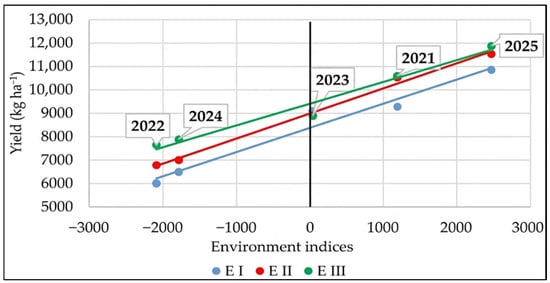
The Eberhart–Russell regression analysis revealed differences in maize adaptation patterns to environmental variability among the three soil temperatures at sowing (Figure 1).
Figure 1.
Yield stability in maize as affected by sowing date. E I, E II and E III represent the first, second and third sowing dates, respectively. Yield is expressed in kg ha−1. Environmental indices (0 = normal environmental conditions; positive values = favourable conditions; negative values = unfavourable conditions).
The environmental index differentiated unfavorable environments (negative values) from favorable environments (positive values), with 2022 and 2024 representing unfavorable environments and 2021 and 2025 representing favorable environments. The regression coefficient (bi) provides an indication of the response of each sowing treatment to changes in environmental productivity. E I (6 °C) and E II (8 °C) showed regression coefficients close to unity, indicating relatively broad adaptation across environments. E III (10 °C) exhibited a regression coefficient below unity (bi ≈ 0.91), indicating a lower sensitivity of yield to environmental improvement and, consequently, a tendency towards better adaptation to less favorable environments.
Importantly, E III maintained the highest regression line across the environmental index range, indicating a superior mean yield compared with E I and E II under both unfavorable and favorable environmental conditions. The 10 °C sowing treatment combined a high yield level with a relatively low response to environmental variation. According to the Eberhart–Russell model, this response pattern suggests good adaptation and yield stability, particularly under less favorable environmental conditions.
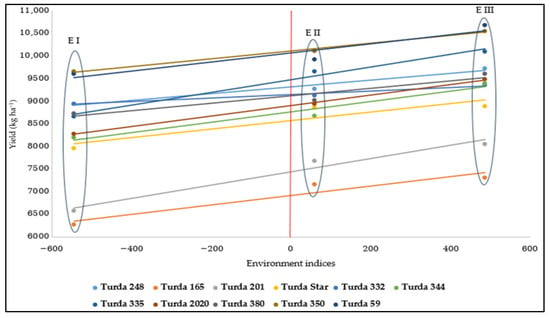
Differences in grain yield among maize hybrids and sowing dates were observed over the five-year study period. Several hybrids, particularly Turda 350, Turda 59 and Turda 335, exhibited comparatively high yield values at certain sowing dates. Among the sowing dates, the third treatment (E III) showed the highest average grain yield and was therefore the most favorable for grain yield under the experimental conditions (Figure 2).
Figure 2.
Yield stability in maize hybrids as affected by sowing date. E I, E II and E III represent the first, second and third sowing dates, respectively. Yield is expressed in kg ha−1. Environmental indices (0 = normal environmental conditions; positive values = favourable conditions; negative values = unfavourable conditions).
Despite variations in precipitation over the five years analyzed, sowing at the first sowing date (E I) resulted in yields exceeding 6000 kg ha−1, even under limited-moisture conditions and moderate fertilization. The use of hybrids with a longer growing season may contribute to more efficient use of climatic resources and higher yield potential when combined with an appropriate sowing date. Thus, optimizing sowing time and selecting suitable hybrids represent sustainable strategies for increasing productivity and achieving yields above 10,000 kg ha−1.
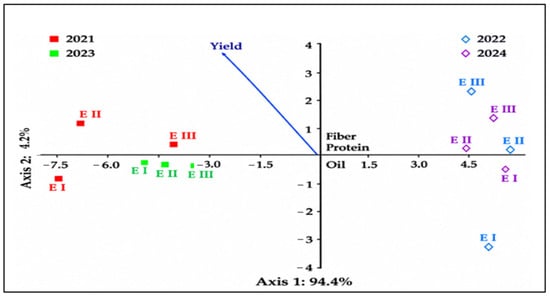
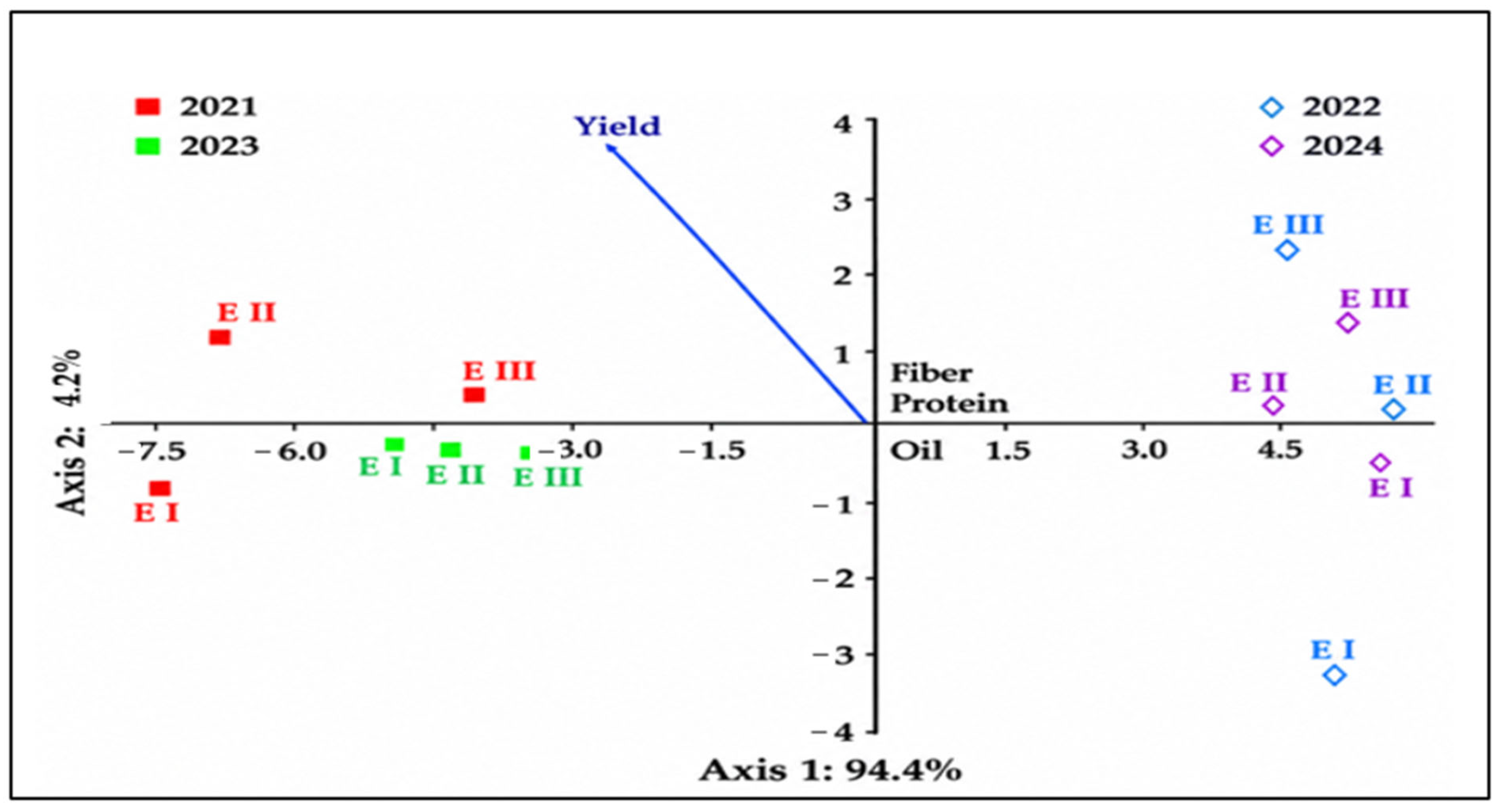
The LDA indicated that variability in maize yield and quality indicators was determined primarily by the specific pedoclimatic conditions of the growing year and, to a lesser extent, by soil temperature at sowing (Figure 3).
Figure 3.
Linear discriminant analysis (LDA) of four growing seasons (2021, 2022, 2023, 2024). E I represents sowing at 6 °C, E II represents sowing at 8 °C, and E III represents sowing at 10 °C.
The first discriminant axis, which explains 94.4% of the total variation, clearly separates the favorable years (2021 and 2023) from the unfavorable years (2022 and 2024), with the treatments from the favorable years being associated with the direction of the Yield vector. This result confirms the predominant role of environmental conditions during the growing season in determining yield performance. The differentiation among sowing temperatures of 6 °C, 8 °C, and 10 °C is reflected mainly by Axis 2, which explains only 2.4% of the variation, suggesting a smaller effect compared with the influence of the growing year. The different positions of treatments E I, E II, and E III across years also indicate the possible existence of an interaction between sowing temperature and the climatic conditions of the respective growing year.
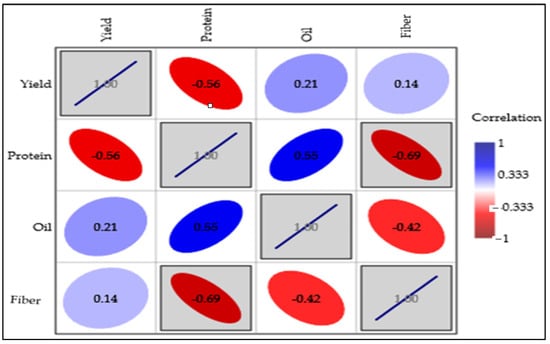
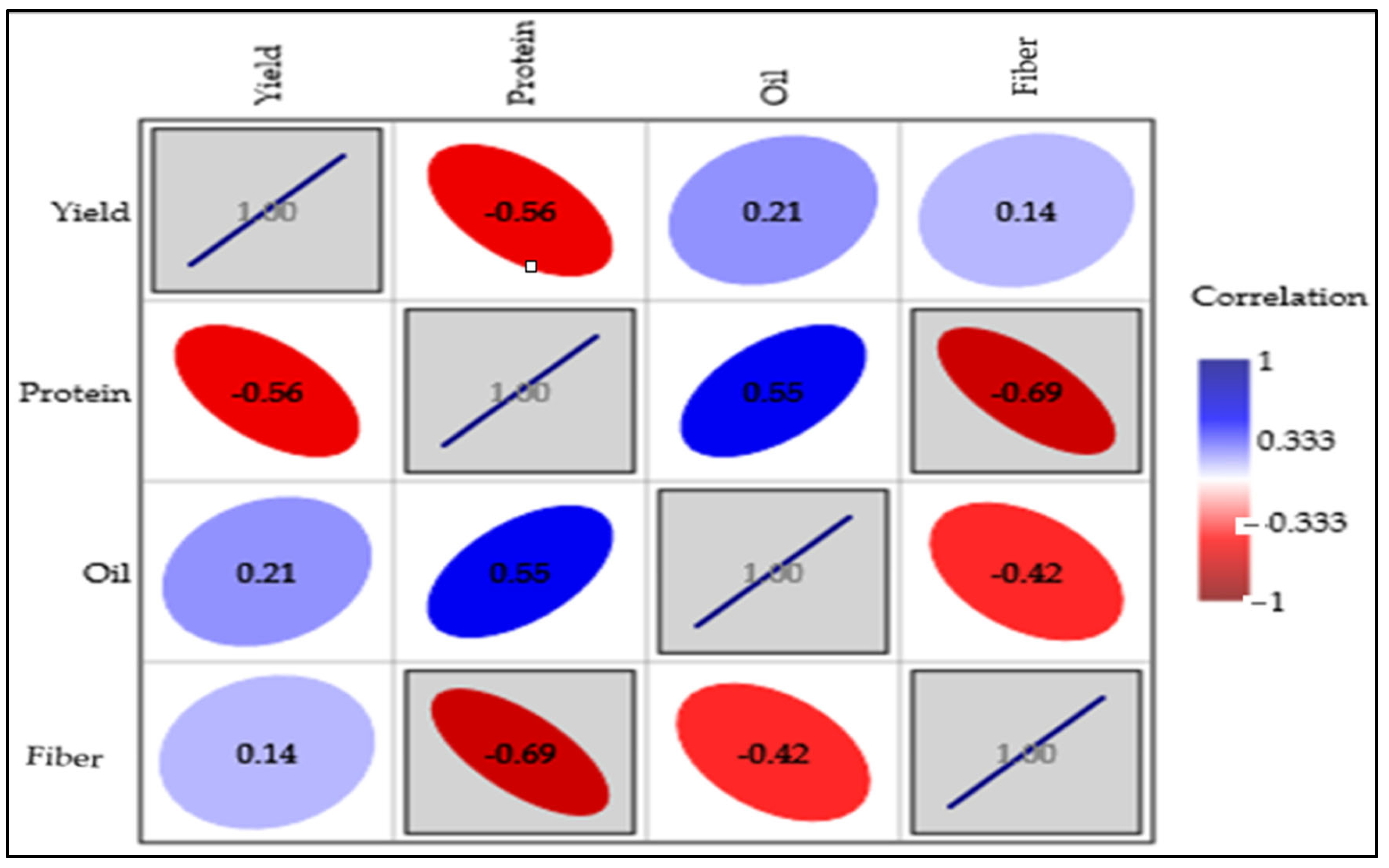
The Pearson correlation analysis revealed a negative association between yield and protein content, whereas yield was positively correlated with oil and fiber contents (Figure 4). A particularly strong negative correlation was observed between protein and fiber contents, indicating that higher protein levels were closely associated with lower fiber levels.
Figure 4.
Correlation matrix showing Pearson’s correlation coefficients between grain quality traits (protein, oil, and fiber) and maize yield. Positive correlations are indicated by warmer colors, and negative correlations by cooler colors, while the intensity of color reflects the strength of the association. Correlations were considered statistically significant at p < 0.05.
4. Discussion
Sowing date is a key agronomic factor influencing the productivity of agricultural crops, as it determines the environmental conditions under which plants undergo the main stages of their growth cycle. Selecting the optimal date for sowing allows for the synchronization of plant development phases with periods that are favorable in terms of temperature and moisture, thereby facilitating a more effective utilization of water, light and nutrient resources. Adjusting the sowing date can affect crop phenology and the timing of critical developmental stages—particularly flowering and grain filling—thereby influencing the extent to which plants are exposed to high temperatures and water stress [37,38].
The effect of soil temperature at sowing on maize yield varied considerably among experimental years, indicating that yield responses were influenced by growing-season conditions. In 2021, 2022, and 2024, increasing soil temperature from 6 °C to 10 °C was associated with higher yields, with the trend being more pronounced in 2022 and 2024. In contrast, in 2023, the earliest sowing date resulted in a slightly higher yield, differing from the trends observed in the other years. This finding is consistent with Zou et al. [39] who reported that early sowing can increase yield by extending the period during which the crop benefits from favorable growing conditions. A more consistent response was observed in 2025, when yield increased with soil temperature at sowing, although differences among treatments remained moderate. This interannual variability may also reflect differences in hybrid genetic characteristics that contribute to yield variation [23,40]. The results obtained during the 2021–2025 period underscore the importance of optimizing the maize sowing date as a potential adaptation strategy for sustainable yield under variable climatic conditions. The year-to-year differences indicate that the benefits of adjusting the sowing date depend on the specific conditions of each season, rather than following a uniform pattern. From a sustainability perspective, identifying sowing windows that favor high yields under contrasting climatic conditions can help farmers adapt their crop management to climatic variability and enhance the stability of maize yield.
These results highlight that the productive response of maize to soil temperature at the time of sowing is not constant, but is strongly dependent on the pedoclimatic conditions that characterize the growing season; according to [41], combined heat and drought stress, which generally manifests concurrently, led to an 18.75% reduction in maize yield, this proving more harmful than drought or heat stress taken in isolation [42]. Sowing maize at a specific time—in order to capitalize on peak precipitation and an optimal sum of thermal units required by hybrids with high yield potential—can contribute to the development of more resilient and sustainable agricultural production systems, in line with the principles of sustainable development promoted by the United Nations’ 2030 Agenda. The general trend of obtaining higher yields when sowing in heated soil, observed in most years, can be associated with more favorable conditions for germination, emergence and crop establishment. Previous studies have shown that the effects of sowing dates on maize yield depend on the interaction between climatic conditions, hybrid characteristics, and other crop management practices [43,44]. At the same time, the different response observed in 2023 suggests that, under certain environmental conditions, earlier sowing can maintain or even favor the productive potential of the crop. Therefore, the establishment of the optimal sowing time must be analyzed in relation to the climatic conditions specific to each season and not exclusively based on the soil temperature at the time of the establishment of the crop. Maize is a crop with a high water demand, particularly during the grain-filling stage; consequently, there is a direct relationship between maize yield and the amount of precipitation recorded in July [45]. The variability in precipitation [46] during this period—which encompasses the development of reproductive organs through the onset of grain filling—contributed to higher average yields in 2021, 2023, and 2025.
The results obtained over the five-year study period (Figure 2) revealed differences in grain yield among maize hybrids and sowing dates, highlighting the importance of both genotype selection and sowing time in optimizing crop productivity. Among the hybrids evaluated, Turda 350, Turda 59, and Turda 335 showed comparatively high yield values at specific sowing dates, suggesting that their productive performance may depend on the interaction between genetic potential and environmental conditions.
The results indicate that soil temperature at sowing influenced the qualitative composition of maize kernels, in contrast to other studies, which showed that protein, fat and fiber contents were not significantly influenced by the sowing date [47], but the intensity and direction of response varied more depending on the crop year. Sowing at 10 °C (E III) was generally associated with higher protein and oil accumulations, particularly in the years 2021 and 2024, while the response at 6 °C (E I) was more variable, with higher protein and oil content values in 2022. In the case of fibres, the dynamics were less constant, with different responses being observed from one year to the next. The results of other studies showed that in the years when the water available to plants was higher and the oil content increased, water being a critical element in changing the oil content of grains [48]. These variations highlight the fact that the influence of temperature at sowing on grain quality cannot be interpreted independently of the environmental conditions of the period after sowing. In this sense, the significant interaction of Year × Sowing era identified by analysis of variance confirms that the response of quality parameters was dependent on the specific conditions of each crop year.
The results of the regression analysis revealed a differentiated response of the maize crop to variations in environmental conditions, as a function of soil temperature at the time of sowing. Although existing scientific studies suggest that in the context of future climate change warming environmental conditions could favor an earlier sowing date for maize in Europe [44], the results of our study highlight a trend that differs from these projections. This variability confirms the important influence of environmental conditions on the expression of the productive potential of the crop, with some studies indicating that a delayed sowing date can influence certain phases of development, with the reduction in negative effects of high temperatures during the stage of occurrence of silking and potentially increasing the yield of maize [49,50].
The relatively high grain yields recorded for the Turda 350 and Turda 59 hybrids in this study can be analyzed in terms of their yield potential and adaptation to growing conditions in Romania; they may be considered for cultivation within a sustainable agricultural system that relies primarily on natural rainfall and involves limited fertilization. Furthermore, refs. [51,52] reported high productivity and relatively good yield stability for these hybrids under contrasting climatic conditions. Nevertheless, the performance of each hybrid must be evaluated in relation to the sowing date and the annual variability of environmental conditions, as their yield potential may not manifest consistently across different growing environments.
The regression coefficients for the 6 °C (E I) and 8 °C (E II) sowing variants were close to 1, indicating a relatively proportional yield response to changes in environmental favorability and suggesting broader adaptability. In the case of maize sown at 10 °C, the regression coefficient below unity (bi ≈ 0.91) suggests a lower variation in production relative to changes in environmental favorability, in contrast to those stated by ref. [53] who recorded a lower grain yield in the case of delayed sowing.
The results for E I are consistent with findings from similar studies, which show that when sowing occurs earlier, the coefficient of variation is higher, indicating an unstable period with lower yields [54,55], particularly due to the fact that variability in climatic conditions has caused early-sown maize to be exposed to lower temperatures [56].
A relevant element for the interpretation of the results is the superior positioning of the regression line corresponding to the E III variant over the entire range of the environmental index. This distribution indicates that sowing at a soil temperature of 10 °C was associated with higher mean production values in both unfavorable and favorable environments. By simultaneously relating the level of production to the regression coefficient, the results suggest that this variant combined high productive potential with relatively little variation in response to changes in environmental conditions. Overall, the behaviour observed for E III indicates a favourable adaptation to paedoclimatic conditions characterised by a variability of the environment, with a particular advantage in situations where vegetation conditions are less favourable.
Linear discriminant analysis (LDA) indicated that differences among experimental variants in grain yield and major quality traits were largely associated with climatic conditions during the respective growing seasons. Although maize is a light- and heat-demanding crop, prolonged exposure to temperatures above 35 °C can impair plant development, particularly during flowering and grain filling, leading to substantial yield reductions [57]. During flowering, drought [58,59] and high temperatures [60,61] can significantly affect the reproductive process of corn by reducing pollen fertility, which causes significant production losses and decreased crop yield. Although the maize plants were exposed to periods of limited rainfall and high temperatures—including heatwaves during critical developmental stages—the hybrids maintained a good level of yield, likely due to soil water reserves and their adaptation to local climatic conditions, as reflected in their genetic background; however, the lack of physiological measurements limits the ability to confirm the mechanisms underlying the observed tolerance to these stress conditions.
Compared with crop year, soil temperature at sowing contributed substantially less to the differentiation of experimental variants, with its effect primarily reflected along the second discriminant axis, which explained 2.4% of the total variability. Nevertheless, previous studies have shown that exposure to low temperatures triggers physiological and biochemical changes in plants that contribute to long-term stress acclimation [62].
However, the different distributions of treatments E I, E II, and E III across the years analyzed suggest that crop responses to soil temperature at sowing are not constant, but may vary according to the pedoclimatic conditions specific to each season, the choice of the best time for planting being important for crop productivity, since planting dates are influenced by temperature [63].
Optimizing the timing of maize sowing represents a potential adaptation strategy for sustainable production, given increasingly pronounced climatic variability. By correlating soil temperature thresholds with soil water reserves, farmers can better align the crop establishment phase with prevailing thermal conditions, which may improve both germination and subsequent plant development. Identifying sowing windows that ensure satisfactory yield and grain quality—regardless of the specific growing season—can contribute to greater production resilience under variable climatic conditions. Furthermore, considering both yield and grain quality—including protein, oil, and fiber content—can facilitate more efficient use of agricultural land and production resources.
Pearson correlation analysis revealed distinct relationships between production and the main quality indicators analyzed. Maize grain yield showed a negative correlation with protein content, while the positive relationships identified with oil and fiber content suggest a favourable association between productivity and these parameters. At the same time, the strong negative correlation between protein and fiber content indicates an inverse relationship between the two components, with higher protein content values being associated with lower fiber levels, according to the data presented by [64], but in contrast to the results presented by [65]. These results highlight the existence of important interrelationships between the yield and chemical composition of grains, which can contribute to the characterization of the crop response under the experimental conditions analyzed. This relationship could be the result of factor interaction, as [66] also state that improper sowing data impacts crude protein and starch accumulation.
A major limitation of this study is that the experiment was conducted at a single location; therefore, the influence of site-specific pedoclimatic conditions cannot be completely separated from the effect of the sowing date. In this context, extending research to additional locations would allow for a more robust assessment of the interaction between sowing time and pedoclimatic conditions. Also, the achievement of different soil temperatures occurs at distinct calendar times, which makes it difficult to delimit the actual effect of the sowing temperature from the influence of the climatic conditions specific to the period in which it was reached. An additional limitation is represented by the predominant evaluation of production and quality indicators, without the inclusion of detailed physiological determinations, such as emergence dynamics, biomass accumulation, root system development or water use efficiency. The inclusion of these parameters in future research could contribute to a better understanding of the physiological mechanisms by which the sowing date influences the development and productivity of maize cultivation.
5. Conclusions
The five-year evaluation showed that the maize yield response to sowing date was strongly influenced by growing-season conditions. In most years, higher soil temperatures at sowing were associated with increased grain yield, although the magnitude of this response varied across years. Among the treatments, E III (10 °C soil temperature) was associated with favorable yields and a relatively stable response across environments. These findings suggest that the yield response to sowing time depends not only on soil temperature at sowing but also on environmental conditions during subsequent crop development.
Sowing maize from the last ten days of April to the second ten days of May (E II and E III) yielded the best results in terms of production, as it allowed for the partial avoidance of drought periods during the reproductive phases and facilitated more effective use of the hybrids’ productive potential.
Grain quality parameters also varied according to both sowing time and experimental year. The 10 °C treatment generally favored protein and oil accumulation, whereas fiber content showed no consistent response across the experimental years. The significant Year × Sowing Time interaction and the results of the discriminant analysis confirmed that annual environmental variation played an important role in determining differences in both yield and grain quality. The observed relationships among yield, protein, oil and fiber contents further indicate that changes in grain productivity may be associated with shifts in its chemical composition.
Overall, the findings suggest that sowing decisions should account for both soil temperature at sowing and subsequent growing-season conditions. Under the conditions of this study, sowing at a soil temperature of 10 °C was associated with favorable yield performance, relatively high stability, and improvements in selected grain quality traits. However, this temperature should not be regarded as a universally optimal sowing threshold, as the response may vary with environmental conditions.
Author Contributions
Conceptualization, A.Ș. and C.U.; methodology, P.I.M., A.P. and T.R.; software, F.C. and I.B.; validation, T.R. and C.U.; formal analysis, A.P., A.I.P. and I.B.; investigation, A.Ș., C.U. and A.P.; resources, P.I.M. and A.Ș.; data curation, P.I.M. and A.I.P.; writing—original draft preparation, A.Ș. and C.U.; writing—review and editing, F.C. and I.B.; visualization, T.R. and A.I.P.; supervision, F.C. and P.I.M.; project administration, A.Ș. and C.U.; funding acquisition, P.I.M. All authors have read and agreed to the published version of the manuscript.
Funding
This research received no external funding.
Institutional Review Board Statement
Not applicable.
Informed Consent Statement
Not applicable.
Data Availability Statement
The original contributions presented in this study are included in the article. Further inquiries can be directed to the corresponding author.
Acknowledgments
We would like to thank the Agricultural Research and Development Station Turda for facilitating the field experiments.
Conflicts of Interest
The authors declare no conflicts of interest.
References
- Duan, J.-Q.; Yuan, J.-S.; Xu, X.-W.; Ju, H. Interpretation of the IPCC AR6 Report on Agricultural Systems. Adv. Clim. Change Res. 2022, 18, 422. [Google Scholar]
- Rolle, M.; Tamea, S.; Claps, P.; Ayari, E.; Baghdadi, N.; Zribi, M. Analysis of Maize Sowing Periods and Cycle Phases Using Sentinel 1&2 Data Synergy. Remote Sens. 2022, 14, 3712. [Google Scholar] [CrossRef] [Scilit]
- Lezoche, M.; Hernandez, J.E.; Alemany Díaz, M.D.M.E.; Panetto, H.; Kacprzyk, J. Agri-Food 4.0: A Survey of the Supply Chains and Technologies for the Future Agriculture. Comput. Ind. 2020, 117, 103187. [Google Scholar] [CrossRef] [Scilit]
- Li, Y.; Guan, K.; Peng, B.; Franz, T.E.; Wardlow, B.; Pan, M. Quantifying Irrigation Cooling Benefits to Maize Yield in the US Midwest. Glob. Change Biol. 2020, 26, 3065–3078. [Google Scholar] [CrossRef] [Scilit]
- Croci, M.; Impollonia, G.; Meroni, M.; Amaducci, S. Dynamic Maize Yield Predictions Using Machine Learning on Multi-Source Data. Remote Sens. 2022, 15, 100. [Google Scholar] [CrossRef] [Scilit]
- Monteiro, J.E.B.D.A.; Assad, E.D.; Sentelhas, P.C.; Azevedo, L.D.C. Modeling of Corn Yield in Brazil as a Function of Meteorological Conditions and Technological Level. Pesq. Agropec. Bras. 2017, 52, 137–148. [Google Scholar] [CrossRef] [Scilit]
- Vogel, E.; Donat, M.G.; Alexander, L.V.; Meinshausen, M.; Ray, D.K.; Karoly, D.; Meinshausen, N.; Frieler, K. The Effects of Climate Extremes on Global Agricultural Yields. Environ. Res. Lett. 2019, 14, 054010. [Google Scholar] [CrossRef] [Scilit]
- Barna, F.M.; Manescu, A.C. The Impact of Drought Risk on Maize Crop in Romania. Sustainability 2025, 17, 8870. [Google Scholar] [CrossRef] [Scilit]
- Lesk, C.; Anderson, W.; Rigden, A.; Coast, O.; Jägermeyr, J.; McDermid, S.; Davis, K.F.; Konar, M. Compound Heat and Moisture Extreme Impacts on Global Crop Yields under Climate Change. Nat. Rev. Earth Environ. 2022, 3, 872–889. [Google Scholar] [CrossRef] [Scilit]
- Zhang, Y.; Chen, X.; Geng, S.; Zhang, X. A Review of Soil Waterlogging Impacts, Mechanisms, and Adaptive Strategies. Front. Plant Sci. 2025, 16, 1545912. [Google Scholar] [CrossRef] [Scilit]
- Dunăreanu, I.C.; Bonea, D. Adaptability of maize hybrids in the central part of Oltenia, Romania, under combined drought and heat conditions. Sci. Pap. Ser. Manag. Econ. Eng. Agric. Rural Dev. 2024, 24, 289. [Google Scholar]
- Tsimba, R.; Edmeades, G.O.; Millner, J.P.; Kemp, P.D. The Effect of Planting Date on Maize: Phenology, Thermal Time Durations and Growth Rates in a Cool Temperate Climate. Field Crops Res. 2013, 150, 145–155. [Google Scholar] [CrossRef] [Scilit]
- Vălean, A.-M.; Tritean, N.; Șopterean, L.; Tărău, A.; Șimon, A.; Crișan, I.; Russu, F.; Suciu, L.; Trifan, D. Influence of Green Manures and Fertilization on Maize (Zea mays L.) Yield and Quality. Nitrogen 2026, 7, 66. [Google Scholar] [CrossRef] [Scilit]
- Rymuza, K.; Radzka, E.; Kapela, K.; Gugała, M. Yield Formation and Stability of Maize Under Monoculture in Response to Biological Amendments, Weather Variability and Cultivar Maturity. Sustainability 2026, 18, 2542. [Google Scholar] [CrossRef] [Scilit]
- Corn | USDA Foreign Agricultural Service. Available online: https://www.fas.usda.gov/data/production/0440000 (accessed on 20 October 2026).
- FAOSTAT. Available online: https://www.fao.org/faostat/en/#home (accessed on 21 October 2026).
- Erenstein, O.; Jaleta, M.; Sonder, K.; Mottaleb, K.; Prasanna, B.M. Global Maize Production, Consumption and Trade: Trends and R&D Implications. Food Secur. 2022, 14, 1295–1319. [Google Scholar] [CrossRef] [Scilit]
- Sun, X.; Zhao, Q.; Gao, J.; Liu, Z. The Physiological Mechanisms and Hurdles of Efficient Water–Nitrogen Utilization in Maize Production: A Review. Plants 2025, 14, 1899. [Google Scholar] [CrossRef] [Scilit]
- Zhao, Z.-W.; Leng, P.; Han, X.-J.; Shang, G.-F. Global Maize Yield Responses to Essential Climate Variables: Assessment Using Atmospheric Reanalysis and Future Climate Scenarios. Comput. Electron. Agric. 2025, 232, 110140. [Google Scholar] [CrossRef] [Scilit]
- Kamali, B.; Abbaspour, K.C.; Wehrli, B.; Yang, H. Drought Vulnerability Assessment of Maize in Sub-Saharan Africa: Insights from Physical and Social Perspectives. Glob. Planet. Change 2018, 162, 266–274. [Google Scholar] [CrossRef] [Scilit]
- Taddese, A.T.; Shanka, D. Climate Change Impacts on Maize Production and Food Security: Integrating Climate-Smart Agriculture and Modeling Approaches for Sustainable Adaptation. Adv. Agric. 2026, 2026, 3471134. [Google Scholar] [CrossRef] [Scilit]
- Transforming Our World: The 2030 Agenda for Sustainable Development | Department of Economic and Social Affairs. Available online: https://sdgs.un.org/2030agenda (accessed on 21 October 2026).
- Tang, H.; Xie, X.; Zhang, L.; Liu, C. Assessing the Influence of Planting Dates on Sustainable Maize Production under Drought Stress Conditions. Sustainability 2024, 16, 4571. [Google Scholar] [CrossRef] [Scilit]
- Verma, N.K. Integrated Nutrient Management in Winter Maize (Zea mays L.) Sown at Different Dates. J. Plant Breed. Crop Sci. 2011, 3, 161–167. [Google Scholar]
- Domokos, Z.; Șimon, A.; Chețan, F.; Ceclan, O.A.; Filip, E.; Călugăr, R.E.; Vâtcă, S.D.; Duda, M.M. The Influence of Sowing Date on the Primary Yield Components of Maize. Agronomy 2024, 14, 2120. [Google Scholar] [CrossRef] [Scilit]
- Ying-hua, J.I.N.; Dao-wei, Z.; Li-jie, Q.I.N. Sowing Date of Corn in Semiarid Region of Jilin Province, Northeast China in Adapting to Climate Change. Chin. J. Appl. Ecol. 2012, 23, 2795. [Google Scholar]
- Solaimalai, A.; Arunkumar, N.; Jeyakumar, M.; Jawahar, D. Effect of Dates of Sowing and Integrated Nutrient Management Practices on Growth, Yield Attributes and Yield of Hybrid Maize under Rainfed Vertisol of Tamil Nadu. Life Sci. 2016, 5, 3456–3460. [Google Scholar]
- Cammarano, D.; Tian, D. The Effects of Projected Climate and Climate Extremes on a Winter and Summer Crop in the Southeast USA. Agric. For. Meteorol. 2018, 248, 109–118. [Google Scholar] [CrossRef] [Scilit]
- Wu, W.; Yue, W.; Bi, J.; Zhang, L.; Xu, D.; Peng, C.; Chen, X.; Wang, S. Influence of Climatic Variables on Maize Grain Yield and Its Components by Adjusting the Sowing Date. Front. Plant Sci. 2024, 15, 1411009. [Google Scholar] [CrossRef] [Scilit]
- Dadrasi, A.; Soltani, E.; Makowski, D.; Lamichhane, J.R. Does Shifting from Normal to Early or Late Sowing Dates Provide Yield Benefits? A Global Meta-Analysis. Field Crops Res. 2024, 318, 109600. [Google Scholar] [CrossRef] [Scilit]
- Vâtcă, S.D.; Stoian, V.A.; Man, T.C.; Horvath, C.; Vidican, R.; Gâdea, Ș.; Vâtcă, A.; Rotaru, A.; Vârban, R.; Cristina, M.; et al. Agrometeorological Requirements of Maize Crop Phenology for Sustainable Cropping—A Historical Review for Romania. Sustainability 2021, 13, 7719. [Google Scholar] [CrossRef] [Scilit]
- State Institute for Variety Testing and Registration (SIVTR) Bucharest. Available online: https://istis.ro/ (accessed on 10 September 2026).
- Chețan, F.; Chețan, C.; Bogdan, I.; Moraru, P.I.; Pop, A.I.; Rusu, T. Use of Vegetable Residues and Cover Crops in the Cultivation of Maize Grown in Different Tillage Systems. Sustainability 2022, 14, 3609. [Google Scholar] [CrossRef] [Scilit]
- Ontel, I.; Cheval, S.; Irimescu, A.; Boldeanu, G.; Amihaesei, V.-A.; Mihailescu, D.; Nertan, A.; Angearu, C.-V.; Craciunescu, V. Assessing the Recent Trends of Land Degradation and Desertification in Romania Using Remote Sensing Indicators. Remote Sens. 2023, 15, 4842. [Google Scholar] [CrossRef] [Scilit]
- Fact, P. ANOVA and Duncan’s Test PC Program for Variant Analyses Made for Completely Randomized Polyfactorial Experiences; USAMV: Cluj-Napoca, Romania, 2015. [Google Scholar]
- Eberhart, S.A.; Russell, W.A. Stability Parameters for Comparing Varieties. Crop Sci. 1966, 6, 36–40. [Google Scholar] [CrossRef] [Scilit]
- Abaza, A.S.D.; Elshamly, A.M.S.; Alwahibi, M.S.; Elshikh, M.S.; Ditta, A. Impact of Different Sowing Dates and Irrigation Levels on NPK Absorption, Yield and Water Use Efficiency of Maize. Sci. Rep. 2023, 13, 12956. [Google Scholar] [CrossRef] [Scilit]
- Busschaert, L.; Deketelaere, V.; Thiery, W.; Raes, D.; De Lannoy, G.J.M. Future Projections of European Maize Yields Using AquaCrop with an Adaptive Growing Season. Eur. J. Agron. 2026, 173, 127920. [Google Scholar] [CrossRef] [Scilit]
- Zou, J.; Cui, Z.Y.; Yi, X.; Zhu, X. Comparison of Grain Dehydration Process and Yield Formation for Summer Maize under Different Sowing Dates in Huanghuaihai Plain. Chin. J. Agrometeorol. 2022, 43, 112. [Google Scholar]
- Qi, J.; Wei, B.; Wang, C.; Ma, Y. A Study on Comprehensive Evaluation of Corn Hybrids. J. Jilin Agric. Univ. 2003, 25, 139–142. [Google Scholar]
- Lawas, L.M.F.; Zuther, E.; Jagadish, S.K.; Hincha, D.K. Molecular Mechanisms of Combined Heat and Drought Stress Resilience in Cereals. Curr. Opin. Plant Biol. 2018, 45, 212–217. [Google Scholar] [CrossRef] [Scilit]
- Li, E.; Zhao, J.; Pullens, J.W.M.; Yang, X. The Compound Effects of Drought and High Temperature Stresses Will Be the Main Constraints on Maize Yield in Northeast China. Sci. Total Environ. 2022, 812, 152461. [Google Scholar] [CrossRef] [Scilit]
- Partal, E.; Oltenacu, C.; Petcu, V. The influence of sowing date and plant density on maize yield and quality in the context of climate change in Southern Romania. Sci. Pap. Ser. A Agron. 2021, 64, 508–514. [Google Scholar]
- Minoli, S.; Jägermeyr, J.; Asseng, S.; Urfels, A.; Müller, C. Global Crop Yields Can Be Lifted by Timely Adaptation of Growing Periods to Climate Change. Nat. Commun. 2022, 13, 7079. [Google Scholar] [CrossRef] [Scilit]
- Șimon, A.; Moraru, P.I.; Ceclan, A.; Russu, F.; Chețan, F.; Bărdaș, M.; Popa, A.; Rusu, T.; Pop, A.I.; Bogdan, I. The Impact of Climatic Factors on the Development Stages of Maize Crop in the Transylvanian Plain. Agronomy 2023, 13, 1612. [Google Scholar] [CrossRef] [Scilit]
- Affoh, R.; Zheng, H.; Zhang, X.; Yu, W.; Qu, C. Influences of Meteorological Factors on Maize and Sorghum Yield in Togo, West Africa. Land 2022, 12, 123. [Google Scholar] [CrossRef] [Scilit]
- Szulc, P.; Ambroży-Deręgowska, K.; Selwet, M.; Kolańska, K.; Wąsala, R.; Górecki, K. Yield and Chemical Composition of Maize (Zea mays L.) Green Fodder Depending on Different Sowing Dates as an Element of Sustainable Agriculture. Agronomy 2026, 16, 1300. [Google Scholar] [CrossRef] [Scilit]
- Jahangirlou, M.R.; Akbari, G.A.; Alahdadi, I.; Soufizadeh, S.; Parsons, D. Grain Quality of Maize Cultivars as a Function of Planting Dates, Irrigation and Nitrogen Stress: A Case Study from Semiarid Conditions of Iran. Agriculture 2020, 11, 11. [Google Scholar] [CrossRef] [Scilit]
- Tian, B.; Zhu, J.; Nie, Y.; Xu, C.; Meng, Q.; Wang, P. Mitigating Heat and Chilling Stress by Adjusting the Sowing Date of Maize in the North China Plain. J. Agron. Crop Sci. 2019, 205, 77–87. [Google Scholar] [CrossRef] [Scilit]
- Guo, D.; Chen, C.; Li, X.; Wang, R.; Ding, Z.; Ma, W.; Wang, X.; Li, C.; Zhao, M.; Li, M.; et al. Adjusting Sowing Date Improves the Photosynthetic Capacity and Grain Yield by Optimizing Temperature Condition around Flowering of Summer Maize in the North China Plain. Front. Plant Sci. 2022, 13, 934618. [Google Scholar] [CrossRef] [Scilit]
- Ceclan, A.; Călugăr, R.; Varga, A.; Vana, C.; Urda, C.; Has, V.; Muntean, L. The Yield and Grains Quality of Some Maize Hybrids Created at ARDS Turda. Sci. Pap. Ser. A Agron. 2024, LXVII, 134–141. [Google Scholar]
- Călugăr, R.E.; Varga, A.; Vana, C.D.; Ceclan, L.A.; Racz, I.; Chețan, F.; Șimon, A.; Popa, C.; Tritean, N.; Russu, F.; et al. Influence of Changing Weather on Old and New Maize Hybrids: A Case Study in Romania. Plants 2024, 13, 3322. [Google Scholar] [CrossRef] [Scilit]
- Shahzad Ali, S.A.; Inamullah, I.; Amanullah Jan, A.J.; Miftahud Din, M.D.; Muhammad Habibullah, M.H. Yield Response of Maize (Zea mays L.) Hybrids Sown on Various Dates during Kharif in Peshawar-Pakistan. J. Environ. Earth Sci. 2015, 5, 13–17. [Google Scholar]
- Li, W.; Liu, W.; Huang, Y.; Xiao, W.; Xu, L.; Pan, K.; Fu, G.; Chen, X.; Li, C. Modeling the Effects of Sowing Dates on Maize in Different Environments in the Tropical Area of Southwest China Using DSSAT. Agronomy 2024, 14, 2819. [Google Scholar] [CrossRef] [Scilit]
- Lv, Z.; Li, F.; Lu, G. Adjusting Sowing Date and Cultivar Shift Improve Maize Adaption to Climate Change in China. Mitig. Adapt. Strateg. Glob. Change 2020, 25, 87–106. [Google Scholar] [CrossRef] [Scilit]
- Jiang, L.; Wang, M.; Chu, Z.; Gao, Y.; Guo, L.; Ji, S.; Jiang, L.; Gong, L. Effects of Temperature on Growth and Grain Maturity of Spring Maize in Northeast China: A Study of Different Sowing Dates. Atmosphere 2023, 14, 1755. [Google Scholar] [CrossRef] [Scilit]
- Noor, J.J.; Vinayan, M.T.; Umar, S.; Devi, P.; Iqbal, M.; Seetharam, K.; Zaidi, P.H. Morpho-Physiological Traits Associated with Heat Stress Tolerance in Tropical Maize (Zea mays L.) at Reproductive Stage. Aust. J. Crop Sci. 2019, 13, 536–545. [Google Scholar] [CrossRef] [Scilit]
- Călugăr, R.E.; Varga, A.; Vana, C.D.; Ceclan, L.A.; Chețan, F.; Fodor, A.; Tritean, N. Using Flint Maize for Developing New Hybrids: A Case Study in Romania. Agronomy 2025, 15, 2215. [Google Scholar] [CrossRef] [Scilit]
- Božić, M.; Ignjatović Micić, D.; Kostadinović, M.; Milovanović, M.; Grčić, N.; Čanak, P.; Nikolić, A. Low-Temperature Stress Signatures in Maize During Emergence: Linking Osmoprotectants, Antioxidative Enzymes, and Photosynthetic Performance. Biology 2026, 15, 1634. [Google Scholar] [CrossRef] [Scilit]
- Petrović, G.; Ivanović, T.; Knežević, D.; Radosavac, A.; Obhođaš, I.; Brzaković, T.; Golić, Z.; Dragičević Radičević, T. Assessment of Climate Change Impact on Maize Production in Serbia. Atmosphere 2023, 14, 110. [Google Scholar] [CrossRef] [Scilit]
- Mahmood, A.; Wang, W.; Ali, I.; Zhen, F.; Osman, R.; Liu, B.; Liu, L.; Zhu, Y.; Cao, W.; Tang, L. Individual and Combined Effects of Booting and Flowering High-Temperature Stress on Rice Biomass Accumulation. Plants 2021, 10, 1021. [Google Scholar] [CrossRef] [Scilit]
- Xu, Y.; Fu, X. Reprogramming of Plant Central Metabolism in Response to Abiotic Stresses: A Metabolomics View. Int. J. Mol. Sci. 2022, 23, 5716. [Google Scholar] [CrossRef] [Scilit]
- Harrison, L.; Michaelsen, J.; Funk, C.; Husak, G. Effects of Temperature Changes on Maize Production in Mozambique. Clim. Res. 2011, 46, 211–222. [Google Scholar] [CrossRef] [Scilit]
- Chaudhary, D.P.; Kumar, A.; Kumar, R.; Singode, A.; Mukri, G.; Sah, R.P.; Tiwana, U.S.; Kumar, B. Evaluation of Normal and Specialty Corn for Fodder Yield and Quality Traits. Range Manag. Agrofor. 2016, 37, 79–83. [Google Scholar]
- Wang, X.; Liu, S.; Yin, X.; Bellaloui, N.; Winings, J.H.; Agyin-Birikorang, S.; Singh, U.; Sanabria, J.; Mengistu, A. Maize Grain Composition with Additions of NPK Briquette and Organically Enhanced N Fertilizer. Agronomy 2020, 10, 852. [Google Scholar] [CrossRef] [Scilit]
- Liu, J.; He, Q.; Wu, Y.; Xiao, X.; Sun, W.; Lin, Y.; Yi, R.; Pan, X. The Effect of Sowing Date on the Nutritional Quality of Kernels of Various Maize Varieties in Northeast China. Agronomy 2023, 13, 2543. [Google Scholar] [CrossRef] [Scilit]

Disclaimer/Publisher’s Note: The statements, opinions and data contained in all publications are solely those of the individual author(s) and contributor(s) and not of MDPI and/or the editor(s). MDPI and/or the editor(s) disclaim responsibility for any injury to people or property resulting from any ideas, methods, instructions or products referred to in the content. |
© 2026 by the authors. Licensee MDPI, Basel, Switzerland. This article is an open access article distributed under the terms and conditions of the Creative Commons Attribution (CC BY) license.