


Abstract
Corporate ESG commitments and claims can fail for the same reasons as collective action initiatives for sustainability, yet classroom games usually teach only one of them, the free-rider problem. This paper argues that collective action fails for three distinct reasons and proposes a short game for each. A cheating game, a public goods game played without and then with monitoring, teaches the enforcement gap: contributing is efficient but not individually rational unless non-contribution is detected and sanctioned. A bluffing game, in which firms claim to be green, teaches the verification gap: when claims are free, the word “green” earns no premium until verification makes false claims costly. A hats puzzle followed by a stag hunt teaches the common knowledge gap: conditional cooperation requires that everyone knows that everyone knows, so compliance must be visible. Each game is mapped to the institution that closes its gap, and each gap has a counterpart in corporate practice and financial markets, from net-zero pledges without penalties and unverified ESG disclosures to ESG ratings that coordinate investors’ beliefs. The paper provides payoff tables, equilibrium predictions, debriefing questions, and a teaching note for a 90 min session. The proposal has not yet been evaluated in a classroom.
1. Introduction
Most sustainability problems are collective-action problems. Household waste is sorted or not, emissions are abated or not, and fisheries are restrained or not by many agents whose individual incentives diverge from the collective interest. Sustainability education frameworks accordingly list strategic and interpersonal competence, the capacity to understand collective problems and to act on them with others, among the competencies that graduates should acquire [1]. Classroom games are a natural vehicle for this competence because they let students feel the divergence between individual and collective rationality before it is named, and economics education literature has documented both their popularity and their effect on learning [2,3,4,5,6]. In sustainability teaching, the most common form is a commons game in which students fish a shared pond or harvest a shared forest until the resource collapses, after which the debriefing introduces Hardin’s [7] tragedy of the commons and the free-rider problem.
The limitation of this practice is that it teaches one failure. A student who has played a commons game understands why cooperation that is efficient for the group is not individually rational when defection goes unpunished. That is one of three distinct reasons why collective action fails. The second is that cooperation is often unobservable, so that claims to have cooperated cost nothing and therefore carry no information, with the result that those who would reward cooperation stop rewarding it. The third is that much cooperation is conditional, in that each agent is willing to cooperate only if the others do, and conditional cooperation requires not only that the others cooperate but that everyone knows that everyone will, which private information cannot supply. This paper calls the three the enforcement gap, the verification gap, and the common knowledge gap, respectively. Each corresponds to an established branch of theory: public goods provision and sanctions [8,9,10], strategic information transmission and cheap talk [11,12], and common knowledge and coordination [13,14,15].
The paper proposes one classroom game for each gap, each played first with the gap open and then with an institution that closes it. The cheating game is a public goods game, the bluffing game is a sender–receiver game in which firms claim to be green, and the third game is a hats puzzle followed by a stag hunt. The three games share a single setting, household waste sorting, which every student knows from daily life and which contains all three gaps at once: sorting is costly and hard to attribute to a household, claims about a product’s environmental quality are hard to verify, and sorting is worthwhile only if the neighbors sort too. The same gaps arise when firms make environmental, social, and governance (ESG) claims to investors, so the games can also be used in finance and corporate finance courses. The correspondence between ESG instruments and the parameters of the games, such as a coupon step-up read as a fine, is a pedagogical simplification rather than a model of how these instruments work in practice.
Each of the three games has precedents, and the contribution lies in how they are combined. Classroom public goods games have long been used to teach free riding [2]; a classroom market for lemons shows how quality that buyers cannot observe drives high quality out of a market [16]; and coordination games are among the class experiments collected by Holt [17]. Simulations and serious games are also an established approach in education for sustainability, although most of that literature consists of commentaries and its empirical studies rely mainly on non-experimental designs [18]. In these uses, each game is typically played for its own lesson. The paper adds a classification of collective-action failures into three gaps, each defined by what is missing (incentives, information, or common knowledge) and paired with the institution that supplies it, and a design that teaches the classification: the three games share one setting and one structure, so that students compare three regime changes in a single session and assign real institutions, including ESG disclosure, assurance, and ratings, to the gap that each closes. The novelty lies in the classification and its integration into one learning experience, not in any one game. The paper is a conceptual teaching proposal: it sets out the games, the behavior that theory and prior experiments lead one to expect, and a protocol for evaluating the design, but it reports no classroom data. Section 2 defines the three gaps; Section 3 presents the games and how they are reframed for finance courses; Section 4 gives the implementation guide; and Section 5 discusses what the games teach, what they leave out, and how the design could be evaluated.
2. Three Gaps in Collective Action
Olson [8] showed that a group with a shared interest will not in general act on it, because each member can enjoy the result of the others’ effort without contributing. Hardin [7] gave the argument its best-known image, and Ostrom [9] showed that communities nevertheless do govern shared resources when, among other conditions, members can monitor one another and apply graduated sanctions. In the language of a public goods game, the enforcement gap arises when the marginal per capita return from contributing is below one, so that keeping a token pays more than contributing it even though contributing it raises the group’s total. The gap is closed when the expected sanction for not contributing exceeds the private gain from not contributing. Laboratory evidence on this point is extensive: contributions decay over rounds when nothing can be done about free riders and recover when players can punish them, even at a cost to themselves [10,19,20,21].
The verification gap arises when cooperation cannot be observed by those who would reward it. Many sustainability attributes are credence attributes in the sense of Darby and Karni [22]: a buyer cannot tell whether a product’s supply chain was clean even after using the product. If a firm’s claim to be green costs nothing to make, the claim is cheap talk, and the theory of strategic information transmission [11,12] dictates when such talk can be informative. A message conveys some information if senders of different types send it with different probabilities, and it separates the types fully only if each type sends a different message. When every type prefers to say “green”, the message is uninformative and the receiver ignores it, so claims are made and disbelieved. The economics of greenwashing builds on this logic. Lyon and Maxwell [23] model the firm’s choice of what to disclose under the threat of an audit, and Lyon and Montgomery [24] and Delmas and Burbano [25] review the forms greenwashing takes and the conditions that encourage it. The gap is closed when false claims become costly enough, whether through certification, audit, or liability for misleading advertising, so that the types separate fully and the claim recovers its meaning.
The common knowledge gap arises when cooperation is conditional. If sorting is worthwhile only when one’s neighbors sort too, the interaction is a coordination game of the stag hunt type [26] rather than a prisoner’s dilemma. The game has two equilibria in pure strategies, one in which everyone cooperates and one in which nobody does, and the cooperative equilibrium is reached only if each agent is confident enough that the others will cooperate. Harsanyi and Selten [27] formalized the intuition that the safe equilibrium is selected when that confidence is lacking. The confidence required is of a special kind, because it is not enough that everyone intends to cooperate, nor even that everyone knows that everyone intends to cooperate; each agent must also know that the others know, and so on without end. This infinite regress is the definition of common knowledge [13,28]. Geanakoplos [29] gives an accessible account of why it matters, and Rubinstein [14] showed that a situation in which the regress stops at any finite level, however high, can fail to secure coordination. Chwe [15] drew the institutional conclusion that societies solve coordination problems with public rituals, ceremonies, and visible acts because these generate common knowledge in a way that private communication cannot, so that the common knowledge gap is closed by visibility rather than by sanction or verification. Closing the gap does not by itself produce cooperation. A posted count of the households that sorted their waste is public information when everyone observes it and common knowledge when everyone also sees the others observe it, but conditional cooperation requires a shared expectation that the others will cooperate in the future, and common knowledge of past compliance supports that expectation only when compliance has been high, so a display of low compliance can entrench non-cooperation. Table 1 summarizes the three gaps and the institutions that close them, and the debriefing of each game returns to the corresponding row.
Table 1.
Three gaps in collective action, the game proposed for each, and the institution that closes it.
The three gaps can be told apart by asking what an agent would do if she were certain that the others would cooperate. If she would still defect because defection pays more, regardless of what the others do, the gap is one of enforcement and the problem is incentives. If she would cooperate but lacks that certainty, the gap is one of common knowledge and the problem is beliefs. If cooperation cannot be observed and a claim to have cooperated costs nothing, the gap is one of verification and the problem is information. Monitoring in the first game and verification in the second differ in what the penalty attaches to. Monitoring penalizes an action, the failure to sort, and closes the gap when the expected penalty exceeds the private gain from the action; verification penalizes a message, a false claim, and closes the gap when the expected penalty exceeds what a false claim can earn, while a true claim stays free and the firm’s type is not itself penalized. Both rely on expected penalties and are linked in practice, since a penalty on an action that cannot be observed directly can be applied only after the action has been checked, which is what the audit in the cheating game does; the two gaps are nonetheless distinct, because the penalty that closes each is compared with a different gain. The common knowledge gap needs no penalty, only that compliance be seen by everyone at once. Each game is built so that only one gap is present, but real institutions often work on more than one. External assurance makes false claims costly and, if the assured report is published to all investors at once, also makes the verified information common knowledge. Public disclosure of environmental violations verifies what firms did and adds a reputational sanction, which also closes the enforcement gap when the expected loss of reputation exceeds the gain from the violation. Community-based governance of common-pool resources combines the conditions in a similar way: in the communities studied by Ostrom [9], members monitor one another and apply graduated sanctions, so the monitoring that makes sanctions possible also lets each member observe the others’ compliance. A published ESG rating can coordinate investors’ beliefs because all of them see it at once, but publication does not make it accurate, so a public but poorly verified rating can close the common knowledge gap while leaving the verification gap open. The gaps remain separable in analysis, because each is closed by a different condition even when one institution meets several conditions, and the closing discussion in Section 4 asks students which conditions a given institution meets.
3. Three Games
3.1. Cheating, or the Enforcement Gap
The cheating game is a linear public goods game framed around waste sorting. Students form groups of four players, with a fifth student acting as a recorder who does not play, and participate in repeated rounds. In each round, every member receives ten tokens, interpreted as the time and attention that sorting requires, and chooses privately whether to sort, which places all ten tokens in a group recycling fund, or not to sort, which keeps the ten tokens. The fund is multiplied by two and divided equally among the four members regardless of who contributed. Each contributed token therefore returns 0.5 to the contributor and 2.0 to the group as a whole, so that sorting is efficient for the group and dominated for the individual. The game is called the cheating game because the member who does not sort nevertheless shares in the fund, which is what happens when unsorted waste is placed among the recyclables of a building and nobody can attribute it. Choices are handed face down to the recorder, who keeps the official score and announces only the group total after each round, so that a member can keep the tokens and let the others assume that everyone sorted. Table 2 gives each member’s payoff by individual choice and the number of other members who sort. Not sorting pays five tokens more regardless of what the others do, and this private gain of five tokens is the number that monitoring has to overturn.
Table 2.
Payoffs in the four-player cheating game, by individual choice and number of other members who sort.
After five rounds, monitoring is introduced for five more. In each round, one randomly chosen member of each group is audited, so that each member faces a detection probability of one quarter, and a member who is found not to have sorted pays a fine of 24 tokens, which is removed from the game. Panel B of Table 2 shows the result: the expected fine of 6 tokens exceeds the private gain of 5; the row for not sorting falls below the row for sorting in every column; and sorting becomes the better choice for a student who cares only about tokens. The instructor can vary either parameter between rounds. Halving the fine while keeping detection unchanged or keeping the fine while reducing detection to one in eight brings the expected fine to 3 and restores the incentive not to sort; students then see that the sanction that matters is the product of detection and penalty rather than the penalty alone. The audit checks an action, whether a member sorted, rather than a claim, which is what distinguishes monitoring here from verification in the next game (Section 2). The pattern to be expected, on the basis of the laboratory literature rather than that of observations of this game, is that contributions are substantial in the first rounds, decline as students who sorted observe that others did not, reach their lowest level in the round before monitoring because there is no future to protect, and rise sharply once the audit is introduced [10,20]. Students who continue to sort when it does not pay are not making a mistake, and the debriefing should say so; they reveal that token payoffs are not their only motive, which is itself a lesson about why real sorting rates exceed what the game predicts.
Three debriefing questions organize the discussion. The first asks why a choice that makes everyone better off is not the choice anyone makes, and leads to the distinction between dominance and efficiency. The second asks each student for the smallest expected fine that would have changed their choice, and leads to the condition that the expected sanction must exceed the private gain, which is the enforcement gap stated as an inequality. The third asks why a fine that is large on paper may change nothing: in a building where unsorted waste cannot be attributed to a household, the detection probability is close to zero regardless of the fine, so a pay-as-you-throw system that relies on fines alone leaves the enforcement gap partly open. The most common student error is to conclude that people are selfish or that contributors are irrational, and the debriefing should redirect the conclusion to the structure of payoffs and to the design of the sanction, which is what changes behavior between the two halves of the game.
In a finance or corporate finance course, the cheating game can be reframed as emission reduction by the firms of an industry: each firm bears the cost of its own abatement while the benefit, lower climate risk and a better reputation for the industry, is shared, so the structure of Table 2 applies with firms in place of households. A net-zero pledge with no consequence for missing it leaves the enforcement gap open, like a sorting rule that nobody checks. A sustainability-linked bond attempts to close the gap by contract: its financial characteristics change if the issuer misses a predefined sustainability performance target, most commonly through a coupon step-up, and the market’s principles treat post-issuance external verification of performance as a necessary element [30]. In the terms of the game, the step-up is the fine and verification sets the probability that a missed target is detected, so students can ask whether the expected step-up exceeds what the issuer saves by missing the target, which is the inequality of the second debriefing question. Because a penalty attached to a target can be applied only if performance against it is measured, the reframing also shows why enforcement depends on verification, the subject of the next game.
3.2. Bluffing, or the Verification Gap
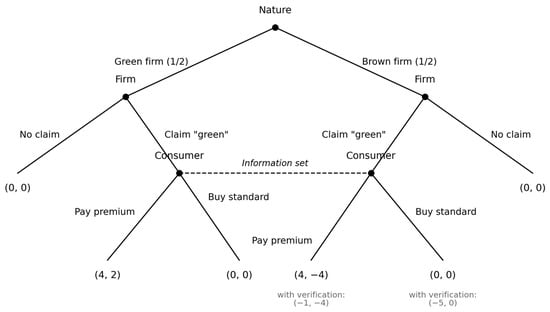
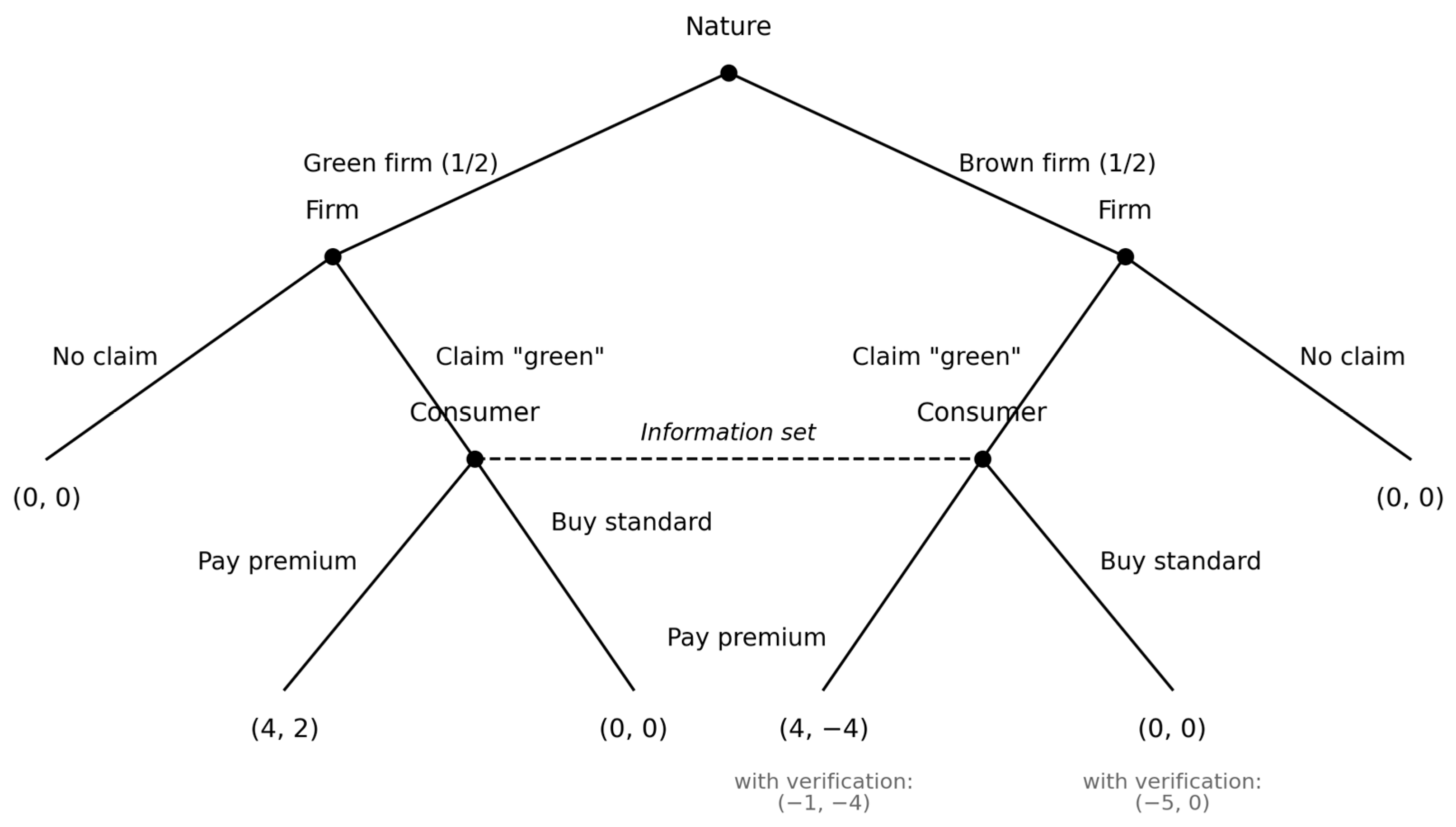
The bluffing game is a sender–receiver game played in pairs, with roles rotating between rounds. One student is a firm and the other a consumer. The firm draws a card that assigns its type, green with probability one-half and brown otherwise, and the consumer does not see the card. Being green is a past investment and does not affect the firm’s payoff within the round. The firm then chooses a message, either a claim to be green or no claim. The consumer, having seen the message but not the type, decides whether to pay a premium of 4 for the firm’s product or to buy a standard product. A product that is not claimed to be green is sold as a standard product, so the premium decision arises only after a claim. The firm earns 4 if the consumer pays the premium and 0 otherwise, regardless of its type. The consumer values a green product at 6 and so earns 2 from paying the premium to a green firm, loses 4 from paying it to a brown firm, and earns 0 from buying the standard product. Figure 1 shows the game tree.
Figure 1.
Game tree of the bluffing game. Notes: Payoffs are (firm, consumer). The dashed line joins the consumer’s two decision nodes after a green claim, which the consumer cannot tell apart (an information set). The payoffs in gray give the brown firm’s expected payoffs on the claim branch in the verification regime, in which a false claim is audited with probability 1/2 and fined 10, so that the expected fine of 5 is subtracted from the firm’s payoff whether or not the consumer pays; the consumer’s payoffs are unchanged. After no claim, the consumer buys the standard product and both players earn 0.
In the first three rounds, nothing is verified and the claim is free. Silence earns a firm 0 and a claim earns 4 if the consumer pays and 0 if not, so for either type a claim is at least as good as silence. A consumer who believes that the firm is green with probability μ expects 2μ − 4(1 − μ) from paying the premium and so pays only if μ is at least two-thirds. No equilibrium has the consumer paying after a claim: if the consumer paid with any positive probability, both types would strictly prefer to claim, the belief would stay at the prior of one-half, and paying would yield one-half of 2 plus one-half of −4, which is −1. In every equilibrium, therefore, the consumer buys the standard product, every player earns 0, and green firms cannot sell at a premium regardless of how green they are. What is not unique is how firms use the claim. Any strategies in which brown firms claim at least half as often as green firms keep the belief after a claim at or below two-thirds and, with a consumer who never pays, form an equilibrium, so universal claiming, universal silence (with a consumer who would distrust an unexpected claim), and mixtures of the two all qualify with the same payoffs. Universal claiming is the only equilibrium in which no firm uses a weakly dominated strategy, and it is the outcome to expect in class, since a student in the firm role loses nothing by claiming. This is the market for lemons of Akerlof [31] with the lemon’s disguise supplied by cheap talk.
In the last three rounds, a claim is audited with probability one-half by a coin tossed after the consumer has chosen, and a firm whose claim is found to be false pays a fine of 10. A brown firm that claims green now expects to pay 5 and to earn at most 4, so it stays silent; a green firm’s claim is never false and remains free. Only green firms claim, the claim becomes fully informative, the consumer pays the premium whenever it is made, and the green firm earns 4 while the consumer earns 2. A false claim is now strictly dominated for a brown firm, while a true claim still weakly dominates silence for a green firm, so the separating outcome is the only one in which no firm uses a dominated strategy; it is also the only equilibrium that satisfies the intuitive criterion of Cho and Kreps [32]. Table 3 sets the two regimes side by side. The pattern to be expected, based on this logic and on the laboratory evidence cited below, is that claims are nearly universal in the unverified rounds and that premium purchases, after some initial trust, fall toward zero as consumers learn that the claim is empty, while in the verified rounds, brown firms stop claiming and premium purchases recover. Because pairs are fixed and cards are shown after each round, consumers also learn about their partners, so the change in round four combines the new rule with that learning; rematching pairs every round or showing the cards and tossing the audit coins only at the end of each regime reduces some of the confounding effects of this learning, although students still learn about the class as a whole. Laboratory evidence on sender–receiver games supports the equilibrium logic but also finds that senders transmit somewhat more information and receivers trust messages somewhat more than the theory predicts [33], such that a few consumers will keep paying in the unverified rounds and a few brown firms will stay silent; the debriefing can use these students to ask what, other than tokens, they were responding to. The condition for full separation is that the expected penalty for a false claim exceed the premium that a false claim can earn, and the instructor can show that lowering the audit probability to one-quarter, which reduces the expected fine to 2.5, brings the brown firm’s claim partly back: in the equilibrium in which green firms always claim, brown firms claim half the time, the consumer pays after a claim with probability 5/8, which leaves the brown firm indifferent, and the green firm’s expected payoff falls from 4 to 2.5. The claim then remains informative, since it raises the belief that the firm is green from one-half to two-thirds, but it no longer separates the types fully, and the same holds for any expected fine above 0 and below 4, with the consumer paying after a claim with probability equal to the expected fine divided by 4. The same point can be made from the consumer’s side by allowing the consumer to pay a fee for a certificate check that reveals the type in place of the audit. Students then see that the check is worth buying only when the fee is below the consumer’s expected gain from being able to tell the types apart, which in the game, with claims that carry no information, is 1.
Table 3.
The bluffing game without and with verification.
The debriefing first asks why the word “green” stopped meaning anything in the first three rounds, and the expected answer is that it was free for the wrong type to say. It asks second who lost, and the expected answer is that consumers lost nothing in equilibrium because they stopped paying, while green firms lost the premium they deserved, so that the verification gap is a tax on the honest. It asks third what verification changed, and the expected answer is that it made the claim costly for the brown type while leaving it free for the green type, which is the condition for a separating equilibrium. Students are then asked to place real institutions in the game. A third-party eco-label is a certificate check whose cost is shared; a rule that defines which environmental claims count as deceptive raises the probability that a false claim is identified as such, which in the game is the audit probability rather than the fine; and liability for misleading advertising is the fine. The common error is to attribute the collapse of the claim to the dishonesty of particular students in the firm role, when the brown firm’s claim is the best response to a regime in which claims are free and the same students stop claiming when the regime changes. In a finance course, the same game can be played with investors in the receiver role. The premium becomes the lower cost of capital that investors grant a firm they believe to be sustainable, the claim becomes an ESG disclosure, and verification becomes external assurance of sustainability reports or an independent ESG rating. The condition for full separation is unchanged, and a disclosure that every firm makes and nobody checks earns the firm nothing.
The investor version can be made concrete with three features of ESG markets. First, assurance is partial: the Corporate Sustainability Reporting Directive requires limited assurance of the sustainability reports within its scope [34], and IFRS S1 and IFRS S2 [35,36] specify what must be disclosed. In the game, a standard that makes a false disclosure easier to identify raises the audit probability, and limited assurance is an audit probability below one, so students can ask whether it is high enough for the expected penalty to exceed the 4 that a false claim earns. Second, verification is noisy: ratings of the same firms by six major providers are correlated only between 0.38 and 0.71, mostly because the providers measure the same attributes differently [37]. A simple version of the certificate check captures this noise. Suppose that the check reports the firm’s true type with probability r, between one-half and one, whatever the type, that its error is independent of the firm’s claim, and that claims carry no information, as in the unverified rounds, so that the receiver starts from the prior of one-half. A favorable report then raises the belief that the firm is green from one-half to r rather than to one, and the most that the receiver would pay as a premium falls from 6 to 6r. With the premium fixed at 4, the receiver pays it after a favorable report only if r is at least two-thirds, so the value of the check, the receiver’s expected gain from being able to act on the report, falls from 1 to 3r − 2 when r is at least two-thirds and is zero when r is lower. These formulas depend on symmetric errors, a prior of one-half, uninformative claims, and a fixed premium, and the same calculation gives a different threshold and value when any one of these assumptions is changed. A noisy rating thus narrows the verification gap without closing it, and the premium that the receiver would be willing to pay, which in the investor version is the firm’s lower cost of capital, shrinks as the rating’s precision falls. Third, the premium affects what firms do: among Chinese-listed firms, higher ESG ratings promote digital technology innovation through more research and development, better financing opportunities, lower uncertainty, and a stronger reputation [38]. Christensen et al. [39] reviewed the economics of mandatory sustainability reporting more broadly.
3.3. The Hats Puzzle and the Stag Hunt, or the Common Knowledge Gap
The third game begins with a puzzle rather than a payoff table, because the common knowledge gap is easier to experience than to define. Three students stand at the front of the class. The instructor shows the class five hats, three white and two black, places a hat on each student’s head, and hides the remaining two. Each student can see the other two hats but not their own; in fact, all three hats are white. The instructor asks whether anyone knows the color of their own hat, waits for the answers, and repeats the question. Nobody can answer in the first round or the second; in the third round all three announce that their hat is white. The reasoning turns on the fact that each round of silence is public. Silence in the first round makes it common knowledge that nobody sees two black hats, so that at most one hat is black. A student who then saw one black hat would know that her own hat was white and would answer in the second round, so silence in the second round makes it common knowledge that nobody sees a black hat. Each student, knowing that a black hat on her own head would have been seen by the others, concludes that her hat is white, and all three answer in the third round. Had the students been questioned privately, no one would ever have deduced their color: what changed between the rounds was not anyone’s knowledge of the hats but everyone’s knowledge of what the others knew. The puzzle is the three-hat version of what the logic of knowledge calls the muddy children puzzle [40] and is the standard illustration of common knowledge [29]. Puzzle collections also call it the prisoners and hats puzzle, a name that several variants share.
The puzzle is followed by a stag hunt framed as sorting with contamination. Students are told that a batch of recyclables is processed only if it is clean, so that one unsorted bag ruins the batch for everyone and makes one’s own sorting effort wasted. Each student chooses, simultaneously with a partner, whether to sort or to leave the waste unsorted. Table 4 gives the payoffs. If both sort, each earns 4; if neither sorts, each earns 3; if one sorts and the other does not, the sorter earns 0 and the other earns 3. Sorting is the better choice when the partner sorts and the worse choice when the partner does not, so that both mutual sorting and mutual non-sorting are equilibria. Mutual sorting is better for both, but non-sorting is safer: a student who sorts gives up a sure 3 for 4 if the partner sorts and 0 if not, and sorting is the best response only if the partner is believed to sort with probability at least three-quarters. In the terms of Harsanyi and Selten [27], mutual sorting is payoff-dominant and mutual non-sorting is risk-dominant.
Table 4.
Payoffs in the stag hunt with contamination.
The stag hunt is played in six rounds with new partners each round. In the first three rounds, choices are private; each student learns only their own payoff. In the last three rounds, before each round, the instructor writes on the board the number of students who sorted in the previous round, so that everyone sees the same number at the same time and sees the others seeing it. The board is public information and, because everyone sees everyone else seeing it, the number is common knowledge; but it is a fact about the past, not anyone’s intention for the next round, and it matters only through the expectations of future cooperation that students form from it. Because each round brings a new partner, the displayed share is each student’s natural estimate of the probability that the next partner will sort, and because the share is common knowledge, students who form expectations from it in the same way, and expect others to do so, hold the same expectation and know that they hold it; this supplies the beliefs of every order that coordination requires: about the partner’s choice, about the partner’s belief about one’s own choice, and so on. The display therefore does not by itself raise confidence above the three-quarter threshold; it makes confidence common at whatever level the board shows. The prediction is accordingly conditional: if the displayed share is at least three-quarters, sorting is the best response to the shared estimate and should rise and stabilize; if it is well below, the display supports non-sorting and can entrench it. In either case, the share of mismatched pairs, in which one student sorts and the other does not, should fall as expectations converge, and this convergence, rather than a higher sorting rate as such, is what the public rounds are designed to show. The display is anonymous by design. Names or seat numbers would add a second motive, being seen to sort: public goods experiments find that making contributors identifiable raises contributions [41], with social approval as one channel [42], and named display would also let a student look up the new partner’s last choice. An instructor can add a named round after the anonymous ones to show the difference, but any rise in sorting in that round should not be attributed to common knowledge alone. For an advanced class the instructor can add a round in which each student receives a private note stating that the partner sorted last time and is asked whether this is enough. The point of Rubinstein [14] is that it is not, because the student does not know whether the partner knows that the note was received, and the regress does not close.
The debriefing first asks what the students in the hats puzzle learned in the second round that they did not know in the first, and the expected answer is nothing about hats and something about what the others knew. It asks second why mutual non-sorting was attractive in the private rounds, and the expected answer is that it was safe, and that safety is what one chooses when one cannot be confident about the others. It asks third what institution makes sorting visible, and the expected answer is a communal collection point used by all households on fixed days, where each household’s sorting is seen by its neighbors and, as important, is seen to be seen. Such a routine involves no fine; it closes the common knowledge gap by the mechanism that Chwe [15] describes, a public ritual in which each household’s compliance is on display to all at once. Students are asked to compare it with private curbside pickup from individual bins, in which the same sorting rate would generate no common knowledge. The most common error is the objection that everyone already knew that the others would sort, and the reply is that mutual knowledge is not common knowledge: each student may privately expect the others to sort and still not know whether the others expect it of her, and the stag hunt punishes that uncertainty. A second error is to read the board as merely more information; the board is informative, but its distinctive effect is that everyone sees it together. A third error is to expect visibility to produce sorting by itself. Visibility coordinates expectations on whatever the board shows, and a field experiment found that telling households how their energy use compared with the average in their neighborhood moved use toward the average from both sides, so that households below the average increased their use [43]; a display of low compliance can entrench non-compliance in the same way.
The common knowledge gap has a counterpart in financial markets. An investor who values a firm partly by what other investors will pay for it cares not only about the firm’s ESG performance but about what others believe about it, and a signal that everyone observes at once, such as a published ESG rating or a mandated sustainability disclosure, coordinates those beliefs in a way that the same information obtained privately does not. Morris and Shin [44] show that agents with such a coordination motive, as in a beauty contest, place more weight on public signals than their precision alone would warrant. In a finance course, the debriefing can connect this result to two empirical literatures, one on stock price synchronicity, the extent to which a firm’s stock price moves with the market rather than with firm-specific information [45], and one on investor sentiment and its influence on prices [46]. The game models neither, but it gives students a reason why a public ESG announcement can move prices by more than the information it adds to what investors already know.
Together, the bluffing game and the stag hunt show that publicity and reliability are separate properties of a signal, which is why ESG ratings appear in both. A rating published to all investors at once can coordinate their beliefs, but publication does not make it accurate, and ratings of the same firm diverge across providers [37]. An inaccurate public signal can coordinate investors on a mistaken belief, and because investors with a coordination motive overweight public signals, its errors are shared rather than averaged out. Morris and Shin [44] show that, for this reason, more precise public information can even reduce welfare when private information is sufficiently precise. A verified disclosure that reaches only some investors closes the verification gap for them without creating common knowledge, whereas assured disclosures published to all investors at once close both gaps, so assurance and publication are complements. Investors do respond to public ratings: when Morningstar began publishing sustainability ratings for mutual funds in 2016, the highest-rated funds attracted net inflows and the lowest-rated suffered net outflows [47].
4. Running the Three Games in One Session
The three games fit a 90 min session in the order presented, with 25 min for the cheating game, 25 for the bluffing game, 30 for the hats puzzle and the stag hunt, and 10 for a closing discussion across the three. These times are planning estimates, since the session has not yet been run as a whole: about 5 min for instructions, 10 for play, and 10 for debriefing in each of the first two games, and about 5 min for the puzzle, 15 for the stag hunt, and 10 for debriefing in the third. The play times assume about one minute per round for the ten rounds of the cheating game and about a minute and a half per round for the six rounds of each of the other two games; every choice is a single card and every payoff is read from a table, which keeps rounds short. An instructor who wants more time can split the material into two sessions, with the cheating and bluffing games in the first and the rest in the second. Table 5 lists group sizes, rounds, materials, debriefing questions, and the errors that the instructor should expect. The recorder in the cheating game can be a student who does not play, a teaching assistant, or the instructor; because the recorder keeps the official score, self-reported payoffs cannot be inflated and arithmetic errors are caught, which matters once points count toward a prize or a grade. Token earnings are best converted at a fixed rate into a small reward rather than into grade points, since grade incentives can offset the learning gains from experiments [4]. Whatever the reward, it should be linear in points; a prize for the highest total or a bonus for the top half of the class would make the games into contests in which lowering a classmate’s payoff raises one’s own rank. Payoffs can be negative: a student who does not sort, is audited, and belongs to a group in which nobody sorts earns 10 − 24 = −14 in that round, and a brown firm whose false claim is audited earns −6 or −10. Points accumulate across rounds and games and no money changes hands, so a negative balance raises no payment problem. If points are converted into a reward, a starting balance of 80 points keeps every possible session total above zero, since the lowest attainable totals are −45 in the cheating game and −32 in the bluffing game and no stag hunt payoff is negative; with a linear conversion, the starting balance changes no incentive. Larger classes can run the cheating and bluffing games in parallel groups with a teaching assistant recording totals, and choices can be collected with an online form or a classroom response system, which also keeps the record needed for the evaluation described in Section 5. The hats puzzle can be played by three volunteers while the rest of the class is asked to predict when the volunteers will answer.
Table 5.
Implementation guide for a 90 min session.
The closing discussion asks the cross-game question: which gap does each institution close, and which does it leave open? Table 6 states the learning objective for each gap and gives a sample assessment item, and a written assignment extends the discussion. Each student chooses a sustainability policy, for instance, a deposit-refund scheme for beverage containers, a carbon label, or an assurance requirement for corporate sustainability reports, and identifies which gap the policy targets, through which mechanism (an expected sanction, a separating equilibrium, or a public ritual), and which gap it leaves open. The assignment is graded based on those three elements, each scored from 0 to 2: 2 for a correct answer justified by the condition that closes the gap in the corresponding game, for instance, that the expected sanction exceeds the private gain, 1 for a correct answer without that justification, and 0 for an incorrect or missing answer, for a total of 6. The written part matters in its own right, since writing a report on a classroom experiment has been found to have a large positive effect on students’ end-of-course test scores [48]. Appendix A gives the instructions read to students, the instructor’s script for each regime change, and a record sheet for each game, so that the session can be run from the Appendix A alone.
Table 6.
Learning objectives and sample assessment items.
5. Discussion and Conclusions
The three-gap frame is a reading device that tells students that when a sustainability institution works, it is because it has made defection costly, made false claims costly, or made compliance visible, and that when it fails, it is because one of these has not happened or, in the case of visibility, because what became visible was low compliance. The frame does not claim that the three gaps are exhaustive. Problems of distribution, of intergenerational conflict, and of scientific uncertainty are also reasons why collective action fails, and the games do not touch upon them.
The games simplify in that the payoffs are stylized, the interactions are one-shot or finitely repeated, greenness is binary, contamination is all-or-nothing, and each ESG instrument is represented by a single parameter of a game, a fine, an audit probability, or a premium. Repeated interaction and reputation, which the games exclude, are themselves mechanisms that close the enforcement and verification gaps in practice, and the communities studied by Ostrom [9] relied on them. The instructor who wants to make this point can add a variant of the cheating game with fixed groups, no audit, and a last round chosen at random, in which contributions can be sustained by the threat of future non-contribution, and can ask why that threat works in a village and not in a city. The simplifications are deliberate, since each game is meant to present one gap at a time and the frame is meant to be carried into settings that the games do not model. The same three gaps appear well beyond household waste: a corporate net-zero pledge with no penalty for missing it is an enforcement gap, an environmental rating that nobody audits is a verification gap, and a campaign that tells each household that its neighbors are already conserving shapes expectations of others’ cooperation, and it addresses a common knowledge gap only if the message is delivered publicly, so that each household knows that the others have received it.
The paper is a conceptual teaching proposal. The design has not been evaluated in a classroom, and the expected behavior described in Section 3 rests on theory and on the laboratory and classroom literature for each component game rather than on observations of the three played together. An evaluation would compare sections of the same course, one playing the three games and one playing a commons game of the same length, with the same debriefing time and written assignment. Learning would be measured with a pre- and post-test built from the items of Table 6 and a transfer item that asks students to assign a policy not discussed in class to the gap it targets, scored with the rubric of Section 4 by a grader who does not know the student’s section, to test whether the three-gap frame improves that assignment beyond the single-game approach. Behavior can be measured from the record sheets of Appendix A: the contribution rate with and without monitoring, the frequency of claims and premium purchases with and without verification, and the sorting rate in the private and public rounds of the stag hunt, together with the share of mismatched pairs if choices are recorded by pair, so that the expected patterns of Section 3 can be compared with what students do. A short questionnaire on students’ perceptions would complement both measures. Because the evaluation collects data from students, it would require review board approval and informed consent, with participation in the research, as distinct from the class, being voluntary. Until then, the claim is the narrower one that the standard commons game teaches one of three failures, that the other two can be taught with games as short and as cheap, and that a session built on all three is designed to leave students with a question they can ask of any sustainability institution, namely which gap it closes.
Author Contributions
Conceptualization, H.Y. and D.R.; methodology, H.Y. and D.R.; investigation, H.Y. and D.R.; writing—original draft preparation, D.R.; writing—review and editing, H.Y. and D.R.; project administration, D.R.; funding acquisition, D.R. All authors have read and agreed to the published version of the manuscript.
Funding
This work was supported by a grant from Kyung Hee University in 2026 (KHU-20262245).
Institutional Review Board Statement
Not applicable.
Informed Consent Statement
Not applicable.
Data Availability Statement
No new data were created or analyzed in this study. Data sharing is not applicable to this article.
Acknowledgments
A large language model (Claude Opus 5.5, Anthropic, San Francisco, CA, USA) was used to assist with drafting and editing; the authors reviewed and take full responsibility for the content.
Conflicts of Interest
The authors declare no conflicts of interest.
Appendix A
Teaching Note: Student Instructions, Instructor Script, and Record Sheets.
Appendix A.1. Cheating Game
Instructions read to students. You are in a group of four players with a recorder who does not play. In each round every player receives ten tokens. You decide privately whether to sort, which places all ten tokens in the group’s recycling fund, or not to sort, which keeps the ten tokens for yourself. Whatever each of you decides, the fund is doubled and divided equally among the four members. You hand the recorder your choice card, which carries your player number, face down. The recorder writes down each choice, keeps the official score, and announces only the total in the fund; the other players never learn who contributed. Your earnings in a round are the tokens you kept plus your share of the fund. Record your choice and your earnings on the sheet after each round.
Instructor script for the monitoring rounds. From this round on, one player in each group will be drawn at random each round, using four cards of which one is marked. The recorder checks the record and, if the player drawn did not sort, announces a fine of 24 tokens, which leave the game. Nothing else changes. Before playing a further variant, the instructor announces the new parameter in one sentence, for example, that the fine is now 12 tokens, or that the draw now uses eight cards, and asks students to recompute the expected fine before they choose. Table A1 is the player’s record sheet and Table A2 is the recorder’s sheet, which is the official score.
Table A1.
Record sheet for the cheating game.
Table A2.
Recorder’s sheet for the cheating game.
Appendix A.2. Bluffing Game
Instructions read to students. You are in a pair. In each round one of you is a firm and the other a consumer, and you swap roles every round. The firm draws a card that says green or brown and does not show it to the consumer. The firm then says either “my product is green” or nothing. The consumer then decides whether to pay a premium of 4 for the firm’s product or to buy a standard product instead. If the firm says nothing, the consumer buys the standard product. The firm earns 4 if the consumer pays the premium and 0 otherwise, regardless of what its card says. The consumer earns 2 for paying the premium to a green firm, loses 4 for paying it to a brown firm, and earns 0 for buying the standard product. After the consumer has chosen, the firm shows its card and both of you record the round.
Instructor script for the verification rounds. From this round on, every claim of “green” is checked with a coin toss after the consumer has chosen. If the coin shows heads and the card is brown, the firm pays a fine of 10. A green firm is never fined. Nothing else changes. If the instructor adds the certificate variant, it replaces the coin toss, and the consumer may pay a small fee, below 1, to see the card before choosing, and the instructor asks the class in advance whether the fee is worth paying. To reduce the confounding of the rule’s effect with what consumers learn about their partners, the instructor can rematch pairs every round or have the cards shown and the audit coins tossed only at the end of each regime. Table A3 is the record sheet.
Table A3.
Record sheet for the bluffing game.
Appendix A.3. The Hats Puzzle and the Stag Hunt
Instructor script for the puzzle. Three volunteers stand facing the class. The instructor shows the class five hats, three white and two black, asks the volunteers to close their eyes, places a white hat on each volunteer, and hides the two black hats before the volunteers open their eyes. The volunteers may look at each other but not at their own hats, and the class must stay silent. The instructor asks, “Does anyone know the color of their own hat? If you do, say so now,” waits ten seconds, and repeats the question twice more, counting the rounds aloud. If a volunteer announces a color in the first or second round, the instructor asks them to explain; an answer given before the third round cannot be justified from what the volunteer has seen and heard, so the instructor restarts the puzzle with new volunteers. After the third round the instructor asks each volunteer what they learned in round two that they did not know in round one, and writes the two answers on the board: nothing about the hats, and something about what the others knew.
Instructions read to students for the stag hunt. You are in a pair, and you will have a new partner each round. A batch of recyclables is processed only if it is clean, so if either of you leaves your waste unsorted, the batch is lost and the one who sorted has wasted the effort. You choose, at the same time as your partner, either to sort or to leave your waste unsorted. If both sort, each earns 4. If both leave it unsorted, each earns 3. If one sorts and the other does not, the one who sorted earns 0 and the other earns 3. In rounds one to three you will learn only your own earnings. In rounds four to six, before each round, the instructor will write on the board the number of students who sorted in the previous round. Table A4 is the record sheet.
Table A4.
Record sheet for the stag hunt.
References
- Wiek, A.; Withycombe, L.; Redman, C.L. Key competencies in sustainability: A reference framework for academic program development. Sustain. Sci. 2011, 6, 203–218. [Google Scholar] [CrossRef] [Scilit]
- Holt, C.A.; Laury, S.K. Classroom games: Voluntary provision of a public good. J. Econ. Perspect. 1997, 11, 209–215. [Google Scholar] [CrossRef] [Scilit]
- Brauer, J.; Delemeester, G. Games economists play: A survey of non-computerized classroom-games for college economics. J. Econ. Surv. 2001, 15, 221–236. [Google Scholar] [CrossRef] [Scilit]
- Dickie, M. Do classroom experiments increase learning in introductory microeconomics? J. Econ. Educ. 2006, 37, 267–288. [Google Scholar] [CrossRef] [Scilit]
- Durham, Y.; McKinnon, T.; Schulman, C. Classroom experiments: Not just fun and games. Econ. Inq. 2007, 45, 162–178. [Google Scholar] [CrossRef] [Scilit]
- Emerson, T.L.N.; English, L.K. Classroom experiments: Teaching specific topics or promoting the economic way of thinking? J. Econ. Educ. 2016, 47, 288–299. [Google Scholar] [CrossRef] [Scilit]
- Hardin, G. The tragedy of the commons. Science 1968, 162, 1243–1248. [Google Scholar] [CrossRef] [Scilit] [PubMed]
- Olson, M. The Logic of Collective Action: Public Goods and the Theory of Groups; Harvard University Press: Cambridge, MA, USA, 1965. [Google Scholar]
- Ostrom, E. Governing the Commons: The Evolution of Institutions for Collective Action; Cambridge University Press: Cambridge, UK, 1990. [Google Scholar]
- Fehr, E.; Gächter, S. Cooperation and punishment in public goods experiments. Am. Econ. Rev. 2000, 90, 980–994. [Google Scholar] [CrossRef] [Scilit]
- Crawford, V.P.; Sobel, J. Strategic information transmission. Econometrica 1982, 50, 1431–1451. [Google Scholar] [CrossRef] [Scilit]
- Farrell, J.; Rabin, M. Cheap talk. J. Econ. Perspect. 1996, 10, 103–118. [Google Scholar] [CrossRef] [Scilit]
- Aumann, R.J. Agreeing to disagree. Ann. Stat. 1976, 4, 1236–1239. [Google Scholar] [CrossRef] [Scilit]
- Rubinstein, A. The electronic mail game: Strategic behavior under “almost common knowledge”. Am. Econ. Rev. 1989, 79, 385–391. [Google Scholar]
- Chwe, M.S.-Y. Rational Ritual: Culture, Coordination, and Common Knowledge; Princeton University Press: Princeton, NJ, USA, 2001. [Google Scholar]
- Holt, C.A.; Sherman, R. Classroom games: A market for lemons. J. Econ. Perspect. 1999, 13, 205–214. [Google Scholar] [CrossRef] [Scilit]
- Holt, C.A. Markets, Games, and Strategic Behavior: An Introduction to Experimental Economics, 2nd ed.; Princeton University Press: Princeton, NJ, USA, 2019. [Google Scholar]
- Hallinger, P.; Wang, R.; Chatpinyakoop, C.; Nguyen, V.-T.; Nguyen, U.-P. A bibliometric review of research on simulations and serious games used in educating for sustainability, 1997–2019. J. Clean. Prod. 2020, 256, 120358. [Google Scholar] [CrossRef] [Scilit]
- Ostrom, E.; Walker, J.; Gardner, R. Covenants with and without a sword: Self-governance is possible. Am. Polit. Sci. Rev. 1992, 86, 404–417. [Google Scholar] [CrossRef] [Scilit]
- Ledyard, J.O. Public goods: A survey of experimental research. In The Handbook of Experimental Economics; Kagel, J.H., Roth, A.E., Eds.; Princeton University Press: Princeton, NJ, USA, 1995; pp. 111–194. [Google Scholar]
- Fehr, E.; Gächter, S. Altruistic punishment in humans. Nature 2002, 415, 137–140. [Google Scholar] [CrossRef] [Scilit]
- Darby, M.R.; Karni, E. Free competition and the optimal amount of fraud. J. Law Econ. 1973, 16, 67–88. [Google Scholar] [CrossRef] [Scilit]
- Lyon, T.P.; Maxwell, J.W. Greenwash: Corporate environmental disclosure under threat of audit. J. Econ. Manag. Strategy 2011, 20, 3–41. [Google Scholar] [CrossRef] [Scilit]
- Lyon, T.P.; Montgomery, A.W. The means and end of greenwash. Organ. Environ. 2015, 28, 223–249. [Google Scholar] [CrossRef] [Scilit]
- Delmas, M.A.; Burbano, V.C. The drivers of greenwashing. Calif. Manag. Rev. 2011, 54, 64–87. [Google Scholar] [CrossRef] [Scilit]
- Skyrms, B. The Stag Hunt and the Evolution of Social Structure; Cambridge University Press: Cambridge, UK, 2004. [Google Scholar]
- Harsanyi, J.C.; Selten, R. A General Theory of Equilibrium Selection in Games; MIT Press: Cambridge, MA, USA, 1988. [Google Scholar]
- Lewis, D.K. Convention: A Philosophical Study; Harvard University Press: Cambridge, MA, USA, 1969. [Google Scholar]
- Geanakoplos, J. Common knowledge. J. Econ. Perspect. 1992, 6, 53–82. [Google Scholar] [CrossRef] [Scilit]
- International Capital Market Association. Sustainability-Linked Bond Principles: Voluntary Process Guidelines (June 2024); International Capital Market Association: Zurich, Switzerland, 2024. [Google Scholar]
- Akerlof, G.A. The market for “lemons”: Quality uncertainty and the market mechanism. Q. J. Econ. 1970, 84, 488–500. [Google Scholar] [CrossRef] [Scilit]
- Cho, I.-K.; Kreps, D.M. Signaling games and stable equilibria. Q. J. Econ. 1987, 102, 179–221. [Google Scholar] [CrossRef] [Scilit]
- Cai, H.; Wang, J.T.-Y. Overcommunication in strategic information transmission games. Games Econ. Behav. 2006, 56, 7–36. [Google Scholar] [CrossRef] [Scilit]
- European Parliament and Council. Directive (EU) 2022/2464 of the European Parliament and of the Council of 14 December 2022 amending Regulation (EU) No 537/2014, Directive 2004/109/EC, Directive 2006/43/EC and Directive 2013/34/EU, as regards corporate sustainability reporting. Off. J. Eur. Union 2022, L 322, 15–80. [Google Scholar]
- International Sustainability Standards Board. IFRS S1 General Requirements for Disclosure of Sustainability-Related Financial Information; IFRS Foundation: London, UK, 2023. [Google Scholar]
- International Sustainability Standards Board. IFRS S2 Climate-Related Disclosures; IFRS Foundation: London, UK, 2023. [Google Scholar]
- Berg, F.; Kölbel, J.F.; Rigobon, R. Aggregate confusion: The divergence of ESG ratings. Rev. Financ. 2022, 26, 1315–1344. [Google Scholar] [CrossRef] [Scilit]
- Hao, P.; Alharbi, S.S.; Hunjra, A.I.; Zhao, S. How do ESG ratings promote digital technology innovation? Int. Rev. Financ. Anal. 2025, 97, 103886. [Google Scholar] [CrossRef] [Scilit]
- Christensen, H.B.; Hail, L.; Leuz, C. Mandatory CSR and sustainability reporting: Economic analysis and literature review. Rev. Account. Stud. 2021, 26, 1176–1248. [Google Scholar] [CrossRef] [Scilit]
- Fagin, R.; Halpern, J.Y.; Moses, Y.; Vardi, M.Y. Reasoning About Knowledge; MIT Press: Cambridge, MA, USA, 1995. [Google Scholar]
- Andreoni, J.; Petrie, R. Public goods experiments without confidentiality: A glimpse into fund-raising. J. Public Econ. 2004, 88, 1605–1623. [Google Scholar] [CrossRef] [Scilit]
- Rege, M.; Telle, K. The impact of social approval and framing on cooperation in public good situations. J. Public Econ. 2004, 88, 1625–1644. [Google Scholar] [CrossRef] [Scilit]
- Schultz, P.W.; Nolan, J.M.; Cialdini, R.B.; Goldstein, N.J.; Griskevicius, V. The constructive, destructive, and reconstructive power of social norms. Psychol. Sci. 2007, 18, 429–434. [Google Scholar] [CrossRef] [Scilit]
- Morris, S.; Shin, H.S. Social value of public information. Am. Econ. Rev. 2002, 92, 1521–1534. [Google Scholar] [CrossRef] [Scilit]
- Morck, R.; Yeung, B.; Yu, W. The information content of stock markets: Why do emerging markets have synchronous stock price movements? J. Financ. Econ. 2000, 58, 215–260. [Google Scholar] [CrossRef] [Scilit]
- Baker, M.; Wurgler, J. Investor sentiment and the cross-section of stock returns. J. Financ. 2006, 61, 1645–1680. [Google Scholar] [CrossRef] [Scilit]
- Hartzmark, S.M.; Sussman, A.B. Do investors value sustainability? A natural experiment examining ranking and fund flows. J. Financ. 2019, 74, 2789–2837. [Google Scholar] [CrossRef] [Scilit]
- Cartwright, E.; Stepanova, A. What do students learn from a classroom experiment: Not much, unless they write a report on it. J. Econ. Educ. 2012, 43, 48–57. [Google Scholar] [CrossRef] [Scilit]

Disclaimer/Publisher’s Note: The statements, opinions and data contained in all publications are solely those of the individual author(s) and contributor(s) and not of MDPI and/or the editor(s). MDPI and/or the editor(s) disclaim responsibility for any injury to people or property resulting from any ideas, methods, instructions or products referred to in the content. |
© 2026 by the authors. Licensee MDPI, Basel, Switzerland. This article is an open access article distributed under the terms and conditions of the Creative Commons Attribution (CC BY) license.