


Abstract
With climate change intensifying and space for new greenery becoming scarce, cities need their green spaces to work more effectively. Yet it remains unclear how green infrastructure (GI) and blue–green infrastructure (BGI) differ and whether combining their elements provides additional benefits. This conceptual review examined how sources position GI in relation to BGI (RQ1) and what evidence they provide for functional links between elements (RQ2). We conducted two consecutive targeted searches. The first, on conceptual relationships (46 sources), showed that element labels do not reliably distinguish the concepts. In the second, on functional links (29 sources), elements were therefore coded by their function rather than their labels. Most sources treated GI and BGI as nested concepts or synonyms. None treated them as mutually exclusive. Element labels reflected water management roles more than physical form. Five sources described a functional link, usually one in which a BGI element supplied water to vegetation. Two tested such a link, but neither appears to have compared the same receiving element with and without this supply. In the reviewed sources, GI and BGI are therefore mostly nested rather than distinct concepts (RQ1), and the added effect of linking their elements has not yet been demonstrated (RQ2). Functional links were tested only at the local scale. City-scale studies reported only combined effects, possibly because of how they were designed. At the metropolitan scale, effectiveness may depend on a mosaic of spatial arrangements of GI, BGI and natural systems. Rather than introducing new terms, effective integration requires planning and research to specify which element supplies water to which, and to test whether this link adds benefits.
1. Introduction
Cities need their green spaces to function more effectively for three reasons:
- First, climate change increases the need for greenery that helps cities cope with its impacts. Urban greenery supports cities in several ways: it balances water flows, provides thermal comfort and sequesters CO2 [1]. Existing greenery often lacks the design or capacity to meet current climate adaptation needs [2,3].
- Second, the green spaces expected to help mitigate the effects of climate change are themselves increasingly exposed to climate-related stress [4], which can weaken their ability to provide these benefits [5].
- Third, policies such as the EU’s goal of no net land take (NNLT) by 2050 call for limiting the conversion of land to urban and other artificial uses [6]. This directs more development towards building within existing urban areas, often increasing soil sealing and reducing vegetation cover [7]. Such densification can put pressure on existing green spaces and leave new greenery in smaller, more scattered patches between buildings and other urban uses [8].
These challenges require better planning and management to improve the effectiveness [9] of both existing and new green spaces. The concepts of green infrastructure (GI) [10] and blue–green infrastructure (BGI) [11,12] may help address this need. GI is generally understood as a strategically planned network of natural and semi-natural areas, together with other environmental features, designed and managed to provide a wide range of ecosystem services [10]. BGI consists of natural and semi-natural (that is, green) decentralised systems for urban stormwater management (that is, blue), which, in addition to their primary purpose, provide a variety of shared benefits and ecosystem services [11].
The term infrastructure emphasises a systems perspective, which matters because greenery provides benefits at both the site scale and the city or metropolitan scale. Individual interventions at the site scale can support stormwater infiltration [13], cool streets through shade [14], and help capture airborne particles within urban blocks [15]. At the city scale, however, benefits such as reducing the urban heat island effect depend on the combined performance of green spaces [16,17].
Planning green spaces as infrastructure therefore requires consideration of the role each element plays in the wider system. By element, we mean any spatial type that serves as a building block of GI or BGI, such as a park, tree line, rain garden or bioswale. We assume that connections between elements can help maintain or improve their performance. To act on this assumption, planners need to know how GI and BGI frame these elements and whether linking elements improves performance. The literature reveals two dilemmas: some authors define GI and BGI differently, and some also relate them in different ways.
The first dilemma concerns the scope of each concept: which elements they include and what purposes they serve in urban planning. Authors differ in the elements they include and the purposes they emphasise. At the level of elements, the two concepts can include the same elements, processes and intended outcomes [12]. Parks and street trees, for example, are classified as GI [18,19] but are also included in BGI systems [20,21]. Wetlands are likewise described as either BGI [20] or GI [13,22]. Water and stormwater management are central purposes of BGI by definition [11] and are often associated with BGI [23,24], but they are also linked to GI, particularly through functions such as water retention, infiltration and water purification [13,18]. Urban cooling and climate are also common urban planning objectives associated with both BGI [20,22,25] and GI [16,19]. Earlier reviews have noted that blue–green terminology has grown faster than agreement on what the terms mean [26], and that new labels may rebrand existing practices rather than introduce new ones [27].
The second dilemma moves from how GI and BGI are defined individually to how authors understand the relationship between them. Some treat the two terms as referring to the same content [27], others treat one concept as part of the other [20,22], and still others treat them as distinct but overlapping concepts [9,23].
The labels GI and BGI alone therefore do not show how the two concepts relate. By reviewing definitions, we examine how sources (here, “sources” refers to the reviewed literature) position GI and BGI in relation to one another. Clarifying this conceptual relationship, however, does not show how the elements included in GI and BGI work together as infrastructure, which is what our initial assumption concerns. Elements placed under the same concept or located side by side are not necessarily functionally linked. We therefore move from relationships between concepts to relationships between individual elements.
We use two terms to describe these connections: functional link and integration. A functional link exists when one element supplies a resource needed by another. For example, stormwater infiltration can increase soil moisture and support tree water use during drought [28]. This differs from ecological connectivity, in which separate green patches form a network, for example, by acting as stepping stones, without supplying resources to one another [29]. The review addresses only the first type of connection. When a nature-based element provides this support instead of grey infrastructure—for example, when a bioswale conveys stormwater to a separate planting area in a park—we treat the linked elements as an integrated solution. Whether integration improves performance cannot be inferred from the link alone; it requires comparison with a suitable baseline. In this article, integration refers only to functional links between individual elements (the spatial arrangement of GI, BGI and natural systems at the city or metropolitan scale are discussed separately in Section 4.2). Two research questions guide the review:
RQ1: How do reviewed sources position GI and BGI in relation to one another?
RQ2: How do sources describe and support functional links among elements included in GI, BGI or both, and do any evaluate the effectiveness of an integrated configuration against a baseline?
The questions address different levels. RQ1 asks how sources relate GI and BGI. RQ2 asks whether individual elements work together, regardless of how they are labelled. It does not test the relationships identified in RQ1, but examines whether sources describe functional links and show that they improve performance. The article makes four contributions. First, it examines how sources describe the relationship between GI and BGI (RQ1). Second, it uses supply-based dependency to distinguish functional links from co-location, allowing the review to move from the conceptual level (RQ1) to the element level (RQ2). Third, it assesses whether functional links are asserted, explained or tested. Fourth, it checks whether tested configurations are compared with a suitable baseline and can therefore demonstrate the added effect of integration. The third and fourth contributions address RQ2.
2. Methodology
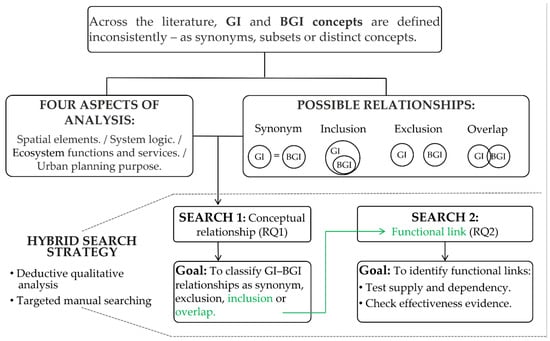
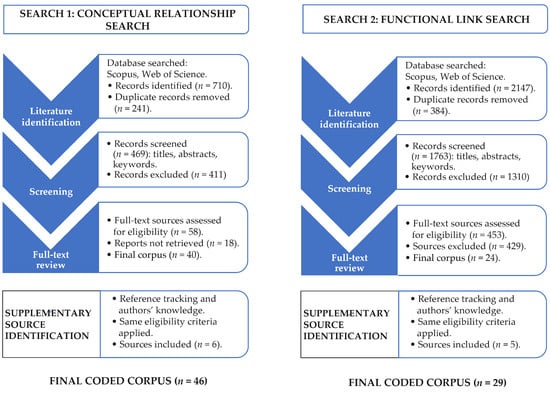
This study used a conceptual review design to examine how GI and BGI are defined, related and applied across the literature. It did not aim to identify or evaluate all available evidence, but to clarify the relationship between the two concepts. It also sought studies on how their elements work together and whether combining them improves performance. We addressed the two research questions through two separate targeted searches (Figure 1).
Figure 1.
Overview of the research design. Inclusion and overlap are the relationships under which distinct GI and BGI elements can coexist within one system. The green text and arrow mark this conceptual link to Search 2, which examined functional links at the element level, regardless of labels.
2.1. Reading GI and BGI Through Four Aspects
Definitions explain what GI and BGI include, what they do, what benefits they provide, and how they are used in urban planning. To compare GI and BGI consistently, we identified four aspects during an initial review of the literature and then applied them to the final sets of sources. These aspects provide a common basis for comparing GI and BGI within each source (Section 2.3).
The four aspects are:
- Elements—which green or blue elements does each source include under GI or BGI?
- Ecosystem functions and services—which ecosystem functions do the elements perform, which ecosystem services do they provide, and what benefits do they generate [30]?
- System logic—how are elements connected to form a wider system, including how they interact with other types of infrastructure? The categories and examples are:
- ∘
- Green or ecological networks—examples include London’s All London Green Grid [31], Berlin’s biotope network [32], and Barcelona’s Passeig de Sant Joan green corridor [33];
- ∘
- Blue or hydrological networks—examples include London’s Blue-Ribbon Network [34] and Singapore’s urban catchment network [35];
- ∘
- Combined blue–green networks—examples include Brussels’ green and blue network [36] and Copenhagen’s Cloudburst Management Plan [37].
- Urban planning purpose—which objectives are pursued through GI and BGI, such as biodiversity conservation, recreation, water management, climate adaptation, health and wellbeing [38,39]?
We recorded elements descriptively, while ecosystem functions (EF), ecosystem services and benefits (ES), urban planning purposes (UPP), and system logic were coded using predefined categories. A source could receive more than one system logic or urban planning purpose code if it addressed several systems or purposes. All coding categories and their codes are listed in Appendix C.3, and the codes assigned to each source are given in Table A6 and Table A7.
Together, these four aspects provided a common framework for data collection and comparison. The final classification of each source, however, followed the decision rules described in Section 2.3.
2.2. Literature Search and Selection
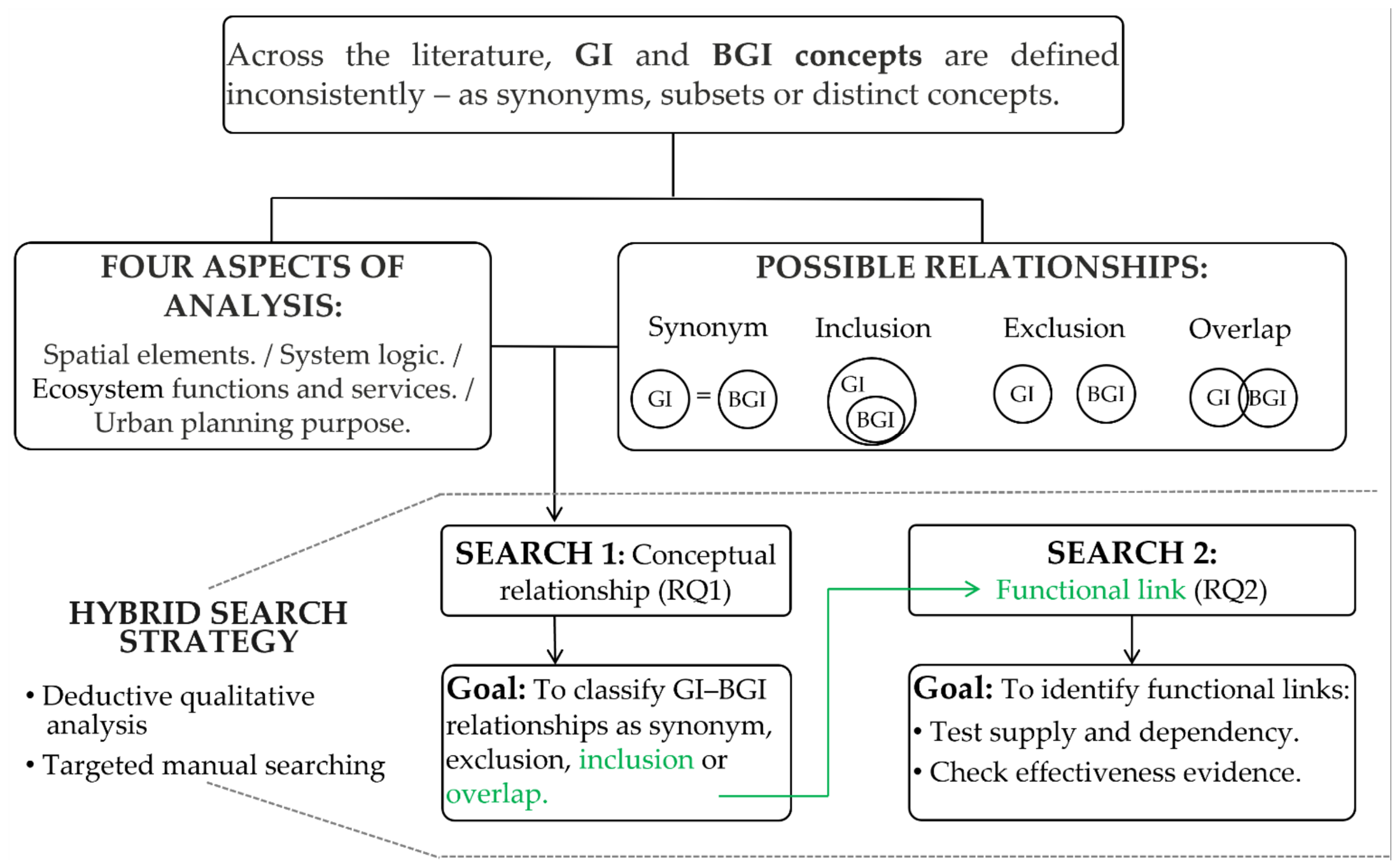
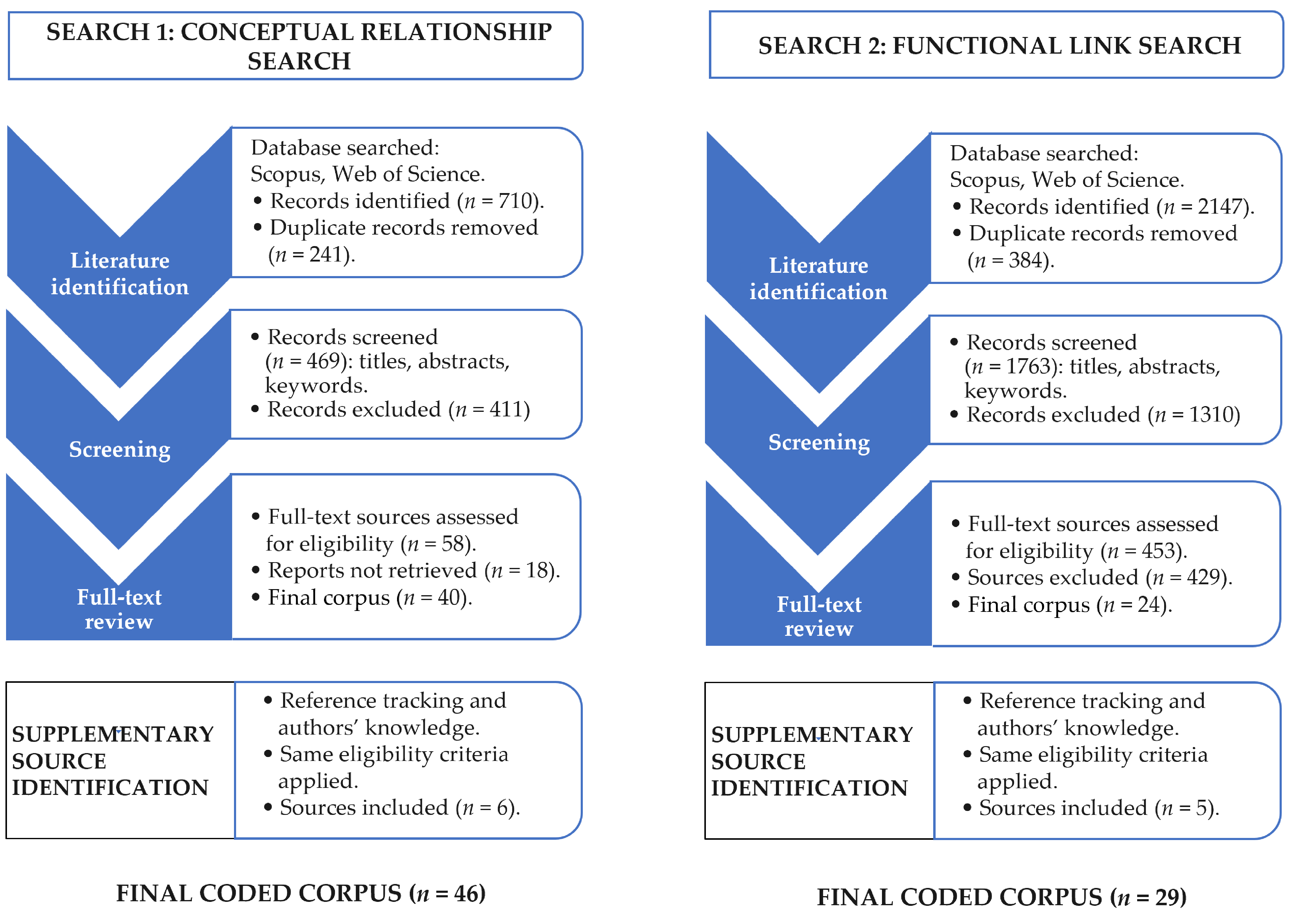
We used deductive qualitative content analysis, with categories developed before coding (relationship types, ecosystem functions and services, system logic, urban planning purposes and element-level codes) and inductive recording of elements. The search strings, eligibility criteria, source-selection process and coding procedures were documented in full to ensure that the conceptual analysis was transparent. An exploratory phase in 2025 helped refine the research questions and typology. We conducted two targeted database searches (Figure 2; Appendix C.1) and a supplementary manual search to capture relevant sources that used different terminology. Manual searching can identify relevant sources missed by predefined search strings, a common issue in complex and heterogeneous fields [40]. All manually identified sources met the same inclusion criteria as those from the database searches (Table A4) and were coded in the same way. Throughout the review, the term urban area was used broadly to include both the city (the dense urban core) and the wider metropolitan area, understood as a functional urban area comprising the city and its commuting zone, following the EU–OECD definition [41].
Figure 2.
Identification, screening and selection of sources for both targeted searches.
The two searches served different purposes (Figure 2):
- Conceptual relationship (Search 1): We coded how each source positions GI and BGI in relation to one another, using the relationship types defined in Section 2.3.
- Functional link (Search 2): We examined whether one element supports the functioning of another, regardless of whether the elements were labelled GI or BGI. We distinguished functional links from co-location, where elements occur together without depending on each other. We then assessed the level of support for each link and whether any source compared an integrated configuration with a baseline.
Identification—Records were identified through two targeted database searches (Appendix C.1) and a manual search based on citation tracking and the authors’ prior knowledge. Together, these formed the hybrid search shown in Figure 2. Duplicate records were removed.
Screening—Titles, abstracts and keywords were screened against the inclusion and exclusion criteria for each search (Table A4). We included articles, reviews, book chapters and conference papers (Table A4). Only sources with full texts in English were included. We also included sources that used only GI or only BGI if they defined or described that concept. These sources show how each concept is used on its own and were classified as not applicable in the relationship coding (Section 2.3). Because the search strings required both terms in the title, abstract or keywords, such sources entered the corpus only if they also mentioned the other term (see Section 4.3). Records that were unclear were retained for full-text review, where the same criteria were applied again. Unavailable full texts were excluded, and all full-text exclusions were recorded with reasons (Table A5). A large language model (Claude Opus 5.5) was used to suggest provisional codes based on titles, abstracts and keywords. Every provisional code was checked against the full text by the first author before it was retained.
Included in full-text review—We retained 46 sources that met the inclusion criteria in Search 1 (Appendix A) and 29 sources in Search 2 (Appendix B). The number of records is shown in the source-selection flow diagram (Figure 2). In Search 1, the 18 reports shown as not retrieved comprise 16 full texts that could not be retrieved and 2 excluded because they were not in English (Table A5).
2.3. Search 1: Conceptual Relationship (RQ1)
Search 1 addresses RQ1. The four aspects indicate what each source includes under each concept (GI and BGI), while the relationship type shows how the source positions the concepts in relation to one another.
We distinguished four relationships between the concepts (Table 1). We also used two residual categories: “not applicable”, when a source used only one of the two terms, and “unclear”, when it used both terms but their relationship could not be determined.
Table 1.
Four relationships between GI and BGI.
Each source received one relationship code, based only on what it stated or clearly implied. Assigning a single code simplifies sources that relate the concepts differently in different parts of the text. In such cases, the code reflects the explicitly stated or dominant relationship, and the remaining variation is not captured by the typology. We compared GI and BGI across three of the four aspects (Section 2.1): elements, urban planning purpose, and system logic. We counted a term only when it appeared in the authors’ own text. We excluded mentions appearing only in reference titles or in the names of policies, programmes, or tools. We treated terminological variants as the same concept (e.g., UGI or urban green infrastructure as GI). If a source explicitly defined the relationship between GI and BGI but used the terms inconsistently elsewhere, we prioritised the explicit definition. We also classified each source by its main focus: GI only, BGI only, or GI and BGI when both were addressed (“Concept addressed” in Table A6). Spatial scale was recorded as a descriptive note during coding, rather than as a separate code. These notes were used to summarise GI–BGI relationships at different spatial scales.
We applied the decision rules in a fixed order (Appendix C.3). Among the 38 sources with an identifiable relationship (Table 2), most treated one concept as part of the other (inclusion, 26 sources) or used the terms as synonyms (synonymy, 8). Four sources treated GI and BGI as distinct concepts that share elements or purposes (overlap). None treated GI and BGI as fully separate concepts (exclusion). The remaining eight sources used only one of the two terms, so no relationship could be assigned.
Table 2.
Relationship types of the Search 1 sources with an identifiable GI–BGI relationship (n = 38).
2.4. Search 2: Functional Link (RQ2)
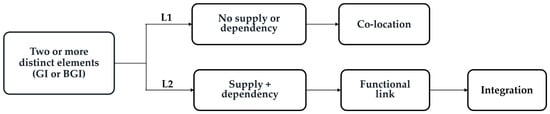
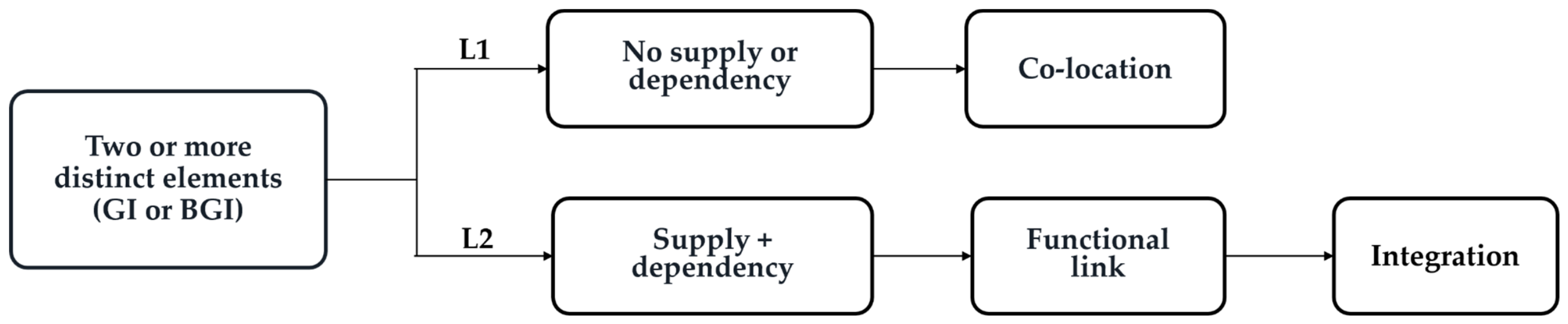
Search 2 addressed the element level of the initial assumption (Section 1). Because Search 1 showed that element labels did not reliably distinguish GI from BGI (Section 3.1), we coded links between green and blue elements regardless of whether sources referred to them as GI or BGI. Figure 3 shows two common arrangements in which elements occur together. If neither supplies a resource that the other needs, the elements are co-located. They may produce a combined effect, but they do not depend on each other. If one supplies a resource that the other needs, they are functionally linked and form an integrated configuration.
Figure 3.
Co-location of two separate elements (which occur together without depending on one another) and integration (where one element supplies a resource the other needs).
Search 2 addressed RQ2 in four steps. First, we identified the elements and confirmed that each had its own function (see the rule below). We did not treat processes within a single element, such as water storage in the substrate of a green roof, as functional links.
Second, we identified each element’s function (blue: capturing, storing or infiltrating water; green: using water for growth or cooling). This provided the basis for assessing whether one element supports another.
Third, we classified each source by its element-level arrangement (Table A7). For sources describing separate elements, we applied two questions to identify a functional link:
- Supply—does one element provide a resource (e.g., water) that the other uses?
- Dependency—would the receiving element function less effectively without this resource?
The element-level codes were defined as follows:
- L0—single element: processes occur within one element. The supply and dependency tests are not applied.
- L1—co-location: separate GI and BGI elements occur together or produce a combined effect, but at least one of the two conditions (supply or dependency) is not met.
- L2—functional link: separate elements are linked, and both conditions are met.
Elements were distinguished by function rather than by physical separation. A component was coded as a separate element if it had its own water management role, such as storing or releasing water, which it performed regardless of the receiving element. This applied even when components were built into one structure, such as a blue–green roof. A link was coded as L2 only if the source showed what the supplying element provided and that the receiving element depended on it. We then coded the level of support for each functional link using the INT scale (Appendix C.3), which records whether the source asserts, explains or tests the link:
- INT0—not applicable: the source was coded L0 or L1, so no functional link was identified.
- INT1—asserted: the link is stated but not explained.
- INT2—explained: the link is explained but not tested.
- INT3—tested: the link is tested using measurements, monitoring, or data-based modelling.
The INT scale records whether a link was tested, not the methodological quality of the test.
Fourth, for L2 sources coded INT3, we recorded whether they included a comparison condition. A baseline is the reference situation without the link against which an integrated configuration is evaluated (Section 1; RQ2); in its strict form, the same receiving element is compared with and without the supply, and only such a strict baseline can isolate the added effect of the functional link. A comparison condition is the form of reference that a study actually included: the same receiving element, a comparable spatial unit, or a scenario in which the support was absent or weaker (Table A7). Comparisons across different elements or locations can indicate a benefit for the receiving element but do not by themselves demonstrate the added value of integration.
Few sources identify a functional link between GI and BGI elements, and even fewer test it (Table 3; Table A7). Of the 29 sources, eight describe processes within a single element. A total of 16 describe separate green and blue elements that co-occur or have a combined effect but do not depend on each other, and five describe a supply-based dependency. Of these five, three explain the link without testing it, while two test it by using measurements or data-based models. None merely asserts that a link exists. Of the two INT3 sources, B30 included a comparison condition (a comparable spatial unit), but it compared trees at different locations rather than the same receiving element with and without support. Its results indicate a benefit for the receiving element but do not isolate the added effect of integration. The other INT3 source did not include a comparison condition that could serve as a baseline.
Table 3.
Element-level arrangement and level of support for functional links in the Search 2 sources (n = 29).
3. Results
3.1. From Similarities and Differences to Conceptual Relationships Between GI and BGI (Search 1)
Search 1 included 46 sources; almost all were published in 2020 or later (Table A6). Based on their main focus (Section 2.3), 26 sources addressed both GI and BGI, 16 addressed only BGI, and four addressed only GI.
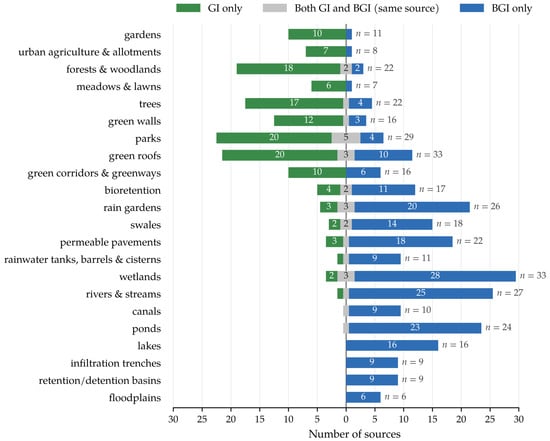
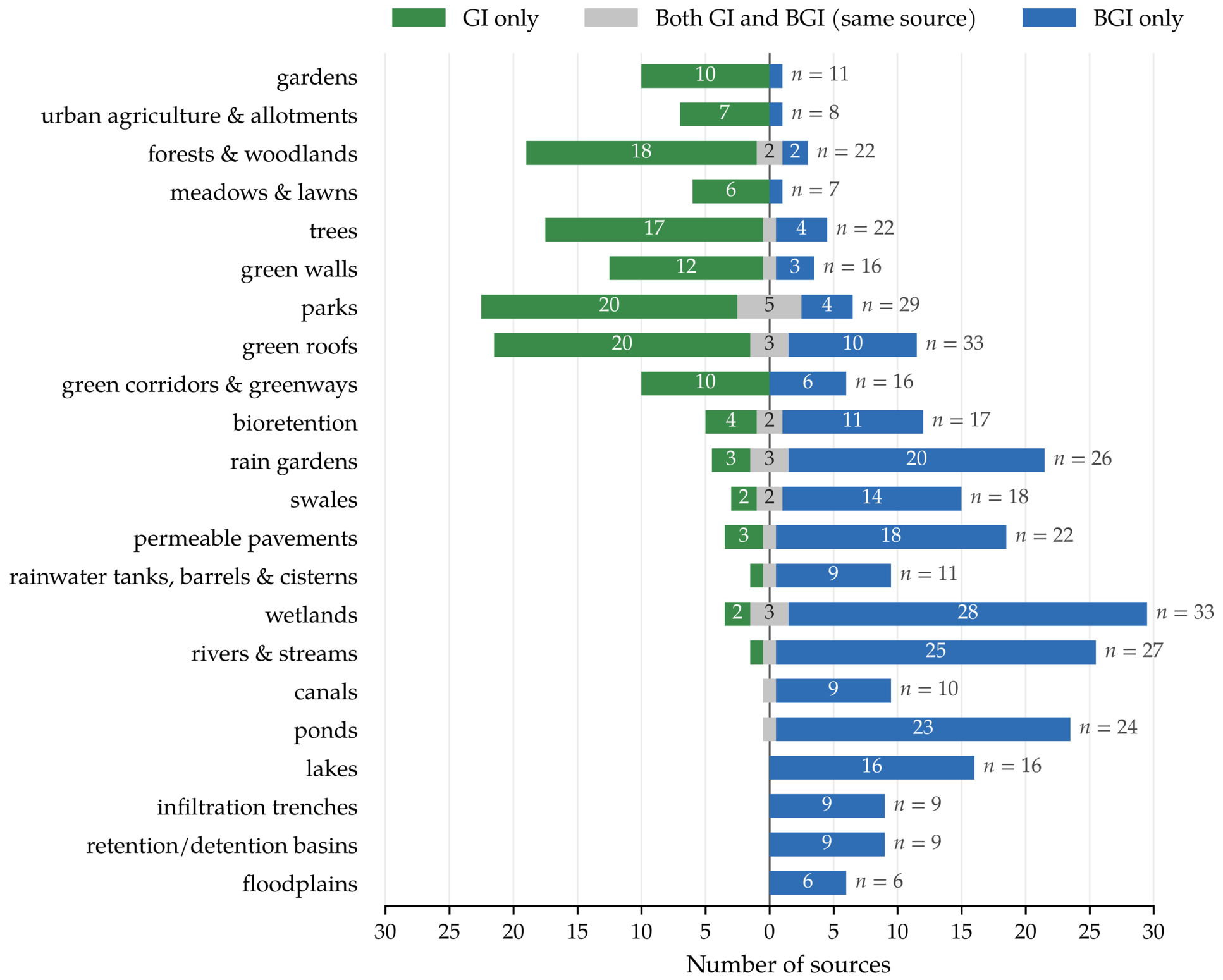
Of the four aspects, the analysis of elements provided the clearest insight into how sources understood GI and BGI. After related terms were merged and umbrella terms such as SuDS were removed, 48 elements were identified. For the analysis presented in Figure 4, we included 22 of these 48 elements that were mentioned in at least five sources (Table A9).
Figure 4.
Elements labelled as GI, BGI or both, shown for the 22 elements mentioned in at least five sources. If a source lists an element under both GI and BGI, it is counted once, in the “Both” category, rather than separately under GI and BGI.
Among these frequently mentioned elements, vegetated elements, such as gardens, meadows, forests and trees, were usually labelled as GI. Water bodies and engineered stormwater elements, such as lakes, ponds, infiltration trenches and retention basins, were almost always labelled as BGI. The overlap was uneven: green elements were often included under BGI, while water elements were rarely included under GI. Labels therefore reflected an element’s role in water management more than its physical form. For example, permeable pavements, which contain neither vegetation nor open water, were labelled as BGI in 18 of the 22 sources in which they appeared. This pattern remained when we considered only the 26 sources that discussed both GI and BGI, indicating that it was not driven by BGI-only sources.
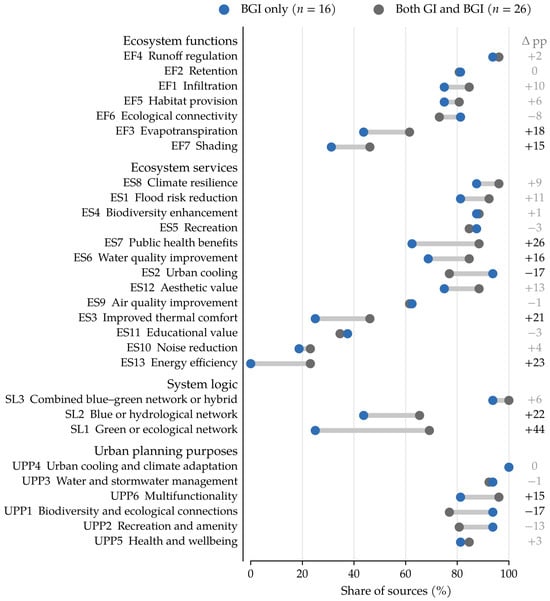
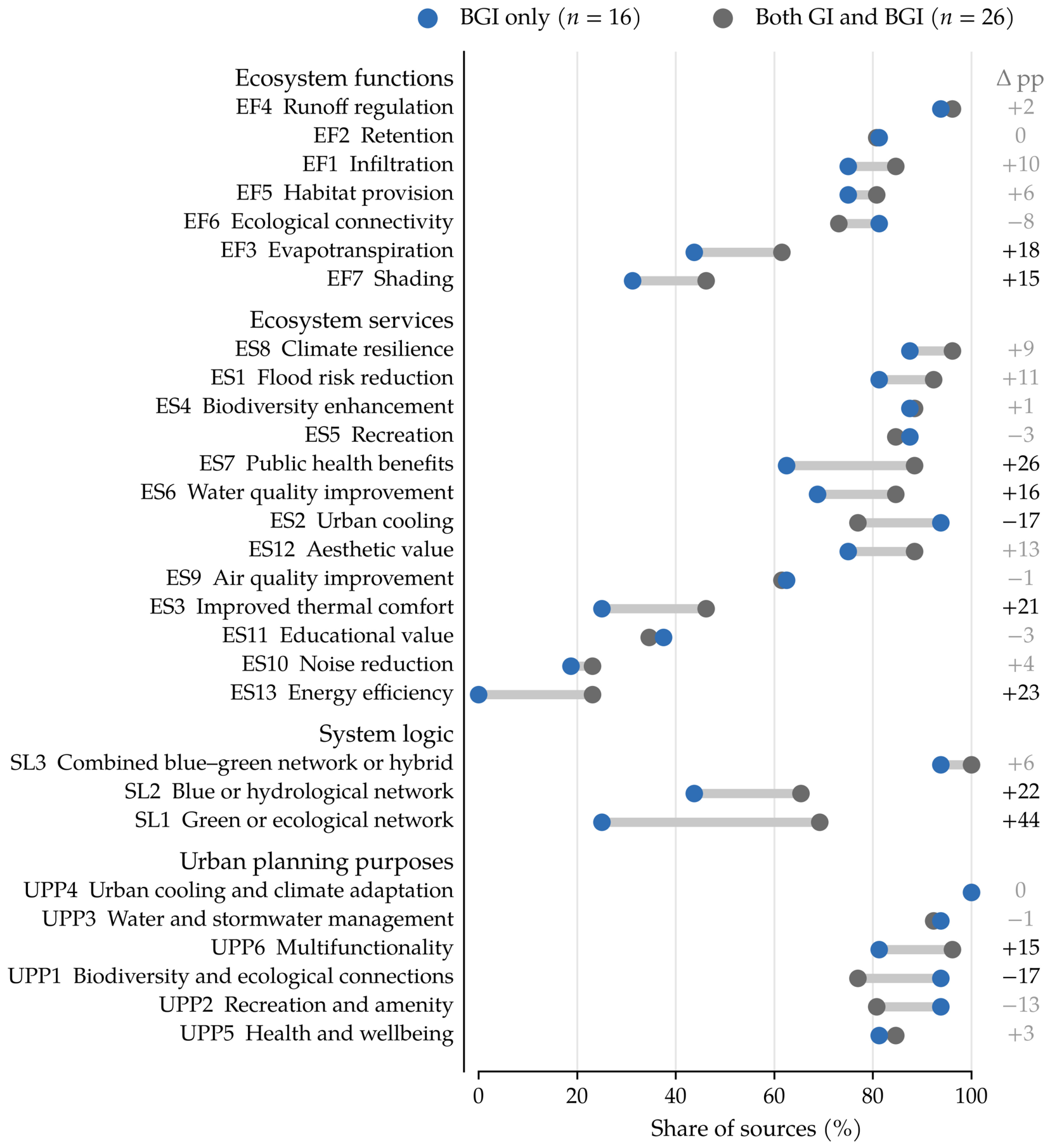
In contrast to elements, the other three aspects (ecosystem functions and services, system logic, and urban planning purposes) were shared more evenly. Sources addressing only BGI (n = 16) and those addressing both GI and BGI (n = 26) used mostly the same categories and differed mainly in how often they mentioned particular codes (Figure 5; Table A8). We excluded the four GI-only sources from Figure 5 because the group was too small for a meaningful percentage comparison.
Figure 5.
Ecosystem functions and services, system logic and urban planning purposes in BGI-only sources and sources covering both GI and BGI. Each point shows the percentage of sources in that group that mention a code. Δ pp shows the difference between the groups (GI&BGI vs. BGI only). The four GI-only sources are not shown. A source could belong to several categories in each aspect. Differences of at least 15 percentage points are in bold.
A total of 45 of the 46 sources (98%) addressed urban cooling and climate adaptation as an urban planning purpose, and 91% addressed water and stormwater management. Because this category combines two purposes, its frequency largely reflects the near-universal reference to climate adaptation; urban cooling was coded as a service in 36 sources (78%; Table A8). BGI-only sources mentioned biodiversity and recreation more often than sources covering both concepts (94% [15/16] versus 77% [20/26] and 81% [21/26], respectively; UPP1 and UPP2 in Table A8). This suggests that authors used BGI for a broad range of urban planning purposes, rather than focusing it narrowly on water. This finding also aligns with the GBR results: five of the eight sources that treated GI and BGI as synonyms were BGI-only sources.
Water-related functions were common in both groups: sources frequently mentioned runoff regulation, retention and infiltration, with differences of ten percentage points or less (Figure 5). The most frequently cited ecosystem services were biodiversity, climate resilience, flood risk reduction and recreation. Urban cooling showed a different pattern. BGI-only sources mentioned cooling as a service more often than sources covering both concepts (94% [15/16] versus 77% [20/26]). However, they mentioned evapotranspiration and shading less often (44% [7/16] versus 62% [16/26], and 31% [5/16] versus 46% [12/26]), as well as thermal comfort (25% [4/16] versus 46% [12/26]), energy efficiency (0% [0/16] versus 23% [6/26]) and public health (63% [10/16] versus 88% [23/26]).
System logic: Almost all sources in both groups described a combined blue–green network, with a difference of only six percentage points (Figure 5). Sources covering both concepts mentioned separate green and blue networks considerably more often (69% [18/26] versus 25% [4/16], and 65% [17/26] versus 44% [7/16]). The GBR coding clarifies how sources framed the combined network: 34 of the 38 sources with a clear relationship treated the concepts as nested or synonymous, and only four treated them as distinct, overlapping concepts. The combined network therefore usually referred to nested or identical concepts rather than a distinct BGI system.
Sources addressing both concepts mostly used inclusion (20 of 26), while five of the eight cases of synonymy came from BGI-only sources (Table 4). All eight sources classified as not applicable used only one term. Only four sources treated GI and BGI as distinct but overlapping concepts, and none treated them as mutually exclusive. Thus, although almost all sources described a combined blue–green network, they usually did not treat GI and BGI as two distinct concepts within that network.
Table 4.
GI–BGI relationship by concept addressed in Search 1 sources (n = 46).
Search 1 asked whether sources clearly distinguished GI from BGI. Most did not. The concepts shared most functions, services and urban planning purposes. Sources differed mainly in how they labelled elements, but even here the boundary was unclear. A total of 18 of the 22 elements shown in Figure 4 received different labels across sources or both labels within the same source (21 of all 48 elements). Element labels therefore did not provide a reliable way to separate the concepts. Search 2 focused on relationships between individual elements. Because labels varied across sources, we considered elements regardless of whether they were called GI or BGI.
3.2. Functional Links Between GI and BGI Elements: Effects and Evidence (Search 2)
Five of the 29 sources in Search 2 described a functional link (Section 2.4; Table 3).
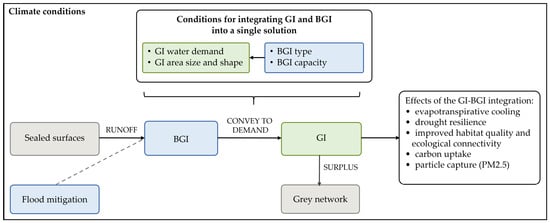
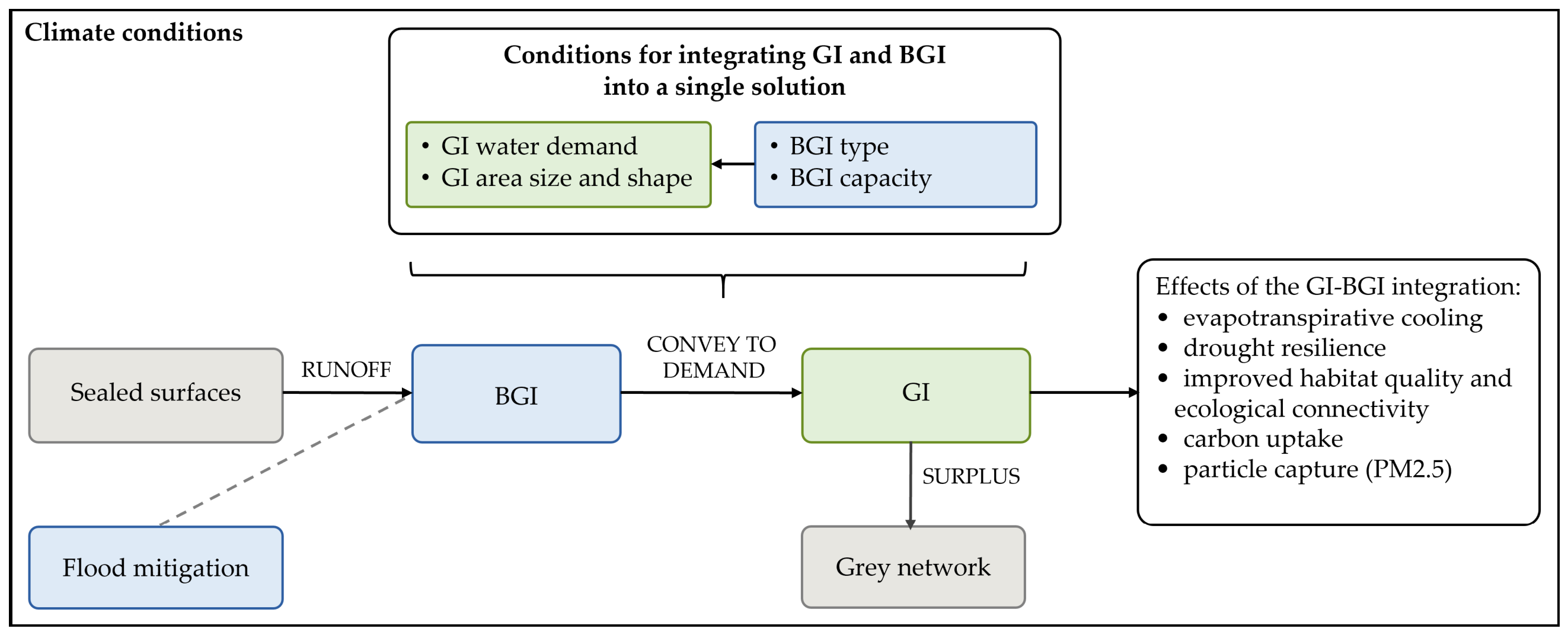
Together, these sources outline a common water pathway. BGI captures runoff from sealed surfaces, stores it, facilitates infiltration and directs water to vegetation. Any excess water then enters the grey drainage network. Figure 6 shows this pathway, its conditions and expected effects. These conditions include water availability, the type and capacity of the BGI element, vegetation water requirements, the green area’s size and shape, and the climate zone. The model suggests that runoff can support vegetation while also helping reduce flooding at the source.
Figure 6.
Proposed conceptual model of GI and BGI integration: enabling conditions and expected effects. Solid arrows show the water pathway and its effects, and the arrow within the conditions box indicates that BGI type and capacity determine whether GI requirements can be met. The dashed line indicates flood mitigation as a co-benefit of capturing runoff in BGI.
The most frequently reported effect is reduced drought stress. Stored or infiltrated stormwater keeps vegetation supplied during dry periods (B13, B30, B32). Cooling is reported less often. On a blue–green roof, stored water supports vegetation and cooling, which weaken when water is scarce (B6). Infiltrated stormwater sustains tree transpiration, which implies evaporative cooling, although temperature was not measured (B30). One source reports biodiversity (B6), so evidence for this effect is more limited.
Three sources explain the link without testing it (B13, B32, B34), while two test it by using measurements or data-based models (B6, B30). Neither test compared the same receiving element with and without support (Section 2.4).
3.3. GI and BGI from the Site to the Metropolitan Scale
The conceptual literature did not tie GI or BGI to a particular scale. Of the 46 sources in Search 1, 20 were coded as multi-scale without naming a specific scale, and 17 of the remaining 26 named more than one. The city–metropolitan scale, which includes the city and its commuting area [41], was named most often (21 sources), followed by the site or project scale (14), neighbourhood scale (9) and regional scale (5). Inclusion was the most common relationship at both the local scale (10 of 17 sources) and the city–metropolitan scale (10 of 21 sources), based on the scale notes recorded during coding.
In Search 2, at the city–metropolitan scale, nine of ten sources reported a combined effect without a dependency between elements. Six addressed cooling and mostly derived it statistically from land surface temperature or similar spatial data (e.g., B8, B19, B23, B28). Such data show where water bodies and vegetation cool together, but not whether one supports the other. Only one source reached the regional scale (B25), analysing blue–green landscape composition in urban–rural grid cells, and it also reported a combined effect.
GI and BGI are used as urban planning concepts at all scales, but evidence of how their elements support one another comes mainly from individual sites. Whether these functional links deliver greater benefits than simply placing the elements side by side remains largely untested.
4. Discussion
4.1. From GI and BGI Concepts to Conceptual Relationships and Functional Links
In the reviewed literature, the main problem is not so much disagreement over how the concepts of GI and BGI are used, as a limited understanding of how they relate to each other. This makes it difficult to combine their advantages. Most sources treat GI and BGI as nested or synonymous, and element labels reflect an element’s role in water management more than its physical form. These findings extend earlier critiques that blue–green terminology has grown faster than agreement on what the terms mean and that new labels may simply rebrand existing practices (Section 1). The problem lies less in the number of terms than in the unclear relationships between them. Matsler et al. similarly showed that green infrastructure carries many disciplinary definitions, goals and forms; our findings suggest that the same ambiguity extends to how GI relates to BGI [42]. Nevertheless, new combined terms continue to emerge. Farghaly and Elzeni [43], for example, add a social “red” layer and propose blue–green-red infrastructure. Because the reviewed corpus consists of scientific sources, it cannot show whether nesting or synonymy originates mainly in science, policy or practice. Within the corpus, however, synonymy was more frequent among sources that addressed policy or planning practice (6 of 27) than among other sources (2 of 19), whereas inclusion was equally common in both groups. Although these numbers are small, they suggest that the distinction between GI and BGI weakens as the concepts move from research into planning. For knowledge transfer, this means that plans and guidance should specify which elements, purposes and system logic a term covers, rather than rely on the labels GI or BGI alone.
This limited understanding of relationships also appears at the level of elements, where shared or combined benefits are often treated as proof of integration. In our functional-link corpus, 16 of the 29 coded sources describe green and blue elements that produce a combined effect without depending on each other (co-location; Table 3). Most show only that water and vegetation cool the same area through different processes: water through heat capacity and evaporation, and vegetation through evapotranspiration [17,44,45]. B3 shows a similar pattern for air quality: urban lakes and neighbouring greenery together reduce PM2.5, but their contributions are not separated. These studies do not show that one element depends on the other. Some authors draw this line carefully. McNabb et al. [24], for example, distinguish between co-benefits, synergies, and trade-offs. In many studies, however, a list of co-benefits is still treated as evidence of integration. The distinction between co-location and functional link is meant to prevent this.
Functional links have been tested only at the local scale, in two sources (Table 5). The link most commonly described runs from a blue element to vegetation (BGI → GI). Examples include stormwater infiltration that raises downslope soil moisture and allows trees to maintain water use during dry periods [28], and roof-water storage that supports vegetation and cooling [46]. This pattern may partly reflect our operational definition: the supply–dependency criterion most readily detects flows of water to vegetation, whereas other forms of support, such as vegetation shading a water body or filtering inflows to a pond (GI → BGI), are rarely described as resources that the receiving element needs. Other sources explain BGI → GI links without testing them, for example, soil–pipe systems for street trees [47] and trees integrated into sponge-city stormwater systems [48]. This agrees with Krauze and Wagner [49], who place links between water and living systems at the centre of blue–green practice. By contrast, studies of single elements, such as street-tree water balances [2,3], hydrological models of individual blue–green elements [50], or greywater-fed green walls [51], describe how water is supplied within one element rather than a link between elements. The evidence is strongest for drought resilience, whereas evidence for cooling and other effects is based on only one or two studies and is therefore less certain. These statements refer to the number of studies, not their methodological quality. Both tested links are based on empirical data: field measurements of soil moisture and tree water use (B30) and long-term monitoring of a blue–green roof (B6). Neither relies on modelling alone. The two links work differently. In B6, the storage layer and vegetation are part of the same roof system, so the link stays within one building. In B30, water moves from one element to a separate element.
Table 5.
Element-level arrangement (L) and tested links (INT3) by spatial scale in Search 2 sources (n = 29).
However, the added benefit of these links remains unclear. B30 compared supported trees with trees at other locations, rather than comparing the same receiving element with and without support (Section 3.2; Table A7). It therefore indicates a benefit for the receiving element but does not isolate the added effect of integration.
Studies of passively irrigated street trees show that a water supply link from BGI to GI can work, but only under certain conditions. Newly planted trees in drained infiltration pits grew twice as fast as control trees in the first two years and later transpired more than twice as much [52,53]. In contrast, infiltration trenches retrofitted next to established trees did not reduce drought stress or increase growth because the trees already had sufficient water [54]. In our terms, the second case shows supply without dependency. These studies were not retrieved by our searches because they do not use the terms GI or BGI. This highlights a gap: the idea has been tested for individual trees but is rarely described or tested as a link between GI and BGI elements.
Even when a functional link is present, its effects may vary with environmental conditions. Gobatti et al. [55] show that cooling depends on available soil moisture, so it may weaken as conditions change. Improving one benefit may also reduce another, as McNabb et al. [24] demonstrate in their distinction between synergies and trade-offs.
A focus on functional links also changes how existing green spaces are viewed. Many were created before GI and BGI became common concepts in urban planning, and climate change is making them more vulnerable to drought [56]. BGI can supply water to these spaces and connect them to the wider urban water system. By receiving and managing water, these spaces can function as infrastructure rather than simply as recreational amenities, a view consistent with Mertens et al. [9]. Ensuring that existing and newly planned green spaces deliver their intended effects therefore requires more than (re)labelling GI and BGI. It requires specifying how their elements are linked, including which element supplies water to another, under what conditions, and with what measurable benefit.
Implications for practice. Figure 6 presents the review findings as a conceptual model of an integrated GI and BGI solution. In this model, a BGI element collects runoff from sealed surfaces and directs it to a GI element, based on the vegetation’s water needs. GI uses this water to improve its performance, for example, by providing cooling through evapotranspiration and becoming more drought-resilient. Any excess water is then directed to the grey drainage network. Whether the solution works depends on matching the type and capacity of BGI with the water demand, size and shape of GI under local climate conditions. This model also changes the role of ecosystem services. In Search 1, sources assigned largely the same ecosystem functions and services to GI and BGI, so these did not help distinguish the two concepts (Section 3.1). In a functional link, however, they become important in a different way. Ecosystem services are usually understood as benefits for people [30]. Here, a function provided by one element—for example, runoff retention and infiltration by BGI—first supports another element. That element can then provide services, such as cooling or drought resilience, more reliably. People benefit indirectly because the receiving element works better. In ecosystem-service terms, the supplying element provides an intermediate service that supports the final service of the receiving element [57]. Integration can therefore be planned as a chain of services, in which one service supports another, rather than simply as a list of co-benefits. The sources suggest that this can happen, but none of those we analysed isolated the added effect by comparing the same receiving element with and without the supply (Section 3.2). For any proposed combination, planners can ask: (1) Which element supplies water, and which receives it? (2) Would the receiving element function less effectively without this supply? (3) Does each element have its own water management role, or do the processes occur within a single element? (4) How will the added benefit be measured, ideally by comparing the same receiving element with and without the supply? If these questions cannot be answered, the elements are more likely to be co-located than integrated.
4.2. From Site Scale to Metropolitan Area
Evidence of functional links becomes thinner as the scale increases (Section 3.3), probably because such links can be observed directly only at the site scale, and because city-scale studies rarely use designs or data that could trace them. At the city or metropolitan scale, the combined effect of GI and BGI can be observed, for example, in mitigating the urban heat island effect [16,17], but in the reviewed studies, it has rarely been traced to individual links. A local project may therefore contain functional links even where none have been demonstrated at the city or metropolitan scale. The Kunshan sponge-city scheme, for example, combines and monitors blue, green and grey infrastructure at a specific site [23], but this does not demonstrate the same relationship at a larger spatial scale.
At the metropolitan scale, the analysis extends beyond the compact city into its commuting zone. What changes at this scale is the diversity of relationships. GI and BGI, as nature-based solutions, encounter natural systems such as rivers, catchments, relief and groundwater in diverse and complex ways. Effectiveness may therefore depend less on integration than on a mosaic of different spatial arrangements of nature-based solutions and natural systems. Within this mosaic, some areas may form connected blue–green networks, others may function as shared corridors that support common urban planning goals, and still others may be protected from development to preserve ecosystem functions. These are spatial planning arrangements. They differ from the relationships defined in Section 2.3 (synonymy, inclusion, overlap and exclusion), which describe how sources relate the concepts of GI and BGI rather than how areas are planned. At the metropolitan scale, future studies could assess this mosaic using indicators that do not depend on tracing individual links. For the services most often reported in our corpus (flood risk reduction, urban cooling, water quality improvement and biodiversity enhancement; Table A8), such indicators could include the proportion of runoff retained within a catchment, downstream peak flows, the extent of the urban heat island, nutrient loads in receiving waters and habitat connectivity along river corridors [12].
4.3. Limitations and Further Research
This study used a conceptual review, not a systematic or scoping review. We chose this approach because existing studies often favour one concept over the other, whereas we saw greater value in identifying common ground between them to support more effective use of GI and BGI in urban areas. The results therefore describe the sources we selected, not the wider field, and the review does not claim statistical generalisability. Its value lies in clarifying the relationships between the concepts and mapping the evidence for functional links. A broader review could show how the use of GI and BGI varies over time, across disciplines and between regions.
No source was coded as an exclusion. This may reflect the search strings, which required both terms in the title, abstract or keywords. Sources that use BGI only for stormwater management and never mention GI, or vice versa, were therefore unlikely to be retrieved, even though such single-concept use may be common in practice. Exclusion therefore remains a relationship that this review did not examine fully.
We checked whether the manually added sources changed the results by repeating the analysis without them. In Search 1, removing six sources (A55–A60) left 40 sources. Inclusion was still the most common relationship: 21 of 33 sources with a clear relationship, compared with 26 of 38 in the full sample. No source showed exclusion, and other results changed by no more than five percentage points. In Search 2, removing five sources (B30–B34) left 24 sources. Only two described a functional link (B6 and B13), only one tested it (B6), and none used a comparison condition. The manually added sources therefore had little effect on Search 1 but provided most of the evidence on functional links, including the only comparison condition (B30). This suggests that studies of linked elements often use terms not captured by GI- and BGI-based searches (Section 4.1).
Coding was carried out by a single researcher (M.H.). A large language model was used only to suggest provisional code assignments. The researcher checked each assignment against the full text and made all final coding decisions. Key decisions and unclear cases were discussed with A.Z.L. Because the sources were not independently double-coded, inter-coder reliability was not assessed. The categories and decision rules were defined before coding, and the complete source-level coding is provided in Appendices C4–C7, allowing the analysis to be checked or repeated. However, the categories reflect a single interpretive perspective and should therefore be treated as preliminary.
Future research could test whether the model in Figure 6 helps cities reduce overheating and stormwater runoff at the same time. Paired studies already compare trees that receive water with those that do not, in tree pits and passive irrigation systems [52,53,54]. Future studies could apply similar comparisons to links between separate BGI and/or GI elements, for example, a bioswale that supplies water to planting in a park. They could measure how much runoff is kept out of the grey drainage network, as well as soil moisture, tree water use, and surface or air temperature. If both benefits are confirmed, cities could plan stormwater management and heat reduction as a single integrated task.
5. Conclusions
Most of the reviewed sources do not treat GI and BGI as distinct concepts. Their relationship is described in terms of inclusion or synonymy, and where the labels differ, they refer to an element’s role in water management rather than its physical form.
Co-location is not integration. A functional link exists only when one element supplies a resource that another requires, yet most studies reporting combined benefits show water and vegetation occurring in the same place without demonstrating that one supports the other.
In the reviewed studies, functional links have been tested only at the local scale. At the city scale, only combined effects have been observed, possibly because of how such studies are designed and the data they use. At the metropolitan scale, effectiveness may depend less on integration than on a mosaic of spatial arrangements of GI, BGI and natural systems, including areas protected from development to preserve ecosystem functions.
Additional definitions of GI and BGI are unlikely to clarify the difference between them. Rather than trying to agree on a single definition, future research should identify functional links between elements and test whether integrated solutions provide more ecosystem services than the same elements simply placed side by side. In the reviewed sources, ecosystem services did not clearly distinguish GI from BGI. However, they may be most important where a service provided by one element helps another element function more effectively. Integration could therefore be planned as a chain of services rather than as a list of co-benefits.
Author Contributions
Conceptualization, M.H., A.Z.L. and Ž.T.; methodology, M.H. and A.Z.L.; validation, A.Z.L. and Ž.T.; formal analysis, M.H.; investigation, M.H.; data curation, M.H.; writing—original draft preparation, M.H.; writing—review and editing, M.H., A.Z.L. and Ž.T.; supervision, A.Z.L. and Ž.T.; funding acquisition, A.Z.L. and Ž.T. All authors have read and agreed to the published version of the manuscript.
Funding
This research was funded by the Slovenian Research and Innovation Agency through the research programmes “Geoinformation Infrastructure and Sustainable Spatial Development of Slovenia” (No. P2-0227) and “E-Construction” (No. P2-0210); by the European Union under the Horizon Europe programme through the project “CROSS-disciplinary Network for Research Excellence in Regenerative Economy Innovation Eco-Systems” (CROSS-REIS), Grant Agreement No. 101136834; and by the European Union under the Interreg Slovenia–Croatia programme, through the project “STRIVER—Strengthening the resilience of border river basins to climate change, with a focus on extreme hydrological events” (project code SIHR00895).
Institutional Review Board Statement
Not applicable.
Informed Consent Statement
Not applicable.
Data Availability Statement
The study did not generate new experimental data. The search strings, screening summary and complete source-level coding of both corpora (the GI–BGI relationship and functional link) are provided in Appendices A–C. The underlying coding workbook is available from the corresponding author on reasonable request.
Acknowledgments
During the preparation of this manuscript, the authors used Claude (Opus 5.5, Anthropic) to suggest provisional codes from titles, abstracts and keywords and to edit the language. The authors have reviewed and edited the output and take full responsibility for the content of this publication.
Conflicts of Interest
The authors declare no conflicts of interest.
Abbreviations
The following abbreviations are used in this manuscript:
| GI | Green infrastructure |
| BGI | Blue–green infrastructure |
| GBR | Green–blue relationship |
| INT | Level of support for a functional link |
| SL | System logic |
| UPP | Urban planning purpose |
| L | Element-level code |
| EF | Ecosystem function |
| ES | Ecosystem services |
| SuDS | Sustainable drainage systems |
Appendix A. Sources Included in Search 1
Table A1.
Sources used to analyse the GI–BGI relationship (46 coded sources).
Appendix B. Sources Included in Search 2
Table A2.
Sources included in the functional-link analysis (29 coded sources).
Appendix C
This appendix contains the information needed to repeat the searches and coding. Appendix C.1 lists the search terms, databases, search dates and numbers of records found (Table A3). Appendix C.2 explains how sources were screened and selected, including the inclusion and exclusion criteria (Table A4) and the number excluded for each reason (Table A5). Appendix C.3 explains the coding categories. Appendix C.4 gives the codes for each Search 1 source: GI and BGI relationship, concept addressed, system logic and urban planning purpose (Table A6). Appendix C.5 gives the codes for each Search 2 source: element-level relationship (L0–L2), level of support for the functional link (INT), comparison condition and spatial scale (Table A7). Appendix C.6 shows how often each ecosystem function, ecosystem service, system logic and urban planning purpose was recorded in Search 1 (Table A8). Appendix C.7 lists the spatial elements recorded in Search 1 and how each source labelled them (Table A9).
Appendix C.1. Search Strings and Dates
We carried out two rounds of searches on the Web of Science and Scopus. The first round (Searches 1.1–1.3) produced the relationship corpus (Corpus 1), while the second (Searches 2.1–2.2) produced the functional-link corpus (Corpus 2).
Table A3.
Search strings and dates.
Appendix C.2. Screening and Selection
Corpus 1. The three database searches (Searches 1.1–1.3) identified 710 records. After de-duplication, 469 records were screened on title, abstract and keywords, and 411 were excluded. Full texts were sought for 58 records; 16 could not be retrieved (EX4), and 2 were excluded at full-text assessment (EX5), leaving 40 coded sources from the database arm (including IDs 61–62 from Search 1.3). Six supplementary sources (IDs 55–60) were added, giving 46 coded sources.
Corpus 2. The two database searches identified 2147 records. After de-duplication, 1763 records remained. A first screening on title and abstract excluded 1310 records, leaving 453 records for detailed assessment. Of these, 429 were excluded, leaving 24 coded sources from the database arm. Five supplementary sources (IDs 30–34) were added, giving 29 coded sources.
Two sources occur in both corpora (A14/B2 and A21/B9), giving 75 selection entries and 73 distinct sources. The number of records at each stage is shown in the source-selection flow diagram (Figure 2). Table A6 and Table A7 list the coded sources only.
Table A4.
Inclusion and exclusion criteria by source set.
The following exclusion reasons were recorded. EX3 was used during de-duplication, EX4 when retrieving full texts, and EX5 during full-text assessment. All other codes were used during screening. For Corpus 1, EX1, EX2, EX7 and EX8 were used at the title/abstract stage, EX4 at the retrieval stage, and EX5 at the full-text assessment. For Corpus 2, all codes, including EX4, were assigned during the detailed assessment. The 1310 records removed in the first title/abstract screening were excluded in bulk because they were not relevant to the topic. They were not given individual exclusion codes.
Table A5.
Exclusion reasons and number of records excluded, by search.
Appendix C.3. Coding Legend
Ecosystem functions (EF) code:
- EF1—infiltration;
- EF2—retention;
- EF3—evapotranspiration;
- EF4—runoff regulation;
- EF5—habitat provision;
- EF6—ecological connectivity;
- EF7—shading.
Ecosystem services and benefits (ES) code:
- ES1—flood risk reduction;
- ES2—urban cooling;
- ES3—improved thermal comfort;
- ES4—biodiversity enhancement;
- ES5—recreation;
- ES6—water quality improvement;
- ES7—public health benefits;
- ES8—climate resilience;
- ES9—air quality improvement;
- ES10—noise reduction;
- ES11—educational value;
- ES12—aesthetic value;
- ES13—energy efficiency.
System logic code (SL):
- SL1—green or ecological network;
- SL2—blue or hydrological network;
- SL3—combined blue–green network or hybrid.
Urban planning purpose code (UPP):
- UPP1—biodiversity and ecological connections;
- UPP2—recreation and amenity;
- UPP3—water and stormwater management;
- UPP4—urban cooling and climate adaptation;
- UPP5—health and wellbeing;
- UPP6—multifunctionality.
GBR code:
- GBR0—not applicable: the source uses only one of the two terms (GI or BGI) in its own text.
- GBR1—synonym: GI and BGI are used interchangeably and refer to the same content.
- GBR2—inclusion: one concept is treated as part of or a subtype of the other. The direction is also recorded (BGI is part of GI, or GI is part of BGI).
- GBR3—exclusion: GI and BGI are treated as separate concepts that differ in elements, urban planning purpose, and system logic; they may share only ecosystem functions and services.
- GBR4—overlap: GI and BGI are treated as distinct concepts that overlap in at least one of the three aspects (elements, urban planning purpose, system logic), while each also has content not included in the other.
- GBR5—unclear: the source uses both terms, but the relationship between them cannot be determined.
Codes were assigned by applying the following rules in order:
- The source uses only one of the two terms in its own text: GBR0 (not applicable).
- GI and BGI are used interchangeably and refer to the same content: GBR1 (synonym).
- One concept is treated as part of or a subtype of the other: GBR2 (inclusion).
- GI and BGI are separate and differ in all three aspects. They may share only ecosystem functions and services: GBR3 (exclusion).
- GI and BGI are distinct but overlap in at least one aspect, while each also has content not included in the other: GBR4 (overlap).
- The source uses both terms but does not fit GBR1—GBR4: GBR5 (unclear).
Search 2
Type of element-level arrangement (Search 2):
- L0—single element: the processes occur within one element or system, with no separate supplying element.
- L1—co-location: separate green and blue elements occur together or produce a combined effect, but at least one condition (supply or dependency) is not met.
- L2—functional link: separate elements are linked and both conditions are met. One element supplies a resource that the other needs to perform its function.
Level of support for the functional link (Search 2):
- INT0—not applicable: the source was coded L0 or L1, so no functional link was identified.
- INT1—Asserted: The link is stated but not explained.
- INT2—Explained: The link is explained but not tested.
- INT3—Tested: The link is tested using measurements, monitoring, or data-based modelling.
Appendix C.4. Source-Level Coding (Corpus: Search 1)
Table A6.
GI and BGI relationship codes: concept addressed, system logic and urban planning purpose (46 coded sources).
Appendix C.5. Source-Level Coding (Corpus: Search 2)
Table A7.
Functional-link codes and spatial scale (29 coded sources).
Appendix C.6. Frequency of the Three Descriptive Aspects (Corpus: Search 1)
Table A8.
Ecosystem functions, ecosystem services and benefits, system logic and urban planning purposes by concept addressed (46 coded sources).
Appendix C.7. Spatial Elements Recorded in Search 1
Appendix C.7 lists the spatial elements recorded in Search 1 and how often each was labelled as GI, BGI or both (Table A9).
Table A9.
Spatial elements by how sources labelled them (Search 1, 45 sources listing at least one element).
References
- Demuzere, M.; Orru, K.; Heidrich, O.; Olazabal, E.; Geneletti, D.; Orru, H.; Bhave, A.G.; Mittal, N.; Feliu, E.; Faehnle, M. Mitigating and Adapting to Climate Change: Multi-Functional and Multi-Scale Assessment of Green Urban Infrastructure. J. Environ. Manag. 2014, 146, 107–115. [Google Scholar] [CrossRef] [Scilit] [PubMed]
- Kluge, B.; Kirmaier, M. Urban Trees Left High and Dry—Modelling Urban Trees Water Supply and Evapotranspiration under Drought. Environ. Res. Commun. 2024, 6, 115029. [Google Scholar] [CrossRef] [Scilit]
- Wessolek, G.; Kluge, B. Predicting Water Supply and Evapotranspiration of Street Trees Using Hydro-Pedo-Transfer Functions (HPTFs). Forests 2021, 12, 1010. [Google Scholar] [CrossRef] [Scilit]
- Esperon-Rodriguez, M.; Tjoelker, M.G.; Lenoir, J.; Baumgartner, J.B.; Beaumont, L.J.; Nipperess, D.A.; Power, S.A.; Richard, B.; Rymer, P.D.; Gallagher, R.V. Climate Change Increases Global Risk to Urban Forests. Nat. Clim. Change 2022, 12, 950–955. [Google Scholar] [CrossRef] [Scilit]
- Marchin, R.M.; Esperon-Rodriguez, M.; Tjoelker, M.G.; Ellsworth, D.S. Crown Dieback and Mortality of Urban Trees Linked to Heatwaves during Extreme Drought. Sci. Total Environ. 2022, 850, 157915. [Google Scholar] [CrossRef] [Scilit] [PubMed]
- European Commission Roadmap to a Resource Efficient Europe; European Commission: Brussels, Belgium, 2011.
- Decoville, A.; Feltgen, V. Clarifying the EU Objective of No Net Land Take: A Necessity to Avoid the Cure Being Worse than the Disease. Land Use Policy 2023, 131, 106722. [Google Scholar] [CrossRef] [Scilit]
- Teller, J. Regulating Urban Densification: What Factors Should Be Used? Build. Cities 2021, 2, 302–317. [Google Scholar] [CrossRef] [Scilit]
- Mertens, E.; Stiles, R.; Karadeniz, N. Green May Be Nice, but Infrastructure Is Necessary. Land 2022, 11, 89. [Google Scholar] [CrossRef] [Scilit]
- European Commission Green Infrastructure (GI)—Enhancing Europe’s Natural Capital; European Commission: Brussels, Belgium, 2013.
- Radinja, M.; Atanasova, N.; Zavodnik Lamovšek, A. Vodarski pogled na uvajanje modro-zelene infrastrukture v mestih. Urbani Izziv 2021, 32, 28–39. [Google Scholar] [CrossRef] [Scilit]
- Veerkamp, C.J.; Schipper, A.M.; Hedlund, K.; Lazarova, T.; Nordin, A.; Hanson, H.I. A Review of Studies Assessing Ecosystem Services Provided by Urban Green and Blue Infrastructure. Ecosyst. Serv. 2021, 52, 101367. [Google Scholar] [CrossRef] [Scilit]
- Zellner, M.; Massey, D.; Minor, E.; Gonzalez-Meler, M. Exploring the Effects of Green Infrastructure Placement on Neighborhood-Level Flooding via Spatially Explicit Simulations. Comput. Environ. Urban Syst. 2016, 59, 116–128. [Google Scholar] [CrossRef] [Scilit]
- Pace, R.; De Fino, F.; Rahman, M.A.; Pauleit, S.; Nowak, D.J.; Grote, R. A Single Tree Model to Consistently Simulate Cooling, Shading, and Pollution Uptake of Urban Trees. Int. J. Biometeorol. 2021, 65, 277–289. [Google Scholar] [CrossRef] [Scilit] [PubMed]
- Chen, M.; Dai, F.; Yang, B.; Zhu, S. Effects of Neighborhood Green Space on PM2.5 Mitigation: Evidence from Five Megacities in China. Build. Environ. 2019, 156, 33–45. [Google Scholar] [CrossRef] [Scilit]
- Norton, B.A.; Coutts, A.M.; Livesley, S.J.; Harris, R.J.; Hunter, A.M.; Williams, N.S.G. Planning for Cooler Cities: A Framework to Prioritise Green Infrastructure to Mitigate High Temperatures in Urban Landscapes. Landsc. Urban Plan. 2015, 134, 127–138. [Google Scholar] [CrossRef] [Scilit]
- Bhattarai, S.; Banjara, P.; Pandey, V.P.; Aryal, A.; Pradhan, P.; Al-Douri, F.; Pradhan, N.R.; Talchabhadel, R. Quantifying the Cooling Effects of Blue-Green Spaces across Urban Landscapes: A Case Study of Kathmandu Valley, Nepal. Urban Clim. 2025, 61, 102493. [Google Scholar] [CrossRef] [Scilit]
- Gupta, A.; De, B. A Systematic Review on Urban Blue-Green Infrastructure in the South Asian Region: Recent Advancements, Applications, and Challenges. Water Sci. Technol. 2024, 89, 382–403. [Google Scholar] [CrossRef] [Scilit] [PubMed]
- Jones, L.; Anderson, S.; Læssøe, J.; Banzhaf, E.; Jensen, A.; Bird, D.N.; Miller, J.; Hutchins, M.G.; Yang, J.; Garrett, J.; et al. A Typology for Urban Green Infrastructure to Guide Multifunctional Planning of Nature-Based Solutions. Nat.-Based Solut. 2022, 2, 100041. [Google Scholar] [CrossRef] [Scilit]
- De Rijke, C.A.; Lim, N.J.; Iqbal, A.; Brandt, S.A.; Sahlin, E.A.U. A Systematic Review of Blue-Green Infrastructure’s Role and Relevance in the Mitigation and Management of Climate-Induced Hazards in x-Minute Cities. Plan. Pract. Res. 2025, 1–29. [Google Scholar] [CrossRef] [Scilit]
- Jiang, L.; Liu, S.; Liu, C. The Contributions of Blue-Green Infrastructure to Building Urban Climatic Resilience—Bibliometric Analysis Based on Co-Citation Networks. Landsc. Archit. Front. 2021, 9, 8. [Google Scholar] [CrossRef] [Scilit]
- Wang, X.; Hu, Q.; Zhang, R.; Sun, C.; Wang, M. Ecosystem Services in Urban Blue-Green Infrastructure: A Bibliometric Review. Water 2025, 17, 2273. [Google Scholar] [CrossRef] [Scilit]
- Zhang, J.; Fu, D.; Zevenbergen, C. Moving Towards Water Sensitive Cities: A Planning Framework, Underlying Principles, and Technologies—Case Study Kunshan Sponge City. In Encyclopedia of Inland Waters; Mehner, T., Tockner, K., Eds.; Elsevier: Amsterdam, The Netherlands, 2022; pp. 399–416. [Google Scholar]
- McNabb, T.; Charters, F.J.; Challies, E.; Dionisio, R. Unlocking Urban Blue-Green Infrastructure: An Interdisciplinary Literature Review Analysing Co-Benefits and Synergies between Bio-Physical and Socio-Cultural Outcomes. Blue-Green Syst. 2024, 6, 217–231. [Google Scholar] [CrossRef] [Scilit]
- Kapetas, L.; Fenner, R. Integrating Blue-Green and Grey Infrastructure through an Adaptation Pathways Approach to Surface Water Flooding. Philos. Trans. R. Soc. Math. Phys. Eng. Sci. 2020, 378, 20190204. [Google Scholar] [CrossRef] [Scilit] [PubMed]
- Ghofrani, Z.; Sposito, V.; Faggian, R. A Comprehensive Review of Blue-Green Infrastructure Concepts. Int. J. Environ. Sustain. 2017, 6, 15–36. [Google Scholar] [CrossRef] [Scilit]
- O’Sullivan, F.; Mell, I.; Clement, S. Novel Solutions or Rebranded Approaches: Evaluating the Use of Nature-Based Solutions (NBS) in Europe. Front. Sustain. Cities 2020, 2, 572527. [Google Scholar] [CrossRef] [Scilit]
- Western, A.W.; Arora, M.; Burns, M.J.; Bonneau, J.; Thom, J.K.; Yong, C.F.; James, R.B.; Poelsma, P.J.; Fletcher, T.D. Impacts of Stormwater Infiltration on Downslope Soil Moisture and Tree Water Use. Environ. Res. Lett. 2021, 16, 104014. [Google Scholar] [CrossRef] [Scilit]
- Saura, S.; Bodin, Ö.; Fortin, M. Stepping Stones Are Crucial for Species’ Long-distance Dispersal and Range Expansion through Habitat Networks. J. Appl. Ecol. 2014, 51, 171–182. [Google Scholar] [CrossRef] [Scilit]
- De Groot, R.S.; Wilson, M.A.; Boumans, R.M.J. A Typology for the Classification, Description and Valuation of Ecosystem Functions, Goods and Services. Ecol. Econ. 2002, 41, 393–408. [Google Scholar] [CrossRef] [Scilit]
- Greater London Authority. Green Infrastructure and Open Environments: The All London Green Grid Supplementary Planning Guidance; Greater London Authority: London, UK, 2012.
- Senatsverwaltung für Stadtentwicklung und Umwelt. Landschaftsprogramm Einschließlich Artenschutzprogramm: Begründung und Erläuterung; Senatsverwaltung für Stadtentwicklung und Umwelt: Berlin, Germany, 2016. [Google Scholar]
- Kotsila, P.; Anguelovski, I.; Baró, F.; Langemeyer, J.; Sekulova, F.; Connolly, J.J.T. Nature-Based Solutions as Discursive Tools and Contested Practices in Urban Nature’s Neoliberalisation Processes. Environ. Plan. E Nat. Space 2021, 4, 252–274. [Google Scholar] [CrossRef] [Scilit]
- Greater London Authority. The London Plan: The Spatial Development Strategy for Greater London, March 2021; Greater London Authority: London, UK, 2021.
- PUB, Singapore’s National Water Agency Water from Local Catchment. Available online: https://www.pub.gov.sg/Public/WaterLoop/OurWaterStory/Local-Catchment-Water (accessed on 20 August 2026).
- OECD. OECD Environmental Performance Reviews: Belgium 2021; OECD Publishing: Paris, France, 2021. [Google Scholar]
- The City of Copenhagen. Cloudburst Management Plan 2012; Technical and Environmental Administration: Copenhagen, Denmark, 2012. [Google Scholar]
- Hansen, R.; Pauleit, S. From Multifunctionality to Multiple Ecosystem Services? A Conceptual Framework for Multifunctionality in Green Infrastructure Planning for Urban Areas. AMBIO 2014, 43, 516–529. [Google Scholar] [CrossRef] [Scilit] [PubMed]
- Hansen, R.; Rolf, W.; Pauleit, S.; Born, D.; Bartz, R.; Kowarik, I.; Lindschulte, K.; Becker, C.W. Urban Green Infrastructure. A Foundation of Attractive and Sustainable Cities. Pointers for Municipal Practice; Bundesamt für Naturschutz: Bonn, Germany, 2018. [Google Scholar]
- Greenhalgh, T.; Peacock, R. Effectiveness and Efficiency of Search Methods in Systematic Reviews of Complex Evidence: Audit of Primary Sources. BMJ 2005, 331, 1064–1065. [Google Scholar] [CrossRef] [Scilit] [PubMed]
- Dijkstra, L.; Poelman, H.; Veneri, P. the EU-OECD Definition of a Functional Urban Area. In OECD Regional Development Working Papers; OECD: Paris, France, 2019; Vol 2019/11. [Google Scholar]
- Matsler, A.M.; Meerow, S.; Mell, I.C.; Pavao-Zuckerman, M.A. A ‘Green’ Chameleon: Exploring the Many Disciplinary Definitions, Goals, and Forms of “Green Infrastructure.”. Landsc. Urban Plan. 2021, 214, 104145. [Google Scholar] [CrossRef] [Scilit]
- Farghaly, R.M.; Elzeni, M.M. Bridging Environmental and Social Sustainability: A Conceptual Model of Blue-Green-Red Infrastructure (BGRI). Sustain. Cities Soc. 2026, 141, 107267. [Google Scholar] [CrossRef] [Scilit]
- Ming, T.; Hu, Y.; Shi, T.; Li, Y.; Hu, S.; Yang, D.; Lv, B.; Peng, C.; Chen, Y. Effect of Blue–Green Infrastructure in Mitigating Microenvironmental Heat Islands: Field- and Simulation-Based Insights. Atmosphere 2025, 16, 134. [Google Scholar] [CrossRef] [Scilit]
- Wu, D.; Wang, Y.; Fan, C.; Xia, B. Thermal Environment Effects and Interactions of Reservoirs and Forests as Urban Blue-Green Infrastructures. Ecol. Indic. 2018, 91, 657–663. [Google Scholar] [CrossRef] [Scilit]
- Richter, M.; Dickhaut, W. Long-Term Performance of Blue-Green Roof Systems—Results of a Building-Scale Monitoring Study in Hamburg, Germany. Water 2023, 15, 2806. [Google Scholar] [CrossRef] [Scilit]
- Walther, H.; Bennerscheidt, C.; Boudeling, D.J.; Streckenbach, M.; Simon, F.; Mudersbach, C.; Schnaut, S.; Oelmann, M.; Quirmbach, M. A New Perspective on Blue–Green Infrastructure for Climate Adaptation in Urbanized Areas: A Soil-Pipe System as a Multifunctional Solution. Land 2025, 14, 1065. [Google Scholar] [CrossRef] [Scilit]
- Richter, M.; Heinemann, K.; Meiser, N.; Dickhaut, W. Trees in Sponge Cities—A Systematic Review of Trees as a Component of Blue-Green Infrastructure, Vegetation Engineering Principles, and Stormwater Management. Water 2024, 16, 655. [Google Scholar] [CrossRef] [Scilit]
- Krauze, K.; Wagner, I. From Classical Water-Ecosystem Theories to Nature-Based Solutions—Contextualizing Nature-Based Solutions for Sustainable City. Sci. Total Environ. 2019, 655, 697–706. [Google Scholar] [CrossRef] [Scilit] [PubMed]
- Hörnschemeyer, B.; Henrichs, M.; Dittmer, U.; Uhl, M. Parameterization for Modeling Blue–Green Infrastructures in Urban Settings Using SWMM-UrbanEVA. Water 2023, 15, 2840. [Google Scholar] [CrossRef] [Scilit]
- Aicher, A.; Boermel, M.; Londong, J.; Beier, S. Vertical Green System for Gray Water Treatment: Analysis of the VertiKKA-Module in a Field Test. Front. Environ. Sci. 2022, 10, 976005. [Google Scholar] [CrossRef] [Scilit]
- Thom, J.K.; Fletcher, T.D.; Livesley, S.J.; Grey, V.; Szota, C. Supporting Growth and Transpiration of Newly Planted Street Trees with Passive Irrigation Systems. Water Resour. Res. 2022, 58, e2020WR029526. [Google Scholar] [CrossRef] [Scilit]
- Grey, V.; Livesley, S.J.; Fletcher, T.D.; Szota, C. Establishing Street Trees in Stormwater Control Measures Can Double Tree Growth When Extended Waterlogging Is Avoided. Landsc. Urban Plan. 2018, 178, 122–129. [Google Scholar] [CrossRef] [Scilit]
- Szota, C.; Coutts, A.M.; Thom, J.K.; Virahsawmy, H.K.; Fletcher, T.D.; Livesley, S.J. Street Tree Stormwater Control Measures Can Reduce Runoff but May Not Benefit Established Trees. Landsc. Urban Plan. 2019, 182, 144–155. [Google Scholar] [CrossRef] [Scilit]
- Gobatti, L.; Bach, P.M.; Maurer, M.; Leitão, J.P. Impact of Soil Moisture Content on Urban Tree Evaporative Cooling and Human Thermal Comfort. npj Urban Sustain. 2025, 5, 26. [Google Scholar] [CrossRef] [Scilit] [PubMed]
- Shehayeb, R.; Ortlepp, R.; Schanze, J. A Drought and Heat Risk Assessment Framework for Urban Green Infrastructure. Clim. Resil. Sustain. 2024, 3, e63. [Google Scholar] [CrossRef] [Scilit]
- Fisher, B.; Turner, R.K.; Morling, P. Defining and Classifying Ecosystem Services for Decision Making. Ecol. Econ. 2009, 68, 643–653. [Google Scholar] [CrossRef] [Scilit]

Disclaimer/Publisher’s Note: The statements, opinions and data contained in all publications are solely those of the individual author(s) and contributor(s) and not of MDPI and/or the editor(s). MDPI and/or the editor(s) disclaim responsibility for any injury to people or property resulting from any ideas, methods, instructions or products referred to in the content. |
© 2026 by the authors. Licensee MDPI, Basel, Switzerland. This article is an open access article distributed under the terms and conditions of the Creative Commons Attribution (CC BY) license.