


Abstract
Gateway regions contain operating ports, planned airports and logistics districts with different delivery horizons. This article develops anticipatory gateway regionalization as a conditional framework for the formation of complementary capabilities before all assets operate. The scholarly synthesis covers 60 works selected through reference-led screening and a dated six-query targeted discovery search. A nine-record official-document analysis, 2023–2025 port throughput baseline and structured Singapore–Dubai comparison provide bounded context. Four mechanisms—temporal alignment, functional complementarity, spatial and urban embedding, and institutional orchestration—organize six untested propositions. Existing systematic reviews limit claims of novelty and document competing interpretations. The records identify port growth, asynchronous project plans, a 2024 environmental-scoping notice, earlier port consultations and a 2026 airport-project coordination meeting. They do not establish a binding cross-modal coordination mechanism or its effects. A proposition-specific challenge audit distinguishes observed precursors from rival explanations and unavailable outcomes. The operational/developmental hinterland distinction and service-specific stranded adjacency identify conceptual boundaries. An operating baseline and a dimensionless financial illustration provide descriptive and conditional appraisal evidence. Firm-level routing, additional regional value, post-opening services and causal effects remain unmeasured. The contribution is a bounded conceptual and documentary analysis, not an empirical validation of all six propositions.
1. Introduction
Ports are no longer adequately understood as bounded transport facilities whose competitiveness is determined only by nautical access, quay capacity and terminal productivity. Their performance increasingly depends on inland corridors, logistics districts, digital platforms, industrial clusters, producer services and urban labour markets [1,2,3,4]. Port regionalization theory explains how maritime gateways extend inland through terminals, corridors and logistics platforms [5,6]. Although much of this work examines established flows, later research also recognizes strategic agency and institutional change. Sequencing becomes consequential when interdependent assets must be planned before their joint flows become observable.
Operating cargo flows provide only part of the explanation for gateway regions in which major infrastructure assets are planned and delivered at different speeds. Authorities must reserve corridors, allocate logistics land, attract firms, organize data systems and prepare labour markets before the relevant flows become observable. Early commitments may lock scarce land and capital into inappropriate uses; late commitments may create missing links, operational bottlenecks and forgone investment. The question therefore concerns how a future gateway system acquires complementary capabilities under uncertainty [7,8].
Busan–Jinhae–Gadeok provides an illustrative setting. Busan New Port is an operating maritime anchor, and Jinhae New Port is a capacity extension within the wider Busan Port system. Gadeokdo New Airport remains pre-operational. A March 2026 announcement initiated its basic-design process and stated a target opening in the second half of 2035 [9]. On 7 September 2026 the Ministry of Land, Infrastructure and Transport reported receipt of the airport site-formation basic-design submission [10]; on 18 September it reported the first meeting of an airport-project coordination body comprising the ministry, Busan Metropolitan City and the airport construction corporation [11]. These are documentary procedural observations, not proof of airport construction completion, effective cross-modal integration or commercial demand. Existing port hinterland districts, free economic zones, manufacturing cities and metropolitan labour markets surround these assets. Their proximity alone does not establish an integrated commercial system.
According to Busan Port Authority (BPA), Busan New Port handled 17.880 million twenty-foot equivalent units (TEU) in 2024 and 18.638 million TEU in 2025, representing 73.3% and 74.9% of Busan Port’s respective container throughput [12]. A construction notice published in September 2025 lists April 2024–November 2028 for the first-phase southern breakwater and April 2025–May 2030 for the first container-terminal works package at Jinhae [13]. These are reported works periods rather than independently observed start or completion dates. Completion of a works package is also distinct from commercial opening.
The Physical Artificial Intelligence (AI) Port Strategy, posted on 22 July 2026 for announcement on 23 July, identifies Jinhae’s first phase in 2032 and second phase in 2040 as policy horizons. It proposes links between existing terminals and maritime, land and air logistics data [14]. These targets differ in scope from the works-package dates in [13]. Neither source demonstrates an operating port–airport service, and the airport opening date in [9] is likewise a target rather than an observed outcome.
The sequencing problem is also a sustainability problem. Economically, mistimed commitments can leave terminals, corridors or logistics land idle, and gateway growth can coexist with weak value retention in the host region. Socially, the benefits of gateway employment depend on accessible jobs and on community acceptance of construction and operational burdens. Environmentally, early allocation of land to road-dependent uses and uncoordinated construction can lock in emissions and land consumption that later integration cannot reverse [15,16]. The framework therefore speaks to Sustainable Development Goal (SDG) 9 on resilient infrastructure, SDG 11 on sustainable cities and communities and SDG 13 on climate action [17].
Three questions organize the analysis. First, how should port regionalization theory be extended when key gateway infrastructures are not simultaneously operational? Second, which mechanisms convert spatial proximity among ports, airports, logistics districts and hinterland cities into commercial complementarity? Third, how can the resulting framework be made observable and testable during the transition from planning to operation?
The contribution is an explicitly bounded theoretical recombination [18] of four alignment mechanisms, analytically distinct operational and developmental hinterland functions, and a narrowly diagnosed failure state. Six falsifiable but untested propositions organize the comparison of competing explanations. The nine official records document heterogeneous project horizons and some pre-operational administrative coordination, without demonstrating either regionalization effects or failure. The service-specific challenge matrix in Section 5.5 and Table A4 identifies what the sources support, what contradicts stronger claims and which observations remain unavailable. Figure 1 summarizes the documented operating base and the different dates and statuses of source-reported milestones.
Figure 1.
Operating results and source-reported development horizons. (a) Realized container throughput at Busan New Port in 2024 and 2025. (b) Reported works periods, the airport design announcement and future policy horizons. Blue bars show reported works periods with scheduled end dates; amber denotes a design announcement; purple denotes policy targets. The two-berth works package ending in 2030 differs in scope from the broader 2032 first-phase policy horizon. Future dates are not observations. Sources: airport announcement [9], throughput [12], works notice [13] and national strategy [14]. Prepared with AI assistance as described in Section 2.4; the final conceptual content and graphical representation were reviewed, revised, and approved by the authors.
2. Materials and Methods
The research combines a purposive, reference-led theory synthesis informed by integrative-review principles [18,19,20] with a bounded, status-coded analysis of official documents. This is neither a registered systematic review nor a causal process-tracing study. Its analytic outputs are construct definitions, conditional propositions, transparent source-to-claim mapping and specifications for observations that could contradict the framework. Descriptive source statements are kept separate from the authors’ interpretation, prospective measures and candidate policy instruments.
The analysis integrates three components: (i) source-level scholarly discovery and eligibility coding (Appendix E); (ii) extraction of contemporaneously dated operating values and official administrative records (Appendix C); and (iii) an adversarial evidence audit organized by proposition and rival explanation (Table A4). Only the third is a limited within-case challenge exercise; the records are insufficient for causal process-tracing identification. Evidence terms are used consistently: “observed” for published throughput or a reported dated administrative act, “reported” for works periods, “target” for future policy dates, “proposition” for unestimated relationships and “pilot candidate” for an unapproved intervention.
2.1. Literature Scope and Selection Transparency
The scholarly inventory contains 60 purposively retained works. Fifty-seven were identified through reference-led selection: 39 substantive studies, nine critical or rival-explanation studies, six comparative studies and three methodological works (Appendix B). The scholarly literature was compiled between July and October 2026; within this period, a targeted search of publicly indexed academic sources in October 2026 identified three further publications concerning port–hinterland governance, integration mechanisms and stated preferences for a proposed sea–air service [21,22,23]. The 57-work reference-led selection has no complete dated database export, candidate retrieval list, duplicate-screening record or candidate-level exclusion log. Appendix E documents the executed search queries, access limitations and inclusion decisions for the three search-identified publications. Since ranked web-search results do not constitute an exhaustive or stable bibliographic database corpus, the search is described as targeted scholarly discovery rather than a systematic review. Eligible sources address gateway development, hinterland governance, multi-port relations, port–city integration, ecosystems or infrastructure sequencing with a relevant logistics, regional, governance or strategic decision dimension. Titles, publication records and DOIs were checked where available. The inventory supports traceable interpretive synthesis but does not establish search completeness, saturation, independent duplicate coding or a formal risk-of-bias assessment.
2.2. Interpretive Mapping and Synthesis
For each of 60 included scholarly sources, the mapping records five categories: the relevant claim, analytical role (input, qualification, rival explanation, method or comparison), proposed construct, mechanism, and proposition linkage (Appendix B). We first juxtaposed the six literature streams in Table 1, then identified four distinct dependencies—asset timing, independently justified joint-service value, regional production/labour links and decisions across autonomous actors. We formulated P1–P6 only after separating mechanisms from outcomes (Section 4). Section 4.6 records rival pathways and potentially weakening observations for each proposition. The mapping is qualitative argument reconstruction, not a count of positive empirical findings or a reproducible database screen. It was not independently duplicate-coded; no intercoder-reliability estimate can be reported.
Table 1.
Interpretive synthesis from six literature streams to mechanisms and propositions. The scope statements describe the emphasis relevant to the analysis, not universal assumptions of each literature.
For example, regionalization and megaproject research jointly motivate the question of whether preserving options can reduce adaptation costs (P1–P2). Multi-port and ecosystem research motivates an independently measured complementarity pathway (P3). Port–city, cluster and production-network research motivates regional capability and value-capture questions (P4). Governance and megaproject research motivates conditional coordination and legitimacy relationships (P5–P6). These are the authors’ deductions; the cited studies do not test the newly combined framework. Existing research on agency, institutional plasticity and port ecosystems also limits the novelty claimed in Section 3.4.
2.3. Documentary Layer
The official-document corpus contains nine purposively selected records [9,10,11,12,13,14,24,25,26] covering port throughput, reported construction periods, future policy horizons, airport design and pre-operational institutional activities and environmental-scoping consultation. Three kinds of dates are distinguished. The documentary event cutoff, 28 October 2026, applies only to the documentary and empirical evidence (official records and operating data); later events are not considered. All nine records were accessed on 28 October 2026. The cutoff does not apply to the scholarly literature, which was compiled between July and October 2026, including a targeted search in October 2026; these dates are reported separately in Section 2.1 and Appendix E. Records from 2019 to 2021 are retrospective entries in a published BPA chronology, not contemporaneous recovered minutes. Appendix C identifies source, date, extraction locator, purpose and limitation. The extraction unit is an attributable passage or dated entry. Coding distinguishes realized outcome, reported activity, scheduled milestone and policy target; it also distinguishes explicit action, stated intention and information absent from the selected record. Each coordination episode is tagged by institutional remit (port project, airport project or an established cross-modal interface). The authors did not obtain an independently coded archive, interview corroboration or a longitudinal administrative-decision panel. Absence of a statement in a short announcement is not evidence of institutional absence.
2.4. Use of Generative AI
ChatGPT and Codex (GPT-6 Astra; OpenAI, San Francisco, CA, USA) were used for language editing, grammar correction, conceptual figure preparation, and image generation. AI assistance included suggestions for refining construct definitions and the selection and representation of hypothesized relationships, together with graphical implementation, including layout, labels, and connectors. The authors evaluated these suggestions against the cited literature and documentary evidence and selected and revised the final constructs, relationships, and graphical representations. The figures prepared with AI assistance are identified in their respective captions. AI-generated suggestions were not treated as documentary evidence or empirical validation of the proposed framework. All model output was reviewed, verified, and edited by the authors. The authors retain full responsibility for the content, accuracy, and integrity of the publication.
3. Results of the Theoretical Synthesis
3.1. Port Regionalization and Infrastructure Timing
Port regionalization explains the functional extension of maritime gateways into inland space through corridors, inland terminals and distribution platforms [5,27,28,29]. Dry ports can relocate customs, storage and modal-transfer functions inland and may reduce road congestion where cargo density and rail services are viable, although dry-port projects also contain interdependent risk dimensions [6,30]. Later studies showed that these processes are not automatic. Institutional barriers and mismatched strategies among ports, carriers, inland terminals and public authorities can prevent effective integration [31,32,33].
These studies explain flows, strategic agency and institutional constraints, including planning and pre-operational action [7,31,32,33]. Anticipatory gateway regionalization combines the relative timing of interdependent assets with commercial and urban capability formation. The contribution lies in this analytical recombination rather than in identifying anticipatory agency as a previously unrecognized process.
3.2. From Operational Hinterland to Developmental Hinterland
Port–city research demonstrates that the relocation of terminals does not remove urban dependence. Ports continue to draw on specialized labour, engineering, finance, logistics services, research institutions and metropolitan accessibility [34,35,36]. Seaport cluster performance likewise depends on relationships among firms and institutions rather than simple co-location, and on the quality of regional production, knowledge and proximity relations [37,38,39,40]. Recent evidence on port–city synergy reinforces the importance of transport networks, industrial structure and regional policy in converting port development into wider economic effects [41].
Operational and developmental hinterlands denote two analytical functions. The operational hinterland provides cargo-handling and circulation capabilities through terminals, corridors, customs, warehouses and data interfaces. The developmental hinterland supplies firms, labour, knowledge, housing, professional services and capacities for environmental management and participation. These functions overlap spatially and organizationally; a logistics firm may contribute to both. Throughput growth can coexist with external procurement or commuting leakage, but such outcomes require measurement rather than inference from the functional distinction.
3.3. Ecosystems, Orchestration and Infrastructure Lock-In
Business ecosystem theory holds that value depends on aligned activities undertaken by interdependent actors and on capabilities that permit adaptation over time [42,43,44,45]. A port authority cannot independently deliver an integrated gateway service because shipping lines, terminals, customs agencies, road and rail operators, logistics firms, manufacturers and technology suppliers control essential complements. Port governance studies similarly show that coordination problems arise because no single actor controls the hinterland chain and because reforms operate through diverse institutional settings [46,47,48,49,50]. Recent work further emphasizes uncertainty, digital integration and resilience at the port-ecosystem level [51,52].
Megaproject research adds a temporal warning [53]. Sunk costs, political commitments and premature design closure can lock projects into weak trajectories [54,55]. For gateway regions, lock-in can occur outside the terminal: land can be allocated to road-dependent tenants, corridors can be duplicated and incompatible data systems can become embedded. An adequate theory must therefore treat the port, airport, corridors, logistics land and urban capabilities as an interdependent investment portfolio.
3.4. Positioning Against the Related Literature
Anticipatory gateway regionalization overlaps with established work. Windows-of-opportunity and path-dependence research recognizes purposeful change [7,8]; multi-port research recognizes cooperation and institutional impediments [28,33]; port–city research connects urban capabilities with development [35,41]; and ecosystem theory addresses the alignment of complements before and after a value proposition is realized [42,44,45]. The framework organizes these insights around an interdependent portfolio of gateways, connections, land and urban capabilities with different delivery dates (Table 2). The dual-hinterland distinction is a heuristic, and stranded adjacency is a bounded diagnostic category whose additional explanatory value requires evaluation.
Table 2.
Positioning of anticipatory gateway regionalization against the related literature.
4. Anticipatory Gateway Regionalization
Anticipatory gateway regionalization is the deliberate formation of connective, commercial, urban and institutional capabilities around interdependent gateway assets before all nodes required for a proposed service become operational (Figure 2a). It applies where at least one critical asset is incomplete, autonomous actors control complementary resources, and sequencing affects feasible responses to uncertain demand. Interdependence requires evidence beyond geographical proximity. The six propositions are deductions from the theoretical synthesis and remain untested.
Figure 2.
Analytical framework and conditional diagnosis. (a) Interdependent assets, overlapping hinterland functions, four alignment mechanisms and prospective outcomes. The aggregate connections organize the framework; Figure 3 specifies the proposition-level relationships. (b) Deferred synergy, synchronized redundancy and lock-in motivate service-specific assessment but are not sufficient conditions for stranded adjacency. Diagnosis requires an independently credible service opportunity, persistence after all required assets operate and evidence of an unresolved barrier, with rival explanations assessed. Arrows do not represent observed transitions. P denotes proposition. Source: authors’ elaboration. Prepared with AI assistance as described in Section 2.4; the final conceptual content and graphical representation were reviewed, revised, and approved by the authors.
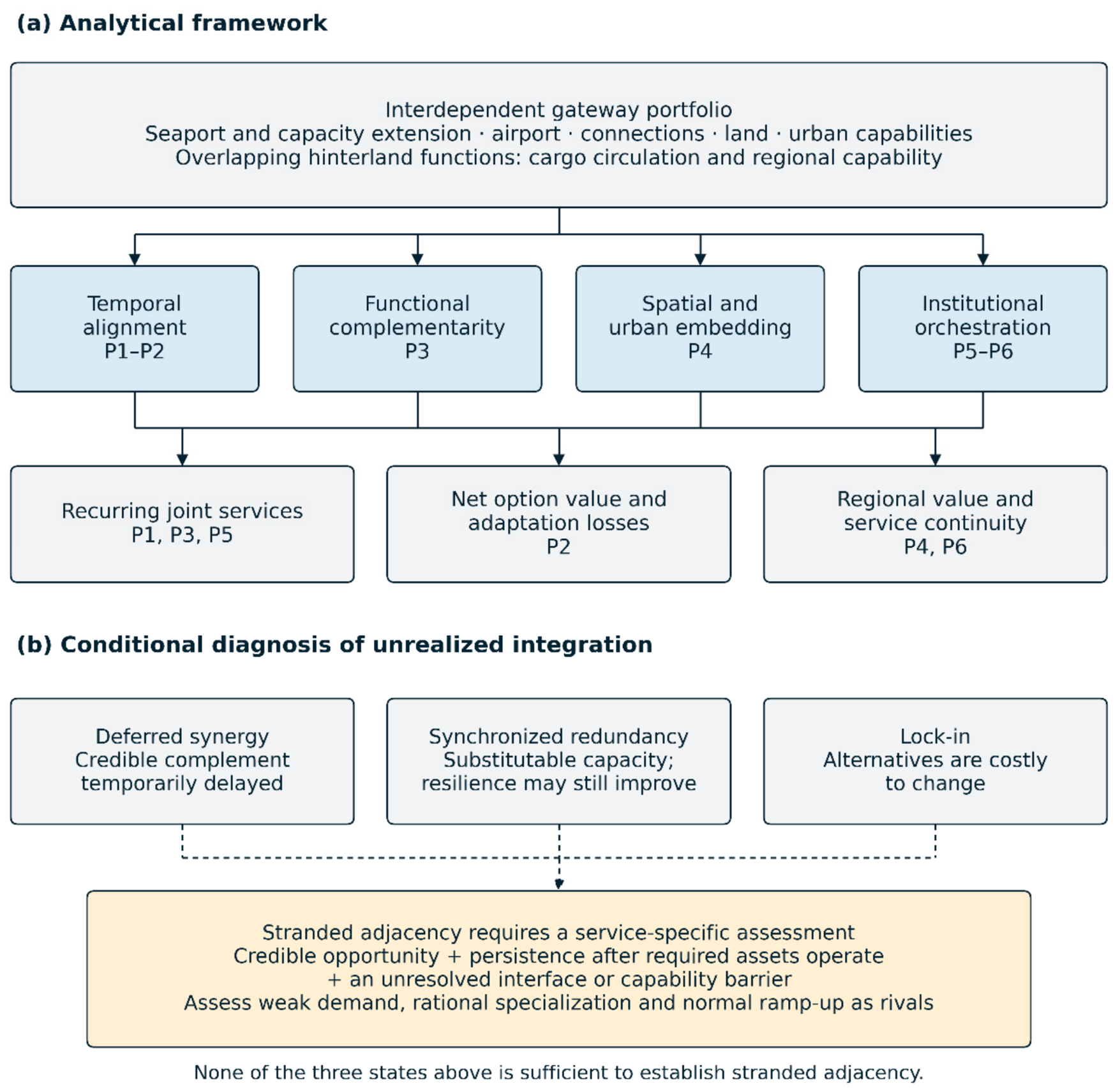
Figure 3.
Hypothesized relationships in P1–P6. P denotes proposition. Explanatory variables, the independently measured P3 mediator and subsequent outcomes are distinguished. Dashed vertical arrows indicate moderation of relationships; the routed dashed P3 path denotes a possible direct proximity relationship. Demand, initial capabilities, ownership and regulation are potential common causes, and outcomes may feed back into coordination. All relationships remain unestimated. Source: authors’ elaboration. Prepared with AI assistance as described in Section 2.4; the final conceptual content and graphical representation were reviewed, revised, and approved by the authors.
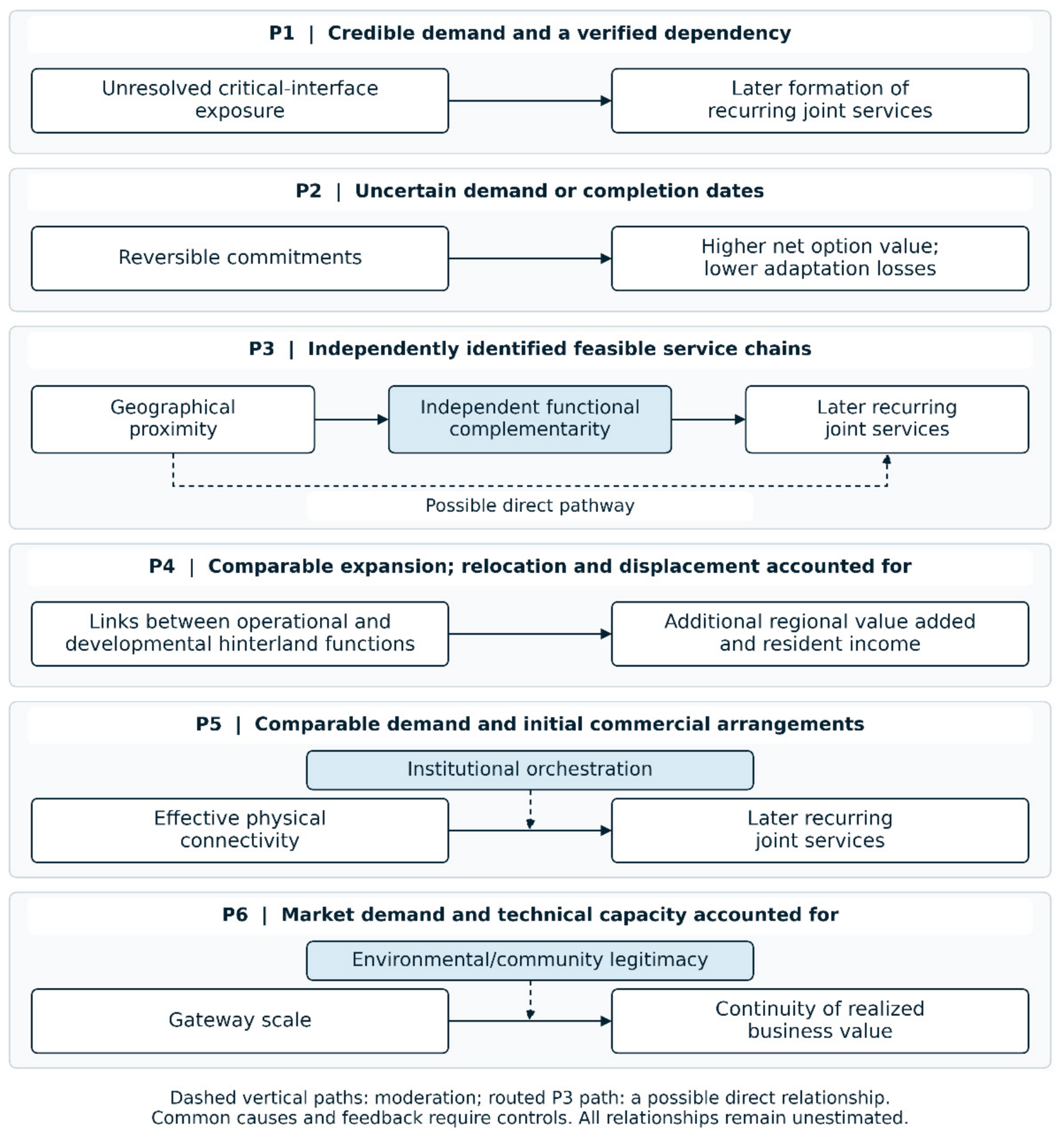
Table 3 separates constructs from their measurement proxies. Gateway ecosystem formation concerns recurrent joint services and transactions. Functional complementarity concerns the independently assessed benefit of combining capabilities, rather than transaction volume itself. Option value concerns the incremental value of flexibility relative to a fixed commitment; a staged land-release ratio is only a process proxy. Hinterland integration is measured through supplier and labour links, while regional value capture requires value-added or income evidence. These distinctions prevent a mediator and its outcome from being defined by the same indicator.
Table 3.
Definitions and indicators of the constructs.
4.1. Infrastructure Asynchrony and Temporal Alignment
Infrastructure asynchrony is a mismatch among the dates when gateway assets, connections, land and urban support functions are required and become available. Differences in completion dates are not inherently harmful. Exposure arises only when an independently specified service or investment depends on an unavailable complement. Scheduled exposure and realized delay must be recorded separately; neither can be inferred solely from two projects having different opening dates.
Temporal alignment is the capability to sequence interdependent commitments while retaining feasible responses to new information. Candidate instruments include protected interfaces, modular facilities, conditional land release and contingencies. They may also impose carrying, coordination and waiting costs. The relevant comparison is the net value of flexibility against an explicit fixed-commitment alternative, not simultaneous completion or staging for its own sake.
Proposition 1.
Conditional on credible demand and a verified dependency, greater unresolved critical-interface exposure is associated with later formation of recurrent cross-node services, relative to otherwise comparable service chains with the required complements available.
Proposition 2.
Under uncertain demand or completion schedules, commitments that remain reversible until independently specified information arrives yield higher net option value and lower irreversible adaptation losses than otherwise comparable fixed commitments.
4.2. Functional Complementarity
Functional complementarity exists when the capability of one node raises the value of another. It differs from specialization, because specialized facilities may remain commercially unrelated. Complementarity may arise through cargo type, service speed, vessel or aircraft requirements, technology, customs arrangements, manufacturing links or resilience functions.
New capacity may substitute for existing activity rather than create additional value. Port–airport proximity is therefore an insufficient basis for an integration claim. Sea–air services require a feasible combination of commodity characteristics, handling reliability, customs arrangements, schedules and end-to-end generalized cost. The comparison must include viable all-sea, all-air or other routing alternatives. Positive throughput at two nearby facilities does not establish complementarity.
Proposition 3.
For independently identified feasible service chains, functional complementarity partly mediates the relationship between geographical proximity and subsequent gateway ecosystem formation; proximity alone need not produce joint services.
4.3. Spatial and Urban Embedding
Spatial and urban embedding connects gateway activity to regional suppliers, labour, research, housing and environmental systems. Accessibility alone is insufficient. An automated terminal may reduce some manual tasks while increasing demand for software, equipment maintenance, systems integration and cybersecurity. If these capabilities are sourced externally, terminal productivity may rise without equivalent regional value capture.
Operational hinterland functions enable cargo circulation, while developmental hinterland functions connect that activity to regional suppliers and workers. Procurement and labour links are intermediate relationships rather than evidence of net regional benefit. Proposition 4 therefore requires regional value-added evidence, a fixed spatial boundary and adjustment for relocation and displacement.
Proposition 4.
For comparable capacity expansion and after accounting for displacement, stronger links between operational and developmental hinterland functions are associated with greater additional regional value added and resident income than capacity expansion with weaker regional links.
4.4. Institutional Orchestration and Legitimacy
Institutional orchestration is the capacity to align interdependent decisions through compatible milestones, information rights, cost and risk allocation, and conflict resolution. It need not involve organizational merger or public leadership. Carriers, operators and private platforms can supply coordination. Its net contribution should be assessed against coordination costs, institutional rigidity and the strength of existing commercial arrangements.
Legitimacy denotes procedurally credible and sustained acceptance by affected communities and regulators. Permit compliance is necessary but does not by itself establish that acceptance. Environmental burdens and uneven benefits can affect implementation [15,16], while consultation can reveal unresolved or conflicting preferences. Independent participation, grievance and acceptance evidence is therefore required alongside compliance records.
Proposition 5.
For comparable service demand and initial commercial arrangements, the association between effective physical connectivity and subsequent ecosystem formation is stronger where cross-actor decision rights and interfaces are explicitly coordinated; this difference is expected to be greater under jurisdictional fragmentation.
Proposition 6.
The association between gateway scale and continuity of realized business value is stronger under sustained environmental and community legitimacy, conditional on market demand and technical capacity; this relationship may be more consequential where approvals span several jurisdictions.
4.5. Stranded Adjacency
Stranded adjacency is the persistent non-realization of an ex ante specified, commercially credible cross-node service after all assets required for that service become operational, despite their geographical proximity. It is a proposed subset of co-location without integration, not a label for every unconnected pair of facilities. Its diagnosis requires an independently documented service opportunity, an explicit follow-up horizon and evidence of an unresolved interface or capability barrier. Rational specialization, inadequate demand and ordinary ramp-up remain alternative explanations. No such diagnosis is made for Busan–Jinhae–Gadeok.
Deferred synergy concerns a temporary delay to a credible complement; synchronized redundancy concerns substitutable capacity; and lock-in concerns costly irreversibility, which does not require proximity (Table 4; Figure 2b). None necessarily ends in stranded adjacency. Future studies should prespecify a service-specific follow-up horizon and report sensitivity to shorter and longer horizons. Low sea–air volume or low regional procurement alone cannot identify the construct. Regional value capture and cross-node commercial integration are separate outcomes, and unavailable observations must be recorded as missing rather than zero.
Table 4.
Stranded adjacency and related concepts.
4.6. Causal Structure and Measurement of the Propositions
Figure 3 distinguishes proposed relationships and measurement roles. Functional complementarity is measured independently of subsequent joint transactions in P3; institutional orchestration moderates the connectivity relationship in P5; and legitimacy moderates the scale relationship in P6. Temporal ordering, demand controls and the possibility that successful integration attracts coordination require explicit treatment before mediation or moderation estimates can support causal interpretation.
Table 5 specifies each proposition’s unit of analysis, boundary conditions, rival explanation and potentially weakening observation. These are prospective tests; the documentary corpus supplies contextual evidence.
Table 5.
Proposition-to-measurement matrix.
5. Documentary Application to Busan–Jinhae–Gadeok
5.1. Source-Reported Milestones and Documentary Scope
The milestone panel establishes different development horizons and observable pre-operational administrative actions, rather than a completed integrated gateway or a harmful effect of asynchrony. Table 6 separates realized operating results, announcements, reported works periods, scheduled milestones and policy targets; Table 7 codes the institutional scope of actions and intentions. The airport basic-design submission reported on 7 September 2026 and the first meeting of an airport-project consultative body on 18 September are dated procedural observations [10,11]. A construction-period label is not a site observation, and the 2030 works package and 2032 policy phase concern different scopes. The nine-record source register and retrospective institutional entries appear in Appendix C.
Table 6.
Evidence tiers of the 2024–2026 documentary panel.
Table 7.
Bounded documentary coding. “Explicit” identifies a source-reported action or entry, “intended” identifies a stated future measure, and “not specified” means only that the selected document does not establish the matter. None denotes demonstrated effectiveness.
A minimal published operating baseline can nevertheless be reproduced. BPA reports New Port throughput of 16.309, 17.880 and 18.638 million TEU in 2023, 2024 and 2025, respectively, and Busan Port totals of 23.154, 24.402 and 24.882 million TEU [12]. New Port’s within-port shares are therefore 70.44%, 73.27% and 74.91%, and annual New Port growth is 9.63% in 2024 and 4.24% in 2025 (Table A5). These are arithmetic descriptions of an already operating asset, not baseline estimates of future sea–air integration, public-policy impact or regional welfare. The environmental-scoping portal additionally records an airport public-comment window from 29 April to 13 May 2024 [26]; this demonstrates an opportunity for procedural input, not stakeholder acceptance, environmental compliance or community legitimacy. The nine-source official layer is bounded to accessible evidence and must not be treated as an exhaustive archive.
Table 7 classifies explicit actions and intentions in the selected documents. The national strategy proposes maritime–land–air data links and industrial capabilities [14]; it does not establish a working cross-modal platform. The construction, design and airport-delivery notices are narrower in institutional scope [9,10,11,13]. In particular, the airport consultative body reported in [11] demonstrates actual pre-operational inter-agency convening but not an authorized cross-modal data exchange, coordination benefit or port–airport commercial service. The BPA development record independently reports consultative activity from August 2019 and an appraisal sequence involving a non-passing result followed by a passing reappraisal in 2021 [24]. These documented events refute a claim that institutions were inactive before operation but cannot establish which actors changed a decision or by how much.
5.2. Provisional Functional Scenarios
The roles below are provisional scenarios. Each requires commercial and institutional evidence and must be compared with independent operation or alternative allocations. They are not established specializations or recommendations to reserve land.
Busan New Port could remain the maritime network anchor as Jinhae capacity enters service. Its realized 2024–2025 throughput establishes an operating base [12], but it does not predict future carrier choices or prove complementarity with another node. Carrier-network, transfer-cost and firm-routing evidence would be needed to evaluate this scenario.
Jinhae could add differentiated technology and capacity within the Busan Port system. The Physical AI strategy proposes supplier support, skills and a manufacturing–port–logistics cluster [14]. This is a policy scenario rather than evidence of regional supplier capture. Validation requires procurement origin, supplier capabilities, additional value added and a comparison with sourcing outside the region, including the costs and risks of technology adoption.
Gadeokdo could support selected time-sensitive chains, such as urgent industrial components, pharmaceuticals or perishables. These are candidate markets, not demonstrated demand. Ishihara et al. model sea–air routing through Japan and find route-specific potential [56]; their results neither estimate Gadeokdo demand nor establish observed conversion. Commodity-chain and routing studies must compare schedules, generalized cost, customs feasibility and handling reliability with viable alternatives before any dedicated sea–air facility is justified.
A regional capability scenario would examine how port hinterland districts and firms in Busan, Changwon and Gimhae contribute services, equipment, manufacturing knowledge and labour access. These are candidate relationships to investigate, not fixed city-level assignments. Establishment locations, supplier networks, worker residences and competing land uses are needed to assess them. A surrounding city’s industrial profile alone cannot establish a gateway linkage.
5.3. Institutional Questions and Existing Pre-Operational Coordination
The records distinguish the institutions responsible for port development and airport project delivery [9,10,11,13,24,25]. They also contradict any assumption of an institutional vacuum: BPA records an earlier public–private consultative activity beginning in 2019 [24], and the September 2026 ministry release reports an actual airport-project coordination meeting involving the ministry, Busan City and the airport construction corporation [11]. The latter body focuses on airport construction, costs and associated regional-development questions. Neither source establishes a formally authorized port–airport joint-governance body, measured coordination effectiveness or commercial integration. The mandate, decision authority, minutes and consequences of these bodies require further documentary and interview evidence.
Three questions remain open. Who can authorize a change to a shared interface, finance it and settle disputes? Which commercial and personal data can be shared, with whose consent and under what security arrangements? Which land-release or procurement conditions can the relevant authorities lawfully apply? These questions follow from the framework and the limits of the available sources; they are not findings that separate planning, commercial confidentiality or appraisal practice has caused a coordination failure.
An institutional feasibility assessment would examine governing instruments, approved plans, budgets, contracts and inter-agency agreements and validate the interpretation with responsible authorities and affected groups. No full legal-mandate audit, stakeholder interview programme or policy-effectiveness evaluation was conducted. The available documents do not establish that a gateway-wide joint dependency register, cross-modal shared data platform or conditional land allocation is already authorized, funded or acceptable. The airport-project body recorded in [11] cannot be assumed to possess those additional decision rights.
A dependency register is consequently a candidate pilot, not an implemented governance architecture. A pilot could list the interface, responsible bodies, decision rights, required dates, data permissions and contingency, while documenting unresolved conflicts. Its value should be judged against administrative cost and the performance of existing arrangements.
5.4. Four-Stage Implementation Pathway
The following pathway is an agenda for feasibility assessment and piloting. Progression between stages requires evidence and the relevant approvals; the sequence is not a validated implementation plan.
Stage 1—option appraisal: Identify credible interdependencies, environmental constraints and competing land uses. Compare the costs of reserving an interface with early commitment and with leaving the assets independent.
Stage 2—capability piloting: Subject to operator consent, access agreements and approvals, use existing facilities to test a bounded data exchange, supplier relationship or joint service. Record baseline performance, costs and failure criteria before the pilot starts.
Stage 3—conditional scaling: Consider additional land or facilities only after independent evidence establishes demand, interface readiness, environmental requirements and authority to act. The relevant triggers must be negotiated and tested; no trigger value is validated here.
Stage 4—evaluation after operation: Compare joint services, utilization, regional value added, emissions and distributional effects with the prespecified alternative. Scale, adapt or discontinue arrangements in light of observed benefits and costs.
Candidate participants include the maritime and transport ministries, BPA, the airport construction authority, the free economic zone authority, Busan Metropolitan City, Gyeongsangnam-do, relevant municipalities, customs, operators, suppliers, workers and affected communities. Naming them does not establish a shared statutory mandate or agreement. Before adoption, each proposed action requires a documented decision owner, applicable authority, budget or contract route, data permissions and stakeholder review.
5.5. Documentary Challenge Tests Against the Six Propositions
The documentary tests use two competing interpretations. H_A states that publicly documented pre-operational coordination plausibly conditions a later joint gateway service; H_B states that the same actions reflect independent port or airport project administration without a commercially authorized cross-modal interface. The records identify within-project consultation and scheduled or actual meetings, satisfying only the minimal existence-and-timing prerequisite for H_A. Neither minutes attributing a port–airport design or service decision to that coordination nor signed joint commitments and downstream transactions were identified in this bounded record set. Consequently, the currently observed traces are equally consistent with H_B. This is not evidence that coordination is absent: it is an evidentiary failure to discriminate causal explanations with available records. Table A3 sets out the known sequence and Table A4 explicitly identifies missing tests for each proposition.
Official documents do not directly test any of the six propositions; nevertheless, their implications can be challenged rather than merely illustrated. Table A4 separates an observed or reported trace, the strongest justified inference, an alternative explanation or contradictory implication, and the evidence required for adjudication. The 2019 port consultation and September 2026 airport-project council contradict a categorical assertion that coordination never precedes operation. They do not confirm P5: the council’s documented remit concerns airport delivery, and no independent comparison of service formation with and without coordination is available. Likewise, distinct asset schedules demonstrate temporal heterogeneity but do not establish harmful critical-interface exposure under P1. Neither unobserved post-opening service volumes nor unmeasured local value added is recoded as zero.
These restrictions change the interpretation of the Busan application. The documentary findings are limited to (i) an established maritime operating base, (ii) distinguishable construction and policy horizons, (iii) reported pre-operational port and airport decision activity, and (iv) the absence of accessible evidence in this corpus on realized cross-modal service effects, additional regional value, or tested governance benefits. The last item is an evidence gap, not evidence that the outcomes or institutions do not exist. The framework’s increment over existing port and ecosystem accounts therefore remains a testable hypothesis rather than an established explanatory advantage.
6. Operationalization and Decision Logic
Table 8 specifies prospective measurements. Data holders are candidate custodians; access, coverage and linkage have not been secured. The first full 12 months of authorized collection would establish a baseline, supplemented by retrospective observations where records are recoverable. Measures that depend on an airport or joint service begin only when the relevant service becomes observable. Missing or inapplicable values must not be coded as zero. The illustrative regional boundary comprises Busan, Changwon and Gimhae and should be tested against a functional labour-market boundary. Policy thresholds, data-sharing agreements and pilot results remain to be established.
Table 8.
Prospective measurement specification. All access and baselines remain to be established. Process proxies are distinguished from outcomes, and denominator coverage must accompany every ratio.
6.1. Decision-Relevant Cost–Benefit Logic
Financial appraisal requires an explicit decision-maker perspective and must be distinguished from social welfare assessment. Delay may affect the present value of net contribution, idle or duplicated investment, sourcing, redesign and temporary operation. Staging may also incur financing, coordination and waiting costs. External sourcing is not automatically a social loss, and procurement, wages and taxes must not be added as independent benefits when they overlap within value added. Environmental burdens and displacement require separate assessment.
The relevant comparison is a staged arrangement against a specified project-by-project or independently operating alternative. Cargo and employment benefits depend on net additional activity after relocation, substitution and commuting leakage. Neither capacity nor proximity establishes such benefits. Section Algebraic Illustration of Partial Risk Reduction provides a financial break-even illustration rather than a social cost–benefit analysis or a Busan estimate.
Algebraic Illustration of Partial Risk Reduction
For a delay of months, conditional exposure under alternative is defined at a common present-value date, where denotes the comparator and the staged arrangement:
Here, denotes conditional financial exposure; is the present-value loss from postponed or cancelled net contribution; is incremental duplication cost net of reuse or salvage; is an external-sourcing premium applied to a stated eligible purchase base; and is redesign or temporary-operation cost. Components must be mutually exclusive, measured from the same decision-maker perspective and discounted consistently. A deferred receipt recovered later contributes only its timing loss unless a permanent loss is documented. The break-even condition is
In Equation (2), and denote the respective probabilities of the dependency event, the incremental cost of the staging package and the additional waiting and carrying cost not already included in exposure. Staging has a positive expected financial increment only when the reduction in expected exposure exceeds . For illustration, assume equal probabilities and an avoided fraction of conditional exposure, so that . Under linear delay scaling, . The break-even ceiling for is then . Table 9 uses to show the arithmetic. These inputs are chosen examples rather than probability bounds, calibrated parameters or estimates of policy feasibility. No monetary values or event probabilities are estimated for Busan.
Table 9.
Algebraic break-even ceilings for , assuming , 50% avoided exposure () and linear delay scaling. Equality denotes break-even; a positive expected financial increment requires a lower cost ratio. The entries are dimensionless arithmetic examples, not Busan sensitivity estimates.
Under the illustrative assumptions, and yield a ceiling of 0.15. Setting halves every displayed ceiling, whereas doubles it. In an application, may range from zero to one and exposure need not increase linearly with delay. Audited costs, residual risks, correlations, discounting and nonlinear schedules would be required. A positive financial increment alone cannot authorize land release or establish a net social or environmental benefit.
7. Discussion
7.1. Theoretical Contribution
The framework combines timing, commercial complementarity, regional capability and institutional coordination at the level of an interdependent asset portfolio. Its additional explanatory value depends on whether this specification predicts outcomes beyond existing regionalization, ecosystem and governance accounts.
The dual-hinterland distinction separates circulation from regional capability as analytical functions. Stranded adjacency is a proposed diagnostic subset of unrealized integration, conditional on independently established commercial potential. Neither construct is established as a separate theory or an observed Busan outcome.
Transfer beyond Busan is conditional on demonstrable asset interdependence, incomplete complements and uncertainty that makes sequencing consequential. Singapore and Dubai provide secondary-source boundary illustrations, not independent validation cases.
7.2. Competing Explanations and Contrary Evidence
The critical literature qualifies several links. Carrier and shipper strategies provide a rival source of integration [57], so a public body’s presence is not evidence of its marginal contribution (P5). Route-specific sea–air modelling [56] weakens generic proximity arguments (P3). Institutional plasticity [58] documents adaptation as well as inertia (P2/P5). Port reform and co-opetition scholarship [59,60] require coordination costs, competition and substitution to be examined. The September 2026 airport-project coordination body [11] supplies an additional documentary counter-instance to any conjecture that actors wait for full gateway operation before coordinating; however, it is not evidence that the proposed cross-modal mechanism improves services. The limited documentary challenge tests (Section 5.5; Table A4) also identify an observed pre-operational coordination episode that weakens any institutional-vacuum premise. None of these sources validates or falsifies the conditional P1–P6 relationships in Busan.
The remaining evidence also needs careful scope. Highway-based redistribution in [61] is an analogy for displacement, not a direct port-region estimate (P4). Reclamation and hinterland-environment studies identify reasons to measure land and transport burdens [62,63]. The automation study examines stakeholder attitudes rather than establishing local employment losses [64] (P6). These studies are not direct tests of P1–P6. Table 5 therefore pairs each proposition with a rival and a prospective discriminating observation. Stable services despite critical-interface exposure would weaken P1; non-positive net flexibility benefits would weaken P2; absent incremental complementarity would weaken P3; no additional regional value after displacement would weaken P4; market-led integration without a coordination interaction would weaken P5; and continuity unrelated to independently measured acceptance would weaken P6. Demand and temporal ordering must be considered before any such pattern is interpreted.
7.3. Structured Boundary Comparison with Singapore and Dubai
Singapore and Dubai are purposively selected, information-rich boundary illustrations because both combine maritime, aviation and logistics activities, and published research already compares their development [65,66,67,68,69,70]. Their governance arrangements provide contrasts, but both are prominent hub-development examples. This selection omits failed and weakly integrated regions and cannot identify necessary or sufficient conditions. Table 10 applies common descriptive dimensions linked to the four mechanisms. It combines historical scholarship with contemporary institutional descriptions, not matched observations or a harmonized dataset. Current operator claims are attributed as such; outcome equivalence and causality are not inferred.
Table 10.
Structured secondary-source boundary comparison. The entries describe selected arrangements at different historical dates; they do not rank performance, establish equivalent governance concentration or validate transfer to Korea.
The comparison suggests questions about sequencing interfaces, assigning capability-development responsibilities and making shared services operable. It does not show that either arrangement would work in Busan. City-state and emirate contexts differ from Korea in fiscal authority, planning, property, labour and approval systems, and Dubai itself contains several distinct entities. Potential transfer must be examined instrument by instrument for authority, resources, commercial demand and environmental and distributional consequences. Neither case supplies a validated Korean governance template.
7.4. Managerial Implications
Managers could use the framework to identify a small number of credible dependencies and evaluate whether a joint arrangement adds value beyond existing commercial coordination. Port authorities’ involvement should follow the dependencies they can influence. Tenant appraisal could examine gateway links, adaptability and regional effects alongside commercial viability, subject to the rules governing allocation and procurement.
A bounded dependency-register pilot could provide an initial test. Each interface would identify a decision owner, deadline, authority, evidence source, permissions, contingency and review criterion. Agreement on these items has not been obtained. Evaluation should record coordination costs and unresolved disputes alongside service outcomes.
7.5. Prospective Validation, Research Agenda and Limitations
Recent systematic reviews provide important qualifications to the proposed theoretical contribution. Rahayu et al. systematically review 49 port–hinterland governance papers and show that governance changes with spatial and temporal context [21]. Zhang et al. synthesize 90 full-text port–hinterland studies and discuss weak causal identification for many integration levers [22]. These reviews directly disconfirm any assertion that governance dynamics, anticipatory actors or integration layers are unrecognized in prior research; the narrower proposed contribution is a service-specific portfolio of assets with distinct operating dates and explicit evidence criteria. Eo and Choi’s stated-preference analysis of the proposed Busan–Gadeokdo sea–air connection identifies service attributes in respondents’ choices, but it is neither observed cargo conversion nor a calibrated forecast of airport demand [23]. The environmental-scoping portal records the 2024 public-notice window but no representative acceptance survey [26]. Treating these four sources as serious alternative evidence, rather than automatic support for P1–P6, further narrows the framework’s empirical claims.
Validation can begin before the airport opens. A process study could follow BPA’s 2019 consultation and 2021 appraisal/reappraisal entries [24], the 2026 airport design procedures [9,10], and the September 2026 airport coordination meeting [11] through minutes, contracts, option assessments and dated decisions. Archival collection should distinguish the authority that met from the authority that could change an interface; it should document alternatives considered, actor-specific positions, actual changes and dissent. Interviews with authorities, operators, firms, workers and affected communities could test rival accounts. The first authorized observation year would establish baselines; repeated firm-routing, supplier and worker observations would then follow formation of services as assets operate. Comparative sampling should include weak or failed integration, not only Singapore and Dubai. Mediation and moderation tests require temporally ordered, independently measured constructs and evaluation of selection, demand, ownership and reverse causality. Appendix D supplies a prospective protocol and Table A4 documents current evidentiary challenges; neither amounts to completed interviews, a reproducible systematic review, causal identification or populated baselines.
Several limitations constrain interpretation. The 60 retained scholarly works (57 reference-led and three identified by targeted search) are an auditable included-source inventory, not a systematic search yield; historical query exports, candidate-level screening, exhaustive coverage and independent coding are missing. The nine official records establish time-stamped announcements and selected institutional actions, but not continuous deliberation, stakeholder acceptance, validated legal authority or attributable impacts. The September 2026 airport-project council cannot be equated with effective cross-modal coordination. Singapore and Dubai are prominent, non-failure boundary illustrations without matched outcomes. Firm-level routing, supplier networks, land-release data, independent joint-service, supplier and community-acceptance baselines and pilots have not been obtained. Accordingly, P1–P6 remain untested. A full systematic review and longitudinal process study would be needed to evaluate the proposed relationships against broader evidence.
8. Conclusions
Busan–Jinhae–Gadeok illustrates a planning question: how should interdependent interfaces and capabilities be sequenced when an operating maritime gateway, its capacity extension and a pre-operational airport have different horizons? The nine official records establish those horizons, port consultation prior to full operation and a dated September 2026 airport-project council. They do not demonstrate realized port–airport integration, the marginal benefit of additional orchestration or causal effects on sustainable development.
Anticipatory gateway regionalization offers six untested propositions organized by four alignment mechanisms. Its contribution is a combined analytical specification, with explicit distinctions among timing, commercial complementarity, regional capability and legitimacy. The dual-hinterland distinction and stranded adjacency remain proposed analytical devices.
For sustainable gateway development, the framework identifies questions about reversible investment, net regional value added, emissions, land use and the distribution of benefits and burdens. Staging or coordination is desirable only where its incremental benefits exceed its economic, environmental and social costs under the relevant institutions. These sustainability effects require empirical evaluation.
The executed targeted search improves visibility of critical new research but does not replace a database-complete systematic review. Public records permit a reproducible throughput baseline and limited testing of whether a procedural precondition was reported; they cannot identify the counterfactual marginal effect of coordination, port–airport transactions, additional regional value, emissions or ongoing community acceptance. The next empirical stage must obtain decision minutes, alternative investment packages, firm-routing and supplier data and eventually post-opening service observations. The six propositions, functional-role scenarios and candidate governance instruments remain conditional rather than verified. Infrastructure scale and throughput alone cannot establish sustainable gateway value.
Author Contributions
Conceptualization, S.R. and M.K.; methodology, S.R., J.K. (Jeongweon Kim) and S.J.; investigation, J.K. (Jeongweon Kim) and J.K. (Joohye Kim); writing—original draft preparation, S.R. and J.K. (Joohye Kim); writing—review and editing, S.R., J.K. (Jeongweon Kim), J.K. (Joohye Kim), S.J. and M.K.; visualization, S.R. and J.K. (Joohye Kim); supervision, M.K. All authors have read and agreed to the published version of the manuscript.
Funding
This research was supported by the ANCHOR programme through the ANCHOR Center, Gyeongsangnam-do, funded by the Ministry of Education (MOE) and the Gyeongsangnam-do Provincial Government, Republic of Korea (2026-ANCHOR(Glocal University Project)-16-008).
Institutional Review Board Statement
Not applicable.
Informed Consent Statement
Not applicable.
Data Availability Statement
The official-document extraction and proposition challenge audit are reported in Table 6, Table 7, Table A2, Table A3 and Table A4. Published BPA 2023–2025 statistics and the derived shares and growth rates appear in Table A5, with the publicly accessible original source cited. The 60-study included-source inventory and the exact executed six-query targeted scholarly discovery log are reported in Appendix B and Appendix E. This is not a complete systematic database export or screening register. No interviews, firm-level records, signed cross-modal agreements, confidential minutes, future joint-service outcomes or causal estimates were obtained. Public source links and verification dates appear in the References.
Acknowledgments
During the preparation of this manuscript, the authors used OpenAI ChatGPT and Codex(GPT-6 Astra; Open AI) for language editing, grammar correction, conceptual figure preparation, and image generation. The scope of their assistance, including contributions to the refinement of conceptual representations, is described in Section 2.4. All model output was reviewed, verified, and edited by the authors. The authors retain full responsibility for the content, accuracy, and integrity of the publication.
Conflicts of Interest
The authors declare no conflicts of interest.
Abbreviations
| Abbreviation | Definition |
| AI | Artificial intelligence |
| BPA | Busan Port Authority |
| Jafza | Jebel Ali Free Zone |
| MOF | Ministry of Oceans and Fisheries |
| MOLIT | Ministry of Land, Infrastructure and Transport |
| MPA | Maritime and Port Authority of Singapore |
| SDG | Sustainable Development Goal |
| TEU | Twenty-foot equivalent unit |
Appendix A. Source Notes and Limits of the Boundary Comparison
The institutional sources below document selected infrastructure and service arrangements in Table 10. They are not independent evaluations of effectiveness. Historical studies [65,66,67,68,69,70] provide context at their publication dates and cannot verify present-day outcomes.
Appendix A.1. Singapore’s Phased Consolidation and Differentiated Public Roles
The Maritime and Port Authority of Singapore (MPA) reports Tuas’s formal opening in September 2022 and phased development toward the 2040s [71]. Changi Airport Group describes its air-cargo free-trade-zone services [73], while JTC Corporation describes an advanced-manufacturing innovation district [75]. These sources identify distinct organizational roles without establishing the performance of a unified port–airport chain or demonstrating that district firms supply the port.
Appendix A.2. Dubai’s Port, Airport and Free Zone Arrangements
Jebel Ali Free Zone (Jafza) describes a port-adjacent free zone [76], Dubai Airports describes its cargo services [72], and Dubai South advertises access to Jebel Ali through a bonded logistics corridor [74]. These sources establish stated facilities and arrangements rather than sea–air volumes, regional benefits or cost savings. Historical studies describe government-linked development and the importance of its institutional setting [67,68,69,70].
Appendix B. Included Scholarly Sources and Their Interpretive Roles
Table A1 inventories 60 scholarly sources: 39 substantive, nine critical or rival-explanation, six comparative and three methodological works and three studies identified through a dated targeted search. Institutional sources are listed separately in the references. The mapping identifies each work’s analytical role and relevant mechanism or proposition. It does not imply that the sources test the propositions or share a common temporal assumption.
Table A1.
Included scholarly sources (60 records) and their interpretive roles. Mechanism labels and proposition links are the authors’ mapping, not empirical support counts.
Appendix C. Documentary Extraction Register
The nine records in Table A2 form a bounded, purposively selected official-document corpus. All nine records were accessed on 28 October 2026, the documentary event cutoff, and all covered events precede that date. Inclusion was based on source coverage of operating results, works packages, published policy horizons, airport design, and pre-operational coordination. This is an included-record register, not an exhaustive search of institutional archives. Retrospective entries on current official webpages are not substitutes for original meeting minutes, appraisal reports or signed decisions.
Table A2.
Nine-source official-document extraction register and evidentiary limits. All records were accessed on 28 October 2026, the event cutoff; all documented events preceded that date. An official notice confirms its stated procedure or intention, not its effectiveness.
Appendix D. Audit-Ready Research Protocol and Limited Process Observations
Appendix D.1. Bounded Documentary Process Evidence
The following chronology reports what can be observed in dated official accounts, not a complete process-tracing test. A process-tracing causal claim would additionally require contemporaneous minutes, decisions, alternative options, counterfactuals and actor-level testimony. Source reports have been classified by action, institutional scope and observable limitation before any proposition is evaluated.
Table A3.
Source-grounded process observations and missing causal links.
Appendix D.2. Proposition-Specific Challenge Audit of the Nine-Record Corpus
Table A4.
Proposition-specific evidence challenge audit. “Not tested” means that the bounded documentary source set lacks the outcome and comparison required for that proposition; it does not signify failure of the proposition.
Table A5.
Reproducible operating-port baseline (BPA [12]). Values are published in thousand TEU; within-port shares and annual changes were recalculated from published annual totals, with intermediate calculations retained. The table is not an estimate of integrated-gateway outcomes.
The status-coded record supports a descriptive precursor sequence, not a smoking-gun test. The rival hypothesis that within-project consultations occurred without a binding cross-modal port–airport decision remains viable. The observed 2023–2025 throughput trend and 2024 environmental notice do not satisfy mediation or moderation identification, and no unpublished minutes, interviews or commercial data were assumed. The available records limit causal inference; they do not establish either an effect or its absence.
Appendix D.3. Proposed Systematic Literature-Search and Process-Study Procedures
For a future systematic review, the search date, database export and exact Boolean query should be preserved independently for each database. Proposed databases are Scopus and Web of Science Core Collection, subject to access and coverage checks. Candidate search blocks are (port* OR seaport* OR gateway*) AND (regionalization OR regionalisation OR hinterland* OR “port-city” OR “multi-port”); (port* OR airport* OR freight*) AND (sequenc* OR “path depend*” OR “real option*” OR “institutional coordinat*”); (“business ecosystem*” OR “logistics cluster*”) AND (infrastructur* OR port* OR freight*). Search fields, language, year filters, database index date and export counts would be recorded before screening; these Boolean expressions are proposed for a subsequent database review and were not executed as database searches in this study.
Two independent screeners should record title/abstract and full-text exclusions by a predefined reason hierarchy (not a gateway/logistics setting; no regional or institutional mechanism; no empirical or conceptual relevance; duplicate; inaccessible full text) and reconcile disagreements in an auditable log. The extraction form should record study design, location, period, unit, pre-operational status, actor rights, dependencies, proposed mechanisms, evidence, contradictions and limits. The synthesis should retain negative cases and distinguish conceptual predictions from observed effects. The 57-work reference-led inventory is not the output of the proposed systematic search.
The proposed empirical study would preregister service-chain or decision-episode units; sample public and private coordination episodes, including non-adoption and failure; recover dated decisions, contracts and costed alternatives; and triangulate interviews with operators, agencies, suppliers, employees and affected residents. Baselines would use the first 12 months of authorized observations, with pre-registration of missing-data rules, competing routes, demand and ownership controls, spatial boundaries and service-specific follow-up horizons. Airport-dependent outcomes are structurally unavailable until relevant facilities operate. No interviews, institutional approvals, populated joint-service baseline or causal estimates are included in the present analysis.
Appendix E. Executed Targeted Scholarly Discovery: Search and Source-Decision Ledger
In October 2026, six predefined theme-specific queries were executed through a publicly indexed academic-web discovery interface. The search produced ranked webpages, not a bulk bibliographic database export. The visible results were screened manually for scholarly provenance, identifiable publication year, explicit port/hinterland/airport relevance and a conceptual, empirical or critical contribution. Record-level inclusion decisions for the three search-identified publications are reported below. Search-engine ranking is unstable and the total number of candidate pages, duplicates and excluded full texts was not available. Accordingly, no PRISMA identification or screening counts, systematic coverage, database equivalence, quality rating or independent dual screening are claimed. The targeted search does not establish systematic coverage of the complete 60-work inventory.
Table A6.
Executed search terms and scope. Exact quoted search terms entered in October 2026; no date or language filters were forced by the search interface. This log is reproducible as search wording, not as a fixed exhaustive result set.
Table A7.
Scholarly sources identified through targeted discovery and their inclusion decisions. These records do not constitute the results of a complete systematic screening; the 57 reference-led sources are mapped in Appendix B.
Search limitations: Only visible search results and verified source pages could be inspected; institutional Scopus and Web of Science retrieval, exact export totals, duplicate removal, independent full-text screening, and prospectively registered eligibility criteria were unavailable. The available search records therefore do not support claims of an exhaustive systematic review.
References
- Slack, B. Pawns in the Game: Ports in a Global Transportation System. Growth Change 1993, 24, 579–588. [Google Scholar] [CrossRef] [Scilit]
- Hesse, M.; Rodrigue, J.-P. The Transport Geography of Logistics and Freight Distribution. J. Transp. Geogr. 2004, 12, 171–184. [Google Scholar] [CrossRef] [Scilit]
- Pallis, A.A.; Vitsounis, T.K.; de Langen, P.W. Port Economics, Policy and Management: Review of an Emerging Research Field. Transp. Rev. 2010, 30, 115–161. [Google Scholar] [CrossRef] [Scilit]
- Parola, F.; Risitano, M.; Ferretti, M.; Panetti, E. The Drivers of Port Competitiveness: A Critical Review. Transp. Rev. 2017, 37, 116–138. [Google Scholar] [CrossRef] [Scilit]
- Notteboom, T.; Rodrigue, J.-P. Port Regionalization: Towards a New Phase in Port Development. Marit. Policy Manag. 2005, 32, 297–313. [Google Scholar] [CrossRef] [Scilit]
- Roso, V.; Woxenius, J.; Lumsden, K. The Dry Port Concept: Connecting Container Seaports with the Hinterland. J. Transp. Geogr. 2009, 17, 338–345. [Google Scholar] [CrossRef] [Scilit]
- Jacobs, W.; Notteboom, T. An Evolutionary Perspective on Regional Port Systems: The Role of Windows of Opportunity in Shaping Seaport Competition. Environ. Plan. A 2011, 43, 1674–1692. [Google Scholar] [CrossRef] [Scilit]
- Martin, R.; Sunley, P. Path Dependence and Regional Economic Evolution. J. Econ. Geogr. 2006, 6, 395–437. [Google Scholar] [CrossRef] [Scilit]
- Busan Metropolitan City. Basic Design Commences for the Gadeokdo New Airport Site Development Project. 5 March 2026. Available online: https://www.busan.go.kr/bgi/news/1721254 (accessed on 28 October 2026).
- Ministry of Land, Infrastructure and Transport (Republic of Korea). Receipt of Basic Design for Gadeokdo New Airport Site Formation Works (in Korean). 7 September 2026. Available online: https://www.molit.go.kr/USR/NEWS/m_72/dtl.jsp?id=95092391 (accessed on 28 October 2026).
- Ministry of Land, Infrastructure and Transport (Republic of Korea). Launch of the Gadeokdo New Airport Project Promotion Consultative Body: Central Government, Busan City and Project Implementer Begin Cooperation (in Korean). 18 September 2026. Available online: https://www.molit.go.kr/USR/NEWS/m_71/dtl.jsp?id=95092434 (accessed on 28 October 2026).
- Busan Port Authority. Container Throughput by New Port and North Port, 2010–2025. Available online: https://www.busanpa.com/index.bpa?menuCd=DOM000000105005001003 (accessed on 28 October 2026).
- Busan Port Authority. Construction Notice for the Full-Scale Start of the Jinhae New Port Development Project at Busan Port. 8 September 2025. Available online: https://busanpa.com/board/view.do?boardId=BBS0000027&dataSid=34124&menuCd=DOM000000105001001000&paging=ok&startPage=26 (accessed on 28 October 2026).
- Ministry of Oceans and Fisheries. Ports as One Giant Intelligent Robot: Launching the Physical AI Port Strategy. Posted 22 July 2026; strategy announced 23 July 2026. Available online: https://www.mof.go.kr/doc/ko/selectDoc.do?bbsSeq=10&docSeq=67543&menuSeq=971 (accessed on 28 October 2026).
- Lam, J.S.L.; Notteboom, T. The Greening of Ports: A Comparison of Port Management Tools Used by Leading Ports in Asia and Europe. Transp. Rev. 2014, 34, 169–189. [Google Scholar] [CrossRef] [Scilit]
- Monios, J.; Wilmsmeier, G.; Tello, G.A.M.; Pomaska, L. A New Conception of Port Governance Under Climate Change. J. Transp. Geogr. 2024, 120, 103988. [Google Scholar] [CrossRef] [Scilit]
- United Nations. Transforming Our World: The 2030 Agenda for Sustainable Development; Resolution A/RES/70/1; United Nations General Assembly: New York, NY, USA, 2015. [Google Scholar]
- Jaakkola, E. Designing Conceptual Articles: Four Approaches. AMS Rev. 2020, 10, 18–26. [Google Scholar] [CrossRef] [Scilit]
- Torraco, R.J. Writing Integrative Literature Reviews: Guidelines and Examples. Hum. Resour. Dev. Rev. 2005, 4, 356–367. [Google Scholar] [CrossRef] [Scilit]
- Snyder, H. Literature Review as a Research Methodology: An Overview and Guidelines. J. Bus. Res. 2019, 104, 333–339. [Google Scholar] [CrossRef] [Scilit]
- Rahayu, L.; Busscher, T.; Woltjer, J. The evolution of port-hinterland relations: A systematic review of governance practices. Transp. Res. Interdiscip. Perspect. 2026, 38, 102128. [Google Scholar] [CrossRef] [Scilit]
- Zhang, H.; Poo, M.C.-P.; Lau, Y.-y.; Fan, S. Integration Mechanisms and Performance in Port–Hinterland Supply Chains: A Systematic Review. J. Mar. Sci. Eng. 2026, 14, 1434. [Google Scholar] [CrossRef] [Scilit]
- Eo, J.; Choi, D. Analysis of Priority for Sea&Air Integration between Gadeokdo New Airport and Busan Port: A Conjoint Analysis Approach. Korean J. Logist. 2026, 34, 25–44. [Google Scholar] [CrossRef]
- Busan Port Authority. 2026 BPA Port Development Status. Item 8: Jinhae New Port Phase 1-1 Container Terminal Development. Available online: https://www.busanpa.com/index.bpa?menuCd=DOM000000103002002000 (accessed on 28 October 2026).
- Ministry of Land, Infrastructure and Transport. Basic Design Commences for the Gadeokdo New Airport Site Development Project. 5 March 2026. Available online: https://www.korea.kr/briefing/pressReleaseView.do?callfrom=openData&newsId=156747468 (accessed on 28 October 2026).
- Environmental Impact Assessment Information Support System (EIASS). Gadeokdo New Airport Construction Project: Public Notice of EIA Scoping Decision, Notice and Comment Period 29 April–13 May 2024. Available online: https://eiass.go.kr/partcptn/result/resultEiassView.do?BIZ_CD=RE20240212 (accessed on 28 October 2026).
- Rodrigue, J.-P.; Notteboom, T. Foreland-Based Regionalization: Integrating Intermediate Hubs with Port Hinterlands. Res. Transp. Econ. 2010, 27, 19–29. [Google Scholar] [CrossRef] [Scilit]
- Notteboom, T. Concentration and the Formation of Multi-Port Gateway Regions in the European Container Port System: An Update. J. Transp. Geogr. 2010, 18, 567–583. [Google Scholar] [CrossRef] [Scilit]
- Rodrigue, J.-P.; Notteboom, T. Comparative North American and European Gateway Logistics: The Regionalism of Freight Distribution. J. Transp. Geogr. 2010, 18, 497–507. [Google Scholar] [CrossRef] [Scilit]
- Rodrigues, T.A.; Ojiako, U.; Mota, C.M.M.; Marshall, A.; Chipulu, M.; Dweiri, F. Assessing Risk Dimensions in Dry Port Projects: Prioritization, Interdependence and Heterogeneity. Marit. Bus. Rev. 2024, 9, 311–330. [Google Scholar] [CrossRef] [Scilit]
- Monios, J.; Wilmsmeier, G. Giving a Direction to Port Regionalisation. Transp. Res. Part A Policy Pract. 2012, 46, 1551–1561. [Google Scholar] [CrossRef] [Scilit]
- Monios, J.; Wilmsmeier, G. The Role of Intermodal Transport in Port Regionalisation. Transp. Policy 2013, 30, 161–172. [Google Scholar] [CrossRef] [Scilit]
- Notteboom, T.; Knatz, G.; Parola, F. Port Co-Operation: Types, Drivers and Impediments. Res. Transp. Bus. Manag. 2018, 26, 1–4. [Google Scholar] [CrossRef] [Scilit]
- Ducruet, C.; Lee, S.W. Frontline Soldiers of Globalisation: Port–City Evolution and Regional Competition. GeoJournal 2006, 67, 107–122. [Google Scholar] [CrossRef] [Scilit]
- Hall, P.V.; Jacobs, W. Why Are Maritime Ports (Still) Urban, and Why Should Policy-Makers Care? Marit. Policy Manag. 2012, 39, 189–206. [Google Scholar] [CrossRef] [Scilit]
- Wiegmans, B.W.; Louw, E. Changing Port–City Relations at Amsterdam: A New Phase at the Interface? J. Transp. Geogr. 2011, 19, 575–583. [Google Scholar] [CrossRef] [Scilit]
- de Langen, P.W. Governance in Seaport Clusters. Marit. Econ. Logist. 2004, 6, 141–156. [Google Scholar] [CrossRef] [Scilit]
- Coe, N.M.; Hess, M.; Yeung, H.W.C.; Dicken, P.; Henderson, J. Globalizing Regional Development: A Global Production Networks Perspective. Trans. Inst. Br. Geogr. 2004, 29, 468–484. [Google Scholar] [CrossRef] [Scilit]
- Boschma, R. Proximity and Innovation: A Critical Assessment. Reg. Stud. 2005, 39, 61–74. [Google Scholar] [CrossRef] [Scilit]
- Sheffi, Y. Logistics Clusters: Delivering Value and Driving Growth; MIT Press: Cambridge, MA, USA, 2012. [Google Scholar]
- Zhang, J.Q.; Woo, S.H.; Li, K.X. Port-City Synergism and Regional Development Policy: Evidence from the Yangtze River Region. Transp. Res. Part E Logist. Transp. Rev. 2024, 192, 103817. [Google Scholar] [CrossRef] [Scilit]
- Adner, R. Ecosystem as Structure: An Actionable Construct for Strategy. J. Manag. 2017, 43, 39–58. [Google Scholar] [CrossRef] [Scilit]
- Teece, D.J. Explicating Dynamic Capabilities: The Nature and Microfoundations of (Sustainable) Enterprise Performance. Strateg. Manag. J. 2007, 28, 1319–1350. [Google Scholar] [CrossRef] [Scilit]
- Jacobides, M.G.; Cennamo, C.; Gawer, A. Towards a Theory of Ecosystems. Strateg. Manag. J. 2018, 39, 2255–2276. [Google Scholar] [CrossRef] [Scilit]
- de Langen, P.W.; Sornn-Friese, H.; Hallworth, J. The Role of Port Development Companies in Transitioning the Port Business Ecosystem; The Case of Port of Amsterdam’s Circular Activities. Sustainability 2020, 12, 4397. [Google Scholar] [CrossRef] [Scilit]
- Brooks, M.R.; Pallis, A.A. Assessing Port Governance Models: Process and Performance Components. Marit. Policy Manag. 2008, 35, 411–432. [Google Scholar] [CrossRef] [Scilit]
- van der Horst, M.R.; de Langen, P.W. Coordination in Hinterland Transport Chains: A Major Challenge for the Seaport Community. Marit. Econ. Logist. 2008, 10, 108–129. [Google Scholar] [CrossRef] [Scilit]
- Ng, A.K.Y.; Pallis, A.A. Port Governance Reforms in Diversified Institutional Frameworks: Generic Solutions, Implementation Asymmetries. Environ. Plan. A 2010, 42, 2147–2167. [Google Scholar] [CrossRef] [Scilit]
- Verhoeven, P. A Review of Port Authority Functions: Towards a Renaissance? Marit. Policy Manag. 2010, 37, 247–270. [Google Scholar] [CrossRef] [Scilit]
- Brooks, M.R.; Cullinane, K.P.B.; Pallis, A.A. Revisiting Port Governance and Port Reform: A Multi-Country Examination. Res. Transp. Bus. Manag. 2017, 22, 1–10. [Google Scholar] [CrossRef] [Scilit]
- Valionienė, E.; Župerkienė, E. Exploring the Factors That Affect the Resilience of Port Organizational Ecosystems Through a Survey of Common Uncertainties. TransNav Int. J. Mar. Navig. Saf. Sea Transp. 2024, 18, 185–192. [Google Scholar] [CrossRef] [Scilit]
- Sirajuddin; Januarsi, Y.; Irman, A.; Ridwan, A. Integrated Port Governance and Digitalization System: A Model for Boosting Port Logistics Performance. Asian J. Shipp. Logist. 2026, 42, 84–96. [Google Scholar] [CrossRef] [Scilit]
- Ansar, A.; Flyvbjerg, B.; Budzier, A.; Lunn, D. Should We Build More Large Dams? The Actual Costs of Hydropower Megaproject Development. Energy Policy 2014, 69, 43–56. [Google Scholar] [CrossRef] [Scilit]
- Cantarelli, C.C.; Flyvbjerg, B.; van Wee, B.; Molin, E.J.E. Lock-In and Its Influence on the Project Performance of Large-Scale Transportation Infrastructure Projects: Investigating the Way in Which Lock-In Can Emerge and Affect Cost Overruns. Environ. Plan. B Plan. Des. 2010, 37, 792–807. [Google Scholar] [CrossRef] [Scilit]
- Flyvbjerg, B. What You Should Know About Megaprojects and Why: An Overview. Proj. Manag. J. 2014, 45, 6–19. [Google Scholar] [CrossRef] [Scilit]
- Ishihara, H.; Ishiguro, K.; Takebayashi, M. Feasibility Analysis of International Sea–Air Transport on the Export Cargo from East Asia to North America. J. East. Asia Soc. Transp. Stud. 2024, 15, 1330–1349. [Google Scholar] [CrossRef]
- Frémont, A. Shipping Lines and Logistics. Transp. Rev. 2009, 29, 537–554. [Google Scholar] [CrossRef] [Scilit]
- Notteboom, T.; de Langen, P.; Jacobs, W. Institutional Plasticity and Path Dependence in Seaports: Interactions Between Institutions, Port Governance Reforms and Port Authority Routines. J. Transp. Geogr. 2013, 27, 26–35. [Google Scholar] [CrossRef] [Scilit]
- Haralambides, H. Globalization, Public Sector Reform, and the Role of Ports in International Supply Chains. Marit. Econ. Logist. 2017, 19, 1–51. [Google Scholar] [CrossRef] [Scilit]
- Song, D.-W. Port Co-Opetition in Concept and Practice. Marit. Policy Manag. 2003, 30, 29–44. [Google Scholar] [CrossRef] [Scilit]
- Chandra, A.; Thompson, E. Does Public Infrastructure Affect Economic Activity? Evidence from the Rural Interstate Highway System. Reg. Sci. Urban Econ. 2000, 30, 457–490. [Google Scholar] [CrossRef] [Scilit]
- Sengupta, D.; Chen, R.; Meadows, M.E. Building Beyond Land: An Overview of Coastal Land Reclamation in 16 Global Megacities. Appl. Geogr. 2018, 90, 229–238. [Google Scholar] [CrossRef] [Scilit]
- Gonzalez Aregall, M.; Bergqvist, R.; Monios, J. A Global Review of the Hinterland Dimension of Green Port Strategies. Transp. Res. Part D Transp. Environ. 2018, 59, 23–34. [Google Scholar] [CrossRef] [Scilit]
- Notteboom, T.; Pallis, A.A.; Knatz, G. Stakeholders’ Attitudes Toward Container Terminal Automation. Marit. Econ. Logist. 2025, 27, 752–785. [Google Scholar] [CrossRef] [Scilit]
- Airriess, C.A. Regional Production, Information-Communication Technology, and the Developmental State: The Rise of Singapore as a Global Container Hub. Geoforum 2001, 32, 235–254. [Google Scholar] [CrossRef] [Scilit]
- Lee, S.-W.; Song, D.-W.; Ducruet, C. A Tale of Asia’s World Ports: The Spatial Evolution in Global Hub Port Cities. Geoforum 2008, 39, 372–385. [Google Scholar] [CrossRef] [Scilit]
- Jacobs, W.; Hall, P.V. What Conditions Supply Chain Strategies of Ports? The Case of Dubai. GeoJournal 2007, 68, 327–342. [Google Scholar] [CrossRef] [Scilit]
- Hvidt, M. The Dubai Model: An Outline of Key Development-Process Elements in Dubai. Int. J. Middle East Stud. 2009, 41, 397–418. [Google Scholar] [CrossRef] [Scilit]
- Akhavan, M. Development Dynamics of Port-Cities Interface in the Arab Middle Eastern World—The Case of Dubai Global Hub Port-City. Cities 2017, 60, 343–352. [Google Scholar] [CrossRef] [Scilit]
- Akhavan, M. Evolution of Hub Port-Cities into Global Logistics Centres: Lessons from the Two Cases of Dubai and Singapore. Int. J. Transp. Econ. 2017, 44, 25–47. [Google Scholar] [CrossRef]
- Maritime and Port Authority of Singapore. Port of the Future. Available online: https://www.mpa.gov.sg/maritime-singapore/port-of-the-future (accessed on 28 October 2026).
- Dubai Airports. Cargo: Dubai World Central–Al Maktoum International. Available online: https://dubaiairports.ae/corporate/business-opportunities/cargo (accessed on 28 October 2026).
- Changi Airport Group. Air Cargo Partnerships. Available online: https://www.changiairport.com/en/corporate/partnering-us/cargo-partners.html (accessed on 28 October 2026).
- Dubai South. Dubai South and Toll Group Break Ground on State-of-the-Art Logistics Facility. Available online: https://www.dubaisouth.ae/en/newsroom/dubai-south-and-toll-group-break-ground-on-state-of-the-art-logistics (accessed on 28 October 2026).
- JTC Corporation. Jurong Innovation District. Available online: https://www.jtc.gov.sg/juronginnovationdistrict (accessed on 28 October 2026).
- Jebel Ali Free Zone. About Jafza. Available online: https://www.jafza.ae/about/ (accessed on 28 October 2026).
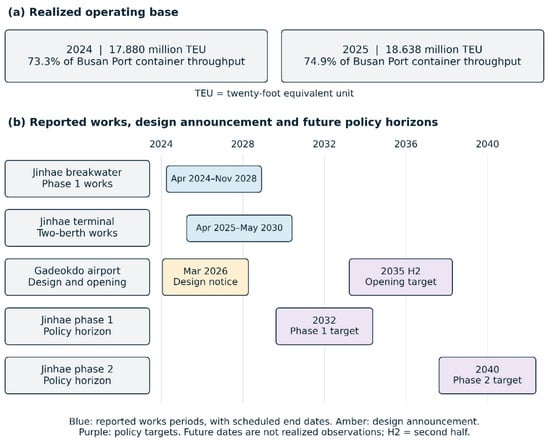
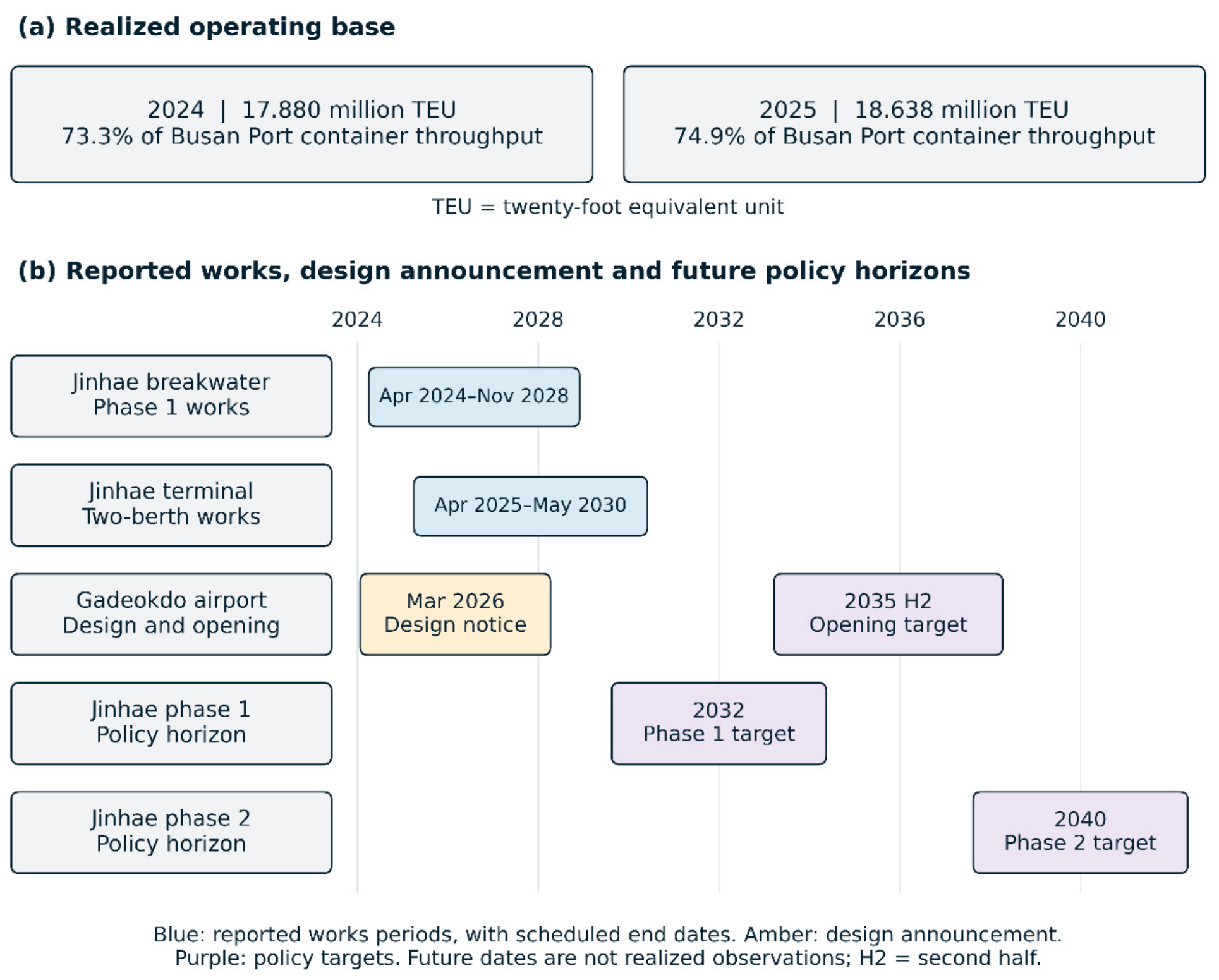

Disclaimer/Publisher’s Note: The statements, opinions and data contained in all publications are solely those of the individual author(s) and contributor(s) and not of MDPI and/or the editor(s). MDPI and/or the editor(s) disclaim responsibility for any injury to people or property resulting from any ideas, methods, instructions or products referred to in the content. |
© 2026 by the authors. Licensee MDPI, Basel, Switzerland. This article is an open access article distributed under the terms and conditions of the Creative Commons Attribution (CC BY) license.