


Abstract
This study examined the associations between economic constraints, agricultural extension deficiencies, knowledge-related factors, perceived agricultural innovation, and drip irrigation use, and farmers’ perceptions of the difficulty and time requirements associated with traditional farming methods in Al-Hariq Governorate, Riyadh Region, Saudi Arabia. Data were collected through structured face-to-face interviews with 185 citrus farmers using an event-based convenience sampling approach at the Al-Hariq Citrus Festival. Descriptive statistics, Spearman’s rank correlation, and multiple linear regression were used to analyze the data. Model diagnostics included multicollinearity assessment, heteroskedasticity tests, HC3 robust standard errors, influential-case diagnostics, and bootstrap sensitivity analysis. The measured outcome reflected farmers’ perceptions that traditional farming methods are difficult and time-consuming. The regression model explained 35.8% of the observed variation in this outcome (R2 = 0.358; adjusted R2 = 0.340), and the overall model was statistically significant (F(5, 179) = 19.940, p < 0.001). In the HC3-adjusted model, economic constraints were positively associated with the outcome (B = 0.8672, HC3 SE = 0.1431, p < 0.001), as was the perceived importance of agricultural innovation (B = 0.0960, HC3 SE = 0.0463, p = 0.040). The adjusted associations for extension deficiencies, limited knowledge, and reported drip-irrigation use were not statistically significant at the 0.05 level. These findings concern farmers’ perceptions of traditional farming methods and should not be interpreted as evidence of operational or maintenance barriers to drip irrigation. The cross-sectional design and convenience sampling approach limit causal interpretation and generalizability. Future research should use validated measures of perceptions of traditional farming and separate, direct measures of irrigation-system operation and maintenance if those outcomes are of interest.
1. Introduction
The agricultural sector in the Kingdom of Saudi Arabia plays an important role in supporting food security and advancing sustainable development in line with Saudi Vision 2030. National efforts to improve agricultural productivity and resource-use efficiency have increased the importance of farming practices suited to arid and semi-arid conditions [1,2]. Citrus production contributes to agricultural diversification and related economic activities, and the Riyadh Region—including Al-Hariq Governorate—is an important setting for citrus cultivation [3,4,5].
Citrus farmers operate in an environment shaped by water scarcity, limited rainfall, high temperatures, and changing climatic conditions [6,7]. These pressures can increase production risks and strengthen the need for efficient management of agricultural inputs, particularly water [8]. Drip irrigation is one technology promoted for improving the delivery of water to crops and reducing losses. Nevertheless, the availability of a water-efficient technology does not by itself determine how farmers evaluate their existing practices or whether they can make use of alternative methods. Such evaluations may also reflect economic circumstances, access to information, and the wider institutional context in which farming decisions are made [8,9].
Research on water-saving technologies indicates that adoption and continued use are associated with multiple economic, farm-level, and institutional conditions [9,10]. Evidence from Saudi agriculture, including research involving date-palm farmers in the Qassim Region, has highlighted the relevance of agricultural education and extension in supporting the use of modern irrigation methods [10,11]. Economic constraints may matter when equipment, energy, and other inputs are costly or when farmers have limited access to finance and incentives. Previous research has therefore emphasized that financial assistance alone may not be sufficient and that economic measures may need to be accompanied by training and technical support [12,13,14].
Agricultural extension and technical information can help farmers understand available technologies, compare farming practices, and make informed decisions. Farmers may obtain information through extension agents, non-governmental organizations, training activities, farmer field schools, and social networks [15,16,17,18,19]. These channels can support knowledge exchange and farmers’ confidence in agricultural innovations [20,21]. However, limited access to effective extension services and inadequate technical support may constrain farmers’ ability to assess or use alternative practices [22,23]. Existing evidence also suggests that technical knowledge and the perceived benefits of a technology are relevant to adoption, while knowledge alone may not be sufficient without suitable institutional support and training [21,24,25,26,27,28].
Alongside the adoption of modern technologies, farmers’ perceptions of traditional farming methods are an important outcome to examine in their own right. Farmers’ evaluations of agricultural practices may be shaped by perceived labour requirements, expected time savings, complexity, and compatibility with existing farm systems. Research on zero-tillage has examined farmers’ awareness and adoption and highlighted the relevance of perceived time-saving potential [29], while research on conservation agriculture has emphasized the importance of farmers’ attitudes and perceived labour requirements in decision-making [30]. Similarly, perceived complexity and the effort required to integrate agricultural innovations into existing farm systems are relevant to understanding adoption decisions [31]. Evidence from Saudi Arabia also underscores the importance of examining farmers’ attitudes and agricultural practices within the national context [32]. A recent systematic review further synthesized evidence on farmers’ preferences and trade-offs concerning sustainable agricultural practices, including water and soil management and smart-farming technologies [33]. Collectively, this literature supports examining farmers’ perceptions of the difficulty and time requirements associated with traditional farming methods. However, these perceptions should be distinguished from objective measures of farm performance and from specific operational or maintenance problems associated with drip irrigation. In the present study, the dependent variable is based on a single survey item—“Traditional farming methods are difficult and time-consuming.” It therefore captures respondents’ perceptions of the difficulty and time requirements of traditional farming methods; it does not directly measure irrigation-system failures, maintenance needs, or the technical performance of drip irrigation.
This distinction defines the focus of the present study. Using data from citrus farmers in Al-Hariq Governorate, Riyadh Region, Saudi Arabia, the study examines the associations between farmers’ perceptions of traditional farming methods and five explanatory variables: economic constraints, limited knowledge of modern agricultural technologies, deficiencies in agricultural extension programs, the perceived importance of agricultural innovation, and reported use of drip irrigation. These variables represent economic, informational, institutional, innovation-related, and practice-related dimensions that may be associated with farmers’ evaluations. Given the cross-sectional design, the analysis identifies statistical associations and does not establish causal relationships.
The study contributes localized evidence by focusing on a clearly defined perception-related outcome rather than treating it as a proxy for the operational performance of irrigation technology. Specifically, it aims to (1) describe the personal and agricultural characteristics and reported irrigation practices of the sampled citrus farmers; (2) summarize their perceptions of the difficulty and time requirements associated with traditional farming methods; (3) examine bivariate associations between this outcome and the selected explanatory variables; and (4) estimate the adjusted associations of economic constraints, knowledge, extension deficiencies, perceived agricultural innovation, and reported drip-irrigation use with the outcome. The findings are interpreted in light of the study’s event-based convenience sample and should not be generalized beyond the sampled context without further evidence.
2. Conceptual Framework
Farmers’ perceptions of agricultural practices may be shaped by the economic, institutional, and informational conditions in which farming decisions are made. In resource-constrained agricultural settings, perceptions of the difficulty and time required by traditional methods may coexist with interest in modern technologies. However, such perceptions should not be treated as direct measures of the technical performance or maintenance requirements of a particular irrigation system.
Economic constraints may shape farmers’ evaluations of agricultural practices by limiting their ability to access inputs, equipment, labor, and alternative technologies. Agricultural extension and technical information may also influence how farmers understand and compare farming practices. These relationships provide a rationale for examining associations between the explanatory variables available in the survey and farmers’ perceptions of the difficulty and time requirements associated with traditional farming methods, without assuming that the outcome represents irrigation-system failures or maintenance problems.
This distinction is relevant in the Saudi agricultural context, where water scarcity has encouraged interest in efficient irrigation technologies. Nevertheless, the present analysis focuses on farmers’ reported perceptions of traditional farming methods. It does not directly evaluate whether a drip irrigation system is functioning effectively or whether farmers experience maintenance problems.
Accordingly, the conceptual framework treats economic constraints, extension deficiencies, knowledge-related factors, perceived agricultural innovation, and reported drip irrigation use as explanatory variables associated with the measured perception-related outcome. The cross-sectional design permits assessment of associations but does not establish temporal order or causality.
3. Literature Review and Hypothesis Development
3.1. Farmers’ Perceptions of Agricultural Practices, Complexity, and Time Requirements
Farmers’ evaluations of agricultural practices are shaped not only by the technical characteristics of a practice but also by how difficult, time-consuming, costly, and compatible with their farm context they perceive it to be. Kaine and Wright [34] found that farmers’ perceptions of the complexity, compatibility, and relative advantage of agricultural practices varied with characteristics of their farm systems. This supports treating farmers’ perceptions as meaningful outcomes in their own right, while recognizing that they are not interchangeable with objective measures of system performance or with direct measures of irrigation-maintenance problems.
Grover and Gruver [35] examined place-based barriers to sustainable agriculture and highlighted how farmers’ decisions are embedded in local social, economic, and practical circumstances. Their work provides relevant context for considering time and labor requirements as part of farmers’ evaluations of agricultural practices. Singh and Kaur [36] likewise examined farmers’ attitudes toward conventional and organic farming and identified socioeconomic and institutional factors relevant to their evaluations of alternative farming systems. These studies concern related perceptions and decisions, although neither measures the exact single-item outcome used in the present study.
The present study’s dependent variable is a single survey item stating that traditional farming methods are difficult and time-consuming. Accordingly, the analysis concerns respondents’ perceptions of the difficulty and time requirements associated with traditional farming methods. It does not directly measure the perceived complexity of drip irrigation, technical failures, irrigation-system performance, or maintenance barriers. The hypotheses are therefore framed as associations between the explanatory variables and the measured perception-related outcome, rather than as explanations of operational or maintenance barriers to drip irrigation.
3.2. Economic Constraints and Perceptions of Traditional Farming Methods
Economic constraints can influence farmers’ choices by shaping access to labor, equipment, inputs, credit, and alternative production practices. Magruder [37] reviewed experimental evidence on agricultural technology adoption in developing countries and discussed how constraints and enabling conditions affect farmers’ adoption decisions. Ruzzante et al. [38], in a meta-analysis of empirical studies, similarly documented the relevance of economic and institutional factors—including credit access and extension—to agricultural technology adoption. These studies provide a broad rationale for examining economic conditions, but they do not establish that economic constraints necessarily increase perceived difficulty of traditional farming methods in every context.
Evidence from specific farming contexts also cautions against treating the perceived costs and feasibility of agricultural practices as universal. Chaudhary et al. [39] showed that resource constraints and contextual realities shaped smallholders’ evaluations of conservation agriculture in South Asia. Although conservation agriculture differs from the practices considered here, the study supports the broader proposition that farmers’ evaluations of agricultural practices need to be interpreted in relation to their available resources and local conditions.
The economic composite in the present study captures reported concerns about the cost of agricultural technology devices, limited economic incentives, and high energy costs. It is therefore a measure of perceived economic constraints, not a direct measure of labor expenditure or the cost of maintaining drip irrigation. The hypothesized association with perceived difficulty and time requirements is plausible, but its direction and magnitude must be established empirically.
Economic constraints may be associated with farmers’ perceptions of the difficulty and time requirements of traditional farming methods because financial resources can shape access to labor, equipment, and alternative practices. Nevertheless, the direction and strength of this association are empirical questions, and the outcome measured here does not directly indicate the cost or performance of drip irrigation systems.
H1.
Economic constraints are positively associated with farmers’ perceptions of the difficulty and time requirements associated with traditional farming methods.
3.3. Agricultural Extension and Technical Information
Agricultural extension can provide information, training, and opportunities for farmers to evaluate the suitability of different practices in Saudi Arabia. Al-Zahrani et al. [40] examined wheat farmers’ perceptions of agricultural extension services, offering context-specific evidence on how farmers assess extension provision. Kaine and Wright [34] also emphasize that farmers’ perceptions of practices and technologies are connected to farm context, with implications for extension and policy. These findings support considering extension-related factors when examining farmers’ evaluations, while not implying that extension deficiencies necessarily cause a particular perception.
Broader adoption research also identifies information and institutional support as relevant factors. Magruder [37] reviews experimental evidence on agricultural technology adoption. Ruzzante et al. [38] synthesized empirical findings across the developing world Arsil et al. [41] examines farmers’ perceptions of attributes of the system of rice intensification in Indonesia, providing a further example of how farmers’ evaluations of agricultural practices can be relevant to adoption decisions. Because these studies focus on adoption or different agricultural practices, they provide conceptual context rather than direct evidence about the dependent variable used in the present study.
The literature suggests that extension and social interaction can support farmers’ understanding of agricultural practices, but the implications for the current outcome remain an empirical question. The present analysis tests whether reported extension deficiencies are associated with perceptions of the difficulty and time requirements of traditional farming methods; it does not test whether extension services reduce technical failures or improve drip-irrigation maintenance.
The current outcome is narrower than a general measure of agricultural technology adoption or extension effectiveness. It is a single item concerning perceived difficulty and time requirements of traditional farming methods, so any association with extension deficiencies should be interpreted cautiously and should not be generalized to technical performance.
Extension programs can provide information that helps farmers evaluate agricultural practices and available technologies. In the present study, however, the measured outcome concerns perceptions of traditional farming methods rather than direct operational problems with drip irrigation. The association between extension deficiencies and this outcome is therefore examined empirically without assuming a specific technical mechanism.
H2.
Deficiencies in agricultural extension programs and technical support are positively associated with farmers’ perceptions of the difficulty and time requirements associated with traditional farming methods.
3.4. Knowledge of Modern Agricultural Technologies
Agricultural knowledge can shape how farmers understand, compare, and assess farming practices. Research on agricultural technology adoption indicates that information and farmers’ understanding of a technology are relevant to adoption decisions [37,38]. Arsil et al. [41] also provides a useful example of research examining farmers’ perceptions of attributes of a farming system. However, the present study does not measure detailed knowledge of traditional farming methods or objectively assess technical competence; it includes a knowledge-related explanatory variable and examines its association with the specified perception-related outcome.
Kaine and Wright [34] shows that farmers’ assessments of complexity and relative advantage vary with farm context, reinforcing the need to interpret perceptions in relation to the conditions in which farmers operate. Chaudhary et al. [39] likewise demonstrates the importance of resource constraints and local realities in farmers’ evaluations of agricultural practices. These studies motivate examining knowledge-related factors, but they do not establish a predetermined direction for the association tested here.
Knowledge of modern agricultural technologies may be related to how farmers evaluate traditional and alternative practices. Because the available outcome measures perceived difficulty and time requirements associated with traditional farming methods, the direction of this association is not assumed in advance.
H3.
Limited knowledge of modern agricultural technologies is associated with farmers’ perceptions of the difficulty and time requirements associated with traditional farming methods.
3.5. Perceived Importance of Agricultural Innovation
Farmers’ perceptions of agricultural innovation may be related to how they evaluate existing and alternative practices. Kaine and Wright [34] examine perceived complexity, compatibility, and relative advantage. Singh and Kaur [36] analyzes attitudes toward conventional and organic farming. Together, these studies suggest that farmers’ evaluations of agricultural practices are multidimensional and shaped by their context. They do not, however, establish that a stronger perceived importance of innovation must be associated with greater or lower perceived difficulty of traditional farming methods.
The economic and institutional context also matters when farmers compare agricultural practices. Magruder [37] reviews evidence on factors associated with agricultural technology adoption, while the meta-analysis [38] synthesizes findings on economic and institutional influences. Study [39] highlights the importance of contextual realities in farmers’ evaluations. In the present study, the innovation-related variable is treated as an explanatory factor associated with the measured outcome, not as a direct measure of drip-irrigation performance or maintenance difficulty.
Farmers who place greater importance on agricultural innovation may evaluate existing practices differently, although the direction of this relationship cannot be established from the cross-sectional data. The current survey outcome measures perceptions of traditional farming methods and should not be interpreted as a measure of problems encountered during the operation or maintenance of drip irrigation.
H4.
The perceived importance of agricultural innovation is associated with farmers’ perceptions of the difficulty and time requirements associated with traditional farming methods.
3.6. Reported Drip Irrigation Use and Perceptions of Traditional Farming Methods
Reported use of drip irrigation may be associated with how farmers evaluate traditional farming methods, because farmers who use an alternative practice may also hold different views about conventional methods. However, this is a conceptual possibility rather than an established causal mechanism. The dependent variable does not measure the quality, reliability, or maintenance requirements of drip irrigation.
Studies of agricultural technology adoption, including the synthesis [38], provide background on how use of modern technologies relates to economic, informational, and institutional conditions. Such evidence should not be interpreted as direct evidence about the present dependent variable. The current analysis tests only whether reported drip-irrigation use is statistically associated with respondents’ perceptions of traditional farming methods.
The association between reported drip-irrigation use and the measured outcome is examined without assuming causality. Because the outcome is a single item, it measures perceptions of traditional farming methods and should not be interpreted as a measure of drip-irrigation performance, reliability, or maintenance requirements. Its scope and limitations should remain explicit throughout the interpretation of results.
H5.
Reported drip irrigation use is associated with farmers’ perceptions of the difficulty and time requirements associated with traditional farming methods.
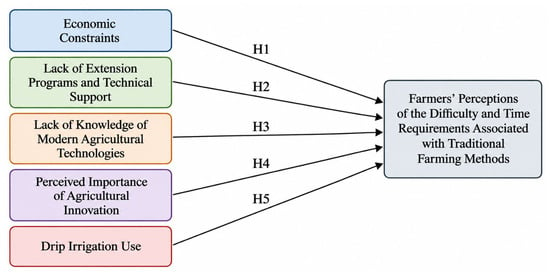
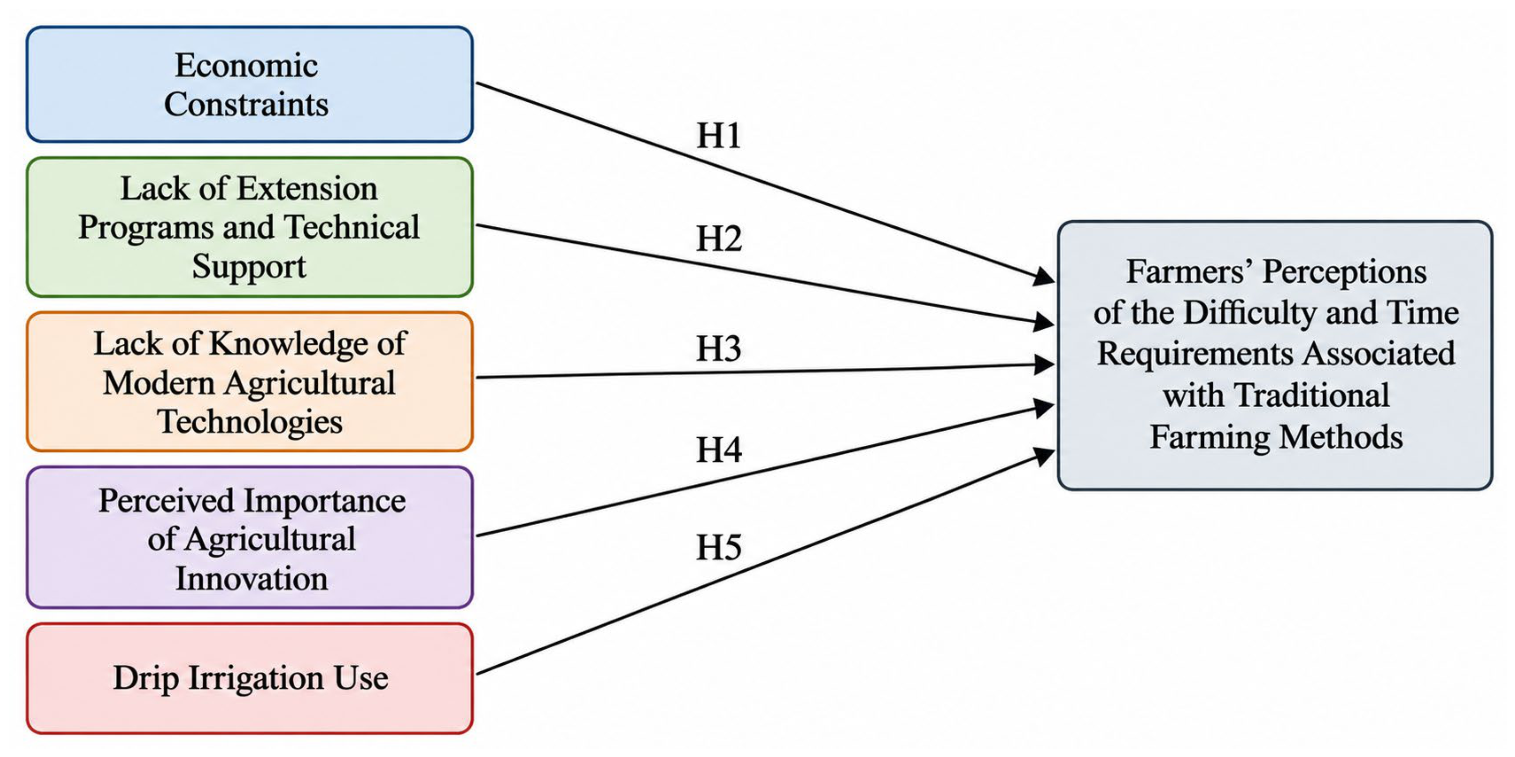
The five hypothesized associations between the explanatory variables and farmers’ perceptions of the difficulty and time requirements associated with traditional farming methods are summarized in the conceptual framework presented in Figure 1.
Figure 1.
Proposed Conceptual Framework of the Study.
4. Materials and Methods
4.1. Study Area
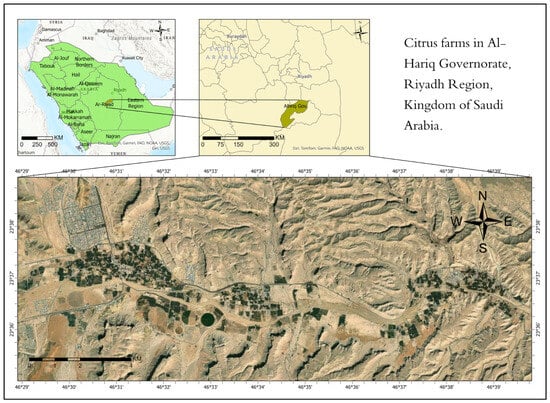
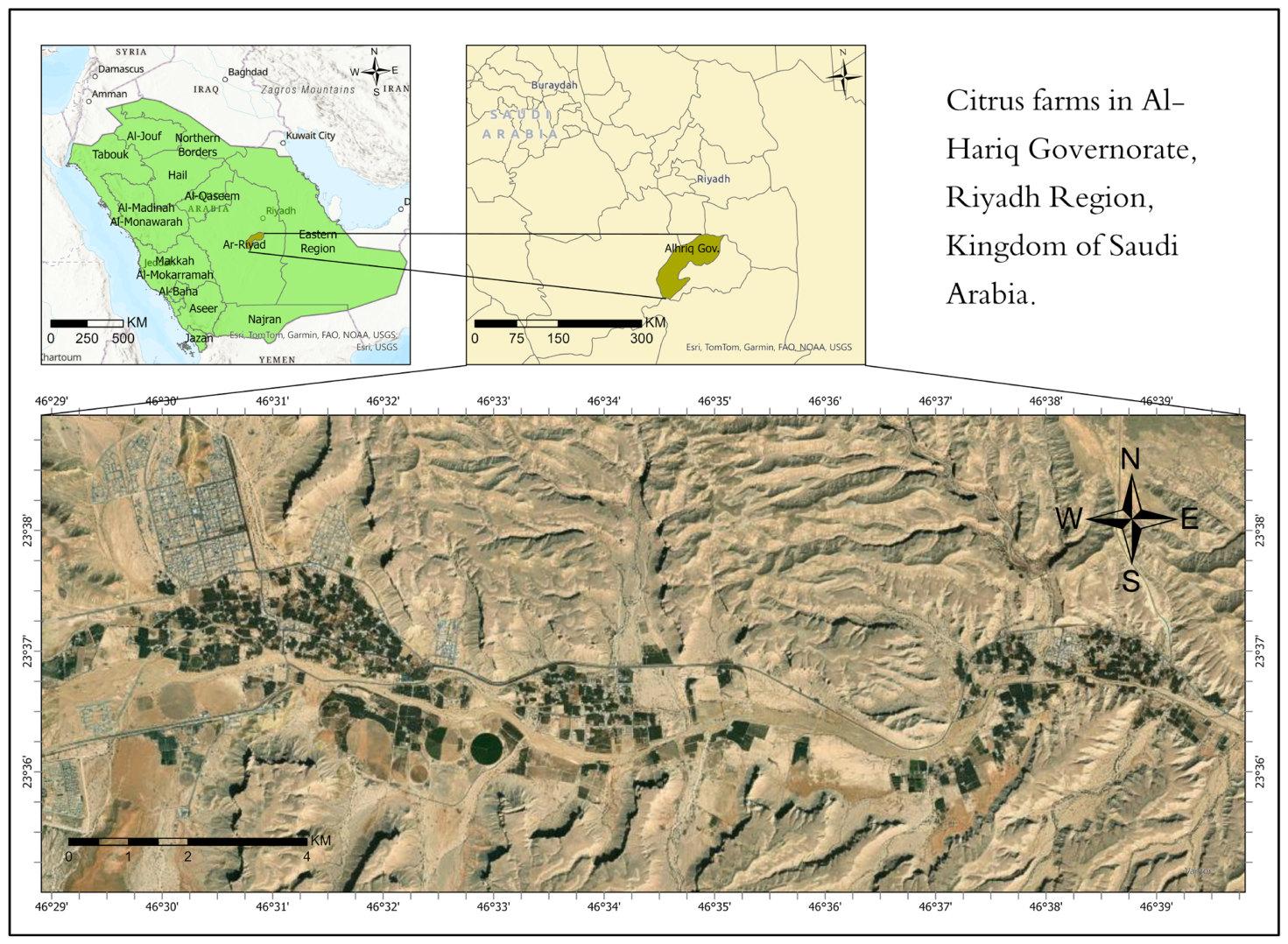
This study was conducted in Al-Hariq Governorate, which is part of the Riyadh Region and is located approximately 220 km southwest of Riyadh. The population of Al-Hariq Governorate reached 10,864 in 2022 [42], and its area is approximately 6790 km2. The governorate is considered one of the important agricultural areas in the Riyadh Region. It also hosts an annual Citrus Festival, which serves as a platform for marketing local agricultural products and promoting the citrus varieties produced in the region, which exceed 20 types. The study area was selected due to the importance of citrus cultivation in the governorate and its direct relevance to the subject of the study [42]. The geographical location of Al-Hariq Governorate within the Riyadh Region, Kingdom of Saudi Arabia, is shown in Figure 2.
Figure 2.
Geographical location of Al-Hariq Governorate within Riyadh Region, Kingdom of Saudi Arabia.
4.2. Data Collection Instrument
The questionnaire was used as the main data collection instrument to gather data from the sampled farmers. It was developed based on the study objectives and a review of the relevant literature and previous studies addressing the adoption of modern irrigation technologies, particularly drip irrigation. The questionnaire was divided into three main sections, as follows:
4.2.1. Section One: Personal Characteristics and Basic Agricultural Information
This section covered the farmers’ personal and agricultural characteristics, including age, education level, occupation or source of income, farm ownership, area cultivated with citrus, production quantity, and types of citrus cultivated.
4.2.2. Section Two: Irrigation Systems and Level of Irrigation Practices
This section was designed to assess the irrigation systems used on citrus farms and the extent of their application, with particular emphasis on drip irrigation. It covered six irrigation systems: flood irrigation, basin irrigation, blind furrow irrigation, drip irrigation, bubbler irrigation (rotating bubbler), and sprinkler irrigation. The level of application of each irrigation system was measured using a three-point Likert scale: 1 = Rarely, 2 = Sometimes, 3 = Always. The section also included questions on the number of irrigation events during the agricultural season and the number of irrigation hours per event.
4.2.3. Section Three: Information Sources and Agricultural Perceptions
This section consisted of two dimensions. The first addressed the sources of information and agricultural extension services that farmers rely on to obtain information related to irrigation technologies, particularly drip irrigation. The degree of reliance on information sources was measured using a three-point Likert scale: 1 = Do not rely, 2 = Sometimes, 3 = Always.
The questionnaire section included questions about factors associated with agricultural technology and farming practices. However, the outcome used in the present regression analysis was the item concerning whether traditional farming methods are difficult and time-consuming. Although the questionnaire also discussed barriers to adopting and using drip irrigation, the analyzed dependent variable does not directly assess system operation, maintenance, technical malfunctions, or emitter clogging.
4.3. Measurement of Variables
The dependent variable was measured using a single survey item: “Traditional farming methods are difficult and time-consuming.” This item captures respondents’ perceptions of the difficulty and time requirements associated with traditional farming methods. It does not directly measure technical failures, maintenance needs, or operational performance of drip irrigation systems. The explanatory variables comprised the economic constraint composite, limited knowledge of modern agricultural technologies (FC2), deficiencies in agricultural extension programs (FC9), perceived importance of agricultural innovation (FC12), and reported drip irrigation use (IR4). The original variable coding and response scales were retained for the analysis.
Drip irrigation use was represented by the IR4 index, while the economic factor was represented by a composite index comprising the cost of modern technology equipment, lack of incentives, and high energy costs. FC9 captured deficiencies in extension programs, FC12 captured perceived importance of innovation, and FC2 captured lack of knowledge about modern technologies.
4.4. Statistical Analysis
Study data were analyzed using IBM SPSS Statistics, version 27.0 (IBM Corporation, Armonk, NY, USA). The statistical methods used included descriptive statistics, Spearman’s rank correlation coefficient, and multiple linear regression. Spearman’s rank correlation coefficient was used to assess the direction and strength of relationships between variables, as it is appropriate for ordinal data and for cases in which the assumptions of normality are not fully satisfied Field [43].
To examine factors associated with the perception-related outcome, a multiple linear regression model was estimated with farmers’ perceptions of the difficulty and time requirements associated with traditional farming methods as the dependent variable (Y). The explanatory variables were the economic factor (X1), limited knowledge of modern agricultural technologies (X2), deficiencies in extension programs and technical support (X3), perceived importance of agricultural innovation (X4), and reported use of drip irrigation (X5).
Y = β0 + β1X1 + β2X2 + β3X3 + β4X4 + β5X5 + ε
Here, Y represents farmers’ perceptions of the difficulty and time requirements associated with traditional farming methods; X1 represents the economic factor; X2 represents limited knowledge of modern agricultural technologies; X3 represents deficiencies in extension programs and technical support; X4 represents perceived importance of agricultural innovation; and X5 represents reported drip irrigation use, The error term (ε) represents the random component capturing unobserved factors affecting the dependent variable. The coefficients are interpreted as statistical associations with the measured outcome, not as direct estimates of operational or maintenance barriers to drip irrigation.
The quality and goodness of fit of the regression model were assessed using the multiple correlation coefficient (R), coefficient of determination (R2), adjusted coefficient of determination (Adjusted R2), and the F-test, in addition to examining the unstandardized regression coefficients (B) and standardized coefficients (Beta, β) and their statistical significance. Before interpreting the regression coefficients, the assumption of no multicollinearity among the independent variables was evaluated using the Variance Inflation Factor (VIF) and Tolerance indices, which are important indicators for assessing the stability of regression model coefficients [43].
The correlation and regression results were interpreted within the context of the cross-sectional data of the study as statistical associations among the variables and should not be taken as evidence of direct causal relationships between them.
To ensure the validity and stability of the regression estimates, rigorous post-estimation diagnostics were conducted. A Breusch-Pagan test was utilized to check for heteroskedasticity due to the diverse socioeconomic backgrounds of the respondents. Consequently, the multiple linear regression model was estimated using Heteroskedasticity-Consistent (HC) robust standard errors to prevent biased t-statistics and p-values. Additionally, influential observations and extreme outliers were screened using Cook’s Distance. Cases exceeding the threshold of 4/n were analyzed through sensitivity testing to confirm that no single extreme value disproportionately drove the primary regression coefficients.
4.5. Study Population and Data Collection
The study population consisted of 340 citrus farmers in Al-Hariq Governorate, Riyadh Region. Data were collected using a structured questionnaire administered through face-to-face interviews to citrus farmers attending the Al-Hariq Citrus Festival. Because recruitment was conducted at the festival venue, the sample is more appropriately characterized as an event-based convenience sample rather than a probability random sample. A total of 185 valid questionnaires were obtained from the 340 citrus farmers identified in the study population. The questionnaire was designed to collect data on the agricultural practices of citrus farmers during the 2023 and 2024 growing seasons. It included a set of open-ended and closed-ended questions covering the farmers’ personal and social characteristics, such as age, educational level, and occupation, as well as farm characteristics, including the area cultivated with citrus and citrus production quantities. In addition, the questionnaire identified the major diseases and pests affecting citrus crops and measured the farmers’ level of adoption of methods and practices for controlling these diseases and pests.
The study employed a descriptive-correlational research design using the social survey method to describe the characteristics and agricultural practices of the study population and to examine the relationships among the study variables without manipulating or influencing them. The study was conducted in the field in Al-Hariq Governorate, Riyadh Region.
5. Results
5.1. Personal, Social, and Economic Characteristics of Citrus Farmers
Table 1 summarizes the characteristics of the 185 respondents. Most respondents held a bachelor’s degree (57.3%) and owned their farms (79.5%), while government employees constituted the largest occupational group (46.5%). The mean age was 48.8 years, and the mean farm area was 0.75 ha.
Table 1.
Demographic Characteristics of Citrus Farmers.
5.2. Descriptive Statistics of the Measured Outcome and Explanatory Variables
Table 2 presents descriptive statistics for the study variables. Economic constraints and deficiencies in extension programs received comparatively high mean scores of 2.91 and 2.89, respectively, whereas limited knowledge received a lower mean score of 1.94. Most respondents (86.5%) reported always using drip irrigation. The dependent-variable item reflects farmers’ perceptions of the difficulty and time requirements associated with traditional farming methods; it should not be interpreted as a direct measure of drip-irrigation operation, maintenance, or technical performance.
Table 2.
Descriptive Statistics of Farmers’ Perceptions and Explanatory Variables.
5.3. Spearman Correlations Between the Measured Outcome and Explanatory Variables
Table 3 presents the Spearman correlation matrix for the measured outcome and explanatory variables. The strongest positive bivariate association was observed between the outcome and the economic factor (ρ = 0.901, p < 0.001). A positive association was also observed between the outcome and deficiencies in extension programs (ρ = 0.713, p < 0.001). Limited knowledge was negatively associated with the outcome (ρ = −0.156, p < 0.05), whereas reported drip-irrigation use was not significantly correlated with the outcome (ρ = 0.102, p > 0.05). These results describe bivariate associations with farmers’ perceptions of traditional farming methods and do not constitute direct evidence of operational or maintenance barriers to drip irrigation.
Table 3.
Spearman Correlation Matrix.
Table 4 presents the goodness-of-fit indicators for the multiple linear regression model predicting the measured perception-related outcome.
Table 4.
Model Fit Measures.
The model yielded R = 0.598, R2 = 0.358, and adjusted R2 = 0.340. The explanatory variables collectively accounted for 35.8% of the observed variation in farmers’ perceptions of the difficulty and time requirements associated with traditional farming methods. The overall model was statistically significant, F(5, 179) = 19.940, p < 0.001. These indicators describe model fit for the measured outcome and do not establish explanatory power for technical or maintenance barriers to drip irrigation.
5.4. Regression Coefficients for the Perception-Related Outcome
Table 5 reports multiple regression coefficients using HC3 robust standard errors. Economic constraints showed a positive adjusted association with the measured outcome (B = 0.8672, HC3 SE = 0.1431, p < 0.001). Perceived importance of agricultural innovation was also positively associated with the outcome (B = 0.0960, HC3 SE = 0.0463, p = 0.040). The adjusted coefficients for extension deficiencies (B = 0.1937, p = 0.185), limited knowledge (B = −0.0774, p = 0.130), and reported drip irrigation use (B = −0.0086, p = 0.442) were not statistically significant at the 0.05 level. These estimates concern the measured perception-related outcome only.
Table 5.
HC3-Adjusted Regression Coefficients for Farmers’ Perceptions of Traditional Farming Methods.
5.5. Multicollinearity Test Among the Independent Variables
Table 6 shows the extent to which multicollinearity exists among the independent variables included in the regression model. The VIF values range from 1.04 to 2.99, while the tolerance values range from 0.335 to 0.959. FC9 has the highest VIF value (2.99), followed by the economic factor (2.49), whereas IR4 has the lowest value (1.04).
Table 6.
Collinearity Statistics.
5.6. Robustness Checks and Outlier Diagnostics
The Breusch–Pagan test (LM = 22.936, p < 0.001) and White test (LM = 76.092, p < 0.001) indicated heteroskedasticity. Statistical inference for the regression coefficients was therefore based on HC3 heteroskedasticity-consistent standard errors, as reported in Table 5.
Influence diagnostics identified observations with elevated Cook’s distances and large externally studentized residuals (Table 7). These findings indicate that some observations may exert appreciable influence on the fitted model. HC3 standard errors address heteroskedasticity in statistical inference but do not, by themselves, establish that the coefficients are insensitive to influential observations.
Table 7.
Tests for heteroskedasticity in the model.
The bootstrap 95% BCa confidence interval for the economic composite was entirely positive [0.4945, 1.0865], supporting its positive association with the measured outcome under the bootstrap procedure. The interval for perceived importance of agricultural innovation was also positive [0.0356, 0.2427]. For limited knowledge (FC2), the bootstrap interval excluded zero [−0.2087, −0.0035], whereas the HC3-based test was not statistically significant (B = −0.0774, HC3 SE = 0.0509, p = 0.130). This difference indicates that the inferential conclusion for FC2 depends on the estimation procedure. The association should therefore be interpreted cautiously rather than considered robust across methods. These diagnostics do not resolve the limitations arising from convenience sampling, omitted variables, or the cross-sectional design.
To address this, the model was re-estimated using heteroskedasticity-consistent (HC3) robust standard errors, as reported in Table 5. Additionally, influence diagnostics were conducted to identify potential outliers. These diagnostics identified a small subset of observations with high Cook’s distance and extreme studentized residuals (Table 8).
Table 8.
Influence Diagnostics for Potentially Influential Observations in the Regression Model.
Bootstrap sensitivity analysis using 95% bias-corrected and accelerated (BCa) confidence intervals was conducted to assess the stability of the estimated coefficients (Table 9). The economic composite had a positive confidence interval that excluded zero [0.4945, 1.0865]. FC12 also had a positive interval excluding zero [0.0356, 0.2427], whereas the intervals for FC9 and IR4 included zero. For FC2, the BCa interval excluded zero despite the non-significant HC3 test (p = 0.130). This discrepancy should be interpreted as method-dependent inference, not as unequivocal evidence of a robust association.
Table 9.
Bootstrap sensitivity intervals for the model.
6. Discussion
This study examined the associations between economic constraints, deficiencies in extension services, limited knowledge, the perceived importance of agricultural innovation, and the use of drip irrigation systems, on the one hand, and the perceptions of citrus farmers in Al-Hariq Governorate regarding the difficulty and time intensiveness of traditional farming methods, on the other. The interpretation of these findings is limited to this perception-based indicator, as it does not directly measure specific barriers to the adoption, operation, or maintenance of drip irrigation systems.
Economic constraints showed the strongest positive association with the measured outcome (B = 0.8672, HC3 SE = 0.1431, p < 0.001), indicating that farmers who reported greater economic constraints were more likely to perceive traditional farming methods as difficult and requiring more time and effort. This finding aligns with studies that have examined the role of economic conditions in decision-making regarding agricultural technologies [9,37,38]. However, the cross-sectional design of this study does not allow for the inference of a causal relationship or the identification of mechanisms that might explain this association.
Furthermore, the perceived importance of agricultural innovation was positively associated with the outcome, albeit with a smaller effect size (B = 0.0960, HC3 SE = 0.0463, p = 0.040). This result is generally consistent with research that underscores this. Conversely, shortcomings in extension services and limited knowledge did not retain statistical significance in the adjusted model. Although there was a strong positive bivariate correlation between extension service deficiencies and the outcome (ρ = 0.713, p < 0.001), the adjusted coefficient was not statistically significant (B = 0.1937, HC3 SE = 0.1455, p = 0.185). Similarly, limited knowledge was negatively associated with the outcome in the bivariate analysis—albeit with a weak correlation (ρ = −0.156, p < 0.05)—but its adjusted coefficient was not statistically significant (B = −0.0774, HC3 SE = 0.0509, p = 0.130). These findings indicate that bivariate correlations do not necessarily reflect independent associations once other variables are taken into account. Although indicators of multicollinearity did not reveal severe multicollinearity, the analyses do not pinpoint the reason for the loss of statistical significance in these two associations. Furthermore, the use of drip irrigation, as reported by the farmers, did not show a statistically significant association with the outcome in the adjusted model (B = −0.0086, HC3 SE = 0.0112, p = 0.442). The interpretation of this result should be confined to the specific perceptions measured in the study and should not be generalized to all aspects of the use of irrigation technologies.
The regression model was statistically significant overall (F(5, 179) = 19.940, p < 0.001) and explained 35.8% of the variance in the outcome (R2 = 0.358; adjusted R2 = 0.340). Variance inflation factor (VIF) values ranged from 1.04 to 2.99, indicating no severe multicollinearity. However, the remaining unexplained variance—combined with the fact that the outcome was measured using only a single questionnaire item—limits the model’s ability to capture the multidimensional nature of farmers’ perceptions of traditional agricultural practices.
Regarding the robustness of the findings, both the Breusch-Pagan test (LM = 22.936, p < 0.001) and the White test (LM = 76.092, p < 0.001) indicated the presence of heteroscedasticity, justifying the use of HC3 robust standard errors for statistical inference. Influence diagnostics also revealed observations with high Cook’s distances and large standardized residuals, suggesting that the coefficient estimates may be sensitive to specific cases. While HC3 robust standard errors account for the impact of heteroscedasticity on the estimation of standard errors, they do not necessarily eliminate the influence of outlying observations on the regression coefficients themselves. Bias-corrected and accelerated (BCa) bootstrap confidence intervals indicated positive associations for economic constraints [0.4945, 1.0865] and for the perceived importance of agricultural innovation [0.0356, 0.2427]. Conversely, the confidence interval for limited knowledge excluded zero [−0.2087, −0.0035], although the HC3 test did not indicate statistical significance for this variable (p = 0.130). This discrepancy warrants caution and necessitates verifying the consistency of model specifications and sample composition, as well as examining the influence of specific data points on both analyses. Therefore, the bootstrap result alone is insufficient to conclude that a robust, independent association exists for limited knowledge; instead, it should be interpreted in light of the divergent outcomes produced by the different statistical inference procedures.
Overall, economic constraints emerged as the variable most strongly associated with the outcome, followed by the perceived importance of agricultural innovation, which showed a positive association of smaller magnitude. Findings regarding extension-related shortcomings and limited knowledge did not provide conclusive evidence of independent associations, and the use of drip irrigation was not statistically linked to the measured outcome. These conclusions remain constrained by the cross-sectional design, the use of convenience sampling, reliance on a single-item indicator, and the potential for estimates to be influenced by specific observations. Consequently, future studies should employ broader and more representative samples, as well as validated, multidimensional scales to measure farmers’ perceptions. This should be complemented by independent indicators regarding the adoption, operation, and maintenance of irrigation systems. Such an approach would facilitate a more precise understanding of the relationships between economic conditions, extension support, agricultural innovation, and how farmers evaluate traditional practices.
7. Conclusions
This study examined associations between economic constraints, extension deficiencies, limited knowledge, perceived agricultural innovation, and reported drip irrigation use, and farmers’ perceptions of the difficulty and time requirements associated with traditional farming methods in Al-Hariq Governorate, Saudi Arabia. Economic constraints showed the strongest positive adjusted association with this measured outcome, while perceived importance of agricultural innovation also showed a positive association. Extension deficiencies, limited knowledge, and reported drip-irrigation use were not statistically significant independent correlates in the HC3-adjusted model. These findings describe associations with the perception-related outcome only; they do not establish operational or maintenance barriers to drip irrigation. Given the single-item outcome, cross-sectional design, and convenience sample, conclusions should remain cautious and context-specific. Future research should use validated multi-item measures of farmers’ perceptions of traditional practices and, separately, direct measures of irrigation operation and maintenance if those outcomes are of interest.
8. Study Limitations
This study has several limitations. First, participants were recruited through an event-based convenience sampling approach at the Al-Hariq Citrus Festival, which may limit generalizability beyond the sampled farmers. Second, the cross-sectional design permits assessment of associations but does not establish causal relationships. Third, self-reported questionnaire data may be subject to response bias. Fourth, the dependent variable is a single survey item capturing perceived difficulty and time requirements associated with traditional farming methods; it does not directly assess drip-irrigation operation, maintenance, technical failures, or system performance. Consequently, the findings should not be interpreted as direct evidence of operational barriers to drip irrigation. Future research should use validated multi-item measures of farmers’ perceptions and separate technology-specific measures if the aim is to evaluate irrigation-system operation and maintenance.
Author Contributions
M.M.F.: Conceptualization, methodology, investigation, data analysis, writing—original draft, and writing—review and editing. J.M.A.: Supervision, validation, and writing—review and editing. F.O.A.: methodology, investigation, data analysis. All authors have read and agreed to the published version of the manuscript.
Funding
This research was funded by King Abdulaziz City for Science and Technology (KACST), grant number STU-88.
Institutional Review Board Statement
This study was approved by Subcommittee on Ethics in Human and Social Research, under ethical approval No. KSU-HE-24-088 on 30 January 2024.
Informed Consent Statement
Informed consent was obtained from all participants in the study prior to their participation.
Data Availability Statement
The survey data are not publicly available and cannot be shared upon request because participants were explicitly assured before data collection that their responses would remain confidential and would be used solely for scientific research purposes. Sharing the data would be inconsistent with the confidentiality assurances provided to participants. The findings and summary statistics are reported in this article.
Acknowledgments
The authors gratefully acknowledge the support provided by King Abdulaziz City for Science and Technology (KACST), represented by the Science, Technology and Innovation Unit at King Saud University (STU-KSU), Riyadh, Saudi Arabia, through Grant No. STU-88. The authors also express their sincere appreciation for the support and assistance provided throughout this research project.
Conflicts of Interest
The authors declare no conflicts of interest.
References
- Jabbari, A.; Teli, T.A.; Masoodi, F.; Reegu, F.A.; Uddin, M.; Albakri, A. Prioritizing factors for the adoption of IoT-based smart irrigation in Saudi Arabia: A GRA/AHP approach. Front. Agron. 2024, 6, 1335443. [Google Scholar] [CrossRef] [Scilit]
- Li, W.; Adam, N.A.; Wang, Y.; Zhang, S.; Wang, W.; Hou, Y. Exploring the adoption of climate smart agriculture in Saudi Arabia: Strategies for sustainable development. Sustain. Futures 2025, 10, 101043. [Google Scholar] [CrossRef] [Scilit]
- Alebidi, A.; Abdel-Sattar, M. Synergistic effect of seaweed extract and boric acid and/or calcium chloride on productivity and physico-chemical properties of Valencia orange. PeerJ 2024, 12, e17378. [Google Scholar] [CrossRef] [Scilit]
- Saeid, A.; Ahmed, M. Citrus fruits: Nutritive value and value-added products. In Citrus-Research, Development and Biotechnolog; Nova Science Publishers: Hauppauge, NY, USA, 2021; pp. 1–18. [Google Scholar] [CrossRef] [Scilit]
- Ministry of Environment; Water and Agriculture (MEWA). Citrus Festival in Al-Hariq Governorate. Available online: https://www.mewa.gov.sa/ar/MediaCenter/News/Pages/News13942020.aspx (accessed on 11 March 2026).
- Haque, M.I.; Khan, M.R. Impact of climate change on food security in Saudi Arabia: A roadmap to agriculture-water sustainability. J. Agribus. Dev. Emerg. Econ. 2022, 12, 1–18. [Google Scholar] [CrossRef] [Scilit]
- Alotaibi, B.A.; Abbas, A.; Azeem, M.I.; Shahbaz, P.; ul Haq, S.; Nayak, R.K. Role of risk perception and climate change beliefs in adoption of climate-resilient agricultural practices in Saudi Arabia. Clim. Serv. 2025, 38, 100552. [Google Scholar] [CrossRef] [Scilit]
- Alotaibi, B.A.; Kassem, H.S. Adoption of sustainable water management practices among farmers in Saudi Arabia. Sustainability 2021, 13, 11260. [Google Scholar] [CrossRef] [Scilit]
- Pronti, A.; Auci, S.; Berbel, J. Water conservation and saving technologies for irrigation: A structured literature review of econometric studies on the determinants of adoption. Agric. Water Manag. 2024, 299, 108838. [Google Scholar] [CrossRef] [Scilit]
- Dhehibi, B.; Salah, M.B.; Frija, A.; Aw-Hassan, A.; Al Wahaibi, H.; Al Raisi, Y.; Dewidar, A.Z.; Al Fuhaid, Y.; Nejatian, A.; Niane, A.A. Economic and environmental evaluation of different irrigation systems for date palm production in the GCC countries: The case of Oman and Saudi Arabia. Desalin. Water Treat. 2022, 263, 116–124. [Google Scholar] [CrossRef] [Scilit]
- Al-Subaiee, F.S.; Al-Ghobari, H.M.; Baig, M.B.; Ei-Hag, E.A.; Abu-Riziga, M.T. Studies on Adoption of Irrigation Methods by the Date Palm Farmers in Al-Qassim Area—Kingdom of Saudi Arabia. 2013. Available online: http://agrojournal.org/19/06-25.pdf (accessed on 30 August 2026).
- Sana, A.; Chfadi, T.; El Mansoum, R. From belief to behavior: An exploratory analysis of adaptive behavior to water scarcity, irrigation technology choice, and water productivity in Morocco. Agric. Water Manag. 2026, 332, 110453. [Google Scholar] [CrossRef] [Scilit]
- Alam, M.F.; McClain, M.; Sikka, A.; Pande, S. Subsidies alone are not enough to increase adoption of agricultural water management interventions. Front. Water 2024, 6, 1444423. [Google Scholar] [CrossRef] [Scilit]
- Khan, N.A.; Qijie, G.; Sertse, S.F.; Nabi, M.N.; Khan, P. Farmers’ use of mobile phone-based farm advisory services in Punjab, Pakistan. Inf. Dev. 2020, 36, 390–402. [Google Scholar] [CrossRef] [Scilit]
- Dawit, M.; Dinka, M.O.; Leta, O.T. Implications of adopting drip irrigation system on crop yield and gender-sensitive issues: The case of Haramaya district, Ethiopia. J. Open Innov. Technol. Mark. Complex. 2020, 6, 96. [Google Scholar] [CrossRef] [Scilit]
- Wuepper, D.; Roleff, N.; Finger, R. Does it matter who advises farmers? Pest management choices with public and private extension. Food Policy 2021, 99, 101995. [Google Scholar] [CrossRef] [Scilit]
- Ali, A.; Sharif, M. Impact of farmer field schools on adoption of integrated pest management practices among cotton farmers in Pakistan. J. Asia Pac. Econ. 2012, 17, 498–513. [Google Scholar] [CrossRef] [Scilit]
- Ma, W.; Abdulai, A. IPM adoption, cooperative membership and farm economic performance: Insight from apple farmers in China. China Agric. Econ. Rev. 2019, 11, 218–236. [Google Scholar] [CrossRef] [Scilit]
- Creissen, H.E.; Jones, P.J.; Tranter, R.B.; Girling, R.D.; Jess, S.; Burnett, F.J.; Gaffney, M.; Thorne, F.S.; Kildea, S. Identifying the drivers and constraints to adoption of IPM among arable farmers in the UK and Ireland. Pest Manag. Sci. 2021, 77, 4148–4158. [Google Scholar] [CrossRef] [Scilit]
- Cai, B.; Shi, F.; Meseretchanie, A.; Betelhemabraham, G.; Zeng, R. Agricultural socialized services empowering smallholder rice producers to achieve high technical efficiency: Empirical evidence from southern China. Front. Sustain. Food Syst. 2024, 8, 1329872. [Google Scholar] [CrossRef] [Scilit]
- Gao, T.; Lu, Q.; Zhang, Y.; Feng, H. The influence of digital agricultural technology extension service cognition on farmers’ pro-environmental behaviour: The moderating role of policy support. Int. J. Agric. Sustain. 2025, 23, 2569186. [Google Scholar] [CrossRef] [Scilit]
- Hasan, M.R. Influencers, barriers to adoption, and technical efficiency of integrated pest management in brinjal production: Evidence from Narsingdi district, Bangladesh. J. Agric. Food Environ. 2025, 6, 33–41. [Google Scholar] [CrossRef] [Scilit]
- Timprasert, S.; Datta, A.; Ranamukhaarachchi, S.L. Factors determining adoption of integrated pest management by vegetable growers in Nakhon Ratchasima Province, Thailand. Crop Prot. 2014, 62, 32–39. [Google Scholar] [CrossRef] [Scilit]
- Xiang, P.; Guo, J. Understanding farmers’ intentions to adopt pest and disease green control techniques: Comparison and integration based on multiple models. Sustainability 2023, 15, 10822. [Google Scholar] [CrossRef] [Scilit]
- Hurrell, C.; Chai, A.; Green, H.; Bradley, G. Virtual reality facilitates pro-environmental behavioural intentions. Environ. Educ. Res. 2024, 30, 1856–1883. [Google Scholar] [CrossRef] [Scilit]
- Baluku, M.M. Mindfulness and the theory of planned behavior: Explaining entrepreneurial intentions of refugees in Uganda. J. Enterprising Communities 2024, 18, 1170–1192. [Google Scholar] [CrossRef] [Scilit]
- Rahman, M.S. Farmers’ perceptions of integrated pest management (IPM) and determinants of adoption in vegetable production in Bangladesh. Int. J. Pest Manag. 2022, 68, 158–166. [Google Scholar] [CrossRef] [Scilit]
- Russo, I.; Vecchio, R.; Viscecchia, R.; Cembalo, L.; De Devitiis, B. Factors affecting farmers’ adoption of sustainable pest management practices: A scoping review. Environ. Dev. Sustain. 2025. online first. [Google Scholar] [CrossRef] [Scilit]
- Keil, A.; D’souza, A.; McDonald, A. Zero-Tillage Is a Proven Technology for Sustainable Wheat Intensification in the Eastern Indo-Gangetic Plains: What Determines Farmer Awareness and Adoption? Food Secur. 2017, 9, 723–743. [Google Scholar] [CrossRef] [Scilit]
- Lalani, B.; Dorward, P.; Holloway, G.; Wauters, E. Smallholder Farmers’ Motivations for Using Conservation Agriculture and the Roles of Yield, Labour and Soil Fertility in Decision Making. Agric. Syst. 2016, 146, 80–90. [Google Scholar] [CrossRef] [Scilit]
- Kaine, G.; Wright, V. Relative Advantage and Complexity: Predicting the Rate of Adoption of Agricultural Innovations. Front. Agron. 2022, 4, 967605. [Google Scholar] [CrossRef] [Scilit]
- Al-Shayaa, M.S.; Al-Wabel, M.; Herab, A.H.; Sallam, A.; Baig, M.B.; Usman, A.R. Environmental Issues in Relation to Agricultural Practices and Attitudes of Farmers: A Case Study from Saudi Arabia. Saudi J. Biol. Sci. 2021, 28, 1080–1087. [Google Scholar] [CrossRef] [Scilit]
- Miriti, P.K.; Lambarraa-Lehnhardt, F. Understanding Farmer Preferences and Trade-Offs for Adopting Sustainable Crop Production: A Systematic Review. Discov. Sustain. 2025, 6, 760. [Google Scholar] [CrossRef] [Scilit]
- Kaine, G.; Wright, V. Farm Context and Farmers’ Perceptions of the Compatibility, Complexity and Relative Advantage of Innovations. Agriculture 2025, 15, 1841. [Google Scholar] [CrossRef] [Scilit]
- Grover, S.; Gruver, J. “Slow to Change”: Farmers’ Perceptions of Place-Based Barriers to Sustainable Agriculture. Renew. Agric. Food Syst. 2017, 32, 511–523. [Google Scholar] [CrossRef] [Scilit]
- Singh, P.; Kaur, J. Farmers’ Attitudes towards Conventional and Organic Farming in Indian Punjab: A Behavioural Analysis. J. Asian Afr. Stud. 2024, 59, 512–531. [Google Scholar] [CrossRef] [Scilit]
- Magruder, J.R. An Assessment of Experimental Evidence on Agricultural Technology Adoption in Developing Countries. Annu. Rev. Resour. Econ. 2018, 10, 299–316. [Google Scholar] [CrossRef] [Scilit]
- Ruzzante, S.; Labarta, R.; Bilton, A. Adoption of Agricultural Technology in the Developing World: A Meta-Analysis of the Empirical Literature. World Dev. 2021, 146, 105599. [Google Scholar] [CrossRef] [Scilit]
- Chaudhary, A.; Timsina, P.; Karki, E.; Sharma, A.; Suri, B.; Sharma, R.; Brown, B. Contextual Realities and Poverty Traps: Why South Asian Smallholder Farmers Negatively Evaluate Conservation Agriculture. Renew. Agric. Food Syst. 2023, 38, e13. [Google Scholar] [CrossRef] [Scilit]
- Al-Zahrani, K.H.; Khan, A.Q.; Baig, M.B.; Mubushar, M.; Herab, A.H. Perceptions of Wheat Farmers toward Agricultural Extension Services for Realizing Sustainable Biological Yields. Saudi J. Biol. Sci. 2019, 26, 1503–1508. [Google Scholar] [CrossRef] [Scilit]
- Arsil, P.; Tey, Y.S.; Brindal, M.; Ardiansyah; Sumarni, E.; Masrukhi. Perceived Attributes Driving the Adoption of System of Rice Intensification: The Indonesian Farmers’ View. Open Agric. 2022, 7, 217–225. [Google Scholar] [CrossRef] [Scilit]
- General Authority for Statistics (GASTAT). Saudi Census 2022: Population Summary Report; General Authority for Statistics: Riyadh, Saudi Arabia, 2022. [Google Scholar]
- Field, A.P. Discovering Statistics Using IBM SPSS Statistics, 5th ed.; SAGE Publications Ltd.: London, UK, 2018. [Google Scholar]

Disclaimer/Publisher’s Note: The statements, opinions and data contained in all publications are solely those of the individual author(s) and contributor(s) and not of MDPI and/or the editor(s). MDPI and/or the editor(s) disclaim responsibility for any injury to people or property resulting from any ideas, methods, instructions or products referred to in the content. |
© 2026 by the authors. Licensee MDPI, Basel, Switzerland. This article is an open access article distributed under the terms and conditions of the Creative Commons Attribution (CC BY) license.