


Abstract
Understanding seasonal precipitation variability and air-mass transport is important for sustainable water-resource management in water-scarce monsoon-margin regions. Stable isotopes in precipitation provide useful tracers of these hydroclimatic processes. Based on 101 event-based precipitation samples collected in Shijiazhuang during 2015–2017, the local meteoric water line (LMWL) was determined as δD = 7.00δ18O + 4.11 (R2 = 0.93, p < 0.05). The isotope records revealed distinct seasonal variation. The δ18O–temperature relationship showed pronounced seasonality: δ18O was significantly and positively associated with temperature across all events and during the dry season, whereas no significant relationship was observed during the wet season. Six trajectory-defined categories were identified, with continental trajectories occurring more frequently than oceanward trajectories during the 2015–2017 observation period. Precipitation associated with different trajectory-defined categories showed contrasting δ18O and d-excess characteristics. The occurrence frequency of precipitation events and the fraction of observed precipitation amount associated with these trajectory categories varied with the seasonal evolution of the East Asian summer monsoon and were accompanied by corresponding seasonal variations in precipitation isotopes. HYSPLIT characterizes transport pathways rather than directly quantifying moisture-source contributions. These findings improve process-based understanding of seasonal precipitation inputs and regional hydrological-cycle sensitivity, providing hydroclimatic information relevant to water-resource sustainability and climate adaptation in water-scarce monsoon-margin regions.
1. Introduction
Precipitation, as a major input to the terrestrial water cycle, represents a critical link between oceanic and continental water resources and is a primary source of freshwater on land [1]. Variations in precipitation sources directly influence regional hydrological processes and water resource management [2,3]. Stable isotopes of oxygen and hydrogen (δ18O and δD), as essential constituents of water, act as natural tracers of precipitation sources and as sensitive indicators of climatic and environmental changes, recording valuable hydrological information. At present, stable isotopes are widely used to identify different components of the hydrological cycle and to explore regional moisture sources [4,5,6]. Moreover, stable isotopic records preserved in archives such as ice cores, tree rings, and lake sediments provide critical evidence for paleoclimate reconstruction [7,8]. The isotopic composition of precipitation is fundamentally controlled by fractionation processes during evaporation and condensation, thereby reflecting environmental conditions in the source regions, including temperature, evaporation intensity, and relative humidity [9,10,11]. Consequently, variability of stable isotopes in precipitation offers key insights into changes in moisture sources and regional hydrological processes. In addition to δ18O and δD, deuterium excess (d-excess), defined as d = δD − 8 × δ18O, is influenced by meteorological conditions in moisture-source regions [12]. It has been widely recognized as a useful indicator of moisture-source conditions and atmospheric processes and has been successfully applied to infer atmospheric processes in diverse regions [13,14]. Therefore, understanding the seasonal characteristics of precipitation isotopes and their associated transport pathways is essential for advancing knowledge of regional hydrological processes and environmental changes. In water-scarce regions, such knowledge is also relevant to water-resource sustainability because seasonal changes in atmospheric water inputs can influence the reliability and variability of regional water availability for urban, agricultural, and ecological needs.
In recent decades, the mechanisms controlling the variability of stable isotopes in precipitation have received considerable attention. Studies have shown that isotope variations are closely related to temperature, precipitation amount, elevation, and latitude [15,16]. However, the controlling factors are complex and vary across regions due to differences in geographical and climatic settings. Previous studies have reported a more evident temperature effect in northern China, whereas the amount effect is more significant in southern China [17,18,19]. Unlike mid–high latitudes, precipitation isotopes show a relatively weak dependence on local meteorological parameters in tropical climates [10,20]. Recent research suggests that variations in precipitation isotopes are not governed solely by individual precipitation events that are influenced by local meteorological factors, but rather by large-scale atmospheric circulation [19,21]. In monsoon regions, atmospheric circulation can play an important role in isotopic variability on seasonal and interannual timescales by regulating changes in moisture-source conditions and air-mass transport pathways, as well as temperature and relative humidity, along air-mass trajectories. Furthermore, research has demonstrated that on longer timescales, interannual variations in precipitation isotopes across the Asian summer monsoon (ASM) region show a positive relationship with ENSO, with enriched isotopes corresponding to El Niño events [22]. To better characterize air-mass transport pathways and qualitatively constrain potential moisture-source regions, the Hybrid Single-Particle Lagrangian Integrated Trajectory (HYSPLIT) model, developed by the National Oceanic and Atmospheric Administration at the Air Resources Laboratory (NOAA), has been widely applied [23,24]. HYSPLIT trajectory simulations reveal, for instance, that precipitation in southwestern Ohio primarily originates from the Pacific Ocean, the Gulf of Mexico, the Arctic, and recycled continental moisture [25]. In China’s Poyang Lake wetlands, reviews of isotope records, combined with trajectory analysis, indicate that seasonal variations in precipitation isotopes are driven by changes in contributions from oceanic versus continental moisture sources [24]. Similarly, research [26] has shown that moisture over the eastern Tibetan Plateau is mainly derived from the Bay of Bengal and South Asia. The HYSPLIT model has been widely used to characterize air-mass transport pathways and qualitatively constrain potential moisture-source regions. Several studies have also been conducted in nearby regions. During 2006–2015, moisture from proximal oceans dominated summer precipitation in Beijing [27]. The moisture contributing to summer precipitation in Zhengzhou mainly originated from the South China Sea, whereas precipitation in other seasons was primarily supplied by inland northwestern regions [28]. Summer precipitation in Taiyuan, located in the monsoon marginal zone, was mainly sustained by local recycled moisture, while the contribution of oceanic moisture decreased significantly under the influence of the 2015/2016 super El Niño event [29]. The southward shift of the northern boundary of the East Asian summer monsoon was identified as the main cause of the reduction in moisture transport flux over North China [30]. Previous studies have shown that the ITCZ is the principal moisture source region for the transport of moisture from the tropical oceans to the Asian continent during summer [31]. ENSO alters regional precipitation and the variation of stable isotopes by modulating the position and intensity of the ITCZ [32]. The 2015/2016 El Niño has been identified as the first extreme El Niño event of the 21st century, during which the pronounced weakening of the summer monsoon suppressed the northward migration of the ITCZ, while the inland westerlies strengthened [33,34,35]. Nevertheless, uncertainties remain because certain atmospheric processes that affect moisture transport are simplified in the model [36,37]. Therefore, the combination of isotopic measurements and backward trajectory-based modeling, which has already been reliably validated in other regions, is a more robust approach for characterizing air-mass transport pathways and constraining potential moisture-source regions.
Shijiazhuang, located on the northwestern margin of the East Asian monsoon region, lies in a semi-arid region under the influence of a temperate continental monsoon climate and is a key water-scarce city along the middle route of China’s South-to-North Water Diversion Project. In recent years, accelerated urbanization and the impacts of climate change have exacerbated local water shortages. Continuous declines in groundwater levels pose severe threats to agricultural irrigation, the urban water supply, and the ecological environment. As the primary input to the hydrological cycle, precipitation and its sources play a crucial role in regional ecosystem sustainability and water resource management. Accordingly, resolving the seasonal variability of precipitation inputs and their associated air-mass transport pathways can provide process-based hydroclimatic information relevant to long-term water-resource planning and climate adaptation in this water-scarce region. Moreover, Shijiazhuang’s location at the transition zone between the North China Plain and the Taihang Mountains further increases the complexity of its precipitation sources. Previous isotope-based studies in this region have assessed the impacts of human activities on water resource degradation [38,39]. Seasonal variations in precipitation isotopes have attracted particular attention. For example, the relationship between precipitation δ18O and meteorological factors during 1986–1999 was analyzed, and it was found that the dominant influences on isotopic variability in Shijiazhuang differed from those in other parts of China [40]. Furthermore, seasonal variations in precipitation isotopes were examined, and it was inferred from d-excess values that winter and summer precipitation originated from different source regions and evaporation conditions [41]. However, isotopic studies of precipitation in this region remain limited. Most previous work has focused on the temporal variability in precipitation isotopes and their meteorological controls, while the relationships between precipitation-isotope variability, air-mass transport pathways, and atmospheric circulation have not been systematically examined. Furthermore, many earlier studies relied mainly on monthly-scale GNIP isotope data, resulting in a lack of higher-resolution event-based observations. To fill this gap, we conducted continuous monitoring of event-based δ18O and δD in Shijiazhuang from 2015 to 2017 to improve our understanding of precipitation-isotope characteristics and their relationships with air-mass transport pathways.
In this study, we analyzed 101 event-based precipitation samples collected in Shijiazhuang from 2015 to 2017 to (1) characterize the seasonal variations in stable isotopes in precipitation, (2) examine the relationships between precipitation isotopes and key environmental variables, and (3) characterize air-mass transport pathways, qualitatively constrain potential moisture-source regions, and examine the associations between trajectory-defined categories and precipitation isotope characteristics. By linking event-based precipitation isotopes with air-mass transport pathways, this study provides process-based hydroclimatic information for understanding seasonal water-input variability in North China and offers a scientific basis relevant to water-resource sustainability and climate adaptation in water-scarce monsoon-margin regions.
2. Materials and Methods
2.1. Study Area
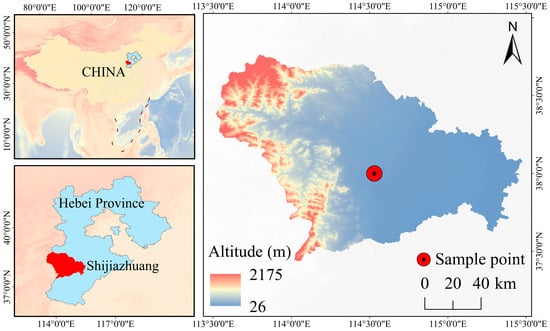
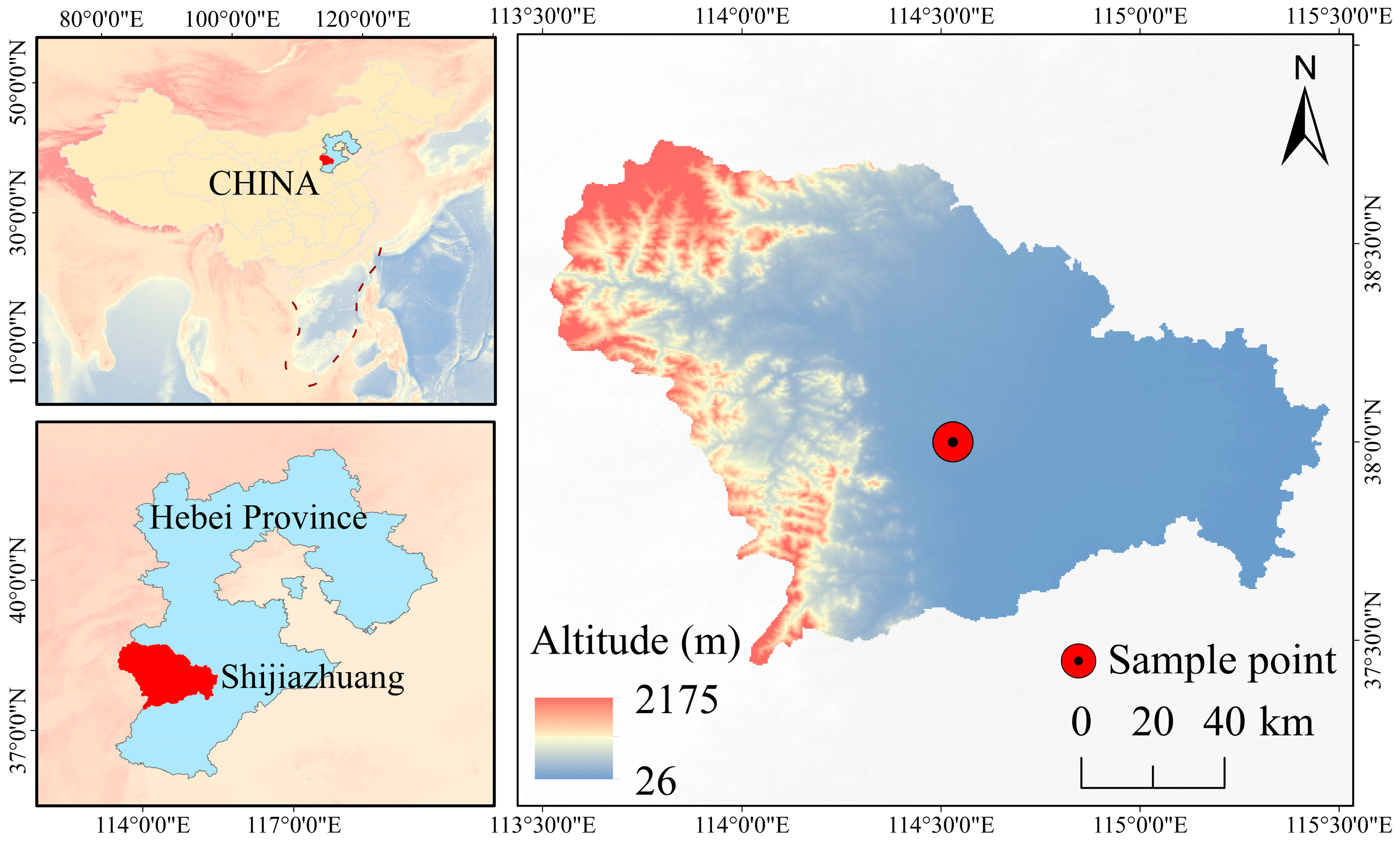
Shijiazhuang (113°30′–115°20′ E, 37°27′–38°47′ N), located on the northwestern margin of the East Asian monsoon region, lies in the western part of the North China Plain (Figure 1). The western part of the city lies in the central Taihang Mountains—an important ecological barrier—where elevation decreases eastward from 90 m to 60 m across alluvial plains. The region is characterized by a temperate semi-arid continental monsoon climate, marked by hot, rainy summers and cold, dry winters [38]. The mean annual temperature is 11–14 °C and total precipitation is 450–550 mm, approximately 70% of which occurs during summer (June–August), when the region is strongly influenced by the East Asian summer monsoon [42,43]. The natural vegetation consists primarily of warm-temperate deciduous broadleaf forests. Strong evaporation further intensifies water loss, shaping the regional hydrological cycle and water resource distribution. Shijiazhuang is a typical water-scarce city [44] and a major beneficiary of the South-to-North Water Diversion Project. The combined influences of monsoon variability, its topographic setting, and chronic water scarcity make Shijiazhuang an ideal site for investigating precipitation isotope characteristics and the dynamics of air-mass transport pathways in North China.
Figure 1.
Map of the study area in Shijiazhuang, showing the sampling site (red dot). Note: map lines delineate study areas and do not necessarily depict accepted national boundaries.
2.2. Precipitation Sampling and Analysis
From 2015 to 2017, 101 event-based precipitation samples were collected in Shijiazhuang, including 65 from the wet season (April–September) and 36 from the dry season (October–March). For the seasonal statistical analyses, April–September was operationally defined as the wet season and October–March as the dry season. This classification reflects the pronounced warm/wet versus cold/dry contrast in the local annual hydroclimatic cycle. Approximately 70% of the annual precipitation in Shijiazhuang occurs during summer (June–August) [42,43], and the April–September period encompasses the broader warm-season precipitation regime surrounding this summer maximum. By contrast, October–March represents the colder and generally drier half of the year. In this study, these operational wet- and dry-season groupings were used only for the isotope–meteorology analyses. Here, “summer” refers to the meteorological season (June–August), whereas the East Asian summer monsoon (EASM) refers to the large-scale monsoon circulation regime. Sampling was conducted on the rooftop of the College of Geography, Hebei Normal University (114.53° E, 38.00° N), using a standard rain gauge (Figure 1). For each precipitation event, the start and end times were recorded, and samples were collected immediately after the event to minimize changes due to evaporation. Collected water was measured, filtered with a 0.22 μm syringe filter, and stored in triplicate 4 mL glass vials. The vials were sealed with Parafilm, labeled, and kept refrigerated until analysis.
Stable isotope ratios (δ18O and δD) were determined using a Picarro L2130-i ultra-high-precision liquid water and vapor isotope analyzer (Picarro Inc., Santa Clara, CA, USA) at the Isotope Laboratory, College of Geography [45], Hebei Normal University. The analytical precision, expressed as long-term repeatability, was ±0.011‰ for δ18O and ±0.038‰ for δD. The three reference materials had certified (δ18O, δD) values of (0‰, 0‰), (−24.76‰, −189.5‰), and (−55.5‰, −427.5‰), respectively. Samples were equilibrated to room temperature for 2–3 h before analysis. Calibration was performed using IAEA reference standards. Each sample was measured six times, with the first three runs discarded to avoid memory effects of the analyzer. Meteorological data were obtained from the China Meteorological Data Service Center: http://data.cma.cn (accessed on 19 October 2026). After the measurements were completed, the results were corrected for analytical error. Taking δ18O as an example, a linear equation was first established between the true values of the standard samples and their measured values, which reflected the difference between the true and measured values. The measured δ18O value of each collected sample was then substituted into this equation to obtain its true δ18O value.
In this study, the stable isotope composition of precipitation (δ18O and δD) was expressed in per mil (‰) relative to Vienna Standard Mean Ocean Water (VSMOW) according to the conventional delta notation:
where represents the isotope ratio (18O/16O or D/H) in the precipitation sample, and represents the corresponding ratio in VSMOW.
All mean δ18O, δD, and d-excess values reported for the trajectory-defined categories and the complete dataset were calculated as precipitation-weighted means. The corresponding δ18O, δD, or d-excess values were calculated using the following equation:
where is the precipitation-weighted mean isotope value, is the precipitation amount of event i, and is the corresponding δ18O, δD, or d-excess value for the corresponding precipitation event. The precipitation-weighted mean isotope value reflects the influence of precipitation amount on isotopic composition.
The LMWL and the δD–δ18O relationships for the trajectory-defined categories were fitted using ordinary least-squares (OLS) regression, with δ18O treated as the predictor and δD as the response variable. For the LMWL based on all 101 precipitation events, standard errors and 95% confidence intervals were calculated for the OLS slope and intercept. To evaluate the sensitivity of the LMWL parameters to the regression method, reduced major axis (RMA) regression and precipitation-weighted least-squares regression (PWLSR) were additionally performed. For PWLSR, the precipitation amount of each event was used as the regression weight. OLS was retained to provide a consistent descriptive framework for the isotope relationships examined in this study. Because both isotope variables contain analytical uncertainty and natural variability, the fitted slopes and intercepts are interpreted descriptively rather than as unique indicators of specific fractionation mechanisms. The significance threshold for all statistical tests was set at α = 0.05, with p < 0.05 considered statistically significant. The regression analyses were performed, and Figures 7 and 8 were prepared, using Origin 2024 (OriginLab Corporation, Northampton, MA, USA).
2.3. Hybrid Single-Particle Lagrangian Integrated Trajectory (HYSPLIT) Model
To characterize air-mass transport pathways and qualitatively constrain potential moisture-source regions associated with precipitation, the Hybrid Single-Particle Lagrangian Integrated Trajectory (HYSPLIT) model, developed by the Air Resources Laboratory of the National Oceanic and Atmospheric Administration (NOAA), was employed [46]. In this study, “air-mass transport pathways” refers to the transport patterns represented by HYSPLIT backward trajectories, whereas “trajectory-defined categories” refers to the six analytical groups classified according to trajectory direction, pathway, and transport distance. The term “potential moisture-source regions” is used only in a qualitative geographic sense. Accordingly, the HYSPLIT analysis in this study is used to characterize broad air-mass transport pathways and trajectory-defined categories, rather than to quantify moisture uptake or the fractional contributions of specific moisture-source regions. Two sets of backward-trajectory simulations were conducted for different analytical purposes. First, to characterize seasonal air-mass transport pathways, 96 h backward trajectories were initialized at 3 h intervals (00, 03, 06, 09, 12, 15, 18, and 21 UTC) at 1500 m above ground level (AGL). All trajectories simulated within each season were then subjected to cluster analysis using the Euclidean distance metric, and the resulting clusters were used to characterize the dominant seasonal transport pathways. Second, to link individual precipitation samples with their corresponding transport pathways, one 96 h backward trajectory was calculated for each of the 101 precipitation events. For the event classification, each trajectory was initialized at the recorded onset time of the precipitation event rather than at the eight fixed daily initialization times used for the seasonal clustering analysis. The 101 event-specific trajectories were subsequently classified into six trajectory-defined categories according to their direction, pathway, and transport distance: northwest continental pathways (CNW), northern continental pathways (CN), southwest continental pathways (CSW), nearby continental pathways (CNS), eastern oceanward pathways (OE), and southern oceanward pathways (OS). CNW, CN, and CSW represent continental trajectories approaching the study area from the northwest, north, and southwest, respectively; CNS represents relatively short-distance nearby continental pathways; OE represents oceanward transport pathways approaching the study area from the east, whereas OS represents oceanward transport pathways approaching the study area from the south. Thus, each precipitation event corresponded to one event-specific trajectory and one trajectory category for the subsequent isotope and precipitation analyses. Because the seasonal clustering analysis and the event-based classification use different trajectory initialization schemes and different statistical populations, the percentages derived from these two analyses are not directly comparable quantitatively. For long-duration precipitation events, additional 96 h backward trajectories were calculated at 1 h intervals during the event as a sensitivity analysis to assess whether substantial changes in transport pathways occurred during precipitation. These additional trajectories were used only to evaluate the robustness of the onset-time-based event classification and were not treated as independent precipitation events or included separately in the occurrence frequencies, fractions of observed precipitation amount, or isotope statistics.
The 1500 m AGL simulations were used for the primary analyses. Trajectories initialized at 500 m AGL were generated only as a sensitivity test to evaluate whether the principal transport-pattern results were robust to the choice of trajectory endpoint height. Because trajectories at 500 m AGL are more sensitive to boundary-layer processes and terrain-induced circulation, they were analyzed separately and used only for sensitivity assessment rather than for the primary classification of the 101 precipitation events. The trajectory endpoint for the primary analyses was set at 1500 m AGL to characterize lower-tropospheric air-mass transport while reducing sensitivity to very local near-surface circulation. Previous studies have shown that moisture transport in the Asian monsoon region is concentrated in the lower troposphere, often near the 850 hPa level [22,47]. However, 1500 m AGL is not strictly equivalent to the 850 hPa pressure surface because the altitude of a pressure surface varies spatially and temporally. This altitude has been widely adopted in simulations of air-mass trajectories in the Asian monsoon region [22,24,47,48].
For each season, the relative occurrence frequency of each trajectory category was calculated as the number of precipitation events assigned to that category divided by the total number of sampled precipitation events in the corresponding season. The fraction of observed precipitation amount associated with each trajectory category was calculated as the sum of precipitation amounts from events assigned to that category divided by the total precipitation amount of all sampled events in the corresponding season. To characterize the seasonal distribution of precipitation events associated with different trajectory categories, two metrics were calculated. First, the relative occurrence frequency of trajectory category in season was calculated as:
where is the number of precipitation events assigned to trajectory category in season , and is the total number of sampled precipitation events in that season. Second, the fraction of observed precipitation amount associated with trajectory category in season was calculated as:
where is the precipitation amount of event assigned to trajectory category , and represents the precipitation amount of sampled event in the corresponding season. Each precipitation event was counted once according to its primary event-specific trajectory category. For long-duration events, additional trajectories generated to evaluate within-event pathway variability were used only for sensitivity assessment and were not treated as independent precipitation events or included separately in either metric. No additional weighting was applied to the occurrence-frequency calculation. For the precipitation-amount fraction, each event contributed according to its observed precipitation amount; therefore, larger precipitation events contributed proportionally more to the calculated fraction. The first metric represents the relative occurrence frequency of sampled precipitation events associated with each trajectory category, whereas the second represents the fraction of the observed seasonal precipitation amount associated with those events. Because the backward-trajectory analysis does not explicitly diagnose moisture uptake and loss along the transport pathways, should not be interpreted as a quantitative moisture-source contribution.
3. Results
3.1. Local Meteoric Water Line (LMWL)
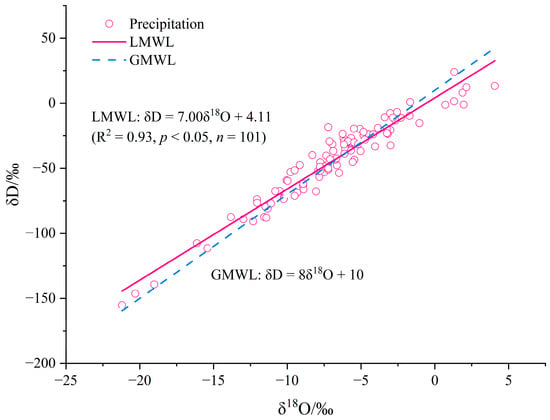
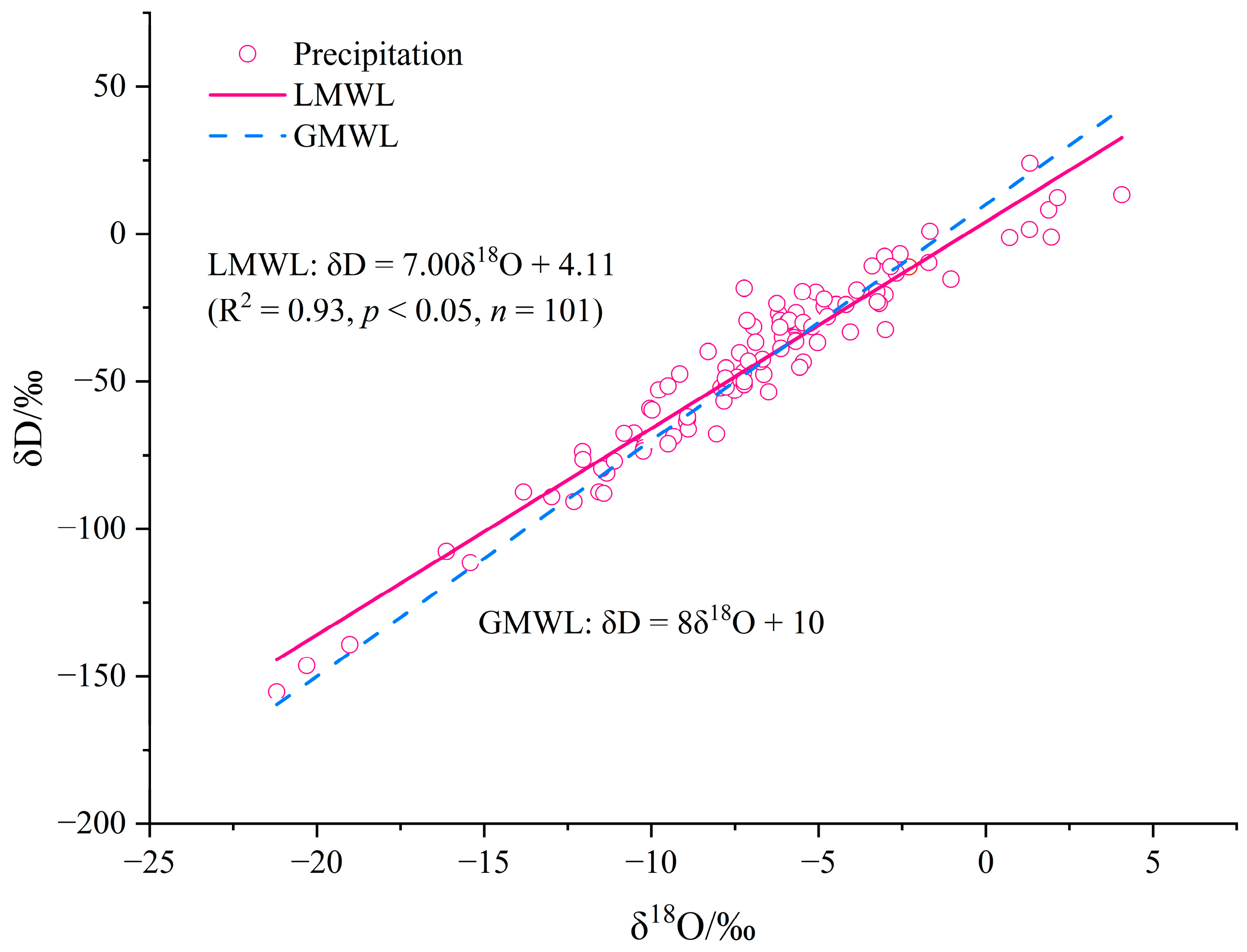
Based on 101 event-based precipitation samples, the local meteoric water line (LMWL) for Shijiazhuang was established using OLS regression as δD = 7.00δ18O + 4.11 (R2 = 0.93, p < 0.05) (Figure 2). The unrounded OLS slope was 7.004. The slope was 7.00 ± 0.19 (SE; 95% CI: 6.62–7.39), and the intercept was 4.11 ± 1.59 (SE; 95% CI: 0.97–7.26). Sensitivity analyses yielded δD–δ18O slopes of 7.26 for RMA regression and 7.41 for PWLSR, with corresponding intercepts of 5.90 and 6.95, respectively (Table S1). Although the estimated LMWL parameters showed some sensitivity to the regression method and precipitation weighting, all three regression approaches yielded slopes and intercepts lower than those of the GMWL.
Figure 2.
Relationship between δ18O and δD values for the 101 event-based precipitation samples in Shijiazhuang.
3.2. Meteorological and Isotopic Characteristics
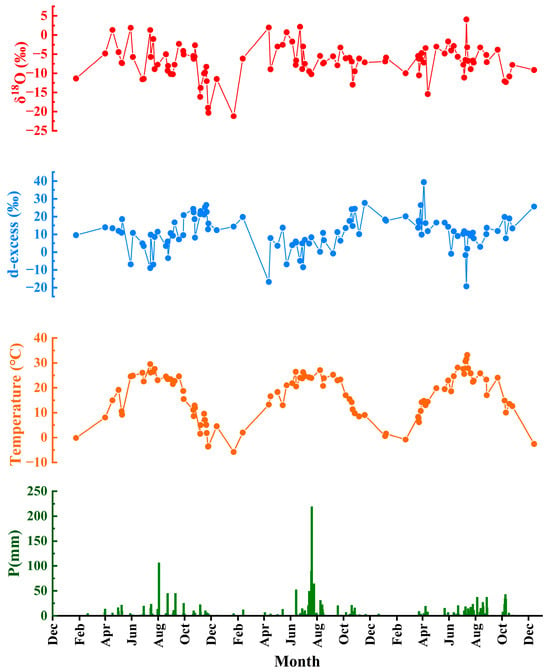
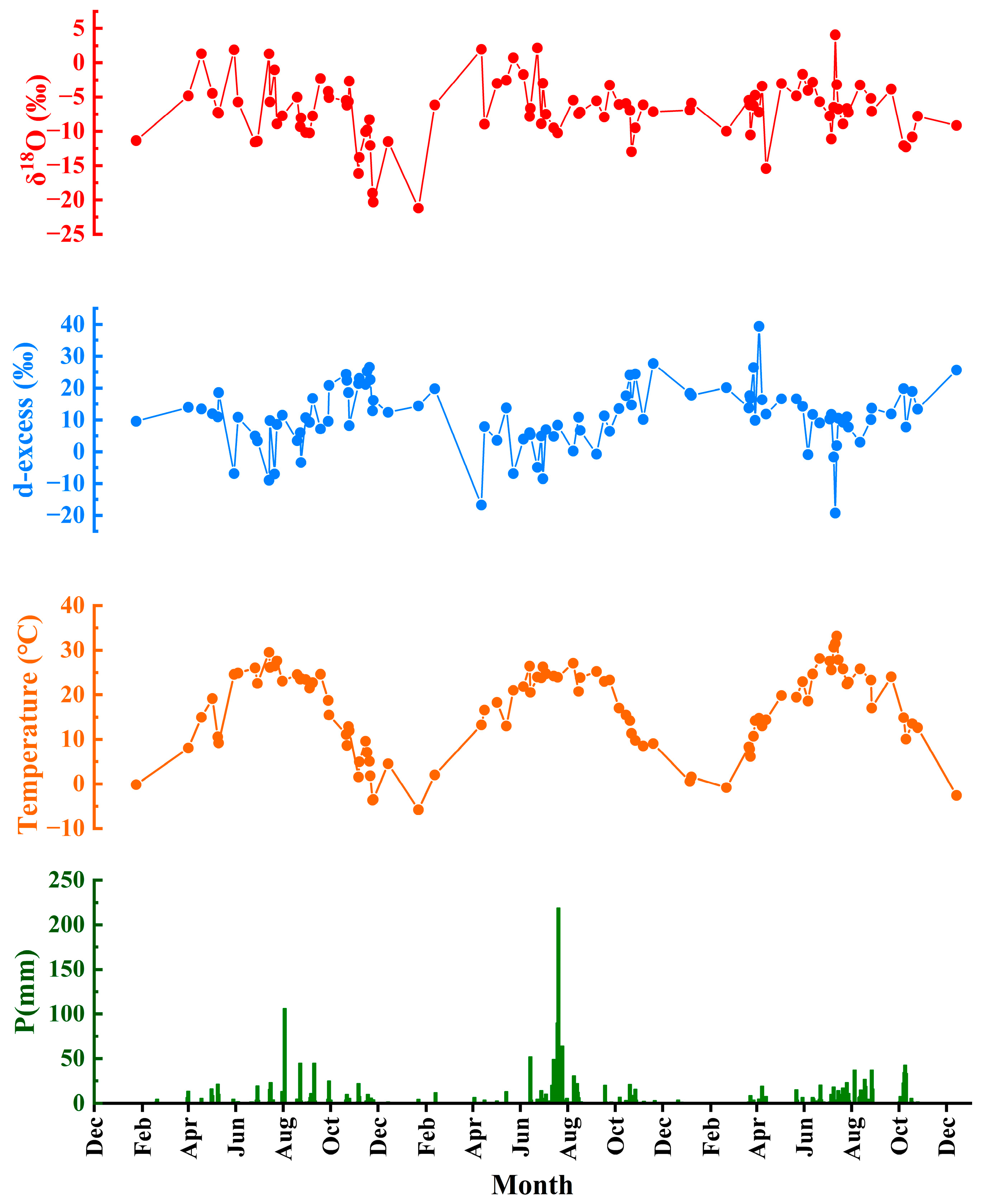
Because δ18O and δD showed closely corresponding temporal variations, δ18O was used as the representative isotope parameter in the subsequent isotope–meteorology analyses. Seasonal variations in δ18O, d-excess, air temperature, and precipitation were observed (Figure 3). The δ18O values in the wet season (April–September) were higher than those in the dry season (October–March) (Table 1). The maximum δ18O value occurred in May, with the overall pattern characterized by enrichment in spring and depletion in winter. Annual mean δ18O values decreased in the following order: 2016, 2017, and 2015 (Table 1). The lowest d-excess values occurred in July. The seasonal pattern—higher d-excess in the dry season compared to the wet season—was opposite to that of δ18O and temperature. Notably, d-excess values in 2015 and 2017 were higher than in 2016 (Table 1), suggesting interannual differences in precipitation-isotope characteristics that may be associated with changes in moisture-source conditions. Variations in d-excess during the wet season showed a similar interannual pattern, further suggesting that the observed interannual isotope variability may be associated with changes in moisture-source conditions and atmospheric transport during the wet season.
Figure 3.
Seasonal variations in stable isotopes of precipitation and meteorological factors (air temperature, precipitation amount) from 2015 to 2017 in Shijiazhuang.
Table 1.
Annual and seasonal δ18O (‰) and d-excess (‰) for precipitation and meteorological parameters in the study area from 2015 to 2017. T represents annual average temperature (°C) and P represents annual precipitation amount (mm).
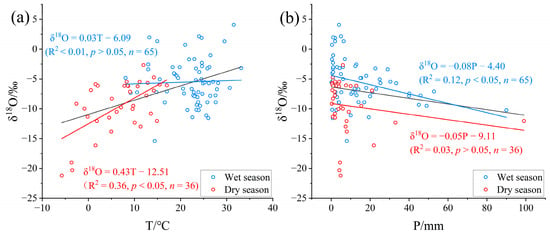
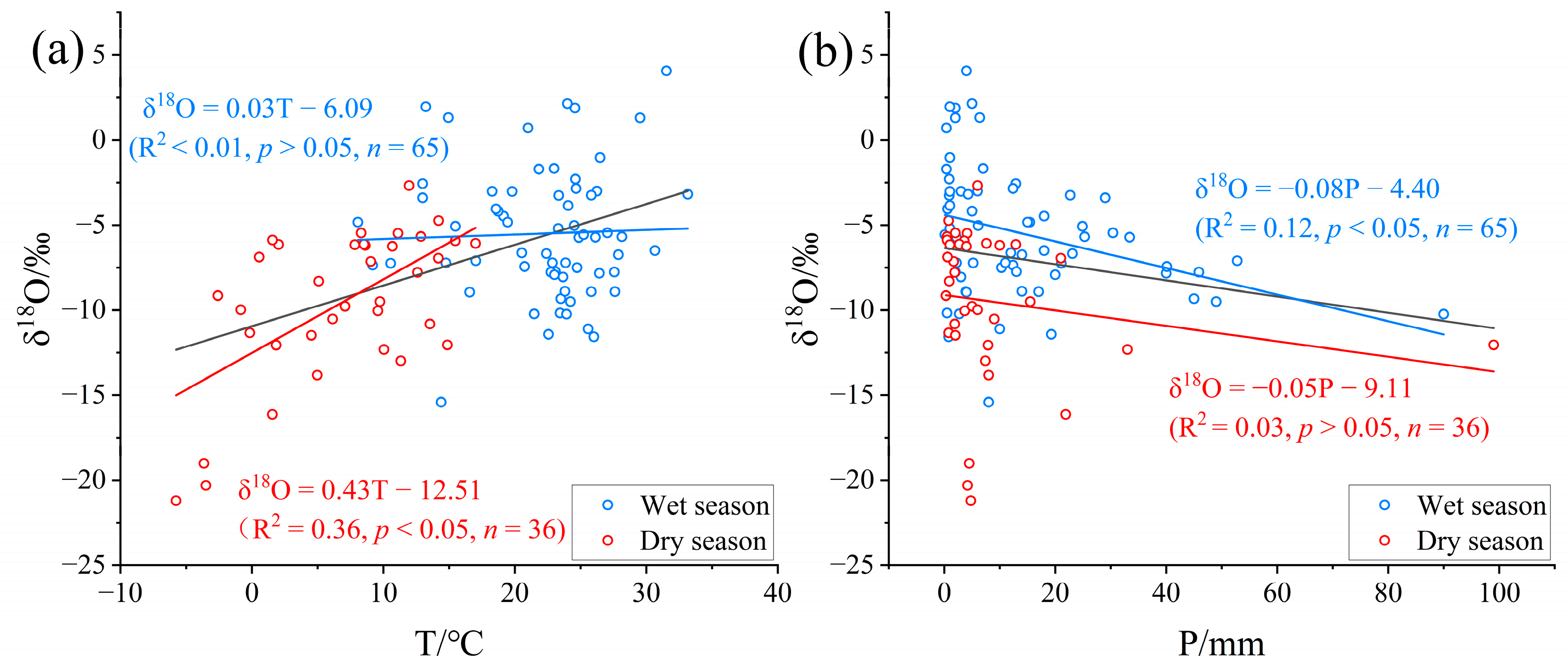
During the observation period, air temperature ranged from –5.77 °C to 33.16 °C, showing a significant seasonal trend of an increase from January to July and a subsequent decrease through to December, with the highest temperature occurring in July. The precipitation amount varied between 0.10 mm and 219.20 mm. Annual precipitation amounts in 2015, 2016, and 2017 were 364.40 mm, 418.90 mm, and 444.40 mm, respectively. The wettest month was July (Figure 3). Figure 4 shows the relationships between δ18O, temperature, and precipitation. Based on all 101 event-based precipitation samples, δ18O values in Shijiazhuang exhibited a significant correlation with temperature, expressed as δ18O = 0.24T − 10.95 (R2 = 0.25, p < 0.05, n = 101), as shown by the black line in Figure 4a. Although statistically significant, this relationship explained only a limited proportion of the event-scale δ18O variability (R2 = 0.25), indicating that additional factors also contributed to the observed isotope variations. Significant correlations between δ18O and temperature were also observed in individual years (Table 2). At the seasonal scale, temperature and δ18O were strongly and positively correlated during the dry season (δ18O = 0.43T − 12.51, R2 = 0.36, p < 0.05, n = 36), but no significant correlation was found during the wet season (δ18O = 0.03T − 6.09, R2 < 0.01, p > 0.05, n = 65). This suggests a stronger association between temperature and δ18O during the dry season than during the wet season. By contrast, δ18O showed no significant correlation with precipitation when the entire dataset was considered (δ18O = –0.05P − 6.35, R2 = 0.03, p > 0.05, n = 101), as shown by the black line in Figure 4b, and this pattern was consistent across all years at the interannual scale. However, a significant negative correlation was observed during the wet season (δ18O = –0.08P − 4.40, R2 = 0.12, p < 0.05, n = 65). Although statistically significant, the wet-season relationship was modest (R2 = 0.12), indicating that precipitation amount alone explained only a limited proportion of the δ18O variability.
Figure 4.
Relationships between precipitation δ18O and (a) air temperature and (b) precipitation amount in Shijiazhuang. The black line represents the linear fit based on all 101 event-based precipitation samples. The blue and red lines represent the linear fits of the wet (April to September) and dry (October to March) seasons, respectively.
Table 2.
Correlation coefficients between precipitation δ18O and temperature and precipitation amount in the study area from 2015 to 2017.
3.3. Air-Mass Transport Pathways and Trajectory-Defined Categories
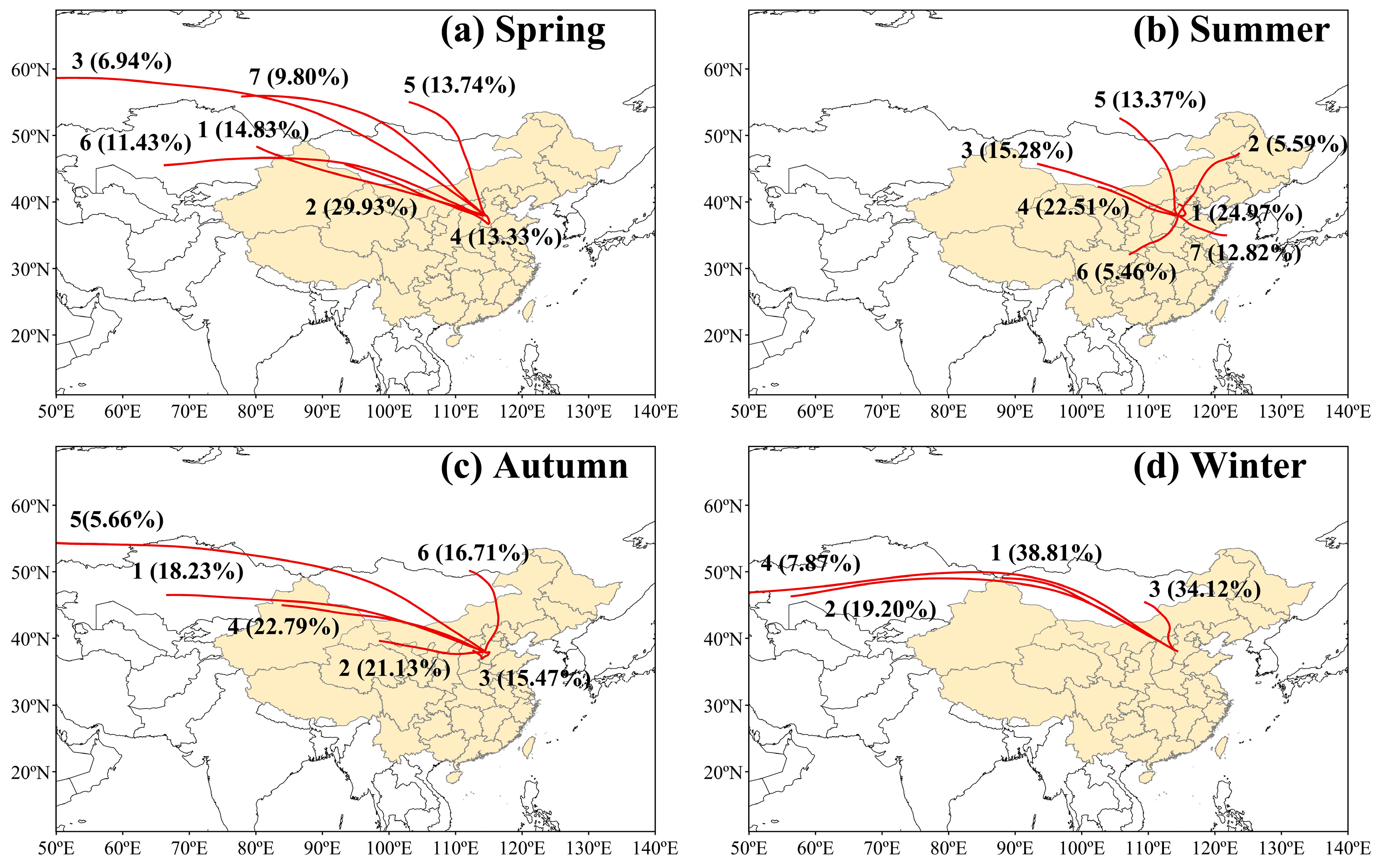
Cluster analysis of all trajectories during the observation period revealed the seasonal transport patterns for Shijiazhuang (Figure 5). In winter, the northwestern inland cluster accounted for 65.88% of the trajectories, whereas the nearby continental cluster accounted for 34.12%. In summer, the trajectory clusters were more diverse, including northeastern, northern, northwestern, southwestern, nearby continental, and eastern oceanward clusters. The eastern oceanward cluster accounted for 12.82% of the trajectories, whereas the nearby continental cluster accounted for the largest proportion (24.97%). Spring and autumn represented transitional periods associated with monsoon onset or retreat. During these seasons, northwestern inland and nearby continental clusters were predominant, while medium-distance inland clusters became more prominent.
Figure 5.
Seasonal cluster analysis of 96 h backward trajectories initialized at 3 h intervals at 1500 m AGL in Shijiazhuang: (a) spring; (b) summer; (c) autumn; (d) winter. The numbers outside the parentheses represent the cluster number, whereas the percentages in parentheses represent the proportion of trajectories assigned to each cluster relative to the total number of trajectories simulated in the corresponding season.
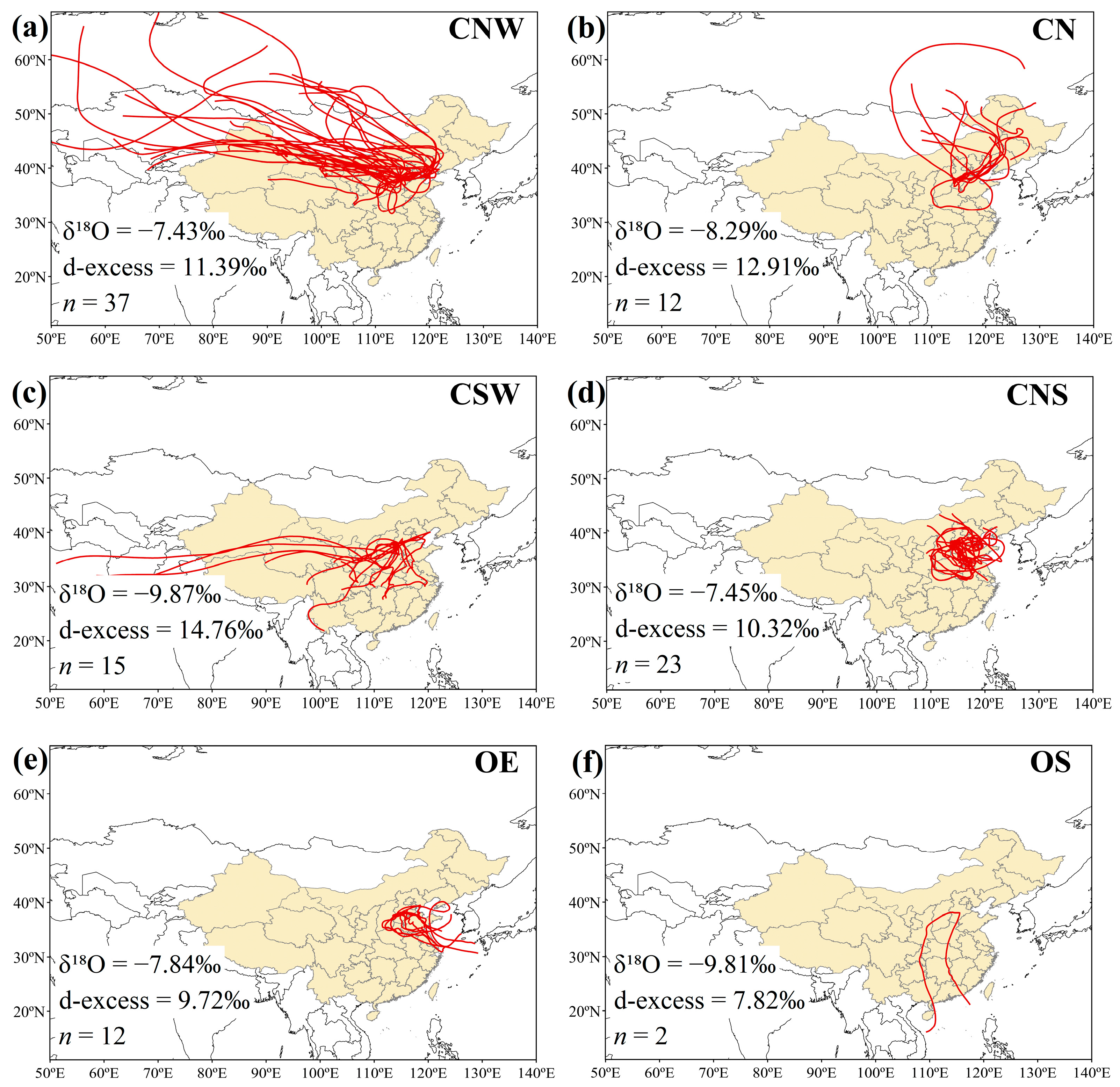
Based on the 101 event-specific HYSPLIT backward trajectories, two broad trajectory groups representing continental and oceanward transport pathways were identified: continental trajectories and oceanward trajectories. To further compare the isotope characteristics of the different trajectory categories, these trajectories were subdivided into six subcategories according to air-mass direction, pathway, and transport distance. These included four continental trajectory categories—CNW (n = 37), CN (n = 12), CSW (n = 15), and CNS (n = 23)—and two oceanward trajectory categories, OE (n = 12) and OS (n = 2) (Figure 6). Given the uneven seasonal representation and unequal sample sizes among trajectory categories, particularly the very small OS sample (n = 2), the following isotope comparisons are descriptive and should not be interpreted as statistically significant between-category differences. The sensitivity analysis of long-duration precipitation events showed that most events retained the same broad transport-pathway classification throughout the precipitation period. Limited within-event variations among trajectory subcategories were observed in a small number of cases, but these variations did not alter the overall classification pattern. The precipitation-weighted mean δ18O values of precipitation associated with continental and oceanward trajectories were –8.16‰ and –8.47‰, respectively. Overall, precipitation associated with continental trajectories was more enriched in δ18O than precipitation associated with oceanward trajectories. Differences were also evident in d-excess, with precipitation associated with continental trajectories exhibiting higher d-excess values than precipitation associated with oceanward trajectories: the weighted mean values were 12.05‰ for precipitation associated with continental trajectories and 6.10‰ for precipitation associated with oceanward trajectories.
Figure 6.
Event-specific backward trajectories for the 101 precipitation events classified into six trajectory-defined categories from 2015 to 2017 in Shijiazhuang: (a) CNW, (b) CN, (c) CSW, (d) CNS, (e) OE, and (f) OS. The red lines represent the individual 96-h HYSPLIT backward trajectories associated with the precipitation events assigned to each category. The value of n in each panel represents the number of sampled precipitation events assigned to the corresponding trajectory category. The δ18O and d-excess values are precipitation-weighted means for the events in each category. Because only two OS events were identified, the isotope values shown for OS are descriptive and should not be interpreted as representative characteristics of this trajectory category.
4. Discussion
4.1. Stable Isotopes in Precipitation and Meteorological Factors
Over the past several decades, the influence of meteorological factors on stable isotopes in precipitation has attracted considerable scholarly attention [16,49,50]. Among the meteorological factors commonly associated with precipitation-isotope variability, temperature and precipitation amount have received particular attention [51]. Temperature can influence isotopic fractionation during condensation [52], while convective activity may also affect precipitation-isotope variability, particularly in coastal regions [16].
The positive correlation between stable isotopes and temperature, commonly referred to as the “temperature effect,” is more significant in mid- to high-latitude regions [16,53]. The near-surface temperature corresponds to the condensation temperature of the air mass from which precipitation forms, and this condensation temperature directly influences the δ values of stable isotopes in atmospheric precipitation. Based on the 101 event-based precipitation samples, a significant positive correlation was observed between δ18O and temperature in Shijiazhuang (p < 0.05) (Table 2). Thus, temperature was the meteorological variable most strongly associated with precipitation δ18O in our study, consistent with previous findings from the North Atlantic, Europe, and other regions of China [52]. However, higher temperatures do not always correspond to higher isotopic values. The correlation exhibited marked seasonality, with strong significance during the dry season but no significant relationship during the wet season (Figure 4; Table 2). This suggests a stronger association between temperature and δ18O during the dry season. The low relative humidity and high temperatures can further enhance δ18O and δD enrichment in precipitation [54]. The relatively low precipitation and relative humidity during the dry season (October–March) may contribute to the stronger association between temperature and δ18O during this period. By contrast, in the wet season (April–September), when higher temperatures coincide with abundant rainfall, the association between precipitation amount and δ18O during the wet season may partly obscure the temperature–δ18O relationship. However, in low-latitude monsoon regions such as South and Southeast Asia, the temperature effect is generally absent or even reversed, with stable isotopes in precipitation showing a negative correlation with temperature. Differences in moisture-source conditions under monsoon circulation may contribute to this discrepancy [15,17].
The negative correlation between stable isotopes and precipitation amount, known as the “amount effect,” typically occurs in low-latitude and coastal regions [16,55]. In the present study, no significant overall relationship was observed between δ18O and precipitation amount (p > 0.05) (Table 2). Nevertheless, a significant amount effect was observed during the wet season (Figure 4; Table 2). This pattern may reflect the influence of large monsoonal rainfall events, which are generally characterized by lower isotope values [45]. Heavier isotopes (δ18O) preferentially condense in raindrops; thus, during successive rainfall events, stable isotope values progressively decrease as the precipitation amount increases. In addition, the high humidity associated with heavy rainfall reduces sub-cloud evaporation and limits isotopic exchange between falling raindrops and ambient vapor [20], and the stable isotopes in precipitation do not increase with rising temperature during the wet season. Therefore, the enhanced influence of precipitation amount during the wet season may mask the temperature effect on δ18O, leading to a nonsignificant relationship between δ18O and temperature. This is consistent with previous findings regarding the relationship between stable isotopic compositions in precipitation and meteorological factors in North China [51].
Taken together, these findings highlight that the impact of meteorological factors on precipitation isotopes is strongly regional. Furthermore, the relationships between isotopes and meteorological variables are not always consistent on monthly or shorter timescales (e.g., in August 2015, δ18O was negatively correlated with temperature). Similar conclusions have been reported in other regions as well [24,54]. This may be because, on shorter timescales, the relationships between precipitation isotopes and meteorological variables are often obscured by variations in moisture-source conditions and air-mass transport pathways. Consequently, attributing precipitation-isotope variability in the study area primarily to meteorological factors may be an oversimplification. Other influences, such as changes in air-mass transport pathways under monsoon circulation, are also likely to play an important role in shaping the isotopic composition of regional precipitation.
4.2. Stable Isotopes of Precipitation and Air-Mass Transport Pathways
In addition to meteorological factors, numerous studies have shown that precipitation isotopes are shaped by a range of processes, including evaporation and humidity conditions at the moisture source, atmospheric transport, and condensation–fractionation during rainfall [11,49,56,57]. In recent years, increasing attention has been placed on moisture sources, which are influenced by atmospheric circulation and thereby can substantially influence isotopic variability [58,59]. Distinct isotopic signatures are associated with different moisture sources [60]. During the three-year observation period, both δ18O and d-excess values in Shijiazhuang exhibited interannual variability (Figure 3). These variations coincided with changes in atmospheric transport patterns. To examine the corresponding air-mass transport patterns, 96 h backward trajectories were simulated using the HYSPLIT model and classified into six trajectory-defined categories (Figure 6). Overall, precipitation associated with continental trajectories showed relatively enriched δ18O and higher d-excess values compared with precipitation associated with oceanward trajectories. This contrast is broadly consistent with previous studies [61,62] and may reflect differences in humidity conditions, evaporative modification, and transport history between continental and oceanward pathways [37,55]. In addition, isotopically enriched recycled water from rivers, lakes, and other inland reservoirs may further enhance δ18O and d-excess values [24]. Therefore, these findings highlight the potential importance of variations in air-mass transport pathways in shaping precipitation-isotope characteristics.
Among the continental trajectory categories, CSW exhibited the most depleted δ18O and the highest d-excess values, which may be consistent with relatively humid transport conditions and differences in moisture-source conditions and transport history [63]. By contrast, CNW and CNS showed relatively enriched δ18O, which may reflect stronger evaporative modification under drier continental transport conditions. Among the oceanward trajectory categories, OE also showed relatively enriched δ18O and a comparatively low δD–δ18O slope, potentially reflecting evaporative modification, including possible sub-cloud evaporation during transport [57]. Although upstream rainfall processes generally reduce heavy isotopes during moisture transport, the relatively short travel distance of the OE trajectories may have limited such depletion, contributing to the comparatively enriched δ18O values. Taken together, the isotope contrasts among the adequately sampled trajectory categories are consistent with differences in transport history, humidity conditions, and evaporative modification, although the isotope characteristics alone do not uniquely identify individual fractionation processes. The two OS events showed comparatively depleted δ18O values and lower d-excess values. However, because of the very small sample size, these observations are treated separately and are not used for broader mechanistic interpretation. Additional OS events are required to evaluate whether the observed isotopic characteristics are reproducible. These contrasts highlight the complexity of the relationships between air-mass transport pathways and precipitation isotope characteristics in the study area. Overall, the contrasts among the adequately sampled trajectory categories suggest that differences in transport history and evaporative modification contributed to the observed precipitation-isotope variability. The precipitation-weighted standard deviations indicate substantial within-category variability in isotope values, highlighting considerable heterogeneity among individual precipitation events within the same trajectory category (Table 3).
Table 3.
Precipitation-weighted isotope characteristics and δD–δ18O regression parameters for the trajectory-defined categories.
4.3. Seasonality of Stable Isotopes in Precipitation and Atmospheric Circulation
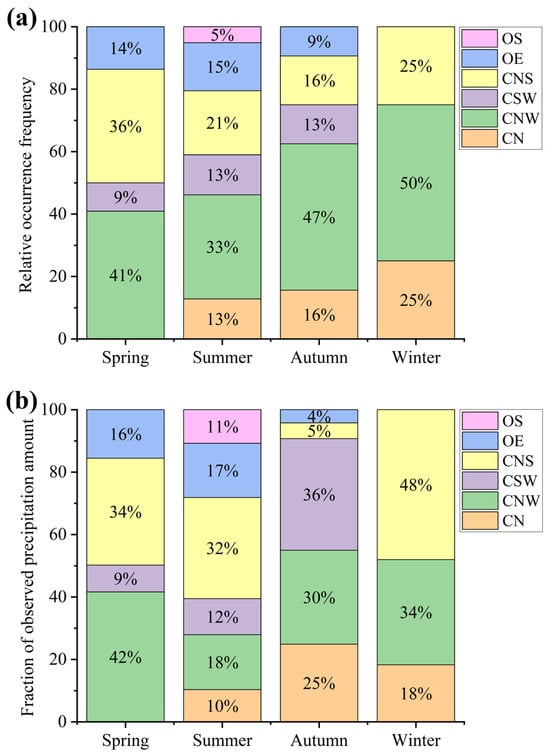
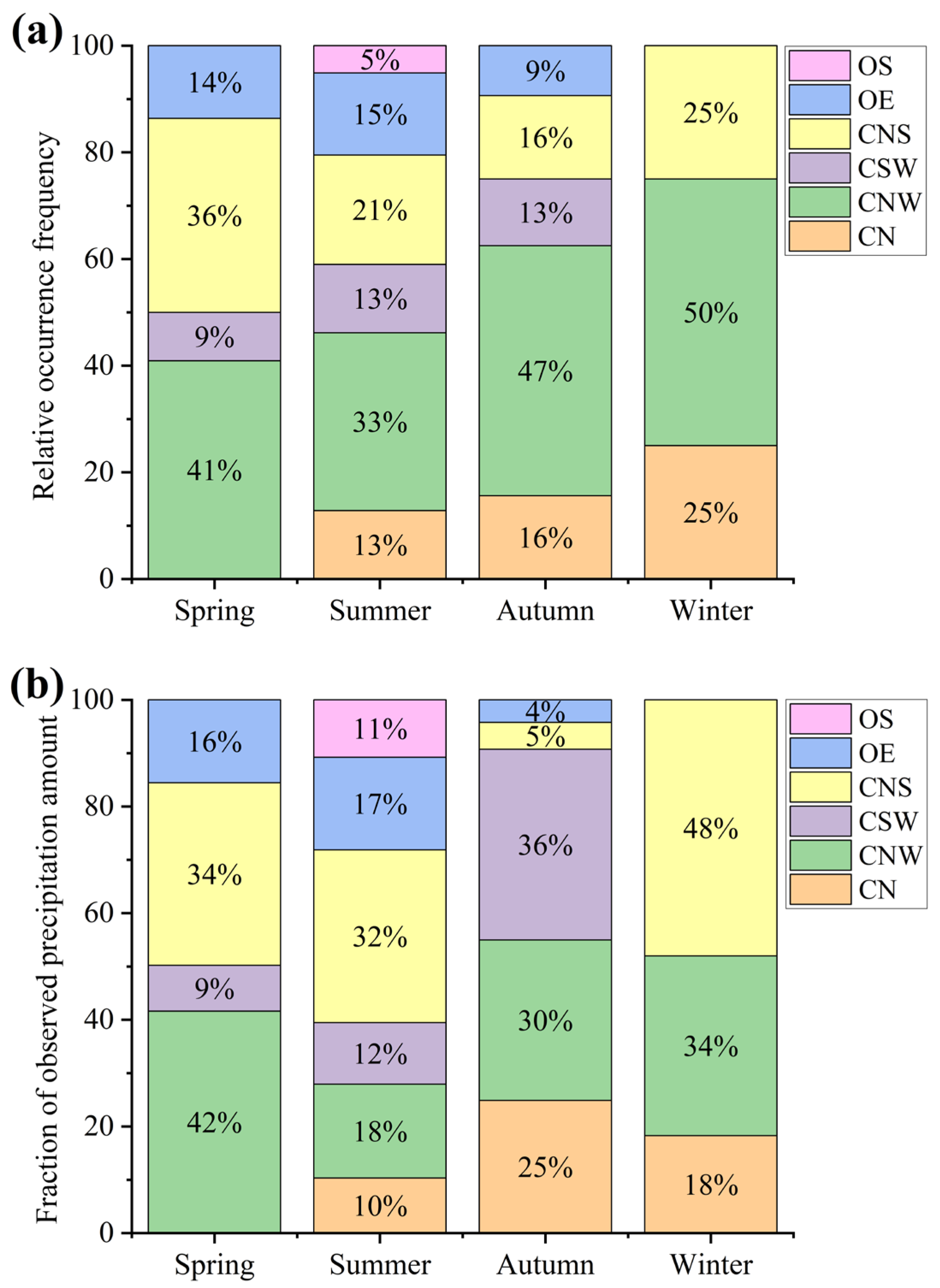
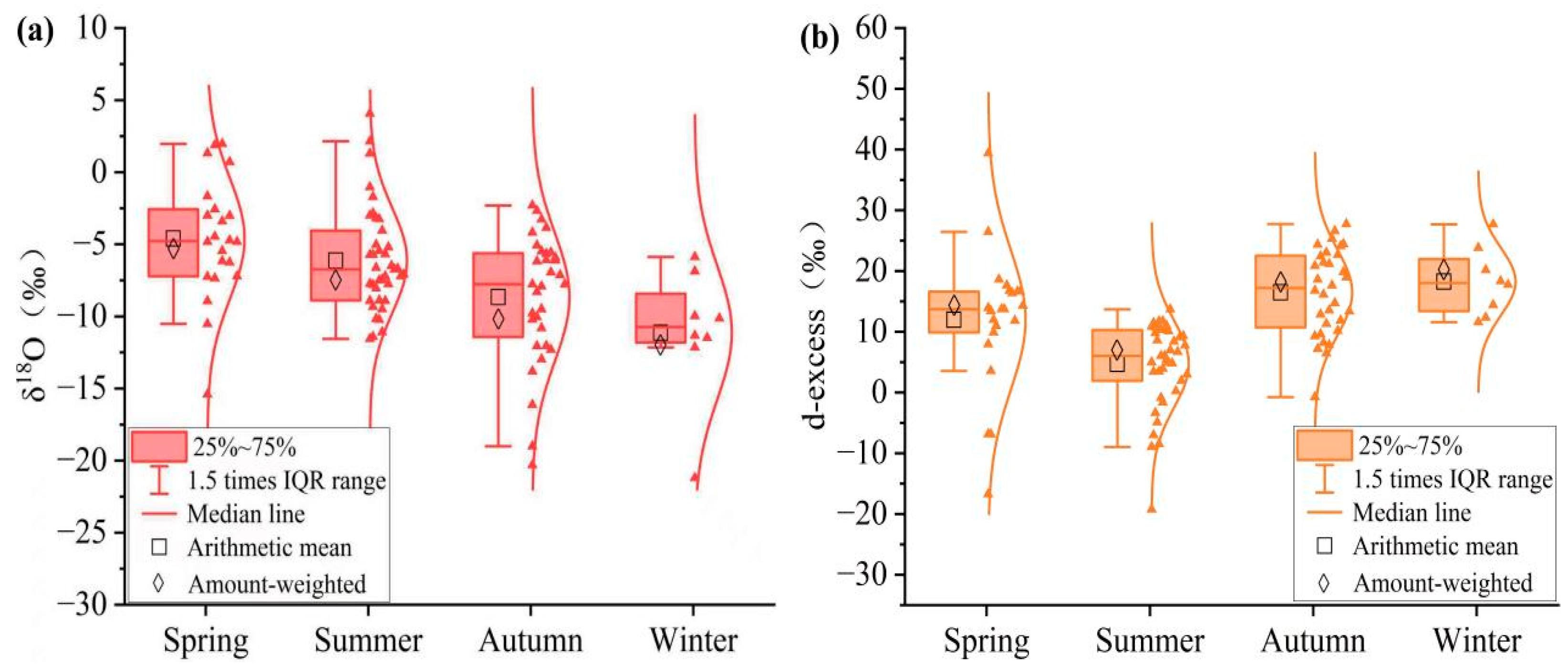
Seasonal shifts in the monsoon system alter air-mass transport pathways and moisture-source conditions, thereby contributing to seasonal variability in precipitation isotopes [55,64]. In spring, precipitation events were predominantly associated with continental trajectories (CNS and CNW; Figure 7), while CNS and CNW showed relatively enriched δ18O values, resulting in relatively high weighted mean δ18O values (Figure 8). In summer, all trajectory categories were represented. The onset of the East Asian summer monsoon was associated with an increased occurrence of oceanward trajectories (Figure 5) and the higher-humidity conditions during summer may also contribute to the lower δ18O values observed relative to spring (Figure 8). Notably, despite the seasonal increase in the occurrence of oceanward trajectories, precipitation events associated with continental trajectories remained more frequent during summer. CNS was associated with a larger fraction of observed precipitation amount relative to its event frequency, whereas CNW showed the opposite pattern (Figure 7), indicating that trajectory occurrence frequency and associated precipitation amount do not necessarily vary in parallel. The seasonal trajectory-clustering analysis showed that the eastern oceanward cluster accounted for 12.82% of all summer trajectories at 1500 m AGL (Figure 5). Independently, the event-based classification showed that OE and OS trajectories together represented approximately 20% of the sampled summer precipitation events and were associated with approximately 28% of the observed summer precipitation amount (Figure 7). Because these two analyses use different trajectory initialization schemes and different statistical populations, the corresponding percentages are not directly comparable quantitatively. Rather, they provide complementary descriptions of seasonal background transport patterns and transport pathways associated specifically with sampled precipitation events. To assess the sensitivity of the inferred transport pattern to the selected trajectory endpoint height, the seasonal trajectory analysis was repeated at 500 m AGL. The summer occurrence frequency of oceanward trajectories was 11.25% at 500 m AGL, compared with 12.82% at 1500 m AGL, indicating that the relatively low occurrence of oceanward summer trajectories was not strongly dependent on the selected endpoint height. Nevertheless, the 500 m trajectories were interpreted cautiously because low-level transport may be more strongly affected by local boundary-layer circulation and topography. This trajectory-based pattern differs from previous studies reporting a stronger influence of oceanic source regions on summer precipitation in North China [51]. This may be attributed to Shijiazhuang’s location on the northwestern margin of the East Asian monsoon region, adjacent to arid northwestern China, where the influence of the East Asian summer monsoon is limited. Furthermore, the mid-latitude westerlies may also influence air-mass transport toward the study area. The relatively low occurrence of oceanward trajectories during the study period may also have been associated with the 2015/2016 strong El Niño event, which has been reported to influence East Asian summer monsoon circulation [22,65]. However, because the present record spans only 2015–2017 and includes only one strong El Niño event, this temporal correspondence cannot establish a causal ENSO influence on the transport patterns observed in Shijiazhuang. Previous studies have shown that for Zhengzhou, which is located in the interior of the Asian monsoon region, most of the moisture contributing to summer precipitation comes from the South China Sea, whereas moisture contributing to precipitation in other seasons mainly originates from continental regions [28]. However, under the influence of the 2015/2016 super El Niño event, summer precipitation in Taiyuan, a city on the margin of the East Asian monsoon region, was mainly supplied by locally evaporated moisture [29]. This finding is consistent with the relatively low occurrence of oceanward trajectories observed in Shijiazhuang during summer. The Shijiazhuang LMWL (δD = 7.00δ18O + 4.11) had a lower slope and intercept than the GMWL and the previously reported meteoric water line for a Pacific-monsoon-influenced region (δD = 7.63δ18O + 8.03) [18]. Sensitivity analyses using RMA regression and PWLSR produced somewhat higher slope and intercept estimates than OLS, but the values remained below those of the GMWL. This indicates that the overall feature of a comparatively lower LMWL slope and intercept was not solely an artifact of the OLS fitting method. However, differences in event-scale meteoric water-line parameters may reflect the combined effects of precipitation seasonality, sample composition, the treatment of precipitation weighting, sub-cloud evaporation, moisture-transport history, and regression methodology. Therefore, the LMWL parameters are interpreted as integrated characteristics of the sampled precipitation rather than as evidence for a single fractionation process. Consequently, the trajectory analysis indicates that precipitation events associated with oceanward transport pathways were less frequent than those associated with continental pathways during the 2015–2017 observation period. This trajectory-based pattern, together with the observed isotopic characteristics, indicates the greater prevalence of continental air-mass transport during the study period. In autumn, as the summer monsoon weakens, the occurrence of oceanward trajectories decreases, whereas continental trajectories become more frequent. Except for OS, the other five trajectory categories were represented, and precipitation events associated with CNS and CNW accounted for 36% and 30% of the observed precipitation amount, respectively (Figure 7). Because CSW exhibited the lowest precipitation-weighted δ18O values among the continental trajectory categories, the increased fraction of observed precipitation amount associated with CSW trajectories in autumn may have partly contributed to the lower precipitation-weighted mean δ18O in autumn than in summer (Figure 8). In winter, when the East Asian winter monsoon is active, sampled precipitation events were associated with continental trajectories, with CNS (48%) and CNW (34%) accounting for the largest event fractions (Figure 7). The greater winter occurrence of CNW may be consistent with enhanced westerly influence relative to autumn. The seasonal evolution of d-excess values provides additional insight. Because the d-excess of precipitation associated with continental trajectories was generally higher than that of precipitation associated with oceanward trajectories, the relatively high winter d-excess values are consistent with the greater prevalence of continental transport pathways during this season, although the actual geographic fractions of moisture uptake remain unquantified [66]. Moreover, all winter precipitation events sampled during 2015–2017 occurred as snowfall. These events formed under cold conditions conducive to non-equilibrium condensation, which may have contributed to the depleted δ18O and elevated d-excess values observed in winter. During the 2015–2017 observation period, sampled precipitation events were more frequently associated with continental than oceanward trajectories, with CNS and CNW representing two important continental trajectory categories. The combined fraction of observed precipitation amount associated with CNS and CNW was higher in winter than in summer, although substantial seasonal variation was observed. These patterns should be interpreted as characteristics of the 2015–2017 observation period rather than as long-term climatological features of Shijiazhuang. Accordingly, the observed seasonal variability in precipitation isotopes during the study period was associated with concurrent changes in meteorological conditions and air-mass transport pathways.
Figure 7.
Seasonal distributions of the six trajectory-defined categories in Shijiazhuang: (a) relative occurrence frequency of precipitation events and (b) fraction of observed precipitation amount associated with each trajectory category.
Figure 8.
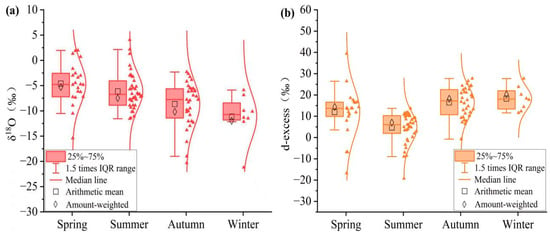
Box-and-whisker plot of seasonal variations in precipitation in Shijiazhuang: (a) δ18O and (b) d-excess. The red triangles in panel (a) represent individual precipitation-event δ18O observations, while the orange triangles in panel (b) represent individual precipitation-event d-excess observations.
Previous studies have reported relationships between ENSO variability and precipitation isotopes across the Asian monsoon region [22,67]. Recent studies have increasingly highlighted the role of ENSO in modulating the interannual variability in precipitation isotopes in the Asian monsoon region through alterations in convection in upstream source areas and transport pathways [68,69]. The relatively enriched precipitation isotope values observed in 2016 coincided with the 2015/2016 strong El Niño event [65], and this temporal correspondence is broadly consistent with patterns reported in previous studies. In addition, d-excess values in 2016 were lower than those in 2015 and 2017, indicating interannual variability in the isotopic characteristics of precipitation. However, the three-year observation period is insufficient to establish a site-specific ENSO influence in Shijiazhuang, and the present dataset does not permit direct attribution of the observed isotope variability to ENSO. Longer isotope records combined with independent circulation indices and atmospheric diagnostics are required to evaluate this possible relationship.
Although the three-year observation period is relatively short, the findings highlight the complexity of factors influencing precipitation isotopes and provide a valuable reference for longer-term studies in the mid-latitudes and the marginal East Asian monsoon region. The observed seasonal and interannual variability in precipitation isotopes and air-mass transport pathways highlights the sensitivity of precipitation characteristics to atmospheric circulation in this water-scarce monsoon-margin region. These observations provide a useful baseline for assessing longer-term hydroclimatic variability and regional water-resource vulnerability.
5. Conclusions
The local meteoric water line (δD = 7.00δ18O + 4.11, R2 = 0.93, p < 0.05) of Shijiazhuang had a lower slope and intercept than the global meteoric water line. Precipitation isotopes exhibited clear seasonal variability, with δ18O being most enriched in spring and most depleted in winter, whereas d-excess was generally higher during the dry season than during the wet season. The event-scale isotope–meteorology relationships also showed pronounced seasonality: δ18O was significantly and positively associated with air temperature during the dry season, whereas a significant negative relationship with precipitation amount was observed during the wet season.
During the 2015–2017 observation period, precipitation events were more frequently associated with continental than oceanward trajectories. Precipitation associated with continental trajectories generally showed higher precipitation-weighted δ18O and d-excess values than precipitation associated with oceanward trajectories. The seasonal distribution of trajectory-defined categories also varied markedly, indicating that changes in atmospheric transport accompanied the seasonal evolution of precipitation-isotope characteristics. Together, these results demonstrate that both local meteorological conditions and air-mass transport pathways contributed to the observed event-scale and seasonal variability in precipitation isotopes on the northwestern margin of the East Asian monsoon region.
Several limitations should be considered when interpreting these results. The three-year observation period is insufficient to establish longer-term ENSO-related variability, and the OS category contained only two events, limiting its statistical interpretation. In addition, the 1° × 1° GDAS data and backward-trajectory calculations may not fully resolve local boundary-layer and terrain-induced circulation near the Taihang Mountains. Future work should therefore extend the observational record, increase the number of event samples, and incorporate additional diagnostics of moisture uptake and large-scale climate variability. Overall, by improving understanding of the seasonal variability and atmospheric controls of precipitation inputs, these findings provide hydroclimatic information relevant to sustainable water-resource planning and climate adaptation in water-scarce monsoon-margin regions.
Supplementary Materials
The following supporting information can be downloaded at: https://www.mdpi.com/article/10.3390/su182111100/s1, Table S1: Sensitivity of the Shijiazhuang local meteoric water line (LMWL) parameters to different regression methods (n = 101).
Author Contributions
Conceptualization, B.Z.; Methodology, L.Z. (Lin Zhao); Software, D.Y., R.L. and X.C.; Validation, D.Y., R.L. and X.C.; Formal analysis, B.Z., L.Z. (Liping Zhao) and H.C.; Investigation, B.Z. and L.Z. (Liping Zhao); Data curation, B.Z. and L.Z. (Liping Zhao); Writing—original draft, B.Z.; Writing—review and editing, L.Z. (Lin Zhao) and H.C.; Supervision, L.Z. (Lin Zhao); Funding acquisition, H.C. All authors have read and agreed to the published version of the manuscript.
Funding
This research was funded by the Natural Science Foundation of Hebei Province (D2023205005) and the National Natural Science Foundation of China (40971118). The APC was funded by Hui Chen.
Institutional Review Board Statement
Not applicable.
Informed Consent Statement
Not applicable.
Data Availability Statement
The event-level precipitation and stable-isotope data supporting the findings of this study are available from the corresponding author upon reasonable request. The dataset is not publicly available at present because it forms part of an ongoing long-term monitoring program and is being used in related ongoing and unpublished research. Requests for access will be considered on a case-by-case basis for non-commercial academic research purposes, subject to approval by the corresponding author and provided that the proposed use does not conflict with ongoing analyses or planned publications based on the monitoring dataset.
Acknowledgments
We thank the School of Geographical Sciences, Hebei Normal University, for supporting our fieldwork. Suggestions for improving our paper from the anonymous reviewers are also appreciated.
Conflicts of Interest
The authors declare no conflicts of interest. The funders had no role in the design of the study; in the collection, analyses, or interpretation of data; in the writing of the manuscript; or in the decision to publish the results.
References
- Zhang, B.; Song, X.F.; Zhang, Y.H.; Han, D.M.; Tang, C.Y.; Yu, Y.L.; Ma, Y. Hydrochemical characteristics and water quality assessment of surface water and groundwater in Songnen plain, Northeast China. Water Res. 2012, 46, 2737–2748. [Google Scholar] [CrossRef] [Scilit] [PubMed]
- Jouzel, J.; Lorius, C.; Petit, J.R.; Genthon, C.; Barkov, N.I.; Kotlyakov, V.M.; Petrov, V.M. Vostok Ice Core—A Continuous Isotope Temperature Record over the Last Climatic Cycle (160,000 Years). Nature 1987, 329, 403–408. [Google Scholar] [CrossRef] [Scilit]
- Thompson, L.G.; Yao, T.; Davis, M.E.; Henderson, K.A.; Mosley-Thompson, E.; Lin, P.N.; Beer, J.; Synal, H.A.; Cole-Dai, J.; Bolzan, J.F. Tropical climate instability: The last glacial cycle from a Qinghai-Tibetan ice core. Science 1997, 276, 1821–1825. [Google Scholar] [CrossRef] [Scilit]
- Deshpande, R.D.; Maurya, A.S.; Kumar, B.; Sarkar, A.; Gupta, S.K. Rain-vapor interaction and vapor source identification using stable isotopes from semiarid western India. J. Geophys. Res.-Atmos. 2010, 115, D23311. [Google Scholar] [CrossRef] [Scilit]
- He, S.Y.; Richards, K. The role of dew in the monsoon season assessed via stable isotopes in an alpine meadow in Northern Tibet. Atmos. Res. 2015, 151, 101–109. [Google Scholar] [CrossRef] [Scilit]
- Salamalikis, V.; Argiriou, A.A.; Dotsika, E. Stable isotopic composition of atmospheric water vapor in Patras, Greece: A concentration weighted trajectory approach. Atmos. Res. 2015, 152, 93–104. [Google Scholar] [CrossRef] [Scilit]
- Yu, W.S.; Tian, L.D.; Risi, C.; Yao, T.D.; Ma, Y.M.; Zhao, H.B.; Zhu, H.F.; He, Y.; Xu, B.Q.; Zhang, H.B.; et al. δ18O records in water vapor and an ice core from the eastern Pamir Plateau: Implications for paleoclimate reconstructions. Earth Planet. Sci. Lett. 2016, 456, 146–156. [Google Scholar] [CrossRef] [Scilit]
- Zech, M.; Tuthorn, M.; Zech, R.; Schlütz, F.; Zech, W.; Glaser, B. A 16-ka δ18O record of lacustrine sugar biomarkers from the High Himalaya reflects Indian Summer Monsoon variability. J. Paleolimnol. 2014, 51, 241–251. [Google Scholar] [CrossRef] [Scilit]
- Baker, A.J.; Sodemann, H.; Baldini, J.U.L.; Breitenbach, S.F.M.; Johnson, K.R.; van Hunen, J.; Zhang, P.Z. Seasonality of westerly moisture transport in the East Asian summer monsoon and its implications for interpreting precipitation δ18O. J. Geophys. Res.-Atmos. 2015, 120, 5850–5862. [Google Scholar] [CrossRef] [Scilit]
- Breitenbach, S.F.M.; Adkins, J.F.; Meyer, H.; Marwan, N.; Kumar, K.K.; Haug, G.H. Strong influence of water vapor source dynamics on stable isotopes in precipitation observed in Southern Meghalaya, NE India. Earth Planet. Sci. Lett. 2010, 292, 212–220. [Google Scholar] [CrossRef] [Scilit]
- Merlivat, L.; Jouzel, J. Global Climatic Interpretation of the Deuterium-Oxygen-18 Relationship For Precipitation. J. Geophys. Res.-Ocean. 1979, 84, 5029–5033. [Google Scholar] [CrossRef] [Scilit]
- Xie, C.; Zhao, L.J.; Eastoe, C.J.; Liu, X.H.; Wang, N.L.; Zhang, Z.H.; Dong, X.Y.; Liu, H. Precipitation stable isotope composition, moisture sources, and controlling factors in Xi’an, Northwest China. Atmos. Res. 2022, 280, 106428. [Google Scholar] [CrossRef] [Scilit]
- Guan, H.D.; Zhang, X.P.; Skrzypek, G.; Sun, Z.; Xu, X. Deuterium excess variations of rainfall events in a coastal area of South Australia and its relationship with synoptic weather systems and atmospheric moisture sources. J. Geophys. Res.-Atmos. 2013, 118, 1123–1138. [Google Scholar] [CrossRef] [Scilit]
- Otte, I.; Detsch, F.; Gütlein, A.; Scholl, M.; Kiese, R.; Appelhans, T.; Nauss, T. Seasonality of stable isotope composition of atmospheric water input at the southern slopes of Mt. Kilimanjaro, Tanzania. Hydrol. Process. 2017, 31, 3932–3947. [Google Scholar] [CrossRef] [Scilit]
- Araguas-Araguas, L.; Froehlich, K.; Rozanski, K. Stable isotope composition of precipitation over southeast Asia. J. Geophys. Res.-Atmos. 1998, 103, 28721–28742. [Google Scholar] [CrossRef] [Scilit]
- Dansgaard, W. Stable Isotopes in Precipitation. Tellus 1964, 16, 436–468. [Google Scholar] [CrossRef] [Scilit]
- Johnson, K.R.; Ingram, B.L. Spatial and temporal variability in the stable isotope systematics of modern precipitation in China: Implications for paleoclimate reconstructions. Earth Planet. Sci. Lett. 2004, 220, 365–377. [Google Scholar] [CrossRef] [Scilit]
- Kong, Y.L.; Wang, K.; Li, J.; Pang, Z.H. Stable Isotopes of Precipitation in China: A Consideration of Moisture Sources. Water 2019, 11, 1239. [Google Scholar] [CrossRef] [Scilit]
- Liu, J.R.; Song, X.F.; Yuan, G.F.; Sun, X.M.; Yang, L.H. Stable isotopic compositions of precipitation in China. Tellus Ser. B-Chem. Phys. Meteorol. 2014, 66, 22567. [Google Scholar] [CrossRef] [Scilit]
- Sánchez-Murillo, R.; Birkel, C.; Welsh, K.; Esquivel-Hernández, G.; Corrales-Salazar, J.; Boll, J.; Brooks, E.; Roupsard, O.; Sáenz-Rosales, O.; Katchan, I.; et al. Key drivers controlling stable isotope variations in daily precipitation of Costa Rica: Caribbean Sea versus Eastern Pacific Ocean moisture sources. Quat. Sci. Rev. 2016, 131, 250–261. [Google Scholar] [CrossRef] [Scilit]
- Bailey, H.L.; Kaufman, D.S.; Henderson, A.C.G.; Leng, M.J. Synoptic—Scale controls on the δ18O in precipitation across Beringia. Geophys. Res. Lett. 2015, 42, 4608–4616. [Google Scholar]
- Cai, Z.Y.; Tian, L.D.; Bowen, G.J. ENSO variability reflected in precipitation oxygen isotopes across the Asian Summer Monsoon region. Earth Planet. Sci. Lett. 2017, 475, 25–33. [Google Scholar] [CrossRef] [Scilit]
- Stein, A.F.; Draxler, R.R.; Rolph, G.D.; Stunder, B.J.B.; Cohen, M.D.; Ngan, F. Noaa’s Hysplit Atmospheric Transport and Dispersion Modeling System. Bull. Am. Meteorol. Soc. 2015, 96, 2059–2077. [Google Scholar] [CrossRef] [Scilit]
- Tao, S.Y.; Zhang, X.; Pan, G.Y.; Xu, J.; Zeng, Z.Y. Moisture source identification based on the seasonal isotope variation of precipitation in the Poyang Lake Wetland, China. J. Hydrol.-Reg. Stud. 2021, 37, 100892. [Google Scholar] [CrossRef] [Scilit]
- Bedaso, Z.; Wu, S.Y. Daily precipitation isotope variation in Midwestern United States: Implication for hydroclimate and moisture source. Sci. Total Environ. 2020, 713, 136631. [Google Scholar] [CrossRef] [Scilit] [PubMed]
- Ren, W.; Tian, L.D.; Shao, L.L. Regional moisture sources and Indian summer monsoon (ISM) moisture transport from simultaneous monitoring of precipitation isotopes on the southeastern and northeastern Tibetan Plateau. J. Hydrol. 2021, 601, 126836. [Google Scholar] [CrossRef] [Scilit]
- Tang, Y.; Song, X.F.; Zhang, Y.H.; Han, D.M.; Ai, L.K.; Zhao, T.B.; Wang, Y.J. Using stable isotopes to understand seasonal and interannual dynamics in moisture sources and atmospheric circulation in precipitation. Hydrol. Process. 2017, 31, 4682–4692. [Google Scholar] [CrossRef] [Scilit]
- Wu, X.; Chen, F.; Zhou, X.; Liu, X.; Qian, R.; Wang, S.; Chen, J. Comparative analysis of precipitation isotopes and water vapor sources in Zhengzhou and Fuzhou. Environ. Chem. 2022, 41, 125–134. [Google Scholar]
- Guo, Z. Influence of moisture sources on the hydrogen and oxygen isotopes of precipitation in the Shanxi Province. Shanxi Norm. Univ. 2020, 29. [Google Scholar]
- Ma, J.; Yu, B.; Gao, X.; Li, J. Change of Large Scale Circulation and Its Impact on the Water Vapor over North China. Plateau Meteorol. 2008, 27, 517–523. [Google Scholar]
- Tang, Y.; Pang, H.; Zhang, W.; Li, Y.; Wu, S.; Hou, S. Effects of changes in moisture source and the upstream rainout on stable isotopes in precipitation—A case study in Nanjing, eastern China. Hydrol. Earth Syst. Sci. 2015, 19, 4293–4306. [Google Scholar] [CrossRef] [Scilit]
- Chen, Y.; Guo, M.; Qian, H. Effect of ENSO on the Annual Precipitation Anomaly in Guanzhong Basin and southern Shaanxi China. In Proceedings of the 5th International Conference on Water Resource and Environment (WRE)/1st International Conference on Advances in Civil and Ecological Engineering Research (ACEER), Macao, China, 16–19 June 2019. [Google Scholar]
- Liu, B.Q.; Zhu, C.W.; Su, J.Z.; Hua, L.J.; Duan, Y.H. Why was the western Pacific subtropical anticyclone weaker in late summer after the 2015/2016 super El Nino? Int. J. Climatol. 2018, 38, 55–65. [Google Scholar] [CrossRef] [Scilit]
- Paek, H.; Yu, J.Y.; Qian, C.C. Why were the 2015/2016 and 1997/1998 extreme El Ninos different? Geophys. Res. Lett. 2017, 44, 1848–1856. [Google Scholar] [CrossRef] [Scilit]
- Santoso, A.; McPhaden, M.J.; Cai, W.J. The Defining Characteristics of ENSO Extremes and the Strong 2015/2016 El Nino. Rev. Geophys. 2017, 55, 1079–1129. [Google Scholar] [CrossRef] [Scilit]
- Dütsch, M.; Pfahl, S.; Meyer, M.; Wernli, H. Lagrangian process attribution of isotopic variations in near-surface water vapour in a 30-year regional climate simulation over Europe. Atmos. Chem. Phys. 2018, 18, 1653–1669. [Google Scholar] [CrossRef] [Scilit]
- Kong, Y.L.; Wang, K.; Pan, S.; Ren, Y.Q.; Zhang, W.Z. Effect of Moisture Sources on the Isotopic Composition of Precipitation in Northwest China. Water 2023, 15, 1584. [Google Scholar] [CrossRef] [Scilit]
- Cheng, Z.S.; Zhang, Y.B.; Su, C.; Cheng, Z.Y. Chemical and Isotopic Response to Intensive Groundwater Abstraction and Its Implications on Aquifer Sustainability in Shijiazhuang, China. J. Earth Sci. 2017, 28, 523–534. [Google Scholar] [CrossRef] [Scilit]
- Zhang, S.C.; Sun, X.M.; Wang, J.L.; Yu, G.R.; Wen, X.F. Short-term variations of vapor isotope ratios reveal the influence of atmospheric processes. J. Geogr. Sci. 2011, 21, 401–416. [Google Scholar] [CrossRef] [Scilit]
- Wang, D.S.; Wang, K. Isotopes in precipitation in China (1986–1999). Sci. China Ser. E-Technol. Sci. 2001, 44, 48–51. [Google Scholar] [CrossRef] [Scilit]
- Deng, W.P.; Yu, X.X.; Jia, G.D. Stable isotopic characteristics and moisture sources of Atmospheric precipitation in North China. Bull. Mineral. Petrol. Geochem. 2012, 31, 489–494. [Google Scholar]
- Yang, Y.M.; Yang, Y.H.; Moiwo, J.P.; Hu, Y.K. Estimation of irrigation requirement for sustainable water resources reallocation in North China. Agric. Water Manag. 2010, 97, 1711–1721. [Google Scholar] [CrossRef] [Scilit]
- Liu, J.; Zheng, C.M.; Zheng, L.; Lei, Y.P. Ground Water Sustainability: Methodology and Application to the North China Plain. Ground Water 2008, 46, 897–909. [Google Scholar] [CrossRef] [Scilit] [PubMed]
- Hu, Y.K.; Moiwo, J.P.; Yang, Y.H.; Han, S.M.; Yang, Y.M. Agricultural water-saving and sustainable groundwater management in Shijiazhuang Irrigation District, North China Plain. J. Hydrol. 2010, 393, 219–232. [Google Scholar] [CrossRef] [Scilit]
- Yu, W.S.; Wei, F.L.; Ma, Y.M.; Liu, W.J.; Zhang, Y.Y.; Luo, L.; Tian, L.D.; Xu, B.Q.; Qu, D.M. Stable isotope variations in precipitation over Deqin on the southeastern margin of the Tibetan Plateau during different seasons related to various meteorological factors and moisture sources. Atmos. Res. 2016, 170, 123–130. [Google Scholar] [CrossRef] [Scilit]
- Lee, K.S.; Grundstein, A.J.; Wenner, D.B.; Choi, M.S.; Woo, N.C.; Lee, D.H. Climatic controls on the stable isotopic composition of precipitation in Northeast Asia. Clim. Res. 2003, 23, 137–148. [Google Scholar] [CrossRef] [Scilit]
- Cai, Z.Y.; Tian, L.D.; Bowen, G.J. Spatial-seasonal patterns reveal large-scale atmospheric controls on Asian Monsoon precipitation water isotope ratios. Earth Planet. Sci. Lett. 2018, 503, 158–169. [Google Scholar] [CrossRef] [Scilit]
- Wei, Z.W.; Lee, X.; Liu, Z.F.; Seeboonruang, U.; Koike, M.; Yoshimura, K. Influences of large-scale convection and moisture source on monthly precipitation isotope ratios observed in Thailand, Southeast Asia. Earth Planet. Sci. Lett. 2018, 488, 181–192. [Google Scholar] [CrossRef] [Scilit]
- Siegenthaler, U.; Oeschger, H. Correlation of O-18 in Precipitation with Temperature and Altitude. Nature 1980, 285, 314–317. [Google Scholar] [CrossRef] [Scilit]
- Uchiyama, R.; Okochi, H.; Ogata, H.; Katsumi, N.; Asai, D.; Nakano, T. H and O isotopic differences in typhon and urban-induced heavy rain in Tokyo. Environ. Chem. Lett. 2017, 15, 739–745. [Google Scholar] [CrossRef] [Scilit]
- Liu, J.R.; Song, X.F.; Yuan, G.F.; Sun, X.M.; Liu, X.; Wang, S.Q. Characteristics of δ18O in precipitation over Eastern Monsoon China and the water vapor sources. Chin. Sci. Bull. 2010, 55, 200–211. [Google Scholar] [CrossRef] [Scilit]
- Ma, F.Y.; Chen, J.Q.; Chen, J.S.; Wang, T. Environmental drivers of precipitation stable isotopes and moisture sources in the Mongolian Plateau. J. Hydrol. 2023, 621, 129615. [Google Scholar] [CrossRef] [Scilit]
- Guo, H.W.; Zhu, G.F.; He, Y.Q.; Zhou, J.J.; Pan, H.X.; Ma, X.G.; Zhang, Y.; Huang, M.H.; Xiang, J. Dynamic characteristics and influencing factors of precipitation δ18O, China. Theor. Appl. Climatol. 2019, 138, 899–910. [Google Scholar] [CrossRef] [Scilit]
- Sun, C.J.; Chen, W.; Chen, Y.N.; Cai, Z.Y. Stable isotopes of atmospheric precipitation and its environmental drivers in the Eastern Chinese Loess Plateau, China. J. Hydrol. 2020, 581, 124404. [Google Scholar] [CrossRef] [Scilit]
- Wu, H.W.; Zhang, X.P.; Li, X.Y.; Li, G.; Huang, Y.M. Seasonal variations of deuterium and oxygen-18 isotopes and their response to moisture source for precipitation events in the subtropical monsoon region. Hydrol. Process. 2015, 29, 90–102. [Google Scholar] [CrossRef] [Scilit]
- Hoffmann, G.; Jouzel, J.; Masson, V. Stable water isotopes in atmospheric general circulation models. Hydrol. Process. 2000, 14, 1385–1406. [Google Scholar] [CrossRef]
- Wang, S.J.; Zhang, M.J.; Che, Y.J.; Zhu, X.F.; Liu, X.M. Influence of Below-Cloud Evaporation on Deuterium Excess in Precipitation of Arid Central Asia and Its Meteorological Controls. J. Hydrometeorol. 2016, 17, 1973–1984. [Google Scholar] [CrossRef] [Scilit]
- Duy, N.L.; Heidbüchel, I.; Meyer, H.; Merz, B.; Apel, H. What controls the stable isotope composition of precipitation in the Mekong Delta? A model-based statistical approach. Hydrol. Earth Syst. Sci. 2018, 22, 1239–1262. [Google Scholar] [CrossRef] [Scilit]
- Rahul, P.; Ghosh, P.; Bhattacharya, S.K.; Yoshimura, K. Controlling factors of rainwater and water vapor isotopes at Bangalore, India: Constraints from observations in 2013 Indian monsoon. J. Geophys. Res.-Atmos. 2016, 121, 13936–13952. [Google Scholar] [CrossRef] [Scilit]
- Muller, C.L.; Baker, A.; Fairchild, I.J.; Kidd, C.; Boomer, I. Intra-Event Trends in Stable Isotopes: Exploring Midlatitude Precipitation Using a Vertically Pointing Micro Rain Radar. J. Hydrometeorol. 2015, 16, 194–213. [Google Scholar] [CrossRef] [Scilit]
- Crawford, J.; Hughes, C.E.; Parkes, S.D. Is the isotopic composition of event based precipitation driven by moisture source or synoptic scale weather in the Sydney Basin, Australia? J. Hydrol. 2013, 507, 213–226. [Google Scholar] [CrossRef] [Scilit]
- Lone, S.A.; Jeelani, G.; Deshpande, R.D.; Mukherjee, A. Stable isotope (δ18O and δD) dynamics of precipitation in a high altitude Himalayan cold desert and its surroundings in Indus river basin, Ladakh. Atmos. Res. 2019, 221, 46–57. [Google Scholar] [CrossRef] [Scilit]
- Liu, Z.F.; Tian, L.; Yao, T.D.; Yu, W.S. Seasonal deuterium excess in Nagqu precipitation: Influence of moisture transport and recycling in the middle of Tibetan Plateau. Environ. Geol. 2008, 55, 1501–1506. [Google Scholar] [CrossRef] [Scilit]
- Rai, S.P.; Purushothaman, P.; Kumar, B.; Jacob, N.; Rawat, Y.S. Stable isotopic composition of precipitation in the River Bhagirathi Basin and identification of source vapour. Environ. Earth Sci. 2014, 71, 4835–4847. [Google Scholar] [CrossRef] [Scilit]
- Lei, Y.B.; Zhu, Y.L.; Wang, B.; Yao, T.D.; Yang, K.; Zhang, X.W.; Zhai, J.Q.; Ma, N. Extreme Lake Level Changes on the Tibetan Plateau Associated with the 2015/2016 El Nino. Geophys. Res. Lett. 2019, 46, 5889–5898. [Google Scholar] [CrossRef] [Scilit]
- Yu, W.S.; Yao, T.D.; Tian, L.D.; Ma, Y.M.; Wen, R.; Devkota, L.P.; Wang, W.C.; Qu, D.M.; Chhetri, T.B. Short-term variability in the dates of the Indian monsoon onset and retreat on the southern and northern slopes of the central Himalayas as determined by precipitation stable isotopes. Clim. Dyn. 2016, 47, 159–172. [Google Scholar] [CrossRef] [Scilit]
- Ishizaki, Y.; Yoshimura, K.; Kanae, S.; Kimoto, M.; Kurita, N.; Oki, T. Interannual variability of H218O in precipitation over the Asian monsoon region. J. Geophys. Res.-Atmos. 2012, 117, D16308. [Google Scholar] [CrossRef] [Scilit]
- Cai, Z.Y.; Tian, L.D. Atmospheric Controls on Seasonal and Interannual Variations in the Precipitation Isotope in the East Asian Monsoon Region. J. Clim. 2016, 29, 1339–1352. [Google Scholar] [CrossRef] [Scilit]
- Yang, H.; Johnson, K.R.; Griffiths, M.L.; Yoshimura, K. Interannual controls on oxygen isotope variability in Asian monsoon precipitation and implications for paleoclimate reconstructions. J. Geophys. Res.-Atmos. 2016, 121, 8410–8428. [Google Scholar] [CrossRef] [Scilit]

Disclaimer/Publisher’s Note: The statements, opinions and data contained in all publications are solely those of the individual author(s) and contributor(s) and not of MDPI and/or the editor(s). MDPI and/or the editor(s) disclaim responsibility for any injury to people or property resulting from any ideas, methods, instructions or products referred to in the content. |
© 2026 by the authors. Licensee MDPI, Basel, Switzerland. This article is an open access article distributed under the terms and conditions of the Creative Commons Attribution (CC BY) license.