


Abstract
Productive land ratings address suitability for a specified use; contamination and food-law decisions require additional evidence. We propose an empirically unvalidated conceptual framework using Romania’s 1987 bonitation method as an institutional case. Critical documentary analysis compared Romanian pedological and environmental instruments, European Union law, and purpose-selected soil-science literature by decision object, trigger, matrix, indicator, threshold, actor, output, and permitted inference. MESP indicator 28 records pollution type and source; indicator 29 translates estimated plant-production impairment into a land-rating coefficient. These indicators supply no analyte-specific soil or edible-crop concentration. The comparison supports six analytically distinct decisions: productive suitability, soil health, hazard and operational availability, soil-to-plant transfer, edible-part concentration, and food-law compliance. A transversal gate records the trigger, selects the relevant evidence requirements, and assigns responsibilities. The sewage-sludge regime illustrates legal coverage and remaining evidence requirements; an explicitly hypothetical scenario explains possible referrals. Productive ratings remain available alongside hazard and food results, with no averaging across legal safety limits. The six-layer partition and proposed handoffs require testing through source-coding checks, paired soil and edible-crop studies, and observed decision exercises.
1. Introduction
Land evaluation predicts the suitability or productive potential of a defined unit of land for a specified use, using land characteristics and qualities relevant to that use [1,2]. Farmers, planners, valuers, and public authorities use it to compare land, identify limiting factors, and estimate the effects of improvement measures. Contamination assessment and food-law control ask additional questions about particular hazards, sampled matrices, and legal decision units. This paper examines the inferential risk of substituting a productive score for that evidence. It does not document an observed Romanian case in which an authority certified food safety from a bonitation score.
Land evaluation, contamination assessment and food-law enforcement operate under different institutional mandates and measurement requirements. Snelder et al. [3] explain that suitability is a statement about a parcel relative to a specified use. Applied to contamination, this requires the intended decision to remain explicit when a land-rating result is shared. The possibility that a score may be interpreted beyond its scope is a theoretical governance risk examined here. Establishing whether this occurs in practice would require case records, interviews or observation of actual decisions.
Romania’s agricultural land-rating system, commonly termed bonitation, makes that tension unusually visible. The 1987 Methodology for the Elaboration of Pedological Studies (Metodologia elaborării studiilor pedologice, MESP) states that the natural score for a specified crop or land use is obtained by multiplying 100 by the product of 17 direct coefficients. The calculation is expressed in Equation (1), where Y is the notation used here rather than a quoted MESP symbol. Indicators 16 and 17 are alternatives within one coefficient position and auxiliary indicator 69 is excluded from the direct product [4,5,6] (MESP Part II, p. 31). Land-quality class also informs administrative land and soil-protection decisions in Romania [7,8]. Recent work shows that geographic information systems and machine learning can modernize the computational logic without changing its productive-suitability decision object [9].
Pollution is not absent from the formal system. In the 1987 MESP, indicator 28 records broad pollution type and source, while indicator 29 records degree and is one of the 17 direct coefficients. Its six historical degrees are anchored to estimated quantitative and/or qualitative reduction in plant production relative to practically unpolluted soil, then translated into crop- or land-use-specific coefficients [4] (Part II, pp. 31 and 44; Part III, p. 78). Later technical instruments use an expanded 0 to 9 classification and penalties from 1 to 0.05 [5,6]. The stronger criticism is therefore precise: this architecture does not itself produce an analyte-specific concentration that can be compared with a legal threshold, distinguish total from operationally available concentration, estimate uptake by a particular crop, quantify a contaminant in the harvested organ or determine whether a food lot complies with a commodity-specific legal limit.
At the same time, soil science has moved from a predominantly productive interpretation of soil quality toward a functional understanding of soil health. Soil health concerns the continued capacity of a living soil system to support plants, animals, humans and ecosystem services through interacting physical, chemical and biological processes [10,11,12,13]. Indicator selection must therefore be purpose-specific and sensitive to soil type, land use, management and function. No universal composite index has solved that interpretive problem [14,15].
Contemporary soil-quality frameworks extend assessment toward multifunctionality, participatory interpretation, and policy relevance [16]. That advance still leaves a separate inference problem unresolved: whether a land-suitability score, a general soil-health profile, a contaminant measurement, a crop-transfer estimate, and a food-law decision can substitute for one another. The contribution developed here is to make those boundaries explicit and non-compensatory.
The policy context makes the gap harder to ignore. Directive (EU) 2025/2360 defines soil health through physical, chemical, and biological condition and requires Member States to establish monitoring and assessment systems that address degradation, including contamination [17]. Food law operates downstream. Regulation (EU) 2023/915 sets maximum levels for named contaminants in defined foods and applies commodity- and Annex-specific rules, including relevant edible parts where specified [18]. Soil condition and food compliance are connected, but they are not the same construct and do not use the same sampling unit.
This distinction is not semantic. Total concentration in soil often predicts plant concentration poorly because availability and transfer depend on pH, organic matter, redox conditions, texture, contaminant speciation, crop species and cultivar, harvested organ, phenology and management [19,20,21,22]. Crop safety can therefore fail even where an aggregated land score is high, while a soil contaminant exceedance need not map mechanically onto an edible-part exceedance. Each inference requires its own evidence.
We use Romania as an institutional and methodological case to propose a non-compensatory architecture for contamination evidence. The objectives are to state what classical land rating establishes; identify the evidence boundary of pollution indicators 28 and 29; distinguish requirements for soil health, hazard characterization, transfer, edible-part measurement and food-law decisions; and illustrate how the sewage-sludge regime can activate selected requirements. The architecture supplements productive rating. Neither the six-layer partition nor the proposed governance handoffs have been empirically validated.
2. Materials and Methods
2.1. Design
We conducted a critical documentary study followed by framework development. The unit of analysis was the decision each source was designed to support. Operative legal rules, technical measurement methods and scientific explanations were compared according to their different evidential roles. The study uses purposive source selection. No systematic screening set, population of management decisions, or new soil and crop measurements was assembled. The analysis therefore supports a proposed framework and an account of its documentary basis; it cannot estimate the frequency of inappropriate decisions or the framework’s effectiveness.
2.2. Documentary Corpus
The Romanian corpus comprised photographed title pages and relevant pages from all three parts of the 1987 MESP, operative technical instruments that incorporate the national pedological methodology, the legal regime for agricultural use of sewage sludge, and instruments governing the Offices for Pedological and Agrochemical Studies (Oficiile de Studii Pedologice și Agrochimice, OSPA), their responsibilities and transition. Official versions were checked in the Ministry of Justice Portal Legislativ. The European corpus comprised the Sewage Sludge Directive, the Soil Monitoring and Resilience Directive, food contaminant maximum levels, and official sampling and analytical rules for trace elements. The legal search was refreshed and the legal cut-off date was 8 August 2026.
The initial scientific source set was assembled between 20 and 27 July 2026 by targeted retrieval through OpenAlex, DOI-linked publisher records, and backward and forward checking around four source clusters: land evaluation and productive function; soil quality and health; contaminant availability and soil-to-crop transfer; and sewage-sludge risk. Bibliographic metadata and source locators were rechecked on 8 August 2026. Supplementary File S1 distinguishes 46 analytical sources, including 27 DOI-bearing sources, from five later contextual publications. Together these correspond to the 51 cited references, including 32 DOI-bearing entries. The later bibliographic checks and the present correction of source coding do not extend the original legal cutoff or establish independent screening or empirical validation.
The selection boundary was relevance to a decision or inference boundary in that chain. Romanian legal and technical instruments were retained for the formal bonitation, institutional or sludge-use requirement they specify; European instruments were retained for soil monitoring, sludge control or food sampling and compliance requirements. Scientific sources were retained where they define land or soil functions, examine contaminant availability or soil-to-crop transfer, or address risks relevant to agricultural sludge use. Sources outside these questions were outside the analytical scope. Later environmental-management publications were used as context and are identified separately. These are explicit scope criteria for the retained corpus, not a retrospectively reconstructed screening protocol. The original record does not provide a complete search-string log, numbers of retrieved or excluded records, or independent screening decisions.
2.3. Extraction and Analytical Procedure
Each source was charted against eight fields: decision object, activation trigger, sampled matrix, indicator or analyte, threshold or interpretation rule, responsible actor, reported output and permitted inference. Comparison focused on the question that each source could support and the additional evidence or authority needed to answer a different question. The six-layer partition distinguishes productive suitability, functional soil condition, hazard characterization, crop transfer, edible-part concentration and food-law decision. These are analytical decision objects rather than six mutually exclusive measurement events. In particular, a paired soil and edible-crop investigation can supply evidence for both transfer and edible-part concentration. A concentration result can also contribute to a food-law decision when the applicable sampling, analytical and decision requirements are met. The distinction is between the inferences supported by those observations. The number of layers is a proposed analytical resolution of this decision problem; its usefulness and the boundaries between layers require testing in practice.
The resulting architecture was applied illustratively to agricultural use of sewage sludge. That case was chosen because Romanian law already specifies an activation event, a special OSPA study, soil and sludge sampling, laboratory analysis, numerical limits, permitting and monitoring [23]. We asked which layers the regime supports and which downstream inferences remain unavailable.
2.4. Epistemic and Implementation Controls
A formal requirement was kept separate from evidence of implementation. Public institutional records were used only for their documented office and period; the analysis makes no national implementation estimate. A proposed external laboratory route requires a current accreditation scope matching matrix, analyte and method. Soil, sludge, plant and food thresholds remain attached to their own mass bases and decision units. During revision, the eight-field matrix in S1 was re-examined for source-specific content. The corrected coding is identified as a revision-stage interpretive check, with unavailable or inapplicable fields distinguished from formal requirements. This check is AI-assisted and does not constitute independent human duplicate coding.
2.5. Evidence Streams and Their Limits
The evidence streams were treated as complementary but non-substitutable. For each stream, the analysis retained only the decision object, primary matrix, valid output, and inference boundary supported by its source (Table 1). An upstream output could activate more specific assessment, but it could not substitute for the evidence required by a downstream decision. Legal and technical sources established formal requirements; scientific sources supported conceptual or mechanistic propositions; and institutional records were used only for documented implementation status.
Table 1.
Evidence streams, valid outputs, and inference boundaries used in framework development.
2.6. AI Assistance and Human Verification
OpenAI Codex (desktop application; recorded version 26.803.5235.0 during July and August 2026, with further assistance in October 2026) was used for query development, source-identification and charting support, drafting, language and structural revision, consistency and bibliographic checks, and preparation of the schematic. The present revision also used Codex, an OpenAI GPT-6-based assistant, to draft proposed text changes and point-by-point responses, re-examine supplementary coding, and prepare clean and tracked files. This assistance is not an independent evidence source, independent human screening or empirical validation. Teodor Rusu supplied the primary 1987 MESP pages and reviewed the Romanian pedological and institutional interpretation in the earlier work. The authors retain the source records and manuscript versions and remain responsible for reviewing the revised text, coding, interpretations, figure and references before resubmission. AI is not an author.
3. Results
3.1. The Valid Core of Romanian Land Rating
Romanian bonitation is a crop- and use-oriented land evaluation system. Its direct coefficients cover climate, relief, hydrology, soil properties, and pollution that modify the productive response of a specified crop or use. Because the coefficients are multiplied, a strongly limiting factor can sharply reduce the final score. The output supports comparison of favorability, diagnosis of limiting factors, estimation of productive potential and identification of improvement measures. Those are substantial and enduring functions for productive soil management and for administrative decisions that rely on land-quality class.
The 17 direct coefficient positions used to rate land under natural conditions are corrected mean annual temperature (3C), corrected mean annual precipitation (4C), gleying (14), pseudogleying (15), salinization or alkalization used alternatively (16 or 17), texture in the Ap horizon or uppermost 20 cm (23A), degree of soil pollution (29), slope (33), landslide occurrence (38), groundwater-table depth (39), flooding susceptibility (40), total porosity in the restrictive horizon (44), total CaCO3 content in the 0–50 cm layer (61), soil reaction in the Ap horizon or uppermost 20 cm (63), edaphic volume (133), humus reserve in the 0–50 cm layer (144), and surface excess moisture (181). Base saturation (69) acts indirectly and is not multiplied as an eighteenth direct coefficient [4,5] (MESP Part II, p. 31).
The system also retains a distinction between natural and enhanced ratings. Improvement measures can change the potential rating when irrigation, drainage, erosion control or other interventions alter the relevant limitation. This makes bonitation a useful base layer for adaptive land management, especially when spatial data and transparent prediction models are added [9]. The score remains an answer to a productive-suitability question, even when its output also informs administrative decisions about land quality and conversion.
3.2. Indicators 28 and 29: Formally Present, Inferentially Incomplete
The 1987 MESP gives pollution a two-part representation. Indicator 28 classifies its broad type and source; indicator 29 assigns one of six degrees by estimated quantitative and/or qualitative reduction in plant production and is explicitly included among the 17 direct coefficients. Annexes 3–8 then map each degree to crop- or land-use-specific coefficients [4] (Part II, pp. 31 and 44; Part III, p. 78). It is therefore inaccurate to argue that the classical method ignores pollution or treats it as wholly unstructured. The measurement object remains agronomic impairment rather than compliance with contaminant-specific concentration limits such as those used under the sewage-sludge regime.
Indicator 28 provides broad source categories, including inorganic residues and metals, airborne pollutants, radioactive material, pesticides and pathogens, but neither inspected indicator provides an analyte-specific concentration. The representation does not distinguish total concentration from a fraction defined by a particular extraction procedure, model crop- and cultivar-specific uptake or require a sample of the edible organ on the wet-weight basis used by many food limits. An indicator may be quantitative and still be insufficient for a different decision.
The documented method-practice boundary is equally important. The legal presence of indicators 28 and 29 does not establish that every OSPA applies uniform contaminant testing to every parcel. The regulatory texts specify the formal method but provide no national implementation data. This analysis therefore makes no claim about the frequency or uniformity of contaminant testing or pollution-indicator use in OSPA practice.
3.3. Six Distinct Evidence Layers
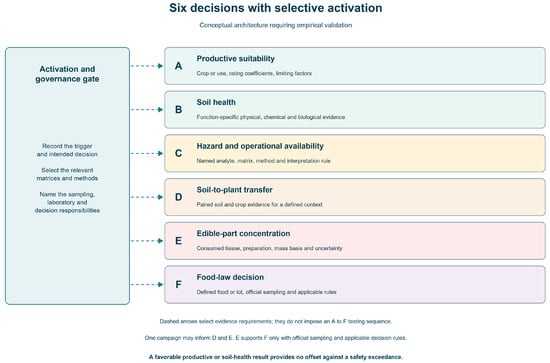
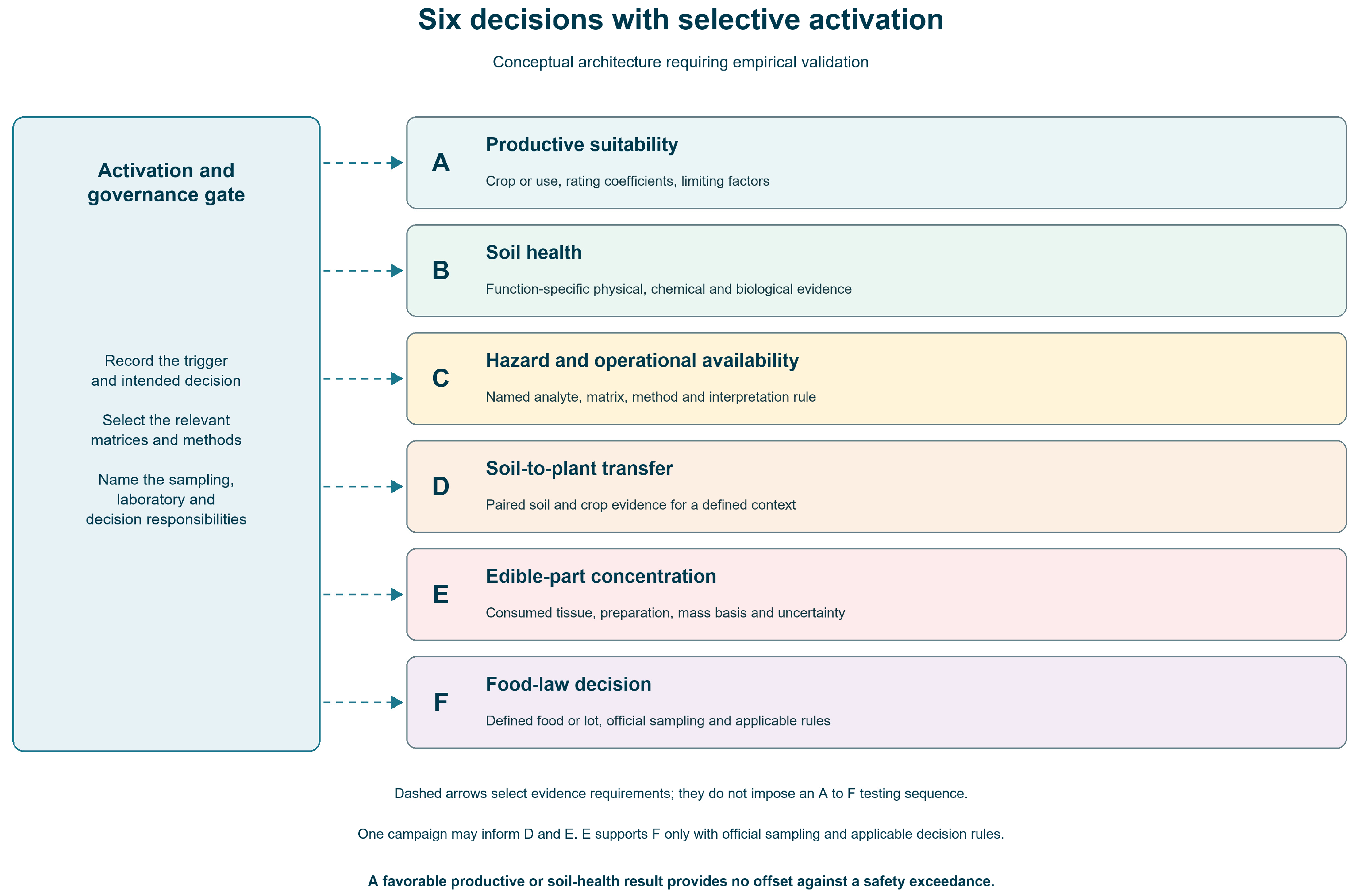
The documentary comparison is organized into six decision layers, each with a question, minimum evidence and output (Table 2). The five evidence streams in Table 1 correspond to A, B, C, D and the combined E-F food-control stream. That final stream is separated into measurement of the consumed material (E) and the governed decision about a defined food or lot (F). A measured edible-part concentration remains distinct from the interpretation of a soil-to-plant transfer relationship (D), even when both use the same edible-tissue sample. The layers therefore do not prescribe an obligatory A-to-F testing sequence. Soil-health assessment and contaminant investigation can be initiated independently. Edible food can be sampled directly for a food-control question without first estimating soil-to-plant transfer. Figure 1 presents these decision objects and the gate that selects the evidence needed for the question at hand.
Table 2.
Six non-compensatory evidence layers from productive suitability to food-law decision.
Figure 1.
Six decision objects connected to an activation and governance gate. Dashed arrows indicate selection of relevant evidence requirements, not mandatory progression through all layers. Evidence may be shared across layers, while the food-law decision requires its own sampling and legal conditions. Original revised schematic; empirical validation remains to be conducted.
3.4. Layer A: Productive Suitability
Layer A preserves the classical task. It identifies the land unit and proposed use, applies the relevant coefficients and reports the score with its limiting factors. This output should remain visible even when later layers are activated. Removing it would lose information about productive feasibility and the agronomic consequences of remediation or management.
3.5. Layer B: Soil Health
Layer B asks whether the soil can sustain the functions expected in context. Physical structure and water relations, chemical fertility and buffering, and biological activity and diversity require separate consideration. Biological indicators are particularly important because they can respond to stress and functions that routine fertility measures do not capture [24]. Yet the choice of indicators must be justified against the function and reference condition. A fixed imported minimum suite should not be treated as universally valid [14,25].
3.6. Layer C: Hazard Presence and Operational Availability
Layer C changes the unit of reasoning from a general penalty to a named hazard. Total concentration is necessary for many legal comparisons but is not identical to the fraction accessible to organisms or plants. Operational availability depends on the specified extraction, soil properties and time [21]. The report must therefore state the matrix, analyte, preparation, method, detection limit, uncertainty and whether the result falls within the laboratory’s accredited scope.
3.7. Layer D: Soil-to-Plant Transfer
Layer D requires paired evidence. Transfer varies by element, soil chemistry, species, cultivar and harvested organ. Cadmium is a clear example: uptake and translocation vary within and between crop species and respond to soil and management conditions [19,26]. Field studies likewise show that operationally available fractions may relate to crop concentrations better than total soil concentrations, but the relation is not universal [22]. A transfer factor is therefore a contextual descriptor whose numerator and denominator, mass basis and uncertainty must be explicit.
Romanian evidence confirms that this is not a purely imported concern. Recent studies examined co-located soil and edible-vegetable matrices and reported element- and crop-specific uptake patterns [27,28]. These studies demonstrate feasibility and heterogeneity, not national prevalence.
3.8. Layers E and F: Edible-Part Evidence and Food-Law Decision
Layer E prevents a common analytical shortcut: treating any plant measurement as equivalent to the consumed organ. Roots, leaves, stems, fruits and grains partition elements differently. Washing, peeling, drying and homogenization also change the reported basis. The food-law comparison is invalid if a dry-weight research result is compared directly with a wet-weight legal maximum without a documented conversion. Recent synthesis shows marked differences in accumulation and oral bioaccessibility across vegetable categories and contaminants [29].
Layer F is a governed decision, not merely the last column of a research spreadsheet. Regulation (EU) 2023/915 defines maximum levels by contaminant and commodity, while Regulation (EC) No 333/2007 sets official sampling and analytical requirements for trace elements [18,30]. The Codex General Standard likewise links maximum levels and sampling plans to defined food and feed commodities [31]. A paired research sample can inform risk and surveillance; it does not automatically certify a commercial lot. Layer F is a compliance decision, not a complete human-health risk assessment.
3.9. The Transversal Activation and Governance Gate
The activation gate records the question to be decided, the trigger, the legal or investigatory basis for testing, the target matrix and analyte, the responsible body and the condition for closing or escalating the inquiry. A statutory duty and a framework recommendation must be identified separately. Agricultural use of treated sewage sludge activates the soil and sludge studies, analyses and controls specified by the applicable sludge regime [23,32]. Those duties support Layer C within that regime. Operational-availability measurements, paired crop studies or official food sampling require their own justification; they are not all made compulsory by the sludge trigger.
For other triggers, the following branches are proposed for implementation. A documented industrial or mining history, suspicious field evidence or a change to a potentially exposed agricultural use can justify a hazard-specific Layer C investigation, with analytes selected from the suspected source and exposure route. A monitoring exceedance first requires interpretation against the applicable matrix, method, mass basis and threshold. Where a soil-to-food pathway remains plausible, paired soil and crop investigation (D) or targeted edible-part measurement (E) can address the unresolved question. These are investigatory recommendations unless a specific legal instrument or competent-authority instruction makes the testing obligatory.
A crop-accumulation concern can justify direct edible-part testing (E); a transfer study (D) is useful when the soil–crop relationship itself is the question. A food-compliance inquiry can enter through official sampling and analysis for E and F under the applicable food-control rules [18,30], independently of completion of A-D. The case record should identify why a branch was selected, whether the available evidence answers the question and who decides any further action. An unactivated layer provides no finding about its decision object.
The governance part of the gate identifies the body commissioning the investigation, the body interpreting the pedological question, the laboratory responsible for the measurement and the authority competent for the eventual environmental or food-law decision. The proposed route retains those responsibilities when external analytical capacity is used. A laboratory result is passed with its sampling and analytical context, the inference it supports and the question that remains unresolved. The named coordinating body records the referral and the receiving body’s decision about additional investigation or official control. This allocation of coordination tasks does not enlarge an institution’s statutory powers.
3.10. Worked Case: Agricultural Use of Sewage Sludge
The sewage-sludge regime demonstrates that Romania already uses context-activated analytical control. Council Directive 86/278/EEC requires limits and analysis for sludge and receiving soil and restricts use for particular crops and periods [32]. Romania’s Order 344/708/2004 requires treated sludge, a sludge application permit, a special OSPA agrochemical study, soil and sludge analysis, numerical limits, crop restrictions, registers and monitoring of soil, water and plants [23].
The technical norms specify a representative soil sample normally composed of 25 cores over no more than 5 ha, a standard depth of 25 cm or at least 10 cm for a shallower cultivated layer, strong-acid mineralization, atomic absorption spectrometry and a detection limit no greater than 10% of the applicable threshold [23]. These are specific analytical duties, not a visual pollution screen.
The regime substantially covers Layer C and parts of the governance gate. It does not complete Layers D to F. Its requirement to monitor plants cannot be rewritten as mandatory measurement of the edible organ under official food sampling rules. Sludge and soil compliance therefore support authorization of the land application under that regime; they do not prove compliance of a harvested commodity. The scientific literature reinforces this boundary because metal availability and crop uptake depend on soil pH, residual form, loading, element and plant regulation [33,34,35]. Table 3 maps the verified requirements to the proposed architecture.
Table 3.
Romanian sewage-sludge requirements and the proposed implementation route mapped to the evidence architecture. Legal requirements derive from the cited sludge regime [23,32]; the external-laboratory row describes a conditional implementation proposal.
A hypothetical decision scenario illustrates the additional connections. For a parcel proposed to receive treated sludge, the special OSPA agrochemical study, its agricultural approval and the required soil and sludge analyses support the application-permit process under the sludge regime (C and the gate) [23]. A soil result above an applicable limit returns to that permit decision; a favorable productive rating supplies no offset. If the sludge-regime requirements are met, that outcome answers the land-application question within its conditions. It supplies no edible-food compliance decision.
Suppose subsequent plant monitoring or a crop-specific concern raises an unresolved food-chain question. The body coordinating the investigation can request paired soil and crop evidence to examine transfer (D), or edible-part measurement to answer the concentration question (E). These additional branches are illustrative investigation choices, not general duties attributed to the sludge order. Where a food-law compliance decision is required, the competent food authority determines the official sampling and analytical route for the relevant commodity (F) [18,30]. Investigative samples are usable for that decision only if the applicable official requirements are satisfied. A direct official edible-food investigation may proceed without a separate transfer study. No concentrations, observed outcomes or validation results are assumed in this scenario.
4. Discussion
4.1. Principal Contribution
The proposed contribution is an explicit separation of decision objects across existing bodies of practice. Land evaluation supplies productive suitability [1,2]; soil-health frameworks supply function-specific interpretation [10,13,14]; contaminant and transfer studies supply hazard- and crop-specific evidence [19,21,22]; food rules specify commodity-level decisions [18,30]. The present synthesis connects these objects through a non-compensation rule and an activation record. It has not established that six is the only workable partition or that the proposed reporting format improves real decisions.
This distinction gives the reform question a bounded target. Indicators 28 and 29 already represent pollution in the national method. Their production-based interpretation can be retained while additional evidence is commissioned for a different question. Whether agencies and users actually confuse those outputs remains an empirical question.
4.2. Why the Framework Must Be Non-Compensatory
Non-compensation concerns the treatment of evidence once an applicable safety limit or decision rule has been identified. A productive score or a soil-health profile provides no basis for canceling an exceedance in the food decision. A high total soil concentration, in turn, calls for interpretation under the relevant soil or input regime and may justify crop investigation; it does not establish an edible-crop exceedance. A shared report can retain all these results and state which action each supports. This proposed reporting rule still requires testing for comprehension and unnecessary testing burden.
4.3. Relation to Soil-Function and Environmental-Management Frameworks
FAO land evaluation and Rossiter’s theoretical framework define suitability in relation to specified land uses [1,2]. Soil-health assessments interpret condition against functions and context [13,14,15,16]. Functional land management and Soil Navigator translate several soil functions into management choices [36,37,38]. These are relevant comparators because they explain why the assessment question and reference condition matter. The present documentary corpus does not compare national land-rating systems comprehensively, and it cannot establish that other national systems omit contamination controls. Transfer to another jurisdiction requires inspection of its own productive, contaminated-land and food-control instruments.
The environmental-management literature addresses complementary problems of screening and information governance. Bergius and Öberg [39] compared initial screening of contaminated land under United States and Swedish methods. Hellawell and Hughes [40] examined the site-investigation contamination data submitted to United Kingdom local government and its potential reuse. Brotherton et al. [41] identified fragmented contaminated-land records and proposed information matrices and geographic information systems to improve integration and standardization. That information-governance aim is compatible with the present architecture: records and institutional handoffs can be integrated while the evidence needed for different decisions remains distinguishable. Our additional requirement is that a productive score, soil measurement, plant-transfer result and food-law decision retain their respective matrices and permitted inferences. Integrating records does not by itself establish those inference boundaries or validate the proposed six-layer framework. Hallenbeck [42] examined health aspects of cadmium uptake from sludge-amended soil and the regulatory implications, illustrating the downstream transfer question that a production-impairment coefficient cannot answer.
4.4. Practical Implementation
Operational use requires a named body to coordinate the case and a recorded decision to be supported. Existing bonitation supplies Layer A when productive suitability is the question. Soil-health assessment (B) and hazard investigation (C) are commissioned where their respective questions arise. After a soil result identifies a concern, the pedological interpretation should state the unresolved crop or food question and refer it, with the evidence file, to the body competent to act within the applicable procedure. As an implementation proposal, the commissioner or named coordinating body requests further investigative D or E evidence, while the competent authority determines whether its official-control procedure must be entered. Where a legal food-compliance decision is the immediate task, official edible-food sampling can be initiated directly. This route is proposed for local agreement; its operation across Romanian institutions has not been evaluated.
Each handoff should retain the parcel and sample identifiers, any food-lot identifier, sampling purpose and date, custody record, preparation and mass basis, analyte, method, quality-control information, result and uncertainty, together with the interpretation, reason for referral and status of the requested action as a legal requirement or an investigatory recommendation. The receiving body should record its acceptance, request for additional evidence or closure decision. Where an external laboratory is commissioned, its current accreditation scope must cover the relevant matrix, analyte and method, and commissioning remains subject to applicable procurement and competent-authority requirements. Analytical reports should retain calibration, detection and quantification limits, recovery, blanks, duplicates or reference materials and deviations. The laboratory is responsible for its analytical result; the body interpreting the pedological question and the authority making the legal decision retain their respective responsibilities.
Romania also illustrates why localization must identify an institution capable of preserving the evidence chain. The reviewed legal sequence and institutional records establish a transition context, but they do not show that the reorganization had taken effect nationally by 8 August 2026 or that contaminant testing was uniform. A single-office staffing record cannot support a national capacity estimate [43,44,45,46,47,48,49]. The transferable requirement is functional rather than institutional: the responsible body must define the sampling question, retain chain of custody, commission analyses only within an accredited matrix-analyte-method scope, and identify the authority responsible for the environmental or food-law decision.
4.5. Transferability Beyond Romania
Transfer beyond Romania should begin by mapping the local decision objects, sampled matrices and competent authorities. The FAO use-specific approach supports retaining productive suitability within its scope [1]. The global soil-pollution assessment describes a broader range of hazards and pathways than the trace-metal sludge example [50]. European sludge and food instruments illustrate how different legal regimes can govern connected materials [17,18,32]. These sources support comparison of evidence requirements. They do not establish equivalent institutional arrangements or testing duties across countries. A local adaptation must check which requirements already exist and whether a separate gate record adds anything.
4.6. Validation Agenda
Validation should begin with a source-coding exercise: independent human reviewers would code the same documentary set, compare disagreements in the eight fields, and assess whether the six decision objects remain distinguishable. A field study would then collect traceable paired soil and edible-crop samples across contrasting soils, crops, contaminants and seasons, with sample preparation and mass basis recorded. Candidate total and operationally available soil measurements could be compared for their ability to predict crop concentrations; shared samples should be used where they validly serve more than one layer. Inter-laboratory comparison would assess analytical disagreement. In parallel, decision exercises would compare a layered report with existing reporting, recording unsupported inferences, missed referrals, unnecessary tests, cost and time. Outcomes and comparator reports should be specified before testing. These are proposed studies; none was performed in this analysis.
4.7. Strengths and Limitations
The documentary basis permits the formal productive rating and the sludge regime to be inspected separately from proposed implementation changes. The framework’s distinct decision objects make its assumptions available for testing. Its usefulness in routine management remains unknown.
Scientific retrieval was targeted and non-exhaustive, and no formal scoping-review screening set was completed. Photographed covers identify the inspected MESP set as the 1987 Bucharest edition coordinated by N. Florea, V. Bălăceanu, C. Răuță and A. Canarache; references to 1986 in later instruments are a secondary bibliographic inconsistency. Source coding was AI-assisted, and the revision-stage recoding does not establish independent human agreement. Single-office records cannot estimate national OSPA practice. Legal and institutional findings are bounded by the original 8 August 2026 cutoff and require a current-law check before operational use. The sludge illustration primarily concerns trace metals; emerging organic contaminants can require different sampling and analytical pathways [51]. The six decisions may share samples and measurements. Their partition, operational handoffs and effect on management decisions remain unvalidated.
5. Conclusions
Romania’s bonitation method supplies crop- or use-specific productive ratings and already represents pollution through indicators 28 and 29. Contamination and food-law decisions require evidence tied to the relevant hazard, matrix and legal unit. The proposed six-layer framework places these requirements alongside the productive rating and records which decisions remain unsupported.
For land managers, the practical proposal is to retain the productive assessment and record a trigger when a hazard-specific investigation is warranted. Pedological and environmental bodies can use the proposed gate record to state the sampling question and the limit of their interpretation. Food-safety authorities require evidence and sampling appropriate to the defined food or lot. The sewage-sludge example illustrates the legal control of an input and receiving soil and identifies the additional evidence needed for crop and food decisions.
The framework requires independent source-coding checks, paired soil and edible-crop studies, and comparison with existing decision reports. Those studies should test whether the layers are useful and distinguishable, whether referrals improve, and whether testing costs are justified. The present analysis supplies a conceptual proposal and an illustrative application.
Supplementary Materials
The following supporting information can be downloaded at: https://www.mdpi.com/article/10.3390/su182111084/s1, Supplementary File S1: Source corpus and analytical matrix, contextual literature and complete reference crosswalk. The workbook separates the 46-source charted analytical corpus from five later contextual publications and maps all 51 references to their main-text citations.
Author Contributions
R.M.C.: Conceptualization, Methodology, Investigation, Data curation, Visualization, Writing—original draft, Writing—review and editing. T.R.: Conceptualization, Investigation, Resources, Writing—review and editing. All authors have read and agreed to the published version of the manuscript.
Funding
This research received no external funding.
Institutional Review Board Statement
Not applicable. This documentary study involved no human participants, animals, identifiable participant data or experimental interventions.
Informed Consent Statement
Not applicable. The study involved no human participants.
Data Availability Statement
The documentary corpus, analytical fields and complete reference crosswalk are supplied in Supplementary File S1, including the revision-stage correction of source coding. Primary materials are identified by the cited publications and official document records. No new soil, crop, participant-level or experimental measurements were collected.
Acknowledgments
During preparation of this manuscript, the authors used OpenAI Codex (desktop application; recorded version 26.803.5235.0 during July and August 2026, with further assistance in October 2026) for query development, source-identification and charting support, drafting, language and structural revision, consistency and bibliographic checks, and preparation of the schematic. For this revision, Codex, an OpenAI GPT-6-based assistant, also assisted with proposed manuscript changes, reviewer responses, supplementary recoding and file preparation. Section 2.6 describes the workflow. The authors are responsible for reviewing and editing the material and for its accuracy, integrity and appropriate attribution.
Conflicts of Interest
The authors report no financial or commercial competing interests in the research. Teodor Rusu served as director of OSPA Cluj from April 2014 to July 2024. This prior institutional role informed contextual interpretation and generated implementation hypotheses; it was not used as documentary evidence, and no national claim rests on it. Teodor Rusu serves as an editor of Sustainability. This role is disclosed to enable independent editorial handling in accordance with MDPI policy.
References
- FAO. A Framework for Land Evaluation; FAO Soils Bulletin 32; Food and Agriculture Organization of the United Nations: Rome, Italy, 1976; Available online: https://www.fao.org/4/X5310E/X5310E00.htm (accessed on 11 October 2026).
- Rossiter, D.G. A theoretical framework for land evaluation. Geoderma 1996, 72, 165–190. [Google Scholar] [CrossRef] [Scilit]
- Snelder, T.; Lilburne, L.; Booker, D.; Whitehead, A.; Harris, S.; Larned, S.; Semadeni-Davies, A.; Plew, D.; McDowell, R. Land-use Suitability is Not an Intrinsic Property of a Land Parcel. Environ. Manag. 2023, 71, 981–997. [Google Scholar] [CrossRef] [Scilit]
- Florea, N.; Bălăceanu, V.; Răuță, C.; Canarache, A. (Eds.) Metodologia Elaborării Studiilor Pedologice. Partea I: Colectarea și Sistematizarea Datelor Pedologice; Partea a II-a: Elaborarea Studiilor Pedologice în Diferite Scopuri; Partea a III-a: Indicatorii Ecopedologici; Institutul de Cercetări pentru Pedologie și Agrochimie: București, Romania, 1987. [Google Scholar]
- Romania. Ordinul nr. 212 Din 15 Mai 2002 și nr. 145 Din 3 Iunie 2002 Pentru Aprobarea Normelor Tehnice de Întocmire a Proiectelor de Organizare a Teritoriului Exploatațiilor Agricole. 2002. Available online: https://legislatie.just.ro/Public/FormaPrintabila/00000G3W03U16AEWGQY2DZP385RQNU9L (accessed on 11 October 2026).
- Romania. ORDIN nr. 362 Din 29 Decembrie 2021 Pentru Aprobarea Programului Național Privind Realizarea și Reactualizarea Sistemului Național de Monitorizare Sol-Teren Pentru Agricultură, a Normelor de Conținut Pentru Studiile Pedologice și Agrochimice Elaborate în Vederea Realizării și Reactualizării Periodice a Sistemului Județean de Monitorizare Sol-Teren Pentru Agricultură și a Realizării Sistemului Național de Monitoring al Calității Solului în Rețeaua de Profile 8 × 8 km și a Bazelor de Date Aferente, a Metodologiei Privind Realizarea și Reactualizarea Sistemului Județean de Monitorizare Sol-Teren Pentru Agricultură și a Sistemului Național de Monitoring al Calității Solului în Rețeaua de Profile 8 × 8 km și a Bazelor de Date Aferente, a Normelor de Conținut Privind Realizarea Sistemului Național de Monitoring al Calității Solului În Rețeaua de Profile 8 × 8 km și a Bazei de Date Aferente Rețelei de Profile 8 × 8 km, Precum și Realizarea Bazei de Date la Nivel Național Aferente Sistemului Județean de Monitorizare Sol-Teren Pentru Agricultură și a Modului de Finanțare a Sistemului Județean de Monitorizare sol-Teren Pentru Agricultură, a Sistemului Național de Monitoring al Calității Solului în Rețeaua de Profile 8 × 8 km, Precum și a Bazelor de Date Aferente. 2021. Available online: https://legislatie.just.ro/Public/DetaliiDocumentAfis/250140 (accessed on 11 October 2026).
- Romania. Legea Fondului Funciar nr. 18 Din 19 Februarie 1991, Republicată, Forma Consolidată. 1991. Available online: https://legislatie.just.ro/Public/DetaliiDocument/298794 (accessed on 11 October 2026).
- Romania. LEGE nr. 246 Din 10 Noiembrie 2020 Privind Utilizarea, Conservarea și Protecția Solului. 2020. Available online: https://legislatie.just.ro/Public/DetaliiDocument/232879 (accessed on 11 October 2026).
- Văduva, B.; Avram, A.; Matei, O.; Andreica, L.; Rusu, T. A GIS-Driven, Machine Learning-Enhanced Framework for Adaptive Land Bonitation. Agriculture 2025, 15, 1735. [Google Scholar] [CrossRef] [Scilit]
- Karlen, D.L.; Mausbach, M.J.; Doran, J.W.; Cline, R.G.; Harris, R.F.; Schuman, G.E. Soil Quality: A Concept, Definition, and Framework for Evaluation (A Guest Editorial). Soil Sci. Soc. Am. J. 1997, 61, 4–10. [Google Scholar] [CrossRef] [Scilit]
- Doran, J.W.; Zeiss, M.R. Soil health and sustainability: Managing the biotic component of soil quality. Appl. Soil Ecol. 2000, 15, 3–11. [Google Scholar] [CrossRef] [Scilit]
- Kibblewhite, M.G.; Ritz, K.; Swift, M.J. Soil health in agricultural systems. Philos. Trans. R. Soc. B Biol. Sci. 2008, 363, 685–701. [Google Scholar] [CrossRef] [Scilit]
- Lehmann, J.; Bossio, D.A.; Kögel-Knabner, I.; Rillig, M.C. The concept and future prospects of soil health. Nat. Rev. Earth Environ. 2020, 1, 544–553. [Google Scholar] [CrossRef] [Scilit]
- Bünemann, E.K.; Bongiorno, G.; Bai, Z.; Creamer, R.E.; De Deyn, G.; de Goede, R.; Fleskens, L.; Geissen, V.; Kuyper, T.W.; Mäder, P.; et al. Soil quality: A critical review. Soil Biol. Biochem. 2018, 120, 105–125. [Google Scholar] [CrossRef] [Scilit]
- Rinot, O.; Levy, G.J.; Steinberger, Y.; Svoray, T.; Eshel, G. Soil health assessment: A critical review of current methodologies and a proposed new approach. Sci. Total Environ. 2019, 648, 1484–1491. [Google Scholar] [CrossRef] [Scilit]
- Celis, R.A.O.; Gamboa, C.H.; Pascual, J.A.; Ros, M. Conceptual and practical challenges of assessing soil quality. Soil Use Manag. 2024, 40, e13137. [Google Scholar] [CrossRef] [Scilit]
- European Union. Directive (EU) 2025/2360 of the European Parliament and of the Council of 12 November 2025 on Soil Monitoring and Resilience (Soil Monitoring Law). 2025. Available online: https://eur-lex.europa.eu/eli/dir/2025/2360/oj/eng (accessed on 11 October 2026).
- European Union. Commission Regulation (EU) 2023/915 of 25 April 2023 on Maximum Levels for Certain Contaminants in Food and Repealing Regulation (EC) No. 1881/2006; Consolidated Version 8 October 2025. 2023. Available online: https://eur-lex.europa.eu/eli/reg/2023/915/2025-10-08/eng (accessed on 11 October 2026).
- Grant, C.A.; Buckley, W.T.; Bailey, L.D.; Selles, F. Cadmium Accumulation in Crops. Can. J. Plant Sci. 1998, 78, 1–17. [Google Scholar] [CrossRef] [Scilit]
- Chojnacka, K.; Chojnacki, A.; Górecka, H.; Górecki, H. Bioavailability of Heavy Metals from Polluted Soils to Plants. Sci. Total Environ. 2005, 337, 175–182. [Google Scholar] [CrossRef] [Scilit]
- Kim, R.Y.; Yoon, J.K.; Kim, T.S.; Yang, J.E.; Owens, G.; Kim, K.R. Bioavailability of Heavy Metals in Soils: Definitions and Practical Implementation: A Critical Review. Environ. Geochem. Health 2015, 37, 1041–1061. [Google Scholar] [CrossRef] [Scilit]
- Zhang, J.; Li, H.; Zhou, Y.; Dou, L.; Cai, L.; Mo, L.; You, J. Bioavailability and Soil-to-Crop Transfer of Heavy Metals in Farmland Soils: A Case Study in the Pearl River Delta, South China. Environ. Pollut. 2018, 235, 710–719. [Google Scholar] [CrossRef] [Scilit]
- Romania. Ordinul nr. 344/708/2004 Pentru Aprobarea Normelor Tehnice Privind Protecția Mediului și în Special a Solurilor, Când se Utilizează Nămolurile de Epurare în Agricultură, Forma Consolidată. 2004. Available online: https://legislatie.just.ro/Public/DetaliiDocument/212102 (accessed on 11 October 2026).
- Schloter, M.; Nannipieri, P.; Sørensen, S.J.; van Elsas, J.D. Microbial indicators for soil quality. Biol. Fertil. Soils 2018, 54, 1–10. [Google Scholar] [CrossRef] [Scilit]
- Bagnall, D.K.; Rieke, E.L.; Morgan, C.L.S.; Liptzin, D.L.; Cappellazzi, S.B.; Honeycutt, C.W. A minimum suite of soil health indicators for North American agriculture. Soil Secur. 2023, 10, 100084. [Google Scholar] [CrossRef] [Scilit]
- Clemens, S.; Ma, J.F. Toxic Heavy Metal and Metalloid Accumulation in Crop Plants and Foods. Annu. Rev. Plant Biol. 2016, 67, 489–512. [Google Scholar] [CrossRef] [Scilit]
- Gergen, I.; Hărmănescu, M. Application of principal component analysis in the pollution assessment with heavy metals of vegetable food chain in the old mining areas. Chem. Cent. J. 2012, 6, 156. [Google Scholar] [CrossRef] [Scilit]
- Păun, N.; Zgavarogea, R.; Niculescu, V.C.; Nasture, A.M.; Voicea, I.; Popescu (Stegarus), D.I. From Soil to Plate: Lithium and Other Trace Metals Uptake in Vegetables Under Variable Soil Conditions. Toxics 2025, 13, 956. [Google Scholar] [CrossRef] [Scilit]
- Newell, J.; Cox, S.F.; Doherty, R. Oral bioaccessibility trends for As, Cd, Cr, Ni, and Pb in vegetables grown in contaminated soils: A systematic review. Urban Agric. Reg. Food Syst. 2025, 10, e70009. [Google Scholar] [CrossRef] [Scilit]
- European Union. Commission Regulation (EC) No. 333/2007 of 28 March 2007 Laying Down the Methods of Sampling and Analysis for the Control of the Levels of Trace Elements and Processing Contaminants in Foodstuffs; Consolidated Version 30 April 2024. 2007. Available online: https://eur-lex.europa.eu/eli/reg/2007/333/2024-04-30/eng (accessed on 11 October 2026).
- Codex Alimentarius Commission. General Standard for Contaminants and Toxins in Food and Feed; CXS 193-1995; FAO/WHO: Rome, Italy, 2025; Available online: https://codex.fao.org/restapi/searchstandard/CXS_193e.pdf?lang=en&id=18 (accessed on 22 October 2026).
- European Union. Council Directive 86/278/EEC of 12 June 1986 on the Protection of the Environment, and in Particular of the Soil, When Sewage Sludge Is Used in Agriculture; Consolidated Version 1 January 2022. 1986. Available online: https://eur-lex.europa.eu/eli/dir/1986/278/2022-01-01/eng (accessed on 11 October 2026).
- McBride, M.B. Toxic metals in sewage sludge-amended soils: Has promotion of beneficial use discounted the risks? Adv. Environ. Res. 2003, 8, 5–19. [Google Scholar] [CrossRef] [Scilit]
- Smith, S.R. A critical review of the bioavailability and impacts of heavy metals in municipal solid waste composts compared to sewage sludge. Environ. Int. 2009, 35, 142–156. [Google Scholar] [CrossRef] [Scilit]
- Singh, R.P.; Agrawal, M. Potential benefits and risks of land application of sewage sludge. Waste Manag. 2008, 28, 347–358. [Google Scholar] [CrossRef] [Scilit]
- Schulte, R.P.O.; Creamer, R.E.; Donnellan, T.; Farrelly, N.; Fealy, R.; O’Donoghue, C.; O’hUallachain, D. Functional land management: A framework for managing soil-based ecosystem services for the sustainable intensification of agriculture. Environ. Sci. Policy 2014, 38, 45–58. [Google Scholar] [CrossRef] [Scilit]
- Vogel, H.J.; Bartke, S.; Daedlow, K.; Helming, K.; Kögel-Knabner, I.; Lang, B.; Rabot, E.; Russell, D.; Stößel, B.; Weller, U.; et al. A systemic approach for modeling soil functions. SOIL 2018, 4, 83–92. [Google Scholar] [CrossRef] [Scilit]
- Debeljak, M.; Trajanov, A.; Kuzmanovski, V.; Schröder, J.; Sandén, T.; Spiegel, H.; Wall, D.P.; Van de Broek, M.; Rutgers, M.; Bampa, F.; et al. A Field-Scale Decision Support System for Assessment and Management of Soil Functions. Front. Environ. Sci. 2019, 7, 115. [Google Scholar] [CrossRef] [Scilit]
- Bergius, K.; Öberg, T. Initial Screening of Contaminated Land: A Comparison of US and Swedish Methods. Environ. Manag. 2007, 39, 226–234. [Google Scholar] [CrossRef] [Scilit]
- Hellawell, E.E.; Hughes, S.J. Evaluation and Potential Uses of Site Investigation Soil Contamination Data Submitted to Uk Local Government. Environ. Manag. 2022, 70, 1–15. [Google Scholar] [CrossRef] [Scilit]
- Brotherton, J.; Hussain, S.; Deary, M.E.; Mahammedi, C.; Beal, C.D.; Butt, T.E. The Significance of Unifying Non-Integrated Information on Contaminated Land and Risks. Environ. Manag. 2026, 76, 51. [Google Scholar] [CrossRef] [Scilit]
- Hallenbeck, W.H. Municipal sludge management: Health aspects of crop uptake of cadmium from sludge-amended soil and recommendations for regulation. Environ. Manag. 1979, 3, 155–158. [Google Scholar] [CrossRef] [Scilit]
- Romania. HOTĂRÂRE nr. 751 Din 21 Iulie 2010 Privind Măsurile de Reorganizare a Direcțiilor Pentru Agricultură și Dezvoltare Rurală Județene și a Municipiului București. 2010. Available online: https://legislatie.just.ro/Public/DetaliiDocument/164583 (accessed on 11 October 2026).
- Romania. HOTĂRÂRE nr. 30 Din 18 Ianuarie 2017 Privind Organizarea și Funcționarea Ministerului Agriculturii și Dezvoltării Rurale, Precum și Pentru Modificarea Art. 6 Alin. (6) Din Hotărârea Guvernului nr. 1.186/2014 Privind Organizarea și Funcționarea Autorității Pentru Administrarea Sistemului Național Antigrindină și de Creștere a Precipitațiilor. 2017. Available online: https://legislatie.just.ro/Public/DetaliiDocumentAfis/296092 (accessed on 11 October 2026).
- Romania. ORDONANȚĂ DE URGENȚĂ nr. 85 Din 28 Iunie 2024 Privind Unele Măsuri Pentru Reorganizarea Ministerului Agriculturii și Dezvoltării Rurale și a Unor Instituții Aflate în Subordinea Acestuia, Precum și Pentru Modificarea Ordonanței Guvernului nr. 12/2024 Privind Instituirea Unei Scheme de Ajutor de Stat Pentru Susținerea Activității Crescătorilor Din Sectoarele Suin și Avicol, în Perioada 1 August 2022-31 August 2023, în Contextul Crizei Provocate de Agresiunea Rusiei Împotriva Ucrainei. 2024. Available online: https://legislatie.just.ro/Public/DetaliiDocument/291663 (accessed on 11 October 2026).
- Romania. ORDONANȚĂ DE URGENȚĂ nr. 92 Din 30 Decembrie 2025 Pentru Modificarea și Completarea Ordonanței de Urgență a Guvernului nr. 85/2024 Privind Unele Măsuri Pentru Reorganizarea Ministerului Agriculturii și Dezvoltării Rurale și a Unor Instituții Aflate în Subordinea Acestuia, Precum și Pentru Modificarea Ordonanței Guvernului nr. 12/2024 Privind Instituirea Unei Scheme de Ajutor de Stat Pentru Susținerea Activității Crescătorilor Din Sectoarele Suin și Avicol, în Perioada 1 August 2022- 31 August 2023, în Contextul Crizei Provocate de Agresiunea Rusiei Împotriva Ucrainei, cu Modificările și Completările Ulterioare, Precum și Pentru Modificarea Unor Acte Normative Din Domeniul Agriculturii. 2025. Available online: https://legislatie.just.ro/Public/DetaliiDocument/306241 (accessed on 11 October 2026).
- Romania. HOTĂRÂRE nr. 483 Din 18 Iunie 2026 Privind Trecerea Unui Bun Imobil, Aflat în Administrarea Oficiului de Studii Pedologice și Agrochimice Cluj, Din Domeniul Public în Domeniul Privat al Statului, în Vederea Scoaterii Din Funcțiune, Valorificării și, După Caz, Casării. 2026. Available online: https://legislatie.just.ro/Public/DetaliiDocument/311932 (accessed on 11 October 2026).
- Oficiul de Studii Pedologice și Agrochimice Cluj. Raport de Activitate Pentru Anul 2020; Nr. 16. 12 January 2021. Available online: https://www.ospacluj.ro/doc/Raport-de-activitate-OSPA-Cluj-2020.pdf (accessed on 11 October 2026).
- Oficiul de Studii Pedologice și Agrochimice Cluj. Prezentare și Situația Încadrării Personalului. Available online: https://ospacluj.ro/prezentare.html (accessed on 8 August 2026).
- FAO; UNEP. Global Assessment of Soil Pollution: Report; FAO: Rome, Italy; UNEP: Rome, Italy, 2021. [Google Scholar] [CrossRef] [Scilit]
- Clarke, B.O.; Smith, S.R. Review of ‘emerging’ organic contaminants in biosolids and assessment of international research priorities for the agricultural use of biosolids. Environ. Int. 2011, 37, 226–247. [Google Scholar] [CrossRef] [Scilit]

Disclaimer/Publisher’s Note: The statements, opinions and data contained in all publications are solely those of the individual author(s) and contributor(s) and not of MDPI and/or the editor(s). MDPI and/or the editor(s) disclaim responsibility for any injury to people or property resulting from any ideas, methods, instructions or products referred to in the content. |
© 2026 by the authors. Licensee MDPI, Basel, Switzerland. This article is an open access article distributed under the terms and conditions of the Creative Commons Attribution (CC BY) license.