


Abstract
This study aimed to translate, cross-culturally adapt, and evaluate the psychometric properties of the 24-item Environmental Attitudes Inventory (EAI-24) in Spanish university students. The Preservation dimension reflects an orientation towards environmental protection; Utilization reflects beliefs about the legitimacy of using and controlling nature. A convenience sample of 270 University of Cádiz students completed the Spanish EAI-24 and self-report measures of behaviours related to caring for nature and using natural resources as health assets. Adaptation followed international guidelines. Internal consistency and test–retest analyses assessed reliability; exploratory and confirmatory factor analyses examined structure, and regressions evaluated criterion-related validity. Internal consistency was satisfactory for the overall score and Preservation but more modest for Utilization; temporal stability was generally satisfactory. Confirmatory factor analysis provided partial support for the proposed structure, with some incremental fit indices below recommended thresholds. Exploratory factor analysis revealed a partial reorganisation within Preservation and broadly reproduced the original Utilization structure. Preservation showed stronger and more consistent associations with behavioural indicators than Utilization and, in several analyses, than the overall EAI-24 score. These findings offer initial evidence of reliability and validity, but factorial discrepancies and low internal consistency of some two-item subscales warrant investigation in more diverse samples.
1. Introduction
1.1. Human–Nature Relationship and the Environmental Crisis
The relationship between humans and the natural environment is a key determinant of health, well-being, and quality of life. Numerous studies have shown that contact with nature, both in natural settings and in urban environments that incorporate natural elements, is associated with psychological and physiological benefits, including stress reduction, improved mood, recovery from illness, enhanced social interaction, and increased physical activity [1,2,3,4,5,6,7,8,9,10]. These effects have been observed not only in natural green spaces but also in built environments that feature natural light, vegetation, or outdoor views [11,12,13,14,15,16].
Despite these benefits, the planet is currently facing a global environmental crisis. Climate change, pollution, deforestation, biodiversity loss, and waste accumulation threaten ecosystem sustainability and, consequently, the conditions that support human life. A substantial proportion of these threats derives directly or indirectly from unsustainable human behaviours, increasing interest in understanding the psychological factors involved in the adoption or rejection of pro-environmental actions [17,18,19,20].
1.2. Environmental Attitudes and Environmental Behaviour
Across multiple theories of human behaviour and health promotion, attitudes have been identified as central determinants of action [21,22,23,24,25,26]. Within this framework, environmental attitudes can be defined as relatively stable predispositions reflecting cognitive, affective, and evaluative responses towards the natural environment and environmental issues [18]. Numerous studies have identified environmental attitudes as important antecedents of pro-environmental behaviour and support for environmental protection policies [27,28,29,30,31]. Studying environmental attitudes is therefore essential for understanding how individuals perceive, evaluate, and relate to the natural environment, as well as for designing interventions aimed at promoting more sustainable behaviours. At the same time, pro-environmental behaviour encompasses multiple behavioural domains that are only modestly interrelated, highlighting the value of considering different behavioural indicators when examining their association with environmental attitudes [32]. In the present study, the term pro-environmental behaviour is used specifically to refer to behaviour related to caring for and protecting nature. Behaviour related to the use of natural resources as health assets is considered a distinct behavioural domain, reflecting another way in which individuals interact with the natural environment. These domains are considered complementary expressions of the way individuals interact with and make use of the natural environment. Within an asset-based approach to health promotion, health assets can be understood as factors or resources that enhance the capacity of individuals, groups, communities, populations, and social systems to maintain and sustain health and well-being and to help reduce health inequities [33]. From this perspective, natural resources and environments may be conceptualised as health assets when they provide opportunities to promote or maintain physical, psychological, or social well-being.
However, the relationship between attitudes and behaviour is neither direct nor linear. Environmental psychology research has consistently documented the so-called attitude-behaviour gap, whereby favourable environmental attitudes do not necessarily translate into corresponding actions [34,35,36]. This gap can be partly explained by contextual, social, economic, and situational factors that mediate or moderate the behavioural expression of attitudes. Recent evidence from climate-action research similarly highlights the combined influence of intrapersonal, social, and structural mechanisms, including habits, social norms, affordability, convenience, and trust, on whether pro-environmental intentions are translated into action [37]. Consequently, attitudes should be viewed as necessary but insufficient conditions for pro-environmental behaviour, reinforcing the importance of measuring them accurately and conceptually appropriately.
These considerations are particularly relevant in higher education. Universities are expected not only to provide knowledge about sustainability but also to foster the values, attitudes and competencies needed for informed and responsible action through interdisciplinary, context-sensitive and action-oriented education [38,39,40,41]. Recent evidence indicates that students’ attitudes constitute an important link between sustainability knowledge and behaviour, while their systematic assessment can help higher education institutions orient curricula and sustainability initiatives [42,43]. Accordingly, valid and culturally adapted instruments are needed to assess environmental attitudes in university populations. Research across diverse disciplines such as health, education, communication, and environmental sciences further illustrates the value of reliable instruments for identifying educational needs and assessing sustainability-related knowledge, awareness, and attitudes among students and future professionals, who may subsequently promote environmentally responsible practices within healthcare and the wider community [44,45].
Beyond their role as antecedents of behaviour, environmental attitudes can also serve as relevant diagnostic and outcome variables in the design and evaluation of educational and behavioural interventions. Assessing attitudes before an intervention may help identify the initial predispositions and barriers of the target population and guide the selection of context-sensitive strategies, whereas post-intervention assessment can determine whether attitudinal change has occurred and whether it is accompanied by changes in intentions or behaviour. This distinction is particularly important because educational interventions tend to produce more consistent improvements in knowledge and attitudes than in observable action, although theory-based programmes can simultaneously improve several behavioural determinants [46,47]. Intervention effects may also vary according to individual attitudes and sociodemographic characteristics, reinforcing the need to consider these variables when tailoring and evaluating sustainability initiatives [48].
1.3. From Unidimensional Models to Hierarchical Approaches to Environmental Attitudes
Environmental attitudes were traditionally conceptualised and measured as a unidimensional construct through global scales such as the New Environmental Paradigm (NEP) [49]. Although these instruments played a significant role in the early development of the field, subsequent research has suggested that environmental attitudes represent a more complex construct, leading to growing interest in examining their factorial structure and their relationship with environmental behaviour from more nuanced perspectives [18,30]. In response to these limitations, multidimensional and hierarchical models were proposed, conceptualising environmental attitudes as a complex system of interrelated beliefs, values, and affective dispositions. Within this context, Milfont and Duckitt [18] developed a hierarchical model of environmental attitudes consisting of two higher-order dimensions: Preservation and Utilization. Preservation reflects an orientation towards protecting and caring for the natural environment, whereas Utilization reflects beliefs about human use of nature within the anthropocentrism–ecocentrism continuum. Anthropocentrism prioritises human interests, whereas ecocentrism recognises the intrinsic value of nature beyond its usefulness to humans. This model has received empirical support and has been validated across different cultural contexts [30,50,51,52,53,54,55].
1.4. The Environmental Attitudes Inventory and Its Short Forms
Based on this hierarchical framework, the Environmental Attitudes Inventory (EAI) was developed as a multidimensional instrument designed to assess the structure of environmental attitudes [18]. The model proposes two second-order dimensions, Preservation and Utilization, which organise a set of first-order factors and capture the complexity of the construct [18,30,51].
The EAI is available in 120-, 72- and 24-item versions, maintaining the hierarchical organisation of the construct while balancing positively and negatively worded items.
The 24-item version (EAI-24) is particularly useful in applied and educational research settings because it combines brevity, conceptual breadth, and theoretical robustness. Several studies have supported its usefulness and shown that, despite its shorter length, it retains the essential structural properties of the original instrument [55,56]. The EAI has also been adapted and psychometrically evaluated across different linguistic and cultural con-texts [50,53].
In the Spanish context, the adaptation conducted by Andrade et al. [55] supports a multidimensional structure and demonstrates the feasibility of developing abbreviated versions of the EAI with adequate psychometric properties. However, the version proposed by Andrade et al. differs from the original 24-item version developed by Milfont and Duckitt in both item composition and factorial structure.
More recently, Stewart-Knox et al. [57] examined environmental attitudes across five European countries, including Spain, using the EAI-24. Although all 24 items were administered, subsequent multigroup analyses used a reduced 18-item, two-factor model comprising Preservation and Utilization. The analyses identified cross-national differences in the response patterns of some items, highlighting the relevance of examining measurement equivalence across cultural contexts.
Table 1 summarises the main validation and adaptation studies of the EAI, including the original version and its adaptations across different cultural contexts. This overview illustrates the diversity of versions employed and the variability observed in their factorial structures.
Table 1.
Comparative overview of validation studies of the Environmental Attitudes Inventory (EAI).
Previous Spanish adaptations and international applications of the EAI have provided relevant evidence regarding its psychometric properties, although they have also resulted in configurations that differ from the original 24-item version. The present study extends this evidence by examining a Spanish adaptation that retains all 24 original items and provides initial evidence regarding its internal structure, internal consistency, and temporal stability in a university sample. Additionally, it examines the associations of Preservation and Utilization with behaviours related to caring for nature and the use of natural resources as health assets. This approach allows the functioning of both dimensions to be explored across different behavioural domains and provides further evidence regarding the validity of the instrument in this context.
1.5. The Present Study
Previous research has examined Spanish-language adaptations and cross-national applications of the Environmental Attitudes Inventory (EAI), highlighting the need for further evidence on the psychometric performance of its original 24-item version in Spanish university students. To address this need and support the availability of a brief, culturally appropriate measure of environmental attitudes in this context, the present study aimed to provide initial evidence on the reliability and validity of a Spanish adaptation of the EAI-24 in a sample of Spanish university students. Specifically, the objectives were to: (a) develop a linguistically and culturally appropriate Spanish version through translation and cross-cultural adaptation; (b) examine its factorial structure through exploratory and confirmatory factor analyses; (c) assess its internal consistency and temporal stability; and (d) evaluate its criterion-related validity through associations with behavioural indicators, including pro-environmental behaviour and behaviours related to the use of natural resources as health assets, and explore the patterns of these associations for the Preservation and Utilization dimensions.
2. Materials and Methods
2.1. Instrument
The 24-item version of the Environmental Attitudes Inventory (EAI-24) comprises 12 first-order factors, each represented by two items. These factors are hierarchically organised into two second-order dimensions: Preservation (seven scales) and Utilization (five scales). Responses are recorded on a 7-point Likert-type scale ranging from 1 (strongly disagree) to 7 (strongly agree), consistent with the format of the original instrument.
The item-scale correspondence between the EAI-24 and EAI-72 is presented in Appendix A.
2.2. Translation and Cultural Adaptation
The translation and cultural adaptation of the EAI-24 followed widely accepted international guidelines for the cross-cultural adaptation of psychometric instruments [58,59,60,61,62]. Formal permission to translate, adapt, and validate the EAI-24 in the Spanish context was obtained from the first author of the instrument, Taciano L. Milfont. The forward translators and back-translators were professional translators or philologists with previous experience in academic translation. They were recruited through contacts established during previous translation work, with native language as a key selection criterion: Spanish for forward translation and English for back-translation.
In the first stage, two independent forward translations from English into Spanish were performed by translators who were native Spanish speakers. The resulting versions were compared and reconciled by a multidisciplinary expert committee including specialists in psychology, health sciences, public health, anthropology, and linguistics, with the aim of ensuring semantic and conceptual equivalence.
Subsequently, the reconciled Spanish version was back translated into English by two native English-speaking translators. The back translations were compared with each other and with the original version of the instrument. Any discrepancies identified were resolved through consensus among translators and expert committee members. This process yielded a preliminary Spanish version of the EAI-24 that was conceptually equivalent to the original instrument. Only minor linguistic and cultural adjustments were required during the adaptation process. For example, in item 24, the original expression “married couple” was rendered as “pareja” (couple), allowing the item to refer to couples irrespective of marital status. This adjustment was intended to preserve the underlying attitudinal content while improving the cultural appropriateness of the wording.
The Spanish translation of the EAI-24 is provided in Appendix B.
2.3. Pilot Study and Cognitive Interviews
To assess comprehensibility, linguistic adequacy, and cultural relevance, a pilot study was conducted that included individual cognitive interviews and group administration of the questionnaire. The sample consisted of 13 fourth-year nursing students from the University of Cádiz, selected through convenience sampling.
During this phase, questionnaire completion time was recorded, qualitative observations were collected, and potential difficulties in comprehension or ambiguities in item wording were identified. The issues detected were reviewed by the expert committee, and minor adjustments to improve linguistic naturalness were introduced, resulting in the final Spanish version of the EAI-24. The overall multistage process is consistent with recent recommendations indicating that cross-cultural adaptation should extend beyond linguistic translation by incorporating expert review, cognitive interviews with the target population, and empirical psychometric evaluation to support content validity in the new cultural context [63].
2.4. Participants and Procedure
The validation of the instrument was carried out through an observational study with a test–retest design. The questionnaire was administered on two occasions separated by an interval of approximately two weeks. Of the 270 participants who completed the initial assessment, 199 participated in the retest administration, representing a retention rate of 73.7%. Data collection was conducted in both paper-and-pencil and online formats, with members of the research team physically present during administration in both cases.
The sample consisted of 270 university students enrolled in different degree programmes at the University of Cádiz, from several campuses and academic years. Participants were recruited through convenience sampling. They were enrolled in Nursing, Social Work, Advertising and Public Relations, and Public Management and Administration programmes, none of which specifically focused on environmental sciences, environmental protection, or ecology. The sample size was comparable to or larger than those used in previous EAI validation studies, including that of Milfont and Duckitt [30], which involved 229 participants.
2.5. Environmental Behaviour Measures
Environmental behaviour was assessed using two complementary instruments. Prior to their use in the present study, both instruments had undergone a psychometric validation process conducted by the research team. In addition, given the absence of a published Spanish-language version, the Pro-Environmental Behaviour Scale (PEBS) had also undergone translation and cross-cultural adaptation.
First, an ad hoc instrument specifically developed for this study was used to assess environmental behaviour through two dimensions and a global score. The instrument comprised 10 items, with five items assessing behaviours related to caring for nature (C-D1) and five items assessing behaviours related to the use of natural resources as health assets (C-D2). Responses were recorded on a 5-point Likert-type scale ranging from 1 (never) to 5 (always). A global score (C-G) was calculated by summing both dimensions. Internal consistency for the overall instrument was adequate (α = 0.754), although the dimensions showed different levels of reliability (C-D1, α = 0.450; C-D2, α = 0.815). The lower internal consistency observed for C-D1 may reflect greater heterogeneity in item content; nevertheless, this dimension was retained as a complementary measure in subsequent analyses.
Second, the PEBS was administered. This instrument specifically assesses behaviours related to environmental protection and care for nature. The PEBS comprises 13 items [64] rated on the same 5-point Likert-type scale, ranging from 1 (never) to 5 (always), and demonstrated adequate internal consistency in the present sample (α = 0.670). Furthermore, adaptations of the instrument to other languages, such as Italian, support its applicability across different linguistic contexts [65].
2.6. Data Analysis
Descriptive analyses were conducted for all items, including means, standard deviations, skewness, and kurtosis. Internal consistency was assessed using Cronbach’s alpha coefficients for the overall scale, the second-order dimensions, and the first-order scales. Test–retest reliability was evaluated using a two-way mixed-effects, consistency, single-measure intraclass correlation coefficient (ICC), with 95% confidence intervals. Friedman tests were also used to examine systematic differences between test and retest scores.
The internal structure of the instrument was examined through exploratory factor analysis (EFA) and confirmatory factor analysis (CFA). Sampling adequacy was assessed using the Kaiser–Meyer–Olkin (KMO) index and Bartlett’s test of sphericity. Exploratory factor analyses were conducted separately for the Preservation and Utilization dimensions using principal axis factoring with direct oblimin rotation. Factor retention in the unconstrained EFA solutions was based on the Kaiser–Guttman criterion, retaining factors with initial eigenvalues greater than 1. Both unconstrained solutions and a theoretically constrained seven-factor solution for the Preservation dimension were examined. CFA was conducted to test the proposed two-dimensional model. Model fit was evaluated using the chi-square statistic (χ2), with non-significant values (p > 0.05) indicating acceptable fit; the chi-square to degrees of freedom ratio (χ2/df), with values <2 indicating very good fit, values from 2 to <3 indicating good or acceptable fit, and values from 3 to 5 indicating acceptable but less favourable fit; and the root mean square error of approximation (RMSEA), with values ≤ 0.10 considered acceptable and values ≤ 0.05 indicating good fit. Incremental fit was assessed using the Comparative Fit Index (CFI), Tucker–Lewis Index (TLI), and Normed Fit Index (NFI), with values ≥0.90 considered indicative of adequate fit.
Prior to the factor analyses, the magnitude and pattern of missing data were examined. Overall missingness across the EAI-24 items was very low (0.39%), with item-level missingness ranging from 0% to 1.5%. Little’s Missing Completely at Random (MCAR) test indicated that the missing data were consistent with a completely random pattern for the overall EAI-24 (χ2 = 284.840, df = 271, p = 0.270) as well as for the Preservation (χ2 = 104.733, df = 102, p = 0.407) and Utilization (χ2 = 54.859, df = 53, p = 0.404) dimensions. Exploratory factor analyses were conducted using cases with complete data for all items in each dimension (Preservation, n = 257; Utilization, n = 261). For confirmatory factor analyses, missing values were imputed using the expectation–maximization (EM) algorithm, resulting in a complete dataset of 270 participants for all three CFA models.
Linear regression analyses were subsequently performed to examine the associations between the EAI-24 dimensions and different indicators of environmental behaviour (C-D1, C-D2, C-G, and PEBS).
All analyses were conducted using IBM SPSS Statistics version 29, with IBM AMOS used for confirmatory factor analyses.
2.7. Use of Generative Artificial Intelligence
Generative artificial intelligence (ChatGPT (GPT-6), developed by OpenAI) was used to support language editing, text refinement, structural organisation, and adaptation of the manuscript to journal requirements. It was not used for study design, data collection, or statistical analysis. All AI-assisted content was critically reviewed, verified, and edited by the authors, who take full responsibility for the interpretation of the findings and the final content of the manuscript.
2.8. Ethical Considerations
The study was approved by the Bioethics Committee of the University of Cádiz (Ref. 007/2021) and received authorisation from the participating faculties. Participation was voluntary, anonymous, and confidential, and all procedures complied with current regulations on research ethics and the protection of personal data. All participants received information about the objectives and characteristics of the study and provided informed consent before completing the questionnaire.
3. Results
3.1. Descriptive Analysis
The sociodemographic characteristics of the validation sample are presented in Table 2. Participants had a mean age of 21.04 years (SD = 4.06; range = 17–52), and most were female (83.3%). The largest groups were enrolled in Social Work (41.1%) and Nursing (34.8%), and most participants studied at the Jerez campus (65.6%).
Table 2.
Sociodemographic characteristics of the validation sample (n = 270).
Descriptive analyses of the EAI-24 items revealed an attitudinal profile clearly oriented towards the Preservation dimension, consistent with previous research conducted among university students and young adults [30,55]. In general, items associated with this dimension displayed high mean scores and skewed distributions, indicating strong agreement with statements related to environmental protection and concern for the natural environment. In contrast, items corresponding to the Utilization dimension showed lower mean scores and more symmetrical or positively skewed distributions, reflecting lower endorsement of anthropocentric beliefs.
Standard deviations were moderate, suggesting sufficient variability to discriminate between individual levels of environmental attitudes. Although some Preservation items showed evidence of ceiling effects, this pattern has been reported in previous studies using the EAI in educational settings and does not compromise interpretability [50]. Detailed item-level descriptive statistics for both the test and retest administrations are provided in Appendix C.
3.2. Internal Consistency and Test–Retest Reliability
Internal consistency was adequate for the overall EAI-24 score (α = 0.767), and for the Preservation dimension (α = 0.733), although it was more modest for Utilization (α = 0.617). This differential pattern is consistent with previous studies reporting greater internal coherence for Preservation than for Utilization [18,56].
At the first-order level, most scales yielded Cronbach’s alpha coefficients ranging from 0.60 to 0.80. Some subscales produced lower values, which should be interpreted cautiously given that each consists of only two items, a condition known to underestimate alpha coefficients [66]. Internal consistency coefficients for the overall score, the two second-order dimensions, and the 12 first-order scales are presented in Table 3.
Table 3.
Internal consistency of the EAI-24.
Test–retest reliability, assessed using the intraclass correlation coefficient (ICC), was high for the overall EAI-24 score (ICC = 0.84), as well as for the Preservation (ICC = 0.85) and Utilization (ICC = 0.79) dimensions. All test–retest ICCs were statistically significant, indicating substantial stability of environmental attitudes over the assessment interval, consistent with previous findings on attitudinal stability among young adults [30,50]. However, Friedman tests indicated statistically significant test–retest differences for the overall EAI-24 score, Preservation, and Scales 2, 6, and 9, whereas no significant differences were observed for the remaining scores.
Detailed ICC values for each subscale are presented in Table 4.
Table 4.
Test–retest reliability results for the EAI-24.
3.3. Exploratory Factor Analysis
Exploratory factor analyses (EFA) were conducted separately for the Preservation (n = 257) and Utilization (n = 261) dimensions, following the hierarchical structure originally proposed for the EAI-24 [18]. Principal axis factoring with direct oblimin rotation was used.
For the Preservation dimension, sampling adequacy was satisfactory (KMO = 0.725), and Bartlett’s test of sphericity was significant (p < 0.001), confirming the suitability of the data for factor analysis. The resulting solution identified four factors that jointly explained 40.61% of the variance following principal axis extraction. When extraction was constrained to seven factors (n = 257), the variance accounted for increased to 52.46%; however, the resulting structure did not fully reproduce the original structure, with discrepancies observed in the allocation of several items. The structure of this alternative solution is presented in Appendix D.
Consistent with previous studies [50,55], the factorial structure identified in the present study did not replicate the original model proposed by Milfont and Duckitt, which consisted of seven factors composed of two items each. Although fewer factors were extracted in the present study (four instead of seven), all 14 items originally assigned to the Preservation dimension were retained in the analysis. EAI21 and EAI22 showed weak factorial loadings, with their highest pattern coefficients observed on Factor 4 (0.236 and 0.298, respectively), although coefficients of similar magnitude were also observed on Factor 1 (0.205 and 0.223, respectively). Given their theoretical relevance and their original membership in the Preservation dimension, both items were retained. Overall, the findings suggest a factorial reorganisation of the Preservation dimension rather than an exact replication of the original first-order structure.
For descriptive and interpretative purposes, the four factors were labelled as follows: Affective Affinity and Commitment to Nature; Population Regulation and Reproductive Autonomy; Conservation and Saving of Natural Resources; Concern about Environmental Degradation and Regulation of Natural Resources.
The factor correlation matrix showed moderate correlations among Factors 1, 3, and 4 (r = 0.356 to 0.446), whereas Factor 2 showed near-zero correlations with the remaining factors (r = −0.066 to −0.040). Despite this relative independence, Factor 2 was internally coherent, with strong loadings for its two items (0.798 and 0.677) and a moderate inter-item correlation (r = 0.551), suggesting that it represents a relatively distinct domain within the Preservation dimension.
For the Utilization dimension, the KMO index was more modest (KMO = 0.573), although Bartlett’s test remained significant (p < 0.001). Although this value falls below the threshold commonly considered optimal, it remains within the minimum acceptable range for exploratory purposes. The factor solution broadly reproduced the five factors of the original instrument and explained 49.33% of the variance following principal axis extraction. Given the more modest sampling adequacy, the results were interpreted with caution; nevertheless, Bartlett’s test was significant, and the resulting structure was conceptually interpretable and broadly consistent with the original theoretical model and previous cross-cultural studies in which this dimension has exhibited greater structural heterogeneity [52,53].
Pattern matrices, the factor correlation matrices, and scree plots for both analyses are presented in Appendix D.
3.4. Confirmatory Factor Analysis
The confirmatory factor analysis (CFA) of the EAI-24 (n = 270) supported a model consisting of two second-order factors corresponding to the Preservation and Utilization dimensions, as proposed in the original theoretical framework of the EAI [18]. Model fit indices indicated an acceptable fit of the model to the data (χ2 (239) = 366.677; p < 0.001; χ2/df = 1.53; RMSEA = 0.045; CFI = 0.90; TLI = 0.89; NFI = 0.77). These values are comparable to those reported in previous studies of the EAI-24 [50] and in research proposing adapted versions of the instrument [55].
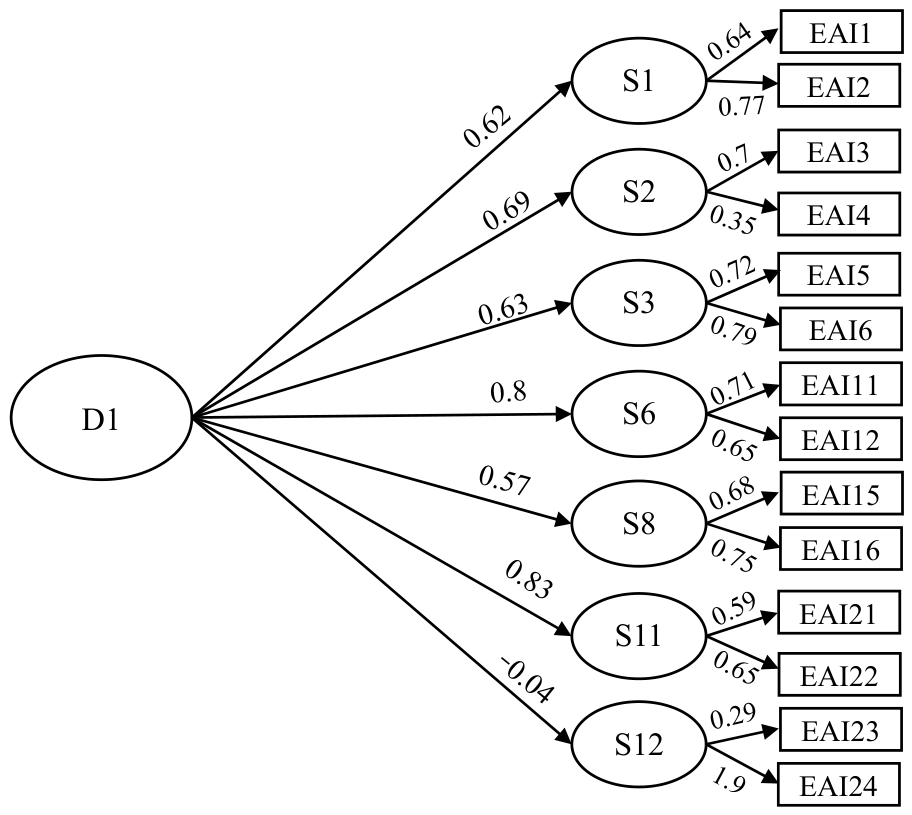
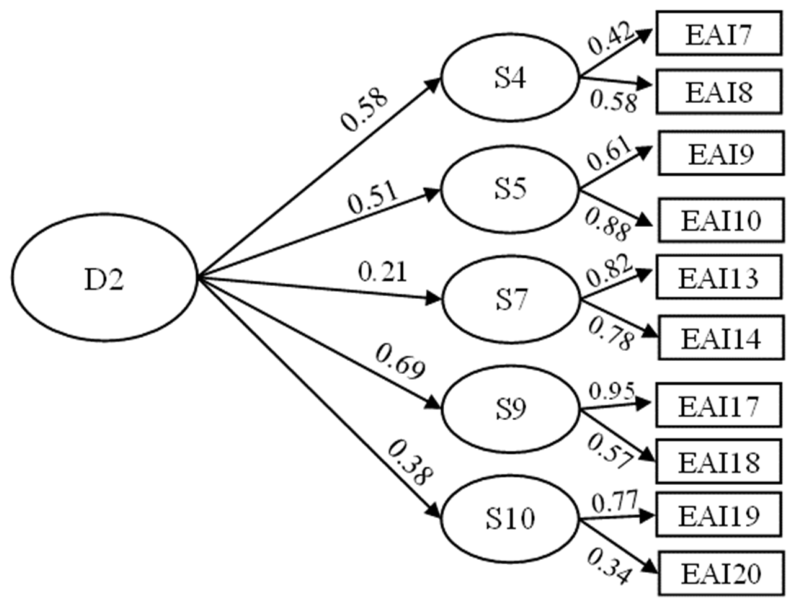
Separate CFA models were also estimated for each dimension, using the same sample (n = 270). The model corresponding to the Preservation dimension demonstrated adequate fit (χ2 (70) = 137.698; p < 0.001; χ2/df = 1.97; RMSEA = 0.060; CFI = 0.91; TLI = 0.89; NFI = 0.84), whereas the Utilization model showed slightly stronger fit indices (χ2 (30) = 52.525; p = 0.007; χ2/df = 1.75; RMSEA = 0.053; CFI = 0.95; TLI = 0.92; NFI = 0.90). Goodness-of-fit indices and graphical representations of the confirmatory models are presented in Appendix E.
Although the chi-square tests were statistically significant and some incremental fit indices fell below the conventional threshold of 0.90, other fit indicators were more favourable. In particular, χ2/df values were below 2.0 in all three models, while RMSEA values remained at or below 0.060. Taken together, these findings provide partial support for the proposed factorial structure, with the Utilization dimension showing the most consistently favourable fit indices.
3.5. Criterion-Related Validity: Associations with Behavioural Criteria
The behavioural criteria were assessed concurrently with the EAI-24; therefore, these analyses were intended to provide criterion-related validity evidence rather than prospective predictive validity. The results are presented in Table 5.
Table 5.
Criterion-related validity results for the EAI-24.
The Preservation dimension showed the strongest and most consistent associations with the behavioural criteria, with positive and statistically significant associations for all dependent variables examined. The largest proportion of explained variance was observed for the PEBS (R2 = 0.162), followed by C-G (R2 = 0.113) and C-D1 (R2 = 0.111), which yielded nearly equivalent values. Preservation was also significantly associated with behaviour related to the use of natural resources as health assets (C-D2; R2 = 0.063). Beta coefficients were positive and statistically significant in all cases. These findings are consistent with previous studies highlighting the central role of the Preservation dimension (EAI24-D1) in explaining pro-environmental behaviour [30,50].
In contrast, the Utilization dimension showed considerably weaker associations. In most models, associations did not reach statistical significance, with R2 values close to zero. The only significant association was observed with the PEBS (R2 = 0.042, p = 0.001), although the effect size was small. This pattern may be explained by conceptual differences between the Utilization dimension (EAI24-D2) and the behavioural measures employed. Specifically, Utilization is likely less directly related to specific pro-environmental actions and more closely associated with underlying beliefs concerning the legitimacy and purposes of human use of nature. Consequently, this dimension may reflect broader anthropocentric or ecocentric worldviews rather than behaviours directly related to environmental protection.
The overall EAI-24 score showed positive and statistically significant associations with all environmental behaviour indicators, although effect sizes were generally modest (R2 ranging from 0.022 to 0.134). The strongest associations were observed for the PEBS (R2 = 0.134) and behaviour related to caring for nature (C-D1; R2 = 0.065). Notably, all of these values were lower than those obtained for the Preservation dimension.
Taken together, these findings provide evidence supporting the criterion-related validity of the EAI-24, particularly for the Preservation dimension, which emerged as the component most directly associated with pro-environmental behaviour.
4. Discussion
4.1. Summary of Main Findings
The aim of this study was to translate, culturally adapt, and evaluate the psychometric properties of the 24-item Environmental Attitudes Inventory (EAI-24) in a sample of Spanish university students. Internal consistency was satisfactory for the overall score and Preservation, but more modest for Utilization, with low coefficients in some two-item subscales. Temporal stability was generally satisfactory. Confirmatory factor analysis provided partial support for the original theoretical model, while exploratory factor analysis revealed a partial reorganisation within Preservation and broadly reproduced the original structure of Utilization.
Preservation showed stronger and more consistent associations with the self-reported behavioural indicators than Utilization and, in several analyses, stronger associations than the overall EAI-24 score. These findings provide initial evidence supporting the potential usefulness of the Spanish EAI-24 in the sample studied and highlight the relevance of considering its two dimensions separately when examining associations between environmental attitudes and behaviour.
4.2. Psychometric Performance of the EAI-24 in Spanish University Students
The psychometric evaluation of the Spanish EAI-24 provided initial evidence regarding its reliability and construct validity. Internal consistency was satisfactory for the overall score and the Preservation dimension, whereas Utilization showed more modest internal consistency. This pattern was broadly consistent with previous studies conducted in different cultural contexts [52,53,56]. At the first-order level, some subscales yielded low Cronbach’s alpha coefficients. Their two-item composition should be considered when interpreting these estimates [66], although the low values warrant caution regarding the reliability of the corresponding subscale scores.
Temporal stability was generally satisfactory, with high intraclass correlation coefficients for the overall EAI-24 score and both second-order dimensions over the approximately two-week interval between assessments. These findings align with previous research involving young and university populations [18,30,52,55,56].
Regarding structural validity, the findings offer a more nuanced picture than a straightforward confirmation of the original factorial structure. Confirmatory factor analysis provided partial support for the proposed hierarchical model, with favourable RMSEA and χ2/df values, although some incremental fit indices, particularly TLI and NFI, fell below conventionally recommended thresholds. Exploratory factor analysis revealed a partial reorganisation of Preservation into four factors, while Utilization broadly reproduced the original five-factor structure. All 24 original items were retained. The regrouping of some items may reflect less empirical differentiation between theoretically distinct facets within this sample. Thus, the results suggest that the original theoretical framework remains relevant for interpreting environmental attitudes in this sample, although its first-order factorial structure was not fully replicated.
The four factors identified within Preservation were interpreted as Affective Affinity and Commitment to Nature, Population Regulation and Reproductive Autonomy, Conservation and Saving of Natural Resources, and Concern about Environmental Degradation and Regulation of Natural Resources. Moderate correlations among Factors 1, 3, and 4 suggest related facets within the broader Preservation dimension. In contrast, Factor 2 showed near-zero correlations with the remaining factors despite its relatively strong item loadings, suggesting a more distinct attitudinal domain. The weak and partially overlapping loadings of EAI21 and EAI22 also indicate uncertainty regarding the empirical differentiation of some components of Preservation.
In the Spanish context, Andrade et al. [55] proposed an abbreviated version comprising 18 items and six first-order factors, derived from a 37-item version of the EAI. Differences in item composition should therefore be considered when comparing their findings with those obtained for the original EAI-24 examined here. More broadly, structural variations have been reported across previous adaptations, including item removal, factor reduction, and alternative factorial configurations [50,52,53,55]. These precedents contextualise the discrepancies observed in the present study but do not, by themselves, establish the adequacy of the Spanish EAI-24 structure.
The differences between the exploratory and confirmatory findings should also be considered in light of the purposes of these approaches: EFA examines how items cluster empirically, whereas CFA evaluates the fit of a theoretically specified model. Their complementary use does not resolve the uncertainty associated with the observed factorial discrepancies. Consistent with previous research on cross-cultural instrument adaptation [67], replication in independent samples is needed to assess the stability of the findings.
4.3. Preservation and Utilization: Differentiated Functional Profiles
The findings suggest differentiated associations between the two second-order dimensions of the EAI-24 and self-reported environmental behaviour. Preservation showed positive and statistically significant associations with all behavioural indicators examined, including behaviour related to caring for nature, the use of natural resources as health assets, global environmental behaviour, and the PEBS. In contrast, Utilization displayed weaker associations, reaching statistical significance only in relation to the PEBS. This pattern suggests that Preservation may be more closely associated with the behavioural domains assessed here, consistent with previous research using the EAI-24, although the findings have not been uniform across behaviours and studies [54].
One possible explanation lies in the conceptual content of each dimension. Preservation encompasses environmental concern, sensitivity to ecosystem degradation, affinity with nature, and commitment to environmental protection, which may be closely aligned with the behaviours examined. This interpretation is broadly consistent with meta-analytic evidence linking non-anthropocentric environmental motives more strongly to personal environmentalism, although these motives are not directly equivalent to the EAI-24 dimensions [68]. Utilization, by contrast, reflects beliefs about the legitimacy of using and controlling nature, whose associations with specific behaviours may be less direct. These differences can be considered within the attitude–behaviour gap framework, which recognises that favourable attitudes do not necessarily translate into corresponding actions [35,36]. Research among university students has likewise highlighted the complex relationships between sustainability knowledge, attitudes, and behaviour [43].
The label Utilization also raises a possible interpretive issue in Spanish, where “utilización” may suggest the functional or sustainable use of natural resources rather than the beliefs addressed by its items within the anthropocentrism–ecocentrism continuum. The original terminology was retained for theoretical consistency and comparability with previous research [30]. Future studies could examine how Spanish-speaking respondents understand this label and whether alternative terms communicate the dimension’s conceptual content more clearly.
Preservation also showed stronger associations with the behavioural indicators than the overall EAI-24 score in several models. Combining the two dimensions into a global score may therefore not strengthen associations with particular behavioural outcomes. However, this observation requires replication, given the cross-sectional nature of the analyses and the reliability limitations of some behavioural measures. It should not be interpreted as evidence of superior prediction of future behaviour.
From an applied perspective, examining the two dimensions separately may provide useful information beyond the global score. The complete EAI-24 may be useful for a multidimensional assessment of environmental attitudes, while Preservation may warrant particular attention when studying associations with pro-environmental behaviour. Its use as a standalone measure, however, requires further psychometric evaluation before it can be recommended. These findings also suggest that evaluations of educational interventions should consider the specific attitudinal dimensions targeted and the behavioural outcomes of interest, rather than relying exclusively on a global environmental attitude score [48].
4.4. Limitations and Future Research
Several limitations should be considered when interpreting these findings. First, the sample comprised students from a single Spanish university, limiting generalisation to other educational and sociocultural contexts. The convenience sampling strategy, predominance of female participants, and inclusion of students from only four degree programmes also limit generalisability to the wider Spanish university population. The predominance of female participants may partly reflect the gender composition of the degree programmes included, rather than deliberate recruitment based on sex. Sample composition may also affect the psychometric estimates and behavioural associations observed, so their reproducibility across other student groups remains uncertain. Future research should examine the instrument in more diverse samples, including non-university populations and individuals from different age groups and educational backgrounds.
Second, the study relied exclusively on self-report measures, which may be subject to social desirability, acquiescence, and subjective interpretation of questionnaire items. Furthermore, assessing both environmental attitudes and behaviours through self-report questionnaires may introduce common method bias, potentially influencing the observed associations between these constructs. These associations may therefore partly reflect how participants perceive and describe their own attitudes and behaviours, rather than solely the relationship between their attitudes and their actual behaviour. Future studies incorporating objective behavioural indicators or observational measures would help strengthen the evidence regarding these relationships.
Third, the factorial discrepancies identified in the EFA and the mixed CFA fit indices warrant caution regarding structural validity. Both analyses were conducted using the same sample, without an independent validation sample; consequently, replication is needed to assess the stability of the findings. The use of the same participants means that both analyses may reflect sample-specific response patterns. Their complementary use therefore does not provide independent evidence that the structural findings will be reproduced in a new sample. In addition, cross-language measurement invariance and differential item functioning (DIF) were not assessed. The linguistic and cultural adaptation conducted here should therefore be distinguished from evidence of statistical equivalence between language versions. Future studies should examine measurement invariance and DIF across linguistic and cultural groups, particularly through comparisons between the Spanish EAI-24 and the original English-language version using appropriately comparable samples.
An additional limitation concerns the internal consistency of the behavioural measures used in the criterion-related validity analyses. The low internal consistency of C-D1 (α = 0.450) and adequate value for the PEBS (α = 0.670) may have influenced the magnitude and stability of the observed associations. In particular, uncertainty in the measurement of these behavioural outcomes may reduce the precision of the estimated associations. Small or non-significant associations should therefore be interpreted cautiously when assessing criterion-related validity, as they may partly reflect limitations of the behavioural measures. Further studies should examine these relationships using additional behavioural measures with stronger evidence of reliability.
Finally, the cross-sectional associations do not establish temporal or causal relationships between environmental attitudes and behaviour. Longitudinal and intervention studies could further examine these relationships and assess the responsiveness of the EAI-24 to changes following sustainability-related interventions. Parallel assessment of behavioural outcomes would help determine whether changes in environmental attitudes are accompanied by changes in behaviour [46,47].
5. Conclusions
The present study describes the linguistic and cultural adaptation of the 24-item Environmental Attitudes Inventory (EAI-24) into Spanish and provides initial evidence supporting its reliability and construct validity in a sample of Spanish university students. However, the factorial discrepancies identified and the low internal consistency of some two-item subscales warrant caution when interpreting these findings. Overall, the findings support the potential usefulness of the Spanish EAI-24 for assessing environmental attitudes in this population, although further research in more diverse samples is needed to confirm its psychometric properties.
The Preservation dimension showed stronger and more consistent associations than Utilization with the self-reported behavioural indicators, including those assessing pro-environmental behaviour and the use of natural resources as health assets. Considering these dimensions separately may therefore provide useful information beyond the overall score when examining associations between environmental attitudes and behaviour. Further psychometric evaluation is required before recommending Preservation as a standalone measure.
The Spanish EAI-24 provides a basis for further research on environmental attitudes and their behavioural associations. Its generalisability to other Spanish-speaking populations and its potential applications in environmental education and sustainability-related research require additional evaluation.
Author Contributions
Conceptualization, C.S.-S., J.M.M.-N. and R.G.-G.-G.; methodology, C.S.-S., J.M.M.-N., M.B.-R. and R.G.-G.-G.; formal analysis, C.S.-S., J.M.M.-N., M.B.-R. and R.G.-G.-G.; investigation, C.S.-S., J.M.M.-N. and R.G.-G.-G.; data curation, C.S.-S. and J.M.M.-N.; writing—original draft preparation, C.S.-S., J.M.M.-N., M.B.-R. and R.G.-G.-G.; writing—review and editing, C.S.-S., J.M.M.-N., M.B.-R. and R.G.-G.-G.; visualization, C.S.-S. and J.M.M.-N.; supervision, J.M.M.-N. and R.G.-G.-G.; project administration, J.M.M.-N.; funding acquisition, R.G.-G.-G. All authors have read and agreed to the published version of the manuscript.
Funding
This research was supported by Fundación Jaime González-Gordon and the University of Cádiz. No specific grant was awarded, and no grant number is applicable.
Institutional Review Board Statement
The study was conducted in accordance with the Declaration of Helsinki and approved by the Bioethics Committee of the University of Cádiz (approval code 007/2021; date of approval: 9 December 2021).
Informed Consent Statement
Informed consent was obtained from all subjects involved in the study.
Data Availability Statement
The data supporting the findings of this study are available from the corresponding author upon reasonable request.
Acknowledgments
The authors would like to thank all the students who participated in the study, the participating faculties of the University of Cádiz for facilitating data collection, and the translators and expert committee members who contributed to the translation and cross-cultural adaptation process. The authors would also like to express their gratitude to Fundación Jaime González-Gordon and the University of Cádiz for the resources and support provided throughout the study.
Conflicts of Interest
The authors declare no conflicts of interest.
Abbreviations
The following abbreviations are used in this manuscript:
| C-D1 | Pro-environmental behaviour related to caring for nature |
| C-D2 | Behaviour related to the use of natural resources as health assets |
| C-G | Global environmental behaviour score |
| CFA | Confirmatory Factor Analysis |
| CFI | Comparative Fit Index |
| DIF | Differential Item Functioning |
| EAI | Environmental Attitudes Inventory |
| EAI-24 | 24-item Environmental Attitudes Inventory |
| EFA | Exploratory Factor Analysis |
| EM | Expectation–Maximization |
| ICC | Intraclass Correlation Coefficient |
| KMO | Kaiser–Meyer–Olkin |
| MCAR | Missing Completely at Random |
| NEP | New Environmental Paradigm |
| NFI | Normed Fit Index |
| PEBS | Pro-Environmental Behaviour Scale |
| RMSEA | Root Mean Square Error of Approximation |
| TLI | Tucker–Lewis Index |
Appendix A. Item-Scale Correspondence for the EAI-24 and EAI-72
Table A1.
Item allocation by second-order dimension and first-order scale.
Appendix B. Spanish Translation of the 24-Item Environmental Attitudes Inventory Based on the Original Version by Milfont and Duckitt (2010) [30]
- I really like going on trips into the countryside, for example to forests or fields.Me gusta mucho ir de excursión a la naturaleza, por ejemplo, al bosque o al campo. (P)
- I think spending time in nature is boring.Me resulta muy aburrido estar en medio de la naturaleza. (P, R)
- Governments should control the rate at which raw materials are used to ensure that they last as long as possible.Los gobiernos deberían controlar el ritmo al que se consumen las materias primas para garantizar que duren lo máximo posible. (P)
- I am opposed to governments controlling and regulating the way raw materials are used in order to try and make them last longer.Me opongo a que los gobiernos controlen y regulen la forma en la que se utilizan las materias primas para intentar que duren más tiempo. (P, R)
- I would like to join and actively participate in an environmentalist group.Me gustaría unirme y participar activamente en un grupo para la protección del medio ambiente. (P)
- I would NOT get involved in an environmentalist organization.No me involucraría en una organización medioambiental. (P, R)
- One of the most important reasons to keep lakes and rivers clean is so that people have a place to enjoy water sports.Uno de los motivos más importantes para mantener limpios los lagos y los ríos es que la gente pueda disponer de un lugar para disfrutar de los deportes acuáticos. (U, R)
- We need to keep rivers and lakes clean in order to protect the environment, and NOT as places for people to enjoy water sports.Debemos mantener limpios los ríos y los lagos para proteger el medio ambiente y NO para que la gente pueda disfrutar de deportes acuáticos. (U)
- Modern science will NOT be able to solve our environmental problems.La ciencia moderna NO podrá solucionar nuestros problemas medioambientales. (U)
- Modern science will solve our environmental problems.La ciencia moderna solucionará nuestros problemas medioambientales. (U, R)
- Humans are severely abusing the environment.Los seres humanos están abusando gravemente del medio ambiente. (P)
- I do not believe that the environment has been severely abused by humans.No creo que los seres humanos hayan abusado gravemente del medio ambiente. (P, R)
- I’d prefer a garden that is wild and natural to a well-groomed and ordered one.Prefiero un jardín agreste y natural a uno bien cuidado y ordenado. (U)
- I’d much prefer a garden that is well groomed and ordered to a wild and natural one.Prefiero un jardín bien cuidado y ordenado que uno agreste y natural. (U, R)
- I am NOT the kind of person who makes efforts to conserve natural resources.NO soy el tipo de persona que se esfuerza por conservar los recursos naturales. (P, R)
- Whenever possible, I try to save natural resources.Siempre que sea posible, trato de ahorrar recursos naturales. (P)
- Human beings were created or evolved to dominate the rest of nature.Los seres humanos fueron creados o evolucionaron para dominar el resto de la naturaleza. (U, R)
- I DO NOT believe humans were created or evolved to dominate the rest of nature.NO creo que el ser humano fuera creado o evolucionara para dominar el resto de la naturaleza. (U)
- Protecting peoples’ jobs is more important than protecting the environment.Proteger los puestos de trabajo de las personas es más importante que proteger el medio ambiente. (U, R)
- Protecting the environment is more important than protecting peoples’ jobs.Proteger el medio ambiente es más importante que proteger los puestos de trabajo. (U)
- It makes me sad to see forests cleared for agriculture.Me entristece ver bosques eliminados para la agricultura. (P)
- It does NOT make me sad to see natural environments destroyed.NO me entristece ver entornos naturales destruidos. (P, R)
- Families should be encouraged to limit themselves to two children or less.Se debería animar a las familias a que se limiten a tener dos hijos como máximo. (P)
- A married couple should have as many children as they wish, as long as they can adequately provide for them.Una pareja debería tener tantos hijos como quiera, siempre que pueda mantenerlos adecuadamente. (P, R)Note. P = Preservation; U = Utilization; R = reverse-scored item.
Appendix C. Descriptive Statistics for the EAI-24 Test and Retest
Table A2.
Descriptive statistics for the EAI-24 at test.
Table A3.
Descriptive statistics for the EAI-24 at retest.
Appendix D. Exploratory Factor Analysis for the EAI-24
Appendix D.1. Exploratory Factor Analysis for the Preservation Dimension (EAI24-D1; n = 257)
Figure A1.
Scree plot for the Preservation dimension.
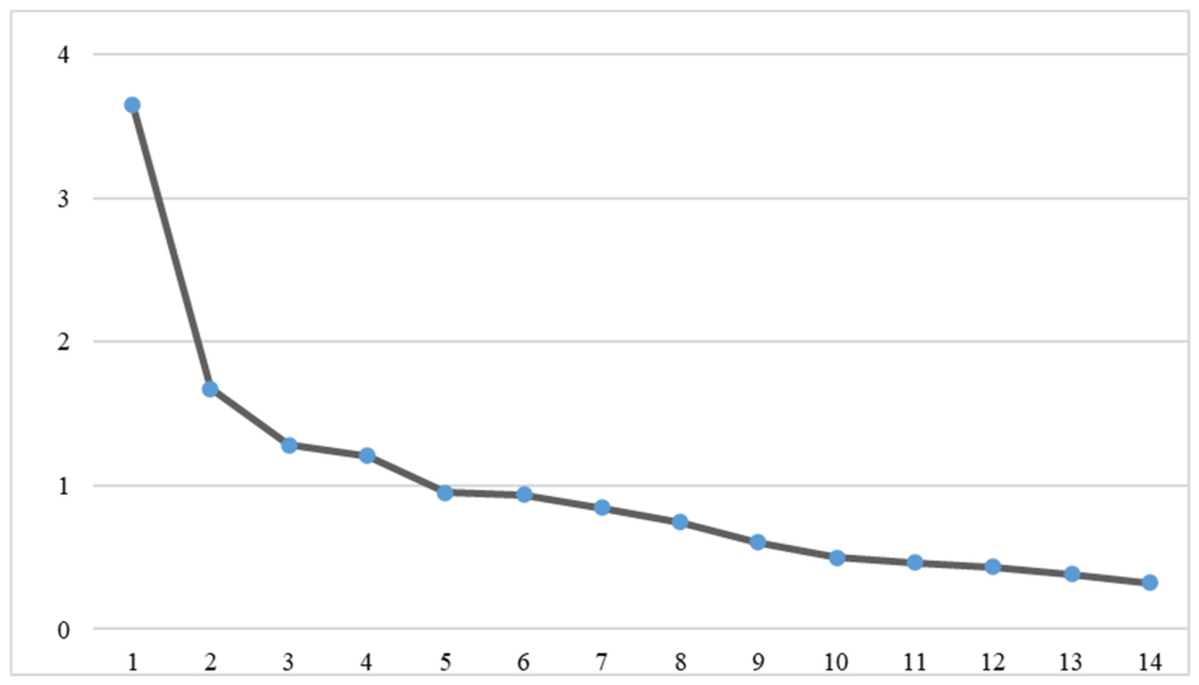
Table A4.
Pattern matrix for the Preservation dimension (EAI-24).
Table A5.
Factor Correlation Matrix for the Preservation dimension (EAI24-D1).
Table A6.
Factor structure for the Preservation dimension (EAI24-D1).
Appendix D.2. Exploratory Factor Analysis for the Preservation Dimension (EAI24-D1; n = 257) with a Forced Seven-Factor Solution
Table A7.
Pattern matrix for the Preservation dimension (EAI24-D1) with a forced seven-factor solution.
Table A8.
Factor Correlation Matrix for the Preservation Dimension (EAI24-D1) with a forced seven-factor solution.
Table A9.
Factor structure for the Preservation dimension (EAI24-D1) with a forced seven-factor solution.
Appendix D.3. Exploratory Factor Analysis for the Utilization Dimension (EAI24-D2; n = 261)
Figure A2.
Scree plot for the Utilization dimension (EAI24-D2).
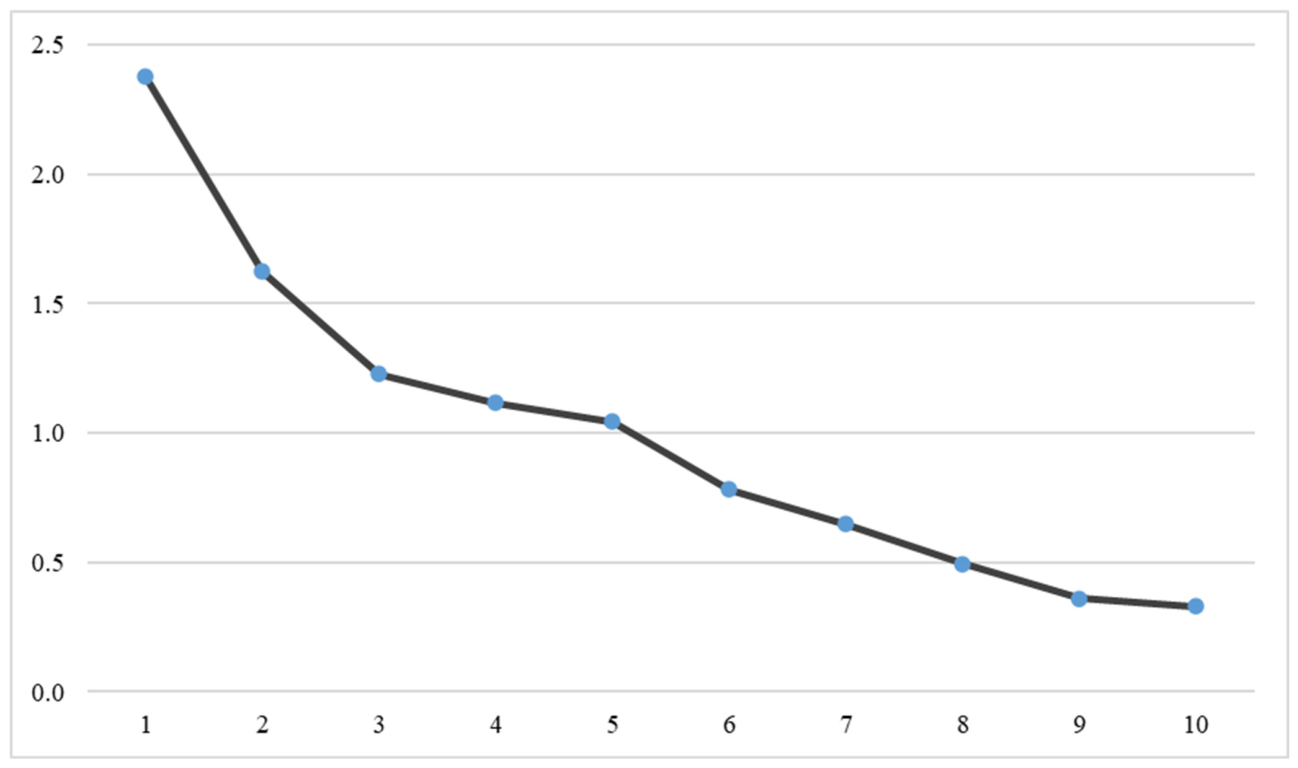
Table A10.
Pattern matrix for the Utilization dimension (EAI24-D2).
Table A11.
Factor structure for the Utilization dimension (EAI24-D2).
Appendix E. Confirmatory Factor Analysis for the EAI-24
Appendix E.1. Confirmatory Factor Analysis for the Global Model (EAI24-G)
Table A12.
Goodness-of-fit indices for the global model (EAI24-G; n = 270).
Appendix E.2. Confirmatory Factor Analysis for the Preservation Dimension (EAI24-D1)
Table A13.
Goodness-of-fit indices for the Preservation dimension model (EAI24-D1; n = 270).
Figure A3.
Confirmatory factor analysis model for the Preservation dimension (EAI24-D1).
Appendix E.3. Confirmatory Factor Analysis for the Utilization Dimension (EAI24-D2)
Table A14.
Goodness-of-fit indices for the Utilization dimension model (EAI24-D2; n = 270).
Figure A4.
Confirmatory factor analysis model for the Utilization dimension (EAI24-D2).
References
- Beute, F.; de Kort, Y.A.W. Salutogenic Effects of the Environment: Review of Health Protective Effects of Nature and Daylight. Appl. Psychol. Health Well-Being 2014, 6, 67–95. [Google Scholar] [CrossRef] [Scilit] [PubMed]
- Bratman, G.N.; Anderson, C.B.; Berman, M.G.; Cochran, B.; de Vries, S.; Flanders, J.; Folke, C.; Frumkin, H.; Gross, J.J.; Hartig, T.; et al. Nature and Mental Health: An Ecosystem Service Perspective. Sci. Adv. 2019, 5, eaax0903. [Google Scholar] [CrossRef] [Scilit] [PubMed]
- Coventry, P.A.; Brown, J.V.E.; Pervin, J.; Brabyn, S.; Pateman, R.; Breedvelt, J.; Gilbody, S.; Stancliffe, R.; McEachan, R.; White, P.C.L. Nature-Based Outdoor Activities for Mental and Physical Health: Systematic Review and Meta-Analysis. SSM-Popul. Health 2021, 16, 100934. [Google Scholar] [CrossRef] [Scilit] [PubMed]
- Genter, C.; Roberts, A.; Richardson, J.; Sheaff, M. The Contribution of Allotment Gardening to Health and Wellbeing: A Systematic Review of the Literature. Br. J. Occup. Ther. 2015, 78, 593–605. [Google Scholar] [CrossRef] [Scilit]
- Husk, K.; Lovell, R.; Cooper, C.; Stahl-Timmins, W.; Garside, R. Participation in Environmental Enhancement and Conservation Activities for Health and Well-Being in Adults: A Review of Quantitative and Qualitative Evidence (Review). Cochrane Database Syst. Rev. 2016, 2016, CD010351. [Google Scholar] [CrossRef] [Scilit] [PubMed]
- Jimenez, M.P.; Deville, N.V.; Elliott, E.G.; Schiff, J.E.; Wilt, G.E.; Hart, J.E.; James, P. Associations between Nature Exposure and Health: A Review of the Evidence. Int. J. Environ. Res. Public Health 2021, 18, 4790. [Google Scholar] [CrossRef] [Scilit] [PubMed]
- Kaplan, R.; Kaplan, S. The Experience of Nature: A Psychological Perspective; Cambridge University Press: Cambridge, UK, 1989; ISBN 0521349397. [Google Scholar]
- Komori, T.; Mitsui, M.; Togashi, K.; Matsui, J.; Kato, T.; Uei, D.; Shibayama, A.; Yamato, K.; Okumura, H.; Kinoshita, F. Relaxation Effect of a 2-Hour Walk in Kumano-Kodo Forest. J. Neurol. Neurosci. 2017, 8, 174. [Google Scholar] [CrossRef] [Scilit]
- Kondo, M.C.; Fluehr, J.M.; McKeon, T.; Branas, C.C. Urban Green Space and Its Impact on Human Health. Int. J. Environ. Res. Public Health 2018, 15, 445. [Google Scholar] [CrossRef] [Scilit] [PubMed]
- Ulrich, R.S.; Simons, R.F.; Losito, B.D.; Fiorito, E.; Miles, M.A.; Zelson, M. Stress Recovery during Exposure to Natural and Urban Environments. J. Environ. Psychol. 1991, 11, 201–230. [Google Scholar] [CrossRef] [Scilit]
- Evensen, K.H.; Raanaas, R.K.; Hagerhall, C.M.; Johansson, M.; Patil, G.G. Restorative Elements at the Computer Workstation: A Comparison of Live Plants and Inanimate Objects with and Without Window View. Environ. Behav. 2013, 47, 288–303. [Google Scholar] [CrossRef] [Scilit]
- Kaplan, S. The Restorative Benefits of Nature: Toward an Integrative Framework. J. Environ. Psychol. 1995, 15, 169–182. [Google Scholar] [CrossRef] [Scilit]
- Koprivec, L.; Zbašnik-Senegačnik, M.; Kristl, Ž. A Study of Restorative Potential in Window Views Adopting Kaplan’s Attention Restoration Theory and Urban Visual Preferences Defined by Lynch. J. Archit. Urban. 2022, 46, 148–159. [Google Scholar] [CrossRef] [Scilit]
- Kuo, M. How Might Contact with Nature Promote Human Health? Promising Mechanisms and a Possible Central Pathway. Front. Psychol. 2015, 6, 1093. [Google Scholar] [CrossRef] [Scilit] [PubMed]
- Ulrich, R.S. View through a Window May Influence Recovery from Surgery. Science 1984, 224, 420–421. [Google Scholar] [CrossRef] [Scilit] [PubMed]
- Yin, J.; Yuan, J.; Arfaei, N.; Catalano, P.J.; Allen, J.G.; Spengler, J.D. Effects of Biophilic Indoor Environment on Stress and Anxiety Recovery: A between-Subjects Experiment in Virtual Reality. Environ. Int. 2020, 136, 105427. [Google Scholar] [CrossRef] [Scilit] [PubMed]
- Clayton, S.; Myers, G. Conservation Psychology: Understanding and Promoting Human Care for Nature, 2nd ed.; John Wiley & Sons: Chichester, UK, 2015; ISBN 9781118874608. [Google Scholar]
- Milfont, T.L.; Duckitt, J. The Structure of Environmental Attitudes: A First- and Second-Order Confirmatory Factor Analysis. J. Environ. Psychol. 2004, 24, 289–303. [Google Scholar] [CrossRef] [Scilit]
- Steg, L.; Vlek, C. Encouraging Pro-Environmental Behaviour: An Integrative Review and Research Agenda. J. Environ. Psychol. 2009, 29, 309–317. [Google Scholar] [CrossRef] [Scilit]
- Whitmarsh, L.; Poortinga, W.; Capstick, S. Behaviour Change to Address Climate Change. Curr. Opin. Psychol. 2021, 42, 76–81. [Google Scholar] [CrossRef] [Scilit] [PubMed]
- Ajzen, I. The Theory of Planned Behavior. Organ. Behav. Hum. Decis. Process. 1991, 50, 179–211. [Google Scholar] [CrossRef] [Scilit]
- Bandura, A. Social Cognitive Theory of Mass Communication. Media Psychol. 2001, 3, 265–299. [Google Scholar] [CrossRef] [Scilit] [PubMed]
- Greene, W.H.; Simons-Morton, B.G. Educación Para La Salud, 1st ed.; Nueva Editorial Interamericana: Mexico City, Mexico, 1988. [Google Scholar]
- Pender, N.J. The Health Promotion Model Manual; University of Michigan Library: Ann Arbor, MI, USA, 2011. [Google Scholar]
- Prochaska, J.O.; Velicer, W.F. The Transtheoretical Model of Health Behavior Change. Am. J. Heal. Promot. 1997, 12, 38–48. [Google Scholar] [CrossRef] [Scilit] [PubMed]
- Rosenstock, I.M. The Health Belief Model and Preventive Health Behavior. Health Educ. Monogr. 1974, 2, 354–386. [Google Scholar] [CrossRef] [Scilit]
- Bellotti, M.; Duradoni, M.; Fiorenza, M.; Guazzini, A. Between Pro-Environmental Identity and Attitudes: A PRISMA Systematic Review of the Relationship Between Connectedness to Nature and Pro-Environmental Attitudes for Sustainability. Sustainability 2025, 17, 2140. [Google Scholar] [CrossRef] [Scilit]
- Kaiser, F.G.; Ranney, M.; Hartig, T.; Bowler, P.A. Ecological Behavior, Environmental Attitude, and Feelings of Responsibility for the Environment. Eur. Psychol. 1999, 4, 59–74. [Google Scholar] [CrossRef] [Scilit]
- Milfont, T.L. Psychology of Environmental Attitudes: A Cross-Cultural Study of Their Content and Structure; University of Auckland: Auckland, New Zealand, 2007. [Google Scholar]
- Milfont, T.L.; Duckitt, J. The Environmental Attitudes Inventory: A Valid and Reliable Measure to Assess the Structure of Environmental Attitudes. J. Environ. Psychol. 2010, 30, 80–94. [Google Scholar] [CrossRef] [Scilit]
- van Valkengoed, A.M.; Abrahamse, W.; Steg, L. To Select Effective Interventions for Pro-Environmental Behaviour Change, We Need to Consider Determinants of Behaviour. Nat. Hum. Behav. 2022, 6, 1482–1492. [Google Scholar] [CrossRef] [Scilit] [PubMed]
- Ciocîrlan, A.-B.; Baird, H.; Rowe, R. A Systematic Review and Meta-Analysis of the Relationships between Pro-Environmental Behaviours. J. Environ. Psychol. 2025, 108, 102807. [Google Scholar] [CrossRef] [Scilit]
- Morgan, A.; Ziglio, E. Revitalising the Evidence Base for Public Health: An Assets Model. Promot. Educ. 2007, 14, 17–22. [Google Scholar] [CrossRef] [Scilit] [PubMed]
- Lou, X.; Li, L.M.W. The Relationship of Environmental Concern with Public and Private Pro-Environmental Behaviours: A Pre-Registered Meta-Analysis. Eur. J. Soc. Psychol. 2023, 53, 1–14. [Google Scholar] [CrossRef] [Scilit]
- Hadler, M.; Klösch, B.; Schwarzinger, S.; Schweighart, M.; Wardana, R.; Bird, D.N. Measuring Environmental Attitudes and Behaviors. In Surveying Climate-Relevant Behavior: Measurements, Obstacles, and Implications; Palgrave Macmillan: Cham, Switzerland, 2022; pp. 15–35. ISBN 978-3-030-85796-7. [Google Scholar]
- Kollmuss, A.; Agyeman, J. Mind the Gap: Why Do People Act Environmentally and What Are the Barriers to pro-Environmental Behavior? Environ. Educ. Res. 2002, 8, 239–260. [Google Scholar] [CrossRef] [Scilit]
- Fielding, K.S.; Hornsey, M.J. Understanding and Reducing the Intention–Behaviour Gap in Climate Action. Nat. Clim. Change 2026, 16, 638–647. [Google Scholar] [CrossRef] [Scilit]
- UNESCO. Education for Sustainable Development: A Roadmap; UNESCO: Paris, France, 2020. [Google Scholar]
- Berchin, I.I.; de Aguiar Dutra, A.R.; de Andrade Guerra, J.B.S.O. How Do Higher Education Institutions Promote Sustainable Development? A Literature Review. Sustain. Dev. 2021, 29, 1204–1222. [Google Scholar] [CrossRef] [Scilit]
- Brundiers, K.; Barth, M.; Cebrián, G.; Cohen, M.; Diaz, L.; Doucette-Remington, S.; Dripps, W.; Habron, G.; Harré, N.; Jarchow, M.; et al. Key Competencies in Sustainability in Higher Education—Toward an Agreed-upon Reference Framework. Sustain. Sci. 2021, 16, 13–29. [Google Scholar] [CrossRef] [Scilit]
- Molnár, Z.; Kiss, P.S.; Gálfi, M.; Radács, M. The Importance of Environmental Attitudes in Dealing with the Environmental Crisis and the Relationship between Education Systems: A Systematic Review. Discov. Educ. 2026, 5, 112. [Google Scholar] [CrossRef] [Scilit]
- Concina, E.; Frate, S. Assessing University Students’ Beliefs and Attitudes towards Sustainability and Sustainable Development: A Systematic Review. Trends High. Educ. 2023, 2, 705–717. [Google Scholar] [CrossRef] [Scilit]
- Leal, S.; Nascimento, J.; Piki, A.; Tekerek, A.; Güzel, A.; Loureiro, A.; Gonçalves, C.; Messias, I.; Simons, J.; Teunen, L.; et al. Exploring Sustainable Development Perceptions among Higher Education Students: An Empirical Study on Knowledge, Attitudes, and Behaviours. Clean. Responsible Consum. 2024, 14, 100223. [Google Scholar] [CrossRef] [Scilit]
- Hashad, N.; Jabbari, S.; Fahmy, A.M.; Ahmed, H.; Debelić, I.; Arafat, K.; Cortes-De Guzman, K.; Abohabsa, M.W.; Ghozlan, S.H.; Hussien, T.E. Pharmacy Students’ and Pharmacy Professionals’ Knowledge, Perception, and Attitude Regarding Environmental Sustainability in Pharmacy Practice: A Systematic Review. Int. J. Pharm. Pract. 2026, 34, 543–561. [Google Scholar] [CrossRef] [Scilit] [PubMed]
- Portela Dos Santos, O.; Perruchoud, É.; Pereira, F.; Alves, P.; Verloo, H. Measuring Nurses’ Knowledge and Awareness of Climate Change and Climate-Associated Diseases: Systematic Review of Existing Instruments. Nurs. Rep. 2024, 14, 2850–2876. [Google Scholar] [CrossRef] [Scilit] [PubMed]
- Chen, J.; Ren, Y.; Yang, Y. The Effect of School Science Education on Students’ Climate Literacy: A Three-Level Meta-Analysis. Front. Psychol. 2026, 17, 1769772. [Google Scholar] [CrossRef] [Scilit] [PubMed]
- Ebrahimi, Z.; Khalkhali, H.R.; Navidjouy, N.; Maheri, M. Investigating the Effect of Educational Intervention Based on the Theory of Planned Behavior on Environmentally Responsible Behaviors among Lower Secondary School Students. BMC Public Health 2026, 26, 2173. [Google Scholar] [CrossRef] [Scilit] [PubMed]
- de Costa, R.; Ferrara, I.; Toplak, M.; Alam, A.; Bowie, R.; Burnett, A. Behavioural Insights and Environmental Sustainability: Key Findings and Policy Implications from a Systematic Review. J. Environ. Manag. 2025, 390, 126118. [Google Scholar] [CrossRef] [Scilit] [PubMed]
- Dunlap, R.E.; Van Liere, K.D.; Mertig, A.G.; Jones, R.E. Measuring Endorsement of the New Ecological Paradigm: A Revised NEP Scale. J. Soc. Issues 2000, 56, 425–442. [Google Scholar] [CrossRef] [Scilit]
- Ajdukovic, I.; Gilibert, D.; Fointiat, V. Structural Confirmation of the 24-Item Environmental Attitude Inventory/Confirmación Estructural Del Inventario de Actitudes Ambientales de 24 Ítems. Psyecology 2019, 10, 184–216. [Google Scholar] [CrossRef] [Scilit]
- Milfont, T.L.; Duckitt, J.; Wagner, C. The Higher Order Structure of Environmental Attitudes: A Cross-Cultural Examination. Interam. J. Psychol. 2010, 44, 263–273. [Google Scholar]
- AlMenhali, E.A.; Khalid, K.; Iyanna, S. Testing the Psychometric Properties of the Environmental Attitudes Inventory on Undergraduate Students in the Arab Context: A Test-Retest Approach. PLoS ONE 2018, 13, e0195250. [Google Scholar] [CrossRef] [Scilit] [PubMed]
- Domingues, R.B.; Gonçalves, G. Assessing Environmental Attitudes in Portugal Using a New Short Version of the Environmental Attitudes Inventory. Curr. Psychol. 2020, 39, 629–639. [Google Scholar] [CrossRef] [Scilit]
- Moussaoui, L.S.; Desrichard, O.; Milfont, T.L. Do Environmental Prompts Work the Same for Everyone? A Test of Environmental Attitudes as a Moderator. Front. Psychol. 2020, 10, 3057. [Google Scholar] [CrossRef] [Scilit] [PubMed]
- Andrade, E.; Seoane, G.; Velay, L.; Sabucedo, J.M. Multidimensional Model of Environmental Attitudes: Evidence Supporting an Abbreviated Measure in Spanish. Int. J. Environ. Res. Public Health 2021, 18, 4438. [Google Scholar] [CrossRef] [Scilit] [PubMed]
- Sutton, S.G.; Gyuris, E. Optimizing the Environmental Attitudes Inventory: Establishing a Baseline of Change in Students’ Attitudes. Int. J. Sustain. High. Educ. 2015, 16, 16–33. [Google Scholar] [CrossRef] [Scilit]
- Stewart-Knox, B.J.; Bunting, B.P.; Jin, S.; Tindale, S.; Vicario-Modroño, V.; Miškolci, S.; Ojo, M.; Sánchez-Zamora, P.; Gallardo-Cobos, R.; Newell-Price, P.; et al. Citizen Attitudes towards the Environment and Association with Perceived Threats to the Countryside: Evidence from Countries in Five European Biogeographic Zones. PLoS ONE 2024, 19, e0311056. [Google Scholar] [CrossRef] [Scilit] [PubMed]
- Beaton, D.E.; Bombardier, C.; Guillemin, F.; Ferraz, M.B. Guidelines for the Process of Cross-Cultural Adaptation of Self-Report Measures. Spine 2000, 25, 3186–3191. [Google Scholar] [CrossRef] [Scilit] [PubMed]
- Cruchinho, P.; López-Franco, M.D.; Capelas, M.L.; Almeida, S.; Bennett, P.M.; Miranda da Silva, M.; Teixeira, G.; Nunes, E.; Lucas, P.; Gaspar, F.; et al. Translation, Cross-Cultural Adaptation, and Validation of Measurement Instruments: A Practical Guideline for Novice Researchers. J. Multidiscip. Healthc. 2024, 17, 2701–2728. [Google Scholar] [CrossRef] [Scilit] [PubMed]
- McKown, S.; Acquadro, C.; Anfray, C.; Arnold, B.; Eremenco, S.; Giroudet, C.; Martin, M.; Weiss, D. Good Practices for the Translation, Cultural Adaptation, and Linguistic Validation of Clinician-Reported Outcome, Observer-Reported Outcome, and Performance Outcome Measures. J. Patient-Rep. Outcomes 2020, 4, 89. [Google Scholar] [CrossRef] [Scilit] [PubMed]
- Ramada-Rodilla, J.M.; Serra-Pujadas, C.; Delclós-Clanchet, G.L. Adaptación Cultural y Validación de Cuestionarios de Salud: Revisión y Recomendaciones Metodológicas. Salud Publica Mex. 2013, 55, 57–66. [Google Scholar] [CrossRef] [Scilit] [PubMed]
- Wild, D.; Grove, A.; Martin, M.; Eremenco, S.; McElroy, S.; Verjee-Lorenz, A.; Erikson, P. Principles of Good Practice for the Translation and Cultural Adaptation Process for Patient-Reported Outcomes (PRO) Measures: Report of the ISPOR Task Force for Translation and Cultural Adaptation. Value Health 2005, 8, 94–104. [Google Scholar] [CrossRef] [Scilit] [PubMed]
- Haynes, S.N.; Matsui, M.; Kaholokula, J.K. Content Validation and Cultural Adaptation Are Necessary to Interpret Evidence from Psychological Assessment Instruments Imported across Cultures. Curr. Opin. Psychol. 2026, 70, 102307. [Google Scholar] [CrossRef] [Scilit] [PubMed]
- de Leeuw, A.; Valois, P.; Ajzen, I.; Schmidt, P. Using the Theory of Planned Behavior to Identify Key Beliefs Underlying Pro-Environmental Behavior in High-School Students: Implications for Educational Interventions. J. Environ. Psychol. 2015, 42, 128–138. [Google Scholar] [CrossRef] [Scilit]
- Menardo, E.; Brondino, M.; Pasini, M. Adaptation and Psychometric Properties of the Italian Version of the Pro-Environmental Behaviours Scale (PEBS). Environ. Dev. Sustain. 2020, 22, 6907–6930. [Google Scholar] [CrossRef] [Scilit]
- Eisinga, R.; Grotenhuis, M.T.; Pelzer, B. The Reliability of a Two-Item Scale: Pearson, Cronbach, or Spearman-Brown? Int. J. Public Health 2013, 58, 637–642. [Google Scholar] [CrossRef] [Scilit] [PubMed]
- Stowell, M.; Ramalho, R.; Manuela, S.; Newcombe, D.; McCool, J. Cross-Cultural Adaptations of Mental Health Screening Tools: A Scoping Review. Curr. Psychiatry Rep. 2025, 27, 743–757. [Google Scholar] [CrossRef] [Scilit] [PubMed]
- Lou, X. Non-Anthropocentric Environmental Motive Correlates with Personal Environmentalism More Strongly than Anthropocentric Motives: A Meta-Analysis. J. Agric. Environ. Ethics 2025, 38, 27. [Google Scholar] [CrossRef] [Scilit]

Disclaimer/Publisher’s Note: The statements, opinions and data contained in all publications are solely those of the individual author(s) and contributor(s) and not of MDPI and/or the editor(s). MDPI and/or the editor(s) disclaim responsibility for any injury to people or property resulting from any ideas, methods, instructions or products referred to in the content. |
© 2026 by the authors. Licensee MDPI, Basel, Switzerland. This article is an open access article distributed under the terms and conditions of the Creative Commons Attribution (CC BY) license.