


Abstract
The transition towards sustainable civil engineering requires minimizing the massive environmental footprint of concrete structures. A crucial aspect of this transition is optimizing material usage to prevent both resource-wasting over-design and premature structural failure. Achieving such optimization demands highly accurate material models; however, current design codes often fail to fully capture complex fracture behaviors, compromising long-term structural durability. This paper addresses this challenge by synthesizing the current state of knowledge regarding the “gap test”, a recently introduced laboratory and numerical method in advanced fracture mechanics. The gap test uniquely demonstrates that the mode-I fracture energy depends significantly on crack-parallel normal stress, a critical effect that standard fracture tests fail to recreate. This phenomenon is inextricably linked to the size effect, providing a much more realistic prediction of structural behavior under stress. This paper argues that incorporating the gap test findings into future structural design codes is an essential step forward. By utilizing these advanced mechanics, engineers may, in the future, obtain a tool to design safer, more durable, and highly optimized concrete structures, thereby reducing material consumption and extending the service life of the built environment. Finally, the paper outlines future research directions needed to fully integrate these findings into sustainable engineering practices.
1. Introduction
Fracture mechanics is a field of knowledge that has been developing for over a hundred years [1,2], but, in the case of quasi-brittle materials, including concrete, the first scientific works appeared only in the 1960s and 1970s [3,4]. Since then, this field has been experiencing strong development, additionally stimulated by the cyclical FraMCoS scientific conferences. Nowadays, concrete fracture mechanics is already a highly developed scientific field and can contribute to a more realistic modeling of concrete behavior, in particular, crack propagation and the damage process [5]. A detailed description of the concrete cracking and destruction process can contribute to the better design of concrete and reinforced concrete structures, including a reduction in the consumption of material and energy needed to produce concrete. All the major achievements and theories of fracture mechanics in the description of concrete behavior were comprehensively described by Bažant and Planas [6].
Fracture mechanics is inextricably linked to the so-called size effect. Generally speaking, this effect means that the nominal strength of a structure made of a given material decreases as its physical dimensions increase. The relationship between this strength and the dimensions of the structure made of quasi-brittle material was given by Bažant [7] and called the size-effect law. The size effect is highly useful in practice, as it allows for the creation of laboratory-scale structural models and, following testing, the calculation of the structure’s strength at full scale. This results in significant savings of material and energy, particularly in the case of large, full-scale structures such as dams and bridges. Naturally, even greater savings can be achieved through numerical analyses performed using the finite element method (FEM), which is widely employed by structural designers. Ideally, both approaches, laboratory testing and numerical analysis, should be applied concurrently, with the results compared against each other and against the size-effect law.
Over the years, the development of fracture mechanics has required not only theoretical considerations, expressed in mathematical formulae, but also laboratory testing on samples of selected materials. The research to confirm the size effect were conducted not only in simple strength tests, such as the three-point bending of samples with notches, but also in more advanced tests: the diagonal shear failure of beams, punching shear failure of slabs, pull-out test of reinforcing bars, torsional failure of beams, etc. [8]. However, in recent years, it was noticed [9] that all typical fracture mechanics tests did not take into account a very important effect, namely, that mode-I fracture energy depends significantly on crack-parallel normal stress and, in consequence, on the nominal strength of structures of different sizes. Therefore, a new test, called the gap test, was proposed by the team of Prof. Bažant [9].
It should be noted that gap test results are not a direct measure of a structure’s durability, but they may lead to a radical change in the future approach to the design of reinforced concrete structures, which must be reflected in the codes and manuals for structural design. This test provides completely new knowledge about the behavior of concrete and other quasi-brittle materials when crack-parallel compressive stress occurs in a complex stress state. Until now, standard concrete fracture mechanics tests have been unable to capture this effect because the crack-parallel stress was negligible. In the gap test, the crack-parallel stress is introduced gradually in the first phase, and the system remains statically determinate in the three-point bending phase [9]. Thus, this simple and unambiguous test provides very important new knowledge about the fracture energy, but that is not all. The crack-parallel stress also affects the range of the fracture process zone (FPZ), the nominal strength of geometrically similar structures, and all the phenomena occurring during the cracking and fracture of concrete. The gap test therefore provides a fundamental experimental basis for reassessing the physical assumptions used in fracture models. Its contribution to sustainability arises when this improved knowledge is translated into more reliable models, better engineering decisions, longer structural service life, and lower whole-life environmental impacts.
The influence of the gap test on the sustainability of structures is indirect but important. The observed relationship of the fracture energy and compressive stress firstly allows us to identify mechanical and fracture parameters and to predict the fracture process. These outputs can affect design variables such as cross-sectional dimensions, reinforcement, local strengthening, inspection intervals, repair strategies, and replacement timing. Therefore, the environmental consequences are not inferred directly from the fracture energy. Because the existing gap-test literature does not yet provide validated savings, this paper treats this pathway as a testable conceptual framework rather than as proof of a universal carbon reduction.
This paper presents the current state of research on the gap test and provides insights into future work. The test is discussed in terms of both laboratory tests and numerical analyses. The former primarily involved concrete samples, while the latter focused on finding a suitable material model that could reproduce the laboratory test. The general diagnosis of the current progress of work on the gap test is that, since 2020 (when the first article about this test in the field of quasi-brittle materials was published [9]), this topic has not attracted much interest and a relatively limited number of scientific teams have worked on it. On the other hand, the research results of these teams are already very specific and constitute an important contribution to the development of fracture mechanics of quasi-brittle materials, which will be presented later in this paper.
The literature search was conducted in Scopus, Web of Science, and Google Scholar for publications available from January 2020 (when the first paper on the gap test was published) to August 2026. The principal search strings combined the following terms: “gap test”, “crack-parallel compressive stress”, “fracture energy”, “size effect”, “quasibrittle”, and “concrete”. Publications were included only when they reported an experimental or numerical reproduction of the gap test, or an assessment of the constitutive model used in the FEM calculations, or reported the influence of the crack-parallel compressive stress level on the fracture energy. The exclusion criterion was set such that only articles from 2020 onwards were considered, as it was in that year that the gap test was first proposed [9].
2. Description of Gap Test
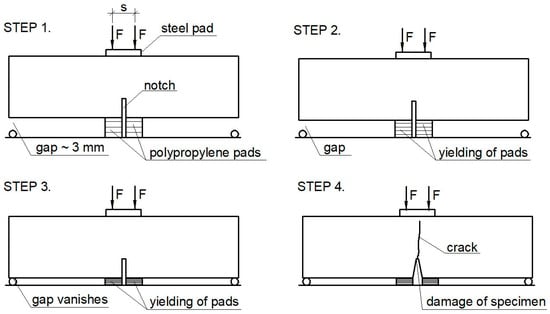
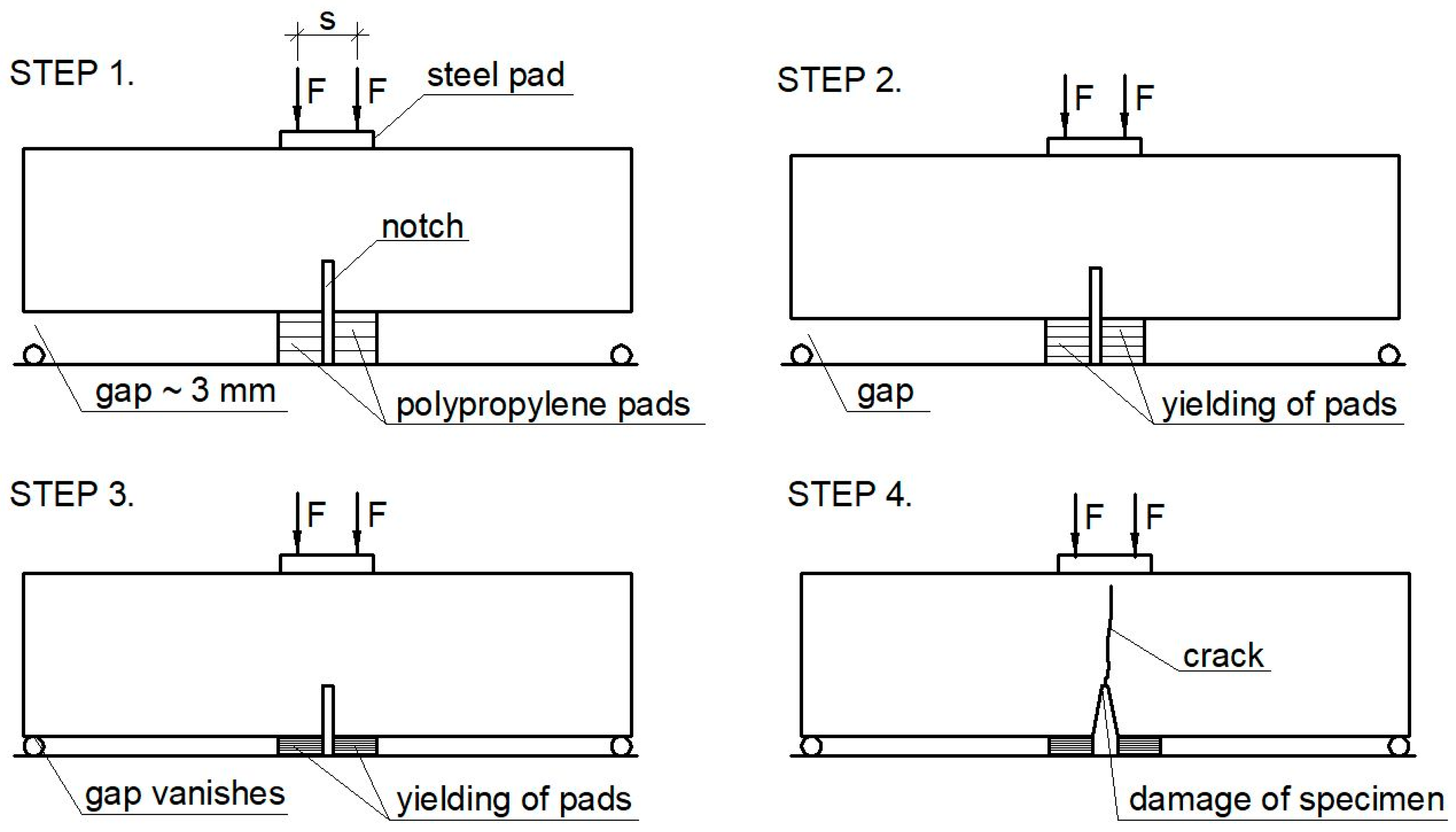
In the gap test [9], a single-notched specimen is subjected to a four-point bending (see Figure 1); however, hydraulic jacks are placed so close (the distance S in the Figure 1) that one can also call the scheme as a three-point bending. In the first two steps of the test, the specimen is only supported by polypropylene pads placed symmetrically below the notch. The test is named because of a gap between end supports and the vertical edges of the specimen. The gap width is set so that the gap disappears only when the pads are fully yielded (Figure 1 step 3). Finally, a crack propagating from the notch causes damage to the specimen. The test is performed on at least three sample sizes, most often on a scale of 1:1, 2:1, and 4:1.
Figure 1.
Steps of the gap test.
The most important result of the gap test is the reading of the so-called peak force just after the change in the static scheme and just before the damage to the sample.
Since the force in the yielded pads has a constant value, the peak force can be read quite easily from the force-displacement diagram (plotted from the actuators in the case of laboratory testing or from the corresponding FEM mesh points in the case of numerical analyses) as the excess over the plateau (asymptote) in the final phase of the test. The plateau is caused by the yielding of the pads and reflects a constant value of force in the pads.
According to the size-effect law [10], the relation between the nominal stress σN and the specimen width D can be written as follows:
where E is the elastic modulus, Gf is the fracture energy, g(α) is the energy release rate as a function of α (a ratio of notch width and specimen width), and cf is the critical effective crack extension. The nominal stress can be calculated according to the following formula:
where P is the peak force and b denotes the thickness of the specimen. The expression for the energy release rate is as follows:
whereby
where L is the half-span of the specimen and S is the distance between the two hydraulic jacks. The formula (1) can be expressed in the form of a linear function:
with the following substitution:
On a graph of the vs. D relationship, one can draw a regression line and calculate the slope A and the y-intercept C of this line. This allows us to calculate the fracture energy and the critical effective crack extension according to the following formulae:
To accurately demonstrate the relationship between the fracture energy and crack-parallel stress, various values of this stress (also called the T-stress from the word “transverse”) are considered in the gap test. The following values have predominated in recent tests of concrete specimens: 0.4 fc, 0.9 fc, and 0, where fc is the compressive strength of quasi-brittle material, while different values were applied to aluminum specimens. This stress was most often obtained by reducing the surface area of polypropylene pads, e.g., by drilling holes in them [9]. In the case of numerical analyses, this effect can be achieved by changing the width of the pads.
3. Research Review
The gap test for quasi-brittle materials was first proposed in the paper by Nguyen et al. [9]. In this paper, the authors challenged the hypothesis of constant brittle fracture energy and demonstrated that this energy depends significantly on the crack-parallel compressive stress. They also listed some features and advantages of the gap test that distinguish it from other popular fracture mechanics tests:
- The crack-parallel stress in all standard fracture specimens is negligible and, hence, the effect of inconstancy of the fracture energy has not been revealed for a long time;
- The static scheme of the specimen remains statically determinate which makes the test unambiguous;
- Despite the multiple loading, the test remains suitable for the size effect.
The authors presented the results of the laboratory tests and numerical analyses, concluding that the best material model for reproducing the finite element test is the so-called microplane model M7 combined with the crack band model. They also showed the complete inappropriateness of linear-elastic fracture mechanics (LEFM) and the cohesive crack model (CCM) for reproducing the gap test. Both the LEFM and CCM cannot take into account that the fracture energy depends on the compressive stress. Meanwhile, the microplane M7 and crack band models show this relationship to be in broad agreement with the experiment. An interesting observation is that the fracture energy is almost twice its original value in the case of stresses in the pads being equal to 0.4 fc, and decreases rapidly in the case of 0.9 fc to approximately 54% of its original value with the start of a downward trend around 0.75 fc.
The authors provided an intuitive explanation for this effect. In the case of smaller values of the compressive stress in the gap test, a pressure on the inclined microcrack increases the resistance to slip while larger values of the crack-parallel compression overcomes the friction and causes the inclined microcrack to slip. Finally, the authors proposed the gap test as a standard fracture test to provide a sufficient information on quasi-brittle materials.
Prof. Bažant’s team continued their work and publications on the new fracture mechanics test. The paper by Nguyen et al. [11] reiterates the basic assumptions and results of the fracture mechanics test, and also provides a broader discussion of the suitability of various material models for numerical reproduction of the test. The authors stated the following:
- The Mohr–Coulomb’s model produces an artificial stiffening effect at the crack tip, so it is inapplicable for fracture analysis;
- The CDPM2 model, introduced by Grassl et al. [12], reproduces the gap test similarly to the crack band and microplane M7 models, but there are significant discrepancies in the results—the initial fracture energy doubles its value only when the compressive stress level is equal to 0.6 fc, and decreases to zero when the compressive stress is around 0.9 fc;
- The microplane model has certain features that make it suitable for reproducing the gap test.
In the discussed paper, the authors included many important notes in the appendices, including alternative testing setups, detailed properties of the sample and concrete used in their experiments, the optimization of the polypropylene pads’ dimensions, and formulae for the size effect. In this way, they enabled other research teams to accurately reproduce the gap test.
The previously mentioned M7 microplane model was thoroughly described by Nguyen et al. [13]. In the subsection 8.7 of the paper [13], the authors demonstrated the effectiveness of this model in reproducing the gap test. Referring to the main theme of the entire article, the authors showed that the M7 model works with both the implicit and explicit FEM algorithms (solvers), returning very similar results with larger discrepancies for the compressive stress level around 0.7 fc, which was not explained by the authors [13]. Both of these algorithms are available, for example, in Abaqus software; the implicit one is used for static and quasi-dynamic problems, while the explicit one is used for fast-changing dynamic problems. The convergence of results for both algorithms in the gap test demonstrates the high effectiveness of the M7 model.
The same authors [14] presented once again their on-going work during the Annual Conference on Experimental and Applied Mechanics 2020. Compared to previous articles, the authors did not present new results of the gap test. This time, however, they provided more details regarding the test setup and specimen preparation, including the crucial information about the gap width between the specimen and the end supports. This gap ranged from 2 to 4 mm. As stated in the paper’s summary, the presented results were of particular interest for the shear failure of reinforced concrete beams, punching of slabs, fracture of prestressed concrete, and the hydraulic fracturing of shale [14].
Despite the pioneering nature of the gap test, initially, only Prof. Bažant’s team addressed this issue. This may have been influenced by the global pandemic situation. The test gained some interest after the Euro-C 2022 conference in Vienna. During this event, two papers by Bažant et al. [15,16] were presented. The first of these papers continued the discussion on the suitability of various concrete material models for FEM calculations in selected simple fracture mechanics tests, including the gap test. The material models considered were as follows: a crack band combined with a microplane M7 model (CB-M7), a crack band model in which the M7 model was replaced by the CDPM2 model (the previously mentioned model of Grassl et al. [12], abbreviated as CB-Gr), a phase-field model, and a peridynamic model with its modifications. The authors found that only the first model (CB-M7) was able to correctly reproduce all tests, and the CB-Gr model correctly reproduced the trend of the size effect but still required corrections. The same authors included a more detailed description of the same issues in the paper [17], which was published just before the above-mentioned conference. The other paper [16] demonstrated that the influence of the crack-parallel stress on fracture energy occurs not only in concrete but also in the ductile fracture of plastic-hardening polycrystalline metals. It also turns out that linear elastic fracture mechanics (LEFM) and the material models, phase-field and cohesive crack, are unable to accurately reproduce the gap test. According to the authors, the only model whose use is not restricted is the crack band model.
It gradually became clear that the gap test must apply not only to concrete but also to other materials, even those with a damage mechanism different from concrete. Bažant et al. [18] summarized the results of their previous research and theoretical considerations. In addition to the previously presented laboratory test results and FEM analyses, the authors presented preliminary information on the gap test for an aluminum specimen. Samples with four different scales (1:2:4:8), two different compressive stress levels (0 and 0.15 times the material strength), and slightly different dimensions than those for concrete samples were considered. The test results showed a significant increase in fracture energy (58%) at a compressive stress level equal to 0.15 times the material strength. The second important element of the discussed paper is the authors’ assertion that classical plasticity models of concrete (Drucker–Prager, and Coulomb–Mohr) based on stress tensor invariants are not suitable for numerically reproducing all the phenomena occurring in the gap test.
Interest in the gap test begun to emerge in other research groups. Brockmann and Salviato [19] performed laboratory tests and numerical simulations on a carbon fiber composite specimen. They used three specimen sizes in a 1:2:4 ratio, with dimensions different from those of concrete specimens [9]. Three different levels of the crack-parallel compressive stress were applied: 0, 0.29, and 0.44 of the compressive strength of laminate. Laboratory test results confirmed that the fracture energy depends on compressive stress, but this relationship is different from that for concrete. As we recall [9], the fracture energy of concrete in the gap test initially increased with increasing stress and then decreased rapidly at a stress level of 0.9 fc. In the case of laminate, the situation was different—this energy only decreased significantly (37%) with increasing stress. The authors [19] used a high-magnification optical microscope to demonstrate the changing crack tip morphology with increasing compressive stress, thus explaining this relationship. They also performed numerical simulations using the crack band model and confirmed its effectiveness in reproducing the gap test. The results published in this article showed that the dependence of fracture energy on compressive stress is a very important issue not only for concrete.
Meanwhile, Prof. Bažant’s team continued their research on the gap test for aluminum. Papers [20,21] presented details of laboratory tests and the theoretical basis for the size effect in metals. The tests were conducted for three compressive stress levels: 0, 0.144, and 0.386 of the yield strength of aluminum. Higher stress values would have been difficult to achieve in the tests, unlike in the case of concrete, whose compressive strength is much lower than that of aluminum. Furthermore, the authors had also to change the material of the pads, which, in the case of the concrete specimens, were made of polypropylene. This time, the pads were made of copper and PVC. The gap test results were as follows: at the crack-parallel compressive stress equal to 0.386 of the yield strength of aluminum, the fracture energy more than tripled. This is an even better result than in the case of concrete [9]. The only remaining question was how the brittle fracture energy would change at compressive stresses of 0.9 times the yield strength.
To summarize this stage of research on the gap test (early 2023), the researchers examined the discussed effect in concrete, aluminum, and carbon fiber composites. In the case of numerical studies, the effectiveness of the crack band model was reported. From that point on, work on the gap test slowed down, and the authors limited themselves to summarizing the results and theoretical considerations. Issues related to the numerical reproduction of the gap test were also discussed. Paper [22] presented the use of the lattice discrete particle model (LDPM) instead of the previously used crack band and microplane M7 model. It turned out that the LDPM was able to more accurately reproduce the phenomena occurring in the fracture process zone (FPZ), particularly the frictional sliding. The numerical results were in good agreement with the laboratory tests. The authors also provided recommendations regarding the numerical model itself:
- Avoid an instability of the simulation using finite elements with full integration instead of reduced integration;
- Use the kinematic coupling instead of a tie constraint when linking the two endpoints of the loading pad with reference points in the specimen;
- On the other hand, use the tie constraint to link the pads with the specimen instead of tangential and normal contact conditions.
An unusual and interesting proposal by the authors of paper [23] was to introduce a ranking of material models (called the m-Index) that would assess their ability to numerically reproduce eleven typical fracture mechanics tests, including the gap test. The authors selected the following models for evaluation: the crack band and microplane M7 model (CB-M7), crack band and Grassl model (CB-Gr), basic phase-field model (bPF), modification of the phase-field model (PF-Wu), basic peridynamics model (bPD), peridynamics with Grassl model (PD-Gr), and two bond-associated basic peridynamics models (PDba-Gr and PDba-M7). The authors awarded each model a score from 0 to 4, assessing how accurately the model reproduces laboratory tests in terms of the following criteria: crack propagation, maximum load, force-displacement diagram, and size effect. Table 1 presents a summary of the ranking of the considered models. The CB-M7 model turned out to be the “winner”, although the CB-Gr model was close behind. The remaining models performed worse; some proved to be useless in each of the eleven tests. In the case of the gap test, only the CB-M7 and CB-Gr models proved useful. However, this ranking did not include the LDPM model discussed earlier [22].
Table 1.
m-Index results presented in the paper [23].
The following paper [24] briefly mentions the gap test and summarizes the results of tests on concrete and aluminum specimens to date. However, the paper is of significant importance in the context of structural durability and sustainability. The authors compiled the results of numerous scale effect studies for various materials—concrete, aluminum, carbon composite, sea ice, vinyl foam, limestone, and ceramic. They also demonstrated that optimal structural design results from matching the asymptotes on a graph of the nominal stress σN versus the characteristic size D of a structure (with both axes on a logarithmic scale). Deviating from this matching leads to designing structures with insufficient overall safety factors or with excessive ones, which, consequently, results in financial losses and increased CO2 emission. The gap test is one of the most important fracture mechanics tests in this context because it not only accounts for the size effect and allows for asymptotic matching, but, above all, it reveals the effect of the dependence of fracture energy on crack-parallel compressive stress.
The authors of paper [25] presented details of the laboratory test program in the gap test for fiber-reinforced concrete (FRC) specimens. The test results indicate that the addition of fibers has a significant effect on the change in the fracture energy of concrete with changing compressive stress, causing an increase in this energy by 64% or 78% (for compressive stress levels of 0.63 and 0.67 of the compressive strength, respectively), while, for plain concrete, it is as much as 126%. The authors explain this by the fact that the addition of fibers introduces a certain degree of ductility in the specimen. However, no gap test was performed at stress level 0.9 to see if the fracture energy would then undergo a rapid reduction.
However, work continued on improving the numerical reproduction of the gap test. In paper [26], the introduction of the second gradient of the displacement field vector, named the “sprain”, was proposed as the localization limiter. The model implementing this quantity was called the slCBM—smooth Lagrangian crack-band model—and it was compared with the CB-M7 model previously used by the authors. The slCBM was found to provide an almost perfect fit to the laboratory test results, and the discrepancy of the CBM was about 3%, which makes both models (CBM and slCBM) suitable for reproducing the gap test. However, again, the analyses only considered a compressive stress level equal to 0.4 of the concrete compressive strength, and the case of 0.9 was not analyzed.
The proposal to introduce the slCBM and the related achievements of the authors [26] were presented by them at the FraMCoS-XII scientific conference in Vienna in 2025. During the same conference, a completely new concept of numerical reproduction of the gap test was introduced. Its authors were Szczecina and Winnicki, who presented its details and calculation results in a paper [27] published after the aforementioned conference. They decided to numerically reproduce the gap test in Abaqus software using the concrete damage plasticity (CDP) model. This model is well-known to Abaqus users and researchers [28], and was introduced by Lubliner et al. [29], and developed by Lee and Fenves [30]. It combines plasticity theory with continuum damage mechanics, and such models have not been considered effective in reproducing the gap test so far [18]. However, it turned out that the CDP model can correctly reproduce the main gap test results (size effect, and brittle fracture energy), but only if damage conditions are applied. In Abaqus, these conditions are defined by specifying the material damage parameter (this parameter is a fraction between 0 and 1, assuming a value of 0 in a virgin state and 1 for full damage) depending on strain. As a result of this, the authors obtained a satisfactory agreement of their numerical analyses with the results presented by Nguyen et al. [9]—see Table 2. In the case of 0.9 fc, the discrepancy between results reported in [9] and [27] is about 19% (with regard to 0.67 as the reference value), but the most important observation is that the fracture energy decreases rapidly when the crack-parallel compressive stress is at this level.
Table 2.
Comparison of results presented in [9,27].
The next material tested in the gap test was rubber [31]. The study again showed that the crack-parallel compressive stress increases the fracture energy by 12.2% and 20.2% for lower and higher compressive stresses, respectively. The authors also presented a comprehensive theoretical description of the constitutive modeling of soft materials using a microplane approach.
At the traditional Euro-C conference (March 2026, Austria), Jirásek and Li [32] presented a new approach to the numerical reproduction of the gap test. They declare that their analyses are preliminary. In their work, they focused primarily on identifying the mechanism that influences the change in brittle fracture energy depending on the compressive stress. For calculations, they used the finite element platform OOFEM with the CDPM2 concrete material model [12]. The current state of the authors’ analyses concludes that the non-uniform, multiaxial stress state and damage pattern induced during the initial compressive stage of the gap test strongly affect the performance in the bending stage. At the highest compressive stress (0.9 fcd), cracks appear that compete with the one that clearly runs between the notches in the center of the specimen. This paper provides a new perspective on the gap test, and the issues discussed therein require much further research.
The final paper in this review is the work by Qing et al. [33]. The authors presented the results of the gap tests for steel-fiber-reinforced concrete (SFRC) with varying fiber contents. Laboratory tests were performed using digital image correlation (DIC) to investigate the effects of the crack-parallel compressive stress on fracture evolution. For numerical analyses, the authors used the previously mentioned CDP model with active damage conditions. The authors examined three compressive stress levels, 0, 0.3, and 0.5 of the compressive strength fc. Analyses showed that the peak load was higher at 0.3 fc than in the absence of compression, but the opposite effect was observed at 0.5 fc. The post-peak fracture energy decreased significantly in both cases (0.3 fc and 0.5 fc) by 26.4% to 39.9% and 74.4% to 81.0%, respectively. Additionally, the authors were able to compare the crack morphology from DIC and FEM analyses, which were found to be in satisfactory agreement.
A brief summary of the research performed to date on the gap test is presented in Table 3 and Table 4. It can be observed that the test has been performed primarily on concrete samples; regarding other materials, it is notable that no attempts were made to perform the test at compressive stress levels corresponding to 0.9 of the material’s strength (or yield stress in the case of metals). It should be noted that the stress levels listed in Table 3 are those reported by researchers in their papers. The significant lack of standardization regarding these stress levels should be addressed in future standards governing the laboratory and numerical execution of the gap test. Table 4 presents the results of the fracture energy changes in laboratory tests for different load levels. One can see the general tendencies of the fracture energy change for different materials.
Table 3.
Summary of materials and material models in literature review.
Table 4.
Summary of Gf/Gf0 change in laboratory tests.
To summarize the literature review presented in this chapter, it can be concluded that, despite the six years of research on the gap test, it has not yet attracted much attention among scientists involved in the laboratory or numerical testing of concrete and other materials. The main center for this test is Northwestern University, and the remaining few teams are composed of two scientists. This is true even though the test itself appears to be a breakthrough in the fracture mechanics of quasi-brittle materials, as it has revealed a completely new feature of these materials: the dependence of the fracture energy on crack-parallel stress. According to the authors of this paper, there is still much work to be done in this area, including the selection of materials for further gap testing. To date, the test has been performed primarily on concrete, but also on carbon fiber composites, fiber-reinforced concrete, and aluminum. Metals other than aluminum, limestone, and ceramics have not yet been considered. Of course, for materials with a high compressive strength, the practical implementation of this test in the laboratory may encounter some difficulties (the selection of pads with the appropriate yield strength), but numerical analyses can always be performed, where this will no longer be a problem. Some of the papers presented above reported test results for lower compressive stress values (e.g., 0.4 or 0.5 fc), but the material behavior for 0.9 fc is also very important—a significant decrease in fracture energy can then be expected, so there are still many gaps to fill.
4. From New Fracture Test to Structural Durability and Sustainability—A Conceptual Agenda
The gap test discussed in the paper is only the beginning of the path leading to durability and guaranteeing the sustainability of structures. It is always related to the size effect, which is why all laboratory tests and FEM analyses are carried out on samples scaled in several sizes, most often three. Because the physical size of the FPZ does not scale proportionally with structural dimensions, geometrically similar concrete structures do not exhibit the same nominal strength. With increasing size, the structural response tends to transition from relatively ductile toward more brittle behavior. This size effect is particularly important when laboratory tests on relatively small specimens are used to predict the resistance of large members: beams, slabs, walls, foundations, and bridges. Ignoring it may lead to an overestimation of the nominal strength of real-scale members. The size effect is therefore not merely a laboratory phenomenon, but a principal structural manifestation of quasi-brittle fracture and has direct implications for safety, reliability, and design-code formulations.
Current design codes already address safety, serviceability, and durability. Eurocode 2 [34] provides the general basis for the design of plain, reinforced, and prestressed concrete structures, while the fib Model Code 2010 [35] adopts a performance- and life-cycle-oriented framework. ACI Committee 446 document [8] establishes the fracture-mechanics and size-effect background relevant to concrete while ISO standards [36,37] define general principles, framework, requirements, and guidelines for life-cycle assessment. However, these documents do not currently provide a direct design procedure in which the fracture energy is presented as a function of crack-parallel compressive stress. Moreover, Nguyen et al. [9] stated that the gap test should also be standardized and become a standard fracture test.
In practice, this requires testing several geometrically similar series of specimens and determining the relationships between the stress parallel to the crack, the effective fracture energy, the size of the FPZ, and the nominal strength. These quantities should not be treated as independent material constants if they change with the stress state and the scale of the system. The testing program should also determine the variability of the results and the number of specimens necessary for the reliable identification of the model parameters.
Transferring the results from the laboratory scale to structural scale should account for the uncertainty of input parameters, the scatter of concrete properties, and the model’s sensitivity to the adopted constitutive law. Validation cannot be limited to the maximum load. It should include the load–displacement curve, crack initiation and propagation, FPZ evolution, dissipated energy, and changes in nominal strength with increasing size. The consistency of these quantities across several scales allows an assessment of whether the model reproduces the actual fracture mechanism and can be applied to elements of structural dimensions.
The fact that the fracture energy depends on the crack-parallel stress has serious consequences for the fracture process. Crack-parallel stress may modify both the effective fracture energy and the fracture process zone size, thereby altering the nominal-strength scaling law. From a sustainability perspective, the correct treatment of the size effect is essential because material efficiency cannot be assessed reliably if the mechanical model does not transfer correctly across scales. A design based on small-specimen strength may be un-conservative for large structural components, creating a risk of premature failure. An excessively simplified safety provision may generate conservatism and unnecessary material demand. Both of these situations result in excessive material consumption and an increased carbon footprint. The combination of gap testing and size-effect analysis provides a potential route toward replacing generalized conservatism with physically informed, scale-sensitive design.
In sustainable design, a consistent sequence of procedures is required: from identifying parameters in the gap test, through their implementation and validation in the numerical model, to design decisions. A more accurate description of the fracture may influence the element’s cross-section, reinforcement ratio, local strengthening, the acceptable level of cracking, and the predicted failure mechanism. However, environmental benefits occur only when the solution reduces resource consumption or the risk of premature intervention without lowering safety and reliability. Therefore, the results of mechanical analyses should be translated into comparable environmental and operational indicators.
The sustainability assessment should include the concrete and steel consumption, the embedded emissions, the service life, the probability of damage, the scope of repairs, the downtime, and the potential replacement of the element. The reference variant should be compared with solutions that use fracture parameters dependent on the stress state and scale. The smallest initial mass does not always imply the lowest impact over the entire life cycle. Local increases in the cross-section or reinforcement may be more advantageous if they limit cracking, reduce the number of repairs, and extend safe operation. The result should thus be presented jointly as changes in material consumption, carbon footprint, durability, and the risk of premature removal of the structure from service.
The purpose of introducing the gap test with the size effect into fracture mechanics is not to eliminate safety margins, but to better justify them physically. Gap-test-based models can help distinguish the actual structural requirements from conservatism introduced to compensate for incomplete crack representation. This forms the basis of a concept that can be provisionally described as “prediction-based sustainability”—improved environmental and life-cycle performance achieved through a more reliable prediction of structural behavior. However, the environmental benefit of gap-test-informed optimization must be demonstrated rather than assumed. A credible comparison should quantify the differences between conventional and enhanced fracture-modeling approaches in terms of concrete volume, reinforcement mass, expected service life, repair requirements, failure probability, and whole-life carbon. The relevant conclusion may sometimes be a material reduction, but, in other cases, it may be a local increase in reinforcement that substantially reduces the probability of failure or future replacement.
The concept of prediction-based sustainability has an overarching character and refers to a design based on the reliable prediction of structural behavior throughout the entire life cycle. Its aim is to jointly account for safety, durability, reliability, and environmental impact, rather than merely reducing the initial material consumption. The gap test can provide data for implementing this concept, but it constitutes only one of its components. The effectiveness of prediction-based sustainability is determined only by the use of verified models to compare structural variants and assess their mechanical, environmental, and operational consequences.
Comparing variants within prediction-based sustainability should combine a mechanical analysis, reliability assessment, and life-cycle evaluation. The criteria may include the load-bearing capacity, crack development, probability of reaching limit states, concrete and steel consumption, carbon footprint, repair needs, and expected service life. The outcome may involve both a reduction in material quantity and justified local strengthening that limits the risk of failure or replacement of the element. The goal is to replace unguided conservatism with solutions based on a verified description of the fracture and a clearly defined level of reliability.
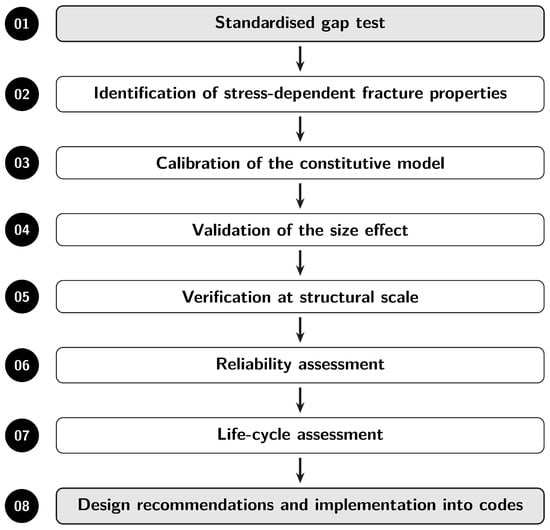
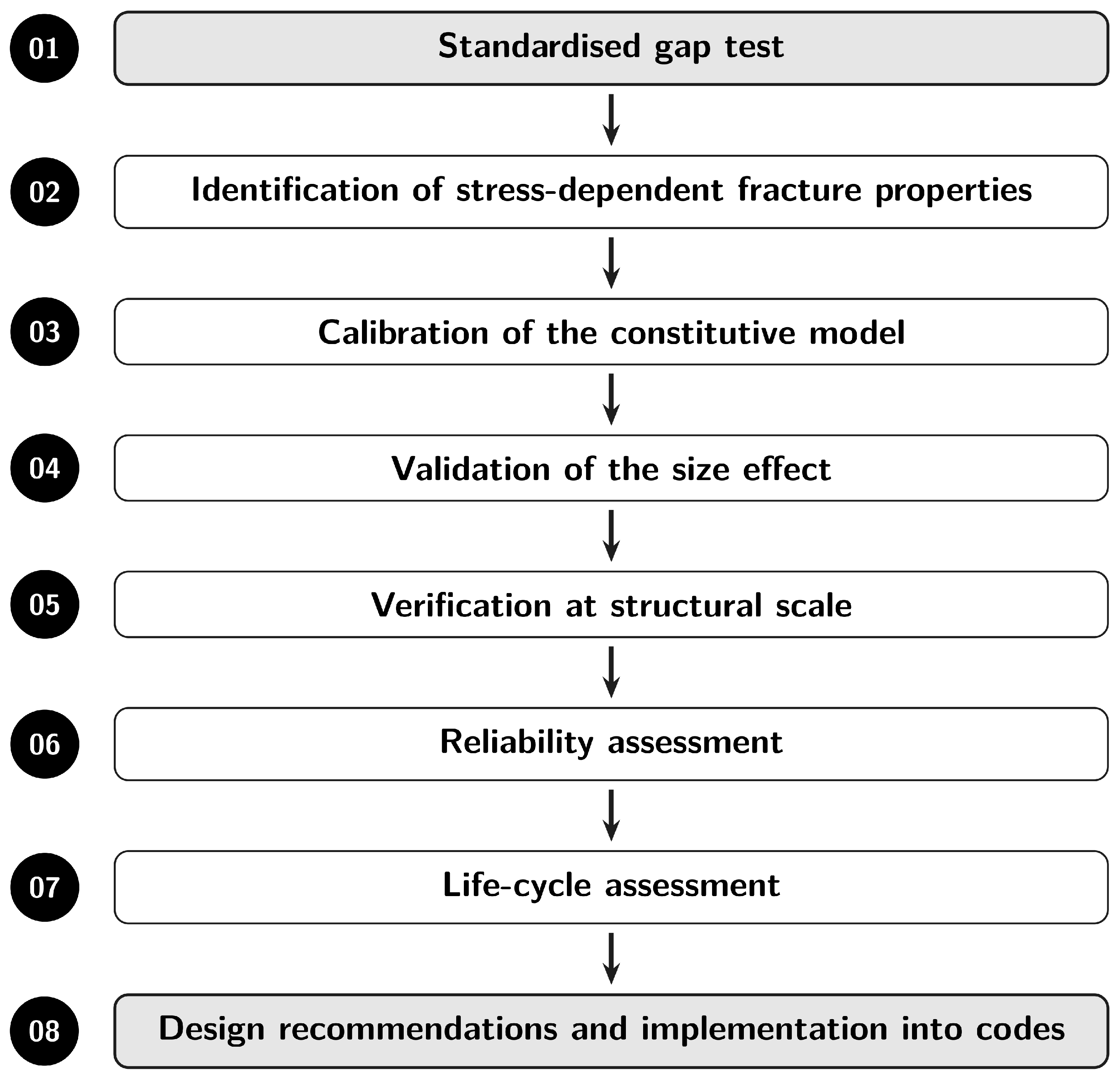
Implementing gap-test results into design practice is, in contrast, a detailed technical process leading to the development of calculation methods and code provisions (Figure 2). It should include, in sequence, the following: the standardization of the testing procedure and an assessment of its repeatability and reproducibility; the determination of the influence of concrete composition and grade, aggregate size, curing conditions, age, and environmental exposure on fracture parameters; the calibration of constitutive models; the validation of the size effect and verification on structural elements; followed by reliability analyses and life-cycle assessment. Only on this basis can simplified engineering methods, applicability ranges, correction factors, and proposals for code provisions be developed. Such a sequence reduces the risk of implementing recommendations based on insufficient experimental evidence, while enabling the linkage of structural safety levels with measurable benefits in durability and sustainable development.
Figure 2.
Scheme for implementing gap-test results into design practice and design standards.
To demonstrate the utility of the gap test in the context of sustainability, the relationship between compressive strength and the fracture energy can be presented. According to the fib Model Code [35], the fracture energy is expressed by the following formula, formula (14):
where fcm is the mean compressive strength of concrete expressed in [MPa]. A growth in the value of the fracture energy should also result in a growth in the compressive strength. Of course, formula (14) is an empirical one and restricted, but the general trend of the fracture energy growth still holds true.
5. Discussion
This paper presents the current research on the gap test and suggests its relationship to the durability and strength of buildings. This test is still a relatively new concept in the field of fracture mechanics of quasi-brittle materials and has not yet received the attention it deserves. However, the authors believe that, over time, the number of papers on the gap test will increase, especially since the test itself reveals a very important phenomenon that was previously unknown. The relationship between the fracture energy and crack-parallel stress is already of great importance for describing the cracking and fracture process and urgently requires the supplementation of the theory of fracture mechanics.
The test itself should be considered in terms of laboratory tests and numerical simulations. In the case of the former, the situation is clear—the authors of the previous papers have thoroughly described the test setup, the test procedure, and the results, which form the basis for further size-effect calculations. The concrete test results clearly indicate the existence of a fundamental dependence of the fracture energy on the crack-parallel stress:
- If the stress is equal to 0.4 fc, the energy almost doubles its initial value,
- In the case of 0.9 fc, the energy dramatically decreases to approximately 50% of its initial value.
For aluminum, only low stress levels were tested, a maximum of around 0.4 of the yield strength. The test results showed more than a doubling of the brittle fracture energy. However, there are no results for a significantly higher stress, leaving a gap that needs to be filled in the near future. It is not clear whether the brittle fracture energy of aluminum will significantly decrease at stresses of around 0.9 of yield strength. If laboratory testing for high stress levels is difficult, numerical analyses are an alternative.
The most recent materials examined by researchers were carbon fiber composites [19] and fiber-reinforced concrete [25]. In the case of the former, a surprising trend of lower fracture energy was observed, even at lower values of crack-parallel stress. This contradicts the results obtained by other teams for plain concrete and aluminum. Since this effect was obtained by only one team of researchers, it will certainly need to be verified in the future by other, independent teams. If this behavior of fracture energy is confirmed, it would indicate that materials can exhibit completely different behavior under crack-parallel stress, and a very extensive experimental campaign will be required. In the case of fiber-reinforced concrete [25], the results obtained are not surprising. For stress levels ranging from 0.63 to 0.67 fc, the energy increase ranged from 64% to 78%. However, the tests were conducted only for a narrow range of compressive stresses. It would be interesting to see the results obtained for, for example, 0.4 and 0.9 fc. There is still much work to be done in this area.
The numerical analysis of the gap test requires a separate discussion. The first publications on this test indicated that the crack band and microplane M7 model (CB-M7) seemed to be the best for the numerical reproduction of the gap test. However, models based on the theory of plasticity and continuum damage mechanics were not completely ruled out, emphasizing a certain limited usefulness of the crack band model in combination with CDPM2 (CB-Gr). On the other hand, plastic models based on stress tensor invariants (Coulomb–Mohr, and Drucker–Prager) were considered [11,18] to be incapable of the numerical reproduction of the gap test. Later, however, teams emerged that demonstrated the effectiveness of models based on the theory of plasticity. The papers [27,33] presented results obtained using the CDP model with the damage condition included. As Szczecina and Winnicki [27] emphasized, only the use of these conditions yielded realistic results. The results of Jirásek and Li [32], who used the CDPM2 model, are also promising, although preliminary. Meanwhile, the team of Prof. Bažant [26] demonstrated the high effectiveness of the slCBM, even better than the CB-M7 they previously used.
It can therefore be said that, six years after the introduction of the gap test into fracture mechanics, its numerical simulation is well-developed, with existing models undergoing refinement [26], and new ones emerging [27,31,32]. This trend seems to bode well for the future of the gap test, as, so far, only a relatively small number of teams have addressed this crucial issue for fracture mechanics. Numerical analyses are not only a valuable complement to laboratory tests, but, in some cases, can completely replace them, significantly reducing testing costs. An example of the gap test is the numerical analysis of materials with a high compressive strength (or yield stress), where selecting the appropriate material of pads is difficult and only low levels of crack-parallel stress can be practically achieved.
Despite the undoubted achievements of the gap test teams, many issues remain unaddressed. Research has been conducted primarily on plain concrete, aluminum, rubber, and fiber-reinforced concrete, with the majority focused on concrete itself. For the remaining materials, the pool of research results is still very limited, and most of the materials important for construction have yet to be studied. Ceramics, carbon composites, and glass will require urgent investigation first. In the case of concrete, the research will vary according to the different types of reinforcement—from steel bars to dispersed reinforcement. The results obtained so far reveal a new phenomenon: a strong dependence of brittle fracture energy on crack-parallel stress. The paper suggests that this has a further impact on the theory of fracture mechanics, cracking, and material fracture processes, and, in the long run, on the durability and sustainability of structures. Taking this phenomenon into account allows us to avoid two extreme situations: unnecessary material demands and premature failures of structures.
6. Conclusions
This review paper summarizes all the significant works on the gap test, a new fracture mechanics test, performed only on few selected quasi-brittle materials. Nevertheless, this test has already demonstrated that the fracture energy depends on the crack-parallel compressive stress, which, consequently, has a significant impact on the cracking and fracture behavior of concrete and reinforced concrete structures, especially if their design was based on the assumption of the constancy of the fracture energy. This, in turn, may prove crucial for the durability and sustainability of structures. The conclusions drawn from the presented literature review are as follows:
- The fracture energy varies depending on the crack-parallel stress—for plain concrete and aluminum, this energy increased significantly (about twice) at a stress level of 0.4 fc or yield strength, and, for concrete, it decreased rapidly at a stress level of 0.9 fc. For fiber-reinforced concrete, a 64% to 78% increase was observed (at 0.63 to 0.67 fc), while, for rubber, it was 12% to 20%. In the case of steel-fiber-reinforced concrete, researchers reported [33] a 26.4% to 39.9% decrease of the fracture energy at 0.3 fc and 74.4% to 81.0% at 0.5 fc. Only in the case of carbon fiber composites did the fracture energy decrease with increasing stress. This fact indicates that the behavior of different building materials can be completely different and requires a broader research campaign;
- The tests were performed primarily on plain concrete, and, to a lesser extent, on fiber-reinforced concrete, carbon fiber composites, and aluminum. Tests have not yet been performed on reinforced concrete, ceramics, glass, and limestone;
- FEM numerical analyses of the gap test were performed using various material models (e.g., CB-M7, CDP, and slCBM), each of which demonstrated the effective reproduction of the test and the size effect. Work on the models is ongoing—the slCBM reproduces the gap test at the 0.4 fc compressive stress level best of all those analyzed, while the CDP model is available in commercial software and reproduces the size effect sufficiently for structural designers.
The authors of this paper predict how further work on the gap test might progress:
- In the case of concrete, there is an urgent need to investigate bar-reinforced elements and expand the set of results for fiber-reinforced concrete. Plain concrete is already well-studied, and the results obtained by research teams form the basis for research on other materials;
- In the case of FEM analyses, concrete material models are already well-developed and accurately reproduce the gap test. Material models of other materials (those tested) remain a significant gap. Further research will definitely rely on a combination of laboratory tests and numerical analyses, subject to the note in the next point;
- As mentioned earlier, there are still many building materials to be tested (e.g., ceramics, limestone, and glass). It is possible that the impetus for this research will come from numerical analyses, as they are cheaper and faster to perform than laboratory tests;
- Studies on the relationship between the fracture energy and the crack-parallel stress do not have to be conducted solely in the gap test. Similar studies can be conducted on tensile samples subjected to additional perpendicular compression. This way, the variation in brittle fracture energy can be detected not only in the three-point bending test (as is the case in the gap test) but also in the tensile test;
- Once the first material has been thoroughly tested (concrete has the best chance of being tested), the gap test will be a candidate for inclusion in textbooks and codes. This test will become a standard in fracture mechanics. The expanded scientific knowledge of concrete will allow for the better design of durable and sustainable structures.
Author Contributions
Conceptualization, P.G.K. and M.S.; resources, P.G.K. and M.S.; writing—original draft preparation, M.S.; writing—review and editing, P.G.K.; supervision, P.G.K. All authors have read and agreed to the published version of the manuscript.
Funding
This research received no external funding.
Institutional Review Board Statement
Not applicable.
Informed Consent Statement
Not applicable.
Data Availability Statement
No new data were created or analyzed in this study. Data sharing is not applicable to this article.
Conflicts of Interest
The authors declare no conflicts of interest.
Abbreviations
The following abbreviations are used in this manuscript:
| FEM | Finite Element Method |
| FPZ | Fracture Process Zone |
| CBM | Crack Band Model |
| CB-M7 | Crack Band Microplane 7 Model |
| LEFM | Linear Elastic Fracture Mechanics |
| CCM | Cohesive Crack Model |
| CDPM2 | Concrete Damage Plasticity Model 2 |
| CB-Gr | Crack Band Grassl Model |
| PVC | Polyvinyl Chloride |
| LDPM | Lattice Discrete Particle Model |
| bPF | Basic Phase-Field Model |
| PF-Wu | Phase-Field Wu Model |
| bPD | Basic Peridynamics Model |
| PD-Gr | Peridynamics Grassl Model |
| PDba-Gr | Peridynamics bond associated Grassl Model |
| PDba-M7 | Peridynamics bond associated Microplane 7 Model |
| FRC | Fiber-Reinforced Concrete |
| slCBM | smooth Lagrangian Crack Band Model |
| CDP | Concrete Damage Plasticity |
| DIC | Digital Image Correlation |
References
- Inglis, C.E. Stresses in a Plate Due to the Presence of Cracks and Sharp Corners. T. Inst. Nav. Arch. 1913, 5, 219–241. [Google Scholar]
- Griffith, A.A. The phenomena of rupture and flow in solids. Philos. T. Roy. Soc. A 1924, 221, 163–197. [Google Scholar]
- Kaplan, M.F. Crack Propagation and the Fracture of Concrete. ACI J. Proc. 1961, 58, 591–610. [Google Scholar] [CrossRef] [Scilit] [PubMed]
- Kesler, C.E.; Naus, D.J.; Lott, J.L. Fracture mechanics—Its applicability to concrete. In Proceedings of the International Conference on the Mechanical Behavior of Materials, Kyoto, Japan, 15–20 August 1971. [Google Scholar]
- Mazloom, M. Concrete Fracture Mechanics: Failure Analysis, Modeling, and Applied Examples of Reinforcement, 1st ed.; Woodhead Publishing, Elsevier: Cambridge, MA, USA, 2026. [Google Scholar] [CrossRef] [Scilit]
- Bažant, Z.P.; Planas, J. Fracture and Size Effect in Concrete and Other Quasi-Brittle Materials, 1st ed.; Taylor & Francis: New York, NY, USA, 2019. [Google Scholar]
- Bažant, Z.P. Scaling of Structural Strength, 2nd ed.; Elsevier Ltd.: Oxford, UK, 2005. [Google Scholar]
- Fracture Mechanics of Concrete: Concepts, Models and Determination of Material Properties; ACI Committee 446; American Concrete Institute: Farmington Hills, MI, USA, 1999.
- Nguyen, H.T.; Pathirage, M.; Rezaei, M.; Issa, M.; Cusatis, G.; Bažant, Z.P. New perspective of fracture mechanics inspired by gap test with crack-parallel compression. Proc. Natl. Acad. Sci. USA 2020, 117, 14015–14020. [Google Scholar] [CrossRef] [Scilit] [PubMed]
- Bažant, Z.P.; Kazemi, M.T. Determination of fracture energy, process zone length and brittleness number from size effect, with application to rock and concrete. Int. J. Frac. 1990, 44, 111–131. Available online: https://link.springer.com/article/10.1007/BF00047063 (accessed on 30 August 2026). [CrossRef] [Scilit]
- Nguyen, H.T.; Pathirage, M.; Cusatis, G.; Bažant, Z.P. Gap Test of Crack-Parallel Stress Effect on Quasibrittle Fracture and Its Consequences. J. Appl. Mech. 2020, 87, 071012. [Google Scholar] [CrossRef] [Scilit]
- Grassl, P.; Xenos, D.; Nystrom, U.; Rempling, R.; Gylltoft, K. CDPM2: A damage-plasticity approach to modelling the failure of concrete. Int. J. Solids Struct. 2013, 50, 3805–3816. [Google Scholar] [CrossRef] [Scilit]
- Nguyen, H.T.; Caner, F.C.; Bažant, Z.P. Conversion of explicit microplane model with boundaries to a constitutive subroutine for implicit finite element programs. Int. J. Numer. Methods Eng. 2020, 122, 1–15. [Google Scholar] [CrossRef] [Scilit]
- Nguyen, H.T.; Rezaei, M.; Pathirage, M.; Cusatis, G.; Mohsen, I.; Bažant, Z.P. Effect of Crack-Parallel Compression or Tension on Mode-I Fracture Energy of Quasibrittle Material—As Applied to Concrete. In Fracture, Fatigue, Failure and Damage Evolution, Volume 3, 1st ed.; Xia, S., Beese, A., Berke, R.B., Eds.; Springer: Cham, Switzerland, 2021; Volume 3, pp. 55–59. [Google Scholar] [CrossRef] [Scilit]
- Bažant, Z.P.; Nguyen, H.T.; Dönmez, A.A. Reappraisal of phase-field, peridynamics and other fracture models in light of classical fracture tests and new gap test. In Computational Modelling of Concrete and Concrete Structures, 1st ed.; Meschke, G., Pichler, B., Rots, J., Eds.; CRC Press/Balkema: Leiden, The Netherlands, 2022; Volume 1, pp. 3–7. [Google Scholar] [CrossRef] [Scilit]
- Bažant, Z.P.; Dönmez, A.A.; Nguyen, H.T. How gap tests of ductile and quasibrittle fracture limit applicability of phase-field, XFEM, cohesive, nonlocal and crack-band models? In Computational Modelling of Concrete and Concrete Structures, 1st ed.; Meschke, G., Pichler, B., Rots, J., Eds.; CRC Press/Balkema: Leiden, The Netherlands, 2022; Volume 1, pp. 409–413. [Google Scholar] [CrossRef] [Scilit]
- Bažant, Z.P.; Nguyen, H.T.; Dönmez, A.A. Critical Comparison of Phase-Field, Peridynamics, and Crack Band Model M7 in Light of Gap Test and Classical Fracture Tests. J. Appl. Mech. 2022, 89, 061008. [Google Scholar] [CrossRef] [Scilit]
- Bažant, Z.P.; Dönmez, A.A.; Nguyen, H.T. Précis of gap test results requiring reappraisal of line crack and phase-field models of fracture mechanics. Eng. Struct. 2022, 250, 113285. [Google Scholar] [CrossRef] [Scilit]
- Brockmann, J.; Salviato, M. The Gap test—Effects of crack parallel compression on fracture in carbon fiber composites. Compos. Part A 2023, 164, 107252. [Google Scholar] [CrossRef] [Scilit]
- Nguyen, H.T.; Dönmez, A.A.; Bažant, Z.P. Gap Test Consequences for Fracture Mechanics of Quasibrittle Materials and Plastic-Hardening Metals. In Fracture, Fatigue, Failure and Damage Evolution, 1st ed.; Beese, A., Berke, R.B., Pataky, G., Eds.; Springer: Cham, Switzerland, 2023; Volume 3, pp. 39–41. [Google Scholar] [CrossRef] [Scilit]
- Dönmez, A.A.; Nguyen, H.T.; Xu, H.; Bažant, Z.P. Crack-parallel stress effect on fracture energy of plastic hardening polycrystalline metal identified from gap test scaling. J. Mech. Phys. Solids 2023, 173, 105222. [Google Scholar] [CrossRef] [Scilit]
- Lyu, Y.; Pathirage, M.; Nguyen, H.T.; Bažant, Z.P.; Cusatis, G. Dissipation mechanisms of crack-parallel stress effects on fracture process zone in concrete. J. Mech. Phys. Solids 2023, 181, 105439. [Google Scholar] [CrossRef] [Scilit]
- Bažant, Z.P.; Nguyen, H.T. Proposal of m-Index for Rating Fracture and Damage Models by Their Ability to Represent a Set of Distinctive Experiments. J. Eng. Mech. 2023, 149, 04023047. [Google Scholar] [CrossRef] [Scilit]
- Bažant, Z.P.; Nguyen, H.T.; Dönmez, A.A. Scaling in size, time and risk—The problem of huge extrapolations and remedy by asymptotic matching. J. Mech. Phys. Solids 2023, 170, 105094. [Google Scholar] [CrossRef] [Scilit]
- Li, L.; Wang, B.; Xu, H.; Nguyen, H.T.; Bažant, Z.P.; Hubler, M.H. Crack-Parallel Stress Effect on Fracture of Fiber-Reinforced Concrete Revealed by Gap Tests. J. Eng. Mech. 2024, 150, 04024011. [Google Scholar] [CrossRef] [Scilit]
- Xu, H.; Nguyen, A.T.; Bažant, Z.P. Sprain energy consequences for damage localization and fracture mechanics. Proc. Natl. Acad. Sci. USA 2024, 121, e2410668121. [Google Scholar] [CrossRef] [Scilit] [PubMed]
- Szczecina, M.; Winnicki, A. Recreation of Gap Test with Damaged Plasticity Model. Appl. Sci. 2025, 15, 12606. [Google Scholar] [CrossRef] [Scilit]
- Kossakowski, P.G.; Uzarska, I. Numerical modeling of an orthotropic RC slab band system using the Barcelona model. Adv. Comput. Des. 2019, 4, 211–221. [Google Scholar] [CrossRef]
- Lubliner, J.; Oliver, J.; Oller, S.; Oñate, E. A plastic-damage model for concrete. Int. J. Solids Struct. 1989, 25, 229–326. [Google Scholar] [CrossRef] [Scilit]
- Lee, J.; Fenves, G.L. Plastic-damage model for cyclic loading of concrete structures. J. Eng. Mech. 1998, 124, 892–900. [Google Scholar] [CrossRef] [Scilit]
- Zhao, Y.; Nguyen, A.T.; Chen, H.; Espinosa, H.; Bažant, Z.P. Crack-Parallel Stress Effects in Soft Material Fracture: Insights from Gap Tests and the Microplane Modeling Perspective. J. Appl. Mech. 2026, 93, 021001. [Google Scholar] [CrossRef] [Scilit]
- Jirásek, M.; Li, C. Lessons learned from simulations of the gap test. In Computational Modelling of Concrete and Concrete Structures, 1st ed.; Meschke, G., Pichler, B., Rots, J., Eds.; CRC Press: London, UK, 2026; Volume 1, pp. 557–566. [Google Scholar] [CrossRef] [Scilit]
- Qing, L.; Ma, W.; Yu, K. Influence of crack-parallel compressive stress on the fracture evolution behavior of SFRC: Experimental and numerical investigations. Theor. Appl. Fract. Mech. 2026, 146, 105750. [Google Scholar] [CrossRef] [Scilit]
- EN 1992-1-1:2023; Eurocode 2: Design of Concrete Structures—Part 1-1: General Rules and Rules for Buildings, Bridges and Civil Engineering Structures. CEN: Brussels, Belgium, 2023.
- fib. fib Model Code for Concrete Structures 2010; fédération internationale du béton/International Federation for Structural Concrete (fib): Lausanne, Switzerland, 2013. [Google Scholar] [CrossRef] [Scilit]
- ISO 14040:2006; Environmental Management—Life Cycle Assessment—Principles and Framework. International Organization for Standardization: Geneva, Switzerland, 2006.
- ISO 14044:2006; Environmental Management—Life Cycle Assessment—Requirements and Guidelines. International Organization for Standardization: Geneva, Switzerland, 2006.

Disclaimer/Publisher’s Note: The statements, opinions and data contained in all publications are solely those of the individual author(s) and contributor(s) and not of MDPI and/or the editor(s). MDPI and/or the editor(s) disclaim responsibility for any injury to people or property resulting from any ideas, methods, instructions or products referred to in the content. |
© 2026 by the authors. Licensee MDPI, Basel, Switzerland. This article is an open access article distributed under the terms and conditions of the Creative Commons Attribution (CC BY) license.