


Abstract
Grape winery by-products, including grape pomace, grape seed meal, and polyphenol-rich extracts, are increasingly studied as functional poultry feed ingredients. This review summarizes 46 in vivo studies on broilers and laying hens (26 and 20, respectively) published between February 2008 and January 2026. Overall, low-to-moderate inclusion levels improved antioxidant status and reduced lipid peroxidation in tissues and poultry products. They also enhanced egg internal quality, yolk color, and meat oxidative stability during refrigerated storage, with little or no negative effect on production performance. Higher inclusion levels, particularly of unprocessed high-fiber or high-tannin fractions, may enhance some antioxidant outcomes but can impair digestibility, growth, and feed efficiency through tannin–protein interactions. These effects may be limited through fermentation, enzymatic pretreatment, or formulation aids. Responses depend on dose, by-product type, and oxidative challenge. Laying hens show strong improvements in yolk pigmentation, eggshell mineralization, and egg storage stability. Broilers mainly benefit through improved meat oxidative stability, reduced fat deposition, and gut microbiota modulation. The main evidence gaps are incomplete by-product characterization, few multi-dose, long-term, or commercial-scale trials, and no economic or life-cycle assessment. Grape by-products are therefore promising circular-economy feed inputs whose commercial viability remains to be validated.
1. Introduction
Poultry meat is the largest meat category globally, averaging about 145 million tons of annual production in 2022–2024, with further growth projected over the next decade [1]. In intensive production, oxidative stress impairs gut function, lipid metabolism, meat and egg quality, and product shelf-life [2].
Synthetic antioxidants such as ethoxyquin and BHT, traditionally used to limit lipid oxidation, differ in regulatory status and market acceptance [3,4]. In the European Union, ethoxyquin was suspended in 2017 and denied in 2022 [4,5] and EFSA could not conclude on the environmental safety of BHT [6]. This has encouraged research into plant-derived polyphenol sources [4] that may partly replace synthetic antioxidants while supporting the circular economy [7].
Grape pomace (the skins, seeds, and stems left after juice or wine extraction) represents about 20–25% of the harvested grape weight, and together with grape seed meal, these by-products exceed 9 million tons annually worldwide [8]. Both are rich in polyphenols, tocols, and dietary fiber. Since early work showed that grape pomace polyphenols were partly digestible and enhanced antioxidant activity in broilers [9], in vivo trials have been extended to grape seed extract, laying hens, and fermented by-products [10,11,12]. However, this literature is difficult to interpret because studies differ in inclusion rates, processing, and design, and because composition varies with pomace source [13] and drying [14]. High inclusion levels can impair performance through condensed tannins [15] and fiber [16], wet seasonal pomace is difficult to stabilize and store [17,18], and ochratoxin A contamination must be controlled [19].
Previous reviews addressed broader contexts, namely meat quality in monogastrics, enrichment of animal-derived foods and oxidative stress in pigs, chickens, and cattle [20,21,22] without separating broiler from laying-hen evidence or examining processing and implementation constraints together. This review therefore synthesizes in vivo feeding trials with grape pomace, grape seed meal, and grape-derived extracts, identified through a structured literature search, evaluating broilers and laying hens separately. It examines performance, egg and meat quality, antioxidant status, lipid metabolism, gut microbiota, and shelf-life, together with dose- and species-dependent responses and the processing, safety, economic, and life-cycle constraints on using grape by-products to valorize winery waste and replace synthetic antioxidants. To our knowledge, it is the first review to combine a species-separated synthesis with a descriptive tally of outcome direction and a distinction between grape feed materials and functional additives.
2. Literature Search Strategy and Eligibility Criteria
This review was conducted as a structured narrative review. Selected elements of the PRISMA 2020 statement [23] were adopted to report the search and selection process transparently, namely predefined eligibility criteria, multi-database searching, independent screening by two or more authors, and a flow diagram (Figure 1). However, the full PRISMA or PRISMA-ScR methodology was not applied, because no protocol was registered and no formal risk-of-bias assessment or meta-analysis was performed. A targeted literature search was conducted to identify in vivo feeding trials evaluating grape pomace and grape seed meal as feed ingredients for broiler chickens and laying hens. Grape pomace was defined as the skins, seeds, and stems remaining after vinification, while grape seed meal was defined as the oil-extracted residue of grape seeds. The search covered studies published from February 2008 to January 2026, reflecting the publication span of the compiled evidence base.
The databases searched included Web of Science Core Collection, Scopus, PubMed, and CAB Abstracts. Additionally, Google Scholar was used for forward and backward citation chasing. The search strings combined ingredient, species, and outcome terms using Boolean operators and truncation where supported. Ingredient-related terms included “grape pomace,” “grape byproduct*,” “vinification by-product*,” “grape seed meal,” “grape seed cake,” “grape seed extract,” and “proanthocyanidin*.” Species-related terms included broilers, broiler chickens, laying hens, and layers. Outcome-related terms included egg quality, yolk, shell thickness, meat quality, oxidative stability, TBARS, MDA, lipid peroxidation, shelf life, and storage. Searches were conducted in title, abstract, and keyword fields where supported.
All records were imported into EndNote, and duplicates were removed before screening. Titles and abstracts were screened independently by two of the authors. Full texts of potentially eligible studies were then assessed independently by three authors. Disagreements were resolved by discussion or by consultation with the review and editing members. For each included study, the following data were extracted—author, year, country, poultry species, strain, bird age, production stage, sample size, replicate unit, trial duration, grape by-product type, processing method, inclusion level, compositional characterization, basal diet, comparator or control treatment, main performance outcomes, egg or meat quality outcomes, oxidative-stability outcomes, microbiota or gut-health outcomes, statistical model, and main conclusions.
Studies were included if they were peer-reviewed in vivo feeding experiments using domestic chickens, specifically broilers or laying hens. They also had to report a quantifiable grape by-product dose and at least one outcome related to egg or meat quality, oxidative stability, shelf-life, antioxidant status, lipid profile, or gut microbiota. Studies were excluded when the grape by-product contribution could not be isolated from a complex blend without quantified individual ingredient doses. Papers were also excluded if outcomes were limited only to production performance without any quality, oxidative, or health indicators, or if the study was not a live-animal feeding trial.
The search yield and final included articles were organized into summary tables to facilitate cross-study comparison. Out of 128 records screened, 46 eligible studies were identified, including 20 studies on laying hens, presented in Table 1 and Table 2, and 26 studies on broilers, presented in Table 3 and Table 4.
Figure 1.
Flow diagram illustrating the literature search and study selection process.
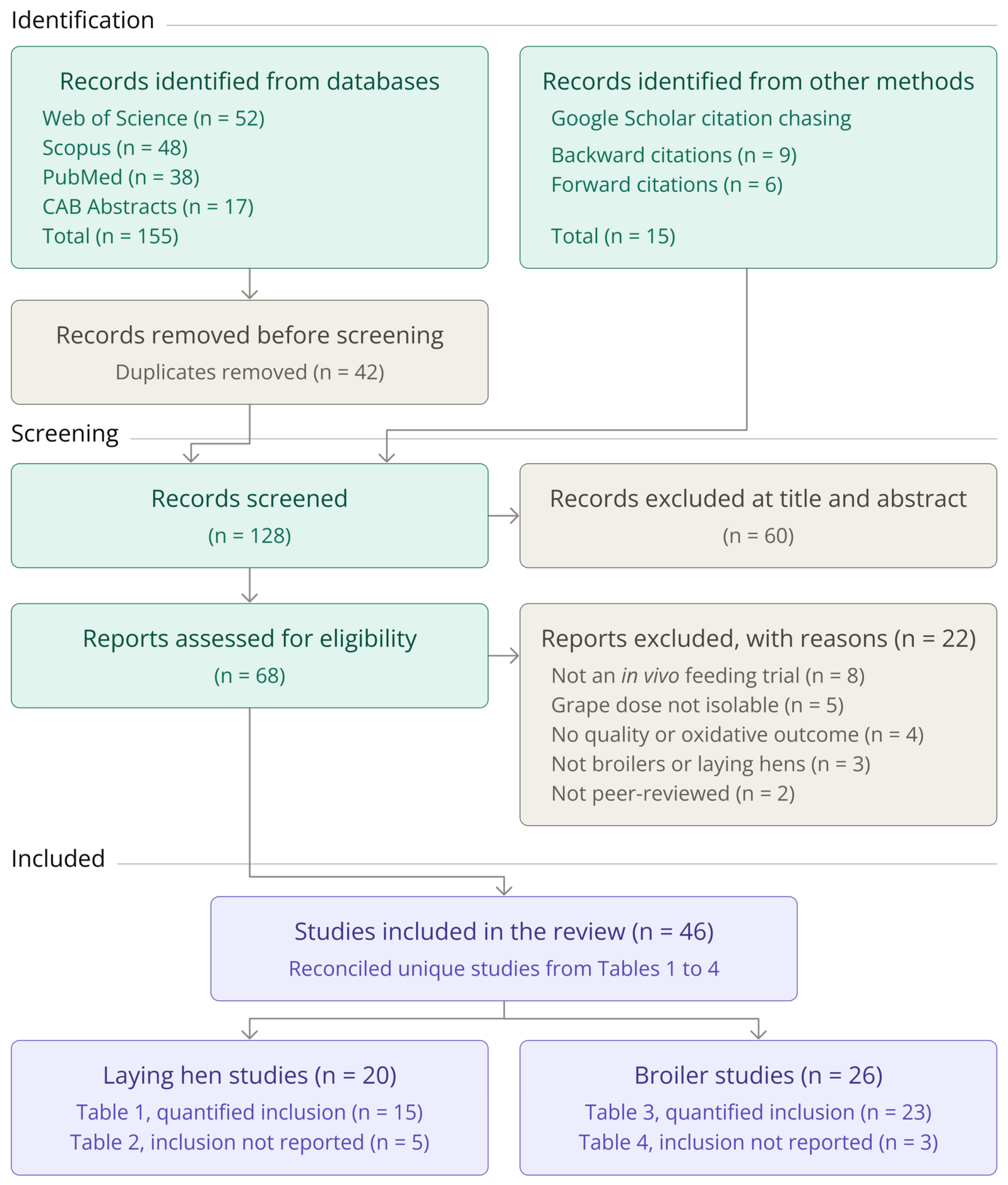
The complete record flow from database identification to study inclusion is presented in Figure 1. To provide a quantitative overview of the direction of effects, the outcomes of the included studies, as summarized in Table 1, Table 2, Table 3 and Table 4, were also tallied by species and outcome category as positive, negative, or no significant effect, with each study counted only in the categories it assessed. Because this vote-counting approach does not account for effect size, sample size, or statistical power, the resulting counts are presented as descriptive indicators of consistency rather than as measures of effect magnitude.
3. Grape By-Products Used in Poultry Nutrition: Composition, Bioactive Compounds, and Feed Limitations
3.1. Principal By-Product Fractions
Three principal grape by-product fractions are commonly used in poultry feeding studies: whole grape pomace, grape seed meal, and grape seed extract. Whole grape pomace is the heterogeneous mixture of skins, seeds, and stems remaining after juice or wine pressing. It typically contains 30–60% crude fiber, 5–12% crude protein, 3–10% crude fat, mostly from seeds, and 10–30% total polyphenols on a dry matter basis. However, these values vary markedly according to grape variety, vinification method, and geographic origin [13].
Grape seed meal is the residue remaining after oil extraction from the seed fraction. Compared with whole grape pomace, it is richer in protein, usually 15–25%, and condensed tannins, especially proanthocyanidins, usually 10–25% [24]. Grape seed extract is a concentrated and often standardized preparation of seed polyphenols obtained through aqueous, hydroalcoholic, or supercritical extraction [25]. It is typically standardized according to proanthocyanidin or total polyphenol content and used at ppm-to-sub-per cent inclusion levels [26]. In this review, grape pomace and grape seed meal are therefore treated as feed materials included at percentage levels, contributing both nutrients and bioactive compounds, whereas grape seed extract and other grape-derived extracts are treated as functional additives dosed for their polyphenol content. The chemical composition of these fractions also differs in nutritionally relevant ways. Red pomace, fermented together with the must, generally contains less residual sugar and more anthocyanins than white pomace, which is usually separated before fermentation, while a higher seed-to-skin ratio increases proanthocyanidin and fat content, the latter being rich in polyunsaturated fatty acids, mainly linoleic acid [13,24]. These differences influence the energy value, protein-binding capacity, antioxidant supply, and oxidative susceptibility of the diet, and partly explain the variability in responses observed across the trials reviewed in Section 4 and Section 5.
3.2. Key Bioactive Compounds
The main bioactive compounds in grape by-products relevant to poultry nutrition are condensed tannins, particularly proanthocyanidins [21]. These compounds are oligomeric and polymeric flavanols with strong radical-scavenging and metal-chelating activity [27]. Seeds are the predominant source and contain mainly procyanidin dimers, trimers, and oligomers [28]. Skins provide a broader polyphenol profile, including anthocyanins in red or black varieties, flavonols such as quercetin and myricetin, stilbenes such as resveratrol, and hydroxycinnamic acids [29]. Stems also contribute stilbenes and flavonols [30]. Additionally, all fractions contain alpha-tocopherol at concentrations that may contribute to the antioxidant pool in formulated diets [14]. Standard antioxidant assays, including DPPH, ABTS, and FRAP, consistently demonstrate high in vitro antioxidant capacity of grape by-product extracts, although activity relative to synthetic antioxidants depends on the fraction, extraction solvent, assay system, and comparator used [31]. However, their bioavailability in poultry digestive tracts is not fully characterized [32].
Tannin content and composition vary considerably among grape by-products. In seeds, they depend mainly on grape variety, ripeness at harvest, and climatic conditions [28], while skin polyphenols also respond to growing conditions such as water deficit [29]. Vinification matters as well, because skin contact and fermentation in red winemaking extract part of the tannins into the wine [13], and drying further modifies the polyphenol profile [14].
3.3. Anti-Nutritional Factors and Feed Limitations
The main feed limitation of grape by-products is their anti-nutritional potential, particularly when unprocessed, high-fiber or high-tannin fractions are used at elevated inclusion levels. Condensed tannins can bind dietary proteins and digestive enzymes, forming complexes that may reduce amino acid digestibility and, to a lesser extent, starch and fat utilization [15]. The magnitude of this effect depends on tannin concentration, tannin structure, and the degree of polymerization of the proanthocyanidin fraction [33]. In addition, the high fiber content of grape pomace, mainly insoluble cell-wall polysaccharides, can dilute dietary energy density, increase digesta bulk, alter passage rate, and reduce nutrient accessibility to digestive enzymes and the absorptive surface [24].
These constraints are particularly relevant in broilers, whose rapid growth rate and relatively short gastrointestinal transit make them less tolerant of poorly digestible fiber and tannin-rich ingredients than laying hens [16]. Several studies suggest that tolerance to grape by-products is matrix- and processing-dependent. Grape pomace concentrate has been included up to 60 g/kg without impairing broiler growth performance or crude protein digestibility [9], whereas grape-skin fractions at 30–60 g/kg have been associated with reduced growth performance and ileal protein digestibility [34]. At higher red grape pomace inclusions, tannin-binding or processing strategies such as polyethylene glycol and fibrolytic enzymes have been shown to mitigate anti-nutritional effects [35]. Therefore, inclusion levels above approximately 5–7% for unprocessed grape pomace or grape-skin fractions should be interpreted as an approximate caution range rather than a universal threshold, because tolerance depends on grape variety, seed-to-skin ratio, tannin and fiber concentration, processing method, basal diet formulation, bird strain, age, and production conditions.
By contrast, laying hens appear moderately more tolerant of grape by-products, possibly because of lower growth pressure, longer digestive retention time, and greater capacity to accommodate fibrous ingredients [36,37]. Therefore, the practical inclusion range for unprocessed grape by-products is generally narrower in broilers than in laying hens. Processing strategies such as fermentation, enzymatic pretreatment, fractionation, or tannin-binding approaches may reduce tannin activity, improve fiber degradability, and allow higher inclusion levels while preserving the antioxidant and product-quality benefits of grape-derived bioactive compounds [10,35,38].
4. Evidence from In Vivo Laying-Hen Trials
Table 1 provides a structured overview of the eligible in vivo laying-hen trials identified through the structured literature search, grouped by product category and ordered by inclusion level from lowest to highest within each group. Polyphenol-rich extracts of grape seed or grape pomace are concentrated preparations included at mg/kg levels to obtain a specific biological effect and are therefore listed as feed additives. In contrast, grape pomace, grape seed meal, and crushed grape seed are included at percentage levels, replace part of the diet, and contribute energy, protein, fiber, and fat; they are therefore listed as feed materials. Because these feed materials also supply bioactive polyphenols, they are referred to in this review as feed materials with functional properties rather than as functional additives. It organizes the evidence by grape by-product type, inclusion level, and principal outcomes in hens and eggs. This structure illustrates the key pattern discussed throughout this section. Low-dose extracts act mainly on antioxidant biology and systemic physiology, whereas multi-per cent inclusions of grape pomace or grape seed meal more consistently influence yolk color, Haugh unit, shell traits, lipid profile, and oxidative stability during storage.
Studies for which the inclusion level was not reported in the primary evidence summary are listed separately in Table 2.
Table 2 includes laying-hen trials in which the dietary inclusion level of the grape by-product was not clearly specified, with NR indicating “not reported.” These studies cannot be included in a strict inclusion-level ranking or dose–response analysis. However, they are retained to ensure complete evidence coverage.
The recurring outcome themes in Table 2 include antioxidant protection, lipid peroxidation control, and preservation of PUFA-enriched egg quality during storage. These themes are broadly consistent with the patterns established by the fully quantified trials in Table 1. Moreover, Table 2 highlights reporting gaps that limit dose–response inference and underscores the need for standardized reporting of inclusion rates and compositional characterization of grape materials in future trials.
Table 1.
In vivo laying-hen trials evaluating grape by-products (feed materials) or extracts (feed additives) in poultry diets (grouped by product category and ordered by inclusion level within each group, from lowest to highest).
Table 2.
Laying-hen studies with incompletely reported or non-isolated grape by-product inclusion levels.
4.1. Laying Performance and Feed Efficiency
Across laying-hen studies, production performance is generally maintained, and improvements are most evident under conditions associated with elevated oxidative or physiological stress. At ppm-level supplementation, Beshara et al. [41] reported improved productive indices in hens aged 47 to 62 weeks, whereas Sun et al. [40] found laying rate, feed intake, and feed/egg ratio unchanged with 150 mg/kg grape seed extract. Lee et al. [39], working under an oxidized-oil dietary challenge, reported improved laying performance with grape polyphenol extract, indicating that the production response may be amplified when oxidative load is high. However, not all studies report clear production benefits. For example, Romero et al. [11] observed largely unchanged egg production and egg mass with grape extract supplementation, and several ingredient-level studies indicate that feed intake and feed conversion are generally maintained rather than consistently improved when diets are properly balanced. At ingredient-level inclusions, Kaya et al. [43] reported linear increases in egg production with crushed grape seed and grape seed extract, while Selim et al. [36] observed improvements in egg production, egg weight, and egg mass from 3% to 9% grape pomace. In aged hens (48 to 60 weeks of age), Alm El-Dein et al. [44] found that 2% to 4% grape pomace increased egg production and egg mass and improved feed conversion, with 4% outperforming 150 mg/kg vitamin E, possibly because elevated baseline oxidative stress in older birds increased responsiveness to antioxidant supplementation. Nasiri et al. [48] reported performance benefits at 4.5% grape waste, particularly under high stocking density. Together, these studies suggest that grape by-products can support laying performance. Still, the response is not uniform and appears to depend on bird age, oxidative challenge, stocking density, by-product matrix, inclusion level, and diet formulation.
4.2. Egg Internal Quality and Yolk Pigmentation
Haugh unit and yolk color are among the most consistently improved endpoints across the laying-hen literature. Kaya et al. [43] found linear increases in Haugh unit with both grape seed forms, and Kara et al. [47] reported a Haugh unit of 87.3 at 4% pomace versus 83.1 in controls. El-Aaser et al. [42] confirmed Haugh unit improvements at 600–1800 mg/kg GSE in aged hens, alongside improved shell thickness. Romero et al. [11] observed elevated yolk color scores (approximately 8.1 versus 7.3 in controls) with grape extract and pomace, and noted a small reduction in average egg weight as a formulation trade-off. Olteanu et al. [45] found that yolk color intensified progressively from 2% to 4% GSM in omega-3-enriched diets, while Haugh unit responded most strongly at the lower inclusion. Selim et al. [36] documented linear improvements in Haugh unit, yolk color, albumen index, and eggshell ultrastructure from 3% to 9% pomace, with the strongest shell responses at the highest level. Herranz et al. [50] and Reis et al. [49], both at 5% pomace, confirmed marked increases in yolk polyphenol content alongside improved internal and external quality parameters, supporting a functional-egg enrichment interpretation as well as a conventional quality one.
4.3. Yolk Lipid Oxidation and Storage Stability
Reduction in yolk lipid peroxidation during storage is one of the most reproducible outcomes in this literature. Lee et al. [39] confirmed lower yolk TBARS and preserved Haugh units in eggs stored after polyphenol extract supplementation under oxidized-oil conditions. Kaya et al. [43] described dose- and time-dependent reductions in yolk oxidative markers during refrigerated storage across both grape seed matrices. Olteanu et al. [52] observed the strongest reduction in yolk TBARS at 4% GSM after 28 days of storage in PUFA-enriched eggs. Vlaicu et al. [46] reported that 3% pomace both elevated the yolk antioxidant starting-point and reduced TBARS accumulation during refrigeration, and Kara et al. [47] confirmed lower egg TBARS at 15 and 30 days of storage with 4% pomace. At higher inclusions, Selim et al. [36] documented linearly decreasing lipid oxidation from 3% to 9%, while Reis et al. [49] and Herranz et al. [50] showed that 5% pomace produced substantial reductions in yolk oxidation over extended storage periods. The Table 2 studies (NR inclusion) are also thematically consistent. Tufarelli et al. [51], Olteanu et al. [52,53], and Bunduc et al. [54] all reported reduced lipid peroxidation and preserved egg quality during storage in PUFA-enriched egg contexts, reinforcing the robustness of this effect across matrices and experimental designs.
4.4. Lipid Metabolism and Antioxidant Status
Improvements in serum lipid profile and systemic antioxidant enzyme activity are consistent across inclusion levels and by-product types. Sun et al. (2018) [40] reported an approximately 16.5% reduction in yolk cholesterol with 150 mg/kg GSE. Kaya et al. (2014) [43] reported declining serum cholesterol with both grape seed forms, and Olteanu et al. [45] found concurrent reductions in serum cholesterol and triglycerides with GSM at 2% and 4%. Vlaicu et al. [46] described favorable shifts in yolk fatty acid composition (higher PUFA, lower SFA) at 3% pomace alongside increased yolk antioxidant capacity. Beshara et al. [41] documented improved antioxidant indices in hens supplemented at the sub-percent level, Alm El-Dein et al. [44] found that plasma SOD and GPx activities in aged hens increased at every grape pomace level from 1% to 4%, and Selim et al. [36] confirmed these patterns at higher inclusions with additional improvements in hepatic enzyme profiles and tibia mineral content. Cornescu et al. [37] observed elevated antioxidant enzyme activity and favorable cecal microbiota shifts at 6% white grape pomace across thermal treatment groups.
4.5. Stress Resilience: Heat Stress, Stocking Density, Oxidized Oil, and Aging Hens
A recurring pattern across the laying-hen evidence is that performance-related responses are more likely to be detected when the experimental model involves elevated oxidative, thermal, aging-related, reproductive, or density-related stress. In contrast, egg-quality and oxidative-stability outcomes appear more consistently responsive across both challenged and non-challenged conditions. Lee et al. [39] showed that the performance, egg quality, and hepatic protection benefits of grape polyphenol extract were contingent on the presence of dietary oxidized fat. Alm El-Dein et al. [44] fed grape pomace to aged hens (48 to 60 weeks of age), in which oxidative stress is chronically elevated, and found clear production and antioxidant benefits that may be more modest in young, unchallenged birds. Nasiri et al. [48] evaluated 4.5% grape waste under two stocking densities and found that improved egg production, Haugh unit, yolk color, and mitigation of stress markers (serum corticosterone, oxidative indices) were most pronounced under high stocking density. Cornescu et al. [37] evaluated 6% white grape pomace under normal, heat-stress, and cold-stress conditions and found that the improvements in egg quality parameters, antioxidant enzyme activities, and lipid peroxidation during storage were all amplified under heat stress relative to the thermoneutral control. Hafeez et al. [55], in the Table 2 cohort, similarly reported production, digestibility, and lipid peroxidation benefits from GSE under conditions where reproductive performance was a primary concern. The consistent stress-amplification pattern has practical implications. Grape by-products are likely to deliver their strongest return on investment in production systems or seasons characterized by elevated thermal, oxidative, or density-related burden.
5. Evidence from In Vivo Broiler Trials
Across broiler studies, the most reproducible outcomes are improved antioxidant status, reduced lipid oxidation in meat, and modulation of lipid or gut-health indices. In contrast, growth-performance responses are more variable and depend strongly on grape by-product matrix, inclusion level, and processing. Table 3 provides a structured overview of the eligible in vivo broiler feeding trials identified through the structured literature search, ordered by inclusion level from lowest to highest. It covers the full inclusion gradient, ranging from ppm-level grape seed extracts to 10% red grape pomace. The table also separates bird-level outcomes, including growth, antioxidant, and immune responses, from meat and shelf-life outcomes.
Studies for which the inclusion level was not reported in the primary evidence summary are listed separately in Table 4.
Table 4 includes broiler trials in which the dietary inclusion level of the grape by-product was not clearly specified, with NR indicating “not reported.” As with Table 2 for laying hens, these studies cannot be integrated into a strict inclusion-level ranking. However, they are retained to maintain complete evidence coverage.
The recurring outcome themes in Table 4 include antioxidant status and meat quality attributes. These themes are consistent with the patterns observed in the fully quantified broiler trials in Table 3. Moreover, Table 4 highlights reporting gaps that limit dose–response inference and underscores the need for standardized reporting of by-product inclusion rates and compositional characterization to improve cross-trial comparability.
Table 3.
In vivo broiler trials evaluating grape by-products or extracts in poultry diets (ordered by inclusion level, lowest to highest).
Table 4.
Broiler studies with incompletely reported or non-isolated grape by-product inclusion levels.
5.1. Growth Performance and Feed Conversion
Growth performance responses in broilers are less uniform than antioxidant or meat-quality responses and are strongly influenced by inclusion level, grape matrix, and processing method. At low doses, grape seed extracts do not impair and often do not improve growth. Farahat et al. [12] found no material change in body weight across 125–2000 ppm GSE, and Karadagoglu et al. [56] reported the primary benefits at 100–400 ppm as biochemical and lipid-profile improvements rather than growth gains. At moderate whole-ingredient inclusions, a clearer benefit emerges. Gungor et al. [10] documented increased body weight and average daily gain at 1.5% Aspergillus niger-fermented grape pomace, and Kharde et al. [58] confirmed improved production outcomes and economic returns at the same level. Abu Hafsa and Ibrahim [60] established an important nuance by comparing 1%, 2%, and 4% grape seed. The 2% level produced the most favorable growth and FCR response, while 4% delivered the strongest antioxidant outcome but not the best growth. Nan et al. [38] showed that fermented grape seed meal at 2–6% achieved dose-dependent improvements in average daily gain and feed conversion that unprocessed material would not achieve at equivalent levels, underlining the critical role of fermentation in unlocking growth compatibility at higher inclusions. Conversely, unprocessed high-tannin fractions are growth-suppressive, with Khodayari and Shahria [72] reporting declining performance beyond the lowest red grape pomace inclusion and Nardoia et al. [34] finding growth depression at both 3% and 6% unfermented grape skin.
Overall, the broiler evidence indicates that grape by-products produce more consistent benefits for antioxidant status, lipid metabolism, gut modulation, and meat oxidative stability than for growth performance. Growth and feed-conversion responses are matrix-, dose-, and processing-dependent. Low-dose grape seed extracts generally do not impair growth but mainly improve antioxidant, lipid, or immune indices. Moderate inclusions of whole grape seed, grape pomace, or grape seed meal can be performance-compatible, particularly when diets are nutritionally balanced. However, unprocessed grape-skin or high-tannin pomace fractions at higher inclusion levels may reduce protein digestibility, growth rate, or feed efficiency. Therefore, broiler growth responses should not be generalized across grape by-products without considering tannin concentration, fiber content, seed-to-skin ratio, processing method, and basal diet formulation.
5.2. Carcass Traits and Meat Technological Quality
Carcass yield is generally unaffected at moderate inclusions. Giamouri et al. [63] reported no change in carcass yield at 2.5% ground grape pomace, and Sen and Basalan [70] found carcass yield preserved at 5% pomace. Nan et al. [38] documented reduced abdominal fat with fermented GSM in a dose-dependent pattern, consistent with the inhibitory effects of procyanidins on hepatic lipogenesis described in Section 7.5. Meat technological quality responds positively even when growth is unchanged or modestly reduced. Thema et al. [61] reported dose-dependent improvements in water-holding capacity and reduced cooking loss at 1.5–5% red grape pomace under high stocking density, alongside shifts in pH and color parameters. Giamouri et al. [63] found altered meat color and an improved fatty acid profile (higher unsaturated fraction) at 2.5%. Karadagoglu et al. [56] reported breast-meat fatty acid modulation at 100–400 ppm GSE, and Hascik et al. [66] characterized amino acid and fatty acid profile changes in breast and thigh meat at 1–3% Alibernet red grape pomace. Kumanda et al. [35] showed that processing with PEG and fibrolytic enzymes at 10% pomace improved water-holding capacity in addition to restoring body weight, demonstrating that meat technological quality and growth response can be simultaneously rescued by appropriate pre-treatment.
5.3. Meat Oxidative Stability During Storage
Reduced lipid peroxidation in stored broiler meat is the most consistently demonstrated endpoint in this literature, reproduced across extract levels, whole by-product inclusions, and processing states. Farahat et al. [12] documented lower thigh muscle TBARS at 125–2000 ppm GSE. De-Cara et al. [73] confirmed improved oxidative stability during refrigerated storage with a grape-based by-product mix. Gungor et al. [10] did not find effects on muscle TBARS at 1.5% raw grape pomace or Aspergillus niger-fermented grape pomace. Abu Hafsa and Ibrahim [60] showed TBARS reductions at 4% grape seed. Brenes et al. [9] provided an important benchmark comparison by showing that grape pomace concentrate at 1.5–6% improved breast-meat oxidative stability during refrigerated storage, with responses comparable to those obtained with 200 mg/kg vitamin E under the conditions of that study. However, this finding should be interpreted as matrix- and context-specific, because equivalence to vitamin E may depend on grape by-product composition, inclusion level, basal diet, bird genotype, antioxidant status, storage temperature, storage duration, packaging conditions, and the oxidation endpoint measured. Romero et al. [69] showed that a 4% blend of grape seed and skin reduced thigh-meat TBARS most effectively when skins comprised at least 50% of the mix, and increased plasma and muscle alpha-tocopherol without additional vitamin E supplementation, providing direct evidence for tocopherol sparing. Olteanu et al. [65] confirmed improved oxidative stability in slow-growing broilers fed 3% GSM in PUFA-enriched diets, and Turcu et al. [67] found TBARS reductions at 3–6% pomace in a similar dietary context. At 6% grape skin, Nardoia et al. [34] found that oxidative stability during refrigerated storage was comparable to vitamin E even though growth was suppressed, illustrating that antioxidant transfer to meat can be maintained independently of production performance.
5.4. Gut Morphology, Microbiota, and Immune Response
Gut morphology, microbiota composition, and immune function are particularly well-characterized in the broiler literature. Huerta et al. [57] documented modulation of intestinal structure and immune function at 0.1–0.4% GSE, and Gungor et al. [10] showed that 0.5% whole grape seed shifted cecal microbial balance toward higher Lactobacillus and lower E. coli counts, alongside the growth and antioxidant benefits. Abu Hafsa and Ibrahim [60] found the strongest microbiota and SOD/CAT/GPx/GSH responses at 4% grape seed, independent of the growth optimum at 2%. Pascariu et al. [59] documented differential effects on systemic redox status and hematological indices across grape pomace, seed, and extract matrices, reinforcing that delivery form matters for gut-level as well as systemic responses. Gungor et al. [10], comparing raw and fermented pomace at 1.5%, found that fermented pomace reduced cecal Clostridium perfringens, a commercially relevant pathogen indicator, while raw pomace produced stronger biochemical antioxidant signals. Oretomiloye et al. [64] showed that 2.5% grape pomace restored intestinal morphology impaired by heat stress and shifted microbial taxa favorably, supporting the concept of grape by-products as gut-resilience ingredients. Ebrahimzadeh et al. [71] documented gut morphology changes and improved antioxidant and immune indicators at 5–10% pomace, with no performance differences across inclusion levels, indicating that high doses can sustain gut-level benefits even when growth is not enhanced. Farahat et al. [12] reported enhanced antibody titers against Newcastle disease at low GSE doses, extending the immune-function evidence to pathogen-specific responses.
5.5. High-Inclusion Risks and Processing Solutions
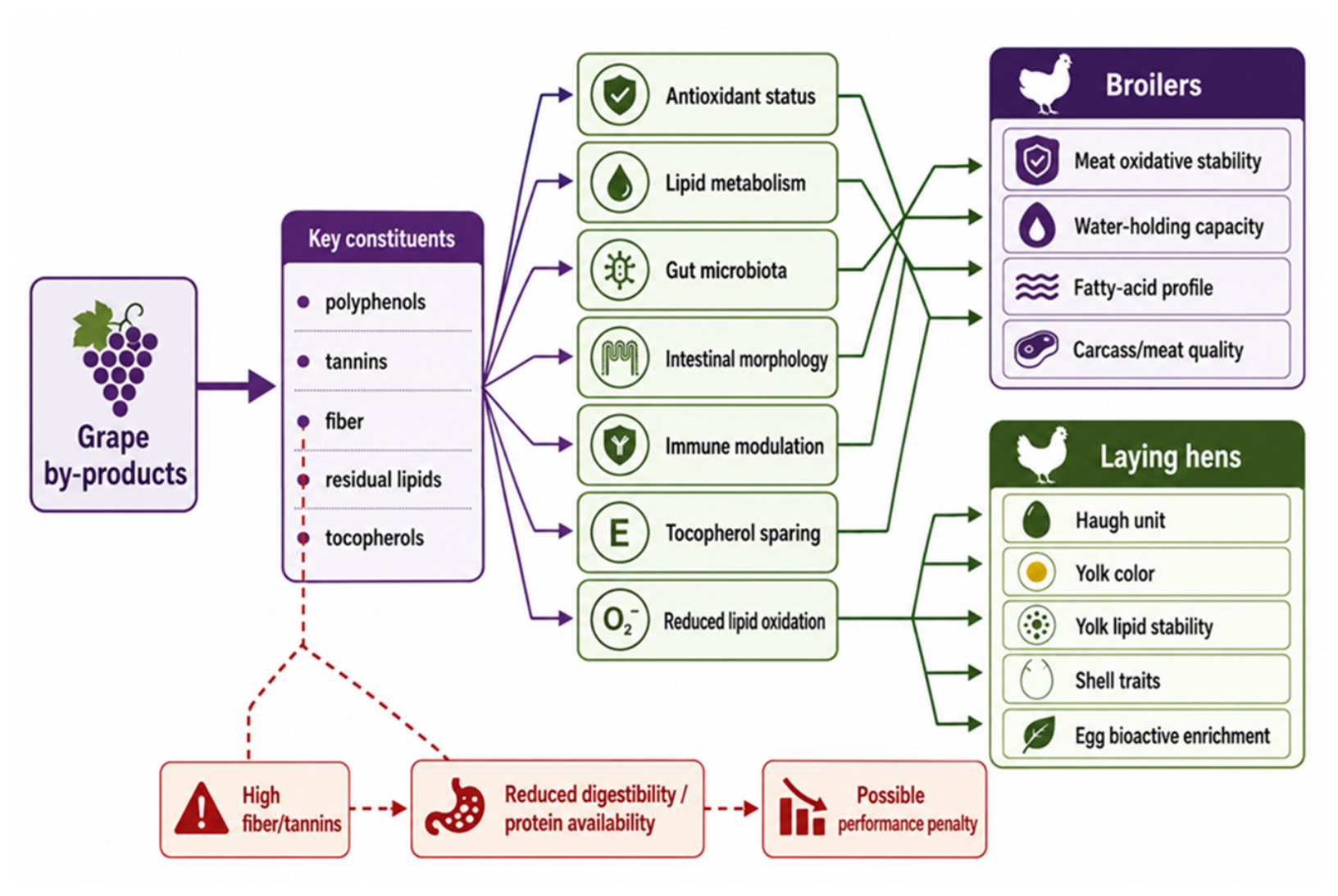
The upper boundary of the performance-safe inclusion range for unprocessed grape by-products in broilers is approximately 3–5% for whole pomace and 2–4% for high-tannin fractions such as grape skin, with Khodayari and Shahria [72] and Nardoia et al. [34] both demonstrating growth depression below these thresholds. At 10% red grape pomace, Kumanda et al. [35] made the constraint explicit. Untreated pomace caused severe growth depression, but polyethylene glycol (a tannin-binding agent) and fibrolytic enzymes substantially restored body weight, carcass yield, and selected meat quality traits, providing a direct demonstration of how the anti-nutritional mechanism can be pharmacologically and enzymatically circumvented. Fermentation is the most scalable and commercially relevant processing solution. Nan et al. [38] showed that fermented grape seed meal at 2–6% not only eliminated performance penalties but produced dose-dependent improvements in ADG, FCR, abdominal fat, and microbiome composition relative to unsupplemented controls. Gungor et al. [10] confirmed that fermented grape pomace at 1.5% improved final body weight and cecal microbiota more favorably than raw pomace at the same level. Romero et al. [68] demonstrated that blending grape seed and grape skin at 4% total inclusion in a ratio that maximizes skin contribution preserved tocopherol-sparing and meat oxidative stability benefits without the growth penalty that accompanied single-fraction high-skin inclusion at 11%. Together, these studies support a processing and formulation hierarchy: fermentation for whole pomace or seed meal at elevated inclusions, PEG or fibrolytic enzymes when fermentation is impractical, and blending of fractions to dilute the highest-tannin components while preserving aggregate bioactive exposure. This high-inclusion caution scenario corresponds to the dashed red pathway in Figure 2.
6. Cross-Species Synthesis: What Is Consistent, What Is Species-Specific, and What Is Dose-Dependent
6.1. Consistent Cross-Species Responses
Across broilers and laying hens, the most consistently reproduced outcomes of grape by-product supplementation are improved systemic antioxidant enzyme activities, including SOD, CAT, and GPx, and increased total antioxidant capacity. Supplementation also reduces tissue and product TBARS during post-slaughter or post-lay storage [39,45,46]. Moreover, it produces favorable shifts in serum lipid profiles, including reductions in total cholesterol, LDL, and triglycerides, as well as increases in HDL. Additionally, grape by-products modulate gut microbiota by increasing Lactobacillus and reducing pathogen-indicator populations [10,11,12]. Because these outcomes are reproduced across diverse experimental designs, they may be regarded as robust biological signals.
This pattern is supported by a descriptive count of the outcomes summarized in Table 1, Table 2, Table 3 and Table 4. In laying hens (n = 20), product-related outcomes were the most consistent: all 18 studies that evaluated egg quality or egg oxidative stability reported a positive effect, and all 11 studies that assessed systemic antioxidant status reported improvements. Production performance was more variable, with 9 of 14 studies reporting improvements and 5 reporting no significant effect, while none reported a clear negative effect on egg output, although two extract trials recorded small reductions in egg weight [11,40]. In broilers (n = 26), all 12 studies that measured meat lipid oxidation reported reduced oxidation in at least one treatment, and 12 of 13 studies that assessed systemic antioxidant status reported improvements, with the remaining study showing matrix-dependent responses. In contrast, growth performance was the least consistent outcome. Of the 17 broiler studies reporting growth data, 4 showed improvements, 9 showed no significant effect, and 4 showed negative effects, the latter associated with high inclusion levels of unprocessed grape skin or red grape pomace. These counts reinforce the conclusion that grape by-products act more reliably on antioxidant status and product quality than on growth performance.
6.2. Species-Specific Responses
Some endpoints are more consistently and strongly expressed in one species. Laying hens show particularly pronounced responses in yolk pigmentation, including anthocyanin and carotenoid transfer to the yolk, eggshell mineralization, including shell thickness, breaking strength, and ultrastructure, and egg internal quality, especially Haugh unit [36,39,42]. These responses partly reflect the unique physiology of laying hens, since continuous egg formation creates a metabolic interface between dietary bioactive compounds and the developing egg. Furthermore, the antioxidant environment of the hen directly influences lipid packaging in the yolk and calcium mobilization for shell formation.
Broilers show relatively stronger and more characterized responses in intestinal morphology, including villus height, crypt depth, and absorptive surface area. They also show clear changes in gut microbiota diversity and composition, as well as immune function indices, including antibody titers and heterophil-to-lymphocyte ratio. These responses may reflect the biological relevance of gut integrity and immune competence in high-growth-rate broilers, where intestinal health is a primary driver of productive efficiency [10,38,61].
6.3. Performance Responses and Influencing Factors
Production performance is the least consistent outcome in the reviewed trials. In laying hens, performance improved in 9 of 14 studies and was unaffected in the remainder, whereas in broilers, growth improved in 4 of 17 studies, was unaffected in 9, and declined in 4 (Section 6.1). This variation reflects several interacting factors, of which dose is the most widely studied.
Dose–response relationships are present in both species, but they are not uniformly linear. At low doses, from ppm to sub-per cent levels, the main effects involve antioxidant and immunometabolic modulation, with minimal performance effects [39,40,41]. At moderate doses, approximately 1–4%, a favorable balance between bioactivity and digestibility is achievable for most matrices, and broader quality endpoints, including yolk color, shell traits, and meat fatty acid profile, become responsive [10,45,47]. At higher doses, approximately 5–10%, antioxidant and quality benefits may increase further. However, the risk of digestibility-related performance penalties also increases in a non-linear way, depending on by-product type, fiber and tannin profile, and processing status [34,35,36].
Importantly, the dose that optimizes production performance does not necessarily coincide with the dose that optimizes antioxidant or quality protection. In broilers, Abu Hafsa and Ibrahim (2018) [60] documented that 2% grape seed favored growth performance, whereas 4% produced stronger antioxidant and microbiota effects. In laying hens, egg output tends to be more tolerant of higher inclusion levels than broiler growth performance, which extends the formulation-safe window for laying-hen diets.
Product type also shapes the response. Functional additives such as grape seed extract, used at ppm levels, rarely change performance and act mainly on antioxidant, lipid, and immune indices [12], whereas feed materials such as grape pomace and grape seed meal, included at percentage levels, also change the nutrient and anti-nutrient content of the diet. Within feed materials, the concentrations of condensed tannins [15] and fiber [16], which depend largely on the seed-to-skin ratio, determine the inclusion level at which digestibility and growth decline, and fermentation, enzyme treatment, or tannin-binding agents can raise this threshold [10,35,38] (Section 5.5). Physiological state and challenge are a further factor. Performance benefits are most evident under oxidative or environmental stress, such as oxidized dietary oil, heat stress, or high stocking density [39,48,64], and in older hens [44], whereas under standard conditions performance is usually maintained rather than improved. Finally, diet composition matters: responses are stronger in PUFA-enriched or oxidized-fat diets, performance is more likely to be maintained when diets are nutritionally balanced, and dietary vitamin E status modifies the contribution of grape polyphenols (Section 8.1 and Section 8.3).
7. Mechanisms of Action
The mechanisms summarized in this section differ in the strength of direct poultry evidence. Reductions in TBARS/MDA, improvements in SOD, CAT, GPx, total antioxidant capacity, changes in serum lipid indices, and selected microbiota shifts are directly supported by broiler and laying-hen feeding trials. By contrast, some intracellular pathways, including Nrf2-Keap1 activation, NF-κB modulation, pancreatic lipase inhibition, and detailed microbial metabolite formation, are supported mainly by broader polyphenol, mammalian, or in vitro literature and should therefore be interpreted as plausible mechanistic explanations rather than fully confirmed mechanisms in poultry [76,77]. Where possible, the following subsections distinguish direct poultry outcomes from inferred molecular pathways. Figure 2 provides a visual conceptual synthesis of the principal pathways through which grape by-products influence poultry performance, health, and product quality. It distinguishes beneficial pathways from the caution pathway associated with high fiber and tannin content at elevated inclusion levels, shown as a dashed red pathway. The following subsections address each mechanism in detail.
Figure 2.
Proposed mechanisms linking grape by-products to poultry performance, health, and product quality. Solid arrows indicate mechanisms supported by direct poultry feeding-trial outcomes, such as reduced thiobarbituric acid reactive substances (TBARS)/malondialdehyde (MDA), improved antioxidant enzyme activities, altered lipid indices, and selected microbiota shifts. Dashed arrows indicate plausible molecular mechanisms supported mainly by broader polyphenol, mammalian, or in vitro literature and requiring further confirmation in poultry [76,77,78]. The dashed red pathway indicates the caution scenario in which high fiber and tannin contents at elevated inclusion levels may reduce digestibility and protein availability.
7.1. Direct Antioxidant Activity
One of the best-characterized mechanisms of action of grape by-products is the antioxidant activity of grape polyphenols, particularly proanthocyanidins and their monomeric precursors, including catechin and epicatechin [79,80]. These compounds can scavenge free radicals and chelate transition metals, especially iron and copper, that catalyze Fenton-type reactions [81]. They may also help preserve the functional tocopherol pool by regenerating α-tocopherol from its radical form, thereby contributing to vitamin E sparing [69,79]. In poultry feeding trials, the most direct evidence for antioxidant activity is the repeated reduction in TBARS or MDA in eggs, meat, serum, or liver following grape by-product supplementation [11,12,68]. This response is consistent with the radical-scavenging and metal-chelating properties of grape polyphenols. However, in vitro antioxidant capacity should not be assumed to predict in vivo efficacy without considering digestion, absorption, metabolism, tissue deposition, and the specific oxidative challenge [82].
7.2. Upregulation of Endogenous Antioxidant Defenses
Direct poultry evidence for activation of endogenous antioxidant defenses is mainly functional, reflected by increased SOD, CAT, GPx, GSH, or total antioxidant capacity and reduced MDA in several broiler and laying-hen studies [12,83]. These responses are consistent with possible involvement of the Nrf2-Keap1 signalling pathway, although direct confirmation in poultry remains limited [76,84]. If activated, Nrf2 can upregulate transcription of antioxidant enzymes, including SOD, CAT, GPx, and heme oxygenase-1, as well as glutathione biosynthetic enzymes. More direct evidence is provided by altered hepatic antioxidant gene expression in pomace-supplemented broilers, as reported by Mavrommatis et al. (2021) [62].
7.3. Anti-Inflammatory Effects
Proanthocyanidins and anthocyanins have been proposed to modulate inflammatory signalling, potentially through inhibition of NF-κB activation, reduced pro-inflammatory cytokine production, including TNF-α, IL-1β, and IL-6, and suppression of cyclooxygenase-2 activity [85,86,87]. In poultry, however, these pathways have rarely been measured directly, and anti-inflammatory effects are inferred mainly from improved heterophil-to-lymphocyte ratios, immune markers, reduced serum transaminases, and gut-health outcomes [39,83,85]. Moreover, they may improve performance under stressors such as heat, high stocking density, and oxidized fat, where inflammatory responses otherwise compromise productive efficiency [37,61].
7.4. Gut Microbiota Modulation
Grape-derived polyphenols and associated fiber fractions also modulate the intestinal microbiome, as directly shown in poultry studies that report increased Lactobacillus, reduced E. coli or Clostridium indicators, or broader shifts in cecal microbial composition [10,38,88]. Microbial fermentation of grape polyphenols into phenolic acids or urolithin-like metabolites may provide additional antioxidant and anti-inflammatory activity in the gut epithelium [89,90], but the formation and systemic relevance of these metabolites have not been fully characterized in broilers or laying hens [89,91].
Therefore, the consistently reported shifts in microbiota composition across multiple broiler and laying-hen studies, together with improvements in intestinal morphology, support the conclusion that gut ecology is an important pathway through which grape by-products influence systemic and productive outcomes [38,88].
7.5. Lipid Metabolism Effects
Poultry feeding trials provide direct evidence for changes in serum cholesterol, triglycerides, abdominal fat deposition, and egg or meat fatty-acid profiles [12,36]. However, specific molecular mechanisms such as pancreatic lipase inhibition or downregulation of SREBP-1c and FAS are less consistently demonstrated in poultry and should be framed as plausible explanations supported by broader nutritional and polyphenol literature [92,93].
In poultry, these effects are reflected in lower serum and hepatic triglycerides, reduced abdominal fat deposition, as documented in broilers by Nan et al. (2022) [38], and altered tissue fatty acid profiles. In laying hens, modulation of hepatic lipid metabolism may contribute to the reported shifts toward higher MUFA and PUFA and lower cholesterol and SFA in eggs from grape-supplemented hens [11,47].
7.6. Tocopherol Sparing and Transfer
Compared with several other proposed pathways, tocopherol sparing has more direct poultry support, where studies report increased plasma or muscle α-tocopherol and improved meat oxidative stability in birds fed grape seed–skin combinations without additional vitamin E. Nevertheless, this mechanism should be interpreted in relation to the specific grape matrix, diet vitamin E status, and storage conditions tested [62,68].
Romero et al. [69] demonstrated increased plasma and muscle alpha-tocopherol content in broilers fed grape seed and skin blend diets without additional dietary vitamin E supplementation, providing direct evidence for tocopherol sparing. In laying hens, this mechanism contributes to enhanced yolk antioxidant capacity and improved oxidative stability of PUFA-enriched eggs [51,52].
8. Practical Formulation Considerations and Processing Strategies
8.1. Inclusion Level Guidance
Based on the available experimental evidence, the following inclusion ranges can be proposed as provisional, research-derived working guidance rather than definitive commercial recommendations. These ranges should be interpreted in relation to grape by-product type, grape variety, seed-to-skin ratio, polyphenol and condensed tannin concentration, fiber content, processing method, diet formulation, bird genotype, age, production stage, and environmental challenge.
For broiler diets, grape seed extracts have been evaluated across a broad range, approximately 100–2000 ppm, with the most consistent responses related to antioxidant status, lipid metabolism, and immune indices rather than growth performance. In the study by Farahat et al. [12], antioxidant and immune-related responses were observed within this ppm range, with lower inclusion levels appearing sufficient for several functional outcomes. Whole grape seed or grape seed powder has generally been tested at low dietary inclusions, commonly around 0.5–2%, where performance compatibility is more likely [58,60]. For unprocessed grape pomace or grape seed meal, moderate inclusions around 2.5–3% appear most consistently compatible with broiler performance while still providing antioxidant or meat-quality benefits [62,63]. Fermented grape seed meal or otherwise processed grape by-products may allow higher inclusions, such as 4–6%, without growth penalties in some studies; however, these levels should be validated for each processed product [38]. Unprocessed pomace or grape-skin fractions above approximately 5–7% should be considered a caution range rather than a fixed threshold, because anti-nutritional effects depend strongly on tannin concentration, fiber content, and diet formulation [34,35].
For laying hens, the experimental inclusion window appears somewhat wider than for broilers [36,47]. Extracts can generally be considered within ppm ranges similar to those evaluated in broilers, although the target outcomes are more often egg quality, antioxidant status, and yolk oxidative stability [11,39]. Grape pomace and grape seed meal at approximately 3–6% have been associated with improvements in yolk color, egg white quality, egg oxidative stability, and antioxidant indices, usually with limited adverse effects on laying performance when diets are nutritionally balanced [45,47]. Higher inclusions, including levels up to 9% in some studies such as Selim et al. [36], have been evaluated without major production penalties, but the evidence base is thinner at these levels. Therefore, higher inclusion levels should not be generalized without lot-specific ingredient characterization and reformulation for energy, amino acids, fiber, minerals, and feed safety.
8.2. Processing Strategies
Fermentation is the most extensively evaluated processing strategy and the most consistently effective [10,38]. Controlled fermentation with selected microorganisms (Aspergillus spp., Trichoderma, Lactobacillus, or mixed cultures) degrades condensed tannins through tannin-acylhydrolase activity, reduces non-starch polysaccharides through cellulase and xylanase production, increases soluble phenolic acid content, and improves protein digestibility [94,95]. Nan et al. [38] demonstrated complete reversal of the performance penalty associated with unprocessed grape seed meal using fermented preparations at equivalent inclusion levels.
Enzymatic pretreatment with fibrolytic enzyme cocktails (cellulase, xylanase, pectinase) can improve the digestible energy value of pomace fractions by partially degrading cell wall polysaccharides. Kumanda et al. [35] demonstrated that fibrolytic enzymes combined with polyethylene glycol substantially mitigated growth depression from 10% red grape pomace. Pelleting conditions (temperature, moisture, conditioning time) influence polyphenol stability and should be considered when grape by-products are included in pelleted diets; lower-temperature conditioning or expander technology is preferable to preserve bioactivity [96].
8.3. Dietary Context and Interactions
The beneficial effects of grape by-products are consistently stronger in dietary contexts that increase oxidative challenge. These contexts include PUFA-enriched diets, such as omega-3 enrichment from fish oil, linseed, or algae, diets containing oxidized fat, heat-stress environments, and high stocking densities [39,51,61].
However, interactions between grape by-products and other functional ingredients require caution. Sen and Basalan [70] investigated the combination of grape pomace with inulin and reported non-additive or antagonistic effects on some parameters. Therefore, combinations of fermentable substrates and polyphenol sources should be empirically validated rather than assumed to have additive effects.
Interactions with vitamin E are generally relevant because grape polyphenols may contribute to tocopherol sparing and oxidative-stability protection [68]. Nevertheless, replacement of vitamin E or synthetic antioxidants by grape by-products should not be assumed across production systems [91]. Such replacement should be validated for each grape matrix, inclusion level, diet formulation, poultry genotype, and storage condition using product-relevant oxidative-stability endpoints [62,68].
9. Implementation Constraints for Grape-Derived Feed Materials and Functional Additives
The biological evidence reviewed in Section 4 through 7 shows that grape by-products can improve antioxidant status, product quality, and gut health in poultry across different inclusion levels and production contexts. However, biological efficacy under controlled conditions is not sufficient to support commercial adoption. Their practical use depends mainly on processing and stabilization, feed safety, compositional consistency, and whether they are used as feed materials or as functional additives, as discussed below.
Processing grape pomace into a stable feed-grade ingredient requires drying and, in some cases, grinding, fractionation, or fermentation [14]. Fresh pomace contains 50–70% moisture and is highly perishable [17,18]. For this reason, drying to below 10% moisture is essential in storage-dependent supply chains [14,18], although drying is energy-intensive and can be costly [97]. Fermentation can reduce anti-nutritional tannins and improve compatibility with higher inclusion levels, but it requires controlled microbial cultures, moisture management, and secondary drying [10,38,98]. Overall, grape pomace should not be viewed as a cheap by-product that is immediately ready for feed use [14,98].
Safety and compositional consistency are essential requirements for any ingredient used in commercial poultry feed, and grape by-products present specific challenges in both areas [98]. The main safety concern is mycotoxin contamination [19]. Ochratoxin A is especially important because it has been repeatedly detected in grape-derived materials and is immunotoxic and nephrotoxic in poultry at ppb concentrations [99]. Therefore, procurement protocols for grape pomace and grape seed meal must include mandatory mycotoxin screening, with clearly defined and enforced maximum acceptable limits [19,98]. In addition to mycotoxins, total microbial load, pesticide residues from vineyard spray programs, and heavy metal accumulation from some viticultural soils require routine testing [100]. Moreover, compositional standardization is a major challenge because polyphenol content, condensed tannin concentration, crude fiber, crude protein, and metabolizable energy vary substantially across grape varieties, vintages, and vinification methods [101]. Without lot-by-lot characterization and clear acceptance or rejection specifications, diet formulation becomes unreliable, and dose–response effects observed in research trials cannot be reproduced in commercial practice [98,102]. Commercial use as feed materials also requires compliance with feed-marketing and labelling rules, such as Regulation (EC) No 767/2009 in the European Union [103].
The economic value of grape by-products is not straightforward because they can be positioned either as bulk feed ingredients or as functional antioxidant additives [102]. When grape pomace is used as a bulk ingredient to replace part of the cereal or protein fraction of the diet, its value is limited by its modest metabolizable energy and digestible protein contribution, as well as by its high fiber and anti-nutritional content [98]. This use is most favorable where pomace is in surplus and disposal costs are high [104]. However, when grape by-products are used as functional antioxidant additives, their economic comparison changes. In this case, they should not be compared with cereals but with synthetic antioxidants such as butylated hydroxytoluene (BHT) or ethoxyquin, or with natural vitamin E concentrates [4,6]. In premium and certified markets where synthetic antioxidants are restricted or undesirable, grape-derived polyphenol fractions may have higher economic value [105]. Grape pomace has also been proposed as a natural antimicrobial alternative to in-feed antibiotics, which could open an additional, higher-value market for winery by-products as antibiotic use in livestock production becomes increasingly restricted [106]. Therefore, feed formulators must decide at the outset whether grape ingredients are being purchased for their bulk nutritional contribution or for their functional bioactive value. These two uses require different procurement specifications, acceptable price points, and quality standards.
From a sustainability perspective, two further factors determine the amount and quality of material reaching the poultry sector. First, higher-value uses, particularly polyphenol extraction for nutraceutical and food applications, compete for the same by-products and may leave lower-grade or post-extraction residues for feed [102,107]. Second, because dried pomace is bulky and of low value, its use is most viable in short supply chains where wineries and feed mills or farms are geographically close [102,104]. Whether a net circular-economy benefit remains once drying, processing, and transport are accounted for has not yet been quantified by life-cycle assessment [108], so sustainability claims should remain provisional (see Section 10).
10. Evidence Limitations, Research Gaps, and Future Priorities
The evidence synthesized in this review is substantial, but several structural limitations reduce the strength of inference from individual studies and limit the development of reliable dose–response guidance. These limitations should be considered when interpreting the findings in Section 4, Section 5, Section 6, Section 7, Section 8 and Section 9 and when defining future research priorities. One major limitation is experimental heterogeneity. Trial duration varies from short broiler grow-out periods of three to four weeks to laying-hen studies lasting more than thirty weeks, which makes cumulative or late-onset effects difficult to compare [9,36,37,39]. Bird strain, age, production stage, and genotype also differ across studies, so findings from Ross 308 broilers, slower-growing genotypes, broiler breeders, young laying hens, or aged hens cannot be directly generalized across production systems [37,44,45]. Moreover, some studies use oxidative or thermal stress to amplify responses, whereas others are conducted under standard conditions. Since grape by-product effects are usually stronger under challenge conditions, pooling these designs may overestimate the responses expected under routine commercial production [39,48,64].
Ingredient characterization is another important limitation. Most studies describe the grape-derived material only as pomace, seed meal, or seed extract and report inclusion as a percentage of diet dry matter [9,47,60]. However, key compositional data are often missing, including polyphenol profile, proanthocyanidin or condensed tannin concentration, fiber fractions, and residual oil content [10,36]. Because these factors influence both bioactive efficacy and anti-nutritional risk, their absence limits attribution of effects, estimation of actual exposure, and reproducibility across batches [34,35]. This issue is especially important because composition varies with grape variety, vintage, and processing method, as noted in Section 3. Therefore, future studies should report standardized composition and, where possible, dose ingredients according to total polyphenols, proanthocyanidins, or condensed tannins rather than dry-matter inclusion alone.
Dose–response evidence also remains incomplete. Few studies test more than two or three inclusion levels, selected doses differ across trials, and some studies use only one level or do not clearly report the level used [51,55,73]. As shown in Table 2 and Table 4, trials with unreported dietary levels can contribute to qualitative synthesis but cannot support dose–response analysis. More consistent reporting and precision dosing models are therefore needed to account for polyphenol concentration, oxidative challenge, production stage, species, and strain.
Many trials are further limited by short duration and narrow biological scope. Short feeding windows may not capture late-cycle productivity, bone health, reproductive performance, or gradual accumulation of bioactives in eggs and tissues [36,39,55]. Consequently, longer studies are especially needed in laying hens, broiler breeders, and systems where cumulative effects may influence performance, product quality, or health outcomes. Furthermore, the bioavailability and metabolism of grape polyphenols in poultry remain insufficiently characterized [109]. Intestinal depolymerization, absorption, and biotransformation of proanthocyanidins into urolithins and phenolic acid metabolites have not been systematically studied in broilers or laying hens [110]. This limits the prediction of effective doses from in vitro antioxidant activity or compositional data alone. Future research should therefore link ingredient composition, intestinal transformation, metabolite availability, and outcomes in antioxidant status, gut health, meat quality, and egg quality.
Storage protocols for meat and eggs are not standardized, which limits comparison of shelf-life and oxidative stability results. Temperature, duration, packaging atmosphere, and oxidation measurements, including TBARS, MDA, and peroxide value, vary across studies [43,47,65]. Therefore, improvements observed under one storage condition may not apply to refrigerated, frozen, aerobic, or modified-atmosphere systems. Harmonized storage and oxidation protocols are needed to support practical conclusions about product shelf-life. In addition, processing methods require systematic investigation. Protocols should be optimized for skins, seeds, mixed pomace, and seed meal, including controlled fermentation, enzyme treatments, drying methods, and pelleting parameters [10,34,35]. These methods should be evaluated for their ability to reduce anti-nutritional constraints, improve nutrient availability, preserve bioactive value, and allow higher safe inclusion levels.
Economic and sustainability evidence is still limited. Most studies that include economic analysis focus only on feed cost and do not consider procurement, drying, processing, storage, quality assurance, or transport [58]. Moreover, life-cycle assessment of grape by-product valorization from winery gate through feed mill, farm, and final product has not been performed for the poultry systems covered in this review. Thus, the circular-economy argument presented in Section 9 remains plausible but insufficiently quantified [111,112]. Future applied studies should include cost modelling and life-cycle assessment.
Commercial-scale validation is also lacking. Most trials are conducted under controlled research conditions that do not reflect the variability, management constraints, or economic pressures of commercial broiler and laying-hen production [36,39]. Therefore, extrapolation to commercial performance should be performed with caution. Multi-site trials under realistic stressors, including heat stress, variable ingredient quality, disease pressure, and market-driven production targets, are needed to confirm whether experimental benefits can be reproduced at scale.
Overall, confidence in precise quantitative recommendations remains moderate, even when the directional evidence is consistent. The inclusion-level guidance in Section 8.1 should be interpreted as the range of levels that produced favorable outcomes in research trials, not as precise targets validated commercially [35,38,60]. Stronger evidence will require standardized compositional reporting, clear inclusion-level disclosure, pre-registered study designs, harmonized storage and oxidation protocols, longer trials, bioavailability studies, optimized processing methods, precision dosing models, commercial validation, economic analysis, and life-cycle assessment. These priorities would help move the field from promising experimental findings toward reliable, scalable, and commercially relevant use of grape by-products in poultry nutrition.
11. Conclusions
Current in vivo evidence supports grape by-products as promising circular-economy feed ingredients for broilers and laying hens, particularly for improving antioxidant status, lipid oxidative stability, and product quality. In broilers, the most consistent responses are related to meat oxidative stability, lipid metabolism, gut modulation, and selected technological quality traits. However, growth responses are less uniform and depend strongly on ingredient type and processing method. In laying hens, grape by-products and extracts are most consistently associated with improved yolk pigmentation, Haugh unit, yolk oxidative stability, and systemic antioxidant or lipid-related indices. Moreover, production responses appear more evident under oxidative, thermal, aging-related, or density-related stress. Therefore, practical implementation requires standardized characterization of grape-derived matrices, dose–response validation, processing strategies to reduce fiber- and tannin-related constraints, and economic and environmental assessment under commercial feeding conditions. From a sustainability perspective, these ingredients can turn a seasonal winery residue into a natural antioxidant source for poultry products, but the net environmental benefit of this use must be confirmed by life-cycle assessment that accounts for drying and transport.
Author Contributions
Conceptualization, I.A.G. and G.C.P.; methodology, I.A.G., R.S.P., C.V. and A.-M.C.; software, I.A.G.; validation, M.A.G., I.T., D.E.M. and G.C.P.; data curation, I.A.G. and M.A.G.; writing—original draft preparation, I.A.G.; writing—review and editing, I.T., D.E.M. and G.C.P.; visualization, I.A.G. and A.-M.C.; supervision, G.C.P. All authors have read and agreed to the published version of the manuscript.
Funding
This research was funded by the Romanian Ministry of Investments and European Projects, grant PoCDIF, “Innovative nutritional strategies for producing competitive animal products enriched with bioactive compounds beneficial to consumer health” (acronym: PREM-ALIM), Contract No. 390100/27 November 2025, SMIS code 336320.
Institutional Review Board Statement
Not applicable.
Informed Consent Statement
Not applicable.
Data Availability Statement
No new data were created or analyzed in this study. Data sharing is not applicable to this article.
Conflicts of Interest
The authors declare no conflicts of interest.
References
- OECD/FAO. OECD-FAO Agricultural Outlook 2025–2034; OECD Publishing: Paris, France; FAO: Rome, Italy, 2025; p. 166. [Google Scholar]
- Oke, O.; Akosile, O.; Oni, A.; Opowoye, I.; Ishola, C.; Adebiyi, J.; Odeyemi, A.; Adjei-Mensah, B.; Uyanga, V.; Abioja, M. Oxidative stress in poultry production. Poult. Sci. 2024, 103, 104003. [Google Scholar] [CrossRef] [Scilit]
- Lundebye, A.-K.; Hove, H.; Måge, A.; Bohne, V.; Hamre, K. Levels of synthetic antioxidants (ethoxyquin, butylated hydroxytoluene and butylated hydroxyanisole) in fish feed and commercially farmed fish. Food Addit. Contam. Part A 2010, 27, 1652–1657. [Google Scholar] [CrossRef] [Scilit]
- Bampidis, V.; Azimonti, G.; Bastos, M.d.L.; Christensen, H.; Dusemund, B.; Fašmon Durjava, M.; Kouba, M.; López-Alonso, M.; López Puente, S.; Marcon, F.; et al. Safety and efficacy of a feed additive consisting of ethoxyquin (6-ethoxy-1, 2-dihydro-2, 2, 4-trimethylquinoline) for all animal species (FEFANA asbl). EFSA J. 2022, 20, e07166. [Google Scholar]
- European Commission. Commission Implementing Regulation (EU) 2022/1375 of 5 August 2022 Concerning the Denial of Authorisation of Ethoxyquin as a Feed Additive Belonging to the Functional Group of Antioxidants and Repealing Implementing Regulation (EU) 2017/962. Available online: https://eur-lex.europa.eu/eli/reg_impl/2022/1375/oj (accessed on 20 June 2026).
- EFSA Panel on Additives and Products or Substances Used in Animal Feed (FEEDAP); Bampidis, V.; Azimonti, G.; Bastos, M.d.L.; Christensen, H.; Dusemund, B.; Fašmon Durjava, M.; Kouba, M.; López-Alonso, M.; López Puente, S.; et al. Safety and efficacy of a feed additive consisting of butylated hydroxytoluene (BHT) for all animal species (Katyon Technologies Limited). EFSA J. 2022, 20, e07287. [Google Scholar] [CrossRef] [Scilit]
- Righi, F.; Pitino, R.; Manuelian, C.L.; Simoni, M.; Quarantelli, A.; De Marchi, M.; Tsiplakou, E. Plant feed additives as natural alternatives to the use of synthetic antioxidant vitamins on poultry performances, health, and oxidative status: A review of the literature in the last 20 years. Antioxidants 2021, 10, 659. [Google Scholar] [CrossRef] [Scilit]
- Caponio, G.R.; Minervini, F.; Tamma, G.; Gambacorta, G.; De Angelis, M. Promising application of grape pomace and its agri-food valorization: Source of bioactive molecules with beneficial effects. Sustainability 2023, 15, 9075. [Google Scholar] [CrossRef] [Scilit]
- Brenes, A.; Viveros, A.; Goñi, I.; Centeno, C.; Sáyago-Ayerdy, S.; Arija, I.; Saura-Calixto, F. Effect of grape pomace concentrate and vitamin E on digestibility of polyphenols and antioxidant activity in chickens. Poult. Sci. 2008, 87, 307–316. [Google Scholar] [CrossRef] [Scilit]
- Gungor, E.; Altop, A.; Erener, G. Effect of raw and fermented grape pomace on the growth performance, antioxidant status, intestinal morphology, and selected bacterial species in broiler chicks. Animals 2021, 11, 364. [Google Scholar] [CrossRef] [Scilit]
- Romero, C.; Arija, I.; Viveros, A.; Chamorro, S. Productive performance, egg quality and yolk lipid oxidation in laying hens fed diets including grape pomace or grape extract. Animals 2022, 12, 1076. [Google Scholar] [CrossRef] [Scilit]
- Farahat, M.; Abdallah, F.; Ali, H.; Hernandez-Santana, A. Effect of dietary supplementation of grape seed extract on the growth performance, lipid profile, antioxidant status and immune response of broiler chickens. Animal 2017, 11, 771–777. [Google Scholar] [CrossRef] [Scilit]
- Jin, Q.; O’Hair, J.; Stewart, A.C.; O’Keefe, S.F.; Neilson, A.P.; Kim, Y.-T.; McGuire, M.; Lee, A.; Wilder, G.; Huang, H. Compositional characterization of different industrial white and red grape pomaces in Virginia and the potential valorization of the major components. Foods 2019, 8, 667. [Google Scholar] [CrossRef] [Scilit]
- Carmona-Jiménez, Y.; García-Moreno, M.V.; García-Barroso, C. Effect of drying on the phenolic content and antioxidant activity of red grape pomace. Plant Foods Hum. Nutr. 2018, 73, 74–81. [Google Scholar] [CrossRef] [Scilit]
- Hassan, Z.M.; Manyelo, T.G.; Selaledi, L.; Mabelebele, M. The effects of tannins in monogastric animals with special reference to alternative feed ingredients. Molecules 2020, 25, 4680. [Google Scholar] [CrossRef] [Scilit]
- Tejeda, O.J.; Kim, W.K. Role of dietary fiber in poultry nutrition. Animals 2021, 11, 461. [Google Scholar] [CrossRef] [Scilit]
- Gerardi, C.; Durante, M.; Tufariello, M.; Grieco, F.; Giovinazzo, G. Effects of time and temperature on stability of bioactive molecules, color and volatile compounds during storage of grape pomace flour. Appl. Sci. 2022, 12, 3956. [Google Scholar] [CrossRef] [Scilit]
- Sokač, T.; Gunjević, V.; Pušek, A.; Tušek, A.J.; Dujmić, F.; Brnčić, M.; Ganić, K.K.; Jakovljević, T.; Uher, D.; Mitrić, G. Comparison of drying methods and their effect on the stability of Graševina grape pomace biologically active compounds. Foods 2022, 11, 112. [Google Scholar] [CrossRef] [Scilit]
- Bonerba, E.; Manfredi, A.; Dimuccio, M.M.; Lorusso, P.; Pandiscia, A.; Terio, V.; Di Pinto, A.; Panseri, S.; Ceci, E.; Bozzo, G. Ochratoxin A in poultry supply chain: Overview of feed occurrence, carry-over, and pathognomonic lesions in target organs to promote food safety. Toxins 2024, 16, 487. [Google Scholar] [CrossRef] [Scilit]
- Alfaia, C.M.; Costa, M.M.; Lopes, P.A.; Pestana, J.M.; Prates, J.A. Use of grape by-products to enhance meat quality and nutritional value in monogastrics. Foods 2022, 11, 2754. [Google Scholar] [CrossRef] [Scilit]
- Blasi, F.; Trovarelli, V.; Mangiapelo, L.; Ianni, F.; Cossignani, L. Grape pomace for feed enrichment to improve the quality of animal-based foods. Foods 2024, 13, 3541. [Google Scholar] [CrossRef] [Scilit]
- Eder, K.; Ringseis, R.; Gessner, D.K. Effects of grape by-products on oxidative stress and inflammation in farm animals: An overview of studies performed in pigs, chickens, and cattle. Animals 2025, 15, 1536. [Google Scholar] [CrossRef] [Scilit]
- Page, M.J.; McKenzie, J.E.; Bossuyt, P.M.; Boutron, I.; Hoffmann, T.C.; Mulrow, C.D.; Shamseer, L.; Tetzlaff, J.M.; Akl, E.A.; Brennan, S.E.; et al. The PRISMA 2020 statement: An updated guideline for reporting systematic reviews. BMJ 2021, 372, n71. [Google Scholar] [CrossRef] [Scilit]
- Kurćubić, V.S.; Stanišić, N.; Stajić, S.B.; Dmitrić, M.; Živković, S.; Kurćubić, L.V.; Živković, V.; Jakovljević, V.; Mašković, P.Z.; Mašković, J. Valorizing grape pomace: A review of applications, nutritional benefits, and potential in functional food development. Foods 2024, 13, 4169. [Google Scholar] [CrossRef] [Scilit]
- Thilakarathna, W.P.; Rupasinghe, H.V. Optimization of the extraction of proanthocyanidins from grape seeds using ultrasonication-assisted aqueous ethanol and evaluation of anti-steatosis activity in vitro. Molecules 2022, 27, 1363. [Google Scholar] [CrossRef] [Scilit]
- Da Porto, C.; Natolino, A. Supercritical fluid extraction of polyphenols from grape seed (Vitis vinifera): Study on process variables and kinetics. J. Supercrit. Fluids 2017, 130, 239–245. [Google Scholar] [CrossRef] [Scilit]
- Rauf, A.; Imran, M.; Abu-Izneid, T.; Patel, S.; Pan, X.; Naz, S.; Silva, A.S.; Saeed, F.; Suleria, H.A.R. Proanthocyanidins: A comprehensive review. Biomed. Pharmacother. 2019, 116, 108999. [Google Scholar] [CrossRef] [Scilit]
- Padilla-González, G.F.; Grosskopf, E.; Sadgrove, N.J.; Simmonds, M.S. Chemical diversity of Flavan-3-Ols in grape seeds: Modulating factors and quality requirements. Plants 2022, 11, 809. [Google Scholar] [CrossRef] [Scilit]
- Pinasseau, L.; Vallverdú-Queralt, A.; Verbaere, A.; Roques, M.; Meudec, E.; Le Cunff, L.; Péros, J.-P.; Ageorges, A.; Sommerer, N.; Boulet, J.-C. Cultivar diversity of grape skin polyphenol composition and changes in response to drought investigated by LC-MS based metabolomics. Front. Plant Sci. 2017, 8, 1826. [Google Scholar] [CrossRef] [Scilit]
- Dias-Costa, R.; Coelho, M.; Domínguez-Perles, R.; Gouvinhas, I.; Barros, A.N. Overview of polyphenolic composition and related biological activities of grape stems. Eur. Food Res. Technol. 2025, 251, 3389–3416. [Google Scholar] [CrossRef] [Scilit]
- Rockenbach, I.I.; Rodrigues, E.; Gonzaga, L.V.; Caliari, V.; Genovese, M.I.; Gonçalves, A.E.d.S.S.; Fett, R. Phenolic compounds content and antioxidant activity in pomace from selected red grapes (Vitis vinifera L. and Vitis labrusca L.) widely produced in Brazil. Food Chem. 2011, 127, 174–179. [Google Scholar] [CrossRef] [Scilit]
- Mannino, G.; Chinigò, G.; Serio, G.; Genova, T.; Gentile, C.; Munaron, L.; Bertea, C.M. Proanthocyanidins and where to find them: A meta-analytic approach to investigate their chemistry, biosynthesis, distribution, and effect on human health. Antioxidants 2021, 10, 1229. [Google Scholar] [CrossRef] [Scilit]
- Saminathan, M.; Tan, H.Y.; Sieo, C.C.; Abdullah, N.; Wong, C.M.V.L.; Abdulmalek, E.; Ho, Y.W. Polymerization degrees, molecular weights and protein-binding affinities of condensed tannin fractions from a Leucaena leucocephala hybrid. Molecules 2014, 19, 7990–8010. [Google Scholar] [CrossRef] [Scilit]
- Nardoia, M.; Romero, C.; Brenes, A.; Arija, I.; Viveros, A.; Ruiz-Capillas, C.; Chamorro, S. Addition of fermented and unfermented grape skin in broilers’ diets: Effect on digestion, growth performance, intestinal microbiota and oxidative stability of meat. Animal 2020, 14, 1371–1381. [Google Scholar] [CrossRef] [Scilit]
- Kumanda, C.; Mlambo, V.; Mnisi, C.M. Valorization of red grape pomace waste using polyethylene glycol and fibrolytic enzymes: Physiological and meat quality responses in broilers. Animals 2019, 9, 779. [Google Scholar] [CrossRef] [Scilit]
- Selim, S.; Abdel-Megeid, N.S.; Alhotan, R.A.; Ebrahim, A.; Hussein, E. Grape pomace: Agrifood by-product with potential to enhance performance, yolk quality, antioxidant capacity, and eggshell ultrastructure in laying hens. Vet. Sci. 2023, 10, 461. [Google Scholar] [CrossRef] [Scilit]
- Cornescu, G.M.; Panaite, T.D.; Cișmileanu, A.E.; Sărăcilă, M.; Untea, A.E.; Varzaru, I. White grape pomace effect on laying hens’ productivity, egg quality traits, and antioxidant capacity under normal, heat, and cold thermal conditions. Agriculture 2024, 14, 2209. [Google Scholar] [CrossRef] [Scilit]
- Nan, S.; Yao, M.; Zhang, X.; Wang, H.; Li, J.; Niu, J.; Chen, C.; Zhang, W.; Nie, C. Fermented grape seed meal promotes broiler growth and reduces abdominal fat deposition through intestinal microorganisms. Front. Microbiol. 2022, 13, 994033. [Google Scholar] [CrossRef] [Scilit]
- Lee, H.; Kim, D.; Lee, K.; Kim, K.; Shin, D.; An, B. Dietary effects of natural polyphenol antioxidant on laying performance and egg quality of laying hens fed diets with oxidized oil. Braz. J. Poult. Sci. 2019, 21, eRBCA-2019-0791. [Google Scholar] [CrossRef] [Scilit]
- Sun, P.; Lu, Y.; Cheng, H.; Song, D. The effect of grape seed extract and yeast culture on both cholesterol content of egg yolk and performance of laying hens. J. Appl. Poult. Res. 2018, 27, 564–569. [Google Scholar] [CrossRef] [Scilit]
- Beshara, M.; Moustafa, E.; Rizk, Y.; Shata, R.F. Effect of Dietary Proanthocynidins Supplementation on Productive and Reproductive Performance of Sinai Hens from 47 to 62 Week of Age. J. Anim. Poult. Prod. 2019, 10, 185–191. [Google Scholar] [CrossRef] [Scilit]
- El-Aaser, M.A.; Attia, A.; Mahrose, K.; Bealish, A.; Soliman, M. Effect of dietary grape seed extract supplementation on productive performance of aged two local strains of laying hens. Zagazig J. Agric. Res. 2021, 48, 1411–1424. [Google Scholar] [CrossRef] [Scilit]
- Kaya, A.; Yildirim, B.; Kaya, H.; Gül, M.; Çelebi, Ş. The effects of diets supplemented with crushed and extracted grape seed on performance, egg quality parameters, yolk peroxidation and serum traits in laying hens. Eur. Poult. Sci. 2014, 78, 1–10. [Google Scholar] [CrossRef] [Scilit]
- Alm El-Dein, A.K.; Rashed, O.S.; Ouda, M.M.M.; Awaden, N.B.; Ismail, I.I.; Mady, M.S. Comparative study between dietary supplementation of grape pomace and vitamin E as antioxidant on some productive, reproductive and physiological performance of male and female aged Inshas strain chickens. Egypt. Poult. Sci. J. 2017, 37, 855–872. [Google Scholar] [CrossRef] [Scilit]
- Olteanu, M.; Criste, R.; Panaite, T.; Bunduc, V.; Panaite, C.; Ropota, M.; Mitoi, M. Study on the efficiency of grape seed meals used as antioxidants in layer diets enriched with polyunsaturated fatty acids compared with vitamin E. Braz. J. Poult. Sci. 2016, 18, 655–662. [Google Scholar] [CrossRef] [Scilit]
- Vlaicu, P.A.; Panaite, T.D.; Turcu, R.P. Enriching laying hens eggs by feeding diets with different fatty acid composition and antioxidants. Sci. Rep. 2021, 11, 20707. [Google Scholar] [CrossRef] [Scilit]
- Kara, K.; Kocaoğlu Güçlü, B.; Baytok, E.; Şentürk, M. Effects of grape pomace supplementation to laying hen diet on performance, egg quality, egg lipid peroxidation and some biochemical parameters. J. Appl. Anim. Res. 2016, 44, 303–310. [Google Scholar] [CrossRef] [Scilit]
- Nasiri, M.; Houshmand, M.; Boostani, A.; Parsaei, S.; Khajavi, M. Dietary Application of Grape Waste in Laying Hens Reared Under Two Stocking Densities. Poult. Sci. J. 2024, 12, 119–127. [Google Scholar]
- Reis, J.H.; Gebert, R.R.; Barreta, M.; Boiago, M.M.; Souza, C.F.; Baldissera, M.D.; Santos, I.D.; Wagner, R.; Laporta, L.V.; Stefani, L.M. Addition of grape pomace flour in the diet on laying hens in heat stress: Impacts on health and performance as well as the fatty acid profile and total antioxidant capacity in the egg. J. Therm. Biol. 2019, 80, 141–149. [Google Scholar] [CrossRef] [Scilit]
- Herranz, B.; Romero, C.; Sánchez-Román, I.; López-Torres, M.; Viveros, A.; Arija, I.; Álvarez, M.D.; de Pascual-Teresa, S.; Chamorro, S. Enriching eggs with bioactive compounds through the inclusion of grape pomace in laying hens diet: Effect on internal and external egg quality parameters. Foods 2024, 13, 1553. [Google Scholar] [CrossRef] [Scilit]
- Tufarelli, V.; Baghban-Kanani, P.; Azimi-Youvalari, S.; Hosseintabar-Ghasemabad, B.; Slozhenkina, M.; Gorlov, I.; Viktoronova, F.M.; Seidavi, A.; Laudadio, V. Effect of dietary flaxseed meal supplemented with dried tomato and grape pomace on performance traits and antioxidant status of laying hens. Anim. Biotechnol. 2022, 33, 1525–1532. [Google Scholar] [CrossRef] [Scilit]
- Olteanu, M.; Criste, R.D.; Panaite, T.D.; Ropotă, M.; Mitoi, M.; Vlaicu, P.; Şoica, C. Quality of the eggs obtained from hens fed diet formulations rich in polyunsaturated fatty acids and with grape seeds meal as antioxidant. Arch. Zootech. 2017, 20, 37. [Google Scholar]
- Olteanu, M.; Criste, R.D.; Panaite, T.D.; Ropota, M.; Vlaicu, P.A.; Turcu, R.P.; Soica, C.; Visinescu, P. Preservation of egg quality using grape pomace cakes as a natural antioxidant in the diets of laying hens enriched in Omega 3 Fatty acids. Anim. Sci. S. Lucr. Stiint. Ser. Zooteh. 2019, 72, 54–59. [Google Scholar]
- Bunduc, V.; Olteanu, M.; Criste, R.D.; Panaite, T.D.; Ropota, M.; Mitoi, M. Effect of using a winery by-product with antioxidant properties in later diets enriched in polyunsaturated fatty acids, on egg quality. Sci. Pap. Ser. D Anim. Sci. 2016, 59, 79–84. [Google Scholar]
- Hafeez, A.; Hassni, S.F.; Naz, S.; Alonaizan, R.; Al-Akeel, R.K.; Sifa, D.; Shamsi, S.; Ullah Khan, R. Impact of grape (Vitis vinifera) seed extract on egg production traits, nutrients digestability, lipid peroxidation and fertility of golden laying hens (Gallus gallus) during early stage of production. Vet. Q. 2023, 43, 1–7. [Google Scholar] [CrossRef] [Scilit]
- Karadağoğlu, Ö.; Şahin, T.; Ölmez, M.; Yakan, A.; Özsoy, B. Changes in serum biochemical and lipid profile, and fatty acid composition of breast meat of broiler chickens fed supplemental grape seed extract. Turk. J. Vet. Anim. Sci. 2020, 44, 182–190. [Google Scholar] [CrossRef] [Scilit]
- Huerta, A.; Trocino, A.; Birolo, M.; Pascual, A.; Bordignon, F.; Radaelli, G.; Bortoletti, M.; Xiccato, G. Growth performance and gut response of broiler chickens fed diets supplemented with grape (Vitis vinifera L.) seed extract. Ital. J. Anim. Sci. 2022, 21, 990–999. [Google Scholar] [CrossRef] [Scilit]
- Kharde, S.; Kadam, A.; Lonkar, V.; Mugalikar, D.; Patodkar, V.; Bhalerao, S.; Karande, V. Dietary Supplementation of Grape (Vitis vinifera) Seed Powder in Broiler Chicken. Uttar Pradesh J. Zool. 2024, 45, 215–222. [Google Scholar] [CrossRef] [Scilit]
- Pascariu, S.; Pop, I.; Simeanu, D.; Pavel, G.; Solcan, C. Effects of wine by-products on growth performance, complete blood count and total antioxidant status in broilers. Rev. Bras. DE Ciênc. Avícola 2017, 19, 191–202. [Google Scholar] [CrossRef] [Scilit]
- Abu Hafsa, S.; Ibrahim, S. Effect of dietary polyphenol-rich grape seed on growth performance, antioxidant capacity and ileal microflora in broiler chicks. J. Anim. Physiol. Anim. Nutr. 2018, 102, 268–275. [Google Scholar] [CrossRef] [Scilit]
- Thema, K.K.; Mlambo, V.; Egbu, C.F.; Mnisi, C.M. Use of red grape pomace and Aloe vera gel as nutraceuticals to ameliorate stocking density-induced stress in commercial male broilers. Trop. Anim. Health Prod. 2024, 56, 107. [Google Scholar] [CrossRef] [Scilit]
- Mavrommatis, A.; Giamouri, E.; Myrtsi, E.D.; Evergetis, E.; Filippi, K.; Papapostolou, H.; Koulocheri, S.D.; Zoidis, E.; Pappas, A.C.; Koutinas, A. Antioxidant status of broiler chickens fed diets supplemented with vinification by-products: A valorization approach. Antioxidants 2021, 10, 1250. [Google Scholar] [CrossRef] [Scilit]
- Giamouri, E.; Mavrommatis, A.; Simitzis, P.E.; Mitsiopoulou, C.; Haroutounian, S.A.; Koutinas, A.; Pappas, A.C.; Tsiplakou, E. Redefining the use of vinification waste by-products in broiler diets. Sustainability 2022, 14, 15714. [Google Scholar] [CrossRef] [Scilit]
- Oretomiloye, F.; Adewole, D. Evaluating the effects of red osier dogwood extract and grape pomace on growth performance, plasma biochemistry, intestinal morphology and microbiota, and immune and antioxidant status of broiler chickens challenged with heat stress. Can. J. Anim. Sci. 2024, 104, 436–453. [Google Scholar] [CrossRef] [Scilit]
- Olteanu, M.; Panaite, T.D.; Turcu, R.P.; Ropota, M.; Vlaicu, P.A.; Mitoi, M. Using grapeseed meal as natural antioxidant in slow-growing Hubbard broiler diets enriched in polyunsaturated fatty acids. Rev. Mex. DE Cienc. Pecu. 2022, 13, 43–63. [Google Scholar]
- Haščík, P.; Čech, M.; Kačániová, M.; Herc, P.; Jurčaga, L.; Bučko, O. Effect of dietary Alibernet red grape pomace application into Ross 308 broiler chickens diet on amino and fatty acids profile of breast and thigh meat. Biologia 2023, 78, 2167–2177. [Google Scholar] [CrossRef] [Scilit]
- Turcu, R.P.; Panaite, T.D.; Untea, A.E.; Șoica, C.; Iuga, M.; Mironeasa, S. Effects of supplementing grape pomace to broilers fed polyunsaturated fatty acids enriched diets on meat quality. Animals 2020, 10, 947. [Google Scholar] [CrossRef] [Scilit]
- Romero, C.; Nardoia, M.; Brenes, A.; Arija, I.; Viveros, A.; Chamorro, S. Combining grape byproducts to maximise biological activity of polyphenols in chickens. Animals 2021, 11, 3111. [Google Scholar] [CrossRef] [Scilit]
- Romero, C.; Nardoia, M.; Arija, I.; Viveros, A.; Rey, A.I.; Prodanov, M.; Chamorro, S. Feeding broiler chickens with grape seed and skin meals to enhance α-and γ-tocopherol content and meat oxidative stability. Antioxidants 2021, 10, 699. [Google Scholar] [CrossRef] [Scilit]
- Şen, G.; Başalan, M. Effects of Using Inulin and Grape Pomace in Broiler Diets on Performance, Carcass Yield, Intestinal Viscosity, Immunity, and Antioxidant Status. J. Hell. Vet. Med. Soc. 2022, 73, 4583–4592. [Google Scholar] [CrossRef] [Scilit]
- Ebrahimzadeh, S.; Navidshad, B.; Farhoomand, P.; Aghjehgheshlagh, F.M. Effects of grape pomace and vitamin E on performance, antioxidant status, immune response, gut morphology and histopathological responses in broiler chickens. S. Afr. J. Anim. Sci. 2018, 48, 324–336. [Google Scholar] [CrossRef] [Scilit]
- Khodayari, F.; Shahria, H. The effect of red grape pomace on performance, lipid peroxidation (MDA) and some serum biochemical parameters in broiler. Adv. Biores 2014, 5, 82–87. [Google Scholar]
- de-Cara, A.; Saldaña, B.; Vázquez, P.; Rey, A.I. Dietary protected sodium butyrate and/or olive leaf and grape-based by-product supplementation modifies productive performance, antioxidant status and meat quality in broilers. Antioxidants 2023, 12, 201. [Google Scholar] [CrossRef] [Scilit]
- Mauro, M.; Attanzio, A.; Buzzanca, C.; Ponte, M.; Di Stefano, V.; Restivo, I.; Maniaci, G.; D’Amico, A.; Di Grigoli, A.; Gurrieri, E. Supplemented Feed for Broiler Chickens: The Influence of Red Grape Pomace and Grape Seed Flours on Meat Characteristics. Animals 2026, 16, 280. [Google Scholar] [CrossRef] [Scilit]
- Makri, S.; Kafantaris, I.; Stagos, D.; Chamokeridou, T.; Petrotos, K.; Gerasopoulos, K.; Mpesios, A.; Goutzourelas, N.; Kokkas, S.; Goulas, P. Novel feed including bioactive compounds from winery wastes improved broilers’ redox status in blood and tissues of vital organs. Food Chem. Toxicol. 2017, 102, 24–31. [Google Scholar] [CrossRef] [Scilit]
- Yang, L.; Xian, D.; Xiong, X.; Lai, R.; Song, J.; Zhong, J. Proanthocyanidins against oxidative stress: From molecular mechanisms to clinical applications. BioMed Res. Int. 2018, 2018, 8584136. [Google Scholar] [CrossRef] [Scilit]
- Wang, X.; Qi, Y.; Zheng, H. Dietary polyphenol, gut microbiota, and health benefits. Antioxidants 2022, 11, 1212. [Google Scholar] [CrossRef] [Scilit]
- Kawabata, K.; Yoshioka, Y.; Terao, J. Role of intestinal microbiota in the bioavailability and physiological functions of dietary polyphenols. Molecules 2019, 24, 370. [Google Scholar] [CrossRef] [Scilit]
- Iglesias, J.; Pazos, M.; Torres, J.L.; Medina, I. Antioxidant mechanism of grape procyanidins in muscle tissues: Redox interactions with endogenous ascorbic acid and α-tocopherol. Food Chem. 2012, 134, 1767–1774. [Google Scholar] [CrossRef] [Scilit]
- Habib, H.M.; El-Fakharany, E.M.; Kheadr, E.; Ibrahim, W.H. Grape seed proanthocyanidin extract inhibits DNA and protein damage and labile iron, enzyme, and cancer cell activities. Sci. Rep. 2022, 12, 12393. [Google Scholar] [CrossRef] [Scilit]
- Rodríguez-Ramos, F.; Cañas-Sarazúa, R.; Briones-Labarca, V. Pisco grape pomace: Iron/copper speciation and antioxidant properties, towards their comprehensive utilization. Food Biosci. 2022, 47, 101781. [Google Scholar] [CrossRef] [Scilit]
- Wojtunik-Kulesza, K.; Oniszczuk, A.; Oniszczuk, T.; Combrzyński, M.; Nowakowska, D.; Matwijczuk, A. Influence of in vitro digestion on composition, bioaccessibility and antioxidant activity of food polyphenols—A non-systematic review. Nutrients 2020, 12, 1401. [Google Scholar] [CrossRef] [Scilit]
- Rajput, S.A.; Sun, L.; Zhang, N.-Y.; Khalil, M.M.; Ling, Z.; Chong, L.; Wang, S.; Rajput, I.R.; Bloch, D.M.; Khan, F.A. Grape seed proanthocyanidin extract alleviates aflatoxinB1-induced immunotoxicity and oxidative stress via modulation of NF-κB and Nrf2 signaling pathways in broilers. Toxins 2019, 11, 23. [Google Scholar] [CrossRef] [Scilit]
- Krajka-Kuźniak, V.; Baer-Dubowska, W. Modulation of Nrf2 and NF-κB signaling pathways by naturally occurring compounds in relation to cancer prevention and therapy. Are combinations better than single compounds? Int. J. Mol. Sci. 2021, 22, 8223. [Google Scholar] [CrossRef] [Scilit]
- Magrone, T.; Magrone, M.; Russo, M.A.; Jirillo, E. Recent advances on the anti-inflammatory and antioxidant properties of red grape polyphenols: In vitro and in vivo studies. Antioxidants 2019, 9, 35. [Google Scholar] [CrossRef] [Scilit]
- Kozłowska, A.; Dzierżanowski, T. Targeting inflammation by anthocyanins as the novel therapeutic potential for chronic diseases: An update. Molecules 2021, 26, 4380. [Google Scholar] [CrossRef] [Scilit]
- Calabriso, N.; Massaro, M.; Scoditti, E.; Verri, T.; Barca, A.; Gerardi, C.; Giovinazzo, G.; Carluccio, M.A. Grape pomace extract attenuates inflammatory response in intestinal epithelial and endothelial cells: Potential health-promoting properties in bowel inflammation. Nutrients 2022, 14, 1175. [Google Scholar] [CrossRef] [Scilit]
- Erinle, T.J.; Oladokun, S.; MacIsaac, J.; Rathgeber, B.; Adewole, D. Dietary grape pomace–effects on growth performance, intestinal health, blood parameters, and breast muscle myopathies of broiler chickens. Poult. Sci. 2022, 101, 101519. [Google Scholar] [CrossRef] [Scilit]
- González-Sarrías, A.; Espín, J.C.; Tomás-Barberán, F.A. Non-extractable polyphenols produce gut microbiota metabolites that persist in circulation and show anti-inflammatory and free radical-scavenging effects. Trends Food Sci. Technol. 2017, 69, 281–288. [Google Scholar] [CrossRef] [Scilit]
- Al-Harbi, S.A.; Abdulrahman, A.O.; Zamzami, M.A.; Khan, M.I. Urolithins: The gut based polyphenol metabolites of ellagitannins in cancer prevention, a review. Front. Nutr. 2021, 8, 647582. [Google Scholar] [CrossRef] [Scilit]
- Iqbal, Y.; Cottrell, J.J.; Suleria, H.A.; Dunshea, F.R. Gut microbiota-polyphenol interactions in chicken: A review. Animals 2020, 10, 1391. [Google Scholar] [CrossRef] [Scilit]
- Salvado, M.J.; Casanova, E.; Fernández-Iglesias, A.; Arola, L.; Bladé, C. Roles of proanthocyanidin rich extracts in obesity. Food Funct. 2015, 6, 1053–1071. [Google Scholar] [CrossRef] [Scilit]
- Ding, X.; Giannenas, I.; Skoufos, I.; Wang, J.; Zhu, W. The effects of plant extracts on lipid metabolism of chickens—A review. Anim. Biosci. 2022, 36, 679. [Google Scholar] [CrossRef] [Scilit]
- Meini, M.-R.; Cabezudo, I.; Galetto, C.S.; Romanini, D. Production of grape pomace extracts with enhanced antioxidant and prebiotic activities through solid-state fermentation by Aspergillus niger and Aspergillus oryzae. Food Biosci. 2021, 42, 101168. [Google Scholar] [CrossRef] [Scilit]
- Šelo, G.; Planinić, M.; Tišma, M.; Martinović, J.; Perković, G.; Bucić-Kojić, A. Bioconversion of grape pomace with Rhizopus oryzae under solid-state conditions: Changes in the chemical composition and profile of phenolic compounds. Microorganisms 2023, 11, 956. [Google Scholar] [CrossRef] [Scilit]
- Yu, J. Thermal stability of major classes of polyphenols in skins, seeds and stems of grape pomace. In Grapes: Production, Phenolic Composition and Potential Biomedical Effects; Nova Science Publishers: Hauppauge, NY, USA, 2014; pp. 273–285. [Google Scholar]
- Jin, Q.; O’Keefe, S.F.; Stewart, A.C.; Neilson, A.P.; Kim, Y.-T.; Huang, H. Techno-economic analysis of a grape pomace biorefinery: Production of seed oil, polyphenols, and biochar. Food Bioprod. Process. 2021, 127, 139–151. [Google Scholar] [CrossRef] [Scilit]
- Costa, M.M.; Alfaia, C.M.; Lopes, P.A.; Pestana, J.M.; Prates, J.A. Grape by-products as feedstuff for pig and poultry production. Animals 2022, 12, 2239. [Google Scholar] [CrossRef] [Scilit]
- Freire, L.; Braga, P.A.; Furtado, M.M.; Delafiori, J.; Dias-Audibert, F.L.; Pereira, G.E.; Reyes, F.G.; Catharino, R.R.; Sant’Ana, A.S. From grape to wine: Fate of ochratoxin A during red, rose, and white winemaking process and the presence of ochratoxin derivatives in the final products. Food Control 2020, 113, 107167. [Google Scholar] [CrossRef] [Scilit]
- Liviz, C.d.A.M.; Maciel, G.M.; Pinheiro, D.F.; Lima, N.F.; Ribeiro, I.S.; Haminiuk, C.W.I. Pesticide residues in grapes and wine: An overview on detection, health risks, and regulatory challenges. Food Res. Int. 2025, 203, 115771. [Google Scholar] [CrossRef] [Scilit]
- Abouelenein, D.; Mustafa, A.M.; Caprioli, G.; Ricciutelli, M.; Sagratini, G.; Vittori, S. Phenolic and nutritional profiles, and antioxidant activity of grape pomaces and seeds from Lacrima di Morro d’Alba and Verdicchio varieties. Food Biosci. 2023, 53, 102808. [Google Scholar] [CrossRef] [Scilit]
- Fontana, A.R.; Antoniolli, A.; Bottini, R. Grape pomace as a sustainable source of bioactive compounds: Extraction, characterization, and biotechnological applications of phenolics. J. Agric. Food Chem. 2013, 61, 8987–9003. [Google Scholar] [CrossRef] [Scilit]
- The European Parliament and the Council of the European Union. Regulation (EC) No 767/2009 of the European Parliament and of the Council of 13 July 2009 on the Placing on the Market and Use of Feed. Official Journal of the European Union L 229, 1.9.2009, pp. 1–28. Available online: http://data.europa.eu/eli/reg/2009/767/oj (accessed on 6 April 2026).
- Ioannidou, S.M.; Filippi, K.; Kookos, I.K.; Koutinas, A.; Ladakis, D. Techno-economic evaluation and life cycle assessment of a biorefinery using winery waste streams for the production of succinic acid and value-added co-products. Bioresour. Technol. 2022, 348, 126295. [Google Scholar] [CrossRef] [Scilit]
- Karre, L.; Lopez, K.; Getty, K.J.K. Natural antioxidants in meat and poultry products. Meat Sci. 2013, 94, 220–227. [Google Scholar] [CrossRef] [Scilit]
- Hassan, Y.I.; Kosir, V.; Yin, X.; Ross, K.; Diarra, M.S. Grape pomace as a promising antimicrobial alternative in feed: A critical review. J. Agric. Food Chem. 2019, 67, 9705–9718. [Google Scholar] [CrossRef] [Scilit]
- Antonić, B.; Jančíková, S.; Dordević, D.; Tremlová, B. Grape pomace valorization: A systematic review and meta-analysis. Foods 2020, 9, 1627. [Google Scholar] [CrossRef] [Scilit]
- Taifouris, M.; El-Halwagi, M.; Martin, M. Evaluation of the economic, environmental, and social impact of the valorization of grape pomace from the wine industry. ACS Sustain. Chem. Eng. 2023, 11, 13718–13728. [Google Scholar] [CrossRef] [Scilit]
- Brenes, A.; Viveros, A.; Chamorro, S.; Arija, I. Use of polyphenol-rich grape by-products in monogastric nutrition. A review. Anim. Feed Sci. Technol. 2016, 211, 1–17. [Google Scholar] [CrossRef] [Scilit]
- Ou, K.; Gu, L. Absorption and metabolism of proanthocyanidins. J. Funct. Foods 2014, 7, 43–53. [Google Scholar] [CrossRef] [Scilit]
- Casolani, N.; D’Eusanio, M.; Liberatore, L.; Raggi, A.; Petti, L. Life Cycle Assessment in the wine sector: A review on inventory phase. J. Clean. Prod. 2022, 379, 134404. [Google Scholar] [CrossRef] [Scilit]
- Falcone, G.; Stillitano, T.; Iofrida, N.; Spada, E.; Bernardi, B.; Gulisano, G.; De Luca, A.I. Life cycle and circularity metrics to measure the sustainability of closed-loop agri-food pathways. Front. Sustain. Food Syst. 2022, 6, 1014228. [Google Scholar] [CrossRef] [Scilit]
Disclaimer/Publisher’s Note: The statements, opinions and data contained in all publications are solely those of the individual author(s) and contributor(s) and not of MDPI and/or the editor(s). MDPI and/or the editor(s) disclaim responsibility for any injury to people or property resulting from any ideas, methods, instructions or products referred to in the content. |
© 2026 by the authors. Licensee MDPI, Basel, Switzerland. This article is an open access article distributed under the terms and conditions of the Creative Commons Attribution (CC BY) license.