


Abstract
National climate change mitigation targets for agriculture are typically transmitted to farmers as standardised technical requirements, while adaptation is negotiated locally under biophysical and economic constraint. This paper asks what happens when the two meet inside a single supply chain. Drawing on semi-structured interviews with ten informants in Shiga Prefecture, Japan—producers, an agricultural cooperative, a specialist rice merchant, and two retailers—and applying a Four-Tier Analytical Framework built from global value chain governance and food systems theory, we identify a Triple Bind. None of the informants had registered under J-Credit methodology AG-005. The study therefore examines why these eligible producers have not joined the scheme. Upstream, the seven-day extension of mid-summer drainage required by AG-005 leaves early-maturing cultivars little time before panicle initiation. A grower who re-floods in a hot spell loses the credit. Midstream, cooperatives grade heat-damaged grain down irrespective of whether the damage followed from environmental compliance. Downstream, mass-market retailers report that consumers will not pay extra for environmental attributes. Each tier behaves rationally on its own terms, yet the aggregate outcome is that the cost of national mitigation policy settles on the tier least able to carry it. The findings indicate that this friction is better understood as a supply chain specification of the micro–macro paradox of climate action than as a deficit in farmer knowledge or willingness. We propose supply chain co-design, state-backed compensation for compliance-induced quality downgrades, and corporate ESG financing in place of consumer eco-premiums.
1. Introduction
1.1. The Dual Challenge of Climate Change in Agriculture
Agriculture sits awkwardly in climate policy. It is a source of emissions—the irrigated paddy rice being a well-documented anthropogenic source of methane, which is why emission-reduction methodologies for flooded rice have drawn sustained attention [1]. It is also among the sectors most exposed to what those emissions cause. Rising temperatures and more frequent extremes threaten the crop directly, which creates a second and far more immediate demand for adaptation [2]. Long-term weather records at the International Rice Research Institute show grain yield falling as minimum night temperature rises, one of the earliest and most direct demonstrations that observed warming, not merely projected warming, already measurably reduces rice yield [3].
The two demands are often assumed to sit comfortably together, and a useful body of work has asked when mitigation and adaptation can be pursued as synergies rather than as competitors [4,5]. That same work has been candid about a division of labour that persists in practice: mitigation tends to be assessed through biophysical and accounting logics at a national or global scale, while adaptation is judged through socioeconomic logics at a farm or community scale [5]. Where the two are examined together, the analysis usually happens at one of two levels. Either it is agronomic—water regime, cultivar choice, nutrient management [6]—or it is behavioural, asking which producer characteristics predict adoption of low-carbon technology [7,8]. There is a further difficulty, and the climate evaluation literature has named it. Reviewing evidence from large-scale evaluations of climate interventions, van den Berg identified the micro–macro paradox of climate action: interventions demonstrably work at the level at which they are measured, yet the macro-level trajectory does not shift [9]. Later comprehensive evaluations by Uitto confirmed the pattern, and the paradox has become an organising concept in the evaluation of environmental interventions in development [10,11,12]. Its implication for mitigation instruments is direct: for such action to succeed ultimately, whole systems must change and become environmentally sustainable, which is simultaneously the route toward durable emission reductions and toward greater adaptive capacity [10].
The second of these approaches—which we will call the adoption approach, since it asks why individual farmers do or do not take up a practice—has itself been questioned. Climate-smart agriculture is often promoted on the promise of a “triple win”: lower emissions, better adaptation and higher productivity, all at once. Taylor argues that this promise conceals more than it reveals [13]. In practice these three goals frequently pull against one another, and when they do, someone has to absorb the loss. By presenting the problem as one of getting farmers to adopt the right technique, the triple-win framing turns a question about who pays into a question about who complies. The present study asks who pays.
These two bodies of work—the agronomic and the adoption literatures—have each produced findings this study relies on. Neither, however, was designed to answer the question we pose here, and it is worth being precise about why.
Agronomic research can show that a mitigation practice and an adaptation practice cannot both be carried out in the same field. That is a valuable finding, and we draw on it directly. But it stops at the point where the farmer’s decision begins. It does not ask which practice gets abandoned, or why.
Adoption research does examine the decision. Its difficulty is that it looks for the explanation inside the individual farmer—in their information, their capital, their tolerance for risk. Non-adoption then appears as a shortfall in the person. This framing has been criticised for treating structural constraints as personal ones [13,14].
What neither body of literature follows is what happens after the decision is made. The consequences do not stay in the field. An agronomic choice becomes a quality outcome at inspection, and a quality outcome becomes an income outcome at sale. The conditions governing that passage are agronomic, institutional and economic at once, and they lie beyond the farm gate.
1.2. The Japanese Context: Demographic Decline and Agricultural Vulnerability
Japan is an instructive case because climate exposure arrives on top of structural constraints that leave producers with little capacity to absorb additional burdens. According to the national agricultural census, the mean age of core agricultural workers is now close to 68 years, and the same statistics record a shrinking workforce and persistent farmland abandonment [15,16]. This is not only a succession problem. An ageing workforce limits the manual labour available for exactly the practices—mechanical weeding above all—that environmental compliance schemes ask for in place of chemical inputs.
The economics are equally tight, and the figures are worth setting out in full, because the scale of the shortfall is not obvious from a single number.
Take a representative 10 a plot—one tenth of a hectare, a convenient Japanese accounting unit. Detailed cost accounting shows that once the depreciation of essential infrastructure is properly counted—grain dryer, huller and sorter, refrigerated storage, work shed, vehicles, together with land rent and water improvement levies—non-labour production costs reach roughly 85,000 JPY per 10 a [17]. This is the cost of operating before the farmer’s own time is valued at anything at all. Official statistics for the 2024 crop give a similar order of cost. Before labour, land and capital are counted, the cost is 100,820 JPY per 10 a in the Kinki region and 83,079 JPY nationally [18].
Against this, the same plot yields on average 5.3 hyō (about 318 kg). At the conventional wholesale price of roughly 13,000 JPY per 60 kg—the range has historically been 12,000–15,000 JPY—that plot generates gross revenue of about 68,900 JPY. Revenue therefore falls short of non-labour costs by roughly 16,000 JPY per 10 a, before a single hour of labour is priced [17]. Prices have since risen sharply. The relative transaction price of Shiga Koshihikari, Japan’s most widely planted cultivar, was 15,272 JPY per 60 kg for the 2023 crop and 34,596 JPY for the 2025 crop [19,20].
The gap is closed, when it is closed at all, by direct payments and by unpaid labour. That plot takes roughly 30 h to work. Nationally, the average paddy farm earned about 10 JPY per hour of work in 2021–2022, against a statutory minimum wage above 1000 JPY [21].
These are one farmer’s figures for one operation, and the assumptions are open to challenge. What is less disputable is the order of magnitude: an enterprise operating at this margin has little capacity to absorb a policy shock, and none to self-insure against a grade downgrade. The recent rise in price eases this margin for now. It does not remove the exposure to a downgrade.
1.3. Problem Statement, Research Gap, and Research Questions
Why should mitigation and adaptation come into conflict at all, when both serve the same end? They compete for the same finite resources at the same moment. Mitigation asks the farmer to give something up now—water, chemical inputs, a portion of yield—in exchange for a diffuse global benefit realised over decades. Adaptation asks that those same resources be deployed immediately, to protect this season’s crop. Where the resource is singular, as paddy water is, the two demands cannot both be met. This tension is usually described as a mitigation–adaptation trade-off, and it has an established body of literature. Locatelli and colleagues set out the conditions under which mitigation and adaptation in agriculture and forestry may be pursued jointly, and where they instead compete for the same land, water or labour [4]; Duguma and colleagues examine the institutional conditions that allow synergy to be realised, and note how rarely those conditions hold in practice [5]. We use the term Mitigation–Adaptation Paradox for the arrangement described below. It is a supply chain specification of the micro–macro paradox: where van den Berg’s formulation concerns the gap between micro-level success and an unmoved macro trajectory [9], ours concerns the mechanism producing that gap within a single commodity chain—a mitigation instrument certifying a verified reduction at Tier 1 while shifting agronomic and financial vulnerability onto Tier 2, in a chain where no institution registers the transfer. The agricultural literature treats the same tensions as trade-offs [4,5] and maladaptation [22,23]. Readers who prefer the established vocabulary may read the term throughout as maladaptation produced by rigid policy design, operating at the scale of a supply chain rather than a field. We use the term descriptively: a situation in which complying with a mitigation requirement would raise a producer’s exposure to climate risk, and in which no institution in the chain is equipped to notice that it has done so. The adaptation literature has its own vocabulary for this, and it is worth being explicit about the choice. Maladaptation is generally defined as an action that, while intended to reduce vulnerability, ends up increasing it instead, or that increases vulnerability elsewhere in the system [22]. Recent work on the concept has pushed for tighter definitional boundaries so that maladaptation is not simply a label attached after the fact to any policy that goes wrong [23]. What we describe here would qualify as maladaptation on either definition if the risk materialised: the mitigation instrument increases vulnerability at the very tier it does not touch directly. We keep the Mitigation–Adaptation Paradox as the working term because the emphasis of the paper is on where the induced vulnerability accumulates across a chain, which the maladaptation literature does not by itself specify.
We apply the term only when four conditions hold together. First, a mitigation requirement acts on a resource that local adaptation also uses. Second, the requirement is uniform and cannot be varied when the need for adaptation rises. Third, an intermediate institution turns the resulting loss into lost income without asking what caused it. Fourth, no tier further down the chain makes good that loss. These conditions can be checked from the rules of the instrument and of the chain, before any loss is observed.
The paradox differs from maladaptation in where it starts, not in when it can be seen. The IPCC defines maladaptive actions as those that may increase the risk of adverse climate outcomes, including by shifting vulnerability [24]. Reviews of maladaptation mostly examine actions taken in the name of adaptation [25,26]. Our case starts from a mitigation instrument. The object of analysis also differs. Reckien and colleagues assess the outcomes of options, not how an option was designed [26]. Our four conditions concern design: how an instrument allocates the risk of failure along a chain. Section 5.3 sets the two concepts side by side.
Existing work on Japanese rice and climate adaptation is itself divided along tier lines—agronomic, farm-economic and consumer-facing bodies of literature that rarely address one another—and Section 3.2 sets out that division and its consequences in detail. What follows from it here is that these bodies of literature are, individually, poorly positioned to observe how environmental mandates and climate risks are passed down, filtered, or absorbed across the intermediate interfaces of the chain.
What remains underexplored, then, is how these strategies interact inside the economics of the wider chain. Food systems research established some time ago that production cannot be analysed apart from processing, distribution, retail and consumption, since what happens at one node conditions the others [27]. The recent assessment literature makes the same observation from the other direction, noting that agricultural climate interventions remain weighted toward farm-level production analysis and deal less consistently with structural constraints in post-harvest value chains [2].
The two paddy-water demands examined in this paper illustrate the mechanism concretely. Two terms are used here in advance of their full treatment. By tiers we mean the successive stages through which rice passes: Tier 1, the institutional layer of national government and policy; Tier 2, producers; Tier 3, cooperatives, wholesalers and merchants who aggregate, inspect and grade; and Tier 4, retailers and consumers (Section 3.2). The J-Credit Scheme is Japan’s government-administered carbon offsetting programme, under which verified emission reductions are certified as credits and sold to firms with their own reduction commitments (Section 2.2). The J-Credit requirement to extend mid-summer drainage is a single-objective mitigation requirement: it is verified against one variable, methane suppression, and certified at Tier 1 through a standard protocol. Keeping the paddy flooded in the weeks around heading, when grain quality is most sensitive to heat, is an adaptation practice, negotiated at Tier 2 against the condition of a particular field in a particular season. Assessed on its own accounting terms, the mitigation requirement can report success—the drainage was extended, the reduction was verified, the credit was issued. Assessed across the chain, that same success may have raised the producer’s exposure to heat damage, which becomes a grade at Tier 3 and an income loss that Tier 4 declines to compensate. This is the micro–macro paradox operating within a commodity chain: mitigation instruments decoupled from whole-system supply chain economics and from local adaptation needs do not merely underperform, they systematically relocate vulnerability toward the tier least able to carry it, and, where the risk materialises, induce maladaptation on the farm [22].
This paper takes up that gap by treating mitigation–adaptation tension as a cross-supply-chain constraint rather than a farm-level agronomic choice. The research question is: How do national climate change mitigation (CCM) policies interact with localised climate change adaptation (CCA) strategies across a multi-tiered rice supply chain? We address this question through an embedded case study of Shiga Prefecture, for the reasons set out in Section 3.1.
2. Background and Institutional Context
2.1. Trajectory of Japanese Agricultural Policy and Subsidies
Japanese rice policy has moved over several decades from direct production control toward market orientation [21]. The gentan production adjustment system, introduced in 1971, managed supply for more than four decades. Its mechanism is worth stating precisely, since the two are often conflated: the government set a national target for rice volume, then translated that target into planting area quotas allocated down through prefectures to individual farms, with subsidies paid for converting paddy to other crops. The instrument was therefore acreage-based, but the objective it served was volume control. The government stopped setting production targets for each prefecture in 2018 [21]. Policy since 2018 has emphasised production responsive to demand, consolidation of land among designated core operators, and improved competitiveness [21,28]. This happened against a long structural decline in domestic rice consumption, which fell from a peak of about 118 kg per capita in 1962 to roughly 51 kg in 2021 [29], and against continuing volatility in supply, stocks and price [30]. International assessment of agricultural policy reform places Japan among the OECD countries with the highest producer support. The OECD urges a shift of that support toward environmental public goods [31]. The schemes described below are domestic examples of such support.
For most of the postwar period the state intervened in rice markets directly: it set producer prices, purchased and stored the crop through the food control system, allocated production quotas to prefectures, and absorbed the fiscal cost of holding supply and demand in balance. The reforms outlined above dismantled most of these instruments. Critical work on this transition argues that the resulting restructuring has moved responsibility for environmental sustainability and structural risk away from direct state provision and onto supply chains, markets and local communities [14]. That observation matters a great deal here. Where the state withdraws these direct instruments while raising environmental requirements at the same time, the supply chain becomes the mechanism of enforcement, and where compliance costs finally land becomes a matter of supply chain governance rather than of policy design.
2.2. Top-Down Mitigation Frameworks: The Green Food System Strategy and J-Credit
In May 2021 the Ministry of Agriculture, Forestry and Fisheries (MAFF) adopted the Green Food System Strategy [32,33]. Its legal character bears on how the targets reach producers: the Strategy is a ministerial policy document rather than a statute, and its targets—zero sectoral carbon dioxide emission by 2050, a 50% cut in chemical pesticides, a 30% cut in chemical fertiliser, and organic cultivation on 25% of farmed area—are not in themselves binding on individual farms [32]. Binding force arrives indirectly, through the 2022 Act on Promotion of Environmentally Friendly Food Systems, the certification of business plans under it, and the eligibility conditions attached to subsidies and credit schemes. The Strategy is explicit that the transition runs through every stage of the food supply chain, from inputs to consumption [33], and later ministerial material consolidates the associated technical measures [34].
The principal market instrument through which these targets reach paddy rice is the J-Credit Scheme. It is administered jointly by three ministries—the Ministry of Economy, Trade and Industry; the Ministry of the Environment; and MAFF—rather than by MAFF alone, and operates as an offset programme under which verified emission reductions are certified as tradable credits and sold to firms seeking to meet their own reduction commitments [1]. The scheme spans energy, forestry and agriculture, and within agriculture it includes methodologies for livestock manure management, fertiliser substitution, and energy efficiency in facility horticulture, among others. Methodology AG-005 is the one that applies to flooded rice. It certifies the reduction achieved when a field’s mid-summer drainage is extended by at least seven days. The baseline is that field’s own average over at least the two previous years, not local custom [1]. Longer drainage suppresses methane production in the flooded soil.
The seven days rest on national trials, not on local tests. The methodology credits a fixed 30% cut in the methane emission factor [1]. This matches the average reduction in trials at nine sites in eight prefectures in 2008–2009 [35]. None of those sites was in the Kinki region [35].
Four clauses of the methodology matter for this paper. First, drainage counts only before heading [1]. Second, the extension must run for seven consecutive days. A grower who re-floods a drying field ends the drainage, and the field earns no credit that year [36]. Third, there is no shorter extension for hot or dry seasons [1,36]. The guidance even tells growers to re-flood “without hesitation” if over-drying threatens yield [36]. The rule therefore does not forbid adaptation, but a grower who adapts loses the credit. Fourth, the start and end of drainage must be proved by dated photographs or by water-level records [1].
The scheme’s own documents name the risk. The Ministry argues that longer drainage is not common practice because over-drying can damage roots and reduce yield [36]. The technical manual behind the 30% figure also warns of some loss of yield [35].
Uptake of AG-005 is uneven across Japan. In fiscal 2025 about 83,100 ha in 40 prefectures were under extended drainage, and only about 1.3% of that area was in the Kinki region [37]. No registered AG-005 project names Shiga as its location. Most are nationwide programme-type projects [38].
We single out AG-005 for two reasons. First, it is the agricultural methodology that acts directly on the water regime of the paddy, which is also the principal instrument of local heat adaptation; it is therefore the point at which the mitigation and adaptation agendas make competing claims on the same physical variable. Second, unlike methodologies that substitute one input for another, AG-005 changes the timing of an operation on which the crop depends. Drainage falls in the weeks when the crop sets the number of grains it will later fill [39]. Its working assumption is that paddy water is available to be used as a mitigation variable—that drainage timing can be stretched without disturbing whatever else the water is doing. The two are related but not the same, and the distinction matters. Alternate wetting and drying (AWD) is a general water-management technique, studied internationally, in which fields are allowed to dry and are then re-flooded in cycles across the season. AG-005 applies that logic to one specific window in Japanese practice: it extends the single mid-summer drainage (nakaboshi) already conventional in Japanese rice growing. Findings on AWD are therefore indicative for AG-005 rather than directly about it. A meta-analysis of AWD trials finds that yield penalties from water withdrawal are highly sensitive to drainage depth and timing, with severe drainage producing measurable yield loss even as it reduces methane emissions [40]. AG-005 does not vary its seven-day requirement according to these conditions. Domestic evidence on the extension is reviewed in Section 2.3.
Japan also runs direct payment schemes for environmentally friendly agriculture, whose positive effects and spatial variation have been studied empirically [41,42]. Prefectures differ considerably in how far they build on this national framework, and Shiga sits at the more developed end. Because this prefecture supplies the empirical material for the remainder of the paper, it is worth setting out at some length why it was selected and what makes its situation legible for the wider Japanese case.
The prefecture occupies central Honshu, and Lake Biwa—Japan’s largest freshwater body—covers roughly one-sixth of its total area and supplies drinking water to the downstream Kinki region [43]. Because agricultural runoff drains directly into that lake, Shiga has for decades treated fertiliser and pesticide use as a water quality problem of regional rather than purely local consequence. Eutrophication of the lake—freshwater red tide from 1977 and from 1983, recurrent blue-green algal blooms—was the proximate driver of policy, prompting the prefecture’s Ordinance on the Prevention of Eutrophication of Lake Biwa in 1979 [43]. Shiga was the first prefecture in the Kinki region to adopt a direct payment system for environmentally friendly agriculture, and its agro-environmental policy is among the most developed in the country [43]. The scheme supported seventeen distinct initiatives, with payments ranging from 40,000 JPY per hectare for a 50% reduction in chemical fertilisers and synthetic pesticides to 120,000 JPY per hectare for complete elimination [43]. The scheme was reorganised in fiscal 2025, and payments are now set per practice [44]. One practice pays up to 4,000 JPY per 10 a for mid-summer drainage of at least 14 days with slow-release fertiliser. Under it, growers may add water if the field dries too far [44]. The prefecture’s Environmentally Conscious Agriculture Framework sets the 50% reduction as its baseline standard [45], within a wider watershed sustainability agenda for Lake Biwa [46]. Empirical assessment of practice adoption in the prefecture shows measurable effects on soil fertility and productivity, though with considerable variation between operations [47].
The right to re-flood may explain part of the difference in uptake. In a choice experiment in eastern Shiga, farmers accepted a seven-day extension under the prefectural payment even without extra money [48]. That payment allows re-flooding when the soil dries out [44]. AG-005 does not [36]. The survey also left yield and grade risk out of the choice [48].
Comparable schemes elsewhere offer reference points. In the Mekong Delta, the compensation rate largely decides whether farmers participate in eco-friendly rice programmes [49]; national alternate wetting and drying programmes in Vietnam and Thailand have seen uneven uptake [50,51]; and studies in China identify risk preference, credit access and contractual security as the operative determinants [7,8]. The common thread is straightforward: farmers take up these practices when the deal on offer is worth taking, and decline when it is not.
2.3. On-the-Ground Climate Adaptation Realities: Heat Stress and Water Management
Adaptation in Japanese rice cultivation is driven above all by high-temperature damage during grain filling. Heat during ripening disturbs starch accumulation and produces chalky, white immature grains, with loss of visual quality and grade following directly [6].
Grain quality is most at risk in about the first 20 days after heading. Chalky grain increases sharply when the mean temperature in that period exceeds 26–27 °C [6,39]. Recent Shiga seasons have been well above that level. At Hikone, the mean was 29.0–30.3 °C in each year from 2023 to 2025 [52] (Figure 1).
Three kinds of response appear in the technical literature and in prefectural extension material. They are new cultivars, water management and capital investment. Agronomic adaptation means moving to heat-tolerant cultivars. In Shiga this has centred on Kiramizuki [53]. It is positioned as the flagship of the prefecture’s environmental agriculture policy. Biophysical adaptation means water management. Shiga’s guidance keeps paddies continuously flooded, 3–5 cm deep, for three weeks before and after heading [54]. Related trials point the same way: deep-flood irrigation increases the assimilate supply available to each grain and measurably reduces the incidence of milky-white chalky grain under high-temperature, low-radiation conditions [55], and physiological work on grain filling traces the same heat stress to disrupted starch deposition in the endosperm [56]. Infrastructural adaptation means capital: air-conditioned cabin machinery so operators do not collapse in the heat, and refrigerated storage so grain does not deteriorate in a warmer autumn [17].
One observation matters more than the rest. The main biophysical adaptation measure and the main mitigation measure act on the same variable. Flooding around heading requires water held in the paddy; AG-005 requires it withdrawn for longer. The two act at different stages, so they rarely fall in the same week. The extension squeezes the time between them instead. Shiga’s guidance asks that drainage end by panicle initiation [54]. For early-maturing cultivars, seven extra days leave almost no gap before that point (Figure 1).
A grower of an early-maturing cultivar who wants the credit must therefore give something up. Drainage can start before enough tillers have formed. It can end later and drier than the guidance advises. In the hot summer of 2010 in Niigata, Koshihikari drained harder than recommended had paler leaves after heading and more immature grain [57]. Or the grower can re-flood, which protects the crop but loses the credit.
Drainage itself is not the problem. Too little drainage also worsens heat damage, because drainage limits the number of grains the crop must later fill [39]. In short, drainage is good practice when done in the right amount at the right time. AG-005 fixes the amount and leaves the timing to be squeezed.
Figure 1.
Mid-summer drainage, the AG-005 extension and the flooding window around heading for three Shiga cultivars, 2023–2025. Transplanting, panicle initiation and heading are measured dates at the prefectural crop survey plot in Omihachiman City [54]. Drainage is drawn as starting 31 days after transplanting and lasting 14 days, following prefectural guidance [58], and is followed by the seven-day extension required by AG-005 [1]. The actual start depends on tiller number, so the drainage bars are illustrative. The flooding window covers three weeks before and after heading [54]. The red bars mark the first 20 days after heading, labelled with the mean daily temperature at Hikone City [52]; the Hikone station is not at the survey plot. Prepared by the authors from these sources.
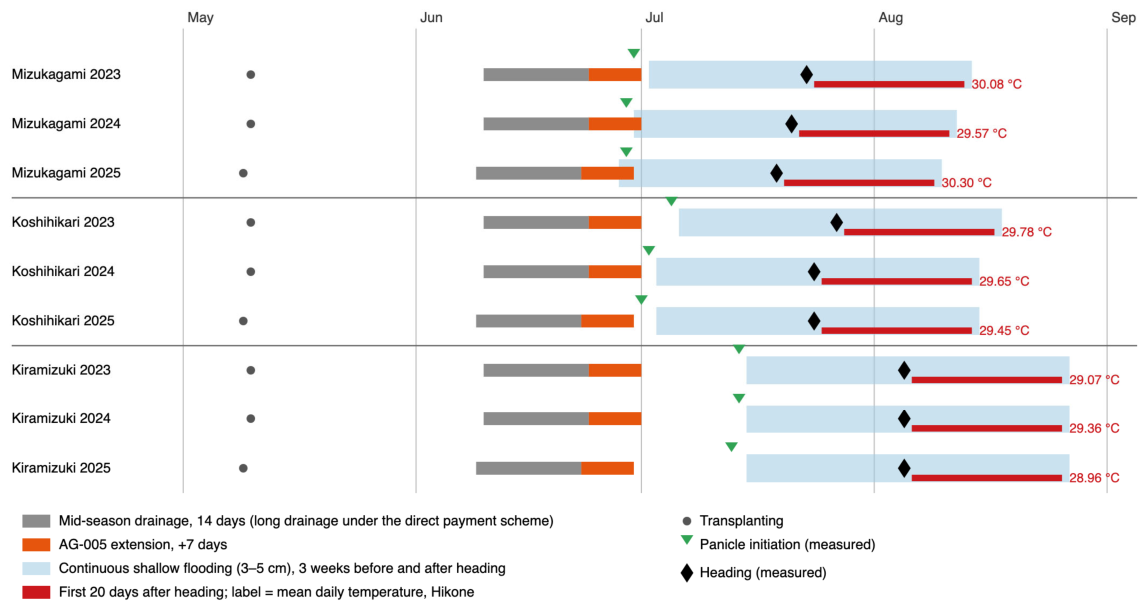
Domestic trials of the extension say little about grade (Appendix A, Table A1). In the 2008–2009 trials behind the 30% figure, yield fell by about 3% on average, and chalkiness and inspection grade were not reported [35]. Later trials in Yamagata, Niigata and Shiga found yield and the share of sound grains similar to conventional drainage [59,60,61]. Three recent trials in hot seasons also measured grain appearance, with mixed results [62,63,64]. No domestic study separates the quality loss caused by the extension from the loss caused by heat. This gap limits the causal claims of this paper (Section 6.3).
The likely route from drainage to quality runs through nitrogen. Low nitrogen status around heading is linked to more white-back and basal immature grain in trials in Kagoshima, Aichi and Shiga [65,66,67]. Strong drainage made leaves paler in Niigata in 2010 [57]. In one Iwate trial, it also reduced root activity and the share of sound grains [68]. Yet Niigata’s review of the 2023 heat blamed heat and too little topdressing, not drainage [69]. In Shiga, fertiliser limits that protect Lake Biwa add to the late-season decline in nitrogen [67].
3. Materials and Methods
3.1. Research Design and Case Selection: Shiga Prefecture and the Lake Biwa Basin
This is a qualitative, embedded single-case study. The case is the rice supply chain of Shiga Prefecture; the embedded units are the successive tiers of that chain. The design follows the case study logic in which the aim is analytic generalisation—extending and refining theory so that it can be applied to comparable settings—rather than statistical generalisation to a population [70]. The distinction matters for how our claims should be read. We do not estimate the statistical frequency of these phenomena across Japan. We claim only that the mechanism can arise elsewhere. Where the three conditions set out in Section 5.3 hold together, a similar bind is likely. Whether they hold beyond Shiga is an empirical question (Section 6.3).
Shiga was chosen for three reasons. First, the prefecture has one of the most developed environmental agriculture frameworks in Japan, having run a reduced-input certification scheme for two decades under the environmental demands of the Lake Biwa watershed [45]. Producers there can therefore describe the costs of compliance from experience rather than from anticipation. Second, the prefecture has a visible answer to the heat problem in Kiramizuki, so the adaptation pathway can be observed while it is being built [53]. Third, the 2023 heat events cut the first-grade ratio for the crop year well below historical norms [71,72,73]. A mature mitigation apparatus meeting an acute adaptation shock is the configuration in which the interaction between the two should be most visible.
Shiga is therefore a case in which three conditions coincide. First, the credit earned per hectare is low in this region (Section 6.3). Second, the prefecture already pays for long drainage, so the credit needs a further extension on top of it (Section 2.2). Third, heat has cut grades in successive years (Section 4.2). Section 6.3 sets out the scope conditions that govern how far the findings apply beyond this case.
3.2. The Four-Tier Analytical Framework
To take the analysis past the farm gate we draw on global value chain research, which offers established methods for mapping input–output structures, governance relations and institutional context along a chain, and which is centrally concerned with how lead firms and intermediaries hold asymmetric power over primary producers [74,75]. We combine these with food systems theory, which treats production, processing, distribution, retail and consumption as one social–ecological system [27]. Work on food standards as instruments of trade policy shows that a standard functions simultaneously as a quality signal and as a barrier that sorts producers by their capacity to comply [76], and broader treatments of power in global value chains make the same point about sustainability standards specifically: a standard set at one tier disciplines behaviour at every tier below it [77]. The national inspection system analysed in Section 4.2 is a standard in exactly this sense.
From that combination we derive a Four-Tier Analytical Framework:
- Tier 1—Institutional layer: national government, ministerial strategy, and macro-policy instruments including the Green Food System Strategy and the J-Credit methodology.
- Tier 2—Upstream: primary producers, whether family operations, community farming associations or incorporated farms.
- Tier 3—Midstream: agricultural cooperatives, inspection and grading, wholesalers and specialist merchants.
- Tier 4—Downstream: retailers and end consumers.
Each tier has its own decision logic and its own exposure to climate and price risk, and the interfaces between them are where compliance requirements are passed on, absorbed, or refused. What crosses those interfaces is not only cost. A drainage requirement set at Tier 1 becomes a crop-failure risk at Tier 2; heat damage in the field becomes a grade at Tier 3 and a shelf price at Tier 4; and what retailers believe consumers want shapes the standard the cooperative applies, which shapes in turn what the farmer can afford to grow. Cost is the most readily measured of these, but the framework tracks the transmission of the obligations themselves, not merely their price.
We draw the tier boundaries where a requirement changes form. Gereffi, Humphrey and Sturgeon note that the point where a standard is applied helps to set the breaks in a value chain [78]. They also note that public institutions, not only firms, set grades and standards [78]. At Tier 1 the requirement is written. At Tier 2 it is carried out in the field. At Tier 3 the harvest becomes a grade and a price. At Tier 4 the rice is priced for consumers. We treat the state as a tier of its own because, in this chain, ministries write the requirement and a national system assigns the grade.
Influence also runs up the chain. Retailers’ demands on quality travel upstream to growers [78], and Section 4.2 traces this path from Tier 4 to Tier 2. A weaker path runs from Tier 3 to Tier 1. The cooperative in our study tried the extension and judged it too hard for its members (Section 4.1). Yet the methodology has no procedure for revising the requirement in the light of such field evidence. Krishnan, De Marchi and Ponte describe how lower-tier actors try to renegotiate the terms of an environmental requirement [79]. In this chain they have no formal route to do so.
This is the analytical reason for interviewing people who do not farm, and it responds to a structural gap in the existing Japanese literature rather than to a preference for breadth.
Work on Japanese rice and climate adaptation divides into three disciplinary bodies of literature that rarely address one another. The first is agronomic and biophysical: it establishes the mechanisms of heat-induced quality loss and the water-management responses available to counter them, but does so within experimental field trials, treating the market grade assigned to the resulting crop as exogenous to the analysis [6,55,56]. The second concerns farm-level adoption: it models why individual farmers do or do not take up environmental payment schemes, and estimates the income effects when they do, but does so without incorporating the downstream inspection penalty that compliance may trigger [41,43,80]. The third is consumer preference research: it quantifies willingness to pay for environmental attributes, generally through choice experiments conducted in isolation from the procurement criteria that determine what reaches the shelf in the first place [81].
Each is rigorous within its own tier, and this study draws on all three. What none appears designed to establish is where the cost of an environmental requirement finally comes to rest, because that question is answered at the interfaces between tiers rather than within any one of them. Answering it requires evidence from Tier 3 in particular. The cooperative is the point at which an agronomic outcome is converted into a grade and a grade into a price, and it is the only tier positioned to explain how that conversion is performed and what discretion, if any, it permits. Producers can report what they were paid; only the midstream gatekeeper can account for why. Comparable value chain research on Asian rice has made the same methodological point, showing that the significant transformations of recent decades have occurred in the midstream segments—milling, wholesaling, logistics—that farm-level and consumer-level studies both pass over [82].
One might still object that retail buyers dilute a sample in a study about on-farm friction. Our answer is that the study is not built to describe the average farm. It is built to trace how an environmental requirement is transmitted through a chain, and where its consequences finally settle. To establish that a cost is not absorbed at Tier 3 or Tier 4, we need evidence from the people who work at Tier 3 and Tier 4. Producers can tell us what they were paid; only the cooperative can explain how the grade was assigned, and only the retailer can say what the shelf will bear.
3.3. Sampling Strategy and Informant Demographics
Interviews were semi-structured and conducted between October 2025 and March 2026, using a common instrument with tier-specific sections covering farm profile, adaptation and mitigation practice, barriers and incentives, branding and price formation, and open reflection. Sampling was purposive rather than random. As Patton (2015) argues, the logic of purposive sampling lies in selecting information-rich cases—those from which one can learn a great deal about matters central to the purpose of the inquiry—and the criterion of selection is therefore analytical relevance rather than representativeness [83]. We selected accordingly for position along the chain, giving ten respondents (Table 1).
Table 1.
Participant profile by supply chain tier.
The distribution—six at Tier 2, two at Tier 3, two at Tier 4—reflects the double aim of describing upstream friction in reasonable depth while establishing the downstream conditions that shape it.
One characteristic of the sample requires statement, because it bounds what the study can claim. Participation in the J-Credit Scheme is not automatic: an operator must submit a project plan, obtain registration, and undergo verification before any credit is issued. None of the ten respondents had registered a project under methodology AG-005. The interviews therefore document why eligible producers decline to participate, and what the requirement would cost them if they did; they do not document the experience of participants. We return to the implications in Section 6.3.
Two respondents described how the scheme reached them. One producer said an aggregator often sent invitations to register, presented as having no downside (P2). Another said that information came through the cooperative (P8). The cooperative also reported an unregistered trial of the extension in its area (Section 4.1).
3.4. Data Collection, Thematic Coding, and Triangulation
Interviews were conducted in Japanese. The quotations are the authors’ translations, checked against the transcripts. Interviews were transcribed and analysed through thematic analysis following the six-phase procedure set out by Braun and Clarke [84]: familiarisation with the data, generation of initial codes, searching for themes, reviewing themes, defining and naming them, and producing the report. Coding ran inductively from the transcripts into a structured codebook of five themes and fourteen subthemes: climate adaptation and environmental change; farm management economics; the challenges and limits of environmentally friendly agriculture; regional community and the multifunctional roles of agriculture; and changes in distribution and consumption alongside distrust of agricultural policy. Coded segments were kept in an anchor-quote repository tying every analytic claim back to verbatim transcript evidence, so the path from utterance to theme to argument can be audited. Claims in Section 4 rest on convergent accounts from more than one respondent; where an observation comes from a single account, we say so. Generative AI tools were used at two points in the study. Google Antigravity (Gemini 3.1 Pro High) was utilised to assist with the transcription of interview recordings. The authors wrote the text, using Claude Code (Anthropic; Claude Opus 5.5 High) to edit and refine the English expression and to check citations against the source documents. Coding and theme development were carried out by the authors without AI assistance. The authors reviewed and verified all AI-assisted revisions.
Two limitations in the procedure should be stated plainly. Coding was done by the research team without independent double-coding, so we report no inter-coder reliability statistic; what we offer instead is the retained anchor-quote repository, which allows the inferential chain to be checked. Second, respondents were recruited through networks that may over-represent operators already engaged with environmental agriculture. That would tend to understate indifference to such schemes and overstate informed criticism of them.
Data collection stopped at ten interviews on grounds of thematic saturation. Methodological work indicates that in relatively homogeneous groups most core codes emerge within six to twelve in-depth interviews [85]. Here, no new subtheme came out of the final two interviews, and the three mechanisms reported below—the drainage conflict, the grading conflict, and the eco-premium ceiling—were each described independently by respondents at more than one tier. Saturation is claimed for the themes present in this chain. Other prefectures will differ in the detail of their arrangements—in grading practice, in cooperative structure, in the balance between pooled and direct sales—but the three structural conditions identified in Section 5.3 are not peculiar to Shiga, and where they hold we would expect the same themes to appear again.
4. Results
4.1. Tier 2 (Upstream Producers): The Agronomic and Labour Burden of Drainage Extension
Producers described two separate tensions between what mitigation asks of them and what adaptation requires.
The water conflict. AG-005 requires mid-summer drainage to be extended by at least seven days beyond each field’s own recent average [1]. Producers reported that warming has made them more dependent on retained water, not less. A cooperative respondent put the incompatibility plainly:
“We have always worked on two weeks of mid-summer drainage. Extend it by another week and the plants wither, so going in for carbon credits on that basis is difficult in our area. ... With the heat as it is, some farmers are putting in more water. The carbon credit is the opposite, so it is hard.” (P5)
The same respondent described the closest thing in our material to compliance. About two years before the interview, the cooperative asked a member farmer to try the extension. Growth stalled and the grain filled poorly. The conclusion was that “another week makes it hard” (P5). The trial was not registered under AG-005, and we know of it only second-hand.
A producer already working under the direct payment framework said he maintained drainage of roughly ten days to two weeks but doubted a further week served any agronomic purpose, since damaging the crop to extend the period would defeat the object (P1).
Another producer drained and cut furrows as the guidance asks, then put water back because the crop “loses to the heat” (P2). These concerns match the Ministry’s own case for the scheme. It argues that longer drainage is uncommon because over-drying can damage roots and reduce yield (Section 2.2).
Respondents also raised a durability problem that the methodology does not contemplate. One eco-producer noted that some fields, once dried, cannot reliably be re-flooded, and argued that judging drainage through a carbon lens alone ignores what the water regime does for biodiversity (P8). This sits well with prefectural guidance that keeps paddies flooded for three weeks on either side of heading to protect quality [54]. Another producer described the underlying logic in thermal terms: use natural mountain water, and admit it gradually through the day rather than in one volume, so that it does not warm before it reaches the paddy (P7).
Thus the conflict is not a matter of reluctance. Mid-summer drainage and flooding around heading both act on the same thing: the water standing in the paddy. For early-maturing cultivars, the extended drainage runs up against the weeks when the water must return (Figure 1). AG-005 sets a single national requirement for how long that water must be withheld. It contains no provision allowing the period to be shortened where withholding water would damage the crop, and no mechanism by which a producer can report that it would. A grower who re-floods simply loses the credit for that field and year [36].
The chemical–labour conflict. The Green Food System Strategy targets a 50% cut in chemical pesticide use [32]. Producers reported that warming has raised pest pressure at the same time, describing marked increases in stink bugs and planthoppers, and wider wildlife damage attributed partly to mild winters letting more juvenile deer survive (P3, P6). This matches the wider agronomic literature, which documents that warming shifts weed and pest ranges and extends their growing season, working against reduced-input regimes that depend on manual and mechanical control precisely when that control becomes harder to provide [86]. Reduced-input cultivation shifts that burden onto manual labour. One producer reported roughly six weeding passes against four under conventional practice, plus systematic clearance of surrounding vegetation to deny the insects habitat (P1). Another described the loss of control that comes with dropping synthetic fertiliser, since organic nutrient release varies year to year and cannot be corrected once the season is underway (P2). A global meta-analysis puts the average yield gap between organic and conventional systems at roughly 25%, narrowing to about 13% under the best organic management, which is consistent with producers treating the transition as a real production cost rather than a marketing choice [87].
This burden falls on a workforce whose mean age is close to 68 [15]. The Japanese literature anticipates the result. Econometric analysis shows that larger operations find reduced-input techniques harder to adopt because of labour constraints—a diseconomy of scale peculiar to environmental agriculture [80], with the added labour bearing directly on operating efficiency.
Capital compounds all of this. One producer named machinery investment as his single largest pressure, citing a cabin combine bought with air conditioning so the operator does not suffer heat illness, and refrigerated storage now run continuously because grain that once held its quality in a cool room for a year no longer does (P2). These are adaptation investments. The mitigation framework does not support them, and they are being made by operations whose return to labour is already marginal [17].
4.2. Tier 3 (Cooperative and Merchants): Quality Grading Traps and Uncompensated Degradation
The midstream tier is where physical grain quality becomes price. Grading under the national agricultural inspection system assesses visual characteristics, and chalky immature grains from high-temperature ripening are a downgrading defect [6].
Producers reported the effect directly. One described a season in which first-grade rice was scarce and second and third grades predominated, put the quality loss down to heat, and responded by intensifying water management and withdrawing from fields he could no longer maintain (P3). Another said Koshihikari had become difficult to grow in the prefecture because of chalky grain (P2), and a merchant said flatly that the cultivar can no longer take the summer heat and that a move to varieties able to hold quality is necessary (P4). A cooperative respondent described a managed transition away from Kinuhikari toward Kinumusume and a new prefectural line, together with re-consolidation of stored grain into low-temperature warehousing because spring temperatures now rise earlier (P5). One producer put the price penalty for a lower grade at about 1000 JPY per 60 kg bag (P2). The inspection record matches these accounts. Shiga’s first-grade ratio was 51.4% for the 2023 crop and 32.5% for the 2025 crop, below the national ratio in each year from 2023 [71,72,73].
These accounts describe losses from heat itself. None of the respondents was extending drainage under the scheme, and none blamed a downgrade on it. What this section shows is that the exposure is already high. It also shows that the chain would not compensate any loss that compliance added (Section 4.4).
The governance consequence is the substance of the finding. The grading system judges the grain, not the process that produced it. A producer who extends drainage under a mitigation scheme, or forgoes pesticides under an environmental one, and whose grain may therefore be more exposed to heat or pests, takes the downgrade in full. Nothing adjusts for the policy origin of the loss. Grading also decides the environmental premium. At one Shiga cooperative, the premium for specially cultivated rice is paid on first-grade rice only [88]. A downgrade therefore removes the environmental premium as well. In value chain terms the cooperative acts as a gatekeeper exercising asymmetric power through control of a standard [74,75], and that standard is written in terms—visual appearance—that have nothing to do with the environmental objectives the producer is being asked to serve.
It would be wrong to read this as cooperative obstruction. The grading standard reflects what the market downstream expects, and Section 4.3 shows that expectation is real. The cooperative transmits a constraint; it does not originate one. Japanese market research finds that cooperative-led programmes have little power over price, whereas grower groups that sell directly set their own prices [89].
Some producers respond by leaving the tier altogether. One eco-producer described setting price not against the market but by calculating what the enterprise needs to reproduce itself, and then holding that price rather than following cooperative purchase prices up and being caught when they fall (P8). It is a coherent strategy. It is also available only to operations with direct sales channels and enough brand recognition to use them, and it does not generalise to the tier.
4.3. Tier 4 (Retailers): Market Bifurcation and the Limits of the Eco-Premium
The last constraint is the ceiling on what environmental value will fetch.
Retail respondents described a market splitting in two. A buyer at a department store (P9) reported that specially cultivated and organic rice sells reliably at premium channels with no discounting, sustained by customers who cannot buy such products in supermarkets. This respondent qualified the point immediately: an environmental story alone does not decide a purchase, and the arrangement that works is one where environmental consideration sits as an extension of taste rather than a substitute for it (P9). A mass-market supermarket respondent described movement in the other direction, reporting that over the past year or two the reasons for choosing a particular rice had collapsed toward price, with customers buying advertised products in bulk on weekends. Environmental attributes were attractive but not enough to widen demand. The chain therefore continues to stock such products so that the shelf offers a complete assortment, while expecting the sales volume to come from elsewhere (P10). Consumer research on sustainable food consistently finds a gap between stated environmental attitude and actual purchase, with price sensitivity and habit outweighing professed values at the point of sale [90], and work specifically on organic price premiums finds that willingness to pay collapses once the premium is made salient at checkout rather than in a survey [91]. Related work on visual imperfection in food finds that abnormal appearance depresses purchase intention even when the product is explicitly labelled as organic, which is the same mechanism working against chalky, heat-damaged grain regardless of how it was produced [92]. The retail accounts above describe this gap in practice rather than in the abstract.
The Japanese consumer literature corroborates this. A latent class analysis of consumer co-op members finds that those who value safety and public benefit form a distinct minority of about one-fifth [81]; studies of Shiga’s own biodiversity-branded rice report low awareness and substantial barriers in general retail [93].
International choice-experiment evidence reports positive premiums for low-carbon and sustainability attributes [94], but two qualifications limit the transfer. Stated willingness to pay in an experiment is not realised purchasing under inflation, and the retail accounts above describe the latter. Willingness also appears to depend on information source and regional branding [95].
The macroeconomic setting matters too. Under sustained consumer price inflation and disrupted rice supply and price formation [30], the segment able to act on environmental preference gets smaller still. The mass market does not reward compliance, and it continues to penalise the visual quality loss that compliance can cause.
Published Japanese studies show that the premium depends on the sales channel. For Shiga’s “cradle paddy” rice, one supermarket charged a premium of 500 JPY per 5 kg, and a farm stand near the producing village 100 JPY [96]. On Sado Island, rice that falls to third grade cannot be sold as certified Toki rice [97]. The same study finds that small volumes make contract sales difficult [97]. Our three channels fit this pattern. In pooled cooperative sales, a downgrade removes the environmental premium (Section 4.2). Direct and contract sales can carry a premium, but only for small volumes.
4.4. Tier 1 (Governance): Subsidies, Risk Transfer, and the Structural Triple Bind
Put the three tiers together and the structure closes. National mitigation policy offers a credit for a practice that, for early-maturing cultivars, squeezes the water management that heat adaptation needs. Midstream grading converts the resulting quality loss into income loss without regard to where it came from. Downstream markets decline to make up the difference in price. Each tier behaves rationally given its own constraints, and the aggregate result is that the full cost of national climate mitigation policy accumulates at the tier least able to bear it.
The credit is too small to cover these risks (Table 2 and Table 3). In the middle case, a Shiga grower would earn about 525 JPY per 10 a a year. A 3% fall in yield, the average in the national trials, would cost more than five times that amount [35]. The credit would cover a first-to-second-grade downgrade of less than a tenth of the crop. Work in Tohoku and Kanto reaches the same result. There, the revenue lost to a 3% fall in yield exceeded the credit income on farms of every size [98].
Table 2.
Credit income from AG-005, per 10 a (0.1 ha), Tōkai–Kinki region.
Table 3.
Yield and grade losses per 10 a (0.1 ha), Shiga.
The table does not estimate how much the extension raises the risk of a downgrade. No domestic trial isolates that effect (Section 2.3). The table shows the choice a grower faces when deciding whether to register. On one side is a small, certain income. On the other is a possible loss that the credit cannot cover and that grading would assign to the grower in full.
5. Discussion
5.1. The Mitigation–Adaptation Paradox as a Structural Value Chain Conflict
What the findings show is a mismatch between the scale at which the mitigation instrument is designed and the scale at which its consequences arrive. AG-005 works on a national accounting logic: a defined practice change yields a quantified emission reduction, verifiable through a standard protocol [1]. For that to work the practice change must be uniform enough to certify, which means it must be specified without reference to local conditions. Our evidence suggests that this very independence is what breaks the instrument at the operational tier, because the variable it acts on—paddy water—is also the main instrument of local heat adaptation [54].
The governance literature calls this a scale mismatch: a problem is managed at one level while the processes it concerns run at another, and nothing spans the gap [102]. This fits the wider finding that top-down climate policy underperforms without the nested, polycentric arrangements able to mediate between levels [103].
A common-pool resource framing applies here, though not in the sense the term usually carries. The point is not that water is scarce and that AG-005 asks for more of it; it asks for less. The point is who holds the authority to set the rule. Irrigation water in Japanese paddy systems is governed collectively—through land improvement districts and village-level associations that determine the sequencing and duration of supply to each block—and these institutions have been analysed directly against Ostrom’s design principles [104,105]. What is held in common is therefore less the water itself than the schedule that governs it, and withholding water is no more an individual act than taking it: farmers who extend drainage do so inside a rotation they do not set, and re-flooding afterwards depends on when that rotation next reaches their block. AG-005 does not create a new water-governance regime. It imposes a uniform national rule, addressed to individual certified operators, on a resource whose operating rules are already set collectively at a different scale.
Two of Ostrom’s design principles sharpen the diagnosis [105]. The first is congruence between rules and local conditions: a rule governing how a resource may be used, if it disregards local biophysical circumstance, tends either to be disregarded in turn or to damage the resource it governs [105]. A uniform seven-day drainage extension is a non-congruent rule in exactly that sense, and the accounts of fields that cannot be reliably re-flooded (P8) describe a case where compliance would damage the productive asset itself. The baseline rule makes this harder for growers who already drain at length. Shiga’s prefectural payment already supports drainage of at least 14 days (Section 2.2). For those growers, the credit requires at least 21 days. The second is what Ostrom termed nested enterprises: in durable governance systems, the rules are not set at one level alone but in layers, with local units retaining authority over local conditions while operating inside wider institutional arrangements [105]. In the Japanese rice chain the cooperative is the obvious candidate for a meso-level node: it already aggregates, inspects, grades, stores and markets, and it already sits between national standards and individual operations. What it lacks is any mandate or instrument to adjust a national requirement to local conditions. It passes Tier 1 rules down and Tier 4 expectations up, and absorbs neither. So the polycentric diagnosis is not that Japan lacks intermediate institutions. It is that the intermediate institutions it has are built as transmission mechanisms rather than as adaptive governance nodes.
The political economy behind this arrangement matches accounts of Japanese agricultural restructuring, which describe environmental and structural risk moving from state provision toward supply chains and communities [14]. The Green Food System Strategy names the supply chain as its delivery vehicle [33]. The difficulty is what this means in practice. Producers cannot raise their prices, because the grade and the cooperative’s pooled purchase price are set for them. Nor can they decline the requirement, because compliance is tied to the payments and certifications on which their operation depends. When a policy is delivered through a chain, and one tier in that chain can neither charge more nor say no, the cost stops there. Designating the supply chain as the delivery mechanism therefore designates the producer as the one who pays.
5.2. Beyond Band-Aid Fixes: Transformative Adaptation and Institutional Reform
The low-carbon adoption literature locates non-adoption in producer attributes—risk preference, credit access, training, contractual security [7,8]—implying that adoption should respond to interventions aimed at them. Our findings suggest a complementary structural account. Non-participation here is not well explained by information deficit or risk aversion: respondents showed detailed technical grasp of the methodology and raised specific agronomic objections to it (P1, P5, P8). It is better explained by the fact that the scheme asks for an action that respondents expected to increase the crop’s vulnerability to heat, for an income too small to cover the risk (Table 2 and Table 3), in a chain where the resulting quality loss becomes income loss at the next tier and is not compensated at the tier beyond. Under those conditions, declining to participate is what a well-informed operator should rationally do. It follows that measures directed at the producer—more training, better information campaigns, improved access to credit—would not be expected to change the decision, because the obstacle is not situated in the producer.
Three implications follow. The first concerns how adoption is studied. Whether a producer gains or loses by complying depends on what happens to the crop after it leaves the field—on how strictly it will be graded, and on what that grade will be worth. Two farmers with identical attitudes to risk will reach opposite decisions if one sells into a channel that penalises appearance and the other does not. Studies that model adoption without knowing which channel the farmer sells into are therefore missing a determinant of the decision they are trying to explain. Second, where a mitigation practice and an adaptation practice compete for the same physical resource, synergy framings that assume the two can be jointly optimised [4,5] need one further condition: that the institutional environment can recognise the trade-off and price it. Third, the case supports the observation from the assessment and modelling literature that concentrating analysis at the farm level may obscure the structural constraints running through value chains [2,27].
5.3. Theoretical Contributions to Supply Chain Governance and Climate Policy Trade-Offs
We therefore suggest reading this configuration not as a paradox in the logical sense, nor as an ordinary policy trade-off, but as a question of who carries risk. A climate requirement can be technically coherent, economically rational for the state, and still unbearable for the tier its costs land on, simply because no institution in the chain has the authority to move them. Read that way, the case points beyond rice. It suggests similar friction wherever three conditions hold together: a mitigation instrument acting on a resource that also serves adaptation; an intermediate grading or certification regime that prices output characteristics rather than production practice; and a downstream market for environmental attributes too small to absorb the cost of compliance. Table 4 compares this configuration with maladaptation (Section 1.3).
Table 4.
Maladaptation and the Mitigation–Adaptation Paradox compared.
Comparative evidence supports the first two conditions: participation follows where compensation is calculated and paid [49], and adoption rises where contracts secure the downstream relationship [8]. Domestic evidence points the same way. A comparative study examines two Japanese wildlife-coexistence rice programmes [106]. Both link reduced-input cultivation to the recovery of a threatened bird: in Toyooka, Hyogo Prefecture, rice grown to support the reintroduced Oriental white stork, and on Sado Island, Niigata Prefecture, rice grown to support the crested ibis. In each case paddies are farmed to provide feeding habitat, and the resulting rice is marketed under the bird’s name at a premium. The study finds that diffusion succeeded where municipalities, cooperatives and producers built a consensus-formation process, and not where requirements were simply handed down.
International work on carbon credits in rice points the same way. In the Philippines, alternate wetting and drying covered less than 5% of irrigated land in 2016, after two decades of promotion [107]. An attempt to fund it through Clean Development Mechanism credits did not pass the pilot stage [107]. The authors reject the view that adoption follows once farmers have the knowledge. Their review does not discuss grain quality or grade. In Shiga, by contrast, the main risk of compliance runs through the grade.
Critics of climate-smart agriculture make a related point. Rosén and colleagues show that, depending on the policy discourse, the burden of mitigation can shift onto marginalised producers [108]. They also find little evidence that smallholders gain from carbon markets [108]. Our case adds one point. Here the burden is shifted not by private firms but by a national credit scheme and a national grading system, each working as designed. Estimates at the national scale give a different picture. In Chinese agriculture, methane has the lowest marginal abatement cost of the main greenhouse gases [109]. Such estimates show the cost to the economy as a whole. They do not show which tier of a chain bears the risk.
The findings point toward three institutional reforms, which we set out here as analytical implications and restate as concrete recommendations.
From unilateral requirements to supply chain co-design. The first implication concerns how targets get set. At present, mitigation requirements are written at Tier 1 and passed straight down to Tier 2, with the intermediate tiers acting as conduits. Our evidence suggests that requirements written without reference to operational constraint tend to be declined rather than negotiated, which yields neither mitigation nor legitimacy.
What we mean by co-design is straightforward. At present the government decides what the requirement will be and then announces it; the other parties can comment, but the decision has already been taken. Co-design means the parties who will have to live with the requirement—the cooperatives that must grade the resulting crop, the retailers that must sell it, and the farmers who must grow it—sit at the table while the requirement is being written, and have the authority to vary its technical terms according to local conditions. The difference is between consultation after the fact and joint decision-making before it. This is what the collaborative governance literature calls a multi-stakeholder forum: a formal, consensus-oriented process in which state and non-state actors jointly determine implementation rather than the state determining it alone and non-state actors merely commenting on the result [110]. The distinction matters here because AG-005 was set through the latter process, not the former. In polycentric terms this means giving intermediate institutions an adaptive mandate instead of a transmitting role, and building in the congruence between rules and local conditions that the present instrument lacks [102,103]. The domestic precedent in wildlife-coexistence rice suggests such arrangements can be built from existing local actors, given leaders who connect them [106].
Co-design has costs and trade-offs. The state wants reductions it can verify. Retailers want first-grade rice. Farmers want a secure income. A forum cannot remove these conflicts, but it can make the trade-offs explicit. For example, a variant that allows re-flooding during heat warnings would be easier for farmers to accept. It would also earn a smaller and less certain credit, which makes verification harder.
Concretely, a methodology such as AG-005 would need to admit conditional variants—recognising equivalent mitigation achieved by other means, in fields where extending drainage would damage the crop—rather than specifying one uniform practice nationwide.
From gatekeeping to the administration of climate resilience. The second implication concerns the grading interface, which is where compliance turns into loss.
It is worth being clear about what we do not propose. Cooperatives cannot simply relax grading standards. Grade reflects real differences in appearance and eating quality that buyers downstream price, and as Section 4.3 shows, mass-market consumers do not treat environmental provenance as a substitute for quality [81,93]. A cooperative that graded heat-damaged grain as first grade would absorb the loss itself and would not last long doing it.
The workable intervention is a state-backed compensation mechanism administered at the midstream tier. Where a producer has complied with a specified mitigation requirement and has taken a quality downgrade, the cooperative would administer a payment covering the price difference between the grade achieved and the grade that would ordinarily have been expected. Second-grade rice still sells, but at a lower price. The payment would cover that price gap. This keeps the grading system intact, keeps the market signal to consumers intact, and removes the penalty that compliance now carries. It extends the logic of existing environmental direct payments, whose effects and spatial variation are already documented [41], from a payment for practice into an indemnity against compliance risk—which is what our evidence indicates is actually needed, since the binding constraint our respondents describe is downside exposure rather than the absence of a practice payment.
The obvious objection is that no one can tell whether a downgrade came from compliance or from heat alone. Japan’s revenue insurance avoids this question. It covers falls in revenue that good management cannot prevent, measured against the farm’s average over the past five years [111]. The cooperative respondent described it as a tool growers already use (P5).
Crop mutual aid (NOSAI) already separates causes in the field. When it assesses a loss of grain quality, it excludes losses caused by poor fertiliser management or pest control [112]. A compliance indemnity could build on this procedure. It would state that documented compliance with a registered methodology is not a management fault.
The fiscal cost would be modest at present uptake. Suppose that all of the roughly 1100 ha under the scheme in the Kinki region were downgraded from first to second grade in one year [37]. At Shiga prices, the payment would be about 64 million JPY (Table 3).
Such a mechanism should be paired with faster cultivar transition, so that compensation does not harden into a permanent subsidy for a deteriorating agronomic position. The prefectural Kiramizuki programme, with its cultivation standards and extension materials, offers a vehicle that already exists [53], and the wider technical literature on high-temperature countermeasures supports the pathway [39].
From retail premiums to alternative financing. The third implication follows from the finding that the downstream market will not fund the transition. Given record rice prices [30] and evidence that environmentally motivated consumers are a minority [81], policy that depends on consumers paying an eco-premium is unlikely to deliver at the scale required.
Capital therefore has to come from somewhere other than the retail price. Corporate environmental, social and governance investment is one route. Large firms increasingly report not only the emissions from their own operations but also those arising across their supply chains—known as Scope 3 emissions, which for a food company typically account for the large majority of its total footprint, and which it can only reduce by acting on its suppliers. A firm purchasing rice therefore has a reporting interest in the emissions of the farms that grow it, and a corresponding reason to fund the transition directly rather than through the product price. This is structurally a payment for environmental services arrangement, in which a buyer who values an environmental outcome pays the party positioned to produce it, conditional on delivery [113]. Recasting corporate ESG spending in these terms—a conditional payment for a defined service, not a donation—is what would make it durable rather than dependent on a firm’s current sustainability messaging. The valuation literature shows participation in eco-friendly practice responding to compensation rates [49], and evidence on contracting shows secure downstream relationships raising adoption [8]. Both point toward financing that bypasses the retail premium: what farmers value is a secure contract and a guaranteed price, not a premium that may never materialise downstream.
This route has limits of its own. A buyer will pay only where it can count the reduction in its own reports. That favours large, well-documented farms over small farms on hilly land. It also risks counting the same reduction twice: once as a J-Credit sold to another firm, and once in the buyer’s own supply chain accounts. Clear rules on who may claim each reduction would have to come first.
This should sit alongside a restructuring of national budgetary support to decouple payment from yield and visual quality. Support calibrated to output characteristics necessarily penalises the producer whose output characteristics have been degraded by compliance. The distinction matters because of what each kind of payment can and cannot reach. A payment calculated on yield or grade rewards the farm that produced a good crop; it cannot compensate the farm whose crop was downgraded precisely because it followed an environmental requirement. Only a payment triggered by the act of compliance, rather than by the quality of the output, can do that. Given the direction of consolidation policy [28] and the persistence of abandoned land [16], support of this second kind would address a constraint that yield-linked payments structurally cannot.
6. Conclusions
6.1. Synthesis of Core Findings
This paper asked how national climate mitigation policy interacts with local adaptation across a multi-tiered rice supply chain in Shiga Prefecture. The evidence points to a Triple Bind. We observe it in the reasons producers give for declining the scheme. Upstream, the drainage extension certified under AG-005 leaves early-maturing cultivars little time before panicle initiation, and a grower who re-floods in a hot spell loses the credit, while the targeted cut in pesticide use meets heat-amplified pest pressure and an ageing labour force. Midstream, grading under the national inspection system turns the resulting quality loss into income loss, with no adjustment for where that loss came from. Downstream, mass-market retail reports that consumers under inflation will not fund compliance, leaving eco-premiums confined to a segment too narrow to carry a transition. Against these risks, the credit offers about 200–2200 JPY per 10 a a year.
Each tier acts rationally within its own constraints. The aggregate result is that the cost of national mitigation policy settles on the least capitalised participant. This suggests the friction between mitigation and adaptation here is better understood as a question of how risk is distributed along a chain than as a deficit in producer knowledge, capital or willingness.
6.2. Policy Recommendations
Unilateral mitigation requirements become unworkable in practice when they take no account of the economic dependencies of the chain that carries them. Bringing climate governance into line with those dependencies would mean giving intermediate institutions an adaptive rather than a transmitting role, insuring producers against compliance-induced quality loss instead of assuming markets will reward compliance, and drawing transition finance from actors whose balance sheets can supply it.
These conclusions come from one prefecture, distinctive in both hydrology and topography, and moving them elsewhere requires attention to the boundaries set out in Section 6.3. Within those limits, the case suggests that how well agricultural climate policy works may depend less on the technical specification of the mitigation practice than on whether the institutions around it can see, price and reallocate the risks that compliance creates.
6.3. Limitations and Future Research
The mechanism described above is not confined to Shiga, but neither does it operate everywhere in the same form. This section sets out the conditions that govern how far the findings apply beyond this case, and the limitations of the study itself. We state these not to withdraw the claim to wider relevance, but to specify it: the value of a single case lies in identifying a mechanism precisely enough that others can judge where it applies [70].
Topography. Several respondents criticised national policy for assuming consolidated, flat cultivation, and specifically doubted whether large-scale mechanised and automated farming is viable in semi-mountainous terrain (P2). Much of Japan’s commercial rice comes off alluvial plains where consolidation and standardised mitigation practice are considerably easier. Treating the constraints of terraced and semi-mountainous paddies as a national baseline would misrepresent national strategy, and we intend no such generalisation.
Method and sample. Ten interviews in one prefecture support analytic rather than statistical generalisation [70], and saturation is claimed for the themes present in this chain [85]. Single-team coding without independent verification remains a limitation, reduced but not removed by keeping the anchor-quote repository. What the study establishes is that a mechanism operates, and the conditions under which it operates. What it does not establish is the proportion of Japanese rice production currently affected. That is a question for subsequent quantitative work, and the specification offered here is intended to make such work possible.
Causal inference. The causal chain in this paper is supported link by link, not observed as a whole. It runs from the extension to heat exposure, then to a downgrade and an uncompensated loss. The first link rests on crop timing and on trials elsewhere (Section 2.3). The downgrades our respondents reported came from heat, in seasons when none of them extended drainage under the scheme. We therefore cannot separate the loss due to warming from any loss the policy would add. Our claim concerns allocation. If compliance adds to the loss, the chain as now organised assigns that addition to the producer. A trial that extends drainage in a hot season and records inspection grade would test the first link directly.
Participation. None of our respondents had registered under AG-005, and uptake in the Kinki region is low (Section 2.2). The study therefore examines why these producers have not joined. Interviews with registered participants and with verification bodies are the first priority for further work.
Retail evidence. The downstream evidence comes from two retail buyers, supported by published studies (Section 4.3). The two buyers were chosen for their position in the chain, and no new theme emerged from the final interviews (Section 3.4). The evidence therefore shows how retail requirements reach the producer. It does not measure the size of the market for environmental premiums. Consumer surveys or sales data would be needed for that.
Other prefectures. One hot season does not set Shiga apart. In 2023 the first-grade ratio fell even further in Niigata and Yamagata [71]. Shiga differs in that it has not recovered. In 2024 and 2025 the main northern prefectures returned to 75–93%, while Shiga fell further [72,73]. The bind is therefore likely to be sharpest where grade loss recurs, and weakest where a year like 2023 remains rare. The credit also varies by region, while the requirement does not. A field in the Tōkai–Kinki region earns about 55% of the credit that the same field would earn in Tohoku [36]. Two further conditions are specific to Shiga. Fertiliser use is limited to protect Lake Biwa, and the prefecture already pays for long drainage (Section 2.2).
Supplementary Materials
The following supporting information can be downloaded at: https://www.mdpi.com/article/10.3390/su182110771/s1, Section S1. Semi-Structured Interview Guide; Section S2. Full Master Codebook and Thematic Definitions.
Author Contributions
Conceptualization, T.M. and M.Y.; methodology, T.M.; formal analysis, T.M.; investigation, T.M. and M.Y.; data curation, T.M.; writing—original draft preparation, T.M.; writing—review and editing, T.M.; supervision, M.Y.; funding acquisition, M.Y. All authors have read and agreed to the published version of the manuscript.
Funding
This research was supported by the International Joint Research Promotion Program (2025–2026), Ritsumeikan University, Japan. Fieldwork in Shiga Prefecture was partly supported by this funding.
Institutional Review Board Statement
Ethical review and approval were waived for this study. The research consisted of non-interventional interviews with professional stakeholders acting in their occupational capacity. It collected no personal, sensitive or health-related information. It therefore falls outside the Ethical Guidelines for Life Science and Medical Research Involving Human Subjects (MEXT, MHLW and METI, Japan, 2021, as amended), which apply to medical and life science research. It also falls outside the Clinical Trials Act (Act No. 16 of 2017). No Japanese law requires board approval for non-medical social science interviews of this type. The rules of the authors’ universities do not require review of research on enterprises and organisations that handles no personal information.
Informed Consent Statement
Verbal informed consent was obtained from all participants prior to interview. Participants were informed of the purpose of the research, the intended academic use of the material, and their right to decline to answer or to withdraw. All responses are reported in anonymised form.
Data Availability Statement
The full interview transcripts are not publicly available in order to protect the confidentiality of participants, several of whom are identifiable from operational detail within a small regional population. The anonymised codebook and the interview guide are provided in the Supplementary Materials, and representative verbatim quotations are given in Section 4. Further anonymised material may be made available by the corresponding author on reasonable request.
Acknowledgments
The authors are grateful to the rice producers, the agricultural cooperative and community farming associations, the specialist rice merchant, and the retail buyers in Shiga Prefecture and the wider Kansai region who gave their time to this research. Their willingness to describe operational realities candidly made the analysis possible. During the preparation of this study, the authors used Google Antigravity (Gemini 3.1 Pro High) to assist with transcribing the interview recordings and Claude Code (Anthropic; Claude Opus 5.5 High) to edit the English text and check citations, as described in Section 3.4. The authors have reviewed and edited the output and take full responsibility for the content of this publication.
Conflicts of Interest
The authors declare no conflicts of interest.
Appendix A
Table A1.
Domestic field trials of extended or stronger mid-summer drainage.
References
- J-Credit Scheme Steering Committee (METI, MOE, MAFF). J-Credit Scheme Methodology AG-005: Extension of the Mid-Season Drainage Period in Paddy Rice Cultivation, Version 3.5; (Version 3.2 of 25 February 2025 was Current at Submission); J-Credit Scheme: Tokyo, Japan, 2026; Available online: https://japancredit.go.jp/pdf/methodology/AG-005_v3.5.pdf (accessed on 4 October 2026). (In Japanese)
- Bezner Kerr, R.; Hasegawa, T.; Lasco, R.; Bhatt, I.; Deryng, D.; Farrell, A.; Gurney-Smith, H.; Ju, H.; Lluch-Cota, S.; Meza, F.; et al. Food, Fibre and Other Ecosystem Products (Chapter 5). In Climate Change 2022: Impacts, Adaptation and Vulnerability. Contribution of Working Group II to the Sixth Assessment Report of the Intergovernmental Panel on Climate Change; Cambridge University Press: Cambridge, UK; New York, NY, USA, 2022; pp. 713–906. [Google Scholar] [CrossRef] [Scilit]
- Peng, S.; Huang, J.; Sheehy, J.E.; Laza, R.C.; Visperas, R.M.; Zhong, X.; Centeno, G.S.; Khush, G.S.; Cassman, K.G. Rice Yields Decline with Higher Night Temperature from Global Warming. Proc. Natl. Acad. Sci. USA 2004, 101, 9971–9975. [Google Scholar] [CrossRef] [Scilit] [PubMed]
- Locatelli, B.; Pavageau, C.; Pramova, E.; Di Gregorio, M. Integrating Climate Change Mitigation and Adaptation in Agriculture and Forestry: Opportunities and Trade-Offs. Wiley Interdiscip. Rev. Clim. Change 2015, 6, 585–598. [Google Scholar] [CrossRef] [Scilit]
- Duguma, L.A.; Wambugu, S.W.; Minang, P.A.; van Noordwijk, M. A Systematic Analysis of Enabling Conditions for Synergy Between Climate Change Mitigation and Adaptation Measures in Developing Countries. Environ. Sci. Policy 2014, 42, 138–148. [Google Scholar] [CrossRef] [Scilit]
- Kondo, M.; Iwasawa, N. Soil and Fertilizer Adaptation Techniques for Climate Change in Paddy Rice Cultivation 2: Recent Decline in Rice Appearance Quality Caused by High Temperature, and Its Cultivation Management. Jpn. J. Soil Sci. Plant Nutr. 2018, 89, 497–502. (In Japanese) [Google Scholar] [CrossRef] [PubMed]
- Chen, Z.-D.; Chen, F. Socio-Economic Factors Influencing the Adoption of Low Carbon Technologies Under Rice Production Systems in China. Carbon Balance Manag. 2022, 17, 19. [Google Scholar] [CrossRef] [Scilit] [PubMed]
- Tang, L.; Luo, X. Contract Signing and Low-Carbon Technology Adoption in Rice Production: Survey Evidence from China. Environ. Dev. 2026, 57, 101339. [Google Scholar] [CrossRef] [Scilit]
- van den Berg, R.D. Evaluation in the Context of Global Public Goods. Evaluation 2011, 17, 405–415. [Google Scholar] [CrossRef] [Scilit]
- van den Berg, R.D.; Cando-Noordhuizen, L. Action on Climate Change: What Does It Mean and Where Does It Lead To? In Evaluating Climate Change Action for Sustainable Development; Uitto, J.I., Puri, J., van den Berg, R.D., Eds.; Springer: Cham, Switzerland, 2017; pp. 13–34. [Google Scholar]
- Uitto, J.I.; Puri, J.; van den Berg, R.D. Evaluating Climate Change Action for Sustainable Development: Introduction. In Evaluating Climate Change Action for Sustainable Development; Uitto, J.I., Puri, J., van den Berg, R.D., Eds.; Springer: Cham, Switzerland, 2017; pp. 1–12. [Google Scholar] [CrossRef] [Scilit]
- Uitto, J.I. Evaluating Environment and Development: Lessons from International Cooperation. Evaluation 2014, 20, 44–57. [Google Scholar] [CrossRef] [Scilit]
- Taylor, M. Climate-Smart Agriculture: What Is It Good For? J. Peasant Stud. 2018, 45, 89–107. [Google Scholar] [CrossRef] [Scilit]
- Hisano, S.; Akitsu, M.; McGreevy, S.R. Revitalising Rurality Under the Neoliberal Transformation of Agriculture: Experiences of Re-Agrarianisation in Japan. J. Rural Stud. 2018, 61, 290–301. [Google Scholar] [CrossRef] [Scilit]
- Statistics Department; Ministry of Agriculture, Forestry and Fisheries (MAFF). Summary of the Results of the 2025 Census of Agriculture and Forestry (Final Figures); MAFF: Tokyo, Japan, 2026; Available online: https://www.e-stat.go.jp/stat-search/files/data?sinfid=000040483733&ext=pdf (accessed on 12 October 2026). (In Japanese)
- Rural Development Bureau; Ministry of Agriculture, Forestry and Fisheries (MAFF). Current Status of and Countermeasures for Abandoned Farmland; MAFF: Tokyo, Japan, 2026; Available online: https://www.maff.go.jp/j/nousin/tikei/houkiti/attach/pdf/index-51.pdf (accessed on 12 October 2026). (In Japanese)
- Shigitani, Y. I Set My Selling Price from My Own Hourly Wage. In What We Want to Know Now About Rice and Farmers: Rice Prices, Distribution and the Future of Paddy Fields, Considered with Farmers; Rural Culture Association Japan (Nobunkyo), Ed.; Nobunkyo: Toda, Japan, 2026; pp. 74–77. (In Japanese) [Google Scholar]
- MAFF. Farm Management Statistics Survey: Production Costs of Agricultural Products, 2024 Crop (Individual Farms), Table 2: Rice Production Costs, National and by Agricultural Region (per 10 a; per 60 kg); E-Stat: Tokyo, Japan, 2026; Available online: https://www.e-stat.go.jp/stat-search/files?stat_infid=000040440080 (accessed on 11 October 2026). (In Japanese)
- MAFF. Relative Transaction Prices and Volumes of Rice, August 2024 Issue (Preliminary); MAFF: Tokyo, Japan, 2024; Available online: https://www.maff.go.jp/j/seisan/keikaku/soukatu/attach/pdf/aitaikakaku-185.pdf (accessed on 4 October 2026). (In Japanese)
- MAFF. Relative Transaction Prices and Volumes of Rice, August 2026 Issue (Preliminary); MAFF: Tokyo, Japan, 2026; Available online: https://www.maff.go.jp/j/seisan/keikaku/soukatu/attach/pdf/aitaikakaku-575.pdf (accessed on 4 October 2026). (In Japanese)
- Rural Culture Association Japan (Nobunkyo). What We Want to Know Now About Rice and Farmers: Rice Prices, Distribution and the Future of Paddy Fields; Nobunkyo: Toda, Japan, 2026; ISBN 978-4-540-25158-0. (In Japanese) [Google Scholar]
- Schipper, E.L.F. Maladaptation: When Adaptation to Climate Change Goes Very Wrong. One Earth 2020, 3, 409–414. [Google Scholar] [CrossRef] [Scilit]
- Juhola, S.; Glaas, E.; Linnér, B.-O.; Neset, T.-S. Redefining Maladaptation. Environ. Sci. Policy 2016, 55, 135–140. [Google Scholar] [CrossRef] [Scilit]
- IPCC. Annex II: Glossary. In Climate Change 2022: Impacts, Adaptation and Vulnerability. Contribution of Working Group II to the Sixth Assessment Report of the Intergovernmental Panel on Climate Change; Möller, V., van Diemen, R., Matthews, J.B.R., Méndez, C., Semenov, S., Fuglestvedt, J.S., Reisinger, A., Eds.; Cambridge University Press: Cambridge, UK, 2022; pp. 2897–2930. [Google Scholar] [CrossRef] [Scilit]
- Eriksen, S.; Schipper, E.L.F.; Scoville-Simonds, M.; Vincent, K.; Adam, H.N.; Brooks, N.; Harding, B.; Khatri, D.; Lenaerts, L.; Liverman, D.; et al. Adaptation Interventions and Their Effect on Vulnerability in Developing Countries: Help, Hindrance or Irrelevance? World Dev. 2021, 141, 105383. [Google Scholar] [CrossRef] [Scilit]
- Reckien, D.; Magnan, A.K.; Singh, C.; Lukas-Sithole, M.; Orlove, B.; Schipper, E.L.F.; Coughlan de Perez, E. Navigating the Continuum between Adaptation and Maladaptation. Nat. Clim. Change 2023, 13, 907–918. [Google Scholar] [CrossRef] [Scilit]
- Ericksen, P.J. Conceptualizing Food Systems for Global Environmental Change Research. Glob. Environ. Change 2008, 18, 234–245. [Google Scholar] [CrossRef] [Scilit]
- Ministry of Agriculture, Forestry and Fisheries (MAFF). Basic Plan for Food, Agriculture and Rural Areas (Cabinet Decision, 31 March 2020); MAFF: Tokyo, Japan, 2020; Available online: https://www.maff.go.jp/j/keikaku/k_aratana/attach/pdf/r2_keikaku-3.pdf (accessed on 12 October 2026). (In Japanese)
- Ministry of Agriculture, Forestry and Fisheries (MAFF). Annual Report on Food, Agriculture and Rural Areas in Japan, FY2022; MAFF: Tokyo, Japan, 2023; Available online: https://www.maff.go.jp/j/wpaper/w_maff/r4/r4_h/trend/part1/chap2/c2_3_00.html (accessed on 12 October 2026). (In Japanese)
- Crop Production Bureau; Ministry of Agriculture, Forestry and Fisheries (MAFF). The Current Situation of Rice (Reference Material 6, Food Subcommittee, Council of Food, Agriculture and Rural Area Policies, 31 January 2025); MAFF: Tokyo, Japan, 2025; Available online: https://www.maff.go.jp/j/council/seisaku/syokuryo/250131/attach/pdf/250131-11.pdf (accessed on 12 October 2026).
- OECD. Agricultural Policy Monitoring and Evaluation 2021: Addressing the Challenges Facing Food Systems; OECD Publishing: Paris, France, 2021. [Google Scholar] [CrossRef] [Scilit]
- Ministry of Agriculture, Forestry and Fisheries (MAFF). Strategy for Sustainable Food Systems (MIDORI Strategy): Achieving Both Improved Productivity and Sustainability in Food, Agriculture, Forestry and Fisheries Through Innovation; MAFF: Tokyo, Japan, 2021. (In Japanese) [Google Scholar]
- Ministry of Agriculture, Forestry and Fisheries (MAFF). Measures for Achievement of Decarbonization and Resilience with Innovation (MeaDRI); MAFF: Tokyo, Japan, 2021; Available online: http://web.archive.org/web/20210816160346/https://www.maff.go.jp/e/policies/env/env_policy/attach/pdf/meadri-4.pdf (accessed on 12 October 2026).
- Agricultural Environment Division; Crop Production Bureau; Ministry of Agriculture, Forestry and Fisheries (MAFF). Climate Change and Global Warming Countermeasures in the Agricultural Sector; MAFF: Tokyo, Japan, 2024; Available online: https://www.maff.go.jp/j/seisan/kankyo/ondanka/pdf/ondanka_taisaku.pdf (accessed on 12 October 2026).
- National Institute for Agro-Environmental Sciences (NIAES). New Water Management Techniques for Suppressing Methane Emission from Paddy Fields; NIAES: Tsukuba, Japan, 2012; Available online: https://web.archive.org/web/2023/https://www.naro.affrc.go.jp/archive/niaes/techdoc/methane_manual.pdf (accessed on 4 October 2026).
- MAFF; Agricultural Production Bureau; Agricultural Environment Policy Division. The J-Credit Scheme for “Extension of the Mid-Season Drainage Period in Paddy Rice Cultivation”; MAFF: Tokyo, Japan, 2026; Available online: https://www.maff.go.jp/j/seisan/kankyo/ondanka/attach/pdf/index-175.pdf (accessed on 4 October 2026). (In Japanese)
- MAFF. Toward the Expansion of Carbon Credits in Agriculture, Forestry and Fisheries; MAFF: Tokyo, Japan, 2026; Available online: https://www.maff.go.jp/j/kanbo/kankyo/seisaku/climate/jcredit/cckakudai.pdf (accessed on 4 October 2026). (In Japanese)
- J-Credit Scheme. List of Registered Projects and List of Certified Credits (as of the 68th Certification Committee). 2026. Available online: https://japancredit.go.jp/xls/registration_list_jcre.xlsx (accessed on 4 October 2026). (In Japanese)
- Ministry of Agriculture, Forestry and Fisheries (MAFF). Toward Overcoming High-Temperature Damage in Paddy Rice; MAFF: Tokyo, Japan, 2006; Available online: https://www.maff.go.jp/j/kanbo/kihyo03/gityo/g_kiko_hendo/suito_kouon/pdf/report.pdf (accessed on 4 October 2026). (In Japanese)
- Carrijo, D.R.; Lundy, M.E.; Linquist, B.A. Rice Yields and Water Use Under Alternate Wetting and Drying Irrigation: A Meta-Analysis. Field Crops Res. 2017, 203, 173–180. [Google Scholar] [CrossRef] [Scilit]
- Kitano, S. Policy Impact and Spatial Heterogeneity of Direct Payment for Environmentally Friendly Agriculture in Japan. J. Environ. Inf. Sci. 2024, 2023, 1–12. [Google Scholar] [CrossRef] [PubMed]
- Kitano, S. An Evaluation of a Direct Payment Policy for Community-Based Environmental Conservation Agricultural Practices: A Case of Shiga Prefecture in Japan. J. Environ. Inf. Sci. 2019, 1, 43–52. [Google Scholar] [CrossRef] [PubMed]
- Santos, D.K.; Shimada, K. Direct Payment Subsidies for Environmentally-Friendly Agriculture on Rice Production in Shiga, Japan. Chem. Eng. Trans. 2021, 83, 319–324. [Google Scholar] [CrossRef] [Scilit]
- Shiga Prefecture; Department of Agriculture and Fisheries. Outline of the Direct Payment for Environmentally Friendly Agriculture, Shiga Edition. February 2026. Available online: https://www.pref.shiga.lg.jp/documents/6891/5609773.pdf (accessed on 7 October 2026). (In Japanese)
- Shiga Prefecture. Basic Plan for the Promotion of Environmentally Conscious Agriculture in Shiga Prefecture; Shiga Prefectural Government: Otsu, Japan, 2023; Available online: https://www.pref.shiga.lg.jp/documents/6887/5404217.pdf (accessed on 12 October 2026). (In Japanese)
- Mother Lake Goals Promotion Committee. Mother Lake Goals (MLGs) Agenda: Proposed Goals for a Sustainable Society in 2030 Viewed Through Lake Biwa; MLGs Promotion Committee: Otsu, Japan, 2021; Available online: https://mlgs.shiga.jp/wp-content/uploads/2021/06/MotherLakeGoals_Agenda_20210701.pdf (accessed on 12 October 2026). (In Japanese)
- Ho, T.T.; Tran, Q.T.; Shimada, K. Do Sustainable Agricultural Practices Improve Rice Productivity and Soil Fertility? An Empirical Study in Shiga Prefecture, Japan. Chem. Eng. Trans. 2023, 106, 121–126. [Google Scholar] [CrossRef]
- Du, S.; Tanaka, K.; Sasaki, H.; Horie, T.; Horie, S. Promoting Methane Reductions Through Behavioural Nudges and Informational Boosts: A Field Choice Experiment in Japanese Rice Farming. J. Agric. Econ. 2026, 77, 677–698. [Google Scholar] [CrossRef] [Scilit]
- Tu, V.H.; Trang, N.T. Economic Valuation of Carbon Credits in Eco-Friendly Rice Farming in the Mekong Delta. Process Integr. Optim. Sustain. 2026, 10, 1211–1228. [Google Scholar] [CrossRef] [Scilit]
- Tivet, F.; Boulakia, S. Climate Smart Rice Cropping Systems in Vietnam: State of Knowledge and Prospects; CIRAD: Montpellier, France, 2017. [Google Scholar]
- Dharma, A.W. Scoping Study Climate Smart Rice, Country Report—Thailand: Promoting Global Best Practices and Scaling of Low Emissions Technologies by Engaging the Private and Public Sectors in the Paddy Rice Sector; UNEP Regional Office for Asia and the Pacific and Climate and Clean Air Coalition (CCAC): Bangkok, Thailand, 2021; Available online: https://www.ccacoalition.org/sites/default/files/resources/2021_Thailand-Country%20Report-Scoping-Study_CCAC.pdf (accessed on 12 October 2026).
- Japan Meteorological Agency. Past Weather Data: Hikone, Daily Values for June–September 2023–2025 and Daily Normals 1991–2020. Available online: https://www.data.jma.go.jp/stats/etrn/ (accessed on 4 October 2026). (In Japanese)
- Omi Rice Promotion Association. Training Seminar on the Cultivation of ‘Kiramizuki’ for the 2025 Crop (In Japanese; Seminar Handout, February 2025); Omi Rice Promotion Association: Shiga, Japan, 2025; Available online: https://www.pref.shiga.lg.jp/gc00/6999.html (accessed on 12 October 2026).
- Shiga Prefectural Agricultural Technology Promotion Center. Rice Growth Diagnosis Information: No. 2 (26 June 2023); No. 5 (22 August 2023); Special Issue: Risk-Reduction Measures for Extreme Heat (12 July 2024); No. 5 (23 August 2024); No. 5 (20 August 2025). Available online: https://www.pref.shiga.lg.jp/documents/13739/5587203.pdf (accessed on 4 October 2026). (In Japanese)
- Morita, S.; Wada, H.; Matsue, Y. Countermeasures for Heat Damage in Rice Grain Quality Under Climate Change. Plant Prod. Sci. 2016, 19, 1–11. [Google Scholar] [CrossRef] [Scilit]
- Ishimaru, T.; Horigane, A.K.; Ida, M.; Iwasawa, N.; San-oh, Y.A.; Nakazono, M.; Nishizawa, N.K.; Masumura, T.; Kondo, M.; Yoshida, M. Formation of Grain Chalkiness and Changes in Water Distribution in Developing Rice Caryopses Grown Under High-Temperature Stress. J. Cereal Sci. 2009, 50, 166–174. [Google Scholar] [CrossRef] [Scilit]
- Niigata Agricultural Research Institute; Crop Research Center. Mid-Season Drainage Method for Producing High-Quality Koshihikari Under High-Temperature Ripening. In Research Results of Agriculture, Forestry and Fisheries in Niigata Prefecture, FY2011; Niigata Prefecture: Niigata, Japan, 2011; Available online: https://www.pref.niigata.lg.jp/uploaded/attachment/216867.pdf (accessed on 4 October 2026). (In Japanese)
- Higashiomi Agricultural Extension Center; Shiga Prefecture. Rice Cultivation Information No. 2. 8 June 2026. Available online: https://www.pref.shiga.lg.jp/documents/7008/5621464_1.pdf (accessed on 4 October 2026). (In Japanese)
- Shiono, H.; Saito, H.; Kumagai, K. Interannual Variability of Methane Emission from Paddy Fields Incorporated with Rice Straw and Mitigation by Prolonging Midseason Drainage in a Cold Region of Japan: 2. Effect of Reducing Methane Emission by Prolonging Midseason Drainage and Its Influence on the Growth of Rice. Jpn. J. Soil Sci. Plant Nutr. 2019, 90, 193–200. (In Japanese) [Google Scholar] [CrossRef] [PubMed]
- Niigata Agricultural Research Institute. Water Management Technique for Reducing Methane Emission from Paddy Fields. In Research Results of Agriculture, Forestry and Fisheries in Niigata Prefecture, FY2010; Niigata Prefecture: Niigata, Japan, 2010; Available online: https://www.pref.niigata.lg.jp/uploaded/attachment/216827.pdf (accessed on 4 October 2026). (In Japanese)
- Hasukawa, H.; Inoda, Y.; Toritsuka, S.; Sudo, S.; Oura, N.; Sano, T. Effects of Mitigation Strategies on Greenhouse Gas Emissions from a Paddy Field on Gray Lowland Soil Under a Paddy-Upland Rotation System with Four Crops over Three Years. Jpn. J. Soil Sci. Plant Nutr. 2019, 90, 1–12. (In Japanese) [Google Scholar] [CrossRef] [PubMed]
- Yanagita, K. Practical Methods and Application of Prolonging Midseason Drainage in Normal-Season Rice Cultivation. Rep. Crop Sci. Soc. Kyushu 2025, 2, 2–7. (In Japanese) [Google Scholar] [CrossRef] [PubMed]
- Shibata, S.; Sato, N.; Noborio, K.; Shiotsu, F. Effect of Medium Drying Extension on Yield and Quality of Paddy Rice. In Proceedings of the Abstracts of the 260th Meeting of the Crop Science Society of Japan; Crop Science Society of Japan: Tokyo, Japan, 2025; p. 16, (In Japanese). [Google Scholar] [CrossRef] [PubMed]
- Kanetani, H.; Okubo, K.; Kawata, K. Effects of Prolonging Midseason Drainage on the Yield and Grain Quality of the Rice Cultivar “Akebono”. In Proceedings of the Abstracts of the 262nd Meeting of the Crop Science Society of Japan; Crop Science Society of Japan: Tokyo, Japan, 2026; p. 5, (In Japanese). [Google Scholar] [CrossRef] [PubMed]
- Wakamatsu, K.; Sasaki, O.; Uezono, I.; Tanaka, A. Effect of the Amount of Nitrogen Application on Occurrence of White-Back Kernels during Ripening of Rice under High-Temperature Conditions. Jpn. J. Crop Sci. 2008, 77, 424–433. (In Japanese) [Google Scholar] [CrossRef] [Scilit]
- Sugiura, K.; Honjo, H.; Hayashi, M.; Nonoyama, T.; Yamashita, K.; Torasawa, A.; Yamauchi, A. Research on the Factors Affecting Kernel Quality of Rice Cultivar ‘Koshihikari’ Cultivated in Aichi Prefecture. Jpn. J. Crop Sci. 2013, 82, 262–269. (In Japanese) [Google Scholar] [CrossRef] [Scilit]
- Takehisa, K.; Hotta, S.; Kojima, T.; Nakai, J.; Toritsuka, S. Effects of Ear Fertilizer Application on Yield and Grain Quality of Rice Cultivar ‘Koshihikari’ under High Temperature. Bull. Shiga Pref. Agric. Tech. Promot. Cent. 2016, 54, 12–22. Available online: https://www.pref.shiga.lg.jp/documents/13716/2008926.pdf (accessed on 12 October 2026).
- Tada, S.; Ohmi, K. Effect of Midseason Drainage on the Grain Quality of Rice. Tohoku Agric. Res. 2023, 76, 13–14. Available online: https://www.naro.go.jp/org/tarc/to-noken/DB/DATA/076/076-013.pdf (accessed on 12 October 2026).
- Study Group on the 2023 Rice Crop. Factors Behind the Fall in the First-Grade Ratio of 2023 Niigata Rice and Responses; Niigata Prefecture: Niigata, Japan, 2023; Available online: https://www.pref.niigata.lg.jp/uploaded/attachment/385244.pdf (accessed on 7 October 2026).
- Yin, R.K. Case Study Research and Applications: Design and Methods, 6th ed.; SAGE Publications: Thousand Oaks, CA, USA, 2018. [Google Scholar]
- Ministry of Agriculture, Forestry and Fisheries (MAFF). Results of Agricultural Product Inspection for the 2023 Rice Crop (Final, 27 December 2024); MAFF: Tokyo, Japan; Available online: https://www.maff.go.jp/j/seisan/syoryu/kensa/kome/attach/pdf/index-82.pdf (accessed on 4 October 2026). (In Japanese)
- Ministry of Agriculture, Forestry and Fisheries (MAFF). Results of Agricultural Product Inspection for the 2024 Rice Crop (Final, 30 January 2026); MAFF: Tokyo, Japan; Available online: https://www.maff.go.jp/j/seisan/syoryu/kensa/kome/attach/pdf/index-96.pdf (accessed on 4 October 2026). (In Japanese)
- Ministry of Agriculture, Forestry and Fisheries (MAFF). Results of Agricultural Product Inspection for the 2025 Rice Crop (Preliminary, as of 31 March 2026, with Corrigendum of July 2026); MAFF: Tokyo, Japan; Available online: https://www.maff.go.jp/j/seisan/syoryu/kensa/kome/attach/pdf/index-98.pdf (accessed on 4 October 2026). (In Japanese)
- Gereffi, G.; Fernandez-Stark, K. Global Value Chain Analysis: A Primer, 2nd ed.; Duke Center on Globalization, Governance & Competitiveness (Duke CGGC): Durham, NC, USA, 2016; Available online: https://hdl.handle.net/10161/12488 (accessed on 12 October 2026).
- Kaplinsky, R.; Morris, M. A Handbook for Value Chain Research; International Development Research Centre (IDRC): Ottawa, ON, Canada, 2001. [Google Scholar]
- Swinnen, J. Economics and Politics of Food Standards, Trade, and Development. Agric. Econ. 2016, 47, 7–19. [Google Scholar] [CrossRef] [Scilit]
- Ponte, S. Business, Power and Sustainability in a World of Global Value Chains; Zed Books: London, UK, 2019. [Google Scholar] [CrossRef] [Scilit]
- Gereffi, G.; Humphrey, J.; Sturgeon, T. The Governance of Global Value Chains. Rev. Int. Political Econ. 2005, 12, 78–104. [Google Scholar] [CrossRef] [Scilit]
- Krishnan, A.; De Marchi, V.; Ponte, S. Environmental Upgrading and Downgrading in Global Value Chains: A Framework for Analysis. Econ. Geogr. 2023, 99, 25–50. [Google Scholar] [CrossRef] [Scilit]
- Kuwabara, T.; Ueki, M. Relationships between Environmentally Friendly Farming Practices and Farm Size: An Analysis of Farms in Sado, Niigata. J. Rural Econ. 2016, 87, 353–358. (In Japanese) [Google Scholar] [CrossRef]
- Mizuki, A. Analysis of Heterogeneous Consumer Preferences for Environmentally Friendly Rice. Res. Rep. Agric. Econ. (Tohoku Univ.) 2016, 47, 1–14. (In Japanese) [Google Scholar]
- Reardon, T.; Chen, K.Z.; Minten, B.; Adriano, L.; Dao, T.A.; Wang, J.; Gupta, S.D. The Quiet Revolution in Asia’s Rice Value Chains. Ann. N. Y. Acad. Sci. 2014, 1331, 106–118. [Google Scholar] [CrossRef] [Scilit] [PubMed]
- Patton, M.Q. Qualitative Research & Evaluation Methods: Integrating Theory and Practice, 4th ed.; SAGE Publications: Thousand Oaks, CA, 2015. [Google Scholar]
- Braun, V.; Clarke, V. Using Thematic Analysis in Psychology. Qual. Res. Psychol. 2006, 3, 77–101. [Google Scholar] [CrossRef] [Scilit]
- Guest, G.; Bunce, A.; Johnson, L. How Many Interviews Are Enough? Experimenting with Data Saturation and Variability. Field Methods 2006, 18, 59–82. [Google Scholar] [CrossRef] [Scilit]
- Ramesh, K.; Matloob, A.; Aslam, F.; Florentine, S.K.; Chauhan, B.S. Weeds in a Changing Climate: Vulnerabilities, Consequences, and Implications for Future Weed Management. Front. Plant Sci. 2017, 8, 95. [Google Scholar] [CrossRef] [Scilit] [PubMed]
- Seufert, V.; Ramankutty, N.; Foley, J.A. Comparing the Yields of Organic and Conventional Agriculture. Nature 2012, 485, 229–232. [Google Scholar] [CrossRef] [Scilit] [PubMed]
- 88. JA Green Ohmi. Settlement Payments for 2023-Crop Rice by Grade (March 2025) and Disclosure of Joint Calculation for 2025-Crop Rice (2025); JA Green Ohmi: Shiga, Japan; Available online: https://www.jagreenohmi.jas.or.jp/img/column/kaiji/r5_kaiji/r5_kaiji_kome_2.pdf (accessed on 4 October 2026).
- Hoshino, Y. Additional Value of Environment-Preservation-Type Rice Cropping and Characteristics of Its Production and Sale. J. Niigata Agric. Res. Inst. 2001, 3, 11–18. (In Japanese) [Google Scholar]
- Vermeir, I.; Verbeke, W. Sustainable Food Consumption: Exploring the Consumer “Attitude–Behavioral Intention” Gap. J. Agric. Environ. Ethics 2006, 19, 169–194. [Google Scholar] [CrossRef] [Scilit]
- Aschemann-Witzel, J.; Zielke, S. Can’t Buy Me Green? A Review of Consumer Perceptions of and Behavior Toward the Price of Organic Food. J. Consum. Aff. 2017, 51, 211–251. [Google Scholar] [CrossRef] [Scilit]
- Loebnitz, N.; Grunert, K.G. Who Buys Oddly Shaped Food and Why? Impacts of Food Shape Abnormality and Organic Labeling on Purchase Intentions. Psychol. Mark. 2015, 32, 408–421. [Google Scholar] [CrossRef] [Scilit]
- Nishimura, T. Consumer Recognition for Fish-Friendly Rice in Shiga Prefecture. Annu. Rep. Res. Cent. Sustain. Environ. Shiga Univ. 2011, 8, 103–111. (In Japanese) [Google Scholar]
- Yang, X.; Chen, Q.; Xu, Z.; Zheng, Q.; Zhao, R.; Yang, H.; Ruan, C.; Han, F.; Chen, Q. Consumers’ Preferences for Health-Related and Low-Carbon Attributes of Rice: A Choice Experiment. J. Clean. Prod. 2021, 295, 126443. [Google Scholar] [CrossRef] [Scilit]
- Xu, P.; Wang, L.; Li, Y.; Liu, M. How Do Local Government Information Sources Affect the Purchase Willingness of Low-Carbon Agricultural Products? The Example of Regional Brand Agricultural Products. Front. Public Health 2023, 11, 1169741. [Google Scholar] [CrossRef] [Scilit] [PubMed]
- Nishimura, T.; Matsushita, K.; Fujie, T. Determinants of Price Premium for Ecosystem- and Environment-Friendly Rice: A Case of Sakana no Yurikago Suiden Mai Rice from Shiga Prefecture, Japan. Environ. Sci. 2012, 25, 204–214. (In Japanese) [Google Scholar] [CrossRef]
- Ohtsubo, F.; Kawaguchi, Y.; Tashiro, Y.; Toyoda, M. Sales Situation and Brand Strategy in Environmental-Friendly Agriculture. J. Agric. Mark. Soc. Jpn. 2019, 28, 26–33. (In Japanese) [Google Scholar] [CrossRef] [PubMed]
- Fujii, S.; Watanabe, M.; Ashida, T. Regional Differences in Incentives to Extend Mid-Dry Periods to Reduce Methane Emissions. In Proceedings of the Abstracts of the 2024 (73rd) Annual Meeting of the Japanese Society of Irrigation, Drainage and Rural Engineering; Japanese Society of Irrigation, Drainage and Rural Engineering: Tokyo, Japan, 2024; pp. 407–408, (Presentation [7–19]); Available online: https://soil.en.a.u-tokyo.ac.jp/jsidre/search/PDFs/24/%5B7-19%5D.pdf (accessed on 7 October 2026). (In Japanese)
- Japan Exchange Group. Carbon Credit Market: Trading Since Market Opening (11 October 2023–30 September 2026). 2026. Available online: https://www.jpx.co.jp/equities/carbon-credit/daily/ (accessed on 4 October 2026). (In Japanese)
- Agrinote. J-Credit: Extension of Mid-Season Drainage. Available online: https://lp.agri-note.jp/j-credit/nakaboshi/ (accessed on 4 October 2026). (In Japanese)
- Kinki Regional Agricultural Administration Office; MAFF. Crop Statistics Survey: Harvest of Paddy Rice, 2025 Crop (Kinki). 12 December 2025. Available online: https://www.maff.go.jp/kinki/toukei/d/pdf/07_suitou_shukaku.pdf (accessed on 7 October 2026). (In Japanese)
- Cash, D.W.; Adger, W.N.; Berkes, F. Scale and Cross-Scale Dynamics: Governance and Information in a Multilevel World. Ecol. Soc. 2006, 11, 8. [Google Scholar] [CrossRef] [Scilit]
- Ostrom, E. Polycentric Systems for Coping with Collective Action and Global Environmental Change. Glob. Environ. Change 2010, 20, 550–557. [Google Scholar] [CrossRef] [Scilit]
- Sarker, A.; Itoh, T. Design Principles in Long-Enduring Institutions of Japanese Irrigation Common-Pool Resources. Agric. Water Manag. 2001, 48, 89–102. [Google Scholar] [CrossRef] [Scilit]
- Ostrom, E. Governing the Commons: The Evolution of Institutions for Collective Action; Cambridge University Press: Cambridge, UK, 1990. [Google Scholar]
- Iwata, Y. Comparative Study on the Diffusion Process of Konotori Rice and Toki Rice: A Collaborative Governance Approach. Pap. Environ. Inf. Sci. 2016, 30, 25–30. (In Japanese) [Google Scholar] [CrossRef] [PubMed]
- Enriquez, Y.; Yadav, S.; Evangelista, G.K.; Villanueva, D.; Burac, M.A.; Pede, V. Disentangling Challenges to Scaling Alternate Wetting and Drying Technology for Rice Cultivation: Distilling Lessons from 20 Years of Experience in the Philippines. Front. Sustain. Food Syst. 2021, 5, 675818. [Google Scholar] [CrossRef] [Scilit]
- Rosén, L.; Naess, L.O.; Nightingale, A.; Thompson, J. Triple Wins or Triple Faults? Analysing the Equity Implications of Policy Discourses on Climate-Smart Agriculture (CSA). J. Peasant Stud. 2018, 45, 150–174. [Google Scholar] [CrossRef] [Scilit]
- Niu, J.; Yu, H.; Jin, G. Estimating the GHGs and the MAC of Agricultural Production Systems in China. Ecosyst. Health Sustain. 2024, 10, 0189. [Google Scholar] [CrossRef] [Scilit]
- Ansell, C.; Gash, A. Collaborative Governance in Theory and Practice. J. Public Adm. Res. Theory 2008, 18, 543–571. [Google Scholar] [CrossRef] [Scilit]
- MAFF. Revenue Insurance (Web Page). Available online: https://www.maff.go.jp/j/keiei/nogyohoken/syunyuhoken/index.html (accessed on 7 October 2026). (In Japanese)
- MAFF. Guidelines for Loss Assessment in Crop Mutual Aid; Last Amended 9 May 2025 (7 Keiei No. 395). Available online: https://www.maff.go.jp/j/keiei/nogyohoken/attach/pdf/kokujituuchi-354.pdf (accessed on 7 October 2026). (In Japanese)
- Wunder, S. Revisiting the Concept of Payments for Environmental Services. Ecol. Econ. 2015, 117, 234–243. [Google Scholar] [CrossRef] [Scilit]

Disclaimer/Publisher’s Note: The statements, opinions and data contained in all publications are solely those of the individual author(s) and contributor(s) and not of MDPI and/or the editor(s). MDPI and/or the editor(s) disclaim responsibility for any injury to people or property resulting from any ideas, methods, instructions or products referred to in the content. |
© 2026 by the authors. Licensee MDPI, Basel, Switzerland. This article is an open access article distributed under the terms and conditions of the Creative Commons Attribution (CC BY) license.