


Abstract
The implementation of climate policies in cities increasingly depends on effective stakeholder engagement and participatory governance. This paper examines the development of the Clean Transport Zone (CTZ) in Kraków as a case of formal political participation supporting urban climate transition. The study was conducted within the Horizon Europe CO-SUSTAIN project and combines a historical case study with stakeholder and context analyses. The analytical framework is based on the Multi-Level Perspective (MLP), which explains socio-technical transitions through interactions between landscape, regime, and niche levels. The research applies qualitative methods, including document analysis, stakeholder mapping, and expert interviews with representatives of the Public Transport Authority of Kraków responsible for CTZ implementation. The findings demonstrate that the evolution of the CTZ was driven by the interaction of environmental pressures, institutional change, and local innovation. Public consultations, legal disputes, and stakeholder negotiations substantially influenced the final policy design. The stakeholder analysis identified local government institutions as key actors, while non-governmental organizations played a crucial role in shaping public debate and strengthening policy legitimacy. The Kraków case demonstrates that the successful implementation of urban climate policies depends not only on technical and legal solutions but also on inclusive governance, transparent decision-making, and sustained stakeholder participation. This study contributes to the literature by integrating the Multi-Level Perspective with stakeholder analysis to explain how participatory governance shapes the implementation of urban climate policies. This paper presents the results of research conducted within the EU-funded CO-SUSTAIN project (2024–2026) (which is funded by the European Union; views and opinions expressed are, however, those of the author(s) only and do not necessarily reflect those of the European Union or the European Research Executive Agency, and neither the European Union nor the granting authority can be held responsible for them), which aims to explore new democratic pathways for a sustainable transition. The historical development of the Clean Transport Zone in Kraków was analysed as a case study to examine the participatory process and identify its key stakeholders within the Multi-Level Perspective (MLP) framework.
1. Introduction
Political participation encompasses both formal and informal activities through which citizens and organised groups seek to influence public decisions. Formal participation includes elections, public consultations, hearings and other institutionally recognised procedures, whereas informal participation may involve petitions, protests, public campaigns and social mobilisation. This distinction is particularly relevant to urban climate policies, which often redistribute costs, benefits and access to urban space among different groups. Consequently, their development and implementation may generate both institutional participation and political contestation.
Participatory governance and stakeholder engagement have become increasingly important in sustainable urban mobility and climate policy. Recent research highlights the role of multi-actor collaboration, stakeholder co-creation and participatory approaches in addressing complex urban sustainability challenges [1,2,3,4]. At the same time, stakeholder engagement does not necessarily eliminate conflicts, as actors differ in their interests, resources, institutional authority and perceptions of policy costs [1,5,6]. Transport measures such as Clean Transport Zones (CTZs) illustrate this challenge particularly clearly because environmental objectives are combined with restrictions that may impose economic and social costs on residents, businesses and other road users.
Quantitative approaches provide a complementary perspective on urban transport systems by enabling the assessment of relationships between economic conditions and transport performance. For example, Sun et al. [7] applied a two-stage method to examine the impact of urban economic structure on passenger and freight transport efficiency, illustrating the use of quantitative methods to analyse relationships between urban economic characteristics and transport-system performance.
Despite growing research on participatory governance and sustainable urban mobility, less attention has been paid to how formal and informal political participation interact over time with institutional decision-making during the development and implementation of contested urban climate policies. This is particularly relevant in Central and Eastern European cities, where climate-policy implementation is shaped by specific institutional, legal and socio-political conditions. This study addresses this gap by examining the development of the Clean Transport Zone in Kraków, focusing on the interaction between stakeholder mobilisation, formal political procedures, political conflict and subsequent policy adaptation.
To analyse these processes, the study combines the Multi-Level Perspective (MLP) with stakeholder analysis. MLP provides a framework for understanding interactions between landscape pressures, established socio-technical regimes and emerging niches [8,9]. Stakeholder analysis complements this perspective by identifying the actors involved, their interests, resources and capacity to influence decision-making [4,10]. Their integration therefore makes it possible to connect broader urban mobility transition dynamics with actor-level participation, conflict and policy adaptation [11].
Kraków provides a relevant case because the development of its CTZ has involved public consultations, political debate, legal challenges, stakeholder mobilisation and successive modifications of the proposed regulatory framework. The withdrawal of the initial 2018 pilot following public opposition and the subsequent development of the CTZ provide an opportunity to examine how participation and conflict affected the evolution of the policy. Against this background, the study asks: How did formal political participation and stakeholder interactions influence the development and implementation of the Clean Transport Zone in Kraków?
The study has four objectives: (1) to reconstruct the development of the CTZ and identify its main stages; (2) to identify the principal stakeholders and assess their interests and capacity to influence decision-making; (3) to interpret the CTZ process through the landscape, regime and niche levels of the MLP framework; and (4) to examine how participation, stakeholder mobilisation and political conflict contributed to policy adaptation. The study contributes to the literature by linking stakeholder-level participation and conflict with broader socio-technical transition dynamics and by treating participation as a dynamic process extending beyond formal consultation.
The remainder of the paper is organised as follows. Section 2 reviews the literature on political participation, participatory governance, stakeholder engagement and socio-technical transitions. Section 3 presents the research design, data sources and analytical methods. Section 4 describes the development and context of the CTZ in Kraków. Section 5 presents the stakeholder analysis, while Section 6 interprets the findings using the MLP framework. Section 7 examines the main conflicts associated with the CTZ. Section 8 discusses the findings and presents conclusions and limitations. This paper presents the results of research conducted within the EU-funded CO-SUSTAIN project (2024–2026).
2. Materials and Methods
The historical example (HE) of the Clean Transport Zone (CTZ) in Krakow was examined within the CO-SUSTAIN project as a qualitative case study. The research aimed to reconstruct the development of the CTZ and identify the institutional, social, and political factors shaping the participatory process and decision-making. The analysis was based on the Multi-Level Perspective (MLP) framework, which enabled the interpretation of the transition process across the landscape, regime, and niche levels. The development of the initiative was analysed through three stages: initiation (2016–2018), expansion (2019–2021), and stabilization (from 2022 onwards). A triangulation approach was applied, combining the analysis of strategic and legal documents, public consultation materials, scientific literature, reports, media sources, and data from public institutions and NGOs, complemented by expert interviews with key stakeholders (The study included multi-stage interviews with four representatives of the Public Transport Authority of Kraków, generating over 4.5 h of empirical material). The results obtained from documentary analysis were triangulated with expert interviews conducted with four directors and managers of the Public Transport Authority of Krakow, the institution responsible for implementing the Clean Transport Zone (CTZ).
Stakeholder analysis constituted a central part of the research. It identified the main public authorities, civil society organisations, businesses, experts, and residents involved in the process, assessing their roles, interests, influence, and relationships using stakeholder categorisation and power–interest matrices.
2.1. Identifying the Framework of a Multi-Level Perspective
The Multi-Level Perspective (MLP) is used to understand and analyze socio-technical transformations that result from the interplay at three analytical levels: niches (micro-level), socio-technical regimes (mezzo-level), and the socio-technical landscape (macro-level). These levels interact dynamically to drive or hinder transformations in different systems [8,9]:
- Niches are spaces where radical innovations, new technologies and alternative practices emerge and develop, potentially challenging the dominant socio-technical regime.
- Socio-technical regimes comprise established rules, norms, technologies, infrastructure and user practices that maintain the existing system.
- Socio-technical landscapes encompass broader, slowly changing environmental, social, economic and political conditions that can create pressure for, or reinforce, regime change.
- According to MLP, transitions result from interactions between these three levels: landscape pressures may create opportunities for change, while niche innovations can challenge the existing regime; conversely, regimes may constrain or absorb niche innovations.
When analyzing the phenomenon of citizens engaging in activities aimed at changing the existing state, the use of the MLP framework allows for understanding the process and organizing the sequence of events. Therefore, it is necessary to first identify the system, its boundaries and its components.
2.2. Methodology of Contextual Analysis
Context Analysis (CA) aims to better understand when, where and why the phenomenon of political participation occurred and what its course was. It has to capture the fullest possible picture of the situation in which a niche was created, provoking citizens to get involved. This requires the use of various means and methods and determining the scale of the phenomenon, its dynamics and the relationships between different elements of the system. The form of political involvement that emerged depends on many elements, first of all on how the landscape and regime were shaped in the period before the niche appeared.
The research questions should therefore capture the state of the system at the time of the creation of the CAI, and should concern:
- the state and dynamics of the power regime (political and legal systems, local specificity and views of politicians) not only at the national level but also in the place where the activities took place;
- population characteristics and the dynamics of changes in the area;
- the characteristics of the region covered by the action in economic terms (employment, income of residents, characteristics of places of employment);
- socio-cultural characteristics and the changes taking place and the scope of the impact;
- socio-political dynamics;
- socio-technical dynamics together with the scope of the impact;
- the level of political and civic participation and involvement that characterized the area covered by the CAI;
- ecological features occurring in the CAI region;
- specific factors that could have initiated the action.
The general guidelines presented here related to the methodology for conducting context analysis do not necessarily apply to the specific case being analyzed. Therefore, in practice, some of the areas of interest may not be analyzed as having no impact on the development of CAI.
2.3. Stakeholders Analysis
Stakeholder analysis (SA) aims to identify the key actors (individuals, groups, and organizations) involved in a social process, assess their characteristics, relationships, and capacity to influence or be affected by the initiative. In this study, a stakeholder is understood, following Freeman’s concept, as any individual or collective actor who may directly or indirectly influence, or be influenced by, the emergence and development of political participation initiatives [12].
The analysis comprised three stages. Step 1 focused on stakeholder identification by determining the actors directly involved in the initiative, their roles, and the expected impacts of the initiative. Stakeholders were classified into the following categories: public institutions, businesses, public service providers, intermediary organizations, research institutions, professionals, citizens, NGOs, civil society organizations, media, and politicians.
According to their role in the process, stakeholders were further classified as promoters (driving the initiative), target groups (expected to support its implementation), beneficiaries (directly affected by its outcomes), and third parties (indirectly involved in the initiative).
Stakeholders may influence the course of an initiative in different ways. To assess their role in the implementation of the Clean Transport Zone (CTZ) in Krakow, three key characteristics were analysed (Stakeholder description—step 2):
- Resources—the types of assets or capacities through which stakeholders may influence the initiative. A stakeholder may possess multiple types of resources (Table 1);
- Influence—the extent to which stakeholders are able and willing to use their resources to affect the course or outcomes of the process, either positively or negatively;
- Relationship—the stakeholder’s attitude towards the initiative, classified as cooperative, neutral, or conflictual, with varying degrees of intensity.
Table 1.
Description of actors based on their resources. Source: [13].
Step 3—Stakeholder categorization. Based on the qualitative assessment conducted in Step 2, stakeholders were categorized according to their relative importance in the process. Using a standardized scoring approach, the researcher assessed each stakeholder’s capacity to influence the initiative and the extent to which they were affected by its implementation. This enabled the ranking of stakeholders according to their influence and the expected positive or negative impacts of the initiative. The results are presented as a power–interest matrix (Figure 1), illustrating both stakeholders’ influence on the process and their degree of exposure to its outcomes.
Figure 1.
The likelihood that a stakeholder will influence or be affected by the process. Source: [14].
Stakeholder power and interest were assessed using a structured qualitative scoring procedure. Power was evaluated on a five-point scale (1–5) according to the extent to which a stakeholder was able to influence the design, adoption or implementation of the CTZ. The assessment considered five types of resources identified in the stakeholder analysis: normative, relational, positional, economic and knowledge-related resources. Positional and normative resources reflected formal authority and the ability to shape or approve policy decisions; relational resources referred to the ability to mobilise other actors and build coalitions; economic resources reflected the capacity to bear or influence the economic consequences of the policy; and knowledge-related resources referred to access to relevant technical, administrative or expert knowledge. A score of 1 indicated very limited capacity to influence the CTZ process, whereas a score of 5 indicated a very high capacity, including direct or substantial influence on policy decisions. The five dimensions were treated with equal importance, and no additional weighting was applied.
3. Clean Transport Zone in Krakow—Origins and Development
Following the analytical approach described in Section 2, the historical development of the CTZ is examined as a sequence of policy changes shaped by institutional conditions, stakeholder participation and political contestation. The chronology presented below provides the empirical basis for the subsequent context, stakeholder and MLP analyses.
The development of the CTZ in Krakow is a significant policy initiative aimed at improving air quality, reducing traffic congestion and promoting sustainable urban mobility [15]. The policy was a response to growing environmental concerns and the need to comply with European Union (EU) directives on air pollution and climate change. Key European directives include the Ambient Air Quality Directive—AAQD [16] and the National Emission reduction Commitments Directive—NEC Directive [17]. The AAQD sets air quality standards and limits for pollutants, and regulates emissions from various sectors (like transport), while the NEC Directive focuses on national emission reduction obligations for key pollutants.
Air quality is consistently identified as the most negatively rated factor affecting the quality of life in Krakow. As a result, Krakow has passed the first resolution in Poland prohibiting the burning of solid fuels in the city. It came into force on 1 September 2019. The Clean Transport Zone (CTZ) is another effort to improve the air quality in the city.
The citywide clean transport zone was also a pioneering initiative on a national scale, being not only an example of the implementation of modern urban policy, but also an interesting case of the use (and limitations) of civic participation mechanisms.
The legal basis for establishing the CTZ was created by the Act on Electromobility and Alternative Fuels [18]. The regulations contained therein give municipalities the possibility of establishing zones with limited access for combustion vehicles. Kraków has used these regulations. The key formal steps leading to the establishment of the zone are presented below.
The geographical extent of the Clean Transport Zone currently in force in Krakow is presented in Figure 2. The zone covers the area within Krakow’s Fourth Ring Road, corresponding to approximately 60% of the city’s territory.
Figure 2.
Geographical extent of the Clean Transport Zone in Krakow. Source: Authors’ elaboration based on Public Transport Authority of Krakow (ZTP).
The following timeline outlines the key events that shaped the emergence and development of the Clean Transport Zone (CTZ) in Krakow, providing the context necessary to understand the evolution of the initiative:
2018—The Act on Electromobility and Alternative Fuels provided Polish municipalities with the legal basis for establishing Clean Transport Zones [18].
December 2018—CTZ pilot project. A pilot low-emission zone was introduced in part of the Kazimierz district to test enforcement mechanisms and assess public acceptance. Planned to operate for six months in 2019, the pilot faced strong opposition from residents and local businesses. The failure of the pilot can be attributed to a combination of social, institutional and implementation-related factors rather than to a single cause. Although public consultations had been conducted before the introduction of the zone, they did not result in sufficient stakeholder understanding and acceptance of the proposed measures. In particular, insufficient communication with residents and local businesses contributed to uncertainty about the functioning of the zone and its expected benefits and costs. The implementation was also affected by regulatory ambiguities and practical difficulties related to access rules and their enforcement. These factors contributed to strong opposition from residents and businesses and increased political pressure to modify the original scheme. Consequently, the pilot demonstrated that the implementation of access restrictions requires not only an appropriate regulatory framework but also effective communication, stakeholder engagement and clear implementation procedures [19]. Following public protests and heated debates during City Council meetings, the pilot was withdrawn after only a few weeks. The experience demonstrated the need for broader stakeholder engagement and public consultation before introducing a city-wide CTZ [20].
May–July 2022—Public consultations. Extensive public consultations involving residents, NGOs, entrepreneurs and other stakeholders attracted more than 3000 participants. The consultations revealed highly polarized opinions, ranging from strong support to firm opposition. As a result, the city decided that the CTZ should be introduced gradually through a phased implementation [21].
November 2022—First city-wide CTZ resolution. The Krakow City Council adopted the first resolution establishing a city-wide Clean Transport Zone [22]. The regulations introduced emission standards for vehicles entering the zone while providing exemptions for emergency services, municipal vehicles, public transport, and vehicles used by people with disabilities. The implementation was planned in two stages, with progressively stricter emission standards.
Spring–Summer 2023—The Małopolska Voivode challenged the resolution before the Provincial Administrative Court, arguing that the restrictions were disproportionate and legally questionable. In response, the city prepared a revised draft addressing both legal concerns and comments submitted during the public consultations.
January 2024—The Provincial Administrative Court annulled the 2022 resolution due to the imprecise definition of the CTZ boundaries.
April 2024—During the referendum campaign seeking the dismissal of the Mayor of Krakow, the Clean Transport Zone became one of the central political issues. Opponents of the Mayor presented the CTZ as evidence of excessive restrictions on residents, while supporters argued that the policy was essential for improving air quality and public health.
May–June 2024—The Public Transport Authority prepared a revised draft of the CTZ resolution. Discussions within the City Council focused primarily on the implementation schedule and the scope of exemptions [23].
19 June 2024—The Krakow City Council adopted Resolution V/74/24, replacing the previous resolution, introducing several amendments, and postponing the implementation date [24,25,26].
12 June 2025—The City Council adopted Resolution XXXII/619/25, which further modified the boundaries of the CTZ, revised the rules governing vehicle access, and postponed the implementation date once again [27].
1 January 2026—The Clean Transport Zone entered into force, covering the area inside Krakow’s Fourth Ring Road (approximately 60% of the city). Minimum emission standards were introduced for passenger cars, trucks and buses. Following extensive consultations and negotiations, several exemptions were incorporated, including permanent exemptions for Krakow residents who had registered their vehicles before the adoption of the resolution and transitional access until the end of 2028 for non-compliant vehicles upon payment of an emission fee.
It introduces the following standards for vehicles permitted to operate within the zone:
Minimum standards for vehicles up to 3.5 t:
- Petrol: Euro 4 or year of manufacture no older than 2005;
- Diesel: Euro 6 or year of manufacture no older than 2014.
Minimum standards for vehicles over 3.5 tons (e.g., trucks and buses):
- Petrol: Euro 4 or later (model year 2005 or later);
- Diesel: Euro 6 or later (model year 2012 or later).
As a result of many consultations and negotiations, a number of exceptions were introduced to the general rules:
Permanent: for Krakow residents—applies to cars already purchased and registered before the resolution came into effect: they can continue to drive without restrictions.
In the transition period until the end of 2028: Access for vehicles that do not meet the standards is permitted, provided the emission fee is paid.
January 2026—The Małopolska Voivode challenged the new resolution before the Provincial Administrative Court, arguing that it discriminated against drivers living outside Krakow and that the boundaries of the zone were insufficiently justified [28].
January 2026—The Provincial Administrative Court upheld the legality of the CTZ but invalidated selected provisions, including those defining a Krakow resident solely on the basis of vehicle registration and the exemption applying only to travel to public healthcare facilities [29,30].
March 2026—The Małopolska Voivode filed a cassation appeal to the Supreme Administrative Court seeking to overturn the judgment of the Provincial Administrative Court. Until the final ruling, the CTZ remains in force [31].
2026 (ongoing)—During the campaign for the Mayor of Krakow, the Clean Transport Zone became one of the key issues of the electoral debate. Candidates have presented markedly different positions, ranging from tightening the current regulations, through introducing targeted amendments, to completely abolishing the CTZ. This illustrates that the zone has evolved from an environmental policy instrument into a highly contested political issue influencing local electoral competition.
The chronology presented above can be interpreted in relation to the analytical framework introduced in Section 2. The 2018 pilot represents the initiation stage, in which national regulatory change created an institutional opportunity for local experimentation, while opposition from residents and businesses revealed tensions between the emerging policy initiative and established mobility practices. The subsequent consultations, stakeholder mobilisation and modifications of the CTZ illustrate the expansion of the participatory process and the increasing interaction between public authorities, civil society organisations, businesses and residents. From 2022 onwards, the adoption, legal contestation and subsequent revision of the CTZ indicate a stabilization stage in which the policy became increasingly institutionalised but remained subject to stakeholder pressure and political adaptation. Thus, the empirical development of the CTZ reflects the interaction between institutional change, stakeholder participation and policy adaptation that forms the analytical basis of this study.
In the context of the Krakow CTZ, several participatory mechanisms were used: public consultations, meetings with residents, and an open public debate. Over 3000 people participated—residents, entrepreneurs, social organizations, and professional groups. These consultations were organized in the form of informational meetings with residents and district councils, debates and public hearings (including those held at the City Council and the Green Krakow Council), as well as online surveys asking residents about their preferred options. The consultations aimed to collect opinions, comments and recommendations, which were then partially included in the draft resolution adopted in November 2022. On the one hand, the consultations were an important element of public deliberation. On the other hand, many critical opinions (e.g., from seniors and transportation companies) were deemed to be either ineligible for formal criteria or too general to influence the project. Some residents and environmental organizations supported the project (clean air, health), while others expressed opposition due to the anticipated costs of replacing old vehicles, and businesses demanded extended transition periods. The draft resolution was published for consultation, and local media publicized the issue. The resolution, passed in 2022, was a compromise, addressing only some of the residents’ demands.
Following the adoption of the CTZ, a lively discussion ensued. Petitions and demonstrations emerged. The City Council and City Hall organized further informational meetings and clarifications of the regulations. Faced with criticism and new analyses, the city prepared amendments to the resolution in 2023, easing the criteria. Participatory activities included:
- thematic workshops with residents and businesses;
- public presentations of the new options (including in cinemas and community centers);
- open collection of comments online and in paper form.
The discussion led to further amendments to the resolution and involved an increasingly broad group of residents. The following were published:
- consultation monitoring reports (e.g., how many people attended the meetings and what the most common comments were);
- additional information campaigns for residents to clarify which vehicles are permitted and how to verify compliance with the standards.
The entire consultation process was multi-stage: from information and gathering feedback, through adoption, to corrections and repeated consultations.
The public consultation process surrounding the adoption and modification of the Clean Transport Zone in Krakow demonstrates that resident participation was both formal and reactive. Consultations conducted prior to the adoption of resolutions were embedded in an institutional and procedural framework consistent with the “information” and “consultation” model from the participation ladder typology [32].
At the same time, experiences from the period following the adoption of the first version of the Clean Transport Zone in 2022 demonstrated that consultations became reactive, resulting from intense social and media pressure. City officials were forced to conduct additional informational meetings, amend the resolution, and conduct further consultation rounds. This type of process can be described as an example of “forced participation,” where public participation stems not from the authorities’ plan but from citizens’ opposition to the public policy [33]. The final resolution adopted in 2025 can be viewed as a social compromise, balancing the public interest (protection of health and air quality) against private interests, particularly those of older vehicle owners and businesses. This model aligns with the logic of “negotiated governance”, where public regulations are the result of interactions and negotiations between various social actors [34].
Analysis of the consultation process also highlights the crucial importance of legitimizing political decisions. The lack of a sense of citizens’ real influence on the content of regulations leads to the delegitimization of the authorities and increased resistance to adopted solutions. This phenomenon was clearly visible in Krakow after 2022, when a lack of confidence in the effectiveness of consultations translated into protests and pressure to amend the resolution.
The entire process demonstrates that consultations in urban policies are cyclical and dynamic—not a one-time event, but a continuous process of communication, correction, and adaptation.
Nevertheless, compared to other Polish cities that have not implemented the CTZ at all, the process in Krakow stands out as a relatively advanced example of deliberative urban management. It should be noted, however, that the process of implementing the Clean Transport Zone took a very long time. Although Krakow was the first to start processing the relevant resolution, Warsaw managed to implement such a zone using the experience of Krakow. The Clean Transport Zone in Warsaw has been operating since 1 July 2024. It covers most of the city center and parts of the surrounding districts, such as Wola, Żoliborz, Mokotów, Praga-Północ and Praga-Południe. The aim of the zone is to limit the entry of vehicles with the highest emissions in order to improve the air quality in the city.
This historical development shows that the evolution of the CTZ cannot be explained solely by successive regulatory decisions. It also reflects interactions between institutional conditions, stakeholder interests, participation and broader socio-technical pressures. These dimensions are examined systematically in the following sections through context analysis, stakeholder analysis and the MLP framework.
4. Context Analysis
As outlined in Section 2.2, Context Analysis is used in this case study to identify the political, demographic, economic, socio-cultural, socio-political, socio-technical, participatory, and ecological conditions in which the Krakow CTZ emerged and developed. Rather than providing a general description of the city, the analysis focuses on contextual factors relevant to understanding the development of the CTZ, stakeholder participation, and the institutional and social conditions that shaped the policy process. These contextual factors provide the empirical basis for interpreting the CTZ case within the Multi-Level Perspective (MLP).
From the perspective of the Multi-Level Perspective (MLP), the development of the CTZ in Krakow can be divided into three stages: Initiation (2016–2018), Expansion (2019–2021), and Stabilization and Future Prospects (from 2022). Initially (2016–2018), the Krakow local government introduced this concept to address environmental and health challenges related to excessive vehicle emissions. At that time, discussions focused on creating pilot areas in the city and gaining support from local businesses and residents. In the expansion phase (2019–2021), the concept was extended to wider areas of the city. The concept gained support from local activists who drew attention to the importance of clean air, while independent environmental groups and growing public awareness in the European Union and Poland emphasized the importance of sustainable urban mobility. Over time, there was a change in the attitude of local decision-makers, which ultimately led to the introduction of more stringent measures regarding vehicle entry into the CTZ, based on emission standards. During the stabilization phase and future perspectives (from 2022), the CTZ not only became a permanent feature of Krakow, but also inspired similar initiatives in other cities and regions across Poland.
4.1. Power Regime Dynamic (Political System, Legal System, Related to Politicians)
Kraków’s political system operates within Poland’s governance framework, based on the separation of legislative, executive, and judicial powers [35]. At the local level, the Kraków City Council serves as the legislative body, while the Mayor acts as the executive authority [36]. An important feature of the institutional context of the CTZ process was the long-term continuity of the city’s executive leadership. Jacek Majchrowski served as Mayor of Krakow from 2002 to May 2024 and was re-elected for a fifth term in 2018. Consequently, the initiation of the CTZ, the 2018–2019 pilot, the subsequent consultation process, and the adoption of the first city-wide CTZ resolution in 2022 took place under the same mayoral leadership. In May 2024, Aleksander Miszalski succeeded Majchrowski, meaning that the later modification and implementation of the CTZ took place under a new city administration. Following the municipal referendum of 24 May 2026, Miszalski was removed from office and Stanisław Kracik was appointed to perform the duties of Mayor pending an early election. These changes distinguish a long period of executive continuity during the development of the CTZ from subsequent changes in city leadership during its final modification and implementation. Following the restoration of local self-government in 1990, residents have been able to influence local policies through democratic elections [37]. Kraków is divided into 18 administrative districts and forms part of the Kraków Metropolitan Area, which plays an important role in regional planning, particularly in transport, environmental protection, and economic development [38]. Although this governance model is consistent with the Polish legal framework, the involvement of both the City Council and the Mayor may either facilitate cooperation or generate political tensions, depending on their respective policy agendas.
4.2. Population Structure and Dynamics
Kraków is characterized by dynamic demographic changes. In June 2023, the city had 804,237 inhabitants, slightly more than in 2022, with a population density of 2460 people per km2 [39]. Like the rest of Poland, Kraków is experiencing population ageing, with 17.9% of residents aged 65 and over, creating growing demand for age-friendly infrastructure and public services [40,41]. Unlike most Polish cities, Kraków is expected to continue growing and may exceed 900,000 inhabitants by 2050. This trend is driven by its strong academic sector, expanding service economy, and continued domestic and international migration, particularly following the influx of Ukrainian migrants after 2022 [42,43,44]. In 2023, the fertility rate was 1.27 children per woman [45]. At the same time, the growing number of single-person households, associated with urbanisation and changing lifestyles, has increased demand for housing and influenced urban planning [43,46].
4.3. The Economic Situation of the City
Kraków has a diversified economy dominated by services, including the IT sector, education, and business services [47]. Strong demand for skilled workers has contributed to low unemployment and relatively high income levels, supporting the city’s economic growth [40,48]. Kraków is also one of Poland’s leading IT hubs, employing over 50,000 specialists and attracting significant foreign investment [49].
Employment grew steadily between 2015 and 2022, while the labour force participation rate reached 60.6% in 2023, above the national average. In mid-2024, unemployment stood at just 2% [40,47]. The city’s economic development is supported by digitalisation and the growing adoption of sustainable practices. However, continued urbanisation and population ageing remain important challenges for future public policy and economic growth [41].
The socio-economic context is also relevant to understanding public acceptance of the CTZ, particularly because compliance with emission requirements may require some households to replace an older vehicle. Kraków has a relatively strong labour market; for example, the average monthly gross wage in the enterprise sector reached PLN 8110 in the first quarter of 2022 [19]. However, this average masks differences between economic sectors and does not directly reflect the disposable income of individual households.
The economic relevance of the CTZ becomes particularly visible when the structure of the vehicle fleet is considered. Roadside emission measurements conducted in Kraków in 2019 and 2021, covering approximately 100,000 vehicles in each measurement campaign, showed that older diesel vehicles represented a substantial part of the fleet. Diesel vehicles below Euro 5 accounted for approximately 17% of vehicles but generated about 40% of NOx emissions, while diesel vehicles below Euro 6 represented approximately 26% of the fleet and generated about 59% of NOx emissions. In comparison, petrol vehicles below Euro 4 represented approximately 8% of the fleet and accounted for about 6% of NOx emissions [50].
These data illustrate an important socio-economic dimension of the CTZ. Although the restrictions target only part of the vehicle fleet, they may require affected households to replace older vehicles or adjust their mobility patterns. Consequently, household purchasing power, vehicle ownership and the costs associated with replacing older vehicles are relevant factors for understanding public concerns and the social acceptance of the CTZ.
4.4. Socio-Cultural Dynamics
Kraków’s socio-cultural dynamics are shaped by its historical heritage, academic traditions, demographic diversity, and civic engagement. As the former capital of Poland and a UNESCO World Heritage Site, the city has a rich multicultural legacy that continues to influence its identity [43,51,52]. Kraków is also a major academic centre, with institutions such as the Jagiellonian University fostering innovation and social development [43].
Civic activism, particularly in the fields of environmental protection, human rights, and urban development, plays an important role in shaping local public debate [53]. Tourism, with approximately 14 million visitors in 2023, is a key sector of the local economy, although it also contributes to challenges such as gentrification and pressures on cultural heritage, particularly in districts such as Kazimierz [40,54].
Kraków and its metropolitan area contain numerous protected natural areas that support biodiversity and recreation. Ongoing investments in environmental protection and sustainable urban planning have improved access to green spaces and water management; however, air pollution remains one of the city’s major environmental challenges [55,56,57].
4.5. Socio-Political Dynamics
The city’s distinctive socio-political dynamics stem from the interplay of existing governance structures operating under conditions of demographic change and ongoing economic transformation, with increasingly pronounced social activism [41]. Civil society actively participates in social movements related to environmental issues, women’s rights, and urban development [58]. They contributed to the introduction of a ban on burning solid fuels to reduce air pollution. As the capital of the Małopolska region, Krakow plays a key role in shaping regional policy in infrastructure, environmental protection, and economic development, often setting standards for neighboring municipalities [41].
4.6. Socio-Technical Dynamics
Kraków’s socio-technical transformation is reflected in the transition from a traditional industrial economy to one dominated by knowledge-intensive services, particularly ICT, finance, and business process outsourcing [41,49]. At the same time, the city has expanded its transport infrastructure, including road, tram, and bus networks, while investing in digital technologies to accommodate population growth and urbanisation [43].
Persistent air pollution has accelerated the implementation of environmental policies, including the Clean Transport Zone (CTZ), the ban on solid-fuel heating, and the promotion of sustainable mobility, such as cycling and electric vehicles. Complementary measures include the expansion of green spaces, improvements in waste management, and adaptation of public services to demographic change [41,55].
Tourism remains an important driver of the local economy, but its long-term sustainability depends on balancing economic benefits with environmental protection and residents’ quality of life [43,59].
4.7. Political and Civic Participation
Kraków is characterised by a relatively high level of political and civic participation. Voter turnout in both local and national elections has consistently remained above the national average [60]. Civic engagement has been further strengthened through participatory budgeting, which enables residents to directly influence the allocation of a portion of the municipal budget by proposing and selecting local development projects [61]. As civic participation constitutes a central dimension of the present study, this aspect is examined in greater detail in the subsequent sections of the article.
4.8. Ecological Characteristics
Air pollution remains one of Kraków’s most significant environmental challenges. In response, the city has implemented a range of measures aimed at improving air quality, including a ban on the combustion of solid fuels, which entered into force in 2019 [62], investments in public transport and cycling infrastructure, and the establishment of the Clean Transport Zone (CTZ) [43].
Kraków has also developed an integrated waste management system based on waste separation, recycling, and energy recovery through a municipal waste incineration plant [63]. Water resource protection focuses on monitoring the Vistula River and its tributaries, supported by investments in wastewater treatment infrastructure and river restoration projects aimed at improving ecological functions [64]. Environmental policies are further strengthened through cooperation with neighbouring municipalities, contributing to coordinated regional action on air quality and sustainable environmental management.
5. Stakeholder Analysis
This part of the analysis focuses on the stakeholders involved in the Clean Transport Zone (CTZ) project. Table 2 identifies a diverse group of stakeholders representing different sectors of society. The research team identified 19 distinct stakeholder groups for the Clean Transport Zone. They represent different subsets of society. Table 2 presents these stakeholders and their categorization.
Table 2.
Identified stakeholders for the Clean Transport Zone in Krakow, divided into categories of their activities. Source: [13].
Among the identified stakeholder groups, the most visible are those related to politics as well as groups (organized and unorganized) originating from local communities. Table 3 presents a more detailed description of those stakeholders.
Table 3.
Characteristics of the main stakeholders. Source: [13].
Regarding the issue of establishing a CTZ, the stakeholders categorized as politicians are mostly cooperative or neutral. The initiative is promoted by the local mayor and his deputy, as well as the Kraków City Council. At the national level, the initiative is supported by the Ministry of Climate and Environment acting as a third party.
Citizen groups operating at the local level are taking a conflicting stance. Those stakeholders organized into pro-environmental groups or organizations at the national or supranational level (SH6—“Kraków Smog Alarm”, SH7—Clean Air Fund, SH8—European Climate Foundation) support the initiative. Most of these stakeholders operate at both the local and national levels. This multi-level governance structure suggests that the successful implementation of the CTZ depends on cooperation and coordination between various levels of government and civil society organizations.
Civil society groups that perceived the proposed regulations as negatively impacting their lives or activities forced multiple public consultations and led to a number of changes in the shape and scope of the regulations introducing the CTZ.
To categorize stakeholders, two attributes were assigned to them:
- “Power”—defining their influence, i.e., the driving force behind achieving a specified goal, on a scale of 1 to 5;
- “Interest”—illustrating the level of interest in establishing a CTZ. In this case, a scale of 1 to 5 was used for stakeholders interested in the project’s inception, while a scale of −1 to −5 was used for stakeholders interested in preventing the project from being implemented.
The results of this assessment are presented in Table 4.
Table 4.
Stakeholders by impact category. Source: [13].
The distinction between different levels of opposition is important because stakeholders did not necessarily reject the environmental objectives underlying the CTZ, but could oppose its specific design, implementation timetable, geographical scope or distributional consequences. Consequently, −1 was assigned where the available evidence indicated only weak, conditional or issue-specific opposition, while more negative values were reserved for stakeholders expressing strong and explicit opposition to the CTZ as a policy instrument.
The results of this assessment were used to create a matrix that ranked the importance of individual stakeholders in influencing the process. The Power–Interest Matrix is one of the most widely used stakeholder analysis tools [65].
Figure 3 highlights the significant role of local government stakeholders, particularly the City Mayor and the City Council. NGOs, including the Krakow Smog Alarm, are also key stakeholders in this process. They have considerable influence over decisions concerning the implementation of new regulations, while the successful outcome of the process is also of significant political importance.
Figure 3.
Stakeholders by relevance: the Power-Interest matrix. Source: [65].
The stakeholder matrix comprises four categories:
- Key Players—stakeholders with both high levels of influence and strong interest in the initiative.
- Context Setters—stakeholders with considerable influence but relatively limited interest in the process.
- Subjects—stakeholders highly affected by the initiative but with limited capacity to influence its development.
- Crowd—stakeholders with low levels of both influence and interest (no stakeholders in this category).
The analysis highlights the central role of local government institutions, particularly the Mayor of Krakow and the Krakow City Council, as the principal decision-makers responsible for the adoption and implementation of the CTZ. Among non-governmental organisations, the Krakow Smog Alert emerged as a key stakeholder due to its long-standing advocacy for improved air quality and its influence on public debate and policy development.
Most stakeholders were classified as influential, reflecting the predominantly local character of the governance process. Their involvement significantly shaped the design of the CTZ, including its territorial scope, implementation schedule, and the introduction of exemptions and transitional arrangements.
The stakeholder analysis demonstrates that the implementation of the CTZ depended not only on formal political decisions but also on continuous interaction between public authorities, civil society organisations, businesses, and residents. Consequently, the long-term effectiveness and legitimacy of the CTZ will depend on maintaining transparent governance, effective stakeholder communication, and the ability to adapt the policy in response to emerging social and legal challenges.
6. The Krakow Clean Transport Zone Through the Multi-Level Perspective (MLP)
The development of the Clean Transport Zone (CTZ) in Krakow can be interpreted using the Multi-Level Perspective (MLP), which explains socio-technical transitions as interactions between three analytical levels: landscape, regime, and niche. The interactions between the landscape, regime, and niche levels that shaped the development of the CTZ are illustrated in Figure 4.
Figure 4.
Krakow Clean Transport Zone—MLP Timeline. Source: [13].
Rather than emerging as an isolated policy measure, the CTZ resulted from the convergence of long-term societal trends, institutional changes, and locally developed innovations.
At the landscape level, several long-term developments created increasing pressure for urban transport transformation. These included the rapid growth of motorisation, increasing awareness of the health impacts of air pollution, tightening European emission standards (Euro 1—Euro 6), and the spread of Low Emission Zones across European cities. In Poland, accession to the European Union in 2004 strengthened environmental policy and enabled substantial investments in sustainable urban mobility. More recently, the COVID-19 pandemic altered mobility patterns, accelerating discussions on urban space, active mobility, and transport resilience.
At the regime level, national legislation gradually created favourable institutional conditions for implementing low-emission transport policies. The adoption of the Act on Electromobility and Alternative Fuels (2018) provided municipalities with the legal authority to establish Clean Transport Zones, while broader national and European climate and transport policies encouraged the transition towards cleaner mobility systems.
At the niche level, Krakow had been experimenting with traffic restrictions and sustainable mobility measures for several decades. Successive policies—including the creation of pedestrian zones, paid parking systems, expansion of public transport infrastructure, air quality monitoring, anti-smog campaigns, and the ban on solid-fuel heating—created both institutional experience and growing public awareness. The CTZ pilot introduced in 2019 represented another step in this gradual transition. Although its implementation encountered political and social resistance, it initiated a broader participatory process that eventually led to the adoption of revised regulations and the implementation of the CTZ in 2026.
From the MLP perspective, the CTZ should therefore be understood not as a single regulatory intervention but as the outcome of long-term interactions between landscape pressures, institutional change, and locally developed innovations. The participatory processes accompanying its development played a crucial role in mediating these interactions and shaping the final design of the policy.
7. Conflicts Surrounding the Clean Transport Zone in Krakow After Its Implementation
The introduction of the Clean Transport Zone (CTZ) in Krakow, effective 1 January 2026, is one of the most significant developments in urban and environmental policy in Poland in recent years. Although this instrument aligns with broader European trends in reducing transport emissions [66], its implementation in Krakow has exposed deep social and political tensions. The CTZ has transformed from a technical tool into a subject of intense public conflict, involving both residents and institutions at various levels of government.
A particularly significant element of the dispute is the exploitation of the implementation of the CTZ to intensify a purely political conflict. The numerous shortcomings and uncertainties were exploited by the Mayor’s political opponent to undermine his effectiveness, leading, among other things, to the announcement of a referendum on his dismissal.
The operation of the zone did not end the earlier disputes, but rather led to their marked intensification. In the literature on public policy, this phenomenon is referred to as “policy feedback”, a situation in which policy implementation generates new conflicts and redefines the interests of actors.
The first months of the CTZ’s operation (January–March 2026) saw:
- an increase in the number of public protests;
- the mobilization of groups opposing the zone;
- an escalation of the conflict in the media;
- the dispute escalated to the institutional and judicial levels.
The CTZ thus became a major topic of public debate in Krakow, and the conflict surrounding it became multidimensional.
7.1. Redistributive Conflict: Costs and Benefits of CTZ
One of the most important axes of the dispute is the issue of redistributing the costs and benefits of the CTZ. This policy creates clear beneficiaries and losers.
The main beneficiaries include: Krakow residents (especially those using public transport), people exposed to the effects of air pollution. In turn, the costs are borne primarily by: owners of older vehicles, people commuting to the city from neighboring municipalities and some entrepreneurs. This conflict is structural in nature and fits into the broader tensions related to ecological transformation, in which costs are unevenly distributed socially and spatially.
7.2. Metropolitan Conflict: Kraków vs. Neighboring Municipalities
The conflict between Krakow’s authorities and the residents and authorities of neighboring municipalities took a particularly acute form. Critics pointed out that the CTZ:
- privileges Krakow residents through a system of exceptions;
- shifts costs to residents outside the city;
- fails to take into account functional metropolitan connections.
The lack of coordination of transport policy at the agglomeration level led to a situation in which the CTZ became a source of tension between local government units. This conflict can be interpreted in terms of a “core-periphery” relationship, where the center (Krakow) imposes solutions that burden the periphery. To increase public acceptance, the transitional emission fee was designed according to the earmarking principle. Revenues collected from non-compliant vehicles during the transition period were intended to finance sustainable mobility measures, including improvements to public transport, active mobility infrastructure, and other air-quality-related initiatives.
7.3. Social Conflict and Grassroots Mobilization
Following the implementation of the CTZ, intense social mobilization by opponents of the zone took place. This took various forms:
- organizing protests and demonstrations;
- creating social media groups;
- dissident activities, including acts of vandalism.
These phenomena indicate a shift from standard political disputes to so-called contentious politics, a conflict characterized by heightened levels of mobilization and emotionality.
7.4. Institutional and Legal Conflict
The CTZ also became the subject of legal disputes involving state institutions. The voivode played a key role, challenging the resolution establishing the zone, citing possible:
- the principle of equality before the law,
- freedom of movement,
- proportionality of restrictions.
The case reached the administrative courts, leading to a partial challenge to the regulations and the need to modify them. This conflict is part of the broader issue of tensions within the multi-level governance system violations [67].
7.5. Criticism of the CTZ and the Role of the Mayor of Krakow
The Mayor of Krakow, as the executive authority responsible for implementing the Clean Transport Zone (CTZ), became the central actor in the public debate. Several legal, political, and governance-related concerns were raised regarding both the policy design and the decision-making process.
The principal criticism concerned the principle of equal treatment. Opponents argued that the regulations differentiated between Krakow residents and drivers from outside the city, raising concerns about compliance with the constitutional principles of equality and proportionality. These objections formed the basis of legal challenges brought by the Malopolska Voivode before the administrative courts.
Further criticism related to transparency and accountability. Critics questioned the accessibility of analytical evidence supporting the CTZ and argued that communication by the municipal authorities lacked sufficient openness, potentially undermining public trust and policy legitimacy.
Concerns were also expressed regarding the design of the policy, including the territorial scope of the CTZ, the incorporation of public consultation outcomes, and the assessment of its social and economic impacts.
In response, the municipal authorities revised the policy by expanding exemptions, modifying eligibility criteria, and easing selected restrictions. These adjustments illustrate adaptive public management, whereby policies evolve in response to legal challenges, stakeholder feedback, and changing political conditions, consistent with the assumptions of policy feedback theory.
8. Conclusions
The development of the Clean Transport Zone (CTZ) in Krakow illustrates the importance of formal political participation in shaping local climate policy. The process demonstrates that the successful implementation of climate measures depends not only on formal legal competences but also on effective interaction between public authorities and citizens. In particular, local government institutions played a decisive role in designing and implementing the policy, while public consultations constituted the principal mechanism for incorporating stakeholder preferences into the decision-making process. The case also shows that political participation extended beyond formal consultation procedures and included stakeholder mobilisation, public debate and other forms of political engagement.
The Krakow case further demonstrates that the quality of participatory governance substantially influences policy outcomes. The limited consultation accompanying the initial CTZ proposal and the subsequent public opposition contributed to its failure, whereas broader stakeholder engagement and more intensive public communication facilitated the adoption of a revised policy framework. At the same time, the case suggests that the outcome resulted from the interaction of several political, institutional, legal and social factors rather than from a single determinant. The experience gained in Krakow subsequently informed the implementation of Clean Transport Zones in other Polish cities, particularly Warsaw, illustrating the diffusion of institutional learning between municipalities.
The findings also reveal that the implementation of urban climate policies is inherently political. The CTZ generated substantial public controversy concerning social equity, transparency, and the distribution of policy costs and benefits, leading to judicial proceedings and repeated policy revisions. These developments illustrate the principles of adaptive governance and policy feedback, whereby public policies evolve through continuous interaction between institutions, stakeholders, and changing political conditions. The stakeholder analysis further demonstrates that actors differed substantially in their levels of power, interest and capacity to influence the process. While local government institutions had the strongest formal influence, NGOs, residents, businesses and other stakeholders could affect the process through mobilisation, public communication, knowledge and participation in decision-making.
The combination of the Multi-Level Perspective (MLP) and stakeholder analysis provides an analytical contribution of the study. MLP allows the CTZ to be interpreted as part of a broader socio-technical transition, while stakeholder analysis identifies how different actors, interests and resources shaped the development of the policy. Together, these approaches help connect broader transition dynamics with actor-level participation, conflict and policy adaptation.
Several limitations of this study should be acknowledged. First, the analysis focuses on a single case, the Clean Transport Zone in Kraków, which limits the generalisability of the findings to other cities and institutional contexts. Second, the stakeholder power and interest assessment is based on qualitative expert judgement and should therefore be interpreted as an analytical rather than statistically measurable classification. Third, the empirical material includes a limited number of expert interviews, which may not fully capture the perspectives of all stakeholder groups, particularly residents, businesses and civil-society organisations; this limitation was partly addressed through the triangulation of interviews with policy documents, public consultation materials and other secondary sources. Finally, the study focuses primarily on governance, participation and policy development rather than quantitatively measuring the environmental and mobility effects of the CTZ. Future research could therefore extend the analysis through comparative studies of clean transport zones in other European cities and combine stakeholder and MLP approaches with quantitative policy-evaluation methods.
Overall, the Krakow case demonstrates that the long-term effectiveness of urban climate policies depends not only on their technical design but also on their social legitimacy, the quality of participatory governance, and the capacity of public institutions to manage political conflict while maintaining broad public support.
Author Contributions
Conceptualization, L.G. and W.H.; methodology, W.H.; software, W.H.; validation, D.K. and L.G.; formal analysis, D.K.; investigation, W.H., D.K. and L.G.; resources, D.K.; data curation, W.H., D.K. and L.G.; writing—original draft preparation, W.H. and L.G.; writing—review and editing, D.K.; visualization, W.H.; supervision, L.G. and W.H.; project administration, L.G.; funding acquisition, L.G. All authors have read and agreed to the published version of the manuscript.
Funding
This research was carried out within the CO-SUSTAIN project (Pathways for CO-creation between Local Authorities and Collective Actions for a SUSTAINable Transition), funded by the European Union’s Horizon Europe Research and Innovation Programme under Grant Agreement No. 101132467.
Institutional Review Board Statement
Not applicable.
Informed Consent Statement
Not applicable.
Data Availability Statement
The original contributions presented in this study are included in the article. Further inquiries can be directed to the corresponding author.
Acknowledgments
Funded by the European Union. Views and opinions expressed are, however, those of the author(s) only and do not necessarily reflect those of the European Union or the European Research Executive Agency (REA). Neither the European Union nor the granting authority can be held responsible for them. ChatGPT-6 (OpenAI) was used for language editing and stylistic refinement of the manuscript. The author reviewed and approved all changes and takes full responsibility for the final content.
Conflicts of Interest
The authors declare no conflicts of interest.
Abbreviations
The following abbreviations are used in this manuscript:
| AAQD | Ambient Air Quality Directive |
| CA | Context Analysis |
| CAI | Collective Action Initiative |
| CTZ | Clean Transport Zone |
| EU | European Union |
| MLP | Multi-Level Perspective |
| NEC Directive | National Emission Reduction Commitments Directive |
| NGOs | Non-governmental organisations |
| SA | Stakeholder Analysis |
| SME | Small and medium-sized enterprises |
References
- Corais, F.; Bandeira, M.; Silva, C.; Bragança, L. Between the Unstoppable and the Feasible: The Lucid Pragmatism of Transition Processes for Sustainable Urban Mobility: A Literature Review. Future Transp. 2022, 2, 86–114. [Google Scholar] [CrossRef] [Scilit]
- Loorbach, D.; Schwanen, T.; Doody, J.B.; Arnfalk, P.; Langeland, O.; Farstad, E. Transition governance for just, sustainable urban mobility: An experimental approach from Rotterdam, the Netherlands. J. Urban Mobil. 2021, 1, 100009. [Google Scholar] [CrossRef] [Scilit]
- Hartl, R.; Harms, P.; Egermann, M. Towards transformation-oriented planning: What can sustainable urban mobility planning (SUMP) learn from transition management (TM)? Transp. Rev. 2024, 44, 167–190. [Google Scholar] [CrossRef] [Scilit]
- Wahono, D.M.; Nuh, M.; Wanusmawatie, I. Stakeholder Analysis in Urban Waste Management Policy: A Case Study of Malang City. J. Bina Praja 2025, 17. [Google Scholar] [CrossRef] [Scilit]
- Mitieka, D.; Luke, R.; Twinomurinzi, H.; Mageto, J. Mapping the Institutional and Socio-Political Barriers to Smart Mobility Adoption: A TISM-MICMAC Approach. Smart Cities 2025, 8, 182. [Google Scholar] [CrossRef] [Scilit]
- van Diepen, R. Transforming Power Relations in Urban Mobility Systems. In Interdisciplinary Advances in Sustainable Development; ICSD 2022. Lecture Notes in Networks and Systems; Tufek-Memišević, T., Arslanagić-Kalajdžić, M., Ademović, N., Eds.; Springer: Cham, Switzerland, 2023; Volume 529. [Google Scholar] [CrossRef] [Scilit]
- Sun, B.; Yang, Y.; Zhang, S.; Li, J. Urban Economic Structure Impact on Passenger and Freight Efficiencies of Nine Airports in China: A Two-Stage Method. J. Nonlinear Convex Anal. 2026, 27, 987–999. [Google Scholar]
- Geels, F. Technological transitions as evolutionary reconfiguration processes: A multi-level perspective and a case-study. Res. Policy 2002, 31, 1257–1274. [Google Scholar] [CrossRef] [Scilit]
- Geels, F. A socio-technical analysis of low-carbon transitions: Introducing the multi-level perspective into transport studies. J. Transp. Geogr. 2012, 24, 471–482. [Google Scholar] [CrossRef] [Scilit]
- Wu, W.; He, F.; Zhuang, T.; Yi, Y. Stakeholder Analysis and Social Network Analysis in the Decision-Making of Industrial Land Redevelopment in China: The Case of Shanghai. Int. J. Environ. Res. Public Health 2020, 17, 9206. [Google Scholar] [CrossRef] [Scilit]
- Hoffmann, S.; Weyer, J.; Longen, L. Discontinuation of the automobility regime? An integrated approach to multi-level governance. Transp. Res. Part A Policy Pract. 2017, 103, 391–408. [Google Scholar] [CrossRef] [Scilit]
- Reed, M.S.; Graves, A.; Dandy, N.; Posthumus, H.; Hubacek, K.; Morris, J.; Prell, C.; Quinn, C.H.; Stringer, L.C. Who’s in and why? A typology of stakeholder analysis methods for natural resource management. J. Environ. Manag. 2009, 90, 1933–1949. [Google Scholar] [CrossRef] [Scilit]
- Kowalik, W.; Hubert, W.; Gawlik, L.; Pepłowska, M.; Kryzia, D.; Komorowska, A.; Braito, M.; Klingler, M.; Plöchl, J.; Scherhaufer, P.; et al. CO-SUSTAIN: Context and Stakeholders Analysis for Historic Examples of Political Participation [Project Deliverable]. Zenodo. 2025. Available online: https://zenodo.org/records/17433844 (accessed on 16 August 2026).
- Chevalier, J.M.; Buckles, D.J. SAS2: A Guide to Collaborative Inquiry and Social Engagement. Sage, IDRC. Available online: https://webs.uab.cat/laprec/wp-content/uploads/sites/240/2025/11/00110.pdf (accessed on 1 July 2026).
- Targa, J.; Colina, M.; Banyuls, L.; González Ortiz, A.; Soares, J. Status Report of Air Quality in Europe for Year 2024, Using Validated and Up-to-Date Data (ETC-HE Report 2025/1); European Topic Centre on Human Health and the Environment: Kjeller, Norway, 2025. [Google Scholar] [CrossRef]
- Directive (EU) 2024/2881 of the European Parliament and of the Council of 23 October 2024 on Ambient Air Quality and Cleaner Air for Europe (recast). PE/88/2024/REV/1. OJ L, 2024/2881, 20.11.2024. Available online: http://data.europa.eu/eli/dir/2024/2881/oj (accessed on 1 July 2026).
- Directive (EU) 2016/2284 of the European Parliament and of the Council of 14 December 2016 on the Reduction of National Emissions of Certain Atmospheric Pollutants, Amending Directive 2003/35/EC and Repealing Directive 2001/81/EC (Text with EEA Relevance) OJ L 344, 17.12. 2016. Available online: http://data.europa.eu/eli/dir/2016/2284/oj (accessed on 1 July 2026).
- Act of 11th January 2018 on Electromobility and Alternative Fuels (In Polish: Ustawa z dnia 11 stycznia 2018 r. o elektromobilności i paliwach alternatywnych). Dz.U. 2018 poz. 317. Available online: https://sip.lex.pl/akty-prawne/dzu-dziennik-ustaw/elektromobilnosc-i-paliwa-alternatywne-18683445 (accessed on 3 November 2024).
- Statistical Office in Kraków. Statistical Bulletin of Kraków—1st Quarter 2022; Statistical Office in Kraków: Kraków, Poland, 2022. Available online: https://krakow.stat.gov.pl/opracowania-biezace/komunikaty-i-biuletyny/inne-opracowania/biuletyn-statystyczny-krakowa-i-kwartal-2022%2C4%2C48.html (accessed on 30 September 2026).
- SCT Krakow Kazimierz 2019—What Went Wrong? 5 July 2023. (In Polish: SCT Krakowski Kazimierz 2019—co Poszło nie tak?) 05 Lipca 2023. Available online: https://sctlab.ios.edu.pl/sct-kazimierz-2019-co-poszlo-nie-tak (accessed on 3 July 2025).
- Report on Public Consultations on the Draft Resolution Establishing a Clean Transport Zone in Krakow. Krakow Public Transport Authority. (In Polish: Raport z Konsultacji Społecznych Projektu Uchwały o Ustanowieniu Strefy Czystego Transportu w Krakowie. Zarząd Transportu Publicznego w Krakowie.). Available online: https://ztp.krakow.pl/wp-content/uploads/2022/10/raport_konsultacje_uchwaly_sct.pdf (accessed on 15 August 2025).
- Resolution No. C/2707/22 of The Krakow City Council of 23 November 2022 on the Establishment of the Clean Transport Zone in Krakow. (In Polish: Uchwała Nr C/2707/22 Rady Miasta Krakowa z Dnia 23 Listopada 2022 r. w Sprawie Ustanowienia Strefy Czystego Transportu w Krakowie). Available online: www.bip.krakow.pl/?dok_id=167&sub_dok_id=167&sub=uchwala&query=id%3D26808%26typ%3Du (accessed on 5 August 2025).
- Tymczak, P. Krakow Has Fallen into the Trap of a Clean Transport Zone. What Will Officials Do Now? (In Polish: Kraków Wpadł w Pułapkę Strefy Czystego Transportu. Co Teraz Zrobią Urzędnicy?). Gazeta Krakowska 6 July 2024. Available online: https://gazetakrakowska.pl/krakow-wpadl-w-pulapke-strefy-czystego-transportu-co-teraz-zrobia-urzednicy/ar/c1-18586305 (accessed on 2 August 2025).
- Resolution No. V/74/24 of the Krakow City Council of 19 June 2024 Amending Resolution no. C/2707/22 on the Establishment of the Clean Transport Zone in Kraków. (In Polish: Uchwała Nr V/74/24 Rady Miasta Krakowa z Dnia 19 Czerwca 2024 r. Zmieniająca Uchwałę nr C/2707/22 w Sprawie Ustanowienia Strefy Czystego Transportu w Krakowie). Available online: www.bip.krakow.pl/?dok_id=167&sub_dok_id=167&sub=uchwala&query=id%3D27946%26typ%3Du (accessed on 5 August 2025).
- Krakow’s Clean Transport Zone Delayed by a Year. New Deadline: July 2025. (In Polish: Strefa Czystego Transportu w Krakowie z Rocznym Opóźnieniem. Nowy Termin—Lipiec 2025). Smoglab, 19.06. Available online: https://smoglab.pl/strefa-czystego-transportu-krakow-zmiana-2025 (accessed on 20 July 2025).
- Public Consultations on the Clean Transport Zone in Krakow—Summary. (In Polish: Konsultacje Społeczne w Sprawie Strefy Czystego Transportu w Krakowie—Podsumowanie). Zarząd Transportu Publicznego ZTP. 18 March 2025. Available online: www.ztp.krakow.pl/wszystkie-aktualnosci/sct/konsultacje-spoleczne-w-sprawie-strefy-czystego-transportu-w-krakowie-podsumowanie.html (accessed on 30 June 2025).
- Resolution No. Nr XXXII/619/25 of Te Krakow City Council of 12 June 2025 on the Establishment of the Clean Transport Zone in Krakow. (In Polish: Uchwała Nr XXXII/619/25 Rady Miasta Krakowa z dnia 12 czerwca 2025 r. w sprawie ustanowienia Strefy Czystego Transportu w Krakowie.). Available online: https://bip.krakow.pl/?dok_id=167&sub_dok_id=167&sub=uchwala&query=id%3D27946%26typ%3Du (accessed on 5 August 2025).
- Voivode Krzysztof Jan Klęczar Files a Complaint Against the Resolution on the Establishment of a Clean Transport Zone in Krakow. (In Polish: Wojewoda Krzysztof Jan Klęczar składa skargę na uchwałę w sprawie ustanowienia w Krakowie Strefy Czystego Transportu). Małopolski Urząd Wojewódzki w Krakowie (MUW), 22.07. Available online: https://malopolska.uw.gov.pl/PressArticlePage.aspx?id=17461&utm_source=chatgpt.com (accessed on 14 August 2025).
- Judgment of the Provincial Administrative Courtt in Kraków of 14 January 2026, File Reference III SA/Kr 1167/25. (In Polish: Wyrok WSA w Krakowie z dnia 14 stycznia 2026 r., sygn. III SA/Kr 1167/25). Available online: www.inforlex.pl/dok/tresc,FOB0000000000007524791,Wyrok-WSA-w-Krakowie-z-dnia-14-stycznia-2026-r-sygn-III-SA-Kr-1167-25.html (accessed on 20 February 2026).
- Horbaczewski, R. The Provincial Administrative Court Repealed Some of the Provisions Regarding the Clean Transport Zone in Krakow. (In Polish: WSA uchylił część zapisów dotyczących strefy czystego transportu w Krakowie). 14 January 2026. Available online: www.prawo.pl/samorzad/strefa-czystego-transportu-w-krakowie-wyrok-wsa,536745.html (accessed on 10 February 2026).
- Blikowska, J. The Voivode Appealed Against the Judgment of the Provincial Administrative Court Regarding the Clean Transport Zone in Krakow. (In Polish: Wojewoda zaskarżył wyrok WSA ws. strefy czystego transportu w Krakowie). Available online: https://regiony.rp.pl/transport/art44054601-wojewoda-zaskarzyl-wyrok-wsa-ws-strefy-czystego-transportu-w-krakowie (accessed on 30 March 2026).
- Arnstein, S.R. A Ladder of Citizen Participation. J. Am. Inst. Plan. 1969, 35, 216–224. [Google Scholar] [CrossRef] [Scilit]
- Hausner, J. Public Management. In Polish: Zarządzanie Publiczne; Wydawnictwo Naukowe Scholar: Warszawa, Poland, 2008. [Google Scholar]
- Klijn, E.H.; Koppenjan, J.; Spekkink, W.; Warsen, R. Governance Networks in the Public Sector London; Routledge: London, UK, 2015. [Google Scholar] [CrossRef] [Scilit]
- Constitution of the Republic of Poland of 2nd April 1997. (In Polish: Konstytucja Rzeczypospolitej Polskiej z dnia 2 kwietnia 1997 r.). Available online: www.sejm.gov.pl/prawo/konst/polski/kon1.htm (accessed on 1 July 2025).
- Act of 8th March 1990 on Local Government. (In Polish: Ustawa z dnia 8 marca 1990 r. o samorządzie gminnym). Dz.U. z 2024 r. poz. 1465, z późn. zm. Available online: https://sip.lex.pl/akty-prawne/dzu-dziennik-ustaw/samorzad-gminny-16793509 (accessed on 3 November 2024).
- Regulski, J. Local Government Reform in Poland: An Insider’s Story; Open Society Institute, Local Government and Public Reform Initiative: Budapest, Hungary, 2003; Available online: www.scribd.com/document/834994966/Local-Government-Reform-in-Poland-An-Insider-s-Story (accessed on 14 November 2024).
- Krakow Metropolitan Association (KMA). Available online: https://metropoliakrakowska.pl/metropolia/o-metropolii (accessed on 10 October 2024).
- Socio-Economic Situation of Małopolskie Voivodship—June. Statistical Office in Krakow, Central Statistical Office (GUS). Available online: https://krakow.stat.gov.pl/en/infographics/infographics-us-krakow/socio-economic-situation-of-malopolskie-voivodship-june-2025,1,107.html (accessed on 10 August 2025).
- Demographic Yearbook of Poland 2023. Central Statistical Office Statistical Office—Główny Urząd Statystyczny (GUS). Available online: https://stat.gov.pl/en/topics/statistical-yearbooks/statistical-yearbooks/demographic-yearbook-of-poland-2023,3,17.html (accessed on 1 July 2025).
- Development Strategy of Krakow. Here I Want to Live. Krakow 2030. Krakow City Council. (In Polish: Strategia Rozwoju Krakowa. Tu Chcę Żyć. Kraków 2030. Rada Miasta Krakowa). Annex to Resolution No. XCIV/2449/18 of the Krakow City Council of 7 February 2018. (In Polish: Załącznik do Uchwały nr XCIV/2449/18 Rady Miasta Krakowa z dnia 7 lutego 2018 r.). Available online: www.bip.krakow.pl/?dok_id=167&sub_dok_id=167&sub=uchwala&query=id%3D23155%26typ%3Du (accessed on 1 July 2025).
- Cracow University of Economics. Available online: www.uek.krakow.pl (accessed on 3 November 2024).
- Krakow City Office. Official Website. (In Polish: Urząd Miasta Krakowa Oficjalna Strona Intenetowa). Available online: www.krakow.pl/samorzad/201542,artykul,lista_dzielnic.html (accessed on 10 October 2024).
- Migration Data Portal. Operational Data Portal. Ukraine Refugee Situation. Available online: https://data.unhcr.org/en/situations/ukraine (accessed on 16 October 2024).
- Population Projection for 2023–2060. Central Statistical Office Statistical Office—Główny Urząd Statystyczny (GUS). Available online: https://stat.gov.pl/en/topics/population/population-projection/population-projection-20232060,4,1.html (accessed on 1 July 2025).
- Housing Conditions in Małopolskie Voivodship in the Light of the National Population and Housing Census 2021. Statistical Office in Krakow. Central Statistical Office (GUS). Available online: https://krakow.stat.gov.pl/en/publications/national-census/housing-conditions-in-malopolskie-voivodship-in-the-light-of-the-national-population-and-housing-census-2021,3,1.html (accessed on 10 August 2025).
- Labor Market. Statistical Office in Krakow, Central Statistical Office (GUS). Available online: https://krakow.stat.gov.pl/en/information-about-voivodship/voivodship/labour-market (accessed on 12 August 2025).
- Paid Employment, Wages and Salaries in the National Economy in 2024. Central Statistical Office Statistical Office—Główny Urząd Statystyczny (GUS). Available online: https://stat.gov.pl/en/topics/labour-market/working-employed-wages-and-salaries-cost-of-labour/paid-employment-wages-and-salaries-in-the-national-economy-in-2024,1,64.html (accessed on 1 July 2025).
- Business Services Sector in Poland (ABSL). Available online: https://absl.pl/en/news/p/polands-business-services-sector-more-innovative-other-industries (accessed on 10 November 2024).
- Public Transport Authority in Kraków (ZTP). Why These Particular Emission Standards and Vehicle Age Requirements? Explanation of the Clean Transport Zone Requirements [Dlaczego akurat te normy i roczniki? Wyjaśniamy wymogi Strefy Czystego Transportu]. 9 July 2025. Available online: https://ztp.krakow.pl/wszystkie-aktualnosci/sct/dlaczego-akurat-te-normy-i-roczniki-wyjasniamy-wymogi-strefy-czystego-transportu.html (accessed on 30 September 2026).
- PWN Encyclopedia, Krakow. Available online: https://encyklopedia.pwn.pl/szukaj/Krak%C3%B3w.html (accessed on 14 November 2024).
- UNESCO. Historic Centre of Krakow. Available online: https://whc.unesco.org/en/list/29 (accessed on 14 November 2024).
- Jagiellonian University. History. Available online: https://en.uj.edu.pl/en_GB/about-university/history (accessed on 14 November 2024).
- Kazimierz Area Overview. Available online: https://visitkrakow.com/kazimierz (accessed on 14 November 2024).
- Urban Greenery. (In Polish: Zieleń miejska). Krakow Municipal Green Space Authority. (In Polish: Zarząd Zieleni Miejskiej (ZZM). Available online: www.zzm.krakow.pl (accessed on 14 November 2024).
- Water Cities Index 2024. Arcadis. Available online: www.arcadis.com (accessed on 14 November 2024).
- Air Quality in Europe 2023. European Environment Agency (EEA). Available online: www.eea.europa.eu (accessed on 14 November 2024).
- Protests in Krakow. (In Polish: Protest Kraków). Gazeta Krakowska, 28 June 2025. Available online: https://gazetakrakowska.pl/tag/protest-krakow (accessed on 10 July 2025).
- Tourism Development. (In Polish: Rozwój turystyki). Polish Tourism Organization. (In Polish: Polska Organizacja Turystyczna (POT). Available online: www.pot.gov.pl (accessed on 14 November 2024).
- Statistical Yearbook of Regions—Poland. (In Polish: Rocznik Statystyczny Województw). Central Statistical Office—Główny Urząd Statystyczny (GUS). Available online: https://stat.gov.pl/en/topics/statistical-yearbooks/statistical-yearbooks/statistical-yearbook-of-the-regions-poland-2022,4,17.html (accessed on 20 June 2025).
- Participatory Budget—Krakow. (In Polish: Budzet Obywatelski—Kraków). Available online: www.budzet.krakow.pl (accessed on 2 July 2025).
- Resolution No. XVIII/243/16 of the Regional Assembly of the Małopolska Province of 15 January 2016 on the Introduction of Restrictions on the Operation of Fuel Combustion Installations Within the Area of the Municipality of Kraków. (In Polish: Uchwała Nr XVIII/243/16 Sejmiku Województwa Małopolskiego z dnia 15 stycznia 2016 r. w sprawie wprowadzenia na obszarze Gminy Miejskiej Kraków ograniczeń w zakresie eksploatacji instalacji, w których następuje spalanie paliw). Available online: https://bip.malopolska.pl/umwm/Article/get/id,1159347.html (accessed on 10 July 2025).
- Municipal Waste Management Company Krakow. (In Polish: Kraków. Miejskie Przedsiębiorstwo Oczyszczania). Available online: www.mpo.krakow.pl (accessed on 14 November 2024).
- Waterworks of Krakow. (In Polish: Wodociągi Miasta Kraków). Available online: https://wodociagi.krakow.pl (accessed on 14 November 2024).
- Mendelow, A.L. Environmental Scanning: The Impact of the Stakeholder Concept. In Proceedings of the International Conference on Information Systems (ICIS), Cambridge, MA, USA, 7–8 December 1981; Available online: www.semanticscholar.org/paper/Environmental-Scanning-The-Impact-of-the-Concept-Mendelow/7b361652157989c77ed442dd387ec9b1a9b99632 (accessed on 20 August 2025).
- Gałczyńska, A.; Karkowski, M. Stakeholder dynamics in the implementation of Low Emission Zones. Roads Bridges/Drogi i Mosty 2025, 24, 577–590. [Google Scholar] [CrossRef] [Scilit]
- Pawłowski, S. A model of introducing Clean Transport Zones in Poland—Between optionality and obligatoriness. Dyskurs Praw. Adm. 2022, 2, 61–72. [Google Scholar]
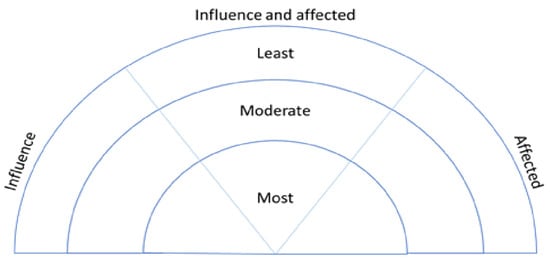
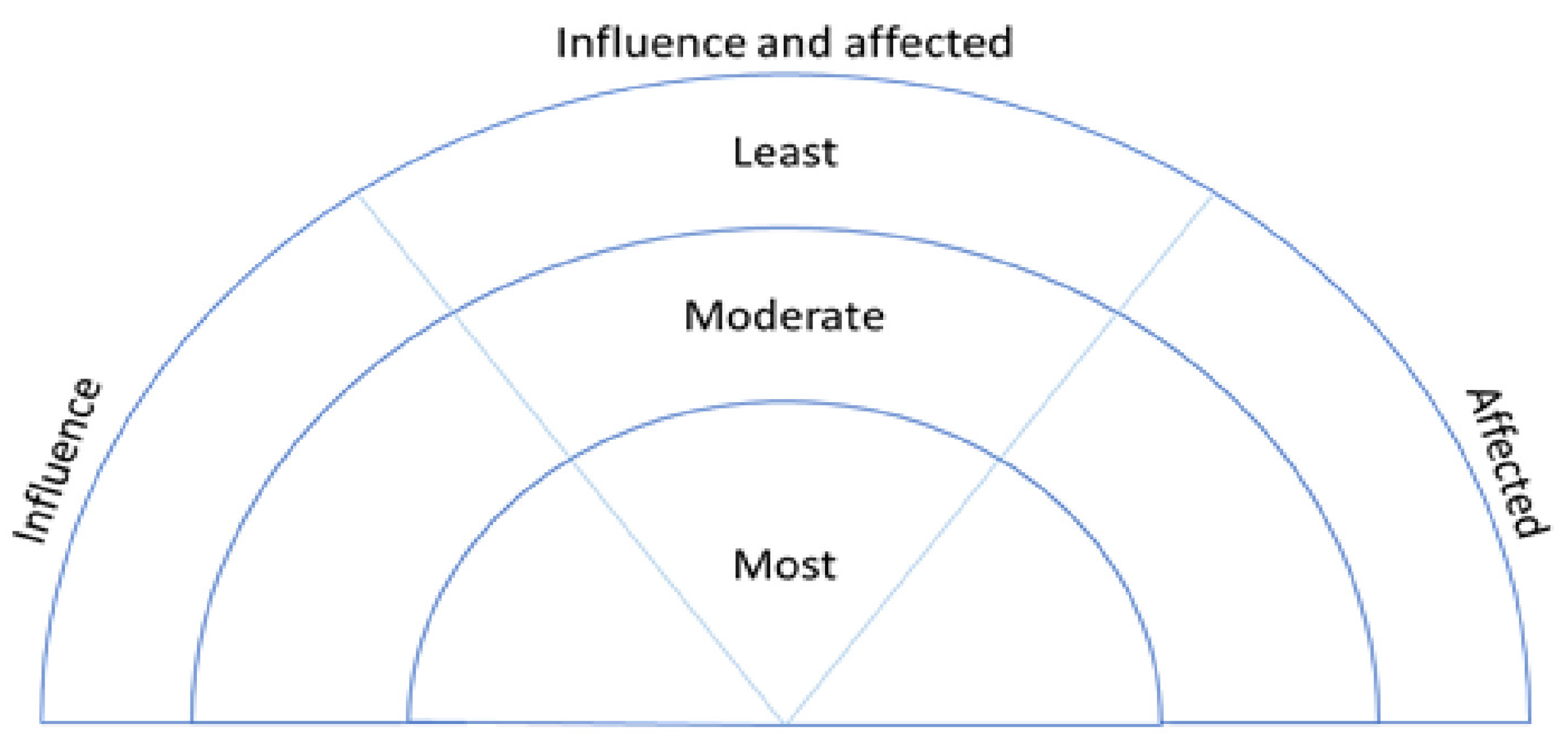
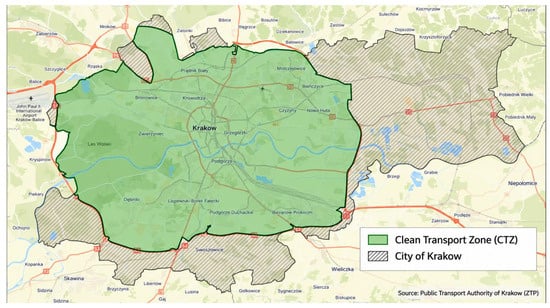
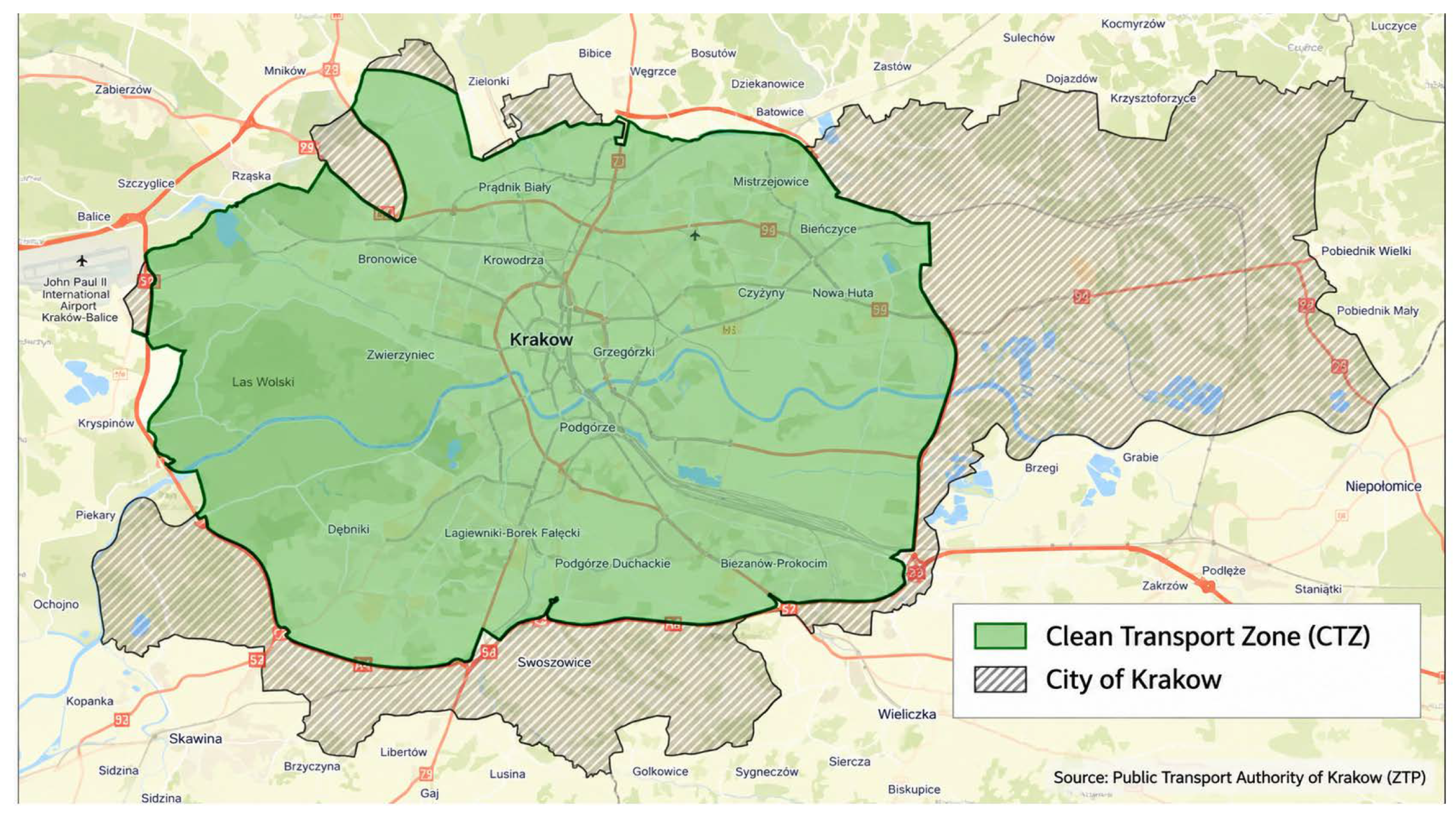
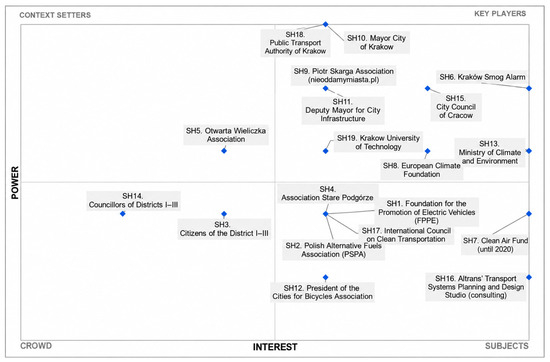
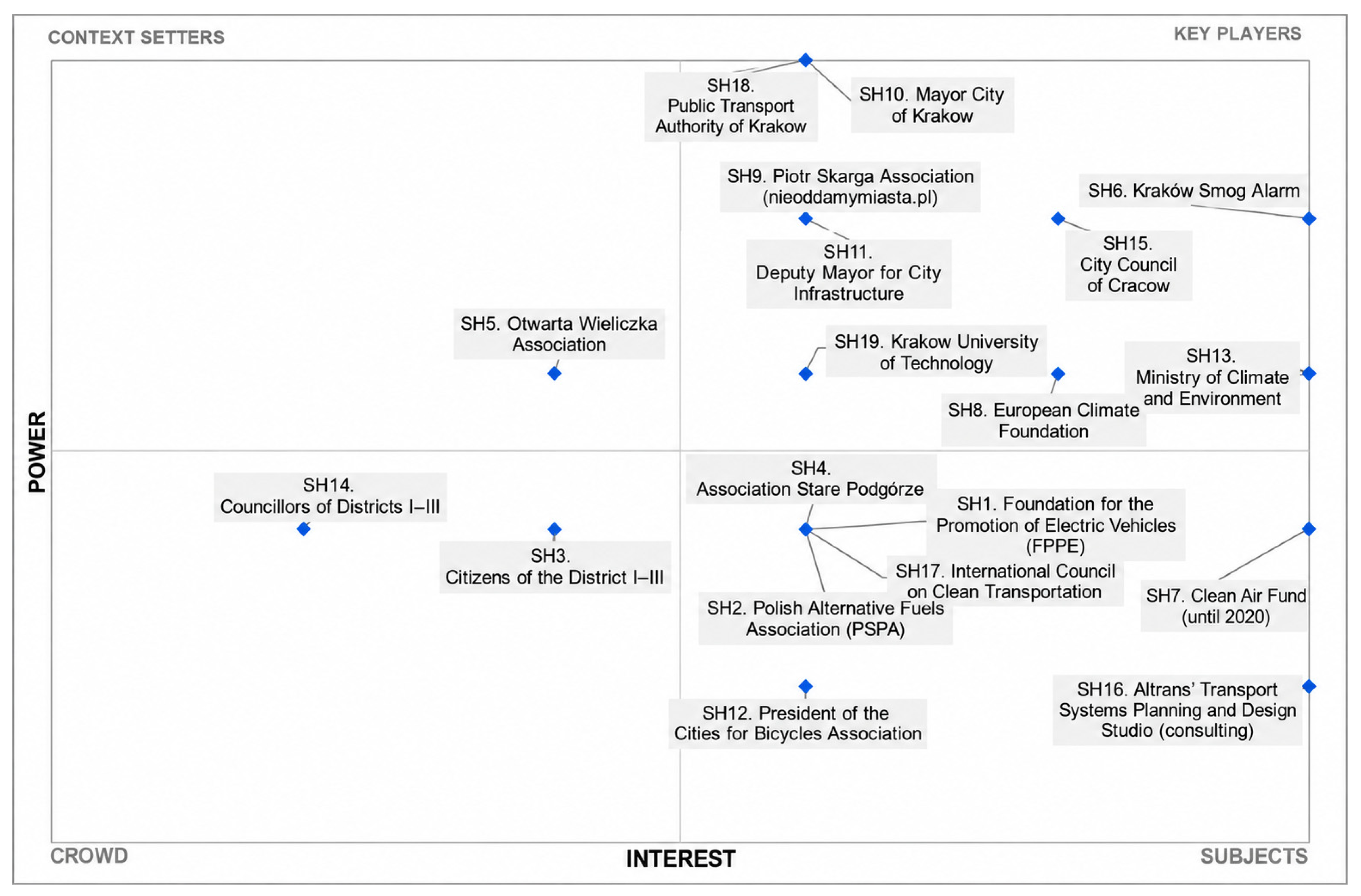
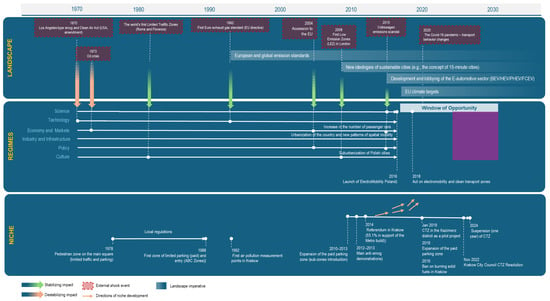
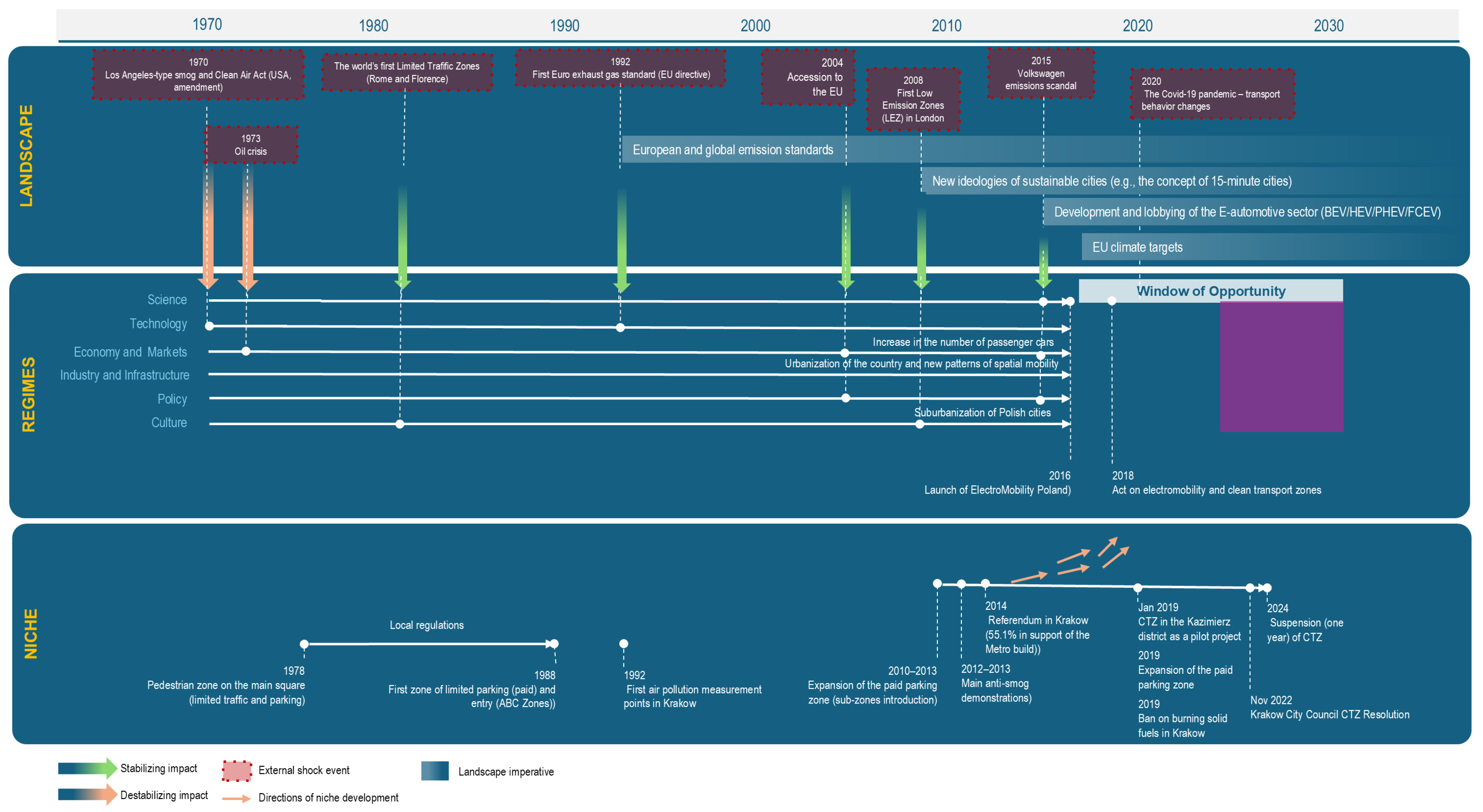

Disclaimer/Publisher’s Note: The statements, opinions and data contained in all publications are solely those of the individual author(s) and contributor(s) and not of MDPI and/or the editor(s). MDPI and/or the editor(s) disclaim responsibility for any injury to people or property resulting from any ideas, methods, instructions or products referred to in the content. |
© 2026 by the authors. Licensee MDPI, Basel, Switzerland. This article is an open access article distributed under the terms and conditions of the Creative Commons Attribution (CC BY) license.