


Abstract
The long development cycle and high investment requirements of artificial intelligence (AI) conflict with the short-term incentives prevailing in capital markets, leading some firms to cater to market expectations through promotional rhetoric rather than substantive investment, possibly at the expense of long-term sustainability commitments. This study examines whether such AI catering affects corporate pollution and under which conditions. Using Chinese A-share listed firms with firm-level emission records from 2016 to 2024, we measure AI catering as AI disclosure in excess of the level predicted by observable substantive AI input and estimate its effect with firm and year fixed-effects models. AI catering is associated with higher pollution emission intensity, whereas substantive AI input is associated with lower intensity. Lower environmental investment and environmental disclosure quality account for part of this association. The association is stronger under formation conditions that make substantive AI adoption costly and weaker under detection and penalty conditions that make laxer pollution control easier to discover and more costly. This study contributes to research on corporate sustainability by revealing an organizational and governance cost of technology hype, distinct from AI’s direct environmental footprint, and suggests that regulators and investors should verify the substantive basis of corporate AI claims.
1. Introduction
The application of artificial intelligence (AI) in energy management, emission monitoring, and production process optimization has opened new technological pathways for corporate pollution control [1,2]. Given AI’s broad application prospects, investors have rewarded AI-related narratives, at least initially, and listed companies have increased AI-related disclosures in their annual reports [3]. However, the development and deployment of AI require sustained financial investment and technological accumulation, meaning that firms’ AI narratives may run ahead of their substantive AI input [4]. This suggests that when expected valuation gains from promotional disclosure exceed the costs of substantive investment, firms are incentivized to exaggerate their AI adoption to cater to market expectations, creating a gap between their AI narrative and their substantive AI input. The adverse consequences of such catering behavior lie not only in the failure to realize the intended technological benefits of AI, but also in the consumption of corporate resources that may crowd out environmental governance, which similarly demands long-term commitment. Therefore, amid the ongoing AI boom, the extent to which such catering behavior exists and its effect on corporate pollution emissions warrant empirical investigation.
Existing research suggests that corporate AI adoption is associated with lower pollution emissions, primarily through improved production efficiency resulting from technological upgrading [2]. However, the reliability of these conclusions largely depends on the valid measurement of firms’ AI adoption. The existing literature employs two main types of indicators: disclosure-based indicators, constructed by mining technology-related keywords from annual report texts to capture how firms present their AI capabilities [5]; and input-based indicators, constructed from patent applications or research and development (R&D) expenditures to reflect firms’ resource commitment to AI [6]. Recent research on AI washing brings the two together and shows that firms’ AI narratives can exceed their substantive AI input, with consequences for market reactions and long-run performance [3] and for organizational resilience [4]. These studies leave aside how the gap between AI narrative and substantive AI input bears on corporate pollution and on the environmental investment, environmental disclosure, and environmental management on which pollution control depends. If such a gap is prevalent, estimates of emission reduction effects based solely on disclosure indicators may also be biased.
Catering theory provides an analytical framework for understanding this gap. Baker and Wurgler developed catering theory in the context of dividend policy, arguing that when markets assign valuation premiums to certain characteristics, managers are motivated to adjust corporate decisions to accommodate market preferences, even if such adjustments undermine long-term firm value [7]. Related research shows that firms cater to investor preferences in a broader range of corporate behaviors. During the dot-com bubble, firms earned significant abnormal returns simply by changing their names to Internet-related dot-com names [8]; likewise, after the rise of blockchain, comparable renaming strategies generated valuation premiums [9]. These findings suggest that when markets favor certain concepts, firms tend to cater to investor preferences through superficial signals rather than substantive investments. The current AI domain exhibits similar conditions conducive to catering behavior, creating incentives for firms to pursue market recognition through disclosure rather than substantive investment.
Whether such catering behavior affects corporate environmental performance has been partially addressed by the greenwashing literature. Greenwashing refers to situations in which firms’ environmental claims exceed their actual environmental actions, essentially reflecting firms’ attempts to cater to market preferences for a green image [10,11,12]. Research has found that firms that divest polluting plants highlight their sustainable policies although pollution from these plants does not decline [13], and that green financing can widen the decoupling between environmental claims and environmental performance [14]. These findings suggest that catering behavior may harm corporate environmental performance. However, greenwashing research focuses on the divergence between disclosure and action within the environmental domain, and research on AI washing has examined market and organizational outcomes [3,4] rather than whether catering behavior in the technology domain spills over into environmental governance. This study therefore asks whether AI catering, the extent to which a firm’s AI narrative exceeds its observable substantive AI input, increases corporate pollution, through which environmental governance channels, and under which formation, detection, and penalty conditions the effect is stronger or weaker. The environmental cost examined here is organizational and governance-related. It arises from how firms allocate resources and managerial attention between a short-term technology narrative and long-term environmental commitments, rather than from the direct environmental footprint of AI systems such as the energy use of data centers.
Building on the above analysis, we measure AI catering as AI disclosure in excess of the level predicted by a firm’s observable substantive AI input and examine its effect on pollution emission intensity for Chinese A-share listed firms with firm-level emission records from 2016 to 2024. We find that AI catering is associated with higher pollution emission intensity, whereas substantive AI input is associated with lower intensity. Lower environmental investment and lower environmental disclosure quality account for part of this association. The association is stronger among traditional manufacturing firms than among other firms and weaker under heavier analyst coverage and central environmental inspection exposure, which we use to capture the formation, detection, and penalty conditions of catering, respectively. AI catering is also positively associated with short-term institutional ownership and negatively associated with long-term institutional ownership, consistent with a short-term market incentive.
This study makes three contributions. First, we extend research on AI washing from market and organizational outcomes to environmental outcomes. Holding observable substantive AI input constant, a firm’s AI narrative is associated with higher pollution emission intensity, whereas substantive AI input itself is associated with lower intensity, so the environmental cost lies in the gap between narrative and input rather than in AI adoption. Second, we extend research on the environmental consequences of catering behavior. While existing greenwashing studies focus on the divergence between disclosure and action within the environmental domain, this study examines how catering behavior in the technology domain spills over into environmental governance, finding that AI catering is associated with higher pollution and that lower environmental investment and environmental disclosure quality account for part of this association. Third, by examining the formation, detection, and penalty conditions of catering, we show that the association is stronger in traditional manufacturing firms, for which substantive AI adoption is costly, than in other firms, and weaker where analyst coverage and central environmental inspections expose laxer pollution control to detection and penalties than where they do not, which helps regulators and investors identify high-risk contexts and informs the sustainability governance of corporate AI adoption. The remainder of the paper is organized as follows. Section 2 develops the theoretical background and hypotheses; Section 3 describes the data, variables, and model; Section 4 reports the empirical results and, in Section 4.6, examines short-term market incentives; and Section 5 concludes and discusses policy implications, limitations, and future research.
2. Theoretical Background
2.1. Analysis of How AI Catering Affects Pollution Emissions
AI catering shares with greenwashing a gap between what a firm communicates and what it does, but the two differ in domain, in the image being built, in the audience, and in the path to environmental outcomes. Greenwashing is the gap between environmental claims and actual environmental actions; firms build a green image for stakeholders who value environmental responsibility, and the environmental cost lies in the gap itself [11,15]. AI catering is the extent to which a firm’s AI narrative exceeds its observable substantive AI input; firms build an image of technological progress for investors who price AI themes, and its environmental consequences arise indirectly, through the allocation of resources and managerial attention. The two concepts therefore apply to different settings. Greenwashing arises wherever stakeholders reward a green image, whereas AI catering arises where capital markets price AI themes and can affect the environment even in firms that make no environmental claims. The two overlap when firms describe the use of AI for emission monitoring or energy saving; such statements are treated here as part of the AI narrative, because what defines them is the technology claim.
Research on symbolic corporate action shows that the gap between communication and substance extends well beyond environmental reporting, to sustainability goals that firms announce but do not pursue [16], to sustainability officer appointments that serve legitimacy rather than change [17], and to the tone of annual reports [18]. AI washing research belongs to this line; it concerns AI claims that lack substantiation and asks how markets and regulators respond to them [3,19]. AI catering concerns the same kind of gap when it is driven by investor demand for AI themes, and this study follows the chain from that demand to narratives that run ahead of input and to the resources and attention they crowd out.
AI catering substitutes disclosure for substantive investment and is characterized by a pronounced short-term orientation, whereas environmental governance requires sustained long-term commitment [20,21,22]. Because the outcomes of environmental governance are difficult for markets to recognize and price in the short term, firms must sustain their governance efforts to achieve lasting improvements in environmental performance. Environmental investment provides the material foundation for pollution control; environmental information disclosure provides the informational basis for external oversight; and environmental management systems ensure that resource allocation translates into standardized governance actions [23]. All three draw on financial resources and on managerial attention, which is itself a scarce resource [24]. The short-term orientation that leads managers to substitute AI narrative for AI investment also guides how they allocate these resources. When firms concentrate resources and attention on cultivating an AI image, investment, disclosure, and execution may all be compromised, thereby weakening corporate pollution control.
At the resource investment stage, AI catering may crowd out environmental investment. The returns on environmental investment are difficult for markets to recognize and price; emission reduction effects lag behind investment activities; and the social benefits of environmental improvement cannot be fully converted into corporate financial returns. These characteristics place environmental investment at a disadvantage in internal resource allocation, especially when managers are short-sighted [21,25,26]. AI catering further exacerbates this disadvantage, as the core logic of catering is to gain market recognition at lower cost by channeling resources toward activities that can quickly generate market responses. By contrast, environmental investment fails to produce comparable market effects and is therefore more likely to be deprioritized in resource allocation. Reduced environmental investment leads to slower upgrades of pollution control facilities and delayed improvements in cleaner production, eroding the material foundation for pollution control and consequently raising corporate pollution emissions.
At the information disclosure stage, AI catering may reduce environmental disclosure quality. High-quality environmental information serves as an important basis for investors to assess environmental risks, for regulators to allocate enforcement resources, and for the public to exercise social oversight [27,28]. However, when catering motives dominate disclosure decisions, information disclosure shifts from faithful reporting to an impression management tool, with management prioritizing image-building effects over accuracy [18]. Firms engaged in catering to project a technologically advanced image may avoid disclosing environmental issues that suggest legacy burdens or compliance risks, opting instead to selectively disclose favorable information and downplay negative information [29]. The decline in environmental disclosure quality weakens the oversight capacity of external stakeholders, leaving corporate pollution behavior inadequately constrained and thereby raising pollution emissions [30].
At the organizational execution stage, AI catering may reduce the level of standardized environmental management. The degree to which management focuses on environmental issues directly affects the effectiveness of corporate environmental governance, serving as a key driver of green practices [31]. AI catering continuously consumes managerial attention, reducing the capacity available for environmental management matters. When environmental issues fail to enter management’s attention agenda, the development and operation of environmental management systems lack sustained momentum, and institutional implementation tends to slacken. Even if firms maintain environmental expenditures, the absence of managerial attention makes it difficult to establish standardized governance processes, leading to increased pollution emissions.
In summary, AI catering may weaken corporate pollution control through three channels: resource investment, information disclosure, and organizational execution. Accordingly, we propose the following hypotheses:
Hypothesis 1.
AI catering increases corporate pollution.
Hypothesis 2a.
AI catering increases corporate pollution by reducing environmental investment.
Hypothesis 2b.
AI catering increases corporate pollution by lowering environmental disclosure quality.
Hypothesis 2c.
AI catering increases corporate pollution by weakening standardized environmental management.
2.2. Analysis of Formation, Detection, and Penalty Conditions
The effect of AI catering on corporate pollution emissions may vary depending on firm characteristics and the external environment. For catering behavior to produce environmental consequences, it must first occur and persist, and then the crowding-out of resources must translate into actual pollution. Specifically, the occurrence of the behavior depends on formation conditions: the higher the cost of substantive action, the more likely firms are to substitute symbolic disclosure for substantive investment [12,32]. The persistence of the behavior and of its environmental consequences depends on detection conditions: the greater the information asymmetry, the harder it is for external stakeholders to notice the gap [29] and the weaker environmental effort behind it [33]. Whether resource crowding-out translates into increased pollution depends on penalty conditions: the weaker the environmental enforcement deterrence, the more readily the resource crowding-out caused by catering manifests as increased emissions. Variations in these three conditions lead to differential environmental consequences of AI catering.
First, formation conditions determine whether catering behavior emerges. When firms can convert AI technology into productivity at reasonable cost, management can earn market recognition through genuine performance without resorting to catering. Conversely, when the cost of substantive action is prohibitively high or uncertainty is too great, catering becomes a practical choice [4]. Traditional manufacturing firms face precisely the latter situation. These firms have long built their core competitiveness on physical equipment, production processes, and human expertise. Embedding AI technology requires overhauling data collection systems, restructuring production processes, and cultivating new organizational capabilities. These efforts entail large investment outlays, long transformation cycles, and low success rates. By contrast, non-traditional manufacturing firms have stronger digital foundations and face lower barriers to AI adoption [34], making management more likely to earn market recognition through substantive action and thereby less inclined to engage in catering. Consequently, the degree of catering is higher among traditional manufacturing firms. Moreover, production processes in traditional manufacturing are often accompanied by higher pollution emissions, and pollution control depends more heavily on sustained environmental investment. As a result, the emission consequences of crowding out environmental resources are more severe [35].
Second, detection conditions determine whether catering behavior and its environmental consequences can persist. Even after catering behavior has emerged, its strategic effectiveness depends on whether the market can identify the gap between the AI narrative and substantive AI input. When information asymmetry is high, the market struggles to verify firms’ AI disclosures, allowing catering behavior to continue capturing valuation premiums while environmental spending is cut. Analyst coverage is an important mechanism for reducing information asymmetry and restraining symbolic disclosure [33,36]. Analysts verify the reasonableness of corporate disclosures through site visits, financial analysis, and peer comparisons, and their findings diffuse to the market via research reports and media coverage. When firms receive greater analyst coverage, the gap between narrative and input becomes harder to conceal, which may lead management to cater less. For a given gap, cuts in environmental investment and laxer pollution control also become easier to discover and to count against the firm, so the gap is less likely to translate into weaker environmental effort. The positive effect of AI catering on corporate pollution emissions is therefore weaker in firms with greater analyst coverage.
Finally, penalty conditions determine whether resource crowding-out translates into actual pollution. Unlike the previous two conditions, penalty conditions do not affect how much catering occurs but the extent to which pollution consequences manifest at a given level of catering. Catering behavior crowds out environmental resources, but whether this crowding-out translates into increased pollution depends on management’s expectations regarding pollution consequences. When penalties for polluting are light, management can free up resources for catering activities by cutting environmental expenditures while bearing only low pollution costs. However, when pollution faces severe penalties, this latitude is substantially narrowed [37]. Environmental enforcement action raises the expected cost of cutting environmental expenditures through both the probability of detection and the severity of punishment. In China, central environmental inspections, in which teams dispatched by the central government examine provinces and hold local governments and firms accountable for environmental problems, are a direct form of such action [38,39]. When expected pollution costs are sufficiently high, even if management engages in catering behavior, it becomes difficult to free up resources by cutting environmental expenditures. The scope for resource crowding-out is compressed, and the effect of AI catering on pollution emissions is therefore weaker. Accordingly, we propose the following hypotheses:
Hypothesis 3.
A higher cost of substantive AI adoption strengthens the positive effect of AI catering on corporate pollution.
Hypothesis 4.
Stronger external scrutiny weakens the positive effect of AI catering on corporate pollution.
Hypothesis 5.
Stronger environmental enforcement deterrence weakens the positive effect of AI catering on corporate pollution.
3. Materials and Methods
3.1. Data Sources
This study uses Chinese A-share listed companies from 2016 to 2024 as the research sample. The revised Environmental Protection Law and the Measures for the Disclosure of Environmental Information by Enterprises and Public Institutions, which took effect on 1 January 2015, required key pollutant-discharging units to disclose their emissions; the sample therefore starts in 2016, and 2015 is used to construct lagged variables. The sample period also covers the spread of corporate AI narratives that followed the release of the New Generation Artificial Intelligence Development Plan in 2017.
After excluding companies under special treatment or particular transfer, financial institutions, observations with negative assets or debt-to-asset ratios exceeding one, and observations with missing key variables, 27,874 firm-year observations remain for 2016–2024, of which 16,129 have firm-level emission records; dropping 322 observations of firms that appear only once yields a final sample of 15,807 firm-year observations for 2784 firms. All continuous variables are winsorized at the 1st and 99th percentiles. Annual report texts are obtained from CNINFO (www.cninfo.com.cn (accessed on 5 October 2026)). AI patent application data are sourced from the China National Intellectual Property Administration. Financial, corporate governance, analyst, and institutional ownership data are drawn from the China Stock Market & Accounting Research (CSMAR) and Wind databases. Pollution emission data are collected from the firm-level emission records of the CSMAR Environmental Research Database, and the entry dates of central environmental inspection teams from announcements of the Ministry of Ecology and Environment.
3.2. Variable Definition
For each main measure, the studies followed and what this study adds are summarized in Table A1.
3.2.1. Dependent Variable
The dependent variable is corporate pollution, measured by pollution emission intensity (Intensity). Following Mao et al. [40] and Wang and Wheeler [41], we construct a composite pollution measure using sulfur dioxide and nitrogen oxide emissions from industrial exhaust gases, along with chemical oxygen demand and ammonia nitrogen emissions from industrial wastewater. Since different pollutants have varying measurement units, direct aggregation lacks comparability. To address this issue, we convert each pollutant’s emissions into pollution equivalents by dividing by their respective equivalent values, as specified in China’s Administrative Measures for Pollutant Discharge Fee Collection Standards. We sum the pollution equivalents, divide the total by operating revenue, and take the natural logarithm, so that the measure reflects emissions per unit of business activity rather than their level. The formula is as follows:
where Eiωt denotes firm i’s emissions of pollutant ω in year t in kilograms, qω represents the pollution equivalent value of pollutant ω, and Revenueit is operating revenue in 10,000 yuan. The subscript ω corresponds to sulfur dioxide, nitrogen oxides, chemical oxygen demand, and ammonia nitrogen, respectively. According to the Administrative Measures, the pollution equivalent values are 0.95 kg for both sulfur dioxide and nitrogen oxides, 1 kg for chemical oxygen demand, and 0.8 kg for ammonia nitrogen. Higher values indicate greater pollution emission intensity.
3.2.2. Independent Variable
The independent variable is AI catering, which captures the extent to which a firm’s AI narrative exceeds its observable substantive AI input. We measure firms’ AI engagement from two dimensions: nominal AI disclosure and substantive AI input. Nominal AI disclosure (Nominal) reflects the technological image firms present to external stakeholders in the Management Discussion and Analysis (MD&A) section. Substantive AI input (Substantive) is measured by AI patent applications, which require R&D investment and provide an observable record of a firm’s own AI development.
Following Yao et al. [5], we construct the nominal measure by first selecting seed words from existing literature and research reports, then expanding semantically similar terms using the Word2vec model. After screening, we compile an AI dictionary containing 73 keywords, count their occurrences in MD&A texts, and define Nominal as the natural logarithm of one plus the number of AI keywords per 10,000 MD&A characters. Following Grashof and Kopka [6], we extract firms’ annual AI patent applications using the International Patent Classification (IPC) codes of the AI branch of the 2023 Key Digital Technology Patent Classification System, and define Substantive as the natural logarithm of one plus the number of applications. We use application counts rather than granted patents because patent approval typically lags by two to three years, whereas applications better reflect current R&D activities.
We then measure AI catering as excess AI disclosure (ExcessAI), that is, AI disclosure in excess of the level predicted by the firm’s observable substantive AI input and R&D intensity, given its size, age, and the industry-year disclosure norm. We estimate the following disclosure model on all non-financial listed firms from 2015 to 2024:
where RDit is R&D expenses divided by operating revenue, SIZEit and AGEit are defined below, and δjt denotes industry-by-year fixed effects. ExcessAI equals the positive part of the residual, and firm-years without any AI keyword are assigned zero (Table A2). ExcessAI is therefore a relative measure that compares a firm with firms of the same industry and year that have similar AI input, and a narrative that falls short of input is not treated as the economic opposite of catering. Industry classification follows the 2012 Guidelines for Industry Classification of Listed Companies issued by the China Securities Regulatory Commission (CSRC), using two-digit codes for manufacturing and one-digit codes for other industries. A difference index that subtracts the min-max normalized patent count from the normalized keyword frequency within each industry-year [42], together with three alternative constructions of the difference, is used in the robustness tests.
Nominalit = α1Substantiveit + α2RDit + α3SIZEit + α4AGEit + δjt + uit
Patent applications record only part of substantive AI input. Firms can adopt AI through purchased systems, cloud-based and licensed models, or data infrastructure without filing patents, and patenting propensity differs across industries; the industry-by-year effects in the disclosure model absorb the latter. Within a firm, adopting AI in unpatented forms raises measured excess disclosure. To the extent that such adoption lowers pollution, this measurement error works against finding a positive effect of AI catering on pollution emission intensity. Conversely, strategic patent applications filed to obtain subsidies or meet performance evaluations inflate measured input and understate excess disclosure, which also works against a positive effect to the extent that such firms pollute no less than others. Excess AI disclosure is not followed by more AI patent applications over the next two years (Table A3), so it does not appear to reflect an early stage of in-house AI development.
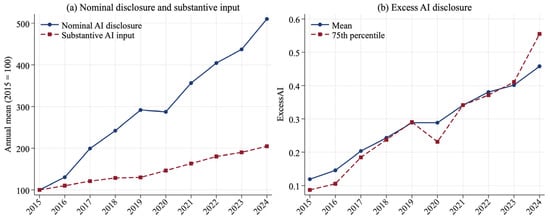
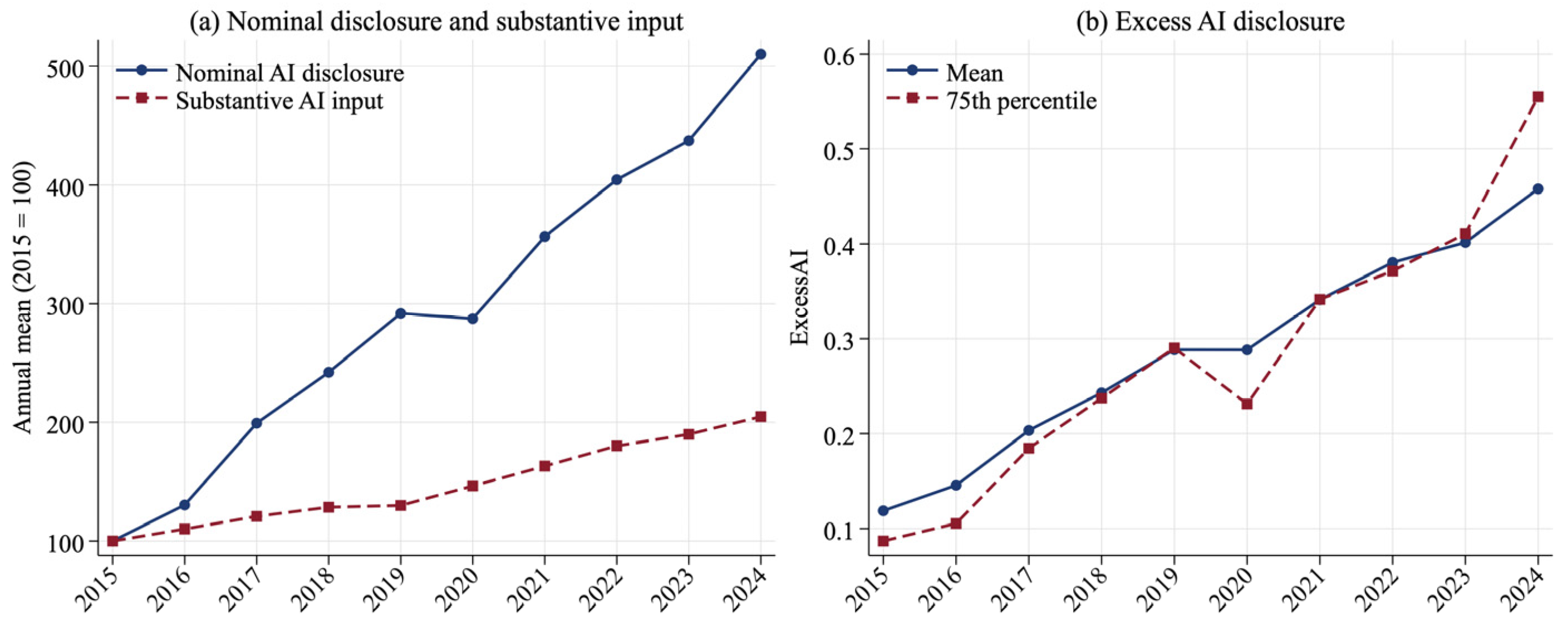
Figure 1 shows that, for all non-financial listed firms over 2015–2024, average nominal AI disclosure grew much faster than average substantive AI input (Panel a), and that the mean and 75th percentile of ExcessAI rose throughout the period while its median remained zero (Panel b), so the gap between narrative and input widened within industry-years and was concentrated in a subset of firms.
Figure 1.
Artificial intelligence (AI) disclosure and substantive AI input, 2015–2024: (a) annual means, 2015 = 100; (b) mean and 75th percentile of ExcessAI.
3.2.3. Control Variables
The control variables include: firm size (SIZE), the natural logarithm of total assets; leverage (LEV), the ratio of total liabilities to total assets; revenue growth (GROWTH), the change in operating revenue from the prior year divided by prior-year operating revenue; return on assets (ROA), the ratio of net income to total assets; operating cash flow (CFO1), the ratio of net cash flow from operating activities to total assets; largest shareholder ownership (TOP1), the ratio of shares held by the largest shareholder to total shares outstanding; board independence (INDBOARD), the ratio of independent directors to total board members; chief executive officer (CEO) duality (DUAL), a dummy variable that equals 1 if the chairman also serves as CEO, and 0 otherwise; state ownership (SOE), a dummy variable that equals 1 for state-owned enterprises, and 0 otherwise; firm age (AGE), the natural logarithm of the number of years since establishment plus one. Descriptive statistics for the variables in the baseline model are presented in Table 1.
Table 1.
Descriptive statistics.
3.3. Model Setting
To examine the effect of AI catering on pollution emission intensity, we specify the following baseline regression model:
where subscript i denotes firm and t denotes year. Intensityit is firm i’s pollution emission intensity in year t. ExcessAIit is firm i’s AI catering in year t. Controlsit is a vector of control variables. μi represents firm fixed effects, controlling for time-invariant firm characteristics. λt represents year fixed effects, controlling for macroeconomic fluctuations and other time-varying factors common to all firms. εit is the error term. Standard errors are clustered at the firm level to account for within-firm correlation. If Hypothesis 1 holds, the coefficient β should be positive. All estimations were performed in Stata (version 16), and the data and code are provided in the Supplementary Materials.
Intensityit = βExcessAIit + γControlsit + μi + λt + εit
4. Results and Discussion
4.1. Baseline Regression
Table 2 reports the baseline regression results of AI catering on corporate pollution emission intensity. Column (1) includes only firm and year fixed effects, while Column (2) further incorporates control variables. The coefficient of ExcessAI is positive and statistically significant at the 1% level in both models, and its magnitude remains stable after including the control variables, indicating that AI catering is associated with higher pollution emission intensity. In Column (2), a one-standard-deviation increase in ExcessAI corresponds to about 4.4% higher pollution emission intensity, and a move from the 25th to the 75th percentile to about 1.9% higher intensity; the former equals about one-tenth of the average within-firm standard deviation of intensity. For the median firm, 4.4% corresponds to about 0.14 pollution equivalents per 10,000 yuan of operating revenue.
Table 2.
AI catering and pollution emission intensity: baseline results.
Column (3) enters nominal AI disclosure and substantive AI input separately. Holding substantive input constant, higher nominal disclosure is associated with higher pollution emission intensity, whereas substantive AI input is associated with lower intensity. A one-standard-deviation increase in nominal disclosure corresponds to about 4.2% higher intensity, and a one-standard-deviation increase in substantive input to about 3.2% lower intensity, so the association of the AI narrative with pollution emission intensity is comparable in size to that of substantive AI input. A difference between disclosure and patenting therefore combines a narrative component and an input component with opposite signs, and ExcessAI keeps only the narrative component. Because disclosure rises only slightly with substantive input in the disclosure model (Table A2), a firm that adds AI input and raises its disclosure only by the amount predicted for that input ends up with lower intensity. The positive association therefore comes from narrative beyond input. These results support Hypothesis 1.
4.2. Endogeneity Test
Reverse causality and omitted variables may affect the baseline estimates. Firms with higher pollution levels face greater environmental compliance pressure and reputational risks, which may motivate them to emphasize AI applications in annual reports to project a green transformation image. Shocks common to firms in the same industry and year, such as regulatory changes, energy costs, industrial policy, and demand fluctuations, may also move AI narratives and emissions together. We therefore use an instrumental variable (IV) that can be combined with industry-by-year fixed effects: the average ExcessAI in year t − 1 of non-financial listed firms that share at least one director with the focal firm and belong to other industries (IV_Interlock).
The validity of this instrument rests on two conditions. First, the instrument is correlated with the endogenous variable. Directors who sit on several boards carry disclosure practices across firms [43], and board interlocks shape the strategic choices of the connected firms [44]. A director who has seen AI narratives rewarded at another firm is likely to support similar narratives at the focal firm. The first-stage coefficient is positive and significant at the 1% level, with a cluster-robust F statistic of 87.3.
Second, the instrument should be related to the focal firm’s pollution only through its own AI catering. Because interlocked firms belong to other industries, the instrument removes the focal firm’s own industry-year shocks, and lagging it by one year limits feedback from the focal firm’s current decisions to its interlocked firms.
Table 3 reports the estimates. The two-stage least squares (2SLS) coefficient on ExcessAI is positive and significant at the 1% level (Column 1). Column (2) adds industry-by-year fixed effects to both stages; the first stage remains strong (F = 77.3), and the 2SLS coefficient remains positive and significant at the 1% level. The 2SLS estimates are about four times the ordinary least squares (OLS) estimate on the same sample (Column 3). ExcessAI is an estimated residual, and the part of it that reflects AI adoption the measure cannot observe, such as purchased systems, acts as measurement error that biases the OLS estimate toward zero. The instrument captures the part of excess disclosure that follows interlocked directors, which is less likely to reflect such unobserved adoption; the IV estimate is also a local effect for firms whose narratives respond to their board ties. The IV estimates are therefore consistent with a causal interpretation of the baseline association, although, because board ties are not formed at random, they are one strand of converging evidence alongside the fixed-effects results rather than a definitive solution to endogeneity. To examine the reverse path directly, we additionally regress ExcessAI on one-year lagged pollution emission intensity with the full set of controls and fixed effects. The coefficient on lagged intensity is close to zero and statistically insignificant, providing no evidence that more polluting firms subsequently engage in more AI catering (Table A3).
Table 3.
Instrumental-variable estimates.
4.3. Robustness Test
Table 4 summarizes the robustness tests; each row is a separate regression. The first three rows replace the dependent variable with the emission level, controlling for operating revenue, with emissions scaled by total assets, and with the intensity of air pollutants, which have been a focus of environmental regulation and follow relatively consistent statistical standards. The next five rows replace ExcessAI with the difference index and its positive part and with three constructions of the difference that limit the influence of extreme values on min-max scaling, namely decile ranks, an indicator for disclosure above and patenting below the industry-year median, and Z-scores. The last four rows replace year fixed effects with industry-by-year fixed effects, which absorb shocks common to firms in the same industry and year, cluster standard errors by firm and year, exclude firms in the four municipalities directly under the central government, whose service-oriented industrial structures differ from those of other regions, and exclude 2020–2022, when the COVID-19 pandemic disrupted production and emission records. The coefficient remains positive and significant in every specification. In a distributed-lag model on a common sample, the contemporaneous effect holds, and the sum of the coefficients from t to t − 3 is positive and significant at the 1% level (Table A4).
Table 4.
Robustness tests.
4.4. Mechanism Analysis
AI catering may increase pollution emission intensity by reducing environmental investment, lowering environmental disclosure quality, and weakening standardized environmental management. We test each mediator in three steps: the effect of AI catering on the mediator M, the effect of M on pollution emission intensity conditional on AI catering, and the indirect effect, the product of the two coefficients, with a percentile interval from 300 firm-cluster bootstrap replications that re-estimate the construction of ExcessAI in each replication.
Mit = α1ExcessAIit + γ1Controlsit + μi + λt + εit
Intensityit = β1ExcessAIit + β2Mit + γ2Controlsit + μi + λt + εit
Because pollution may itself shape environmental investment, disclosure, and certification, and the data offer no source of variation in any mediator that leaves emissions unaffected, the indirect effects should be read as correlational evidence consistent with the proposed mechanisms rather than as causal mediation estimates. Environmental investment, moreover, can be measured only from hand-collected annual report notes, which limits the sample for this mediator.
4.4.1. Environmental Investment (GreenInv)
Following Zhang et al. [45], we manually collect environmental investment data from listed companies’ annual reports. Capitalized environmental investment is extracted from the construction-in-progress notes, including expenditures on desulfurization and denitrification, sewage treatment, waste gas and residue treatment, energy and water conservation, waste heat recovery, and exhaust gas treatment. Expensed environmental investment is extracted from administrative expense schedules, including expenditures on greening, environmental impact assessments, pollutant discharge fees, environmental protection fees, and vegetation restoration. The sum of both is divided by year-end total assets to obtain an environmental investment indicator encompassing both capital and operating expenditures.
The results in Table 5 show that AI catering is associated with lower environmental investment, and that lower environmental investment is associated with higher pollution emission intensity conditional on ExcessAI; the indirect effect is positive, and its bootstrap interval excludes zero. Environmental investment is available for 4769 firm-years. Firms with these data differ from other sample firms mainly in that they are more often traditional manufacturers and state-owned, are larger, have more analyst coverage, and have higher environmental disclosure quality, while their pollution emission intensity and ExcessAI are similar (Table A5). The baseline effect holds both in firms with these data and in firms without them (Table A6). The association between ExcessAI and environmental investment remains negative after controlling for lagged environmental disclosure quality and when investment is measured by its capitalized component, taken from audited construction-in-progress notes (Table A6).
Table 5.
Mechanism analysis: environmental investment, environmental disclosure quality, and standardized environmental management.
4.4.2. Environmental Disclosure Quality (EDI)
Following Bi et al. [46], we construct an environmental disclosure quality index from two dimensions: monetary information and non-monetary information. Monetary information covers environmental liabilities, environmental expenditures, and pollution control investments. Combined quantitative and qualitative disclosure is scored 2 points, qualitative-only disclosure is scored 1 point, and non-disclosure is scored 0 points. Non-monetary information covers environmental targets, management systems, and certification status. Disclosure is scored 2 points, and non-disclosure is scored 0 points. The two categories comprise 25 scoring items in total, and the index is the natural logarithm of one plus the sum of the scores. This scoring system differentiates between disclosure completeness and depth, with higher scores indicating better disclosure quality.
AI catering is also associated with lower environmental disclosure quality, lower disclosure quality is associated with higher pollution emission intensity conditional on ExcessAI, and the bootstrap interval of the indirect effect excludes zero (Table 5). Environmental investment and environmental disclosure quality thus account for part of the association between AI catering and pollution emission intensity, supporting Hypotheses 2a and 2b.
4.4.3. Standardized Environmental Management (ISO 14001)
We measure the level of standardized environmental management by ISO 14001 certification status. ISO 14001 is an environmental management system certification standard developed by the International Organization for Standardization [47]. Firms obtaining this certification must set environmental objectives, assign environmental responsibilities, monitor and measure their environmental performance, and conduct regular internal audits. The certification process requires third-party verification. We obtain certification information from the CSMAR database, coding certified firms as 1 and non-certified firms as 0.
AI catering is not significantly associated with ISO 14001 certification, certification is not significantly associated with pollution emission intensity conditional on ExcessAI, and the bootstrap interval of the indirect effect includes zero (Table 5), so we find no evidence supporting Hypothesis 2c. Certification status changed for only 16.8% of sample firms during the sample period, so with firm fixed effects the test rests on these firms alone and has limited power, and certification records whether a management system exists rather than how intensively it is operated. The organizational execution channel therefore cannot be confirmed with certification data.
4.5. Formation, Detection, and Penalty Conditions
The effect of AI catering on pollution emission intensity may vary with external conditions. This study examines moderating effects from three dimensions: formation conditions, detection conditions, and penalty conditions of catering behavior. We construct the following interaction model for testing:
Intensityit = β1ExcessAIit + β2Modit + β3ExcessAIit × Modit
+γControlsit + μi + λt + εit
+γControlsit + μi + λt + εit
Here, Mod is successively replaced by three variables: traditional manufacturing status (TM), analyst coverage (Analyst), and central environmental inspection exposure (Inspect). If formation conditions strengthen the effect, the interaction coefficient β3 should be positive; if detection and penalty conditions weaken it, β3 should be negative. To separate how much catering occurs under each condition from the effect of a given level of catering on pollution, we also compare AI disclosure and substantive AI input between traditional manufacturing and other firms, and the level of ExcessAI across analyst coverage and inspection exposure (Table A7).
4.5.1. Formation Conditions: Traditional Manufacturing Status (TM)
Within manufacturing category C of the CSRC classification, we exclude industries with higher digitalization levels: pharmaceutical manufacturing (C27), railway, shipbuilding, aerospace, and other transportation equipment manufacturing (C37), electrical machinery and equipment manufacturing (C38), computer, communication, and other electronic equipment manufacturing (C39), and instrument manufacturing (C40). The remaining manufacturing firms are coded as 1, and all other firms are coded as 0. The remaining traditional manufacturing firms still rely primarily on physical processing and manual operations. Their AI adoption faces multiple obstacles, including equipment upgrades, process restructuring, and workforce training, making the implementation of AI technology more difficult and costly than in other firms.
Traditional manufacturing firms disclose AI about as much as other firms in the same year, but their substantive AI input is lower (Table A7), so the gap between their AI narrative and their substantive AI input is wider, consistent with the high cost of substantive AI adoption in these firms. The results in Column (1) of Table 6 show that the interaction coefficient between ExcessAI and TM is positive and significant at the 10% level, indicating that the association between AI catering and pollution emission intensity is stronger among traditional manufacturing firms, whose pollution control depends more heavily on sustained environmental investment; among other firms, the coefficient on ExcessAI is not significant, which is consistent with Hypothesis 3.
Table 6.
Moderating effects of formation, detection, and penalty conditions.
4.5.2. Detection Conditions: Analyst Coverage (Analyst)
We measure detection conditions by the number of analysts following the firm in a given year; firms without analyst coverage are assigned zero, and the variable is standardized to zero mean and unit standard deviation.
The results in Column (2) of Table 6 show that the interaction coefficient between ExcessAI and Analyst is negative and significant at the 10% level. Analyst coverage is not significantly associated with the level of ExcessAI (Table A7), so the weaker association is consistent with analyst scrutiny limiting the consequences of a given gap rather than reducing catering itself, in line with Hypothesis 4.
4.5.3. Penalty Conditions: Central Environmental Inspection Exposure (Inspect)
We measure penalty conditions by exposure to central environmental inspections. Since 2016, inspection teams dispatched by the central government have examined every province in successive batches: the first round in 2016–2017, the follow-up inspections of 2018, the second round in 2019–2022, and the batches of the third round that began in 2023 (Table A8). A team stays in a province for about one month, after which it reports its findings, and the province draws up and carries out a rectification plan. We therefore code Inspect as 1 in the year that contains at least half of the twelve months after the team’s entry, assigning entries in January–June to the entry year and entries in July–December to the following year; the twelve-month window spans the team’s stay and the rectification period that follows. Because Inspect varies at the province-year level, standard errors in Column (3) of Table 6 are clustered by province.
The results in Column (3) of Table 6 show that the interaction coefficient between ExcessAI and Inspect is negative and significant at the 1% level. The association between AI catering and pollution emission intensity is weaker in province-years under inspection exposure than in other province-years. Inspection exposure is not significantly associated with the level of ExcessAI (Table A7), consistent with penalty conditions acting on the consequences of catering rather than on its extent. These results are consistent with Hypothesis 5.
4.6. Further Analysis: Short-Term Market Incentives
If AI catering harms corporate environmental performance, why would managers still adopt this strategy? One possible explanation is that although catering behavior carries environmental costs, it may be rewarded in the short term. Rational managers, after weighing the trade-offs, may still opt for catering. If this explanation holds, addressing AI catering cannot rely solely on disclosure regulation but must also consider capital market incentives.
Managers may engage in AI catering in response to short-term market incentives. AI catering signals technological progress to investors, catering to market sentiment and potentially raising market valuation. However, because catering behavior lacks substantive investment support, such valuation gains are unlikely to be sustained. Catering is more likely than substantive investment to attract investors chasing short-term returns, while fundamentals-oriented long-term investors tend to divest. To examine this conjecture, we conduct analysis along two dimensions: market valuation and investor composition. Market valuation is measured by Tobin’s Q (TBQ), the ratio of market value to total assets. For investor composition, we classify institutional investors by holding duration: those with holding periods of less than one year are classified as short-term investors, while those with holding periods exceeding one year are classified as long-term investors. We then calculate their respective shareholding ratios (Short_Inst and Long_Inst).
The results in Table 7 show that ExcessAI is positively associated with TBQ and Short_Inst and negatively associated with Long_Inst, all at the 1% level. Firms with higher AI catering have a higher market valuation and a shareholder base tilted toward short-term institutional investors, a pattern consistent with a short-term market incentive explanation.
Table 7.
AI catering, market valuation, and institutional ownership.
5. Conclusions
This study defines AI catering as the extent to which a firm’s AI narrative exceeds its observable substantive AI input and examines its effect on pollution emission intensity. We find that AI catering is associated with higher corporate pollution emission intensity, and that lower environmental investment and environmental disclosure quality account for part of this association. The association varies with formation, detection, and penalty conditions. Traditional manufacturing firms, facing higher costs of substantive AI adoption than other firms, show a wider gap between AI narrative and substantive AI input, and their pollution-intensive production processes make a given level of catering more consequential for emissions. Analyst coverage and central environmental inspection exposure weaken this association and are not significantly related to the level of catering, consistent with scrutiny and penalties limiting how far catering translates into laxer pollution control. AI catering is also associated with a shareholder base tilted toward short-term institutional investors, consistent with a short-term market incentive. Because substantive AI input is associated with lower pollution, the findings do not indicate that AI adoption itself is environmentally harmful; the cost arises from the gap between narrative and input. By showing that such a gap is associated with lower environmental investment and disclosure quality, the findings illustrate the tension between short-term technological legitimation and long-term environmental commitments that responsible digital transformation has to manage.
The above findings offer the following policy implications for standardizing AI information disclosure and mitigating the environmental risks of catering behavior. First, because AI disclosure in excess of substantive AI input is associated with higher pollution emission intensity, regulatory authorities should establish AI disclosure standards to constrain catering behavior. This includes developing substantive standards for AI information disclosure, requiring firms to provide supporting evidence such as R&D expenditures, procurement contracts, and application scenarios when disclosing AI-related information. Stock exchanges should incorporate AI disclosure into their disclosure evaluation systems and initiate inquiry procedures for firms whose disclosures diverge from their substantive AI input. Second, because AI catering is associated with lower environmental investment and disclosure quality, governments should raise mandatory environmental disclosure standards, requiring annual reports to include indicators such as environmental capital expenditures and major pollutant emissions. Third, regulators should give priority to verifying the substantive evidence behind AI claims in traditional manufacturing firms, where the association is stronger than in other firms. Broader directions that follow from these findings as logical inferences and require further research include disclosure inquiries by stock exchanges for firms with lower analyst coverage, green credit and tax incentives for firms that raise environmental investment, sector-specific evaluation criteria and third-party assessments of AI applications, wider online emission monitoring, and changes in capital market incentives, such as a larger role for long-term capital from social security and pension funds and the inclusion of pollution emission intensity in the construction of market indices.
This study has several limitations. First, patent applications capture only the AI that firms develop themselves. Although the disclosure model controls for R&D intensity, AI bought as systems or licensed models remains unobserved and may be counted as catering. Data on AI procurement or AI-related hiring would reveal how much measured catering reflects purchased AI. Second, although the board-interlock instrument absorbs industry-year shocks, its exclusion restriction cannot be tested, none of the mediators varies exogenously, and the organizational execution channel could not be confirmed, because certification status rarely changes within firms. If the instrument affects pollution through other routes, the estimate would be biased; the findings are therefore best interpreted as a robust association supported by converging evidence rather than as a definitive causal estimate. Changes in AI disclosure rules could provide exogenous variation to identify the effect and its channels; testing the execution channel also requires measures of how environmental management systems are operated. Third, the sample covers listed firms with emission records, which are subject to stricter regulation and disclosure requirements than unlisted firms, and environmental investment is observed only for firms that report it. The findings do not extend directly to unlisted small and medium-sized firms, which face little capital-market demand for AI narratives. With administrative data on environmental expenditures, the investment channel could be tested for all firms, and evidence from unlisted firms would indicate whether the findings depend on that demand. Fourth, the evidence comes from China, where investors price AI themes and central environmental inspections hold local governments and firms accountable. The association is weaker under inspection exposure, so it may differ under other market and enforcement arrangements. Comparative studies across countries would show whether the findings hold elsewhere and which institutional conditions weaken them.
Supplementary Materials
The following supporting information can be downloaded at: https://www.mdpi.com/article/10.3390/su182010648/s1, Data and Stata code that reproduce the results reported in this study.
Author Contributions
Conceptualization, J.H.; methodology, J.H.; formal analysis, J.H.; data curation, J.H.; writing—original draft preparation, J.H.; writing—review and editing, S.C.; supervision, S.C.; project administration, S.C.; funding acquisition, J.H. All authors have read and agreed to the published version of the manuscript.
Funding
This research was supported by Program for the Philosophy and Social Sciences Research of Higher Learning Institutions of Shanxi (PSSR), grant number 2024W059, for the project ‘Research on the Mechanisms and Countermeasures of Digital Finance Empowering the Green Development of Shanxi’s Manufacturing Industry’; and by the Shanxi Scholarship Council of China (2025 Shanxi Province Returned Overseas Scholars Science and Education Innovation Funding Project), grant number 2025-150, for the project ‘Research on Digital Technology Empowering Energy Consumption Optimization and Green Transformation of Shanxi’s Energy-Intensive Manufacturing Industry under the Carbon Peaking and Carbon Neutrality Goals’.
Institutional Review Board Statement
Not applicable.
Informed Consent Statement
Not applicable.
Data Availability Statement
The data and Stata code that reproduce the results presented in this study are openly available in the Supplementary Materials. Further inquiries can be directed to the corresponding author.
Conflicts of Interest
The authors declare no conflicts of interest.
Appendix A
Table A1.
Measures, the studies they follow, and what this study adds.
Table A2.
Disclosure model used to construct ExcessAI.
Table A3.
Reverse path and subsequent AI patenting.
Table A4.
Distributed-lag model of AI catering and pollution emission intensity.
Table A5.
Firm characteristics with and without environmental-investment data.
Table A6.
Baseline estimates by environmental-investment data and alternative investment measures.
Table A7.
AI disclosure, substantive AI input, and AI catering under the formation, detection, and penalty conditions.
Table A8.
Central environmental inspection batches and exposure coding.
References
- Liu, F.; Liang, C. Examining the Role of Artificial Intelligence in Advancing Pollution Reduction Strategies. Manag. Decis. Econ. 2024, 45, 3068–3079. [Google Scholar] [CrossRef] [Scilit]
- Zhu, Q.; Zhang, Z. The Impact of Artificial Intelligence on Energy Conservation and Emission Reduction: Evidence From China’s Listed Firms. Int. Stud. Econ. 2025, 20, 410–430. [Google Scholar] [CrossRef] [Scilit]
- Song, X.; Hou, W.; Ouyang, Z.; Hao, F. AI washing: Strategic disclosure and backlash. Financ. Res. Lett. 2026, 95, 109684. [Google Scholar] [CrossRef] [Scilit]
- Xia, Y.; Sun, J.; Liu, J.; Fang, K.; Shi, H.; Li, N. Beyond AI Narratives: AI Washing and Organizational Resilience. Systems 2026, 14, 853. [Google Scholar] [CrossRef] [Scilit]
- Yao, J.; Zhang, K.; Guo, L.; Feng, X. How does artificial intelligence improve firm productivity? Based on the perspective of labor skill structure adjustment. Manag. World 2024, 40, 101–133. (In Chinese) [Google Scholar]
- Grashof, N.; Kopka, A. Artificial intelligence and radical innovation: An opportunity for all companies? Small Bus. Econ. 2023, 61, 771–797. [Google Scholar] [CrossRef] [Scilit]
- Baker, M.; Wurgler, J. A Catering Theory of Dividends. J. Financ. 2004, 59, 1125–1165. [Google Scholar] [CrossRef] [Scilit]
- Cooper, M.J.; Dimitrov, O.; Rau, P.R. A Rose.com by Any Other Name. J. Financ. 2001, 56, 2371–2388. [Google Scholar] [CrossRef] [Scilit]
- Akyildirim, E.; Corbet, S.; Sensoy, A.; Yarovaya, L. The impact of blockchain related name changes on corporate performance. J. Corp. Financ. 2020, 65, 101759. [Google Scholar] [CrossRef] [Scilit]
- Delmas, M.A.; Burbano, V.C. The Drivers of Greenwashing. Calif. Manag. Rev. 2011, 54, 64–87. [Google Scholar] [CrossRef] [Scilit]
- Daga, S.; Yadav, K.; Singh, D.; Pamucar, D.; Simic, V. Unveiling Greenwashing: Analyzing the interaction of factors discouraging ESG Greenwashing through TISM and MICMAC. J. Environ. Manag. 2025, 380, 124850. [Google Scholar] [CrossRef] [Scilit]
- Li, S.; Liu, C. Corporate strategic greenwashing under ESG disclosure uncertainty: Financing incentives and nonlinear effects. J. Environ. Manag. 2025, 394, 127473. [Google Scholar] [CrossRef] [Scilit]
- Duchin, R.; Gao, J.; Xu, Q. Sustainability or Greenwashing: Evidence from the Asset Market for Industrial Pollution. J. Financ. 2025, 80, 699–754. [Google Scholar] [CrossRef] [Scilit]
- Wang, C.; Duan, D.; Tang, P.; Yang, S. Greenwashing or brownwashing? Green bond issuance and corporate environmental decoupling. Appl. Econ. 2026, 58, 10272–10288. [Google Scholar] [CrossRef] [Scilit]
- Mai, S.; Zhang, Z.; Zhu, J.; Mai, W.; Deng, G. Beyond green words: A natural language processing-driven disclosure-emission gap index for detecting corporate carbon washing in China. J. King Saud Univ. Comput. Inf. Sci. 2026, 38, 775. [Google Scholar] [CrossRef] [Scilit]
- Palea, V.; Gordano, S.; Migliavacca, A. Do firms practise what they preach? Corporate performance-communication decoupling on environmental SDGs and the impact of sustainability-oriented governance mechanisms. Sustain. Account. Manag. Policy J. 2025, 16, 98–127. [Google Scholar] [CrossRef] [Scilit]
- Al Amosh, H. Chief sustainability officer appointment design and environmental outcomes: Distinguishing symbolic from substantive roles. J. Environ. Manag. 2026, 404, 129401. [Google Scholar] [CrossRef] [Scilit]
- Lu, Y.; Karbhari, Y.; Yang, X.; Wang, Y. The double-edged sword of ESG: Impression management and audit pricing efficiency across auditor quality. Manag. Audit. J. 2026, 1–31. [Google Scholar] [CrossRef] [Scilit]
- Ofir, M. AI washing. Am. Bus. Law J. 2026, 63, 193–233. [Google Scholar] [CrossRef] [Scilit]
- Wiersema, M.; Koo, H.; Chen, W.; Zhang, Y. Corporate Short-Termism: A Review and Research Agenda. J. Manag. 2025, 51, 2389–2418. [Google Scholar] [CrossRef] [Scilit]
- Zhu, R.; Zhang, Y.; Zeng, H.; Guo, L. Solve the cause, not the symptom: Managerial myopia and environmental investment preferences. J. Environ. Manag. 2025, 373, 123873. [Google Scholar] [CrossRef] [Scilit]
- Zhong, J.; Tang, S.; Albitar, K. Earnings Pressure and Environmental Social and Governance Performance: How Executive Compensation Incentives Mitigate Short-Termism. Corp. Soc. Responsib. Environ. Manag. 2026, 33, 4329–4347. [Google Scholar] [CrossRef] [Scilit]
- Arocena, P.; Orcos, R.; Zouaghi, F. The impact of ISO 14001 on firm environmental and economic performance: The moderating role of size and environmental awareness. Bus. Strategy Environ. 2021, 30, 955–967. [Google Scholar] [CrossRef] [Scilit]
- Ocasio, W. Towards an attention-based view of the firm. Strateg. Manag. J. 1997, 18, 187–206. [Google Scholar] [CrossRef] [Scilit]
- Lu, Q.; Deng, J.; Chen, S.; Hussain, Y. Managerial myopia and its barrier to green innovation in high-pollution enterprises: A machine learning approach. J. Environ. Manag. 2025, 376, 124477. [Google Scholar] [CrossRef] [Scilit]
- Li, Q.; Li, Q. Making quick money: The impact of managerial myopia on corporate investment decision. Manag. Decis. 2025, 64, 1639–1660. [Google Scholar] [CrossRef] [Scilit]
- Yao, S.; Chen, G.; Zhu, Y. Board secretary succession and environmental information disclosure quality: Evidence from heavily polluting firms in China. Appl. Econ. 2026, 58, 3839–3856. [Google Scholar] [CrossRef] [Scilit]
- Zhu, Y.; Chen, Q.; Zhong, M. Using Generative Artificial Intelligence to Evaluate the Quality of Chinese Environmental Information Disclosure in Chemical Firms. Sustainability 2025, 17, 11348. [Google Scholar] [CrossRef] [Scilit]
- Marquis, C.; Toffel, M.W.; Zhou, Y. Scrutiny, Norms, and Selective Disclosure: A Global Study of Greenwashing. Organ. Sci. 2016, 27, 483–504. [Google Scholar] [CrossRef] [Scilit]
- Liu, Y.; Liu, W.; Chen, X.; Fang, R.; Deng, L. The synergies of air quality monitoring program: Information disclosure and pollution control. J. Environ. Manag. 2025, 375, 124258. [Google Scholar] [CrossRef] [Scilit]
- Huang, D.; Cheng, J.; Quan, X.; Wu, Y. Managerial attention to environmental protection and corporate green innovation. Rev. Quant. Financ. Account. 2024, 63, 1047–1081. [Google Scholar] [CrossRef] [Scilit]
- Walker, K.; Wan, F. The Harm of Symbolic Actions and Green-Washing: Corporate Actions and Communications on Environmental Performance and Their Financial Implications. J. Bus. Ethics 2012, 109, 227–242. [Google Scholar] [CrossRef] [Scilit]
- Zhang, C.; Wu, X. Can Analyst Coverage Reduce Corporate ESG Greenwashing? Evidence from China. Sustainability 2025, 17, 11138. [Google Scholar] [CrossRef] [Scilit]
- Tang, X.; Tan, G.; Gao, D.; Wang, Q. Can Artificial Intelligence Adoption Empower Digital–Green Synergy in Manufacturing Firms? Evidence from Large Language Models. Sustainability 2026, 18, 7485. [Google Scholar] [CrossRef] [Scilit]
- Fan, X.; Wang, Z.; Wu, S.; Li, K. Environmental investment and green innovation in polluting enterprises: Evidence from heavily polluting listed firms in China. J. Environ. Manag. 2025, 393, 127177. [Google Scholar] [CrossRef] [Scilit]
- Warren, J.D. Voluntary Disclosure Quality and Analyst Coverage. Account. Rev. 2025, 100, 309–333. [Google Scholar] [CrossRef] [Scilit]
- Gray, W.B.; Shimshack, J.P. The Effectiveness of Environmental Monitoring and Enforcement: A Review of the Empirical Evidence. Rev. Environ. Econ. Policy 2011, 5, 3–24. [Google Scholar] [CrossRef] [Scilit]
- Pan, H.; Li, W.; Luo, G.; Shao, Y. When green turns grey: China’s Central Environmental Protection Inspection and entrepreneurship. Appl. Econ. Lett. 2026, 33, 1290–1294. [Google Scholar] [CrossRef] [Scilit]
- Li, K.; Li, Z.; Gao, J. How Does Central Environmental Protection Inspection Affect Corporate ESG Performance: A Quasi-Natural Experiment from China. Sustainability 2026, 18, 9346. [Google Scholar] [CrossRef] [Scilit]
- Mao, J.; Guo, Y.; Cao, J.; Xu, J. Financing platform debt and environmental pollution governance. Manag. World 2022, 38, 96–118. (In Chinese) [Google Scholar]
- Wang, H.; Wheeler, D. Financial incentives and endogenous enforcement in China’s pollution levy system. J. Environ. Econ. Manag. 2005, 49, 174–196. [Google Scholar] [CrossRef] [Scilit]
- Wang, Y.; Dou, B.; Song, P.; He, X. Does management tone deviation affect investor decisions? An empirical study based on text and financial data of Chinese listed companies. J. Financ. Res. 2023, 169–187. (In Chinese) [Google Scholar]
- Cai, Y.; Dhaliwal, D.S.; Kim, Y.; Pan, C. Board interlocks and the diffusion of disclosure policy. Rev. Acc. Stud. 2014, 19, 1086–1119. [Google Scholar] [CrossRef] [Scilit]
- Wang, J.C. Strategic Implications of Board Interlocks: A Literature Review and Future Research Agenda. Corp. Gov. 2026. Early View. [Google Scholar] [CrossRef] [Scilit]
- Zhang, Q.; Zheng, Y.; Kong, D. Regional environmental governance pressure, executive experience and corporate environmental investment: A quasi-natural experiment based on the ‘Ambient Air Quality Standards (2012)’. Econ. Res. J. 2019, 54, 183–198. (In Chinese) [Google Scholar]
- Bi, Q.; Peng, J.; Zuo, Y. Environmental information disclosure system, corporate governance and environmental information disclosure. Account. Res. 2012, 39–47. (In Chinese) [Google Scholar]
- ISO 14001:2015; Environmental Management Systems—Requirements with Guidance for Use. International Organization for Standardization: Geneva, Switzerland, 2015.

Disclaimer/Publisher’s Note: The statements, opinions and data contained in all publications are solely those of the individual author(s) and contributor(s) and not of MDPI and/or the editor(s). MDPI and/or the editor(s) disclaim responsibility for any injury to people or property resulting from any ideas, methods, instructions or products referred to in the content. |
© 2026 by the authors. Licensee MDPI, Basel, Switzerland. This article is an open access article distributed under the terms and conditions of the Creative Commons Attribution (CC BY) license.