


Abstract
Heritage trees connect ecological functions with cultural meanings, but conservation research often treats these evaluations and people’s emotional relationships with heritage settings separately. This study develops an integrated appraisal model that distinguishes ecological value perception, cultural ecosystem service perception, place attachment, and sustainable conservation support. A cross-sectional survey of 500 adults in China with direct or mediated heritage-site familiarity was analyzed using latent-variable structural equation modeling. Heritage trees were understood broadly as older, large, notable, and traditional courtyard trees with ecological or cultural significance. Ecological recognition was positively associated with cultural-service appraisal, which in turn was associated with tree-related attachment appraisal and stated conservation support. Ecological and cultural appraisals also retained direct associations with support, indicating that attachment was not the sole link between perceived value and conservation endorsement. The positive path pattern persisted after excluding patterned responses and among respondents reporting direct visits. The study refines attachment-centered accounts by distinguishing cultural meaning appraisal from emotional connection and by specifying complementary routes to support. These findings inform the evaluation of heritage interpretation and participatory management that connect ecological protection with cultural continuity.
1. Introduction
Cultural heritage sites are often protected as material records of the past, yet their continuity also depends on living components that grow, age, and respond to environmental change. Temples, ancestral halls, historic gardens, towns, and traditional villages convey memory through buildings, rituals, and inherited landscapes. The Historic Urban Landscape approach accordingly links conservation with natural settings, cultural practices, communities, and intangible values [1]. Heritage trees make these relationships visible: they shade courtyards, frame ceremonial routes, and connect present-day use with earlier generations. Chinese heritage settings provide a particularly relevant context for examining this conjunction. Research on temple landscapes and regional heritage-tree distributions documents the association of long-lived trees with religious and historical settings [2,3]. Such settings bring ecological persistence and cultural continuity into the same conservation problem. This conjunction makes Chinese heritage settings a substantively relevant context for examining how ecological recognition and cultural meaning relate to attachment and support. The study uses that context to develop and evaluate an integrated account of the four measured constructs.
The ecological stakes of this living heritage are substantial. Large old trees provide habitat structures, microclimates, biomass storage, genetic continuity, and ecological stability that cannot be rapidly recreated after loss. Their global decline and the exceptional conservation value of the oldest individuals have made their protection an urgent concern in landscape ecology [4,5]. In a heritage site, however, tree decline can also diminish shade, sensory atmosphere, ritual settings, historical legibility, and confidence in long-term stewardship. This combined vulnerability resonates with scholarship that has moved beyond narrow utility-based valuation toward plural values and Nature’s Contributions to People, including identity, responsibility, spirituality, and belonging [6,7,8]. Work on sacred heritage trees further illustrates how ecological attributes and culturally embedded meanings may coexist within the same organism and site [9]. These perspectives do not make ecological and cultural values interchangeable; rather, they indicate that their significance may be jointly perceived. Ancient-tree conservation in heritage landscapes is consequently a biocultural challenge in which biological condition, inherited meaning, and public experience must be considered together.
Relevant research increasingly connects ecological and cultural values, but studies address different aspects of conservation support. Tree-condition and historical studies establish the significance of heritage trees, whereas behavioral research examines people’s willingness to protect them. In Tehran, a survey of 503 residents linked psychological and attachment dimensions to heritage-tree conservation intentions, identifying social bonding as the strongest predictor [10]. European research shows that cultural-service experiences differ among visitor groups [11], while interviews in England connect landscape attachment with local history, practice, and responses to change [12]. These findings establish the relevance of attachment but leave room to distinguish two appraisals that may underpin it: what a tree contributes ecologically and what it means culturally. The distinction matters because recognition of public ecological or cultural benefits may support conservation even where personal attachment is limited. Explaining how these appraisals relate to emotional connection and support is therefore a conceptual question as well as a governance concern [13].
The model combines relational-value perspectives [14,15], the person–process–place framework of attachment [16], and the social psychology of place, which distinguishes place-based meanings, emotional identification, and protective intentions [17,18]. Cultural ecosystem service theory further locates cultural benefits in relations between environmental settings and human practices [19]. Building on these foundations, we propose an appraisal-specific extension: ecological value perception (EVP) and cultural ecosystem service perception (CESP) are separated from place attachment (PA), while each can retain an association with sustainable conservation support (SCS). This specification examines cultural meaning appraisal as a link between ecological recognition and attachment without making attachment the only route to support. The theoretical proposition concerns the differentiated organization of conservation-relevant appraisals and the coexistence of attachment-related and direct routes to support. The questionnaire operationalizes PA as the perceived contribution of heritage trees to emotional connections with heritage settings, and SCS as stated support for specified conservation measures.
Using a mixed-mode survey of 500 adults in China with direct or mediated familiarity with heritage sites, the study addresses three conceptual questions:
- How are perceptions of ecological functions connected with the cultural meanings attributed to heritage trees?
- What distinct roles do cultural-service appraisal and emotional connection play in linking perceived tree value with conservation support?
- To what extent is support organized through attachment-related routes and direct value-appraisal routes, including among respondents with direct site experience?
The study’s contribution is to specify and evaluate these complementary routes in one measurement framework. By keeping ecological recognition, cultural appraisal, and tree-related attachment distinct, it makes explicit what each contributes to the conservation-support account. Its practical relevance concerns how heritage interpretation and participatory management can connect living ecological features with cultural continuity; specific management interventions remain matters for site-based evaluation.
2. Literature Review and Hypotheses
2.1. Theoretical Foundations: Biocultural Heritage and Place Meaning
Biocultural approaches treat ecological conditions, cultural practices, institutions, and identities as interdependent rather than as separate inventories of natural and cultural assets [20,21,22,23]. Heritage trees illustrate this interdependence: ecological persistence can sustain a setting for rituals and memories, while cultural commitments can motivate continued care. The contribution of large old trees develops over long periods and cannot be rapidly replaced [4,5]. These properties establish the conservation context, but a biocultural perspective alone does not specify individual psychological relationships. The social psychology of place supplies that distinction. Stedman separates beliefs about a setting’s meanings from attachment and protective intentions, and relates physical landscape attributes to attachment through meaning [17,18]. Scannell and Gifford’s person–process–place framework similarly distinguishes the person, psychological processes, and place characteristics [16]. We draw on these accounts to distinguish recognition of ecological functions, appraisal of cultural contributions, and emotional connection, rather than treating all favorable evaluations as a single attachment construct.
The proposed extension connects this psychological distinction to cultural ecosystem service theory. Cultural contributions emerge through encounters between environmental settings and human practices; they are not uniform outputs of biophysical condition [19,24,25]. Accordingly, our model represents perceived ecological functions as EVP, perceived cultural contributions as CESP, personal emotional significance as PA, and endorsement of protective actions as SCS. Ecological and cultural appraisal can each be relevant to support, either alongside or through attachment. The model therefore retains direct and shorter indirect paths rather than imposing a single chain in which cultural benefits necessarily become durable bonds. Studies of heritage-tree conservation intentions [10], culturally differentiated landscape experiences [11], and place relationships [12,26] motivate these distinctions. The resulting model is an integrative extension of existing accounts: it specifies a separate cultural-appraisal position within the ecological recognition–attachment relationship and allows conservation endorsement to have more than one perceptual basis.
2.2. Ecological Value Perception and Cultural Ecosystem Service Perception
EVP concerns recognition of heritage trees’ environmental functions and long-term ecological significance, including regulation, biodiversity, stability, and accumulated value. CESP concerns perceived aesthetic, historical, spiritual, educational, and identity-related contributions. Ecosystem-service classifications distinguish these domains [27], while cultural-value scholarship emphasizes that non-material benefits depend on interpretation and social context [19,24,25]. The psychological rationale for H1 is meaning attribution: recognized properties of a setting provide material for interpreting what that setting signifies. Stedman’s meaning-mediated account connects environmental attributes with place meanings [18]; the cultural ecosystem service framework explains why environmental settings and cultural practices are interrelated [19]. Applied here, recognition of a tree’s longevity or ecological continuity may make its contribution to historical continuity, learning, or atmosphere more salient. This is our theoretical inference about associated appraisals, not a claim that ecological information automatically produces cultural appreciation.
The distinction between appraisal domains remains essential to that inference. A tree’s ecological significance does not prescribe one cultural interpretation, and cultural appreciation can arise through stories, rituals, or aesthetics without detailed ecological knowledge. Relational- and plural-value research similarly recognizes multiple, situated grounds for valuing nature [6,7,8,14,15,28]. Empirical studies in European mountain protected areas and at Vadu Beach show that cultural values and service experiences vary across people and settings [11,29]. In the heritage-tree model, we therefore predict a positive average EVP–CESP association while measuring the constructs separately. This prediction follows from their shared environmental referent and the proposed connection between functional recognition and meaning appraisal; it does not equate the two constructs or presume that all respondents interpret the same tree in the same way.
H1.
Higher ecological value perception is associated with higher cultural ecosystem service perception.
2.3. Cultural Ecosystem Services and Place Attachment
The distinction between cultural meaning and personal emotional significance provides the basis for the CESP–PA relationship. In the social psychology of place, meanings concern what a setting represents, whereas attachment concerns the relationship between that setting and the self [17]. Attachment frameworks include affective and cognitive processes, together with physical and social features of place [16,26]. Measurement research likewise distinguishes personal, community, and environmental connections [30,31]. Applied to heritage trees, a perceived contribution to historical continuity, spiritual atmosphere, education, or identity supplies a reason why a setting may become emotionally significant. Our proposed link is the personal relevance of cultural meaning: a contribution that resonates with memories, values, or identity may be associated with closeness and perceived irreplaceability. CESP measures appraisal of these contributions; PA measures trees’ perceived contribution to emotional connection with heritage settings. They are related but analytically distinct evaluations.
Appreciating a cultural service need not produce a durable bond in every individual. Rather, the theory predicts an average association whose strength may depend on personal relevance and experience. A first-time visitor may recognize historical importance without feeling attached, while another person may connect the same meaning to family memory or shared identity. Interviews in England’s Peak District emphasize histories and practices in place relationships [12], and cultural-service mapping shows that meanings are socially and spatially differentiated [32]. These observations clarify why the model includes a direct CESP–SCS path: people may support preserving valued cultural contributions without a strong emotional connection. They also support treating CESP and PA as separate constructs instead of interpreting cultural appreciation itself as evidence of attachment. H2a concerns their expected positive association, not a necessary progression from one to the other.
H2a.
Higher cultural ecosystem service perception is associated with stronger place attachment.
The model also retains an EVP → PA association independent of CESP. Recognition of ecological continuity, living diversity, or a tree’s irreplaceability may contribute to its personal significance without requiring a specifically historical or spiritual interpretation. This inference follows the place framework’s inclusion of physical characteristics alongside psychological processes [16,18] and preserves a route distinct from cultural meaning appraisal.
H2b.
Higher ecological value perception is associated with stronger place attachment after accounting for cultural ecosystem service perception.
2.4. Place Attachment and Sustainable Conservation Support
SCS measures stated endorsement of long-term tree protection, coordinated tree–building conservation, management investment, and public communication. Attachment is relevant because a valued connection with a setting makes its continuity personally meaningful. Environmental-psychology research links place attachment with environmentally responsible orientations [33], while planning scholarship relates it to participation and collective action [34]. In the proposed model, concern for maintaining an emotionally significant heritage setting supplies the rationale for PA–SCS: trees regarded as integral to its continuity or distinctiveness should be associated with greater support for their care. This prediction concerns the overall pattern of stated support. It does not require people to endorse every intervention, since attachment to familiar appearances or access arrangements may coexist with objections to particular management decisions. Perceived effectiveness and institutional legitimacy are additional considerations in conservation governance [13].
Empirical comparisons help define the expectation. The Tehran heritage-tree study highlights social bonding within a broader set of psychological predictors [10], whereas research in Bocas del Toro, Panama, connects attachment to surf places with wellbeing and conservation concerns [35]. Our outcome makes the conservation referent explicit by asking about tree-management measures rather than general environmental concern. Support may arise because continued care is seen as protecting an emotionally meaningful setting; the survey assesses that association through PA and SCS. This positions attachment as one basis for conservation endorsement alongside appraisals of ecological and cultural contributions, rather than as a universal explanation of support. The distinction is important when comparing findings across heritage landscapes, recreational settings, and studies using actual participation rather than reported willingness.
H3.
Stronger place attachment is associated with greater sustainable conservation support.
2.5. Direct Associations of Ecological Value and Cultural Ecosystem Services with Conservation Support
Direct EVP–SCS and CESP–SCS relationships follow from the distinction between valuing a contribution and feeling personally attached to its setting. Recognizing ecological functions can provide a conservation rationale based on maintaining habitat, environmental regulation, or long-term ecological continuity. Cultural appraisal can provide a rationale based on preserving historical, educational, spiritual, or aesthetic contributions for others as well as oneself. These routes need not depend entirely on emotional connection. Place-based meanings and attachment can have separate relationships with protective intentions [17], while plural-value research and heritage-tree valuation support considering different grounds for conservation together [6,8,28,36]. The model therefore allows ecological and cultural appraisal to remain associated with SCS after accounting for PA. These direct paths distinguish the proposed partial-indirect account from a model in which attachment absorbs all perceived-value associations.
H4.
Higher ecological value perception is associated with greater sustainable conservation support.
H5.
Higher cultural ecosystem service perception is associated with greater sustainable conservation support.
2.6. Integrated Conceptual Model
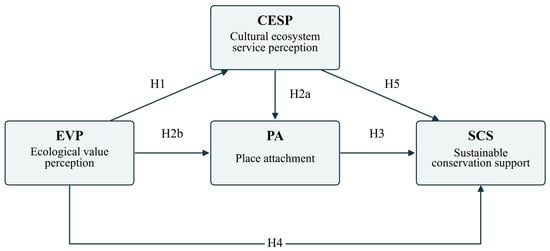
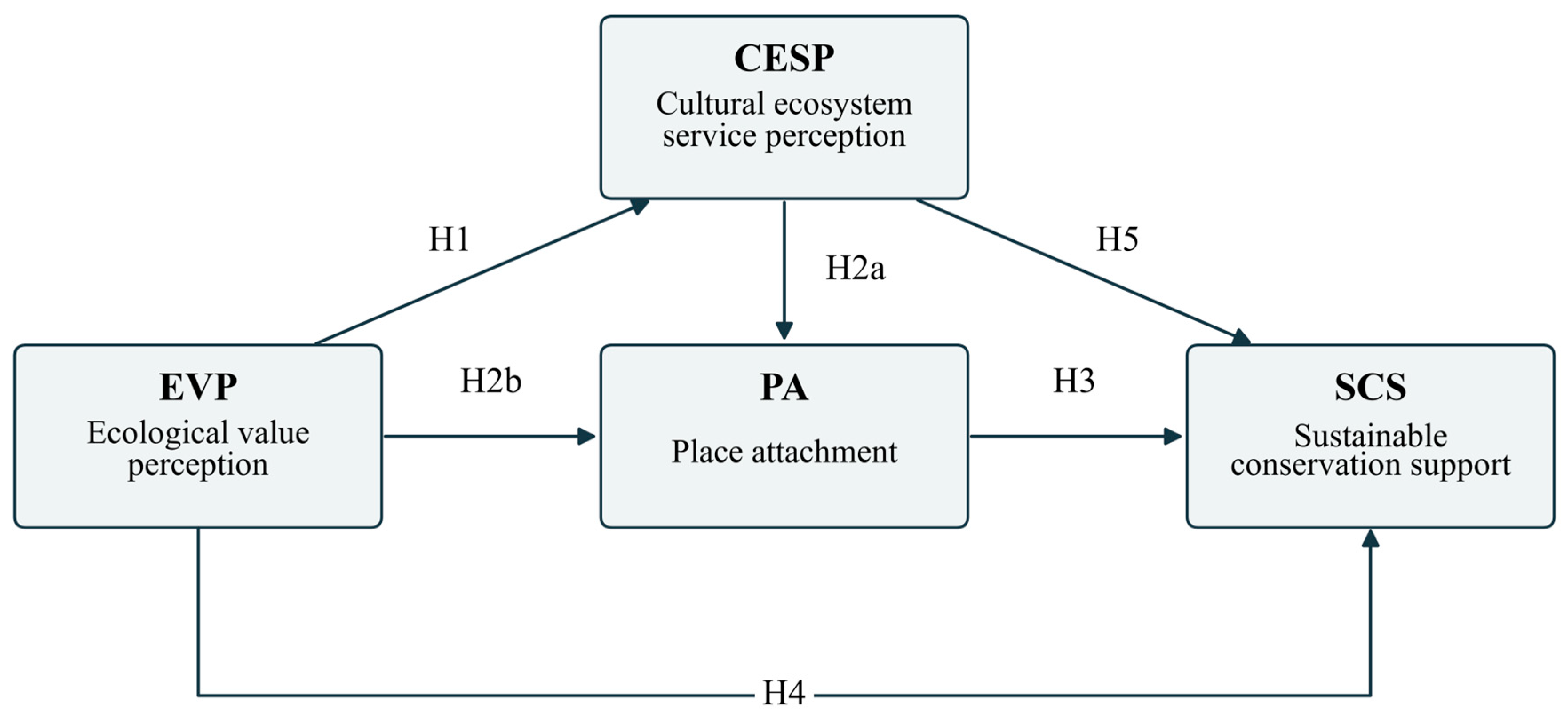
Figure 1 integrates six direct relationships: EVP → CESP (H1), CESP → PA (H2a), EVP → PA (H2b), PA → SCS (H3), EVP → SCS (H4), and CESP → SCS (H5). Three proposed indirect routes connect ecological recognition with support. The cultural-appraisal route concerns preserving valued cultural contributions (H6); the attachment route concerns protecting an emotionally meaningful setting (H7); and the serial route links ecological recognition with cultural meaning appraisal, personal emotional significance, and support (H8). These are theoretically differentiated explanations of how appraisals may be organized, with coefficient products providing their empirical representation. Retaining all direct paths makes it possible to examine each route without assuming complete mediation. The directional ordering expresses the theoretical specification; its interpretation under the cross-sectional design is set out in Section 3.1.
Figure 1.
Conceptual model and direct-path hypotheses.
H6.
Higher ecological value perception is associated with greater conservation support indirectly through stronger appraisal of heritage trees’ cultural contributions (EVP → CESP → SCS).
H7.
Higher ecological value perception is associated with greater conservation support indirectly through stronger tree-related attachment appraisal (EVP → PA → SCS).
H8.
Higher ecological value perception is associated with greater conservation support through the sequential combination of cultural contribution appraisal and tree-related attachment appraisal (EVP → CESP → PA → SCS).
3. Materials and Methods
3.1. Research Design
This quantitative, cross-sectional study examined associations among public perceptions of heritage trees and support for their conservation in cultural heritage settings. The design supports theory-guided association analysis. A questionnaire measured four latent constructs, and structural equation modeling jointly estimated their measurement structure and structural relationships. Model development, contextual item formulation, data screening, and estimation were followed by indirect-association and sensitivity analyses. Directional paths encode the proposed organization of appraisals, while the concurrent self-report design does not establish temporal precedence or causal mediation. Consequently, findings are interpreted as relationships among reported appraisals and stated support, not as changes in behavior produced by ecological knowledge or cultural experience.
3.2. Study Context and Target Population
The survey addressed trees associated with temples, Taoist sites, historic architectural complexes, gardens, towns, villages, districts, and protected heritage scenic areas. Its Chinese term for ancient trees was explicitly broad. The definition provided to respondents, translated in Supplementary Material S1, reads: “Ancient trees refer broadly to older trees with substantial ecological, historical, cultural, or landscape value, including large trees, notable trees, and traditional courtyard trees with particular historical and landscape significance in heritage settings.” We use heritage trees as the umbrella term for this operational category, rather than an age-certified inventory category. Tree age, cultural significance, and setting were therefore dimensions of a shared description, not separate eligibility thresholds. Respondents were not required to identify one tree or select a single named site throughout the questionnaire. The study examines appraisals of this heritage-associated tree category across familiar settings; it does not compare trees of verified ages or estimate site-specific attachment.
Eligibility required adulthood, consent, and at least direct or mediated familiarity with the described settings. Screening item 3 asked whether respondents had visited a heritage site containing such trees, with three options: a visit; no visit but familiarity through pictures, videos, or introductions; or complete unfamiliarity. In the retained data, visit_exp = 1 identified direct visits (n = 390), and visit_exp = 2 identified mediated familiarity (n = 110); no record selected the third option. All 110 mediated-familiarity respondents also reported never visiting in the recency question. These were self-reported experience categories, distinct from collection mode. The common contextual description established the category of interest, while the response instruction allowed visits, life experience, or understanding of relevant settings to inform answers. The complete definition, contextual introduction, response instruction, and screening options are reproduced together in Supplementary Material S1.
The survey ran from February to May 2026 and used Wenjuanxing for online responses alongside field questionnaires. Online invitations were circulated through WeChat groups, Xiaohongshu, Weibo, and related public-platform communities for interested members and volunteers, without a province-based sampling frame. Field recruitment was confined to Xiantong Temple, Tayuan Temple, and Longquan Temple in Shanxi Province. The team publicized the survey at the ends of visitor routes, and participation was voluntary. No numerical quota targets were set; researchers sought varied backgrounds without fixed target cells or population-proportional allocation. The strategy is therefore described as non-probability volunteer recruitment. Of 92 field questionnaires distributed, 15 were not recovered because volunteers could not be contacted, and 7 of the 77 returned questionnaires were excluded for low response quality, leaving 70. All 430 received online questionnaires passed the attention check and were retained. The 500 retained questionnaires were combined and exported after this screening, rather than constituting the total number initially distributed or returned.
Collection-stage sample formation is summarized in Supplementary Material S2, Table S7. Collection mode was available as aggregate totals, but a reliable record-level linkage could not be recovered after questionnaires from the two modes became mixed. Analyses therefore used the pooled sample, with experience subgroups defined by questionnaire responses.
The achieved distributions characterize this volunteer sample. Gender composition was 48.0% male, 50.0% female, and 2.0% other or preferring not to say; 28.0% were aged 18–25 years and 5.0% were at least 56 years old. Bachelor’s and master’s degree holders accounted for 47.0% and 28.0%, respectively. Demographic characteristics, heritage-site experience, and professional background describe the achieved coverage of this volunteer sample; their implications for transferability are discussed in Section 5.6.
Reported heritage-site categories included temples (53.2%), ancient architectural complexes (47.0%), historic gardens (41.6%), ancient towns or traditional villages (39.6%), protected scenic sites (38.2%), historical districts (30.6%), and Taoist sites (26.2%). Most respondents reported no relevant professional background (71.8%); smaller groups indicated ecology or environmental science (9.2%), architecture or planning (8.2%), religion or history (8.0%), heritage conservation (7.2%), landscape architecture (5.8%), and tourism or public administration (5.8%). Site categories and professional backgrounds allowed multiple responses, so their percentages need not sum to 100%. These variables summarize respondents’ broader exposure and background; the field recruitment locations were the three Shanxi temples specified above.
3.3. Questionnaire Development
Questionnaire development translated the study framework into tree-specific statements using prior work on ecosystem and cultural values [19,24,25,32], place attachment [16,26,30,31], and environmentally responsible behavior and participation [33,34]. Ecological concepts were expressed through shade, biodiversity, stability, and long-term accumulation; cultural concepts through aesthetics, history, spirituality, learning, and local identity; attachment through the trees’ perceived contribution to emotional relationships with heritage settings; and support through specified management actions and communication willingness. This was contextual item development informed by these frameworks, rather than verbatim use of a single established scale. Before formal data collection, 30 participants completed a pretest. Their responses and suggestions were reviewed to determine whether the questionnaire required revision. Few changes were suggested, and no substantial revision was made. The pretest responses were excluded from the final sample of 500. Before rating the study constructs, participants read a contextual introduction describing the ecological and cultural benefits of heritage trees, alongside conservation challenges. All 22 core items used five-point agreement responses, with higher scores indicating stronger endorsement and no reverse-coded items. Supplementary Material S1 reproduces the complete administered Chinese instrument and its English translation, including the contextual introduction, questionnaire sequence, and variable map.
3.4. Measures
EVP comprised five items on ecological protection, environmental regulation, biodiversity, stability, and long-term accumulation. CESP comprised six items on aesthetic, historical, spiritual, educational, and locally distinctive cultural contributions. PA comprised five items on closeness, emotional connection, irreplaceability, anticipated regret at loss, and distinctiveness or memorability. Its instruction asked respondents to assess whether trees affect their “emotional connection to and identification with cultural heritage sites.” The preceding common instruction was “Please assess the following statements in light of your visits, life experience, or understanding of relevant settings.” PA is therefore interpreted as tree-related attachment appraisal across heritage settings, rather than a site-anchored bond to one named place. For the 110 respondents with mediated familiarity, this appraisal may reflect symbolic identification or anticipated emotional connection; the survey did not measure a separate mediated-attachment dimension. SCS comprised six items endorsing monitoring, protective maintenance, increased costs, development restrictions, integrated tree–building management, and communication. It measures stated support for these actions, not subsequent behavior.
The content distinction is between perceived contributions of trees (CESP), their personal emotional significance (PA), and endorsement of protective actions (SCS). CESP6 concerns local character and cultural recognizability, whereas PA5 frames distinctiveness and memorability as a personal impression. Their wording nevertheless shares a distinctiveness theme. PA4 treats anticipated regret at loss as an affective response to a valued landscape component, although regret can also express conservation concern. It does not itself ask the respondent to endorse a management action, as SCS does. These are content boundaries, not claims that every item is semantically exclusive. To assess whether the structural pattern depended on these three indicators, a targeted post hoc sensitivity model omitted CESP6, PA4, and PA5 while retaining all respondents and the original structural paths. The administered 22-item model remained the primary analysis. Supplementary Material S1 provides a focused item-content comparison; Supplementary Material S2 reports the 19-item sensitivity results.
ERP and EI were measured using four items each and were used for auxiliary description rather than as core latent variables. ERP concerns perceived threats to heritage trees. EI concerns interest in ecological and cultural protection and familiarity with relevant knowledge. The EI introductory instruction in the administered questionnaire describes interest and familiarity endpoints, whereas its table repeats agreement labels; both are reproduced in Supplementary Material S1. EI is not used in the principal EVP–CESP–PA–SCS model.
3.5. Data Collection and Ethical Considerations
Participation was voluntary and based on informed consent. Respondents were told that the anonymous questionnaire was for academic research and that the data would be used only for academic analysis. The Ethics Review Committee of Shanxi University determined that the study was exempt from ethics review under Article 32 of the Measures for Ethical Review of Life Science and Medical Research Involving Human Participants (2023). No payment, cash reward, platform points, or other incentive was provided. Online platform, IP, and account restrictions were used to reduce duplicate responses, and the dataset was screened manually. Every respondent retained in the final dataset was an adult, provided informed consent, and passed the attention check; no personally identifying information was required for the SEM analysis.
3.6. Data Preprocessing and Quality Control
The archived analysis file was the post-screening, merged export of 500 retained questionnaires and 59 variables, not a log of all recruitment attempts. Preprocessing used Stata 17; revision models used Stata 18 with version 17 compatibility syntax. All 500 records met consent, adult-eligibility, and attention criteria; the 22 core indicators were complete, and no respondent selected one option for every core item. An additional pattern screen flagged 32 records with the same option on at least 18 of 22 indicators (at least 80%). This is the frequency of the modal answer across items, not necessarily a consecutive run. Passing an attention check does not itself resolve such pattern concerns. We therefore report the pooled analysis (n = 500) alongside a strict exclusion analysis (n = 468), applying the same measurement and structural specification to both. This comparison makes the contribution of flagged records visible without treating agreement across positively worded items as definitive proof of inattention. Composite scores were used only for descriptive and auxiliary analyses; the primary SEM used individual indicators.
3.7. Analytical Strategy
Descriptive statistics and Pearson correlations summarized the constructs. A four-factor CFA assessed the proposed measurement structure, with a one-factor CFA used as a contrasting measurement specification rather than as a sufficient test of common method bias [37,38]. Reliability and validity were evaluated using Cronbach’s alpha, composite reliability, standardized loadings, average variance extracted, Fornell–Larcker comparisons, and HTMT [39,40]. Fornell–Larcker comparisons used estimated latent correlations and the square roots of AVE, separately from descriptive composite-score correlations. The structural model was estimated by full-information maximum likelihood, implemented as method(mlmv) in Stata. All 22 core indicators were complete, so no missing core responses contributed partial patterns to estimation. Global fit was described using χ2, RMSEA, CFI, TLI, and SRMR, with thresholds treated as diagnostics [41,42]. The latent structural component was just-identified; its fit therefore reproduces the four-factor CFA fit and does not independently test the proposed ordering. Equation-level R2 describes in-sample explained variance, not out-of-sample prediction.
Common-method assessment combined the documented procedures in Section 3.5 with an additional common-response sensitivity model. Anonymous participation, no incentives, and attention and duplicate-response checks address specific response conditions; they do not eliminate all shared-method influences [37,38]. Following the random-intercept factor formulation [43], we added a factor with unit loadings on all 22 standardized indicators, orthogonal to the substantive factors. Its variance was fixed in turn to 0.05, 0.10, 0.20, and 0.30, corresponding to assumed uniform components of 5%, 10%, 20%, and 30% of each item’s observed variance. The same six structural paths were re-estimated in the pooled and strict samples. These are post hoc sensitivity scenarios, not estimates of the actual amount of method bias. Supplementary Material S2 documents identification, convergence, admissibility, and the complete results; only converged, admissible solutions are interpreted. This approach tests sensitivity to a specified shared-response component beyond the single-factor diagnostics.
Indirect associations were calculated as products of unstandardized structural coefficients [44]. Respondent-level nonparametric bootstrap resampling directly recomputed the three products and their sum after refitting the latent SEM. Main, strict-sample, and direct-experience models each used 1000 replications with seed 20260629; 95% percentile intervals are reported, together with bootstrap standard errors. Standardized coefficients are used for individual structural paths, while indirect estimates retain the marker-variable scale, identified by fixing each factor’s first loading to 1; their numerical values are therefore not products of the rounded standardized coefficients in Figure 2. Robustness analyses included adjustment for gender, age, education, visit frequency, information seeking, and professional background; exclusion of 32 patterned responses; and an auxiliary composite-score model. The latter used 5000 bootstrap replications, separately from the latent-model analysis. The experience sensitivity analysis re-estimated the latent model for the 390 respondents with visit_exp = 1. It evaluates within-subgroup consistency and does not test measurement invariance or equality of paths between experience groups. Original preprocessing and analyses used Stata 17; the revision replication used Stata 18 with version 17 compatibility syntax. Analysis code, model logs, and replication results are provided in File S1.
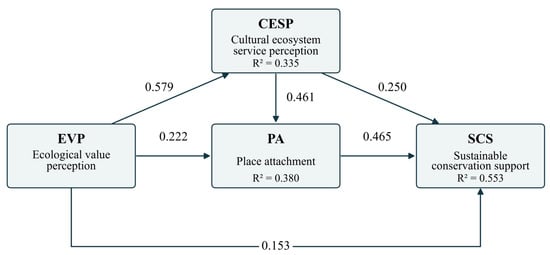
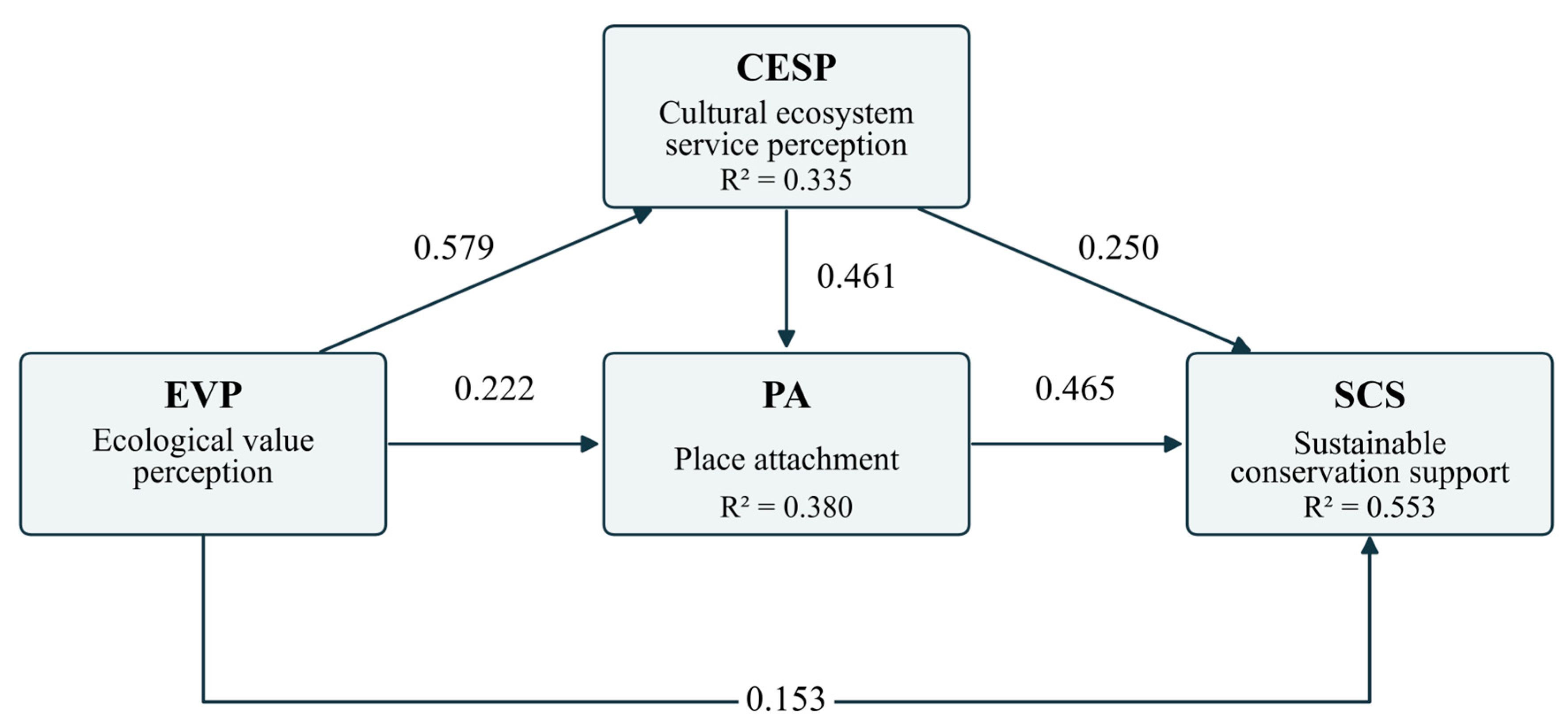
Figure 2.
Estimated structural associations in the pooled sample (n = 500).
4. Results
4.1. Data Screening, Descriptive Statistics and Correlations
The final main sample included 500 respondents. All respondents passed the consent, age and attention checks. No missing values were found in the 22 core SEM items. The strict robustness sample contained 468 respondents after excluding 32 cases with potential response-pattern concerns. Mean scores were above the scale midpoint for all four core constructs. EVP had a mean of 3.890 (SD = 0.852), CESP had a mean of 3.859 (SD = 0.823), PA had a mean of 3.895 (SD = 0.823), and SCS had a mean of 3.881 (SD = 0.802). These values indicate that respondents generally recognized heritage trees as ecologically and culturally valuable and expressed support for conservation measures. The correlation matrix showed positive and significant associations among all core constructs. EVP was correlated with CESP (r = 0.508, p < 0.001), PA (r = 0.432, p < 0.001) and SCS (r = 0.459, p < 0.001). CESP was correlated with PA (r = 0.522, p < 0.001) and SCS (r = 0.542, p < 0.001). The largest observed correlation was between PA and SCS (r = 0.607, p < 0.001). These bivariate results were consistent with the proposed pathway but did not by themselves establish the latent indirect-association structure examined in the SEM. Descriptive statistics and correlations are reported in Table 1.
Table 1.
Descriptive statistics and correlations among study constructs.
4.2. Measurement Structure and Common-Response Sensitivity
Harman’s first unrotated factor accounted for 41.53% of item variance. This descriptive diagnostic is not used as a decision rule for common method bias; the additional sensitivity analysis below examines an explicitly specified common-response component.
A one-factor CFA fitted poorly: χ2(209) = 1973.210, p < 0.001, RMSEA = 0.130, CFI = 0.696, TLI = 0.664, and SRMR = 0.099 (Table 2). This result argues against representing all core items with one undifferentiated factor.
Table 2.
Model fit indices.
The four-factor CFA fitted substantially better: χ2(203) = 235.739, p = 0.057, RMSEA = 0.018, CFI = 0.994, TLI = 0.994, and SRMR = 0.027 (Table 2). Standardized loading ranges were 0.729–0.817 for EVP, 0.726–0.788 for CESP, 0.751–0.798 for PA, and 0.711–0.760 for SCS, with all loadings significant. These results support the distinction among the measured constructs.
The common-response sensitivity models retained all six positive, significant paths at the 5% and 10% settings in both samples (Supplementary Material S2, Tables S8–S10). At 20%, the focal EVP → CESP → PA → SCS links remained positive and significant: standardized coefficients were 0.353, 0.330, and 0.420 in the pooled sample and 0.253, 0.236, and 0.382 in the strict sample. The smaller EVP → PA and EVP → SCS direct paths were no longer significant at that setting. At the 30% stress setting, the pooled model no longer supported the EVP → CESP and CESP → PA links; the strict-sample model did not converge and is not interpreted. The analysis thus identifies both persistence of the focal links under the lower assumed components and sensitivity under a stronger component. It does not estimate the true shared-method contribution or establish the absence of common method bias. No indirect-component confidence intervals were calculated for these sensitivity scenarios.
Reliability and convergent validity were satisfactory: Cronbach’s alpha ranged from 0.878 to 0.889, composite reliability from 0.878 to 0.889, and AVE from 0.550 to 0.592 (Table 3). Fornell–Larcker comparisons used correlations among the latent factors estimated in the four-factor CFA, not the composite-score Pearson correlations in Table 1. The latent correlations ranged from 0.488 to 0.687; each construct’s square root of AVE (0.742–0.770) exceeded every correlation involving that construct. HTMT ratios ranged from 0.490 to 0.690. Table 4 reports the latent correlations alongside HTMT, and Supplementary Material S2, Table S5, provides the complete Fornell–Larcker matrix. These results support statistical separation of the four constructs; the interpretation of potentially overlapping item content is specified separately in Section 3.4.
Table 3.
Reliability and convergent validity of the measurement model.
Table 4.
Latent factor correlations and HTMT ratios.
4.3. Structural Model and Hypothesis Testing
The main SEM reproduced the global fit indices of the four-factor CFA (χ2(203) = 235.739, p = 0.057, RMSEA = 0.018, CFI = 0.994, TLI = 0.994, and SRMR = 0.027). As specified in Section 3.7, structural hypotheses were evaluated using standardized path coefficients and bootstrapped indirect associations. The path from EVP to CESP was positive and significant (β = 0.579, SE = 0.036, z = 16.18, p < 0.001), supporting H1. Respondents who perceived heritage trees as ecologically valuable reported higher levels of cultural ecosystem service perception. The path from CESP to PA was positive and significant (β = 0.461, SE = 0.051, z = 8.98, p < 0.001), supporting H2a. This result indicates that perceived cultural services were associated with stronger tree-related attachment appraisal. The path from PA to SCS was also positive and significant (β = 0.465, SE = 0.048, z = 9.72, p < 0.001), supporting H3. The latent equations accounted for 33.5% of in-sample variance in CESP (R2 = 0.335), 38.0% in PA (R2 = 0.380), and 55.3% in SCS (R2 = 0.553).
Among the direct predictors of conservation support, place attachment had the highest estimated standardized direct coefficient. The direct path from EVP to SCS was positive and significant (β = 0.153, SE = 0.050, z = 3.08, p = 0.002), supporting H4. The direct path from CESP to SCS was also positive and significant (β = 0.250, SE = 0.056, z = 4.43, p < 0.001), supporting H5. The EVP → PA path, labeled H2b in the revised theoretical specification, was also positive and significant (β = 0.222, SE = 0.054, z = 4.09, p < 0.001). Overall, the path results indicate that ecological value perception was associated with conservation support both directly and indirectly through cultural services and attachment. The final model and structural estimates are presented in Figure 2 and Table 5, respectively.
Table 5.
Structural path estimates and hypothesis testing.
4.4. Indirect-Association Analysis
Direct bootstrap resampling supported the three hypothesized indirect components (Table 6). The unstandardized EVP → CESP → SCS estimate was 0.126 (bootstrap SE = 0.033, 95% percentile CI [0.068, 0.195]); EVP → PA → SCS was 0.090 (SE = 0.026, CI [0.043, 0.148]); and EVP → CESP → PA → SCS was 0.108 (SE = 0.022, CI [0.071, 0.157]). All intervals excluded zero, supporting H6–H8 within the specified model. The total indirect estimate was 0.325 (SE = 0.047, CI [0.237, 0.426]). These estimates are on the unstandardized marker-variable scale and therefore differ from products of the standardized paths reported in Table 5. The findings identify coexisting direct and indirect components of the EVP–SCS association, with the serial component representing the model’s focal combination of cultural appraisal and attachment.
Table 6.
Bootstrap indirect associations from the latent SEM.
4.5. Robustness Checks
The strict exclusion analysis addresses the 32 patterned records directly. After their removal (n = 468), all six structural paths remained positive and significant (Table 7): EVP → CESP = 0.528, CESP → PA = 0.419, EVP → PA = 0.207, CESP → SCS = 0.236, PA → SCS = 0.454, and EVP → SCS = 0.150. Fit remained satisfactory (Table 2). The unstandardized serial indirect estimate was 0.085, with a 95% percentile bootstrap CI of [0.054, 0.128], compared with 0.108 [0.071, 0.157] in the pooled analysis. SCS R2 decreased from 0.553 to 0.493. Thus, excluding the flagged cases reduced some magnitudes but did not remove the positive association pattern or the serial indirect component. The interpretation rests on this agreement across the pooled and strict analyses, rather than on the attention check alone. Supplementary Material S2 reports the complete fit, explained variance, and indirect estimates for both samples.
Table 7.
Robustness checks for core structural paths.
Other robustness checks were consistent with this pattern. The control-variable SEM included gender, age, education, visit frequency, information seeking, and professional background; all six core paths remained positive and significant (Table 2 and Table 7). An auxiliary composite-score model also retained the positive path pattern and serial indirect component, with SCS R2 = 0.455 (Table 8). These checks complement, rather than replace, the strict exclusion analysis.
Table 8.
Auxiliary composite-score path model.
An experience-based sensitivity analysis restricted the latent SEM to the 390 respondents who reported direct on-site experience with relevant heritage sites. This subgroup was defined by screening item 3 (visit_exp = 1). The analysis examines whether the association pattern persists among respondents reporting direct visits, because attachment-related appraisals may differ from those based on mediated familiarity.
The direct-experience model fitted as follows: χ2(203) = 252.287, p = 0.011, RMSEA = 0.025, CFI = 0.989, TLI = 0.987, and SRMR = 0.033 (Table 2). All six structural coefficients were positive (Table 7). The EVP → PA and EVP → SCS coefficients were 0.163 (p = 0.010) and 0.139 (p = 0.012), respectively; the other four paths had p < 0.001. The unstandardized serial indirect estimate was 0.120 (bootstrap SE = 0.027, 95% percentile CI [0.077, 0.183]). The direction of the principal associations was therefore consistent within the direct-experience subgroup, although individual magnitudes differed from the full sample. Table 7 summarizes the control, strict-sample, and direct-experience paths; Table 8 reports the auxiliary composite-score estimates. Supplementary Material S2 reports the detailed model verification.
The targeted item-content sensitivity analysis also retained positive structural paths after omitting CESP6, PA4, and PA5 (n = 500; 19 indicators). The standardized EVP → CESP, CESP → PA, and PA → SCS coefficients were 0.578, 0.502, and 0.475, respectively; all six paths were significant (p ≤ 0.003). Fit was χ2(146) = 177.548, RMSEA = 0.021, CFI = 0.993, TLI = 0.992, and SRMR = 0.027, with SCS R2 = 0.552. This post hoc check indicates that the positive path pattern is not contingent on the three potentially overlapping items; it does not establish a separately validated shortened scale (Supplementary Material S2, Table S6).
5. Discussion
5.1. Central Findings
The study specifies how ecological recognition, cultural-service appraisal, and tree-related attachment jointly relate to conservation support in Chinese heritage settings. PA had the highest estimated standardized direct coefficient among the three predictors of SCS, while EVP and CESP retained their own direct associations. The positive serial indirect component adds a cultural-service connection to attachment-based conservation models, with the main model explaining 55.3% of in-sample variance in support. This pattern accords with plural- and relational-value scholarship, which treats ecological, cultural, and relational values as coexisting grounds for conservation [6,7,8,14,15]. Its consistency across the strict sample, direct-visit subgroup, and targeted item-omission analysis supports the relevance of the association structure under these specifications. The heritage-tree contribution lies in linking these appraisals to a concrete set of stewardship choices, including monitoring, maintenance, development restrictions, and coordinated care of trees and buildings. The following comparisons distinguish this contribution from earlier intention models and from studies of named landscapes.
5.2. Contributions to Heritage-Tree and Biocultural Heritage Research
The contribution is an appraisal-specific extension of attachment-centered conservation accounts. Maleknia and Pakravan-Charvadeh’s Tehran study already establishes the relevance of psychological and attachment dimensions to heritage-tree conservation intentions [10]. Here, ecological recognition and cultural contribution appraisal occupy separate positions, and cultural appraisal is linked both with emotional significance and directly with support. The resulting specification distinguishes the meaning assigned to a living heritage feature from the personal bond associated with it. This provides an empirical representation of the proposed cultural-appraisal link while allowing ecological and cultural grounds for protection to coexist with attachment. Chinese temple and heritage-tree research supplies a relevant biocultural setting [2,3,9], within which the specified relationships and construct distinctions can be evaluated.
The findings refine the organization of the integrated account in two respects. First, the four-factor model supports separating ecological recognition, cultural contribution appraisal, tree-related attachment appraisal, and support in this dataset. Second, direct EVP–SCS and CESP–SCS associations remain alongside the indirect components, so attachment does not exhaust the association between perceived value and support. These results are consistent with a differentiated appraisal account, rather than a single undivided evaluation of biocultural importance. They connect biocultural perspectives on ecological–cultural interdependence [20,21,22,23] with a psychological distinction between what a setting contributes and what it means personally. The extension supplies testable propositions for future site-based work: whether particular cultural meanings link ecological recognition with attachment, and when perceived public benefits sustain support among people with weaker personal bonds. Evaluating those propositions longitudinally would test the proposed processes beyond their cross-sectional representation.
5.3. Contributions to Cultural Ecosystem Service and Plural Value Research
The CESP findings complement landscape-based empirical studies of cultural values and service experiences. Felipe-Lucia and colleagues used surveys and participatory mapping in four European mountain protected areas to distinguish visitor groups and the cultural services they experienced [11]. Sima and colleagues examined visitors’ cultural values and management preferences at Vadu Beach in Romania [29]. Our respondent-level model complements these approaches by examining the covariance of a cultural-service appraisal with ecological recognition, attachment, and support. The common implication is that aesthetic, identity-related, and experiential values matter to how people engage with a landscape. Named protected areas and repeat visitation provide spatially specific accounts, whereas the present survey captures appraisals across multiple heritage settings. Future heritage-tree studies could combine this latent measurement approach with participatory mapping and verified visitation histories.
The retained direct EVP and CESP paths also qualify the role of attachment. Ecological recognition and cultural appraisal each remained associated with support after accounting for PA, consistent with plural-value arguments that different grounds for conservation can coexist [6,7,8,14,15]. The result extends an inventory of benefits by specifying their partial associations within one model. A useful next comparison would separate aesthetic, educational, spiritual, and historical contributions to determine which are most closely associated with support for particular actions. Such distinctions would connect the present construct-level findings with the heterogeneous visitor experiences documented in European protected areas [11].
5.4. Place Attachment as a Bridge to Conservation Governance
The association between PA and SCS is consistent with research linking place bonds to environmentally responsible orientations [33,34] and with the relevance of attachment to heritage-tree conservation intentions in Tehran [10]. Research in Bocas del Toro, Panama, similarly links attachment to valued recreational places with wellbeing and perceived conservation threats [35]. These comparisons support the broader relevance of emotional and social relationships with landscapes, although they involve different populations and outcomes.
The PA–SCS association also raises the practical question of which conservation interventions people will support. Tenzer and Schofield’s interviews in England reveal that attachment can be grounded in different histories and practices, with differing responses to landscape change [12]. Conservation-governance research likewise links local support with perceived ecological effectiveness, social impacts, and institutional quality [13]. These findings suggest a plausible boundary for heritage-tree management: people attached to familiar views or access arrangements may question pruning, bracing, or root-zone barriers even when they support conservation in general. To extend the present measure of overall support, management-oriented follow-up studies should specify the intervention, its costs and distributional effects, and the institution responsible, while testing trust and perceived effectiveness alongside attachment. Across these studies, cultural meanings and relationships with place appear relevant to conservation attitudes, despite differences in populations, landscapes, predictors, and outcomes [10,11,12,29,35]. The present findings place that broader pattern in Chinese heritage settings, where respondents considered trees in relation to historic buildings, temples, gardens, and other cultural landscapes. The survey did not compare countries or estimate effects for individual sites, so it cannot establish that the strength of these associations is distinctive to China. Cross-site and cross-country studies using comparable measures could test how heritage practices, visitor familiarity, and management arrangements shape these relationships.
5.5. Practical Implications for Sustainable Heritage-Site Management
The survey directly supports considering ecological, cultural, and attachment-related appraisals together when examining endorsement of heritage-tree management. Its SCS items explicitly include long-term health monitoring, protective maintenance, support despite higher costs, restrictions on harmful development, and coordinated tree–building conservation. This provides a basis for studying public support for these actions, while their effectiveness requires separate evaluation. An interpretation strategy worth testing would connect shade, habitat, and longevity with documented historical meanings and local identity through signs, guided visits, or digital materials. That proposal combines the observed associations with international evidence that cultural-service experiences and place meanings vary among audiences [11,29,35]. In Chinese heritage settings, interpretation can be grounded in documented site histories rather than assuming shared religious or cultural meanings. Follow-up evaluations should distinguish mediated familiarity from repeated visits and assess understanding, support for specified actions, and subsequent behavior.
Broader governance proposals draw on the literature rather than on a direct survey test of institutional arrangements. Historic Urban Landscape and biocultural approaches emphasize the interdependence of natural, cultural, spatial, and community relationships [1,22,23]; conservation-support research adds the importance of institutional quality and social consequences [13]. These perspectives suggest coordinating root-zone design, arboricultural care, building preservation, visitor circulation, and public engagement. Cultural-tourism research similarly relates infrastructure, accessibility, heritage preservation, and governance across spatial scales [45]. Community-level mapping can help locate concentrated cultural meanings and uses [32]. Building on these frameworks, digital archives, tree-health dashboards, citizen monitoring, and co-created interpretation are candidate management tools for site-specific evaluation. They were not evaluated as interventions in this survey. Their value should be judged by whether they improve participation, perceived legitimacy, and conservation outcomes, rather than assumed from positive perception–support associations.
5.6. Limitations and Future Research
The cross-sectional, single-questionnaire design does not establish temporal ordering or causal mediation. Existing attachment or favorable orientations may also influence ecological and cultural appraisals. Because the contextual introduction described ecological and cultural benefits before participants evaluated the constructs, it may have influenced their subsequent responses. The findings should therefore be interpreted as appraisals elicited after this shared contextual information, rather than as entirely unprompted perceptions. The common-response analysis goes beyond single-factor diagnostics by testing explicitly specified shared components, but its equal-loading and orthogonality assumptions do not cover every form of common method bias [37,38,43]. The focal links persisted through the 20% scenario, whereas some smaller direct relationships were sensitive and the 30% scenario weakened the focal sequence. These findings bound the interpretation rather than quantify the true amount of bias. Longitudinal measurement, independently collected outcomes, and randomized interpretation studies can evaluate the proposed processes with stronger separation of source and timing. Observed participation, donations, or responses to a specified conservation restriction would also distinguish stated support from behavior.
The volunteer sample defines the scope of transferability. Online recruitment reached interested public-platform communities, and field recruitment occurred at three Shanxi temples; no probability sampling frame or numerical quota targets were used. The large share of university-educated respondents and the 70 field/430 online balance further characterize the achieved sample. Findings concern associations among the surveyed adults with direct or mediated heritage-site familiarity, not population prevalence, nationally representative attitudes, or estimates for all Chinese heritage sites. Removing patterned records addresses response quality but does not correct volunteer self-selection. Collection mode was retained only as aggregate totals, so reliable respondent-level mode comparisons are unavailable. Future studies can use site-based recruitment logs and documented sampling frames to evaluate the same construct relationships across visitor groups, residents, and named heritage settings.
The broad heritage-tree category and non-site-anchored PA measure define the setting for transferability. Comparisons among named trees and sites, with verified ages and visitation histories, would distinguish attachments grounded in repeated experience from symbolic or anticipated connections. Cross-site and cross-group measurement-invariance tests could evaluate comparability across cultures and visitor groups. The targeted item-omission analysis supports the persistence of the structural pattern, while further scale development could sharpen the distinction between cultural distinctiveness, anticipated loss, and emotional attachment. Future studies can also link perceptions with tree health, canopy structure, root-zone condition, microclimate, visitor movement, and relationships with heritage buildings. Such designs would connect the perceived value structure with measured ecological conditions and governance outcomes.
6. Conclusions
Heritage-tree conservation support in this volunteer sample was associated with distinct ecological, cultural, and attachment-related appraisals. The study extends an attachment-centered account by representing cultural contribution appraisal separately from emotional connection and retaining direct ecological and cultural routes to stated support. The positive direct-path pattern and serial indirect component persisted when the 32 patterned records were excluded and among respondents reporting direct visits. Place attachment had the highest estimated standardized direct coefficient among the three predictors of support, while ecological and cultural appraisals each retained their own associations. This combination supports considering both the public contributions of heritage trees and their personal emotional significance in conservation research. Site-based evaluations can use these distinctions to examine interpretation and participation strategies that connect living ecological features, cultural continuity, and coordinated tree–building stewardship.
Supplementary Materials
The following supporting information can be downloaded at https://www.mdpi.com/article/10.3390/su182010441/s1. Supplementary Material S1 contains the complete Chinese questionnaire, its English translation, a variable map, and measurement notes. Supplementary Material S2 reports model verification, latent-factor validity, item-content sensitivity, sample formation, and common-response sensitivity analyses. Dataset S1 provides the de-identified analysis variables in CSV and Stata formats. File S1 provides the Stata analysis scripts, execution logs, bootstrap replication summaries, and the common-response sensitivity analyses.
Author Contributions
Conceptualization, R.L. and P.P.; methodology, R.L.; software, R.L.; validation, B.H.; formal analysis, R.L. and B.H.; investigation, P.P.; resources, P.P.; data curation, R.L.; writing—original draft preparation, R.L.; writing—review and editing, P.P. and B.F.; visualization, R.L.; supervision, P.P.; project administration, P.P.; funding acquisition, P.P. All authors have read and agreed to the published version of the manuscript.
Funding
This research was funded by the National Social Science Fund of China (Late-stage Funded Project), grant number 25FZXB069, and the National Natural Science Foundation of China for Young Scientists, grant number 11904217.
Institutional Review Board Statement
The Ethics Review Committee of Shanxi University determined that this anonymous, non-interventional questionnaire study was exempt from ethics review under Article 32 of the Measures for Ethical Review of Life Science and Medical Research Involving Human Participants (2023).
Informed Consent Statement
Informed consent was obtained from all subjects involved in the study.
Data Availability Statement
The de-identified analysis variables are provided in Dataset S1 in CSV and Stata formats. File S1 contains the analysis code, execution logs, and bootstrap summaries used for verification. The open-ended response field and original record identifier are excluded from the shared dataset. Further inquiries may be directed to the corresponding authors.
Conflicts of Interest
The authors declare no conflicts of interest.
Abbreviations
The following abbreviations are used in this manuscript:
| AVE | average variance extracted |
| CESP | cultural ecosystem service perception |
| CFA | confirmatory factor analysis |
| CFI | comparative fit index |
| CMB | common method bias |
| CR | composite reliability |
| EI | interest in ecological protection and cultural heritage |
| ERP | ecological risk perception |
| EVP | ecological value perception |
| HTMT | heterotrait–monotrait ratio |
| PA | place attachment |
| RMSEA | root mean square error of approximation |
| SCS | sustainable conservation support |
| SEM | structural equation modeling |
| SRMR | standardized root mean square residual |
| TLI | Tucker–Lewis index |
References
- UNESCO. Recommendation on the Historic Urban Landscape; United Nations Educational, Scientific and Cultural Organization: Paris, France, 2011. [Google Scholar]
- Huang, L.; Tian, L.; Huang, L.; Jin, C.; Hu, S.; Zhang, Z.; Yan, E.; Jim, C.Y.; Yang, Y.; Lindenmayer, D.B.; et al. Religious temples are long-term refuges for old trees in human-dominated landscapes in China. Curr. Biol. 2025, 35, 2994–3000.e3. [Google Scholar] [CrossRef] [Scilit]
- Jin, C.; Zheng, M.; Huang, L.; Qian, S.; Jim, C.Y.; Lin, D.; Zhao, L.; Minor, J.; Coggins, C.; Chen, B.; et al. Co-existence between humans and nature: Heritage trees in China’s Yangtze River region. Urban For. Urban Green. 2020, 54, 126748. [Google Scholar] [CrossRef] [Scilit]
- Lindenmayer, D.B.; Laurance, W.F.; Franklin, J.F. Global decline in large old trees. Science 2012, 338, 1305–1306. [Google Scholar] [CrossRef] [Scilit]
- Piovesan, G.; Cannon, C.H.; Liu, J.; Munné-Bosch, S. Ancient trees: Irreplaceable conservation resource for ecosystem restoration. Trends Ecol. Evol. 2022, 37, 1025–1028. [Google Scholar] [CrossRef] [Scilit]
- Chan, K.M.A.; Balvanera, P.; Benessaiah, K.; Chapman, M.; Diaz, S.; Gomez-Baggethun, E.; Gould, R.; Hannahs, N.; Jax, K.; Klain, S.; et al. Why protect nature? Rethinking values and the environment. Proc. Natl. Acad. Sci. USA 2016, 113, 1462–1465. [Google Scholar] [CrossRef] [Scilit]
- Díaz, S.; Pascual, U.; Stenseke, M.; Martin-Lopez, B.; Watson, R.T.; Molnar, Z.; Hill, R.; Chan, K.M.A.; Baste, I.A.; Brauman, K.A.; et al. Assessing nature’s contributions to people. Science 2018, 359, 270–272. [Google Scholar] [CrossRef] [Scilit]
- Pascual, U.; Balvanera, P.; Anderson, C.B.; Chaplin-Kramer, R.; Christie, M.; Gonzalez-Jimenez, D.; Martin, A.; Raymond, C.M.; Termansen, M.; Vatn, A.; et al. Diverse values of nature for sustainability. Nature 2023, 620, 813–823. [Google Scholar] [CrossRef] [Scilit]
- Xie, C.; Jim, C.Y. Bridging the gap between cultural reverence and scientific care for sacred heritage trees. Urban Ecosyst. 2026, 29, 118. [Google Scholar] [CrossRef] [Scilit]
- Maleknia, R.; Pakravan-Charvadeh, M.R. Cultural roots in urban landscapes: Examining psychological and place attachment factors in heritage tree conservation. J. Nat. Conserv. 2025, 84, 126816. [Google Scholar] [CrossRef] [Scilit]
- Felipe-Lucia, M.R.; de Frutos, Á.; Crouzat, E.; Grescho, V.; Heuschele, J.M.; Marselle, M.; Heurich, M.; Pöpperl, F.; Porst, F.; Portela, A.P.; et al. Differences in the experience of cultural ecosystem services in mountain protected areas by clusters of visitors. Ecosyst. Serv. 2024, 70, 101663. [Google Scholar] [CrossRef] [Scilit]
- Tenzer, M.; Schofield, J. People and places: Towards an understanding and categorisation of reasons for place attachment—Case studies from the north of England. Landsc. Res. 2024, 49, 340–358. [Google Scholar] [CrossRef] [Scilit]
- Bennett, N.J.; Di Franco, A.; Calò, A.; Nethery, E.; Niccolini, F.; Milazzo, M.; Guidetti, P. Local support for conservation is associated with perceptions of good governance, social impacts, and ecological effectiveness. Conserv. Lett. 2019, 12, e12640. [Google Scholar] [CrossRef] [Scilit]
- Himes, A.; Muraca, B. Relational values: The key to pluralistic valuation of ecosystem services. Curr. Opin. Environ. Sustain. 2018, 35, 1–7. [Google Scholar] [CrossRef] [Scilit]
- Riechers, M.; Balázsi, Á.; Engler, J.-O.; Shumi, G.; Fischer, J. Understanding relational values in cultural landscapes in Romania and Germany. People Nat. 2021, 3, 1036–1046. [Google Scholar] [CrossRef] [Scilit]
- Scannell, L.; Gifford, R. Defining place attachment: A tripartite organizing framework. J. Environ. Psychol. 2010, 30, 1–10. [Google Scholar] [CrossRef] [Scilit]
- Stedman, R.C. Toward a social psychology of place: Predicting behavior from place-based cognitions, attitude, and identity. Environ. Behav. 2002, 34, 561–581. [Google Scholar] [CrossRef] [Scilit]
- Stedman, R.C. Is it really just a social construction? The contribution of the physical environment to sense of place. Soc. Nat. Resour. 2003, 16, 671–685. [Google Scholar] [CrossRef] [Scilit]
- Fish, R.; Church, A.; Winter, M. Conceptualising cultural ecosystem services: A novel framework for research and critical engagement. Ecosyst. Serv. 2016, 21, 208–217. [Google Scholar] [CrossRef] [Scilit]
- Maffi, L. Linguistic, cultural, and biological diversity. Annu. Rev. Anthropol. 2005, 34, 599–617. [Google Scholar] [CrossRef] [Scilit]
- Gavin, M.C.; McCarter, J.; Mead, A.; Berkes, F.; Stepp, J.R.; Peterson, D.; Tang, R. Defining biocultural approaches to conservation. Trends Ecol. Evol. 2015, 30, 140–145. [Google Scholar] [CrossRef] [Scilit]
- Hanspach, J.; Haider, L.J.; Oteros-Rozas, E.; Stahl Olafsson, A.; Gulsrud, N.M.; Raymond, C.M.; Torralba, M.; Martín-López, B.; Bieling, C.; García-Martín, M.; et al. Biocultural approaches to sustainability: A systematic review of the scientific literature. People Nat. 2020, 2, 643–659. [Google Scholar] [CrossRef] [Scilit]
- Ekblom, A.; Shoemaker, A.; Gillson, L.; Lane, P.; Lindholm, K.-J. Conservation through biocultural heritage—Examples from Sub-Saharan Africa. Land 2019, 8, 5. [Google Scholar] [CrossRef] [Scilit]
- Daniel, T.C.; Muhar, A.; Arnberger, A.; Aznar, O.; Boyd, J.W.; Chan, K.M.A.; Costanza, R.; Elmqvist, T.; Flint, C.G.; Gobster, P.H.; et al. Contributions of cultural services to the ecosystem services agenda. Proc. Natl. Acad. Sci. USA 2012, 109, 8812–8819. [Google Scholar] [CrossRef] [Scilit]
- Chan, K.M.A.; Satterfield, T.; Goldstein, J. Rethinking ecosystem services to better address and navigate cultural values. Ecol. Econ. 2012, 74, 8–18. [Google Scholar] [CrossRef] [Scilit]
- Lewicka, M. Place attachment: How far have we come in the last 40 years? J. Environ. Psychol. 2011, 31, 207–230. [Google Scholar] [CrossRef] [Scilit]
- Millennium Ecosystem Assessment. Ecosystems and Human Well-Being: Synthesis; Island Press: Washington, DC, USA, 2005. [Google Scholar]
- IPBES. Methodological Assessment Report on the Diverse Values and Valuation of Nature of the Intergovernmental Science-Policy Platform on Biodiversity and Ecosystem Services; IPBES Secretariat: Bonn, Germany, 2022. [Google Scholar] [CrossRef]
- Sima, M.; Dumitrascu, M.; Grigorescu, I.; Costache, A. Tourists’ perception of socio-cultural values of ecosystem services and management perspectives at the Vadu wild beach, Danube Delta Biosphere Reserve, Romania. Ocean Coast. Manag. 2024, 257, 107312. [Google Scholar] [CrossRef] [Scilit]
- Raymond, C.M.; Brown, G.; Weber, D. The measurement of place attachment: Personal, community, and environmental connections. J. Environ. Psychol. 2010, 30, 422–434. [Google Scholar] [CrossRef] [Scilit]
- Williams, D.R.; Vaske, J.J. The measurement of place attachment: Validity and generalizability of a psychometric approach. For. Sci. 2003, 49, 830–840. [Google Scholar] [CrossRef] [Scilit]
- Plieninger, T.; Dijks, S.; Oteros-Rozas, E.; Bieling, C. Assessing, mapping, and quantifying cultural ecosystem services at community level. Land Use Policy 2013, 33, 118–129. [Google Scholar] [CrossRef] [Scilit]
- Vaske, J.J.; Kobrin, K.C. Place attachment and environmentally responsible behavior. J. Environ. Educ. 2001, 32, 16–21. [Google Scholar] [CrossRef] [Scilit]
- Manzo, L.C.; Perkins, D.D. Finding common ground: The importance of place attachment to community participation and planning. J. Plan. Lit. 2006, 20, 335–350. [Google Scholar] [CrossRef] [Scilit]
- Mach, L.; Rothrock, E.; Stark, S.; Nahmias, J. Place attachment, wellbeing, and conservation in surf destination communities. Front. Sustain. Tour. 2024, 3, 1387081. [Google Scholar] [CrossRef] [Scilit]
- Lin, H.-W.; Chuang, Y.-C.; Liu, W.-Y. Assessing the economic value of an iconic urban heritage tree. For. Policy Econ. 2020, 118, 102216. [Google Scholar] [CrossRef] [Scilit]
- Podsakoff, P.M.; MacKenzie, S.B.; Lee, J.Y.; Podsakoff, N.P. Common method biases in behavioral research: A critical review of the literature and recommended remedies. J. Appl. Psychol. 2003, 88, 879–903. [Google Scholar] [CrossRef] [Scilit]
- Podsakoff, P.M.; MacKenzie, S.B.; Podsakoff, N.P. Sources of method bias in social science research and recommendations on how to control it. Annu. Rev. Psychol. 2012, 63, 539–569. [Google Scholar] [CrossRef] [Scilit]
- Fornell, C.; Larcker, D.F. Evaluating structural equation models with unobservable variables and measurement error. J. Mark. Res. 1981, 18, 39–50. [Google Scholar] [CrossRef] [Scilit]
- Henseler, J.; Ringle, C.M.; Sarstedt, M. A new criterion for assessing discriminant validity in variance-based structural equation modeling. J. Acad. Mark. Sci. 2015, 43, 115–135. [Google Scholar] [CrossRef] [Scilit]
- Hu, L.T.; Bentler, P.M. Cutoff criteria for fit indexes in covariance structure analysis: Conventional criteria versus new alternatives. Struct. Equ. Model. 1999, 6, 1–55. [Google Scholar] [CrossRef] [Scilit]
- Kline, R.B. Principles and Practice of Structural Equation Modeling, 4th ed.; Guilford Press: New York, NY, USA, 2016. [Google Scholar]
- Maydeu-Olivares, A.; Coffman, D.L. Random intercept item factor analysis. Psychol. Methods 2006, 11, 344–362. [Google Scholar] [CrossRef] [Scilit]
- Preacher, K.J.; Hayes, A.F. Asymptotic and resampling strategies for assessing and comparing indirect effects in multiple mediator models. Behav. Res. Methods 2008, 40, 879–891. [Google Scholar] [CrossRef] [Scilit]
- Zuhaib; Liu, G.; Chen, J.; Ali, S.; Rui, Z.; Dawood; Chen, H. Dynamic mechanisms and spatial spillover effects of cultural tourism development in the China-Pakistan Economic Corridor. Front. Psychol. 2025, 16, 1555524. [Google Scholar] [CrossRef] [Scilit]

Disclaimer/Publisher’s Note: The statements, opinions and data contained in all publications are solely those of the individual author(s) and contributor(s) and not of MDPI and/or the editor(s). MDPI and/or the editor(s) disclaim responsibility for any injury to people or property resulting from any ideas, methods, instructions or products referred to in the content. |
© 2026 by the authors. Licensee MDPI, Basel, Switzerland. This article is an open access article distributed under the terms and conditions of the Creative Commons Attribution (CC BY) license.