Article

Comparison of Stabilization Systems for Soybean Wax Emulsions to Produce Sustainable Water-Resistant Paper Based Packaging: Surfactant vs. Pickering


1
Department of Chemical and Biomedical Engineering, University of Maine, 5737 Jenness Hall, Orono, ME 04469, USA
2
School of Forest Resources, University of Maine, 5755 Nutting Hall, Orono, ME 04469, USA
3
Forest Products Laboratory, U.S. Forest Service, 1 Gifford Pinchot Drive, Madison, WI 53726, USA
*
Author to whom correspondence should be addressed.
Sustainability 2026, 18(2), 852; https://doi.org/10.3390/su18020852 (registering DOI)
Submission received: 30 November 2025 / Revised: 28 December 2025 / Accepted: 9 January 2026 / Published: 14 January 2026

Abstract

Soybean wax is a sustainable alternative to synthetic polymeric coatings in packaging due to its renewable, environmentally benign, and hydrophobic properties. In order to be effectively applied, however, soybean wax must be emulsified in water. The present work compares two stabilization approaches for soybean wax emulsions: a conventional surfactant-based emulsion (SE) using a mixture of nonionic surfactants (Span-80 and Tween-80), and a Pickering emulsion (PE) using cellulose nanocrystals combined with sodium alginate (CNC-SA) as an anionic stabilizer. The SE produced stable emulsions at 6 wt% Span-80/Tween-80 (at a HLBmix value of 10) with a mean droplet size of 449 nm but limited storage stability (approximately 7 days under ambient conditions), while the PE achieved superior stability (approximately 1 month) at 1 wt% CNC-SA with a mean droplet size of 740 nm. The stabilized SE and PE were subsequently applied as coatings on three different types of paper substrates: northern bleached kraft (NBK) paper, copy paper, and cellulose nanofiber (CNF)-coated NBK paper. When applied to northern bleached kraft (NBK) paper, the SE coatings provided minimal improvements in barrier performance. The Cobb 60 value decreased slightly from 125 g/m2 (control-no coating) to 86 g/m2, indicating a negligible water barrier with immediate water absorption upon contact. In contrast, the Cobb 60 value of the PE-coated NBK paper decreased markedly from 125 g/m2 to 39 g/m2, confirming that the PE coating substantially enhances water resistance. The SE coating displayed a significant loss of water contact angle (WCA) from 85° to 0° within 20 s, showing limited water holdout capacity, whereas PE-coated NBK paper demonstrated strong water holdout, with the WCA decreasing only from 94° to 85° over 5 min. The SE coating achieved only a 14% reduction in water vapor transmission rate (WVTR), while the PE coating provided a greater reduction of 30%. In terms of oil resistance, both emulsion systems significantly enhanced the kit rating of the papers tested, e.g., from kit number 0 to 6–9 (paper dependent). The SE coating, however, experienced a substantial reduction in barrier integrity after folding, while the PE coating largely retained its oil barrier properties. Furthermore, the SE coating reduced the tensile strength of NBK paper by 41%, whereas the PE coating reduced it by only 7%. Overall, the comparative findings indicate that although the SE generated a smaller mean particle size, it offered minimal improvement in the water and oil barrier performance of paper and had a limited storage life. In contrast, the PE generated a larger mean particle size, but provided substantially greater water and oil resistance, and enhanced mechanical strength retention. In addition, the PE displayed an effective storage life of at least one month. The Pickering emulsion, formulated with all biologically derived components, therefore represents a viable, sustainable, bio-based alternative to synthetic polymeric coatings for packaging applications.

1. Introduction

Petroleum-derived plastics dominate the food packaging industry due to their excellent barrier performance and economic viability [1,2,3]. In 2019, packaging plastics accounted for 40% of global plastic waste [4]. However, most commodity plastics are inherently non-biodegradable and difficult to recycle [5,6]. Consequently, a substantial amount of plastic waste persists in the environment, where it may fragment into microplastics, contaminating the air, water, and food chain [7,8]. Moreover, microplastics have been found to accumulate in the human body, causing serious health issues, including metabolic disorders, organ dysfunction, oxidative stress, and neurotoxicity [9,10]. Increasing awareness of the harmful effects of plastics has intensified the need for a sustainable alternative to conventional synthetic polymer derived packaging.
Paper-based packaging has gained significant attention due to its sustainability, biodegradability, recyclability, and affordability [11,12,13]. However, the hydrophilic characteristics of cellulose fibers and the highly porous structure of paper lead to poor water and oil repellency, which limits its applicability in many packaging applications [14]. To address these challenges, various coating materials have been applied to the paper surface. Traditionally, petroleum-derived polymers (e.g., polyethylene, polypropylene) have been used to coat paper, which effectively enhances its water and oil resistance [15,16]. However, these materials reintroduce plastic to the product, which has major implications for the biodegradability and recyclability of coated paper [17]. Until recently, an effective and common means of imparting barrier properties on paper substrates was to treat them with fluorinated compounds such as pentafluoroethane, perfluoropolyether, and perfluorononanoyl ester [18,19]. Although these materials enhance the water and oil repellency of paper, their hazardous nature to the environment and human health are growing concerns that have led to their large-scale withdrawal from the marketplace [20]. Biopolymers such as starch, hemicellulose, and a range of proteins such as zein, offer an alternative, environmentally benign means of coating paper with positive attributes including renewability, degradability, and nontoxicity [21,22,23]. However, these polymers often exhibit poor resistance to water and oil. Further, coatings of natural polymers are often brittle, resulting in limited durability and utility in the often-demanding field of packaging [24,25].
Plant- or animal-derived waxes are abundant and highly valued for being renewable, biodegradable, and environmentally benign [26]. They exhibit inherent hydrophobicity due to low surface energies and distinct microstructures, which makes them a sustainable alternative to conventional barrier coatings [27,28]. Soybean wax is a widely available plant-based wax derived from natural soybeans and is produced by hydrogenation of soybean oil, which mainly consists of stearic acid-based triacylglycerides [29]. However, it is challenging to apply wax alone in a thin layer due to its solid state at ambient temperatures [30]. Consequently, wax-based coatings are predominantly processed through wax-melting methods, in which the liquefied wax is applied directly onto the substrate using techniques such as spray coating, roller coating, dip coating, or rod coating [31,32]. However, coatings produced through this approach suffer from brittleness, uneven coating thickness, low abrasion resistance, and rapid leaching [31,33]. In addition, this approach often necessitates the use of adhesives including ethylene-vinyl acetate (EVA), styrene block copolymers, ethylene/ethyl acrylate, phenol-based resins, and polyurethane to improve compatibility and provide adequate bonding strength between the wax and the paper substrate [33,34]. These adhesives are often petroleum-derived, raising concerns regarding their non-biodegradability and limited recyclability. Another widely adopted approach involves dispersing waxes in organic solvents (e.g., methanol, ethanol, acetone, or toluene) to facilitate the formation of a more uniform and continuous coating layer [35,36,37]. However, these coatings exhibit a significant reduction in mechanical durability when subjected to moderate wear and abrasion. Moreover, the use of organic solvents leads to other environmental concerns [36].
To address these challenges, oil-in-water emulsions have been developed and successfully employed to create wax coatings on paper. This approach has attracted significant commercial interest, as it not only facilitates the application of the wax but also enables its separation from fibers during the repulping process [38,39]. There are several methods for preparing oil-in-water emulsions. Historically, a common method of emulsification has been via the use of a surfactant or a mixture of surfactants. These amphiphilic surface-active species preferentially migrate to the oil/water interface where they lower the interfacial tension via partitioning of their hydrophobic portions within the oil phase, and their hydrophilic portions within the aqueous phase. The reduced interfacial tension, often coupled with electrostatic repulsion when polar surfactants are employed, results in enhanced emulsion stability by reducing the tendency for coalescence [40]. Surfactant stabilization of wax emulsions was successfully employed by Naderizadeh et al. [41] who created highly hydrophobic surfaces by spray-coating a beeswax-in-water emulsion stabilized with a nonionic fluorosurfactant onto metal and glass substrates. However, the coating demonstrated poor thermal–structural integrity, and the inclusion of a fluorinated surfactant raises environmental and health concerns due to its potential for bioaccumulation and toxicity. Separately, Liu et al. [42] utilized Span-80 and Tween-80 surfactants to stabilize petroleum-derived microcrystalline wax emulsions for paper coating. The resultant substrates exhibited excellent oil and water barrier properties; however, long-term emulsion stability was poor, and the use of a non-biodegradable, non-renewable microcrystalline wax limited the sustainability profile of the emulsion. In addition, Zhang et al. [43] fabricated a water-based beeswax/carnauba wax coating stabilized via the cationic surfactant cetyltrimethylammonium bromide (CTAB) and applied it to copy paper. The coated substrate was subsequently annealed. Although the resulting coating exhibited excellent hydrophobicity, its suitability for sustainable packaging is constrained by the inclusion of CTAB, a petroleum-derived, non-biodegradable surfactant that may pose significant toxicity risks to both human health and the environment [44].
An alternative emulsification method, named after one of its inventors, was first introduced by Pickering and Ramsden in the early 1900s [45]. The Pickering process utilizes solid micro/nanoparticles to stabilize the interface between two immiscible fluids. The solid particles irreversibly adsorb at the oil/water interface and create a dense interfacial network, which prevents droplet coalescence. In addition to steric factors, emulsion stability is commonly governed by the surface charge of the oil droplets, imparted by the micro/nanoparticles. A higher absolute zeta potential results in greater electrostatic repulsion between the droplets, which limits particle aggregation and improves stability [46,47]. Compared to traditional surfactant-based systems, Pickering emulsions offer several benefits, such as high stability, enhanced environmental friendliness, cost-effectiveness, and ease of recyclability [48,49]. Recently, Zhang et al. [50] employed a titanium dioxide (TiO2) nanoparticle-stabilized carnauba wax-in-water Pickering emulsion to coat polysaccharide-based films. The films displayed significantly increased hydrophobicity; however, the use of inorganic TiO2 nanoparticles that are non-biodegradable raises potential environmental issues. Separately, Liu et al. [51] prepared an acrylated epoxidized soybean oil Pickering emulsion using cellulose nanocrystals (CNCs) and applied it to paper surfaces to enhance barrier properties. Although the coating exhibited excellent resistance to water vapor, its water contact angle of approximately 74° indicated low hydrophobicity. Wang et al. [52] demonstrated a fully biomass-based beeswax-in-water Pickering emulsion stabilized by hemicellulose-grafted-lauric acid (H-LA) micelles; the emulsion was sprayed onto cellulosic paper and the resulting surface exhibited excellent water and water vapor barrier properties. Similarly, Jaekel et al. [53] created a cationic CNC-stabilized linseed oil Pickering emulsion which was cast onto filter paper to improve hydrophobicity and water vapor barrier properties. However, both of these latter coating systems have challenges in terms of cost and large-scale implementation.
In the present study the relative efficacy and the pros and cons of the two major emulsification methodologies (surfactant and Pickering) were evaluated via preparation and coating of soybean wax-in-water emulsions on paper. The surfactant-based system employed a non-ionic surfactant mixture of Span-80 and Tween-80, while the Pickering emulsion system employed CNCs and sodium alginate (SA) as anionic stabilizers in combination with chitosan as a cationic stabilizer. It is noted that the Pickering emulsification system, reported in detail in the authors’ previous study [54], employs fully biodegradable and renewable materials, providing a sustainable pathway for coating development [35,55,56]. A comparative evaluation was conducted to examine how the two emulsification systems influenced emulsion stability and the barrier performance of coated papers. The emulsions were applied onto three significantly different paper substrates using a simple one-step rod-coating technique. The effects of each coating on both water and oil resistance, water vapor transmission, and mechanical performance were determined and compared/contrasted.

2. Materials and Methods

2.1. Materials

The materials employed for preparation of the surfactant-based emulsions (SEs) comprised sorbitan monooleate (Span-80), obtained from TCI America (Portland, OR, USA), and polysorbate 80 (Tween-80) purchased from Thermo Fisher Scientific (Waltham, MA, USA). Soybean wax with a melting point of 49–52 °C (415 Virginia Pure Soy Wax) was supplied by Virginia Candle Supply LLC (Gray, TN, USA). Potassium hydroxide (KOH) (ACS reagent grade pellets) was obtained from Fisher Scientific (USA).
The materials employed for preparation of the Pickering emulsions (PEs) were a 10.6 wt% CNC slurry obtained from the Process Development Center (PDC) at the University of Maine, Orono, ME, USA. Soybean wax, with a melting temperature of 52–55 °C, was obtained from American Soy Organics Store (New Hampton, IA, USA). Sodium alginate (SA) was purchased from Fisher Scientific (USA) and Chitosan (CS) with a molecular weight of 250–300 kDa was supplied by Chinova Bioworks Inc. (Fredericton, NB, Canada). All chemical reagents employed for both emulsion types were used without further purification.
Three paper substrates were employed: a northern bleached kraft (NBK) paper with basis weight 80 ± 1 g m−2 and thickness 122 ± 2 µm, obtained from the PDC, University of Maine; a copy paper with basis weight 76 ± 1 g m−2 and thickness 104 ± 2 µm, purchased from Flagship, W.B. Mason (Brockton, MA, USA); and a cellulose nanofiber (CNF)-coated NBK paper with basis weight 92 ± 2 g m−2 and thickness 123 ± 2 µm, obtained from the PDC, University of Maine.

2.2. Synthesis of Soybean Wax Emulsions

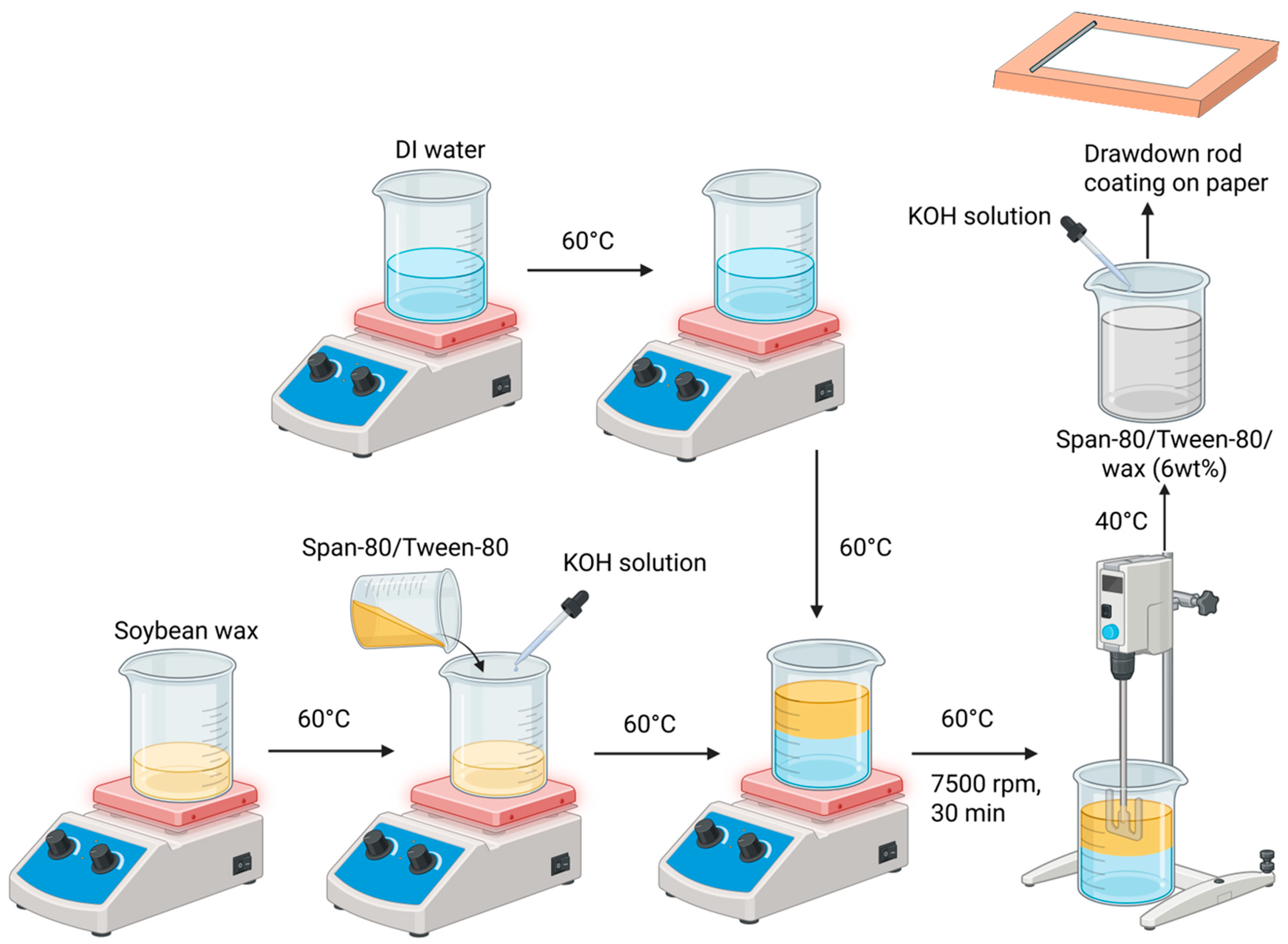
To create a stabilized SE, the ratio of Span-80/Tween-80 was determined by adjusting the hydrophilic–lipophilic balance (HLB) to 10 using the known HLB of 4.3 for Span-80 and of 15 for Tween-80, i.e., Span-80 at 46.7 wt% and Tween-80 at 53.3 wt%, following Li et al. [57]. Six SEs were prepared with a soy wax concentration of 20 wt% but varying concentrations of the Span-80/Tween-80 mixture at 1, 2, 3, 4, 5, and 6 wt%, respectively. The process of preparing one SE with 6 wt% of the surfactant mixture is illustrated in Scheme 1. Pure soy wax flakes were heated to their molten state in a glass beaker placed on a hotplate at a temperature above 60 °C. The calculated mass of the Span-80/Tween-80 mixture, equivalent to 6 wt% of the total mass of the SE, was added to the molten wax. A trace amount of KOH solution with a concentration of 15 wt% was added to the molten wax to neutralize the free fatty acids, such as oleic (approximately 0.027 wt%) present in the soybean wax. In addition, a sufficient amount of deionized (DI) water (16.5 MΩ·cm) was heated to 60 °C and then added to the molten wax. For example, to prepare 400 g of SE containing 6 wt% of the Span-80/Tween-80 stabilizer mixture, 11.2 g of Span-80 and 12.8 g of Tween-80 were first added to 80 g of molten wax, followed by the addition of 296 g of preheated water to the mixture. The mixture was immediately emulsified using a high shear laboratory mixer (Silverson L5M-A, Silverson Machines Ltd., Chesham, UK) at 7500 rpm for 35 min. The temperature of the mixture was maintained at 60 °C throughout the high-shear mixing. The mixture was then cooled to below 40 °C using a water bath at room temperature while stirring at 650 rpm with a magnetic stirrer. Finally, the pH of the SE was adjusted to 7.0 by gradually adding a 15 wt% KOH solution dropwise.
The synthesis procedure of the CNC-SA/wax (1 wt%) PE has been reported in the authors’ previous study [54]. In brief, at a fixed oil-to-water volume ratio of 1:7, soybean wax was first melted at 60 °C and 1.0 wt% chitosan was incorporated into the molten wax. In parallel, a CNC slurry was dispersed in the aqueous phase and heated to 55 °C. SA was subsequently added to the aqueous phase to obtain a total anionic stabilizer concentration (CNC + SA/water) of 1.0 wt%, while maintaining a fixed CNC-to-SA mass ratio of 1.5:1. The oil phase was then combined with the aqueous phase and homogenized at 8000 rpm for 5 min. In both cases, the oil-to-water ratio was maximized, and the stabilizing-agent concentrations were optimized to provide the best balance between a high oil-to-water ratio and emulsion stability. The oil-to-water volume ratio for the Span-80/Tween-80/wax (6 wt%) SE formulation was approximately 1:3.4, whereas the corresponding ratio for the CNC-SA/wax (1 wt%) PE formulation was approximately 1:7.

2.3. Soybean Wax Emulsion Characterization

2.3.1. Dynamic Light Scattering for Particle Size, Particle Size Distribution, and Zeta Potential

Dynamic light scattering (DLS) measurements were conducted using a Zetasizer 300HSA (Malvern Instruments, Malvern, UK). A single drop of the emulsion was diluted with 20 mL of DI water, followed by tip-sonication for 1 min to ensure uniform dispersion. The diluted sample was then transferred into a plastic cuvette with a 1 cm path length for particle size analysis. The particle size distribution was determined using a Non-Negative Least Squares (NNLS) fitting algorithm. The zeta potential of the emulsion was measured using the same diluted solution placed in a Malvern capillary cell. Reported particle size data represent the average of ten measurements, while zeta potential values correspond to the mean of three measurements. The average values and standard deviations were determined for each sample after it was examined in triplicate.

2.3.2. Viscosity Measurement

The shear viscosity of the emulsions was characterized using a Brookfield AMETEK viscometer (DV2T, AMETEK Brookfield, Chandler, AZ, USA). Measurements were conducted at 25 °C with spindle no. 2 over rotational speeds ranging from 50 to 200 rpm in 50 rpm increments. Torque values exceeding 10% were maintained throughout the tests, and the average viscosity was subsequently reported.

2.3.3. Scanning Electron Microscopy (SEM) for Morphology of Dried Emulsion Particles

Dried emulsion droplet micrographs were obtained using a Zeiss NVision 40 FIB/SEM (Zeiss, Oberkochen, Germany). A 10 μL droplet of the emulsion was deposited onto a polished silicon wafer (5 × 5 mm) and air-dried at ambient temperature for 24 h. The dried sample was sputter-coated with a 6 nm thick layer of gold: palladium (60:40 ratio) using a Cressington 108 auto sputter coater (Cressington, Watford, UK). Images at various magnifications were generated using an accelerating voltage of 3 kV and a working distance of 10 mm.

2.4. Coating Method and Characterization of Coated Paper

2.4.1. Coating Procedure

Paper substrates with dimensions of 20 × 20 cm were cut and weighed to obtain their initial weight. Emulsions were applied using an automated drawdown rod coater (Serial no. 49733, RK Print-Coat Instruments Ltd., Royston, UK) at a speed of 4 cm/s. Wire-wound rods with numbers 3, 5, and 8 were employed to achieve different coating weights. After coating, the papers were dried overnight in a fume hood at 25 °C. The dried papers were weighed at room temperature 24 h afterwards to obtain the final weight. The coat weight of paper was calculated by subtracting the initial weight of the paper from the final weight of the dried coated paper, and normalizing the result by the area of the paper.

2.4.2. Scanning Electron Microscopy for Morphology of Coated Paper Samples

Following the procedures previously outlined, scanning electron micrographs (SEM) of both the surface and the cross-section of paper samples were examined before and after coating using a Zeiss NVision 40 FIB/SEM.

2.4.3. Cobb Test Analysis

A Cobb sizing tester (Gurley Precision Instruments, Troy, NY, USA) was used to record the Cobb 60 values according to TAPPI standard protocol (T 441 OM-90) [58]. Paper samples were conditioned in a TAPPI room at 23 °C and 50% RH for 24 h prior to testing. The conditioned samples were then cut into a square dimension of 12.5 × 12.5 cm and weighed to measure the initial mass. A 100 cm2 paper sample was exposed to 100 mL of DI water for a duration of 60 s. After the exposure period, excess water on the paper was removed, and the final mass of the paper was recorded. The Cobb value or water absorptiveness was calculated by measuring the weight change in the paper before and after water treatment and normalizing the difference by the area of the paper exposed to water.

2.4.4. Water Contact Angle (WCA) Analysis

A Krüss mobile surface analyzer (Krüss GmbH, Hamburg, Germany) was employed to measure the WCAs of coated and uncoated papers using the sessile drop method. Each measurement involved applying a 1 μL droplet of DI water at ambient temperature to a randomly selected area of the surface. WCA measurements were initiated 2 s after the droplet contacted the surface and continued for up to 5 min to further examine water holdout. Each measurement was performed in triplicate in at least ten distinct locations, and the mean of these measurements was reported as the final WCA value.

2.4.5. Water Vapor Transmission Rate (WVTR) Measurement

A gravimetric technique was employed to determine the water vapor transmission rate (WVTR) following the TAPPI standard protocol (T 448 OM-89) [59]. Paper samples were conditioned in a TAPPI-controlled room (23 °C and 50% RH) for 24 h prior to testing. The conditioned samples were trimmed into circular specimens with a diameter of 6.8 cm to fit inside the testing jars. Each jar was filled with 25 g of DI water, and the paper samples were placed between the lid ring and a silicone gasket, which had an opening diameter of 5.6 cm. The jars were weighed after being tightly sealed with the coated side facing the water and stored in a TAPPI room (23 °C, 50% RH). After 24 h, the jars were weighed, and the WVTR was calculated by dividing the mass loss by the opening area of the silicone gasket and the exposure time.

2.4.6. Oil Resistance Analysis

The oil resistance of the paper samples was investigated according to the TAPPI standard protocol (T559 pm-96), commonly known as the kit test [60]. This test was performed using a series of 12 test solutions containing different ratios of castor oil, n-heptane, and toluene. The test solutions with higher kit ratings are more aggressive and, therefore, more difficult for a paper sample to pass than those with lower kit numbers. The kit test results are expressed as kit ratings ranging from 0 to 12, where a kit rating of 0 indicates the lowest oil resistance and a rating of 12 represents the highest resistance to oil penetration. During the test, oil from the various test solutions was placed on the sample surface using an eyedropper. After 15 s, the oil was wiped off, and the test area was immediately observed. A paper sample was considered to pass a specific kit number if no dark spot appeared on the surface. A VEVOR manual folding machine (VEVOR, Shanghai, China) was used to fold the paper samples, and the kit tests were then performed along the folded areas following the same procedure described above. Five specimens were tested for each measurement, and the average values with standard deviations were reported.

2.4.7. Mechanical Properties Analysis

An Instron 68TM-5 universal tensile testing machine (6800 Series Dual Column Table Model, Instron Corporation, Norwood, MA, USA) was used to analyze mechanical properties of paper samples following the TAPPI standard protocol (T 494 OM-21) [61]. Paper samples were conditioned in a TAPPI room (23 °C and 50% RH) for 24 h prior to testing. The conditioned samples were cut into rectangular strips with dimensions of 1.5 cm × 10 cm. At least ten tensile strips were tested for each sample, and the average value with standard deviation was reported.

2.4.8. Statistical Analysis

Statistical analysis of the data was performed using Minitab software (Minitab LLC, State College, PA, USA, version 22.2.1, 64-bit). A one-way analysis of variance (ANOVA) was conducted to assess the differences among factors and levels. Differences between means were further evaluated using Tukey’s test (p < 0.05). All results are presented as mean ± standard deviation. Statistically significant differences or similarities between individual graphs are indicated by alphanumeric characters.

3. Results and Discussion

3.1. Characterization of Soybean Wax Emulsions

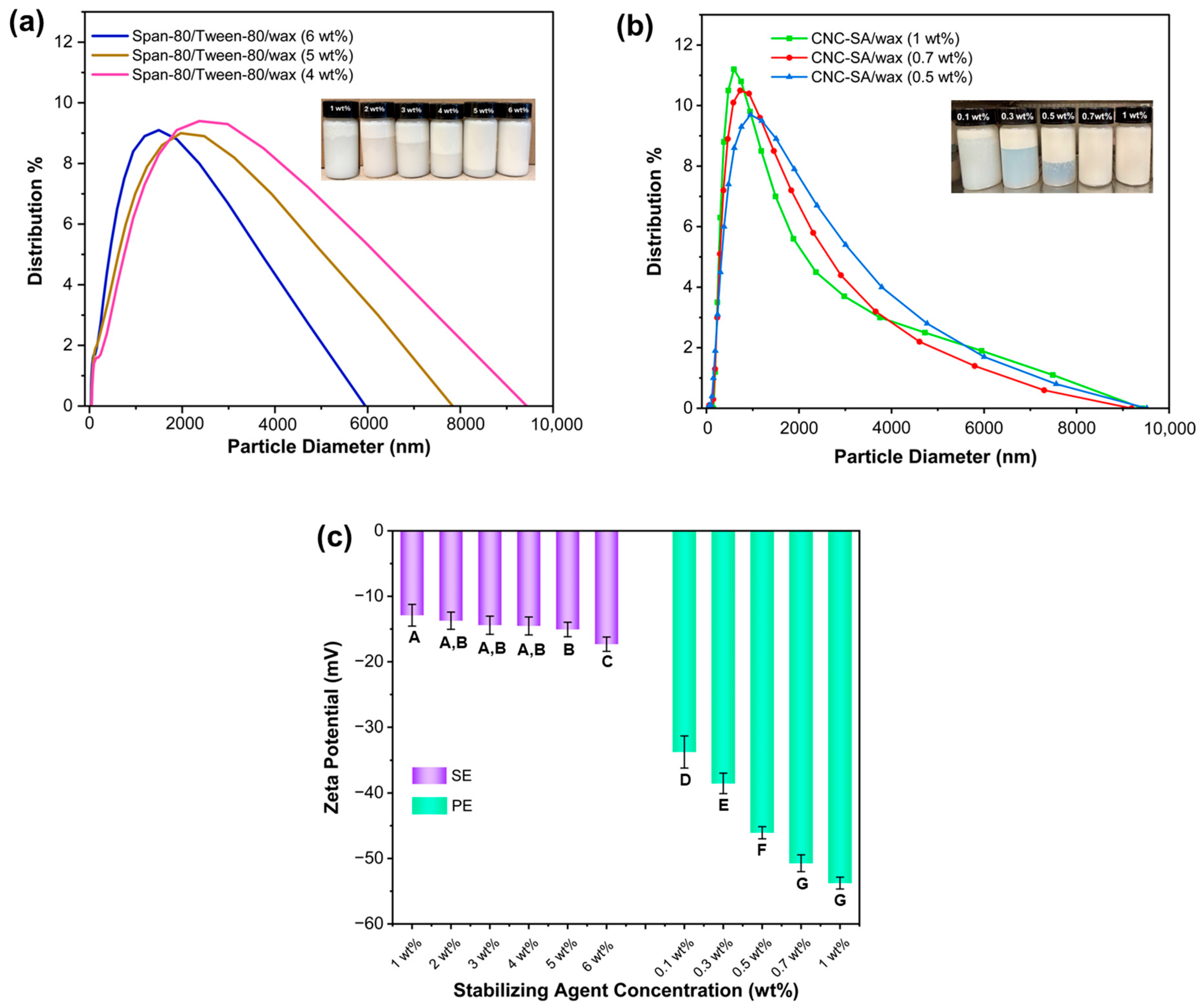
The surfactant-based soybean wax emulsions were formulated at various concentrations of the Span-80/Tween-80 mixture, ranging from 1 wt% to 6 wt%. It was observed that the 1 wt% formulation exhibited immediate phase separation, with a creamy wax phase forming in the upper portion and an aqueous phase settling at the bottom when stored in a vial (see Figure 1a and Figure S1 for enlarged views). With increasing concentrations of the Span-80/Tween-80 mixture, the uniformity of the emulsion improved, and at a stabilizer concentration of 6 wt%, a visually stable emulsion with no observable phase separation was obtained. The DLS profiles of the SEs exhibited a progressive shift towards smaller droplet diameters with increasing concentrations of Span-80/Tween-80 from 4 to 6 wt%, as shown in Figure 1a. Indeed, the average particle size decreased from approximately 667 nm at 4 wt% to 420 nm at 6 wt%. The distributions became narrower with a decreasing tail, indicating improved droplet uniformity and enhanced emulsification efficiency at higher surfactant concentrations. Conversely, visual stability of the CNC-SA stabilised soybean wax Pickering emulsion was observed at only 1 wt% stabilizer concentration (see Figure 1b and Figure S2 for enlarged views). DLS analysis of Pickering emulsion formulations over a stabilizer concentration range of 0.5 wt% to 1 wt% (Figure 1b) demonstrated enhanced emulsion stability with increasing CNC-SA concentration, with an accompanying decrease in the average particle size from 773 nm to 766 nm. The zeta potential of the SE samples was measured across the Span-80/Tween-80 concentration range of 1–6 wt%, while that of the PE samples was measured across the CNC-SA concentration range of 0.1–1.0 wt%, as shown in Figure 1c. It is evident from examination of Figure 1c that the zeta potential of the SE was −13 mV at a Span-80/Tween-80 concentration of 1 wt% and became progressively more negative with increasing stabilizer concentration, reaching −17 mV at 6 wt%. It is noted that the magnitude of the zeta potential was well below the value generally accepted as indicative of persistent colloidal stability, i.e., ±30 mV [62]. However, a non-ionic-surfactant-stabilized emulsion does not necessarily require a high zeta potential (>|30| mV) to induce stability since their mode of action is largely via steric repulsion [63]. Sufficient non-ionic surfactant loadings are required, however, to fully coat the droplets, as evidenced by the 6 wt% surfactant concentration required for stability in the present work. In contrast, the zeta potential of the PE samples exhibited a substantial decrease from −34 mV to −54 mV with increasing CNC-SA concentration from 0.1 to 1.0 wt%. The markedly greater absolute value of the zeta potential observed for the PE vs. the SE indicates significantly enhanced electrostatic repulsion between the dispersed droplets, thereby contributing to improved colloidal stability of the emulsion [64].
The shear viscosity of the most stable SE and PE formulations were evaluated. It was found that the Span-80/Tween-80/wax (6 wt%) emulsion exhibited a shear viscosity of 38 cP; a value considerably lower than that of the CNC-SA/wax (1 wt%) emulsion of 137 cP. The lower viscosity of the SE likely correlates with enhanced droplet mobility and consequently a great propensity for droplet coalescence relative to the PE [65].
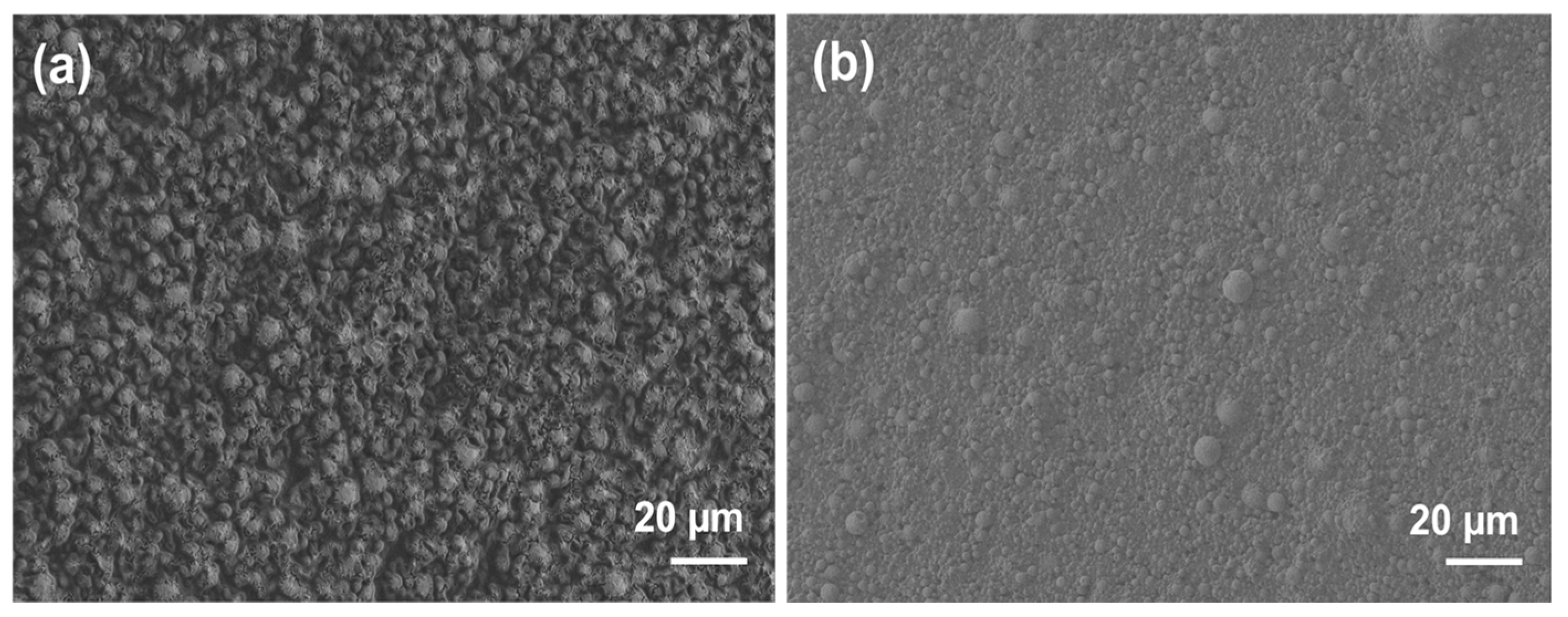
Having established that the most stable SE and PE formulations were obtained at stabilizing agent concentrations of 6wt% and 1wt%, respectively, all future characterization was performed employing these formulations. The morphology of the surfactant and Pickering emulsions dried on optically polished silicon wafers was characterized by scanning electron microscopy; representative micrographs are presented in Figure 2. Examination of Figure 2a reveals a densely packed morphology with fused, irregular particles in the dried coating of the Span-80/Tween-80/wax (6 wt%) emulsion, indicative of coalescence of particles during coating and drying. In contrast, Figure 2b shows that the dried CNC-SA/wax (1 wt%) emulsion (PE) exhibited well-defined micro- and nanoscale spherical structures, consistent with the particle size distribution observed in Figure 1b. Indeed, the average particle size of the CNC-SA/wax (1 wt%) emulsion was 766 nm as measured by the Zetasizer, while the corresponding dried emulsion, shown in Figure 2b, exhibited an average particle size of 862 nm as determined via the software package ImageJ 1.54d.

3.2. Characterization of Soybean Wax Emulsion Coated Paper

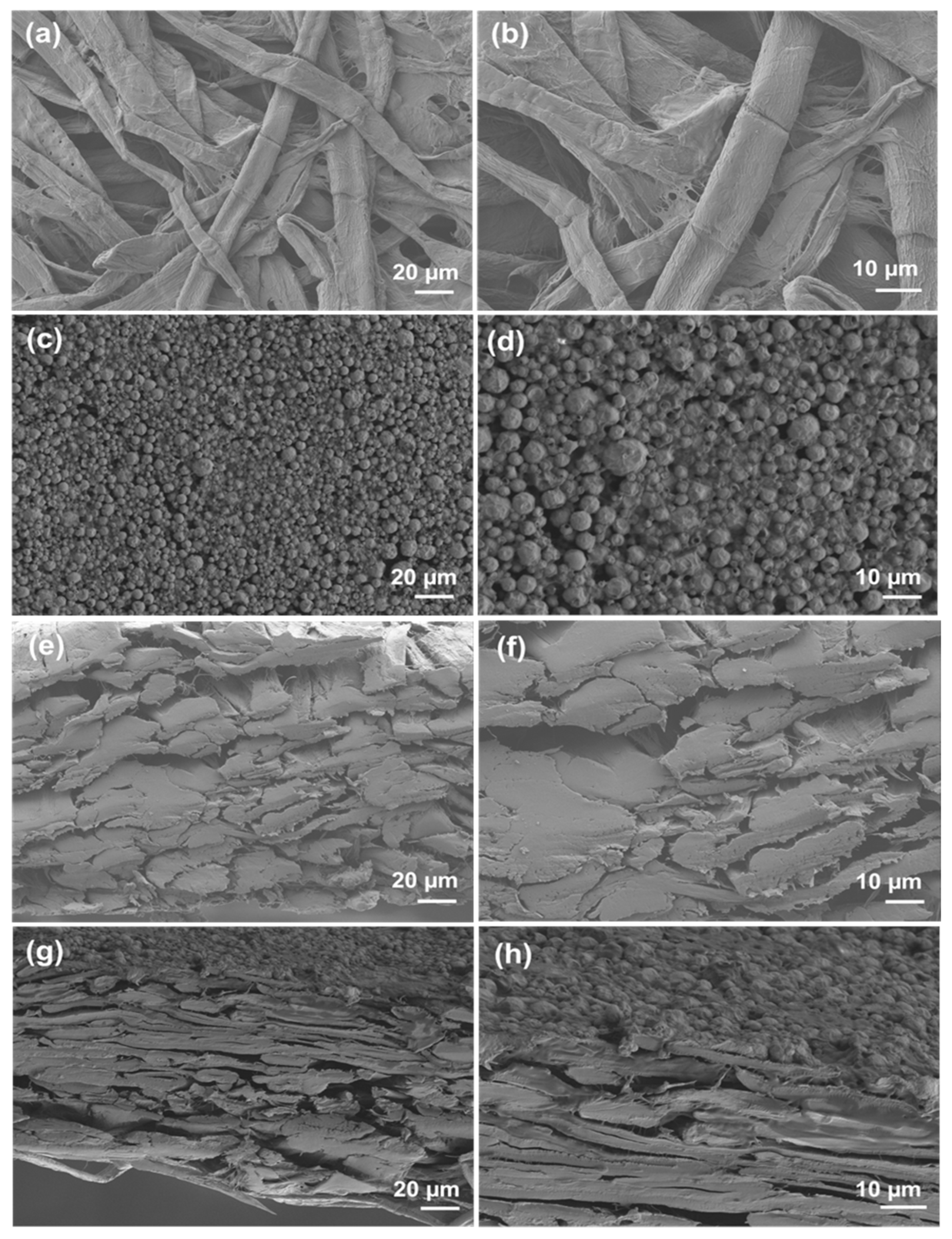
Morphological characterization of the surface and cross-section of uncoated and Span-80/Tween-80/wax (6 wt%) emulsion (SE)-coated NBK papers was performed via SEM; the resultant micrographs are presented in Figure 3. As may be seen in Figure 3a,b, the uncoated paper surface exhibited a randomly entangled fibrous microstructure, with fiber widths ranging from 5 to 20 μm with intrinsic voids present between the cellulose fibers. Application of the SE resulted in complete coverage of the paper structure, as evident in Figure 3c,d. It is noted that particle size analysis of the SE-coated paper surface revealed a significantly larger mean particle size of approximately 3 µm, relative to that observed by DLS in the suspension of 420 nm. This difference indicates that the SE droplets aggregate upon coating/drying, forming larger surface structures, and presumably decreasing porosity in the coating. The uncoated paper cross-section (Figure 3e,f) reveals a layered pulp fiber mat with an inter-fiber porous structure extending across the entire 154 μm thickness of the paper. The cross-sectional images of the SE-coated paper reveal a continuous coating layer on the top surface with limited penetration into the porous structure of the cellulose fibers and the adjacent subsurface region (Figure 3g,h). Similarly, analysis of the surface and cross-sectional morphology of the PE-coated paper, as demonstrated in the authors’ previous study [54], revealed a uniform coating on the paper surface accompanied by partial penetration of the coating into the porous fiber network.

3.3. Water Barrier Properties and the Water Vapor Transmission Rate of SE- and PE-Coated Paper

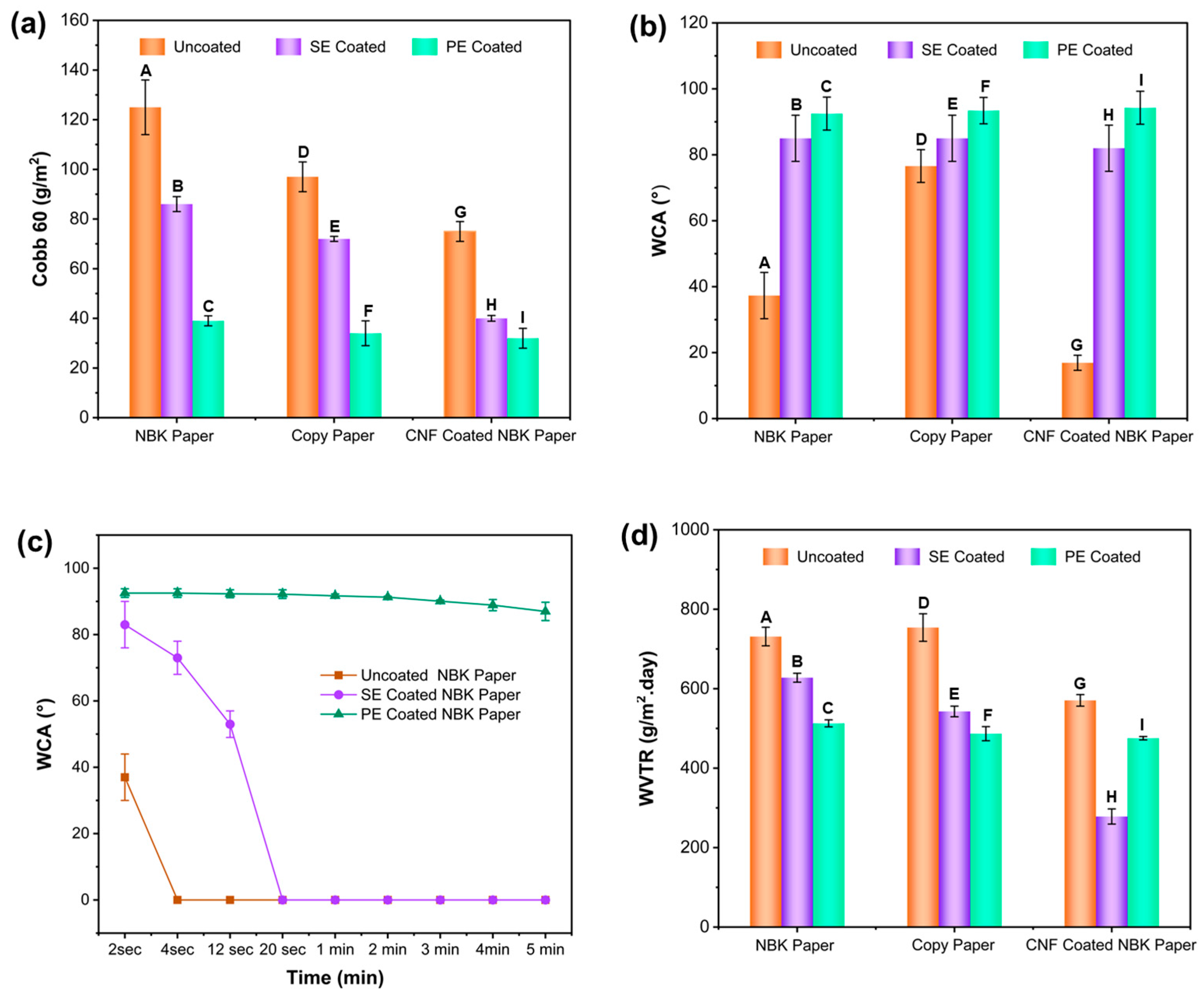
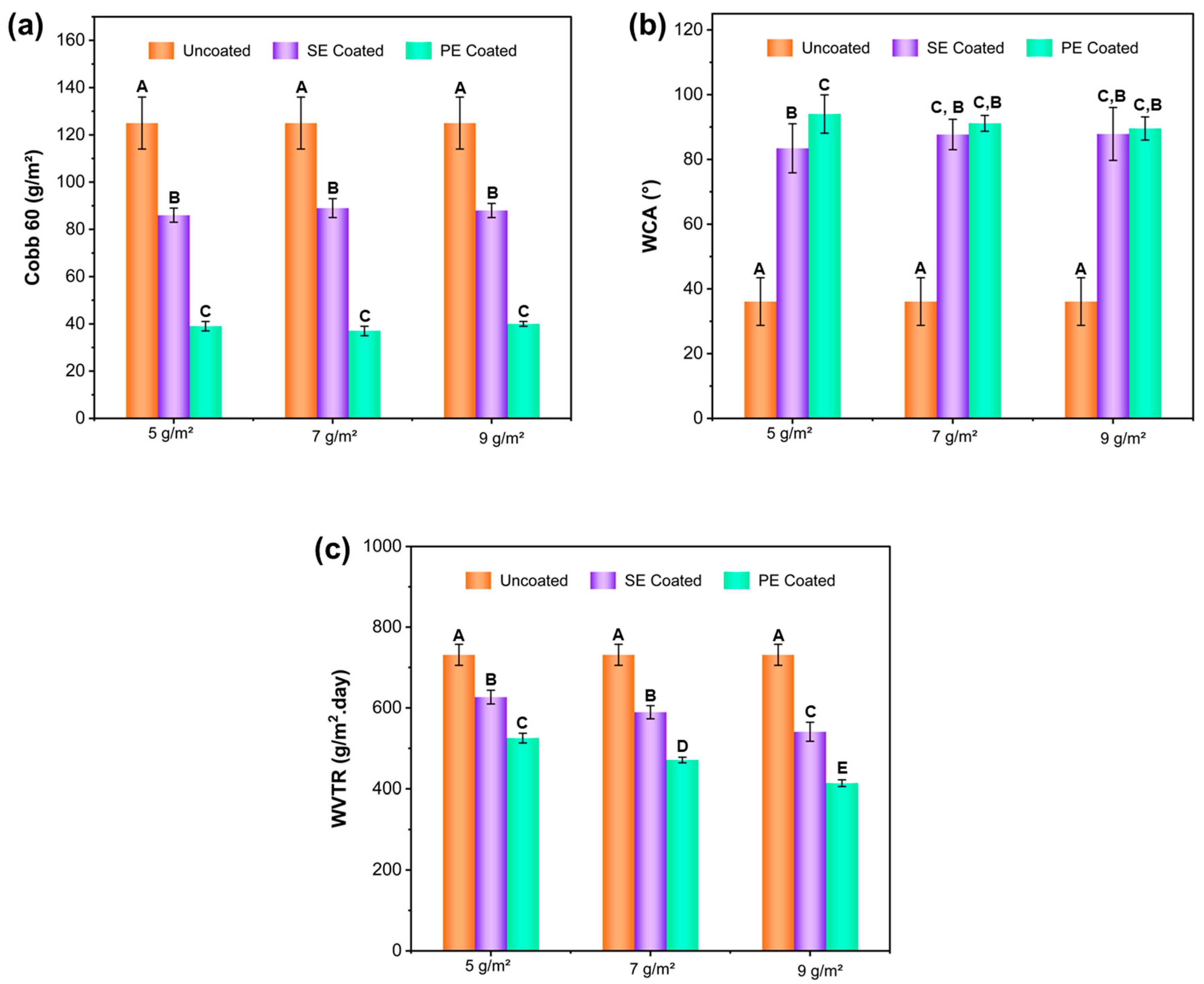
The efficacy of the Span-80/Tween-80/wax (6 wt%) emulsion (SE) and the CNC-SA/wax (1 wt%) emulsion (PE) coatings in promoting water and water vapor barrier properties on all three base papers was characterized. The emulsions were applied at an average coat weight of 5 g/m2 with a rod draw-down coater, which was the minimum coat weight required to achieve complete coating coverage. Cobb 60 values of uncoated and coated papers were analyzed to assess the impact of the SE and PE coatings on the water absorptiveness; the resulting data are presented in Figure 4a. The SE-coated NBK paper exhibited a moderate reduction in water absorptivity, with a 31% decrease, and was characterized by rapid water absorption. In contrast, the PE-coated paper showed a significant 69% reduction in water absorption compared to the uncoated paper. Comparable trends were observed in the water absorptiveness of both copy and CNF-coated NBK papers. The SE coating resulted in a 26% decrease in water absorption for the copy paper and a 46% reduction for the CNF-coated NBK paper. In comparison, the PE coating reduced water absorption by 65% for the copy paper and 57% for the CNF-coated NBK paper. These results highlight the superior water resistance imparted by the PE coating relative to the SE coating across all three paper types. Furthermore, the performance of the PE coating aligns with the typical commercial Cobb 60 range for flexible paper, which spans from 20 g/m2 to 40 g/m2 [66,67,68]. The liquid water barrier properties of the paper prior to and post-coating were further evaluated through WCA analysis, as shown in Figure 4b. Analysis of Figure 4b reveals that uncoated NBK paper exhibited a WCA of 37 ± 7°, a value indicative of considerable hydrophilicity. The WCA increased to 85 ± 7° upon coating of the NBK paper with the SE, and to 92 ± 5° upon coating with the PE. Similar trends were observed in the WCA analysis of both copy and CNF-coated NBK papers. It is noted that uncoated copy paper exhibited a relatively high WCA of 77 ± 5°, yet it absorbed 1 µL of water within 10 s, suggesting only a temporary water retention effect. Subsequently, the WCA increased to 85 ± 7° for the SE-coated and 93 ± 4° for the PE-coated copy paper. Non-emulsion treated CNF-coated NBK paper displayed a highly hydrophilic nature with a WCA of 17 ± 2°, which significantly increased to 82 ± 7° when coated with the SE, and 94 ± 5° when coated with the PE. It is concluded, therefore, that the WCA values of the SE-coated papers, while higher than the non-coated papers, were statistically less than those of the PE-coated papers across all three substrate types. Further, the PE coatings consistently surpassed the hydrophobicity threshold of 90° [69]. The WCA obtained with the PE-coated paper in this study was higher than those reported for acrylated epoxidized soybean oil-coated paper [51], paraffin wax-coated paper [70], and cellulose sheets dip-coated with carnauba wax micro- and nanoemulsions [71]. Moreover, it surpassed those reported for several bio-based coatings, such as cellulose esters [72], semi-crystalline polylactic acid [73], and polylactic acid-polycaprolactone-coated kraft papers [74], highlighting the effectiveness of the PE coating in substantially reducing paper hydrophilicity.
The temporal evolution of the WCA was evaluated for uncoated and SE- and PE-coated NBK paper (Figure 4c). Investigation of Figure 4c reveals that the uncoated NBK paper exhibited an initial WCA of 37° at 2 s, which decreased to 0° within 4 s, indicating high surface wettability and an inability to resist water spreading/penetration. A similar trend was observed for the SE-coated NBK paper, which absorbed water droplets within 20 s. Conversely, the PE-coated paper demonstrated significant water holdout, with an initial WCA of 93° at 2 s, which slightly decreased to 85° over a 5-min period. This behavior suggests reduced surface wettability and superior hydrophobicity for the PE-coated paper.
The effect of the SE and PE coatings on the water vapor transmission rate (WVTR) of the three base papers was evaluated and is presented in Figure 4d. Examination of Figure 4d shows that both the SE and PE coatings improved the water vapor barrier properties for all three base paper types. Specifically, the SE coating reduced the WVTR of NBK and copy paper by 14% and 27%, respectively. The PE -coating demonstrated greater impedance of water vapor transmission with a reduction in the WVTR values of 30% and 35% for the NBK and copy papers, respectively. Interestingly, a different trend was observed in the effect of the coatings on the WVTR of CNF-coated NBK paper. Indeed, the SE coating reduced the WVTR of the CNF-coated NBK paper by 54% whereas the PE -coating resulted in only a 17% reduction. It is hypothesized that the SE coating is more uniform and less porous than the PE coating due to droplet fusion; consequently, it provides more effective resistance to water vapor transmission. It is noted that although both emulsion coatings significantly reduced the WVTR of the three base papers, the resultant values are relatively high compared to the range of 20 to 100 g/m2·day for commercial water-dispersed polymer coatings [75].

3.4. Effect of Increasing Emulsion Coat Weight on Water Barrier Properties and the Water Vapor Transmission Rate

The effect of increasing the coat weight of the Span-80/Tween-80/wax (6 wt%) emulsion (SE) and the CNC-SA/wax (1 wt%) emulsion (PE) coatings on the liquid water and water vapor barrier performance of the NBK base paper was investigated and is presented in Figure 5. To obtain coat weights of 5 g/m2, 7 g/m2, and 9 g/m2 rods numbered 3, 5, and 8 were employed for the SE coating, respectively, while rods numbered 5, 8, and a double coating using rod number 8 were employed for comparable PE coatings. Examination of Figure 5a,b reveals that both the Cobb 60 and WCA values plateaued for both coating types beyond a coat weight of 5 g/m2. These results indicate that the optimal liquid water barrier is achieved at the lowest coat weight, suggesting that water resistance is primarily governed by surface phenomena rather than bulk coating characteristics. However, the WVTR values decreased with increasing coat weight for both emulsion coatings, as may be seen in Figure 5c. It is hypothesized that these results stem from the increased diffusion path that water vapor must traverse as it passes through increasing thicknesses of the coatings. As such, it is considered likely that the rate of water vapor transmission is primarily governed by the resistance of the bulk of the coating. In addition, it is noted that the reduction in WVTR was greatest for the PE-coated papers relative to the SE-coated papers at equivalent coat weights (28%, 36%, and 43% vs. 14%, 19%, and 26% for 5, 7, and 9 g/m2 coat weights, respectively). These results indicate the superiority of the PE-coating over the SE-coating in WVTR performance.

3.5. Oil Resistance Properties of SE- and PE-Coated Paper

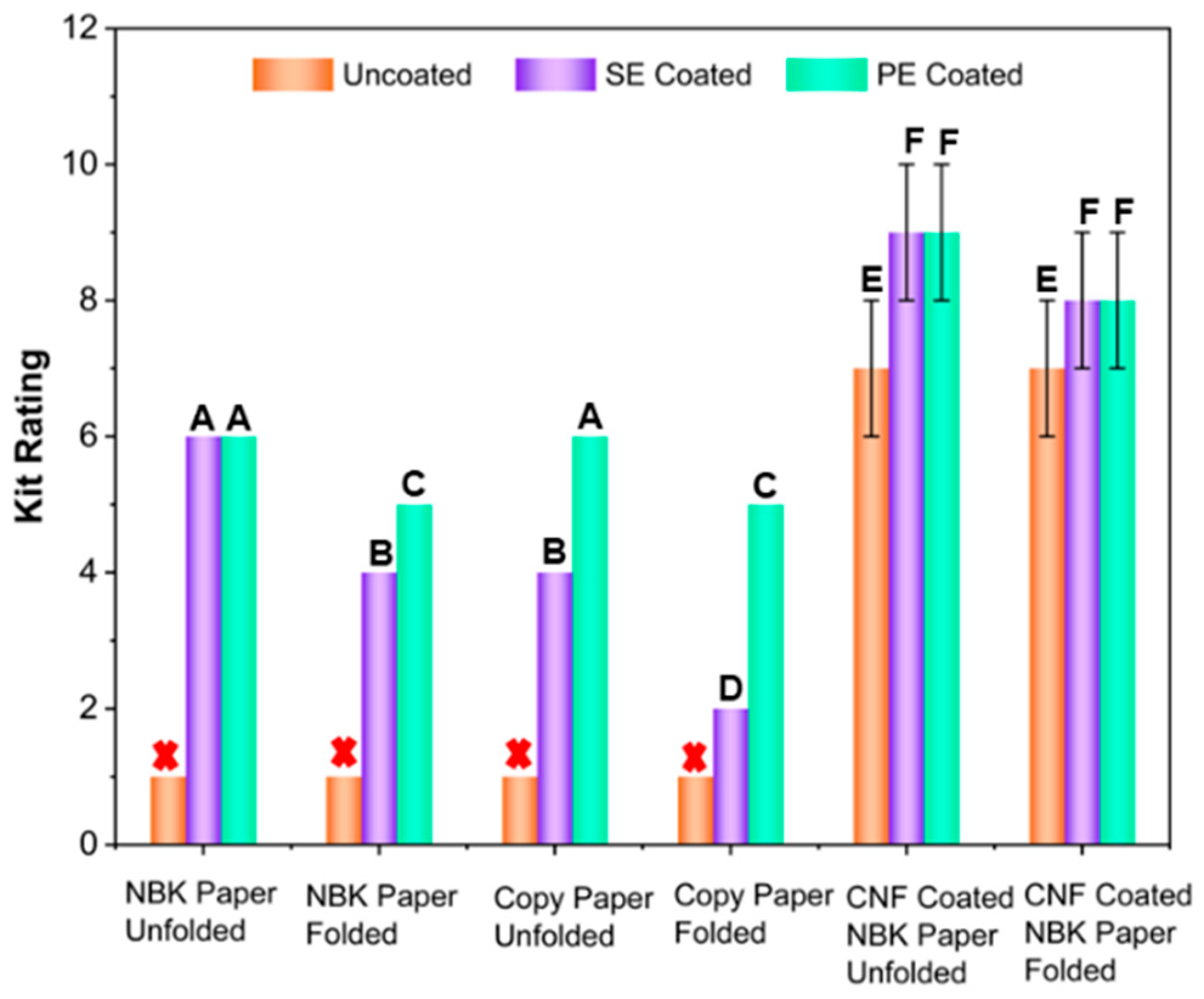
The oil resistance properties of all three base papers were evaluated for both Span-80/Tween-80/wax (6 wt%) emulsion (SE) and CNC-SA/wax (1 wt%) emulsion (PE) coatings, as presented in Figure 6. The analysis was conducted at an average coat weight of 9 g/m2 for both coatings. Examination of Figure 6 reveals that uncoated NBK paper exhibited a kit rating of 0, indicative of a complete lack of oil resistance. A substantial increase in kit rating from 0 to 6 ± 0 was observed for both the SE-coated and the PE-coated NBK papers, demonstrating that the coating layer effectively enhanced oil resistance by reducing surface porosity as seen in Figure 3 (from pores of the order of tens of microns in the uncoated paper to non-visible pores in the coated paper), along with a presumed decrease in surface energy due to the hydrophobic nature of the coating [32,76]. Folding of the coated NBK papers led to a reduction in kit rating at the fold for both coating types, likely due to mechanical failure of the coating in the newly formed creases [77]. It is noted, however, that the reduction in kit rating was greatest for the SE-coating than for the PE-coating (from 6 ± 0 to 4 ± 0, vs. 6 ± 0 to 5 ± 0 for the SE and PE coatings, respectively). Similar trends to those observed for the NBK paper were observed for the oil resistance of the copy paper. Specifically, the uncoated copy paper exhibited an absence of oil resistance (kit rating 0). SE-coating increased the kit rating from 0 to 4 ± 0, while PE-coating improved the rating from 0 to 6 ± 0. Upon folding, the kit rating of SE-coated copy paper decreased from 4 ± 0 to 2 ± 0, whereas that of PE-coated copy paper decreased from 6 ± 0 to 5 ± 0. These results clearly indicate that PE-coating provided greater oil resistance for both NBK and copy papers under both unfolded and folded conditions. For the CNF-coated NBK paper, the uncoated substrate exhibited good oil resistance, with a kit rating of 7 ± 1.0, due to the presence of the CNF layer acting as an effective oil barrier [78]. Application of the SE and PE coatings on top of the CNF-coated NBK paper resulted in both cases in an increase in the kit rating to 9 ± 1.0, indicating enhanced oil resistance, again likely due to a decrease in surface energy of the sample. Upon folding, the kit rating of both the SE- and PE-coated papers decreased to 8 ± 1.0, consistent with the trends observed for other coated papers, and the known behavior of CNF coated paper [78].

3.6. Mechanical Properties of the Coated Paper

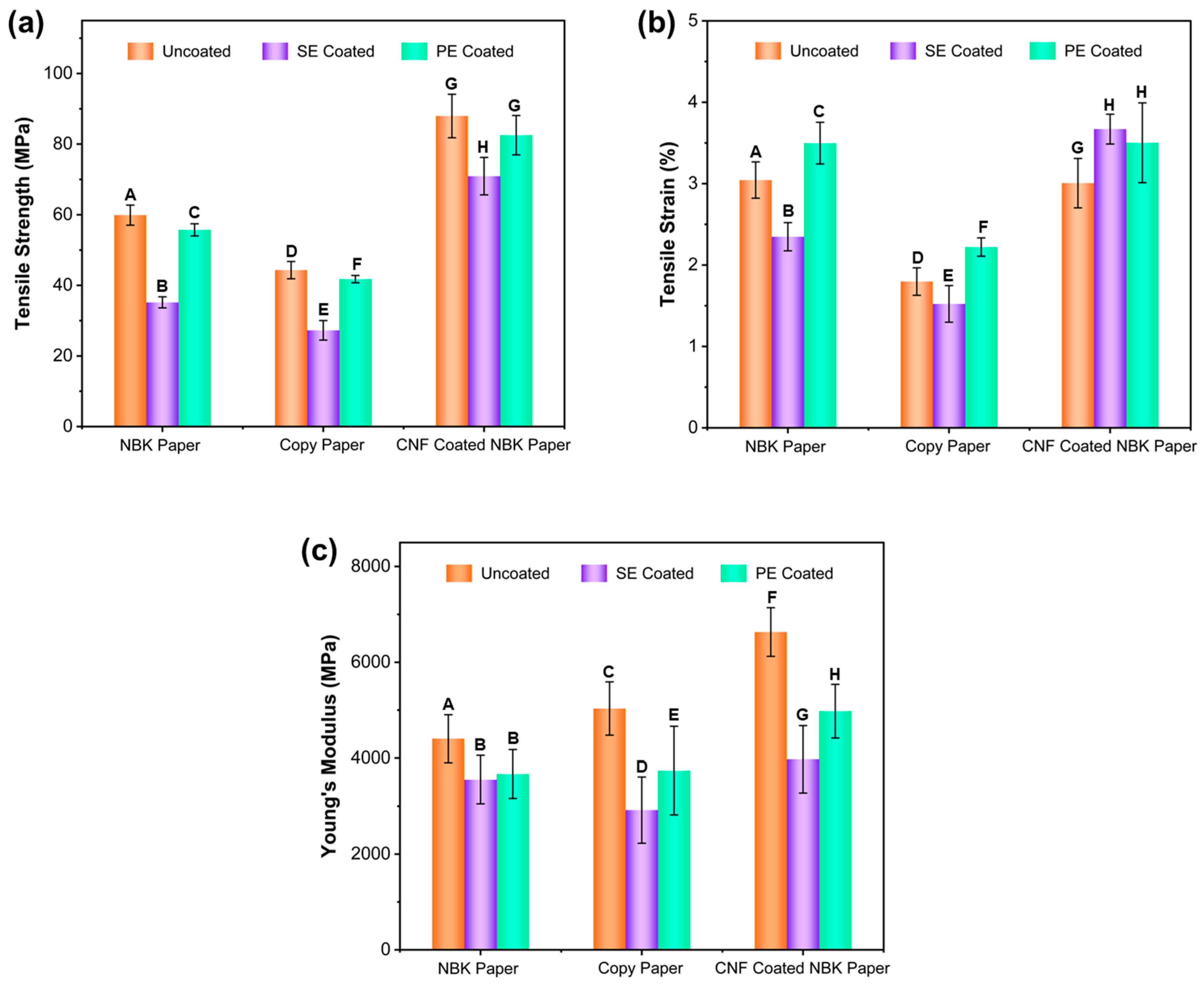
Mechanical properties are important indicators of the stability and robustness of paper, ensuring its longevity and functionality in various real-world packaging applications. Consequently, the mechanical properties of all three base papers were evaluated with both the Span-80/Tween-80/wax (6 wt%) emulsion (SE) and the CNC-SA/wax (1 wt%) emulsion (PE) at a coat weight of 5 g/m2. The mechanical properties measured included tensile strength, tensile strain, and Young’s modulus, as presented in Figure 7. Review of Figure 7a reveals that the uncoated NBK paper exhibited a tensile strength of 60 ± 3 MPa in the machine direction. Coating of the NBK paper with the SE-coating reduced the tensile strength by 41%; application of the PE-coating resulted in a smaller reduction in tensile strength of 7%. Other workers have reported decreases in the tensile strength of paper upon application of a water-based coating and have attributed it to the permeation of water into the cellulose fiber network, resulting in weakening of inter-fiber bonding and consequently a reduction in the overall mechanical integrity of the paper [79,80]. It is hypothesized that the greater reduction in tensile strength observed for the SE-coated paper may be attributed to deeper penetration of the SE, owing to its lower viscosity (38 cP), compared with that of the PE coating (137 cP). Comparable trends in tensile strength to those observed for NBK paper were found for copy paper when coated with SE and PE. Specifically, a 39% decrease in tensile strength relative to the uncoated control was observed for the SE-coated paper, while only a 6% decrease was observed for the PE-coated paper. The CNF-coated NBK paper exhibited the highest tensile strength of the three base papers with a value of 88 ± 6 MPa. Application of the SE to the CNF-coated NBK paper resulted in a 19% reduction in tensile strength; application of the PE-coating resulted in no statistically significant difference in tensile strength. The retention of tensile strength observed for the CNF-coated NBK paper is likely attributed to the cellulose nanofiber layer acting as a barrier, which limits emulsion penetration into the underlying base paper. It may be concluded that overall the PE-coating was found to have only a minor, if any, impact on the tensile strength, whereas the SE-coating was found to consistently decrease the tensile strength and therefore the mechanical integrity of the various base papers.
The tensile strain data of Figure 7b reveals that application of the SE-coating to the NBK paper resulted in a 23% reduction in its value; application of the PE coating, however, increased the tensile strain by 15%. Similar trends were observed for copy paper with the application of the SE-coating resulting in a 15% reduction in tensile strain, and application of the PE-coating resulting in a 24% increase. These results indicate that SE coating reduced the extensibility of the NBK and copy papers, while PE coating enhanced it. Several studies have reported a reduction in tensile strain due to wax coatings on paper substrates, which is consistent with the behavior observed for the SE-coated NBK and copy papers [71,81]. Conversely, Khwaldia [82] reported an increase in the extensibility of paper coated with a sodium caseinate (NaCAS)–paraffin wax emulsion containing 10% paraffin wax compared with the uncoated substrate, a response that is comparable to the behavior observed for the PE-coated papers. Interestingly, Khwaldia observed that increasing the wax content in the coating formulation to 20–40% led to a reduction in extensibility. This effect likely accounts for the reduced extensibility observed in the SE-coated papers, as the SE formulation contains a higher wax content than the PE formulation. In contrast, for the CNF-coated NBK paper, comparable enhancements of 22% and 17% were observed for the SE and PE coatings, respectively, indicating that both coatings improved the extensibility of the CNF-coated NBK paper. This somewhat anomalous result is likely attributable to the barrier properties of the cellulose nanofiber coating preventing emulsion penetration into the underlying sheet.
Finally, review of Figure 7c reveals a reduction in Young’s modulus across all three base papers following application of both the SE and PE coatings. Specifically, the SE-coated papers exhibited decreases of 19%, 42%, and 40% for NBK, copy, and CNF-coated NBK papers, respectively, while the corresponding reductions for the PE-coated papers were 17%, 26%, and 25%. These findings indicate that both coatings increased the flexibility of the paper by reducing its stiffness. Arshad et al. [83] and Kumar et al. [84] have also reported similar trends in Young’s modulus for paper coated with modified camelina oil (MCO) and soybean oil respectively. The greater reduction in Young’s modulus observed for the SE-coated samples relative to the PE-coated samples is likely attributable to the lower viscosity and hence greater penetration of the surfactant stabilized emulsion.

3.7. Storage Stability and Functionality of Soybean Wax Emulsions

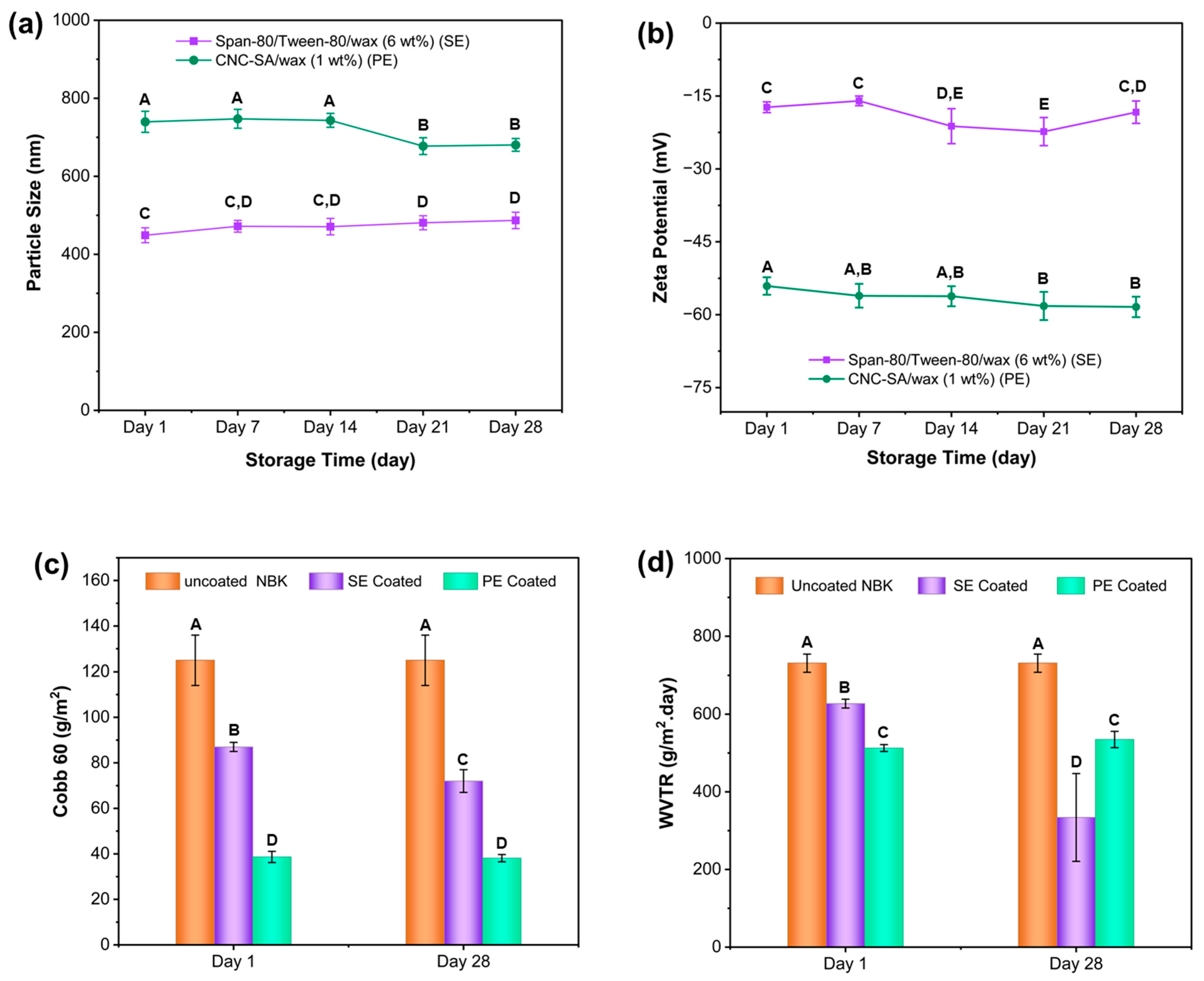
To evaluate the storage stability of the Span-80/Tween-80/wax (6 wt%) emulsion (SE) and the CNC-SA/wax (1 wt%) emulsion (PE), both formulations were stored in screw-capped vials at ambient temperature for one month. The droplet size and zeta potential of the emulsions were monitored at one-week intervals; the results are presented in Figure 8a,b, respectively. Review of Figure 8a reveals that the freshly prepared (day 1) SE exhibited an average particle size of 449 ± 19 nm, which gradually increased with storage time, reaching a value of 487 ± 21 nm after 1 month. The small but consistent growth in droplet size is likely indicative of progressive droplet coalescence during storage. Moreover, the initially low-viscosity SE transformed into a cream-like paste within one week of its preparation, a state it maintained for the remainder of the storage period; a finding similar to that of Cheikh et al. [85]. In contrast, the PE displayed an initial average particle size of 740 ± 27 nm, which remained relatively stable over the first 14 days, followed by a slight decrease to 680 ± 16 nm after 21 days. The reduction in particle size is likely attributed to minor phase fractionation during storage and hence loss of larger droplets from the sample [86].
Analysis of Figure 8b reveals statistically significant fluctuations in the zeta potential of the SE over the storage period. The freshly prepared emulsion exhibited a zeta potential of −17 mV, which remained statistically unchanged after 7 days. The zeta potential decreased to −21 mV on day 14 and remained consistent through day 21, before increasing significantly to −18 mV at the end of the storage period. Such fluctuations may indicate progressive destabilization of the SE during storage. Conversely, the PE displayed consistent zeta potential values during the first 14 days, followed by a slight decrease from −56 mV to −58 mV on day 21, a value which was maintained thereafter. The relative consistency of the zeta potential of the PE over time correlates well with its observed stability.
To evaluate the functionality of the stored emulsions, NBK paper was coated with the SE and PE formulations both immediately upon preparation, and after one month of storage. The coated papers were assessed for Cobb 60 and WVTR performance, as presented in Figure 8c,d. Application of the stored SE exhibited a substantially higher coat weight of 37 g/m2 using rod number 3, compared with only 5 g/m2 for the freshly prepared SE applied with the same rod. The increase in coat weight is attributed to the thickening of SE during storage. Specifically, using the same rod (same groove depth), a more viscous emulsion at the same solid concentration deposits a thicker wet layer, which dries into a higher coating weight. It is also noted that the coating generated using the stored SE was non-uniform and had a propensity to flake off the base paper; effects that were not observed for the freshly prepared SE coating. As shown in Figure 8c, the stored SE-coated NBK paper displayed a lower Cobb 60 value of 72 g/m2 compared with 87 g/m2 for the freshly prepared SE coating, a fact likely attributable to the vastly higher coat weight. Conversely, the Cobb 60 values of NBK paper coated with freshly prepared, and stored, PE were statistically identical, indicating that the PE retained its functionality during storage. Similar trends to those observed for the Cobb 60 analysis were observed for the WVTR (Figure 8d). Specifically, the WVTR of NBK paper decreased by only 14% when coated with the freshly prepared SE formulation, whereas a pronounced decrease of 54%, accompanied by higher variability, was recorded for NBK paper coated with the stored SE formulation; an observation likely attributable to the thick and non-uniform coating layer. In contrast, the WVTR values for NBK paper coated with the PE before and after storage were statistically identical, further demonstrating that the PE maintained its functional integrity over the storage period.
It should be noted that the work presented in the study to date employed two different soybean waxes for the SE and PE emulsions, a fact that resulted from separate formulation development phases. To address potential concerns regarding the influence of wax sources on the evaluation of suspension performance, select SE formulations were created employing the same wax as that used throughout for the PE formulation. There was no difference in the duration of stability observed. The performance of the revised SE formulation was evaluated via Cobb 60 and kit value testing, with the resultant data provided in the Supplemental Information. Review of Figures S3 and S4 indicates that no statistical differences were observed between SEs prepared with the different waxes, with the exception of the kit value results obtained for copy paper.

4. Conclusions

The present work presents a comparative insight into two stabilization strategies for soybean wax emulsions formulated for the production of sustainable food packaging with effective water and oil barrier properties. Specifically, the efficacy of the traditional surfactant stabilization system (SE) and the less common Pickering stabilization system (PE), specifically formulated with fully biologically derived, sustainable components, was compared and contrasted. It was determined that while both systems yielded uniform emulsions, the Pickering system maintained its stability over a longer period than the surfactant-based system. Both coating formulations were shown to provide enhanced barrier properties across a range of base papers. The Pickering system was shown to have superior performance in terms of preventing liquid water absorption, maximizing the water contact angle, and minimizing the water vapor transmission rate compared to the surfactant-based system. SE-coated papers exhibited relatively modest reductions in water absorption of 31%, 26%, and 46% for NBK, copy, and CNF-coated NBK papers, respectively, whereas PE-coated papers achieved substantially higher reductions of 69%, 65%, and 57%, as determined by Cobb 60 measurements. Consistent with these results, WCA analysis showed that the SE coating produced lower contact angles of 85 ± 7°, 85 ± 7°, and 82 ± 7°, while the PE coating resulted in markedly higher contact angles of 92 ± 5°, 93 ± 4°, and 94 ± 5° for NBK, copy, and CNF-coated NBK papers, respectively. With respect to water vapor barrier performance, the SE coating improved WVTR by 14%, 27%, and 54%, whereas the PE coating led to WVTR reductions of 30%, 35%, and 17% for NBK, copy, and CNF-coated NBK papers, respectively. Both SE and PE coatings exhibited optimum water resistance at a coat weight of 5 g/m2, while water vapor barrier behavior was improved by increasing coating thickness. In terms of oil resistance, both emulsion systems significantly enhanced the kit rating of the papers tested. The SE coating resulted in an increase in kit rating from 0 to 6 ± 0 for NBK paper and from 0 to 4 ± 0 for copy paper, while the kit rating of CNF-coated NBK paper increased from 7 ± 1.0 to 9 ± 1.0. In contrast, the PE coating led to a rise in kit rating from 0 to 6 ± 0 for both NBK and copy papers and similarly enhanced the kit rating of CNF-coated NBK paper from 7 ± 1.0 to 9 ± 1.0. The SE coating, however, experienced a substantial reduction in barrier integrity after folding, while the PE coating largely retained its oil barrier properties. Mechanical testing revealed that PE coatings provided higher tensile strength retention and improved extensibility relative to the SE coatings. Owing to the excellent stability, enhanced water and oil barrier properties, mechanical robustness, and overall functionality of the PE coating, it represents a significant advancement toward a renewable, biodegradable, and environmentally sustainable paper-coating formulation.

Supplementary Materials

The following supporting information can be downloaded at: https://www.mdpi.com/article/10.3390/su18020852/s1, Figure S1: Image of SEs as a function of increasing stabilizer concentrations. Figure S2: Image of PEs as a function of increasing stabilizer concentrations. Figure S3: Cobb 60 values for SEs formulated with two soybean wax types from different development phases. Figure S4: Kit values of SEs formulated with two soybean wax types from different development phases.

Author Contributions

Conceptualization, L.L., J.W., D.W.B. and D.J.N.; Methodology, M.D. and Y.Z.; Validation, M.D., and Y.Z.; Formal Analysis, M.D., Y.Z., L.L., J.W., D.W.B. and D.J.N.; Investigation, M.D. and Y.Z.; Writing—Original Draft Preparation, M.D.; Writing—Review & Editing, M.D., Y.Z., L.L., J.W., D.W.B. and D.J.N.; Supervision, L.L., J.W., D.W.B. and D.J.N.; Project Administration, L.L., J.W., D.W.B. and D.J.N.; Funding Acquisition, L.L., J.W., D.W.B. and D.J.N. All authors have read and agreed to the published version of the manuscript.

Funding

The present work was funded through the USDA Forest Service Forest Products Laboratory (Agreement #: 22-JV-11111124-025) and the USDA National Institute of Food and Agriculture (NIFA), Award # 2021-67022-34366, McIntire-Stennis Project Number ME0-42205 through the Maine Agricultural and Forest Experiment Station. The work was also supported by the National Oceanic and Atmospheric Administration (NOAA) (University of Maine Sea Grant Program, Grant 5410057, Reducing Marine Debris at the Source: Material Replacement and Source Reduction for Single-Use Food Packaging).

Institutional Review Board Statement

Not applicable.

Informed Consent Statement

Not applicable.

Data Availability Statement

All original data are available through the corresponding author.

Acknowledgments

The authors thank Mehdi Tajvidi for assistance with the water contact angle (WCA) measurements and Emma Perry for her expert support with the scanning electron microscopy (SEM) imaging. The authors also thank the Process Development Center (PDC) at the University of Maine for providing both the uncoated and CNF-coated northern bleached Kraft (NBK) paper, the cellulose nanocrystal (CNC) slurry, and access to the high-shear laboratory mixer.

Conflicts of Interest

The authors declare no conflicts of interest.

References

  1. Moad, G.; Solomon, D.H. The critical importance of adopting whole-of-life strategies for polymers and plastics. Sustainability 2021, 13, 8218. [Google Scholar] [CrossRef]
  2. Dey, A.; Dhumal, C.V.; Sengupta, P.; Kumar, A.; Pramanik, N.K.; Alam, T. Challenges and possible solutions to mitigate the problems of single-use plastics used for packaging food items: A Review. J. Food Sci. Technol. 2021, 58, 3251–3269. [Google Scholar] [CrossRef]
  3. Andrady, A.L.; Neal, M.A. Applications and societal benefits of plastics. Philos. Trans. R. Soc. B Biol. Sci. 2009, 364, 1977–1984. [Google Scholar] [CrossRef]
  4. Samborska, V. Packaging Is the Source of 40% of the Planet’s Plastic Waste. Our World Data. 2024. Available online: https://ourworldindata.org/data-insights/packaging-is-the-source-of-40-of-the-planets-plastic-waste (accessed on 2 November 2025).
  5. Ali, S.S.; Elsamahy, T.; Koutra, E.; Kornaros, M.; El-Sheekh, M.; Abdelkarim, E.A.; Zhu, D.; Sun, J. Degradation of conventional plastic wastes in the environment: A review on current status of knowledge and future perspectives of disposal. Sci. Total Environ. 2021, 771, 144719. [Google Scholar] [CrossRef]
  6. Narancic, T.; O’Connor, K.E. Plastic Waste as a Global Challenge: Are Biodegradable Plastics the Answer to the Plastic Waste Problem? Microbiology 2019, 165, 129–137. [Google Scholar] [CrossRef]
  7. Barboza, L.G.A.; Vethaak, A.D.; Lavorante, B.R.; Lundebye, A.K.; Guilhermino, L. Marine microplastic debris: An emerging issue for food security, food safety and human health. Mar. Pollut. Bull. 2018, 133, 336–348. [Google Scholar] [CrossRef] [PubMed]
  8. Eze, C.G.; Nwankwo, C.E.; Dey, S.; Sundaramurthy, S.; Okeke, E.S. Food chain microplastics contamination and impact on human health: A review. Environ. Chem. Lett. 2024, 22, 1889–1927. [Google Scholar] [CrossRef]
  9. Kutralam-Muniasamy, G.; Shruti, V.C.; Pérez-Guevara, F.; Roy, P.D. Microplastic diagnostics in humans: “The 3Ps” Progress, problems, and prospects. Sci. Total Environ. 2023, 856, 159164. [Google Scholar] [CrossRef]
  10. Li, Y.; Tao, L.; Wang, Q.; Wang, F.; Li, G.; Song, M. Potential health impact of microplastics: A review of environmental distribution, human exposure, and toxic effects. Environ. Health 2023, 1, 249–257. [Google Scholar] [CrossRef] [PubMed]
  11. Hamdani, S.S.; Li, Z.; Rolland, E.; Mohiuddin, M.; Rabnawaz, M. Barrier and mechanical properties of biodegradable paper bilayer-coated with plasticized starch and zein. J. Appl. Polym. Sci. 2023, 140, e53440. [Google Scholar] [CrossRef]
  12. Parvathy, P.A.; Sahoo, S.K. Hydrophobic, moisture resistant and biorenewable paper coating derived from castor oil based epoxy methyl ricinoleate with repulpable potential. Prog. Org. Coat. 2021, 158, 106347. [Google Scholar] [CrossRef]
  13. Deshwal, G.K.; Panjagari, N.R.; Alam, T. An Overview of Paper and Paper Based Food Packaging Materials: Health Safety and Environmental Concerns. J. Food Sci. Technol. 2019, 56, 4391–4403. [Google Scholar] [CrossRef]
  14. Li, Z.; Rabnawaz, M. Oil-and water-resistant coatings for porous cellulosic substrates. ACS Appl. Polym. Mater. 2018, 1, 103–111. [Google Scholar] [CrossRef]
  15. Choi, J.O.; Jitsunari, F.; Asakawa, F.; Park, H.J.; Lee, D.S. Migration of surrogate contaminants in paper and paperboard into water through polyethylene coating layer. Food Addit. Contam. 2002, 19, 1200–1206. [Google Scholar] [CrossRef]
  16. Tyagi, P.; Salem, K.S.; Hubbe, M.A.; Pal, L. Advances in barrier coatings and film technologies for achieving sustainable packaging of food products—A review. Trends Food Sci. Technol. 2021, 115, 461–485. [Google Scholar] [CrossRef]
  17. North, E.J.; Halden, R.U. Plastics and environmental health: The road ahead. Rev. Environ. Health 2013, 28, 1–8. [Google Scholar] [CrossRef]
  18. Guzman-Puyol, S. Fluorinated compounds in paper and paperboard based food packaging materials. NPJ Sci. Food 2024, 8, 82. [Google Scholar] [CrossRef]
  19. Bongiovanni, R.; Zeno, E.; Pollicino, A.; Serafini, P.M.; Tonelli, C. UV light-induced grafting of fluorinated monomer onto cellulose sheets. Cellulose 2011, 18, 117–126. [Google Scholar] [CrossRef]
  20. Gorrochategui, E.; Pérez-Albaladejo, E.; Casas, J.; Lacorte, S.; Porte, C. Perfluorinated Chemicals: Differential Toxicity, Inhibition of Aromatase Activity and Alteration of Cellular Lipids in Human Placental Cells. Toxicol. Appl. Pharmacol. 2014, 277, 124–130. [Google Scholar] [CrossRef] [PubMed]
  21. Karmakar, B.; Sarkar, S.; Chakraborty, R.; Saha, S.P.; Thirugnanam, A.; Roy, P.K.; Roy, S. Starch-based biodegradable films amended with nano-starch and tannic acid-coated nano-starch exhibit enhanced mechanical and functional attributes with antimicrobial activity. Carbohydr. Polym. 2024, 341, 122321. [Google Scholar] [CrossRef]
  22. Hansen, N.M.L.; Plackett, D. Sustainable films and coatings from hemicelluloses: A review. Biomacromolecules 2008, 9, 1493–1505. [Google Scholar] [CrossRef]
  23. Hamdani, S.S.; Li, Z.; Rabnawaz, M.; Kamdem, D.P.; Khan, B.A. Chitosan–graft–poly (dimethylsiloxane)/zein coatings for the fabrication of environmentally friendly oil- and water-resistant paper. ACS Sustain. Chem. Eng. 2020, 8, 5147–5155. [Google Scholar] [CrossRef]
  24. Lin, D.; Kuang, Y.; Chen, G.; Kuang, Q.; Wang, C.; Zhu, P.; Peng, C.; Fang, Z. Enhancing moisture resistance of starch-coated paper by improving the film forming capability of starch film. Ind. Crops Prod. 2017, 100, 12–18. [Google Scholar] [CrossRef]
  25. Kunam, P.K.; Ramakanth, D.; Akhila, K.; Gaikwad, K.K. Bio-based materials for barrier coatings on paper packaging. Biomass Convers. Biorefin. 2024, 14, 12637–12652. [Google Scholar] [CrossRef] [PubMed]
  26. Pashova, S. Application of plant waxes in edible coatings. Coatings 2023, 13, 911. [Google Scholar] [CrossRef]
  27. Gupta, S.; Ivvala, J.; Grewal, H.S. Development of natural wax-based durable superhydrophobic coatings. Ind. Crops Prod. 2021, 171, 113871. [Google Scholar] [CrossRef]
  28. Glavan, A.C.; Martinez, R.V.; Subramaniam, A.B.; Yoon, H.J.; Nunes, R.M.; Lange, H.; Thuo, M.M.; Whitesides, G.M. Omniphobic “RF paper” produced by silanization of paper with fluoroalkyltrichlorosilanes. Adv. Funct. Mater. 2014, 24, 60–70. [Google Scholar] [CrossRef]
  29. Surendran, A.N.; Ajjarapu, K.P.K.; Arumugham, A.A.; Kate, K.; Satyavolu, J. Characterization of industry grade soybean wax for potential applications in natural fiber reinforced composite (NFRC) filaments. Ind. Crops Prod. 2022, 186, 115163. [Google Scholar] [CrossRef]
  30. Jo, H.M.; Kim, D.H.; Lee, S.H.; Lee, J.Y. Multi-layer barrier coating technology using nano-fibrillated cellulose and a hydrophobic coating agent. BioResources 2022, 17, 6222. [Google Scholar] [CrossRef]
  31. Saji, V.S. Wax-based artificial superhydrophobic surfaces and coatings. Colloids Surf. A 2020, 602, 125132. [Google Scholar] [CrossRef]
  32. Jahangiri, F.; Mohanty, A.; Pal, A.K.; Clemmer, R.; Gregori, S.; Misra, M. Wax coatings for paper packaging applications: Study of the coating effect on surface, mechanical, and barrier properties. ACS Environ. Au 2024, 5, 165–182. [Google Scholar] [CrossRef]
  33. Li, W.; Bouzidi, L.; Narine, S.S. Current research and development status and prospect of hot-melt adhesives: A review. Ind. Eng. Chem. Res. 2008, 47, 7524–7532. [Google Scholar] [CrossRef]
  34. Takemoto, M.; Kajiyama, M.; Mizumachi, H.; Takemura, A.; Ono, H. Miscibility and adhesive properties of ethylene vinyl acetate copolymer (EVA)-based hot-melt adhesives. I. Adhesive tensile strength. J. Appl. Polym. Sci. 2002, 83, 719–725. [Google Scholar] [CrossRef]
  35. Shen, T.; Fan, S.; Li, Y.; Xu, G.; Fan, W. Preparation of edible non-wettable coating with soybean wax for repelling liquid foods with little residue. Materials 2020, 13, 3308. [Google Scholar] [CrossRef]
  36. Celik, N.; Torun, I.; Ruzi, M.; Esidir, A.; Onses, M.S. Fabrication of robust superhydrophobic surfaces by one-step spray coating: Evaporation driven self-assembly of wax and nanoparticles into hierarchical structures. Chem. Eng. J. 2020, 396, 125230. [Google Scholar] [CrossRef]
  37. Celik, N.; Kiremitler, N.B.; Ruzi, M.; Onses, M.S. Waxing the soot: Practical fabrication of all-organic superhydrophobic coatings from candle soot and carnauba wax. Prog. Org. Coat. 2021, 153, 106169. [Google Scholar] [CrossRef]
  38. Fei, T.; Walker, J.A.; Vickerman, K.L.; Stanley, L.M.; Jarboe, D.; Wang, T. Synthesis and characterization of soybean oil-based waxes and their application as paraffin substitute for corrugated coating. J. Ind. Eng. Chem. 2018, 58, 113–122. [Google Scholar] [CrossRef]
  39. Ryan, N.M.; Mcnally, G.M.; Welsh, J. The use of aqueous-based emulsion polymers as moisture barrier coatings for carton boards. Dev. Chem. Eng. Miner. Process. 2004, 12, 141–148. [Google Scholar] [CrossRef]
  40. Al-Yaqoobi, A.M.; Al-dulaimi, S.L.; Salman, R.H. Explore the Impact of Surfactant Type on the Stability and Separation Efficiency of Oil–Water Emulsions of Real Wastewater from Al-Basrah Crude Oil Using Microbubble Air Flotation. J. Ecol. Eng. 2024, 25, 367–378. [Google Scholar] [CrossRef]
  41. Naderizadeh, S.; Heredia-Guerrero, J.A.; Caputo, G.; Grasselli, S.; Malchiodi, A.; Athanassiou, A.; Bayer, I.S. Superhydrophobic coatings from beeswax-in-water emulsions with latent heat storage capability. Adv. Mater. Interfaces 2019, 6, 1801782. [Google Scholar] [CrossRef]
  42. Liu, D.; Duan, Y.; Wang, S.; Gong, M.; Dai, H. Improvement of oil and water barrier properties of food packaging paper by coating with microcrystalline wax emulsion. Polymers 2022, 14, 1786. [Google Scholar] [CrossRef]
  43. Zhang, W.; Lu, P.; Qian, L.; Xiao, H. Fabrication of superhydrophobic paper surface via wax mixture coating. Chem. Eng. J. 2014, 250, 431–436. [Google Scholar] [CrossRef]
  44. Kaczerewska, O.; Martins, R.; Figueiredo, J.; Loureiro, S.; Tedim, J. Environmental behaviour and ecotoxicity of cationic surfactants towards marine organisms. J. Hazard. Mater. 2020, 392, 122299. [Google Scholar] [CrossRef] [PubMed]
  45. Pickering, S.U. CXCVI—Emulsions. J. Chem. Soc. Trans. 1907, 91, 2001–2021. [Google Scholar] [CrossRef]
  46. Li, W.; Jiao, B.; Li, S.; Faisal, S.; Shi, A.; Fu, W.; Chen, Y.; Wang, Q. Recent advances on Pickering emulsions stabilized by diverse edible particles: Stability mechanism and applications. Front. Nutr. 2022, 9, 864943. [Google Scholar] [CrossRef]
  47. Xiao, T.; Ma, X.; Hu, H.; Xiang, F.; Zhang, X.; Zheng, Y.; Dong, H.; Adhikari, B.; Wang, Q.; Shi, A. Advances in emulsion stability: A review on mechanisms, role of emulsifiers, and applications in food. Food Chem. X 2025, 29, 102792. [Google Scholar] [CrossRef]
  48. Liu, P.; Pei, X.; Cui, Z.; Song, B.; Jiang, J.; Binks, B.P. Recyclable nonionic–anionic bola surfactant as a stabilizer of size-controllable and pH-responsive Pickering emulsions. Langmuir 2023, 39, 841–850. [Google Scholar] [CrossRef]
  49. Huang, S.; Lv, J.; Liu, X.; Yuan, H.; Wang, Y.; Huan, S.; Shen, J.; Wang, C. Sustainable and green design of beeswax-based Pickering emulsion coating for food packaging. J. Clean. Prod. 2025, 495, 145096. [Google Scholar] [CrossRef]
  50. Zhang, N.; Gao, C.; Meng, L.; Tang, X. Preparation and characterization of carnauba wax-based particle with hierarchical structure and its use as hydrophobic coating for chitosan films. Carbohydr. Polym. 2023, 319, 121224. [Google Scholar] [CrossRef]
  51. Liu, R.; Tian, X.; Wang, Z.; Zhang, J.; Lu, P.; Huang, C. Water vapor barrier coating based on nanocellulose crystals stabilized AESO oil-in-water Pickering emulsion. Prog. Org. Coat. 2021, 159, 106479. [Google Scholar] [CrossRef]
  52. Wang, Y.; Zhang, X.; Kan, L.; Shen, F.; Ling, H.; Wang, X. All-biomass-based eco-friendly waterproof coating for paper-based green packaging. Green Chem. 2022, 24, 7039–7048. [Google Scholar] [CrossRef]
  53. Jaekel, E.E.; Filonenko, S. Cationic CNC-stabilized Pickering emulsions of linseed oil for hydrophobic coatings. RSC Adv. 2023, 13, 16860–16866. [Google Scholar] [CrossRef]
  54. Daizy, M.; Ni, Y.; Bousfield, D.W.; Neivandt, D.J. Development of a soybean wax Pickering emulsion for sustainable hydrophobic modification of paper. ACS Sustain. Chem. Eng. 2025, 13, 13614–13627. [Google Scholar] [CrossRef]
  55. Yadav, M.; Behera, K.; Chang, Y.H.; Chiu, F.C. Cellulose nanocrystal reinforced chitosan based UV barrier composite films for sustainable packaging. Polymers 2020, 12, 202. [Google Scholar] [CrossRef]
  56. Metha, C.; Pawar, S.; Suvarna, V. Recent advancements in alginate-based films for active food packaging applications. Sustain. Food Technol. 2024, 2, 1246–1265. [Google Scholar] [CrossRef]
  57. Li, C.; Mei, Z.; Liu, Q.; Wang, J.; Xu, J.; Sun, D. Formation and properties of paraffin wax submicron emulsions prepared by the emulsion inversion point method. Colloids Surf. A Physicochem. Eng. Asp. 2010, 356, 71–77. [Google Scholar] [CrossRef]
  58. T 441 OM-90; Technical Association of the Pulp and Paper Industry, Water Absorptiveness of Sized (Non-Bibulous) Paper and Paper Board (Cobb Test). Technical Association of the Pulp and Paper Industry (TAPPI): Peachtree Corners, GA, USA, 1990.
  59. T448 OM-89; Technical Association of the Pulp and Paper Industry, Water Vapor Transmission Rate of Sheet Materials at Standard Temperature and Humidity. Technical Association of the Pulp and Paper Industry (TAPPI): Peachtree Corners, GA, USA, 1989.
  60. T559 Pm-96; Technical Association of the Pulp and Paper Industry, Grease Resistance Test for Paper and Paperboard. Technical Association of the Pulp and Paper Industry (TAPPI): Peachtree Corners, GA, USA, 1996.
  61. T 494 OM-21; Technical Association of the Pulp and Paper Industry, Tensile Properties of Paper and Paperboard (Using Constant Rate of Elongation Apparatus). Technical Association of the Pulp and Paper Industry (TAPPI): Peachtree Corners, GA, USA, 2021.
  62. Varsou, D.D.; Afantitis, A.; Tsoumanis, A.; Papadiamantis, A.; Valsami-Jones, E.; Lynch, I.; Melagraki, G. Zeta-potential read-across model utilizing nanodescriptors extracted via the nanoxtract image analysis tool available on the enalos nanoinformatics cloud platform. Small 2020, 16, 1906588. [Google Scholar] [CrossRef]
  63. Souza, I.D.L.; Saez, V.; Mansur, C.R.E. Lipid nanoparticles containing coenzyme Q10 for topical applications: An overview of their characterization. Colloids Surf. B Biointerfaces 2023, 230, 113491. [Google Scholar] [CrossRef] [PubMed]
  64. Lowry, G.V.; Hill, R.J.; Harper, S.; Rawle, A.F.; Hendren, C.O.; Klaessig, F.; Nobbmann, U.; Sayre, P.; Rumble, J. Guidance to Improve the Scientific Value of Zeta-Potential Measurements in NanoEHS. Environ. Sci. Nano 2016, 3, 953–965. [Google Scholar] [CrossRef]
  65. Zadeh, S.S.S.; Egan, V.; Walsh, P. An experimental study on the mobility of droplets in liquid-liquid Taylor flows within circular capillaries. Int. J. Multiph. Flow 2022, 157, 104259. [Google Scholar] [CrossRef]
  66. Nair, A. Oil-and Water-Resistant Paper Coatings Using Low-Cost Biodegradable Polymer Blends for Packaging Applications. Master’s Thesis, Michigan State University, East Lansing, MI, USA, 2021. [Google Scholar]
  67. Li, Z.; Rabnawaz, M.; Khan, B. Response surface methodology design for biobased and sustainable coatings for water-and oil resistant paper. ACS Appl. Polym. Mater. 2020, 2, 1378–1387. [Google Scholar] [CrossRef]
  68. OECD. PFASs and Alternatives in Food Packaging (Paper and Paperboard): Report on the Commercial Availability and Current Uses; OECD Series on Risk Management of Chemicals No. 58; OECD: Paris, France, 2020; pp. 1–65. [Google Scholar] [CrossRef]
  69. Godawat, R.; Jamadagni, S.N.; Garde, S. Characterizing hydrophobicity of interfaces by using cavity formation, solute binding, and water correlations. Proc. Natl. Acad. Sci. USA 2009, 106, 15119–15124. [Google Scholar] [CrossRef]
  70. Nowacka, M.; Rybak, K.; Wiktor, A.; Mika, A.; Boruszewski, P.; Woch, J.; Przybysz, K.; Witrowa-Rajchert, D. The quality and safety of food contact materials–paper and cardboard coated with paraffin emulsion. Food Control 2018, 93, 183–190. [Google Scholar] [CrossRef]
  71. de Campos, A.; Claro, P.C.; Luchesi, B.R.; Miranda, M.; Souza, F.V.; Ferreira, M.D.; Marconcini, J.M. Curaua cellulose sheets dip coated with micro and nano carnauba wax emulsions. Cellulose 2019, 26, 7983–7993. [Google Scholar] [CrossRef]
  72. Willberg-Keyriläinen, P.; Ropponen, J.; Alakomi, H.L.; Vartiainen, J. Cellulose fatty acid ester coated papers for stand-up pouch applications. J. Appl. Polym. Sci. 2018, 135, 46936. [Google Scholar] [CrossRef]
  73. Sundar, N.; Kumar, A.; Pavithra, A.; Ghosh, S. Studies on semi-crystalline poly lactic acid (PLA) as a hydrophobic coating material on kraft paper for imparting barrier properties in coated abrasive applications. Prog. Org. Coat. 2020, 145, 105682. [Google Scholar] [CrossRef]
  74. Sundar, N.; Keerthana, P.; Kumar, S.A.; Kumar, G.A.; Ghosh, S. Dual purpose, bio-based polylactic acid (PLA)-polycaprolactone (PCL) blends for coated abrasive and packaging industrial coating applications. J. Polym. Res. 2020, 27, 386. [Google Scholar] [CrossRef]
  75. Mesic, B.B.; Järnström, L.; Johnston, J. Latex-Based Barrier Dispersion Coating on Linerboard: Flexographic Multilayering versus Single Step Conventional Coating Technology. Nord. Pulp Pap. Res. J. 2015, 30, 350–360. [Google Scholar] [CrossRef]
  76. Basak, S.; Dangate, M.S.; Samy, S. Oil-and water-resistant paper coatings: A review. Prog. Org. Coat. 2024, 186, 107938. [Google Scholar] [CrossRef]
  77. dos Santos, A.D.A.; Matos, L.C.; Duraes, A.F.S.; Mendonca, M.C.; dos Santos Muguet, M.C.; Damasio, R.A.P.; Sanadi, A.R.; Tonoli, G.H.D. Kraftliner paper coated with cationic starch/glycerol and poly (vinyl alcohol) blends to generate water vapor and O2 barriers. Food Packag. Shelf Life 2025, 47, 101435. [Google Scholar] [CrossRef]
  78. Tayeb, A.H.; Tajvidi, M.; Bousfield, D. Paper-based oil barrier packaging using lignin-containing cellulose nanofibrils. Molecules 2020, 25, 1344. [Google Scholar] [CrossRef]
  79. Hamdani, S.S.; Elkholy, H.M.; Alghaysh, M.O.; Wyman, I.; Bher, A.; Auras, R.; Rabnawaz, M. Recyclable and Biodegradable Paper Coating with Functionalized PLA and PBAT. ACS Omega 2025, 10, 11483–11497. [Google Scholar] [CrossRef]
  80. Wang, H.; Mai, Y.A.; Qiu, W.; Liu, W.; Yang, D.; Fang, Z.; Qiu, X. Water-, Oil-, and Stain-Resistant Lignin-Based Degradable Waterborne Polyurethane for Paper Packaging Coating. ACS Sustain. Chem. Eng. 2025, 13, 1292–1303. [Google Scholar] [CrossRef]
  81. Vijayan, S.P.; Aparna, S.; Sahoo, S.K. Effect of beeswax on hydrophobicity, moisture resistance and transparency of UV curable linseed oil based coating for compostable paper packaging. Ind. Crops Prod. 2023, 197, 116645. [Google Scholar] [CrossRef]
  82. Khwaldia, K. Water vapor barrier and mechanical properties of paper-sodium caseinate and paper-sodium caseinate-paraffin wax films. J. Food Biochem. 2010, 34, 998–1013. [Google Scholar] [CrossRef]
  83. Arshad, M.; Shankar, S.; Mohanty, A.K.; Todd, J.; Riddle, R.; Van Acker, R.; Taylor, G.W.; Misra, M. Improving the barrier and mechanical properties of paper used for packing applications with renewable hydrophobic coatings derived from camelina oil. ACS Omega 2024, 9, 19786–19795. [Google Scholar] [CrossRef] [PubMed]
  84. Kumar, V.; Khan, A.; Rabnawaz, M. A plant oil-based eco-friendly approach for paper coatings and their packaging applications. Prog. Org. Coat. 2023, 176, 107386. [Google Scholar] [CrossRef]
  85. Cheikh, F.B.; Mabrouk, A.B.; Magnin, A.; Putaux, J.L.; Boufi, S. Chitin nanocrystals as Pickering stabilizer for O/W emulsions: Effect of the oil chemical structure on the emulsion properties. Colloids Surf. B Biointerfaces 2021, 200, 111604. [Google Scholar] [CrossRef] [PubMed]
  86. Ji, Y.; Wu, Y.; Wang, Y.; He, S.; Jiang, Y.; Li, X.; Wang, L.; Xu, Q.; Zhang, L.; Wang, H. Pickering emulsion gel stabilized by milk fat globule membrane/pectin enhanced probiotic stability. Food Chem. X 2025, 27, 102409. [Google Scholar] [CrossRef]
Scheme 1. Schematic illustration of the synthesis of the Span-80/Tween-80/wax (6 wt%) surfactant-based emulsion (SE). Created in BioRender. Daizy, M. (2025) https://BioRender.com/254nump.
Sustainability 18 00852 sch001
Figure 1. (a) Particle size distribution of Span-80/Tween-80 emulsions (SE) at stabilizer concentrations of 4, 5, and 6 wt%. (b) Particle size distribution of CNC-SA/wax emulsions (PE) at stabilizer concentrations of 0.5, 0.7, and 1 wt%. (c) Zeta potential of the SE and PE as a function of increasing stabilizer concentrations. Note that images of the suspensions are presented at all concentrations tested, but only select particle size distributions are included for clarity. Different letters (A–G) indicate significant statistical differences by Tukey’s test (p < 0.05).
Sustainability 18 00852 g001
Figure 2. Scanning electron micrographs of (a) the Span-80/Tween-80/wax (6 wt%) emulsion (SE) and (b) the CNC-SA/wax (1 wt%) emulsion (PE) dried on polished silicon substrates.
Sustainability 18 00852 g002
Figure 3. SEM micrographs of the surface and cross-section of uncoated and Span-80/Tween-80 /wax (6 wt%) emulsion (SE) coated NBK paper: (a,b) uncoated surface; (c,d) coated surface; (e,f) uncoated cross-section; (g,h) coated cross-section.
Sustainability 18 00852 g003
Figure 4. Comparison of water and water vapor barrier performance for uncoated, SE-coated, and PE-coated NBK, copy, and CNF-coated NBK papers: (a) Cobb 60 liquid water absorptiveness, (b) WCA, (c) Temporal evolution of the WCA, and (d) WVTR. All coated samples had an emulsion coat weight of 5 g/m2. Uncoated and coated samples within each paper type were compared using pairwise statistical analysis. Different letters (A–I) indicate significant statistical differences by Tukey’s test (p < 0.05).
Sustainability 18 00852 g004
Figure 5. Water barrier properties and water vapor transmission rate of SE-coated and PE-coated NBK paper as a function of increasing coat weight.: (a) Cobb 60 liquid water absorptiveness, (b) WCA, and (c) WVTR. Different letters (A–E) indicate significant statistical differences by Tukey’s test (p < 0.05).
Sustainability 18 00852 g005
Figure 6. Kit ratings of uncoated, SE-coated, and PE-coated NBK, copy, and CNF-coated NBK papers under unfolded and folded conditions. Five measurements were performed for each condition, and all standard deviations were zero except for the CNF-coated NBK paper. Different letters (A–F) indicate significant statistical differences by Tukey’s test (p < 0.05), and the cross symbol indicates no oil resistance (kit rating = 0).
Sustainability 18 00852 g006
Figure 7. Mechanical properties of uncoated, SE-coated, and PE-coated NBK, copy, and CNF-coated NBK paper: (a) Tensile strength, (b) Tensilestrain, and (c) Young’s modulus. Note: Uncoated and coated samples within each paper type were compared through pairwise statistical analysis. Different letters (A–H) indicate significant statistical differences by Tukey’s test (p < 0.05).
Sustainability 18 00852 g007
Figure 8. Storage stability and functionality of SE and PE: (a) Mean particle size, (b) mean zeta-potential measurements, (c) Cobb 60, and (d) WVTR as a function of time. Different letters (A–E) indicate significant statistical differences by Tukey’s test (p < 0.05).
Sustainability 18 00852 g008
Disclaimer/Publisher’s Note: The statements, opinions and data contained in all publications are solely those of the individual author(s) and contributor(s) and not of MDPI and/or the editor(s). MDPI and/or the editor(s) disclaim responsibility for any injury to people or property resulting from any ideas, methods, instructions or products referred to in the content.