1. Introduction
Agricultural enterprises are pivotal to rural revitalization because they connect dispersed farm households with modern production, processing, and marketing systems, thereby shaping rural incomes, food security, and environmental outcomes [
1]. In China, rural restructuring—especially land consolidation and the reallocation of key production factors—has increased the urgency of enterprise upgrading in the countryside [
2]. In this setting, “high-quality development” is best captured by sustained improvements in total factor productivity (TFP), which reflect efficiency gains and technological progress rather than output expansion alone.
A specific theoretical gap persists at the intersection of institutional analysis and agricultural productivity research. TFP studies often operationalize institutions as separate, additive drivers and estimate average marginal effects, leaving unclear when institutional elements are complementary, substitutive, or mutually reinforcing. Conversely, development-oriented institutional work stresses that late-developing economies rely on the synergy between an “effective market” and an “enabling government” [
3], while the institutional logics perspective emphasizes that organizations navigate multiple coexisting rationalities that may be compatible or competing [
4,
5]. Across sectors, strategic orientation research similarly suggests that performance hinges on context–strategy fit [
6]. Yet the literature rarely specifies and tests the mechanism through which configurations of these logics translate into TFP-type outcomes in agricultural enterprises—i.e., how institutional complexity shapes efficiency improvement and technological progress.
Methodologically, addressing this gap requires tools that match causal complexity. Regression models are powerful for estimating marginal effects, but they are poorly suited to equifinality and causal asymmetry—situations where multiple distinct “recipes” can generate the same outcome and the causes of success need not mirror the causes of failure [
7]. Configurational approaches such as fsQCA address these features, yet many studies remain static snapshots [
8]. Dynamic configurational analysis extends QCA to panel settings, enabling identification of whether high-performance recipes persist, evolve, or are replaced across stages of development and institutional change. Recent panel fsQCA work in innovation ecosystems and ESG-oriented digital transformation shows that high performance can be achieved via different condition combinations and that such combinations may shift over time [
9,
10]. In rural development research, QCA evidence further indicates that entrepreneurial activity can arise from alternative efficiency–equity trade-offs, reinforcing the need to model multiple pathways rather than a single best practice [
11].
Accordingly, this study integrates institutional logics with a TFP-based measure of high-quality development and employs a dynamic configurational approach to identify time-varying institutional pathways that foster agricultural enterprise upgrading. This study makes three contributions. First, it reconceptualizes high-quality development of agricultural enterprises as a TFP-centered outcome shaped by institutional configurations, rather than by isolated institutional factors. Second, by introducing dynamic QCA into agricultural enterprise research, it goes beyond static configurational analyses and reveals how the sufficiency of institutional combinations evolves over time. Third, it provides configuration-specific policy insights, showing why policy support succeeds in some institutional environments but fails in others.
Based on the aforementioned theoretical gap and practical needs, this study aims to answer the following core question: In the context of a transitional economy, what are the multiple institutional configuration paths that drive the high-quality development of Chinese agricultural enterprises? Will the effectiveness of these paths change over time? How do different configurations of government, market, and social institutional conditions jointly shape the high-quality development of agricultural enterprises, and how does the sufficiency of these configurations evolve over time?
2. Literature Review
High-quality development refers to economic growth that is efficient, sustainable, and innovation-driven, as opposed to mere expansion of output. In the agricultural sector, this concept has gained prominence as countries seek to improve productivity and sustainability in tandem. Total Factor Productivity (TFP)—the efficiency with which inputs are transformed into output—is widely regarded as a key indicator of high-quality growth. For instance, China’s policy discourse explicitly frames raising TFP as an “important and dependable path” to achieve high-quality development [
12]. Empirical studies likewise treat agricultural TFP improvement as both a measure and driver of quality-focused growth. Recent firm-level evidence further confirms this view: Wang et al. (2024) show that trade credit significantly promotes TFP growth and quality upgrading among Chinese agricultural enterprises, highlighting the importance of financial mechanisms in productivity-centered development [
13].
Empirical studies typically identify Total Factor Productivity (TFP) as the core metric for assessing high-quality agricultural growth, distinguishing intensive growth from extensive factor accumulation. For instance, Gong (2018) provides robust evidence from China’s provincial data, demonstrating that agricultural TFP growth has replaced input accumulation as the primary driver of output since the reform era [
14]. This transition aligns with the broader definition of high-quality development: a shift towards efficiency and sustainability.
Furthermore, Sheng and Chancellor (2019) argue that productivity improvements generate positive externalities that spill over to the broader rural economy [
15]. In a systemic context, TFP acts not just as an output indicator, but as a feedback signal reflecting the efficiency of the entire socio-technical system’s metabolism. Thus, raising TFP is explicitly framed in policy discourse as the “critical path” to modernizing the agricultural system.
In practice, researchers have measured “high-quality development” of agricultural firms or regions through composite indices (capturing productivity, income, sustainability, etc.) or simply by TFP growth itself. For example, Qi et al. construct an index of agricultural eco-efficiency—capturing both productive performance and environmental impacts—as a composite measure of high-quality agricultural development, and use dynamic QCA to show that configurations of rural “digital intelligence” factors are strongly associated with improvements in this index [
16]. Zhu et al. examined how TFP growth is driven by mechanization and climate-smart practices across South Asia, confirming that institutional support and technology jointly enhance sustainable productivity [
17]. Similarly, recent evidence from East Africa shows that improvements in institutional quality—such as more effective and accountable governance—are crucial for sustaining agricultural value added and productivity growth [
18].
Institutions provide the foundational environment that enables high-quality development. At the regional level, structural conditions are equally critical: Lu et al. (2022) find that transitions in farmland recessive morphology significantly affect the quality of agricultural development in China, underscoring the role of spatial and structural foundations [
19]. Huang et al. (2025) document substantial regional differences in agricultural carbon emissions and their institutional drivers across China, suggesting that governance and structural conditions vary markedly across regions [
20]. Agricultural enterprises do not operate in a vacuum; their productivity and innovation depend on supportive institutional frameworks, including government policies, market institutions, and social norms. Strong formal institutions—such as secure property rights, rule of law, and efficient regulatory systems—foster higher productivity by encouraging investment and technological adoption [
21]. Cross-country studies have identified institutional factors like ease of doing business, patent protection, and governance quality as significant explanations for differences in agricultural TFP [
22].
In emerging economies, government policy tools play an especially pivotal role. Li et al. (2024) show that targeted government subsidies improved the environmental efficiency of new-energy agribusiness firms [
23]. Similarly, Sun et al. find that value-added tax incentives for China’s new energy industry significantly increase the profitability of listed firms, suggesting that tax-based instruments can strengthen firms’ capacity to invest in cleaner technologies and innovation [
24]. Bopp et al., analyzing Iran’s agricultural sector, also found that water reform and governance quality are essential to TFP growth in water-stressed regions [
25].
Beyond formal policies, scholars have also examined institutional logics as an explanatory lens for development outcomes. Recent studies further show that the digital economy plays an important enabling role in this process. Fang and Shen (2025) demonstrate that digital transformation enhances high-quality development of agricultural enterprises by reshaping internal governance and interaction mechanisms [
26], while Ma and Wang (2024) provide firm-level evidence that digital economy development significantly improves productivity-oriented performance [
27]. Yang et al. (2024) provide evidence from China’s agricultural industry that both state logic and market logic shape firms’ green transformation strategies, with the strongest environmental innovation outcomes achieved when firms simultaneously respond to government policy mandates and market pressures [
28].
While early studies often examined individual institutional factors in isolation, more recent work recognizes that combinations of conditions are crucial. Configuration theory posits that no single “best practice” exists; instead, effective outcomes result from consistent configurations of multiple elements. For example, Liu and Wang (2025) show that a green credit interest-subsidy policy—a coordinated fiscal–financial instrument—significantly promotes corporate green innovation, highlighting that credit policy works most effectively when combined with fiscal support [
29]. In the context of agricultural enterprises, institutional complementarities might mean, for example, that the benefit of trade liberalization is much greater if complemented by supportive infrastructure and extension services. Zhang et al. (2020) find that the synergy among technological, organizational, and environmental readiness explains firms’ green innovation performance far better than any single factor considered in isolation [
30]. Hu et al. (2022) further show that misallocation of agricultural resources—often linked to local institutional distortions—significantly depresses green total factor productivity and generates negative spatial spillovers across regions [
31].
QCA (Qualitative Comparative Analysis) offers a novel way to capture complex institutional configurations. Fiss (2011) argues that QCA is well-suited to uncovering equifinal solutions—multiple “recipes” that produce the same outcome, recent work applies QCA to agricultural development [
7]. For instance, Qi et al. (2025) apply dynamic qualitative comparative analysis to examine how configurations of rural “digital intelligence” factors influence agricultural eco-efficiency and identify multiple equifinal pathways to high performance [
16].
Building on this, Li et al. (2024) combine dynamic QCA with Necessary Condition Analysis to examine how digital economy factors interact over time to drive high-quality agricultural development [
23]. They show that different configurations matter at different stages of development, emphasizing the temporal dimension in causal inference.
Reviewing the literature reveals important gaps that set the stage for further research. First, many prior studies of agricultural enterprise performance have been fragmented in theoretical focus—either emphasizing institutional factors (like policies and governance) or technological and market factors, but not integrating them. The institutional logics perspective reminds us that multiple forces operate simultaneously, yet empirical work linking, say, cultural logics with measurable productivity outcomes is still relatively scant. Few studies explicitly measure the presence of different logics in agricultural firms and how those logics interact with policy measures. An exception like Yang et al. (2024) demonstrates a complementarity of state and market logics in driving firms’ green transformation: they show that environmental innovation outcomes are strongest when organizations simultaneously respond to government mandates and market pressures [
28]. However, their focus remains on green transformation indicators rather than broader productivity metrics such as TFP, so more work is needed to generalize how such institutional duality affects efficiency-based measures of high-quality development.
Second, there has been a tendency to neglect institutional complementarities in quantitative analyses. As noted, researchers often include multiple institutional variables in a regression and interpret coefficients separately, implicitly assuming additivity. The risk is failing to appreciate that certain institutions only bear fruit in combination. For example, rural finance reform might only significantly boost productivity in regions that also have good agricultural extension services and stable land tenure. The literature would benefit from a configurational approach to institutional effects—identifying which clusters of institutional conditions consistently coincide with high TFP growth. Some recent policy studies make this move, arguing that only a coordinated package of reforms yields “real” improvements, but by and large, the interaction of institutions has been under-explored. This gap is underscored by Liu and Wang (2025), who note that most evaluations still treat policy instruments in isolation, even though their analysis of a green credit interest-subsidy scheme in China shows that fiscal and financial tools work most effectively when designed as a coordinated package [
29].
Third, and perhaps most significantly, is the lack of dynamic modeling in the study of high-quality development. Quality improvements and productivity growth unfold over time, yet much of the extant research relies on cross-sectional or static analyses. Even QCA studies to date have often been applied as a one-time comparative static analysis. They also risk misidentifying causality if an institution’s effect is lagged or contingent on prior states. The importance of dynamics is evident in policy: an agricultural subsidy might stimulate short-term output but undermine innovation in the long run, or vice versa. Static models miss these temporal trade-offs and transitions. As recent dynamic QCA work on carbon emission efficiency in China shows, explicitly studying how configurations evolve over time is vital to understanding complex performance outcomes and avoiding the biases of purely static analyses [
32]. The literature on agricultural enterprises has only begun to scratch the surface of this issue. There is a clear need for studies that incorporate time—for example, by examining sequences of institutional changes and their impact on TFP, or by using panel-data techniques in a configurational way.
In light of these gaps, a strong case emerges for employing a dynamic QCA approach to investigate institutional configurations driving TFP growth in agricultural enterprises. Such a study would build on the strengths of prior work—the rich institutional detail from institutional logics, the emphasis on combinations from configuration theory, and the systematic comparative logic of QCA—while addressing their shortcomings. By using dynamic QCA, one can analyze multiple time periods and detect how the presence or absence of certain institutional configurations correlates with improvements in TFP over time rather than just high TFP levels at a static point. This would allow us to distinguish, for example, configurations that produce one-off gains from those that sustain growth persistently. It also enables identifying sufficient configurations over time if certain configurations are stepping stones to others. Recent studies have begun to extend configurational analysis to dynamic settings in the agricultural context. Luo et al. (2025) employ a dynamic QCA framework to examine the configurational drivers of new-quality productive forces in agriculture, highlighting the growing application of dynamic set-theoretic approaches in agricultural development research [
33]. The expected contribution of a dynamic configurational study would be two-fold. Theoretically, it would deepen our understanding of how different institutional elements jointly foster productivity growth in agriculture, and whether different combinations are needed at different stages of development. This responds directly to the literature’s call for more holistic and process-oriented explanations of high-quality development. Methodologically, it would demonstrate an approach to reconcile complexity with rigor over time—something traditional panel regressions or case studies alone struggle with. Early applications, such as Qi et al. (2025), have illustrated the promise of this approach in related domains, finding that multiple pathways can lead to sustainable agricultural productivity and that these pathways’ relevance shifts over time [
16,
17,
18,
19,
20,
21,
22,
23]. Building on that, a focused inquiry into TFP growth with dynamic QCA would fill a notable void in the literature.
Taken together, the existing literature reveals three interrelated gaps that directly motivate the theoretical framework and empirical design of this study. First, while institutional factors are widely acknowledged as important for agricultural development, existing studies rarely explain how different institutional logics jointly translate into productivity-centered outcomes such as TFP. Second, most empirical analyses adopt linear or additive approaches, which obscure equifinality and causal asymmetry among institutional conditions. Third, despite the inherently dynamic nature of institutional change and productivity upgrading, temporal evolution of institutional configurations remains underexplored, particularly in agricultural enterprise research. To address these gaps, this study integrates institutional logics theory with dynamic QCA, thereby providing a direct empirical link between theoretical configurations and observed productivity outcomes.
4. Results
4.1. Necessity Analysis
Before conducting the configurational analysis, we examine whether each antecedent constitutes a necessary condition for the outcome. Necessity analysis aims to identify whether any single institutional variable plays a decisive role in pathways leading to high-quality development of agricultural enterprises. Following standard QCA practice, an antecedent is regarded as necessary if its consistency in the high-outcome set exceeds 0.9 and its coverage is above 0.5 [
49]. This criterion applies to both traditional cross-sectional QCA and dynamic QCA.
Unlike static analysis, dynamic QCA introduces adjusted distance indicators to test temporal effects and regional heterogeneity. Specifically, the between-group consistency adjusted distance (BECONS) and within-group consistency adjusted distance (WICONS) are used to gauge fluctuations in a condition’s consistency across time windows or case clusters. An adjusted distance above 0.2 indicates that the effect of a condition may be influenced by time or region and thus requires caution in judging necessity.
Table 3 reports necessity tests for both the high-quality and non-high-quality outcomes. Results show that no single variable achieves a consistency above 0.9, implying no evident necessary condition among the selected antecedents. Some variables—such as Marketization level and Financial development—exhibit relatively high consistencies (0.70 and 0.689, respectively), but still fall short of the threshold. The between-/within-group adjusted distances are generally small (all below 0.2), suggesting that the variables are stable along temporal and spatial dimensions. Subsequent analysis thus focuses on identifying configurational pathways.
4.2. Configurational Analysis
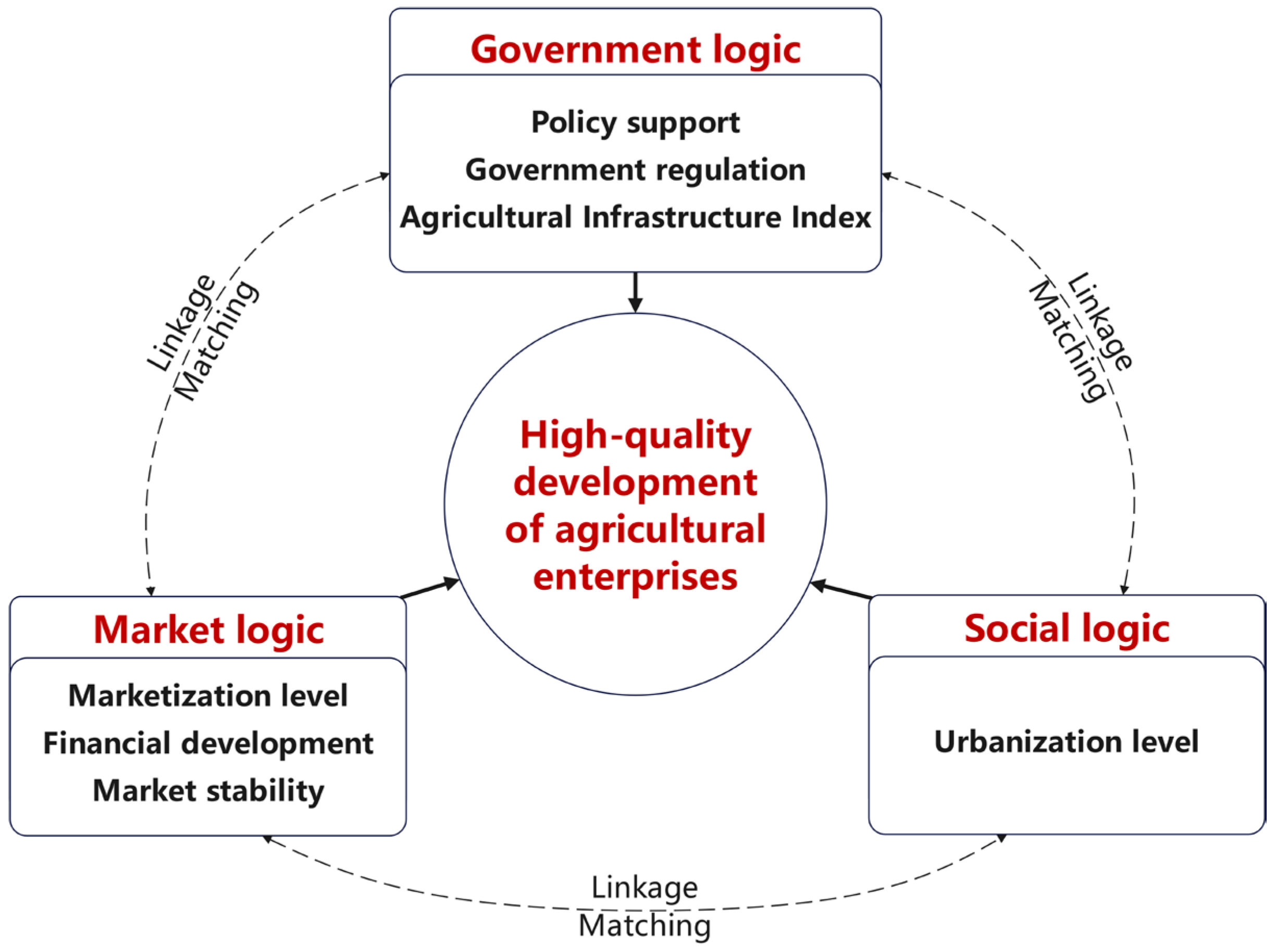
Grounded in institutional complementarity theory, we construct a tripartite framework of market–government–society and apply dynamic QCA to analyze configurations leading to the high-quality development of agricultural enterprises. The analysis covers seven key institutional elements: financial development, market stability, Agricultural Infrastructure Index, marketization level, urbanization level, government regulation, and policy support. In fsQCA, sufficiency analysis requires setting thresholds for consistency and PRI to ensure logical rigor and exclusivity of the identified paths. PRI (Proportional Reduction in Inconsistency) gauges whether a configuration also belongs to the negated outcome set (i.e., “contradictory consistency”). The closer PRI is to 1, the less a path involves the negated set, implying higher logical exclusivity [
50]. The frequency threshold is set to 5. Overall, these threshold choices reflect a deliberate methodological trade-off that prioritizes configurational robustness and interpretability in a complex, large-sample institutional setting, rather than precise parameter estimation.
We set the PRI threshold to 0.6, which is theoretically and empirically grounded. On one hand, Schneider and colleagues note that in large-sample fsQCA, PRI below 0.5 risks path ambiguity, while 0.6–0.75 is a commonly recommended range balancing coverage and exclusivity [
51]. On the other hand, in complex social systems such as agricultural enterprises and high-tech industries, researchers often relax the threshold to 0.6 to avoid excluding theoretically plausible yet slightly overlapping paths. This choice follows standard practice in QCA [
52], aiming to prevent simultaneous subset relations in the outcome and its negation and to balance consistency requirements with empirical realities. The consistency and PRI thresholds adopted in this study follow established QCA methodological guidelines (Ragin) [
50], which are widely used to balance empirical coverage and causal interpretability.
Given the spatio-temporal heterogeneity of provincial panel data and potential mismatches in institutional–firm alignment, non-fully exclusive situations may arise. A PRI of 0.6 provides a reasonable balance between exclusivity and real-world complexity, enhancing path stability and explanatory power. We thus adopt a consistency threshold of 0.8 and PRI = 0.6. For counterfactual analysis, because prior studies offer no unified direction for each antecedent’s effect and regional disparities are substantial, we do not impose directional expectations. We take the intermediate solution as the main reference and use the nesting relation between intermediate and parsimonious solutions as auxiliary evidence: if an antecedent appears in both solutions, it is treated as a core condition; if it appears only in the intermediate solution, it is treated as a peripheral condition.
Table 4 summarizes the solutions for both high-quality and non-high-quality outcomes.
4.3. Aggregate Analysis
For the positive outcome,
Table 4 identifies five equifinal configurations (T1–T5), highlighting that high-quality development (ACF-based TFP) is achieved through institutional complementarities rather than single-factor dominance. The overall solution consistency is 0.867 (≥0.8), and the overall coverage is 0.463, suggesting that these configurational paths exhibit strong set-theoretic sufficiency and explain a substantive share of high-quality cases. Across paths, financial development and marketization repeatedly appear as core conditions (T1, T2, and T4), while market stability, infrastructure coordination, and urbanization constitute another core bundle (T3 and T5). In contrast, government regulation is not uniformly required and even appears as a core-absent element in several high-quality paths, indicating that regulatory intensity is configurational—its role depends on how it interacts with market and societal logics rather than operating as an independent driver.
Path T1: Finance–marketization synergy with low regulatory intensity (urbanization as support). T1 is characterized by high financial development and high marketization as core present conditions, complemented by urbanization as a peripheral present condition, while government regulation is core absent. This configuration suggests that when market institutions are well developed and financing channels are accessible, agricultural enterprises can improve productivity through more efficient resource allocation, stronger innovation incentives, and faster market response. Urbanization further supports this pathway by facilitating factor mobility, expanding demand, and strengthening linkages between urban consumption and rural supply. Importantly, the “low regulation” element should be interpreted as a lower intensity of direct intervention rather than an absence of governance; the configuration implies that market discipline and financial mechanisms may substitute part of the formal regulatory role in contexts where market institutions are sufficiently mature. This finding is consistent with institutional substitution and governance theories, which suggest that in transitional economies, market-based mechanisms and financial governance can partially substitute for formal regulatory enforcement when institutional capacity is uneven or evolving (Williamson, 2000) [
53].
Path T2: Government–market coupling under strong finance and marketization. T2 features financial development, marketization, and policy support as core present conditions, with infrastructure coordination and urbanization playing peripheral supporting roles. This path reflects a “policy-enabled market logic” in which government support does not replace the market; instead, it complements financial and market institutions by reducing uncertainty, encouraging technology adoption, and lowering the cost of upgrading. The peripheral presence of infrastructure and urbanization indicates that while these elements reinforce productivity gains, the decisive sufficiency hinges on the joint operation of finance + marketization + policy support.
Path T3: Stability–infrastructure–urbanization bundle with marketization support (low regulatory intensity). T3 is defined by high market stability, high infrastructure coordination, and high urbanization as core present conditions, together with marketization as a peripheral present condition, while government regulation remains core absent. This configuration emphasizes the societal/infrastructural logic: coordinated infrastructure can directly reduce transaction and distribution costs, making productivity improvements feasible even without placing financial development at the core. Here, market stability works as a risk-reduction mechanism, improving predictability of demand and price signals, while urbanization strengthens supply-chain integration and supports scaling. The peripheral presence of marketization indicates that even a moderate degree of marketization can help translate these structural advantages into firm-level productivity gains.
Path T4: Comprehensive alignment—finance and marketization reinforced by policy support and an enabling environment. T4 combines financial development, marketization, and policy support as core present conditions, while market stability, infrastructure coordination, and government regulation appear as peripheral present conditions. Compared with T2, this configuration implies a more “complete institutional fit”: beyond finance and market institutions plus policy support, an enabling environment further consolidates sufficiency for high-quality development. The peripheral presence of regulation suggests that in some contexts, regulation functions as a supportive boundary condition rather than a dominating force.
Path T5: High-consistency structural pathway—stability, infrastructure, and urbanization as cores. T5 shows market stability, infrastructure coordination, and urbanization as core present conditions, with financial development and policy support present peripherally, while government regulation is core absent. This path displays the highest consistency (0.933), implying that the stability–infrastructure–urbanization bundle constitutes a particularly reliable sufficient configuration for high-quality development. In this pathway, finance and policy support function as “accelerators” rather than prerequisites: once structural and societal conditions are strong, marginal policy/financial inputs can further facilitate technology diffusion and organizational upgrading. This also suggests that improving “hard” foundations may yield robust productivity payoffs, especially when market stability reduces exposure to volatility.
For the negative outcome,
Table 4 reports two sufficient configurations (NT1–NT2) for non-high-quality development, with overall consistency 0.811 and overall coverage 0.489. Notably, insufficient infrastructure coordination emerges as a core absent condition in both negative paths, underscoring infrastructure as a structural bottleneck. Meanwhile, policy support appears as core present in both negative configurations, indicating that policy input alone does not guarantee productivity enhancement; its effectiveness depends on complementary market and societal conditions.
Path NT1: Policy support without finance and infrastructure—an “input–capacity mismatch”. NT1 is characterized by policy support as core present, while financial development and infrastructure coordination are core absent. This configuration suggests a scenario where policy resources are present but the basic capacity to transform them into productivity is missing. Without financial development, enterprises face constraints in investment, technology upgrading, and risk management; without infrastructure coordination, distribution and supply-chain costs remain high, limiting returns to policy subsidies or projects. As a result, policy support may become fragmented or diverted toward short-term relief rather than long-term productivity improvement, producing a “policy-heavy but capability-light” institutional environment associated with non-high-quality outcomes.
Path NT2: Stable market and policy support without structural upgrading—low marketization, low urbanization, weak regulation, and poor infrastructure. NT2 features market stability and policy support as core present conditions, but infrastructure coordination and urbanization are core absent; additionally, marketization and government regulation are peripherally absent. This configuration implies that macro stability and policy resources can coexist with low productivity when the structural and institutional foundations for upgrading are insufficient. Stable markets may even lock enterprises into a low-productivity equilibrium if transaction costs remain high (poor infrastructure), factor mobility is limited (low urbanization), and market mechanisms are underdeveloped (low marketization). The peripheral absence of regulation also suggests that weak formal governance may fail to correct market failures or enforce standards, further undermining productivity improvement.
The negative configurations reveal a typical policy–capacity mismatch, where strong policy inputs coexist with weak market or structural foundations, limiting productivity improvement. Such failure pathways indicate that policy support or stability alone does not guarantee high-quality development, but may instead reinforce low-productivity lock-in when complementary institutional capacities are absent.
4.4. Between-Group Analysis
Dynamic QCA allows us to examine the temporal fit of each configurational pathway across the 2013–2023 period. The between-group adjusted distances reported in
Table 4 are all well below 0.2, indicating that the identified paths are broadly stable across time.
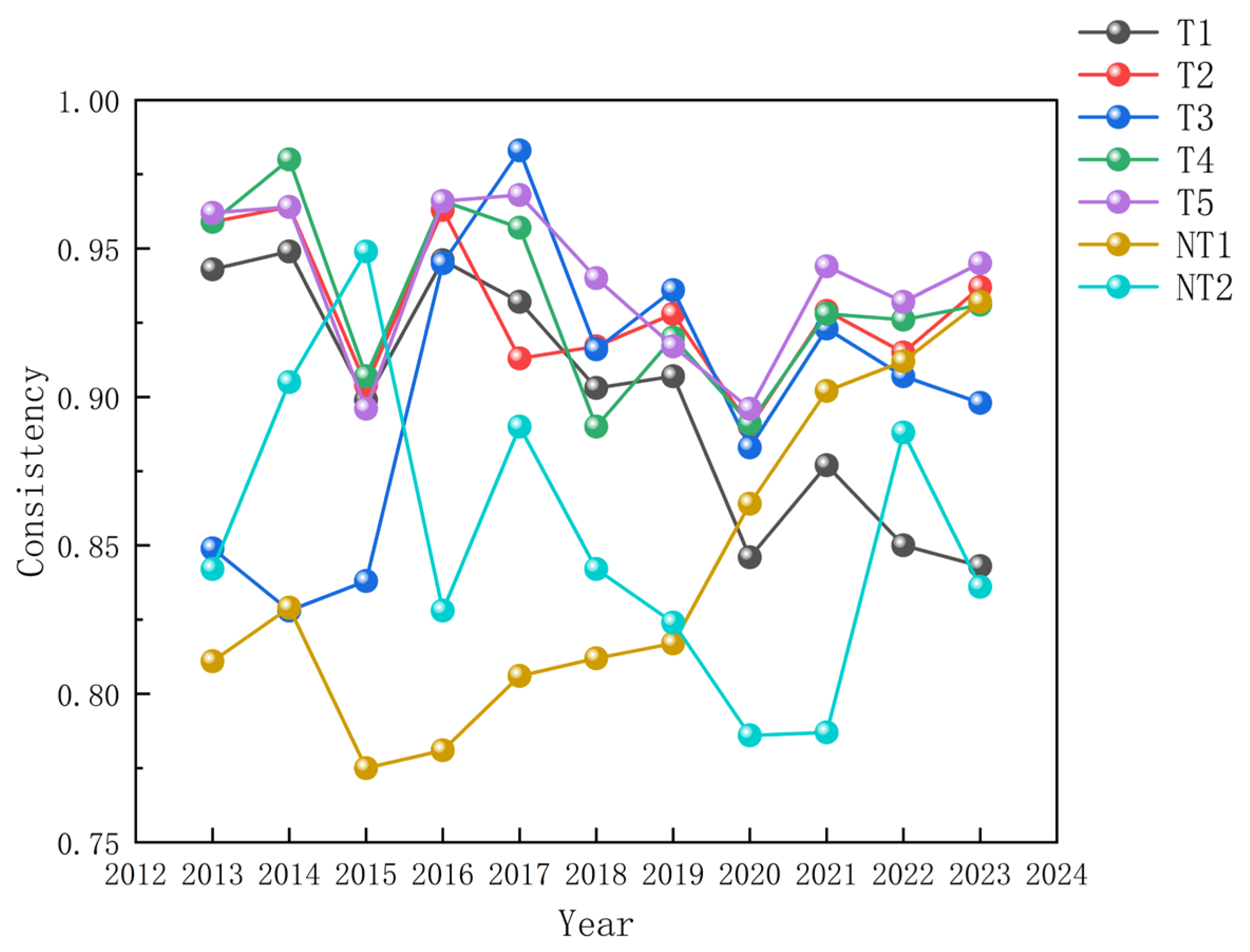
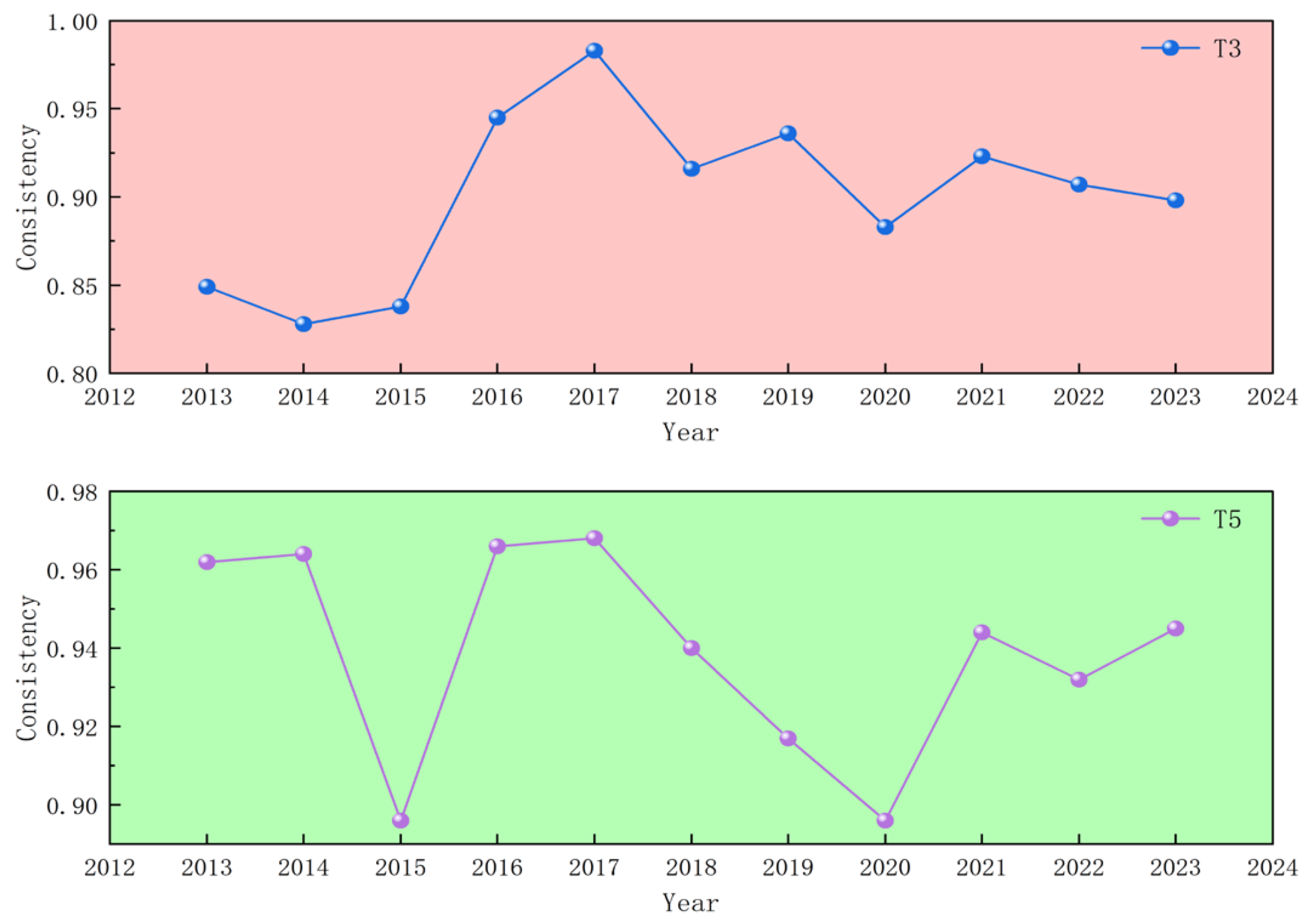
Figure 2 further presents year-by-year between-group consistency, showing that while the structural form of configurations remains stable, their empirical consistency varies—reflecting changes in the alignment between institutional combinations and high-quality outcomes over time. These temporal patterns should be interpreted as evolving configurational sufficiency rather than strict time-lag causation.
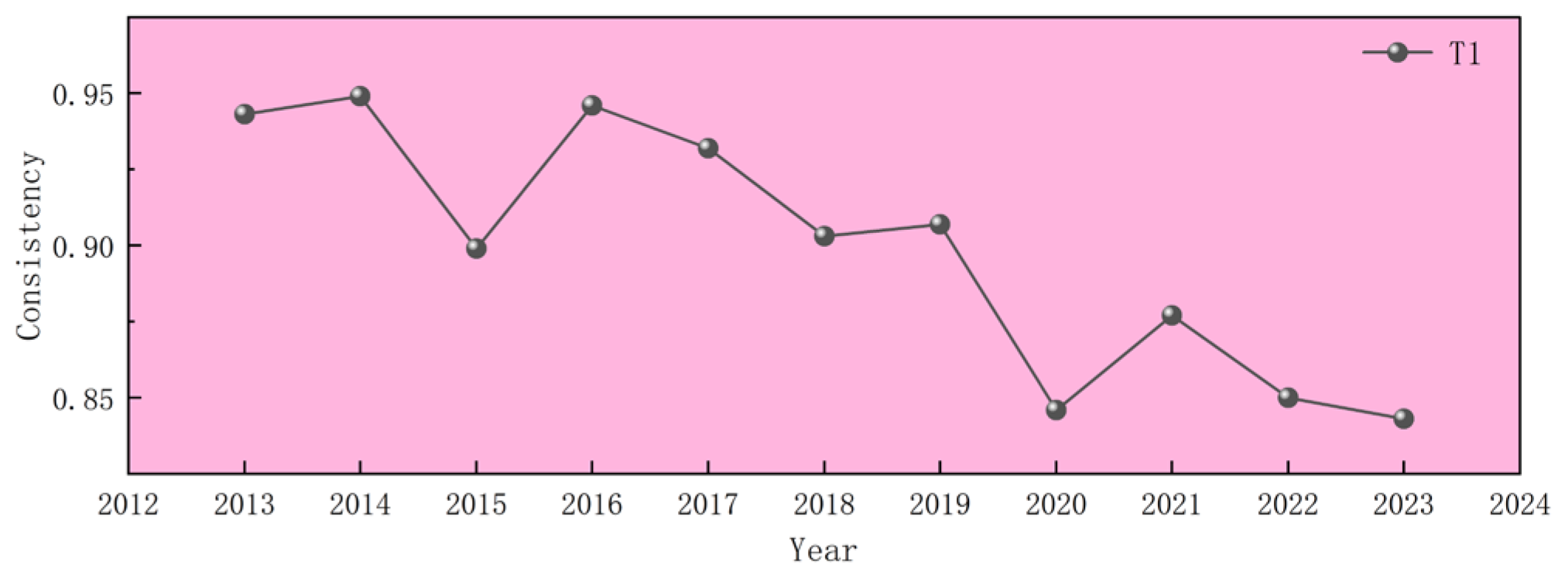
As it shown in
Figure 3, A key temporal feature is the gradual weakening of T1. Its consistency declines from 0.949 (2014) to 0.843 (2023). This suggests that a finance–marketization pathway accompanied by low regulatory intensity becomes less uniformly sufficient over time, potentially because agricultural upgrading increasingly requires more coordinated governance, standardization, and broader ecosystem support as markets deepen and competition intensifies. In other words, as the institutional environment evolves, “market–finance dominance” alone may no longer match the full set of requirements for sustained productivity improvement in all contexts.
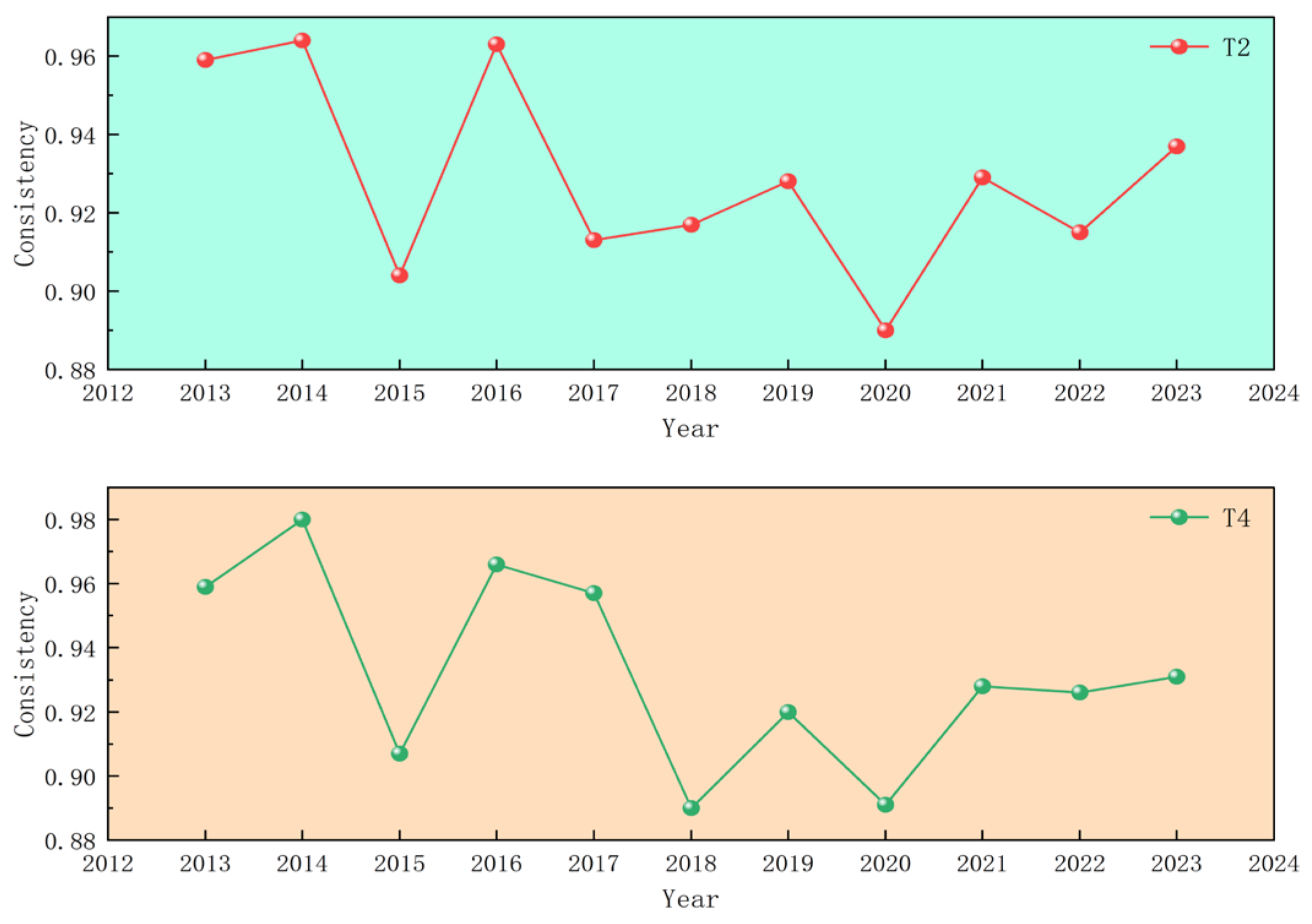
By contrast, T2 and T4 show strong resilience (As shown in
Figure 4). T2 dips to 0.890 in 2020 but rebounds to 0.937 by 2023; T4 similarly remains high, reaching 0.931 in 2023. This indicates that configurations where policy support complements finance and marketization remain consistently associated with high-quality development, especially during periods of heightened uncertainty. Rather than substituting for the market, policy support in these pathways likely improves predictability and lowers upgrading barriers, allowing market and financial mechanisms to translate into productivity gains.
The “structural foundation” pathways—T3 and T5—also display robust temporal performance.
Figure 5 shows that T3 peaks at 0.983 (2017) and stays around the high-consistency range thereafter, while T5 remains consistently high (0.962 in 2013 and 0.945 in 2023). This pattern implies that the stability–infrastructure–urbanization bundle provides enduring institutional support for high-quality development. Importantly, these pathways suggest that long-term investment in infrastructure coordination and urban–rural integration can sustain productivity gains across different macro periods, functioning as “slow-moving” yet reliable institutional foundations.
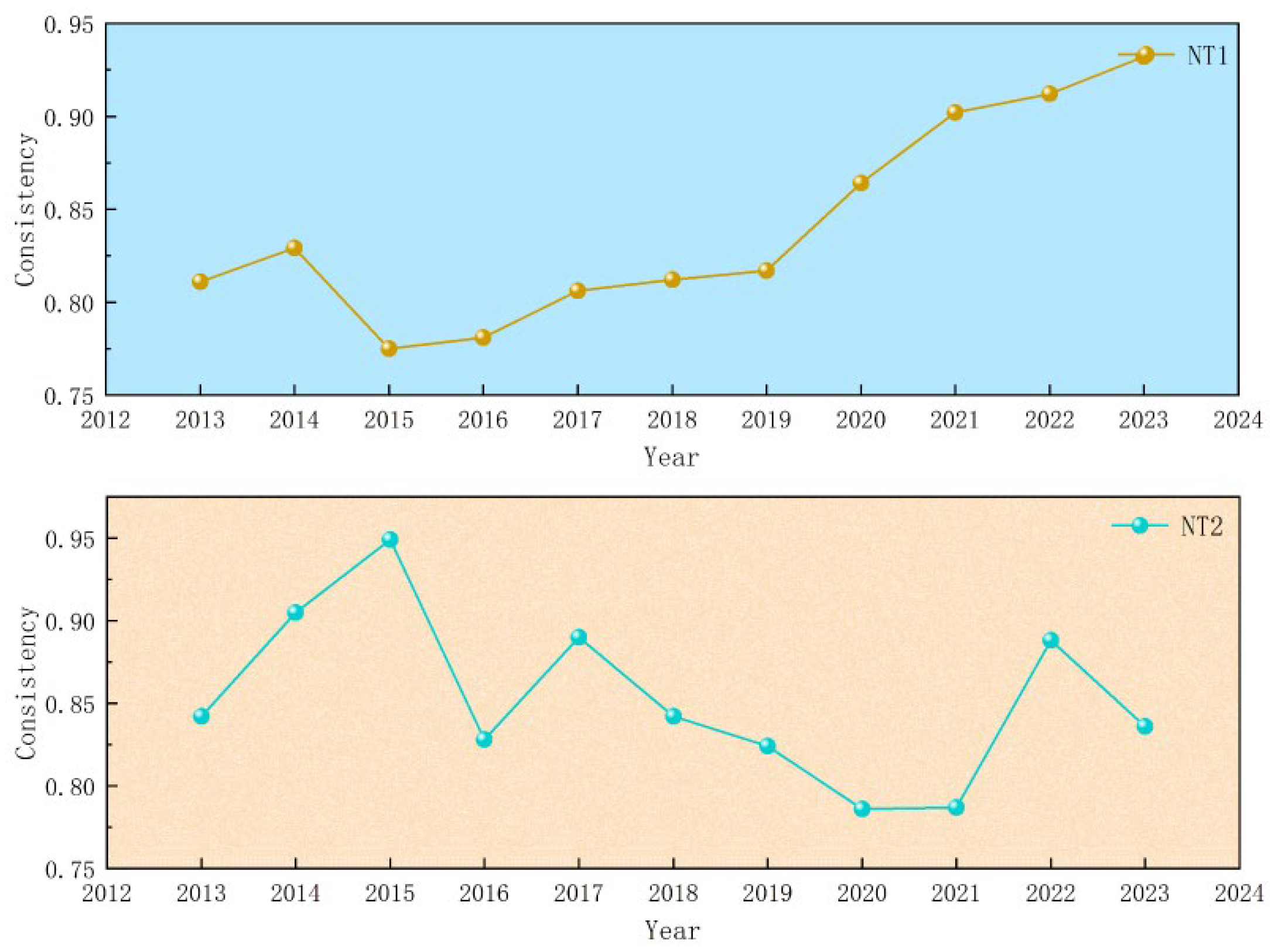
For the negative outcome as shown in
Figure 6, NT1 strengthens over time, rising from 0.775 (2015) to 0.932 (2023), indicating an increasingly clear association between “policy support without finance and infrastructure” and non-high-quality development. This trend suggests a persistent risk of resource-constraint traps: even when policy resources are abundant, the lack of complementary market and infrastructural capacities can systematically prevent productivity improvements. NT2 exhibits a notable dip during 2020–2021 (0.786/0.787) and rebounds thereafter (0.888 in 2022), implying that the sufficiency of this negative configuration is more sensitive to macro shocks and recovery dynamics—again consistent with the idea that “stability + policy” is not enough when structural constraints dominate.
4.5. Within-Group Analysis
All antecedent conditions in this study are derived from institutional environments at the provincial, municipal, and county levels, whose spatial scale and statistical caliber are inherently positioned at the regional level. Conducting within-group analysis at the individual enterprise level would easily lead to scale mismatches. On one hand, the heterogeneity among firms would substantially enlarge the fluctuations in within-group consistency; on the other hand, provincial-level institutional variables cannot be precisely mapped onto firm-level performance within the same spatiotemporal dimension, resulting in high “institution–outcome” noise and unstable path identification.
To address these issues, this study redefined the case aggregation rule for within-group analysis from “enterprise code–year” to “province–year,” and then re-clustered cases by province. The following steps were implemented: (1) Provinces were recoded according to national administrative division codes; (2) Cases were clustered by province and year before re-running the within-group necessity analysis; (3) Based on the recalibrated data, truth tables were reconstructed to obtain the complex, parsimonious, and intermediate solutions, which were then used to perform within-group analysis under the provincial clustering framework.
This adjustment reduces the interference of firm-level noise in identifying configurations, thereby improving the interpretability of within-group results. It also aligns more closely with the research objective, which focuses on how external institutional configurations influence the collective performance of agricultural enterprises within a region, rather than the micro-level behavior of individual firms. Methodologically, this provincial aggregation enhances robustness—because within-group and between-group adjusted distances in dynamic QCA at the provincial level can more accurately reflect true temporal and spatial effects.
The within-group consistency distance reflects whether each configuration’s explanatory power is affected by individual (cluster) effects. All configurations exhibit within-group adjusted distances below 0.2, indicating no significant inter-provincial differences in explanatory strength.
Table 5 and
Table 6 present the recalculated necessity and configuration analyses, respectively. The bolded values highlight the updated within-group adjusted distances, none of which exceed 0.2. This finding suggests that variable performance remains stable across time and space, without significant regional heterogeneity.
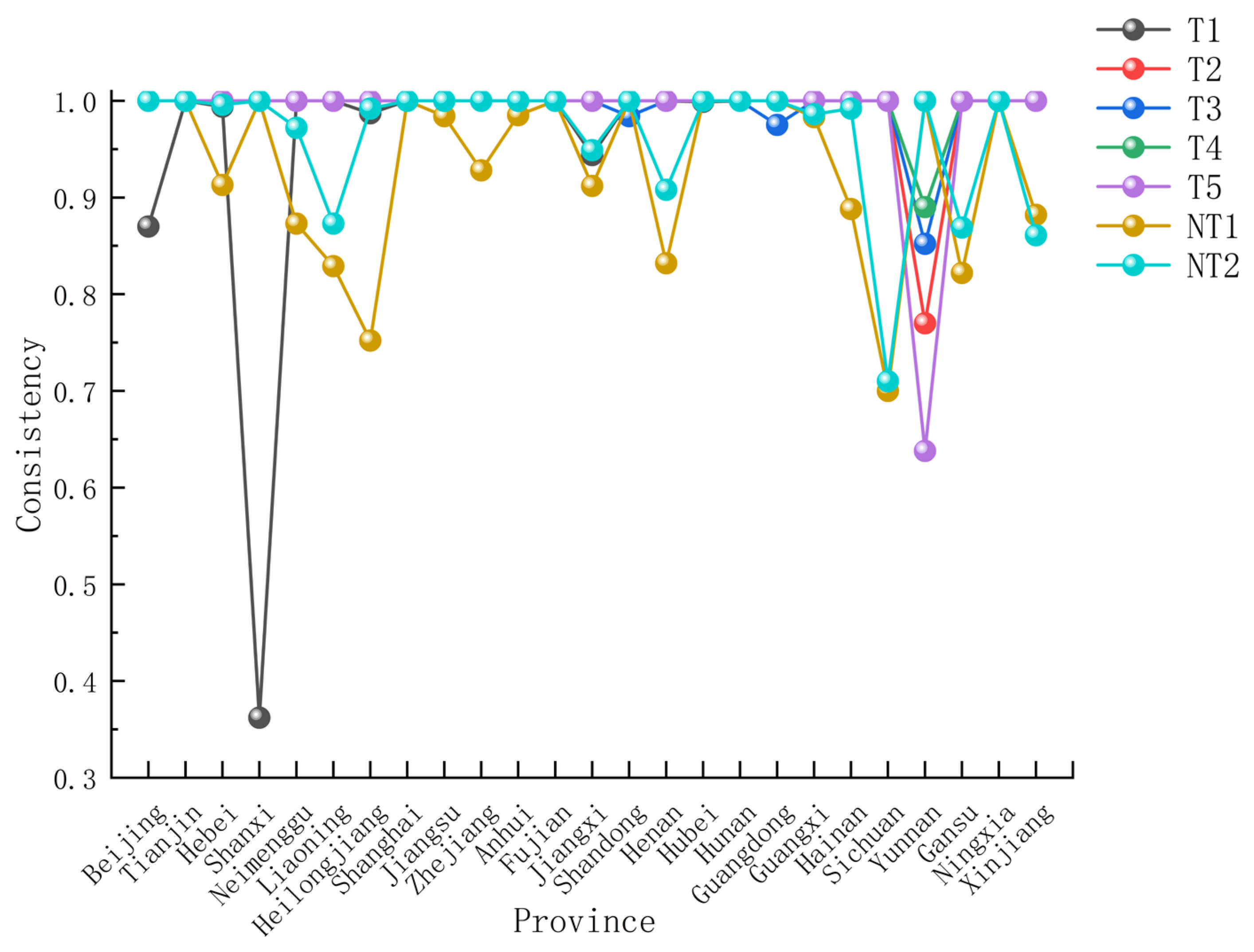
Figure 7 reports within-group consistency by province. Most provinces show values close to 1 across both positive and negative configurations, implying that within many regions, institutional combinations remain stably aligned with high-quality (or non-high-quality) outcomes. Nevertheless, several provinces display lower within-group fit for specific pathways. For example, Shanxi shows a particularly low consistency for T1 (0.362), and Yunnan exhibits lower consistencies across multiple high-quality configurations. These deviations suggest that, in some regions, either the finance–marketization mechanism or the stability–infrastructure–urbanization bundle may not translate into productivity improvements as effectively, possibly due to locally binding constraints. Such heterogeneity reinforces the need for locally tailored institutional packages rather than uniform policy templates.
Regional averages in
Table 7 further indicate that eastern provinces generally maintain higher mean coverage/consistency across paths, while some central and western provinces display comparatively lower stability for certain configurations. This suggests that institutional complementarities are more predictable where market and financial systems are relatively mature, whereas in less-developed areas, achieving high-quality development may require sequencing improvements—especially strengthening infrastructure coordination, deepening marketization, and ensuring that policy support is closely matched with local absorptive capacity.
Overall, within-group analysis reveals regional differences in consistency: eastern regions show stronger stability, while some central–western provinces exhibit phase-specific instability, implying that institutional fit still needs improvement in certain areas.
4.6. Robustness Checks
In the literature, robustness checks commonly adjust the consistency threshold, PRI threshold, and case frequency. We adopt the consistency-threshold approach, raising it from 0.8 to 0.85 and re-running the aggregate analysis. The resulting configurations and parameters remain highly consistent with the baseline, indicating that our findings are robust.
5. Discussion
5.1. Theoretical Implications
Building on the dynamic configurational results, this study provides several theoretical insights into the institutional foundations of high-quality development in agricultural enterprises. Most fundamentally, the findings confirm that productivity-centered development is not driven by any single institutional factor, but emerges from multiple sufficient configurations of government, market, and social logics. This reinforces the institutional logics perspective, which emphasizes institutional pluralism and rejects the notion of a universally dominant logic.
Across the identified configurations, two broad functional families can be distinguished. One is market–finance oriented, where financial development and marketization jointly form the core enabling engine for productivity upgrading. The other is structural-foundation oriented, where market stability, infrastructure coordination, and urban–rural integration provide a stable platform for efficiency improvement. The coexistence of these families illustrates equifinality: similar high-quality outcomes can be achieved through qualitatively different institutional arrangements.
Importantly, the results refine the role of government logic. Policy support does not operate as a standalone driver of high-quality development. Instead, its effectiveness depends on alignment with complementary market and structural conditions. In several high-quality configurations, policy support strengthens the productivity effects of market and financial mechanisms, while in non-high-quality configurations, policy support appears alongside weak finance or infrastructure, resulting in limited or even adverse outcomes. This asymmetry highlights that government intervention is context-dependent, functioning as a catalyst only when embedded within a coherent institutional configuration.
Taken together, these findings extend institutional logics theory by specifying how government, market, and social logics interact through configurational mechanisms in a transitional agricultural economy, and by linking these interactions directly to productivity-based measures of high-quality development.
5.2. Mechanisms of Configurational Results
The configurational patterns further illuminate three key mechanisms underlying institutional interaction: complementarity, substitution, and temporal differentiation.
First, complementarity is evident where policy support amplifies the effectiveness of marketization and financial development. In these configurations, fiscal instruments and supportive policies reduce uncertainty and upgrading costs, enabling market and financial mechanisms to translate into productivity gains. This supports the view that an enabling government enhances, rather than replaces, market efficiency when institutional alignment is achieved.
Second, substitution effects are observed when certain institutional elements compensate for the weakness of others. Strong infrastructure coordination, market stability, and urban–rural integration can partially substitute for limited financial development, allowing productivity improvement to occur even in financially constrained environments. Similarly, mature market mechanisms may substitute for intensive regulation by providing coordination and discipline through competition and information flows. These substitution patterns explain why regions with different institutional endowments can nonetheless achieve comparable productivity outcomes.
Third, the dynamic analysis reveals temporal differentiation in configurational robustness. Market–finance centered configurations tend to display greater variability in sufficiency over time, suggesting that their effectiveness may diminish as upgrading requirements become more complex. In contrast, configurations anchored in structural foundations—such as infrastructure, stability, and urban–rural integration—exhibit higher temporal robustness, indicating that these slow-moving institutions provide enduring support for productivity upgrading.
Crucially, these temporal patterns should be interpreted as changes in the strength of association between institutional configurations and high-quality outcomes, rather than as evidence of strict temporal causality. This perspective aligns with configurational theory, which views development as an evolving process of institutional fit rather than a linear causal sequence. These limitations point to promising directions for future research, including the use of more fine-grained institutional indicators and multi-level configurational designs. Future studies could also integrate dynamic configurational analysis with qualitative case studies or process-tracing approaches to further clarify causal mechanisms underlying institutional change.
5.3. Policy Logic, Failure Mechanisms, and Institutional Misalignment
The analysis of non-high-quality configurations offers additional insights by revealing institutional failure mechanisms. These pathways are not simple inverses of high-quality configurations, underscoring the asymmetric nature of institutional causality.
A prominent failure mechanism is the policy–capacity mismatch. Configurations characterized by strong policy support but weak financial development and infrastructure are consistently associated with non-high-quality outcomes. In such contexts, policy inputs lack the absorptive capacity needed to generate productivity improvements, leading to fragmented or short-term effects rather than sustained upgrading.
Another failure mechanism reflects structural lock-in. Even under conditions of market stability and policy support, weak marketization, limited urban–rural integration, and inadequate infrastructure can trap enterprises in low-productivity equilibria. Stability, in this case, reinforces existing inefficiencies rather than facilitating transformation.
These findings suggest that effective policy design should focus less on the intensity of individual instruments and more on their institutional alignment. Policies are most likely to promote high-quality development when they are embedded within complementary market and structural environments, and least effective when deployed in isolation.
5.4. Methodological Reflections and Research Limitation
Methodologically, this study demonstrates the value of combining ACF-based TFP estimation with dynamic QCA to analyze complex development processes. While the ACF approach addresses simultaneity and selection bias in productivity measurement, dynamic QCA captures equifinality, asymmetry, and temporal variation that conventional regression models tend to obscure.
At the same time, several limitations should be acknowledged. First, the institutional conditions are primarily measured at the provincial level, whereas productivity outcomes are observed at the firm level. This multi-level structure creates an inherent tension between explanatory variables and outcomes, which represents a fundamental challenge of the research design rather than a purely technical issue. To mitigate excessive noise in within-group analysis, the study pragmatically aggregates cases from the firm–year level to the province–year level. While this adjustment improves interpretability and stability of configurational patterns, it also entails a loss of firm-level heterogeneity and should therefore be interpreted as a methodological compromise rather than a full resolution of the scale mismatch problem.
Second, dynamic QCA captures evolving patterns of configurational sufficiency rather than strict causal sequences. Accordingly, the findings should be interpreted as evidence of time-varying institutional fit rather than definitive temporal causality. Future research could address these limitations by employing more fine-grained institutional indicators, multi-level configurational designs, or by combining configurational analysis with longitudinal case studies and process-tracing approaches. The observed temporal variation in configurational robustness reflects differences in institutional inertia and stage-specific effectiveness across regions. Slow-moving structural conditions, such as infrastructure coordination and market stability, tend to generate more persistent sufficiency over time, whereas market- or finance-centered configurations are more sensitive to regional institutional contexts.
6. Conclusions
This study investigates how institutional environments shape the high-quality development of agricultural enterprises from a configurational and dynamic perspective. Using ACF-based total factor productivity (TFP) as a core indicator of high-quality development and applying dynamic Qualitative Comparative Analysis to panel data from Chinese listed agricultural enterprises (2013–2023), the analysis demonstrates that productivity upgrading is not driven by any single institutional factor. Instead, it emerges from multiple sufficient institutional configurations that combine government, market, and social logics in different ways.
Three main conclusions can be drawn.
First, high-quality development of agricultural enterprises is fundamentally configurational and equifinal. No institutional condition—whether policy support, marketization, financial development, infrastructure coordination, or urban–rural integration—constitutes a necessary prerequisite for high TFP. Rather, several distinct institutional “recipes” are sufficient to support productivity-centered development. These configurations cluster into two broad functional families: market–finance oriented pathways and structural-foundation oriented pathways. The former emphasize the role of financial development and marketization in enabling efficient resource allocation and innovation incentives, while the latter highlight the importance of infrastructure coordination, market stability, and urban–rural integration in reducing transaction costs and uncertainty. This finding underscores that there is no single optimal institutional model for agricultural enterprise upgrading; different regions can achieve high-quality development through alternative institutional arrangements.
Second, the results refine the understanding of government intervention in transitional agricultural systems. Policy support does not operate as an independent driver of productivity improvement. Instead, its effectiveness is conditional on the presence of complementary market and structural capacities. While policy support strengthens high-quality outcomes when aligned with marketization, finance, or structural foundations, it may coexist with non-high-quality outcomes when such capacities are absent. This asymmetry implies that “more policy” is not necessarily better; what matters is institutional alignment. The findings thus caution against fragmented or single-instrument policy approaches and highlight the importance of coordinated institutional packages that match local absorptive capacity.
Third, the dynamic analysis reveals that institutional pathways differ in their temporal robustness. Some market–finance oriented configurations display greater variability in sufficiency over time, suggesting that their effectiveness may weaken as development stages advance and upgrading requirements become more complex. In contrast, configurations anchored in structural foundations—such as infrastructure coordination, market stability, and urban–rural integration—tend to remain robust across periods. This temporal differentiation indicates that high-quality development is an evolving process: institutional arrangements that are effective at one stage may require adjustment or reinforcement at another. Consequently, sustainable productivity upgrading depends not only on identifying effective institutional combinations, but also on maintaining their coherence over time.
Beyond these substantive findings, the study makes three key contributions.
From a theoretical perspective, it extends institutional logics research by explicitly linking the interaction of government, market, and social logics to a productivity-based measure of high-quality development in agriculture. By adopting a configurational lens, the analysis moves beyond additive explanations and demonstrates how complementarity, substitution, and contextual alignment among institutional logics jointly shape firm-level outcomes in a transitional economy.
From a methodological perspective, the study demonstrates the value of integrating ACF-based TFP estimation with dynamic QCA. This combination allows researchers to address econometric concerns in productivity measurement while capturing causal complexity, equifinality, asymmetry, and temporal variation—features that are difficult to accommodate within conventional regression frameworks. The dynamic QCA approach further provides a systematic way to assess whether identified configurations remain relevant as institutional contexts evolve.
From a policy perspective, the findings suggest that promoting high-quality development of agricultural enterprises requires differentiated and configuration-sensitive strategies rather than uniform policy templates. Policies are most effective when they reinforce existing market and structural strengths, help unlock financial and infrastructural bottlenecks, and are sequenced in line with regional development stages. Emphasizing institutional coherence over isolated interventions can help avoid policy–capacity mismatches and reduce the risk of low-productivity lock-in.
Several limitations should be acknowledged to contextualize these conclusions. First, institutional conditions are primarily measured at the provincial level, while productivity outcomes are observed at the firm level. Although aggregation strategies are employed to improve robustness, future research could benefit from more granular institutional indicators or multi-level configurational designs. Second, dynamic QCA captures changes in the strength of association between configurations and outcomes rather than strict causal sequences. Accordingly, the results should be interpreted as evidence of evolving sufficiency patterns rather than definitive temporal causality. Future studies may combine configurational analysis with longitudinal case studies or process-tracing methods to further unpack causal mechanisms.
Overall, this study highlights that high-quality development of agricultural enterprises is best understood as a dynamic and institutionally embedded process. By showing how different institutional configurations can support productivity upgrading—and why some fail—this research provides a nuanced foundation for both theoretical advancement and policy design in the pursuit of sustainable agricultural transformation.