Article

Fatigue Analysis of Sustainable Bituminous Pavements with Artificial and Recycled Aggregates

by
Evelio Teijón-López-Zuazo
1,*,
Ángel Vega-Zamanillo
2,
Cristina Calmeiro dos Santos
3 and
David Gómez-Carrascal
2
1
Zamora Polytechnical School, University of Salamanca, 49022 Zamora, Spain
2
Civil Engineering Technical School of Santander, University of Cantabria, 39005 Santander, Spain
3
Polytechnic Institute of Castelo Branco, 6000-266 Castelo Branco, Portugal
*
Author to whom correspondence should be addressed.
Sustainability 2026, 18(2), 845; https://doi.org/10.3390/su18020845
Submission received: 21 July 2025 / Revised: 8 December 2025 / Accepted: 26 December 2025 / Published: 14 January 2026
(This article belongs to the Special Issue Innovative and Sustainable Pavement Materials and Technologies)

Abstract

The circular economy represents a significant opportunity to enhance the mechanical properties of bituminous mixtures, thereby contributing to sustainable development. This research compares the behaviour of traditional bituminous mixtures with sustainable ones that reuse recycled materials, industrial waste products, or additives that improve mechanical or rheological properties. The methodology employed comprised the acquisition of fatigue resistance laws from 4-point bending tests on prismatic specimens. This facilitated the analytical determination of the number of axles of 13 tons that the section of pavement with sustainable material can support for comparison with the axles supported in the conventional mix. The findings corroborate the utilization of sustainable bituminous mixtures in pavement sections, employing the maximum circularity criterion. The fatigue laws calculated must permit the use of different calculation methods or other applications in green infrastructures, such as cycling lanes or pedestrian areas. On sections with an AADT of between 800 and 25 HV/day, all of the analyzed bituminous mixtures with sustainable materials prolong the service life of the road. There were increases in service life of between 25.5% and 6.6%, respectively, which satisfactorily achieved an increase in pavement service life based on the criterion of maximum circularity.

1. Introduction

The circular economy enhances the mechanical properties of bituminous mixtures [1]. The recycled materials investigated include packaging and cable sheathing polymers, steel wool, and rubber powder. Recovered waste includes common salt, black slag, ash from thermal power stations, and wax.
So, The Council of Europe plans recycling and waste management until 2035, mandating reuse and recycling rates for municipal waste of 55% by 2025, 60% by 2030, and 65% by 2035 [1]. The standard 6.1-IC Pavement sections [2] establish a catalogue of pavement sections based on the quality of the underlying road surface and the number of HVs. The solutions proposed have been calculated using analytical methods and verified by experience.
The General Specifications for Roads and Bridges Works, PG-3, in the 3rd Part Explanations, defines the types of bituminous mixture for each layer [3]. It also defines the minimum binder content and the properties of aggregates, asphalt bitumen and finally bituminous mixtures. The OC 40/2017 on Recycling of bituminous pavements and pavements [4], including three types of action such as in situ recycling with emulsion of bituminous layers, in situ recycling with cement of pavement layers and finally hot and semi-hot recycling of bituminous layers in the plant.
In the urban environment, the primary sources of non-traffic combustion PM microplastics emissions include those caused by tyre and brake wear as well as those released on the road surface [5]. Particles from tyre and brake wear, due to their size of less than 10 μm, are very dangerous to human health. The non-destructive characterization of construction and demolition waste CDW can be investigated using terahertz radiation [6].
The spectral lines differentiate the different structures and chemical compositions of plastics and polymers in the frequency range of 1.0–4.5 THz, looking inside some of the non-conductive construction materials by combining terahertz imaging and spectroscopy [7]; also, inside the content of toxic and hazardous substances, as well as unsuitable substances, which is important for the separation of recycled material into fractions. This enables the design to be aimed towards sustainable buildings with minimal demolition at the end of life. An analytical approach to the linear viscoelastic behaviour of high-modulus bitumen macadam in flexible pavements by a moving load has been investigated [7].
The findings have demonstrated that the implementation of high-modulus bitumen macadam layers results in a reduction in traction and deformation at the pavement surface and at the base of the asphalt layer. The findings of experimental tests have demonstrated that the chemical composition, granulometric analysis, atomic absorption, spectrometry, calcium carbonate content, scanning electron microscopy (SEM), and X-ray diffraction (XRD) of the marble aggregate, in conjunction with its physical and mechanical properties—densities, water absorption, sand equivalent, Los Angeles abrasion test, Micro-Deval test, flakiness index and shape index—have substantiated its utilization as a conventional aggregate for road construction. The construction and maintenance of road pavements are responsible for the continuous generation of substantial amounts of waste [7].
Life Cycle Assessment (LCA) modelling can provide interesting insights for advanced users, increasing the use of plastic recycles in asphalt concretes. An LCA case study investigated the environmental benefits of using plastic recycles instead of natural aggregates in the production of asphalt mixes. Santos et al. [8] investigate the modelling of LCA from the environmental consequences of the use of plastic recyclizes in bituminous concretes. Therefore, the Life Cycle Assessment study should remove the constraints on the supply of recycled materials to quantify the environmental consequences of the use of recycled plastics in road surfacing applications, avoiding increased demand in the construction industry for virgin plastics. Thus, optimal modelling should capture how the plastic material that will be used in future road pavements is currently produced and used.
The polymeric material that is currently rejected at the waste treatment centre will be converted with this model into recycled material for road construction. The pellets are composed of plastic waste from the recycling of recycled polyethylene (rPE) from silo bags (rPE-SB) and RPE from plastic drums (rPE-PD).
Concrete incorporating reclaimed asphalt pavement (RAP) is an environmentally friendly material [9]. The coarse aggregate fraction is replaced with natural origin, and concretes with different percentages of RAP are compared. The application of artificial intelligence (AI) programmes has enabled the development of a hardening curve model for various percentages of RAP.
The use of recycled aggregates from the exclusive crushing of structural concrete waste (CDWCon) and mixed ceramic materials (CDWCer) from selective demolition in road construction have been investigated [10]. The low values of the Los Angeles wear rate limit the use of these materials to sustainable road construction and other sites, such as urban roads, mountain roads or car parks, which have a low average heavy vehicle intensity. Soluble salt contents were detected, so additional waterproofing or drainage measures should be taken with CDWCer.
This study demonstrates that adding packaging and cable sheathing polymers, steel wool, rubber powder, black slag, and ash from thermal power stations improves the service life of bituminous pavements. For medium and low traffic, improvements in the fatigue behaviour of sustainable mixtures were obtained using the four-point bending fatigue resistance test on prismatic test specimens.
This research addresses specific issues associated with the absence of a definitive definition for road sections with sustainable bituminous mixtures. It involves experimental calculation of their fatigue laws and subsequent analytical analysis to determine the number of standard axles that reach failure in any given layer.

2. Materials and Methods

2.1. Materials

The wearing course bituminous mixtures investigated were made with natural aggregates and additives corresponding to sustainable by-products. The quarry aggregates used were ophite as coarse aggregate, limestone as fine aggregate, and limestone filler, Figure 1.
The samples were produced using ophite aggregate, which has the properties listed in Table 1:
Conventional asphalt bitumen and polymer-modified bitumen were used as the base binder. The conventional asphalt bitumen chosen was type B 50/70 according to the PG-3 designation. Its main characteristics are penetration at 25 °C, UNE-EN 1426 [15], between 50 and 70 tenths of a mm; a softening point, UNE-EN 1427 [16], between 46 and 54 °C; a penetration index, UNE-EN 12591 [17], of −1.5 to +0.7; a Fraass breaking point, UNE-EN 12593 [18], less than or equal to −8 °C; and an elastic recovery at 25 °C, UNE-EN 13398 [19], higher or equal to 70.
An AC16 Surf B50/70 D mixture, which is frequently utilized on surface pavements in Spain, was one of the bituminous mixtures examined. The composition is illustrated in Table 2.
The layer types and thicknesses defined for the different pavement sections investigated were as follows:
0031: PA 16, 4 cm; AC22 bin S, 10 cm; AC 22 base S MAM, 14 cm; ZA0/32, 25 cm; Total: 53 cm.
031: PA 16, 4 cm; AC 22 bin S, 7 cm; AC 22 base S MAM, 13 cm; ZA 0/32, 25 cm; Total: 49 cm.
121: PA 16, 4 cm; AC 22 bin S, 7 cm; AC 22 base S MAM, 13 cm; ZA 0/32 25 cm; Total: 49 cm.
121: PA 16, 4 cm; AC 22 bin S, 7 cm; AC 22 base S MAM, 13 cm; ZA 0/32, 25 cm; Total: 49 cm.
221 (PA): PA 16, 4 cm; AC 22 bin S, 9 cm; AC 32 base G, 12 cm; ZA 0/32, 25 cm; Total: 50 cm.
221 (AC): PA 16, 4 cm; AC 22 bin S, 5 cm; AC 32 base G, 7 cm; ZA 0/32, 40 cm; Total: 50 cm.
3121 (PA): PA 16, 4 cm; AC 22 bin S, 5 cm; AC 32 base G, 7 cm; ZA 0/32, 40 cm; Total: 56 cm.
Section 3221: AC 16 surf S, 5 cm; AC 22 bin S, 10 cm; ZA 0/32, 35 cm; Total: 50 cm.
Section 4221: AC 16 surf S, 5 cm; ZA 0/32, 25 cm; Total: 30 cm.
According to 6.1-IC, section 0031 is designed for AADHT higher than 4 000 HV/d, section 031 higher than 2 000 HV/d, section 121 higher than 800 HV/d, section 221 higher than 200 HV/d, section 3121 higher than 100 HV/d, section 3221 higher than 50 HV/d, and finally, section 4221 higher than 25 HV/d. In each of the sections 221 and 3121, two different options were considered depending on if the wearing course is porous asphalt 3121 (PA) or conventional asphalt concrete 3121 (AC). Sections 0031 and 031 are formed by subgrades with a modulus of compressibility Ev2 higher or equal to 300 MPa. In the sections with a high-modulus bitumen macadam in base layer, AC 22 base S MAM, a reduction of 20% was applied on the theoretical section of 35 cm, reducing it to the final thickness of 28 cm of bituminous mixture.
The materials and additives used were common salt, black slag, ash from thermal power plants, polymers from recycled packaging, plastic from recycled copper cable coating, synthetic wax, steel wool, and finally, rubber powder.
Common salt corresponds to mineral sodium chloride (NaCl). It was added in a dry form at a dosage equivalent to 5% of the weight of the dry aggregate.
The black slag used in this research was obtained as a residue from the steelmaking process in an electric arc furnace. Black slag was used in mixtures as a dry replacement for the coarse aggregate fraction.
Thermal power plant bottom ash is a solid waste product of coal combustion in thermal power plants. In this research, it was used to replace the percentage by weight of the mineral filler in the bituminous mix with bottom ash from a thermal power plant, by dry process.
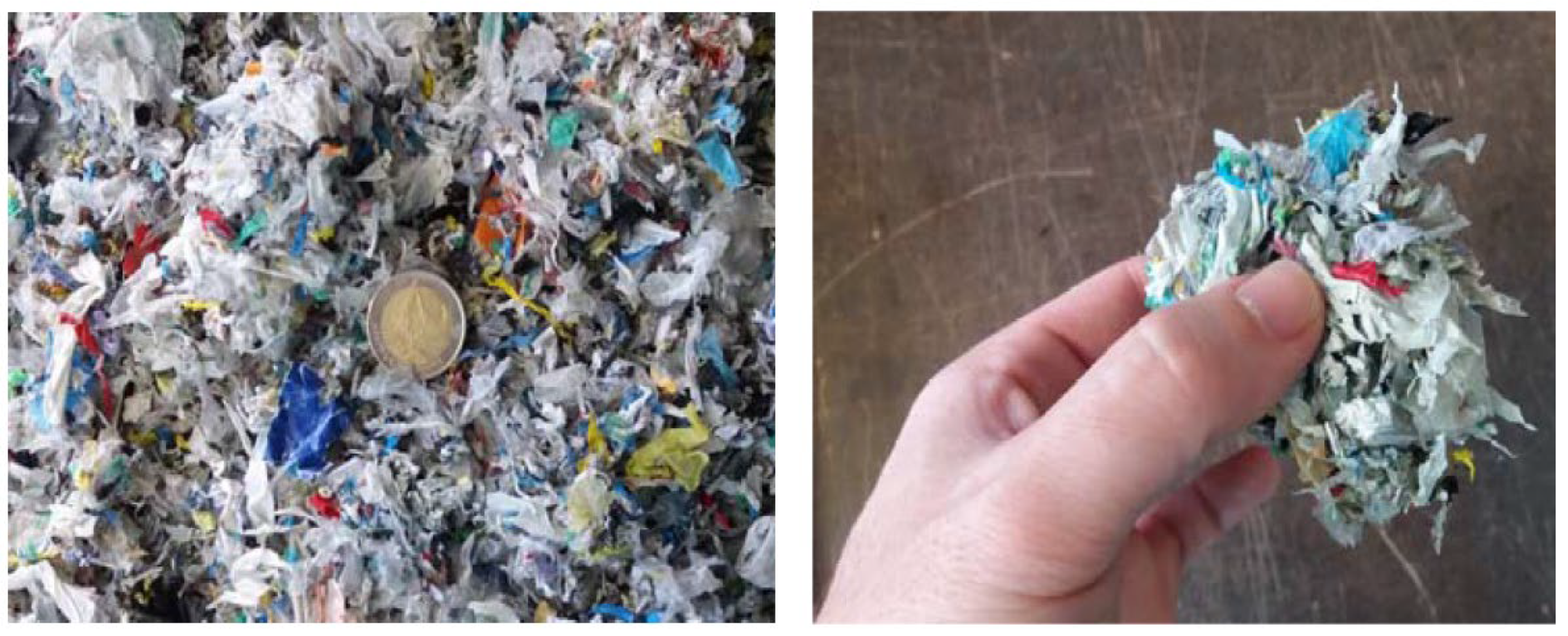
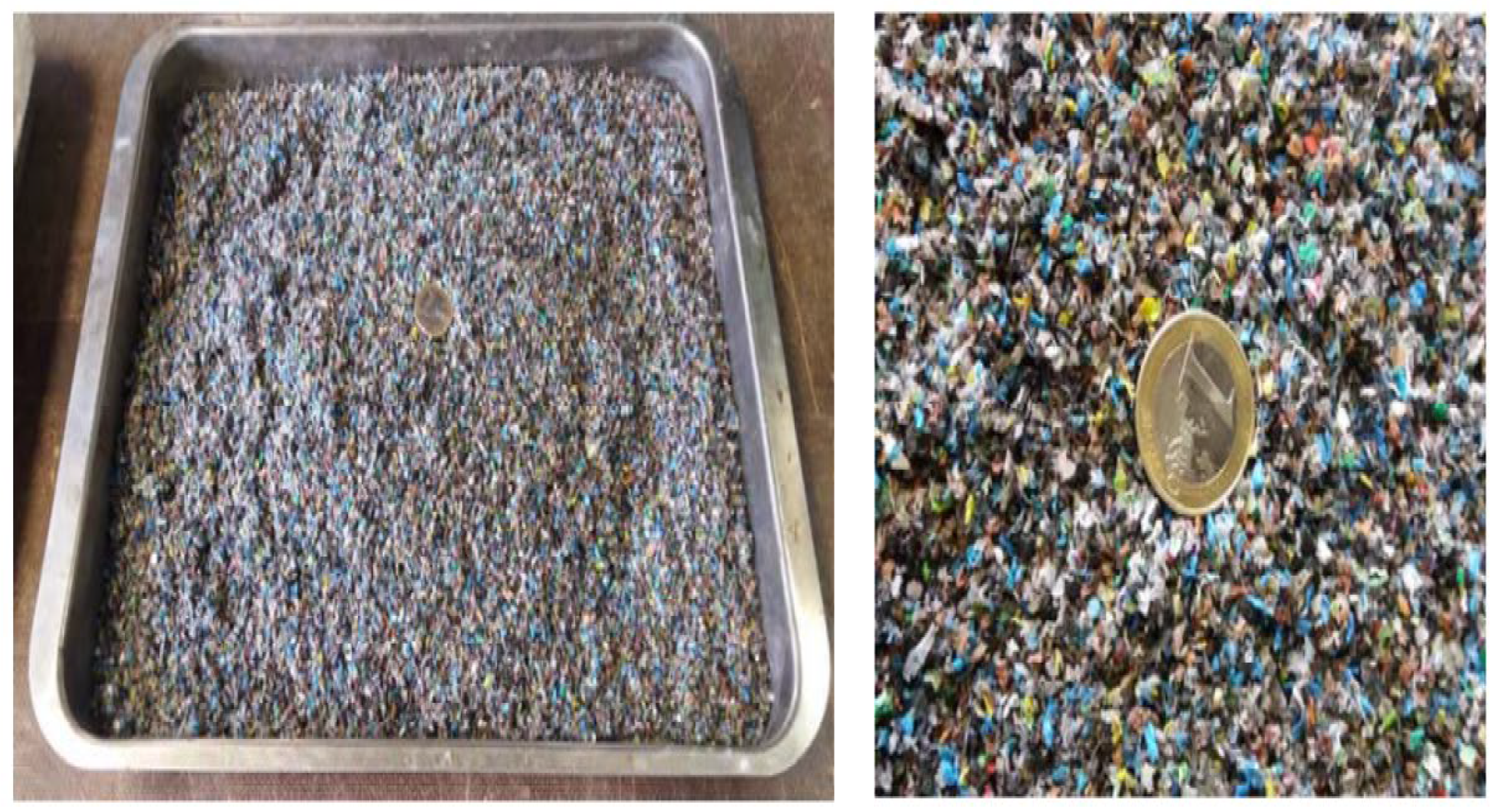
Ecoembes plastic fibres are a polymeric material obtained from the recycling of light packaging in solid urban waste containers, which is then processed in packaging plants, Figure 2.
Ecoembes is the Spanish non-profit organization responsible for managing the recycling of plastic packaging, achieving a recycling rate of 74.8%. Ecoembes is responsible for the recycling of various types of packaging, including polyethylene terephthalate (PET) fibres, polypropylene (PP) fibres, polystyrene (PS) fibres, and expanded polystyrene (EPS) fibres. The tensile strength of PET fibres ranges from 55 to 80 MPa, while their dry bulk density is 438.2 kg/m3. The tensile strength of PP fibres ranges from 25 to 40 MPa, and their dry bulk density is 515 kg/m3. PS fibres exhibit a tensile strength ranging from 30 to 55 MPa, and their dry bulk density is 30 kg/m3 [20].
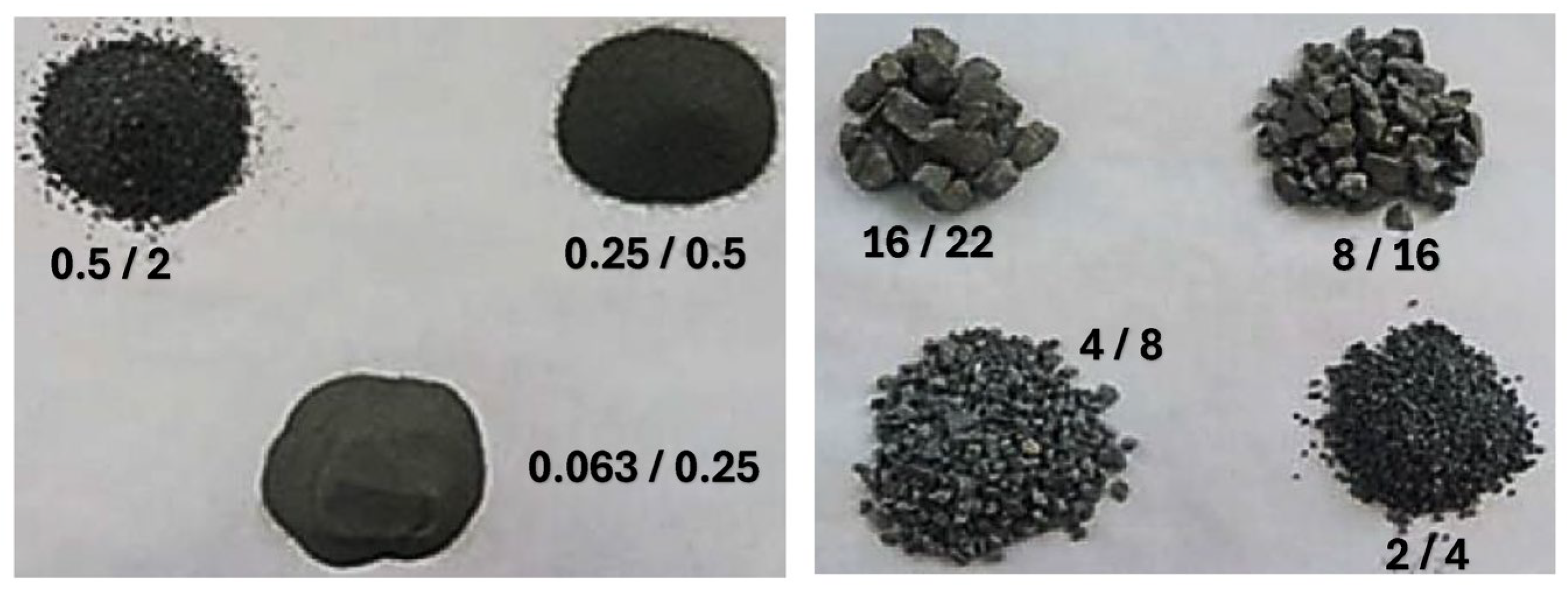
The use of recycled asphalt pavement (RAP) in bituminous mixes was also investigated. RAP is material from the rehabilitation of pavement layers in poor condition. In a dry process, the percentage of aggregate by weight was replaced with RAP.
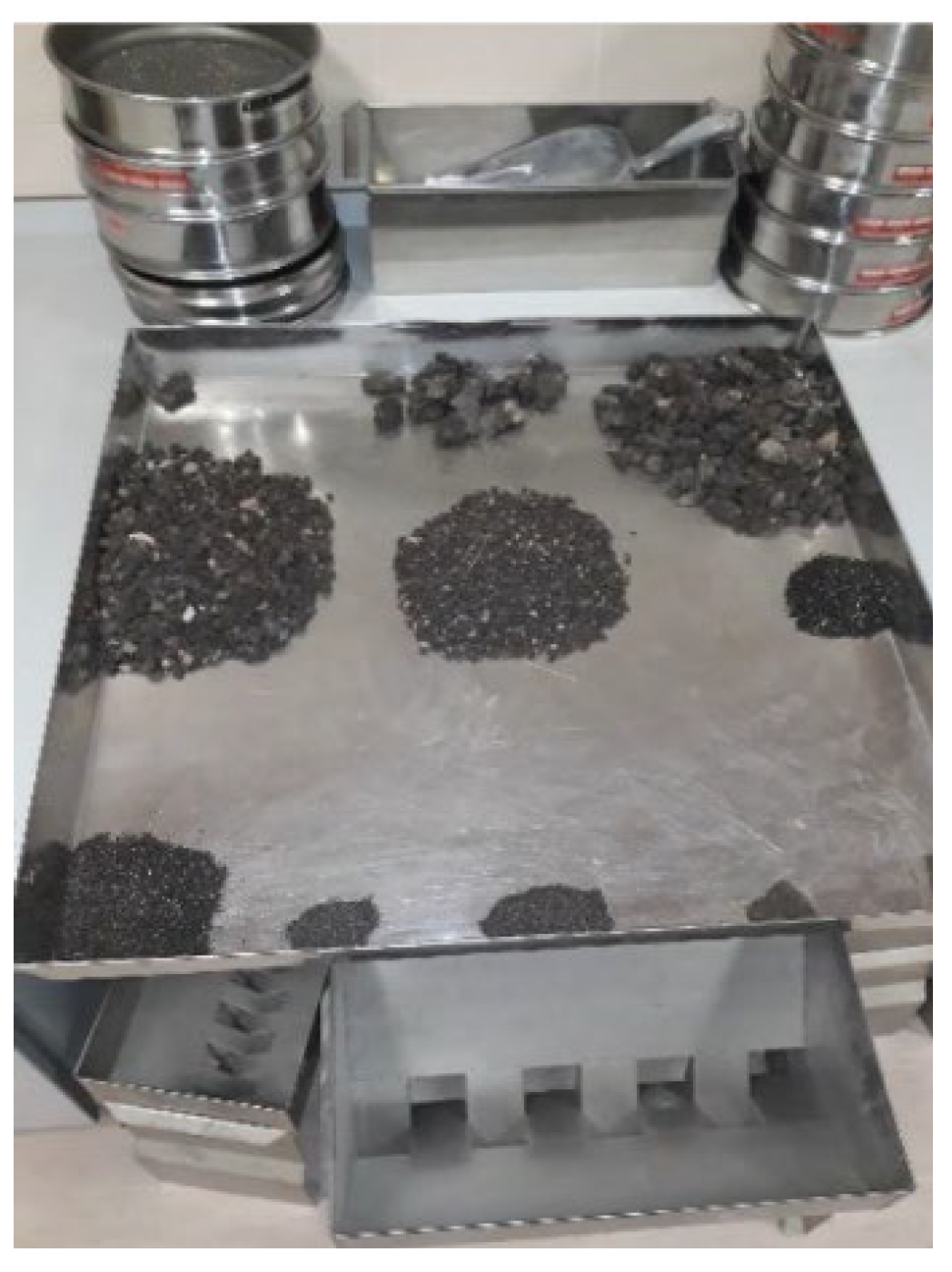
RAP (recycled asphalt pavement) is the main recycled material, Figure 3.
Its composition is shown in Table 3. The average moisture content of RAP, tested according to UNE-EN 13043/AC:2004 [20], is 2.9%.
Another additive is the manufacture of bituminous mixtures with synthetic wax. In the wet process, synthetic wax is added to bitumen to reduce the manufacturing temperature and improve the adhesiveness of the aggregate binder.
A collection of fine steel fibres is another reused additive: steel wool. When added dry, it improves the alligator crack resistance of the bituminous mix. Steel wool can be derived from the reuse of dust from the shredding of end-of-life tyres. When added to the mixture, it reduces the manufacturing temperature of bitumen and improves the rheology of the binder.
Bituminous mixtures containing polymeric fibres from copper cable recycling were also investigated, Figure 4. These recycled polymeric fibres are obtained by stripping electrical cables for copper separation (65% of the cable by weight). A percentage by volume of the asphalt bitumen mixture is replaced by plastic fibres obtained from stripping copper cables.
The most prevalent plastic fibres utilized in the recycling of cooper cables are polyvinyl chloride (PVC) fibres, which possess a tensile strength ranging from 50 to 60 megapascals (MPa), and polyethylene (PE) fibres, which exhibit a tensile strength ranging from 18 to 30 MPa [21].
Table 4 shows the tensile strength and dry bulk density of different plastic fibres, alongside the values for reference mixtures.

2.2. Methodology

The investigation was developed for flexible pavements and different AADTH. Only subgrades with a modulus of compressibility in the second loading cycle Ev2 higher or equal to 120 MPa have been considered. This research was carried out with PA 16 porous asphalt, which is a discontinuous mixture for drainage and an AC16 surf S, which is a semi-dense mixture, both with a maximum size of 16 mm and designed for wearing courses, UNE-EN 13108-1 [22]. In the intermediate layer, AC 22 bin S is located. The asphalt concrete types of AC 32 base G and AC 22 base S MAM were used in the base layer. The subgrades considered are E3 for high categories of heavy traffic and E2 for the rest.
The particle size distribution curves of the samples are within the PA 16 and AC 16 surf S particle size ranges defined in PG-3 [3]. The optimum asphalt content was designed according to the Marshall test, UNE-EN 12697-34:2013 [23]. Dynamic flexural fatigue tests were performed on prismatic specimens using a sinusoidal load law applied to two points on each specimen. Several proposals for models of sustainable pavement fatigue performance were therefore generated in comparison with the laws proposed for conventional asphalt mixtures.
Prior to the commencement of the test, the specimens were maintained at a temperature of below 20 °C, in a horizontal position, on a flat surface, and stored for a minimum period of 14 days.
The large prismatic specimens were manufactured in accordance with the requirements specified in UNE EN 12697-33:2020 [24], which pertains to the dimensions, thinness, and roller compactor specifications of the specimens.
After the sawing of the specimens, the dimensions and apparent density were determined, yielding differences between them of less than 1%, thereby ensuring their uniformity.
The four-point bending fatigue strength testing machine utilizes a load cell with a tolerance of ±2000 N and a preset frequency range of 0.1–60 Hz, exhibiting an accuracy of 0.1 Hz. The thermostatic chamber employed for specimen conditioning exhibits a tolerance of ±1 °C and an accuracy of 0.5 °C.
The research undertaken was therefore entirely experimental, calculating the resilient modulus by means of fatigue tests, which allowed us to classify the mixes according to their resistance to fatigue. In this way, the structural behaviour of new sustainable pavement sections was investigated by means of durability testing.
The calculation program used is Alizé, version 1.3.0. The calculation was carried out according to the Kraemer method with a dual-wheel axle with a radius of effect of 11.35 cm, a pressure of 0.8 MPa, and a dual-wheel spacing of 37.5 cm. With the analytical calculation of stresses and strains, we have obtained the number of axes N in each layer based on the fatigue laws defined above. The stresses are calculated using the Burmister linear elastic multilayer model. The damage mode was associated with the type of material being considered, like bending-induced horizontal tension or vertical compression.

3. Results and Discussion

All fatigue laws for damage integration in the investigated road materials were calculated using a four-point flexural testing machine on prismatic specimens (4PB-PR) following the procedure of Annex D of the UNE-EN 12697-24:2019 Bituminous mixtures. Test methods were as follows: Part 24: Resistance to fatigue [25]. The modulus of elasticity and Poisson coefficients, UNE-EN 12697-26:2019 [26], and fatigue laws were determined for the PA 16 sustainable asphaltic mixtures, with addition. For reference, PA 16 without addition, and the rest as high-modulus bitumen macadam, AC22 bin S MAM, or wet mix macadam, ZA 0/32, the complementary specifications expressed in 6.1-IC. The usual value in upgrades has been considered.
In all cases, a Poisson ratio of 0.35 is considered for the semi-indefinite mass. Therefore, with dynamic flexural fatigue tests on prismatic specimens using a sinusoidal load law applied at four points, fatigue behaviour models of sustainable pavements have been generated for subsequent comparison with those also tested on conventional asphalt mixes. All this information is shown in Table 5.
The incorporation of sodium chloride (NaCl) as a natural aggregate at a proportion of 5.0% has resulted in a substantial decline in the resilient modulus, amounting to a loss of 42.9%. This indicates a reduction of 8.6% modulus for each percentage point of substitution with salt. This suggests that salt exerts a significant influence on the resilient modulus during replacement.
The replacement of black slag has been found to be significantly higher, reaching up to 88.0% over aggregates. This suggests a 52.3% decrease in resilient modulus, which is proportionally much lower than in salt replacement. This is since it implies a loss of 1.7% for each percentage point of black slag, i.e., 5 times less than with salt. This suggests that the presence of black slag exerts a moderate influence on the resilient modulus.
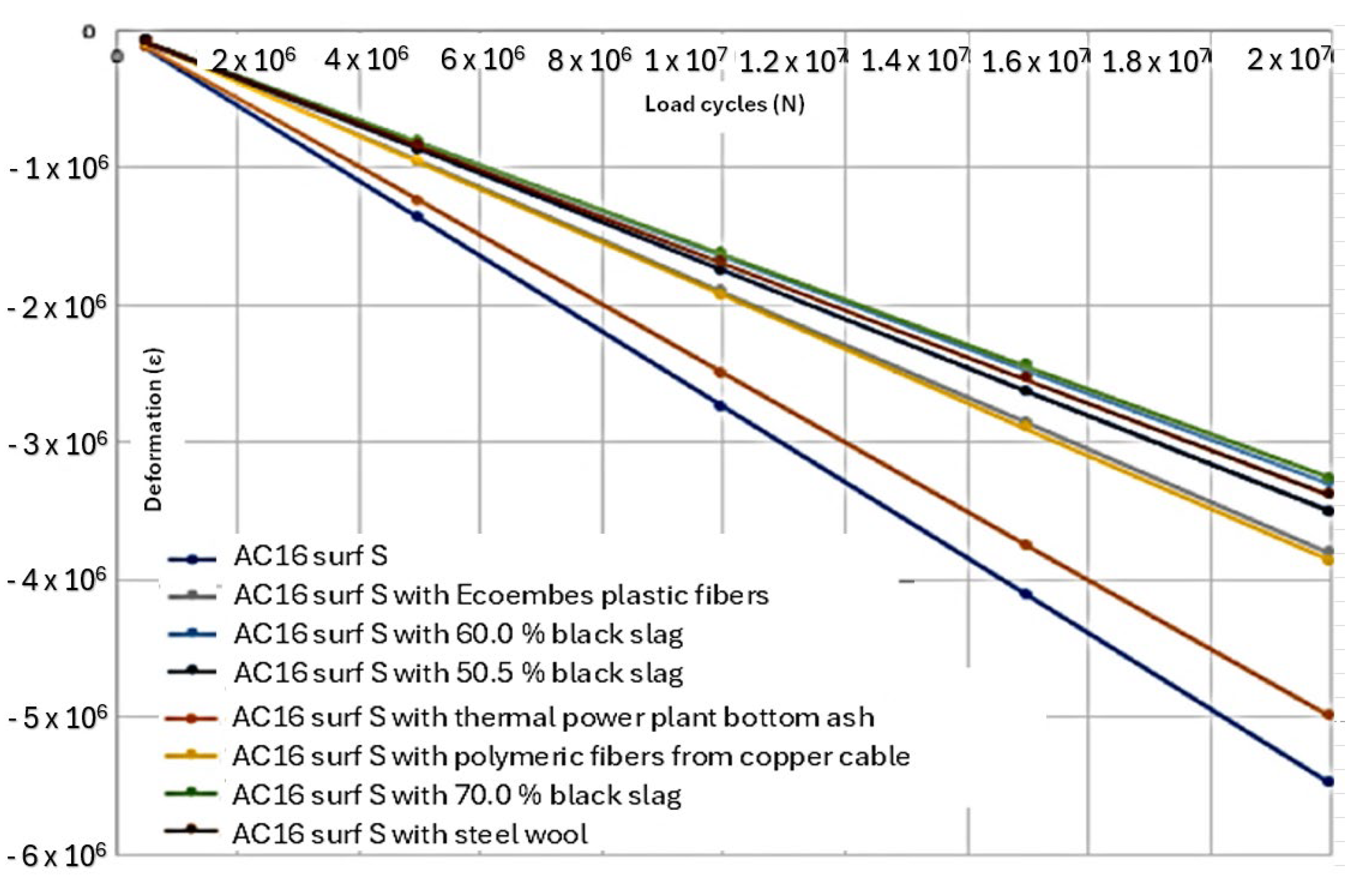
Fatigue lines of bituminous mixtures, depicted graphically as microstrain versus number of cycles, have been determined according to the test standard UNE-EN 12697-24:2019. Calculations were performed with up to 18 determinations in a range between low numbers of and more than 106 cycles, showing a high R2 fit > 0.90 in all cases.
The procedure for calculating and adjusting the results of the various fatigue laws is shown in Figure 5.
The fatigue testing was conducted in accordance with the conditions stipulated in the standard UNE-EN 12697-24/2019, at a controlled temperature of 20 °C. It is important to note that, even considering the tolerance of the test and given its extended duration, the test specimens were not conditioned for other temperatures. This is because the parameters of the fatigue equation, values a and b, are usually defined for these conditions.
The analysis employs sinusoidal load and double-wheel axle load models so the potential discrepancies between the load method employed in the calculations and the actual traffic load, characterized by its randomness and intermittent nature, and the consequent impact on the accuracy of fatigue life predictions, are suggested to be examined in a test section as a future research direction.
The duration for N load cycles of the different sections investigated are shown in Table 6. The cycles supported for a conventional wearing course, PA 16, or AC 16 surf S and those obtained with alternative wearing courses are shown. The alternative asphalt concretes have been additions to the bituminous mixture of by-products. The maximal defection admitted is 16.7 mm/100 in the dual-wheel centre.
In section 0031, the highest number of equivalent axles, 27.4 × 10⁶, is obtained with the PA 16 porous asphalt in the wearing course. In sustainable asphalt concretes consisting of PA 16 with the common salt additive or black slag, a reduction in pavement service life of 11.7% and 14.8%, respectively, is observed. The section failure has occurred in the AC 22 base S MAM. For pavement section 031, the highest number of equivalent axles, 12.5 × 10⁶, is obtained with the PA 16 porous asphalt in the wearing course. In the case of PA 16 with the common salt additive or black slag, a reduction in pavement service life of 13.7% and 16.9%, respectively, is observed. In all cases, the section failure has occurred in the base course, AC 22 base S MAM. In section 121, the highest number of equivalent axles, 7.1 × 10⁶, is obtained with the PA 16 porous asphalt in the wearing course. In the case of sustainable asphalt concretes consisting of PA 16 with the common salt additive or black slag, a reduction in pavement service life of 14.7% and 18.5%, respectively, is observed. In all cases, the section failure has occurred in the base course, which is a high-modulus bitumen macadam AC 22 base S MAM.
The findings from the experimental trials suggest that the presence of salt has a significant effect on the durability of the mixture. All specimens containing salt as an aggregate exhibited lower axle number values in comparison to the reference series, thereby confirming that the aggregate–binder interface is subject to damage because of the salt treatment. The findings from the experimental trials suggest that the presence of salt has a significant effect on the durability of the mixture. All specimens containing salt as an aggregate exhibited lower axle number values in comparison to the reference series, thereby confirming that the aggregate–binder interface is subject to damage because of the salt treatment.
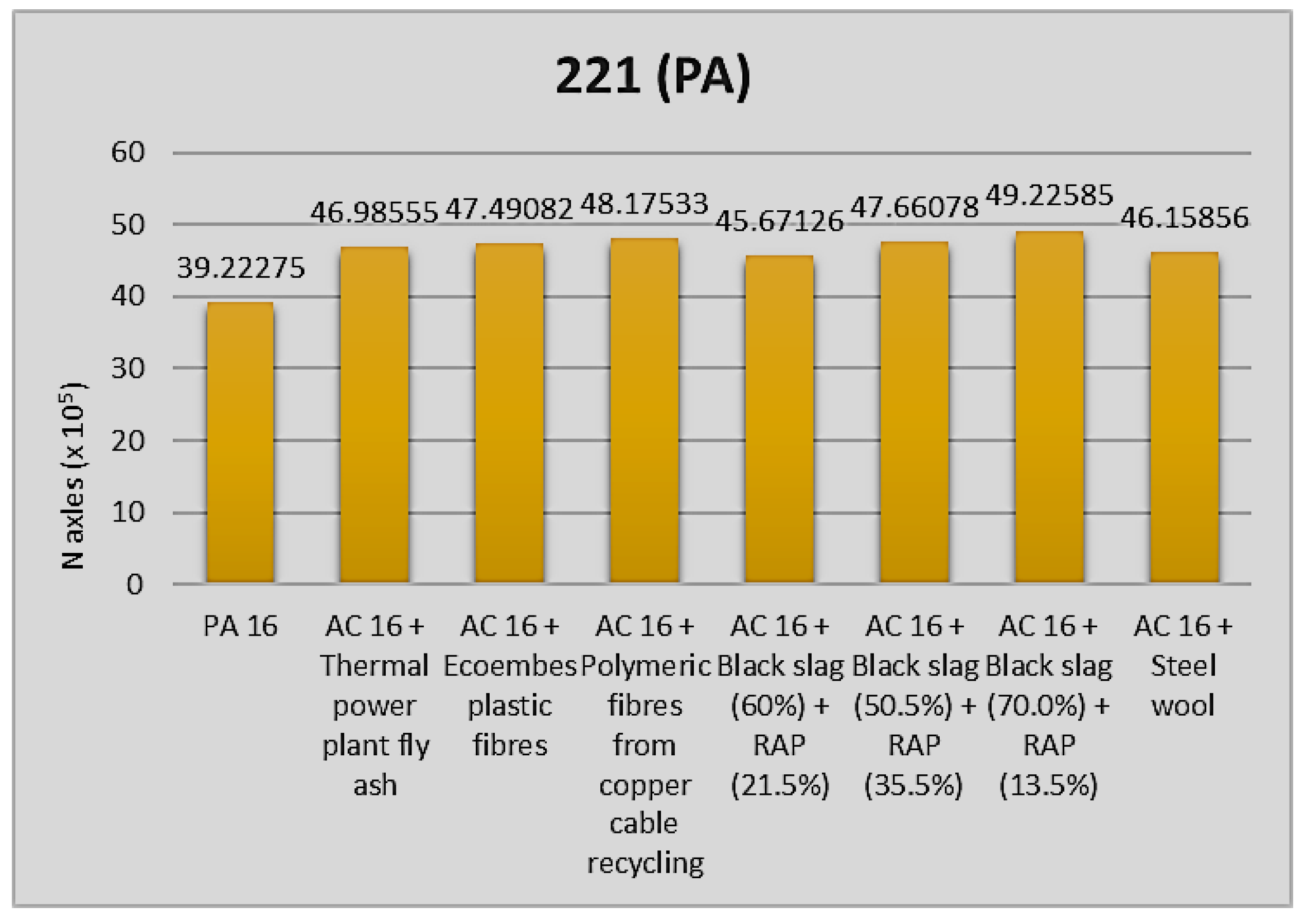
For pavement section 221 with PA 16 porous asphalt, 221 (PA), Figure 6, for all the wearing courses investigated, an improvement in service life was obtained with sustainable asphalt mixes. In all cases, the section failure has occurred in the base course, AC 32 base G.
Different percentages of improvement have been obtained compared to the porous asphalt PA 16, between 16.4% of the asphalt concrete with the addition of Black slag (60%) + RAP (21.5%) and 25.5% in bituminous mixture with the addition of Black slag (70.0%) + RAP (13.5%). So, in section 221 (PA), the comparison between PA 16 and PA 16+ addition is as follows:
For PA 16 + Thermal power plant bottom ash, an increase in service life of 19.8%;
For PA 16 + Ecoembes plastic fibres, an increase in service life of 21.1%;
For PA 16 + Polymeric fibres from copper cable recycling, an increase of 22.2%;
For PA 16 + Black slag (60%) + RAP (21.5%), an increase in service life of 16.4%;
For PA 16 + Black slag (50.5%) + RAP (35.5%), an increase in service life of 21.5%;
For PA 16 + Black slag (70.0%) + RAP (13.5%), an increase in service life of 25.5%;
For PA 16 + steel wool, an increase in service life of 17.7%.
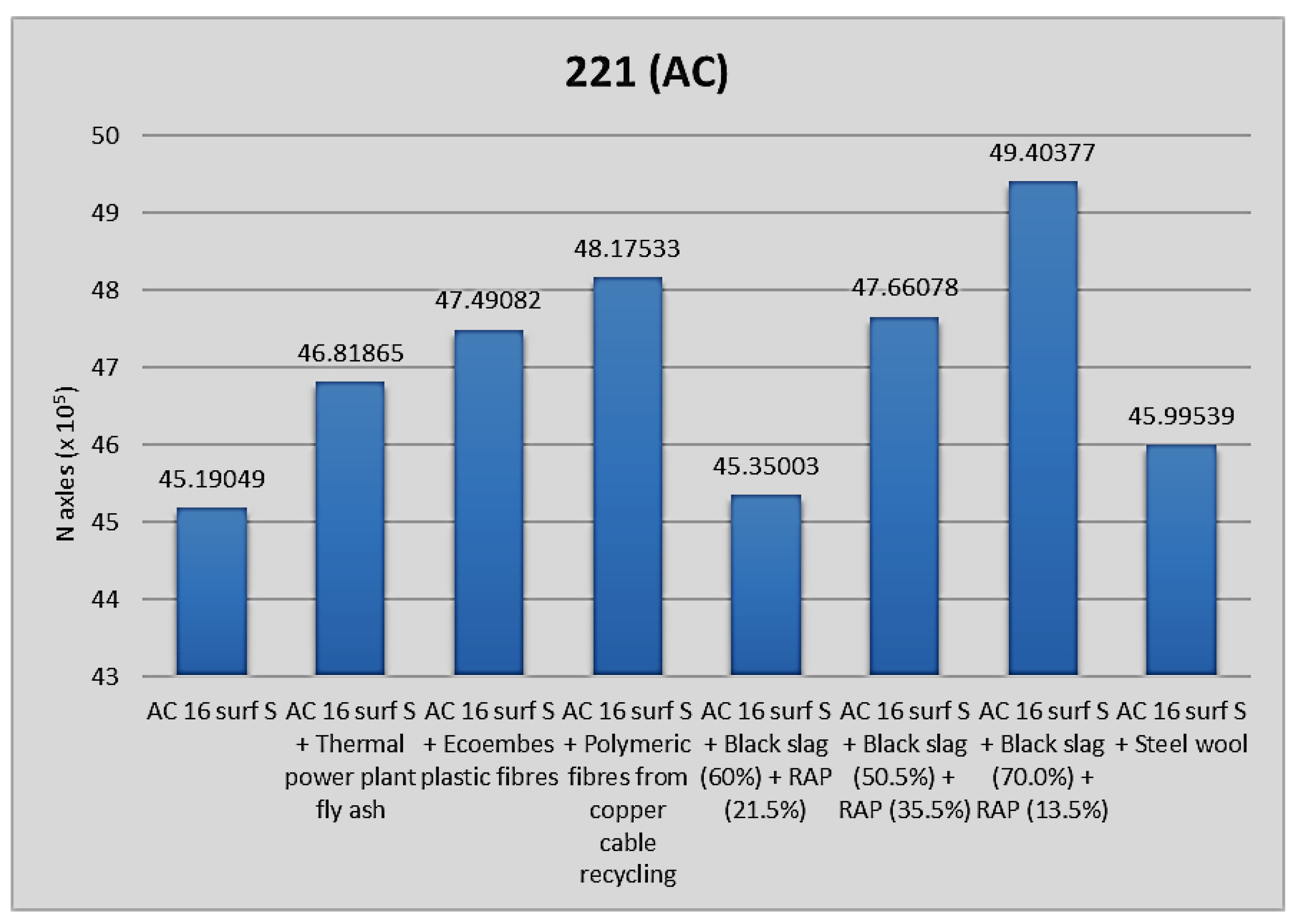
In section 221 with AC 16 surf S asphalt concrete, 221 (AC), Figure 7, for all the wearing courses investigated, an improvement in the service life was obtained with sustainable asphalt mixes. In all cases, the section failure has occurred in the base course, AC 32 base G.
Different percentages of improvement have been obtained compared to the bituminous mixture AC 16 surf S, between 0.4% of the asphalt concrete with the addition of Black slag (60%) + RAP (21.5%) and 9.3% in bituminous mixture with the addition of Black slag (70.0%) + RAP (13.5%). So, in section 221 (AC), the comparison between AC 16 surf S and AC 16 surf S + addition is as follows:
For AC 16 surf S + Thermal power plant bottom ash, an increase in service life of 3.6%;
For AC 16 surf S + Ecoembes plastic fibres, an increase in service life of 5.1%;
For AC 16 surf S + Fibres from copper cable recycling, an increase in service life of 6.6%;
For AC 16 surf S + Black slag (60%) + RAP (21.5%), an increase in service life of 0.4%;
For AC 16 surf S + Black slag (50.5%) + RAP (35.5%), an increase in service life of 5.5%;
For AC 16 surf S + Black slag (70.0%) + RAP (13.5%), an increase in service life of 9.3%;
For AC 16 surf S + Steel wool, an increase in service life compared to AC 16 surf S of 1.8%.
In the case of pavement section 3121 with PA 16 porous asphalt, 3121 (PA), for all the wearing courses investigated, an improvement in the service life of the pavement was obtained with sustainable asphalt mixes. In all cases, the section failure has occurred in the base course.
Different percentages of improvement have been obtained compared to the porous asphalt PA 16, between 16.5% of the asphalt concrete with the addition of Black slag (60%) + RAP (21.5%) and 25.7% in bituminous mixture with the addition of Black slag (70.0%) + RAP (13.5%). So, in section 3121 (PA), the comparison between PA 16 and sustainable (PA 16 + addition) is as follows:
For PA 16 + Thermal power plant bottom ash, an increase in service life of 20.0%;
For PA 16 + Ecoembes plastic fibres, an increase in service life of 21.3%;
For PA 16 + Polymeric fibres from cable recycling, an increase in service life of 23.1%;
For PA 16 + Black slag (60%) + RAP (21.5%), an increase in service life of 16.5%;
For PA 16 + Black slag (50.5%) + RAP (35.5%), an increase in service life of 21.8%;
For PA 16 + Black slag (70.0%) + RAP (13.5%), an increase in service life of 25.7%;
For PA 16 + Steel wool, an increase in service life compared to PA 16 of 18.3%.
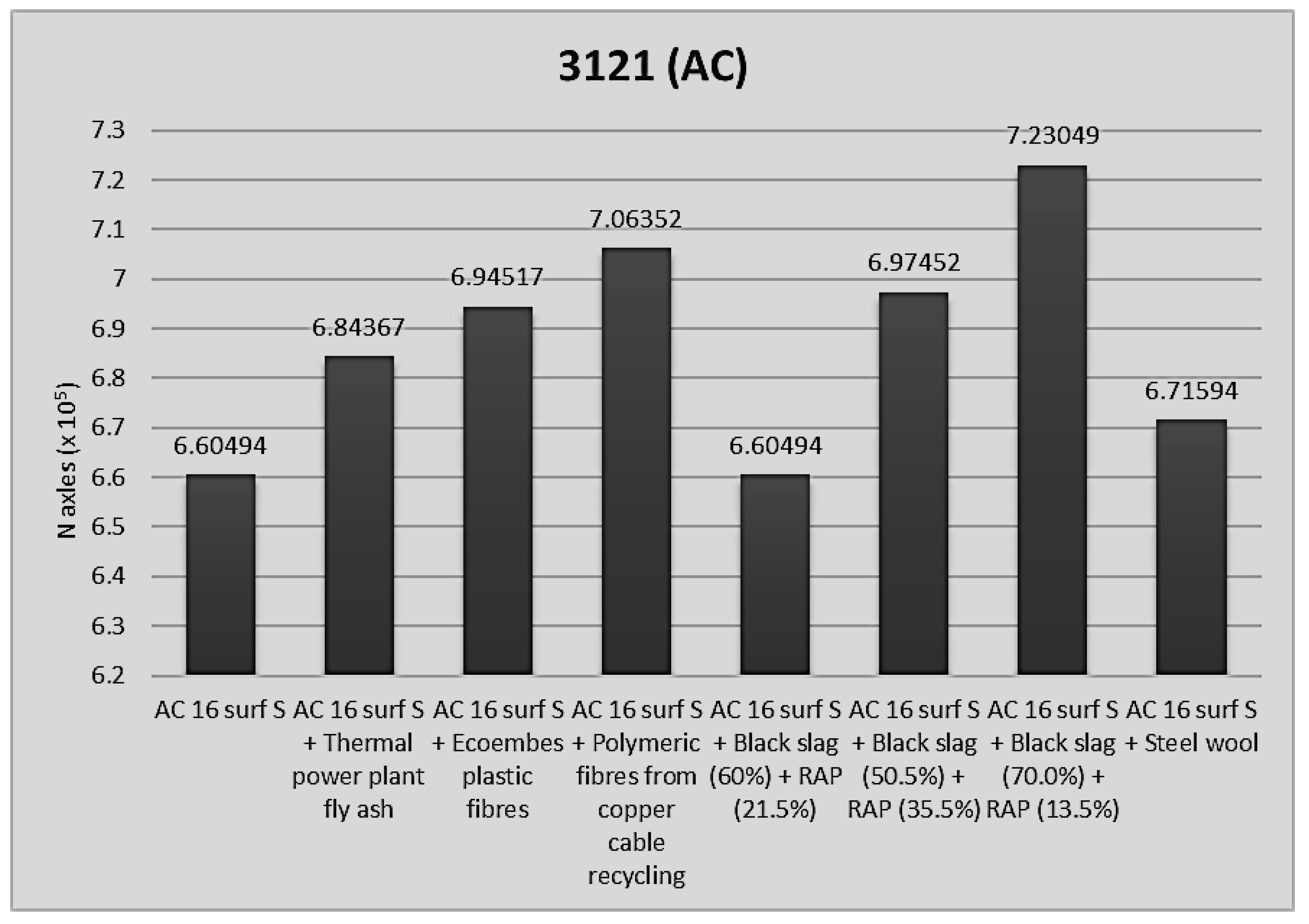
For pavement section 3121 with AC 16 surf S asphalt concrete, 3121 (AC), Figure 8, for all the wearing courses investigated, an improvement in the service life of the pavement was obtained with sustainable asphalt mixes. In all cases, the section failure has occurred in the base course, which is a bituminous mixture AC 22 bin S.
Different percentages of improvement have been obtained compared to the bituminous mixture AC 16 surf S, between 0.0% of the asphalt concrete with the addition of Black slag (60%) + RAP (21.5%) and 9.5% in bituminous mixture with the addition of Black slag (70.0%) + RAP (13.5%). So, in section 3121 (AC), the comparison between AC 16 surf S and AC 16 surf S + addition is as follows:
For AC 16 surf S + Thermal power plant bottom ash, an increase in service life of 3.6%;
For AC 16 surf S + Ecoembes plastic fibres, an increase in service life of 5.2%;
For AC 16 surf S + Fibres from copper cable recycling, an increase in service life of 6.9%;
For PA 16 + Black slag (60%) + RAP (21.5%), an increase in service life of 0.0%;
For PA 16 + Black slag (50.5%) + RAP (35.5%), an increase in service life of 5.6%;
For PA 16 + Black slag (70.0%) + RAP (13.5%), an increase in service life of 9.5%;
For PA 16 + Steel wool, an increase in service life compared to PA 16 of 1.7%.
The results confirm the advantages of using bituminous mixtures containing steel wool fibre as a new paving substance in terms of functional characteristics, durability and service life. As this study is based on fatigue analysis, SEM/XRD microscopic analysis of steel wool fibre reinforcement is proposed as a future line of research.
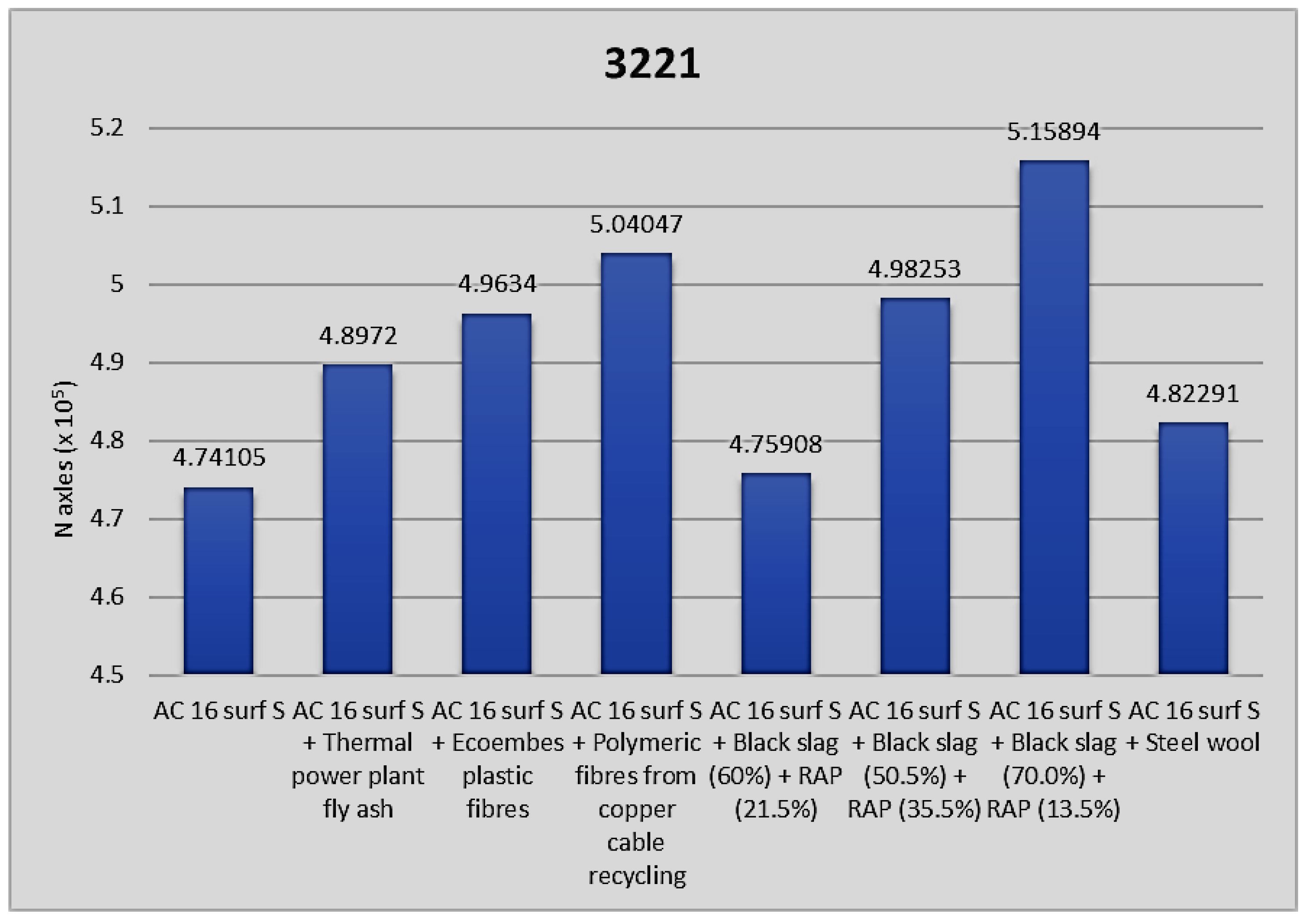
In the case of pavement section 3221 with AC 16 surf S asphalt concrete, Figure 9, for all the wearing courses investigated, an improvement in the service life of the pavement was obtained. In all cases, the section failure has occurred in the base course, which is a mixture AC 22 bin S.
Different percentages of improvement have been obtained compared to the bituminous mixture AC 16 surf S, between 0.4% of the asphalt concrete with the addition of Black slag (60%) + RAP (21.5%) and 8.8% in bituminous mixture with the addition of Black slag (70.0%) + RAP (13.5%). So, in section 3221, the comparison between AC 16 surf S and AC 16 surf S + addition is as follows:
For AC 16 surf S + Thermal power plant bottom ash, an increase in service life of 3.3%;
For AC 16 surf S + Ecoembes plastic fibres, an increase in service life of 4.7%;
For AC 16 surf S + Fibres from copper cable recycling, an increase in service life of 6.3%;
For PA 16 + Black slag (60%) + RAP (21.5%), an increase in service life of 0.4%;
For PA 16 + Black slag (50.5%) + RAP (35.5%), an increase in service life of 5.1%;
For PA 16 + Black slag (70.0%) + RAP (13.5%), an increase in service life of 8.8%;
For PA 16 + Steel wool, an increase in service life compared to PA 16 of 1.7%.
In section 4121 with AC 16 surf S asphalt concrete, for all the wearing courses investigated, an improvement in the service life of the pavement was obtained with sustainable asphalt mixes. The section failure has occurred in the base course, AC 22 bin S. Different percentages of improvement have been obtained compared to the AC 16 surf S, between 0.1% of the asphalt concrete with the addition of Black slag (60%) + RAP (21.5%) and 6.1% in mixture with the addition of Black slag (70.0%) + RAP (13.5%). So, in section 4121, the comparison is as follows:
For AC 16 surf S + Thermal power plant bottom ash, an increase in service life of 2.3%;
For AC 16 surf S + Ecoembes plastic fibres, an increase in service life of 3.3%;
For AC 16 surf S + Fibres from copper cable recycling, an increase in service life of 4.5%;
For PA 16 + Black slag (60%) + RAP (21.5%), an increase in service life of 0.1%;
For PA 16 + Black slag (50.5%) + RAP (35.5%), an increase in service life of 3.6%;
For PA 16 + Black slag (70.0%) + RAP (13.5%), an increase in service life of 6.6%;
For PA 16 + Steel wool, an increase in service life compared to PA 16 of 1.1%.
In general, using the analyzed mixtures improves the service life and ecological value of the road. Following a comprehensive analysis of the results, it has been determined that the optimal mixture is PA 16 + Black slag (70.0%) + RAP (13.5%). This combination has been found to produce the greatest increase in service life for sections 221, 3121 and 3221, with respective increases of 25.5%, 25.7% and 8.8%. For section 4121, the increase is 6.6%.
Regardless of the road sections with two or three layers of bituminous mixture, all fatigue analyses indicated that failure occurred in the base. In general, the incorporation of sustainable materials into the wearing course has had a substantial impact on the service life of the base course. The mechanical mechanism may be due to a redistribution of stress caused by the change in resistant modulus, leading to increased deformation in the base course. While the ecological value is evident, the primary objective of the research is to analyze the fatigue of bituminous mixtures with recycled materials, without providing quantitative data on environmental benefits such as reduced carbon emissions and energy consumption. Research should focus on analyzing these pavements with regard to their environmental impacts and costs.
A new line of research, employing specific indicators such as carbon emissions and energy consumption comparisons to quantify these differences, would be necessary to validate the environmental benefits from life cycle assessment (LCA), considering the complete life cycle of the bituminous mixture. The complete life cycle under consideration would encompass the extraction and acquisition of bitumen and natural aggregates, along with recycled materials, and extend to production and manufacturing, including energy and material use, end-of-life treatment, and final disposal.
In this research, the extension of service life is directly equivalent to the number of load actions per axis (n) necessary to cause fatigue failure and is therefore a structural service life. As functional service life, such as degradation of slip and groove resistance, is not considered, it is important to understand the limitations of this index. It can be subsequently verified against an actual measurement in an experimental section.
While most of the samples analyzed demonstrate statistically significant improvements in mixture performance, with increases exceeding 20% in certain sections, such as 4121, there are minor increments, with AC 16 SURF S 2.3–4.5% and mixture PA 16 showing variations between 0.1 and 6.6%, values that could fall within the experimental margin of error. Even though fatigue equations for various mixtures (ε = a × nb) have been obtained through four-point bending tests, these models cannot be compared with the actual life of the pavement. This is an analysis that is proposed as a future line of research. In any case, it is widely acknowledged that temperature is a pivotal factor in the performance of asphalt pavement. Therefore, it may be suggested as a future line of research to test the application of the sustainable bituminous mixtures investigated in fatigue resistance tests under different temperature conditions.
Although the mixtures analyzed do not improve durability for higher traffic intensities, they do improve the service life of the pavement. Nevertheless, the ecological value of reusing recycled materials should be considered alongside the improvement in service life.

4. Conclusions

This paper investigates the service life of different pavement sections with sustainable asphalt mixes containing recycled materials in the wearing course. We carried out an analytical calculation of the sections based on mechanical characterization to define the useful life of sustainable pavements and promote the development of the circular economy. The findings are as follows:
Experimental calculation of the parameters a and b of the fatigue laws of the sustainable bituminous mixtures investigated was conducted using the 4-point bending strength test.
For an Annual Average Daily Heavy Traffic (AAHDT) of at least 800 heavy vehicles (HVs) per day, valid results were obtained for the use of sustainable mixes in wearing courses. However, the service life of sustainable sections 0031, 031, and 121 has not improved due to the additions, which reduced the permissible axle number by 14.8%, 16.9% and 18.5%, respectively. Therefore, the benefits of sustainable asphalt mixes should be considered in the context of transforming the construction industry according to the principles of the circular economy.
In the sections for AADTH between 800 and 25 HV/d, 221 (PA), 221 (AC), 3121 (PA), 3121 (AC), 3221, and 4121, all the bituminous mixes with additions analyzed extend the service life of the road, with maximum increases in service life of 25.5%, 9.3%, 25.7%, 9.5%, 8.8%, and 6.6%, respectively. This suggests a transformation of the pavement sections with sustainable materials, applying the maximum circularity criterion.
In this instance, the optimal outcomes were achieved through the incorporation of asphalt concretes, wherein a proportion of the natural aggregate was substituted with electric arc furnace slag (60% by mass) and RAP (21.5% by mass). The mixture was utilized with polymer-modified bitumen, which was further enhanced by rubber powder derived from the shredding of end-of-life tyres.
Research findings have demonstrated a general improvement in the fatigue behaviour of all bituminous mixtures in wearing courses with the incorporation of polymeric fibres from recycled copper cables or plastic fibres from Ecoembes. Therefore, an increase in service life was observed in the recycling of cables, with a range of 4.5% to 23.1%, yielding an average value of 11.6%. The investigation yielded a 3.3% to 21.3% increase in the life cycle of plastic fibres, with an average value of 10.1%.
In sections with AADTH higher than 100 HV/d, sustainable pavement sections with open porous asphalt PA 16, 221 (PA), and 3121 (PA) have obtained a higher increase in service life (25.5 and 25.7%) than those with surface layer type AC 16 surf S (9.3 and 9.5%).
In the AADTH sections between 800 and 25 HV/d (221 (PA), 221 (AC), 3121 (PA), 3121 (AC), 3221, and 4121), all of the analyzed bituminous mixes with additions extend the road’s service life, with maximum increases of 25.5%, 9.3%, 25.7%, 9.5%, 8.8%, and 6.6%, respectively.
This suggests transforming pavement sections using sustainable materials and applying the maximum circularity criterion.

Author Contributions

E.T.-L.-Z.: conceived and designed the experiments; performed the experiments; analyzed and interpreted the data; wrote the paper. Á.V.-Z.: conceived and designed the experiments; performed the experiments; analyzed and interpreted the data; contributed reagents, materials, analysis tools or data. C.C.d.S.: conceived and designed the experiments; performed the experiments; analyzed and interpreted the data; contributed reagents, materials, analysis tools. D.G.-C.: conceived and designed the experiments; performed the experiments; analyzed and interpreted the data; contributed reagents, materials, analysis tools or data. All authors have read and agreed to the published version of the manuscript.

Funding

The APC has been funded by the University of Salamanca.

Data Availability Statement

Data will be made available on request.

Conflicts of Interest

The authors declare no conflicts of interest.

References

  1. The European Parliament and the Council of the European Union. Directive 2008/98/EC of the European Parliament and of the Council of 19 November 2008 on waste and repealing certain Directives. EUR-Lex, 2025. 32008L0098. Available online: https://eur-lex.europa.eu/eli/dir/2008/98/oj/eng (accessed on 20 July 2025).
  2. Spanish Ministry of Public Works. Road Instruction. 6.1 IC Pavement Sections; Ministry of Public Works: Madrid, Spain, 2010; Available online: https://cdn.transportes.gob.es/portal-web-transportes/carreteras/normativa_tecnica/11_firmes_pavimientos/1010100.pdf (accessed on 20 July 2025).
  3. Spanish Ministry of Public Works. General Specifications for Roads and Bridges Works PG-3; 3rd Part Explanations; Ministry of Public Works: Madrid, Spain, 2014; pp. 50–312. Available online: https://cdn.transportes.gob.es/portal-web-transportes/carreteras/normativa_tecnica/17_pliego_prescripciones_tecnicas/(52)-boe-a-2015-48.pdf (accessed on 20 July 2025).
  4. Spanish Ministry of Public Works; General Directorate of Roads. Circular Order 40/2017. Recycling of Road Surfaces and Bituminous Pavements (PG4); Ministry of Public Works: Madrid, Spain, 2017; Available online: https://publicaciones.transportes.gob.es/downloadcustom/sample/1372 (accessed on 20 July 2025).
  5. Monira, S.; Bhuiyana, M.A.; Nawshad Haqueb, N.; Pramanika, B.K. Road dust-associated microplastics from vehicle traffics and weathering. In Plastic Waste for Sustainable Asphalt Roads; Woodhead Publishing: Cambridge, UK, 2022; pp. 257–271. [Google Scholar] [CrossRef]
  6. Abina, A.; Puc, U.; Zidanšek, A. Challenges and opportunities of terahertz technology in construction and demolition waste management. J. Environ. Manag. 2022, 315, 115118. [Google Scholar] [CrossRef] [PubMed]
  7. Tai Nguyen, H.T.; Phan, T.-N.; Do, T.-T.; Nguyen, D.-L.; Tran, V.-T. Analysis of Flexible Pavements Comprised of Conventional and High Modulus Asphalt Concrete Subjected to Moving Loading using Linear Viscoelastic Theory. In Proceedings of the 5th International Conference GTSD, Ho Chi Minh City, Vietnam, 27–28 November 2020; pp. 302–311. [Google Scholar] [CrossRef]
  8. Santos, J.; Pizzol, M.; Azarijafari, H. Life cycle assessment (LCA) of recycled plastic waste in road pavements: Theoretical modeling. In Plastic Waste for Sustainable Asphalt Roads; Woodhead Publishing Series in Civil and Structural Engineering; Woodhead Publishing: Cambridge, UK, 2022; pp. 273–302. [Google Scholar] [CrossRef]
  9. Deng, Y.; Shi, X.; Zhang, Y. Determination of composite modulus of concrete containing reclaimed asphalt pavement using micromechanical modelling and soft computing techniques. J. Clean. Prod. 2021, 327, 129486. [Google Scholar] [CrossRef]
  10. Teijón-López-Zuazo, E.; Vega-Zamanillo, Á.; Calzada-Pérez, M.Á.; Robles-Miguel, Á. Use of Recycled Aggregates Made from Construction and Demolition Waste in Sustainable Road Base Layers. Sustainability 2020, 12, 6663. [Google Scholar] [CrossRef]
  11. UNE-EN 1097-6:2025; Tests for Mechanical and Physical Properties of Aggregates—Part 6: Determination of Particle Density and Water Absorption. AENOR: Madrid, Spain, 2025.
  12. UNE-EN 933-3:2012; Tests for Geometrical Properties of Aggregates—Part 3: Determination of Particle Shape—Flakiness Index. AENOR: Madrid, Spain, 2012.
  13. UNE-EN 1097-2:2021; Tests for Mechanical and Physical Properties of Aggregates—Part 2: Methods for the Determination of Resistance to Fragmentation. AENOR: Madrid, Spain, 2021.
  14. UNE-EN 1097-7:2025; Tests for Mechanical and Physical Properties of Aggregates—Part 7: Determination of the Particle Density of Filler—Pyknometer Method. AENOR: Madrid, Spain, 2025.
  15. UNE-EN 1426:2000; Bitumen and Bituminous Binders. Needle Penetration. AENOR: Madrid, Spain, 2000.
  16. UNE-EN 1427:2000; Bitumen and Bituminous Binders. Determination of Softening Point. Ring and Ball Method. AENOR: Madrid, Spain, 2000.
  17. UNE-EN 12591:2000; Bitumen and Bituminous Binders. Specifications for Paving Grade Bitumen. AENOR: Madrid, Spain, 2000.
  18. UNE-EN 12593:2001; Bitumen and Bituminous Binders. Determination of the Fraass Breaking Point. AENOR: Madrid, Spain, 2001.
  19. UNE-EN 13398:2018; Bitumen and Bituminous Binders. Determination of the Elastic Recovery of Modified Bitumen. AENOR: Madrid, Spain, 2018.
  20. UNE-EN 13043/AC:2004; Aggregates for Bituminous Mixtures and Surface Treatments for Roads, Airfields and Other Trafficked areas. AENOR: Madrid, Spain, 2004.
  21. Magbool, H.M. Sustainability of utilizing recycled plastic fiber in green concrete: A systematic review. Case Stud. Constr. Mater. 2025, 22, e04432. [Google Scholar] [CrossRef]
  22. UNE-EN 13108-1:2019; Bituminous Mixtures. Material Specifications. Part 1: Asphalt Concrete. AENOR: Madrid, Spain, 2019.
  23. UNE-EN 12697-34:2013; Bituminous Mixtures—Test Methods for Hot Asphalt—Part 34: Marshall Test. AENOR: Madrid, Spain, 2013.
  24. UNE-EN 12697-33:2020; Bituminous Mixtures. Test Method. Part 33: Specimen Prepared by Roller Compactor. AENOR: Madrid, Spain, 2019.
  25. UNE-EN 12697-24:2019; Bituminous Mixtures. Test Methods. Part 24: Resistance to Fatigue. AENOR: Madrid, Spain, 2019.
  26. UNE-EN 12697-26:2019; Bituminous Mixtures. Test Methods. Part 26: Stiffness. AENOR: Madrid, Spain, 2019.
Figure 1. Natural aggregates.
Sustainability 18 00845 g001
Figure 2. Ecoembes plastic fibres.
Sustainability 18 00845 g002
Figure 3. RAP fractions.
Sustainability 18 00845 g003
Figure 4. Polymeric fibers from copper cable recycling.
Sustainability 18 00845 g004
Figure 5. Specific fatigue laws for sustainable mixtures.
Sustainability 18 00845 g005
Figure 6. Service life of pavements section 221 (PA).
Sustainability 18 00845 g006
Figure 7. Service life of pavements section 221 (AC).
Sustainability 18 00845 g007
Figure 8. Service life of pavements section 3121 (AC).
Sustainability 18 00845 g008
Figure 9. Service life of pavements section 3221.
Sustainability 18 00845 g009
Table 1. Composition of bituminous mixture.
AggregateSpecific Weight UNE-EN 1097-6:2025 (g/cm3) [11]Water Absorption UNE-EN 1097-6:2025 (%)Flakiness Index UNE-EN 933-3:2012 [12]Los Angeles Abrasion Test UNE-EN 1097-2:2010 [13]Specific Weight UNE-EN 1097-7:2025 (g/cm3) [14]
Ophite2.9371.009.0016.00---
Limestone mineral powder------------2.753
Table 2. Composition of AC16 surf D bituminous mixture.
AC16 Surf D
Sieve size (mm)22168420.50.250.063
Passing rate (%)100.094.471.351.239.520.314.76.0
Table 3. Composition of RAP.
RAP
Sieve size (mm)40252010521.250.80.40.20.1250.08
Passing rate (%)100.099.592.458.629.012.28.72.82.21.00.70.4
Table 4. Tensile strength and bulk density.
Tensile Strength (MPa)Bulk Density (kg/m3)
FibresPET55.0–80.0438.2
PP25.0–40.0515.0
PS30.0–55.030.0
EPS1.0–1.532.5
PVC50.0–60.0351.0
PET18.0–30.0392.0
Benchmark mixturePA 16409.91948.0
AC16 surf D2189.02458.0
Table 5. Pavement structure parameters.
Addiction (% of Aggregates)Resilient Modulus (MPa)Poisson CoefficientFatigue Law
PA 16 Reference4000.00.35 ε = 6.925 × 10 3 × N 0.2743
PA 16 + Common salt (5.0%)2286.00.35 ε = 0.026 × 10 3 × N 0.1751
PA 16 + Black slag (88.0%)1906.00.35 ε = 3.951 × 10 3 × N 0.2299
PA 16 Reference7000.00.33 ε = 6.925 × 10 3 × N 0.2743
PA 16 + Thermal power plant bottom ash (70% over filler)6632.00.33 ε = 0.945 × 10 3 × N 0.25
PA 16 + Ecoembes plastic fibres6846.00.33 ε = 1.400 × 10 3 × N 0.1903
PA 16 + Polymeric fibres from copper cable recycling7113.00.33 ε = 1.338 × 10 3 × N 0.1935
PA 16 + Black slag (60.0%), limestone sand (18.5%) and RAP (21.5%)6166.00.33 ε = 1.374 × 10 3 × N 0.1653
PA 16 + Black slag (50.5%), furnace sand (12.1%) and RAP (35.5%)6912.00.33 ε = 1.338 × 10 3 × N 0.1631
PA 16 + Black slag (70.0%), limestone sand (16.5%) and RAP (13.5%)7528.00.33 ε = 1.889 × 10 3 × N 0.1754
PA 16 + Steel wool (1.0%)6373.00.33 ε = 1.309 × 10 3 × N 0.1693
AC22 bin S MAM11,000.00.33 ε = 6.617 × 10 3 × N 0.2743
ZA 0/32300.00.33 ε = 2.160 × 10 3 × N 0.2800
Upgrade300.00.33 ε = 1.580 × 10 2 × N 0.2500
Table 6. Durability of pavement sections for different PA 16 wearing courses.
SectionWearing CourseFailure LayerN Axles (105)
0031(PA 16-4 cm) (Reference)AC 22 base S MAM274.4
0031(PA 16-4 cm) + Common saltAC 22 base S MAM242.2
0031(PA 16-4 cm) + Black slagAC 22 base S MAM233.9
031(PA 16-4 cm) (Reference)AC 22 base S MAM124.5
031(PA 16-4 cm) + Common saltAC 22 base S MAM107.4
031(PA 16-4 cm) + Black slagAC 22 base S MAM103.4
121(PA 16-4 cm) (Reference)AC 22 base S MAM71.2
121(PA 16-4 cm) + Common saltAC 22 base S MAM60.7
121(PA 16-4 cm) + Black slagAC 22 base S MAM58.4
221 (PA)(PA 16-4 cm) (Reference)AC 32 base G39.2
221(AC 16-4 cm) + Thermal power plant bottom ashAC 32 base G47.0
221(AC 16-4 cm) + Ecoembes plastic fibresAC 32 base G47.5
221(AC 16-4 cm) + Polymeric fibres of copper cable recyclingAC 32 base G48.2
221(AC 16-4 cm) + Black slag (60%) + RAP (21.5%)AC 32 base G45.7
221(AC 16-4 cm) + Black slag (50.5%) + RAP (35.5%)AC 32 base G47.7
221(AC 16-4 cm) + Black slag (70.0%) + RAP (13.5%)AC 32 base G49.2
221(AC 16-4 cm) + Steel woolAC 32 base G46.2
3121 (PA)(PA 16-4 cm) (Reference)AC 32 base G5.7
3121(AC 16-4 cm) + Thermal power plant bottom ashAC 32 base G6.9
3121(AC 16-4 cm) + Ecoembes plastic fibresAC 32 base G6.9
3121(AC 16-4 cm) + Polymeric fibres copper cable recyclingAC 32 base G7.0
3121(AC 16-4 cm) + Black slag (60%) + RAP (21.5%)AC 32 base G6.7
3121(AC 16-4 cm) + Black slag (50.5%) + RAP (35.5%)AC 32 base G7.0
3121(AC 16-4 cm) + Black slag (70.0%) + RAP (13.5%)AC 32 base G7.2
3121(AC 16-4 cm) + Steel woolAC 32 base G6.8
221 (AC)(AC 16 surf S-5 cm) (Reference)AC 32 base G45.2
221 (AC)(AC 16 surf S-5 cm) + Thermal power plant bottom ashAC 32 base G46.8
221 (AC)(AC 16 surf S-5 cm) + Ecoembes plastic fibresAC 32 base G47.5
221 (AC)(AC 16 surf S-5 cm) + Polymeric fibres of copper cable recyclingAC 32 base G48.2
221 (AC)(AC 16 surf S-5 cm) + Black slag (60%) + RAP (21.5%)AC 32 base G45.4
221 (AC)(AC 16 surf S-5 cm) + Black slag (50.5%) + RAP (35.5%)AC 32 base G47.7
221 (AC)(AC 16 surf S-5 cm) + Black slag (70.0%) + RAP (13.5%)AC 32 base G49.4
221 (AC)(AC 16 surf S-5 cm) + Steel woolAC 32 base G46.0
3121 (AC)(AC 16 surf S-6 cm) (Reference)AC 22 bin S6.6
3121 (AC)(AC 16 surf S-6 cm) + Thermal power plant bottom ashAC 22 bin S6.8
3121 (AC)(AC 16 surf S-6 cm) + Ecoembes plastic fibresAC 22 bin S6.9
3121 (AC)(AC 16 surf S-6 cm) + Polymeric fibres of copper cable recyclingAC 22 bin S7.1
3121 (AC)(AC 16 surf S-6 cm) + Black slag (60%) + RAP (21.5%)AC 22 bin S6.6
3121 (AC)(AC 16 surf S-6 cm) + Black slag (50.5%) + RAP (35.5%)AC 22 bin S7.0
3121 (AC)(AC 16 surf S-6 cm) + Black slag (70.0%) + RAP (13.5%)AC 22 bin S7.2
3121 (AC)(AC 16 surf S-6 cm) + Steel woolAC 22 bin S6.7
3221(AC 16 surf S-5 cm) (Reference)AC 22 bin S4.7
3221(AC 16 surf S-5 cm) + Thermal power plant bottom ashAC 22 bin S4.9
3221(AC 16 surf S-5 cm) + Ecoembes plastic fibresAC 22 bin S5.0
3221(AC 16 surf S-5 cm) + Polymeric fibres of copper cable recyclingAC 22 bin S5.0
3221(AC 16 surf S-5 cm) + Black slag (60%) + RAP (21.5%)AC 22 bin S4.8
3221(AC 16 surf S-5 cm) + Black slag (50.5%) + RAP (35.5%)AC 22 bin S5.0
3221(AC 16 surf S-5 cm) + Black slag (70.0%) + RAP (13.5%)AC 22 bin S5.2
3221(AC 16 surf S-5 cm) + Steel woolAC 22 bin S4.8
4121(AC 16 surf S-4 cm) (Reference)AC 22 bin S1.0
4121(AC 16 surf S-4 cm) + Thermal power plant bottom ashAC 22 bin S1.0
4121(AC 16 surf S-4 cm) + Ecoembes plastic fibresAC 22 bin S1.1
4121(AC 16 surf S-4 cm) + Polymeric fibres of copper cable recyclingAC 22 bin S1.1
4121(AC 16 surf S-4 cm) + Black slag (60%) + RAP (21.5%)AC 22 bin S1.0
4121(AC 16 surf S-4 cm) + Black slag (50.5%) + RAP (35.5%)AC 22 bin S1.1
4121(AC 16 surf S-4 cm) + Black slag (70.0%) + RAP (13.5%)AC 22 bin S1.1
4121(AC 16 surf S-4 cm) + Steel woolAC 22 bin S1.0
Disclaimer/Publisher’s Note: The statements, opinions and data contained in all publications are solely those of the individual author(s) and contributor(s) and not of MDPI and/or the editor(s). MDPI and/or the editor(s) disclaim responsibility for any injury to people or property resulting from any ideas, methods, instructions or products referred to in the content.