


Abstract
This research examines the impact of five crucial factors underlying human resource management (HRM), namely, compensation, transformational leadership, motivation, and job satisfaction on sustainable employees’ performance in Lebanese family companies. The research is founded on Social Exchange Theory, Maslow’s Hierarchy of Needs, and Transformational Leadership Theory. Based on a cross-sectional design and quantitative approach, data were collected from 511 full-time employees working for family-owned businesses in Lebanon via structured questionnaires. Structural equation modeling (SEM) using SmartPLS-4 was used to analyze the relationships among the variables. The results point out that job satisfaction, motivation, and the transformational leadership style meaningfully impact employees’ performance. Compensation had a slight yet statistically significant effect. Furthermore, the work environment was found to have both a direct influence on performance and a moderating effect on the relationships between job satisfaction, transformational leadership style, and employees’ outcomes. These outcomes provide theoretical contributions to the literature on HRM in family-owned enterprises and deliver practical insights for improving employees’ performance through targeted HR strategies in emerging economies. The present study concludes by highlighting the role of a supportive environment at work and participative leadership in enhancing performance outcomes, mostly in culturally complex and intergenerational business settings.
1. Introduction
Family businesses constitute the main economic pillar in developing countries, where they contribute considerably to employment, GDP, and long-term stability at the socio-economic levels. These types of firms often lay on robust heritage and intergenerational values, added to strategic emphasis on continuity above short-run profit [1]. Nevertheless, internal inefficiencies, leadership challenges, and human resource weaknesses keep threatening these businesses’ sustainability. Generally, many family businesses fail to survive beyond the founding generation, while in Lebanon, particularly, the situation is deemed critical [1]. In this regard, a study found that 75.8% of family-owned businesses in Lebanon are still in the first generation [2]. Whereas family-owned firms constitute approximately 85% of the private sector, only 30% thereof survive into the second generation, 15% into the third, and a mere 3% continue into the fourth [3,4]. These alarming statistics pinpoint inherent problems related to succession planning, lack of accountability, inefficient HR systems, and governance failures [5]. Despite the fact that family businesses dominate the Lebanese economy, the academic literature collected works covering this domain remain sparse and underdeveloped, mostly regarding the study of structured organizational dimensions such as employees’ performance and human capital management. The majority of previous research has been narrowed down to exploring family dynamics, personal relationships, or value-driven behaviors, missing the analysis of formal HR practices and their consequences on long-term sustainability and performance [6]. This study suggests that almost 80% of entrepreneurs will run a family business, nearly 50% of entrepreneurs started their firm, while 33% inherited their business; more than 50% had several family investors, and about 70% hired at least one family member full-time, emphasizing the importance of family in the entrepreneurial process. The distinctive features of family firms in Lebanon, such as the dominance of family members in leadership positions, role ambiguity, and inherited managerial authority, can lead to constricted morale among non-family staff, limited motivation, and, in the long run, declining performance [7]. The absence of fair and transparent HR practices, as for instance structured compensation, equitable promotions, and performance-based incentives, further exacerbates these organizational deficiencies, particularly when employees perceive biased decision-making or a lack of career advancement opportunities [8]. Although current studies across other countries have scrutinized how HRM practices can affect employees’ outcomes, few of these have been carried out in the Lebanese context, though an integrated approach combining compensation, motivation, leadership, job satisfaction, and work environment. Therefore, there remains a considerable breach in the literature concerning how these variables interact and contribute to sustainable employees’ performance in Lebanese family organizations. In an attempt to bridge this gap, the present research introduces the ensuing question: What is the effect of key HRM factors, precisely the transformational leadership style, motivation, compensation, job satisfaction, and work environment, on the sustainable performance of the staff in Lebanese family businesses? The primary aim of the present study is to inspect the direct and indirect influences of these variables on the performance of Lebanese family firms’ employees. To be more definite, the study aims to (1) investigate the direct influence of transformational leadership style, compensation, motivation, and job satisfaction on employee’s performance, (2) explore the moderating role of the work environment in the relationships between leadership and performance, as well as job satisfaction and performance, and (3) establish a coherent theoretical base founded on Social Exchange Theory, Maslow’s Hierarchy of Needs, and Transformational Leadership Theory in order to elucidate these relationships. Social Exchange Theory helps in shedding light on how employees respond to organizational support with greater engagement and loyalty when they obtain fair treatment. Maslow’s Needs Theory provides a hierarchy allowing employee motivation and job satisfaction to be interpreted, principally in contexts where foundational needs are not entirely addressed. Transformational Leadership Theory offers a useful lens allowing transformational leadership styles that prioritize vision, individualized support, and empowerment to be linked to enhanced outcomes of the concerned staff.
While family business HRM has been researched, empirical work examining compensation, transformational leadership style, motivation, job satisfaction, and the work environment in family firms remains limited [9]. Family firms’ socio-emotional wealth priorities may lead to less formal HR practices, but scholars have only started to investigate how family firms’ transformational leadership styles (e.g., paternalistic vs. transformational) affect employee outcomes [10]. In addition, a positive work environment has been associated with job satisfaction among family firms, especially during times of external shock, but empirical work examining the mechanisms of the positive work environment (e.g., trust, shared identity) is limited [11]. Finally, the dual motives of family and nonfamily employees in family firms, particularly in motivational drivers, are rarely disentangled or examined, which limits the understanding of how HRM practices in family firms contribute to sustainable job performance. Exploring these areas is important to inform scholars’ understanding of socio-emotional wealth theories in HRM scholarship, and practitioners’ ability to design people practices with consideration for family values while maintaining a professional HR approach.
Sustainable family business success encompasses the long-term capability of a family-owned enterprise to compete successfully while achieving continuity across descendants, while maintaining its family values in an ethical manner. The significance of sustainability for family businesses is found not only in building trust with stakeholders through longevity but also in creating a stable, supportive working environment where employees feel empowered and engaged, thereby increasing effectiveness and efficiency [3].
With the concerning dilemmas regarding family businesses, it is important to define perpetuity in terms of sustainable success—a paradigm shift that goes well beyond short-term profitability and towards organizational sufficiency, employee satisfaction, and the transfer of ownership to progeny. This is supported by empirical studies conducted by [2,3]. Sustainable success indicates family businesses’ success in managing the economic, social, and human capital while providing an effective governance structure, human resource management practices, and motivated and satisfied employees. Thus, performance does not exclusively count on financial returns or success, but is also examined through the organization’s capabilities in retaining talent, positive work environments, and transparent and fair practices that lead to longevity or perpetuity. Shifting towards sustainable success captures how strategic human resource management initiatives—equitable compensation, transformational leadership, motivating and satisfaction initiatives—help augment organizations’ resilience, succession planning, and family business sustainability, which we can apply to family-owned enterprises in Lebanon.
Hence, the study offers a holistic comprehension of the way internal HRM practices lead to sustainable employees’ work by integrating these frameworks. The worth of the present study lies in its theoretical and practical contributions. Theoretically, it addresses an obvious void in the existing knowledge body by implementing prominent motivation and leadership theories in order to reach the understudied Lebanese family business sector. Practically, it offers actionable insights for family firms’ owners, HR managers, and consultants operating in Lebanon and whose goal is to enhance their employees’ performance and organizational longevity via the optimization of the HRM systems. This also offers evidence-based guidance in order to nurture fairness, inclusion, and engagement among both family and non-family employees, which is decisive for the long-term survival of the said businesses. Furthermore, the current study underlines relevance to policymakers and development agencies operating in private sector sustainability in Lebanon and similar emerging markets. Yet, the remaining part of this article details the following plan: Section 2 covers a comprehensive literature review and the theoretical framework underpinning the study, encompassing the testable hypotheses. As for Section 3, we unveil the description of the adopted methodology in gathering and analyzing data, such as the survey design, sampling strategy, and the applied statistical tools. In Section 4, we demonstrate the empirical outcomes and provide an interpretation of the data relevant to the research model. Finally, Section 5 discusses the prominent findings, theoretical and practical implications, and studies the limitations and recommendations for future studies.
2. Literature Review, Theoretical Framework, and Hypotheses
This section reviews the literature, develops the study’s theoretical foundation, and develops hypotheses.
2.1. Literature Review
The family businesses within developing nations frequently reveal traditional leadership structures, resistance to innovation, and informal human resource methods that are capable of impeding the progress of employees [12]. Non-participative transformational leadership styles repeatedly quash initiative and creativity in these firms, particularly among non-family employees, thus limiting their promotion and development opportunities. In a sample of 378 employees from Lebanese family businesses, 50.5% reported monthly incomes below USD 500, and structural equation modeling showed a significant positive relationship between nepotism and turnover intention [13]. Strategic roles are typically reserved for family members, and this measure often leads to inadequate coaching, imprecise accountability, and marginalization of professional HR development systems. Likewise, limited digital mastery and knowledge added to resistance to technology usage in labor management mount these challenges. Similar structural patterns can be noticed in Lebanon’s family businesses, where the intersection between family and business roles generates conflicts of interest, especially regarding hiring, remuneration, and advancement decisions. In smaller businesses, non-family employees often feel ignored or excluded from decision-making due to family members’ favoritism [14].
The literature frames sustainable family business success as the balanced achievement of both family well-being and business performance, as highlighted in the Sustainable Family Business Model (SFBM). Its importance is reinforced by research showing that effective governance, family cohesion, and responsible strategic practices improve employee satisfaction and commitment, which in turn boosts organizational performance and long-term resilience [3].
A rising body emphasized the strong correlation between leadership methods and employees’ performance [7]. In particular, transformational leadership has been found as a booster of job satisfaction, motivation, and overall productivity [15,16], since leaders encouraging participative decision-making foster greater confidence and performance outcomes. According to [17], transformational leadership and psychological well-being conjointly facilitate the connection between organizational trust and employees’ engagement. Nevertheless, this study focused exclusively on executive-level employees, which may limit generalizability to front-line staff in SMEs and family firms.
The role of leadership mode variations was investigated by other scholars. In this context, Ref. [18] confirmed that entrepreneurial passion mediates the correlation between transactional leadership and employees’ work in SMEs, while [19] tackled the way toxic leadership, social support, and job ambiguity, particularly role uncertainty and job insecurity, are able to affect commitment and performance. The said studies commonly suggest that transformational leadership style can either improve or wear away performance depending on how it is perceived and supported within the organizational context.
Motivation plays a central role. Ref. [20] emphasizes the fact that motivated employees reveal higher satisfaction and productivity. Ref. [21] confirmed in Lebanese SMEs that recognition and advancement opportunities significantly increase effort and organizational citizenship conduct, and rewards further reinforce this dynamic. Moreover, competitive compensation according to [22,23] increases satisfaction and retention, whereas inadequate remuneration leads to demotivation and turnover.
The work environment has emerged in recent studies as a direct performance driver and other HRM variables. More recent research has identified that a direct driver of employee performance is either the work environment or the work environment acts as an important facilitator with respect to HRM factors. A study [24] found that a supportive and psychologically safe work environment enhances the positive effects of leadership on motivation, satisfaction, and performance, illustrating the work environment as an important mechanism by which HRM practices lead to sustained outcomes. Similarly, ref. [25] disclosed that well-designed physical and psychological workspaces can heighten creativity and job satisfaction. On the other hand, few studies explore how work environments interact with leadership and satisfaction, specifically in the context of family-owned businesses.
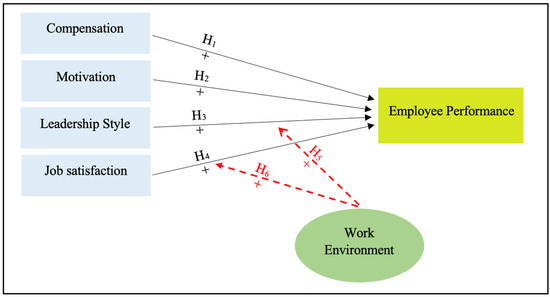
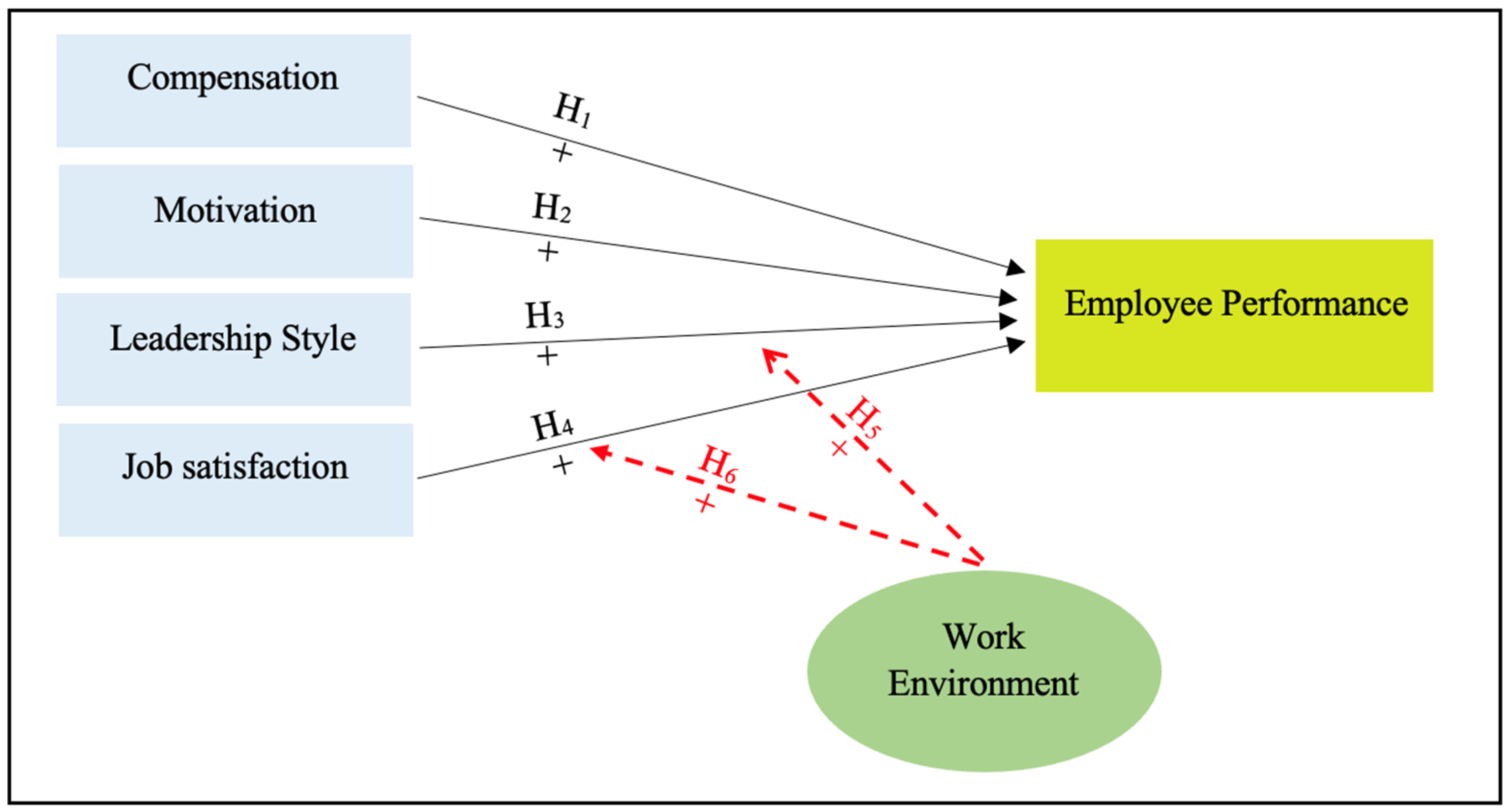
Notwithstanding these insights, limited research systematically integrates these HRM dimensions, i.e., leadership, motivation, compensation, satisfaction, and environment, within the definite cultural and structural setting of Lebanese family businesses. The present research’s purpose is to seal this breach through examining the direct and moderating impacts of the said factors on employees’ performance. More accurately, it investigates whether leadership and job satisfaction can have an indirect influence on performance when affected by the work environment. The conceptual model, as presented in Figure 1, is developed on the grounds of the present review, and it will guide the hypothesis testing that follows.
Figure 1.
Conceptual Framework.
Thus, based on the aforementioned literature, family-owned businesses have their unique motivations that influence job satisfaction and retention of employees due to the interplay of the family dynamic, informal governance structure, and long-term orientation of these businesses. Any compensation package is critical in this regard, because many family-owned businesses utilize pay structures other than “formal” salaries; it is important to take into consideration the employee’s loyalty to the company, as well as the company’s ability to pay. Owner-managers are often in a position where their authority is centralized, thus they have a greater degree of control over the work environment and influence employee behaviors. Similarly, family-owned businesses place a strong emphasis on emotional attachment, fairness, and relational dynamics among employees, which helps motivate employees to contribute more than what is required by their job description. The workplace itself, whether it is physical and/or socio-relational, has a large impact on the success of any family-owned business. Often, family-owned businesses rely on a close-knit culture based on shared values, which makes the work environment a critical component in the development of effective and sustainable business performance. This is supported by empirical evidence according to [3,4,12]. Together, the above components create the three dimensions (structural, relational, and psychological) that are predominantly influenced by the unique characteristics of family-owned businesses (i.e., informality, long-term stewardship, and socio-emotional priorities), thus creating a framework for understanding the successful and sustainable business performance of family-owned enterprises.
2.2. Theoretical Framework
2.2.1. Social Exchange Theory (SET)
As seen by [26], the SET postulates that social behavior is the outcome of an exchange course intending to maximize benefits and reduce costs. When employees recognize at their workplace that their management values and supports them (e.g., through fair compensation, good leadership, or a supportive environment), they are more likely to counter that with amplified commitment, loyalty, and performance [27]. From the perspective of [28], apparent organizational support and the quality of leader–member interrelationships deeply influence the staff’s outcomes through this reciprocal logic. Latest studies confirm as well that SET remains an effective framework in current organizational contexts, particularly under conditions of psychological contract fulfillment and ethical leadership [29]. Additionally, SET explains within the family businesses frame—where personal trust, informal norms, and perceived fairness are essential—how fair treatment (especially for non-family employees) promotes job satisfaction and sustainable acts.
2.2.2. Maslow’s Hierarchy of Needs
Maslow’s Hierarchy of Needs puts forward that five hierarchical needs motivate individuals: physiology, security, love/belonging, esteem, and self-actualization [30]. In workplace settings, this theory implies that unless foundational requirements—such as job security and satisfactory compensation—are fulfilled, employees will not do their utmost for higher-level aspirations such as achievement and recognition [31]. The theory has been foundational in humanistic psychology and organizational behavior, underlining the extent to which unfulfilled needs defeat motivation and decrease workplace commitment.
New empirical work asserts that Maslow’s structure can explain workplace motivation, especially in cross-cultural situations and during crisis circumstances [32]. Within the Lebanese family businesses, where job roles can be fuzzy or unpredictable, employees might sense doubt or be underrated, making it challenging for them to reach esteem or self-actualization, and this subsequently diminishes their overall performance and job satisfaction.
2.2.3. Transformational Leadership Theory
Transformational Leadership Theory, as presented by [33], recognizes leaders who raise the interests of followers via inspirational motivation, personalized consideration, flawless influence, and intellectual stimulation. In this perspective, ref. [34] observed in their meta-analysis that transformational leadership is definitely and pointedly correlated with employees’ job satisfaction, motivation, and performance across various industries. Moreover, according to [35], transformational leaders are able to foster innovation and adaptability through the establishment of emotionally safe environments for employees where they can express their thoughts. Recent inquiries show that transformational leadership boosts engagement, creativity, and sustainable performance in dynamic work settings [36] and plays a substantial role in SMEs and family-run companies in emerging markets. In the exceptional environment of family-owned businesses, transformational leadership is deemed to be chiefly effective. It entitles next-generation leaders to cope with legacy expectations while inspiring family and non-family employees, based on trust, empowerment, and shared vision.
2.3. Hypotheses Development
This study seeks mainly to detect the key human resource factors influencing employees’ performance in family-owned businesses. Considering its relevance to business permanence and long-term competitiveness, the employees’ performance is designated as the chief dependent variable. It is appraised through comparative assessments with similarly qualified peers and self-reported satisfaction regarding one’s work products [23]. In the unique context of family companies, emotional bonds, informal structures, and loyalty-based dynamics often play a significant role in shaping employees’ behavior and outputs.
Compensation, transformational leadership style, motivation, job satisfaction, and work environment are some of the critical HRM dimensions in family business contexts because of strong empirical links to sustainable performance. Fair compensation and opportunities for development increase levels of commitment and performance in family SMEs [37]. Leadership behaviors, transformational and participative transformational leadership styles, play an important role in employee motivation, job satisfaction, and retention [38]. Supportive work environments, based on trusting relationships and socio-emotional wealth, have positive influences through increased resilience and job satisfaction when employees are challenged during a crisis moment [39]. There is empirical support that compensation has a positive influence on job satisfaction that leads to task performance and completion. Collectively, these findings illustrate the reason for their inclusion in studies of sustainable job performance in family firms.
2.3.1. Compensation
Compensation, encompassing direct financial rewards (e.g., salaries, bonuses) and indirect benefits (e.g., healthcare, professional development), is considered a fundamental HRM function and a perceptible signal of employees’ value. In Lebanon, studies run in the private sector reveal that competitive compensation structures and transparent incentive systems not only decrease turnover but also boost commitment and productivity [36,40]. Grounded in SET [26], it is quite expected that employees who get their remuneration equitably and in an aligned margin with their efforts, reciprocate through greater commitment and performance [41].
H1.
Compensation is positively related to employees’ performance.
2.3.2. Motivation
Motivation is a multidimensional concept driven by internal forces (e.g., recognition, purpose) and external stimuli (e.g., promotion, rewards). Within Lebanese SMEs, structured recognition systems and clear promotion pathways have been revealed as supporting greater efforts and engagement [21]. Therefore, when employees have faith that their contributions will be acknowledged and rewarded, their discretionary effort and performance typically improve. These outcomes align with Maslow’s assessment of motivational needs and with reciprocity assumptions in SET.
H2.
Motivation is positively related to employees’ performance.
2.3.3. Transformational Leadership Style
Transformational leadership style captures the behavioral approach of managers in affecting and guiding their employees. In the framework of family businesses, where hierarchy often overlaps with kinship, it is noticed that transformational and participative leadership styles are associated with better organizational outcomes. In the same context, ref. [42] noted that second-generation leaders who offered individualized sustenance and strategic vision outperformed the traditional ones. In the same way, ref. [43] observed that inclusive leadership can build confidence and nurture resilience, particularly during transitional or organizational change periods. As per Transformational Leadership, leaders who motivate employees by providing inspiration, stimulating their critical thinking, encouraging innovation, and providing individual support foster greater engagement and higher performance, thereby providing support for the proposed relationship.
H3.
Transformational leadership style is positively related to employees’ performance.
2.3.4. Job Satisfaction
Job satisfaction echoes employees’ emotional response to their roles, working conditions, and organizational policies. High satisfaction is naturally associated with greater task engagement, reduced absenteeism, and stronger organizational loyalty. In the Lebanese family hospitals context, ref. [44] demonstrated how managerial competence and role clarity expressively augment satisfaction and, by extension, ameliorate performance outcomes. Additionally, ref. [44] confirmed analogous trends in SMEs, where satisfaction constituted a reliable predictor of employees’ retention and effort. Supported by SET, satisfied employees perceive the organization as fulfilling their expectations, thus reciprocating with stronger performance and organizational commitment.
H4.
Job satisfaction is definitely related to employees’ performance.
2.3.5. Moderating Effect of Work Environment on Transformational Leadership Style
While transformational leadership exerts direct effects on performance, its efficacy often depends on the context. Ethical leadership yields higher performance solely in psychologically safe milieus, as considered by [24]. From this point of view, ref. [41] added that the benefits of inspirational leadership materialize wholly when supported by conducive ergonomic and social settings. Hence, the work atmosphere may act as a decisive moderator in the leadership–performance relationship.
H5.
The work environment moderates the relationship between transformational leadership style and employees’ performance.
2.3.6. Moderating Effect of Work Environment on Job Satisfaction
In the same context, the impact of job satisfaction on performance may be contingent upon environmental support. For [41], positive influence of satisfaction turns out to be statistically noteworthy only when it is supported by improved work settings. Ref. [24] further confirmed that the work environment’s physical and communicative aspects augment satisfaction-based gains in engagement and performance.
H6.
The work environment moderates the relationship linking job satisfaction to employees’ outcomes.
3. Methodology
3.1. Research Design
The present study aims at scrutinizing the influence of five human resource management variables—compensation, transformational leadership style, motivation, job satisfaction, and work environment—on employees’ performance in Lebanese family businesses. An explanatory, cross-sectional research design was adopted to appraise the suggested relationships by means of a deductive, theory-driven approach. A structured survey instrument was employed to collect primary data from full-time employees at a given point in time, consistent with best practices in explanatory HRM research. This scheme is suitable for identifying associations among latent concepts, aligning with the testing goals of the study’s hypothesis.
3.2. Data Collection and Sampling
A judgmental (purposive) non-probability sampling method was adopted to guarantee the involvement of individuals in direct knowledge of family business operations. Inclusion criteria required participants to be full-time employees (family or non-family) in companies where at least two family members were involved in ownership or management. The sample was drawn from registered firms and professional networks across Beirut, Mount Lebanon, and North Lebanon, accompanied by site visits and snowball referrals where necessary. Ethical approval was secured from the Higher Center for Research under the number HCR/EC 2025-061. Ethical approval and informed consent were obtained from all participants before running the survey.
Using information provided by the Lebanese Commercial Register and various Trade Association Directories, the research team has located the appropriate contact people at family firms for our data collection needs. Then, based on the main contact number of the businesses, the concerned individuals were contacted.
Data was collected via an online Google Forms–based questionnaire. To enhance the construct reliability and variance, all items were rated on an eight-point Likert scale, ranging between “strongly disagree” and “strongly agree.” Measurement items were adapted from validated scales in existing literature and reviewed by academic and industry experts in order to guarantee contextual relevance. A 20-responder pilot test was run to assess clarity and reliability; feedback informed slight amendments before full deployment.
The research project has developed an 8-point Likert Scale for measuring participant attitudes and perceptions based on the benefits provided by this statistical tool through its higher number of variables, allowing for better differentiation and less central tendency bias. Furthermore, this scale provides a higher level of specificity and provides useful information for researchers [45].
For survey implementation, the questionnaire was administered both electronically via email and WhatsApp to maximize reach and minimize barriers to participation, in line with written guidance and other recommended best practices for online data collection. A total of 784 questionnaires were distributed, and 511 valid responses were obtained or received, for a response rate of about 65%. Data was collected during the period between May and June 2025.
To ensure a satisfactory sample size for structural equation modeling (SEM), the study followed the guidelines suggested by [46], necessitating a minimum of ten responses per formative indicator. With seven latent variables and over 25 items, a minimum of 250 respondents were targeted, which was exceeded in the final sample.
3.3. Instrumentation
In this study, measurement scales were adopted from the literature that had demonstrated reliability and consistency in theoretical design. The measurement scales selected for this research are described in greater detail below, along with their respective items (Appendix A). Compensation, Work Environment, Motivation, Transformational Leadership Style, Job Satisfaction, and Employee Performance items were adopted from [23,47,48,49,50,51], respectively.
3.4. Data Analysis
The data analysis was executed employing Smart PLS 4 version 4.1.1.2, a variance-based SEM tool suitable for exploratory and theory-confirmation research, including complex models and non-normal data. The analysis included two stages: (1) evaluation of the measurement model, including internal consistency (Cronbach’s alpha, composite reliability), convergent validity (average variance extracted), and discriminant validity (Fornell–Larcker criterion and HTMT ratio); and (2) evaluation of the structural model, including path coefficients, R2 values, effect sizes (f2), and significance levels through bootstrapping with 5000 resamples.
3.5. Research Setting
Data was collected from family-owned businesses across Lebanon’s key economic zones, i.e., Beirut, Mount Lebanon, and the North Governorate, and chosen for their concentration of generational businesses and sectoral diversity. These regions represent distinct economic hubs within Lebanon’s SME landscape, offering a rich context to study the employee-related dynamics.
3.6. Firm Size and Industry Representation
The study included family businesses of different sizes and in different industries to capture variation in organizational complexity and HRM maturity. The participating firms were categorized into three major sectors:
- Manufacturing: Firms producing consumable and industrial goods (e.g., textiles, food, furniture), often family-run, expanding into multiple generations.
- Trade: Firms engaged in domestic and regional commercial distribution and supply chains.
- Services: Firms operating in education, healthcare, tourism, and hospitality, reflecting the strong presence of family ownership in Lebanese service SMEs.
4. Findings
This section covers the analysis and discussion of the research conclusions, which address the guiding research questions of the research. The data was gathered through self-directed questionnaires to which 511 candidates chose to respond. The questionnaire consisted of two main segments: the first gathered data related to demographics, entailing age, gender, educational level, and other relevant background details, while the second one focused on questions related to the research hypotheses. Data was analyzed by means of Smart PLS 4 version 4.1.1.2. The results acquired from this data shed light on the study’s main questions and will be thoroughly investigated to yield significant findings.
4.1. Descriptive Statistics
To gather comprehensive data about the characteristics of the participants and their opinions on the veracity of financial reporting, a survey was carried out. Out of the 511 respondents in the study, 53% were female, and the remaining 47% were male. In order to further analyze the demographic composition and age distribution of the participants scrutinized, 3, 8% of the participants were below the age of 20, while 14% were between the ages of 21 and 30, 27% between 31 and 40, 26% between 41 and 50, and 13% between 51 and 60. Additionally, 12% were found to be above the age of 60. Moreover, the work experience of the participants was also considered. 24% of the participants had less than one year of experience, whereas 25% had between 1 and 3 years. 28% had between 3 and 5 years of work experience. Lastly, 23% of the participants were found to have over five years of experience. As for the distribution of educational qualifications among respondents, the largest proportion, comprising 33%, holds an undergraduate degree, indicating that a significant segment has completed tertiary education. High school graduates represent the second largest group at 27%. Individuals with a Master’s Degree account for 24%, reflecting a substantial presence of advanced degree holders. Finally, Ph.D./DBA holders make up 16%. These demographics suggest a relatively balanced gender distribution and a workforce with predominantly young to mid-career professionals, which may influence the way they perceive motivation and job satisfaction. The dominance of medium-sized firms (50–250 employees) reflects Lebanon’s SME structure and provides insight into the formalization level of HR practices in these family businesses.
4.2. Measurement Model and Validity
We conducted internal consistency and convergent validity tests to evaluate the validity and reliability of the measurement model. Specifically, we scrutinized Cronbach’s Alpha, Composite Reliability, and Average Variance Extracted (AVE) for each construct. Strong internal consistency is shown by Cronbach’s Alpha and Composite Reliability values above 0.7, and suitable convergent validity is established by an AVE score above 0.5. All of the model’s components met or went beyond these standards, as Table 1 illustrates, with AVE values ranging from 0.632 to 0.671 and Cronbach’s Alpha values between 0.6 and 0.910. These findings provide a strong basis for additional structural analysis by corroborating that the measurement items capture in a reliable and consistent way their corresponding latent components. The reliability of the measurement scale for Work Environment was relatively low (α = 0.6), indicating that the items did not demonstrate strong internal consistency. This suggests that some items may not be closely aligned with the underlying construct they were intended to measure, potentially due to unclear wording, conceptual overlap, or insufficient item quantity.
Table 1.
Reliability and Convergent Validity of the Measurement Model.
The Fornell-Larcker criterion is adopted to evaluate discriminant validity in structural equation modeling by comparing the square root of the Average Variance Extracted (AVE) of each construct to its correlations to other constructs. In Table 2, the diagonal values represent the square roots of the AVE for each construct, while the off-diagonal values characterize the correlations between constructs. In addition, discriminant validity is established when the square root of a construct’s AVE is greater than its correlations with any other construct in the model. As seen in Table 2, all constructs, Compensation (0.807), Employee Performance (0.793), Job Satisfaction (0.803), Transformational leadership style (0.812), Motivation (0.819), and Work Environment (0.795), have √AVE values that exceed their respective correlations with other constructs. Such findings indicate that each construct shares more variance with its indicators than with other constructs, thereby confirming good discriminant validity. These results suggest that the constructs are conceptually dissimilar from one another, and that the measurement model is reliable for further structural analysis.
Table 2.
Fornell-Larcker Criterion Value.
Table 3 provides the HTMT values among the 6 constructs. Values below 0.85 points out that constructs are sufficiently different from one another, according to the HTMT method of evaluating discriminant validity. As seen in Table 3, most HTMT values are below the 0.85 threshold, such as the HTMT between Compensation and Employee Performance (0.752), Job Satisfaction and Motivation (0.744), and Work Environment and Transformational leadership style (0.733). However, two results demand additional consideration: the HTMT between Motivation and Compensation is 0.8278, and the HTMT between Job Satisfaction and Transformational leadership style is 0.856. Both values are near or just above the more cautious 0.85 limit. These values imply a possible overlap in the conceptual boundaries of those notions and may necessitate additional research through bootstrapping inference, even though they do not conclusively show a lack of discriminant validity. A few strong inter-construct similarities should be watched for or improved in subsequent model revisions, but overall, the HTMT analysis offers solid evidence for discriminant validity among the constructs.
Table 3.
HTMT Indicators.
The VIF values for each indicator linked to six latent constructs are shown in Table 4. When multicollinearity across indicators is evaluated using VIF, values greater than may indicate problematic redundancy. An extremely low degree of multicollinearity across all measurement items is shown by the exceptionally low VIF values in this instance, which range from 1.000 to 1.008. This implies that the indicators encompassed by each construct do not impact the path estimates in the structural model and are sufficiently statistically independent from one another. The consistently low VIF values attest to the fact that each indicator makes a distinct contribution to its corresponding construct and that multicollinearity poses no threat to the measurement model’s validity or reliability. Consequently, no indicators need to be eliminated or modified due to collinearity issues, and the model retains strong statistical quality at the indicator level.
Table 4.
VIF Scores.
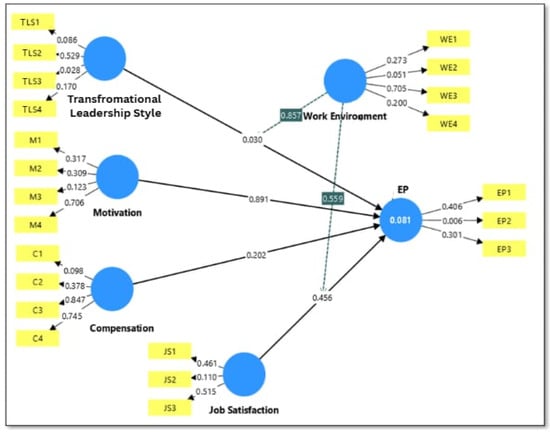
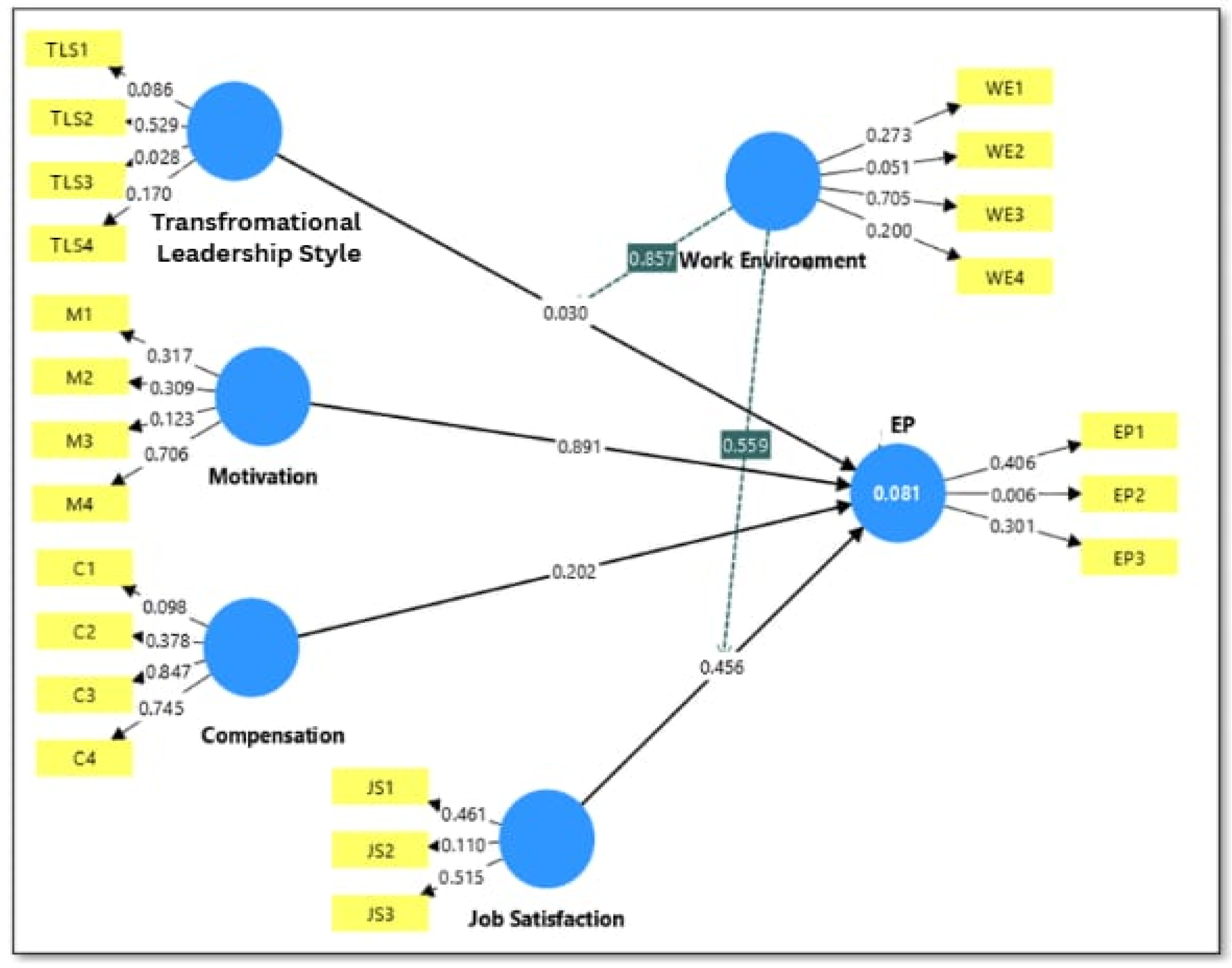
The path coefficient values assessing the influence of various factors on employee performance are displayed in Table 5. Among the direct predictors, job satisfaction shows the strongest positive association with employee performance (path coefficient = 0.356; t = 2.000), followed by motivation (0.315; t = 2.210), work environment (0.286; t = 2.580), and transformational leadership style (0.267; t = 2.171). Compensation also demonstrates a statistically significant but smaller effect (0.163; t = 2.330; p = 0.020).
Table 5.
Path Coefficient Values (Done by the Authors).
Regarding interaction terms, the effect of work environment × job satisfaction (0.131; t = 2.000) and work environment × transformational leadership style (0.010; t = 2.110) is weaker in magnitude but still statistically significant (all p < 0.05). These results indicate meaningful associations, though no assumptions of causality are made due to the correlational nature of the data (Figure 2).
Figure 2.
Path Relationship Diagram.
The model’s predictions and explanations validate the strength of the structural model. Employee performance was assessed with an R2 value of 0.61. This means that the variables, which are part of the employee performance model, explain 61% of the differences in the level of employee performance in this study. The Q2 value (Q2 = 0.29) demonstrated that the model is very good at predicting future outcomes. Effect sizes for motivation (f2 = 0.14) and job satisfaction (f2 = 0.16) on employee performance are both classified as small to moderate, whereas transformational leadership (f2 = 0.10) and compensation (f2 = 0.07) are small yet meaningful. The effect sizes of moderating relationships were small: work environment × job satisfaction (f2 = 0.04) and work environment × transformational leadership (f2 = 0.03). The work environment adds explanatory value to these relationships through its moderating impacts on the primary predictors.
5. Discussion
The achieved outcomes highlight the huge importance of job satisfaction, which emerged as the toughest predictor of employees’ performance. This meets previous studies [44,52], sustaining that employees who find personal meaning, clarity in roles, and fairness in their workplace tend to reveal stronger commitment and task performance. This is also consistent with Maslow’s Hierarchy of Needs, as satisfaction reflects the fulfillment of esteem and self-actualization levels, which stand as necessary conditions for optimal productivity [32].
Motivation showed, furthermore, a strong and noteworthy influence on performance. Employees, who are intrinsically driven and extrinsically rewarded, reported higher levels of engagement and discretionary effort, validating findings as stated by [21]. This supports both Maslow’s theory and SET, whereby motivated individuals will more probably reciprocate with improved effort as soon as their needs are met and contributions acknowledged [26,27].
Transformational leadership style, particularly the transformational and participative forms thereof, was significantly associated with enhanced employees’ outcomes, reinforcing the assertions of [33,34], and a more recent work by [36]. In the family business context, where hierarchy and legacy often dominate, visionary and supportive leadership can foster trust and innovation, according to [42]. This backs the role of Transformational Leadership Theory in explaining how leaders are capable of affecting not only direct outputs but also emotional engagement.
Compensation, though substantial, left a comparatively feebler impact. This may be attributed to the condition that compensation serves more as a hygiene factor—a prerequisite rather than a driver of exceptional performance. Nevertheless, it remains a key mechanism for equity and fairness, particularly for employees who are not part of the family, as highlighted by [40] and supported by SET.
The work environment was also found to be positively connected to performance and served as a moderator in the relationships between job satisfaction, leadership, and performance. These results are consistent with the statements of [24,41], who considered that well-designed physical and social environments are able to magnify the impacts of other HRM factors. Consequently, a supportive environment is not only able to directly influence performance, but it can also reinforce the contextual platform for satisfaction and leadership so that they become more impactful.
Interestingly, the moderation effect of the work environment on leadership was statistically significant but relatively weak (β = 0.010), suggesting that, whereas context matters, transformational leadership might have a direct influence regardless of environmental support. In contrast, the work environment had a more meaningful regulating effect on the job satisfaction–performance link, emphasizing the idea that satisfied employees carry out their tasks better when their surroundings are conducive to productivity and well-being.
Expanding on these results, the overall structural model provided strong empirical evidence as every hypothesized relationship was validated. The underlying premise for the relationships, causal pathways, and theoretical rationale was reaffirmed because we observed positive and statistically significant associations within each relationship tested. Additionally, every hypothesis brought together consistent connections among the studied variables, strengthened the relevance of the theoretical frameworks selected, and demonstrated that the full model was strong in predicting variability in employees’ performance.
6. Conclusions, Limitations, and Recommendations
6.1. Conclusions
The current study explored the impact of key HRM factors on the employees’ sustainable performance in Lebanese family companies, such as compensation, transformational leadership style, motivation, job satisfaction, and work environment. Hence, using SEM with the data that has been collected from 511 full-time employees working in multiple industries revealed outcomes that job satisfaction, motivation, and transformational leadership style considerably affect employees’ performance. Although reward had a more modest direct effect, it remained statistically substantial. Moreover, the work milieu was found to be simultaneously a direct predictor of performance and a moderator that expands the relationships among job satisfaction, leadership, and performance.
The outcomes reinforce the significance of fostering a positive organizational culture and supportive work environment to optimize employees’ performance in family-owned businesses. Above all, the study shows that job satisfaction serves as a cornerstone of the employees’ sustainable performance. It further confirms that the transformational leadership style, when practiced through a transformational and participative approach, inspires trust, commitment, and innovation. These findings align with SET, Maslow’s Hierarchy of Needs, and Transformational Leadership Theory, thus providing a multidimensional consideration of how HRM practices are able to strengthen employee performance in legacy-driven enterprises.
6.2. Implications
6.2.1. Theoretical Implications
This study extends the relevance of SET, Maslow’s motivational theory, and Transformational Leadership Theory in the less explored context of Lebanese family-owned businesses by illustrating how they jointly account for performance. The study, through the lens of SET, reinforces that when reciprocal exchanges occur, including fair compensation, situationally supportive leadership, and a positive environment/climate, employees are likely to show greater performance. Maslow’s theory adds clarity with respect to the salient role of motivation and job satisfaction as important antecedents of performance; even in family businesses, which are largely informally governed organizations, employees still seek to fulfill more psychological needs, including recognition, growth, and purpose; all of which are essential conditions for improved performance. In terms of transformational leadership theory, the communication of vision, the displayed support, and the consideration of the leader for followers’ needs can facilitate motivation and job satisfaction by way of improving performance outcomes. To further enhance the theoretical contribution, the study introduces work context as a moderator of the relationships. Collectively, these perspectives may shed greater insights into performance by highlighting the potential for the work context to strengthen or weaken performance in family farms, as well as reinforcing that work motivation and performance cannot be completely isolated from each other, or the work context, particularly in family firms with close-knit relationships/motives and flexible management styles.
6.2.2. Practical Implications and Recommendations
Practically, the study carries actionable insights for family business owners, HR managers, and consultants, whether operating in Lebanon or in analogous emerging economies. First, prioritizing job satisfaction through role clarity, recognition, and employees’ involvement is indispensable. Second, investing in leadership development—particularly for second-generation family leaders—can have a transformative effect on employees’ outcomes. Third, HR departments should adopt structured compensation systems and performance-based incentives to ensure fairness and motivation, especially among non-family employees. Lastly, improving the physical and psychosocial work environment can augment the positive influences of HRM approaches and foster a culture of permanent engagement and productivity.
Based on the results of the study, several actionable suggestions could be recommended to Lebanese family businesses that are seeking to enhance sustainable employee performance. First, organizations should prioritize job satisfaction by implementing transparent performance evaluations, offering recognition programs, and ensuring career development opportunities for employees, whether coming from the family or not. Second, leadership development programs focused on transformational styles should be institutionalized, particularly targeting next-generation family leaders to foster trust and innovation. Third, compensation systems should be revisited to align better with performance metrics and market standards, guaranteeing fairness and equity across the groups of employees. Finally, businesses are recommended to invest in both the physical and psychosocial aspects of the work environment to build inclusive, healthy, and engaging spaces that support high performance and decrease turnover. These integrated efforts can collectively reinforce a culture of commitment, productivity, and long-term viability in family-run enterprises.
6.3. Limitations
Despite its contributions, the present search faces numerous constraints. First of all, the cross-sectional research scheme limits the capability to make causal inferences. Longitudinal studies would be compulsory to track the way HRM interventions might impact performance over time. Secondly, the sample is geographically restricted to relatively stable regions (Beirut, Mount Lebanon, and North Lebanon), due to political and security constraints in other regions such as the South and the Bekaa. This hampers the generalizability of the outcomes. Thirdly, self-reported data could introduce social desirability or common method bias, despite methodological precautions such as anonymity and scale variation. Another possible limitation is that this study does not distinguish among specific transformational leadership styles, which means that future studies could look at specific leadership types—like transformational or participative leadership—and how this affects the relationship among HRM factors and sustainable job performance.
6.4. Future Research
Future studies can constitute a foundation for these findings through the adoption of longitudinal designs to evaluate how changes in HR practices over time affect sustainability and performance. Comparative research between family-owned and other firms in Lebanon could yield deeper insights into the role of ownership structure in defining HRM effectiveness. Furthermore, qualitative research, such as interviews or case studies, will possibly explore employees’ perceptions and cultural influences that quantitative surveys may overlook. Amplifying the sample to encompass firms in the South and Bekaa areas, as well as cross-national comparisons with family businesses in other MENA countries, would also enhance the robustness and transferability of the outcomes. Finally, future studies could look at other leadership types—like participative leadership—and how this affects the relationship among HRM factors and sustainable job performance.
Author Contributions
Conceptualization, J.E.; Methodology, J.S.; Formal analysis, N.B.Z.; Data curation, N.B.Z. and C.S.; Writing—original draft, J.E.; Writing—review & editing, J.S., M.K. and C.S.; Visualization, M.K. All authors contributed equally to the manuscript. All authors have read and agreed to the published version of the manuscript.
Funding
This research received no external funding.
Institutional Review Board Statement
The study was conducted in accordance with the Institutional Review Board rules of USEK University (approval number: HCR/EC 2025-061) on 5 May 2025.
Informed Consent Statement
Informed consent was obtained from all subjects involved in the study.
Data Availability Statement
The data presented in this study are available on request from the corresponding author.
Conflicts of Interest
The authors declare no conflicts of interest.
Appendix A. Survey Questionnaire
| Dear Participants, This survey aims to explore the key factors influencing sustainable employee performance, including compensation, motivation, transformational leadership style, job satisfaction, and work environment. Your participation is voluntary and confidential. Please confirm your willingness to proceed by selecting the appropriate option below. Thank you for your valuable input. |
Before progressing, kindly verify your readiness to contribute to this survey.
I am willing to contribute to this survey.
- □
- Yes, I am willing to contribute.
- □
- No, I am not willing to contribute.
Section 1: Sociodemographic Questions
- Gender:
- □
- Male
- □
- Female
- Age
- □
- Below 20
- □
- 21–30
- □
- 31–40
- □
- 41–50
- □
- 51–60
- □
- Above 60
- Work Experience:
- □
- Less than 1 year
- □
- 1 to 3 years
- □
- 3 to 5 years
- □
- More than 5 years
- Education Level:
- □
- High School
- □
- Undergraduate
- □
- Masters
- □
- Ph.D./DBA
Section 2: Hypotheses Development Questions
Please indicate your level of agreement with the following statements
1 = Strongly Disagree
2 = Disagree
3 = Neutral
4 = Agree
5 = Strongly Agree
| Compensation | 1 | 2 | 3 | 4 | 5 | 6 | 7 | 8 | |
| C1 | ||||||||
| C2 | ||||||||
| C3 | ||||||||
| C4 |
| Work Environment | 1 | 2 | 3 | 4 | 5 | 6 | 7 | 8 | |
| WE1 | ||||||||
| WE2 | ||||||||
| WE3 | ||||||||
| WE4 |
| Motivation | 1 | 2 | 3 | 4 | 5 | 6 | 7 | 8 | |
| M1 | ||||||||
| M2 | ||||||||
| M3 | ||||||||
| M4 |
| Transformational Leadership Style | 1 | 2 | 3 | 4 | 5 | 6 | 7 | 8 | |
| LS1 | ||||||||
| LS2 | ||||||||
| LS3 | ||||||||
| LS4 |
| Transformational Leadership Style | 1 | 2 | 3 | 4 | 5 | 6 | 7 | 8 | |
| JS1 | ||||||||
| JS2 | ||||||||
| JS3 |
| Employee Performance | 1 | 2 | 3 | 4 | 5 | 6 | 7 | 8 | |
| EP1 | ||||||||
| EP2 | ||||||||
| EP3 |
References
- Paulraj, A. Understanding the Relationships between Internal Resources and Capabilities, Sustainable Supply Management and Organizational Sustainability. J. Supply Chain Manag. 2011, 47, 19–37. [Google Scholar] [CrossRef] [Scilit]
- Chehimi, F. Management Succession of Micro-Small and Medium Family-Owned Enterprises in Lebanon. Ph.D. Thesis, University of Staffordshire, Stoke-on-Trent, UK, 2025. [Google Scholar]
- Beckhard, R.; Dyer, W.G., Jr. Managing Continuity in the Family-Owned Business. Organ. Dyn. 1983, 12, 5–12. [Google Scholar] [CrossRef] [Scilit]
- Ward, J. Keeping the Family Business Healthy: How to Plan for Continuing Growth, Profitability, and Family Leadership; Springer: Berlin/Heidelberg, Germany, 2016; ISBN 0-230-11612-4. [Google Scholar]
- Hull, C.E.; Rothenberg, S.; Vogt, S. The Financial Impact of High-Performance Work Practices: The Moderating Effects of Labor Market Flexibility and Labor Market Efficiency. Contemp. Manag. Res. 2019, 15, 247–272. [Google Scholar] [CrossRef] [Scilit]
- Fahed-Sreih, J.; Pistrui, D.; Huang, W.V.; Welsch, H.P. Family and Cultural Factors Impacting Entrepreneurship in War Time Lebanon. Int. J. Entrep. Innov. Manag. 2010, 12, 35–51. [Google Scholar] [CrossRef] [Scilit]
- Lukito, D.; Susanti, M.; Susanto, Y.; Judijanto, L.; Ali, M.; Mahardhani, A.J. Determinants of Sustainable Employee Performance: A Study of Family Businesses in Indonesia. Asia Pac. Manag. Rev. 2025, 30, 100340. [Google Scholar] [CrossRef] [Scilit]
- Febrianti, I.T.D.; Andriani, H. The Effect of Compensation Policy and Work Discipline on Nurse Productivity at Dr. H. Marzoeki Mahdi Mental Hospital Bogor in 2023. J. Indones. Health Policy Adm. 2024, 9, 1. [Google Scholar] [CrossRef] [Scilit]
- Michiels, A.; Arijs, D.; Uhlaner, L. Formal HRM in Family SMEs: The Role of Family-Centered Goals and Family Governance. Rev. Manag. Sci. 2022, 16, 2553–2576. [Google Scholar] [CrossRef] [Scilit]
- Lambrechts, F.; Gnan, L. Human Resources and Mutual Gains in Family Firms: New Developments and Possibilities on the Horizon. J. Fam. Bus. Strategy 2022, 13, 100502. [Google Scholar] [CrossRef] [Scilit]
- Lyu, Z.; Yang, X. Strategic Alignment of Leadership and Work Climate: Field Experiment on Context-Dependent Supervision Effectiveness. Adm. Sci. 2025, 15, 385. [Google Scholar] [CrossRef] [Scilit]
- Forés, B.; Fernandez-Yanez, J.M.; Camisón-Zornoza, C.; Kallmuenzer, A.; Valeri, M. Unveiling Structural and Emotional Drivers of Dynamic Capabilities in Family Firms: The Contingent Role of Firm Size. Bus. Process Manag. J. 2025, 31, 2126–2151. [Google Scholar] [CrossRef] [Scilit]
- Ramez, W.I. The Effect of Nepotism on Engagement and Turnover Intention in Lebanese Family Businesses. J. Lang. Linguist. Stud. 2023, 19, 448–469. [Google Scholar]
- Bernhard, F. Psychological Ownership in Family Businesses: Three Essays on Antecedents and Consequences; BoD–Books on Demand: Norderstedt, Germany, 2011; Volume 5, ISBN 3-8441-0049-0. [Google Scholar]
- Meng, J.; Berger, B.K. The Impact of Organizational Culture and Leadership Performance on PR Professionals’ Job Satisfaction: Testing the Joint Mediating Effects of Engagement and Trust. Public Relat. Rev. 2019, 45, 64–75. [Google Scholar] [CrossRef] [Scilit]
- Asrar-ul-Haq, M.; Kuchinke, K.P. Impact of Transformational leadership styles on Employees’ Attitude towards Their Leader and Performance: Empirical Evidence from Pakistani Banks. Future Bus. J. 2016, 2, 54–64. [Google Scholar] [CrossRef] [Scilit]
- Jena, L.K.; Pradhan, S.; Panigrahy, N.P. Pursuit of Organisational Trust: Role of Employee Engagement, Psychological Well-Being and Transformational Leadership. Asia Pac. Manag. Rev. 2018, 23, 227–234. [Google Scholar] [CrossRef] [Scilit]
- Abdelwahed, N.A.A.; Soomro, B.A.; Shah, N. Predicting Employee Performance through Transactional Leadership and Entrepreneur’s Passion among the Employees of Pakistan. Asia Pac. Manag. Rev. 2023, 28, 60–68. [Google Scholar] [CrossRef] [Scilit]
- Lee, M.C.C.; Sim, B.Y.H.; Tuckey, M.R. Comparing Effects of Toxic Leadership and Team Social Support on Job Insecurity, Role Ambiguity, Work Engagement, and Job Performance: A Multilevel Mediational Perspective. Asia Pac. Manag. Rev. 2024, 29, 115–126. [Google Scholar] [CrossRef] [Scilit]
- Ackah, D. The Impact of Motivation on Employee Performance in the Manufacturing Industry in Ghana. Glob. J. Manag. Stud. Res. 2014, 1, 291–310. [Google Scholar]
- Makdissi, R.; Mekdessi, S. Motivating the Workforce: A Key to Enhancing Financial Performance in Lebanese SMEs. Innov. J. Soc. Sci. Econ. Rev. 2024, 9, 4789–4799. [Google Scholar] [CrossRef] [Scilit]
- Idris, I.; Adi, K.R.; Soetjipto, B.E.; Supriyanto, A.S. The Mediating Role of Job Satisfaction on Compensation, Work Environment, and Employee Performance: Evidence from Indonesia. Entrep. Sustain. Issues 2020, 8, 735–750. [Google Scholar] [CrossRef] [Scilit]
- Ramli, A.H. Compensation, job satisfaction and employee performance in health services. Bus. Entrep. Rev. 2019, 18, 177–186. [Google Scholar] [CrossRef] [Scilit]
- Khan, M.; Mahmood, A.; Shoaib, M. Role of Ethical Leadership in Improving Employee Outcomes through the Work Environment, Work-Life Quality and ICT Skills: A Setting of China-Pakistan Economic Corridor. Sustainability 2022, 14, 11055. [Google Scholar] [CrossRef] [Scilit]
- Abouelela, A. The Effectiveness of the Role of Interior Design in Creating Functional and Institutional Happiness for Work Environments: King Faisal University as a Model. Designs 2022, 6, 45. [Google Scholar] [CrossRef] [Scilit]
- Kieserling, A. Blau (1964): Exchange and Power in Social Life. In Schlüsselwerke der netzwerkforschung; Springer: Berlin/Heidelberg, Germany, 2018; pp. 51–54. [Google Scholar]
- Cropanzano, R.; Mitchell, M.S. Social Exchange Theory: An Interdisciplinary Review. J. Manag. 2005, 31, 874–900. [Google Scholar] [CrossRef] [Scilit]
- Wayne, S.J.; Shore, L.M.; Liden, R.C. Perceived organizational support and leader-member exchange: A social exchange perspective. Acad. Manag. J. 1997, 40, 82–111. [Google Scholar] [CrossRef] [Scilit]
- Kaltiainen, J.; Lipponen, J.; Holtz, B.C. Dynamic Interplay Between Merger Process Justice and Cognitive Trust in Top Management: A Longitudinal Study. J. Appl. Psychol. 2017, 102, 636. [Google Scholar] [CrossRef] [Scilit]
- Neher, A. Maslow’s Theory of Motivation: A Critique. J. Humanist. Psychol. 1991, 31, 89–112. [Google Scholar] [CrossRef] [Scilit]
- Alvesson, M.; Willmott, H. Identity Regulation as Organizational Control: Producing the Appropriate Individual. J. Manag. Stud. 2002, 39, 619–644. [Google Scholar] [CrossRef] [Scilit]
- Rojas, M.; Méndez, A.; Watkins-Fassler, K. The Hierarchy of Needs Empirical Examination of Maslow’s Theory and Lessons for Development. World Dev. 2023, 165, 106185. [Google Scholar] [CrossRef] [Scilit]
- Bass, B.M. Leadership and Performance Beyond Expectations; Free Press: New York, NY, USA, 1985; Volume 25. [Google Scholar]
- Judge, T.A.; Piccolo, R.F. Transformational and Transactional Leadership: A Meta-Analytic Test of Their Relative Validity. J. Appl. Psychol. 2004, 89, 755–768. [Google Scholar] [CrossRef] [Scilit]
- Wang, G.; Oh, I.-S.; Courtright, S.H.; Colbert, A.E. Transformational Leadership and Performance Across Criteria and Levels: A Meta-Analytic Review of 25 Years of Research. Group Organ. Manag. 2011, 36, 223–270. [Google Scholar] [CrossRef] [Scilit]
- Gui, C.; Luo, A.; Zhang, P.; Deng, A. A Meta-Analysis of Transformational Leadership in Hospitality Research. Int. J. Contemp. Hosp. Manag. 2020, 32, 2137–2154. [Google Scholar] [CrossRef] [Scilit]
- Flamini, G.; Pittino, D.; Visintin, F. Family Leadership, Family Involvement and Mutuality HRM Practices in Family SMEs. J. Fam. Bus. Strategy 2022, 13, 100468. [Google Scholar] [CrossRef] [Scilit]
- Fries, A.; Kammerlander, N.; Leitterstorf, M. Transformational leadership styles and Leadership Behaviors in Family Firms: A Systematic Literature Review. J. Fam. Bus. Strategy 2021, 12, 100374. [Google Scholar] [CrossRef] [Scilit]
- Lin, M.-H.; Yen, Y.-H.; Chuang, T.-F.; Yang, P.-S.; Chuang, M.-D. The Impact of Job Stress on Job Satisfaction and Turnover Intentions among Bank Employees during the COVID-19 Pandemic. Front. Psychol. 2024, 15, 1482968. [Google Scholar] [CrossRef] [Scilit]
- Bokaii, L. The Impact of Compensation Benefits on Retaining Talented Employees: The Case of Lebanon. Manag. Econ. Rev. 2023, 8, 98–108. [Google Scholar] [CrossRef] [Scilit]
- Öhrn, M.; Wahlström, V.; Harder, M.S.; Nordin, M.; Pettersson-Strömbäck, A.; Bodin Danielsson, C.; Olsson, D.; Andersson, M.; Slunga Järvholm, L. Productivity, Satisfaction, Work Environment and Health after Relocation to an Activity-Based Flex Office—The Active Office Design Study. Int. J. Environ. Res. Public Health 2021, 18, 7640. [Google Scholar] [CrossRef] [Scilit]
- Zeidan, F. Family Business in Lebanon: Leadership Practices and Continuity. Ph.D. Thesis, Hungarian University of Agriculture and Life Science, Budapest, Hungary, 2021. [Google Scholar]
- Kaur Bagga, S.; Gera, S.; Haque, S.N. The Mediating Role of Organizational Culture: Transformational Leadership and Change Management in Virtual Teams. Asia Pac. Manag. Rev. 2023, 28, 120–131. [Google Scholar] [CrossRef] [Scilit]
- Inuwa, M.; Muhammad, A. Impact of Job Satisfaction on Performance of Non-Academic Staff of Bauchi State University Gadau: The Moderating Effect of Physical Working Environment. IIARD Int. J. Econ. Bus. Manag. 2016, 2, 60–77. [Google Scholar]
- Taherdoost, H. What is the best response scale for survey and questionnaire design; review of different lengths of rating scale/attitude scale/Likert scale. Int. J. Acad. Res. Manag. (IJARM) 2019, 8, 1–10. [Google Scholar]
- Thompson, R.L.; Higgins, C.A.; Howell, J.M. Influence of Experience on Personal Computer Utilization: Testing a Conceptual Model. J. Manag. Inf. Syst. 1994, 11, 167–187. [Google Scholar] [CrossRef] [Scilit]
- Scarpello, V.; Huber, V.; Vandenberg, R.J. Compensation satisfaction: Its measurement and dimensional ity. J. Appl. Psychol. 1988, 73, 163. [Google Scholar] [CrossRef]
- Fletcher, T.D.; Nusbaum, D.N. Development of the competitive work environment scale: A multidimensional climate construct. Educ. Psychol. Meas. 2010, 70, 105–124. [Google Scholar] [CrossRef] [Scilit]
- Vallerand, R.J.; Pelletier, L.G.; Blais, M.R.; Briere, N.M.; Senecal, C.; Vallieres, E.F. The Academic Motivation Scale: A measure of intrinsic, extrinsic, and amotivation in education. Educ. Psychol. Meas. 1992, 52, 1003–1017. [Google Scholar] [CrossRef] [Scilit]
- Carless, S.A.; Wearing, A.J.; Mann, L. A short measure of transformational leadership. J. Bus. Psychol. 2000, 14, 389–405. [Google Scholar] [CrossRef] [Scilit]
- Ho, C.L.; Au, W.T. Teaching satisfaction scale: Measuring job satisfaction of teachers. Educ. Psychol. Meas. 2006, 66, 172–185. [Google Scholar] [CrossRef] [Scilit]
- Chaanine, J.C. The Efficiency of Management by Working Around: The Case of Lebanese Healthcare Organizations. SAGE Open 2025, 15, 21582440251330105. [Google Scholar] [CrossRef] [Scilit]

Disclaimer/Publisher’s Note: The statements, opinions and data contained in all publications are solely those of the individual author(s) and contributor(s) and not of MDPI and/or the editor(s). MDPI and/or the editor(s) disclaim responsibility for any injury to people or property resulting from any ideas, methods, instructions or products referred to in the content. |
© 2026 by the authors. Licensee MDPI, Basel, Switzerland. This article is an open access article distributed under the terms and conditions of the Creative Commons Attribution (CC BY) license.