


Abstract
Corporate digital intelligence transformation (DIT) has become a crucial factor influencing the carbon intensity (CI) of enterprises in the digital economy era. The purpose of this study is to examine how DIT affects CI and its underlying mechanisms. Using panel data from China’s listed manufacturing enterprises spanning from 2012 to 2023, this paper employs a fixed-effect model, an instrumental variable model, a moderation model and a stepwise regression method to investigate the impact of DIT on CI. The results show that (1) DIT is significantly negatively associated with CI, as confirmed by extensive robustness and endogeneity tests; (2) the impact of DIT on CI is pronounced in different groups of enterprises and is significant in non-state-owned enterprises, high-tech enterprises, high-polluting enterprises and firms in low-carbon pilot cities; (3) government innovation subsidy also reinforces the CI reduction effect of DIT; (4) mediation analysis indicates that the negative association between DIT and CI operates through enhanced green technological innovation and improved human capital structure. The results extend the research and theoretical perspective on enterprises’ low-carbon development and the influence of digital intelligence transformation.
1. Introduction
As environmental issues like global warming and frequent extreme weather worsen, the climate crisis has created urgent demands for countries worldwide to reduce carbon emissions. According to the International Energy Agency, China’s energy-related carbon dioxide emissions totaled 11.13 billion tons in 2023, representing 32.1% of global emissions [1]. To promote energy conservation, emission reductions, and greener economic development, the Chinese government aims to peak carbon emissions by 2030 and achieve carbon neutrality by 2060, known as the “dual-carbon” goal. Under this goal, manufacturing enterprises, as the main emitters and key units for emission reduction, are facing increasing pressure to reduce emissions. Consequently, finding ways to assist enterprises in emission reduction and green transformation has become a major research focus.
Digital transformation has rapidly reshaped businesses and organizations. China’s digital economy has grown rapidly in recent years. According to the “2024 Research Report on the Development of China’s Digital Economy” released by the China Academy of Information and Communications Technology (CAICT), China’s digital economy reached 53.9 trillion yuan in 2023, accounting for 42.8% of GDP. Industrial digitalization alone accounted for 81.3% [2]. Digital transformation refers to the unprecedented changes in organizations driven by advancements in technologies like artificial intelligence, block chain, cloud computing and big data analysis [3]. In recent years, however, digitalization and intelligence have become increasingly intertwined. Firms are not only adopting digital technologies but also embedding intelligent technologies into production and management. We refer to this integrated process as digital intelligence transformation (DIT). Compared with conventional digital transformation, DIT extends beyond information processing and connectivity to encompass intelligent decision-making, automation, and data-driven optimization and therefore may offer greater potential for energy saving and carbon reduction. Against this backdrop, the carbon emission reduction effect brought about by the DIT of Chinese enterprises deserves special attention.
However, DIT is a complex and systematic project. Can DIT improve corporate carbon intensity (CI)? What are the underlying mechanisms? These issues have attracted scholarly attention.
Numerous studies have examined the impact of digital and intelligent technologies on enterprises’ development. Digital technology has changed the way employees work [4], enhances worker productivity [5], and aids enterprises with decentralized innovation structures to increase profits [6] and reduce economic costs [7]. The introduction of digital technology has improved the information environment, accelerated communication, and strengthened the ability to capture and analyze data, enabling enterprises to better explore potential consumer demands [8]. Digitalization can significantly enhance production practices and management models [9], prompting enterprises to increase innovation investment and improve total factor productivity and core competitiveness [10]. Furthermore, some studies suggest that digitalization can foster sustainable corporate development [11], enhance ESG performance [12], and contribute to long-term sustainability [13].
Digitalization has enhanced operational efficiency and management precision while also creating new opportunities for low-carbon development [14]. Despite growing recognition of digital and intelligent technology’s role in corporate low-carbon transition, research on this topic remains limited. Moreover, these studies focus solely on the impact of digital transformation or artificial intelligence on carbon emission reduction, and their conclusions are not consistent. Based on the findings, the relevant literature is categorized into three groups.
The first category of findings indicates that digital transformation or artificial intelligence can help reduce carbon emissions. They have proved that digital transformation contributes to the reduction in corporate carbon emissions and the advancement of carbon performance. This is achieved through internal mechanisms such as improved resource utilization efficiency and total factor productivity [15], enhanced environmental information disclosure [16], strengthened supply chain collaboration [17], and optimized factor allocation efficiency [18]. These elements collectively create favorable conditions for emission reduction and performance enhancement. Zhou and Liu (2024) observed the carbon reduction effect of digital transformation [19]. The positive impact of artificial intelligence on environmental performance in enterprises has also been confirmed by the relevant literature [20,21,22,23]. Che et al. (2025) found that artificial intelligence promotes green management innovation through digital, financing, operational, and R&D empowerment, collectively helping enterprises overcome the dilemma of high pollution [24]. Artificial intelligence can significantly enhance the ESG performance of enterprises [25]. Empirical studies have found that artificial intelligence technology significantly reduces carbon emission intensity at the enterprise level [26,27].
While many studies have confirmed digital transformation or artificial intelligence can reduce carbon emissions, the second group of studies presents a contrasting view. Jevons posited that while the adoption of new technologies may increase energy intensity, it also stimulates economies of scale, exacerbating energy consumption and environmental pollution; this is known as the “Jevons Paradox” [28]. Teng and Zheng (2023) [29] provided empirical confirmation for the existence of this paradox. Some scholars argued that digitalization hampers corporate energy conservation and emission-reduction efforts. They suggested that the application of digital technologies within enterprises leads to increased demands for digital infrastructure, data transmission, and connectivity, raising overall energy consumption and resulting in a digital rebound effect [22]. This phenomenon, in turn, contributes to higher corporate carbon intensity [30,31].
The third category of literature indicates a non-linear relationship between digital transformation or artificial intelligence and carbon emissions. Wang and Yu (2024) [32] found that the relationship between digitalization and carbon emission efficiency is significantly U-shaped. He et al. (2025) [33] studied steel companies and demonstrated a U-shaped relationship between digital transformation and corporate carbon emissions. In contrast, Zhang et al. (2026) [34] found an inverted U-shaped relationship between digital transformation and corporate carbon emissions. Wu and Zhang (2025) [35] categorized AI innovation into AI application innovation and AI method innovation. They found that AI method innovation consistently improved environmental performance, whereas AI application innovation exhibited a U-shaped relationship with environmental performance.
In summary, the impact of corporate digital transformation and AI on carbon emissions remains debated. This can be attributed to differences in research methodologies, sample selection, and the complexity of the underlying mechanisms linking digital transformation and artificial intelligence to corporate carbon emissions. With the evolution of the digital economy, DIT has emerged as an advanced form that integrates digitalization and intelligence. Therefore, this paper adopts DIT as the independent variable, aiming to construct a more comprehensive and systematic framework that can explore the effective path of carbon emission reduction in manufacturing enterprises more widely.
This study selects Chinese listed manufacturing companies from 2012 to 2023 as the research sample to investigate the impact of DIT on CI and its underlying mechanisms, along with the moderating effect of government innovation subsidy. The aim is to provide theoretical evidence for identifying carbon emission reduction pathways at the micro-enterprise level. The potential marginal contributions of this paper are as follows: (1) From an integrated research perspective, this study extends the literature on digital transformation and artificial intelligence by conceptualizing DIT as an integrated firm-level transformation that encompasses both digital transformation and artificial intelligence. Unlike the existing studies that focus solely on digital transformation or artificial intelligence, this research develops a unified analytical framework to investigate how the integration of these technologies is associated with corporate CI. This provides a broader perspective for understanding the environmental consequences of firms’ digital and intelligent transformation. (2) Regarding research mechanisms, this paper explores how DIT influences CI through green technology innovation and human capital optimization. In addition, we examine government innovation subsidies as a moderating factor that may strengthen the negative association between DIT and CI. By incorporating both internal transmission mechanisms and external institutional conditions into a unified framework, this study provides a more comprehensive explanation of not only how DIT affects CI but also under what conditions its environmental benefits are more pronounced. (3) This study identifies firm-level and city-level boundary conditions of the DIT–CI relationship. By conducting heterogeneity analyses across ownership, technological capability, pollution levels and city status, the study provides evidence at both the firm and city levels and offers more targeted implications for policymakers seeking to promote differentiated low-carbon transformation strategies across different types of enterprises and regional contexts.
2. Theoretical Analysis and Hypothesis Development
Socio-technical system theory emphasizes that technology-driven transformations generate performance gains only when technical and social subsystems are aligned [36,37]. Based on this view, we believe that low-carbon development is not automatic but a social and technological transformation that combines digital intelligence technology and human capital. Therefore, its carbon reduction effect is not automatic but depends on complementary internal capabilities and external resources. This framework has generated three pathways: technology, human and policy.
2.1. The Direct Effect of DIT on CI
First, with the widespread use of digital technologies, enterprises are able to utilize resources more efficiently and adopt greener production methods. For instance, the application of big data analysis and artificial intelligence technology in production enables enterprises to improve energy efficiency, optimize manufacturing processes, and reduce emissions. Second, digital intelligence transformation has encouraged the use of virtual meetings and remote collaboration tools, reducing carbon emissions related to travel. Third, digital intelligence technology helps industrial enterprises monitor their energy consumption and carbon emissions in real time, optimize their carbon emission management mechanisms, and reduce reliance on non-clean energy. This provides a technical foundation for developing and utilizing clean energy, driving emission reductions and efficiency improvements. Finally, DIT enhances transparency in enterprise information and facilitates carbon emissions trading, thereby decreasing CI. These impacts may vary across industries and firm sizes, depending on the level and sophistication of digital technology adoption [38,39].
Therefore, Hypothesis 1 (H1) is formulated as follows:
H1.
Digital intelligence transformation reduces the corporate carbon intensity.
2.2. Moderating Effect of Government Innovation Subsidy
Government innovation subsidy (GIS) can support enterprises in strengthening technological transformation and carbon reduction. First, according to stakeholder theory, external stakeholders of enterprises may not have the ability to control key organizational resources, but they can regulate and support enterprises’ low-carbon practices [40]. The government is the primary external stakeholder for the low-carbon practices of Chinese manufacturing enterprises, as its subsidies provide financial support for their low-carbon development. Second, GIS can promote research motivation and capabilities, ultimately decreasing carbon emissions. Specifically, given the public nature of carbon reduction, government investment can improve returns or lower costs for organizations. Emission reduction and DIT transformation call for substantial R&D investment and long-term commitment, which may discourage organizations from participating. GIS can reduce the entry barriers for enterprises’ digital intelligence transformation and emission reduction, thereby enhancing their enthusiasm for these initiatives. Lastly, because carbon emission reduction is a public good, investors cannot fully monopolize its benefits. GIS can enhance the joint carbon reduction effect of governments, universities, and enterprises by promoting collaboration among them. According to signal theory, GIS can serve as a signal from the government to enterprises, and even their respective industries, indicating that an enterprise’s low-carbon innovation technology or project has received government recognition and support. Based on this signal, the enterprise can attract more innovative resources from external investors, thereby enhancing low-carbon innovation performance [41]. This signal also influences the decision-making behavior of other stakeholders in the enterprise’s supply chain. For example, some downstream customers may prioritize suppliers that comply with environmental regulations, use low-carbon raw materials, and adopt low-carbon processes or technologies [42]. Enterprises will also choose low-carbon strategies that align with their needs to ensure competitive advantage.
In summary, this study propounds the second hypothesis (H2):
H2.
GIS strengthens the effect of DIT on CI.
2.3. The Transmission Mechanism of DIT on CI
This study explores the intrinsic mechanisms through which digitalization decreases corporate carbon intensity. As digital intelligence transformation permeates every aspect of a company, this study identifies two key transformational pathways: green technology innovation and human capital structure optimization. Corporate DIT is a comprehensive and full-process endeavor. These pathways reflect a company’s primary focus or strategic emphasis rather than implying that digital intelligence transformation is limited to any single dimension.
2.3.1. The Transmission Mechanism of Green Technology Innovation
The theory of ecological modernization posits that coordinated environmental and economic development can be achieved through technological upgrading and policy optimization [43]. Digitalization is a process in which digital technologies trigger disruptive changes, prompting organizations to alter their value creation paths [44]. Green technology innovation (GTI) refers to technological or product innovations that enhance environmental performance and address challenges like ecological degradation, pollution, energy shortages, and resource depletion [45]. The positive impact of digitalization on GTI has been confirmed by numerous studies [46,47,48,49,50]. This impact can be understood in three ways. First, digitalization facilitates more efficient government supervision of environmental regulations. According to the Porter hypothesis, well-designed and stringent environmental regulations can compel enterprises to upgrade their technologies and optimize resource utilization efficiency [51]. Second, digitalization deeply integrates digital technology with elements like enterprise structure and business processes. By overcoming traditional boundaries through knowledge spillover, it optimizes information processing and resource allocation efficiency, constructs a new organizational ecosystem, and enhances innovation potential. Third, the introduction of digitalization and artificial intelligence can assist technical personnel in accomplishing fundamental tasks such as information retrieval and data processing more efficiently, thereby enabling them to focus more on green technology innovation.
The application of green technology can upgrade traditional production tools to enhance energy utilization. Enterprises also overcome energy input constraints by innovatively combining production resources, driving increased marginal output from energy consumption. Additionally, technological innovation can drive enterprises to rationally utilize innovative robotic equipment for collaborative management, which can separate and treat pollutants while manufacturing products, thereby reducing pollution emissions. Moreover, green technologies, such as carbon capture systems that capture and process carbon dioxide through technical means, can reduce the final carbon emissions. Captured carbon dioxide can also be applied in fields such as casting, metal smelting, firefighting, and food processing.
Given the aforementioned analysis, we propose the Hypothesis 3 (H3):
H3.
DIT will indirectly decrease CI through the enhancement of green technology innovation.
2.3.2. The Transmission Mechanism of Human Capital Optimization
The most prominent feature of artificial intelligence is its ability to replace labor [52,53], particularly in low-skilled jobs. DIT fosters the accumulation of skilled talent and optimizes the human capital structure (HC) [54], as it requires a large number of highly skilled technical and managerial personnel. Furthermore, digitized enterprises benefit from more efficient information exchange with external stakeholders. According to signal theory, in the labor market, a firm’s adoption of digital technologies signals high quality, attracting top-tier job applicants.
As highly qualified personnel integrate into corporate operations and management, they improve processes, reduce resource waste, and accelerate the adoption of new knowledge and technologies. This enhances the technical capacity for energy conservation and emission reduction. Moreover, the advanced educational background of such talent fosters stronger energy-saving awareness, further cultivating a corporate culture oriented toward emission reduction. This, in turn, increases the willingness to pursue carbon mitigation and removes human capital barriers to energy system transition and green transformation [55].
Thus, we propose Hypothesis 4 (H4):
H4.
DIT will indirectly influence CI via the optimization of HC.
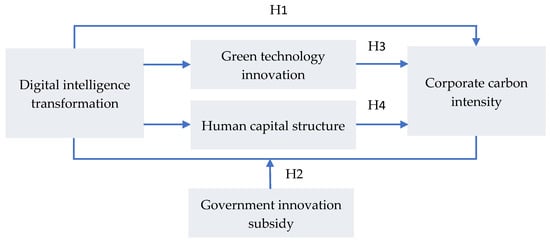
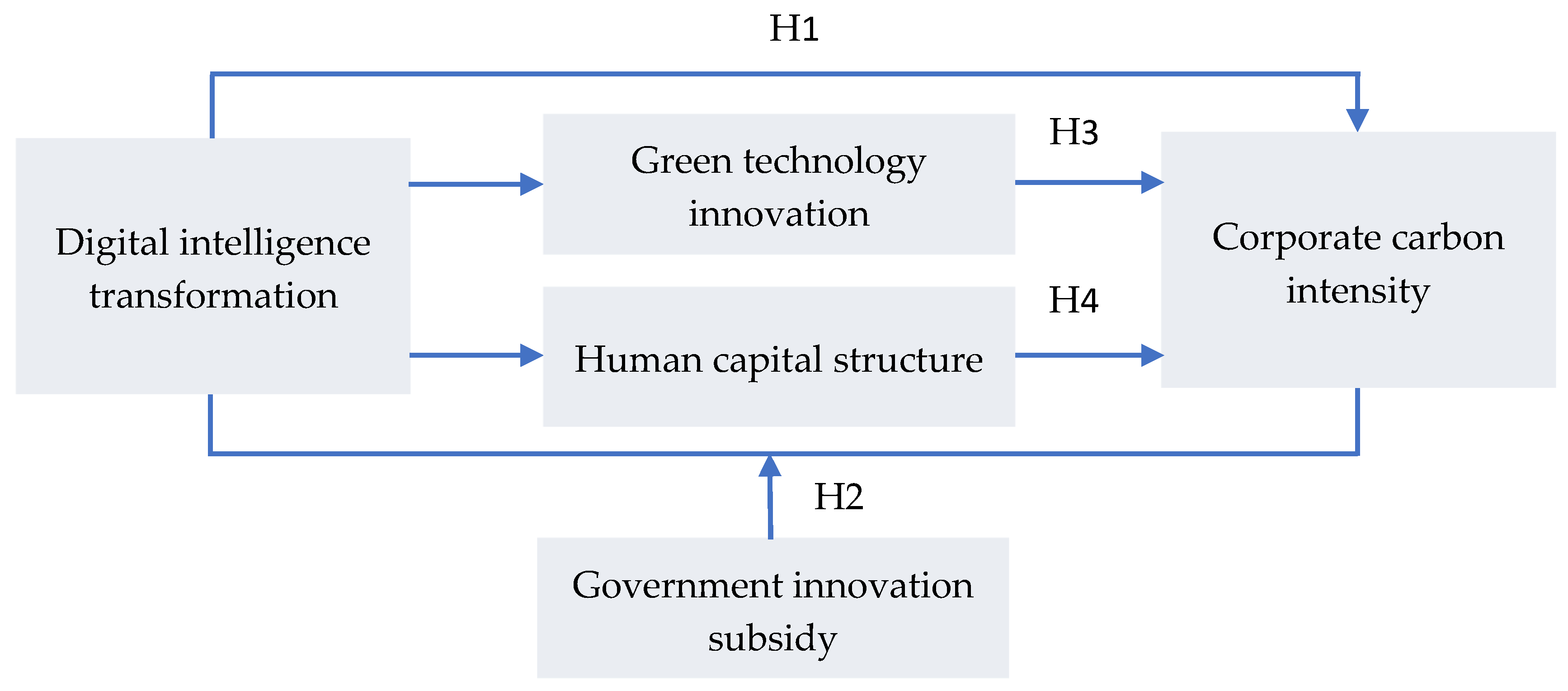
The theoretical model of this paper is shown in Figure 1.
Figure 1.
Theoretical model.
3. Variables and Methods
3.1. Variables
3.1.1. Dependent Variable: Carbon Intensity
This paper adopts the method from Shen and Huang (2019) [56], using the ratio of carbon emissions (CE) to corporate operating income (OI) to measure carbon intensity, denoted as CI, as shown in Equation (1):
The carbon dioxide emissions () from a given company i in sector j were calculated according to Equation (2):
In Equation (2), denotes the operating cost from company i, and is the total operating cost from the corresponding sector j; is the consumption of type e fuel; represents the net calorific value of type e fuel from the China Energy Statistical Yearbook; refers to the carbon dioxide emission factors of type e fuel.
3.1.2. Independent Variable: Digital Intelligence Transformation
DIT is inherently multidimensional, as it encompasses not only the adoption of digital technologies but also the integration of production technologies and processes. Following Cao et al. (2025) [57], this study uses an indicator system to measure the level of enterprise DIT and employs the entropy weight method to determine the weights of individual indicators. This system encompasses three indexes: attention to digitalization and intelligence, intangible assets related to digitalization, and intelligent technology applications, as shown in Table 1. First, attention to DIT reflects the strategic positioning and application of digital technologies by enterprises. According to the method created by Wu et al. (2021) [58], attention to DIT is represented by the sum of the frequencies of words related to digital transformation and artificial intelligence in corporate annual reports. Second, intangible asset investment captures the resources allocated by enterprises to build digital infrastructure and technological capabilities. Third, different from Cao et al.’s use of the book value of machinery and equipment, which is an accounting-based stock measure, we use industrial robot penetration, which reflects the actual application of intelligent technology in production processes. Following Wang and Dong (2020) [59], we measure the application of intelligent technologies using the industrial robot penetration rate. The main reason is that industrial robots represent the deep integration of intelligent algorithms and advanced technology, and their penetration rate can reflect the level of intelligent application in enterprises. These three dimensions correspond to the digital positioning and application, resource investment in digital capabilities, and intelligent application in the production of enterprises, respectively. Taken together, they provide a multidimensional representation of the extent to which enterprises are undergoing DIT.
Table 1.
Indicator system for DIT.
3.1.3. Moderating Variable
This study follows the methodology of Wang et al. (2017) [60] by identifying government innovation subsidy details within the non-operating income section of corporate annual reports using keyword searches while excluding non-government innovation subsidies. The keywords included, but were not limited to, research and development, innovation, science and technology, and intellectual property. This study measures GIS as the ratio of government innovation subsidy to the company’s total assets.
3.1.4. Mediating Variables
This paper uses GTI and HC as the mediating variables to analyze the transmission mechanism to enhance the impact of DIT on CI. Based on existing research [61], this study adopts the number of corporate green patent applications as a proxy for the level of green technology innovation. Given the time lag in patent grants, patent applications better reflect the level of green technology innovation in a given year than actual patent grants. Data is sourced from the Chinese Research Data Services (CNRDS) platform. GTI is measured by the logarithm of the number of green patent applications plus one.
This study uses the proportion of employees with a master’s degree or higher in listed companies as a proxy for the firm’s HC.
3.1.5. Control Variables
To enhance the precision of the research, this paper draws on the existing literature to introduce the following control variables: (1) Company size (Size): This paper uses a company’s total assets to represent its size. (2) Asset-liability ratio (LEV): This is a core indicator for measuring corporate financial leverage. A higher ratio increases a company’s motivation to participate in carbon trading [62]. We measure a company’s debt-to-asset ratio using the ratio of total liabilities to total assets. (3) Inventory turnover ratio (ITO): ITO is an important gauge of operational efficiency, and higher efficiency facilitates the reduction in corporate carbon intensity [63]. Inventory management is closely related to firms’ operational efficiency and resource utilization. Higher inventory turnover generally indicates more efficient inventory management and working capital utilization [64], which may affect resource consumption and carbon emissions. This paper employs the natural logarithm of the ratio of sales costs to the average inventory balance to measure ITO. (4) Ownership concentration (TOP1): This is measured by the percentage of shares held by the largest shareholder to the total shares outstanding. (5) Return on assets (ROA): This study defines ROA as the ratio of the sum of total profit and financial expenses to the average total assets. (6) Cash flow (Cflow): This is calculated as the ratio of total cash and trading financial assets to total assets. (7) Years listed (Listage): This is measured as the number of years since the firm was listed. (8) Number of employees (StaffNum). Table 2 provides the definitions of the variables.
Table 2.
Variable definitions.
3.2. Data Source
This paper constructs a balanced panel dataset of 930 Chinese A-share listed manufacturing firms over the period 2012–2023, yielding 11,160 observations. The data are sourced from the China Energy Statistical Yearbook, the China Statistical Yearbook, and the databases of the China Information and Communication Research Institute, the China National Intellectual Property Administration, CSMAR and Wind. To enhance sample comparability, this study applies the following data screening criteria: (1) excluding non-industrial firms; (2) excluding ST, *ST, and PT firms; and (3) excluding firms with substantial missing data. For the few missing values, linear interpolation is employed for imputation. To address heteroscedasticity and enhance the smoothness of the data, a logarithmic transformation was performed on the variables: CI, GTI, Size, LEV ITO, TOP1, ROA, Cflow, Listage and StaffNum. To mitigate the influence of outliers, the data have been winsorized at the 1st and 99th percentiles. Table 3 presents the descriptive statistics for all variables.
Table 3.
Descriptive statistics.
3.3. Methods
3.3.1. Benchmark Model
To investigate the impact of the digital economy on carbon dioxide emissions, we employ a two-way fixed-effects model:
In Equation (3), refers to carbon dioxide emission intensity; is the level of digital intelligence transformation; represents a set of control variables; is a constant term; is the coefficient of DIT, which measures the direct impact of DIT on CI. This model also controls the year fixed effect and the company fixed effects . is a stochastic error term.
3.3.2. Moderating Effect Model
Based on Equation (3), Equation (4) is constructed to investigate whether GIS can moderate the relationship between DIT and CI:
If regression coefficients and are significant, the moderating effect exists.
3.3.3. Mediating Effect Model
To empirically examine the mediating mechanism by which DIT impacts CI, we use the stepwise regression method, as shown in Equations (5) and (6):
Through the theoretical analysis in this paper, the impact of DIT on CI is transmitted through two mediating variables: GIT and HC. In Equations (5) and (6), refers to GTI and HC. If regression coefficients and are significant, the transmitting effect exists.
4. Empirical Analysis Results
4.1. Baseline Regression
Based on Equation (3), we conduct a regression analysis, and the baseline regression results are shown in Table 4.
Table 4.
Baseline regression results.
As shown in column (1) of Table 4, without considering control variables, the coefficient of DIT is −0.296 (p < 0.01), indicating a statistically significant negative correlation at the 1% significance level. As control variables are introduced in column (2), the coefficient of DIT remains consistently negative and statistically significant at conventional levels, with a regression coefficient of −0.295. This finding indicates that corporate DIT is significantly negatively associated with firms’ CI. From an economic perspective, a one-standard-deviation increase in DIT is associated with an average decrease of 2.33% (0.295 × 0.079) in CI, approximately a 2.30% reduction (e−0.233 − 1) relative to firms’ carbon intensity levels. Consistent with Hypothesis 1, this result supports the view that DIT reduces CI.
4.2. Endogeneity Test
Due to the presence of unobservable variables, measurement errors, and potential reverse causality, the research model may be subject to potential endogeneity issues. To ensure valid causal inference and mitigate parameter estimation biases caused by endogeneity, this paper employs a two-stage least squares (2SLS) instrumental variable approach.
Many studies [65,66] use historical data on fixed telephone lines in 1984 as an instrumental variable (IV). Regions with a higher density of telephone lines tend to have a stronger foundation for digital development. The density of telephone lines is positively associated with corporate digital intelligence transformation, while its association with carbon emissions is relatively weak. However, using a single year’s data as an instrumental variable may pose challenges in fixed-effects models because the instrument lacks sufficient time-series variation. To address this issue, we construct a time-varying IV by multiplying the number of fixed telephone lines per 100 people in 1984 by the annual number of Internet users (TI). This interaction term TI is used as an IV for DIT.
Table 5 presents the 2SLS results. In the first stage, the coefficient of the IV is statistically significant at the 1% level. In the second stage, the estimated coefficient for DIT is −22.661, significant at the 1% level. Furthermore, the Kleibergen–Paap rk LM statistic is 16.669 (p < 0.001), rejecting the null hypothesis of underidentification. The Kleibergen–Paap rk Wald F statistic is 16.731, exceeding the Stock–Yogo 10% maximal IV size-critical value of 16.380. These results suggest that the proposed instrumental variable is sufficiently relevant and that the weak-instrument concern is not severe.
Table 5.
Instrumental variable test results.
4.3. Robustness Test
4.3.1. Control for Province-Year Fixed Effects
Due to variations in provincial economic development levels, industrial agglomeration, and green low-carbon subsidy policies, provincial characteristics may influence the regression results. To account for the impact of regional factors that change over time, we further incorporate province-by-year fixed effects. Column (1) of Table 6 reports the results that the coefficient of DIT is still significant after controlling for province-year fixed effects.
Table 6.
Robustness testing results.
4.3.2. Change in Sample Interval
China’s digital economy has witnessed sustained and robust growth since 2012. The COVID-19 outbreak in early 2020 served as a new catalyst for corporate digital intelligence transformation while also exerting certain impacts on the overall production and operational activities of enterprises. To minimize the influence of this external shock on the estimation results, data from 2020 onward were excluded, and the sample period was adjusted to 2012 through 2019. Equation (3) was subsequently re-estimated based on the revised sample. Column (2) of Table 6 presents the results after adjusting the sample period, which confirms the negative effect of DIT on CI. Thus, the estimated effect of DIT on CI maintains its robustness after the sample interval adjustment.
4.3.3. Placebo Test
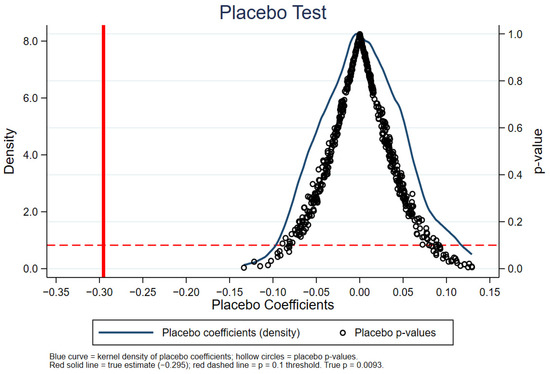
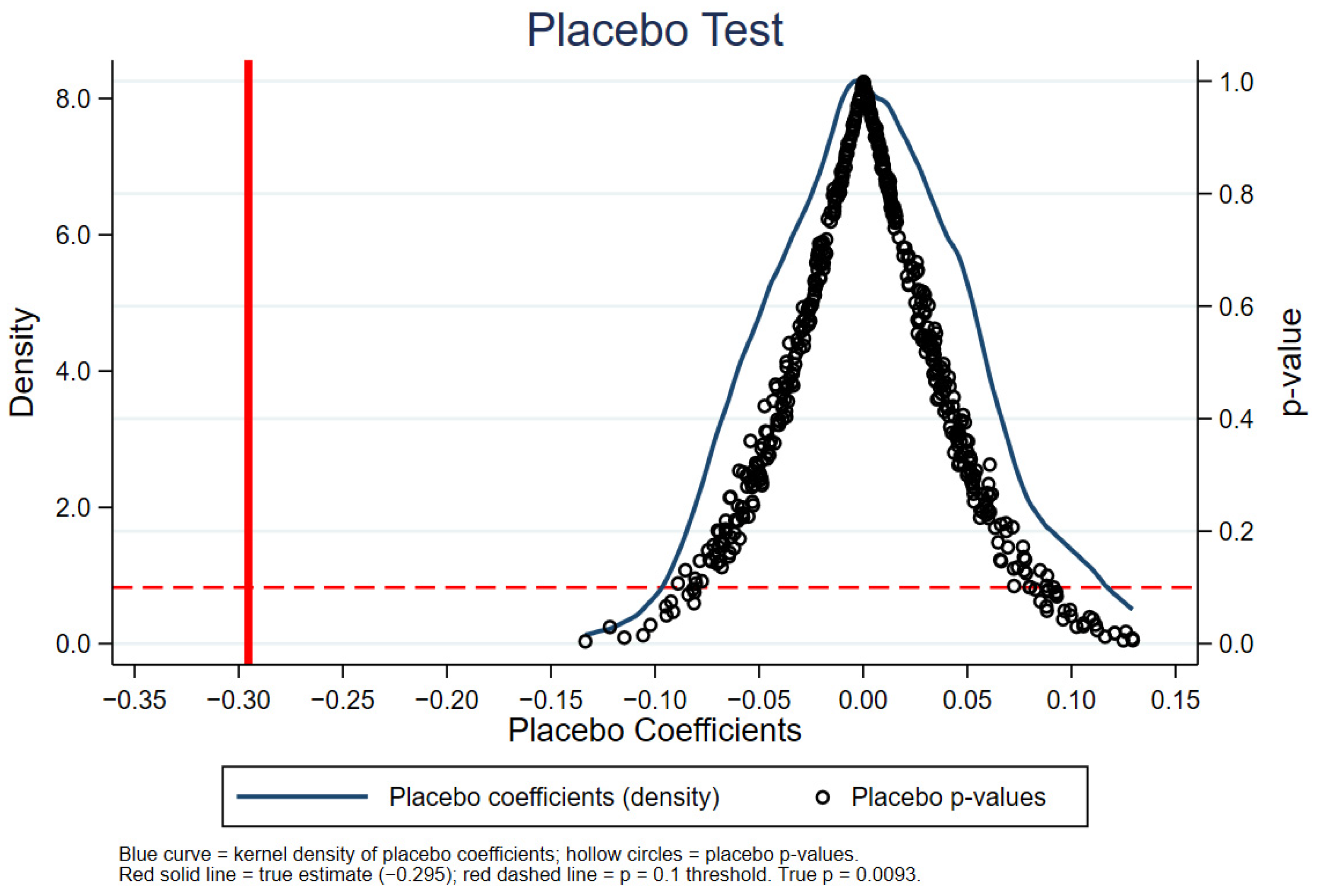
To further verify that the baseline results are not driven by random factors or spurious correlations, a placebo test is conducted using the permutation approach. Figure 2 illustrates the distribution of the estimated coefficients and the corresponding p-values obtained from the permutation tests. As shown in the figure, the estimated coefficients are concentrated around zero, and the vast majority of the associated p-values exceed the conventional significance levels. Moreover, the true estimate, indicated by the red vertical line, lies well outside the distribution of the coefficients obtained from the random permutations. These results suggest that the significantly negative effect of digital intelligence transformation on carbon intensity is unlikely to be attributable to random chance or spurious correlations, thereby providing strong evidence for the robustness of the baseline findings.
Figure 2.
Placebo test result.
4.4. Heterogeneity Analysis
The impact of DIT on CI may vary across firms and institutional environments because firms differ in their incentives, technological capabilities, environmental pressures, and access to supportive policy resources. Accordingly, we examine this heterogeneity in relation to four dimensions: ownership type, technological capacity, pollution level, and local low-carbon policy environment.
4.4.1. Heterogeneity by Firms’ Ownership
To examine the ownership heterogeneity of DIT on CI, we divided the sample into two groups: state-owned enterprises (SOEs) and non-state-owned enterprises (non-SOEs). The analysis in columns (1) and (2) of Table 7 shows that the inhibitory effect of DIT on CI is significant and negative for non-SOEs (coefficient = −0.382, p < 0.05), while the effect for SOEs is statistically insignificant (coefficient = −0.203, p > 0.1). This difference arises from fundamental disparities in corporate goals, resource allocation, regulatory environments, and internal governance across ownership structures. Compared with SOEs, non-SOEs face stronger market pressure to optimize resource efficiency and reduce costs, making them more responsive to the carbon-reduction benefits of DIT. In contrast, SOEs may have more diversified objectives, and their DIT efforts are often subject to multidimensional policy constraints, weakening the direct carbon-reduction effect in the short term.
Table 7.
Heterogeneity analysis results.
We further conduct the Chow test of coefficient differences between groups to examine whether the estimated effects differ significantly across subsamples. The Chow test results are presented in Table 7.
4.4.2. Heterogeneity by Firms’ Technological Capacity
With reference to the methodology of Peng and Mao (2017) [67], and in accordance with the Industry Classification Guidelines for Listed Companies (2012 Revision) issued by the China Securities Regulatory Commission (CSRC) [68], firms with codes C25 to C29, C31 to C32, and C34 to C41 are classified as high-tech enterprises (HTEs). The rest are non-high-tech enterprises (non-HTEs). Columns (3) and (4) of Table 6 report the results for non-HTEs and HTEs, respectively. The CI reduction effect of DIT is significantly negative only for HTEs (coefficient = −0.460, p < 0.01). For non-HTEs in column (3) of Table 7, the coefficient is negative but statistically insignificant (coefficient = −0.160, p > 0.1). A plausible explanation is that high-tech firms generally possess stronger digital infrastructure, higher R&D intensity, and greater technological absorptive capacity, enabling them to integrate digital technologies into production processes and energy management more effectively.
4.4.3. Heterogeneity by Firms’ Pollution Level
Based on the methodology of Pan et al. (2019) [69], firms with industry codes C17, C19, C22, C25, C26, C28–C32, and D44 are classified as high-polluting enterprises (HPEs), while others are categorized as non-high-polluting enterprises (non-HPEs). As shown in column (6) of Table 7, the coefficient of DIT is significantly negative only for HPEs (coefficient = −0.393, p < 0.05). For non-HPEs in column (5) of Table 7, the coefficient is positive and insignificant (coefficient = 0.109, p > 0.1). This indicates that HPEs, which face stricter environmental regulations and higher compliance costs, have stronger incentives to leverage digital intelligence transformation to optimize production processes and reduce carbon emissions. Non-HPEs, under less regulatory pressure, show no significant carbon-reduction effect from DIT.
4.4.4. Heterogeneity by Low-Carbon Pilot City Status
China’s National Development and Reform Commission (NDRC) launched three batches of low-carbon province and low-carbon city pilot programs in 2010, 2012, and 2017. The first batch covered five provinces and eight cities, the second batch included one province and twenty-eight cities, and the third batch comprised forty-one cities and four counties. For cities selected in multiple batches, the implementation year was defined as the year in which they were first designated as pilot areas. Moreover, if a province was approved as a low-carbon pilot province, all cities within that province were classified as low-carbon pilot cities. A dummy variable, LCP, was constructed and assigned a value of 1 if a firm was located in a low-carbon pilot city and 0 otherwise. Columns (7) and (8) of Table 7 indicate that the coefficient of DIT is statistically insignificant for firms located in non-low-carbon pilot cities. In contrast, for firms located in low-carbon pilot cities, the estimated coefficient of DIT is −0.353 and is significantly negative at the 1% level, suggesting that DIT significantly reduces CI in low-carbon pilot cities.
4.5. Moderating Effect Analysis
To examine whether GIS moderates the carbon reduction effect of DIT, we incorporate GIS and its interaction with DIT into the baseline model. Table 8 presents the moderating effect analysis result. As shown in column (2) of Table 8, the coefficient on DIT is significantly negative (coefficient = −0.282, p < 0.05) and that on the interaction is also significantly negative (coefficient = −66.099, p < 0.05), while GIS itself is insignificant. Thus, the carbon abatement effect of DIT strengthens with GIS intensity, indicating that GIS positively moderates the emission-reduction role of DIT, rather than reducing CI directly.
Table 8.
Results of moderating effect analysis.
Because the interaction is mean-centered, the marginal effect of DIT can be calculated by Equation (7). As shown in Table 3, , the mean of GIS, is 0.001, and SD is 0.002.
These results confirm that government innovation subsidy plays a positive moderating role in the relationship between digital intelligence transformation and corporate carbon intensity.
To further assess the economic significance of the moderating effect, Table 9 reports the marginal effects of DIT on CI at different levels of GIS. The estimated marginal effect is −0.244 when GIS is zero, −0.282 at the mean level of GIS, and −0.385 when GIS is one standard deviation above its mean. Correspondingly, a one-standard-deviation increase in DIT is associated with reductions in CI of approximately 1.91%, 2.20%, and 2.99%, respectively. Overall, the marginal-effect estimates indicate that GIS strengthens the negative association between DIT and CI. Thus, H2 is supported.
Table 9.
Marginal effect of DIT at different levels of GIS.
4.6. Mediating Effect Analysis
This paper expounds two transmission mechanisms through which DIT affects CI: promoting green technology innovation (GTI) and optimizing human capital structure (HC). Accordingly, this section employs Equations (5) and (6) for empirical analysis.
4.6.1. The Mediating Role of Green Technology Innovation
Columns (1) and (2) of Table 10 present the mechanism results for green technology innovation (GTI). Column (1) reports the results for the first step of the GTI mechanism. The coefficient of DIT is positive and highly significant at the 1% level (coefficient = 0.525, p < 0.01), indicating that DIT effectively promotes green technology innovation within firms. Column (2) incorporates both DIT and GTI to examine the direct and indirect effects. The coefficient of GTI is significantly negative at the 1% level (coefficient = −0.021, p < 0.01), demonstrating that an improvement in GTI significantly reduces corporate carbon intensity. Meanwhile, the coefficient of DIT remains negative and significant (coefficient = −0.285, p < 0.05), though its magnitude is slightly reduced compared to the baseline. These results suggest that GTI partially mediates the negative association between DIT and CI. To further test the indirect effect, we conduct a bootstrap mediation test with 1000 replications. The 95% confidence interval for the indirect effect is [−0.027, −0.002], which excludes zero, indicating a statistically significant mediation effect. These results suggest that GTI serves as a significant transmission channel through which DIT reduces CI, so H3 is confirmed.
Table 10.
Results of mediating mechanism analysis.
4.6.2. The Mediating Role of Human Capital Structure
Columns (3) and (4) of Table 10 examine the mediating role of human capital structure (HC). Column (3) reports the first step of the mediation: the effect of DIT on the mediator HC. The coefficient of DIT is positive and highly significant at the 1% level (coefficient = 2.454, p < 0.01), indicating that digital intelligence transformation significantly improves firms’ human capital structure. Column (4) includes both DIT and HC to test the second stage. The coefficient of HC is significantly negative at the 5% level (coefficient = −0.010, p < 0.01), while the coefficient of DIT remains significantly negative (coefficient = −0.272, p < 0.05). The finding confirms that HC plays a transmitting role in the relationship between DIT and CI. We also conduct a bootstrap mediation test with 1000 replications. The 95% bootstrap confidence interval for the indirect effect is [−0.052, −0.005], which does not include zero, indicating a statistically significant mediation effect. These results further confirm the significant mediating effect of HC. Thus, H4 is verified.
5. Discussion and Conclusions
5.1. Discussion
While most scholars acknowledge that digital technological innovation drives socio-economic development by improving quality, enhancing efficiency, and supporting transformation and upgrading, concerns about the Solow Paradox in the digital era still exist [70]. This study employs theoretical analysis and econometric models to empirically investigate the impact of DIT on corporate CI. The results indicate that DIT significantly reduces the CI of listed manufacturing companies in China, aligning with the existing literature [57]. The economic scale should not be underestimated, with an average decrease of 2.33% in CI for every one-standard-deviation increase in DIT.
The regulatory role of GIS is consistent with its complementary rather than crowding-out interpretation. Higher GIS strengthens the negative DIT-CI relationship: with the increase in GIS, the marginal effect of DIT becomes more negative. This indicates that public innovation support alleviates financing constraints, shares the risks of digital green investment, and demonstrates the legitimacy of such investments, thereby enabling companies to convert DIT capabilities into actual carbon emission reductions. At the same time, GIS has no significant direct impact on CI, indicating that subsidies themselves cannot reduce emissions and operate by amplifying the DIT of the enterprise itself.
This study examines the impact of DIT on CI, identifying GTI and HC as key mediators in this relationship. The GTI channel reflects innovative responses, as digital and intelligent technologies reduce the costs of search, experimentation, and process optimization, enabling businesses to develop and adopt clean production technologies that reduce unit output emissions. The HC channel reflects the response of human capital, while DIT shifts the demand of enterprises towards skilled labor and enhances the organizational capabilities required to integrate digital tools into energy and carbon management.
Heterogeneity analysis reveals that DIT exerts a significant negative effect on CI in non-state-owned enterprises, high-tech enterprises, highly polluting firms and enterprises in low-carbon pilot cities. However, this relationship is not statistically significant for state-owned enterprises, non-high-tech enterprises, non-heavily polluting enterprises and firms in non-low-carbon pilot cities. Non-SOEs face stronger market competition and profit incentives, and they can reallocate resources toward digital and green investments more quickly. In contrast, SOEs often pursue multiple policy and social objectives and may have longer decision chains. High-tech firms possess more skilled employees, stronger R&D infrastructure, and greater experience in managing complex technologies, enabling them to integrate digital-intelligent systems into production and energy management more effectively. Non-high-tech firms may lack these complementary assets, so their DIT investments generate fewer carbon-reduction returns. Compared to non-HPEs, HPEs face greater regulatory pressure and have larger energy and emission footprints, leaving more room for DIT to optimize energy use, reduce waste, and improve compliance. Low-carbon pilot programs provide policy support, green finance, infrastructure, and stronger environmental enforcement, all of which complement firms’ DIT investments. In non-pilot cities, the absence of these complementary institutional resources may limit the extent to which DIT translates into carbon reduction. This finding highlights the importance of local policy environments in shaping the effectiveness of firm-level digital transformation.
This study provides a comprehensive analytical framework for examining how DIT affects CI. In contrast to most studies that focused solely on the emission-reduction effects of digitalization or intellectualization, this study conceptualizes digitalization and intellectualization as an integrated, holistic framework, better reflecting the current characteristics of industrial development. In fact, the impact of DIT on enterprises is multifaceted and does not necessarily always lead to reduced carbon intensity. To address this, this study conducts an in-depth analysis and empirical investigation from three critical dimensions for low-carbon corporate development: technology, human capital and government innovation subsidy. Theoretically, this research enriches the literature on transformation and upgrading in manufacturing enterprises, explores the causal relationships between different pathways and corporate carbon intensity, and offers a new perspective for digital intelligence transformation research. The findings contribute to a comprehensive understanding of corporate digital intelligence transformation pathways, provide valuable recommendations for the digital and green low-carbon development of industrial enterprises in China, and offer a theoretical basis for government support policies aimed at fostering green development in the industrial sector.
Despite its contributions to theory and practice, this study has several limitations. First, constrained by the availability of the latest data, the temporal scope of this research is limited to the period from 2012 to 2023, which may restrict the generalizability of the findings. Second, the DIT variable is measured by three indicators: the word frequency analysis of annual reports, intangible assets investment and industrial robot penetration. On the one hand, companies may overemphasize digital transformation in their reports, either to attract investment or to present a positive image to the public. On the other hand, the application of intelligent technology extends beyond the adoption of industrial robots and also encompasses a wide range of intelligent machines and equipment. These can lead to the inaccurate measurement of DIT, potentially compromising the accuracy and reliability of the results. Third, when examining the mechanisms through which DIT affects CI, this study may not have captured all potential pathways. Finally, our findings are based on Chinese listed manufacturing firms, a sample that is larger, more digitally mature, and more likely to disclose environmental information than non-listed and smaller firms; the results may therefore not fully generalize to other firm types, sectors, or institutional contexts.
Future research could address these limitations by developing a more rigorous indicator system tailored to the features of DIT, replicating the analysis in broader and cross-country samples, and incorporating case studies of representative firms to further clarify the impact pathways of DIT on CI.
5.2. Research Conclusions
This paper theoretically analyzes the impact mechanism of DIT on CI and then empirically tests it. The main findings are summarized as follows:
First, DIT has a significant negative effect on CI, confirming its role as a critical driver of corporate green transition.
Second, DIT has a more pronounced impact in non-state-owned enterprises, high-tech enterprises, high-polluting enterprises and firms in low-carbon pilot cities.
Third, government green subsidies enhance the ability of DIT to decrease CI.
Finally, DIT reduces CI primarily by promoting green technological innovation and improving human capital structure. These findings highlight the roles of technology empowerment and talent empowerment as key pathways linking digital transformation and carbon reduction.
5.3. Policy Implications
The findings of this study provide significant implications for advancing the digital and green development of manufacturing enterprises. Based on these findings, we propose the following policy recommendations:
First, the government can implement a series of policies to create a favorable external environment for enterprises undergoing digital intelligence transformation and low-carbon development. Specifically, the government should enhance green innovation subsidies to alleviate the financial pressures faced by enterprises during digital intelligence transformation and low-carbon development. Additionally, the government should establish a rapid response mechanism to address challenges and demands encountered by enterprises during digital intelligence transformation, thereby further improving the efficiency of the transition.
Second, manufacturing enterprises should recognize the important role of digital intelligence transformation in reducing carbon intensity. Initially, manufacturing enterprises should strengthen their awareness of digital intelligence transformation and fully leverage digital technologies and digital thinking to modernize traditional production methods. Moreover, enterprises should accelerate the innovation and application of digital intelligence technologies, improve the digitalization and intelligentization of production and operations, and promote the development of digital, smart, and green factories. Furthermore, companies should establish incentive mechanisms to encourage low-carbon behavior among employees.
Third, enterprises should establish digitally driven collaborative emission-reduction platforms. Given the significant emission-reduction effects of digital intelligence transformation among non-state-owned enterprises, high-tech enterprises, highly polluting enterprises, and firms in low-carbon pilot cities, these firms should establish cross-level digital carbon footprint monitoring systems. These enterprises should actively fulfill their social responsibility for low-carbon environmental protection and allocate additional resources to support the low-carbon transformation of the entire industry and supply chain. For example, Industrial Internet of Things (IIoT) technologies can be used to collect real-time energy consumption data during the transportation of raw materials from suppliers, while AI algorithms can be employed to predict and optimize energy efficiency across different stages of the supply chain. Highly polluting enterprises can introduce digital intelligent control systems and carbon footprint monitoring technologies to accurately identify high-carbon-emission processes and equipment. Enterprises should adopt green technologies to gradually optimize production processes and promote cleaner production. In particular, heavily polluting high-tech enterprises should establish stricter digital transformation-driven carbon-emission-reduction targets and implementation timelines and incorporate their achievement into core corporate performance evaluations. The heterogeneity analysis shows that the effect is significantly more pronounced in low-carbon pilot cities, offering empirical support for targeted policy making. Accordingly, governments could expand the pilot program, delegate greater carbon allowance autonomy to pilot cities, and adopt differentiated green subsidies based on local resource endowments. A cross-regional carbon compensation mechanism between pilot and non-pilot cities is also recommended to promote fair and coordinated green transformation.
Author Contributions
Conceptualization, F.H.; methodology, F.H. and C.W.; software, F.H.; validation, F.H. and C.W.; formal analysis, F.H. and C.W.; investigation, F.H.; resources, F.H.; data curation, F.H. and C.W.; writing—original draft preparation, F.H.; writing—review and editing, F.H. and C.W.; supervision, F.H.; project administration, F.H.; funding acquisition, C.W. All authors have read and agreed to the published version of the manuscript.
Funding
This research was supported by the National Social Science Fund of China, grant number 24BGL039, and the Social Science Fund of Jiangsu, China, grant number 23EYB003.
Institutional Review Board Statement
Not applicable.
Informed Consent Statement
Not applicable.
Data Availability Statement
The raw data presented in this study are derived from publicly accessible statistical sources and licensed databases, including the China Energy Statistical Yearbook, the China Statistical Yearbook, and the China Information and Communication Research Institute, China National Intellectual Property Administration, CSMAR and Wind databases. The processed and derived data generated during this study are available from the corresponding author upon reasonable request.
Acknowledgments
We thank anonymous commenters for their insightful comments on this manuscript.
Conflicts of Interest
The authors declare no conflicts of interest.
References
- International Energy Agency (IEA). CO2 Emissions in 2023. Available online: https://www.iea.org/reports/co2-emissions-in-2023/executive-summary (accessed on 28 November 2025).
- China Academy of Information and Communications Technology. Research Report on the Development of China’s Digital Economy (2024). Available online: http://www.caict.ac.cn/english/research/whitepapers/202411/P020241129563286506423.pdf (accessed on 28 November 2025).
- Tang, D. What is digital transformation? EDPACS 2021, 64, 9–13. [Google Scholar] [CrossRef] [Scilit]
- Ilvonen, I.; Thalmann, S.; Manhart, M.; Sillaber, C. Reconciling digital transformation and knowledge protection: A research agenda. Knowl. Manag. Res. Pract. 2018, 16, 235–244. [Google Scholar] [CrossRef] [Scilit]
- Akerman, A.; Gaarder, I.; Mogstad, M. The skill complementarity of broadband internet. Q. J. Econ. 2015, 130, 1781–1824. [Google Scholar] [CrossRef] [Scilit]
- Wu, L.; Lou, B.; Hitt, L. Data analytics supports decentralized innovation. Manag. Sci. 2019, 65, 4863–4877. [Google Scholar] [CrossRef] [Scilit]
- Goldfarb, A.; Tucker, C. Digital economics. J. Econ. Lit. 2019, 57, 3–43. [Google Scholar] [CrossRef] [Scilit]
- Chen, J.; Huang, S.; Liu, Y.H. Operations management in the digitization era: From empowering to enabling. Manag. World 2020, 36, 117–128. [Google Scholar] [CrossRef]
- Qi, Y.D.; Xiao, X. Transformation of enterprise management in the era of digital economy. J. Manag. World 2020, 36, 135–152. [Google Scholar] [CrossRef]
- Zhao, C.; Wang, W.; Li, X. How does digital transformation affect the total factor productivity of enterprises. Finance Trade Econ. 2021, 42, 114–129. [Google Scholar] [CrossRef]
- Xiao, H.; Shen, H.; Zhou, Y. Customer digitalization, supplier ESG performance and supply chain sustainability. Front. Bus. Res. China 2025, 19, 398–431. [Google Scholar] [CrossRef]
- Liu, F.; Wu, Y. Digital Transformation and ESG Performance of Enterprises Under the “Double Carbon” Goal: Effect and Impact Mechanism. Sci. Technol. Prog. Policy 2024, 41, 40–49. [Google Scholar] [CrossRef]
- Zhou, Z.; Yuan, Z.; He, C. Can digital transformation promote firms’ sustainable development? Evidence based on ESG performance. Int. Rev. Financ. Anal. 2025, 105, 104434. [Google Scholar] [CrossRef] [Scilit]
- Yuan, C.; Xiao, T.; Geng, C.; Sheng, Y. Digital transformation and division of labor between enterprises: Vertical specialization or vertical integration. China Ind. Econ. 2021, 9, 137–155. [Google Scholar] [CrossRef]
- Massaro, M.; Secinaro, S.; Dal Mas, F.; Brescia, V.; Calandra, D. Industry 4.0 and circular economy: An exploratory analysis of academic and practitioners’ perspectives. Bus. Strategy Environ. 2021, 30, 1213–1231. [Google Scholar] [CrossRef] [Scilit]
- Chen, Y.; Mai, W. Investor attention and environmental performance of Chinese high-tech companies: The moderating effects of media attention and coverage sentiment. Humanit. Soc. Sci. Commun. 2024, 11, 1020. [Google Scholar] [CrossRef] [Scilit]
- Lei, Y.; Peng, W.; Zhang, X. A study on the carbon emission reduction effect of industrial digitization transformation: Empirical evidence from Chinese industry. Econ. Surv. 2024, 41, 97–109. [Google Scholar] [CrossRef]
- Feng, S.; Mao, Y.; Li, G.; Bai, J. Enterprise digital transformation, biased technological progress and carbon total factor productivity. J. Environ. Plan. Manag. 2025, 68, 154–184. [Google Scholar] [CrossRef] [Scilit]
- Zhou, J.; Liu, W. Carbon reduction effects of digital technology transformation: Evidence from the listed manufacturing firms in China. Technol. Forecast. Soc. Change 2024, 198, 122999. [Google Scholar] [CrossRef] [Scilit]
- Shang, Y.; Zhou, S.; Zhuang, D.; Żywiołek, J.; Dincer, H. The impact of artificial intelligence application on enterprise environmental performance: Evidence from microenterprises. Gondwana Res. 2024, 131, 181–195. [Google Scholar] [CrossRef] [Scilit]
- Li, S. Heterogeneous effects of artificial intelligence orientation and application on enterprise green emission reduction performance. Int. Rev. Econ. Finance 2025, 104, 104609. [Google Scholar] [CrossRef] [Scilit]
- Yu, M.; Sun, Q.; Huang, H. The impact of artificial intelligence on the green governance performance of enterprises. Int. Rev. Financ. Anal. 2025, 106, 104548. [Google Scholar] [CrossRef] [Scilit]
- Chen, Y.; Du, L.; Zhang, B.; Wang, L.; Wang, K.; Huang, X.; Shi, Y. The impact of artificial intelligence on the sustainability of international trade enterprises. Int. Rev. Econ. Finance 2025, 101, 104136. [Google Scholar] [CrossRef] [Scilit]
- Che, S.; Liu, C.; Wang, J.; Wang, J. Can artificial intelligence drive enterprise green management innovation? A new perspective on harnessing intelligence. Technol. Soc. 2025, 85, 103156. [Google Scholar] [CrossRef] [Scilit]
- Yang, Y.; Zhang, J.; Zhang, X.; Chen, C.; Dong, C. Artificial intelligence as a catalyst for ESG improvement: Mechanisms and empirical evidence from manufacturing enterprises. J. Bus. Res. 2026, 215, 116302. [Google Scholar] [CrossRef] [Scilit]
- Li, J.G.; Gong, F.M.; Wang, Y.B. How does artificial intelligence technology innovation impact carbon reduction in the manufacturing industry. China Popul. Resour. Environ. 2025, 35, 14–24. [Google Scholar] [CrossRef]
- Wu, Q.; Zhou, P. How does artificial intelligence change carbon emission intensity? A firm lifecycle perspective. Appl. Econ. 2026, 58, 3103–3120. [Google Scholar] [CrossRef] [Scilit]
- Alcott, B. Jevons’ paradox. Ecol. Econ. 2005, 54, 9–21. [Google Scholar] [CrossRef] [Scilit]
- Teng, Y.; Zheng, Y.H. Research on the impact of digitalization of industrial enterprises on corporate carbon emissions—A reexamination of the ‘Jevons Paradox’ from a micro perspective. J. Ind. Technol. Econ. 2023, 42, 48–56. [Google Scholar] [CrossRef]
- Yi, Z.; Wei, L.; Wang, L. The effect of technological development of digital industry on carbon emission intensity. Int. Econ. Trade Res. 2022, 38, 22–37. [Google Scholar] [CrossRef]
- Zhang, W.; Li, H.; Wang, S.; Zhang, T. Impact of digital infrastructure inputs on industrial carbon emission intensity: Evidence from China’s manufacturing panel data. Environ. Sci. Pollut. Res. 2023, 30, 65296–65313. [Google Scholar] [CrossRef] [Scilit] [PubMed]
- Wang, S.; Yu, D. Carbon emission reduction effect and pathways of digital economy: An empirical investigation based on the carbon emission efficiency of China’s manufacturing. Stud. Sci. Sci. 2024, 42, 310–321. [Google Scholar] [CrossRef]
- He, H.; Wu, S.; Wang, X. Carbon reduction effect of digital transformation in Chinese steel enterprises. Environ. Eng. Manag. J. (EEMJ) 2025, 24, 105–115. [Google Scholar] [CrossRef] [Scilit]
- Zhang, Y.; Jia, K.; Cen, L.; Ma, J. Does digital transformation promote corporate carbon reduction? Evidence from Chinese A-share listed companies. Environ. Dev. Sustain. 2026, 28, 3845–3872. [Google Scholar] [CrossRef] [Scilit]
- Wu, W.; Zhang, Y. Artificial intelligence innovation and environmental performance: Unraveling the complex roles of application and method innovation across enterprise sizes. Technol. Forecast. Soc. Change 2025, 218, 124211. [Google Scholar] [CrossRef] [Scilit]
- Trist, E.L.; Bamforth, K.W. Some social and psychological consequences of the longwall method of coal-getting: An examination of the psychological situation and defences of a work group in relation to the social structure and technological content of the work system. Hum. Relat. 1951, 4, 3–38. [Google Scholar]
- Geels, F.W. Technological transitions as evolutionary reconfiguration processes: A multi-level perspective and a case-study. Res. Policy 2002, 31, 1257–1274. [Google Scholar] [CrossRef] [Scilit]
- Du, X.; Zhang, X.; Xie, Y.; Zeng, Q.; Zhang, Y. Does carbon emission trading promote corporate energy conservation and emission reduction? Evidence from a quasi-natural experiment based on the pilot policy of carbon emission trading. J. Manag. Sci. China 2025, 28, 22–38. [Google Scholar] [CrossRef]
- Muzammal, R.; Peng, X.; Wang, H.; Bah, A.S. Does the synergy between digitalization and sustainability matter for agricultural productivity in Asia? Cogent Food Agric. 2026, 12, 2641283. [Google Scholar] [CrossRef] [Scilit]
- Sharma, S. Managerial interpretations and organizational context as predictors of corporate choice of environmental strategy. Acad. Manag. J. 2000, 43, 681–697. [Google Scholar] [CrossRef] [Scilit] [PubMed]
- Guo, Y. Signal transmission mechanism of government innovation subsidy and enterprise innovation. China Ind. Econ. 2018, 9, 98–116. [Google Scholar] [CrossRef]
- Newman, G.E.; Gorlin, M.; Dhar, R. When going green backfires: How firm intentions shape the evaluation of socially beneficial product enhancements. J. Consum. Res. 2014, 41, 823–839. [Google Scholar] [CrossRef] [Scilit]
- Huber, J. Pioneer countries and the global diffusion of environmental innovations: Theses from the viewpoint of ecological modernisation theory. Glob. Environ. Change 2008, 18, 360–367. [Google Scholar] [CrossRef] [Scilit]
- Vial, G. Understanding digital transformation: A review and a research agenda. Manag. Digit. Transform. 2021, 13, 13–66. [Google Scholar]
- Liu, K.; Dong, S.; Han, M. Exploring the impact of green innovation on carbon emission intensity in Chinese metropolitan areas. Ecol. Indic. 2023, 156, 111115. [Google Scholar] [CrossRef] [Scilit]
- Zheng, Y.; Zhang, Q. Digital transformation, corporate social responsibility and green technology innovation-based on empirical evidence of listed companies in China. J. Clean. Prod. 2023, 424, 138805. [Google Scholar] [CrossRef] [Scilit]
- Xu, C.; Sun, G.; Kong, T. The impact of digital transformation on enterprise green innovation. Int. Rev. Econ. Finance 2024, 90, 1–12. [Google Scholar] [CrossRef] [Scilit]
- Lin, B.; Xie, Y. Impacts of digital transformation on corporate green technology innovation: Do board characteristics play a role? Corp. Soc. Responsib. Environ. Manag. 2024, 31, 1741–1755. [Google Scholar] [CrossRef] [Scilit]
- Zhang, J.; Yu, C.H.; Zhao, J.; Lee, C.-C. How does corporate digital transformation affect green innovation? Evidence from China’s enterprise data. Energy Econ. 2025, 142, 108217. [Google Scholar] [CrossRef] [Scilit]
- Zou, Y.; Xu, J. Research on the impact of digital intelligence on green innovation of heavy polluting enterprises--based on the perspective of “Tripartite Co—Governance” among government, public and enterprises. J. Hebei Univ. Econ. Bus. 2025, 46, 70–82. [Google Scholar] [CrossRef]
- Porter, M.E.; Linde, C. Toward a new conception of the environment-competitiveness relationship. J. Econ. Perspect. 1995, 9, 97–118. [Google Scholar] [CrossRef] [Scilit]
- Frey, C.B.; Osborne, M.A. The future of employment: How susceptible are jobs to computerisation? Technol. Forecast. Soc. Change 2017, 114, 254–280. [Google Scholar] [CrossRef] [Scilit]
- Acemoglu, D.; Restrepo, P. Robots and jobs: Evidence from US labor markets. J. Political Econ. 2020, 128, 2188–2244. [Google Scholar] [CrossRef] [Scilit]
- Yu, G. Digital transformation, human capital upgrading, and enterprise ESG performance: Evidence from Chinese listed enterprises. Oecon. Copernic. 2024, 15, 1465–1508. [Google Scholar] [CrossRef] [Scilit]
- Xu, Q.; Zhong, M. The impact of income inequity on energy consumption: The moderating role of digitalization. J. Environ. Manag. 2023, 325, 116464. [Google Scholar] [CrossRef] [Scilit] [PubMed]
- Shen, H.; Huang, N. Will the carbon emission trading scheme improve firm value. Finance Trade Econ. 2019, 40, 144–160. [Google Scholar] [CrossRef]
- Cao, B.; Li, L.; Zhang, K.; Ma, W. The influence of digital intelligence transformation on carbon emission reduction in manufacturing firms. J. Environ. Manag. 2024, 367, 121987. [Google Scholar] [CrossRef] [Scilit] [PubMed]
- Wu, F.; Hu, H.; Lin, H.; Ren, X. Enterprise digital transformation and capital market performance: Empirical evidence from stock liquidity. Manag. World 2021, 37, 130–144. [Google Scholar] [CrossRef]
- Wang, Y.; Dong, W. How the rise of robots has affected China’s labor market: Evidence from China’s listed manufacturing firms. Econ. Res. J. 2020, 55, 159–175. Available online: https://jtp.cnki.net/bilingual/detail/html/JJYJ202010011 (accessed on 19 September 2026).
- Wang, G.G.; Xie, F.J.; Jia, Y. Reconsider incentive mechanism of R&D subsidy policy–based on exploration for external financing incentive mechanism. China Ind. Econ. 2017, 2, 60–78. [Google Scholar] [CrossRef]
- Han, Y.; Wei, T. Supply chain digitization and corporate carbon emissions: A chain mediation examination based on digital transformation and green innovation. J. Environ. Manag. 2025, 379, 124825. [Google Scholar] [CrossRef] [Scilit] [PubMed]
- Cui, Y.; Zhou, C.; Qi, Y. Does Quota Control and Market Disclosure Encourage Companies to Participate in Carbon Trading? Based on the Test of Listed Companies in Pilot Areas. J. Cent. Univ. Finance Econ. 2018, 7, 51–59. [Google Scholar] [CrossRef]
- Yagi, M.; Managi, S. Decomposition analysis of corporate carbon dioxide and greenhouse gas emissions in Japan: Integrating corporate environmental and financial performances. Bus. Strategy Environ. 2018, 27, 1476–1492. [Google Scholar] [CrossRef] [Scilit]
- Benmamoun, Z.; Hachimi, H.; Amine, A. Comparison of Inventory Models for Optimal Working Capital; Case of Aeronautics Company. Int. J. Eng. 2018, 31, 605–611. [Google Scholar] [CrossRef] [Scilit]
- Wu, H.; Xue, Y.; Hao, Y.; Ren, S. How does internet development affect energy-saving and emission reduction? Evidence from China. Energy Econ. 2021, 103, 105577. [Google Scholar] [CrossRef] [Scilit]
- Ma, R.; Zhang, Z.J.; Lin, B. Evaluating the synergistic effect of digitalization and industrialization on total factor carbon emission performance. J. Environ. Manag. 2023, 348, 119281. [Google Scholar] [CrossRef] [Scilit] [PubMed]
- Peng, H.X.; Mao, X.S. Government subsidies for innovation, company executives background and R&D investment: Evidence from the high-tech industry. Finance Trade Econ. 2017, 3, 147–161. [Google Scholar] [CrossRef]
- China Securities Regulatory Commission. Guidelines on the Industrial Classification of Listed Companies (2012 Revision) (CSRC Announcement [2012] No. 31). Available online: http://www.csrc.gov.cn/csrc_en/c102034/c1371375/content.shtml (accessed on 30 April 2026).
- Pan, A.L.; Liu, X.; Qiu, J.L.; Shen, Y. Can green M&A of heavy polluting enterprises achieve substantial transformation under the pressure of media. China Ind. Econ. 2019, 2, 174–192. [Google Scholar] [CrossRef]
- Capello, R.; Lenzi, C.; Perucca, G. The modern Solow paradox. In search for explanations. Struct. Change Econ. Dyn. 2022, 63, 166–180. [Google Scholar] [CrossRef] [Scilit]

Disclaimer/Publisher’s Note: The statements, opinions and data contained in all publications are solely those of the individual author(s) and contributor(s) and not of MDPI and/or the editor(s). MDPI and/or the editor(s) disclaim responsibility for any injury to people or property resulting from any ideas, methods, instructions or products referred to in the content. |
© 2026 by the authors. Licensee MDPI, Basel, Switzerland. This article is an open access article distributed under the terms and conditions of the Creative Commons Attribution (CC BY) license.