


Abstract
This systematic review synthesizes the conceptual and pedagogical foundations through which STEM/STEAM approaches inform the curricular integration of energy education, while identifying methodological trends, educational contexts, learning outcomes, and research gaps. Following PRISMA 2020, searches were conducted across eight scientific databases, resulting in 36 empirical studies analyzed through a documentary matrix and interpretive thematic synthesis. The evidence is concentrated mainly in Asian contexts and secondary education. Quantitative studies predominate (20/36), followed by mixed-methods (11/36) and qualitative studies (5/36), with non-randomized quantitative designs constituting the largest methodological category. STEM/STEAM-based energy education is implemented through project- and problem-based learning, inquiry, engineering design, collaborative and experiential learning, and technology-supported environments. The studies report favorable outcomes related to conceptual understanding, energy literacy, creativity, critical thinking, collaboration, and problem-solving. Overall, STEM/STEAM functions as an interdisciplinary pedagogical framework connecting energy learning with inquiry, design, experimentation, technological applications, and sustainability-related contexts. However, the predominance of non-randomized and descriptive designs limits causal interpretations of these outcomes. Further research should address curriculum development, teacher preparation, institutional implementation, diverse educational contexts, and the sustained integration of energy education through STEM/STEAM approaches across educational systems and levels.
1. Introduction
In the 21st century, energy education has become a field of growing relevance due to global challenges associated with climate change, the socio-environmental crisis, and the transition toward more sustainable energy matrices. In this scenario, education is called upon to play a strategic role in training individuals capable of critically understanding energy systems—along with their ecological, economic, technological, and political implications—and their impact on shaping fairer and more resilient ways of life. From this perspective, energy education cannot be reduced to the transmission of technical knowledge about energy sources or efficient consumption; rather, it must be oriented toward building a critical energy literacy capable of articulating scientific knowledge, environmental awareness, and ethical responsibility toward our shared future [1,2].
Energy, in addition to constituting an essential component for economic development and quality of life, represents a highly complex educational problem, as it involves multiple interdependent dimensions that exceed traditional disciplinary frameworks. As DeWaters et al. [1] point out, understanding energy systems requires integrating scientific, social, and environmental aspects, while Demirbas [3] warns that energy is also a determining factor in the stability of nations and the sustainability of their development models. Hence, its teaching must transcend fragmented approaches and adopt an integral formative perspective capable of linking knowledge, context, and transformative action.
In the school environment, energy education can contribute to the development of competencies that allow students to recognize energy problems within their surroundings, interpret their structural causes, and propose sustainable alternatives rooted in informed and participatory citizenship. Castro and Gallego [4] argue that this field can foster processes of situated understanding and critical intervention in reality, while Zúñiga-González and Valenzuela-González [5] show that teaching renewable energy strengthens favorable attitudes toward the energy transition. In the same vein, Zografakis et al. [6] highlight that early education in this area allows for the shaping of responsible consumption habits and ethical dispositions regarding resource use. Thus, energy education emerges not merely as school content, but as a cultural and pedagogical mechanism oriented toward social and environmental transformation.
However, this formative need coexists with a persistent paradox: although educational systems recognize the urgency of preparing new generations to face sustainability challenges, curricular structures organized under rigid disciplinary logics—inherited from an educational paradigm designed for an industrial and fossil-fueled modernity—still predominate. Within this framework, it is necessary to critically question what type of energy training the school is promoting today. Is it a teaching approach centered on savings and efficiency as decontextualized slogans, or a training oriented toward understanding the relationships among energy, territory, climate justice, technology, and social equity? This tension reveals that energy education constitutes not only an emerging thematic field but also an epistemological and curricular problem that demands new ways of articulating knowledge.
It is precisely within this horizon that the STEM approach acquires special relevance. STEM education, understood as an integrative framework of science, technology, engineering, and mathematics, emerged in the final decades of the 20th century as a response to the need to strengthen scientific and technological training in contexts of accelerated social transformation. Although its background can be traced back to previous discussions on curricular integration, its conceptual consolidation is usually situated in the 1990s, when the United States National Science Foundation (NSF) promoted the articulated incorporation of engineering and technology into science and mathematics teaching, initially under the acronym SMET [7]. Subsequently, in 2001, Judith Ramaley introduced the term STEM, which has since established itself as the predominant denomination for this approach [8].
Since then, STEM education has experienced a sustained expansion at an international level, accompanied by a growing research interest and its progressive incorporation into educational policies, school curricula, and pedagogical innovation proposals. Portillo-Blanco et al. [9] point out that this growth responds both to the transformations of the contemporary world and to the need to train individuals capable of facing complex problems through the articulated use of knowledge and skills from different disciplines. Consequently, STEM education has ceased to be conceived as a simple sum of areas and is now understood as a pedagogical field with the potential to reorganize teaching and learning practices around real, interdisciplinary, and socially relevant situations.
In conceptual terms, STEM education can be defined as an integral and dynamic educational approach that promotes the integration of science, technology, engineering, and mathematics for the purpose of developing competencies to understand, analyze, and solve problems of the contemporary world [10,11]. From a pedagogical perspective, this approach places the student at the center of the formative process and fosters active, collaborative, and contextualized learning experiences where conceptual, procedural, and attitudinal dimensions converge [12,13]. In this sense, STEM education not only challenges content but also the ways of producing knowledge in schools, as it shifts away from fragmented teaching in favor of disciplinary integration processes oriented toward solving authentic problems [14,15].
The relevance of this approach for energy education lies in the fact that energy constitutes an object of study of a complex, multidimensional, and transversal nature, whose understanding requires the articulation of scientific, technological, environmental, and social knowledge. Jeong and González-Gómez [16] argue that energy teaching must promote not only conceptual understanding but also ethical responsibility when facing problems derived from its generation, distribution, and consumption. Similarly, Wang and Wang [17] underline that energy concepts cross multiple disciplines; therefore, its teaching demands integrative approaches that allow for linking theory, application, and context. Within this framework, STEM education presents itself as an especially fertile epistemological and pedagogical mediation to address energy education, given that it facilitates the connection between diverse knowledge and its application in real scenarios of energy sustainability [17,18].
Added to this is the fact that the concept of energy has historically been identified as one of the most complex for students, due to its high level of abstraction, its multiple semantic uses, and the difficulties involved in understanding it across different scientific and everyday contexts. Shahbazloo and Abdullah Mirzaie [19] and Drobnič Vidic [20] warn that this complexity requires didactic mechanisms capable of translating abstract knowledge into meaningful learning experiences. In this sense, the STEM approach can foster a more accessible and profound understanding of the energy phenomenon by situating it within concrete problems, technological designs, contextualized situations, and modeling processes that connect school knowledge with the reality experienced by students.
Likewise, the incorporation of active methodologies within the STEM framework further strengthens this convergence. Strategies such as project-based learning allow energy to cease being taught as isolated content and to instead become a problem-posing axis for inquiry, design, and problem-solving experiences. Cahya and Anggaryani [21] and Mayanti and Widiyatmoko [22] argue that these methodologies enhance critical thinking, creativity, and collaboration, while simultaneously linking learning to real situations related to sustainability. For their part, STEAM perspectives expand this possibility by incorporating artistic, social, and humanistic dimensions into the understanding of contemporary energy challenges, enriching the production of innovative and contextualized solutions [23,24]. In the same way, Utami et al. [25], as well as Martins et al. [26], show that student-centered experiences improve energy literacy, motivation, and the capacity for informed decision-making.
However, despite the growth of research on energy education and the expansive development of STEM/STEAM approaches in the educational field, how recent scientific literature has articulated both fields, what the dominant conceptual and methodological trends are, and what concrete contributions they offer to think about curricular integration processes across formal educational contexts. This gap is especially significant because the relationship between energy education and STEM has frequently been assumed as an intuitive or methodological convergence, but it has not always been analyzed from a perspective that allows for clarifying its epistemological density, its forms of pedagogical operationalization, and its potential to reconfigure energy teaching in schools. The absence of this systematization limits the possibility of recognizing whether this articulation constitutes a mere innovative didactic strategy or if, more deeply, it represents a transformation in the structure of school knowledge about energy.
In this sense, the problem does not lie solely in determining whether experiences linking energy education and STEM/STEAM exist, but rather in understanding how recent research has conceptualized and pedagogically operationalized this convergence, the approaches through which it has been justified, the methodological tendencies that characterize it, the educational contexts in which it has been implemented, and the implications it offers for the curricular integration of energy education. From an epistemological perspective, it is of interest to analyze whether the reviewed literature conceives energy as content that can be taught through isolated disciplinary perspectives or as a complex category whose educability requires interdisciplinary approaches, systems thinking, and pedagogical practices oriented toward sustainability.
Previous review studies have addressed topics related to energy education from different perspectives. Reviews on energy literacy have synthesized evidence on knowledge, attitudes, behaviors, and educational interventions [27]; Other reviews have examined energy literacy, renewable energy education, and the contribution of STEM/STEAM to sustainability education [28,29,30,31]. More recently, Kesuma et al. [32] conducted a bibliometric review of publications on STEAM and renewable energy education, identifying publication trends, collaboration networks, and research hotspots. However, these reviews differ in scope from the present study because they do not provide an interpretive synthesis of the conceptual foundations, pedagogical models, methodological trends, learning outcomes, and implications for the curricular integration of energy education through STEM/STEAM approaches. Table 1 summarizes the main differences between previous reviews and the present systematic review.
Table 1.
Comparison of Previous Review Studies and the Contribution of the Present Systematic Review.
Based on this overview, this systematic review aims to synthesize the conceptual and pedagogical foundations through which STEM/STEAM approaches support the integration of energy education, while identifying the methodological tendencies, educational contexts, learning outcomes, and research gaps reported in studies published between 2015 and 2025.
The contribution of this review lies in moving beyond the descriptive characterization of studies to provide an interpretive synthesis of the conceptual, pedagogical, and methodological foundations that underpin the integration of energy education through STEM/STEAM approaches. By organizing the available evidence around educational contexts, theoretical perspectives, pedagogical models, methodological tendencies, and reported learning outcomes, this review offers analytical guidance for future curriculum development and educational research.
Consequently, this review is guided by the following research question: What conceptual and pedagogical foundations emerge from the literature on energy education through STEM/STEAM approaches, and what implications do they provide for its curricular integration?
2. Materials and Methods
This study was conducted as a systematic literature review aimed at identifying, analyzing, and interpretively synthesizing the conceptual, pedagogical, and methodological foundations reported in studies published between 2015 and 2025 on the relationship between energy education and STEM/STEAM approaches. The review followed the Preferred Reporting Items for Systematic Reviews and Meta-Analyses (PRISMA) 2020 guidelines [33], a reporting framework designed to improve the transparency and completeness of systematic reviews, ensuring traceability throughout the identification, screening, eligibility assessment, and synthesis of the included studies (see Table 2).
Table 2.
Search strategies used in scientific databases.
The review protocol was registered in PROSPERO (CRD420261507125) on 15 September 2026. The review process had commenced before registration; therefore, the review is not characterized here as prospectively registered. The definitive database searches reported in this article were conducted on 7–8 September 2026. Searches were conducted in the title, abstract, and keyword fields across all eight databases, with eligibility restricted to publications from 2015 to 2025. Database-specific search strategies, limits, search dates, and retrieved records are reported in Table 2 and Supplementary Table S1.
The inclusion criteria were: (a) peer-reviewed articles published between 2015 and 2025; (b) studies explicitly addressing energy education or energy learning in relation to STEM or STEAM approaches; (c) publications written in English, Spanish, or Portuguese; (d) studies conducted in formal educational contexts, including primary and secondary education, higher education, teacher education, or professional development; and (e) empirical studies providing evidence relevant to the conceptual, pedagogical, methodological, or curricular objectives of the review.
The exclusion criteria were: (a) duplicate records; (b) documents without full-text access; (c) non-empirical articles, including perspective, theoretical/conceptual, review, or framework-based articles; (d) studies focused exclusively on technical or engineering aspects of energy without an educational component; (e) studies addressing STEM/STEAM without a direct connection to energy education; and (f) studies whose participants, intervention, or analytical focus did not correspond to an educational context.
Records retrieved from the eight databases were consolidated in Microsoft Excel. Duplicate records were identified by comparing bibliographic information, including title, authors, publication year, and DOI, and were subsequently verified manually before removal. A total of 30 duplicate records were removed.
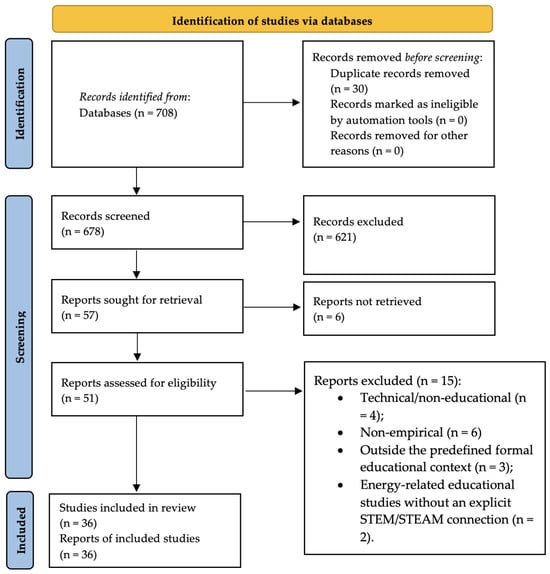
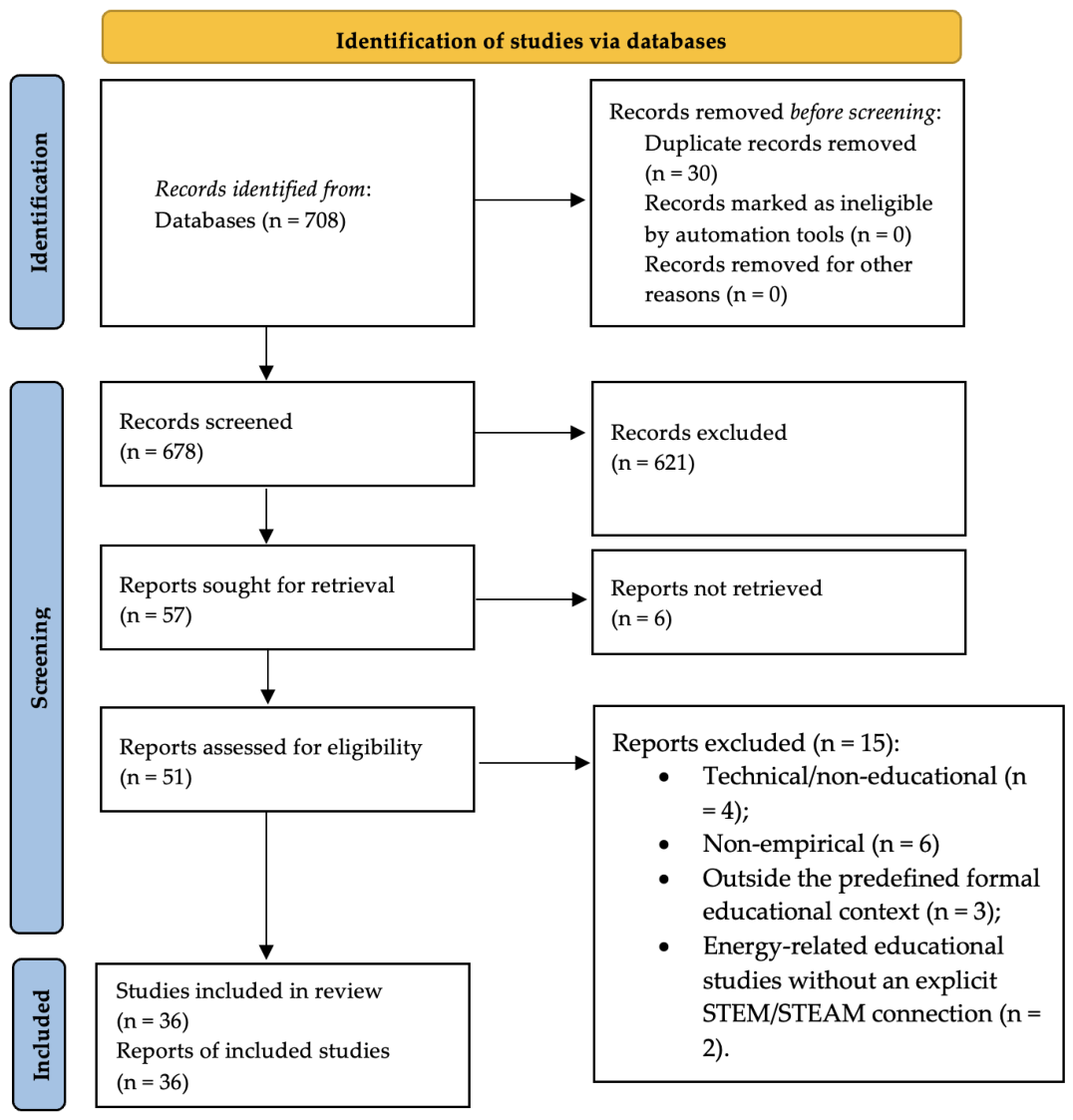
The database search identified 708 records. After removing 30 duplicates, 678 records were screened by title and abstract. This screening was performed by one reviewer and checked by a second reviewer against the predefined eligibility criteria, resulting in the exclusion of 621 records. Full texts were sought for 57 reports, of which 6 could not be retrieved. The remaining 51 full-text articles were independently assessed for eligibility by two reviewers, and disagreements were resolved through discussion and consensus. A total of 15 articles were excluded after full-text assessment, resulting in a final corpus of 36 articles included in the qualitative thematic synthesis (Figure 1).
Figure 1.
PRISMA 2020 [33] Flow Diagram.
Data Analysis
Information from the included studies was organized in a documentary analysis matrix designed to systematize bibliographic, contextual, methodological, pedagogical, and analytical variables. The matrix included the following categories: author and year, country, educational context, participant population, educational level, methodological approach, research design, sample characteristics, data collection techniques and instruments, pedagogical model, conceptual orientation, pedagogical purpose, reported learning outcomes, main findings, and limitations.
Data extraction was conducted using the documentary analysis matrix described above. Each included study was independently reviewed by two authors, who extracted information according to the predefined categories. The matrix was not pilot-tested. After independent extraction, discrepancies were discussed and resolved by consensus.
The thematic synthesis was conducted in four stages. First, the included studies were read in full to identify their objectives, educational contexts, conceptual foundations, methodological characteristics, pedagogical approaches, learning outcomes, and main findings. Second, the extracted information was coded using a combination of deductive and inductive procedures. Deductive codes were derived from the review questions and included educational context, participant population, conceptual perspective, methodological approach, research design, pedagogical model, instruments, and reported outcomes. Inductive codes were added when recurring concepts, pedagogical relationships, or research gaps emerged from the studies. Third, conceptually related codes were grouped into broader analytical categories, including interdisciplinarity, constructivist and experiential learning, sustainability orientation, active pedagogies, cognitive and socioemotional outcomes, and conditions for curricular integration. Finally, the categories were compared across studies to identify convergences, divergences, limitations, and implications for the curricular integration of energy education through STEM/STEAM approaches.
The methodological quality of the included studies was critically appraised using the Mixed Methods Appraisal Tool (MMAT), version 2018 [34]. Each study was classified according to its methodological design and assessed using the corresponding MMAT criteria. The MMAT category therefore indicates the methodological design assessed rather than an overall quality rating. The appraisal was conducted independently by two reviewers, and disagreements were resolved through discussion and consensus. In accordance with MMAT recommendations, no overall numerical score was calculated; criterion-level judgments were reported as “Yes,” “No,” or “Can’t tell.” Mixed-methods studies were appraised at both the component and integration levels using the corresponding MMAT criteria (Supplementary Table S2).
To operationalize the main research question, five subsidiary review questions were formulated to guide the thematic synthesis and the organization of the results. The review was guided by the following questions:
- Q1. What geographical and educational contexts, participant populations, and educational levels characterize the reviewed studies?
- Q2. How is the STEM/STEAM approach conceived in the reviewed literature, and what theoretical perspectives support its understanding within energy education?
- Q3. What methodological trends characterize research on energy education with a STEM/STEAM approach in terms of approaches, designs, techniques, and instruments?
- Q4. What pedagogical models and instructional purposes characterize the implementation of energy education through STEM/STEAM approaches?
- Q5. What convergent findings provide pedagogical guidance for the curricular integration of energy education through STEM/STEAM approaches?
All 36 included studies were independently coded and categorized by two authors. After completing the coding independently, the two authors compared the assigned codes and analytical categories. Any disagreements were discussed and resolved through consensus before establishing the final categories used in the thematic synthesis.
3. Results
3.1. Q1: Geographical Distribution, Educational Contexts, and Educational Levels in Energy Education with a STEM/STEAM Approach
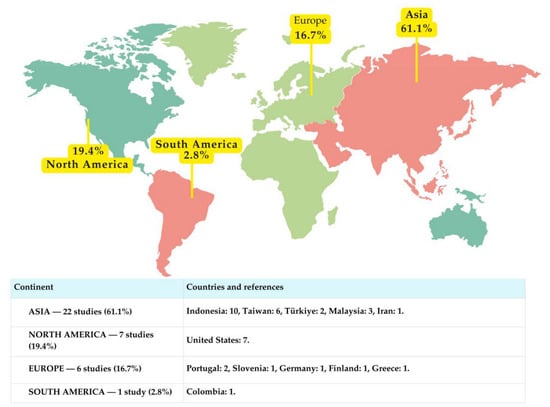
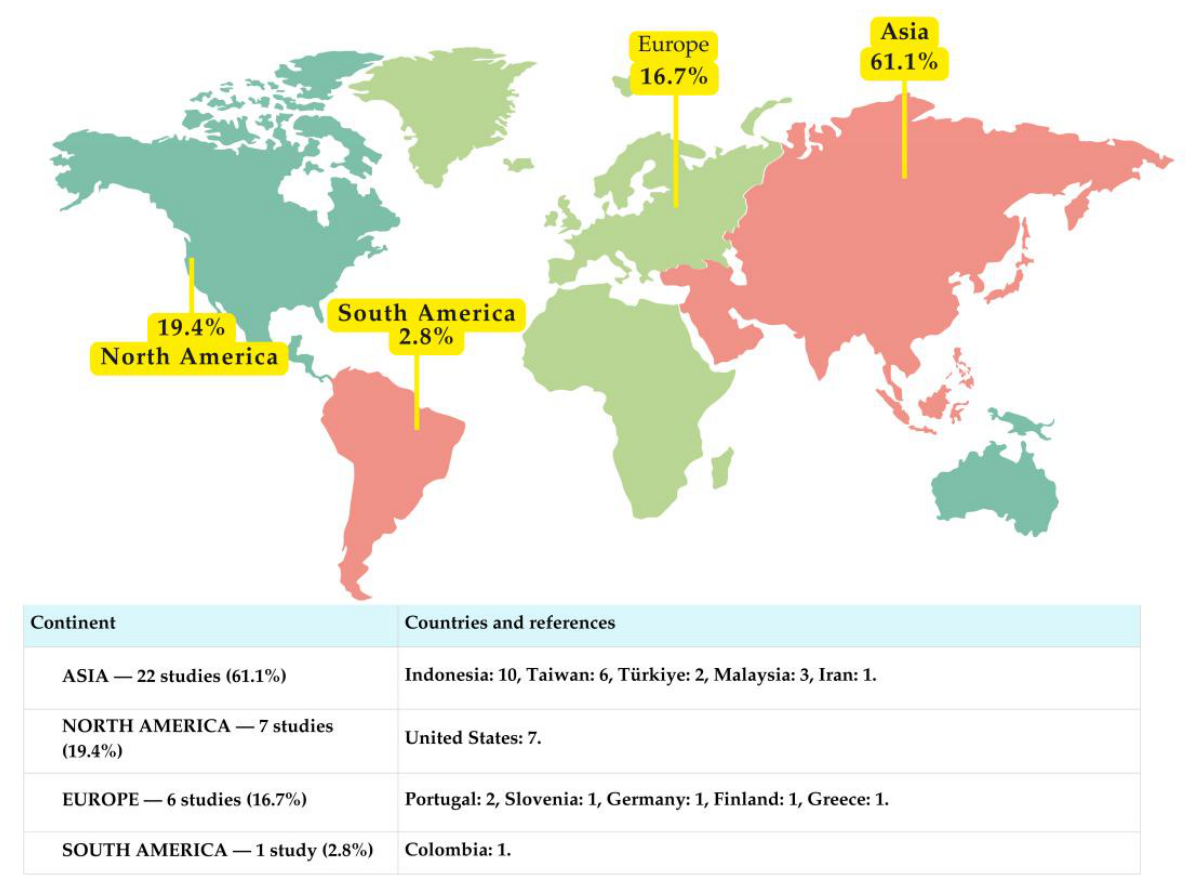
The geographical distribution of the 36 studies included in this review reveals an uneven but geographically diverse body of research on STEM/STEAM-based energy education. Twenty-two studies (61.1%) were conducted in Asian contexts, seven (19.4%) in North America, six (16.7%) in Europe, and one (2.8%) in South America. Indonesia was represented in ten studies, including one comparative study involving Japan and Indonesia [22,23,25,35,36,37,38,39,40,41]. The United States accounted for seven studies [42,43,44,45,46,47,48], Taiwan for six [17,49,50,51,52,53], Malaysia for three, including one comparative study with Oman [54,55,56], Türkiye for two [18,57], and Portugal for two [26,58]. The remaining studies were conducted in Iran [19], Slovenia [20], Colombia [59], Germany [60], Finland [61], and Greece [62] (see Figure 2).
Figure 2.
Geographical distribution of the 36 included studies by continent and country.
These findings indicate that the reviewed evidence is primarily concentrated in Asia. Indonesia alone accounts for more than one quarter of the corpus (10/36; 27.8%), while Taiwan, Türkiye, and Malaysia also make substantial contributions to the Asian evidence base. This pattern is consistent with the increasing adoption of STEM-oriented instructional approaches previously reported in the educational literature [61] and with the relevance of renewable energy and sustainability in these educational contexts [34]. The presence of studies from North America, Europe, and, to a lesser extent, South America also suggests that STEM/STEAM-based energy education is being explored across diverse educational systems and sociocultural contexts.
Regarding educational contexts and participant populations, 22 of the 36 studies (61.1%) focused primarily on school-age students. Twelve studies (33.3%) examined pre-service or in-service teachers, STEM or renewable energy educators, or university faculty involved in teacher education, professional development, or curriculum-related initiatives. Two additional studies (5.6%) focused primarily on higher education students [52,59]. This distribution highlights the importance of classroom-based interventions while also showing the presence of teacher education, professional development, and higher education within the field.
Secondary education constitutes the predominant educational level. Of the 23 studies centered on school-age students, 20 involved primarily lower- or upper-secondary students, while one focused on primary education [18] and another on early childhood education [40,62]. Across secondary education contexts, energy is commonly addressed as a contextualized interdisciplinary problem through inquiry, experimentation, engineering design, project-based learning, digital environments, collaboration, and sustainability-oriented activities [17,19,22,23,25,36,38,55,57,58,60,61].
3.2. Q2: Conceptual Conception of the STEM Approach and Predominant Theoretical Perspectives
The reviewed studies conceptualize STEM/STEAM as an integrative pedagogical framework that brings together science, technology, engineering, mathematics, and, in STEAM-oriented studies, the arts to address authentic energy-related problems [18,19,22,23,35,36,37,40,49,51,57,61]. Within this framework, energy education is organized through inquiry, design, experimentation, collaboration, and informed decision-making [17,19,22,23,25,36,37,49,50,51,57]. Its conceptual value lies in creating learning situations in which different forms of knowledge are mobilized to understand and address complex energy challenges. The synthesis identified four interconnected conceptual and pedagogical foundations: interdisciplinarity, active and experiential learning, education for sustainable development, and pedagogical contextualization (Table 3). Study-level thematic mapping and the distinction between explicit and inferred theoretical attributions are provided in Supplementary Table S4.
Table 3.
Conceptual and pedagogical foundations of STEM/STEAM-based energy education identified in the reviewed studies.
As summarized in Table 3, these four interconnected foundations form a pedagogical matrix that frames energy not as isolated disciplinary content but as a complex object of inquiry, design, interpretation, and action [17,18,19,22,23,36,37,38,49,57,61]. The first foundation is interdisciplinarity. Across the reviewed corpus, energy is treated as a phenomenon whose understanding requires multiple disciplinary perspectives. This orientation is developed through integrated STEM instruction, the 5E model, engineering design, inquiry-based learning, and project-based approaches [18,19,36,38,40,51,57,61]. Its educational treatment combines scientific explanations, technological applications, engineering design, mathematical reasoning, and, in STEAM-oriented proposals, creative and artistic processes [22,23,37,62]. Interdisciplinarity therefore organizes knowledge around energy-related problems whose analysis requires contributions from several disciplinary domains.
Within this perspective, knowledge acquires meaning through measurement, experimentation, modeling, design, and problem-solving [19,36,37,50,51,57]. STEM/STEAM consequently operates as an epistemic structure for integration: disciplinary knowledge is not eliminated but mobilized according to the demands of the energy-related problem under examination.
The second foundation involves active and experiential learning, frequently expressed through constructivist-oriented pedagogical practices. This is one of the most recurrent orientations in the corpus [17,19,22,23,25,26,36,37,38,40,51,55,62]. The studies employ project-based learning, the Predict–Observe–Explain model, the 5E instructional model, prototype construction, cognitive restructuring, collaborative learning, gamification, engineering design, and hands-on activities. Despite their differences, these approaches position learners as active participants who formulate questions, test ideas, design products, construct explanations, and reconsider prior conceptions.
Project-based experiences provide opportunities for creativity, collaboration, and the development of solutions to energy-related problems [22,25,36,38,49]. The Predict–Observe–Explain model and activities focused on cognitive structures support the progressive reorganization of students’ understanding of energy [17,26]. Likewise, the 5E model structures engagement, exploration, explanation, elaboration, and evaluation in energy-related learning situations [19,57,62]. These approaches share a pedagogical logic in which learning about energy involves interacting with phenomena, challenging prior conceptions, and constructing meaning through guided experience.
From an interpretive perspective, the reviewed literature is broadly consistent with constructivist and experiential principles, although the original studies do not always formulate these foundations explicitly as theoretical frameworks. Constructivist-oriented learning is identifiable in studies focused on conceptual change, cognitive restructuring, inquiry, and the 5E model [17,19,26,57,62], while experiential principles are evident in project-based work, prototype development, engineering design, and applied STEM activities [18,22,25,36,37,49,51]. In several cases, however, the theoretical orientation must be inferred from the organization of the pedagogical experience. This uneven explicitness suggests a stronger articulation of instructional practices than of the theoretical assumptions supporting them.
The third foundation is education for sustainable development. Sustainability emerges as a recurrent orientation in the reviewed literature [18,23,25,35,38,42,46,48,51,52,55,59]. It is expressed through renewable energy, solar energy, energy saving, environmental awareness, technological innovation, and environmentally responsible decision-making. Within these studies, energy is framed not only as scientific content but also as a socio-scientific issue involving environmental responsibility, technological development, resource use, and social well-being.
STEM/STEAM provides a context in which learners analyze energy problems, design technological responses, and reflect on sustainability-related decisions [18,23,25,35,38,46,51,55,59]. In several studies, the educational purpose extends beyond conceptual understanding to include creativity, collaboration, attitudes, environmental awareness, and responsible decision-making. Energy education is therefore linked to knowledge, competencies, values, and forms of participation relevant to contemporary sustainability challenges.
The pedagogical role of sustainability, however, varies across the corpus. In some studies, sustainability provides a thematic context for activities involving renewable energy, energy conservation, and related technological applications [51,55,56]. In others, it more explicitly guides the educational purpose through ESD, environmental responsibility, energy literacy, and sustainability-related decision-making [18,23,25,35,38,48,52,58,59]. In a limited number of studies, the relationship with ESD was inferred from the educational framing rather than explicitly formulated by the authors [42,46]. Sustainability is thus recurrent but unevenly elaborated across the reviewed studies.
The fourth foundation concerns pedagogical contextualization, expressed through digital mediation, context-responsive instructional environments, curriculum development, and teacher professional learning. Digital mediation is identifiable through Canva-assisted project-based learning, IoT smart energy-saving projects, mobile learning, digital making, and technology-supported educational environments [22,49,50,53,55,56]. These studies suggest that digital resources expand the pedagogical environments and forms of interaction through which energy concepts and problems can be explored.
Teacher education and professional development constitute another identifiable dimension. Studies involving pre-service or in-service teachers and university faculty address beliefs, conceptual understanding, research experiences, interdisciplinary planning, curriculum development, and professional learning [20,35,44,45,46,47,48,50]. This evidence suggests that STEM/STEAM-based energy education involves educators’ capacity to design interdisciplinary experiences, guide inquiry, integrate technologies, and connect energy content with sustainability-related purposes.
The teacher-focused evidence also indicates that the pedagogical appropriation of STEM/STEAM involves more than the application of individual instructional methods. It includes collaborative planning, curricular mediation, disciplinary coordination, and professional learning [20,44,45,47,48]. Although student-centered classroom interventions are prominent, the teacher-focused studies show that professional learning and curricular implementation are also relevant components of STEM/STEAM-based energy education.
Across the reviewed literature, STEM/STEAM-based energy education draws on several pedagogical traditions. Project-based learning is developed in studies concerned with creativity, collaboration, and applied problem-solving [22,25,36,38,49]; inquiry-oriented and 5E-based learning addresses conceptual understanding and scientific reasoning [17,19,51,57,62]; and digital learning broadens the forms of pedagogical mediation available for energy education [22,49,50,55]. STEM/STEAM functions as an integrating framework that articulates these approaches according to the educational context, level, and purpose of each study.
These foundations represent analytical patterns identified across the reviewed studies rather than theoretical frameworks uniformly adopted by all authors; where a foundation was not explicitly formulated in the original study, its attribution was treated as inferred and is identified as such in Supplementary Table S4. From an interpretive perspective, this diversity suggests that the coherence of the field does not derive from adherence to a single theoretical model, but from recurring connections among interdisciplinary knowledge, active participation, contextualized pedagogical mediation, and sustainability-oriented educational purposes. STEM/STEAM-based energy education thus emerges as a heterogeneous field in which energy-related knowledge is connected with inquiry, action, design, and social responsibility.
3.3. Q3: Methodological Trends of the Reviewed Studies: Approaches, Designs, Techniques, and Instruments
The analysis of the 36 reviewed studies reveals a predominantly empirical orientation (Table 4). Quantitative studies constitute the largest methodological group (20/36; 55.6%), followed by mixed-methods studies (11/36; 30.6%) and qualitative studies (5/36; 13.9%). Across these approaches, the studies examine educational outcomes and processes related to energy learning, scientific competencies, creativity, critical thinking, energy literacy, attitudes, and sustainability [17,19,22,23,25,26,36,38,42,49,57,58].
Table 4.
Methodological Characteristics, Main Reported Outcomes, and MMAT Classification of the Reviewed Studies.
Within the quantitative evidence, non-randomized designs are the most frequent (13/20; 65.0%), followed by quantitative descriptive designs (6/20; 30.0%), whereas only one study (1/20; 5.0%) employed a randomized controlled design [25]. Non-randomized studies include quasi-experimental, pre–post, predictive/associational, observational/comparative, and other non-randomized designs examining variables such as conceptual understanding, academic achievement, creativity, collaboration, critical thinking, energy literacy, and attitudes [19,22,23,36,38,39,42,49,50,52,53,55,56]. Descriptive studies complement this evidence through surveys, diagnostic assessments, comparative analyses, and learning analytics focused on students, teachers, and educational contexts [20,35,41,43,45,60].
This distribution indicates that the quantitative evidence is better suited to identifying reported changes, group differences, patterns, and associations than to establishing causal effects. Although several studies report favorable outcomes following STEM/STEAM-based educational experiences, other studies report mixed, limited, or non-significant findings for particular outcomes. Moreover, the predominance of non-randomized and descriptive designs requires caution when interpreting reported changes or associations as evidence of instructional effectiveness.
Mixed-methods studies (11/36; 30.6%) provide a complementary methodological perspective by combining quantitative measures with interviews, observations, open-ended responses, student products, or other qualitative evidence [17,18,26,37,44,47,51,54,57,58,61]. These designs allow reported outcomes to be considered alongside learning processes, pedagogical experiences, teacher development, and contextual conditions. Qualitative studies (5/36; 13.9%), although less frequent, further examine experiences and meanings associated with STEM/STEAM-based energy education, including teacher learning, curriculum development, equity, higher education, and early childhood contexts [40,46,48,50,62]. The MMAT appraisal showed variation in methodological quality across the reviewed studies (Supplementary Table S2). Mixed-methods studies were assessed at both the component and integration levels. Overall, limitations related to sampling, qualitative analysis, and integration of methodological components support a cautious interpretation of the reported educational outcomes.
Regarding data collection, surveys, questionnaires, achievement and performance tests, observations, and interviews are recurrent across the corpus. These are complemented by standardized assessments, word-association tasks, rubrics, document analysis, student products, and digital learning analytics [17,22,26,49,60]. This methodological diversity reflects the multidimensional character of energy education within STEM/STEAM contexts, where research addresses cognitive outcomes alongside attitudes, perceptions, creativity, collaboration, sustainability-related orientations, and pedagogical experiences.
Regarding participants, school-age students—particularly at the secondary level—constitute the largest group, consistent with the educational distribution identified in Q1. The corpus also includes pre-service and in-service teachers, university faculty, and higher-education students. Consequently, evidence concerning student learning is more extensive than evidence addressing teacher professional development, curriculum implementation, and institutional conditions.
From an interpretive perspective, the methodological configuration of the reviewed literature shows a clear emphasis on outcome- and intervention-oriented research, particularly through quantitative non-randomized designs. Mixed-methods and qualitative studies broaden this evidence by examining learning processes, pedagogical experiences, professional development, and contextual conditions that cannot be fully represented through outcome measures alone. The combination of these approaches provides complementary evidence; however, the limited presence of randomized designs constrains causal interpretations of the reported educational outcomes.
3.4. Q4: Pedagogical Intentionality of the STEM/STEAM Approach in Energy Education
The pedagogical analysis of the reviewed studies reveals two closely related ways in which STEM/STEAM and energy education are articulated: (1) STEM/STEAM as an instructional approach for teaching and learning energy-related content, and (2) energy as an authentic context for applying and integrating STEM/STEAM knowledge and practices. These categories are not mutually exclusive; rather, they represent complementary forms of pedagogical organization across the reviewed literature. The broader corpus also shows that these relationships are operationalized through diverse instructional models, including project- and problem-based learning, inquiry, engineering design, experiential and collaborative learning, digital environments, place-based education, and sustainability-oriented approaches (Table 5).
Table 5.
Integration of STEM/STEAM with Pedagogical and Didactic Models in Energy Education.
The first category, STEM/STEAM as an instructional approach, refers to studies in which STEM/STEAM provides the pedagogical structure through which energy concepts and problems are addressed. Energy learning is organized through project- and problem-based learning, inquiry, the 5E instructional model, Predict–Observe–Explain, engineering design, collaborative learning, digital making, and other forms of active instruction [17,19,22,23,36,38,40,50,51,53,57,62]. In these studies, the pedagogical intention extends beyond presenting energy content and includes opportunities for learners to investigate phenomena, construct explanations, design products, collaborate, and address problems through STEM/STEAM practices.
The second category, energy as a context for STEM/STEAM application, refers to studies in which renewable energy, solar energy, energy saving, electricity, wind energy, biofuels, or climate-related challenges provide a meaningful context for integrating science, technology, engineering, mathematics, and, where applicable, the arts [18,25,36,37,39,49,51,52,55,56,58,59]. In this configuration, energy serves as an interdisciplinary problem space in which learners apply disciplinary knowledge and practices to investigate phenomena, develop prototypes or technological responses, and consider sustainability-related decisions.
The expanded range of pedagogical models also shows that instructional intentionality is not limited to student-centered classroom interventions. Teacher education, professional development, curriculum design, culturally responsive approaches, and equity-oriented perspectives form an additional contextual layer within the two categories [44,45,46,47,48]. These studies indicate that the pedagogical integration of energy and STEM/STEAM also depends on how educators interpret, adapt, and organize interdisciplinary content in relation to particular learners and educational settings.
The distinction between the two categories clarifies the pedagogical intentionality identified across the corpus. In the first configuration, STEM/STEAM functions primarily as the pedagogical means through which energy is taught; in the second, energy functions primarily as the context through which STEM/STEAM knowledge and practices are mobilized. Several studies combine both functions by using STEM/STEAM pedagogies to develop energy understanding while simultaneously using energy-related problems to address creativity, critical thinking, collaboration, engineering design, energy literacy, and sustainability-oriented decision-making [22,23,25,36,38,39,49,51,57,58]. Rather than demonstrating uniform pedagogical effectiveness, the reviewed evidence shows a recurring pattern of intentional integration between disciplinary learning, active participation, technological design, and sustainability-related contexts.
3.5. Q5: Convergent Findings and Pedagogical Implications for the Curricular Integration of Energy Education Through STEM/STEAM Approaches
The synthesized evidence shows several convergent patterns regarding the contribution of STEM/STEAM to energy education across different educational contexts, participants, and methodological designs. Rather than focusing only on disciplinary content, the reviewed studies commonly organize learning around experiences that connect conceptual understanding, inquiry, design, collaboration, technological application, and sustainability-related problems.
A first convergent finding concerns higher-order competencies. Studies using project-based, problem-based, collaborative, design-oriented, and technology-mediated activities report outcomes related to creativity, critical thinking, collaboration, problem-solving, engineering thinking, and other forms of applied reasoning [22,23,36,38,39,50,53]. Study [49], based on a predictive associational design, reported significant relationships between cognition and problem-solving variables rather than intervention-related improvement, while study [53] reported improvement in energy-related knowledge but no significant change in programming attitudes. These findings suggest that energy-related STEM/STEAM activities provide contexts in which learners may mobilize disciplinary knowledge to analyze problems, design responses, and connect ideas across domains. Given the predominance of non-randomized and descriptive designs identified in Q3, these results should be interpreted as educational patterns rather than as uniform evidence of causal effectiveness.
A second convergence relates to conceptual learning and energy literacy. Studies using inquiry, experimentation, engineering design, the 5E model, Predict–Observe–Explain, and digital environments report outcomes related to students’ understanding of energy concepts, energy transformations, electricity, renewable energy, and energy literacy [17,25,26,42,51,55,57,60,62]. However, findings were not uniformly positive. Study [42] did not identify statistically significant program-related differences in overall energy literacy between participants and nonparticipants, although differences were reported for specific dimensions. Study [61] also identified persistent difficulties in developing a multidisciplinary understanding of energy. Overall, conceptual learning is commonly connected with observation, explanation, experimentation, and application to specific energy-related situations, but the magnitude and consistency of reported outcomes vary across studies.
A third pattern concerns participation and engagement. Project development, prototype construction, collaborative tasks, digital making, physical computing, IoT-supported activities, and other technology-mediated environments are used to situate energy learning within active experiences [22,36,39,49,50,53,55,56]. Several studies report favorable perceptions, motivation, participation, or engagement; however, these findings are often based on self-reported, observational, or context-specific evidence. The evidence therefore does not support assuming that digital or project-based resources alone produce greater engagement; their pedagogical value appears to depend on their integration with inquiry, collaboration, design, and meaningful energy-related problems.
Taken together, these findings inform a curricular perspective in which energy is addressed as an interdisciplinary and sustainability-related issue rather than as an isolated science topic. The reviewed evidence points toward curriculum integration through project- and problem-based learning, inquiry, engineering design, collaboration, and context-sensitive sustainability education. At the same time, student-focused studies remain more prominent than research on teacher preparation, curriculum development, institutional implementation, and long-term adoption [42,43,45,47,48].
4. Discussion
Across the 36 studies analyzed, STEM/STEAM-based energy education was commonly implemented through active pedagogical models, including project-based learning, inquiry-based learning, the 5E instructional model, engineering design, collaborative learning, experiential learning, and technology-supported approaches. Their integration organizes learning around contextualized energy challenges and is associated with reported outcomes related to scientific creativity, critical thinking, problem-solving, collaboration, and energy-related competencies. However, these outcomes were not uniform across studies or measures, and the predominance of non-randomized and descriptive designs limits causal interpretations. This pattern supports the understanding of STEM education as a framework that connects disciplines through authentic problems and interdisciplinary learning experiences [7,9,14].
A second finding concerns the emphasis placed on conceptual understanding through experimentation, modeling, inquiry, and design. The synthesized evidence suggests that these strategies may support the reorganization of students’ ideas and the development of more integrated explanations of energy concepts and transformations. Nevertheless, some studies reported mixed, limited, or non-significant findings for particular outcomes, indicating that conceptual and competency-related changes cannot be assumed across contexts. This finding is consistent with the abstract and multidimensional character of energy and reinforces the relevance of pedagogical approaches that connect theoretical knowledge, practical experience, and educational context [16,17,20,26].
The review further indicates that the contribution of STEM/STEAM extends beyond specific academic outcomes by providing pedagogical principles that can inform the curricular organization of energy education. Across the reviewed corpus, energy is frequently approached as an interdisciplinary and sustainability-related issue requiring connections among scientific, technological, environmental, and social knowledge [2,7,9,14]. At the same time, the evidence is not uniform across research designs or educational contexts. Quantitative non-randomized studies primarily report changes, differences, or associations in outcomes such as conceptual understanding, creativity, energy literacy, and problem-solving, whereas mixed-methods and qualitative studies provide complementary evidence on learning processes, participant experiences, collaboration, teacher development, and educational implementation. This variation reflects differences in educational purposes, assessment instruments, participants, and intervention conditions, making direct comparison of outcomes difficult. Moreover, the predominance of quantitative non-randomized and descriptive designs, together with the strong representation of secondary education and Asian contexts, means that the available evidence is more informative about reported educational outcomes and contextualized learning experiences than about causal effectiveness or long-term curricular and institutional implementation. These methodological characteristics require caution when generalizing across educational systems and contexts [2,9,17].
4.1. Comparison with Previous Reviews
The findings of this review both converge with and extend previous syntheses [27,28,29,30,31,32]. Consistent with reviews on energy literacy and renewable energy education [27,28,29], the included studies emphasize conceptual learning, sustainability, and active educational strategies. Likewise, previous reviews linking STEM with Education for Sustainable Development [30,31] highlighted interdisciplinarity, problem-solving, and sustainability-oriented learning, dimensions also identified in the present synthesis. However, the present review also shows that these pedagogical patterns are not methodologically uniform: much of the available evidence comes from non-randomized and descriptive studies, which limits causal interpretations of the reported educational outcomes. In this respect, the review distinguishes between the pedagogical potential reported across studies and the strength of the evidence supporting claims of effectiveness. It also provides a more specific interpretation of how STEM/STEAM functions as a pedagogical approach for teaching energy and how energy-related problems provide authentic contexts for applying STEM/STEAM knowledge and practices.
4.2. Limitations
This review has several limitations. First, although the search was conducted across eight databases and included title, abstract, and keyword fields in all databases, the search strategy relied on a relatively specific combination of terms related to “energy education”, “energy learning”, STEM, and STEAM. The limited use of broader synonyms, controlled vocabulary, and truncation may have reduced search sensitivity and may have resulted in relevant studies using alternative terminology not being retrieved. Second, six potentially relevant reports could not be retrieved in full text and therefore could not be assessed for eligibility. Finally, the geographical concentration of the evidence, particularly in Asian contexts, and the predominance of secondary education and non-randomized designs limit the transferability and strength of conclusions across educational levels and settings.
4.3. Future Research Directions
Future research should prioritize longitudinal, comparative, and, where feasible, more robust controlled designs to examine the sustainability and transferability of reported learning outcomes across educational levels and geographical contexts. Greater attention is also needed to teacher education and professional development, as well as to the curricular and institutional conditions required for sustained STEM/STEAM-based energy education. Studies conducted in underrepresented regions and diverse educational settings would help address the geographical concentration of the evidence and provide a broader understanding of how these approaches can be adapted to different contexts.
5. Conclusions
This systematic review identifies STEM/STEAM-based energy education as a developing area of research in which energy is conceptualized as a complex educational issue involving scientific, technological, environmental, and social knowledge. Across the 36 reviewed studies, STEM/STEAM functions as an integrative pedagogical framework that organizes learning through authentic problems, inquiry, design, collaboration, technological mediation, and sustainability-oriented contexts.
Methodologically, the reviewed literature is characterized by a predominance of quantitative approaches (20/36; 55.6%), followed by mixed-methods (11/36; 30.6%) and qualitative studies (5/36; 13.9%). Quantitative non-randomized designs constitute the largest methodological category, while randomized evidence is limited. Across these designs, studies report outcomes related to conceptual understanding, energy literacy, creativity, critical thinking, collaboration, problem-solving, and other learning processes, although some outcomes were mixed, limited, or non-significant. Given the methodological heterogeneity and the predominance of non-randomized and descriptive designs, these findings should be interpreted as reported educational patterns rather than as conclusive evidence of causal effectiveness.
The reviewed literature also shows that the pedagogical integration of energy and STEM/STEAM is commonly operationalized through project- and problem-based learning, inquiry, the 5E instructional model, engineering design, collaborative learning, experiential approaches, and technology-supported environments. These configurations position energy as an interdisciplinary context for investigation, design, problem-solving, and sustainability-oriented learning. The concentration of evidence in secondary education and Asian contexts indicates an uneven geographical and educational distribution, while teacher education, curriculum development, institutional implementation, and long-term adoption remain less extensively examined.
Taken together, the reviewed evidence identifies interdisciplinarity, active and experiential learning, education for sustainable development, and pedagogical contextualization as interconnected foundations for the curricular integration of energy education through STEM/STEAM. These foundations provide a framework for interpreting the reviewed pedagogical approaches while also highlighting the need for further research on teacher preparation, institutional conditions, broader educational contexts, and sustained implementation.
Supplementary Materials
The following supporting information can be downloaded at: https://www.mdpi.com/article/10.3390/su181910024/s1, Table S1: Database-specific search strategies, limits, search dates, and retrieved records; Table S2: MMAT 2018 criterion-level appraisal of the included studies; Table S3: Studies excluded after full-text assessment; Table S4: Study-level thematic mapping of conceptual and pedagogical foundations.
Author Contributions
Conceptualization, S.M.O.D. and Á.A.J.S.; methodology, S.M.O.D. and Á.A.J.S.; formal analysis, S.M.O.D. and Á.A.J.S.; investigation, S.M.O.D., Á.A.J.S. and E.M.B.V.; theoretical framework and conceptual review, S.M.O.D., Á.A.J.S. and E.M.B.V.; writing—review and editing, S.M.O.D. and Á.A.J.S.; supervision, Á.A.J.S. All authors have read and agreed to the published version of the manuscript.
Funding
This research was funded by Universidad del Magdalena through the research project “Formación docente situada: Educación energética con enfoque STEM”, grant number [VIN2026024].
Data Availability Statement
No new primary data were generated in this study. All data extracted and analyzed for this systematic review were derived from the published studies included in the review. The study-level data supporting the synthesis, including the extracted characteristics, reported outcomes, and methodological quality assessments, are provided in the article and its Supplementary Materials.
Conflicts of Interest
The authors declare no conflicts of interest.
References
- DeWaters, J.; Powers, S.; Bilow, F. An introductory energy course to promote broad energy education for undergraduate engineering students. Sustainability 2021, 13, 9693. [Google Scholar] [CrossRef] [Scilit]
- Vakulchuk, R.; Overland, I. The failure to decarbonize the global energy education system: Carbon lock-in and stranded skill sets. Energy Res. Soc. Sci. 2024, 110, 103446. [Google Scholar] [CrossRef] [Scilit]
- Demirbas, A. Political, economic and environmental impacts of biofuels: A review. Appl. Energy 2009, 86, S108–S117. [Google Scholar] [CrossRef] [Scilit]
- Castro Montaña, J.E.; Gallego Torres, A.P. La educación energética. Tecné Epistem. Didaxis TED 2009, 323–329. Available online: https://www.redalyc.org/articulo.oa?id=614277077069 (accessed on 15 May 2026).
- Zuñiga-González, L.; Valenzuela-González, A. Educación en energías renovables desde el enfoque Ciencia, Tecnología y Sociedad—CTS. Pensam. Acción 2020, 2, 47–59. [Google Scholar] [CrossRef] [Scilit]
- Zografakis, N.; Menegaki, A.N.; Tsagarakis, K.P. Effective education for energy efficiency. Energy Policy 2008, 36, 3226–3232. [Google Scholar] [CrossRef] [Scilit]
- Li, Y.; Wang, K.; Xiao, Y.; Froyd, J.E. Research and trends in STEM education: A systematic review of journal publications. Int. J. STEM Educ. 2020, 7, 11. [Google Scholar] [CrossRef] [Scilit]
- Toptas, V.; Oztop, F.; Gunes, F. A Systematic Review of the Effects of STEM Education Practices at the Primary School Level. Int. Technol. Educ. J. 2024, 8, 1–8. [Google Scholar]
- Portillo-Blanco, A.; Deprez, H.; De Cock, M.; Guisasola, J.; Zuza, K. A Systematic Literature Review of Integrated STEM Ed-ucation: Uncovering Consensus and Diversity in Principles and Characteristics. Educ. Sci. 2024, 14, 1028. [Google Scholar] [CrossRef] [Scilit]
- Marín-Ríos, A.; Cano-Villa, J.; Mazo-Castañeda, A. Apropiación de la educación STEM/STEAM en Colombia: Una revisión a la producción de trabajos de grado. Rev. Científica 2023, 47, 55–70. [Google Scholar] [CrossRef] [Scilit]
- Núñez Rodríguez, D.S.; Vargas Barros, V.H.; Vasquez Barrera, F.J.; de Jesús Andrade Zambrano, W.; Espinoza Valarezo, F.L. Educación STEM: Una revisión de enfoques interdisciplinarios y mejores prácticas para fomentar habilidades en ciencia, tecnología, ingeniería y matemáticas. Cienc. Lat. Rev. Científica Multidiscip. 2023, 7, 2023–2045. [Google Scholar] [CrossRef] [Scilit]
- Ferrada-Ferrada, C.; Carrillo-Rosúa, J.; Díaz-Levicoy, D.; Silva-Díaz, F. Robotics from Stem Areas in Primary School: A Systematic Review; Ediciones Universidad de Salamanca: Salamanca, Spain, 2020. [Google Scholar]
- Hebebci, M.T. A Systematic Review of Experimental Studies on STEM Education. J. Educ. Environ. Sci. Health 2023, 9, 56–73. [Google Scholar] [CrossRef] [Scilit]
- Aguilera, D.; Ortiz-Revilla, J. Stem vs. Steam education and student creativity: A systematic literature review. Educ. Sci. 2021, 11, 331. [Google Scholar] [CrossRef] [Scilit]
- Ardwiyanti, D.; Prasetyo, Z.K.; Wilujeng, I. STEM research trends in indonesia: A systematic literature review. J. Sci. Educ. Res. 2021, 5, 38–45. Available online: https://journal.uny.ac.id/index.php/jser/article/view/41752 (accessed on 15 May 2026). [CrossRef] [Scilit]
- Jeong, J.S.; González-Gómez, D. A web-based tool framing a collective method for optimizing the location of a renewable energy facility and its possible application to sustainable STEM education. J. Clean. Prod. 2020, 251, 119747. [Google Scholar] [CrossRef] [Scilit]
- Wang, J.C.; Wang, T.H. Learning effectiveness of energy education in junior high schools: Implementation of action research and the predict–observe–explain model to STEM course. Heliyon 2023, 9, e14058. [Google Scholar] [CrossRef] [Scilit]
- Hiğde, E. An Interdisciplinary Renewable Energy Education: Investigating the Influence of STEM Activities on Perception, Attitude, and Behavior. J. Sci. Learn. 2022, 5, 373–385. [Google Scholar] [CrossRef] [Scilit]
- Shahbazloo, F.; Abdullah Mirzaie, R. Investigating the effect of 5E-based STEM education in solar energy context on creativity and academic achievement of female junior high school students. Think. Ski. Creat. 2023, 49, 101336. [Google Scholar] [CrossRef] [Scilit]
- Drobnič Vidic, A. Teachers’ Beliefs about STEM Education Based on Realisation of the “Energy as a Value” Project in the Slovenian School System. Int. J. Eng. Educ. 2017, 33, 408–419. [Google Scholar]
- Cahya, R.E.; Anggaryani, M. Integrating STEM-PBL with solar energy projects to foster critical thinking and achieve SDG 4 and SDG 7 in physics education. J. Phys. Conf. Ser. 2025, 3132, 012002. [Google Scholar] [CrossRef] [Scilit]
- Mayanti, A.N.R.; Widiyatmoko, A. The Effect of Canva-assisted PjBL-STEAM to Improve Creative Thinking and Collaboration on Energy Concept. Int. J. Technol. Educ. Sci. 2025, 9, 299–321. [Google Scholar] [CrossRef] [Scilit]
- Ellianawati, E.; Subali, B.; Putra, B.R.; Wahyuni, S.; Dwijananti, P.; Adhi, M.A.; Yusof, M.M.M. Critical thinking and creativity in STEAM-based collaborative learning on renewable energy issues. J. Educ. Learn. 2025, 19, 112–119. [Google Scholar] [CrossRef] [Scilit]
- Skowronek, M.; Gilberti, R.M.; Petro, M.; Sancomb, C.; Maddern, S.; Jankovic, J. Inclusive STEAM education in diverse dis-ciplines of sustainable energy and AI. Energy AI 2022, 7, 100124. [Google Scholar] [CrossRef] [Scilit]
- Utami, P.L.; Suprapto, N.; Hidaayatullaah, H.N. Empowering students’ energy literacy through STEAM-ESD projects in place-based education. J. Phys. Conf. Ser. 2025, 3132, 012010. [Google Scholar] [CrossRef] [Scilit]
- Martins, I.; Baptista, M.; Tomé, I. STEM education in the development of cognitive structures about energy transformations: A study with 9th grade students. Rev. Port. Educ. 2023, 36, e23032. [Google Scholar] [CrossRef] [Scilit]
- Majid, N.A.M.N.A.; Osman, K.; Yee, T.S. Integrating energy literacy into science education: A comprehensive systematic review. Int. J. Eval. Res. Educ. 2025, 14, 1253–1263. [Google Scholar] [CrossRef] [Scilit]
- Santillán, O.S.; Cedano, K.G. Energy Literacy: A Systematic Review of the Scientific Literature. Energies 2023, 16, 7235. [Google Scholar] [CrossRef] [Scilit]
- Hoque, F.; Yasin, R.M.; Sopian, K. Revisiting Education for Sustainable Development: Methods to Inspire Secondary School Students toward Renewable Energy. Sustainability 2022, 14, 8296. [Google Scholar] [CrossRef] [Scilit]
- Fathurohman, I.; Amri, M.F.; Septiyanto, A.; Riandi. Integrating STEM based Education for Sustainable Development (ESD) to Promote Quality Education: A Systematic Literature Review. J. Penelit. Pendidik. IPA 2023, 9, 1052–1059. [Google Scholar] [CrossRef] [Scilit]
- Sihombing, R.A.; Muslim, M.; Rahman, T.; Winarno, N. Enhancing Quality Education in Indonesia: A Literature Review of STEM-ESD Landscape Contributions. J. Sci. Learn. 2024, 7, 213–226. [Google Scholar] [CrossRef] [Scilit]
- Kesuma, A.P.; Sunyono, S.; Lengkana, D.; Haenilah, E.Y.; Firdaus, R.; Fuad, M.; Muhammad, U.A. STEAM Approach in Renewable Energy Education: Global Trends and Future Research Direction. J. Pendidik. Progresif 2024, 14, 1280–1304. [Google Scholar] [CrossRef] [Scilit]
- Page, M.J.; McKenzie, J.E.; Bossuyt, P.M.; Boutron, I.; Hoffmann, T.C.; Mulrow, C.D.; Shamseer, L.; Tetzlaff, J.M.; Akl, E.A.; Brennan, S.E.; et al. The PRISMA 2020 statement: An updated guideline for reporting systematic reviews. BMJ 2021, 372, n71. [Google Scholar] [CrossRef] [Scilit]
- Hong, Q.N.; Pluye, P.; Fàbregues, S.; Bartlett, G.; Boardman, F.; Cargo, M.; Dagenais, P.; Gagnon, M.-P.; Griffiths, F.; Nicolau, B.; et al. Mixed Methods Appraisal Tool (MMAT), Version 2018; Registration of Copyright (#1148552); Canadian Intellectual Property Office: Gatineau, QC, Canada; Industry Canada: Ottawa, ON, Canada, 2018. [Google Scholar]
- Syamra, F.M.; Suryadi, A. Comparing project-based learning and integrated STEM approach in enhancing scientific creativity in renewable energy education. Pedagog. Res. 2025, 10, em0244. [Google Scholar] [CrossRef] [Scilit]
- Rizki, I.A.; Suprapto, N.; Hariyono, E. Designing Vertical Axis Wind Turbine Prototype as Future Renewable Energy Source in STEAM Learning. TEM J. 2023, 12, 452–458. [Google Scholar] [CrossRef] [Scilit]
- Marlina, L.; Ardi; Afifa, M.; Sriyanti, I.; Meilinda. Nanofiber Membranes for Renewable Energy: A Stem Approach to Creative Thinking in Education. J. Balt. Sci. Educ. 2025, 24, 488–505. [Google Scholar] [CrossRef] [Scilit]
- Adriyawati; Utomo, E.; Rahmawati, Y.; Mardiah, A. STEAM-project-based learning integration to improve elementary school students’ scientific literacy on alternative energy learning. Univers. J. Educ. Res. 2020, 8, 1863–1873. [Google Scholar] [CrossRef] [Scilit]
- Abdurrahman, A.; Maulina, H.; Nurulsari, N.; Sukamto, I.; Umam, A.N.; Mulyana, K.M. Impacts of integrating engineering design process into STEM makerspace on renewable energy unit to foster students’ system thinking skills. Heliyon 2023, 9, e15100. [Google Scholar] [CrossRef] [Scilit]
- Putra, P.D.A.; Kumano, Y. Energy Learning Progression and STEM Conceptualization among Pre-Service Science Teachers in Japan and Indonesia. New Educ. Rev. 2018, 53, 153–162. [Google Scholar] [CrossRef] [Scilit]
- Shobah, N.; Hariyono, E.; Anggaryani, M.; Ilhami, F.B.; Citra, N.F. Belajar Sains Berkelanjutan Website: Enhancing High School Education for Sustainable Development (ESD) Competencies in Global Warming and Renewable Energy. J. Sci. Learn. 2025, 8, 84–99. [Google Scholar] [CrossRef] [Scilit]
- Schneider, K.; Martin, A.; Hogue, T.S. Evaluation of an NSF Research Experience for Teachers (RET) Program for STEM Development: Water-Energy Education for the Next Generation (WE2NG). Adv. Eng. Educ. 2020, 8, 1–26. [Google Scholar] [CrossRef] [Scilit]
- Walz, K.A.; Slowinski, M.; Alfano, K. International Approaches To Renewable Energy Education—A Faculty Professional Development Case Study With Recommended Practices For STEM Educators. Am. J. Eng. Educ. 2016, 7, 97–116. [Google Scholar] [CrossRef] [Scilit][Green Version]
- Merritt, E.G.; Weinberg, A.E.; Archambault, L. Exploring Energy Through the Lens of Equity: Funds of Knowledge Conveyed Through Video-Based Discussion. Int. J. Sci. Math. Educ. 2023, 21, 2237–2260. [Google Scholar] [CrossRef] [Scilit]
- Ji, H.; Coronado, A.B.; Mueller, M.A.; Esposito, L.J.; Tait, D.; Kim, H.J. A Learning Ecology Perspective of Energy Literacy among Youth: A Case Study from Alabama High Schools. Sustainability 2023, 15, 16055. [Google Scholar] [CrossRef] [Scilit]
- Muldrow, L.; Chambers, B.; Newell, M.; Salter, A. Sustainability infused across the curriculum at a minority-serving liberal arts institution: A case study. Int. J. High. Educ. 2019, 8, 1–9. [Google Scholar] [CrossRef] [Scilit]
- Lux, N.; Hammack, R.; Gannon, P.; Windchief, S.; Taylor, S.; Richards, A.; Hacker, D.J. Culturally Responsive Energy Engi-neering Education: Campus-Based Research Experience for Reservation and Rural Elementary Educators. J. STEM Outreach 2024, 7, 1–15. [Google Scholar] [CrossRef] [Scilit]
- Christensen, R.; Knezek, G.; Tyler-Wood, T. Alignment of hands-on STEM engagement activities with positive STEM dispo-sitions in secondary school students. J. Sci. Educ. Technol. 2015, 24, 898–909. [Google Scholar] [CrossRef] [Scilit]
- Sie, Y.J.; Lin, K.Y. Effects of Psychological Capital and Cognition on Stem Learning in Iot Smart Energy-Saving Projects. J. Balt. Sci. Educ. 2025, 24, 340–359. [Google Scholar] [CrossRef] [Scilit]
- Tsai, F.-H. Fostering Engineering and Computational Thinking Competencies in Pre-Service Elementary Teachers Through an EDP-Based STEM Digital Making Activity. Sustainability 2025, 17, 9156. [Google Scholar] [CrossRef] [Scilit]
- Chien, S.-I.; Su, C.; Chou, C.-C.; Wang, H.-H. Research insights and challenges of secondary school energy education: A dye-sensitized solar cells case study. Sustainability 2021, 13, 10581. [Google Scholar] [CrossRef] [Scilit]
- Dharmapriya, T.N.; Huang, P.-J.; Dissanayaka, D.D.S.; Dharmapriya, J.J.; Shein, P.P. Survey on social awareness towards energy conservation and ESD lesson on biofuel as a renewable energy source. J. Environ. Stud. Sci. 2023, 13, 658–667. [Google Scholar] [CrossRef] [Scilit]
- Tsai, F.-H. Using a Physical Computing Project to Prepare Preservice Primary Teachers for Teaching Programing. SAGE Open 2023, 13, 21582440231. [Google Scholar] [CrossRef] [Scilit]
- Majid, N.A.M.N.A.; Osman, K.; Yee, T.S. Energy education: Adapting to learning preferences and pedagogical strategies. J. Educ. Learn. 2025, 19, 2332–2341. [Google Scholar] [CrossRef] [Scilit]
- Sulaiman, M.K.A.; Halim, L.; Mohamad Arsad, N.; Mohamad Yasin, R. Understanding Solar PV through the MinUS-C Module grounded in the ADDIE Instructional Model. E-Bangi J. Soc. Sci. Humanit. 2024, 21, 449–462. [Google Scholar] [CrossRef] [Scilit]
- Yasin, R.M.; Hoque, F.; Sopian, K. Secondary Students’ Awareness on Renewable Energy: A Comparison Between Malaysia and Oman. J. Electr. Syst. 2024, 20, 1835–1847. [Google Scholar] [CrossRef] [Scilit]
- Bakirci, H.; Kirici, M.G.; Kara, Y. The Effectiveness of STEM-Supported Inquiry-Based Learning Approach on Conceptual Understanding of 7th Graders: Force and Energy Unit. J. Sci. Learn. 2022, 5, 452–468. [Google Scholar] [CrossRef] [Scilit]
- Ferreira, L.; Dias, L.P.; Seixas, J.; Schmidt, L. Co-creating innovative climate policy frameworks for urban decarbonization: High school engagement in carbon pricing. Front. Environ. Sci. 2025, 13, 1635633. [Google Scholar] [CrossRef] [Scilit]
- Bellon Monsalve, D.; Garzon Baquero, J.E. Retos en la enseñanza de las energías renovables en un mundo digital. Rev. Interam. Investig. Educ. Pedagog. RIIEP 2023, 16, 341–369. [Google Scholar] [CrossRef] [Scilit]
- Domenichini, D.; Strauß, S.; Gombert, S.; Rummel, N.; Drachsler, H.; Neumann, K.; Chiarello, F.; Fantoni, G.; Kubsch, M. Leveraging AI and network analysis to uncover learning trajectories of energy to foster knowledge-in-use in science education. Discip. Interdiscip. Sci. Educ. Res. 2025, 7, 28. [Google Scholar] [CrossRef] [Scilit]
- Braskén, M.; Pörn, R. Energy as a multidisciplinary concept in K-12 education—A case study. LUMAT 2021, 9, 77–99. [Google Scholar] [CrossRef] [Scilit]
- Gavrilas, L.; Papanikolaou, M.-S.; Kotsis, K.T. Exploring electricity in early childhood education: A 5E-based learning ap-proach. Sci. Act. 2025, 62, 53–94. [Google Scholar] [CrossRef] [Scilit]

Disclaimer/Publisher’s Note: The statements, opinions and data contained in all publications are solely those of the individual author(s) and contributor(s) and not of MDPI and/or the editor(s). MDPI and/or the editor(s) disclaim responsibility for any injury to people or property resulting from any ideas, methods, instructions or products referred to in the content. |
© 2026 by the authors. Licensee MDPI, Basel, Switzerland. This article is an open access article distributed under the terms and conditions of the Creative Commons Attribution (CC BY) license.