Biofouling by Limnoperna fortunei in Water-Conveyance Infrastructure: Stage-Specific Risks, Monitoring Signals, and Integrated Management for Sustainable Operation


 ,
,
Abstract
1. Introduction
2. Literature Search and Evidence Synthesis
3. Stage-Specific Biofouling Processes in Water-Conveyance Systems
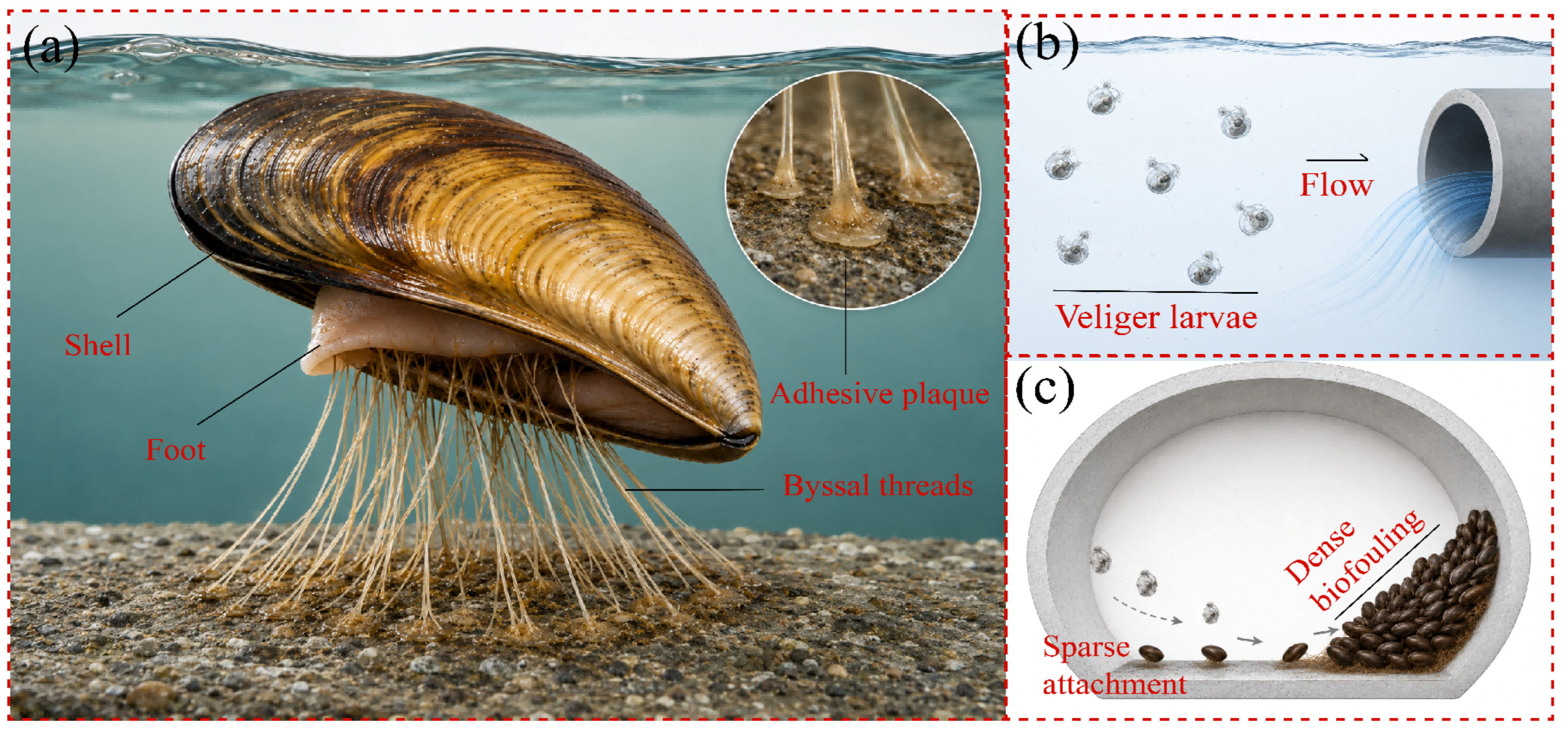
3.1. Mussel Attachment Mechanisms and Biofouling Progression
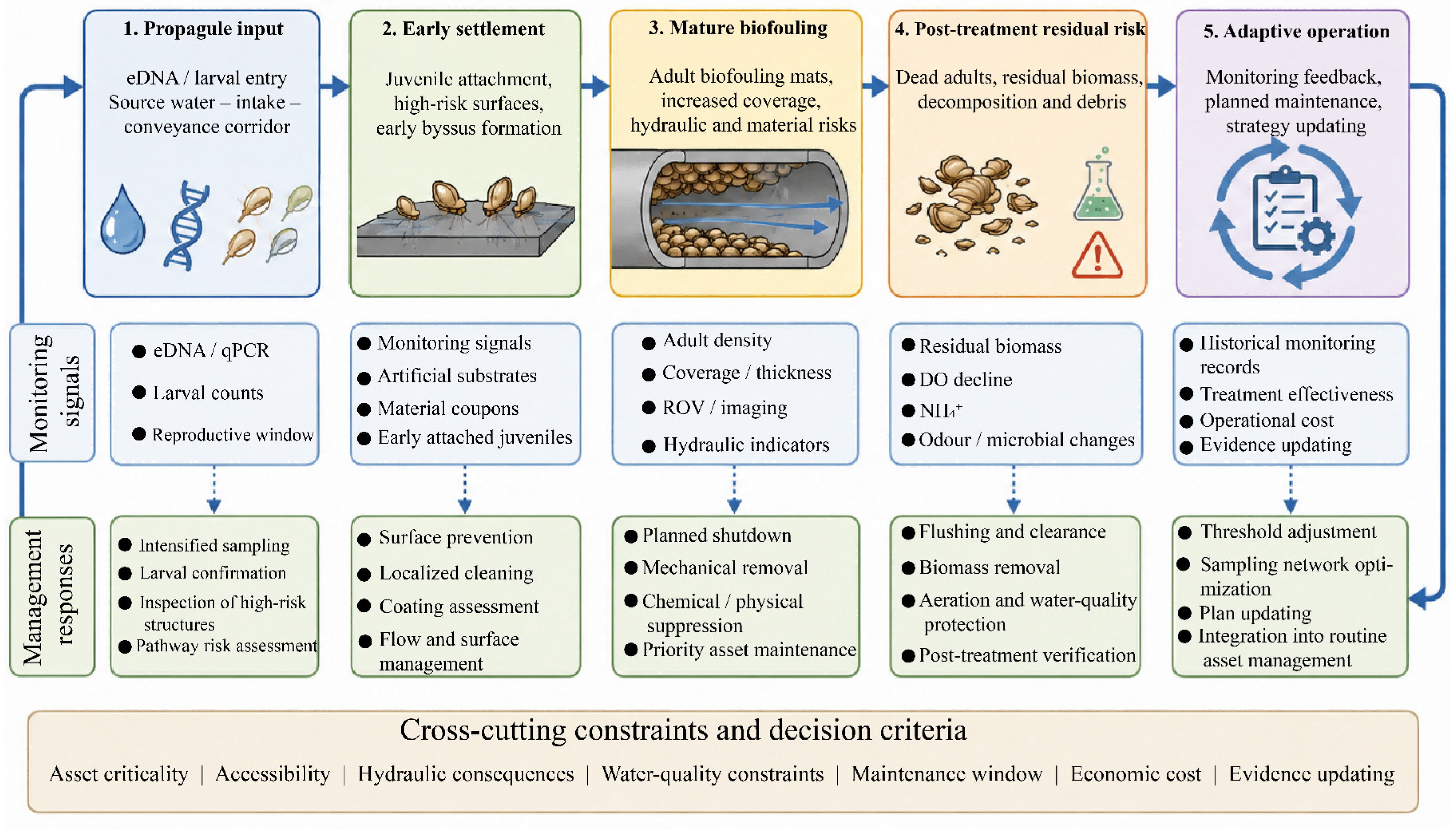
3.2. Stage–Risk Mapping for Infrastructure Management
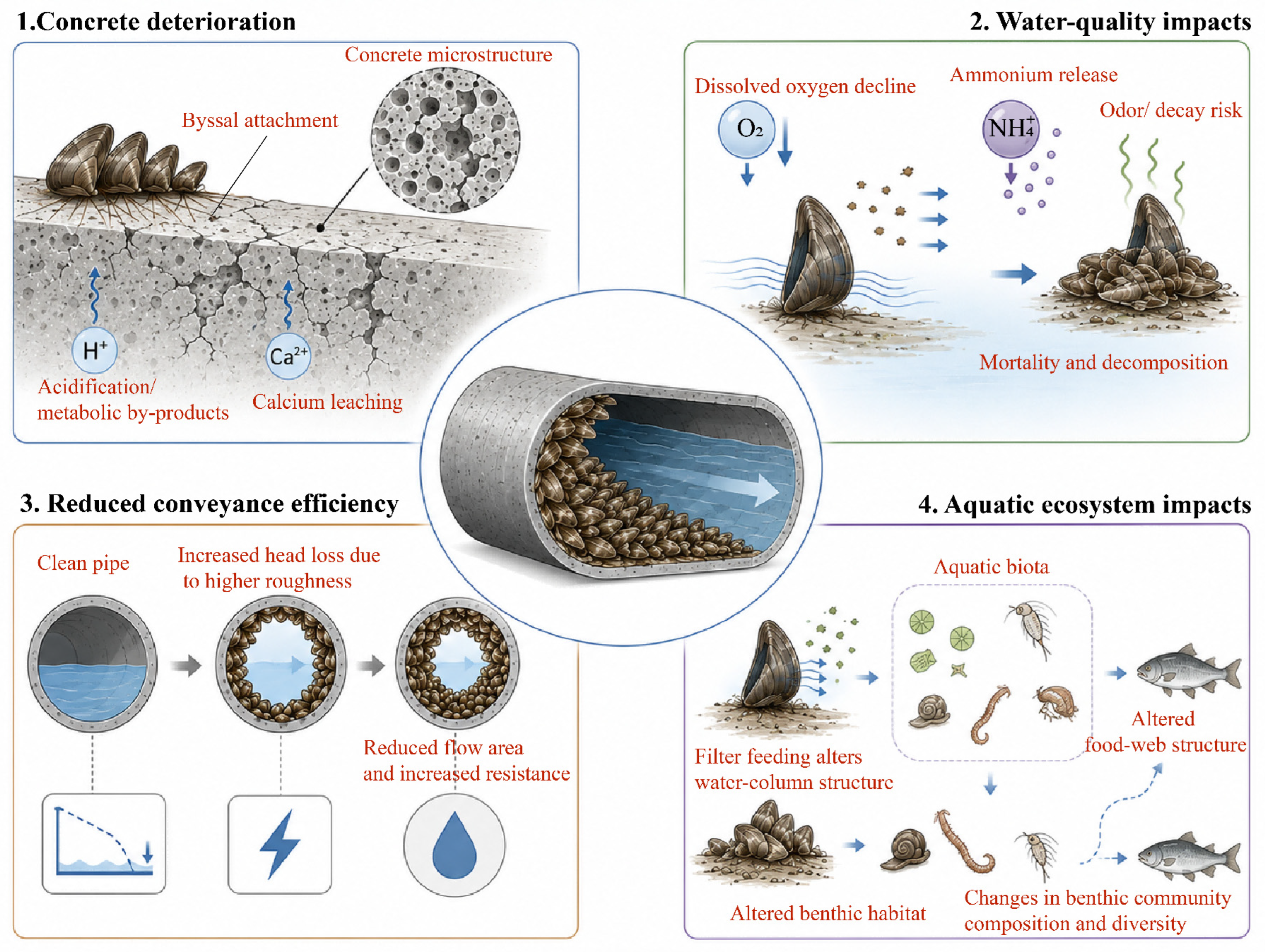
4. Impacts of L. fortunei on Water-Conveyance Projects
4.1. Concrete Deterioration
4.2. Water-Quality Impacts
4.3. Reduced Water-Conveyance Efficiency
4.4. Impacts on Aquatic Ecosystems
5. Monitoring and Early Warning Across Risk Stages
5.1. Larval Monitoring and eDNA-Based Early Warning
5.2. Conventional Field Surveys
5.3. ROV- and Image-Based Inspection
5.4. Stage-Specific Management Responses to Monitoring Signals
6. Control Measures for L. fortunei
6.1. Physical Control Methods
6.2. Chemical Control Methods
6.3. Coating-Based Control Methods
6.4. Biological Control Methods
6.5. Comparison of Control Methods
7. An Integrated Management Framework for Water-Conveyance Assets
8. Current Limitations and Research Priorities
8.1. Current Limitations
8.2. Research Priorities
9. Conclusions
Author Contributions
Funding
Institutional Review Board Statement
Informed Consent Statement
Data Availability Statement
Acknowledgments
Conflicts of Interest
References
- Waine, A.; Robertson, P.; Pattison, Z. Understanding and classifying the raw water transfer invasion pathway. Biol. Invasions 2024, 26, 4035–4049. [Google Scholar] [CrossRef] [Scilit]
- Zhan, A.; Zhang, L.; Xia, Z.; Ni, P.; Xiong, W.; Chen, Y.; Haffner, G.D.; MacIsaac, H.J. Water diversions facilitate spread of non-native species. Biol. Invasions 2015, 17, 3073–3080. [Google Scholar] [CrossRef] [Scilit]
- Guo, W.; Li, S.; Zhan, A. eDNA-Based Early Detection Illustrates Rapid Spread of the Non-Native Golden Mussel Introduced into Beijing via Water Diversion. Animals 2024, 14, 399. [Google Scholar] [CrossRef] [Scilit] [PubMed]
- Ricciardi, A. Global range expansion of the Asian mussel Limnoperna fortunei (Mytilidae): Another fouling threat to freshwater systems. Biofouling 1998, 13, 97–106. [Google Scholar] [CrossRef] [Scilit]
- Xia, Z.; Gu, J.; Wen, Y.; Cao, X.; Gao, Y.; Li, S.; Haffner, G.D.; MacIsaac, H.J.; Zhan, A. eDNA-based detection reveals invasion risks of a biofouling bivalve in the world’s largest water diversion project. Ecol. Appl. 2024, 34, e2826. [Google Scholar] [CrossRef] [Scilit] [PubMed]
- Karatayev, A.Y.; Boltovskoy, D.; Padilla, D.K.; Burlakova, L.E. The invasive bivalves Dreissena polymorpha and Limnoperna fortunei: Parallels, contrasts, potential spread and invasion impacts. J. Shellfish Res. 2007, 26, 205–213. [Google Scholar] [CrossRef] [Scilit]
- Liu, Y.; He, X.; Yang, Y.; Bai, X.; Yuan, C. Distribution, tolerance, growth, behaviour and control methods of Limnoperna fortunei (Dunker, 1857) (Bivalvia: Mytilidae): A review. Aquat. Conserv. Mar. Freshw. Ecosyst. 2024, 34, e4217. [Google Scholar] [CrossRef] [Scilit]
- Fang, X.; Li, H.; Zhang, S.; Zhang, J.; Wang, C.; Wang, X.; Ma, Z.; Jia, H. Integration of ROV and vision-based underwater inspection for Limnoperna fortunei in water conveyance structure. Eng. Appl. Artif. Intell. 2023, 124, 106575. [Google Scholar] [CrossRef] [Scilit]
- Yao, G.-Y.; Xu, M.-Z.; An, X.-H. Concrete deterioration caused by freshwater mussel Limnoperna fortunei fouling. Int. Biodeterior. Biodegrad. 2017, 121, 55–65. [Google Scholar] [CrossRef] [Scilit]
- Zhang, J.; Xu, M.; Huber, B.; Grünzner, M.; Blanckaert, K. Roughness and Energy Losses Induced by Mussel Growth on the Walls of Hydraulic Structures and Application to a Water Transfer Project. Water Resour. Res. 2025, 61, e2023WR036503. [Google Scholar] [CrossRef] [Scilit]
- Yang, Y.; Liu, K.; Zhang, J.; Xu, M.; Guo, F.; Zhou, X.; Wang, C.; Zhou, X.; Fu, X. Key environmental factors influencing eDNA quantitative detection of golden mussel (Limnoperna fortunei) in a long-distance water diversion project. Environ. Technol. Innov. 2025, 37, 103998. [Google Scholar] [CrossRef] [Scilit]
- de Paula, R.S.; Reis, M.d.P.; de Oliveira Júnior, R.B.; Andrade, G.R.; de Carvalho, M.D.; Cardoso, A.V.; Jorge, E.C. Genetic and functional repertoires of Limnoperna fortunei (Dunker, 1857) (Mollusca, Mytilidae): A review on the use of molecular techniques for the detection and control of the golden mussel. Hydrobiologia 2020, 847, 2193–2202. [Google Scholar] [CrossRef] [Scilit]
- Boltovskoy, D.; Paolucci, E.; MacIsaac, H.J.; Zhan, A.; Xia, Z.; Correa, N. What we know and don’t know about the invasive golden mussel Limnoperna fortunei. Hydrobiologia 2022, 852, 1275–1322. [Google Scholar] [CrossRef] [Scilit]
- Xiao, R.; Liu, D.; Xu, Y.; Li, T.; Ma, J. A Review of the Effects of Limnoperna fortunei (Dunker, 1857): Invasion on Hydraulic Structures and Ecosystems and Their Control. Sustainability 2025, 17, 2240. [Google Scholar] [CrossRef] [Scilit]
- Nakano, D.; Kobayashi, T.; Sakaguchi, I. Changes in the drift and the settlement of the freshwater mussel Limnoperna fortunei along a headrace channel. Water Sci. Technol. 2012, 65, 426–433. [Google Scholar] [CrossRef] [Scilit] [PubMed][Green Version]
- Zhao, N.; Xu, M.; Blanckaert, K.; Qiao, C.; Zhou, H.; Niu, X. Study of factors influencing the invasion of Golden Mussels (Limnoperna fortunei) in water transfer projects. Aquat. Ecosyst. Health Manag. 2019, 22, 385–395. [Google Scholar] [CrossRef] [Scilit]
- Cataldo, D.; Boltovskoy, D.; Hermosa, J.L.; Canzi, C. Temperature-dependent rates of larval development in Limnoperna fortunei (Bivalvia: Mytilidae). J. Molluscan Stud. 2005, 71, 41–46. [Google Scholar] [CrossRef] [Scilit]
- Andrade, G.R.; de Araújo, J.L.F.; Nakamura Filho, A.; Guañabens, A.C.P.; de Carvalho, M.D.; Cardoso, A.V. Functional surface of the golden mussel’s foot: Morphology, structures and the role of cilia on underwater adhesion. Mater. Sci. Eng. C 2015, 54, 32–42. [Google Scholar] [CrossRef] [Scilit] [PubMed]
- Li, S.; Xia, Z.; Chen, Y.; Gao, Y.; Zhan, A. Byssus structure and protein composition in the highly invasive fouling mussel Limnoperna fortunei. Front. Physiol. 2018, 9, 418. [Google Scholar] [CrossRef] [Scilit] [PubMed]
- Waite, J.H. Mussel adhesion—Essential footwork. J. Exp. Biol. 2017, 220, 517–530. [Google Scholar] [CrossRef] [Scilit] [PubMed]
- Matsui, Y.; Nagaya, K.; Yuasa, A.; Naruto, H.; Yamamoto, H.; Ohkawa, K.; Magara, Y. Attachment Strength of Limnoperna fortunei on Substrates, and their Surface Properties. Biofouling 2001, 17, 29–39. [Google Scholar] [CrossRef] [Scilit]
- Nagaya, K.; Matsui, Y.; Ohira, H.; Yuasa, A.; Yamamoto, H.; Ohkawa, K.; Magara, Y. Attachment strength of an adhesive nuisance mussel, Limnoperna fortunei, against water flow. Biofouling 2001, 17, 263–274. [Google Scholar] [CrossRef] [Scilit]
- Xu, M.; Darrigran, G.; Wang, Z.; Zhao, N.; Lin, C.-C.; Pan, B. Experimental study on control of Limnoperna fortunei biofouling in water transfer tunnels. J. Hydro-Environ. Res. 2015, 9, 248–258. [Google Scholar] [CrossRef] [Scilit]
- Boltovskoy, D.; Cataldo, D.H. Population dynamics of Limnoperna fortunei, an invasive fouling mollusc, in the lower Paraná River (Argentina). Biofouling 1999, 14, 255–263. [Google Scholar] [CrossRef] [Scilit]
- Darrigran, G.; Penchaszadeh, P.E.; Damborenea, C. The reproductive cycle of Limnoperna fortunei (Dunker, 1857) (Mytilidae) from a neotropical temperate locality. J. Shellfish Res. 1999, 18, 361–365. [Google Scholar]
- Pérez, M.; García, M.; Traversa, L.; Stupak, M. Concrete deterioration by golden mussels. In Proceedings of the RILEM International Conference on Microbial Impact on Building Materials; Ribas Silva, M., Ed.; RILEM Publications SARL: Champs-sur-Marne, France, 2003; pp. 39–47. [Google Scholar] [CrossRef] [Scilit]
- Pan, Z.; Cai, J. Study on erosion mechanism of simulated Limnoperna fortunei metabolic acid on cement-based materials. Pearl River 2019, 40, 60–65. [Google Scholar]
- Liu, Y.; He, X.; Yang, Y.; Yuan, X.; Zhou, Z.; Bai, X.; Yuan, C. Corrosion behavior of Limnoperna fortunei on carbon steel in freshwater environments. npj Mater. Degrad. 2025, 9, 69. [Google Scholar] [CrossRef] [Scilit]
- Li, R.; Hu, J.; Wang, L.; Yan, H.; Wang, Y.; Wang, W. Effect of Limnoperna fortunei on raw water quality. Water Purif. Technol. 2022, 41, 47–52. [Google Scholar] [CrossRef]
- Cataldo, D.; O’Farrell, I.; Paolucci, E.; Sylvester, F.; Boltovskoy, D. Impact of the invasive golden mussel (Limnoperna fortunei) on phytoplankton and nutrient cycling. Aquat. Invasions 2012, 7, 91–100. [Google Scholar] [CrossRef] [Scilit]
- Sardiña, P.; Chaves, E.; Marchese, M. Benthic community responses to invasion by the golden mussel, Limnoperna fortunei Dunker: Biotic homogenization versus environmental driving forces. J. N. Am. Benthol. Soc. 2011, 30, 1009–1023. [Google Scholar] [CrossRef] [Scilit]
- Zhang, J.; Zhang, S.; Liu, H.; Wang, C.; Wang, X.; Jiang, P.; Cui, W. Effect of fouling organism attachment on flow capacity of pressurized water diversion system. Adv. Sci. Technol. Water Resour. 2024, 44, 23–28. [Google Scholar] [CrossRef]
- McDowell, W.G.; Sousa, R. Mass mortality events of invasive freshwater bivalves: Current understanding and potential directions for future research. Front. Ecol. Evol. 2019, 7, 331. [Google Scholar] [CrossRef] [Scilit]
- Wang, R.; Wang, X.; Li, S.; Shen, J.; Wang, J.; Liu, C.; Zheng, Y.; Chen, Y.; Ding, C. Study on the law of harmful gas release from Limnoperna fortunei (Dunker 1857) during maintenance period of water tunnel based on K-means outlier treatment. Appl. Sci. 2021, 11, 11995. [Google Scholar] [CrossRef] [Scilit]
- Zhang, J.; Xu, M.; Sun, L.; Reible, D.D.; Fu, X. Impact of golden mussel (Limnoperna fortunei) colonization on bacterial communities and potential risk to water quality. Ecol. Indic. 2022, 144, 109499. [Google Scholar] [CrossRef] [Scilit]
- de Souza, T.R.C.; de Andrade, J.T.M.; Serrano, R.O.P.; Vidigal, T.H.D.A.; Viana, E.M.d.F.; Bastos, A.S.; Martinez, C.B. Energy efficiency analysis of pumping systems impacted by the golden mussel: A case study in the Brazilian Amazon. Energies 2023, 16, 1858. [Google Scholar] [CrossRef] [Scilit]
- Zhang, H.; Ding, Q.; Zhang, Y.; Lu, G.; Liu, Y.; Tong, Y. Prevention and Control of Biofouling Coatings in Limnoperna fortunei: A Review of Research Progress and Strategies. Polymers 2024, 16, 3070. [Google Scholar] [CrossRef] [Scilit] [PubMed]
- Liu, Z.; Chen, C.; Wu, W.; Zhang, B.; Chen, J.; Chen, S. Removing method of Limnoperna fortunei in long-distance raw water pipeline. Water Purif. Technol. 2014, 33, 109–112. [Google Scholar]
- Boltovskoy, D.; Karatayev, A.; Burlakova, L.; Cataldo, D.; Karatayev, V.; Sylvester, F.; Mariñelarena, A. Significant ecosystem-wide effects of the swiftly spreading invasive freshwater bivalve Limnoperna fortunei. Hydrobiologia 2009, 636, 271–284. [Google Scholar] [CrossRef] [Scilit]
- Darrigran, G. Potential impact of filter-feeding invaders on temperate inland freshwater environments. Biol. Invasions 2002, 4, 145–156. [Google Scholar] [CrossRef] [Scilit]
- Burlakova, L.E.; Karatayev, A.Y.; Karatayev, V.A. Invasive mussels induce community changes by increasing habitat complexity. Hydrobiologia 2012, 685, 121–134. [Google Scholar] [CrossRef] [Scilit]
- Darrigran, G.A.; Damborenea, M.C. A South American bioinvasion case history: Limnoperna fortunei (Dunker, 1857), the golden mussel. Am. Malacol. Bull. 2005, 20, 105–112. [Google Scholar]
- Sylvester, F.; Boltovskoy, D.; Cataldo, D. The invasive bivalve Limnoperna fortunei enhances benthic invertebrate densities in South American floodplain rivers. Hydrobiologia 2007, 589, 15–27. [Google Scholar] [CrossRef] [Scilit]
- González-Bergonzoni, I.; Silva, I.; Teixeira de Mello, F.; D’Anatro, A.; Boccardi, L.; Stebniki, S.; Brugnoli, E.; Tesitore, G.; Vidal, N.; Naya, D.E. Evaluating the role of predatory fish controlling the invasion of the Asian golden mussel Limnoperna fortunei in a subtropical river. J. Appl. Ecol. 2020, 57, 717–728. [Google Scholar] [CrossRef] [Scilit]
- Paolucci, E.M.; Thuesen, E.V.; Cataldo, D.H.; Boltovskoy, D. Veligers of an introduced bivalve, Limnoperna fortunei, are a new food resource that enhances growth of larval fish in the Paraná River (South America). Freshw. Biol. 2010, 55, 1831–1844. [Google Scholar] [CrossRef] [Scilit]
- Vieira, J.P.; Lopes, M.N. Size-selective predation of the catfish Pimelodus pintado (Siluriformes: Pimelodidae) on the golden mussel Limnoperna fortunei (Bivalvia: Mytilidae). Zoologia 2013, 30, 43–48. [Google Scholar] [CrossRef] [Scilit]
- Ito, K.; Shibaike, H. Use of environmental DNA to survey the distribution of the invasive mussel Limnoperna fortunei in farm ponds. Plankton Benthos Res. 2021, 16, 100–108. [Google Scholar] [CrossRef] [Scilit]
- Ostrensky, A.; Leite, R.V.V.; da Silva Bertão, A.P.; Stica, P.V.; Horodesky, A.; Mädder Netto, O.S.; Pie, M.R.; Pestana, D.; Zanin, T.L.; Dal Pont, G. Assessing the bioinvasion of the golden mussel (Limnoperna fortunei) through different watersheds in South Brazil: A comparison between quali-quantitative microscopic and molecular techniques. Biol. Invasions 2025, 27, 16. [Google Scholar] [CrossRef] [Scilit]
- Schenekar, T. The current state of eDNA research in freshwater ecosystems: Are we shifting from the developmental phase to standard application in biomonitoring? Hydrobiologia 2023, 850, 1263–1282. [Google Scholar] [CrossRef] [Scilit]
- Yang, Y.; Zhang, J.; Chang, Z.; Liu, M.; Xu, M.; Zhou, X.; Fu, X. Quantifying the effect of key factors on the shedding and decay rates of eDNA from the golden mussel. J. Environ. Manag. 2025, 388, 126054. [Google Scholar] [CrossRef] [Scilit] [PubMed]
- Wilcox, T.M.; McKelvey, K.S.; Young, M.K.; Jane, S.F.; Lowe, W.H.; Whiteley, A.R.; Schwartz, M.K. Robust Detection of Rare Species Using Environmental DNA: The Importance of Primer Specificity. PLoS ONE 2013, 8, e59520. [Google Scholar] [CrossRef] [Scilit] [PubMed]
- Xia, Z.; Zhan, A.; Gao, Y.; Zhang, L.; Haffner, G.D.; MacIsaac, H.J. Early detection of a highly invasive bivalve based on environmental DNA (eDNA). Biol. Invasions 2018, 20, 437–447. [Google Scholar] [CrossRef] [Scilit]
- Deiner, K.; Altermatt, F. Transport Distance of Invertebrate Environmental DNA in a Natural River. PLoS ONE 2014, 9, e88786. [Google Scholar] [CrossRef] [Scilit] [PubMed]
- Boeger, W.A.; Pie, M.R.; Falleiros, R.M.; Ostrensky, A.; Darrigran, G.; Mansur, M.C.D.; Belz, C.E. Testing a molecular protocol to monitor the presence of golden mussel larvae (Limnoperna fortunei) in plankton samples. J. Plankton Res. 2007, 29, 1015–1019. [Google Scholar] [CrossRef] [Scilit]
- Endo, N.; Sato, K.; Nogata, Y. Molecular based method for the detection and quantification of larvae of the golden mussel Limnoperna fortunei using real-time PCR. Plankton Benthos Res. 2009, 4, 125–128. [Google Scholar] [CrossRef] [Scilit]
- Zhou, N.; Zhang, R.-J.; Liu, B.-D.; Cui, B.; Du, Z.-L.; Chen, P.-F.; Zhu, B.-F.; Lin, C.; Dong, H.-T.; Zhou, W.-Y.; et al. Effects of ultrasound on invasive golden mussel Limnoperna fortunei mortality and tissue lesions. Sci. Total Environ. 2021, 761, 144134. [Google Scholar] [CrossRef] [Scilit] [PubMed]
- Fortunato, H.F.d.M.; Figueira, R.M.A.; de Souza, R.F.M.; Theodoro Junior, N.; Mello, V.B.B. Artificial intelligence as an ally to assess and manage the golden mussel (Limnoperna fortunei (Dunker, 1857)) bioinvasion. Aquat. Sci. 2025, 87, 53. [Google Scholar] [CrossRef] [Scilit]
- Xing, X.; Xu, M.; Wang, C.; Li, X.; Zhang, Y.; Xue, Y.; Fu, X. Smart detection of biofouling: A deep learning framework for water infrastructure surveillance. Water Res. 2026, 288, 124665. [Google Scholar] [CrossRef] [Scilit] [PubMed]
- Bergonci, P.E.A.; Mansur, M.C.D.; Pereira, D.; Santos, C.P.d. Population sampling of the golden mussel, Limnoperna fortunei (Dunker, 1857), based on artificial ceramic substrate. Biotemas 2009, 22, 85–94. [Google Scholar]
- Pestana, D.; Pie, M.R.; Ostrensky, A.; Boeger, W.A.; Andreoli, C.; Franceschi, F.; Lagos, P. Seasonal variation in larval density of Limnoperna fortunei (Bivalvia, Mytilidae) in the Iguaçu and Paraná rivers, in the region of Foz do Iguaçu, Paraná, Southern Brazil. Braz. Arch. Biol. Technol. 2008, 51, 607–612. [Google Scholar] [CrossRef] [Scilit]
- Xu, M.; Wang, Z.; Lin, C.-C.; Pan, B.; Zhao, N. Experimental Study of Invasion and Biofouling of Freshwater Mussel Limnoperna fortunei. Int. J. Geosci. 2013, 4, 1–7. [Google Scholar] [CrossRef]
- Perepelizin, P.V.; Boltovskoy, D. Effects of 254 nm UV irradiation on the mobility and survival of larvae of the invasive fouling mussel Limnoperna fortunei. Biofouling 2014, 30, 197–202. [Google Scholar] [CrossRef] [Scilit] [PubMed]
- Montalto, L.; Ezcurra de Drago, I. Tolerance to desiccation of an invasive mussel, Limnoperna fortunei (Dunker, 1857) (Bivalvia, Mytilidae), under experimental conditions. Hydrobiologia 2003, 498, 161–167. [Google Scholar] [CrossRef] [Scilit]
- Perepelizin, P.V.; Boltovskoy, D. Hot Water Treatment (Chronic Upper Lethal Temperature) Mitigates Biofouling by the Invasive Asian Mussel Limnoperna fortunei in Industrial Installations. Environ. Sci. Technol. 2011, 45, 7868–7873. [Google Scholar] [CrossRef] [Scilit] [PubMed]
- Zhang, C.; Xu, M.; Wang, Z.; Liu, W.; Yu, D. Experimental study on the effect of turbulence in pipelines on the mortality of Limnoperna fortunei veligers. Ecol. Eng. 2017, 109, 101–118. [Google Scholar] [CrossRef] [Scilit]
- Calazans, S.H.C.; Americo, J.A.; Fernandes, F.d.C.; Aldridge, D.C.; Rebelo, M.d.F. Assessment of toxicity of dissolved and microencapsulated biocides for control of the Golden Mussel Limnoperna fortunei. Mar. Environ. Res. 2013, 91, 104–108. [Google Scholar] [CrossRef] [Scilit] [PubMed]
- Cataldo, D.; Boltovskoy, D.; Pose, M. Toxicity of chlorine and three nonoxidizing molluscicides to the pest mussel Limnoperna fortunei. J. Am. Water Works Assoc. 2003, 95, 66–78. [Google Scholar] [CrossRef] [Scilit]
- Claudi, R.; de Oliveira, M.D. Chemical Strategies for the Control of the Golden Mussel (Limnoperna fortunei) in Industrial Facilities. In Limnoperna fortunei: The Ecology, Distribution and Control of a Swiftly Spreading Invasive Fouling Mussel; Boltovskoy, D., Ed.; Springer: Cham, Switzerland, 2015; pp. 417–441. [Google Scholar] [CrossRef] [Scilit]
- Darrigran, G.A.; Colautti, D.C.; Maroñas, M.E. A Potential Biocide for Control of the Golden Mussel, Limnoperna fortunei. J. Freshw. Ecol. 2007, 22, 359–360. [Google Scholar] [CrossRef] [Scilit]
- Montresor, L.C.; Miranda-Filho, K.C.; Paglia, A.; Luz, D.M.R.; Araújo, J.M.; Silva, M.J.d.S.; Gerhard, L.; Martinez, C.B.; Vidigal, T.H.D.A. Short-term toxicity of ammonia, sodium hydroxide and a commercial biocide to golden mussel Limnoperna fortunei (Dunker, 1857). Ecotoxicol. Environ. Saf. 2013, 92, 150–154. [Google Scholar] [CrossRef] [Scilit] [PubMed]
- Moreira, A.M.S.; Freitas, E.T.F.; Reis, M.d.P.; Nogueira, J.M.; Barbosa, N.P.d.U.; Reis, A.L.M.; Pelli, A.; Camargo, P.R.d.S.; Cardoso, A.V.; de Paula, R.S.; et al. Acute Exposure to Two Biocides Causes Morphological and Molecular Changes in the Gill Ciliary Epithelium of the Invasive Golden Mussel Limnoperna fortunei (Dunker, 1857). Animals 2023, 13, 3258. [Google Scholar] [CrossRef] [Scilit] [PubMed]
- Li, S.; Chen, Y.; Gao, Y.; Xia, Z.; Zhan, A. Chemical oxidants affect byssus adhesion in the highly invasive fouling mussel Limnoperna fortunei. Sci. Total Environ. 2019, 646, 1367–1375. [Google Scholar] [CrossRef] [Scilit] [PubMed]
- Wang, Q.-B.; Zhou, J.-H.; Zhang, R.-J.; Xu, Y.-Q.; Hu, Y.; Dong, H.-T.; Du, Z.-L.; Liu, Y.-S.; Lin, C.; Zhang, Z.-J. Physiological and metabolic responses of Limnoperna fortunei to KMnO4 and NaClO exposure. Water Environ. Res. 2025, 97, e70082. [Google Scholar] [CrossRef] [Scilit] [PubMed]
- Matsui, Y.; Nagaya, K.; Funahashi, G.; Goto, Y.; Yuasa, A.; Yamamoto, H.; Ohkawa, K.; Magara, Y. Effectiveness of Antifouling Coatings and Water Flow in Controlling Attachment of the Nuisance Mussel Limnoperna fortunei. Biofouling 2002, 18, 137–148. [Google Scholar] [CrossRef] [Scilit]
- Braga, E.F.; Ayroza, D.M.M.d.R.; Silva, M.C.d.M.; Nascimento, T.S.; Sanches, E.G.; Carmo, C.F.d.; Pereira, L.P.F.; Albert, A.L.M.; Batista, W.R.; Lopes, R.S.C.; et al. Synthesis of Lysoglycerophosphocholines from Crude Soybean Lecithins as Sustainable and Non-toxic Antifouling Agents against the Golden Mussel Limnoperna fortunei. ACS Omega 2022, 7, 45197–45207. [Google Scholar] [CrossRef] [Scilit] [PubMed]
- Pereira Morales, M.L.; Guimarães, P.S.; Martins, C.d.M.G.; Míguez, D.; Bentos, F.R.; Boccardi, L.; Brugnoli, E.; Shaik, A.; Chenia, H.; Cavalli, R.O.; et al. Aquatic macrophytes as a source of antifouling non-toxic against bacterial biofilms and golden mussel attachment: A possible role of quorum-sensing interference. Environ. Sci. Pollut. Res. 2024, 31, 66977–66993. [Google Scholar] [CrossRef] [Scilit] [PubMed]
- Siless, G.E.; García, M.T.; Pérez, M.C.; Blustein, G.; Palermo, J.A. Large-scale purification of pachydictyol A from the brown alga Dictyota dichotoma obtained from algal wash and evaluation of its antifouling activity against the freshwater mollusk Limnoperna fortunei. J. Appl. Phycol. 2018, 30, 629–636. [Google Scholar] [CrossRef] [Scilit]
- Dafforn, K.A.; Lewis, J.A.; Johnston, E.L. Antifouling strategies: History and regulation, ecological impacts and mitigation. Mar. Pollut. Bull. 2011, 62, 453–465. [Google Scholar] [CrossRef] [Scilit] [PubMed]
- Hernandez Elizarraga, V.H.; Ballantyne, S.; Gengelbach, L.; Americo, J.A.; Suhr, S.T.; Senut, M.-C.; Minerich, B.; Merkes, C.M.; Edwards, T.M.; Klymus, K.E.; et al. Toward invasive mussel genetic biocontrol: Approaches, challenges, and perspectives. iScience 2023, 26, 108027. [Google Scholar] [CrossRef] [Scilit] [PubMed]
- Magara, Y.; Matsui, Y.; Goto, Y.; Yuasa, A. Invasion of the non-indigenous nuisance mussel, Limnoperna fortunei, into water supply facilities in Japan. J. Water Supply Res. Technol. AQUA 2001, 50, 113–124. [Google Scholar] [CrossRef] [Scilit]



| Review | Main Emphasis | Stage–Risk Perspective | Monitoring and Management Link | Post-Treatment Management |
|---|---|---|---|---|
| [13] | Distribution, ecology, impacts, knowledge gaps, and control | Life-history stages and ecological effects are broadly considered, but not organized around risks to water-conveyance infrastructure | Monitoring and control are mainly discussed as separate aspects of invasion management | Limited attention to residual biomass and associated risks |
| [7] | Distribution, environmental tolerance, growth, behaviour, and control methods | Emphasis on biological traits and responses across life stages | Control methods are mainly discussed in relation to biological responses and treatment effects | Not specifically addressed |
| [14] | Impacts on hydraulic structures and ecosystems, invasion factors, and control approaches | Biofouling development and engineering impacts are considered | Monitoring and control are discussed, but are not organized around stage-specific management responses | Limited discussion of residual biomass and post-treatment recovery |
| Present review | Stage-specific biofouling risk and management in water-conveyance infrastructure | Biofouling is divided into propagule input, early settlement, mature biofouling, and post-treatment residual biomass | Monitoring evidence identifies the relevant risk stage, while engineering consequences determine the urgency and intensity of management actions | Residual biomass, biomass removal, water-quality recovery, and post-treatment monitoring are incorporated into the management process |
| Risk Stage | Dominant Process | Major Infrastructure Risk | Management Objective |
|---|---|---|---|
| Propagule input | Larval transport through connected water systems | Corridor-scale dispersal before visible fouling | Early detection and pathway surveillance |
| Early settlement | Juvenile attachment and early byssus formation | Surface colonization and localized hotspots | Settlement prevention |
| Mature biofouling | Growth and accumulation of adult fouling layers | Hydraulic impairment and material deterioration | Load assessment and targeted removal |
| Post-treatment residual risk | Accumulation and decomposition of dead mussels, shells, and residual biomass | Water-quality deterioration and maintenance risks | Biomass removal and post-treatment verification |
| Method Category | Primary Management Use | Key Limitation |
|---|---|---|
| Field sampling of larvae and adults | Routine surveillance after invasion and quantitative assessment of biofouling loads [59,60,61] | Labor-intensive, dependent on accessibility, and relatively insensitive to low-density early invasion |
| eDNA and qPCR detection | Pre-invasion screening, early detection, and early warning during the larval stage [5,11,47,52] | Affected by false-positive/negative detections, DNA transport and persistence, and site-specific environmental conditions |
| ROV- and image-recognition-based inspection | Inspection of inaccessible or hazardous structures during operation or shutdown periods [8,57] | Performance depends on image quality, turbidity, illumination, scale calibration, annotated datasets, and field validation |
| Risk models and decision-support tools | Integrating biological and environmental observations to prioritize monitoring locations and intervention timing [57] | Requires site-specific calibration and long-term operational validation before independent use for management decisions |
| Control Strategy | Long-Term Performance | Engineering Feasibility | Maintenance and Cost Implications | Environmental Considerations | Preferred Application |
|---|---|---|---|---|---|
| Mechanical removal and flushing | Effective for established fouling, but recolonization may require repeated removal | Suitable for accessible or hydraulically isolated structures; difficult to scale to long or continuously operating systems | Labor, shutdown requirements, repeated cleaning, and biomass disposal increase maintenance demand | Avoids chemical residues, but detached shells and biomass require removal or disposal | Localized mature fouling during planned maintenance |
| Thermal and UV treatment | Effective under suitable exposure conditions; long-term performance depends on repeated treatment | Thermal treatment requires heat delivery and temperature control; UV performance depends strongly on water transparency and exposure conditions | Energy and equipment requirements may constrain large-scale use | No chemical residues; energy demand and operating conditions remain important considerations | Larval-stage treatment or hydraulically controllable sections |
| Chemical oxidants and molluscicides | Effective when adequate dose and exposure time are maintained; repeated dosing may be required | Relatively feasible where existing dosing infrastructure is available | Chemical consumption, monitoring, and residual management contribute to operating costs | Residuals, by-products, downstream water quality, and non-target effects require control | Enclosed pipelines, intakes, and other systems with controllable dosing and retention time |
| Antifouling coatings | Can reduce settlement while coating performance is maintained; long-term field durability remains insufficiently quantified | Most suitable for new construction or accessible surfaces during major maintenance | Costs depend on surface preparation, service life, and recoating frequency; comparative life-cycle cost data remain limited | Environmental performance depends on coating chemistry; non-toxic systems are preferable for water-supply infrastructure | Prevention of settlement on high-risk surfaces |
| Biological or genetic approaches | Long-term effectiveness remains uncertain | Field-scale engineering application is currently limited | Cost-effectiveness cannot yet be assessed because practical deployment remains limited | Ecological effects and non-target risks require further assessment | Research and experimental applications |
Disclaimer/Publisher’s Note: The statements, opinions and data contained in all publications are solely those of the individual author(s) and contributor(s) and not of MDPI and/or the editor(s). MDPI and/or the editor(s) disclaim responsibility for any injury to people or property resulting from any ideas, methods, instructions or products referred to in the content. |
© 2026 by the authors. Licensee MDPI, Basel, Switzerland. This article is an open access article distributed under the terms and conditions of the Creative Commons Attribution (CC BY) license.
Share and Cite
Yang, D.; Cao, L.; Zhao, W.; Li, M.; Yu, Z.; Gao, Y.; Li, J.; Mei, Z.; Guo, W. Biofouling by Limnoperna fortunei in Water-Conveyance Infrastructure: Stage-Specific Risks, Monitoring Signals, and Integrated Management for Sustainable Operation. Sustainability 2026, 18, 9038. https://doi.org/10.3390/su18179038
Yang D, Cao L, Zhao W, Li M, Yu Z, Gao Y, Li J, Mei Z, Guo W. Biofouling by Limnoperna fortunei in Water-Conveyance Infrastructure: Stage-Specific Risks, Monitoring Signals, and Integrated Management for Sustainable Operation. Sustainability. 2026; 18(17):9038. https://doi.org/10.3390/su18179038
Chicago/Turabian StyleYang, Dongyang, Li Cao, Weihua Zhao, Min Li, Zengzeng Yu, Yu Gao, Junzhe Li, Zhenggui Mei, and Weijie Guo. 2026. "Biofouling by Limnoperna fortunei in Water-Conveyance Infrastructure: Stage-Specific Risks, Monitoring Signals, and Integrated Management for Sustainable Operation" Sustainability 18, no. 17: 9038. https://doi.org/10.3390/su18179038
APA StyleYang, D., Cao, L., Zhao, W., Li, M., Yu, Z., Gao, Y., Li, J., Mei, Z., & Guo, W. (2026). Biofouling by Limnoperna fortunei in Water-Conveyance Infrastructure: Stage-Specific Risks, Monitoring Signals, and Integrated Management for Sustainable Operation. Sustainability, 18(17), 9038. https://doi.org/10.3390/su18179038