1. Introduction
Rural sustainability has become a central issue in contemporary territorial governance. Under the framework of the United Nations Sustainable Development Goals (SDGs), rural areas are no longer understood merely as agricultural production zones or residual spaces outside urban development. Instead, they are increasingly recognized as socio-ecological and cultural landscapes in which food production, environmental stewardship, livelihood relevance, public-space usability, social participation, and spatial governance are interconnected [
1,
2,
3]. In this article, rural sustainability refers to the capacity of rural communities to maintain ecological functions, cultural continuity, livelihood relevance, public-space usability, social participation, and adaptive governance under demographic, land-use, environmental, and institutional pressures. This definition makes governance capacity central to sustainability rather than a separate administrative concern.
In many regions, rural development policies have gradually moved away from sectoral intervention toward integrated regeneration. Rural regeneration, rural revitalization, and community-based development programs often attempt to combine environmental improvement, local industry, cultural preservation, public-space renewal, and community participation. However, the sustainability of such programs cannot be assessed only by the number of completed projects, the amount of funding executed, or the visible improvement in public spaces. A more critical question is whether project-based participation can generate durable governance capacity within rural communities and whether such capacity helps maintain sustainability-oriented actions after individual projects end.
This question is particularly important in peri-urban rural areas. Unlike remote rural communities, peri-urban rural settlements are embedded in urban expansion, metropolitan economies, transportation networks, land-use transformation, ecological corridors, and recreational demands. Their rurality is continuously negotiated through planning regulations, community action, agricultural practices, environmental pressure, and urban–rural interaction. Peri-urban rural communities therefore face a double challenge: proximity to urban systems may provide access to consumers, educational institutions, professional networks, and public infrastructure, while also exposing rural communities to land-use pressure, agricultural decline, landscape fragmentation, population aging, and the risk of being reduced to recreational spaces for urban residents.
Existing studies on rural sustainability have provided several important insights. Multi-scale rural governance research has shown that rural development issues are not governed on a single scale. Rural living environment studies further suggest that physical improvement alone cannot ensure sustainability if maintenance mechanisms, resident participation, and everyday usability remain weak [
4,
5,
6,
7,
8]. Meanwhile, community capitals and rural resilience research remind us that rural sustainability depends not only on built facilities or short-term economic outputs, but also on social capital, natural capital, cultural capital, human capital, and adaptive capacity [
9,
10,
11,
12].
Despite these contributions, three research gaps remain. First, many studies still focus on rural regeneration as project implementation or physical improvement, paying insufficient attention to the intermediate process through which communities acquire governance capacity. Second, peri-urban rural regeneration remains underexplored, especially in highly urbanized cities where rural communities are closely embedded within metropolitan life and land-use systems. Third, although SDGs and ESG-oriented sustainability discourses are frequently cited in development programs, the mechanism through which global sustainability goals and governance responsibilities are translated into local community action remains insufficiently examined.
To address these gaps, this study deliberately positions the Hsinchu case within international debates rather than only within Taiwan’s policy context. OECD rural well-being research emphasizes rural–urban functional linkages, stakeholder engagement, and multi-level governance [
13], while FAO highlights territorial connections among rural settlements, small cities, food systems, and local livelihoods [
14]. International rural studies further show that rural places are increasingly shaped by globalization, hybrid rural–urban relations, multifunctional land use, and neo-endogenous development processes [
15,
16,
17,
18,
19]. SDG governance research similarly stresses collective action, trade-offs, accountability, and local adaptation rather than merely aligning local projects with SDG labels [
20,
21]. These perspectives provide a broader basis for interpreting Hsinchu City as a distinctive peri-urban case rather than as a statistically representative rural region.
Taiwan provides a meaningful context for addressing these gaps. Since the enactment of the Rural Regeneration Act in 2010, Taiwan’s rural regeneration policy has emphasized bottom-up participation, community training, local consensus building, rural regeneration planning, and the integration of production, living, and ecological dimensions [
22]. Communities are expected to enter the Bacon Program (Pei-Gen Program), Taiwan’s staged rural regeneration capacity-building training system through which communities learn rural regeneration concepts, identify local resources, build consensus, and prepare for Rural Regeneration Plan development. This institutional design makes rural regeneration not only a funding system but also a staged process of community learning and capacity formation.
Hsinchu City offers a particularly valuable case. Hsinchu City is located in northwestern Taiwan along the island’s western urban corridor, between the Taipei metropolitan region and central Taiwan. It is internationally known for the Hsinchu Science Park and its technology-oriented urban economy, yet it also contains agricultural, coastal, ecological, and landscape-based rural communities distributed across the North, East, and Xiangshan districts. According to updated program records, Hsinchu City contains 36 rural communities eligible to participate in rural regeneration training. Among them, 15 communities are located in non-urban land-use areas, while 21 communities are situated within urban planning areas that contain agricultural-related land eligible through activation procedures. To date, 25 communities have participated in the Bacon Program, representing a participation rate of 69.4%. In addition, according to the program dataset, nine communities are recorded as having passed Rural Regeneration Plan review, corresponding to a review–passage rate of 36.0% among Bacon Program participants and 25.0% among all eligible communities. Dongxiang Community in Xiangshan District has undergone the initial plan–review process and received review comments. In 2026, it is revising its Rural Regeneration Plan in response to these comments before submission for subsequent administrative approval.
This study asks three research questions: RQ1. How is rural regeneration translated across municipal, functional-cluster, community, and site scales in a peri-urban context? RQ2. Through what mechanisms do project-based rural regeneration interventions contribute to governance-capacity formation rather than merely producing administrative outputs? RQ3. How can an SDG-oriented analytical framework help evaluate the sustainability contribution and limitations of rural regeneration in Hsinchu City?
To answer these questions, this study adopts an evidence-bound reflective documentary case-study design. The empirical focus is the 2025 Hsinchu City Community Rural Regeneration Guidance Program; the analytical focus is governance-capacity formation; and the normative policy concern is rural sustainability. The objective is therefore not to choose between governance formation and sustainability, but to examine governance-capacity formation as an intermediate mechanism through which sustainability-oriented rural regeneration may become institutionally durable.
3. Materials and Methods
3.1. Research Design
This study adopts an evidence-bound reflective documentary case-study design to examine SDG-oriented peri-urban rural regeneration in Hsinchu City, Taiwan. The design draws on the tradition of practitioner reflection, in which professional knowledge is generated through systematic reflection on action and on reflexive inquiry, which requires researchers to examine how their own institutional position shapes interpretation [
43,
44]. In this study, “reflective” does not mean that personal experience is treated as evidence by itself. It means that practitioner knowledge is explicitly disclosed, bounded, and used only to contextualize documented processes.
The study is documentary because the primary empirical materials are program-generated and policy-generated documents rather than resident interviews or survey data. Such documents are suitable for reconstructing institutional procedures, participation trajectories, review stages, and project categories, but they are insufficient for measuring resident satisfaction, conflicts, social inclusion, economic outcomes, carbon reduction, or ecological effects. This limitation is not treated as an afterthought; it is built into the evidence-use protocol of the study.
The study is evidence-bound because every claim is assigned to an evidential status: documented output, analytical inference, reflexive contextualization, unverified long-term outcome, or policy implication. This protocol prevents the analysis from converting administrative records into unsupported claims of policy success. The purpose of the study is therefore to identify and refine a framework for governance-capacity formation rather than to evaluate the overall effectiveness of Hsinchu City’s rural regeneration policy.
Theoretical borrowing is also bounded by this research design. This study does not fully apply the niche–regime–landscape model from multi-level-transition research, nor does it treat Taiwan’s rural regeneration policy as an open-ended transition experiment. Rural regeneration in Taiwan is strongly shaped by state funding, review procedures, and administrative compliance. The transition-management and multi-level-transition literature are therefore used only to interpret localized learning, experimentation, and incremental reconfiguration within a policy-regulated setting. Similarly, collaborative and polycentric governance are used in a restricted sense: the Hsinchu case does not demonstrate a fully polycentric governance system, because municipal and national policy actors remain structurally important. These concepts are used only to clarify how multiple actors, professional teams, communities, and review mechanisms are coordinated across scales within a bounded public policy process [
32,
33,
45,
46].
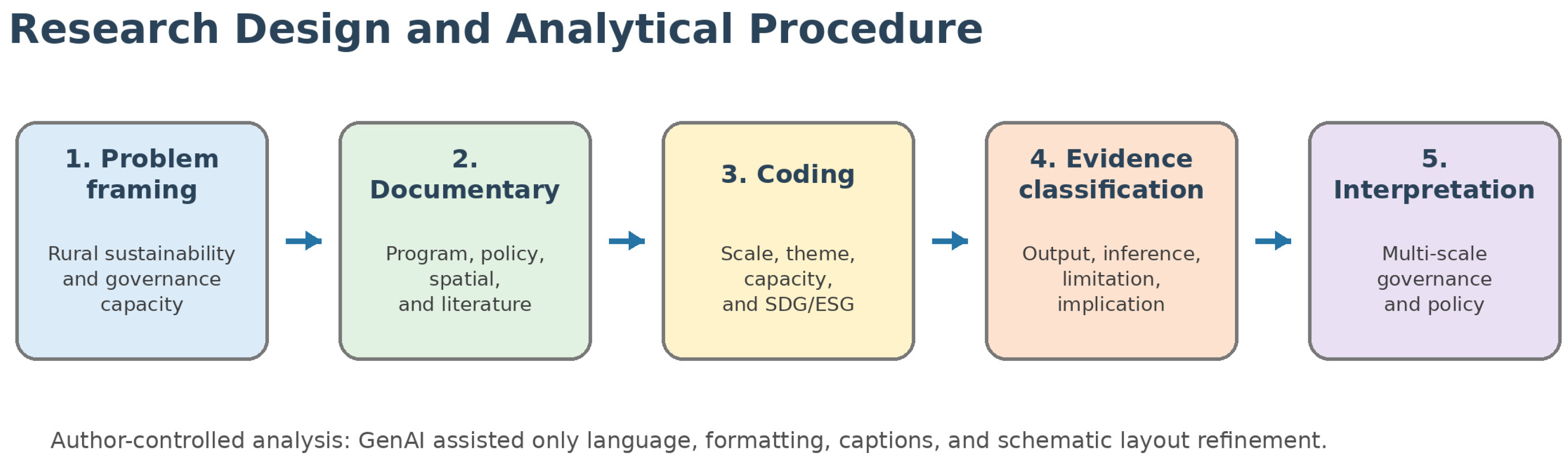
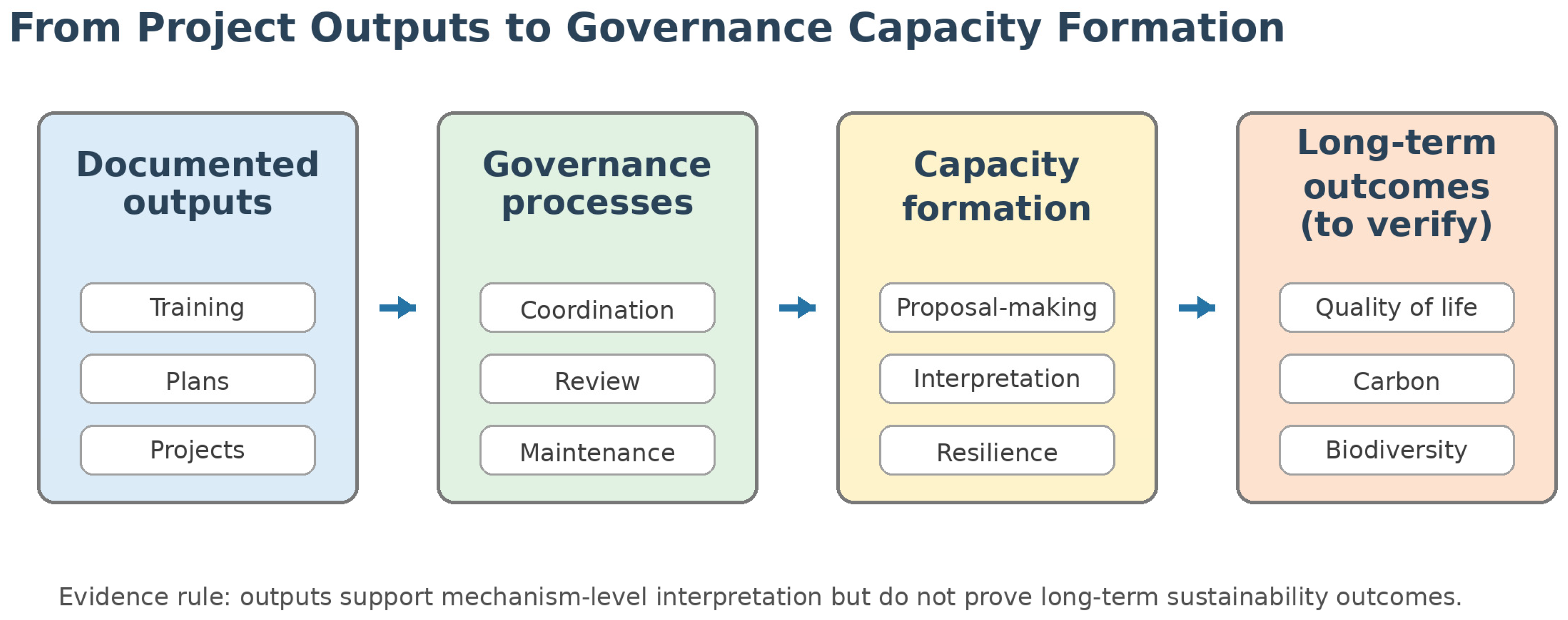
Figure 1 and
Figure 2 operationalize the research design.
Figure 1 presents the analytical procedure used to move from research problem framing and documentary data collection to coding, evidence-level classification, multi-scale analysis, and policy implications.
Figure 2 clarifies the core evidential distinction of the study: documented outputs and governance processes may support analytical inference about intermediate capacity formation, but they do not by themselves prove long-term sustainability outcomes.
3.2. Operational Definition of Peri-Urban Rurality and Case Selection
Hsinchu City was selected as the case study area for three reasons. First, it represents a distinctive peri-urban rural context in which technology-based urban development coexists with rural communities that have agricultural, ecological, cultural, and coastal characteristics. Hsinchu City is located in northwestern Taiwan along the island’s western urban corridor; this location places its rural communities within a highly urbanized municipal territory rather than in a remote agricultural hinterland. Second, Hsinchu City’s rural regeneration process has reached a scale that allows governance analysis beyond isolated community cases. Third, the case provides an opportunity to examine rural regeneration as an iterative process of review, revision, negotiation, and administrative alignment.
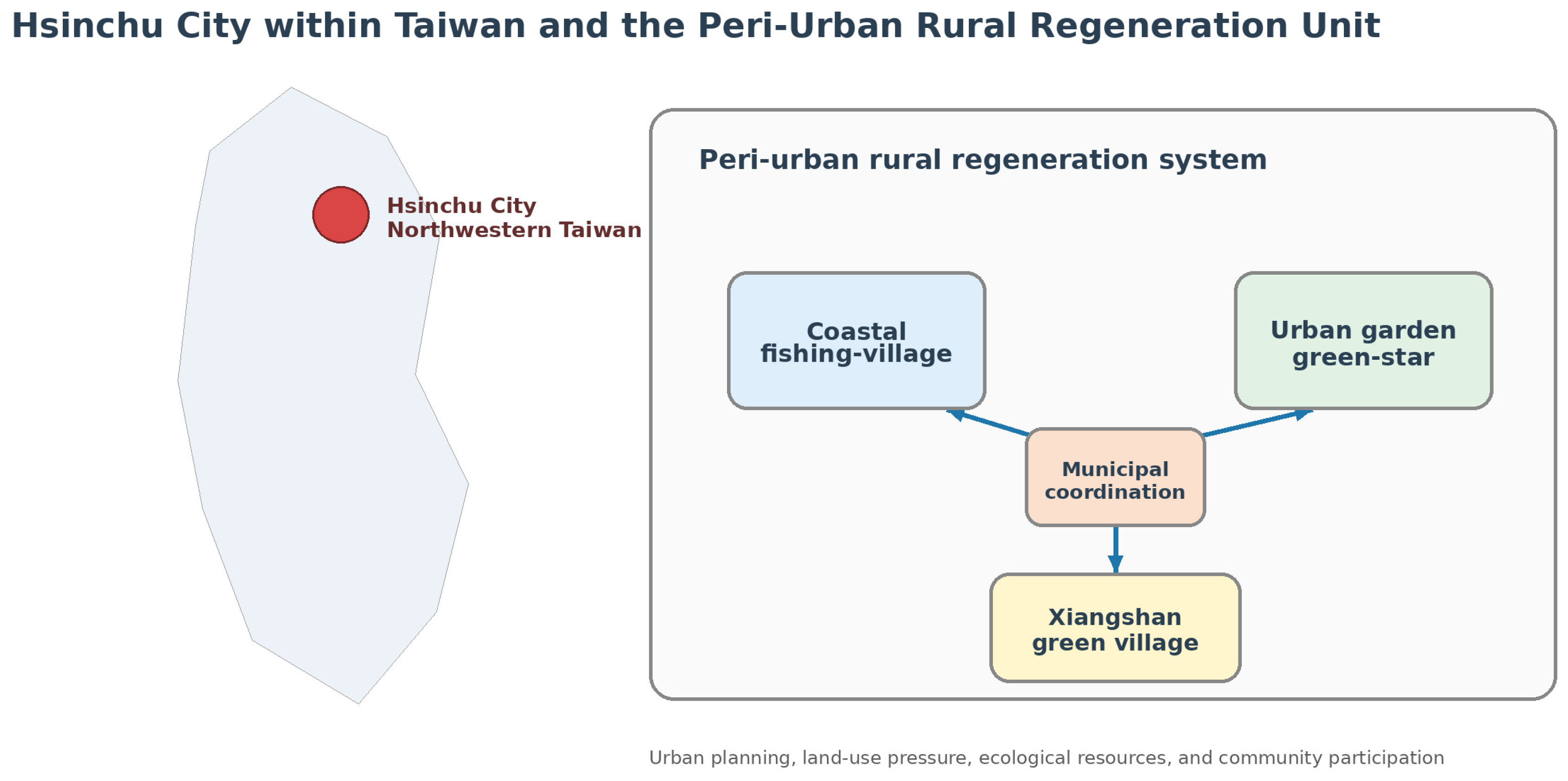
Figure 3 situates Hsinchu City and the three functional clusters within their peri-urban context.
For this study, peri-urban rural communities are operationally defined through three combined criteria. First, they are located within a highly urbanized municipal territory rather than in remote agricultural townships. Second, they retain agricultural, coastal, ecological, green-space, cultural, or landscape resources that remain relevant to rural regeneration. Third, they are functionally connected to urban systems through land-use transformation, commuting, recreational demand, public services, and municipal governance. This definition avoids treating peri-urban rurality as only an administrative label.
Based on this definition, Hsinchu City’s rural communities can be understood as having different degrees and forms of peri-urbanity. Urban-embedded rural communities are located within urban planning areas but retain agricultural-related land or community-based rural resources. Coastal peri-urban communities are shaped by the relationship among fishing-village culture, coastal ecology, and urban recreation. Landscape-based peri-urban communities, especially in Xiangshan, combine agricultural land, hilly terrain, ecological corridors, and tourism or learning functions. These distinctions support the later use of functional clusters as an intermediate governance scale.
Temporally, the study positions the 2025 guidance program within the longer trajectory of Taiwan’s Rural Regeneration Act, enacted in 2010. The available program dataset provides detailed evidence for the 2025 implementation year, while the Ministry of Agriculture open-data platform and the Rural Regeneration History website provide official fields for approval date, submission date, county/city, district, village, community, plan name, plan year, and approved area.
Supplementary Table S1 reports the community-status table used in the manuscript, including the nine approved or plan–review–passed communities and Dongxiang Community as an under-review case, with plan-year or approval-date information recorded according to the available source type [
47,
48].
3.3. Data Sources and Source Independence
The empirical analysis is based on four categories of sources. The first category consists of project-generated documents from the 2025 Hsinchu City Community Rural Regeneration Guidance Program, including reports, training materials, community project lists, presentation files, consultation records, and implementation records available to the authors for this study. These materials are extensive for reconstructing the program process, but they should not be understood as an exhaustive archive of every administrative communication or community-level record. The second category consists of key public policy and planning documents directly relevant to rural regeneration, spatial planning, and peri-urban land-use governance in Hsinchu City. Internal administrative correspondence, informal communications, and documents containing sensitive or non-public information were not used as empirical evidence. The third category consists of the international and Taiwan-based academic literature used to frame the case within debates on rural sustainability, peri-urban governance, community resilience, institutional learning, SDG localization, and ESG-oriented governance. The fourth category consists of visual and spatial materials used to interpret community distribution, functional clusters, and peri-urban spatial relationships. In this structure, the international literature provides the main theoretical foundation for rural sustainability, peri-urban governance, SDG localization, ESG governance, resilience, and collaborative governance [
13,
14,
15,
16,
17,
18,
19,
20,
21,
23,
24,
25,
26,
27,
28,
29,
30,
31,
32,
33,
34,
35,
36,
37,
38,
39,
40,
41,
42,
43,
44,
45,
46,
49,
50], whereas Taiwan-specific academic studies, official datasets, planning documents, and program-generated records provide the empirical and institutional context for the Hsinchu case [
1,
2,
3,
4,
5,
6,
7,
8,
22,
47,
48,
51,
52,
53,
54,
55,
56,
57,
58,
59,
60,
61,
62,
63,
64,
65,
66,
67].
The data structure therefore contains an asymmetry. Project-generated documents provide rich process detail but limited independence; public policy documents provide institutional context but do not capture resident experience; the academic literature provides conceptual positioning but cannot validate the specific Hsinchu process; and visual–spatial materials clarify distributional patterns but do not measure social outcomes. Internal administrative correspondence, informal communications, and documents containing sensitive or non-public information were not used as empirical evidence. This study addresses the asymmetry by using project documents only for documented outputs and process reconstruction, while reserving stronger outcome claims for future research using interviews, resident surveys, external evaluation, GIS analysis, and longitudinal monitoring.
Table 2 summarizes the data sources, analytical uses, and evidence levels.
3.4. Analytical Procedure and Hybrid Framework Derivation
The analysis proceeded in five steps. First, program documents were reviewed to identify the institutional process of rural regeneration in Hsinchu City. Second, materials were coded according to four analytical scales: municipal scale, functional-cluster scale, community scale, and site scale. Third, project materials were coded according to rural regeneration dimensions, including production, living environment, ecology, culture, governance, public space, rural experience, and sustainability education. Fourth, coded materials were analyzed according to six dimensions of governance-capacity formation. Fifth, rural regeneration actions were mapped onto relevant SDGs to examine local translation mechanisms rather than to claim verified SDG outcomes.
3.5. Coding Framework and Capacity-Dimension Logic
The coding framework consisted of three layers: descriptive coding, thematic coding, and interpretive coding. Descriptive coding identified basic project information, such as community name, district, project category, training type, implementation activity, review status, and documented output. Thematic coding classified the materials into broader analytical themes, including rural living environment improvement, public-space renewal, cultural preservation, ecological conservation, industry activation, community empowerment, cross-sectoral collaboration, and SDG-oriented action. Interpretive coding examined whether and how documented activities could be interpreted as contributing to governance-capacity formation.
Table 3 presents the proposed coding scheme.
For example, Dongxiang Community is not coded as a successful regeneration outcome. Its review–comment revision process is coded as a documented review stage, then interpreted only as a possible example of institutional learning. The coding chain is: review record and resident-meeting documentation -> plan-revision requirement -> analytical inference of proposal-making and interpretive capacity under revision -> no claim of plan approval, long-term maintenance, or resident outcome. This example illustrates how evidence-use rules restrict the strength of interpretation.
3.6. Evidence-Use Protocol
To avoid overinterpretation, this study classifies claims according to the evidence-use protocol summarized in
Table 4. First, documented outputs refer to information directly recorded in project documents, public policy materials, planning documents, or visual–spatial records. Second, cross-document analytical inferences refer to interpretations supported by more than one source type and by the conceptual framework. Third, reflexive contextualization refers to the author–practitioner’s interpretive knowledge of process context; it is not treated as an independent evidence level and is used only when triangulated with documentary sources. Fourth, unverified long-term outcomes refer to impacts that cannot be confirmed by the available evidence, including income growth, demographic stabilization, carbon reduction, and sustained ecological improvement. Fifth, policy implications are normative recommendations derived from the analysis rather than empirical outcomes.
3.7. Researcher Positionality and Self-Study Boundary
The first author’s role as principal investigator created both interpretive access and methodological vulnerability. The manuscript therefore avoids claiming that it is an external evaluation of the program. Instead, it presents an evidence-bound reflective documentary case study. Reflexive insight is used only as contextual interpretation, not as stand-alone evidence. All major claims are linked to documented materials, cross-document comparison, or literature-based analytical framing. This distinction is particularly important because project-generated documents tend to emphasize planned activities and reported outputs more than internal conflict, resident dissatisfaction, implementation failure, or unobserved non-participation.
3.8. Methodological Limitations and Verification Needs
This study is based primarily on documentary analysis and reflective interpretation and does not include representative resident surveys, formal interviews, independent third-party evaluation, or longitudinal monitoring. Consequently, the analysis cannot verify residents’ subjective quality of life, community conflict, marginalized voices, actual use of public spaces, income effects, population change, or carbon-reduction outcomes. These limitations are not incidental; they define the scope of the paper. The empirical contribution is the construction of an analytical framework and the identification of plausible governance mechanisms that require future external verification.
4. Results
4.1. Rural Regeneration Participation Trajectory in Hsinchu City
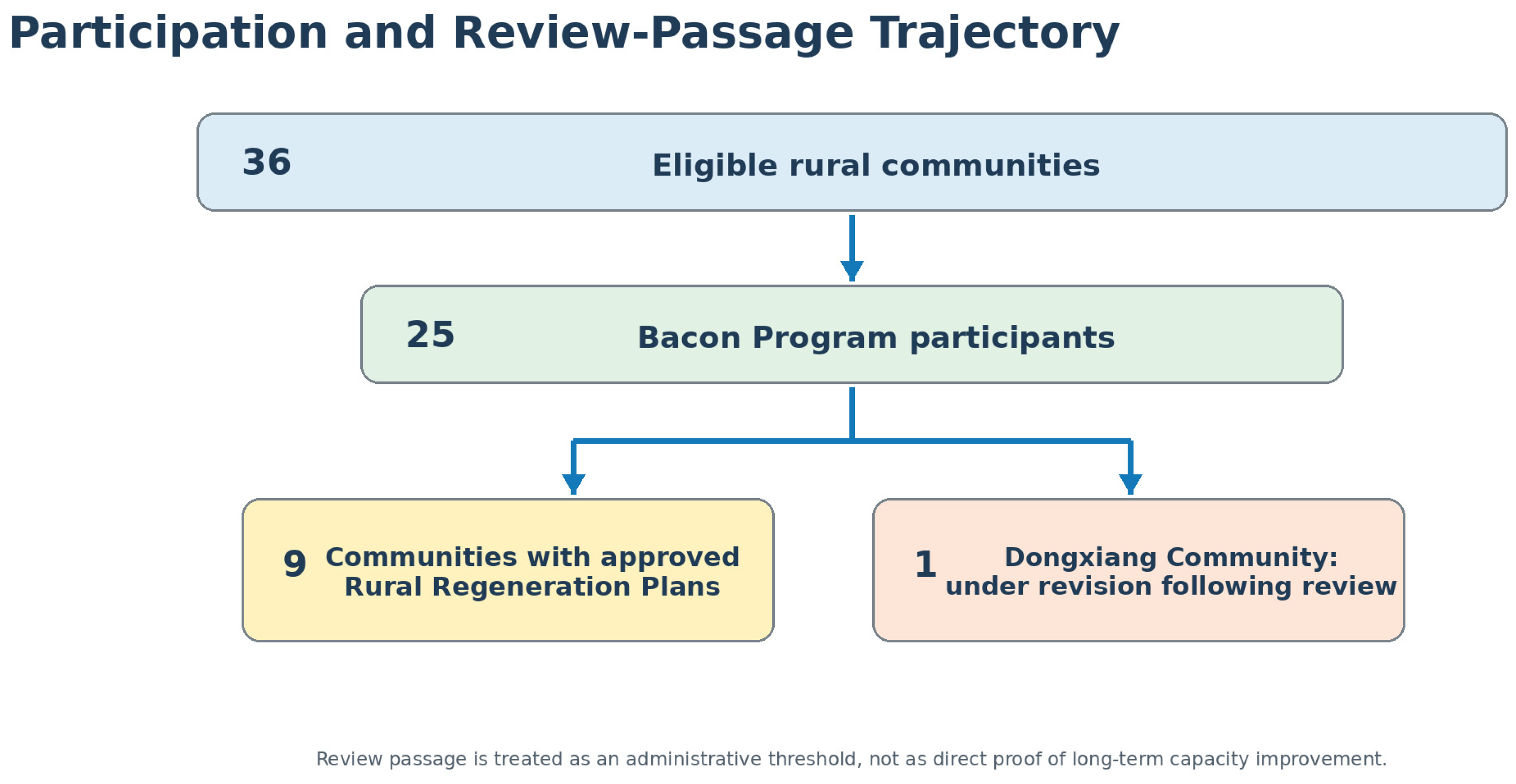
The first finding concerns the participation and approval trajectory of rural regeneration in Hsinchu City. Updated program records show that Hsinchu City contains 36 rural communities eligible to participate in rural regeneration training. Among them, 15 communities are located in non-urban land-use areas, while 21 communities are situated within urban planning areas that contain agricultural-related land eligible through activation procedures. To date, 25 of the 36 eligible communities have participated in the Bacon Program, resulting in a participation rate of 69.4%. In addition, according to the program dataset, nine communities are recorded as having passed Rural Regeneration Plan review, corresponding to a review–passage rate of 36.0% among Bacon Program participants and 25.0% among all eligible communities.
Table 5 summarizes the participation and review–passage status.
The case of Dongxiang Community in Xiangshan District illustrates the iterative nature of this process. Dongxiang Community has undergone the initial plan–review process and received review comments, but it is still revising its Rural Regeneration Plan in 2026 before submitting the revised version to the Hsinchu City Government for subsequent administrative approval. This case demonstrates that governance capacity is also formed during review, negotiation, revision, and alignment with administrative standards.
Figure 4 visualizes the participation and review–passage trajectory.
4.2. Multi-Scale Governance Structure
The second finding concerns the multi-scale governance structure through which rural regeneration operates in Hsinchu City. The empirical materials show that rural regeneration is not implemented on a single scale. Instead, it involves municipal coordination, functional-cluster planning, community participation, and site-based intervention.
Table 6 presents the multi-scale governance structure identified in this study.
At the municipal scale, rural regeneration functions as a governance platform connected to land-use governance, agricultural land preservation, ecological conservation, cultural development, community empowerment, and SDG-oriented local sustainability. At the functional-cluster scale, rural communities are grouped according to shared development themes, landscape characteristics, and resource complementarities. At the community scale, rural regeneration is implemented through Bacon Program participation, resident meetings, proposal preparation, local resource investigation, community organization, and annual implementation projects. At the site scale, rural regeneration becomes visible through public spaces, food forests, ecological trails, community gardens, cultural routes, activity spaces, and rural-experience sites.
4.3. Functional Clusters and Peri-Urban Rural Differentiation
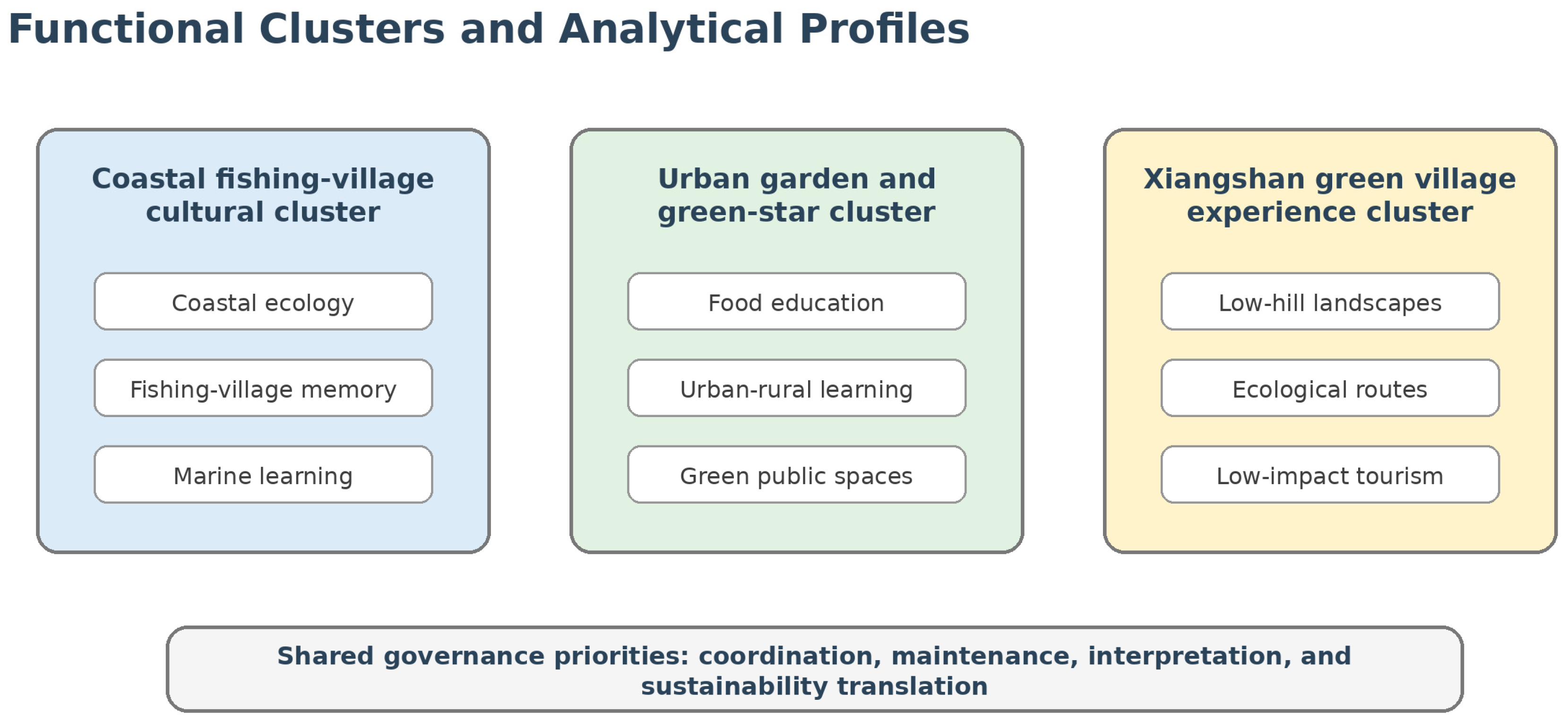
The third finding is that Hsinchu City’s rural regeneration requires a differentiated functional-cluster approach. The program materials identify three broad functional clusters: the coastal fishing-village cultural cluster, the urban-garden and green-star cluster, and the Xiangshan green village experience cluster. These clusters do not represent rigid administrative districts; rather, they provide an analytical and planning framework for understanding how different communities can develop distinct but complementary regeneration strategies.
Table 7 summarizes their characteristics and governance priorities.
The functional-cluster approach helps address a common limitation in rural regeneration: the tendency to evaluate communities as isolated units. In Hsinchu City, many rural issues exceed the scale of a single community. Coastal ecology, rural tourism routes, agricultural landscape preservation, public-space networks, and urban–rural learning all require coordination beyond individual project sites.
Figure 5 presents the three functional clusters and their analytical profiles.
4.4. Governance-Capacity Formation Through Training, Review, and Implementation
The fourth finding concerns the mechanisms through which governance capacity is formed. The empirical materials suggest that rural regeneration contributes to governance capacity through training, review, and implementation. Training introduces communities to concepts, procedures, and expectations of rural regeneration. Review requires communities to translate local visions into formal plans that meet administrative, spatial, and policy standards. Implementation allows communities to practice coordination, financial management, community mobilization, public communication, and maintenance.
This study identifies six dimensions of governance-capacity formation: proposal-making capacity, coordination capacity, maintenance capacity, interpretive capacity, sustainability-translation capacity, and resilience capacity.
Table 3 links these dimensions with empirical indicators, governance processes, and evidential boundaries.
4.5. Site-Based Interventions and Rural Public-Space Governance
The fifth finding concerns site-based rural public-space interventions. Many annual rural regeneration projects in Hsinchu City involve public spaces, community gardens, cultural routes, rural-experience sites, ecological interpretation, environmental improvement, and local activity spaces. These projects provide visible and tangible outcomes, but their sustainability depends on whether they are embedded in everyday use and community maintenance.
In a peri-urban context, rural public spaces have multiple functions. They are not only local facilities for residents but also interfaces between rural communities and urban visitors. This study therefore treats public-space projects as possible sites of governance-capacity formation only when documentary evidence shows links to everyday use, accessibility, maintenance arrangements, local interpretation, or ecological stewardship. Actual vitality, resident satisfaction, and age-friendly performance remain future verification issues because this study does not include post-occupancy observation or resident surveys.
4.6. SDG Translation Mechanism
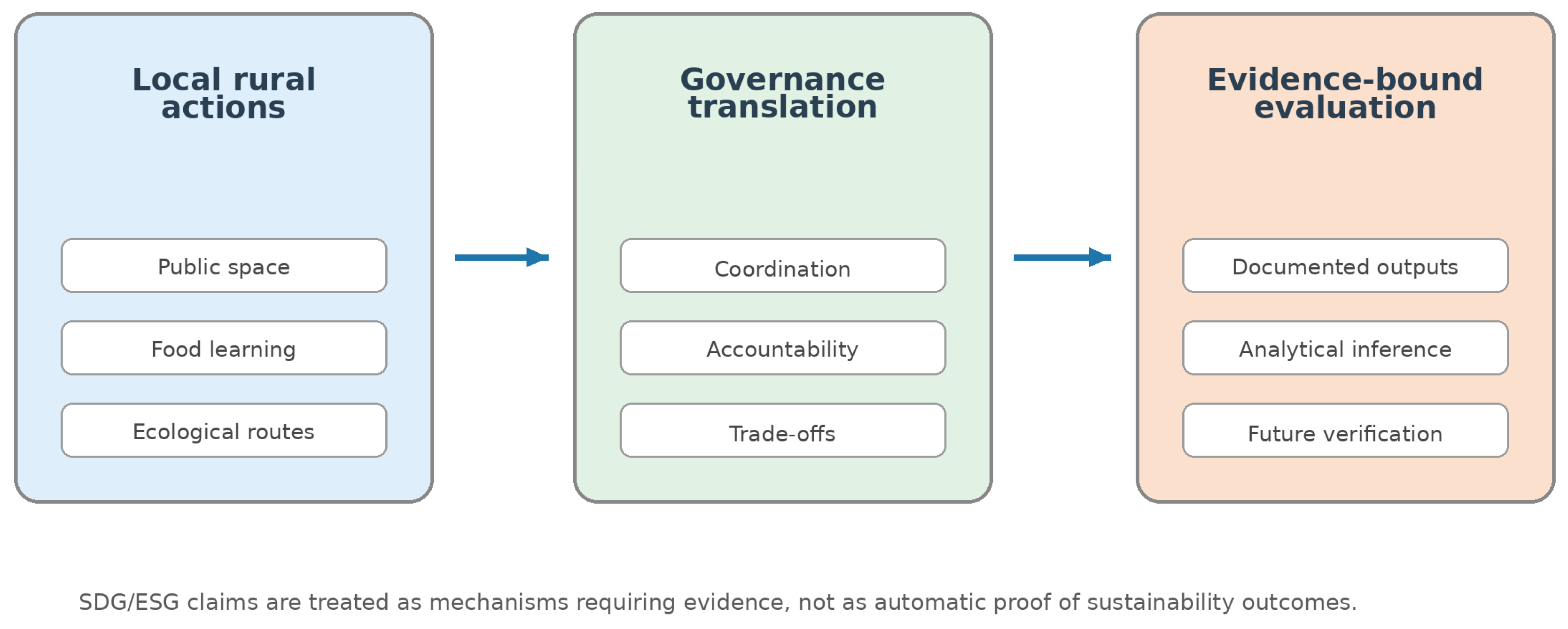
The sixth finding concerns the mechanism of SDG translation. The Hsinchu case shows that rural regeneration can be connected to multiple SDGs, but this connection should be interpreted carefully. The study does not claim that the program has already achieved measurable SDG outcomes. Instead, it identifies how rural regeneration activities may function as local translation mechanisms for global sustainability goals.
Table 8 presents the SDG translation mechanism identified in this study.
SDG 11 is translated through rural living environment improvement, public-space renewal, community planning, and cultural landscape preservation. SDG 12 is translated through local food experiences, community markets, rural industry activation, agricultural interpretation, and attempts to reconnect production and consumption. SDG 13 is translated through low-carbon education, energy-related courses, environmental awareness, ecological conservation, and climate-sensitive planning. SDG 14 is relevant to the coastal fishing-village cultural cluster because several rural regeneration actions involve coastal ecological interpretation, fishing-village cultural memory, wetland-related environmental awareness, and community-based coastal stewardship. However, this study treats SDG 14 as a local translation mechanism for coastal and marine-related learning rather than as evidence of measurable marine biodiversity improvement or marine-resource recovery. SDG 15 is translated through ecological interpretation, agricultural landscape preservation, green spaces, and biodiversity-related community actions. SDG 17 is translated through partnerships among local government, communities, universities, professional teams, instructors, and civic organizations.
Figure 6 visualizes the evidence-bound SDG/ESG translation mechanism.
4.7. Constraints, Uneven Participation, and Limits of Governance-Capacity Inference
The seventh finding is not a positive outcome, but a set of analytical tensions. First, participation remains incomplete: 25 of 36 eligible communities have participated in the Bacon Program, meaning that 11 eligible communities remain outside the documented training trajectory. This indicates that eligibility does not automatically translate into policy participation. Second, the movement from training participation to plan review is selective: 9 of the 25 participating communities are recorded in the program dataset as having passed Rural Regeneration Plan review. This should be interpreted as an administrative threshold and procedural achievement, not as direct evidence that governance capacity has improved in a verified or equal manner across communities.
Third, Dongxiang Community’s 2026 review-comment revision process illustrates institutional learning under constraint rather than completed success. The case shows that plan review can require communities to translate local visions into a more policy-recognizable form, but it does not demonstrate long-term outcomes. Fourth, functional clustering is analytically useful but institutionally incomplete. Cluster-based interpretation can reveal cross-community complementarities, yet actual collaboration may still be limited by uneven organizational resources, maintenance burdens, annual funding cycles, and administrative boundaries. Fifth, SDG translation remains a mechanism-level finding. The documents support the identification of SDG-related local practices, but they do not verify SDG outcomes. These tensions are central to the article’s evidence-bound contribution.
4.8. Summary of Results
The results show that the Hsinchu case does not simply confirm the proposed framework. It also exposes the limits of translating project participation into governance capacity. The case demonstrates a staged participation trajectory, a multi-scale governance structure, and the usefulness of functional clusters. At the same time, it reveals incomplete participation, uneven conversion from training to approval, the provisional status of Dongxiang Community, and the need to treat SDG translation as a mechanism requiring future verification. These tensions provide the basis for
Section 5, which reframes rural regeneration as institutional learning, clarifies the intermediate role of functional clusters, and specifies the verification boundary of SDG translation.
5. Discussion
5.1. Governance-Capacity Formation as an Intermediate Mechanism of Rural Sustainability
The Hsinchu case suggests that rural regeneration should be interpreted as an institutional learning process rather than merely as project delivery. In this article, institutional learning is used in a limited and evidence-bound sense, drawing on reflective-practice, organizational-learning, and policy-learning traditions [
43,
49,
50]. It does not mean that resident cognition or community attitudes have been directly measured. Rather, within the evidential boundary of documentary analysis, learning is inferred only when the record shows procedural adjustment, repeated plan revision, translation of review comments, or alignment between community proposals and policy requirements.
Governance-capacity formation is therefore the article’s analytical bridge between rural regeneration and rural sustainability. The study does not claim that project implementation automatically produces sustainability. Instead, it argues that sustainability-oriented rural regeneration becomes more durable only when project-based participation helps communities and public agencies develop proposal-making, coordination, maintenance, interpretive, sustainability-translation, and resilience capacities. This framing also clarifies the article’s objective: the empirical object is rural regeneration in Hsinchu City, the analytical object is governance-capacity formation, and the normative concern is rural sustainability.
Returning to the three research questions, RQ1 is answered by showing that rural regeneration in Hsinchu City is translated across municipal coordination, functional clusters, community participation, and site-based intervention. RQ2 is answered by identifying training, proposal preparation, review-comment revision, implementation, and maintenance as mechanisms through which project-based participation may contribute to governance-capacity formation. RQ3 is answered by distinguishing SDG translation from SDG labeling and by specifying the evidence boundary between local sustainability mechanisms and unverified long-term SDG outcomes.
5.2. Functional Clusters as an Intermediate Governance Scale
The findings indicate that peri-urban rural regeneration cannot be adequately governed through a single-community model. Individual communities often lack the scale to address coastal ecology, urban–rural learning routes, shared public-space networks, or landscape-based tourism. The functional-cluster scale provides an intermediate level between municipal strategy and community projects. It does not replace administrative districts; rather, it creates an analytical space for identifying complementary resources, shared risks, and possible cross-community collaboration.
The Hsinchu case also shows that functional clusters are not automatically institutionalized. The coastal, urban-garden, and Xiangshan landscape clusters differ in resource endowment, organizational maturity, public-space needs, and exposure to urban pressure. Thus, functional clustering should be understood as a planning and learning device, not as evidence that cross-community governance has already been achieved. Future policy design would need facilitation mechanisms, shared maintenance arrangements, and inter-community forums if clusters are to become actual governance units.
5.3. SDG Translation, ESG Governance, and Evidence Boundaries
The distinction between SDG labeling and SDG translation remains a central analytical contribution, but it must be operationalized cautiously. SDG translation is identified only when three conditions are present: a local action is linked to a specific sustainability theme; the action is embedded in an institutional or community process; and the evidence specifies a plausible governance mechanism. For example, a community garden is not automatically an SDG 11 or SDG 12 contribution. It becomes analytically relevant only when documents connect it with public-space use, food education, maintenance responsibility, or community learning.
The governance dimension of ESG strengthens this argument. Environmental or social claims in rural regeneration remain fragile if there is no governance mechanism for coordination, accountability, maintenance, trade-off management, or long-term monitoring. Although this article does not conduct a corporate ESG assessment, ESG provides a useful vocabulary for clarifying that governance capacity is not peripheral to sustainability but part of the institutional infrastructure that enables sustainability-oriented actions to persist. In this sense, SDG and ESG perspectives converge around the need to connect sustainability claims to verifiable local mechanisms.
A trade-off perspective is especially important in peri-urban rural regeneration. Public-space improvement or rural-experience development related to SDG 11 may increase recreational attractiveness and land-use pressure, potentially creating tension with ecological stewardship related to SDG 15. Similarly, local tourism or market activities related to SDG 12 may strengthen production–consumption learning while also generating maintenance burdens or visitor-management pressures. SDG and ESG translation should therefore include not only positive alignment but also the identification of trade-offs, accountability boundaries, and future verification needs.
5.4. Evidence Boundaries and the Limits of Project-Generated Documentation
A major limitation of this study is also its methodological problem-space: much of the evidence was generated by the program being analyzed, and the first author served as program principal investigator. Project-generated documents are detailed but not neutral. They tend to record planned actions, reportable outputs, meeting procedures, and implementation progress more systematically than conflict, non-participation, weak maintenance, or dissatisfaction. The evidence-use protocol addresses this issue by preventing project documents from being treated as proof of effectiveness.
The author–practitioner position is therefore handled as reflexive contextualization rather than independent evidence. It provides insight into procedural logic and implementation context, but it cannot validate claims by itself. This methodological stance is important because the article does not claim to be an external evaluation. Its contribution is to make the interpretive boundary explicit and to propose a framework that can later be tested through resident surveys, interviews, GIS analysis, external evaluation, and longitudinal monitoring.
5.5. Analytical Transferability and International Policy Implications
Hsinchu City is not presented as a representative Taiwanese rural case. It is a distinctive peri-urban municipality in which a technology-oriented urban economy coexists with agricultural, coastal, ecological, and landscape-based rural communities. Its value lies in analytical transferability: the case helps clarify how peri-urban rural regeneration may be studied when rural communities are embedded in urban planning areas, land-use pressure, metropolitan recreation, and municipal governance systems.
The Hsinchu case is not statistically generalizable beyond Taiwan. Its transferability is analytical and conditional. The framework may be relevant to countries or regions that use project-based rural regeneration, community capacity-building, plan–review mechanisms, professional guidance, or local sustainability programs to connect rural communities with multi-level governance. However, direct extrapolation is limited where rural policy systems lack comparable participatory procedures, where state-community relations differ substantially, or where rural sustainability problems are shaped primarily by remoteness rather than peri-urban pressure.
Beyond Taiwan, the case suggests four policy lessons for project-based rural sustainability programs: first, evaluation should include intermediate governance-capacity indicators rather than only completed outputs; second, functional clusters can help connect community projects with regional sustainability strategies; third, SDG and ESG claims should be supported by identifiable local mechanisms and evidence boundaries; and fourth, long-term outcomes should be verified through independent monitoring rather than inferred from project completion alone.
6. Limitations
This study has several limitations that define the scope of its claims. First, it is based primarily on documentary analysis and reflective interpretation. The evidence can reconstruct policy procedures, project outputs, participation trajectories, review stages, and analytical mechanisms, but it cannot directly verify residents’ subjective quality of life, internal community conflicts, marginalized voices, actual public-space use, income effects, demographic change, carbon reduction, biodiversity improvement, or durable resilience.
Second, the first author’s role as principal investigator provided access to detailed implementation records and practice-based contextual knowledge, but also introduced the risk of interpretive bias. The manuscript addresses this risk through reflexive disclosure, documentary triangulation, and evidence-use classification. Nevertheless, the study remains a researcher-practitioner case rather than an independent third-party evaluation.
Third, the data sources are extensive but not exhaustive of all possible administrative, community, or informal records. Category 1 includes the project-generated documents available to the authors and used for this study, while Category 2 includes key public policy and planning documents relevant to Hsinchu City’s rural regeneration and spatial governance. Internal administrative correspondence, informal communications, and documents containing sensitive or non-public information were not used as empirical evidence.
Fourth, the international transferability of the findings is conditional. The analytical framework may be relevant to other project-based rural sustainability programs, especially in peri-urban regions with participatory planning, professional guidance, community capacity-building, and multi-level governance. However, direct extrapolation is limited because Taiwan’s Bacon Program and Rural Regeneration Plan review system are institutionally specific. Future research should test the framework through comparative cases, resident surveys, stakeholder interviews, GIS analysis, external evaluation, and longitudinal monitoring.
7. Conclusions
This study examined SDG-oriented peri-urban rural regeneration in Hsinchu City, Taiwan, through an evidence-bound reflective documentary case study. Its central contribution is not to claim verified policy impact, but to develop an analytical framework for understanding how project-generated outputs may be interpreted, within strict evidential boundaries, as possible conditions for governance-capacity formation. The framework connects institutional entry, multi-scale governance, functional clusters, documentary evidence, SDG/ESG translation, and evidence-bound policy interpretation.
The study answers RQ1 by identifying a multi-scale translation structure in which rural regeneration is mediated across municipal coordination, functional clusters, community participation, and site-based interventions. It answers RQ2 by clarifying that governance capacity is formed through training, proposal preparation, plan review, review-comment revision, implementation coordination, and maintenance arrangements. It answers RQ3 by proposing an evidence-bound SDG translation framework that distinguishes local sustainability mechanisms from unverified long-term SDG outcomes.
For peri-urban rural regeneration research, the Hsinchu case shows the value of treating highly urbanized rural communities as functionally differentiated and institutionally mediated spaces. The case is not statistically representative of all Taiwanese rural areas; rather, it is an analytically useful case for examining how rural communities embedded in a technology-oriented city negotiate land-use pressure, ecological resources, urban–rural interaction, and policy participation. The concept of functional clusters offers a transferable lens for studying the intermediate scale between municipal policy and community-level implementation.
For rural regeneration policy evaluation, the findings suggest that project completion and funding execution should be supplemented by governance-capacity indicators. Evaluation systems should ask whether communities develop proposal-making, coordination, maintenance, interpretive, sustainability-translation, and resilience capacities over time, and whether SDG or ESG-related claims are supported by identifiable local mechanisms, evidence boundaries, and trade-off awareness. This shifts policy evaluation from a narrow focus on participation and review–passage indicators toward a more process-sensitive assessment of how rural communities acquire, sustain, and verify governance capacity.
The added value of this study is therefore not a claim of verified policy success, but a transferable analytical framework that clarifies how documentary evidence can be used, within explicit evidential limits, to examine governance-capacity formation and SDG/ESG translation in project-based rural regeneration. Future research should verify approval years and community trajectories through official datasets, supplement documentary analysis with resident and external-stakeholder evidence, and examine whether documented governance-capacity formation is associated with measurable changes in public-space maintenance, quality of life, ecological stewardship, carbon-related practices, or long-term rural resilience.