


Abstract
Against the ongoing pursuit of ecological civilization and the Beautiful China agenda, understanding how environmental policies influence corporate sustainable development has become increasingly important. This study aims to examine whether and how the “Zero-Waste City” pilot policy affects corporate ESG performance and to identify the underlying mechanisms through which the policy influences firms’ sustainability outcomes. Based on a panel dataset of Chinese A-share listed firms from 2014 to 2024, this study exploits the phased implementation of the “Zero-Waste City” pilot program as a quasi-natural experiment and employs a multi-period difference-in-differences (DID) model to estimate its causal effects. The results show that the “Zero-Waste City” pilot policy significantly improves corporate ESG performance. Mechanism analyses reveal that the policy promotes ESG performance through three channels: alleviating financing constraints, stimulating green technological innovation, and enhancing corporate environmental attention. Further heterogeneity analyses indicate that the policy effects are more pronounced among firms located in central China, traditional industries, heavy-polluting industries, and large enterprises. Additional analysis shows that the policy mainly improves firms’ environmental (E) and governance (G) performance. This study contributes to the literature by providing micro-level evidence on how environmental governance policies shape corporate sustainability outcomes. The findings offer important implications for improving policy design and facilitating firms’ green transformation. Future research could further explore the long-term dynamic effects, spatial spillover mechanisms, and alternative approaches to measuring corporate sustainability performance.
1. Introduction
Over the past several decades, China has experienced remarkable economic expansion driven largely by an extensive growth model that relies heavily on resource inputs and energy consumption. While this development strategy has generated substantial economic gains, it has also intensified pressure on natural resources and given rise to a range of environmental challenges. Among them, solid waste pollution has emerged as a particularly pressing environmental issue. The scale of solid waste generation in China has reached unprecedented levels. Data from the “China Statistical Yearbook” and the “2024 China Ecological Environment Statistical Bulletin” show that annual solid waste production exceeds 11 billion tons, of which general industrial solid waste contributes more than 4 billion tons and hazardous industrial waste accounts for over 100 million tons. Moreover, the long-term accumulation of solid waste has imposed substantial pressure on the ecological environment. Against this backdrop, addressing solid waste pollution has become a major practical challenge facing China.
In response to the growing challenges posed by solid waste accumulation and environmental degradation, China has introduced the “Zero-Waste City” initiative as an important policy instrument for advancing ecological civilization and facilitating a transition toward sustainable urban development. In December 2018, the “Pilot Work Plan for Zero-Waste City Construction” was officially issued, marking the formal implementation of the policy. The policy promotes the minimization and reutilization of solid waste in order to reduce its environmental burden and facilitate the transition of cities toward resource-efficient and sustainable development. In May 2019, the “Announcement on the List of Pilot Zero-Waste Cities” identified 11 cities, including Shenzhen, and 5 special regions, including the Xiong’an New Area, as the first batch of pilot areas. Subsequently, in April 2022, the “Notice on the List of Zero-Waste Cities during the Fourteenth Five-Year Plan Period” expanded the pilot scope to 113 prefecture-level and above cities and 8 special regions. In China’s evolving environmental governance framework, the “Zero-Waste City” initiative has emerged as a key policy approach for improving solid waste management, jointly advancing pollution control and carbon reduction, and supporting the transition toward greener and low-carbon urban development.
Under this policy context, firms, as the primary entities responsible for resource consumption and pollutant emissions, play a decisive role in achieving the goals of solid waste reduction and environmental governance. The traditional development model solely oriented toward profit maximization is increasingly unable to meet the requirements of the ongoing green transformation, making it imperative for firms to shift toward a sustainable development model that balances environmental, social, and governance performance. Over the past decade, ESG performance has evolved into an important framework for evaluating corporate sustainable development. Meanwhile, ESG practices among Chinese listed companies have expanded rapidly. According to the “China ESG Development White Paper (2024) [1],” more than 2200 A-share listed companies had released ESG or sustainability reports by 2024, representing a substantial increase compared with previous years. Furthermore, in April 2024, China’s three major stock exchanges jointly issued the “Guidelines for Sustainability Reporting by Listed Companies [2,3,4],” promoting the transition of ESG disclosure from voluntary practice to a more standardized and institutionalized framework. With the continuous improvement of ESG disclosure systems and regulatory requirements, ESG performance not only reflects firms’ fulfillment of environmental and social responsibilities but is also regarded by capital markets as an important indicator of risk management capability and long-term competitiveness. Consequently, firms have increasingly incorporated ESG principles into their strategic decision-making processes to strengthen sustainability and long-term resilience.
Existing studies have extensively examined the economic and environmental consequences of the “Zero-Waste City” pilot policy. Previous research demonstrates that the policy can promote corporate green innovation, improve resource allocation efficiency, and enhance green development performance [5,6,7,8,9]. Meanwhile, environmental studies indicate that the initiative contributes to solid waste reduction, resource recycling, pollution mitigation, and carbon emission reduction [10,11,12]. These findings provide important evidence regarding the effectiveness of the “Zero-Waste City” policy in promoting environmental governance and green development.
However, several important issues remain unresolved. First, existing studies mainly focus on specific outcomes, such as green innovation, productivity improvement, or environmental pollution reduction, while limited attention has been paid to the broader implications of the policy for corporate sustainable development. As an integrated framework incorporating environmental, social, and governance dimensions, ESG performance provides a comprehensive perspective for evaluating corporate sustainability. Nevertheless, whether and how the “Zero-Waste City” pilot policy affects corporate sustainability remains insufficiently explored, not only in China but also in the broader international literature on environmental policy and corporate sustainability. Second, the underlying mechanisms through which environmental governance initiatives influence corporate sustainability remain unclear.
Motivated by these research gaps, this study aims to answer the following research questions:
- (1)
- Does the “Zero-Waste City” pilot policy improve corporate sustainable development?
- (2)
- Through what channels does the policy affect corporate sustainable development?
- (3)
- Are the effects heterogeneous across different types of firms and regions?
To answer these questions, this study exploits the staggered implementation of the “Zero-Waste City” pilot policy as a quasi-natural experiment and employs a multi-period difference-in-differences (DID) framework using Chinese A-share listed firms from 2014 to 2024.
This study contributes to the existing literature in three ways. First, this study extends the literature on environmental policy evaluation by linking the “Zero-Waste City” pilot policy with corporate ESG performance. Unlike previous studies that mainly examine specific environmental or economic outcomes, this study provides comprehensive evidence regarding how solid waste governance policies influence corporate sustainability. Second, this study advances the understanding of the mechanisms underlying environmental policy effectiveness. By examining financing constraint alleviation, green technological innovation, and environmental attention enhancement, this study reveals the underlying pathways through which environmental policies shape corporate ESG performance. Third, this study provides a more nuanced understanding of policy heterogeneity by investigating differences across regions, industries, firm sizes, and further disentangling its impacts across the environmental, social, and governance dimensions.
The remainder of this paper is organized as follows. Section 2 presents the theoretical foundation and develops the research hypotheses regarding the impact of the “Zero-Waste City” pilot policy on corporate ESG performance. Section 3 describes the research design, including the empirical model, variable definitions, sample selection, and data sources. Section 4 reports the empirical results, including the baseline regression results, robustness checks, mechanism analyses, heterogeneity analyses, and further discussions. Section 5 concludes the study, summarizes the main findings, presents policy implications, and discusses limitations and future research directions.
2. Theoretical Foundation and Hypothesis Development
2.1. Theoretical Foundation
The relationship between environmental policies and corporate sustainable development can be explained through several theoretical perspectives. Since the “Zero-Waste City” pilot policy simultaneously involves environmental regulation, resource allocation, technological upgrading, information disclosure, and stakeholder participation, multiple theoretical mechanisms may jointly explain how such a policy affects corporate ESG performance.
2.1.1. Environmental Regulation Theory and the Porter Hypothesis
Environmental regulation theory suggests that government intervention can influence corporate behavior by changing firms’ external institutional constraints and compliance requirements. Traditional perspectives argue that stricter environmental regulations may increase firms’ operating costs and reduce competitiveness. However, the Porter Hypothesis [13] provides an alternative perspective, suggesting that well-designed environmental regulations can stimulate technological innovation and operational improvements, thereby generating innovation compensation effects.
In the context of the “Zero-Waste City” pilot policy, strengthened solid waste management requirements, stricter pollution control standards, and enhanced environmental supervision increase firms’ incentives to improve resource efficiency and adopt cleaner production practices. Therefore, environmental regulation provides an important theoretical foundation for understanding how the policy promotes corporate sustainable development.
2.1.2. Stakeholder Theory and Legitimacy Theory
Stakeholder theory [14] emphasizes that firms are embedded in a broader social environment and must respond to the expectations of governments, investors, consumers, communities, and other stakeholders. Legitimacy theory [15] further suggests that firms seek to maintain organizational legitimacy by aligning their behaviors with prevailing social norms and institutional expectations.
The “Zero-Waste City” pilot policy not only strengthens governmental environmental regulation but also promotes environmental information disclosure and public participation mechanisms. These institutional changes increase external stakeholder pressure and encourage firms to pay greater attention to environmental responsibility, social expectations, and corporate reputation. Therefore, stakeholder theory and legitimacy theory provide theoretical explanations for why environmental policies may influence firms’ ESG behaviors.
2.1.3. Resource-Based View and Circular Economy Theory
The resource-based view [16] argues that firms’ sustainable competitive advantages depend on their ability to acquire and utilize valuable resources. Circular economy theory [17] emphasizes resource conservation, recycling, and the transformation from linear production models toward resource-efficient development patterns.
The “Zero-Waste City” initiative promotes resource recycling, waste reduction, and technological upgrading, thereby encouraging firms to improve resource utilization efficiency and develop green production capabilities. These processes help firms accumulate environmental capabilities and transform external policy pressures into internal sustainable development advantages. Thus, the resource-based view and circular economy theory provide a theoretical basis for explaining the role of green innovation and resource optimization in improving corporate ESG performance.
2.1.4. Attention-Based View and Information Disclosure Theory
The attention-based view [18] suggests that managerial attention allocation is influenced by external institutional environments and strategic signals. Firms are more likely to prioritize issues receiving greater regulatory and societal attention.
Meanwhile, information disclosure theory suggests that firms adjust their disclosure behaviors in response to information demands from regulators, investors, and other stakeholders. The “Zero-Waste City” pilot policy emphasizes environmental information disclosure, public supervision, and green development objectives, which may increase firms’ attention toward environmental issues and encourage them to integrate sustainability considerations into strategic decision-making.
Together, these theories provide the theoretical foundation for understanding how the “Zero-Waste City” pilot policy influences corporate ESG performance through multiple channels.
2.2. Direct Impact of the “Zero-Waste City” Pilot Policy on Corporate ESG Performance
The “Zero-Waste City” pilot policy aims to advance sustainable solid waste governance through source reduction, enhanced resource recovery, and environmentally responsible waste treatment. By establishing an integrated governance framework encompassing institutional arrangements, technological support, market incentives, and regulatory oversight, the policy reshapes firms’ operating environment and encourages adjustments in corporate behavior toward more sustainable practices. Theoretically, through the synergistic effects of environmental regulatory pressure, market incentives, and social supervision mechanisms, the policy encourages firms to adjust their practices in environmental governance, social responsibility fulfillment, and corporate governance, thereby improving ESG performance.
From the environmental dimension (E), the policy enhances firms’ environmental performance through stronger regulatory oversight and by incentivizing the transition toward more resource-efficient and circular modes of production. On the one hand, the requirements for full-process solid waste management and cleaner production increase firms’ pollution control costs. Consistent with the Porter Hypothesis [13], more stringent environmental requirements may create incentives for firms to pursue green technological innovation and production-process improvements. On the other hand, the promotion of green industrial parks and circular industrial chains encourages firms to achieve resource recycling and reuse. Based on circular economy theory and the resource-based view [16,17], this process facilitates more efficient resource allocation and contributes to better environmental performance.
From the social responsibility dimension (S), the policy promotes corporate social responsibility by strengthening information disclosure, public participation, and supply chain accountability mechanisms. The policy requires greater transparency in solid waste management information and emphasizes public supervision and social co-governance. Drawing upon stakeholder theory and legitimacy theory [14,15], enhanced information transparency increases external supervisory pressure, thereby encouraging firms to proactively fulfill social responsibilities in order to maintain legitimacy and corporate reputation.
From the corporate governance dimension (G), the policy facilitates governance optimization through improving institutional systems and strengthening information supervision. On the one hand, by establishing a systematic environmental management framework for solid waste and assigning responsibilities across different operational stages, the policy helps firms improve their internal governance structures. On the other hand, the creation of a unified environmental information management and disclosure system enhances corporate transparency. From the perspectives of agency theory and information asymmetry theory [19,20], strengthened information disclosure can mitigate information frictions between firms and stakeholders, thereby enhancing the effectiveness of corporate governance.
Drawing on the above theoretical arguments, the following hypothesis is proposed:
Hypothesis 1.
The “Zero-Waste City” pilot policy can significantly improve corporate ESG performance.
2.3. Indirect Effects of the “Zero-Waste City” Pilot Policy on Corporate ESG Performance
2.3.1. Financing Constraints Alleviation Effect
The “Zero-Waste City” pilot policy may enhance firms’ ESG outcomes through its role in easing the financing difficulties and improving access to financial resources. Specifically, the policy improves the corporate financing environment through strengthened green financial support and policy guidance. It encourages financial institutions to increase funding support for “Zero-Waste City” construction and provides financial guarantees for firms by exploring market-oriented investment and financing mechanisms, diversifying funding channels, and offering tax incentives. These measures can improve firms’ access to external capital and ease financing difficulties faced by enterprises [21].
As firms face fewer financial constraints, they are better positioned to allocate resources toward environmental, social, and governance objectives. On the one hand, enhanced financing capacity strengthens firms’ ability to support environmental initiatives and green technological upgrading, thereby generating improvements in environmental performance. On the other hand, greater financial flexibility allows firms to better fulfill social responsibilities and optimize governance structures, thereby strengthening firms’ social engagement and governance quality.
Taken together, the policy contributes to better ESG outcomes by improving firms’ access to financial resources through various green finance initiatives. Accordingly, the following hypothesis is developed:
Hypothesis 2.
The “Zero-Waste City” pilot policy can improve corporate ESG performance through the financing constraints alleviation effect.
2.3.2. Green Technological Innovation Effect
The “Zero-Waste City” pilot policy may also contribute to improvements in corporate ESG outcomes by stimulating firms’ green innovation activities. Specifically, the policy strengthens environmental regulatory pressure, thereby inducing firms to strengthen their green innovation efforts. The policy explicitly requires strict control over projects characterized by large volumes of solid waste generation and low utilization efficiency, while simultaneously reinforcing environmental supervision and risk prevention mechanisms. Against this backdrop, firms are confronted with strengthened environmental regulation and tighter limits on pollutant emissions, leading to higher compliance requirements. According to the Porter Hypothesis [13], these pressures may induce an “innovation compensation effect,” through which firms are incentivized to expand their green technological innovation efforts.
In addition, the policy enhances firms’ green innovation capabilities by establishing a technological support system. The policy enhances technological support by facilitating knowledge collaboration among firms, universities, and research institutions, and by accelerating the development and market diffusion of technologies related to solid waste utilization and treatment. Based on technology diffusion theory [22], such measures can reduce innovation costs, improve firms’ access to advanced technologies, and enhance both the incentives and capabilities for green technological innovation.
As firms strengthen their green technological innovation capabilities, their overall ESG performance tends to improve. On the one hand, the adoption of green technologies helps firms achieve lower emissions and higher resource-use efficiency, thereby improving their environmental performance. On the other hand, such innovation activities can strengthen corporate social image and improve internal governance practices, thereby promoting firms’ social responsibility and corporate governance performance.
Overall, strengthened environmental regulation and improved technological support under the “Zero-Waste City” pilot policy stimulate firms’ green innovation activities, which are ultimately reflected in better ESG performance. Accordingly, the following hypothesis is developed:
Hypothesis 3.
The “Zero-Waste City” pilot policy can improve corporate ESG performance through the green technological innovation effect.
2.3.3. Environmental Attention Enhancement Effect
The “Zero-Waste City” pilot policy may further improve corporate ESG performance by increasing firms’ attention to environmental issues. First, the policy enhances corporate environmental attention through the transmission of policy signals. The policy explicitly advocates the formation of green production and consumption patterns and identifies waste reduction, resource utilization, and harmless disposal of solid waste as its core objectives. In addition, the pilot program emphasizes integrating the principles of green, low-carbon, and circular development into the entire process of urban economic and social development. According to the attention-based view [18], managerial attention allocation is shaped by external institutional environments and policy signals. As the “Zero-Waste City” pilot policy continuously conveys a strong orientation toward green development, corporate managers are more likely to allocate attention and strategic resources to environmental issues, thereby increasing firms’ environmental attention.
Second, the policy promotes environmental attention by strengthening information disclosure requirements and public oversight mechanisms. The pilot program requires the implementation of environmental information disclosure systems in accordance with the law and calls for greater transparency in solid waste management. It also emphasizes public participation and social supervision. Drawing on information disclosure theory and legitimacy theory [15], firms often adjust the content of their formal disclosures in response to regulatory expectations and societal demands. To demonstrate their commitment to environmental responsibility and maintain organizational legitimacy, firms are more likely to increase the disclosure of environment-related information in annual reports and other public documents. Consequently, the “Zero-Waste City” pilot policy may induce firms to devote greater attention to environmental issues and communicate such attention more extensively through corporate disclosures.
Finally, increased environmental attention contributes to improvements in corporate ESG performance. On the one hand, greater attention to environmental issues encourages firms to strengthen environmental governance and expand green investments, thereby improving environmental (E) performance. On the other hand, heightened environmental attention helps firms respond more effectively to stakeholders’ expectations regarding sustainable development, thereby enhancing social (S) performance. Moreover, sustained attention to environmental issues facilitates the integration of sustainability considerations into corporate strategies and governance arrangements, which in turn contributes to better governance (G) performance. Therefore, environmental attention serves as an important mediating channel linking the “Zero-Waste City” pilot policy to corporate ESG performance.
In summary, by strengthening policy guidance and raising information disclosure requirements, the “Zero-Waste City” pilot policy encourages corporate managers to devote greater attention to environmental issues, thereby increasing firms’ environmental attention. The enhancement of environmental attention subsequently contributes to improvements in corporate ESG performance. Accordingly, the following hypothesis is developed:
Hypothesis 4.
The “Zero-Waste City” pilot policy can improve corporate ESG performance through the environmental attention enhancement effect.
3. Methods
3.1. Model Specification
Relying on the quasi-natural experiment generated by the “Zero-Waste City” pilot program, this study adopts a staggered difference-in-differences (DID) framework with multiple policy adoption periods to identify the causal effect of the policy on corporate ESG performance. Unlike conventional DID settings where all treated units receive the intervention simultaneously, the “Zero-Waste City” pilot policy was implemented in multiple stages. Specifically, the first batch of pilot cities was announced and implemented in 2019, while the second batch was expanded in 2022. Therefore, different cities entered the treatment group at different points in time, resulting in a staggered policy implementation structure. This institutional setting provides an appropriate context for applying the staggered DID approach, as it allows the comparison of changes in corporate ESG performance before and after policy implementation between firms located in pilot cities and those located in non-pilot cities. The baseline model is specified as follows:
where represents the ESG performance of listed firm i in year t. The core explanatory variable, , is a dummy variable indicating the implementation of the “Zero-Waste City” pilot policy. The coefficient captures the effect of the “Zero-Waste City” pilot policy on corporate ESG performance, which is the primary focus of this study. denotes a set of control variables, represents firm fixed effects, denotes year fixed effects, and is the random error term.
3.2. Variable Definitions
3.2.1. Dependent Variable
Corporate ESG Performance (ESG): ESG performance serves as a comprehensive measure of corporate sustainable development by capturing firms’ environmental, social, and governance practices. This study adopts the Huazheng ESG composite score as the dependent variable. Built upon internationally recognized ESG evaluation frameworks while incorporating the institutional characteristics of the Chinese market, the Huazheng ESG rating system provides a comprehensive assessment of the sustainability performance of Chinese listed companies. Compared with other widely used ESG rating systems, such as Bloomberg, SynTao Green Finance, and MSCI, the Huazheng ESG rating offers broader coverage of A-share listed firms, more continuous historical data, and better reflects China’s regulatory and institutional environment, making it particularly suitable for empirical research based on Chinese listed companies. Moreover, the Huazheng ESG rating methodology has remained relatively stable over the sample period, allowing meaningful comparisons across firms and over time. Following Li and Chen [23] and Zhu and Wei [24], this study employs the Huazheng ESG composite score to measure corporate ESG performance. A higher score indicates a higher level of corporate ESG performance.
3.2.2. Independent Variable
“Zero-Waste City” Pilot Policy (ZWC): The variable ZWC is constructed by interacting the policy dummy variable with the time dummy variable:
Specifically, is the policy dummy variable, which equals 1 if the city where firm i is located is included in the “Zero-Waste City” pilot program, and 0 otherwise. is the time dummy variable, which equals 1 for the year in which the city is included in the pilot program and all subsequent years, and 0 otherwise.
3.2.3. Mechanism Variables
Financing Constraints (FC): Following the approach of Gu et al. [25], Xu and Li [26], this study employs the FC index to capture firms’ financing constraints, with larger values reflecting a higher degree of financing difficulty.
Green Technological Innovation (GI): Consistent with Qi et al. [27], this study captures firms’ green technological innovation by calculating the proportion of authorized green patents relative to total patent applications submitted by listed firms in a given year.
Corporate Environmental Attention (CEA): Following the approach of Wu and Ma [28], this study measures corporate environmental attention by the frequency of environment-related keywords appearing in the Management Discussion and Analysis (MD&A) section of firms’ annual reports.
3.2.4. Control Variables
Following the studies of Wang et al. [29], Xin et al. [30], and Ge et al. [31], this study includes a series of control variables, including firm size (Size), leverage ratio (Lev), return on assets (Roa), firm growth (Growth), capital intensity (Den), proportion of independent directors (Bi), ownership concentration (Top10), Tobin’s Q (TobinQ), CEO duality (Dual), and whether the firm is audited by one of the Big Four accounting firms (Big4).
3.3. Sample Selection and Data Sources
Considering that the lists of “Zero-Waste City” pilot areas were announced in May 2019 and April 2022, respectively, and taking data availability into account, the sample consists of an unbalanced panel of Chinese A-share listed firms spanning the period 2014–2024. The sample is processed according to the following criteria. First, financial firms are excluded. Second, firms designated as ST, *ST, and PT are removed. Third, firms listed for less than one year, delisted firms, and firms suspended from listing are excluded. Fourth, observations with severe missing values for key variables are omitted. Finally, all continuous variables are Winsorized at the 1% level at both tails to mitigate the influence of extreme values.
The data on the “Zero-Waste City” pilot policy are obtained from the official lists of “Zero-Waste City” pilot areas released by the Ministry of Ecology and Environment of China. Corporate ESG performance data are collected from the Wind Information database, while the control variables are obtained from the CSMAR database.
3.4. Descriptive Statistics
Summary statistics for the main variables are reported in Table 1. The mean and median values of corporate ESG performance (ESG) are 73.030 and 73.270, respectively, indicating that the overall distribution of ESG performance among sample firms is relatively symmetric. However, the standard deviation is 5.183, suggesting substantial variation in ESG performance across firms. For green technological innovation (GI), the mean value is 0.049, while the median value is 0, indicating that most firms exhibit relatively low levels of green technological innovation, whereas only a small proportion of firms possess relatively strong green innovation capabilities.
Table 1.
Descriptive statistics results.
4. Empirical Results and Analysis
4.1. Baseline Regression Results
The baseline regression results are presented in Table 2, illustrating the effect of the “Zero-Waste City” pilot policy on firms’ ESG performance. Firm and year fixed effects are controlled for in all regressions. As shown in Column (1), the estimated coefficient on ZWC remains positive and significant at the 1% level before additional control variables are introduced. Column (2) further incorporates the control variables. The estimated coefficient on ZWC is positive and statistically significant at the 1% level. The results indicate that, after the implementation of the policy, firms located in pilot cities experienced an average increase of 0.487 points in their ESG scores relative to firms in non-pilot cities. These baseline estimates provide evidence that the “Zero-Waste City” pilot policy significantly enhances corporate ESG performance, in line with Hypothesis 1.
Table 2.
Baseline regression results.
Beyond statistical significance, we further evaluate the economic significance of the estimated policy effect. The coefficient of the ZWC estimator is 0.487, indicating that the implementation of the “Zero-Waste City” pilot policy increases corporate ESG scores by approximately 0.487 points. Considering that the mean value of corporate ESG performance is 73.030, this effect represents approximately 0.667% of the average ESG score. Moreover, relative to the standard deviation of ESG performance (5.183), the estimated effect corresponds to approximately 9.40% of one standard deviation. These results suggest that the impact of the “Zero-Waste City” pilot policy is not only statistically significant but also economically meaningful.
4.2. Parallel Trend Test
The above empirical results suggest that the “Zero-Waste City” pilot policy has a positive impact on corporate ESG performance. However, the validity of the multi-period difference-in-differences (DID) approach relies on the parallel trend assumption being satisfied. Moreover, the baseline results identify only the average treatment effect, while failing to capture the dynamic impact over time of the policy. Therefore, this study adopts an event-study framework in the spirit of Jacobson et al. [32], and specifies the following regression model:
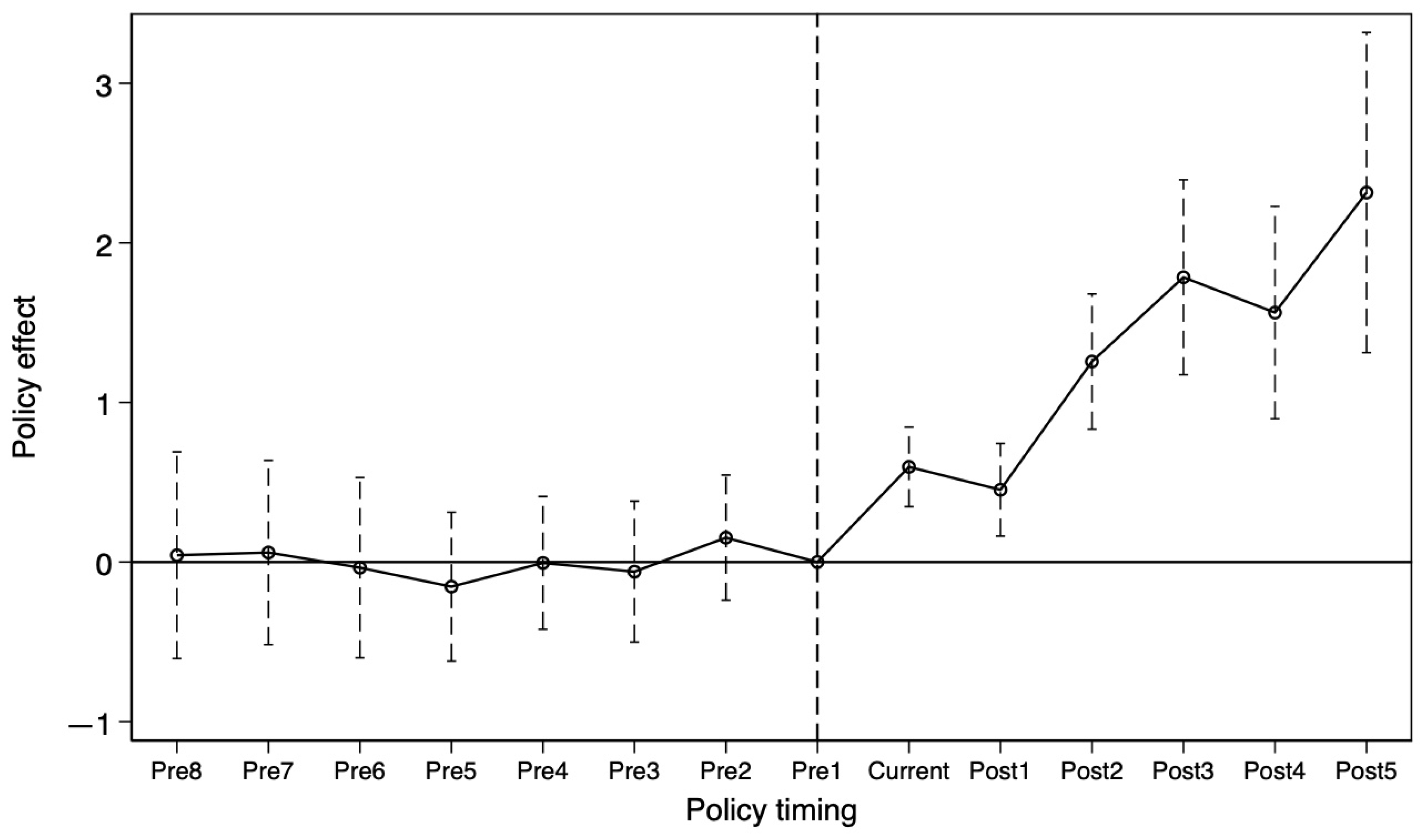
In Equation (3), denotes the policy implementation year, and indicates years relative to the adoption of the “Zero-Waste City” pilot policy. The indicator equals one if firm i belongs to a pilot city in event time . The coefficient therefore reflects the difference in ESG performance between treated and control firms at each relative time period. When < 0, if the estimated coefficients fluctuate slightly around zero without exhibiting any significant systematic trend, the parallel trend assumption can be considered satisfied. Conversely, if systematic differences exist prior to policy implementation, the assumption would be violated. Figure 1 illustrates the results of the parallel trend test, with the vertical axis reporting the dynamic effects of the policy (i.e., the estimated coefficient ), and the horizontal axis denotes the policy timing.
Figure 1.
Parallel trends test.
As shown in Figure 1, the estimated coefficients in the pre-policy period do not significantly deviate from zero and generally fluctuate around the zero line, indicating that no pre-existing divergence in ESG performance can be observed between the treatment and control groups before the policy was introduced. The insignificant pre-treatment estimates lend support to the parallel trend assumption. In contrast, the estimated coefficients become positive and significant following policy adoption, implying that the “Zero-Waste City” pilot policy contributes to improvements in corporate ESG performance.
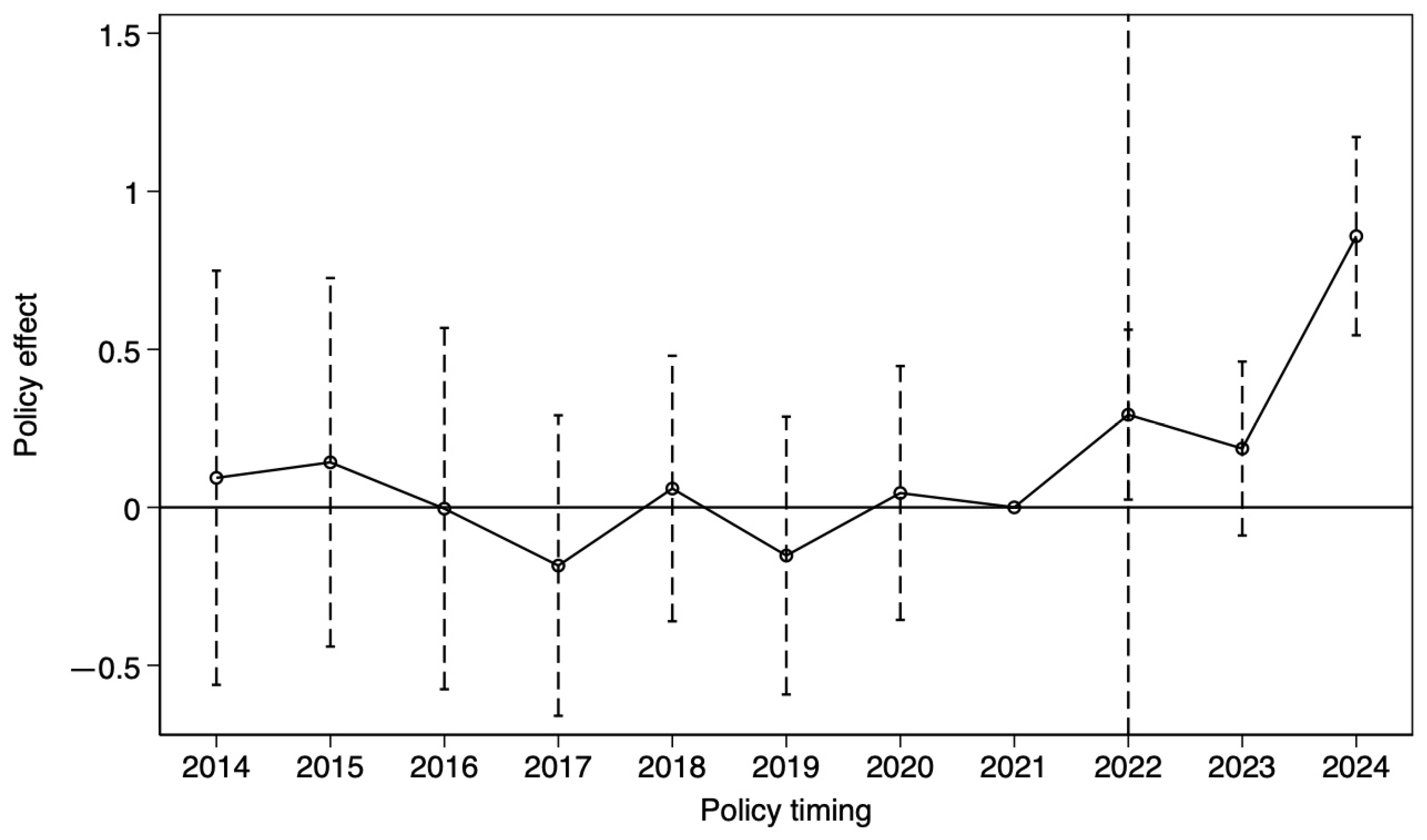
To further address the staggered implementation of the “Zero-Waste City” pilot policy, we separately estimate the dynamic treatment effects for the first and second batches of pilot cities. As reported in Appendix A Figure A1 and Figure A2, neither batch exhibits significant pre-treatment effects, while positive post-treatment effects are observed after policy implementation, confirming the validity of the parallel trends assumption.
4.3. Robustness Tests
4.3.1. PSM-DID Test
Despite the advantages of the DID approach in identifying policy effects, the selection of pilot cities under the “Zero-Waste City” program may not be entirely exogenous. Consequently, the sample may suffer from potential selection bias. To reduce potential selection bias arising from the non-random assignment of pilot cities, this study further adopts a propensity score matching difference-in-differences (PSM-DID) strategy. According to the balance test results reported in Table 3, after implementing nearest-neighbor matching, the standardized biases of all covariates (i.e., the control variables included in the baseline regression) are reduced to within 5%. In addition, the t-test results indicate that no statistically significant differences remain between the treatment and control groups after matching, indicating that the matching procedure achieves satisfactory balance.
Table 3.
Balance test for PSM-DID.
Following the matching process, the multi-period DID model is estimated again based on the matched sample. Table 4 reports the PSM-DID estimation results. The coefficient on ZWC remains positive and statistically significant, implying that the “Zero-Waste City” pilot policy continues to improve firms’ ESG performance. Therefore, the main conclusions derived from the baseline analysis remain unchanged.
Table 4.
Robustness test for PSM-DID.
4.3.2. Placebo Test
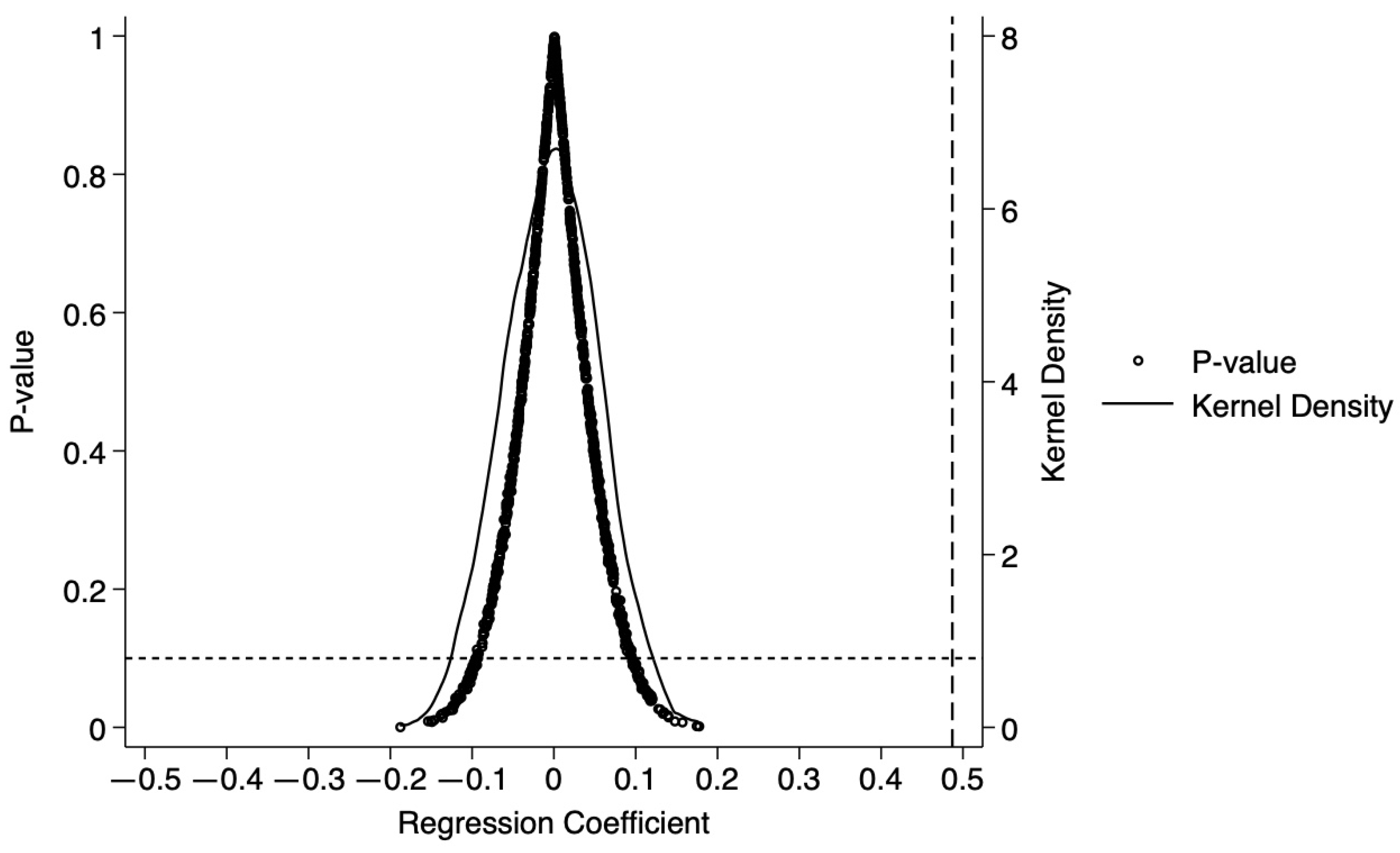
To verify that the benchmark findings are not the result of random factors or unobservable influences, this study implements a placebo test using the procedures developed by Ge et al. [31] and Wang and Liu [33]. Specifically, while holding the policy implementation timing unchanged, we randomly assign cities to a pseudo-treatment group, ensuring that the number of selected cities is identical to that of the actual pilot cities. Based on this randomly assigned treatment status, the policy effect is re-estimated 1000 times.
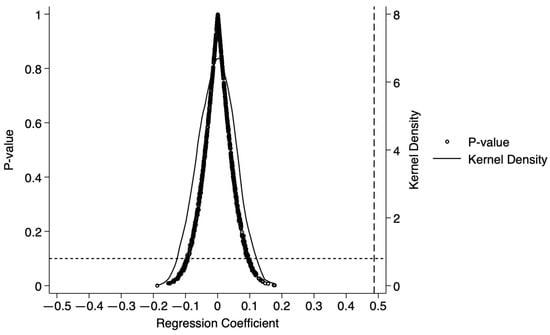
Figure 2 reports a distribution of the estimated coefficients that is close to normal, with the majority centered around zero. Furthermore, most placebo coefficients fail to reach statistical significance at the 10% level. In contrast, the benchmark estimate of 0.487 lies outside the empirical distribution generated from the placebo tests. Overall, these findings imply that the estimated effect of the “Zero-Waste City” pilot policy on corporate ESG performance is not attributable to random shocks or unobserved confounders, thereby strengthening the credibility of the baseline results.
Figure 2.
Placebo test. The dashed lines represent the 10% significance level and the benchmark estimate of 0.487, respectively.
4.3.3. Excluding the Influence of Other Concurrent Policies
Concurrent with the implementation of the “Zero-Waste City” pilot policy, China also advanced several other policy initiatives, including the Low-Carbon City Pilot Program (LCC), the National Industry–Finance Cooperation Pilot Program (IFC), the Supply Chain Innovation and Application Pilot Program (SCI), the Smart Manufacturing Pilot Demonstration Initiative (SMP), the National Big Data Comprehensive Pilot Zones (BDC), and the Carbon Emission Trading Pilot Program (CET). These policies may also exert positive effects on corporate ESG performance, thereby potentially confounding the identification of the net effect of the “Zero-Waste City” pilot policy.
To control for the influence of these concurrent policy interventions, Policy dummy variables are constructed for each of the aforementioned policies and are introduced into the benchmark model one by one to control for potential policy interference. Table 5 reports the corresponding estimation results. The estimated effect of ZWC remains positive and statistically significant after controlling for these additional policy factors. Furthermore, when all of these policy variables are controlled for simultaneously, the estimated coefficient exhibits no substantial change. These findings suggest that the positive effect of the “Zero-Waste City” pilot policy on corporate ESG performance is not driven by other concurrent policy interventions, lending further support to the reliability of the main findings.
Table 5.
Results after excluding the influence of other concurrent policies.
4.3.4. Additional Robustness Tests
To further assess the stability of the main results, several additional robustness checks are performed. Table 6 presents the results of these robustness tests. Column (1) replaces the dependent variable with the Huazheng nine-point ESG rating measure. Column (2) uses the Bloomberg ESG score as a substitute indicator for firms’ ESG performance. Column (3) uses ESG rating data from the CNRDS database, while Column (4) adopts ESG data provided by SynTao Green Finance. Column (5) considers the possibility that the policy effect may exhibit a lagged response and therefore re-estimates the model using the one-period lagged policy variable as the core explanatory variable. Column (6) further incorporates a one-period lag of ESG performance to account for its potential persistence over time. Column (7) further incorporates city-level control variables, including the level of economic development (PGDP), industrial structure (IS), and local environmental protection expenditure (EPE), in order to mitigate the potential influence of city-specific characteristics. Finally, Column (8) excludes firms whose registered locations are inconsistent with their actual operating locations. Column (9) incorporates Region × Year fixed effects into the baseline specification to control for time-varying regional heterogeneity in environmental governance and other unobservable regional shocks. Across all robustness checks, the results remain stable and align closely with the baseline estimates, reinforcing the validity of the main conclusions.
Table 6.
Results of additional robustness tests.
4.4. Mechanism Analysis
The baseline regression results provide evidence that the “Zero-Waste City” pilot policy significantly enhances corporate ESG performance; however, they do not reveal the underlying transmission mechanisms. On the basis of the theoretical framework developed above, this paper suggests that the policy operates through three transmission channels to enhance corporate ESG performance: the financing constraint alleviation effect, the green technological innovation effect, and the environmental attention enhancement effect. To identify these transmission mechanisms, this section conducts corresponding empirical tests.
Following Jiang [34], we formulate the mechanism model (4) to examine the underlying transmission channels. In addition, to further investigate the link between the mechanism variables and the dependent variable, we specify model (5), thereby strengthening the completeness and rigor of the mechanism-testing framework.
where denotes firms, represents years, and refers to the mechanism variables.
Table 7 presents the empirical results of the mechanism analysis. Columns (1)–(2) show that the “Zero-Waste City” pilot policy significantly alleviates firms’ financing constraints, while financing constraints are found to significantly hinder corporate ESG performance. This finding indicates that reduced financing constraints play a facilitating role in improving corporate ESG performance. One possible explanation is that the “Zero-Waste City” pilot policy is bundled with supportive instruments, including green finance support, fiscal subsidies, and tax incentives. In addition, strengthened environmental information disclosure and regulatory oversight alleviate information asymmetry, thereby improving firms’ credit conditions, which ultimately enhances the corporate financing environment. Once financing constraints are alleviated, firms are able to allocate more resources toward environmental governance, social responsibility fulfillment, and governance structure optimization, thereby improving ESG performance. The empirical results lend support to Hypothesis 2.
Table 7.
Mechanism test results.
Columns (3)–(4) provide evidence that the pilot policy fosters green technological innovation among firms, while green technological innovation is positively associated with ESG performance. This result can be attributed to the policy focus on solid waste reduction and resource recycling under the “Zero-Waste City” pilot initiative, which strengthens environmental regulation and thereby incentivizes firms to invest more in green R&D activities. Meanwhile, policy support through fiscal incentives and industrial guidance reduces the cost of green innovation and increases expected returns, thereby encouraging firms to engage in green technological innovation. Green technological innovation contributes to lower pollutant emissions and higher resource efficiency, which improves firms’ environmental outcomes and strengthens their social responsibility image, ultimately enhancing overall ESG performance. Therefore, Hypothesis 3 is validated.
Columns (5)–(6) indicate that the pilot policy enhances firms’ environmental attention, which in turn contributes to higher ESG performance. This result mainly arises because this policy strengthens environmental regulatory constraints and promotes a green development orientation, thereby increasing firms’ attention to environmental issues. Enhanced environmental attention implies greater emphasis on environmental risk management and green value creation, leading firms to incorporate environmental objectives into both strategic decisions and daily operations. Accordingly, firms increase environmental investment and green innovation activities, improve environmental disclosure quality, strengthen stakeholder communication, and enhance internal environmental management systems. Collectively, these responses improve firms’ environmental, social, and governance performance, thereby contributing to higher ESG scores. Accordingly, Hypothesis 4 is supported.
Although the above analysis examines the three transmission channels separately, these mechanisms are not independent but may interact with and reinforce each other. Specifically, the alleviation of financing constraints provides firms with the necessary financial resources to undertake green transformation activities, while enhanced environmental attention strengthens managerial awareness and strategic commitment toward sustainable development. The combination of sufficient financial resources and stronger environmental awareness creates favorable conditions for firms to increase investment in green technological innovation. Furthermore, green technological innovation serves as a key link connecting financing support and environmental attention with corporate ESG improvement. On the one hand, financing constraint alleviation enables firms to bear the high initial costs and uncertainty associated with green innovation. On the other hand, increased environmental attention guides firms to allocate resources toward environmentally oriented innovation activities. Therefore, the improvement of financing conditions and environmental attention jointly promotes green technological innovation, which subsequently enhances firms’ environmental performance, stakeholder relationships, and governance capabilities.
In this sense, the three mechanisms identified in this study exhibit a complementary relationship: financing constraint alleviation provides the resource foundation, environmental attention enhancement provides strategic motivation, and green technological innovation represents the substantive pathway through which firms achieve sustainable transformation. Their combined effects jointly contribute to the improvement of corporate ESG performance under the “Zero-Waste City” pilot policy.
4.5. Heterogeneity Analysis
4.5.1. Regional Characteristics
In light of differences in economic development across eastern, central, and western China, the effect of the “Zero-Waste City” pilot policy on corporate ESG performance is likely to be heterogeneous across regions. Therefore, following the regional classification criteria of the National Bureau of Statistics of China, we partition the sample into eastern, central, and western regions and perform subsample regressions to explore potential regional heterogeneity. The results are reported in Table 8. The results suggest substantial regional heterogeneity in the policy effect. Specifically, the “Zero-Waste City” pilot policy significantly improves firms’ ESG performance in the eastern and central regions, but its effect in the western region is not statistically significant. Moreover, the policy effect is found to be stronger in the central region.
Table 8.
Heterogeneity analysis results 1.
Several explanations may account for these regional differences. First, from an institutional implementation perspective, policy effectiveness is shaped by local governments’ regulatory capacity and enforcement intensity. The more developed institutional environments in the eastern and central regions enhance the transmission of policy pressure to firms, thereby strengthening policy effectiveness. In contrast, the relatively weaker institutional enforcement capacity in the western region may dilute the policy’s regulatory effect. Second, from the perspective of factor endowments, the western region is characterized by relatively limited access to capital, technology, and human resources, as well as less developed factor markets. Consequently, firms in the western region face higher costs in acquiring the resources necessary for green transformation, thereby limiting their responsiveness to the policy. Third, from the perspective of marginal effects, the central region is currently undergoing industrial restructuring and still contains a relatively high proportion of traditional pollution-intensive industries that have not yet completed green transformation. As a result, the policy shock generates more pronounced marginal improvements in ESG performance. By comparison, firms in the eastern region generally possess stronger ESG foundations, leaving relatively limited room for further improvement. Finally, the effectiveness of the policy also depends on transmission mechanisms such as financial support and technology diffusion. These supporting systems are relatively well developed in the eastern and central regions, whereas the transmission channels in the western region remain comparatively constrained, further weakening the policy effect.
4.5.2. Industry Characteristics
The effect of the “Zero-Waste City” pilot policy may differ across firms with different technological characteristics. Following the classification method proposed by Peng and Mao [35], to examine whether the policy effect differs across technological attributes, separate estimations are performed for high-tech and traditional firms. Evidence from Columns (1)–(2) of Table 9 reveals substantial heterogeneity across firm types. The estimates indicate that the “Zero-Waste City” pilot policy generates a significant improvement in ESG performance among traditional firms, while no significant effect is observed for high-tech firms. A plausible explanation is that the current “Zero-Waste City” pilot policy places greater emphasis on pollution abatement, with regulatory resources primarily directed toward traditional industries that generate substantial environmental externalities. Under the pressure of environmental regulation, traditional firms are compelled to undertake green transformation, resulting in more substantial improvements in ESG performance. In contrast, high-tech firms are generally characterized by lower emissions, asset-light operational models, and stronger innovation capabilities. As a result, these firms are less directly constrained by the policy, which weakens the policy’s impact on their ESG performance.
Table 9.
Heterogeneity analysis results 2.
Furthermore, significant differences exist between heavy-polluting and non-heavy-polluting industries in terms of environmental damage, which may lead to heterogeneous effects of the “Zero-Waste City” pilot policy on corporate ESG performance. Accordingly, based on the “Environmental Protection Verification Industry Classification and Management Catalogue for Listed Companies,” this study divides the sample firms into two groups: heavy-polluting firms and non-heavy-polluting firms, and conducts subgroup regression analyses. The results are reported in Columns (3)–(4) of Table 9. The results show that, compared with non-heavy-polluting firms, the “Zero-Waste City” pilot policy generates a stronger improvement effect on ESG performance among heavy-polluting firms. Moreover, the Fisher test confirms that the difference between the coefficients across the two groups is statistically significant. One possible explanation is that, first, heavy-polluting firms generally generate larger amounts of solid waste and have weaker environmental governance capabilities before policy implementation. Therefore, the same environmental governance measures are more likely to generate greater improvements among heavy-polluting firms, resulting in a more pronounced enhancement of ESG performance. Second, during the implementation of the “Zero-Waste City” initiative, both central and local governments provide targeted financial and technological support for key issues such as large-scale industrial solid waste and hazardous waste management. As the primary targets of these support measures, heavy-polluting firms are more likely to benefit from technological upgrading and environmental governance investments, thereby achieving greater improvements in ESG performance.
4.5.3. Firm Characteristics
In general, the effects of public policies may vary across firms of different sizes. To explore heterogeneity by firm size, the sample is partitioned into two groups according to the median level of total assets, representing large firms and small firms, respectively. Evidence from Columns (5)–(6) of Table 9 reveals clear size heterogeneity. The “Zero-Waste City” pilot policy has a significantly positive effect on ESG performance among large firms, but no significant impact is detected for small firms.
Several explanations may account for this heterogeneity. First, small firms tend to experience more severe financing constraints, primarily driven by information frictions and insufficient collateral capacity, which reduce their access to external financing. Meanwhile, investments related to solid waste treatment and cleaner production upgrades typically require substantial capital expenditures and involve long payback periods, which constrain small firms’ ability to improve ESG performance. Second, environmental investments tend to entail significant fixed costs, particularly from the perspective of compliance costs. Large firms are better able to spread these costs through economies of scale, whereas small firms bear relatively higher unit compliance costs, leaving them with less flexibility for adjustment. Third, under conditions of uncertainty, small firms are more likely to adopt survival-oriented strategies by allocating limited resources primarily toward their core business operations, thereby weakening their incentives to invest in ESG-related activities. Taken together, these factors jointly account for the insignificant effect of the “Zero-Waste City” pilot policy on the ESG performance of small firms.
4.6. Further Analysis
This study further decomposes the Huazheng ESG rating into its environmental (E), social responsibility (S), and corporate governance (G) components to examine the effects of the “Zero-Waste City” pilot policy across different ESG dimensions. Table 10 reports the corresponding results. Specifically, the pilot policy significantly enhances firms’ environmental (E) and governance (G) performance, while no significant impact is observed on social responsibility (S).
Table 10.
Further analysis of the results.
The insignificant effect of the “Zero-Waste City” pilot policy on the social responsibility (S) dimension may be attributed to the mismatch between the policy orientation and the underlying characteristics of social responsibility activities. Specifically, the “Zero-Waste City” initiative primarily focuses on solid waste reduction, resource recycling, cleaner production, and environmental information disclosure, which are directly related to firms’ environmental management capabilities and governance mechanisms. Therefore, the policy can more directly stimulate improvements in the environmental (E) and governance (G) dimensions. In contrast, the social responsibility dimension mainly reflects firms’ behaviors regarding employee protection, consumer rights, community engagement, and social welfare activities, which are not the direct regulatory targets of the policy. Consequently, the transmission effect of the “Zero-Waste City” policy on the S dimension is relatively limited.
Furthermore, according to stakeholder theory, corporate social responsibility reflects firms’ long-term commitments to various stakeholders, including employees, consumers, and local communities, and is closely associated with organizational values and strategic orientation. Compared with environmental management practices that can be adjusted through regulatory compliance and technological upgrading, social responsibility practices usually require long-term institutional accumulation and cultural transformation. Therefore, a single environmental policy shock may not be sufficient to generate immediate improvements in firms’ social responsibility performance.
In addition, the adjustment speed of different ESG dimensions may vary. The implementation of the “Zero-Waste City” policy creates direct incentives for firms to improve waste management, environmental governance, and related internal control systems, while changes in social responsibility practices generally occur more gradually. This may explain why the policy significantly improves firms’ E and G performance but does not produce a statistically significant effect on the S dimension in the short term.
5. Conclusions and Policy Implications
5.1. Conclusions
Using Chinese A-share non-financial listed firms as the sample, this study examines the effect of the “Zero-Waste City” pilot policy on corporate ESG performance. The main findings are summarized as follows. First, the “Zero-Waste City” pilot policy significantly improves corporate ESG performance, and this result remains robust across multiple robustness checks. Second, the mechanism analysis shows that the policy operates through three channels: the financing constraint alleviation effect, the green technological innovation effect, and the environmental attention enhancement effect. Third, the heterogeneity analysis reveals substantial differences across regions, industries, and firm characteristics. The policy effect is stronger in the eastern and central regions—especially the central region—while it is statistically insignificant in the western region. Similarly, the effect is significant for traditional firms, heavy-polluting firms and large firms, but not for high-tech, non-heavy-polluting or small firms. Fourth, further evidence from ESG sub-dimensions shows that the policy mainly improves environmental (E) and governance (G) performance, while no statistically significant effect is observed for social responsibility (S).
5.2. Policy Implications
In light of the empirical evidence, this study puts forward the following policy implications.
First, establish differentiated green financial support mechanisms to enhance the transformation capacity of resource-constrained firms. The results show that the positive effect of the “Zero-Waste City” pilot policy is significant for large firms but insignificant for small firms, indicating that insufficient financial capacity may constrain small firms’ ability to respond to environmental policies. Therefore, policymakers should develop targeted financing instruments, such as green credit guarantees, special transition funds, and interest subsidies, to reduce the fixed costs associated with solid waste treatment and cleaner production upgrading for small firms. Moreover, given the insignificant policy effect in western regions, financial support should be combined with improvements in local financial infrastructure and environmental service systems. Rather than simply increasing financial input, policymakers should enhance the accessibility of green financial resources by strengthening local financial institutions, improving project evaluation capacity, and attracting green investment.
Second, implement differentiated policy approaches based on firms’ technological and pollution characteristics. For traditional and heavily polluting firms, the policy should continue to emphasize regulatory pressure and environmental compliance because these firms generate larger amounts of solid waste and possess greater potential for pollution reduction. Governments should promote cleaner production, resource recycling, and technological upgrading through stricter standards and targeted transition support. For high-tech firms, however, the insignificant policy effect suggests that traditional regulatory approaches may have limited marginal effects because these firms usually face relatively lower solid waste pressure and already possess better environmental capabilities. Therefore, policy emphasis should shift from pollution control toward innovation incentives. Governments should encourage high-tech firms to participate in the development of solid waste recycling technologies and establish mechanisms for technology diffusion from high-tech firms to traditional industries.
Third, strengthen policy guidance and information disclosure mechanisms to enhance corporate awareness of green development. The mechanism analysis indicates that environmental attention enhancement is an important channel through which the “Zero-Waste City” pilot policy improves corporate ESG performance. Therefore, policymakers should further strengthen the guiding role of environmental policies and enhance their signaling effects on corporate green development strategies. On the one hand, governments should continue to improve the policy framework represented by the “Zero-Waste City” initiative by setting clear, stable, and forward-looking environmental governance objectives. Such policy signals can increase firms’ expectations regarding future environmental requirements and encourage managers to integrate environmental considerations into strategic decision-making and daily operations. On the other hand, policymakers should further improve environmental information disclosure mechanisms and enhance the transparency and comparability of corporate environmental information. By promoting standardized environmental disclosure requirements and strengthening public supervision, governments can reduce information asymmetry between firms and external stakeholders, thereby encouraging firms to improve environmental management systems, increase green investment, and enhance overall ESG performance.
Fourth, optimize regional implementation pathways and enhance policy adaptability across regions. The heterogeneous results indicate that the policy effect is significant in eastern and central regions but not in western regions. This suggests that policy effectiveness depends not only on policy design but also on regional implementation capacity. Therefore, western regions should prioritize improving basic conditions for policy implementation, including solid waste treatment infrastructure, environmental technology adoption, and professional talent cultivation. Meanwhile, successful practices from central regions should be promoted through regional cooperation mechanisms, allowing the experience accumulated in pilot areas to be transferred to regions with weaker governance capacity.
5.3. Limitations and Future Research
This study is subject to several limitations, which provide avenues for future research.
First, this paper investigates the mechanisms linking the “Zero-Waste City” pilot policy to corporate ESG performance, focusing on financing constraint alleviation, green technological innovation, and environmental attention enhancement. However, the mechanisms underlying improvements in ESG performance may be considerably more complex. Different mechanisms may exhibit complementary or substitutive relationships, and their relative importance or effect intensity may also vary. These issues are not fully addressed in the present study. Future research may further explore additional channels, such as supply chain collaboration, digital transformation, and institutional investor supervision, while also considering the interactions among these mechanisms to better uncover the internal logic through which environmental policies influence corporate sustainable development.
Second, future studies could further examine the long-term dynamic effects of “Zero-Waste City” construction by exploring whether the policy effects strengthen gradually as pilot programs advance and institutional systems become more mature. In addition, researchers may investigate how policy effectiveness evolves across different stages of policy diffusion and expansion.
Third, this study mainly identifies the direct effect of the “Zero-Waste City” pilot policy based on the assumption that firms in non-pilot areas are not directly affected by the policy. However, given the regional characteristics of environmental policies, potential spillover effects may exist and may challenge the Stable Unit Treatment Value Assumption (SUTVA). Specifically, the policy may influence firms located outside pilot cities through channels such as supply chain linkages, green technology diffusion, demonstration effects, and regional industrial coordination. Although the baseline DID framework captures the average treatment effect of the policy, it does not fully account for these potential spatial spillovers. Future research could incorporate spatial econometric models or network-based approaches to further examine the diffusion effects and broader economic consequences of the “Zero-Waste City” initiative.
Fourth, although this study employs the PSM-DID approach and a series of robustness tests to enhance causal identification, the selection of “Zero-Waste City” pilot areas was determined by government decisions rather than random assignment. Therefore, potential selection bias may still exist if unobservable factors influencing pilot city selection are also related to firms’ ESG performance. Future research could further explore this issue by utilizing more exogenous policy shocks, alternative identification strategies, or detailed information on the government selection process to strengthen causal inference.
Fifth, although this study adopts the Huazheng ESG score to measure corporate ESG performance, ESG ratings may involve certain measurement limitations. Different ESG rating agencies may differ in evaluation criteria, indicator construction, and weighting approaches, resulting in potential discrepancies across ESG assessment systems. Furthermore, composite ESG scores may not fully capture the multidimensional and long-term nature of corporate sustainability practices. Future studies could integrate ESG indicators with more objective environmental and social performance measures to obtain a more comprehensive understanding of corporate sustainable development.
Author Contributions
Conceptualization, Q.H. and L.Z.; methodology, Q.H. and L.Z.; software, L.Z.; validation, Q.H. and L.Z.; formal analysis, Q.H.; investigation, L.Z.; resources, Q.H.; data curation, L.Z.; writing—original draft preparation, L.Z.; writing—review and editing, Q.H.; visualization, L.Z.; supervision, Q.H.; project administration, Q.H.; funding acquisition, Q.H. All authors have read and agreed to the published version of the manuscript.
Funding
This research was funded by the project ‘Practice and Innovation of High-Quality Development of Island Counties in Zhejiang Province’, grant number HX2024000382.
Institutional Review Board Statement
Not applicable.
Informed Consent Statement
Not applicable.
Data Availability Statement
The data presented in this study are available on request from the corresponding author.
Conflicts of Interest
The authors declare no conflicts of interest.
Correction Statement
This article has been republished with a minor correction to the Funding statement. This change does not affect the scientific content of the article.
Appendix A
Figure A1.
Dynamic treatment effects for the first batch of “Zero-Waste City” pilots (2019).
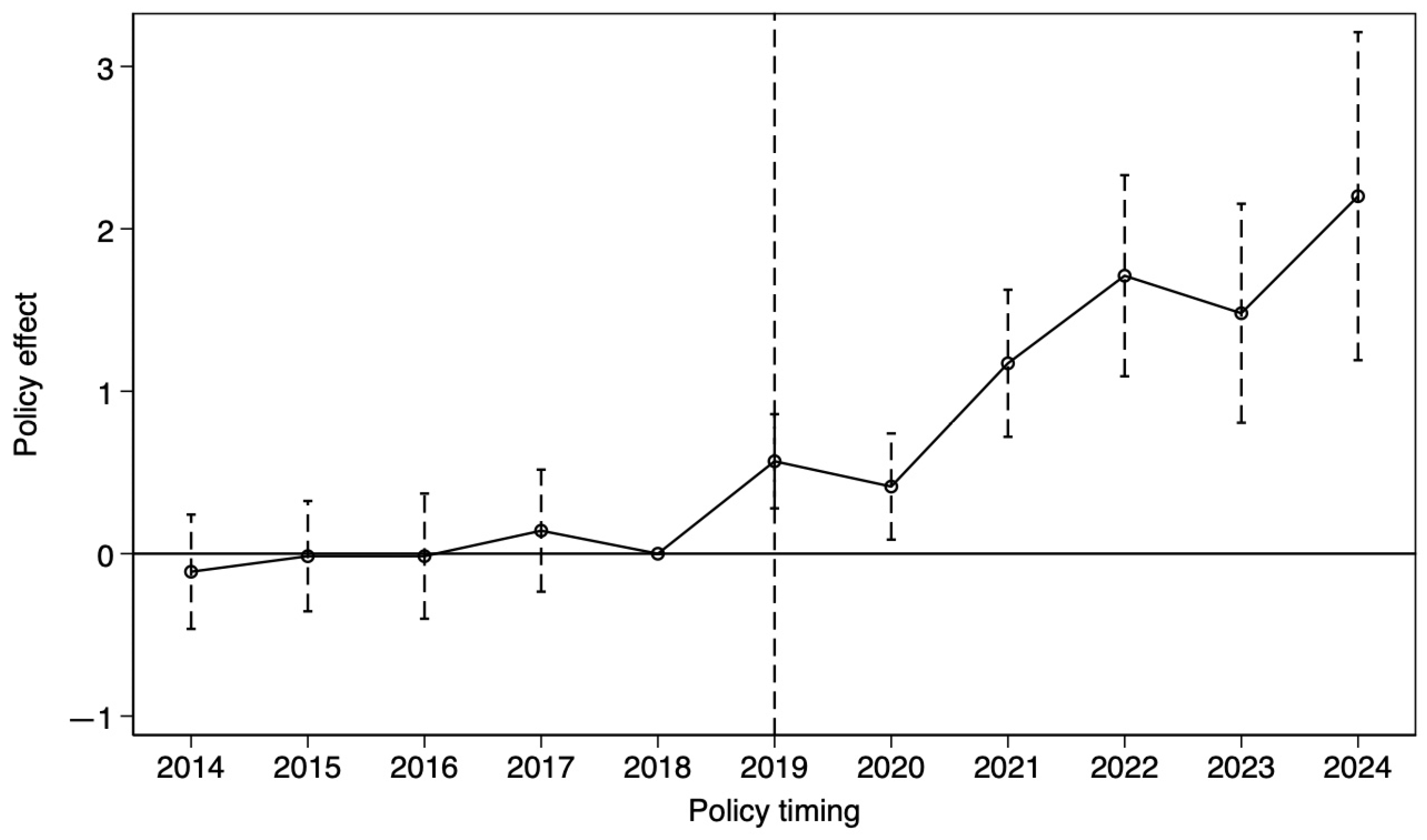
Figure A2.
Dynamic treatment effects for the second batch of “Zero-Waste City” pilots (2022).
References
- Caixin Insight; ESG30 Forum. China ESG Development White Paper 2024; Caixin Insight and ESG30 Forum: Beijing, China, 2024. [Google Scholar]
- Shanghai Stock Exchange. Guidelines No. 14 of Shanghai Stock Exchange for Self-Regulation of Listed Companies—Sustainability Report (Trial); Shanghai Stock Exchange: Shanghai, China, 2024. [Google Scholar]
- Shenzhen Stock Exchange. Guidelines No. 17 of Shenzhen Stock Exchange for Self-Regulation of Listed Companies—Sustainability Report (Trial); Shenzhen Stock Exchange: Shenzhen, China, 2024. [Google Scholar]
- Beijing Stock Exchange. Guidelines No. 11 of Beijing Stock Exchange for Self-Regulation of Listed Companies—Sustainability Report (Trial); Beijing Stock Exchange: Beijing, China, 2024. [Google Scholar]
- Chen, X.J.; Jiang, S.; He, L.X. The impact of pilot policies of “zero-waste city” on enterprise green innovation. East China Econ. Manag. 2024, 38, 42–52. [Google Scholar]
- Chai, S.L.; Zhou, Q.Q.; Wei, W.; Cao, M.J. Impact of zero-waste pilot city construction on corporate green innovation. China Popul. Resour. Environ. 2025, 35, 144–156. [Google Scholar]
- Huang, M.; Chen, S.; Cheng, P. Green path without waste: Zero-waste city pilot construction and corporate green innovation. Humanit. Soc. Sci. Commun. 2025, 12, 1771. [Google Scholar] [CrossRef] [Scilit]
- Feng, L.; Liu, P. Can the pilot policy of “waste-free cities” promote the high-quality development of enterprises? From the perspective of green dual innovation. Ecol. Econ. 2026, 42, 95–104. [Google Scholar]
- Liu, M.G.; Liang, H.P.; Liu, Y.; He, J.H. Research on the impact of the “zero-waste cities” pilot policy on the green total factor productivity of enterprises. Ecol. Econ. 2026, 42, 105–114. [Google Scholar]
- Li, Y.; Fu, Z.; Li, J. Assessing the policy benefits of constructing “zero-waste cities” in China: From the perspective of hazardous waste lifecycle management. Sci. Total Environ. 2024, 918, 170184. [Google Scholar] [CrossRef] [Scilit] [PubMed]
- Zhu, F.; Hunjra, A.I.; Roubaud, D.; Zhao, S.; Grebinevych, O. Assessment of synergistic governance of pollution and carbon reduction. J. Environ. Manag. 2025, 375, 124226. [Google Scholar] [CrossRef] [Scilit] [PubMed]
- Wang, W. Breaking down the barriers to clean air: The effects of China’s zero-waste city policy on PM2.5 concentration. Chin. J. Popul. Resour. Environ. 2025, 23, 75–84. [Google Scholar] [CrossRef] [Scilit]
- Porter, M.E.; Van der Linde, C. Toward a new conception of the environment–competitiveness relationship. J. Econ. Perspect. 1995, 9, 97–118. [Google Scholar] [CrossRef] [Scilit]
- Freeman, R.E. Strategic Management: A Stakeholder Approach; Cambridge University Press: Cambridge, UK, 2010. [Google Scholar]
- Suchman, M.C. Managing legitimacy: Strategic and institutional approaches. Acad. Manag. Rev. 1995, 20, 571–610. [Google Scholar] [CrossRef] [Scilit]
- Hart, S.L. A natural-resource-based view of the firm. Acad. Manag. Rev. 1995, 20, 986–1014. [Google Scholar] [CrossRef] [Scilit]
- Ghisellini, P.; Cialani, C.; Ulgiati, S. A review on circular economy: The expected transition to a balanced interplay of environmental and economic systems. J. Clean. Prod. 2016, 114, 11–32. [Google Scholar] [CrossRef] [Scilit]
- Ocasio, W. Towards an attention-based view of the firm. J. Strateg. Manag. 1997, 18, 187–206. [Google Scholar] [CrossRef] [Scilit]
- Jensen, M.C.; Meckling, W.H. Theory of the firm: Managerial behavior, agency costs and ownership structure. J. Financ. Econ. 1976, 3, 305–360. [Google Scholar] [CrossRef] [Scilit]
- Akerlof, G.A. The market for “lemons”: Quality uncertainty and the market mechanism. Q. J. Econ. 1970, 84, 488–500. [Google Scholar] [CrossRef] [Scilit]
- Fazzari, S.; Hubbard, R.G.; Petersen, B.C. Financing Constraints and Corporate Investment; NBER Working Paper No. 2387; National Bureau of Economic Research Location: Cambridge, MA, USA, 1987. [Google Scholar]
- Rogers, E.M.; Singhal, A.; Quinlan, M.M. An Integrated Approach to Communication Theory and Research; Routledge: New York, NY, USA, 2014. [Google Scholar]
- Li, Z.F.; Chen, J.Y. Corporate ESG performance and corporate short-term debt for long-term use. J. Quant. Technol. Econ. 2023, 40, 152–171. [Google Scholar]
- Zhu, G.S.; Wei, N. Socially responsible bank lending and ESG performance of listed companies. J. Quant. Technol. Econ. 2023, 40, 133–151. [Google Scholar]
- Gu, L.L.; Guo, J.L.; Wang, H.Y. Corporate social responsibility, financing constraints, and the financialization of enterprises. J. Financ. Res. 2020, 47, 109–127. [Google Scholar]
- Xu, X.Z.; Li, Z.F. Local government debt governance and enterprise investment efficiency. South China J. Econ. 2024, 11, 18–41. [Google Scholar]
- Qi, S.Z.; Lin, S.; Cui, J.B. Do environmental rights trading schemes induce green innovation? Evidence from listed firms in China. Econ. Res. J. 2018, 53, 129–143. [Google Scholar]
- Wu, M.Z.; Ma, W.J. Impact of the green credit policy on corporate green governance strategic behaviors and its mechanisms. China Popul. Resour. Environ. 2025, 35, 149–160. [Google Scholar]
- Wang, Y.; Wang, H.Y.; Xue, S. Greening of tax system and corporate ESG performance: A quasi-natural experiment based on the environmental protection tax law. J. Financ. Econ. 2022, 48, 47–62. [Google Scholar]
- Xin, D.L.; Ji, C.R.; Xin, L.G. Impact of intelligent manufacturing on corporate ESG performance: A quasi-natural experiment based on the intelligent manufacturing pilot demonstration project. China Popul. Resour. Environ. 2025, 35, 103–113. [Google Scholar]
- Ge, L.M.; Yang, M.D.; Liu, Z.X.; Zheng, H.Y. Impact of urban low-carbon governance on corporate sustainable development: A quasi-natural experiment of low-carbon city pilot policy. Res. Econ. Manag. 2025, 46, 16–37. [Google Scholar]
- Jacobson, L.S.; LaLonde, R.J.; Sullivan, D.G. Earnings losses of displaced workers. Am. Econ. Rev. 1993, 83, 685–709. [Google Scholar]
- Wang, F.Z.; Liu, X.M. Intelligent manufacturing policy, knowledge reconstruction, and supply chain resilience. Bus. Manag. J. 2025, 47, 154–170. [Google Scholar]
- Jiang, T. Mediating effects and moderating effects in causal inference. China Ind. Econ. 2022, 5, 100–120. [Google Scholar]
- Peng, H.X.; Mao, X.S. Government subsidies for innovation, company executives background and R&D investment: Evidence from the high-tech industry. Financ. Trade Econ. 2017, 38, 147–161. [Google Scholar]

Disclaimer/Publisher’s Note: The statements, opinions and data contained in all publications are solely those of the individual author(s) and contributor(s) and not of MDPI and/or the editor(s). MDPI and/or the editor(s) disclaim responsibility for any injury to people or property resulting from any ideas, methods, instructions or products referred to in the content. |
© 2026 by the authors. Licensee MDPI, Basel, Switzerland. This article is an open access article distributed under the terms and conditions of the Creative Commons Attribution (CC BY) license.