


Abstract
Reducing the greenhouse gas (GHG) intensity of dairy production remains challenging because enteric methane and upstream supply chain emissions persist despite existing mitigation strategies. This study evaluated a supply chain decarbonization approach in which Spirulina (Arthospira platensis) produced through a carbon-removal supply chain (GeoSpirulina) was incorporated into dairy rations to enable net supply chain carbon removal within cradle-to-farm-gate boundaries. A carbon-focused life cycle assessment (LCA) was combined with a commercial-scale feeding trial to determine an appropriate inclusion rate and assess production outcomes. The LCA integrated primary activity and production data from the commercial dairy farm with previously published GeoSpirulina production and soil organic carbon sequestration data derived from primary Icelandic production and field studies, supplemented by secondary background datasets and published dairy emission estimates. GeoSpirulina was produced using geothermal energy and coupled with soil organic carbon sequestration associated with the application of residual biomass as a soil biostimulant, resulting in a modeled net-negative production footprint. Under the defined LCA assumptions, supplementation with 2 g cow−1 day−1 of GeoSpirulina reduced the modeled milk GHG intensity from approximately 1.9 to 0.06 kg CO2e kg−1 at the farm gate. Scenario analysis identified active vitamin B12 concentration as a key driver of the modeled carbon balance. Milk yield and group-level feed efficiency were unaffected, whereas butterfat (+4.7%, p = 0.002), fatty acids (+4.4%, p = 0.011), and somatic cell count (−71%, p = 0.007) improved without detectable adverse effects. These findings suggest that carbon-negative feed ingredients may provide a complementary sustainability strategy for dairy production by embedding measurable carbon removal within agricultural supply chains while maintaining production performance. Although this approach counterbalances rather than eliminates biological emissions, it may contribute to broader dairy decarbonization and sustainable food-production strategies alongside direct greenhouse gas mitigation interventions.
1. Introduction
Dairy farming is among the most carbon-intensive agricultural activities, contributing substantially to global greenhouse gas (GHG) emissions. The dairy sector was responsible for roughly 2.2 gigatonnes of CO2-equivalent (CO2e) emissions in 2022 [1]. In the United States, the GHG intensity of fat- and protein-corrected milk (FPCM), a standardized metric adjusting for milk composition, ranges from 1.24 to 1.87 kg CO2e per kilogram of milk when assessed from cradle to farm gate [2]. Enteric methane from cows is the single largest contributor, accounting for about 25–30% of the carbon footprint of raw milk [1]. Additional emissions arise from manure management, feed production, and on-farm energy use.
Over the past decade, a range of strategies have been investigated to mitigate or reduce enteric methane in dairy cattle. Dietary modifications, such as high-grain diets or lipid supplementation, can alter rumen fermentation and modestly reduce methane yield per unit of feed [3,4]. Feed additives, including chemical inhibitors such as 3-nitrooxypropanol (3-NOP), alternative hydrogen acceptors (e.g., nitrates) [5], plant secondary compounds (e.g., tannins, saponins, essential oils) [6], seaweed-derived compounds, and ionophores, have demonstrated methane reductions typically in the range of 10–30% in controlled trials [7,8,9]. More substantial suppression (up to ~60% less methane) is possible with red seaweed (Asparagopsis), though its application is constrained by concerns over bromoform content, supply scalability, and potential diminishing efficacy over time [10]. Alternative approaches targeting the rumen microbiome, such as direct-fed microbials, protozoa suppression (defaunation), and experimental methanogen vaccines, have generally achieved smaller reductions (often <20%) or face significant challenges in large-scale deployment [11,12,13].
Genetic selection for low-methane cows represents a promising long-term strategy but requires extensive measurement and multi-generational breeding to achieve population-level impact [14]. To date, no single intervention has fully eliminated enteric methane emissions, and even the most effective combinations leave residual emissions from ruminal fermentation and other on-farm sources. Consequently, achieving no net GHG emissions per unit of milk remains challenging. The objective of achieving a near-net-zero cradle-to-farm-gate greenhouse gas footprint is therefore not to eliminate biological greenhouse gas production by dairy cattle, but rather to counterbalance unavoidable emissions through verified carbon removal elsewhere within the production supply chain.
Carbon-negative feed ingredients represent such a potential supply chain approach for reducing the GHG intensity of milk production. Unlike carbon offsets, sourced from external projects, this approach embeds carbon removal directly within the dairy value chain itself. The concept is exemplified by Spirulina (Arthrospira platensis), a blue-green microalga that can be cultivated in a manner that removes more CO2 from the atmosphere than it emits. In a recent analysis, Smidt-Jensen et al. demonstrated that Phycocyanin, a pigment produced from GeoSpirulina (Spirulina produced using geothermal energy and coupled with waste-based carbon dioxide removal via soil organic carbon (SOC) sequestration), achieved a net-negative carbon footprint, based on primary data from field trials [15]. The current research is based on the same coupled production-removal system foundations: Spirulina cultivation integrated with a renewable energy source, extracting a product (active vitamin B12) and utilizing the cultivation waste stream for application to degraded soils as a biostimulant, enhancing SOC storage.
Primary data from Icelandic field trials, including a conservative 20% reduction factor, indicate that GeoSpirulina waste-based biostimulation can sequester approximately 1.1 metric tons of carbon per hectare annually in soil [15]. This data is consistent with published data obtained over decades of SOC field trials in Iceland, where the carbon was demonstrated to remain stored in local soils for periods exceeding 100 years [16]. When this durable biogenic carbon removal is accounted for in a life-cycle assessment (LCA), the Spirulina-based product carries a carbon-negative emissions profile. By incorporating a small amount of this carbon-negative B12-rich Spirulina into dairy cow rations, the negative emissions footprint from this feed supplement can counterbalance the cow’s GHG outputs through supply chain decarbonization. This approach is conceptually consistent with emerging GHG accounting frameworks, as the associated carbon removal can be quantified within a life cycle assessment and linked to farm-level feed inputs, potentially contributing to corporate emissions reporting.
In addition to its carbon benefits, Spirulina offers potential nutritional advantages as a feed supplement. It is rich in protein, vitamins (e.g., Vitamin B12 in GeoSpirulina [17]), minerals (e.g., magnesium sulphate) and antioxidants (e.g., phycocyanin, carotenoids, and phenolic compounds). Notably, Spirulina has been tested as a low-inclusion feed additive in dairy cows (typically ≤20 g per cow per day) and found to be safe and well-tolerated. Multiple in vivo trials report that such small doses do not adversely affect feed intake, milk flavor or cow health [18,19,20,21]. Moreover, several studies have observed improvements in milk quality and cow well-being [18,20,22]. For example, even a micro-dose of ~0.2 g (dry weight) Spirulina per day increased milk yield (+7.6%), fat (+22.0%) and protein (+9.7%) content and decreased somatic cell counts (SCC, an indicator of mastitis)) (−29.0%) [23]. Another study reported that cows receiving 20 g Spirulina per day had dramatically lower SCC by the end of the trial (−94.6%), alongside improved milk yield (+18.8%), fat (+15.0%) and protein (+10.1%) composition [24]. These benefits were attributed to Spirulina’s antioxidant and immunomodulatory properties, which may enhance cows’ oxidative status and immune response [25]. While reported experiments were relatively short-term and limited in scale, collectively they suggest that including a few grams of Spirulina in the diet could improve milk quality and animal health without negative side effects [18,21].
The aim of this study was to evaluate whether supplementation with a carbon-negative GeoSpirulina feed ingredient could counterbalance the modeled greenhouse gas emissions associated with raw milk production while maintaining dairy production performance under commercial farm conditions. A carbon-focused life cycle assessment was conducted to quantify the effect of GeoSpirulina supplementation on the cradle-to-farm-gate carbon footprint of fat- and protein-corrected milk and to identify an inclusion rate capable of approaching a net-zero supply chain carbon balance under the defined model assumptions. The resulting inclusion rate was subsequently evaluated in a five-month commercial-farm feeding trial using primary farm activity and production data to assess milk yield, group-level feed efficiency, milk composition, somatic cell count, and selected animal-welfare indicators. This integrated approach evaluated the feasibility of embedding carbon removal within the dairy supply chain through a carbon-negative feed ingredient while assessing its compatibility with commercial dairy production.
2. Materials and Methods
The present study comprised three complementary methodological components. First, a cradle-to-farm-gate life cycle assessment (LCA) was conducted to evaluate the greenhouse gas implications of incorporating GeoSpirulina into dairy production and to determine a practical supplementation rate. The LCA combined primary production data from the commercial dairy farm with previously published primary data describing the GeoSpirulina production-removal system and associated soil organic carbon sequestration. Second, a commercial dairy feeding trial was conducted to evaluate the effects of the selected GeoSpirulina supplementation strategy on milk production, milk composition, somatic cell count, and selected animal welfare indicators. Finally, sensitivity and scenario analyses were performed to evaluate the robustness of the modeled greenhouse gas outcomes under varying assumptions regarding the active vitamin B12 concentration of the supplemented biomass.
2.1. Life Cycle Assessment
2.1.1. Goal and Scope Definition
The goal of the assessment was to quantify the cradle-to-farm-gate greenhouse gas footprint of fat- and protein-corrected raw milk produced at Goodrich Family Farm (Salisbury, VT, USA) and to evaluate the modeled effect of incorporating GeoSpirulina into the dairy supply chain. The functional unit was 1 kg of fat- and protein-corrected milk (FPCM) at the farm gate. The assessment focused exclusively on the climate change impact category, expressed as 100-year global warming potential (GWP100).
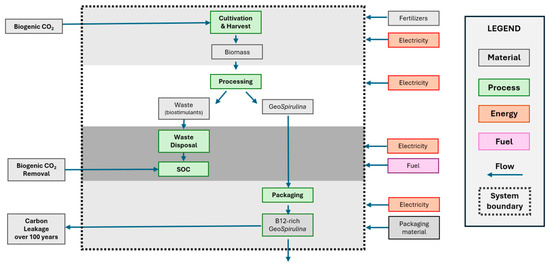
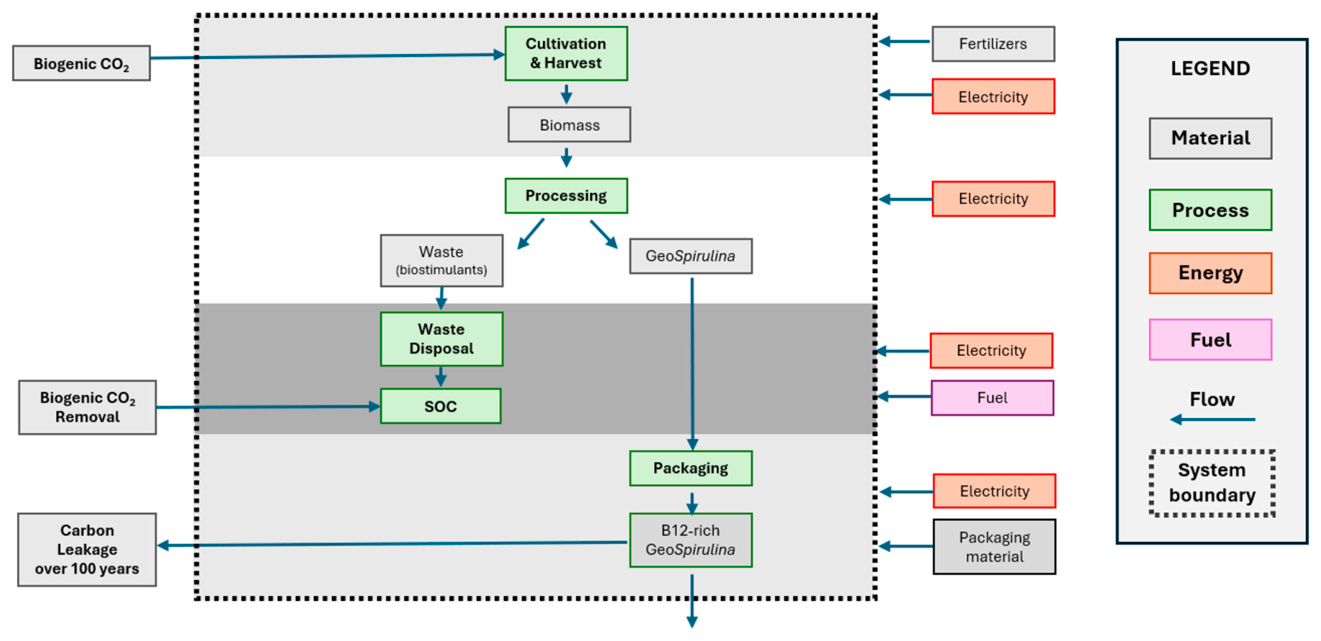
The system boundary encompassed the coupled GeoSpirulina production-removal system in Iceland, transportation of the GeoSpirulina feed ingredient from Iceland to the United States, background feed and energy supply, and on-farm milk production at the commercial dairy farm in Vermont. The GeoSpirulina system included geothermal-integrated cultivation and harvesting of Arthrospira platensis biomass at the Hellisheidi Geothermal Park, followed by downstream processing and extraction to produce the B12-rich GeoSpirulina biomass used as the dairy feed ingredient. A separate waste stream generated during processing was used as a soil biostimulant on degraded Icelandic soils and was associated with increased soil organic carbon storage. The B12-rich GeoSpirulina feed ingredient was packaged and transported by truck to the Reykjavík seaport, shipped to Boston, Massachusetts, USA, and subsequently transported by truck to Goodrich Family Farm, where it was incorporated into the total mixed ration. Figure 1 presents the system boundary and principal process flows.
Figure 1.
System boundaries and process flows for the coupled GeoSpirulina production-removal system, including cultivation, downstream processing and waste-stream biostimulant application for soil carbon sequestration.
The dairy-system boundary included background feed and energy supply and on-farm milk production to the farm gate. Downstream milk processing, distribution, retail, use, and end-of-life were excluded. Packaging end-of-life and the construction and maintenance of production facilities were also excluded.
No separate allocation of dairy-system burdens to meat was performed. The baseline milk carbon footprint was derived from published U.S. dairy production data reported per kilogram of FPCM at the farm gate and was used as the reference system for evaluating the incremental effect of GeoSpirulina supplementation. Accordingly, the present assessment did not construct a new whole-herd multifunctional dairy inventory requiring independent allocation between milk and meat. This methodological choice should be considered when comparing the absolute carbon-footprint estimates with studies applying alternative co-product allocation procedures.
Geographically, the foreground system represented GeoSpirulina production and soil organic carbon sequestration in Iceland, intercontinental transportation between Iceland and the northeastern United States, and commercial dairy production in Vermont, USA. Temporally, primary farm activity and production data represented the five-month commercial feeding trial conducted in 2025. GeoSpirulina production and soil organic carbon sequestration parameters were obtained from the recently published assessment of the same coupled production-removal system, which was based on primary Icelandic production and field data. Background processes and baseline dairy emission parameters were obtained from contemporary secondary LCA datasets and published literature. Technologically, the foreground system represented industrial-scale geothermal-integrated GeoSpirulina cultivation and processing in Iceland and a commercial free-stall dairy production system in Vermont.
The assessment compared a baseline system without GeoSpirulina supplementation with an intervention system in which B12-rich GeoSpirulina was incorporated into the dairy ration. The LCA was used to estimate an inclusion rate capable of approaching a net-zero cradle-to-farm-gate carbon balance under the defined model assumptions. The life cycle inventory, data provenance, carbon-removal calculation, and scenario analysis are described in the following sections.
2.1.2. Life Cycle Inventory and Data Provenance
The life cycle inventory combined primary activity data generated during the commercial dairy feeding trial with previously published GeoSpirulina production-removal data and secondary background datasets.
Primary data generated in the present study comprised commercial farm activity and production data collected during the five-month feeding trial at Goodrich Family Farm, including milk production, feed intake, and the parameters required to evaluate the feeding intervention.
GeoSpirulina production, transportation, processing, and soil organic carbon sequestration parameters were adapted from the previously published life cycle assessment of the same coupled GeoSpirulina production-removal system [15]. Although these parameters originated from primary production and Icelandic field measurements reported in that study, they were incorporated into the present assessment as previously published inventory data.
Background processes, transport datasets, packaging inventories, and baseline dairy greenhouse gas emissions were obtained from secondary sources, including environmental product declarations, published literature, and established life cycle inventory databases.
Table 1 summarizes the principal foreground inventory processes, data sources, geographical representativeness, and data provenance used in the present assessment.
Table 1.
Life cycle inventory for raw milk production (per functional unit: 1 kg fat and protein corrected milk).
Foreground processes were represented using primary commercial-farm activity data and previously published inventory data derived from primary GeoSpirulina production measurements and Icelandic field trials. Background processes were represented using contemporary secondary life cycle inventory datasets and published literature. Data sources were selected to maximize geographical, technological, and temporal representativeness of the modeled systems.
2.1.3. Carbon-Removal and Intervention Scenario Calculation
The purpose of the life cycle assessment was not only to quantify the baseline cradle-to-farm-gate greenhouse gas footprint of milk production but also to determine a practical GeoSpirulina supplementation rate capable of counterbalancing these emissions through the coupled production-removal system.
The carbon-removal contribution associated with GeoSpirulina supplementation was calculated by combining the carbon-removal factor assigned to the coupled GeoSpirulina production-removal system with the daily GeoSpirulina supplementation rate and expressing the resulting net carbon-removal contribution relative to daily milk production. The intervention scenario was calculated according to Equation (1).
where the removal factor was derived from primary GeoSpirulina waste-based SOC sequestration rates reported by Smidt-Jensen et al. [15].
Carbon removal (kg CO2e kg−1) =
GeoSpirulina dose (g cow−1 d−1) ×
GeoSpirulina removal factor (kg CO2e g−1)/milk yield (kg cow−1 d−1)
GeoSpirulina dose (g cow−1 d−1) ×
GeoSpirulina removal factor (kg CO2e g−1)/milk yield (kg cow−1 d−1)
The resulting carbon-removal contribution was combined with the modeled baseline milk greenhouse gas footprint to estimate the net cradle-to-farm-gate greenhouse gas intensity of milk production under GeoSpirulina supplementation. The supplementation rate subsequently evaluated in the commercial feeding trial corresponded to the scenario that approached a net-zero carbon balance under the defined model assumptions. Using the carbon-removal factor assigned to the coupled GeoSpirulina production-removal system, an inclusion rate of approximately 2 g cow−1 day−1 was estimated to counterbalance the modeled cradle-to-farm-gate greenhouse gas emissions associated with the corresponding quantity of milk produced under the defined model assumptions.
Thus, daily feeding assumptions used to interpret results were 2 g GeoSpirulina (providing ~80 µg active vitamin B12) mixed into approximately 25 kg dry matter intake (DMI) per cow per day, yielding about 38 kg raw milk per cow per day (group-level feed efficiency ≈ 1.5 kg milk per kg dry matter).
2.1.4. Scenario and Sensitivity Analysis
The baseline scenario represented conventional milk production without GeoSpirulina supplementation. The intervention scenario incorporated the B12-rich GeoSpirulina feed ingredient into the total mixed ration at the inclusion rate identified through the life cycle assessment.
Sensitivity analysis evaluated the influence of active vitamin B12 concentration on the quantity of GeoSpirulina required to provide the target daily vitamin B12 dose. Three scenarios representing low (40 µg), reference (80 µg), and high (120 µg) active vitamin B12 concentrations were evaluated. For each scenario, the required GeoSpirulina inclusion rate, associated carbon-removal contribution, and resulting cradle-to-farm-gate carbon footprint of milk were recalculated.
2.1.5. Life Cycle Impact Assessment and Contribution Analysis
Impacts were characterized with EF 3.1 (GWP100), applying the latest IPCC characterization factors. This study investigated climate change only; LCIA results are relative indicators and do not predict endpoint damages, threshold exceedance or risk. The LCA was used to determine a practical GeoSpirulina inclusion rate for the feeding trial. Contribution analysis was performed to identify the principal sources contributing to the modeled cradle-to-farm-gate greenhouse gas footprint under the baseline scenario and to quantify the relative contribution of the GeoSpirulina production-removal system under the intervention scenario.
2.2. Dairy Cow Feeding Trial
2.2.1. Spirulina Preparation
GeoSpirulina biomass for the feeding trial was cultivated at industrial scale in Iceland and subjected to downstream processing and extraction to produce the B12-rich biomass used as the dairy feed ingredient, following previously described methods [17,26] adapted from dry Spirulina extraction [27]. A separate waste stream generated during processing was used as the soil biostimulant within the coupled production-removal system. Active vitamin B12 content was confirmed by Matís (Reykjavík, Iceland) using the analytical approach described by Van den Oever and Mayer [28]. The separate processing waste stream used as the soil biostimulant was evaluated by Eurofins AgroScience Services and was found to meet the applicable criteria for use as an EU-approved biostimulant. It was exempt under REACH Annex IV and had no regulatory classification under EC 1272/2008 (CLP/GHS).
2.2.2. Animals and Diets
The trial was conducted in 2025 at Goodrich Family Farm (Salisbury, VT, USA) in Holstein cows in late lactation (~213 ± 14 days in milk). The experimental plan was developed based on approved protocols used by North Carolina State University [29] and the University of California, Davis [30]. The study was conducted on a privately owned commercial dairy farm under routine production conditions. The intervention consisted solely of supplementation of the total mixed ration with GeoSpirulina at a low inclusion rate (2 g cow−1 day−1). No invasive procedures, experimental surgeries, blood sampling, restraint beyond normal husbandry practices, or other procedures requiring animal ethics oversight were performed. No academic institution or federally funded research program was responsible for conducting or supervising the animal work. Accordingly, formal review by an Institutional Animal Care and Use Committee (IACUC) was not required. Animals remained under standard farm management and veterinary care throughout the study. All procedures were consistent with normal commercial dairy management practices and complied with applicable state and federal regulations governing livestock production.
Cows were allocated to a control group (n = 187) and a treatment group (n = 118), with the experimental unit being the individual cow. However, milk production was measured at the pen level, recorded by the farm. Individual feed efficiency was therefore not available. The unequal group sizes reflect the practical constraints of conducting the study under commercial farm conditions. Animals remained within existing production groups to minimize disruption to normal farm management and feed delivery. Consequently, group allocation was determined by operational considerations rather than experimental balancing. No animals were excluded from the study after allocation. To maintain continuous group sizes during the late-lactation period and avoid premature dry-off, a small number (~5%) of cows were replaced in both the control and treatment groups during the trial. Replacements followed the same allocation criteria as the original animals. Replacement animals were included as random effects in the mixed model. Baseline measurements on day 0 confirmed the groups were comparable across key indicators (days in milk and milk yield).
During the trial, cows were housed in free-stall pens under standard farm management practices. Animals were milked twice daily in a rotary milking parlor. Pens were cleaned while cows were being milked, and bedding consisting of separated manure solids was refreshed approximately two to three times per week as needed. Environmental conditions were managed using fans, curtains, and water misters to mitigate heat stress, with fans activated above approximately 16 °C (60 °F), curtains opened above ~2 °C (35 °F), and periodic misting applied when temperatures exceeded ~24 °C (75 °F).
All cows received the same ad libitum total mixed ration (TMR) formulated to meet or exceed NRC/NASEM recommendations for late-lactation Holstein cows. The basal diet consisted primarily of corn silage, haylage, concentrate mix, and a mineral-vitamin premix. The composition of the basal ration is also presented in Table 2. A comprehensive laboratory nutrient analysis of the commercial total mixed ration was not performed during the feeding trial. Consequently, only the dietary information routinely recorded by the commercial farm was available for inclusion in the present study. The treatment ration was identical to the control ration except for supplementation with GeoSpirulina at 2 g/cow/day, which was mixed into the TMR once daily. This supplementation rate represented approximately 0.008% of daily dry matter intake and was selected through the life cycle assessment to provide the targeted active vitamin B12 dose while maximizing the modeled carbon-removal contribution. Because feeding was conducted under normal farm management conditions, individual supplement intake could not be confirmed directly and as the inclusion rate represented less than 0.01% of daily dry matter intake, the macro-nutrient composition of the treatment and control diets was considered equivalent. Product specifications supplied by the manufacturer are also summarized in Table 2. A comprehensive laboratory compositional analysis of the commercial product was not performed as part of the present commercial feeding trial.
Table 2.
Nutritional composition of the basal TMR and GeoSpirulina as a percentage of dry matter (DM).
Due to the nature of the feeding intervention, farm personnel responsible for feed preparation and animal management were aware of group allocation. Laboratory analyses of milk composition and somatic cell count were conducted by external laboratories blinded to treatment group. Statistical analyses were performed using coded group identifiers to minimize bias during data interpretation.
Animals were monitored daily through routine visual inspection by farm personnel. In addition, cows were equipped with activity monitoring collars that recorded rumination time, feeding duration, and activity levels. No adverse health events related to the feeding intervention were observed during the trial, and no animals were removed due to adverse effects. No predefined humane endpoints were required as the study involved routine feeding practices without invasive procedures.
2.2.3. Measurements
Dry matter intake (DMI; kg/cow/day) was recorded daily with an electronic feed management system (Topcon TMR Tracker Pro+). Milk yield (kg/cow/day) was captured by automated milking meters (GEA DemaTron 60) and summarized daily and weekly. Feed efficiency was calculated as milk yield divided by DMI. Milk fat (%) and Fatty acids (%) were analyzed weekly by mid-infrared spectroscopy (Milkoscan FTIR; Dairy One laboratory, New York, NY, USA). Somatic cell count (SCC; cells/mL) was quantified weekly by flow cytometry (Fossomatic; Dairy One laboratory, New York, NY, USA). As a welfare indicator, heavy breathing (minutes/cow/day of elevated respiratory rate) was monitored daily using SCR collars (Allflex Livestock Intelligence, MSD Animal Health). Milk composition and somatic cell count were determined from representative bulk milk samples collected weekly from each experimental pen. An equal number of pens was sampled for both the control and GeoSpirulina treatment groups throughout the five-month feeding trial, ensuring balanced sampling across treatments.
The primary outcome measure for the feeding trial was somatic cell count (SCC), with milk yield, milk composition, group-level feed efficiency, and welfare indicators considered secondary outcomes.
2.2.4. Statistical Analysis
Group size was determined based on herd size and commercial farm constraints; no a priori power calculation was performed. Group means for milk yield and DMI were compared by one-way ANOVA. Repeated measures variables (heavy breathing, milk fat and protein) were analyzed by two-way ANOVA with fixed factors group and time, including their interaction, and animal as the subject for repeated measurements. SCC was analyzed with a mixed-effects negative binomial regression including group as a fixed effect and animal as a random effect. Model assumptions were assessed using residual diagnostics and normality testing. Statistical significance was set at p < 0.05. Analyses were conducted in JMP 19.
3. Results
3.1. Life Cycle Assessment Results
The carbon footprint analysis showed that the supply chain decarbonization strategy of adding a small quantity of GeoSpirulina to the dairy system can fully balance the emissions from milk production.
In our baseline scenario (no Spirulina), the cradle-to-farmgate GHG emission intensity for raw milk was conservatively estimated at 1.9 kg CO2e per kg of milk, consistent with the industry upper limit for modern U.S. dairy farms. In the baseline scenario, enteric methane represented the largest contributor to the modeled milk carbon footprint, followed by manure management and feed production, consistent with previously published U.S. dairy LCAs.
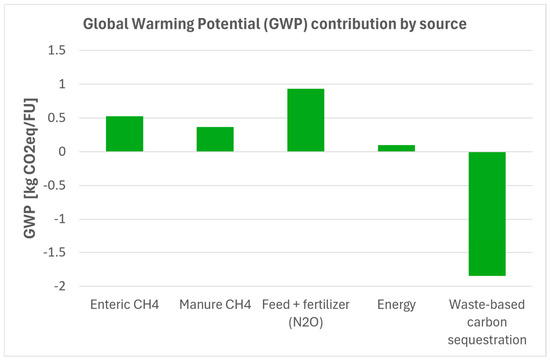
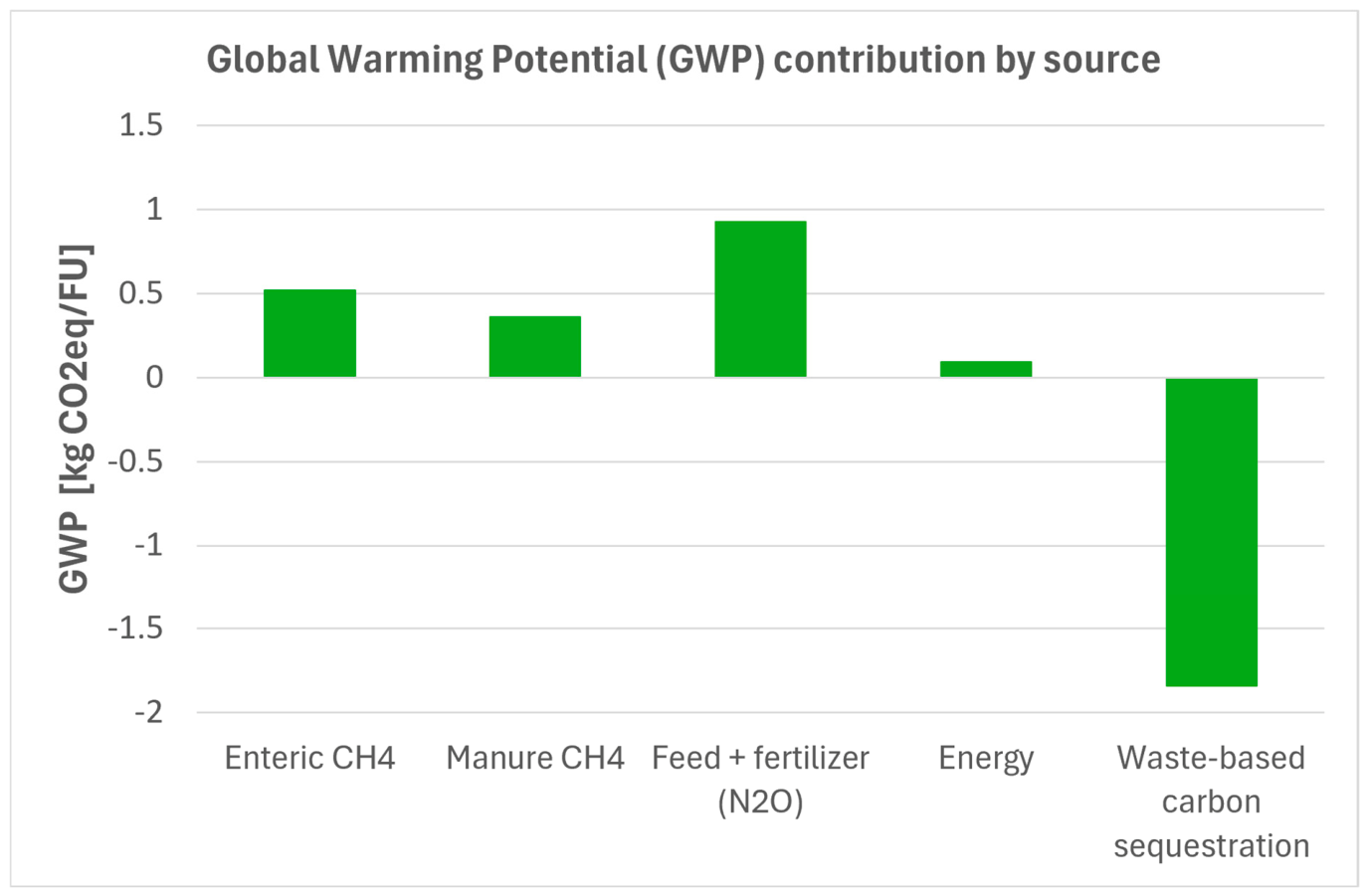
By incorporating 2 g of GeoSpirulina per cow per day, the net milk carbon emissions dropped to near zero. The negative carbon contributions of the Spirulina (due to the waste-based CO2 captured and sequestered during its production) balanced the total GHG emissions from milk production: methane, feed, transport, and packaging; see Figure 2 for the results of the contribution analysis. As a result, the milk produced under this scenario had a near net-neutral or slightly net-negative carbon intensity (within the uncertainty of the LCA calculations). Although the intervention reduced the net greenhouse gas balance, enteric methane remained the dominant biological emission source throughout the assessment. The modeled reduction resulted from the carbon-removal contribution associated with the GeoSpirulina production-removal system rather than direct reduction in enteric methane emissions (see Figure 2). Therefore, this near-zero greenhouse gas footprint should be interpreted as the modeled net cradle-to-farm-gate carbon balance obtained under the assumptions of the life cycle assessment and does not imply elimination of biological greenhouse gas emissions at the farm level. Table 3 summarizes the baseline scenario together with the sensitivity scenarios generated by varying the active vitamin B12 concentration while holding all other inventory parameters constant.
Figure 2.
Contribution of major greenhouse gas sources to the cradle-to-farm-gate carbon footprint of milk production with GeoSpirulina supplementation. Emission sources include enteric methane, manure methane, feed production (including fertilizer-related N2O), and on-farm energy use. The negative contribution represents supply chain-embedded carbon removal associated with GeoSpirulina production.
Table 3.
Modeled cradle-to-farm-gate carbon footprint of milk production (kg CO2e kg−1 milk) under baseline conditions, GeoSpirulina supplementation, and selected sensitivity scenarios. Results are based on a life cycle-based carbon footprint analysis. Sensitivity scenarios reflect variation in active vitamin B12 concentration and soil organic carbon (SOC) sequestration assumptions. Percent change is calculated relative to the baseline system without supplementation.
A sensitivity analysis confirmed that the degree of carbon negativity depends on Spirulina’s characteristics, particularly its active vitamin B12 content, which influences the carbon sequestration achieved in the production process. In our primary scenario, Spirulina with a high active B12 content yielded a net footprint of about −0.86 kg CO2e per kg milk, indicating a modest net removal of CO2 overall. If the Spirulina’s carbon sequestration efficiency were lower (e.g., assuming a lower B12 yield), the milk’s footprint would be correspondingly less negative—though still near carbon-neutral or slightly below zero. These results suggest that, under the assumptions of the present LCA, net-zero or net-negative cradle-to-farm-gate milk carbon balances may be achievable through inclusion of carbon-negative feed ingredients
3.2. Feeding Trial Results
This five-month on-farm feeding trial assessed the practical effects of adding 2 g/day of GeoSpirulina to the diet of lactating cows. Baseline characteristics for both the experimental and control groups can be found in Table 4.
Table 4.
Baseline characteristics and production parameters of the control (CTRL) and experimental (EXP) groups. Values are presented as mean ± SD and represent cow-level averages over a 14-day baseline period preceding initiation of the feeding trial.
No sensorial differences (color, smell or taste) were observed; however, differences in milk quality were observed between the experimental and control groups (see Table 5).
Table 5.
Five-month average measurements of animal welfare and milk quality of control (CTRL) and experimental (EXP) groups.
Daily milk yield did not differ between treatments, indicating that GeoSpirulina supplementation did not affect overall milk production during the feeding trial. While no statistically significant differences in group-level feed efficiency (FE) (p = 0.894) and heavy breathing (p = 0.141) were observed, cows receiving GeoSpirulina supplementation had statistically significant (p < 0.05) improvements in milk quality and composition: a notable decrease in SCC (p = 0.007) and increase in BFP (p = 0.002) and MFA. Heavy breathing was numerically lower in cows receiving GeoSpirulina supplementation. However, the response exhibited substantial inter-animal variability and did not reach statistical significance. Consequently, this observation should be interpreted as a numerical trend rather than evidence of a treatment effect.
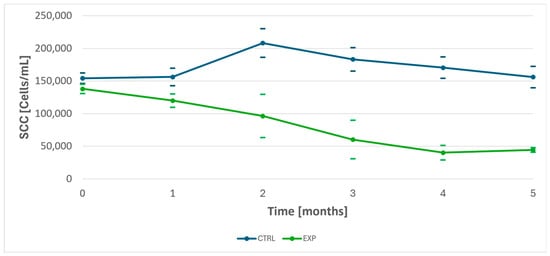
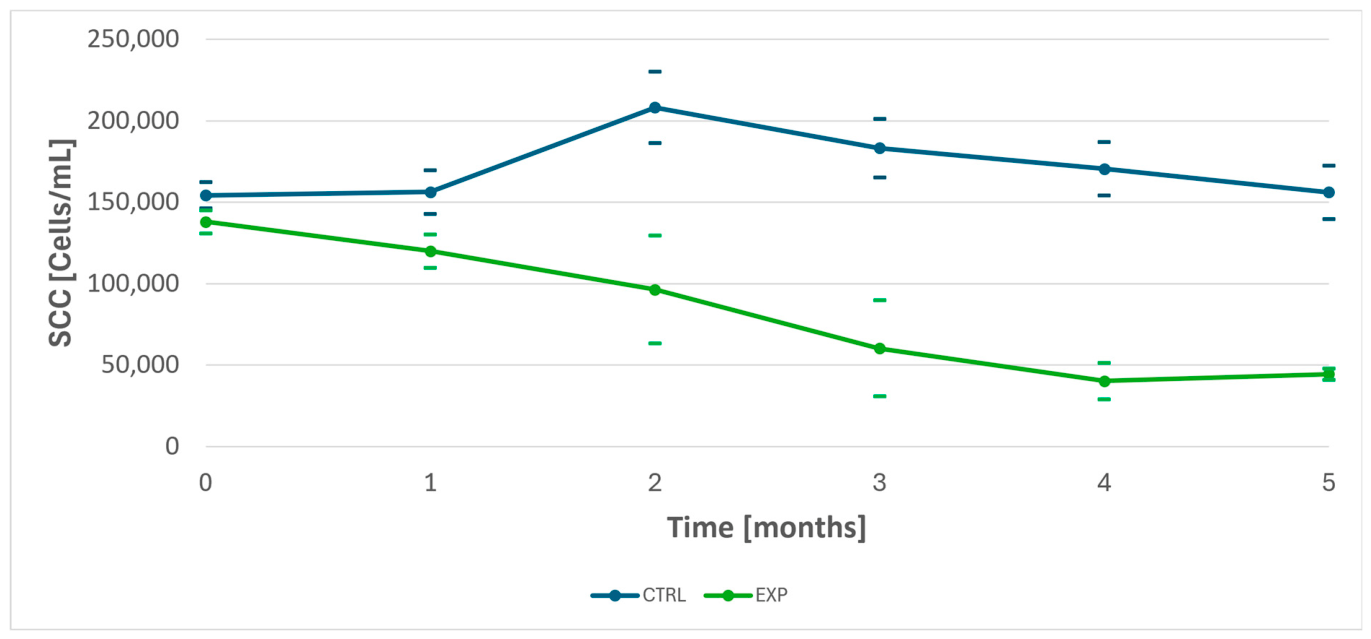
Figure 3.
Somatic cell count (SCC) monthly averages during the experimental period.
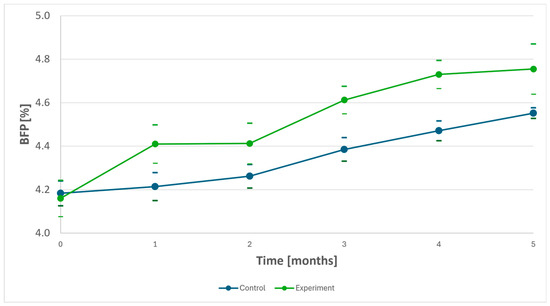
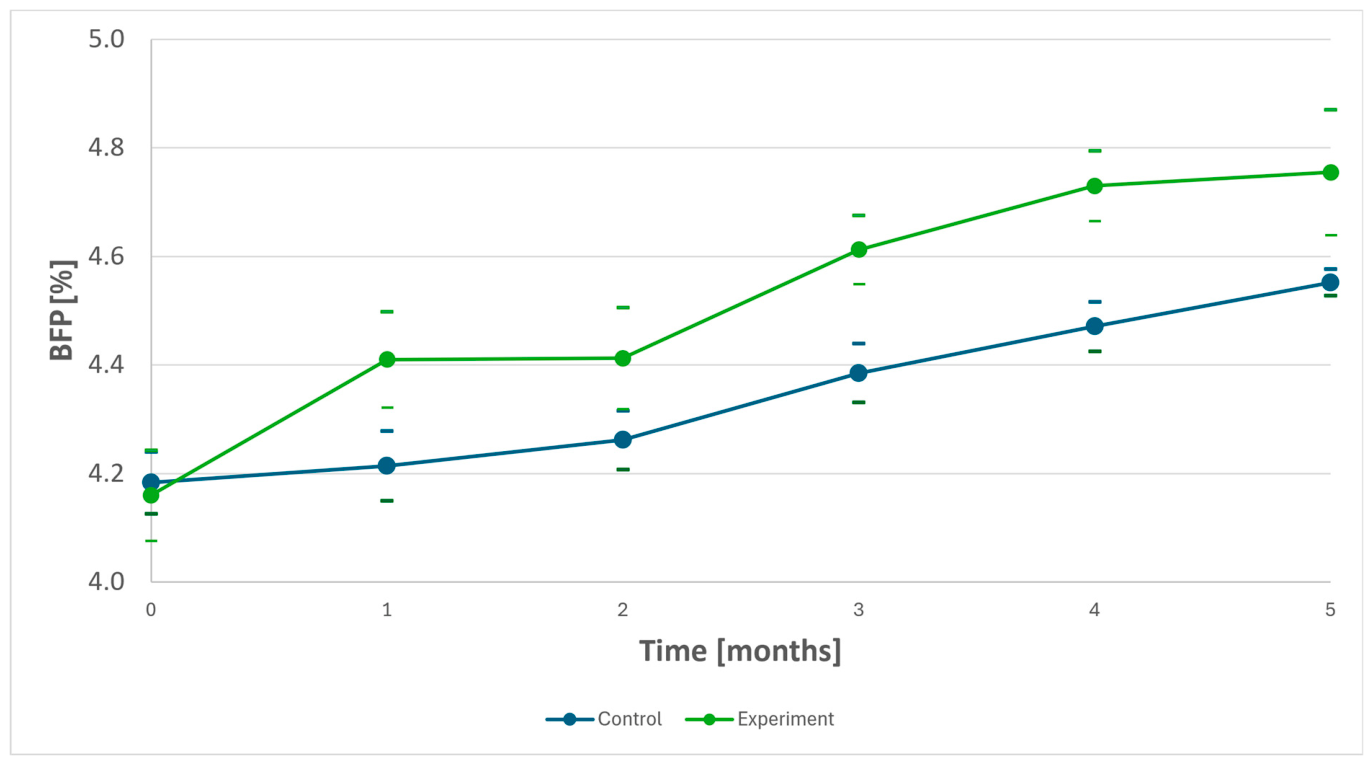
Figure 4.
Butter Fat Percentage (BFP) monthly averages during the experimental period.
Figure 5.
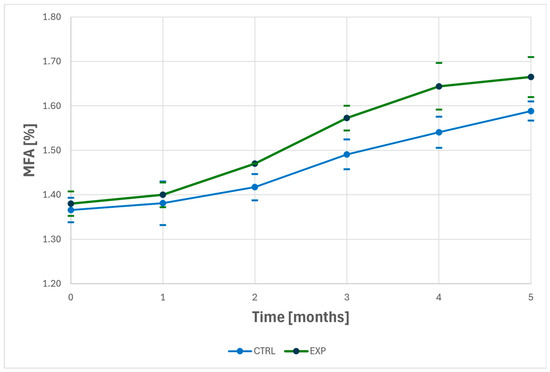
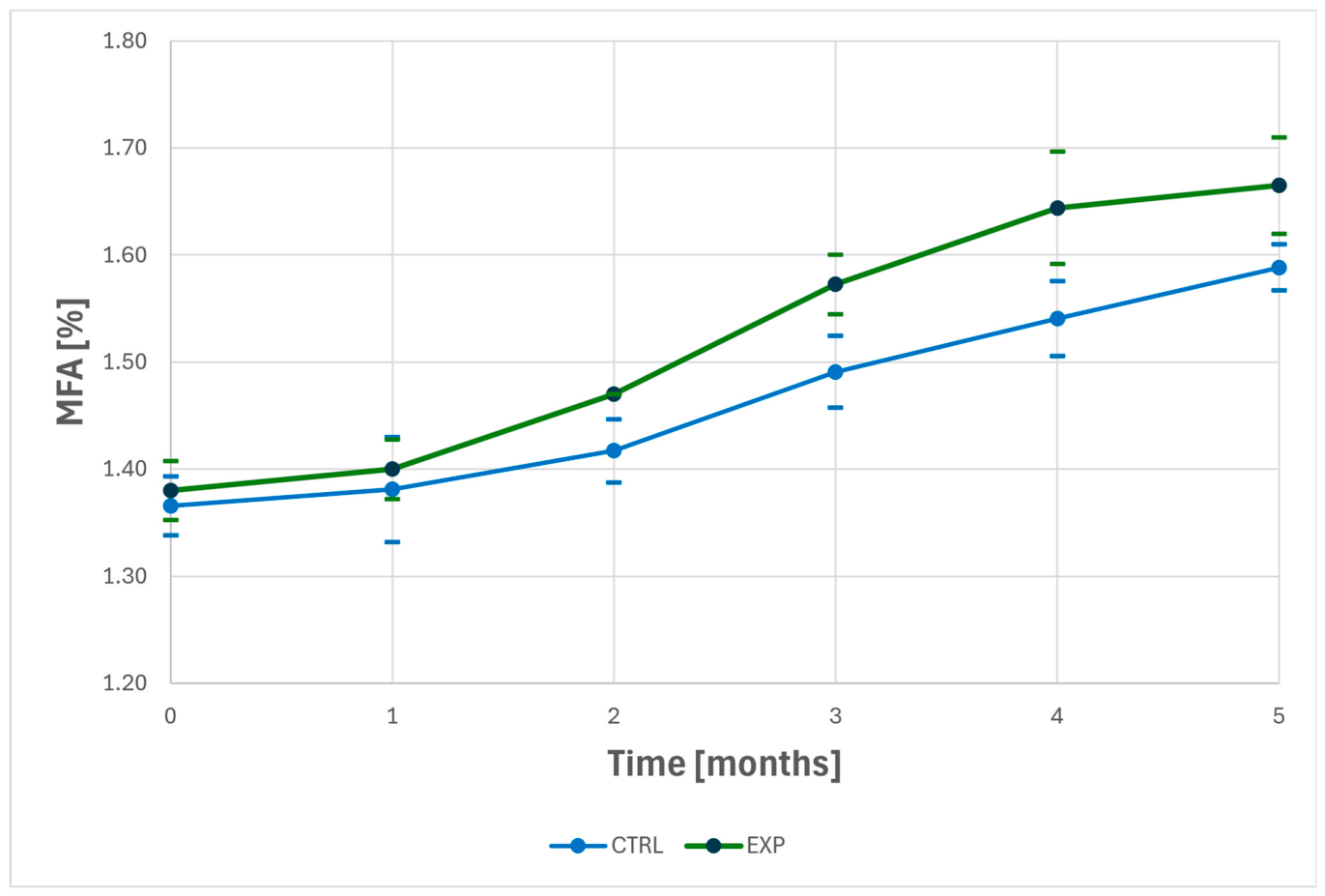
Milk Fatty Acids (MFA) monthly averages during the experimental period.
The control group SCC level ranges between 150,000 and 200,000 cells/mL throughout the trial, while the experimental group showed consistent decline, stabilizing at approximately 50,000 cells/mL by month five. During the experimental period, SCC decreased by 71% (IRR = 0.26, 95% CI = 0.20–0.65, p < 0.01)
Both experimental and control groups exhibit an upward trend in BFP values over the experimental period. BFP was significantly higher in GeoSpirulina-supplemented cows (4.56% vs. 4.37%). The ratio of means was 1.043 (95% CI: 1.017–1.068, p = 0.005), corresponding to a 4.3% increase relative to the control group.
Both experimental and control groups also exhibit an upward trend in MFA values over the experimental period. MFA concentration was significantly higher in GeoSpirulina-supplemented cows (1.55% vs. 1.48%). The ratio of means was 1.044 (95% CI: 1.020–1.068, p = 0.003), corresponding to a 4.4% increase relative to the control group.
Overall, the feeding trial confirmed that including a carbon-negative Spirulina supplement at the tested dose has no adverse effects on the measured indicators for cow performance or milk quality. On the contrary, it conferred potential benefits: improved milk quality, enhanced milk fat levels, reduced SCC, and potentially improved animal comfort—all while enabling the cows to contribute to the production of milk products with net supply chain carbon removal.
To place the proposed GeoSpirulina intervention within the broader context of available dairy greenhouse gas mitigation strategies, Table 6 summarizes key characteristics of representative mitigation approaches reported in the literature, including their estimated greenhouse gas reduction potential, implementation considerations, animal welfare implications, and projected economic impacts.
Table 6.
Comparison of key criteria of various milk emission reduction strategies, where %NetZero * = % Reduction in Milk cradle-to-farm-gate Carbon Footprint, of which enteric digestion emissions contribute ~27% [2]; Projected Cost ** = Estimated net cost of GHG emission reduction, considering milk production benefits.
4. Discussion
The present study comprised two complementary components. The life cycle assessment was used to determine a GeoSpirulina supplementation scenario capable of approaching a modeled near-net-zero cradle-to-farm-gate greenhouse gas balance, whereas the commercial feeding trial evaluated whether implementation of this supplementation strategy affected dairy production performance or animal-related outcomes. Spirulina-based supplementation was feasible under the conditions of this study and at the inclusion rate tested, with minimal changes to routine feeding practices. The algae powder was mixed into the cows’ daily ration at a low dose (a few grams per cow), which did not visibly alter feed texture. No adverse effects on feed intake or apparent palatability were observed during the trial, and no changes in milk flavor were reported under the study conditions. These observations suggest that, at low inclusion levels, integrating a carbon-negative microalgal ingredient into the diet may be operationally compatible with routine farm management without measurable disruption to animal performance.
Comparisons with other additives should be interpreted cautiously, as palatability and product-quality responses are dose-, formulation-, species- and context-dependent. However, it is important to clarify that this strategy counterbalances emissions through supply chain carbon removal rather than directly reducing enteric methane or other biological emission sources at the farm level. The approach therefore complements mitigation strategies aimed at lowering emissions within the production system itself. In addition, the present life cycle assessment was carbon-focused and evaluated climate change impacts only. Other environmental impact categories were not assessed, and therefore potential trade-offs beyond greenhouse gas emissions remain outside the scope of this analysis.
Previous assessments of the underlying Spirulina production system indicate that certain resource demands, including water and land use associated with soil-based carbon sequestration, may increase relative to conventional production pathways [15]. Although these effects are context-dependent, they highlight that carbon sequestration strategies can shift environmental burdens rather than eliminate them. A comprehensive evaluation of additional impact categories would be required to determine the overall environmental balance of large-scale implementation.
Beyond emissions, Spirulina is a nutrient-dense feed ingredient containing protein, vitamins (e.g., Vitamin B12, in the case of GeoSpirulina), minerals (such as Magnesium Sulphate), and antioxidant compounds, and these characteristics may have relevance for cow health and productivity. At the low inclusion rate used here, Spirulina contributed only a small proportion of the overall ration, but it may still have influenced measured outcomes.
The observed reduction in SCC is consistent with the findings of Ragab et al. [24], reporting >90% decline in SCC following an order of magnitude higher Spirulina supplementation rate in Holstein cows with subclinical mastitis, after 21 days of supplementation—obtained in a small, uncontrolled cohort. This study also reported that milk fat, protein, lactose, casein, and milk yield also increased during the supplementation period.
The observed changes in milk composition are consistent with several additional studies [18,21], suggesting a possible nutritional or physiological effect, although this study was not designed to isolate causal mechanisms. An important strength of the present study is its scale and duration relative to previously published Spirulina supplementation trials in dairy cattle. Earlier studies reporting improvements in milk composition, somatic cell count, or animal performance have generally been conducted over relatively short periods (typically several weeks) and with limited numbers of animals, which can make it difficult to distinguish treatment effects from normal biological variation. In contrast, the current commercial-farm trial followed more than 300 lactating cows for five months, with both the control (n = 187) and treatment (n = 118) groups exceeding 100 animals. This larger sample size and extended observation period allowed temporal trends to be evaluated with greater confidence and provided substantially greater statistical power to detect persistent treatment-associated effects, although the unequal allocation may have reduced statistical power for some outcome variables and should therefore be considered when interpreting non-significant findings. The consistent, statistically significant divergence observed between groups over multiple months, particularly for somatic cell count, butterfat percentage, and milk fatty acid content, suggests that the measured responses were not transient fluctuations but sustained trends under commercial production conditions. As such, the present study is among the larger and longer-duration commercial-farm evaluations reported for Spirulina supplementation in dairy cattle, demonstrating how low-dose Spirulina supplementation can influence milk quality and reduce somatic cell count in dairy cows. Nevertheless, longer-term and dose–response trials, including targeted measurements of micronutrient status, immune function, and metabolic indicators, are needed to determine whether Spirulina supplementation can reliably improve broader herd-health outcomes or reduce the need for specific supplements under commercial conditions.
An important feature of this coupled Spirulina production-removal system approach is that the climate benefit arises through supply chain-embedded carbon removal rather than direct suppression of on-farm biological emissions. In the present study, CO2 removal associated with GeoSpirulina production and subsequent soil carbon sequestration was estimated using a dedicated LCA and conservatively limited to the fraction modeled as durably sequestered, excluding carbon expected to be rapidly respired after ingestion.
In principle, batch-level documentation of production and sequestration parameters could support traceability within dairy supply chains and may facilitate carbon accounting, provided that robust chain-of-custody procedures, verification protocols, and safeguards against double counting are in place. However, broader application of such accounting approaches would require standardized methodologies and independent validation across production contexts.
Unlike most of the enteric digestion mitigation techniques, Spirulina’s climate benefit does not hinge on continuous precision dosing: if supplementation is paused, the only loss is the forgone carbon removal for that period, without any methane or other “rebound” effects. There is no evidence of diminishing returns over time, as Spirulina is not a pharmacological agent to which rumen microbes adapt, but a nutrient-rich feed component.
However, comparative performance across mitigation options should be evaluated carefully, and longer-term studies are still needed to assess consistency of production responses and implementation outcomes over time.
Broader adoption of Spirulina-enriched feed will depend on economic viability for farmers and value-chain partners, which should be assessed using transparent assumptions and, ultimately, formal techno-economic analysis under commercial conditions [31]. The present study did not include a formal techno-economic analysis, and cost-effectiveness therefore cannot be established here—qualitative rankings presented in Table 6 are based on literature review and expert judgment. Although the Spirulina-fed group showed improvements in milk composition and SCC under the study conditions, the economic significance of these changes will depend on local milk-pricing systems, herd context, additive cost, and management practices. Additional value may arise if supply chain actors recognize and reward verified emissions mitigation, but such mechanisms are market- and policy-dependent. Future work should integrate production data, additive costs, milk-pricing structures, and carbon-accounting assumptions into a formal economic assessment.
Large-scale cultivation and valorization of co-products (e.g., pigments or vitamins) may improve the economics of Spirulina production, but the extent of this effect will depend on process configuration, product markets, and allocation assumptions. Accordingly, any conclusion regarding economic justification of supplementation requires a scenario-based techno-economic analysis that explicitly examines feed costs, milk-value effects, and carbon-accounting incentives under different commercial conditions.
In this study, Spirulina supplementation at the tested inclusion rate was well tolerated, with no apparent adverse effects on feed intake or measured production outcomes. Potential animal-welfare, food-safety, regulatory, and consumer-acceptance considerations remain important for broader deployment, but these were not directly evaluated here. Acceptance may vary across jurisdictions and value chains and should be assessed empirically alongside efficacy, cost, and environmental performance in future implementation studies.
Finally, the scalability of this approach warrants careful consideration. GeoSpirulina has high areal productivity relative to many biomass systems, and its production may avoid direct use of arable land depending on facility design and siting [32]. However, resource requirements and environmental performance are highly context-dependent. At an inclusion rate of 2 g per cow per day, supplying the estimated global population of 270 million dairy cows would require approximately 200,000 tonnes of GeoSpirulina annually [14]. Current estimates suggest that Iceland’s existing utilities could support production exceeding 100,000 tonnes per year [33], but these projections rely on site-specific conditions, including access to renewable geothermal energy and suitable soils for long-term carbon sequestration. Replication in other contexts would require case-specific assessment of energy sources, land suitability, sequestration rates, and carbon permanence.
The long-term durability of soil organic carbon storage also introduces uncertainty. Although data from Iceland indicate multi-decadal stability, sequestration outcomes are inherently site-specific and influenced by soil type, climate, and land management practices. The availability of regions combining renewable energy infrastructure with suitable soils for durable carbon storage may therefore constrain global scalability. Broader deployment would require context-specific validation of both sequestration rates and permanence.
Several additional limitations should be acknowledged. The feeding trial was conducted on a single commercial farm, and treatment allocation was not randomized. Because the feeding trial was conducted under commercial farm conditions, individual feed efficiency, several baseline animal characteristics, and mechanistic physiological measurements were unavailable. These limitations should be considered when interpreting the biological responses reported. No a priori sample size calculation was performed because the study represented a commercial-farm validation using the available herd rather than a prospectively powered randomized controlled trial. Consequently, secondary outcomes should be interpreted with appropriate caution. Although the dietary treatments were applied under identical commercial feeding conditions, the absence of a comprehensive laboratory characterization of the total mixed ration precluded assessment of whether specific nutrient interactions may have influenced the observed responses. Future controlled feeding studies incorporating complete diet characterization are therefore warranted. The life-cycle assessment was limited to climate change impacts and relied on primary SOC data from a single site during a single year to evaluate carbon removal rates and permanence. Therefore, replication across multiple farms, climates, and production systems, as well as multiple-year removal primary data, will be required before broader generalization. The use of a published milk carbon-footprint baseline also meant that alternative allocation procedures between milk and dairy co-products, including meat, were not independently evaluated; such allocation choices may influence the absolute baseline footprint and should be considered when comparing results across dairy LCA studies. Furthermore, as treatment allocation was not randomized and the study was conducted under commercial farm conditions, causal inference should be interpreted cautiously. Although baseline measurements indicated that the treatment and control groups were broadly comparable at the start of the study, unmeasured differences between groups, management-related factors, housing conditions, health history, or other confounding variables may have contributed to the observed outcomes. The inclusion of replacement animals during the study period introduces an additional potential source of variability, although these animals were accounted for in the statistical analyses. Consequently, the observed associations between GeoSpirulina supplementation and improvements in somatic cell count and milk composition should not be interpreted as definitive evidence of causality. Replication using randomized controlled designs across multiple farms and production systems will be important to confirm the magnitude and consistency of the reported effects.
In summary, the modeled assessment indicated that carbon-negative GeoSpirulina feed may provide a complementary sustainability strategy for reducing the net climate impact of dairy production through supply chain-embedded carbon removal, while the commercial feeding trial indicated that the tested inclusion rate could be implemented without adversely affecting production performance. The study provides a proof-of-concept for integrating carbon-removal supply chains into agricultural production and evaluating their contribution within a life cycle carbon-accounting framework. However, the findings should be interpreted within the defined system boundaries, trial duration, inclusion rate, and carbon-focused scope of the LCA. Longer-term, multi-site trials and broader environmental, economic, and social assessments are required to evaluate reproducibility, potential trade-offs, and implementation conditions. If validated across production systems and geographical contexts, supply chain-embedded carbon removal could complement direct greenhouse gas mitigation as part of broader strategies for sustainable dairy production and agricultural decarbonization.
Author Contributions
A.S.-J. conceived and coordinated the study, conducted the life cycle assessment, performed the formal analysis, wrote the main manuscript text, and prepared the figures and tables. M.A. conducted the statistical analyses and contributed to writing sections of the manuscript. T.C. contributed to the methodology, data curation, and writing of sections of the manuscript. A.T. contributed to the conceptualization, methodology, writing, editing, and validation of the study. W.R.M. provided methodological validation, supervision, and critical revision of the manuscript. All authors contributed to the interpretation and validation of the results, reviewed the manuscript, and approved the final version before submission. All authors have read and agreed to the published version of the manuscript.
Funding
This research was funded by the EUROSTARS program (project E!1868 ULTRA-B12), co-funded by Tækniþróunarsjóður (Innovation Fund Denmark) and the European Union through the EUREKA network.
Institutional Review Board Statement
Ethical review and approval were waived for this study as all procedures complied with institutional and national guidelines for the care and use of agricul-tural animals. The study involved routine feeding practices conducted on a commercial dairy farm and did not introduce invasive procedures. Formal approval by an Institutional Animal Care and Use Committee was therefore not required. No formal pre-registration of the experimental protocol was conducted.
Informed Consent Statement
We can confirm that the commercial feeding trial was conducted with the informed consent and full cooperation of the participating dairy farm. The farm owner and management approved the study and its implementation prior to the commencement of the feeding trial, and permission was obtained to collect and use the associated production data for research purposes.
Data Availability Statement
The original contributions presented in this study are included in the article. Further inquiries can be directed to the corresponding author.
Acknowledgments
The authors gratefully acknowledge Danielle Goodrich of Goodrich Family Farm (VT, USA) for essential collaboration and support in conducting the on-farm feeding trial; Trine Boje Røgild of the Danish Technological Institute for contributions to development of the underlying life cycle assessment model; David Burnham of Phoenix Feeds & Nutrition (VT, USA) for providing milk quality data; Gaurav Das of MIT (MA, USA) for reviewing the LCA modeling and data quality; and Kristinn Hafliðason of VAXA Technologies (Iceland) for supplying GeoSpirulina used in the trial.
Conflicts of Interest
The authors declare no conflicts of interest.
Abbreviations
The following abbreviations are used in this manuscript:
| BFP | Butterfat percentage |
| DMI | Dry matter intake |
| FE | Feed efficiency |
| FPCM | Fat- and protein-corrected milk |
| GHG | Greenhouse gas |
| GWP100 | 100-year global warming potential |
| MFA | Milk fatty acids |
| SCC | Somatic cell count |
| SOC | Soil organic carbon |
| TMR | Total mixed ration |
References
- Singaravadivelan, A.; Sachin, P.B.; Harikumar, S.; Vijayakumar, P.; Vindhya, M.V.; Beegum Farhana, F.M.; Rameesa, K.K.; Mathew, J. Life-cycle assessment of greenhouse-gas emission from the dairy production system—Review. Trop. Anim. Health Prod. 2023, 55, 320. [Google Scholar] [CrossRef] [Scilit] [PubMed]
- Pelton, R.; Tricarico, J.; Bernal, F.; de Ondarza, M.B.; Kurt, T. Spatially resolved greenhouse gas emissions of U.S. milk production in 2020. Environ. Sci. Technol. 2025, 59, 9552–9564. [Google Scholar] [CrossRef] [Scilit] [PubMed]
- Beauchemin, K.A.; Kreuzer, M.; O’Mara, F.; McAllister, T.A. Nutritional management for enteric methane abatement: A review. Aust. J. Exp. Agric. 2008, 48, 21–27. [Google Scholar] [CrossRef] [Scilit]
- Smith, P.E.; Kelly, A.K.; Kenny, D.A.; Waters, S.M. Enteric methane research and mitigation strategies for pastoral based beef cattle production systems. Front. Vet. Sci. 2022, 9, 958340. [Google Scholar] [CrossRef] [Scilit] [PubMed]
- Yang, C.; Rooke, J.A.; Cabeza, I.; Wallace, R.J. Nitrate and inhibition of ruminal methanogenesis: Microbial ecology, obstacles, and opportunities for lowering methane emissions from ruminant livestock. Front. Microbiol. 2016, 7, 132. [Google Scholar] [CrossRef] [Scilit] [PubMed]
- Ku Vera, J.C.; Jiménez Ocampo, R.; Valencia Salazar, S.S.; Montoya Flores, M.D.; Molina Botero, I.C.; Arango, J.; Gómez Bravo, C.A.; Aguilar Pérez, C.F.; Solorio Sánchez, F.J. Role of secondary plant metabolites on enteric methane mitigation in ruminants. Front. Vet. Sci. 2020, 7, 584. [Google Scholar] [CrossRef] [Scilit] [PubMed]
- Hristov, A.N.; Oh, J.; Giallongo, F.; Frederick, T.W.; Harper, M.T.; Weeks, H.L.; Branco, A.F.; Moate, P.J.; Deighton, M.H.; Williams, S.R.O.; et al. An inhibitor persistently decreased enteric methane emission from dairy cows with no negative effect on milk production. Proc. Natl. Acad. Sci. USA 2015, 112, 10663–10668. [Google Scholar] [CrossRef] [Scilit] [PubMed]
- Yu, G.; Beauchemin, K.A.; Dong, R. A review of 3 nitrooxypropanol for enteric methane mitigation from ruminant livestock. Animals 2021, 11, 3540. [Google Scholar] [CrossRef] [Scilit] [PubMed]
- Roques, S.; Martinez Fernandez, G.; Ramayo Caldas, Y.; Popova, M.; Denman, S.; Meale, S.J.; Morgavi, D.P. Recent advances in enteric methane mitigation and the long road to sustainable ruminant production. Annu. Rev. Anim. Biosci. 2024, 12, 321–343. [Google Scholar] [CrossRef] [Scilit] [PubMed]
- Roque, B.M.; Venegas, M.; Kinley, R.D.; de Nys, R.; Duarte, T.L.; Yang, X.; Kebreab, E. Red seaweed (Asparagopsis taxiformis) supplementation reduces enteric methane by over 80 percent in beef steers. PLoS ONE 2021, 16, e0247820. [Google Scholar] [CrossRef] [Scilit] [PubMed]
- Hegarty, R.S. Reducing rumen methane emissions through elimination of rumen protozoa. Aust. J. Agric. Res. 1999, 50, 1321–1328. [Google Scholar] [CrossRef] [Scilit]
- Wedlock, D.N.; Janssen, P.H.; Leahy, S.C.; Shu, D.; Buddle, B.M. Progress in the development of vaccines against rumen methanogens. Animal 2013, 7, 244–252. [Google Scholar] [CrossRef] [Scilit] [PubMed]
- Wu, Y.; Gao, N.; Sun, C.; Feng, T.; Liu, Q.; Chen, W.H. A compendium of ruminant gastrointestinal phage genomes revealed a higher proportion of lytic phages than in any other environments. Microbiome 2024, 12, 69. [Google Scholar] [CrossRef] [Scilit] [PubMed]
- Brito, L.F.; Bedere, N.; Douhard, F.; Oliveira, H.R.; Arnal, M.; Peñagaricano, F.; Schinckel, A.P.; Baes, C.F.; Miglior, F. Review: Genetic selection of high-yielding dairy cattle toward sustainable farming systems in a rapidly changing world. Animal 2021, 15, 100292. [Google Scholar] [CrossRef] [Scilit] [PubMed]
- Smidt-Jensen, A.; Røgild, T.B.; Cohen, T.; Meshoulam, S.; Iuclea, L.; Sigurjónsson, H.Æ.; Tzachor, A.; Geirsdóttir, M.; Moomaw, W.R. Life cycle assessment of phycocyanin food colorant production from Spirulina (Arthrospira platensis) with biostimulant waste-stream utilization for soil carbon sequestration to achieve net carbon removal. Foods 2026, 15, 610. [Google Scholar] [CrossRef] [Scilit] [PubMed]
- Arnalds, O.; Guðbergsson, G.; Guðmundsson, J. Carbon Sequestration and reclamation of severely degraded soils in Iceland. Icel. Agric. Sci. 2000, 13, 87–97. [Google Scholar]
- Tzachor, A.; van den Oever, S.P.; Mayer, H.K.; Asfur, M.; Smidt-Jensen, A.; Geirsdóttir, M.; Jensen, S.; Smárason, B.O. Photonic management of Spirulina (Arthrospira platensis) in scalable photobioreactors to achieve biologically active unopposed vitamin B12. Discov. Food 2024, 4, 69. [Google Scholar] [CrossRef] [Scilit]
- Lamminen, M.; Halmemies Beauchet Filleau, A.; Kokkonen, T.; Vanhatalo, A.; Jaakkola, S. The effect of partial substitution of rapeseed meal and faba beans by Spirulina platensis microalgae on milk production, nitrogen utilization, and amino acid metabolism of lactating dairy cows. J. Dairy Sci. 2019, 102, 7102–7117. [Google Scholar] [CrossRef] [Scilit] [PubMed]
- Manzocchi, E.; Guggenbühl, B.; Kreuzer, M.; Giller, K. Effects of the substitution of soybean meal by Spirulina in a hay based diet for dairy cows on milk composition and sensory perception. J. Dairy Sci. 2020, 103, 11349–11362. [Google Scholar] [CrossRef] [Scilit] [PubMed]
- Newton, E.E.; Lamminen, M.; Ray, P.; Mackenzie, A.M.; Reynolds, C.K.; Lee, M.R.F.; Halmemies-Beauchet-Filleau, A.; Vanhatalo, A.; Stergiadis, S. Macromineral and trace element concentrations in milk from Finnish Ayrshire cows fed microalgae (Spirulina platensis) and rapeseed (Brassica napus). J. Dairy Sci. 2022, 105, 8866–8878. [Google Scholar] [CrossRef] [Scilit] [PubMed]
- Barceló Villalobos, M.; Arrebola, F.; Vizcaíno, A.; Alarcón, F.J.; Acién, F.G. Influence of including Arthrospira platensis as a functional ingredient in dairy cow feed on milk quality and animal performance. Algal Res. 2025, 91, 104295. [Google Scholar] [CrossRef] [Scilit]
- Lambiase, C.; Braghieri, A.; Barone, C.M.A.; Di Francia, A.; Pacelli, C.; Serrapica, F.; Lorenzo, J.M.; De Rosa, G. Use of cyanobacterium Spirulina (Arthrospira platensis) in buffalo feeding: Effect on mozzarella cheese quality. Foods 2023, 12, 4095. [Google Scholar] [CrossRef] [Scilit] [PubMed]
- Šimkus, A.; Oberauskas, V.; Laugalis, J.; Želvytė, R.; Monkevičienė, I.; Sederevičius, A.; Šimkienė, A.; Pauliukas, K. The effect of weed Spirulina platensis on the milk production in cows. Vet. Zootech. 2007, 38, 74–77. [Google Scholar]
- Ragab, M.; El Diasty, M.; El Sherbini, M.; AbdelKhalek, A. Effect of Spirulina on somatic cell count and milk quality. J. Adv. Vet. Res. 2023, 13, 637–642. [Google Scholar]
- Christodoulou, C.; Kotsampasi, B.; Dotas, V.; Simoni, M.; Righi, F.; Tsiplakou, E. The effect of Spirulina supplementation in ewes’ oxidative status and milk quality. Anim. Feed Sci. Technol. 2023, 295, 115544. [Google Scholar] [CrossRef] [Scilit]
- Tzachor, A.; Smidt-Jensen, A.; Ramel, A.; Geirsdóttir, M. Environmental impacts of large-scale Spirulina (Arthrospira platensis) production in Hellisheidi Geothermal Park Iceland: Life cycle assessment. Mar. Biotechnol. 2022, 24, 991–1001. [Google Scholar] [CrossRef] [Scilit]
- Papadaki, S.; Kyriakopoulou, K.; Tzovenis, I.; Krokida, M. Environmental impact of phycocyanin recovery from Spirulina platensis cyanobacterium. Innov. Food Sci. Emerg. Technol. 2017, 44, 217–223. [Google Scholar] [CrossRef] [Scilit]
- van den Oever, S.P.; Mayer, H.K. Biologically active or just “pseudo” vitamin B12 as predominant form in algae based nutritional supplements? J. Food Compos. Anal. 2022, 109, 104464. [Google Scholar] [CrossRef] [Scilit]
- Meo-Filho, P.; Ramirez-Agudelo, J.F.; Kebreab, E. Mitigating methane emissions in grazing beef cattle with a seaweed-based feed additive: Implications for climate-smart agriculture. Proc. Natl. Acad. Sci. USA 2024, 121, e2410863121. [Google Scholar] [PubMed]
- Plascencia, A.; Martínez-Alvarez, I.G.; Montano, M.; Estrada-Angulo, A.; Urías-Estrada, J.D.; Castro-Pérez, B.I.; Zinn, R.A. Effects of Spirulina (Arthrospira platensis) as feed additive of steers consuming high-energy diets: Growth performance and nutrient digestion. J. Hell. Vet. Med. Soc. 2022, 73, 4015–4022. [Google Scholar] [CrossRef] [Scilit]
- Lovat, S.J.; Ben-Nissan, R.; Milshtein, E.; Tzachor, A.; Flamholz, A.; Leger, D.; Noor, E.; Milo, R. Electro-microbial production techno-economic viability and environmental implications. Nat. Biotechnol. 2025, 43, 848–853. [Google Scholar] [CrossRef] [Scilit] [PubMed]
- Tzachor, A.; Richards, C.E.; Holt, L. Future foods for risk-resilient diets. Nat. Food 2021, 2, 326–329. [Google Scholar] [CrossRef] [Scilit] [PubMed]
- Tzachor, A.; Richards, C.E.; Smidt-Jensen, A.; Skúlason, A.Þ.; Ramel, A.; Geirsdóttir, M. The Potential Role of Iceland in Northern Europe’s Protein Self-Sufficiency: Feasibility Study of Large-Scale Production of Spirulina in a Novel Energy-Food System. Foods 2023, 12, 38. [Google Scholar]

Disclaimer/Publisher’s Note: The statements, opinions and data contained in all publications are solely those of the individual author(s) and contributor(s) and not of MDPI and/or the editor(s). MDPI and/or the editor(s) disclaim responsibility for any injury to people or property resulting from any ideas, methods, instructions or products referred to in the content. |
© 2026 by the authors. Licensee MDPI, Basel, Switzerland. This article is an open access article distributed under the terms and conditions of the Creative Commons Attribution (CC BY) license.