


Abstract
This study examines how green supply chain management (GSCM) contributes to long-term supply chain viability (SCV) and whether supply chain resilience (SCRES) mediates this relationship. Drawing on dynamic capabilities theory, GSCM is conceptualised as a set of structured operational practices, SCRES as an adaptive capability, and SCV as a higher-order outcome reflecting sustained supply chain functioning under prolonged disruption. A cross-sectional survey was administered to 420 manufacturing firms in Saudi Arabia. GSCM and SCV were modelled as higher-order multidimensional constructs, whereas SCRES was modelled as a single reflective construct. The model was estimated using a two-stage hierarchical component approach, and structural relationships were tested using PLS-SEM with 5000 bootstrap resamples. GSCM was positively associated with SCRES (β = 0.465, p < 0.001) and SCV (β = 0.263, p < 0.001), and SCRES was positively associated with SCV (β = 0.438, p < 0.001) and partially mediated the GSCM–SCV relationship (indirect effect = 0.204; VAF = 43.7%). The model accounted for 21.7% of the variance in SCRES and 36.9% in SCV. The results integrate GSCM, resilience, and viability within a capability-based mediation framework and indicate that green practices are associated with long-term viability primarily through resilience capability. The findings carry direct implications for manufacturers operating under the policy ambition of Saudi Vision 2030 and the Saudi Green Initiative.
1. Introduction
Supply chain management (SCM) has long been considered a lever for operational efficiency, cost reduction, and competitive performance [1]. The coordination of material, information, and financial flows across organisational boundaries enables scale advantages and tighter responsiveness to market signals. However, the conventional emphasis on efficiency and cost minimisation has been progressively destabilised by the growing complexity and uncertainty of the global business environment.
Over the past two decades, firms have faced increasing pressure to address environmental and social responsibilities alongside economic performance. Regulatory tightening, stakeholder scrutiny, and rising awareness of the environmental footprint of production and logistics have pushed environmentally oriented practices (green purchasing, eco-design, waste reduction, and supplier environmental cooperation) into the operational core of supply chains, rather than leaving them as peripheral compliance activities.
This trajectory has established green supply chain management (GSCM) as a major research stream within SCM. A substantial body of empirical work has shown that GSCM practices improve environmental performance, operational efficiency, and competitive positioning [2,3,4]. However, most of this evidence has been generated under the implicit assumption of relatively stable operating conditions and has had less to say about how green practices shape supply chain functioning under uncertainty and disruption. Recent evidence indicates that GSCM also strengthens resilience-oriented outcomes by reducing financing and transaction costs, improving productivity, and reinforcing operating conditions, thereby supporting the development of adaptive capabilities [5].
In parallel, supply chains have become more exposed to disruptions arising from pandemics, geopolitical realignments, climate-related shocks, and resource scarcity. These events have laid bare the vulnerability of supply chains optimised for efficiency but lacking adaptive capacity. The response in the literature has been a rapid expansion of work on supply chain resilience (SCRES): the capacity to prepare for, respond to, and recover from disruption [6,7]. Empirical evidence has identified flexibility, redundancy, and responsiveness as central to maintaining performance under disruption [8,9]. Recent work shows that resilience helps sustain performance under severe disruptions and scarce-resource conditions, reinforcing its role as a foundational adaptive capability rather than a short-term recovery response [10], and that green innovation strategies and green logistics practices materially shape this resilience [11].
Nonetheless, a growing chorus of scholars has argued that resilience alone is insufficient when disruption is persistent and systemic. Although resilience captures response and recovery, it does not exhaust the ability of supply chains to maintain functionality over extended periods of instability. This recognition has led to the concept of supply chain viability (SCV), which emphasises long-term system functioning and the capacity to sustain operations under prolonged disruption [12]. Initial empirical work suggests that viability is a higher-order capability that extends beyond resilience, incorporating long-term adaptation and continuity [13], and that resilience operates as a key antecedent through which integration- and risk-management practices translate into viability [14]. The broader interface between sustainability and resilience remains characterised by divergent conceptualisations, which makes conceptual precision a precondition for any attempt to link adaptive capability to long-term supply chain functioning [15].
Despite these advances, the literature remains limited regarding how sustainability-oriented practices may translate into long-term, system-level outcomes. Recent work shows that green practices and integration mechanisms can strengthen resilience through information sharing, joint planning, logistics cooperation, and supplier integration [16,17], and that resilience can mediate the effects of GSCM dimensions on organisational outcomes [18]. However, these insights have not yet been consolidated into a coherent explanatory account of how green practices may be transformed into adaptive capabilities and, in turn, into long-term viability.
The gap matters. Recent disruptions have shown that long-term supply chain functioning is not produced by isolated practices or single capabilities but by their integration. However, an explanation of the pathway connecting operational practices, adaptive capabilities, and system-level outcomes is lacking.
Drawing on dynamic capabilities theory [19], this study treats supply chains as layered systems in which operational practices provide the substrate for adaptive capabilities, which in turn enable higher-order outcomes. From this perspective, GSCM represents a set of structured practices, SCRES represents an adaptive capability, and SCV represents a higher-order capability associated with sustained system functioning.
Accordingly, the purpose of this study is to examine the relationships among GSCM, SCRES, and SCV, and to develop a model that explains how these constructs are linked. Specifically, we investigate whether SCRES mediates the relationship between GSCM and SCV in a sample of 420 manufacturing firms operating in Saudi Arabia, a context in which environmental policy ambition (Vision 2030, the Saudi Green Initiative) coincides with persistent supply- and demand-side uncertainty [20], providing a useful empirical setting for examining the chain from GSCM through SCRES to SCV.
The remainder of this paper is organised as follows. Section 2 reviews the literature and develops the hypotheses. Section 3 presents the methodology. Section 4 reports the analysis and results. Section 5 discusses the findings, and Section 6 concludes with theoretical contributions, managerial implications, limitations, and directions for further research.
2. Theoretical Background and Hypotheses Development
2.1. Green Supply Chain Management
Green supply chain management (GSCM) is defined as the integration of environmental considerations into supply chain management practices, including product design, material sourcing, manufacturing, delivery, and end-of-life management [2]. The definition signals a clear shift away from supply chain management framed solely in economic terms toward a logic that places environmental objectives alongside operational performance [21].
Subsequent work has refined the construct into a multidimensional one. Zhu et al. [3] identified five recurring dimensions: internal environmental management, green purchasing, eco-design, customer cooperation, and investment recovery. These dimensions span both intra- and inter-organisational practices, indicating that GSCM is not limited to internal process improvements but extends to relational mechanisms across the supply chain.
Empirically, GSCM practices have been consistently linked to improvements in environmental and operational performance. Srivastava [22] emphasised that green practices reduce waste and improve resource efficiency; Green et al. [4] showed that GSCM improves operational performance through tighter process integration; and Azevedo et al. [23] provided evidence that environmentally oriented supply chain practices can simultaneously enhance environmental and economic performance.
Recent evidence further suggests that the contribution of GSCM extends beyond performance to capability development. GSCM has been shown to strengthen resilience by lowering transaction and financing costs, increasing productivity, and reinforcing operating efficiency [5]. Related studies show that green supplier integration, information sharing, joint planning, and logistics cooperation strengthen both proactive and reactive resilience capabilities [16,17], and that green innovation strategy translates into supply chain resilience through green logistics practices [11]. Together, these findings indicate that GSCM contributes not only to environmental and operational gains but also to the relational and informational conditions that make adaptive responses possible. However, the literature still lacks an account of how these operational and relational improvements may translate into higher-order capabilities and sustained system-level outcomes.
2.2. Supply Chain Resilience
Supply chain resilience is defined as the capability of supply chains to prepare for, respond to, and recover from unexpected disruptions [6]. This definition foregrounds adaptability and continuity under uncertainty. Building on this baseline, Pettit et al. [7] conceptualise resilience as the alignment between vulnerabilities and adaptive capacities. Christopher and Peck [24] emphasise flexibility and redundancy, while Sheffi and Rice [25] highlight the role of adaptive processes in disruption management.
Empirical evidence confirms the centrality of resilience capabilities in sustaining performance under disruption [8,9]. More recent work shows that resilience helps maintain performance under severe disruptions and resource scarcity [10] and that it serves as a mechanism linking antecedent capabilities and relational conditions to sustainable operational outcomes [26]. Issa et al. [11] further demonstrate that green innovation strategies, channelled through green logistics practices, materially enhance supply chain resilience under varying conditions of structural and dynamic complexity. The thrust of these findings is that resilience should not be narrowly treated as a recovery-oriented response but rather as an adaptive capability with implications for sustained functioning.
However, the bulk of the resilience literature has remained focused on short- to medium-term disruption management. While resilience explains how supply chains cope with discrete shocks, it does not capture the higher-order condition of long-term functioning under prolonged instability.
Importantly, resilience and viability are conceptually distinct, rather than simple variants of one another along a time horizon. Resilience has been predominantly conceptualised as a closed-system, bounce-back capability oriented toward returning the supply chain to a prior equilibrium after a discrete disruption [6,24]. In contrast, viability has been theorised as an open-system, adaptation-driven property of supply chains operating under continuous structural dynamics, where the objective is not recovery to a pre-disruption state but sustained functioning through ongoing reconfiguration of structures, resources, and design [12,13]. This distinction implies that viability incorporates structural and resource-allocation logics absent from the resilience construct, and that resilience is more accurately understood as an antecedent capability feeding into viability rather than a proxy for it [14]. Recent ontological work sharpens this demarcation. Ivanov [27] distinguishes a stability-based view of resilience (triggered by disruption and oriented toward returning the system to a normal state) from an adaptation-based view oriented toward proactive adaptation and performance persistence under deep uncertainty, and Padovano and Ivanov [28] formalise viability as a multidimensional system property that subsumes, but is not reducible to, disruption-specific recovery capability. The distinction is therefore one of system type rather than time horizon: resilience as restoration of a functional state, and viability as continuation of functioning through transformation. The demarcation is mirrored at the level of measurement. The dimensions through which SCV is operationalised in this study (organisational structures, organisational resources, dynamic design capabilities, and operational aspects [13]) capture structural endowments of the system, the capacity to redesign the network itself, and sustained functioning, none of which reduces to the response–recovery–adaptation content of the resilience indicators.
2.3. Conceptual Framework and Hypotheses
The preceding discussion suggests that GSCM and SCRES are distinct but interrelated. While GSCM reflects structured operational practices embedded in supply chain processes, SCRES represents an adaptive capability that enables supply chains to respond to disruptions. However, the relationship between these constructs and long-term supply chain viability remains underdeveloped. Dynamic capabilities theory is employed here as an interpretive lens that organises the layered relationships among GSCM, SCRES, and SCV; its sensing, seizing, and transforming microfoundations [19] provide conceptual scaffolding for this layering rather than constructs measured in this study.
From a dynamic capabilities perspective [19], organisational outcomes are not determined by operational practices in isolation but by the ability to reconfigure and deploy resources in changing conditions. This perspective implies a layered architecture in which practices feed capabilities, which, in turn, enable higher-order outcomes. Translated to supply chains, GSCM may influence supply chain viability both directly and indirectly by developing resilience capabilities.
This layered structure can be mapped more precisely onto the microfoundations identified by Teece [19]. GSCM practices align with the sensing and seizing microfoundations: environmental scanning embedded in green purchasing and supplier evaluation, cross-functional coordination under internal environmental management, and customer and supplier integration enable firms to detect environmental and operational signals and commit resources to coordinated responses. SCRES corresponds to the transforming microfoundation: the capacity to adapt, reconfigure, and realign supply chain processes when those signals demand change. SCV represents a higher-order organisational condition that emerges when these capabilities are repeatedly exercised under prolonged uncertainty, producing sustained functioning through continuous structural and resource reconfiguration. The mapping clarifies a key theoretical claim: GSCM is not theorised here as a direct driver of long-term viability but as a set of practices whose contribution is channelled substantially through the adaptive capability represented by SCRES.
2.3.1. Supply Chain Resilience and Supply Chain Viability
Supply chain resilience enables firms to maintain continuity under disruption by supporting response, recovery, and adaptation [6]. These capabilities allow supply chains to absorb shocks and adjust to changing conditions, thereby sustaining operations over time. Empirical evidence indicates that resilience is central to maintaining performance in uncertain environments [8]. Recent evidence further shows that resilience supports performance under severe and prolonged disruptions, reinforcing its role as a foundational capability for sustained functioning [10], and that resilience operates as a key antecedent of supply chain viability in pandemic-era empirical models [14]. Given that supply chain viability reflects long-term system functioning, resilience can therefore be treated as a foundational capability that supports such outcomes.
Hypothesis 1 (H1).
Supply chain resilience positively influences supply chain viability.
2.3.2. Green Supply Chain Management and Supply Chain Resilience
GSCM practices enhance coordination, information sharing, and process discipline across supply chains [3]. These properties are precisely those required for adaptive responses: improved supplier relationships and increased transparency enhance responsiveness, while formalised processes support coordinated adjustments under disruption. Direct empirical support is available. Li and Zhu [5] show that GSCM improves resilience by enhancing coordination efficiency, reducing transaction costs, and strengthening operational capabilities. Integration-based practices, such as green supplier integration, information sharing, joint planning, and logistics cooperation, strengthen both proactive and reactive resilience [16,17], and green innovation strategies operate through green logistics practices to enhance resilience under varying complexity conditions [11].
Hypothesis 2 (H2).
Green supply chain management positively influences supply chain resilience.
2.3.3. Green Supply Chain Management and Supply Chain Viability
GSCM practices improve resource efficiency and strengthen coordination across the supply chain [4,22]. These improvements are conducive to long-term system functioning. However, their direct effect is likely to be limited in the absence of adaptive capability: green practices alone do not guarantee continuity under prolonged disruption. Therefore, the argument advanced here is not that GSCM is unrelated to viability but that its direct contribution is meaningful yet incomplete, stronger when operational and relational improvements are converted into resilience capability.
Hypothesis 3 (H3).
Green supply chain management positively influences supply chain viability.
2.3.4. The Mediating Role of Supply Chain Resilience
Dynamic capability theory holds that operational practices influence higher-order outcomes through the development of adaptive capabilities [19]. In the present model, supply chain resilience is theorised as the mechanism linking GSCM practices to long-term outcomes. Emerging empirical evidence supports this mediation logic. Resilience has been shown to function as an intermediate capability linking antecedent conditions to sustainable operational outcomes [26], and recent evidence suggests that resilience mediates the effects of GSCM dimensions on firm-level performance [18]. Studies in the supply chain viability literature also report that resilience mediates the influence of integration- and risk-related antecedents on viability [14], and recent Saudi-context evidence shows resilience to be a robust mediator between strategic supply chain choices and sustainability performance [20]. Although the evidence base is still consolidating, it is consistent with the dynamic capabilities logic advanced here: sustainability-oriented practices do not translate directly into long-term viability but do so through the adaptive capability that enables supply chains to reconfigure under persistent uncertainty.
Hypothesis 4 (H4).
Supply chain resilience mediates the relationship between green supply chain management and supply chain viability.
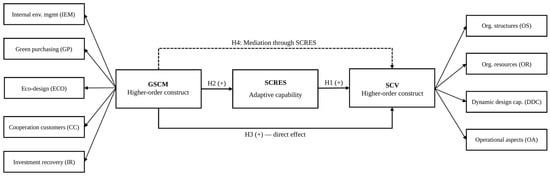
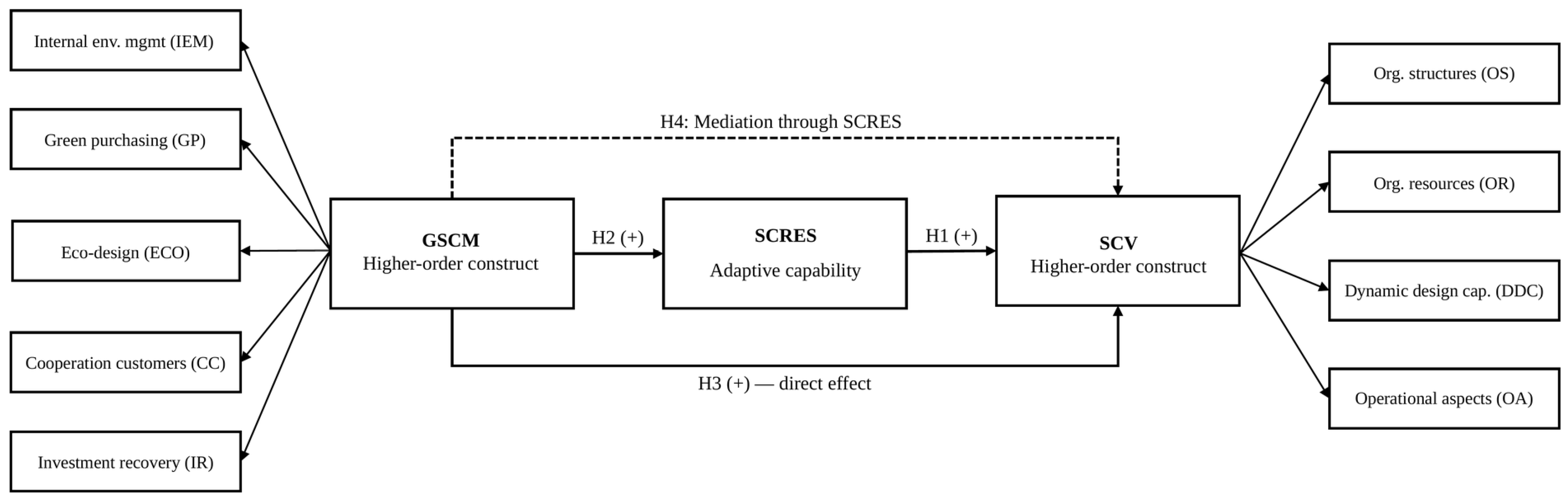
Figure 1 summarises the conceptual model and hypothesised relationships among GSCM, SCRES, and SCV.
Figure 1.
Conceptual model linking GSCM, SCRES, and SCV. Solid arrows denote direct paths (H1, H2, H3); the dashed bracket denotes the mediation hypothesis (H4). Reflective arrows from GSCM and SCV indicate the higher-order construct’s relationship to its first-order dimensions.
3. Materials and Methods
3.1. Variable Measurement and Questionnaire Design
A cross-sectional survey-based research design was adopted to test the relationships among green supply chain management (GSCM), supply chain resilience (SCRES), and supply chain viability (SCV) in manufacturing firms operating in Saudi Arabia. The Saudi context is appropriate for the present study because it combines accelerating environmental policy ambition under Vision 2030 and the Saudi Green Initiative with persistent exposure to supply- and demand-side uncertainty arising from regional geopolitical pressures, energy market volatility, and post-pandemic supply chain reconfiguration [20]. This combination makes the setting well-suited for examining the links among green practices, adaptive capabilities, and long-term supply chain functioning.
The questionnaire was structured into three measurement sections corresponding to the focal constructs (GSCM, SCRES, and SCV) and a demographic section. All constructs were operationalised using validated original measurement models, and the questionnaire design followed strict construct-specific logic. This is particularly important because the model combines constructs with different structural properties: GSCM and SCV are modelled as higher-order multidimensional constructs, whereas SCRES is modelled as a single reflective latent construct. Therefore, the questionnaire design preserved the original dimensionality and item structure of each construct rather than reconstructing scales from conceptual definitions.
GSCM was measured as a higher-order multidimensional construct based on the original scale developed by Zhu et al. [3], in which GSCM implementation is operationalised through 21 items distributed across five a priori dimensions: internal environmental management (IEM), green purchasing (GP), eco-design (ECO), cooperation with customers (CC), and investment recovery (IR). Because Zhu et al. [3] explicitly tested and validated both first- and second-order structures, this study adopted the original multidimensional specification without collapsing, deleting, or redefining any dimension at the questionnaire design stage.
SCRES was measured as a single reflective latent construct, adapted from Ambulkar et al. [9], whose study addressed the ambiguity surrounding resilience in the supply chain literature and operationalised it as the capability of the firm to remain alert, adapt, and respond effectively to supply chain disruptions. The literature also contains a hierarchical multidimensional specification of resilience [29], but this approach was not adopted here. Because GSCM and SCV are already modelled as higher-order constructs, introducing a further hierarchical specification for SCRES would unnecessarily increase model complexity and weaken the conceptual separation between resilience and viability. Accordingly, SCRES was measured as a direct capability-based construct rather than as a multidimensional one. The items were adapted from the original scale, with one additional item capturing the proactive anticipation of disruptions, in line with the prior resilience literature [30]. This adjustment preserves the unidimensional reflective specification while ensuring that both the reactive and anticipatory elements of resilience are represented.
SCV was measured as a higher-order multidimensional construct following the scale development and nomological validation study of Ruel et al. [13], in which SCV was conceptualised and validated as a hierarchical construct that captures long-term supply chain functioning under prolonged disruption. The original validated structure reflects four dimensions: organisational structures (OS), organisational resources (OR), dynamic design capabilities (DDC), and operational aspects (OA). Because SCV is still an emerging construct, this study adopted the original validated structure without reconstructing alternative dimensions from conceptual definitions.
All questionnaire items were adapted directly from the original measurement studies, with only minor wording adjustments made to improve clarity and contextual fit for the Saudi manufacturing environment. These adjustments did not alter the conceptual meaning of the items. The full item pool was retained at the initial design stage, and item purification was deferred to empirical validation rather than imposed a priori. Content validity was assessed through a review by academic experts in supply chain management and practitioners with managerial experience in supply chain and operations. Their feedback focused on conceptual alignment, item clarity, contextual relevance, and redundancy, leading to minor changes in wording. A pilot test with 30 respondents confirmed that the questionnaire was understandable, logically ordered, and suitable for full-scale administration. All items were measured using a seven-point Likert scale ranging from 1 (strongly disagree) to 7 (strongly agree). Table 1 summarises the measurement specifications.
Table 1.
Construct specification and measurement sources.
3.2. Sample and Data Collection
The empirical setting is Saudi Arabia, and the target population comprises manufacturing firms operating within the Saudi industrial context. The manufacturing sector provides an appropriate context because it involves complex supply chain coordination, substantial operational interdependence, and significant exposure to both sustainability pressures and disruption-related risks: the conditions under which the hypothesised relationships are most likely to be observable. The contextual relevance of this setting is reinforced by recent reviews documenting the systemic transformation of Saudi supply chains under Vision 2030 and the Saudi Green Initiative [20].
The unit of analysis is the focal firm’s assessment of its supply chain practices and capability. Key respondents were managerial-level individuals with direct knowledge of supply chain practices, disruption response, and operational continuity, including supply chain, operations, procurement, logistics, and plant managers, as well as senior executives involved in supply chain-related decision-making.
Data were collected through a structured online questionnaire distributed via direct email contact, professional industrial networks, and chamber-of-commerce membership directories covering manufacturing firms across major industrial regions (Riyadh, Eastern Province, and Makkah). Respondents were informed that participation was voluntary, that their responses would remain confidential, and that the study was intended solely for academic purposes. Following the procedural remedies recommended by Podsakoff et al. [31], the predictor, mediator, and outcome constructs were psychologically separated by placing a short buffer section of unrelated demographic items between the independent and dependent variable blocks; respondent anonymity was assured; and item wording was reviewed to minimise ambiguity. An attention-check item was embedded in the questionnaire, and responses that failed the check were excluded during data screening.
A total of 612 questionnaires were distributed, and 451 responses were received, representing a response rate of 73.7%. After screening for missing data, response consistency, attention-check failure, and questionnaire completeness, 420 valid responses were retained for the final analysis. Sample size sufficiency was verified using the inverse square root method [32]. For a minimum detectable path coefficient of 0.10 at α = 0.05 and 80% power, the required sample size was approximately 155, well below the realised N of 420.
Nonresponse bias was assessed by comparing early and late respondents (the first and last 25% of returned questionnaires) on the focal construct means using independent-sample t-tests, following the method of Armstrong and Overton [33]. No statistically significant differences were observed (all p > 0.10), suggesting that nonresponse bias was unlikely to be a material concern. Table 2 reports the demographic profile of the respondent firms.
Table 2.
Respondent and firm profile (N = 420).
3.3. Data Analysis Procedure
The analysis followed a three-step protocol: preliminary analysis, measurement model assessment, and structural model assessment. Partial least squares structural equation modelling (PLS-SEM) was selected as the estimation approach for three reasons: it accommodates higher-order constructs in a hierarchical component model framework; it is robust under non-normal data and moderate sample sizes; and it is well-suited to predictive theory-building research of the kind pursued here [34]. Three considerations make this choice substantive rather than conventional. First, both GSCM and SCV are higher-order constructs estimated through the two-stage hierarchical component approach, for which PLS-SEM is the standard procedure [35]. Second, the research orientation is prediction-oriented (asking how well GSCM and SCRES jointly predict SCV rather than testing exact covariance fit), an orientation corroborated empirically through the out-of-sample assessment reported in Section 4.3.3. Third, all 39 indicators exhibit skewness between −0.27 and 0.03 and excess kurtosis between −0.52 and 0.17: modest but non-zero departures from normality across a seven-point response format, consistent with a distribution-free estimator. All statistical analyses were conducted using R version 4.5.2 (R Foundation for Statistical Computing, Vienna, Austria) through RStudio version 2026.01.1+403 (Posit Software, PBC, Boston, MA, USA).
The preliminary analysis included data screening, missing-data inspection, response-pattern checking, and bias assessment. Common method variance was assessed using established procedural and statistical techniques. The measurement model was assessed in terms of internal consistency reliability (Cronbach’s α and composite reliability), convergent validity (average variance extracted [AVE] and indicator loadings), and discriminant validity (Fornell–Larcker criterion and the heterotrait–monotrait ratio of correlations [HTMT]).
Because GSCM and SCV are higher-order multidimensional constructs and SCRES is a single reflective construct, the model was estimated using a two-stage hierarchical component model approach [34]. In the first stage, the lower-order dimensions of GSCM (IEM, GP, ECO, CC, and IR) and SCV (OS, OR, DDC, and OA) were estimated alongside SCRES, and latent variable scores were computed. In the second stage, these scores were used to estimate the higher-order constructs and the structural relationships among GSCM, SCRES, and SCV. This two-stage approach reduces model complexity and improves estimation clarity when multiple higher-order constructs coexist with single-level mediators.
The structural model was evaluated using path coefficients, t-values, p-values, the coefficient of determination (R2), Stone–Geisser predictive relevance (Q2), and Cohen’s f2 effect sizes. Significance was assessed using bootstrapping with 5000 resamples and bias-corrected 95% confidence intervals (CIs). The mediating role of SCRES was tested by examining the indirect effect of GSCM on SCV through SCRES and by classifying the mediation type using the decision tree of Zhao et al. [36] (no effect, full, partial complementary, or partial competitive mediation).
4. Results
4.1. Preliminary Analysis
Examination of the data showed no missing values in the final sample of 420 responses. Inspection of response patterns revealed no straight-lining or careless responding: row-mean band counts indicated that 1.4% of responses fell below 3.5, 52.1% in the mid-range (3.5–4.99), and 46.4% at 5 or above, producing a unimodal distribution centred around the construct means. Univariate normality was modestly violated (skewness and kurtosis within ±1), supporting the use of PLS-SEM, which does not assume multivariate normality.
Multicollinearity was assessed prior to estimating the structural model. Variance inflation factors (VIFs) for all predictor constructs were comfortably below the commonly accepted threshold of 3.0, indicating that collinearity does not distort the parameter estimates.
Given the single-source, self-reported nature of the data, common method bias was considered explicitly. Procedural steps were taken at the design stage, including assurances of anonymity and reducing evaluation apprehension. From a statistical standpoint, Harman’s single-factor test showed that no single factor accounted for the majority of the variance (32.92%).
To provide a more stringent assessment, full collinearity VIFs were also examined following Kock [37]. All values remained well below the critical threshold of 3.3, suggesting that common method bias is unlikely to meaningfully affect the results. These screens cannot rule out residual method variance entirely; this point is acknowledged explicitly in Section 6.3.
4.2. Measurement Model Assessment
4.2.1. Reliability and Convergent Validity
Reliability and convergent validity were assessed at the level of each lower-order construct, consistent with a two-stage approach. As shown in Table 3, all constructs exhibited Cronbach’s α values above the 0.70 threshold (range 0.733–0.915) and composite reliability values above 0.80 (range 0.849–0.934). All AVE values exceeded the 0.50 cut-off (range 0.653–0.718), supporting convergent validity. Standardised indicator loadings ranged from 0.78 to 0.87, all significant at p < 0.001 (full item-level loadings are reported in Appendix B).
Table 3.
Reliability and convergent validity for first-order constructs.
4.2.2. Discriminant Validity
Discriminant validity was assessed using the Fornell–Larcker criterion and the HTMT ratio. As reported in Table 4, the square root of the AVE for each construct exceeds its correlation with the other constructs [38]. All HTMT values were below the 0.85 threshold [39], with the highest pair (SCRES–SCV) at 0.629. Therefore, the constructs are empirically distinct.
Table 4.
Discriminant validity (Fornell–Larcker criterion and HTMT).
4.2.3. Higher-Order Construct Assessment
The higher-order specifications of GSCM and SCV were evaluated by examining the loadings of the first-order dimensions on their respective higher-order constructs. As shown in Table 5, all five GSCM dimensions loaded strongly on the second-order GSCM construct (range 0.763–0.827; CR = 0.901; AVE = 0.646), and all four SCV dimensions loaded strongly on the second-order SCV construct (range 0.757–0.792; CR = 0.857; AVE = 0.600). Therefore, the hierarchical specification is supported.
Table 5.
Higher-order construct loadings.
4.3. Structural Model Results
4.3.1. Direct Effects
Path coefficients and significance levels were estimated using bootstrapping with 5000 resamples. Multicollinearity was not a concern; the variance inflation factors for the predictors of SCV (GSCM and SCRES) were below the 3.0 threshold [34].
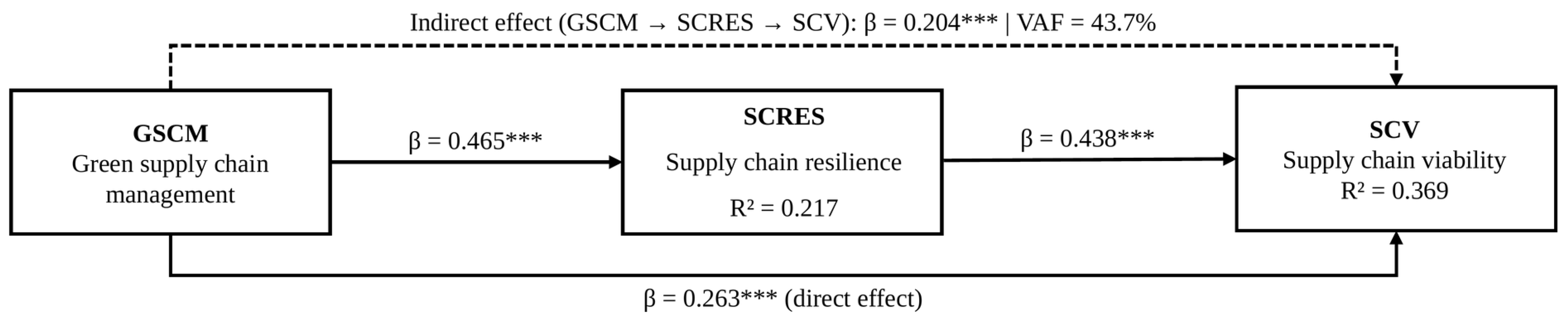
As reported in Table 6, supply chain resilience exerted a positive and significant effect on supply chain viability (β = 0.438, t = 9.97, p < 0.001), supporting H1. Therefore, resilience capabilities play a central role in sustaining long-term supply chain functioning. Green supply chain management has a positive and significant effect on supply chain resilience (β = 0.465, t = 10.75, p < 0.001), supporting H2: environmentally oriented supply chain practices contribute substantively to the development of adaptive capability. The direct effect of GSCM on SCV is also positive and significant (β = 0.263, t = 5.98, p < 0.001), supporting H3, although the magnitude of this direct effect is markedly smaller than the indirect effect operating through resilience (see Section 4.3.2).
Table 6.
Structural model results: direct effects.
4.3.2. Mediation Analysis
The mediating role of SCRES was tested by examining the indirect effect of GSCM on SCV through SCRES using bias-corrected bootstrap confidence intervals (5000 resamples). The indirect effect was positive and statistically significant (β = 0.204, t = 7.74, p < 0.001), with a 95% bias-corrected confidence interval of [0.154, 0.258] that excluded zero, supporting H4. Because the direct effect of GSCM on SCV remains significant after the mediator is included and is in the same direction as the indirect effect, the result corresponds to complementary partial mediation in the classification of Zhao et al. [36]. The variance accounted for (VAF) by the mediator is 43.7% (Table 7), indicating that almost half of the total effect of GSCM on SCV operates through resilience capability.
Table 7.
Mediation analysis: the path from GSCM through SCRES to SCV.
4.3.3. Model Explanatory and Predictive Power
The explanatory power of the model is presented in Table 8. GSCM accounts for 21.7% of the variance in SCRES (R2 = 0.217), and GSCM and SCRES together account for 36.9% of the variance in SCV (R2 = 0.369). Stone–Geisser predictive relevance, computed using leave-one-out cross-validation as a proxy for blindfolding, was positive for both endogenous constructs (Q2 = 0.210 for SCRES; Q2 = 0.359 for SCV), indicating satisfactory predictive relevance. Cohen’s f2 effect sizes (Table 6) suggest a medium-to-large effect of GSCM on SCRES (f2 = 0.277), a medium-to-large effect of SCRES on SCV (f2 = 0.238), and a small effect of GSCM on SCV (f2 = 0.086), a pattern consistent with the mediation logic.
Table 8.
Model explanatory and predictive power.
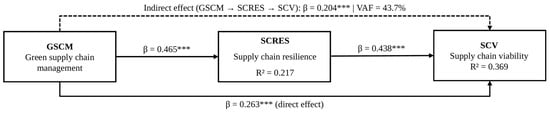
Figure 2 summarises the structural model, including standardised path coefficients and significance levels.
Figure 2.
Structural model with standardised path coefficients (*** p < 0.001). Solid arrows denote direct effects; the dashed arc denotes the indirect (mediation) effect through SCRES.
To corroborate the prediction-oriented rationale for the estimation approach, out-of-sample predictive performance was further assessed using leave-one-out cross-validation at the construct level, complementing the Stone–Geisser estimates above. The predictive relevance for SCV was Q2 predict = 0.363, and a cross-validated predictive ability test (CVPAT) [41] indicated that the structural model significantly outperformed the naïve indicator-average benchmark (average loss difference = 0.363, t(419) = 7.05, p < 0.001), supporting the predictive adequacy of the model beyond in-sample explanation [41,42].
4.4. Alternative Model Assessment
Because the hypothesised structure is not the only plausible arrangement of the three constructs, a formal alternative-model assessment was conducted following the prediction-oriented model-selection framework of Sharma et al. [42] and the CVPAT logic of Liengaard et al. [41]. Two nested rival specifications sharing SCV as the target construct were compared with the hypothesised partial-mediation model (M0): a full-mediation model omitting the direct path from GSCM to SCV (M1) and a direct-effects model omitting the mediator (M2). Table 9 reports the comparison.
Table 9.
Alternative model assessment: information-theoretic and predictive comparisons.
The hypothesised model is decisively preferred among the nested rivals. Relative to M0, the Bayesian information criterion deteriorates by 28.5 points for M1 and by 83.7 points for M2 (both far beyond the threshold of 10 classified by Raftery [43] as very strong evidence), and the CVPAT comparisons in Table 9 confirm the predictive superiority of M0. Fully reversed orderings of the three constructs (e.g., SCV as antecedent of SCRES and GSCM) were also estimated. Because the three-construct path system is saturated, such reversals are covariance-equivalent and cannot be discriminated statistically with cross-sectional data: the variance explained when SCRES is regressed on GSCM and when GSCM is regressed on SCRES, for example, is identical (0.217) by construction. The modelled direction therefore rests on the dynamic-capabilities logic that operational practices precede capability development and on prior empirical evidence for the GSCM-to-resilience direction [5]; this point is acknowledged as a limitation in Section 6.3.
4.5. Robustness Check: Dimensionality of Supply Chain Resilience
The unidimensional specification of SCRES adopted in Section 3.1 was additionally subjected to a formal dimensionality check. Following the proactive/reactive taxonomy in the resilience literature [30,44], the six SCRES items were partitioned into a proactive subscale (SCRES3, anticipation of disruptions; SCRES5, maintaining operations despite disruptions; α = 0.756) and a reactive subscale (SCRES1, rapid response; SCRES2, adaptation; SCRES4, rapid recovery; SCRES6, process adjustment; α = 0.887). Confirmatory factor analysis (maximum likelihood, N = 420) compared the unidimensional and two-factor specifications; Table 10 reports the results.
Table 10.
Dimensionality of SCRES: confirmatory factor analysis comparison.
The two specifications are statistically indistinguishable in fit (Δχ2(1) = 0.09, p = 0.759), the Bayesian information criterion favours the more parsimonious unidimensional model (ΔBIC = +6.0), and, decisively, the latent correlation between the proactive and reactive factors is φ = 0.994, with HTMT = 0.993, far above the 0.90 threshold for construct distinctness [39]. The two putative dimensions are therefore empirically inseparable in these data, and the unidimensional specification is retained on demonstrated rather than asserted grounds. This result may be sample-specific: in settings with greater heterogeneity in disruption exposure, the proactive/reactive separation may be empirically recoverable [45], which is flagged as a direction for future research.
5. Discussion
This study aimed to examine how green supply chain management contributes to long-term supply chain viability and whether this relationship operates through the development of supply chain resilience. The findings yield several insights that extend and integrate research streams that have developed largely in parallel until recently. Because the design is cross-sectional, capability evolution cannot be observed directly; the findings are therefore interpreted as patterns consistent with (rather than a direct empirical demonstration of) the dynamic-capabilities logic developed in Section 2.
5.1. Interpreting the Relationship from GSCM Through SCRES to SCV
Why is GSCM associated with resilience in these data? GSCM practices (supplier coordination, information sharing, eco-design integration, and internal environmental management) produce relational and informational conditions that constitute the substrate on which resilience capability develops: visibility into upstream operations, joint planning routines, and redundancy through diversified green sourcing. The association captured by H2 is consistent with this reading: what green practices supply is not resilience itself but the organisational raw material from which a resilience capability can be formed.
Why does resilience channel the association between GSCM and viability? Resilience represents the capacity to deploy GSCM-derived resources and information under disruption, not merely to possess them. This is consistent with the dominant role of the indirect path: green practices without deployment capacity yield static green capacity, whereas green practices accompanied by resilience are associated with adaptive, system-level functioning. The dominance of the indirect path (VAF = 43.7%) is precisely the pattern this layered reading implies.
Why does a direct association between GSCM and SCV remain? GSCM practices have direct positive associations with system functioning (waste reduction, efficiency gains, and supplier-base stability) that operate independently of resilience deployment. These associations are real but limited in magnitude (f2 = 0.086), and the residual direct effect plausibly also reflects intermediating capabilities not modelled here, such as integration capability, absorptive capacity, digital capability, and risk-governance capability (see Section 6.3).
The empirical setting sharpens this interpretation. Saudi manufacturing remains structurally dependent on imported industrial inputs (machinery and electrical equipment alone account for roughly a quarter of total imports [46]) and operates within the structural transition mandated by Vision 2030 [20]. Under such conditions, the deployment capacity captured by SCRES is particularly consequential for sustained functioning, which is consistent with the dominance of the indirect path observed in this sample.
5.2. Findings in Relation to Prior Research
First, the results indicate that supply chain resilience is strongly associated with long-term supply chain functioning (β = 0.438, p < 0.001). Prior studies have consistently shown that resilience supports disruption response and recovery [6,9]. The present results extend this understanding: the pattern of effects is consistent with resilience operating as a key mechanism underlying supply chain viability. This interpretation is consistent with recent evidence that resilience helps firms sustain performance under severe disruptions and resource constraints rather than merely supporting short-term recovery [10], and with empirical work in the SCV literature showing resilience to be a robust antecedent of viability under pandemic-era disruption [14]. Therefore, resilience should not be viewed solely as a short-term adaptive capability but as a foundational capability for sustained functioning and continuity over time.
Second, GSCM substantially contributes to the development of resilience (β = 0.465, p < 0.001; f2 = 0.277). This finding extends the GSCM literature beyond its traditional focus on environmental and operational performance [3,4] and clarifies the mechanism: GSCM strengthens resilience not because it is “green” per se, but because it improves the structural and relational conditions that make adaptive response possible. This interpretation is supported by recent empirical evidence that GSCM lowers transaction costs, increases productivity, and strengthens operating efficiency [5], and that green supplier integration, information sharing, joint planning, and logistics cooperation reinforce both proactive and reactive resilience [16,17]. Issa et al. [11] further demonstrate that green innovation strategy translates into resilience through green logistics practices, with the strength of this transformation contingent on supply chain complexity. What these mechanisms share is an improvement in coordination quality, information visibility, and collaborative adjustment capacity: the precise substrate on which resilient response depends.
Third, GSCM exerts a direct but weaker effect on supply chain viability (β = 0.263, p < 0.001; f2 = 0.086) than its indirect effect through resilience (β = 0.204; 43.7% of the total effect). This pattern is theoretically important because it clarifies how sustainability-oriented practices influence long-term outcomes. Although GSCM improves resource efficiency and coordination, these improvements alone do not fully explain sustained functioning under prolonged disruption. However, these improvements appear more consequential when channelled through adaptive capabilities. This interpretation is consistent with recent evidence that supply chain resilience significantly mediates the effects of GSCM dimensions on organisational outcomes [18] and that resilience operates as a robust mediator between strategic supply chain choices and sustainability performance in the Saudi context [20]. Therefore, the contribution of the present study is not merely to confirm that GSCM matters but to show that a substantial part of its contribution to viability operates through resilience as the intervening capability that converts operational practices into adaptive continuity.
Taken together, these findings support a layered view of supply chain functioning, in which operational practices (GSCM) provide the structural foundation, adaptive capabilities (SCRES) act as the intermediating capability, and higher-order outcomes (SCV) represent sustained system functioning. This interpretation is consistent with recent studies showing that resilience links dynamic and relational capabilities to sustainable operational outcomes [26]. Therefore, this study applies dynamic capabilities theory [19] to the supply chain context as an interpretive lens, examining how structured sustainability-oriented practices relate to adaptive capability and, in turn, to long-term viability.
More broadly, this study integrates three research streams that have rarely been examined together within a single explanatory framework. The GSCM literature has primarily focused on environmental and operational performance, the resilience literature on disruption response and recovery, and the emerging viability literature on long-term system continuity. While recent studies have begun to link subsets of these constructs [5,11,14,17,18], their integration within a single mediation framework remains to be developed. The contribution here is to specify a capability pathway through which sustainability-oriented practices are associated with long-term system-level outcomes: not merely to establish that GSCM, resilience, and viability are related, but to articulate the mechanism through which their relationships are theorised to unfold within a coherent capability-based framework.
At the same time, the explanatory boundaries of the model warrant emphasis. The model accounts for 21.7% of the variance in SCRES and 36.9% in SCV; a substantial share of the variance in both constructs therefore remains attributable to factors outside the framework. Digitalisation, environmental turbulence, integration capability, risk governance, and absorptive capacity are plausible candidates, and recent evidence underscores their relevance in closely related settings [20]. The framework advanced here should accordingly be read as capturing one substantial pathway from sustainability-oriented practice to long-term functioning, not the complete explanation.
The findings also intersect with the emerging literature on technology-intensive and digitally coordinated supply chains. The capability architecture identified here offers one organisational foundation on which such digitally enabled resilience-building can operate, although digital capabilities were not measured directly in this study.
6. Conclusions
6.1. Theoretical Contributions
This study contributes to the supply chain management literature in three ways. First, it specifies the mechanism by which green supply chain management influences long-term outcomes. Rather than assuming a direct relationship between GSCM and performance, the findings show that this relationship operates substantially through the development of a resilient supply chain. This addresses an important limitation of prior work, which has often emphasised outcomes without identifying the underlying transformation processes. The result is consistent with recent evidence that supply chain resilience mediates the effects of GSCM dimensions on organisational outcomes [18] and reinforces the view that resilience serves as the mechanism by which sustainability-oriented practices translate into more durable outcomes.
Second, this study contributes to the resilience literature by positioning resilience not only as a disruption-response capability but also as a capability that supports long-term supply chain viability. This is consistent with recent studies showing that resilience links antecedent capabilities and relational conditions to sustainable operational outcomes, rather than merely operating as an isolated response variable [26], and with empirical work demonstrating its mediating role in pandemic-era viability models [14]. Therefore, resilience deserves to be theorised as a transformational capability with implications for both short- and long-term time horizons.
Third, this study contributes to the emerging literature on supply chain viability by providing empirical integration with established constructs. Existing research on viability has been largely conceptual or focused on scale development [12,13], highlighting the critical need to transition these theoretical propositions into tangible practices [47]. By linking viability to both operational practices (GSCM) and adaptive capabilities (SCRES) within a single mediation framework, this study situates viability within a broader nomological network, thereby strengthening its theoretical grounding.
Overall, this study advances a layered capability perspective in which GSCM represents structured operational practices, SCRES represents adaptive capability, and SCV represents higher-order system-level functioning. The layered view provides a more coherent understanding of supply chain behaviour across analytical levels and time horizons than the traditional view. This interpretation is reinforced by recent evidence that GSCM strengthens resilience through efficiency improvements, lower transaction costs, and stronger operating conditions [5].
6.2. Managerial and Policy Implications
The findings have several implications for managers operating in complex and uncertain supply chain environments, particularly in the Saudi manufacturing context. First, green supply chain practices should not be framed solely as compliance or efficiency instruments but also as resilience-building investments. Practices such as supplier collaboration, eco-design, and internal environmental management improve coordination and information flow, which are central to responding to disruptions. This implication is reinforced by recent evidence that GSCM improves resilience through better coordination efficiency, lower transaction costs, and improved productivity [5].
Second, because resilience appears to be the channel through which green practices are linked to long-term outcomes, managers should actively develop resilience capabilities (such as flexibility, responsiveness, rapid decision-making, and redundancy in critical nodes) rather than assuming that sustainability practices alone will ensure continuity under disruption. This is especially salient under severe disruption and resource scarcity, where resilience sustains operational performance rather than merely supporting short-term recovery [10].
Third, achieving supply chain viability requires a system-level perspective. Firms should move beyond isolated initiatives and align sustainability initiatives with disruption-management strategies and long-term planning. From a policy standpoint, the findings also support the orientation of national programmes such as Saudi Vision 2030 and the Saudi Green Initiative, which combine environmental ambition with industrial resilience objectives, by clarifying that the two agendas are mutually reinforcing rather than competing [20]. The findings therefore align directly with the Special Issue’s focus on sustainable enterprise operations and circular value creation in supply chains.
6.3. Limitations and Future Research
Several limitations qualify these findings and suggest directions for further research. First, the study is based on cross-sectional survey data, which limits the ability to capture dynamic changes in supply chain capabilities over time and to draw strict causal inferences. Future research could adopt longitudinal or quasi-experimental designs to examine how the relationships among GSCM, resilience, and viability evolve under different disruption regimes. Such designs would also permit direct empirical separation of resilience and viability: a longitudinal study could observe both the return-to-baseline trajectory after a discrete disruption (operationalising resilience) and continued functioning under sustained structural change over a longer horizon (operationalising viability), and could test whether the two trajectories covary within firms. Relatedly, because the three-construct path system estimated here is saturated, fully reversed orderings are covariance-equivalent in cross-sectional data (Section 4.4); the modelled direction rests on theory and prior evidence rather than on statistical adjudication, and longitudinal designs are required to discriminate it empirically.
Second, the empirical context is limited to manufacturing firms in Saudi Arabia. While appropriate for the research objectives, this choice may limit generalisability to other industries or geographical settings. Replication is needed in different contexts: for example, service supply chains and agri-food chains in low-income economies, where developing context-specific resilience is crucial to mitigate disruptive impacts [48]. On balance, the association between GSCM and SCRES may transfer to non-manufacturing settings, because the underlying coordination, information-sharing, and process-discipline mechanisms generalise, and the association between SCRES and SCV captures a generic capability relationship; the relative magnitudes of the paths, however (particularly the dominance of the indirect over the direct path), are likely to be context-dependent. Replications in lower-income economies would be especially informative because they would test whether the resilience-mediation pattern holds where the resource base for capability development is more constrained.
Third, although the study adopts validated measurement models, the operationalisation of supply chain viability remains relatively recent, and scholars may differ on its dimensional structure. Further psychometric work is needed to refine and validate this construct across different empirical settings and methodological approaches. Fourth, the data are single-source and self-reported. The questionnaire did not include a theoretically unrelated marker variable at the design stage, which precludes formal marker-based corrections [49,50], and the unmeasured-latent-method-construct approach was deliberately avoided because it neither reliably detects nor corrects method variance in PLS settings [51]; despite acceptable Harman and full-collinearity screens (Section 4.1), residual common-method variance may therefore remain. The single-informant design is a related constraint when measuring system-level outcomes such as SCV, and future studies should triangulate executive assessments with multi-respondent designs and objective indicators such as disruption-recovery times and on-time delivery performance. Finally, this study focused on a single mediating mechanism. Future research could explore additional pathways (digitalisation, supply chain integration, risk management capabilities, and circular value creation) within multi-mediator and moderated-mediation frameworks, to provide a more comprehensive account of how supply chains achieve long-term viability.
Author Contributions
Conceptualisation, M.Z.A. and M.A.; methodology, M.Z.A.; software, M.Z.A.; validation, M.Z.A. and M.A.; formal analysis, M.Z.A.; investigation, M.Z.A.; resources, M.Z.A.; data curation, M.Z.A.; writing—original draft preparation, M.Z.A.; writing—review and editing, M.Z.A. and M.A.; visualisation, M.Z.A.; supervision, M.A.; project administration, M.Z.A. All authors have read and agreed to the published version of the manuscript.
Funding
This research received no external funding.
Institutional Review Board Statement
The study was conducted in accordance with the Declaration of Helsinki and approved by the Research Ethics Committee of the College of Business Administration in Yanbu, Taibah University (protocol code TU-CBAY-2025-018; date of approval: 12 March 2025).
Informed Consent Statement
Informed consent was obtained from all subjects involved in the study.
Data Availability Statement
The data presented in this study are available on reasonable request from the corresponding author. The data are not publicly available because of confidentiality agreements with participating firms.
Conflicts of Interest
The authors declare no conflicts of interest.
Abbreviations
The following abbreviations are used in this manuscript:
| AVE | Average variance extracted |
| BC CI | Bias-corrected confidence interval |
| CC | Cooperation with customers |
| CR | Composite reliability |
| DDC | Dynamic design capabilities |
| ECO | Eco-design |
| GP | Green purchasing |
| GSCM | Green supply chain management |
| HTMT | Heterotrait–monotrait ratio of correlations |
| IEM | Internal environmental management |
| IR | Investment recovery |
| OA | Operational aspects |
| OR | Organisational resources |
| OS | Organisational structures |
| PLS-SEM | Partial least squares structural equation modelling |
| SCM | Supply chain management |
| SCRES | Supply chain resilience |
| SCV | Supply chain viability |
| SD | Standard deviation |
| VAF | Variance accounted for |
| VIF | Variance inflation factor |
Appendix A. Measurement Items
All items were measured on a seven-point Likert scale (1 = strongly disagree, 7 = strongly agree).
Appendix A.1. Green Supply Chain Management (Adapted from Zhu et al. [3])
- Internal environmental management (IEM)
- IEM1. Commitment of senior managers to environmental management.
- IEM2. Support for environmental programs by top management.
- IEM3. Total quality environmental management.
- IEM4. Environmental compliance and auditing programs.
- IEM5. Cross-functional cooperation for environmental improvement.
- Green purchasing (GP)
- GP1. Selection of suppliers based on environmental criteria.
- GP2. Cooperation with suppliers for environmental objectives.
- GP3. Requirement for suppliers to adopt environmentally friendly practices.
- GP4. Evaluation of suppliers’ environmental performance.
- Eco-design (ECO)
- ECO1. Design of products for reduced consumption of materials and energy.
- ECO2. Design of products for reuse, recycling, and recovery.
- ECO3. Reduction of hazardous materials in products.
- ECO4. Design of products to reduce environmental impact.
- Cooperation with customers (CC)
- CC1. Cooperation with customers for eco-design.
- CC2. Cooperation with customers for cleaner production.
- CC3. Cooperation with customers for green packaging.
- CC4. Cooperation with customers to reduce environmental impact.
- Investment recovery (IR)
- IR1. Sale of excess inventory and materials.
- IR2. Sale of scrap and used materials.
- IR3. Recovery of reusable materials and components.
- IR4. Recycling of materials within the operations.
Appendix A.2. Supply Chain Resilience (Adapted from Ambulkar et al. [9]; Hohenstein et al. [30])
- SCRES1. Our firm can respond quickly to supply chain disruptions.
- SCRES2. Our firm can effectively adapt to unexpected changes in the supply chain.
- SCRES3. We can anticipate potential disruptions in the supply chain.
- SCRES4. Our supply chain recovers quickly from such disruptions.
- SCRES5. We can maintain operations despite disruptions.
- SCRES6. Our firm can adjust its supply chain processes in response to unexpected conditions.
Appendix A.3. Supply Chain Viability (Adapted from Ruel et al. [13])
- Organisational structures (OS)
- OS1. The supply chain structure supports continuity in the event of disruption.
- OS2. Organisational design allows for flexible structural adjustments.
- OS3. Supply chain configuration enables long-term functionality.
- Organisational resources (OR)
- OR1. Resources can be reallocated under disruptive conditions.
- OR2. Supply chain resources support sustained operation.
- OR3. Resource availability supports continuity in the face of uncertainty.
- Dynamic design capabilities (DDC)
- DDC1. The supply chain can be redesigned in response to changing conditions.
- DDC2. The network structure can be reconfigured as necessary.
- DDC3. Firms can dynamically adapt their supply chain design.
- Operational aspects (OA)
- OA1. Operations can be maintained during prolonged disruption.
- OA2. Supply chain processes ensure continuity.
- OA3. Operational activities remain stable amid uncertainty.
Appendix B. Item-Level Loadings, Means and Standard Deviations
| Construct | Item | Mean | SD | Loading (λ) |
| IEM | IEM1 | 4.888 | 1.164 | 0.821 |
| IEM2 | 4.886 | 1.117 | 0.853 | |
| IEM3 | 4.905 | 1.090 | 0.823 | |
| IEM4 | 4.919 | 1.089 | 0.864 | |
| IEM5 | 4.893 | 1.062 | 0.836 | |
| GP | GP1 | 4.910 | 1.021 | 0.809 |
| GP2 | 4.914 | 1.047 | 0.839 | |
| GP3 | 4.940 | 1.022 | 0.829 | |
| GP4 | 4.874 | 1.080 | 0.852 | |
| ECO | ECO1 | 4.874 | 1.071 | 0.839 |
| ECO2 | 4.848 | 1.121 | 0.858 | |
| ECO3 | 4.874 | 0.999 | 0.796 | |
| ECO4 | 4.881 | 1.079 | 0.803 | |
| CC | CC1 | 4.898 | 1.069 | 0.791 |
| CC2 | 4.890 | 1.085 | 0.859 | |
| CC3 | 4.910 | 1.075 | 0.869 | |
| CC4 | 4.888 | 1.047 | 0.823 | |
| IR | IR1 | 4.931 | 1.124 | 0.825 |
| IR2 | 4.881 | 1.125 | 0.825 | |
| IR3 | 4.890 | 1.087 | 0.792 | |
| IR4 | 4.829 | 1.090 | 0.826 | |
| SCRES | SCRES1 | 4.855 | 1.055 | 0.834 |
| SCRES2 | 4.814 | 1.081 | 0.840 | |
| SCRES3 | 4.826 | 1.048 | 0.797 | |
| SCRES4 | 4.867 | 1.097 | 0.844 | |
| SCRES5 | 4.840 | 1.112 | 0.843 | |
| SCRES6 | 4.881 | 1.123 | 0.867 | |
| OS | OS1 | 4.886 | 1.093 | 0.846 |
| OS2 | 4.843 | 1.045 | 0.870 | |
| OS3 | 4.881 | 1.057 | 0.824 | |
| OR | OR1 | 4.936 | 1.078 | 0.810 |
| OR2 | 4.950 | 1.050 | 0.867 | |
| OR3 | 4.981 | 1.029 | 0.839 | |
| DDC | DDC1 | 5.021 | 1.012 | 0.831 |
| DDC2 | 4.888 | 1.008 | 0.810 | |
| DDC3 | 4.929 | 0.989 | 0.828 | |
| OA | OA1 | 4.895 | 1.031 | 0.782 |
| OA2 | 4.850 | 1.010 | 0.832 | |
| OA3 | 4.952 | 1.074 | 0.809 | |
| Notes: All loadings are significant at p < 0.001 based on bootstrap with 5000 resamples (N = 420). | ||||
References
- Changalima, I.A. Assembling the avengers! Trends and knowledge themes in 100 most-cited publications on the blood supply chain: A bibliometric analysis. Mod. Supply Chain Res. Appl. 2025, 7, 258–278. [Google Scholar]
- Zhu, Q.; Sarkis, J. Relationships Between Operational Practices and Performance Among Early Adopters of Green Supply Chain Management Practices in Chinese Manufacturing Enterprises. J. Oper. Manag. 2004, 22, 265–289. [Google Scholar] [CrossRef]
- Zhu, Q.; Sarkis, J.; Lai, K.-H. Green Supply Chain Management Implications for ‘Closing the Loop’. Transp. Res. Part E Logist. Transp. Rev. 2008, 44, 1–18. [Google Scholar] [CrossRef] [Scilit]
- Green, K.W.; Zelbst, P.J.; Meacham, J.; Bhadauria, V.S. Green Supply Chain Management Practices: Impact on Performance. Supply Chain Manag. Int. J. 2012, 17, 290–305. [Google Scholar] [CrossRef] [Scilit]
- Li, J.; Zhu, C. Can Green Supply Chain Management Improve Supply Chain Resilience? A Quasi-Natural Experiment from China. Sustainability 2025, 17, 7481. [Google Scholar] [CrossRef] [Scilit]
- Ponomarov, S.Y.; Holcomb, M.C. Understanding the Concept of Supply Chain Resilience. Int. J. Logist. Manag. 2009, 20, 124–143. [Google Scholar] [CrossRef] [Scilit]
- Pettit, T.J.; Fiksel, J.; Croxton, K.L. Ensuring Supply Chain Resilience: Development of a Conceptual Framework. J. Bus. Logist. 2010, 31, 1–21. [Google Scholar] [CrossRef] [Scilit]
- Brandon-Jones, E.; Squire, B.; Autry, C.W.; Petersen, K.J. A Contingent Resource-Based Perspective of Supply Chain Resilience and Robustness. J. Supply Chain Manag. 2014, 50, 55–73. [Google Scholar] [CrossRef] [Scilit]
- Ambulkar, S.; Blackhurst, J.; Grawe, S. Firm’s Resilience to Supply Chain Disruptions: Scale Development and Empirical Examination. J. Oper. Manag. 2015, 33–34, 111–122. [Google Scholar]
- Queiroz, M.M.; Wamba, S.F.; Raut, R.D.; Pappas, I.O. Does Resilience Matter for Supply Chain Performance in Disruptive Crises with Scarce Resources? Br. J. Manag. 2024, 35, 974–991. [Google Scholar]
- Issa, A.; Khadem, A.; Alzubi, A.; Berberoğlu, A. The Path from Green Innovation to Supply Chain Resilience: Do Structural and Dynamic Supply Chain Complexity Matter? Sustainability 2024, 16, 3762. [Google Scholar] [CrossRef] [Scilit]
- Ivanov, D. Viable Supply Chain Model: Integrating Agility, Resilience and Sustainability Perspectives—Lessons from and Thinking Beyond the COVID-19 Pandemic. Ann. Oper. Res. 2020, 319, 1411–1431. [Google Scholar] [CrossRef] [Scilit] [PubMed]
- Ruel, S.; El Baz, J.; Ivanov, D.; Das, A. Supply Chain Viability: Conceptualization, Measurement, and Nomological Validation. Ann. Oper. Res. 2024, 335, 1107–1136. [Google Scholar]
- Misbauddin, S.M.; Alam, M.J.; Karmaker, C.L.; Nabi, M.N.U.; Hasan, M.M. Exploring the Antecedents of Supply Chain Viability in a Pandemic Context: An Empirical Study on the Commercial Flower Supply Chain of an Emerging Economy. Sustainability 2023, 15, 2146. [Google Scholar] [CrossRef] [Scilit]
- Carissimi, M.C.; Creazza, A.; Colicchia, C. Crossing the Chasm: Investigating the Relationship Between Sustainability and Resilience in Supply Chain Management. Clean. Logist. Supply Chain 2023, 7, 100098. [Google Scholar] [CrossRef] [Scilit]
- Qi, Y.; Huo, B.; Wang, Z.; Yeung, H.Y.J. The Impact of Operations and Supply Chain Strategies on Integration and Performance. Int. J. Prod. Econ. 2017, 185, 162–174. [Google Scholar] [CrossRef] [Scilit]
- Ji, L.; Yuan, C.; Feng, T.; Wang, C. Achieving the Environmental Profits of Green Supplier Integration: The Roles of Supply Chain Resilience and Knowledge Combination. Sustain. Dev. 2020, 28, 978–989. [Google Scholar] [CrossRef] [Scilit]
- Yimer, J.M.; Durie, A.D.; Kibiret, A.T. Green Supply Chain Management Practice and Its Effect on Organizations’ Economic Performance with the Mediating Role of Supply Chain Resilience (in the Case of the Ethiopian Manufacturing Industry). Bus. Strategy Environ. 2026. Early View. [Google Scholar] [CrossRef] [Scilit]
- Teece, D.J. Explicating Dynamic Capabilities: The Nature and Microfoundations of (Sustainable) Enterprise Performance. Strateg. Manag. J. 2007, 28, 1319–1350. [Google Scholar] [CrossRef] [Scilit]
- Alhaderi, S.M. The Interaction of Diversification Strategies, Resilience, and Digital Capabilities in Driving Supply Chain Sustainability in Saudi Arabia. Sustainability 2025, 17, 8299. [Google Scholar] [CrossRef] [Scilit]
- Arabshahi, M.; Garza-Reyes, J.A. Advancing sustainable supply chain management: Emerging trends, challenges and determinants of success. Mod. Supply Chain Res. Appl. 2026, 8, 2–22. [Google Scholar]
- Srivastava, S.K. Green Supply-Chain Management: A State-of-the-Art Literature Review. Int. J. Manag. Rev. 2007, 9, 53–80. [Google Scholar] [CrossRef] [Scilit]
- Azevedo, S.G.; Carvalho, H.; Cruz-Machado, V. The Influence of Green Practices on Supply Chain Performance: A Case Study Approach. Transp. Res. Part E Logist. Transp. Rev. 2011, 47, 850–871. [Google Scholar] [CrossRef] [Scilit]
- Christopher, M.; Peck, H. Building the Resilient Supply Chain. Int. J. Logist. Manag. 2004, 15, 1–13. [Google Scholar] [CrossRef] [Scilit]
- Sheffi, Y.; Rice, J.B. A Supply Chain View of the Resilient Enterprise. MIT Sloan Manag. Rev. 2005, 47, 41–48. [Google Scholar]
- Pu, G.; Qiao, W.; Feng, Z. Antecedents and Outcomes of Supply Chain Resilience: Integrating Dynamic Capabilities and Relational Perspective. J. Conting. Crisis Manag. 2023, 31, 706–726. [Google Scholar] [CrossRef] [Scilit]
- Ivanov, D. Two Views of Supply Chain Resilience. Int. J. Prod. Res. 2024, 62, 4031–4045. [Google Scholar] [CrossRef] [Scilit]
- Padovano, A.; Ivanov, D. Towards Resilient and Viable Supply Chains: A Multidimensional Model and Empirical Analysis. Int. J. Prod. Res. 2025, 63, 6252–6290. [Google Scholar] [CrossRef] [Scilit]
- Chowdhury, M.M.H.; Quaddus, M. Supply Chain Resilience: Conceptualisation and Scale Development Using Dynamic Capability Theory. Int. J. Prod. Econ. 2017, 188, 185–204. [Google Scholar] [CrossRef] [Scilit]
- Hohenstein, N.-O.; Feisel, E.; Hartmann, E.; Giunipero, L. Research on the Phenomenon of Supply Chain Resilience: A Systematic Review and Paths for Further Investigation. Int. J. Phys. Distrib. Logist. Manag. 2015, 45, 90–117. [Google Scholar]
- Podsakoff, P.M.; MacKenzie, S.B.; Lee, J.-Y.; Podsakoff, N.P. Common Method Biases in Behavioral Research: A Critical Review of the Literature and Recommended Remedies. J. Appl. Psychol. 2003, 88, 879–903. [Google Scholar] [CrossRef] [Scilit] [PubMed]
- Kock, N.; Hadaya, P. Minimum Sample Size Estimation in PLS-SEM: The Inverse Square Root and Gamma-Exponential Methods. Inf. Syst. J. 2018, 28, 227–261. [Google Scholar] [CrossRef] [Scilit]
- Armstrong, J.S.; Overton, T.S. Estimating Nonresponse Bias in Mail Surveys. J. Mark. Res. 1977, 14, 396–402. [Google Scholar] [CrossRef] [Scilit]
- Hair, J.F.; Hult, G.T.M.; Ringle, C.M.; Sarstedt, M. A Primer on Partial Least Squares Structural Equation Modeling (PLS-SEM), 2nd ed.; Sage Publications: Thousand Oaks, CA, USA, 2017. [Google Scholar]
- Becker, J.-M.; Klein, K.; Wetzels, M. Hierarchical Latent Variable Models in PLS-SEM: Guidelines for Using Reflective-Formative Type Models. Long Range Plan. 2012, 45, 359–394. [Google Scholar] [CrossRef] [Scilit]
- Zhao, X.; Lynch, J.G., Jr.; Chen, Q. Reconsidering Baron and Kenny: Myths and Truths About Mediation Analysis. J. Consum. Res. 2010, 37, 197–206. [Google Scholar] [CrossRef] [Scilit]
- Kock, N. Common Method Bias in PLS-SEM: A Full Collinearity Assessment Approach. Int. J. e-Collab. 2015, 11, 1–10. [Google Scholar]
- Fornell, C.; Larcker, D.F. Evaluating Structural Equation Models with Unobservable Variables and Measurement Error. J. Mark. Res. 1981, 18, 39–50. [Google Scholar] [CrossRef] [Scilit]
- Henseler, J.; Ringle, C.M.; Sarstedt, M. A New Criterion for Assessing Discriminant Validity in Variance-Based Structural Equation Modeling. J. Acad. Mark. Sci. 2015, 43, 115–135. [Google Scholar] [CrossRef] [Scilit]
- Cohen, J. Statistical Power Analysis for the Behavioral Sciences, 2nd ed.; Lawrence Erlbaum Associates: Hillsdale, NJ, USA, 1988. [Google Scholar]
- Liengaard, B.D.; Sharma, P.N.; Hult, G.T.M.; Jensen, M.B.; Sarstedt, M.; Hair, J.F.; Ringle, C.M. Prediction: Coveted, Yet Forsaken? Introducing a Cross-Validated Predictive Ability Test in Partial Least Squares Path Modeling. Decis. Sci. 2021, 52, 362–392. [Google Scholar] [CrossRef] [Scilit]
- Sharma, P.N.; Shmueli, G.; Sarstedt, M.; Danks, N.; Ray, S. Prediction-Oriented Model Selection in Partial Least Squares Path Modeling. Decis. Sci. 2021, 52, 567–607. [Google Scholar] [CrossRef] [Scilit]
- Raftery, A.E. Bayesian Model Selection in Social Research. Sociol. Methodol. 1995, 25, 111–163. [Google Scholar] [CrossRef] [Scilit] [PubMed]
- Ali, A.; Mahfouz, A.; Arisha, A. Analysing Supply Chain Resilience: Integrating the Constructs in a Concept Mapping Framework via a Systematic Literature Review. Supply Chain Manag. Int. J. 2017, 22, 16–39. [Google Scholar] [CrossRef] [Scilit]
- Türkeș, M.C.; Stăncioiu, A.F.; Marinescu, R.-C. Modeling the Impact of Resilience Factors and Relational Practice on Performance of the Supply Chain. J. Innov. Knowl. 2024, 9, 100533. [Google Scholar] [CrossRef] [Scilit]
- General Authority for Statistics. International Trade Statistics; GASTAT: Riyadh, Saudi Arabia, 2025. Available online: https://www.stats.gov.sa (accessed on 11 June 2026).
- Khalid, R.U.; Jajja, M.S.S.; Ahsan, M.B. Risk Management in Food Cold Chains. Mod. Supply Chain Res. Appl. 2024, 6, 193–221. [Google Scholar] [CrossRef] [Scilit]
- Ratnajeewa, D.; Bhaskar, P. Improving resilience of agrifood supply chains: A systematic literature review. Mod. Supply Chain Res. Appl. 2025, 7, 458–484. [Google Scholar] [CrossRef] [Scilit]
- Lindell, M.K.; Whitney, D.J. Accounting for Common Method Variance in Cross-Sectional Research Designs. J. Appl. Psychol. 2001, 86, 114–121. [Google Scholar] [CrossRef] [Scilit] [PubMed]
- Chin, W.W.; Thatcher, J.B.; Wright, R.T.; Steel, D. Controlling for Common Method Variance in PLS Analysis: The Measured Latent Marker Variable Approach. In New Perspectives in Partial Least Squares and Related Methods; Abdi, H., Chin, W.W., Esposito Vinzi, V., Russolillo, G., Trinchera, L., Eds.; Springer: New York, NY, USA, 2013; pp. 231–239. [Google Scholar]
- Chin, W.W.; Thatcher, J.B.; Wright, R.T. Assessing Common Method Bias: Problems with the ULMC Technique. MIS Q. 2012, 36, 1003–1019. [Google Scholar] [CrossRef] [Scilit]

Disclaimer/Publisher’s Note: The statements, opinions and data contained in all publications are solely those of the individual author(s) and contributor(s) and not of MDPI and/or the editor(s). MDPI and/or the editor(s) disclaim responsibility for any injury to people or property resulting from any ideas, methods, instructions or products referred to in the content. |
© 2026 by the authors. Licensee MDPI, Basel, Switzerland. This article is an open access article distributed under the terms and conditions of the Creative Commons Attribution (CC BY) license.