


Abstract
Twin green and digital transitions (TTs) are framed as mutually reinforcing pathways toward climate neutrality and economic modernisation. However, local realities in peripheral, coal regions in Southeastern Europe (SEE) indicate a more complex and contested picture. The paper traces how TTs are shaped, perceived, negotiated, and implemented in two historically lignite-dependent areas, Stara Zagora (Southeast Region, Bulgaria) and Kozani (Western Macedonia, Greece), through qualitative comparative research drawing on 24 semi-structured interviews with energy workers, institutional stakeholders, local government representatives, and industry actors, conducted between June and October 2025, triangulated with statistical, institutional, and policy documentation. The conceptualisation integrates labour regimes, Varieties of Capitalism, and Europeanisation, while the analysis examines divergent local pathways produced by common European policy architecture. The findings indicate that TTs are not experienced nor understood as unified synergistic agendas but as asymmetric and differentiated processes, with green transition dominating the discourse while digital transition remains detached from the materialised understandings of transition. Governance is perceived as centralised and distant, labour market interventions such as retraining programmes serve as fund absorption mechanisms, while renewable energy projects generate neither quality employment nor community ownership. Instead of transformative processes, TTs in both cases function as a renewed modality of deindustrialisation. The paper moves from empirical findings of local transition realities to normative arguments about the democratic governance conditions that just transition requires.
1. Introduction
The word transition or преход (‘prehod’) in Bulgarian or μετάβαση (‘metavasi’) in Greek embeds nuanced spatio-temporal understandings of a non-singular process that reshapes in a top-down manner localised aspects of multiple sectors such as electricity production, agriculture, construction, energy-intensive industries and transport [1]. Currently, at the European level, twin green and digital transitions (henceforth TTs) are framed as the promising matchmaking of green goals and technological innovations in a reinforcing loop that will tackle existential problems linked to the climate breakdown. This approach is supported by many reports [1,2,3] arguing that the only viable way forward is the joint evolution of both despite inherent contradictions. However, the situation is far more complex. Digital technologies have become the foundational architecture of contemporary global value chains, facilitating hyper-specialised production, real-time coordination across supply networks, and the continuous expansion of markets—conditions that tend to amplify resource and energy consumption [4]. While renewable energy industrialised-scale installations can generate “environmentally and socially toxic landscapes” [5] (p. 134), digital technologies, though they enable low carbon solutions and improve energy efficiency, can also raise overall energy demand [6]. Such deviation in understandings of the assessment of TTs stems from fundamentally different socio-ecological points of view. Ecomodernism, which guides the dominant EU framing, assumes that technological development can protect nature and improve human well-being by decoupling economic growth and ecological harm [7]. However, framing complex environmental issues as solely technical problems removes them from democratic debate, leading to depoliticised discussions [8,9,10]. Climate crisis is a wicked problem that cannot be fixed by TTs, but instead requires continuous collective re-problematisation [11,12].
These structural tensions are apparent in the energy sector, where green and digital transitions intersect directly with questions of employment, territorial governance, and social reproduction. We focus on this sector as the green transition is fundamentally linked to renewable energy technologies, making it a cornerstone of climate-neutrality efforts [1]. Labour plays a central role as both an agent and subject of the transition as the impacts of TTs on labour markets vary significantly, reflecting distinct yet interconnected drivers such as technological advancements, political commitments, shifts in consumer preferences, and external shocks [13]. Particularly, green transition expands renewable energy deployment, contributing to the creation of new jobs in construction, installation, and operation and management of solar, wind and hydrogen systems among others [14]. The digital transition includes AI, automation, the Internet of Things, digital platforms, and data management tools reshaping tasks and skill requirements [15,16,17]. Specifically, in the energy sector, digital transition shows three analytically distinct aspects: the digitalisation of energy operations potentially displaces workers within the sector itself; the operation and maintenance of renewable energy systems require digital skills; and the expansion of digital infrastructure generates additional energy demand, putting strain on grids. Recent research on the Spanish energy sector shows that TTs in practice operate through continuing the smart grid imaginaries rather than revolutionary changes: digitalisation focuses on grid optimisation, while addressing technical efficiency at the system level without producing the societal-level changes that a complete energy transition requires [18]. Together, these processes risk producing not a just transformation but a new wave of deindustrialisation [19] as new employment opportunities coexist with job and spatial displacement, deteriorating working conditions, and deepening skill mismatches, particularly in extractive regions whose economic base was structured around fossil fuel extraction across many generations. Without stronger social protections, industrial strategies, and labour-centred transition policies, the TTs may deepen existing socio-spatial inequalities.
This is why the local dimension of TTs matter. This energy-material base has translated into polarised labour markets, infrastructure networks and fiscal dependencies, particularly in municipalities where mining and coal-fired power generation serve as the principal sources of income and local development [20,21]. For the cases of Greece and Bulgaria, whose energy systems have historically been built around lignite and heavy industry, alignment with the EU decarbonisation and digitalisation agendas does not imply convergence; instead, it tends to lead to institutional friction [20,22,23,24,25]. Domestic coalitions, state capacity, regimes quality and geopolitical interdependence mediate how far institutional change actually occurs [26,27]. Moreover, the ‘permeability’ of their geographies—understood as the continual reshaping of geographical formations through intersecting knowledges, experiences, legacies, and narratives [28]—situates TTs within political economies where historical path-dependencies, cross-border collaborations and competing visions of energy futures continually influence the direction and pace of change. Against this backdrop, the consequences of TTs stretch far beyond employment losses alone. Deindustrialisation through cases of mine and power plant closure reshapes regional economies, social relations, and collective senses of belonging [21,29]. These transitions are therefore lived unevenly as they are mediated and conditioned by class, gender, migration status, precarity, and workers’ positions within core and satellite sectors of the energy economy [21]. Moving beyond the dominant image of the male coal miner [30], attention to some of these differentiated experiences becomes significant for understanding the socially uneven trajectories of TTs.
Peripheral coal regions are not marginal to the EU’s TT agenda, but among its most intensive sites of implementation. Despite their analytical significance, such localities, especially in the peripheries of advanced capitalism, are under-represented in empirical research on how TTs unfold, are shaped, negotiated and implemented at the local level. This paper addresses this gap through a comparative, place-based analysis of two historically lignite-dependent EU regions: Kozani (Western Macedonia, Greece) and Stara Zagora (Southeast Region, Bulgaria). Both cases share common structural characteristics such as coal dependence, semi-peripheral EU status, and exposure to TT policy frameworks, while they differ in their national institutional arrangements, energy governance structures, transition timelines, and forms of labour reconfiguration. The study draws on 24 semi-structured interviews conducted between June and October 2025 with energy workers, institutional stakeholders, experts and industry actors, in discussion with policy documents, and secondary data. The main research questions are: (i) How are green and digital transitions of the energy sector articulated in peripheral, lignite-dependent regions? (ii) What multi-level and multi-actor governance dynamics influence local transition pathways? (iii) How do local actors respond, adapt or contest twin transition agendas? (iv) What comparative insights do these cases offer about the plurality of TTs and their divergence from official policy narratives? The empirical analysis responding to these questions shows that the digital transition of the energy sector is largely absent from the material realities of both cases at the time of the fieldwork. The green transition arrives with a disruptive force while digitalisation is locally unanchored, creating an asymmetry that is treated not as a limitation of the study but as a substantive finding.
Based on the above, the contribution of the study is threefold. First, empirical justification on the localised limitations and impacts of TTs is provided through in-depth, comparative insights from two coal regions. Second, critical theorisation on TTs as differentiated rather than synergistic processes, integrating labour regime theory, Varieties of Capitalism, and Europeanisation, is used to explain how a common policy architecture may lead to divergent local pathways converging on similar structural outcomes. Third, policy relevance is established through the articulation of multi-level implications for place-sensitive transition governance reframing peripheral resistance not as an opposition to decarbonisation per se, but as a demand for its democratic governance. The value of this research lies in documenting the democratic deficit and localised friction of these transitions in peripheral regions. This is achieved by moving from empirical description of local transition realities to normative arguments about the democratic governance conditions that just transition requires, drawing on micro-level qualitative evidence to question macro-level EU policy narratives. In this context the remainder of the paper is structured as follows: Section 2 develops the conceptual framework, Section 3 lays out the methodological issues, Section 4 presents the results, Section 5 includes the discussion, and Section 6 presents the conclusions.
2. Literature Review and Conceptualisation
The concept of TTs entered mainstream EU policy discourse through the European Green Deal (EDG) (2019) and the broader EU Digital Strategies, such as the Digital Decade Policy Programme and the Digital Compass [31], framing green and digital transitions as mutually reinforcing [1,2]. The energy sector sits at the intersection of both: it is a primary site of rapid decarbonisation through the expansion of renewable energy systems, while simultaneously deploying Artificial Intelligence (AI) across more than fifty use cases from grid maintenance to load forecasting [32]. These developments are presented as complementary, as digitalisation enables smarter and more efficient green energy systems. However, their relationship is not synergistic at the systemic level [18]. Digital infrastructure is a significant and rapidly growing energy consumer: data centres are currently responsible for 2.7% of electricity demand in the EU, which by 2030 is expected to rise by 28% [32]. Training and running AI models requires substantial generation capacity, meaning that without an increase in generation and grid capacity, the expansion of digital technologies risks outpacing green energy production [32]. The promise of TTs as a reinforcing loop therefore bears an internal antithesis: the digital pillar increases the energy demand and the green pillar is tasked with decarbonising—a tension acknowledged even by EU documents [33]. This realisation is always followed by an approach which entails contradictions between environmental governance with the advancement of digital technologies as a facet of the ecomodernist approach of accepting the decoupling of growth and environmental impacts as a viable solution to climate breakdown in the context of digital solutionism [11,18].
These contradictions have systemic implications for the overall efficiency and coherence of green policies and their impacts are unevenly materialised. Coal-dependent peripheral regions bear significant costs that, in addition to the overall tensions within TT framework, reflect structural conditions such as the absence of alternative industries, and the underdevelopment of technologies and production value chains that could replace carbon-intensive economic activities and absorb displaced workers. Job loss, job precarity, and skill shortages are some of the key challenges [34], all while these developments may intensify existing regional inequalities [35]. In the EU context, these impacts are unevenly distributed: whereas Western and Northern regions are better positioned to adapt to these transitions, regions in SEE face structural economic challenges that risk deepening the existing disparities between core and peripheral EU regions [35]. The just transition debate—although characterised by varied and sometimes competing interpretations of different stakeholders of what constitutes a “just” transition—responds to these vulnerabilities through retraining programmes aligned with actual labour demand, strong social protections for displaced workers, and targeted support for marginalised groups and regions [36,37,38,39]. Still, as European social partners in the energy sector mention, just transition means nothing if it is not built upon comprehensive social dialogue, anticipation—and not fear—of change, and collective bargaining across national, sectoral and company levels [40]. This is evidently difficult considering that the overall TT concept is lacking operational coherence in the European policy framework [41]. Understanding how these pressures are metabolised at the local level requires focus on how declining coal affects everyday life patterns and embodied experiences, a discussion between energy geographies and emotional geography that can inform place-based approaches [21,42]. Growing socio-spatial inequalities are accompanied by diverse strategies of resistance, adaptation and transformation among workers and other social actors, leading to differentiated transition pathways that constitute a critical field of study [43].
The paper conceptualises local pathways of TTs as the outcome of differentiated transition logics linked to (i) historically embedded labour regimes that shape how transitions are experienced, contested, and reproduced in specific places; and (ii) Europeanisation processes and distinct capitalist formations that set the structural context and future directions of specific energy systems. As a result, TTs embed plurality in their conceptualisation and implementation as they are distinct processes with multiple internal contradictions such as uneven timelines, sequencing, and prioritisation. Figure 1 attempts an illustration of these interactions followed by an argumentative explanation of its parts.
Figure 1.
Conceptualisation. Source: Authors’ elaboration.
2.1. Labour Regimes as Mediating Lens
Labour regimes are understood as multi-scalar constructs shaped historically by class struggles, mechanisms of control, and labour agency, and provide a valuable framework to examine diverse forms of labour exploitation emerging within these transitions [44,45]. Spanning the spheres of workplace, social reproduction and consumption, the labour regime framework integrates elements of the labour process, worker agency, and governance, offering insights into how transitions impact not only employment levels, but also job quality, regional economies, and the social fabric of coal communities [20,46]. In the context of TTs, labour regimes mediate transition experiences in the following spheres and manners: production, through labour processes, skill restructuring, and the reorganisation of work in energy production; reproduction, through household (in)security, outmigration, and regional ecosystem instability; and consumption, through energy costs, housing, and recreation. This understanding anchors the analysis in material social relations rather just policy and investment dynamics.
2.2. Europeanisation and Varieties of Capitalism
Drawing on extended Varieties of Capitalism (VoCs) [47], this comparative political-economy framework explains how different institutional configurations of state, market and social actors produce distinct forms of capitalist economies with different strengths, policies and innovation dynamics. This extended VoC, besides economic competitiveness, firm coordination and skill regimes, embeds issues of sustainability and highlights how regional institutional capacities (governance quality, innovation systems, social dialogue) affect who benefits from the energy transition and where green investment and innovation concentrate. Different VoCs may produce different transition pathways, speeds and social outcomes; regions with strong institutions and innovation capacity are more likely to attract green growth, while peripheral or coal-dependent regions risk being left behind [47]. Policy must therefore be regionally sensitive and politically attentive (not just market-led), and consider alternatives to growth-centred objectives where appropriate.
In this context, the process of Europeanisation in regard to TTs can be understood as a cross-cutting process intertwined with VoCs through EU climate, digital, and energy policy frameworks; funding instruments, e.g., transition-related mechanisms and funds; institutional adaptation, which is directly linked to the existing administrative capabilities and domestic political scene; and normative expectations around competitiveness, modernisation, and sustainability [48,49]. High-level, EU narratives clash with domestic realities leading to a fragmented adoption of such guidelines [11,50]. By extension, the close connection between VoC configurations, Europeanisation and neoliberal restructuring builds institutional arrangements where market-driven and market-limiting forces interact and co-evolve [26,27]. Based on the above, the plurality of local transition pathways emerges from the interaction of EU agendas and local institutional capacities, which in the following sections is both empirically traced and theorised.
3. Materials and Methods
This paper employs an instrumental two-case design drawing on decentered comparative logic [51] and analytical generalisation [52]. A case-study approach [52] is adopted to dive into contextual conditions, which are considered crucial to the implementation and constrains of TTs. To operationalise a decentered perspective [51], the paper (i) avoids EU-conditionalities as normative benchmarks, instead reconstructing locally grounded interpretations of TTs and their underlying dynamics; (ii) avoids pre-existing geopolitical narratives (e.g., SEE as a ‘buffer zone’ between the EU and Russia), unless they are empirically observed; and (iii) conceptualises regions as relational and networked spaces, viewing the two cases as sites embedded in potentially overlapping governance and policy networks. At the same time, analytical generalisation [52] is pursued by first articulating empirical findings for each case and then comparing them to assess their relation to the theoretical framework. This design can be analytically productive as shared outcomes can be related to common structural conditions, while divergent outcomes illuminate the mediating role of national and local institutional configurations.
The fieldwork took place between June and October 2025, covering both cases, and led to a total of 24 semi-structured interviews. The sample was determined through a combination of purposive design (structural coverage between the two cases and the actor categories) and saturation assessment during fieldwork (i.e., until additional data did not produce additional themes) [53,54]. Moreover, especially in the Bulgarian case, many active workers were reluctant to participate in interviews as they interpret their participation as declaring that their attitudes are positive towards the green transition (see Section 4.3). The sample size is considered appropriate for in-depth qualitative research, where the aim is to develop theoretical propositions through analytical generalisation rather than statistical representativeness, and the data are considered rich [53,55]. Interviews were conducted face-to-face where possible, with online video calls and telephone interviews used where access or distance required. Participants were recruited through purposive and snowball sampling to ensure coverage across three actor categories: (1) energy workers including current and retired, spanning lignite mining, electricity production, and renewable installation (8 interviews); (2) institutional stakeholders including municipal, regional, and union representatives (6 interviews); (3) key experts including researchers, journalists, and consultants, as well as industry stakeholders (10 interviews). The internal heterogeneity of these groups is made visible throughout the paper through the consistent use of anonymised participant IDs, which allow each quote to be traced back to the corresponding participants in Table 1. The three-category structure is used as a means to track both within-group variations (e.g., perceptions’ divergence between retired and current energy workers) and cross-group convergence, which, when it occurs, carries a particular analytical weight. Moreover, the categorical boundaries between the groups are analytical rather than ontological as many of the interviewees occupy multiple roles. For instance, BG4_3 is an NGO representative and a resident in SZ; BG5_3 and BG6_3 worked for Mini Maritsa Iztok in the past; GR7_1 was a lignite miner and now works for the renewables sector. Rather than treating this multiplicity as a source of bias, the analysis approaches it as methodologically productive as these different positionalities enrich the empirical findings. Table 1 summarises the interview sample by participant type, location, and mode of interview. Informed consent was obtained from all participants prior to each interview and its duration ranged from approximately 40 to 90 min. Interviews conducted in Bulgarian, Greek and English were either conducted by native-speaking researchers or subsequently translated, with reflexive attention to potential losses in nuance.
Table 1.
Sample of interviewees.
Thematic coverage across interviews was structured around seven domains: (A) background and professional trajectory; (B) perceptions of twin transitions; (C) job conditions and labour market dynamics; (D) governance and workforce training and support programmes; (E) actors’ responses to transition; (F) regional and local dynamics; and (G) reflective observations. This common interview architecture ensured cross-case symmetry in data collection while remaining sufficiently open to allow for the emergence of locally specific themes. Data were analysed through a hybrid deductive–inductive coding process as a priori themes derived from the interview guide (specifically themes B-G) structured the initial coding, while inductive coding was applied iteratively in order to trace emergent subthemes per theme and participant group per case leading to approximately 100 codes per case study [56,57], followed by the identification of cross-cutting codes per participant group for both countries indicating within- and cross-group convergence and divergence trends between the cases.
The initial transcription was supported by WhisperTranscribe, followed by manual supervision and corrections to ensure accuracy. A matrix containing key insights and illustrative quotes for each participant and thematic category was synthesised using MS Excel. After familiarisation with the anonymised dataset, Claude was used to support a preliminary thematic organisation by helping identify initial patterns across interview codes and participant groups, which informed, but did not replace the authors’ subsequent deductive-indictive thematic analysis as described above. Triangulation was achieved through complementary forms, i.e., across participant groups enabling the comparison of different perspectives, and across primary and secondary sources, including policy reports, institutional documents, the relevant literature, and statistical data used throughout the analysis to contextualise and support empirical findings and arguments.
Finally, our research benefitted from our respective positionalities as researchers from Greece and Bulgaria [58]. In the Greek case, the first author was able to draw on connections established during a previous wave of fieldwork in the area. In the Bulgarian case, the second author’s existing networks facilitated the development of new connections, particularly by fostering trust and enabling communication in the local language. Moreover, these forms of embeddedness in the field may have shaped the research by granting access to specific participants and perspectives while potentially limiting engagement with others. We therefore remain attentive to how our dynamic positionalities have influenced more than access, but also the collection and interpretation of data, although reflexive field notes during fieldwork supported the management of these dynamics and their potential influence on data interpretation.
4. Results: Localised Aspects of Twin Transitions
4.1. Case Study Contextualisation
The two cases examined, i.e., Stara Zagora (Southeast Region, Bulgaria) and Kozani (Western Macedonia, Greece), are embedded in EU-wide governance structures like the European Green Deal (EGD), Just Transition Fund (JTF)—an instrument of the Cohesion Policy 2021–2027, presenting the first pillar of the Just Transition Mechanism in the context of the EGD aiming at achieving the EU climate neutrality by 2050 [59]—and multiple policy and funding mechanisms, although mediated by distinct national and local political economies (see Table 2 for macro-level comparison and Figure 2 for their geographical location and energy production infrastructure).
Table 2.
Macro-level context.
Figure 2.
Geographical location of case studies and energy infrastructure in Kozani (Western Macedonia, Greece) and Stara Zagora (Southeast Region, Bulgaria). Source: Authors’ elaboration based on [62,63], synthesised with ArcGIS Pro v.3.4.
Greece followed a capitalistic developmental trajectory marked by clientelism and uneven EU integration [22,23], with its energy system historically organised around the state monopoly of the Public Power Corporation of Greece (PPC). Greece has committed to lignite phase-out by 2028 following an accelerated process after 2019, adopting a strategy of replacing lignite with gas as a bridge fuel alongside large investments in solar and wind [20,61]. At the regional level (see and Table 3), WM hosts the Western Macedonia Lignite Centre (WMLC), which is the largest lignite operation in Greece and includes multiple mine fields and power plants, all of them owned by the PPC—only a few smaller mines are private [64,65]. High import dependence characterises Greece’s broader energy security profile, while electricity price volatility represents the principal social risk associated with the transition. The accelerated phase-out timeline has produced a sharp temporal rupture in a region whose economic and social fabric was structured around lignite extraction and generation across multiple generations.
Bulgaria was shaped by state-socialist planning and the post-1989 transition to market capitalism, which is a historical weight that fundamentally affects how European policy frameworks are received [24]. Bulgaria has announced a commitment to phase out coal by 2038 [66], showing a contested and delayed trajectory, shaped by deep political instability and a fragmented governance landscape [24,25]. Stara Zagora dominates the lignite-based electricity production in Bulgaria, hosting the Maritsa East Complex, which is the largest energy complex in SEE, comprising three lignite-fired thermal power stations, several mines, a briquette plant with multiple owners like Bulgarian Energy Holding EAD, AES Corporation, and ContourGlobal [67], with more than 6000 employees [68,69]. High fossil fuel dependence and severe energy poverty—based on data from the Energy Poverty Advisory Hub, Bulgaria (16%) and Greece (18%) show the highest energy poverty levels among EU countries [70]—represent the principal social risks in the Bulgarian context, while delayed transition trajectory points to that future social disruption is anticipated.
Table 3.
Regional context.
The two cases are useful examples of what the conceptual framework identifies as the plurality of local transition pathways, which are divergent in their temporalities, actor landscapes and internal institutional conditions, but convergent in their structural exposure to external policy frameworks and the governance challenges this introduces. The following sections present the empirical findings for each case through an equivalent analytical structure. The depth of analysis differs between the two cases, reflecting structural asymmetries in data availability as the Greek transition is temporally more mature.
4.2. ‘This Is El Dorado’: The Kozani Case
4.2.1. Perceptions and Cognitive Framing
The Region of Western Macedonia (WM) has been the epicentre of a growing number of studies around the socio-economic effects of green transition [20,72]. Currently, after a more than five-year period of shock following the EGD (2019) and the National Energy and Climate Plan [73]—a ten-year strategic plan prepared by each EU Member State that outline national targets and policy measures for achieving the EU’s energy and climate objectives, including decarbonisation, renewable energy, energy efficiency, and energy security—most of the interviewees still show a sceptical and fragmented understanding of the TTs and what they entail. First, the lack of an effective post-transition plan and vision (GR2_2) combined with the perceptions of externally imposed and poorly communicated policy frameworks, has led to confusion about the interconnection and effectiveness of the two transitions. As one industry expert highlighted, “the EU is attracted to novelties and clever-sounding expressions (…) but are completely empty of content” (GR12_3). Workers usually seem ignorant about digital transition: “What is digital? Let’s say, a data center? I don’t know what this data center does” (GR5_1; also, GR1_1, GR7_1). The absence of public discussions on the intricacies of the digitalisation of the energy sector could be attributed to its currently zero material anchoring in the regional economy. Recently the PPC announced a planned mega data centre in former lignite mines in WM [74] representing incoming digital infrastructure investment rather than the digitalisation of energy operations per se. On the contrary, green transition attracted the sharpest criticism given the rapid spatial expansion of renewables, especially photovoltaic installations with inadequate planning or community benefits (GR3_2). Several interviewees understood it as a pretext spreading the costs at the local communities while benefits are gained elsewhere: “From the very first moment, we saw that this green development was not introduced for the sake of saving the environment, but it was a pretext; it was an attempt to overcome issues and contradictions that arose at the economic level” (GR6_2). This understanding also explains why the concept of “just transition” is repeatedly invoked and rejected even by official actors: “The Just Transition Fund: four words, four lies. It is neither a fund, nor is it just, nor is it a transition” (GR2_2). The temporality of this process was highlighted as the compression of lignite phase-out to a 2028 target produced an abrupt rupture that no governance instrument seemed able to absorb (GR3_2; GR2_2).
4.2.2. Labour Conditions and Market Dynamics
The closure of the majority of lignite power plants (as of 2026, only one still standing) [75] has fundamentally reshaped the employment landscape in Kozani and WM in general, leading to a mismatch between the jobs lost and those created by the construction activities related to the renewable energy sector [20,76]. At its peak, the now privatised PPC supported tens of thousands of direct (e.g., miners and power plant workers) and indirect (e.g., contractors, transport operators, machine shops, and skilled tradespeople) positions, many of which have already been lost. Expert actors estimate total employment losses at approximately 10,000 (GR10_3), consistent with findings reported in the Territorial Just Transition Plan of WM (Territorial Just Transition Plans are crucial tools in the context of the EU Just Transition Mechanism in order to locate the needs and proposed investments for a region, and draw a roadmap for transition for all stakeholders involved) [77], while Eurostat indicates that from 2010 to 2025 total employment in WM decreased by more than 7%, and employment in the industry sector (except construction) decreased by more than 30% [78]. Moreover, interviewees observe that the economically active population is decreasing due to outmigration (GR1_1), a sentiment explained by the level of population ageing in WM, which is shown by the increase in the median population age from 42 in 2010 to 50.5 in 2025 and a population decrease of 15% the last 15 years [79,80], leading to what one municipal actor terms a “social black hole” (GR2_2).
However, the renewable energy sector has not been an effective substitute. Photovoltaic construction generates temporary, usually low-quality employment, characterised as seasonal, daily-paid, and low-skilled: “If you have two legs, two arms and two eyes, you can work. You don’t have to do anything, just carry things like a tractor” (GR5_1). This is also partly reflected in the 35% increase in employment in the construction sector in WM from 2020 to 2025 [78]. The above-average wage comes at a cost in working conditions, as another worker explains, “You work six days a week, ten hours a day. If you break it down, it is not that much above average (…) Most people work on an hourly wage, which means that if, say, it snows one day, you don’t go to work, you don’t get paid” (GR4_1). These positions are largely filled by workers recruited from outside the region (GR11_2; GR5_1), and the employment is temporary: “when this part [construction period] is finished, the party is over” (GR7_1). Only a few higher education-related positions may still be in demand, as shown by recent data indicating increased demand for Electrical Engineers in WM over the last five years [81]. Industry actors further emphasise the fundamentally different structure of the emergent labour market, as “the employment duration is different; 15 different photovoltaic projects instead of a lifetime at PPC” (GR8_3), while they also stress the limited transferability of workers between sectors: “there is no real transition of workers from lignite to renewables, since renewables require very few workers once construction is complete” (GR12_3). This indicates the differences between lignite production as labour-intensive across its entire lifecycle, and renewables (here mainly photovoltaics and wind farms), which are capital-intensive and require very few permanent workers, leading to a regional workforce caught between an industrial past that no longer exists and a low-employment future for which it is structurally unprepared. Additionally, Eurostat data shows that WM has decreased its unemployment rate by 22% from 2020 to 2025 [82], a statistical picture that is directly related to the population decrease and, as some interviewees reason, to early retirement, outmigration, and (re)training programmes that reduce the measured unemployment population (GR6_2).
4.2.3. Governance and Workforce Support
Governance failures in the case of WM are structural rather than contingent considering multiple aspects such as the allocation of funds from the JTF to create skills development centres that are “permanently empty” (GR2_2) [76] and training vouchers that “function like a temporary benefit instead of unemployment allowance” (GR10_3). According to institutional and industry actors, retraining programmes serve not to develop skills, but to manage the unemployed and remove them from unemployment registers (GR6_2). They are described as “a big sham of the EU,” functioning primarily as subsidies to vocational training centres rather than as vehicles for genuine skill acquisition (GR12_3). This process turns governance metrics into instruments that actively conceal the scale of labour market collapse rather than measure it. The JTF is criticised for being administered from Athens by officials unfamiliar with the region’s human geography (GR6_2), while the PPC has retained control of its land holdings following privatisation, removing a key development asset from local reach (GR11_2). Additionally, a structural historical dimension compounds these issues, as the region experienced a previous wave of deindustrialisation in the 1990s through the closures of the Nitrogen Fertilizer Industry Company, Asbestos Mines of Northern Greece, and Hellenic Ferroalloys S.A., whose governance failures have not been institutionally addressed, creating what GR12_3 calls a “big trap” which is being reproduced rather than avoided.
4.2.4. Actor Responses and Regional Dynamics
Local actors’ responses to the transition have been characterised by fragmentation, co-optation, and a gradual erosion of collective capacity for resistance. But resistance to what? Interviewees suggested that agentic practices in WM are less focused on lignite continuation and more contesting the socio-economic effects, spatial impacts, and governance processes focused on policies and new development plans, i.e., an internally heterogenous landscape of opposition rather than unified around a single target. For instance, residents in areas such as Achlada in Florina are actively opposing the current expansion of lignite extraction in private mines near their village (GR1_1) [83,84]—a process that contradicts decarbonisation goals and illustrates the contested energy landscape. Elsewhere, residents in Pontokomi and Akrini—villages near Kozani heavily affected by past lignite activities and marked for resettlement—find themselves abandoned rather than relocated, contesting not the transition itself but the failure to realise its commitments (GR6_2) [20,85]. Rising opposition to waste-to-energy projects in Kozani represents a third register of resistance: contesting the specific development choices being made in the name of transition (GR6_2) [86]. Collectively, these reactions show that local mobilisation in WM does not reflect neatly pro- or anti-transition views; rather, actors organise around specific grievances that cut across this binary. As GR2_2 highlights, the situation resembles an “El Dorado”—a term used by to describe how they see state and capital forces shaping the area in an extractivist way with no local consent. Moreover, these reactions are shaped by multiple factors, including misinformation, vested interests, increasing use of legal appeals, and anxieties over employment losses and declining living standards (GR8_3). At the same time, several interviewees stressed the limited scale and fragmented nature of mobilisation. GR12_3 supported that “voices of protest are minimal in the region”, despite the scale of disruption and the expectation that local institutions should collectively lead opposition efforts. Similarly, GR5_1 observed that resistance tends to remain highly localised and emerges primarily where communities are directly affected, and GR7_1 described protests and road blockades by communities and farmers but “nothing changed”, pinpointing the frustration and sense of exclusion. Trade unions, mostly PPC-related, once the primary vehicle for organised labour in the region, have remain constrained and conservative in demands for a more well-planned transition [87], while in the renewable energy sector there are no documented unions (GR5_1). Lastly, regional and municipal authorities, rather than providing leadership, are characterised as complicit actors, having helped open the path to the current transition while now functioning merely as administrative conduits for centrally administered funds (GR2_2, GR2_2, GR12_3). Individual exit, usually through migration, or working in multiple jobs simultaneously has become the dominant adaptive response (GR7_1; GR5_1; GR10_3).
Structurally, the region seems trapped in a self-reinforcing trajectory. Municipal revenues are decreasing considering the minimisation of PPC’s lignite tax—based on Law 2446/1996, a compensatory tax was established for the development of industrial areas producing electricity from thermal lignite plants in three Greek subregions including Kozani; this tax was reset after 2012 at 0.5% of the PPC’s turnover—, which was more than €24 million per year until 2020, albeit with long-term issues of not being paid on time by the PPC (GR3_2) [88,89]. Moreover, Eurostat indicates a significant decrease of 28% in the overall GDP of Kozani (NUTS3 level) from 2010 to 2023, but an increase of 10% from 2023 [90]. GDP figures are considered “fictitious”, inflated by PPC pension flows rather than productive activity (GR3_2; GR11_2). The Regulatory Authority for Energy, Waste and Water documents that the dominant investors in WM’s renewable future are large (inter)national corporations, institutionally remote from affected communities, pointing to the underlying extractive spatial continuity as value capture is geographically and institutionally distant from the communities bearing land and environmental costs. Workers and institutional actors converge on a shared moral assessment by viewing the transition as abandonment of communities, obligations towards them, and the historical debt owed to a region that provided “land, water and human lives” for the electrification of the country (GR10_3; GR7_1; GR6_2).
4.3. ‘Shmenti Kapeli: The Stara Zagora Case
4.3.1. Perceptions and Cognitive Framing
In Bulgaria, TTs are filtered through a path-dependent memory of the post-socialist transition, which carries the traumatic weight of the 1990s transformation, making the term itself a counterproductive communication vehicle (BG12_3) [24]—captured by one interviewee through the use of the Bulgarian expression “shmenti kapeli”, meaning something untrue or a lie, to describe what TTs signify in practice (BG1_2). A recurring understanding positions the EGD as externally imposed, premature and geographically uneven: “Policies are created by white-collars in Brussels who do not consider the different geographic needs within the EU, especially SEE countries (…) when we have our house fixed and settled, then we can think about composting” (BG3_2). Several interviewees acknowledge the inevitability of coal’s decline but they question the pace and roadmap of the transition: “I think it’s a rushed move, meaning we put the cart before the horse” (BG11_1). The structural conditions supporting this perception are related to the political instability and limited institutional capacity, constraining the already strained relationship with the EU [24,65,91]. One institutional actor puts forth an intriguing analogy, “This sounds like Marie Antoinette: ‘When we don’t have bread, eat pastry.’ Lovely. But we don’t have the money for it” (BG3_2).
The discussion on digital transition initiates more varied responses than in the Greek case, spanning from cautious optimism with experts viewing digitalisation as an enabler for green projects (BG5_3; BG6_3; BG12_3), to more hostile views especially among workers who associate automation with potential displacement: “digital transition? A nightmare” (BG9_1). However, this variation does not mean better information; on the contrary, the feeling of exclusion in decision-making is prevalent: “we are not informed and we are not involved in meetings with committees” (BG7_3). This exclusion is reinforced by the political instrumentalisation of transition itself, as politicians defer difficult decisions across elections: “we will survive until the next elections” (BG4_3). This is considered a governance strategy and not an incidental situation [24].
4.3.2. Labour Conditions and Market Dynamics
The Bulgarian coal sector is related to a labour market in managed but accelerating decline. Unlike the Kozani case, the transition is proceeding through attrition as retirees are not replaced, contracts are increasingly temporary and monthly redundancies accumulate: “18 miners leave mines every month (…) It seems they found jobs, most of them in Plovdiv” (BG5_3). Operational budgets have been cut significantly as one former employee highlights, “When I left the department, the budget had fallen from 30 million to 10 million (…) which means that no investments are being made” and night shifts have been discontinued (BG10_1). Approximately, 6200 workers remain across the three mines (BG11_1) [69], sustained partly by state support, but job security is experienced as provisional, compounded by an enterprise-level financial crisis: Mini Maritsa Iztok is reportedly borrowing to cover wage costs (BG11_1; BG7_4). This is corroborated by the company’s own financial reporting, which documents that it is “not being able to meet its obligations” as financial liabilities rose more than 170% between 2024 and 2025 [69] (p. 11). The broader demographic and economic contraction of the Southeast Region frame these enterprise-level dynamics. Eurostat data indicates that total employment decreased by 8.5% between 2010 and 2025, while employment in the industry (excluding construction) fell by 21.1% and construction itself by 24.2% over the same period [78]. Population decline further compounds the picture as a 12.4% decrease between 2010 and 2025 is documented, with the median age rising from 38.5 in 2000 to 47.1 in 2025 [79], indicating a region experiencing the same self-reinforcing demographic contraction shown in WM.
The redeployment is framed as a structural issue as, according to multiple experts, many workers hold higher education qualifications, for instance in mining engineering, i.e., sector-specific competencies whose collective operational value cannot be transferred into other sectors (BG1_2; BG5_3). A paradox has further undermined even the data collection needed for transition planning as workers are afraid to participate in skills mapping [92] because participation might be perceived as a sign of support for the green transition and thereby accelerate their own redundancy (BG5_3; BG6_3). Older workers show increased anxiety for their remaining years in the labour market: “engineers say no one would hire me” (BG10_1); meanwhile, younger workers leave the sector after a few months due to low pay (BG11_1). At the same time, the broader ancillary workforce (such as bus drivers, cleaners, security personnel, catering staff), numbering in the tens of thousands, remains entirely absent from transition planning (BG3_2; BG4_3). Expert actors also situate a psychosocial dimension in this landscape; in a patriarchal Balkan society, male job loss carries specific psychological weight— “if they remain jobless, it will be probably very tragic for these people” (BG4_3)—an aspect that aggregate labour market statistics are incapable of capturing.
4.3.3. Governance and Workforce Support
A 110 million BGN requalification fund [93], secured through sustained union pressure and attributed to union agency rather than government initiative (BG1_2), represents the most concrete governance achievement to date, yet is assessed as inadequate by the same actor. Reskilling programmes lack coherent national architecture (BG3_2), leading to a critical misunderstanding as workers interpret retraining as a pathway for internal occupation mobility rather than structural sectoral redeployment (BG10_1). Instead, workers anticipate financial compensation rather than skills development. The distance of governance from affected communities is perceived as both institutional and spatial: “we are just a branch” (BG7_3). Bulgaria’s Territorial Just Transition Plan for Stara Zagora, drafted after significant delay and without stable government endorsement (BG4_3; BG3_2) [94], specifies employment targets and intervention plans that bear minimum relationship to the magnitude of workforce displacement that is documented in this paper, pointing towards governance without agency; that is, even if the formal conditions exist, political will and democratic legitimacy are absent [95].
4.3.4. Actor Responses and Regional Dynamics
The 2021–2022 highway blockades, coordinated by the NGO “For Maritsa East” in coalition with trade unionists (BG8_1) [96], led to a government commitment of 250 million BGN in transition support, though disbursement remains unclear to workers (BG11_1). However, distrust and intra-union tensions complicate the capacity for sustained collective action: “the unions themselves are on the payroll” (BG8_1). NGOs including Za Zemiata and Greenpeace occupy a distinct pro-transition position (BG12_3), while the dominant union’s public orientation is more constructively conservative: “keep the companies alive and transform them” (BG1_2). Seeking to bypass domestic inertia, cross-national expert cooperation with Greek and Romanian partners on common transition strategies and hydrogen pilot projects (BG5_3; BG6_3) represents the most institutionally ambitious response, though it remains at the technical expert level without equivalent community or labour solidarity structures.
The regional consequences of coal phase-out in SZ are directly related to the structural characteristics of the regional economy as the MMI draws workers from commuting distances spanning Stara Zagora, Dimitrovgrad, Haskovo, Nova Zagora, and Sliven (BG7_3), meaning that closure effects radiate far beyond the immediate mining settlements. Villages adjacent to the mines such as Troyanovo are in visible decline: “the houses are falling apart… obviously no one believes that things will happen there” (BG1_2). While the most prominent regional vision is a hydrogen valley aspiration drawing on Thracian University’s engagement [97], the material reality is one of rapid erosion. Although aggregate economic indicators suggest stability [98], there is a growing disconnect between current fiscal health and long-term institutional capacity. As the region enters the post-coal era and becomes increasingly dependent on the necessity of new investments [68], the foundations for a diversified future, such as local innovation ecosystems and community trust, are eroding, creating a dangerous gap between coal-related revenues and tomorrow’s needs. Demographically, SZ have lost more than 11% of its population in line with Bulgaria’s national population decline of 10% [99] and interviewees warn of a trajectory toward the depopulation and low employment rates already visible in other areas—“it will be like the Northwest: mass unemployment” (BG9_1) [68]—unless new industrial anchors are identified and developed with deliberate public investment.
5. Discussion
5.1. The Plurality of Twin Transitions: Common Conditions, Differentiated Pathways
Despite operating under the same European policy schemes (EGD, JTF, respective national energy and climate plans, etc.), the Greek and Bulgarian cases show different local pathways shaped by distinct historical, institutional, geographical, industrial and temporal conditions. Rather that reflecting different transition models, such variations show how common policy frameworks are mediated by place-specific political economies.
The empirical comparison identifies three case-specific differentiated dimensions. First, the mechanisms of labour market dynamics differ. Greece experienced an abrupt rupture following accelerated lignite phase-out, whereas Bulgaria’s carbon inertia has produced a slower process of labour attrition through retirements and the absence of workforce renewal. Despite this divergence, both cases converge on a common outcome that is declining employment quality, the erosion of ancillary economic ecosystems, and widespread reliance on voluntary exit schemes [100,101]. Second, governance arrangements differ according to each region’s institutional history. In Kozani, governance capacity has weakened following the post-2008 restructuring of the PPC [20], its subsequent privatisation [102], and the fragmentation of organised labour. In SZ, transition governance is characterised by a more contested landscape involving unions, civil society, and transnational expert networks [95,103]. Third, emerging development imaginaries and trajectories differ. While SZ increasingly frames its future around hydrogen economy [68,97], WM is witnessing the current and planned agglomeration of energy and digital infrastructures [74], reinforcing capital attraction while reproducing extractive pressures through growing demands for land, energy, and water.
At the same time, convergences in findings are analytically significant. Across both regions, transition is perceived as external imposition rather than a locally negotiated social project. Interviewees consistently described limited opportunities to influence decision-making, suggesting that EU agendas have not been translated into locally embedded developmental trajectories. Likewise, the capital intensity of the renewable energy sector forecloses employment equivalence with lignite. The displacement of labour-intensive jobs by renewable operations is not an implementation failure but a realistic sectoral difference identified across all interviewee groups. Similarly, governance instruments, especially retraining programmes, were widely perceived as fulfilling administrative objectives without generating quality employment opportunities, pointing to a structural implementation gap. Last but not least, both cases indicate that the spatial logic of transition reproduces longstanding extractive relations, whereby value extracted from local resources is captured by external investors with no local consent or dialogue, resembling what Kumar conceptualises as ‘violent transitions’ [104].
Finally, a unanimous assessment of injustice permeates all actor groups in both regions. Workers accept the inevitability of phasing out coal, but what they reject are the terms of transition. This distinction is captured by one Greek industry actor through the classical sequence of Hubris-Ate-Nemesis-Tisis: “[mountains] are sacred and holy things that we ought to honor and protect. Nature itself will take revenge on us. Because if they strip the mountains bare, where will all the waters go?” (GR12_3). Rather than serving as an explanatory framework, this allegory shows how participants interpreted transition as a moral and political process. As such, the findings suggest that aggregate socio-economic indicators alone cannot capture the moral economy through which affected communities evaluate justice, particularly where quantifiable decarbonisation targets as a part of a socio-ecological fix become detached from societal conditions required to achieve them sustainably [20,95,105].
5.2. Structural Convergences: Asymmetry, Deindustrialisation, and the Limits of Just Transition
The aforementioned empirical convergences across both cases lead to five theoretically interconnected arguments that question the mainstream EU framing of TTs and are discussed in line with the proposed conceptualisation of the paper.
First, the internal structure of the TT concept is challenged at the local level as the green transition is seen as immediate, materially disruptive, and politically legible to be pursued, while digital transition is institutionally thin, materially unanchored—at least so far—and cognitively absent, especially from the workers’ experiences. The ecomodernist perspective that characterises EU TT policy [7] transforms political questions into managerial ones, producing depoliticised and technocratic governance [8,9,10]. The soft power of the TTs as a concept [11] normalises a modernised vision accustomed to Northwestern institutional conditions, foreclosing alternatives while risking delivering minimal or no sustainable outcomes in peripheral contexts.
Second, labour regime transition is spiralling downward. In production, the findings suggest that labour displacement should be understood as an inherent characteristic of the current transition model rather than simply an implementation shortcoming. As a result, the just transition literature’s emphasis on retraining [36,37,38] is to be accompanied with the need for regional economic base diversification, otherwise retraining with no local employment alternatives may further increase outmigration. In reproduction, household security erodes as income is reduced and outmigration accelerates demographic downturn. In consumption, energy costs rise [106], while local fiscal capacity contracts, affecting everyday life. Moreover, the invisibility of the ancillary workforce redefines the scope of the just transition problem as workers across both cases deploy moral economy arguments [21,107] not to reject decarbonisation but to assert that obligations incurred through decades of sacrifice in light of the coal mining activities have not been honoured [21,108].
Third, the spatial logic of TTs does not fall far from the one of the coal economies as value generated from local land and labour is captured by institutionally remote investors, while environmental costs, fiscal decline, and demographic consequences remain local—resembling what Alonso Fradejas observes about how renewables can generate socially and ecologically toxic landscapes [5]. What the findings suggest might be theorised as green extractivism [109], i.e., the extension of extractive capitalism under an ecological banner, reflecting the operation of market-driven transition logics on institutionally fragile political economies, as the VoC–Europeanisation–neoliberalism articulation would suggest [26,27]. Extractive spatial continuity is further engraved into local experience, memory, and identity through the permeability of these geographies [28], compounding the sense of injustice and complicating the politics of transition.
Fourth, the findings are consistent with interpreting governance failures as structural rather than contingent. The formal apparatus of governance exists, yet the political will for transformation, fiscal capacity, local embeddedness, and democratic legitimacy for effective implementation remain limited [95]. The training-as-fund-absorption mechanism is of empirical significance here as enrolment removes participants from unemployment registers without improving employment prospects, generating metrics that conceal the scale of labour market collapse. Drawing on the extended VoC framework [47], EU transition frameworks calibrated to Northwestern European institutional conditions generate a structural implementation gap when articulated with the distinct governance capacities of peripheral economies such as Greece and Bulgaria, producing governance that is present in form but systematically undermined in substance [11,41,50].
Taken together, these findings support the interpretation of the green transition in peripheral EU coal regions operating as a renewed modality of deindustrialisation [19]. The structural parallels relate to the concentration of costs on specific places, intensification of precarious employment, fiscal withdrawal, collapse of collective bargaining, while the normative packaging of deindustrialisation as ecological necessity forecloses contestation and displaces responsibility onto market forces and supra-national frameworks [8,9,32,110]. In this backdrop, policies have now turned their focus more on competitiveness rather than climate action [32,111].
One of the most politically significant findings cuts against any simple reading of peripheral resistance as anti-green: no actor group in either country rejects decarbonisation as such. What is rejected are the terms of implementation such as temporal compression, corporate capture, governance distance, and exclusion of affected communities. The findings suggest that strengthening place-sensitive implementation, deliberative participation, locally embedded fiscal resources, and sustained political commitment may enhance the legitimacy of transition in affected communities, supporting arguments that transition should be approached as a negotiated social project rather than a technical inevitability imposed from above [30].
6. Conclusions
The paper set out to trace how TTs are shaped, perceived, negotiated, and implemented in two historically lignite-dependent regions of Southeastern Europe. The findings demonstrate that the plurality of local transition pathways resolves under an iterative analytical process into a shared structural condition that is a common European policy architecture producing place-specific outcomes of labour regime deterioration, extractive spatial continuity, and governance without agency across both cases. TTs, as experienced in Kozani and Stara Zagora, do not represent a transformative departure from the extractive logics of the coal economy they try to replace, but their continuation under an ecological banner. By integrating labour regime theory, Varieties of Capitalism, and Europeanisation into a place-based analytical framework, this paper contributes to the theorisation of TTs by showing that, in peripheral coal regions at this stage of transition, the green and digital dimensions do not currently evolve as synergistic processes. Rather the green transition dominates local understandings, while the digital transition of the energy sector is weakly embedded in everyday economic and social realities. This asymmetry is not a transitional delay to be corrected by better implementation, but a finding that calls into question the analytical and policy coherence of treating green and digital transitions as a unified agenda. Thereby, our conceptualisation invites closer examination of the unified policy logic of the EGD and the limits of the TT framework by tracing how such frameworks may generate divergent outcomes in peripheral regions, highlighting the importance of locally sensitive implementation approaches. Empirically, it brings into view local dimensions of transition that aggregate indicators and policy frameworks systematically obscure: the ancillary workforce, the ambiguous role of (re)training programmes and the underlying community identity fragmentation due to abrupt detachment from a historically and spatially embedded sector. At the same time, it reframes the moral economy of peripheral resistance—not as opposition to decarbonisation but as an unmet demand for its democratic governance—in ways that carry implications for how EU transition frameworks are implemented and perceived at the local level. In doing so, the paper moves beyond empirical description toward a normative argument: the terms of transition as currently structured are not merely inefficient but unjust.
From a policy perspective, our findings do not suggest a single model of transition governance. Rather they indicate that regional implementation may benefit from stronger mechanisms for deliberative participation, early involvement of trade unions and local authorities in planning processes, greater transparency in the allocation of funding, and closer alignment between retraining programmes and local employment opportunities. Effective transition governance in contexts with multiple stakeholder groups with conflicting interests requires project management competences including stakeholder mapping, conflict mediation, and needs assessment aligned with actual labour market demands. While such measures themselves cannot resolve structural issues, they may contribute in strengthening procedural and communicative dimensions of just transition in coal regions.
Several limitations and directions for future research should be acknowledged. The digital transition pillar is empirically thin in both regions, reflecting not a methodological gap rather a substantive finding: at this stage of transition in the two cases, digital infrastructure has not materialised yet and local actors’ immediate concerns are focused on the consequences of lignite phase-out. This makes digitalisation less a lived experience at the moment and more a critical but ‘hidden’ process in need of future research as digital infrastructure materialises and its labour market effects become empirically observable. The differentiated experiences of transition across class, gender, and migration status remain insufficiently documented in both cases. The conditions under which peripheral regions might contest transition terms, rather than absorb them, constitute an urgent research agenda as the 2038 Bulgarian phase-out deadline approaches and the post-lignite future of Western Macedonia takes shape. Additionally, the primary findings from local actors indicate an underlying fear of displacement and loss of occupational status and identity reflecting the localised dimensions of deindustrialisation that inevitably influence the narratives. The analytical approach to this is to subject those narratives to triangulation with multiple types of actors, as well as institutional, statistical and policy evidence, and to treat these moral-incentivised narratives of affected communities as a finding and not as a bias. Finally, the paper’s closing argument that just transition is a political rather than a technical problem should not be understood as dismissing its technical dimensions. The energy demand implications of digitalisation, such as data centre growth, require the active involvement of relevant experts. What this paper suggests is that affected communities often experience current governance arrangements as offering limited space for meaningful participation in political decision-making, while technical expertise is frequently subordinated to market logic and supranational decisions and timelines.
Author Contributions
Conceptualization, V.K. (Vasiliki Krommyda); methodology, V.K. (Vasiliki Krommyda); validation, V.K. (Vasiliki Krommyda) and V.K. (Vassil Kirov); formal analysis, V.K. (Vasiliki Krommyda); investigation, V.K. (Vasiliki Krommyda) and V.K. (Vassil Kirov); resources, V.K. (Vasiliki Krommyda); data curation, V.K. (Vasiliki Krommyda); writing—original draft preparation, V.K. (Vasiliki Krommyda); writing—review and editing, V.K. (Vasiliki Krommyda) and V.K. (Vassil Kirov); visualisation, V.K. (Vasiliki Krommyda); supervision, V.K. (Vasiliki Krommyda) and V.K. (Vassil Kirov); project administration, V.K. (Vasiliki Krommyda) and V.K. (Vassil Kirov); funding acquisition, V.K. (Vasiliki Krommyda) and V.K. (Vassil Kirov). All authors have read and agreed to the published version of the manuscript.
Funding
This research is based on the postdoctoral research project titled “Critical Approach to Twin Transitions: (Un)sustainable Pathways for Labour in Southeastern Europe’s Energy Sector (TWINfix)”, implemented at the Institute of Philosophy and Sociology at the Bulgarian Academy of Sciences, and funded by the EU Recovery and Resilience Facility (NextGenerationEU) (№ ПВУ-1 от 03.04.2025 г./BG-RRP-2.018-0003-C01). The APC was covered by the ProSkills2Work ERA Chair project, funded by the European Union under Horizon Europe (project 101183817).
Institutional Review Board Statement
The study was conducted in accordance with the ethical code of the Bulgarian Sociological Association (http://bsa-bg.eu/?page_id=314&lang=en, accessed on 28 May 2026). Approval by the Ethics Committee of IPS-BAS was obtained after application No 04-343/01.07.2025, on 1 July 2025.
Informed Consent Statement
Informed consent was obtained from all individual participants included in the study. Especially for those interviewed through videocall or phone call, the same informed consent was obtained verbally.
Data Availability Statement
The anonymised data presented in this study are available upon substantiated request from the corresponding author. Currently, the Institute of Philosophy and Sociology—BAS does not have a data repository.
Acknowledgments
The authors would like to thank all research participants for their willingness to be interviewed and for sharing their experiences and insights. The authors also gratefully acknowledge the support provided by Stefania Gergova and Mina Kostova in interview transcription and Bulgarian-to-English translation. We further thank Veneta Krasteva and Kalina Arabadjieva for their critical feedback on an earlier version of the manuscript. Combined with the constructive comments of the three anonymous reviewers, the final form of the paper was substantially strengthened by their insights. During the preparation of this manuscript, the authors used WhisperTranscribe (v.3.2.1) for initial interview transcription and Claude (Anthropic) v. 1.24012.9 (03c61d) to support preliminary thematic organisation of the anonymised data. All AI-assisted outputs were reviewed, edited and critically assessed by the authors who take full responsibility for the content of this publication.
Conflicts of Interest
The authors declare no conflicts of interest.
Abbreviations
The following abbreviations are used in this manuscript:
| EU | European Union |
| GR | Greece |
| BG | Bulgaria |
| SEE | Southeastern Europe |
| SZ | Stara Zagora |
| WM | Western Macedonia |
| TTs | Twin green and digital transitions |
| PPC | Public Power Corporation |
| MMI | Mini Maritsa Iztok |
| AI | Artificial Intelligence |
| EGD | European Green Deal |
| VoC | Varieties of Capitalism |
References
- Muench, S.; Stoermer, E.; Jensen, K.; Asikainen, T.; Salvi, M.; Scapolo, F. Towards a Green and Digital Future: Key Requirements for Successful Twin Transitions in the European Union; Publications Office of the European Union: Luxembourg, 2022.
- Faggian, A.; Marzucchi, A.; Montresor, S. Regions facing the ‘twin transition’: Combining regional green and digital innovations. Reg. Stud. 2024, 59, 2398555. [Google Scholar] [CrossRef] [Scilit]
- WEF. Harnessing Artificial Intelligence to Accelerate the Energy Transition. World Economic Forum. White Paper. 2021. Available online: https://www3.weforum.org/docs/WEF_Harnessing_AI_to_accelerate_the_Energy_Transition_2021.pdf (accessed on 25 May 2026).
- Selwyn, B. Twin transitions and systemic ecocide: Revisiting Jevons in the era of digitalised global value chains. Extr. Ind. Soc. 2026, 27, 101890. [Google Scholar] [CrossRef] [Scilit]
- Alonso-Fradejas, A. ‘Leaving no one unscathed’ in sustainability transitions: The life purging agro-extractivism of corporate renewables. J. Rural Stud. 2020, 81, 127–138. [Google Scholar] [CrossRef] [Scilit]
- Verdolini, V. Interlinkages Between the Just Ecological Transition and the Digital Transformation; ETUI Research Paper-Working Paper; European Trade Union Institute: Brussels, Belgium, 2023. [Google Scholar]
- Kovacic, Z.; Argüelles, L. Troubled environmental governance in the age of the “twin” green and digital transitions. Environ. Sci. Policy 2025, 174, 104233. [Google Scholar] [CrossRef] [Scilit]
- Morozov, E. To Save Everything, Click Here: The Folly of Technological Solutionism; PublicAffairs: New York, NY, USA, 2013. [Google Scholar]
- Hickel, J. Ecomodernism, Green Growth and the Imperial Arrangement. J. Labor Soc. 2025, 28, 553–561. [Google Scholar] [CrossRef] [Scilit]
- Swyngedouw, E. “The Apocalypse is Disappointing”: Traversing the Ecological Fantasy. In Haste: The Slow Politics of Climate Urgency; Haarstad, H., Grandin, J., Kjærås, K., Eds.; UCL Press: London, UK, 2022. [Google Scholar]
- Horn, C.; Felt, U. Collateral transitions. Reassembling societies, data centres and the twin transition. Environ. Sci. Policy 2025, 170, 104122. [Google Scholar] [CrossRef] [Scilit]
- Kirov, V. Decent, Inclusive, and Green? Mission Impossible? Soc. Sci. 2023, 12, 433. [Google Scholar] [CrossRef] [Scilit]
- Bednorz, J.; Sadauskaitė, A.; Czarzasty, J.; Surdykowska, B. Unionisation and the twin transition. In Policy Department for Economic, Scientific and Quality of Life Policies; European Parliament: Luxembourg, 2022. [Google Scholar]
- McCoy, J.; Davis, D.; Mayfield, E.; Brear, M.J. Labour implications of the net-zero transition and clean energy exports in Australia. Energy Res. Soc. Sci. 2024, 112, 103506. [Google Scholar] [CrossRef] [Scilit]
- Alvarelhão, A.; Resende, J.; Carneiro, A. Employment and wage dynamics in the electricity sector: Evidence from Portugal 2002–2020. Energy Econ. 2024, 130, 107310. [Google Scholar] [CrossRef] [Scilit]
- Cagno, E.; Accordini, D.; Thollander, P.; Andrei, M.; Hasan, A.S.M.M.; Pessina, S.; Trianni, A. Energy management and industry 4.0: Analysis of the enabling effects of digitalization on the implementation of energy management practices. Appl. Energy 2025, 390, 125877. [Google Scholar] [CrossRef] [Scilit]
- Kornelakis, A.; Kirov, V.; Thill, P. The digitalisation of service work: A comparative study of restructuring of the banking sector in the United Kingdom and Luxembourg. Eur. J. Ind. Relat. 2022, 28, 253–272. [Google Scholar] [CrossRef] [Scilit]
- Casañas, C.G.; Kovacic, Z. Implementing the twin transitions: A critical perspective from the Spanish energy sector. Environ. Sci. Policy 2025, 164, 104012. [Google Scholar] [CrossRef] [Scilit]
- ETUC. Decarbonisation Must Not Become Deindustrialisation, Unions Warn. Press Release. 2025. Available online: https://www.etuc.org/en/pressrelease/decarbonisation-must-not-become-deindustrialisation-unions-warn (accessed on 25 May 2026).
- Krommyda, V.; Gialis, S.; Stratigea, A. Linking labour regimes and socio-ecological fixes: The low-carbon transition of electricity production in Greece. J. Econ. Geogr. 2025, lbaf039. [Google Scholar] [CrossRef]
- Atkins, E. The geographies of ‘stranded communities’ in energy transitions. Prog. Hum. Geogr. 2024, 48, 614–635. [Google Scholar] [CrossRef] [Scilit]
- Bouzarovski, S. East-Central Europe’s Changing Energy Landscapes: A Place for Geography. Area 2009, 41, 452–463. [Google Scholar] [CrossRef] [Scilit]
- Chardas, A. State capacity and ‘embeddedness’ in the context of the European Union’s Regional Policy: The case of Greece and the third Community Support Framework (CSF). Southeast Eur. Black Sea Stud. 2012, 12, 221–242. [Google Scholar] [CrossRef] [Scilit]
- Bernaciak, M. The politics of Bulgaria’s uneven energy transition. Energy Res. Soc. Sci. 2025, 129, 104399. [Google Scholar] [CrossRef] [Scilit]
- Pavlov, T. The political economy of coal in Bulgaria: The silent phase-out. In The Political Economy of Coal: Obstacles to Clean Energy Transitions, 1st ed.; Jakob, M., Steckel, J.C., Eds.; Routledge: London, UK, 2022; pp. 40–59. [Google Scholar]
- Maccarrone, V. Common Pressures, Uneven Trajectories: The Variegated Europeanisation of Wage Regulation Institutions. Br. J. Ind. Relat. 2026, 64, 286–298. [Google Scholar] [CrossRef] [Scilit]
- Brenner, N.; Peck, J.; Theodore, N. Variegated neoliberalization: Geographies, modalities, pathways. Glob. Netw. 2010, 10, 182–222. [Google Scholar] [CrossRef] [Scilit]
- Larrington-Spencer, H.; Browne, A.; Petrova, S. Permeability and Protest in Lane 49: Entangling Materialities of Place with Housing Activism in Shanghai. Antipode 2020, 53, 222–241. [Google Scholar] [CrossRef] [Scilit]
- Zhang, V. Embodying industrial transitions: Melancholy loss, interrupted habit and transitional memory after the end of a coal mine. Trans. Inst. Br. Geogr. 2025, 50, e12672. [Google Scholar] [CrossRef] [Scilit]
- Bouzarovski, S. Energy and labour: Thinking across the continuum. Prog. Hum. Geogr. 2022, 46, 753–774. [Google Scholar] [CrossRef] [Scilit]
- EEA. Navigating Europe’s Twin Transition—Opportunities and Challenges of Digitalisation in the Green Transition; European Environment Agency, Briefing: Copenhagen, Denmark, 2026. [Google Scholar] [CrossRef]
- Draghi, M. The Future of European Competitiveness—A Competitiveness Strategy for Europe; Part A; Publications Office of the European Union: Luxembourg, 2024.
- European Commission. Strategic Foresight Report Strategic Foresight—Charting the Course Towards a More Resilient Europe; Communication, COM(2020) 493 Final; European Commission: Brussels, Belgium, 2024. [Google Scholar]
- Cedefop. Skills in Transition: The Way to 2035; Publications Office: Luxembourg, 2023.
- Maucorps, A.; Römisch, R.; Schwab, T.; Vujanović, Ν. The Impact of the Green and Digital Transition on Regional Cohesion in Europe. Intereconomics 2023, 58, 102–110. [Google Scholar] [CrossRef] [Scilit]
- Apostolopoulos, N.; Kakouris, A.; Liargovas, P.; Borisov, P.; Radev, T.; Apostolopoulos, S.; Daskou, S.; Anastasopoulou, E.Ε. Just Transition Policies, Power Plant Workers and Green Entrepreneurs in Greece, Cyprus and Bulgaria: Can Education and Retraining Meet the Challenge? Sustainability 2023, 15, 16307. [Google Scholar] [CrossRef] [Scilit]
- Bosch, G. Employment policy for a just transition—The example of Germany. Transf. Eur. Rev. Labour Res. 2023, 29, 405–421. [Google Scholar] [CrossRef] [Scilit]
- Wang, C.; Wang, B.; Vu, T.N.A.; Xu, S.; Song, W.; Wang, Z.; Li, Z. Quantifying inequalities in the global employment landscape during the low-carbon transition. Nexus 2026, 3, 100120. [Google Scholar] [CrossRef] [Scilit]
- European Economic and Social Committee. Available online: https://www.eesc.europa.eu/en/news-media/news/just-transition-targeted-training-workers-can-turn-challenges-opportunities (accessed on 25 May 2026).
- Eurelectric; IndustriAll European Trade Union; EPSU. Joint Statement on Just Transition. 2021. Available online: https://news.industriall-europe.eu/documents/upload/2021/1EN.pdf (accessed on 25 May 2026).
- Gao, X. The EU’s twin transitions towards sustainability and digital leadership: A coherent or fragmented policy field? Reg. Stud. 2024, 59, 2360053. [Google Scholar] [CrossRef] [Scilit]
- Rohse, M.; Day, R.; Llewellyn, D. Towards an emotional energy geography: Attending to emotions and affects in a former coal mining community in South Wales, UK. Geoforum 2020, 110, 136–146. [Google Scholar] [CrossRef] [Scilit]
- Cantoni, R.; Brisbois, M.C. En route to decarbonization: A periodisation of just transition in four carbon-intensive EU regions. Geoforum 2024, 154, 104061. [Google Scholar] [CrossRef] [Scilit]
- Smith, A.; Barbu, M.; Campling, L.; Harrison, J.; Richardson, B. Labor regimes, global production networks, and European Union Trade Policy: Labor standards and export production in the Moldovan clothing industry. Econ. Geogr. 2018, 94, 550–574. [Google Scholar] [CrossRef] [Scilit]
- Baglioni, E.; Campling, L.; Mezzadri, A.; Miyamura, S.; Pattenden, J.; Selwyn, B. Exploitation and Labour Regimes: Production, Circulation, Social Reproduction, Ecology. In Labour Regimes and Global Production; Baglioni, E., Campling, L., Coe, N.M., Smith, A., Eds.; Agenda Publishing: Newcastle, UK, 2022; pp. 81–100. [Google Scholar]
- Wickramasingha, S.; Coe, N.M. Conceptualizing labor regimes in global production networks: Uneven outcomes across the Bangladeshi and Sri Lankan apparel industries. Econ. Geogr. 2022, 98, 68–90. [Google Scholar] [CrossRef] [Scilit]
- Loewen, B. Coal, green growth and crises: Exploring three European Union policy responses to regional energy transitions. Energy Res. Soc. Sci. 2022, 93, 102849. [Google Scholar] [CrossRef] [Scilit]
- Paiho, S.; Wessberg, N.; Dubovik, M.; Lavikka, R.; Naumer, S. Twin transition in the built environment—Policy mechanisms, technologies and market views from a cold climate perspective. Sustain. Cities Soc. 2023, 98, 104870. [Google Scholar] [CrossRef] [Scilit]
- Marchevska, D. Enlightenment, politicisation or mere window dressing? Europeanisation and the use of evidence for policy making in Bulgaria. Policy Sci. 2024, 57, 281–303. [Google Scholar] [CrossRef] [Scilit]
- Dokov, H. Bulgaria’s regional policy: Analysing paradigm shifts and dynamics of territorial inequalities. Environ. Socio-Econ. Stud. 2024, 12, 37–50. [Google Scholar] [CrossRef] [Scilit]
- Le Pavic, G.; Enríquez Palacios, A. Essay 52: Decentering Regionalism Thinking: A Comparative Perspective from Latin America and Eastern Europe. In Essays on Global Regionalism I; United Nations University Series on Regionalism; Acharya, A., De Lombaerde, P., Futák-Campbell, B., Iroulo, L.C., Peixoto Batista, J., Eds.; Springer: Cham, Switzerland, 2026; Volume 30. [Google Scholar] [CrossRef] [Scilit]
- Manara, M.; Piazza, G. The depoliticisation of asylum seekers: Carl Schmitt and the Italian system of dispersal reception into cities. Political Geogr. 2018, 64, 43–52. [Google Scholar] [CrossRef] [Scilit]
- Fusch, P.I.; Ness, L.R. Are we there yet? Data saturation in qualitative research. Qual. Rep. 2015, 20, 1408–1416. [Google Scholar] [CrossRef] [Scilit]
- Guest, G.; Bunce, A.; Johnson, L. How many interviews are enough? An experiment with data saturation and variability. Field Methods 2006, 18, 59–82. [Google Scholar] [CrossRef] [Scilit]
- Wutich, A.; Beresford, M.; Bernard, H.R. Sample sizes for 10 types of qualitative data analysis: An integrative review, empirical guidance, and next steps. Int. J. Qual. Methods 2024, 23, 1–14. [Google Scholar] [CrossRef] [Scilit]
- Akhtar, A.; Sullivan, P.; Alam, Y.; Locke, A. Using hybrid qualitative analysis to explore lived experience of motherhood and postnatal depression: A thematic-dialogical approach. Methods Psychol. 2024, 11, 100161. [Google Scholar] [CrossRef] [Scilit]
- Braun, V.; Clarke, V. Reflecting on reflexive thematic analysis. Qual. Res. Sport Exerc. Health 2019, 11, 589–597. [Google Scholar] [CrossRef] [Scilit]
- Darwin Holmes, A.G. Researcher Positionality—A Consideration of Its Influence and Place in Qualitative Research—A New Researcher Guide. Shanlax Int. J. Educ. 2020, 8, 1–10. [Google Scholar] [CrossRef] [Scilit]
- European Commission. Just Transition Fund. 2026. Available online: https://ec.europa.eu/regional_policy/funding/just-transition-fund_en (accessed on 10 July 2026).
- Vladimirov, M.; Köppen, M.; Rickles, M. Energy and Climate Security in Europe; From Crisis Response to Structural Transformation; Center for the Study of Democracy: Sofia, Bulgaria, 2025. [Google Scholar]
- IEA. Countries and Regions. Available online: https://www.iea.org/countries/ (accessed on 25 May 2026).
- Global Integrated Power Tracker. Global Energy Monitor, September 2024 Release. Available online: https://services7.arcgis.com/iFGeGXTAJXnjq0YN/arcgis/rest/services/Global_Power_Plants_Aug24/FeatureServer (accessed on 25 May 2026).
- Global Integrated Power Tracker. Global Energy Monitor, April 2025 Release. Available online: https://services.arcgis.com/P3ePLMYs2RVChkJx/arcgis/rest/services/Global_Integrated_Power_v1/FeatureServer (accessed on 25 May 2026).
- Global Energy Monitor. West Macedonia Lignite Centre. Available online: https://www.gem.wiki/West_Macedonia_Lignite_Centre (accessed on 25 May 2026).
- PPC. Available online: https://www.ppcgroup.com/en/ppc-group/business-areas/conventional-generation/ (accessed on 25 May 2026).
- Beyond Fossil Fuels. Available online: https://beyondfossilfuels.org/europes-coal-exit/ (accessed on 25 May 2026).
- Global Energy Monitor. Maritsa Iztok Complex. Available online: https://www.gem.wiki/Maritsa_Iztok_Complex (accessed on 25 May 2026).
- European Commission Directorate-General for Energy. Regional Profile Stara Zagora, Bulgaria; Publications Office of the European Union: Luxembourg, 2024. Available online: https://data.europa.eu/doi/10.2833/867281 (accessed on 25 May 2026).
- MMI. Interim Activity Report. Mini Maritsa-Iztok EAD. 30 June 2025. Available online: https://bgenh.com/storage/app/public/uploads/files/finans/2025/30.06/FS_individual_MMI_Q2_2025_EN.pdf (accessed on 25 May 2026).
- Energy Poverty Advisory Hub, 2026. Energy Poverty Indicators Dashboard. Available online: https://energy-poverty.ec.europa.eu/epah-indicators?indicator-inability+tkphmdqt+warm-eurostat+households-total+bynts+region-nuts+2-country-all+indicators-2025 (accessed on 12 July 2026).
- Ciută, I.; Gallop, P. The Great Coal Jobs Fraud; CEE Bankwatch Network: Prague, Czech Republic, 2018. [Google Scholar]
- Topaloglou, L.; Kouskoura, A.; Janikowska, O.; Grozeva, R.; Nikolaidou, K.; Karagiannis, I.; Kulczycka, J. The interplay between just energy transition and community engagement: Assessing collaborative pathways in Greece, Poland and Bulgaria. Energy Res. Soc. Sci. 2024, 116, 103708. [Google Scholar] [CrossRef] [Scilit]
- Ministry of the Environment and Energy. National Energy and Climate Plan—Greece. 2020. Available online: https://energy.ec.europa.eu/strategy/energy-union/national-energy-and-climate-plans_en (accessed on 25 May 2026).
- PPC. Available online: https://www.ppcgroup.com/el/ependytikes-sxeseis/anakoinoseis/xrimatistiriakes-anakoinoseis/chrimatistiriakes-anakoinoseis-2025 (accessed on 25 May 2026).
- NewsIt. Available online: https://www.newsit.gr/oikonomia/megales-epixeiriseis/ekriktiko-finale-gia-ton-emvlimatiko-lignitiko-stathmo-tou-ag-dimitriou-tis-dei-simera-i-teleytaia-imera-leitourgias-tou/4676093/ (accessed on 25 May 2026).
- Kathimerini. Available online: https://www.ekathimerini.com/in-depth/1292270/power-plants-last-smokestack-goes-cold/ (accessed on 25 May 2026).
- Ministry of Environment and Energy. Territorial Just Transition Plan Western Macedonia, Greece. 2021. Available online: https://eydam.gr/wp-content/uploads/2026/02/ΕΔΑΦΙΚΟ-ΣΧΕΔΙΟ-ΔΥΤΙΚΗΣ-ΜΑΚΕΔΟΝΙΑΣv2.pdf (accessed on 13 July 2026).
- Eurostat. Employed Persons by Economic Activity and NUTS 2 Region (NACE Rev. 2) (2008–2026). Available online: https://ec.europa.eu/eurostat/databrowser/product/page/LFST_R_LFE2EN2 (accessed on 25 May 2026).
- Eurostat. Population Structure Indicators by NUTS 2 Region. Available online: https://ec.europa.eu/eurostat/databrowser/product/page/DEMO_R_PJANIND2 (accessed on 25 May 2026).
- Eurostat. Population on 1 January by Age, Sex and NUTS 2 Region. Available online: https://ec.europa.eu/eurostat/databrowser/product/page/DEMO_R_D2JAN (accessed on 25 May 2026).
- Metavasi, S.A. Available online: https://ejust4skills.gr/kladikes-meletes-erevnes/ (accessed on 25 May 2026).
- Eurostat. Unemployment Rates by Educational Attainment Level and NUTS 2 Region. Available online: https://ec.europa.eu/eurostat/databrowser/product/page/LFST_R_LFU3RT (accessed on 25 May 2026).
- Reporters United. Available online: https://www.reportersunited.gr/18223/achlada-metlen-2/ (accessed on 25 May 2026).
- Amyntaio News. Available online: https://amyntaionews.gr/i-foni-tis-achladas-den-fimonetai (accessed on 25 May 2026).
- Tvxs. Available online: https://tvxs.gr/news/ellada/stin-akrini-den-echoyme-zoi-to-perikyklomeno-prasino-chorio-toy-mitsotaki/ (accessed on 25 May 2026).
- Ert News. Available online: https://www.ertnews.gr/perifereiakoi-stathmoi/kozani/kozani-psifisma-27-foreon-kai-somateion-gia-tin-monada-kaysis-aporrimmaton/ (accessed on 25 May 2026).
- Ert News. Available online: https://www.ertnews.gr/perifereiakoi-stathmoi/kozani/titloi-telous-gia-ton-ais-agiou-dimitriou-anisyxia-gia-ergazomenous-kai-tilethermansi/ (accessed on 25 May 2026).
- PPC. Corporate Social Responsibility and Sustainable Development Report 2015. Available online: https://www.ppcgroup.com/media/vwrn5ygf/apologismos-deh_2016_web_final-gr.pdf (accessed on 25 May 2026).
- Xronos Kozanis. Available online: https://xronos-kozanis.gr/allazei-o-ypologismos-toy-topikoy-poroy-anaptyxis-symfona-me-dimosieyma-toy-vimatos-ti-provlepei-to-nomoschedio-gia-tin-apoependysi-tis-dei-apo-toys-lignite/ (accessed on 25 May 2026).
- Eurostat. Gross Domestic Product (GDP) at Current Market Prices by NUTS 3 Region. Available online: https://ec.europa.eu/eurostat/databrowser/product/page/NAMA_10R_3GDP (accessed on 25 May 2026).
- Zankina, Ε. Corruption Drives Bulgaria’s Cycle of Political Instability. Curr. Hist. 2026, 125, 104–110. [Google Scholar] [CrossRef] [Scilit]
- Economic—BG. Available online: https://www.economic.bg/en/a/view/bulgarian-regional-development-ministry-launches-a-call-for-mapping-the-skills-of-those-affected-by-the-coal-transition (accessed on 25 May 2026).
- Ministry of Regional Development and Public Works. Available online: https://www.mrrb.bg/en/deputy-minister-yura-vitanova-in-2026-we-foresee-over-bgn-1-billion-for-the-development-of-the-coal-regions-of-bulgaria/ (accessed on 25 May 2026).
- Kojouharova, V. What Is the Current State of Play of the Just Transition Processes in Bulgaria? CEE Bankwatch Network, Briefing: Prague, Czech Republic, 2023. [Google Scholar]
- Krasteva, V. Public (lack of) awareness and civic (non) participation in the green transition in Bulgaria. Identities J. Politics Gend. Cult. 2025, 1, 28–47. [Google Scholar] [CrossRef] [Scilit]
- NBP.bg. Available online: https://www.nbp.bg/nbp/учредиха-сдружение-с-нестопанска-цел/ (accessed on 25 May 2026).
- European Commission: Directorate-General for Energy. Supporting Clean Hydrogen Development in Stara Zagora: A Case Study of Hydrogen Valleys in the Netherlands and Poland; Publications Office of the European Union: Luxembourg, 2024. Available online: https://data.europa.eu/doi/10.2833/69202 (accessed on 25 May 2026).
- Institute for Market Economics. Available online: https://www.regionalprofiles.bg/en/regions/stara-zagora/ (accessed on 25 May 2026).
- National Statistical Institute. Population by Districts, Municipalities, Place of Residence and Sex. 2026. Available online: https://www.nsi.bg/en/statistical-data/206/651 (accessed on 25 May 2026).
- Balkan Green Energy News. Available online: https://balkangreenenergynews.com/ppc-begins-voluntary-layoffs-at-coal-mines-with-program-for-890-workers/ (accessed on 25 May 2026).
- Forbes Greece. Available online: https://www.forbesgreece.gr/epixeiriseis/3972881/ethelousia-exodos-rekor-sti-dei-1300-aitiseis-sto-programma-tou-2025 (accessed on 25 May 2026).
- PPC. Available online: https://www.ppcgroup.com/media/wxmn0p1z/announcement-re-bod-resolution-gr.pdf (accessed on 25 May 2026).
- Primova, R.; Vladimirov, M.; Trifonova, M. Towards a Just Transition in Bulgaria. In Unlocking the Green Transformation Potential of Stara Zagora, Pernik and Kyustendil; Center for the Study of Democracy: Sofia, Bulgaria, 2022. [Google Scholar]
- Kumar, M. Violent transitions: Towards a political ecology of coal and hydropower in India. Clim. Dev. 2024, 16, 751–761. [Google Scholar] [CrossRef] [Scilit]
- Tsoneva, J. The Green Frontiers of Capital: Decarbonization as a Market Reset. Identities J. Politics Gend. Cult. 2025, 1, 48–63. [Google Scholar]
- Romania-Insider. Available online: https://www.romania-insider.com/greece-romania-bulgaria-energy-prices-2024 (accessed on 25 May 2026).
- Gibbs, E.; Phillips, J. Who owns a factory?: Caterpillar tractors in Uddingston, 1956–1987. Hist. Stud. Ind. Relat. 2018, 39, 111–137. [Google Scholar] [CrossRef] [Scilit]
- Beynon, H.; Hudson, R. The Shadow of the Mine: Coal and the End of Industrial Britain; Verso: London, UK, 2021. [Google Scholar]
- Boretti, A. From lost sovereignty to green extractivism? A critical analysis of Italy’s energy history, hydrogen ambitions, and Africa’s path to sovereignty. Extr. Ind. Soc. 2026, 27, 101945. [Google Scholar] [CrossRef] [Scilit]
- High, S. The Radical Origins of the Deindustrialization Thesis: From Dependency to Capital Flight and Community Abandonment. Labour/Le Trav. 2023, 91, 31–56. [Google Scholar] [CrossRef] [Scilit]
- Arabadjieva, K.; Galgoczi, B.; Van Melkebeke, T. Just Transition Governance; Policy Brief; Heinrich-Böll Stiftung European Union: Brussels, Belgium, 2024. [Google Scholar]
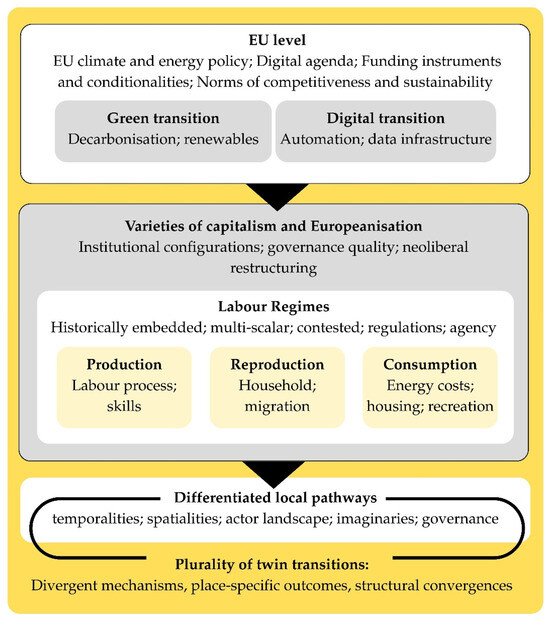
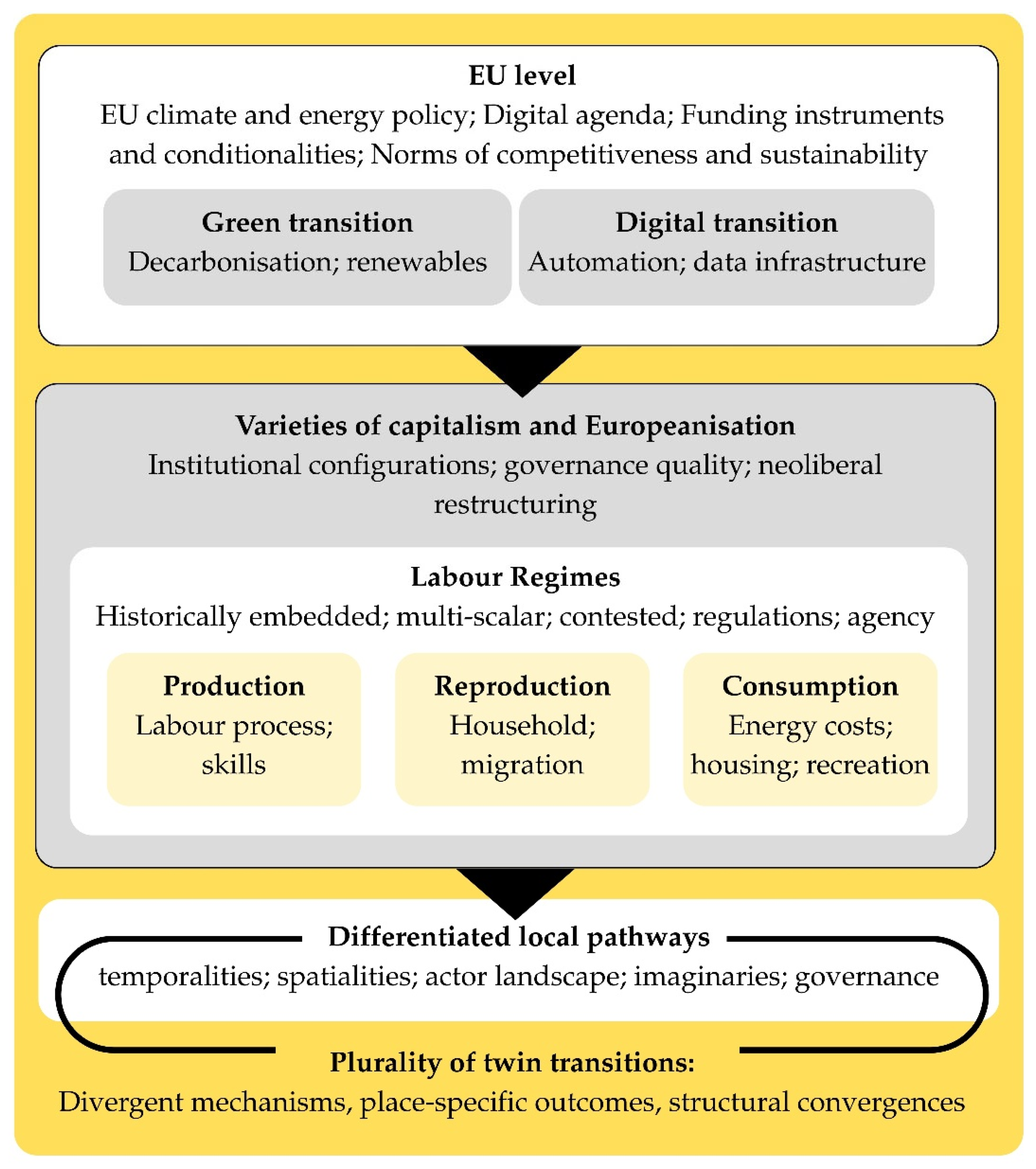
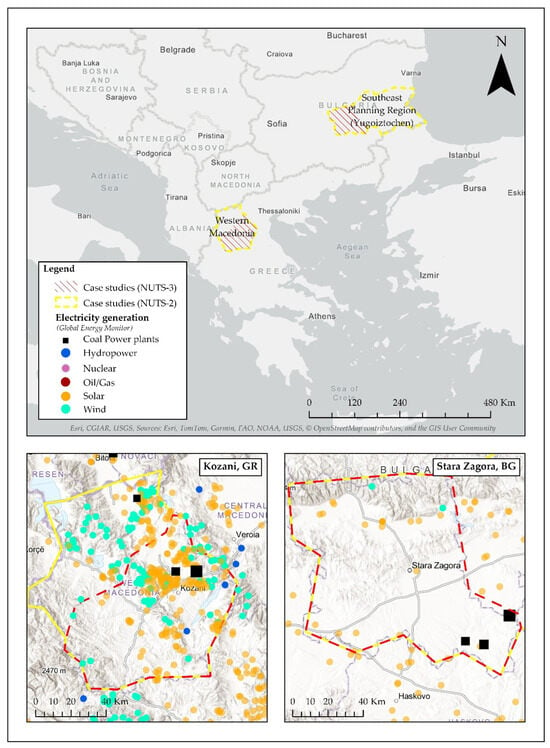
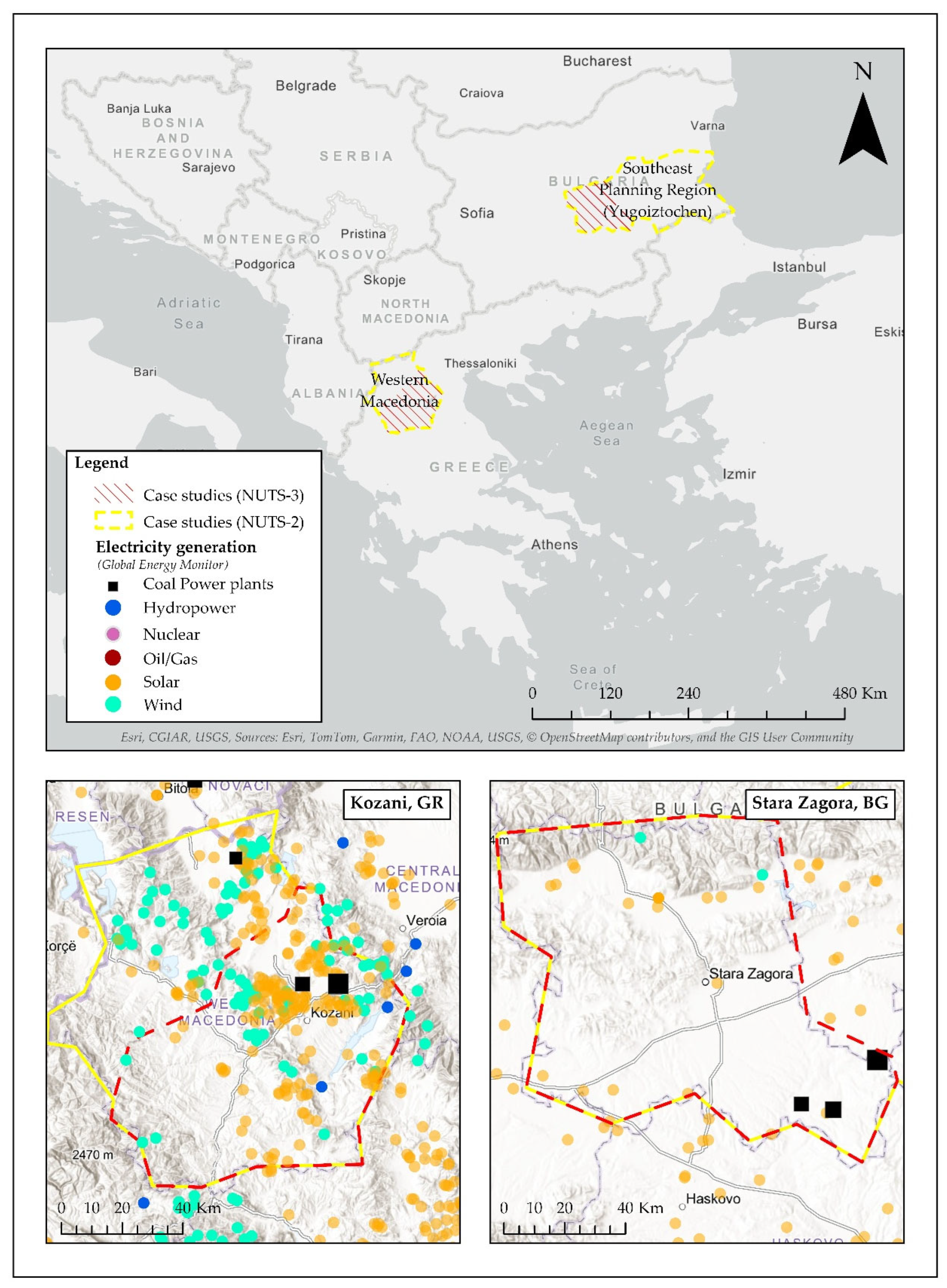

Disclaimer/Publisher’s Note: The statements, opinions and data contained in all publications are solely those of the individual author(s) and contributor(s) and not of MDPI and/or the editor(s). MDPI and/or the editor(s) disclaim responsibility for any injury to people or property resulting from any ideas, methods, instructions or products referred to in the content. |
© 2026 by the authors. Licensee MDPI, Basel, Switzerland. This article is an open access article distributed under the terms and conditions of the Creative Commons Attribution (CC BY) license.