


Abstract
The fashion and textile industry is undergoing profound transformation driven by regulatory, environmental and societal pressures to reduce its significant contributions to global waste, emissions and resource depletion. In the European Union (EU), this transition is being formalised through the Ecodesign for Sustainable Products Regulation (ESPR), which introduces mandatory sustainability and circularity requirements for textile products, including the Digital Product Passport (DPP). The emerging DPP framework is expected to include product-specific, life-cycle-based environmental information requirements, creating new compliance obligations for garment manufacturers supplying the EU market, particularly those based outside the EU. This study examines the readiness of global garment manufacturers to meet these requirements, with a focus on data availability, supply chain traceability, and alignment with the methodological expectations of the Product Environmental Footprint (PEF) framework. A mixed-methods approach is employed, combining a survey of garment manufacturers in Pakistan, Bangladesh and Turkey with a case study of upcycled garments produced for the Estonian national team for the Paris 2024 Olympic Games. The findings identify key barriers to generating DPP-compliant environmental data, including limited life cycle assessment (LCA) expertise, fragmented and inconsistent upstream datasets, insufficient digital data systems and the practical complexity of applying PEF Category Rules across diverse production contexts. The case study further demonstrates how data gaps constrain the assessment of innovative circular materials, revealing a mismatch between regulatory expectations and current industry capabilities. Overall, this study highlights the need for phased DPP implementation, simplified cradle-to-gate assessment approaches and clearer, more harmonised methodological guidance to support an achievable and equitable transition towards sustainable textile supply chains.
1. Introduction
The fashion and textile industry is undergoing a profound transformation in response to growing concerns about environmental degradation, unsustainable production practices, and the linear “take-make-dispose” consumption model [1,2,3]. As one of the largest contributors to global waste, greenhouse gas emissions, and water pollution [4,5], the sector is under increasing regulatory and societal pressure to become more sustainable and circular [6]. In the European Union (EU), this shift is being formalised through the Ecodesign for Sustainable Products Regulation (ESPR) [7], which aims to make products placed on the EU market more durable, reusable, repairable, recyclable, and resource-efficient.
A cornerstone of the ESPR is the Digital Product Passport (DPP)—a digital information system currently being developed to support sustainability by providing product-specific data across the value chain [8]. For the textile sector, this includes data on material composition, durability, recyclability and life-cycle-based environmental information [9]. Recent literature recognises DPPs as a key enabler of the circular economy and the twin digital and green transition, with the potential to improve product traceability, transparency and sustainability communication throughout global value chains [10,11]. The rapidly expanding body of DPP research has focused predominantly on the digital architectures, interoperability, blockchain, artificial intelligence, digital twins, and data governance required to support DPP implementation [10,12,13]. Nevertheless, DPP implementation introduces complex technical and organisational challenges for garment manufacturers [14,15]. Early experiences also indicate that DPP requirements generate substantial traceability, data-sharing and compliance burdens across global supply chains, particularly for suppliers located outside the EU [16,17].
Textile and garment manufacturers often operate within highly fragmented, multi-tiered supply chains where data availability and quality are inconsistent [9,18]. Recent reviews of Life Cycle Assessment (LCA) in the fashion industry likewise identify persistent shortages of high-quality primary supply chain data, methodological inconsistencies, and limited integration between digital traceability systems and environmental assessment methods [19,20]. Complying with the emerging DPP requirement to provide verified, product-level environmental impact information therefore entails significant challenges. These include accessing and consolidating upstream data from diverse suppliers, managing confidential business information, generating robust environmental data based on LCA and the Product Environmental Footprint (PEF) framework [21], and aligning with evolving European methodological and reporting requirements. For many manufacturers, this represents a shift from a passive role in sustainability reporting to an active contributor to traceable, digital environmental information, requiring new capabilities, organisational processes and collaboration across supply chains.
Despite these advances, relatively little research has examined DPP implementation from the perspective of garment manufacturers and their upstream supply chains. Existing reviews predominantly discuss technological solutions and implementation approaches, whereas considerably less attention has been paid to manufacturers’ ability to generate the product-level environmental information expected under the forthcoming EU regulatory framework, particularly information based on LCA and PEF methodologies. Recent review studies further suggest that much of the existing DPP literature remains focused on conceptual frameworks, technological architectures and data management frameworks, and proof-of-concept implementations, with comparatively limited empirical evidence from real industrial settings [10,20,22].
This study addresses this scientific gap by examining the capacity of global garment manufacturers and their upstream supply chains to generate and manage product-level environmental information needed to support future DPP implementation. In this paper, the term “global garment manufacturers” refers to manufacturers operating within international textile supply chains supplying products to the European market, particularly manufacturers located outside the EU that will be directly affected by forthcoming EU Ecodesign and DPP requirements.
As such, this paper addresses the evolving regulatory and industrial context surrounding the EU’s new ecodesign and sustainability requirements for textile products through two research objectives:
- To analyse the current challenges faced by global garment manufacturers—particularly those based outside the EU—in complying with the EU’s emerging sustainability requirements for circular textile products, with a focus on the technical, organisational, and supply chain-related barriers to providing environmental performance data.
- To identify the key barriers and enabling conditions that support effective collaboration between garment manufacturers and their upstream supply chains in generating and managing product-level environmental impact data, specifically in the context of the DPP and its associated LCA-based information requirements.
To support and contextualise this analysis, this study includes a case study of one of Asia’s largest textile and garment manufacturers, which produced the uniforms for the Estonian national team for the Paris 2024 Olympic Games. The case study explores real-world challenges associated with gathering, managing, and reporting LCA data for circular textile products, offering insights into the practical implications of upcoming DPP requirements and highlighting critical gaps in current methodological frameworks, data systems and industry readiness.
By combining a targeted regulatory review, an exploratory survey of garment manufacturers, and an in-depth industrial case study, this research provides one of the first empirical assessments of manufacturers’ readiness to generate product-level environmental information required for DPP implementation. Rather than primarily focusing on digital system architectures and enabling technologies, this study investigates the organisational, methodological and data-related barriers associated with generating product-level environmental information under real supply chain conditions. This study contributes to the academic discussion on sustainable textile supply chains and provides empirical evidence to support ongoing discussions on the practical implementation of the forthcoming EU DPP requirements.
2. Policy and Legal Context
The EU has placed the circular economy at the core of its environmental and industrial transformation agenda [23]. The EU Circular Economy Action Plan [24] outlines a comprehensive policy framework to make sustainable products the norm in the EU market. As part of this initiative, textiles have been identified as a priority sector, given their significant environmental footprint and low circularity rates. In response, the EU Strategy for Sustainable and Circular Textiles was introduced in 2022 [25], establishing a vision to ensure that textile products placed on the EU market are durable, recyclable, made as much as possible from recycled fibres, and free from hazardous substances.
Central to achieving this vision is ESPR, which extends ecodesign principles beyond energy-related products to a wide range of consumer goods, including textiles [7]. The ESPR introduces mandatory performance requirements for aspects such as product durability, reparability, recyclability, and environmental impact. One of its most transformative elements is the establishment of DPP—a standardised digital system designed to improve traceability and access to key product-related sustainability information across the entire value chain [9,11]. While ESPR establishes the overall framework for the DPP, the specific information requirements, performance indicators, and reporting obligations applicable to textile products will be defined through future delegated acts and product-specific ecodesign requirements.
For textiles, the DPP is expected to include detailed sustainability information such as product composition, substances of concern, and, importantly, life-cycle-based environmental impact data. These requirements are rooted in the ESPR’s definition of environmental footprint, which links impact quantification to the EU’s PEF method and other recognised life-cycle-based approaches [7,21]. Since PEF is an explicitly LCA-based framework covering multiple impact categories across the product life cycle, the environmental indicators included in the DPP will rely on LCA-compatible data and methodologies.
To ensure consistency within the textile sector, the EU has recently introduced PEF Category Rules (PEFCR) for apparel and footwear, which standardise how LCA results should be produced and reported [26]. Although it is not yet clear which methodologies besides PEF will be accepted for environmental footprint assessment within the DPP framework, the PEF methodology is expected to play a central role in shaping its environmental information requirements. As a result, the DPP will function not only as a traceability tool but also as a mechanism for embedding quantified and verifiable LCA-based environmental information into product governance. This marks a shift from voluntary sustainability claims toward mandatory, comparable and evidence-based performance reporting. For global garment manufacturers—especially those operating outside the EU—meeting these evolving requirements presents challenges related to data availability, LCA capacity, supply chain coordination and digital infrastructure.
3. Methods
This study employed a mixed-methods research design to examine the implications and challenges associated with implementing the proposed EU DPP requirements for the textile sector, with a particular focus on global garment manufacturers operating outside the EU. This study combined a targeted policy and literature review, survey-based data collection, and an in-depth case study to provide both theoretical insights and practical, real-world perspectives. By triangulating findings from regulatory analysis, industry stakeholder input, and a real-world case study, this approach enabled a comprehensive assessment of preparedness gaps, data-management limitations, and LCA-related methodological challenges faced by global garment manufacturers in meeting forthcoming EU DPP requirements.
3.1. Review of EU Policy and Regulation
The first stage involved a targeted review of recent EU policy and regulatory developments related to sustainable textile production, circularity, and environmental impact disclosure. Key documents analysed included the ESPR, associated guidance materials, and sector-specific studies published by EU institutions. These were complemented by relevant academic literature and industry reports to contextualise regulatory expectations and assess their practical implications for textile value chains.
3.2. Survey of Textile Companies
A structured questionnaire was developed to identify perceived barriers and organisational capacities associated with future DPP implementation. The survey was designed as an exploratory assessment of DPP readiness and environmental data challenges among manufacturers supplying European markets rather than as a statistically representative survey of the textile sector. In this study, DPP readiness refers to manufacturers’ preparedness to generate, manage and verify product-level environmental information and product traceability data required under the forthcoming DPP framework, including organisational capabilities, environmental data availability, LCA capacity and collaboration across upstream supply chains.
The questionnaire consisted of 20 questions organised into three sections. It was developed based on the study objectives and a targeted review of the literature and EU regulatory documents. The first section collected company background information (e.g., size, production processes, production volume, and client regions); the second examined sustainability and environmental impact assessment practices; and the third explored awareness of the emerging DPP, anticipated implementation challenges, and support needs.
The questionnaire combined single-choice, multiple-choice, and open-ended questions, enabling the collection of both quantitative and qualitative data on current sustainability practices and preparedness for future DPP requirements. Closed-ended responses were analysed using descriptive statistics, whereas open-ended responses were categorised according to recurring themes. As the survey constituted one component of the mixed-method study design, its purpose was to provide descriptive and contextual insights rather than support statistically generalisable conclusions.
Participants were recruited through direct email contact with garment manufacturers. In total, 30 companies were invited to participate in the survey, of which 14 participated. The sample comprised textile manufacturing companies located predominantly in Pakistan (11 companies), with additional participants from Bangladesh (2) and Turkey (1). Respondents were primarily sustainability, compliance, or management personnel with knowledge of environmental reporting and sustainability requirements within their organisations.
According to EU SME definitions, companies with 250 or more employees fall outside the SME category and are therefore considered large enterprises [27]. Most participating manufacturers employed between 1000 and 10,000 workers (10 companies), while two had fewer than 1000 employees and two had more than 10,000. All surveyed manufacturers were engaged in garment and home textile production; 11 were also active in fabric production, and a subset of 8 companies additionally produced fibres and yarns. All participating companies supplied products to European brands and retailers and therefore represent a group of manufacturers that are expected to be directly affected by forthcoming EU sustainability and DPP requirements.
3.3. Case Study: LCA of Circular Garments
To complement the survey findings, an in-depth case study was conducted to examine the practical challenges of generating environmental impact data for circular textile products relevant to DPP. The case focused on one of Asia’s largest garment manufacturers, which produced the uniforms for the Estonian national team for the Paris 2024 Olympic Games. The selected manufacturer is a major supplier to international and European markets and therefore operates within the global supply chains that will be directly affected by forthcoming DPP requirements. The uniforms were designed by Reet Aus using the UPMADE approach [28], a certified, industrial-level circular textile design and production methodology that utilises fabric waste from garment production within a closed-loop upcycling process. The case was selected because the Team Estonia collection developed for the Paris 2024 Olympic Games project was intentionally a sustainability-oriented textile collection aligned with the objectives of emerging EU circular textile policies. The project incorporated several features expected to become key elements of the future DPP requirements, including the use of circular materials, supply chain traceability, and the generation of product-level environmental information. Furthermore, the collection combined different circular design strategies, including industrial-scale upcycling and the use of recycled and bio-based materials, providing a valuable opportunity to examine practical challenges related to LCA data collection and environmental footprint reporting. While the case represents a specific product collection, the identified challenges concerning data availability, methodological complexity, and environmental impact assessment are considered relevant to a broader range of textile products and manufacturers preparing for future DPP implementation. Nevertheless, future research should investigate DPP readiness and environmental data challenges across a wider range of textile product categories, supply chain configurations, and manufacturing contexts.
The assessment was limited to the cradle-to-factory-gate stages because the primary objective of this study was to investigate the practical challenges associated with generating environmental information provided by manufacturers and their upstream supply chains for future DPP implementation. These life-cycle stages require the collection of product- and process-specific data from suppliers and manufacturers and therefore represent the area where the most significant data availability and reporting challenges occur. Downstream stages, such as product use and end-of-life, are in PEFCR modelled using more standardised assumptions and generic datasets and were therefore considered outside the main scope of this study.
The case study aimed to examine the practical feasibility and challenges of generating LCA-based environmental information that is expected to become increasingly important for future DPP implementation. Particular attention was given to data availability, supply chain coordination, and the methodological challenges associated with applying LCA in a manner broadly consistent with the PEFCR framework for apparel and footwear.
Data were collected through close collaboration with the manufacturer’s sustainability and production teams, focusing on existing data-management systems, supplier information flows, and internal processes relevant to LCA and DPP reporting. Particular focus was placed on data completeness, consistency and compatibility with LCA requirements, together with the practical challenges encountered during environmental footprint calculation.
Two garment types from the Estonian national uniform were selected for detailed analysis (Figure 1). These products were chosen because they incorporate different circular material strategies, allowing assessment of the feasibility of generating LCA-based environmental profiles for use in DPPs:
Figure 1.
Estonian national team uniform designed for the Paris 2024 Olympic Games: upcycled T-shirt and recycled jeans. Photo: Madis Palm.
- Upcycled T-shirt: The T-shirt was produced using the UPMADE-certified upcycling method, employing 100% cotton fabric leftovers generated during garment production. No new fabric was manufactured for this product; instead, fabric waste was transformed into a fully functional new garment. This approach reduces the demand for virgin fibre and fabric production and diverts textile waste from disposal.
- Recycled jeans: The jeans were made from fabric developed specifically for this project, combining 50% recycled cotton produced with RECOVER technology and 50% TENCEL™ Lyocell fibres created using REFIBRA™ technology. This fibre mix integrates pre-consumer cotton waste with wood-pulp-based cellulosic fibres to create a high-quality circular fabric. The material is fully bio-based, biodegradable and compliant with the Recycled Claim Standard (RCS).
The overall design objective of the Olympic uniform was to maximise circularity through the integration of upcycled and recycled materials and to explore the feasibility of generating LCA-based environmental profiles that could support future DPP implementation.
A secondary objective was to compare the environmental performance of the circular garments with that of functionally equivalent garments made from conventional virgin cotton.
4. Results
4.1. Industry Perspectives on LCA and DPP Readiness
4.1.1. Level of Sustainability Management
All surveyed companies reported being subject to clear sustainability (including circularity) requirements imposed by their clients, typically implemented through retail- or brand-specific compliance standards and requirements. These requirements are primarily addressed via internationally recognised certifications and labels, including the Higg Index, GOTS, and GRS (adopted by all 14 companies), alongside Oeko-Tex®, ISO 14001 [29], and RCS. As a result, most companies monitor key environmental indicators such as greenhouse gas emissions, energy consumption, water use, material consumption, and waste generation. Despite this, product-related life-cycle management has received comparatively less attention. Only about one-third of respondents reported that their clients required LCA-based product data, suggesting that market-driven demand for life-cycle information remains limited.
When asked about methods used to assess product-related environmental impacts (multiple responses were allowed), respondents most frequently cited water footprint analysis (11 of 14, 79%), carbon footprint analysis (10 of 14, 71%), and LCA (9 of 14). These assessments were conducted both internally (11 companies with in-house specialists) and with the support of external experts (10 companies), indicating that LCA and related approaches are generally familiar but not yet systematically integrated.
4.1.2. Barriers to Life-Cycle-Based Environmental Impact Assessment
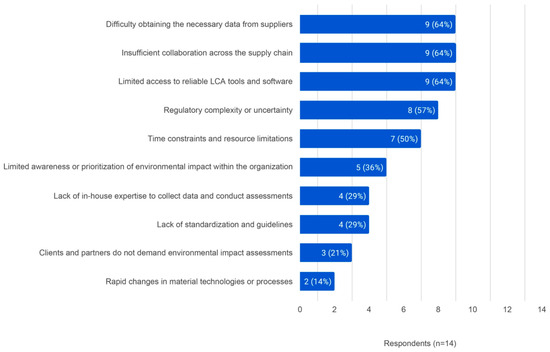
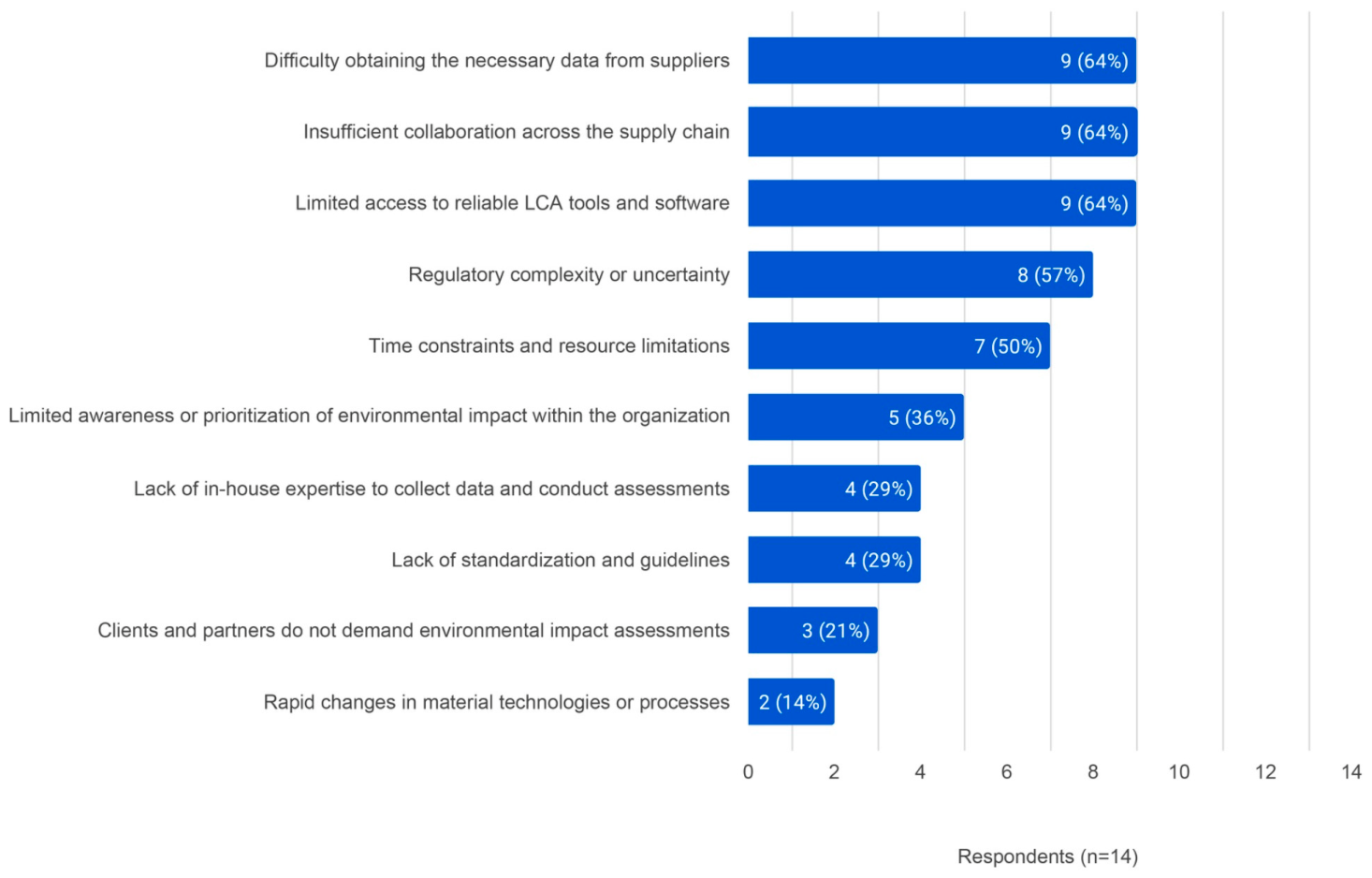
Despite some use of LCA methods, companies identified several barriers to comprehensive product-level impact assessment by selecting up to five predefined options and, where relevant, providing additional responses (see Figure 2). The most frequently reported challenges concerned supplier data gaps, weak collaboration, and the lack of reliable LCA tools and software, cited by nine companies (64%). Eight respondents (57%) highlighted regulatory complexity, while seven mentioned time and resource constraints. Other obstacles included limited awareness of, or prioritisation of, LCA within companies, lack of expertise, and the absence of harmonised standards. A smaller share of companies pointed to weak client demand and the challenge of keeping pace with rapid technological changes.
Figure 2.
Barriers to life-cycle-based environmental impact assessment reported by companies (respondents could select up to five predefined barriers and add additional responses).
These findings highlight persistent structural and data-related obstacles to effective LCA. They also indicate that external demand from brands and retailers remains insufficient, reducing manufacturers’ incentive to build internal capacity and readiness in this area.
4.1.3. Knowledge and Readiness for DPP Requirements
Awareness of upcoming DPP requirements was relatively high, with 13 out of 14 respondents indicating at least some knowledge of the initiative. Notably, most manufacturers expressed a positive outlook: half of the companies (7 out of 14) perceived the DPP as potentially beneficial, while 4 out of 14 saw it as somewhat beneficial. Only two respondents reported negative perceptions, and one company expressed no opinion. This optimism may, however, partly reflect limited awareness of the technical details and obligations associated with DPP implementation, as respondents frequently emphasised uncertainties and challenges when asked to elaborate.
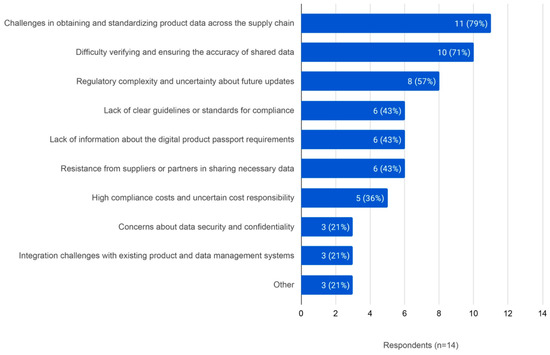
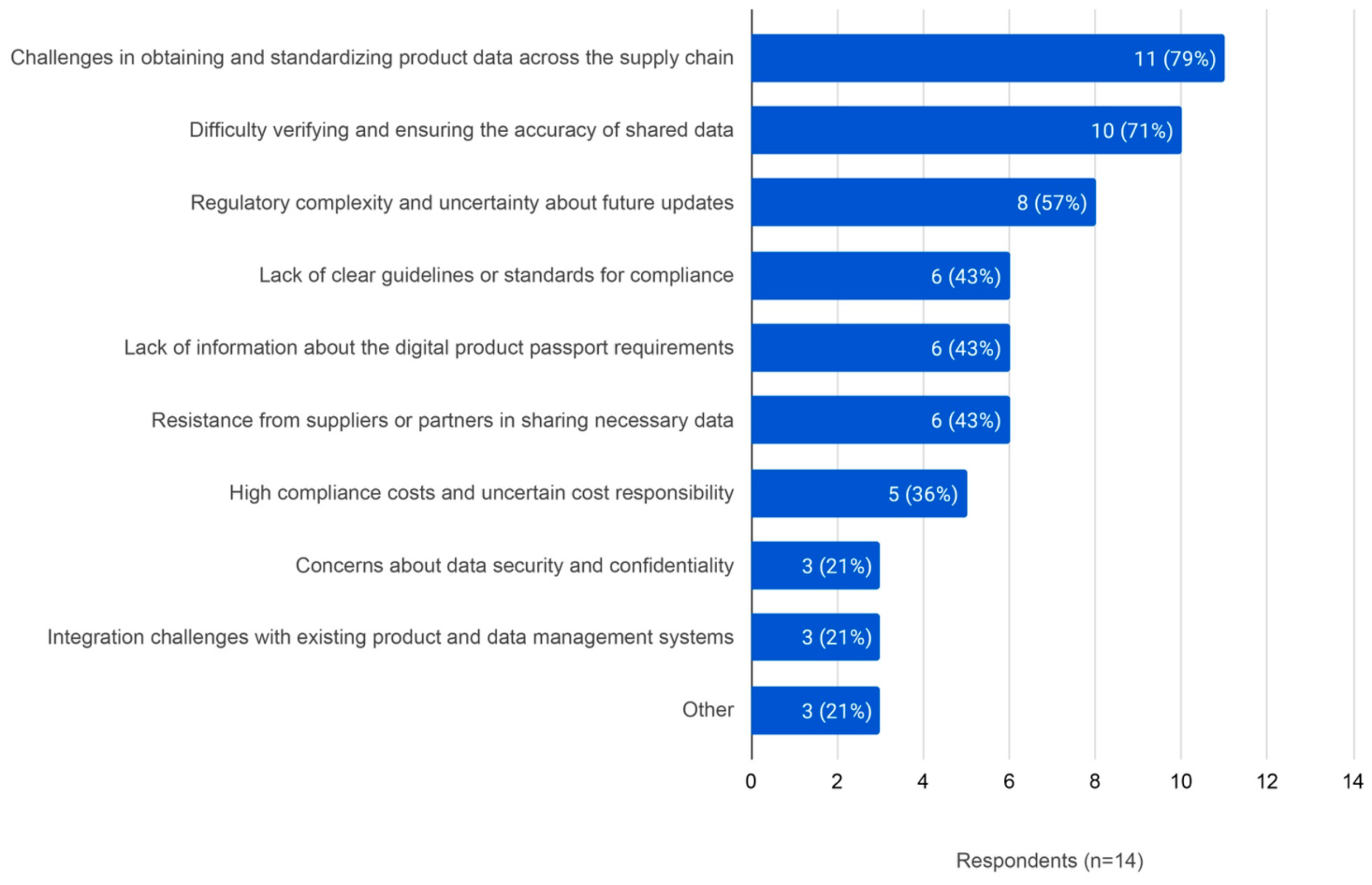
The main concerns regarding DPP implementation for product-level environmental information were identified by selecting up to five challenges from a predefined list, with the option to provide additional responses (see Figure 3). The most significant challenges identified were difficulties in collecting and standardising product-level data across the supply chain (reported by 11 of 14 companies, 79%), as well as verifying the accuracy of shared data (10 of 14, 71%). Regulatory complexity and uncertainty regarding future requirements were also widely mentioned (8 of 14, 57%), alongside the lack of clear compliance guidelines or standards (6 of 14, 43%), insufficient information about DPP obligations (6 of 14, 43%), and supplier reluctance to share data (6 of 14, 43%). Additionally, though less frequently mentioned, barriers included high costs, difficulties in integrating DPP processes with existing product and data management systems, and concerns over data security.
Figure 3.
Challenges related to the possible implementation of the DPP reported by companies (respondents could select up to five predefined challenges and add additional responses).
4.1.4. Enablers for Effective DPP Adoption
In response to the open-ended question, respondents highlighted several enabling factors that could facilitate DPP implementation:
- Accessible, user-friendly platforms with authentic and reliable data;
- Greater standardisation and clear implementation frameworks;
- Centralised data management systems;
- Technical and financial support for capacity building;
- Training across all supply chain tiers, particularly among lower-tier suppliers;
- Stronger alignment between brands, suppliers, and technology providers to ensure interoperability and cost-effective adoption.
These findings imply that while garment manufacturers recognise the potential benefits of DPP, successful implementation will require systemic support, harmonisation of standards and requirements, user-friendly tools and guidance, and stronger collaboration across supply chains.
4.2. Case Study Design and Results
This study initially aimed to conduct an LCA for both sample garments (T-shirt and jeans). However, significant data gaps were identified for the jeans, as the data obtained from the upstream fibre supplier were insufficient to include its environmental impacts across all relevant impact categories. The data for this material were also not available in the LCA database. These gaps highlight the broader challenges brands and global manufacturers face when attempting to meet forthcoming DPP data requirements.
As a result, the LCA results are presented only for the upcycled T-shirt, with a parallel assessment for a conventional, virgin-cotton T-shirt. This comparison enabled us to assess the impact of material choices and production strategies on overall outcomes and quantify the environmental benefits resulting from upcycling. Two scenarios were analysed:
- Scenario 1—Conventional T-shirt: 100% virgin cotton T-shirt produced using standard sourcing and manufacturing practices.
- Scenario 2—Upcycled T-shirt: T-shirt produced entirely from cotton fabric leftovers from conventional garment production.
A cradle-to-factory-gate system boundary was applied. The focus on upstream and manufacturing stages aligns with the study’s objective of assessing the data collection challenges and methodological barriers that manufacturers face when compiling DPP-relevant environmental impact information. For downstream processes (use phase, end-of-life), the PEFCR provides standardised datasets that would not vary significantly between garments of similar weight and fibre composition; thus, they were considered outside the scope of this analysis. Both T-shirts were designed to fulfil the same intended function. Both are cotton upper-body garments of identical mass (174 g), comparable quality, and similar expected lifespan. No evidence of meaningful differences in functionality was identified. The functional unit was defined as one T-shirt (174 g) at the factory gate.
For the conventional T-shirt, the life cycle begins with cotton cultivation and proceeds through ginning and spinning in India to produce the yarn. The yarn is then transported to Bangladesh, where the subsequent manufacturing steps take place. These include knitting and dyeing of the fabric, fabric finishing, and the cutting, sewing and ironing processes carried out within the garment factory. Wastewater treatment from the dyeing and finishing stages was modelled as a separate process, while other production wastes (such as textile waste) were accounted for within the stages in which they were generated. Each phase of the life cycle incorporates the environmental impacts associated with the consumption of raw materials, chemicals, energy, and auxiliary inputs required to complete the production steps.
For the upcycled T-shirt, the material input consisted of fabric leftovers from the same factory. The cut-off approach—under which waste-derived materials enter the system without upstream environmental burdens—was applied for the upcycled T-shirt. This approach is widely used and methodologically justified in LCA. ISO 14044 allows allocation based on physical, economic or cut-off criteria where appropriate, provided the assumptions are transparent, and waste materials with no market value may be assigned zero upstream impacts under these rules [30]. A similar principle is used in the Ecoinvent “recycled content” system model, where post-industrial and post-consumer wastes carry no burdens from previous life cycles and only the impacts of recycling or reprocessing are accounted for [31]. Textile leftovers considered in the case study originated from manufacturing off-cuts. The cut-off approach was considered appropriate because the textile residues had no market value and would otherwise have been treated as waste. Therefore, they were considered as waste materials entering a new product system, not as a manufacturing co-product. Thus, for scenario 2, all upstream burdens (cultivation, ginning, spinning, dyeing) are excluded because the material is treated as post-industrial textile waste entering the system boundary.
The PEF methodology requires the use of the Circular Footprint Formula (CFF) that splits the benefits and burdens of recycling between the user of recycled input material and the producer of the product that was recycled [26]. This formula includes the end-of-life management of the product in the future (impacts of the recycling process plus impacts of replaced virgin materials, i.e., the credit from avoided virgin material use). The focus of this study was limited to the cradle-to-factory-gate stages, excluding the use and end-of-life stages. This approach was selected because it represents the part of the life cycle where the largest data collection challenges occur and where manufacturers and their suppliers are required to actively contribute product- and process-specific information. It should be noted that alternative allocation approaches, including CFF required by PEF methodology, may result in different LCA results. However, evaluating the influence of alternative allocation methods was beyond the scope of this study, which focused primarily on the practical challenges of generating environmental data for DPP implementation.
Primary inventory data were collected in 2024 from the factory in Bangladesh and included data on consumption of materials, chemicals, energy, and waste generation from T-shirt production. Secondary data (e.g., cotton production, grid electricity) were sourced from Ecoinvent v3.9.1. The LCA was modelled in OpenLCA using the EF 3.1 impact assessment method, which applies the same impact categories required by the EU’s PEF methodology.
Table 1 summarises the inventory data of the conventional and upcycled T-shirts. The manufacturing processes of the conventional T-shirt include the energy and chemical use of the wastewater treatment as well. Treated water is used at the same factory for non-industrial processes.
Table 1.
Summary life cycle inventory data of the production of one T-shirt (174 g) at the factory gate.
The total amount of chemicals required for textile processing was obtained from the company, but the breakdown of chemical types was based on the Ecoinvent process “batch dyeing, fibre, cotton | batch dyeing, fibre, cotton | Cutoff, U—BD”.
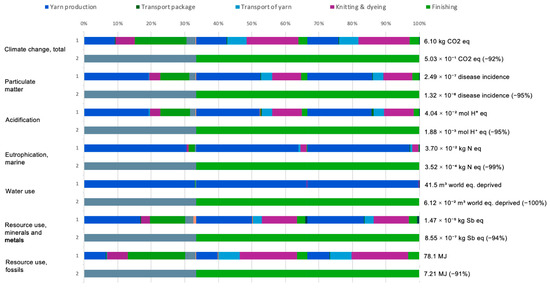
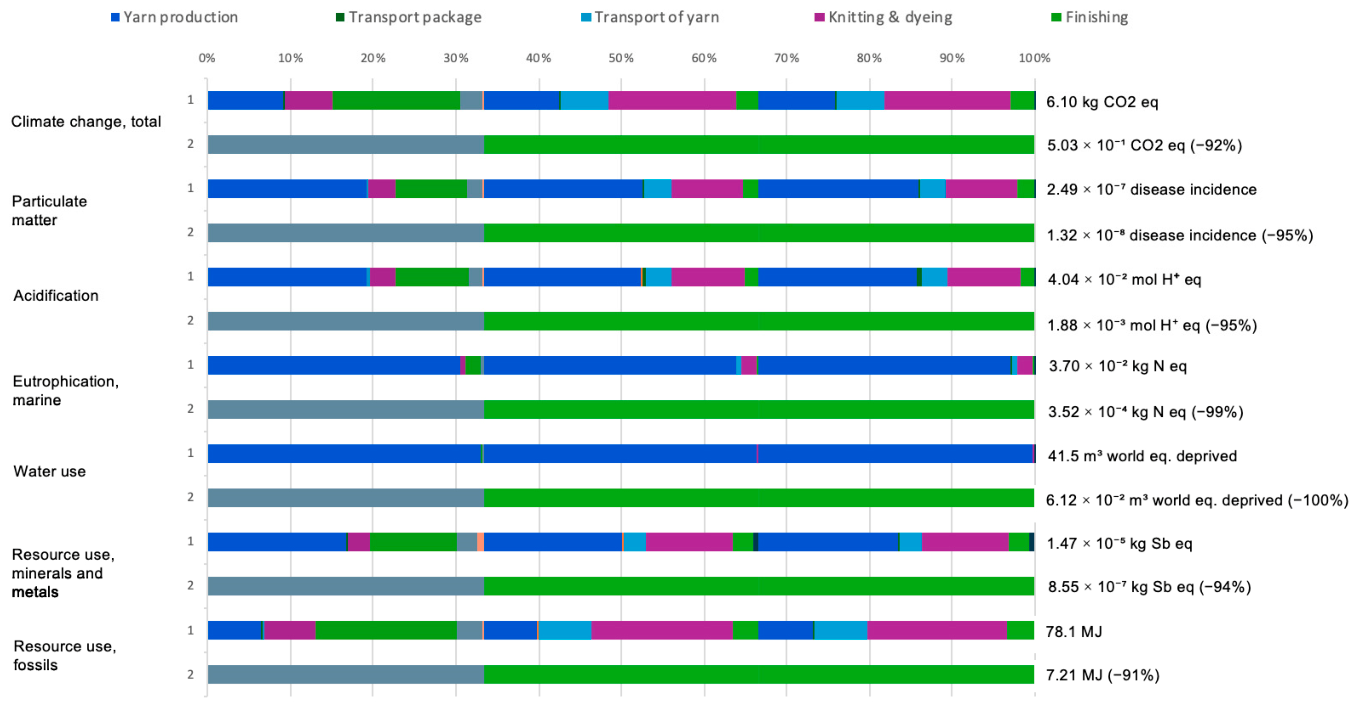
Under the cradle-to-factory-gate system boundary and the cut-off allocation approach applied in this study, the upcycled T-shirt exhibited 91–100% lower environmental impacts than the conventional cotton T-shirt across all assessed impact categories (see Figure 4). In the conventional T-shirt scenario, yarn production was the dominant contributor to most impact categories. For climate change and fossil resource use, manufacturing energy demand (particularly during the dyeing and finishing processes) was a major driver of impacts.
Figure 4.
Characterised LCA results for T-shirts in Scenario 1 (T-shirt from virgin cotton) and Scenario 2 (upcycled T-shirt from cotton fabric leftovers). The bars illustrate the contributions of different life cycle stages, while the secondary y-axis shows the absolute impact values for each impact category and the percentage reduction achieved by the upcycled T-shirt made from cotton fabric leftovers (Scenario 2) relative to the virgin cotton T-shirt (Scenario 1).
5. Discussion
The findings from the survey and the industrial case study provide complementary evidence for several interconnected barriers limiting the ability of garment manufacturers to generate the life-cycle-based environmental information expected under the forthcoming DPP framework. While the survey identified organisational capacities and perceived implementation challenges across manufacturers, the case study illustrated how these barriers manifest in practice during the generation of product-level environmental information. Together, these findings align closely with the broader literature on supply chain transparency, environmental data governance, and capacity constraints in global manufacturing systems [15,16,32,33,34,35,36].
The discussion below synthesises these main barriers into four key themes: knowledge and capacity, data availability, methodological complexity, and result reporting and verification.
5.1. Knowledge and Capacity
Among the participating garment manufacturers, limited organisational capacity emerged as a central challenge. This may limit their ability to generate the detailed environmental impact data expected under the forthcoming DPP requirements. Although most surveyed companies were familiar with sustainability certifications and maintained basic environmental indicators—such as energy and water use—fewer had experience producing product-specific LCA data. This reflects a broader gap between general sustainability management and the highly technical demands of LCA. Several capacity gaps were identified:
- Limited internal expertise. Conducting LCAs requires specialised methodological and software expertise that manufacturers currently lack.
- Insufficient awareness of emerging DPP technical requirements. Although most respondents had heard of the DPP, their understanding of its methodological implications—particularly the possible need for PEF-aligned, product-level environmental data—was incomplete. The generally positive perception of the DPP may therefore reflect familiarity with the concept rather than readiness to meet its data and verification demands.
- Resource constraints. Although most of the surveyed manufacturers were large enterprises, many still reported limited resources for specialised technical staff, LCA software, and external expert support. Scaling LCA across large and diverse product portfolios, potentially covering thousands of stock-keeping units, represents a significant organisational and financial challenge. These constraints are likely to be even more pronounced among small and medium-sized manufacturers, which typically have more limited technical and financial capacity to meet the emerging DPP requirements.
- Lack of structured internal data systems. Many manufacturers do not yet have integrated digital systems capable of capturing production data at the level of granularity required for LCA. Data were frequently stored across multiple departments or formats, making extraction and verification a laborious process.
These findings highlight that DPP implementation requires a broader shift toward digital environmental data governance. Without targeted training, improved data systems, and clear guidance, this transition is likely to prove challenging, particularly for manufacturers operating outside the EU.
5.2. Data Availability
Obtaining reliable primary data remains one of the most significant barriers to conducting LCAs for textile products. The textile supply chain typically spans across multiple countries and tiers, from fibre production to dyeing, finishing, and garment construction. This fragmentation contributes to several persistent data challenges:
- Incomplete or inconsistent upstream data. Many manufacturers rely on suppliers who either lack the capacity or incentives to collect and publish detailed process-level data or LCA results. As illustrated by the case study, even suppliers of advanced recycled or circular materials may not yet provide comprehensive LCI datasets or LCA results. This limits the applicability of PEFCR-aligned methods.
- Variability across regions and production sites. Differences in technology, fuel mix, wastewater management, and chemical use mean that average or secondary datasets may not reflect actual impacts. However, primary data are often unavailable, creating uncertainty in assessments.
- Cultural and communication barriers. Language differences, varying documentation norms, and inconsistent environmental literacy across regions further complicate data collection. These barriers were especially pronounced among lower-tier suppliers, who play a critical role in fibre, yarn, or dyeing processes.
The case study clearly illustrates these challenges. Despite close collaboration with the manufacturer, key upstream datasets for the recycled jeans remained inaccessible or incomplete. Consequently, it was not possible to generate a sufficiently complete life-cycle inventory to support a comprehensive ISO-compliant or PEFCR-aligned assessment of the recycled jeans. This underscores a fundamental challenge for the emerging DPP framework: accurate environmental impact information depends on data systems and supplier engagement that many global supply chains do not yet provide.
5.3. Methodological Challenges
A key methodological challenge relates to the anticipated application of PEFCR for apparel and footwear as one of the principal approaches for generating harmonised environmental information under the future DPP framework. Several methodological issues were identified:
- Complexity of the PEFCR methodology. While the PEFCR provides necessary harmonisation, it is technically demanding and requires detailed modelling expertise. Stakeholders involved in this study expressed concern that applying PEFCR across product portfolios would exceed their technical and financial capacity.
- Although PEFCR facilitates comparability, it may underestimate the environmental benefits of innovative practices such as upcycling and the use of waste materials.
- Challenges applying CFF. The CFF used in the PEFCR is intended to allocate impacts in circular systems (recycling, upcycling, reuse). However, it is complex to operationalise. Evidence from other product groups (such as batteries) also suggests that first attempts to use the CFF often face severe practical challenges [37].
- Need for pragmatic alternatives. The case study demonstrated that, where primary data remain incomplete, pragmatic approaches such as the cut-off approach for waste-derived materials can provide transparent and scientifically robust environmental assessments. Such approaches are already widely recognised within LCA practice and may represent practical transitional solutions while manufacturers progressively improve data quality and supply chain collaboration.
- In parallel, the Environmental Product Declaration (EPD) system is available for companies to measure the environmental performance of their products. For the apparel sector, this includes the EPD Product Category Rules for Apparel [38]. An EPD is a Type III environmental declaration in accordance with the ISO 14025 standard [39]. Similarly to PEF, an EPD provides third-party-verified information about a product or service throughout its life cycle in a standardised way. There are, however, significant methodological differences between EPD and PEF that can affect the results. For example, the EPD framework does not require the use of CFF, and it allows greater flexibility in using assumptions based on value-chain studies or statistical data at the downstream stage. This may further increase confusion among potential users of the results.
Overall, the methodological barriers identified point to a mismatch between the ambition of PEFCR requirements and the current data and capacity realities of global textile supply chains.
5.4. Result Reporting and Credibility
Even when LCAs can be conducted, significant challenges remain in the interpretation, communication, and management (including possible verification) of environmental information:
- Complexity of LCA results. Environmental impacts are multi-dimensional, and LCA outcomes can be difficult for non-expert stakeholders to interpret. In the absence of clear and harmonised methodological guidance and consistent DPP reporting formats, there is a risk of inconsistent interpretation and communication of environmental information.
- Restrictions on comparability under PEFCR. PEFCR allow comparisons only against an established benchmark representing an average EU market product. While this framework enhances methodological consistency, it can mask differences related to geography, technological efficiency, or circular innovations (e.g., industrial-scale upcycling). Although the rationale for using a standardised benchmark is understandable, this restriction on comparability may also have unintended consequences by limiting meaningful comparisons with real market alternatives and potentially obscuring the environmental benefits of innovative circular products.
- Credibility and quality assurance of environmental information. Reliable environmental information will be essential for ensuring confidence in DPPs. Although the specific requirements for quality assurance and verification of environmental information under future DPP systems have yet to be fully defined, manufacturers are likely to face additional efforts related to documenting data sources, ensuring methodological consistency, and demonstrating the robustness of environmental information provided.
- Integration with digital reporting systems. DPPs are expected to integrate environmental information into digital formats that are interoperable across platforms and supply chain actors. Translating LCA results into structured, machine-readable information therefore creates an additional layer of complexity that many manufacturers are not yet prepared to address.
Overall, the findings suggest that the challenge extends beyond conducting LCAs. Manufacturers will also need practical approaches for generating, documenting, communicating and digitally managing environmental information in a consistent and transparent manner that supports the objectives of the future DPP framework.
6. Conclusions
This study examined the readiness of global garment manufacturers and their upstream supply chains to generate, manage, and communicate the product-level environmental information expected under the forthcoming EU DPP framework. Using a mixed-methods approach that combined an exploratory survey of garment manufacturers and an industrial case study, the research identified four interrelated challenges that currently limit this readiness: insufficient organisational capacity, limited availability of high-quality supply chain data, methodological complexity associated with life-cycle assessment and environmental footprint methodologies, and practical challenges related to the reporting and management of environmental information.
Overall, the findings suggest that, despite growing awareness of sustainability and forthcoming DPP requirements, many manufacturers supplying the European market are not yet fully prepared to generate robust product-level environmental information at the scale envisaged under the emerging DPP framework. The case study further demonstrates that even experienced manufacturers implementing advanced circular production approaches may face significant challenges in obtaining sufficiently complete and consistent data to support comprehensive environmental assessments. These findings highlight a gap between the regulatory ambition of the DPP framework and the current environmental data capabilities of global textile supply chains.
This study also provides new evidence to complement the predominantly technology-oriented DPP literature. Rather than focusing on digital system architectures or data infrastructures, it examines the practical organisational, methodological and supply chain challenges associated with generating environmental information under real industrial conditions. This study therefore contributes to the growing body of research on DPP implementation by providing practical insights into the capacity of textile manufacturers to meet emerging environmental information requirements.
From a policy perspective, the results suggest that successful implementation of the DPP will require more than digital infrastructure alone. Strengthening technical capacity for life-cycle assessment and environmental data management, improving the availability and quality of primary supply chain data, and providing clearer methodological guidance will all be essential. In addition, interoperable digital systems, harmonised reporting approaches, and practical support for manufacturers will help reduce administrative burdens and improve the consistency and credibility of environmental information across global supply chains. The findings also support a phased implementation of environmental information requirements, allowing manufacturers to progressively strengthen their data systems and analytical capacity while maintaining the overall objectives of the DPP framework.
Although this study focused on one industrial case and an exploratory survey of manufacturers supplying European markets, many of the identified challenges are likely to be relevant across a broader range of textile supply chains preparing for forthcoming DPP requirements. Future research should therefore examine DPP readiness across different textile product categories, manufacturing contexts, and supply chain configurations. Additional work is also needed to evaluate the practical application of environmental footprint methodologies for circular textile products, assess the role of digital solutions in supporting environmental information management, and investigate the economic implications of environmental data generation, quality assurance, and digital information exchange. Such research will be important for developing DPP implementation approaches that are both scientifically robust and practically feasible for global textile supply chains.
Overall, while the DPP represents an important opportunity to improve transparency and support the transition towards a more circular textile economy, its successful implementation will depend on translating regulatory ambitions into practical solutions that can be effectively adopted across global textile supply chains. Achieving this will require continued collaboration between policymakers, industry, researchers and technology providers to ensure that future DPP systems are both scientifically robust and practically feasible.
Author Contributions
Conceptualization, H.M.; Methodology, H.M., M.H. and S.P.; Validation, H.M.; Formal analysis, M.H. and S.P.; Investigation, H.M., M.H., S.P., H.W.M. and R.A.; Data curation, H.M., S.P. and R.A.; Writing—original draft, H.M., M.H. and S.P.; Writing—review and editing, H.M., M.H., H.W.M. and R.A.; Visualization, M.H. and S.P.; Funding acquisition, R.A. All authors have read and agreed to the published version of the manuscript.
Funding
This research was funded by the Estonian Research Council project TEM-TA169.
Institutional Review Board Statement
Ethical review and approval were waived for this study by the Institutional Committee as the questionnaire did not collect or analyse special categories of personal data within the meaning of Article 9 of GDPR or § 6 of the Estonian Personal Data Protection Act. The optional contact details requested from respondents served solely for possible clarification of questionnaire responses and were not included in the research analysis or publication. Under § 6(4) of the Estonian Personal Data Protection Act, mandatory ethics committee review applies where research is based on special categories of personal data processed without the data subject’s consent. This provision was not applicable to the present study.
Informed Consent Statement
Informed consent was obtained from all subjects involved in this study.
Data Availability Statement
The data presented in this study are available on request from the corresponding author due to confidentiality considerations (protection of sensitive company information).
Conflicts of Interest
The authors declare no conflicts of interest.
Abbreviations
The following abbreviations are used in this manuscript:
| CFF | Circular Footprint Formula |
| EPD | Environmental Product Declaration |
| EU | European Union |
| ESPR | Ecodesign for Sustainable Products Regulation |
| DPP | Digital Product Passport |
| LCA | Life Cycle Assessment |
| LCI | Life Cycle Inventory |
| PEF | Product Environmental Footprint |
| PEFCR | Product Environmental Footprint Category Rules |
| RCS | Recycled Claim Standard |
References
- Abbate, S.; Centobelli, P.; Cerchione, R.; Nadeem, S.P.; Riccio, E. Sustainability trends and gaps in the textile, apparel and fashion industries. Environ. Dev. Sustain. 2024, 26, 2837–2864. [Google Scholar] [CrossRef] [Scilit] [PubMed]
- De Felice, F.; Fareed, A.G.; Zahid, A.; Nenni, M.E.; Petrillo, A. Circular economy practices in the textile industry for sustainable future: A systematic literature review. J. Clean. Prod. 2025, 486, 144547. [Google Scholar] [CrossRef] [Scilit]
- Wu, Z.; Zhou, L.; Ding, X.; Wu, X.; Wang, L. Knowledge roadmap of sustainable development in the textile and apparel industry: A scientometric analysis. Fash. Text. 2022, 9, 35. [Google Scholar] [CrossRef] [Scilit]
- Niinimäki, K.; Peters, G.; Dahlbo, H.; Perry, P.; Rissanen, T.; Gwilt, A. The environmental price of fast fashion. Nat. Rev. Earth Environ. 2020, 1, 189–200. [Google Scholar] [CrossRef] [Scilit]
- Filho, W.L.; Perry, P.; Heim, H.; Dinis, M.A.P.; Moda, H.; Ebhuoma, E.; Paço, A. An overview of the contribution of the textiles sector to climate change. Front. Environ. Sci. 2022, 10, 973102. [Google Scholar] [CrossRef] [Scilit]
- European Fashion Alliance. The Status of European Fashion Report 2024. 2024. Available online: https://www.europeanfashionalliance.org/_files/ugd/45e679_71bb21809ec4444da605e3258c0aec5b.pdf (accessed on 1 July 2026).
- European Parliament; Council of the European Union. Regulation (EU) 2024/1781 of the European Parliament and of the Council of 13 June 2024 Establishing a Framework for the Setting of Ecodesign Requirements for Sustainable Products, Amending Directive (EU) 2020/1828 and Regulation (EU) 2023/1542 and Repealing Directive 2009/125/EC. Off. J. Eur. Union. 2024. Available online: http://data.europa.eu/eli/reg/2024/1781/oj (accessed on 2 July 2026). [CrossRef] [Scilit]
- University of Cambridge Institute for Sustainability Leadership (CISL) and the Wuppertal Institute. Digital Product Passport: The Ticket to Achieving a Climate Neutral and Circular European Economy; CLG Europe: Cambridge, UK, 2022; Available online: https://circulareconomy.europa.eu/platform/sites/default/files/cisl_digital_products_passport_report_v6.pdf (accessed on 1 July 2026).
- European Parliament Research Service. Digital Product Passport for the Textile Sector; Panel for the Future of Science and Technology (STOA), European Parliament: Brussels, Belgium, 2024; Available online: https://www.europarl.europa.eu/RegData/etudes/STUD/2024/757808/EPRS_STU%282024%29757808_EN.pdf (accessed on 1 July 2026).
- Lopes, C.; Barata, J. Digital Product Passport: A Review and Research Agenda. Procedia Comput. Sci. 2024, 246, 981–990. [Google Scholar] [CrossRef] [Scilit]
- Carvalho, C.; Silva, C.J.; Abreu, M.J. Circular economy: Literature review on the implementation of the Digital Product Passport (DPP) in the textile industry. Sustainability 2025, 17, 1802. [Google Scholar] [CrossRef] [Scilit]
- Abedi, F.; Saari, U.; Hakola, L. Implementation and Adoption of Digital Product Passports: A Systematic Literature Review. In 2024 IEEE International Conference on Engineering, Technology and Innovation (ICE/ITMC); IEEE: Piscataway, NJ, USA, 2024; p. 10794320. [Google Scholar] [CrossRef] [Scilit]
- Cruz, E.F.; Silva, P.; Serra, S.; Rodrigues, R.; Alves, M.; Oliveira, J.; Rosado da Cruz, A.M. Machine Learning-Based Data Quality Assessment for the Textile and Clothing Digital Product Passport. Appl. Sci. 2025, 15, 10259. [Google Scholar] [CrossRef] [Scilit]
- Adisorn, T.; Tholen, L.; Götz, T. Towards a Digital Product Passport Fit for Contributing to a Circular Economy. Energies 2021, 14, 2289. [Google Scholar] [CrossRef] [Scilit]
- Domskienė, J.; Gaidule, E. An overview of technological challenges in implementing the Digital Product Passport in the textile and clothing industry. AUTEX Res. J. 2024, 24, 20240002. [Google Scholar] [CrossRef] [Scilit]
- Zhang, A.; Seuring, S. Digital product passport for sustainable and circular supply chain management: A structured review of use cases. Int. J. Logist. Res. Appl. 2024, 27, 2513–2540. [Google Scholar] [CrossRef] [Scilit]
- Rizos, V.; Urban, P. Implementing the EU Digital Battery Passport: Opportunities and Challenges for Battery Circularity; Centre for European Policy Studies (CEPS): Brussels, Belgium, 2024; Available online: https://circulareconomy.europa.eu/platform/sites/default/files/2024-03/1qp5rxiZ-CEPS-InDepthAnalysis-2024-05_Implementing-the-EU-digital-battery-passport.pdf (accessed on 2 July 2026).
- Hauschild, C.; Coll, A. The influence of technologies in increasing transparency in textile supply chains. Logistics 2023, 7, 55. [Google Scholar] [CrossRef] [Scilit]
- Dhiwar, K.; Bedarkar, M. Life cycle assessment in fashion industry: A systematic review. Discov. Sustain. 2025, 6, 1214. [Google Scholar] [CrossRef] [Scilit]
- Pedersen, E.; Remmen, A. Challenges with product environmental footprint: A systematic review. Int. J. Life Cycle Assess. 2022, 27, 342–352. [Google Scholar] [CrossRef] [Scilit]
- European Commission. Commission Recommendation (EU) 2021/2279 of 15 December 2021 on the Use of the Environmental Footprint Methods to Measure and Communicate the Life Cycle Environmental Performance of Products and Organisations. Off. J. Eur. Union 2021, L 471, 1–396. Available online: http://data.europa.eu/eli/reco/2021/2279/oj (accessed on 2 July 2026).
- Lyse, S.M.; Huang, L. Digital Product Passports: A Systematic Literature Review on Framework Design and Validation. Digital 2026, 6, 43. [Google Scholar] [CrossRef] [Scilit]
- European Commission. Communication from the Commission: The European Green Deal (COM(2019) 640 Final). 2019. Available online: https://eur-lex.europa.eu/legal-content/EN/TXT/?uri=CELEX:52019DC0640 (accessed on 2 July 2026).
- European Commission. Communication from the Commission to the European Parliament, the Council, the European Economic and Social Committee and the Committee of the Regions: A New Circular Economy Action Plan—For a Cleaner and More Competitive Europe (COM(2020) 98 Final). 2020. Available online: https://eur-lex.europa.eu/legal-content/EN/TXT/?uri=CELEX:52020DC0098 (accessed on 1 July 2026).
- European Commission. Communication from the Commission to the European Parliament, the Council, the European Economic and Social Committee and the Committee of the Regions: EU Strategy for Sustainable and Circular Textiles (COM(2022) 141 Final). 2022. Available online: https://eur-lex.europa.eu/legal-content/EN/TXT/?uri=CELEX:52022DC0141 (accessed on 1 July 2026).
- Technical Secretariat of the Product Environmental Footprint Category Rules (PEFCR) for Apparel and Footwear. Product Environmental Footprint Category Rules (PEFCR) for Apparel and Footwear, Version 3.1. 2025. Available online: https://www.carbonfact.com/hubfs/A%26FW_PEFCR_v3.1.pdf (accessed on 2 July 2026).
- European Commission. Commission Recommendation 2003/361/EC of 6 May 2003 concerning the Definition of Micro, Small and Medium-Sized Enterprises. Off. J. Eur. Union 2003, L 124, 36–41. Available online: http://data.europa.eu/eli/reco/2003/361/oj (accessed on 2 July 2026).
- Aus, R.; Moora, H.; Vihma, M.; Unt, R.; Kiisa, M.; Kapur, S. Designing for circular fashion: Integrating upcycling into conventional garment manufacturing processes. Fash. Text. 2021, 8, 34. [Google Scholar] [CrossRef] [Scilit]
- ISO 14001:2015; Environmental Management Systems—Requirements with Guidance for Use. International Organization for Standardization (ISO): Geneva, Switzerland, 2015.
- ISO 14044:2006; Environmental Management—Life Cycle Assessment—Requirements and Guidelines. International Organization for Standardization (ISO): Geneva, Switzerland, 2006.
- Wernet, G.; Bauer, C.; Steubing, B.; Reinhard, J.; Moreno-Ruiz, E.; Weidema, B. The ecoinvent database version 3 (part I): Overview and methodology. Int. J. Life Cycle Assess. 2016, 21, 1218–1230. [Google Scholar] [CrossRef] [Scilit]
- Papile, F.; Del Curto, B. Textile materials information for Digital Product Passport implementation in the textile and clothing ecosystem: A review on the role of raw fibers in a substantial transition. Sustainability 2025, 17, 8804. [Google Scholar] [CrossRef] [Scilit]
- Wren, B. Sustainable supply chain management in the fast fashion industry: A comparative study of current efforts and best practices to address the climate crisis. Clean. Logist. Supply Chain. 2022, 4, 100032. [Google Scholar] [CrossRef] [Scilit]
- Heim, H. Digital fashion revolutions: Supply chain transparency, digitalization and the non-disclosure paradox. Fash. Pract. 2022, 14, 329–351. [Google Scholar] [CrossRef] [Scilit]
- Egels-Zandén, N.; Hulthén, K.; Wulff, G. Trade-offs in supply chain transparency: The case of Nudie Jeans Co. J. Clean. Prod. 2015, 107, 95–104. [Google Scholar] [CrossRef] [Scilit]
- Golini, R.; Longoni, A.; Cagliano, R. Developing sustainability in global manufacturing networks: The role of site competence on sustainability performance. Int. J. Prod. Econ. 2014, 147, 448–459. [Google Scholar] [CrossRef] [Scilit]
- The Battery Pass Consortium. Comparison of End-of-Life Allocation Approaches: An Analysis Complementing the Battery Pass Rules for Calculating the Carbon Footprint of the “End-of-Life and Recycling” Life Cycle Stage, version 1.0; The Battery Pass Consortium: Berlin, Germany, 2023. Available online: https://thebatterypass.eu/assets/images/content-guidance/pdf/2023_Battery_Passport_EOL_Analysis.pdf (accessed on 3 July 2026).
- EPD International AB. Product Category Rules (PCR): Apparel, Except Fur and Leather Apparel (PCR 2024:03, Version 1.0.0); EPD International AB: Stockholm, Sweden, 2024; Available online: https://www.environdec.com/pcr-library/pcr_fe5934d8-029d-4c48-19ea-08db3f138c24 (accessed on 1 July 2026).
- ISO 14025:2006; Environmental Labels and Declarations—Type III Environmental Declarations—Principles and Procedures. International Organization for Standardization (ISO): Geneva, Switzerland, 2006.



Disclaimer/Publisher’s Note: The statements, opinions and data contained in all publications are solely those of the individual author(s) and contributor(s) and not of MDPI and/or the editor(s). MDPI and/or the editor(s) disclaim responsibility for any injury to people or property resulting from any ideas, methods, instructions or products referred to in the content. |
© 2026 by the authors. Licensee MDPI, Basel, Switzerland. This article is an open access article distributed under the terms and conditions of the Creative Commons Attribution (CC BY) license.