


Abstract
Higher education programs are increasingly expected to show not only where sustainability appears in the curriculum, but also how it is sequenced, assessed and monitored. This study develops and applies a document-based curriculum audit for tracing documentary evidence of sustainability-related learning opportunities in undergraduate industrial design education. The data source was the publicly available 2025–2026 module handbook and course-information documentation of the Bachelor of Industrial Design program at Istanbul Aydın University, Türkiye. The study examines planned-curriculum documentation only; it does not evaluate enacted teaching practice, actual assessment practice, student performance or demonstrated learning outcomes. Ninety-five unique course-unit records were analyzed through directed qualitative content analysis and curriculum mapping. The audit examined course aims, content, contribution to professional education, learning outcomes, weekly topics, program-outcome links, assessment mechanisms and ECTS workload. Seven audit categories were used to distinguish direct sustainability evidence from disciplinary carrier evidence in areas including material literacy, production and manufacturability, resource and energy awareness, user-centered and inclusive design, digital and technological competence, and critical–cultural and ethical awareness. One additional documentation category recorded the availability of general assessment and workload information without treating it as sustainability-specific assessment evidence. The findings show documented visibility of sustainability-related learning opportunities across studio, material-production, digital, ergonomic, theory–culture and supportive curriculum components. However, explicit sustainability-specific assessment criteria were not visible in formal assessment descriptors. The study contributes a replicable audit procedure for distinguishing documented competency visibility, disciplinary carrier evidence and sustainability-specific assessment alignment, and supports curriculum-level monitoring for education for sustainable development in higher education.
1. Introduction
Higher education institutions are increasingly expected to provide evidence that sustainability is not only declared at the program level, but also embedded, sequenced, assessed and monitored within the formal curricula [1,2,3,4,5]. This expectation has become central to education for sustainable development, where sustainability is framed as a transformative learning agenda rather than a thematic addition to existing courses [6,7,8,9]. It is particularly important in professional fields because students are prepared for future decisions that will affect materials, production systems, users, communities and environmental consequences.
Industrial design education provides a critical context for examining this problem. Design decisions mediate relations among materials, production processes, digital tools, user needs, cultural values, consumption practices, durability, repairability and end-of-life scenarios. Sustainable product design and circular design therefore require more than conceptual awareness; they require the ability to connect design reasoning with material choices, production feasibility, user inclusion, ethical responsibility and life-cycle consequences [10,11,12,13].
A persistent challenge is that sustainability-related learning may be present but difficult to trace. In some curricula, sustainability appears explicitly through dedicated courses, environmental learning outcomes or references to responsible resource use. In others, it is embedded in disciplinary practices such as studio briefs, prototyping, design critique, user research, ergonomic analysis, material experimentation or digital modeling. Keyword-based mapping can under-detect this embedded learning, while an overly broad interpretation can overstate sustainability integration by attaching sustainability claims to general design activities. This methodological tension is well documented in the curriculum mapping and alignment literature, which emphasizes the need to connect aims, outcomes, pedagogy and assessment rather than count topics alone [14,15,16]. Recent SDG-oriented curriculum studies similarly show that sustainability integration becomes more meaningful when competencies, learning outcomes, teaching activities and assessment evidence are analyzed together rather than as isolated references to sustainability [3,4].
This problem is also a sustainability monitoring problem. If sustainability-related learning is recorded only as broad content, course labels or generic professional values, curriculum committees cannot determine whether students are expected to demonstrate sustainability reasoning, how such reasoning is assessed, or whether the program-level improvement is evidence-based. For this reason, the present study treats curriculum audit as a tool for making education for sustainable development traceable in the planned curriculum.
The assessment dimension is especially important. Recent studies on sustainability competency assessments confirm that the major challenge is not only introducing sustainability into curricula, but also making competency development visible, assessable and monitorable through explicit evidence structures [17,18,19]. Sustainability competency frameworks emphasize systems thinking, anticipatory thinking, normative competence, strategic competence, interpersonal competence and integrated problem solving [20,21,22]. However, competency visibility does not automatically mean that competence is assessed. Constructive alignment theory argues that intended learning outcomes, teaching activities and assessment tasks should support one another [23,24,25]. From this perspective, a curriculum can be rich in sustainability-related content but weak in sustainability-specific assessment alignment if formal assessment descriptors do not specify how sustainability reasoning is judged.
This study addresses this gap by developing and applying a document-based curriculum audit to the publicly available 2025–2026 course-information documentation of the Bachelor of Industrial Design program at Istanbul Aydın University, Türkiye. The purpose is not to evaluate an institution or to claim statistical generalization. Rather, the study uses a single, information-rich planned-curriculum dataset to demonstrate how documentary evidence of sustainability-related learning opportunities can be traced across course aims, content, weekly topics, learning outcomes, program–outcome links, assessment mechanisms and ECTS workload. The central contribution is a replicable audit procedure for distinguishing direct sustainability evidence, disciplinary carrier evidence, pedagogical location and sustainability-specific assessment alignment in professional design curricula.
By doing so, this study is positioned within education for sustainable development in higher education, with particular attention to how documentary evidence of sustainability-related learning opportunities is made visible, distributed across professional curricula and translated into assessment structures. Rather than treating sustainability as a course label or a thematic keyword, this study examines how SDG-oriented and ESD-related learning can be traced through the planned curriculum of a design program. This positioning is relevant for higher education institutions seeking to move from sustainability declarations toward curriculum-level monitoring, sustainability-specific assessment alignment and program improvement. This study is guided by three research questions:
RQ1. Which documentary evidence of sustainability-related learning opportunities is visible in the documented undergraduate industrial design curriculum?
RQ2. Where is this documented evidence pedagogically located across studio, material-production, digital, user-centered/ergonomic, theory–culture and supportive curriculum components?
RQ3. What alignment gaps emerge between documented competency visibility, general assessment/workload documentation and explicit sustainability-specific assessment criteria visible in formal course records?
The article makes three contributions. First, it develops a document-based audit procedure for tracing documentary evidence of sustainability-related learning opportunities across multiple curriculum components rather than through keyword counts or sustainability-labeled courses alone. Second, it introduces a visibility-alignment distinction by separating the documented competency visibility from the explicit assessment of sustainability reasoning. Third, it demonstrates how professional design curricula can be reviewed through a transferable monitoring logic that distinguishes direct sustainability evidence, disciplinary carrier evidence, weak or potential evidence and non-visible cases. The study does not claim national representativeness or direct evidence of student competence. Its contribution lies in showing how the planned curriculum can be audited to identify where documentary evidence of sustainability-related learning opportunities is explicit, indirectly carried, weakly visible, under-assessed, absent or available for program-level strengthening.
2. Literature Background
2.1. Sustainability Competencies and Education for Sustainable Development
Education for sustainable development has moved from awareness-raising toward competency formation, curriculum integration and evidence-based monitoring. Early critiques of sustainability education warned against superficial institutional language and called for critical, systemic and action-oriented learning [6,26]. Later competency frameworks define sustainability learning in terms of systems thinking, futures thinking, values or normative competence, strategic competence, interpersonal competence and integrated problem solving, while recent curriculum-level tools connect these competencies with learning outcomes, teaching activities and assessment evidence [4,18,20,21,22,27]. These competencies require students to connect knowledge, values, uncertainty, action and reflection.
UNESCO’s learning objectives for sustainability education similarly distinguish cognitive, socio-emotional and behavioral dimensions [7,8]. This distinction is important for curriculum audits because sustainability learning cannot be inferred from content alone. A course may mention sustainability but not support meaningful competency development; conversely, a professional course may develop sustainability-related judgment through problem framing, user analysis, material decisions or ethical critique. The analytical challenge is to determine what kind of curriculum evidence is visible, where it is located and whether it is assessable.
Assessment remains a persistent weakness in sustainability education. Redman et al. [18] show that sustainability competency assessment often lacks consistent tools and transparent evidence, while Annelin and Boström [17] identify continuing ambiguity in the scales and instruments used to assess key sustainability competencies. Large-scale evidence from STEM higher education also shows that sustainability competencies can be distributed across programs and semesters, but that meaningful monitoring depends on whether assessment records explicitly capture competency development [19]. These studies suggest that a curriculum audit should ask not only whether sustainability appears in course documentation, but also whether it is linked to learning outcomes, tasks and assessment criteria.
2.2. Curriculum Mapping, Constructive Alignment and Curriculum Audit
Curriculum mapping is a method for making the relationships among courses, outcomes, activities and assessments visible [14,16]. In higher education, mapping can support program coherence, accreditation, curriculum renewal and quality assurance by showing where competencies are introduced, developed and assessed. This function has become particularly relevant for SDG-oriented curriculum work, where recent studies have proposed models for identifying, aligning and monitoring SDG-related learning within course syllabuses, competencies, learning outcomes and assessment activities [3,4,5,28]. However, curriculum mapping becomes weak when it treats curricula as lists of topics rather than structured educational plans. Lattuca and Stark [15] define curriculum as an academic plan shaped by purposes, content, sequence, learners, instructional processes and evaluation. This view supports a more integrated audit of curriculum evidence.
Constructive alignment provides a useful lens for interpreting such evidence. Biggs [23] argues that teaching and assessment should align with intended learning outcomes, while Biggs and Tang [24] emphasize that learning tasks must make the intended outcomes achievable. More recent work on alignment highlights the continuing difficulty of making learning outcomes, activities and assessments coherent at the program level [25]. For sustainability education, this means that an explicit environmental topic or a general statement of responsibility is insufficient unless it is connected to assessable criteria.
Document analysis is appropriate when the research aim concerns the planned curriculum. Documents are not neutral mirrors of practice, but they provide stable evidence of what an institution formally declares, sequences and assesses [29]. Directed qualitative content analysis allows researchers to apply theoretically informed categories while remaining attentive to the documentary evidence [30,31]. In this study, curriculum audit is used as an applied form of document analysis: it examines curriculum components systematically in order to identify competency visibility, pedagogical location and sustainability-specific assessment alignment gaps.
2.3. Industrial Design Education, Studio Pedagogy and Sustainable/Circular Design Competence
Industrial design education has long been associated with material choice, production knowledge, user-centered inquiry, technological representation and design judgment. Sustainable design extends these concerns by asking how products affect resources, users, systems and futures. Papanek [32] argued that design education should confront social and environmental responsibility, while later design-for-sustainability scholarship expanded the field from product improvement to system innovation and transition-oriented design [11,33].
Industrial and product design education also has a specific history of sustainability integration. Boks and Diehl [10] show that sustainability can be integrated into regular industrial design engineering courses, but that integration requires pedagogical and assessment support. More recent work argues that the future of design education requires stronger attention to circularity, systems thinking, impact assessment, sustainable innovation, design thinking for sustainable futures and responsible professional practice [12,13,34,35].
Circular design education makes this challenge more concrete. Recent work on circular and sustainable design education further emphasizes that students need to develop not only awareness of sustainability, but also actionable competencies for impact assessment, recovery, multiple use cycles, repairability, user engagement and professional transition into circular design practice [13,36]. Designing for the circular economy requires competencies related to material selection, recovery, multiple use cycles, repairability, user behavior, collaboration and impact assessment [13,37,38]. These competencies often cut across studio, technology, materials, ergonomics, digital representation and theory courses. A design curriculum may therefore carry sustainability-related learning through disciplinary structures even when the sustainability label appears only in selected courses.
Studio pedagogy provides a distinctive setting for this integration. Schön [39] conceptualizes design practice as reflective conversation with the situation, and Shulman [40] describes professional education through signature pedagogies that shape how students think and act in a field. Project-based and experiential learning can also support sustainability learning by linking inquiry, action and reflection. For this reason, the present study treats studio work not as a generic course type, but as a pedagogical location where sustainability-related competencies can become visible through design action. This framing also supports the distinction between direct sustainability evidence and disciplinary carrier evidence, because studio, material, production and digital courses may carry sustainability-relevant judgment even when they are not formally labeled as sustainability courses.
2.4. Conceptual Frame
The study conceptualizes sustainability-related learning through five linked concepts. Competency visibility refers to documentary evidence that a curriculum addresses sustainability-related knowledge, judgment or action. Direct sustainability evidence refers to explicit references to sustainability, environmental responsibility, resource or energy awareness, accessibility, inclusive design, ethical design, life-cycle thinking or closely related concepts. Disciplinary carrier evidence refers to professional design competencies, such as material literacy, production knowledge, digital modeling, user research, ergonomics or cultural–ethical interpretation, that may support sustainability-related learning when they are connected to responsible material choice, production consequences, life-cycle reasoning, inclusion or ethical judgment. Pedagogical location refers to the curriculum cluster in which the evidence appears, such as studio, material-production, digital representation, user-centered/ergonomic design or theory–culture courses.
The conceptual frame also distinguishes general assessment/workload documentation from sustainability-specific assessment alignment. General assessment/workload documentation refers to the presence of formal assessment mechanisms and ECTS workload information. Sustainability-specific assessment alignment refers to whether the curriculum explicitly states how sustainability-related reasoning, criteria or judgment are assessed. This distinction prevents two common errors. The first is to equate the presence of assessment tables with sustainability assessment. The second is to equate the presence of sustainability-related content or disciplinary carrier evidence with demonstrated sustainability competence.
The conceptual frame is therefore diagnostic rather than celebratory. It does not assume that sustainability-related language is sufficient documentary evidence of competency visibility, and it does not assume that general assessment mechanisms constitute sustainability-specific assessment. Instead, it asks whether the planned curriculum provides documentary evidence that sustainability-related reasoning is visible, where that evidence is pedagogically located, and whether it is assessable through explicit criteria. In the audit used here, a course can have strong general assessment documentation while still lacking sustainability-specific assessment criteria. Similarly, a course can contain disciplinary carrier evidence without being classified as direct sustainability evidence. This distinction is central to the findings and discussion.
The C1–C7 categories were therefore not treated as direct measures of student competence acquisition. Instead, they were used as design-education-specific documentary evidence categories that indicate where the planned curriculum makes sustainability-related learning opportunities visible. Table 1 summarizes how each operational category corresponds to recognized sustainability-competency domains, accepted documentary evidence, limits of inference and examples of direct or indirect evidence. The purpose of this correspondence is to clarify the analytical bridge between general sustainability-competency frameworks and the industrial-design curriculum evidence used in this audit.
Table 1.
Correspondence between C1–C7 audit categories and sustainability-competency domains.
Accordingly, the term “competency visibility” in this study refers to documented visibility of sustainability-related learning opportunities in the planned curriculum, not to observed competence development or assessed student performance.
3. Materials and Methods
3.1. Research Design
The study used a document-based curriculum audit combining directed qualitative content analysis and curriculum mapping. The design was selected because the research aim concerned the planned curriculum as documented in official course records. The study did not attempt to measure enacted classroom practice, student learning, instructor intentions or graduate outcomes. Instead, it examined the documentary structure through which sustainability-related learning opportunities become visible and assessable at the curriculum level. The design was especially appropriate for examining sustainability curriculum monitoring because the unit of evidence was not student performance, but the formal documentation through which a program declares, sequences and records assessment structures for planned learning opportunities. The audit therefore evaluates the traceability of documentary evidence of sustainability-related learning opportunities in the planned curriculum, not the quality of teaching or the actual attainment of students.
The audit was designed to be analytically transferable to other professional education contexts where course information forms include aims, content, outcomes, weekly topics, assessment and workload data. The procedure does not require a sustainability-labeled curriculum. It can be used to examine whether sustainability-related learning is directly visible, indirectly carried, weakly or potentially visible, or not visible in formal curriculum documents.
3.2. Data Source and Scope
The data source was the publicly available 2025–2026 module handbook and course-information documentation of the Bachelor of Industrial Design program at Istanbul Aydın University, Türkiye. The audited program is organized as an eight-semester, 240-ECTS undergraduate degree pathway, with course-unit records documenting aims, content, contribution to professional education, learning outcomes, program-outcome links, assessment mechanisms and ECTS workload. This documentary structure makes the handbook an appropriate source for examining the planned curriculum, because it records what the program formally declares, sequences and assesses. However, the handbook does not provide evidence of enacted classroom practice, instructor intention, student performance or graduate outcomes.
After removing one duplicated course-unit entry, the audit corpus consisted of 95 unique course-unit records. The corpus includes compulsory courses and elective pools. Therefore, the catalog ECTS represented in the audit is larger than the 240-ECTS pathway completed by an individual student. This distinction is methodologically important: the audit identifies sustainability-related visibility within the documented program catalog and degree pathway structure, not the actual course combinations completed by individual students. Therefore, the numerical findings should be read as evidence of documented curriculum visibility within the audit corpus, not as evidence that every student encounters or demonstrates every recorded competency. Table 2 summarizes the data corpus and curriculum structure.
Table 2.
Data corpus and curriculum structure.
The audited course-information records were treated as planned-curriculum evidence. The representative evidence in Supplementary Table S1 is reported as excerpts or translated summaries of the publicly available course documentation. To strengthen source-level traceability, Supplementary Table S1 records, for each course-unit entry, the official course name, institutional course code where available, public source or access pathway, date of access, original language of the record, curriculum-document field used as evidence, original evidence excerpt and English translation or analytical summary. This structure allows readers to follow the audit trail from the public course-information record to the extracted evidence, assigned category, visibility classification and assessment-alignment judgment. Where course records were available in Turkish, the relevant evidence was translated into English by the authors for analytical reporting; where records were already available in English, the original wording was retained. The evidence excerpts and summaries were used only to support curriculum-level coding and should not be interpreted as evidence of classroom enactment, instructor intention or student attainment.
3.3. Units of Analysis
Each course-unit record was segmented into recurring curriculum components: course aim, course content, contribution to professional education, key learning outcomes, weekly topics, program learning outcome links, assessment structure and ECTS workload. These components formed the units of analysis. The analysis included program-specific and general/elective records because all were part of the documented curriculum environment. However, the findings distinguish the 240-ECTS degree pathway from the wider catalog corpus.
Program–outcome links were reviewed as contextual curriculum components rather than as primary coding variables. Their function was to show whether a course record was formally connected to the wider program–learning–outcome structure and to support interpretation of curriculum-level traceability. However, C1–C7 category assignments, visibility classifications and sustainability-specific assessment-alignment judgements were not assigned on the basis of program–outcome links alone. Codes and visibility levels were assigned only when substantive course-level documentary fields, such as aims, content, professional contribution statements, learning outcomes, weekly topics or assessment descriptors, provided explicit or defensible evidence. Therefore, program–outcome links supported contextual interpretation of the planned curriculum but did not independently generate sustainability-category counts or assessment-alignment findings.
Curriculum-cluster classification was operationalized before category coding in order to locate where sustainability-related evidence appeared pedagogically within the planned curriculum. Each course-unit record was assigned to one primary curriculum cluster using a hierarchical rule. First, the official course title and institutional course code were reviewed to identify clearly signaled pedagogical domains, such as studio, materials, production, digital representation, ergonomics, history, culture or general education. Second, where the title alone was insufficient, the course aim, content, weekly topics and contribution-to-professional-education statement were reviewed to determine the dominant pedagogical function of the record. Third, semester position and catalog type were used as contextual checks, but they did not override the documented course content. Finally, borderline cases were assigned according to their dominant documentary function rather than according to a single keyword. For example, a course was classified as “Digital representation and communication” only when its documented function centered on CAD, Rhinoceros, modeling, rendering, technical drawing or digital presentation; a course was classified as “Material, production and prototyping” when its dominant evidence concerned material families, production processes, prototyping or manufacturability; and a course was classified as “Studio-based design projects” when project-based design development, critique, prototyping and integrated design decision-making formed the main pedagogical structure. This rule-based cluster assignment was used to avoid treating cluster labels as subjective descriptors and to make the pedagogical location of the evidence inspectable in Supplementary Table S1.
3.4. Operationalization of the Coding Framework
A directed coding framework was developed from sustainability education, design education and curriculum alignment literature. The C1–C7 categories operationalized the documentary visibility of sustainability-related learning opportunities in industrial design education; they were not used as measures of demonstrated student competence or actual learning outcomes. The framework distinguished explicit sustainability categories from disciplinary carrier categories. C1, sustainability orientation, and C4, resource and energy awareness, captured direct sustainability-related evidence. C5, user-centered and inclusive design, and C7, critical–cultural and ethical awareness, captured the social, cultural and ethical dimensions of sustainability when supported by documentary evidence. C2, material literacy as disciplinary carrier evidence C3, production and manufacturability literacy as disciplinary carrier evidence, and C6, digital and technological competence as disciplinary carrier evidence, were treated as disciplinary carrier categories: they were coded as sustainability-related only when they provided documentary evidence that could support responsible material choice, production consequences, user inclusion, life-cycle reasoning, resource awareness, ethical judgment or other sustainability-relevant design decisions. An eighth category, C8, recorded general assessment/workload documentation; it was not treated as sustainability-specific assessment evidence. C8 was not treated as a sustainability competency; it recorded whether formal assessment mechanisms and ECTS workload structures were documented.
A course could receive more than one code because sustainability-related learning often appears through overlapping professional competencies. For example, a studio course addressing user needs, prototyping, materials, production and sustainability discussion could be coded under C1, C2, C3, C5, C7 and C8. Table 3 presents the coding framework and decision rules.
Table 3.
Coding framework and decision rules.
To reduce overinterpretation, the audit also used negative decision rules. General communication skills, general digital literacy, career planning, entrepreneurship, personal development, physical health, general social interaction and broad professional development were not coded as sustainability orientation unless the course record explicitly linked them to environmental responsibility, sustainable development, resource use, circularity, social sustainability, inclusion, ethical responsibility or life-cycle implications. Similarly, digital tools were coded as sustainability-related only when the documentary evidence connected them to impact comparison, material efficiency, production optimization, repairability, life-cycle reasoning or another sustainability-relevant design decision. The term “sustainable” was not treated as sufficient evidence when it referred only to the continuity of personal or professional development rather than to sustainability in the environmental, social, cultural or economic sense.
3.5. Visibility Classification, Audit Trail and Trustworthiness
Evidence was classified according to four visibility levels. Direct visibility was assigned when a course record explicitly referred to sustainability, environmental responsibility, resource or energy awareness, accessibility, universal design, inclusive design, production responsibility, ethical design or closely related professional concepts. Indirect visibility was assigned when a course developed disciplinary competencies that could support sustainability-related learning without explicit sustainability language, such as material selection, production methods, user research, prototyping, ergonomic analysis or digital modeling. Weak or potential visibility was assigned only when at least one sustainability-related category was present but the connection was limited, general, catalog-level or dependent on future pedagogical interpretation. Not visible was assigned when no C1–C7 category could be supported by the documentary evidence. In these cases, the record was retained as a negative case in the audit corpus rather than being interpreted as sustainability-related visibility. When a course-unit record contained evidence supporting more than one C1–C7 category, the single visibility classification used for corpus-level reporting followed the strongest supported visibility level: direct visibility prevailed over indirect visibility, indirect visibility prevailed over weak/potential visibility, and not visible was assigned only when no C1–C7 evidence was supported by the documentary record.
To strengthen trustworthiness, the audit used predefined decision rules, sequential code-recode checking and a documented audit trail. The first author prepared the initial coding matrix by applying the C1–C8 framework in Table 3 to each course-unit record. After a temporal interval, the same matrix was rechecked record by record against the original course-information fields, with particular attention to indirect carrier evidence, negative cases and cases where general disciplinary competence could be overinterpreted as sustainability evidence. The second author then reviewed the coding framework, borderline classifications and representative evidence summaries. The temporal interval between the initial coding and the record-by-record recoding was approximately one week. The second author did not independently recode the entire matrix as a separate reliability exercise; rather, the review covered the full 95-record coding matrix, with focused attention to the coding framework, borderline classifications, representative evidence summaries and the consistency between the matrix and the reported category-level findings. During this consensus review, 25 cases were discussed in detail, comprising 5 weak/potential cases and 20 not-visible cases; 20 cases were confirmed as negative/non-visible cases, and 5 cases were retained at the more conservative weak/potential visibility level by refining the coding rationale. These clarifications were added to make the category-stability procedure transparent without converting the directed qualitative curriculum audit into a statistical inter-coder reliability design. The process was therefore sequential and consensus-oriented rather than statistically independent double coding. Borderline cases were resolved through discussion between the authors by returning to the decision rules in Table 3 and retaining the more conservative visibility level when explicit documentary evidence was insufficient. The procedure was not designed to produce a statistical inter-coder reliability coefficient, because the study used directed qualitative content analysis and curriculum-document audit rather than survey-style measurement. Instead, category stability was supported through explicit category definitions, conservative negative rules, repeated checking against source evidence, author-level consensus review and the source-level audit trail provided in Supplementary Table S1. Supplementary Table S1 therefore functions as the source-level audit trail for inspecting how publicly available course-information records were translated into competency categories, visibility levels and assessment-alignment judgements. For each course-unit record, the matrix links the analytical Course_ID to the official course name, institutional course code where available, public source or access pathway, date of access, original language, curriculum-document field used as evidence, original evidence excerpt and English translation or analytical summary. This structure was used to make each extraction and coding decision externally inspectable without extending the study beyond planned-curriculum documentation. Table 4 illustrates how these decision rules were applied to representative borderline cases during the coding and recoding process.
Table 4.
Borderline-case resolution examples in the coding and recoding process.
These examples illustrate how the audit avoided equating general design competence, general digital skill or general assessment documentation with sustainability-specific evidence unless the course record made that connection explicit.
Figure 1 summarizes the audit workflow used to move from publicly available curriculum documentation to document segmentation, coding, visibility classification, sustainability-specific assessment alignment and curriculum-level diagnosis.
Figure 1.
Document-based curriculum audit workflow. The figure shows the sequence from publicly available curriculum documentation and segmentation to coding, visibility classification, sustainability-specific assessment alignment and curriculum diagnosis. Source: Authors’ own work based on publicly available curriculum documentation.
3.6. Ethics
The study did not involve human participants, personal data, classroom observation, interviews, surveys, experiments or evaluation of individual instructors. The analysis was based exclusively on publicly available curriculum documentation for the planned curriculum. Ethical review was therefore not required. Because the audited program is located at the authors’ institution, the study is presented as a document-based curriculum audit rather than as an external evaluation of program quality. The authors’ institutional relationship to the audited context is therefore acknowledged explicitly. The first author is affiliated with the Department of Industrial Design, and the second author is affiliated with the same university in a related design field. This institutional proximity may create a risk of advocacy bias if the audit were used to promote or defend the program. To reduce this risk, the study was limited to publicly available planned-curriculum documentation and did not evaluate individual staff members, students, teaching quality, classroom enactment or student performance. The institutional context is named because the curriculum data are public and source-traceable, not because the study aims to rank or promote the program.
Several safeguards were used to reduce overinterpretation. The audit applied predefined coding categories, conservative decision rules, negative coding rules, retention of negative cases, code-recode checking, author-level consensus review and a full source-level supplementary audit trail. Cases were coded as sustainability-related only when supported by explicit documentary evidence, and uncertain cases were assigned the more conservative visibility level. Supplementary Table S1 provides the course-level audit matrix and source-traceability fields so that readers can inspect how public curriculum documentation was translated into categories, visibility levels and assessment-alignment judgements. These safeguards were intended to make the analysis transparent, reproducible and resistant to institutional advocacy bias.
4. Results
4.1. Curriculum Structure: Pathway and Catalog Distinction
The audited program has a 240-ECTS student pathway, but the publicly available course-information documentation contains a larger catalog of compulsory and elective records. This distinction is central to the interpretation of the results because sustainability visibility in the catalog does not necessarily mean that every student encounters the same sustainability-related evidence during an individual degree pathway. Table 5 shows how the 95 course-unit records are distributed across curriculum clusters and course types.
Table 5.
Curriculum clusters and course-unit distribution by catalog type.
The cluster distribution also shows that documentary evidence of sustainability-related learning opportunities is not housed in a single location. Studio-based design projects, material-production courses and digital representation courses carry professional design competencies; history–culture and general/supportive education records broaden the cultural, communicative and social learning environment; and user-centered/ergonomic records provide focused evidence for accessibility, safety and inclusion.
The ECTS values in Table 5 refer to catalog ECTS represented in the audited records, not to additive student-pathway credits. This distinction is important because elective pools increase the number of documented course-unit records beyond the 240-ECTS pathway completed by an individual student. Therefore, the audit reports curriculum visibility within the documented catalog and distinguishes this from claims about actual student course combinations. The findings should not be interpreted as showing that every student encounters all elective-based sustainability-related evidence.
4.2. Competency Visibility Across Curriculum Clusters
The results distinguish direct sustainability evidence from disciplinary carrier evidence. Direct evidence refers to course records that explicitly mention sustainability, environmental responsibility, resource or energy awareness, accessibility, inclusive design, ethical design or closely related concepts. Disciplinary carrier evidence refers to professional design competencies, such as material literacy, production knowledge or digital modeling, that may support sustainability-related learning when connected to responsible material choice, production consequences, life-cycle reasoning, inclusion or ethical judgment. This distinction is important because the audit does not treat all design activity as sustainability education. Instead, it records where sustainability is explicit, where it is carried indirectly through disciplinary competencies and where no sustainability-related evidence is visible.
Figure 2 visualizes the documented visibility of sustainability-related audit categories across curriculum clusters using both raw and normalized displays. Panel A reports the raw number of course-unit records in each cluster containing documentary evidence for each C1–C7 category. Panel B reports the corresponding within-cluster percentages using the total number of records in each curriculum cluster as the denominator. This two-panel format is used to avoid interpreting larger clusters as stronger merely because they contain more course-unit records. The figure should therefore be read as a distribution map of planned-curriculum documentary evidence, not as a measure of student competence, teaching quality or assessed learning intensity.
Figure 2.
Sustainability-related competency visibility by curriculum cluster: raw counts and within-cluster percentages. Panel (A) reports raw counts of course-unit records containing documentary evidence for each C1–C7 category. Panel (B) reports within-cluster percentages calculated by dividing each raw count by the total number of course-unit records in the corresponding curriculum cluster. Row denominators are as follows: studio-based design projects, n = 14; material, production and prototyping, n = 12; digital representation and communication, n = 12; user-centered, ergonomic and inclusive design, n = 2; foundational design and methods, n = 10; history, culture, society and communication, n = 21; and general/supportive education, n = 24. C1 = sustainability orientation; C2 = material literacy; C3 = production and manufacturability literacy; C4 = resource and energy awareness; C5 = user-centered and inclusive design; C6 = digital and technological competence; C7 = critical–cultural and ethical awareness. C2, C3 and C6 are interpreted as disciplinary carrier categories unless directly linked to sustainability-related reasoning. Percentages indicate the share of records within each cluster containing documentary evidence for a category; they do not measure student competence, teaching quality or assessment intensity.
Using the conservative decision rules described in the Section 3, the strongest corpus-level documented concentration appears in critical–cultural and ethical awareness, followed by digital and technological competence, material literacy, production and manufacturability literacy, user-centered and inclusive design, sustainability orientation, and resource and energy awareness.
Table 6 summarizes the same pattern at corpus level and also reports the general assessment/workload documentation variable and the sustainability-specific assessment-alignment variable.
Table 6.
Sustainability-related competency visibility and assessment-alignment variables across the audit corpus.
To clarify how these visibility levels are distributed across the compulsory pathway and the wider elective catalog, Table 7 reports the visibility classification by course-unit type. This distinction is necessary because compulsory records form the stable core of the documented curriculum, whereas program, university and faculty electives broaden the catalog-level evidence without necessarily being encountered by every student. The table shows that sustainability-related visibility is present in the compulsory curriculum, but it also confirms the importance of retaining negative cases rather than overstating sustainability integration across the full catalog.
Table 7.
Visibility classification by course-unit type.
4.3. Pedagogical Locations of Sustainability-Related Learning
Studio course records provide the most integrative planned-curriculum evidence. Introductory and intermediate studio records describe hands-on project work, problem identification, concept development, modeling, prototyping, user needs, material and production processes, and sustainability and ethical design discussions. One early studio record explicitly states that studio classes provide discussion on sustainability and ethical design practices, while its learning outcomes include evaluating psychological, social and ecological data in environment–human interaction. Another studio record includes persona development, interviews, ergonomic/environment relationships, prototyping/testing, technical detailing and jury-type critique. These documented elements make studio pedagogy a key planned-curriculum location where sustainability-related learning opportunities are formally connected to design action.
Material and production course records provide the clearest documentary basis for the planned-curriculum visibility of resource responsibility. Industrial design technology courses introduce material families such as wood, paper/cardboard, metal, plastics, composites, textiles, glass and ceramics, together with technical properties, production processes and selection criteria. One early technology course includes the learning outcome of taking responsibility for environmental protection by being aware of limited energy resources. Later production-oriented records address manufacturing process selection, cutting, folding, machining, assembly, casting, injection, extrusion, thermoforming, digital production processes and criteria to be considered in material selection during design. This evidence supports material-production literacy as a strong carrier of sustainability-related learning.
Digital representation and communication courses strongly support technical and professional competence. Course records include technical drawing, projection, sectioning, dimensioning, CAD, Rhinoceros, solid and surface modeling, rendering, Photoshop-based presentation, SubD modeling, assembly modeling and manufacturability checking. These elements are directly relevant to professional design communication and innovation-oriented competence. However, their sustainability link remains mostly indirect. Digital tools are visible as representation and production-preparation skills, but explicit links to material efficiency, environmental simulation, life-cycle comparison or low-impact design scenarios are not consistently visible in digital-course assessment descriptors.
Documentary evidence for user-centered, ergonomic and inclusive design appears as a significant but unevenly distributed planned-curriculum strength. The ergonomics record provides particularly clear evidence: weekly topics include anthropometry, cognitive ergonomics, perceptual ergonomics, product–user interaction, product safety, accessibility, universal design, inclusive design, ergonomic data collection, sustainability and life-cycle analysis, systems thinking and design ethics. This record creates a strong bridge between user-centered design, inclusion, safety, life-cycle thinking and sustainability ethics. Studio and fundamentals courses also include user needs, ergonomics, product–human relationships and human–environment interaction.
The curriculum also includes explicit sustainability content. A program elective on sustainability in industrial design addresses environmental, green, ecological and sustainability concepts, environment–energy–ecology relations, sustainable design principles, sustainability standards and efficient resource use. A university elective on sustainable development and cinema broadens the sustainability learning environment through renewable energy and sustainable development themes. These dedicated records are important, but the audit shows that documentary evidence of sustainability-related learning opportunities is broader than dedicated sustainability-labeled courses. Documentary evidence also appears through materials, production, studios, ergonomics, digital tools, culture and professional ethics. Table 8 presents traceable representative examples from different curriculum clusters by linking each evidence summary to a Course_ID, the official course name and the exact curriculum-document component recorded in Supplementary Table S1.
Table 8.
Traceable representative evidence summaries from the curriculum audit.
4.4. Assessment Alignment Gap
The central result of the audit is the gap between documented competency visibility and sustainability-specific assessment alignment. Formal assessment mechanisms are documented across all audited records, including examinations, homework, computer-based presentations, project work, interim submissions, portfolio-type outputs, jury-like evaluation and ECTS workload. This creates strong general assessment/workload documentation. However, explicit sustainability-specific assessment criteria were not visible in the formal assessment descriptors. The documents show that documentary evidence of sustainability-related learning opportunities is present in aims, content, weekly topics and learning outcomes, but formal assessment descriptors do not specify how students’ sustainability reasoning, life-cycle thinking, circular design decisions, inclusive design quality, responsible material selection or environmental impact judgment are evaluated. Program–outcome links supported contextual traceability between course records and the wider program structure, but they did not provide explicit sustainability-specific assessment descriptors and therefore did not alter the C1–C7 counts or the 0/95 assessment-alignment finding.
To make this negative finding auditable, the assessment descriptors were reviewed using a two-step exclusion rule. First, the audit recorded whether general assessment/workload documentation was present in each course-unit record. Second, a descriptor was counted as sustainability-specific assessment evidence only if it explicitly stated that sustainability-related reasoning or judgment would be assessed, such as life-cycle reasoning, circularity, environmental impact, responsible material selection, repairability, resource efficiency, inclusive design quality or ethical/social impact judgment. General assessment formats, such as examinations, homework, project submissions, presentations, interim reviews, final juries, portfolios or ECTS workload tables, were therefore recorded as general assessment/workload documentation but were not counted as sustainability-specific assessment criteria unless they named such criteria explicitly. Table 9 illustrates this decision rule with representative examples from the audited records.
Table 9.
Auditability of the 0/95 sustainability-specific assessment-criteria finding.
Building on the auditability examples in Table 9, Figure 3 visualizes the same distinction by separating general document-component availability from sustainability-specific assessment alignment. Weekly topics and general assessment/workload documentation were available across the audited course-unit records. However, availability of a document component does not mean that sustainability-specific reasoning was assessed. Sustainability-related evidence was visible in course aims/content and learning outcomes in part of the corpus, while explicit sustainability-specific assessment criteria were not visible in the formal assessment descriptors.
Figure 3.
Document-component availability and sustainability-specific assessment-alignment profile. Panel (A) shows the availability of recurring curriculum-document components in the audited course-unit records. Panel (B) shows where sustainability-related evidence was visible in selected document components and whether explicit sustainability-specific assessment criteria were present. A record was counted once per document component when at least one C1–C7 sustainability-related evidence item was visible in that component. Multiple evidence items within the same component did not increase the count for that record. The figure separates general document-component availability from sustainability-specific assessment alignment. Note: Percentages are based on 95 audited course-unit records. General assessment/workload documentation indicates the availability of formal assessment and ECTS workload information; it does not indicate sustainability-specific assessment alignment.
The sustainability-specific assessment-alignment gap identified in this section is interpreted further in the Discussion, where it is translated into curriculum-level improvement actions.
5. Discussion
5.1. Contribution to Sustainability Curriculum Monitoring
The study contributes to discussions on sustainability curriculum monitoring by distinguishing three levels that are often conflated: the presence of sustainability-related content, documented competency visibility, and the explicit assessment of sustainability reasoning. This distinction matters because sustainability education is often weakened either by additive content or by broad but unassessed aspirations. The audit shows that documented sustainability-related learning opportunities in industrial design are not limited to dedicated sustainability courses. Documentary evidence also appears through the professional logic of the discipline: material choice, production methods, prototyping, user research, ergonomics, digital representation, cultural interpretation and ethical critique. This finding aligns with sustainability competency frameworks that treat sustainability as integrated judgment rather than topic knowledge alone [20,21], and with recent curriculum-alignment studies that argue for connecting sustainability competencies to learning outcomes, teaching activities and assessment evidence [3,4].
The results extend the sustainable design education literature by showing how material-production literacy and studio pedagogy operate as carriers of sustainability-related learning. Earlier work by Boks and Diehl [10] showed that sustainability can be integrated into industrial design education, while more recent studies emphasize that sustainable and circular design education requires competencies in materials, production, systems thinking, user engagement, impact assessment, design thinking and professional transition into circular practice [12,13,34,36]. The present findings support that view, but also show a curriculum-level tension: the documentary evidence for materials, production and user-centered design is stronger than the evidence for explicit sustainability-specific assessment criteria.
The findings also clarify the role of constructive alignment in sustainability education. A curriculum may be sustainability-rich at the level of content, weekly topics and learning outcomes while remaining weakly aligned at the assessment level. This supports the argument that alignment among outcomes, activities and assessment is essential for program-level coherence [23,24,25]. It also echoes recent assessment-focused research showing that sustainability competency assessment remains a central challenge because transparent instruments, validated scales and explicit assessment records are still unevenly developed across higher education contexts [17,18,19]. The theoretical contribution is therefore the visibility-alignment distinction: documented sustainability-related learning opportunities become more monitorable at the curriculum level only when their visibility is connected to explicit assessable criteria.
5.2. Methodological Contribution
The methodological contribution is the document-based curriculum audit procedure. Instead of asking only whether sustainability or SDGs are mentioned, the audit asks where documentary evidence of sustainability-related learning opportunities appears, which audit category it supports, whether the evidence is direct or indirect, and whether it is linked to general assessment documentation or sustainability-specific criteria. This approach responds to a known problem in curriculum mapping: maps can support transparency and program review, but they can also become superficial if they do not examine relationships among outcomes, activities and assessment [14,16].
The procedure also responds to the challenges of document analysis. Documents are formal representations of planned curricula, not direct evidence of enacted teaching or student learning [29]. For that reason, the audit does not claim to measure competence acquisition. Its value lies in showing what the planned curriculum makes directly visible, where documentary evidence of sustainability-related learning opportunities is indirectly carried or weakly visible, and where assessment descriptors do not support sustainability-specific monitoring. Directed content analysis, transparent decision rules and an audit trail reduce the risk of arbitrary interpretation [30,31].
The method is particularly relevant to studio-based professional education. Studio learning often contains tacit and situated judgment, which can be difficult to detect through keyword search. By using multiple document components and conservative visibility criteria, the audit identifies indirect disciplinary carrier evidence without labeling all design activity as sustainability-related. This balance is important for industrial design education, where sustainability may be carried through materials, production, user scenarios and critique rather than explicit sustainability terminology.
5.3. Practical Implications for Curriculum Design and Program Review
For curriculum development, the findings suggest that the audited program does not only require additional sustainability topics. The more urgent need is to convert existing documented sustainability-related learning opportunities into explicit assessment descriptors and program-review indicators. Studio briefs could include criteria for material responsibility, inclusion, repairability, durability, use-phase implications and design justification. Material and production courses could connect existing material families and production processes to life-cycle thinking, circularity, waste reduction and low-carbon alternatives. These actions would make existing documented professional learning opportunities more traceable rather than simply adding isolated sustainability content. Table 10 translates the assessment-alignment gap into curriculum-level improvement actions across the main areas of visible sustainability-related evidence.
Table 10.
Assessment alignment and curriculum improvement matrix.
The matrix should be read as an improvement-oriented interpretation of the audit results rather than as evidence of implemented curriculum change.
The findings also have implications for digital design education. Digital and technological competence was clearly visible, although it was not the dominant category under the conservative decision rules used in the audit. This supports a cautious position: digital tools should not be assumed to be sustainable by default. Digital modeling, rendering and assembly modeling can support sustainability when they are connected to material efficiency, alternative production scenarios, environmental comparison or design-for-repair tasks. Without such links, digital competence remains technological rather than sustainability-oriented [11,12,35].
Advanced digital environments can make this assessment gap more actionable if they are integrated into explicit sustainability-oriented tasks rather than treated as neutral representation tools. Digital-twin workflows, for example, could require students to compare alternative material assemblies, production routes, durability assumptions or use-phase scenarios before finalizing a design proposal. Generative AI tools could be used not as autonomous design substitutes, but as controlled scenario-generation aids through which students compare low-impact material options, repairability strategies, disassembly alternatives or reduced-waste production choices and then justify their selections. Similarly, localized life-cycle assessment plugins or simplified LCA-based design tools could be embedded in CAD, Rhinoceros or digital-production assignments so that students submit not only a model or rendering, but also a short comparison of embodied impact, material efficiency, production alternatives or low-impact scenarios. In assessment terms, this would shift digital coursework from evaluating technical representation alone toward evaluating how students use digital environments to support sustainability reasoning, material responsibility and evidence-based design justification. These examples are curriculum-design implications derived from the audit findings and the identified sustainability-specific assessment–alignment gap; they were not observed as implemented assessment practices in the audited course records.
User-centered and inclusive design should be strengthened as part of social sustainability. Ergonomics, accessibility, universal design and safety are visible in the planned curriculum, but the audit suggests that these criteria should be carried more systematically into studio rubrics and program-level review. In this respect, sustainability should be understood as environmental, social and ethical, not only as resource efficiency. The critical–cultural courses can also support this broader understanding by connecting culture, identity, consumption and social responsibility to project decisions.
5.4. Assessment Alignment and Sustainability Competency Monitoring
The central practical implication concerns assessment. General assessment mechanisms are well documented, but sustainability-specific assessment criteria are absent from the formal descriptors. This distinction should guide program review. If documented sustainability-related learning opportunities are to be monitored through the planned curriculum, assessment descriptors need to specify how students would be expected to justify material choices, evaluate life-cycle implications, address inclusion, compare production alternatives, respond to resource constraints and reflect on ethical consequences. This does not require every course to become a sustainability course; it requires courses with relevant evidence to make the assessment criteria explicit.
A program-level monitoring system could use a recurring audit cycle. First, curriculum committees can identify where documentary evidence of sustainability-related learning opportunities is introduced, developed and assessed in formal curriculum records. Second, studio and technology courses can add rubric descriptors for resource responsibility, life-cycle reasoning, user inclusion and environmental impact. Third, digital courses can incorporate scenario comparison and material efficiency tasks. Fourth, in a future audit cycle beyond the present document-based study, evidence from student portfolios could be sampled to examine whether planned assessment criteria are implemented in assessment practice. Such steps would connect the planned curriculum, studio pedagogy and quality assurance without overclaiming student competence from documents alone. This recommendation is consistent with recent SDG-oriented curriculum alignment studies, which show that sustainability integration becomes more operational when competencies, learning outcomes, teaching activities and assessment tasks are explicitly connected rather than treated as separate documentary elements [3,4,28].
For program committees, the audit can be used as a periodic review instrument. A first cycle can identify where documentary evidence of sustainability-related learning opportunities is currently visible. A second cycle can determine whether the corresponding documented learning opportunities are introduced, developed and assessed across the degree pathway. A third cycle can examine whether studio briefs, project rubrics and portfolio assessment descriptors would provide evidence of assessed sustainability reasoning in future curriculum-review work. In this way, the audit moves beyond curriculum description and becomes a quality-assurance tool for education for sustainable development.
5.5. Limitations and Future Research
The study has limitations that should be interpreted in relation to its purpose. It examines the planned curriculum as represented in one publicly available 2025–2026 module handbook and course-information dataset. It does not analyze classroom enactment, instructor intentions, student projects, critique sessions, graduate outcomes, employer feedback or actual student course combinations. The single-program design does not support statistical generalization to industrial design education in Türkiye or internationally. Its value lies instead in demonstrating a transferable audit logic for distinguishing competency visibility from sustainability-specific assessment alignment in planned-curriculum documentation.
Institutional profile may also affect the balance of evidence produced by this audit procedure. A more engineering-oriented industrial design program, for example, may generate stronger documentary concentrations in material literacy, production, manufacturability, resource efficiency, technical optimization or life-cycle-related carrier evidence. By contrast, a fine-arts-oriented or craft-oriented design curriculum may produce stronger visibility in critical–cultural interpretation, visual communication, social meaning, identity, ethics or reflective design practice, while providing less explicit documentation of technical sustainability metrics. Similarly, programs with strong accreditation, quality-assurance or professional-body requirements may make assessment descriptors more explicit than programs whose curricula rely more heavily on tacit studio judgment. For this reason, the audit logic is transferable, but the numerical balance between direct sustainability evidence, indirect disciplinary carrier evidence and sustainability-specific assessment alignment should be interpreted in relation to each institution’s pedagogical orientation, documentation culture and program-review requirements.
Because the audited program is located at the authors’ institution, this analysis should be read as a structured document-based curriculum audit rather than as an external program evaluation. This limitation was addressed through predefined coding categories, conservative decision rules, negative cases, code-recode checking and the provision of a supplementary audit trail. The elective catalog also differs from the pathway completed by individual students. Although the curriculum is organized as a 240-ECTS degree pathway, the audit corpus includes the wider catalog of compulsory, program elective, university elective and faculty elective records. Therefore, catalog-level visibility should not be interpreted as evidence that all students encounter the same sustainability-related learning opportunities. Future research should extend the audit beyond planned-curriculum documentation by examining actual student pathways, studio briefs, assessment rubrics, student portfolios and examples of feedback. Comparative studies across multiple industrial design programs, institutional types and national contexts would also help determine whether sustainability-specific assessment alignment differs by curriculum structure, accreditation expectations or design–education traditions. Such work would make it possible to connect planned-curriculum evidence with enacted pedagogy and demonstrated student sustainability reasoning.
6. Conclusions
This study developed and applied a document-based curriculum audit for examining how documentary evidence of sustainability-related learning opportunities is made visible as planned-curriculum evidence and aligned with sustainability-specific assessment criteria in undergraduate industrial design education. Using the publicly available 2025–2026 module handbook and course-information documentation of the Bachelor of Industrial Design program at Istanbul Aydın University as planned-curriculum evidence, the audit showed that documentary evidence of sustainability-related learning opportunities is distributed across studio design, material-production literacy, digital representation, user-centered/ergonomic and inclusive design, critical–cultural awareness and dedicated sustainability content. The main finding is not simply that documentary evidence of sustainability-related learning opportunities is present, but that documented competency visibility and sustainability-specific assessment alignment are not the same.
The audited curriculum provides substantial documentary evidence of sustainability-related learning opportunities, yet explicit sustainability-specific assessment criteria are not visible in the formal assessment descriptors. This gap matters because documented sustainability-related learning opportunities become more monitorable at curriculum level only when formal assessment descriptors specify how students are expected to demonstrate sustainability reasoning. The study therefore contributes a transferable audit logic for professional design curricula, while remaining limited to planned-curriculum evidence from a single program. Its main value lies in helping curriculum teams identify where documentary evidence of sustainability-related learning opportunities supports documented competency visibility, is indirectly carried, remains weakly visible, is under-assessed, is absent or is ready for program-level strengthening. Accordingly, the numerical distribution reported here should not be generalized to other industrial design programs, whereas the audit logic can be transferred and adapted to other planned-curriculum datasets with attention to local documentation cultures, curriculum structures and program-review requirements.
Supplementary Materials
The following supporting information can be downloaded at: https://www.mdpi.com/article/10.3390/su18147119/s1, Supplementary Table S1. Course-level curriculum audit matrix. Supplementary Table S1 includes a Summary sheet cross-checked against the course-level audit matrix, corpus counts, course-type distributions, competency-category counts, curriculum-cluster distributions, visibility classifications, Figure 2 and Figure 3 support data, and the values reported in Table 2, Table 5, Table 6 and Table 7 and Figure 2 and Figure 3.
Author Contributions
Conceptualization, A.S.A. and D.Y.; methodology, A.S.A. and D.Y.; formal analysis, A.S.A. and D.Y.; investigation, A.S.A. and D.Y.; data curation, A.S.A. and D.Y.; writing—original draft preparation, A.S.A. and D.Y.; writing—review and editing, A.S.A. and D.Y. All authors have read and agreed to the published version of the manuscript.
Funding
This research received no external funding.
Institutional Review Board Statement
Not applicable.
Informed Consent Statement
Not applicable.
Data Availability Statement
The curriculum documentation used in this study is publicly available through the official Istanbul Aydın University course-information and module-handbook pages for the Bachelor of Industrial Design program. The course-level curriculum audit matrix used in the analysis is provided as Supplementary Table S1. The matrix includes analytical course-unit identifiers, official course names, institutional course codes where available, public source or access pathways, access dates, original languages, curriculum-document fields used as evidence, original evidence excerpts, English translations or analytical summaries, curriculum clusters, coding categories, visibility levels, assessment-alignment notes and coding rationales. The supplementary matrix provides the audit trail needed to inspect how publicly available planned-curriculum evidence was translated into the reported categories.
Conflicts of Interest
The authors declare no conflicts of interest.
References
- Adams, T.; Jameel, S.M.; Goggins, J. Education for sustainable development: Mapping the SDGs to university curricula. Sustainability 2023, 15, 8340. [Google Scholar] [CrossRef] [Scilit]
- Alcántara-Rubio, L.; Valderrama-Hernández, R.; Solís-Espallargas, C.; Ruiz-Morales, J. The implementation of the SDGs in universities: A systematic review. Environ. Educ. Res. 2022, 28, 1585–1615. [Google Scholar] [CrossRef] [Scilit]
- Gregori-Giralt, E.; Benítez-Robles, C.; Menéndez-Varela, J.-L. Implementing the Sustainable Development Goals in the curricula of university degrees: Initial steps. Sustainability 2025, 17, 6355. [Google Scholar] [CrossRef] [Scilit]
- Magraner, T.; Gil-García, I.C.; Fernández-Guillamón, A. Linking SDGs, competencies, and learning outcomes: A tool for curriculum alignment in higher education. Sustainability 2025, 17, 8910. [Google Scholar] [CrossRef] [Scilit]
- Rajabifard, A.; Kahalimoghadam, M.; Lumantarna, E.; Herath, N.; Hui, F.K.P.; Assarkhaniki, Z. Applying SDGs as a systematic approach for incorporating sustainability in higher education. Int. J. Sustain. High. Educ. 2021, 22, 1266–1284. [Google Scholar] [CrossRef] [Scilit]
- Sterling, S. Higher education, sustainability, and the role of systemic learning. In Higher Education and the Challenge of Sustainability: Problematics, Promise, and Practice; Corcoran, P.B., Wals, A.E.J., Eds.; Kluwer Academic: Dordrecht, The Netherlands, 2004; pp. 49–70. [Google Scholar]
- UNESCO. Education for Sustainable Development Goals: Learning Objectives; UNESCO: Paris, France, 2017. [Google Scholar]
- UNESCO. Education for Sustainable Development: A Roadmap; UNESCO: Paris, France, 2020. [Google Scholar]
- Wals, A.E.J. Sustainability in higher education in the context of the UN DESD: A review of learning and institutionalization processes. J. Clean. Prod. 2014, 62, 8–15. [Google Scholar] [CrossRef] [Scilit]
- Boks, C.; Diehl, J.C. Integration of sustainability in regular courses: Experiences in industrial design engineering. J. Clean. Prod. 2006, 14, 932–939. [Google Scholar] [CrossRef] [Scilit]
- Ceschin, F.; Gaziulusoy, I. Evolution of design for sustainability: From product design to design for system innovations and transitions. Des. Stud. 2016, 47, 118–163. [Google Scholar] [CrossRef] [Scilit]
- Faludi, J.; Acaroglu, L.; Gardien, P.; Rapela, A.; Sumter, D.; Cooper, C. Sustainability in the future of design education. She Ji J. Des. Econ. Innov. 2023, 9, 157–178. [Google Scholar] [CrossRef] [Scilit]
- Sumter, D.; de Koning, J.; Bakker, C.; Balkenende, R. Key competencies for design in a circular economy: Exploring gaps in design knowledge and skills for a circular economy. Sustainability 2021, 13, 776. [Google Scholar] [CrossRef] [Scilit]
- Harden, R.M. AMEE Guide No. 21: Curriculum mapping: A tool for transparent and authentic teaching and learning. Med. Teach. 2001, 23, 123–137. [Google Scholar] [CrossRef] [Scilit] [PubMed]
- Lattuca, L.R.; Stark, J.S. Shaping the College Curriculum: Academic Plans in Context, 2nd ed.; Jossey-Bass: San Francisco, CA, USA, 2009. [Google Scholar]
- Uchiyama, K.P.; Radin, J.L. Curriculum mapping in higher education: A vehicle for collaboration. Innov. High. Educ. 2009, 33, 271–280. [Google Scholar] [CrossRef] [Scilit]
- Annelin, A.; Boström, G.-O. An assessment of key sustainability competencies: A review of scales and propositions for validation. Int. J. Sustain. High. Educ. 2023, 24, 53–69. [Google Scholar] [CrossRef] [Scilit]
- Redman, A.; Wiek, A.; Barth, M. Current practice of assessing students’ sustainability competencies: A review of tools. Sustain. Sci. 2021, 16, 117–135. [Google Scholar] [CrossRef] [Scilit]
- Valdes-Ramirez, D.; de Armas Jacomino, L.; Monroy, R.; Zavala, G. Assessing sustainability competencies in contemporary STEM higher education: A data-driven analysis at Tecnologico de Monterrey. Front. Educ. 2024, 9, 1415755. [Google Scholar] [CrossRef] [Scilit]
- Barth, M.; Godemann, J.; Rieckmann, M.; Stoltenberg, U. Developing key competencies for sustainable development in higher education. Int. J. Sustain. High. Educ. 2007, 8, 416–430. [Google Scholar] [CrossRef] [Scilit]
- Brundiers, K.; Barth, M.; Cebrián, G.; Cohen, M.; Diaz, L.; Doucette-Remington, S.; Dripps, W.; Habron, G.; Harré, N.; Jarchow, M.; et al. Key competencies in sustainability in higher education—Toward an agreed-upon reference framework. Sustain. Sci. 2021, 16, 13–29. [Google Scholar] [CrossRef] [Scilit]
- Wiek, A.; Withycombe, L.; Redman, C.L. Key competencies in sustainability: A reference framework for academic program development. Sustain. Sci. 2011, 6, 203–218. [Google Scholar] [CrossRef] [Scilit]
- Biggs, J. Enhancing teaching through constructive alignment. High. Educ. 1996, 32, 347–364. [Google Scholar] [CrossRef] [Scilit]
- Biggs, J.; Tang, C. Teaching for Quality Learning at University, 4th ed.; McGraw-Hill/Open University Press: Maidenhead, UK, 2011. [Google Scholar]
- Loughlin, C.; Lygo-Baker, S.; Lindberg-Sand, Å. Reclaiming constructive alignment. Eur. J. High. Educ. 2021, 11, 119–136. [Google Scholar] [CrossRef] [Scilit]
- Wals, A.E.J.; Jickling, B. Sustainability in higher education: From doublethink and newspeak to critical thinking and meaningful learning. High. Educ. Policy 2002, 15, 121–131. [Google Scholar] [CrossRef] [Scilit]
- Rieckmann, M. Learning to transform the world: Key competencies in education for sustainable development. In Issues and Trends in Education for Sustainable Development; Leicht, A., Heiss, J., Byun, W.J., Eds.; UNESCO: Paris, France, 2018; pp. 39–59. [Google Scholar]
- Sánchez-Carracedo, F.; Segalàs, J.; Busquets, P.; Camacho, S.; Climent, J.; Lazzarini, B.; Martín, C.; Miñano, R.; Sáez de Cámara, E.; Sureda, B.; et al. Using competency maps for embedding and assessing sustainability in engineering degrees. Trends High. Educ. 2022, 1, 58–81. [Google Scholar] [CrossRef] [Scilit]
- Bowen, G.A. Document analysis as a qualitative research method. Qual. Res. J. 2009, 9, 27–40. [Google Scholar] [CrossRef] [Scilit]
- Hsieh, H.F.; Shannon, S.E. Three approaches to qualitative content analysis. Qual. Health Res. 2005, 15, 1277–1288. [Google Scholar] [CrossRef] [Scilit] [PubMed]
- Krippendorff, K. Content Analysis: An Introduction to Its Methodology, 4th ed.; Sage: Thousand Oaks, CA, USA, 2019. [Google Scholar]
- Papanek, V. Design for the Real World: Human Ecology and Social Change, 2nd ed.; Thames & Hudson: London, UK, 1985. [Google Scholar]
- Gaziulusoy, A.I.; Brezet, H. Design for system innovations and transitions: A conceptual framework integrating insights from sustainability science and theories of system innovations and transitions. J. Clean. Prod. 2015, 108, 558–568. [Google Scholar] [CrossRef] [Scilit]
- Ardila Echeverry, M.P.; Gauthier, A.; Hartikainen, H.; Vasalou, A. Designing for digital education futures: Design thinking for fostering higher education students’ sustainability competencies. Sustainability 2025, 17, 4289. [Google Scholar] [CrossRef] [Scilit]
- Meyer, M.W.; Norman, D. Changing design education for the 21st century. She Ji J. Des. Econ. Innov. 2020, 6, 13–49. [Google Scholar] [CrossRef] [Scilit]
- Näsman, S.; Nerup, L.; Bangsund, D.; Simonsen, R.; Brandt, E. Fostering Circular Competencies in Design: From Uncertainty to Agency. In Learn X Design 2025; Clemente, V., Gomes, G., Reis, M., Félix, S., Ala, S., Jones, D., Eds.; DRS: Aveiro, Portugal, 22–24 September 2025. [Google Scholar] [CrossRef] [Scilit]
- Kirchherr, J.; Piscicelli, L. Towards an education for the circular economy: Five teaching principles and a case study. Resour. Conserv. Recycl. 2019, 150, 104406. [Google Scholar] [CrossRef] [Scilit]
- Mestre, A.; Cooper, T. Circular product design: A multiple loops life cycle design approach for the circular economy. Des. J. 2017, 20, S1620–S1635. [Google Scholar] [CrossRef] [Scilit]
- Schön, D.A. The Reflective Practitioner: How Professionals Think in Action; Basic Books: New York, NY, USA, 1983. [Google Scholar]
- Shulman, L.S. Signature pedagogies in the professions. Daedalus 2005, 134, 52–59. [Google Scholar] [CrossRef] [Scilit]
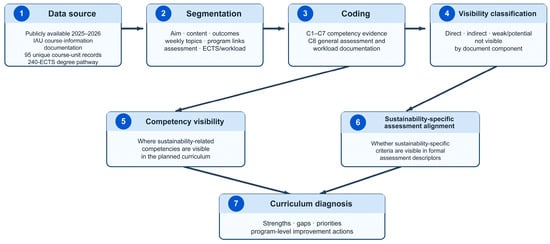
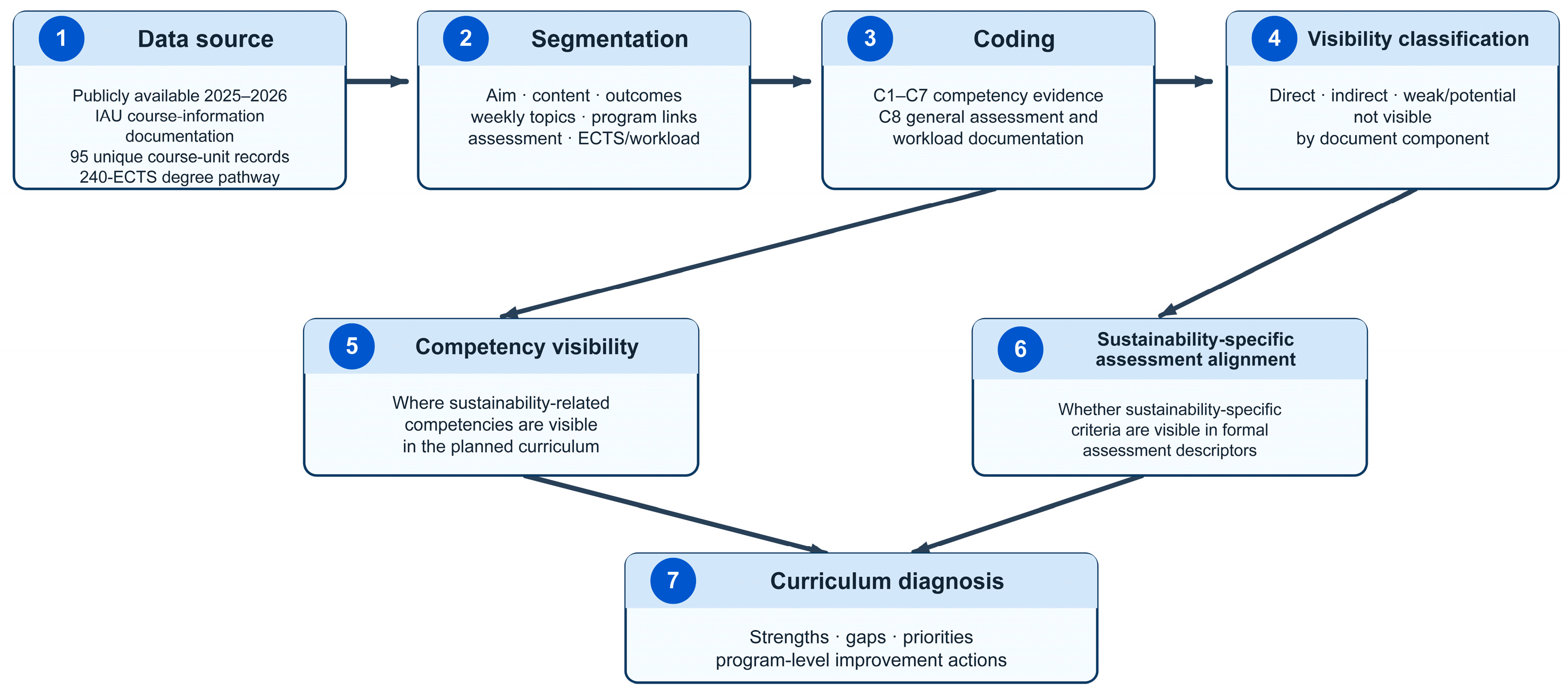
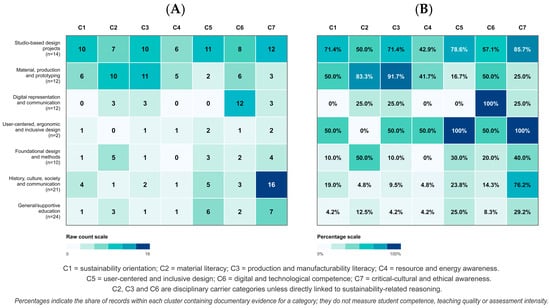
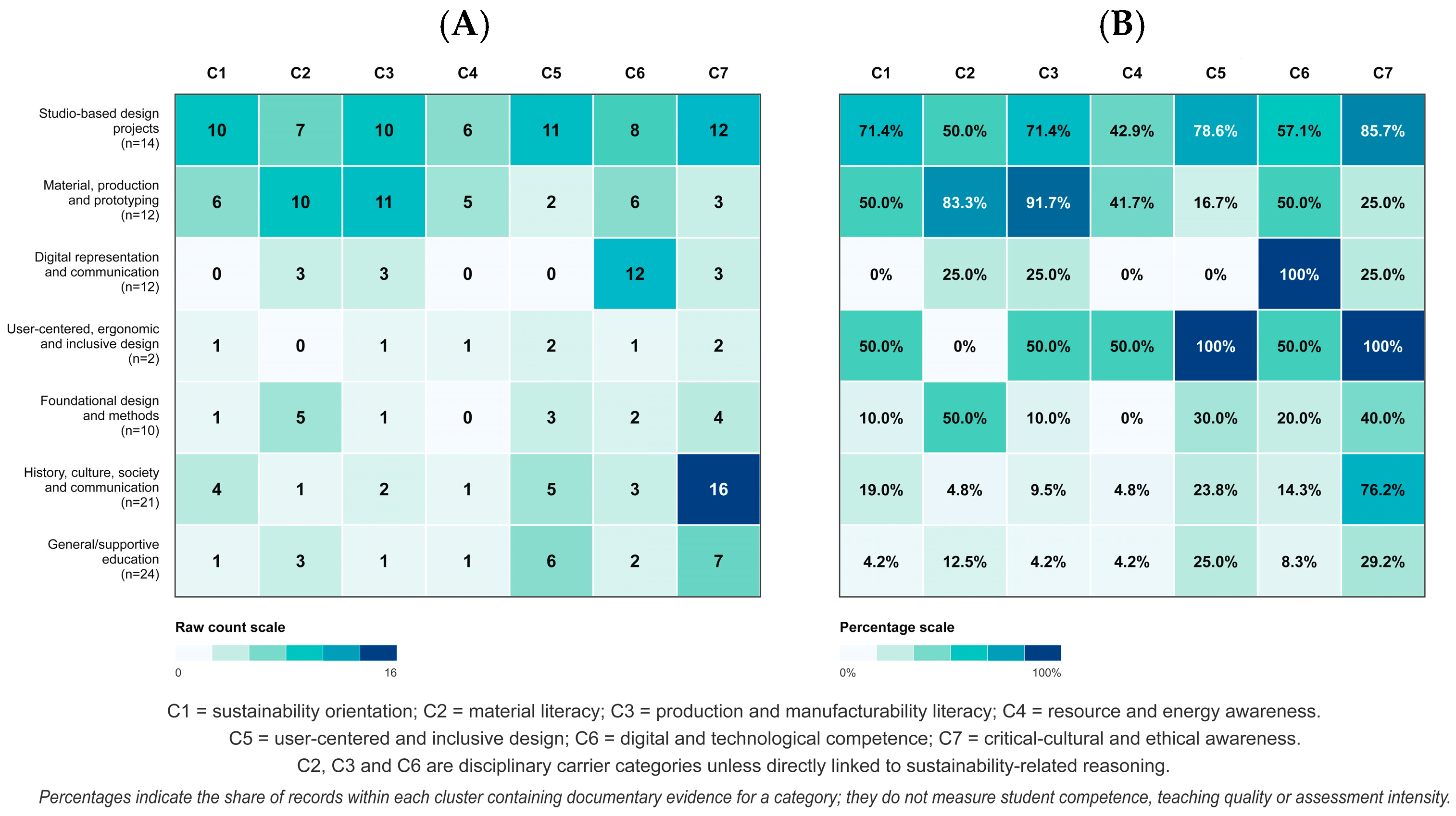
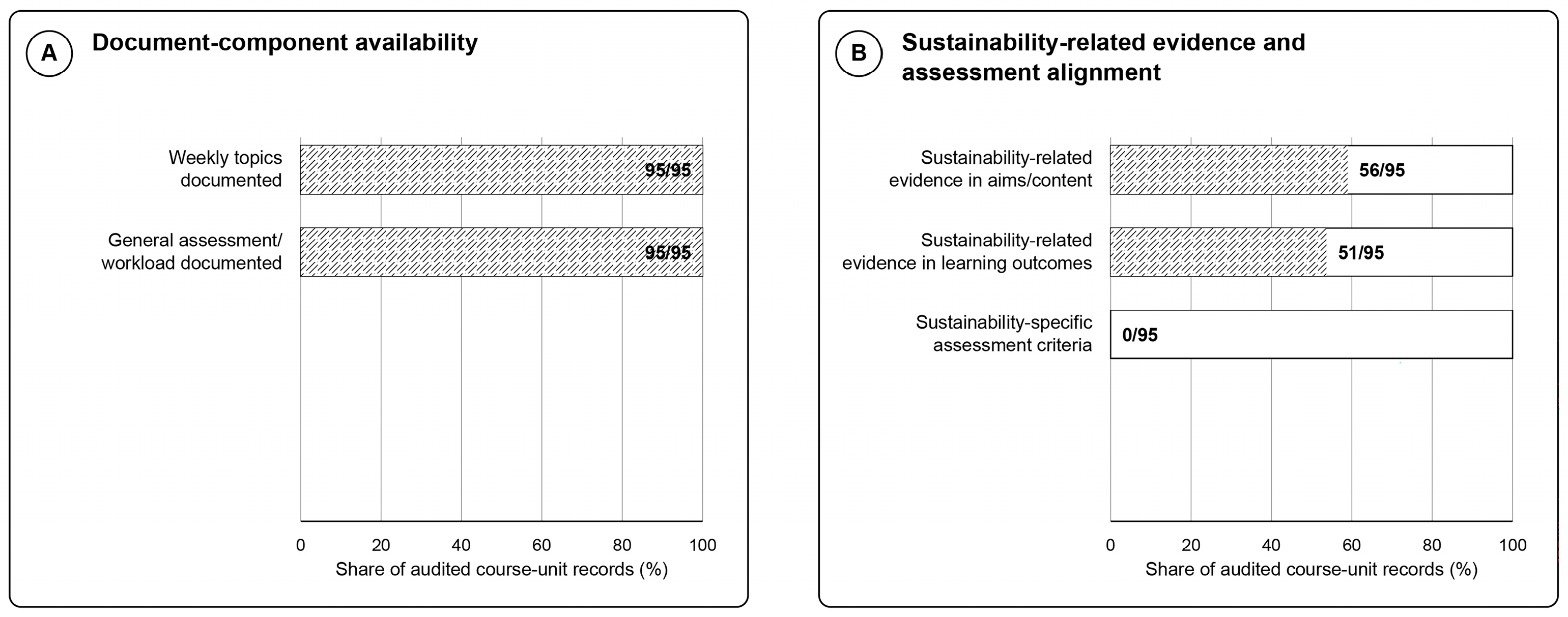

Disclaimer/Publisher’s Note: The statements, opinions and data contained in all publications are solely those of the individual author(s) and contributor(s) and not of MDPI and/or the editor(s). MDPI and/or the editor(s) disclaim responsibility for any injury to people or property resulting from any ideas, methods, instructions or products referred to in the content. |
© 2026 by the authors. Licensee MDPI, Basel, Switzerland. This article is an open access article distributed under the terms and conditions of the Creative Commons Attribution (CC BY) license.