


Abstract
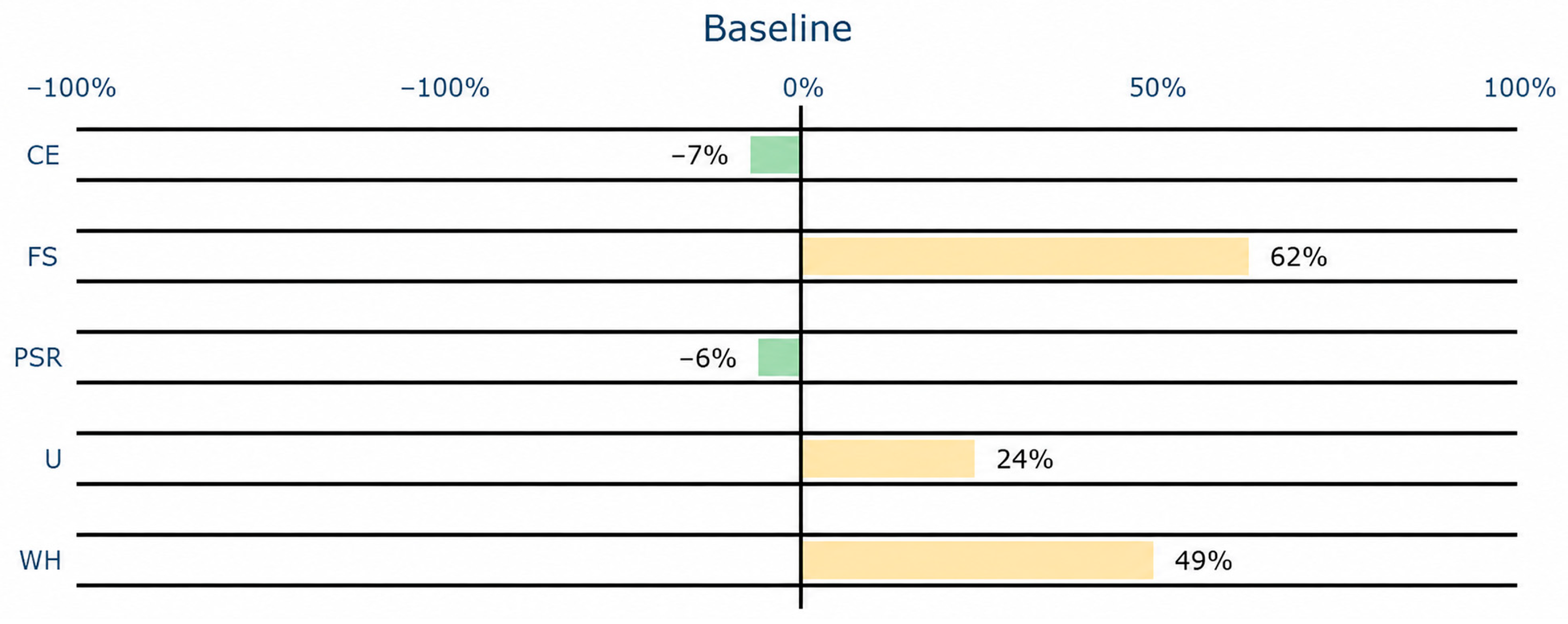
This study applies a screening, prospective social life cycle assessment, integrating process-simulation-derived inventory data with worker-hour-based impact metrics and country–sector social risk profiles from the SOCA/PSILCA database to estimate potential risk and opportunity exposure across the avocado oil supply chain in Colombia. For the local community and societal categories, indicators such as unemployment and contribution to economic development are interpreted based on national statistics, while worker-related indicators, including fair salary and working time, are assessed in relation to sectoral wage structures and living wage benchmarks. Results suggest that potential social risk exposure is primarily associated with worker-related indicators, with contributions concentrated in refining and upstream agricultural stages, reflecting underlying labor conditions and sectoral characteristics. In comparison with a palm oil baseline scenario, increases of up to 62% in medium-risk hours for fair salary and 49% for working time are observed in the avocado oil case. Other indicators show more moderate variation, with unemployment indicator impact increasing by 24% and contribution to economic development decreasing by 7%. However, these findings largely reflect the redistribution of pre-existing country–sector risk profiles rather than system-specific or empirically validated social impacts. Consequently, the results should be interpreted as indicative of potential exposure under screening conditions, rather than definitive measures of social performance.
1. Introduction
Sustainability includes the well-adjusted integration of environmental protection, economic feasibility, and social responsibility and equity. In biorefinery design and life cycle assessment (LCA) studies, environmental impacts such as climate change, energy efficiency, land use or resource depletion have traditionally dominated the focus, often excluding the correspondingly critical social dimension and socio-economic impacts [1]. This imbalance in sustainability assessments risks overlooking labor conditions, community impacts, and equity concerns, which are essential for ensuring that emerging technologies and innovative products contribute to holistic and socially just transitions [2]. Data on gross domestic profit (GDP), minimum wage, unemployment rate, and several more indicators at regional and country level become relevant for social impact quantification.
The relevance of avocado-based biorefineries is closely linked to the rapid global growth of avocado production and the associated generation of organic waste. Global avocado production has increased from approximately 3.8 million tons in 2010 to over 11.2 million tons in 2024 [3], driven by rising demand in food, health, and cosmetic markets. This growth has been accompanied by significant waste generation, as avocado processing can produce up to 30–45% by weight of residues, including peels, seeds, and pulp losses [4]. Improper management of this waste contributes to greenhouse gas emissions, local pollution, and missed opportunities for value recovery, particularly in producing countries. While avocado waste challenges are global, they are especially relevant in major producing regions such as Latin America, where rapid agricultural expansion has outpaced the development of integrated waste valorization and biorefinery infrastructures. Colombia, Peru, Mexico, and Chile together account for a substantial share of global avocado exports, yet face similar socio-economic challenges related to labor informality, rural employment vulnerability, and uneven value distribution along supply chains.
The social life cycle assessment (S-LCA) has been introduced to address the social sustainability performance of products and services throughout their life cycle [5]. S-LCA is built based on the traditional environmental LCA, containing the same phases: goal and scope definition, life cycle inventory (LCI), life cycles impact assessment, and interpretation of results [6]. In contrast to LCA, S-LCA impact selection and characterization follow both quantitative and qualitative data, and the impacts are related to risk and opportunity levels measured as worker-hours [7]. These assessments are typically based on secondary, sector-level data and risk-based modeling approaches, which enable broad coverage but may limit sensitivity to process-specific and local conditions. This methodology enables identifying risks and opportunities in specific indicators and metrics such as unfair salaries, child labor, and promotion of social responsibility while also highlighting opportunities for stakeholder empowerment and community development. As sustainability frameworks grow, S-LCA is gaining traction in agriculture and bio-based sectors, where socio-economic issues are severely rooted in production systems and supply chain dynamics. However, its application in these sectors is still largely based on aggregated secondary datasets and remains limited in emerging bio-based processes and early-stage system design.
Avocado oil has gained acceptance as a top product in health and cosmetic markets, attributable to its nutritional profile and other properties. Colombia, with its favorable climate conditions and growing agricultural infrastructure and investment, is emerging as a main producer of avocados, positioning itself in global market chains [8]. This continuous growth presents a favorable socio-economic and technical context for implementing S-LCA of emerging bio-based products, particularly in early-stage systems where process design decisions directly influence labor demand, supply chain structure, and associated social impacts. It leads to contributing with insights into local rural employment, wage structures, formalization of jobs and economic sector, and regional advance connected to the growth of bio-based niche commodities.
Avocado oil is increasingly recognized as a high-value product due to its favorable lipid profile and functional properties. Its composition is dominated by monounsaturated fatty acids (60–72%), primarily oleic acid (55–70%), which confers nutritional benefits comparable to olive oil [9]. Saturated fatty acids account for approximately 15–20%, mainly palmitic acid (10–18%), while polyunsaturated fatty acids contribute 8–15%, largely as linoleic acid (8–14%) [10]. Minor components include palmitoleic acid (3–8%), along with bioactive compounds such as tocopherols (70–190 mg/kg), phytosterols (2000–4500 mg/kg), and pigments such as carotenoids and chlorophyll derivatives [11]. This composition provides oxidative stability, emollient behavior, and skin permeability, supporting applications in food, cosmetic, nutraceutical, and pharmaceutical products. As a result, avocado oil occupies a premium market segment, offering higher added value than many conventional vegetable oils. The growing demand for such value-added products reinforces the importance of assessing not only their environmental and technical performance, but also their social implications, particularly in producing countries where expanding avocado value chains can significantly influence employment quality, income distribution, and regional development.
The research gap in the field of social impact assessment is evidenced by the lack of S-LCA studies on avocado oil, especially with advanced extraction methods like the thermochemical extraction process presented in this work. Considering relevant previous works in S-LCA, the methodology has been applied to fertilizer production [12] with a focus on methodological choices to address challenges such as difficult interpretation of results, data gaps and impact category selection. The Joint Research Centre (JRC) presented a study to describe the state of the art and challenges of implementing S-LCA to different sectors in the European Union [13], highlighting that the complexity of supply chains and global markets and their associated social impacts are difficult to identify and manage. Other works have combined LCA and S-LCA methodologies to assess the social and environmental sustainability performance of ethanol production [14]. The JRC published a report of S-LCA applied to raw materials in the European Union, where the Product Social Impact Life Cycle Assessment (PSILCA) database was used to study related social impacts [15].
Although S-LCA has been applied to agricultural commodities and bio-based products, three limitations persist in the literature: (i) many studies remain gate-to-gate or omit upstream agricultural stages, limiting hotspot identification across the full supply chain; (ii) indicator selection is often not transparently justified against recognized guidance, creating uncertainty about stakeholder relevance and materiality; and (iii) few studies explicitly connect engineering-based foreground inventories (mass/energy balances and labor requirements) to social risk modeling in a way that supports early-stage process design. In addition, many applications rely predominantly on secondary, sector-level databases and risk-based modeling approaches, with limited incorporation of process-specific foreground data. These gaps are particularly relevant for emerging agro-industrial value chains, where informality, wage adequacy, and governance practices may dominate social performance, yet primary data are scarce. In this context, integrating process-simulation-derived inventory data with S-LCA can improve the representation of foreground systems while maintaining the use of established background databases.
Solarte-Toro et al. [16] performed a combined environmental LCA and social impact evaluation of a small-scale avocado oil biorefinery using Persea americana (Hass variety) in Colombia, offering a valuable foundation of data on avocado upstream production and oil processing impacts. While the study contributes meaningfully to environmental and social sustainability research in avocado oil biorefinery design, its social impact assessment was limited to two stakeholder categories: local community and workers. Other critical groups such as value chain actors and broader societal stakeholders were not included. In addition, it was limited to a gate-to-gate approach, where social impacts of upstream stages were not aggregated in the social impact results. Tragnone et al. [17] performed a product S-LCA using the PSILCA database for a product comparison of confetti as a case study. The functional unit was defined as one production batch (130 kg), approaching a bottom-up model based on process-specific data. In contrast, the PSILCA database employs a top-down methodology, where social impact indicators and categories are connected to financial flows and currencies rather than physical quantities. Other studies [18,19] recently have used similar approaches with the PSILCA database, yet no study is oriented to streamline mass and energy balances from LCIs and process simulation and social impact assessment databases.
In addition to the methodology gaps, there is a need to assess social impacts in emerging agricultural supply chains. Most studies have been focused on studying both economic and environmental dimensions of sustainability, leaving the societal dimension out of scope. Social impacts are remarkably relevant in the context of sustainability and sustainable development as they address human and community impacts that often go unnoticed in early-stage innovation [20]. While environmental and economic indicators dominate sustainability discourse, overseeing social issues can lead to unbalanced development, labor exploitation, and missed opportunities for inclusive growth.
This work proposes a new approach as a contribution to holistic sustainability evaluation of emerging products with considerations for social sustainability issues and the evaluations of its performance. The methodology takes knowledge and methods from chemical and process engineering design, using inventory data from process simulation, socio-economic impact data contained in the social impact add-on (SOCA) created as an extension of ecoinvent (LCA database) based on the social impact data in PSILCA database [21]. This database enables S-LCA to be conducted by taking functional units in terms of physical flows (e.g., kg, kWh, etc.) in a bottom–top approach, as defined in ecoinvent and LCAs, instead of financial flows and the top–bottom approach often applied in S-LCA. This approach helps streamline connection of mass and energy balances generated in production plants to quantifiable socio-economic metrics, which can be used for identification of social issues and optimization.
While several studies have applied S-LCA to agricultural and bio-based systems, many remain limited to partial stakeholder coverage, gate-to-gate system boundaries, or purely descriptive reporting of social indicators. In addition, few studies explicitly connect social impact results to process-level inventory data derived from engineering models. As a result, the potential of S-LCA to inform early-stage design and decision making in emerging biorefinery systems remains underexploited. This study addresses this limitation by integrating process-simulation-based inventory data with a bottom-up S-LCA framework, enabling a more consistent linkage between physical production systems and social impact metrics.
This study contributes to the existing literature on S-LCA by (1) operationalizing a UNEP/SETAC-aligned indicator selection and data quality interpretation procedure for screening S-LCA, (2) explicitly linking process simulation inventory and labor requirements to worker-hour-based social risk modeling using SOCA/PSILCA, and (3) providing a comparative benchmark against a mature vegetable oil supply chain (palm oil) to contextualize results and highlight structural drivers of social risk in emerging biorefinery systems.
In summary, this study aims to strengthen the empirical and methodological basis of S-LCA for emerging agro-industrial systems by evaluating the social sustainability performance of avocado oil production in Colombia using a cradle-to-gate S-LCA framework. Specifically, the study seeks to identify key social hotspots and opportunity areas along the avocado oil supply chain, using process-simulation-based inventory data combined with social impact databases. A comparative baseline analysis using palm oil as a market reference product is conducted to contextualize the results and support interpretation of relative social risks. The findings are analyzed within the framework of Colombian socio-economic conditions and the biorefinery sector, providing insights relevant to decision making in the design and scaling of emerging bio-based production systems, while acknowledging the constraints of secondary, risk-based social data and emphasizing the added value of foreground process integration.
2. Materials and Methods
This study applies a screening, prospective S-LCA intended to identify potential hotspots and improvement levers for an emerging avocado oil biorefinery rather than to deliver definitive, site-specific social performance claims. The methodological structure follows the UNEP/SETAC 2020 Guidelines [7] (goal and scope, inventory, impact assessment, interpretation), while explicitly documenting (i) indicator selection and stakeholder materiality, (ii) database mapping choices, and (iii) data quality limitations inherent to secondary social data. Results are interpreted comparatively (across supply-chain stages, allocation scenarios, and a palm-oil benchmark) and are used to identify where improved primary data collection would most reduce uncertainty.
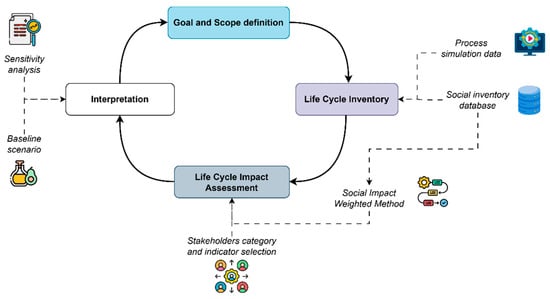
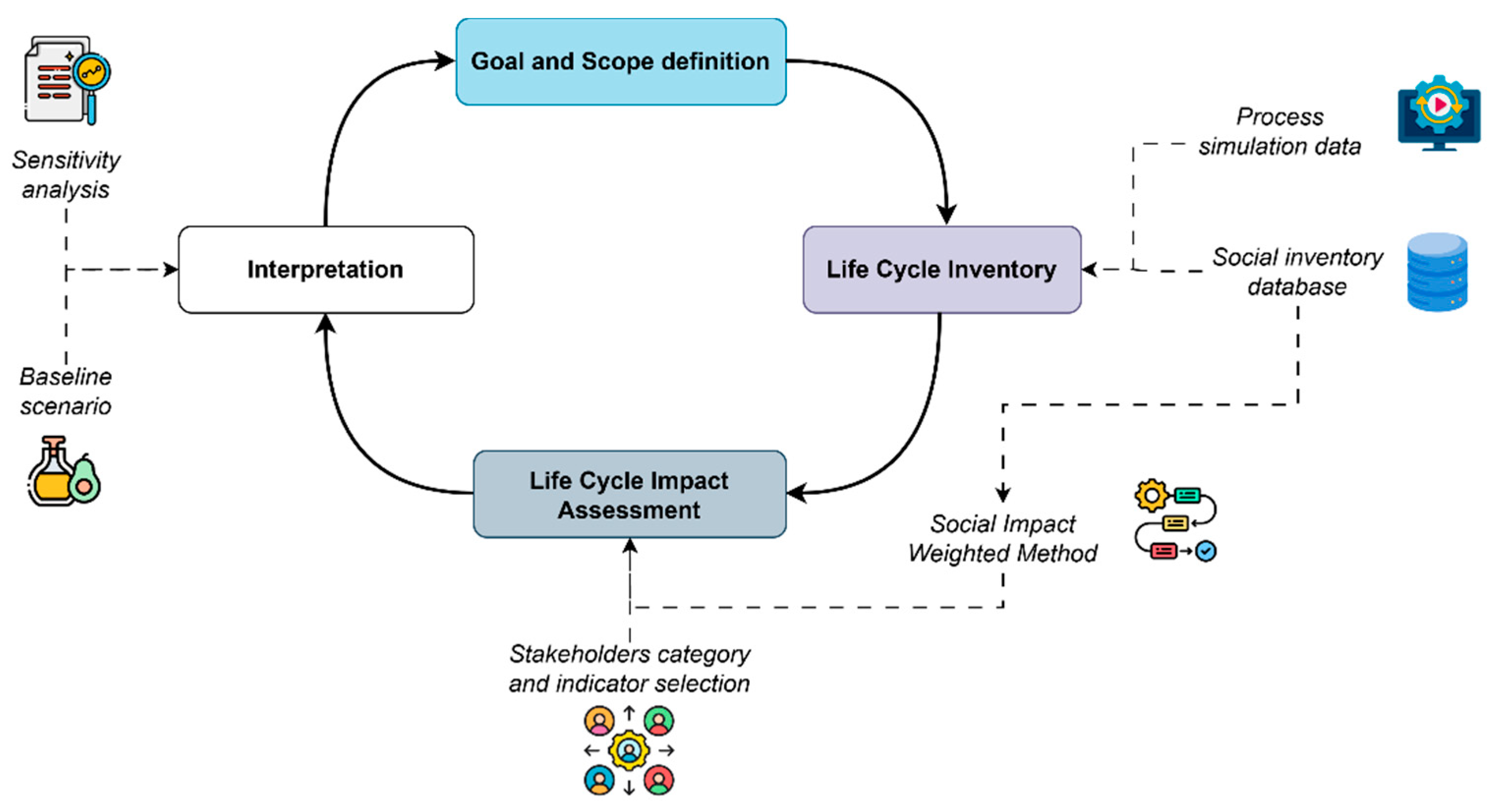
The S-LCA evaluates social impacts and hotspots of products and services across their partial or full life cycle. The S-LCA has been built based on the foundations of environmental LCA, whereas S-LCA relies on both quantitative and qualitative data. The technical feasibility and environmental performance of the avocado oil biorefinery evaluated in this study have been previously assessed by the authors using process simulation and environmental life cycle assessment, providing the foundation for the present social sustainability analysis [22]. The applied methodology is shown in Figure 1.
Figure 1.
Methodology for prospective S-LCA combining social impact databases and process simulation data.
The UNEP/SETAC 2020 framework [7] was operationalized as follows: (i) stakeholder categories and subcategories were defined in the goal and scope; (ii) the inventory combined process simulation foreground data with SOCA/PSILCA background risk profiles; (iii) social impact assessment employed SIWM worker-hour equivalents; and (iv) interpretation incorporated data quality considerations (reliability, temporal, geographic, and technological correlation) and sensitivity analysis for multifunctionality allocation. This mapping is provided to ensure transparency of methodological choices and to support reproducibility under screening conditions.
2.1. Goal and Scope Definition
The goal of this study is to conduct a social life cycle assessment and identify social hotspots of an avocado oil production from underutilized avocado side streams via a thermochemical extraction process. The functional unit is the production of avocado oil; its function is related to a product ready for delivery to other supply chains or final product application. The used reference flow is 1 kg of avocado oil. The evaluated process generates value-added co-products like biochar, rich chlorophyll extract, treated avocado peel, and pulp without fat. The allocation of impacts of these co-products was handled following allocation rules. While a detailed market and economic analysis of byproducts is beyond the scope of this S-LCA, their inclusion reflects realistic valorization pathways that influence labor demand, supply chain structure, and social outcomes.
Because the system represents a prospective industrial facility, foreground labor requirements and operating conditions reflect engineering assumptions consistent with early-stage design (operators per unit process, shift structure, and throughput). These assumptions influence worker-hour scaling but do not substitute for site-specific labor management practices; therefore, results are treated as hotspot signals and are complemented with data quality interpretation.
The avocado streams considered in this study correspond to fruits that do not meet commercial quality standards for fresh consumption (e.g., shape defects, non-uniform ripening, size, or mechanical damage) and are therefore excluded from the primary fresh-fruit market. In the context of biorefinery design and circular economy frameworks, such streams are considered residues or waste in a valorization sense, as they have lost their original market function despite remaining technically suitable for processing. The use of the term “waste” in this study therefore refers to loss of market value rather than deterioration of material quality, and provides the motivation for evaluating their upgrading through avocado oil production rather than alternative fresh-market pathways.
The plant is assumed to be built and operative in Cartagena, Colombia (North Colombia Region) considering the logistics and industrial infrastructure offered by this location. Avocado streams are transported from farms in the Montes de Maria region (148 km south of Cartagena, road distance). Following UNEP/SETAC 2020 framework [7], the stakeholder categories considered at the scoping stage were Workers, Local Community, Society, Consumers, and Value Chain Actors. After materiality screening (Section 2.4.1), Consumers were excluded from the final assessment because (i) the product is an intermediate oil at factory gate (cradle-to-gate scope), (ii) consumer-facing impacts would primarily arise in downstream formulation and retail stages that are outside the system boundary, and (iii) relevant consumer subcategory data could not be meaningfully differentiated using available sector-level proxies. The final assessment therefore covers Workers, Local Community, Society, and Value Chain Actors.
2.2. System Boundary and Cut-Off Criteria
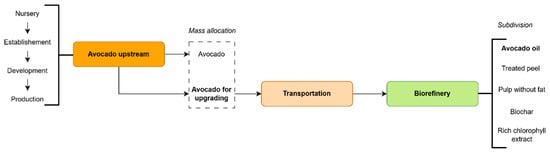
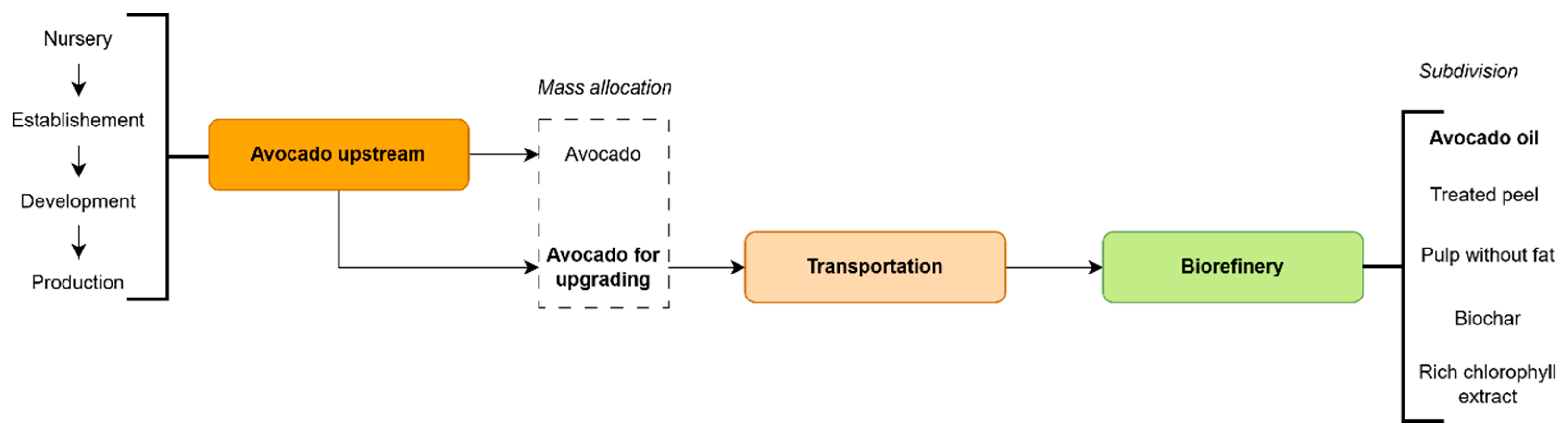
The system boundary for the assessed system is cradle-to-gate, including raw materials extraction/production, transportation, and processing stages. The system boundary evaluated in this work is based on the physical perspective to account for technological processes and economic flows that make up the avocado oil supply chain of this work. Selected stages and the allocation approach for baseline scenario are shown in Figure 2. Cut-off criteria were applied to cover the most relevant supply chain stages to guarantee the comprehensiveness of the system; packaging and product distribution were excluded from the system boundary as well as post-production or following downstream stages as the scope is limited to a factory gate assessment.
Figure 2.
Cradle-to-gate system boundary of baseline scenario for a thermochemical extractive avocado biorefinery.
The system included an avocado upstream stage, where four different stages were modeled. As part of avocado production, three main streams are generated: (i) avocado for human consumption, (ii) avocado for upgrading. Stream (ii) is the selected feedstock for this biorefinery considering that it does not compete with food security, and they keep their chemical properties, making them suitable for oil extraction. Avocado waste streams are not considered for bioprocessing as the quality and efficiency of oil obtained from spoiled or waste avocado is considerably lower than stream (ii). Mass allocation based on weight ratios between streams (i) and (ii) was applied at the avocado upstream level to handle multifunctionality. Solarte-Toro et al. [16] showed that 0.33 kg of avocado for upgrading is produced per 1 kg of avocado for human consumption.
The biorefinery stage presents multifunctionality as well, as it yields five different products with potential application and market value. However, process units in this biorefinery can be physically separated into product lines for producing specific biorefinery products. For instance, biochar follows its own product line after pretreatment preparation (100% allocated to oil extraction). The same approach was followed for avocado oil and pulp without fat (two products of a second production line) and treated avocado peel and rich chlorophyll extract (other two products in a third separate production line). Therefore, subdivision allocation was used to assign impact for different processing units; for those production lines with more than one product (second and third production lines), economic allocation based on market value was applied. More details are provided in the supplementary file.
The present work evaluates one thermochemical/extractive biorefinery configuration as the baseline design. While multiple thermochemical routes (e.g., pyrolysis-based or gasification-based configurations) are conceptually possible, they were not modeled as separate social scenarios due to inventory and design data limitations at this stage. Instead, the analysis focuses on how the selected configuration redistributes labor demand across supply-chain stages (agriculture, transport, industrial refining) and how this redistribution influences social risk exposure. Future work should compare alternative thermochemical configurations using consistent process simulation and labor modeling to strengthen route-level differentiation.
2.3. Life Cycle Inventory
This stage is related to the relevant socio-economic flows of the evaluated product system and includes both foreground and background systems. The product system is built to cover stages described in the system boundaries that include raw material production, transportation, and processing. Raw material production for this avocado oil production starts with avocado production in the North Colombia region. Different avocado varieties are produced in Colombia, including Fuerte, Choquette, Creole, and others. Due to LCA data availability, the process reported by Solarte-Toro et al. [16], which is based on the Persea Americana variety, was used to model avocado production. The feedstock used for the evaluated production process are those avocado streams that do not pass quality standards for food consumption (shape, ripeness, etc.) but are available for upgrading in further processing. Discarded or spoiled avocados are not suitable for processing in this biorefinery. Spoiled avocado would compromise process efficiency and final product quality. The adequate avocado side streams used for the production process evaluated in this work represent around 25% of total avocado output of Antilla creole variety.
Following this, transportation of raw materials to the production site (Cartagena city) was considered in the assessment. Details of the calculated distance are shown in the supplementary file. Raw materials are mostly available in regional or national Colombian markets. Considering the transportation infrastructure in Colombia, raw materials are transported by truck.
For calculation of worker-hours, it was assumed that 1.5 operators (including supervision) are required per unit process (five-unit operations), resulting in approximately eight operators. Two additional workers for management, financial, and human resources functions were included, yielding a total of ten employees. Under Colombian labor law, a regular workday consists of 8 h. Based on the simulated production rate of 103.5 kg avocado oil per hour, the direct labor requirement was calculated as 0.0251 h per kg of produced avocado oil.
This value represents foreground operational labor at the facility level and was scaled to the functional unit using the simulated production rate. To ensure that plant-level labor intensity derived from process simulation is explicitly reflected in the S-LCA results, the calculated labor requirement was introduced into the model as foreground social flows linked to the selected worker- and stakeholder-related indicators. These flows represent direct labor exposure specific to the biorefinery and are modeled separately from background labor intensities embedded in SOCA/PSILCA datasets, which capture worker-hour equivalents associated with upstream inputs and utilities. Packaging, distribution, and downstream use were excluded from the system boundary; therefore, consumer-related impacts were not assessed.
Given the limited availability of primary social data for emerging avocado oil supply chains in Colombia, this study relies on secondary socio-economic data sourced from the SOCA database, derived from PSILCA. These data represent country- and sector-level social risk profiles and are used as proxies for identifying potential social hotspots rather than exact site-specific conditions. This approach is consistent with the screening-oriented purpose of S-LCA, particularly in early-stage biorefinery design, where primary social data are often unavailable. The modeled product system integrates flows and socio-economic indicators with heterogeneous geographic resolution. Foreground operations are assumed to be located in Cartagena (Bolívar Department, Caribbean region of Colombia), while upstream avocado production occurs in Montes de María (North Colombia region). However, background processes and social risk characterization in SOCA/PSILCA are primarily based on country–sector averages, as reported in Table 1.
Table 1.
A summary of the geographic resolution of key flows and indicators.
2.4. Life Cycle Impact Assessment
The S-LCA is founded on a stakeholder approach, where impacts and effects on different stakeholders related to the evaluated supply chains are taken into consideration. One aspect of S-LCA is that the goal is to identify and manage both positive and negative effects in a socio-economic context. Therefore, the social impacts are classified by stakeholder categories including (1) Workers, (2) Local community, (3) Society, and (4) Value chain actors.
2.4.1. Indicator Identification, Materiality Screening, and Selection
Indicator selection followed UNEP/SETAC 2020 [7] principles and was implemented as a three-stage screening procedure to reduce arbitrariness and improve stakeholder relevance:
- Long-list identification: A long list of candidate indicators was compiled from SIWM/SOCA coverage and UNEP/SETAC subcategory recommendations for Workers, Local Community, Society, Consumers, and Value Chain Actors.
- Materiality and pathway relevance screening: Indicators were prioritized if they plausibly relate to the avocado-to-oil supply chain and the industrial thermochemical/extractive conversion context through identifiable mechanisms (e.g., wage adequacy, working time, labor formality, governance/CSR adoption, community employment vulnerability).
- Data quality and interpretability filter: Indicators were retained only when Colombia- and sector-relevant proxy data were available with sufficient temporal and geographic representativeness to support interpretation within a screening S-LCA.
The final indicator set (see Table 2) emphasizes (i) labor conditions likely to dominate social performance in Colombia (wage adequacy, working time), (ii) local community vulnerability signals (employment and informality context), and (iii) governance proxies for value chain actors (social responsibility engagement). Indicators such as child labor, forced labor, discrimination, and occupational health and safety were not retained in the baseline because of missing sector-specific data in SOCA for Colombia, inability to differentiate across stages, and insufficient interpretability. However, these remain high-priority topics for primary data collection in future work and are discussed as limitations (Section 4).
Table 2.
Final social indicators after UNEP/SETAC-aligned screening and data-quality filtering.
For each retained indicator, an interpretive pathway was defined: the product system determines labor demand and sector composition by stage; SOCA/PSILCA provides country–sector social risk profiles; and SIWM scales potential exposure into worker-hour equivalents. Consequently, results represent the distribution of potential risk/opportunity exposure across supply-chain stages rather than measured site-specific performance.
2.4.2. Social Impact Modeling
Social impacts were quantified using the SIWM as implemented in the SOCA add-on (derived from PSILCA). SIWM characterizes social performance as risk- or opportunity-related worker-hour equivalents by combining life cycle activity levels with country–sector social risk profiles. In practice, each foreground and background process in the product system was linked to a corresponding SOCA dataset representing a specific country–sector combination. These datasets embed (i) sectoral labor intensity and (ii) associated social risk or opportunity profiles for the selected indicators. The activity levels from the life cycle inventory (e.g., material flows, energy inputs, transport services) were combined with the embedded social profiles in SOCA to calculate indicator-specific worker-hour equivalents for each process. Results were subsequently aggregated and attributed to defined supply-chain stages (upstream avocado production, transportation, and refining/processing).
This approach allows the distribution of potential social risk and opportunity exposure to be analyzed at the stage level while maintaining consistency with the underlying country–sector risk structure of SOCA/PSILCA. The resulting values represent potential exposure under sector-average conditions rather than site-specific measured performance. Indicators are categorized as either of the following:
- Risk-type indicators, where higher values indicate greater potential social burden;
- Opportunity-type indicators, where higher values indicate greater potential positive social contribution.
Because worker-hour equivalents are indicator-specific and reflect distinct social dimensions, comparisons are conducted within each indicator across supply-chain stages and scenarios, rather than across different indicators. In addition to background characterization through SOCA/PSILCA, direct operational labor associated with the modeled biorefinery was explicitly accounted for as foreground social flows. The calculated labor requirement per functional unit (0.0251 h per kg avocado oil) was introduced as indicator-specific social flows to represent direct exposure of on-site workers under the defined risk or opportunity classification.
These foreground flows were used to ensure that plant-level labor assumptions derived from process simulation (Section 2.3) are directly reflected in the S-LCA results. The approach does not replace the SOCA characterization of background supply-chain processes but, rather, complements it by explicitly representing operational labor intensity in the foreground system. Risk or opportunity classification for these foreground flows follows the interpretation criteria described in Section 2.4.3.
2.4.3. Interpretation Criteria for Risk and Opportunity Classes
To support interpretation in a screening context, quantitative national/sector reference values were translated into qualitative risk/opportunity classes using the SIWM/SOCA interpretation logic [17]. Where SIWM provides categorical thresholds, these were adopted directly. Where explicit thresholds were not available for Colombia-specific contextual indicators (e.g., living-to-minimum wage ratios), transparent interpretation bands were applied and are reported in Table 3 and Table 4 as interpretation criteria, not as universally valid characterization factors. These criteria are used to facilitate consistent discussion across indicators and to avoid overinterpretation of absolute values.
Table 3.
Risk assessment criteria for selected social impact indicators.
Table 4.
Risk assessment criteria for selected social impact indicators based on opportunity levels.
Overall, the UNEP/SETAC-aligned indicator screening (Section 2.4.1), SIWM/SOCA characterization (Section 2.4.2), and transparent interpretation criteria (Section 2.4.3) provide a reproducible basis to identify potential social hotspots and opportunity areas for the modeled avocado oil biorefinery supply chain.
2.5. Interpretation of Results
In S-LCA, interpretation of results requires a careful balance between methodological consistency and contextual significance, particularly when data quality varies across indicators and sectors. The S-LCA applied in this work relies on proxy data from the SOCA database (which is an adapted version of PSILCA), which aggregates social risks that are defined at the sectoral and country level into a product-level evaluation. This introduces uncertainty, particularly when modeling emerging supply chains such as avocado oil production in Colombia. To ensure meaningful interpretation, data quality across five dimensions (reliability, completeness, temporal correlation, geographical correlation, and technological correlation) were taken into consideration. High-quality data enables clearer differentiation between actual and potential risks, while poor-quality data may inflate or obscure social hotspots. Interpretation of results in this work first included the definition of a baseline scenario for comparison with social impacts of avocado oil production and a sensitivity analysis to test three allocation methods and enhance the transparency and test robustness of the developed method.
2.5.1. Definition of a Baseline Scenario
As commonly applied for environmental LCAs, this work defines a baseline scenario to compare potential socio-economic impacts of the avocado oil production presented in this work with respect to competing products in the market with similar applications to avocado oil. Colombia is one of the major avocado producers, with a significant avocado oil output with a market of $484.6 million in 2020 [23]. Data available on avocado oil production is limited, as not many LCA or S-LCA studies have been conducted on this product. Avocado oil has applications in the food, pharmaceutical, and cosmetic industries, among others. Depending on the application, there are different competing products to avocado oil on the market, including coconut oil, palm oil, soybean oil, and others, with palm oil and soybean oil as leading products by market volume [24]. Given Colombia’s position as one of the world’s leading palm oil producers and the functional similarity between palm oil and avocado oil in several applications, palm oil was selected as the baseline product for comparison.
Accordingly, the baseline scenario was defined as the production of 1 kg of refined palm oil, consistent with the functional unit and reference flow described in Section 2.1. The baseline system was modeled in OpenLCA using the “rest-of-world market for refined palm oil” available in the SOCA database, which represents global average production and supply chain conditions. To improve geographical representativeness, the baseline system was partially regionalized to Colombia (CO) where datasets were available. Specifically, foreground and background processes were customized to select Colombian geographies for key inputs, including electricity supply (Colombia-specific electricity mix), heat supply where applicable, crude palm oil production datasets with Colombian geography when available, tap water, and other utilities with country-specific representation.
Where Colombian datasets were not available in SOCA/ecoinvent, the default global or rest-of-world processes were retained. This hybrid regionalization ensures improved alignment with Colombian labor and sector conditions while maintaining consistency with the underlying SOCA characterization structure. The palm oil baseline therefore reflects a Colombia-adjusted supply chain configuration under SOCA modeling assumptions. It serves as a contextual benchmark to compare a mature, vertically integrated vegetable oil supply chain with the emerging thermochemical avocado oil value chain under equivalent functional use.
2.5.2. Sensitivity Analysis
A sensitivity analysis was conducted to evaluate the influence of allocation methodology on social impact results, given the multifunctional nature of the biorefinery system. The baseline scenario applies subdivision allocation, consistent with physical separation of process units and product lines where feasible. Two alternative allocation approaches were assessed: (i) economic allocation, based on relative market value of co-products, and (ii) mass allocation, based on production mass ratios of co-products.
Because SIWM/SOCA results scale proportionally with allocated activity levels, allocation choice directly affects the magnitude of indicator-specific worker-hour equivalents. The sensitivity analysis therefore evaluates the robustness of hotspot identification and stage-level distribution patterns under alternative allocation assumptions. This analysis supports transparency in modeling choices and clarifies the extent to which allocation methodology influences social impact interpretation in multiproduct biorefineries.
2.5.3. Uncertainty Analysis
An uncertainty analysis was performed to assess the variability of the results associated with the use of secondary data in the S-LCA model. Given that the SOCA database (adapted from PSILCA) relies on life cycle inventory data derived from ecoinvent, uncertainty primarily arises from variability in the underlying inventory rather than from the social impact assessment model itself. Uncertainty propagation was conducted using Monte Carlo simulation implemented in OpenLCA version 2.3. A total of 1000 iterations were performed, during which input parameters characterized by probability distributions in the background database were randomly sampled according to the OpenLCA uncertainty algorithm. This algorithm propagates parameter uncertainty through the life cycle model to generate distributions of the resulting social impact indicators.
The analysis provides a statistical characterization of the results, including mean values and dispersion metrics, allowing the identification of variability ranges across impact categories and life cycle stages. This enables the evaluation of the robustness of hotspot identification and supports the interpretation of results under uncertainty. It is acknowledged that this approach captures uncertainty at the inventory level, reflecting variability in sectoral and country-level data embedded in SOCA/ecoinvent, while uncertainties associated with characterization factors and social impact modeling remain outside the scope of this analysis.
3. Results
Social impacts and risk assessment can be assessed from two main perspectives: direct contribution of the evaluated systems (effects inherent of the production process) and indirect contributions related to activities out of the control of the manufacturing process (raw materials, energy supply, transportation of raw materials, etc.). Related to direct contribution, the selected categories, subcategories, and indicators were carefully analyzed based on the current socio-economic conditions in Colombia. For Colombia, the latest report (May 2025) indicates an unemployment rate of around 9% [25], which is considered as medium risk (see Table 2). However, Colombia accounts for informal employment and unregulated self-employment in their statistics, which, according to estimations [23], can be around 55.9%. Despite the above, this study accepts the 9% figure for the unemployment rate, which is reflected in a medium-risk level. Weekly working hours in the assessed supply chain were estimated at 46 h per worker, corresponding to a medium-risk level according to the applied risk classification criteria. Table 5 shows social indicator values and identified risk/opportunity levels based on reference values in Table 3 and Table 4.
Table 5.
Social indicators, values, and identified risk and opportunity levels.
With respect to the contribution to economic development (CE) indicator, the avocado sector represents a relevant export activity in Colombia; however, avocado oil constitutes only a secondary value stream within the broader industry. Based on available estimates, avocado oil contributes approximately 1.5% to national GDP [26], which corresponds to a low opportunity classification under the applied interpretation criteria (<10% GDP share). This result reflects the limited macroeconomic weight of the oil-processing segment rather than a deficiency in local economic activity at the plant level. As CE is structurally anchored to sectoral GDP contribution, its magnitude is primarily influenced by national economic structure rather than process-specific labor intensity.
The Value Chain Actors category was assessed through the promoting social responsibility (PSR) indicator. Available sector-level data indicate limited documented participation of Colombian agricultural actors in structured initiatives such as the United Nations Global Compact. Within the SOCA/PSILCA framework, absence or scarcity of documented formal engagement results in a very-high-risk classification. It is important to note that this classification reflects data availability and formalization of governance mechanisms rather than verified non-compliance or absence of responsible practices at the firm level.
The statutory minimum wage in Colombia for 2025 is approximately 350 USD per month [27]. In contrast, the estimated living wage for Cartagena, the assumed plant location, is approximately 560 USD per month [28], reflecting higher urban living costs in this region. The resulting living-to-minimum wage ratio of 1.60 indicates that statutory minimum compensation falls substantially below estimated living wage requirements, corresponding to a high-risk classification under the applied interpretation criteria.
Given that the modeled facility represents an industrial biorefinery requiring skilled operators and technical personnel, compensation levels were aligned with sector-average wages observed in Cartagena’s industrial cluster (including petrochemical, chemical, logistics, and related industries). The estimated sector-average wage is approximately 1165 USD per month [29]. The ratio of sector-average wage to living wage (2.08) corresponds to a medium-risk classification, indicating improved wage adequacy relative to minimum wage conditions but not complete elimination of structural vulnerability. This differentiation highlights that wage-related risk exposure is driven not only by statutory wage levels but also by the gap between regional living costs and sector compensation structures.
3.1. Impact Assessment Results of Avocado Oil Production Supply Chain
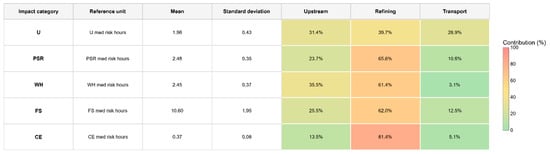
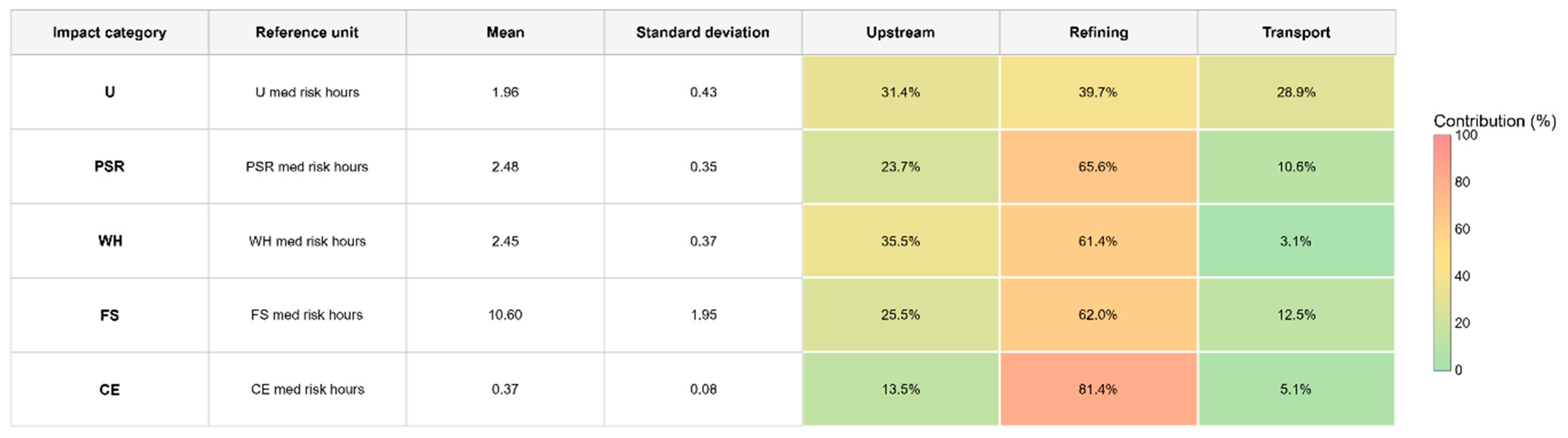
With the constructed product system and SOCA-based characterization, the stage-level social impact assessment was performed under the subdivision allocation model. Results are presented in Figure 3 as normalized worker-hour equivalents per indicator and supply-chain stage.
Figure 3.
Social impact assessment results of subdivision model, with heatmap indicating red for high-, yellow for mid-, and green for low-level impact.
Because SIWM scales social exposure as labor-weighted risk or opportunity intensity, stage dominance reflects the interaction between (i) labor demand per functional unit and (ii) country–sector risk profiles embedded in SOCA. Worker-hour equivalents are indicator-specific and therefore comparable only within each indicator across stages.
Contribution to economic development (CE) exhibits relatively low magnitude across all stages. As CE is anchored to sectoral GDP contribution rather than process-specific labor scaling, its distribution is primarily influenced by the macroeconomic weight of the avocado oil segment within the broader agricultural economy. The limited magnitude therefore reflects structural economic positioning rather than operational inefficiency.
Promoting social responsibility (PSR) shows higher exposure in upstream agriculture relative to refining. This pattern is driven by sector-level documentation and formal participation rates in structured sustainability initiatives within the SOCA database. The refining stage, which is associated with more industrialized operations and formal governance structures, exhibits comparatively lower risk exposure. This differentiation illustrates how governance-related indicators are sensitive to sector formalization levels rather than solely to labor intensity.
The fair salary (FS) indicator demonstrates a more balanced but still refining-dominant distribution, with the refining stage contributing the largest share and upstream agriculture contributing 25.50%. This pattern reflects the combined effect of foreground labor modeling in refining and sector-average wage profiles in agriculture. The agricultural contribution highlights that wage adequacy gaps relative to living costs remain structurally embedded in upstream production stages.
Unemployment (U) displays relatively even distribution across stages. Because unemployment risk is characterized largely at the national level, variation between stages is primarily driven by relative labor demand rather than technological differentiation. This behavior contrasts with worker-related indicators and demonstrates lower process sensitivity. Working time (WH) exposure is strongly concentrated in the refining stage (61.41%) and upstream agriculture (35.5%). The refining-stage dominance is largely attributable to explicitly modeled foreground labor intensity (0.0251 h/kg), while upstream contributions are driven by agricultural sector labor profiles embedded in SOCA. Transportation contributes minimally due to low labor requirements per functional unit. The contrast between WH and U illustrates differential indicator sensitivity: WH responds strongly to operational labor modeling, whereas U reflects broader structural labor market conditions.
Uncertainty analysis based on Monte Carlo simulation (1000 runs) indicates that variability across indicators is generally moderate and does not alter the identification of dominant stages. Standard deviation values remain relatively low compared to mean values for most indicators, suggesting stable results under the underlying inventory uncertainty. Higher dispersion is observed for indicators such as fair salary (FS), reflecting greater variability in wage-related parameters across sectors and regions in the SOCA/ecoinvent datasets. In contrast, indicators driven by macro-level factors, such as CE and U, show lower variability. Overall, the uncertainty ranges confirm that refining and upstream agriculture remain the primary contributors across indicators, supporting the robustness of hotspot identification despite the use of secondary data. It is noted that this uncertainty reflects variability in the life cycle inventory, while uncertainties in characterization models are not captured.
Overall, social exposure concentrates in refining and upstream agriculture across most indicators. This concentration reflects structural characteristics of agro-industrial value chains in Colombia, where labor-intensive agricultural production and formal industrial refining coexist within a national context characterized by wage adequacy gaps and labor informality. Importantly, results represent potential exposure under sector-average conditions and screening-level assumptions rather than verified site-specific performance. Nevertheless, the framework differentiates between process-sensitive indicators (e.g., WH, FS) and macro-structural indicators (e.g., CE, U), thereby enabling targeted identification of stages where improved labor practices or governance formalization would most influence social performance.
3.2. Results of Sensitivity Analysis
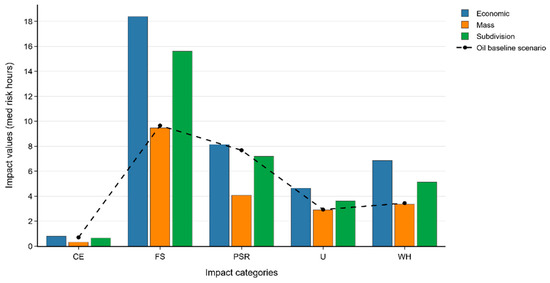
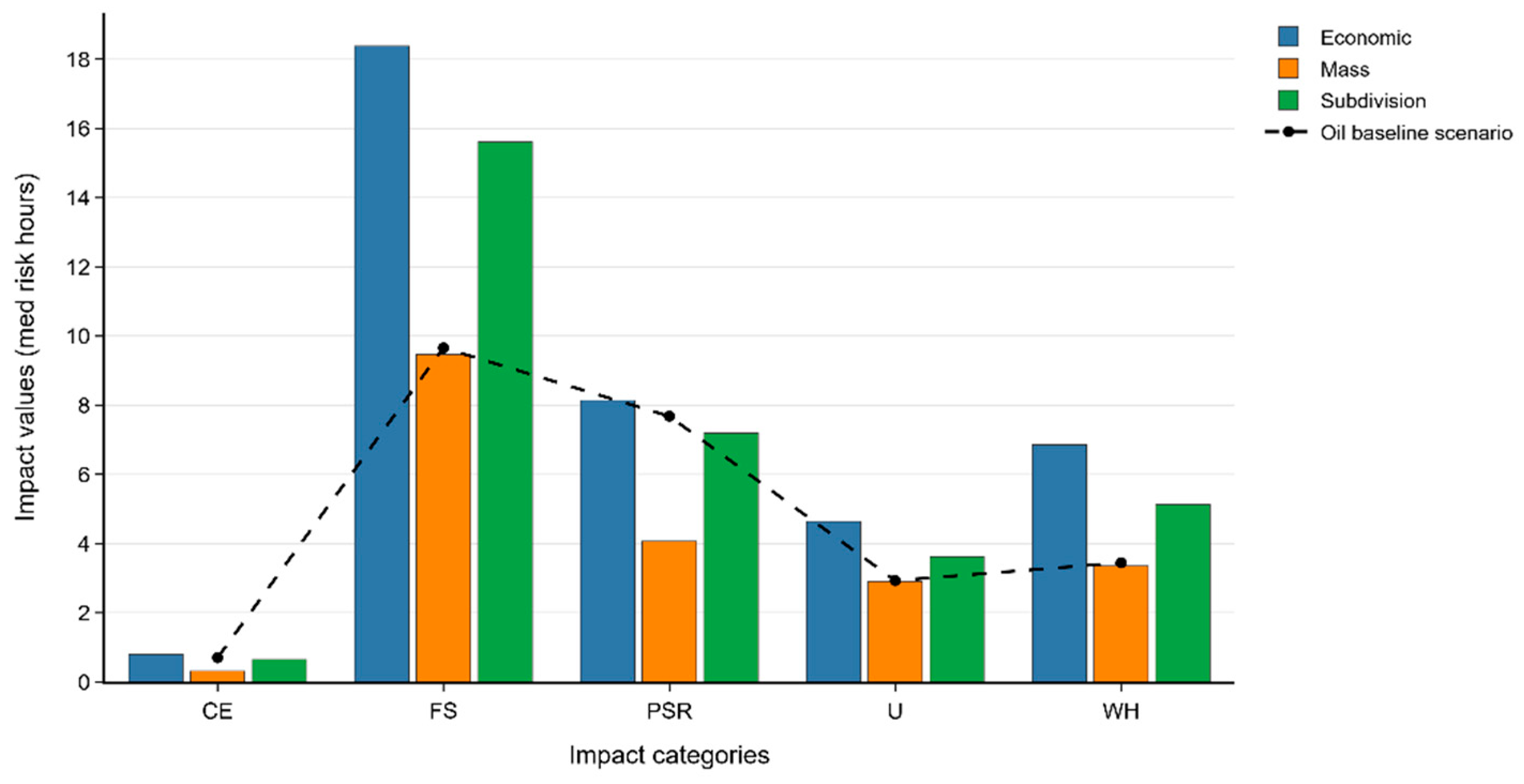
Sensitivity analysis was conducted based on the allocation methods applicable to this product system. Baseline scenario was formulated applying subdivision. Two other scenarios for economic and mass allocation were performed to compare the impact output by different allocation criteria. Figure 4 shows a comparison of LCIA results for the three allocation methods.
Figure 4.
Comparative social impact of avocado oil per allocation method; dotted line represents the average value between the three allocation methods.
The allocation methods highly influence the impact results of avocado oil biorefinery, as observed in Figure 4. As the allocation is a linear multiplier, a similar trend is seen in all evaluated impact categories. Economic allocation provides the highest, quantity-wise, social impacts as avocado oil price is a lot higher than the other co-products. Subdivision follows the second highest allocation method (this is the baseline) and it provides the closest to the average value (dotted line) calculated between the values of the three methods. Therefore, the results might indicate that subdivision allocation is the most balanced between the evaluated approaches. Lastly, mass allocation provides the lowest impact contribution from avocado oil because the impacts get skewed by the relatively high co-products output.
4. Discussion
Few studies have applied S-LCA to avocado oil production. Solarte-Toro et al. [16] evaluated worker and local community categories using raw socio-economic indicators. In contrast, the present study applies a worker-hour-based characterization approach through SIWM, enabling stage-level differentiation and integration with foreground labor modeling. Because Solarte-Toro et al. reported absolute ratios rather than labor-weighted exposure, direct quantitative comparison is limited.
For wage adequacy, Solarte-Toro et al. reported a minimum-to-living wage ratio of 0.72 for their base case, compared to 0.625 in the present study. These values are comparable in magnitude and reflect similar structural wage gaps. Differences are attributable to updated reference years, inflation adjustments, and regional cost-of-living variation. In terms of employment generation, Solarte-Toro et al. estimated six jobs for a small-scale facility, whereas the present industrial-scale configuration assumes ten employees. The difference reflects scale assumptions rather than methodological inconsistency and illustrates how foreground labor modeling directly influences worker-hour scaling in S-LCA.
4.1. Comparative Benchmarking Against Palm Oil
To contextualize results, a Colombia-adjusted palm oil baseline was modeled under consistent functional unit and SOCA characterization assumptions. Figure 5 presents relative differences in medium-risk worker-hour equivalents between the two systems. The comparison reveals systematic structural differences between a mature agro-industrial system (palm oil) and an emerging value chain (avocado oil). Palm oil production in Colombia is characterized by large-scale operations, vertical integration, established labor formalization, and standardized regulatory oversight. These characteristics contribute to lower exposure in wage-related and working-time indicators.
Figure 5.
Comparative social impact of avocado oil production vs. palm oil baseline in Colombia. Baseline values are normalized to 0%; bars represent relative increases or decreases in medium risk hours per impact category.
In contrast, avocado oil production represents a developing agro-industrial segment with smaller-scale upstream suppliers and fewer consolidated institutional structures. As a result, worker-related indicators (FS and WH) show higher exposure in the avocado oil system. For fair salary (FS), avocado oil exhibits approximately double the medium-risk worker-hours (18.38 vs. 9.65). For working time (WH), exposure is similarly elevated (6.86 vs. 3.45). Unemployment-related exposure also differs (4.64 vs. 2.93), reflecting the stronger influence of informal and seasonal labor patterns embedded in agricultural supply chains.
Importantly, contribution to economic development (CE) and promoting social responsibility (PSR) show comparable magnitudes across systems. This suggests that macroeconomic structure and sector-level governance formalization, rather than product type alone, drive differences in worker-related exposure. These findings indicate that differences are not inherent to vegetable oil production as a product category but, rather, to institutional maturity, labor formalization, and supply chain consolidation.
4.2. Methodological Implications for S-LCA of Emerging Biorefineries
The results highlight three methodological insights relevant to S-LCA practice:
- Foreground labor modeling materially influences worker-related indicators. Explicit integration of process simulation labor assumptions (0.0251 h/kg) allows differentiation between process-sensitive and macro-structural indicators.
- Indicator sensitivity varies across social dimensions. Worker-related indicators (WH, FS) respond strongly to operational labor scaling, whereas macro-level indicators (CE, U) are primarily driven by country–sector structure. This distinction is critical for interpreting S-LCA outputs and avoiding overgeneralization.
- Allocation choice affects magnitude but not hotspot ranking. Sensitivity analysis demonstrated that while economic and mass allocation alter absolute worker-hour equivalents, stage-level dominance patterns remain stable. This supports the robustness of hotspot identification in multiproduct biorefineries.
Together, these findings contribute to improving transparency and interpretability of screening-level S-LCA in early-stage biorefinery design. Future research could be oriented toward a matching assessment of avocado oil using a top-down approach. The PSILCA database or similar, with its input–output framework and sectoral data availability across multiple countries, enables a robust platform for such analysis. This methodology would enable comparison of avocado oil production at the sector level, expanding the scope and insights into social risks and opportunities from both country- and industry-wide perspectives. Additionally, the generated socio-economic impact data can be used for further optimization of avocado oil and the approach presented can be applied to biorefinery design, if the goal is to comprehensively address sustainability of emerging bio-based products from a global perspective.
4.3. Limitations and Future Research
This assessment relies on secondary country–sector data from SOCA/PSILCA and therefore represents potential exposure under average sector conditions rather than verified site-specific performance. Indicators such as child labor, forced labor, and occupational health and safety were excluded due to insufficient differentiable data and remaining priorities for future primary data collection. Future research could complement this bottom-up modeling approach with input–output-based S-LCA to assess avocado oil production at the sectoral level. Integration of primary labor surveys and differentiation across alternative thermochemical configurations would further enhance robustness and route-level comparison. Because SOCA/PSILCA relies on country–sector averages, results are subject to statistical aggregation bias, and national labor indicators may underrepresent rural informality and intra-sector heterogeneity in upstream agricultural regions. Accordingly, results should be interpreted as screening-level exposure patterns rather than site-specific social performance measurements.
5. Conclusions
This study applies a screening, prospective social life cycle assessment (S-LCA) to an emerging thermochemical avocado oil biorefinery in Colombia and demonstrates how process-based foreground modeling can be integrated with country–sector social risk databases (SOCA/PSILCA) to identify stage-specific social exposure patterns. By explicitly linking process-simulation-derived labor requirements with worker-hour-based characterization, the assessment differentiates between process-sensitive indicators (e.g., working time, fair salary) and macro-structural indicators (e.g., unemployment, economic contribution), thereby enhancing interpretability beyond descriptive country-level benchmarking. However, it is important to note that the results reflect the interaction between modeled labor demand and pre-existing country–sector risk profiles, rather than empirically validated, site-specific social impacts.
Results indicate that while avocado oil production presents moderate opportunity levels for economic development and governance-related indicators, it exhibits elevated exposure in worker-related dimensions, particularly fair salary and working time. These exposures are concentrated in upstream agriculture and refining stages, reflecting structural characteristics of emerging agro-industrial supply chains rather than isolated operational deficiencies. Comparative benchmarking against a Colombia-adjusted palm oil baseline confirms that differences in social exposure are driven primarily by sector maturity, labor formalization, and supply chain consolidation, rather than by product type alone. Accordingly, these differences should be interpreted as indicative of relative risk exposure under sector-average conditions.
Sensitivity analysis demonstrates that although allocation methodology significantly influences the magnitude of worker-hour equivalents, stage-level hotspot identification remains robust across subdivision, economic, and mass allocation approaches. In addition, uncertainty analysis indicates moderate variability across indicators, with standard deviation values remaining relatively low compared to mean values for most categories. While indicators such as fair salary exhibit higher dispersion due to variability in wage-related parameters, the overall identification of dominant stages remains unchanged, supporting the robustness of hotspot identification within the limits of inventory-based uncertainty. It is noted that this uncertainty reflects variability in the life cycle inventory derived from SOCA/ecoinvent, while uncertainties in characterization models and local operational conditions are not captured.
Beyond the specific case of avocado oil, this study contributes to advancing S-LCA application in bio-based systems by (i) operationalizing materiality-based indicator selection under UNEP/SETAC 2020 guidance [7]; (ii) integrating foreground labor modeling with sector-level social risk profiles; and (iii) explicitly analyzing indicator sensitivity to technological configuration and allocation choices. These contributions are framed within a screening-level approach and should be interpreted as methodological rather than predictive of absolute social performance. These elements strengthen transparency and reproducibility in prospective S-LCA of emerging value chains.
Future work should incorporate primary labor data, expand stakeholder engagement, and compare alternative thermochemical configurations to refine route-level differentiation. Complementary top-down assessments at the sector scale would further enhance robustness. Further methodological development is also needed to better capture uncertainty at the impact assessment level and improve geographical and sectoral resolution. Nonetheless, the present study demonstrates that screening-level S-LCA, when structurally integrated with process modeling, can provide meaningful decision support for socially informed design of emerging bio-based production systems, while acknowledging its limitations in representing context-specific social performance.
Supplementary Materials
The following supporting information can be downloaded at: https://www.mdpi.com/article/10.3390/su18136885/s1, Table S1: Allocation factors; Table S2: LCI for avocado oil subdivision; Table S3: LCI biochar subdivision; Table S4: LCI chlorophyll subdivision; Table S5: LCI avocado and co-products—economic and mass allocation; Table S6: LCI transportation; Table S7: LCI avocado upstream; Table S8: LCIA results avocado oil—base case; Table S9: LCIA comparison base case vs. allocation and baseline scenario.
Author Contributions
Conceptualization, S.M. and A.D.G.-D.; methodology, S.M.; software, A.D.G.-D.; validation, T.H.-R. and A.D.G.-D.; formal analysis, S.M.; investigation, S.M.; resources, T.H.-R. and A.D.G.-D.; data curation, S.M.; writing—original draft preparation, S.M.; writing—review and editing, A.D.G.-D.; visualization, S.M.; supervision, A.D.G.-D.; project administration, T.H.-R. and A.D.G.-D.; funding acquisition, S.M. and A.D.G.-D. All authors have read and agreed to the published version of the manuscript.
Funding
This research and the APC were funded by Ministerio de Ciencia, Tecnologia e Innovacion de Colombia (MINCIENCIAS), through the funding instrument “Posdoctorado Orientado a Misiones” and grant number 096-2024.
Institutional Review Board Statement
Not applicable.
Informed Consent Statement
Not applicable.
Data Availability Statement
Data is available in the supplementary file attached to this manuscript.
Acknowledgments
The authors want to thank Universidad de Cartagena and Ministerio de Ciencia, Tecnologia e Innovacion de Colombia for their support to conduct this research. Ángel Darío González-Delgado thanks Vianny Parejo-Palacio for modeling biorefinery topology in previous studies. All the authors have consented to the acknowledgments.
Conflicts of Interest
Samir Meramo were employed by the company SMH Sustainability Consulting. The remaining authors declare that the research was conducted in the absence of any commercial or financial relationships that could be construed as a potential conflict of interest.
Abbreviations
The following abbreviations are used in this manuscript:
| LCA | Life cycle assessment |
| S-LCA | Social life cycle assessment |
| GDP | Gross domestic product |
| CE | Contribution to economic development |
| LCIA | Life cycle impact assessment |
| LCI | Life cycle inventory |
| FS | Fair salary |
| U | Unemployment |
| WH | Weekly number of hours per employee |
| PSR | Promoting social responsibility |
| PSILCA | Product Social Impact Life Cycle Assessment database |
| SIWM | The Social Impact Weighting Method |
| SOCA | Social impact add-on |
References
- Pollok, L.; Spierling, S.; Endres, H.J.; Grote, U. Social life cycle assessments: A review on past development, advances and methodological challenges. Sustainability 2021, 13, 10286. [Google Scholar] [CrossRef] [Scilit]
- Andreou, N.; Besharov, M. Rethinking how we measure companies on social and environmental impact. MIT Sloan Manag. Rev. 2022, 64, 1–4. [Google Scholar] [CrossRef] [Scilit]
- Food and Agriculture Organization of the United Nations (FAO). FAOSTAT: Crops and Livestock Products (QCL); FAO: Rome, Italy, 2025; Available online: https://www.fao.org/faostat/en/#data/QCL (accessed on 14 August 2025).
- Mora-Sandí, A.; Ramírez-González, A.; Castillo-Henríquez, L.; Lopretti-Correa, M.; Vega-Baudrit, J.R. Persea Americana Agro-Industrial Waste Biorefinery for Sustainable High-Value-Added Products. Polymers 2021, 13, 1727. [Google Scholar] [CrossRef] [Scilit] [PubMed]
- Huertas-Valdivia, I.; Ferrari, A.M.; Settembre-Blundo, D.; García-Muiña, F.E. Social life-cycle assessment: A review by bibliometric analysis. Sustainability 2020, 12, 6211. [Google Scholar] [CrossRef] [Scilit]
- van Haaster, B.; Ciroth, A.; Fontes, J.; Wood, R.; Ramirez, A. Development of a methodological framework for social life-cycle assessment of novel technologies. Int. J. Life Cycle Assess. 2017, 22, 423–440. [Google Scholar] [CrossRef] [Scilit]
- UNEP. Guidelines for Social Life Cycle Assessment of Products and Organizations 2020; UNEP: Nairobi, Kenya, 2020. [Google Scholar]
- García, J.S.A.; Hurtado-Salazar, A.; Ceballos-Aguirre, N. Current overview of Hass avocado in Colombia. Challenges and opportunities: A review. Cienc. Rural. 2021, 51, e20200903. [Google Scholar] [CrossRef] [Scilit]
- Flores, M.; Saravia, C.; Vergara, C.E.; Ávila, F.; Valdés, H.; Ortiz-Viedma, J. Avocado Oil: Characteristics, Properties, and Applications. Molecules 2019, 24, 2172. [Google Scholar] [CrossRef] [Scilit] [PubMed]
- Dreher, M.L.; Davenport, A.J. Hass avocado composition and potential health effects. Crit. Rev. Food Sci. Nutr. 2013, 53, 738–750. [Google Scholar] [CrossRef] [Scilit] [PubMed]
- Berasategi, I.; Barriuso, B.; Ansorena, D.; Astiasarán, I. Stability of avocado oil during heating: Comparative study to olive oil. Food Chem. 2012, 132, 439–446. [Google Scholar] [CrossRef] [Scilit] [PubMed]
- Martínez-Blanco, J.; Lehmann, A.; Muñoz, P.; Antón, A.; Traverso, M.; Rieradevall, J.; Finkbeiner, M. Application challenges for the social Life Cycle Assessment of fertilizers within life cycle sustainability assessment. J. Clean. Prod. 2014, 69, 34–48. [Google Scholar] [CrossRef] [Scilit]
- Sala, S.; Vasta, A.; Mancini, L.; Dewulf, J.; Rosenbaum, E. Social Life Cycle Assessment: State of the Art and Challenges for Supporting Product Policies; European Commission Joint Research Centre: Ispra, Italy, 2015. [Google Scholar]
- Papong, S.; Rewlay-ngoen, C.; Itsubo, N.; Malakul, P. Environmental life cycle assessment and social impacts of bioethanol production in Thailand. J. Clean. Prod. 2017, 157, 254–266. [Google Scholar] [CrossRef] [Scilit]
- Mancini, L.; Eynard, U.; Eisfeldt, F.; Ciroth, A.; Blengini, G.A.; Pennington, D.W. Social Assessment of Raw Materials Supply Chains: A Life-Cycle-Based Analysis; Publications Office of the European Union: Luxembourg, 2018. [Google Scholar] [CrossRef]
- Solarte-Toro, J.C.; Ortiz-Sanchez, M.; Cardona Alzate, C.A. Environmental life cycle assessment (E-LCA) and social impact assessment (SIA) of small-scale biorefineries implemented in rural zones: The avocado (Persea americana var. Americana) case in Colombia. Environ. Sci. Pollut. Res. 2022, 30, 8790–8808. [Google Scholar] [CrossRef] [Scilit] [PubMed]
- Tragnone, B.M.; Serreli, M.; Arzoumanidis, I.; Pelino, C.A.; Petti, L. Using the Product Social Impact Life Cycle Assessment (PSILCA) database for product comparison: Confetti case study. Int. J. Life Cycle Assess. 2023, 28, 1031–1053. [Google Scholar] [CrossRef] [Scilit] [PubMed]
- Safeie-Noghlbari, B.; Amiri, Z.; Allahyari, M.S.; Nikkhah, A.; Ben Hassen, T.; Bacenetti, J. Social life cycle assessment of the olive oil industry: A case study in Guilan Province, Iran. Environ. Dev. Sustain. 2024, 27, 14553–14599. [Google Scholar] [CrossRef] [Scilit]
- Luna Ostos, L.M.; Roche, L.; Coroama, V.; Finkbeiner, M. Social life cycle assessment in the chocolate industry: A Colombian case study with Luker Chocolate. Int. J. Life Cycle Assess. 2024, 29, 929–951. [Google Scholar] [CrossRef] [Scilit]
- Hutchins, M.J.; Robinson, S.L.; Dornfeld, D. Understanding life cycle social impacts in manufacturing: A processed-based approach. Trans. North Am. Manuf. Res. Inst. SME 2013, 41, 629–637. [Google Scholar]
- GreenDelta GmbH. Soca v.2 add-on-Adding Social Impact Information to Ecoinvent; GreenDelta GmbH: Berlin, Germany, 2021. [Google Scholar]
- Herrera, T.; Parejo, V.; González-Delgado, Á. Quality of Energy Conservation in an Avocado Oil Extraction Process Via Exergy Analysis. Chem. Eng. Trans. 2022, 91, 241–246. [Google Scholar] [CrossRef]
- Solarte-Toro, J.C.; Ortiz-Sanchez, M.; Restrepo-Serna, D.L.; Peroza Piñeres, P.; Pérez Cordero, A.; Cardona Alzate, C.A. Influence of products portfolio and process contextualization on the economic performance of small- and large-scale avocado biorefineries. Bioresour. Technol. 2021, 342, 126060. [Google Scholar] [CrossRef] [Scilit] [PubMed]
- Business Research Insights. Palm Oil Market Size, Share|2025 to 2033. Available online: https://www.businessresearchinsights.com/market-reports/palm-oil-market-106744 (accessed on 14 August 2025).
- Trading Economics. Colombia Unemployment Rate. 2025. Available online: https://tradingeconomics.com/colombia/unemployment-rate (accessed on 14 August 2025).
- Hass Avocado Board. Colombia a Young, Explosive Industry in Unique Climatic Conditions. 2022. Available online: https://www.hassavocadoboard.com (accessed on 14 August 2025).
- DANE. DANE—Mercado Laboral. Available online: https://www.dane.gov.co/index.php/comunicados-y-boletines/estadisticas-sociales/mercado-laboral (accessed on 14 August 2025).
- Global Living Wage Coalition. Living Wage for Caribbean Coast of Colombia—Global Living Wage Coalition. Available online: https://www.globallivingwage.org/living-wage-benchmarks/living-wage-for-caribbean-coast-of-colombia/ (accessed on 14 August 2025).
- SalaryExpert. Average Salary in Cartagena, Colombia. Available online: https://www.salaryexpert.com/salary/area/colombia/cartagena (accessed on 14 August 2025).

Disclaimer/Publisher’s Note: The statements, opinions and data contained in all publications are solely those of the individual author(s) and contributor(s) and not of MDPI and/or the editor(s). MDPI and/or the editor(s) disclaim responsibility for any injury to people or property resulting from any ideas, methods, instructions or products referred to in the content. |
© 2026 by the authors. Licensee MDPI, Basel, Switzerland. This article is an open access article distributed under the terms and conditions of the Creative Commons Attribution (CC BY) license.