


Abstract
As uncertainty increases within the aviation industry, the importance of airport sustainability has come to the forefront, necessitating continuous demand generation through strategic aviation marketing. Consequently, there is an urgent need to analyze the practical efficacy of the incentive programs implemented primarily by global airports. In particular, amid intense competition among Northeast Asian airports to attract airlines, this study empirically analyzes the effects of Incheon International Airport’s (ICN) incentive programs on airline supply and passenger demand growth. To this end, utilizing empirical data from ICN spanning 2016 to 2024, this research quantitatively establishes the causal mechanism between incentive programs, supply expansion, and demand growth. Specifically, it comprehensively evaluates the impact of incentives provided for new airline entry and new route expansion, while comparing the effects across different airline business models. The empirical results confirm that the effects vary significantly depending on the type of incentive program and the airline category. Furthermore, the findings indicate that airport incentives are not merely sunk costs, but rather strategic investments that generate measurable aviation demand and airport revenue. However, the analysis also suggests a need to supplement and refine these incentive schemes to tailor them to specific airline types.
1. Introduction
The aviation industry has faced continuous financial pressure in recent years due to rising global uncertainty, and airports are no exception. Profitability has deteriorated due to various external economic shifts, such as international conflicts, fuel price fluctuations, and rising operating costs driven by inflation. This proliferation of uncertainty has brought the importance of airport resilience and sustainability back to the forefront. In particular, the significance of airport marketing, which directly influences airport management and operations, is being re-emphasized to ensure long-term sustainability [1]. Major global airports are actively adopting incentive programs to encourage cooperation between airports and airlines as a marketing tool [2,3,4], thereby strengthening airport-airline connectivity and competitiveness [5,6,7]. The introduction of incentive programs not only affects the achievement of an airport’s strategic goals but also acts as a critical factor influencing flight schedule coordination and airlines’ choice of airports [8].
While incentive programs were historically funded by governments to maintain air services and promote regional development, they have recently been utilized as strategic mechanisms to accelerate route development and airport growth [9,10,11,12]. Airports grant practical landing fee discounts and financial benefits by providing marketing subsidies to airlines, thereby inducing increased flight frequencies and the expansion of new routes. Historically, airport incentive programs have been predominantly concentrated in the United States and Europe; accordingly, existing literature has mostly focused on analyzing US and European cases [7,12,13,14]. Recently, however, intense competition has emerged among major airports in the Northeast Asian region, leading to the refinement and expansion of such incentive programs. Feng et al. [15] analyzed Tokyo Narita Airport (NRT) and demonstrated that incentive programs have a significant positive impact on attracting airlines and expanding routes.
ICN first introduced its incentive program in 2013 and has since updated it every two years. The incentives offered by ICN target new airline entries and new route expansions, providing landing fee waivers and marketing cost support to eligible carriers. Although this incentive framework has been in place for over a decade, empirical analyses regarding its practical ripple effects remain severely lacking. Therefore, this study quantitatively analyzes the efficacy of ICN’s incentive programs, evaluates their appropriateness, and proposes policy improvements. While previous literature has primarily focused on academic contributions, this study aims to offer practical insights to enhance airport sustainability by delivering both academic rigor and actionable policy recommendations.
2. Effects of Airport Incentive Programs
The relationship between supply and demand is not only a primary research domain in economics but also a core element in corporate management, and aviation-related enterprises are no exception. In particular, airports function well beyond mere infrastructure providers; they act as a two-sided platform that connects two distinct user groups: airlines and passengers [16,17]. An intriguing aspect of this dynamic is that airlines play a dual role, serving as suppliers to passengers while acting as consumers (or demanders) to airports. In other words, from the airport’s perspective, new supply is generated through airlines, which are the primary users of the airport.
Airports and airlines share a complementary relationship, fundamentally combining their operations to produce air transport services. The airport (upstream) acts as an infrastructure provider that supplies essential facilities for aircraft takeoff and landing, as well as passenger and cargo handling, such as runways, terminals, and slots [3,18]. Conversely, the airline (downstream) utilizes the services provided by the airport as input factors to deliver transportation services to final consumers, namely travelers and shippers [2]. Generally, vertical integration, where an airport owns an airline, is rare; instead, the structure predominantly involves two independent economic agents cooperating through contractual agreements.
The pricing policy (e.g., airport charges) of the airport as an upstream monopolist exerts asymmetric effects on the competitive dynamics among airlines in the downstream market [18]. Because low-cost carriers (LCCs) target highly price-sensitive passengers and airport charges constitute a significant portion of their total operating costs, they react far more sensitively to changes in airport charges than full-service carriers (FSCs). If an airport raises its fees, LCCs face greater difficulties passing these costs onto airfares, thereby suffering a more severe impact than FSCs. Ultimately, this can lead to weakened competition in the downstream market.
Airports possess dual revenue streams, with aeronautical and non-aeronautical revenue, making the balanced management of both a critical task for overall financial performance. Through incentive schemes such as landing fee discounts, airports deliberately accept a short-term reduction in aeronautical revenue. Instead, they leverage a cross-subsidization mechanism, offsetting this loss with non-aeronautical revenue generated when attracted passengers utilize commercial facilities, such as duty-free shops, food and beverage outlets, and parking. This platform strategy provides a theoretical rationale for airport operators to induce supply expansion by sharing the initial market entry risks of airlines, ultimately maximizing both the overall social welfare of the airport ecosystem and its financial profitability simultaneously.
Barbot [19] reported that providing financial incentives lowers airlines’ cost burdens, thereby positively impacting new demand generation and passenger traffic growth. Supporting this, a regression-based study by Schnitzler [20] demonstrated that airport incentives have a significant positive impact on the seat capacity expansion of LCCs. Allroggen et al. [21] stated that the primary objective of airport incentive programs is to grow the supply scale by expanding airline seats or increasing flight frequencies. They emphasized that the sustainability of supply secured through incentives (i.e., the adhesive effect) enables the long-term maintenance of passenger demand. This phenomenon has also been observed in the work of Malina et al. [22], which focused on the discontinuation of routes after incentives expire. They highlighted that supply sustainability is a prerequisite for maintaining demand, suggesting that supply variables are structurally and tightly linked to passenger demand. Furthermore, Feng et al. [15] analyzed NRT and concluded that incentive programs positively affect new route launches and flight increases, which in turn expands the airport’s network. Based on this previous literature, the following hypotheses are formulated:
H1.
Airport incentive has a significant effect on airline seat capacity.
H2.
Airline seat capacity has a significant effect on passenger traffic.
H3.
Airport incentive has a significant effect on passenger traffic.
H4.
Airport incentive has a significant effect on passenger traffic, mediated by seat capacity.
3. Research Design
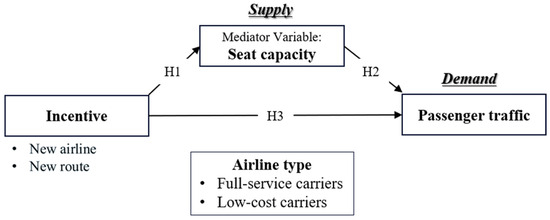
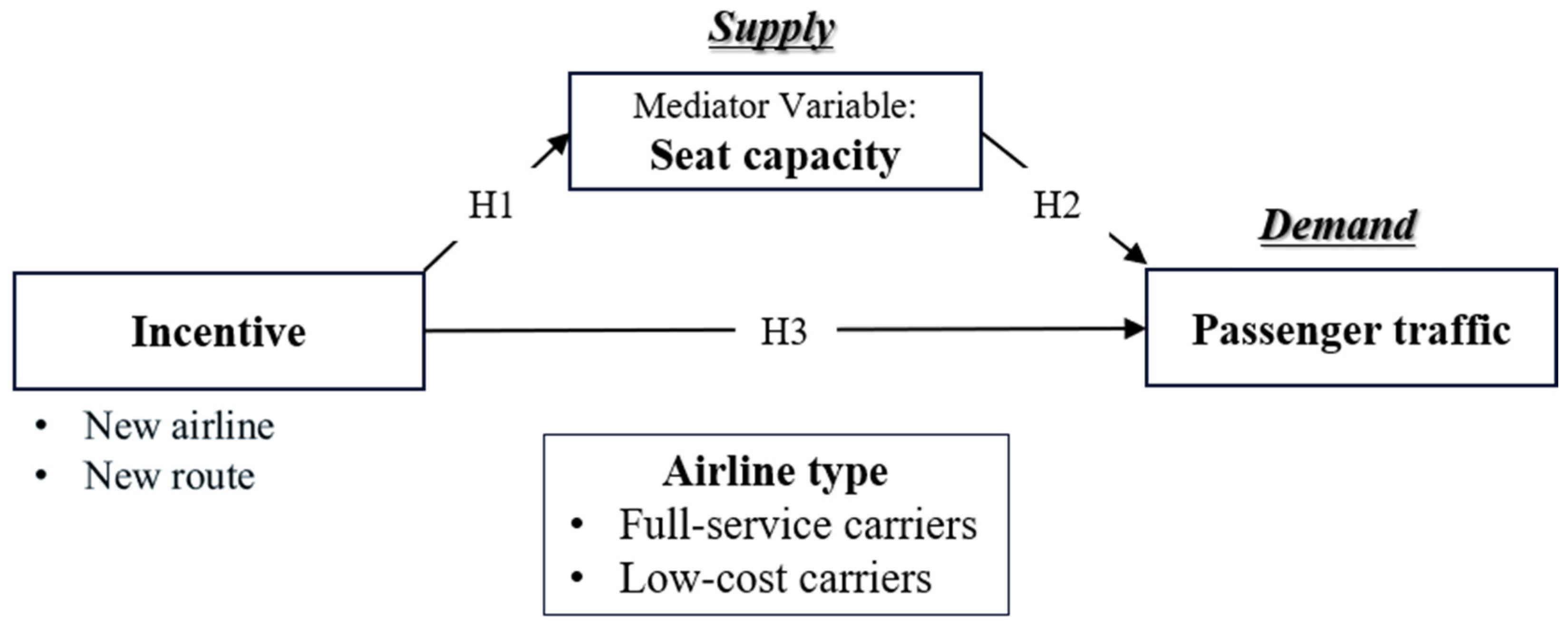
To analyze the effects of airport incentives on airline supply (i.e., seat capacity) and passenger demand (i.e., passenger traffic), a research model was designed as shown in Figure 1. The research model evaluates two distinct incentive schemes implemented at ICN, namely ‘New Airline Entry’ and ‘New Route Expansion’. The incentive for new airline entry is defined as a scheme provided to an airline newly entering an existing route already operated by other carriers. In contrast, the incentive for new route expansion applies to airlines launching services on a route that did not previously exist at ICN. Furthermore, referencing Schnitzler’s [20] finding that airport incentives are particularly effective for LCC route development, this study divides airlines into two groups: LCCs and FSCs. This categorization is based on the assumption that the effects of incentive programs may differ between LCCs and FSCs, and aims to comparatively analyze these differences.
Figure 1.
Research model.
Empirical data on ICN’s incentive disbursements and airline performance statistics spanning the 2016–2024 period were employed to validate the hypotheses (H1–H4). The aviation statistics consist of aggregated data capturing seat capacity and passenger traffic for all inbound and outbound flights. These disbursement records were subsequently integrated with the aviation statistics by aligning corresponding airlines and routes throughout the incentive period.
To analyze the impact of airport incentives on airline supply and passenger demand, the scope of the study was limited exclusively to passenger airlines. This limitation ensures research validity and addresses the heterogeneity in market structures and operational characteristics between the passenger and cargo markets, as well as policy concentration [16,22,23]. The scope of airlines subject to the incentive programs includes 20 airlines across 21 routes for the “New Airline Entry” category, and 9 airlines across 11 routes for the “New Route Expansion” category (Table 1).
Table 1.
Applicable airlines.
The collected data were analyzed using path analysis to evaluate model fit, analyze correlations, and conduct multi-group analysis to test the hypotheses. Specifically, path analysis was applied instead of structural equation modeling (SEM) because the study strictly examines the direct relationships between observed variables. This approach enhances the parsimony of model interpretation, ensures computational efficiency, and more effectively validates the empirical soundness of the hypotheses.
4. Empirical Analysis
4.1. Incentive Schemes for New Airline Entry
To verify the effectiveness of the incentive scheme applied to new airline entries, a comparative analysis was conducted by categorizing the carriers based on their business models into FSCs and LCCs. Consequently, a multi-group analysis was performed to test the equality of path coefficients between the FSC and LCC groups. A comparison between the unconstrained model and the structural weights model revealed a statistically significant difference in the χ2 values between the two models (Δχ2 = 35.202, Δdf = 3, p < 0.001), confirming that the path coefficients vary significantly between FSCs and LCCs. Due to the limited sample size utilized in this study, the RMSEA was 0.223, exceeding the conventional threshold of 0.08. However, the NFI (0.914) and IFI (0.921)—which are relatively less sensitive to sample size—satisfied the recommended threshold of 0.90, thereby validating the overall model fit [24]. Since structural differences between the groups were confirmed through the multi-group path analysis, a Z-test for group differences in unstandardized path coefficients was additionally conducted following the methodology of Paternoster et al. [25] to scrutinize variations across individual paths. The Z-test results indicated statistically significant differences between FSCs and LCCs in the path from incentives to seat capacity (Z = 1.992, p < 0.05) and the path from incentives to passenger traffic (Z = 5.758, p < 0.001). Conversely, no significant difference was observed between the two groups regarding the path from seat capacity to passenger traffic (Z = 1.525, p > 0.05).
An indirect effect test was conducted by establishing seat capacity as a mediator in the relationship between incentives for new airline entry and passenger traffic. The significance of the derived indirect effect was verified through a bootstrapping procedure with 5000 resamples [26]. Following Hayes [27], the significance of the indirect effect was determined based on whether the 95% bias-corrected confidence interval (CI), demarcated by the lower and upper bounds, excluded zero. The indirect effect analysis for FSCs revealed that seat capacity (B = 145.605) exhibited a statistically significant partial mediating effect at the p < 0.001 level, as the confidence interval spanning from the lower to upper bounds (101.239 to 193.645) did not contain zero. This implies a structural mechanism whereby incentives exert an indirect influence on passenger traffic through the partial mediation of seat capacity. The total effect was 176.907 (LLCI: 132.618, ULCI: 225.887) (Table 2). Conversely, the indirect effect analysis for LCCs demonstrated that the mediating effect of seat capacity was not statistically significant, given that the p-value for the indirect effect along the path from incentives to passenger traffic was 0.623 (Table 3).
Table 2.
Results of a hypothesis test on FSC under the new airline entry incentive schemes.
Table 3.
Results of a hypothesis test on LCC under the new airline entry incentive schemes.
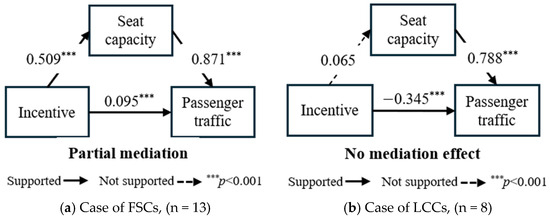
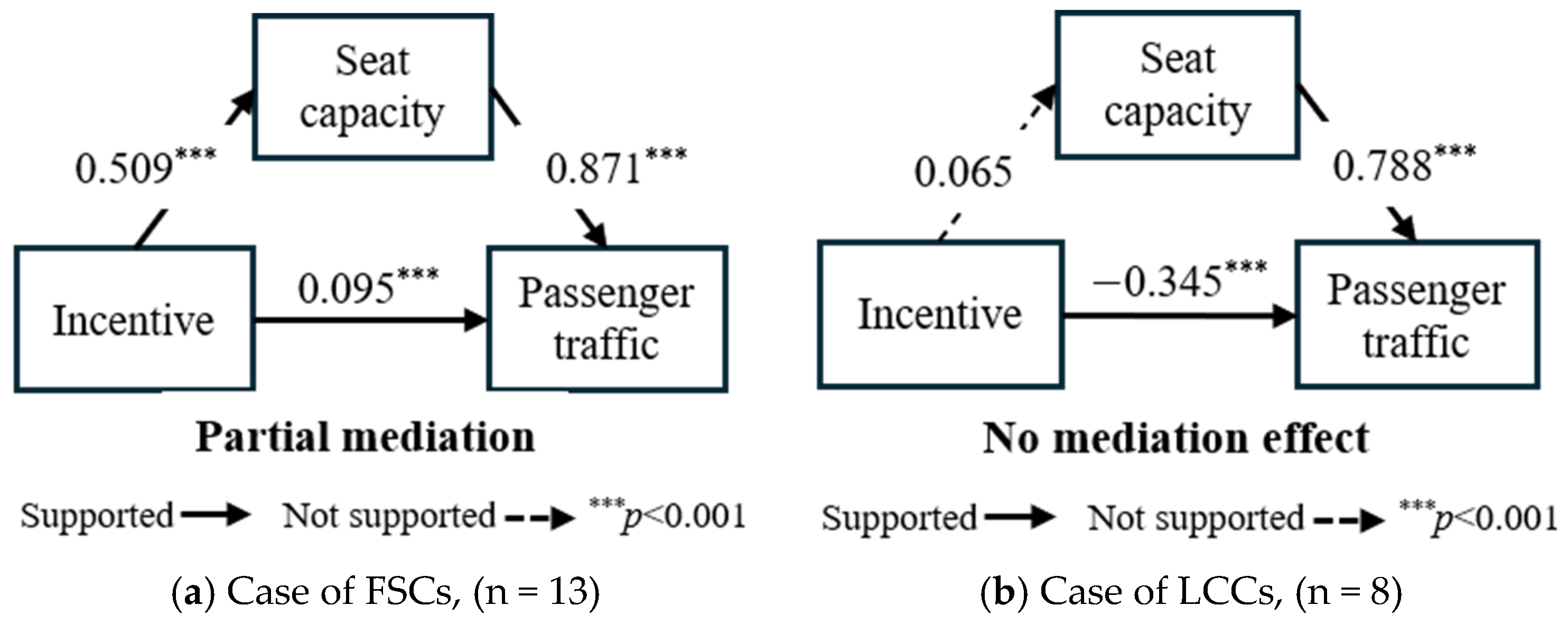
For the FSC group, which comprised 13 new entering airlines, the effect of incentives on seat capacity (β = 0.509, C.R. = 7.208, p < 0.001) and the effect of seat capacity on passenger traffic (β = 0.871, C.R. = 23.696, p < 0.001) were both highly significant. Additionally, the direct effect of incentives on passenger traffic (β = 0.095, C.R. = 2.593, p < 0.05) was also confirmed to be significant. This demonstrates that for FSCs, incentive disbursements generate a direct passenger demand-inducing effect alongside an indirect pathway where incentives increase passenger traffic via the expansion of seat capacity (Figure 2a). On the other hand, the LCC group included 8 new entering airlines; while the effect of seat capacity on passenger traffic (β = 0.788, C.R. = 11.856, p < 0.001) was significant, the effect of incentives on seat capacity (β = 0.065, C.R. = 0.535) was statistically non-significant. Meanwhile, the direct effect of providing incentives on passenger traffic was significantly negative (β = −0.345, C.R. = −5.186, p < 0.001). This confirms that for LCCs, incentives do not successfully drive seat capacity expansion and instead exert a negative direct effect on passenger traffic (Figure 2b).
Figure 2.
Multigroup analysis of the effects of incentives for new airline entry.
This unexpected outcome for LCCs stems from a demand cannibalization phenomenon where the entry of a new LCC shifts existing passenger volume away from incumbent LCCs rather than generating entirely new market demand. For newly entering LCCs, incentive benefits offer a short-term effect of expanding initial market share through aggressive airfare discounting. However, as incumbent LCCs subsequently downscale or exit the route, the overall scale of total seat capacity reverts to a baseline maintenance level rather than achieving net growth. Because no substantial new demand is created and existing traffic merely shifts, the long-term effectiveness of the incentive scheme remains heavily constrained. This is evidenced by the Incheon–Ningbo route operated by Air Busan and Spring Airlines. In November 2019, Air Busan entered the Ningbo route utilizing ICN’s incentives and aggressively expanded its market presence. It sustained a 75% market share until Spring Airlines entered in October 2020, after which Air Busan’s share fell to 36%, leading to the suspension of its flights in March 2021. Beyond the loss of market share, Air Busan’s average load factor deteriorated from an initial 79.6% to 64.3% in 2020, and down to 24.4% in 2021. Meanwhile, Spring Airlines’ market share grew from 25% (2020) to 64% (2021), and its average load factor rose from 20.7% (2020) to over 70% (2021), confirming that Air Busan’s demand shifted to Spring Airlines. Similar cases can be observed with Aero K on the Incheon–Narita route and Air Premia on the Incheon–Singapore route. Corroborating this trend, only 37.5% of the LCCs that received incentive support from ICN continue to operate flights at the airport today. In contrast, while new FSCs require a relatively longer period to stabilize in the market, they were found to successfully stimulate and generate genuine new market demand.
A synthesis of the results from the multi-group path analysis and Z-test analysis of incentives provided to new entrants reveals that airline type plays a significant moderating role in the incentive effect pathways. In particular, there were marked differences between FSCs and LCCs in both the direction and magnitude of the direct effect of incentives on passenger traffic. For FSCs, the provision of incentives had a positive effect on the increase in available seat capacity (H1 is accepted), and the increase in available seat capacity was found to have a positive effect on the increase in passenger traffic (H2 is accepted). Furthermore, since the provision of incentives was found to have a positive effect on the increase in passenger traffic, H3 is also accepted (Table 2). In contrast, for LCCs, no significant results were found regarding the effect of incentive provision on the increase in available seat capacity (H1 is rejected), but the increase in available seat capacity was found to have a positive effect on the increase in passenger traffic (H2 is accepted). It was also found that incentive provision had a negative effect on the increase in passenger traffic (H3 is accepted) (Table 3).
4.2. Incentive Schemes for New Route Expansion
To evaluate the effectiveness of the incentive program applied to new route expansions, a comparative analysis was performed by grouping the data by airline type, matching the approach used for the new airline entry incentives. The results indicated a significant χ2 difference between the unconstrained model and the structural weights model (Δχ2 = 9.225, Δdf = 3, p < 0.05) confirming that statistically significant differences exist in the path coefficients between FSCs and LCCs. Due to a restricted sample size in the case of new route expansions, the RMSEA was 0.138, exceeding the 0.08 threshold. Nevertheless, the remaining fit indices (NFI = 0.977, IFI = 0.984, TLI = 0.969) demonstrated a relatively higher model fit compared to the previously discussed new airline entry incentive model. Given that structural differences between the groups were confirmed for new route expansions as well, an additional Z-test was conducted to scrutinize specific group variations. The Z-test results showed that the path from incentives to seat capacity (Z = 1.901, p > 0.05) and the path from incentives to passenger traffic (Z = 1.567, p > 0.05) exhibited no significant differences between the two groups. In contrast, a statistically significant difference was found between the groups regarding the path from seat capacity to passenger traffic (Z = −2.438, p < 0.001).
An indirect effect test was conducted by specifying seat capacity as a mediator in the relationship between incentives for new route expansion and passenger traffic. The significance testing for the derived indirect effect followed the exact same bootstrapping procedure applied to the case of new airline entry. Regarding the indirect effect analysis, which delineates the path from incentives to passenger traffic via seat capacity, the results for FSCs indicated that seat capacity (B = 348.103) exerted a statistically significant full mediating effect at the p < 0.001 level, as the 95% confidence interval (CI), bounded by the lower limit of 100.99 and the upper limit of 550.562, did not include zero. This suggests a structural mechanism in which incentives indirectly influence passenger traffic through the full mediation of seat capacity. The total effect was 374.374 (LLCI: 118.355, ULCI: 594.129) (Table 4). In the case of LCCs, the mediating effect of seat capacity within the relationship between incentives and passenger traffic was also statistically significant at the p < 0.001 level, with the 95% confidence interval ranging from a lower bound of 157.155 to an upper bound of 226.797, thereby excluding zero (Table 5). Furthermore, the direct effects of incentives on both seat capacity and passenger traffic were found to be statistically significant. This demonstrates that incentives simultaneously trigger a direct inducement effect on passenger traffic alongside the indirect pathway driven by the expansion of seat capacity. Comparing the outcomes of the two groups reveals a meaningful commonality: both FSCs and LCCs exhibit a significant indirect pathway through which incentives influence passenger traffic via seat capacity. However, for LCCs, the direct effect of incentives on passenger traffic was also significant. This confirms that the efficacy of the incentive policy for LCCs manifests through more diverse pathways relative to FSCs.
Table 4.
Results of a hypothesis test on FSC under the new route expansion incentive schemes.
Table 5.
Results of a hypothesis test on LCC under the new route expansion incentive schemes.
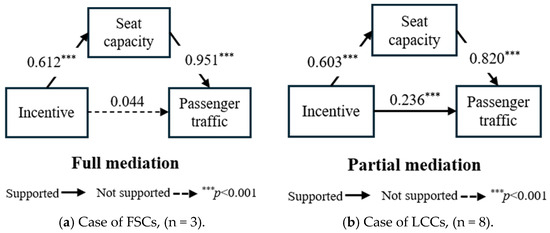
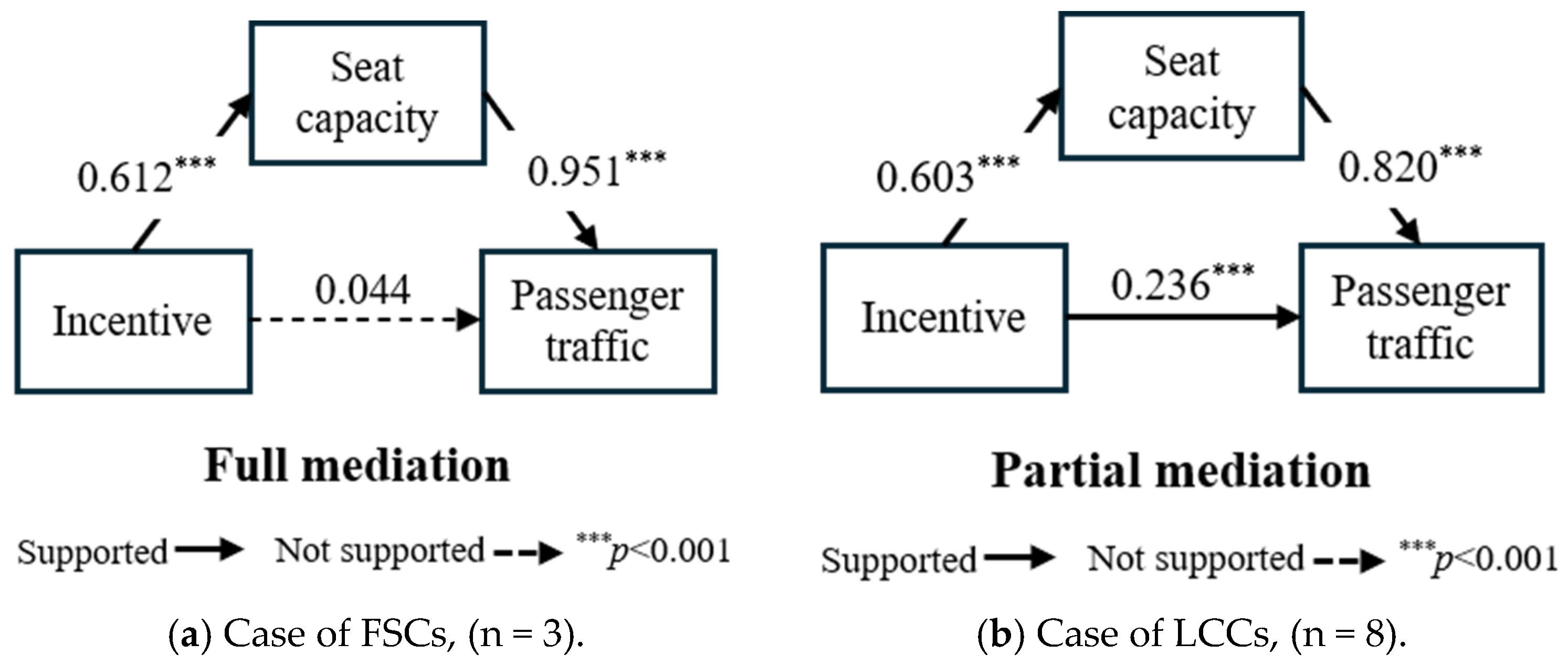
The number of FSCs that received incentives for launching new routes was limited to three, representing a smaller group of beneficiaries compared to other incentive schemes. This disparity arises because FSCs, unlike LCCs, tend to exercise greater caution when introducing new routes, meticulously evaluating the potential for sustained demand generation. Although the number of airlines was small, the duration of the incentive support was relatively extensive; for instance, Air China received incentives benefits for 24 months. This longitudinal data provided a sufficient sample size for the analysis, thereby mitigating potential statistical errors. Reflecting this robustness, the results indicate that for FSCs, the effect of incentives on seat capacity (β = 0.612, C.R. = 5.138, p < 0.001) and the effect of seat capacity on passenger traffic (β = 0.951, C.R. = 24.395, p < 0.001) were both highly significant. Conversely, the direct effect of incentives on passenger traffic (β = 0.044, C.R. = 1.126) was found to be statistically non-significant. This indicates that when FSCs launch new routes, only the indirect pathway—wherein incentives expand seat capacity, thereby driving passenger traffic—remains valid (Figure 3a). On the contrary, for LCCs operating on 8 new routes, the effect of incentives on seat capacity (β = 0.603, C.R. = 6.091, p < 0.001), the effect of seat capacity on passenger traffic (β = 0.820, C.R. = 27.233, p < 0.001), and the direct effect of incentives on passenger traffic (β = 0.236, C.R. = 7.852, p < 0.001) were all statistically significant. This implies that for LCC new route expansions, the provision of incentives concurrently triggers an indirect effect via seat capacity expansion alongside a direct stimulating effect on passenger traffic. Comparing the outcomes of the two groups, both FSCs and LCCs share a significant commonality in the indirect path running from incentives to seat capacity to total passengers. However, LCCs also displayed a significant direct effect of incentive payouts on passenger demand growth, whereas FSCs did not (Figure 3b).
Figure 3.
Multigroup analysis of the effects of incentives for new route expansion.
This discrepancy is attributed to the fundamental differences in operating cost structures between LCCs and FSCs. In the case of LCCs, their relatively lower cost base allowed them to offset a significant portion of their operational expenditures through the incentives provided to carriers. Particularly during route expansion, entering low-demand markets posed fewer difficulties for LCCs, as the absence of incumbent airlines eliminated competitive pressures. Conversely, due to their higher operating cost structures, FSCs found it challenging to establish a sustainable presence within a short timeframe when entering low-demand markets, even in the absence of pre-existing competition. This phenomenon is evidenced by the cases of China Southern Airlines and Philippine Airlines, which launched routes from Incheon International Airport to Guiyang Longdongbao Airport and Puerto Princesa Airport, respectively. Although the lack of incumbent operators suggested potential for new market creation, the actual traffic volume on both routes proved insufficient to sustain FSC operations. Ultimately, these findings imply that for new route expansions, airport-provided incentives offer only limited utility to FSCs, highlighting the inherent constraints of stimulating demand in nascent markets.
A synthesis of the results from the multi-group path analysis and Z-test analysis of incentives provided for new route expansion indicates that airline type did not show a significant difference in the incentive effect path. However, a marked difference was observed between FSCs and LCCs in both the direction and magnitude of the direct effect of incentives on passenger traffic. For FSCs, the provision of incentives had a positive effect on the increase in available seat capacity (H1 is accepted), and the increase in available seat capacity was found to have a positive effect on the increase in passenger traffic (H2 is accepted). On the other hand, no significant results were obtained regarding the effect of incentive provision on the increase in passenger traffic; therefore, H3 is rejected. For LCCs, the provision of incentives had a positive effect on the increase in available seat capacity (H1 is accepted), and the increase in available seat capacity was found to have a positive effect on the increase in passenger traffic (H2 is accepted). Furthermore, the analysis showed that the provision of incentives also had a positive effect on the increase in passenger traffic (H3 is accepted) (Table 3).
5. Conclusions
Previous studies on the effects of incentives have focused primarily on airports in Europe and the United States, with the majority employing correlation or regression analysis. Accordingly, this study utilized path analysis to examine the causal relationship between incentives and airline supply and passenger demand using actual data from ICN, a representative airport in Northeast Asia. The results showed that the path from the airport’s incentives to an increase in airline seat supply was statistically significant, supporting the notion that the airport’s incentives have a substantial impact on airlines’ operational decisions. Conversely, the structural pathways for generating passenger demand varied depending on the type of incentive. This implies that the airport’s incentive system should be differentiated based on the type of incentive and the type of airline. This highlights the limitations of the current system, which provides incentives uniformly without differentiation based on incentive type or airline type, and suggests that maintaining the current system will yield minimal positive effects on increasing passenger demand.
Incentives provided to entry of new airlines were found to drive passenger demand indirectly—through the expansion of airline supply—rather than directly. This suggests that, in the early stages of a new airline’s market entry, the stable establishment of supply is a prerequisite for demand growth. This reaffirms that the focus of incentive program design should be on establishing a sustainable operational foundation for airlines rather than on generating short-term demand. However, analysis indicates that stable supply is not being achieved in the case of LCCs; specifically, it was found that when new LCCs receiving incentives launch service, existing LCCs are exiting the market. In particular, it was considered that this is because existing LCCs are at a disadvantage in price competition with new airlines once incentive support is discontinued. In other words, in addition to the current financial support centered on landing fee reductions, establishing structural conditions that ensure operations can continue even after the incentives end—through joint marketing support between airports and airlines—is a key task for guaranteeing the long-term effectiveness of the system.
Analysis shows that incentive support provided for the expansion of new routes has a significantly positive impact on airlines’ capacity expansion and passenger demand growth. However, the analysis indicates that, compared to LCCs, the effect of such support on passenger demand growth is minimal for FSCs. This is because markets with sufficient passenger demand (tourism and business) to support direct flights from ICN are already served primarily by FSCs. Conversely, markets for routes which have not previously been served have relatively insufficient passenger demand and require the development of new potential demand. In other words, for FSCs, which have a relatively high operating cost structure, there are limits to how much incentive support can offset operating costs; therefore, launching new routes in markets requiring the development of potential demand inevitably carries risks. As evidence of this, 72.7% of airlines receiving incentive support for new route expansion are LCCs. This empirically demonstrates that airport incentives have a more significant impact on route development decisions made by LCCs, which are sensitive to operating costs. These results indicate that when designing incentives for new route expansion, it is necessary to reflect the airlines’ cost structures and the characteristics of route development. This suggests that increasing the initial landing fee reduction rate and introducing a phased support structure linked to operational performance can enhance policy effectiveness. Furthermore, such a system can establish itself as a policy tool that helps airport operators achieve two policy objectives—ensuring network diversity and expanding passenger demand—in an integrated manner.
The concept of return on investment (ROI) was applied to evaluate the effectiveness of the ICN incentive program. For the analysis of the ROI, the investment costs were calculated based on the amount of incentives paid by airports, and the investment returns were calculated based on the airport service charges paid by passengers. In other words, the airport’s incentives were conceptualized as strategic investment costs for revenue generation, whereas the passenger demand stimulated by these incentives was approached as investment returns realized through passenger airport service fees. For FSCs that received incentives for launching operations as a new airline, the average ROI was found to be 228.9%, with all carriers except Saudia (−27.4%) generating positive investment returns. The airlines exhibiting the highest returns were Qingdao Airlines (518.9%), followed by Batik Air (352.5%) and Hong Kong Airlines (331.9%). In the case of LCCs, the average ROI stood at 200.1%, and no carrier failed to yield a positive investment return. The top-performing LCCs in terms of returns were Tigerair Taiwan (673.9%), Air Busan (551.4%), and Air Seoul (465.2%). Meanwhile, for FSCs receiving incentives for introducing new routes, the average ROI was 362.4%; Philippine Airlines exhibited the highest ROI at 467.8%, outperforming Air China (366.1%) and China Southern Airlines (279.5%). For LCCs on new routes expansion, the average ROI reached 393.5%, with VietJet Air having the highest ROI at 607.8%. These findings demonstrate that airport-provided incentives are not merely ambiguous expenses but rather justifiable investment costs capable of generating substantial revenue. Furthermore, the analysis reveals that airport investment returns vary substantially depending on the type of incentive scheme and the airline’s business model, with new route launches yielding particularly high financial returns. This underscores the necessity of implementing differentiated incentive mechanisms tailored to specific incentive programs and airline categories.
While airport incentive support primarily aims to increase revenue through demand generation, its ultimate purpose extends beyond short-term effects to ensure the continuous maintenance of routes and airline operations even after the subsidy period concludes. This implies that evaluations must account not only for immediate financial returns but also for route and carrier retention. Accordingly, “route retention” is defined as a state in which a route continues to operate autonomously without external subsidies after the termination of incentive support. Retention is deemed successful if the route is continuously maintained post-incentive for a duration equal to or exceeding the period during which it received financial support. Under the new airline entry incentive program, 18 out of 21 routes were successfully retained, yielding a retention rate of 85.7%. For the new route expansion incentive program, 9 out of 11 routes achieved retention, representing an 81.8% retention rate. This indicates that a significant majority of routes established a self-sustaining operational foundation even after the cessation of financial incentives, confirming that incentive schemes contribute not only to short-term demand attraction but also to mid-to-long-term route stabilization. However, the relatively lower retention rate observed in the new route expansion incentive program suggests a pressing need for structural improvements in incentives targeting new route developments.
Currently, ICN’s incentive scheme applies a uniform support framework based on seat capacity (e.g., a mechanism where higher subsidies are allocated for greater seat capacity) for newly entering airlines and routes. While this conventional approach has achieved a baseline level of success in attracting new carriers and developing novel routes, formulating a more effective optimization plan requires shifting toward a differentiated payout model aligned with specific airline profiles. To achieve this differentiation, this study proposes three core factors: (1) ROI, (2) route retention, and (3) stage-length (flight distance) system. First, incorporating ROI entails allocating higher incentives to airlines that effectively contribute to the airport’s financial performance. From an airport operations perspective, increases in seat capacity expand investment costs, whereas passenger demand drives investment returns; thus, an increase in the average load factor inherently enhances the ROI. Consequently, differentiating incentives based on the average load factor would enable the airport to effectively secure and optimize its financial performance. Second, regarding route retention, carriers introducing new routes face minimal inter-airline competition, allowing for immediate short-term demand capture; however, establishing sustained, long-term demand requires a longer gestation period. This necessitates augmenting conventional landing-fee-centered incentives with supplementary airline marketing funds, thereby extending continuous support for a minimum of 12 months. This approach would incentivize the expansion of network coverage over simple frequency additions on existing routes, prevent destructive cannibalistic competition among airlines, and stimulate net-new demand across the entire airport ecosystem. Finally, a distance-based differential scheme modifies the existing seat-capacity-oriented payouts by integrating flight distance, thereby alleviating the financial burden imposed on airlines operating long-haul routes. To counter the current strategic threat of decelerating growth in long-haul capacity at ICN, this study proposes a tiered support mechanism based on a great-circle distance threshold of 6000 km. Because long-haul routes utilize wide-body aircraft that substantially contribute to total available seat capacity, the airport can maximize its aggregate revenue through passenger-driven commercial (non-aeronautical) revenues, even if it discounts a portion of its aeronautical revenues.
The refinement and strategic management of airport incentive schemes extend far beyond short-term aeronautical revenue derived from new airline recruitment and route development; rather, they serve as an indispensable pillar for the long-term sustainability of the airport. From an economic perspective, sharing the initial financial risks of airlines encourages capacity expansion, which in turn acts as a catalyst for supply-induced demand that stimulates latent market segments. In essence, the airport’s incentive program functions as a strategic investment cost that directly drives the generation of robust investment returns. From a social perspective, the introduction of new airlines and routes reinforces the airport’s primary function as a global hub facilitating the exchange of people, goods, and information. This, in turn, fosters a virtuous cycle that actively contributes to regional development and national economic growth. Therefore, achieving comprehensive airport sustainability must be realized through the rigorous optimization and continuous management of effective incentive schemes.
This study analyzes the impact of airport incentive schemes, utilized as strategic marketing tools, on airline seat capacity and passenger traffic. In terms of theoretical contributions, first, while existing literature has primarily focused on correlation analysis, this study employs causal analysis to identify precise causal relationships and delineates the specific pathways through which incentives influence seat capacity and passenger traffic. Notably, it differentiates itself from previous literature by examining the mediating effect of seat capacity. Second, whereas prior research on airport incentives has predominantly focused on North American and European airports, this study shifts the geographical focus to Northeast Asia, a region characterized by intense hub competition to attract airlines. Specifically, it explores a new market context by utilizing empirical data from ICN spanning from 2016 to 2024. Furthermore, regarding practical contributions, first, this study categorizes incentive schemes by type and distinguishes between airline types to analyze variations in incentive effectiveness across segmented groups. Second, by integrating the concepts of return on investment (ROI) and route retention, it proposes strategic measures to enhance ICN’s incentive system. Collectively, these efforts distinguish this study from existing literature, offering substantial academic insights and practical utility.
While this study provides meaningful theoretical and practical contributions, certain limitations must be acknowledged. The first limitation lies in the constrained control over external confounding variables. Although major exogenous shocks, such as the pandemic, international conflicts, and oil price fluctuations, were incorporated into the model as dummy variables, they did not yield statistically significant effects. Consequently, the results were derived under the assumption that these external factors exerted no substantial influence, underscoring the need for future research to more comprehensively account for complex external variables. Second, the incentives offered by ICN were segmented by program and airline type, resulting in a limited number of eligible airlines in each subgroup. Specifically, the number of sample airlines receiving incentive benefits consisted of 13 FSCs and 8 LCCs for new airline entry, and 3 FSCs and 8 LCCs for new route expansion. Although the extended duration of incentive provision enabled the derivation of statistically significant results, generalizing these findings to other Northeast Asian airports remains constrained. Consequently, the scope of this study is confined to the impact analysis of ICN’s specific incentive framework. This highlights the necessity for future research to utilize more cumulative datasets to conduct further studies that can generalize the findings to the broader Northeast Asian airport context.
Author Contributions
Conceptualization, Y.-J.C. and J.K.C.; methodology, Y.-J.C.; software, J.-S.K.; validation, J.K.C.; formal analysis, Y.-J.C.; investigation, Y.-J.C. and J.K.C.; resources, J.-S.K.; data curation, Y.-J.C.; writing—original draft preparation, Y.-J.C.; writing—review and editing, J.K.C.; visualization, J.-S.K.; supervision, J.K.C. All authors have read and agreed to the published version of the manuscript.
Funding
This research received no external funding.
Institutional Review Board Statement
Not applicable.
Informed Consent Statement
Not applicable.
Data Availability Statement
The data is unavailable due to privacy.
Conflicts of Interest
Author, Jun-Seok Kim, is employed by Incheon International Airport Corporation. The remaining authors declare that the research was conducted in the absence of any commercial or financial relationships that could be construed as a potential conflict of interest.
Abbreviations
The following abbreviations are used in this manuscript:
| 7C | Jeju Air |
| 8M | Myanmar Airways International |
| 9C | Spring Airlines |
| AM | Aeroméxico |
| BI | Royal Brunei Airlines |
| BX | Air Busan |
| CA | Air China |
| CZ | China Southern Airlines |
| HB | Greater Bay Airlines |
| HU | Hainan Airlines |
| HX | Hong Kong Airlines |
| IT | Tigerair Taiwan |
| LJ | Jin Air |
| LO | LOT Polish Airlines |
| OD | Batik Air Malaysia |
| PR | Philippine Airlines |
| QF | Qantas |
| QH | Bamboo Airways |
| QW | Qingdao Airlines |
| R3 | Yakutia Airlines |
| RF | Aero K |
| RS | Air Seoul |
| SV | Saudia |
| UL | SriLankan Airlines |
| VJ | VietJet Air |
| YP | Air Premia |
| ZE | Eastar Jet |
| ZG | Zipair Tokyo |
| BWN | Brunei International Airport |
| CMB | Bandaranaike International Airport |
| DAD | Da Nang International Airport |
| DLC | Dalian Zhoushuizi International Airport |
| DLI | Lien Khuong International Airport |
| DYG | Zhangjiajie Hehua International Airport |
| EWR | Newark Liberty International Airport |
| HKG | Hong Kong International Airport |
| HPH | Cat Bi International Airport |
| IBR | Ibaraki Airport |
| ICN | Incheon International Airport |
| JED | King Abdulaziz International Airport |
| KKJ | Kitakyushu Airport |
| KUL | Kuala Lumpur International Airport |
| KWE | Guiyang Longdongbao International Airport |
| LYI | Linyi Qiyang International Airport |
| MEX | Mexico City International Airport |
| NGB | Ningbo Lishe International Airport |
| NRT | Narita International Airport |
| NTG | Nantong Xingdong International Airport |
| PPS | Puerto Princesa International Airport |
| RGN | Yangon International Airport |
| SIN | Changi Airport |
| SYD | Sydney Kingsford Smith Airport |
| TAK | Takamatsu Airport |
| TAO | Qingdao Jiaodong International Airport |
| TPE | Taiwan Taoyuan International Airport |
| VCA | Can Tho International Airport |
| WAW | Warsaw Chopin Airport |
| WNZ | Wenzhou Longwan International Airport |
| YKS | Platon Oyunsky Yakutsk International Airport |
References
- Graham, A. Airport planning and regulation in the United Kingdom. In Aviation Infrastructure Performance: A Study in Comparative Political Economy; Winston, C., de Rus, G., Eds.; Brookings Institution Press: Washington, DC, USA, 2008; pp. 100–135. [Google Scholar]
- Fu, X.; Homsombat, W.; Oum, T.H. Airport–airline vertical relationships, their effects and regulatory policy implications. J. Air Transp. Manag. 2011, 17, 347–353. [Google Scholar] [CrossRef] [Scilit]
- Oum, T.H.; Fu, X. Impacts of Airports on Airline Competition: Focus on Airport Performance and Airport-Airline Vertical Relations; OECD/ITF Joint Transport Research Centre Discussion Paper No. 2008-17; Organisation for Economic Co-Operation and Development (OECD): Paris, France, 2008. [Google Scholar]
- Saraswati, B.; Hanaoka, S. Airport–airline cooperation under commercial revenue sharing agreements: A network approach. Transp. Res. Part E Logist. Transp. Rev. 2014, 70, 17–33. [Google Scholar] [CrossRef] [Scilit]
- Halpern, N. Airport Marketing. In The Routledge Companion to Air Transport Management; Halpern, N., Graham, A., Eds.; Routledge: London, UK, 2018; pp. 220–237. [Google Scholar] [CrossRef] [Scilit]
- Halpern, N.; Graham, A. Airport route development: A survey of current practice. Tour. Manag. 2015, 46, 213–221. [Google Scholar] [CrossRef] [Scilit]
- Halpern, N.; Graham, A. Factors affecting airport route development activity and performance. J. Air Transp. Manag. 2016, 56, 69–78. [Google Scholar] [CrossRef] [Scilit]
- Warnock-Smith, D.; Potter, A. An exploratory study into airport choice factors for European low-cost airlines. J. Air Transp. Manag. 2005, 11, 388–392. [Google Scholar] [CrossRef] [Scilit]
- Minato, N.; Morimoto, R. Designing the commercial sustainability of unprofitable regional airports using system dynamics analysis. Res. Transp. Bus. Manag. 2011, 1, 80–90. [Google Scholar] [CrossRef] [Scilit]
- Ryerson, M.S. Incentivize it and they will come? How some of the busiest US airports are building air service with incentive programs. J. Am. Plan. Assoc. 2016, 82, 303–315. [Google Scholar] [CrossRef] [Scilit]
- Wittman, M.D. Public funding of airport incentives in the United States: The efficacy of the Small Community Air Service Development Grant program. Transp. Policy 2014, 35, 220–228. [Google Scholar] [CrossRef] [Scilit]
- Spasojevic, B.; Lohmann, G.; Scott, N. Leadership and governance in air route development. Ann. Tour. Res. 2019, 78, 102746. [Google Scholar] [CrossRef] [Scilit]
- Blythe, J. The Marketing Environment. In Principles and Practice of Marketing, 3rd ed.; SAGE Publications: London, UK, 2014; pp. 29–58. [Google Scholar]
- Stephenson, C.; Lohmann, G.; Spasojevic, B. Stakeholder engagement in the development of international air services: A case study on Adelaide Airport. J. Air Transp. Manag. 2018, 71, 45–54. [Google Scholar] [CrossRef] [Scilit]
- Feng, J.; Wu, C.L.; Zhu, J. Exploring the effect of airport incentive programs: The practice of Narita International Airport. Transp. Plan. Technol. 2021, 44, 785–806. [Google Scholar] [CrossRef] [Scilit]
- Zhang, A.; Zhang, Y. Airport charges and capacity expansion: Effects of concessions and privatization. J. Urban Econ. 2003, 53, 54–75. [Google Scholar] [CrossRef] [Scilit]
- Gillen, D. The evolution of airport ownership and governance. J. Air Transp. Manag. 2011, 17, 3–13. [Google Scholar] [CrossRef] [Scilit]
- Fu, X.; Lijesen, M.; Oum, T.H. An analysis of airport pricing and regulation in the presence of competition between full service airlines and low cost carriers. J. Transp. Econ. Policy 2006, 40, 425–447. [Google Scholar] [CrossRef] [Scilit]
- Barbot, C. Low-cost airlines, secondary airports, and state aid: An economic assessment of the Ryanair–Charleroi Airport agreement. J. Air Transp. Manag. 2006, 12, 197–203. [Google Scholar] [CrossRef] [Scilit]
- Schnitzler, D. The influence of price discrimination from airports on the route development behavior of airlines. J. Civ. Eng. Arch. 2024, 18, 17–29. [Google Scholar] [CrossRef] [Scilit]
- Allroggen, F.; Malina, R.; Lenz, A.K. Which factors impact on the presence of incentives for route and traffic development? Econometric evidence from European airports. Transp. Res. Part E Logist. Transp. Rev. 2013, 60, 49–61. [Google Scholar] [CrossRef] [Scilit]
- Malina, R.; Albers, S.; Kroll, N. Airport incentive programmes: A European perspective. Transp. Rev. 2012, 32, 435–453. [Google Scholar] [CrossRef] [Scilit]
- Fageda, X.; Fioravanti, R.; Ricover, A.; Café, E.; Ansaldo, M. Econometric analysis of the determinants of air cargo services supply in Latin America and the Caribbean. Transp. Policy 2023, 135, 33–44. [Google Scholar] [CrossRef] [Scilit]
- Bentler, P.M.; Bonett, D.G. Significance tests and goodness of fit in the analysis of covariance structures. Psychol. Bull. 1980, 88, 588–606. [Google Scholar] [CrossRef]
- Paternoster, R.; Brame, R.; Mazerolle, P.; Piquero, A. Using the correct statistical test for the equality of regression coefficients. Criminology 1998, 36, 859–866. [Google Scholar] [CrossRef] [Scilit]
- Shrout, P.E.; Bolger, N. Mediation in experimental and nonexperimental studies: New procedures and recommendations. Psychol. Methods 2002, 7, 422–445. [Google Scholar] [CrossRef]
- Hayes, A.F. Introduction to Mediation, Moderation, and Conditional Process Analysis: A Regression-Based Approach; Guilford Press: New York, NY, USA, 2013. [Google Scholar]

Disclaimer/Publisher’s Note: The statements, opinions and data contained in all publications are solely those of the individual author(s) and contributor(s) and not of MDPI and/or the editor(s). MDPI and/or the editor(s) disclaim responsibility for any injury to people or property resulting from any ideas, methods, instructions or products referred to in the content. |
© 2026 by the authors. Licensee MDPI, Basel, Switzerland. This article is an open access article distributed under the terms and conditions of the Creative Commons Attribution (CC BY) license.