


Abstract
This study addresses the disconnect between environmental impact assessment (EIA) outputs and construction contract management, which limits the practical effectiveness of environmental decision-making in project delivery. To bridge this gap, ImpactPredict—a data-driven decision-support framework—is developed to integrate environmental impact data with environmental-based contractual risk assessment. The methodology combines: (1) severity–likelihood environmental scoring with contractual weighting to generate quantitative indicators of claim likelihood before and after mitigation; (2) developing the proposed framework using Microsoft Excel and Power BI; (3) validation using six case study energy projects in Egypt, enabling cross-case comparative analysis; and (4) statistical analysis to test the model’s sensitivity and uncertainty. The results show consistent reductions across all projects, with mitigation leading to an average 40% risk reduction across all case studies, and significant decreases in predicted claims. Linear regression analysis between initial contractual risk (CR) and residual contractual risk (RCR) produced the predictive equation RR = 4.93 + 0.351(CR). The regression coefficient and hypothesis testing (t = 3.367, p = 0.028 < 0.05) provide preliminary evidence that initial contractual risk is a statistically significant predictor of residual contractual risk. The coefficient of determination (R2 = 0.758) indicates that approximately 75.8% of the variance in residual risk is explained by the initial risk conditions. In addition, low prediction error values (mean absolute error = 1.17; root mean square error = 1.28) demonstrate satisfactory predictive stability and model reliability. The sensitivity analysis indicates that the model exhibits proportional responsiveness to all input variables, with severity and likelihood identified as dominant drivers of risk magnitude, while contractual weighting governs risk translation into project performance outcomes. These findings confirm that environmental impacts can be operationalized as quantifiable contractual risk drivers. The study concludes that embedding contract-integrated environmental intelligence within accessible analytical platforms enhances decision-making, supports measurable performance improvement, and transforms EIA into a proactive risk management tool.
1. Introduction
Environmental Impact Assessment (EIA) was first introduced as a non-mandatory framework in the National Environmental Policy Act in 1969, which came into force in 1970 for mega construction projects [1,2]. It is seen not only as a legal procedure but also as an integrated process for environmental management that contributes to improving the quality of projects, reducing environmental risks, and enhancing transparency and accountability in decision-making [3,4].
The EIA process is divided into stages: screening, scoping, and planning the EIA process. The screening step determines the type of projects that require an EIA process and identifies the assessment level required. The scoping step defines the types and number of environmental risks. The preliminary assessment provides the required background data needed for identifying and assessing risks and their corresponding mitigation measures. The subsequent steps include conducting the analysis, preparing the EIA report, reviewing and making the final decision, followed by monitoring and feedback [5,6]. Nevertheless, it is noted that the integration of these steps in traditional project management models is limited [5]. Also, the integration between EIA and other levels of environmental assessment is underexplored [7].
The success of construction projects is no longer measured solely by adherence to time, cost, and quality but is increasingly linked to environmental performance [8,9]. Thus, environmental management is seen as an integral part of project management, as inefficient handling of environmental issues affects the schedule, cost, and reputation of the project [10]. However, the literature shows that there is a clear gap between environmental assessment and project management, as environmental risks are often managed separately from overall project risk management systems [11]. This separation makes it difficult to track the impact of environmental decisions on overall project performance and limits the ability of teams to make proactive decisions.
Several studies indicate that environmental risks are among the most significant sources of unexpected risks in construction projects, as they can lead to delays, cost increases, or contractual claims and legal disputes [12]. Nevertheless, there is a lack of clear models linking specific environmental impacts to the likelihood of contractual risks arising. In this regard, risk assessment has evolved into a multidisciplinary field utilizing a variety of qualitative, quantitative, and hybrid models to manage the complexities of the built environment and to identify potential failures early in the management process, which often leads to claims resulting from work stoppages, penalties, or the need for unplanned corrective work [13]. Most environmental risk assessment models in construction projects rely on the severity–likelihood methodology, which is widely used in risk matrices [14]. This methodology is effective in prioritizing risks and guiding mitigation efforts and can be integrated into construction contracts to systematize environmental cause-and-effect tracking. However, studies indicate that these models are often static and do not reflect the dynamic changes that occur during project implementation [15]. Furthermore, many models lack the ability to quantitatively assess risks after mitigation measures have been applied, limiting their use as decision-support tools [8].
Thus, the main research question is how contracts operationalize EIA predictions—noting that integrating contracts into EIA transforms environmental impact statements from predictive exercises into accountability instruments. This is crucial for sustainable buildings, where performance against environmental baselines is the entire value proposition. In this regard, the aim of this research is to develop a data-driven decision-support framework that integrates environmental impact data with contractual risk assessment. This clarifies how each specific environmental impact can become a potential source of contractual risk and supports the idea that EIA should not be a separate process from project and contract management but rather an integral part of the risk and performance control system.
1.1. Environmental Impacts as a Source of Contractual Risks and Dispute Resolution Strategies
The shift toward climate resilience standards, performance-based green building codes, and net-zero carbon clauses has introduced new uncertainties and complexities in project delivery, particularly those associated with energy efficiency and indoor environmental quality [16]. These have transformed into explicit or implicit contractual risks [17,18]. Construction contracts serve as the essential legal framework for managing these complexities, defining green goals, allocating the related roles and responsibilities of parties within clear contractual relationships, and facilitating effective communication of project-specific green objectives [19]. It is noted that in conventional buildings, contracts often specify means and methods, while in sustainable buildings, contracts increasingly specify environmental outcomes—which can be vulnerable to climatic and ecological variability [20,21]. Thus, incentive-based contracts and cost-plus-fee structures are perceived as more beneficial for green building initiatives than traditional lump-sum contracts, as they better align stakeholder interests with performance outcomes [22]. To address this, researchers suggest a shift from viewing construction contracts as static to dynamic entities to better regulate environmental conflicts [23]. Thus, standard forms of construction contracts, such as those issued by the Fédération Internationale Des Ingénieurs-Conseils (FIDIC), Joint Contracts Tribunal (JCT), and the American Institute of Architects (AIA), have evolved to incorporate sustainability-related provisions. Nevertheless, critics argue that their scope is too narrow to cover long-term ecological impacts [23,24]. EIA is legally separate from procurement and construction contracts because, currently, there are no jurisdictions that require contracts to be appended to EIA approvals. Nevertheless, integrating contracts into EIA can transform qualitative mitigation measures into quantifiable legal performance standards. Consequently, EIA is not restricted to mitigation recommendations only but extends to contractual obligations [25]. Also, it should be noted that while many EIAs require monitoring and adaptive management, they do not specify time, action, specific roles, or penalties. Nevertheless, without a contract, these roles and responsibilities are not defined in terms of time and money [21].
In this regard, environmental risks are codified into contractual liabilities triggering warranties, performance guarantees, indemnities, or force majeure clauses [26]. Available risk assessment models include: risk breakdown structure, failure modes and effects analysis, analytic hierarchy process (AHP), cause–effect and predictive models, as well as specialized indices like the change order impact index and the cash flow risk index [27]. These are used to assess risk severity and expected impact based on occurrence, severity, and detection [8]. These risk models can be applied to compliment pre-contractual EIA findings and project implementation [28]. This involves developing management and monitoring mechanisms to re-evaluate assessments when unforeseen contingencies arise during construction [29,30].
Consequently, the complexity of sustainable projects often leads to an increase in disputes regarding compliance with environmental requirements [31]. Traditional dispute resolution methods are increasingly being supplemented by alternative dispute resolution (ADR) methods and the use of dispute boards, which are effective in early conflict prevention [32]. Building information modeling (BIM) further assists in dispute resolution by providing a transparent record of as-planned versus as-built data, effectively addressing claims related to design changes and construction variations [33]. Ultimately, developing tailored contractual frameworks is vital for ensuring the successful delivery of sustainable projects [21,23].
1.2. Advanced Tools for Data Analysis in Environmental Risk Management
There is growing interest in the use of advanced tools for data analysis in risk assessment and management, with studies demonstrating the ability of these technologies to improve risk prediction and support decision-making based on data-driven analysis [8,34]. Such systems may be based on the automated processing of large environmental datasets, the identification of patterns and irregularities, and assisting in the accelerated interpretation of environmental situations [35].
On the one hand, recent literature has seen the emergence of a number of digital tools and models that support the EIA processes. Models based on artificial intelligence (AI), machine learning, and neural network technologies have been developed to predict the potential environmental impacts of projects [36,37]. A previous study [38] developed a digital-based decision-support system to improve the EIA of infrastructure projects, focusing on the analysis of different environmental scenarios. A recent study developed a digital decision-support framework for EIA management using AHP-based prioritization methods, focusing on environmental risk identification, mitigation planning, and monitoring across different project lifecycle stages [8]. In a more specialized context, AI tools integrated with geographic information systems (AI–GIS) have been used to support EIA, enabling the analysis of spatial data and the prediction of project impacts on sensitive ecosystems [39,40]. Furthermore, machine learning models were used to predict the environmental impacts of construction projects, and the results showed a significant improvement in prediction accuracy compared to traditional methods [41]. Although these tools are effective in improving the quality of environmental prediction, they focus primarily on the environmental dimension without linking their results to contractual risks or the temporal and financial performance of projects, or vice versa.
On the other hand, numerous studies have addressed the use of digital tools and methods in contracts and claims management in construction projects [42]. In this regard, intelligent systems have been developed to analyze contract clauses, extract contractual risks, and predict the likelihood of disputes. Previous studies have used AI models to predict claims in construction projects based on historical project data [32]. Other studies have pointed to the possibility of using predictive analytics and AI techniques to identify early indicators of contractual disputes in FIDIC contracts [43]. In addition, tools based on natural language processing have emerged to analyze contract texts and detect high-risk clauses, supporting decision-makers in contract management and legal compliance [44].
This review of the literature shows that current tools either link digital tools to EIA or link it to contract and claims management, without an integrated framework that combines EIA, predictive analysis, and contractual risks with intelligent digital methods in a single system. This highlights the research gap that this study seeks to fill by developing an integrated tool that links these three dimensions to support decision-making in mega construction projects.
2. Materials and Methods
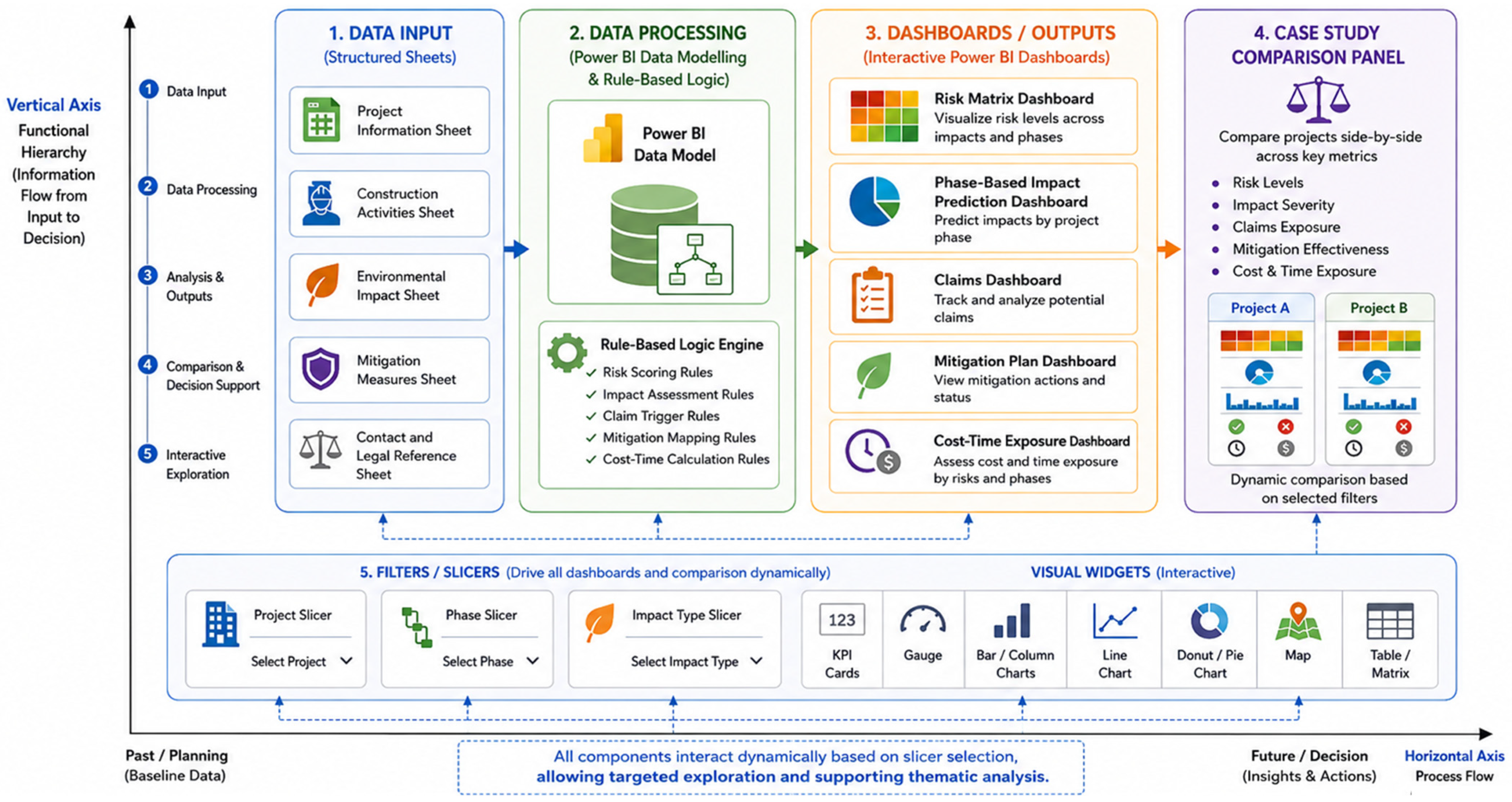
The proposed ImpactPredict framework synthesizes structured environmental and project data through Microsoft Excel, applying rule-based risk logic within Power BI version 2.149.1429.0 released December 2025 data modeling and data analysis expressions (DAX) capabilities. This produces interactive dashboards that visualize environmental risk, claim likelihood, and cost–time exposure under FIDIC contracts. The framework transforms EIA outputs from static documentation into dynamic, continuously updateable risk intelligence through scoring systems, weighted relationships, and predictive analytics. The research method design in shown in Figure 1. Full-sheet descriptions and the proposed framework interface can be found in Supplementary Files S1 and S2, respectively. Also, for the purpose of this study, ChatGPT 5.5 was used to support visualization and mathematical equations.
Figure 1.
Research method framework.
2.1. Data Input Structure
Microsoft Excel is used as the data input platform, which ensures that all assumptions, inputs, and scoring criteria remain auditable and easily adjustable without requiring advanced programming skills. It is divided into multiple interrelated worksheets, each serving a distinct analytical purpose, as shown in Table 1.
Table 1.
Data input sheet structure.
2.2. Parameter Assignment Procedure
Table 2 presents the calibration criteria used for assigning the main input parameters, including severity (S), likelihood (L), activity intensity (A), phase sensitivity (P), contractual weight (CW), and the mitigation effectiveness factor (MEF). S′ and L′ indicate severity and likelihood after applying the mitigation measures. The selected scales and thresholds were adapted from established environmental risk assessment, impact significance evaluation, and risk matrix methodologies reported in the literature. Five-point severity and likelihood scales were adopted because they provide a balance between analytical sensitivity and practical interpretability and are widely used in environmental and project risk assessment studies [45,46]. Table 3 presents the calibration criteria for the environmental and contractual risk assessment parameters.
Table 2.
Calibration criteria for environmental and contractual risk assessment parameters.
Table 3.
Environmental–contractual mapping structure.
2.3. Power BI Data Modeling and Digitally-Enabled Logic
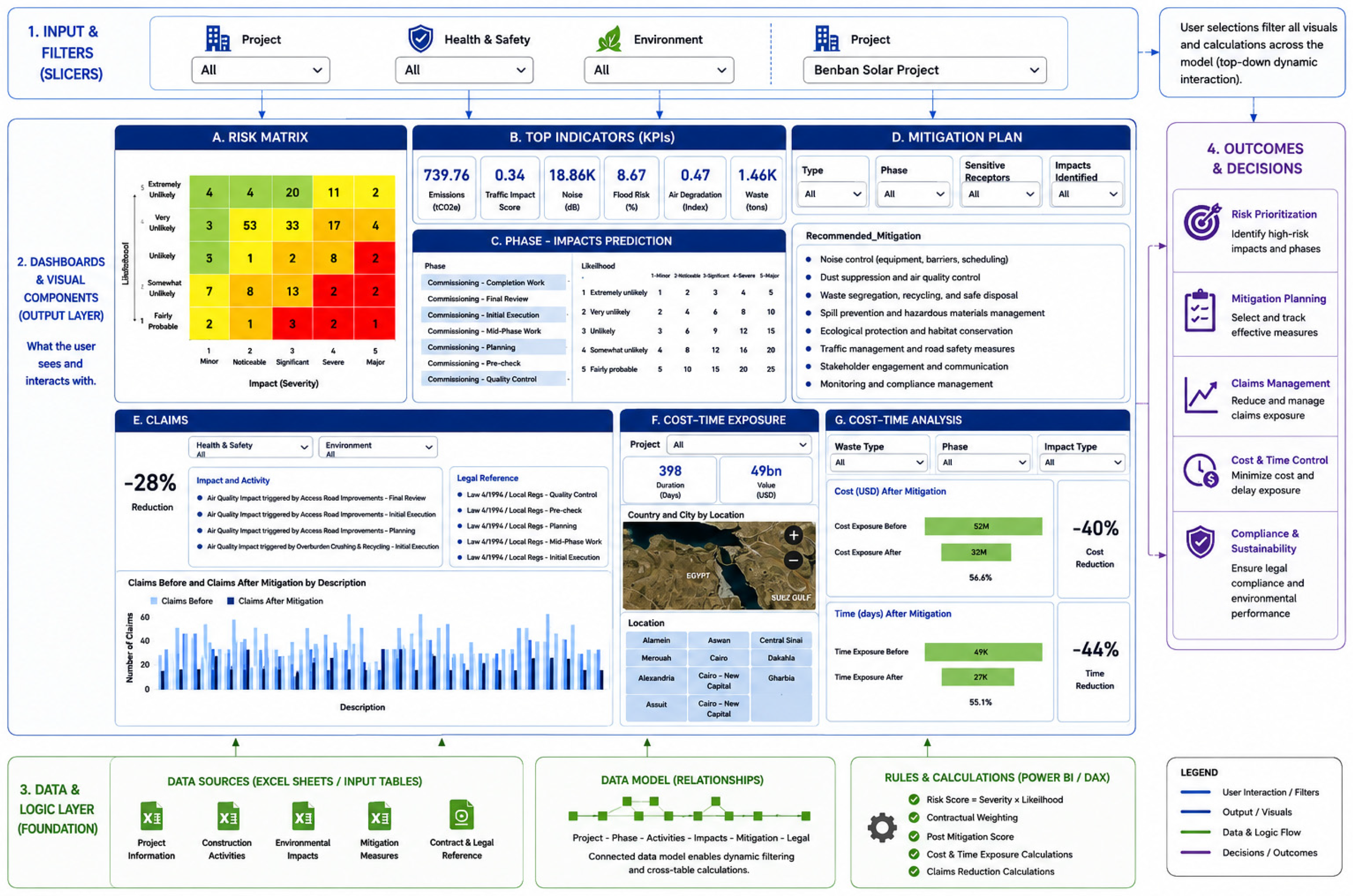
This study used Power BI dashboards version 2.149.1429.0—which are already widely used in the building industry for reporting, scheduling, and cost control [49,50,51]—to represent the primary interface through which users interact with the proposed ImpactPredict framework. This is performed through a series of interconnected dashboards, as elaborated in Table 4. All Excel sheets are imported into Power BI and connected through a relational data model. Key relationships include construction activities linked to environmental impacts, impacts linked to mitigation measures, impacts linked to legal and contractual references, and phases linked to time-based risk aggregation. This relational structure allows Power BI to dynamically propagate changes in one dataset across the entire model. The dashboard is structured around a set of interactive slicers and visual widgets that operate together dynamically to support thematic analysis. Any selection made in one slicer immediately updates all charts, allowing the user to isolate specific projects, project phases, and impact categories. This interactivity ensures analytical consistency and allows targeted exploration without altering the underlying data model. This feature allows users to trace how specific environmental impacts may trigger contractual clauses, regulatory obligations, or dispute mechanisms. The bar chart enhances interpretation by presenting claim frequencies before and after mitigation for individual activities and impact descriptions. By maintaining this level of traceability, the dashboard supports transparent risk communication between project teams, contractors, clients, and decision makers. The proposed model is presented in Figure 2, showing its operational logic, structure, components, and hierarchy.
Table 4.
Interactive dashboards and slicers description and function.
Figure 2.
Model conceptual diagram. Cell colours indicate the corresponding risk level: green = low risk, yellow = moderate risk, orange = high risk, and red = very high (critical) risk.
2.4. Framework Implementation Process and Governance Mechanism
To operationalize the proposed framework as an active environmental risk management system, its implementation should extend across the full project lifecycle. During the planning and design phase, project teams input project information, construction activities, anticipated environmental impacts, and contractual requirements into the structured database. Environmental specialists assign severity and likelihood scores, while contract specialists establish contractual weighting factors and legal obligations. During the construction phase, contractors implement mitigation measures identified by the framework. Project managers periodically update environmental observations and mitigation implementation status within the dashboard environment. Contract administrators monitor claim exposure indicators and verify whether environmental impacts trigger contractual implications. During the commissioning and operation phase, residual risks are continuously monitored, mitigation effectiveness is evaluated, and environmental performance trends are compared against baseline predictions.
The framework effectiveness can be evaluated using measurable performance indicators, including environmental risk reduction percentage, contractual risk reduction percentage, and residual risk trend stability. Periodic dashboard reviews at predefined project milestones support continuous monitoring and adaptive management, transforming environmental impact assessment outputs from static documentation into an operational project-control mechanism. Dashboard outputs support adaptive decision-making and corrective interventions where residual exposure exceeds acceptable thresholds.
2.5. Mathematical Logic
The model can be formulated as a sequence of linked environmental and contractual risk propagation calculations, as shown in Table 5, including activity intensity weighting (A), initial contractual risk (CR), contractual risk reduction (CRR), contractual weighting coefficient (CW), environmental impact (EI), initial environmental risk (ER), mitigated environmental risk (ER’), likelihood (L), likelihood after applying the mitigation measures (L′), mitigation effectiveness factor (MEF), project phase sensitivity factor (P), residual contractual risk (RCR), severity (S), and severity after applying the mitigation measures (S′). Equations (1)–(8) establish how construction activities generate environmental impacts, how impacts translate into contractual risks, and how mitigation measures reduce both environmental and contractual exposure.
Table 5.
Selected indicators and their mathematical equations.
3. Application on Six Case Study Power Station Projects in Egypt
The legislative framework for the application of EIA in Egypt was established through Environment Law number 4 of 1994 and its amendments, which stipulated the need to conduct EIA studies for new projects or proposed expansions and to obtain the approval of competent authorities before implementation [52].The Egyptian Environmental Affairs Agency (EEAA) is responsible for overseeing the implementation of EIA. It has prepared guidelines for the process and classifies projects into different categories according to their environmental risk, ensuring that the level of study required is commensurate with the nature and magnitude of the expected impacts [52].
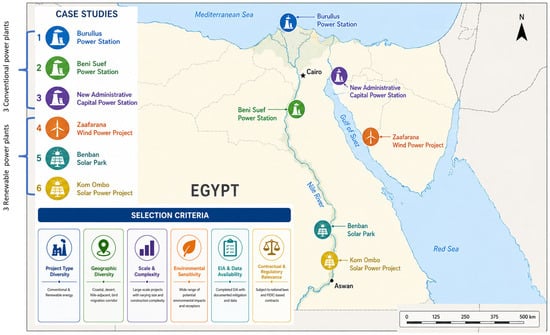
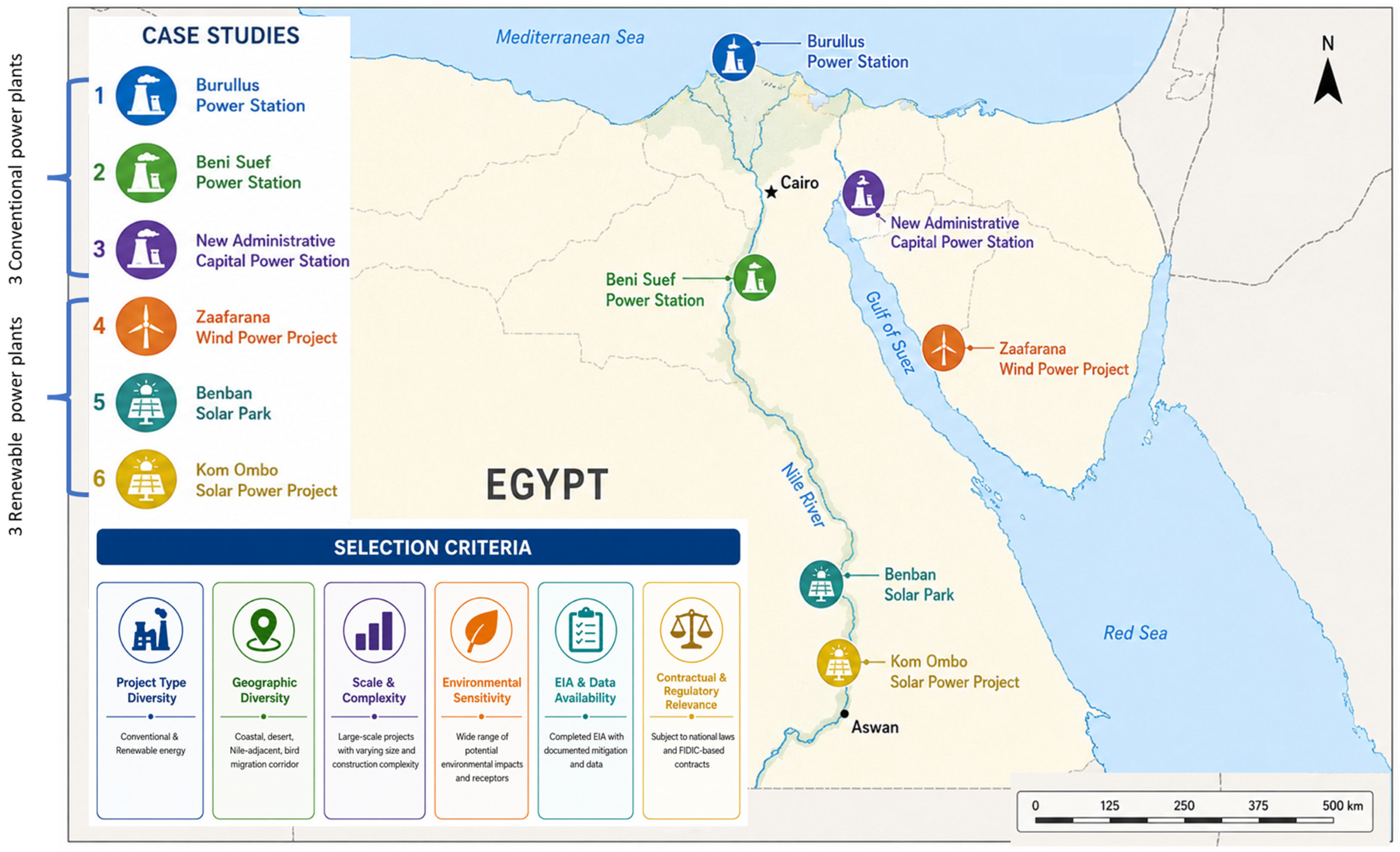
Six case studies were selected to provide a representative and analytically diverse sample of large-scale energy infrastructure projects in Egypt. All selected projects are nationally significant infrastructure developments, classified as Black projects, which underwent full formal EIA procedures and include publicly documented environmental management measures and regulatory obligations. This allows comprehensive testing and validation of the proposed framework across different project types, contextual settings, environmental conditions, and contractual risk profiles, as shown in Figure 3.
Figure 3.
Case study selection justification.
The selected projects include both conventional and renewable energy major national developments. The selected case studies include three combined-cycle gas power stations (Burullus, Beni Suef, and the New Administrative Capital power station), two large-scale solar energy projects (Benban and Kom Ombo), and one major wind energy project (Zaafarana). A brief description of each case study is described Table 6, and the full comparison is provided in Supplementary File S3.
Table 6.
Summary of environmental context, contractual risks, and mitigation effectiveness across the six case studies.
For each project, activity intensity, phase sensitivity, contractual weighting, and mitigation effectiveness factors were incorporated as semi-quantitative coefficients to reflect project-specific conditions while maintaining consistency with established weighted risk assessment frameworks. Ten independent experts in the field assigned parameter values using the predefined scoring criteria and performed the mapping exercise (refer to Supplementary File S4). Following established expert elicitation practice, differences in initial assessments were discussed and reconciled through structured deliberation until a common judgement was achieved. Consequently, the final parameter values represent consensus-based expert knowledge incorporated into the proposed framework.
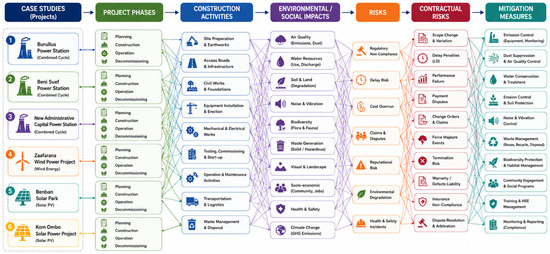
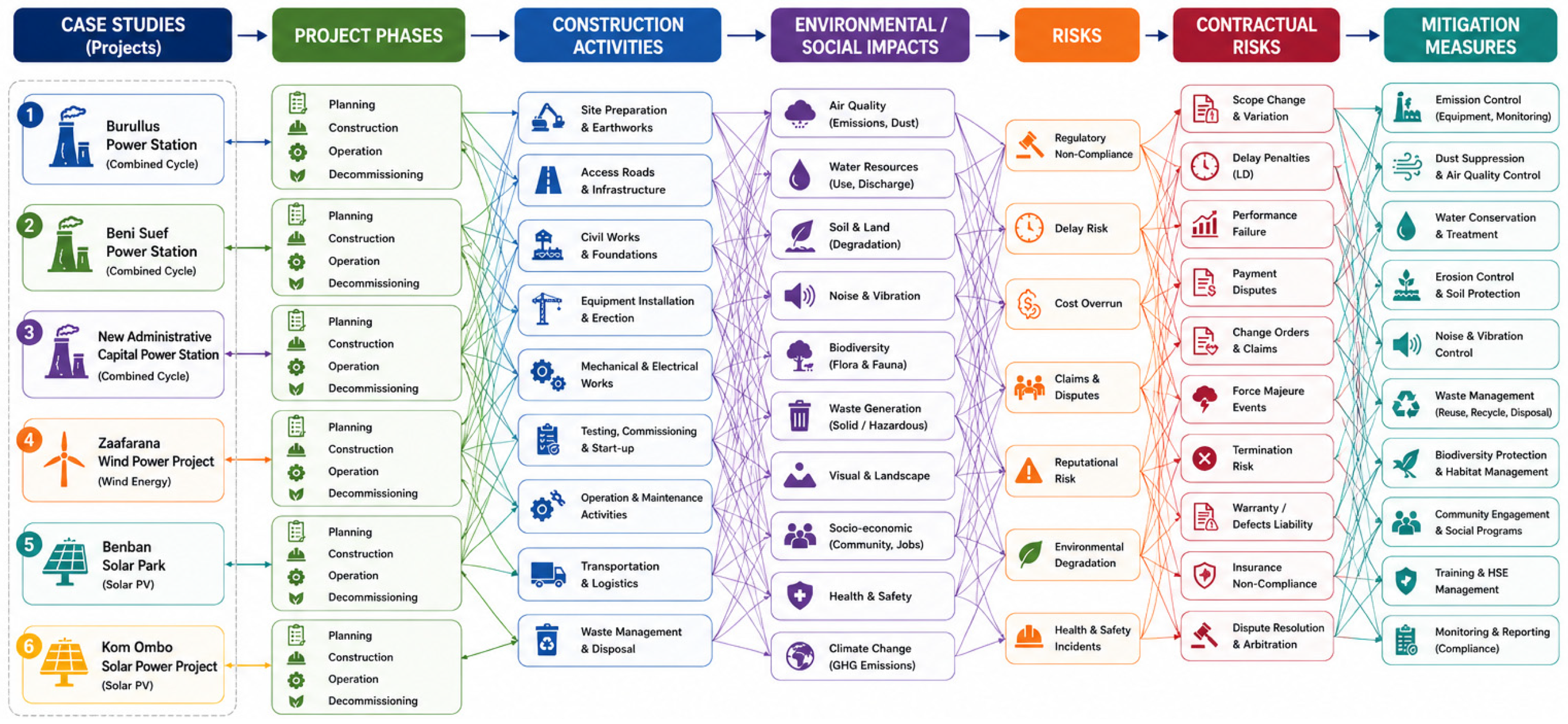
A comparative analysis of the six case studies reveals a fundamental shift in the nature, intensity, and management of environmental and operational risks between conventional thermal power plants and renewable energy systems. While both categories aim to meet growing energy demands, their risk–impact–mitigation profiles differ significantly in structure, temporal distribution, and systemic implications, as shown in Figure 4.
Figure 4.
Developing the interrelationship network for the case study projects, linking project, project phases, construction activities, environmental impacts, environmental risks, contractual risks, and mitigation measures.
A primary distinction lies in the origin and persistence of risks. Conventional power plants (Burullus, Beni Suef, and the New Administrative Capital) exhibit process-inherent risks, largely driven by fossil fuel combustion and continuous operation. These include air emissions (notably NOx and CO2), substantial water consumption for cooling, and the generation of hazardous and industrial waste. Such risks are persistent over the plants’ lifecycles and contribute to cumulative environmental degradation, particularly in terms of climate change and regional air quality deterioration. By contrast, renewable energy projects (Zaafarana, Benban, and Kom Ombo) demonstrate site-specific and phase-dependent risks, with the majority concentrated during construction and early deployment stages. Operational risks in renewables are comparatively minimal, with notable exceptions, such as bird collisions in wind farms and water use for panel cleaning in solar installations.
The impact profile further underscores this divergence. Conventional systems generate global and regional impacts (e.g., greenhouse gas emissions and water stress) due to their resource dependence on fuel and water, reflecting a consumptive operational model. Conversely, renewable projects primarily produce localized environmental impacts (e.g., habitat disturbance, soil degradation, and biodiversity loss). The Zaafarana wind project exemplifies this through its interaction with migratory bird pathways, highlighting a critical ecological trade-off. This shift indicates that while renewable energy significantly reduces contributions to global climate change, it introduces new challenges related to land use and ecosystem sensitivity.
Mitigation strategies also differ for both types of projects. In conventional plants, mitigation is predominantly technological and reactive, focusing on efficiency improvements (e.g., combined cycle systems), emission reduction technologies (e.g., low-NOx burners), and end-of-pipe solutions, such as waste management systems. While these measures reduce environmental harm, they do not eliminate the underlying sources of impact. By contrast, renewable energy projects adopt more preventive and design-integrated mitigation approaches, including careful site selection, environmental monitoring, and resource efficiency measures. These strategies are inherently proactive, aiming to avoid or minimize impacts before they occur rather than controlling them post-generation.
This shows that the shift from conventional to renewable energy does not eliminate environmental risks but rather reconfigures them from emission-intensive and continuous risks to spatially distributed and ecologically sensitive ones. This transformation necessitates a corresponding evolution in risk management approaches, moving from compliance-driven, reactive systems toward integrated, anticipatory planning frameworks.
4. Results and Discussion
The proposed framework was applied to six infrastructure and energy case study projects to test the tool’s ability to integrate and compare environmental and contractual risks within a unified analytical environment. The case study selection significantly influenced the calculated environmental and contractual risk reduction outcomes. This enabled the framework to (1) evaluate different technologies (including thermal emissions, water consumption, and carbon emissions); (2) compare fossil-fuel-based and renewable energy projects; (3) test different geographical distribution (coastal zones, desert environments, Nile-adjacent areas, and migratory bird corridors); and (4) explore variations in project scale, construction complexity, and operational characteristics. This cross-case validation functions as a multi-sample validation test. Thus, the study applies before–after comparative analysis, where each environmental impact is evaluated under two conditions: unmanaged (baseline) and mitigated. The difference between these states provides a quantitative estimate of mitigation effectiveness, expressed through percentage reduction metrics. The comparison shown in Table 7 demonstrates noticeable variations in environmental and contractual risk reduction performance between conventional power projects and renewable energy developments. Figure 5 shows the comparative dashboard, enabling the comparison of projects, phases, impacts, and mitigation measures. Also, a video showing the framework operation is shown in Supplementary File S5.
Table 7.
Comparing the initial risk, residual risk, and total risk reduction for the six case studies.
Figure 5.
Comparison dashboard.
The results show that conventional combined-cycle power stations, including Burullus, Beni Suef, and the New Administrative Capital power station, generally exhibited moderate contractual risk reduction values ranging between approximately 33% and 42%. These projects involve continuous fuel combustion processes, intensive water consumption, thermal emissions, operational noise, industrial waste generation, and complex mechanical systems. Consequently, a substantial portion of their environmental risks are operationally inherent and cannot be fully eliminated through mitigation measures alone. Even with advanced combined-cycle technologies and emission control systems, residual environmental exposure remains relatively high because operational emissions, maintenance activities, and resource dependency persist throughout the project lifecycle. This explains why their contractual risks linked to regulatory environmental compliance remain comparatively significant after mitigation implementation.
Among the conventional projects, Beni Suef achieved the highest reduction performance due to the effectiveness of water reuse systems and thermal control measures in reducing environmentally sensitive impacts associated with Nile water withdrawal. By contrast, the New Administrative Capital power station demonstrated the lowest reduction percentage among all projects because many of its risks are linked to urban expansion pressures, traffic emissions, and long-term infrastructure demand, which are inherently more difficult to mitigate through purely technical interventions. Social and urban impacts often generate indirect contractual exposure through stakeholder objections, planning modifications, and service integration challenges, making residual contractual risks more persistent.
Renewable projects, including Zaafarana, Benban, and Kom Ombo, inherently avoid several major environmental pressures associated with conventional power generation. These impacts occur during construction rather than operation, which increases the effectiveness of targeted mitigation strategies and shortens the duration of exposure. This is why they generally demonstrated stronger contractual risk reduction performance. The Zaafarana Wind Power Project achieved the highest reduction value of 55%. Benban and Kom Ombo demonstrated moderate reduction values of 35% and 37%, respectively, because many of their impacts are linked to indirect emissions, dust generation, logistics, and resource consumption during construction activities. These impacts are more diffuse and distributed across multiple operational processes, making complete mitigation less achievable.
However, these projects also exhibit highly specialized environmental sensitivities. In Zaafarana, the dominant risk involves bird migration and biodiversity disturbance due to its location along one of the world’s major migratory corridors. Although the initial contractual and environmental risks were high, mitigation measures such as bird monitoring systems and temporary turbine shutdown protocols directly addressed the primary causal mechanism of impact generation. This produced a comparatively high mitigation effectiveness coefficient and therefore greater contractual risk reduction. In this case, environmental sensitivity initially increased project exposure but simultaneously enabled highly targeted and measurable mitigation responses.
Similarly, project scale and complexity influenced mitigation performance. Large-scale projects involving extensive construction activities and multiple stakeholders generated more interconnected environmental and contractual risks, increasing uncertainty propagation across the model network, and consequently retained higher residual contractual exposure even after mitigation implementation.
The results demonstrate that mitigation effectiveness is not solely dependent on the quality of environmental controls but also on project type, environmental sensitivity, operational characteristics, and geographic context. Consequently, the proposed ImpactPredict framework successfully captures how environmental conditions and project-specific characteristics dynamically influence contractual exposure and mitigation performance across diverse infrastructure developments.
5. Statistical Validation
To evaluate the predictive performance and internal consistency of the proposed ImpactPredict framework, a quantitative validation procedure was conducted using reduction analysis, regression analysis, goodness-of-fit assessment, prediction error metrics, and hypothesis testing. Owing to the limited number of case studies (), the results should be interpreted as exploratory evidence of model performance rather than definitive statistical generalization. The objective of this validation is to examine whether the framework produces consistent reductions in contractual risk and whether the relationship between initial contractual risk and residual contractual risk can be statistically explained.
The average contractual risk reduction ratio () was calculated by substituting the reduction percentages reported for the six case studies:
It is noted that all case studies exhibited positive risk reductions (), indicating consistent mitigation effectiveness across both conventional and renewable energy projects. The average reduction ratio of 40.0% provides preliminary evidence of internal model consistency and demonstrates that the framework systematically reduces contractual risk following mitigation implementation.
To investigate the relationship between pre-mitigation contractual risk and post-mitigation residual contractual risk, a simple linear regression model was developed, as shown in Equation (7):
where:
- = intercept;
- = regression coefficient;
- = random error.
Using the six case study observations, the estimated regression equation is shown in Equation (8), where is the model predicted residual contractual risk:
The positive regression coefficient () indicates that projects with higher initial contractual risk tend to retain higher residual risk after mitigation, although at a substantially reduced level.
The statistical significance of the regression coefficient was assessed using a two-tailed t-test.
Null Hypothesis:
Alternative Hypothesis:
The t-statistic was calculated following Equation (9):
where is the standard error of the regression coefficient.
The results are summarized in Table 8.
Table 8.
Regression statistics.
Since:
the null hypothesis is rejected at the 95% confidence level. This indicates that initial contractual risk is a statistically significant predictor of residual contractual risk within the analyzed dataset.
For the goodness-of-fit assessment, the predictive strength of the regression model was evaluated using the coefficient of determination (), as shown in Equation (10):
where:
- = observed residual contractual risk;
- = model predicted residual contractual risk;
- = mean observed residual contractual risk.
The observed and predicted values are presented in Table 9.
Table 9.
Regression validation results.
The resulting coefficient of determination was:
This indicates that approximately 75.8% of the variance in residual contractual risk is explained by the initial contractual risk, suggesting a strong predictive relationship. Nevertheless, it should be noted that depending on the anticipated effect size, conventional power analysis indicates that approximately 30 observations (for a large effect) to 55 observations (for a medium effect) would typically be required to achieve a statistical power of 0.80 in a simple linear regression at α = 0.05.
It should be noted that among the six case studies, the Zaafarana Wind Power Project exhibited a comparatively large prediction residual relative to the general regression trend. Although the project recorded the highest initial contractual risk (CR = 31.50), its residual contractual risk after mitigation was lower than that predicted by the regression equation. This behavior can be attributed to the unique environmental characteristics of the project. Unlike conventional power stations, whose environmental risks arise from multiple operational processes that remain partially unavoidable throughout the project lifecycle, the dominant environmental risks at Zaafarana are concentrated around biodiversity impacts associated with migratory bird movements. The mitigation measures implemented, including bird-monitoring programs and temporary turbine shutdown protocols, directly address the principal impact mechanism and therefore achieve comparatively high mitigation effectiveness. Consequently, the project exhibits stronger risk reduction than would be expected from the average linear relationship observed across the full dataset.
Prediction accuracy was assessed using the mean absolute error (MAE) and root mean square error (RMSE).
The MAE was calculated following Equation (11):
Substituting the values for calculated absolute error:
The RMSE was calculated following Equation (12):
Substituting the values:
The relatively low MAE and RMSE values indicate satisfactory predictive performance and demonstrate that the model produces stable estimates of residual contractual risk.
6. Conclusions and Directions for Future Research
This study contributes to addressing a critical gap in the literature associated with the lack of operational linkage between EIA outputs and contractual risk management systems. While previous research has advanced environmental prediction models or contract risk analytics independently, limited attention has been given to integrating both within a unified decision-support framework. Thus, a key contribution of this study is a reproducible methodology for linking environmental impacts with measurable contractual and project-performance consequences, thereby broadening the practical scope of environmental decision-support systems. The proposed ImpactPredict framework includes specific construction activities, environmental receptors, anticipated impacts, and mitigation measures. These are structured within the Excel-based data model and subsequently processed and visualized through interconnected and interactive Power BI dashboards. By combining filtering controls with comparative visualizations, the dashboard supports both high level benchmarking and detailed project specific analysis. This approach allows the framework to function not only as an assessment tool but also as a performance evaluation mechanism and an active environmental risk management system, aligning with established risk management principles.
The rule-based core of ImpactPredict is implemented through structured risk scoring logic. This score is calculated automatically for each impact using DAX measures. Contractual weightings are then applied to reflect the extent to which a given impact may trigger claims, delays, or penalties under FIDIC conditions. By combining environmental risk with contractual exposure, the tool generates a contract impact risk score, which serves as the basis for prioritization and decision-making. Then, Power BI calculates risk scores both before and after mitigation measures are applied. This allows the tool to quantify risk reduction achieved through mitigation, and residual risk requiring monitoring or contingency planning. This comparative capability is essential for demonstrating the tangible value of environmental controls in contractual and financial terms.
The proposed framework was applied to six case study energy and infrastructure projects (three conventional and three renewable projects). The case study selection provides a balanced and sufficiently heterogeneous sample for validating the proposed model under multiple technology, geography, environmental sensitivity, project scale, and regulatory exposure, while enabling cross-project benchmarking and thematic analysis within a unified analytical framework. Across the six case studies, the framework consistently identified significant reductions in risk exposure following mitigation, confirming its effectiveness as a decision-support tool. The findings also highlight that while renewable projects inherently perform better in environmental terms, risk reduction efficiency is not technology-dependent, but rather influenced by the structure and implementation of mitigation strategies.
The statistical validation provides preliminary evidence of the robustness of the proposed framework. Model consistency analysis demonstrates that all six case studies exhibit positive risk reduction (ΔR > 0), with an average reduction of 8.90 and a mean reduction ratio of 40%. The slope coefficient was statistically significant (t = 3.367, p = 0.028 < 0.05), implying that the relationship between pre-mitigation and post-mitigation risk levels is unlikely to occur randomly. The coefficient of determination (R2 = 0.758) indicates that approximately 75.8% of the variance in residual risk is explained by the initial risk conditions. In addition, low prediction error values (MAE = 1.17; RMSE = 1.28) demonstrate satisfactory predictive stability and model reliability. The sensitivity analysis indicates that the model exhibits proportional responsiveness to all input variables, with severity and likelihood identified as dominant drivers of risk magnitude, while contractual weighting governs risk translation into project performance outcomes. These results collectively validate the model’s internal consistency, predictive capability, and structural robustness across diverse project types.
Despite these contributions, the validation approach remains limited by its dependence on input data availability, data quality, and expert-based scoring assumptions. A further limitation relates to external validation. Although the framework was evaluated using six real-world case studies, the validation process remained dependent on expert-calibrated inputs, documented environmental impacts, and model-generated outputs. Actual contractual claim records, dispute records, environmental non-compliance events, variation orders, schedule-delay records, and cost-overrun data were not publicly available for the selected projects. As a result, the predicted contractual risk levels could not be directly compared against observed project outcomes. Therefore, the present study demonstrates internal validation and model consistency rather than a full external validation of predictive performance. It should also be noted that the focus of the analysis was to compare environmental risk—those listed in the official EIA reports—while other types of environmental risks or the risks attributed to cost and delay exposure were not included due to unavailability of data. Actual contractual claim records, dispute records, and environmental non-compliance events were not available for the selected projects. Similarly, the mitigation measures discussed were obtained from the official EIA reports of the six discussed case studies and addressed the listed environmental risks. It should also be noted that the Zaafarana case study also illustrates the potential influence of project-specific environmental characteristics on predictive performance. Given the limited sample size (n = 6), individual projects exhibiting a typical risk structure may exert a disproportionate influence on the regression relationship. Furthermore, the study did not include additional explanatory variables, such as project size, contract type, geographic location, procurement method, project technology, or environmental context. While these factors may influence contractual risk behavior, the small number of available case studies limited the potential of estimating more complex multivariable models. Therefore, the reported regression results should be interpreted as exploratory rather than as fully explanatory.
Thus, to enhance robustness, future research should pursue external validation through collaboration with project owners, contractors, consultants, and regulatory agencies to obtain verified project-performance datasets. These datasets may include environmental non-compliance reports, contractual claims, dispute records, variation orders, liquidated damages records, cost-overrun reports, and schedule-delay documentation. Such information would enable a direct comparison between predicted contractual risk exposure and actual project outcomes, allowing calibration of contractual weighting factors, refinement of mitigation effectiveness assumptions, and rigorous assessment of predictive accuracy. Also, the application process should include larger and more diverse project samples for generalizable validation of different risk dimensions—including those attributed to time and cost overruns—and their corresponding mitigation measures. Future studies should also investigate whether separate predictive models are required for different project categories, including conventional energy infrastructure, renewable energy developments, and environmentally sensitive projects. Such segmentation may improve predictive performance by accounting for differences in risk generation mechanisms and mitigation effectiveness. This can be used to develop a composite Integrated Project Risk Index that combines environmental, contractual, financial, and schedule-related performance indicators within a unified decision-support environment. Furthermore, real-time environmental monitoring data can be incorporated to validate predicted versus actual environmental performance for a solid claim compliance ground. Also, further studies can integrate the proposed framework with BIM and digital twin environments for spatial and temporal validation.
Supplementary Materials
The following supporting information can be downloaded at: https://www.mdpi.com/article/10.3390/su18136789/s1, S1: Sheet descriptions, S2: The proposed framework interface, S3: Expert mapping and parameter calibration procedure, S4: Comparison of the six case studies in terms of risks, impacts, and mitigation measures, as documented in formal EIA reports, S5: Video showing the model operation.
Author Contributions
Conceptualization, W.S.E.I., Y.T., and N.T.; methodology, W.S.E.I., Y.T., and N.T.; software, Y.T. and N.T.; validation, Y.T. and N.T.; formal analysis, Y.T. and N.T.; data curation, Y.T. and N.T.; writing—original draft preparation, Y.T. and N.T.; writing—review and editing, W.S.E.I.; visualization, Y.T. and N.T.; supervision, W.S.E.I. All authors have read and agreed to the published version of the manuscript.
Funding
This research received no external funding.
Institutional Review Board Statement
The study was conducted in accordance with the Declaration of Helsinki and approved by the Faculty of Engineering Ethics Committee of The British University in Egypt (protocol code EC-2526-2 and Approval date 5 January 2026).
Informed Consent Statement
Informed consent was obtained from all subjects involved in the study.
Data Availability Statement
The original contributions presented in this study are included in the article/Supplementary Material. Further inquiries can be directed to the corresponding author.
Acknowledgments
During the preparation of this manuscript/study, the authors used Power BI version 2.149.1429.0 released December 2025 to help transform raw information into interactive, real-time dashboards and reports. Also, ChatGPT 5.5 was used for the purposes of visualization and supporting mathematical equations. The authors have reviewed and edited the output and take full responsibility for the content of this publication.
Conflicts of Interest
The authors declare no conflicts of interest.
Abbreviations
| A | Activity intensity weighting |
| CR | Contractual risk (Initial) |
| CRR | Contractual risk reduction |
| CW | Contractual weighting coefficient |
| EI | Environmental impact |
| ER | Environmental risk (initial) |
| L | Likelihood |
| L′ | Likelihood after applying the mitigation measures |
| MAE | Mean absolute error |
| MEF | Mitigation effectiveness factor |
| P | Project phase sensitivity factor |
| RCR | Observed residual contractual risk |
| Model predicted residual contractual risk | |
| RER | Residual environmental risk |
| RMSE | Root mean square error |
| S | Severity |
| S′ | Severity after applying the mitigation measures |
References
- Kang, H.J. Development of a Systematic Model for an Assessment Tool for Sustainable Buildings Based on a Structural Framework. Energy Build. 2015, 104, 287–301. [Google Scholar] [CrossRef] [Scilit]
- Loomis, J.J.; Dziedzic, M. Evaluating EIA Systems Effectiveness: A State of the Art. Environ. Impact Assess. Rev. 2018, 68, 29–37. [Google Scholar] [CrossRef] [Scilit]
- Arts, J.; Caldwell, P.; Morrison-Saunders, A. Environmental Impact Assessment Follow-up: Good Practice and Future Directions—Findings from a Workshop at the IAIA 2000 Conference. Impact Assess. Proj. Apprais. 2001, 19, 175–185. [Google Scholar] [CrossRef] [Scilit]
- Ismaeel, W.S.E.; Lotfy, R.A.E.R. An Integrated Building Information Modelling-Based Environmental Impact Assessment Framework. Clean Technol. Environ. Policy 2022, 25, 1291–1307. [Google Scholar] [CrossRef] [Scilit]
- Jasch, C. Environmental Performance Evaluation and Indicators. J. Clean. Prod. 2000, 8, 79–88. [Google Scholar] [CrossRef] [Scilit]
- Huertas-Olivares, C.; Norris, J. Environmental Impact Assessment. Environ. Monit. Assess. 2013, 1, 423–497. [Google Scholar]
- Ismaeel, W.S.E.; Elsayed, M.A. The Interplay of Environmental Assessment Methods; Characterising the Institutional Background in Egypt. J. Environ. Assess. Policy Manag. 2018, 20, 1850003. [Google Scholar] [CrossRef] [Scilit]
- Raafat, A.; Algheetany, N.; Ismaeel, W.S.E. A Digital Decision-Support Framework for Risk Identification and Mitigation Management in Environmental Impact Assessment. Sustainability 2026, 18, 1980. [Google Scholar] [CrossRef] [Scilit]
- Elsayed, M.A.; Ismaeel, W.S.E. Environmental Assessment for Major Development Projects: A Case Study “Qattara Depression”. J. Clean. Prod. 2019, 215, 522–533. [Google Scholar] [CrossRef] [Scilit]
- Ismaeel, W.S.E.; Sherif, J.; Adel, R.; Said, A. A Life Cycle AI-Assisted Model for Optimizing Sustainable Material Selection. Sustainability 2026, 18, 566. [Google Scholar] [CrossRef] [Scilit]
- Montt, G.; Fraga, F.; Harsdorff, M. The Future of Work in a Changing Natural Environment: Climate Change, Degradation and Sustainability; International Labour Organization: Geneva, Switzerland, 2018; p. 38. [Google Scholar]
- Chen, Q.; García de Soto, B.; Adey, B.T. Construction Automation: Research Areas, Industry Concerns and Suggestions for Advancement. Autom. Constr. 2018, 94, 22–38. [Google Scholar] [CrossRef] [Scilit]
- Pope, C.; Marks, E.; Back, E.; Leopard, T.; Love, T. Renovation versus New Construction and Building Decision Tool for Educational Facilities. J. Constr. Eng. 2016, 2016, 5737160. [Google Scholar] [CrossRef] [Scilit]
- ISO 31000; Risk Management—Guidelines. International Organization for Standardization: Geneva, Switzerland, 2018. Available online: https://www.iso.org/standard/65694.html (accessed on 1 January 2026).
- Aven, T. Risk Assessment and Risk Management: Review of Recent Advances on Their Foundation. Eur. J. Oper. Res. 2016, 253, 1–13. [Google Scholar] [CrossRef] [Scilit]
- Ismaeel, W.S.E.; Alamoudy, F.O.; Sameh, R. How Renovation Activities May Jeopardize Indoor Air Quality: Accounting for Short and Long-Term Sick Building Syndromes in Educational Buildings. J. Archit. Eng. Des. Manag. 2022, 19, 360–377. [Google Scholar] [CrossRef] [Scilit]
- Mohammadi, S.; Far, F.L. The Influence of Sustainability Policy on Procurement Approaches for Sustainable AEC Projects. J. Build. Archit. 2025, 2, 2955. [Google Scholar] [CrossRef] [Scilit]
- Ismaeel, W.S.E.; Alamoudy, F.O. Climate-Resilient Retrofitting for Enhanced Indoor Comfort in Industrial Workplaces: A Post-Occupancy Evaluation of a Case Study. Climate 2025, 13, 243. [Google Scholar] [CrossRef] [Scilit]
- Al-sabah, R.S.; Al-enezi, S.S. Reducing Contract Disputes: A Comparative Analysis of FIDIC and GCC Standard General Conditions of Contract for Construction Projects. J. Eng. Res. 2025, 13, 2877–2894. [Google Scholar] [CrossRef] [Scilit]
- Abdelalim, A.M.; Al-sabah, R.; Salem, M.; Said, S.O.; Tantawy, M.; Ezz Al-Regal, M.R. Variations and Claims in International Construction Projects in the MENA Region from the Last Decade. Buildings 2024, 14, 2496. [Google Scholar] [CrossRef] [Scilit]
- Hung, N.D.; Thang, P.M.; Dung, P.M. MoDiSo: A Tool for Building Contract Dispute Resolution Systems. Int. J. Artif. Intell. Tools 2012, 21, 1250002. [Google Scholar] [CrossRef] [Scilit]
- Moazzami, M.; Dehghan, R.; Ruwanpura, J.Y. Contractual Risks in Fast-Track Projects. Procedia Eng. 2011, 14, 2552–2557. [Google Scholar] [CrossRef] [Scilit]
- Sigalov, K.; Ye, X.; König, M.; Hagedorn, P.; Blum, F.; Severin, B.; Hettmer, M.; Hückinghaus, P.; Wölkerling, J.; Groß, D. Automated Payment and Contract Management in the Construction Industry by Integrating Building Information Modeling and Blockchain-Based Smart Contracts. Appl. Sci. 2021, 11, 7653. [Google Scholar] [CrossRef] [Scilit]
- Muhammad, R.; Nasir, A.R. Integrating BIM in Construction Dispute Resolution: Development of a Contractual Framework. Buildings 2022, 12, 1828. [Google Scholar] [CrossRef] [Scilit]
- Bennett, J.; Iossa, E. Building and Managing Facilities for Public Services. J. Public Econ. 2006, 90, 2143–2160. [Google Scholar] [CrossRef] [Scilit]
- Alfadil, M.O.; Kassem, M.A.; Ali, K.N.; Alaghbari, W. Construction Industry from Perspective of Force Majeure and Environmental Risk Compared to the COVID-19 Outbreak: A Systematic Literature Review. Sustainability 2022, 14, 1135. [Google Scholar] [CrossRef] [Scilit]
- Rözer, V.; Kreibich, H.; Schröter, K.; Müller, M.; Sairam, N.; Doss-Gollin, J.; Lall, U.; Merz, B. Probabilistic Models Significantly Reduce Uncertainty in Hurricane Harvey Pluvial Flood Loss Estimates. Earth’s Futur. 2019, 7, 384–394. [Google Scholar] [CrossRef] [Scilit]
- Prum, D.A.; Del Percio, S. Green Building Contracts: Considering the Roles of Consequential Damages & Limitation of Liability Provisions. Loyola Consum. Law Rev. 2010, 23, 113–146. [Google Scholar]
- Thompson, M.A. Determining Impact Significance in EIA: A Review of 24 Methodologie. J. Environ. Manag. 1990, 30, 235–250. [Google Scholar] [CrossRef] [Scilit]
- Geng, Y.; Zhang, L.; Chen, X.; Xue, B.; Fujita, T.; Dong, H. Urban Ecological Footprint Analysis: A Comparative Study between Shenyang in China and Kawasaki in Japan. J. Clean. Prod. 2014, 75, 130–142. [Google Scholar] [CrossRef] [Scilit]
- Circo, C.J. Will Green Building Contracts Transform Construction and Design Law? Urban Lawyer 2011, 43, 483. [Google Scholar] [CrossRef] [Scilit]
- Marzouk, M.; El-Mesteckawi, L.; El-Said, M. Dispute Resolution Aided Tool for Construction Projects in Egypt. J. Civ. Eng. Manag. 2011, 17, 63–71. [Google Scholar] [CrossRef] [Scilit]
- Abougamil, R.A.; Thorpe, D. An Investigation of BIM Advantages in Analysing Claims Procedures Related to the Extension of Time and Money in the KSA Construction Industry. Buildings 2024, 14, 426. [Google Scholar] [CrossRef] [Scilit]
- Bilal, M.; Oyedele, L.O.; Qadir, J.; Munir, K.; Ajayi, S.O.; Akinade, O.O.; Owolabi, H.A.; Alaka, H.A.; Pasha, M. Advanced Engineering Informatics Big Data in the Construction Industry: A Review of Present Status, Opportunities, and Future Trends. Adv. Eng. Inform. 2016, 30, 500–521. [Google Scholar] [CrossRef] [Scilit]
- Khurshid, A.; Farida, W.; Ilham, R.; Amor, B.; Quadir, M.; Murianingrum, M.; Parnidi, P.; Ayub, A.; Supriyadi, S.; Sakiroh, S.; et al. Environmental Resilience through Artificial Intelligence: Innovations in Monitoring and Management. Environ. Sci. Pollut. Res. 2024, 31, 18379–18395. [Google Scholar] [CrossRef] [Scilit] [PubMed]
- Tatari, O.; Kucukvar, M. Cost Premium Prediction of Certified Green Buildings: A Neural Network Approach. Build. Environ. 2011, 46, 1081–1086. [Google Scholar] [CrossRef] [Scilit]
- Sharif, S.A.; Hammad, A. Developing Surrogate ANN for Selecting Near-Optimal Building Energy Renovation Methods Considering Energy Consumption, LCC and LCA. J. Build. Eng. 2019, 25, 100790. [Google Scholar] [CrossRef] [Scilit]
- Xie, H.; Li, S.; Zaman, A.; Song, Y.; Wu, P. Integrating Life Cycle Assessment with GIS and AI for the Building Sector: A Comprehensive Review. Energy Build. 2026, 358, 117095. [Google Scholar] [CrossRef] [Scilit]
- Rozas-Vasquez, D.; Furst, C.; Geneletti, D.; Munoz, F. Multi-Actor Involvement for Integrating Ecosystem Services in Strategic Environmental Assessment of Spatial Plans. Environ. Impact Assess. Rev. 2017, 62, 135–146. [Google Scholar] [CrossRef] [Scilit]
- Kadry, K.; Ismaeel, W.S.E. A Digital Rule-Based GIS Decision Support Tool for Environmental Impact Assessment: The Case of Airport Projects. Sustainability 2026, 18, 5425. [Google Scholar] [CrossRef] [Scilit]
- Abioye, S.O.; Oyedele, L.O.; Akanbi, L.; Ajayi, A.; Manuel, J.; Delgado, D.; Bilal, M.; Akinade, O.O.; Ahmed, A. Artificial Intelligence in the Construction Industry: A Review of Present Status, Opportunities and Future Challenges. J. Build. Eng. 2021, 44, 103299. [Google Scholar] [CrossRef] [Scilit]
- Kalogeraki, M.; Antoniou, F. Industry: Current Research Trends Using Novel Technologies. Buildings 2024, 14, 967. [Google Scholar] [CrossRef] [Scilit]
- Cho, H.; Jung, W.; Park, C.Y. Knowledge-Driven Claim Governance: A Checklist of Entitlements and Procedures in FIDIC and National Standard Contracts. Buildings 2025, 15, 3955. [Google Scholar] [CrossRef] [Scilit]
- Zhang, J.; Nora, M.; El-Gohary, A.M. Semantic NLP-Based Information Extraction from Construction Regulatory Documents for Automated Compliance Checking. J. Comput. Civ. Eng. 2013, 30, 04015014. [Google Scholar] [CrossRef] [Scilit]
- Fuentes-bargues, J.L. Study of Major-Accident Risk Assessment Techniques in the Environmental Impact Assessment Process. Sustainability 2020, 12, 5770. [Google Scholar] [CrossRef] [Scilit]
- Vaezi, A.; Jones, S.; Asgary, A. Integrating Resilience into Risk Matrices: A Practical Approach to Risk Assessment with Empirical Analysis. J. Risk Anal. Cris. Response 2023, 13, 252–272. [Google Scholar] [CrossRef] [Scilit]
- Zhu, Y.; Chen, H.; Ma, J.; Pan, F. Risk Management of Green Building Development: An Application of a Hybrid Machine Learning Approach Towards Sustainability. Sustainability 2025, 17, 6373. [Google Scholar] [CrossRef] [Scilit]
- Nguyen, H.D.; Macchion, L. A Comprehensive Risk Assessment Model Based on a Fuzzy Synthetic Evaluation Approach for Green Building Projects: The Case of Vietnam. Eng. Constr. Archit. Manag. 2026, 30, 2837–2861. [Google Scholar] [CrossRef] [Scilit]
- Gonçalves, T.; Jos, M. Developing Integrated Performance Dashboards Visualisations Using Power BI as a Platform. Information 2023, 14, 614. [Google Scholar] [CrossRef] [Scilit]
- Umar, U.A.; Shafiq, N.; Malakahmad, A.; Nuruddin, M.F.; Khamidi, M.F. A Review on Adoption of Novel Techniques in Construction Waste Management and Policy. J. Mater. Cycles Waste Manag. 2017, 19, 1361–1373. [Google Scholar] [CrossRef] [Scilit]
- Tan, R.R. Application of Symmetric Fuzzy Linear Programming in Life Cycle Assessment. Environ. Model. Softw. 2005, 20, 1343–1346. [Google Scholar] [CrossRef] [Scilit]
- EEAA Ministry of Environmental Affairs Agency. Available online: https://www.eeaa.gov.eg/ (accessed on 1 January 2026).
- Deabes, E.A.M. Results in Engineering The Impact of Thermal Power Stations on Coastline and Benthic Fauna: Case Study of El-Burullus Power Plant in Egypt. Results Eng. 2020, 7, 100128. [Google Scholar] [CrossRef] [Scilit]
- ECO Consult; RECREE. Environmental and Social Impact Assessment (ESIA) Amunet Wind Farm 500 MW at Gulf of Suez; Amunet Wind Power Company: Cairo, Egypt, 2022; Available online: https://ameapower.com/_2022/wp-content/uploads/2022/10/ESIA_Amunet-500MW-Wind-Power-Project.pdf (accessed on 1 January 2026).
- Integral Consult. Environmental and Social Due Diligence of New Capital Power Plant; World Bank: Washington, DC, USA, 2017; Available online: https://documents1.worldbank.org/curated/en/662611499682286010/pdf/SFG1794-V2-EA-P116194-PUBLIC-Disclosed-7-10-2017.pdf (accessed on 1 January 2026).
- New and Renewable Energy Authority (NREA). Strategic Environmental & Social Impact Assessment Benban 1. 8 GW Photovoltaic Solar Park; Egypt Final Report; NREA: Cairo, Egypt, 2016; Available online: https://www.ebrd.com/content/dam/ebrd_dxp/documents/owcs-archive/Environment/esia-48213nts.pdf (accessed on 1 January 2026).
- Eco Con Serv. Environmental & Social Impact Assessment for 30 MW PV Power Plant—Benban Solar Park, Aswan Governorate, Egypt; EcoConServ Environmental Solutions: Cairo, Egypt, 2017; Available online: https://www.miga.org/sites/default/files/archive/Documents/SPGDisclosures/MMID%2030%20Benban%20-ESIA%20Final%20Report.pdf (accessed on 1 January 2026).
- ACWA Power; Environmental and Developopment Group; 5 Capitals Environmental and Management Consulting. 200 MW Photovoltaic Power Project Kom Ombo—Aswan Arab Republic of Egypt Environmental and Social Impact Assessment (ESIA); New and Renewable Energy Authority (NREA): Cairo, Egypt, 2020; Available online: https://www.ebrd.com/content/dam/ebrd_dxp/documents/project/51664/kom-ombo-nts.pdf (accessed on 1 January 2026).

Disclaimer/Publisher’s Note: The statements, opinions and data contained in all publications are solely those of the individual author(s) and contributor(s) and not of MDPI and/or the editor(s). MDPI and/or the editor(s) disclaim responsibility for any injury to people or property resulting from any ideas, methods, instructions or products referred to in the content. |
© 2026 by the authors. Licensee MDPI, Basel, Switzerland. This article is an open access article distributed under the terms and conditions of the Creative Commons Attribution (CC BY) license.