


Abstract
Grounded in dynamic capability theory, this research examines the impact of AI-enabled logistics optimization (ALO) on logistics process efficiency (LPE) and sustainable supply chain performance (SSCP). It further explores the mediation of LPE and the moderation of environmental uncertainty (EU). A structured online questionnaire was distributed to 600 participants via stratified random sampling from June to December 2025, resulting in 380 valid responses, and was analyzed using structural equation modeling. The results include a significant influence of ALO on LPE and SSCP. In addition, LPE significantly affects SSCP and partially mediates the ALO–SSCP relationship. Additionally, the EU significantly moderates the ALO–SSCP relationship, identifying that ALO becomes more performance-related under a volatile and uncertain operational environment. The research is based on cross-sectional survey data with self-reported outcomes. Future research is recommended to employ longitudinal or multi-source research methods. It also suggested examining other mechanisms for dynamic capabilities (e.g., agility, resilience) across several sectors. The results of this research extend dynamic capability by elucidating when (under the EU) and how (via LPE) ALO transforms into SSCP.
1. Introduction
The logistics and supply chain services provided in China play an essential role in supporting the country’s industrial production, e-commerce, and interregional distribution [1]. Meanwhile, there is an increasing need for logistics and supply chain services in China to improve efficiency, cost-effectiveness, and reliability, and to align with the nation’s focus on “green and low-carbon” logistics development [2]. In terms of the nation’s modernization strategy, policy support highlights the essential role of “green and low-carbon” logistics and encourages the adoption of sustainable technologies in transportation, storage, and distribution, positioning sustainable performance as a strategic imperative rather than a voluntary effort [3].
In this context, logistics service providers are increasingly turning to AI-enabled logistics optimization (ALO) to improve dispatching, routing, scheduling, and system-wide resource allocation [4,5]. Current operation research suggests that AI is transforming the field of logistics management by enabling anticipatory routing, dynamic scheduling, and the efficiency–emissions trade-off in decision-making processes [6]. However, despite ALO’s growing practical importance, current empirical research has a limited ability to shed light on the link between ALO and sustainability-driven supply chain outcomes in logistics firms, especially in emerging economies where implementation challenges persist [7,8]. However, earlier studies tend to treat AI logistics technologies merely as operational tools, giving limited consideration to their role as dynamic capabilities that can enable organizations to seize optimization opportunities, sense logistics disruptions, and reconfigure logistics processes towards more sustainable ends.
To shed more light on this mechanism, the current research primarily draws on the dynamic capabilities theory (DCT) which holds that “competitive advantage is created by a company’s capacity to integrate, create, and reconfigure competencies to respond to changing environments” ([9], p.516). In the case of logistics services, ALO is considered not only as a digital tool but also as an AI-enabled dynamic capability for improving sensing, seizing, and transforming activities. At first, ALO enables sensing by recognizing variations in demand, route disruptions, delayed deliveries, network inefficiencies, and sustainability risks within operations. Second, it enables seizing by allowing the selection of the most effective plan and the reallocation of resources. Finally, ALO enables transformation by reconfiguring logistics processes and optimizing systems due to environmental and market conditions. In line with this logic, a key means by which ALO is assumed to deliver its value is through logistics process efficiency (LPE) [10,11]. It refers to improvements in the execution efficiency of logistics processes, such as reductions in cycle time, operating errors, and avoidable waste, and increases in utilization rates, driven by more effective planning and real-time optimization [12]. This mechanism is especially noteworthy given that the Chinese logistics industry is undergoing a dual drive toward process upgrading and low-carbon transformation, in which efficiency gains are often directly linked to resource savings and reductions in CO2 emissions [13]. Thus, LPE is conceptualized here as the “engine” through which ALO can lead to performance improvements [14].
The outcome construct, sustainable supply chain performance (SSCP), is also intrinsically linked with the global sustainability agenda [15]. For instance, it is associated with “SDG 12 on Responsible Consumption and Production”, which strives to reduce resource consumption, pollutants, and waste generated across production and consumption patterns. It is also associated with “SDG 13 on Climate Action”, which calls for urgent action to mitigate climate change and its consequences [16,17]. In terms of logistics, this includes reductions in empty miles, fuel consumption, packaging waste, returns, and inefficiencies, which indirectly contribute to increased CO2 emissions [18]. Nevertheless, since the items in the study largely address environmental impacts such as reduced CO2 emissions, waste reduction, energy efficiency, regulatory compliance, and sustainable logistics, the SSCP concept used in this work refers only to the environmental component of SSCP [19]. Consequently, this study considers SSCP, which emphasizes environmental supply chain outcomes such as CO2 emissions reduction, adoption of greener logistics, and continuity, rather than service speed or cost [19,20].
Furthermore, this research includes environmental uncertainty (EU) as a boundary condition, given the volatile demand, unstable supply, and increasingly competitive nature of logistics firms. Under conditions of uncertainty, the impact of dynamic capabilities is expected to be emphasized, particularly in dynamically reconfiguring resources and making superior decisions in such environments [9]. Meanwhile, China’s carbon peaking and low-carbon freight strategy also creates external pressure for more sustainable logistics [21], which would amplify the performance effect when the EU is high. However, limited research has examined this impact in China’s logistics industry [22,23]. In this regard, this work contributes to the DCT by exploring the circumstances that lead to greater value from ALO, suggesting that environmental uncertainty increases the importance of AI-enabled sensing, seizing, and transformation capabilities [24,25].
Following the above gaps, this research aims to examine the following: (i) whether ALO positively influences LPE; (ii) whether LPE positively influences SSCP; (iii) whether LPE plays a mediating role between ALO and SSCP; and (iv) whether EU moderates the relationship between ALO and SSCP. By incorporating ALO with an efficiency mechanism and an uncertainty boundary condition, this research extends the DCT [9] to the logistics service sector [26], with significant implications for achieving environmental-driven supply chain sustainability consistent with SDG12 and SDG13 [15,27].
2. Theoretical Foundation and Hypothesis Development
2.1. Theoretical Foundation
This research model is grounded in the DCT, which addresses how firms maintain competitive advantage in an uncertain environment by perceiving changes, seizing opportunities, and configuring resources to adapt to them [9]. In the case of China’s logistics and supply chain service providers, ALO, which includes intelligent routing, scheduling, dispatching, and forecasting, acts as an enabler of capabilities by improving the updating of decisions on a continuous basis [11]. In particular, ALO is a digitally embedded dynamic capability since it assists logistics companies in sensing, seizing, and transforming opportunities [25,28]. Sensing is possible by identifying demand variations, logistics constraints, disruptions, and unsustainable logistics practices through data monitoring and forecasting. Seizing can be facilitated by helping logistics organizations respond by improving dispatching, routing, scheduling, and resource allocation. Transformation is achieved by enabling logistics organizations to reshape their routines and continuously reconfigure their operations to make them more efficient and sustainable [25,28].
Further, following the DCT, the advantage of ALO would come through improvements in operational routines; hence, the key factor translating ALO into performance is LPE, which includes reduced cycle time and avoidable costs, reduced errors, and increased utilization [12]. Moreover, SSCP, as operationalized in this work by using its environmental dimension, encompassing sustainability-focused supply chain outcomes such as reduced CO2 emissions and waste, aligns with the proposition that dynamic capabilities facilitate not only operational but also sustainability performance [29,30]. Additionally, the DCT argues that the value of capabilities depends on the environment; hence, the EU’s boundary condition is employed. In a more volatile environment, the need for adaptive optimization and dynamic capabilities to drive performance increases [9,23]. Thus, the contribution of this work to DCT lies in demonstrating the role of an AI-supported logistics capability in generating sustainable value through efficiency under certain environmental conditions [25].
2.2. Hypothesis Development
2.2.1. The Relationship Between the ALO and SSCP
The DCT, such as sensing, seizing, and reconfiguring, is the major driving force for performance in a dynamic environment, as postulated by [9]. Considering the logistics, ALO increases these capabilities by constantly dispatching, re-optimizing routes, and scheduling to respond to a dynamic environment. With help from AI-enabled sensing, businesses can spot inefficiencies in their routes, unused capacity, service failures, and resource waste. They can take advantage of opportunities, choose better logistics options, and use their resources better. With transformation, they can regularly fine-tune their logistics procedures and processes for efficiency [28]. This increases performance and sustainability by reducing unnecessary miles, idle capacity, and waste, which contribute to CO2 emissions [11,31]. SSCP integrates economic, environmental, and social performance across supply chain services [32,33]. Nevertheless, in this work, the SSCP measure primarily reflects the impacts of the environmental supply chain; therefore, the empirical analysis focuses on SSCP’s environmental aspects. Furthermore, Choudhuri [34] posited that integration of AI into logistics optimizes operations, leading to SSCP. In addition, Eyo-Udo’s [35] review study highlighted that AI increases efficiency in the supply chain through enhancements in decision-making, optimizes allocation of resources, and reduces cost. Similarly, Borah et al. [36] documented the benefits of ALO, including reduced operational costs, shorter lead times and fewer disruptions, and improved overall supply chain activities. However, empirical research on SSCP remains limited. Hence, we propose that.
H1:
There is a significant impact of ALO on SSCP.
2.2.2. The Relationship Between the ALO and LPE
Grounded in the DCT, the firm sustains its competitive benefits in turbulent markets through more effective routines and resource reconfigurability [9]. ALO achieves this by accelerating and improving its operational decisions (e.g., load planning, routing, scheduling), which reduces delays, error rates, idle capacity, and rework, thereby increasing its LPE [37]. In the context of logistics operations, process efficiency is primarily driven by improved planning and execution, with fewer bottlenecks and greater utilization, which is optimized by technologies such as AI [38]. Recent research in logistics has shown that AI and optimization are improving logistics operations in real time, particularly in transportation and warehousing [38]. Moin Uddin and Md [39] observe that ALO enhances operational efficiency through minimizing delays and errors, reducing costs, and improving customer satisfaction. Fatorachian [40], in a systematic review study, observed that AI-enabled solutions enhance accuracy, efficiency, and responsiveness across logistics operations. Similarly, an empirical research of Pan et al. [37] also reported that ALO enhances the effectiveness and efficiency of logistics operations. Thus, the following is posited:
H2:
There is a significant impact of ALO on LPE.
2.2.3. The Relationship Between the LPE and SSCP
The SSCP focuses on minimizing waste and adverse environmental impacts while maintaining economic continuity [32]. In logistics organizations, LPE such as reduced cycle time, error rates, and utilization rates represent a direct route to sustainability, given that efficient execution minimizes unwanted fuel/gasoline/energy use, material waste, and rework, which is closely linked with sustainability-driven objectives [31]. Recently, Kumari et al. [41] studied a sample of 453 supply chain firms and found a significant link among efficiency in logistics systems and sustainability in the circular economy in China. Additionally, studies show that LPE positively affects a firm’s sustainability performance by reducing operational costs and waste [42,43,44]. Thus, this study hypothesizes:
H3:
There is a significant impact of LPE on SSCP.
2.2.4. LPE as a Mediator
The DCT posits that technology-based competitive advantage factors affect performance primarily through improved routines and execution quality [9,45]. In this respect, ALO contributes to SSCP by improving LPE, which in turn leads to sustainability-driven results in the supply chain [46]. This mediation process aligns with the sustainable supply chain management argument that sustainability benefits often stem from operational changes that minimize resource consumption and waste [41]. Previously, Kumari et al. [41] used efficiency in logistics systems as a mediator among the adoption of emerging technologies and sustainability in the circular economy. Hamid et al. [47] explored the logistics capabilities in logistics information sharing and logistics performance. Fernandes [48] noted partial mediation of logistics service quality between logistics capabilities and customer satisfaction. Thus, this study hypothesizes:
H4:
LPE plays a significant mediating role between the ALO and SSCP.
2.2.5. EU as Moderator
The DCT asserts that in a changing environment, dynamic capabilities will become increasingly important, as firms must perceive changes and respond to them ever more rapidly [9]. EU, in the context of supply chain and logistics, refers to the unpredictability associated with demand, supply dynamics, competition, customer needs, regulations, and other constraints. In such an environment, organizations experience challenges in maintaining steady logistics management performance and achieving sustainable results.
In this study, the EU plays an important role in the link between ALO and SSCP. Under EU conditions, the importance of ALO increases because implementing ALO enables organizations to detect disruptions, make improvements, and adjust their operations. For example, in times of fluctuating demand, supply chain disruptions, changes in delivery, and other external factors, ALO helps optimize routes, improve scheduling, and reduce empty miles, fuel usage, and waste [11]. These capabilities are directly relevant to SSCP because they enable organizations to maintain environmentally driven supply chain outcomes despite external instability [49,50]. In contrast, when the extent of the EU is low, there is greater predictability in the logistics function, thereby limiting the importance of ALO, as the company depends on its well-entrenched procedures. Therefore, the relationship between ALO and SSCP becomes stronger when EU is high [50,51]. Recently, several studies employed EU as a moderator in the logistics literature, e.g., Khan et al. [52] used it on the link between sustainable service quality attributes and SSCP, Ercan and Celik [53] on the link among logistics and relationship flexibility and service quality, and Elbert et al. [54] reported on the link between transaction and relational mechanism and firm performance. Thus, we posit that:
H5:
The EU significantly moderates the link between the ALO and SSCP.
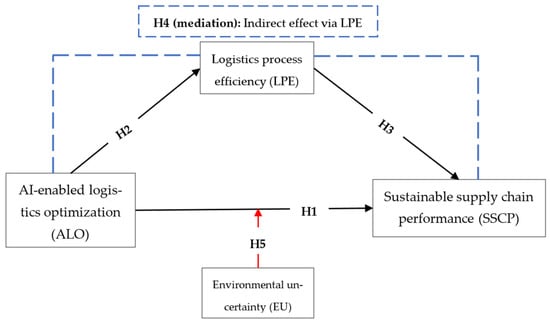
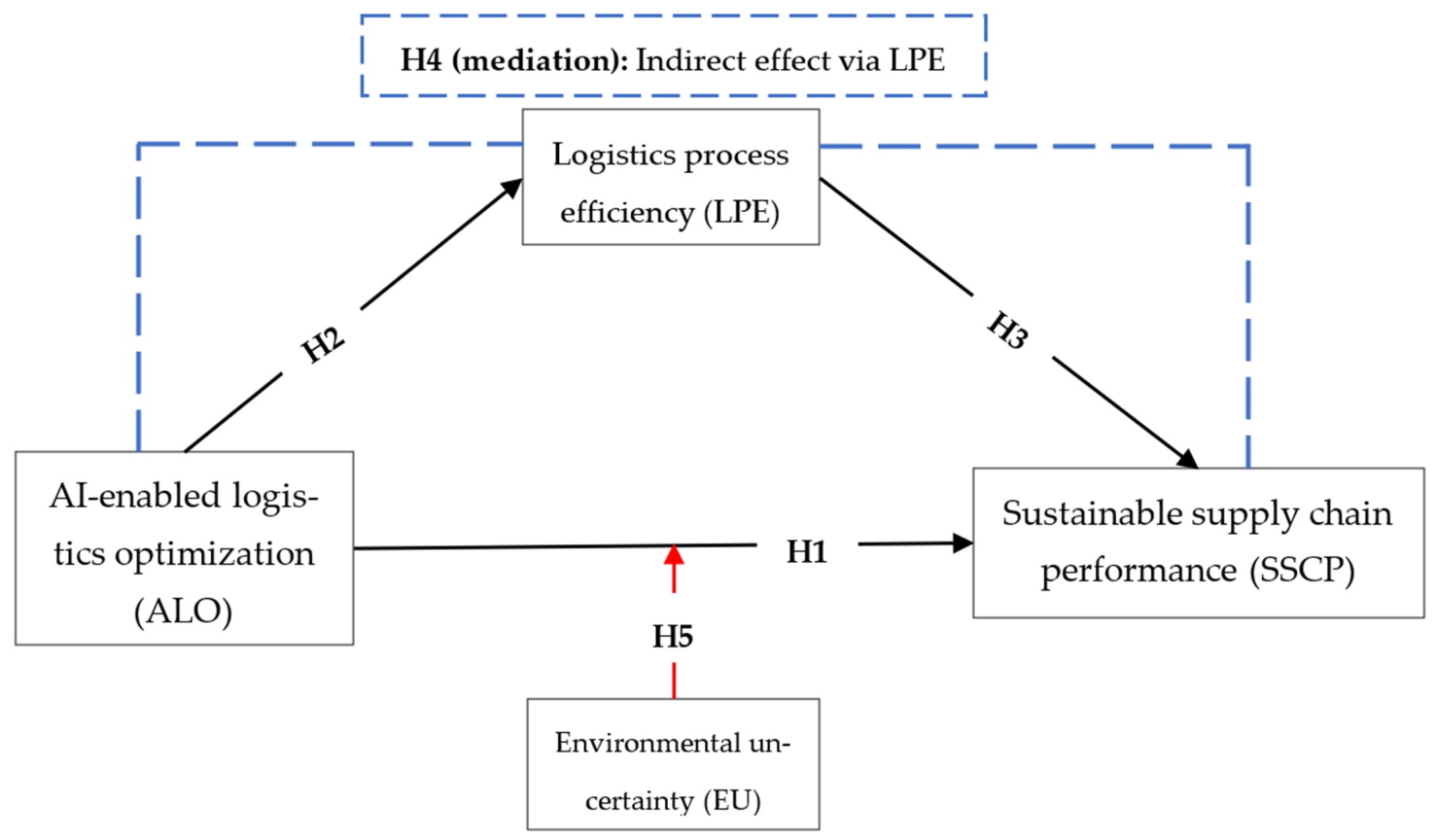
Figure 1 represents the proposed hypothesis. Typically, black arrows indicate direct effects, dashed blue lines indicate mediation, and red lines indicate moderation.
Figure 1.
Proposed model.
3. Research Methodology
3.1. Research Context and Sampling
This quantitative research targets Chinese logistics and supply chain service organizations, which include transport and delivery, warehousing and distribution, freight forwarding, and other logistics support services, which account for nearly 20% of global manufacturing trade and intermediate inputs [55]. The focus of the research is appropriate, as such organizations are under time constraints to coordinate logistics, under pressure to enhance operational efficiency, and concerned with sustainability performance.
The sample participants are supply chain, logistics, and operations managers and section heads, who are knowledgeable about ALO practices, LPE initiatives, and SSCP. A stratified random sampling method was employed to represent each sub-sector [56]. The sampling frame was split into four parts: warehousing and distribution; manufacturing and operations units linked to logistics; transportation and delivery services; and freight forwarding and cross-border logistics. From there, we found eligible firms using recent business directories and industry resources. Every firm received a unique ID number, and firms were randomly selected through a computer-generated random number procedure. This method ensures that each eligible organization in the respective sub-sector has an equal chance of being selected. If the chosen firm did not want to participate, another firm was randomly selected following the same process. After that, the questionnaires were sent to managers, section heads, or senior staff with expertise in AI in logistics, process efficiency, and sustainable supply chain practices. A sample size estimated using G*Power 3.1.9.7 indicated that a minimum of 176 participants is needed [57].
3.2. Data Collection Method
The data collection process lasted over six months, from June to December 2025, using an internet-based survey created with the Chinese survey tool Wenjuanxing (WJX). The survey was distributed to 600 participants working in logistics or supply chain-related organizations via online channels such as email and WeChat, resulting in 393 responses (65.5% response rate). After screening, 13 incomplete responses were excluded, leaving a valid sample of 380 participants.
Among the sample, the majority of respondents were male (n = 222, 58.4%), with females making up the rest (n = 158, 41.6%). Nearly one-third of them were aged between 40 and 49. Nearly half of the firms were over 10 years old, and one-third were logistics-related (see Table 1).
Table 1.
Demographic and firm profile of participants.
3.3. Non-Response Bias
As mentioned above, we approached 600 firms, receiving 393 responses and a 34.5% non-response rate. After screening out some, we had 380 valid questionnaires for our final analysis, giving us a response rate of 63.3%. To check for potential bias, we compared early vs. late responses, thinking that those who answered later might represent those who did not respond at all.
Early respondents, comprising the first 30% of valid responses, were compared with late respondents, who comprised the last 30%. To do this, researchers used chi-square analyses for gender, age, firm age, size, and industry type (see Table 2). No significant differences popped up across those traits, indicating that both groups are similar. In addition, independent-samples t-tests were conducted to compare the key variables. Results also showed no differences between early and late respondents for ALO, LPE, and EU (see Appendix A, Table A1).
Table 2.
Non-response bias results for the demographic and firm constructs.
3.4. Measures
The scales were adapted from prior research. To ensure face validity and contextual relevance, the questionnaire was reviewed by five academic professors and two industry professionals with expertise in digital transformation, logistics, and supply chain management. We employed their feedback to refine the wording of the scale items, enhance clarity, and ensure that the items align with the content of Chinese logistics.
ALO scale was measured with a four-item adapted from Kumar et al. [58]. Despite being a wide concept, the four construct items have been selected because together, they define the essential domains of ALO. In particular, the first item defines the use of AI for routing and delivery path optimization; the second refers to the use of AI for scheduling and adjusting deliveries based on dynamics; the third involves the use of AI for logistics resource allocation; while the fourth pertains to the use of AI for delivering logistical services amidst disruption through re-optimization. These domains essentially represent how AI shapes decisions about and coordinates logistics operations. The adequacy of these items is further evidenced by the measurement model analysis, in which all ALO indicators showed excellent loadings (ranging from 0.798 to 0.913) (see Table 3). In this regard, the four-item scale is considered a concise but theoretically sound construct of ALO in China’s logistics industry.
Table 3.
Constructs reliability and convergent validity.
LPE was assessed through a five-item scale adapted from Fugate et al. [59]. The EU was measured with six-items adapted from Nagarajan et al. [60]. Lastly, the SSCP was measured with six-items scale adapted from Yang et al. [61]. Table 3 includes all items rated using a five-point Likert scale.
The SSCP focuses mainly on eco-friendly results in the supply chain, like reducing emissions and waste, boosting energy efficiency, sticking to environmental rules, and using green logistics. In this regard, we considered it to represent just the environmental part of SSCP in this study. This fits with the item content and prevents claiming it covers economic and social aspects too.
Moreover, before the main survey, a small pilot test was conducted to assess item clarity, content validity, and respondents’ understanding. The minor wording changes were made based on feedback received. Since the EU was measured with six-items adapted from Nagarajan et al. [60]. As Nagarajan et al. [60] used this scale in a different industry and national context, an exploratory factor analysis was conducted to examine its contextual suitability for Chinese logistics firms. The Kaiser–Meyer–Olkin test was 0.921, indicating excellent sample adequacy for factor analysis. Bartlett’s test of sphericity was statistically significant (χ2 = 1323.788, df = 15, p < 0.001), thus suggesting that factor analysis was appropriate for the data under analysis. Principal component extraction yielded one factor with an eigenvalue of 4.116, explaining 68.59% of the total variance. Factor loading of all six EU items ranged between 0.772 and 0.847. The internal consistency, as measured by Cronbach’s alpha, stood at 0.908 (see Appendix A, Table A2).
3.5. Common-Method Bias
This work also used procedural and statistical measures to address possible common-method variance issues during data collection. Considering procedural remedies, at first, participants were reassured about the confidentiality of their answers and that the information would be used only for academic purposes. Second, the questions were carefully formulated to avoid ambiguity and apprehension about evaluation on the part of respondents. Third, questions associated with the independent, mediating, moderating, and dependent variables were grouped separately to prevent respondents from forming associations between concepts. Lastly, data were collected in four phases rather than at a single point in time, which allowed for temporal distance and reduced the likelihood that responses were influenced by the same transitory state or event.
Considering statistical remedies, Harman’s one-factor test was conducted, yielding 35.47% of the total variance (<50.0%). This implies that no single factor explained the maximum variance. Second, a comprehensive test of collinearity, the variance inflation factor (VIF) test, was conducted using the VIF values for all constructs. None of the full collinearity VIFs exceeded 3.3, indicating that bias would not pose a threat in this research (see Table 3). Finally, inter-construct correlations were tested, and no exceedingly high correlations (>0.80) were found between the two constructs (see Table 4), further indicating that the bias is not a significant issue.
Table 4.
Discriminant validity (Fornell–Larcker approach).
3.6. Analysis Tool
The partial least squares structural equation modeling (PLS-SEM) techniques using SmartPLS were chosen due to their appropriateness for predictive studies that attempt to extend theory, especially in cases involving latent constructs, mediation, moderation, and non-normally distributed survey data [62]. This approach enables the reduction in unexplained variances, accommodating complex relationships and non-normally distributed variables [62,63,64]. While this study’s model is not highly complex, it is still considered useful, as the main objectives go beyond verifying existing theory to understanding how ALO impacts the SSCP and predicting the relationship. Moreover, this analysis also involves an indirect effect through LPE and a boundary condition through the EU.
4. Result Analysis
4.1. Measurement Model Analysis
The measurement model was evaluated using construct reliability (Cronbach’s alpha (CA) and composite reliability (CR)) and validity. Table 3 indicates that CA (0.882–0.929) and CR (0.898–0.931) values for ALO, LPE, EU, and SSCP were >0.708 and <0.950, the recommended thresholds [62], validating reliability. Convergent validity was assessed through factor loadings (0.758–0.908) and the average variance extracted (AVE) (0.629–0.762), surpassing the thresholds of 0.70 and 0.50, respectively, validating the validity of the constructs [62].
Discriminant validity was evaluated by employing both the traditional and the heterotrait–monotrait (HTMT) ratio [62]. The square root of each variable’s AVE exceeds the corresponding correlation values, meeting the Fornell and Larcker [65] criteria (see Table 4). Since the Fornell and Larcker [65] approach was criticized for not reliably identifying issues of validity [62], the HTMT threshold of <0.90 for conceptually similar constructs and <0.85 for different constructs was applied. Table 5 indicates that the HTMT value of each construct is far below 0.85, confirming the discriminant validity.
Table 5.
Discriminant validity (HTMT approach).
4.2. Structural (Inner) Model Evaluation
The study’s model fit was examined by calculating the standardized root mean square residual (SRMR), which yielded a satisfactory value of 0.055 < 0.08 (see Table 6) [66]. Given the contemporary assumptions of PLS-SEM analysis, this study does not use the goodness-of-fit statistic, as it has lost widespread acceptance as an indicator of overall fit in PLS-SEM. In addition, the coefficient of determination (R2), predictive relevance (Q2), effect size (f2), VIF, and bootstrapped path coefficients were further used to assess the structural model.
Table 6.
Inner or structural model evaluation.
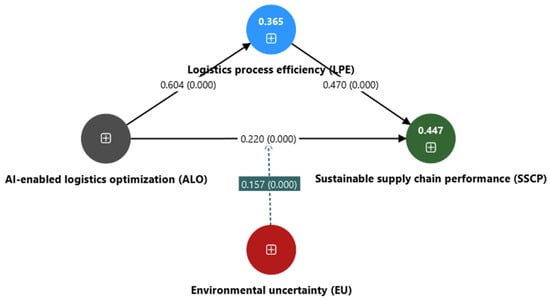
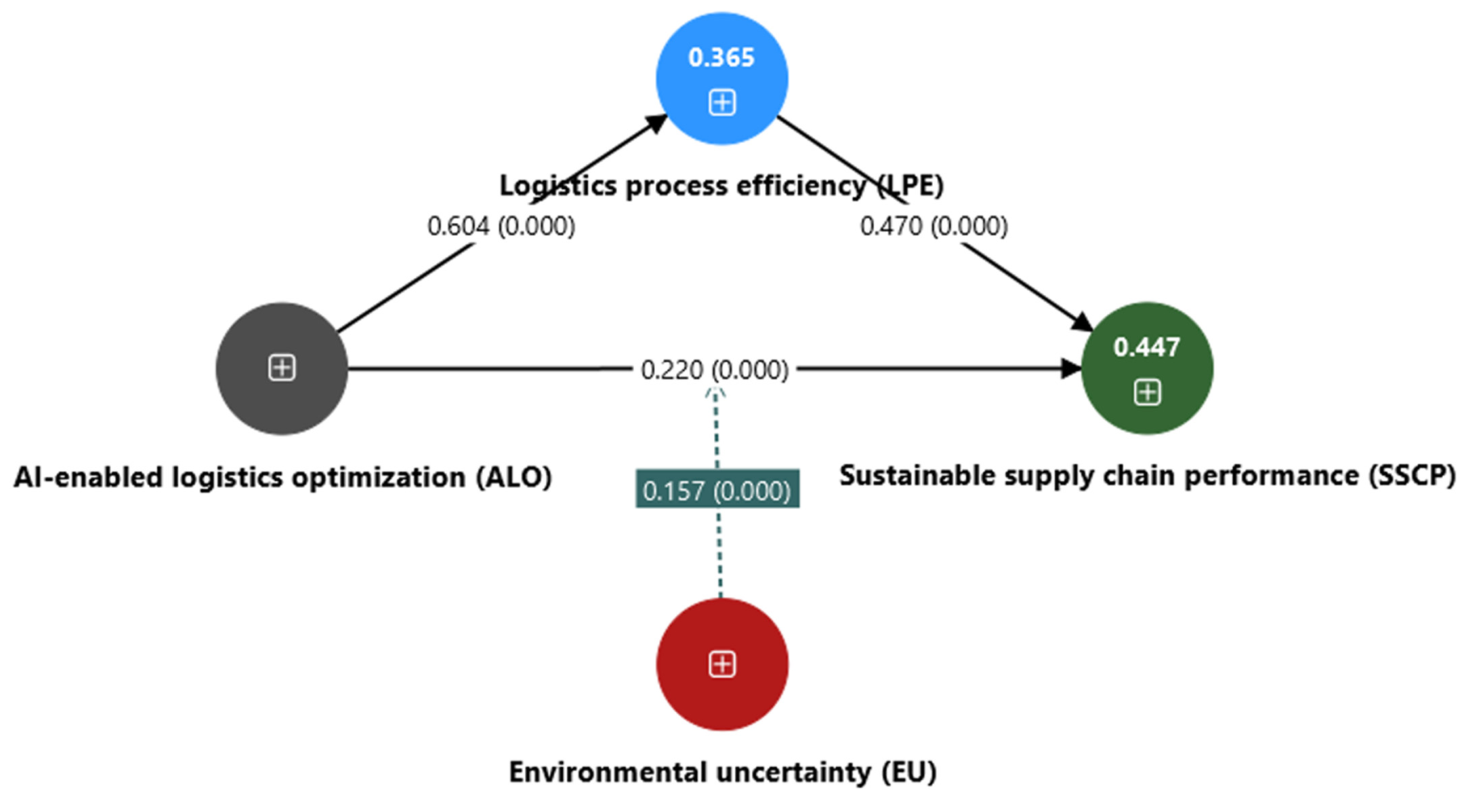
All values were below 3.33, indicating no multicollinearity [62] (see Table 3). Explanatory power was measured using R2 values for endogenous variables. The outcome shows that the ALO and EU models explain 44.7% and 36.5% of the SSCP and LPE variances, respectively (see Figure 2). Such statistics are considered adequate in behavioral and organizational research contexts, as they exceed the acceptable cutoff of 0.10 [66]. Q2 values for LPE (0.255) and SSCP (0.275), both found above 0 [66] (see Table 6). f2 were determined for each predictor with benchmarks of 0.02 (small), 0.15 (medium), and 0.35 (large) impacts [67] (see Table 6).
Figure 2.
Bootstrapping results.
The findings included a significant impact of ALO on SSCP (H1: βeta = 0.222; t = 4.202; p = 0.000, f2 = 0.057 > 0.05 < 0.15 = lower effect) and on LPE (H2: βeta = 0.604; t = 17.622; p = 0.000, f2 = 0.574 > 0.35 = large effect), supporting H1 and H2. Additionally, LPE had a significant effect on SSCP (H3: βeta = 0.470; t = 8.602; p = 0.000, f2 = 0.253 > 0.15 < 0.35 = medium effect), confirming H3. Furthermore, the indirect effect of LPE was also found significant (H4: βeta = 0.283; t = 8.45; p = 0.000), supporting H4. Lastly, the moderation effects were also found significant (H5: βeta = 0.157; t = 3.981; p = 0.000), validating H5 (see Figure 2 and Table 6).
4.3. Mediation Analysis
To explore the mediating impact of LPE, we have used two approaches: the confidence interval and the variance accounted for (VAF). An indirect effect of LPE on the link between ALO and SSCP is positive and statistically significant (βeta = 0.283, bias-corrected confidence interval [0.222, 0.345]), indicating that the confidence interval does not include zero, thereby validating the mediation effect of LPE [68] (see Table 6). Additionally, the level of mediation, either no, partial, or full, has also been validated using the VAF test, often suggested using SmartPLS 4.2.
where total effect (0.505) = direct effect (0.222) + indirect effect (0.283) (see Table 6).
Based on the results, the mediation effect of LPE is partial, as the test results range from 20% to 80% [69].
4.4. Moderation Analysis
The study used Cohen’s [70] f2 formula. f2 formula to calculate moderation impact.
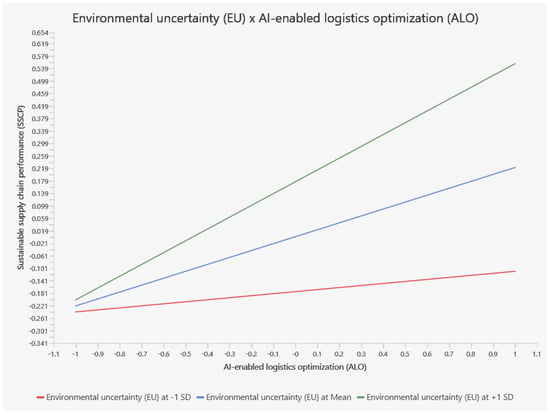
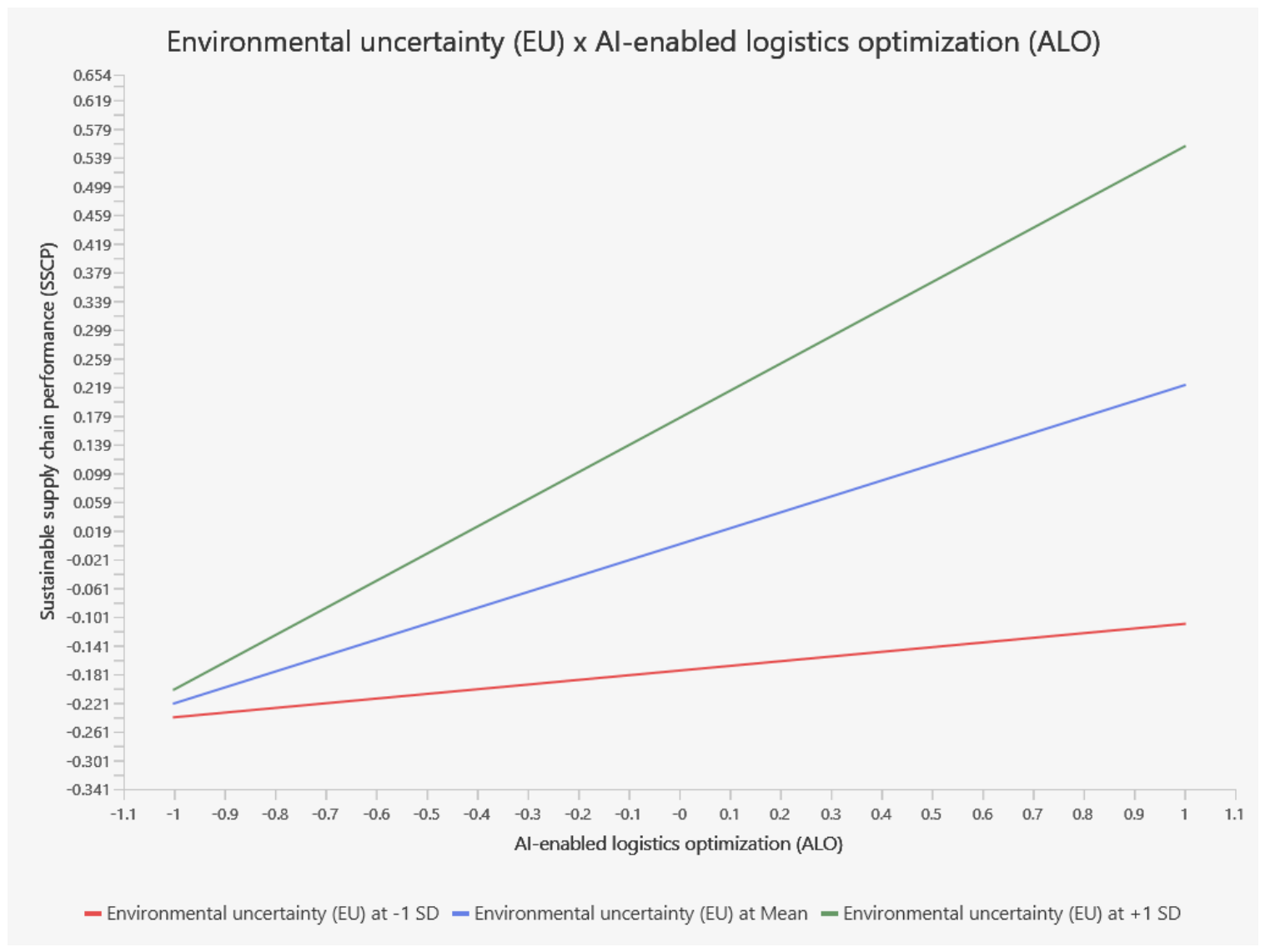
As per Cohen’s [70] guidelines, values of 0.02, 0.15, and 0.35 indicate minimal, moderate, and substantial f2, respectively. The results evidenced that the EU has a minimal effect (0.10 > 0.02 < 0.15) on the ALO–SSCP relationship. Figure 3 demonstrates how the EU increases the positive effect of ALO on SSCP. As shown, when the EU is at a higher level, i.e., +1 SD, any positive change in ALO will result in a substantially higher SSCP (steep slope). However, when the EU is at an average level, the slope between ALO and SSCP is positive yet smaller. When the EU is low (i.e., at −1 SD), the slope between ALO and SSCP is flatter yet positive.
Figure 3.
EU as a moderator.
4.5. Robustness Analysis
To ensure that the results are robust and valid, various additional analyses were conducted, including checks for measurement invariance of composite models (MICOM), later multigroup analysis (MGA), predictive tests, endogeneity assessment test, and quadratic effects.
4.5.1. MICOM Analysis
At first, we used the MICOM, and later the MGA, to assess whether the measurement model was comparable across younger (firm age < 5 years) and older firms (firm age > 10 years), and across small (firm size < 50) and large firms (firm size ≥ 500). MICOM findings in Table 7 and Table 8 indicate that full measurement invariance was achieved. First, it was found that compositional invariance was achieved for all constructs, as the Step 2 permutation p-value exceeded 0.05. Secondly, it was found that the mean difference or variance difference between the two groups concerning all constructs was insignificant. These findings validate that the measurement model is comparable across groups and support meaningful MGA.
Table 7.
MICOM results for younger and older firms.
Table 8.
MICOM results for small and large firms.
4.5.2. Multigroup Analysis (MGA)
Once MICOM was established, we conducted MGA to assess whether the structural relationship differed among younger and older firms, small and large firms. No significant difference was found in the structural path among these two groups, as all p-values obtained by two-tailed tests exceeded the critical value of 0.05 (see Table 9 and Table 10).
Table 9.
MGA results for younger and older firms.
Table 10.
MGA results for small and large firms.
The results provide evidence that the age and size of firms do not significantly affect the proposed structural relationships. It further states that relationships among the constructs (i.e., ALO, LPE, SSCP, and EU) are stable across firms, regardless of whether they are small or large, and whether they are younger or older. The consistency of results further supports the generalizability and stability of the proposed model.
4.5.3. PLS-Predict
Second, the model’s predictive accuracy was examined through PLS-Predict. All Q2 predicted values are greater than zero, indicating satisfactory predictive relevance. Moreover, compared with the prediction error, the PLS-SEM model is more accurate than the linear model benchmark, especially for most indicators except LPE4 and LPE5 (see Table 11). The findings show that the model of PLS-SEM yields lower prediction error than linear moderation, indicating satisfactory predictive performance [71].
Table 11.
PLS-predict results for LPE and SSCP.
4.5.4. Endogeneity Assessment Test
To address issues of potential endogeneity in ALO, we conducted an additional assessment using the Gaussian copula method. We used this test because companies with higher ALO might systematically differ from those with lower ALO adoption, possibly biasing estimates. We added Gaussian copula terms to the structural model to assess potential unobserved endogeneity affecting the main relationships.
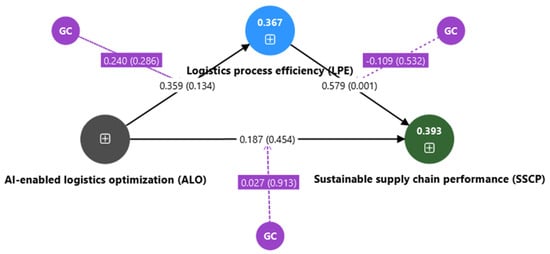
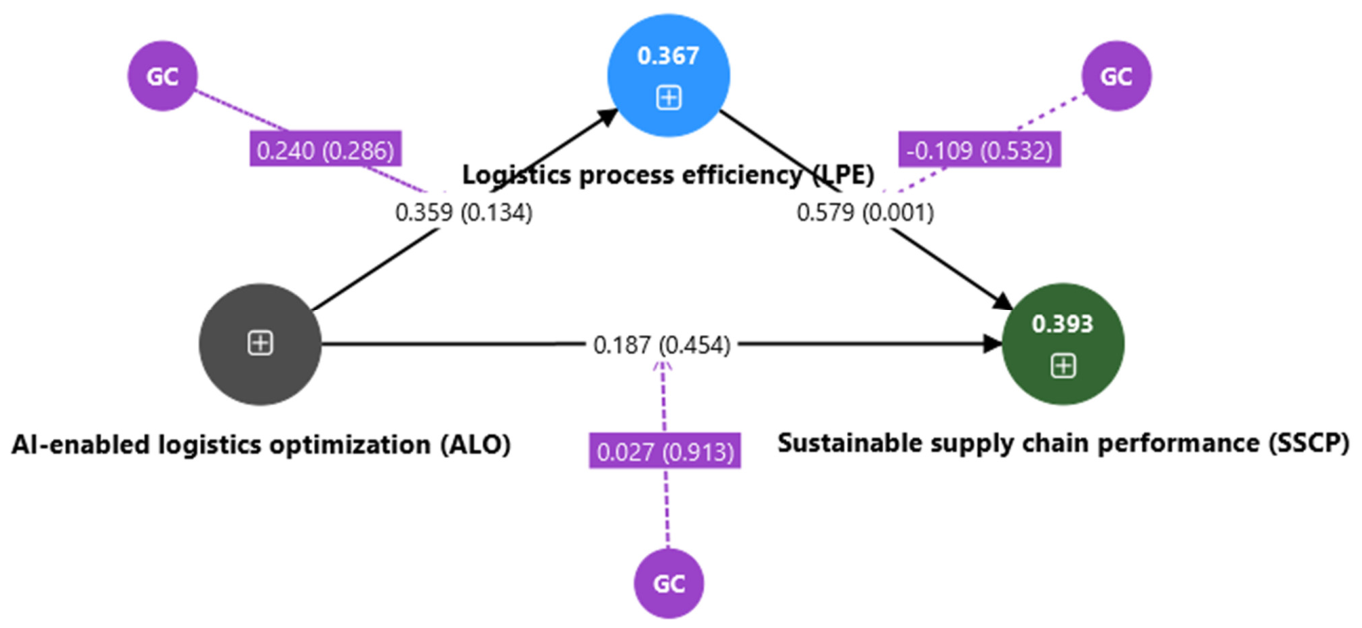
The results show that Gaussian copula terms were not significant. The copula term predicting LPE was insignificant (β = 0.240, p = 0.286), and the same was found for the copula term predicting SSCP (β = −0.109, p = 0.532) (see Figure 4). The additional copula term was also found insignificant (β = 0.027, p = 0.913). From these findings, we learn that copula terms alone are not significant indicators of severe endogeneity problems in the data. Once copulas have been considered, ALO → LPE (β = 0.359, p = 0.134) and ALO → SSCP (β = 0.187, p = 0.454) become insignificant. Therefore, we can take care when interpreting Gaussian copulas. They should not be used to demonstrate the stability of any underlying causal relationship. The findings obtained should be viewed from the perspective of theoretical links, rather than causality. In this regard, it is proposed that future research uses longitudinal, time-lagged experiments, or even archival data, to establish cause-and-effect relations.
Figure 4.
Gaussian copula.
4.5.5. Quadratic Effect Robustness Test
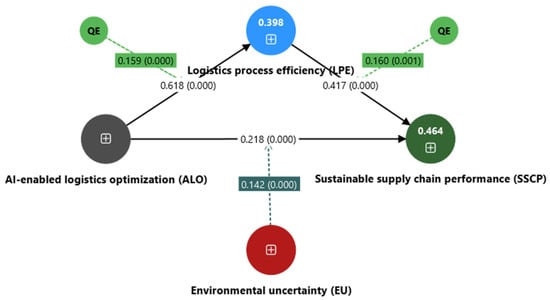
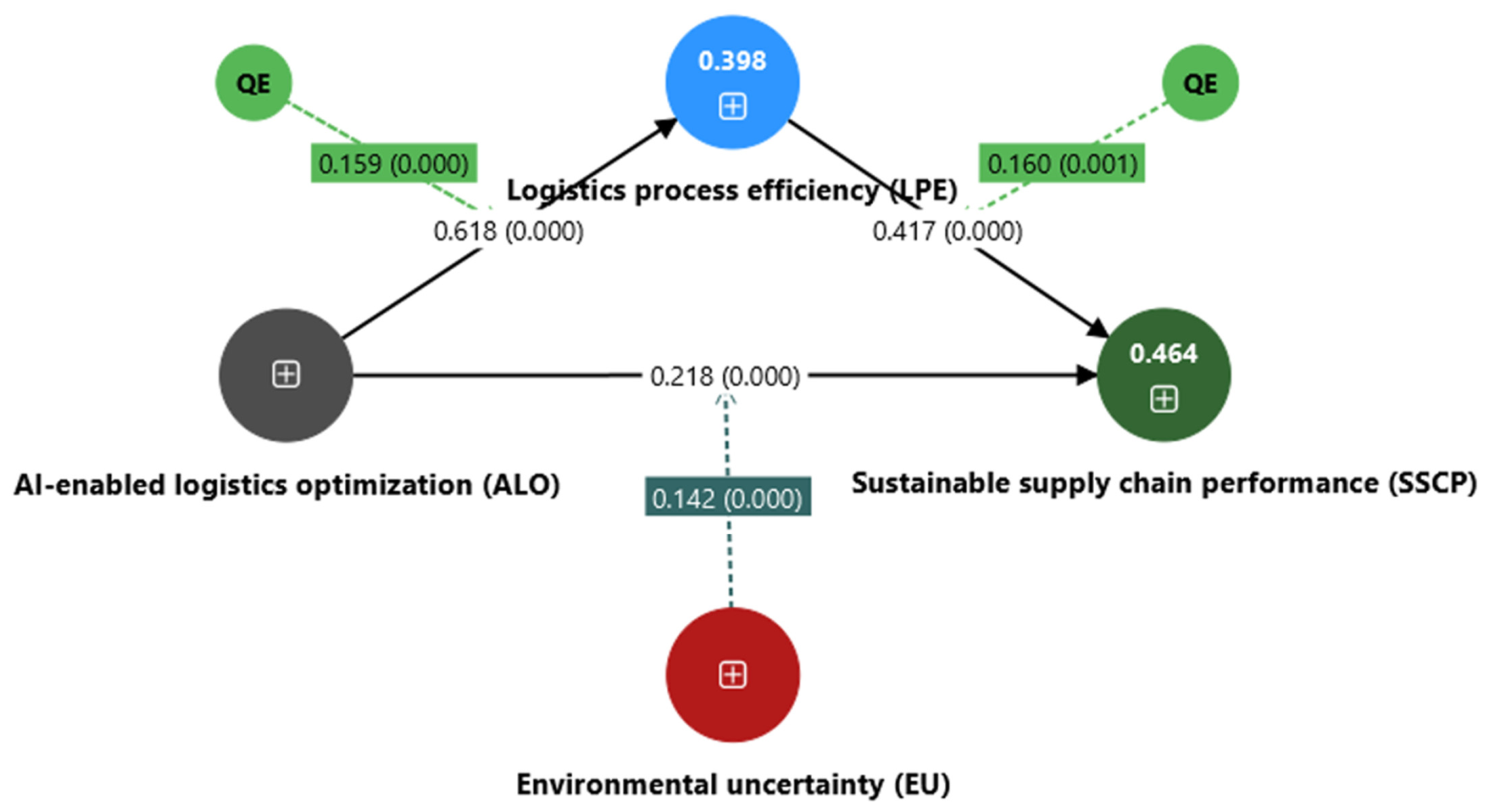
The stability of the developed model is assessed by accounting for the quadratic effect (QE) as an additional contextual/control variable. The results obtained are consistent with those from the main model analysis. Namely, ALO still had a positive impact on LPE and SSCP; LPE had a positive effect on SSCP; and EU still showed a significant interaction effect (see Figure 5). The explanatory power of the model remained acceptable, with R2 = 0.398 for LPE and R2 = 0.464 for SSCP, both exceeding the 0.10 cutoff.
Figure 5.
Quadratics effect.
5. Results Discussion and Implications
In support of H1, the results illustrate a significant and positive impact of ALO on SSCP [34]. This validates earlier findings that ALO is beneficial for supply chain performance by improving accuracy, coordination, and responsiveness, thereby enhancing sustainability performance in logistics systems [35,36]. This connection stems from the ability of such systems using AI to reduce unnecessary logistical movements, route optimization, vehicle/resource usage improvement, and making environmentally conscious decisions based on this information. In logistics, even slight advancements in route optimization, dispatching, and scheduling can reduce fuel use, mileage traveled without cargo, delivery errors, and unnecessary waste; all of these have direct connections to the environment in supply chains.
Furthermore, in support of H2, the findings evidenced that LPE is significantly impacted by ALO. This contributes to earlier findings in operations and logistics management that ALO in logistics systems can create value by enhancing logistics processes, thereby improving logistics performance [37,40]. The findings also supported the work of Alam et al. [38], which illustrates that process efficiency is enhanced by technologies like AI. The impact in question comes down to the ability of ALO to speed up and improve the quality of logistics-related decisions. The use of AI to optimize routing, scheduling, dispatching, forecasting, and re-optimization reduces reliance on human decision-making and enables organizations to better control their operational assets. As such, companies can achieve shorter cycle times, fewer operational errors, better delivery plans, and higher efficiency. In other words, the outcome reflects the logic behind the theory of dynamic capabilities, according to which digital capabilities generate value by enabling the adaptation of existing operations.
Additionally, the positive impact of LPE on SSCP, supporting H3, suggests that improved process efficiency is associated with better sustainable supply chain performance [41]. This result is also in line with previous research, which has shown that improved process efficiency drives supply chain sustainability by reducing CO2 emissions and waste and optimizing resources [42,43,44]. The significance of this finding lies in the very close relationship between environmental performance in the supply chain and operational implementation. For logistics companies, improvements in environmental performance are achieved not only by having environmental strategies in place; efficiency in the execution of everyday activities within the company is also a factor contributing to this performance. The more efficiently logistics operations are conducted, the less idle time, inefficient trips, fuel waste, and inefficiencies in logistics services there will be [25].
With regard to mediation, H4 was supported, as LPE significantly mediated the relationship between ALO and SSCP. The indirect effect, with a confidence interval not including zero, confirms that ALO does, in fact, improve SSCP, at least in part, through its effect on process efficiency. Further, the results of the VAF tests indicate partial mediation, implying that ALO affects SSCP both directly and indirectly, through LPE. This study extends the process-based arguments in the sustainability and supply chain management literature to show that ALO improves sustainability not only as a technological input but also as an efficiency mechanism [41,46]. This partial mediating role is of theoretical relevance because it indicates that there may be another mechanism in addition to process efficiency gains through which ALO affects SSCP. It indicates that the effects could be directly associated with visibility, prediction, risk, and action possibilities resulting from ALO-enabled enhanced visibility. This means that ALO is regarded as both a tool of process efficiency and as an enabling dynamic capability [25]. In other words, LPE accounts for much of ALO’s effect on SSCP, but it cannot capture all of ALO’s benefits.
Finally, with respect to H5, the interaction plot shows that EU moderates the positive relationship between ALO and SSCP, with the relationship maximized at high EU and minimized at low EU. In the DCT model, high levels of EU play a critical role in increasing the performance relevance of dynamic capabilities, in which firms must continually sense environmental changes, seize opportunities in a timely manner, and reconfigure logistics processes more frequently [9]. Therefore, in the presence of high EU, ALO is more performance-relevant for improving SSCP, but in the absence of EU, although the capability is still important, its contribution is less significant since fewer dynamic changes occur in the logistics processes. This is consistent with the findings of [22,23,52,53], who tested the moderation impact of the EU in the context of logistics literature. In light of this moderation, it is noteworthy that this finding underscores the relevance of ALO in contexts characterized by demand volatility, supply-side instability, competitive pressures, and evolving environmental constraints. The uncertain situation requires organizations to adopt a flexible approach to logistics management; instead of relying purely on established logistics procedures, they need to adopt flexible approaches that allow for changes in decisions and resource allocation as required.
5.1. Theoretical Implications
The positive relationship between ALO and SSCP shows that ALO is a capability that enables firms to capitalize on opportunities for improvement through algorithmic decision support and operational transformation towards sustainability [24]. Unlike the conventional perception of ALO as technology, this research views ALO as a dynamic capability embedded in technology that supports and sustains the processes of sensing, seizing, and transforming in logistics operations [25]. The study contributes to DCT by providing evidence that dynamic capabilities are realized at micro-level operational domains that are digitally enabled and provide macro-level benefits for sustainability performance [9]. Therefore, this study extends the DCT beyond its common use as a theory of strategic renewal towards operational renewal for sustainability [61].
Furthermore, the results of LPE mediation add to the DCT by specifying LPE as a mechanism through which the ALO is translated into performance [41]. Contrary to the expectation that digital capability would enhance sustainability performance, the results suggest that value is realized through process reconfiguration and routinization, including execution logic, coordination, and process efficiency [72]. This study strengthens the microfoundations of DCT by empirically supporting the proposition that the capability’s potential to reshape execution logic, rather than the presence of technology, is critical to performance gains [73]. In this regard, the findings of this work demonstrate that the sensing, seizing, and transformation capabilities supported by AI lead to sustainability outcomes partly because of improved logistics efficiency [25].
Moreover, the results regarding partial mediation suggest that ALO exerts an influence on SSCP through two theoretically relevant mechanisms: (1) an indirect mechanism through efficiency gains in processes (routine reconfigurability) [41], and (2) a direct mechanism that apparently shows the benefits of dynamic capability [9,74]. This two-route mechanism supports the DCT by suggesting that ALO is not only a mechanism for process renewal but also a specific manifestation of overarching adaptive capability [41]. Theoretically, this study contributes to the ongoing discussion in digital capability research on whether digital technologies primarily create value through process efficiency gains or through broader adaptability [75]. The results suggest that both mechanisms are active in parallel; efficiency gains are a key, but not the only, mediator [76].
Lastly, the positive moderating effect of the EU provides direct theoretical support for one of the key propositions of the DCT: dynamic capabilities are most important in volatile environments [77]. In particular, the enhancement of the ALO → SSCP relationship under high levels of EU suggests that AI-enabled optimization becomes more important when firms must continually sense changes in the environment, seize timely opportunities, and reconfigure their logistics processes in the face of disruption [9,52]. This research thus extends dynamic capabilities theory in two ways: (1) It empirically treats uncertainty as more than contextual background and instead as a value amplifier for the importance of AI-enabled capabilities [11]. (2) It shows that the performance benefit from ALO is dependent upon the need for reconfiguration, which is heightened under conditions of uncertainty, an important extension for the DCT applications in supply chain contexts [60].
5.2. Practical Implications
First, the results suggest firms treat ALO as an operational capability, not an information technology tool in its own right. The positive relationship between ALO and SSCP implies that the value to management increases to the extent that the outputs generated by AI are integrated into day-to-day planning and execution, ensuring that decisions are data-driven and continuously refined through lessons learned from actual performance. Hence, the application of ALO is suggested for managers, not restricted to just monitoring and reporting on logistics performance, but also to include optimization through the use of AI in routing, scheduling, dispatching, load balancing, warehouse management, and emissions decisions. With this strategy, businesses will be able to leverage ALO to improve logistics assets through rapid decision adjustments and reconfigurations.
Second, the mediation results suggest that there will be no sustainability benefits unless firms can redesign and stabilize critical logistics processes. This implies that firms align ALO initiatives with improvements in logistics processes such as planning, lead time, speed, and consistency, as this is the main mechanism through which improvements in SSCP are realized from the use of ALO. In addition, ALO initiatives are suggested to be assessed by managers using both technological and process-related adoption measures, such as shorter delivery delays, reduced idle mileage, increased vehicle efficiency, fewer dispatch errors, lower fuel consumption, and reduced waste. Through such an approach, the ALO concept is realized through tangible improvements in logistics processes.
Third, the moderation outcomes suggest that in a volatile environment, firms are advised to reap greater benefits from ALO, as it helps speed up sensing and re-planning, thereby improving adaptability to change. In addition, it is suggested that managers focus on implementing ALO in the most disruption-prone areas, where demand variability, supply disruptions, and schedule changes are common, and develop a system to rapidly implement AI suggestions as circumstances change. For instance, logistics companies operating under high levels of EU are suggested to focus on dynamic routing with AI support, demand forecasting, fleet scheduling, inventory placement decisions, and contingency rescheduling. This helps them respond quickly to any disruptions while maintaining operational continuity.
Lastly, the implications for policymakers and industry authorities are that the key to developing sustainable supply chains lies in building capabilities and reducing frictions that heighten perceptions of systemic uncertainty. Rather than solely focusing on technology uptake by businesses, the emphasis is on developing workforce capabilities, data infrastructure, and implementation support to enable businesses to enhance process efficiency using artificial intelligence. Logistics companies are suggested to be supported by government organizations and trade associations through AI training, development of digital infrastructure, creation of data exchange standards, encouragement of sustainable logistics, and piloting of AI-driven, environmentally friendly logistics systems. At the same time, the simplification of administrative logistics processes, information transparency within the transport system, and the standardization of interoperability are also important for reducing systemic uncertainties and enabling businesses, especially small businesses, to leverage AI to enhance sustainability performance.
6. Conclusions
The present study reveals that the impact of ALO is positively linked to SSCP in terms of both direct and indirect impacts via the LPE. The findings suggest that an improvement in the process level is considered a significant factor in linking the impact of ALO to sustainability performance. According to DCT, the results suggest that the EU improves the sustainability outcome value of ALO, indicating that these capabilities are most impactful when organizations face turbulence and continually respond to changes and reconfigure logistics processes. In this regard, ALO is not considered only as a technological tool, but also as a digitally enabled dynamic capability that supports seizing, sensing, and transforming practices in logistics operations.
Furthermore, the limitations of this work lie in its cross-sectional design, which precludes causal inferences regarding the relationships among ALO, LPE, EU, and SSCP. Despite the theoretical foundation of DCT methods, the application of a Gaussian copula for assessing endogeneity yielded no major bias; nonetheless, reverse causality cannot be fully excluded. For example, corporations with better sustainability performance could also be motivated or able to invest in logistics optimization using AI technology. Therefore, the findings must be understood as being theoretically founded but not necessarily causally valid. Further research is recommended to examine these constructs longitudinally, using experimental, time-lagged, or archival approaches to better establish causal direction.
Since this work is based on surveys that are prone to common-method and response biases (such as social desirability effects and response consistency effects). Nonetheless, procedural methods, diagnostic checks for common-method bias, tests for non-response bias, and other robustness checks were conducted. There is room to enhance validity by using multiple respondents and objective operational measures. Future studies are recommended to enhance construct validity by employing multiple methods (e.g., linking managerial responses to operational KPIs) and by using objective measures of logistics performance and sustainability outcomes, such as delivery reliability, waste minimization, and fuel usage, as proxies.
Further, the generalization of the results is also an issue given the samples used. For example, if the sample is used for a particular firm type, region, and sector, it is unclear whether it will generalize to other sectors. Since the research focuses on Chinese logistics and supply chain service firms, the results are influenced by China’s institutional settings, digital framework, logistics policy, and low-carbon development priorities. Future studies are recommended to test this model across sectors and countries, including both emerging and developed ones, to assess whether the mechanisms underlying capabilities and uncertainty effects differ.
Moreover, although this model includes the fundamental mechanism (LPE as a mediator) and the boundary condition (EU as a moderator), it does not account for other important contingencies and capability layers. Data quality, digital talents, organizational readiness, management support, and ecosystem partnerships may affect how ALO translates to process efficiency and sustainability performance. Future research is recommended to build upon this model by incorporating these additional factors, examining additional mediators (e.g., supply chain flexibility/resilience), and examining whether relationships differ by firm size, digital maturity, or operational complexity. Additionally, we suggest that future scholars test the moderating effects of the EU on relationships such as the link between ALO and LPE and between LPE and SSCP.
Author Contributions
Conceptualization, S.P. and L.G.; methodology, S.P.; software, S.A.Q.; validation, L.G. and S.A.Q.; formal analysis, S.P. and S.A.Q.; investigation, S.P.; resources, L.G.; data curation, S.P.; writing—original draft preparation, S.P.; writing—review and editing, S.P., L.G. and S.A.Q.; visualization, L.G.; supervision, L.G.; project administration, L.G.; funding acquisition, L.G. All authors have read and agreed to the published version of the manuscript.
Funding
This research received no external funding.
Institutional Review Board Statement
The study was conducted in accordance with the Declaration of Helsinki, and approved by the Ethics Committee of Liaocheng University (LU-ECSOB-2025-007 and 5 May 2025).
Informed Consent Statement
Informed consent was obtained from all participants and/or their legal guardians for participation in the study.
Data Availability Statement
Data will be made available at the request of the authors.
Acknowledgments
The author used AI-assisted tools, including Grammarly Pro v1.2, to support language editing and improve clarity during manuscript preparation.
Conflicts of Interest
The authors declare no conflicts of interest.
Appendix A
Table A1.
Non-response test results for the constructs.
Table A2.
EFA results of the EU scale.
References
- Xinhua. China’s E-Commerce Logistics Index up in 2023. Available online: https://english.www.gov.cn/archive/statistics/202401/14/content_WS65a38299c6d0868f4e8e30f6.html?utm_source=chatgpt.com (accessed on 26 December 2025).
- Ministry of Transport of China. Report on Sustainable Transport in China; Ministry of Transport of China: Beijing, China, 2021; pp. 1–140.
- Han, W.; Liu, J.; Yang, X.; Yang, Y. The path to green transformation of the logistics sector from the perspective of eco-efficiency. J. Clean. Prod. 2025, 525, 146547. [Google Scholar] [CrossRef] [Scilit]
- Dhaliwal, A. Towards AI-Driven Transport and Logistics. In Digital Transformation in the Viral Age; Springer Nature: Cham, Switzerland, 2024; pp. 119–131. [Google Scholar]
- Tundys, B.; Wiśniewski, T. Who Wins the Energy Race? Artificial Intelligence for Smarter Energy Use in Logistics and Supply Chain Management. Energies 2026, 19, 305. [Google Scholar] [CrossRef] [Scilit]
- Lalla-Ruiz, E.; Mes, M.R.K. Optimization and artificial intelligence in logistics management. Ann. Oper. Res. 2025, 350, 1–3. [Google Scholar] [CrossRef] [Scilit]
- Hossain, M.S.; Sikdar, M.S.H.; Chowdhury, A.; Bhuiyan, S.M.Y.; Mobin, S.M. AI-driven aggregate planning for sustainable supply chains: A systematic literature review of models, applications, and industry impacts. Am. J. Adv. Technol. Eng. Solut. 2025, 1, 382–437. [Google Scholar] [CrossRef] [Scilit]
- Ibrahim, M. Unleashing the Potential of Artificial Intelligence for Dynamic Supply Chain Optimization and Sustainability. In Navigating the Circular Age of a Sustainable Digital Revolution; IGI Global: Hershey, PA, USA, 2024; pp. 381–410. [Google Scholar]
- Teece, D.J.; Pisano, G.; Shuen, A. Dynamic capabilities and strategic management. Strateg. Manag. J. 1997, 18, 509–533. [Google Scholar] [CrossRef] [Scilit]
- Odumbo, O.R.; Nimma, S.Z. Leveraging artificial intelligence to maximize efficiency in supply chain process optimization. Int. J. Res. Publ. Rev. 2025, 6, 3035–3050. [Google Scholar] [CrossRef] [Scilit]
- Chen, W.; Men, Y.; Fuster, N.; Osorio, C.; Juan, A.A. Artificial Intelligence in Logistics Optimization with Sustainable Criteria: A Review. Sustainability 2024, 16, 9145. [Google Scholar] [CrossRef] [Scilit]
- Kovács, G. Methods for efficiency improvement of production and logistic processes. Res. Pap. Fac. Mater. Sci. Technol. Slovak Univ. Technol. 2018, 26, 55–61. [Google Scholar] [CrossRef] [Scilit]
- Wang, L.; Ye, Z.; Lei, T.; Liu, K.; Li, C. Green and Low-Carbon Strategy of Logistics Enterprises Under “Dual Carbon”: A Tripartite Evolutionary Game Simulation. Systems 2025, 13, 590. [Google Scholar] [CrossRef] [Scilit]
- Wamba-Taguimdje, S.-L.; Fosso Wamba, S.; Kala Kamdjoug, J.R.; Tchatchouang Wanko, C.E. Influence of artificial intelligence (AI) on firm performance: The business value of AI-based transformation projects. Bus. Process Manag. J. 2020, 26, 1893–1924. [Google Scholar] [CrossRef] [Scilit]
- Raman, R.; Sreenivasan, A.; Ma, S.; Patwardhan, A.; Nedungadi, P. Green Supply Chain Management Research Trends and Linkages to UN Sustainable Development Goals. Sustainability 2023, 15, 15848. [Google Scholar] [CrossRef] [Scilit]
- Tsani, S.; Koundouri, P.; Akinsete, E. Resource management and sustainable development: A review of the European water policies in accordance with the United Nations’ Sustainable Development Goals. Environ. Sci. Policy 2020, 114, 570–579. [Google Scholar] [CrossRef] [Scilit]
- Carlsen, L.; Bruggemann, R. The 17 United Nations’ sustainable development goals: A status by 2020. Int. J. Sustain. Dev. World Ecol. 2022, 29, 219–229. [Google Scholar] [CrossRef] [Scilit]
- McKinnon, A.C. Reducing Energy Consumption and Emissions in the Logistics Sector. In Energy, Transport, & the Environment: Addressing the Sustainable Mobility Paradigm; Inderwildi, O., King, S.D., Eds.; Springer: London, UK, 2012; pp. 521–537. [Google Scholar]
- Atieh, A.A.; Abushaega, M.M. Achieving Supply Chain Sustainability Through Green Innovation: A Dynamic Capabilities-Based Approach in the Logistics Sector. Sustainability 2025, 17, 5716. [Google Scholar] [CrossRef] [Scilit]
- Muchenje, K.C. Green Logistics and Supply Chain Management. In Contemporary Solutions for Sustainable Transportation Practices; IGI Global: Hershey, PA, USA, 2024; pp. 33–61. [Google Scholar]
- He, Z.; Chen, P.; Liu, H.; Guo, Z. Performance measurement system and strategies for developing low-carbon logistics: A case study in China. J. Clean. Prod. 2017, 156, 395–405. [Google Scholar] [CrossRef] [Scilit]
- Yang, L.; Huo, B.; Ye, Y. The impact of IT use on supply chain coordination: The moderating role of environmental uncertainty. J. Bus. Ind. Mark. 2024, 39, 1809–1826. [Google Scholar] [CrossRef] [Scilit]
- Kalyar, M.N.; Shafique, I.; Ahmad, B. Effect of innovativeness on supply chain integration and performance: Investigating the moderating role of environmental uncertainty. Int. J. Emerg. Mark. 2019, 15, 362–386. [Google Scholar] [CrossRef] [Scilit]
- Tan, C.N.-L.; Liu, D.; Dou, J.; Chung, H.F.L. AI capabilities and sustainable competitiveness in logistics: A mediated moderation model of resilience, government support and intervention. J. Enterp. Inf. Manag. 2025, 1–36. [Google Scholar] [CrossRef] [Scilit]
- Ratanacharoenchai, C.; Jantapoon, K. The mediating role of supply chain resilience in the relationship between AI capabilities and sustainability performance: Evidence from manufacturing SMEs. Sustain. Futures 2026, 11, 101677. [Google Scholar] [CrossRef] [Scilit]
- Liu, X. China-based logistics research: A review of the literature and implications. Int. J. Phys. Distrib. Logist. Manag. 2014, 44, 392–411. [Google Scholar] [CrossRef] [Scilit]
- United Nations. Department of Economic and Social Affairs Sustainable Development. Available online: https://sdgs.un.org/goals/goal12 (accessed on 16 March 2026).
- Lu, X.; Xu, X.; Hou, S.; Wu, F. Forging supply chain resilience: The synergistic effects of AI-enabled capabilities and integration. Socio-Econ. Plan. Sci. 2026, 104, 102432. [Google Scholar] [CrossRef] [Scilit]
- Opoku, R.K.; Ampah, J.; Korsi, N.J.N.; Manzoor, A.; Kaku, G.; Nsiah-Sarfo, D.J. Achieving sustainable performance through dynamic capabilities in disruptive manufacturing environments: Does technology innovation matter? Bus. Process Manag. J. 2025, ahead of print. 1–37. [Google Scholar] [CrossRef] [Scilit]
- Singh, R.K.; Mathiyazhagan, K.; Gunasekaran, A. Advancing towards sustainable and net-zero supply chains: A comprehensive analysis of knowledge capabilities and industry dynamism. J. Knowl. Manag. 2024, 29, 148–170. [Google Scholar] [CrossRef] [Scilit]
- Sasikala, K.; Dahiya, R.; Selvakumar, P.; Sudheer, P.; Rajagopalan, K.K.; Manjunath, T.C.; Sharma, M. Reducing Carbon Footprint With AI-Driven Logistics Planning. In Impact of Generative AI on Food Supply Chain Management; Chahal, B.P.S., David, A., Singh, A., Madaan, G., Singh, G., Eds.; IGI Global Scientific Publishing: Hershey, PA, USA, 2026; pp. 189–216. [Google Scholar]
- Wang, J.; Dai, J. Sustainable supply chain management practices and performance. Ind. Manag. Data Syst. 2018, 118, 2–21. [Google Scholar] [CrossRef] [Scilit]
- Ortas, E.; Moneva, J.M.; Álvarez, I. Sustainable supply chain and company performance: A global examination. Supply Chain. Manag. Int. J. 2014, 19, 332–350. [Google Scholar] [CrossRef] [Scilit]
- Choudhuri, S.S. AI-Driven Supply Chain Optimization: Enhancing Inventory Management, Demand Forecasting, and Logistics within ERP Systems. Int. J. Sci. Res. (IJSR) 2024, 13, 927–933. [Google Scholar] [CrossRef] [Scilit]
- Eyo-Udo, N. Leveraging artificial intelligence for enhanced supply chain optimization. Open Access Res. J. Multidiscip. Stud. 2024, 7, 1–15. [Google Scholar] [CrossRef] [Scilit]
- Borah, A.J.; Das, B.K.; Thomas, S.A.; Saravanan, R.; Salim, S.; Dhande, K. Artificial Intelligence in Supply Chain Management. Nanotechnol. Percept. 2024, 20, 820–833. [Google Scholar] [CrossRef] [Scilit]
- Pan, H.; Li, M.; Yang, C. Research on Logistics Network Optimization Based on Artificial Intelligence. In Proceedings of the 2024 Third International Conference on Distributed Computing and Electrical Circuits and Electronics (ICDCECE), Ballari, India, 26–27 April 2024; pp. 1–6. [Google Scholar]
- Alam, M.M.; Ugli, R.A.N.; Tanha, K.J.; Jun, T. AI-enhanced Digital Twin systems for warehouse logistics optimization: A review of challenges with solutions and future directions. ICT Express 2026, 12, 459–479. [Google Scholar] [CrossRef] [Scilit]
- Mojumder, M.U.; Nuruzzaman, M. AI-Driven Optimization of Warehouse Layout and Material Handling: A Quantitative Study on Efficiency and Space Utilization. Rev. Appl. Sci. Technol. 2025, 4, 233–273. [Google Scholar] [CrossRef] [Scilit]
- Fatorachian, H. Leveraging artificial intelligence for optimizing logistics performance: A comprehensive review. Glob. J. Bus. Soc. Sci. Rev. 2024, 12, 146–160. [Google Scholar] [CrossRef] [Scilit] [PubMed]
- Kumari, S.; Qalati, S.A.; Shaikh, R.; Badwy, H.E. Connecting emerging technologies with sustainability in the circular economy: The role of efficiency in logistics system and regular pressure. Sustain. Futures 2025, 10, 101297. [Google Scholar] [CrossRef] [Scilit]
- Li, A.; Ma, K.; Jin, S. Digitization and Internal Governance: The Power to Drive the Impact of Supply Chain Efficiency on Corporate Sustainability. Sustainability 2025, 17, 5583. [Google Scholar] [CrossRef] [Scilit]
- Yuming, T. The Role of Logistics Innovation in Enhancing Supply Chain Efficiency: A Case Study Analysis. Innov. Sci. Technol. 2024, 3, 64–74. [Google Scholar] [CrossRef] [Scilit]
- Roy, S.; Mohanty, R.P. Green logistics operations and its impact on supply chain sustainability: An empirical study. Bus. Strategy Environ. 2024, 33, 1447–1476. [Google Scholar] [CrossRef] [Scilit]
- Teece, D.J. A Dynamic Capabilities-Based Entrepreneurial Theory of the Multinational Enterprise. In The Eclectic Paradigm: A Framework for Synthesizing and Comparing Theories of International Business from Different Disciplines or Perspectives; Cantwell, J., Ed.; Palgrave Macmillan: London, UK, 2015; pp. 224–273. [Google Scholar]
- Sarioguz, O. Artificial Intelligence for sustainable logistics: Reducing carbon emissions and fuel consumption through route optimization. Int. J. Sci. Res. Arch. 2025, 15, 1527–1537. [Google Scholar] [CrossRef] [Scilit]
- Hamid, A.A.; Eshag, E.A.E.; Karim, N.H.; Abdul Rahman, N.S.F. Investigating the mediating effect of logistics capabilities on the relationship between logistics information sharing and logistics performance. Int. J. Product. Perform. Manag. 2025, 74, 1564–1588. [Google Scholar] [CrossRef] [Scilit]
- Fernandes, D.W.; Moori, R.G.; Filho, V.A.V. Logistic service quality as a mediator between logistics capabilities and customer satisfaction. Rev. Gestão 2018, 25, 358–372. [Google Scholar] [CrossRef] [Scilit]
- Toth, Z.; Goga, A.-S.; Boșcoianu, M. AI Integration in Fundamental Logistics Components: Advanced Theoretical Framework for Knowledge Process Capabilities and Dynamic Capabilities Hybridization. Logistics 2025, 9, 140. [Google Scholar] [CrossRef] [Scilit]
- Abdulameer, S.S.; Ibrahim, Y.M. Leveraging Industry 4.0 technologies, AI-based supply chain analytics and circular economy practices for net-zero and sustainable supply chain performance: A moderated mediation model. Supply Chain. Manag. Int. J. 2025, 30, 701–718. [Google Scholar] [CrossRef] [Scilit]
- Wang, J.; Liu, Y.; Li, J. Supply Chain Capability and Performance Under Environmental Uncertainty: The Mediating Role of Multidimensional Resilience. Systems 2025, 13, 618. [Google Scholar] [CrossRef] [Scilit]
- Khan, S.A.; Sheikh, A.A.; Hassan, N.M.; Yu, Z. Modeling the Intricate Association between Sustainable Service Quality and Supply Chain Performance: Moderating Role of Blockchain Technology and Environmental Uncertainty. Sustainability 2024, 16, 4808. [Google Scholar] [CrossRef] [Scilit]
- Ercan, E.; Çelik, M. Logistics flexibility, relationship flexibility, and logistics service quality: The moderating role of environmental uncertainty. Int. J. Manag. Stud. (IJMS) 2022, 29, 1–36. [Google Scholar] [CrossRef] [Scilit]
- Elbert, R.; Gerdes, U.-T.; Kaiser, G.; Sarnow, T. Governance and moderating effects of environmental uncertainty: The impact on performance in horizontal logistics cooperations. Logist. Res. 2018, 11, 1–29. [Google Scholar] [CrossRef] [Scilit] [PubMed]
- Glaser, S.B.; Bulman, J.D. China’s Dominance in Global Supply Chains. Available online: https://www.gmfus.org/news/chinas-dominance-global-supply-chains (accessed on 22 September 2025).
- Omollo, F.O.; Odari, S. Determinants of Supply Chain Performance in the Energy Sector in Kenya: A Case Study of the Kenya Power. Int. J. Soc. Sci. Humanit. Res. (IJSSHR) 2024, 2, 12–30. [Google Scholar] [CrossRef] [Scilit]
- Rahman, H.U.; Zahid, M.; Ullah, M.; Al-Faryan, M.A.S. Green supply chain management and firm sustainable performance: The awareness of China Pakistan Economic Corridor. J. Clean. Prod. 2023, 414, 137502. [Google Scholar] [CrossRef] [Scilit]
- Kumar, P.; Kaur, A.; Chahal, B.P.S.; Soti, P. AI-Driven Route Optimization and Sustainable Logistics: Transforming Stakeholder Perspectives for a Greener Future. In Impact of Generative AI on Food Supply Chain Management; Chahal, B.P.S., David, A., Singh, A., Madaan, G., Singh, G., Eds.; IGI Global Scientific Publishing: Hershey, PA, USA, 2026; pp. 169–188. [Google Scholar]
- Fugate, B.S.; Mentzer, J.T.; Stank, T.P. Logistics performance: Efficiency, effectiveness, and differentiation. J. Bus. Logist. 2010, 31, 43–62. [Google Scholar] [CrossRef] [Scilit]
- Nagarajan, V.; Savitskie, K.; Ranganathan, S.; Sen, S.; Alexandrov, A. The effect of environmental uncertainty, information quality, and collaborative logistics on supply chain flexibility of small manufacturing firms in India. Asia Pac. J. Mark. Logist. 2013, 25, 784–802. [Google Scholar] [CrossRef] [Scilit]
- Yang, K.; Thoo, A.C.; Ab Talib, M.S.; Huam, H.T. How reverse logistics and sustainable supply chain initiatives influence sustainability performance: The moderating role of organisational learning capability. J. Manuf. Technol. Manag. 2023, 35, 141–163. [Google Scholar] [CrossRef] [Scilit]
- Hair, J.; Alamer, A. Partial Least Squares Structural Equation Modeling (PLS-SEM) in second language and education research: Guidelines using an applied example. Res. Methods Appl. Linguist. 2022, 1, 100027. [Google Scholar] [CrossRef] [Scilit]
- Usakli, A.; Rasoolimanesh, S.M. Which SEM to Use and What to Report? A Comparison of CB-SEM and PLS-SEM. In Cutting Edge Research Methods in Hospitality and Tourism; Emerald Publishing Limited: Leeds, UK, 2023. [Google Scholar] [CrossRef] [Scilit]
- Demir, S.; Uşak, M. Analyzing the Implementation of PLS-SEM in Educational Technology Research: A Review of the Past 10 Years. Sage Open 2025, 15, 21582440251345950. [Google Scholar] [CrossRef] [Scilit]
- Fornell, C.; Larcker, D.F. Structural Equation Models with Unobservable Variables and Measurement Error: Algebra and Statistics. J. Mark. Res. 1981, 18, 382–388. [Google Scholar] [CrossRef] [Scilit]
- Hair, J.F.; Risher, J.J.; Sarstedt, M.; Ringle, C.M. When to use and how to report the results of PLS-SEM. Eur. Bus. Rev. 2019, 31, 2–24. [Google Scholar] [CrossRef] [Scilit]
- Chen, L.; Qalati, S.A.; Fan, M. Effects of sustainable innovation on stakeholder engagement and societal impacts: The mediating role of stakeholder engagement and the moderating role of anticipatory governance. Sustain. Dev. 2024, 33, 2406–2428. [Google Scholar] [CrossRef] [Scilit]
- Sarstedt, M.; Moisescu, O.-I. Quantifying uncertainty in PLS-SEM-based mediation analyses. J. Mark. Anal. 2024, 12, 87–96. [Google Scholar] [CrossRef] [Scilit]
- Nitzl, C.; Roldan, J.L.; Cepeda, G. Mediation analysis in partial least squares path modeling: Helping researchers discuss more sophisticated models. Ind. Manag. Data Syst. 2016, 116, 1849–1864. [Google Scholar] [CrossRef] [Scilit]
- Cohen, J. Statistical Power Analysis. Curr. Dir. Psychol. Sci. 1992, 1, 98–101. [Google Scholar] [CrossRef] [Scilit]
- Shmueli, G.; Sarstedt, M.; Hair, J.F.; Cheah, J.-H.; Ting, H.; Vaithilingam, S.; Ringle, C.M. Predictive model assessment in PLS-SEM: Guidelines for using PLSpredict. Eur. J. Mark. 2019, 53, 2322–2347. [Google Scholar] [CrossRef] [Scilit]
- Wang, C.-N.; Vo, T.T.B.C.; Hsu, H.-P.; Chung, Y.-C.; Nguyen, N.T.; Nhieu, N.-L. Improving processing efficiency through workflow process reengineering, simulation and value stream mapping: A case study of business process reengineering. Bus. Process Manag. J. 2024, 30, 2482–2515. [Google Scholar] [CrossRef] [Scilit]
- Nacchiero, R. The Complex and Transformative Nature of Circular Supply Chains: The Role of Dynamic Capabilities, Microfoundations, and Digital Technologies. 2025. Available online: https://iris.poliba.it/handle/11589/294600 (accessed on 22 May 2025).
- Hsu, L.-C.; Wang, C.-H. Clarifying the Effect of Intellectual Capital on Performance: The Mediating Role of Dynamic Capability. Br. J. Manag. 2012, 23, 179–205. [Google Scholar] [CrossRef] [Scilit]
- Shen, L.; Zhang, X.; Liu, H. Digital technology adoption, digital dynamic capability, and digital transformation performance of textile industry: Moderating role of digital innovation orientation. Manag. Decis. Econ. 2022, 43, 2038–2054. [Google Scholar] [CrossRef] [Scilit]
- Kirono, I.; Armanu, A.; Hadiwidjojo, D.; Solimun, S. Logistics performance collaboration strategy and information sharing with logistics capability as mediator variable (study in Gafeksi East Java Indonesia). Int. J. Qual. Reliab. Manag. 2019, 36, 1301–1317. [Google Scholar] [CrossRef] [Scilit]
- Bresciani, S.; Rehman, S.U.; Alam, G.M.; Ashfaq, K.; Usman, M. Environmental MCS package, perceived environmental uncertainty and green performance: In green dynamic capabilities and investment in environmental management perspectives. Rev. Int. Bus. Strategy 2022, 33, 105–126. [Google Scholar] [CrossRef] [Scilit]

Disclaimer/Publisher’s Note: The statements, opinions and data contained in all publications are solely those of the individual author(s) and contributor(s) and not of MDPI and/or the editor(s). MDPI and/or the editor(s) disclaim responsibility for any injury to people or property resulting from any ideas, methods, instructions or products referred to in the content. |
© 2026 by the authors. Licensee MDPI, Basel, Switzerland. This article is an open access article distributed under the terms and conditions of the Creative Commons Attribution (CC BY) license.