


Abstract
Despite the growing literature on entrepreneurial ecosystems and Industry 4.0, few studies systematically link ecosystemic dynamics to structural transformation in the Global South; even fewer compare BRICS Plus economies with G7 benchmarks using a unified econometric framework. This study addresses that gap. Its objective is to assess how the configuration of such ecosystems shapes the trajectory of sustainable industrialization, comparing the BRICS Plus group with the G7 economies over 2002–2021, a period determined by the most recent harmonized data available across all panel countries from the World Bank, UNIDO and OECD. Methodologically the study employs a balanced panel applying panel unit root and cointegration tests, Vector Error Correction Models, Generalized Method of Moments estimation and Granger causality analysis applied to manufacturing value added (MVA), GDP excluding manufacturing (GDPNOTMVA), industrial employment and productivity indices. The results indicate a long-run interaction between manufacturing and non-manufacturing output in BRICS Plus economies that is consistent with—though not a direct measurement of—entrepreneurial ecosystem dynamics, whereas G7 economies show no cointegration and only a weak unidirectional Granger causality from non-manufacturing to manufacturing (significant at the 10% level), consistent with post-industrial ecosystemic autonomy driven by AI and knowledge-intensive services. The contribution of this work is threefold: (i) theoretically, it operationalizes entrepreneurial ecosystems as macro-structural outcomes within a unified econometric framework; (ii) empirically, it identifies a systematic divergence between BRICS Plus and G7 ecosystemic regimes; and (iii) for policy, it shows that industrial upgrading in emerging economies depends on the coherent integration of industrial policy, digital infrastructure, and entrepreneurship, rather than on manufacturing scale alone.
1. Introduction
Industrialization and deindustrialization trajectories in the Global North and Global South have historically diverged, reflecting differences in timing, institutional capacity, and integration into global value chains. Advanced economies consolidated industrial leadership during early industrial revolutions, driven by mechanization, capital accumulation, and technological change [1,2]. In contrast, many countries in the Global South were historically integrated into the global economy as suppliers of raw materials, a pattern shaped by colonial legacies with long-lasting structural effects [3]. Post-colonial industrialization strategies, frequently state-led and later complemented by export-oriented approaches, produced uneven outcomes that continue to influence contemporary development paths [4,5,6]. Despite these efforts, the industrialization process in the Global South has been uneven and fraught with challenges. Many countries faced significant hurdles, including insufficient infrastructure, limited access to capital, political instability, and a lack of technological expertise [7]. However, some nations, notably the so-called “Asian Tigers” and, more recently, China and India, have achieved remarkable industrial growth, transformed their economies, and lifted millions out of poverty [8,9].
A critical subset of the Global South, the BRICS countries—Brazil, Russia, India, China, and South Africa—emerged as significant players in the global economy during the late 20th and early 21st centuries. These countries have pursued diverse industrialization strategies, leveraging their large domestic markets, abundant natural resources, and increasing integration into global value chains [10]. The success of BRICS nations in achieving rapid industrial growth has been a focal point of analysis, highlighting their unique developmental pathways and policy frameworks [11]. Expanding beyond BRICS, the BRICS Plus (BRICS + Saudi Arabia, United Arab Emirates, Iran, Egypt, and Ethiopia) initiative seeks to include additional emerging economies, broadening the scope and impact of this economic bloc. BRICS Plus represents a mix of rapidly industrializing economies and those facing considerable developmental challenges. These nations are striving to replicate the industrial successes of their BRICS counterparts while navigating the complexities of global economic integration and technological advancement [12].
It is important to note from the outset that BRICS Plus is primarily a geopolitical alliance rather than a homogeneous geoeconomic category. Its members differ substantially in industrial structure, technological capabilities, and patterns of integration into global value chains. Accordingly, this study treats BRICS Plus as a comparative analytical lens while explicitly recognizing internal heterogeneity. In particular, we distinguish between economies with deeper integration into global production and innovation networks (e.g., China, India, UAE) and those with more commodity-dependent or fragmented industrial structures (e.g., Brazil, Russia, South Africa). This distinction is interpretative and does not derive from country-level estimations, which remain beyond the scope of the panel design.
In the late 20th and early 21st centuries, the Global North began to experience deindustrialization, marked by a decline in manufacturing employment and output as economies transitioned towards service-oriented sectors [13]. This shift was driven by several factors, including technological advancements, globalization, and the relocation of manufacturing to lower-cost regions in the Global South [14]. While deindustrialization has led to economic restructuring and the rise of knowledge-based industries in the Global North, it has also resulted in significant social and economic challenges, including job losses, wage stagnation, and regional economic disparities [15].
Simultaneously, the Global South, including BRICS Plus, has encountered both opportunities and obstacles in its industrialization endeavors. As [16] also found, while some countries have successfully integrated into global value chains and developed competitive manufacturing sectors, others have struggled with the adverse effects of premature deindustrialization. This phenomenon, where countries begin to deindustrialize at lower levels of income compared to the historical experience of the Global North, poses significant challenges for sustainable development [17]. In this context, the emergence of entrepreneurial ecosystems and the diffusion of digital technologies and artificial intelligence (AI) have begun to redefine industrialization trajectories across the Global South. The increasing digitalization of production, logistics, and services—often referred to as Industry 4.0—has created new possibilities for innovation-driven growth, enabling late-industrializing economies to leapfrog certain stages of technological development [18,19,20]. These transformations suggest that the capacity of nations to sustain industrialization in the 21st century depends not only on physical infrastructure or industrial policy but also on the maturity, adaptability, and connectivity of their entrepreneurial ecosystems.
Despite the rapidly expanding literature on entrepreneurial ecosystems and Industry 4.0, three specific gaps remain unaddressed. First, conceptually, the entrepreneurial ecosystem literature has been developed primarily for advanced economies and rarely engages with the late-industrialization conditions of the Global South; recent systematic reviews have noted persistent imbalances between empirical research on advanced and emerging economies [21]. Second, methodologically, existing comparative studies of BRICS economies tend to rely on case studies or descriptive statistics, with limited use of panel cointegration, VECM, GMM, and Granger causality techniques applied jointly to manufacturing and non-manufacturing aggregates. Third, empirically, no published study to our knowledge has tested whether the long-run relationship between manufacturing and non-manufacturing output systematically differs between BRICS Plus and G7 economies in a way consistent with distinct ecosystemic regimes. This paper addresses these three gaps simultaneously by combining a structural change framework with an ecosystemic interpretation, applied to a balanced panel of BRICS Plus and G7 economies over 2002–2021.
The objective of this paper is to examine how entrepreneurial ecosystems influence the trajectory of sustainable industrialization and structural transformation in BRICS Plus economies under the conditions of Industry 4.0, comparing their performance with that of G7 countries. By interpreting manufacturing and non-manufacturing outputs as aggregate expressions of ecosystemic maturity, the study seeks to identify whether digitalization and entrepreneurship bolster or decouple industrial development, thereby offering a new perspective on sustainable industrialization in the Global South.
Accordingly, the research addresses three central questions:
- How do entrepreneurial ecosystems influence industrial upgrading in BRICS Plus economies under Industry 4.0?
- To what extent do AI and digitalization transform the relationship between manufacturing and entrepreneurship?
- To what extent are the observed long-run relationships between manufacturing and non-manufacturing output in BRICS Plus economies driven by domestic ecosystemic dynamics versus participation in global value chains and positioning along the Smile Curve?
Building on this framework and drawing on structural change theory [4,6,9] and the entrepreneurial ecosystems framework [19,22,23], the empirical analysis is guided by three core hypotheses and one complementary interpretative hypothesis. These hypotheses are presented in detail in the Theoretical Background section (Section 2), where the theoretical foundations supporting its development are elaborated.
The paper proceeds as follows: Section 2 reviews the relevant theoretical and empirical literature; Section 3 outlines the data sources and methodological approach; Section 4 presents the empirical results; Section 5 discusses the findings considering theoretical perspectives and policy implications; Section 6 concludes with reflections on the broader significance of the study and directions for future research.
2. Theoretical Background
This theoretical background begins presenting the four hypotheses mentioned in the Introduction that will guide the empirical analysis presented in Section 3, followed by the essential concepts regarding entrepreneurial ecosystems—EEs—and addresses how the recent literature examines the role of digital technologies, artificial intelligence (AI), and Industry 4.0 systems in reshaping industrial competitiveness and structural transformation across advanced and emerging economies [18,19]. Within the BRICS Plus context, this transition is particularly salient, as emerging economies seek to reconcile late-industrialization strategies with the demands of digital transformation, technological sovereignty, and sustainable development.
2.1. Hypotheses Formulation
These hypotheses distinguish between observable macro-structural patterns and their possible underlying mechanisms, in line with the inferential scope of the study. H1 (long-run integration in BRICS Plus): In BRICS Plus economies, manufacturing value added (MVA) and non-manufacturing GDP (GDPNOTMVA) are expected to exhibit long-run cointegration, reflecting sustained macro-structural complementarities between industrial production and non-industrial value creation. These complementarities are consistent with—but do not directly measure—coordinated interactions typically associated with entrepreneurial ecosystems [24]. H2 (bidirectional feedback in BRICS Plus): In BRICS Plus economies, MVA and GDPNOTMVA are expected to display bidirectional Granger causality, indicating dynamic co-movement between industrial and non-industrial sectors. This pattern is interpreted as compatible with synergistic structural linkages, while not implying direct institutional or ecosystem-level causality [19,22]. H3 (post-industrial autonomy in G7): In G7 economies, MVA and GDPNOTMVA are expected to exhibit no long-run cointegration and weaker or unidirectional short-run causality, consistent with a structural configuration in which non-manufacturing sectors evolve relatively independently of manufacturing dynamics, reflecting mature post-industrial economic structures [16]. H4 (GVC-mediated alternative explanation): The observed long-run and short-run relationships between MVA and GDPNOTMVA in BRICS Plus economies may be partially explained by countries’ positions within global value chains (GVCs), including their roles in manufacturing, services, and value captured along the Smile Curve [25]. Under this interpretation, bidirectional relationships may reflect structural interdependencies within global production networks rather than solely domestic ecosystemic coordination.
Together, these hypotheses allow the empirical analysis to address not only whether structural complementarities exist (H1–H3), but also how they should be interpreted—whether primarily as outcomes of domestic ecosystemic coordination or as reflections of structural positioning within global value chains (H4), in line with the third research question.
This paper tests the hypotheses above using a macro-structural econometric framework. Specifically, it evaluates whether BRICS Plus economies exhibit long-run cointegration and bidirectional Granger causality between MVA and GDPNOTMVA—patterns that are consistent with structural complementarities—while G7 economies are expected to display weaker integration or structural decoupling. It is important to emphasize that this study does not directly measure entrepreneurial ecosystems at the micro or meso level. Instead, it analyses aggregate macroeconomic patterns that may be consistent with different degrees of industrial–entrepreneurial articulation. Therefore, the results should be interpreted as evidence of ecosystem-compatible structural dynamics, rather than as direct measures of ecosystem quality, institutional effectiveness, or governance capacity. In addition, the analysis explicitly considers the possibility that these observed patterns are shaped by countries’ integration into global value chains, which may generate similar macro-structural signatures independently of domestic ecosystem characteristics. In the subsections that follow, we address the basic concepts behind entrepreneurial ecosystems and the literature background that supports the whole study. The detailed empirical results, together with the interpretative considerations and inferential limits, are presented in Section 5 and discussed in Section 6.
2.2. Conceptualizing Entrepreneurial Ecosystems
Following the more analytically developed framework of Spigel [19] and Stam [22], an EE can be defined as a configuration of interdependent attributes—agents (entrepreneurs, firms, investors, universities, public agencies), resources (financial, knowledge, human capital), formal and informal institutions (regulation, intellectual property regimes, cultural norms), networks (supplier–buyer, knowledge spillovers, mentorship), and physical and digital infrastructure—whose dynamic interaction generates productive entrepreneurship and structural change. This analytical definition makes explicit that EEs are not equivalent to industrial agglomerations or supply chains; their distinguishing feature is the relational coordination among heterogeneous actors that produces innovation, value capture, and adaptive capacity. In the context of this study, entrepreneurial ecosystems are conceptualized as coordination structures linking firms, financial systems, institutions, digital infrastructure, and innovation support mechanisms. These structures operate through mechanisms such as knowledge spillovers, resource mobilization, and institutional alignment. At the macro level, these coordination processes are not directly observable but may manifest indirectly through sustained complementarities between manufacturing output and non-manufacturing value creation. Accordingly, MVA and GDPNOTMVA are not treated as direct measures of ecosystem characteristics, but as downstream structural expressions of these coordination mechanisms within specific institutional and global integration contexts.
Entrepreneurial ecosystems are different from the traditional supply-chain model because firms in an ecosystem do not operate in an isolated approach, but instead, they work together through platforms sharing complementary capabilities, knowledge, innovation procedures and intellectual capital. EEs work in a collaborative and evolutionary manner, and all the actors cooperate and compete. This concept was originally presented by Moore [26,27], who made a comparison with biological ecosystems. Later, other authors expanded the concept to include innovation, leadership, value co-creation and other aspects [28,29].
In a contemporary approach when the subjects of digital transformation, platform economies, Industry 4.0 and energy transition drive the industry, ecosystems are characterized by high connectivity, big data and analytics structures and a high level of integration of all the actors [18,30].
The literature distinguishes several variants of EEs—innovation, platform, industrial, startup, regional/territorial, and digital business ecosystems [31,32]—but for the purposes of this study what matters is their common analytical core: the joint evolution of manufacturing, entrepreneurship, and digital services as integrated subsystems whose maturity shapes structural transformation. Figure 1 illustrates this logic through the example of a platform ecosystem, showing how key actors—platform providers, complementors, and end users—interact through flows of resources, products, services, and feedback.
Figure 1.
Illustrative interaction of the actors in an entrepreneurial ecosystem [33].
2.3. Economic Disparities Between G7 and BRICS Plus
The economic disparities between the BRICS Plus and G7 countries reflect both historical legacies and divergent institutional capacities for innovation. Classical economic thought [31,32] emphasized capital accumulation and comparative advantage as the foundation for national prosperity, while structuralist and dependency theorists [5,34,35] revealed the persistence of unequal exchange and peripheral dependence within global capitalism. These asymmetries continue to define industrial performance in the twenty-first century.
Advanced economies in the G7 benefited early from industrial agglomeration, technological diffusion, and the accumulation of human capital [1,2], while many BRICS Plus economies entered global markets as suppliers of commodities or low-value manufacturing goods. Late-industrialization theory [4] posits that backwardness can be an advantage when supported by strong institutions and strategic state intervention—a notion consistent with China and India’s rapid catch-up [6,9].
However, latecomer industrializers also face technological and financial dependency [7], often exacerbated by premature deindustrialization [16]. The extension of BRICS to BRICS Plus (including Saudi Arabia, UAE, Egypt, Iran, and Ethiopia) underscores the heterogeneity of development models—some resource-based, others innovation-driven—but united by a shared imperative: to sustain industrialization through digital and entrepreneurial upgrading [20].
2.4. Industrial Growth, Innovation Systems, and Entrepreneurial Ecosystems in BRICS Plus
The recent literature emphasizes that industrial growth in emerging economies increasingly depends on the interaction between innovation systems and entrepreneurial ecosystems. The industrial expansion of China and India exhibit how coordinated policies in infrastructure, education, and digital technology can accelerate innovation diffusion [8,9,11]. The rise of innovation clusters such as Shenzhen, Bengaluru, and Dubai exemplifies the hybridization of industrial and entrepreneurial logics, where startups, state enterprises, and multinational corporations co-evolve within shared digital infrastructures [18,36].
Spigel [19] and Stam [22] conceptualize entrepreneurial ecosystems as relational and multi-actor systems comprising entrepreneurs, venture capital, universities, government agencies, and cultural norms that collectively generate innovation and growth. These systems are embedded in spatial and institutional contexts that shape their capacity to sustain industrial upgrading. In BRICS Plus countries, where traditional industrial policy often coexists with emergent entrepreneurial networks, EEs function as mediating mechanisms between macroeconomic structure and technological adaptation [18,37].
Empirical studies reveal that China’s digital platforms and industrial clusters have enabled AI-enabled manufacturing (“Made in China 2025”), while India’s “Make in India” and “Startup India” initiatives illustrate how entrepreneurial ecosystems can attract FDI and facilitate Industry 4.0 adoption [38,39]. In Brazil and South Africa, however, institutional fragmentation and policy discontinuities have hindered the consolidation of robust innovation ecosystems [7,40], resulting in stagnation and premature deindustrialization. Saudi Arabia and the UAE have adopted sovereign-led ecosystem models—anchored in strategic funds, free zones, and digital clusters—to accelerate diversification from hydrocarbons [41].
2.5. Deindustrialization and Digital Transformation in Advanced Economies
Deindustrialization in advanced economies has evolved from a phenomenon of employment decline into a complex process of digital restructuring. Early analyses [13] attributed industrial contraction to productivity gains, trade openness, and changing demand structures. More recent work connects this transformation to the rise of AI, automation, and data-driven business models [42,43,44].
These shifts have reoriented entrepreneurial activity in G7 economies toward knowledge-intensive and digital sectors—software, biotechnology, and fintech—reducing the relative weight of manufacturing but enhancing productivity and innovation capacity [45,46]. Entrepreneurial ecosystems in advanced economies thus evolve around digital entrepreneurship rather than industrial production [47], yet they continue to influence industrial resilience through spillovers, supply chain innovation, and reindustrialization via smart manufacturing [48,49].
However, this model generates uneven benefits. While firms in the United States, Germany, and Japan leverage advanced robotics and AI to sustain competitiveness, other regions experience regional decline and skill polarization [50,51]. The digital transition, therefore, reproduces inequalities similar to those observed in earlier industrialization waves.
2.6. Comparative Dynamics of Industrialization, Deindustrialization, and Ecosystemic Development
Comparative analyses between BRICS Plus and G7 economies reveal divergent yet interconnected paths of structural transformation. Empirical evidence [52,53] suggests that manufacturing continues to play a central role in economic growth for developing countries, even amid global technological shifts. However, sustaining this role increasingly depends on the integration of digital infrastructure, innovation finance, and entrepreneurial networks capable of absorbing and adapting Industry 4.0 technologies.
The persistence of long-run cointegration between manufacturing value added (MVA) and GDP in BRICS Plus economies (as documented in Section 4) indicates that industrialization remains an anchor for structural change. Yet, the nature of industrial growth is evolving toward digital–industrial convergence—what [20] calls industrialization in the digital age. Entrepreneurial ecosystems provide the institutional bridge for this convergence, translating innovation potential into productivity gains.
In G7 countries, the absence of such cointegration reflects a decoupling between manufacturing and broader economic activity, though innovation-driven ecosystems sustain growth through technological spillovers. Thus, the global economy exhibits dual dynamics: reindustrialization through entrepreneurial ecosystems in the Global South and post-industrial innovation ecosystems in the Global North.
2.7. Policy Implications and Theoretical Gaps
The literature underscores several policy and theoretical implications. For BRICS Plus economies, the coexistence of state-led industrial policy and market-driven entrepreneurship presents opportunities to design hybrid innovation systems that combine top-down coordination with bottom-up ecosystem dynamism [18,37]. Digital entrepreneurship policies—incubators, accelerators, and open innovation platforms—can accelerate Industry 4.0 adoption and foster sustainable industrialization [36,54]. This is a capital point for the BRICS Plus countries especially those suffering from premature deindustrialization, namely Brazil and South Africa. Digital Transformation Projects require careful planning and are intense in financial and human capital. Smart manufacturing and big data solutions should be implemented as a first phase [55,56,57]. Industry 4.0 also advances a vision for improving the economic, ecological, and social efficiency of processes (energy transition projects). For the BRICs PLUS countries, energy transition is intimately linked to economic development. Unlike developed economies where decarbonization occurs in a context of mature industrialization, the bloc faces the challenge of implementing decarbonization simultaneously with the industrialization process. This implies risks of technological lock-in and loss of competitiveness, and enhances asymmetries in case the transition is conducted without careful planning. Nevertheless, energy transition opens relevant opportunities. The expansion of renewable energies, smart electric networks, low carbon hydrogen storage, and the digitalization of energy systems can foster new industrial value chains, the creation of qualified jobs and a reduction in external vulnerabilities. In this sense, energy loses its commodity character and assumes a new role as a structural transformation vector [58,59]. This raises issues such as carbon-emission control, waste reduction, resource conservation, and better living standards for customers and future generations [60,61].
However, other challenges persist. Weak intellectual property regimes, limited venture capital depth, and inadequate digital infrastructure constrain ecosystem scalability. Moreover, the concentration of AI capabilities in a few economies (China, the United States, Germany) raises questions about technological sovereignty and data dependency for smaller BRICS Plus members [49,62].
For G7 economies, the policy and theoretical implications of post-industrial transformation operate through different mechanisms. The literature suggests that mature ecosystems face the dual challenge of sustaining innovation-led productivity growth while preventing employment polarization and regional decline [43,50,51,63]. Reindustrialization initiatives—Germany’s Industrie 4.0, Japan’s Society 5.0, and the U.S. Advanced Manufacturing Partnership—illustrate attempts to anchor digital and AI-intensive innovation in renewed industrial capacity, but their effectiveness remains contested [42,49]. Three theoretical gaps persist for advanced economies: first, the relationship between digital ecosystems and traditional manufacturing is undertheorized [49]; second, the spatial dimension of post-industrial ecosystems—and especially the divergence between innovation hubs and declining industrial regions—is rarely modeled in panel-econometric frameworks [50,51]; third, the policy literature has not adequately addressed how the autonomy of digital ecosystems interacts with strategic concerns about technological sovereignty and supply chain resilience.
Theoretically, three specific gaps remain in the application of the entrepreneurial ecosystem literature to the Global South. Spigel [19] develops a relational ecosystemic typology, but his empirical work concentrates on advanced economies, leaving open whether the same relational categories operate in late-industrializing contexts. Stam [22] proposes an output-based ecosystemic framework but does not test it through panel econometric techniques on macro-structural variables, limiting comparability across countries. Cao & Shi [21] examine entrepreneurial ecosystems in emerging economies but rely on case study evidence, which limits generalization. Finally, structural change studies of BRICS economies [16,20] document patterns of deindustrialization but do not interpret them through an ecosystemic lens. The present study addresses these limitations by combining the ecosystemic interpretation drawn from Spigel and Stam, the structural change framework drawn from the late-industrialization literature, and a unified panel econometric design—cointegration, VECM, GMM, and Granger causality—applied jointly to BRICS Plus and G7 economies over 2002–2021.
2.8. Global Value Chains, Smile Curve, and Structural Positioning in BRICS Plus
The interpretation of macro-structural relationships between manufacturing and non-manufacturing output in BRICS Plus economies requires explicit consideration of their integration into global value chains (GVCs). Industrialization in the contemporary global economy does not occur within isolated national systems, but rather within vertically and functionally fragmented production networks, where value creation and value capture are unevenly distributed across countries and sectors [4,5,6,16].
In this context, the relationship between manufacturing value added (MVA) and non-manufacturing GDP (GDPNOTMVA) may reflect not only domestic structural complementarities but also the positioning of economies within global production hierarchies. The literature on structural transformation and late industrialization has long emphasized that countries entering industrialization at later stages often occupy segments of the value chain characterized by lower value capture, higher exposure to external demand, and dependence on imported technology and intermediate inputs [4,7,16].
This asymmetry is conceptually consistent with the “Smile Curve” framework [25], according to which higher-value-added activities—such as research and development, design, and advanced services—tend to be concentrated upstream and downstream in the production process, while manufacturing and assembly activities capture a smaller share of total value. Advanced economies, particularly those in the G7, tend to specialize in these high-value segments, whereas many BRICS Plus economies remain more concentrated in manufacturing, resource-based activities, or intermediate services [1,2,13].
As a result, observed complementarities between manufacturing and non-manufacturing sectors in BRICS Plus economies may reflect two distinct but overlapping mechanisms. On the one hand, they may be consistent with domestic ecosystemic coordination, in which industrial production, services, and entrepreneurial activity co-evolve through institutional and technological linkages. On the other hand, they may be driven by GVC-mediated interdependencies, whereby domestic sectors are structurally linked through participation in global production networks, including export-oriented manufacturing, service outsourcing, and resource-based value chains.
This distinction is particularly relevant in light of the heterogeneity observed within BRICS Plus. Economies such as China and India have combined large-scale manufacturing expansion with increasing participation in higher-value-added segments, including digital services and innovation activities [8,9,18]. Others, including Brazil and South Africa, exhibit more fragmented trajectories, where industrial activity coexists with structural constraints such as commodity dependence, institutional discontinuities, and limited technological upgrading [7,40].
Accordingly, the macro-structural patterns analyzed in this study—particularly cointegration and Granger causality between MVA and GDPNOTMVA—should be interpreted within a dual analytical framework. These patterns may be consistent with ecosystem-based interpretations of coordinated industrial and entrepreneurial development, but they may also reflect structural positioning within GVCs, including asymmetric value capture and external dependence.
This perspective underpins the need for caution in attributing observed macroeconomic relationships solely to domestic ecosystem characteristics. Instead, it supports an interpretation in which ecosystemic dynamics and global structural integration jointly shape the trajectories of industrialization in BRICS Plus economies.
Benchmarking Late Industrialization: East Asia and Structural Upgrading
A useful comparative benchmark for interpreting these dynamics can be found in the historical experience of late-industrializing East Asian economies, particularly South Korea and Taiwan. These economies successfully transitioned from labor-intensive manufacturing to higher-value-added activities through sustained industrial upgrading, technological learning, and progressive repositioning within global value chains. Their trajectories are often interpreted through the “Flying Geese” model of regional industrial development, in which production activities shift across countries in a hierarchical and sequential pattern, enabling latecomers to industrialize by following earlier leaders while gradually upgrading their capabilities [4,6].
From this perspective, the experience of BRICS Plus economies can be interpreted as heterogeneous and incomplete processes of structural transformation. While some economies have advanced toward higher-value-added segments of production and innovation systems, others remain constrained by structural dependence on lower value-added activities or exhibit patterns consistent with the so-called middle-income trap, where initial industrialization does not translate into sustained technological upgrading or productivity growth [7,16].
This comparative lens raises the interpretation that observed macro-structural complementarities between manufacturing and non-manufacturing sectors do not necessarily imply successful or complete ecosystemic development. Instead, they may reflect transitional configurations shaped by partial upgrading, uneven integration into global value chains, and constraints in technological capability accumulation. Accordingly, benchmarking BRICS Plus trajectories against historical late-industrialization experiences highlights both the potential and the structural limits of ecosystem-based interpretations.
3. Materials and Methods
This study employs a comprehensive empirical framework to examine the structural interdependence between manufacturing and non-manufacturing economic activity across BRICS Plus and G7 countries, interpreted here as a reflection of the maturity and effectiveness of entrepreneurial ecosystems (EEs) under the conditions of Industry 4.0. Rather than introducing new variables, the analysis conceptually extends the interpretation of the existing macroeconomic indicators—particularly manufacturing value added (MVA) and Gross Domestic Product excluding manufacturing (GDPNOTMVA)—as integrative outcomes of ecosystemic processes that encompass innovation capacity, digital infrastructure, and policy environments supporting industrial and entrepreneurial development.
3.1. Data Sources and Conceptual Linkages
The dataset comprises annual panel data from 2002 to 2021 for the BRICS Plus and G7 economies, obtained from internationally recognized sources including the World Bank, the United Nations Industrial Development Organization (UNIDO), and national statistical agencies. Key indicators include manufacturing value added (MVA), Gross Domestic Product excluding manufacturing (GDPNOTMVA), population, and employment levels, which together enable a comparative assessment of industrial and non-industrial sector performance.
The choice of BRICS Plus and G7 as comparative units is grounded in three structural criteria. First, the two blocks occupy contrasting positions in the global economic hierarchy: G7 economies represent the technological frontier and host the bulk of global R&D investment, while BRICS Plus economies are late-industrializers at varying stages of catch-up. Second, they exhibit distinct institutional configurations: G7 countries operate mature, market-led innovation systems with deep venture capital markets and well-established intellectual property regimes, whereas BRICS Plus economies typically combine state-led industrial policy with emergent entrepreneurial networks [18,37]. Third, they differ in the functional roles they play in global production: G7 economies concentrate high-value tasks (design, R&D, branding), while BRICS Plus members host varying mixes of manufacturing assembly, services exports, and commodity extraction. Comparing these two blocks therefore offers a structurally meaningful contrast for testing whether entrepreneurial ecosystems operate under different regimes at different stages of industrial maturity.
The 2002–2021 window is determined by data availability: it represents the most recent period for which harmonized indicators (MVA, GDPNOTMVA, industrial employment) are simultaneously available for all BRICS Plus and G7 countries in the panel. National statistical offices and international agencies (World Bank, UNIDO, OECD) release these series with varying lags, and 2021 is the latest year with complete coverage across the seventeen economies analyzed. The starting year of 2002 follows the same logic of harmonized cross-country availability and has the additional analytical advantage of beginning shortly after China’s WTO accession (2001) and encompassing two major macroeconomic shocks—the 2008–09 global financial crisis and the 2020 COVID-19 pandemic—which strengthens the robustness of long-run cointegration tests.
The choice of variables follows established practice in the structural change and industrialization literature. Manufacturing value added (MVA) has been used as the key indicator of industrial output in studies by Rodrik [16] and UNIDO [20]. GDP excluding manufacturing (GDPNOTMVA), constructed as the residual between total GDP and MVA, follows the operationalization adopted by Rowthorn and Ramaswamy [13] in studies of deindustrialization. Industrial employment and labor productivity follow the conventions used in OECD productivity statistics. All variables are expressed in constant 2015 US$ to allow cross-country comparability and are log-transformed prior to estimation, in line with standard practice in panel cointegration analysis.
In the context of this study, these indicators serve a dual analytical function. First, they quantify the traditional structural dynamics of industrialization and deindustrialization across country groups. Second, within the conceptual framework of entrepreneurial ecosystems, they are reinterpreted as aggregate expressions of ecosystemic performance and technological adaptation. Within the analytical framework adopted in this study, manufacturing value added (MVA) is interpreted as an aggregate macroeconomic proxy that indirectly reflects the capacity of national production systems to absorb innovation inputs—such as human capital, digital technologies, and AI-related policies—into industrial outcomes. This interpretation does not imply a direct measurement of entrepreneurial ecosystems, but rather an integrative approximation consistent with macro-level analyses of structural change and technological upgrading. Conversely, GDPNOTMVA captures the breadth of non-industrial activity linked to service-based entrepreneurship, innovation diffusion, and digital platform development.
Thus, the long-run and short-run relationships between MVA and GDPNOTMVA reveal how effectively entrepreneurial ecosystems in each block mediate the integration between industrial production and emerging digital and service sectors. Economies with strong co-movements between these variables (as identified through cointegration and VECM analysis) exhibit more cohesive and adaptive ecosystemic dynamics, while weaker relationships suggest structural or institutional fragmentation.
3.2. Econometric Framework
The econometric design of this study remains fully consistent with established methodologies in the field of structural change and development economics [64,65,66,67,68]. It is adapted here to interpret the structural linkages between manufacturing and non-manufacturing sectors as indicators of entrepreneurial ecosystem coherence and digital readiness.
To capture these relationships, the analysis adopts a panel data framework, combining cross-sectional heterogeneity with temporal dynamics. The methodological sequence proceeds as follows:
- Panel Unit Root Tests—The Levin, Lin & Chu (LLC) and Im, Pesaran & Shin (IPS) tests are applied to examine the stationarity properties of the time series variables, ensuring that any long-term associations are not spurious.
- Panel Cointegration Tests—Conducted to identify whether a long-term equilibrium relationship exists between LOG(MVA) and LOG(GDPNOTMVA). The finding of cointegration is interpreted as evidence of sustained interaction between industrial and non-industrial sectors—conceptually aligned with a mature and synergistic entrepreneurial ecosystem in which manufacturing, services, and digital activities co-evolve [18,19].
- Vector Error Correction Model (VECM)—Estimated for BRICS Plus economies where cointegration is present. The VECM captures both short-run adjustments and long-run equilibrium corrections between MVA and GDPNOTMVA, thus reflecting how efficiently entrepreneurial ecosystems adjust to economic shocks, technological changes, and policy interventions [69]. A significant and negative error correction term denotes institutional adaptability and ecosystem responsiveness in restoring equilibrium between manufacturing and other sectors.
- Generalized Method of Moments (GMM)—Applied to G7 countries, where no cointegration is found, to model short-term dynamics under conditions of structural independence between industrial and non-industrial sectors. This approach mitigates endogeneity concerns and reveals the extent to which mature post-industrial ecosystems sustain growth through innovation-driven, non-manufacturing pathways [44,64].
- Granger Causality Tests—Performed to assess the direction of causality between LOG(MVA) and LOG(GDPNOTMVA). Within this framework, causality from MVA to GDPNOTMVA suggests an ecosystem structure in which manufacturing innovation may reflect broader economic activity (typical of industrializing economies), while causality in the opposite direction indicates an ecosystem transition toward digital entrepreneurship and service-led industrial upgrading (characteristic of post-industrial economies).
3.3. Interpretation of Variables in the Context of Entrepreneurial Ecosystems
The reinterpreted framework positions MVA and GDPNOTMVA as aggregate outcomes of entrepreneurial ecosystem maturity, digital infrastructure development, and AI policy effectiveness:
Manufacturing value added (MVA) operates at two interpretive levels in this study. At a first level, MVA is a robust proxy for articulated productive structure: it aggregates the macroeconomic output of all manufacturing activity within a country, including innovation-driven industrial production. At a second, more interpretive level, sustained co-movement between MVA and other macroeconomic indicators may be read as a downstream signature of underlying ecosystem coordination—whereby firms, research institutions, startups, finance, and policy actors articulate manufacturing with services, digital infrastructure, and innovation flows. We make it explicit that this second-level reading is interpretive: MVA does not directly observe the actors, mechanisms, or relational structures that constitute an EE [9,16,20].
Gross Domestic Product excluding manufacturing (GDPNOTMVA)—This indicator encompasses the broader entrepreneurial and service-oriented segments of the economy, including digital services, logistics, information technology, and finance. Growth in GDPNOTMVA within industrializing economies signals the diffusion of entrepreneurial and technological capabilities from manufacturing to knowledge-intensive sectors—an essential process for sustainable industrialization under Industry 4.0 [18,54].
The strength and stability of the long-run equilibrium between these two indicators (as reflected by cointegration) thus provide an empirical proxy for the degree of integration between the industrial and entrepreneurial components of national innovation systems. BRICS Plus economies exhibiting strong and persistent cointegration are consistent with patterns of cohesive ecosystems capable of translating digital innovation and AI policy into productive industrial outcomes. Conversely, in economies where this relationship is weak or absent, industrial and entrepreneurial subsystems remain decoupled, reflecting the structural fragmentation typical of premature deindustrialization [16,40].
It is essential to acknowledge the inferential limits of this design. Because entrepreneurial ecosystems are not directly observed in the dataset, the empirical strategy is limited to assessing whether macro-structural complementarities between manufacturing and non-manufacturing sectors are consistent with ecosystem-based interpretations. This design cannot identify the specific contribution of venture capital, institutional quality, startup density, or digital governance; therefore, the econometric estimates should be interpreted as macro-level structural associations rather than direct ecosystem effects. Furthermore, MVA as a national accounting aggregate does not distinguish high- from low-tech manufacturing tasks, nor between value-capturing positions along the Smile Curve, and does not capture import leakage of high-value components—limitations that should be addressed in future research through trade in value added (TiVA) data and firm-level entrepreneurship indicators.
3.4. Model Robustness and Diagnostic Procedures
The study applies standard diagnostic procedures to ensure statistical validity and robustness. Tests for heteroskedasticity, cross-sectional dependence, and autocorrelation are performed, with robust standard errors used to correct for potential biases. For the GMM estimations, instrument validity is verified using the J-statistic and Sargan–Hansen tests, while the Durbin–Watson statistic assesses autocorrelation. As regards statistical inference, this study adopts a 10% significance threshold for the panel Granger causality tests, given the relatively short time dimension of the panel (T = 20) and the well-documented loss of statistical power that affects Granger causality tests in macro-panels of this size. The 5% threshold is retained for cointegration and unit root tests, where the estimators are less sensitive to the time dimension. This dual choice is explicitly stated to ensure transparency in the interpretation of the results that follow.
A note is also warranted on the strategy adopted for handling cross-country heterogeneity. Cross-correlation function (CCF) analysis and country-by-country bivariate cointegration estimation are well-suited to settings involving two long time series for a single economy. In the present design, however, the panel comprises seventeen heterogeneous economies with substantially different industrial structures, levels of development, and patterns of integration into global value chains. Estimating and interpreting a separate CCF or cointegration model for each country would generate seventeen idiosyncratic correlation profiles whose synthesis at the bloc level would depend on additional and contestable aggregation choices. For this reason, we deliberately treat heterogeneity as a structural feature of the data rather than as a parameter to be estimated country by country: the panel cointegration, VECM and Granger causality estimators are applied at the bloc level (BRICS Plus and G7) and report bloc-average dynamics, while internal heterogeneity within the BRICS Plus is acknowledged descriptively in the Introduction (Section 1) and interpretatively in the Discussion (Section 5), with country-level observations explicitly framed as suggestive rather than derived from country-level econometric estimations. The disaggregated estimation of country-specific dynamics—for instance via Mean Group or Pooled Mean Group estimators, or via individual cointegration tests for the most integrated members (China, India, UAE)—is identified as a priority direction for future research, as discussed in the Limitations subsection of Section 6.
These diagnostic measures are consistent with the econometric reliability of the estimated models and ensure that the structural interpretations derived from them are sound. Conceptually, they support the idea that resilient entrepreneurial ecosystems—whether in manufacturing or service-dominant contexts—exhibit consistent, statistically significant interdependencies among production variables, even when subjected to technological, policy, or external shocks.
3.5. Descriptive Analysis of Variables
As a complement to the econometric procedures, a descriptive analysis was undertaken to examine the historical evolution of the variables used in the study between 2002 and 2021. This analysis provides an initial understanding of the structural and temporal dynamics that underpin the econometric relationships observed later. By visually exploring data through figures, the study identifies broad patterns of industrialization, deindustrialization, and digital transformation that characterize the BRICS Plus and G7 economies over the past two decades.
The descriptive results rely on macroeconomic indicators obtained from the World Bank, UNIDO, and OECD, including manufacturing value added (MVA), GDP excluding manufacturing (GDPNOTMVA), labor productivity and industrial employment. All variables were converted to constant 2015 U.S. dollars and standardized across countries to ensure comparability. This descriptive approach allows the identification of both long-term trends and cyclical variations that inform the econometric modeling.
Through comparative visual analysis, the evolution of MVA and GDPNOTMVA reveals significant structural divergence between the two blocs. In BRICS Plus economies, the simultaneous growth of industrial and non-industrial sectors suggests increasing complementarity between manufacturing and entrepreneurship, reflecting the gradual consolidation of integrated entrepreneurial ecosystems. In contrast, the G7 economies exhibit a persistent decoupling of these variables, consistent with mature post-industrial ecosystems dominated by knowledge-intensive and AI-driven activities.
Overall, this descriptive examination reinforces the conceptual framework of the study by showing that the interaction between manufacturing and non-manufacturing sectors is not uniform but evolves according to each country’s level of ecosystemic maturity and digital transformation. These findings provide a visual and contextual foundation for the econometric results presented in the next section, where the statistical relationships among the variables are analyzed in depth to assess the role of entrepreneurial ecosystems in shaping sustainable industrialization.
4. Results
This section presents empirical findings derived from both econometric estimation techniques and descriptive analysis applied to BRICS Plus and G7 countries from 2002 to 2021.
4.1. Overview of Empirical Results
The econometric analysis provides consistent evidence that the structural relationship between manufacturing value added (MVA) and GDP excluding manufacturing (GDPNOTMVA) differs markedly between BRICS Plus and G7 economies, supporting hypotheses H1, H2, and H3 as formulated in the introduction (and to be developed in detail in Section 2.7 of the Theoretical Background). Across BRICS Plus economies, long-run cointegration (consistent with H1) and bidirectional Granger causality (consistent with H2) persist, while in G7 economies these long-run linkages have largely dissipated and short-run causality is weaker (consistent with H3), giving rise to a service- and innovation-driven growth pattern.
Under the conceptual lens of entrepreneurial ecosystems, these contrasting dynamics indicate that BRICS Plus countries are still consolidating ecosystemic integration—where manufacturing, entrepreneurship, and digital services interact productively—whereas G7 countries operate mature post-industrial ecosystems, in which entrepreneurship increasingly occurs through digital and platform-based innovation independent of traditional industry. Figure 2, Figure 3, Figure 4, Figure 5, Figure 6, Figure 7, Figure 8, Figure 9, Figure 10, Figure 11 and Figure 12 show visual evidence of how ecosystem maturity, technological capability, and industrial evolution interact across time and regions.
4.1.1. Statistics of LOG(MVA) and LOG(GDPNOTMVA)
Table 1 presents descriptive statistics for LOG(MVA) and LOG(GDPNOTMVA) across BRICS Plus and G7 countries. G7 countries exhibit higher mean values for both variables, reflecting their more advanced industrial and service sectors. However, BRICS Plus countries show greater variability, particularly in LOG(MVA), indicating a wider range of industrial development stages—consistent with the contrast between China and India’s rapid growth and the stagnation of Brazil and South Africa. The higher standard deviation of LOG(MVA) in BRICS Plus (1.73) compared to the G7 (0.84) reflects a wider developmental spectrum, ranging from China’s industrial dominance to Ethiopia’s emerging manufacturing base (Table 1).
Table 1.
Descriptive statistics LOG(MVA) and LOG(GDPNOTMAVA).
Table 2 shows a strong correlation between MVA and GDPNOTMVA: 0.98 for BRICS Plus and 0.91 for G7. This suggests that manufacturing remains more integral to overall economic activity in emerging economies, aligning with structuralist development theories (Rodrik, 2016; Lin, 2012) [9,16], while G7 countries exhibit more diversified, service-driven economic structures (Stiglitz, 2002) [14].
Table 2.
Correlation between LOG(MVA) and LOG(GDPNOTMVA).
Table 1 and Table 2 present descriptive statistics and correlation coefficients between LOG(MVA) and LOG(GDPNOTMVA), suggesting strong association in both blocs but particularly in BRICS Plus (r = 0.98). Formal evidence of integration order and cointegration is presented in the panel unit root and cointegration tests reported below (Table 3 and Table 4), which reflect that both series are integrated of order one I(1) and cointegrated in the BRICS Plus sample, implying the existence of a stable long-term relationship between manufacturing and non-manufacturing output.
Table 3.
Panel Unit Root Test: Summary for BRICS Plus and G7 (2002–2021).
Table 4.
LOG(MVA) and LOG(GDPNOTMVA) cointegration tests for G7 and BRICS Plus (2002–2021).
The panel results indicate that the BRICS Plus bloc, taken as a group, exhibits stronger long-run manufacturing–non-manufacturing interdependence than the G7. This pattern is compatible with the interpretation of ecosystemic complementarity, in which industrial production remains linked to entrepreneurial and service activities that may enable innovation diffusion, supply chain digitalization, and the adoption of Industry 4.0 technologies. While descriptive trajectories suggest internal heterogeneity—with China, India, and the United Arab Emirates displaying patterns of advanced digital infrastructure and startup activity, and Brazil, South Africa, and Russia exhibiting more fragmented industrial–entrepreneurial linkages—country-specific ecosystem maturity cannot be inferred conclusively from the present panel design without separate country-level estimations or direct ecosystem indicators. The interpretation that follows should therefore be read as a tentative reading of the descriptive evidence, not as a confirmed finding of the block-level econometric model.
4.1.2. Structural Patterns in Industrialization and Entrepreneurship (Figure 2, Figure 3 and Figure 4)
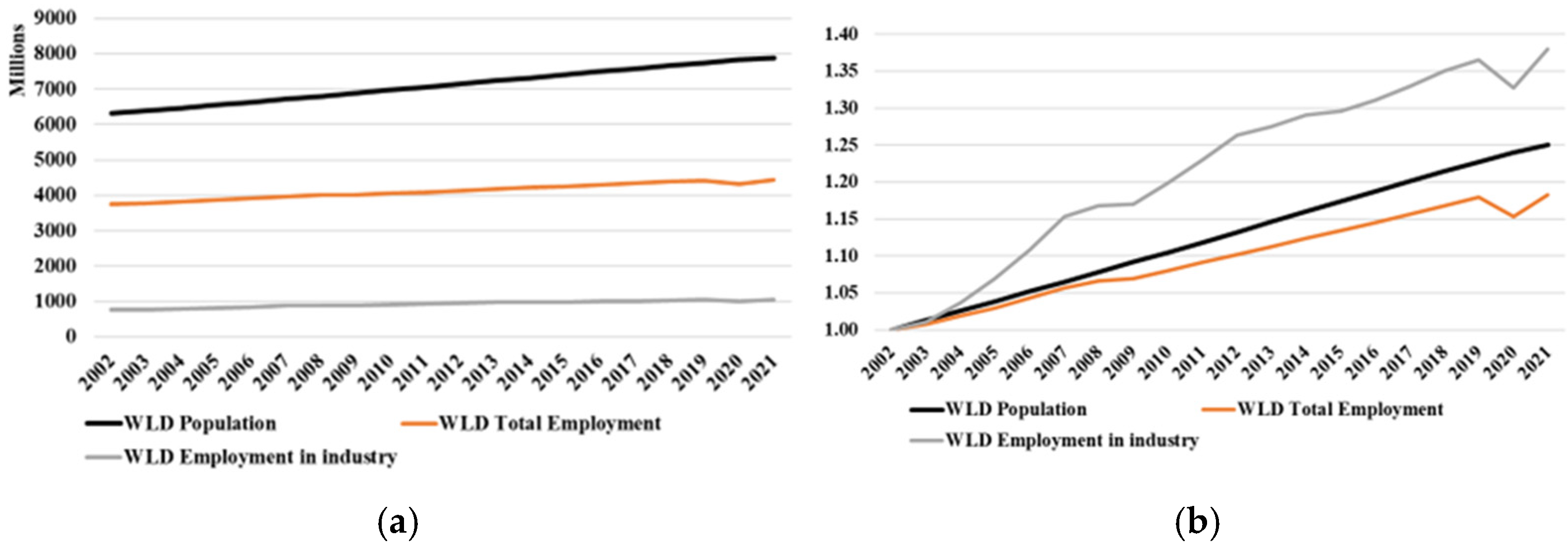
Figure 2a presents the global evolution of population, total employment, and industrial employment from 2002 to 2021. The data reveals a widening gap between population growth and total employment creation, illustrating the increasing pressure on economies to generate productive and technology-intensive jobs. Within this broader trend, employment in manufacturing has expanded more modestly but remains a critical source of stable, innovation-driven work, reflecting the enduring role of industrial activities in supporting productive transformation. Figure 2b compares the relative growth rates of population, total employment, and industrial employment, emphasizing how structural dynamics within the global economy mediate this population–employment imbalance. The figure suggests that economies with stronger entrepreneurial and industrial ecosystems—characterized by diversified manufacturing, technological upgrading, and expanding digital services—are better able to absorb labor productively and sustain industrial employment growth. In contrast, economies with weaker ecosystemic linkages between industry, entrepreneurship, and innovation face greater challenges in converting demographic expansion into sustainable, high-quality jobs.
Figure 2.
The evolution of population and employment in the world: (a) number and (b) index (2002 = 1). For all the graphs shown in this paper, decimal evolution indices are defined as follows: I = nominal value of variable in a particular year/nominal value of variable in 2002. The year 2002 is taken as the base year. In Figure 2 the variables are World Population, Total World Population Employment and Total World Population Employed in Industry. This definition holds for all the graphs ahead considering the variables applicable to each graph. The data source for all the graphs is the World Bank Annual Report.
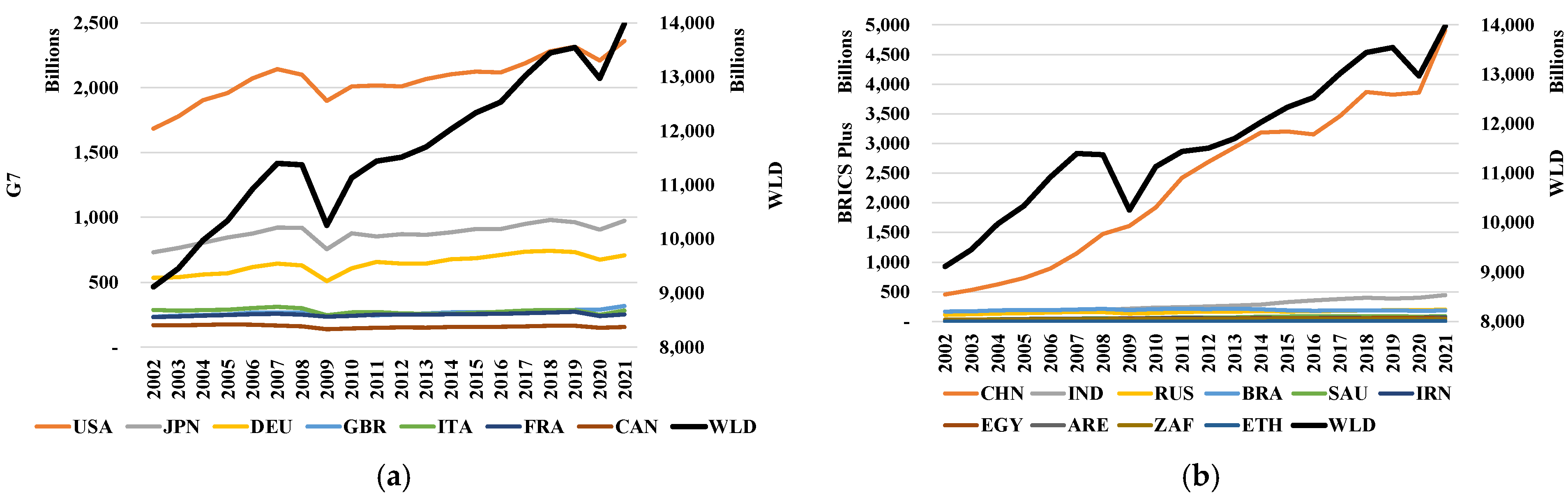
Next, Figure 3a,b illustrate a clear structural divergence between advanced and emerging economies. While G7 countries exhibit a relative deceleration of manufacturing value added associated with post-industrial restructuring and AI-driven specialization, several BRICS Plus economies—particularly China and India—display sustained industrial expansion. These contrasting trajectories are consistent with patterns of ecosystemic specialization in advanced economies and industrial–entrepreneurial convergence under Industry 4.0 in emerging contexts.
Figure 3.
World, G7 (a) and BRICS Plus (b) countries’ MVA evolution (Constant 2015US$).
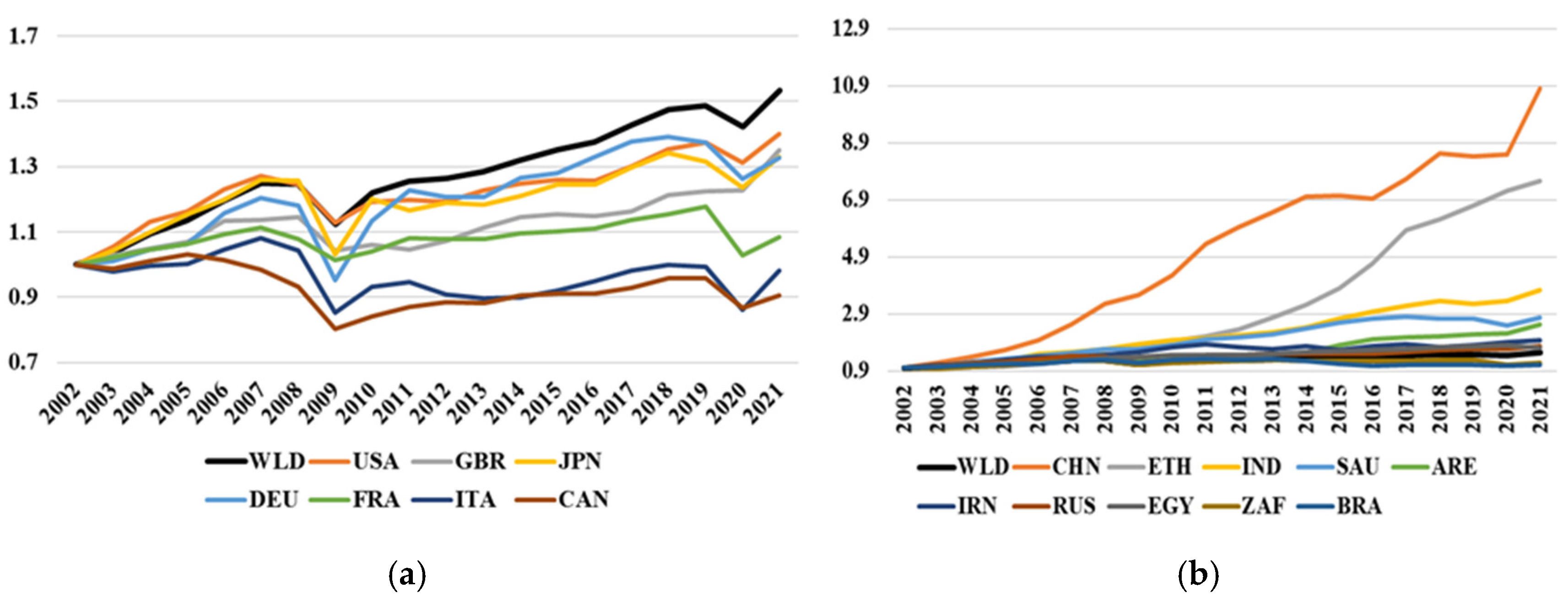
Next, Figure 4a presents the evolution of the manufacturing value added (MVA) index for the G7 economies, showing a clear stagnation over the last two decades, particularly following the 2008 global financial crisis and the 2020 COVID-19 pandemic. Countries such as Italy and France exhibit slower recovery trajectories, reflecting the broader structural transition toward service-based and digital economies. This pattern is consistent with the process of post-industrial adjustment, in which mature entrepreneurial ecosystems increasingly generate innovation and productivity through knowledge-intensive services, artificial intelligence, and technological platforms rather than through traditional manufacturing expansion. The stagnation in MVA therefore signals not a decline in innovative capacity, but a reconfiguration of industrial ecosystems toward digital and intangible value creation. Figure 4b, in contrast, displays the MVA index for BRICS Plus economies, which continue to demonstrate robust industrial growth despite global economic disruptions. Countries such as China and India show sustained increases in manufacturing output, illustrating how emerging entrepreneurial ecosystems are achieving industrial–entrepreneurial convergence through targeted industrial policies, infrastructure investment, and the adoption of Industry 4.0 technologies. Other members, including the United Arab Emirates, Saudi Arabia, and Egypt, show steady progress toward industrial diversification and digital upgrading, highlighting a gradual strengthening of ecosystemic integration. The contrasting trends depicted in Figure 3 show the structural divergence between the G7 and BRICS Plus blocs. While G7 economies exhibit ecosystemic specialization, driven by digital entrepreneurship and post-industrial innovation, BRICS Plus countries exemplify ecosystemic integration, where manufacturing, digitalization, and entrepreneurship evolve synergistically as key structural pillars of sustainable industrialization.
Figure 4.
World, G7 (a) and BRICS Plus (b) countries’ MVA index (2002 = 1).
4.2. Panel Unit Root and Cointegration Results (Table 3 and Table 4; Figure 5 and Figure 6)
Panel unit root tests (Table 3) indicate that LOG(MVA) and LOG(GDPNOTMVA) are non-stationary at levels but become stationary after first differencing, implying they are integrated of order one, I(1). This justifies cointegration analysis to examine long-run relationships.
Cointegration tests (Table 4) reveal a significant long-term relationship between MVA and GDPNOTMVA in BRICS Plus countries but not in G7 economies. This supports the premise that manufacturing continues to underpin long-run economic performance in emerging markets, while G7 economies have transitioned structurally to service-led growth (Rowthorn & Ramaswamy, 1999; Haraguchi et al., 2017) [13,53]. The cointegration results in BRICS Plus may be driven primarily by China and India; the individual BRICS Plus historical data suggest that for countries like Brazil and South Africa, this relationship is weaker or statistically insignificant.
Table 3 and Table 4 reflect that the series LOG(MVA) and LOG(GDPNOTMVA) are integrated of order 1 and cointegrated in the BRICS Plus sample. The rejection of the null hypothesis of no cointegration in Table 4 implies the existence of a stable, long-term relationship between manufacturing and non-manufacturing output.
In the new interpretive framework, this long-run equilibrium reflects an enduring ecosystemic complementarity: industrial production remains tightly connected to entrepreneurial and service activities that facilitate innovation diffusion, supply chain digitalization, and the absorption of Industry 4.0 technologies. Countries such as China, India, and the United Arab Emirates also possess more mature entrepreneurial ecosystems, evidenced by high levels of digital infrastructure investment, startup activity, and AI policy implementation.
Conversely, in Brazil, South Africa, and Russia, the weaker cointegrations suggest partial fragmentation between industrial and non-industrial domains. These patterns indicate that industrial upgrading through entrepreneurial ecosystems depends on the degree of integration between policy, digital infrastructure, and innovation capability rather than on manufacturing scale alone.
In the G7 sample, the absence of cointegration suggests that manufacturing and non-manufacturing activities no longer evolve together in the long run. This decoupling aligns with advanced ecosystemic specialization: entrepreneurship, R&D, and innovation are concentrated in knowledge-intensive and digital sectors that operate autonomously from traditional manufacturing [45,49]. Hence, cointegration results are consistent with structural interdependence—interpreted here as ecosystemic cohesion—which remains characteristic of BRICS Plus economies, while G7 ecosystems have transitioned to service-led innovation models.
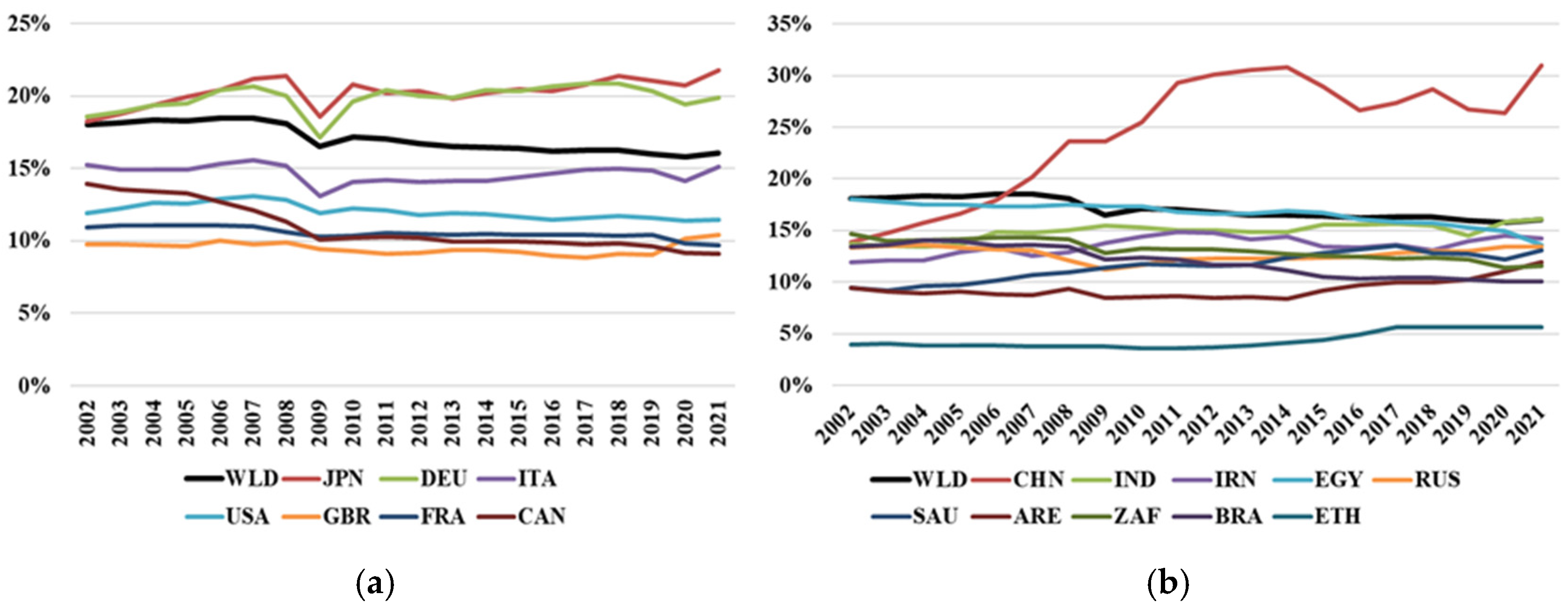
Figure 5a presents the manufacturing value added (MVA) share for selected G7 economies, illustrating how nations such as Germany and Japan have sustained relatively higher levels of industrial output through continuous specialization in high-value-added and technologically sophisticated sectors, including automotive, precision engineering, and advanced materials [46,69]. The persistence and stability of these trajectories correspond with the panel unit root results, indicating that manufacturing activities in advanced economies follow a stationary process around a long-term equilibrium, characteristic of mature industrial ecosystems. Figure 5b shows the corresponding MVA performance for BRICS Plus economies, emphasizing the marked industrial ascent of China and, to a lesser extent, India. China’s ability to leapfrog several G7 economies in MVA as a share of GDP displays how large-scale digital infrastructure investment, innovation policy, and entrepreneurial expansion reinforce industrial competitiveness under Industry 4.0. India’s moderate but steady gains likewise reveal a gradual convergence toward higher manufacturing intensity supported by entrepreneurial dynamism and technological upgrading. The panel cointegration evidence may reflect these visual patterns, showing a statistically significant long-run relationship between industrial and non-industrial sectors in the BRICS Plus bloc—an outcome that indicates how ecosystemic integration between manufacturing, digitalization, and entrepreneurship sustains long-term industrial growth.
Figure 5.
World, G7 (a) and BRICS Plus (b) countries’ MVA % of GDP.
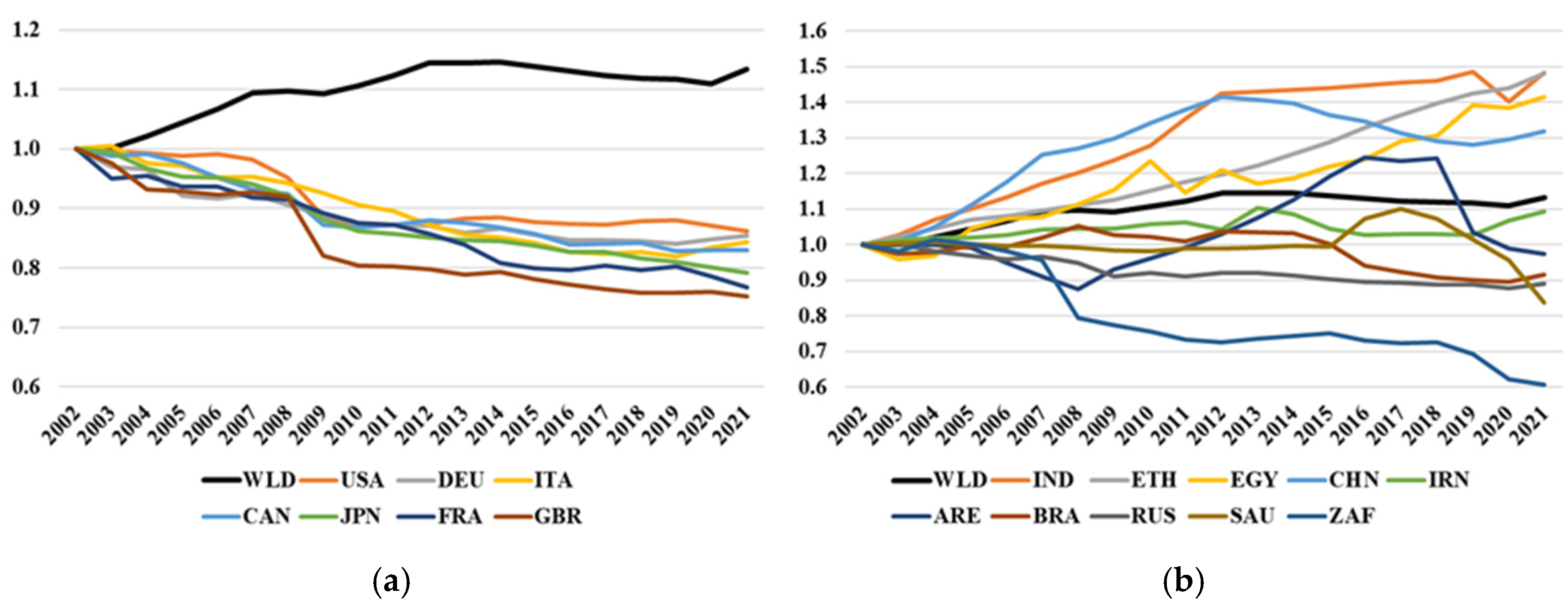
Next, Figure 6a,b illustrate the evolution of manufacturing employment as a share of total employment for the G7 and BRICS Plus economies, respectively. In Figure 6a, the persistent decline in manufacturing employment across G7 reflects a structural shift toward automation, digital services, and offshore production. The panel unit root tests consistent with these changes follow a stable long-run path, indicating that deindustrialization in advanced economies has reached a stationary equilibrium consistent with their mature, innovation-driven entrepreneurial ecosystems. The weak cointegration between industrial and non-industrial sectors further supports the reading of the decoupling of employment and output, as productivity gains in Industry 4.0 industries compensate for shrinking manufacturing labor shares. In contrast, Figure 6b reveals that several BRICS Plus economies—particularly China and India—have sustained or expanded manufacturing employment, suggesting that industrial growth remains a central mechanism for job creation. The positive and statistically significant cointegration results for the BRICS Plus panel indicate an enduring interdependence between industrial and entrepreneurial sectors, where digitalization and policy support reinforce industrial employment. This relationship highlights a transitional stage of ecosystemic integration, in which industrial upgrading, labor absorption, and entrepreneurship co-evolve as complementary components of sustainable industrialization in the Global South.
Figure 6.
World, G7 (a) and BRICS Plus (b) countries’ manufacturing employment % of total employment evolution index (2002 = 1).
4.3. Vector Error Correction Model (VECM) Estimates for BRICS Plus (Table 5; Figure 7 and Figure 8)
The VECM estimation for BRICS Plus (Table 5) reflects a stable long-term equilibrium between LOG(MVA) and LOG(GDPNOTMVA). The error correction term is negative and statistically significant, indicating the presence of a self-correcting mechanism through which deviations from equilibrium are gradually adjusted over time. Lagged changes in LOG(MVA) positively influence current MVA, showing growth momentum, while GDPNOTMVA also contributes, affirming interdependence between manufacturing and the broader economy [71]. The adjustment coefficient is statistically significant, indicating that long-run integration is reliably present in the BRICS Plus panel; its numerical magnitude, however, suggests that short-run shocks dissipate gradually rather than rapidly—a finding compatible with the structural rigidities and institutional frictions characteristic of late-industrializing economies. Country-specific dynamics within the bloc cannot be inferred from this bloc-level estimation; while descriptive trajectories suggest that some economies, such as China and India, may exhibit faster convergence and others, such as Egypt and South Africa, may exhibit slower adjustment to equilibrium, these observations should be read as suggestive descriptive evidence rather than as findings derived from country-specific estimations.
Table 5.
BRICS Plus vector error correction estimates (2002–2021).
Table 5 reports the VECM results for the BRICS Plus group, where the error-correction term (ECT-/CointEq1) is negative and statistically significant, indicating the presence of a self-correcting mechanism between manufacturing and non-manufacturing output. In the framework of entrepreneurial ecosystems, this mechanism captures how institutional and technological feedback loops enable the restoration of equilibrium aftershocks.
For example, policy interventions that strengthen digital infrastructure or support innovation clusters (such as India’s Startup India or China’s Innovation Driven Development Strategy) may accelerate the rebalancing between industrial and service-sector growth. The short-run coefficients indicate bidirectional adjustments: changes in MVA are followed by changes in GDPNOTMVA, and vice versa. This bidirectional pattern is compatible with—though not a direct measure of—ecosystemic synergy, in which industrial expansion may generate demand for entrepreneurial services (ICT, logistics, design, finance), while non-industrial innovation may feed back into production efficiency through AI-driven automation and data analytics [18,54].
The moderate speed of adjustment (captured by the ECT value) also reveals that ecosystemic integration in BRICS Plus remains in progress. Institutional bottlenecks, infrastructure gaps, and uneven innovation finance continue to limit the diffusion of digital technologies and AI across manufacturing sectors. Nevertheless, the significance of both long- and short-run dynamics supports Research Question 1, indicating that entrepreneurial ecosystems substantially influence industrial upgrading under Industry 4.0 by linking innovation processes to productive sectors.
Figure 7a,b present the short-run employment dynamics, showing how industrial and entrepreneurial sectors adjust to restore equilibrium after economic or technological shocks. Figure 7a illustrates the steady decline in industrial employment across the G7 economies, a pattern associated with advanced automation, productivity-driven restructuring, and the growing dominance of knowledge-intensive services. This reflects the post-industrial stabilization of employment, where labor displacement in manufacturing is partly offset by job creation in digital and entrepreneurial domains—an equilibrium typical of mature, innovation-led ecosystems. In contrast, Figure 7b shows the expansion of industrial employment in several BRICS Plus economies, particularly China and India, where sustained manufacturing growth continues to serve as a key source of productive jobs. The VECM results suggest that these employment trends are not isolated phenomena but part of an adjustment mechanism linking manufacturing value added (MVA) and non-manufacturing output (GDPNOTMVA). When disruptions occur—whether through shifts in technology, trade, or innovation intensity—industrial and entrepreneurial sectors co-move to correct disequilibria, re-establishing long-run balance.
Within the entrepreneurial ecosystem framework, this process substantiates the adaptive labor absorption capacity of developing economies. Strong ecosystemic linkages between digital entrepreneurship, industrial upgrading, and policy coordination allow BRICS Plus countries to convert technological change into employment growth rather than displacement. In other words, short-run corrections observed in the VECM reflect how employment serves as the key adjustment variable—translating technological diffusion and entrepreneurial expansion into inclusive, sustainable industrialization.
Figure 7.
World, G7 (a) and BRICS Plus (b) countries’ employment in industry.
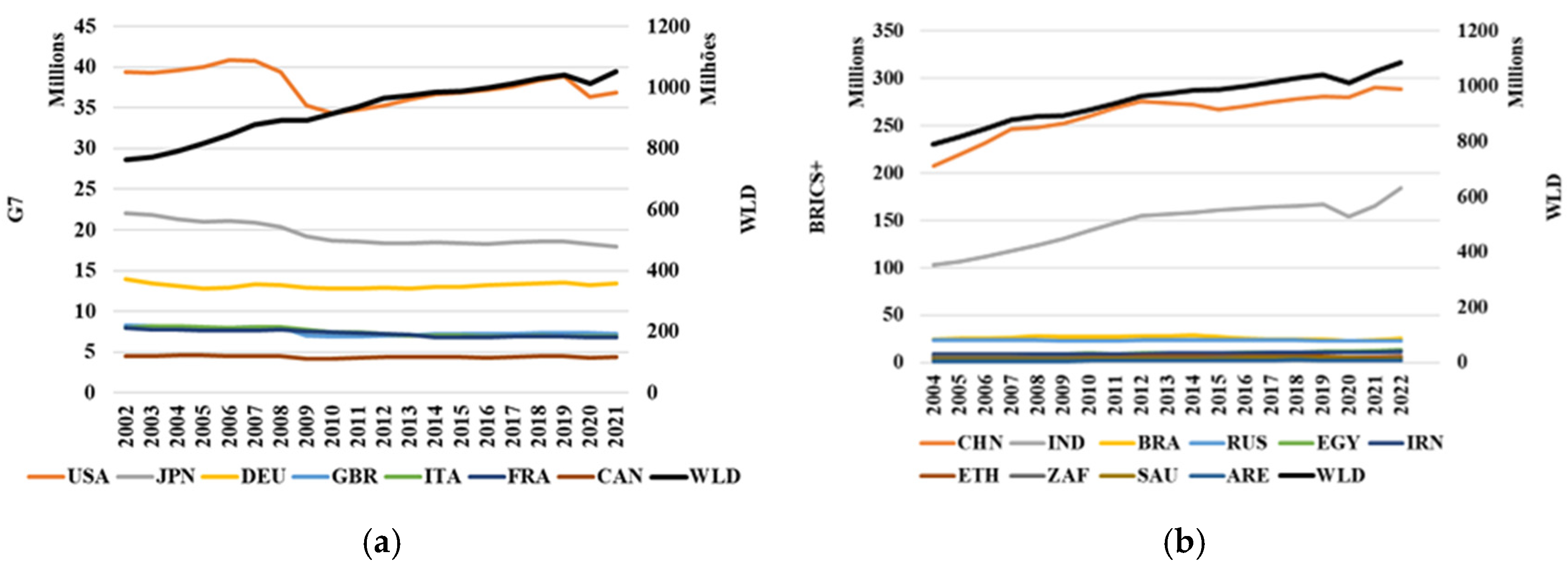
Figure 8a,b extend the VECM-based analysis by examining short-run employment dynamics in industrial sectors across the G7 and BRICS Plus economies. Figure 8a shows a persistent contraction of industrial employment in the G7 countries, reflecting long-term structural adjustment toward high-productivity, capital- and technology-intensive activities. Within the VECM framework, this pattern represents a slow or incomplete adjustment to disequilibria, as job losses in manufacturing are only partially offset by gains in entrepreneurial and service-oriented sectors. The result is a post-industrial equilibrium in which innovation and productivity growth are sustained, but labor absorption diminishes—highlighting the social and distributional limits of mature entrepreneurial ecosystems in advanced economies. In contrast, Figure 8b illustrates the continuing expansion of industrial employment in several BRICS Plus countries, most notably China and India. Here, the VECM estimates indicate a faster and more symmetric short-run correction process, suggesting that shocks to industrial output (MVA) and non-manufacturing activity (GDPNOTMVA) co-move in patterns compatible with—though not equivalent to—institutional mechanisms of mutual reinforcement. This is consistent with an ecosystemic adjustment mechanism in which technological upgrading and entrepreneurial expansion may be associated with new employment opportunities across manufacturing, logistics, and digital services. Rather than displacing labor, technological diffusion appears compatible with productive employment integration, strengthening the link between industrialization and social inclusion.
Figure 8.
World, G7 (a) and BRICS Plus (b) countries’ employment in industry evolution index (2002 = 1).
4.4. GMM Estimates for G7 Economies (Table 6; Figure 9)
Given the absence of cointegration in G7 economies, a GMM model was estimated to capture short-term dynamics (Table 6). The coefficient in lagged LOG(MVA) is highly significant, indicating persistent manufacturing levels. LOG(GDPNOTMVA) has a modest but significant positive effect on MVA. The model shows high overall explanatory power (R2 = 0.995), the substantive interpretation of which is discussed below.
The high explanatory power of the GMM model (R2 = 0.995) should be interpreted with appropriate caution. The dependent variable LOG(MVA) exhibits strong persistence, with the lagged term coefficient close to unity, which mechanically dominates the explained variance in dynamic panel models with highly persistent series. This is a common feature of such specifications and does not in itself signal model misspecification. The substantive interpretation should therefore focus on the statistically significant—though numerically modest—effect of LOG(GDPNOTMVA) on LOG(MVA), rather than on the high overall R2. The Hansen J-statistic reported in Table 6 (J = 2.53; p = 0.112) does not reject the null hypothesis of instrument validity at conventional significance levels, mitigating concerns about over-identifying restrictions; the explicit reporting of Arellano–Bond AR(1)/AR(2) tests is acknowledged as a desirable additional refinement.
Table 6.
G7 panel GMM estimation results for G7 (dependent variable: LOG(MVA)) (2002–2021).
The absence of long-run cointegration necessitates this approach, focusing on short-term causality and dynamic adjustment. The estimates suggest that changes in GDPNOTMVA have a stronger effect on MVA than the reverse, implying that growth in non-industrial sectors—particularly knowledge-intensive services, R&D, and digital entrepreneurship—may reflect the residual character of industrial performance in advanced economies.
Interpreted through the ecosystemic lens, this indicates that G7 economies have completed a transition toward post-industrial entrepreneurial ecosystems, where industrial innovation arises from digital and knowledge spillovers rather than from direct manufacturing expansion. AI-driven productivity, robotics, and smart manufacturing initiatives (e.g., Industrie 4.0 in Germany, Society 5.0 in Japan) are thus outcomes of digitally networked ecosystems that substitute for the traditional manufacturing–GDP linkage observed in developing contexts.
The statistical significance of lagged GDPNOTMVA underscores that in mature ecosystems, entrepreneurship and digital innovation have become autonomous engines of growth. This finding addresses Research Question 2, suggesting that AI and digitalization may be reshaping the historical relationship between manufacturing and entrepreneurship, enabling economic growth decoupled from industrial employment.
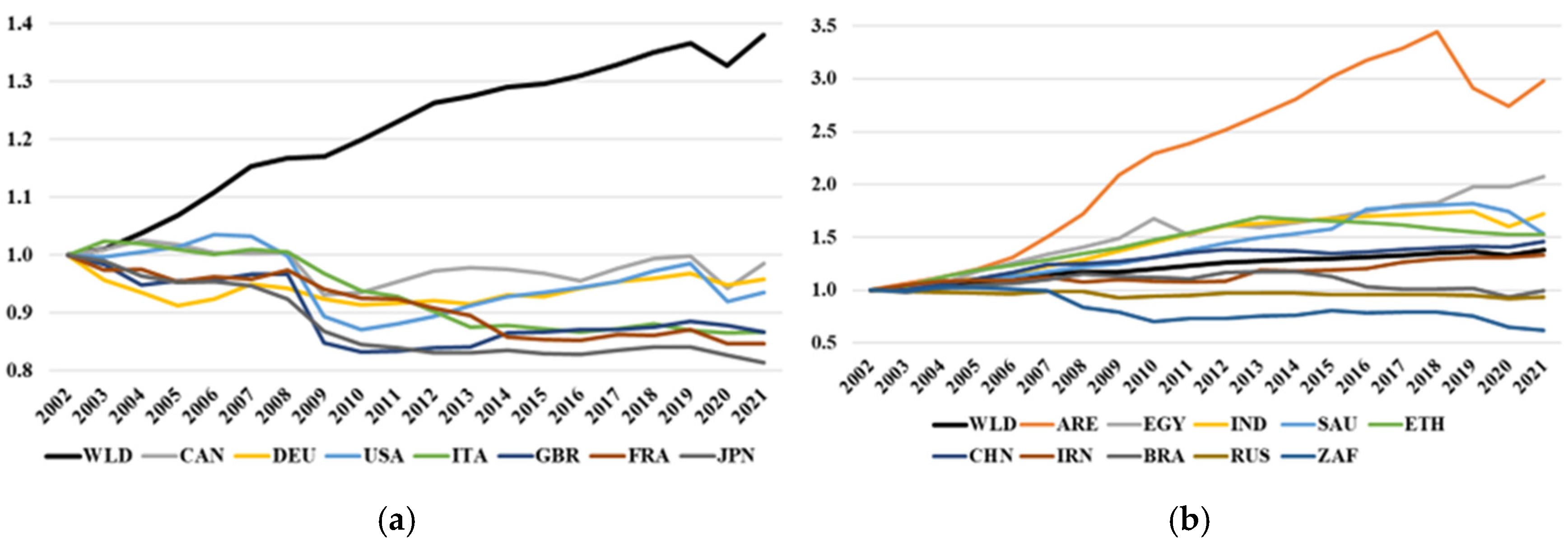
Figure 9a,b build on the GMM estimations by examining the relationship between manufacturing productivity, technological intensity, and employment dynamics across G7 and BRICS Plus economies. Figure 9a highlights the sustained productivity advantage of G7 nations over the global average, reflecting their long-term specialization in high-value-added and capital-intensive manufacturing. However, this superior performance coincides with a persistent decline in industrial employment, as automation, robotics, and artificial intelligence increasingly substitute for labor. Within the GMM framework, this pattern signifies a mature post-industrial equilibrium, where output growth is driven primarily by technological innovation and digital entrepreneurship rather than by labor expansion in manufacturing. Figure 9b shows how several BRICS Plus economies—particularly China and Saudi Arabia—are progressively narrowing the productivity gap with advanced nations through targeted industrial policies, digital infrastructure investment, and technology transfer. Nonetheless, countries such as Brazil and South Africa continue to lag behind, evidencing weaker innovation systems and lower ecosystemic connectivity between manufacturing and entrepreneurship. These disparities indicate that productivity convergence alone does not ensure inclusive industrialization; it must be accompanied by entrepreneurial and policy mechanisms that convert technological upgrading into sustained employment and value creation. For an interesting discussion on the case of middle income economies we refer the reader to the work of Ravindran and Manalaya, 2023 [72], listed in the References.
This empirical contrast underscores the dual transformation occurring under Industry 4.0. In the G7, innovation ecosystems generate productivity gains with limited job creation, consistent with advanced stages of automation and post-industrial specialization. In the BRICS Plus bloc, however, industrial and entrepreneurial integration remains more labor-intensive, with emerging ecosystems displaying the potential for employment-inclusive technological upgrading. Initiatives such as Germany’s Industrie 4.0, Japan’s Society 5.0, and the U.S. Advanced Manufacturing Partnership illustrate how digital entrepreneurship reshapes production and innovation systems [42,62], but they also highlight the challenge of maintaining social inclusivity in highly automated environments.
Figure 9.
World, G7 (a) and BRICS Plus (b) countries’ employment productivity (MVA constant 2015 US$/Manufacturing employment).
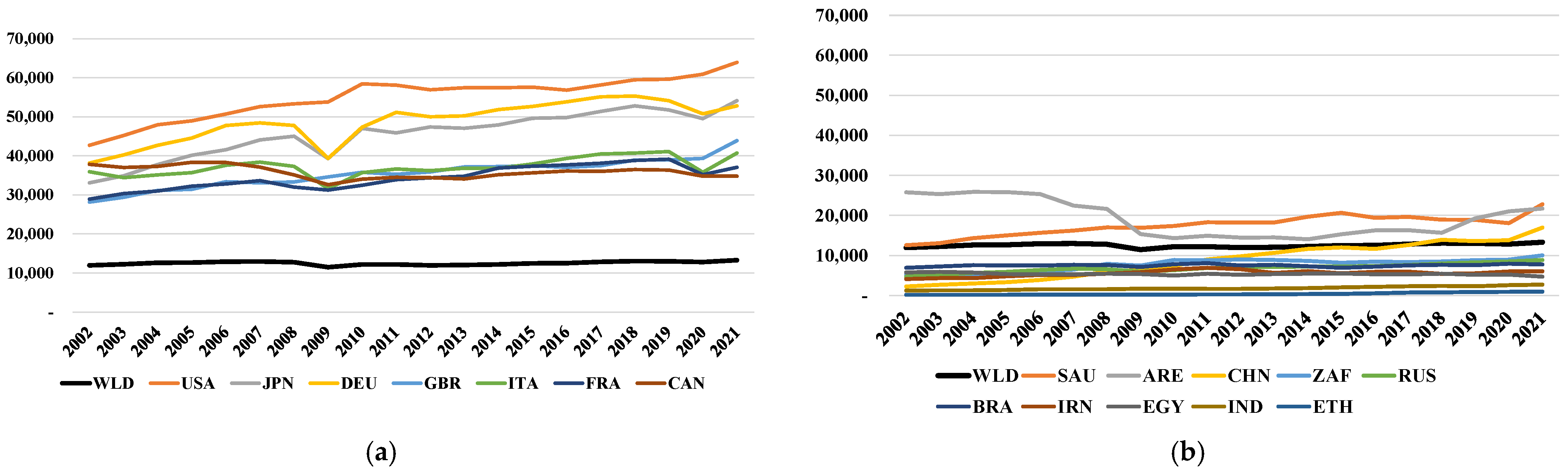
4.5. Granger Causality Tests (Table 7; Figure 10)
Granger causality tests for the G7 panel (Table 7) reveal a marginally significant Granger causality running from LOG(GDPNOTMVA) to LOG(MVA), with a p-value of 0.0859—significant at the 10% level but not at the conventional 5% threshold. Given the modest time dimension of the panel (T = 20) and the well-documented loss of statistical power that affects Granger causality tests in short panels, we adopt a 10% significance threshold for this test, in line with common practice in macro-panel studies of structural change. Within this threshold, the result is consistent with a weak form of unidirectional Granger causality from non-manufacturing to manufacturing activity in advanced economies—a pattern that, while statistically modest, is interpretatively consistent with the structural decoupling of manufacturing from broader GDP dynamics in mature post-industrial ecosystems, where services and digital sectors are the principal drivers of growth [43,44].
Table 7.
G7 pairwise Granger causality tests (2002–2021).
The Granger causalities reported in Table 7 reinforce these differentiated dynamics. For the BRICS Plus group, bidirectional causality between MVA and GDPNOTMVA indicates the presence of reciprocal feedback between industrial production and entrepreneurial activity. This pattern reflects adaptive ecosystems in which technological innovation flows between manufacturing firms, startups, and service providers, enhancing structural resilience and innovation diffusion [19,22].
In contrast, the G7 economies exhibit a weak unidirectional causality from GDPNOTMVA to MVA, statistically significant at the 10% level (p = 0.086) but not at the 5% threshold. This marginal pattern is consistent with the broader structural reading of advanced digital ecosystems, in which high-value entrepreneurship and AI-based services stimulate niche industrial modernization but no longer depend on manufacturing expansion. The interpretation should be read with caution given the modest level of statistical significance; it is consistent with the theoretical expectation that ecosystemic leadership—rather than manufacturing dominance—may now reflect innovation in advanced economies, while acknowledging that the empirical signal is weak.
Figure 10a,b illustrate the results of employment productivity evolution index for the G7 and BRICS Plus panels, comparing the evolution of productivity indices and their implications for employment and industrial–entrepreneurial linkages. Figure 10a suggests that G7 nations maintain persistently higher productivity levels; however, the causal relationship appears to run predominantly from the non-manufacturing sectors toward the manufacturing sector. This pattern indicates that innovation and technological advances originate largely in digital, service-based, and entrepreneurial domains, later diffusing into industrial production. While this structure sustains productivity growth, it also is consistent with the employment stagnation in manufacturing, as technological change is driven by automation and AI-intensive activities rather than by labor expansion. In the G7 context, therefore, causality reflects a post-industrial innovation model, where ecosystem adaptation prioritizes efficiency and digital entrepreneurship over employment-intensive manufacturing. In contrast, Figure 10b suggests that BRICS Plus economies, particularly China and India, are achieving faster gains in manufacturing productivity, with bidirectional causality between industrial and non-industrial sectors. On the other side, economies facing a process of deindustrialization like Brazil and South Africa can improve their industrial productivity indexes by fostering the adoption of digital technologies, modern energy solutions and investments in the requalification of human capital [73]. This suggests that productivity improvements in manufacturing both benefit from and contribute to the growth of entrepreneurial activities, forming a virtuous cycle of industrial upgrading and employment generation. The strong feedback loop between MVA and GDPNOTMVA implies that ecosystemic integration supports employment-led growth, as technological and organizational innovations are absorbed across sectors. Taken together, the causality results reveal a clear structural divergence: while G7 economies exhibit innovation modest employment expansion, the BRICS Plus group indicates employment-mediated industrial convergence, where entrepreneurial ecosystems transform technological progress into inclusive, job-generating industrialization.
Figure 10.
World, G7 (a) and BRICS Plus (b) countries’ employment productivity evolution index (MVA constant 2015 US$/Manufacturing employment, 2002 = 1).
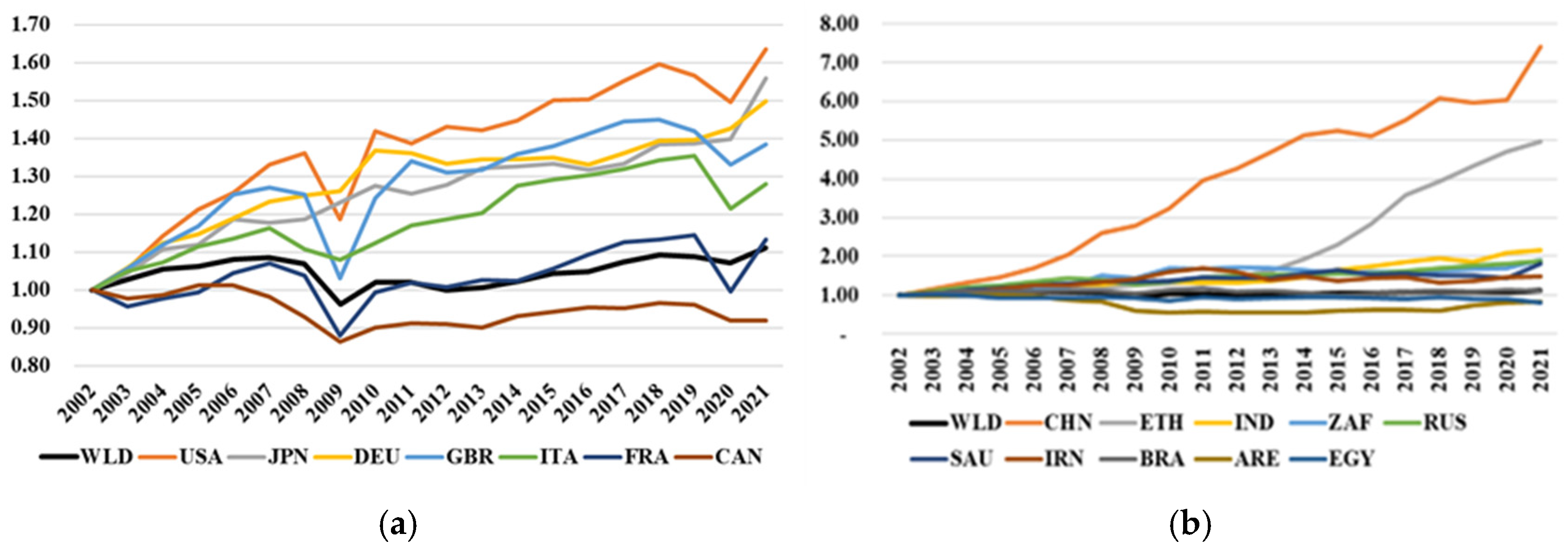
4.6. Evolution of Ecosystemic Performance and Non-Industrial Competitiveness (Figure 11 and Figure 12)
Figure 11 and Figure 12 synthesize the long-term patterns of GDP excluding manufacturing (GDPNOTMVA) across BRICS Plus and G7 economies, offering a comparative panorama of ecosystemic evolution from 2002 to 2021. Taken together, the findings suggest that the sustainability of industrialization is associated with structural relationships between industrial and non-industrial sectors that may be compatible with ecosystem-based interpretations, while also reflecting broader structural factors such as global value chain integration.
Figure 11a,b examine the evolution of non-industrial performance, represented by GDP excluding manufacturing (GDPNOTMVA), for G7 and BRICS Plus economies, respectively. Figure 11a suggests that among G7 countries, the United States continues to lead, consistently maintaining the highest levels of non-manufacturing output. This trend reflects the U.S. economy’s deep structural transformation toward high-value service industries such as finance, digital technology, and data-driven entrepreneurship, which have become the dominant contributors to GDP [74]. Germany and Japan, though retaining robust manufacturing sectors, also demonstrate strong diversification through advanced logistics, business services, and innovation ecosystems. The overall pattern underscores a mature post-industrial configuration in which competitiveness is sustained by knowledge-intensive and digitalized non-industrial activities, forming a core component of ecosystemic performance and long-run productivity. Figure 11b depicts the evolution of GDPNOTMVA across BRICS Plus economies, revealing significant heterogeneity in non-industrial development. China leads the group, followed by India, both of which exhibit sustained growth in services and digital industries while maintaining strong manufacturing foundations. These trajectories represent ecosystemic convergence, where industrial production and entrepreneurial expansion advance in tandem. Policies such as Made in China 2025, Digital India, and Startup India have created institutional bridges connecting manufacturing, digital services, and AI-based innovation. Similarly, the United Arab Emirates’ Vision 2030 illustrates how investment in AI, digital infrastructure, and smart-industry zones may foster complementarity between industrial productivity and non-industrial competitiveness. In contrast, Brazil, South Africa, and Russia show weaker or more volatile trajectories, indicative of ecosystemic fragmentation. Although service-sector activities have expanded, limited technological diffusion, macroeconomic instability, and weak backward linkages to manufacturing have hindered structural transformation [40]. Their entrepreneurial ecosystems remain partially disconnected from industrial upgrading, constraining both productivity and innovation capacity. For economies experiencing premature or partial deindustrialization, the findings highlight the importance of long-term and institutionally coordinated industrial strategies. Rather than short-term policy cycles, sustained frameworks that integrate digital transformation, energy transition, and innovation governance appear more consistent with the requirements of ecosystemic industrial upgrading under Industry 4.0. Digital transformation is a key concept to design modern ecosystems in association with energy transition projects and innovation management. Newly integrated BRICS Plus members—Saudi Arabia, Egypt, and Indonesia—display hybrid models characterized by moderate industrial expansion alongside rapid digital service growth, signaling a transitional stage toward greater ecosystem integration through digital entrepreneurship and policy-led diversification.
Figure 11.
G7 (a) and BRICS Plus (b) countries’ GDPNOTMVA (constant 2015 US$).
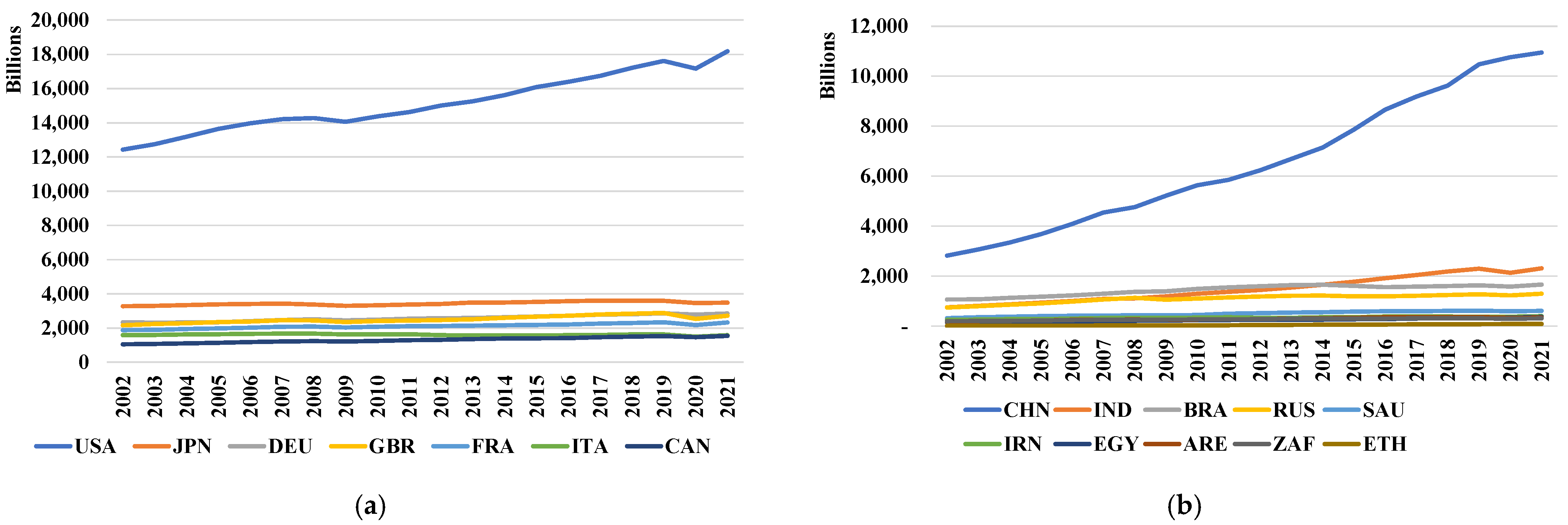
Figure 12 extends the comparative analysis of non-industrial trends by tracing the evolution of GDP excluding manufacturing (GDPNOTMVA) across G7 and BRICS Plus economies, revealing how structural transformations in services, digital industries, and entrepreneurship shape overall ecosystemic performance.
Figure 12a illustrates the trajectory for G7 countries, where non-industrial growth has remained moderate but structurally consistent. The effects of the 2008 global financial crisis and the 2020 COVID-19 pandemic are clearly visible, especially in France and Italy, where service-sector expansion temporarily slowed. The United States again shows resilience, maintaining steady post-crisis recovery driven by innovation in digital technologies, financial services, and high-value-added entrepreneurship. From an ecosystemic standpoint, these patterns signify a mature post-industrial equilibrium, characterized by the migration of innovation, the relocation of entrepreneurial activity, research, and technological discovery from manufacturing toward digital and service domains. G7 economies thus exemplify advanced entrepreneurial ecosystems, in which artificial intelligence, data analytics, and platform-based innovation drive competitiveness without relying on traditional manufacturing growth. National strategies such as Germany’s Industrie 4.0, Japan’s Society 5.0, and the U.S. Advanced Manufacturing Partnership illustrate how governments, corporations, and universities coordinate to sustain technological leadership and adaptability through knowledge-driven value creation. The innovation frontier has accordingly shifted from physical production toward cognitive and algorithmic industries, supported by strong venture capital markets, digital governance frameworks, and transnational research networks. Figure 12b presents the evolution of GDPNOTMVA for BRICS Plus economies, where the trends reveal both rapid expansion and pronounced heterogeneity. China and India show robust non-industrial growth, consistently outpacing the global average and demonstrating how digital transformation and entrepreneurship are reshaping economic structures. Notably, China maintained positive non-industrial growth even during the 2020 pandemic, underscoring the resilience and diversification of its ecosystem. India’s steady upward trajectory reflects the gradual consolidation of digital and service industries alongside industrial modernization. In contrast, Brazil and South Africa continue to exhibit weak or stagnant non-industrial growth, revealing ecosystemic fragmentation—where services and digital sectors expand without generating strong linkages to industrial upgrading or innovation diffusion. These disparities point to the dual trajectory within the BRICS Plus bloc: some economies are advancing toward integrated, digitally enabled ecosystems, while others remain constrained by structural bottlenecks, macroeconomic instability, and limited policy coherence.
Figure 12.
World, G7 (a) and BRICS Plus (b) countries’ GDPNOTMVA evolution index (2002 = 1).
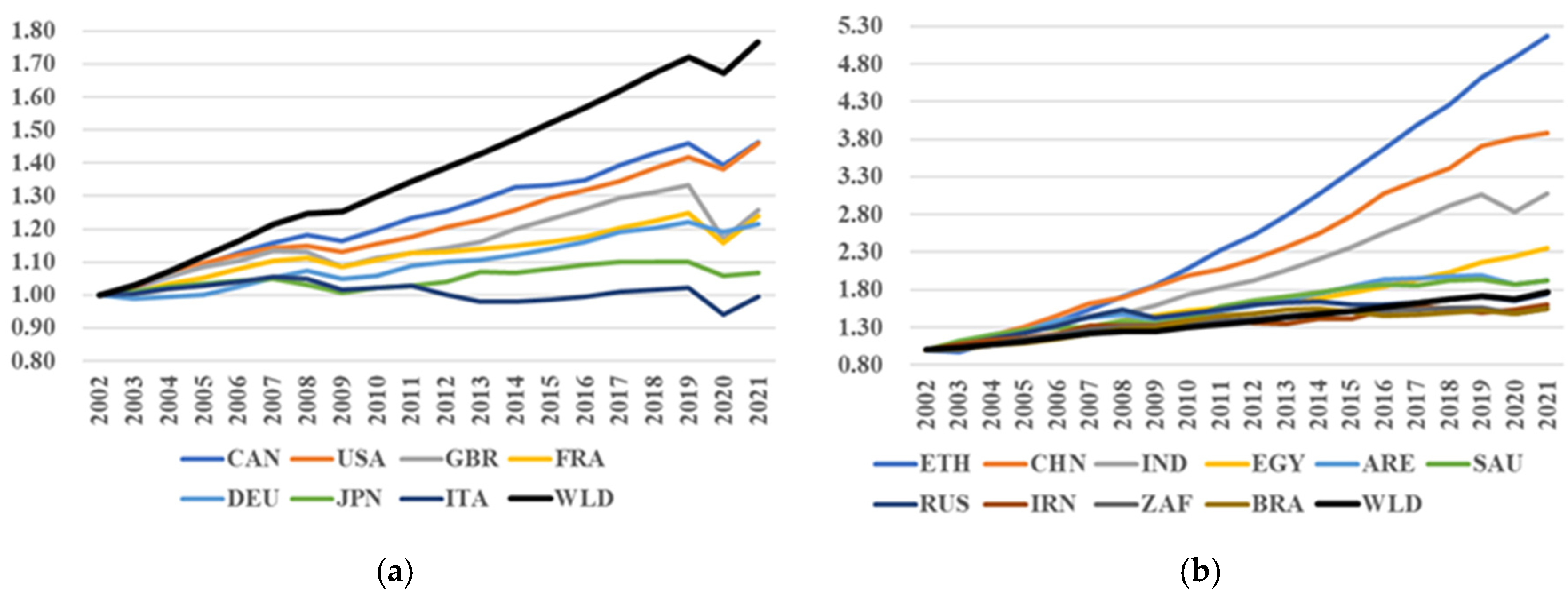
5. Discussion
The results suggest that the observed co-movement between manufacturing and non-manufacturing sectors is consistent with patterns in which digital entrepreneurship, policy frameworks, and infrastructure may contribute to structural complementarities, without implying a direct causal effect of ecosystem characteristics on industrial outcomes. The observed long-run equilibrium between manufacturing value added (MVA) and non-manufacturing GDP (GDPNOTMVA) in BRICS Plus economies provides evidence of long-run co-movement between industrial and entrepreneurial activities—a pattern compatible with, though not equivalent to, institutional mechanisms of mutual reinforcement, and consistent with the concept of ecosystemic integration [18,19]. Cointegration here documents structural complementarity at the macro level; the specific micro-level mechanisms of ecosystem coordination are not directly observed in the present design. This result addresses the first research question—how entrepreneurial ecosystems influence industrial upgrading in BRICS Plus economies under Industry 4.0—by suggesting that when industrial policy, digital infrastructure, and entrepreneurship evolve coherently, structural transformation may be sustained over time.
Our macro-level findings are also consistent with recent evidence showing that technology adoption is shaped by sectoral, organizational, and contextual conditions rather than by technological availability alone [75]. In this sense, the structural complementarities observed in BRICS Plus may reflect broader ecosystem conditions conducive to industrial–digital coordination, although the specific attitudinal and institutional mechanisms remain outside the scope of the present dataset. Descriptive patterns suggest that countries such as China and India may exhibit more advanced forms of industrial–service integration, whereas others such as Brazil and South Africa appear to face structural constraints; however, these observations are not derived from country-level econometric estimations and should therefore be interpreted as suggestive rather than conclusive.
In contrast, the G7 economies exhibit no cointegration and a weak unidirectional Granger causality from non-industrial to industrial activity, statistically significant only at the 10% level (p = 0.086). This marginal but interpretable pattern is consistent with a post-industrial ecosystemic specialization in which digital entrepreneurship and innovation increasingly occur independently of manufacturing expansion, in agreement with the second research question—to what extent AI and digitalization transform the relationship between manufacturing and entrepreneurship. These economies have transitioned to service- and knowledge-based growth, where competitiveness is sustained through AI-intensive production, automation, and digital services rather than through traditional manufacturing [42,49].
5.1. Hypothesis 1: Long-Run Cointegration and Ecosystemic Complementarity in BRICS Plus
Hypothesis 1 (H1) predicts long-run cointegration between MVA and GDPNOTMVA in BRICS Plus economies. The results in Table 3 and Table 4 are consistent with this expectation. In BRICS Plus economies, the persistence of cointegration between MVA and GDPNOTMVA indicates that manufacturing remains structurally linked to the broader entrepreneurial and service sectors. This long-run co-movement is compatible with—though not equivalent to—institutional mechanisms of ecosystemic complementarity through which industrial and non-industrial activities support structural upgrading and technological diffusion [9,20]. Economies such as China, India, and the United Arab Emirates exemplify this dynamic at the descriptive level through strong digital infrastructure, proactive innovation policy, and growing startup ecosystems.
This finding also aligns with late-industrialization theory [4], which argues that institutional coordination and technological adaptation can accelerate industrial convergence. In BRICS Plus contexts, entrepreneurial ecosystems mediate this process by fostering innovation diffusion, supply chain modernization, and AI adoption, helping latecomer economies to leapfrog technological stages. As shown by the Vector Error Correction Model (VECM) results, short-run disequilibria in these economies are corrected through adaptive policy responses and cross-sectoral innovation linkages—a pattern consistent with resilient ecosystemic adjustment [69].
5.2. Hypothesis 3: Structural Decoupling and Post-Industrial Autonomy in G7 Economies
Hypothesis 3 (H3) predicts the absence of long-run cointegration and weaker short-run causality in G7 economies—patterns consistent with mature post-industrial structures. The empirical evidence reported in Table 6 and Table 7 is broadly compatible with this expectation. The GMM and Granger causality results for G7 economies reveal that innovation increasingly originates in non-industrial domains—particularly in software, finance, and biotechnology—and subsequently influences manufacturing through technological spillovers. This decoupling denotes the autonomous functioning of post-industrial ecosystems, in which industrial activities are no longer the primary source of innovation [47,48]. Instead, entrepreneurial dynamism is concentrated in digital platforms, algorithmic industries, and knowledge-intensive services, driven by AI-enabled efficiency and productivity gains [44,45].
However, while these systems are technologically advanced, they face social and spatial challenges, including employment polarization and regional inequality [50,51]. The evidence suggests that post-industrial innovation systems can sustain productivity but struggle to generate inclusive employment growth—underscoring the importance of ecosystemic balance between technological progress and social cohesion.
5.3. Hypothesis 2: Bidirectional Feedback and Divergent Ecosystemic Trajectories
Hypothesis 2 (H2) predicts long-run cointegration between MVA and GDPNOTMVA and also bidirectional Granger causality between MVA and GDPNOTMVA in BRICS Plus economies, a pattern interpreted as compatible with synergistic industrial–entrepreneurial linkages. The Granger results in Table 7 confirm this bidirectionality for BRICS Plus, in contrast with the weaker unidirectional pattern observed for the G7 panel. Comparative analysis across Figure 2, Figure 3, Figure 4, Figure 5, Figure 6, Figure 7, Figure 8, Figure 9, Figure 10, Figure 11 and Figure 12 highlights a structural divergence between ecosystemic integration in BRICS Plus and ecosystemic specialization in G7 economies. The former continues to rely on industrial–entrepreneurial complementarity, while the latter depend on digital autonomy and innovation-driven services. This pattern is consistent with structural configurations in which non-manufacturing sectors evolve more independently from manufacturing, which may be interpreted as reflecting features commonly associated with mature post-industrial economies [18,37].
In the BRICS Plus bloc, digital transformation is embedded in broader industrial strategies—such as Made in China 2025, Startup India, and Vision 2030—which link manufacturing competitiveness to entrepreneurial development. These strategies create synergistic feedback loops between industrial upgrading and digital entrepreneurship, enabling economies to sustain industrialization while diversifying their production base. Conversely, G7 economies exhibit ecosystemic autonomy, where innovation ecosystems operate independently of industrial production, relying instead on cognitive, AI-intensive, and service-based industries for growth [42,49].
5.4. Hypothesis 4: The GVC-Mediated Interpretation—Structural Positioning, Smile Curve, and Heterogeneous Upgrading in BRICS Plus
The patterns of cointegration and Granger causality discussed in Section 5.1, Section 5.2 and Section 5.3 admit a second reading, articulated in H4. The long-run equilibrium and bidirectional causality observed in BRICS Plus, and the structural decoupling observed in the G7, may reflect domestic ecosystemic coordination, but they may also reflect the position of these economies within global value chains. The panel design does not include firm-level GVC indicators, so the present analysis cannot decide between the two interpretations. It can, however, examine how the empirical results align with H4 and identify which features of the BRICS Plus bloc are most exposed to that reading.
We begin with the VECM adjustment speed: Table 5 reports an error correction coefficient of approximately −0.006: statistically significant, but small in magnitude. Section 5.1 reads this slowness as a sign of institutional bottlenecks and uneven innovation finance. The Smile Curve framework [25] reads it differently—as the difficulty of moving from manufacturing-intensive activities, which capture relatively little value, toward upstream R&D and downstream services, where value capture is higher. The frictions described by the two readings differ in nature, but their macro-panel signature is the same. Cointegration and adjustment speed alone cannot tell them apart.
The bidirectional Granger causality in Table 7 presents the analytically more difficult case. The ecosystemic reading interprets it as feedback between industrial production and entrepreneurial activity. The GVC reading interprets it as input–output linkages within global production networks [4,6,16,25]; export-oriented manufacturing demands logistics and financial services, service outsourcing creates demand for industrial activity, and resource-based value chains tie extraction to processing and finance. Both mechanisms generate bidirectional causality at the bloc level. This is precisely why macro-panel evidence of this type, including the present results, must be read with caution.
The internal heterogeneity of the BRICS Plus bloc, visible at the descriptive level in Figure 11b and Figure 12b, is where the dual interpretation becomes most informative. China and India have combined large-scale manufacturing with rising participation in higher-value-added activities—digital services, AI-based platforms, and innovation [8,9,18]. Their trajectories are broadly consistent with the Flying Geese model of sequential upgrading [4,6], in which latecomer economies progressively move toward more sophisticated value chain segments. Brazil, South Africa, and Russia tell a different story. Industrial activity in these economies coexists with commodity dependence, institutional discontinuities, and weak technological upgrading [7,40], and their trajectories resemble those associated with the middle-income trap [7,16], where early industrialization does not translate into sustained productivity convergence. Country-level claims cannot be drawn from a bloc-level estimation, so these observations are necessarily descriptive. Still, the contrast matters: the GVC-mediated interpretation is most plausible for the bloc’s fragmented cases, whereas the more integrated trajectories likely reflect both GVC repositioning and the consolidation of domestic ecosystems.
A similar logic applies to the G7 results, though in mirror image. Section 5.2 reads the absence of cointegration and the weak unidirectional causality from GDPNOTMVA to MVA as evidence of post-industrial autonomy, with innovation originating in digital and knowledge-intensive sectors. The Smile Curve [25] offers a complementary reading: G7 economies specialize in the high value-capture segments of global production—R&D, finance, design, and intangibles [1,2,13]—and the manufacturing activity that remains is structurally disconnected from the broader domestic value chain. In the advanced-economy case, ecosystemic specialization and Smile Curve positioning are two ways of describing the same structural configuration.
H4 complements rather than competes with H1–H3. The bidirectional cointegration in BRICS Plus, the decoupling in the G7, and the heterogeneity within the BRICS Plus bloc are each compatible with the joint operation of domestic ecosystemic dynamics and GVC positioning. Direct adjudication between the two would require sector-level GVC indicators such as the trade in value added (TiVA) backward participation index, which falls outside the macro-panel design adopted here and is listed in Section 6.4 as a priority for future research.
5.5. Policy and Theoretical Implications
Building on the joint reading of ecosystemic dynamics and GVC positioning developed in Section 5.4, the findings indicate that the observed structural relationships are compatible with interpretations in which entrepreneurial ecosystems may play a role in sustaining industrialization in BRICS Plus economies, alongside structural positioning within global value chains. In BRICS Plus economies, sustainable industrialization requires hybrid strategies that blend top-down coordination with bottom-up entrepreneurial dynamism [37,54]. This includes strengthening digital infrastructure, intellectual property regimes, and access to venture capital—factors that enhance innovation absorption capacity and ecosystem scalability [7,62].
From a theoretical perspective, the study bridges the gap between structuralist theories of industrialization [5,6] and contemporary innovation system frameworks [18,19]. It denotes that industrialization in the digital age must be understood as an ecosystemic process, where manufacturing, entrepreneurship, and digitalization evolve as interdependent subsystems. This reconceptualization contributes to the emerging literature on “industrializing in the digital age” [20], providing a comprehensive framework for analyzing how economies combine physical production with cognitive and digital innovation.
5.6. Synthesis and Broader Insights
The study’s results highlight two distinct models of sustainable industrialization under Industry 4.0. The BRICS Plus bloc exhibits macro-structural patterns compatible with industrial–entrepreneurial convergence, in which digital transformation appears to reinforce industrial capabilities, supporting inclusive growth and employment. The G7 bloc, in contrast, displays patterns consistent with post-industrial autonomy, where innovation is decoupled from manufacturing but sustained through advanced services and AI-driven entrepreneurship.
These dual trajectories reveal that the future of global industrialization will depend not on the persistence of manufacturing per se, but on the adaptive capacity of entrepreneurial ecosystems to integrate innovation, policy, and social inclusion. For BRICS Plus economies, the challenge is to deepen ecosystemic linkages to avoid premature deindustrialization; for G7 economies, it is to reindustrialize through digital and sustainable technologies.
In both cases, the empirical evidence is compatible with the interpretation that ecosystemic maturity and coherence—not manufacturing scale—may be associated with the long-term sustainability of industrialization in the digital era.
A fuller assessment of these two models would benefit from systematic comparison with the late-industrialization trajectories of South Korea, Taiwan, and Singapore introduced in the section Benchmarking Late Industrialization: East Asia and Structural Upgrading. Whether the BRICS Plus configuration converges toward, diverges from, or represents a structurally distinct alternative to that East Asian benchmark—and how each contrasts with the post-industrial G7 model—remains a question that the present macro-panel design cannot adjudicate, and that should be examined before extending these findings to geostrategic or geoeconomic policy claims.
6. Conclusions
This study set out to examine how entrepreneurial ecosystems (EEs) shape the dynamics of industrialization in the digital era, focusing on the comparative trajectories of BRICS Plus and G7 economies. Drawing on the frameworks of structural change theory, innovation systems, and ecosystemic development [4,18,19,54], the analysis examined whether the maturity and configuration of entrepreneurial ecosystems may be associated with patterns of sustainable industrialization or with post-industrial specialization.
Before presenting the synthesis and policy implications below, it is important to recall the inferential limits of the study. The macro-structural indicators used (MVA, GDP, GDPNOTMVA) cannot fully capture the micro- and meso-level dynamics of entrepreneurial ecosystems, particularly with regard to high-value tasks such as R&D, design, and post-sale services. Section 6.4 develops these limitations in detail; the conclusions that follow should be read in light of them.
The research employed a combination of descriptive indicators and panel econometric methods to interpret the relationship between manufacturing value added (MVA), GDP excluding manufacturing (GDPNOTMVA), industrial and total employment, and productivity indices. These variables—complemented by visual analyses of structural trends (Figure 2, Figure 3, Figure 4, Figure 5, Figure 6, Figure 7, Figure 8, Figure 9, Figure 10, Figure 11 and Figure 12)—were used as ecosystemic proxies for digital infrastructure, industrial maturity, and policy coherence. Together, they provide an integrated picture of how industrial and entrepreneurial activities co-evolve across distinct stages of development.
6.1. Theoretical and Empirical Synthesis
The results are in line with the study’s guiding research questions. Entrepreneurial ecosystems influence industrial upgrading in BRICS Plus economies by aligning industrial, technological, and institutional processes. AI and digitalization transform the relationship between manufacturing and entrepreneurship, not through substitutions, but through functional integration that enhances innovation diffusion and productivity growth.
The econometric results, particularly the long-run cointegration and bidirectional Granger causality between MVA and GDPNOTMVA, provides macro-structural evidence compatible with the existence of systemic interdependence in BRICS Plus economies. In these countries, manufacturing output and non-industrial activities such as ICT, logistics, and business services evolve in tandem, reflecting ecosystemic complementarity. Descriptive variables, including industrial employment and MVA shares, reinforced this finding by illustrating the persistence of industrial–entrepreneurial convergence in countries like China, India, and the United Arab Emirates.
In contrast, G7 economies exhibited no cointegration and a weak unidirectional causality from GDPNOTMVA to MVA—statistically significant at the 10% level but not at the conventional 5% threshold—indicating an attenuated form of ecosystemic autonomy. Here, digital entrepreneurship and innovation arise predominantly from non-industrial domains—such as software, finance, and biotechnology—illustrating a shift toward post-industrial specialization [42,49]. Figure 9, Figure 10, Figure 11 and Figure 12, which trace the evolution of productivity indices and GDPNOTMVA levels, further substantiate this structural decoupling, showing that technological progress in G7 countries sustains productivity without corresponding industrial or employment expansion.
6.2. Policy and Geopolitical Implications
From a policy perspective, these findings reveal that entrepreneurial ecosystems may serve as connective infrastructures linking industrial policy, innovation, and digital transformation. For BRICS Plus economies, the descriptive and analytical indicators used—especially MVA, industrial employment, and GDPNOTMVA—reflect the resilience and adaptive capacity of economies that integrate industrial upgrading with entrepreneurial dynamism. China’s consistent rise in both MVA and GDPNOTMVA and India’s expanding digital services, in the scope of this work, are descriptive observations, rather than findings derived from country-level econometric estimations, since the panel design described in Section 3.2 does not support such estimations.
However, the results also expose the fragility of ecosystems in economies such as Brazil, South Africa, and Russia, where industrial employment has stagnated and non-industrial expansion has generated limited backward linkages. These cases highlight ecosystemic fragmentation, where digital entrepreneurship remains decoupled from industrial capacity, leading to premature deindustrialization [16,40].
At a global level, the study warns against the growing use of sanctions, trade restrictions, and technological embargoes by some developed countries as instruments of industrial or foreign policy. Such actions distort global innovation flows, deepen technological dependency, and impede late-industrializing economies from accessing critical technologies. From a structuralist perspective [5,6,7], these measures are counterproductive and inconsistent with inclusive global development, as they reinforce historical asymmetries between the Global North and the Global South. In contrast, BRICS Plus cooperation, technological partnerships, and investment in digital infrastructure embody a more equitable and sustainable model of industrial governance [20].
6.3. Theoretical Contributions
Theoretically, this study bridges classical industrialization theories [4,9] with contemporary entrepreneurial ecosystem frameworks [18,19], articulating an ecosystemic theory of industrialization. This synthesis reconceptualizes industrialization as a process embedded in digital infrastructures, innovation networks, and institutional arrangements, rather than limited to factory production. The variables used in this study—MVA, GDPNOTMVA, industrial employment, and productivity indices—are thus reframed as indicators of ecosystemic maturity, capturing the interplay of physical, cognitive, and institutional dimensions of development.
The results suggest that ecosystemic integration—not the magnitude of manufacturing output—may be more relevant than manufacturing scale alone in shaping the sustainability of industrialization, though direct validation requires future micro-level evidence.
In G7 economies, technological leadership is achieved through ecosystemic specialization, while in BRICS Plus, sustainable industrialization depends on ecosystemic convergence between industry, entrepreneurship, and digital policy. This distinction provides a novel analytical lens for understanding the diverse pathways of structural transformation in the 21st century.
6.4. Limitations and Future Research
Despite its robust econometric design and cross-national scope, the study has several limitations. The analysis relies on macro-level indicators that may obscure variations in micro- or meso-level ecosystem attributes such as startup density, venture capital investment, AI adoption rates, and innovation culture. Furthermore, while MVA and GDPNOTMVA serve as effective proxies for ecosystemic maturity, they cannot fully capture qualitative dimensions such as institutional quality, governance capacity, and regional disparities.
Future research should thus extend this framework by integrating micro-level ecosystem indicators—including entrepreneurial activity indices, R&D expenditure, digital platform usage, and policy intensity measures—into multi-level panel models [17,18]. Additionally, longitudinal and comparative case studies of national innovation strategies and AI policies in BRICS Plus countries could illuminate the mechanisms through which governance structures mediate industrial and entrepreneurial outcomes. A promising direction would also be to explore the ecological and social sustainability of entrepreneurial ecosystems, linking digital–industrial convergence to the Sustainable Development Goals (SDG 9) on industry, innovation, and infrastructure.
A second methodological priority concerns the separation of GVC-mediated and ecosystem-mediated mechanisms behind the macro-structural patterns reported here. Beyond trade in value added (TiVA) backward participation indices, future research can draw on network- and entropy-based approaches that capture supplier concentration, structural dependencies, and bottlenecks in high-value segments of global production. Kim and Lee [76], in their study of Korea’s semiconductor supply chain, illustrate this approach: by combining network metrics with entropy-based measures of concentration and resilience, they offer a methodological route for taking aggregate findings such as the ones reported here into more granular, sector-level territory.
6.5. Final Considerations
In sum, the evidence presented in this study suggests that sustainable industrialization in the digital era is more likely to occur where manufacturing and non-manufacturing sectors remain structurally articulated over time. This pattern is compatible with ecosystem-based interpretations of industrial transformation, although direct validation requires future research incorporating micro-level ecosystem measures, governance indicators, and country-specific institutional evidence. BRICS Plus economies, taken as a group, exhibit macro-structural patterns compatible with industrial–entrepreneurial convergence, while G7 economies display patterns compatible with post-industrial specialization characterized by innovation-led growth and weaker employment integration.
From a policy perspective, the results suggest that strategies aimed at enhancing coordination between industrial, digital, and institutional domains may be relevant, although the specific contribution of entrepreneurial ecosystems cannot be isolated from broader structural factors. Efforts to constrain Global South innovation through sanctions or exclusionary trade practices undermine this global imperative. The sustainable path forward requires ecosystemic cooperation, technological openness, and shared innovation to achieve a truly equitable and digitally integrated global economy.
Author Contributions
Conceptualization, P.S.R.A. and E.F.; methodology, E.F.; background concepts and resources, P.S.R.A.; econometrics, panel data analysis and data acquisition, M.C. and R.V.; discussion of results, P.S.R.A. and E.F.; writing—original draft preparation, P.S.R.A., E.F., M.C. and R.V.; writing—review and editing, V.A. All authors have read and agreed to the published version of the manuscript.
Funding
This research received no external funding.
Institutional Review Board Statement
Not applicable.
Informed Consent Statement
Not applicable.
Data Availability Statement
This study analyzed publicly available datasets, and the data can be found in the referenced links below. The World Bank: https://databank.worldbank.org/source/world-development-indicators (accessed on 8 August 2024). 1. The United Nations Industrial Development Organization—UNIDO: https://www.unido.org/sites/default/files/unido-publications/2023-03/UNIDO-IDR2020-Overview-en.pdf, accessed on 8 August 2024. 2. The United Nations Conference on Trade and Development—UNCTAD: https://unctad.org/publication/trade-and-development-report-2017, accessed on 8 August 2024. 3. The United Nations Development Programme—UNDP: https://hdr.undp.org/content/human-development-report-2013, accessed on 8 August 2024. 4. The Organization for Economic Cooperation and Development—OECD: https://doi.org/10.1787/9789264084728-en.
Acknowledgments
We would like to acknowledge the BRICS Research Institute of the Durban University of Technology South Africa, COPPE/UFRJ and the Brazilian National Council for Scientific and Technological Development—CNPq for their research support.
Conflicts of Interest
The authors declare no conflict of interest.
References
- Mokyr, J. The Lever of Riches: Technological Creativity and Economic Progress; Oxford University Press: Oxford, UK, 1992. [Google Scholar]
- Allen, R.C. The British Industrial Revolution in Global Perspective; Cambridge University Press: Cambridge, UK, 2014. [Google Scholar] [CrossRef] [Scilit]
- Rodney, W. How Europe Underdeveloped Africa. Bogle-L’Ouverture. 1972. Available online: https://arxiujosepserradell.cat/wp-content/uploads/2022/03/How-Europe-Underdeveloped-Africa-by-Recorded-Books-Inc.Rodney-Walter-z-lib.org_.pdf (accessed on 8 August 2024).
- Gerschenkron, A. Economic Backwardness in Historical Perspective; Harvard University Press: Cambridge, MA, USA, 1962. [Google Scholar]
- Prebisch, R. The Economic Development of Latin America and Its Principal Problems. United Nations. 1950. Available online: https://repositorio.cepal.org/server/api/core/bitstreams/77466a7c-2c03-4168-81d0-4886825819dc/content (accessed on 8 August 2024).
- Amsden, A.H. The Rise of “The Rest”: Challenges to the West from Late-Industrializing Economies; Oxford University Press: Oxford, UK, 2001. [Google Scholar] [CrossRef] [Scilit]
- UNCTAD Trade and Development Report 2017: Beyond Austerity: Towards a Global New Deal. United Nations Conference on Trade and Development. 2017. Available online: https://unctad.org/publication/trade-and-development-report-2017 (accessed on 8 August 2024).
- World Bank. The East Asian Miracle: Economic Growth and Public Policy: Main Report. World Bank Policy Research Report. 1993. Available online: https://documents.worldbank.org/pt/publication/documents-reports/documentdetail/975081468244550798/main-report (accessed on 8 August 2024).
- Lin, J.Y. New Structural Economics: A Framework for Rethinking Development and Policy; World Bank: Washington, DC, USA, 2012; Available online: http://hdl.handle.net/10986/2232 (accessed on 8 August 2024).
- Wilson, D.; Purushothaman, R. Dreaming with BRICs: The Path to 2050. Goldman Sachs Global Economics Paper No. 99. 2003. Available online: https://www.academia.edu/29331504/Dreaming_With_BRICs_The_Path_to_2050 (accessed on 8 August 2024).
- OECD. Perspectives on Global Development 2010: Shifting Wealth; OECD Publishing: Paris, France, 2010. [Google Scholar] [CrossRef] [Scilit]
- UNIDO. Industrial Development Report 2024: Turning Challenges into Sustainable Solutions—The New Era of Industrial Policy; United Nations Industrial Development Organization: Vienna, Austria, 2024; Available online: https://www.unido.org/publications/industrial-development-report-series (accessed on 15 August 2024).
- Rowthorn, R.; Ramaswamy, R. Growth, Trade, and Deindustrialization. IMF Staff. Pap. 1999, 46, 18–41. [Google Scholar] [CrossRef] [Scilit]
- Stiglitz, J.E. Globalization and Its Discontents; W. W. Norton & Company: New York, NY, USA, 2002; Available online: https://wwnorton.com/books/globalization-and-its-discontents/ (accessed on 15 August 2024).
- Baily, M.N.; Bosworth, B.P. US Manufacturing: Understanding Its Past and Its Potential Future. J. Econ. Perspect. 2014, 28, 3–26. [Google Scholar] [CrossRef] [Scilit]
- Rodrik, D. Premature Deindustrialization. J. Econ. Growth 2016, 21, 1–33. [Google Scholar] [CrossRef] [Scilit]
- UNDP Human Development Report 2013: The Rise of the South: Human Progress in a Diverse World. United Nations Development Programme. 2013. Available online: https://hdr.undp.org/content/human-development-report-2013 (accessed on 8 August 2024).
- Autio, E.; Nambisan, S.; Thomas, L.D.W.; Wright, M. Digital affordances, spatial affordances, and the genesis of entrepreneurial ecosystems. Strateg. Entrep. J. 2018, 12, 72–95. [Google Scholar] [CrossRef] [Scilit]
- Spigel, B. The relational organization of entrepreneurial ecosystems. Entrep. Theory Pract. 2017, 41, 49–72. [Google Scholar] [CrossRef] [Scilit]
- UNIDO. Industrial Development Report 2020: Industrializing in the Digital Age; United Nations Industrial Development Organization: Vienna, Austria, 2019; Available online: https://www.unido.org/sites/default/files/unido-publications/2023-03/UNIDO-IDR2020-Overview-en.pdf (accessed on 8 August 2024).
- Cao, Z.; Shi, X. A systematic literature review of entrepreneurial ecosystems in advanced and emerging economies. Small Bus. Econ. 2021, 57, 75–110. [Google Scholar] [CrossRef] [Scilit]
- Stam, E. Entrepreneurial ecosystems and regional policy: A sympathetic critique. Eur. Plan. Stud. 2015, 23, 1759–1769. [Google Scholar] [CrossRef] [Scilit]
- Acs, Z.J.; Stam, E.; Audretsch, D.B.; O’Connor, A. The lineages of the entrepreneurial ecosystem approach. Small Bus. Econ. 2017, 49, 1–10. [Google Scholar] [CrossRef] [Scilit]
- Foster-McGregor, N.; Kaba, I.; Szirmai, A. Structural transformation and production linkages in developing countries. World Dev. 2021, 138, 105273. [Google Scholar] [CrossRef] [Scilit]
- Gereffi, G. Global Value Chains and Development: Redefining the Contours of 21st Century Capitalism; Cambridge University Press: Cambridge, UK, 2018. [Google Scholar] [CrossRef] [Scilit]
- Moore, J.F. Predators and prey: A new ecology of competition. Harv. Bus. Rev. 1993, 71, 75–86. [Google Scholar] [PubMed]
- Moore, J.F. The Death of Competition: Leadership and Strategy in the Age of Business Ecosystems; HarperBusiness: New York, NY, USA, 1996. [Google Scholar]
- Ianisti, M.; Levien, R. The Keystone Advantage: What the New Dynamics of Business Ecosystems Mean for Strategy, Innovation, and Sustainability; Harvard Business School Press: Boston, MA, USA, 2004. [Google Scholar]
- Adner, R. Ecosystem as Structure: An Actionable Construct for Strategy. J. Manag. 2017, 43, 39–58. [Google Scholar] [CrossRef] [Scilit]
- Jacobides, M.G.; Cennamo, C.; Gawer, A. Towards a theory of ecosystems. Strateg. Manag. J. 2018, 39, 2255–2276. [Google Scholar] [CrossRef] [Scilit]
- Smith, A. An Inquiry into the Nature and Causes of the Wealth of Nations. W. Strahan and T. Cadell. 1776. Available online: https://www.google.com.br/books/edition/An_Inquiry_Into_the_Nature_and_Causes_of/C5dNAAAAcAAJ?hl=pt-BR&gbpv=1&dq=bibliogroup:%22An+Inquiry+Into+the+Nature+and+Causes+of+the+Wealth+of+Nations%22&printsec=frontcover (accessed on 8 August 2024).
- Ricardo, D. On the Principles of Political Economy and Taxation. John Murray. 1817. Available online: https://books.google.com.br/books?id=cUBKAAAAYAAJ&printsec=frontcover&hl=pt-BR&source=gbs_ge_summary_r&cad=0#v=onepage&q&f=false (accessed on 8 August 2024).
- Betz, C.; Jung, R. Value Creation in Business Ecosystems—A Design Theory for a Reference Model. In Proceedings of the Americas Conference on Information Systems, Montreal, QC, Canada, 9–13 August 2021. [Google Scholar]
- Frank, A.G. Capitalism and Underdevelopment in Latin America: Historical Studies of Chile and Brazil; Monthly Review Press: New York, NY, USA, 1967. [Google Scholar]
- Amin, S. Unequal Development: An Essay on the Social Formations of Peripheral Capitalism; Monthly Review Press: New York, NY, USA, 1976. [Google Scholar]
- Oh, D.S.; Phillips, F.; Park, S.; Lee, E. Innovation ecosystems: A critical examination. Technovation 2016, 54, 1–6. [Google Scholar] [CrossRef] [Scilit]
- Brown, R.; Mason, C. Looking inside the spiky bits: A critical review and conceptualisation of entrepreneurial ecosystems. Small Bus. Econ. 2017, 49, 11–30. [Google Scholar] [CrossRef] [Scilit]
- Mehrotra, S. Reviving Jobs: An Agenda for Growth; Rethinking India Series, Volume 3; Penguin Random House India: Gurgaon, India, 2020. [Google Scholar]
- Breznitz, D.; Murphree, M. Run of the Red Queen: Government, Innovation, Globalization, and Economic Growth in China; Yale University Press: New Haven, CT, USA, 2011; Available online: https://yalebooks.yale.edu/book/9780300211955/run-of-the-red-queen/ (accessed on 15 August 2024).
- Oreiro, J.L.; Manarin, L.L.; Gala, P. Deindustrialization, economic complexity and exchange rate overvaluation: The case of Brazil (1998–2017). PSL Q. Rev. 2021, 73, 313–341. [Google Scholar] [CrossRef]
- Arbatli, E. Resource nationalism revisited: A new conceptualization in light of changing actors and strategies in the oil industry. Energy Res. Soc. Sci. 2018, 40, 101–108. [Google Scholar] [CrossRef] [Scilit]
- Brynjolfsson, E.; McAfee, A. The Second Machine Age: Work, Progress, and Prosperity in a Time of Brilliant Technologies; W.W. Norton & Company: New York, NY, USA, 2014; Available online: https://psycnet.apa.org/record/2014-07087-000 (accessed on 15 August 2024).
- Autor, D.H. Why Are There Still So Many Jobs? The History and Future of Workplae Automation. J. Econ. Perspect. 2015, 29, 3–30. [Google Scholar] [CrossRef] [Scilit]
- Baldwin, R.; Okubo, T. GVC journeys: Industrialisation and deindustrialisation in the age of the second unbundling. J. Jpn. Int. Econ. 2019, 52, 53–67. [Google Scholar] [CrossRef] [Scilit]
- Gordon, R.J. Is U.S. Economic Growth Over? Faltering Innovation Confronts the Six Headwinds. NBER Working Paper No. 18315. 2012. Available online: https://www.nber.org/system/files/working_papers/w18315/w18315.pdf (accessed on 8 August 2024).
- Herrigel, G. Manufacturing Possibilities: Creative Action and Industrial Recomposition in the United States, Germany, and Japan; Oxford University Press: Oxford, UK, 2010. [Google Scholar] [CrossRef] [Scilit]
- Audretsch, D.B.; Lehmann, E.E. The Seven Secrets of Germany: Economic Resilience in an Era of Global Turbulence; Oxford University Press: Oxford, UK, 2016; Available online: http://ndl.ethernet.edu.et/bitstream/123456789/14785/1/105-David%20B.%20Audretsch.pdf (accessed on 8 August 2024).
- Pisano, G.P.; Shih, W.C. Producing Prosperity: Why America Needs a Manufacturing Renaissance; Harvard Business Review Press: Brighton, MA, USA, 2012. [Google Scholar]
- Kenney, M.; Zysman, J. The platform economy: Restructuring the space of capitalist accumulation. Camb. J. Reg. Econ. Soc. 2020, 13, 55–76. [Google Scholar] [CrossRef] [Scilit]
- Sassen, S. Expulsions: Brutality and Complexity in the Global Economy; Harvard University Press: Cambridge, MA, USA, 2014; Available online: https://www.hup.harvard.edu/books/9780674599222 (accessed on 15 August 2024).
- Tomlinson, J. De-industrialization: Strengths and weaknesses as a key concept for understanding post-war British history. Urban Hist. 2020, 47, 199–219. [Google Scholar] [CrossRef] [Scilit]
- Szirmaia, A.; Verspagena, B. Manufacturing and economic growth in developing countries, 1950–2005. Struct. Change Econ. Dyn. 2015, 34, 46–59. [Google Scholar] [CrossRef] [Scilit]
- Haraguchi, N.; Cheng, C.F.C.; Smeets, E. The Importance of Manufacturing in Economic Development: Has This Changed? World Dev. 2017, 93, 293–315. [Google Scholar] [CrossRef] [Scilit]
- Nambisan, S.; Wright, M.; Feldman, M. The digital transformation of innovation and entrepreneurship: Progress, challenges and key themes. Res. Policy 2019, 48, 103773. [Google Scholar] [CrossRef] [Scilit]
- ABIMAQ. INDÚSTRIA 4.0—Mapeamento das Tecnologias, 2018-Relatório Geral; UFRGS: Porto Alegre, Brazil, 2018. [Google Scholar]
- CNI. Sondagem Especial 83—Indústria 4.0: Cinco Anos Depois (Year 22, Issue 83, April 2022); Confederação Nacional da Indústria: Brasília, Brazil, 2022; Available online: https://www.portaldaindustria.com.br/estatisticas/sondesp-83-industria-40-cinco-anos-depois/ (accessed on 15 August 2024).
- UNIDO. IID Policy Brief 17: Trade for Industrial Development—Leveraging the Potential of BRICS for Developing Countries; United Nations Industrial Development Organization: Vienna, Austria, 2025; Available online: https://www.unido.org/publications/policy-briefs (accessed on 15 August 2024).
- Mabrouki, M. Energy Transition in BRICS Countries: The Role of Human Capital, Structural Transformation, and Institutional Quality—A Panel ARDL Approach; MPRA Paper No. 126562; Munich Personal RePEc Archive, University Library of the Ludwig Maximilian University of Munich: Munich, Germany, 2025; Available online: https://mpra.ub.uni-muenchen.de/126562/ (accessed on 15 August 2024).
- Sahoo, M.; Bhujabal, P.; Gupta, M.; Islam, M.K. Empowering BRICS economies: The crucial role of green finance, information and communication technology and innovation in sustainable development. Sustain. Dev. 2024, 32, 7292–7308. [Google Scholar] [CrossRef] [Scilit]
- Luthra, S.; Mangla, S.K. Evaluating challenges to Industry 4.0 initiatives for supply chain sustainability in emerging economies. Process Saf. Environ. Prot. 2018, 117, 168–179. [Google Scholar] [CrossRef] [Scilit]
- Fallahpour, A.; Wong, K.Y.; Olugu, E.U.; Musa, S.N. A predictive integrated genetic-based model for supplier evaluation and selection. Int. J. Fuzzy Syst. 2017, 19, 1041–1057. [Google Scholar] [CrossRef] [Scilit]
- OECD.AI. OECD.AI Policy Observatory: Global AI Policy Database and Trends; Organisation for Economic Co-operation and Development: Paris, France, 2023; Available online: https://oecd.ai (accessed on 15 August 2024).
- Acemoglu, D.; Restrepo, P. Robots and Jobs: Evidence from U.S. Labor Markets. J. Political Econ. 2020, 128, 2188–2244. [Google Scholar] [CrossRef] [Scilit]
- Arellano, M.; Bond, S. Some tests of specification for panel data: Monte Carlo evidence and an application to employment equations. Rev. Econ. Stud. 1991, 58, 277–297. [Google Scholar] [CrossRef] [Scilit]
- Arellano, M.; Bover, O. Another look at the instrumental variable estimation of error-components models. J. Econom. 1995, 68, 29–51. [Google Scholar] [CrossRef] [Scilit]
- Engle, R.F.; Granger, C.W.J. Co-integration and error correction: Representation, estimation, and testing. Econometrica 1987, 55, 251–276. [Google Scholar] [CrossRef] [Scilit]
- Levin, A.; Lin, C.F.; Chu, C.S.J. Unit root tests in panel data: Asymptotic and finite-sample properties. J. Econom. 2002, 108, 1–24. [Google Scholar] [CrossRef] [Scilit]
- Im, K.S.; Pesaran, M.H.; Shin, Y. Testing for unit roots in heterogeneous panels. J. Econom. 2003, 115, 53–74. [Google Scholar] [CrossRef] [Scilit]
- Anchordoguy, M. Reprogramming Japan: The High Tech Crisis Under Communitarian Capitalism; Cornell University Press: New York, NY, USA, 2018; Available online: https://www.cornellpress.cornell.edu/book/9780801441875/reprogramming-japan/#bookTabs=4 (accessed on 8 August 2024).
- MacKinnon, H.; Michelis MacKinnon, J.G.; Haug, A.A.; Michelis, L. Numerical Distribution Functions of Likelihood Ratio Tests for Cointegration. J. Appl. Econom. 1999, 14, 563–577. [Google Scholar] [CrossRef]
- McMillan, M.; Rodrik, D. Globalization, Structural Change, and Productivity Growth. NBER Working Paper No. 17143. 2011. Available online: https://www.nber.org/papers/w17143 (accessed on 15 August 2024).
- Ravindran, R.; Manalaya, S.B. Premature Deindustrialisation and Income Inequality Dynamics: Evidence from Middle-Income Economies. J. Dev. Stud. 2023, 59, 1885–1904. [Google Scholar] [CrossRef] [Scilit]
- Tortorella, G.L.; Fettermann, D. Implementation of Industry 4.0 and lean production in Brazilian manufacturing companies. Int. J. Prod. Res. 2018, 56, 2975–2987. [Google Scholar] [CrossRef] [Scilit]
- Feenstra, R.C.; Hanson, G.H. Globalization, Outsourcing, and Wage Inequality. Am. Econ. Rev. Am. Econ. Assoc. 1996, 86, 240–245. [Google Scholar] [CrossRef] [Scilit]
- Noroño Sánchez, J.G. How Entrepreneurs Perceive Technology in the Digital Era: From Aversion to Adoption. Ceniiac 2025, 1, e0002. [Google Scholar] [CrossRef] [Scilit]
- Kim, T.-H.; Lee, M.-J. Assessing Trade Concentration, Dependency, and Resilience in Korea’s Semiconductor Supply Chain: A Network and Entropy-Based Approach. J. Korea Trade 2025, 29, 67–95. [Google Scholar] [CrossRef] [Scilit]
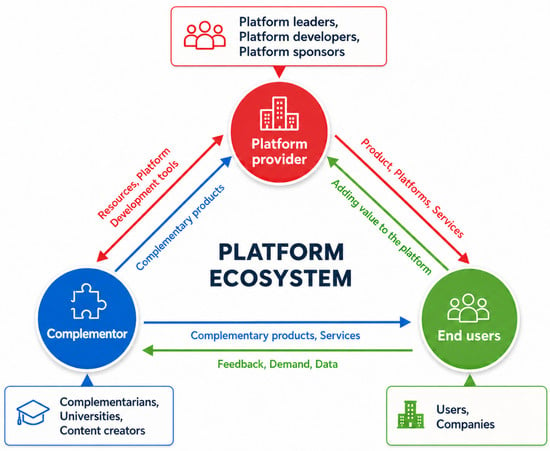
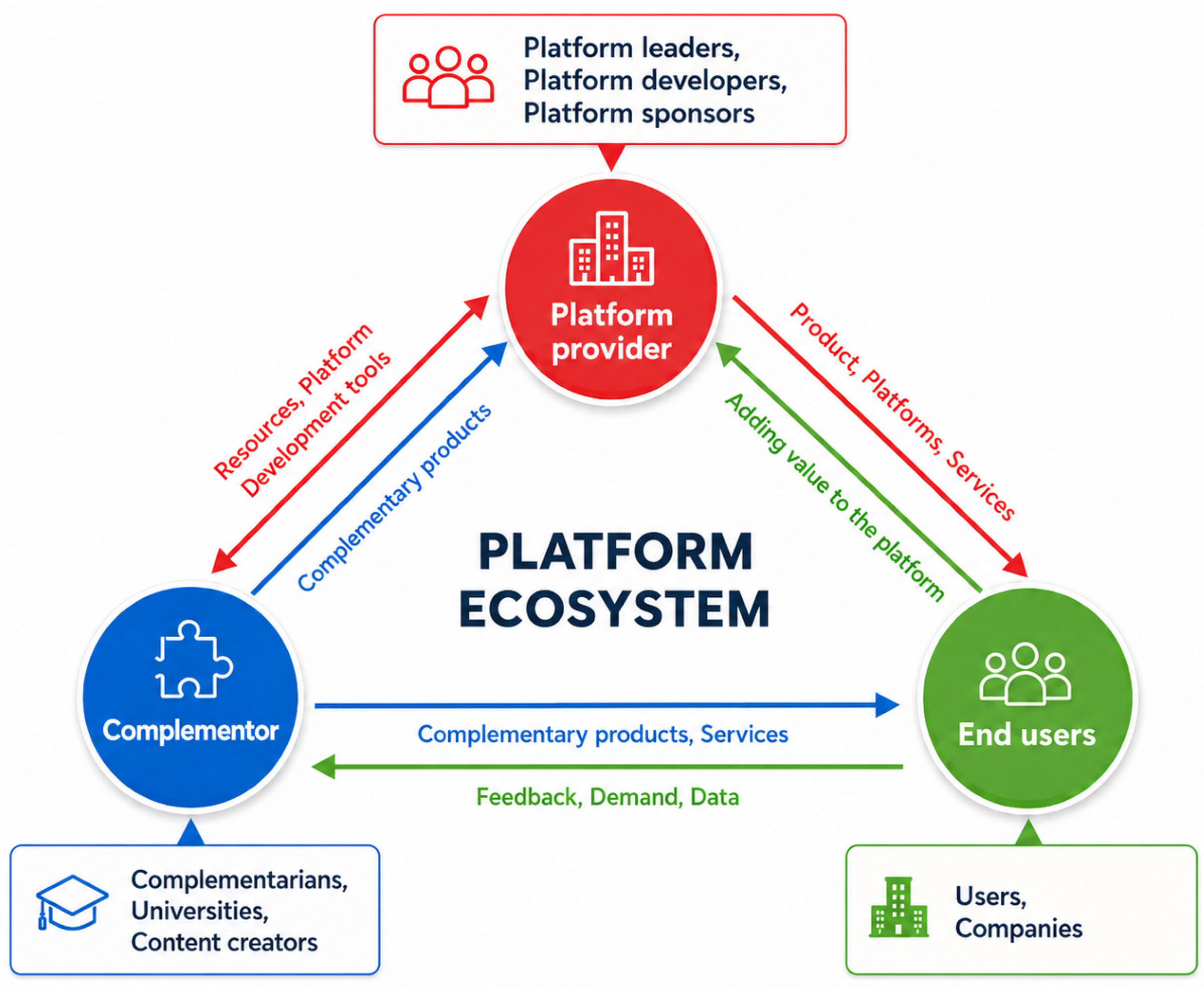

Disclaimer/Publisher’s Note: The statements, opinions and data contained in all publications are solely those of the individual author(s) and contributor(s) and not of MDPI and/or the editor(s). MDPI and/or the editor(s) disclaim responsibility for any injury to people or property resulting from any ideas, methods, instructions or products referred to in the content. |
© 2026 by the authors. Licensee MDPI, Basel, Switzerland. This article is an open access article distributed under the terms and conditions of the Creative Commons Attribution (CC BY) license.