


Abstract
In a large agrarian country with numerous smallholders, a key issue in food security governance is determining how to overcome the constraints of fragmented smallholder farming through productive service provision and thereby expand the scale of grain production. This study focuses on the pilot policy of whole-process socialized agricultural production services implemented during 2013–2016. This pilot served as an important policy foundation for the agricultural production trusteeship policy promoted nationwide after 2017 and represented an early institutional exploration of promoting service-scale operation through fiscal support for productive service provision in China. Using county-level panel data from three provinces over the period 2006–2016, this study evaluated the effect of fiscal subsidies embedded in outsourced service transactions on grain-sown area within a two-way fixed-effects framework with county and year fixed effects. The results show that the pilot significantly expanded the county-level grain-sown area, with the pilot counties increasing their grain-sown area by approximately 1.986 thousand hectares on average. When policy intensity is measured according to the amount of subsidies, each additional 10 million yuan of fiscal subsidies increased the grain-sown area by approximately 3.103 thousand hectares on average. Heterogeneity analysis shows that the marginal effects were stronger in counties with weaker fiscal capacity or lower levels of mechanization, indicating that the policy effects were more pronounced in areas with relatively weak initial conditions. In terms of policy implications, this paper recommends differentiated and performance-based support, improved governance of the agricultural service market, and prioritizing resource allocation to areas with weaker initial conditions, so as to enhance the scale and resilience of food security. This paper provides county-level quasi-causal evidence and an empirical reference for supporting agricultural productive services through fiscal policy to overcome the constraints of fragmented smallholder farming.
1. Introduction
Food security has always been the cornerstone of national security [1]. Data from the National Bureau of Statistics of China show that, in 2025, China’s total grain-sown area reached 119,409 thousand hectares, and its total grain output reached 714.88 million tons, remaining at a relatively high level [2]. The 2026 Central No. 1 Document continued to emphasize the stable development of grain and oilseed production, stating that grain output should remain at around 1.4 trillion jin and that the most recent stage of the 50-million-ton grain production capacity enhancement initiative should be advanced further [3]. With the rapid progress of urbanization and the continuous outflow of rural labor, Chinese agriculture faces a structural dilemma characterized by “numerous smallholders, fragmented operations, and low efficiency” [4,5]. Limited labor supply, land fragmentation, and insufficient technological input have become key constraints on improving grain production efficiency and stabilizing output [6]. Under the premise of maintaining existing land ownership and contractual relations, achieving scale and specialization in production has become a central issue in promoting agricultural modernization.
In the process of China’s agricultural modernization, there are two main pathways for expanding the scale of agricultural operation: land-transfer-based scale operation and service-based scale operation [7,8]. Land-transfer-based scale operation relies primarily on concentrating land use rights by transferring fragmented land to new agricultural business entities such as family farms, cooperatives, and agribusinesses, thereby expanding the land area used by a single entity [9,10]. This pathway is conducive to unified management decisions and the centralized allocation of production factors, but it is also constrained by factors such as the stability of land contract relations, farmers’ willingness to transfer land, operational risks, and the boundaries of scale expansion [11]. By contrast, service-based scale operation does not require the concentration of land use rights [7,8]. Instead, while maintaining smallholders’ land contract relations and their basic status as production decision-making entities, it incorporates fragmented groups of smallholders into a unified productive service system by outsourcing production-stage services such as tillage, sowing, pest control, and harvesting [12]. In other words, land-transfer-based scale operation emphasizes the “concentration of land,” whereas service-based scale operation emphasizes the “concentration of production stages” and the “concentration of services” [7]. In a large agrarian country with numerous smallholders, the latter provides a more institutionally compatible pathway for overcoming the constraints of fragmented smallholder farming [13].
The pilot program for whole-process socialized agricultural production services examined in this study is an important policy supporting the service-scale operation pathway [14]. In 2013, the central government allocated 500 million yuan in agricultural technology extension and service funds to support pilot programs for whole-process socialized agricultural production services in eight provinces: Hebei, Jiangsu, Anhui, Jiangxi, Shandong, Henan, Hubei, and Hunan [15]. The program aimed to promote institutional innovation in agricultural socialized services through fiscal support and to advance the scaled and organized development of agricultural production. In 2016, the pilot program was further expanded to 17 provinces, with an emphasis on promoting whole-process socialized services for major agricultural products in a concentrated and contiguous manner [15,16]. After 2017, the policy focus shifted toward agricultural production trusteeship. The former Ministry of Agriculture explicitly proposed developing service-scale operation through trusteeship services in production stages such as tillage, sowing, pest control, and harvesting without transferring land operating rights. Compared with farmers’ spontaneous purchase of mechanized operation services or ordinary market-based outsourcing, the most distinctive feature of this pilot policy is the direct embedding of fiscal subsidies and administrative coordination into service transactions, which gives productive service provision stronger characteristics of organization, contiguous implementation, and policy support [17]. Therefore, from the perspective of policy evolution, the 2013–2016 pilot program for whole-process socialized agricultural production services constituted an important institutional exploration before the nationwide promotion of agricultural production trusteeship.
Based on this context, this study treats the 2013–2016 pilot program for whole-process socialized agricultural production services as a quasi-natural experiment [18,19,20]. Using county-level panel data from three provinces over the period 2006–2016, it evaluates the effect of fiscal subsidies embedded in outsourced service transactions on grain-sown area within a two-way fixed-effects framework with county and year fixed effects. The empirical results show that the pilot significantly expanded county-level grain-sown area, with the pilot counties increasing their grain-sown area by approximately 1.986 thousand hectares on average. When policy intensity is measured according to the amount of subsidies, each additional 10 million yuan of fiscal subsidies increased grain-sown area by approximately 3.103 thousand hectares on average, indicating a positive association between the intensity of fiscal support and the expansion of production scale. Heterogeneity analysis further shows that the policy effects were more pronounced in counties with weaker fiscal capacity or lower levels of mechanization. The marginal contribution of this paper is to provide county-level quasi-causal evidence that fiscal support for productive service provision can expand the scale of grain production, and to identify whole-process socialized agricultural production services within the pathway of service-scale operation. In doing so, it offers empirical reference for understanding how scale operation can be achieved under conditions of fragmented smallholder farming [8].
2. Policy Background and Theoretical Mechanism
2.1. Policy Background
Agricultural socialized services constitute an important institutional arrangement in China’s process of agricultural modernization [21]. Their core objective is to overcome structural constraints—such as shortages of labor, technology, and market access—caused by fragmented smallholder operations through organized and institutionalized service provision [13]. From a theoretical perspective, agricultural socialized services are not limited to government-led organizational supply; broadly defined, they also include spontaneous services emerging among farmers based on cooperation and the division of labor, such as neighborly mutual aid or sharing machinery [22,23]. These spontaneous services have, to some extent, mitigated the limitations of smallholder production [24]. However, constrained by fragmented landholdings and high transaction costs, their coverage and stability remain limited [24]. Against this backdrop, the state has successively introduced a series of policies aimed at improving the service supply system through institutional innovation and fiscal support, promoting the systematization and standardization of agricultural socialized services. The evolution of these policies can be broadly divided into three stages [21].
2.1.1. Phase I (1978–2003): Institutional Construction Period
Following rural reform, China focused on restoring and rebuilding the fundamental institutional system for agricultural services to address widespread shortages in technology, materials, and channels faced by smallholders. The agricultural technology extension system, supply and marketing cooperatives, and agricultural machinery promotion stations were successively revived, and laws such as the Agricultural Technology Extension Law provided a legal foundation for agricultural socialized services [25]. During this period, policy efforts emphasized organizational support—mainly through administrative means—to promote the diffusion of new technologies and agricultural machinery [26]. Due to the fragmented nature of farmland, service provision was mainly implemented through fragmented demonstrations and unified arrangements, making it difficult to achieve large-scale or contiguous operations across multiple farmers [13]. Overall, this stage laid the institutional foundation for agricultural socialized services, but the supply mechanism remained decentralized and non-contractual in nature [27].
2.1.2. Phase II (2004–2012): Service Expansion Period
Upon entering the new century, China’s agricultural modernization strategy accelerated, and new types of agricultural business entities began to emerge [28]. Agricultural socialized services exhibited increasing diversity as cooperatives, family farms, leading enterprises, and agricultural machinery service organizations grew rapidly with policy support [29,30]. The scope of services extended from traditional production activities to pre- and post-production stages, including input supply, credit financing, processing, distribution, and cold-chain storage [31]. The government promoted service capacity building through special funds, tax incentives, and demonstration projects. Cooperatives played an intermediary role in connecting farmers and markets, while the agricultural machinery purchase subsidy policy significantly expanded the supply of operational services. However, policy support during this period still focused on cultivating service providers rather than directly subsidizing service transactions; most subsidies were indirect [32]. Although service coverage expanded, the supply model remained fragmented, lacking integrated and cross-regional coverage. In essence, this stage facilitated diversification and value-chain extension of services but continued to fall short in achieving large-scale, contiguous operations and effective incentive mechanisms [13].
2.1.3. Phase III (2013–Present): Institutional Transformation Period
In 2013, the pilot program for Agricultural Production Whole-Process Socialized Services was officially launched, marking a new stage of institutional transformation in agricultural socialized services [15,16]. Unlike previous policies that mainly supported organizational development, this pilot program introduced, for the first time, a fiscal mechanism embedded directly in service transactions, implementing the principle of “subsidizing the provider of the service.” County-level governments were responsible for selecting service organizations, signing service agreements with farmers, and allocating subsidies based on the volume of service tasks. This innovative design aimed to reduce the supply cost and operational risk of service organizations, enhance farmers’ willingness to adopt services, and promote the transition of services from fragmented to contiguous and systematized forms. By 2016, the pilot expanded to 17 provinces, accompanied by the establishment of performance evaluation and exit mechanisms, thus institutionalizing the policy framework. Since 2017, the Agricultural Production Trusteeship program has been rolled out nationwide, becoming the dominant form of scaled service operation [14]. Through single-link, multi-link, and full-process trusteeship models, smallholders can be integrated into large-scale production chains at a relatively low cost while retaining their land contract rights [12]. Subsequently, policy design has increasingly emphasized contractualization, performance-based management, and credit governance. Fiscal subsidies have been tightly linked to contract fulfillment and task completion, pushing service provision toward greater standardization and sustainability.
Compared with the previous two stages, the key achievement of the institutional transformation period is realizing direct fiscal support for agricultural socialized services, thereby filling a long-standing gap in institutional incentives [28]. This innovation enables smallholders to participate in large-scale production through service integration without transferring land ownership. The 2013 pilot was China’s first institutional effort to directly subsidize service transactions, marking a milestone in agricultural policy design. The nationwide expansion of the Agricultural Production Trusteeship in 2017 further institutionalized this logic, establishing it as the primary model for scaled service operations [14].
This study takes the 2013 Whole-Process Socialized Services pilot and its subsequent evolution as the empirical context in which to systematically assess its actual impact on the scale of grain production.
2.2. Theoretical Mechanism
Food security governance provides an important context for understanding agricultural production support policies. Existing studies often consider the development of grain production capacity from the perspectives of cultivated land protection, agricultural technological progress, grain subsidies, market prices, and government governance [33,34]. However, with food security elevated to a strategic issue in recent years, researchers have increasingly investigated the effects of state governance capacity and policy incentives on grain production [33]. From a political economy perspective, Zhang and Lu (2024) examined the impact of the food security responsibility system and highlighted that China’s food security governance does not rely entirely on market mechanisms [33]. Instead, through administrative responsibility, target decomposition, and assessment constraints, central food security objectives are transformed into specific implementation tasks for local governments, thereby further affecting grain-sown area [35]. This study suggests that grain-sown area is not only the result of spontaneous decisions made by farmers and market entities but also profoundly shaped by government responsibility systems, policy incentives, and local implementation mechanisms. Different from previous focus on the administrative responsibility system, this paper further examines how fiscal support is embedded in agricultural productive service transactions and how it affects the county-level grain-sown area by improving service provision [13,18].
Regarding the relationship between outsourcing behavior and agricultural production, existing studies have generally taken two explanatory approaches. The first is based on the logic of the division of labor and economies of scale [36,37], emphasizing that outsourcing improves resource allocation through the specialized division of labor and scaled operations. Without expanding their land scale, farmers can share the capital-intensive inputs required for mechanized services and technological diffusion, thereby alleviating constraints related to labor shortages and equipment thresholds. This, in turn, improves the availability and timeliness of operations in key production stages and may be reflected behaviorally in farmers’ decisions to “maintain cultivation” or even “expand cultivation” [38]. The second approach is grounded in the perspectives of transaction costs and institutional constraints [39]. It points out that agricultural production outsourcing is often accompanied by asset specificity and information asymmetry, which may lead to supervision difficulties, contract enforcement frictions, and opportunism [40]. These problems increase uncertainty in service quality and execution costs, thereby weakening farmers’ trust in outsourcing and their incentives to expand cultivation and may even offset its potential efficiency gains [41]. Together, these two strands of the literature suggest that the impact of outsourcing on grain production is not unidirectional or linear. Its net effect depends on the stability of service provision, the capacity for contractual governance, and the strength of institutional support. Therefore, in the context of “policy-driven service-based scale operation” shaped by fiscal subsidies and organized mobilization, further empirical evidence is still needed.
In the Chinese context, the operational logic of outsourcing agricultural production is not entirely market-based [42,43]. From the perspective of policy evolution, agricultural socialized services have shifted from pre-production and post-production support toward productive services, while the service form has gradually become concentrated in agricultural production trusteeship. In particular, after the launch of the pilot program for whole-process socialized agricultural production services in 2013, fiscal subsidies and administrative coordination were embedded in production stages more directly, providing an institutionalized carrier for contiguous operations and organized service provision. Policy-led outsourcing is often accompanied by fiscal subsidies and administrative coordination mechanisms, improving institutionalization, organization, and contiguous implementation for in-production service provision. Compared with spontaneous market transactions, this type of institutional support not only reduces the entry and matching costs of services but also helps alleviate information asymmetry and uncertainty in contract enforcement between supply and demand sides, enabling outsourcing transactions to operate more stably over a broader scope.
In terms of policy effect evaluation, recent studies in land use, agricultural support, and resource governance have increasingly emphasized quasi-natural experiments and causal identification methods. In their study of multi-objective land use policies, Guo and Jin (2025) reviewed existing research in three dimensions—research content, research perspective, and research method—and used the DID method to identify the effects of policy on different efficiency indicators [44]. The implication of their study is that evaluations of public policy effects should not remain at the level of correlation analysis or descriptive experience. Instead, they should clearly identify the policy shock, treatment and control groups, objects of policy impact, and heterogeneous responses. Similarly, the 2013–2016 pilot program for whole-process socialized agricultural production services clearly had the characteristics of a policy pilot. It was not implemented simultaneously nationwide but was first promoted in selected regions, thereby providing quasi-natural experimental conditions for identifying the effect of fiscal support for productive service provision on grain-sown area.
In summary, existing studies provide an important foundation for understanding food security governance, agricultural production outsourcing, and policy effect evaluation, but there remains room for further extension. First, studies on food security governance have paid more attention to cultivated land protection, the food security responsibility system, and local government assessment, while insufficient attention has been paid to how fiscal support is embedded in the agricultural production process and affects grain-sown area through productive service provision. Second, studies on agricultural socialized services have focused more on farmers’ adoption of services, cost reduction and efficiency improvement, and technological diffusion. However, they often treat agricultural socialized services as a broad concept without sufficiently distinguishing general market-based services, spontaneous mechanized operation services, and policy-driven whole-process socialized agricultural production services. Third, existing studies have mostly analyzed the effects of service adoption at the household level, while county-level quasi-causal evidence remains relatively limited. In particular, there is still a lack of systematic identification of policy effects under different levels of fiscal subsidy intensity and regional initial conditions. Based on these gaps, this paper positions the pilot program for whole-process socialized agricultural production services within the framework of service-based scale operation and examines whether fiscal subsidies and organized mobilization can expand the county-level grain-sown area by improving productive service provision.
Building on the above research gaps, this study further explains the mechanism through which whole-process socialized agricultural production services affect grain-sown area from three perspectives: division of labor, economies of scale, and transaction costs. Service-based scale operation under policy support is essentially an institutional restructuring process centered on the division of production stages, cross-household scaled operations, and transaction cost governance. Early policy support for agricultural socialized services was primarily focused on cultivating service providers and strengthening service capacity. Although it also involved some in-production services, its systematic embedding in specific service stages, service tasks, and service performance remained limited. Since the launch of the pilot program for whole-process socialized agricultural production services in 2013, the focus of agricultural socialized service policy has shifted from “subsidizing service providers and capacity” toward “subsidizing services, production stages, and transactions.” Relevant policy documents from 2016 explicitly proposed supporting key and weak stages of socialized agricultural production services, promoting a transformation “from single-stage agricultural production services to whole-process production services, and from small-scale fragmented services to large-scale integrated services,” thereby advancing the mechanized, scaled, and intensive development of agricultural production. Although the policy documents did not directly address the concept of “service-based scale operation,” they already reflected an approach to achieving scaled agricultural production through socialized services. This institutional shift changed the transaction structure and incentive of outsourcing agricultural production, creating conditions for specialized divisions of labor in production stages, scaled coordination, and institutionalized service provision. Based on this development, this study constructs an analytical framework centered on the division of labor, scale, and transaction costs and examines the endogenous economic logic of outsourcing, the expansion mechanism of contiguous outsourcing, and the institutional effects of policy support, thereby revealing how service-based scale operation facilitates evolution from fragmentation to concentration through institutionalized arrangements.
2.2.1. The Endogenous Economic Logic of Outsourcing
From a neoclassical perspective, outsourcing agricultural production is a rational choice made by smallholders under resource constraints. The logic of this decision integrates three factors: division of labor, scale, and transaction costs. Adam Smith (2002) emphasized that the division of labor enhances labor productivity [36], while Youno (1928) [45] further revealed that the expansion of market scale promotes the deepening of division of labor, resulting in a cumulative growth cycle.
In the agricultural context, this mechanism does not manifest as the simple organizational substitution of farmers by modern enterprises but as the rational division of labor by smallholders facing shortages in labor and technology and reduced risk-bearing capacity. When the availability of external services increases and outsourcing costs fall below the cost of personal production, farmers will rationally choose to outsource certain production stages to optimize resource allocation [38,46].
The division of labor mechanism is reflected in farmers’ selective outsourcing of production activities. Outsourcing does not imply the farmers’ withdrawal from agriculture; instead, it forms a complementary structure bridging “household management” and “socialized services.” Farmers retain their land management and income rights while delegating mechanized and technical operations—such as plowing, sowing, pest control, and harvesting—to service organizations. In this way, specialized collaboration is achieved without altering land ownership [47].
The scale mechanism manifests at the level of service organizations: as task concentration increases, service providers can coordinate machinery, labor, and technology across plots, thereby realizing economies of scale and scope.
2.2.2. The Potential Benefits and High Transaction Costs of Clustered Outsourcing
In practice, agricultural outsourcing activities in China typically occur in a fragmented manner. Land fragmentation, independent decision-making by farmers, and heterogeneity among plots mean that service organizations often provide services to individual farmers or small areas, limiting spatial coordination and synergy.
Clustered (contiguous) outsourcing refers to a highly coordinated production arrangement in which the division of labor and scale cooperation are achieved over larger spatial units. It requires service organizations to transcend individual farm boundaries and coordinate the distribution of labor, machinery, and technology across multiple farmers. This integration can generate scale effects by facilitating smoother operation scheduling, cost savings, and improved technological diffusion. In this sense, contiguous outsourcing represents a deeper form of the division of labor and a potential pathway toward scaled management.
However, clustered outsourcing is not a market process that emerges spontaneously. It requires cross-farmer coordination, land consolidation, and synchronized operations—precisely the areas in which institutional bottlenecks arise in agricultural transactions. Dispersed land ownership, heterogeneous returns, and asymmetric risk-sharing result in steep increases in the costs of information exchange, contract negotiation, and monitoring.
For service organizations, contiguous operations can improve machinery utilization and operational efficiency, but they also entail greater coordination investments and more complex responsibility allocation. Consequently, the potential gains from the division of labor and scale economies are often offset by transaction frictions, resulting in the coexistence of high efficiency potential and high transaction costs—a dual characteristic of clustered outsourcing in practice.
2.2.3. Institutional Supply Through Policy Pilots
Against the backdrop of high transaction cost constraints, the implementation of the Agricultural Production Full-Process Socialized Services pilot provided new institutional support for agricultural outsourcing. Through fiscal subsidies and organizational mobilization, the policy intervened in the agricultural production system via two channels, lowering financial and risk barriers for service organizations while improving the conditions for coordination between smallholders and service providers.
Fiscal subsidies alleviated financial pressure and the burden of risk on service organizations during early-stage investment, enabling them to organize production on a larger scale. Meanwhile, administrative coordination and institutional guidance from local governments and village-level organizations facilitated information matching and collective mobilization, encouraging dispersed farmers to participate in unified production arrangements.
As a result, previously fragmented outsourcing activities became spatially integrated across plots and households, and a system of clustered outsourcing gradually took shape and stabilized under institutional support. The theoretical mechanism is summarized in Figure 1.
Figure 1.
Mechanism of the impact of the Agricultural Production Full-Process Socialized Service Pilot Policy on Agricultural Production. Note: Arrows indicate directional relationships. “+” denotes a promoting or reinforcing effect, while “–” denotes a constraining or inhibiting effect.
The development of clustered outsourcing introduced new possibilities for the expansion and stabilization of agricultural production. On one hand, centralized operations improved the utilization efficiency of machinery and labor, reduced production costs, and enhanced land use efficiency, thereby expanding the effective sown area. On the other hand, as service organizations undertook broader coordination and supervisory responsibilities, the costs of communication, scheduling, and risk management also increased, creating new transaction obstacles.
Therefore, the overall effect of clustered outsourcing on grain production is not a unidirectional expansion but rather the outcome of an interplay between institutional support and coordination costs. When policy support effectively offsets the rising transaction costs associated with increased coordination complexity, the net effect manifests as an expansion of the agricultural production base. Conversely, if institutional supply is insufficient or market coordination efficiency remains low, the policy’s impact may be limited or even vary significantly across regions.
The above theoretical analysis suggests that fiscal support for agricultural production outsourcing essentially functions as a form of institutional supply. Through two complementary channels—fiscal incentives and organizational coordination—this institutional supply reduces the transaction costs of service provision, facilitates the formation of clustered (contiguous) outsourcing, and promotes deeper division of labor and scale coordination, thereby expanding the agricultural production base. However, the actual effect of this mechanism depends on regional fiscal capacity and mechanization levels. Only when policy support effectively offsets the rising transaction costs associated with increasing coordination complexity will its net effect manifest as an expansion of the grain production scale. Consequently, the policy’s production outcomes may vary significantly across regions.
Based on this theoretical framework, three testable hypotheses are proposed.
H1.
The pilot program for whole-process socialized agricultural production services can significantly expand the county-level grain-sown area.
H2.
The greater the intensity of fiscal subsidies, the stronger the expansion effect on the county-level grain-sown area.
H3.
The marginal effect of the pilot program for whole-process socialized agricultural production services is more pronounced in areas with weaker fiscal capacity or lower levels of mechanization.
3. Empirical Design and Data Sources
3.1. Data and Variables
The data used in this study were mainly drawn from the China County Statistical Yearbook [48], the China Regional Economic Statistical Yearbook [49] and relevant provincial statistical materials. After data cleaning and matching, a county-level panel dataset covering three provinces, Hebei, Jiangxi, and Hunan, over the period 2006–2016 was constructed. Since 2013–2016 was the period in which the subsidy pilot program for whole-process socialized agricultural production services was implemented, 2006–2016 was taken as the study period to facilitate a comparison of changes that occurred before and after the policy was implemented. It should be noted that, due to missing values for some variables, corresponding valid samples were used according to different model specifications. Baseline regressions without control variables used observations for which both grain-sown area and policy variables were available, totaling 3214 county-year observations. The main regressions with control variables required the dependent variable, policy variables, and control variables to be available, resulting in 2686 county-year observations. Therefore, differences in the number of observations across regression tables mainly arise from differences in variable availability rather than inconsistencies in sample definition.
To ensure the comparability of county-level grain-sown area data, necessary quality checks were conducted on the raw data. Most of the grain-sown area data were drawn from national and provincial statistical yearbooks and therefore follow official statistical definitions. During data processing, units of measurement were verified, and missing values, outliers, and unreasonable fluctuations were screened. Second, annual matching was conducted based on county-level administrative codes and county names, and changes such as county name adjustments and county-to-district conversions during the sample period were carefully verified. For counties that only experienced name changes and had generally continuous statistical coverage, sample continuity was maintained. Observations involving significant administrative boundary adjustments that could not be made comparable were excluded from the final regression sample. Finally, county fixed effects and year fixed effects were included in the model to reduce the influence of long-term county-level differences and common annual shocks on the estimation results.
The data on pilot counties, pilot years, and fiscal subsidy funds were obtained from data-use applications submitted to relevant government departments and used in this study within the approved scope. These data record county-level pilot participation, annual subsidy funds, and related implementation information and constitute the core basis for identifying policy treatment status and subsidy intensity in this study. The timing of pilot implementation, policy coverage, and funding support methods were cross-checked using policy documents publicly released by the Ministry of Finance, agricultural and rural affairs departments, and relevant provincial departments.
In terms of the dependent variable, the grain-sown area was selected as the core indicator because the sown area directly reflects the expansion of the scale of grain production. It is closely related to the central issue of “who will cultivate the land” in food security and best reveals the impact of fiscal support on the grain supply. The policy variables include two types. The first is a pilot county dummy variable, which is used to measure the average effect of the policy intervention on the sown area. The second is the amount of fiscal subsidy funds, which is used to measure the intensity of the effect of fiscal support and reveal the marginal relationship between the scale of subsidy inputs and the sown area. These two measures are complementary; the former highlights the overall difference associated with policy implementation, while the latter captures continuous variation in policy intensity. To reduce omitted variable bias, the control variables include indicators of economic development and agricultural production conditions. Gross regional product reflects the overall economic scale of the county, per capita fiscal revenue measures the fiscal capacity of local governments, and the ratio of loans to GDP reflects the allocation of financial resources. Total agricultural machinery power reflects the level of mechanization and is an important productive input for explaining the sown area. The per capita disposable income of rural residents reflects the farmers’ economic conditions and input capacity. All control variables were entered into the model in logarithmic form to reduce scale differences and alleviate heteroskedasticity. The descriptive statistics show that the average county-level grain-sown area is 70.97 thousand hectares, the proportion of pilot counties is 2.8%, and the average subsidy fund is 200,000 yuan. Table 1 reports the means, standard deviations, and value ranges of the main variables.
Table 1.
Evolution of agricultural socialized service policies in China.
The number of pilot counties and the amount of fiscal subsidy funds showed a pattern of first increasing and then decreasing during the 2013–2016 period. Table 2 presents annual coverage rates and subsidy distributions. Pilot counties accounted for approximately 10% of the sample, while the annual total amount of subsidy funds fluctuated to some extent, and per capita subsidy levels also displayed substantial variation.
Table 2.
Annual pilot coverage and subsidy statistics.
In terms of variable specification, the core dependent variable is the grain-sown area, measured in thousand hectares. The key explanatory variables include a pilot county dummy variable and the annual amount of fiscal subsidy funds. The former equals 1 if a county was included in the fiscal support pilot in a given year and 0 otherwise; the latter, measured in 10,000 yuan, captures the intensity of fiscal support. The control variables cover county-level economic conditions and agricultural input characteristics, including the gross regional product, per capita fiscal revenue, loan-to-GDP ratio, total agricultural machinery power, and per capita disposable income of rural residents. All control variables were entered into the regression model in logarithmic form to reduce scale differences and alleviate heteroskedasticity.
According to the descriptive statistics of the regression sample, the average county-level grain-sown area is 70.97 thousand hectares, but there is substantial variation across counties. The proportion of pilot counties is 2.8%, and the average amount of fiscal subsidies is 200,000 yuan. The control variables also exhibit considerable dispersion. Table 3 reports the means, standard deviations, and value ranges of the main variables.
Table 3.
Descriptive statistics (regression sample).
3.2. Econometric Model and Identification
The fiscal support program for outsourcing production provides a quasi-natural experimental setting for identifying changes in the scale of grain production. To examine the impact of fiscal subsidies on grain-sown area, a two-way fixed-effects (TWFE) model is employed, controlling for unobserved, time-invariant characteristics at the county level and common macro shocks at the year level. Standard errors are clustered at the county level to mitigate within-group correlation. The baseline model is specified as follows:
where denotes the grain-sown area of county i in year t; represents the policy variable, including either the pilot county dummy or the scale of fiscal subsidy funds; is a vector of control variables; and denote county and year fixed effects, respectively; and is the error term. The interpretation of the coefficient β depends on the specification of the policy variable. When is defined as the pilot county dummy, β captures the average change in sown area after a county enters the pilot program. When is measured by the amount of subsidy funds, β reflects the marginal effect of an additional 10,000 yuan of subsidies on the sown area. Since the dependent variable is measured in thousand hectares, the coefficient can be directly interpreted as the increase or decrease in sown area.
To further examine the robustness of the estimation results, the following empirical sections report results using alternative dependent variables, alternative specifications of the policy variable, placebo tests, and event-study analyses. The next section also provides a dedicated discussion of potential sources of endogeneity and the corresponding identification strategies.
3.3. Endogeneity Issues and Identification Strategy
The pilot program for whole-process socialized agricultural production services provides quasi-natural experimental conditions for identifying the effect of fiscal support for productive service provision on grain-sown area. However, it should be noted that the policy pilot was not randomly assigned and may therefore face certain endogeneity issues. It is thus necessary to further clarify the potential sources of endogeneity and the identification strategies adopted in this study.
First, there may be selection bias in pilot county designation. The selection of pilot counties may be related to their existing agricultural production conditions, the development level of service organizations, local governments’ implementation incentives, and grain production potential. If counties with a stronger agricultural production base, more mature service organizations, or stronger local agricultural governance capacity were more likely to be selected for the pilot program, the pilot variable may capture both the policy effect and the counties’ pre-existing development advantages, thereby leading to an overestimation of the policy effect. Conversely, if the pilot program tended to support counties with severe labor outmigration, insufficient service provision, or weaker agricultural foundations, the policy effect may be underestimated. To alleviate this concern, the baseline model includes county fixed effects to control for time-invariant county-level natural endowments, location conditions, long-term agricultural traditions, and institutional environments. Year fixed effects are also included to control for macro policies, market price changes, and annual shocks common to all counties.
Second, omitted variable bias may exist. The county-level grain-sown area is affected not only by the pilot program for whole-process socialized agricultural production services but also by other contemporaneous policies, agricultural infrastructure construction, land consolidation, mechanization promotion, labor migration, local fiscal support for agriculture, and market price changes. If these factors affect both pilot implementation or subsidy intensity and the grain-sown area, they may interfere with the identification of the policy effect. To address this issue, time-varying county-level characteristics, including gross regional product, per capita fiscal revenue, the loan-to-GDP ratio, total agricultural machinery power, and per capita disposable income of rural residents, were controlled for to reduce the influence of observable omitted factors as much as possible.
Third, reverse causality may exist. Counties with larger grain-sown areas may receive more fiscal subsidies because they bear heavier grain production responsibilities, have a greater demand for services, or because local governments attach greater importance to grain production. It is also possible that changes in grain-sown area themselves affect the allocation of subsidy funds. If this is the case, the positive relationship between fiscal subsidy intensity and the grain-sown area may not fully reflect the policy effect. To mitigate this concern, this study used both the pilot county dummy to measure the policy entry effect and subsidy intensity to measure policy strength. Placebo tests and event-study analyses were also conducted. In the placebo test, a one-period lead of the policy variable was introduced to examine whether a significant effect existed before the policy was implemented. In the event-study analysis, the first year in which a county received subsidies was considered as the event year, and the year before the event was used as the baseline. The dynamic changes before and after policy implementation were then examined. If the lead term of the policy variable and the pre-event coefficients are not significant, it indicates that there were no obvious systematic trend differences between the treatment and control groups before policy implementation, thereby strengthening the credibility of the causal interpretation.
Fourth, measurement error may exist. The policy variables used in this paper include both the pilot county dummy and the amount of fiscal subsidy funds. The former reflects policy entry status, while the latter captures the intensity of policy support. However, both types of variables may be affected by differences in statistical definitions, the timing of fund disbursement, task implementation progress, and county-level project management. To avoid relying on a single form of policy variable, alternative specifications were used in the robustness checks, including the logarithmic form of subsidy funds, winsorized subsidy variables, and the entrusted service task area. The policy effects remained generally positive across different specifications, indicating that the conclusions of this study are not driven by a specific variable form or extreme observations.
It should be noted that because the policy pilot was not randomly assigned, the results of this study should be understood as quasi-causal evidence obtained within the framework of existing county-level panel data and a quasi-natural experiment.
4. Empirical Results
4.1. Baseline Regression Results
Table 4 presents the effect of the pilot policy for whole-process socialized agricultural production services on the grain-sown area. In the first two columns, the pilot county dummy is used as the policy indicator, while the policy indicator used in the last two columns is the amount of fiscal subsidy funds. For each policy measure, the table reports estimation results without and with control variables, respectively. All models control for county fixed effects and year fixed effects, and standard errors are clustered at the county level.
Table 4.
Effect of policy on grain-sown area.
As shown in columns (1) and (2), counties entering the fiscal support pilot experienced a significant increase in grain-sown area. Without control variables, the coefficient of the pilot variable is 2.321, with a standard error of 1.081, and is significant at the 5% level. After adding controls for county-level economic conditions and agricultural production characteristics, the coefficient of the pilot variable is 1.986, with a standard error of 1.035, and is significant at the 10% level. Since the dependent variable is measured in thousand hectares, this means that after controlling for county fixed effects, year fixed effects, and relevant control variables, entering the pilot program increased the county-level grain-sown area by approximately 1.986 thousand hectares on average. Relative to the sample mean of 70.97 thousand hectares, this effect is equivalent to about 2.8% of the mean, indicating that the whole-process socialized agricultural production services supported by fiscal policy have not only statistical but also clear economic significance.
Columns (3) and (4) show that policy intensity, measured by the amount of fiscal subsidy funds, also has a significantly positive effect. Without control variables, the coefficient of the subsidy variable is 40.358, with a standard error of 16.291, and is significant at the 5% level. After adding control variables, the coefficient of the subsidy variable is 31.033, with a standard error of 17.180, and is significant at the 10% level. This indicates that, when other factors remain constant, each additional 10 million yuan of fiscal subsidy increased the county-level grain-sown area by approximately 3.103 thousand hectares on average. This result suggests that the policy effect is reflected not only in the discrete change associated with pilot participation but also in the marginal expansion effect generated by increased fiscal support intensity.
The results for the control variables are generally consistent with expectations. The gross regional product has a significantly positive effect on grain-sown area, suggesting that counties with larger economic scale are more likely to have the comprehensive conditions needed to expand grain production. Per capita fiscal revenue and the loan-to-GDP ratio show negative effects, which may reflect that fiscal and financial resources are more likely to flow to non-agricultural sectors, thereby exerting a certain crowding-out effect on grain-sown area. Total agricultural machinery power and rural residents’ income have significantly positive effects on grain-sown area, indicating that the level of mechanization and farmers’ economic capacity are important supports for expanding the scale of grain production.
Overall, the baseline regression results show that the pilot program for whole-process socialized agricultural production services supported by fiscal policy significantly expanded the county-level grain-sown area. Whether the policy variable is measured by the pilot county dummy or by the amount of fiscal subsidy funds, the core coefficients are positive and statistically significant. In terms of economic significance, participating in the pilot increased the grain-sown area by about 2.8% of the sample mean, while each additional 10 million yuan of subsidy corresponded to an increase of approximately 3.103 thousand hectares in the grain-sown area. These findings indicate that embedding fiscal funds into productive service transactions can generate a scale-expansion effect at the county level, with practical policy implications.
4.2. Robustness Checks
To ensure the reliability of the baseline regression results, robustness checks were conducted through three approaches: using alternative dependent variables, adopting alternative specifications of the explanatory variables, and conducting placebo tests. The results indicate that the main findings remain robust.
4.2.1. Alternative Dependent Variables
The dependent variable was replaced with total grain output and yield per unit area to examine whether the policy effect is reflected in more direct output indicators. If the policy did promote agricultural production, its effect should also be observable at the level of grain output.
As shown in Table 5, when the policy is measured according to pilot participation, the estimated coefficients for both the total grain output and yield are positive and statistically significant at the 10% and 5% levels, respectively, suggesting that entry into the pilot program may have been accompanied by certain improvements in output. However, when the policy is measured by subsidy intensity, the estimated coefficients for both total grain output and yield are negative, with the yield result being significant at the 10% level. This result is not fully consistent with the positive effect of subsidy intensity on the grain-sown area found in the baseline regression, indicating that the effects of fiscal subsidy intensity on total output and yield are not stable. One possible reason is that grain output and yield are affected not only by service provision but also by multiple other factors, such as weather conditions, natural disasters, crop structure, soil conditions, and input quality. At the same time, greater fiscal subsidies may have been allocated to counties with weaker production foundations, insufficient service provision, or less favorable output conditions.
Table 5.
Robustness check A: alternative outcomes.
4.2.2. Alternative Specifications of Explanatory Variables
To rule out the possibility that the results hinge on a particular specification of the policy variable, three alternative treatments of the subsidy variable were employed. First, the subsidy amount was transformed into a logarithmic form to reduce scale differences. Second, the subsidy variable was winsorized to mitigate the influence of extreme values. Third, the managed task area was used as an alternative indicator.
As shown in Table 6, the policy effect remains significantly positive under all alternative specifications. This indicates that the findings are not driven by the specific functional form of the policy variable or by extreme observations but rather reflect a robust underlying relationship.
Table 6.
Robustness check B: alternative specifications.
4.2.3. Placebo Test
To examine whether the identification results are affected by potential trend differences, placebo tests were conducted by introducing one-period lead variables, Lead(Pilot) and Lead(Subsidy), into the model. These variables test for the presence of policy anticipation effects. If significant effects were observed before the actual implementation of the policy, it would cast doubt on the causal interpretation.
As shown in Table 7, the coefficients of the lead variables are statistically insignificant, indicating that no anticipation effect exists. This further confirms that the estimated policy effects indeed stem from the implementation of the policy itself rather than from underlying trends or other unobserved factors.
Table 7.
Robustness check C: placebo tests.
4.2.4. Dynamic Effects and Parallel Trend Test: Event Study
Event-study analysis was conducted to further verify the identification assumptions of the baseline regression and characterize the dynamic evolution of the policy effect. The event year was defined as the first year in which a county recorded , and the year immediately before the event was used as the baseline period. County fixed effects and year fixed effects were included, and standard errors were clustered at the county level. Considering that fiscal support involves both a discrete change associated with first receiving subsidies or entering the policy status and a continuous variation in subsidy intensity, both the entry effect and the dose-by-event-time effect were estimated within a unified framework. The results are reported in Table 8.
Table 8.
Event-study: entry-path and post dose-by-event-time.
5. Further Analysis
This study also examined whether the policy effects exhibit structural heterogeneity. A formalized comparison was conducted within a unified model to enhance the credibility of identification. The analysis focuses on two key county-level baseline conditions—fiscal capacity and mechanization level. The approach involved two steps. First, subgroup comparisons were conducted to intuitively display the marginal responses under different baseline conditions; second, interaction tests were employed within a single regression framework to estimate the marginal effects and their differences across contexts.
5.1. Subgroup Comparison
To compare policy marginal effects under different baseline conditions, counties were divided into “high” and “low” groups based on the cross-period averages of fiscal capacity and mechanization level prior to policy implementation (≤2012), using the sample median as the cutoff. Within the framework of county and year fixed effects, regressions were estimated separately, controlling for variables such as ln GDP (billion yuan), ln Fiscal revenue per capita, and ln Agricultural machine power. Policy intensity was primarily measured by APSS Subsidy (10,000 yuan), with Service Task Area (10,000 mu) used as an alternative specification for robustness.
The results, presented in Table 8 and Table 9, indicate that the expansionary effect of the policy on the sown area is concentrated in counties with low fiscal capacity and low mechanization levels. Specifically, the marginal effect of subsidies is positive and statistically significant in the low-fiscal and low-mechanization groups, whereas the corresponding coefficients for the high groups are smaller and often insignificant. When using service task area as the alternative policy measure, the direction of the effects remains consistent with the subgroup results, and significance is even stronger in the “low baseline” groups.
Table 9.
Heterogeneity by fiscal capacity and mechanization.
These findings suggest that in regions with weaker resources and factor endowments, the marginal returns to policy are higher. In contrast, in counties with stronger baseline conditions, additional subsidies yield only limited marginal improvements.
5.2. Interaction Tests
To formally compare marginal effects across different contexts within a unified model, the interaction terms Subsidy × High fiscal and Subsidy × High mechanization were incorporated into the fixed-effects framework (where High fiscal and High mechanization are indicator variables for counties in the high group at baseline). In this setup, the baseline term “Subsidy” reflects the marginal effect for the low group, while the coefficients of the interaction terms capture the relative differences between the high and low groups. Accordingly, the total marginal effect for the high group equals “baseline + interaction.”
The results, presented in Table 10, show that the baseline marginal effect of subsidies is positive and statistically significant, while the interactions with High fiscal and High mechanization are negative. This leads to lower, and often statistically insignificant, total marginal effects for the high groups. The direction of these findings is consistent with the subgroup comparisons, though the statistical strength of the “high–low difference” is somewhat weaker. This indicates that while the economic implication is clear—that marginal returns are higher in regions with a weaker baseline—the statistical evidence should be interpreted more conservatively.
Table 10.
Interaction effects of subsidy with fiscal capacity and mechanization.
The policy implication is therefore that, under a given budget constraint, preferentially scaling up and allocating policy support to counties with weaker fiscal capacity or lower mechanization levels is more likely to generate higher marginal returns in terms of sown area expansion. In contrast, in counties with stronger baseline conditions, additional subsidies alone have limited marginal effects and need to be complemented with instruments such as credit provision, socialized mechanization services, or risk management tools to enhance effectiveness.
6. Main Conclusions and Policy Implications
6.1. Main Conclusions
In this study, the pilot program for whole-process socialized agricultural production services launched in 2013 was treated as a quasi-natural experiment. County-level panel data from three provinces over the period 2006–2016 were used to identify the effect of embedding fiscal support into productive service transactions on grain-sown area within a framework considering county fixed effects and year fixed effects. Three main conclusions are drawn from the study outcomes.
First, fiscally supported productive service provision can significantly increase the grain-sown area at the county level. When measured using the pilot county dummy, after controlling for county fixed effects, year fixed effects, and county-level economic and agricultural production conditions, the coefficient of the pilot variable is 1.986, with a standard error of 1.035, and is significant at the 10% level. This means that entering the pilot program increased the county-level grain-sown area by approximately 1.986 thousand hectares on average, equivalent to about 2.8% of the sample mean of 70.97 thousand hectares. When measured by subsidy intensity, the coefficient of the subsidy variable is 0.0031, with a standard error of 0.0017, and is significant at the 10% level. In other words, each additional 10 million yuan of fiscal subsidies increased the county-level grain-sown area by approximately 3.103 thousand hectares on average. These results indicate that the pilot program for whole-process socialized agricultural production services can expand county-level grain-sown area and that the higher the intensity of fiscal subsidies, the stronger the expansion effect. This suggests that after fiscal funds are embedded in productive service transactions, there is a significantly positive policy effect between fiscal support and the expansion of grain production scale.
Second, the dynamic evidence shows that the policy effect is mainly driven by subsidy intensity and exhibits some lag. The event-study results show that the pre-policy lead terms are not significant, and the joint test supports the absence of systematic pre-treatment differences, providing dynamic support for the identification assumption. Entry into the pilot program itself does not result in a significant average jump, but the marginal effects of subsidy intensity in the first and second years after entry are significantly positive, with the effect being stronger in the second year. This suggests that fiscal support must be provided through processes such as service task arrangement, cross-household coordination, and the formation of contiguous operations before it gradually affects farmers’ sowing decisions and changes in the county-level grain-sown area.
Third, the policy effect is context-dependent: the marginal returns to subsidies are higher in counties with less fiscal capacity or lower levels of mechanization. Both subgroup comparisons and interaction tests consistently show that counties with weaker initial conditions are more sensitive to subsidies, whereas counties with stronger initial conditions experience more limited marginal gains. This indicates that productive services do not naturally expand through market-based division of labor in all regions. In areas with tighter labor constraints and weaker equipment and organizational capacity, fiscal support can better play an institutional role in filling service supply gaps, reducing obstacles to coordination, and facilitating contiguous outsourcing, thereby facilitating a more significant expansion in grain-sown area.
It should be noted that the robustness checks show that evidence of the effects of the policy on total grain output and yield is less stable than evidence for the effects on the grain-sown area. When measured by participation in the pilot program, the effects on output and yield are mostly positive and partly significant. However, when measured by subsidy intensity, the precision and signs of the estimates fluctuate across different specifications. As a result, it can be concluded that fiscally supported productive service provision first and more robustly affects the area foundation of grain production, while its effect on yield per unit area may depend more on specific production stages, technology adoption, and implementation quality, which requires more detailed mechanism data for further examination.
In summary, the major findings of this study can be summarized as follows: in the context of fragmented smallholder farming, when fiscal funds are embedded in productive service transactions through verifiable operational tasks and contractual performance, they can promote the transformation of service provision from fragmentation toward organization and contiguous implementation, which is reflected at the county level in the stabilization and expansion of the grain-sown area. The policy effect depends more on subsidy intensity and the process of institutional implementation, and it generates higher marginal returns in areas with weaker initial conditions.
6.2. Policy Implications
Based on the above findings, policy optimization should not focus on expanding the scale of subsidies alone. Instead, it should center on improving the conversion efficiency of fiscal funds, strengthening the supply capacity of service organizations, reducing cross-household coordination costs, and enhancing policy performance. Specifically, fiscal support should be further transformed from simple financial input into a verifiable, sustainable, and evaluable organized service provision capacity so that productive services can truly contribute to stabilizing the grain-sown area and securing a foundation for food security.
First, a differentiated subsidy allocation mechanism should be established, with priority given to counties with weaker fiscal capacity and lower levels of mechanization.
This study revealed that fiscal subsidies have higher marginal effects in counties with lower fiscal capacity and lower mechanization levels, indicating that areas with weaker initial conditions rely more on policy support to fill gaps in service provision. Therefore, when central and provincial governments allocate funds for socialized agricultural production services, indicators such as county-level fiscal capacity, agricultural mechanization level, labor outmigration, and pressure to stabilize grain-sown area should be incorporated into the basis for fund allocation to create a refined, tiered support system. For counties with weaker fiscal capacity, lower mechanization levels, and underdeveloped service markets but greater grain production responsibilities, subsidy intensity and support ratios may be appropriately increased, with priority given to ensuring service provision in key stages such as tillage, sowing, pest control, and harvesting. For counties where the service market is already relatively mature and the mechanization foundation is relatively strong, the share of universal subsidies should be gradually reduced, and policy priorities should shift toward improving service quality, regulating market order, and promoting green production technologies so as to prevent fiscal funds from substituting for or crowding out mature markets.
Second, the subsidy mechanism should be improved by linking payments to service stages and performance outcomes so as to enhance the efficiency of fiscal fund use.
The results of this paper show that the policy effect is mainly driven by subsidy intensity and exhibits some lag, indicating that fiscal funds can be more effectively transformed into an expanded sown area only when they are combined with specific operational tasks and service performance. In policy design, the subsidy method should further shift from subsidizing service providers and inputs toward subsidizing services, production stages, and performance. Specifically, a subsidy settlement mechanism based on service area, service content, completion quality, and operational timeliness can be established around key stages such as deep plowing and subsoiling, mechanized sowing and harvesting, unified pest control, straw returning, drying, and storage. County-level agricultural and rural affairs departments can formulate service task lists and acceptance standards, linking subsidy payments to actual service area, farmer confirmation, random inspections of operation quality, and performance evaluation results. Service organizations with stable expansion in service coverage, high-quality compliance rates, and high farmer satisfaction may be given priority support in the next year’s project allocation. In contrast, service organizations that falsely report service areas, fail to meet service quality standards, or receive frequent farmer complaints should face reduced subsidies, suspension of project eligibility, or removal from the service organization directory.
Third, service market governance and contract governance should be strengthened to reduce organizational coordination costs in contiguous outsourcing.
The key difficulty of whole-process socialized agricultural production services lies in coordinating across farmers, plots, and production stages. Without stable contractual rules and market governance mechanisms, problems such as opaque service prices, inconsistent quality standards, unclear performance responsibilities, and insufficient farmer trust may easily arise, thereby weakening policy effects. Therefore, a more standardized agricultural production service market governance system should be established at the county level. On one hand, unified model contracts should be promoted to clarify service content, operation standards, service prices, quality acceptance, liability for breach of contract, and dispute resolution methods, thereby reducing uncertainty in contract performance between farmers and service organizations. On the other hand, the management of service organization directories, credit evaluation, and open competition mechanisms should be improved, with dynamic management of service organizations’ equipment capacity, operational capacity, performance records, and farmer evaluations. Village collectives or grassroots agricultural service organizations can undertake functions such as information matching, farmer organization, plot coordination, and operation confirmation, helping service organizations create the conditions for contiguous operations and reduce the negotiation and supervision costs faced by individual farmers. Through the combination of contracts, credit mechanisms, and grassroots organizational coordination, the stability and sustainability of productive service transactions can be improved.
Fourth, fiscal support should be combined with digital supervision to improve the verifiability of service processes and the transparency of policy implementation.
Subsidies for socialized agricultural production services may face problems such as difficulty in verifying service areas, supervising service quality, and evaluating fund performance. To improve policy implementation effects, digital tools should be embedded in the selection of service organizations, supervision of operational processes, and evaluation of subsidy performance. Specifically, Beidou positioning, agricultural machinery operation trajectories, remote sensing monitoring, electronic contracts, and online farmer confirmation can be used to record the service area, operation time, production stage, and service recipients throughout the process. County-level agricultural and rural affairs departments can establish digital ledgers for agricultural production services, incorporating service organizations, service areas, service stages, subsidy payments, and performance evaluations into a unified platform. For fiscal subsidy projects, a closed-loop supervision mechanism should be gradually developed, including establishing task lists before operation commences, maintaining process records mid-operation, farmer confirmation, and random departmental inspections after operations begin. This can not only reduce false reporting and misallocation of funds but also provide a data foundation for subsequent policy evaluation and subsidy standard adjustment.
Fifth, a mechanism for cultivating service organization capacity and gradually withdrawing subsidies should be established so as to prevent policy effects from remaining at the short-term expansion stage.
Fiscal subsidies should not be used to replace the market in the long run but to cultivate stable service provision capacity through phased support. In areas with weak service markets and an insufficient foundation for mechanization, subsidy intensity can be appropriately increased in the early stage, with a focus on supporting service organizations in purchasing key equipment, improving operational capacity, strengthening cross-household coordination mechanisms, and developing the capacity for contiguous service. As the service market gradually matures, the share of universal subsidies should be gradually reduced, while the shares of quality rewards, green operation rewards, and performance-based rewards should be increased, guiding service organizations to shift from relying on fiscal subsidies to obtaining returns from stable service demand and scaled operations. In areas where relatively stable service markets already exists, mechanisms such as reducing subsidy standards, dynamic withdrawal of supported stages, and competitive project selection can be explored, directing fiscal funds toward weak stages, weak regions, and the construction of new service capacities. By forming a policy cycle that integrates cultivation, assessment, incentives, and withdrawal, the long-term sustainability of whole-process socialized agricultural production services can be improved.
6.3. Limitations and Future Research
This study has several limitations, which may be addressed in future research.
First, the identification strategy may still be complicated by pilot selection and general equilibrium effects. Although this study provides supportive evidence through county fixed effects, year fixed effects, placebo tests, and event-study analyses, counties were not randomly included in the pilot program for whole-process socialized agricultural production services. Policy considerations in program allocation, differences in local implementation capacity, cross-county service spillovers, and the overlap of other contemporaneous agricultural policies may affect the purity of the estimation results. Therefore, the conclusions reported in this paper should be understood as quasi-causal evidence based on existing county-level panel data and a quasi-natural experimental framework rather than causal effects in the sense of a fully randomized experiment.
Second, the observability of the mechanism remains insufficient. This study considered the grain-sown area the core outcome variable, which directly reflects marginal changes in the scale of grain production. However, it is still difficult to further distinguish whether the expansion of sown area is the result of newly cultivated land, the recultivation of abandoned land, the reallocation of crop structure, or changes in statistical measurement caused by service substitution. Meanwhile, due to limited county-level data, this study could not directly observe farmers’ outsourcing decisions, service organizations’ operation arrangements, contract performance processes, changes in service quality, or specific changes in transaction costs. Therefore, the explanations concerning “the formation of contiguous outsourcing,” “improvement in service provision,” and “reduction in organizational coordination costs” are based primarily on policy logic and indirect evidence provided by heterogeneity results and cannot yet be equated with mechanism tests in the strict sense.
Third, the external validity of the conclusions should be interpreted with caution. The sample reported in this paper covers three provinces—Hebei, Jiangxi, and Hunan—over the period 2006–2016, and the research object was the 2013–2016 pilot program for whole-process socialized agricultural production services. This was a stage of early institutional exploration before the nationwide promotion of agricultural production trusteeship. Its policy objectives, subsidy methods, and organizational mechanisms are generally continuous with those of the normalized stage of agricultural production trusteeship after 2017, but differences do exist. After 2017, agricultural production trusteeship was promoted on a broader scale, and tools such as service organization directory management, contract governance, credit evaluation, and digital supervision were continuously improved, which may have changed the way fiscal subsidies operate and their marginal returns. Therefore, the conclusions reported this paper are most applicable to understanding the early policy effects of embedding fiscal funds into productive service transactions and should not be simply generalized to all regions, all crops, or all stages of agricultural socialized service policy. In areas with more mature service markets, higher mechanization levels, or more advanced digital supervision, the marginal effects of fiscal subsidies may differ. By contrast, in areas with weaker service markets, stronger labor constraints, and lower mechanization levels, the policy effects may be closer to the findings reported in this paper.
Future research can proceed in three directions. First, micro-level surveys, project implementation data, service contracts, agricultural machinery operation trajectories, and service quality evaluations can be combined to directly identify the mechanism chain of “contiguous implementation–contract performance quality–area expansion,” thereby further revealing how fiscal support affects grain-sown area. Second, future research can extend the analysis to a longer period and broader regions, comparing the sustained effects and marginal differences between the 2013–2016 pilot program, whole-process socialized agricultural production services, and the agricultural production trusteeship policy after 2017 and examining the applicability boundaries of policy tools across different development stages and regional conditions. Third, the distributional effects and governance performance of the policy should be further evaluated by identifying the benefit distribution and behavioral adjustments of different actors, including smallholders, cooperatives, agricultural machinery service organizations, and village collective economic organizations under fiscal support so as to provide more operational institutional evidence for food security governance.
Author Contributions
Writing—original draft, Z.A.; Writing—review & editing, J.M. All authors have read and agreed to the published version of the manuscript.
Funding
This research received no external funding.
Institutional Review Board Statement
Not applicable.
Informed Consent Statement
Not applicable.
Data Availability Statement
The county-level socioeconomic and agricultural statistical data used in this study are derived from publicly available statistical publications, including the China County Statistical Yearbook, the China Regional Economic Statistical Yearbook, and relevant provincial statistical yearbooks. The policy data, including the list of pilot counties and subsidy funds for the pilot program of whole-process agricultural production socialized services, were obtained by the authors through formal data use applications to the relevant government departments. Due to data use permissions and confidentiality requirements, these administrative policy data are not publicly available.
Conflicts of Interest
The authors declare no conflict of interest.
References
- Capone, R.; El Bilali, H.; Debs, P.; Cardone, G.; Driouech, N. Food system sustainability and food security: Connecting the dots. J. Food Secur. 2014, 2, 13–22. [Google Scholar]
- National Bureau of Statistics of China. Announcement on Grain Output Data in 2025; National Bureau of Statistics of China: Beijing, China, 2025.
- Xinhua News Agency. Opinions of the CPC Central Committee and the State Council on Anchoring Agricultural and Rural Modernization and Solidly Advancing Comprehensive Rural Revitalization; Xinhua News Agency: Beijing, China, 2026. [Google Scholar]
- Huang, J.; Rozelle, S.; Zhu, X.; Zhao, S.; Sheng, Y. Agricultural and rural development in China during the past four decades: An introduction. Aust. J. Agric. Resour. Econ. 2020, 64, 1–13. [Google Scholar] [CrossRef] [Scilit]
- Hao, W.; Hu, X.; Wang, J.; Zhang, Z.; Shi, Z.; Zhou, H. The impact of farmland fragmentation in China on agricultural productivity. J. Clean. Prod. 2023, 425, 138962. [Google Scholar] [CrossRef] [Scilit]
- Christiaensen, L.; Rutledge, Z.; Taylor, J.E. The future of work in agri-food. Food Policy 2021, 99, 101963. [Google Scholar] [CrossRef] [Scilit] [PubMed]
- Ji, M. Agricultural productive service industry: The third momentum in Chinese agricultural modernization history. Issues Agric. Econ. 2018, 3, 9–15. [Google Scholar]
- Luo, B. Service scale management: Vertical division of labor, horizontal division of labor and specialization of connected farmland. Chin. Rural Econ. 2017, 11, 2–16. [Google Scholar]
- Rogers, S.; Wilmsen, B.; Han, X.; Wang, Z.J.; Duan, Y.; He, J.; Li, J.; Lin, W.; Wong, C. Scaling up agriculture? The dynamics of land transfer in inland China. World Dev. 2021, 146, 105563. [Google Scholar] [CrossRef] [Scilit]
- Meng, L.; Kan, K. New agricultural operators and the local politics of land transfer in China. China Perspect. 2024, 139, 71–79. [Google Scholar] [CrossRef] [Scilit]
- Yu, C.; Zou, J.; Fang, X.; Wang, J.; Cao, Y.; Li, G. Effect of land tenure fragmentation on the decision-making and scale of agricultural land transfer in China. Land Use Policy 2020, 99, 104996. [Google Scholar] [CrossRef] [Scilit]
- Sun, X.; Wang, Y.; Zhu, F.; Liu, X.; Liu, J.; Sriboonchitta, S. Promotion Effect of Agricultural Production Trusteeship on High-Quality Production of Grain—Evidence from the Perspective of Farm Households. Agronomy 2023, 13, 2024. [Google Scholar] [CrossRef] [Scilit]
- Zang, L.; Wang, Y.; Ke, J.; Su, Y. What drives smallholders to utilize socialized agricultural services for farmland scale management? Insights from the perspective of collective action. Land 2022, 11, 930. [Google Scholar] [CrossRef] [Scilit]
- Ji, M.F.; Li, L. Agricultural production trusteeship: The main form of scale management of agricultural services. Issues Agric. Econ. 2020, 1, 68–75. [Google Scholar]
- Xue, L.; Cui, H.; Liu, J. How does the pilot policy of agricultural socialized services affect grain production capacity? In Proceedings of the 2025 International Conference on Economic Management and Big Data Application, Shenzhen, China, 25–27 July 2025; Association for Computing Machinery: New York, NY, USA, 2025; pp. 231–237. [Google Scholar]
- Wang, J.; Wu, Y. Do the socialization services in the whole process of agricultural production enhance sustainable grain production capacity? Hum. Soc. Sci. Commun. 2026, 13, 320. [Google Scholar] [CrossRef] [Scilit]
- Yao, W.; Zhu, Y.; Liu, S.; Zhang, Y. Can Agricultural Socialized Services Promote Agricultural Green Total Factor Productivity? From the Perspective of Production Factor Allocation. Sustainability 2024, 16, 8425. [Google Scholar] [CrossRef] [Scilit]
- Tao, Y.; Zhao, C. The impact of socialisation services in the whole process of agricultural production on food security—Quasi-natural experimental evidence from China. Front. Sustain. Food Syst. 2024, 8, 1418410. [Google Scholar] [CrossRef] [Scilit]
- Bertrand, M.; Duflo, E.; Mullainathan, S. How much should we trust differences-in-differences estimates? Q. J. Econ. 2004, 119, 249–275. [Google Scholar] [CrossRef] [Scilit]
- Callaway, B.; Sant Anna, P.H. Difference-in-differences with multiple time periods. J. Econom. 2021, 225, 200–230. [Google Scholar] [CrossRef] [Scilit]
- Zeng, R.; Abate, M.C.; Baozhong, C.; Addis, A.K.; Yi, X.; Jiang, S.; Yan, X.; Geremew, B.A.; Alamerew, A.N. Agricultural socialized services in China’s smallholder farming systems: A systematic review of service types, benefits, and measurement challenges. Front. Agron. 2025, 7, 1638637. [Google Scholar] [CrossRef] [Scilit]
- Liu, J.C.; Zhong, F.N.; Xu, Z.G.; Qiu, H.G. Heterogeneity and causes of farmer’s production link outsourcing behavior from the perspective of division of labor. J. Agrotech. Econ. 2019, 7, 4–14. [Google Scholar]
- Liu, Y.; Heerink, N.; Li, F.; Shi, X. Do agricultural machinery services promote village farmland rental markets? Theory and evidence from a case study in the North China plain. Land Use Policy 2022, 122, 106388. [Google Scholar] [CrossRef] [Scilit]
- Cai, B.; Shi, F.; Huang, Y.; Abatechanie, M. The impact of agricultural socialized services to promote the farmland scale management behavior of smallholder farmers: Empirical evidence from the rice-growing region of southern China. Sustainability 2021, 14, 316. [Google Scholar] [CrossRef] [Scilit]
- Ruifa, H.U.; Zhijian, Y. Agricultural extension system reform and agent time allocation in China. China Econ. Rev. 2009, 20, 303–315. [Google Scholar] [CrossRef] [Scilit]
- Gao, Q.; Zhang, C. Agricultural technology extension system in China: Current situation and reform direction. Manag. Sci. Eng. 2008, 2, 47. [Google Scholar]
- Tang, R.; Liu, Q.; Ou, Y. The Construction of a Socialized Service Platform and System for “Internet + Agriculture” in China. Platforms 2024, 2, 211–220. [Google Scholar] [CrossRef] [Scilit]
- Gale, H.F. Growth and Evolution in China’s Agricultural Support Policies; USDA-ERS Economic Research Report; United States Department of Agriculture: Washington, DC, USA, 2013.
- Bijman, J.; Hu, D. The rise of new farmer cooperatives in China: Evidence from Hubei province. J. Rural Coop. 2011, 39, 99–113. [Google Scholar]
- OECD. Innovation, Agricultural Productivity and Sustainability in China; OECD Publications Centre: Paris, France, 2018.
- Hao, J. Chinese Farmers’ Cooperatives and Smallholder Farmers. Ph.D. Thesis, Wageningen University and Research, Wageningen, The Netherlands, 2018. [Google Scholar]
- Huang, J.; Wang, X.; Zhi, H.; Huang, Z.; Rozelle, S. Subsidies and distortions in China’s agriculture: Evidence from producer-level data. Aust. J. Agric. Resour. Econ. 2011, 55, 53–71. [Google Scholar] [CrossRef] [Scilit]
- Zhang, Y.; Lu, S. Food politics in China: How strengthened accountability enhances food security. Food Policy 2024, 128, 102692. [Google Scholar] [CrossRef] [Scilit]
- Zhang, Z.; Meng, X.; Elahi, E. Protection of cultivated land resources and grain supply security in main grain-producing areas of China. Sustainability 2022, 14, 2808. [Google Scholar] [CrossRef] [Scilit]
- Yi, F.; Sun, D.; Zhou, Y. Grain subsidy, liquidity constraints and food security—Impact of the grain subsidy program on the grain-sown areas in China. Food Policy 2015, 50, 114–124. [Google Scholar] [CrossRef] [Scilit]
- Smith, A. An Inquiry into the Nature and Causes of the Wealth of Nations. In Readings in Economic Sociology; Blackwell Publishers Ltd.: Oxford, UK, 2002; pp. 6–17. [Google Scholar]
- Hayami, Y.; Ruttan, V.W. Agricultural Development; Johns Hopkins University Press: Baltimore, MD, USA; London, UK, 1985. [Google Scholar]
- Foster, A.D.; Rosenzweig, M.R. Are there too many farms in the world? Labor market transaction costs, machine capacities, and optimal farm size. J. Polit. Econ. 2022, 130, 636–680. [Google Scholar] [CrossRef] [Scilit]
- Coase, R.H. The nature of the firm. In The Roots of Logistics; Springer: Berlin/Heidelberg, Germany, 2012; pp. 317–333. [Google Scholar]
- Hazell, P.B.; Poulton, C.; Wiggins, S.; Dorward, A. The Future of Small Farms for Poverty Reduction and Growth; International Food Policy Res Institute: Washington, DC, USA, 2007; Volume 42. [Google Scholar]
- Wang, Y.; Huan, M. The effects of socialized agricultural services on rural collective action in the irrigation commons: Evidence from China. Agric. Water Manag. 2023, 289, 108519. [Google Scholar] [CrossRef] [Scilit]
- Zhang, X.; Yang, J.; Thomas, R. Mechanization outsourcing clusters and division of labor in Chinese agriculture. China Econ. Rev. 2017, 43, 184–195. [Google Scholar] [CrossRef] [Scilit]
- Ji, C.; Guo, H.; Jin, S.; Yang, J. Outsourcing agricultural production: Evidence from rice farmers in Zhejiang Province. PLoS ONE 2017, 12, e0170861. [Google Scholar] [CrossRef] [Scilit]
- Guo, B.; Jin, G. Heterogeneity of urban-rural responses to multigoal policy from an efficiency perspective: An empirical study in China. Habitat Int. 2025, 158, 103341. [Google Scholar] [CrossRef] [Scilit]
- Youno, A.A. Increasig returns and economic progress. Econ. J. 1928, 38, 527–542. [Google Scholar]
- Deng, X.; Xu, D.; Zeng, M.; Qi, Y. Does outsourcing affect agricultural productivity of farmer households? Evidence from China. China Agric. Econ. Rev. 2020, 12, 673–688. [Google Scholar] [CrossRef] [Scilit]
- Sun, X. Village-led, Peasant Organization and Large-scale Agricultural Service: Analysis on Entrusted Land Management and Joint Farming. J. Nanjing Agric. Univ. 2017, 17, 131–140. [Google Scholar]
- National Bureau of Statistics of China. China County Statistical Yearbook; China Statistics Press: Beijing, China, 2007–2017.
- National Bureau of Statistics of China. China Regional Economic Statistical Yearbook; China Statistics Press: Beijing, China, 2007–2017.
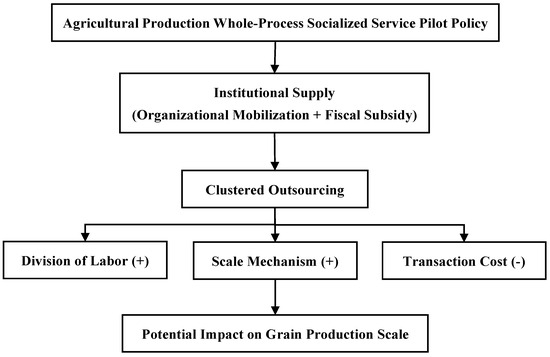
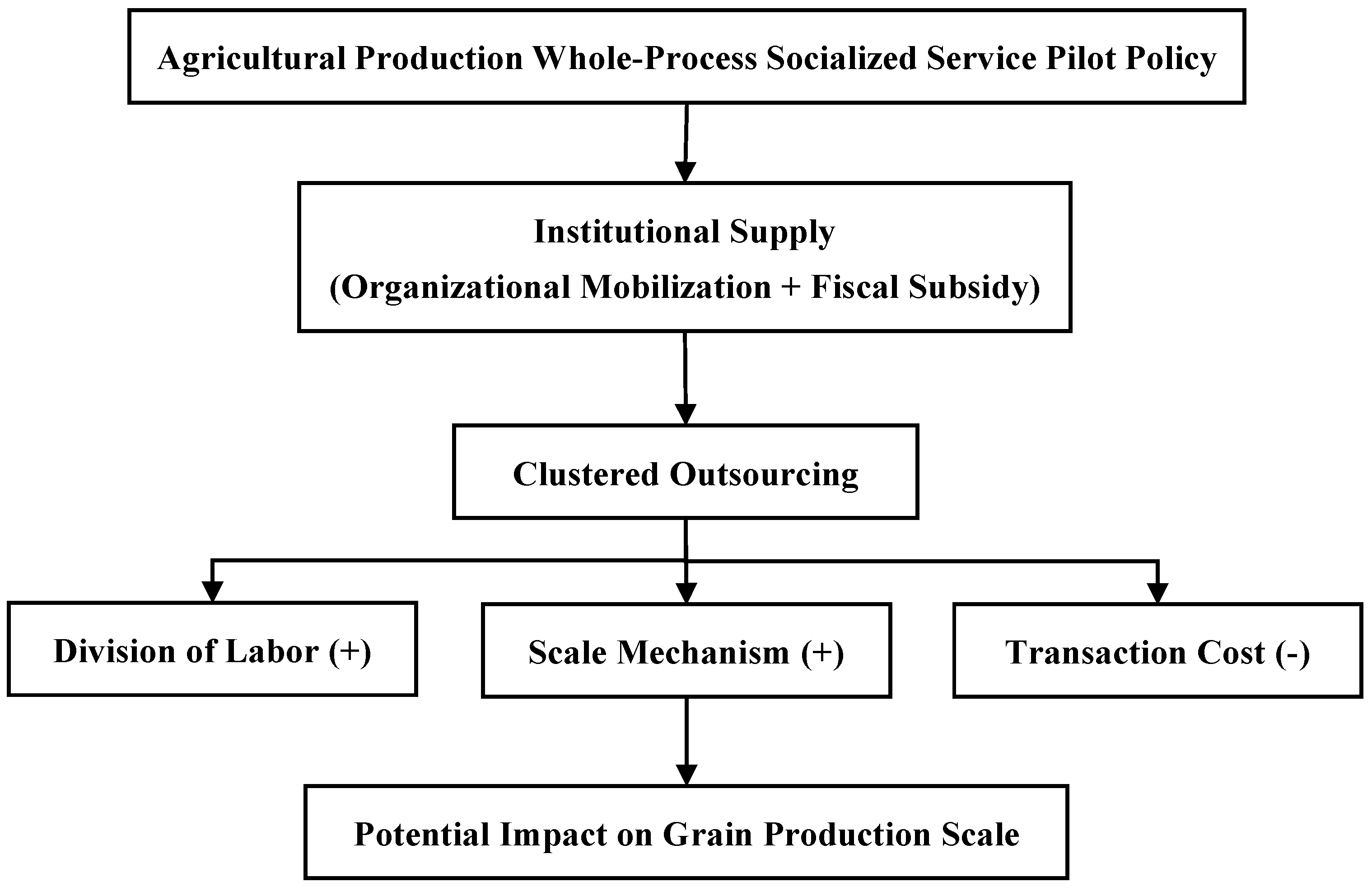

Disclaimer/Publisher’s Note: The statements, opinions and data contained in all publications are solely those of the individual author(s) and contributor(s) and not of MDPI and/or the editor(s). MDPI and/or the editor(s) disclaim responsibility for any injury to people or property resulting from any ideas, methods, instructions or products referred to in the content. |
© 2026 by the authors. Licensee MDPI, Basel, Switzerland. This article is an open access article distributed under the terms and conditions of the Creative Commons Attribution (CC BY) license.