


Abstract
Soil extracellular enzymes serve as critical drivers in the cycling of nutrients within ecosystems, and their stoichiometry can effectively reveal the metabolic resource limitations of soil microorganisms. However, extracellular enzyme activities, microbial metabolic characteristics, and their influencing factors in different grassland types in the Qilian Mountains have rarely been studied. This study focuses on alpine meadows (TJs), swampy meadows (HBs), and temperate desert grasslands (DLHs) in the Qilian Mountains. Extracellular enzyme activity and stoichiometric characteristics in the 0–30 cm soil layer were analyzed to explore the limiting factors on microbial metabolism and clarify the main driving factors affecting nutrient limitation. Compared with swampy meadows and temperate desert grasslands, alpine meadows exhibited greater extracellular enzyme activity, as revealed by the results. Statistical analysis revealed that enzyme activity exhibited a significant positive correlation with nitrate nitrogen (NO3−-N), total phosphorus (TP), total potassium (TK), available potassium (AK), and dissolved organic carbon (DOC), while showing a significant negative correlation with soil moisture content (SWC) (p < 0.05). Vector analysis of soil enzymes showed that soil microorganisms in the three grassland types are limited by carbon (C) and phosphorus (P). Among them, DLH microorganisms are highly restricted by carbon, while HB microorganisms are highly restricted by phosphorus. Random forest results showed that total phosphorus (TP), available potassium (AK), nitrogen-to-phosphorus ratio (N: P), nitrate nitrogen (NO3−-N), and readily oxidizable carbon (ROC) contribute significantly to vector length, while total potassium (TK), soil organic carbon (SOC), particulate organic carbon (POC), bulk density (BD), and carbon–nitrogen ratio (C: N) contribute significantly to vector angle. A partial least squares path model (PLS-PM) revealed that although microbial metabolic limitation is influenced by specific soil factors, the comprehensive effect of soil physicochemical properties is the dominant factor regulating microbial carbon and phosphorus limitation. This study provides valuable data and insights that elucidate the metabolic characteristics of soil microorganisms across different grassland types in the Qilian Mountains, thereby improving the mechanistic understanding of soil nutrient cycling and supporting evidence-based strategies for the sustainable management and conservation of these fragile ecosystems.
1. Introduction
Grassland is regarded as one of the most critical ecosystems on Earth, provides humans with abundant biological resources and is crucial for maintaining the ecological balance of the planet [1]. The Qilian Mountains, due to their altitude and varied topography, are home to diverse types of grassland, which represent the predominant vegetation cover in this area [2]. The stability of this ecosystem is of utmost importance [3,4]. However, the grasslands of the Qilian Mountains are highly susceptible to the impacts of human activities and global climate change [5]. Microorganisms are core components of the soil habitat and dominate various key processes such as biogeochemical cycles and carbon storage [6]. Soil enzymes are primarily produced by microorganisms, and variations in soil enzyme activity are driven by environmental factors through their effects on microbial community structure, diversity, and the expression of associated genes [7,8,9]. Soil enzyme activity, as an indicator of microbial metabolic processes, can be used to describe the energy state of microorganisms, their nutrient requirements, and changes in soil nutrient absorption and utilization [10,11,12]. Therefore, studying the microbial metabolic characteristics of different grassland types in the Qilian Mountains can help clarify the mechanisms of microbial nutrient cycling in these different grassland types, as well as the influence of various factors on microbial metabolism in the context of global climate change.
Currently, there are different viewpoints regarding nutrient limitations on microorganisms in grassland ecosystems. Li et al. [13] found that the chemical composition and enzyme activity in different grasslands in the Qilian Mountains vary with the type of grassland, and that nitrogen is the main limiting factor. Yu et al. [14] suggested that the content and ratio of nutrients are the main factors affecting microbial limitation in alpine meadows, while Li et al. [4] pointed out that soil moisture and organic carbon are the main limiting factors affecting enzyme activity and chemical composition of the ecosystem. These diverse findings highlight the need for further in-depth research on the differences in extracellular enzyme activity and microbial metabolic characteristics in different grassland types in the Qilian Mountains and their influencing factors. Moorhead et al. [15] established a vector length and vector angle relationship formula calculated from extracellular enzyme activity that has been used to reveal the nutrient cycling status of the ecosystem and quantify the nutrient limitations on microbial metabolic processes [16]. The vector length and angle relationship formula were derived from three extracellular enzymes, β-1,4-glucanase (BG), N-acetyl-β-D-glucanase (NAG), and phosphatase (AP). BG acts on cellulose degradation, and this end product serves as a significant carbon source for soil microorganisms [17]. NAG plays a key role in the hydrolysis of peptidoglycan and leucine, and AP participates in the hydrolysis of phosphorus polysaccharides and phosphates, converting them into inorganic phosphorus that can be absorbed and utilized by plants [18]. During this process, soil microorganisms adjust the secretion of C-, N-, and P-cycle-related extracellular enzymes in response to external environmental changes as a core resource acquisition strategy [19]. Changes in soil physicochemical factors regulate microbial metabolism and extracellular enzyme secretion, thereby affecting microbial nutrient limitation. Using vector analysis of soil enzymes, we conducted a study on the differences in extracellular enzyme activities and microbial metabolic characteristics in different grassland vegetation types in the Qilian Mountains, and their influencing factors. We hypothesized that: (1) microbial nutrient limitations vary among different grassland types; and (2) soil moisture and organic carbon are the main limiting factors affecting enzyme activity and its stoichiometric characteristics in the Qilian Mountains. For the first time, this study combined vector analysis with partial least squares path modeling to systematically compare the catalytic activity of soil extracellular enzymes and patterns of nutrient constraints on microorganisms among three grassland types (marsh meadow, temperate desert steppe, and alpine meadow) in the Qilian Mountains. This approach addresses a limitation of previous studies that predominantly focused on single grassland types, and further elucidates the underlying mechanisms of nutrient cycling in the region’s grassland ecosystems. Moreover, these findings provide a mechanistic basis for sustainable grassland management and contribute to establishing quantitative indicators for monitoring ecosystem sustainability and guiding conservation policies in the Qilian Mountains.
2. Materials and Methods
2.1. Experimental Site
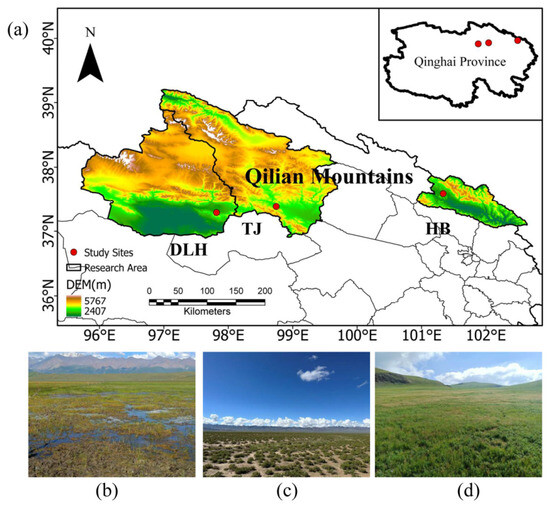
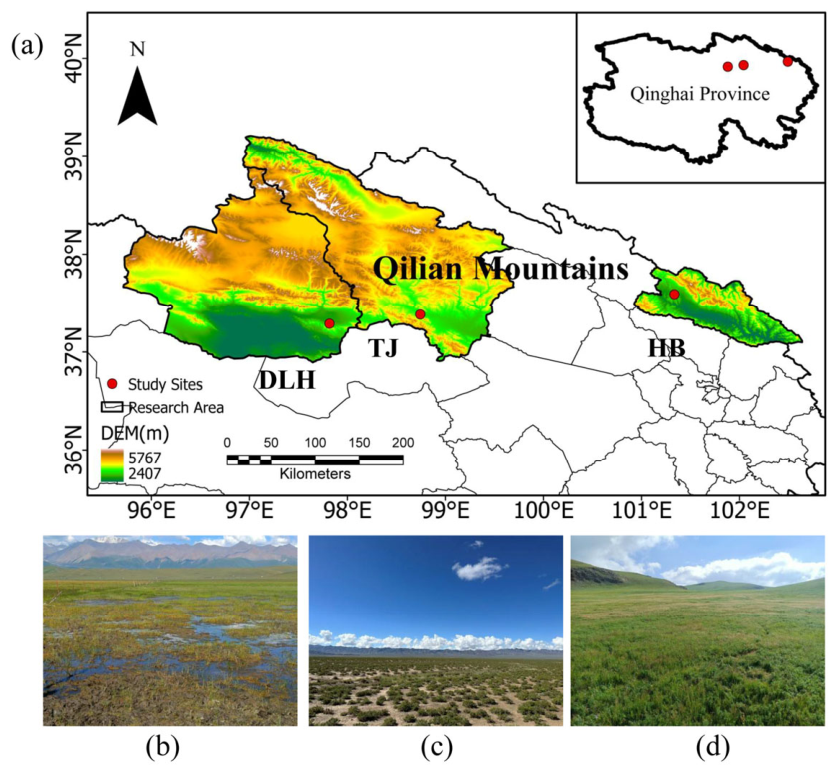
This study selected three grassland ecosystems for investigation: swamp meadow (HB), temperate desert grassland (DLH), and alpine meadow (TJ) (Figure 1). The selected area of swamp meadow is located in Luanhaizi Lake, Qingshizui Town, Menyuan County (37°59′ N, 101°34′ E, elevation 3207 m). The region has a mean annual precipitation of 582.1 mm and a mean annual temperature of −1.7 °C. The dominant species in the plant community are Triglochin palustris L., Carex moorcroftii Falc. ex Boott, and Halerpestes tricuspis (Maxim. Hand.-Mazz.). The selected area of temperate desert grassland is located in Delingha City (hereinafter referred to as DLH), Haixi Mongolian and Tibetan Autonomous Prefecture, Qinghai Province (37°32′ N, 98°30′ E, elevation 3512 m). The region has a mean annual precipitation of 164.6 mm and a mean annual temperature of 3.8 °C. The dominant species of the plant community are Suaeda glauca (Bunge) Bunge, Achnatherum splendens (Trin.) Nevski, and Leymus secalinus (Georgi) Tzvelev. The area selected for the alpine meadow is located in Tianjun County, Haixi Mongolian and Tibetan Autonomous Prefecture, Qinghai Province (TJ) (37°43′ N, 99°02′ E, elevation 3608 m). The region has a mean annual precipitation of 367.6 mm and a mean annual temperature of −1.5 °C. The dominant species are Elymus nutans Griseb., Stipa aliena Keng, and Thermopsis lanceolata R. Br.
Figure 1.
Location of the study area and sampling sites. (a) Overview of the study area, (b) swamp meadow (HB), (c), temperate desert steppe (DLH) and (d) alpine meadow (TJ).
2.2. Experimental Design and Soil Sampling
Soil samples were collected in August 2023 from the three sampling sites. For each grassland type, three plots were established within each site, spaced approximately 20 km apart. Within each plot, three 1 m × 1 m quadrats were arranged at intervals of about 100 m. A 5 cm diameter soil auger was employed to collect samples from three depth intervals (0–10 cm, 10–20 cm, and 20–30 cm) within each quadrat. Soils obtained from the three quadrats of the same plot were thoroughly mixed to create a single composite sample for each layer. These composite samples were subsequently labeled, sealed in zip-lock bags, preserved in insulated cooling containers, and transported to the laboratory. Following the removal of plant roots, stones, and other impurities, the soils were sieved through a 2 mm mesh. The processed material was then split into two fractions: one was refrigerated at 4 °C for enzyme activity and related analyses, while the other was air-dried and finely ground for the assessment of basic soil physicochemical properties. Furthermore, three representative soil profiles were excavated at each site, with samples taken from the 0–10 cm, 10–20 cm, and 20–30 cm layers using 100 cm3 cores to measure soil bulk density.
2.3. Laboratory Analyses
The potassium dichromate volumetric method was employed for the quantification of soil organic carbon (SOC) and dissolved organic carbon (DOC), whereas soil microbial biomass carbon (MBC) was assessed via the chloroform fumigation method. Readily oxidizable carbon (ROC) was quantified via oxidation with a 333 mmol/L potassium permanganate solution. Recalcitrant carbon (RC) was subjected to oxidation using 333 mmol/L potassium permanganate, followed by colorimetric analysis at 565 nm. Mineral-associated organic carbon (MAOC) and particulate organic carbon (POC) were separated and measured through wet sieving coupled with the potassium dichromate volumetric method. The activity of β-1,4-glucosidase (BG), phosphatase (AP), and N-acetyl-β-D-glucosidase (NAG) was determined strictly according to the instructions using a commercial enzyme kit (Beijing Soleibao Technology Co., Ltd., Beijing, China). The specific determination procedures were as follows: BG was incubated at 37 °C for 1 h, and its activity was measured at 400 nm. AP was incubated at 37 °C for 24 h, and its activity was measured at 660 nm. NAG was incubated at 37 °C for 1 h, and its activity was measured at 400 nm. Negative controls were included in all reactions. In addition, soil physicochemical properties, including soil water content (SWC), pH, total phosphorus (TP), total potassium (TK), and other conventional indicators, were determined using standard soil analytical procedures. The electrode method was employed for the determination of soil pH, the oven-drying method for soil water content (SWC), the molybdenum–antimony spectrophotometric method for total phosphorus (TP), and a flame photometer (Model FP-640; Shanghai Precision Instrument & Meter Co., Ltd., Shanghai, China) for total potassium (TK). Detailed protocols are provided in earlier publications [20].
2.4. Vector Analysis for Measurement of Resource Limitation
Vector analysis of soil enzymatic stoichiometry was conducted following the protocol described by Moorhead et al. [21] to assess the degree of carbon (C) and other nutrient limitations for soil microorganisms. It is worth noting that this method indicates the potential and comparative nutrient constraints of soil microorganisms, rather than their absolute limitations. Two primary indicators were derived from the analysis. Vector length quantifies the degree of C limitation experienced by soil microorganisms in comparison with N and P constraints [15]; vector angle distinguishes the relative limitation between P and N. Greater vector length corresponds to stronger C restriction on microbial metabolism. Microbial metabolism is considered P-limited when the vector angle surpasses 45°, and N-limited when it falls below 45°. The formulae for these calculations are presented below:
where x denotes the relative activity of C- versus N- and P-acquiring enzymes (BG/(BG + AP)), and y denotes the relative activity of C- versus N-acquiring enzymes (BG/(BG + NAG).
Length = sqrt (x2 + y2)
Angle (°) = degrees (atan2(x, y))
The C:N, C:P and N:P ratios of soil enzymes (EC:N, EC:P and EN:P) were determined using the following equations [18].
EC:N = ln(BG)/ln(NAG)
EC:P = ln(BG)/ln(AP)
EN:P = ln(NAG)/ln(AP)
2.5. Statistical Analyses
All data were organized and calculated using Microsoft Excel 2016 and R 4.3.2 software. One-way analysis of variance (ANOVA) was used to analyze soil elements and enzyme activities in different grassland types. We used the least significant difference method (LSD, α = 0.05) to test the significance of differences between treatments. We used R 4.3.2 to create a Spearman correlation heatmap, and preprocessed the data using the “dplyr” package. The “ggplot2” package was used to create bar charts, vector analysis graphs, and linear regression graphs. We constructed a random forest model using the “randomForest” package in R 4.3.2 to determine the key factors affecting enzyme vector angles, and evaluated the significance of the model and each factor using the “rfUtilities” and “rfPermute” packages (n = 27, p = 18, ntree = 1000, mtry = 6, OOB MSE = 0.0214, rfPermute nrep = 200). In addition, a partial least squares path model (PLS-PM) was constructed using the “plspm” package in R 4.3.2 to explore potential pathways that affect soil microbial nutrient utilization strategies.
3. Results
3.1. The Activity and Stoichiometric Characteristics of Extracellular Enzymes in Soils of Different Grassland Types
Soil extracellular enzyme activity and stoichiometric ratios varied substantially across the different grassland types (Table 1). In terms of extracellular enzymes, TJ grassland had the highest activity of N-acetyl-β-D-glucosaminidase (NAG), β-1,4-glucosidase (BG), and acid phosphatase (AP) across all soil layers, which were significantly higher than in HB and DLH grasslands (p < 0.05). For HB and DLH grasslands, there were significant differences in BG activity between the 0–10 cm and 10–20 cm soil layers (p < 0.05), while there was no significant difference in enzyme activity in the 20–30 cm soil layer (p > 0.05). Overall, the activity of the three enzymes decreased with increasing soil depth, showing the highest activity in the top layer (0–10 cm), followed by the 10–20 cm layer, and the lowest in the 20–30 cm layer. Regarding stoichiometric ratios, EC:N, EC:P, and EN:P showed significant differences. Specifically, EC:N in the 20–30 cm soil layer was significantly higher in DLH and TJ grasslands compared to HB (p < 0.05); EC:P in all soil layers was significantly higher in DLH and TJ grasslands compared to HB grassland (p < 0.05); and EN:P in the 0–10 cm soil layer was significantly higher in DLH and TJ grasslands compared to HB (p < 0.05). There were no significant differences in the stoichiometric ratios between DLH and TJ grasslands in any soil layer (p > 0.05).
Table 1.
Extracellular enzyme activity and chemometric characteristics of different grassland types and soil layers.
3.2. Correlation Analysis of Carbon Components and Soil Physicochemical Properties with Extracellular Enzyme Activity and Its Stoichiometric Characteristics
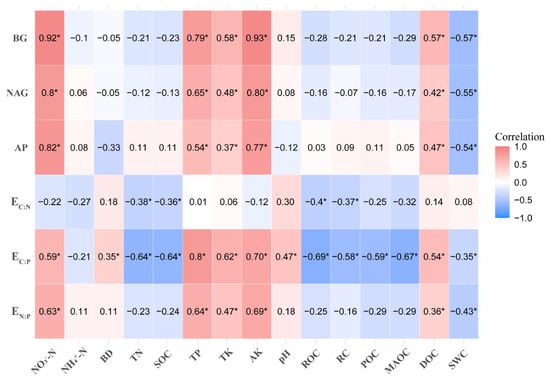
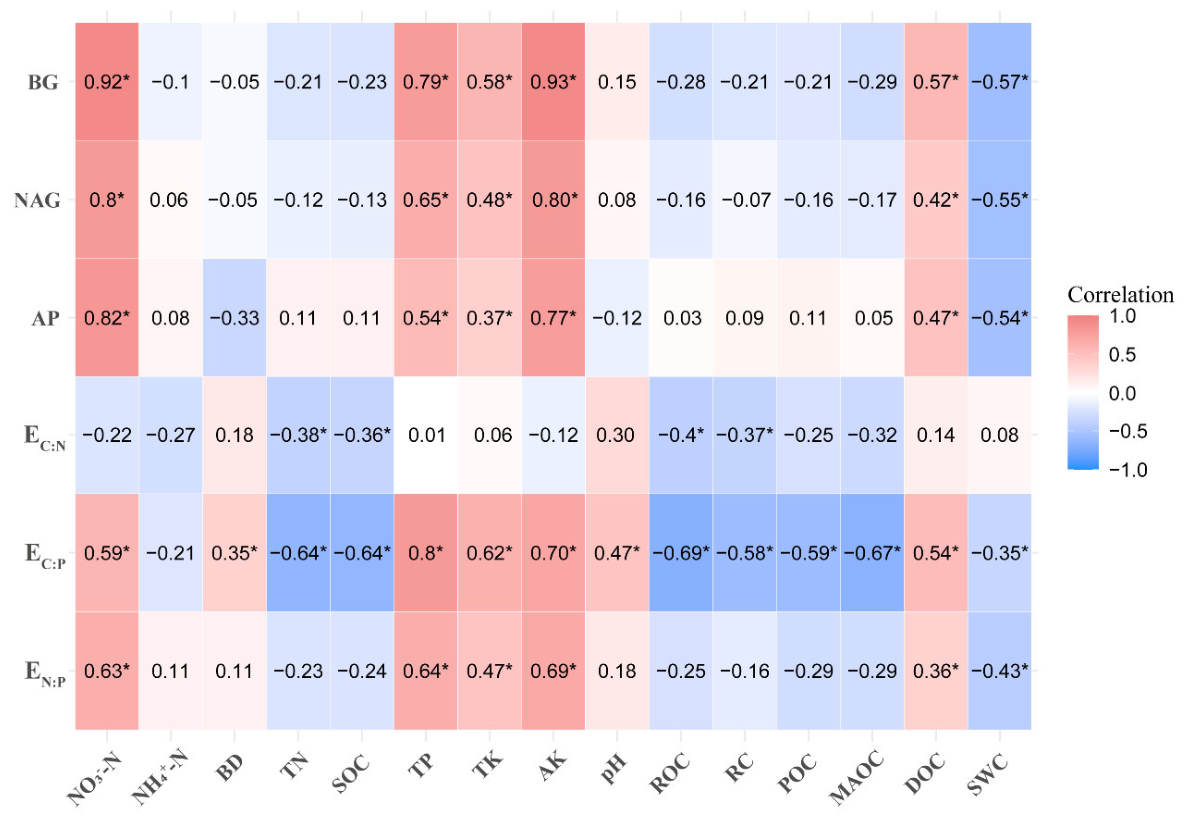
According to the Spearman correlation heatmap, NO3−-N, TP, TK, AK, and DOC all showed significant positive relationships with BG, NAG, and AP (p < 0.05), whereas SWC displayed significant negative relationships with these enzymes (p < 0.05). EC:N was negatively associated with TN, SOC, ROC, and RC (p < 0.05). For EC:P, positive correlations were detected with NO3−-N, BD, TP, TK, AK, pH, and DOC (p < 0.05), and negative correlations with TN, SOC, ROC, RC, POC, MAOC, and SWC (p < 0.05). EN:P also displayed significant positive correlations with NO3−-N, TP, TK, AK, and DOC, but negative correlations with SWC (p < 0.05; Figure 2).
Figure 2.
Correlation analysis of extracellular enzyme activity and its chemical composition characteristics with carbon components and soil physical and chemical properties. The symbol * in the figure indicates significant differences (p < 0.05).
3.3. Soil Microbial Nutrient Utilization Strategies in Different Grassland Types
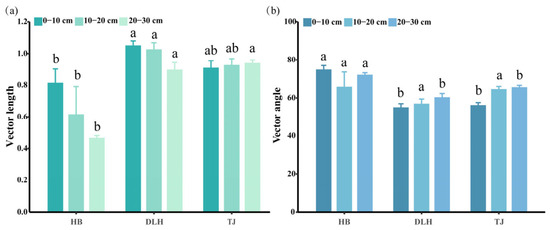
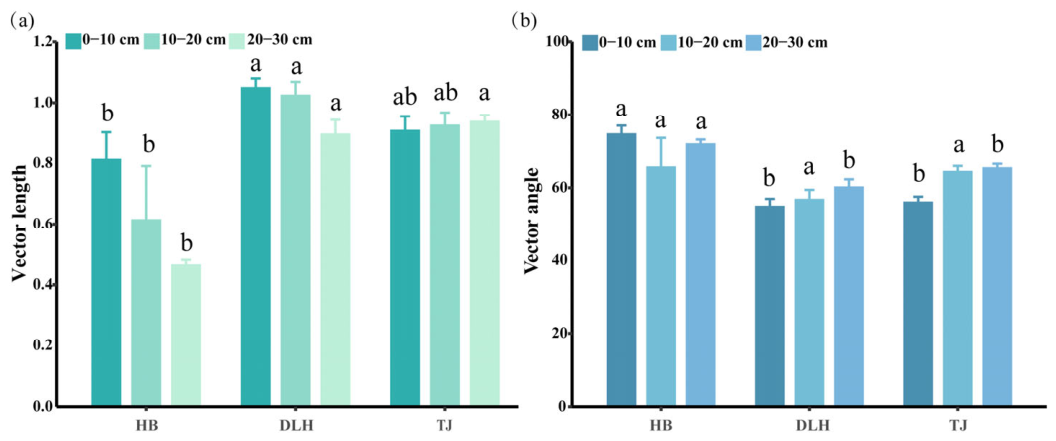
The enzymatic stoichiometric vector characteristics of soil enzymes in different grassland types are shown in Figure 3. The vector length represents the degree of carbon limitation for soil microorganisms, and the longer the vector length, the higher the degree of carbon limitation for soil microorganisms (Figure 3a). DLH has the longest vector length, followed by TJ, and HB has the shortest, with a significant difference between DLH and HB (p < 0.05). The vector lengths of HB and DLH show a decreasing trend with increasing soil depth. The vector angle represents the degree of nitrogen and phosphorus limitation for soil microorganisms. A vector angle less than 45° indicates nitrogen limitation, and a vector angle greater than 45° indicates phosphorus limitation (Figure 3b). All vector angles of the treatments in the figure are greater than 45°. Among them, the vector angles of HB in the 0–10 cm and 20–30 cm soil layers are significantly higher than those of TJ and DLH (p < 0.05).
Figure 3.
The characteristics of soil enzyme chemical stoichiometric vectors in different grassland types, with error bars indicating the mean ± standard error (Mean ± SE). (a) The vector length represents soil microbial carbon limitation; (b) the vector angle represents soil microbial nitrogen and phosphorus limitation. A vector angle less than 45° indicates N limitation, and a vector angle greater than 45° indicates P limitation. Significant differences (p < 0.05) between treatments are indicated with different lowercase letters.
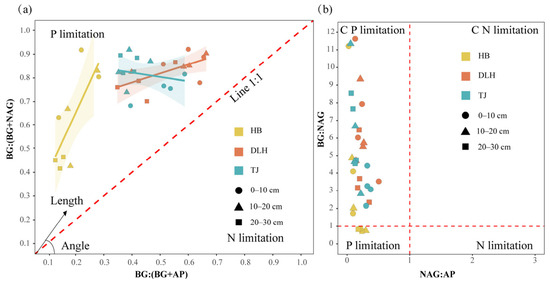
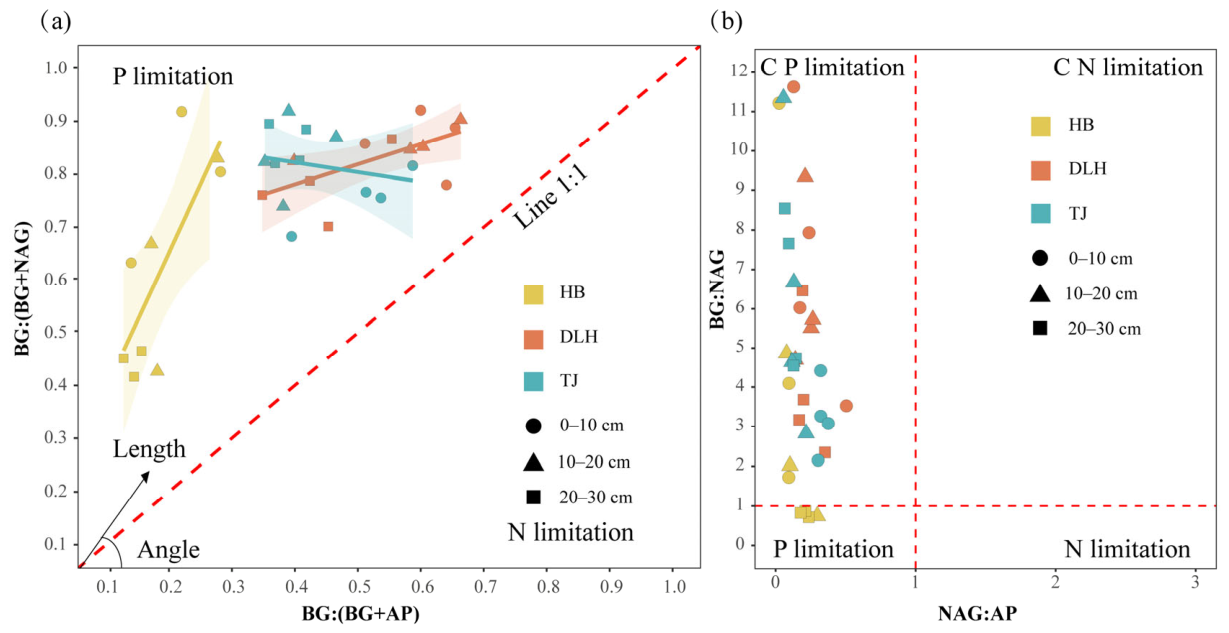
The chemical stoichiometric ratio of extracellular enzymes in soil can be used to assess the nutrient limitation characteristics of soil microorganisms (Figure 4). Threshold analysis of BG:(BG + NAG) and BG:(BG + AP) (Figure 4a) shows that all data points are above the 1:1 line, suggesting that the soil microorganisms in all three grassland types are limited by phosphorus. Additionally, the analysis of the ratio relationship between BG:NAG and NAG:AP suggests that microorganisms in the three grassland types are mainly limited by both carbon and phosphorus, with only a few HB samples showing a single limitation by phosphorus (Figure 4b).
Figure 4.
The relative nutrient limitations on soil microbial metabolism in different grassland types. (a) Threshold analysis of BG:(BG + NAG) versus BG:(BG + AP). Above the 1:1 line indicates that the microorganisms are limited by P; below the 1:1 line indicates that the microorganisms are limited by N. (b) Threshold analysis of BG:NAG versus NAG:AP. The upper left quadrant represents co-limitation by C and P; the upper right quadrant represents co-limitation by C and N; the lower left quadrant represents limitation by P; and the lower right quadrant represents limitation by N.
3.4. The Influence of Soil Properties and Carbon Components on the Nutrient Utilization Strategies of Soil Microorganisms
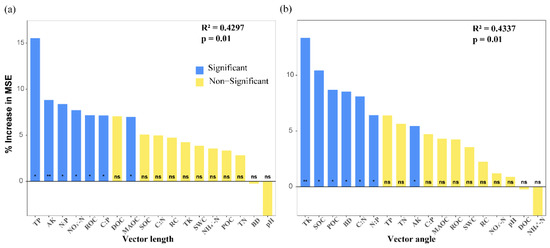
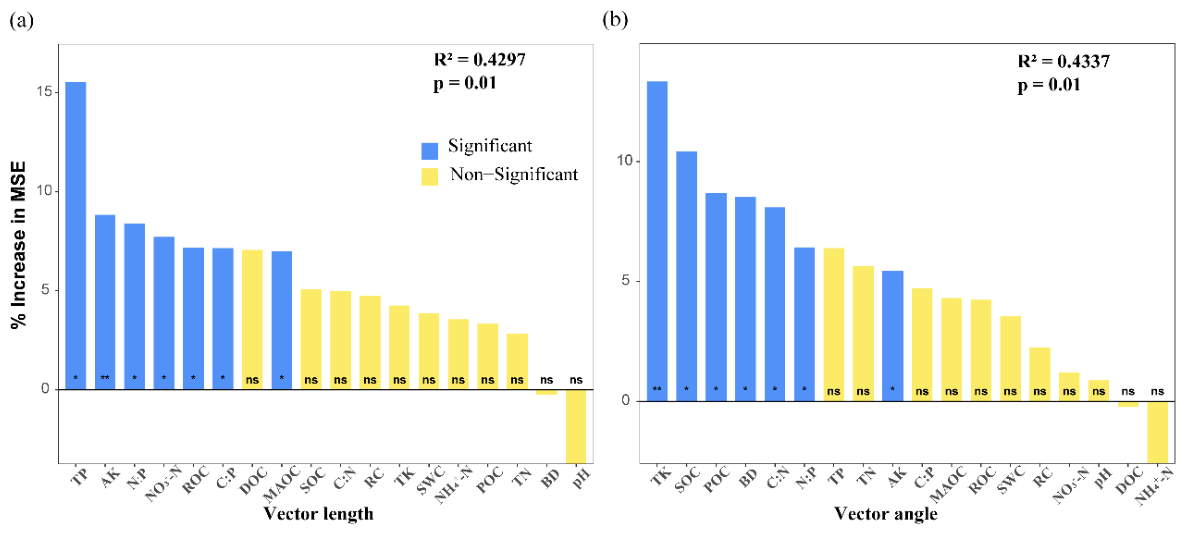
The relative contributions of soil physical and chemical indicators and carbon components to microbial nutrient limitation were analyzed using the random forest model (Figure 5). Results showed that total phosphorus (TP), available potassium (AK), nitrogen-to-phosphorus ratio (N:P), nitrate nitrogen (NO3−-N), readily oxidizable carbon (ROC), carbo-to-phosphorus ratio (C:P), and mineral-associated organic carbon (MAOC) significantly contributed to vector length (p < 0.05, Figure 5a), while total potassium (TK), soil organic carbon (SOC), particulate organic carbon (POC), bulk density (BD), carbon-to-nitrogen ratio (C:N), nitrogen-to-phosphorus ratio (N:P), and available potassium (AK) significantly contributed to vector angle (p < 0.05, Figure 5b).
Figure 5.
The ranking of the importance of variable factors for vector length and angle. (a) Ranking of the importance of environmental variables affecting vector length; (b) Ranking of the importance of environmental variables affecting vector angle. In the figure, * indicates significant difference (p < 0.05), ** indicates extremely significant difference (p < 0.01), and ns indicates no significant difference.
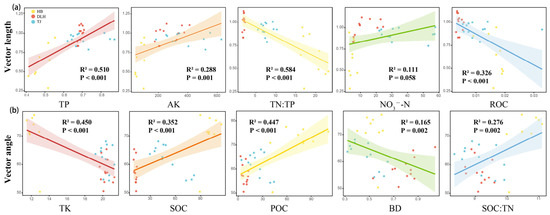
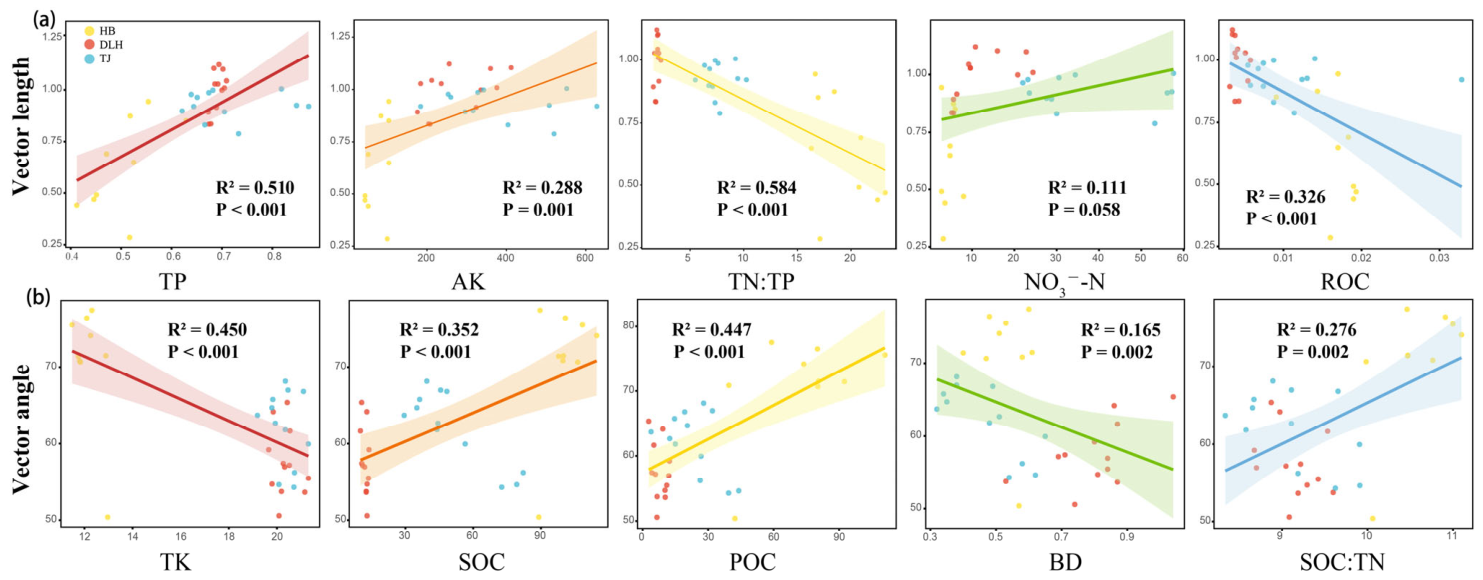
The top five variable factors in terms of importance were selected for a univariate linear regression analysis (Figure 6). Results showed that vector length was significantly positively correlated with total phosphorus (TP) and available potassium (AK) content (p < 0.05), and significantly negatively correlated with nitrogen–phosphorus ratio (TN:TP) and readily oxidizable carbon (ROC) content (p < 0.05). Although the nitrate nitrogen (NO3−-N) content showed a positive trend with vector length, the association was not statistically significant (p > 0.05, Figure 6a). Vector angle was significantly positively correlated with soil organic carbon (SOC), particulate organic carbon (POC) content, and carbon–nitrogen ratio (SOC:TN) (p < 0.05), and significantly negatively correlated with total potassium (TK) content and soil bulk density (BD) (p < 0.05, Figure 6b).
Figure 6.
Linear regression analysis of vector length and angle with respect to environmental variables. (a) Linear regression of vector length against TP, AK, TN:TP, NO₃⁻-N, and ROC. (b) Linear regression of vector angle against TK, SOC, POC, BD, and SOC:TN. The straight lines and shaded areas represent the fitted regressions and the 95% confidence intervals, respectively.
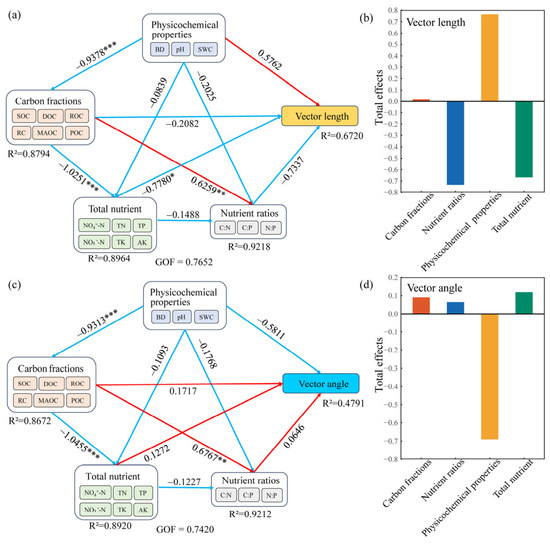
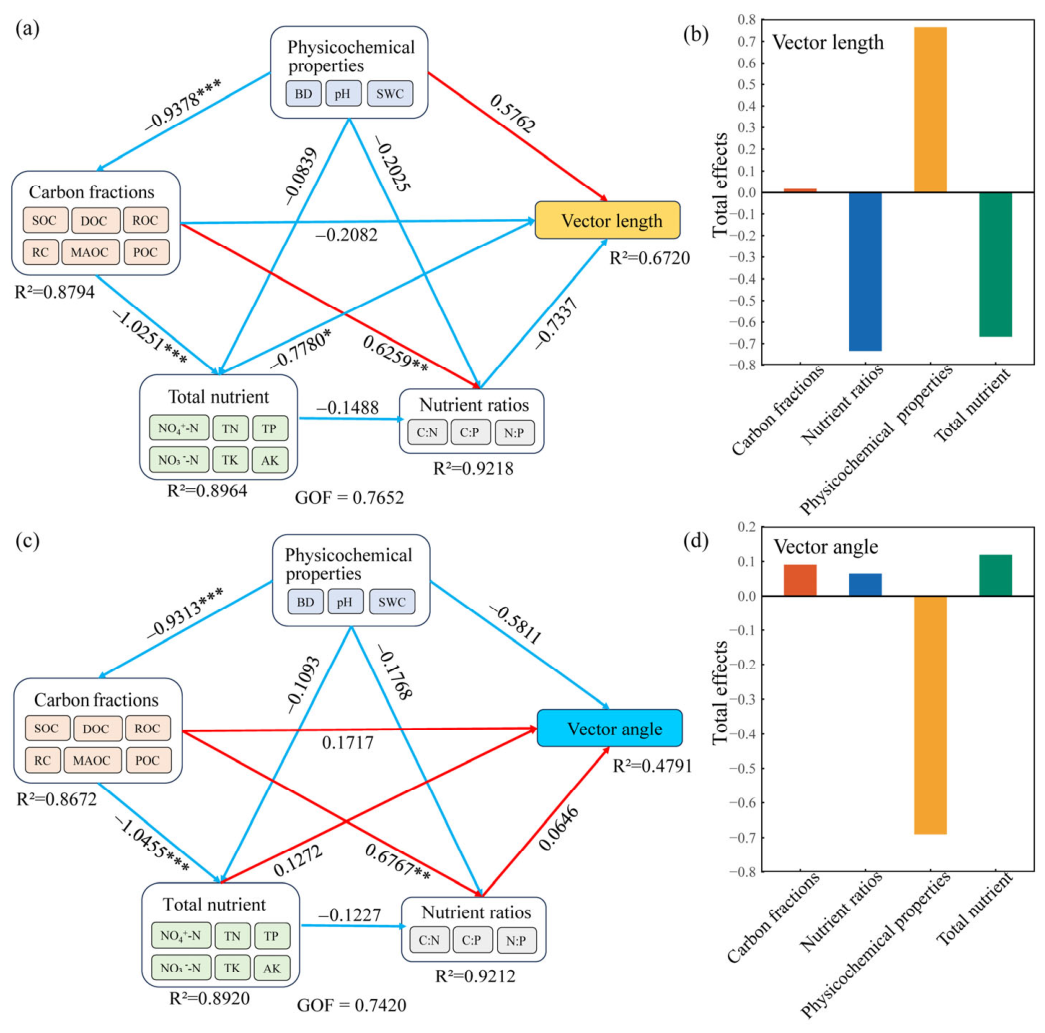
PLS-PM analysis revealed the effects of soil physical and chemical properties, carbon components, total nutrient content, and nutrient stoichiometric ratios on microbial carbon and phosphorus limitation (Figure 7). The results showed that soil physical and chemical properties had a significant positive effect on vector length (Figure 7a), while nutrient stoichiometric ratios and total nutrient content exhibited a significant negative overall effect (Figure 7b). For the vector angle, carbon components, total nutrient content, and nutrient stoichiometric ratios all showed positive effects (Figure 7c), while physical and chemical properties had a negative direct effect and overall effect on it (Figure 7d, Table S4).
Figure 7.
Using the partial least squares path model (PLS-PM), the possible pathways influencing the metabolic limitations of microbial carbon (a) and phosphorus (c) were analyzed. The red and blue arrows respectively represent positive and negative causal relationships; the numbers on the arrows indicate the standardized path coefficients; R2 represents the variance of the dependent variable explained by the model; * indicates p < 0.05, ** indicates p < 0.01, and *** indicates p < 0.001. (b,d) represent the total effects of microbial carbon and phosphorus limitations, respectively.
4. Discussion
4.1. Patterns and Mechanisms of Microbial Carbon and Phosphorus Limitations Across Grassland Types
Soil enzyme activity, a key indicator for assessing soil quality, is comprehensively regulated by vegetation, nutrient, and water conditions [22]. In our study, the TJ vegetation had higher Shannon diversity index, Margalef richness index, and belowground biomass (Table S1). Through root exudates and plant residue input, vegetation directly or indirectly enhanced soil extracellular enzyme activity [23] (Table 1). Spearman correlation analysis further indicated (Figure 2), that enzyme activity was significantly positively correlated with nitrate nitrogen (NO3−-N) and available potassium (AK) (p < 0.05), and significantly negatively correlated with soil water content (SWC) (p < 0.05). Different environmental factors thus exhibited contrasting effects on soil enzyme activities. TJ grasslands, due to their higher NO3−-N and AK contents and lower SWC (Table S2), created favorable conditions for enzyme activity. Conversely, the high SWC of HB induced an anaerobic environment, and through the accumulation of phenolic compounds and the reduction in adenosine triphosphate (ATP) content [24,25,26] inhibited the activity of hydrolase enzymes. In summary, due to the presence of vegetation resources, nutrient supply, and favorable moisture conditions, the extracellular enzyme activities in each soil layer in TJ grasslands were overall higher than those in the DLH and HB grassland types (Table 1).
The chemical stoichiometric vector characteristics of soil enzymes in different grassland types were shown in Figure 3. The microbial community of DLH is the most limited by carbon, followed by TJ, while HB is the least limited by carbon. The contents of SOC, ROC, RC, POC, and MAOC in HB were higher than those in DLH and TJ, with significant differences in SOC, RC, POC, and MAOC contents (p < 0.05; Table S3). These results supported our hypothesis. The reason for HB having a lower carbon limitation may be that in a water-saturated environment, phenolic compounds inhibit microbial activity and prevent organic matter decomposition, which is known as the ‘enzyme latch effect’ [24,27]. On a global scale, the chemical stoichiometric ratios of soil enzymes C, N and P after logarithmic transformation are 1:1:1 [28]. In our study, the ratios were 1.90:1.00:2.64 (Table S4), indicating a relative dominance of C-acquiring enzyme activity compared with the global average. Specifically, the C:N ratio (1.90) was higher than the global average of 1:1, suggesting sufficient soil N availability relative to C in this region. At the same time, as shown in Figure 3, the vector angles of all grassland types are greater than 45°, which is consistent with the results of Wang et al. [29], indicating the high demand of soil microorganisms for phosphorus transformation enzyme activity, while phosphorus resources are relatively scarce. Figure 4 provides further intuitive evidence that soil microorganisms in all grassland types are limited by C and P, suggesting that soil microorganisms invest more resources in the production of C and P acquisition enzymes and reduce their investment in N acquisition enzymes. This is consistent with the result reported by Yang et al. [30], who suggested that the metabolic community of alpine meadow soil microorganisms is limited by carbon and phosphorus. Reasons for this result may include the following. On the one hand, in alkaline soil (Table S2), phosphorus is easily combined with calcium to form insoluble phosphate salts, reducing the availability of phosphorus. On the other hand, due to the elemental stoichiometric balance of microorganisms and Liebig’s minimum factor limit law, when nitrogen is in excess while carbon and phosphorus do not increase accordingly, their relative proportions decrease, thereby limiting the metabolic rate and resource allocation pattern of soil microorganisms [30,31,32].
4.2. The Driving Factors of Strategies for Regulating the Utilization of Soil Microbial Nutrients
The chemical composition characteristics of soil extracellular enzymes are markedly influenced by environmental factors. Through the random forest model, this study identified TP, AK, NO3−-N, ROC, C:P, MAOC, TK, SOC, POC, BD, C:N, and N:P as the main driving factors of soil microbial nutrient utilization strategies (Figure 5). Regression analysis was conducted on the top five driving factors ranked by the random forest model (Figure 6), and the results showed that the degree of microbial carbon limitation was significantly positively correlated with TP and AK contents (p < 0.05; Figure 6a). When TP and AK are sufficient, the microbial turnover rate is high and the abundance of carbon-degrading functional genes significantly increases, exacerbating carbon limitation [33]. N:P ratio and ROC contents also exhibited significant negative associations with the degree of microbial carbon limitation (p < 0.05, Figure 6a), which may suggest that the reduction in nitrogen or enrichment of phosphorus through increasing microbial carbon demand further exacerbates carbon limitation. Microbial phosphorus limitation increased markedly with higher carbon content, but decreased with elevated TK and BD (p < 0.05, Figure 6b). This is consistent with the experimental results of Wu et al. [34], whose results indicated that carbon source input stimulates microbial growth, increases microbial demand for phosphorus, and thereby exacerbates soil phosphorus limitation.
The results of the PLS-PM model (Figure 7) indicated that soil physical and chemical properties (BD, SWC and pH) are the main factors influencing the limitation of microbial carbon and phosphorus metabolism. This is consistent with the findings of Pang et al. [35], and supports our second hypothesis. Soil bulk density (BD) is the core indicator for evaluating the soil pore system and directly affects water infiltration [36]. The distribution and transfer of substances and energy within and outside the ecosystem are regulated by soil moisture [37], which also governs the diffusion rates of enzymes, substrates, and products [38]. The availability of phosphorus is highly dependent on pH [39]. An appropriate soil pH value not only facilitates the dissolution of phosphorus but also increases the activity of microbial phosphorus acquisition enzymes [40]. At the same time, the influence of soil nutrients and their stoichiometric ratios on the microbial carbon metabolism limitation cannot be ignored (Table S5). Specifically, soil nutrients significantly affect enzyme activity and stoichiometric ratios by altering the concentration of effective substrates and the C, N, and P chemical ratios [23,41,42], while the chemical ratios of C, N, and P affect the abundance and activity of specific microbial groups involved in the elemental cycle [43]. In order to maintain chemical ratio equilibrium under soil nutrient supply imbalance, these specific microorganisms will jointly regulate soil enzymes [44], thereby improving the limiting conditions of key nutrients. Overall, although microbial metabolic limitations are influenced by specific soil factors, the combined effect of soil physical and chemical properties is the dominant factor regulating microbial carbon and phosphorus limitations.
This study had certain limitations. First, the limited sample size may reduce statistical power, so some results should be regarded as preliminary findings rather than definitive conclusions. Second, this study was confined to three grassland types in the Qilian Mountains at a single time point without considering climatic factors and seasonal dynamics, which restricts the spatial and temporal generalizability of the conclusions. Future research could establish more spatially independent sampling sites across a broader spatiotemporal scale, thereby improving statistical reliability and yielding more robust conclusions regarding microbial nutrient limitation in the grassland ecosystems of this region.
5. Conclusions
After logarithmic transformation, the stoichiometric ratios of extracellular enzyme activities (C:N:P) in the studied grasslands were 1.90:1.00:2.64, which deviates from the global ecological stoichiometric ratio of 1:1:1. This indicates that microorganisms tend to allocate more metabolic resources to the synthesis of carbon acquisition enzymes and phosphorus acquisition enzymes in this study. Among the three grassland types studied, the length of the DLH vector was the longest, suggesting that microorganisms in this grassland type were most severely limited by carbon, while the vector angle of HB was the largest, indicating that microorganisms in this grassland type were most severely limited by phosphorus. Although microbial metabolic limitations are mainly driven by specific soil factors (i.e., TP, AK, N:P, ROC, TK, SOC, POC, BD, C:N), the structural equation model revealed that the combined effect of soil physical and chemical properties (BD, SWC, and pH) was the dominant factor affecting microbial carbon and phosphorus limitations. The results of this study deepen our understanding of the characteristics of soil enzyme activities, the status of microbial nutrient limitations, and the key driving factors in different grassland types in the study region. The conclusions of this study may apply to swamp meadows, temperate desert grasslands and alpine meadows above 3000 m in the Qilian Mountains, and further verification is needed for other grassland types.
Supplementary Materials
The following supporting information can be downloaded at: https://www.mdpi.com/article/10.3390/su18115567/s1, Table S1: Species diversity in three types of grassland; Table S2: Comparison of soil physical and chemical indicators in three types of grassland; Table S3: Comparison of soil carbon components among three types of grassland; Table S4: Comparison of extracellular enzymes and their ratios in the soils of three types of grassland; Table S5: The overall effect, direct effect and indirect effect of soil elements on VL and VA.
Author Contributions
C.S. and J.L. researched data for this article, performed data interpretation and statistical analysis, and drafted the manuscript. C.Z. and Z.Z. researched data for this article. L.Z. and C.L. contributed to improving discussion and editing. A.W. and S.W. contributed to the review and editing. All authors have read and agreed to the published version of the manuscript.
Funding
This work was financially supported by the Qinghai Province Elite Scientist Responsibility Program (2024-SF-102).
Institutional Review Board Statement
Not applicable.
Informed Consent Statement
Not applicable.
Data Availability Statement
The original contributions presented in this study are included in the article/Supplementary Materials. Further inquiries can be directed to the corresponding author.
Acknowledgments
We thank the members of the Qinghai Sanjiangyuan Grassland Ecosystem National Observation and Research Station for experiment support.
Conflicts of Interest
Author Andreas Wilkes was employed by the Values for Development Limited. The remaining authors declare that the research was conducted in the absence of any commercial or financial relationships that could be construed as a potential conflict of interest.
References
- Wang, Y.; Xia, A.; Xue, K. Cold and humid climates enrich soil carbon stock in the Third Pole grasslands. Innovation 2024, 5, 100545. [Google Scholar] [CrossRef]
- Li, Q.; Liu, X.N.; Zhang, D.G.; Yang, J.Y.; He, G.X.; Guan, W.H.; Liu, Z.G.; Ji, T. Characteristics of aboveground biomass and soil trace elements of different grassland types in Qilian Mountain reserve. Grassland Turf 2021, 41, 48–56. [Google Scholar] [CrossRef]
- Fang, Y.P.; Zhao, C.; Ding, Y.J.; Qin, D.H.; Huang, J.L. Impacts of snow disaster on meat production and adaptation: An empirical analysis in the yellow river source region. Sustain. Sci. 2016, 11, 249–260. [Google Scholar] [CrossRef]
- Li, Q.; Qi, H.; He, G.X.; Zhang, D.G.; Han, T.H.; Sun, B.; Pan, D.R.; Liu, X.N. Response of Soil Enzymes Activities and Their Stoichiometric Characteristics to Altitude and Aspect of Alpine Meadow in Eastern Qilian Mountains. J. Soil Water Conserv. 2022, 36, 357–364. [Google Scholar] [CrossRef]
- Dong, S.K. Revitalizing the grassland on the Qinghai–Tibetan Plateau. Grassland Res. 2023, 2, 241–250. [Google Scholar] [CrossRef]
- Bahram, M.; Hildebrand, F.; Forslund, S.K.; Anderson, J.L.; Soudzilovskaia, N.A.; Bodegom, P.M.; Tedersoo, L.; Bork, P. Structure and function of the global topsoil microbiome. Nature 2018, 560, 233–237. [Google Scholar] [CrossRef]
- Somavarapu, S.; Ramesh, B.; Reddy, G.V.S.; Kameswaran, S.; Chandra, M.S.; Venkatrayulu, C.; Kumar, B.V. Enzymes from microorganisms. In Innovations in Biotechnology for a Sustainable Future; Maddela, N.R., García, L.C., Eds.; Springer: Berlin/Heidelberg, Germany, 2021; pp. 45–58. [Google Scholar] [CrossRef]
- Rillig, M.C.; Ryo, M.; Lehmann, A.; Aguilar-Trigueros, C.A.; Buchert, S.; Wulf, A.; Iwasaki, A.; Roy, J.; Yang, G. The role of multiple global change factors in driving soil functions and microbial biodiversity. Science 2019, 366, 886–890. [Google Scholar] [CrossRef]
- Tariq, M.; Liu, Y.X.; Rizwan, A.; Shoukat, C.A.; Aftab, Q.; Lu, J.F.; Zhang, Y.X. Impact of elevated CO₂ on soil microbiota: A meta-analytical review of carbon and nitrogen metabolism. Sci. Total Environ. 2024, 950, 175354. [Google Scholar] [CrossRef]
- Waring, B.G.; Weintraub, S.R.; Sinsabaugh, R.L. Ecoenzymatic stoichiometry of microbial nutrient acquisition in tropical soils. Biogeochemistry 2014, 117, 101–113. [Google Scholar] [CrossRef]
- Chen, H.; Li, D.; Zhao, J.; Zhang, W.; Xiao, K.; Wang, K. Nitrogen addition aggravates microbial carbon limitation: Evidence from ecoenzymatic stoichiometry. Geoderma 2018, 329, 61–64. [Google Scholar] [CrossRef]
- Xiao, L.; Liu, G.; Li, P.; Li, Q.; Xue, S. Ecoenzymatic stoichiometry and microbial nutrient limitation during secondary succession of natural grassland on the Loess Plateau, China. Soil Tillage Res. 2020, 200, 104605. [Google Scholar] [CrossRef]
- Li, Q.; Yang, J.Y.; He, G.X.; Liu, X.N.; Zhang, D.G. Characteristics of soil C:N:P stoichiometry and enzyme activities in different grassland types in Qilian Mountain nature reserve-Tibetan Plateau. PLoS ONE 2022, 17, e0271399. [Google Scholar] [CrossRef] [PubMed]
- Yu, J.L.; Bing, H.J.; Chang, R.Y.; Cui, Y.X.; Shen, G.T.; Wang, X.X.; Zhang, S.P.; Fang, L.C. Microbial metabolic limitation response to experimental warming along an altitudinal gradient in alpine grasslands, eastern Tibetan Plateau. Catena 2022, 214, 106243. [Google Scholar] [CrossRef]
- Moorhead, D.L.; Sinsabaugh, R.L.; Hill, B.H.; Weintraub, M.N. Vector analysis of ecoenzyme activities reveal constraints on coupled C, N and P dynamics. Soil Biol. Biochem. 2016, 93, 1–7. [Google Scholar] [CrossRef]
- Zhang, K.; Li, J.J.; Wei, Z.H.; Fan, M.C.; Shangguan, Z.P. Revealing nutrient limitation status of microorganisms in the soil of Robinia pseudoacacia plantation through soil stoichiometry and enzyme metrology. Chin. J. Appl. Ecol. 2024, 35, 1799–1806. [Google Scholar] [CrossRef]
- Gil-Sotres, F.; Trasar-Cepeda, C.; Leirós, M.C.; Seoane, S. Different approaches to evaluating soil quality using biochemical properties. Soil Biol. Biochem. 2005, 37, 877–887. [Google Scholar] [CrossRef]
- Sinsabaugh, R.L.; Follstad Shah, J.J. Ecoenzymatic stoichiometry and ecological theory. Annu. Rev. Ecol. Evol. Syst. 2012, 43, 313–343. [Google Scholar] [CrossRef]
- Stock, S.C.; Köster, M.; Dippold, M.A.; Nájera, F.; Matus, F.; Merino, C.; Boy, J.; Spielvogel, S.; Gorbushina, A.; Kuzyakov, Y. Environmental drivers and stoichiometric constraints on enzyme activities in soils from rhizosphere to continental scale. Geoderma 2019, 337, 973–982. [Google Scholar] [CrossRef]
- Zuo, C.; Luo, C.Y.; Zhao, L.; Zhao, X.Q.; Chang, X.F.; Pan, S.C. Effects of different land use patterns on soil passive carbon. Grassland Turf 2024, 24, 96–105. [Google Scholar] [CrossRef]
- Moorhead, D.L.; Rinkes, Z.L.; Sinsabaugh, R.L.; Weintraub, M.N. Dynamic relationships between microbial biomass, respiration, inorganic nutrients, and enzyme activities: Informing enzyme—Based decomposition models. Front. Microbiol. 2013, 4, 223. [Google Scholar] [CrossRef]
- Cui, Y.X.; Fang, L.C.; Guo, X.B.; Wang, X.; Zhang, Y.J.; Li, P.F.; Zhang, X.C. Ecoenzymatic stoichiometry and microbial nutrient limitation in rhizosphere soil in the arid area of the northern Loess Plateau, China. Soil Biol. Biochem. 2018, 116, 11–21. [Google Scholar] [CrossRef]
- Abay, P.; Gong, L.; Luo, Y.; Zhu, H.; Ding, Z. Soil extracellular enzyme stoichiometry reveals the nutrient limitations in soil microbial metabolism under different carbon input manipulations. Sci. Total Environ. 2024, 913, 169793. [Google Scholar] [CrossRef]
- Fenner, N.; Freeman, C. Drought-induced carbon loss in peatlands. Nat. Geosci. 2011, 4, 895–900. [Google Scholar] [CrossRef]
- Hall, S.J.; Treffkorn, J.; Silver, W.L. Breaking the enzymatic latch: Impacts of reducing conditions on hydrolytic enzyme activity in tropical forest soils. Ecology 2014, 95, 2964–2973. [Google Scholar] [CrossRef]
- Długosz, J.; Piotrowska-Długosz, A.; Breza-Boruta, B. The effect of differences in soil water content on microbial and enzymatic properties across the soil profiles. Ecohydrol. Hydrobiol. 2023, 24, 547–556. [Google Scholar] [CrossRef]
- Jiang, Z.; Liu, Y.; Lin, J.; Mo, C.; Yang, J.; Gunina, A. Conversion from double-rice to maize-rice increases iron-bound organic carbon by “iron gate” and “enzyme latch” mechanisms. Soil Tillage Res. 2021, 211, 105014. [Google Scholar] [CrossRef]
- Sinsabaugh, R.L.; Lauber, C.L.; Weintraub, M.N.; Ahmed, B.; Allison, S.D.; Crenshaw, C.; Contosta, A.R.; Cusack, D.; Frey, S.; Gallo, M.E.; et al. Stoichiometry of soil enzyme activity at global scale. Ecol. Lett. 2008, 11, 1252–1264. [Google Scholar] [CrossRef]
- Wang, L.; Li, K.; Guo, J.; Liu, X.; Gao, J.; Ma, L.; Wei, J.; Lu, M.; Li, C. Extracellular enzyme stoichiometry reveals soil microbial carbon and phosphorus limitations in the Yimeng Mountain Area, China. Forests 2022, 13, 692. [Google Scholar] [CrossRef]
- Yang, J.; Wu, X.; Ruan, H.; Song, Y.; Xu, M.; Wang, S.; Wang, D.; Wu, D. How does grassland degradation affect soil enzyme activity and microbial nutrient limitation in saline-alkaline meadow? Land Degrad. Dev. 2023, 34, 5863–5875. [Google Scholar] [CrossRef]
- Yang, J.; Guan, P.; Zhang, P.; Wu, Y.; Wang, D.; Wu, D. Stronger microbial nutrient limitations in subsoil along the precipitation gradient of agroecosystem: Insights from soil enzyme activity and stoichiometry. Front. Ecol. Evol. 2023, 11, 1137172. [Google Scholar] [CrossRef]
- Wang, X.; Li, Y.; Wang, L.; Duan, Y.; Yao, B.; Chen, Y.; Cao, W. Soil extracellular enzyme stoichiometry reflects microbial metabolic limitations in different desert types of northwestern China. Sci. Total Environ. 2023, 874, 162504. [Google Scholar] [CrossRef]
- Zhang, Y.; Qiang, W.; Luo, R.Y.; Wang, M.; Pang, X.Y. Effects of nitrogen and phosphorus addition on soil microbial growth, turnover, and carbon use efficiency: A review. Chin. J. Appl. Environ. Biol. 2022, 28, 526–534. [Google Scholar] [CrossRef]
- Wu, J.M.; Zeng, Q.X.; Mei, K.C.; Lin, H.Y.; Xie, H.; Liu, W.W.; Xu, J.G.; Chen, Y.M. Soil phosphorus availability regulates the response of soil enzyme activity and enzymatic stoichiometry to litter addition in a subtropical forest. Chin. J. Plant Ecol. 2024, 48, 242–253. [Google Scholar] [CrossRef]
- Pang, D.B.; Wu, M.Y.; Wu, X.D.; Ni, X.L.; Dong, L.G.; Chen, L.; Li, X.B.; Hu, Y. Responses of soil enzyme activities and their stoichiometric characteristics to different altitude on the eastern slope of Helan Mountain. Acta Ecol. Sin. 2023, 43, 7950–7962. [Google Scholar] [CrossRef]
- Robinson, D.A.; Friedman, S.P.; Thomas, A.; Hirmas, D.; Sullivan, P.L.; Nemes, A. Soil bulk density and porosity connecting macro- and micro-scales through geometry. Earth-Sci. Rev. 2025, 268, 105173. [Google Scholar] [CrossRef]
- Zhang, Y.W.; Deng, L.; Yan, W.M.; Shangguan, Z.P. Interaction of soil water storage dynamics and long-term natural vegetation succession on the Loess Plateau, China. Catena 2016, 137, 52–60. [Google Scholar] [CrossRef]
- Toberman, H.; Evans, C.D.; Freeman, C.; Fenner, N.; White, M.; Emmett, B.A.; Artz, R.R.E. Summer drought effects upon soil and litter extracellular phenol oxidase activity and soluble carbon release in an upland Calluna heathland. Soil Biol. Biochem. 2008, 40, 1519–1532. [Google Scholar] [CrossRef]
- Zhao, M.; Mills, B.J.W.; Poulton, S.W.; Wan, B.; Xiao, K.Q.; Guo, L.; Guo, Z.T. Drivers of the global phosphorus cycle over geological time. Nat. Rev. Earth Environ. 2024, 5, 873–889. [Google Scholar] [CrossRef]
- Xu, Z.; Zhang, T.; Wang, S.; Wang, Z. Soil pH and C/N ratio determines spatial variations in soil microbial communities and enzymatic activities of the agricultural ecosystems in Northeast China: Jilin Province case. Appl. Soil. Ecol. 2020, 155, 103629. [Google Scholar] [CrossRef]
- Deng, L.; Peng, C.; Huang, C.; Wang, K.; Liu, Q.; Liu, Y.; Hai, X.; Shangguan, Z. Drivers of soil microbial metabolic limitation changes along a vegetation restoration gradient on the Loess Plateau, China. Geoderma 2019, 353, 188–200. [Google Scholar] [CrossRef]
- Wang, J.; Wang, X.; Liu, G.; Wang, G.; Wu, Y.; Zhang, C. Fencing as an effective approach for restoration of alpine meadows: Evidence from nutrient limitation of soil microbes. Geoderma 2020, 363, 114148. [Google Scholar] [CrossRef]
- Luo, G.; Xue, C.; Jiang, Q.; Xiao, Y.; Zhang, F.; Guo, S.; Shen, Q.; Ling, N. Soil carbon, nitrogen, and phosphorus cycling microbial populations and their resistance to global change depend on soil C:N:P stoichiometry. mSystems 2020, 5, e00162-20. [Google Scholar] [CrossRef]
- Cui, Y.X.; Fang, L.C.; Guo, X.B.; Han, F.; Ju, W.L.; Ye, L.P.; Wang, X.; Tan, W.F.; Zhang, X.C. Natural grassland as the optimal pattern of vegetation restoration in arid and semi-arid regions: Evidence from nutrient limitation of soil microbes. Sci. Total Environ. 2019, 648, 388–397. [Google Scholar] [CrossRef]

Disclaimer/Publisher’s Note: The statements, opinions and data contained in all publications are solely those of the individual author(s) and contributor(s) and not of MDPI and/or the editor(s). MDPI and/or the editor(s) disclaim responsibility for any injury to people or property resulting from any ideas, methods, instructions or products referred to in the content. |
© 2026 by the authors. Licensee MDPI, Basel, Switzerland. This article is an open access article distributed under the terms and conditions of the Creative Commons Attribution (CC BY) license.