


Abstract
Environmental degradation represents a critical global challenge. Given its profound impact on ecosystems and societies, understanding the psychological factors that motivate individuals to engage in natural resource conservation behaviors has become increasingly important. Because efficacy beliefs (i.e., self-efficacy, response efficacy, and collective efficacy) are key psychological drivers of both plans and actions, a meta-analytic approach was used to estimate the associations between efficacy beliefs and conservation-related intentions and behaviors. The moderating roles of data collection method, population type, culture, and participants’ gender were also examined. Five meta-analyses synthesized the findings from 50 studies on conservation intentions and behaviors, revealing medium-sized positive associations with self-efficacy (intention, r = 0.47; behaviors, r = 0.41) and response efficacy (intention, r = 0.36; behaviors, r = 0.34), whereas the association with collective efficacy was small (single index, r = 0.28). Although substantial heterogeneity was observed, none of the tested moderators reached statistical significance, highlighting the need for future studies. Overall, these findings underscore the importance of strengthening individuals’ beliefs in their ability to engage in conservation behaviors.
1. Introduction
Environmental degradation poses an increasing threat to life on the planet, driven largely by the growing demand for natural resources associated with population growth and rising standards of living [1,2]. This unsustainable exploitation of natural systems accelerates land degradation and deforestation, aggravates water scarcity, and exacerbates biodiversity loss. Such environmental pressures undermine ecosystem functioning and translate into broader societal challenges, including food insecurity, poverty, and inequality [3]. Furthermore, the above-mentioned degradation processes—particularly deforestation—release substantial amounts of carbon dioxide (CO2) into the atmosphere, destabilizing precipitation patterns and accelerating global warming [4,5]. As environmental degradation is one of the most urgent environmental issues [6], collective and individual conservation efforts are becoming increasingly critical. Through the adoption and promotion of conservation behaviors, people can play a crucial role in environmental protection.
1.1. Conservation Behaviors
Conservation behaviors constitute a specific subset of pro-environmental behaviors, a broad category of actions that minimize harm to natural systems and/or improve the environment [7]. This macro category encompasses several subtypes. For instance, it is possible to distinguish consumption-related behaviors from those concerning transportation, recycling, and reusing, as well as behaviors focused on resource conservation [8]. Specifically, natural resource conservation behaviors (hereafter “conservation behaviors” for brevity) refer to those pro-environmental actions through which individuals directly manage, protect, or restore natural resources. Examples include increasing the number of trees and biological species by planting native plants, or leaving certain areas undisturbed and unmaintained to provide space for wildlife [9]. By engaging in conservation behaviors, individuals actively preserve natural resources and ecological areas through their interactions with the environment [10].
Given the central role of individual action in environmental protection, understanding the psychological processes that support the adoption and maintenance of conservation behaviors becomes critical. From a social-cognitive perspective, one of the key factors that regulates behavior choice, commitment, and persistence is efficacy beliefs—namely, self-efficacy, response efficacy, and collective efficacy [11,12]. Efficacy beliefs are acknowledged as vital predictors of pro-environmental behaviors across a range of models beyond Social Cognitive Theory, including Protection Motivation Theory [13], which addresses self-efficacy (defined as “performance efficacy”) and response efficacy, and the Social Identity Model of Pro-Environmental Action [14], which encompasses collective efficacy. Consistent with these perspectives, many studies have examined the relationship between efficacy beliefs (self-, response, and collective efficacy) and conservation intentions and behaviors.
However, to our knowledge, no quantitative synthesis has yet combined these findings, with the only exception of a recent meta-analysis on the predictors of energy-saving behaviors [15]. The present study extends this line of research to other conservation behaviors, focusing on efficacy beliefs and updating their systematic literature search (dated back to February 2023).
1.2. The Role of Self-Efficacy in Conservation Intentions and Behaviors
Self-efficacy refers to an individual’s conviction in their ability to perform recommended behaviors to achieve desired outcomes [11]. In the specific context of conservation behaviors, self-efficacy refers to people’s confidence in their ability to perform conservation-oriented behaviors that use natural resources responsibly. For instance, research on water- and energy-related practices shows that self-efficacy plays an important role in shaping conservation intentions and the adoption of efficiency-related actions [16,17,18]. Moreover, in households where water conservation behaviors were implemented, residents reported a strong confidence in their ability to conserve water [19], suggesting a potential bidirectional relationship between self-efficacy and behavior. Baah and colleagues [19,20,21] further showed that when residents are not confident in their ability to save water, they also lack the intention to do so and are unlikely to engage in water conservation behaviors.
Consistent with these findings from residential contexts, higher self-efficacy similarly translates into conservation behaviors in agricultural settings. Specifically, greater self-efficacy supports farmers’ engagement in behaviors that safeguard water bodies [22] and not only that, but it also promotes soil conservation practices, as farmers with strong self-efficacy tend to perceive these initiatives as feasible, which motivates them to engage in the protection of soil resources [23,24,25,26,27].
Further extending this pattern, research on energy conservation indicates that self-efficacy is positively associated with energy-saving intentions and behaviors among both residents and employees. This suggests that, even in organizational contexts, fostering self-efficacy beliefs may contribute to achieving sustainability goals—particularly those related to reducing electricity consumption [28,29]. The convergence of evidence across residential, agricultural, and occupational settings illustrates how self-efficacy functions as a cross-domain motivator of conservation behavior.
Importantly, the influence of self-efficacy extends beyond utilitarian conservation settings and also emerges in the context of immersive nature experiences. Indeed, Clayton and colleagues [30] found that, among zoo visitors, self-efficacy was the strongest predictor of behavioral intentions to protect biodiversity and was correlated with existing conservation behaviors. Crucially, they reported that zoo visits incorporating conservation education can enhance self-efficacy, thereby strengthening the potential for future interventions. Similarly, among forest visitors, self-efficacy significantly predicted conservation intentions, highlighting opportunities for targeted awareness initiatives in recreational natural settings [31,32]. These studies emphasize that self-efficacy is relevant even in less structured, leisure-oriented environments, where direct engagement with nature may support pro-environmental action.
Additional insights into the mechanism linking self-efficacy to behavior come from studies that compare self-reported and objective conservation actions. Fielding and colleagues [33] observed significant—but modest—correspondence between what people say they do and what they actually do in their households. Notably, this correspondence strengthened among individuals reporting high levels of self-efficacy, suggesting that it may enhance individuals’ sense of agency and behavioral self-regulation—core mechanisms described in Bandura’s social cognitive theory [34]—thereby increasing the consistency between what people believe they do and their objectively observed actions. In this sense, strong self-efficacy may also reduce discrepancies between intentions, self-perceptions, and actual behavior, functioning as an alignment mechanism within the intention–behavior process. Complementing this, Lauren et al. [35] found that self-efficacy for relatively easy conservation behaviors (e.g., washing full loads) predicted engagement in more demanding actions (e.g., installing low-flow taps) after nine months. This pattern suggests a potential spillover process, whereby increasing self-efficacy for simple actions may lead to the adoption of more challenging behaviors over time.
1.3. Response and Collective Efficacy
Response and collective efficacy are other relevant predictors of conservation behaviors, although these constructs have received considerably less attention than self-efficacy. Response efficacy refers to the belief that a given behavior is effective in mitigating or preventing harm [36]. In the context of natural resource conservation, it reflects the extent to which individuals perceive their actions as capable of reducing the negative consequences of inappropriate exploitation. Recent studies show that response efficacy is an important determinant of behaviors aimed at protecting natural resources [26,37]. For example, it strongly predicted farmers’ intentions to conserve water, highlighting the value of clearly informing them about the effectiveness of conservation practices [38,39]. Among residents, believing that water-saving behaviors are effective has similarly been associated with stronger intentions and actual implementation of conservation actions [19]. Other research reports that response efficacy predicts water conservation during drought conditions [24], biodiversity-related conservation intentions and behaviors [26], and intentions to engage in energy-saving practices [28].
As for collective efficacy, it refers to a group’s shared conviction in its collective ability to perform actions required to achieve desired outcomes [12], which, in conservation contexts, translates into the perceived capacity of groups to effectively conserve the environment. It should be particularly relevant because conservation behaviors often occur within shared community environments. Collective efficacy has been shown to influence pro-environmental actions such as biodiversity and forest conservation (e.g., compliance with rules in protected areas), suggesting its value as a lever for motivating collective environmental engagement [40,41]. Evidence further indicates that collective efficacy, alongside individual efficacy beliefs, contributes to water conservation behaviors among both farmers and residents, especially when environmental threats are perceived as shared community problems (e.g., drought or water pollution; [16,42]). However, mixed results emerged for certain outcomes, such as intentions to save energy [28].
1.4. Objectives
This paper aims to synthesize the results of multiple studies reporting correlations between efficacy beliefs and conservation intentions and behaviors. We aimed to estimate the overall effect size of the association between self-, response, and collective efficacy on the one hand, and conservation intentions and behavior on the other. We focused on these behaviors because of their potential to create a bridge between research and key stakeholders, such as farmers’ associations or energy providers. Establishing common ground is crucial because it allows scientific findings to be translated into actionable strategies, facilitates stakeholder engagement, and ensures that interventions are both practical and contextually relevant. In addition, our focus on efficacy beliefs aims to understand how to promote these pro-environmental behaviors and how to increase public awareness of conservation.
We examined both intentions and behaviors because, according to Bandura [43], they represent two points along the same functional continuum: intentions are “a representation of a future course of actions to be performed” and “a proactive commitment to bringing them about” (p. 6), whereas a behavior reflects the actual enactment of those actions.
In addition to the primary aim of estimating the overall effect size of the association between efficacy beliefs and conservation intentions and behaviors, our secondary aim was to examine potential moderators of these associations.
1.5. Potential Moderators
To explain possible differences across the results of the studies included, we examined different types of moderators (see Supplementary Table S1).
Data collection method. We explored whether the magnitude of the effects varies by mode of administration: self-report questionnaires or structured face-to-face interviews. Indeed, these two modes of administration involve different psychological processes (e.g., cognitive burden or rapport with the interviewer; [44]), which allowed us to classify the studies into two distinct groups and test a potential moderation effect. Since the questionnaire is less affected by social desirability bias than the interview, this methodological choice could influence the way respondents estimate their engagement in desirable behavior as a self-presentation strategy [44]. When responding to an anonymous self-report, participants may feel free to admit that they do not regularly engage in conservation behaviors, despite perceiving themselves capable of doing so. In contrast, during face-to-face interviews, participants could feel greater pressure due to social desirability, increasing the tendency to report behaviors more consistent with their perceived abilities. This could strengthen the association between self-efficacy and conservation behaviors in the interviews compared to the self-report questionnaires.
Populations. As for populations, we divided the studies into two categories based on the context of their use of natural resources: the work-related group included individuals who directly interact with natural resources as part of their occupation or economic activity, such as farmers and employees in any sector. The non-work-related group included individuals who interact with natural resources as consumers or in leisure contexts, such as residents, students, and visitors. In work-related situations, individuals may perceive economic pressures that discourage environmental engagement to avoid potential economic loss [45]. Therefore, since economic constraints can hinder individual pro-environmental actions [46], they may interfere with the relationship between self-efficacy and behavior, weakening the association between the two variables for the work-related group more than the other.
Culture. Although Social Cognitive Theory posits universal mechanisms linking efficacy beliefs to behavior, the relative weight of individual versus collective agency may vary systematically across cultural contexts [47]. Therefore, we expected that differences in cultural contexts could account for variation in effect sizes across studies. In an individualistic culture, independence and individual initiative are more strongly emphasized than in collectivist countries, where social identity and group solidarity are more highly valued [48]. Self-efficacy, as a personal belief, could play a more influential role in shaping behavior in individualistic cultural contexts; vice versa, collective efficacy may be more impactful in collectivistic rather than individualistic societies. Differences between individualistic and collectivistic cultures may call for different training strategies to foster efficacy beliefs and, consequently, conservation behaviors—individual training in the former and group training in the latter [47]. To investigate this potential moderator, we classified each country where the study was conducted according to the novel Individualism–Collectivism Index [48,49].
Gender. Research has consistently shown that women tend to report higher levels of environmental concern and stronger pro-environmental orientations than men (e.g., [50,51]). Because self-efficacy functions within a motivational context shaped by personal values and concern, it may exert a stronger influence on women’s pro-environmental intentions and behaviors, as these attitudes are generally more salient and internalized among women compared with men. On the other hand, previous research also noted a weaker correlation between self-efficacy and some energy-saving behaviors in women rather than in men, mainly due to the different use of heating caused by greater indoor thermal discomfort [52]. Investigating how gender may moderate the effects of efficacy beliefs can inform policy guidelines and intervention strategies [52].
2. Method
2.1. Search Strategy and Inclusion Criteria
Operationally, we defined conservation behaviors as actions through which individuals directly reduce their consumption of natural resources (e.g., saving water or energy) or actively protect and restore them (e.g., planting trees). This definition excludes indirect or mediated behaviors (such as signing petitions). Only behaviors with a direct, proximal impact on natural resources were considered as conservation behaviors.
The systematic review and the meta-analyses were conducted in accordance with the PRISMA 2020 guidelines [53]. Relevant studies were identified using the following methods: (i) electronic databases (Scopus, PsycInfo, Psychology and Behavioral Science Collection, Web of Science, PubMed, Open Science Framework, and Prospero) were searched; (ii) reference lists of included articles were manually searched; and (iii) mailing lists of relevant societies or groups (European Association of Social Psychology, EnvPsy, and International Association of Applied Psychology) were used to request unpublished data.
The inclusion of unpublished data aimed to reduce publication bias by capturing studies with smaller or null effect sizes unlikely to appear in peer-reviewed journals.
The systematic selection process through electronic databases was conducted in the first half of March 2026 (2–16 March), using the following search string: (“self-efficacy” OR “response efficacy” OR “collective efficacy” OR “environmental efficacy”) AND (“pro-environmental behavio*” OR “green behavio*” OR “sustainable behavio*” OR “conservation behavio*” OR “eco-friendly behavio*”) (in the abstract, title and keywords). The request via mailing list was distributed in the early days of April 2025 (1–6 April).
These searches generated 578 independent papers after duplicates were removed. Papers were subsequently screened according to the following inclusion criteria: (1) studies had to report results in English; (2) studies had to report quantitative measures for the relevant variables (i.e., efficacy beliefs and conservation intention, and/or efficacy beliefs and conservation behavior; when appropriate, consistently with Zawadzki et al. [15], we treated measures of perceived behavioral control [54] as equivalent to self-efficacy); (3) studies had to refer to direct actions related specifically to the conservation of water, energy, soil, forests, and biodiversity; studies using indirect measures, such as signing a petition, were therefore excluded; (4) the scales used in the studies had to measure exclusively conservation behavior; studies using mixed scales that also included other pro-environmental behaviors (e.g., sustainable eating, waste management, green mobility, recycling) were therefore excluded.
2.2. Selection of Studies and Data Extraction
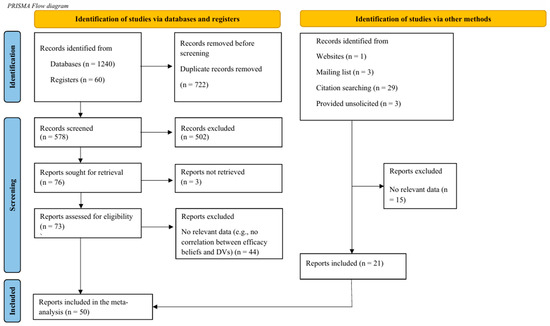
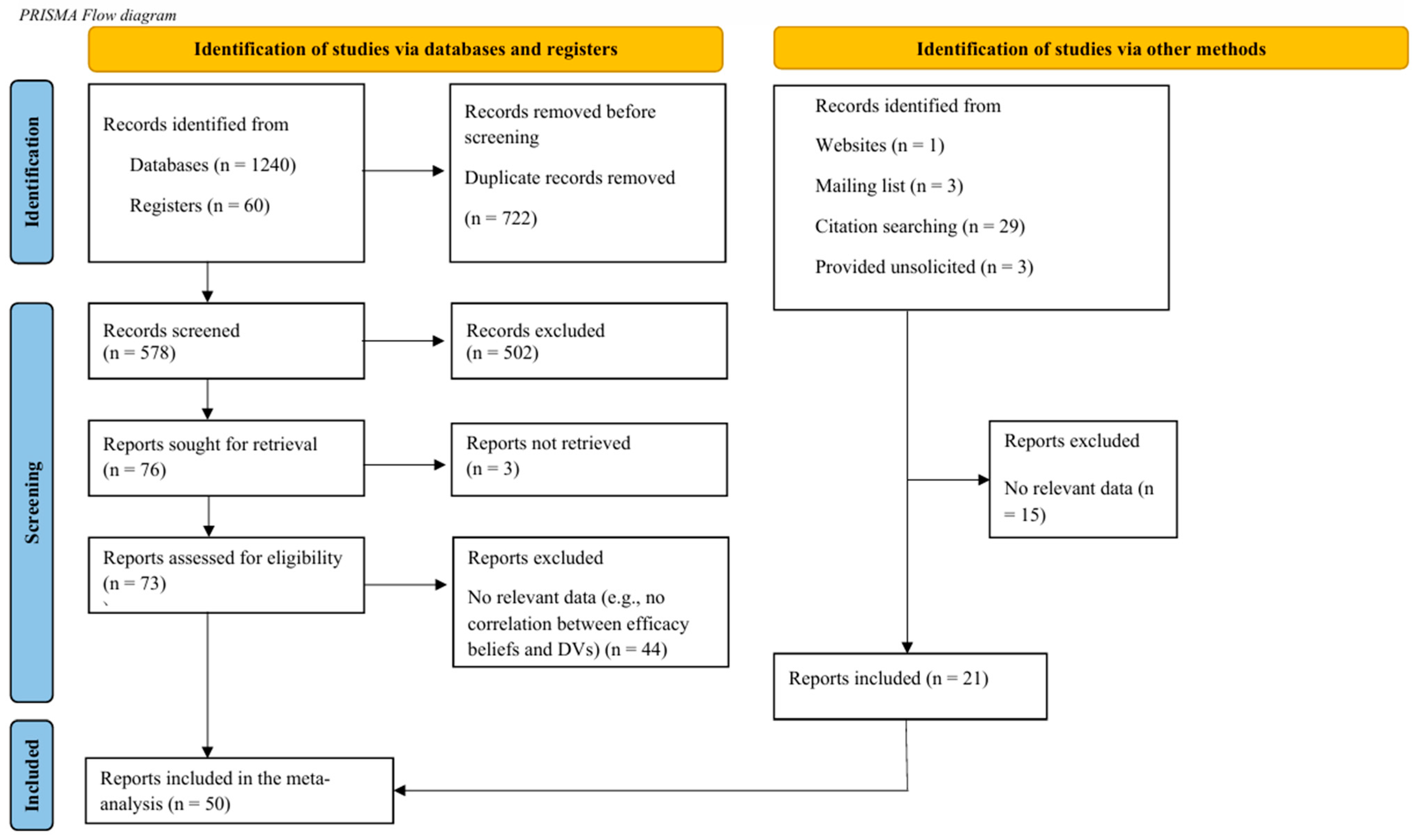
Figure 1 shows the PRISMA flowchart outlining the eligibility and screening procedures. The titles and abstracts of 578 papers retrieved from scientific databases were independently reviewed by the first and second author to assess their potential relevance to the research question. After discussions with the other authors, the analysis of the abstracts led to the exclusion of 502 papers that did not meet our inclusion criteria. Three papers could not be retrieved (for instance, according to the websites, these papers had been removed at the request of the author, the website, or the rights holder); 73 reports were assessed in full; however, during the full-text analysis and data extraction phase, we found that many did not report the necessary data or did not provide Supplementary Materials that would allow us to extract this information beyond what was reported in the manuscripts. Consequently, corresponding authors were contacted to request the missing data. When Pearson’s r was not available, beta coefficients or odds ratios were converted into r using calculators no. 13 and 15 at https://www.psychometrica.de/effect_size.html (accessed on 26 March 2026). Of the retrieved reports, for 44 we did not have the necessary data to conduct the meta-analysis. An additional 36 reports were identified through other sources (e.g., mailing lists, k = 3; Zawadzki et al.’s meta-analysis [15], k = 15: 12 on self-efficacy, 3 on response efficacy, and 1 on collective efficacy), of which 21 were eligible and included.
Figure 1.
Prisma flow diagram.
No imputation was performed for missing effect sizes; cases with missing values were excluded only from the specific analyses for which those values were required (e.g., an effect size lacking information on the percentage of female participants was excluded only from the moderation analysis involving gender).
No formal risk of bias assessment was conducted; however, publication bias was examined using Egger’s regression test.
Materials, data, and analyses output for this meta-analytic investigation are publicly available on the Open Science Framework (OSF): https://osf.io/tdrf8/overview?view_only=7e1712ed2cc84c5bbb69a6cac1fc2342.
2.3. Independence of Effect Size
The independence of the data is one of the fundamental assumptions of meta-analysis [55]. This is why, when studies reported more than one measurement for the same variable (e.g., two different time points) and the same sample, we computed a mean correlation to ensure the independence of effect sizes [56]. The mean calculation followed formula number 9 provided by Welz and colleagues [57]. Importantly, the values were transformed from r to z.
3. Results
In total, 50 articles were included in the meta-analyses and coded by the first and the second author (see Table 1 for study characteristics).
The analyses were carried out with SPSS Statistics, version 29 [58], using a random-effects model with Fisher r-to-z transformation. These analyses provided an estimate representing a weighted average of the observed correlations between efficacy beliefs and conservation intentions or behaviors.
Table 1.
Studies characteristics.
3.1. Self-Efficacy
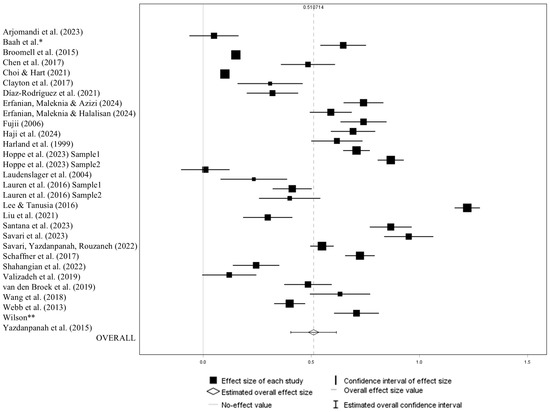
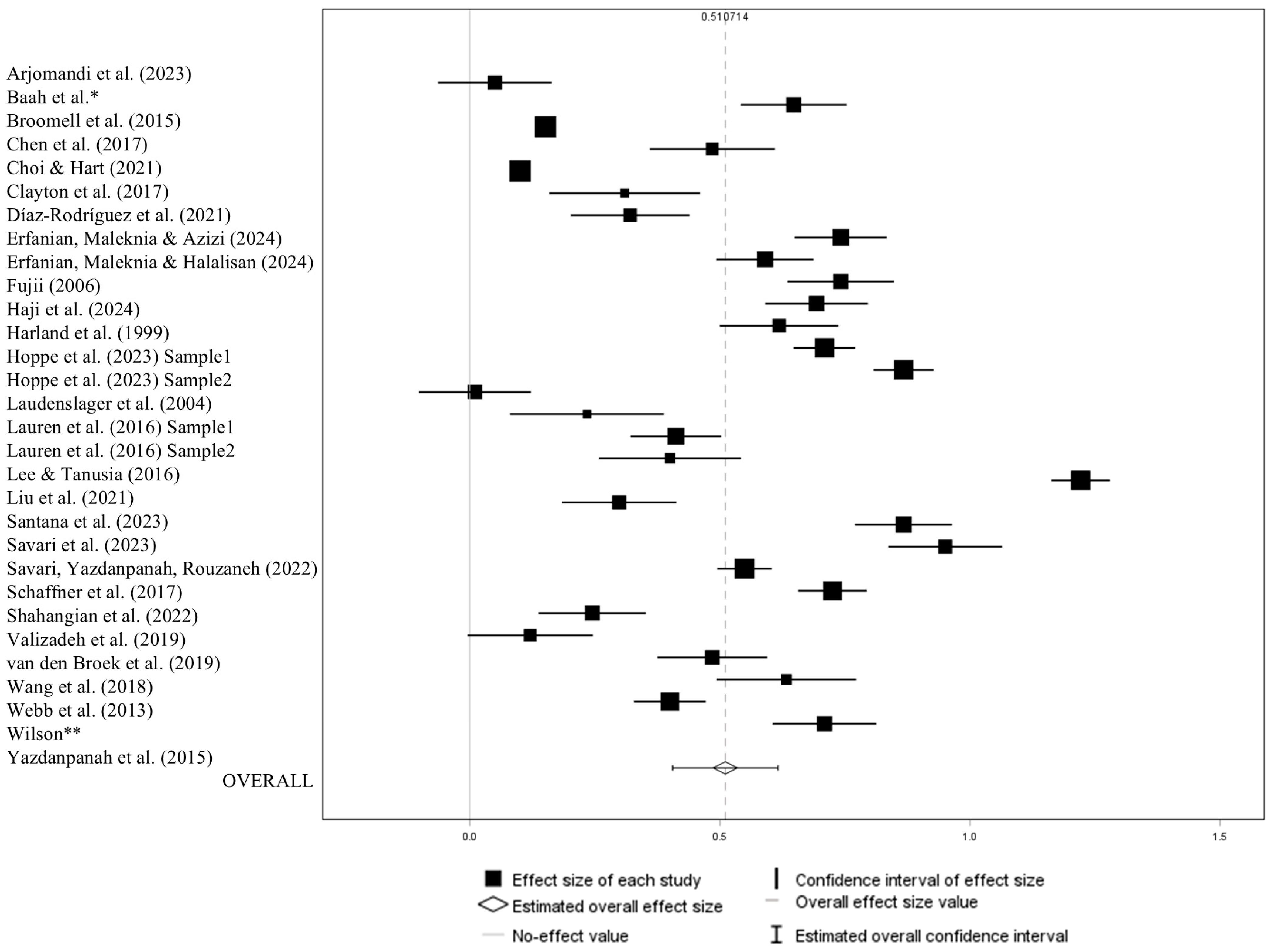
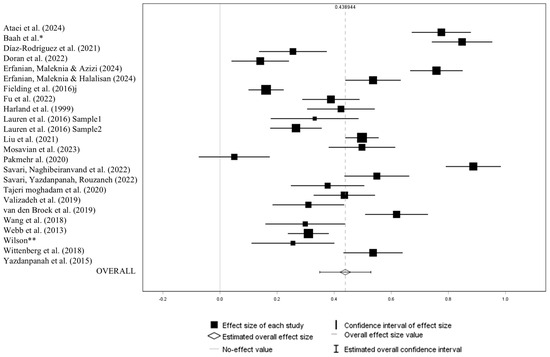
Figure 2 and Figure 3 report the individual studies’ results and the overall effect sizes for the association between self-efficacy and, respectively, intention and behavior. The Z-test was significant for both intention and behavior (respectively, Z = 9.50, p < 0.001; Z = 9.61, p < 0.001), allowing us to reject the null hypothesis that there were no correlations between self-efficacy and the outcomes. These analyses showed that approximately 22% of the variance in intentions and 17% of the variance in behaviors were attributable to self-efficacy beliefs. The summary correlation estimate (Pearson’s r) was 0.47, 95% CI [0.38, 0.55] for the relationship between self-efficacy and intentions (k = 30), and 0.41, 95% CI [0.34, 0.48] (see Figure 3) for the relationship between self-efficacy and behaviors (k = 24). According to Cohen [85], these findings indicate medium-sized correlations.
Figure 2.
Forest plot of the relationship between self-efficacy and conservation intentions. Note. Effect sizes are reported in Fisher’s z. * Effect sizes from three studies were averaged because the sample was the same: Baah et al. [19,20,21]. ** Effect sizes from two studies were averaged because the sample was the same: Prokup et al. [83] and Beetstra et al. [84], where Wilson was the principal investigator.
Figure 3.
Forest plot of the relationship between self-efficacy and conservation behaviors. Note. Effect sizes are reported in Fisher’s z. * Effect sizes from three studies were averaged because the sample was the same: Baah et al. [19,20,21]. ** Effect sizes from two studies were averaged because the sample was the same: Prokup et al. [83] and Beetstra et al. [84] where Wilson was the principal investigator.
Egger’s regression test did not reveal significant asymmetries that could signal the presence of a publication bias (p ≥ 0.459). The two funnel plots are reported in Supplementary Figures S1 and S2.
3.1.1. Heterogeneity
Following the indication provided by Borenstein et al. [86], heterogeneity was assessed. For both the relationship between self-efficacy and conservation intention, Q (29) = 3815.02, p < 0.001, and the relationship between self-efficacy and conservation behavior, Q (23) = 454.60, p < 0.001, we can reject the null hypothesis that the true effect size is the same across all these studies. The I2 statistic indicates that 99.1% and 94.8% of the variance in observed effects reflects variance in true effects rather than sampling error. The variance of true effect sizes (τ2) was 0.08 for intentions and 0.05 for behaviors. Assuming that the effects are normally distributed, we estimated that the prediction interval ranged from −0.09 to 1.11 in the first case and from −0.02 to 0.90 in the second. This suggests that the correlations between self-efficacy and conservation intentions or conservation behaviors greatly vary across populations: since the interval includes zero, these associations may be absent in some populations, while the upper bound indicates that they can be substantial in others.
3.1.2. Moderation Analyses
We explored some moderators potentially accounting for the strong heterogeneity among effect sizes. The criterion of including moderators only when there were at least five studies for each level was followed [87]. First, we tested administration type (questionnaires vs. interviews) as a potential moderator: the difference between subgroups, assessed using the Q statistic, was not significant for either the relationship between self-efficacy and intentions (Q = 2.40, p = 0.121) or the relationship between self-efficacy and behaviors (Q = 1.36, p = 0.244), indicating that this methodological factor did not account for the heterogeneity observed among effect sizes.
We then examined population type as a moderator; also in this case, the difference between work-related and non-work-related groups was not statistically significant (Q = 0.21, p = 0.651; Q = 0.37, p = 0.541). Similarly, cultural context did not significantly moderate the relationships under investigation (SPSS meta-regression; t = −0.80, p = 0.429; t = −1.76, p = 0.092).
Finally, a meta-regression was conducted to evaluate whether the percentage of women in the sample moderated the effects. This analysis did not support the hypothesis of gender differences in the association between self-efficacy and either conservation intentions or behaviors (p ≥ 0.347).
3.2. Response Efficacy
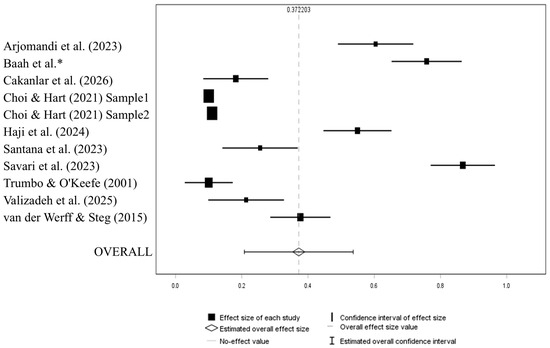
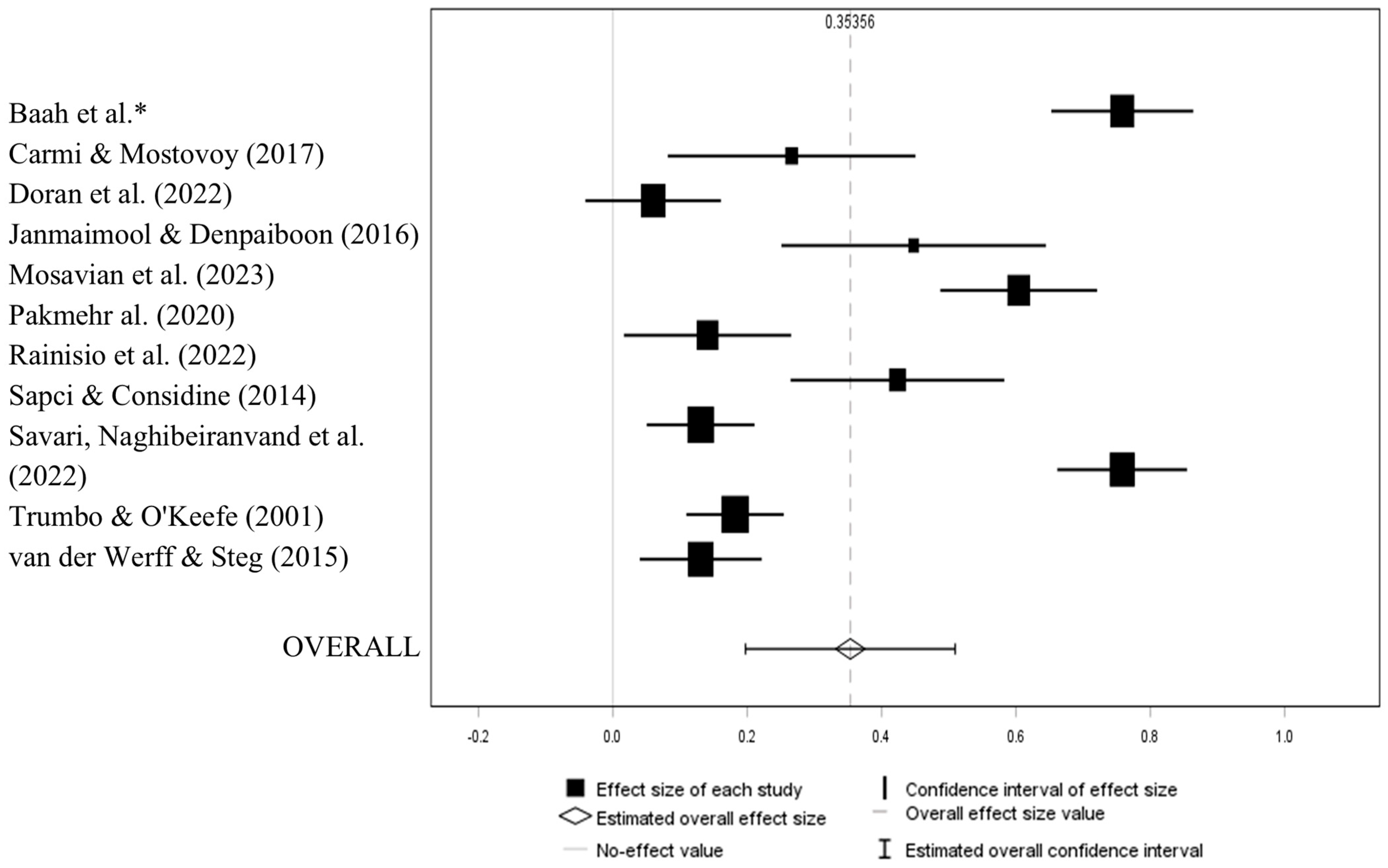
Figure 4 and Figure 5 report the individual studies’ results and the overall effect sizes for the association between response efficacy and, respectively, intention and behavior. Response efficacy significantly correlated with intention and behavior (for both outcomes, Z = 4.44, p < 0.001) and explained approximately 13% of the variance in the former (intention) and 12% in the latter (behavior). The summary correlation estimate (Pearson’s r) was 0.36, 95% CI [0.21, 0.49] for the relationship between response efficacy and intentions (k = 11), and 0.34, 95% CI [0.20, 0.47] for the relationship between response efficacy and behaviors (k = 11), which correspond to medium-sized effect sizes [85].
Figure 4.
Forest plot of the relationship between response efficacy and conservation intentions. Note. Effect sizes are reported in Fisher’s z. * Effect sizes from three studies were averaged because the sample was the same: Baah et al. [19,20,21].
Figure 5.
Forest plot of the relationship between response efficacy and conservation behaviors. Note. Effect sizes are reported in Fisher’s z. * Effect sizes from three studies were averaged because the sample was the same: Baah et al. [19,20,21].
Egger’s regression test did not reveal significant asymmetries that could signal the presence of a publication bias (p ≥ 0.091). The two funnel plots are reported in Supplementary Figures S3 and S4.
3.2.1. Heterogeneity
For both the relationship between response efficacy and intention, Q (10) = 565.15, p < 0.001, and the relationship between response efficacy and conservation behavior, Q (10) = 256.74, p < 0.001, we can reject the null hypothesis that the true effect size is the same across all these studies. The I2 statistic indicates that 99.7% and 95.7% of the variance in observed effects reflects variance in true effects rather than sampling error. The variance of true effect sizes (τ2) was 0.08 for intentions and 0.07 for behaviors. Assuming that the effects are normally distributed, we estimated that the prediction interval ranged from −0.28 to 1.02 in the first case and from −0.25 to 0.96 in the second. This suggests that the correlations between response efficacy and conservation intentions or conservation behaviors greatly vary across populations: since the interval includes zero, these associations may be absent in some populations, while the upper bound indicates that they can be substantial in others.
3.2.2. Moderation Analyses
Following the criterion of including moderators only when at least five studies for each level were available [87], we could test the potential moderating role of administration type (questionnaires vs. interviews) for the association between response efficacy and behavior, but not for the one involving intention. The effect size did not substantially vary according to this factor (Q = 0.70, p = 0.792). Assuming to violate this criterion, the same finding was replicated on intention (Q = 0.74, p = 0.388).
We could not assess the moderating role of population type (work-related vs. non-work-related groups) due to a lack of studies.
Neither cultural context (p ≥ 0.296) nor the percentage of women in the sample (p ≥ 0.219) significantly moderated the relationships under investigation.
3.3. Collective Efficacy
Collective efficacy was the least frequently examined construct in the reviewed literature, and fewer than 10 studies were available per outcome (i.e., intention and behavior). Therefore, given the overlap observed between intention and behavior in the effect sizes for self- and response efficacy, in this case, we conducted a single meta-analysis (all meta-analyzed studies reported correlations between collective efficacy and either intention or behavior only; therefore, no issues of statistical dependence emerged).
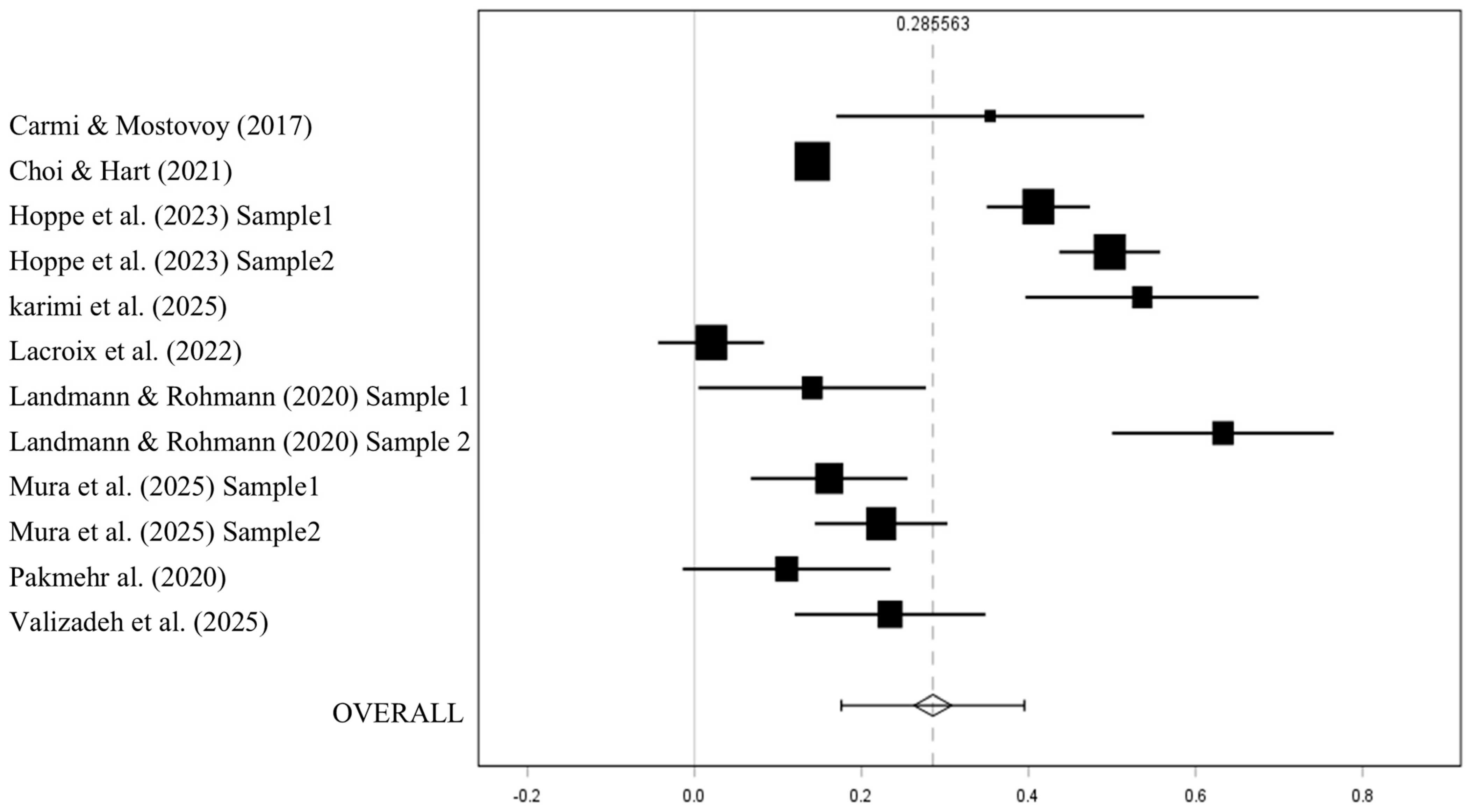
Figure 6 reports the individual studies’ results and the overall effect size. The association between collective efficacy and the conservation outcome was significant (Z = 5.11, p < 0.001) and explained approximately 8% of the variance in the outcome (k = 12). The summary correlation estimate (Pearson’s r) was 0.28, 95% CI [0.17, 0.38], which can be considered a small effect [85].
Figure 6.
Forest plot of the relationship between collective efficacy and conservation intention/behavior. Note. Effect sizes are reported in Fisher’s z.
Regarding the specific associations, the summary correlation estimate (Pearson’s r) between collective efficacy and intention (k = 8) was 0.29, 95% CI [0.18, 0.41]; whereas the association between collective efficacy and behavior (k = 4) was 0.24, 95% CI [0.02, 0.45].
Egger’s regression test did not reveal significant asymmetries that could signal the presence of a publication bias (p = 0.382). The funnel plot is reported in Supplementary Figure S5.
3.3.1. Heterogeneity
We can reject the null hypothesis that the true effect size is the same across all these studies, Q (11) = 303.26, p < 0.001. The I2 statistic indicates that 96.9% of the variance in observed effects reflects variance in true effects rather than sampling error. The variance of true effect sizes (τ2) was 0.04. Assuming that the effects are normally distributed, we estimated that the prediction interval was from −3.20 to 7.67. This suggests that the effect in a new study could be negative, null, or positive.
3.3.2. Moderation Analyses
We could not assess the moderating role of administration type (questionnaires vs. interviews) or population type (work-related vs. non-work-related groups) due to the insufficient number of studies available.
None of the continuous moderators (i.e., cultural context and percentage of women in the sample) explained the observed heterogeneity (p ≥ 0.197).
4. Discussion
This work reports five meta-analyses estimating how efficacy beliefs relate to conservation intentions and behaviors. Regarding the primary objective of the present study, namely the estimation of the overall association between efficacy beliefs and conservation intentions and behaviors, we found medium-sized positive associations between self-efficacy, response efficacy, and conservation intentions and behaviors, and a small-sized positive association with collective efficacy. In other words, the more individuals are confident in their ability to perform conservation behaviors and believe that their individual or collective conservation behaviors will be impactful, the more inclined they are to engage in them. As for the translation of findings into actionable strategies for key stakeholders, these observed associations suggest that organizations directly involved in natural resource management—such as policymakers, farmers’ associations, energy and water providers, and nature-accessible sites—can meaningfully target efficacy beliefs as levers for behavior change.
These findings dovetail with previous correlational meta-analyses in other domains, which have shown that self-efficacy and outcome expectancy are significantly associated with desired behavioral outcomes, such as energy saving, physical activity, or other health behaviors (e.g., [15,88,89]), supporting the relevance of efficacy beliefs across different behavioral contexts. Extending this body of work to natural resource conservation behaviors, the present study provides a novel contribution by simultaneously examining multiple efficacy constructs—self-efficacy, response efficacy, and collective efficacy—across a broad range of domains, offering a unique and comprehensive understanding of how different forms of efficacy beliefs relate to conservation intentions and behaviors.
We found no substantial differences between the correlations with intention and behavior, further aligning with Bandura’s self-efficacy theory [11], which posits that self-efficacy directly influences both the formation of behavioral intentions and the enactment of behavior, thus leading to comparable effect sizes across the two outcomes. These results suggest that efficacy-enhancing interventions are relevant not only for motivating initial engagement (i.e., intention) but also for sustaining behavioral implementation over time.
Another purpose of the present study was to investigate moderating factors. The need for such analyses was supported by the substantial variation in effect sizes across studies. However, none of the expected moderators explained this strong heterogeneity.
The absence of a significant moderating effect of data collection method suggests that the association between efficacy beliefs and conservation outcomes is robust across administration formats; future studies and applied assessments can therefore choose between self-report questionnaires and structured interviews based on practical considerations—such as the characteristics of the target population or the accessibility of the research context—without expecting this choice to substantially affect the observed relationships.
The non-significant moderation by population type (work-related vs. non-work-related) and gender suggests that efficacy-enhancing interventions may need to target other individual characteristics.
Finally, the lack of significant cultural moderation suggests that the relevance of efficacy beliefs for conservation may be relatively consistent across individualistic and collectivistic contexts, supporting the case for global, cross-cultural stakeholder efforts to promote conservation behaviors through efficacy-enhancing strategies.
One potential source of the observed variability may have been the lack of measurement standardization. An examination of the studies included in the meta-analyses indicates that most relied on ad hoc scales or combinations of items drawn from different instruments, which may complicate cross-study comparisons and have contributed to the heterogeneity observed in effect sizes. This limitation of existing research underscores the need for future studies to develop and adopt standardized measures of efficacy beliefs as well as conservation intentions and behaviors. However, an important challenge will be to balance standardization with the need for instruments that can be meaningfully adapted to diverse conservation behaviors, such as water resource conservation or soil protection.
In line with the results from previous research [52] and with Community-Based Social Marketing [90], we strongly believe the domain of conservation behavior, and even the specific conservation behaviors in the same domain, might be one of the most relevant sources of the observed heterogeneity. Currently, there are not enough studies to investigate the moderating role of this factor, which should be further explored in future research.
Another limitation of the reviewed literature concerns the shortage of longitudinal studies capable of capturing how the relationship between efficacy beliefs and conservation intentions and behaviors unfolds over time. Such studies would provide valuable insights into the stability of self-efficacy and its long-term impact on environmental actions.
4.1. Limitations and Strengths
Some of the meta-analyzed studies were authored by the same researchers. Consequently, some effect sizes may derive from similar samples, constructs, designs, and procedures. This might have introduced a bias in our results [91], although we tried to preserve studies’ independence by averaging correlation coefficients derived from the same sample.
Although this procedure preserves the independence assumption required by standard meta-analytic models, current best practice favors multi-level meta-analysis, which explicitly models the nested structure of effect sizes without discarding information through aggregation (e.g., [15]). The averaging approach used here may therefore underestimate sampling variability and introduce a degree of bias in heterogeneity estimates. However, when the number of studies and effect sizes is small, as in the present work, multilevel meta-analysis can yield inflated Type I error rates and biased estimates of between-study variance and its standard error [92]; for this reason, we preferred the aggregation approach.
Even though we tested several potential moderators, we were unable to account for the heterogeneity observed among effect sizes. This may partly reflect the lack of standardized measurement tools identified earlier, as differences in how efficacy beliefs and conservation intentions or behavior are assessed across studies can introduce additional noise into effect sizes. Future research adopting more uniform and validated measures will be crucial for clarifying the sources of heterogeneity and improving the comparability of findings across studies.
The remaining variability also suggests that additional moderators—related, for instance, to contextual factors or the specific conservation domain or even behavior considered—may influence the relationship between efficacy beliefs and environmental actions and should be examined in future research. We were unable to test the moderating role of behavior type or behavioral target (e.g., water, energy) due to the limited number of available studies (i.e., fewer than five studies per category). Future meta-analyses should address this issue once a sufficient body of evidence becomes available.
Given the small number of available studies on collective efficacy, it was not possible to compute separate effect sizes between this variable and conservation intentions or behaviors. Once a larger body of evidence becomes available, future meta-analyses should differentiate these key constructs.
Finally, this work was not pre-registered, and no protocol was prepared.
Despite these limitations, several strengths should be acknowledged. First, the systematic literature search was complemented by calls for unpublished data, thereby reducing the risk of publication bias. Second, in the database extraction, we employed a broad search string to capture as many relevant studies as possible on conservation behaviors, specifically to retrieve relevant studies even when these behaviors were not explicitly labeled as such. As with many meta-analyses, the proportion of studies meeting all inclusion criteria was relatively small (50 out of 578 initially identified). This is partly a consequence of this broad search strategy. However, it should be noted that 59 reports were excluded because the necessary statistical information could not be extracted (see Figure 1). This highlights the critical importance of open data practices and transparent reporting for the cumulative advancement of scientific knowledge.
4.2. Implications
The present findings have implications for interventions aimed at promoting conservation behaviors through enhancing individuals’ efficacy beliefs. These results could help different stakeholders involved in natural resources management identify a shared objective on which to focus their efforts. Organizations such as companies, groups that depend on natural resources (e.g., farmers), service providers (e.g., electricity and water suppliers), and those responsible for publicly accessible natural areas (e.g., zoos, reserves, forests, and beaches) could direct their strategies toward promoting conditions that strengthen people’s efficacy beliefs for conservation.
According to Bandura [11], self-efficacy can be enhanced through vicarious learning and mastery experiences. It is therefore essential to make clear which conservation behaviors are needed—whether in the workplace, at home, or in natural settings—and to provide individuals with opportunities to practice these behaviors so that they can develop and refine their conservation skills. Self-efficacy can also be supported through persuasive communication, particularly when such communication provides credible modeling, step-by-step guidance, and realistic strategies for overcoming common barriers—mechanisms identified as key sources of efficacy beliefs [11]. For example, messages that show how similarly others successfully perform conservation actions, that offer concrete feedback about progress, or that break behaviors down into manageable steps (e.g., [35]) can enhance people’s confidence in their ability to act, thereby promoting both intentions and behavior.
A large-scale “intervention tournament” showed that pro-environmental response efficacy can be enhanced by asking participants to write a letter to future generations describing their aspirations and efforts to ensure that they will inherit a habitable planet, or a list of personal benefits arising from engaging in pro-environmental behaviors over the following months [93]. Additional effective strategies seem to be informing individuals about the cumulative impact of their efforts [94] and combining efficacy feedback with mental imagery tasks. For instance, participants may be prompted to first visualize the destruction of a valued natural place and subsequently imagine engaging in pro-environmental behaviors to prevent such an outcome [95].
Finally, interventions aimed at strengthening collective efficacy have also shown promise. These approaches include peer-to-peer counseling [96], exposure to positive examples of successful collective initiatives [97], and framing environmental problems as challenging yet solvable [98].
5. Conclusions
The present study identified the overall effect sizes of the correlations between efficacy beliefs and conservation intentions and behaviors, showing small or moderate associations in both cases. The observed medium effect sizes suggest that self-efficacy and response efficacy are relevant psychological variables linked to conservation intentions and behaviors, and may function as important facilitators of behavioral implementation. Collective efficacy may also be relevant, although its effect size was small.
Although these findings are encouraging, they should be interpreted with caution due to the high heterogeneity observed. Future research should investigate why the association is stronger in some cases than in others by also considering individual differences, thus optimizing the design of interventions promoting conservation behaviors by enhancing efficacy beliefs.
Supplementary Materials
The following supporting information can be downloaded at https://www.mdpi.com/article/10.3390/su18115307/s1, Table S1: Potential moderators; Figure S1: Forest plot for the association between self-efficacy and conservation intentions; Figure S2: Forest plot for the association between self-efficacy and conservation behaviors; Figure S3: Forest plot for the association between response efficacy and conservation intentions; Figure S4: Forest plot for the association between response efficacy and conservation behaviors; Figure S5: Forest plot for the association between collective efficacy and conservation intentions/behaviors.
Author Contributions
Conceptualization: D.A., G.S., M.G., and N.C.; data curation: D.A. and G.S.; Formal analysis: D.A. and G.S.; investigation: D.A. and G.S.; methodology: D.A., G.S., M.G., and N.C.; project administrator: D.A.; resources: D.A.; software: D.A. and G.S.; supervision: M.G. and N.C.; validation: D.A. and G.S.; writing—original draft: D.A., M.G., and G.S.; writing—review and editing: D.A., G.S., M.G., and N.C. All authors have read and agreed to the published version of the manuscript.
Funding
The authors received no financial support for the research, authorship, and/or publication of this article.
Institutional Review Board Statement
There are no human participants in this study, and informed consent is not required.
Data Availability Statement
Materials, data, and analyses output for this study are publicly available on the Open Science Framework (OSF) at https://osf.io/tdrf8/overview?view_only=7e1712ed2cc84c5bbb69a6cac1fc2342.
Conflicts of Interest
The authors declare no potential conflicts of interest with respect to the research, authorship, and/or publication of this article.
References
- Hatfield, J.; Job, R.S. Optimism Bias about Environmental Degradation: The Role of the Range of Impact of Precautions. J. Environ. Psychol. 2001, 21, 17–30. [Google Scholar] [CrossRef] [Scilit]
- United Nations. World Population Prospects 2024: Summary of Results; United Nations: New York, NY, USA, 2024. [Google Scholar]
- FAO. The State of Food and Agriculture 2025—Addressing Land Degradation across Landholding Scales. In The State of Food and Agriculture (SOFA); FAO: Rome, Italy, 2025; ISBN 978-92-5-140142-2. [Google Scholar]
- Friedrich, T. Degradation of Natural Resources and Measures for Mitigation. In Proceedings of the Handbook of the International Seminar on Enhancing Extension of Conservation Agriculture Techniques in Asia and the Pacific, 24–26 October 2007, Zhengzhou, China; Asian and Pacific Centre for Agricultural Engineering and Machinery (APCAEM) & Ministry of Agriculture of the People’s Republic of China: Beijing, China, 2007. [Google Scholar]
- Savari, M.; Khaleghi, B.; Sheheytavi, A. Iranian Farmers’ Response to the Drought Crisis: How Can the Consequences of Drought Be Reduced? Int. J. Disaster Risk Reduct. 2024, 114, 104910. [Google Scholar] [CrossRef] [Scilit]
- Lee, W.H.; Husaini, D.H.; Lean, H.H. The Renewable Energy–Environment Nexus. In The Renewable Energy-Water-Environment Nexus: Fundamentals, Technology, and Policy; Elsevier: Amsterdam, The Netherlands, 2024; pp. 177–203. ISBN 978-0-443-13439-5. [Google Scholar]
- Steg, L.; Vlek, C. Encouraging Pro-Environmental Behaviour: An Integrative Review and Research Agenda. J. Environ. Psychol. 2009, 29, 309–317. [Google Scholar] [CrossRef] [Scilit]
- Schultz, P.W.; Zelezny, L.C. Values and Proenvironmental Behavior: A Five-Country Survey. J. Cross-Cult. Psychol. 1998, 29, 540–558. [Google Scholar] [CrossRef] [Scilit]
- Barbett, L.; Stupple, E.; Sweet, M.; Schofield, M.; Richardson, M. Measuring Actions for Nature—Development and Validation of a Pro-Nature Conservation Behaviour Scale. Sustainability 2020, 12, 4885. [Google Scholar] [CrossRef] [Scilit]
- Janmaimool, P.; Denpaiboon, C. Evaluating Determinants of Rural Villagers’ Engagement in Conservation and Waste Management Behaviors Based on Integrated Conceptual Framework of Pro-Environmental Behavior. Life Sci. Soc. Policy 2016, 12, 12. [Google Scholar] [CrossRef] [Scilit]
- Bandura, A. Self-Efficacy: Toward a Unifying Theory of Behavioral Change. Psychol. Rev. 1977, 84, 191–215. [Google Scholar] [CrossRef] [PubMed]
- Bandura, A. Self-Efficacy: The Exercise of Control; Worth Publishers: New York, NY, USA, 1997; ISBN 978-0-7167-2626-5. [Google Scholar]
- Rogers, R.W. Cognitive and Physiological Processes in Fear Appeals and Attitude Change: A Revised Theory of Protection Motivation. In Social Psychophysiology; Guilford Press: New York, NY, USA, 1983; pp. 153–177. [Google Scholar]
- Fritsche, I.; Barth, M.; Jugert, P.; Masson, T.; Reese, G. A Social Identity Model of Pro-Environmental Action (SIMPEA). Psychol. Rev. 2018, 125, 245–269. [Google Scholar] [CrossRef] [Scilit]
- Zawadzki, S.J.; Vrieling, L.; Görsch, R.; Michelakis, G.; Lemmen, N.; Zeiske, N.; Verschoor, M.; Steg, L. A Meta-Analytic Review of Why People Save Energy at Home. Cell Rep. Sustain. 2025, 2, 100493. [Google Scholar] [CrossRef] [Scilit]
- Pakmehr, S.; Yazdanpanah, M.; Baradaran, M. How Collective Efficacy Makes a Difference in Responses to Water Shortage Due to Climate Change in Southwest Iran. Land Use Policy 2020, 99, 104798. [Google Scholar] [CrossRef] [Scilit]
- Shahangian, S.A.; Tabesh, M.; Yazdanpanah, M.; Zobeidi, T.; Raoof, M.A. Promoting the Adoption of Residential Water Conservation Behaviors as a Preventive Policy to Sustainable Urban Water Management. J. Environ. Manag. 2022, 313, 115005. [Google Scholar] [CrossRef] [Scilit] [PubMed]
- Broomell, S.B.; Budescu, D.V.; Por, H.-H. Personal Experience with Climate Change Predicts Intentions to Act. Glob. Environ. Change 2015, 32, 67–73. [Google Scholar] [CrossRef] [Scilit]
- Baah, C.; Saleem, M.A.; Tenakwah, E.S.; Chakrabarty, D.; Greenland, S. Place Attachment, Spirituality and Residential Water Conservation Behaviour in Australia’s Northern Territory: Application of an Extended Protection Motivation Theory. Australas. J. Environ. Manag. 2026, 33, 72–99. [Google Scholar] [CrossRef] [Scilit]
- Baah, C.; Saleem, M.A.; Greenland, S.; Tenakwah, E.S.; Chakrabarty, D. Do the Theories of Planned Behaviour and Protection Motivation Provide Probabilistic Sufficient and Necessary Conditions for Residential Water Conservation? Combined Use of PLS-SEM and NCA. J. Environ. Manag. 2024, 372, 123354. [Google Scholar] [CrossRef] [Scilit]
- Baah, C.; Saleem, M.A.; Greenland, S.; Tenakwah, E.S.; Chakrabarty, D. Place Attachment and Residential Water Conservation: Application of an Extended Theory of Planned Behaviour in Australia’s Northern Territory. Environ. Dev. 2025, 55, 101203. [Google Scholar] [CrossRef] [Scilit]
- Ataei, P.; Karimi, H.; Hallaj, Z.; Dastenaei, A.M. Risks and Farmers’ Behavior Change towards Water Conservation: A Study in the Southeast of Iran. Water Supply 2024, 24, 723–737. [Google Scholar] [CrossRef] [Scilit]
- Díaz-Rodríguez, A.M.; Kelly, C.; del Valle, A.; Bravo-Linares, C.; Blake, W.; Velasco, H.; Meigikos dos Anjos, R.; Barrera-Hernández, L.F.; de los Santos-Villalobos, S. Exploring Relationship between Perception Indicators and Mitigation Behaviors of Soil Erosion in Undergraduate Students in Sonora, Mexico. Sustainability 2021, 13, 9282. [Google Scholar] [CrossRef] [Scilit]
- Mosavian, S.H.; Rostami, F.; Tatar, M. Modeling Farmers’ Intention to Water Protection Behavior: A New Extended Version of the Protection Motivation Theory. J. Environ. Psychol. 2023, 90, 102036. [Google Scholar] [CrossRef] [Scilit]
- Savari, M.; Yazdanpanah, M.; Rouzaneh, D. Factors Affecting the Implementation of Soil Conservation Practices among Iranian Farmers. Sci. Rep. 2022, 12, 8396. [Google Scholar] [CrossRef] [Scilit]
- Savari, M.; Sheheytavi, A.; Amghani, M.S. Factors Underpinning Iranian Farmers’ Intention to Conserve Biodiversity at the Farm Level. J. Nat. Conserv. 2023, 73, 126419. [Google Scholar] [CrossRef] [Scilit]
- Valizadeh, N.; Bijani, M.; Hayati, D.; Haghighi, N.F. Social-Cognitive Conceptualization of Iranian Farmers’ Water Conservation Behavior. Hydrogeol. J. 2019, 27, 1131–1142. [Google Scholar] [CrossRef] [Scilit]
- Choi, S.; Hart, P.S. The Influence of Different Efficacy Constructs on Energy Conservation Intentions and Climate Change Policy Support. J. Environ. Psychol. 2021, 75, 101618. [Google Scholar] [CrossRef] [Scilit]
- Fu, Q.; Ghardallou, W.; Comite, U.; Siddique, I.; Han, H.; Arjona-Fuentes, J.M.; Ariza-Montes, A. The Role of CSR in Promoting Energy-Specific Pro-Environmental Behavior among Hotel Employees. Sustainability 2022, 14, 6574. [Google Scholar] [CrossRef] [Scilit]
- Clayton, S.; Prévot, A.; Germain, L.; Saint-Jalme, M. Public Support for Biodiversity After a Zoo Visit: Environmental Concern, Conservation Knowledge, and Self-Efficacy. Curator Mus. J. 2017, 60, 87–100. [Google Scholar] [CrossRef] [Scilit]
- Erfanian, S.; Maleknia, R.; Azizi, R. Environmental Responsibility in Urban Forests: A Cognitive Analysis of Visitors’ Behavior. Forests 2024, 15, 1773. [Google Scholar] [CrossRef] [Scilit]
- Erfanian, S.; Maleknia, R.; Halalisan, A.F. Application of Social Cognitive Theory to Determine Shaping Factors of Environmental Intention and Behaviors of Ecotourist in Forest Areas. Front. For. Glob. Change 2024, 7, 1489170. [Google Scholar] [CrossRef] [Scilit]
- Fielding, K.S.; van Kasteren, Y.; Louis, W.; McKenna, B.; Russell, S.; Spinks, A. Using Individual Householder Survey Responses to Predict Household Environmental Outcomes: The Cases of Recycling and Water Conservation. Resour. Conserv. Recycl. 2016, 106, 90–97. [Google Scholar] [CrossRef] [Scilit]
- Bandura, A. Social Cognitive Theory of Self-Regulation. Organ. Behav. Hum. Decis. Process. 1991, 50, 248–287. [Google Scholar] [CrossRef] [Scilit]
- Lauren, N.; Fielding, K.S.; Smith, L.; Louis, W.R. You Did, so You Can and You Will: Self-Efficacy as a Mediator of Spillover from Easy to More Difficult pro-Environmental Behaviour. J. Environ. Psychol. 2016, 48, 191–199. [Google Scholar] [CrossRef] [Scilit]
- Mankad, A.; Loechel, B. Perceived Competence, Threat Severity and Response Efficacy: Key Drivers of Intention for Area Wide Management. J. Pest Sci. 2020, 93, 929–939. [Google Scholar] [CrossRef] [Scilit]
- Savari, M.; Naghibeiranvand, F.; Asadi, Z. Modeling Environmentally Responsible Behaviors among Rural Women in the Forested Regions in Iran. Glob. Ecol. Conserv. 2022, 35, e02102. [Google Scholar] [CrossRef] [Scilit]
- Arjomandi, A.P.; Yazdanpanah, M.; Shirzad, A.; Komendantova, N.; Kameli, E.; Hosseinzadeh, M.; Razavi, E. Institutional Trust and Cognitive Motivation toward Water Conservation in the Face of an Environmental Disaster. Sustainability 2023, 15, 900. [Google Scholar] [CrossRef] [Scilit]
- Budhathoki, N.K.; Fielding, K.S.; Rhodes, J.R.; Archibald, C.L.; Lunney, D.; Brazil-Boast, J.; Hetherington, S.B.; Fitzsimons, J.A.; Iftekhar, M.S. Landholders’ Intentions to Engage in Private Land Conservation Agreements under Climate Risk. J. Environ. Manag. 2025, 377, 124483. [Google Scholar] [CrossRef] [Scilit]
- Hoppe, A.; Fritsche, I.; Chokrai, P. The “I” and the “We” in Nature Conservation—Investigating Personal and Collective Motives to Protect One’s Regional and Global Nature. Sustainability 2023, 15, 4694. [Google Scholar] [CrossRef] [Scilit]
- Landmann, H.; Rohmann, A. Being Moved by Protest: Collective Efficacy Beliefs and Injustice Appraisals Enhance Collective Action Intentions for Forest Protection via Positive and Negative Emotions. J. Environ. Psychol. 2020, 71, 101491. [Google Scholar] [CrossRef] [Scilit]
- Pradhananga, A.K.; Davenport, M.A. Community Attachment, Beliefs and Residents’ Civic Engagement in Stormwater Management. Landsc. Urban Plan. 2017, 168, 1–8. [Google Scholar] [CrossRef] [Scilit]
- Bandura, A. Social Cognitive Theory: An Agentic Perspective. Annu. Rev. Psychol. 2001, 52, 1–26. [Google Scholar] [CrossRef] [Scilit] [PubMed]
- Bowling, A. Mode of Questionnaire Administration Can Have Serious Effects on Data Quality. J. Public Health 2005, 27, 281–291. [Google Scholar] [CrossRef] [Scilit] [PubMed]
- Liu, T.; Bruins, R.; Heberling, M. Factors Influencing Farmers’ Adoption of Best Management Practices: A Review and Synthesis. Sustainability 2018, 10, 432. [Google Scholar] [CrossRef] [Scilit]
- Dioba, A.; Kroker, V.; Dewitte, S.; Lange, F. Barriers to Pro-Environmental Behavior Change: A Review of Qualitative Research. Sustainability 2024, 16, 8776. [Google Scholar] [CrossRef] [Scilit]
- Bandura, A. Social Cognitive Theory in Cultural Context. Appl. Psychol. 2002, 51, 269–290. [Google Scholar] [CrossRef] [Scilit]
- Hofstede, G. Culture’s Consequences: International Differences in Work-Related Values; SAGE Publications: Thousand Oaks, CA, USA, 1984; ISBN 978-0-8039-1306-6. [Google Scholar]
- Akaliyski, P.; Vignoles, V.L.; Welzel, C.; Minkov, M. Individualism–Collectivism: Reconstructing Hofstede’s Dimension of Cultural Differences. J. Pers. Soc. Psychol. 2026, 130, 308–356. [Google Scholar] [CrossRef] [Scilit] [PubMed]
- Echavarren, J.M. The Gender Gap in Environmental Concern: Support for an Ecofeminist Perspective and the Role of Gender Egalitarian Attitudes. Sex Roles 2023, 89, 610–623. [Google Scholar] [CrossRef] [Scilit]
- Nagy, N.G. Gender Differences in Environmental Attitudes: An Analysis Using the NEP Scale. Gend. Issues 2025, 42, 5. [Google Scholar] [CrossRef] [Scilit]
- Rainisio, N.; Boffi, M.; Pola, L.; Inghilleri, P.; Sergi, I.; Liberatori, M. The Role of Gender and Self-Efficacy in Domestic Energy Saving Behaviors: A Case Study in Lombardy, Italy. Energy Policy 2022, 160, 112696. [Google Scholar] [CrossRef] [Scilit]
- Page, M.J.; Moher, D.; Bossuyt, P.M.; Boutron, I.; Hoffmann, T.C.; Mulrow, C.D.; Shamseer, L.; Tetzlaff, J.M.; Akl, E.A.; Brennan, S.E.; et al. PRISMA 2020 Explanation and Elaboration: Updated Guidance and Exemplars for Reporting Systematic Reviews. BMJ 2021, 372, n160. [Google Scholar] [CrossRef] [PubMed]
- Ajzen, I. The Theory of Planned Behavior. Organ. Behav. Hum. Decis. Process. 1991, 50, 179–211. [Google Scholar] [CrossRef] [Scilit]
- Cheung, M.W.-L. A Guide to Conducting a Meta-Analysis with Non-Independent Effect Sizes. Neuropsychol. Rev. 2019, 29, 387–396. [Google Scholar] [CrossRef] [Scilit]
- Moeyaert, M.; Ugille, M.; Beretvas, S.N.; Ferron, J.; Bunuan, R.; Van den Noortgate, W. Methods for Dealing with Multiple Outcomes in Meta-Analysis: A Comparison between Averaging Effect Sizes, Robust Variance Estimation and Multilevel Meta-Analysis. Int. J. Soc. Res. Methodol. 2017, 20, 559–572. [Google Scholar] [CrossRef] [Scilit]
- Welz, T.; Doebler, P.; Pauly, M. Fisher Transformation Based Confidence Intervals of Correlations in Fixed- and Random-effects Meta-analysis. Br. J. Math. Stat. Psychol. 2022, 75, 1–22. [Google Scholar] [CrossRef] [Scilit] [PubMed]
- IBM SPSS Statistics, version 29.0; International Business Machines Corporation: Armonk, NY, USA, 2024.
- Cakanlar, A.; White, K.; Trudel, R. The Politics of Impact: How Political Ideology Shapes Perceptions of the Environmental Impact of Individual Actions. J. Consum. Psychol. 2026, 36, 161–180. [Google Scholar] [CrossRef] [Scilit]
- Carmi, N.; Mostovoy, N. The Effect of Group Size on Energy Consumption by Communal Electricity Users. J. Environ. Psychol. 2017, 54, 50–56. [Google Scholar] [CrossRef] [Scilit]
- Chen, C.; Xu, X.; Day, J.K. Thermal Comfort or Money Saving? Exploring Intentions to Conserve Energy among Low-Income Households in the United States. Energy Res. Soc. Sci. 2017, 26, 61–71. [Google Scholar] [CrossRef] [Scilit]
- Doran, E.M.; Doidge, M.; Aytur, S.; Wilson, R.S. Understanding Farmers’ Conservation Behavior over Time: A Longitudinal Application of the Transtheoretical Model of Behavior Change. J. Environ. Manag. 2022, 323, 116136. [Google Scholar] [CrossRef] [Scilit] [PubMed]
- Fujii, S. Environmental Concern, Attitude toward Frugality, and Ease of Behavior as Determinants of pro-Environmental Behavior Intentions. J. Environ. Psychol. 2006, 26, 262–268. [Google Scholar] [CrossRef] [Scilit]
- Haji, L.; Momenpour, Y.; Choobchian, S. Moving toward Salvaging Iran’s Groundwater: A Psychological Analysis of Blocking Unauthorized Agricultural Wells. Agric. Water Manag. 2024, 303, 109035. [Google Scholar] [CrossRef] [Scilit]
- Harland, P.; Staats, H.; Wilke, H.A.M. Explaining Proenvironmental Intention and Behavior by Personal Norms and the Theory of Planned Behavior. J. Appl. Soc. Psychol. 1999, 29, 2505–2528. [Google Scholar] [CrossRef] [Scilit]
- Karimi, V.; Tan, Y.; Naderi, L.; Keshavarz, M.; Singh, G.G. Drivers of Collective Action in Agricultural Water Conservation: Applying the Social Identity Model to Iranian Farmers in a Wetlands Basin. Agric. Water Manag. 2025, 322, 110015. [Google Scholar] [CrossRef] [Scilit]
- Lacroix, K.; Carman, J.P.; Goldberg, M.H.; Gustafson, A.; Rosenthal, S.A.; Leiserowitz, A. Does Personal Climate Change Mitigation Behavior Influence Collective Behavior? Experimental Evidence of No Spillover in the United States. Energy Res. Soc. Sci. 2022, 94, 102875. [Google Scholar] [CrossRef] [Scilit]
- Laudenslager, M.S.; Holt, D.T.; Lofgren, S.T. Understanding Air Force Members’ Intentions to Participate in Pro-Environmental Behaviors: An Application of the Theory of Planned Behavior. Percept. Mot. Ski. 2004, 98, 1162–1170. [Google Scholar] [CrossRef] [Scilit]
- Lee, J.W.C.; Tanusia, A. Energy Conservation Behavioural Intention: Attitudes, Subjective Norm and Self-Efficacy. IOP Conf. Ser. Earth Environ. Sci. 2016, 40, 012087. [Google Scholar] [CrossRef] [Scilit]
- Liu, X.; Wang, Q.-C.; Jian, I.Y.; Chi, H.-L.; Yang, D.; Chan, E.H.-W. Are You an Energy Saver at Home? The Personality Insights of Household Energy Conservation Behaviors Based on Theory of Planned Behavior. Resour. Conserv. Recycl. 2021, 174, 105823. [Google Scholar] [CrossRef] [Scilit]
- Santana, F.N.; Yurkanin, A.; Stark, T.E.; Lindsey, E.; Ardoin, N.M.; Wong-Parodi, G. Mālama i Ke Kai: Exploring Psychosocial Factors Associated with Personal and Community Coral Reef Conservation Behavior on Maui, Hawai‘i. Conserv. Sci. Pract. 2023, 5, e13002. [Google Scholar] [CrossRef] [Scilit]
- Sapci, O.; Considine, T. The Link between Environmental Attitudes and Energy Consumption Behavior. J. Behav. Exp. Econ. 2014, 52, 29–34. [Google Scholar] [CrossRef] [Scilit]
- Schaffner, D.; Ohnmacht, T.; Weibel, C.; Mahrer, M. Moving into Energy-Efficient Homes: A Dynamic Approach to Understanding Residents’ Decision-Making. Build. Environ. 2017, 123, 211–222. [Google Scholar] [CrossRef] [Scilit]
- Moghadam, M.T.; Raheli, H.; Zarifian, S.; Yazdanpanah, M. The Power of the Health Belief Model (HBM) to Predict Water Demand Management: A Case Study of Farmers’ Water Conservation in Iran. J. Environ. Manag. 2020, 263, 110388. [Google Scholar] [CrossRef] [Scilit]
- Trumbo, C.W.; O’Keefe, G.J. Intention to Conserve Water: Environmental Values, Planned Behavior, and Information Effects. A Comparison of Three Communities Sharing a Watershed. Soc. Nat. Resour. 2001, 14, 889–899. [Google Scholar] [CrossRef] [Scilit]
- Valizadeh, N.; Le, T.-A.T.; Bazrafkan, K. From ‘Me’ to ‘We’: The Psychology behind Future Collective Action for Wetland Sustainability. Sci. Rep. 2025, 15, 42326. [Google Scholar] [CrossRef] [Scilit]
- Van Den Broek, K.L.; Walker, I.; Klöckner, C.A. Drivers of Energy Saving Behaviour: The Relative Influence of Intentional, Normative, Situational and Habitual Processes. Energy Policy 2019, 132, 811–819. [Google Scholar] [CrossRef] [Scilit]
- Van Der Werff, E.; Steg, L. One Model to Predict Them All: Predicting Energy Behaviours with the Norm Activation Model. Energy Res. Soc. Sci. 2015, 6, 8–14. [Google Scholar] [CrossRef] [Scilit]
- Wang, S.; Lin, S.; Li, J. Exploring the Effects of Non-Cognitive and Emotional Factors on Household Electricity Saving Behavior. Energy Policy 2018, 115, 171–180. [Google Scholar] [CrossRef] [Scilit]
- Webb, D.; Soutar, G.N.; Mazzarol, T.; Saldaris, P. Self-Determination Theory and Consumer Behavioural Change: Evidence from a Household Energy-Saving Behaviour Study. J. Environ. Psychol. 2013, 35, 59–66. [Google Scholar] [CrossRef] [Scilit]
- Wittenberg, I.; Blöbaum, A.; Matthies, E. Environmental Motivations for Energy Use in PV Households: Proposal of a Modified Norm Activation Model for the Specific Context of PV Households. J. Environ. Psychol. 2018, 55, 110–120. [Google Scholar] [CrossRef] [Scilit]
- Yazdanpanah, M.; Feyzabad, F.R.; Forouzani, M.; Mohammadzadeh, S.; Burton, R.J.F. Predicting Farmers’ Water Conservation Goals and Behavior in Iran: A Test of Social Cognitive Theory. Land Use Policy 2015, 47, 401–407. [Google Scholar] [CrossRef] [Scilit]
- Prokup, A.; Wilson, R.; Zubko, C.; Heeren, A.; Roe, B. 4R Nutrient Stewardship in the Western Lake Erie Basin; The Ohio State University, School of Environment & Natural Resources: Columbus, OH, USA, 2017. [Google Scholar]
- Beetstra, M.; Tellez, C.; Wilson, R. 4R Nutrient Stewardship in the Western Lake Erie Basin Part II: A Panel Study; The Ohio State University, School of Environment & Natural Resources: Columbus, OH, USA, 2018. [Google Scholar]
- Cohen, J. Statistical Power Analysis. Curr. Dir. Psychol. Sci. 1992, 1, 98–101. [Google Scholar] [CrossRef] [Scilit]
- Borenstein, M.; Hedges, L.V.; Higgins, J.; Rothstein, H.R. Introduction to Meta-Analysis, 2nd ed.; Wiley: Hoboken, NJ, USA, 2021; ISBN 978-1-119-55835-4. [Google Scholar]
- Cooke, R. Meta-Analysis for Psychologists; Springer Nature: Cham, Switzerland, 2024; ISBN 978-3-031-73772-5. [Google Scholar]
- Szczuka, Z.; Banik, A.; Abraham, C.; Kulis, E.; Luszczynska, A. Associations between Self-Efficacy and Sedentary Behaviour: A Meta-Analysis. Psychol. Health 2021, 36, 271–289. [Google Scholar] [CrossRef] [Scilit]
- Xie, L.; Ma, W.; Du, K.; Huang, Y.; Li, A.; Wang, H.; Cui, H.; Qiu, W.; Gao, R.; Qu, G.; et al. Association between Exercise Self-Efficacy and Physical Activity in Elderly Individuals: A Systematic Review and Meta-Analysis. Front. Psychol. 2025, 16, 1525277. [Google Scholar] [CrossRef] [Scilit] [PubMed]
- McKenzie-Mohr, D. Fostering Sustainable Behavior, Third Edition: An Introduction to Community-Based Social Marketing; New Society Publishers: Gabriola Island, BC, Canada, 2011; ISBN 978-1-55092-462-6. [Google Scholar]
- Shipley, N.J.; van Riper, C.J. Pride and Guilt Predict Pro-Environmental Behavior: A Meta-Analysis of Correlational and Experimental Evidence. J. Environ. Psychol. 2022, 79, 101753. [Google Scholar] [CrossRef] [Scilit]
- Assink, M.; Wibbelink, C.J.M. Fitting Three-Level Meta-Analytic Models in R: A Step-by-Step Tutorial. Quant. Methods Psychol. 2016, 12, 154–174. [Google Scholar] [CrossRef] [Scilit]
- Sinclair, A.H.; Cosme, D.; Lydic, K.; Reinero, D.A.; Carreras-Tartak, J.; Mann, M.E.; Falk, E.B. Behavioral Interventions Motivate Action to Address Climate Change. Proc. Natl. Acad. Sci. USA 2025, 122, e2426768122. [Google Scholar] [CrossRef] [Scilit] [PubMed]
- Raz, N.; Seffen, A.E.; Dohle, S.; Katzir, M. Small Steps, Big Impact: Increasing Perceived Effectiveness of Sustainable Behavior by Demonstrating Its Cumulative Impact Over Time. Environ. Behav. 2025, 57, 183–215. [Google Scholar] [CrossRef] [Scilit]
- Karlsson, H.; Erlandsson, A.; Asutay, E.; Västfjäll, D. The Role of Environmental Mental Imagery in Impact Beliefs about Climate Change Mitigation and Pro-Environmental Intentions. Curr. Res. Ecol. Soc. Psychol. 2024, 6, 100181. [Google Scholar] [CrossRef] [Scilit]
- Hamann, K.R.S.; Holz, J.R.; Reese, G. Coaching for a Sustainability Transition: Empowering Student-Led Sustainability Initiatives by Developing Skills, Group Identification, and Efficacy Beliefs. Front. Psychol. 2021, 12, 623972. [Google Scholar] [CrossRef] [Scilit]
- Jugert, P.; Greenaway, K.H.; Barth, M.; Büchner, R.; Eisentraut, S.; Fritsche, I. Collective Efficacy Increases Pro-Environmental Intentions through Increasing Self-Efficacy. J. Environ. Psychol. 2016, 48, 12–23. [Google Scholar] [CrossRef] [Scilit]
- Reese, G.; Junge, E.A. Keep on Rockin’ in a (Plastic-)Free World: Collective Efficacy and Pro-Environmental Intentions as a Function of Task Difficulty. Sustainability 2017, 9, 200. [Google Scholar] [CrossRef] [Scilit]
Disclaimer/Publisher’s Note: The statements, opinions and data contained in all publications are solely those of the individual author(s) and contributor(s) and not of MDPI and/or the editor(s). MDPI and/or the editor(s) disclaim responsibility for any injury to people or property resulting from any ideas, methods, instructions or products referred to in the content. |
© 2026 by the authors. Licensee MDPI, Basel, Switzerland. This article is an open access article distributed under the terms and conditions of the Creative Commons Attribution (CC BY) license.