


Abstract
Hydrothermal carbonization (HTC) has emerged as a promising technique for food waste treatment. However, food waste is composed of complex components, including refractory proteins and polysaccharides, which lead to low efficiency and high costs during the HTC process. Enhancing the decomposition of food waste while enabling efficient nutrient recovery remains a significant challenge for the widespread application of HTC in food waste management. This study introduces deep eutectic solvents (DESs) to enhance treatment efficiency during the HTC of food waste. A comprehensive characterization of the resulting hydrochar and aqueous phase was conducted, and the effect of DES addition on the migration and speciation of phosphorus and nitrogen species during HTC was investigated. The results indicated that the addition of DESs promoted the decomposition of food waste, reducing the hydrochar yield from 22.6% to 20.2% and decreasing the volatile matter content in the hydrochar from 86.63% to 71.60% at 200 °C. Additionally, DESs significantly lowered the nitrogen content in the hydrochar from 5.99% to 3.77%. By disrupting the hydrogen-bonding networks in proteins and polysaccharides, DESs facilitated the dissolution of organic matter into the aqueous phase. Furthermore, with DES addition, 5.06 mg of phosphorus species was enriched in the hydrochar, compared to only 1.78 mg in the control group without DESs. This study provides a sustainable strategy for the efficient treatment of food waste while simultaneously enabling the effective recovery of valuable nutrients.
1. Introduction
With rapid global urbanization and continuous population growth, the generation of municipal solid waste has increased dramatically [1,2]. Food waste (FW), as the dominant organic fraction in municipal solid waste, amounts to over 1.6 billion metric tons annually [3]. Food waste has high moisture content, abundant organic matter, and high biodegradability, which make it highly prone to generating foul odors and high-strength leachate during collection, transportation, and treatment [4]. These issues not only pose significant threats to the ecological environment but also present potential risks to public health. Currently, traditional food waste disposal methods, such as landfilling and incineration, can mitigate some of the environmental risks associated with food waste to a certain extent [5]. However, these methods are limited by low efficiency and the potential for secondary pollution [6,7]. More importantly, conventional treatment approaches fail to effectively recover the abundant nutrients in food waste, particularly nitrogen and phosphorus, resulting in substantial resource loss [8,9]. Therefore, it is highly desired to develop efficient and environmentally friendly strategies for the treatment and resource recovery of food waste.
Among the various technologies for food waste treatment, hydrothermal carbonization (HTC) has been proposed as a promising thermochemical technique for resource recovery from food waste [10,11,12]. Under subcritical water conditions (180–260°C), HTC efficiently converts wet biomass into high-value solid products (hydrochar) and organic-rich aqueous products through complex decarboxylation, dehydration, polymerization, and aromatization reactions [13,14]. Compared to conventional biological methods such as anaerobic digestion and composting, the key advantage of HTC lies in its ability to directly treat food waste with high moisture content while maintaining high treatment efficiency and broad applicability [15]. Additionally, the products generated from HTC include hydrochar and hydrothermal liquid. Hydrochar possesses relatively high carbon content and calorific value and can be used as a clean solid fuel or functional carbon material [16,17]. Meanwhile, the aqueous-phase product with abundant organic compounds can be further processed for the recovery of value-added chemicals [18].
Given the significant advantages of HTC for food waste treatment, extensive research has been conducted on the influences of reaction parameters on the HTC process and the properties of its products [19,20]. Previous studies have demonstrated that optimizing reaction parameters can effectively improve hydrochar yield, fixed carbon content, and energy density [21,22]. However, the strong hydrogen-bonding interactions among organic components in food waste [23], particularly proteins and carbohydrates, often require relatively high temperatures and pressures for complete decomposition, which increases both equipment requirements and operational costs [24]. Moreover, food waste contains significant amounts of nutrients, and HTC has been recognized as a promising technique for nutrient recovery [25]. For instance, Aragón-Briceño et al. reviewed the fate of phosphorus and nitrogen during the HTC process from a nutrient recovery perspective [26]. Under severe hydrothermal conditions, nutrient elements such as nitrogen and phosphorus are readily dissolved and released into the aqueous or gas phase, making them difficult to recycle [27]. Therefore, enhancing the decomposition of food waste during the hydrothermal process while simultaneously enabling the efficient recovery of nutrient components remains a key challenge for the application of HTC in food waste treatment.
Deep eutectic solvents (DESs) are composed of two or three components in specific ratios of hydrogen bond acceptors and donors, which interact through hydrogen-bonding interactions [28,29]. DESs have garnered significant attention in biomass processing research due to their advantages, including low cost, simple preparation, and tunable physicochemical properties, allowing them to dissolve macromolecular organic substances such as lignin and proteins [30,31]. Introducing DESs into the HTC process can promote the decomposition of biomass and facilitate nutrient recovery. For instance, Xu et al. demonstrated that during the HTC process, DESs can disrupt protein structures in sewage sludge and remove nitrogen in obtained hydrochar [32]. Chen et al. found that DES addition can decompose the lignin in poplar sawdust and enhance the carbonization degree during HTC [33]. Xiong et al. discovered that DESs disrupted protein structures to enhance hydrolysis and deamination during the HTC of spent grain [34]. Therefore, it can be inferred that incorporating DESs into the HTC process can promote the thermal decomposition of food waste, offering a promising strategy for the efficient treatment of food waste. However, the fate of nutrients during the DES-assisted HTC process remains unclear.
To fill this knowledge gap, the present study aims to introduce DESs as a green solvent during the HTC of food waste and investigate their effects on the migration and speciation of nitrogen and phosphorus elements. The findings are expected to help in achieving the efficient treatment of food waste while simultaneously enabling the effective recovery of valuable nutrients.
2. Materials and Methods
2.1. Materials
The food waste composition used in this experiment was simulated based on previous research and strictly standardized [35,36]. In detail, the food waste was composed of 25% vegetable, 20% pericarp, 35% carbohydrate, and 20% meat. The vegetable, pericarp, carbohydrate, and meat used were Chinese cabbage, Chinese watermelon peel, rice, and chicken, respectively. The food waste for this experiment was prepared by mixing 25% Chinese cabbage, 20% Chinese watermelon peel, 35% rice, and 20% chicken. All raw materials were crushed, dried, and stored at 4 °C for subsequent experiments. All reagents used in this study were obtained from Sinopharm Chemical Reagent Co., Ltd (Shanghai, China). and were of analytical-grade purity.
2.2. HTC Experiments
The hydrothermal carbonization (HTC) experiments were conducted in a stainless-steel reactor equipped with a 100 mL PPL-lined vessel. The deep eutectic solvents (DESs) used in this study were a mixture of ZnCl2 and urea in a mass ratio of 1:3.5 [37,38]. For each experiment, 1 g of food waste, 5% or 10% DESs, and 50 mL of purified water (solid-to-liquid ratio = 1:50) were added into the reactor, which was then transferred to an oven for HTC at the designated temperature. To determine the optimal reaction conditions, different temperatures (200 °C, 220 °C, and 240 °C) and three different DES addition ratios (0%, 5%, and 10%) were investigated. The experimental groups under different conditions were labeled as “temperature–DES dosage,” and for example, 240-5% refers to an HTC temperature of 240 °C with 5% DES addition. To further investigate the effect of DESs on the decomposition of different components in food waste, separate HTC experiments were conducted with vegetables, pericarp, rice, and meat.
After the HTC experiments, a solid–liquid mixture was obtained and separated by vacuum filtration through a 0.45 μm membrane to yield hydrochar and the aqueous phase. The collected samples were preserved for further analysis. Each experiment was performed in triplicate, and the average values with error bars were reported as the final experimental data.
2.3. Analysis Methods
The volatile matter (VM), fixed carbon and ash content of the hydrochar were analyzed based on standard methods [39]. The elemental composition of the hydrochar was analyzed using an elemental analyzer (Thermo Fisher, Waltham, MA, USA), and the higher heating value (HHV) was calculated using the Dulong formula. The surface functional groups of the hydrochar were characterized by Fourier-transform infrared spectroscopy (FTIR; Bruker Tensor 27, Karlsruhe, Germany) over a scanning range of 400–4000 cm−1 with 32 scans. The obtained spectra were processed using EZ OMNIC software (v8.2). The surface elemental composition and valence states were further analyzed using X-ray photoelectron spectroscopy (XPS; Thermo Fisher, USA), and peak deconvolution was performed with XPS Peak software (v4.1).
The nitrogen and phosphorus contents in the aqueous phase were determined using standard methods with a UV–Vis spectrophotometer (SHIMADZU, Kyoto, Japan). The total organic carbon (TOC) content was measured using a TOC-L CPH analyzer (SHIMADZU, Japan). Three-dimensional excitation–emission matrix fluorescence spectroscopy (3D-EEM; HORIBA, Kyoto, Japan) was employed to characterize fluorescent substances in the aqueous phase. The emission wavelength ranged from 250 to 600 nm with 1 nm intervals, while the excitation wavelength ranged from 240 to 450 nm with 6 nm intervals. The resulting spectra were analyzed using the DOMFluor toolbox in MATLAB R2017b (v9.3) for parallel factor analysis (PARAFAC). The optimal number of components was determined through split-half validation and residual analysis, and the identified dissolved organic matter (DOM) components were further matched with the OpenFluor database.
3. Results and Discussion
3.1. Characterizations of Hydrochar
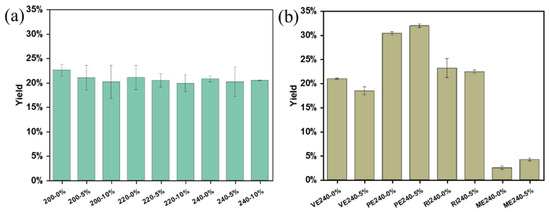
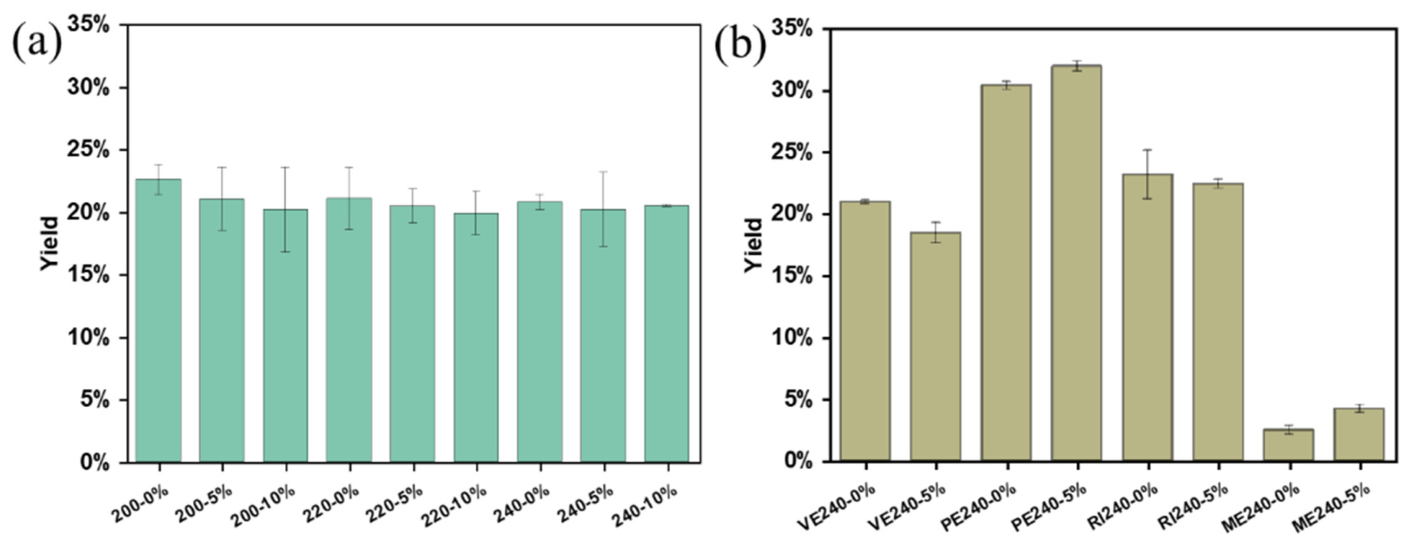
The conversion of food waste during the HTC process was evaluated by measuring the hydrochar yield. As shown in Figure 1, when the hydrothermal temperature increased from 200 to 240 °C, the hydrochar yield decreased slightly from 22.6% to 20.8%. During the hydrothermal carbonization of food waste, temperature is a key factor governing the decomposition of organic matter. Most cellulose and hemicellulose components decompose at approximately 200 °C [40,41], whereas the significant decomposition of lignin and proteinaceous substances generally requires temperatures above 250 °C [42,43]. Therefore, the decrease in hydrochar yield with rising hydrothermal temperature was not pronounced. At 200 °C, the addition of DESs resulted in a gradual decrease in hydrochar yield from 22.6% to 20.2%. This can be attributed to the ability of DESs to disrupt hydrogen-bonding networks in polysaccharides and lignin, thereby promoting the dissolution of organic matter into the aqueous phase. However, at 220 and 240 °C, the effect of DESs on hydrochar yield became less significant and even led to a slight increase. This phenomenon is likely due to the occurrence of complex secondary reactions among liquid-phase intermediates under more severe hydrothermal conditions, resulting in repolymerization and re-carbonization [44].
Figure 1.
(a) The effect of temperature and DESs on the yield of hydrochar. (b) The yield of different compositions during the HTC of food waste. VE, PE, RI and ME refer to vegetables, pericarp, rice, and meat, respectively.
HTC experiments on individual components of food waste revealed that the pericarp produced the highest hydrochar yield, which can be attributed to its high lignin content and corresponding resistance to decomposition. Upon the addition of DESs, a decrease in hydrochar yield was observed only for the vegetable and rice components, indicating that DESs primarily promoted the decomposition of these two components. These results suggest that enhancing the decomposition of food waste through DES addition is a viable strategy for improving HTC efficiency.
The elemental composition of the obtained hydrochar was determined and is presented in Table 1. The proximate analysis results showed that as the hydrothermal temperature increased from 200 to 240 °C, the fixed carbon content in the hydrochar gradually increased from 11.78% to 34.56%. Correspondingly, the volatile matter content decreased from 86.63% to 61.93%, indicating that the degree of carbonization of the hydrochar increased with rising hydrothermal temperature [22,45]. Similarly, the addition of DESs further enhanced the carbonization degree of the hydrochar. Furthermore, the relatively low higher heating value (HHV) of both raw food waste and derived hydrochar may be attributed to the low lignin content in food waste [46].
Table 1.
Chemical compositions of food waste hydrochars.
The elemental analysis results indicate that, after hydrothermal treatment, the carbon content of food waste increased significantly, suggesting that most of the carbon from the feedstock was retained in the hydrochar. As the hydrothermal temperature increased, the carbon content further rose from 51.71% to 61.64%, aligning with the proximate analysis results and confirming that the carbonization degree of the hydrochar increased with the hydrothermal temperature. The addition of deep eutectic solvents (DESs) reduced the carbon content of the hydrochar, which can be attributed to the enhanced decomposition of lignin and polysaccharides in the food waste. Interestingly, under varying hydrothermal temperatures, DESs exhibited distinct effects on the nitrogen content of the hydrochar. At the lower hydrothermal temperature (200 °C), as the DES dosage increased from 0% to 10%, the nitrogen content in the hydrochar gradually decreased from 5.99% to 3.77%. This suggests that DESs facilitated the decomposition of nitrogen-containing substances in food waste, such as proteins and polysaccharides. During the HTC process, Zn2+ ions were converted to Zn(OH)2 and ZnO, which were retained in the hydrochar. The Zn concentrations in the hydrochar with 10% DES addition were determined to be 42.1 mg/g. Therefore, this hydrochar may have potential applications as phosphate ores or functional carbon materials.
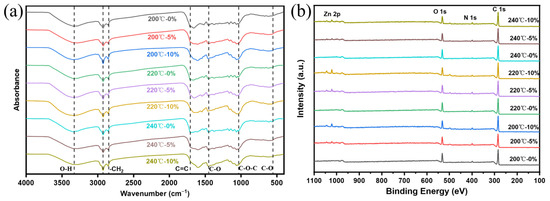
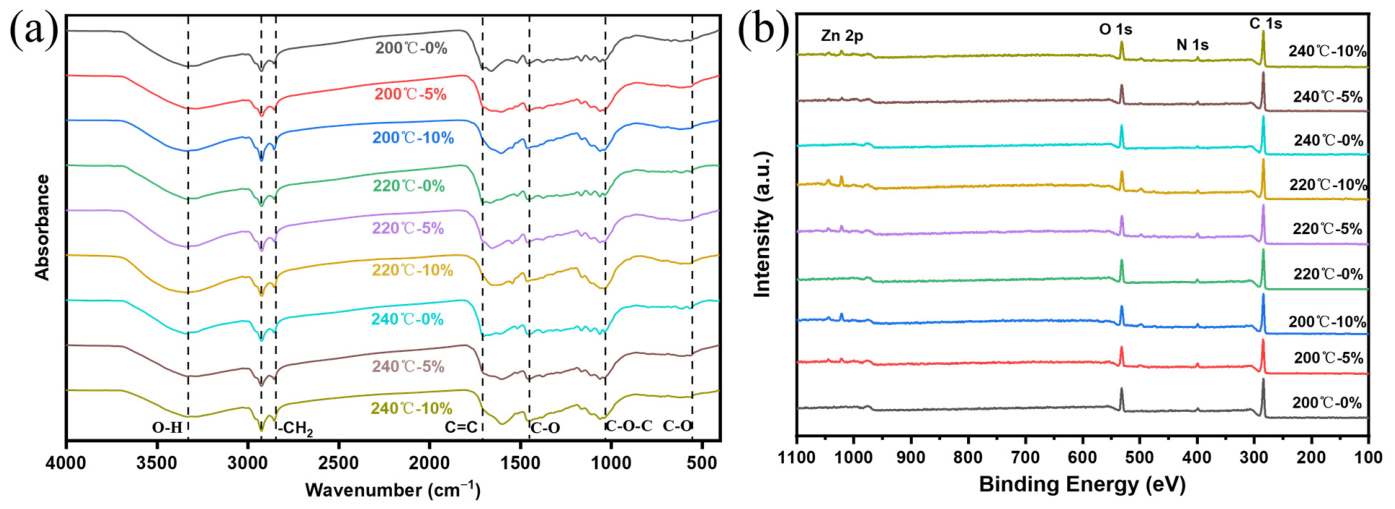
To investigate the surface functional groups of hydrochar during HTC, the obtained hydrochar was characterized using FTIR spectroscopy. As shown in Figure 2a, the peak at 3350 cm−1 is attributed to O–H stretching vibration. With increasing hydrothermal temperature and the addition of DESs, the intensity of this peak gradually decreased, indicating a progressive increase in the hydrophobicity of the hydrochar. The peaks at 2920 cm−1 and 2850 cm−1 correspond to aliphatic structures within the hydrochar. The peak at 1702 cm−1 is associated with the stretching vibration of C=C bonds in lignin structures. As the hydrothermal temperature increased and DESs were added, this peak gradually weakened and eventually disappeared, suggesting the progressive decomposition of lignin structures in the food waste. The peak at 1040 cm−1 represents the stretching vibration of C–O–C bonds, and its intensity gradually increased with DES addition. This increase may be attributed to the relatively higher thermal stability of C–O–C structures, which makes them more resistant to degradation [47]. XPS analysis was conducted on the obtained hydrochars, with the XPS spectrum shown in Figure 2b. All groups exhibited characteristic C 1s, N 1s, and O 1s peaks. No distinct P 2p peak was observed in the hydrochar obtained without DES addition, which is likely due to the phosphorus content being below the detection limit.
Figure 2.
(a) FTIR spectrum of obtained hydrochars, (b) XPS survey spectra of obtained hydrochars.
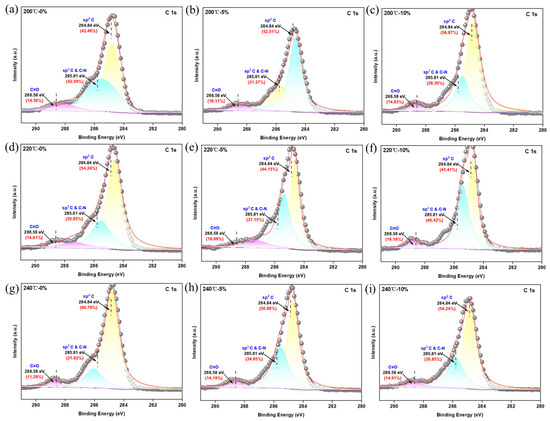
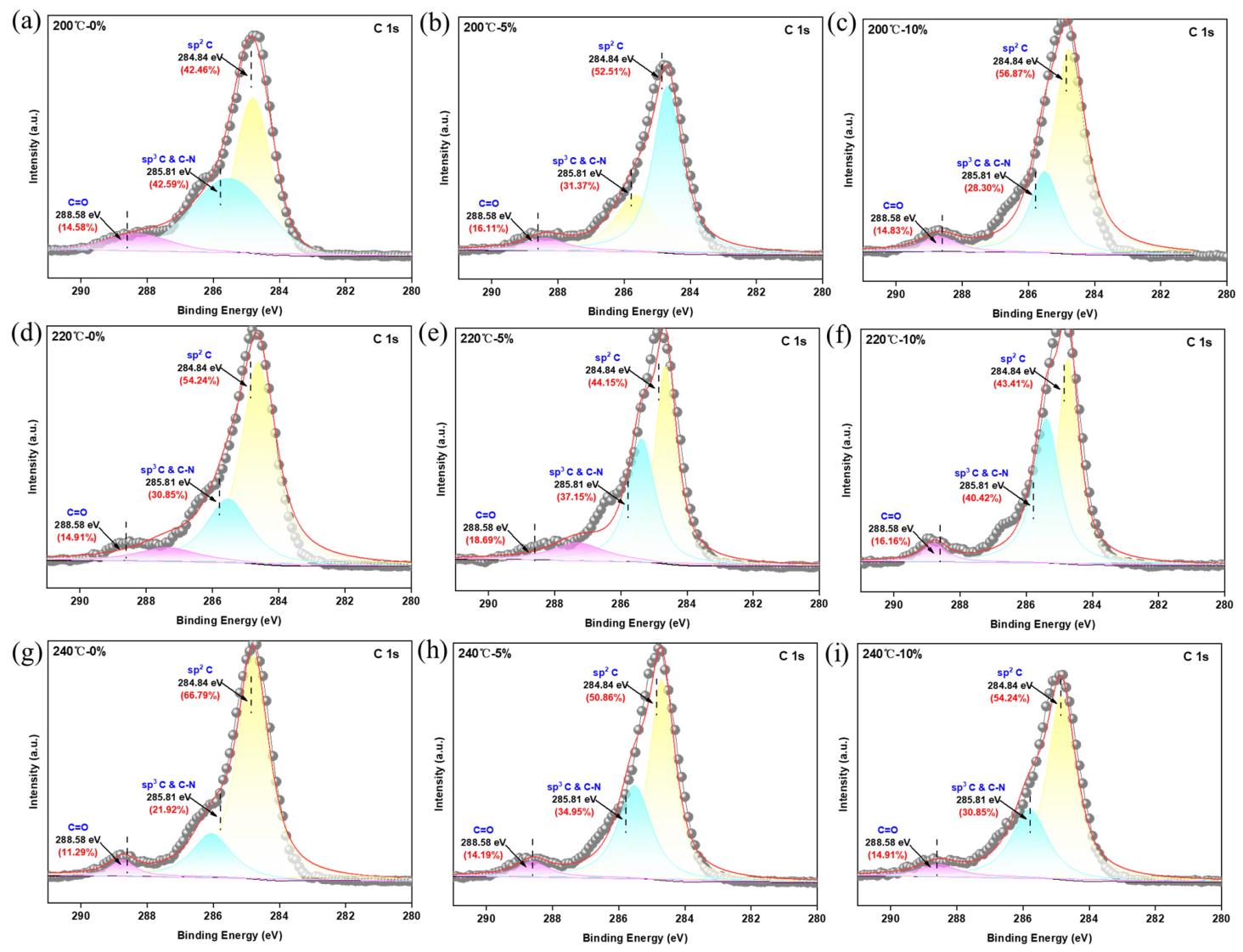
The high-resolution XPS C 1s spectra of the hydrochar are presented in Figure 3. The C 1s spectrum can be deconvoluted into three main components: O=C–O (288.2–288.7 eV), C–O/C–N (285.0–285.5 eV), and C–C/C=C (284.4–284.8 eV) [48]. It can be observed that, at 200 °C, with the addition of deep eutectic solvents (DESs), the relative proportion of C–O/C–N decreased, while that of C–C/C=C increased. This suggests that DESs facilitated the dissolution of C–N bonds in proteinaceous substances, thereby reducing the nitrogen content in the hydrochar. In contrast, at 220 and 240 °C, the opposite trend was observed: the relative proportion of C–O/C–N increased with DES addition, while that of C–C/C=C decreased. This indicates that under higher temperatures, DESs enhanced the hydrothermal reactions and promoted secondary side reactions, leading to the repolymerization of nitrogen-containing compounds into the hydrochar. This phenomenon is consistent with the elemental analysis results discussed earlier.
Figure 3.
XPS C1s spectrum of hydrochars obtained at (a) 200 °C without DES addition; (b) 200 °C with 5% DES addition; (c) 200 °C with 10% DES addition; (d) 220 °C without DES addition; (e) 220 °C with 5% DES addition; (f) 220 °C with 10% DES addition; (g) 240 °C without DES addition; (h) 240 °C with 5% DES addition; (i) 240 °C with 10% DES addition.
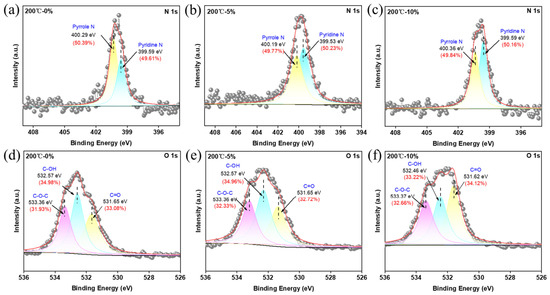
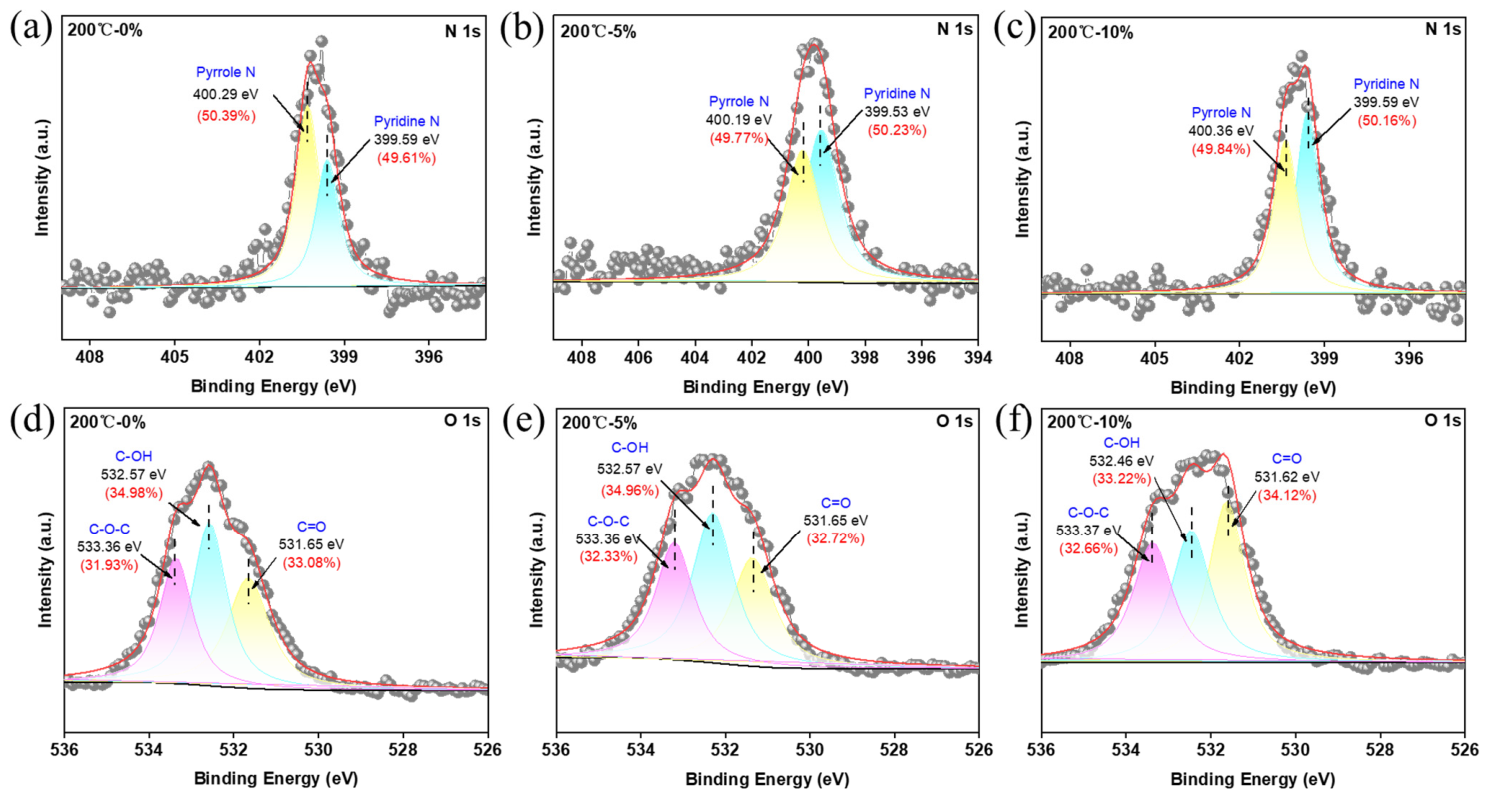
The high-resolution XPS N 1s spectra in Figure 4 indicated that nitrogen in the hydrochar primarily exists in the forms of pyrrolic N (399.8–401.0 eV) and pyridinic N (398.0–399.8 eV), suggesting that the protein-derived nitrogen in the food waste had been effectively decomposed. The addition of DESs had minimal impact on the nitrogen speciation in the hydrochar. The high-resolution XPS O 1s spectra further reveal that oxygen species in the hydrochar are predominantly present as C=O (531.0–531.6 eV), C–OH (532.1–532.5 eV), and C–O–C (532.9–533.5 eV).
Figure 4.
XPS N1s of hydrochars obtained at (a) 200 °C without DES addition; (b) 200 °C with 5% DES addition; (c) 200 °C with 10% DES addition; XPS O1s spectrum of hydrochars obtained at (d) 200 °C without DES addition; (e) 200 °C with 5% DES addition; (f) 200 °C with 10% DES addition.
3.2. Characterizations of Aqueous Phase
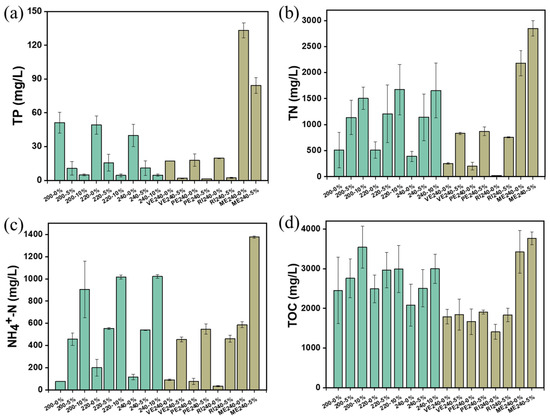
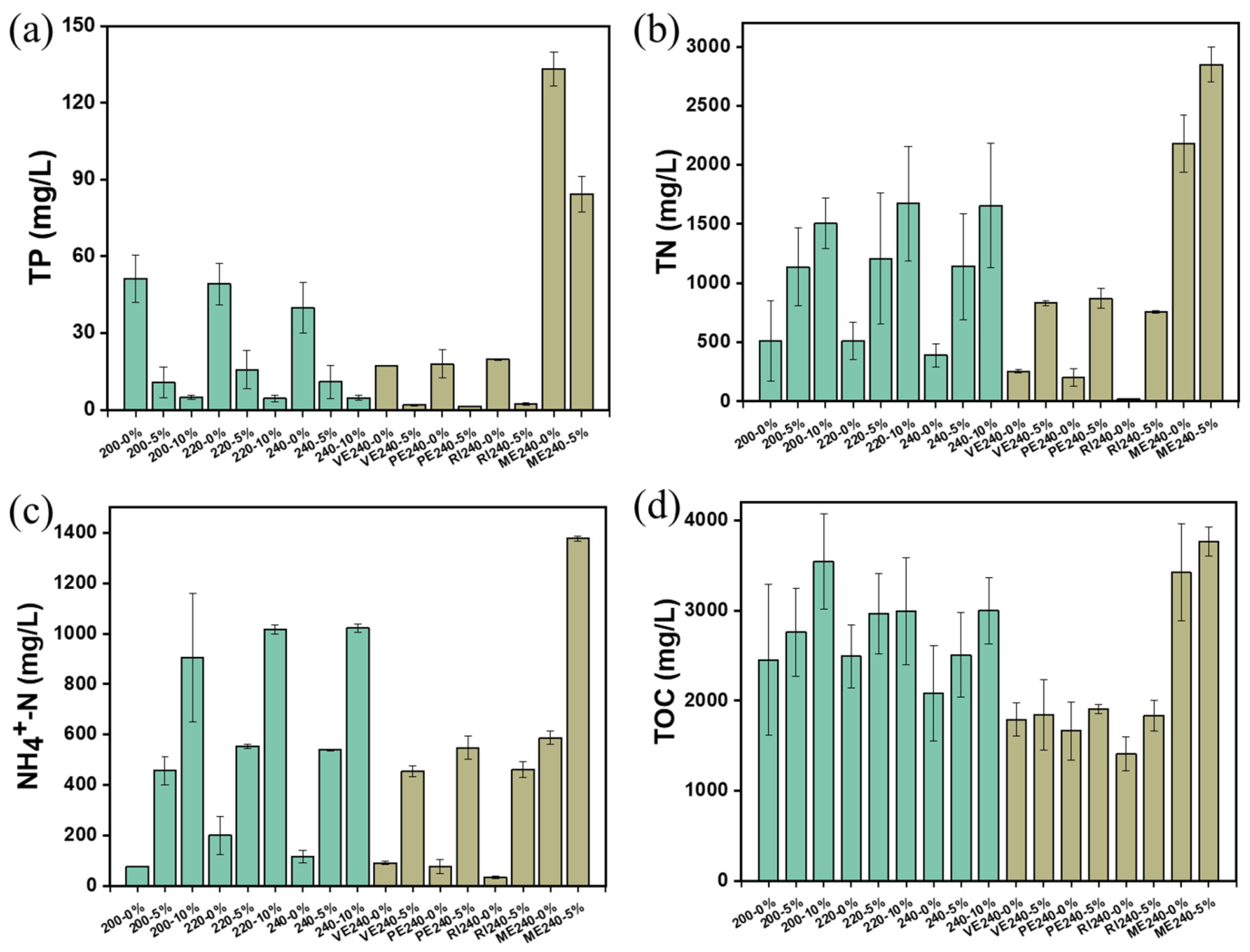
The total phosphorus (TP) content in the aqueous phase is shown in Figure 5a. As the temperature increased, the TP content in the aqueous phase gradually decreased from 51.20 mg/L to 39.79 mg/L. This trend can be attributed to the enhanced volatilization of phosphorus or the formation of solid-phase phosphorus species at elevated temperatures [49]. Upon the addition of DESs, a decrease in TP content was observed at all hydrothermal temperatures. For instance, at 200 °C, as the DES dosage increased from 0% to 10%, the TP content in the aqueous phase decreased from 51.20 mg/L to 4.86 mg/L. This can primarily be attributed to the reaction of Zn ions from the DESs with phosphorus during HTC, leading to the formation of metal phosphates, which were subsequently enriched in the hydrochar, thereby reducing the TP concentration in the liquid phase. Additionally, the pH of the aqueous phase was measured before and after the HTC reaction. The results indicated a slight decrease in pH, from 7.33 to 6.65, which can be attributed to the formation of organic acids from food waste [50]. With the addition of DESs, the pH increased to 7.89 due to the dissolution of urea in the aqueous phase. The elevated pH facilitated precipitation with cations and the immobilization of phosphorus in the hydrochar.
Figure 5.
(a) TP, (b) TN, (c) NH4+–N, and (d) TOC content in the aqueous phase obtained from HTC. VE, PE, RI and ME refer to vegetables, pericarp, rice, and meat, respectively.
The total nitrogen (TN) and NH4+–N contents in the aqueous phase are shown in Figure 5b,c. After the addition of DESs, both TN and NH4+–N contents exhibited an increasing trend across all groups, indicating that DESs effectively promoted the transfer of nitrogen into the aqueous phase. Moreover, the proportion of NH4+–N in TN increased with increasing DES dosage. This can be attributed to the decomposition of urea in the DESs at high temperatures above 220 °C, which generates a large amount of NH3. Since the reaction was carried out in a sealed reactor, the produced NH3 could not escape and instead dissolved into the aqueous phase, thereby increasing the NH4+–N concentration. Additionally, HTC experiments with only 0.1 g of DESs were conducted at different temperatures, and only the aqueous phase was obtained without food waste addition. The TP content in the aqueous phase was below the detection limit. The TN content in the aqueous phase was 653.2 mg/L, 632.4 mg/L, and 599.8 mg/L at 200 °C, which are lower than the theoretical value of 716.2 mg/L. This discrepancy may be attributed to the decomposition of urea at high temperatures, which generates a significant amount of N2 and NH3.
The total organic carbon (TOC) content in the aqueous phase is shown in Figure 5d. As the temperature increased, the TOC content in the aqueous phase decreased. This is likely because, at higher temperatures, part of the organic matter volatilized into the gas phase, thereby reducing the TOC remaining in the liquid phase. After the addition of DESs, the TOC content in the liquid phase gradually increased, which is consistent with the elemental analysis results of the hydrochar discussed above. Specifically, the addition of DESs promoted the dehydration, deamination, and decarboxylation of food waste, resulting in the dissolution of a greater proportion of organic compounds into the aqueous phase.
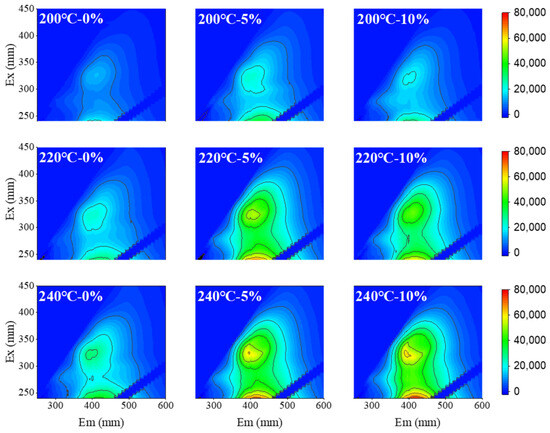
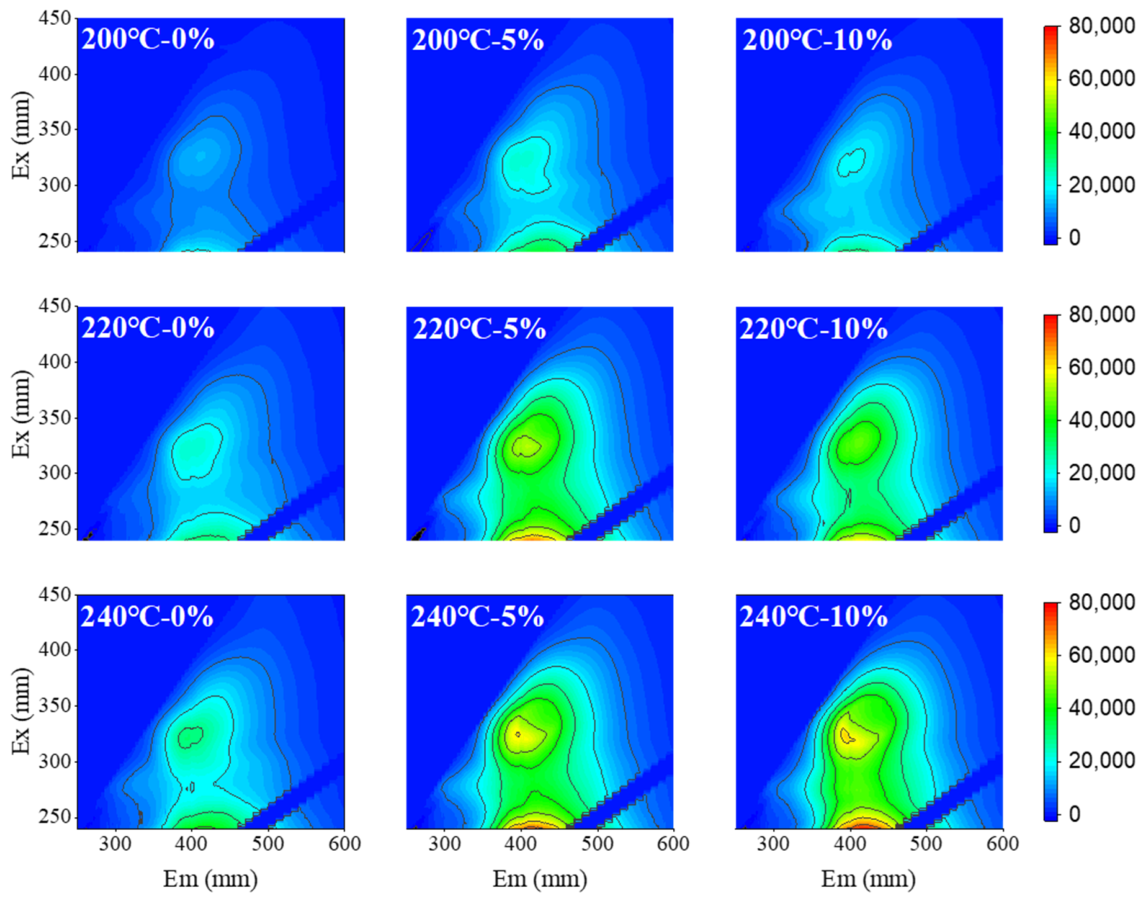
The aqueous-phase products were diluted prior to conducting 3D-EEM analysis. The 3D-EEM spectra of the aqueous phase are presented in Figure 6. The results indicate that higher temperatures led to an increase in the concentration of fluorescent substances in the aqueous phase. Additionally, the addition of deep eutectic solvents (DESs) further elevated the fluorescent intensity of the aqueous phase products. During the measurement process, the EEM data of each sample were corrected by subtracting the Milli-Q water blank, and first- and second-order Rayleigh scattering, as well as Raman scattering, were removed [51]. Based on PARAFAC, three fluorescent components in the hydrothermal aqueous phase (HAP) were identified through split-half validation and residual analysis. These components were designated as C1, C2, and C3.
Figure 6.
Excitation–emission spectra of hydrothermal aqueous phase at different conditions.
By a comparison with the OpenFluor database, the identities of the three fluorescent components were determined. In the aqueous phase, component C1 exhibited the maximum excitation/emission peaks at 240/420 nm and 330/420 nm, which correspond to a UVC humic acid-like substance, characterized by high molecular weight and aromaticity [52,53]. Component C2 showed the maximum excitation/emission at 270/390 nm and 320/390 nm, representing a humic-like substance with lower molecular weight [54]. Component C3 displayed the maximum excitation/emission at 270/460 nm and 370/460 nm, which is identified as humic-like matter, typically with a high molecular weight [55]. The fluorescent components in the hydrothermal aqueous phase were predominantly humic-like substances.
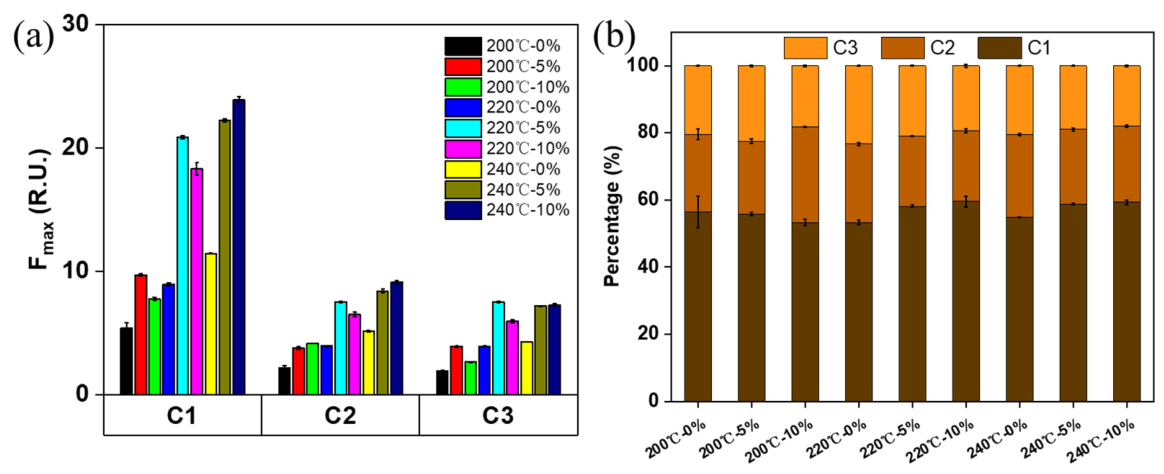
Notably, although HTC experiments indicated that most of the protein dissolved into the aqueous phase, no protein-like fluorescent component was detected. This can be attributed to the extensive Maillard reactions that occur during the HTC process [8]. Figure 7a illustrates the changes in Fmax and the percentage distribution of each component after PARAFAC. The results indicate that component C1 (humic acid-like substance with high molecular weight and aromaticity) had the highest abundance. After the addition of DESs, the contents of C1, C2, and C3 all increased, suggesting that DESs facilitated the release of humic substances into the hydrothermal aqueous phase. The percentage distribution of these components in Figure 7b shows that the addition of DESs to the HTC process slightly reduced the proportion of C1 in the aqueous phase.
Figure 7.
(a) Fmax and (b) percentage of the three components in the aqueous phase after PARAFAC.
3.3. Fates of N and P During HTC
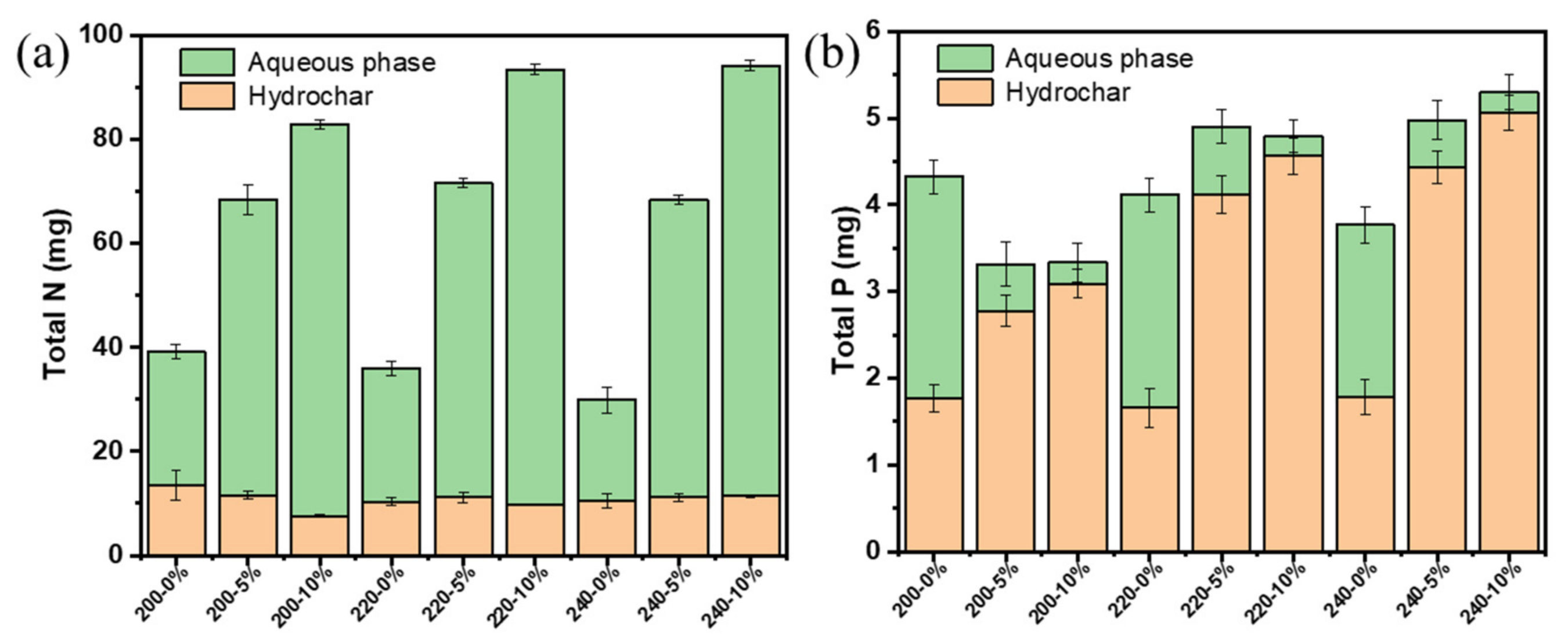
The total nitrogen (N) and phosphorus (P) contents in both hydrochar and the aqueous phase were calculated and are shown in Figure 8. The total N in the aqueous phase significantly increased with the addition of DESs, which can be attributed to the dissolution of urea. At 200 °C, the N content in hydrochar decreased from 13.5 mg to 7.6 mg, suggesting that the addition of DESs facilitated the decomposition of nitrogen-containing substances in food waste, such as proteins and polysaccharides. At higher temperatures, the decomposition of food waste was further enhanced, and degradation intermediates, such as furfurals, would polymerize with protein hydrolysates, generating secondary char with a more aromatic structure. This process collectively led to the enrichment of nitrogen in the hydrochar [45,56]. Similar phenomena have been observed in previous studies. For instance, Shen et al. found that the nitrogen content in hydrochar decreased from 3.37% to 3.08% when the temperature increased from 180 °C to 200 °C but increased to 3.64% when the temperature was further raised to 260 °C [57]. The decrease in TOC in the aqueous phase at elevated temperatures further supports the migration of organic matter into the hydrochar.
Figure 8.
Mass balance of (a) N and (b) P during HTC.
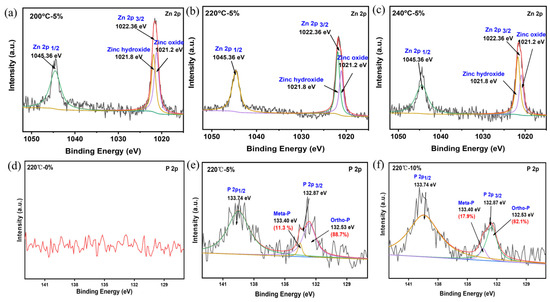
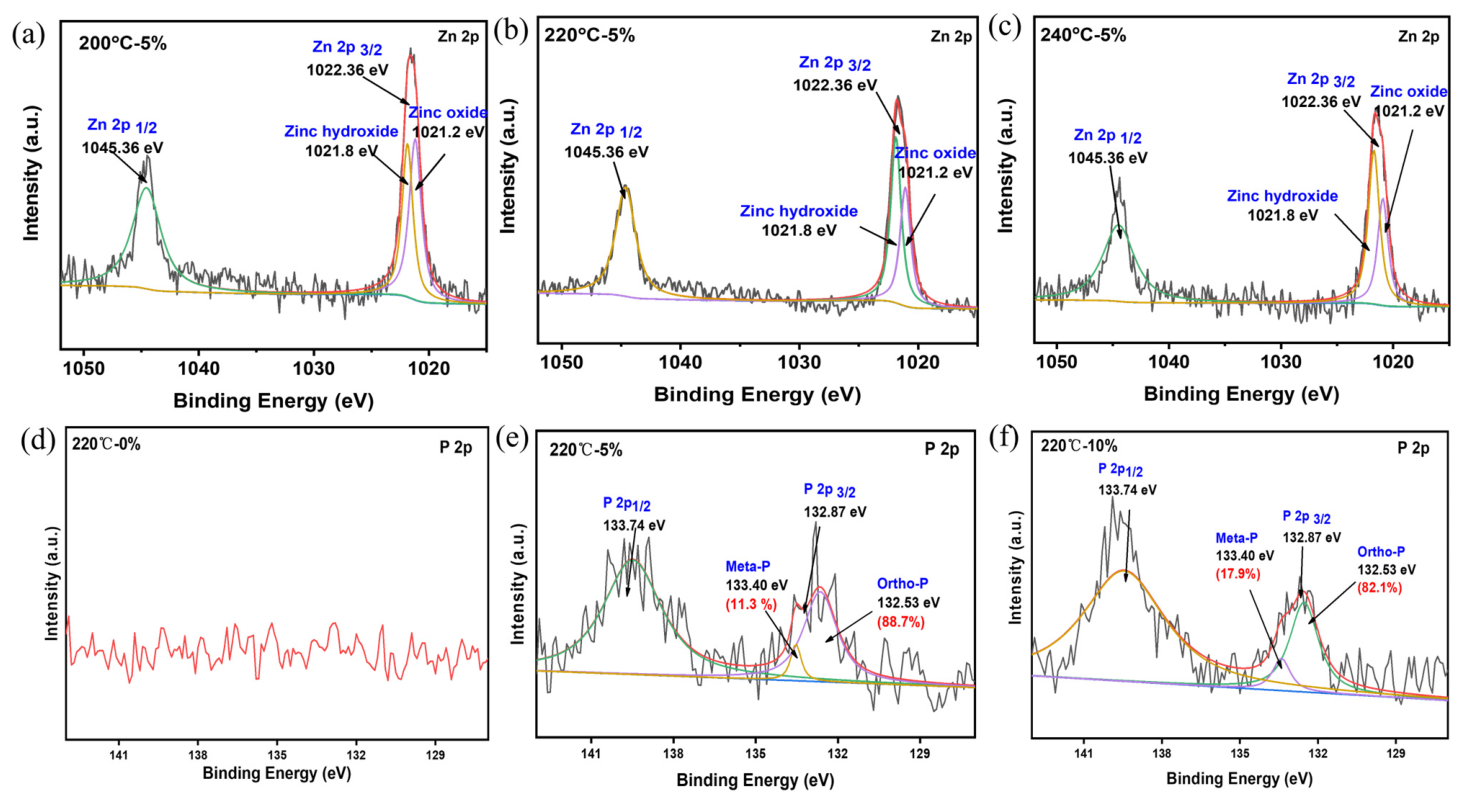
The addition of DESs significantly increased the total phosphorus (TP) content in the hydrochar, particularly at 240 °C, where the TP content rose from 8.55 mg/g to 24.60 mg/g. This finding suggests that DESs promoted the migration and retention of phosphorus into the hydrochar phase. To understand the underlying mechanism, the XPS Zn 2p and P 2p spectra of the hydrochar were analyzed. As shown in Figure 9, the Zn 2p spectrum revealed two peaks at 1045.36 eV and 1022.36 eV, corresponding to the Zn 2p3/2 and Zn 2p1/2 peaks, respectively. The Zn 2p3/2 peak was further divided into peaks at 1021.2 eV (zinc oxide) and 1021.8 eV (zinc hydroxide) [58,59]. During hydrothermal carbonization (HTC), zinc oxide was gradually converted into zinc hydroxide as the temperature increased. Characteristic peaks corresponding to Zn 2p1/2 (1045 eV) and Zn 2p3/2 (1022 eV) were observed in the hydrochar obtained at 220 °C with 5% DESs, indicating that DES addition promoted the formation of phosphorus species in the hydrochar. The Zn 2p3/2 peak was further split into two peaks at 132.5 eV and 133.4 eV, attributed to orthophosphate (Ortho-P) and metaphosphate (Meta-P) species, respectively [60,61]. The relative proportion of Meta-P increased with the DES dosage, suggesting that DESs facilitated the formation of metaphosphate species. Based on these findings, a plausible mechanism for phosphorus retention in hydrochar is proposed. First, all phosphorus species were transformed into orthophosphates during HTC [62]. The molecular bonds of polyphosphates, pyrophosphates, phosphate diesters, and other phosphorus species were broken down to undergo hydrolysis, being converted into soluble orthophosphates that migrate into the liquid phase. The dissolved Zn2+ ions then react with these soluble orthophosphates, forming insoluble precipitates (phosphate salts) and adsorbing onto the surface of the hydrochar.
Figure 9.
The XPS Zn 2p spectra of hydrochar obtained at (a) 200 °C with 5% DES addition; (b) 220 °C with 5% DES addition; (c) 240 °C with 5% DES addition; XPS P 2p spectra of hydrochar obtained at (d) 220 °C without DES addition; (e) 220 °C with 5% DES addition; (f) 220 °C with 10% DES addition.
3.4. Future Perspectives and Limitations
This study proposes a sustainable and efficient approach to promoting the separation of nutrients in food waste, enabling the enrichment of phosphorus (P) in the hydrochar and the release of nitrogen (N) into the aqueous phase. By integrating this method with other chemical or physical processes, the recovery of both energy and resources from food waste can be maximized. For example, the phosphorus-enriched hydrochar can be used as a phosphate ore or functional carbon material, with applications in soil amendment, energy storage, and pollutant removal. Meanwhile, the aqueous phase, which contains a high concentration of ammoniacal nitrogen, can be utilized for the production of nitrogen fertilizers. However, this approach has certain limitations. The deep eutectic solvent (DES) used in this study is challenging to recover, which increases the overall cost of food waste treatment, and its economic feasibility remains uncertain. Therefore, a comprehensive life cycle assessment (LCA) and techno-economic analysis are essential to evaluate the sustainability of this process. Additionally, there is a need to develop lower-cost, recyclable, and more efficient DESs to further enhance the separation of nitrogen and phosphorus from food waste, thereby improving the overall economic and environmental performance of the treatment process.
4. Conclusions
This work investigated the properties of products and the fate of nutrients during the DES-associated HTC process. The addition of DESs promoted the decomposition of food waste by disrupting the hydrogen-bonding networks in extracellular polysaccharides and lignin. As a result, the hydrochar yield decreased from 22.6% to 20.2%, and the volatile matter content in the hydrochar decreased from 86.63% to 71.60% at 200 °C. With increasing DES dosage from 0% to 10%, the nitrogen content in the hydrochar gradually decreased from 5.99% to 3.77%, indicating that DESs facilitated the decomposition of nitrogen-containing substances in food waste, such as proteins and polysaccharides. Furthermore, with DES addition, as much as 5.06 mg of phosphorus (P) species was enriched in the hydrochar, compared to only 1.78 mg in the group without DESs. This study demonstrated that the addition of DESs is an effective strategy to enhance the decomposition of food waste during HTC while enabling efficient nutrient recovery.
Author Contributions
Conceptualization, S.J., J.Q. and Y.T.; Methodology, S.J. and J.Q.; Investigation, S.J. and X.Z.; Data curation, S.J. and X.Z.; Writing—original draft preparation, S.J. and J.Q.; Writing—review and editing, B.L. and X.Z.; Visualization, B.L. and X.Z.; Supervision, B.L. and X.Z. All authors have read and agreed to the published version of the manuscript.
Funding
This research was funded by the Key R&D Program of Zhejiang (2024C03236), the science and technology plan project of Wenzhou (G20240012), and the supporting project from College of Life and Environment Science of Wenzhou University (SHPY2025008).
Institutional Review Board Statement
Not applicable.
Informed Consent Statement
Not applicable.
Data Availability Statement
The data used in the current study are available from the corresponding author on reasonable request.
Conflicts of Interest
The authors declare no conflicts of interest.
References
- Park, M.-J.; Yun, S.; Jeong, D.-W.; Won, W. Upcycling municipal solid waste: Scenario-based techno-economic evaluation and life cycle assessment. Energy 2025, 329, 136786. [Google Scholar] [CrossRef] [Scilit]
- Qi, Y.; Muhammad, U.; Zhang, W.; Song, Y.; Zhang, M.; Wang, M.; Xu, C.; Xu, Y.; Cai, S.; Han, C. A comprehensive evaluation of recent advancement in municipal solid waste gasification: Research status, technical challenges and Perspectives. Sep. Purif. Technol. 2025, 358, 130443. [Google Scholar] [CrossRef] [Scilit]
- Lahiri, A.; Daniel, S.; Kanthapazham, R.; Vanaraj, R.; Thambidurai, A.; Peter, L.S. A critical review on food waste management for the production of materials and biofuel. J. Hazard. Mater. Adv. 2023, 10, 100266. [Google Scholar] [CrossRef] [Scilit]
- Wang, Y.; Ying, H.; Stefanovski, D.; Shurson, G.C.; Chen, T.; Wang, Z.; Yin, Y.; Zheng, H.; Nakaishi, T.; Li, J. Food waste used as a resource can reduce climate and resource burdens in agrifood systems. Nat. Food 2025, 6, 478–490. [Google Scholar] [CrossRef] [Scilit]
- Wei, Y.; Xu, W.; Chen, Y.; Peng, Y.; Ke, H.; Zhan, L.; Lan, J.; Li, H.; Zhang, Y. Evaluation of greenhouse gas emission and reduction potential of high-food-waste-content municipal solid waste landfills: A case study of a landfill in the east of China. Waste Manag. 2024, 189, 290–299. [Google Scholar] [CrossRef] [Scilit]
- Lee, E.; Shurson, G.; Oh, S.-H.; Jang, J.-C. The management of food waste recycling for a sustainable future: A case study on South Korea. Sustainability 2024, 16, 854. [Google Scholar] [CrossRef] [Scilit]
- Liu, M.; Ogunmoroti, A.; Liu, W.; Li, M.; Bi, M.; Liu, W.; Cui, Z. Assessment and projection of environmental impacts of food waste treatment in China from life cycle perspectives. Sci. Total Environ. 2022, 807, 150751. [Google Scholar] [CrossRef] [Scilit] [PubMed]
- Arellano-Yasaca, D.V.; Chu, C.-Y. Insights into nutrients recovery from food waste liquid Digestate: A critical review and systematic analysis. Waste Manag. 2025, 200, 114743. [Google Scholar] [CrossRef] [Scilit]
- Kumari, R.; Singh, A.; Sharma, R.; Malaviya, P. Conversion of food waste into energy and value-added products: A review. Environ. Chem. Lett. 2024, 22, 1759–1790. [Google Scholar] [CrossRef] [Scilit]
- Satari, B.; Kianmehr, M.H. Integrated hydrothermal carbonization to enhance resource and energy recovery from food waste. Appl. Food Res. 2025, 5, 100869. [Google Scholar] [CrossRef] [Scilit]
- Rasaq, W.A.; Thiruchenthooran, V.; Wirkijowska, K.; Valentin, M.; Bobak, Ł.; Igwegbe, C.A.; Białowiec, A. Hydrothermal carbonization of combined food waste: A critical evaluation of emergent products. Waste Manag. 2024, 189, 44–57. [Google Scholar] [CrossRef] [Scilit]
- Jiachen, Q.; Shunfeng, J.; Baoqiang, L.; Xiangyong, Z. Thermochemical Conversion of Food Waste into Biochar/Hydrochar for Soil Amendment: A Review. Agronomy 2026, 16, 389. [Google Scholar] [CrossRef] [Scilit]
- Periyavaram, S.R.; Bella, K.; Uppala, L.; Reddy, P.H. Hydrothermal carbonization of food waste: Process parameters optimization and biomethane potential evaluation of process water. J. Environ. Manag. 2023, 347, 119132. [Google Scholar] [CrossRef] [Scilit]
- Motavaf, B.; Dean, R.A.; Nicolas, J.; Savage, P.E. Hydrothermal carbonization of simulated food waste for recovery of fatty acids and nutrients. Bioresour. Technol. 2021, 341, 125872. [Google Scholar] [CrossRef] [Scilit]
- Hayder, A.; Mazhkoo, S.; Patel, V.; Norouzi, O.; Santos, R.M.; Dutta, A. Recent advances in hydrothermal carbonization of food waste derived bioproducts: Valorization approaches, applications, and the prospective assessment. Waste Biomass Valorization 2025, 16, 2629–2667. [Google Scholar] [CrossRef] [Scilit]
- Munir, M.T.; Saqib, N.U.; Li, B.; Naqvi, M. Food waste hydrochar: An alternate clean fuel for steel industry. Fuel 2023, 346, 128395. [Google Scholar] [CrossRef] [Scilit]
- Dhull, S.B.; Rose, P.K.; Rani, J.; Goksen, G.; Bains, A. Food waste to hydrochar: A potential approach towards the Sustainable Development Goals, carbon neutrality, and circular economy. Chem. Eng. J. 2024, 490, 151609. [Google Scholar] [CrossRef] [Scilit]
- Saengsuriwong, R.; Onsree, T.; Phromphithak, S.; Tippayawong, N. Biocrude oil production via hydrothermal liquefaction of food waste in a simplified high-throughput reactor. Bioresour. Technol. 2021, 341, 125750. [Google Scholar] [CrossRef] [Scilit] [PubMed]
- Periyavaram, S.R.; Uppala, L.; Sivaprakash, S.; Reddy, P.H. Thermal behaviour of hydrochar derived from hydrothermal carbonization of food waste using leachate as moisture source: Kinetic and thermodynamic analysis. Bioresour. Technol. 2023, 373, 128734. [Google Scholar] [CrossRef] [Scilit] [PubMed]
- Pecchi, M.; Baratieri, M.; Goldfarb, J.L.; Maag, A.R. Effect of solvent and feedstock selection on primary and secondary chars produced via hydrothermal carbonization of food wastes. Bioresour. Technol. 2022, 348, 126799. [Google Scholar] [CrossRef] [Scilit]
- Zhang, Y.; Jiang, Q.; Xie, W.; Wang, Y.; Kang, J. Effects of temperature, time and acidity of hydrothermal carbonization on the hydrochar properties and nitrogen recovery from corn stover. Biomass Bioenergy 2019, 122, 175–182. [Google Scholar] [CrossRef] [Scilit]
- Lin, H.; Li, C.; Jiang, Y.; Zhang, L.; Zhang, S.; Wang, D.; Leng, C.; Hu, X. Hydrothermal carbonization of pretreated pine needles: The impacts of temperature and atmosphere in pretreatment on structural evolution of hydrochar. J. Anal. Appl. Pyrolysis 2024, 178, 106421. [Google Scholar] [CrossRef] [Scilit]
- Liu, Z.; Zhao, L.; Yao, Z.; Jia, J.; Wang, Z.; Liu, Z. Behaviors and interactions during hydrothermal carbonization of protein, cellulose and lignin. Chem. Eng. J. 2023, 476, 146373. [Google Scholar] [CrossRef] [Scilit]
- Zhou, Y.; Xiao, H.; Liu, Q.; Wang, L.; Gong, Y.; Remón, J. Synergistic production of nitrogen-rich hydrochar and solid biofuels via co-hydrothermal carbonization of microalgae and macroalgae: When nitrogen circularity matters. Environ. Res. 2025, 268, 120749. [Google Scholar] [CrossRef] [Scilit] [PubMed]
- Aquino, M.; Santoro, S.; Di Profio, G.; La Russa, M.F.; Limonti, C.; Straface, S.; D’Andrea, G.; Curcio, E.; Siciliano, A. Membrane distillation for separation and recovery of valuable compounds from anaerobic digestates. Sep. Purif. Technol. 2023, 315, 123687. [Google Scholar] [CrossRef] [Scilit]
- Aragón-Briceño, C.I.; Pozarlik, A.K.; Bramer, E.A.; Niedzwiecki, L.; Pawlak-Kruczek, H.; Brem, G. Hydrothermal carbonization of wet biomass from nitrogen and phosphorus approach: A review. Renew. Energy 2021, 171, 401–415. [Google Scholar] [CrossRef] [Scilit]
- Sarrion, A.; Diaz, E.; de la Rubia, M.A.; Mohedano, A.F. Fate of nutrients during hydrothermal treatment of food waste. Bioresour. Technol. 2021, 342, 125954. [Google Scholar] [CrossRef] [Scilit]
- Zhu, H.; He, X.; Xu, Z.; Dai, L. Deep eutectic solvent-mediated hydrothermal treatment for biomass conversion: A review. Green Chem. 2025, 27, 1278–1299. [Google Scholar] [CrossRef] [Scilit]
- del Mar Contreras-Gámez, M.; Galán-Martín, Á.; Seixas, N.; da Costa Lopes, A.M.; Silvestre, A.; Castro, E. Deep eutectic solvents for improved biomass pretreatment: Current status and future prospective towards sustainable processes. Bioresour. Technol. 2023, 369, 128396. [Google Scholar] [CrossRef] [Scilit]
- Amesho, K.T.; Lin, Y.-C.; Mohan, S.V.; Halder, S.; Ponnusamy, V.K.; Jhang, S.-R. Deep eutectic solvents in the transformation of biomass into biofuels and fine chemicals: A review. Environ. Chem. Lett. 2023, 21, 183–230. [Google Scholar] [CrossRef] [Scilit]
- Zhang, Q.; Zhu, E.; Zhang, C.; Tian, Q.; Zhang, L.; Shen, J.; Ni, Y.; Wang, Z. Deep eutectic solvents recycling for efficient and sustainable lignocellulosic biomass processing and the impact of recycling on resultant lignin and cellulose products. ACS Sustain. Chem. Eng. 2025, 13, 14400–14410. [Google Scholar] [CrossRef] [Scilit]
- Xu, Z.; Ma, X.; Liao, J.; Osman, S.M.; Wu, S.; Luque, R. Effects on the Physicochemical Properties of Hydrochar Originating from Deep Eutectic Solvent (Urea and ZnCl2)-Assisted Hydrothermal Carbonization of Sewage Sludge. ACS Sustain. Chem. Eng. 2022, 10, 4258–4268. [Google Scholar] [CrossRef] [Scilit]
- Chen, Y.-X.; Gao, F.; Xiong, H.-R.; Tan, Y.; Zhang, Z.-P.; Zeng, W.-H.; Cheng, K.-P.; Yang, Y.-X.; Xu, Z.-X.; Zhang, B. Hydrothermal carbonization of poplar sawdust: Effect of deep eutectic solvents on hydrochar’s physicochemical properties. Fuel Process. Technol. 2023, 251, 107952. [Google Scholar] [CrossRef] [Scilit]
- Xiong, H.-R.; Gao, F.; Tan, Y.; Chen, Y.-X.; Xu, Z.-X. The properties of Chinese Baijiu distilled spent grain-derived hydrochar: Effect of in situ deep eutectic solvents formation during hydrothermal carbonization. J. Environ. Chem. Eng. 2024, 12, 112701. [Google Scholar] [CrossRef] [Scilit]
- Heidari, M.; Dutta, A.; Acharya, B.; Mahmud, S. A review of the current knowledge and challenges of hydrothermal carbonization for biomass conversion. J. Energy Inst. 2019, 92, 1779–1799. [Google Scholar] [CrossRef] [Scilit]
- Lin, J.; Ma, R.; Luo, J.; Sun, S.; Cui, C.; Fang, L.; Huang, H. Microwave pyrolysis of food waste for high-quality syngas production: Positive effects of a CO2 reaction atmosphere and insights into the intrinsic reaction mechanisms. Energy Convers. Manag. 2020, 206, 112490. [Google Scholar] [CrossRef] [Scilit]
- Idris, A.H.; John, D.; Zuleah, H.J.; Shekarau, J.I.; Akanang, H.; Idris, A.H.; Aliyu, A.; Takko, Y.S.; Warji, M.I.; Obotu, A.E. Analytical assessment of a ZnCl2–Urea deep eutectic solvent for fruit and vegetable waste biorefining: Synergistic catalysis, fractionation efficiency, and bioethanol yield enhancement. Earthline J. Chem. Sci. 2026, 13, 99–114. [Google Scholar] [CrossRef] [Scilit]
- Gu, D.; Li, J.; Xu, C.; Wang, S.; Xiang, G.; Chen, W.; Zhang, Q.; Hua, Y.; Li, Y. Existence forms and electrodeposition behavior of various zinc compounds in choline chloride−Urea deep-eutectic solvent. J. Mol. Liq. 2024, 394, 123592. [Google Scholar] [CrossRef] [Scilit]
- GB/T 212–2008; Proximate Analysis of Coal. General Administration of Quality Supervision, Inspection and Quarantine of the People’s Republic of China: Beijing, China, 2009.
- Jia, J.; Wang, R.; Chen, H.; Liu, H.; Xue, Q.; Yin, Q.; Zhao, Z. Interaction mechanism between cellulose and hemicellulose during the hydrothermal carbonization of lignocellulosic biomass. Energy Sci. Eng. 2022, 10, 2076–2087. [Google Scholar] [CrossRef] [Scilit]
- Volpe, M.; Messineo, A.; Mäkelä, M.; Barr, M.R.; Volpe, R.; Corrado, C.; Fiori, L. Reactivity of cellulose during hydrothermal carbonization of lignocellulosic biomass. Fuel Process. Technol. 2020, 206, 106456. [Google Scholar] [CrossRef] [Scilit]
- Wang, J.; Minami, E.; Kawamoto, H. Pyrolysis-assisted catalytic hydrogenolysis of softwood lignin at elevated temperatures for the high yield production of monomers. Green Chem. 2023, 25, 2583–2595. [Google Scholar] [CrossRef] [Scilit]
- Latham, K.G.; Matsakas, L.; Figueira, J.; Kozyatnyk, I.; Rova, U.; Christakopoulos, P.; Jansson, S. Impact of temperature and residence time on the hydrothermal carbonization of organosolv lignin. J. Anal. Appl. Pyrolysis 2022, 166, 105623. [Google Scholar] [CrossRef] [Scilit]
- Yan, M.; Wang, H.; Liu, Y.; Luo, C.; Yang, Y.; Grisdanurak, N.; Kanchanatip, E.; Rahim, D.A. Innovative carbonization techniques for food waste: A comparative study of hydrothermal carbonization (HTC) and vapor-thermal carbonization (VTC). J. Anal. Appl. Pyrolysis 2024, 182, 106685. [Google Scholar] [CrossRef] [Scilit]
- Xie, L.; Gou, L.; Xu, D.; Kapusta, K.; Dai, L.; Wang, Y. Coupling influences of organic components and temperature on nitrogen transformation and hydrochar characterization during hydrothermal carbonization of sewage sludge. Sci. Total Environ. 2023, 866, 161354. [Google Scholar] [CrossRef] [Scilit]
- Zhang, C.; Ma, X.; Chen, X.; Tian, Y.; Zhou, Y.; Lu, X.; Huang, T. Conversion of water hyacinth to value-added fuel via hydrothermal carbonization. Energy 2020, 197, 117193. [Google Scholar] [CrossRef] [Scilit]
- Liang, J.; Lin, H.; Li, C.; Zhang, L.; Zhang, S.; Wang, S.; Xiang, J.; Hu, S.; Wang, Y.; Hu, X. Interaction of derivatives of cellulose and lignin in co-HTC, co-pyrolysis and co-activation. Fuel 2023, 351, 129033. [Google Scholar] [CrossRef] [Scilit]
- Hwang, H.; Lee, J.-H.; Ahmed, M.A.; Choi, J.W. Evaluation of pyrochar and hydrochar derived activated carbons for biosorbent and supercapacitor materials. J. Environ. Manag. 2021, 298, 113436. [Google Scholar] [CrossRef] [Scilit]
- Ge, Q.; Dong, C.; Wang, G.; Zhang, J.; Hou, R. Production, characterization and environmental remediation application of emerging phosphorus-rich biochar/hydrochar: A comprehensive review. RSC Adv. 2024, 14, 33649–33665. [Google Scholar] [CrossRef] [Scilit]
- Ekpo, U.; Ross, A.; Camargo-Valero, M.; Fletcher, L. Influence of pH on hydrothermal treatment of swine manure: Impact on extraction of nitrogen and phosphorus in process water. Bioresour. Technol. 2016, 214, 637–644. [Google Scholar] [CrossRef] [Scilit] [PubMed]
- Zhuang, W.-E.; Chen, W.; Yang, L. Effects of Photodegradation on the Optical Indices of Chromophoric Dissolved Organic Matter from Typical Sources. Int. J. Environ. Res. Public Health 2022, 19, 14268. [Google Scholar] [CrossRef] [Scilit]
- Rajapaksha, A.U.; Ok, Y.S.; El-Naggar, A.; Kim, H.; Song, F.; Kang, S.; Tsang, Y.F. Dissolved organic matter characterization of biochars produced from different feedstock materials. J. Environ. Manag. 2019, 233, 393–399. [Google Scholar] [CrossRef] [Scilit] [PubMed]
- Wu, H.; Dong, X.; Liu, H. Evaluating fluorescent dissolved organic matter released from wetland-plant derived biochar: Effects of extracting solutions. Chemosphere 2018, 212, 638–644. [Google Scholar] [CrossRef] [Scilit]
- Ji, R.; Su, L.; Cheng, H.; Wang, Y.; Min, J.; Chen, M.; Li, H.; Chen, S.; Wang, S.; Yu, G. Insights into the potential release of dissolved organic matter from different agro-forest waste-derived hydrochars: A pilot study. J. Clean. Prod. 2021, 319, 128676. [Google Scholar] [CrossRef] [Scilit]
- Cheng, H.; Ji, R.; Yao, S.; Song, Y.; Sun, Q.; Bian, Y.; Wang, Z.; Zhang, L.; Jiang, X.; Han, J. Potential release of dissolved organic matter from agricultural residue-derived hydrochar: Insight from excitation emission matrix and parallel factor analysis. Sci. Total Environ. 2021, 781, 146712. [Google Scholar] [CrossRef] [Scilit]
- Zhang, C.; Wang, X.; Shao, M.; Li, H.; Chen, Q.; Wang, N.; Xu, Q. Synthesis of nitrogen-enriched hydrochar via co-hydrothermal reaction of liquid digestate and corn stalk. Sci. Total Environ. 2022, 836, 155572. [Google Scholar] [CrossRef] [Scilit]
- Shen, Q.; Zhu, X.; Peng, Y.; Xu, M.; Huang, Y.; Xia, A.; Zhu, X.; Liao, Q. Structure evolution characteristic of hydrochar and nitrogen transformation mechanism during co-hydrothermal carbonization process of microalgae and biomass. Energy 2024, 295, 131028. [Google Scholar] [CrossRef] [Scilit]
- Wang, P.; Tang, L.; Wei, X.; Zeng, G.; Zhou, Y.; Deng, Y.; Wang, J.; Xie, Z.; Fang, W. Synthesis and application of iron and zinc doped biochar for removal of p-nitrophenol in wastewater and assessment of the influence of co-existed Pb (II). Appl. Surf. Sci. 2017, 392, 391–401. [Google Scholar] [CrossRef] [Scilit]
- Gan, C.; Liu, Y.; Tan, X.; Wang, S.; Zeng, G.; Zheng, B.; Li, T.; Jiang, Z.; Liu, W. Effect of porous zinc–biochar nanocomposites on Cr (VI) adsorption from aqueous solution. Rsc Adv. 2015, 5, 35107–35115. [Google Scholar] [CrossRef] [Scilit]
- Fu, X.; Yan, B.; Li, J.; Wang, Y.; Cui, X.; Chen, G.; Wu, W.; Hou, L.A. Insight into transformation of phosphorus species in biomass gasification at different stages. Bioresour. Technol. 2025, 434, 132853. [Google Scholar] [CrossRef] [Scilit]
- Lu, S.-S.; Sheng, Q.; Wang, J.-J.; Yuan, S.-J.; Dong, B.; Xu, Z.-X. A combination of conventional extraction and advanced analytical techniques afford a comprehensive understanding of phosphorus distribution and transformation in sewage sludge biochars. Chem. Eng. J. 2023, 477, 146954. [Google Scholar] [CrossRef] [Scilit]
- Huang, R.; Fang, C.; Lu, X.; Jiang, R.; Tang, Y. Transformation of phosphorus during (hydro) thermal treatments of solid biowastes: Reaction mechanisms and implications for P reclamation and recycling. Environ. Sci. Technol. 2017, 51, 10284–10298. [Google Scholar] [CrossRef] [Scilit] [PubMed]

Disclaimer/Publisher’s Note: The statements, opinions and data contained in all publications are solely those of the individual author(s) and contributor(s) and not of MDPI and/or the editor(s). MDPI and/or the editor(s) disclaim responsibility for any injury to people or property resulting from any ideas, methods, instructions or products referred to in the content. |
© 2026 by the authors. Licensee MDPI, Basel, Switzerland. This article is an open access article distributed under the terms and conditions of the Creative Commons Attribution (CC BY) license.