Decarbonizing Island Mobility: Energy and Environmental Benefits of Rail Transport in Gran Canaria



Abstract
1. Introduction
Purpose and Novelty of the Study
2. Methodology
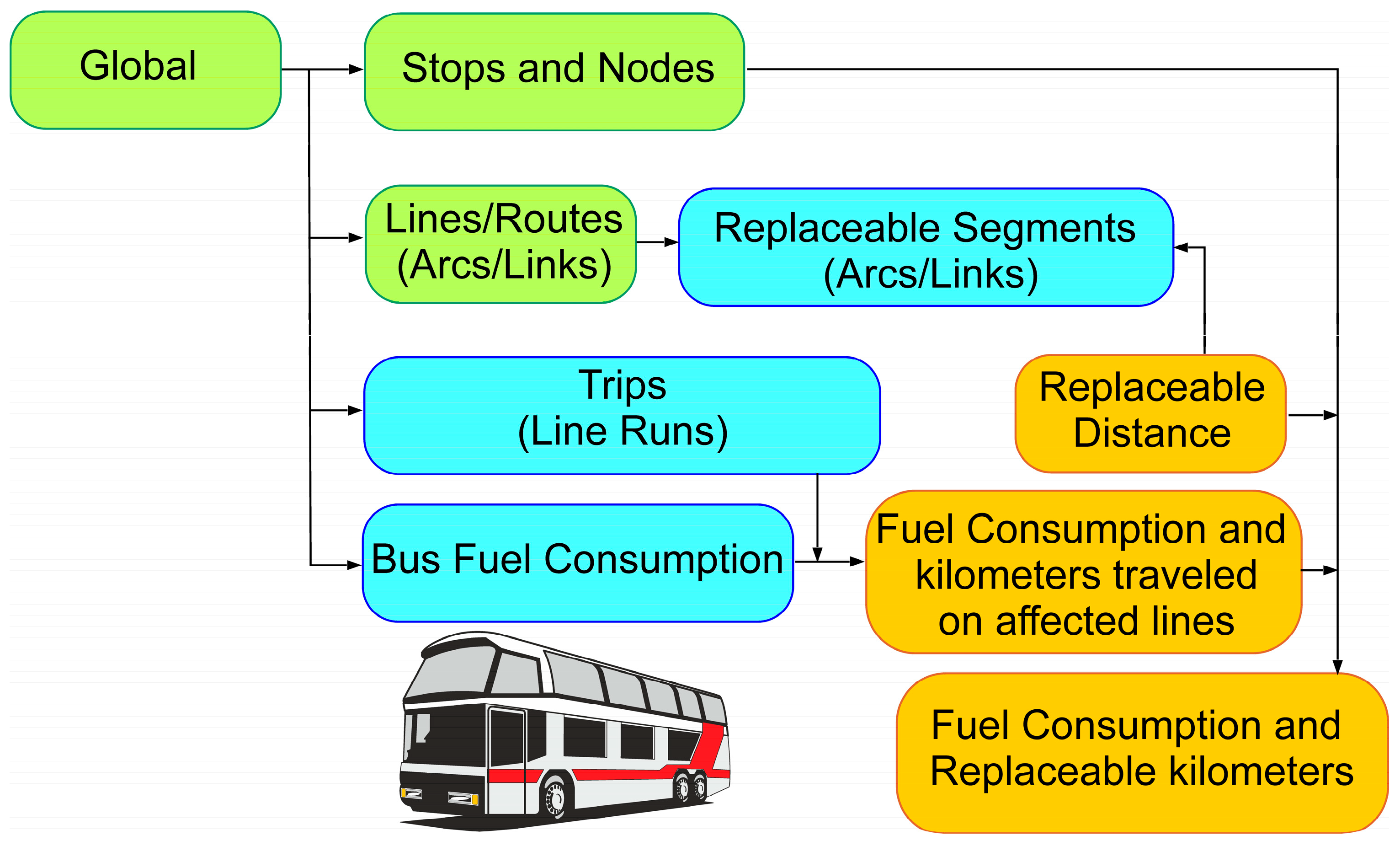
2.1. Methodology for Public Transport Analysis
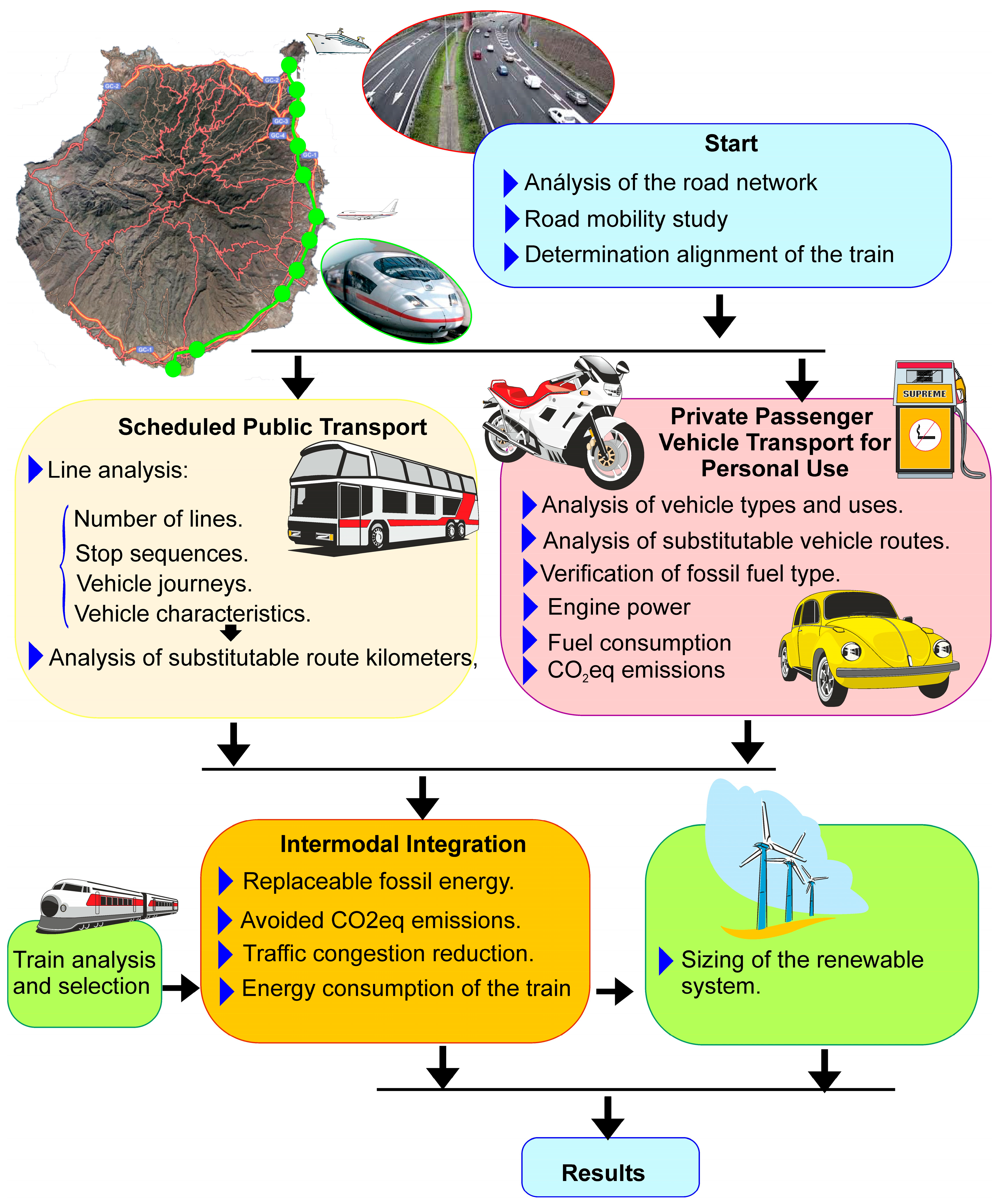
- The existing public transport network within the corridor was identified.
- The segments of each line that may be replaced are delineated [36] based on their geographical overlap with the planned rail route or their proximity to future intermodal stations [37]. This analysis considers reasonable walking distances, typically around 400 m for urban bus stops [38] and up to approximately 800–1000 m for rail stations [39], as reported in various urban mobility studies [39,40].
- The number of passengers and total kilometers traveled along the identified segments are quantified.
- The energy consumption and emissions associated with these segments are calculated to estimate the potential savings if they were to be replaced by the proposed rail system.
- The annual energy consumption of each line is computed as the sum of the energy used by all its trips, distinguishing between trips with known vehicle data and those lacking such information.
- is the estimated energy consumption of expedition (in liters).
- is the kilometers traveled during expedition .
- is the vehicle’s fuel consumption per kilometer.
- ConsEsti is the estimated average consumption per kilometer for line Li.
- E is the set of trips on Li with known vehicle consumption data.
- ∣E∣ is the number of trips in the set E.
2.2. Methodology for Private Transport Analysis
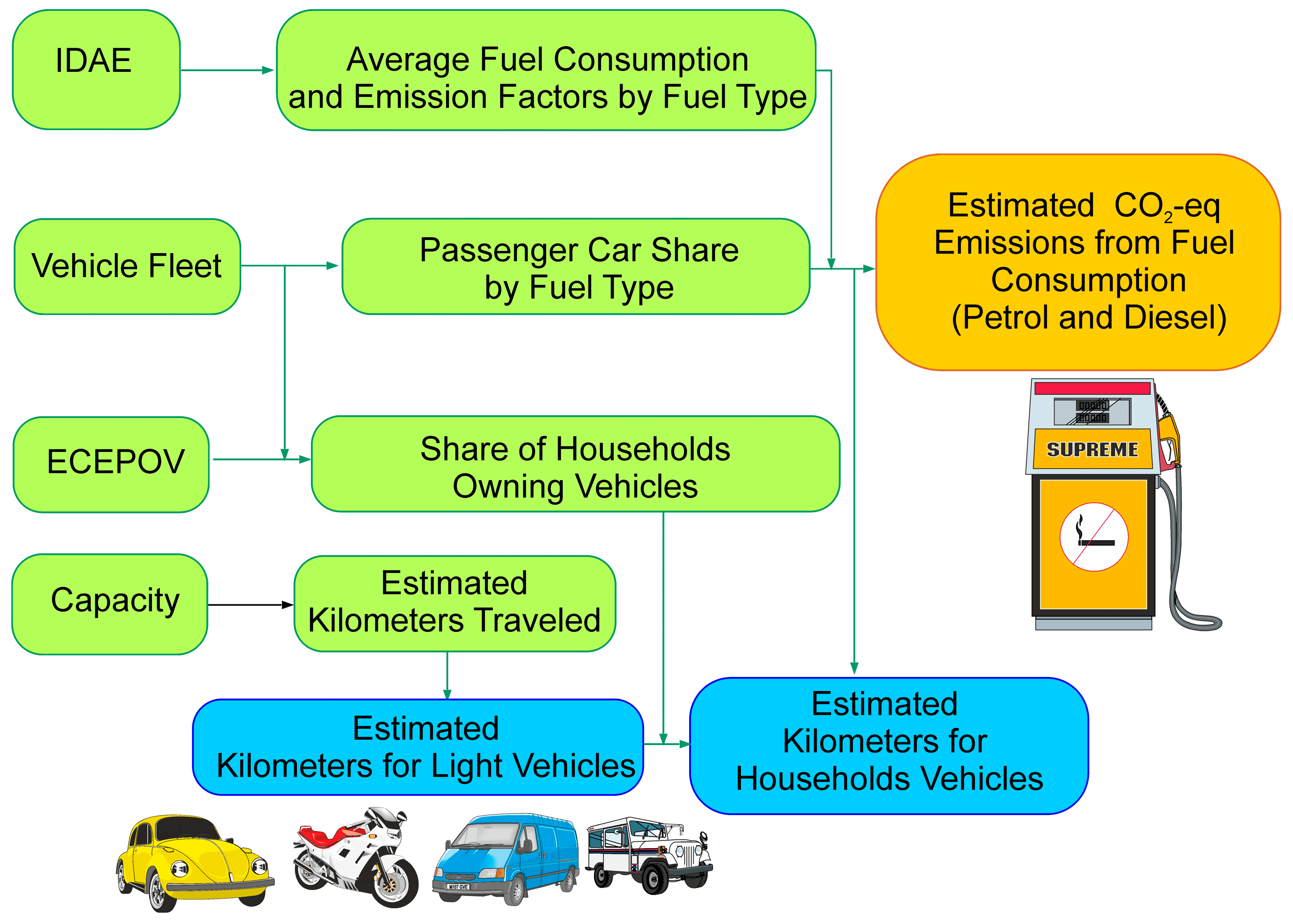
- is the number of private light-duty vehicles of type j and fuel type k at point a.
- is the total number of private vehicles in region R.
- is the total number of light-duty vehicles in region R.
- is the proportion of light-duty vehicles in the total traffic at point a.
- is the average daily traffic volume at point a.
- are the daily kilometers traveled by vehicles of type j and fuel k.
- is the number of vehicles using fuel k.
- Nv is the total number of light vehicles in the region.
- is the average between consecutive traffic count points in the corridor.
- is the average consumption (liters/100 km) of vehicles of type j, fuel k, brand m, and engine capacity c.
- is the number of vehicles of brand m and engine capacity c.
- the annual amount of CO2-eq emitted by vehicles of type j and fuel k.
- is the average emission factor, in kg CO2-eq per 100 km, calculated using Equation (12).
2.3. Integration of Results and Intermodal Analysis
2.4. Sensitivity Analysis
3. Materials
3.1. Public Transport
- Georeferencing of the stop and line system. The stop network (n = 660 unique) and its relation to the intermediate arcs between nodes (n = 4954), corresponding to 153 operational lines, were extracted from the operational database and validated against the layout of the planned railway project.
- The expeditions file containing 377,128 records for the year 2023. It includes information per expedition: line, direction, origin and destination stops, duration, kilometers traveled, commercial speed, vehicle type, seats offered, occupancy, and date. This database enables a dynamic characterization of corridor usage by day of the week and season of the year (school vs. holiday periods). Table 1 shows, as an example, the data in this file for line 055/14.
- The consumption file with technical information on 259 vehicles, including average consumption (l/100 km), engine type and power (302–316 kW), emission category (Euro 6 B, C, or D), passenger capacity (seated and standing), and fuel type (diesel).
3.2. Private Transport
3.3. Energy Consumption and Emissions
- Buses: 5,251,036 L of diesel, which according to PCI represent 202,706 GJ or 53.6 GWh.
- Gasoline light vehicles: 22,998,799.41 L, equivalent to 786,558.94 GJ = 218.49 GWh.
- Diesel light vehicles: 5,449,799.8 L, equivalent to 210,362.27 GJ = 58.43 GWh.
- Gasoline: 2.3 kg CO2/L
- Diesel: 2.6 kg CO2/L
- Road transport: 79.6%
- Passenger cars: 42.5%
- Trucks and light vehicles: 32.3%
- Buses: 3.9%
- and in emissions:
- Buses: The interurban bus fleet consumed 5,251,036 L of diesel on routes substitutable by the train, resulting in emissions of 13,652.69 t CO2-eq/year.
- Gasoline light vehicles: 22,998,799.41 L, representing 53,021.21 t CO2-eq/year.
- Diesel light vehicles: 5,449,799.8 L, representing 14,233.47 t CO2-eq/year.
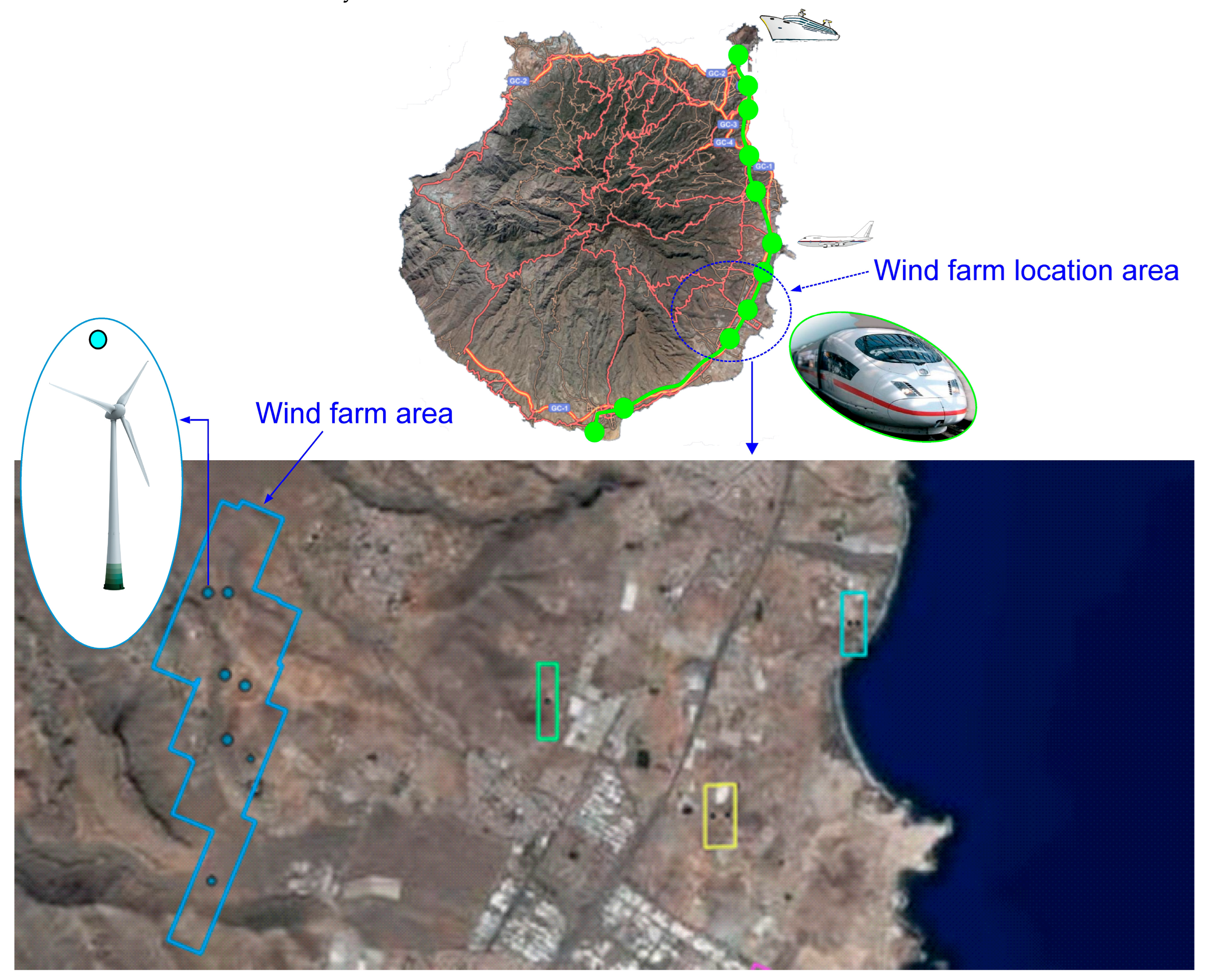
Renewable Energy Resource
3.4. Traffic Congestion
4. Results and Discussion
5. Conclusions
Author Contributions
Funding
Institutional Review Board Statement
Informed Consent Statement
Data Availability Statement
Acknowledgments
Conflicts of Interest
References
- Mugion, R.G.; Toni, M.; Raharjo, H.; Di Pietro, L.; Sebathu, S.P. Does the Service Quality of Urban Public Transport Enhance Sustainable Mobility? J. Clean. Prod. 2018, 174, 1566–1587. [Google Scholar] [CrossRef] [Scilit]
- Guzman, L.A.; Cardona, S.G. Density-Oriented Public Transport Corridors: Decoding Their Influence on BRT Ridership at Station-Level and Time-Slot in Bogotá. Cities 2021, 110, 103071. [Google Scholar] [CrossRef] [Scilit]
- Tayarani, M.; Nadafianshahamabadi, R.; Poorfakhraei, A.; Rowangould, G. Evaluating the Cumulative Impacts of a Long Range Regional Transportation Plan: Particulate Matter Exposure, Greenhouse Gas Emissions, and Transportation System Performance. Transp. Res. Part D Transp. Environ. 2018, 63, 261–275. [Google Scholar] [CrossRef] [Scilit]
- Zhang, R.; Matsushima, K.; Kobayashi, K. Can Land Use Planning Help Mitigate Transport-Related Carbon Emissions? A Case of Changzhou. Land Use Policy 2018, 74, 32–40. [Google Scholar] [CrossRef] [Scilit]
- European Environment Agency Sustainable and Smart Mobility Strategy: Setting European Transport on Track for the Future. Available online: https://eur-lex.europa.eu/legal-content/EN/TXT/?uri=CELEX%3A52020DC0789 (accessed on 10 June 2025).
- Tsigdinos, S.; Nikitas, A.; Bakogiannis, E. Multimodal Corridor Development as a Way of Supporting Sustainable Mobility in Athens. Case Stud. Transp. Policy 2021, 9, 137–148. [Google Scholar] [CrossRef] [Scilit]
- Diao, M. Towards Sustainable Urban Transport in Singapore: Policy Instruments and Mobility Trends. Transp. Policy 2019, 81, 320–330. [Google Scholar] [CrossRef] [Scilit]
- Houston, D.; Boarnet, M.G.; Ferguson, G.; Spears, S. Can Compact Rail Transit Corridors Transform the Automobile City? Planning for More Sustainable Travel in Los Angeles. Urban Stud. 2015, 52, 938–959. [Google Scholar] [CrossRef] [Scilit]
- Du, H.; Chen, Z.; Peng, B.; Southworth, F.; Ma, S.; Wang, Y. What Drives CO2 Emissions from the Transport Sector? A Linkage Analysis. Energy 2019, 175, 195–204. [Google Scholar] [CrossRef] [Scilit]
- Wang, Y.; Guan, Z.; Zhang, Q. Railway Opening and Carbon Emissions in Distressed Areas: Evidence from China’s State-Level Poverty-Stricken Counties. Transp. Policy 2023, 130, 55–67. [Google Scholar] [CrossRef] [Scilit]
- Kougias, I.; Nikitas, A.; Thiel, C.; Szabó, S. Clean Energy and Transport Pathways for Islands: A Stakeholder Analysis Using Q Method. Transp. Res. Part D Transp. Environ. 2020, 78, 102180. [Google Scholar] [CrossRef] [Scilit]
- Cabildo of Gran Canaria. Insular Planning Plan of Gran Canaria. 2023. Available online: https://plan-insular.idegrancanaria.es/ (accessed on 15 September 2025). (In Spanish)
- Canary Islands Statistics Institute (ISTAC). Tourist Accommodation Surveys 2023. Available online: https://www.gobiernodecanarias.org/istac/estadisticas/sectorservicios/hosteleriayturismo/oferta/C00065A.html (accessed on 15 September 2025). (In Spanish)
- Canary Islands Statistics Institute (ISTAC). Regional Accounts of Spain: Harmonised Island Estimates 2021. Available online: https://www3.gobiernodecanarias.org/istac/statistical-visualizer/visualizer/collection.html?resourceType=collection&agencyId=ISTAC&resourceId=E30014B_000001 (accessed on 15 September 2025). (In Spanish)
- Andrés, L.; Padilla, E. Driving Factors of GHG Emissions in the EU Transport Activity. Transp. Policy 2018, 61, 60–74. [Google Scholar] [CrossRef] [Scilit]
- Martín-Cejas, R.R.; Sánchez, P.P.R. Ecological Footprint Analysis of Road Transport Related to Tourism Activity: The Case for Lanzarote Island. Tour. Manag. 2010, 31, 98–103. [Google Scholar] [CrossRef] [Scilit]
- Blasco Hedo, E. Real Decreto 986/2024, de 24 de Septiembre, Por El Que Se Aprueba La Actualización Del Plan Nacional Integrado de Energía y Clima 2023–2030. Actual. Jurídica Ambient. 2024, 149, 225. Available online: https://research.ebsco.com/linkprocessor/plink?id=c9032cf6-92a1-3dc8-b52d-659e9c52bc1e (accessed on 1 October 2025).
- Ullah, S.; Boulanouar, Z.; Meo, M.S.; Ali, K. Navigating Sustainable Mobility: Wavelet Insights into Carbon Emissions in Germany’s Transportation Sector. Transp. Policy 2025, 170, 120–136. [Google Scholar] [CrossRef] [Scilit]
- Bąk, M.; Borkowski, P.; Suchanek, M. Effect of Beliefs and Attitudes on Public Transport Users’ Choices. The Moderating Role of Perceived Intermodal Connectivity. Transp. Policy 2024, 159, 120–129. [Google Scholar] [CrossRef] [Scilit]
- Cabildo of Gran Canaria. Island Strategy for Adaptation to Climate Change and Promotion of the Low-Carbon Economy. 2025. Available online: https://www.energiagrancanaria.com/descargas/estrategia-de-adaptacion-al-cc-gran-canaria-20212709.pdf (accessed on 15 September 2025). (In Spanish)
- Cabildo Insular of Gran Canaria. Railway Infrastructure Project between Las Palmas de Gran Canaria and Maspalomas and Associated Elements. 2025. Available online: https://descargas.grancanaria.com/transportes/ferrocarril_grancanaria/DOCUMENTO%20TECNICO/MEMORIA%20DOCUMENTO%20TECNICO.pdf (accessed on 15 September 2025). (In Spanish)
- Cabildo of Gran Canaria. Database of Capacity, Roads and Public Works. 2023. Available online: https://cabildo.grancanaria.com/area-tematica/carreteras-y-obras-publicas (accessed on 15 September 2025). (In Spanish)
- Maduekwe, M.; Akpan, U.; Isihak, S. Road Transport Energy Consumption and Vehicular Emissions in Lagos, Nigeria: An Application of the LEAP Model. Transp. Res. Interdiscip. Perspect. 2020, 6, 100172. [Google Scholar] [CrossRef] [Scilit]
- Georgatzi, V.V.; Stamboulis, Y.; Vetsikas, A. Examining the Determinants of CO2 Emissions Caused by the Transport Sector: Empirical Evidence from 12 European Countries. Econ. Anal. Policy 2020, 65, 11–20. [Google Scholar] [CrossRef] [Scilit]
- Buehler, R.; Pucher, J.; Gerike, R.; Götschi, T. Reducing Car Dependence in the Heart of Europe: Lessons from Germany, Austria, and Switzerland. Transp. Rev. 2017, 37, 4–28. [Google Scholar] [CrossRef] [Scilit]
- European Parliament and Council of the European Union. Regulation (EU) 2018/841 of the European Parliament and of the Council of 30 May 2018 on the Inclusion of Greenhouse Gas Emissions and Removals from Land Use, Land-Use Change and Forestry in the Climate and Energy Policy Framework to 2030, and Amending Regulation (EU) n.o 525/2013 and Decision n.o 529/2013/EU (OJ L 156, 19.6.2018, pp. 1–25), n.or 2018/841. Available online: https://eur-lex.europa.eu/legal-content/ES/TXT/?uri=CELEX:32018R0841 (accessed on 15 September 2025).
- Kierzkowski, A.; Tubis, A.A. Transportation Systems Modeling, Simulation and Analysis with Reference to Energy Supplying. Energies 2023, 16, 3586. [Google Scholar] [CrossRef] [Scilit]
- Dingil, A.E.; Schweizer, J.; Rupi, F.; Stasiskiene, Z. Updated Models of Passenger Transport Related Energy Consumption of Urban Areas. Sustainability 2019, 11, 4060. [Google Scholar] [CrossRef] [Scilit]
- Cortés, C.E.; Vargas, L.S.; Corvalán, R.M. A Simulation Platform for Computing Energy Consumption and Emissions in Transportation Networks. Transp. Res. Part D Transp. Environ. 2008, 13, 413–427. [Google Scholar] [CrossRef] [Scilit]
- Abdelaty, H.; Mohamed, M. A Framework for BEB Energy Prediction Using Low-Resolution Open-Source Data-Driven Model. Transp. Res. Part D Transp. Environ. 2022, 103, 103170. [Google Scholar] [CrossRef] [Scilit]
- Marique, A.-F.; Reiter, S. A Method for Evaluating Transport Energy Consumption in Suburban Areas. Environ. Impact Assess. Rev. 2012, 33, 1–6. [Google Scholar] [CrossRef] [Scilit]
- Franco, S.; Ravibabu Mandla, V. Analysis of Road Transport Energy Consumption and Emissions: A Case Study. Int. J. Energy Sect. Manag. 2014, 8, 341–355. [Google Scholar] [CrossRef] [Scilit]
- Yin, X.; Chen, W.; Eom, J.; Clarke, L.E.; Kim, S.H.; Patel, P.L.; Yu, S.; Kyle, G.P. China’s Transportation Energy Consumption and CO2 Emissions from a Global Perspective. Energy Policy 2015, 82, 233–248. [Google Scholar] [CrossRef] [Scilit]
- Mishalani, R.G.; Goel, P.K.; Landgraf, A.J.; Westra, A.M.; Zhou, D. Passenger Travel CO2 Emissions in US Urbanized Areas: Multi-Sourced Data, Impacts of Influencing Factors, and Policy Implications. Transp. Policy 2014, 36, 231–241. [Google Scholar] [CrossRef] [Scilit]
- Ortego, A.; Valero, A.; Abadías, A. Environmental Impacts of Promoting New Public Transport Systems in Urban Mobility: A Case Study. J. Sustain. Dev. Energy Water Environ. Syst. 2017, 5, 377–395. [Google Scholar] [CrossRef] [Scilit]
- Guo, Y.; Bigazzi, A.Y.; Chen, X. Potential Greenhouse Gas Emission Reduction from Active Transportation: Comparing Travel Behavior Patterns. Transp. Res. Part D Transp. Environ. 2025, 145, 104835. [Google Scholar] [CrossRef] [Scilit]
- Wakenshaw, G.; Bunn, N. How Far Do People Walk? PTRC Transport Practitioners. 2015. Available online: https://rapleys.com/wp-content/uploads/2020/10/CD3.38-WYG_how-far-do-people-walk.pdf (accessed on 15 September 2025).
- Burke, M.; Brown, A.L. Distances People Walk for Transport. Road Transp. Res. 2007, 16, 16–29. Available online: https://search.informit.org/doi/abs/10.3316/informit.880016006301032 (accessed on 15 September 2025).
- Sarker, R.I.; Mailer, M.; Sikder, S.K. Walking to a Public Transport Station: Empirical Evidence on Willingness and Acceptance in Munich, Germany. Smart Sustain. Built Environ. 2020, 9, 38–53. [Google Scholar] [CrossRef] [Scilit]
- Tennøy, A.; Knapskog, M.; Wolday, F. Walking Distances to Public Transport in Smaller and Larger Norwegian Cities. Transp. Res. Part D Transp. Environ. 2022, 103, 103169. [Google Scholar] [CrossRef] [Scilit]
- Bureau of Public Roads. Traffic Assignment Manual; U.S. Department of Commerce, Urban Planning Division: Washington, DC, USA, 1964; Available online: https://www.google.es/books/edition/Traffic_Assignment_Manual_for_Applicatio/CXMnAQAAMAAJ (accessed on 15 September 2025).
- Patriksson, M. The Traffic Assignment Problem: Models and Methods; Courier Dover Publications: Mineola, NY, USA, 2015; ISBN 978-0-486-78790-9. [Google Scholar]
- Kniz, A.; Kocianova, A. Analysis in the Field of Volume-Delay Function Research. Transp. Res. Procedia 2023, 74, 1022–1029. [Google Scholar] [CrossRef] [Scilit]
- Gadepalli, R.; Bansal, P.; Tiwari, G.; Bolia, N. A Tactical Planning Framework to Integrate Paratransit with Formal Public Transport Systems. Transp. Res. Part D Transp. Environ. 2024, 136, 104438. [Google Scholar] [CrossRef] [Scilit]
- Horowitz, A.J. Delay-Volume Relations for Travel Forecasting: Based on the 1985 Highway Capacity Manual; US Department of Transportation, Federal Highway Administration USA: Washington, DC, USA, 1991; Available online: https://ajhassoc.com/wp-content/uploads/2020/11/SpeedVolume1985HCMReport.pdf (accessed on 15 September 2025).
- Real Decreto-Ley 8/2023, of 27 December Adopting Measures to Address the Economic and Social Consequences Arising from the Conflicts in Ukraine and the Middle East, as Well as to Alleviate the Effects of the Drought. 2023. Available online: https://www.boe.es/diario_boe/txt.php?id=BOE-A-2023-26452 (accessed on 15 September 2025). (In Spanish)
- Institute for Energy Diversification and Saving, IDAE. CO2 Emission Factors and Energy Consumption of the Transport Sector in Spain; Institute for Energy Diversification and Saving, IDAE: Madrid, Spain; Available online: https://coches.idae.es/historico-emisiones-consumos (accessed on 15 September 2025). (In Spanish)
- IPCC Intergovernmental Panel on Climate Change 2025. Available online: https://archive.ipcc.ch/home_languages_main_spanish.shtml (accessed on 15 September 2025). (In Spanish)
- El-Geneidy, A.; Grimsrud, M.; Wasfi, R.; Tétreault, P.; Surprenant-Legault, J. New Evidence on Walking Distances to Transit Stops: Identifying Redundancies and Gaps Using Variable Service Areas. Transportation 2014, 41, 193–210. [Google Scholar] [CrossRef] [Scilit]
- IDAE. Summary Report on Energy Efficiency Indicators in Spain. 2022. Available online: https://www.idae.es/sites/default/files/estudios_informes_y_estadisticas/Ficha_sintesis_EE_2022_041024_OK_accesib.pdf (accessed on 15 September 2025). (In Spanish)
- Government of the Canary Islands. Canary Islands Energy Transition Plan(PTECan-2030). 2023. Available online: https://www.gobiernodecanarias.org/energia/info-publica/PTECan_VersionInicial (accessed on 15 September 2025). (In Spanish)
- Government of the Canary Islands. Canary Islands Energy Transition Plan(PTECan-2030). Annex. Plans. 2023. Available online: https://www.gobiernodecanarias.org/energia/descargas/SDE/Portal/PTECan2030_VI/3-AnexosPlanosDINA1_PTECan_diligenciado.pdf (accessed on 15 September 2025). (In Spanish)




| Line | 055/014 |
|---|---|
| Start year | 2023 |
| Direction | IDA |
| Number of expeditions | 767 |
| Kilometers | 10,254.79 |
| Consumption | 4945.72 |
| Average consumption | 0.48 |
| Km of route | 13.37 |
| Non-substitutable travel | 2.87 |
| Replaceable travel | 10.50 |
| % Non-substitutable | 21.47% |
| % replaceable | 78.53% |
| Replaceable consumption | 3884.07 |
| Replaceable kilometers | 8053.50 |
| Total | Petrol (Except Hybrids) | Diesel (Except Hybrids) | Alternative Energy (*) | Electricity | |
|---|---|---|---|---|---|
| TOTAL | 711,572 | 464,787 | 216,903 | 29,882 | 5624 |
| Moped | 22,872 | 21,131 | 1445 | 296 | 296 |
| Car | 688,700 | 443,656 | 215,458 | 29,586 | 5328 |
| Motorcycle | 68,732 | 67,976 | 76 | 680 | 654 |
| Tourism | 479,090 | 358,406 | 93,460 | 27,224 | 4309 |
| Bus | 2788 | 20 | 2744 | 24 | 5 |
| Van | 31,045 | 5222 | 25,420 | 403 | 227 |
| All-terrain | 19,298 | 4068 | 14,372 | 858 | 0 |
| Truck | 31,323 | 1277 | 29,978 | 68 | 20 |
| Adaptable mixed vehicle | 48,847 | 6492 | 42,031 | 324 | 113 |
| Tractor | 2211 | 0 | 2211 | 0 | 0 |
| Motorhome | 5366 | 195 | 5166 | 5 | 0 |
| Station Code | New Code | PK (km) | Station Location | ADT (Vehicles/Day) |
|---|---|---|---|---|
| 001-02,3-C | 2.25 | La Laja | 87,106 | |
| 001-03,5-C | 3.475 | Potabilization Machine | 77,128 | |
| 574 | 001-06,8-C | 6.804 | El Cortijo | 162,993 |
| 93 | 001-18,3-C | 18.29 | Las Puntillas | 111,967 |
| 94 | 001-20,0-C | 19.95 | Carrizal | 99,498 |
| 532 | 001-37,4-C | 37.35 | Tarajalillo | 78,080 |
| 533 | 001-37,8-C | 37.865 | Bahía Feliz | 74,059 |
| 534 | 001-43,1-C | 43.095 | Playa del Inglés | 61,079 |
| 535 | 001-46,6-C | 46.635 | Tablero Maspalomas | 46,005 |
| Total | Less than 1000 | From 1000 to 1199 | From 1200 to 1399 | From 1400 to 1599 | From 1600 to 1999 | 2000 or More | |
|---|---|---|---|---|---|---|---|
| Petrol (except hybrids) | 358,406 | 71,649 | 66,519 | 111,230 | 62,621 | 31,820 | 14,567 |
| VOLKSWAGEN | 45,149 | 15,432 | 7122 | 12,338 | 6801 | 3327 | 129 |
| TOYOTA | 35,305 | 3167 | 877 | 19,647 | 7737 | 3634 | 243 |
| SEAT | 32,341 | 11,669 | 4174 | 10,277 | 5550 | 661 | 10 |
| OPEL | 31,875 | 1437 | 7862 | 16,064 | 4684 | 1635 | 193 |
| RENAULT | 31,533 | 6741 | 12,275 | 7112 | 3547 | 1811 | 47 |
| (…) | |||||||
| Diesel (except hybrids) | 93,460 | 109 | 304 | 5674 | 35,380 | 34,047 | 17,946 |
| RENAULT | 11,877 | 0 | 149 | 8 | 9182 | 2419 | 119 |
| MERCEDES-BENZ | 9037 | 9 | 4 | 3 | 594 | 1596 | 6831 |
| VOLKSWAGEN | 6661 | 1 | 56 | 7 | 1509 | 4577 | 511 |
| NISSAN | 6306 | 0 | 3 | 3 | 4479 | 766 | 1055 |
| PEUGEOT | 6085 | 9 | 6 | 960 | 3629 | 1153 | 328 |
| (…) |
| Capacity in the GC-1Average Daily Vehicle Intensity (ADT) | |||||
|---|---|---|---|---|---|
| La Laja | El Cortijo | Las Puntillas | Playa del Inglés | ||
| Distribution of capacity according to the distribution of the vehicle fleet | |||||
| MOTOR VEHICLES | 87,106 | 162,993 | 111,967 | 61,079 | |
| LIGHT | a | 78,369 | 148,712 | 100,736 | 54,952 |
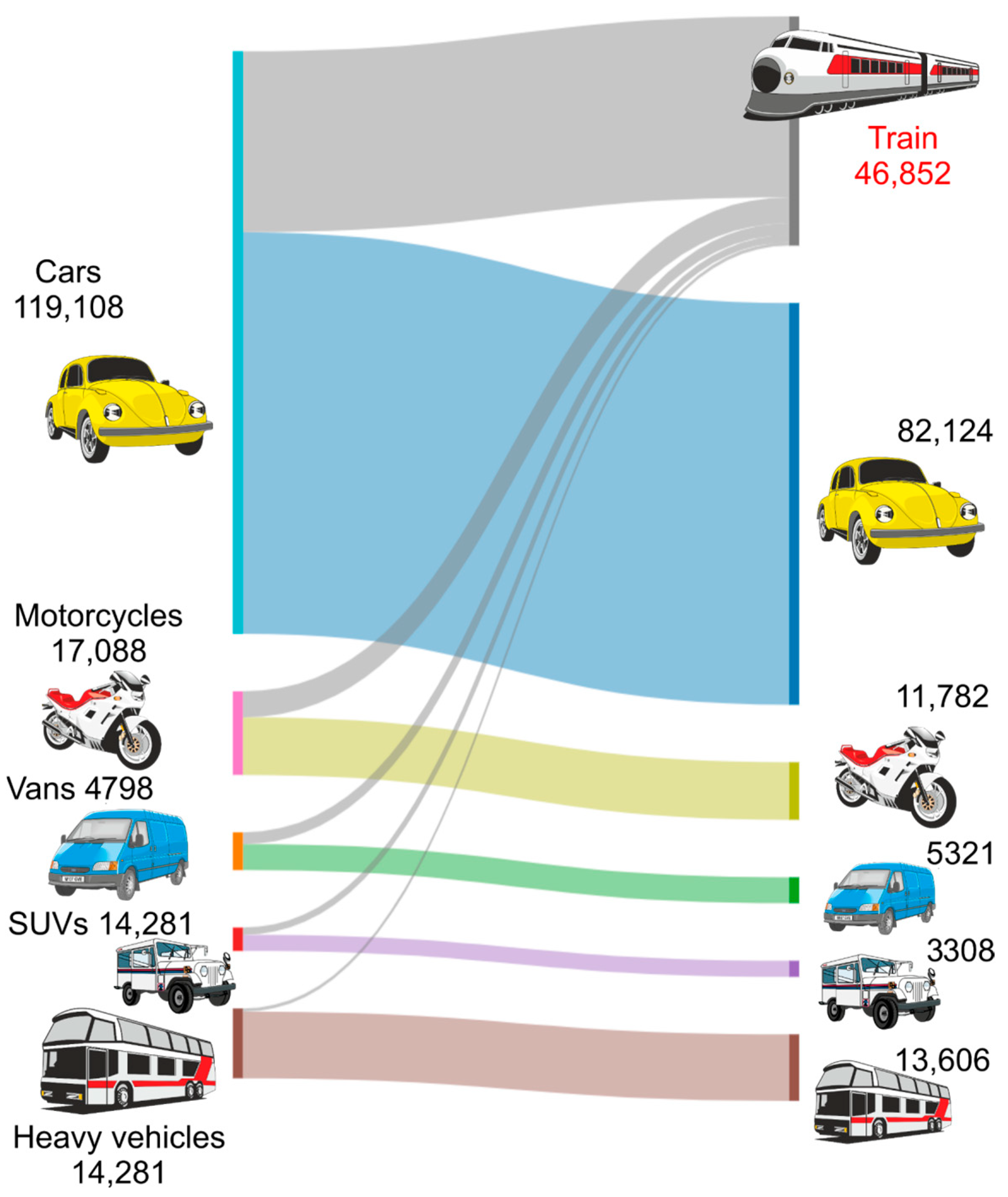
| Motorcycles | c | 9005 | 17,088 | 11,575 | 6314 |
| Cars | c | 62,768 | 119,108 | 80,683 | 44,013 |
| Vans | c | 4067 | 7718 | 5228 | 2852 |
| All-terrain vehicles | c | 2528 | 4798 | 3250 | 1773 |
| HEAVY | b | 8737 | 14,281 | 11,231 | 6127 |
| Distribution of the estimated capacity of replaceable vehicles (light homes and public transport buses) | |||||
| MOTOR VEHICLES | 58,694 | 110,620 | 74,938 | 41,057 | |
| LIGHT | d | 57,939 | 109,945 | 74,476 | 40,627 |
| Motorcycles | f | 6657 | 12,633 | 8558 | 4668 |
| Cars | f | 46,405 | 88,059 | 59,650 | 32,539 |
| Vans | f | 3007 | 5706 | 3865 | 2109 |
| Vans | f | 1869 | 3547 | 2403 | 1311 |
| HEAVY (BUSES) | e | 755 | 675 | 462 | 430 |
| Year 2023 | |
|---|---|
| Initial results: | |
| Expeditions carried out | 336,435 |
| Distance traveled (km) | 14,365,182 |
| Total diesel consumption (liters) | 6,915,044 |
| Average consumption (l/km) | 0.48 |
| Passengers carried | 20,073,462 |
| Final results: | |
| Replaceable distance (km) | 10,952,693 |
| Replaceable diesel consumption (liters) | 5,251,036 |
| Substitutable Power (GJ) | 202,706 |
| Substitutable Energy (GWh) | 56.3 |
| Avoidable emissions (t CO2-eq/year) | 13,652.69 |
| Year 2023 | |||
|---|---|---|---|
| Petrol | Diesel | Total | |
| Current scenario: | |||
| Distance traveled (km) | 2,527,619.45 | 659,116.52 | |
| Average consumption [IDAE] (l/100 km) | 5.94 | 5.39 | |
| Average emissions [IDAE] (g/km CO2-eq) | 136.84 | 140.87 | |
| Fuel consumed [IDAE] (liters) | 54,759,046.21 | 12,976,035.18 | |
| Emissions [IDAE] (t/year CO2-eq) | 126,241.42 | 33,889.23 | 160,130.65 |
| Emissions [emission factor] (t/year CO2-eq) | 127,064.19 | 33,737.69 | 160,801.88 |
| Energy consumed (GJ) | 1,872,759.39 | 500,875.00 | 2,373,634.39 |
| Energy consumed (GWh) | 520.21 | 139.03 | 659.24 |
| Scenario with rail transport: | |||
| Replaceable consumption (liters) | 22,998,799.41 | 5,449,799.80 | |
| Substitutable Power (GJ) | 786,558.94 | 210,362.27 | 996,921.21 |
| Substitutable Energy (GWh) | 218.49 | 58.43 | 276.92 |
| Emission reduction (t CO2-eq/year) | 53,021.21 | 14,233.47 | 67,254.68 |
| Scenario | s | o | F | Congestion Reduction (%) | Avoided Emissions (t CO2-eq/year) | Avoided Energy (GWh/year) |
|---|---|---|---|---|---|---|
| Conservative low | 0.40 | 1.60 | 0.583 | 24.5 | 52,885 | 217.84 |
| Moderate low | 0.50 | 1.50 | 0.778 | 32.7 | 65,962 | 271.68 |
| Baseline (central) | 0.60 | 1.40 | 1.000 | 42.0 | 80,907 | 333.22 |
| High | 0.70 | 1.30 | 1.256 | 52.8 | 98,152 | 404.23 |
| Worst-case (high occ.) | 0.40 | 1.70 | 0.549 | 23.1 | 50,577 | 208.33 |
| Low occupancy | 0.60 | 1.20 | 1.167 | 49.0 | 92,116 | 379.37 |
Disclaimer/Publisher’s Note: The statements, opinions and data contained in all publications are solely those of the individual author(s) and contributor(s) and not of MDPI and/or the editor(s). MDPI and/or the editor(s) disclaim responsibility for any injury to people or property resulting from any ideas, methods, instructions or products referred to in the content. |
© 2025 by the authors. Licensee MDPI, Basel, Switzerland. This article is an open access article distributed under the terms and conditions of the Creative Commons Attribution (CC BY) license (https://creativecommons.org/licenses/by/4.0/).
Share and Cite
Martínez, W.B.; Carta, J.A.; Lozano-Medina, A. Decarbonizing Island Mobility: Energy and Environmental Benefits of Rail Transport in Gran Canaria. Sustainability 2025, 17, 9518. https://doi.org/10.3390/su17219518
Martínez WB, Carta JA, Lozano-Medina A. Decarbonizing Island Mobility: Energy and Environmental Benefits of Rail Transport in Gran Canaria. Sustainability. 2025; 17(21):9518. https://doi.org/10.3390/su17219518
Chicago/Turabian StyleMartínez, Wenceslao Berriel, José Antonio Carta, and Alexis Lozano-Medina. 2025. "Decarbonizing Island Mobility: Energy and Environmental Benefits of Rail Transport in Gran Canaria" Sustainability 17, no. 21: 9518. https://doi.org/10.3390/su17219518
APA StyleMartínez, W. B., Carta, J. A., & Lozano-Medina, A. (2025). Decarbonizing Island Mobility: Energy and Environmental Benefits of Rail Transport in Gran Canaria. Sustainability, 17(21), 9518. https://doi.org/10.3390/su17219518