


Abstract
This study reviews life cycle assessments (LCAs) of reprocessed single-use devices (rSUDs) in healthcare to quantify their greenhouse gas (GHG) emission reductions compared to original equipment manufacturer (OEM) SUDs (single-use devices). rSUDs offer notable reductions in solid waste generation, but, until recently, a reduction in greenhouse gases and other emissions from the reprocessing process was only hypothesized. Emerging LCAs in this space can help validate the assumptions of better environmental performance from greater circularity in the medical device industry. Four LCAs analyzing eight devices found consistent and significant GHG reductions ranging from 23% to 60% with rSUD use. Primary data from rSUD manufacturers were utilized in all studies, with SimaPro v9.3.0.2 and Ecoinvent v3.8 being the predominant LCA software and database. Raw material extraction and production dominated SUD emissions, while electricity use and packaging materials were key contributors for rSUDs. Sensitivity analyses highlighted the influence of electricity sources, collection rates, and reprocessing yields on rSUD environmental performance. A comparison with economic input–output-based models revealed an alignment at the time between price differentials and LCA-derived GHG differences, though this may not always hold true. This review demonstrates the substantial environmental benefits of rSUDs, supporting their role as a readily achievable step towards more sustainable and circular healthcare systems.
1. Introduction
The healthcare sector, while essential for human well-being, bears a substantial environmental footprint—nearly 5% of global greenhouse gases and 8.5% of the US’s emissions [1,2]. It is a resource-intensive industry, consuming vast amounts of energy [3], water, and raw materials [4]. As the global community grapples with the urgent need to decarbonize and transition towards sustainable practices, the healthcare sector is under increasing pressure to find innovative solutions that promote circularity and reduce its ecological impact.
Over 70% of a hospital or health system’s greenhouse gas (GHG) emissions occur from indirect sources or “Scope 3” [5], mainly from procurement and supply chain. Previous studies have found that some clinical spaces, like operating rooms, generate nearly 80% of their GHGs from single-use devices (SUDs), such as personal protective equipment, draping, supplies, and tools [6].
New initiatives are emerging to encourage and support healthcare’s transition to more sustainable practices. In the UK, the National Health Service (NHS) has announced a decarbonization plan called the Design for Life Roadmap that aims to drastically reduce the number of single-use devices, decrease their reliance on foreign imports, and adopt circular healthcare delivery by 2045 [7]. In the United States, about 15% of hospitals signed on to a voluntary pledge issued by the Biden Administration’s White House Office of Climate Change and Health Equity (OCCHE). Signatories committed to reducing their direct (or Scope 1 and 2) emissions 50% by 2030 and estimate and plan a pathway to reductions in their indirect (or Scope 3) emissions [8]. Most health systems signing on to the OCCHE pledge are encouraged to track these GHGs using a Scope 3 Emissions Calculator developed by the organization Practice Greenhealth [9], which utilizes characterization factors from the 2018 US Environmentally Extended Input–Output LCA (EEIO LCA) model or the IO model. These financial models provide some information on environmental impact, where a process-based life cycle assessment approach would be prohibitively time-consuming, costly, and data-limited. However, financial models may not give healthcare systems granular enough data to make optimal procurement decisions for individual products and devices.
Within this context, the reprocessing of single-use devices (SUDs) has emerged as a promising approach for decreasing the emissions of the healthcare sector and taking initial steps into increased circularity. SUD reprocessing is a remanufacturing process where a third party collects used SUDs from medical facilities, diverting them from waste streams such as landfilling or incineration. These are then transported to a central facility, decontaminated, remanufactured, sterilized (if sterilization is required for the product), and sold to hospitals and health systems for continued use. This process has been in existence for several decades, and the US Food and Drug Administration (FDA) regulates this industry to ensure safety and effectiveness. Third-party reprocessors must receive FDA approval (or a CE or “European Conformity” Mark in the European Union) for every SUD they reprocess, and the number of “turns” or reuses is dictated by this approval. The number of reuses per device typically ranges between one and seven reuses before their ultimate disposal or end of life (EOL). Reprocessed SUDs, often referred to as rSUDs, undergo rigorous testing and have been proven safe and effective, meeting the same regulatory standards as their original counterparts [10,11,12,13]. Previous studies have found that rSUDs can outperform SUDs in terms of the failure rate because every single rSUD is tested for performance, whereas SUDs from the original equipment manufacturers (OEMs) undergo batch testing [14].
While the waste reduction benefits of reprocessing are evident, the broader environmental impact, such as GHG emissions, remains less clear. In recent years, there has been a surge in life cycle assessment (LCA) studies within the healthcare sector, from about 50 healthcare-based LCA studies in 2015 to over 350 in just 10 years [15]. These studies, which analyzed the environmental impact of medical products and care pathways throughout their entire lifespan, have begun to shed light on the emissions profile of rSUDs compared to the SUDs made by the OEMs. Despite the growth, there have been only a few literature reviews of LCAs in the healthcare sector, largely in ophthalmology [16,17,18,19], due to the wide breadth of medical fields included in LCA studies [20,21,22,23,24,25].
This article aims to summarize the growing body of process-based LCA literature focused on the GHGs and other environmental emissions of rSUDs. By synthesizing the findings of these studies, we seek to provide a clearer picture of the environmental benefits associated with third-party reprocessing compared to the OEM SUD, using a process-based LCA approach. We also seek to compare how these process-based results would compare to the EEIO LCA approaches currently used by most healthcare systems analyzing their GHG inventory. We hope this article will aid healthcare decision-makers, policymakers, and sustainability advocates in their efforts to drive a more sustainable and circular healthcare system.
2. Materials and Methods
Using a narrative literature review approach, we identified relevant studies through multiple pathways. First, we conducted a thorough review of the open-source aggregator, https://healthcarelca.com, which compiles published health sector LCAs [15,26]. Next, we conducted standard literature searches through libraries and databases, including Google Scholar, Scopus, and PubMed. Finally, we created automated alerts through Google Scholar to notify us of any new publications related to healthcare LCAs. Some of the included studies were white papers or reports released directly by reprocessing companies, following a commissioned ISO-14040/ISO-14067-compliant LCA [27]. The literature search included all English-language publications from any date, with the search concluding in October 2024.
2.1. Keywords
The following combinations of terms and keywords were used in the searches, with one term from this list:
- Life Cycle Assessment/Life Cycle Analysis/ISO14040 [27]/ISO14044 [28];
- Carbon Footprint/Greenhouse Gases/ISO14067 [29];
- Environmental Impact/Environmental Emissions.
AND one term from this list:
- Single-Use Device (SUD);
- Reprocess(ed/ing)/Reprocessed Single-Use Device (rSUD);
- Original Equipment Manufacturer (OEM);
- Medical Supplies/Medical Devices.
2.2. Inclusion and Exclusion Criteria
All studies were reviewed by at least one member of the study team for their eligibility. Conflicts were resolved by committee with the entire study team. Studies were included in the analysis if they met the following criteria:
- rSUD Definition: The study must be focused on rSUDs reprocessed in a third-party facility, and NOT within a hospital or healthcare system (sometimes called “central sterile”). This was because in-hospital reprocessing of SUDs lacks consistency between facilities (unlike a centralized, FDA-approved reprocessing facility serving multiple hospitals) and may actually be illegal in certain jurisdictions. We also excluded evaluations of temporary or emergency reprocessing conducted during the COVID-19 pandemic (i.e., masks and personal protective equipment) as the market was short-lived, and reprocessing these supplies is no longer commonly practiced.
- Peer-Reviewed: The LCA had to undergo a rigorous academic peer-review process or an ISO 14040-compliant expert review panel. We wanted public-facing studies that had gone through some formal scientific review and validation process, particularly given the data needs of most LCAs and the limited methods reporting in most journal articles. A peer-reviewed process helps ensure that the background data has been vetted by knowledgeable scientists, especially for industry reports.
- Comparison: The LCA directly compared the environmental impact of a reprocessed SUD (rSUD) to its original equipment counterpart. Given the variance in methodologies between studies and the increasing prevalence of LCAs on SUDs alone, we wanted studies that explicitly compared SUDs to rSUDs.
- Scope: The LCA included the full life cycle of both the rSUD and the original SUD, encompassing raw material extraction, manufacturing, transportation, use, and disposal. Studies analyzing partial or incomplete life cycles may be difficult to compare to other studies with more components included. (Of note, we did not find any partial studies of rSUDs.)
- Transparency: The LCA provided transparent data on greenhouse gas emissions (kg CO2e) for both the rSUD and the original SUD. Studies should list numbers for results and clearly state methods and assumptions to ease comparison across studies.
Studies were excluded if they analyzed only those SUDs reprocessed by health systems directly. Studies were also excluded if the methods and peer-review process were not expansive enough to provide context for the results.
2.3. Data Extraction
For each included LCA, the following data were extracted:
- Device Type: The specific type of rSUD and its corresponding original SUD.
- Process Steps: We noted whether all steps of an rSUD life cycle were included in the study, including logistics, reprocessing steps, sterilization, and loss rates.
- Allocation Approach: The rSUD cannot be created without an SUD from the OEM. This type of circularity requires a modeling approach in order to allocate the emissions from the systems. We recorded the approach used in each study.
- LCIA Approach: Life Cycle Impact Assessment methods can affect the results, though perhaps less so with GHG emissions exclusively. We noted the type of LCIA used for each study.
- Greenhouse Gas Emissions: The reported greenhouse gas emissions (in kg CO2e) for both the rSUD and the original SUD.
- Emissions Reduction Percentage: The calculated percentage reduction in greenhouse gas emissions achieved by using the rSUD compared to the original SUD.
- Additional Emissions: We noted which other environmental impacts were included in the study results and summarized, where applicable.
- Data Quality: As noted in the LCA report itself. This may include the prevalence of primary vs. secondary data, the geographic and temporal accuracy of the LCA model data compared to the foreground system being modeled, and general comprehensiveness of the collected data.
- Additional Analyses: We noted if additional analyses were employed, such as material flow or other circularity assessments, sensitivity analyses, and uncertainty analyses.
2.4. Data Analysis
The extracted data on GHGs from SUDs and rSUDs were categorized based on the type of SUD into one of three groups: cardiovascular or electrophysiology (EP) catheter; surgical or operating room (OR) Devices, and non-invasive or patient care devices. Within each category, the average percentage reduction in greenhouse gas emissions was calculated, weighting each study equally. A weighted average emission reduction was then calculated for all rSUDs, taking into account the relative volume share of each SUD type. We also similarly summarized emissions from other environmental impact categories, where studies reported them.
2.5. Secondary Analysis Comparing Process LCA Results to EEIO Results
The Practice Greenhealth Scope 3 Emissions Calculator tool uses the US EEIO LCA model to estimate the emissions associated with hospital supply chains [9]. This method has some well-documented limitations, particularly when assessing product-level GHG and environmental emissions [30,31,32]. Particularly in healthcare, where there are limited and highly aggregated IO economic sectors, combined with complicated and unclear billing structures, financial-based modeling may present conflicting information to hospital managers who are using Scope 3 emissions data to make detailed procurement decisions and track annual reductions.
Here, we sought to test if the current price difference between OEM and rSUDs, modeled through the US EEIO LCA approach [33], would accurately map to the difference in GHGs, as estimated through the process-based LCAs in the literature. For the price difference between the rSUD and SUD, we utilized data from the members of the Association of Medical Device Reprocessing (AMDR). Members are to report cost savings associated with reprocessing either as the difference between the average list price and the reprocessing cost or the actual cost to the hospital (if they share such information) as compared to the reprocessing cost [34], shown in Table 1. The reprocessing market has been dynamic, but historically, rSUDs could be purchased by a hospital at 30–50% less than the OEM.
Table 1.
Reported financial savings with rSUD (reprocessed single-use device) over SUD, as reported by AMDR (Association of Medical Device Reprocessing) members.
The North American Industry Classification System (NAICS) sector code assigned to both SUDs and rSUDs in the Practice Greenhealth tool is 339112: Surgical and Medical Instrument Manufacturing. The US EEIO LCA model and Practice Greenhealth use a GHG characterization factor of 0.208 kg CO2e/2018 USD [9,33]. As the Practice Greenhealth model does not yet adjust for inflation or deflation over time, we did not adjust for inflation or deflation in our study. We compared this value and modified the potential price difference between the OEM and rSUD to show how that shifts the IO model relationship to the process LCA. The GHG emissions per device from the process models were taken as the average of all devices in the included studies (3.69 kg CO2e for SUDs and 2.15 kg CO2e for rSUDs). For the comparison, we assumed a procurement of 100,000 devices.
3. Results
3.1. Summary of GHGs from Process-Based LCAs for rSUDs
Our search revealed six studies that comparatively quantified the GHGs from third-party reprocessed SUDs and rSUDs. Two studies were excluded for failing to meet the inclusion criteria. One study was excluded after confirming with the authors that the reprocessing was performed “in house” in a hospital (sometimes referred to as “central sterile department”) rather than through an off-site regulated third-party reprocessor [35]. The second study was excluded as it was a Master’s degree thesis, only reviewed by the thesis committee, and it did not have sufficient methodological detail to explain the results. Though the results showed similar percent reduction in GHGs between the SUD and rSUD, the absolute values of GHGs were an order of magnitude higher than all other included studies. The methodological description and results sections could not explain why this was the case [36].
The four included studies analyzed eight different products: three electrophysiology catheters [37,38], three OR devices (ultrasonic shears, bipolar electrosurgical device, and a tissue removal device), and two patient care devices (compression sleeves and pulse oximeters) [39]. One study was a company white paper produced after a commissioned ISO-14067-certified carbon footprint, reporting on five separate devices [40]. This represents a small sampling of the total number of devices that can be reprocessed but reflects each of the major device categories where rSUDs are available.
All studies reported consistent and significant reductions in GHGs associated with the use of rSUDs compared to their OEM SUD counterparts. Across all device types, the reduction in GHGs for rSUDs ranged from 23% to 60%, with specific reductions varying depending on the device category, as shown in Table 2. This demonstrates that rSUDs offer a substantial climate change benefit compared to the use of new SUDs.
Table 2.
Summary of literature GHGs results by SUD category.
All four studies utilized primary data from rSUD manufacturers, though two out of the four (representing six out of the eight devices included) were funded by rSUD manufacturers. One study (one device) utilized GaBi v9.5.2.49 software and life cycle inventory databases (now called Sphera). One study (one device) utilized OpenLCA v1.10.3 with Ecoinvent v3.8. The remaining studies and devices all utilized SimaPro v9.3.0.2 with Ecoinvent v3.8, as shown in Table 3. The use phase was excluded from six device studies, under the assumption the rSUD and SUD would consume the same resources and emit the same GHGs under use. All studies accounted for the loss of SUDs during the rSUD process, as not all collected devices can be reprocessed. Six of the device studies listed ethylene oxide (ETO) sterilization, while two others listed hydrogen peroxide (H2O2) and a combination of ETO and carbon dioxide. One study reported no sterilization for the OEM SUD [39]; all other reported similar sterilization methods for both the SUD and rSUD. All studies utilized midpoint LCIA categories, with one study (five devices) using the IPCC 2021 GWP100 approach, two using Environmental Footprint 3.0 (one of these also used ReCiPe 2008, EBP, and CML), and one using guidance from the NHS. Two studies (six devices) conducted sensitivity analyses. These included tests on the allocation approach for the use of the OEM in the rSUD (which made no substantial difference to results and conclusions of the study), transportation modes and distances utilized by the rSUD system, grid mixes, reprocessing yield rates, and the use of ETO.
Table 3.
Included study details; ETO = ethylene oxide, H2O2 = hydrogen peroxide. * No study specified whether they were attributional or consequential, but the methods appeared to be attributional.
All studies report that the major source of GHGs in the SUD system is the extraction and production of raw materials. For rSUDs, major contributors to GHGs included electricity use in the reprocessing process and packaging materials. Waste treatment from the reprocessing facility was another noted component of the system, made more significant if reprocessing yields—that is, the amount of harvested SUDs that could be effectively reprocessed—varied [37,40]. Meister et al. found that rSUD EP catheters outperformed SUDs by 66% if a 0% rejection rate of incoming SUDs was achieved, but the rSUD’s performance dropped to just a 23% reduction in GHGs with a 70% rejection rate [37]. Ethylene oxide sterilization was found to have minimal impact on GHGs but significantly contributed to other environmental emissions, such as carcinogenic and non-carcinogenic human health impacts [39].
Sensitivity analyses showed electricity sources could substantially reduce the GHGs from the rSUD process, as could improvements to SUD collection and rejection rates for the rSUD process. Increasing the number of “turns” or reuses of the rSUD will also have favorable effects on environmental emissions. The effects of transportation between the medical facility and the rSUD facility had a mixed effect on rSUDs’ GHG emissions but did not alter the overall conclusion that rSUDs were preferable to OEM SUDs. The effects of transportation seemed to be more pronounced for European locations [37]. For US-based locations, at least, this may suggest that concerns over distances between hospitals and reprocessors may be overstated.
3.2. Other Environmental Emissions and Impact Categories
Schulte et al. found that rSUDs (EP catheters) performed better (at least 20% reduction, up to 89.7% reduction in ozone depletion) in 13 out of 16 impact categories [38]. rSUDs emitted more in the categories of freshwater eutrophication (15.2%) and land use (25.1%). There was no significant difference between SUDs and rSUDs in the water scarcity category [38]. Schulte et al. note that the cause of higher impacts of rSUDs may be due to disinfectants and cleaning agents (noting citric acid specifically) used in the process; they also note that they have less data and information on the OEM assembly process and thus may be underestimating OEM SUD emissions [38]. Lichtnegger et al. found reduced environmental impact from rSUDs compared to OEM devices in all 16 environmental impact categories analyzed, with reductions ranging from −19% (land use) to −72.1% (ozone depletion) [39]. The remaining two studies, representing six devices, reported only GHGs [37,40].
One study also reported on costs and waste generation, showing that the rSUD (IPC Sleeves) saved USD 89.15 per sleeve (savings ranging between USD 4.47 and USD 252.18) and prevented 2.1 kg of waste during production/manufacturing and 11.4 kg of waste in the hospital [39].
3.3. Comparison to IO Models
Existing EEIO or IO models are inadequate for accurately representing the GHG emissions of either an SUD, rSUD, or the difference between the two. The closest match was for non-invasive or patient care devices, where a cost savings of USD 6.41 equates to 1.33 kg CO2e per device, as shown in Table 4. From our included literature, the process-based GHG savings for this device category are 1.44 (a −7% difference between the process-based and IO-based models). For most other device categories, including the market average (with a USD 14.54 savings from the rSUD), the difference between the two modeling approaches is substantial.
Table 4.
Comparison of process-based and EEIO- or IO-based modeling approaches for greenhouse gas (GHG) emissions of single-use devices (SUDs) and reprocessed SUDs (rSUDs). * from the literature included in this study.
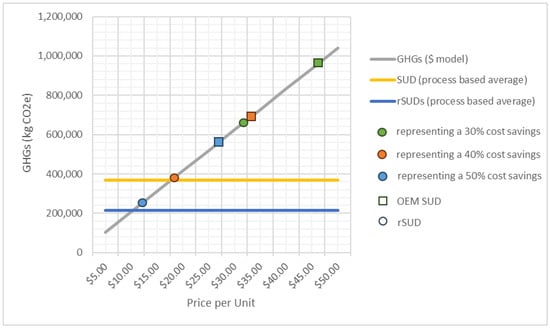
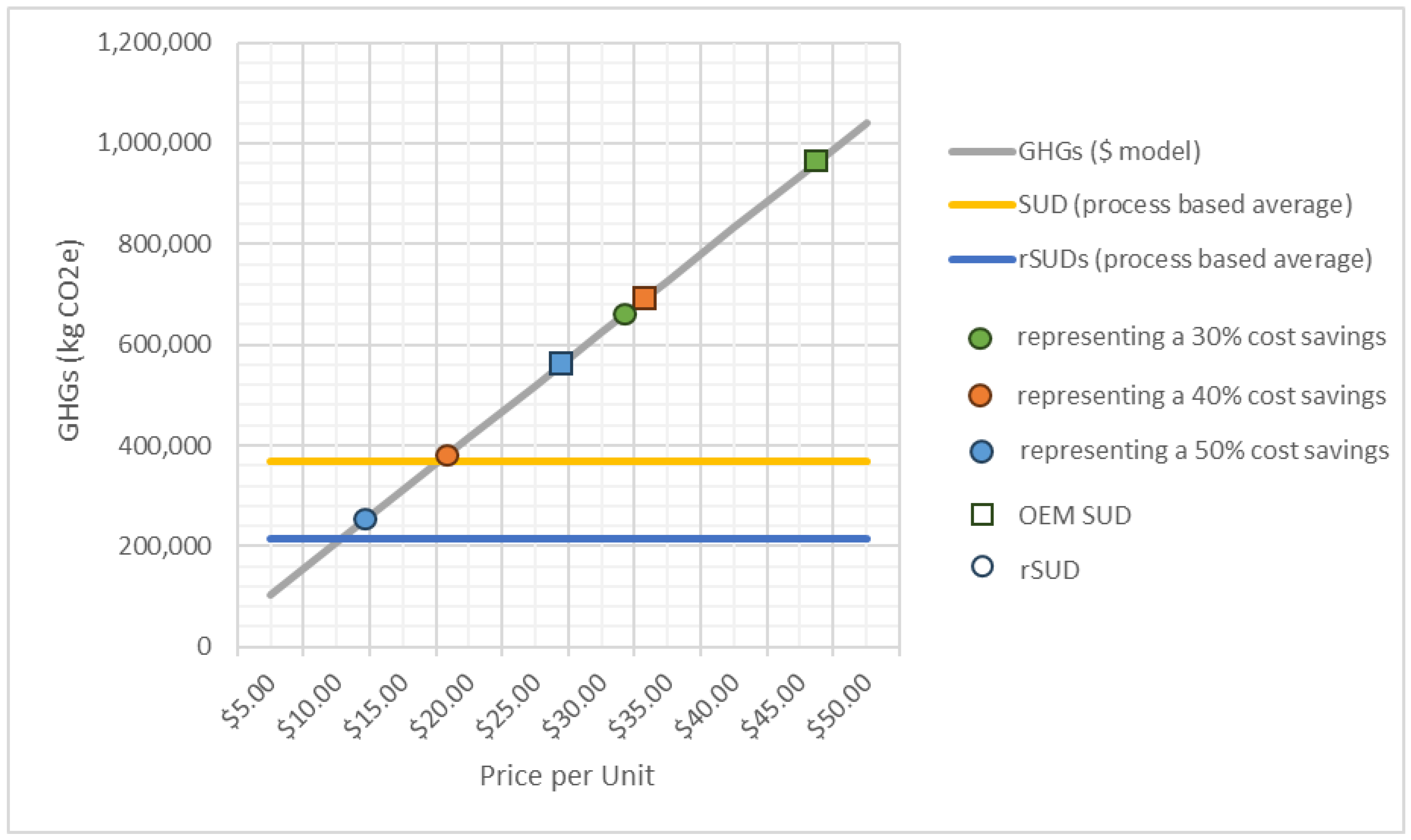
To extrapolate these per-device numbers to procurement decisions, purchasing 100,000 SUDs would result in 369,000 kg CO2e, based on the average process-based results from the included studies, while purchasing 100,000 rSUDs would result in 215,000 kg CO2e, as shown in Figure 1. Depending on the price (of either the SUD or rSUD), emissions from 100,000 devices would range between 104,000 kg CO2e (at USD 5/device) to 5,200,000 kg CO2e (at USD 250/device).
Figure 1.
Comparison of GHGs from process-based studies and EEIO-based models for single-use devices (SUDs) and reprocessed SUDs (rSUDs). Dots represent GHGs along price points, assuming the AMDR member-reported market average savings of USD 14.54 represents a 30%, 40%, or 50% savings between the rSUD and the SUD.
4. Discussion
The rSUD market is a proven and growing option for increasing circularity, decreasing solid waste, and saving financially in the healthcare services sector [12,13]. Despite a proven safety record and government oversight, reprocessed SUDs have struggled against consumer perceptions of safety and functionality [41,42]. At a micro-level, this may occur as a hospital implementing reprocessing, but having staff or product representatives intentionally damaging SUDs by breaking them prior to disposal in reprocessing bins. At a macro-level, policies may discourage or prevent the use of reprocessed SUDs in certain medical specialties or healthcare systems. One ongoing example is a ban on the use of rSUDs in the US Veterans Health System, despite the US Military Health System utilizing SUDs for years [43,44]. Reprocessing temporarily and rapidly expanded during the COVID-19 pandemic, with many health systems utilizing third-party and in-house reprocessed personal protective equipment (PPE) and masks, which were in short supply [45,46]. However, when supply chains normalized after 2021, the reprocessing of PPE largely abated.
Though somewhat forgotten now, the pandemic forced hospitals to assess the resilience of their supply chains. Reprocessed SUDs added some resilience, as most US-based third-party reprocessors have reprocessing facilities within the US [47]. This means materials and supplies are less reliant on globally distributed supply chains, though obviously not entirely. Manufacturing in America or Europe typically entails greater oversight and compliance with safety protocols and labor laws. This allows not only for the reshoring of manufacturing in the healthcare sector but also the possibility for more ethical supply chains [48,49,50,51,52].
By reducing the need for new device manufacturing, rSUDs conserve resources and raw materials, reduce waste, and lower GHG emissions throughout the product life cycle. All included studies reported consistent and significant reductions in GHGs associated with the use of rSUDs compared to their OEM SUD counterparts. The results highlight the potential of rSUDs to contribute to the healthcare sector’s decarbonization efforts and transition towards a more circular economy. As rSUDs can typically be procured for less money than SUDs, and fees for disposal and waste management are avoided, SUD reprocessing also represents an opportunity for financial savings in a strained healthcare system.
The methods of the included studies presented some interesting LCA challenges and considerations. Only two included studies (two devices) included the use phase impacts from their LCAs, which may change the actual % reduction in GHGs and other emissions between the rSUD and OEM SUDs. Any devices that consume electricity or other resources during use should see similar draw between the OEM and rSUD, so this is a reasonable assumption for these LCA studies to make, but it does affect the total emissions calculation across both product life cycles. Additionally, in some performance studies, the rSUD was found to fail less frequently, which has been attributed to reprocessors testing the performance of every device rather than OEM’s batch testing [14]. This might also have changed the use phase impacts between the two devices.
Another methodological challenge was accounting for the circularity of rSUDs. Most studies used a “supporter” or cut-off allocation approach, wherein the emissions from the OEM production are NOT allocated to the rSUD. This obviously favors the rSUD; however, the industry white paper summarizing the ISO14067-certified study of five rSUDs assessed a “circular” allocation approach in a sensitivity analysis. This study found that expanding the system boundaries to the entire circular product life cycle and allocating to each use still substantially favored the rSUDs compared to a linear system [40]. Of the five devices studied, reduction in GHGs for the rSUD with circular allocation ranged from 9% (MyoSure REACH) to 44% (Max-A) [40]. Allocation approaches remain an ongoing challenge in all fields where circularity is increasing.
Finally, the number of turns and rejection rates offer another source of variability in each of these studies. Reprocessors are limited to an official number of turns of rSUDs based on what they have submitted to the FDA and the number of turns that was cleared for the market. The number of turns they can achieve is determined based on a number of factors: the economics of the rSUD market, SUD materials and design, intended use of the device, and human factors in use and collection of a device. Typically, rejections of SUDs increase with the number of turns, and these device rejections occur at multiple points in the reprocessing process—starting with collection in a hospital or patient care area, including arrival at the facility and various points in the reprocessing process. Based on sensitivity analyses from one of the included studies, increasing the number of turns (and decreasing rejection rates or increasing reprocessing yield) would improve the rSUD’s environmental performance [37,40]. The contamination of rSUD collection streams, where non-reprocessable devices were also collected and shipped to the reprocessor, who must then dispose of the device, could also be a confounding factor—one that did not appear to be accounted for in these studies.
This study also highlighted the potential risks of using common IO-based GHG modeling tools to estimate and track health system emissions over time. Given the level of aggregation in IO models, they are inadequate for representing the true benefits of sustainable alternatives such as rSUDs and may not be as useful to healthcare systems or providers who are trying to make detailed procurement decisions.
4.1. For Hospitals and Healthcare Systems
The reprocessing of single-use devices should be considered “low hanging fruit” for healthcare systems seeking to reduce their greenhouse gas emissions. As many US healthcare procurement and supply management systems are designed for linear, SUD-based systems, the rSUD approach may be easier to implement than other sustainability approaches, such as reusables. Health systems can maintain existing procurement and stocking practices, such as Just-in-Time (JIT) supply delivery and inventory volumes. Healthcare systems should implement rSUD procurement as an easy first step in their sustainability journey.
Nonetheless, longer-term solutions should be developed to further decarbonize the sector. rSUDs still rely on the production of single-use devices, and it is likely that reusable devices may produce even greater GHG savings than rSUDs. Many studies have analyzed the difference in environmental emissions between an SUD product and an equivalent reusable product. For some of these products, reprocessing is a viable option for the SUD product; however, we could not find a study that compared the three product systems. One LCA study compares the use of SUD and reusable pulse oximeters in a hospital emergency department [53]. Duffy et al. found that disposable pulse oximeters emit about 0.156 kg CO2e per SUD, which was equivalent to the SUD pulse oximeter from one of our included studies (0.15 kg CO2e) [40]. Duffy et al. did not report on rSUD pulse oximeters but suggest that the impact from a reusable pulse oximeter ranges between 0.008 and 0.01 kg CO2e, depending on use patterns. The Deschamps white paper included in this study reports 0.07 kg CO2e of GHGs for the rSUD pulse oximeter, suggesting devices designed for reusability may be better performing than the semi-reusable rSUDs.
4.2. For Reprocessors and Medical Device Manufacturers
As healthcare systems have struggled to implement more sustainable and circular approaches to care, all suppliers and manufacturers should be contributing to these goals, regardless of whether they are OEMs or reprocessors.
Unfortunately, for over 20 years, some OEMs have fought the reprocessors through anticompetitive activities, including the following:
- OEMs “Chipping,” or using ePROM (erasable programmable read-only memory), specifically to render rSUDs inoperable.
- Similarly, OEMs “updating” software that disables the use of reprocessed devices on hospital generators and consoles without hospital permission or notification, or by misleading hospital personnel about the true nature or the anti-reprocessing impacts of such “upgrades.”
- OEMs threatening to void warranties or case support when rSUDs are used in a procedure.
- Unfair contracting, such as restricting hospitals’ ability to reprocess in exchange for discounts or “free” equipment in exchange for minimum purchasing requirements, which undermines reprocessing programs.
- Price gouging: For example, in the EP space, a several-fold price increase in the reprocessable version of a device intended to push hospitals towards the non-reprocessable version of a similar device.
- Interference with hospital assets, such as replacing cables without hospital permission to make rSUDs inoperable; moving or rearranging hospital stock of reprocessed SUDs to push hospital use of only new SUDs; moving/hiding SUD reprocessing collection containers and/or disposing of the contents of the bins; and finally, instruction to surgical or EP physicians to destroy hospital medical devices assets to prevent reprocessing [54].
A federal jury took only two hours to rule unanimously against Johnson & Johnson’s Biosense Webster division and the reprocessor Innovative Health, awarding USD 147 million for pulling technical support when reprocessed devices are used [55]. These anti-competitive and anti-reprocessing practices should stop, and cross-industry collaboration should be considered to broadly improve performance across the entire “single-use” device industry.
For several companies, the OEM is also the reprocessor. For example, Arjo, Cardinal, Stryker, and Medline are all OEMs and have reprocessing divisions or spin-offs that reprocess SUDs. Those reprocessors, owned by larger medical device manufacturers, may consider integrating circularity (including the opportunity for reprocessing their own SUDs or harvesting SUD components in more of a “refurbishment” model) into SUD product design.
Reprocessors themselves can continue to innovate for greater circularity and sustainability in their practices and policies. As the LCAs included in this study suggest, improvements can be made to the reprocessors’ electricity sourcing, collection and rejection rates, packaging innovations, and waste management, which could help further reduce the GHGs associated with rSUDs. Collection and rejection rates have continued to be a challenge in the industry, where collection happens at the bedside or in a procedure room, where medical staff may not be trained on proper sorting or may hold adversarial and false beliefs about the safety and effectiveness of SUD reprocessing [56].
4.3. For GHG and Sustainability Metrics in the Healthcare Space
As process-based LCAs and product carbon footprints emerge in the healthcare space, the EEIO-based Scope 3 monitoring tools should be validated and perhaps updated to help medical care facilities make the most informed decisions. Presently, the prices in the rSUD market could make the results from the EEIO models roughly match the results from process-based LCA models, but it appears unlikely for most devices. According to our study, for reprocessing, the available carbon footprinting models would likely overstate the GHG reductions from products like rSUDs, making EEIO models ineffective for hospitals’ detailed procurement decisions. EEIO models could be disaggregated, but disaggregation is unlikely to improve comparisons between products that fall in the same sector (SUDs and rSUDs). Process-based LCAs of individual products would be ideal; however, given the amount of effort required to produce these, this seems unlikely without the support of Artificial Intelligence (AI) tools. Healthcare systems using these tools should keep these methodological limitations in mind when utilizing GHG inventories to make detailed procurement decisions.
In an attempt to make this limitation more visible for health systems and to give health systems a way to more accurately measure their Scope 3 emissions associated with rSUDs, specifically, the AMDR has set up a “calculator” tool using the results of this narrative literature review. This tool is free and accessible online [57].
4.4. Study Limitations
Though existing studies analyzed eight devices using LCA methodology, this is still a small number of the rSUDs on the market. Currently, about 300 different SUDs can be reprocessed by third-party reprocessors [58]. Variation in exact emissions is expected based on the device type, reprocessor approach and location, and other system factors. Further research and additional LCAs of a broader range of devices will strengthen the robustness and accuracy of the results. Additional LCAs should be encouraged, either through academic funding or through government and procurement policies, such as the regulations currently in effect in the UK (for National Health Services procurement [59]) or in the European Union.
Two of the studies, representing six devices, were commissioned by SUD reprocessors, which could be construed as a conflict of interest [39,40]. However, both studies underwent scientific peer review, either following ISO 14067 standards, where an expert panel was able to see all background data [40], or through the journal’s peer review process [39]. LCAs from manufacturers typically utilize higher quality, primary foreground data, and both studies reported methodology and assumptions in great enough detail to be comparable to the other two academic studies, though those studies cited obtaining primary data from reprocessors. Transparency is a crucial component of a reliable LCA, especially given the amount of primary and sometimes proprietary data required for accurate modeling. Future studies should continue to adhere to existing assessment and reporting standards to prevent nefarious use of the LCA tool.
Comparing the results from different LCAs can be challenging, as differences in the scope, methods, data sources, and assumptions can impact the results. We found that many of these studies used similar boundaries, assumptions, and methods (Ecoinvent, IPCC-based GHG calculations) and were produced during a similar time period (all studies were published between 2021 and 2023), but differences between studies could still be related to methodological choices rather than actual variations in emissions between products. For example, the LCA practitioner may legitimately choose to use a life cycle inventory library or database other than Ecoinvent, which may list different types or quantities of GHG emissions for the same product. This is a noted limitation of LCAs, which may not be solved until further refined guidelines—such as a Product Category Ruling and Environmental Product Declarations—exist for this particular product category.
This study mainly summarized GHG emissions, as the most prominently reported environmental impact across all included studies. Two studies (two products) reported on other environmental impact categories, largely finding the rSUDs more favorable than the OEM SUDs. Waste generation and resource consumption are inherently improved through SUD reprocessing, as waste is avoided and raw material consumption is reduced in healthcare facilities procuring rSUDs. However, other environmental impacts are important to consider and could result in different conclusions in comparative assertions. Future LCAs should report on other emissions and GHGs, and this field may benefit from circularity-specific assessments, such as identifying opportunities for critical material recovery and recyclability.
5. Conclusions
This summary demonstrates compelling evidence supporting the environmental advantages of rSUDs and underscores their potential to play a crucial role in achieving a more sustainable healthcare system. While rSUDs showed consistent reductions in GHGs and most other environmental emissions compared to the OEM, the literature in this study also highlights ways that these systems can be further improved. This is largely around switching to low-carbon electricity and energy sources and improving collection and rejection rates. The transportation of the rSUD to and from the reprocessing facility and sterilization approaches, including the use of ETO, did not significantly affect GHG emissions. The reprocessing of single-use devices should be considered “low hanging fruit” for healthcare systems seeking to reduce their greenhouse gas emissions.
Health systems should also use the results of the Scope 3 GHG emissions calculations tools with caution. Most of the currently available Scope 3 tools utilize financial-based GHG modeling, which cannot accurately portray emissions or emissions reductions from specific products, such as rSUDs compared to SUDs. This limits their effectiveness in aiding procurement decisions.
Author Contributions
Conceptualization, all.; Methodology, C.L.T.; Software, C.L.T.; Validation, all; Formal Analysis, C.L.T.; Investigation, C.L.T., D.S.; Data Curation, C.L.T.; Writing—Original Draft Preparation, C.L.T.; Writing—Review and Editing, all; Visualization, C.L.T.; Supervision, D.J.V. All authors have read and agreed to the published version of the manuscript.
Funding
This research was funded by AMDR (as internal and contracted labor, not grant or award funding) and received no external funding.
Institutional Review Board Statement
Not applicable.
Informed Consent Statement
Not applicable.
Data Availability Statement
The original data presented in the study are openly available on AMDR’s website: https://amdr.org/reprocessing-carbon-emission-calculator/ (accessed on 1 May 2025).
Acknowledgments
During the preparation of this manuscript/study, the authors used Google Gemini 1.5 Pro to construct an initial draft of the abstract. The authors have reviewed and edited the output and take full responsibility for the content of this publication.
Conflicts of Interest
Author Cassandra L. Thiel was employed by the company Clinically Sustainable Consulting LLC. The remaining authors declare that the research was conducted in the absence of any commercial or financial relationships that could be construed as a potential conflict of interest.
Abbreviations
The following abbreviations are used in this manuscript:
| AMDR | Association of Medical Device Reprocessors |
| LCA | Life Cycle Assessment |
| EEIO LCA | Environmentally Extended Input–Output LCA (financial model) |
| GHG | Greenhouse Gas |
| OEM | Original (medical) Equipment Manufacturer |
| SUD | Single-Use Device |
| rSUD | Reprocessed Single-Use Device |
| NHS | National Health Service (UK) |
| OCCHE | Office of Climate Change and Health Equity (US) |
| FDA | US Food and Drug Administration |
| EOL | End of Life |
| OR | Operating Room |
| EP | Electrophysiology |
| NAICS | North American Industry Classification System |
References
- Karliner, J.; Slotterback, S.; Boyd, R.; Ashby, B.; Steele, K. Health Care’s Climate Footprint: How the Health Sector Contributes to the Global Climate Crisis and Opportunities for Action; Healthcare Without Harm, ARUP: Reston, VA, USA, 2019; p. 48. [Google Scholar]
- Romanello, M.; di Napoli, C.; Green, C.; Kennard, H.; Lampard, P.; Scamman, D.; Walawender, M.; Ali, Z.; Ameli, N.; Ayeb-Karlsson, S. The 2023 report of the Lancet Countdown on health and climate change: The imperative for a health-centred response in a world facing irreversible harms. Lancet 2023, 402, 2346–2394. [Google Scholar] [CrossRef] [Scilit] [PubMed]
- US Energy Information Administration. 2012 Commercial Buildings Energy Consumption Survey (CBECS). Table H5. Major Fuels Usage for Large Hospitals, 2007; US Energy Information Administration: Washington, DC, USA, 2012.
- de Wit, M.; Hoogzaad, J.; Daniels, C.V. The Circularity Gap Report 2020; Circle Economy: Amsterdam, The Netherlands, 2020. [Google Scholar]
- Eckelman, M.J.; Huang, K.; Lagasse, R.; Senay, E.; Dubrow, R.; Sherman, J.D. Health Care Pollution and Public Health Damage in The United States: An Update: Study examines health care pollution and public health damage in the United States. Health Aff. 2020, 39, 2071–2079. [Google Scholar] [CrossRef] [Scilit]
- Rizan, C.; Lillywhite, R.; Reed, M.; Bhutta, M.F. The carbon footprint of products used in five common surgical operations: Identifying contributing products and processes. J. R. Soc. Med. 2023, 116, 199–213. [Google Scholar] [CrossRef] [Scilit] [PubMed]
- UK Department of Health and Social Care. Design for Life Roadmap; UK Department of Health and Social Care: London, UK, 2024.
- The White House; HHS; OCCHE. Health Sector Commitments to Emissions Reduction and Resilience. Available online: https://us.noharm.org/climate-and-health/hhs-health-sector-climate-pledge (accessed on 6 May 2025).
- Practice Greenhealth. Scope 3 GHG Emissions Accounting Tool. Available online: https://practicegreenhealth.org/tools-and-resources/scope-3-ghg-emissions-accounting-tool (accessed on 1 May 2025).
- Duncker, D.; Svetlosak, M.; Guerra, F.; Nagy, K.V.; Vanduynhoven, P.; Mikhaylov, E.N.; Kosiuk, J. Reprocessing of electrophysiology material in EHRA countries: An EHRA Young EP survey. EP Eur. 2020, 23, 479–485. [Google Scholar] [CrossRef] [Scilit]
- Krüger, C.M. Processing single-use medical devices for use in surgery–importance, status quo and potential. GMS Krankenhaushygiene Interdiszip. 2008, 3, Doc21. [Google Scholar]
- Leung, L.W.M.; Evranos, B.; Grimster, A.; Li, A.; Norman, M.; Bajpai, A.; Zuberi, Z.; Sohal, M.; Gallagher, M.M. Remanufactured circular mapping catheters: Safety, effectiveness and cost. J. Interv. Card. Electrophysiol. 2019, 56, 205–211. [Google Scholar] [CrossRef] [Scilit]
- Renton, D.; Denk, P.; Varban, O. Reprocessed single-use devices in laparoscopy: Assessment of cost, environmental impact, and patient safety. Surg. Endosc. 2018, 32, 4310–4313. [Google Scholar] [CrossRef] [Scilit]
- Loftus, T.J. A Comparison of the Defect Rate Between Original Equipment Manufacturer and Reprocessed Single-Use Bipolar and Ultrasound Diathermy Devices. J. Med. Devices 2015, 9, 044501. [Google Scholar] [CrossRef] [Scilit]
- CASCADES. The Healthy Populations Institute at Dalhousie University. Available online: https://healthcarelca.com/ (accessed on 1 May 2025).
- Morris, B.; Tauber, J.; Rai, A.; Thiel, C.; Geringer, T.J.; Mian, U.K. Waste and Greenhouse Gas Emissions Produced from Ophthalmic Surgeries: A Scoping Review. Int. J. Environ. Res. Public Health 2024, 22, 51. [Google Scholar] [CrossRef] [Scilit]
- Morris, B.; Tauber, J.; Rai, A.; Thiel, C.; Mian, U. Waste Produced from Ophthalmic Surgeries: A Scoping Review. Investig. Ophthalmol. Vis. Sci. 2023, 64, 3043. [Google Scholar]
- Sherry, B.; Lee, S.; Ramos Cadena, M.D.L.A.; Laynor, G.; Patel, S.R.; Simon, M.d.; Romanowski, E.G.; Hochman, S.E.; Schuman, J.S.; Prescott, C.; et al. How Ophthalmologists Can Decarbonize Eye Care: A Review of Existing Sustainability Strategies and Steps Ophthalmologists Can Take. Ophthalmology 2023, 130, 702–714. [Google Scholar] [CrossRef] [Scilit] [PubMed]
- Buchan, J.C.; Thiel, C.L.; Steyn, A.; Somner, J.; Venkatesh, R.; Burton, M.J.; Ramke, J. Addressing the environmental sustainability of eye health-care delivery: A scoping review. Lancet Planet. Health 2022, 6, e524–e534. [Google Scholar] [CrossRef] [Scilit]
- Silva de Souza Lima Cano, N.; Marino, M.; Brooks, A.L.; Eckelman, M.J.; Bilec, M.M. Advancing the circular economy of healthcare plastics: A systematic literature review. Resour. Conserv. Recycl. 2025, 219, 108317. [Google Scholar] [CrossRef] [Scilit]
- Braithwaite, J.; Smith, C.L.; Leask, E.; Wijekulasuriya, S.; Brooke-Cowden, K.; Fisher, G.; Patel, R.; Pagano, L.; Rahimi-Ardabili, H.; Spanos, S.; et al. Strategies and tactics to reduce the impact of healthcare on climate change: Systematic review. BMJ 2024, 387, e081284. [Google Scholar] [CrossRef] [Scilit] [PubMed]
- Harris, D.; Chekuri, B.; Schroll, A.; Shah, N.; Swende, L.; Uzuegbu, C.; Young, P. The impact of climate change on hospice and palliative medicine: A scoping and narrative review. J. Clim. Change Health 2024, 18, 100323. [Google Scholar] [CrossRef] [Scilit]
- Sullivan, G.A.; Petit, H.J.; Reiter, A.J.; Westrick, J.C.; Hu, A.; Dunn, J.B.; Gulack, B.C.; Shah, A.N.; Dsida, R.; Raval, M.V. Environmental Impact and Cost Savings of Operating Room Quality Improvement Initiatives: A Scoping Review. J. Am. Coll. Surg. 2023, 236, 411–423. [Google Scholar] [CrossRef] [Scilit]
- Lichter, K.E.; Charbonneau, K.; Sabbagh, A.; Witztum, A.; Chuter, R.; Anand, C.; Thiel, C.L.; Mohamad, O. Evaluating the Environmental Impact of Radiotherapy Using Life Cycle Assessments: A Critical Review. Int. J. Radiat. Oncol. Biol. Phys. 2023, 117, 554–567. [Google Scholar] [CrossRef] [Scilit]
- Rodríguez-Jiménez, L.; Romero-Martín, M.; Spruell, T.; Steley, Z.; Gómez-Salgado, J. The carbon footprint of healthcare settings: A systematic review. J. Adv. Nurs. 2023, 79, 2830–2844. [Google Scholar] [CrossRef] [Scilit]
- Drew, J.; Christie, S.D.; Tyedmers, P.; Smith-Forrester, J.; Rainham, D. Operating in a Climate Crisis: A State-of-the-Science Review of Life Cycle Assessment within Surgical and Anesthetic Care. Environ. Health Perspect. 2021, 129, 076001. [Google Scholar] [CrossRef] [Scilit]
- ISO 14040:2006; Environmental Management—Life Cycle Assessment—Principles and Framework. International Organization for Standardization: Geneva, Switzerland, 2006.
- ISO 14044:2006; Environmental Management—Life Cycle Assessment—Requirements and Guidelines. International Organization for Standardization: Geneva, Switzerland, 2006.
- ISO 14067:2018; Greenhouse Gases—Carbon Footprint of Products—Requirements and Guidelines for Quantification. International Organization for Standardization: Geneva, Switzerland, 2018.
- Majeau-Bettez, G.; Strømman, A.H.; Hertwich, E.G. Evaluation of Process- and Input–Output-based Life Cycle Inventory Data with Regard to Truncation and Aggregation Issues. Environ. Sci. Technol. 2011, 45, 10170–10177. [Google Scholar] [CrossRef] [Scilit]
- Majeau-Bettez, G.; Wood, R.; Hertwich, E.G.; Strømman, A.H. When do allocations and constructs respect material, energy, financial, and production balances in LCA and EEIO? J. Ind. Ecol. 2016, 20, 67–84. [Google Scholar] [CrossRef] [Scilit]
- Steubing, B.; de Koning, A.; Merciai, S.; Tukker, A. How do carbon footprints from LCA and EEIOA databases compare? A comparison of ecoinvent and EXIOBASE. J. Ind. Ecol. 2022, 26, 1406–1422. [Google Scholar] [CrossRef] [Scilit]
- Yang, Y.; Ingwersen, W.W.; Hawkins, T.R.; Srocka, M.; Meyer, D.E. USEEIO: A new and transparent United States environmentally-extended input-output model. J. Clean. Prod. 2017, 158, 308–318. [Google Scholar] [CrossRef] [Scilit]
- AMDR. 2023 AMDR Member Data: Definitions & Collection Methodology. Available online: https://amdr.org/wp-content/uploads/2024/10/2023-AMDR-Member-Data-Methodology.pdf (accessed on 31 October 2024).
- Lalman, C.; Karunathilake, H.; Ruparathna, R. To Dispose or to Reuse? Analyzing the Life Cycle Impacts and Costs of Disposal, Sterilization, and Reuse of Electrophysiological Catheters. Sustainability 2023, 15, 5363. [Google Scholar] [CrossRef] [Scilit]
- Andersen, A.; Sørensen, S. A Case Study of the Environmental and Economic Sustainability of Using Remanufactured Ultrasound Catheters. 2022. Available online: https://vbn.aau.dk/ws/files/473676439/Master_Thesis_Ultrasound_Catheter_SDE_Andersen___Sorensen.pdf (accessed on 1 May 2025).
- Meister, J.A.; Sharp, J.; Wang, Y.; Nguyen, K.A. Assessing long-term medical remanufacturing emissions with Life Cycle Analysis. Processes 2022, 11, 36. [Google Scholar] [CrossRef] [Scilit]
- Schulte, A.; Maga, D.; Thonemann, N. Combining Life Cycle Assessment and Circularity Assessment to Analyze Environmental Impacts of the Medical Remanufacturing of Electrophysiology Catheters. Sustainability 2021, 13, 898. [Google Scholar] [CrossRef] [Scilit]
- Lichtnegger, S.; Meissner, M.; Paolini, F.; Veloz, A.; Saunders, R. Comparative Life Cycle Assessment Between Single-Use and Reprocessed IPC Sleeves. Risk Manag. Healthc. Policy 2023, 16, 2715–2726. [Google Scholar] [CrossRef] [Scilit] [PubMed]
- Deschamps, J. Comparative Carbon Footprint of Reprocessed Single Use Medical Devices; Stryker Sustainability Solutions, Anthesis: Portage, MI, USA, 2023; p. 51. [Google Scholar]
- Grantcharov, P.; Ahmed, S.; Wac, K.; Rivas, H. Reprocessing and reuse of single-use medical devices: Perceptions and concerns of relevant stakeholders toward current practices. JBI Evid. Implement. 2019, 17, 53–57. [Google Scholar] [CrossRef] [Scilit]
- Thiel, C.; Duncan, P.; Woods, N. Attitude of US Obstetricians and Gynaecologists to Global Warming and Medical Waste. J. Health Serv. Res. Policy 2017, 3, 162–167. [Google Scholar] [CrossRef] [Scilit]
- The Office of Sterile Processing (OSP). OSP VHA DIRECTIVE 1116. Available online: https://patientcare.va.gov/PATIENTCARE/Office_Sterile_Processing/VHA_Directive_1116.asp (accessed on 1 May 2025).
- The Assistant Secretary of Defense. Department of Defense Policy on Reprocessing of Medical Single Use Devices. HA POLICY: 06-013 2006. Available online: https://health.mil/Reference-Center/Policies/2006/07/07/Policy-on-Reprocessing-Medical-Single-Use-Devices (accessed on 6 May 2025).
- Hicks, A.; Temizel-Sekeryan, S.; Kontar, W.; Ghamkhar, R.; Rodríguez Morris, M. Personal respiratory protection and resiliency in a pandemic, the evolving disposable versus reusable debate and its effect on waste generation. Resour. Conserv. Recycl. 2021, 168, 105262. [Google Scholar] [CrossRef] [Scilit]
- Perkins, D.J.; Villescas, S.; Wu, T.H.; Muller, T.; Bradfute, S.; Hurwitz, I.; Cheng, Q.; Wilcox, H.; Weiss, M.; Bartlett, C.; et al. COVID-19 global pandemic planning: Decontamination and reuse processes for N95 respirators. Exp. Biol. Med. 2020, 245, 933–939. [Google Scholar] [CrossRef] [Scilit] [PubMed]
- Thiel, C.; Vukelich, D.J. An Urgent Call to Reduce and Reuse Hospital Supplies for Stronger Financial, Environmental and Clinical Sustainability. Manag. Healthc. Exec. 2020. [Google Scholar]
- Bhutta, M. Our over-reliance on single-use equipment in the operating theatre is misguided, irrational and harming our planet. Ann. R. Coll. Surg. Engl. 2021, 103, 709–712. [Google Scholar] [CrossRef] [Scilit] [PubMed]
- Bhutta, M.; Bostock, B.; Brown, J.; Day, E.; Hughes, A.; Hurst, R.; Trautrims, A.; Trueba, M. Forced Labour in the Malaysian Medical Gloves Supply Chain Before and During the COVID-19 Pandemic: Evidence, Scale and Solutions; Modern Slavery and Human Rights Policy and Evidence Centre: Oxford, UK, 2021. [Google Scholar]
- Abbott, J.; Bhutta, M. Don’t forget the people: Protecting labour rights in supply chains is a key part of sustainable healthcare. Bull. R. Coll. Surg. Engl. 2020, 102, 186–189. [Google Scholar] [CrossRef] [Scilit]
- Trueba, M.; Bhutta, M.; Shahvisi, A. Instruments of health and harm: How the procurement of healthcare goods contributes to global health inequality. J. Med. Ethics 2020, 47, medethics-2020. [Google Scholar] [CrossRef] [Scilit]
- Sandler, S.; Sonderman, K.; Citron, I.; Bhutta, M.; Meara, J. Forced Labor in Surgical and Healthcare Supply Chains. J. Am. Coll. Surg. 2018, 227, 618–623. [Google Scholar] [CrossRef] [Scilit]
- Duffy, J.; Slutzman, J.E.; Thiel, C.L.; Landes, M. Sustainable Purchasing Practices: A Comparison of Single-use and Reusable Pulse Oximeters in the Emergency Department. West. J. Emerg. Med. 2023, 24, 1034–1042. [Google Scholar] [CrossRef] [Scilit]
- AMDR. AMDR Action Alert: Your Voice Matters: Hospital Purchasing Representatives Encouraged to Report Anticompetitive SUD Purchasing Contracts and Related Behavior; AMDR: Washington, DC, USA, 2024. [Google Scholar]
- Walter, M. Johnson & Johnson MedTech ordered to pay $147M for antitrust violations. Cardiovascular Business, 19 May 2025.
- Hennein, R.; Goddard, E.; Sherman, J.D. Stakeholder perspectives on scaling up medical device reprocessing: A qualitative study. PLoS ONE 2022, 17, e0279808. [Google Scholar] [CrossRef] [Scilit]
- AMDR. Reprocessing Carbon Emission Calculator. Available online: https://amdr.org/reprocessing-carbon-emission-calculator/ (accessed on 5 May 2025).
- AMDR. Products. Available online: https://amdr.org/product/ (accessed on 31 October 2024).
- NHS England. Delivering a Net Zero National Health Service; NHS England: Redditch, UK, 2022.

Disclaimer/Publisher’s Note: The statements, opinions and data contained in all publications are solely those of the individual author(s) and contributor(s) and not of MDPI and/or the editor(s). MDPI and/or the editor(s) disclaim responsibility for any injury to people or property resulting from any ideas, methods, instructions or products referred to in the content. |
© 2025 by the authors. Licensee MDPI, Basel, Switzerland. This article is an open access article distributed under the terms and conditions of the Creative Commons Attribution (CC BY) license (https://creativecommons.org/licenses/by/4.0/).