


Abstract
This study centers on sustainable operations management within the energy sector, identifying and synthesizing effective strategies for integrating sustainability into business practices. We perform a systematic literature review covering contributions from January 2000 to June 2024 extracted from Web of Science and Scopus databases. The methodology includes an explicit search and selection protocol to ensure relevant and unbiased insights into the evolution of sustainable practices in the energy sector. The results indicate an increase in publications over the years, particularly in areas such as low-carbon economies, environmental management, and innovation, all of which are crucial for reducing carbon footprints and enhancing operational sustainability. This study categorizes existing research into five main streams: Closed Loop Supply Chains (CLSC), Low Carbon Economy (LCE), Environmental Management and Performance (EMP), Innovation (INN), and Social Responsibility (SR). The review underscores the significant gap between current practices and the potential for incorporating renewable energy sources into existing systems. In addition, it highlights the need for robust governmental policies and international cooperation in order to foster a more rapid transition towards sustainable operations on the energy sector. Furthermore, our findings suggest that despite technological advances, significant implementation gaps remain that require focused research and policy adjustments in order to achieve sustainability targets in the energy sector.
1. Introduction
In a world facing climate and environmental challenges, the pressure from governmental and social entities to adopt sustainable practices within organizations has increased over the last few decades, positively impacting those organizations that choose to respond to these demands [1]. This urgency has generated interest in understanding the impact of integrating sustainability goals into operations. Consequently, there is a need for modeling and analysis to measure performance and make strategic, tactical, and operational decisions to optimize supply chains while reducing carbon footprints and enhancing efficiency and sustainability in manufacturing and services [2]. Closed loop supply chains, green products, and lean operations enhanced with operational research tools can drive efficiency and competitiveness, providing an essential framework to address sustainability challenges [3].
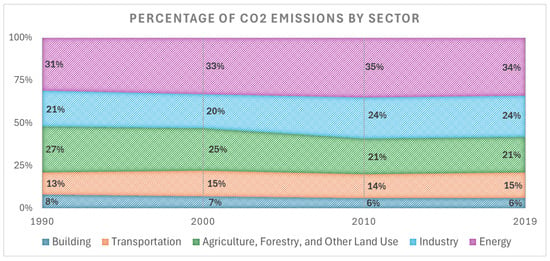
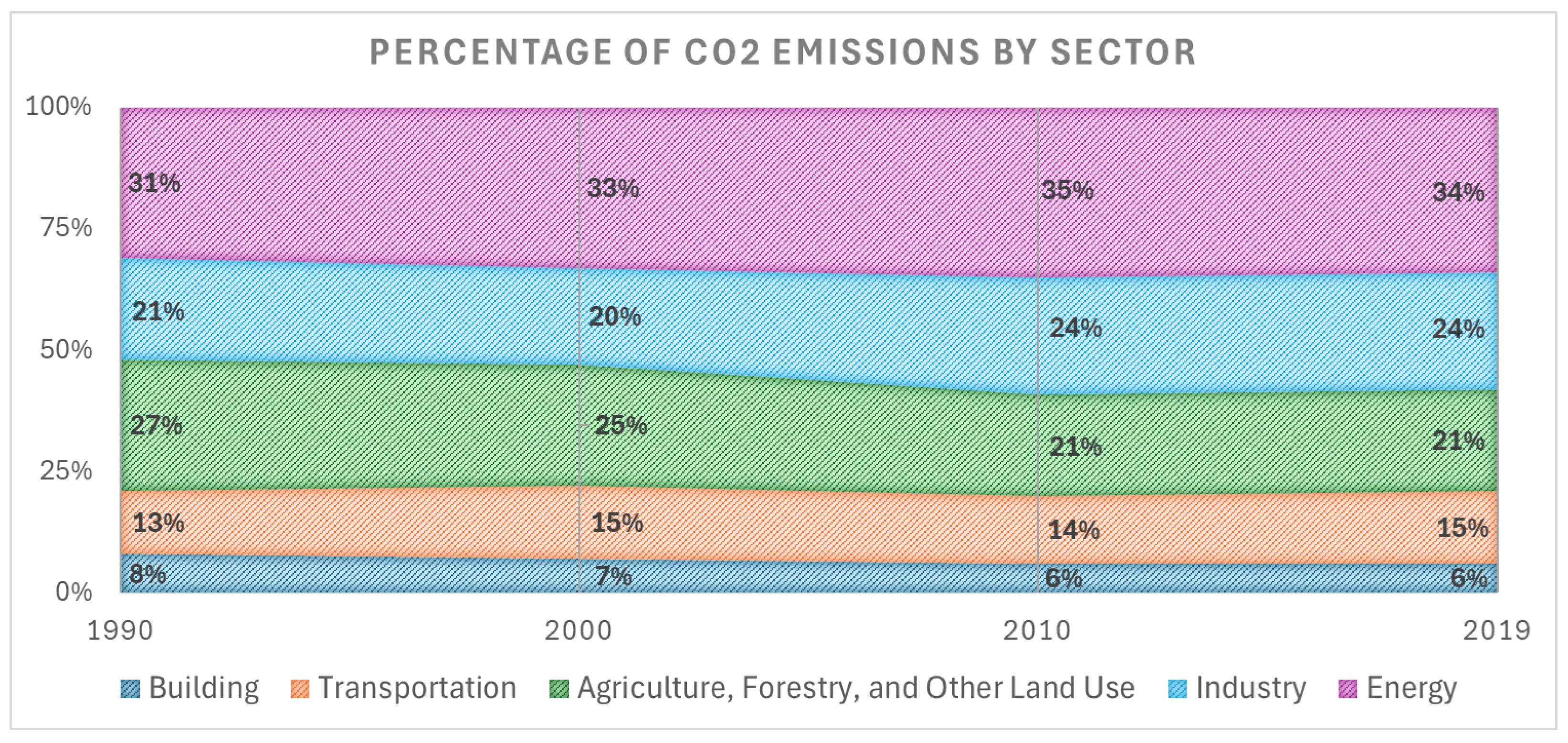
Given climate change and the environmental impact of fossil fuels consumption, the transition towards sustainable energy operations becomes even more crucial [4]. The energy sector, historically dependent on fossil fuels, emerges as one of the main contributors to global greenhouse gas emissions, accounting for 34% of greenhouse gas emissions by 2019, as illustrated in Figure 1 [5,6].
Figure 1.
Percentage of CO2 emissions by sector. Data source: https://www.epa.gov/ghgemissions/global-greenhouse-gas-overview, accessed on 25 July 2024, U.S. Environmental Protection Agency.
Energy transitions are complex multi-sector processes that unfold over extended periods, indicating that shifting to a low-carbon economy is likely to be slow and gradual, requiring government intervention and the protection of niche markets [7]. Governance for the transition to sustainable energy systems is a highly political process, and governance decisions can enable or restrict sustainable changes in energy systems [8]. Therefore, it is necessary to accelerate the process through effective governmental policies, international cooperation, and technologies such as energy efficiency and smart grids [4]. However, despite advances in renewable technologies and energy efficiency policies, significant gaps remain in effective implementation and sustainable operational management on a large scale.
This article focuses on thoroughly reviewing the existing literature on sustainable operations management in the energy sector, highlighting recent advancements and methodologies used to improve the sustainability of operations. This survey uses the classification framework proposed by [9], which reviews papers on sustainability in the operations management literature and divides them into five main categories: Closed Loop Supply Chains (CLSC), Low Carbon Economy (LCE), Environmental Management and Performance (EMP), Innovation (INN), and Social Responsibility (SR). The chronological evolution of these topics is analyzed along with their impact both within and outside the field of operations management. Regarding sustainable operations management in the energy sector, while various publications have addressed components of this topic, notable discrepancies and unresolved challenges remain, such as the integration of renewable energy sources into the existing grid and sustainably managing energy demand, which we discuss later in this survey paper.
This review aims to identify and synthesize the main strategies and practices that have proven effective as well as to highlight areas requiring further research. This work provides a holistic understanding of how operations in the energy sector can evolve toward more sustainable practices. The conclusions of this review are expected to help guide future research and policy decisions in pursuit of a sustainable energy future.
The rest of this paper is organized as follows. Section 2 details the methodology used for a systematic literature review, describing searching processes using databases such as Web of Science and Scopus. Section 3 provides a literature review, where results are analyzed under a classification framework that includes categories such as Closed Loop Supply Chains (CLSC), Low Carbon Economy (LCE), and Social Responsibility (SR), among others. Finally, Section 4 discusses key findings, emphasizing the implementation of sustainable management practices in the sector and the influence of technologies while suggesting future directions for research in this area.
2. Methodology
This survey undertakes a comprehensive review of contributions made through scientific articles to elucidate the current state of sustainable operations management within the energy sector from 1 January 2000 to 30 June 2024. Drawing upon the works of various authors, this study aims to map the evolution and current trends in this critical area of research [9,10,11,12]. The main research question guiding this survey is: What has been the development in sustainable operations management in the energy sector over the past two decades? This question seeks to identify the major trends, challenges, and opportunities that have emerged in this field.
According to the methodology delineated by [13], we executed a systematic literature review, adhering to a predetermined set of criteria and organizing the information in order to offer an overview of the current state of knowledge as well as to outline a future research agenda. To this end, we performed an initial search across two databases: Web of Science (WoS) and Scopus. This approach aims to mitigate biased outcomes owing to the scope encompassed [14]. The search was confined to articles and reviews in English published since 2000 utilizing the following search query:
where TITLE-ABS-KEY: {words} means that the title, abstract, or keywords contain the words in between curly brackets.
After applying the search query, we filtered the result by document type to article and review (excluding conference papers, books, notes, letters, etc.). Then, we limited the journal subject areas to the following: for WoS, Energy Fuels; Engineering; Business Economics; and Operations Research and Management Science; and for Scopus, Energy; Business, Management and Accounting; Engineering; Economics, Econometrics, and Finance; and Decision Science.
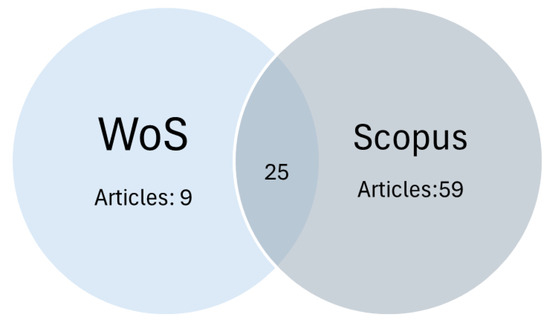
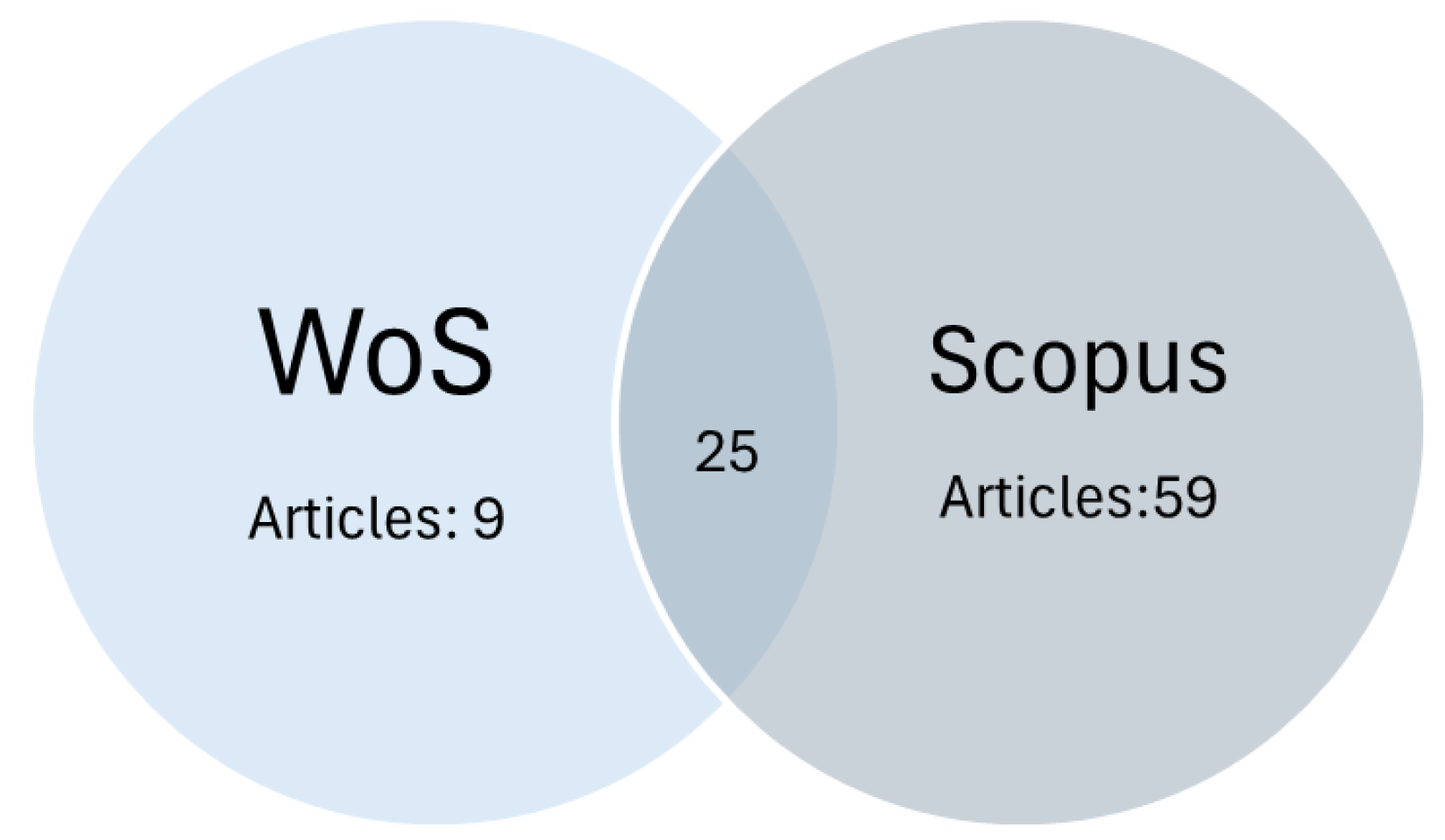
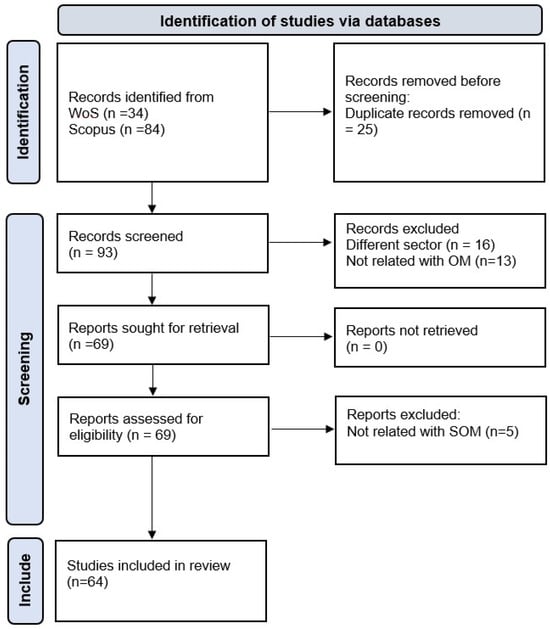
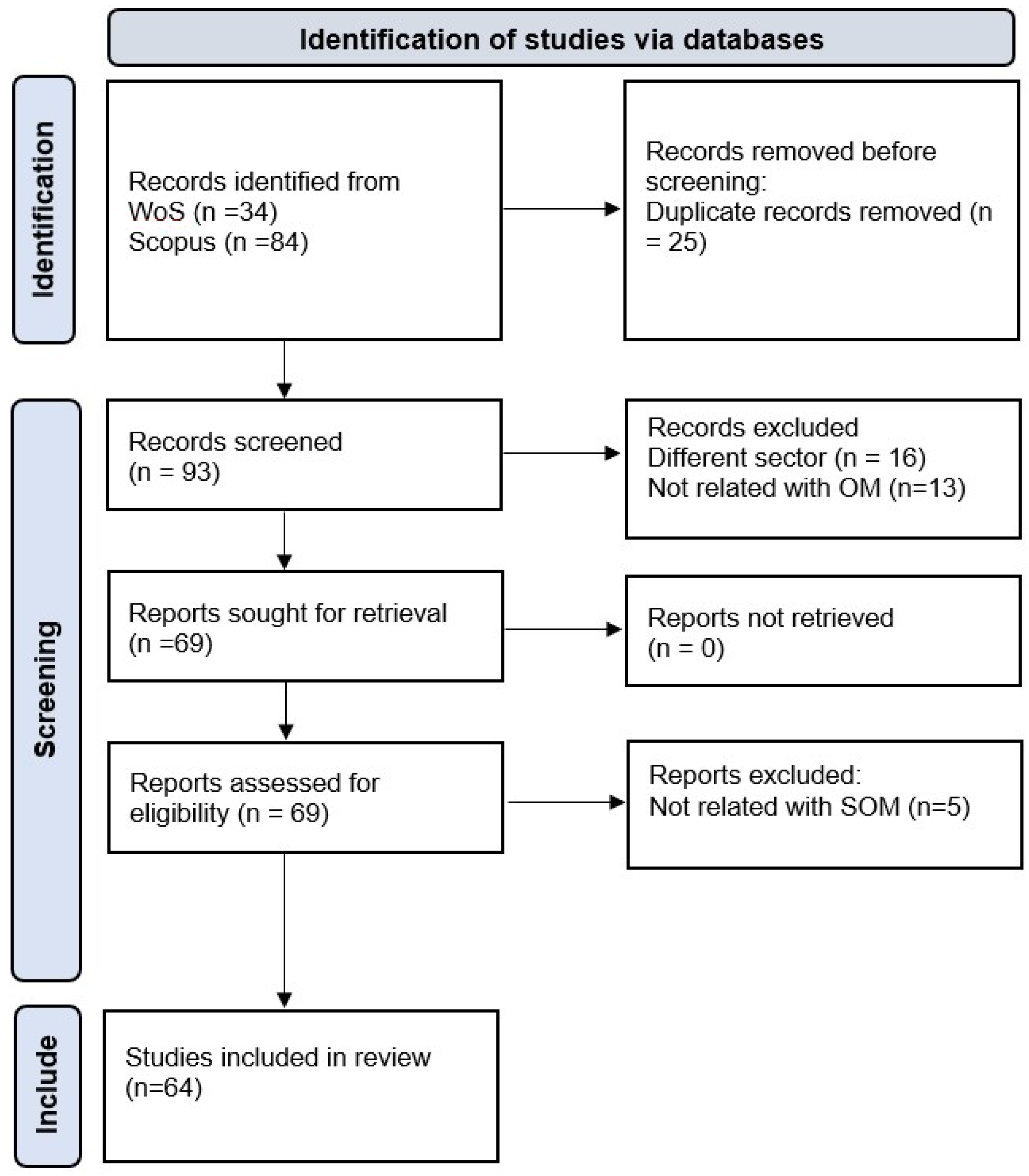
From this search, we identified 34 articles from WoS and 84 from Scopus, of which 25 were present in both databases; see Figure 2.
Figure 2.
Articles per database.
Upon reviewing the literature, 29 documents were excluded from the selection due to their lack of relevance to the scope of this survey. This exclusion process was based on predefined criteria set by the authors, including factors such as the relevance of the study to sustainable operations management specifically within the energy sector and alignment with our research streams (e.g., Closed-Loop Supply Chains, Low-Carbon Economy, Environmental Management, Innovation, and Social Responsibility). The goal was to refine the selection to documents that contribute valuable insights directly related to our research objectives. This resulted in 64 articles being selected for review. The process is described in Figure 3, and the summary of the articles can be found in the Appendix A.
Figure 3.
Identification of studies via databases.
After we had identified the articles, we categorized them into five major streams following the classifications established by [9]: Closed Loop Supply Chains (CLSC), Low Carbon Economy (LCE), Environmental Management and Performance (EMP), Innovation (INN), and Social Responsibility (SR). In the following section, we develop each of these clusters in detail, describing the papers that consolidate them.
3. Literature Review
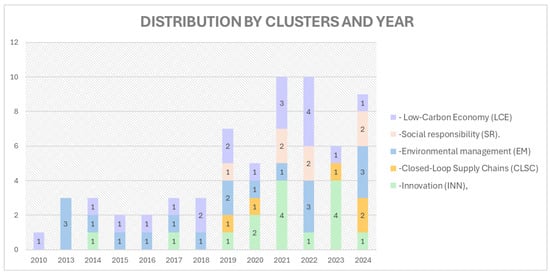
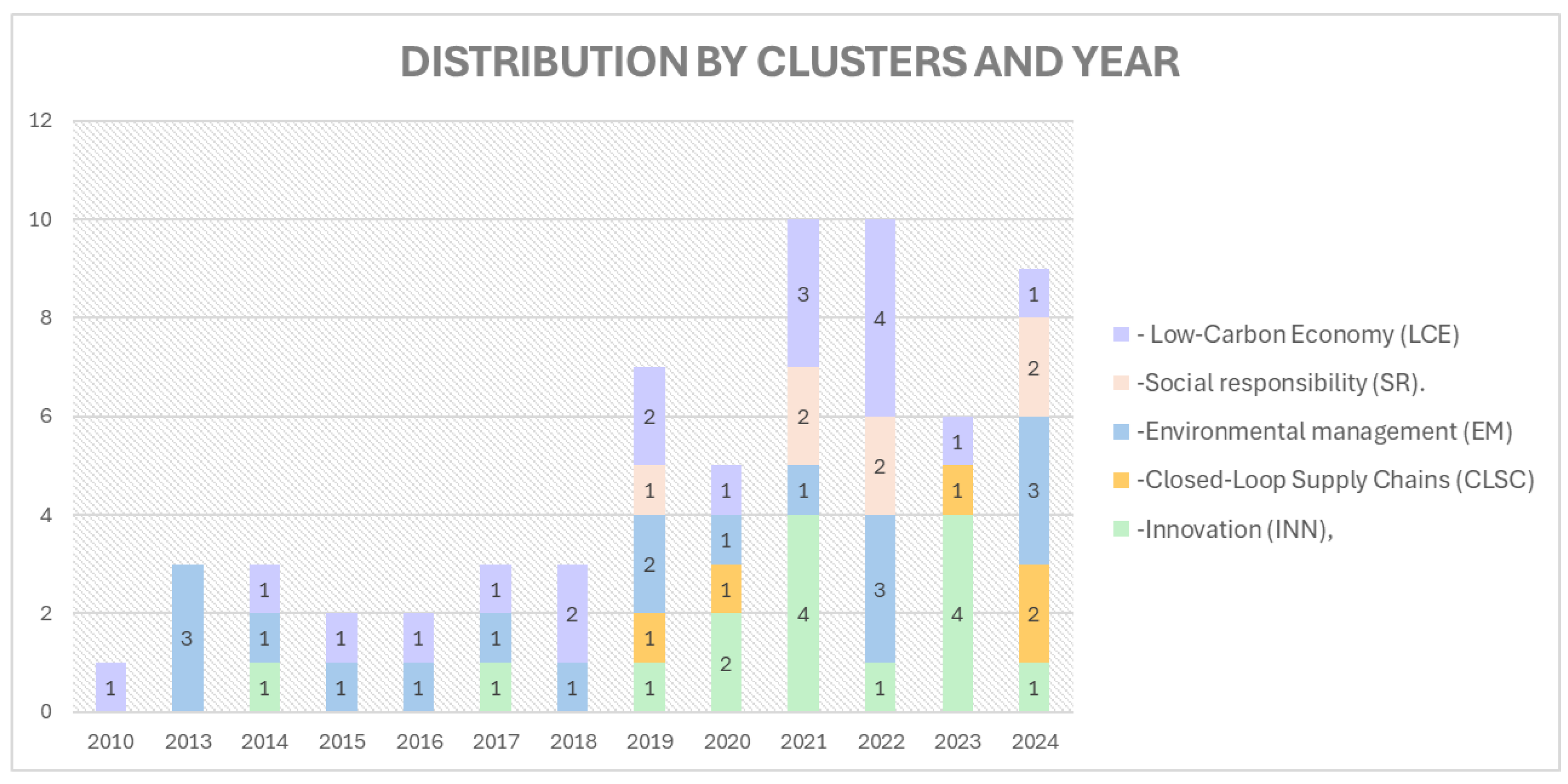
A preliminary descriptive analysis of the search results indicates that the earliest publications in the field of sustainable operations management in the energy sector date back to 2000. Since then, an average of five articles per year have been published up until the beginning of 2024. Figure 4 illustrates the distribution of articles by year according to the categories defined by [9].
Figure 4.
Distribution by clusters and year.
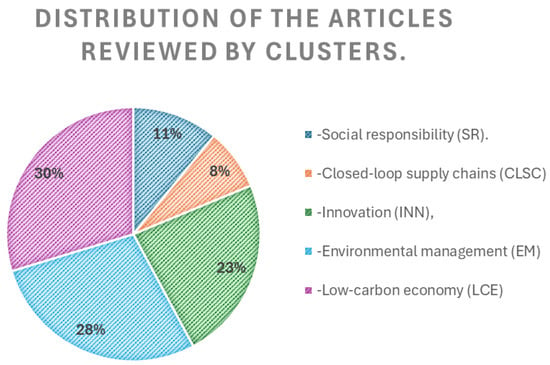
In Figure 5, it can be observed that the cluster with the most publications corresponds to Low Carbon Economy, followed by Innovation and Environmental Management. According to the definition for each cluster provided by [9], we conducted a descriptive analysis of the articles within each cluster to provide a deeper understanding of problems, methods, and contributions identified in the literature related to sustainable operations management in the energy sector.
Figure 5.
Distribution of reviewed articles by clusters.
3.1. Closed Loop Supply Chains (CLSC)
The Closed Loop Supply Chain category describes 8% of the articles located and selected for review. This category focuses on sustainability by maximizing resource utilization, minimizing waste, and conserving natural resources through more efficient resource cycles. According to the definition of this cluster in [9], it covers a broad variety of topics ranging from consumer returns management to remanufacturing and recycling. We included life cycle assessment in this category, as it is a relevant topic in the energy sector. The strategies covered in this category align closely with circular economy principles, which emphasize the importance of creating closed loop systems to achieve sustainable development goals.
From the perspective of the energy markets, ref. [15] demonstrated how circular economy approaches can significantly support sustainable development. The author emphasized the need for a shift from linear (“take–make–dispose”) to circular and sustainable economic systems as a strategic response to global environmental and socioeconomic challenges. Similarly, ref. [16] developed a flexible stochastic programming model to design a sustainable supply chain in the solar industry aimed at reducing CO2 emissions and enhancing sustainability. This model integrates both forward and reverse material flows within the supply chain. The proposed model addresses the collection, separation, recycling, and recovery of components at the end of their lifecycle, thereby closing the product lifecycle and minimizing environmental impacts.
Regarding the materials necessary for the energy transition, ref. [17] highlights the current state of corporate commitment and strategies towards end-of-life management, which refers to strategies and practices implemented to handle products. In this case, a study of lithium batteries within the energy sector revealed that many companies have limited engagement with extended producer responsibilities when batteries reach the end of their useful life. The authors emphasized the importance of comprehensive end-of-life management practices to ensure that environmental and economic impacts are addressed effectively throughout the product lifecycle.
To assess the environmental impacts of products/processes, the authors of [18] analyzed Consequential Life Cycle Assessment (CLCA) through various tools and approaches, highlighting the importance of considering the direct and indirect environmental impacts of technological, economic, and social changes while emphasizing the importance of choosing the evaluation model to ensure the transparency of the results. Similarly, ref. [19] reviewed the CLCA methodology in the energy sector, emphasizing the importance of evaluating both direct and indirect environmental impacts. They concluded that the choice of model depends on the study’s objectives and data availability, and underlined the importance of transparency and sensitivity analysis to enhance the reliability of the results.
3.2. Low Carbon Economy (LCE)
Low carbon economy refers to an economic system that aims to minimize carbon dioxide emissions to combat climate change. According to [9], this category includes the effects of regulation and regulatory instruments on carbon emissions, the impact of reduction strategies on companies’ performance, incentives to adopt clean energy, and consumer behavior toward more sustainable practices. In this category, we located 30% of the articles and identified a number of subcategories.
3.2.1. Policies and Strategies for Sustainable Energy Transition
This subcategory includes articles that discuss the importance of policies, strategies, and governance in the transition towards renewable energy. Articles in this category emphasize the need for robust and coherent policies, stakeholder engagement, and strategic decision-making frameworks to support the sustainable transition.
Environmental awareness, regulatory frameworks, and energy demand are crucial for the transition to renewal energy through analyzing the energy transition using a multi-level perspective (MLP) that includes workshops with policymakers. Ref. [20] identified the need to dismantle fossil fuel infrastructure and promote geothermal innovations through fiscal incentives and favorable regulations. Refs. [21,22] also highlighted the challenges and opportunities to increase renewable energy through a Political, Economic, Social, Technological, Legal, and Environmental (PESTLE) analysis that examines stakeholders involved in the energy industry, emphasizing the need for robust and coherent policies to attract investments and improve infrastructure. Ref. [23] analyzed the transition trajectory towards a low-carbon electrical system, comparing different scenarios and their technological implications, finding that flexible policies and an integrated approach that considers demand and supply are necessary for a successful transition and reducing emissions.
In this context, ref. [24] analyzed the importance of political dynamics and international relations as a foundation for disseminating and enhancing competitiveness in the business of technologies for renewable energy expansion. To this end, the authors used a comparison approach between the leaders in the market and included supply factors and technological policies. Similarly, ref. [25] employed the Fermatean Fuzzy Set (FFS) to model uncertainty, the Criteria Importance Through Intercriteria Correlation (CRITIC) method to determine criteria weights, and the Complex Proportional Assessment (COPRAS) method for ranking barriers, seeking to identify and prioritize the barriers that hinder the adoption of sustainable practices in clean energy supply chains. They highlighted “limited governmental policies”, “monitoring and control issues”, and “mismatch of expertise” as the primary obstacles. Using a case study on biofuel production, ref. [26] stressed the importance of a collaborative approach among governments, businesses, and other stakeholders to develop and implement strategies that ensure energy sustainability while promoting economic growth and environmental protection. Ref. [27] evaluated the drivers and barriers of Green Supply Chain Management (GSCM), identifying stakeholder pressure as a key motivator, while the lack of regulations, government support, and customer awareness are significant barriers. Ref. [28] explored the effects of the COVID-19 pandemic on energy investment, revealing the urgent need to reform international investment agreements to incorporate sustainability and human rights principles. This ensures that public policies can adapt to future crises without compromising economic stability or sustainable development goals. Policies and regulations can foster collaborative innovation in the energy sector’s innovation, effectively meeting the demands of energy [29].
3.2.2. Risk Management and Decision-Making Tools
Under this subcategory, we have identified articles that focus on evaluating and managing risks within the energy sector, including supply chain and geopolitical risks. This category highlights the use of sophisticated decision-making tools such as fuzzy cognitive maps, multi-regional input–output methodologies, and stochastic programming models:
Decision frameworks that consider the preferences of stakeholders in financial and sustainability matters are essential to ensuring transparency in evaluating projects related to renewable energies while managing uncertainty and improving the evaluation of alternatives; examples include robust frameworks utilizing decision and simulation models [30]. Ref. [31] proposed a multi-objective robust optimization model for addressing uncertainty in prices and demand in order to balance costs, efficiency, and sustainability in the hydrocarbon supply chain. This model provides a reliable framework for resource management under uncertain conditions. Ref. [32] underscored the significance of managing environmental, social, and governance risks in the energy sector, noting the lack of prioritization of these issues among small and new companies.
Using an extended methodology that quantifies the geographical diversification of suppliers and the quality of governance, ref. [33] emphasized the importance of evaluating risk in supply chains and making investment decisions to reduce dependence on fossil fuels. In addition, they considered geopolitical aspects that are often obscured as a way to minimize reliance on countries with different governance systems. Ref. [31] highlighted the importance of considering multiple objectives such as cost minimization, environmental considerations, and uncertainties in the supply chain to assess trade-offs between operational and strategic options under price and demand uncertainty through a stochastic programming model. Ref. [34] analyzed the impact of financial incentive schemes on bio-energy production through a fuzzy multi-objective programming model, highlighting the significant impact on profitability indicators due to changes in incentives. This oversight could lead to the creation of incentives for organizations with sustainable business models.
Variations in government investment in energy research and development (R&D) in OECD countries are influenced by factors such as internal R&D spending and the political orientation of the government, which are essential for fostering the transition to sustainable energy [35] Decision-making tools such as fuzzy cognitive maps become useful as they enable experts and stakeholders to manage the complexity and uncertainty of economic and political factors, which are vital for improving the management of energy supply chains and addressing issues of scarcity [36]. Finally, through a literature review on the modeling of energy systems, ref. [37] proposed a classification based on approach and field of study, highlighting the importance of combining approaches from process systems engineering and energy economics to achieve a comprehensive and effective perspective for the modeling and simulation of energy systems.
3.3. Environmental Management
The environmental management category contains 28% of the articles selected for review. According to [9], this category includes environmental management practices such as standardization and instruments, supply chain activities, and pollution control. We also included financial and marketing in green operations, as there are relevant topics in the energy sector.
An effective supply chain is crucial for the development of the energy sector. Ref. [38] identified political, technical, economic, and management barriers through a literature review and proposed measures such as public–private partnerships, access to financial incentives, and the use of Key Performance Indicators (KPIs) to enhance sustainability. Additionally, ref. [39] provided a literature review on the evolution of logistics practices in the energy sector and the transformation of logistical channels for energy products due to global events, highlighting the need for sustainable logistical practices and the use of digital technologies to enhance the efficiency and resilience of energy supply chains and the importance of international cooperation. Similarly, ref. [40] analyzed the integration of energy resources into supply chain management to improve the environmental and economic performance of companies, highlighting the necessity of transitioning to renewable energies and developing a low carbon supply chain approach. Regarding sustainability certifications, ref. [41] addressed the need to develop harmonized and widely accepted sustainability criteria for the certification of renewable hydrogen, emphasizing the importance of integrating diverse perspectives from professionals in the energy sector to ensure a sustainable energy transition. Similarly, for the assessment of project sustainability, ref. [42] developed a Fuzzy-AHP-based method to evaluate sustainability, identifying the most important lifecycle phases and enhancing evaluation precision and robustness. Ref. [43] used data envelopment analysis to identify effective investment strategies, showing that investment in innovative technologies can improve economic performance and reduce CO2 emissions. Ref. [44] employed a mixed-integer linear programming model and fuzzy decision techniques to minimize costs and greenhouse gas emissions in the biomass supply chain for clean energy generation, finding that investment and operational costs are the major components of total cost and that energy production impacts emissions more than transportation. Supply chain disruptions significantly affect Return on Assets (ROA) in the renewable energy sector; however, companies can mitigate these effects by reducing expansion and redirecting funds towards research and development (R&D). Additionally, building long-term relationships with suppliers and using advanced technologies can enhance resilience and sustainability [45].
Technological advancements such as big data and artificial intelligence are key to improving sustainability. Ref. [46] used fuzzy inference systems and sustainability indices to provide a decision-making tool for policymakers and businesses. Ref. [47] applied the TOPSI theory and a five-dimensional evaluation system consisting of economy, innovation, environment, coordination, and safety to conclude that strategies such as increased investment in research and development (R&D), promoting clean coal usage, and improving supply chain coordination are required to enhance sustainability. Refs. [48,49] emphasize the need to integrate SCM functions and continuously improve operations management while identifying and mitigating environmental impacts by collaborating with suppliers and business partners to develop carbon reduction strategies.
Ref. [50] developed a scale for measuring green marketing practices, including statistical analyses to ensure reliability, highlighting that implementing green marketing strategies can improve corporate image, stakeholder satisfaction, and business performance. Ref. [51] identified factors such as corporate social responsibility, governmental policies, resource scarcity, and avoiding negative media attention as influential in adopting sustainable supply chain management, thereby providing a guide for implementing sustainable practices in the thermal energy sector.
In terms of financial sustainability and environmental management, ref. [52] highlighted the crucial role played by environmental management and debt financing in enhancing financial sustainability, and proposed policy development to promote financial sustainability through environmental standards, diversification of financing, and governmental support. In the context of integrating sustainability into business models, ref. [53] advocated for the participation of various stakeholders and the combination of bottom-up and top-down decision-making approaches, as well as the active role of the government in setting multiple goals to address conflicting interests and promote sustainable practices. Ref. [54] proposed a framework to involve stakeholders early and continuously to enhance the credibility of sustainability disclosures in the supply chain.
3.4. Innovation
Under this category, we identified 23% of the reviewed articles; the defined topics are related to process improvement, adoption of new technologies and practices, product and service design, and innovation for sustainable business models.
Industry 4.0 has the potential to improve green supply chain management in the renewable energy sector by digitizing and automating industrial processes using technologies such as IoT, blockchain, big data, and artificial intelligence. Implementing smart factories and new technologies can increase efficiency and foster the development of more sustainable products and supply chains [55,56]. Ref. [57] explored how to effectively integrate technologies to improve efficiency, ensure energy security, and promote environmental sustainability; the authors analyzed the current state and trends in the transformation of the energy industry, where a transition to renewable energies is expected as energy demands continue to grow.
Eco-efficiency, digital transformation, and energy transition all impact environmental sustainability. In this regard, ref. [58] used data from the G-15 economies between 1995 and 2022 to highlight that eco-efficiency and digitalization are key to reducing CO2 emissions, whereas the exploitation of natural resources and energy transition have mixed effects. As such, governmental policies, especially environmental taxes, are crucial for improving environmental outcomes. Similarly, as a consequence of the need for governmental support and strategic policies to foster innovation, ref. [59] proposed creating learning and communication platforms to facilitate knowledge transfer among companies, suppliers, and customers, concluding that innovation consultants, brokerage organizations, and online platforms are essential at different stages of the supply chain. Business models can support sustainable innovation, highlighting the importance of strong relationships with suppliers and customers as well as governmental support to encourage the adoption of sustainable technologies [60].
Investment in technology and sustainable practices is necessary in order to meet customer expectations. Ref. [61] used multi-criteria techniques to analyze innovation strategies in supply chain management, noting that sustainable management can enhance competitiveness and corporate image, although it may involve high costs. For the development of energy technologies such as ocean energy, ref. [62] identified effective multi-criteria decision-making methodologies to improve accuracy and reduce uncertainty. They addressed environmental, social, and economic aspects which can contribute to sustainable and efficient designs. Ref. [63] analyzed how the benefits of Industry 5.0 can address sustainability challenges in the renewable energy supply chain, prioritizing these advantages through fuzzy methods and concluding that advanced technologies can optimize resource use and minimize waste.
For zero waste management in companies, ref. [64] carried out a quantitative approach and regression analysis to examine how the effective implementation of technologies and green supply chains can make a significant contributes to zero waste management while considering the impact of corporate social responsibility intentions. Regarding technological innovation, ref. [65] presented a smart grid architecture that facilitates the integration of renewable energy resources through innovative flexibility markets, improving the operational efficiency of distribution networks and reducing costs through dynamic management and optimal investment strategies. Ref. [66] used an evaluation of bio-energy supply chains to highlight how the implementation of green and proactive sustainable technologies can improve efficiency and reduce environmental impact while offering significant economic and environmental benefits. Similarly, ref. [67] evaluated new photovoltaic technologies that can offer more sustainable options at lower cost. However, these may present environmental challenges, underscoring the need for supportive policies to foster the research and development of cleaner and more efficient solar technologies.
On the other hand, ref. [68] analyzed how the Internet of Things (IoT) and other technologies can create threats in the energy sector’s supply chain, identifying the need to implement cybersecurity measures proactively and flexibly. Ref. [69] explored how microgrids and blockchains can enable collective energy communities, thereby improving the integration of decentralized energy resources and the resilience of the energy system. The combination of microgrids and blockchain can address technical, social, and economic challenges, promoting innovation in the transition to sustainable energy supply.
3.5. Social Responsibility
A wide variety of topics are located within the social responsibility cluster, including supplier selection, incentives adopted by buyers, social responsibility practices and their impact, and improvements in the efficiency of non-governmental and nonprofit organizations. This category contained 11% of the articles selected for review.
Corporate social responsibility can provide a competitive advantage to energy companies, achieving a greater impact than economic aspects and highlighting the importance of product and service quality, education in the supply chain, and energy security [70]. Through a literature review on supply chain management, ref. [71] emphasized the need to include more social sustainability and improve coordination and communication among stakeholders. Enhancing social sustainability improves corporate reputation and contributes to community development and labor equity. In this context, ref. [72] assessed social issues in the sustainability of energy supply chains in India and the USA through surveys and literature reviews, identifying barriers such as lack of regulations and government support while highlighting the importance of ethical responsibility and the inclusion of marginalized populations. Similarly, ref. [73] used a structural equation model to analyze the impact of sustainable supply chain practices on the competitiveness of companies in the energy sector. They found that operational, social (for employees), and community practices enhance competitiveness, while environmental practices and supply chain integration do not have significant impacts. This highlights the importance of policies that promote sustainable practices and align governmental objectives with those of energy companies. Ref. [74] analyzed another barrier related to the management of green talent, concerning professionals with skills to promote green talents, underscoring the need for strategies and training programs to improve responsible practices and contribute to the achievement of corporate sustainability goals. Ref. [75] reviewed social sustainability indicators in the energy sector, emphasizing their importance in the economic and environmental pillars and the challenges associated with their implementation, with those related to employees being crucial. Ref. [76] analyzed how soft dimensions such as human behavior and organizational culture influence the implementation of sustainability practices in thermal energy supply chains, emphasizing the importance of organizational commitment and the inclusion of sustainability in the vision and mission of companies.
4. Discussion
Our review of recent studies reveals a significant increase in research on sustainable operations management (SOM) in the energy sector over the past 24.5 years. Notably, these studies emphasize decision models that involve various stakeholders to evaluate the adoption of sustainability strategies focused on reducing environmental impact while ensuring operational efficiency and profitability. Additionally, there is a notable concentration of research on adopting green technologies and process optimization, both of which have proven effective in reducing carbon footprints and enhancing market positioning.
4.1. The Evolution of SOM in the Energy Sector
The growing concern around the environmental and social impact of business operations has led social and governmental entities to demand the integration of sustainable practices in industrial operations. Consequently, there is significant interest in understanding and transforming supply chains to meet sustainability demands. In this context, the energy sector serves as a critical example, facing unique challenges in balancing supply demands with sustainable and energy-efficient operations, especially in a context aimed at transitioning to clean energy.
The evolution of sustainable operations management in the energy sector from 2000 to 2024 reflects a dynamic shift in both scientific research and practical applications. This period captures the rise in consumer demand and global policies aimed at adopting sustainable practices to reduce environmental impact. Additionally, it highlights the integration of new technologies to improve efficiency while implementing sustainable practices in industry.
In the early 2000s, the focus on low-carbon economy sought to analyze the adoption of strategies in economic systems in order to reduce emissions, including the implementation of policies and decision-making tools to encourage the integration of sustainable practices. This approach highlighted the adoption of modeling techniques and decision analysis to evaluate different scenarios. On the other hand, advances in environmental management emphasized the need to improve efficiency and standardize processes through the adoption of certifications and their impact on operations, the use of multi-criteria analysis techniques for evaluating and implementing sustainable operations, and a focus on proper resource management to minimize environmental impacts. This laid the foundation for integrating sustainability into energy operations, particularly through the adoption of optimization techniques and mathematical programming.
As the field evolved, especially after 2014, the focus expanded to include Innovation (INN). This shift was driven by global climate policies, consumer demand, and the urgent need to decarbonize energy systems, following the trend of low-emission economies. Research during this period highlighted the importance of reducing carbon footprints and exploring innovative approaches to achieve sustainability goals. An emphasis on Industry 4.0 technologies and their evolving relationship with the efficiency of sustainable energy operations began to take center stage, often being studied through trend analysis and regression analysis. Thus, innovation for sustainable business models gained importance within sustainable operations, revolutionizing sustainable operations management in the energy sector.
In recent years, particularly since 2019, there has been a growing interest in incorporating Closed Loop Supply Chains (CLSC) to reduce waste generation and develop strategies for reintegrating resources into the supply chain once they have completed their lifecycle. In this context, the use of stochastic programming models applied to the design of sustainable supply chains has been particularly noteworthy. More recently, topics related to social responsibility within energy operations have gained greater relevance, particularly the concern to include communities that may be affected by energy operations in decision-making processes and assessments to reduce environmental impacts on nearby communities. Here, tools such as surveys to understand social impacts and quantitative analysis to understand the effects of operations on communities have become prominent.
4.2. The Future of SOM in the Energy Sector
Despite evidence of sustainable operations management in the energy sector, we identified several emerging research areas in the reviewed literature. Many studies highlight the need for public policies, incentives, and investments in research and development (R&D) to encourage the adoption of sustainable practices and facilitate the financial transition to renewable energy [15,20,24,26,29,36,48]. However, several barriers delay progress in this area. These include limited government policies [25] that do not offer consistent support and incentives for sustainable energy investments and monitoring, as well as control issues that hinder the implementation of existing regulations. In addition, financial constraints such as high initial investment costs, inadequate access to funding, and resistance to change from established fossil fuel-based practices further delay the transition. Addressing these barriers through targeted policies and increased R&D investment is critical. With a strong and consolidated infrastructure, Industry 4.0 technologies can spread across companies, enabling automation, increasing productivity, and reducing costs [77]. This will also improve transparent measurement and reporting of environmental impacts and help to establish robust and consistent standards for sustainability monitoring across companies and sectors.
The development of Industry 4.0 technologies has enabled significant advancements in the energy sector through the adoption of data analytics for real-time monitoring of energy consumption, which in turn facilitates improvements in energy distribution via smart grids and storage systems. Likewise, blockchain technologies enable real-time energy management, enhance energy distribution, and ensure secure transactions [55]. However, there remains a critical need to integrate these technologies into renewable energy sources such as solar and wind in order to enhance the efficiency and reliability of these systems. These advancements would allow such systems to meet demand more effectively and reduce energy waste, which are key factors for optimizing energy operations.
On the other hand, there is an urgent need to explore innovations in sustainable energy storage, particularly concerning the sourcing of materials for battery production, emphasizing the importance of addressing the operational and logistical challenges associated with sustainably sourcing the materials needed for energy distribution and storage. Moreover, it is essential to ensure the sustainability of these products throughout their lifecycle. In this regard, the Closed Loop Supply Chain (CLSC) concept emerges as an important topic in the literature on sustainable operations management, contributing to the return of resources to the supply chain. However, this area remains underexplored in the energy sector. Addressing these issues would contribute to more sustainable energy solutions and the development of a circular economy by identifying technological advancements and exploring strategies for managing materials such as solar panels, wind turbine blades, and lithium batteries at the end of their lifecycles [60].
Similarly, Social Responsibility (SR) has gained importance in research by highlighting the energy sector’s shortcomings in integrating social aspects into its operations, a factor that is becoming increasingly important due to companies’ relationships with communities. Most research in this area has focused on job creation, human talent in the renewable energy sector, employee relations, and their impact on companies [74,76]. However, there is a notable gap in studies examining relationships with external stakeholders and the impact of energy supply chains on local communities. Addressing this gap is essential for a holistic approach to sustainable energy operations management.
For policymakers, it is crucial to develop comprehensive policies that provide financial incentives for Low Carbon Economies (LCE), such as subsidies or tax breaks, as a means to lower barriers to investment in sustainable technologies. Clear regulations and standards are also necessary to guide companies in measuring, reporting, and improving their environmental impacts consistently. Additionally, it is recommended to explore how sustainable supply chains integrating environmental, economic, and social factors can be strengthened and how companies can collaborate to address environmental challenges through joint initiatives via supply chains involving different stakeholders. The reviewed literature on Environmental Management (EM) emphasizes the importance of public–private partnerships, the use of standardized practice and Key Performance Indicators (KPIs) to improve sustainability, and the need for widely accepted criteria for sustainability certification in renewable energies such as hydrogen. Collaboration between stakeholders, including government, businesses, and research institutions, is essential to foster knowledge sharing and address the challenges in implementing sustainable practices effectively.
5. Conclusions
This study provides a comprehensive review of the literature on Sustainable Operations Management (SOM) in the energy sector from 2000 to 2024, highlighting significant advances in adopting practices and technologies to reduce carbon emissions and environmental impacts. Key findings include the evolution of SOM, from an initial focus on low-carbon economies and environmental management to integrating advanced technologies such as Industry 4.0 and closed-loop supply chains. However, several gaps remain, particularly the lack of empirical studies on the practical implementation of Industry 4.0 technologies such as AI and the IoT in sustainable operations management. While these technologies have shown great potential for optimizing efficiency and sustainability in the energy sector, the current literature lacks studies that assess their practical implementation and associated challenges.
Another important gap is related to the social impacts of sustainable practices in the energy sector, particularly concerning Corporate Social Responsibility (CSR) and social justice. Most studies focus on environmental and economic aspects, overlooking analysis of how sustainable practices affect local communities and workers. This limited approach may hinder a comprehensive understanding of sustainability in the sector.
The implications of these gaps are significant for the broader field of sustainable operations management. The lack of empirical research on the applications of advanced technologies may limit the development of robust theoretical frameworks and practical guidelines for implementation. Moreover, the lack of attention to the social aspects of sustainability could result in policies and practices that do not adequately address the needs of all stakeholders, potentially reducing the effectiveness and acceptance of sustainable initiatives.
Author Contributions
Conceptualization, M.L.-A.; Methodology, M.L.-A.; Formal analysis, M.L.-A.; Investigation, M.L.-A.; Writing—original draft, M.L.-A.; Writing—review & editing, S.S.; Supervision, S.S.; Project administration, S.S. All authors have read and agreed to the published version of the manuscript.
Funding
This research received no external funding.
Informed Consent Statement
Not applicable.
Data Availability Statement
The original contributions presented in the study are included in the article, further inquiries can be directed to the corresponding author.
Conflicts of Interest
The authors declare no conflict of interest.
Appendix A
In this appendix, a summary of the 64 articles selected for the review is presented, distributed in Table A1, Table A2 and Table A3. It provides an overview of the reviewed literature, including the title of each article, the methodology used, the main findings, and the cluster to which it belongs.
Table A1.
Papers selected for the literature review, Part 1.
Table A2.
Papers selected for the literature review, Part 2.
Table A3.
Papers selected for the literature review, Part 3.
References
- Bettley, A.; Burnley, S. Towards sustainable operations management integrating sustainability management into operations management strategies and practices. In Handbook of Performability Engineering; Springer: London, UK, 2008; pp. 875–904. [Google Scholar]
- Gunasekaran, A.; Irani, Z. Sustainable operations management: Design, modelling and analysis. J. Oper. Res. Soc. 2014, 65, 801–805. [Google Scholar] [CrossRef] [Scilit]
- Kleindorfer, P.R.; Singhal, K.; Van Wassenhove, L.N. Sustainable operations management. Prod. Oper. Manag. 2005, 14, 482–492. [Google Scholar] [CrossRef] [Scilit]
- Solomon, B.D.; Krishna, K. The coming sustainable energy transition: History, strategies, and outlook. Energy Policy 2011, 39, 7422–7431. [Google Scholar] [CrossRef] [Scilit]
- Environmental Protection Agency. Global Greenhouse Gas Overview. 2023. Available online: https://www.epa.gov/ghgemissions/global-greenhouse-gas-overview (accessed on 25 July 2024).
- Intergovernmental Panel on Climate Change. Contribution of Working Group III to the Sixth Assessment Report of the Intergovernmental Panel on Climate Change, Mitigation of Climate Change, Chapter 2; IPCC, 2022. Data from IPCC (2022); Based on Global Emissions from 2019, Details on the Sectors and Individual Contributing Sources. Available online: https://www.ipcc.ch/report/ar6/wg3/ (accessed on 25 July 2024).
- Fouquet, R. The slow search for solutions: Lessons from historical energy transitions by sector and service. Energy Policy 2010, 38, 6586–6596. [Google Scholar] [CrossRef] [Scilit]
- Kuzemko, C.; Lockwood, M.; Mitchell, C.; Hoggett, R. Governing for sustainable energy system change: Politics, contexts and contingency. Energy Res. Soc. Sci. 2016, 12, 96–105. [Google Scholar] [CrossRef] [Scilit]
- Atasu, A.; Corbett, C.J.; Huang, X.; Toktay, L.B. Sustainable operations management through the perspective of manufacturing & service operations management. Manuf. Serv. Oper. Manag. 2020, 22, 146–157. [Google Scholar]
- Seuring, S.; Müller, M. Core issues in sustainable supply chain management–a Delphi study. Bus. Strategy Environ. 2008, 17, 455–466. [Google Scholar] [CrossRef] [Scilit]
- Rajeev, A.; Pati, R.K.; Padhi, S.S.; Govindan, K. Evolution of sustainability in supply chain management: A literature review. J. Clean. Prod. 2017, 162, 299–314. [Google Scholar] [CrossRef] [Scilit]
- Touboulic, A.; Walker, H. Theories in sustainable supply chain management: A structured literature review. Int. J. Phys. Distrib. Logist. Manag. 2015, 45, 16–42. [Google Scholar] [CrossRef] [Scilit]
- Kraus, S.; Breier, M.; Lim, W.M.; Dabić, M.; Kumar, S.; Kanbach, D.; Mukherjee, D.; Corvello, V.; Piñeiro-Chousa, J.; Liguori, E.; et al. Literature reviews as independent studies: Guidelines for academic practice. Rev. Manag. Sci. 2022, 16, 2577–2595. [Google Scholar] [CrossRef] [Scilit]
- Dabić, M.; Vlačić, B.; Kiessling, T.; Caputo, A.; Pellegrini, M. Serial entrepreneurs: A review of literature and guidance for future research. J. Small Bus. Manag. 2023, 61, 1107–1142. [Google Scholar] [CrossRef] [Scilit]
- Ghazanfari, A. An analysis of circular economy literature at the macro level, with a particular focus on energy markets. Energies 2023, 16, 1779. [Google Scholar] [CrossRef] [Scilit]
- Giri, B.K.; Roy, S.K. Fuzzy-random robust flexible programming on sustainable closed-loop renewable energy supply chain. Appl. Energy 2024, 363, 123044. [Google Scholar] [CrossRef] [Scilit]
- Annunziata, E.; Rizzi, F.; Frey, M. How do firms interpret extended responsibilities for a sustainable supply chain management of innovative technologies? An analysis of corporate sustainability reports in the energy sector. Sinergie Ital. J. Manag. 2019, 37, 57–74. [Google Scholar] [CrossRef] [Scilit]
- Le Luu, Q.; Longo, S.; Cellura, M.; Riva Sanseverino, E.; Cusenza, M.A.; Franzitta, V. A conceptual review on using consequential life cycle assessment methodology for the energy sector. Energies 2020, 13, 3076. [Google Scholar] [CrossRef] [Scilit]
- Pender, K.; Romoli, F.; Fuller, J. Lifecycle assessment of strategies for decarbonising wind blade recycling toward net zero 2050. Energies 2024, 17, 3008. [Google Scholar] [CrossRef] [Scilit]
- Yudha, S.W.; Tjahjono, B. Stakeholder mapping and analysis of the renewable energy industry in Indonesia. Energies 2019, 12, 602. [Google Scholar] [CrossRef] [Scilit]
- Yudha, S.W.; Tjahjono, B.; Longhurst, P. Sustainable transition from fossil fuel to geothermal energy: A multi-level perspective approach. Energies 2022, 15, 7435. [Google Scholar] [CrossRef] [Scilit]
- Ahmad, W.; Rezaei, J.; de Brito, M.P.; Tavasszy, L.A. The influence of external factors on supply chain sustainability goals of the oil and gas industry. Resour. Policy 2016, 49, 302–314. [Google Scholar] [CrossRef] [Scilit]
- Barton, J.; Davies, L.; Dooley, B.; Foxon, T.J.; Galloway, S.; Hammond, G.P.; O’Grady, A.; Robertson, E.; Thomson, M. Transition pathways for a UK low-carbon electricity system: Comparing scenarios and technology implications. Renew. Sustain. Energy Rev. 2018, 82, 2779–2790. [Google Scholar] [CrossRef] [Scilit]
- Subtil Lacerda, J.; Van den Bergh, J.C. International diffusion of renewable energy innovations: Lessons from the lead markets for wind power in China, Germany and USA. Energies 2014, 7, 8236–8263. [Google Scholar] [CrossRef] [Scilit]
- Krishankumar, R.; Ramanujam, N.; Zavadskas, E.K.; Ravichandran, K.S.; Gandomi, A.H. Ranking barriers impeding sustainability adoption in clean energy supply chains: A hybrid framework with Fermatean fuzzy data. IEEE Trans. Eng. Manag. 2024, 71, 5506–5522. [Google Scholar] [CrossRef] [Scilit]
- Hecht, A.D.; Miller, C.A. Perspectives on achieving sustainable energy production and use. J. Renew. Sustain. Energy 2010, 2, 031002. [Google Scholar] [CrossRef] [Scilit]
- Yassin, A.M.M.; Hassan, M.A.; Elmesmary, H.M. Key elements of green supply chain management drivers and barriers empirical study of solar energy companies in South Egypt. Int. J. Energy Sect. Manag. 2022, 16, 564–584. [Google Scholar] [CrossRef] [Scilit]
- Duggal, K.; Rangachari, R.; Gupta, K. Consequences of crisis and the great re-think: COVID-19’s impact on energy investment, sustainability and the future of international investment agreements. J. World Energy Law Bus. 2021, 14, 133–146. [Google Scholar] [CrossRef] [Scilit]
- Rehme, J.; Nordigården, D.; Chicksand, D. Public policy and electrical-grid sector innovation. Int. J. Energy Sect. Manag. 2015, 9, 565–592. [Google Scholar] [CrossRef] [Scilit]
- Vavatsikos, A.P.; Tsesmetzis, E.; Koulinas, G.; Koulouriotis, D. A robust group decision making framework using fuzzy TOPSIS and Monte Carlo simulation for wind energy projects multicriteria evaluation. Oper. Res. 2022, 22, 6055–6073. [Google Scholar] [CrossRef] [Scilit]
- Attia, A.M. A multi-objective robust optimization model for upstream hydrocarbon supply chain. Alex. Eng. J. 2021, 60, 5115–5127. [Google Scholar] [CrossRef] [Scilit]
- Ziolo, M.; Bak, I.; Spoz, A. Incorporating ESG risk in companies’ business models: State of research and energy sector case studies. Energies 2023, 16, 1809. [Google Scholar] [CrossRef] [Scilit]
- Gamarra, A.R.; Lechón, Y.; Escribano, G.; Lilliestam, J.; Lázaro, L.; Caldés, N. Assessing dependence and governance as value chain risks: Natural gas versus concentrated solar power plants in Mexico. Environ. Impact Assess. Rev. 2022, 93, 106708. [Google Scholar] [CrossRef] [Scilit]
- Balaman, S.Y.; Scott, J.; Matopoulos, A.; Wright, D.G. Incentivising bioenergy production: Economic and environmental insights from a regional optimization methodology. Renew. Energy 2019, 130, 867–880. [Google Scholar] [CrossRef] [Scilit]
- Sun, I.; Kim, S.Y. Energy R&D towards sustainability: A panel analysis of government budget for energy R&D in OECD countries (1974–2012). Sustainability 2017, 9, 617. [Google Scholar] [CrossRef] [Scilit]
- Papageorgiou, K.; Carvalho, G.; Papageorgiou, E.I.; Bochtis, D.; Stamoulis, G. Decision-making process for photovoltaic solar energy sector development using fuzzy cognitive map technique. Energies 2020, 13, 1427. [Google Scholar] [CrossRef] [Scilit]
- Subramanian, A.S.R.; Gundersen, T.; Adams, T.A. Modeling and simulation of energy systems: A review. Processes 2018, 6, 238. [Google Scholar] [CrossRef] [Scilit]
- Jelti, F.; Allouhi, A.; Buker, M.S.; Saadani, R.; Jamil, A. Renewable power generation: A supply chain perspective. Sustainability 2021, 13, 1271. [Google Scholar] [CrossRef] [Scilit]
- Generalov, O. Analysis of modern trends and opportunities in the logistics channels of energy products producers. Balt. J. Econ. Stud. 2024, 10, 39–43. [Google Scholar] [CrossRef] [Scilit]
- Halldórsson, A.; Svanberg, M. Energy resources: Trajectories for supply chain management. Supply Chain.-Manag.- Int. J. 2013, 18, 66–73. [Google Scholar] [CrossRef] [Scilit]
- Goodwin, D.; Gale, F.; Lovell, H.; Beasy, K.; Murphy, H.; Schoen, M. Sustainability certification for renewable hydrogen: An international survey of energy professionals. Energy Policy 2024, 192, 114231. [Google Scholar] [CrossRef] [Scilit]
- Hasheminasab, H.; Gholipour, Y.; Kharrazi, M.; Streimikiene, D. Life cycle approach in sustainability assessment for petroleum refinery projects with fuzzy-AHP. Energy Environ. 2018, 29, 1208–1223. [Google Scholar] [CrossRef] [Scilit]
- Sueyoshi, T.; Wang, D. Radial and non-radial approaches for environmental assessment by data envelopment analysis: Corporate sustainability and effective investment for technology innovation. Energy Econ. 2014, 45, 537–551. [Google Scholar] [CrossRef] [Scilit]
- Balaman, S.Y. Investment planning and strategic management of sustainable systems for clean power generation: An ϵ-constraint based multi objective modelling approach. J. Clean. Prod. 2016, 137, 1179–1190. [Google Scholar] [CrossRef] [Scilit]
- Yu, J. Factors affecting return on assets in the renewable energy sector during supply chain disruptions. J. Risk Financ. Manag. 2024, 17, 253. [Google Scholar] [CrossRef] [Scilit]
- Mastrocinque, E.; Ramírez, F.J.; Honrubia-Escribano, A.; Pham, D.T. Industry 4.0 enabling sustainable supply chain development in the renewable energy sector: A multi-criteria intelligent approach. Technol. Forecast. Soc. Chang. 2022, 182, 121813. [Google Scholar] [CrossRef] [Scilit]
- Ma, J.Q.; Yuan, Y.; Zhao, S.N.; Wu, W. Research on sustainability evaluation of China’s coal supply chain from the perspective of dual circulation new development pattern. Sustainability 2022, 14, 9129. [Google Scholar] [CrossRef] [Scilit]
- Smith, A.D. Alternative energy supply chain management issues: Wind generation considerations in Ohio. Int. J. Serv. Oper. Manag. 2015, 21, 200–216. [Google Scholar] [CrossRef] [Scilit]
- Lundie, S.; Wiedmann, T.; Welzel, M.; Busch, T. Global supply chains hotspots of a wind energy company. J. Clean. Prod. 2019, 210, 1042–1050. [Google Scholar] [CrossRef] [Scilit]
- Vilkaite-Vaitone, N.; Skackauskiene, I.; Diaz-Meneses, G. Measuring green marketing: Scale development and validation. Energies 2022, 15, 718. [Google Scholar] [CrossRef] [Scilit]
- Biswal, J.N.; Muduli, K.; Satapathy, S.; Yadav, D.K. A TISM based study of SSCM enablers: An Indian coal- fired thermal power plant perspective. Int. J. Syst. Assur. Eng. Manag. 2019, 10, 126–141. [Google Scholar] [CrossRef] [Scilit]
- Xu, X.L.; Chen, H.H. Exploring the relationships between environmental management and financial sustainability in the energy industry: Linear and nonlinear effects. Energy Environ. 2020, 31, 1281–1300. [Google Scholar] [CrossRef] [Scilit]
- Matos, S.; Silvestre, B.S. Managing stakeholder relations when developing sustainable business models: The case of the Brazilian energy sector. J. Clean. Prod. 2013, 45, 61–73. [Google Scholar] [CrossRef] [Scilit]
- Okongwu, U.; Morimoto, R.; Lauras, M. The maturity of supply chain sustainability disclosure from a continuous improvement perspective. INternational J. Product. Perform. Manag. 2013, 62, 827–855. [Google Scholar] [CrossRef] [Scilit]
- Ghobakhloo, M.; Fathi, M. Industry 4.0 and opportunities for energy sustainability. J. Clean. Prod. 2021, 295, 126427. [Google Scholar] [CrossRef] [Scilit]
- Labaran, M.J.; Masood, T. Industry 4.0 driven green supply chain management in renewable energy sector: A critical systematic literature review. Energies 2023, 16, 6977. [Google Scholar] [CrossRef] [Scilit]
- Dudin, M.N.; Frolova, E.E.; Protopopova, O.V.; Mamedov, A.A.; Odintsov, S.V. Study of innovative technologies in the energy industry: Nontraditional and renewable energy sources. Entrep. Sustain. Issues 2019, 6, 1704–1713. [Google Scholar] [CrossRef] [Scilit]
- Li, B. Leading role of natural resources, eco-efficiency assessment, and energy transition in environmental sustainability: A depth of digital transformation. Resour. Policy 2024, 94, 105145. [Google Scholar] [CrossRef] [Scilit]
- Chen, H.H.; Lee, A.H.; Chen, S. Strategic policy to select suitable intermediaries for innovation to promote PV solar energy industry in China. Appl. Energy 2014, 115, 429–437. [Google Scholar] [CrossRef] [Scilit]
- Annunziata, E.; Rizzi, F.; Frey, M. The supporting role of business models in the promotion of sustainable innovations in the energy sector: An explorative study in the Italian SMEs. Sinergie Ital. J. Manag. 2020, 38, 131–146. [Google Scholar] [CrossRef] [Scilit]
- Haiyun, C.; Zhixiong, H.; Yüksel, S.; Dinçer, H. Analysis of the innovation strategies for green supply chain management in the energy industry using the QFD-based hybrid interval valued intuitionistic fuzzy decision approach. Renew. Sustain. Energy Rev. 2021, 143, 110844. [Google Scholar] [CrossRef] [Scilit]
- García-Orozco, S.; Vargas-Gutiérrez, G.; Ordóñez-Sánchez, S.; Silva, R. Using multi-criteria decision making in quality function deployment for offshore renewable energies. Energies 2023, 16, 6533. [Google Scholar] [CrossRef] [Scilit]
- Masoomi, B.; Sahebi, I.G.; Ghobakhloo, M.; Mosayebi, A. Do industry 5.0 advantages address the sustainable development challenges of the renewable energy supply chain? Sustain. Prod. Consum. 2023, 43, 94–112. [Google Scholar] [CrossRef] [Scilit]
- Nassani, A.A.; Hussain, H.; Condrea, E.; Grigorescu, A.; Yousaf, Z.; Haffar, M. Zero waste management: Investigation of green technology, the green supply chain, and the moderating role of CSR intentions. Sustainability 2023, 15, 4169. [Google Scholar] [CrossRef] [Scilit]
- Efthymiopoulos, N.; Makris, P.; Tsaousoglou, G.; Steriotis, K.; Vergados, D.J.; Khaksari, A.; Herre, L.; Lacort, V.; Martinez, G.; Lorente, E.L.; et al. FLEXGRID–a novel smart grid architecture that facilitates high-RES penetration through innovative flexibility markets towards efficient stakeholder interaction. Open Res. Eur. 2021, 1, 128. [Google Scholar] [CrossRef] [Scilit] [PubMed]
- Aziz, N.; Hanafiah, M.M.; Gheewala, S.H.; Ismail, H. Bioenergy for a cleaner future: A case study of sustainable biogas supply chain in the Malaysian energy sector. Sustainability 2020, 12, 3213. [Google Scholar] [CrossRef] [Scilit]
- Ibn-Mohammed, T.; Koh, S.C.L.; Reaney, I.M.; Acquaye, A.; Schileo, G.; Mustapha, K.B.; Greenough, R. Perovskite solar cells: An integrated hybrid lifecycle assessment and review in comparison with other photovoltaic technologies. Renew. Sustain. Energy Rev. 2017, 80, 1321–1344. [Google Scholar] [CrossRef] [Scilit]
- Dobrowolski, Z. Internet of things and other e-solutions in supply chain management may generate threats in the energy sector—The quest for preventive measures. Energies 2021, 14, 5381. [Google Scholar] [CrossRef] [Scilit]
- Wu, Y.; Wu, Y.; Cimen, H.; Vasquez, J.C.; Guerrero, J.M. Towards collective energy community: Potential roles of microgrid and blockchain to go beyond P2P energy trading. Appl. Energy 2022, 314, 119003. [Google Scholar] [CrossRef] [Scilit]
- Cader, J.; Koneczna, R.; Smol, M. Corporate social responsibility as a significant factor of competitive advantage-a case study of energy companies in Poland. Energy Rep. 2022, 8, 7989–8001. [Google Scholar] [CrossRef] [Scilit]
- Hmouda, A.M.O.; Orzes, G.; Sauer, P.C. Sustainable supply chain management in energy production: A literature review. Renew. Sustain. Energy Rev. 2024, 191, 114085. [Google Scholar] [CrossRef] [Scilit]
- Nair, P.U.; Thankamony, P. Social issues in supply chain sustainability–focus areas for energy and manufacturing sectors in India and USA. Eur. J. Sustain. Dev. 2021, 10, 495. [Google Scholar] [CrossRef] [Scilit]
- AlKhars, M.; Masoud, M.; AlNasser, A.; Alsubaie, M. Sustainable practices and firm competitiveness: An empirical analysis of the Saudi Arabian energy sector. Discov. Sustain. 2024, 5, 146. [Google Scholar] [CrossRef] [Scilit]
- Gardas, B.B.; Mangla, S.K.; Raut, R.D.; Narkhede, B.; Luthra, S. Green talent management to unlock sustainability in the oil and gas sector. J. Clean. Prod. 2019, 229, 850–862. [Google Scholar] [CrossRef] [Scilit]
- Afshari, H.; Agnihotri, S.; Searcy, C.; Jaber, M.Y. Social sustainability indicators: A comprehensive review with application in the energy sector. Sustain. Prod. Consum. 2022, 31, 263–286. [Google Scholar] [CrossRef] [Scilit]
- Muduli, K.; Kusi-Sarpong, S.; Yadav, D.K.; Gupta, H.; Jabbour, C.J.C. An original assessment of the influence of soft dimensions on implementation of sustainability practices: Implications for the thermal energy sector in fast growing economies. Oper. Manag. Res. 2021, 14, 337–358. [Google Scholar] [CrossRef] [Scilit]
- Botnar, W.L.; Frederico, G.F. Industry 4.0 in the electric sector: Findings from a systematic review of the literature. Electr. J. 2023, 36, 107337. [Google Scholar] [CrossRef] [Scilit]
Disclaimer/Publisher’s Note: The statements, opinions and data contained in all publications are solely those of the individual author(s) and contributor(s) and not of MDPI and/or the editor(s). MDPI and/or the editor(s) disclaim responsibility for any injury to people or property resulting from any ideas, methods, instructions or products referred to in the content. |
© 2024 by the authors. Licensee MDPI, Basel, Switzerland. This article is an open access article distributed under the terms and conditions of the Creative Commons Attribution (CC BY) license (https://creativecommons.org/licenses/by/4.0/).