


Abstract
Over the last several decades, the internationalization of small and medium enterprises (SMEs) has become an interesting research topic in business and entrepreneurship literature. The massive literature in the field has increased demand for systematic reviews, bibliometric studies and meta-analyses. However, up to date, there has been no systematic literature review, particularly on the role of finance, information technology (IT) and network ties in SMEs’ internationalization. Our research fills the gap and reveals the idiosyncrasies in the literature by conducting a systematic literature review to understand evaluation, scholarly debate, past and current research streams and white spaces for future researchers. We employed 262 documents (1997–2022) and utilized performance analysis and co-occurrence analysis for each area separately and then combined them. The database indicates that research in the particular areas started in 1997, but scholarly interest has been noted since 2006 and onward. We further identified the most influential documents, countries and journals in the fields of finance, IT and network ties and SMEs’ internationalization. Moreover, we conducted a co-occurrence analysis and identified past and current research streams in the fields. Finally, we created an integrated framework to identify white spaces and future research directions. Our insights show that SMEs should use finance, IT and network ties as complementary, rather than exclusive, to boost their internationalization process.
1. Introduction
The internationalization of small and medium enterprises (SMEs) has become a hot topic, particularly in emerging markets [1,2,3] in which SMEs face numerous challenges. For instance, barriers such as lack of technology [4], lack of finance [5], lack of support [6], poor entrepreneurial opportunities [7], etc. push emerging SMEs towards developed and advanced markets. Internationalization in the context of business is defined as firms’ activities or actions to expand their operations and sales to international markets. International market entry is influenced by several factors. However, scholars argue that three major factors—financial resources, information technology (IT) and relationship/ties with external partners significantly influence SMEs’ internationalization. Hence, this discussion has received scholarly attention and has resulted in a massive amount of literature. In particular, scholars have overemphasized to determine SMEs’ internationalization in developing and emerging economies. The fragmented and mixed insights displayed by the massive literature have created an ambiguity among scholars. Policymakers and top management of SMEs have unclear practicing implications. Moreover, academic scholars have elusive road maps to research in the particular zone. To solve these issues, we systematically review the existing literature on the determinants of SMEs’ internationalization to explore past, present and future research themes in the field. It will enable scholars researching the most appropriate determinants in the field that, in turn, will create fruitful policy implications. In other words, to date, there has been no systematic or bibliometric study that provides an overview of the current scholarly debate on the particular determinants (financial resources, IT and networking) of SMEs’ internationalization. Hence, this research advances our understanding of the current debate and research areas in the following fields:
- (a)
- To know the most productive countries, authors and journals in the field;
- (b)
- To understand the current research streams in the relationship between finance, IT and ties and SMEs’ internationalization;
- (c)
- To know the most and least researched areas in the field;
- (d)
- To find out missing gaps and suggest future research directions in the field.
SMEs use tangible and intangible resources to make a successful entry into international markets [8]. However, this entry is not so easy, but it is challenging for SMEs [9]. In particular, SMEs operating in emerging economies use their networking, IT and finance to internationalize their operations [10,11,12,13]. This is because these firms do not receive sufficient finance from their local governments and financial institutions [7,14]. They have poor entrepreneurial skills and management capabilities as compared to large firms [9].
Reasoning this, many quantitative and qualitative studies have been carried out to discuss the rapid and low internationalization of SMEs around the world. The debate on SMEs’ internationalization has remained an ongoing discussion in the business literature and has resulted in a huge volume of data. In addition, a few recent systematic and bibliometric studies have been carried out in the field. For instance, Dabić et al. [15] analyzed 762 articles from 1992 to 2018; Steinhäuser et al. [16] conducted a systematic review on 669 articles from 1998 to 2017; and Owalla et al. [17] considered 109 articles from 1994 to 2020 in the field of SMEs’ productivity. In particular, these studies are limited to the general term “SMEs” rather than focusing on what is going on in the relationship between finance, IT and networking and SMEs’ internationalization. Moreover, recent studies in the same nature have focused on particular contexts or areas. For instance, Molina-García et al. [18] have shed light on financial literacy in SMEs; Bartolacci et al. [19] have discussed sustainability in SMEs; and Ragazou et al. [20] have studied digital transformation in the field of SMEs. In particular, there is no study in small business literature that describes the current streams of research, missing gaps and future research directions based on the relationships among financial resources, IT and networking and SMEs’ internationalization. Hence, our research fills this important gap by examining the most productive countries, journals and authors in the field. Moreover, this research unleashes the least and most conducted research areas that may help researchers in understanding the missing gaps in the field of SMEs’ internationalization. By doing so, our research contributes to the entrepreneurship and small business literature in two ways. First, this research combines three different research areas, such as financial resources, IT and network ties for the internationalization of SMEs. This research improves our knowledge to extend the knowledge through the lens of the Resource Base View (RBV) theory. Second, this research sparks scholarly debates, past and current research streams in the aforementioned field that have been ignored by previous studies.
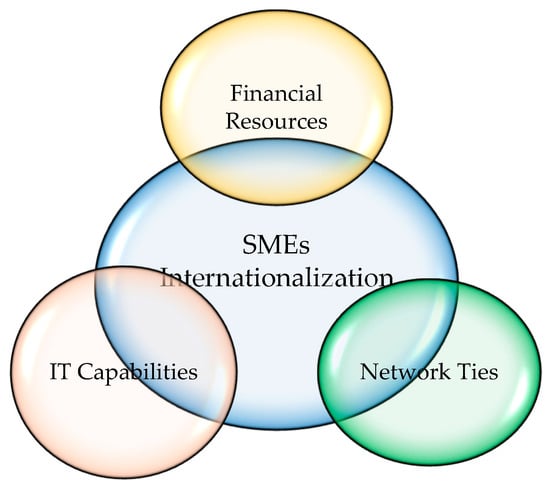
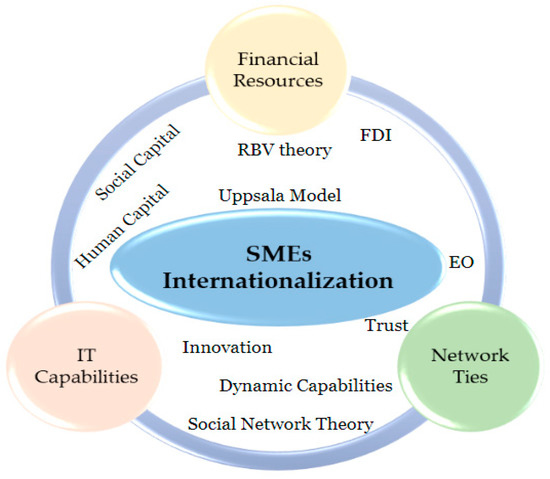
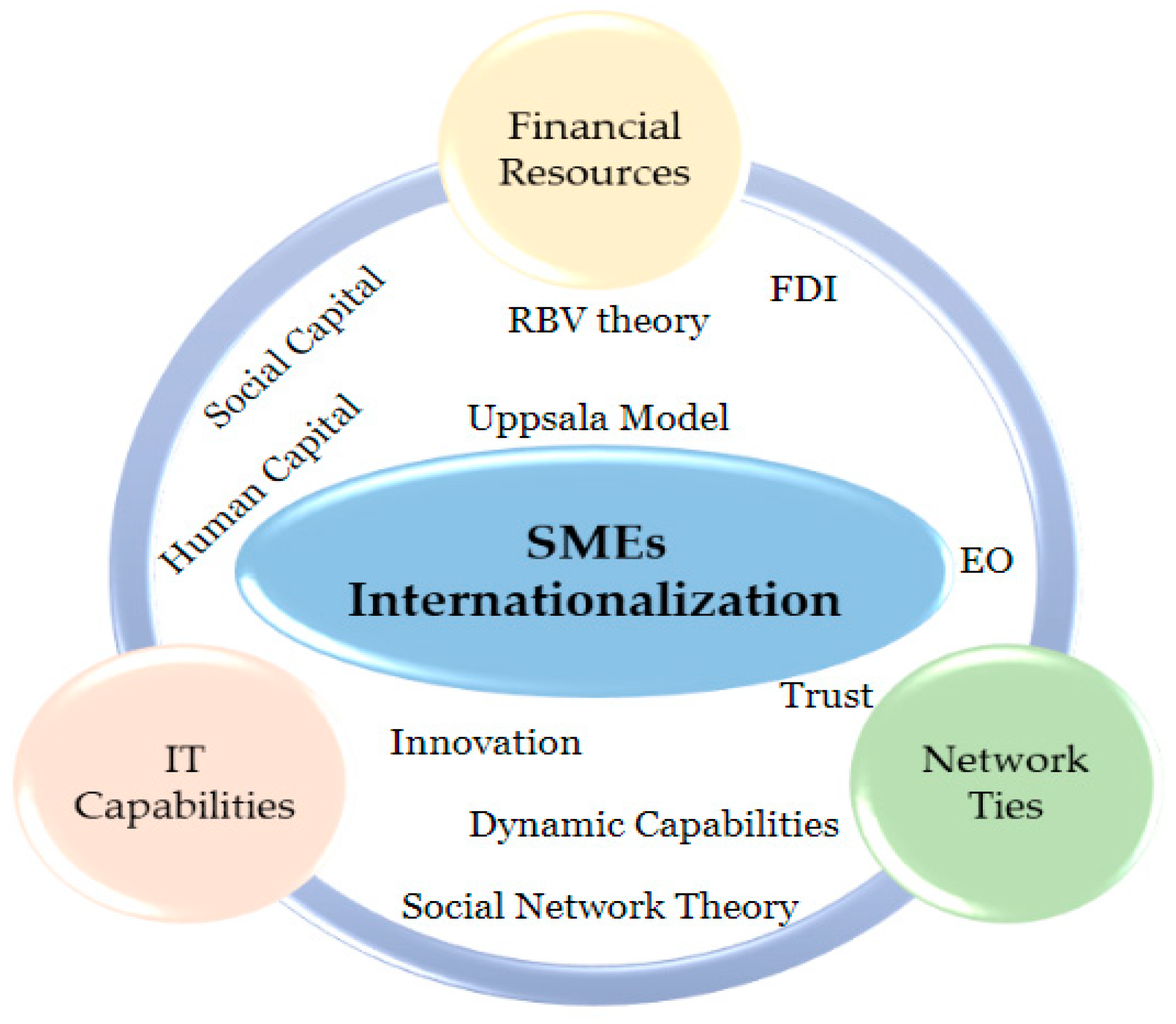
Figure 1 illustrates the conceptualized model of the study.
Figure 1.
Conceptual Research Framework.
A Brief Overview of SMEs’ Internationalization
Financial resources, IT capabilities and network ties play a crucial role in the process of SMEs’ internationalization. We have briefly discussed the importance of each of these factors in the internationalization process of SMEs. Table 1 illustrates the most relevant review of the literature in the context of financial resources, IT capabilities and network ties. The summary of the reviewed literature indicates that financial resources, IT capabilities and network ties are significant predictors of SMEs’ internationalization.
Table 1.
Review of the Existing Literature.
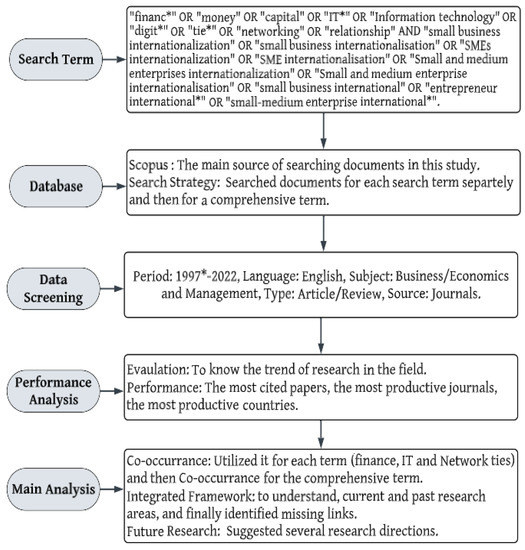
The organization of the study is shown in Figure 2.
Figure 2.
Organization of the Study. (Note: * Research started in 1997).
2. Methodology
2.1. Search Term
Search term is very important in a bibliometric study because an incorrect search term can cause irrelevant data, which significantly influences the results. Hence, we crosschecked several studies to identify the most appropriate search term. To avoid overlapping in the three research areas, we decided to search articles separately for each field and then combined these areas into a single search term. Hence, for financial resources and SMEs internationalization, we used the search term: “financ*” OR “money” OR “capital” OR “investment*” AND “small business internationalization” OR “small business internationalisation” OR “SMEs internationalization” OR “SME internationalisation” OR “Small and medium enterprises internationalization” OR “Small and medium enterprise internationalisation” OR “small business international” OR “entrepreneur international*” OR “small-medium enterprise international*”. For IT Capabilities and SMEs internationalization, the search term is used: “IT*” OR “Information technology” OR “digit*” OR “tie*” OR “networking” OR “relationship” AND “small business internationalization” OR “small business internationalisation” OR “SMEs internationalization” OR “SME internationalisation” OR “Small and medium enterprises internationalization” OR “Small and medium enterprise internationalisation” OR “small business international” OR “entrepreneur international*” OR “small-medium enterprise international*”. For the network ties, it was: “tie*” OR “networking” OR “relationship” AND “small business internationalization” OR “small business internationalisation” OR “SMEs internationalization” OR “SME internationalisation” OR “Small and medium enterprises internationalization” OR “Small and medium enterprise internationalisation” OR “small business international” OR “entrepreneur international*” OR “small-medium enterprise international*”. Finally, we concluded a comprehensive search term “financ*” OR “money” OR “capital” OR “IT*” OR “Information technology” OR “digit*” OR “tie*” OR “networking” OR “relationship” AND “small business internationalization” OR “small business internationalisation” OR “SMEs internationalization” OR “SME internationalisation” OR “Small and medium enterprises internationalization” OR “Small and medium enterprise internationalisation” OR “small business international” OR “entrepreneur international*” OR “small-medium enterprise international*”. These search terms are relevant for extracting papers that have used the word “finance” and “SMEs’ internationalization, IT and SMEs’ internationalization” and” networking” and SMEs’ internationalization in the title, abstract or keywords.
2.2. Database and Software
There are two major databases in the field of business and management research, namely web of science (WOS) and Scopus. Comparatively, Scopus has a larger number of documents than WOS. Considering the term SMEs’ internationalization, we understand that many scholars, especially in developing and emerging markets publish articles in Scopus. In addition, the field of SMEs’ internationalization requires way more research in these countries. Hence, we really wanted to consider these documents in our study. Additionally, many recent bibliometric studies in the same field have selected Scopus as a major database [18,20].
Several software packages, such as R, CiteNet Explorer and CiteSpace, etc., provide the opportunity to analyze a huge dataset for systematic and bibliometric studies. However, in this study, we used VOSviewer 1.6.18 which creates tables and networking structures in different colors to generate results. VOSviewer was ideal for the study because it provides clear insights into a large data set.
2.3. Searching and Screening the Data
After narrowing the search to articles and reviews, business and economics journals and English language, as well as limiting these terms to the titles, abstracts and keywords, we found only 47 documents related to finance and SME internationalization. While using the same criteria, the research area of IT Capabilities and SMEs internalization provided 175 documents. Similarly, network ties and the internationalization of SMEs generated 132 documents. Considering the documents published in three areas, we can see that documents published in finance are relatively lower in number. It is surprising as financial resources are very important for SMEs’ internationalization in emerging economies [51]. However, one reason may be that SMEs have a lack of financial resources, so they tend to use other means for the internationalization process [52]. Finally, we used the comprehensive search term for these three areas. However, there were certain documents that used any of the terms—finance, IT and networking and SMEs internationalization—but were not explicitly addressing the main themes. Hence, we excluded all these irrelevant articles from the dataset to articulate the results in a better way. Consequently, we considered 262 documents with a total of 6499 citations for analysis. All the titles are given in the appendix.
3. Data Analyses and Results
We did a two-step analysis in this study. First, we did performance and then co-occurrence analysis.
3.1. Performance Analysis
We did performance analysis to understand the evaluation of the field (the number of documents published each year and their citations), the most productive countries, the most productive authors and the most cited papers in the fields of financial, IT and networking and SMEs’ internationalization.
3.1.1. Evaluation of the Field
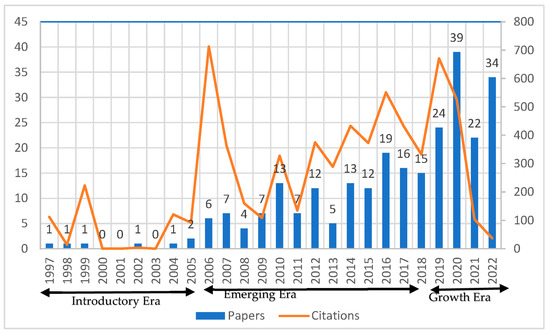
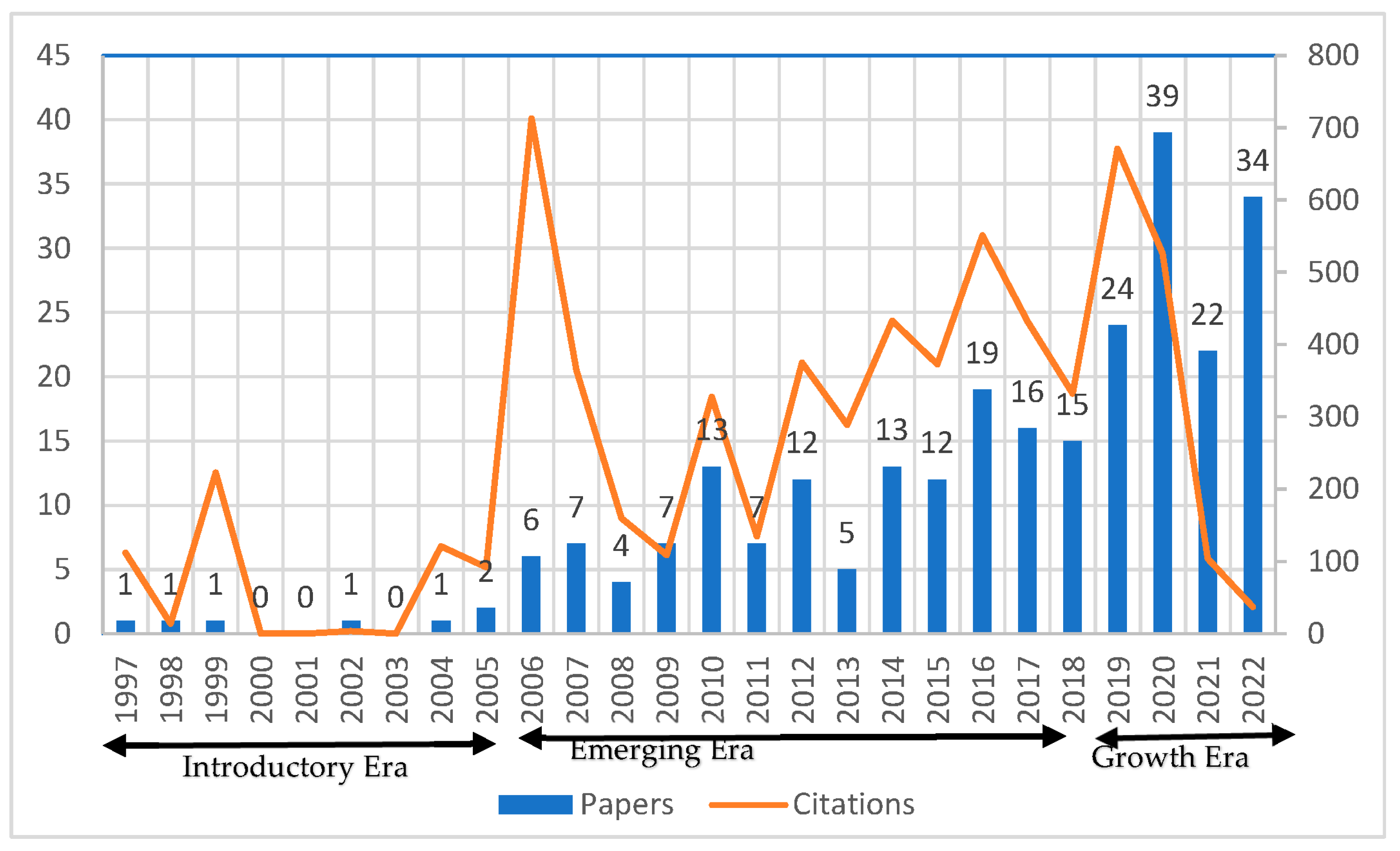
Figure 3 illustrates that research on SMEs’ internationalization in the fields of finance, IT Capabilities and network ties started in 1997 and led to only one paper in each year until 1998, 1999, 2002 and 2004. Surprisingly, no research was conducted in the field in 2000, 2001 and 2003. However, it seems that the formal journey of the research in this particular field started in 2006 with a little up and down for the next several years. We see that, in the year 2019 and onward, more papers were comparatively published (again ups and downs) in the fields. The highest number of studies (39) were published in 2020, followed by 2022.
Figure 3.
An Overview of Published Documents.
Overall, the figure shows three stages: introductory era (1997–2005); emerging era (2006–2018); and growth era (2019–2022) in the field of finance, IT and network ties and SMEs internationalization. In terms of citations, it is clear from the figure that the year 2006 has the highest figure—hinting that research interest since this year has drastically changed.
3.1.2. High Cited Documents
Table 2 indicates the most cited documents in the field of finance, IT Capabilities and networking ties and SMEs’ internationalization. In the top cited documents, Fletcher [53] sheds light on how small business can improve their international entrepreneurship by building relationships with global firms. The second paper in the list, published by Zain and Ng [54], demonstrates the role of network ties in SMEs’ internationalization. The third paper of Pinho [55] reveals that a firm’s international experience, innovative abilities, market potential and market-specific knowledge are the most important factors of its equity-entry mode.
Table 2.
The Most Cited Papers.
3.1.3. Top Journal
Out of 128 journals, there are 16 journals that have published a minimum of 4 papers in the field of SMEs’ internationalization related to finance, IT and network ties. Table 3 illustrates the most productive journals. It is clear from the table that the International Business Review, Journal of International Entrepreneurship and International Marketing Review are the most productive journals in the field.
Table 3.
The Most Productive journals.
3.1.4. Top Countries
Using the condition of at least 5 articles, we discovered 73 countries, 20 of which have published at least 5 articles. As shown in Table 4, UK, USA and Finland are the most productive countries in the fields of finance, IT and network ties and SMEs’ internationalization. As compared to other countries, the table illustrates that most of the scholars in UK emphasize researching SMEs’ internationalization in the particular field. One reason for this is that several top-ranked universities in UK have chairs and departments of SMEs. They significantly focus on the narrow field of research in SMEs. Moreover, there are several research programs for SMEs in UK. Similarly, according to a recent estimate (2022), there are more than 5.5 million of SMEs, which comprise 99.90% of all businesses.
Table 4.
The Most Productive countries.
3.2. Co-Occurrence Analysis
Co-occurrence analysis helps scholars to understand major research themes and areas throughout a period in a field. It helps to understand what the major research areas are, from the beginning to date in a particular field. Hence, we conducted co-occurrence analysis on our dataset in VOSviewer. Our selection criteria was five minimum words—indicating that the database has used a particular word a minimum of five times. In the given figures, nodes (circled dots) show the number of papers while the space between these nodes indicates the relatedness of research areas. For example, the closer the nodes, the more relevant the research areas.
3.2.1. Financial Resources and SMEs’ Internationalization
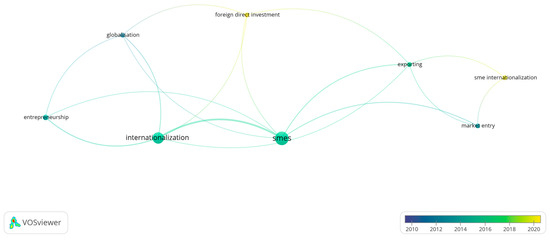
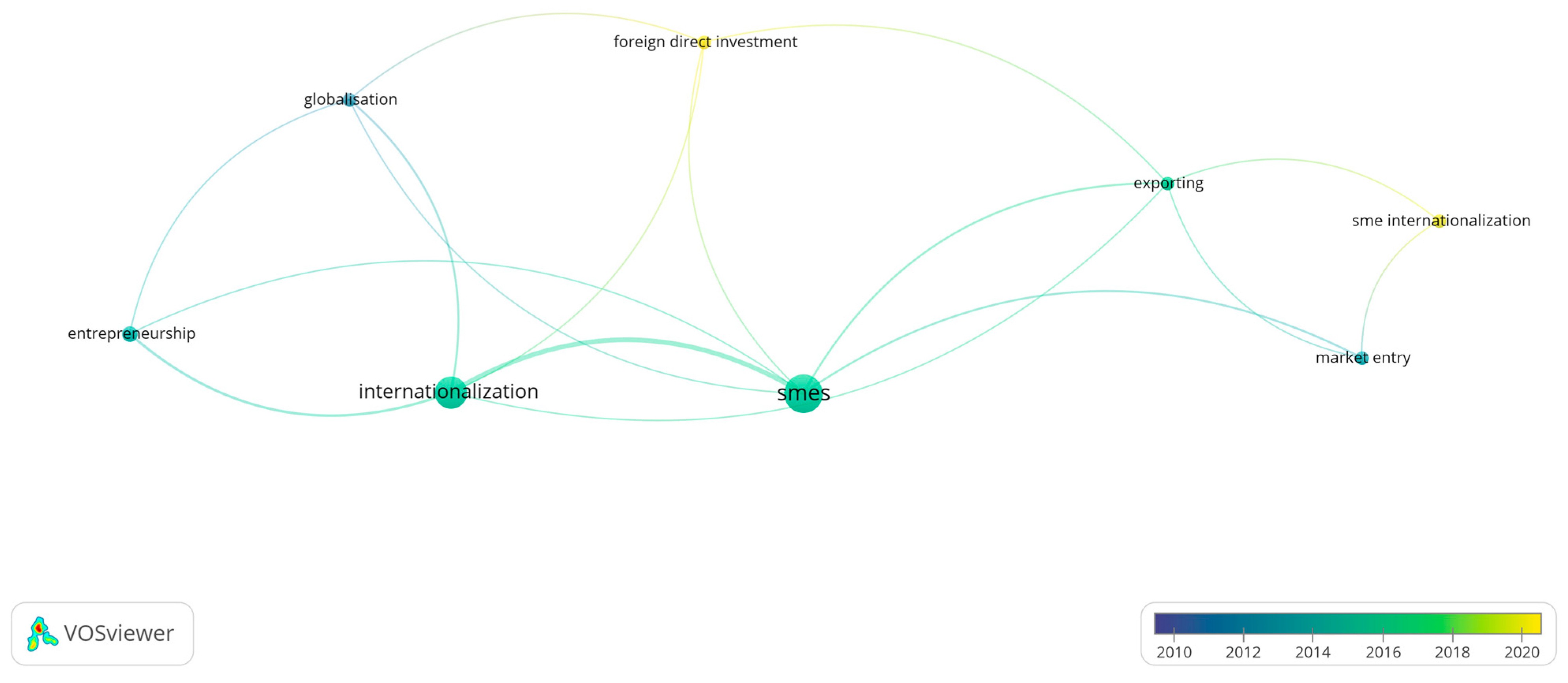
We tried to explore scholarly debate and current research themes in the fields of financial resources and SMEs’ internationalization. We found eight major research themes that revolved around finance and the internationalization of SMEs (see Figure 4). Specifically, the interaction of FDI and SMEs’ internationalization are the hottest topics in the current era. SMEs and internationalization are the most used research words in the field. However, researchers are also significantly engaged in exporting, globalization, entrepreneurship and market entry in the specified area.
Figure 4.
Co-occurrence for Financial Resource and SMEs’ Internationalization.
3.2.2. IT Capabilities and SMEs’ Internationalization
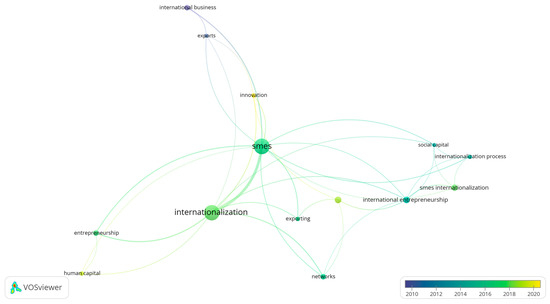
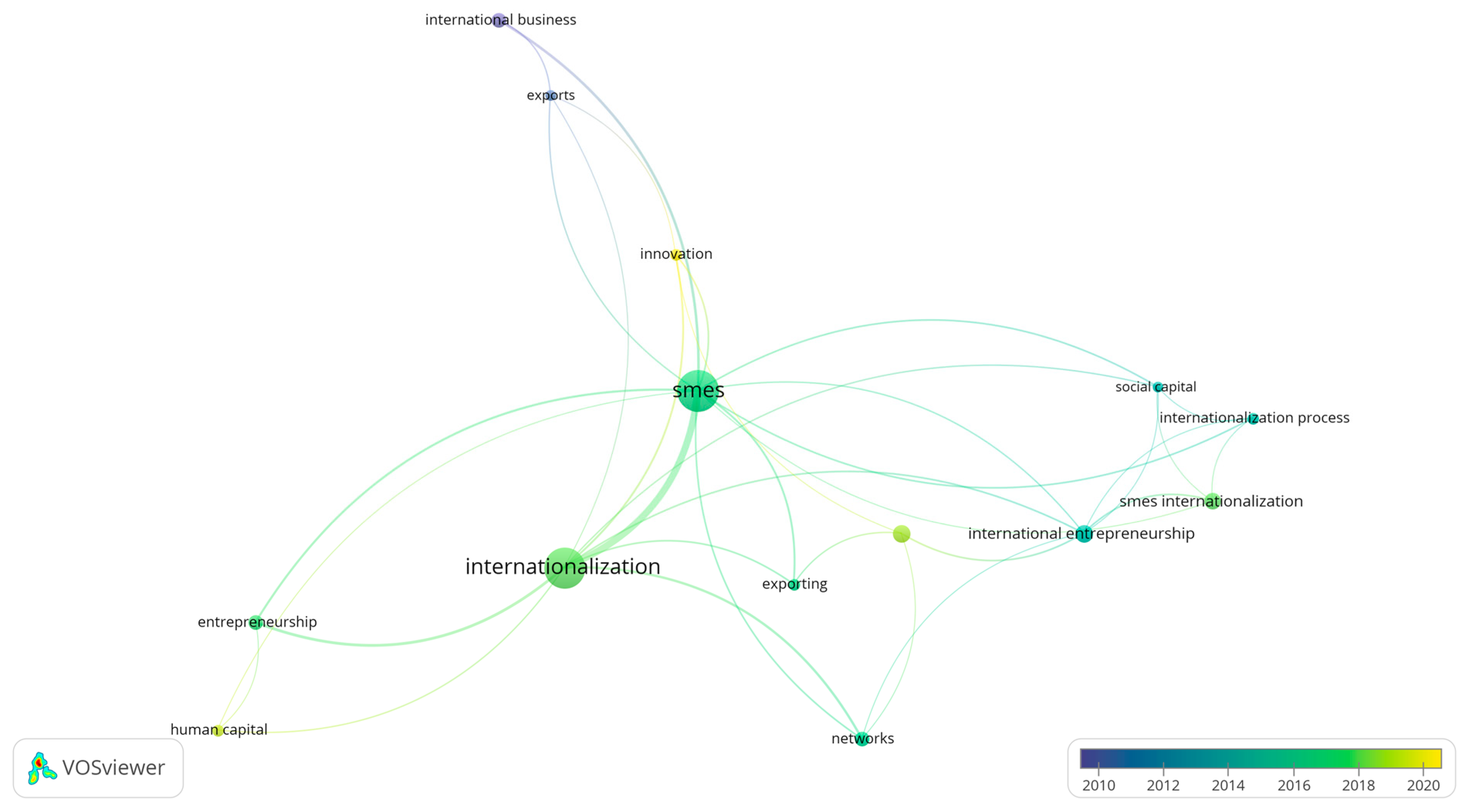
In Figure 5, we tried to understand the research streams and scholarly works in the field of IT capabilities and SMEs’ internationalization. We applied co-occurrence analysis with a minimum of 5 words for each theme and found 14 words that were repeatedly used. We can see that innovation and human capital and innovation are the most recent research streams in the field of IT capabilities and SMEs’ internationalization. SMEs and internationalization are the most used research streams in the field. The other research areas in the field are entrepreneurship, networks, international business, international entrepreneurship, exports, social capital and the internationalization process.
Figure 5.
Co-occurrence for IT Capabilities and SMEs’ Internationalization.
3.2.3. Network Ties and SMEs’ Internationalization
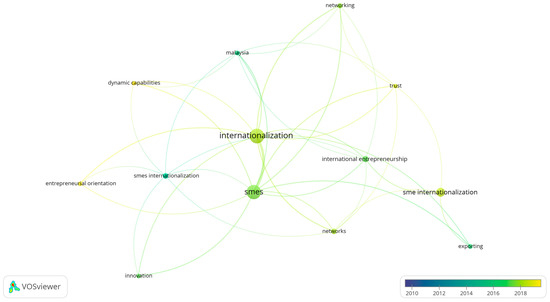
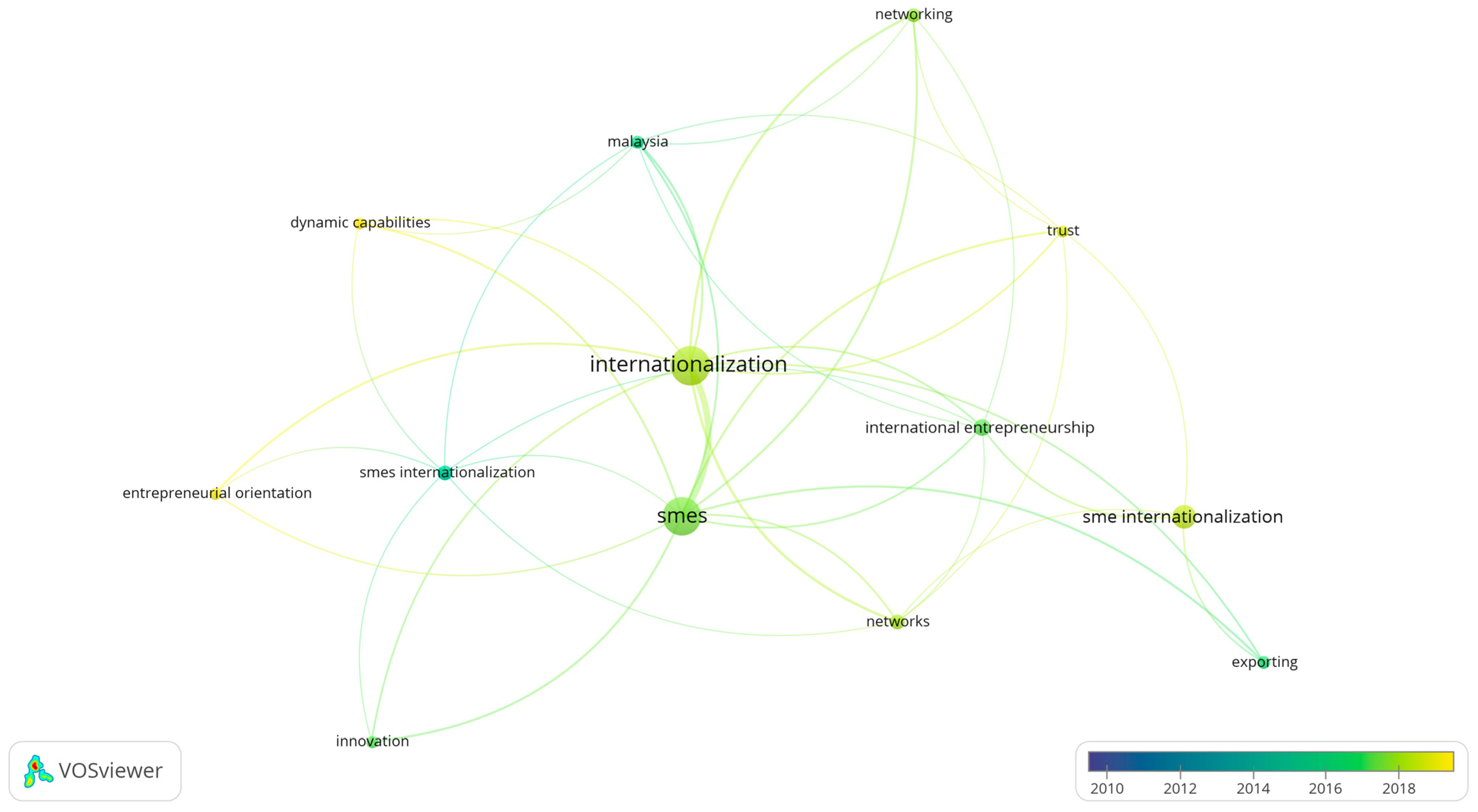
To know the research areas and current streams in the field of network ties and SMEs’ internationalization, we conducted a co-occurrence analysis as given in Figure 6. We can see that SMEs and internationalization are the most used terms. However, currently, researchers in the field of network ties and SMEs’ internationalization are engaged in digital capabilities, entrepreneurial orientation and trust. Moreover, there are other research areas such as exporting, innovation and international entrepreneurship.
Figure 6.
Co-occurrence for Network Ties and SMEs’ Internationalization.
3.2.4. Finance, IT Capabilities and Network Ties and SMEs’ Internationalization
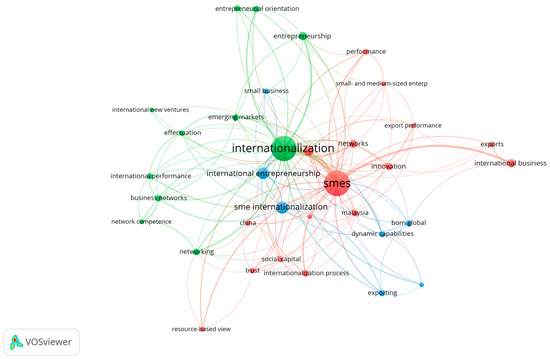
We conducted a co-word analysis for the research areas: financial resources, IT Capabilities, network ties and the internationalization of SMEs. Using the minimum criterion of five words, we found several research streams which were clustered in three different research areas. The networking figure (see Figure 7) shows that the majority of the research studies are circling around SMEs and internationalization. Entrepreneurship and international entrepreneurship are the second most researched areas in the field.
Figure 7.
Co-occurrence for Combined Terms (Network).
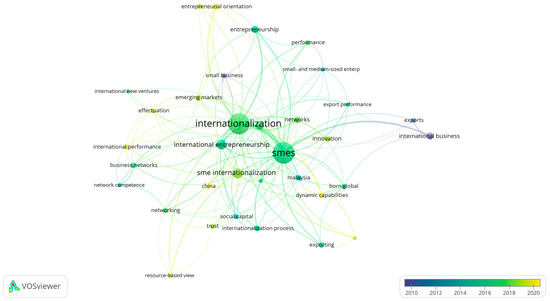
The overlay diagram (Figure 8) shows the past and most recent research areas in the field of finance, IT, networking ties and SMEs internationalization. Looking into the past and current research streams, we see entrepreneurial orientation, affectation, resource base theory, dynamic capabilities and international performance as the hottest topics in the field.
Figure 8.
Co-occurrence for Combined Terms (Overlay).
3.2.5. Integrated Themes and Research Areas
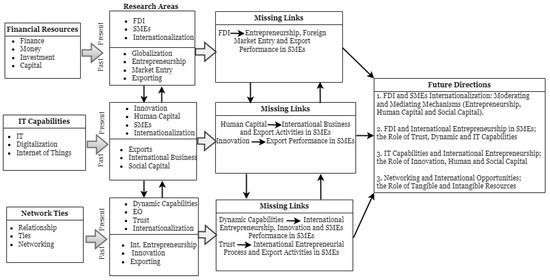
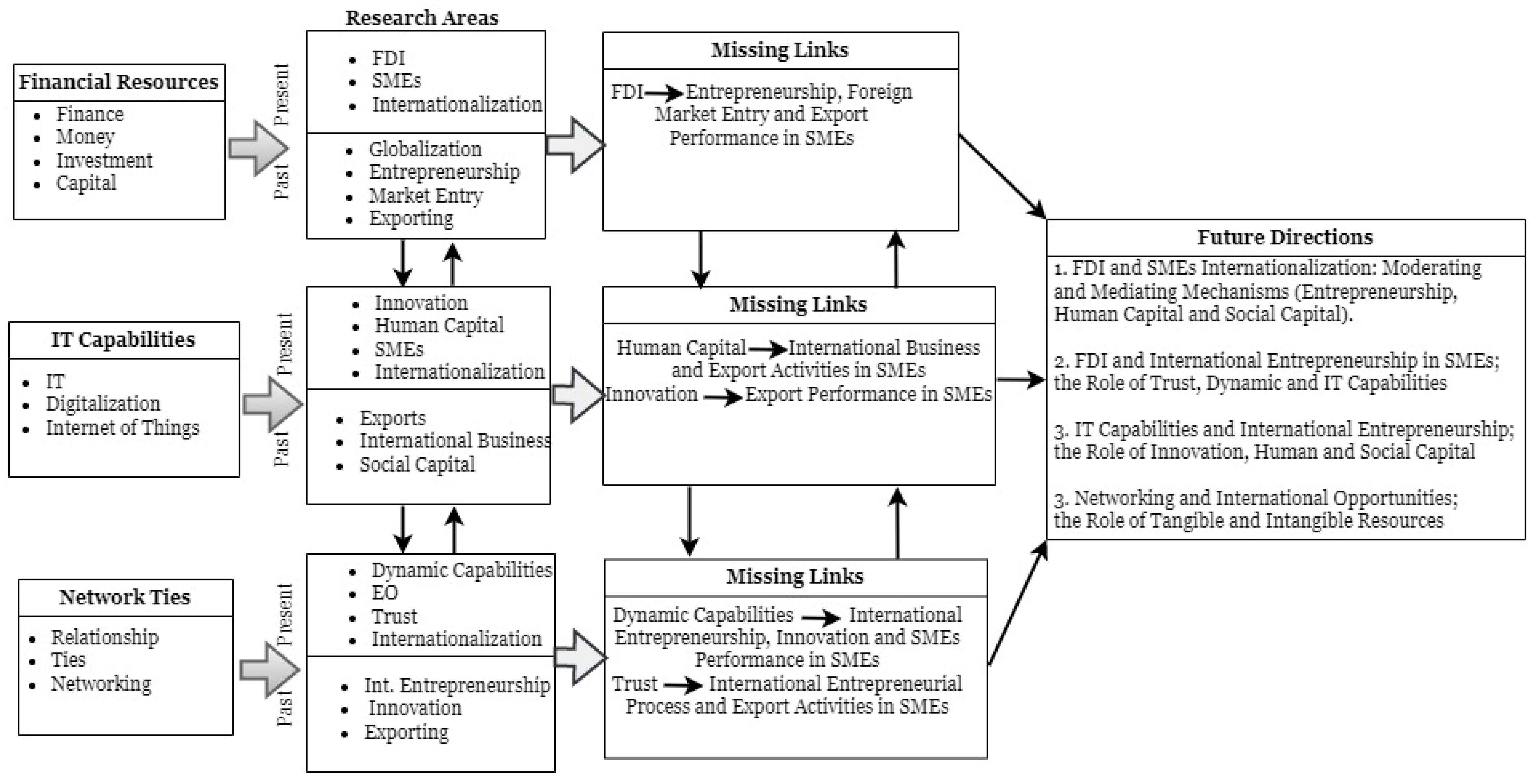
We created an integrated conceptual framework (see Figure 9) based on the co-occurrence analyses for financial resources, IT capabilities and network ties in the field of SMEs’ internationalization. We first distinguished between recent and previous research areas in the fields of financial resources and SMEs’ internationalization, IT capabilities and SMEs’ internationalization, and network ties and SMEs’ internationalization. For example, in the field of financial resources and SMEs’ internationalization, FDI and SMEs’ internationalization are the most recent research areas, while researchers were previously involved in globalization, entrepreneurship, market entry and export performance. Similarly, innovation and human capital are the latest, while exports, international business and social capital are previously researched areas in the field of IT Capabilities and SMEs’ internationalization. In terms of network ties, dynamic capabilities, entrepreneurial orientation and trust are the most recent, while international entrepreneurship, innovation and export performance belong to previous studies. Second, we explored missing links and gaps between recent and past themes in each field. Third, we checked these missing areas and white spaces among the three fields (financial resources, IT Capabilities and network ties) and SMEs’ internationalization. Finally, we created another integrated diagram (see Figure 10) to discuss only scholarly debate on the current edge. This figure illustrates the current research streams in the fields of finance, IT and network ties and SMEs’ internationalization. Consequently, we suggested several research gaps for future researchers and scholars. Overall, the insights demonstrate that finance, IT and network ties could be used complementary to each other, rather than exclusively to configure SMEs’ internationalization.
Figure 9.
An Integrated Framework.
Figure 10.
Current Research Streams.
4. Discussion and Conclusions
We conducted this study to understand the scholarly debate, past and current research streams in the fields of financial resources, IT Capabilities and network ties and SMEs’ internationalization. We understood that the field had received increased interest since 2006 and continued to grow. Several studies have been published in each area and have contributed to the small business’ internationalization literature. These studies have further suggested directions for future researchers in the aforementioned field. For instance, Pacheco et al. [72] described foreign capital as playing an important role in SMEs’ internationalization. Takyi et al. [73] scrutinized the role of government financial resources and strategic alliance in the internationalization of SMEs. Nguyen et al. [3] compared the importance of financial incentives and international knowledge for the internationalization of small business in emerging economies. Pacheco et al. [72] stated that the presence of foreign CEOs configures internationalization process of SMEs because they bring foreign investment to the firms. Child et al. [8] described that, because of limited resources and small size, SMEs rely on external resources, such as finance and technology, etc. A recent study by Croce et al. [74] showed that individual investments improve internationalization process of entrepreneurs and investors. Indeed, financial capital is important for SMEs to innovate their business model for international markets. SMEs should utilize their financial resources efficiently to configure their international success. While looking at the importance of IT Capabilities, Adomako et al. [49] assessed the mediating role of technological capabilities in the relationship between R&D support, technological turbulence and the internationalization of SMEs. Caputo et al. [75] stated that digital platform is an important indicator of international performance in SMEs. Other researchers, such as Reim et al. [76] and Yu et al. [77] described the importance of digitalization and business models in SMEs’ internationalization. Lee et al. [78] described the importance of social media and digital platforms in the internationalization of SMEs. In a recent study, Anwar et al. [52] revealed that digital capabilities assist SMEs in innovating their business model for internationalization process. In the era of COVID-19, digitalization works as helping hands for SMEs in innovating and digitalizing their models for international markets. In the era of digital economy, digitalization has potential to expedite the internationalization process of businesses [79]. Additionally, scholars have also shed light on the role of network ties in the internationalization of SMEs. For example, Singh et al. [80] demonstrated how social networking can improve the internationalization process and economic performance of SMEs. Similarly, Leppäaho et al. [81] discussed the role of networking in the early and post entry phases of internationalization. A recent study by Ong et al. [82] found a positive association between networking and the internationalization of SMEs. Bai et al. [83] stated that building networks with outside partners is important for the internationalization process in business industries. Our research also revealed that networking has been a significant predictor of SMEs’ internationalization over the past 2 decades. To summarize, all these studies have made significant contributions to each area of research. However, many of these research studies combine at least two or three areas as significant determinants of SMEs’ internationalization. This is because SMEs cannot make a useful entry unless they have combined resources and capabilities [9]. In fact, these research studies are limited to a particular research approach or set of data. However, our research sheds light on scholarly debate, past and current research streams, by combining three different areas of research such as finance, IT and networking ties for the internationalization of SMEs.
This research contributes to the body of knowledge in two ways. First, this research combines three major research areas: financial resources, IT Capabilities and network ties and links their association in a systematic way with the internationalization of SMEs. By doing this, we understood how these factors are important for SMEs’ internationalization in the current era. Our research gives hints to future scholars on how these resources and capabilities could be studied further through the lens of the RBV theory. Second, this research is based on a systematic literature review to understand the most influential articles, journals and countries in the field. Previous studies have focused on SMEs’ internationalization with particular factors and these areas are ignored in systematic and bibliometric studies. Hence, our research is the first study to assess the current and past research areas as well as to explore white spaces in the field. For instance, we suggested several research gaps for future scholars who are engaged in researching finance, IT, network ties and SMEs’ internationalization.
4.1. Directions for Future Scholars
We suggest several research directions for future scholars in the fields of financial resources, IT Capabilities and network ties and SMEs’ internationalization. While researching and studying SMEs’ internationalization, researchers can combine these three areas into an integrated model to articulate the results effectively. Despite a high level of interest in research on SMEs’ internationalization, we also understand that only 4 Asian/emerging economies are listed in the top 20 productive countries. This fact gives hints to scholars and researchers towards researching the areas (finance, IT and network ties) in SMEs’ internationalization.
FDI and SMEs’ Internationalization: Moderating and Mediating Mechanisms: In this research area, researchers can understand the importance of FDI in the internationalization of SMEs through various mediators and moderators. A few supportive factors are identified in this study, such as entrepreneurship, human capital and social capital. To explain it further, research can check how entrepreneurially oriented SMEs get the advantages of FDI to boost their internationalization process and performance. They can further check the importance of social and human capital in the lens of FDI or financial resources and SMEs’ internationalization in emerging economies. For instance, Nguyen et al. [3] made a comparison between government financial resources and international market knowledge in SMEs’ internationalization in emerging economies. Moreover, different methods and research approaches could be considered, namely bibliometric studies and meta-analyses.
FDI and International Entrepreneurship: In this research area, we propose researchers check the importance of FDI in international entrepreneurial activities. However, this relationship could be assessed interesting via dynamic capabilities, IT capabilities and networking. It is important to know how FDI improves international entrepreneurship in emerging SMEs. In particular, it would be interesting to check the mediating and moderating roles of certain capabilities, such as dynamic capabilities, IT capabilities and networking ties. Researchers can also know the importance of FDI in SMEs’ internationalization in different regions, e.g., Asian, African and European, etc. However, in particular, the importance of FDI in promoting entrepreneurial interest and motivation in emerging SMEs through local government support will be an interesting study.
IT and International Entrepreneurship: IT Capabilities are very important for boosting entrepreneurial activities in SMEs. IT makes it easy for SMEs to exploit international opportunities. However, for this mission, SMEs need their internal resources, such as finance and management capabilities. Moreover, they could also build networks with external partners and organizations. There are mixed conclusions and fragmented results in the literature. We suggest scholars research how certain internal and external resources and capabilities improve the relationship between IT Capabilities and international entrepreneurship. As noted earlier, scholars and researchers from emerging and Asian economies are highly encouraged to expand the field.
Network Ties and International Opportunities: A number of studies have already researched the importance of networking in international opportunity recognition [84,85]. However, our analysis shows a few missing links in the field, namely the scrutinizing of various tangible (FDI and IT) and intangible (entrepreneurial orientation and managerial capabilities) factors in the relationship between network ties and SMEs’ internationalization. This is important to know, as building relationships with external partners is not always a solution when firms have scarce resources. Therefore, how IT and finance resources enable SMEs to boost their internationalization process will be a vital study. In particular, this topic is interesting for emerging scholars and researchers of developing economies, as firms located in these economies are much more concerned with the deficiency of resources. Apart from this, researchers can also check the importance of financial resources, government incentives, big data analytics and digital transformation approaches in the process of SMEs’ internationalization as well as the export performance of large and listed firms.
Additional future research directions are based on our search term and performance analysis. For instance, in our search, we found only 13% (47) documents for the research area—finance and SMEs’ internationalization. Hence, researchers should explore reasons why finance is not the main strategy for SMEs’ internationalization in the literature. Second, we found almost 24% (63) of the documents published by UK. Although, the number of SMEs and supportive programs are evidence for this number. However, scholars should further research the reasons for an increased number of studies and should investigate causes of the lower number of documents in emerging economies. For instance, the majority of studies in the field have published in the West, while emerging economies in the East have poor research outcomes in the field. Exploring the barriers and causes in this area will be an interesting research study. Moreover, extensive search terms, such as “international entrepreneurship” and “born international Startups”, can be added to the search term in order to know international entrepreneurship behaviors in SMEs.
The database (e.g., Scopus) is the first limitation of this research. We suggest future scholars use the data published in WOS to capture a wide range of articles. Second, we conducted a systematic literature review to address the most influential countries, journals and documents, as well as current and past research streams in the field. Researchers can conduct a bibliometric study by analyzing co-authorship, citation analysis and coupling. In addition, a meta-analysis in the fields of finance, IT Capabilities, networking and the internationalization of SMEs would significantly contribute to the field. In this study, we could not differentiate the importance of each factor on a regional level, such as in Europe, Asia, Africa, etc. This will be an exciting area for future scholars. Also, our study is based on SMEs, and analyzing large firms and companies will improve business literature in the field.
4.2. Conclusions
Research on SMEs’ internationalization has been increasing dramatically, resulting in a huge number of quantitative and qualitative studies around the world. Hence, it is important to conduct a study on the massive amounts of literature to understand how research on the determinants of SMEs can be further improved. However, up to date, we could not find a systematic literature review on the determinants of internationalization: finance, IT and networking for SMEs. To fill the gap, we conducted this systematic literature review on the role of financial resources, IT Capabilities and network ties in the internationalization of SMEs. Our objectives were to understand the most influential papers, countries and journals and to know about scholarly debate and past and current research streams in the field. We used a comprehensive search term and finalized 262 documents from the Scopus database. The database indicates that the research on the internationalization of SMEs started in 1997. However, an increased interest among scholars has been noted since 2006 and onward. In the subsequent sections, we first executed performance analysis and revealed Fletcher [53]; Zain and Ng [54]; and Pinho [55] as the most cited documents. UK, USA and Finland are the most productive countries, and the International Business Review, Journal of International Entrepreneurship and International Marketing Review are the most productive journals in the field. Despite an increased interest in research on SME internationalization, it is surprising to see that only 4 emerging economies, in particular Asian ones, are listed in the top 20 countries. Moreover, we conducted a co-occurrence analysis separately as well as combined for finance, IT and networking in the field of SMEs’ internationalization. We suggest that SMEs should use finance, IT and network ties complementarily, rather than exclusively, to enter into international markets. We then explored several research gaps for future researchers in the field.
The insights of this research are useful for practice because we shed light on three areas, namely finance, IT and networking toward the SMEs’ internationalization. We explored clear white spaces in the field that help researchers to avoid over-researched areas and to focus on the most demanded areas. Moreover, we recognized the most appropriate dimensions to be researched in the future that, in turn, will create useful policy implications.
This study helps researchers understand the origin, status and evaluation of financial resources, IT Capabilities and network ties in the field of SMEs’ internationalization. As demonstrated by our systematic review, the fields have grown significantly since 2006, and even more dramatically since 2019. Small businesses can get benefits of the insights, as they can now understand the determinants of internationalization in the current era. They can know the past and current predictors of the internationalization process. For instance, this research reveals that FDI is the most recent predictor of SMEs’ internationalization in the field of business financial resources. Hence, they could build strong network ties with international banks, financial institutions and investors to boost their internationalization process. In terms of IT Capabilities, our findings show that human capital and innovative tactics are the most recent factors of internationalization. Hence, small businesses should emphasize competent digital employees and managers to attenuate the barriers in the way of internationalization. While building network ties, we found that dynamic capabilities, entrepreneurial orientation and trust are the most significant and recent predictors of SMEs’ internationalization. Owners and managers of SMEs should pay attention to the aforementioned factors when building relationships with external partners to spur their internationalization process. Furthermore, small businesses should use affectation and resources (tangible and intangible) to accelerate their international entry. Furthermore, this research assists policymakers in developing the most appropriate strategies for small business export activities. For instance, based on this research insight, we recommend that policymakers promote FDI, digital competencies and trust in business industries in order to ease export activities.
In summarized findings, we can say that finance, IT and networking play a very important role in the internationalization of SMEs. However, there are areas of research that still need to be investigated based on other indicators. To enrich the literature of SMEs’ internationalization, we have explored some factors that facilitate researchers.
Author Contributions
Conceptualization, M.A. and M.A.; methodology, A.A.-O.; software, S.L.; validation, A.A.-O. and M.A.-N.; formal analysis, M.A.-N.; investigation, S.L.; resources, M.A.-N.; data curation, M.A.; writing—original draft preparation, S.L.; writing—review and editing, M.A.-N.; visualization, S.L.; supervision, M.A.-N.; project administration, A.A.-O.; funding acquisition. All authors have read and agreed to the published version of the manuscript.
Funding
This research was funded by Beijing University of Technology, China. Moreover, this research is aligned the China-Pakistan Economic Corridor.
Data Availability Statement
The data is available free on Scopus https://www.scopus.com/home.uri (accessed on 28 December 2022).
Conflicts of Interest
The authors declare no conflict of interest.
Abbreviations
IT = Information Technology; FDI = Foreign Direct Investment; RBV = Resource Based View; SMEs = Small and Medium Enterprises, EO=Entrepreneurial Orientation.
References
- Bai, W.; Johanson, M.; Oliveira, L.; Ratajczak-Mrozek, M. The role of business and social networks in the effectual internationalization: Insights from emerging market SMEs. J. Bus. Res. 2021, 129, 96–109. [Google Scholar] [CrossRef] [Scilit]
- Mishra, M.; Paul, J.; Czinkota, M. Revisiting models of internationalization: Pre-export phase and lateral rigidity of emerging market Small and Medium Enterprises. Thunderbird Int. Bus. Rev. 2022, 64, 125–138. [Google Scholar] [CrossRef] [Scilit]
- Nguyen, T.; Verreynne, M.-L.; Steen, J.; de Oliveira, R.T. Government support versus international knowledge: Investigating innovations from emerging-market small and medium enterprises. J. Bus. Res. 2023, 154, 113305. [Google Scholar] [CrossRef] [Scilit]
- Qalati, S.A.; Yuan, L.W.; Khan, M.A.S.; Anwar, F. A mediated model on the adoption of social media and SMEs’ performance in developing countries. Technol. Soc. 2021, 64, 101513. [Google Scholar] [CrossRef] [Scilit]
- Khan, R.U.; Salamzadeh, Y.; Kawamorita, H.; Rethi, G. Entrepreneurial Orientation and Small and Medium-sized Enterprises’ Performance; Does ‘Access to Finance’ Moderate the Relation in Emerging Economies? Vis. J. Bus. Perspect. 2021, 25, 88–102. [Google Scholar] [CrossRef] [Scilit]
- Ndiaye, N.; Razak, L.A.; Nagayev, R.; Ng, A. Demystifying small and medium enterprises’ (SMEs) performance in emerging and developing economies. Borsa Istanb. Rev. 2018, 18, 269–281. [Google Scholar] [CrossRef] [Scilit]
- Degong, M.; Ullah, F.; Khattak, M.S.; Anwar, M. Do International Capabilities and Resources Configure Firm’s Sustainable Competitive Performance? Research within Pakistani SMEs. Sustainability 2018, 10, 4298. [Google Scholar] [CrossRef] [Scilit]
- Child, J.; Narooz, R.; Hsieh, L.; Elbanna, S.; Karmowska, J.; Marinova, S.; Puthusserry, P.; Tsai, T.; Zhang, Y. External resource provision and the international performance of SMEs—A contextual analysis. J. Int. Manag. 2022, 28, 100924. [Google Scholar] [CrossRef] [Scilit]
- Anwar, M.; Shah, S.Z.A.; Khan, S.Z. The role of personality in SMEs internationalization: Empirical evidence. Rev. Int. Bus. Strat. 2018, 28, 258–282. [Google Scholar] [CrossRef] [Scilit]
- Senik, Z.C.; Scott-Ladd, B.; Entrekin, L.; Adham, K.A. Networking and internationalization of SMEs in emerging economies. J. Int. Entrep. 2011, 9, 259–281. [Google Scholar] [CrossRef] [Scilit]
- Manolova, T.S.; Manev, I.M.; Gyoshev, B.S. Friends with money? Owner’s financial network and new venture internationalization in a transition economy. Int. Small Bus. J. Res. Entrep. 2014, 32, 944–966. [Google Scholar] [CrossRef] [Scilit]
- Todd, P.R.; Javalgi, R.R.G. Internationalization of SMEs in India: Fostering entrepreneurship by leveraging information technology. Int. J. Emerg. Mark. 2007, 2, 166–180. [Google Scholar] [CrossRef] [Scilit]
- Ayob, A.H.; Ramlee, S.; Rahman, A.A. Financial factors and export behavior of small and medium-sized enterprises in an emerging economy. J. Int. Entrep. 2015, 13, 49–66. [Google Scholar] [CrossRef] [Scilit]
- Ullah, R.; Anwar, M.; Khattak, M.S. Building new venture success through internal capabilities; is business model innovation a missing link? Technol. Anal. Strat. Manag. 2021, 1–14. [Google Scholar] [CrossRef] [Scilit]
- Dabić, M.; Maley, J.; Dana, L.-P.; Novak, I.; Pellegrini, M.M.; Caputo, A. Pathways of SME internationalization: A bibliometric and systematic review. Small Bus. Econ. 2020, 55, 705–725. [Google Scholar] [CrossRef] [Scilit]
- Steinhäuser, V.P.S.; Paula, F.D.O.; de Macedo-Soares, T.D.L.V.A. Internationalization of SMEs: A systematic review of 20 years of research. J. Int. Entrep. 2021, 19, 164–195. [Google Scholar] [CrossRef] [Scilit]
- Owalla, B.; Gherhes, C.; Vorley, T.; Brooks, C. Mapping SME productivity research: A systematic review of empirical evidence and future research agenda. Small Bus. Econ. 2022, 58, 1285–1307. [Google Scholar] [CrossRef] [Scilit]
- Molina-García, A.; Diéguez-Soto, J.; Galache-Laza, M.T.; Campos-Valenzuela, M. Financial literacy in SMEs: A bibliometric analysis and a systematic literature review of an emerging research field. Rev. Manag. Sci. 2022, 1–40. [Google Scholar] [CrossRef] [Scilit]
- Bartolacci, F.; Caputo, A.; Soverchia, M. Sustainability and financial performance of small and medium sized enterprises: A bibliometric and systematic literature review. Bus. Strat. Environ. 2020, 29, 1297–1309. [Google Scholar] [CrossRef] [Scilit]
- Ragazou, K.; Passas, I.; Sklavos, G. Investigating the Strategic Role of Digital Transformation Path of SMEs in the Era of COVID-19: A Bibliometric Analysis Using R. Sustainability 2022, 14, 11295. [Google Scholar] [CrossRef] [Scilit]
- Onkelinx, J.; Manolova, T.; Edelman, L.F. The human factor: Investments in employee human capital, productivity, and SME internationalization. J. Int. Manag. 2016, 22, 351–364. [Google Scholar]
- Jiang, G.F.; Reuer, J.J.; Southam, C.; Beamish, P.W. The impact of initial public offerings on SMEs’ foreign investment decisions. J. Int. Bus. Stud. 2022, 53, 879–901. [Google Scholar] [CrossRef] [Scilit]
- AlShehhi, M.R.; Cherian, J.P.; Farouk, S.; Al Nahyan, M. Influential dynamic capabilities and small and medium enterprises’ internationalization success: Mediating role of international entrepreneurial orientation. Rev. Int. Bus. Strat. 2022, 33, 55–78. [Google Scholar] [CrossRef] [Scilit]
- Rossi, S.P.S.; Bonanno, G.; Giansoldati, M.; Gregori, T. Export starters and exiters: Do innovation and finance matter? Struct. Chang. Econ. Dyn. 2021, 56, 280–297. [Google Scholar] [CrossRef] [Scilit]
- Srivastava, P.; Srivastava, D.K. Resource-based theory and SMEs internationalisation: Evidences from Indian firms. Int. J. Entrep. Small Bus. 2019, 37, 364–398. [Google Scholar]
- Shamsuddoha, A.; Ali, M.Y.; Ndubisi, N.O. Impact of government export assistance on internationalization of SMEs from developing nations. J. Enterp. Inf. Manag. 2009, 22, 408–422. [Google Scholar] [CrossRef] [Scilit]
- Coviello, N.E.; Martin, K.A.-M. Internationalization of Service SMEs: An Integrated Perspective from the Engineering Consulting Sector. J. Int. Mark. 1999, 7, 42–66. [Google Scholar] [CrossRef] [Scilit]
- Nisar, S.; Boateng, A.; Wu, J.; Leung, M. Understanding the motives for SMEs entry choice of international entry mode. Mark. Intell. Plan. 2012, 30, 717–739. [Google Scholar] [CrossRef] [Scilit]
- Gashi, P.; Hashi, I.; Pugh, G. Export behaviour of SMEs in transition countries. Small Bus. Econ. 2014, 42, 407–435. [Google Scholar] [CrossRef] [Scilit]
- Cardoza, G.; Fornes, G.; Li, P.; Xu, N.; Xu, S. China goes global: Public policies‘ influence on small- and medium-sized enterprises’ international expansion. Asia Pac. Bus. Rev. 2015, 21, 188–210. [Google Scholar] [CrossRef] [Scilit]
- Formisano, V.; Tartaglione, A.M.; Fedele, M.; Cavacece, Y. Banking services for SMEs’ internationalization: Evaluating customer satisfaction. TQM J. 2020, 33, 662–680. [Google Scholar] [CrossRef] [Scilit]
- Battisti, M.; Scott-Kennel, J.; Deakins, D. A network perspective on foreign entry modes of small knowledge-intensive services firms. Eur. J. Mark. 2021. [Google Scholar] [CrossRef] [Scilit]
- Rahman, M.; Hack-Polay, D.; Shafique, S.; Igwe, P.A. Dynamic capability of the firm: Analysis of the impact of internationalisation on SME performance in an emerging economy. Int. J. Emerg. Mark. 2021. [Google Scholar] [CrossRef] [Scilit]
- Moon, H.C.; Geddis, L. The internationalisation of entrepreneurship in South Korea. Int. J. Glob. Small Bus. 2009, 3, 263. [Google Scholar] [CrossRef] [Scilit]
- Paramati, S.R.; Ummalla, M.; Apergis, N. The effect of foreign direct investment and stock market growth on clean energy use across a panel of emerging market economies. Energy Econ. 2016, 56, 29–41. [Google Scholar] [CrossRef] [Scilit]
- Hänle, F.; Weil, S.; Cambré, B. China’s OFDI support mechanisms in Germany: How governments can work together to promote SME internationalization, reduce liability of foreignness and contribute positively to society. J. Entrep. Emerg. Econ. 2022. [Google Scholar] [CrossRef] [Scilit]
- Jeong, S.W. Types of foreign networks and internationalization performance of Korean SMEs. Multinatl. Bus. Rev. 2016, 24, 47–61. [Google Scholar] [CrossRef] [Scilit]
- Bagheri, M.; Mitchelmore, S.; Bamiatzi, V.; Nikolopoulos, K. Internationalization Orientation in SMEs: The Mediating Role of Technological Innovation. J. Int. Manag. 2019, 25, 121–139. [Google Scholar] [CrossRef] [Scilit]
- Musteen, M.; Datta, D.K. Learning about foreign markets: A study of Czech SMEs. J. Int. Entrep. 2011, 9, 91–109. [Google Scholar] [CrossRef] [Scilit]
- Jean, R.-J.; Kim, D. Internet and SMEs’ internationalization: The role of platform and website. J. Int. Manag. 2020, 26, 100690. [Google Scholar] [CrossRef] [Scilit]
- Handoyo, S.; Yudianto, I.; Fitriyah, F.K. Critical success factors for the internationalisation of small–medium enterprises in indonesia. Cogent Bus. Manag. 2021, 8, 1923358. [Google Scholar] [CrossRef] [Scilit]
- Yata, S.; Hurd, F. ‘Keep Your Friends Close’: The Role of Informality in the Management of Unequal-sized Collaboration for NZ SMEs. J. Asia-Pac. Bus. 2021, 22, 84–104. [Google Scholar] [CrossRef] [Scilit]
- Thrassou, A.; Vrontis, D.; Crescimanno, M.; Giacomarra, M.; Galati, A. The requisite match between internal resources and network ties to cope with knowledge scarcity. J. Knowl. Manag. 2020, 24, 861–880. [Google Scholar] [CrossRef] [Scilit]
- Amal, M.; Rocha Freitag Filho, A. Internationalization of small-and medium-sized enterprises: A multi case study. Eur. Bus. Rev. 2010, 22, 608–623. [Google Scholar]
- Agnihotri, A.; Bhattacharya, S. CEO polychronicity and SME internationalization. Multinatl. Bus. Rev. 2022, 30, 526–545. [Google Scholar] [CrossRef] [Scilit]
- Ali, I.; Ali, M.; Salam, M.; Bhatti, Z.; Arain, G.; Burhan, M. How international SME’s vicarious learning may improve their performance? The role of absorptive capacity, strength of ties with local SMEs, and their prior success experiences. Ind. Mark. Manag. 2020, 88, 87–100. [Google Scholar]
- Lecerf, M.; Omrani, N. SME Internationalization: The Impact of Information Technology and Innovation. J. Knowl. Econ. 2020, 11, 805–824. [Google Scholar] [CrossRef] [Scilit]
- Rakshit, S.; Islam, N.; Mondal, S.; Paul, T. Influence of blockchain technology in SME internationalization: Evidence from high-tech SMEs in India. Technovation 2022, 115, 102518. [Google Scholar] [CrossRef] [Scilit]
- Adomako, S.; Amankwah-Amoah, J.; Danquah, J.K. R&D support, technological turbulence, and SMEs‘ degree of internationalization: The mediating role of technological capability. Thunderbird Int. Bus. Rev. 2022, 64, 251–262. [Google Scholar]
- Brieger, S.A.; Chowdhury, F.; Hechavarría, D.M.; Muralidharan, E.; Pathak, S.; Lam, Y.T. Digitalization, institutions and new venture internationalization. J. Int. Manag. 2022, 28, 100949. [Google Scholar] [CrossRef] [Scilit]
- Alayo, M.; Iturralde, T.; Maseda, A.; Aparicio, G. Mapping family firm internationalization research: Bibliometric and literature review. Rev. Manag. Sci. 2021, 15, 1517–1560. [Google Scholar] [CrossRef] [Scilit]
- Anwar, M.; Scheffler, M.; Clauss, T. Digital Capabilities, Their Role in Business Model Innovativeness, and the Internationalization of SMEs. IEEE Trans. Eng. Manag. 2022, 1–13. [Google Scholar] [CrossRef] [Scilit]
- Fletcher, D. International entrepreneurship and the small business. Entrep. Reg. Dev. 2004, 16, 289–305. [Google Scholar] [CrossRef] [Scilit]
- Zain, M.; Ng, S.I. The impacts of network relationships on SMEs’ internationalization process. Thunderbird Int. Bus. Rev. 2006, 48, 183–205. [Google Scholar] [CrossRef] [Scilit]
- Pinho, J.C. The impact of ownership: Location-specific advantages and managerial characteristics on SME foreign entry mode choices. Int. Mark. Rev. 2007, 24, 715–734. [Google Scholar]
- Lu, J.W.; Beamish, P.W. SME internationalization and performance: Growth vs. Profitability. J. Int. Entrep. 2006, 4, 27–48. [Google Scholar] [CrossRef] [Scilit]
- D’Angelo, A.; Majocchi, A.; Buck, T. External managers, family ownership and the scope of SME internationalization. J. World Bus. 2016, 51, 534–547. [Google Scholar] [CrossRef] [Scilit]
- Musteen, M.; Datta, D.K.; Butts, M.M. Do International Networks and Foreign Market Knowledge Facilitate SME Internationalization? Evidence from the Czech Republic. Entrep. Theory Pract. 2014, 38, 749–774. [Google Scholar] [CrossRef] [Scilit]
- Cheng, H.-L.; Yu, C.-M.J. Institutional pressures and initiation of internationalization: Evidence from Taiwanese small- and medium-sized enterprises. Int. Bus. Rev. 2008, 17, 331–348. [Google Scholar] [CrossRef] [Scilit]
- Suárez-Ortega, S.M.; Álamo-Vera, F.R. SMES’ internationalization: Firms and managerial factors. Int. J. Entrep. Behav. Res. 2005, 11, 258–279. [Google Scholar]
- Bell, J.; Loane, S. ‘New-wave’ global firms: Web 2.0 and SME internationalisation. J. Mark. Manag. 2010, 26, 213–229. [Google Scholar]
- Child, J.; Hsieh, L.H. Decision mode, information and network attachment in the internationalization of SMEs: A configurational and contingency analysis. J. World Bus. 2014, 49, 598–610. [Google Scholar] [CrossRef] [Scilit]
- Poon, S.; Jevons, C. Internet-enabled international marketing: A small business network perspective. J. Mark. Manag. 1997, 13, 29–41. [Google Scholar] [CrossRef] [Scilit]
- D’Angelo, A.; Majocchi, A.; Zucchella, A.; Buck, T. Geographical pathways for SME internationalization: Insights from an Italian sample. Int. Mark. Rev. 2013, 30, 80–105. [Google Scholar] [CrossRef] [Scilit]
- Hagen, B.; Zucchella, A.; Cerchiello, P.; De Giovanni, N. International strategy and performance—Clustering strategic types of SMEs. Int. Bus. Rev. 2012, 21, 369–382. [Google Scholar] [CrossRef] [Scilit]
- Lindstrand, A.; Melén, S.; Nordman, E.R. Turning social capital into business: A study of the internationalization of biotech SMEs. Int. Bus. Rev. 2011, 20, 194–212. [Google Scholar] [CrossRef] [Scilit]
- Genc, E.; Dayan, M.; Genc, O.F. The impact of SME internationalization on innovation: The mediating role of market and entrepreneurial orientation. Ind. Mark. Manag. 2019, 82, 253–264. [Google Scholar] [CrossRef] [Scilit]
- Lu, J.W.; Beamish, P.W. Partnering strategies and performance of SMEs’ international joint ventures. J. Bus. Ventur. 2006, 21, 461–486. [Google Scholar] [CrossRef] [Scilit]
- Hilmersson, M.; Johanson, M. Speed of SME Internationalization and Performance. Manag. Int. Rev. 2016, 56, 67–94. [Google Scholar] [CrossRef] [Scilit]
- Agndal, H.; Chetty, S. The impact of relationships on changes in internationalisation strategies of SMEs. Eur. J. Mark. 2007, 41, 1449–1474. [Google Scholar] [CrossRef] [Scilit]
- Sadeghi, V.J.; Nkongolo-Bakenda, J.-M.; Anderson, R.B.; Dana, L.-P. An institution-based view of international entrepreneurship: A comparison of context-based and universal determinants in developing and economically advanced countries. Int. Bus. Rev. 2019, 28, 101588. [Google Scholar] [CrossRef] [Scilit]
- Pacheco, L.; Lobo, C.; Maldonado, I. The Presence of Foreign Capital and the Internationalization of Portuguese Industrial SMEs. J. Risk Financial Manag. 2022, 15, 68. [Google Scholar] [CrossRef] [Scilit]
- Takyi, L.N.; Naidoo, V.; Dogbe, C.S.K. Government support, strategic alliance and internationalization: Evidence from indigenous Ghanaian exporters. J. Int. Entrep. 2022, 20, 619–638. [Google Scholar] [CrossRef] [Scilit]
- Croce, A.; Schwienbacher, A.; Ughetto, E. Internationalization of business angel investments: The role of investor experience. Int. Bus. Rev. 2023, 32, 102033. [Google Scholar] [CrossRef] [Scilit]
- Caputo, F.; Fiano, F.; Riso, T.; Romano, M.; Maalaoui, A. Digital platforms and international performance of Italian SMEs: An exploitation-based overview. Int. Mark. Rev. 2022, 39, 568–585. [Google Scholar] [CrossRef] [Scilit]
- Reim, W.; Yli-Viitala, P.; Arrasvuori, J.; Parida, V. Tackling business model challenges in SME internationalization through digitalization. J. Innov. Knowl. 2022, 7, 100199. [Google Scholar] [CrossRef] [Scilit]
- Yu, H.; Fletcher, M.; Buck, T. Managing digital transformation during re-internationalization: Trajectories and implications for performance. J. Int. Manag. 2022, 28, 100947. [Google Scholar] [CrossRef] [Scilit]
- Lee, J.Y.; Yang, Y.S.; Ghauri, P.N.; Park, B.I. The Impact of Social Media and Digital Platforms Experience on SME International Orientation: The Moderating Role of COVID-19 Pandemic. J. Int. Manag. 2022, 28, 100950. [Google Scholar] [CrossRef] [Scilit]
- Feliciano-Cestero, M.M.; Ameen, N.; Kotabe, M.; Paul, J.; Signoret, M. Is digital transformation threatened? A systematic literature review of the factors influencing firms’ digital transformation and internationalization. J. Bus. Res. 2023, 157, 113546. [Google Scholar] [CrossRef] [Scilit]
- Singh, R.; Chandrashekar, D.; Hillemane, B.S.M.; Sukumar, A.; Jafari-Sadeghi, V. Network cooperation and economic performance of SMEs: Direct and mediating impacts of innovation and internationalisation. J. Bus. Res. 2022, 148, 116–130. [Google Scholar] [CrossRef] [Scilit]
- Leppäaho, T.; Jack, S.L.; Plakoyiannaki, E. Network Mechanisms in the Entry and Post-Entry Phases of Internationalization: Evidence from Finnish Family Firms. Br. J. Manag. 2022, 33, 1991–2008. [Google Scholar] [CrossRef] [Scilit]
- Ong, X.; Freeman, S.; Goxe, F.; Guercini, S.; Cooper, B. Outsidership, network positions and cooperation among internationalizing SMEs: An industry evolutionary perspective. Int. Bus. Rev. 2022, 31, 101970. [Google Scholar] [CrossRef] [Scilit]
- Bai, W.; Johanson, M.; Oliveira, L.; Ratajczak-Mrozek, M.; Francioni, B. Where business networks and institutions meet: Internationalization decision-making under uncertainty. J. Int. Manag. 2022, 28, 100904. [Google Scholar] [CrossRef] [Scilit]
- Faroque, A.R.; Morrish, S.C.; Kuivalainen, O.; Sundqvist, S.; Torkkeli, L. Microfoundations of network exploration and exploitation capabilities in international opportunity recognition. Int. Bus. Rev. 2021, 30, 101767. [Google Scholar] [CrossRef] [Scilit]
- Goxe, F.; Mayrhofer, U.; Kuivalainen, O. Argonauts and Icaruses: Social networks and dynamics of nascent international entrepreneurs. Int. Bus. Rev. 2022, 31, 101892. [Google Scholar] [CrossRef] [Scilit]

Disclaimer/Publisher’s Note: The statements, opinions and data contained in all publications are solely those of the individual author(s) and contributor(s) and not of MDPI and/or the editor(s). MDPI and/or the editor(s) disclaim responsibility for any injury to people or property resulting from any ideas, methods, instructions or products referred to in the content. |
© 2023 by the authors. Licensee MDPI, Basel, Switzerland. This article is an open access article distributed under the terms and conditions of the Creative Commons Attribution (CC BY) license (https://creativecommons.org/licenses/by/4.0/).