


Abstract
Hydrogen is an environmentally friendly source of renewable energy. Energy generation from hydrogen has not yet been widely commercialized due to issues related to risk management in its storage and transportation. In this paper, the authors propose a hybrid multiple-criteria decision-making (MCDM)-based method to manage the risks involved in the storage and transportation of hydrogen (RSTH). First, we identified the key points of the RSTH by examining the relevant literature and soliciting the opinions of experts and used this to build a prototype of its decision structure. Second, we developed a hybrid MCDM approach, called the D-ANP, that combined the decision-making trial and evaluation laboratory (DEMENTEL) with the analytic network process (ANP) to obtain the weight of each point of risk. Third, we used fuzzy evaluation to assess the level of the RSTH for Beijing, China, where energy generation using hydrogen is rapidly advancing. The results showed that the skills of the personnel constituted the most important risk-related factor, and environmental volatility and the effectiveness of feedback were root factors. These three factors had an important impact on other factors influencing the risk of energy generation from hydrogen. Training and technical assistance can be used to mitigate the risks arising due to differences in the skills of personnel. An appropriate logistics network and segmented transportation for energy derived from hydrogen should be implemented to reduce environmental volatility, and integrated supply chain management can help make the relevant feedback more effective.
1. Introduction
Hydrogen energy is expected to be an important part of the global energy system in the future. As an energy carrier, hydrogen has important applications in transportation, industry, construction, and other fields. It has the advantages of high power density, zero emission, good thermal conductivity, convenient transportation, etc. [1]. Developing the industry for hydrogen energy is conducive to energy security and industrial upgrade [2]. The International Hydrogen Energy Commission has claimed that hydrogen energy will satisfy 18% of the terminal global energy demand by 2050, with a market value of more than USD 2.5 trillion, and hydrogen fuel-cell vehicles will account for 20–25% of vehicles worldwide [3].
The industrial processes and supply chain for hydrogen energy have gradually improved in China due to the development of key technologies. However, the country’s hydrogen energy industry currently relies heavily on government policies and subsidies. This is primarily because the risk involved in the storage and transportation of hydrogen (RSTH) has affected the commercialization of this form of energy. Hydrogen is a flammable gas that belongs to Class II of dangerous goods according to GB6944. It is more unstable than fossil-fuel-based energy and is gaseous at a normal temperature and pressure. Crucial to the commercialization of hydrogen energy is guaranteeing the safety of each link of the supply chain. Many countries have set up special research institutions to investigate the safety of hydrogen energy to expedite its industrialization. Examples include the Japan Hydrogen Supply and Hydrogen Application Technology Association, the US Hydrogen Safety Center, the European Union’s Fuel Cell and Hydrogen Joint Association, and the International Hydrogen Safety Association. Prevalent research has focused on assessing the safety of hydrogen fuel-cell vehicles [4], methods to calculate a safe distance for fuel dispensers for such vehicles [5], comparing the risks posed by hydrogenated gasoline engines [6], and quantitatively assessing the risk to humans during the operation of hydrogen refueling stations [7]. While the safe application of technologies for energy generation from hydrogen and the operation of hydrogen refueling stations have received widespread attention, other safety-related issues in the hydrogen energy supply chain have been neglected. This supply chain includes production, storage, transportation, and use, and imposes varying safety-related demands on different links of the chain. Research has shown that there is a long distance between the upstream and downstream links of the supply chain for hydrogen energy, especially during its storage and transportation. These links are characterized by a long residence time, uncertain external conditions, and the execution of a large number of logistical activities under the supervision of nonprofessionals [8]. The RSTH is thus high and needs to be managed.
In this study, we sought answers to the following research questions: What risk factors should be considered in the storage and transportation of hydrogen? What are the critical risk factors? How do we evaluate the RSTHs in specific cities? How should we execute the closed-loop management and control of risks based on the results of such evaluations? Answering these questions can help provide useful suggestions for reducing the RSTHs and, thus, economic loss, and motivate the comprehensive development of the hydrogen energy industry.
Multicriteria decision-making (MCDM)-based methods are often used to solve problems that are characterized by incommensurate and conflicting criteria. The indicators used to assess the RSTH have different units and conflict with one another, where this makes managing the RSTH a classic MCDM problem. In this paper, the authors use the decision-making trial and evaluation laboratory (DEMATEL) to analyze the interaction between aspects and criteria and use the analytic network process (ANP) to obtain the weights of key factors. Following this, we use fuzzy evaluation in a case study to assess the RSTHs of Beijing, China, and use the empirical results as the basis for suggesting control measures.
The remainder of this paper is organized as follows: Section 2 reviews the literature on the identification and evaluation of the RSTHs, and Section 3 introduces the proposed method. Section 4 considers Beijing as an example to show how to establish a system of indicators for urban RSTHs, measure the weights of the key risk factors, and evaluate the RSTHs. Section 5 discusses the implications of the work here for risk management in the context of hydrogen energy, and Section 6 summarizes the conclusions of this study.
2. Literature Review
2.1. Risk Factors Influencing RSTH
Recent studies have focused on risk factors related to key links in the industrial chain for hydrogen energy, such as the risks involved in hydrogen production [9,10,11] and at hydrogen refueling stations [12,13,14]. However, accidents in the hydrogen supply chain are more likely to occur at the juncture of its links, especially when the environment changes. Therefore, more attention should be paid to risk factors involved in the storage and transportation of hydrogen energy.
Hydrogen belongs to the category of dangerous goods. The literature on the risks involved in the storage and transportation of hydrogen energy has examined the issue from multiple perspectives. Lam et al. proposed eight risk factors: (i) equipment cracking, (ii) equipment failure, (iii) incorrect operation, (iv) aging material, (v) system failure, (vi) unclear instructions, (vii) vehicular collision, and (viii) weather [15]. Li et al. reviewed the literature and accident reports related to hydrogen energy to develop a hierarchical system of indices of the relevant risk factors that considered six aspects: (i) natural disasters, (ii) equipment failure, (iii) design-related deficiencies, (iv) detrimental process-related factors, (v) human failure, and (vi) management flaws [16]. Zhang et al. comprehensively analyzed the risk factors in the production, storage, and transportation of hydrogen [17], and Moradi et al. classified and accounted for material-related factors that can affect the reliability of storage and delivery systems for it [18]. Fabiano et al. used field data to analyze the risk factors in the transport of dangerous goods from the perspectives of the characteristics of the road, meteorological conditions, and particulars of the traffic [19]. They considered the impacts of inherent factors (such as tunnels, radii of bends, gradient of height, and slope), meteorological factors, and traffic-related factors (e.g., frequency of trucks) to plan actions in case of emergency [20]. Guo et al. analyzed the impact of third-party damage, corrosion-induced destruction, design flaws, and the misuse of factors during pipeline transportation [21].
The brief review above shows that while many studies have been devoted to examining the risk factors in the storage and transportation of dangerous goods, scant work has considered the risks involved in the storage and transportation of hydrogen energy.
2.2. Risk Management and Control
Risk assessment forms the largest category of issues that need to be addressed for the transportation of dangerous goods, accounting for about 47.43% of the total [22]. Hans et al. assessed the risks of different modes of hydrogen transport, and their results can be used to take preventive or protective measures to reduce these risks [23]. Camila et al. estimated the risk involved in storage systems for bulk liquid hydrogen [24], and Byung et al. compared and analyzed the risks posed by hydrogen energy in different states of storage [25]. Lee et al. assessed the risk of transportation of hydrogen using a pipeline [26], and Kim et al. determined the safety and implications of mobile hydrogen refueling stations based on certain scenarios [13]. Moradi et al. reviewed risk and reliability analyses for the storage and delivery of hydrogen [18], and Francisco et al. categorized sections of a hydrogen pipeline according to the levels of risk [27]. Lam et al. identified important factors and effects in the context of logistical accidents involving hydrogen energy [15].
Some researchers have proposed control measures according to the results of risk assessment. Kim et al. claimed that it is necessary to prevent leaks through the regular maintenance of safety devices, such as those to detect gas leaks, emergency shut-off devices, and safety valves. Moreover, periodic inspections are needed to identify faulty connections, and damage to and failure of the core facilities [13]. Moradi et al. claimed that the opportunities offered by advances in sensors, data collection, and prognostics need to be explored to ensure the safe production and transportation of hydrogen energy [18]. Lam et al. proposed specific control measures for different risk factors [15], and Zhang et al. claimed that safety monitoring and early warning should be carried out during the storage and transportation of hydrogen, while the safety of key facilities should be evaluated and adequate risk control should be implemented [17]. Castiglia et al. proposed the standardized management and effective training of operators [28], and Lee et al. proposed real-time monitoring and early warning based on sensing technology to reduce risks during transportation [29]. However, the emergence of risks is usually complex and network-like in practice, and many risks are intimately related and often occur together [15]. Few studies have been devoted to countermeasures and suggestions for risk prevention.
Due to the interdependence of and correlation among the risk factors, developing strategies according to the categories of risk is more conducive to ensuring the safe operation of the supply chain for hydrogen energy.
2.3. Method of Assessing RSTH
In early work on risk, methods of qualitative risk research (QLR) were used to evaluate the risks of transportation and form the premise of research on transporting dangerous goods. Lees, Davies et al., and Erkut et al. used QLR methods to examine the risk of transporting dangerous goods [30,31]. More accurate quantitative models of risk assessment were subsequently developed and have been widely used for the transportation of dangerous goods. Current et al. developed a multiobjective method of risk assessment for the transport of dangerous goods by road that considers such factors such as the balance and cost of transport [32]. Leonelli et al. proposed a model of risk assessment for road transportation by considering multiple factors, such as hazardous substances, meteorological conditions, and seasonal directions of wind [33].
Researchers have used various methods to assess the RSTH. Julien et al. conducted a quantitative assessment of the risks posed by distribution networks for hydrogen [34], and Hans et al. used Bayesian networks to assess this risk [23]. Camila et al. used the FMEA to identify failure scenarios [24], and Byung et al. proposed a QRA-based comparison between the GHRS and the LHRS to analyze risk [25]. Alencar et al. proposed an MCDM that incorporates the human, financial, and environmental dimensions to assess the risk of transporting hydrogen in a pipeline [35]. Lee et al. used a model to analyze delivery scenarios for hydrogen and an improved version of the QRA to help choose a suitable transportation infrastructure for it [26]. Kim et al. performed a QRA of hydrogen refueling stations [13], and Francisco et al. proposed a multidimensional model of risk based on utility theory and the ELECTRE TRI method [27]. Lam et al. used network analysis to analyze the significant effects of risks [15].
Assessing the RSTH is a classical MCDM problem [36]. Wu et al. conducted a risk assessment of wind–photovoltaic–hydrogen energy storage projects by using an improved fuzzy synthetic approach to evaluation based on a cloud model [37]. Yang proposed an information-based model of risk control assessment that can improve information security for the companies and organizations involved [36]. In this study, they proposed an MCDM-based model that combines VIKOR, DEMATEL, and ANP to solve the problem of conflicting criteria that are interdependent and provide feedback [14]. Zheng et al. used the G-DEMATEL-AHP method to investigate the risk of flooding in urban areas of megacities [17], and Wang et al. built a combined analytical hierarchy process–fuzzy comprehensive evaluation (AHP–FCE) model to assess the risk posed by hazard installations [38]. Mohammad et al. used the hybrid Fuzzy DEMATEL-ANP to identify and assess the main risks in oil and gas projects under sanctions and uncertain conditions [39]. Li et al. proposed a framework comprising the fuzzy DEMATEL implemented with TOPSIS to assess the comprehensive risk posed by hydrogen generation units [16].
The above review shows the diversity of the methods that have been applied to risk assessment in the context of the storage and transportation of hydrogen energy. Because factors influencing the RSTH have interdependent impacts, the DEMATAL-ANP method is suitable for evaluating this risk in cities.
2.4. Prototype Decision Structure
We chose and integrated the risk factors involved in the storage and transportation of hydrogen based on the above literature review and classified them into different categories. We then deleted factors that had the same meaning. We thus developed a prototype of a decision structure consisting of five categories: (i) the risk posed by people, (ii) storage-related risk, (iii) transportation-related risk, (iv) environmental risk, and (v) management-related risk. A detailed description of each category is provided in Table 1.
Table 1.
The initial set of risk factors for hydrogen storage and transportation.
3. Materials and Methods
3.1. Materials
First, the D-ANP method was used to obtain the importance of the criteria, and important criteria were selected for in-depth analysis. Then, the RSTH was evaluated by using the fuzzy comprehensive evaluation method. In order to obtain data, we designed the D-ANP questionnaire and the risk assessment questionnaire, respectively.
In order to obtain the D-ANP questionnaire, we investigated five experts in related fields and asked them to rate the influence of 0–4 points on the pairwise rule. In this paper, 0 = no influence, 1 = slight influence, 2 = moderate influence, 3 = high influence, and 4 = significant influence. All diagonal elements were zero. See Appendix A Table A1, Table A2, Table A3, Table A4 and Table A5 for the scoring results of 5 experts. Then, we took the average value scored by 5 experts as the initial direct influence matrix.
We used commonly used levels of risk for the storage and transportation of dangerous goods to divided the risks related to hydrogen energy into four levels: significant risk, larger risk, general risk, and less risk. We investigated the influence of each criterion on RSTH by issuing questionnaires, and the interviewees chose the appropriate level according to their own experience. For example, for personnel awareness (A1), among the 100 valid questionnaires, 10 chose significant risks, 10 chose larger risks, 30 chose general risks, and 50 chose less risks. We divided 10, 10, 30, and 50 by 100 to obtain 0.1, 0.1, 0.3, and 0.5. This questionnaire is convenient and practical and can fully absorb the opinions of relevant personnel.
3.2. DEMATEL-Based ANP
It is important to identify the key factors affecting the RSTH and calculate their weights. The commonly used subjective methods of determining their weights include the AHP, ANP, and DEMATEL. The ANP and AHP are similar in that both are founded on a pairwise-comparison-based decision matrix. However, the AHP does not consider the influence among the factors, their interdependence, and the dominance of one of many factors at the same level. The calculations of the pairwise-comparison-based decision for the ANP are also complicated. Ouyang et al. proposed a combination of DEMATEL and ANP to avoid the complex pairwise comparison of the latter by directly using the total influence matrix generated by the former as the unweighted supermatrix of the ANP [40].
The procedure of the D-ANP is as follows [41]:
Step 1: Build the direct influence matrix.
is first constructed by using the degree of effect between each pair of factors taken from respondent questionnaires:
where represents the extent to which factor affects factors , specified on a numerical scale.
Step 2: Generate the normalized direct influence matrix.
is then normalized to generate the normalized direct influence matrix :
where
Step 3: Generate the total influence matrix.
The total influence matrix is generated by:
Step 4: Determine the causal relationship between the criteria based on prominence and relation.
The causes and effects can be derived from . Each row of the total influence matrix is summed to obtain the value denoted by and each column to obtain the value denoted by . represents prominence, which represents the relative importance of the corresponding factor. A higher prominence implies greater importance. is the relation, where a positive relation means that the corresponding factor tends to affect the other elements, referred to as a cause, and a negative relation means that the corresponding factor tends to be affected by the other elements, referred to as an effect.
Step 5: Obtain the relative weight of each criterion by using the limiting supermatrix
According to a previous study [41], the total influence matrix of DEMATEL can be treated as an unweighted supermatrix for the ANP. Therefore, a weighted matrix, , can be obtained by normalizing , and the global weight of each factor can be obtained by multiplying by itself several times until a limiting supermatrix, , is obtained.
Step 6: Identify the critical factors.
Because the relative weights can represent the importance of each criterion, we identify the key factors according to the relative weight obtained by the D-ANP:
where is the weight of factor .
3.3. Fuzzy Evaluation
Fuzzy theory is an appropriate way to deal with the problems of uncertainty in and incommensurability among factors. The degree of membership in fuzzy theory can be used to transform a qualitative problem into a quantitative problem. We use fuzzy vagueness in this paper to evaluate the RSTH. The procedure is as follows:
Step 1: Determine the set of factors and their weights.
We construct the set of factors and calculate their weights. The former can be expressed as:
Step 2: Determine the set of evaluations.
By referring to the literature on the transportation and storage of dangerous goods, we divide the levels of risk and form the set of evaluations :
Step 3: Construct a comprehensive evaluation matrix.
We used a questionnaire survey for each factor according to the set of comments and processed the survey data to form a comprehensive evaluation matrix :
where represents the result of evaluation of factor with respect to comment .
Step 4: Execute the matrix synthesis operation to obtain the set of comprehensive fuzzy evaluations.
The weighted average operator is an effective means of executing the synthesis operation [42]. We combine the weight matrix and the comprehensive evaluation matrix according to it to obtain the comprehensive set of fuzzy evaluations :
Step 5: Normalize the comprehensive set of fuzzy evaluations.
The comprehensive set of fuzzy evaluations is normalized; if , then and
Step 6: Perform a comprehensive evaluation.
We use the principle of the maximum degree of membership to choose the corresponding grade of the largest in the comprehensive set of fuzzy evaluations as the result of the comprehensive evaluation.
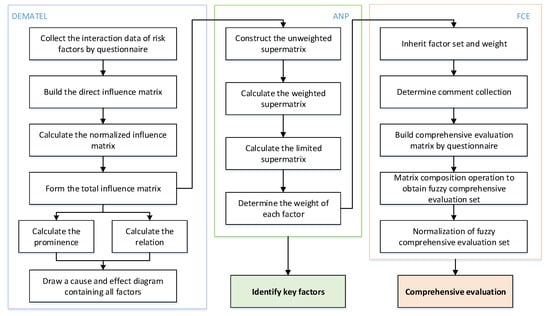
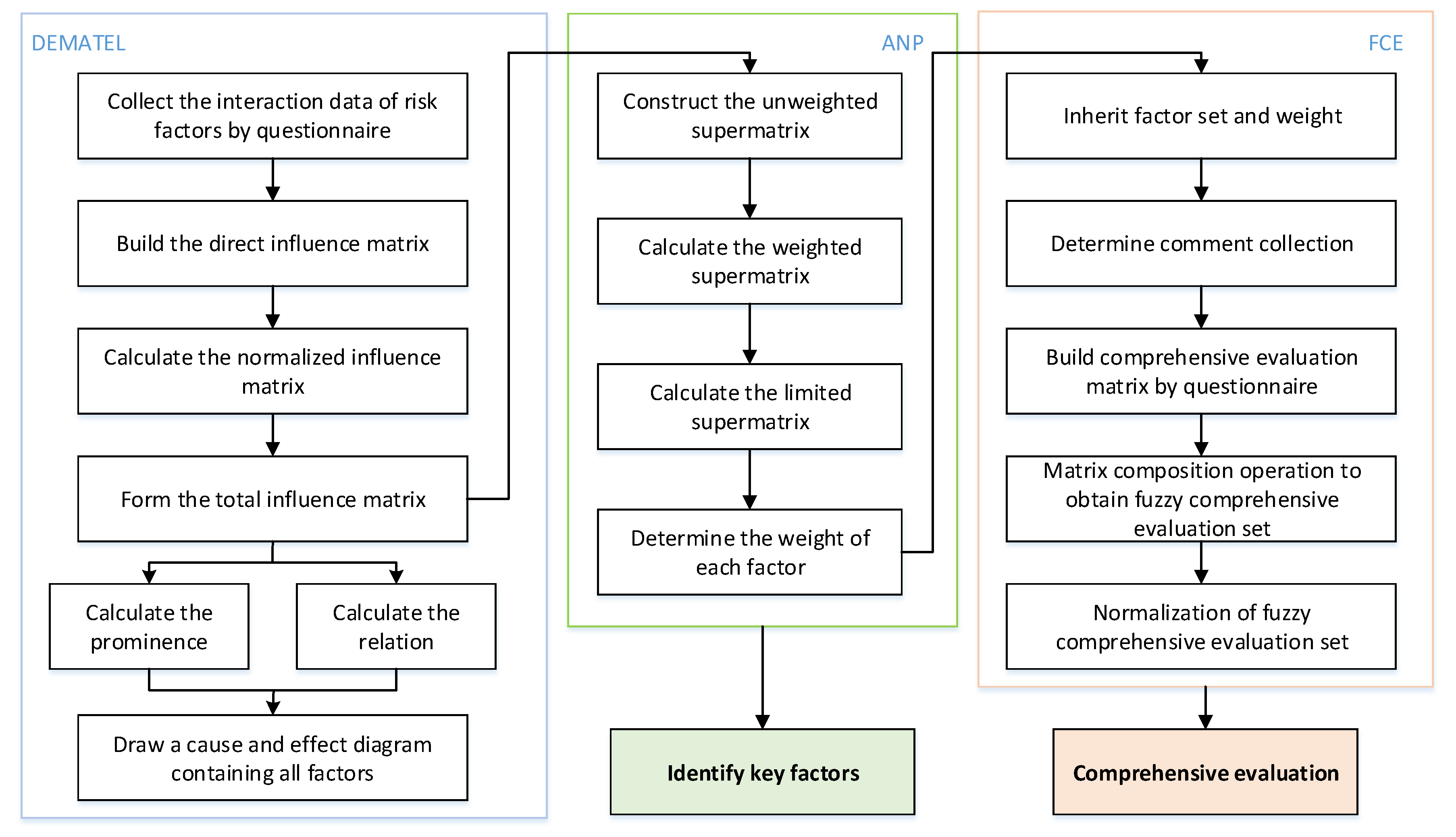
The framework of our model is shown in Figure 1. Jiang [43] used the D-ANP to identify and analyze the key risk factors of an emergency logistics system and accurately calculate the weight of each. He et al. [44] proposed a quantitative method of risk assessment for high-temperature operations based on the AHP and fuzzy evaluation. We followed Jiang’s method to identify the risk factors, distinguish them, calculate their weights, and assess them using fuzzy evaluation [43].
Figure 1.
Framework of the proposed model for the RSTH.
4. Empirical Study
4.1. Introduction to the Case
Beijing has attached great importance to the development of its hydrogen energy industry in recent years. The city recently issued the Implementation Plan for the Development of Hydrogen Energy Industry (2021–2025), which is a blueprint for the development of the hydrogen energy industry. A number of policies and measures have also been formulated to support the development of the hydrogen energy industry along six aspects: scientific and technological R&D, the industrialization of technology and equipment, industrial innovation and development, infrastructure construction, demonstration and application, and the construction of a standard service system. A large number of hydrogen-related enterprises over the entire supply chain have emerged under these policies. They are engaged in hydrogen production, storage, transportation, hydrogenation, and application, and their number and scale are continually expanding. Hydrogen energy is classed as a dangerous good as serious losses of personnel and property may occur in case of an accident involving it. The hydrogen energy industry is both a development opportunity and a major challenge for Beijing. It is thus important to manage the risk posed by this industry, identify the key risk factors, evaluate the level of risk posed by them, and reduce it.
4.2. Determining the Formal Decision Structure
We sorted the risk factors in Table 1 and solicited industry experts for interviews. We considered the following issues: First, we needed to know more about the typical cases of accidents in links involved in the storage and transportation of hydrogen energy. Examining such cases revealed the causes of the accidents and the risk factors. Second, we needed to understand China’s and Beijing’s safety regulatory systems for the hydrogen energy industry, including the relevant laws, regulations, and industry norms. We used the explicit provisions of these regulatory systems to deduce the key factors and integrated them into our system of indicators. Third, we needed to define the entire process and key nodes in the storage and transportation of hydrogen energy and explore common risk factors. Finally, we needed to learn to apply risk management and control to hydrogen energy and to understand the main elements involved as a supplement to the system of indicators. We used a group composed of five experts (see Table 2 for details). We interviewed them and adopted several of their suggestions. For example, all experts agreed that it is reasonable to decompose the risk factors according to the five categories of personnel, storage, transportation, environment, and management. The risk factors related to personnel in Table 1 were further divided in terms of awareness, technology, quality, and health. Hydrogen-induced embrittlement is an important risk factor during its storage. The stability of the transportation process is a key constraint on the transportation of hydrogen energy. In terms of management, the industry is concerned about the standardized management of storage and transportation and uses technologies for real-time monitoring and feedback. The final system of indicators is shown in Table 3.
Table 2.
Professional backgrounds of the selected five experts.
Table 3.
The formal decision structure.
4.3. Identifying Key Risk Factors
We gave the questionnaire to the five experts and scored their responses according to Formula (1). We treated their results equally, calculated the average score, and formed an initial direct impact matrix for D-ANP, as shown in Table 4. Using Formula (2), we first summed each column and each row, respectively, and then found the maximum value. We took the reciprocal of the maximum value as , and multiplied by the initial direct influence matrix to obtain the normalized direct influence matrix. Using Formula (3), we first subtracted the normalized direct influence matrix from the unit matrix , and then found its inverse matrix. Finally, we multiplied the normalized direct influence matrix to obtain the total impact matrix, as shown in Table 5.
Table 4.
The initial direct influence matrix.
Table 5.
The total influence matrix.
We obtained the significance and correlation of each risk factor and used them to determine their causal types. The results are shown in Table 6.
Table 6.
Prominence and relation of each risk factor in RSTH.
The results showed that the RSTH-related factors can be divided into two categories. The driving factors included personnel awareness (A1), personnel skills (A2), personnel emotions (A3), personnel health (A4), liner corrosion and hydrogen-induced embrittlement of the equipment (B1), frequent filling of the equipment (B4), environmental volatility (D2), hyperbaric environment (D3), standardized management (E1), comprehensive management (E2), and the effectiveness of feedback (E4). These factors formed a direct source of risk for the RSTH. The outcome-related factors included equipment fatigue (B2), penetration (B3), combination of gases (B5), stability of liquefaction storage (B6), deficiencies in the transportation equipment (C1), failure of the transport equipment (C2), stability of transportation (C3), accuracy of environmental information (D1), and dynamic monitoring (E3). These factors formed indirect sources of risk for the RSTH. The higher the value of the degree of a relationship was, the greater was the influence of the relevant factors on the other factors. The panel of experts believed that D2, A2, and E4 could be used as the root factors affecting the RSTH for further analysis.
The total influence matrix shown in Table 5 was treated as part of the unweighted supermatrix-based ANP model. In the total influence matrix, each number was divided by the sum of each column to normalize the total influence matrix, and the matrix obtained was used as the weighted supermatrix. By multiplying the weighted supermatrix by itself three times, the numbers in each row of the matrix tended to be the same, and the limit supermatrix could be obtained, as shown in Table 7.
Table 7.
The limiting supermatrix derived by the weighted supermatrix.
The data in each row in Table 7 are the limit values, representing the weight of each criterion. The weight can be ranked according to the value. The rankings showed that the eight most influential factors were also key factors of the RSTH, including comprehensive management (E2), effectiveness of feedback (E4), environmental volatility (D2), standardized management (E1), stability of liquefaction storage (B6), stability of transportation (C3), personnel skills (A2), and personnel health (A4).
4.4. Assessment of Urban RSTH
We distributed 120 copies of it to the expert group and officials of important hydrogen-related enterprises in Beijing. A total of 106 responses were collected and 100 were valid. In the process of questionnaire data statistics, we divided the number of different risk evaluation questionnaires by the number of valid questionnaires for statistical processing, as shown in Table 8.
Table 8.
Evaluation matrix.
The weights of the factor calculated in Table 6 can be expressed as a set of weights:
According to Formula (4), the synthetic calculation for each risk is as follows:
By analogy, the fuzzy set of evaluations can be obtained as follows:
According to the principle of the maximum degree of membership, we can conclude that Beijing can be classed as incurring a general risk with regard to the storage and transportation of hydrogen energy. This also shows that if Beijing does not strengthen its risk management in this context, this may lead to more accidents and, possibly, casualties.
5. Discussion
5.1. Causality between Critical Factors
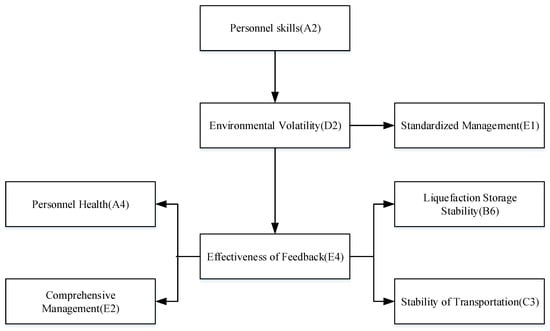
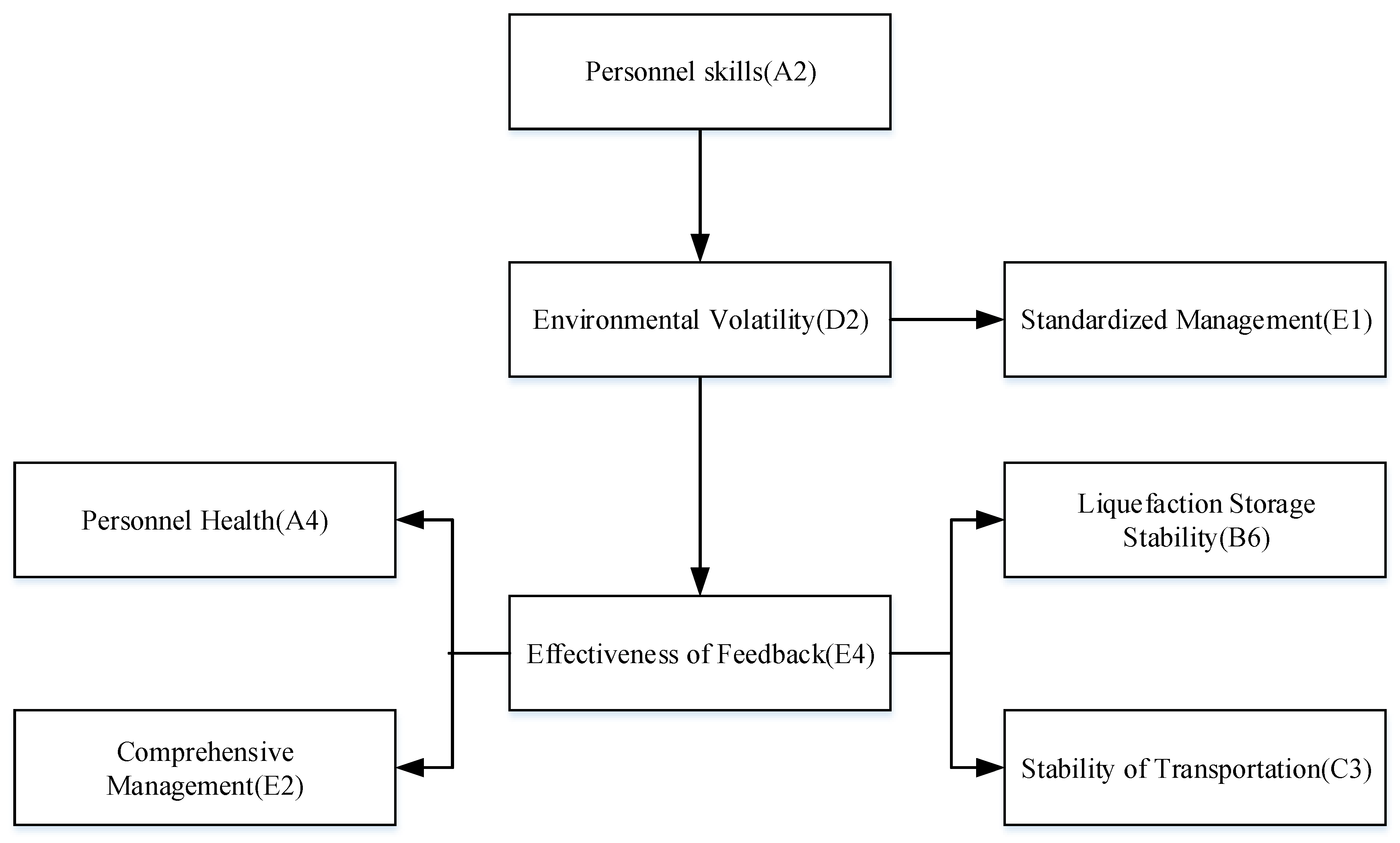
A causal diagram of the critical factors based on the total influence matrix is shown in Figure 2. Table 5 shows that A2, D2, and E4 were suitable as the sources of risk because of their maximal relations. Improving the performance of “personnel skills” (A2) can help improve the other criteria. A2 is fundamental to the risk management and control of the storage and transportation of hydrogen energy and can guarantee the stability of the enterprise while reducing the overall risk. Improving A2 can promote improvements in D2, which in turn can promote E1 and E4. The improvement in E4 can further help improve A4 and E2.
Figure 2.
Causal diagram involving the critical factors.
5.2. Managerial Implications
In this paper, we proposed a hybrid MCDM-based method to identify the key RSTHs by analyzing the supply chain for hydrogen energy in Beijing. As we concluded that the risk level of Beijing in context is general, we focus on addressing the main risk factors for it. The RSTH usually does not emerge alone in practice, and is often accompanied by highly correlated risks [16]. Therefore, based on the results shown in Figure 2, we propose countermeasures according to the types of risks to ensure systematic risk management.
- (1)
- The risk weight of personnel skills (A2) was 0.0880, the rank of A2 was first, and was a root driving factor. A2 was part of people-related risks and formed the most important risk factor. This is because the human operators involved in the supply chain for hydrogen energy are sometimes not trained appropriately, are unfamiliar with the characteristics of hydrogen energy, and cannot deal with emergencies. This result is consistent with that of Zheng et al., who evaluated risk factors for typical hydrogen storage processes in China [45]. Le et al. reached a similar conclusion when studying integrated technical frameworks for safety information of hydrogen energy storage [46]. Furthermore, our study explicitly demonstrates that AI and big data technology can be integrated into the process to assist in decision making in case of emergencies [47]. This can reduce the risks caused by differences in the quality of operators.
- (2)
- Environmental volatility (D2) is part of environmental risk, the risk weight of D2 is 0.0726, the rank of D2 is third, and it is also a driving factor for E4 and E1. The results here showed that the security of the storage and transportation of hydrogen energy depend on the stability of the environment and the process. Kim [13] and Zhang [17], respectively, proved the impact of external temperature and pressure on RSTHs, and Lam et al. [15] proved that the performance of the complicated environmental volatility is a critical risk factor. However, the solution to the D2 is generally based on the control of static storage environment volatility, and few studies have been conducted to deal with dynamic environment volatility. In practice, with the development of hydrogen energy commercialization, more and more hydrogen energy will be in a dynamic transportation environment. This paper proposes that the logistics network for hydrogen energy needs to be redesigned and segmented transportation should be used to reduce the risk due to D2. Large-scale centralized transportation is needed between cities, and small-scale and high frequency distribution is needed within them.
- (3)
- Effectiveness of feedback (E4) is part of management-related risk. The risk weight of E4 is 0.0757, the rank of E4 is second, and it is also a driving factor for A4, B6, E2, C3. Most previous studies focused on the breakthrough of feedback technologies [48,49]. Dynamic path scheduling in combination with the GIS, GPS, and AI; and site selection based on the characteristics of hydrogen energy storage; and monitoring and providing an early warning of surrounding hazardous sources by using IOT-based sensing equipment were proved to be crucial for reducing the risk of E4 [50]. However, ignoring the guiding role of the RSTH management will lead to the role of the technology being greatly reduced. Enterprises are used to attending to safety issues rather than the supply chain [51]. Supply chain management for hydrogen energy is invariably fragmented owing to the large number of personnel and conversion of equipment during storage and transportation [52]. Therefore, risk control measures are needed from the perspective of integrating the supply chain, including improving safety standards for urban hydrogen energy, using information technology to ensure that the responsibility for charging stations in the supply chain is clear and the RSTHs can be traced, and unifying the online management of the equipment and sites used for the storage and transportation of hydrogen energy [17].
- (4)
- Some risk factors are related to key technologies and are not easy to address in a short time. this finding is consistent with that of Mufachi [53] and Pugazhendhi [54]. Furthermore, it is proved that the technology and the mode of operation used must match each other in RSTH management; otherwise, the short board effect occurs [17]. This paper clarifies the responsibilities of the subjects in the hydrogen energy supply chain and designs the strategies to strengthen management cooperation. One effective solution is for technology suppliers to undertake liability for operational management because their professional knowledge of hydrogen energy is conducive to addressing vulnerabilities in management. At the same time, an incentive mechanism should be designed to ensure the enthusiasm of the technicians involved in supply chain management.
6. Conclusions
The safety concern of the storage and transportation of hydrogen energy is a hindrance to its commercialization. This paper proposed a framework to manage the RSTH according to the logistical chain of “risk identification-risk assessment–risk control”.
We used a hybrid MCDM-based method to identify and evaluate the RSTHs. The weighted importance of each risk factor was calculated by combining its importance score obtained from DEMATEL with its weight obtained by the ANP model. The results showed that personnel skills, environmental volatility, and the effectiveness of feedback during the storage and transportation of hydrogen energy are factors driving the RSTHs and have an important impact on the other factors. The general risk grade for the storage and transportation of hydrogen energy in Beijing was calculated by using the FE model. The key to RSTH management is to trace risks upstream and downstream of the supply chain and to design strategies to deal with complex risk chains.
The conclusion drawn from the results are quite different from previous studies. Most previous studies mainly systematically identified the safety status and technical challenges of hydrogen energy infrastructure in the fields of preparation, storage, transportation, and supply [55,56,57]. The research results of this paper proved that the integrated management of hydrogen energy supply chain was more important than the technologies. Based on the identification of the critical RSTHs, an early warning mechanism, emergency response mechanism, and post-traceability control mechanism can be established. In this process, advanced technologies can accelerate the construction of risk management systems and rapidly improve the personnel skills. Therefore, the risk control system integrated with advanced technology established in this paper plays an important role in accelerating the commercial development of hydrogen energy.
Because the RSTHs are influenced by traffic conditions, the layout of the equipment used for hydrogen energy, the number of items of mobile equipment, and the system of indicators for the RSTH should be adjusted with the commercialization of hydrogen energy. In addition, the cost of the short-distance distribution of hydrogen energy in cities is high, and increases by USD 60 for every additional kilometer traveled by a hydrogen vehicle with a capacity of four tons [58]. The costs and risks of transportation and storage are contrary to each other in the commercialization of hydrogen energy, and balancing them is a key problem. We proposed a static risk management system here that is suitable for the promotion and development of the hydrogen energy industry. The early warning of risks can improve the resilience of the supply chain. Once the industry has entered the stage of large-scale commercialization, it should focus on developing dynamic risk management systems. Real-time risk supervision, emergency response, and the traceability of risks are the future directions of research in the area.
Author Contributions
Conceptualization, D.S.; data curation, D.G.; formal analysis, D.G.; resources, D.X.; supervision, D.S.; writing—original draft, D.X. and D.G.; writing—review and editing, D.S. All authors have read and agreed to the published version of the manuscript.
Funding
This research was funded by the Natural Science Foundation of Liaoning Province, China, grant number 2022-MS-417.
Institutional Review Board Statement
Not applicable.
Informed Consent Statement
Informed consent was obtained from all subjects involved in the study.
Data Availability Statement
All data that support the findings of this study are available from the corresponding author upon reasonable request.
Acknowledgments
The authors would like to thank the editor and anonymous reviewers for their valuable comments.
Conflicts of Interest
The authors declare no conflict of interest.
Appendix A
Table A1.
The score of Expert A.
Table A2.
The score of Expert B.
Table A3.
The score of Expert C.
Table A4.
The score of Expert D.
Table A5.
The score of Expert E.
Table A6.
The normalized direct influence matrix.
Table A7.
The weighted supermatrix obtained by normalizing the total influence matrix.
References
- Dokhani, S.; Assadi, M.; Pollet, B.G. Techno-economic assessment of hydrogen production from seawater. Int. J. Hydrogen Energy 2022, in press. [Google Scholar] [CrossRef] [Scilit]
- Yang, Y.; Tong, L.; Yin, S.; Liu, Y.; Wang, L.; Qiu, Y.; Ding, Y. Status and challenges of applications and industry chain technologies of hydrogen in the context of carbon neutrality. J. Clean. Prod. 2022, 376, 134347. [Google Scholar] [CrossRef] [Scilit]
- Moon, S.; Kim, K.; Seung, H.; Kim, J. Strategic analysis on effects of technologies, government policies, and consumer perceptions on diffusion of hydrogen fuel cell vehicles. Energy Econ. 2022, 115, 106382. [Google Scholar] [CrossRef] [Scilit]
- Foorginezhad, S.; Mohseni-Dargah, M.; Falahati, Z.; Abbassi, R.; Razmjou, A.; Asadnia, M. Sensing advancement towards safety assessment of hydrogen fuel cell vehicles. J. Power Sources 2021, 489, 229450. [Google Scholar] [CrossRef] [Scilit]
- Hirayama, M.; Shinozaki, H.; Kasai, N.; Otaki, T. Comparative risk study of hydrogen and gasoline dispensers for vehicles. Int. J. Hydrogen Energy 2018, 43, 12584–12594. [Google Scholar] [CrossRef] [Scilit]
- Hirayama, M.; Ito, Y.; Kamada, H.; Kasai, N.; Otaki, T. Simplified approach to evaluating safety distances for hydrogen vehicle fuel dispensers. Int. J. Hydrogen Energy 2019, 44, 18639–18647. [Google Scholar] [CrossRef] [Scilit]
- Tsunemi, K.; Kihara, T.; Kato, E.; Kawamoto, A.; Saburi, T. Quantitative risk assessment of the interior of a hydrogen refueling station considering safety barrier systems. Int. J. Hydrogen Energy 2019, 44, 23522–23531. [Google Scholar] [CrossRef] [Scilit]
- Rasul, M.G.; Hazrat, M.A.; Sattar, M.A.; Jahirul, M.I.; Shearer, M.J. The future of hydrogen: Challenges on production, storage and applications. Energy Convers. Manag. 2022, 272, 116326. [Google Scholar] [CrossRef] [Scilit]
- Ono, K.; Kato, E.; Tsunemi, K. Construction of a structural equation model to identify public acceptance factors for hydrogen refueling stations under the provision of risk and safety information. Int. J. Hydrogen Energy 2022, 47, 31974–31984. [Google Scholar] [CrossRef] [Scilit]
- Chang, Y.; Zhang, C.; Shi, J.; Li, J.; Zhang, S.; Chen, G. Dynamic Bayesian network based approach for risk analysis of hydrogen generation unit leakage. Int. J. Hydrogen Energy 2019, 44, 26665–26678. [Google Scholar] [CrossRef] [Scilit]
- Hienuki, S.; Noguchi, K.; Shibutani, T.; Fuse, M.; Noguchi, H.; Miyake, A. Risk identification for the introduction of advanced science and technology: A case study of a hydrogen energy system for smooth social implementation. Int. J. Hydrogen Energy 2020, 45, 15027–15040. [Google Scholar] [CrossRef] [Scilit]
- Ono, K.; Tsunemi, K. Identification of public acceptance factors with risk perception scales on hydrogen fueling stations in Japan. Int. J. Hydrogen Energy 2017, 42, 10697–10707. [Google Scholar] [CrossRef] [Scilit]
- Kim, D.-H.; Lim, J.-Y.; Park, W.-I.; Joe, C.-H. Quantitative risk assessment of a mobile hydrogen refueling station in Korea. Int. J. Hydrogen Energy 2022, 47, 33541–33549. [Google Scholar] [CrossRef] [Scilit]
- Kawatsu, K.; Suzuki, T.; Shiota, K.; Izato, Y.-i.; Komori, M.; Sato, K.; Takai, Y.; Ninomiya, T.; Miyake, A. Dynamic physical model of Japanese hydrogen refueling stations for quantitative trade-off study between benefit and risk. Int. J. Hydrogen Energy 2022, in press. [Google Scholar] [CrossRef] [Scilit]
- Lam, C.Y.; Fuse, M.; Shimizu, T. Assessment of risk factors and effects in hydrogen logistics incidents from a network modeling perspective. Int. J. Hydrogen Energy 2019, 44, 20572–20586. [Google Scholar] [CrossRef] [Scilit]
- Li, X.; Han, Z.; Zhang, R.; Zhang, Y.; Zhang, L. Risk assessment of hydrogen generation unit considering dependencies using integrated DEMATEL and TOPSIS approach. Int. J. Hydrogen Energy 2020, 45, 29630–29642. [Google Scholar] [CrossRef] [Scilit]
- Zhang, L.B.; Hu, J.Q.; Zhang, X.Y.; Xiang, S.R. Research status and development trends of safety and emergency guarantee tech-nology for production, storage and transportation of hydrogen. Pet. Sci. Bull. 2021, 6, 167–180. [Google Scholar] [CrossRef]
- Moradi, R.; Groth, K.M. Hydrogen storage and delivery: Review of the state of the art technologies and risk and reliability analysis. Int. J. Hydrogen Energy 2019, 44, 12254–12269. [Google Scholar] [CrossRef] [Scilit]
- Fabiano, B.; Currò, F.; Palazzi, E.; Pastorino, R. A framework for risk assessment and decision-making strategies in dangerous good transportation. J. Hazard. Mater. 2002, 93, 1–15. [Google Scholar] [CrossRef] [Scilit]
- Fabiano, B.; Currò, F.; Reverberi, A.P.; Pastorino, R. Dangerous good transportation by road: From risk analysis to emergency planning. J. Loss Prev. Process Ind. 2005, 18, 403–413. [Google Scholar] [CrossRef] [Scilit]
- Guo, Y.; Meng, X.; Wang, D.; Meng, T.; Liu, S.; He, R. Comprehensive risk evaluation of long-distance oil and gas transportation pipelines using a fuzzy Petri net model. J. Nat. Gas Sci. Eng. 2016, 33, 18–29. [Google Scholar] [CrossRef] [Scilit]
- Guo, J.; Luo, C. Risk assessment of hazardous materials transportation: A review of research progress in the last thirty years. J. Traffic Transp. Eng. 2022, 9, 571–590. [Google Scholar] [CrossRef] [Scilit]
- Pasman, H.J.; Rogers, W.J. Risk assessment by means of Bayesian networks: A comparative study of compressed and liquefied H2 transportation and tank station risks. Int. J. Hydrogen Energy 2012, 37, 17415–17425. [Google Scholar] [CrossRef] [Scilit]
- Correa-Jullian, C.; Groth, K.M. Data requirements for improving the Quantitative Risk Assessment of liquid hydrogen storage systems. Int. J. Hydrogen Energy 2022, 47, 4222–4235. [Google Scholar] [CrossRef] [Scilit]
- Yoo, B.-H.; Wilailak, S.; Bae, S.-H.; Gye, H.-R.; Lee, C.-J. Comparative risk assessment of liquefied and gaseous hydrogen refueling stations. Int. J. Hydrogen Energy 2021, 46, 35511–35524. [Google Scholar] [CrossRef] [Scilit]
- Lee, Y.; Lee, U.; Kim, K. A comparative techno-economic and quantitative risk analysis of hydrogen delivery infrastructure options. Int. J. Hydrogen Energy 2021, 46, 14857–14870. [Google Scholar] [CrossRef] [Scilit]
- Viana, F.F.C.L.; Alencar, M.H.; Ferreira, R.J.P.; De Almeida, A.T. Multidimensional risk assessment and categorization of hydrogen pipelines. Int. J. Hydrogen Energy 2022, 47, 18424–18440. [Google Scholar] [CrossRef] [Scilit]
- Castiglia, F.; Giardina, M. Analysis of operator human errors in hydrogen refuelling stations: Comparison between human rate assessment techniques. Int. J. Hydrogen Energy 2013, 38, 1166–1176. [Google Scholar] [CrossRef] [Scilit]
- Lee, C.-Y.; Shen, C.-C.; Lee, S.-J.; Chiu, C.-W.; Lin, H.-T. Real-time microscopic monitoring of temperature and strain on the surface of magnesium hydrogen storage tank by high temperature resistant flexible integrated microsensor. Int. J. Hydrogen Energy 2022, 47, 12815–12821. [Google Scholar] [CrossRef] [Scilit]
- Davies, P.A.; Lees, F.P. The assessment of major hazards: The road transport environment for conveyance of hazardous materials in Great Britain. J. Hazard. Mater. 1992, 32, 41–79. [Google Scholar] [CrossRef] [Scilit]
- Erkut, E.; Tjandra, S.A.; Verter, V. Chapter 9 Hazardous Materials Transportation. In Handbooks in Operations Research and Management Science; Barnhart, C., Laporte, G., Eds.; Elsevier: Amsterdam, The Netherlands, 2007; Volume 14, pp. 539–621. [Google Scholar] [CrossRef] [Scilit]
- Current, J.; Ratick, S. A model to assess risk, equity and efficiency in facility location and transportation of hazardous materials. Locat. Sci. 1995, 3, 187–201. [Google Scholar] [CrossRef] [Scilit]
- Leonelli, P.; Bonvicini, S.; Spadoni, G. New detailed numerical procedures for calculating risk measures in hazardous materials transportation. J. Loss Prev. Process Ind. 1999, 12, 507–515. [Google Scholar] [CrossRef] [Scilit]
- Mouli-Castillo, J.; Haszeldine, S.R.; Kinsella, K.; Wheeldon, M.; McIntosh, A. A quantitative risk assessment of a domestic property connected to a hydrogen distribution network. Int. J. Hydrogen Energy 2021, 46, 16217–16231. [Google Scholar] [CrossRef] [Scilit]
- Alencar, M.H.; de Almeida, A.T. Assigning priorities to actions in a pipeline transporting hydrogen based on a multicriteria decision model. Int. J. Hydrogen Energy 2010, 35, 3610–3619. [Google Scholar] [CrossRef] [Scilit]
- OuYang, Y.-P.; Shieh, H.-M.; Tzeng, G.-H. A VIKOR technique based on DEMATEL and ANP for information security risk control assessment. Inf. Sci. 2013, 232, 482–500. [Google Scholar] [CrossRef] [Scilit]
- Wu, Y.; Chu, H.; Xu, C. Risk assessment of wind-photovoltaic-hydrogen storage projects using an improved fuzzy synthetic evaluation approach based on cloud model: A case study in China. J. Energy Storage 2021, 38, 102580. [Google Scholar] [CrossRef] [Scilit]
- Wang, W.; Dong, C.; Dong, W.; Yang, C.; Ju, T.; Huang, L.; Ren, Z. The design and implementation of risk assessment model for hazard installations based on AHP–FCE method: A case study of Nansi Lake Basin. Ecol. Inform. 2016, 36, 162–171. [Google Scholar] [CrossRef] [Scilit]
- Othman, M.K.; Abdul Rahman, N.S.F.; Ismail, A.; Saharuddin, A.H. Factors contributing to the imbalances of cargo flows in Malaysia large-scale minor ports using a fuzzy analytical hierarchy process (FAHP) approach. Asian J. Shipp. Logist. 2020, 36, 113–126. [Google Scholar] [CrossRef] [Scilit]
- Ouyang, Y.-P.; Shieh, H.-M.; Leu, J.-D.; Tzeng, G.-H. A novel hybrid MCDM model combined with DEMATEL and ANP with applications. Int. J. Oper. Res 2008, 5, 160–168. [Google Scholar]
- Mubarik, M.S.; Kazmi, S.H.A.; Zaman, S.I. Application of gray DEMATEL-ANP in green-strategic sourcing. Technol. Soc. 2021, 64, 101524. [Google Scholar] [CrossRef] [Scilit]
- Zhang, Q.; Wang, X.P. The comparison of some f fuzzy operators used in fuzzy comprehensive evaluation Models. Fuzzy Syst. Math. 2016, 30, 165–171. [Google Scholar]
- Jiang, P.; Wang, Y.; Liu, C.; Hu, Y.-C.; Xie, J. Evaluating Critical Factors Influencing the Reliability of Emergency Logistics Systems Using Multiple-Attribute Decision Making. Symmetry 2020, 12, 1115. [Google Scholar] [CrossRef] [Scilit]
- He, S.; Xu, H.; Zhang, J.; Xue, P. Risk assessment of oil and gas pipelines hot work based on AHP-FCE. Petroleum 2022, in press. [Google Scholar] [CrossRef] [Scilit]
- Zheng, J.Y.; Kai, F.M.; Liu, Z.Q.; Chen, R.; Chen, C.P. Risk assessment and control of high pressure hydrogen equipment. Acta Energ. Sol. Sin. 2006, 27, 1168–1174. [Google Scholar]
- Le, S.T.; Nguyen, T.N.; Linforth, S.; Ngo, T.D. Safety investigation of hydrogen energy storage systems using quantitative risk assessment. Int. J. Hydrogen Energy 2022, in press. [Google Scholar] [CrossRef] [Scilit]
- Li, J.; Herdem, M.S.; Nathwani, J.; Wen, J.Z. Methods and applications for Artificial Intelligence, Big Data, Internet of Things, and Blockchain in smart energy management. Energy AI 2023, 11, 100208. [Google Scholar] [CrossRef] [Scilit]
- Karipoğlu, F.; Serdar Genç, M.; Akarsu, B. GIS-based optimal site selection for the solar-powered hydrogen fuel charge stations. Fuel 2022, 324, 124626. [Google Scholar] [CrossRef] [Scilit]
- Chen, J.; Zhang, Q.; Xu, N.; Li, W.; Yao, Y.; Li, P.; Yu, Q.; Wen, C.; Song, X.; Shibasaki, R.; et al. Roadmap to hydrogen society of Tokyo: Locating priority of hydrogen facilities based on multiple big data fusion. Appl. Energy 2022, 313, 118688. [Google Scholar] [CrossRef] [Scilit]
- Wang, W.B. Development status and application prospect of hydrogen energy. J. Yuncheng Univ. 2006, 24, 47–48. [Google Scholar]
- Mani, V.; Jabbour, C.J.C.; Mani, K.T.N. Supply chain social sustainability in small and medium manufacturing enterprises and firms’ performance: Empirical evidence from an emerging Asian economy. Int. J. Prod. Econ. 2020, 227, 107656. [Google Scholar] [CrossRef] [Scilit]
- Widera, B. Renewable hydrogen implementations for combined energy storage, transportation and stationary applications. Therm. Sci. Eng. Prog. 2020, 16, 100460. [Google Scholar] [CrossRef] [Scilit]
- Al-Mufachi, N.A.; Shah, N. The role of hydrogen and fuel cell technology in providing security for the UK energy system. Energy Policy 2022, 171, 113286. [Google Scholar] [CrossRef] [Scilit]
- Pugazhendhi, A.; Chen, W.-H. Hydrogen energy technology for future. Int. J. Hydrogen Energy 2022, 47, 37153. [Google Scholar] [CrossRef] [Scilit]
- Schönauer, A.-L.; Glanz, S. Hydrogen in future energy systems: Social acceptance of the technology and its large-scale infrastructure. Int. J. Hydrogen Energy 2022, 47, 12251–12263. [Google Scholar] [CrossRef] [Scilit]
- Razzhivin, I.A.; Rudnik, V.E.; Bay, Y.D.; Kievec, A.V. Coordinated control of a hybrid type 3 wind turbine and hydrogen energy storage model to provide efficient frequency control. Int. J. Hydrogen Energy 2022, 47, 35947–35958. [Google Scholar] [CrossRef] [Scilit]
- Choi, J.; Choi, D.G.; Park, S.Y. Analysis of effects of the hydrogen supply chain on the Korean energy system. Int. J. Hydrogen Energy 2022, 47, 21908–21922. [Google Scholar] [CrossRef] [Scilit]
- Meng, X.Y.; Chen, M.Y.; Gu, A.L.; Wu, X.G.; Liu, B.; Zhou, J.; Mao, Z.Q. China’s hydrogen development strategy in the context of double carbon targets. Nat. Gas Ind. 2022, 42, 156–179. [Google Scholar] [CrossRef] [Scilit]

Disclaimer/Publisher’s Note: The statements, opinions and data contained in all publications are solely those of the individual author(s) and contributor(s) and not of MDPI and/or the editor(s). MDPI and/or the editor(s) disclaim responsibility for any injury to people or property resulting from any ideas, methods, instructions or products referred to in the content. |
© 2023 by the authors. Licensee MDPI, Basel, Switzerland. This article is an open access article distributed under the terms and conditions of the Creative Commons Attribution (CC BY) license (https://creativecommons.org/licenses/by/4.0/).