


Abstract
In China, waste sorting has gradually entered “compulsory times”. The beginning of the compulsory times of waste sorting is marked by the implementation of the policy to remove trash cans in residential building hallways. Since then, this policy has been controversial. Based on the theory of planned behavior and the public’s perspective as well as using the Delphi method and entropy weight method, we investigated Longhua District in Shenzhen and designed an evaluation index system for the effect of the policy to remove trash cans from the following three dimensions: the policy cognitive level, the policy admissive degree, and the awareness of waste sorting. The data were supplemented by observations and interview methods as well as questionnaire surveys that were distributed in residential sub-districts in Longhua District. According to the quantitative research and variance analysis of the data, the policy promotes waste sorting. This paper provides a new idea on how to evaluate environmental policies such as the garbage-classification policy from the perspective of the public based on rigorous evaluation methods and processes.
1. Introduction
According to a report by the World Bank, in 2016, there were 2.01 billion tons of MSW output worldwide. It is predicted that by 2025, 3.4 billion tons of MSW will be generated globally per year [1]. Waste increase and the unscientific recycling of waste have become key factors hindering waste management. Therefore, to alleviate this trend, many countries are promoting waste management. An effective waste-sorting system is the foundation of and precondition for efficient waste management [2], and source-separated collection can reduce the amount of MSW, especially the amount destined for landfill, which is the primary cause of global warming potential [3]. Many countries are engaged in ongoing efforts to increase the effectiveness of waste-sorting models [4]. To increase the level of availability of information on MSW recycling, a unified state information system (EGIS UOITR) has been created, and it functions to offer data on a map of disposal and burial sites in Russia. In addition, some countries have also developed modern smartphone apps, such as “Recycle Nation” (USA), “Recycle Right” (Australia), and “We Recycle” (Great Britain) [2].
The public’s perspective also plays a critical role in the study of garbage-classification. A study highlighted the importance of understanding individuals’ perspectives and attitudes toward waste as an integral part of designing waste management services [5]. From the public’s perspective, the long-term success of an MSW scheme depends on the attitude toward behavior, subjective norms, perceived behavioral control, and the moral norms of urbanites whose lives are shaped by the success or failure of waste management [6]. Regarding waste separation, the theory of planned behavior (TPB) provides a useful model for exploring the factors that influence householders’ decisions [7]. Some studies have further focused on the factors affecting residents’ waste-sorting from the public’s perspective [8]. Reward schemes have been found to have a significant positive relationship with the per-household weight of recyclables collected [9]. Additionally, in one study, the active support and involvement of a real estate company and a community residential committee played a crucial role in increasing public awareness and participation rates [10].
Notably, although garbage-classification management is progressing, MSW management in cities remains at a rudimentary stage; as a result, gross inefficiencies are common. These barriers include institutional/regulatory, natural/physical, operational, and socioeconomic barriers, weak legal frameworks, and policies without clear strategies for realization [11]. Since the establishment of waste-sorting in eight pilot cities in 2000, China has continually improved its waste-sorting policy. In 2016, it began to promote mandatory waste-sorting and implemented mandatory waste-sorting in 46 pilot cities [12]. Although China has made progress in MSW management, its improper and poor MSW management system continues to cause problems. The primary problems that contribute to Chinese cities’ poor performance in source separation are as follows: the relevant laws and regulations are insufficient, the responsibility of stakeholders is unclear, there is a lack of associated incentives and supporting facilities [13], individuals’ environmental awareness and necessary knowledge are inadequate, and the policy instruments prescribed in existing local decrees are costly and inefficient [12]. Among these problems, insufficient financing is a prominent obstacle to promoting waste-sorting.
One of the pilot cities is Shenzhen. This city has actively promoted waste-sorting, and the Longhua District has played a leading role. Before the policy’s implementation, residents would often dispose of their waste in a trash can placed on a staircase, resulting in a low sorting rate and unsanitary conditions. To promote mandatory waste-sorting and because of residents’ insufficient awareness and knowledge of waste-sorting, Shenzhen launched a residential waste-sorting model to remove trash cans from staircases and provide supervision and guidance to dispose of trash at designated times and places, as well as implementing policies to pursue those goals. Notably, Shenzhen’s Longhua District has experienced many obstacles when promoting the policy of removing trash cans, and its residents’ dissatisfaction and doubts about the policy have since continued.
Therefore, if a policy to remove trash cans to promote waste-sorting is implemented, is it always successful? Policy evaluation is a scientific analysis of a certain policy area to promote the efficient achievement of a goal and to optimize existing policies [14]. China’s recycling supervision policy is shifting from pollution prevention to the recycling of recyclable resources [15]. Monitoring the effectiveness of policies can reveal whether the intended goals are being achieved [16]. Many scholars have evaluated the relevant policies of waste-sorting, for example, the precondition for reducing deviations from policy implementation and waste separation performance evaluation of waste separation management policies in the Yangtze River Delta based on the PMC index model [4]. Additionally, the research methods used have varied. For example, studies have evaluated the impact of compulsory and advocative policies on the effectiveness of MSW classification by the polynomial distributed lag (PDL) model [17], mapping of household support degree for the mandatory source-separated policy by the hierarchical tree-based regression model [18], and discussing the challenges related to China’s MSW management through the analysis of relevant data [19]. To improve waste-sorting policies, researchers have adopted, for example, choice experiments [20], focus group interviews [21], and questionnaire surveys [22].
In general, the academic community has produced rich research results in waste-sorting policy evaluation at the national and regional levels, but there is still a gap in the effective evaluation of waste-sorting policy at the local level from the public’s perspective. In this study, therefore, the policy we investigate is Longhua District in Shenzhen; then, we adopt the Delphi method and entropy weight method to design an evaluation index system and evaluate waste-sorting before and after the implementation of the policy. We endeavor to provide novel insights into the existing literature and a reference for the evaluation of waste-sorting.
2. Research Hypotheses
The design of the evaluation index system was based on the TPB (theory of planned behavior). It hypothesizes that the immediate determinant of behavior is the individual’s intention to perform or not to perform that behavior. Perceived behavioral control is the strongest predictor [23]. Intentions are, in addition, influenced by two factors, namely, attitude and subjective norms [24]. The TPB was further developed and has been supported by empirical evidence; now, intentions to perform behaviors of different types can be predicted with high accuracy from attitudes toward the behavior, subjective norms, and perceived behavioral control. These intentions, along with perceptions of behavioral control, account for the considerable variance in actual behavior [25]. Some research has been carried out related to waste-sorting and the TPB, and the theoretical expansion of the TPB can provide a unique theoretical framework for understanding residents’ garbage-classification behavior [26]. The TPB provides a useful model to identify the underlying factors that may influence waste separation behavior, namely, subjective norms, perceived control, and moral norms [7]. The “motivation–intention–behavior” model includes motivation, contextual, and habitual factors for the systematic analysis of household solid waste-sorting behavior [27].
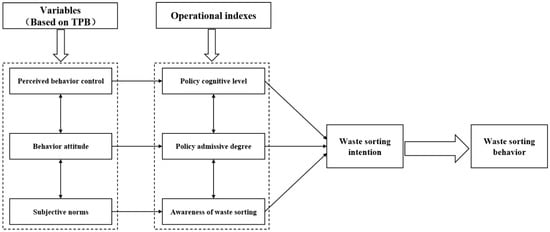
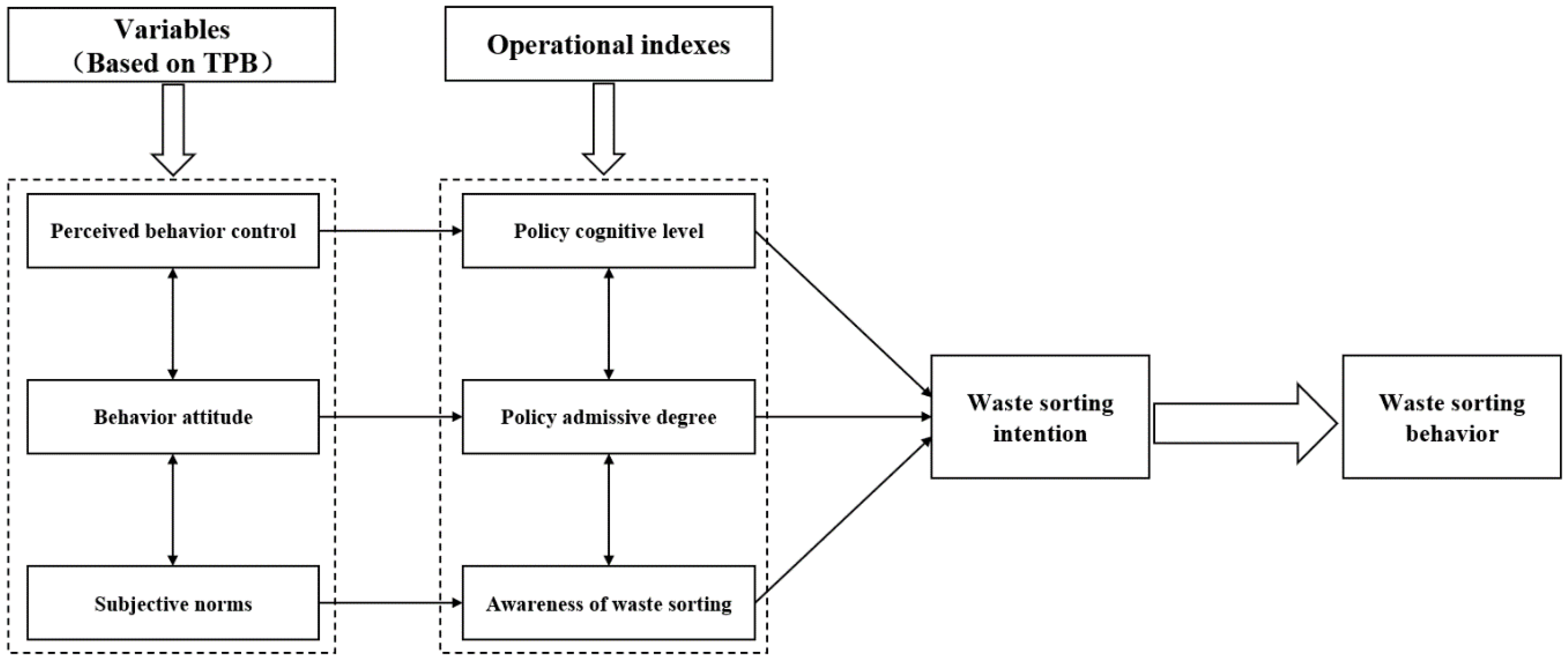
Our research summarizes the aforementioned documents and demonstrates the factors that affect the policy to remove trash cans: perceived behavior control, behavior attitude, and subjective norms. Based on the TPB, these factors may significantly affect the behavior intention of waste-sorting. Thus, we present a theoretical framework in Figure 1 and propose the following three hypotheses [28].
Figure 1.
The theoretical framework of intention and behavior of waste-sorting based on the TPB.
H1.
Perceived behavior control and benefits positively affect behavioral intention for waste-sorting.
Perceived behavior control refers to the related factors observed by residents to promote or inhibit waste-sorting behavior; residents rated their level of agreement with how easy they thought the policy was to implement [26]. Thus, we set an index of “waste sorting policy cognition level” to evaluate residents’ overall perception of the implementation of the waste-sorting policy.
H2.
Behavior attitude positively affects the behavioral intention for waste-sorting.
Behavior attitude refers to the residents’ overall attitude toward the policy [26]. Based on this, we set the “policy admissive degree” index to evaluate the residents’ favored degree of the waste-sorting policy from the expected value, trust degree, satisfaction, and willingness to participate.
H3.
Subjective norms positively affect behavioral intention for waste-sorting.
Subjective norms refer to the social pressure that residents feel when they sort their waste. Thus, we set the “awareness of waste sorting” index to reflect the influence of social pressure on residents’ waste-sorting behavior from the system and living environment levels.
The more favorable the attitude and subjective norms and the greater the perceived control, the stronger the individual’s intention should be to perform the behavior in question, and intention is assumed to be the immediate antecedent of behavior [29]. There is a strong correlation between residents’ waste-sorting intention and behavior. Therefore, the effect of the policy measured by the evaluation index system based on the TPB should have a certain explanatory power and rationality regarding waste-sorting behavior.
3. Materials and Methods
3.1. Research Object
In 2018, Shenzhen issued a document requiring existing residential areas to be transformed according to the standards of new residential areas and remove floor trash cans. Longhua District of Shenzhen has always been at the forefront of the city in promoting the classification of residential garbage and has a good policy basis. Therefore, this study selected Longhua District of Shenzhen as the research object to evaluate the implementation effect of the “policy to remove trash cans” currently.
Before the full implementation of the policy, Longhua District selected some communities to carry out pilot projects. This study selected the same number of pilot communities and non-pilot communities and used a simple random sampling method to invite residents of different types of communities to participate as survey objects to participate in a questionnaire survey on satisfaction of garbage classification in Longhua District in Shenzhen (the content of the questionnaire can be obtained through attachment Supplementary Materials), so as to understand the situation before and after the implementation of the policy, so as to realize the evaluation of the policy’s implementation.
3.2. Research Methodology
3.2.1. Delphi Method
The Delphi method is an important approach for evaluating policy proposals and implementation results based on expert participation, back-to-back communication, and questionnaire distribution and collection. In the last few decades, the Delphi method has become a popular tool to make predictions and help in decision-making, having recently been applied to diverse areas such as food consumption [30], sustainability assessment [31], environmental issues [32], and rural development [33].
The operational steps of the Delphi method are as follows: the research team formulates a questionnaire based on the research content and distributes it to an expert group. The expert group discusses the questionnaire, and the research team conducts an inductive analysis of the discussion results before distributing the revised questionnaire to the expert group [34]. These steps are repeated until experts reach a consensus and the opinion consistency meets a certain standard, at which point the final discussion results are treated as the prediction results [35].
3.2.2. The Entropy Weight Method
The entropy weight method is commonly used as a method of determining weights and can objectively determine weights based on information provided by each evaluation indicator [36,37]. The entropy weight method to determine indicator weights has been widely applied in research related to indicator system construction [38]. In this study, this method was adopted to determine the weights of each indicator in the “policy to remove trash cans” indicator system. The method involves the following three main steps:
First, normalize the values of the obtained data. Assuming k indicators are given, X1, X2,..., Xk, where Xi = {X1, X2,..., Xn}. According to Formula (1), the normalized values of the indicators are Y1, Y2,..., Yk.
Second, based on the normalization results, calculate the information entropy. According to the definition of information entropy in information theory, the information entropy of a set of data is:
The value of Pij in Formula (2) can be calculated by Formula (3).
If Pij = 0, then the definition is:
Third, based on the formula for calculating information entropy, calculate the entropy of each indicator as E1, E2,..., Ek. Then, based on Formula (5), calculate the weight of each indicator using the information entropy.
3.2.3. Control–Implementation Contrast Method
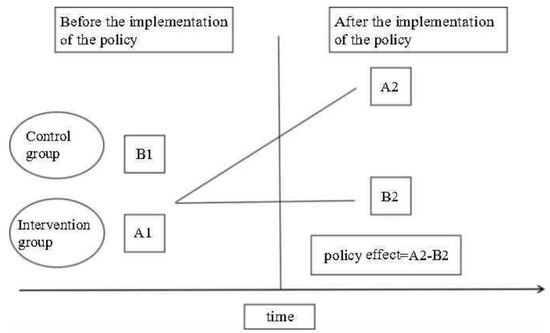
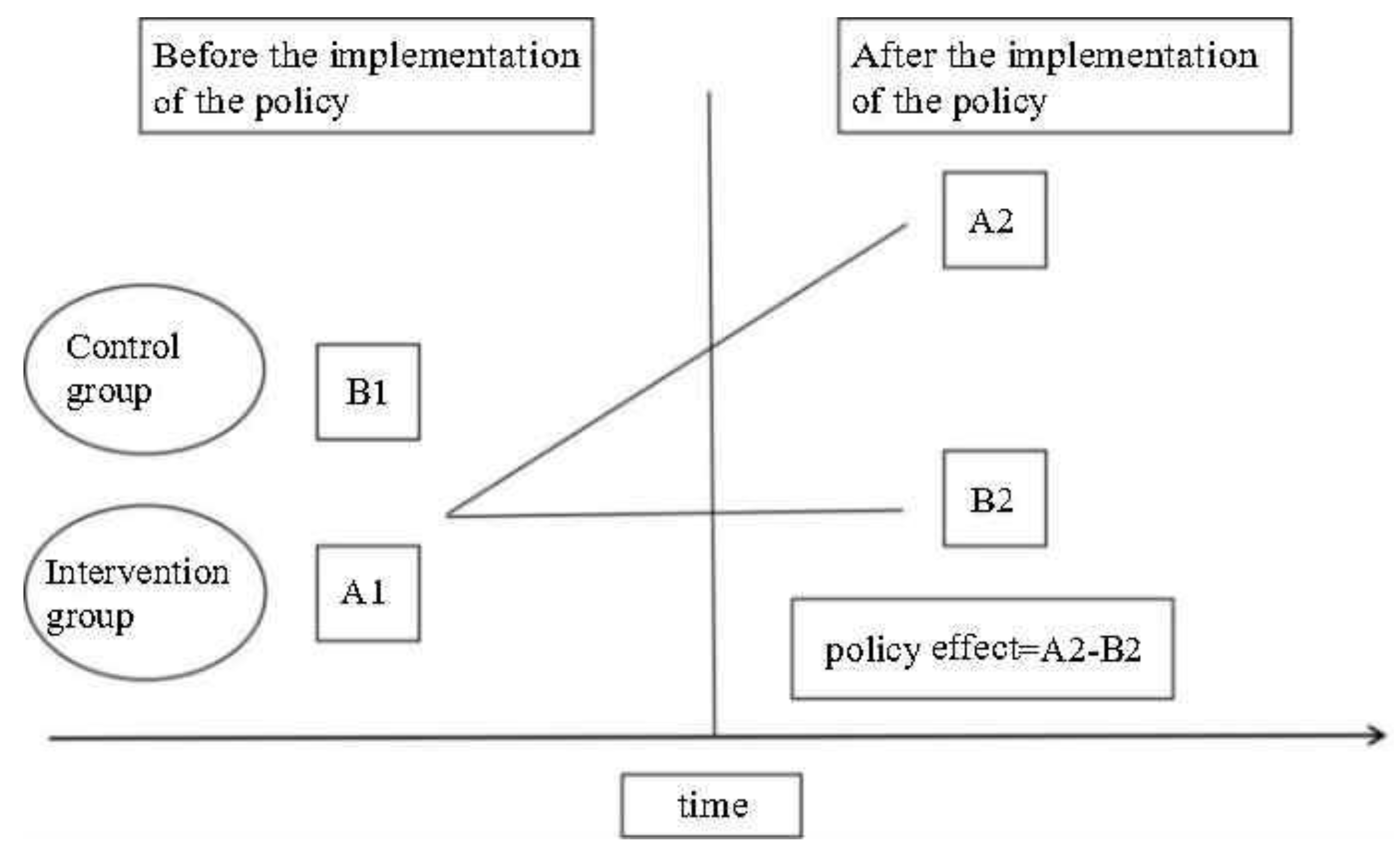
This paper aims to analyze the effectiveness of the implementation of the policy to remove trash cans. Therefore, we built a process comparison analysis model of public policy evaluation and adopted the control–implementation contrast method to compare the situation of waste-sorting before and after the implementation of the trash can removal policy in a residential subdistrict in Longhua, Shenzhen, as shown in Figure 2, to evaluate whether the policy has a promoting or inhibiting effect on the goal of waste-sorting. In addition, this paper further refined the model by using the “controlled object–experimental object” comparison method.
Figure 2.
Control–intervention contrast method.
Three main steps were involved: first, the residential subdistrict before and after the implementation of the policy were the control and experimental groups, respectively. Next, the index scores of the two groups were calculated as follows: × , where is the score corresponding to the questionnaire option and is the weight corresponding to the questionnaire options. Finally, we conducted a significance test on the scores of the two groups to determine the policy effect.
3.3. Research Process
3.3.1. Design of the Evaluation Index System
Using the Delphi method, experts in public-policy-related fields were invited to score the importance of each evaluation index relative to the evaluation target; the importance ranged from 1 to 10 points from low to high, respectively. This study primarily relies on two indicators to determine experts or government officials as “scorers”: first, they are currently focused on community governance research or engaged in grassroots governance work; and second, they have conducted relevant research or have been engaged in relevant work for more than 10 years.
Finally, 20 questionnaires were collected from experts and government staff from Shenzhen University, Xiamen University, China Ocean University, and other universities in the field of public policy and public management. The index system was correspondingly made into a questionnaire, and after consultation with scholars, the indexes with unclear meanings were modified many times. Several indexes were eventually modified to improve the readability and address the ambiguity of the questionnaire. For example, the index of “degree of policy emphasis” was changed to “degree of policy emphasis and execution force”, and “channels of policy participation” was changed to “public participation in policymaking”. The entire evaluation index system is shown in Table 1.
Table 1.
Evaluation index system.
3.3.2. Calculation of the Evaluation Index Weight Based on the Entropy Weight Method
Entropy has been widely used to determine the weight of index systems [37,39]. The basic idea of the entropy weight method is to determine the objective weight consistent with the variability of indexes.
Combining the definition and basic steps of the entropy weight method, the first step is to standardize the data values of the collected indicator score questionnaire. Then, according to Formulas (1)–(3), the entropy value of the third-grade indexes can be calculated (Ej), and the entropy weight (Wj) can be calculated according to Formula (5). Table 2 presents the results of the index weight.
Table 2.
Results of the index weight.
3.3.3. Evaluation Survey Implementation
This study used a questionnaire survey method to collect evaluations of the policy’s effectiveness from residents in different types of communities (“pre-policy implementation” and “post-policy implementation”). The evaluation survey was conducted from March to October 2019. Since Longhua District in Shenzhen began to promote the implementation of the “policy to remove trash cans” in 2018, the survey data obtained in 2019 can more effectively reflect the impact of the policy on the residents. Therefore, the data still have a certain reference value and significance today.
Finally, 201 valid questionnaires were screened in total. The questionnaires comprised 34 questions, for which the respondents used a Likert scale based on the evaluation index system to rate the policy to remove trash cans. The target group of respondents was the residents of Longhua District (not including villages in the city). The respondents provided their consent prior to participating. At the same time, we went into the community and distributed questionnaires to the residents by convenient sampling. Table 3 shows the samples of the distribution of questionnaires.
Table 3.
Samples of the distribution of questionnaires.
4. Results Analysis
4.1. Descriptive Analysis of Data
4.1.1. Average Score Analysis of the First-Grade Indexes
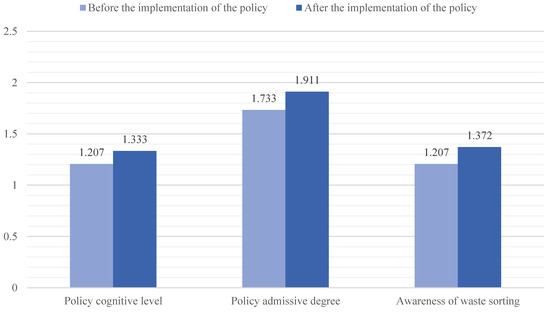
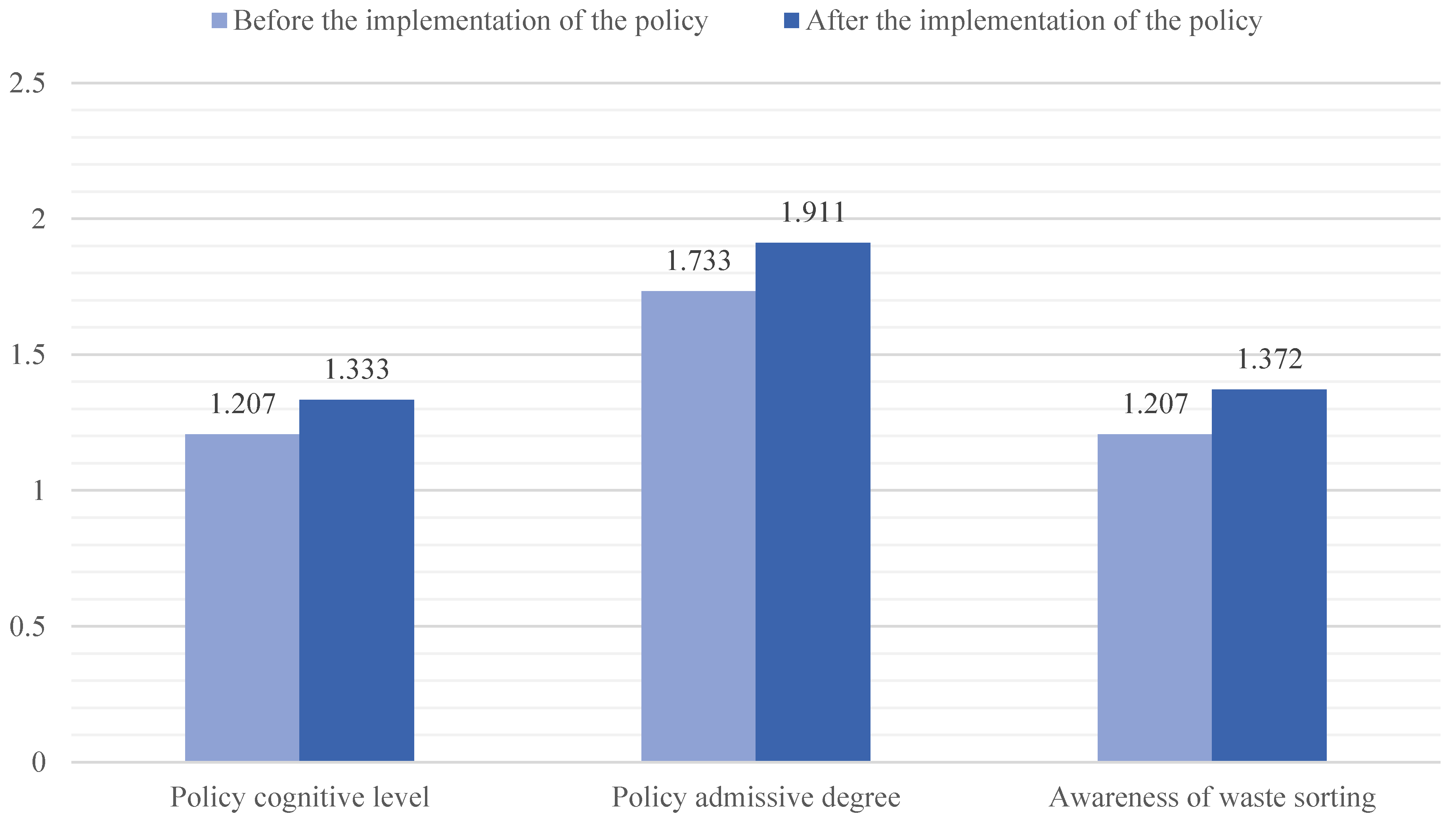
The findings in Figure 3 suggest that the implementation of the policy to remove trash cans plays a large role in promoting the awareness of waste-sorting among residents. Among the three first-grade indexes, the growth rate of the average score ranked from the lowest to the highest is the policy cognitive level, the policy admissive degree, and the awareness of waste-sorting. Compared with the other two indexes, the growth rate of the average score of the awareness of the waste-sorting index increased significantly (13.7%).
Figure 3.
Comparison of the average score of the first-grade indexes.
4.1.2. Average Score Analysis of the Second-Grade Indexes
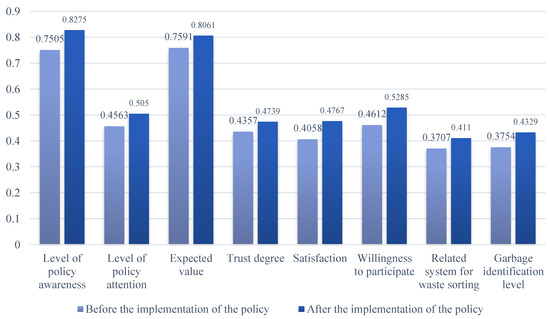
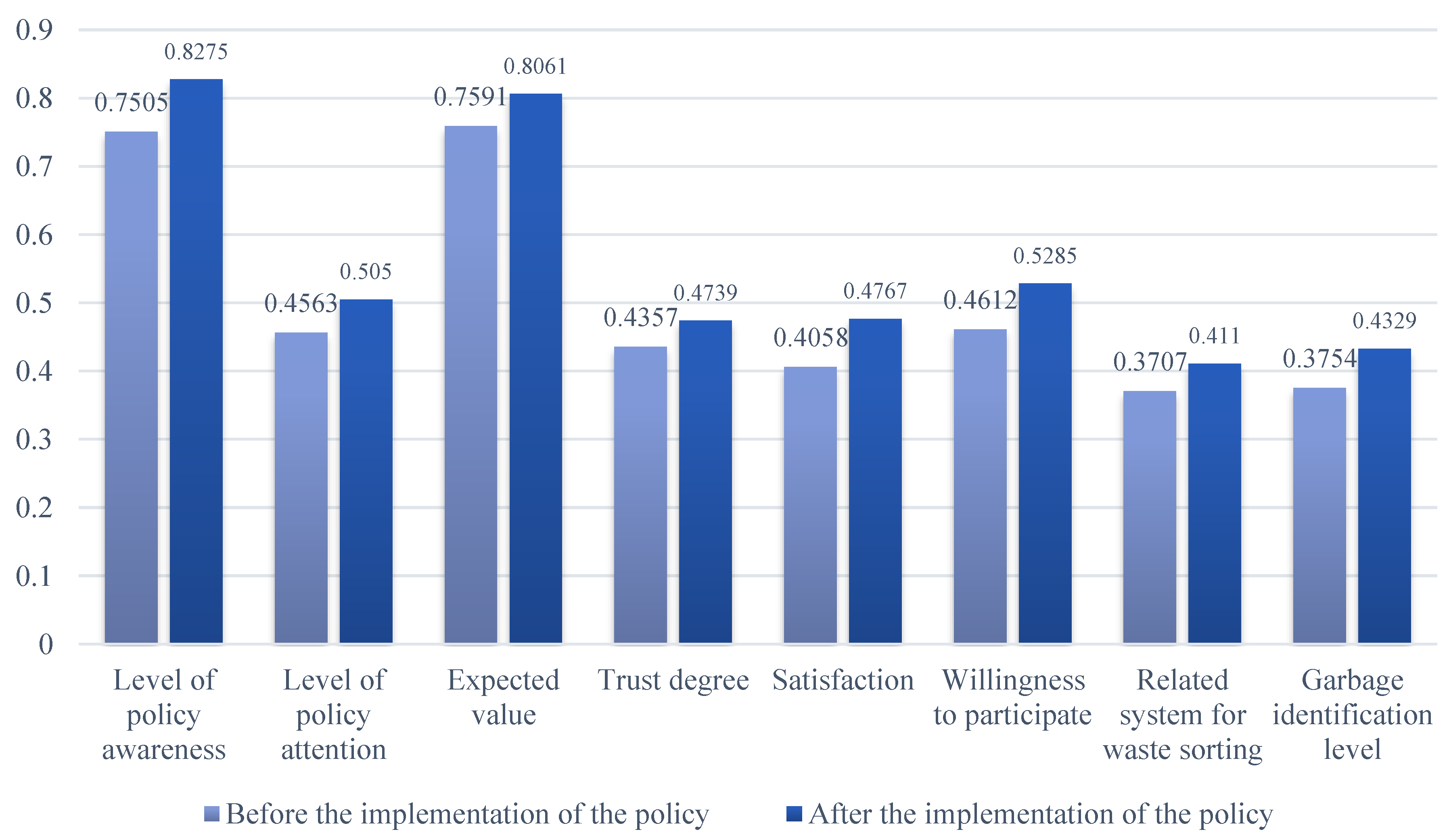
In Figure 4, it can be observed that when the growth rate of the first-grade indexes’ average score is considered, the policy to remove trash cans has the greatest impact on residents’ garbage-identification level in terms of awareness of the waste-sorting index.
Figure 4.
Comparison of the average score of the second-grade indexes.
After the implementation of the policy to remove trash cans, the average score of the second-grade indexes demonstrated a positive growth state: the highest growth rate is satisfaction (17.48%), the second highest level is garbage-identification level (15.31%), the lowest growth rate is expected value (6.20%), and the second lowest level is trust degree (8.76%).
4.1.3. Average Score Analysis of the Third-Grade Indexes
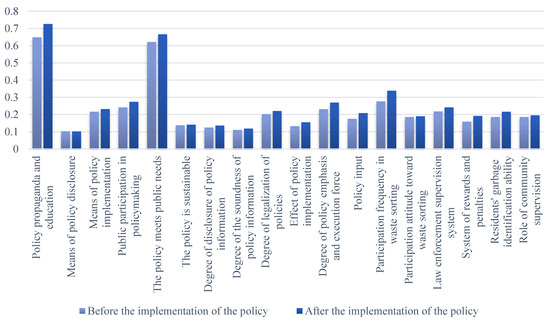
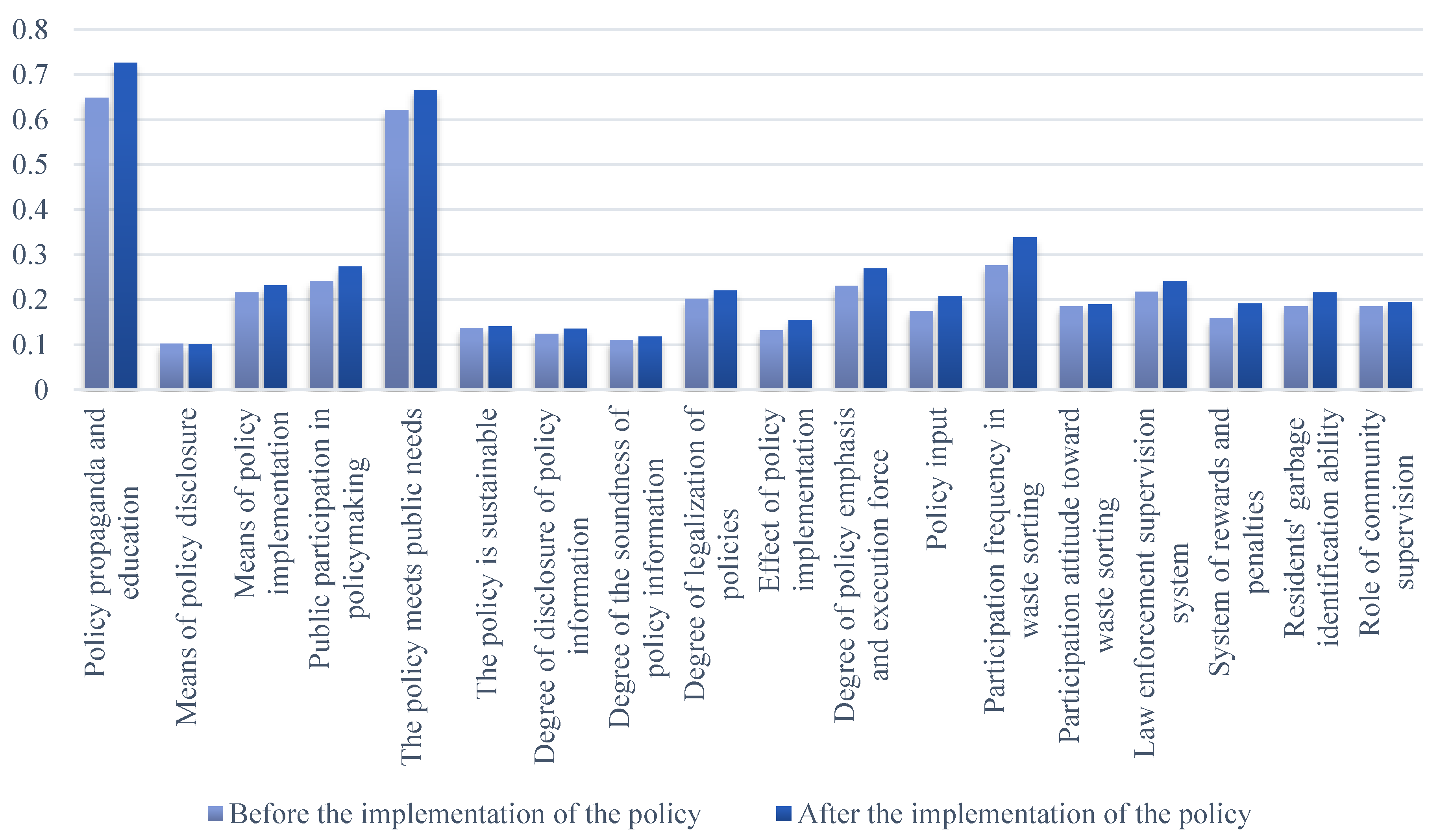
In Figure 5, it is noted that among the third-grade indexes, the average growth rate of index scores is the highest for “participation frequency in waste sorting”, followed by “role of community supervision”. The lowest growth rate is “ways of policy disclosure” and the second lowest is “the policy is sustainable”.
Figure 5.
Comparison of the average score of the third-grade indexes.
4.2. Effectiveness Evaluation of the Policy to Remove Trash Cans
The scores of 201 residents under the three first-grade indexes were classified and counted, and the “implementation or not of the policy to remove trash cans” was used as the influencing factor in the experiment. Setting type 1 is the “residential district that has implemented the policy” and type 2 is the “residential district that has not implemented the policy”. One-way analysis of variance (ANOVA) was used to perform the F test on the average difference between the two populations.
We propose the following hypothesis: : = . (The overall average score before and after implementation of the policy is the same).
Then, : ( = 1,2) are not all equal. (There are differences in the overall average scores before and after the implementation of the policy).
In the ANOVA results of the policy cognitive level index presented in Table 4, the significance was p = 0.004 < 0.05, which shows that the policy to remove trash cans significantly affected the cognitive level, which further had a promoting effect. In the ANOVA results of the policy admissive degree index, the significance was p = 0.001< 0.05, which demonstrates that the policy significantly affected the admissive degree of the waste-sorting policy and promoted improvement in the admissive degree of the waste-sorting policy. In the ANOVA results of the awareness of the waste-sorting index, the significance was p = 0.000 < 0.05, indicating that the policy has a significant impact on the awareness of waste-sorting, which encourages improvement in residents’ awareness of waste-sorting. In the ANOVA results of the total score of the three indexes, types 1 and 2 scored 4.616 and 4.147, respectively, and the significance was p = 0.000 < 0.05, which demonstrates that the policy to remove trash cans has a significant effect on promoting waste-sorting.
Table 4.
Results of the one-way ANOVA.
5. Discussion
According to the scores of the first-grade indexes, we found that after the implementation of ”the policy to remove trash cans”, the policy cognitive level, the policy admissive degree, and the awareness of waste-sorting significantly improved. In other words, we have proven the three previous hypotheses (H1, H2, and H3) through empirical data, among which the improvement level of awareness of waste-sorting is the most significant. This is because, after the implementation of this policy, residents have to bring the waste generated in their homes downstairs, and they need to place different forms of waste into different trash cans according to a unified classification standard. Under the social pressure of this subjective norm, residents will gradually change their original behavior and promote the awareness of garbage-classification, thus positively affecting residents’ garbage-classification behavior.
According to the score of the second-grade indexes, we found that after the implementation of the policy, the scores of the eight secondary indicators improved. Among them, the most significant increase in policy satisfaction was due to the implementation of “the policy to remove trash cans”, and the local government’s policy investment in garbage-classification increased, such as the purchase of garbage cans that meet the requirements of garbage-classification. In addition, due to the implementation of the policy, the local government’s emphasis on garbage-classification continues to increase, and it has stronger policy execution in practice.
Under the “satisfaction” index, the average growth rate of the “policy input” index is the highest, which indicates that the residents’ satisfaction with the personnel and support facilities invested in by the property and the government improved after the implementation of the policy to remove trash cans. Under the “garbage identification level” index, the average score of the “role of community supervision” index has the highest increase, indicating that community supervision plays a greater role in improving residents’ garbage-classification and -identification ability. In contrast, the level of improvement in the secondary indicator of “expectation value” is the lowest. Under the “expected value” index, the score of the “policy is sustainable” index slightly changed before and after removing the trash cans. Before the policy’s implementation, the index was divided into 0.1373, and after its implementation, it was divided into 0.1403. These findings indicate that the change in residents’ attitudes as to whether garbage-classification would be continually improved and developed was non-significant before and after removing the trash cans.
According to the score of the third-grade indexes, excluding the “policy openness” indicator, the other 15 tertiary indicators show a positive growth trend. Among them, the growth rate of the garbage-classification participation frequency index exceeds 20%, which also reflects the significant positive effect on the residents’ garbage-classification behavior after the implementation of the policy. However, at the level of the policy awareness index, the average score of the index of “ways of policy disclosure” is divided into 0.1019 before and 0.1017 after the policy was implemented, and the growth rate of policy disclosure is negative, which demonstrates that the channels for residents to gain knowledge of the waste-sorting policy information slightly changed after the policy’s implementation. Moreover, the data reflect that the channels through which residents receive policy information remain too narrow. Smooth and diverse channels of information transmission are one of the measures urgently necessary for the implementation of the current policy to remove trash cans.
Based on the descriptive data analysis, we drew the following conclusions: since 2019, Longhua District has implemented a policy to remove trash cans, and the average score of the policy cognitive level, the policy admissive degree, and the awareness of waste-sorting have a higher growth rate. The policy had a huge effect on promoting residents’ awareness of waste-sorting. The policy to remove trash cans emphasized that garbage should be collected and distributed separately, and that supervision should be timed and designated. The policy helped to improve the residents’ garbage-identification level. The participation frequency in waste-sorting also increased significantly. Additionally, the policy increased the residents’ attention and demand for a law enforcement supervision system and a system of rewards and penalties, which has laid a foundation for the smooth implementation of the support system.
6. Conclusions
In the past, residents who had never before sorted their garbage participated in the new garbage sorting system. Now, despite the many conflicts in the implementation of the policy, residents’ participation in these conflicts and exchanges will greatly increase, which will lay a foundation for the promotion of future waste-sorting policies. As mentioned in the Section 1, many countries have explored new policy models of garbage-classification, and academic circles have also begun to pay attention to the relationship between public demand and policy supply. Based on the TPB, taking the Delphi method, the entropy weight method, and the control–implementation contrast method, this study investigated the rigor of the trash removal policy in Longhua District from the following three dimensions: the policy cognitive level, the policy admissive degree, and the awareness of waste-sorting. This paper provides a new idea on how to evaluate environmental policies such as the garbage-classification policy from the perspective of the public based on rigorous evaluation methods and processes.
Nevertheless, this research has some limitations. First, there was an insufficient number of statistical samples, and it was difficult to collect data due to objective factors (such as COVID-19); nevertheless, we tried our best to obtain data. Second, the analysis based on the Chinese context has its particularities, and more regions should be compared in the future.
Supplementary Materials
The following supporting information can be downloaded at: https://www.mdpi.com/article/10.3390/su15129763/s1, File S1: Questionnaire survey on satisfaction of garbage classification in Longhua District in Shenzhen.
Author Contributions
Conceptualization, X.G., H.L. (Huayun Liu) and M.H.; methodology, X.G., H.L. (Honghao Li) and H.L. (Huayun Liu); software, H.L. (Honghao Li) and X.L.; validation, X.L.; investigation, X.G., H.L. (Honghao Li), X.L., H.L. (Huayun Liu) and M.H.; writing—original draft, X.G., H.L. (Honghao Li), X.L., H.L. (Huayun Liu) and M.H.; visualization, H.L. (Honghao Li) and X.L.; review and editing, H.L. (Honghao Li) and M.H.; supervision, X.G.; funding acquisition, X.G. All authors have read and agreed to the published version of the manuscript.
Funding
This work was supported by Shenzhen Philosophy and Social Science Planning 2022 Project grant SZ2022C012 for the project entitled “Research on the Construction Path of Data-driven High-quality Public Service Management Mechanism in Shenzhen” and the National Natural Science Foundation of China grant 71704112.
Institutional Review Board Statement
Not applicable.
Informed Consent Statement
Not applicable.
Data Availability Statement
Not applicable.
Acknowledgments
We express our deep gratitude to the participants in Longhua District of Shenzhen who contributed valuable data to this study.
Conflicts of Interest
The authors declare no conflict of interest.
References
- Kaza, S.; Yao, L.C.; Bhada-Tata, P.; Van Woerden, F. What a Waste 2.0: A Global Snapshot of Solid Waste Management to 2050. Urban Development; World Bank: Washington, DC, USA, 2018. [Google Scholar]
- Novikova, O.; Vladimirov, I.; Bugaeva, T. Expansion of the fuel and energy balance structure in Russia through the development of a closed-loop recycling. Sustainability 2021, 13, 4965. [Google Scholar] [CrossRef] [Scilit]
- Blair, J.; Mataraarachchi, S. A review of landfills, waste and the nearly forgotten nexus with climate change. Environments 2021, 8, 73. [Google Scholar] [CrossRef] [Scilit]
- Liu, F.; Liu, Z. Quantitative evaluation of waste separation management policies in the Yangtze River Delta Based on the PMC index model. Int. J. Environ. Res. Public Health 2022, 19, 3815. [Google Scholar] [CrossRef] [Scilit] [PubMed]
- Wu, Z.; Zhang, Y.; Chen, Q.; Wang, H. Attitude of Chinese public towards municipal solid waste sorting policy: A text mining study. Sci. Total Environ. 2021, 756, 142674. [Google Scholar] [CrossRef] [Scilit] [PubMed]
- Razali, F.; Daud, D.; Weng-Wai, C.; Jiram, W.R.A. Waste separation at source behaviour among Malaysian households: The Theory of Planned Behaviour with moral norm. J. Clean. Prod. 2020, 271, 122025. [Google Scholar] [CrossRef] [Scilit]
- Wang, Y.; Long, X.; Li, L.; Wang, Q.; Ding, X.; Cai, S. Extending theory of planned behavior in household waste sorting in China: The moderating effect of knowledge, personal involvement, and moral responsibility. Environ. Dev. Sustain. 2021, 23, 7230–7250. [Google Scholar] [CrossRef] [Scilit]
- Govindan, K.; Zhuang, Y.; Chen, G. Analysis of factors influencing residents’ waste sorting behavior: A case study of Shanghai. J. Clean. Prod. 2022, 349, 131126. [Google Scholar] [CrossRef] [Scilit]
- Lu, B.; Wang, J. How can residents be motivated to participate in waste recycling? An analysis based on two survey experiments in China. Waste Manag. 2022, 143, 206–214. [Google Scholar]
- Tiew, K.G.; Basri, N.E.A.; Deng, H.; Watanabe, K.; Zain, S.M.; Wang, S. Comparative study on recycling behaviours between regular recyclers and non regular recyclers in Malaysia. J. Environ. Manag. 2019, 237, 255–263. [Google Scholar] [CrossRef] [Scilit]
- Chen, H.; Yang, Y.; Jiang, W.; Song, M.; Wang, Y.; Xiang, T. Source separation of municipal solid waste: The effects of different separation methods and citizens’ inclination-case study of Changsha, China. J. Air Waste Manag. Assoc. 2017, 67, 182–195. [Google Scholar] [CrossRef] [Scilit]
- Wang, H.; Jiang, C. Local nuances of authoritarian environmentalism: A legislative study on household solid waste sorting in China. Sustainability 2022, 12, 2522. [Google Scholar] [CrossRef] [Scilit]
- Li, Q. Research on the status quo and countermeasures of Municipal solid waste classification in Fuzhou. IOP Conf. Ser. Earth Environ. Sci. 2021, 631, 012004. [Google Scholar] [CrossRef] [Scilit]
- Chen, S.S. Public Policy Failure and its Prevention: An integrated analytical framework. Acad. Mon. 2022, 54, 91–102. [Google Scholar]
- Kurniawan, T.A.; Liang, X.; O’Callaghan, E.; Goh, H.; Othman, M.H.D.; Avtar, R.; Kusworo, T.D. Transformation of solid waste management in China: Moving towards sustainability through digitalization-based circular economy. Sustainability 2022, 14, 2374. [Google Scholar] [CrossRef] [Scilit]
- American Evaluation Association Evaluation Policy Task Force. An evaluation roadmap for a more effective government. N. Dir. Eval. 2022, 173, 17–28.
- Chu, X.; Chu, Z.; Wang, X.; Huang, W.C.; Ni, Y. Comparative analysis on the performances of implementing compulsory and advocative policies in municipal solid waste classification. Environ. Impact Assess. Rev. 2023, 99, 106982. [Google Scholar] [CrossRef] [Scilit]
- Chen, F.; Li, X.; Ma, J.; Yang, Y.; Liu, G.J. An exploration of the impacts of compulsory source-separated policy in improving household solid waste-sorting in pilot megacities, china: A case study of Nanjing. Sustainability 2018, 10, 1327. [Google Scholar] [CrossRef] [Scilit]
- Kulkarni, B.N.; Anantharama, V. Repercussions of COVID-19 pandemic on municipal solid waste management: Challenges and opportunities. Sci. Total Environ. 2020, 743, 140693. [Google Scholar] [CrossRef] [Scilit]
- Massarutto, A.; Marangon, F.; Troiano, S.; Favot, M. Moral duty, warm glow or self-interest? A choice experiment study on motivations for domestic garbage sorting in Italy. J. Clean. Prod. 2019, 208, 916–923. [Google Scholar]
- Knutsson, S.G.; Asplund, T.; Hst, G.; Schnborn, K.J. Public perceptions of waste management in Sri Lanka: A focus group study. Sustainability 2021, 13, 12960. [Google Scholar] [CrossRef] [Scilit]
- Yang, S.; Wei, J.; Cheng, P. Spillover of different regulatory policies for waste sorting: Potential influence on energy-saving policy acceptability. Waste Manag. 2021, 125, 112–121. [Google Scholar] [CrossRef] [Scilit] [PubMed]
- Bosnjak, M.; Ajzen, I.; Schmidt, P. The Theory of Planned Behavior: Selected Recent Advances and Applications. Eur. J. Psychol. 2020, 16, 352–356. [Google Scholar] [CrossRef] [Scilit] [PubMed]
- Ajzen, I.; Fishbein, M. Understanding Attitudes and Predicting Social Behavior; Prentice Hall: Upper Saddle River, NJ, USA, 1980. [Google Scholar]
- Ajzen, I. The theory of planned behavior. Organ. Behav. Hum. Decis. Process. 1991, 50, 179–211. [Google Scholar] [CrossRef] [Scilit]
- Chan, L.; Bishop, B. A moral basis for recycling: Extending the theory of planned behaviour. J. Environ. Psychol 2013, 36, 96–102. [Google Scholar] [CrossRef] [Scilit]
- Karim Ghani, W.A.; Rusli, I.F.; Biak, D.R.; Idris, A. An application of the theory of planned behaviour to study the influencing factors of participation in source separation of food waste. Waste Manag. 2013, 33, 1276–1281. [Google Scholar] [CrossRef] [Scilit]
- Fan, B.; Yang, W.; Shen, X. A comparison study of ‘motivation–intention–behavior’ model on household solid waste sorting in China and Singapore. J. Clean. Prod. 2019, 211, 442–454. [Google Scholar] [CrossRef] [Scilit]
- Ajzen, I. Residual Effects of Past on Later Behavior: Habituation and Reasoned Action Perspectives. Pers. Soc. Psychol. Rev. 2002, 6, 107–122. [Google Scholar] [CrossRef] [Scilit]
- Chamorro, A.; Miranda, F.J.; Rubio, S.; Valero, V. Innovations and trends in meat consumption: An application of the Delphi method in Spain. Meat Sci. 2012, 92, 816–822. [Google Scholar] [CrossRef] [Scilit]
- Escribano, M.; Díaz-Caro, C.; Mesias, F. A participative approach to develop sustainability indicators for dehesa agroforestry farms. Sci. Total Environ. 2018, 640–641, 89–97. [Google Scholar] [CrossRef] [Scilit]
- Strand, J.; Carson, R.T.; Navrud, S.; Ortiz-Bobea, A.; Vincent, J.R. Using the Delphi method to value protection of the Amazon rainforest. Ecol. Econ. 2017, 131, 475–484. [Google Scholar] [CrossRef] [Scilit]
- Abreu, I.; Mesias, F. The assessment of rural development: Identification of an applicable set of indicators through a Delphi approach. J. Rural Stud. 2020, 80, 578–585. [Google Scholar] [CrossRef] [Scilit]
- Almansa, C.; Martínez-Paz, J.M. What weight should be assigned to future environmental impacts? A probabilistic cost benefit analysis using recent advances on discounting. Sci. Total Environ. 2011, 409, 1305–1314. [Google Scholar]
- Linstone, H.A.; Turoff, M. Delphi: A brief look backward and forward. Technol. Forecast. Soc. Chang. 2011, 78, 1712–1719. [Google Scholar] [CrossRef] [Scilit]
- Peng, Y.; Zhang, F.; Jiang, S.; Huang, L.; Wang, Z.; Xu, Y. Analysis of farmers satisfaction towards concentrated rural settlement development after the Wenchuan earthquake. Int. J. Disaster Risk Reduct. 2018, 31, 160–169. [Google Scholar] [CrossRef] [Scilit]
- Xue, L.; Cho, J.; He, W.; Yao, L.; Zou, W. Construction and application of the student satisfaction evaluation system for the extracurricular education services in colleges. Comput. Appl. Eng. Educ. 2021, 29, 370–384. [Google Scholar] [CrossRef] [Scilit]
- Ni, X.; Quan, Y. Measuring the Sustainable Development of Marine Economy Based on the Entropy Value Method: A Case Study in the Yangtze River Delta, China. Sustainability 2023, 15, 6719. [Google Scholar] [CrossRef] [Scilit]
- Dong, F.; Yin, J.; Xiang, J.; Chang, Z.; Gu, T.; Han, F. EWM-FCE-ODM-Based Evaluation of Smart Community Construction: From the Perspective of Residents Sense of Gain. Sustainability 2023, 15, 6587. [Google Scholar] [CrossRef] [Scilit]

Disclaimer/Publisher’s Note: The statements, opinions and data contained in all publications are solely those of the individual author(s) and contributor(s) and not of MDPI and/or the editor(s). MDPI and/or the editor(s) disclaim responsibility for any injury to people or property resulting from any ideas, methods, instructions or products referred to in the content. |
© 2023 by the authors. Licensee MDPI, Basel, Switzerland. This article is an open access article distributed under the terms and conditions of the Creative Commons Attribution (CC BY) license (https://creativecommons.org/licenses/by/4.0/).