


Abstract
Antimicrobial resistance, which decreases the efficacy of antibiotics and other antimicrobials, has led to concerns about the use of antibiotics in livestock production. Consumers play an important role in influencing producers’ decisions about the use of antimicrobials through their choices in the marketplace, which are driven by attitudes toward these practices. This study examines consumers’ levels of concern about (and acceptance of) the use of antibiotics in livestock production for four objectives: to treat, control, and prevent infections, and to promote growth. Results reveal that the majority of respondents were highly concerned about antibiotic use to promote growth in livestock production and considered this use to be unacceptable. Participants with higher objective knowledge of antibiotic resistance and antibiotic use in livestock production were more likely to accept antibiotic use to treat and control disease, but less likely to accept its use to prevent disease or to promote growth. Participants with high levels of trust in the livestock industry were more likely to accept antibiotic use to control and prevent infections and to be neutral about antibiotic use to promote growth in food animals. Respondents who believed that antibiotic use decreases animal welfare were more likely to be very concerned about antibiotic use to treat, prevent, and control disease, and less likely to accept antibiotic use to treat diseases in food animals. The study findings should be of interest to producers considering the adoption of sustainable technologies and production practices, food retailers making procurement decisions, and policymakers identifying policies that can alleviate antimicrobial resistance in the agri-food sector.
1. Introduction
Antimicrobial resistance (AMR) is one of the most significant threats to human health worldwide [1]. AMR is the capability of viruses, bacteria, fungi, and parasites to resist the effects of antimicrobial medicines (such as antivirals, antibiotics, antifungals, and antimalarial drugs) to which they were once sensitive [2]. Approximately 1.27 million people died globally in 2019 due to AMR infections and by 2050 the death toll is expected to increase to 10 million people [3,4]. O’Neill [5] reported that if actions are not taken to address AMR, the global gross domestic product will decrease by two to three-and-a-half percent by 2050, costing the world up to USD 100 trillion. The most recent estimates of the annual costs of AMR infections to the United States healthcare system are between USD 21 billion and USD 34 billion a year [2,6].
The emergence and spread of AMR bacteria threaten our ability to treat bacterial infections, leading to an increase in diseases, disability, and death [7]. In 2018, the Centers for Disease Control and Prevention (CDC) reported that more than 220 varieties of bacteria with new or rare antibiotic-resistant genes were found in 27 U.S. states [8], which is particularly troubling as there has been a marked decrease in efforts to develop new antibiotics in recent decades [9,10]. According to the CDC, at least 2.8 million people in the United States are infected with AMR bacteria each year, resulting in 35,000 deaths and increased costs for consumers and the health care system [11].
Antibiotics are one of the most used types of antimicrobial drugs in the livestock sector given that livestock diseases without antibiotic use may present a huge loss to livestock producers [12,13,14]. However, the widespread use of antibiotics in livestock production has been linked to the prevalence of AMR in pathogens, including pathogens found in human populations [15,16,17,18]. Livestock-related AMR bacteria have been detected in foods [19,20] as well as in agricultural soils and adjacent waterways [21,22]. The livestock sector accounts for approximately 80 percent of all the antibiotics used in the United States annually [23]. The U.S. Food and Drug Administration [24] permits antibiotics to be used in food animals to: (1) treat diseases in food animals that are sick; (2) control diseases for a group of food animals when some of the animals are sick; and (3) prevent disease in food animals that are at risk of becoming sick. In the U.S. livestock industry, antibiotics have also been used as growth promotants for increased feed efficiency [8]. However, as of 2017, drugs that are deemed medically important to human health are not allowed for use as growth promotants in the United States [8]. When using antibiotics to control and prevent diseases (or when using antibiotics as growth promotants), antibiotics are given to animals that do not exhibit symptoms of the illness the antibiotics are designed to treat.
Given the current use of antibiotics in livestock production and links identified between antibiotic use and the spread of antibiotic resistance, it is important to understand consumer views of, and attitudes toward, antibiotic use in livestock production and antibiotic resistance. It is well documented that product attributes and production processes influence consumer choices [25,26,27,28,29,30,31]. At the same time, consumer acceptance of, or aversion to, production processes and technologies determines, to a large extent, their adoption by producers and, consequently, the type of products that will be supplied in the market; for instance, concerns about consumer acceptance of new plant breeding techniques is viewed as a significant limitation to the development of these breeding methods [32].
A few studies have examined consumer views of animal products produced with and without antibiotics. Lusk et al. [33] examined consumers’ willingness to pay for antibiotic-free meat, and consumers’ willingness to contribute to the mitigation of antibiotic resistance in the U.S. Their results showed consumer support for a ban on the sub-therapeutic use of antibiotics and willingness to pay more for antibiotic-free meat. Olynk et al. [34] found a positive willingness to pay for milk verified to have been produced without the use of antibiotics. Goddard et al. [35] examined consumer willingness to consume meat products from animals treated with antibiotics in Canada and Germany. They found that German consumers were less willing to consume meat products from animals treated with antibiotics than Canadian consumers. The authors also found that individuals with greater animal welfare concerns were more likely to reject the use of antibiotics in livestock production in both countries. Busch et al. [36] examined consumers’ opinions of the relationship between antibiotic use in livestock production and a variety of outcomes in Germany, Italy, and the U.S. They find that consumers are concerned about the implications of the use of antibiotics in livestock production and antibiotic resistance; however, U.S. respondents held more positive views of the use of antibiotics than German and Italian respondents.
While the above studies shed some light on consumers’ attitudes toward the use of antibiotics in livestock production in general, there are no studies to our knowledge that analyze U.S. consumers’ attitudes toward the use of antibiotics for different purposes in livestock production. The main objective of our study was to identify the key factors affecting U.S. consumers’ levels of concern about and acceptance of the use of antibiotics in livestock production for four purposes: to treat, control, and prevent infections, and to promote growth.
In our study, we measured consumers’ levels of concern about, and acceptance of, the use of antibiotics in livestock production to treat, control, and prevent infections, as well as to promote growth in food animals. We also identified individual-specific factors—with a particular focus on self-assessed (or subjective) and objective knowledge and beliefs about antibiotic resistance—that influence consumer concerns and acceptance of these uses. We hypothesize that individual-specific factors, such as knowledge and beliefs, are important determinants of consumer attitudes toward antibiotic use in livestock production as these factors have been found in previous studies to explain differences in the willingness to pay for products [33,37,38], the willingness to vote for ballot initiatives [39], as well as to avoid information related to AMR [40]. Meerza et al. [40] identified that knowledge of antibiotic resistance and antibiotic use in food animals plays an important role in predicting AMR information avoidance. Specifically, they found that consumers with little or no knowledge of antibiotic resistance and antibiotic use in food animals were more likely to avoid information about AMR compared to consumers with high or moderate knowledge of antibiotic resistance and antibiotic use in food animals.
Both subjective and objective knowledge are the most commonly used measures of knowledge in consumer research [41]. Subjective knowledge is important in explaining individuals’ confidence in decisions and their willingness to act [42,43]. On the other hand, objective knowledge depicts what an individual actually knows [44]. While subjective knowledge and objective knowledge of antibiotic resistance among the general public are currently low [40], international bodies, such as the World Health Organization (WHO), have prioritized campaigns to increase awareness and understanding of AMR among healthcare workers and the general public [45], which may lead to marked changes in consumer knowledge and beliefs. Understanding how knowledge and beliefs relate to concern about and acceptance of antibiotic use may help predict future shifts in consumer/voter support for these practices.
2. Survey Design
A survey was developed to achieve our study objectives. To ensure the scientific accuracy of our survey questions, we consulted relevant experts from animal science, food science, and microbiology. This survey received approval from the University of Nebraska-Lincoln Institutional Review Board (approval number: 20180418265EX). The survey included questions that addressed consumer knowledge of antibiotic use in livestock production and antibiotic resistance as well as consumer perceptions of, and attitudes toward, antibiotic use in livestock production, antibiotic resistance, and animal welfare. The survey was administered online by the survey firm IRi using their probability-based consumer panel designed to be representative of the US population. IRi invited a total of 8528 panel consumers (who were the households’ primary shoppers and 19 years or older) by sending a consent email with a link to the online survey. Responses were collected in May and June 2018. IRi closed the online survey when they collected 1030 responses. After removing incomplete responses, 1025 completed surveys were used in the analysis.
The survey consisted of three sections. The first section collected information on demographic variables, such as the respondent’s age, gender, race, education, household income, family size, number of children in the family, and the respondent’s or family member’s employment or involvement in the human health or livestock/animal health sector. The second section of the survey included questions that gauged attitudes toward animal welfare. People’s attitudes toward animal welfare have been found to be important in explaining their levels of acceptance of antibiotic use in livestock production [35]. Information was also collected about participants’ meat consumption habits, factors affecting meat purchasing decisions, personal antibiotic use, and experience with antibiotic drug effectiveness. The last section of the survey included questions that measured participants’ subjective and objective knowledge of antibiotic resistance and antibiotic use in livestock production along with participants’ perceptions of, and level of concern about, antibiotic resistance and antibiotic use in livestock production. Participants also indicated their levels of concern about and acceptance of the use of antibiotics in livestock production for, treatment, control, prevention, and as a growth promotant.
3. Model Description
We used ordered probit models to identify factors affecting the participants’ levels of concern about and acceptance of the use of antibiotics for treatment, control, prevention, and growth promotion in livestock production. The specifications of the ordered probits in this study followed Wooldridge [46], who defined as an individual ’s response for categories. The ordered probit for given models , which is a latent variable. For individual , the latent variable can be defined as:
where comprises relevant individual features, and . β presents a k × 1 column vector. Given the unknown threshold values of , the relationship between (i.e., the observed variable) and (i.e., the latent variable) can be written as:
Then, the conditional distribution of given can be derived from:
where F refers to the cumulative distribution function of . The sign of the parameter β in the ordered probit regression indicates the direction of the relationship between the regressor and the latent variable ; a positive β indicates that an increase in the regressor is associated with an increase in . However, the value of the coefficient in the ordered probit model does not tell us the change in probability of choosing an alternative when the independent variable changes; therefore, we calculate marginal effects to examine the change in the latent variable. The marginal effect indicates the change in the probability of choosing an alternative when the regressor increases by one unit. The marginal effect of the probability that option j is chosen when a continuous predictor variable, , changes, is expressed as:
The dependent variables used in the analysis include the level of concern and acceptance for each of the four uses of antibiotics. The key independent variables that may affect the levels of concern and acceptance are subjective and objective knowledge of antibiotic resistance and antibiotic use in livestock production and perceptions of and attitudes toward animal welfare, antibiotic resistance, and antibiotic use in livestock production. We also include the following control variables in the model: meat and fish consumption habits, factors affecting purchasing decisions, trust in the livestock industry, and demographic characteristics.
4. Results
4.1. Descriptive Statistics
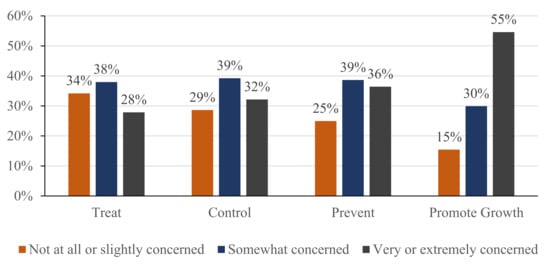
Respondents’ levels of concern were reported on a five-point ordinal scale ranging from “not at all concerned” (=1) to “extremely concerned” (=5). However, because of data sparsity in some categories, the five-point ordinal scale was converted into a three-point ordinal scale (anchored by “not at all or slightly concerned” and “very or extremely concerned”) by aggregating the first two (1 and 2) and last two (4 and 5) categories. Figure 1 presents participants’ reported levels of concern about the use of antibiotics in livestock production for treatment, control, prevention, and growth promotion. A little over one-fourth of participants reported being very or extremely concerned about antibiotic use to treat disease in food animals while about one-third of participants reported being very or extremely concerned about antibiotic use to control and prevent disease in food animals. More than half of the respondents stated that they were very or extremely concerned about antibiotic use to promote growth in food animals (see Figure 1).
Figure 1.
Levels of concern about different antibiotic uses in livestock production.
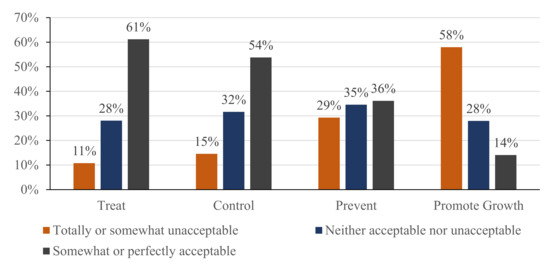
The levels of acceptance of four different uses of antibiotics in livestock production were also converted from a five-point ordinal scale (ranging from “totally unacceptable” (=1) to “perfectly acceptable” (=5)) to a three-point ordinal scale anchored by “totally or somewhat unacceptable” (=1) and “somewhat or perfectly acceptable” (=3) (see Figure 2). More than half of the respondents indicated that antibiotic use to treat and control infections in food animals was acceptable, while only about one-third of participants accepted the use of antibiotics in food animals to prevent infections (see Figure 2). Only 14 percent of respondents reported that the use of antibiotics as a growth promotant was acceptable, while more than half of the respondents considered it to be unacceptable (see Figure 2).
Figure 2.
Levels of acceptance of different antibiotic uses in livestock production.
The survey also collected data on several variables that may influence the levels of concern about and acceptance of antibiotic use in livestock production. Specifically, we gathered data on meat and fish consumption habits; factors—such as the use of organic production practices, animal welfare, nutrition, etc.—affecting meat purchasing decisions; perceptions and understanding of antibiotic resistance and antibiotic use in livestock production; history of antibiotic use; trust in the livestock industry; the perceived relationship between antibiotic use and animal welfare; and demographic characteristics (for details see Table 1).
Table 1.
Descriptive statistics of independent variables.
Participants’ meat consumption habits for four different types of meat (beef, chicken, pork, and fish) were measured on a five-point scale anchored by “never” and “daily.” On average, respondents consumed chicken more frequently than any other type of meat. Respondents were also asked to indicate how important four factors (organic, animal welfare, nutritional value, and food safety) were for them when purchasing meat. A five-point scale, 1 = very unimportant to 5 = very important, was used to assess the importance levels of these attributes for participants. On average, participants reported that organic, animal welfare, nutritional value, and food safety, were important factors when purchasing meat (see Table 1).
Participants, on average, disagreed with the statement that the ‘use of antibiotics in food animals does not cause antibiotic resistance that could affect humans’(see Table 1). Participants, on average, agreed with the statements that ‘antibiotic resistance is one of the biggest problems the world faces,’ ‘widespread use of antibiotics creates new resistant bacteria that cause illness that antibiotics cannot cure,’ and that ‘widespread use of antibiotics in animal feed can lead to antibiotics polluting the environment through agricultural runoff’ (see Table 1).
Regarding personal antibiotic use, around 42 percent of respondents reported that they were treated with antibiotics in the previous year. Overall, 27 and 23 percent of respondents reported having experienced an unsuccessful treatment with antibiotics at some point in their lives or in a family member’s life, respectively (see Table 1).
Participants were also asked about their agreement with statements relating to their trust in the livestock industry as well as their perceived relationship between animal welfare and antibiotic use in food animals using a five-point scale from 1 = strongly disagree to 5 = strongly agree. On average, participants agreed with the statement that ‘livestock farmers and their veterinarians know how best to care for their animals’ (see Table 1). Participants, on average, also agreed with the animal welfare statement that ‘food safety is strongly dependent on the care provided to food animals’ and agreed that the use of antibiotics to treat and prevent an illness in food animals improves animal welfare (see Table 1).
Table 1 also contains demographic information on survey respondents. The average age of survey participants was approximately 52 years old. Around 74 percent of respondents were white, and 71 percent of respondents were female (see Table 1). The percentages of white people and females in the U.S. population are 76 percent and 51 percent, respectively [47]. Females were overrepresented in our sample because the survey was completed by the household’s primary shopper. Individuals who received a college degree represented about 44 percent of the participants (see Table 1), which is almost equal to the percentage of the U.S. population with a college degree [48]. The household size of respondents was around two people with about one child currently living in the home. In addition to demographic characteristics, participants were asked about their own—or their family members’—involvement in the livestock, human health, or animal health sectors. Only nine percent of participants reported that they or their families were involved in one of these sectors (see Table 1).
In the survey, subjects were also asked to assess their knowledge of six topics related to antibiotic resistance and antibiotic use in food animals (i.e., use of antibiotics in livestock production, antibiotic resistance in humans and animals, antibiotic-resistant bacteria, drug resistance, and superbugs) on a four-point scale anchored by “no knowledge” (=1) and “a great deal of knowledge” (=4) (see Table 2). To measure participants’ subjective (i.e., self-assessed) knowledge of antibiotic resistance and antibiotic use in livestock production, this study averaged responses to these six topics. Respondents, on average, have little knowledge of antibiotic resistance and antibiotic use in livestock production with a mean of 2.06 and 35 percent of respondents reporting having no knowledge (see Table 2).
Table 2.
Participants’ self-assessed knowledge of antibiotic resistance and antibiotic use in livestock production.
To assess respondents’ objective knowledge, participants were asked ten true–false questions related to antibiotic resistance and antibiotic use in livestock production (i.e., five questions for each topic); respondents could also indicate that they did not know the answer. Based on participants’ responses, we developed an index of objective knowledge by dividing the number of correct answers by ten (i.e., the total number of questions); see Table 3. The objective knowledge index varies from 0 to 1. Survey results show that, on average, participants correctly answered less than half of the ten questions related to antibiotic resistance and antibiotic use in livestock production with a mean of 0.467 (see Table 3).
Table 3.
Participants’ objective knowledge of antibiotic resistance and antibiotic use in livestock production.
4.2. Regression Results
Results from the eight ordered probit regressions that analyzed factors affecting participants’ levels of concern and acceptance of four different uses of antibiotics in livestock production are presented in Table 4 and Table 5 (estimated coefficients are presented in an online Appendix A). As noted earlier, due to data sparsity, participants’ levels of concern and acceptance of four different uses of antibiotics in livestock production were converted from a five-point scale to a three-point scale. Therefore, the dependent variables in all eight ordered probit regressions have three categories. The marginal effects were evaluated at the mean of independent variables for the last two response categories, which, for the respondents’ levels of concern about different antibiotic uses in food animals, were (1) somewhat concerned and (2) very or extremely concerned; for participants’ levels of acceptance. The last two response categories were (1) neither acceptable nor unacceptable and (2) somewhat or perfectly acceptable.
Table 4.
Marginal effects P (y = 2, somewhat concerned and y = 3, very or extremely concerned): factors affecting the levels of concern about different antibiotic uses in livestock production.
Table 5.
Marginal effects P (y = 2, neither acceptable nor unacceptable, and y = 3, somewhat or perfectly acceptable): factors affecting the levels of acceptance about the different antibiotic uses in livestock production.
4.2.1. Concern about Uses of Antibiotics in Livestock Production
Participants who reported higher subjective (i.e., self-assessed) knowledge of antibiotic resistance and antibiotic use in livestock production were seven percentage points more likely to be very or extremely concerned about antibiotic use to both control and prevent diseases in food animals (p < 0.01). Participants with higher objective knowledge of antibiotic resistance and antibiotic use in livestock production were around 23 and 20 percentage points less likely to be very or extremely concerned about antibiotic use to treat and control infections (p < 0.001). Moreover, they were 19 (13) percentage points more (less) likely to be very or extremely (somewhat) concerned about antibiotic use for growth promotion (p < 0.05) (see Table 4).
Participants who considered animal welfare in their purchasing decisions were about four percentage points more likely to be very or extremely concerned about antibiotics use to both control and prevent infections. They were also six percentage points more likely to be very or extremely concerned about antibiotic use as a growth promotant. Participants who indicated food safety was a factor that affected their purchasing decisions were one and three percentage points more likely to be somewhat concerned about antibiotic use to prevent infection and for growth promotion. However, they were five percentage points less likely to be very or extremely concerned about antibiotic use as a preventive measure or growth promotion.
A number of variables were statistically significant in the perceptions and understanding of antibiotic resistance, and animal welfare sections. The belief that ‘antibiotic resistance is one of the biggest problems the world faces’ and that ‘widespread use of antibiotics in animal feed can lead to antibiotics polluting the environment through agricultural runoff’ increased the probability that respondents were very or extremely concerned about all four antibiotic uses in livestock production. It also decreased the probability of being somewhat concerned about antibiotic use to prevent infection and as a growth promotant. Participants who believed that ‘food safety is strongly dependent on the care provided to food animals’ were more likely to be very or extremely concerned about all four uses of antibiotics in food animals (p < 0.05). Furthermore, subjects who believed that the ‘use of antibiotics in food animal production decreases animal welfare’ were also more likely to be very or extremely concerned about antibiotic use to treat, control, and prevent infections in food animals (p < 0.01) (see Table 4).
4.2.2. Acceptance of Uses of Antibiotics in Livestock Production
Next, we examined participants’ levels of acceptance of antibiotic use in livestock production (Table 5). We found no statistically significant relationship between respondents’ subjective knowledge of antibiotic resistance and antibiotic use and their levels of acceptance of antibiotic uses in food animals (see Table 5). Respondents with higher objective knowledge of antibiotic use in livestock production and antibiotic resistance were 46 and 17 percentage points more likely to somewhat or perfectly accept antibiotic use to treat and control infections in livestock production (p ≤ 0.05). However, they were 14 and 20 percentage points less likely to accept or be neutral (neither acceptable nor unacceptable) about antibiotic use as a growth promotant, respectively (p < 0.001).
Two variables in the factors affecting purchasing decisions—organic and food safety—were statistically significant in analyses of the “Treat” and “Control” variables. Specifically, the respondents’ preferences for organic products decreased the probability of treatment and control practices being somewhat or perfectly accepted by around four and six percentage points, respectively (p ≤ 0.05), and increased the probability of treatment and control practices being neither acceptable nor unacceptable by around two and three percentage points, respectively (p ≤ 0.05). They were also around two percentage points more likely to accept or be neutral about antibiotic use to promote growth. In contrast, participants who considered food safety while making meat purchasing decisions were around six and five (three and two) percentage points more (less) likely to accept (neither accept nor reject) antibiotic use to treat and control infections in food animals (p < 0.05) (see Table 5).
Concerning perceptions of antibiotic resistance, participants who believed that the ‘use of antibiotics in food animals does not cause antibiotic resistance that could affect humans’ were seven, twelve, and six percentage points more likely to accept antibiotic use to control infections, to prevent infections, and to promote growth, respectively (p < 0.001). Respondents who believed that ‘antibiotic resistance is one of the biggest problems the world faces’ were less likely to accept antibiotic use to control and to prevent diseases in food animals (p ≤ 0.05) (see Table 5). However, they were two percentage points more likely to be neutral about antibiotic use to control infections (p < 0.05). Participants who indicated that ‘widespread use of antibiotics in animal feed can lead to antibiotics polluting the environment through agricultural runoff’ were eight and four percentage points more likely to accept antibiotic use to treat and control disease in food animals (p ≤ 0.05). They were also five percentage points less likely to be neutral about antibiotic use to treat infections (p < 0.001).
Respondents who were treated with antibiotics in the previous year were seven and four percentage points more likely to accept antibiotic use to prevent infections and to promote growth in food animals (p ≤ 0.05). As would be expected, respondents who reported high levels of trust in the livestock industry were more likely to accept antibiotic use to control and to prevent infections (p < 0.01).
Participants who believed that the use of antibiotics in livestock production improved animal welfare were more likely to accept antibiotic use to treat, control, and prevent disease, and to promote growth in food animals. Respondents who believed that antibiotic use decreased animal welfare were around five and four percentage points less likely to accept antibiotic use to treat and control disease, respectively, and about three percentage points more likely to be neutral about antibiotic use to treat infections, and as a growth promotant (see Table 5).
A few demographic variables were statistically significant. Female participants were eleven, twelve, and seven percentage points less likely to accept antibiotic use to control and to prevent diseases, and to promote growth, respectively, compared to male participants (p < 0.01). However, they were about six and two percentage points more likely to be neutral about the use of antibiotics to control and prevent infections in food animals (p < 0.01). Participants who identified as white were about nine (six) percentage points more (less) likely to accept (neither accept nor reject) antibiotic use to treat diseases in food animals than other ethnicities (see Table 5).
5. Discussion and Conclusions
This study investigates the factors that influence consumers’ levels of concern about and acceptance of four uses of antibiotics in livestock production. Results show that, on average, participants considered antibiotic use to treat and control infections in food animals as acceptable practices. Participants were fairly neutral regarding antibiotic use to prevent infections in food animals. However, respondents, on average, considered antibiotic use to promote growth in food animals as unacceptable. Only about one-third of participants were very or extremely concerned about antibiotic use to treat, control, and prevent infections in food animals. However, more than half of the participants were very or extremely concerned about antibiotic use to promote growth in food animals.
Results also shed light on the effect of consumer knowledge on the level of concern about and acceptance of antibiotic use in food animals. Respondents with high objective knowledge of antibiotic resistance and antibiotic use in food animals were less concerned about antibiotic use to treat, control, and prevent infections compared to participants with low objective knowledge. However, they were more concerned about antibiotic use to promote growth. High-objective knowledge participants were more likely to accept antibiotic use to treat and control infections in food animals, while they were less likely to accept antibiotic use to prevent infections and to promote growth compared to participants with low objective knowledge. Our results suggest that although respondents with high objective knowledge of antibiotic resistance and antibiotic use in livestock production were less concerned about the use of antibiotics to prevent infections in food animals, they were less likely to accept this practice. While this result is seemingly contradictory, Meerza et al. [40] found that higher-knowledge individuals are more likely to access information about antibiotic use and antimicrobial resistance than low-knowledge individuals. Therefore, it may be the case that low-knowledge individuals are less likely to differentiate between the relative risks and benefits associated with different uses of antibiotics.
Our findings also suggest that participants’ perceptions of antibiotic resistance are important factors affecting their levels of concern about and acceptance of antibiotic use in food animals. For example, participants who believed that antibiotic use in food animals was not connected to the spread of antibiotic resistance were more likely to consider the use of antibiotics to control and to prevent infections as acceptable practices. They were also more likely to accept the use of antibiotics to promote growth in food animals.
Goddard et al. [35] identified that individuals with animal welfare concerns were more likely to reject antibiotic use in food animals. Our results expand upon Goddard et al.’s [35] findings. We identify two types of participants: (1) those who believe that the use of antibiotics in food animals improves animal welfare, and (2) those who believe that the use of antibiotics in food animals decreases animal welfare. Results indicate that respondents who believed that antibiotic use improved animal welfare were more likely to accept antibiotic use in livestock production. Respondents who believed that antibiotic use decreased animal welfare were more likely to be very or extremely concerned about antibiotic use to treat, prevent, and control disease, and were less likely to accept antibiotic use to treat diseases in food animals. Finally, the findings of this study show that female respondents were less likely to accept antibiotic use in livestock production compared to male respondents.
Our study has some limitations. Our sample is not representative of the U.S. population in terms of gender and age because our survey was completed by the household’s primary shopper. Thus, female and older participants are overrepresented in our data. Future research can examine how information related to restricted antibiotic use can be effectively communicated through labels on animal products, how consumers would perceive such labels, as well as their impacts on consumers’ meat purchasing behaviors.
Understanding consumer attitudes toward antibiotic use and antibiotic resistance is important as consumers’ choices influence the types of production practices adopted by producers and the effectiveness of AMR-related policies and directives. Consumer attitudes are also associated with support for action via public policies [39]. Our study contributes to the increasing strand of literature that emphasizes consumer attitudes toward antibiotic use in livestock production. One of the main results of this study is that respondents with higher objective knowledge of antibiotic resistance and antibiotic use in livestock production were more (less) likely to accept antibiotic use for medical (non-medical) purposes. These key results suggest that educating the public about antibiotic resistance and antibiotic use in livestock production can lead to greater acceptance of antibiotic use for the treatment of sick animals but decrease acceptance of antibiotics for non-medical uses (e.g., antibiotic use to promote growth).
Author Contributions
Conceptualization, S.I.A.M., S.G., K.R.B., C.R.G. and A.Y.; Data curation, S.I.A.M. and S.G.; Formal analysis, S.I.A.M. and S.G.; Funding acquisition, K.R.B. and C.R.G.; Methodology, S.G., K.R.B., C.R.G. and A.Y.; Project administration, K.R.B., C.R.G. and A.Y.; Resources, K.R.B., C.R.G. and A.Y.; Software, S.I.A.M. and S.G.; Supervision, K.R.B., C.R.G. and A.Y.; Validation, S.I.A.M.; Writing—original draft, S.I.A.M.; Writing—review & editing, S.G., K.R.B., C.R.G. and A.Y. All authors have read and agreed to the published version of the manuscript.
Funding
This research was funded by U.S. Meat Animal Research Center (USMARC) of the U.S. Department of Agriculture (USDA) and University of Nebraska-Lincoln Agricultural Research Division (UNL ARD; grant number 3904).
Institutional Review Board Statement
This study is approved by the University of Nebraska-Lincoln Institutional Review Board (approval number: 20180418265EX).
Informed Consent Statement
Informed consent was obtained from all subjects involved in this study.
Data Availability Statement
Data will be available upon request.
Conflicts of Interest
The authors declare no conflict of interest.
Appendix A
Table A1.
Ordered probit (coefficients): factors affecting the level of concern about different antibiotic uses in livestock production.
Table A2.
Ordered probit (coefficients): factors affecting the level of acceptance of different antibiotic uses in livestock production.
References
- Walker, B.; Barrett, S.; Polasky, S.; Galaz, V.; Folke, C.; Engström, G.; Daily, G. Looming global-scale failures and missing institutions. Science 2009, 325, 1345–1346. [Google Scholar] [CrossRef] [Scilit] [PubMed]
- Centers for Disease Control and Prevention. Antibiotic Resistance Threats in the United. 2013. Available online: https://www.cdc.gov/drugresistance/pdf/ar-threats-2013-508.pdf (accessed on 19 July 2020).
- Murray, C.J.; Ikuta, K.S.; Sharara, F.; Swetschinski, L.; Aguilar, G.R.; Gray, A.; Han, C.; Bisignano, C.; Rao, P.; Wool, E.; et al. Global burden of bacterial antimicrobial resistance in 2019: A systematic analysis. Lancet 2022, 399, 629–655. [Google Scholar] [CrossRef] [Scilit]
- de Kraker, M.E.A.; Stewardson, A.J.; Harbarth, S. Will 10 Million People Die a Year due to Antimicrobial Resistance by 2050? PLoS Med. 2016, 13, e1002184. [Google Scholar] [CrossRef] [Scilit] [PubMed]
- O’Neill, J. Antimicrobial resistance: Tackling a crisis for the health and wealth of nations. Rev. Antimicrob. Resist. 2014, 20, 1–16. [Google Scholar]
- Roberts, R.R.; Hota, B.; Ahmad, I.; Scott, R.D.; Foster, S.D.; Abbasi, F.; Supino, M. Hospital and societal costs of anti-microbial-resistant infections in a Chicago teaching hospital: Implications for antibiotic stewardship. Clin. Infect. Dis. 2009, 49, 1175–1184. [Google Scholar] [CrossRef] [Scilit]
- World Health Organization (WHO). Antimicrobial Resistance. 2018. Available online: https://www.who.int/news-room/fact-sheets/detail/antimicrobial-resistance (accessed on 4 June 2020).
- Centers for Disease Control and Prevention. Food and Food Animals. 2018. Available online: https://www.cdc.gov/drugresistance/food.html (accessed on 19 July 2020).
- Luepke, K.H.; Suda, K.J.; Boucher, H.; Russo, R.L.; Bonney, M.W.; Hunt, T.D.; Mohr, J.F. Past, Present, and Future of Antibacterial Economics: Increasing Bacterial Resistance, Limited Antibiotic Pipeline, and Societal Implications. Pharmacother. J. Hum. Pharmacol. Drug Ther. 2017, 37, 71–84. [Google Scholar] [CrossRef] [Scilit]
- World Health Organization. Antimicrobial Resistance. 2020. Available online: https://www.who.int/news-room/fact-sheets/detail/antibiotic-resistance (accessed on 18 November 2020).
- Centers for Disease Control and Prevention. Germs with Unusual Antibiotic Resistance Widespread in U.S. 2018. Available online: https://www.cdc.gov/media/releases/2018/p0403-antibiotic-resistant-germs.html (accessed on 19 July 2020).
- Pritchett, J.G.; Thilmany, D.D.; Johnson, K.K. Animal disease economic impacts: A survey of literature and typology of research approaches. Int. Food Agribus. Manag. Rev. 2005, 8, 23–45. [Google Scholar]
- Ashfaq, M.; Razzaq, A.; Haq, S.U.; Muhammad, G. Economic analysis of dairy animal diseases in Punjab: A case study of Faisalabad district. J. Anim. Plant Sci. 2015, 25, 1482–1495. [Google Scholar]
- Ashfaq, M.; Razzaq, A.; Hassan, S.; Haq, S.U. Factors affecting the economic losses due to livestock diseases: A case study of district Faisalabad. Pak. J. Agric. Sci. 2015, 52, 515–520. [Google Scholar]
- Khachatourians, G.G. Agricultural use of antibiotics and the evolution and transfer of antibiotic-resistant bacteria. Can. Med. Assoc. J. 1998, 159, 1129–1136. [Google Scholar]
- Smith, D.L.; Harris, A.D.; Johnson, J.A.; Silbergeld, E.K.; Morris, J.G. Animal antibiotic use has an early but important impact on the emergence of antibiotic resistance in human commensal bacteria. Proc. Natl. Acad. Sci. USA 2002, 99, 6434–6439. [Google Scholar] [CrossRef] [Scilit]
- Smith, D.L.; Dushoff, J.; Morris, J.G., Jr. Agricultural Antibiotics and Human Health. PLoS Med. 2005, 2, e232. [Google Scholar] [CrossRef] [Scilit]
- Wegener, H.C.; Aarestrup, F.M.; Jensen, L.B.; Hammerum, A.M.; Bager, F. Use of Antimicrobial Growth Promoters in Food Animals and Enterococcus faecium Resistance to Therapeutic Antimicrobial Drugs in Europe. Emerg. Infect. Dis. 1999, 5, 329–335. [Google Scholar] [CrossRef] [Scilit]
- Caniça, M.; Manageiro, V.; Abriouel, H.; Moran-Gilad, J.; Franz, C.M. Antibiotic resistance in foodborne bacteria. Trends Food Sci. Technol. 2019, 84, 41–44. [Google Scholar] [CrossRef] [Scilit]
- Manson, A.L.; Van Tyne, D.; Straub, T.J.; Clock, S.; Crupain, M.; Rangan, U.; Gilmore, M.S.; Earl, A.M. Influence of agricultural antibiotic use on chicken meat-associated enterococci and their connection to the clinic. Appl. Environ. Microbiol. 2019, 85, e01559-19. [Google Scholar] [CrossRef] [Scilit]
- Lau, C.H.-F.; van Engelen, K.; Gordon, S.; Renaud, J.; Topp, E. Novel Antibiotic Resistance Determinants from Agricultural Soil Exposed to Antibiotics Widely Used in Human Medicine and Animal Farming. Appl. Environ. Microbiol. 2017, 83, e00989-17. [Google Scholar] [CrossRef] [Scilit]
- Fang, H.; Han, L.; Zhang, H.; Long, Z.; Cai, L.; Yu, Y. Dissemination of antibiotic resistance genes and human pathogenic bacteria from a pig feedlot to the surrounding stream and agricultural soils. J. Hazard. Mater. 2018, 357, 53–62. [Google Scholar] [CrossRef] [Scilit]
- Hollis, A.; Ahmed, Z. Preserving antibiotics, rationally. N. Engl. J. Med. 2013, 369, 2474–2476. [Google Scholar] [CrossRef] [Scilit]
- U.S. Food and Drug Administration. Veterinary Feed Directive. June 2015. Available online: https://www.fda.gov/animal-veterinary/development-approval-process/veterinary-feed-directive-vfd (accessed on 4 June 2020).
- Lancaster, K.J. A New Approach to Consumer Theory. J. Political Econ. 1966, 74, 132–157. [Google Scholar] [CrossRef] [Scilit]
- Gaskell, G.; Bauer, M.W.; Durant, J.; Allum, N.C. Worlds Apart? The Reception of Genetically Modified Foods in Europe and the U.S. Science 1999, 285, 384–387. [Google Scholar] [CrossRef] [Scilit]
- Siegrist, M.; Cvetkovich, G. Perception of Hazards: The Role of Social Trust and Knowledge. Risk Anal. 2000, 20, 713–720. [Google Scholar] [CrossRef] [Scilit]
- Tegene, A.; Huffman, W.E.; Rousu, M.; Shogren, J.F. The Effects of Information on Consumer Demand for Biotech Foods: Evidence from Experimental Auctions; Technical Bulletin No. 1903; U.S. Department of Agriculture: Washington, DC, USA, 2003.
- Schroeder, T.C.; Tonsor, G.T.; Pennings, J.M.; Mintert, J. Consumer food safety risk perceptions and attitudes: Impacts on beef consumption across countries. BE J. Econ. Anal. Policy 2007, 7, 65. [Google Scholar] [CrossRef] [Scilit]
- Kulesz, M.M.; Lundh, T.; de Koning, D.J.; Lagerkvist, C.-J. Dissuasive effect, information provision, and consumer reactions to the term ‘Biotechnology’: The case of reproductive interventions in farmed fish. PLoS ONE 2019, 14, e0222494. [Google Scholar] [CrossRef] [Scilit]
- Oluwagbenga, A.; Ogundari, K.; Amos, T.T. Consumers’ food control risk and preference for food safety certification in emerging food markets. J. Agric. Econ. 2021, 00, 1–19. [Google Scholar]
- Jorasch, P. Will the EU stay out of step with science and the rest of the world on plant breeding innovation? Plant Cell Rep. 2020, 39, 163–167. [Google Scholar] [CrossRef] [Scilit]
- Lusk, J.L.; Norwood, F.B.; Pruitt, J.R. Consumer Demand for a Ban on Antibiotic Drug Use in Pork Production. Am. J. Agric. Econ. 2006, 88, 1015–1033. [Google Scholar] [CrossRef] [Scilit]
- Olynk, N.J.; Tonsor, G.T.; Wolf, C.A. Consumer willingness to pay for livestock credence attribute claim verification. J. Agric. Resour. Econ. 2010, 35, 261–280. [Google Scholar]
- Goddard, E.; Hartmann, M.; Klink-Lehmann, J. Public acceptance of antibiotic use in livestock production Canada and Germany. Proc. Syst. Dyn. Innov. Food Netw. 2017, 424–437. [Google Scholar] [CrossRef]
- Busch, G.; Kassas, B.; Palma, M.; Risius, A. Perceptions of antibiotic use in livestock farming in Germany, Italy and the United States. Livest. Sci. 2020, 241, 104251. [Google Scholar] [CrossRef] [Scilit]
- Gustafson, C.R.; Lybbert, T.J.; Sumner, D.A. Consumer knowledge affects valuation of product attributes: Experimental results for wine. J. Behav. Exp. Econ. 2016, 65, 85–94. [Google Scholar] [CrossRef] [Scilit]
- Meerza, S.I.A.; Gustafson, C.R. Does prior knowledge of food fraud affect consumer behavior? Evidence from an incentivized economic experiment. PLoS ONE 2019, 14, e0225113. [Google Scholar] [CrossRef] [Scilit] [PubMed]
- Tonsor, G.T.; Wolf, C.; Olynk, N. Consumer voting and demand behavior regarding swine gestation crates. Food Policy 2009, 34, 492–498. [Google Scholar] [CrossRef] [Scilit]
- Meerza, S.I.A.; Brooks, K.R.; Gustafson, C.R.; Yiannaka, A. Information avoidance behavior: Does ignorance keep us uninformed about antimicrobial resistance? Food Policy 2021, 102, 102067. [Google Scholar] [CrossRef] [Scilit]
- Alba, J.W.; Hutchinson, J.W. Dimensions of Consumer Expertise. J. Consum. Res. 1987, 13, 411–454. [Google Scholar] [CrossRef] [Scilit]
- Parker, A.M.; de Bruin, W.B.; Yoong, J.; Willis, R. Inappropriate confidence and retirement planning: Four studies with a national sample. J. Behav. Decis. Mak. 2012, 25, 382–389. [Google Scholar] [CrossRef] [Scilit]
- Hadar, L.; Sood, S.; Fox, C.R. Subjective Knowledge in Consumer Financial Decisions. J. Mark. Res. 2013, 50, 303–316. [Google Scholar] [CrossRef] [Scilit]
- O’Reilly, T.; Wang, Z.; Sabatini, J. How Much Knowledge Is Too Little? When a Lack of Knowledge Becomes a Barrier to Comprehension. Psychol. Sci. 2019, 30, 1344–1351. [Google Scholar] [CrossRef] [Scilit]
- World Health Organization. Global Action Plan on Antimicrobial Resistance. 2015. Available online: http://www.wpro.who.int/entity/drug_resistance/resources/global_action_plan_eng.pdf (accessed on 11 March 2019).
- Wooldridge, J.M. Econometric Analysis of Cross Section and Panel Data; The MIT Press: Cambridge, MA, USA, 2010; Available online: https://www.jstor.org/stable/j.ctt5hhcfr (accessed on 3 March 2022).
- U.S. Census Bureau. Annual Estimates of the Resident Population by Sex, Age, Race and Hispanic Origin for the United States and States: 1 July 2015. Available online: https://factfinder.census.gov/faces/tableservices/jsf/pages/productview.xhtml?src=bkmk (accessed on 21 December 2020).
- U.S. Census Bureau. Educational Attainment in the United States. 2017. Available online: https://www.census.gov/data/tables/2017/demo/education-attainment/cps-detailed-tables.html (accessed on 21 December 2020).

Publisher’s Note: MDPI stays neutral with regard to jurisdictional claims in published maps and institutional affiliations. |
© 2022 by the authors. Licensee MDPI, Basel, Switzerland. This article is an open access article distributed under the terms and conditions of the Creative Commons Attribution (CC BY) license (https://creativecommons.org/licenses/by/4.0/).