


Abstract
Information and communication technology is very important both for teacher training and for delivering quality education. Therefore, university graduates must have a level of qualification in digital competencies suitable for their entry into the world of work. The research analyzes various aspects related to the use of technological resources by graduate students who were currently studying for a university master’s degree in compulsory secondary education, and the relationship between their use based on gender and/or age. A descriptive cross-sectional survey is carried out. We use an ad hoc questionnaire that shows acceptable reliability. The results show that graduate students make traditional use of ICT—both for searching for information and using digital resources for teaching. Moreover, differences were found based on gender and age regarding participants’ perception of their digital competence.
1. Introduction
In the so-called “Knowledge Society”, the use of technology is critical in all walks of life. As a consequence, to participate in the labor market in our digitalized world, it is essential to be highly qualified to fulfill one’s professional competencies.
The 17 Sustainable Development Goals were approved by the United Nations (UN) in 2015. The fourth focused on quality education, includes the development of digital competency, as it is a key value contributing to equal opportunities, economic development, citizen engagement, and social inclusion. Such is its significance that it is still in force in the Digital Agenda for Europe within the European policy cooperation (ET2020 framework).
The current Spanish Higher Education System is based on the Paris Communiqué, highlighting priority activities to develop in the coming years. The Communiqué outlines a joint vision of education for a more ambitious European Higher Education Area by 2020. It aims to achieve three principal goals: First, an inclusive and innovative approach to learning and teaching; secondly, integrated transnational cooperation in higher education, research, and innovation; and finally, a sustainable future through higher education. Competencies are currently listed in the curricula of Spanish universities [1], with digital competencies included. The concept “competency” can be defined as “students’ capacity to analyze, reason and communicate efficiently while facing, solving and interpreting problems from a variety of interest areas” [2] (p. 2).
It is necessary that secondary education teachers have sufficient technical experience to work with and teach Information and Communication Technology (ICT) to help students develop adequate technological skills. Authors [3] have emphasized the importance of initial teacher training in ICT, since it allows teachers to obtain an adequate level of digital competence and develop proper training materials.
This research aims to assess the level of technological training (digital competence) of future teachers enrolled in a master’s program in compulsory secondary education and baccalaureate teaching, professional training, and language teaching, which qualifies graduates for the teaching profession, at the University of Jaén in Spain.
2. Development and Current State of Digital Competence
Digital competence “involves the confident and critical use of Information Society Technologies (IST) for work, leisure and communication. It is underpinned by basic skills in ICT: The use of computers to retrieve, assess, store, produce, present and exchange information, and to communicate and participate in collaborative networks via the Internet” [4]. The development of digital competencies began at the end of the last century, when the future of education was a topical issue in the international community. Digital competencies were officially acknowledged as a priority in Europe in December 2006 via the European Parliament’s recommendation on key competencies for lifelong learning (DO L394,2006). The work carried out by the authors of [5], who developed the competencies framework for professors, organized into three states or levels: Technological literacy, deepening of knowledge, and knowledge creation.
The European Digital Competence Framework, also known as DigComp, focuses on the improvement of understanding and development the digital competency [6]. It was intended to create a consensus among European countries about digital competencies, with the idea that a shared framework will send a clear message about its importance. In this regard, within the Digitally Competent Educational Organizations (DigCompOrg) European framework, published by the European Commission in 2015, the tool Self-reflection on Effective Learning by Fostering the Use of Innovative Educational technologies (SELFIE) was created to support the digital transformation of schools. It is a free and flexible tool designed to help schools embed digital technologies into the teaching and learning process and assessment, thereby contributing to the development of the digital competence of all members of the educational community [7].
The development of DigComp, DigCompOrg, and SELFIE were significant benchmarks regarding digital competency in Europe. Organizations, such as the National Institute of Educational Technologies and Teachers Training (INTEF) and others, have built upon their research, experience, and relevant documents. One of the priorities of INTEF is “to provide primary and secondary school teachers with innovative resources and training opportunities to improve their competencies and acquire good practice skills, strategies, and knowledge in all fields of education”. Digital competence is one of the main goals of the professional development (PD) plans that INTEF run [8].
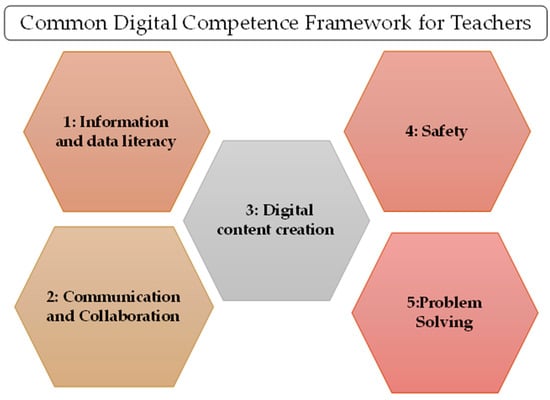
The latest version of the Common Digital Competence Framework for Teachers published in January 2017 outlines five areas that comprise digital competence for teachers, and 21 competencies that make up the aforementioned areas are addressed [9].
These five areas are (Figure 1):
Figure 1.
Common Digital Competence Framework for Teachers ([9], p. 13).
- Area 1—Information and data literacy;
- Area 2—Communication and collaboration;
- Area 3—Digital content creation;
- Area 4—Safety;
- Area 5—Problem solving ([9], p. 1).
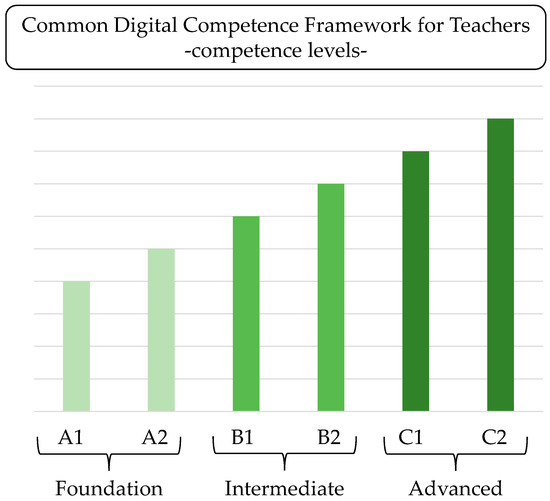
Each of the competencies within these five areas is made up of three dimensions. For example, area 1 (information and data literacy) is made up of the following three dimensions: (1.1) Browsing, searching, and filtering data, information, and digital content; (1.2) Evaluating data, information, and digital content; and (1.3) Managing and retrieval of data, information, and digital content. This structure is designed to identify teachers’ digital competence, to help them plan a path of development and autonomy stemming from the basic (foundation) to the maximum (advanced) level (Figure 2).
Figure 2.
Levels of competence of the Common Digital Framework for teachers ([9], p. 3).
Continuing with the example of area 1, the three levels of competence of dimension 1.1, Browsing, searching, and filtering data, information, and digital content, are:
- A.
- Foundation: I know that the Internet is a source of resources for teaching, and I use it to find information, data, and digital content. I know that the search results are different depending on the search engines.
- B.
- Intermediate: I know how to browse the Internet to locate information and digital educational resources in different formats and dynamic sources of information relevant to my teaching. I express my information needs in an organized manner, and I know how to select the most appropriate information and resources for educational use.
- C.
- I know how to use advanced search tools and filters to find appropriate information and resources regarding my educational needs. I am able to design a customized strategy for searching and filtering information, data, and digital resources for continuous updating of resources, best practices, and educational trends. ([9], p. 17).
In turn, these three levels are subdivided as indicated in Figure 2, obtaining the six progressive proficiency levels that are detailed in Table 1.
Table 1.
Proficiency levels of the Common Digital Competence Framework for teachers.
Multiple studies have been carried out to clarify competency in all stages of education, from the compulsory [10] to the post-compulsory [11,12,13], as well as in informal education and leisure time [14]. At the university level, most research is centered on analyzing self-perceptions about the digital competency level of students, mostly, but not solely, from positive degree results [15,16,17]. The research focused on determining the level of digital competency of university teachers showed a moderate level of acquisition. The areas related to digital pedagogy and digital resources were the most evaluated [18]. Since self-perception is personal and relative, it can help to validate a reliable accreditation certificate of teacher digital competency [19].
There have been multiple investigations of digital competence developed with students obtaining different university degrees, but there is little research regarding the use of ICT by graduate students. We present the following research questions regarding the domain of digital competence in graduate students enrolled on a university master’s degree in teacher training for compulsory secondary education, baccalaureate, vocational training, and language teaching:
- How have the graduate students learned to use digital resources?
- What are the browsing and information leakage techniques that they use the most?
- What perception do they have about the didactic use of digital resources?
- Are there significant differences in the use of these resources according to the age and gender of the students?
The main objective of this research was to analyze various aspects related to the use of technological resources—that is, digital competence—by students who were studying for a master’s degree. The specific objectives of this research were (1) to investigate the way in which the students enrolled in the university master’s degree program in compulsory secondary education and baccalaureate teaching, professional training, and language teaching had learned to use digital resources; (2) to investigate the browsing and information leakage techniques most used by the students; (3) to investigate the perception of the students about the didactic use of digital resources; and (4) to establish possible significant relationships between the digital competence of the students and the independent variables, gender, and age.
3. Materials and Methods
The methodological approach followed was quantitative, using a non-experimental and non-correlational descriptive design. We began by carrying out descriptive research on the topic, where reality is presented as something external to the researcher. The purpose of this kind of research is to understand this reality to improve it. According to [20], descriptive research seeks to specify the properties, characteristics, and important features of any analyzed phenomenon.
3.1. Procedure
This research presents a cross-sectional survey. The questionnaire was distributed, and the data were collected in the second week of November 2018, among the students on the generic module “Educational Processes and Contexts”, of the master’s program in compulsory secondary education and baccalaureate teaching, professional training, and language teaching of the University of Jaén, Spain.
3.2. Sample
The research was carried out using students who were enrolled in this master’s degree in the 2018–2019 academic year. The population was 330 individuals, and 220 answered the questionnaire anonymously. The sample was made up of 91 men (41%) and 131 women (59%). Descriptive data available for the sample are shown in Table 2.
Table 2.
Percentage of respondents by gender and age.
3.3. Instrument
We used a questionnaire developed from the adaptation, improvement, and validation of the questionnaire by [21] on the use of digital resources from students’ perspectives. It is made of 38 items with five response options: 1 = rarely, 2 = sometimes, 3 = half the time, 4 = almost always, and 5 = always. These responses make up the dependent variable. There are two independent variables—age and gender. Some of the items are subdivided into subcategories, which makes it possible for respondents to specify the degrees of use of each specific resource.
The reliability of the scale was determined to define the internal consistency of the measuring instrument. Cronbach’s alpha coefficient was calculated for all the items of the instrument, obtaining α = 0.955, which, according to [12], allows us to consider the instrument reliable. A Kaiser–Meyer–Olkin (KMO) index of sampling adequacy was also calculated to compare the magnitudes of the correlation coefficients obtained with the magnitudes of partial correlation. The result obtained was 0.762, which is considered valid [22].
Data were analyzed with the SPSS software package for Windows, version 27.0. An analysis of the items through frequencies and percentages, as well as a descriptive analysis (means and standard deviations) of each of the items on the questionnaire, was carried out. This was done to determine, as the main objective of the research, various aspects related to the use of technological resources by graduates who are studying for a master’s degree. In addition, an analysis of variance (ANOVA) test was used to study the specific objectives depending on the sociodemographic variables (age and gender). A confidence level of 99% was used in all analyses (significance: p < 0.01).
4. Results
4.1. Descriptive Statistics
Higher frequencies were seen for “agreements” and lower ones for “disagreements”. The descriptive statistic of centralization tells us the number of individuals of the population who choose each option within each item, which will be indicative of its greater or lesser relevance. The most relevant results are shown below, expressed as percentages of the total responses.
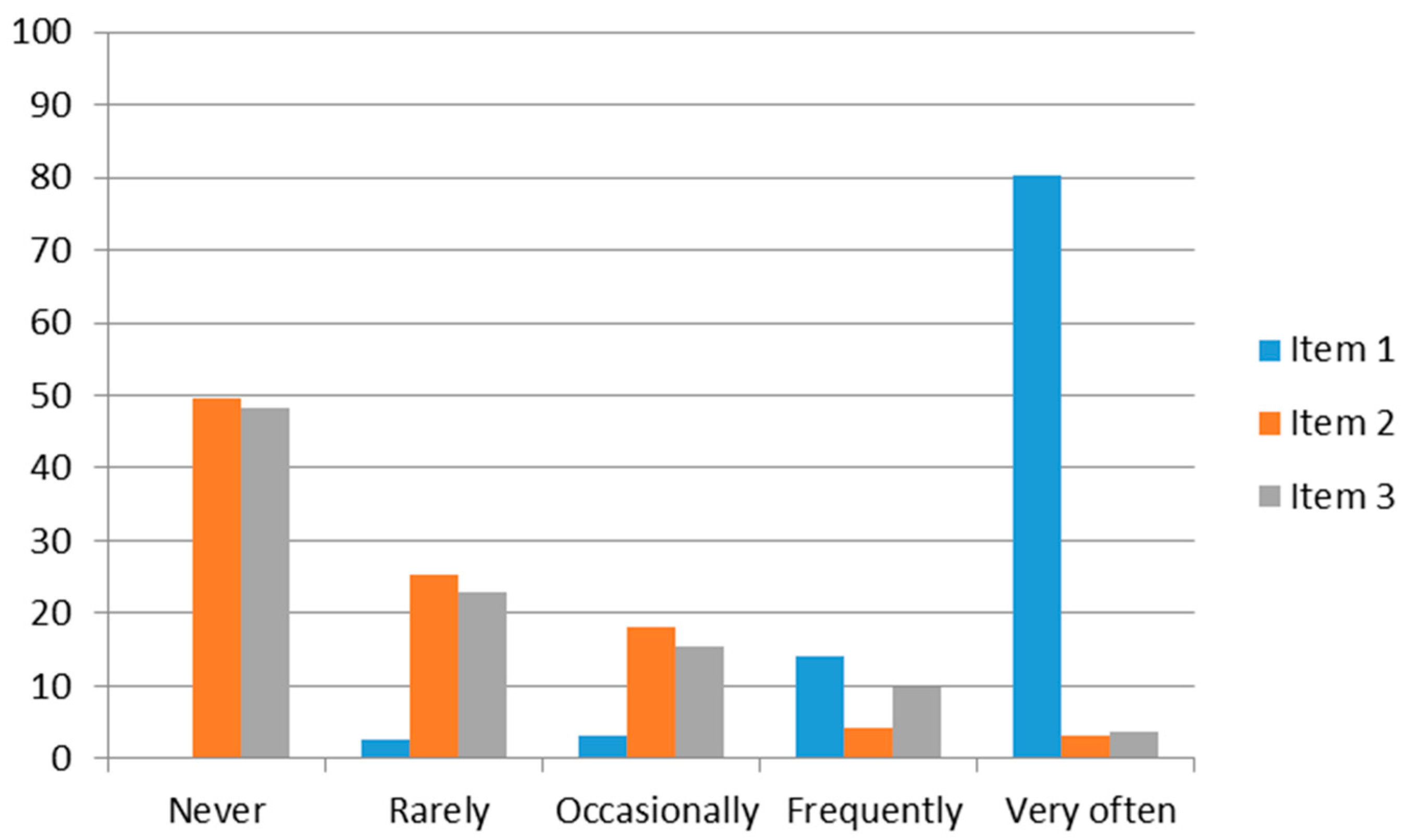
Table 3 shows a large difference in the use of Internet browsers (item 1) compared to digital repositories (item 2) and digital university databases (item 3) among students.
Table 3.
Use of internet browsers vs. digital repositories and university databases.
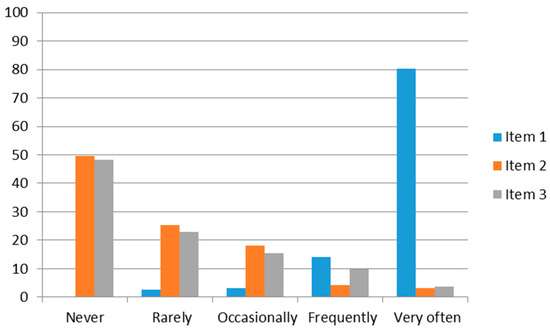
Most students use Internet search engines, both general and more specialized ones, such as Google and Google Scholar, respectively, to search for information to carry out their academic work (1 + 2 = 94.2%). However, as can be seen in Figure 3, they do not usually access the university library website, whereby, through their username and password, they can access specialized databases and academic repositories (approximately 50% of the respondents answered option 1 = never).
Figure 3.
Difference in use of internet browsers (item 1) regarding digital repositories (item 2) and digital university databases (item 3) among students.
Table 4 shows the different degrees of use of digital resources or tools of respondents to communicate remotely with their teacher and/or their classmates (item 13).
Table 4.
Different degrees of use of digital resources or tools of respondents to communicate remotely with their teacher and/or their classmates.
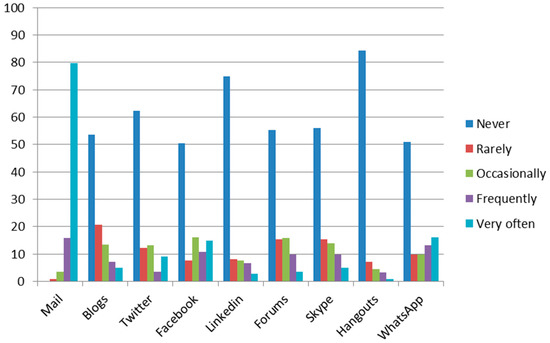
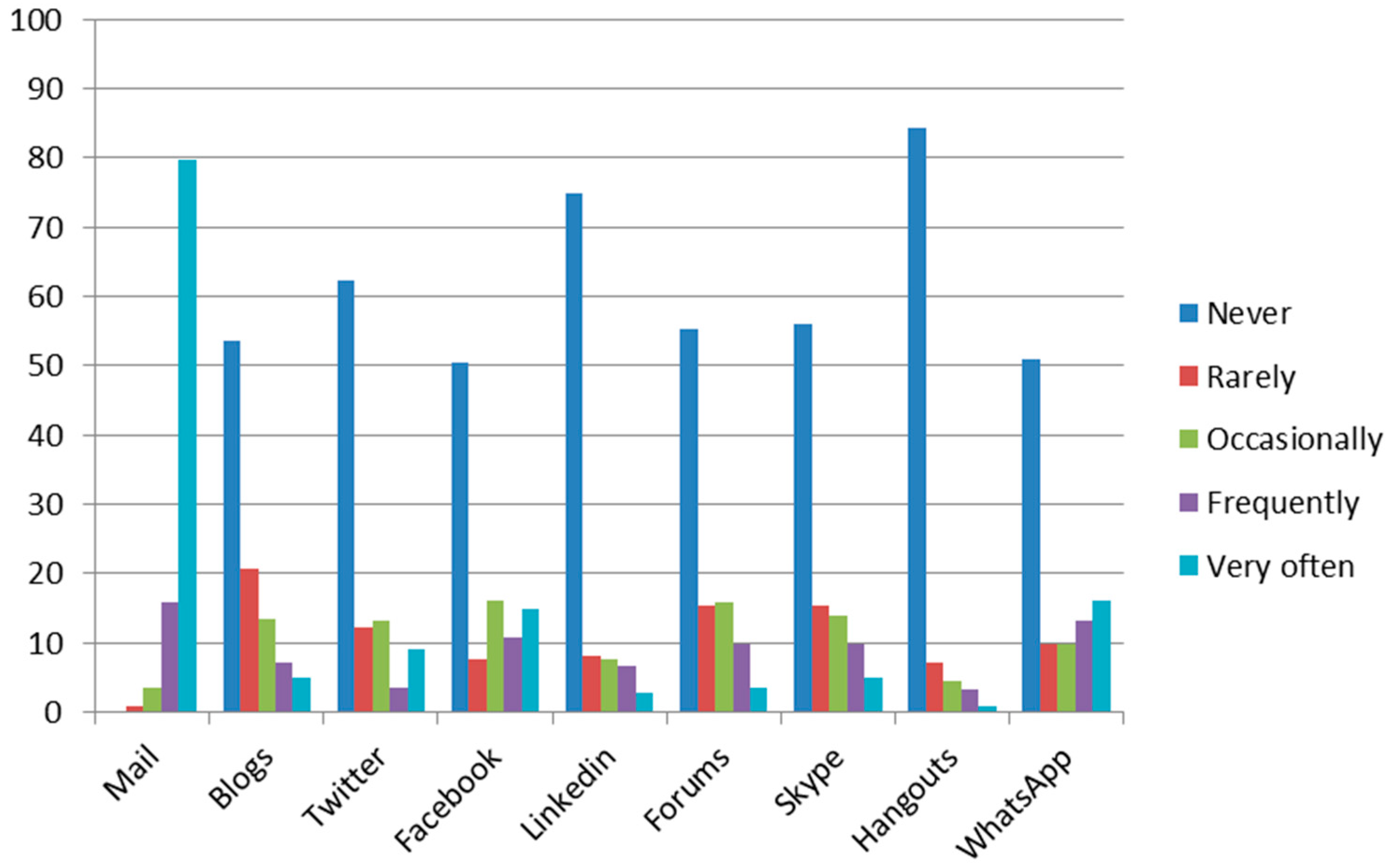
Figure 4 clearly shows that e-mail is the most used tool among respondents to communicate with each other and/or their teachers, as no students selected “never” for this item.
Figure 4.
Percentage of use of digital resources or tools of respondents to communicate remotely with their teacher and/or with their classmates (item 13).
Distinguishing between synchronous and asynchronous tools, we can see that the asynchronous tool that graduate students use the most is mail at 79.9%, followed by Facebook (14.9%) and Twitter (%); the least used are blogs and LinkedIn (7.7%). The most used synchronous tool is video calls through WhatsApp (16.2%), versus other less innovative tools whose use is considerably lower (Skype, 5%, or Hangouts, 0.9%).
Table 5 shows the different degrees of use of each subject area’s Massive Open Online Course (MOOC) (item 26).
Table 5.
Percentage of use of MOOCs in the different subject areas.
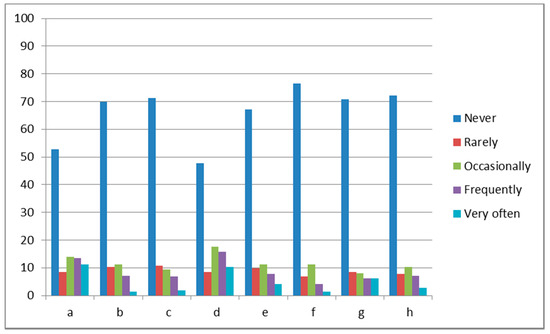
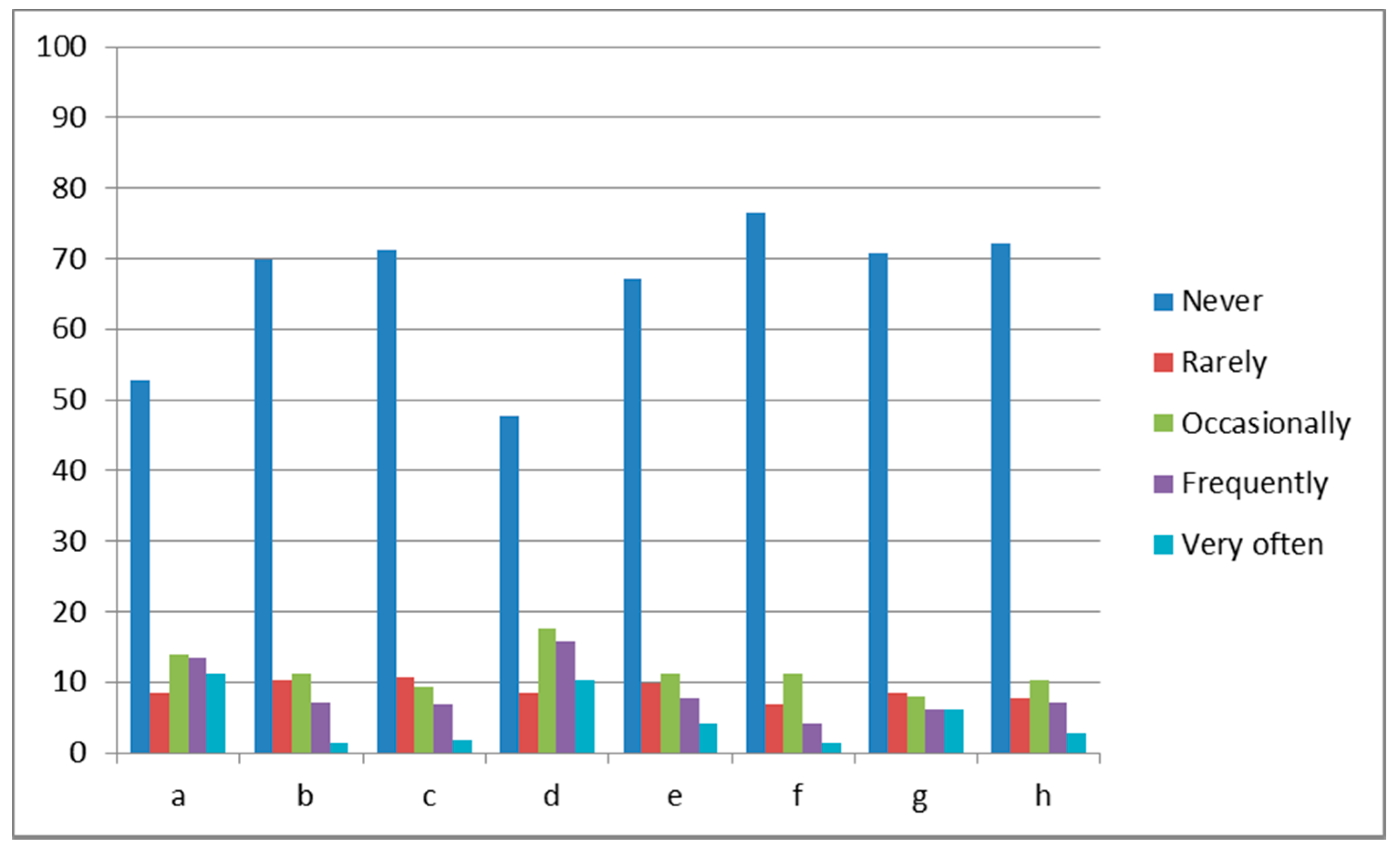
As can be seen from the data above and in Figure 5, most students in all subject areas state that they do not use MOOCs for their training. These tools seem to find more acceptance in areas of knowledge related to the Arts, Humanities, and Social Sciences, among which Educational Sciences stands out with a mean response is 2.32, which is the highest average of all the subject areas surveyed.
Figure 5.
Different degrees of use of MOOCs by graduates in various subject areas (item 26).
In the above figure, a–h refer to:
- Arts, Humanities, and Social Sciences
- Health Sciences
- Economic–Administrative Sciences
- Educational Sciences
- Natural and Exact Sciences
- Agronomic Sciences, Veterinary Medicine, and Zootechnics
- Engineering and Technology
- International Relations
4.2. Analysis of Variance
Table 6 shows the results of the analysis of variance (ANOVA) regarding age. It indicates that there are very significant differences (p < 0.01) between the perceptions about the use of the different resources by graduate students according to the independent variable “age”.
Table 6.
ANOVA—Age.
Specifically, regarding age, significant differences were found in the use of Twitter as a tool for remote communication (F = 5.153; p = 0.007), as well as in the use of any digital tools for the creation of new contents, such as Word (F = 5.655; p = 0.004) and Instagram (F = 7.647; p = 0.001), and for sharing resources with other people with tools, such as Twitter (F = 4.865; p = 0.09) and LinkedIn (F = 4.929; p = 0.008). The analysis of variance also showed significant differences in the use of learning resources, such as videos (F = 4.457; p = 0.013), written documents (F = 8.116; p = 0.000), and images (F = 6.159; p = 0.002), according to the “age” variable. The same occurred with the use of these resource with the purpose of clarification of concepts (F = 6.159; p = 0.002). Finally, the subject area in which MOOCs were significantly less used was Engineering and Technology (F = 4.679; p = 0.010).
Table 7 shows the results of the analysis of variance (ANOVA) regarding gender. It indicated that there are significant differences (p < 0.01) between perceptions about the use of different resources by graduate students according to their gender.
Table 7.
ANOVA—Gender.
With regards to gender, there are significant differences in those competencies related to the selection and search of pertinent information (F = 8.473; p = 0.004), as well as in the use of files (F = 7.900; p = 0.005). Likewise, as with age, significant differences were found in items 13.c (the use of resources to communicate, such as Twitter (F = 5.702; p = 0.018)) and or 14.c and 14.e (the use of digital tools aimed at communication or the creation of new content, such as PowerPoint and Word (F = 9.737; p = 0.02, and F = 6.008; p = 0.015, respectively), in addition to Pinterest (F = 9.010; p = 0.003)). The analysis of variance also showed significant differences in the use of learning resources, such as writing (F = 7.111; p = 0.008) and images (F = 12.209; p = 0.001).
Lastly, the analysis of variance also shows significant differences according to gender in the use of MOOCs for learning based on different areas of knowledge in Natural and Exact Sciences (F = 10.105; p = 0.002) and Engineering and Technology (F = 10.99; p = 0.001).
5. Discussion
Searching for information on the Internet and tutorials are the two most common ways for graduate students to learn to use digital resources. In this regard, various studies show that teachers should play a more active role in the search for educational information, since tutorials, mostly in video format, do not always provide relevant educational information [23], and it is well known that the Internet can provide incorrect information. However, some have developed tutorials, for example, on YouTube, to facilitate learning in both formal and informal educational settings and have achieved good results [24,25].
In our research, it was shown that traditional tools for didactic use, such as e-mail, are still among the most popular. However, we are surprised by the low competency that respondents say they have in the use of the other tools, both synchronous and asynchronous, especially when various studies have shown that the use of social networks in the educational environment is beneficial for learning [26,27]. Graduate students surveyed in this research felt they have high competence in the use of digital resources to develop their academic tasks, related to the use of specialized search engines. However, the results suggest they have insufficient training in the use of the university databases and repositories. Most studies in the literature show a lack of training in information technologies related to teaching ([13,27]).
It was found that there are significant differences in the use of digital resources and media according to the three age groups (21–23, 24–26, and >27), which is consistent with previous studies [28,29]. In this research, students between 24 and 26 years old use Twitter the most, both to communicate and to share content with their teachers and classmates. On the other hand, younger graduates (21–23) prefer Instagram to create content, videos, and images as resources to strengthen their learning. On the contrary, the older people in the sample (>27) used LinkedIn more to share relevant information. Other research corroborates the results obtained in our study [30]. This might suggest that the time when each tool became available influences the age of its users.
Regarding subject areas, Engineering and Technology students used their MOOCs the least, which is consistent with other similar studies [31,32]. In agreement with other studies, our survey showed that men from scientific disciplines use MOOCs the most, while women from the same areas use these tools less [32,33,34,35].
Significant differences according to gender were observed. Women expressed that they carry out more thorough information searching for their academic activities; however, men believe they make better use of this information processing. These data are corroborated by recent studies that indicate that men perceive themselves to be more competent at tasks related to information management and think they have better online collaboration skills using digital media [31,35]. The obtained results show that women use Twitter more as a tool for communication, and use digital tools to create content, such as Word or PowerPoint, while men use Pinterest more. This assertion is corroborated by other studies [36].
6. Conclusions
This study highlights, on the one hand, how graduate students have learned to use digital resources. It was found that they are, mainly, self-taught, and carrying out most of their learning using videos and tutorials, i.e., they develop an informal learning style, not guided by educational institutions. Moreover, the way they navigate and filter information is somewhat ineffective, since they do not usually use databases and repositories, although they claim to have good training in the use of search engines.
In addition, the study of the didactic use of digital resources by graduates allowed us to note differences related to gender and age in this field. These data show that, in the future for teacher training, it is necessary to work on digital competence both in degree programs and in specific master’s degrees in teacher training, to be able to reduce the age and gender digital competence gap.
Finally, it should be noted that the type of design used (cross-sectional) could be a limitation of the present research. Therefore, a longitudinal survey should be developed to study the effect of the independent variables. In addition, although our methodology allowed us to determine which resources the respondents mostly use, we have not been able to assess whether they make effective use of them. This limitation will be solved in an upcoming second phase of the study using a more qualitative methodology.
Author Contributions
Conceptualization, E.P.-N. and M.d.C.M.-S.; methodology, M.T.O.-M. and M.d.C.M.-S.; software, M.T.O.-M. and M.d.C.M.-S.; validation, E.P.-N. and M.T.O.-M.; formal analysis, M.T.O.-M. and M.d.C.M.-S.; investigation, E.P.-N., M.T.O.-M. and M.d.C.M.-S.; resources, E.P.-N., M.T.O.-M. and M.d.C.M.-S.; data curation, E.P.-N., M.T.O.-M. and M.d.C.M.-S.; writing—original draft preparation, E.P.-N., M.T.O.-M. and M.d.C.M.-S.; writing—review and editing, M.T.O.-M., E.P.-N. and M.d.C.M.-S.; visualization, E.P.-N., M.T.O.-M. and M.d.C.M.-S.; supervision, E.P.-N., M.T.O.-M. and M.d.C.M.-S.; project administration, E.P.-N., M.T.O.-M. and M.d.C.M.-S.; funding acquisition, E.P.-N., M.T.O.-M. and M.d.C.M.-S. All authors have read and agreed to the published version of the manuscript.
Funding
This research was funded by the University of Jaén, grant number PID64_201617 and the Research Project Code EDU2015-70491-R. The APC was funded by the University of Jaén and the Ministry of Science and Technology.
Institutional Review Board Statement
This research has been approved by the Ethics Committee of the University of Jaén. Code: OCT.20/1.TES
Informed Consent Statement
Informed consent was obtained from all subjects involved in the study.
Data Availability Statement
Data are available on justified request to the corresponding author.
Acknowledgments
The authors would like to thank the teachers and students for their cooperation in this study.
Conflicts of Interest
The authors declare no conflict of interest. The funders had no role in the design of the study; in the collection, analyses, or interpretation of data; in the writing of the manuscript, or in the decision to publish the results.
References
- Real Decreto 1393/2007, de 29 de Octubre, por el que se Establece la Ordenación de las Enseñanzas Universitarias Oficiales. BOE nº 260, del 30 de Octubre de 2007. Available online: https://www.boe.es/eli/es/rd/2007/10/29/1393/con (accessed on 11 May 2021).
- OCDE. Definición y Selección de Competencias clave (DeSeCo). 2012. Available online: http://deseco.ch/bfs/deseco/en/index/03/02.parsys.78532.downloadList.94248.DownloadFile.tmp/2005.dscexecutivesummary.sp.pdf (accessed on 15 May 2021).
- Castañeda, L.; Esteve, F.; Adell, J. ¿Por qué es necesario repensar la competencia docente par el mundo digital? Rev. Educ. Distancia 2018, 56, 1–20. [Google Scholar]
- Official Journal of the European Union. Recommendation of he European Parliament and of the Council of 18 December 2006 on Key Competences for Lifelong Learning. (2006/962/EC). 2006. Available online: https://eur-lex.europa.eu/LexUriServ/LexUriServ.do?uri=OJ:L:2006:394:0010:0018:en:PDF (accessed on 15 May 2021).
- UNESCO. ICTs in Education for People with Disabilities. Review of Innovative Practice. 2011. Available online: https://www.european-agency.org/sites/default/files/icts_in_education_for_people_with_disabilities.pdf (accessed on 15 May 2021).
- Ferrari, A. DIGCOMP: A Framework for Developing and Understanding Digital Competence in Europe. Seville: JRC-IPTS. Retrieved (27/09/13). 2013. Available online: http://ipts.jrc.ec.europa.eu/publications/pub.cfm?id=6359 (accessed on 16 May 2021).
- European Commission. SELFIE (Self-Reflection on Effective Learning by Fostering the Use of Innovative Educational Technologies). 2018. Available online: https://ec.europa.eu/education/schools-go-digital/about-selfie_en (accessed on 17 May 2021).
- STEM PD Net. INTEF-O7: Policy Briefings. 2019. Available online: https://stem-pd-net.eu/en/intef/index.html (accessed on 18 May 2021).
- INTEF-National Institute of Educational Technologies and Teacher Training. Common Digital Competence Framework for Teachers. 2017. Available online: http://aprende.intef.es/sites/default/files/2018-05/2017_1024-Common-Digital-Competence-Framework-For-Teachers.pdf (accessed on 20 May 2021).
- Martínez-Serrano, M.C. Percepción de la Integración y uso de las Tecnologías de la Información y la Comunicación (TIC). Estudio de Profesores y Estudiantes de Educación Primaria. Inf. Tecnológica 2019, 30, 237–246. [Google Scholar] [CrossRef] [Scilit]
- Carrasco Lozano, M.E.; Sánchez Olavarría, C.; Carro Olvera, A. Las competencias digitales en estudiantes del posgrado en educación. Rev. Lasallista Investig. 2015, 12, 10–18. [Google Scholar] [CrossRef] [Scilit]
- Morales, P. Estadística Aplicada a las Ciencias Sociales: La fiabilidad de los Tests y Escalas. Universidad Pontificia de Comillas. 2007. Available online: http://www.upcomillas.es/personal/peter/estadisticabasica/Fiabilidad.pdf (accessed on 21 May 2021).
- Portillo, J.; Garay, U.; Tejada, E.; Bilbao, N. Self-Perception of the Digital Competence of Educators during the COVID-19 Pandemic: A Cross-Analysis of Different Educational Stages. Sustainability 2020, 12, 10128. [Google Scholar] [CrossRef] [Scilit]
- Barujel, A.G.; Varela, F.F.; Paragarino, V.R. Niños y adolescentes frente a la Competencia Digital. Entre el teléfono móvil, youtubers y videojuegos. Rev. Interuniv. Form. Profr. 2017, 89, 171–186. [Google Scholar]
- Araújo-Vila, N.; Cardoso, L.; Toubes, D.R.; Fraiz-Brea, J.A. Digital Competence in Spanish University Education and Its Use by Students. Publications 2020, 8, 47. [Google Scholar] [CrossRef] [Scilit]
- Ortega-Sánchez, D.; Gómez-Trigueros, I.M.; Trestini, M.; Pérez-González, C. Self-Perception and Training Perceptions on Teacher Digital Competence (TDC) in Spanish and French University Students. Multimodal Technol. Interact. 2020, 4, 74. [Google Scholar] [CrossRef] [Scilit]
- Segrera-Arellana, J.R.; Paez-Logreira, H.D.; Polo-Tovar, A.A. Competencias digitales de los futuros profesionales en tiempos de pandemia/Future professionals e-skills in pandemic times. Utopía Prax. Latinoam. 2020, 25, 222–233. [Google Scholar]
- Cabero-Almenara, J.; Barroso-Osuna, J.; Rodríguez-Gallego, M.; Palacios-Rodríguez, A. La Competencia Digital Docente. El caso de las universidades andaluzas. Aula Abierta 2020, 49, 363–372. [Google Scholar] [CrossRef] [Scilit]
- Durán, M.; Prendes, M.P.; Gutiérrez, I. Certificación de la Competencia Digital Docente: Propuesta para el profesorado universitario. Rev. Iberoam. Educ. Distancia 2019, 22, 187–205. [Google Scholar]
- Hernández, R.; Fernández, C.; Baptista, M.P. Metodología de la Investigación; Mc Graw-Hill: México, Mexico, 2009; ISBN 978-1-4562-2396-0. [Google Scholar]
- Maldonado Berea, G.A.; Pérez Navío, E. Cuestionario sobre el uso de Recursos Digitales del Máster Universitario en Profesorado de Educación Secundaria Obligatoria y Bachillerato, Formación Profesional y Enseñanza de Idiomas; Plaza de Cuerpos Docentes Universitarios, University of Jaén: Jaén, Spain, 2019. [Google Scholar]
- Ocaña, Mª.T.; Pérez, M.; Quijano, R. Elaboración y validación de una escala de creencias de los alumnos de Educación Secundaria Obligatoria respecto al medio ambiente. Profesorado 2013, 17, 432–454. [Google Scholar]
- Özden Yüce, M.; Adalı, E.; Kanmaz, B. An analysis of YouTube videos as educational resources for dental practitioners to prevent the spread of COVID-19. Ir. J. Med. Sci. 2021, 190, 19–26. [Google Scholar] [CrossRef] [Scilit]
- Arguedas Matarrita, C.A.; Herrera, E. Implementación de un canal en YouTube para apoyar un curso Física. Atenas 2016, 2, 55–67. [Google Scholar]
- Roque Rodríguez, E. Tutoriales de Youtube como estrategia de aprendizaje no formal en estudiantes universitarios. RIDE Rev. Iberoam. Investig. Desarro. Educ. 2020, 11. [Google Scholar] [CrossRef] [Scilit]
- Essig, J.; Watts, M.; Beck, G.L.; Gililand, K.O. InstaHisto: Utilizing Instagram as a Medium for Disseminating Visual Educational Resources. Med. Sci. Educ. 2020, 30, 1035–1042. [Google Scholar] [CrossRef] [Scilit]
- Gallardo-López, J.A.; López-Noguero, F. Twitter como recurso metodológico en Educación Superior: Una experiencia educativa con estudiantes de Trabajo Social. Alteridad 2020, 15, 174–189. [Google Scholar] [CrossRef] [Scilit]
- Fernández-Batanero, J.M.; Montenegro-Rueda, M.; Fernández-Cerero, J.; García-Martínez, I. Digital competences for teacher professional development. Systematic review. Eur. J. Teach. Educ. 2020. [Google Scholar] [CrossRef] [Scilit]
- Cabezas-González, M.; Casillas-Martín, S.; García-Peñalvo, F.J. The Digital Competence of Pre-Service Educators: The Influence of Personal Variables. Sustainability 2021, 13, 2318. [Google Scholar] [CrossRef] [Scilit]
- Almenara, J.C.; Osuna, J.B.; Cejudo, M.D.C.L.; Cabrera, C.Y. Redes sociales y Tecnologías de la Información y la Comunicación en Educación: Aprendizaje colaborativo, diferencias de género, edad y preferencias. Rev. Educ. Distancia 2016. [Google Scholar] [CrossRef] [Scilit]
- Morales, R.E.; Rodríguez, P.R. Las competencias digitales en TIC aplicadas a las organizaciones. Int. J. Inf. Syst. Softw. Eng. Big Co. 2020, 7, 25–35. [Google Scholar]
- Cabero-Almenara, J.; Guillén-Gámez, F.D.; Ruiz-Palmero, J.; Palacios-Rodríguez, A. Digital competence of higher education professor according to DigCompEdu. Statistical research methods with ANOVA between fields of knowledge in different age ranges. Educ. Inf. Technol. 2021. [Google Scholar] [CrossRef] [Scilit] [PubMed]
- Cabero-Almenara, J.; Palacios-Rodríguez, A. Marco Europeo de Competencia Digital Docente «DigCompEdu» y cuestionario «DigCompEdu Check-In». EDMETIC 2020, 9, 213–234. [Google Scholar] [CrossRef] [Scilit]
- Robles Moral, F.J.; Fernández Díaz, M. Future Primary School Teachers’ Digital Competence in Teaching Science through the Use of Social Media. Sustainability 2021, 13, 2816. [Google Scholar] [CrossRef] [Scilit]
- Pérez-Navío, E.; Medina-Domínguez, M.C.; Cachón-Zagalaz, J. Perception of the professional competences of last year’s students of Pre-Primary Education and Primary Education degrees and students of training Teachers Master. J. New Approaches Educ. Res. 2019, 8, 58–65. [Google Scholar] [CrossRef] [Scilit]
- Grande, M.; Cañón, R.; García, S.; Cantón, I. Digital competence and gender: Teachers in training. A case study. Future Internet 2020, 12, 204. [Google Scholar] [CrossRef] [Scilit]

Publisher’s Note: MDPI stays neutral with regard to jurisdictional claims in published maps and institutional affiliations. |
© 2021 by the authors. Licensee MDPI, Basel, Switzerland. This article is an open access article distributed under the terms and conditions of the Creative Commons Attribution (CC BY) license (https://creativecommons.org/licenses/by/4.0/).