


Abstract
The rapid economic growth of Vietnam has increased the amount of coal ash waste during electricity generation from coal-fired thermal power plants. This waste is being dumped even though the capacity of dumping sites will not be sufficient in the future. Accordingly, Korean technologies of recycling ashes, modifying them into a valuable product, and fixing carbon dioxide via carbon mineralization, can be an alternative to dumping. In this study, we aimed to investigate the feasibility of deploying carbon mineralization technology to Vietnam while considering technological, legal, and network perspectives. The material properties of coal ash and the applicability of coal ash recycling technology were briefly investigated in Vietnam. Legislation has progressed, focusing on recycling coal ash as a building material, with supportive measures on investment and international cooperation. Meanwhile, a bilateral network between Vietnam and the Republic of Korea at the institutional and governmental levels strengthened the implementation of practical technology cooperation. In conclusion, we considered various perspectives in terms of the technology transfer of recycling coal ash. This technology transfer model can contribute to enhancing the possibility of successful technology cooperation for solving the environmental problems of coal ash.
1. Introduction
Vietnam has experienced rapid economic growth, and this trend is expected to continue into the future. Environmental problems, including pollution and greenhouse gas (GHG) emissions, have occurred due to the rapid economic growth in Vietnam. For example, energy demand has increased with the increasing economy, and coal-fired thermal power plants are generating a substantial amount of coal ash. In 2017, 26 coal-fired power plants were commercially operated, and 51 coal-fired power plants will be in operation by 2030. Furthermore, the share of coal in the structure of power resources for electricity production will gradually increase from 49.3% in 2020 to 56.4% in 2030, according to the revised Seventh Power Development Plan of Vietnam. Thus, the sustainable supply and utilization of coal resources need to be considered.
Coal ash waste from these thermal power plants also causes social and environmental problems. Commercially operated thermal power plants generated 12.2 million tons of coal ash in 2017, and this is expected to increase to up to 30 million tons according to the master plan for electricity development: 52 coal-fired power plants will be in operation by 2030. This waste is dumped in landfill sites even though their capacity is not sufficient to maintain current disposal practices. Furthermore, most ash is disposed into the environment without any treatment [1]. The Vietnamese government acknowledges this problem, and in early 2019, the Ministry of Industry and Trade of Vietnam (MOIT) admitted that the country has an exploding number of coal-powered thermal plants and that there is a need to come up with sustainable measures to manage and process coal ash.
Advanced technologies that can utilize low-quality coal have the potential to alleviate constraints on coal supply by utilizing lignite-coal reserves in Vietnam [1]. Low-quality coal (e.g., lignite <4000 kcal/kg) is usually not applicable to ordinary pulverized coal (PC) power plants, which use high-quality coal (e.g., anthracite, >6000 kcal/kg), due to the low-calorie level of this type of coal. In this context, the circulating fluidized bed combustion (CFBC) power plant of the Republic of Korea, which can utilize low-quality coal for electricity generation with fluidized media, was exported to Vietnam. Particularly, Hyundai Engineering and Construction completed the construction of a CFBC thermal plant with a capacity of 6500 GWh per year in North Vietnam. Consequently, the reserve of low-quality coal in Vietnam attained practicability for thermal power plants. However, GHG emissions and coal ash waste are still environmental matters to be resolved regarding the CFBC power plants.
The Vietnamese government has been committed to legislating environmental regulations. Unfortunately, there is a gap between the high standard of environmental legislation and the comparatively lower level of domestic technology in Vietnam, so actual implementation has been weak. The government has encouraged the application of innovative technologies on the basis of international cooperation in order to fill that gap. In this context, the green cement calcination and carbon mineralization of the Republic of Korea, producing carbonate and functional green cement from coal ash and slag waste, have attracted attention because of their possibility of mitigating CO2 and recycling waste [2]. Carbon mineralization turns CO2 into inorganic material. In particular, utilizing CO2 and coal ash can manufacture building materials (e.g., carbonate), which have substantial potential for CO2 sequestration and market revenue [3]. Furthermore, this technology can contribute to solving the negative externality of coal ash waste in Vietnam.
There are several essential factors for the technology transfer of this Korean technology to Vietnam. Technological feasibility, a basic process in technology transfer, is essential to apply technology. In addition to that, legislative feasibility and a cooperative network that allow technology transfer to be smoothly conducted need to simultaneously be investigated [4,5]. In this study, we investigated the feasibility of carbon mineralization technology transfer to Vietnam from the perspectives of technology, legislation, and an international cooperation network. Then, a holistic model of green technology transfer is suggested to facilitate international technology transfers for solving environmental problems.
2. Technological Feasibility for Carbon Mineralization Technology in Vietnam
Related technologies that recycle coal ash were investigated. Fly ash can be applied as adsorbent, products, and storage in carbon capture, utilization, and storage (CCUS); the potential of CO2 fixation by coal ash depends on the contents of metal oxide (e.g., CaO and MgO) [6]. In particular, partial substitution for ordinary Portland cement (OPC) by fly ash was widely deployed in real cases [7,8]. The utilization of coal bottom ash in building material is also a practicable option [9]. The applicability of recycling coal ash is related to its physical and chemical properties, and these characteristics were investigated from thermal power plants in Vietnam. Duc [10] studied coal ash, especially fly ash from the Uong Bi thermal power plant, which is one of the biggest power plants in Vietnam. Fly ash consisted of fine particles of spherical shape, of which about 55% are 10 µm. The chemical composition of fly ash was a hematite (Fe2O3), mullite (Al2Si2O13), and quartz (SiO2) compound containing a variety of elements; predominant elements were carbon (C), oxygen (O), silicon (Si), aluminum (Al), and iron (Fe), and a low content of potassium (K) and titanium (Ti) was observed. Chau et al. [11] also studied the characteristics of mixed fly ash, obtained from thermal power plants in Northern Vietnam. The coal fly ash sample had a particle size of 1 to 8 µm and a round shape. Fly ash consisted of magnesium (Mg), Al, Si, phosphorus (P), sulfur (S), chlorine (Cl), K, calcium (Ca), vanadium (V), Ti, chromium (Cr), manganese (Mn), Fe, nickel (Ni), copper (Cu), zinc (Zn), rubidium (Rb), strontium (Sr), and lead (Pb), with Al and Si having the highest content. In addition, fly ash comprises quartz (SiO2) and mullite. Coal ash from the Cao Ngan power plant was also analyzed [1]. The particle size of the bottom ash was 0.125–2 mm, the main components of fly ash were quartz, aloxite (Al2O3), and hematite, and that of the bottom ash was lime (CaO).
On the basis of previous research on basic properties and related technologies, coal ash in Vietnam has potential as a raw material for recycling and producing ecofriendly materials. Hwang and Huynh [12] conducted a study to produce unfired bricks by mixing fly ash and rice husk ash, and the bricks appeared to meet Vietnamese standards. However, Vietnamese people still have concerns about the quality of unburnt bricks made from coal ash. In addition, the country lacks suitable technology, proper technical handling, and legal practices on management. Heavy metals such as Cr and Cl in the ash can cause environmental pollution and problems to the operating equipment; proper treatment methods are indispensable [1,13,14].
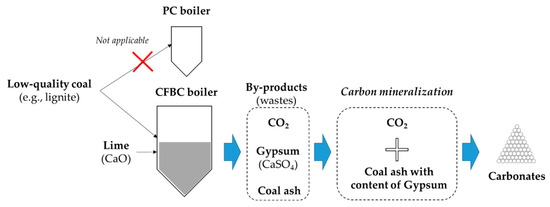
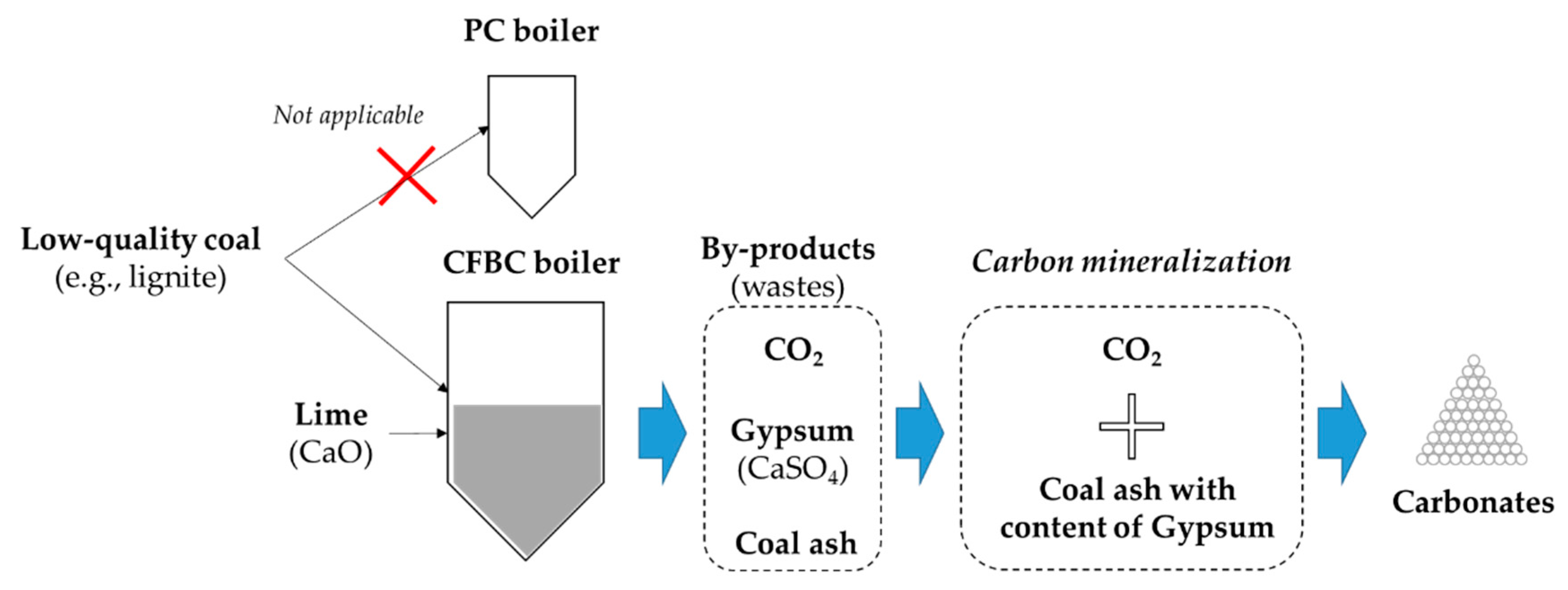
With consideration of this backdrop, carbon mineralization technology can be applied to CFBC thermal power plants in Vietnam, recycling emitted CO2 and coal ash and producing carbonate (Figure 1) [15]. Low-quality coal that is not applicable to PC type boilers is combusted with the addition of lime in CFBC boilers. In the combustion process, CO2 and coal ash with gypsum are generated. The metal dioxide of coal ash can react with CO2, in carbonate form [6,16]. As a result, carbonates that have various industrial uses are produced from this waste. The carbonation reaction is optimized by different pressure, temperature, and ash-dose levels [15]. Thenepalli et al. [1] also utilized coal ash to produce value-added green cement and carbonate that emit less CO2 than OPCs in Vietnam. In fact, carbon-offset methodology (e.g., clean development mechanism) for green cement was developed by a quantitative approach [8]. On the basis of this technological potential, a legal framework and international network need to be progressed in parallel.
Figure 1.
Carbon mineralization technology on circulating fluidized bed combustion (CFBC) thermal power plant in Vietnam.
3. Legal Framework Analysis for Technology Application of Recycling Coal Ash Waste in Vietnam
3.1. Legal Hierarchy of Vietnam
The Vietnamese legal framework consists of multiple layers and hierarchies, led by the central-state level (i.e., National Assembly, Standing Committee, President, Prime Minister) [17]. The National Assembly is a primary legislative body, responsible for the Constitution and Laws. The Constitution is the highest in the hierarchy, followed by the Law. These are followed by Ordinances legislated by the Standing Committee of the National Assembly. In addition, Resolutions are legislated by the National Assembly and its Standing Committee in order to interpret the Constitution, Law, and Ordinances. Furthermore, the President, Government, and Prime Minister produce Orders, Decrees, and Decisions for specific guidelines. For more detailed guidelines, Resolutions, Circulars, and Directives are established by lower hierarchical bodies (e.g., government organizations and local government).
3.2. Legislation on Recycling Coal Ash Waste
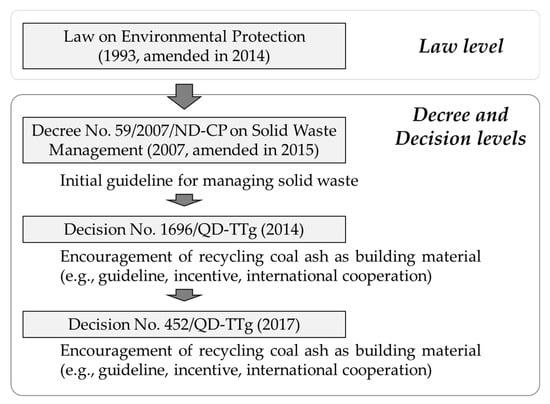
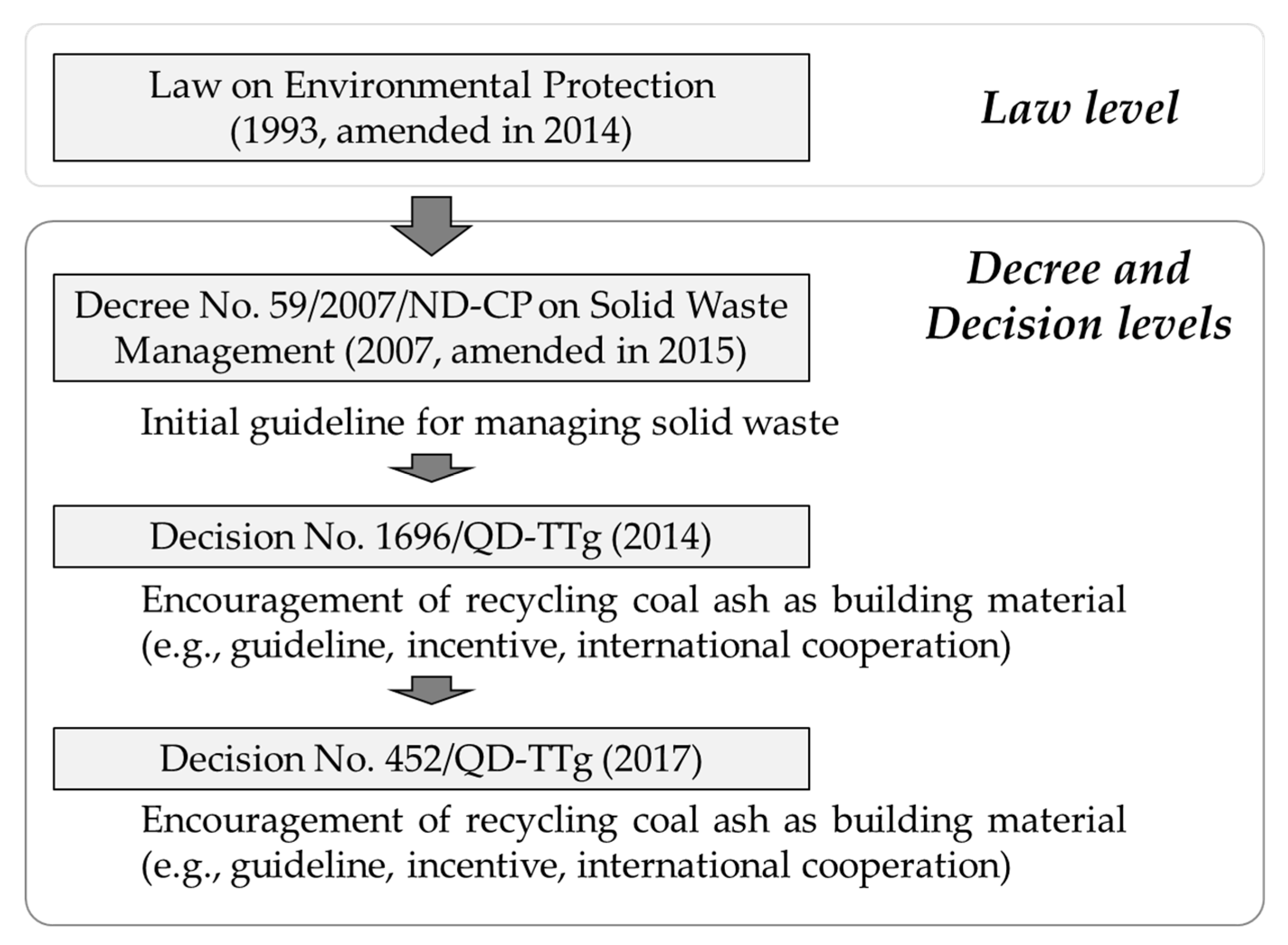
The Law on Environmental Protection, legislated and amended in 2004 and 2014, respectively, established a primary constitutional basis for recycling coal ash waste. This succeeds the Environmental Protection Act of the Socialist Republic of Vietnam, legislated in 1993. This legislation provides a clear direction for waste management, emphasizing research, technology transfer, and the practical application of technology on treatment with governmental support (e.g., incentives and policies). According to the Law on Environmental Projection, waste is defined as follows: material emitted from activities such as manufacturing, trading, service, daily activities, and others. Coal ash is solid waste, but specific guidelines on the management of solid waste are not provided in the Law on Environmental Protection.
Several Decrees and Decisions were established to provide governance over the management of coal ash treatment. Decree No. 59/2007/ND-CP on Solid Waste Management, established in 2007, provides guidelines on the collection, storage, disposal, and handling of solid waste. The Decree defined solid waste and classified it into two categories, hazardous and unhazardous (ordinary). Coal ash is defined as ordinary solid waste. This Decree also provides an overview of the incentive system that supports investment in treatment facilities. According to Article 29, the technology of reprocessing waste into building material and products has opportunities for compensation, commercial loan support, and import-tax exemption.
Then, the Prime Minister’s Decision No. 1696/QD-TTg was established in 2014. This Decision dealt with measures of treating the waste of thermal power plants and factories (e.g., ashes, gypsum, slag) and utilizing them in the production process of building material. An opportunity of receiving incentives and supports on the treatment of ash, slag, and gypsum is also mentioned. This Decision initially acknowledges land depletion issues due to the increase of coal ash in landfills in Vietnam. In this regard, Decree No. 24a/2016/ND-CP was initiated by the request of the Minister of Construction, stating regulations on building-material-related activities. This Decree lays out the specific guidelines and incentive standards of utilizing ash and residue to produce construction materials. For example, projects that process and utilize ash of over 100,000 tons per year are eligible to receive subsidies from the government.
In 2017, Decision No. 452/QD-TTg was released. This Decision specifically focused on facilitating the treatment and usage of ash, slag, and gypsum generated from thermal power, chemical, and fertilizer plants, and reproducing them into building materials, strengthening Decision No. 1696 of 2014. Building materials that utilize and recycle this waste need to attain a certain level of technical standard. The Ministry of Natural Resources and Environment (MONRE) began the preparation of technical guidelines according to this Decision. Encouragement and incentive on related technologies and research are also included in the Decision on the basis of the Science and Technology Law of Vietnam. Interestingly, facilitating international technology cooperation for the treatment and utilization of this waste is included in this Decision. This supplements the lack of domestic technology in Vietnam. The government set the goal of treating 52% of ash, slag, flue gas desulfurization, phosphogypsum to be used as raw materials for construction material production by 2020 in this Decision.
3.3. Implication of Analysis on the Legal Framework in Vietnam
The legal framework of Vietnam is relatively preferable to deploy the technology of recycling coal ash (Figure 2). First, the legal framework is soundly established with a well-designed hierarchy and legislation series. The Decrees and Decision that were proposed by the Socialist Party and ministerial authorities especially allow the government to respond quickly and in detail regarding the issue of coal ash. Successive Decrees and Decisions in 2014, 2016, and 2017 provided detailed and clear guidelines for treating coal ash waste. Second, administrative support and investment support to technological innovation for ash treatment is emphasized in most legal documents related to coal ash. This encourages participation from both the private and the public sectors.
Figure 2.
Main legislation on treating and recycling coal ash waste in Vietnam.
However, the outcome of this legal framework was not sufficient and did not solve the problem of landfills and the open storage of coal ash waste. The lack of domestic technology limits practical solutions despite incentive systems. In this context, Decision No. 452/QD-TTg was released in 2017 while establishing an international network as a timely issue for a solution. Laws should continue to adopt innovative high-potential technologies at the central-government level.
4. Establishing Cooperative Networks between Countries
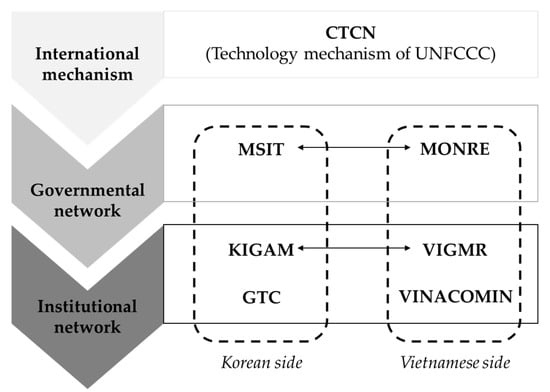
Bilateral networks between the Republic of Korea and Vietnam comprising hierarchical levels were established for facilitating technology cooperation and transfer (Figure 3). The Climate Technology Center and Network (CTCN), facilitating climate technology transfer between countries under the Technology Mechanism of the United Nations Framework Convention on Climate Change (UNFCCC), was established in 2013 [18]. Each country nominated a national designated entity (NDE), a government channel for this international mechanism. A government network for cooperation between Vietnam and the Republic of Korea was also developed on the basis of this international mechanism. The Ministry of Science, Information, and Communications Technology (MSIT) and MONRE are the NDEs of the Republic of Korea and Vietnam, respectively. A memorandum of understanding (MoU) was also signed for climate technology between these two government bodies in March 2018 to facilitate bilateral cooperation. In this MoU, there were 23 science and technology agendas, and carbon mineralization was prioritized. This might be attributed to the fact that Vietnam decided to encourage the deployment of innovative green technologies by international cooperation, according to Decision 452 in 2017.
Figure 3.
Established network at hierarchical levels. Arrows represent a memorandum of understanding (MoU) between organizations. Abbreviations: MSIT, Ministry of Science, Information and Communications Technology; MONRE, Ministry of Natural Resource and Environment; KIGAM, Korea Institute of Geoscience and Mineral Resources; GTC, Green Technology Center; VIGMR, Vietnam Institute of Geoscience and Mineral Resources; VINACOMIN, Vietnam National Coal-Mineral Industries Holding Corporation.
Ultimately, institutional networks between these two countries were established from the perspective of practical implementation for climate technology cooperation and transfer. The Korea Institute of Geoscience and Mineral Resources (KIGAM) and Vietnam Institute of Geoscience and Mineral Resources (VIGMR) have led the institutional network from 2015. These two research institutes investigate the feasibility of applying Korean technologies. The pre-feasibility study of applying carbon mineralization technology to the Cao Ngan thermal power plant was conducted by them in 2016. The Green Technology Center (GTC), a specialized national research institute on international climate technology cooperation, supports technology cooperation with KIGAM. Finally, the Vietnam National Coal-Mineral Industries Holding Corporation (VINACOMIN) focuses on investigating demonstrations of transferred technology in Vietnam.
In particular, these hierarchical networks contributed to developing a practical cooperation program on the basis of the technology mechanism. The CTCN provides an opportunity for technology cooperation and transfer by technical assistance (TA). The TA of CTCN supports various activities on technology cooperation and transfer (e.g., pre-feasibility studies and policy advice). In the case of Vietnam, a TA proposal of CTCN dealing with the problem of coal ash waste and its recycling was developed by cooperation between Vietnam and the Republic of Korea. On the side of the Republic of Korea, KIGAM and GTC, experts in innovative TA technology and development, initially facilitated TA development. VIGMR cooperated in the process of TA development, focusing on considering TA suitability on the regional environment. The developed TA request was submitted to the NDE, the Ministry of Natural Resources and Environment (MONRE) of Vietnam, and then the MONRE submitted the proposal to the CTCN. This cooperative program realized a holistic technology transfer model rather than an ineffective technology transfer, which mainly focuses on scientific and technological feasibility.
5. Concluding Remarks
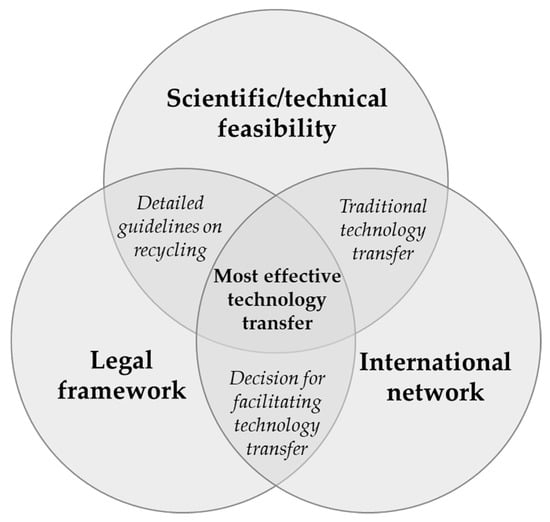
We suggest an integrative framework on technology transfer for recycling coal ash waste in Vietnam (Figure 4). Exploring technological feasibility in previous studies provides the scientific basis for deploying innovative technologies. Investigating the legal framework outlines the current status of Vietnam for deploying transferred technologies. Furthermore, an international network provides an essential basis for technology transfer. However, several implications can be derived considering multiple perspectives. International technology transfer is limited with the consideration of only technological feasibility and an international network. Considering technological feasibility and legal framework can establish detailed guidelines on recycling and management. Interestingly, the Vietnamese government announced a Decision for facilitating technology transfer from the perspective of the legal framework and international network. Finally, the most effective technology transfer can be realized by considering these three perspectives.
Figure 4.
Integrative international technology transfer model for recycling coal ash waste in Vietnam from the perspectives of science/technology, legal framework, and international network.
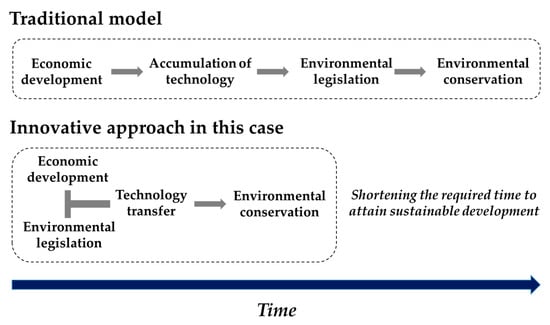
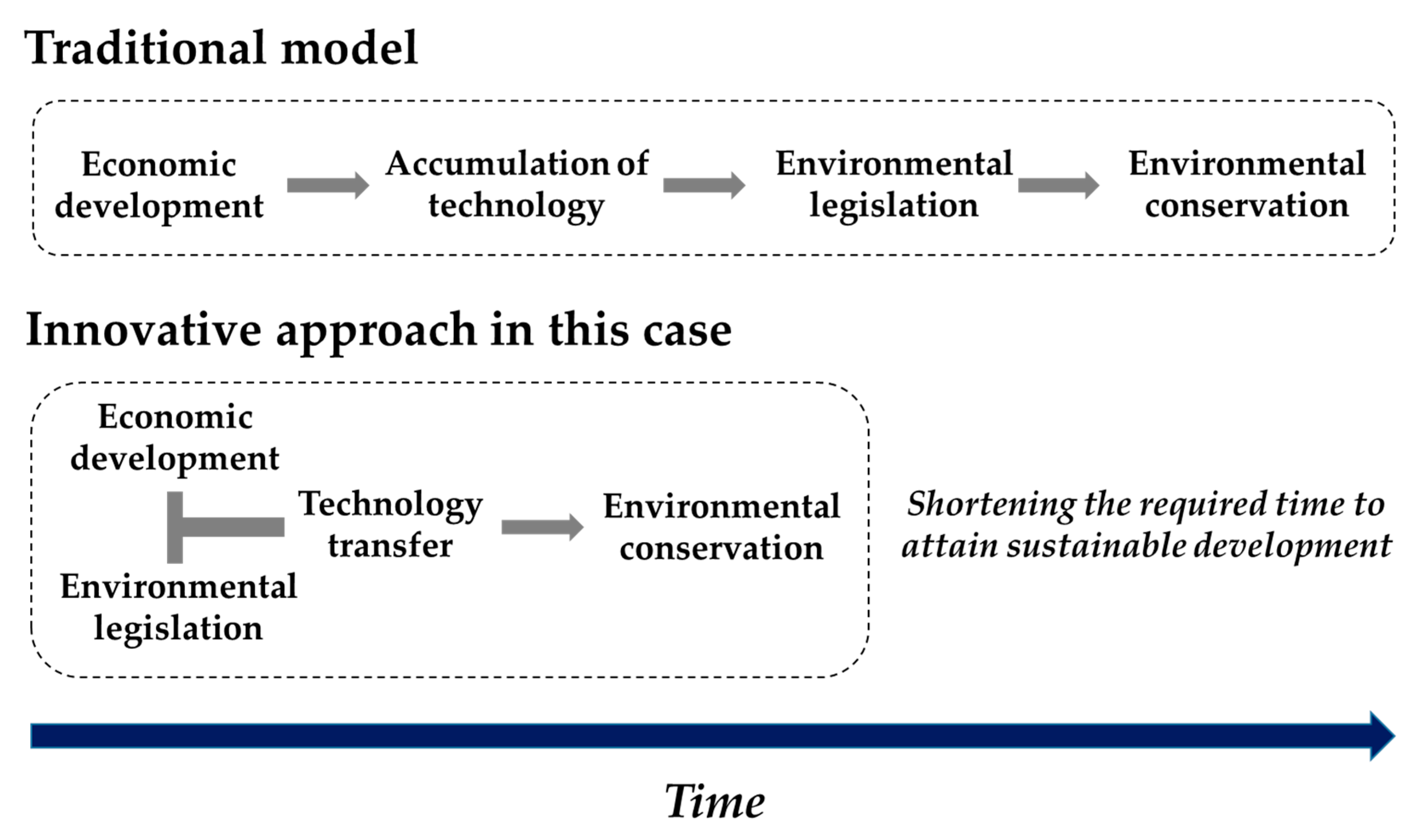
The innovative approach of this study implied the possibility of a new sustainable development pathway (Figure 5). In general, industrialized countries first attain economic development. Improvement of technological capacity follows economic development. Then, environmental regulation is legislated, and the environmental condition starts to be conserved. In contrast, our approach suggests an alternative scheme of sustainable development. In the case of Vietnam, rapid economic growth and strong environmental legislation occurred in parallel. However, the actual implementation for attaining environmental regulation and policy targets is not sufficient due to constraints on domestic technological capacity. International technology shortens the required time of accumulating technology for environmental conservation.
Figure 5.
Comparison of the innovative approach of this case and traditional model from the perspectives of economic development and environmental conservation. The innovative approach can contribute to attaining sustainable development with the inclusion of economic development and environmental conservation on the basis of international technology transfer.
In this study, scientific/technological feasibility, a legal framework, and an international network were investigated to derive a more sophisticated technology transfer model. Other perspectives (e.g., economic feasibility, governance, capacity building) need to also be more considered in technology transfer processes for dealing with the problem of coal ash in Vietnam. Despite this limitation, our holistic approach to technology transfer can enhance the potential of deploying international technology for solving environmental problems and attaining sustainable development in developing countries.
Author Contributions
J.L. led the discussion and wrote the manuscript; T.K. and M.S. participated in writing the manuscript, and investigated the legal framework and scientific feasibilities; H.H.T.V. collected data on the legal framework of Vietnam and participated in the discussion; K.N.S. investigated the current status of the bilateral network between the Republic of Korea and Vietnam; and J.W.A led the discussion and wrote the manuscript. All authors have read and agreed to the published version of the manuscript.
Funding
This research was supported by the National Research Foundation (NRF-2017M3D8A2085293), Green Technology Center (C20220), and National Research Council of Science and Technology (N19008).
Conflicts of Interest
The authors declare no conflict of interest.
References
- Thenepalli, T.; Ngoc, N.T.M.; Tuan, L.Q.; Son, T.H.; Hieu, H.H.; Thuy, D.T.N.; Thao, N.T.T.; Tam, D.T.T.; Huyen, D.T.N.; Van, T.T.; et al. Technological solutions for recycling ash slag from the Cao Ngan coal power plant in Vietnam. Energies 2018, 11, 2018. [Google Scholar] [CrossRef] [Scilit]
- Lee, J.; Jang, C.; Shin, K.N.; Ahn, J.W. Strategy of developing innovative technology for sustainable cities: The case of the national strategic project on carbon mineralization in the Republic of Korea. Sustainability 2019, 11, 3613. [Google Scholar] [CrossRef] [Scilit]
- Innovation for Cool Earth Forum (ICEF). Global Roadmap for Implementing CO2 Utilization. 2016. Available online: www.globalco2initiative.org (accessed on 11 December 2019).
- Karagiannidis, A.; Wittmaier, M.; Langer, S.; Bilitewski, B.; Malamakis, A. Thermal processing of waste organic substrates: Developing and applying an integrated framework for feasibility assessment in developing countries. Renew. Sustain. Energ. Rev. 2009, 13, 2156–2162. [Google Scholar] [CrossRef] [Scilit]
- Rai, V.; Funkhouser, E. Emerging insights on the dynamic drivers of international low-carbon technology transfer. Renew. Sustain. Energ. Rev. 2015, 49, 350–364. [Google Scholar] [CrossRef] [Scilit]
- Dinid, A.; Quang, D.V.; Vega, L.F.; Nashef, E.; Abu-Zahra, M.R.M. Applications of fly ash for CO2 capture, utilization, and storage. J. CO2 Util. 2019, 29, 82–102. [Google Scholar] [CrossRef] [Scilit]
- Bontempi, E.A. New approach to evaluate the sustainability of raw materials substitution. In Raw Materials Substitution Sustainability; Springer: Cham, Switzerland, 2017; ISBN 978-3-319-60830-3. [Google Scholar]
- Jeon, E.-D.; Lee, K.-U.; Lee, C.-K. Development of new clean development mechanism methodology for the quantification of greenhouse gas in calcium sulfoaluminate cement. Sustainability 2019, 11, 1482. [Google Scholar] [CrossRef] [Scilit]
- Kurama, H.; Kaya, M. Usage of coal combustion bottom ash in concrete mixture. Constr. Build. Mater. 2008, 22, 1922–1928. [Google Scholar] [CrossRef] [Scilit]
- Duc, D.S. Properties of fly ash from a thermal power plant in Vietnam. Int. J. Chem. Tech. Res. 2014, 6, 2656–2659. [Google Scholar]
- Thien, L.V.; Chau, N.T.T.; Hong, L.T.T.; Nam, L.H.; Thien, L.V. Physico-chemical and mineralogical properties of fly ash from thermal power stations in Northern Vietnam. VNU J. Sci.: Earth Env. Sci. 2016, 32, 334–341. [Google Scholar]
- Hwang, C.L.; Huynh, T.P. Properties of unfired building bricks prepared from fly ash and residual rice husk ash. Appl. Mech. Mater. 2015, 754, 468–472. [Google Scholar] [CrossRef] [Scilit]
- Dick, E.P.; Ryabov, G.A.; Tugov, A.N.; Soboleva, A.N. Comparing properties of coal ash and alternative-fuel ash. Therm. Eng. 2007, 54, 231–235. [Google Scholar] [CrossRef] [Scilit]
- Liu, G.; Li, N.; Yan, W.; Gao, C.; Zhou, W.; Li, Y. Composition and microstructure of a periclase–composite spinel brick used in the burning zone of a cement rotary kiln. Ceram. Int. 2014, 40, 8149–8155. [Google Scholar] [CrossRef] [Scilit]
- Ahn, J.W. Preparing Method for Complex Calcium Carbonate Using Coal Ash. Patent KR10183 2018. [Google Scholar]
- Montes-Hernandez, G.; Perez-Lopez, R.; Renard, F.; Nieto, J.M.; Charlet, L. Mineral sequestration of CO2 by aqueous carbonation of coal combustion fly-ash. J. Hazard. Mater. 2009, 161, 1347–1354. [Google Scholar] [CrossRef] [Scilit] [PubMed]
- Brandes, K.; Schoebitz, L.; Nguyen, V.-A.; Linda, S. SFD promotion initiative, Hanoi Vietnam; final report; Eawag: Dübendorf, Switzerland, 2016. [Google Scholar]
- Climate Technology Centre and Network (CTCN). CTCN: Connecting Countries to Climate Technology Solutions. Available online: www.ctc-n.org (accessed on 11 December 2019).
© 2020 by the authors. Licensee MDPI, Basel, Switzerland. This article is an open access article distributed under the terms and conditions of the Creative Commons Attribution (CC BY) license (http://creativecommons.org/licenses/by/4.0/).