


Abstract
Sustainable tourism can be the motivation to manage resources to satisfy environmental, social and economic needs through cultural integrity, biological diversity, ecological processes, social and economic equity, and general enrichment. Based on a systematic literature review conducted on research papers published between 2015 and 2020, and on the case studies contained within them (19 papers), this analysis focuses on the innovation drivers and sustainability drivers identified within family businesses in tourism. This desk-based research has made it possible to highlight how variable sustainability is present, albeit in a limited fashion, within family businesses in tourism; at the same time, it also shows how innovative strategies contribute to sustainable development. From the analysis, the correlations between family businesses, family dynamics, sustainability practices, innovation drivers and case studies were analyzed. The results show the poor implementation of innovative strategies, and at the same time, the presence of other variables that guarantee the adoption of sustainable practices. Important research gaps are identified, and future research priorities are suggested. Furthermore, the article is based on a collection of non-exhaustive literary sources. The implications for both family businesses and sustainable development are discussed.
1. Introduction
The concept of sustainable tourism can be understood as a way to manage resources in order to meet social, economic and aesthetic needs while respecting cultural integrity, biological diversity and essential ecological processes [1,2]. The definition of sustainable tourism varies according to the different dimensions of the terms of tourism and sustainability, and is also influenced by the environmental and political approach used [3,4,5]. In the tourism industry, most businesses are small and medium-sized family businesses [6,7,8,9,10].
The family business is a business managed and governed by members of the same family—or by a few families—in a sustainable way throughout the family’s generations, with the aim of pursuing the vision of the business they hold [11,12]. Family businesses in tourism have a culture of accompanying members in a decision that affects their activity, since such members are often united and ready to engage in business; in this way, they strengthen the sustainability of the business [12]. The importance of innovation in terms of business success has previously been underlined, but a new strand has begun to study business model innovation in terms of sustainability and environmental impact [5,13]. Companies could create value for sustainability through the adoption of more sustainable processes and practices, or through the design and marketing of new technologies; the so-called green technologies (e.g., electric vehicles) for solving sustainability problems [14]. Therefore sustainable development can be promoted either through business practices or by the products of a company, or both [13]. This implies moving away from unsustainable trajectories by implementing innovations that improve the ability to learn, manage and respond to environmental stimuli from dynamic socio-ecological structures [15]. The different theoretical and practical approaches to sustainability agree that an improvement in sustainability implies change, innovation or adaptation to its environment [16]. The ability to innovate has become necessary for companies, taking the form of incremental or real radical innovations [17]. Business model innovation, therefore, represents a potential means to integrate sustainability into a business [18,19,20]. Consequently, an innovative and sustainable business model should adapt the company’s profitability to the economic and non-economic benefits for society [5].
There is a close relationship between sustainable development and innovation in tourism; tourism businesses implement innovative strategies, creating a more sustainable environment [21,22].
Tourism activities are sustainable when they are economically efficient without compromising social well-being and the environment [5,23]. For the creation of a sustainable business, there are two factors—resources and opportunities—which direct family business entrepreneurs to identify innovative elements [24]. Thus, for the development of sustainable tourism, innovation is an essential engine, and can promote the development of sustainable tourism. In the literature, the characteristics of the family businesses are conservative and traditional [25]. At the same time, innovation is crucial for the survival of tourism businesses [8,26]. Moreover, it emerges that family dynamics influence innovation in family businesses, and these dynamics are the result of a strong involvement of the family in the company [8,27]. It is clear how the two concepts—business development and family history—are interrelated and influence each other [28]. To guarantee their existence over time and obtain long-term performance, family businesses must constantly innovate [8,29].
This type of family-oriented entrepreneurship aims to pursue two objectives: business performance and the satisfaction of family interests [28,30]. In the context of family businesses and their vision of being successful across multiple generations, it is even more evident that it is necessary to guarantee the long-term survival of the company through innovation [25,31].
This research intends to investigate the presence of sustainability variables within family businesses in tourism, and at the same time, how innovative drivers help to allocate and use resources, thus increasing the chances of achieving sustainable development. For this reason, we chose to conduct desk-based research. We used the analysis of the literature—focusing on case studies—to analyze how and in which family businesses in tourism there are elements related to innovation and sustainability. First of all, we carried out research about family businessed, taking the 2015–2020 period as a reference, using the keywords “family business”, ”family dynamics”, “sustainability practices”, ”innovation drivers” and “case studies”.
The papers analyzing case studies were selected, as shown in the following. Fromthe 131 papers initially shown, a sampleof 35 articles was selected. At the second step, a case study recognition was performed, following a qualitative approach, jointly using the identification of some keywords and the presence of innovative and sustainable factors in family businesses in tourism.
The paper is structured in this way: the next section illustrates the theoretical background upon which the authors based their assumptions. Section 3 reveals the research design, containing the research questions, hypotheses, variable descriptions, materials and method used for the analysis, specifying the characteristics of the data and sources employed. In Section 4, we describe the findingsand the principal outcomes. In Section 5, theresults are discussed, and in Section 6,conclusions are draw up.
2. Theoretical Background
In tourism, most businesses are small and medium-sized, and are owned managed by family members [6,7,8]. This kind of activity involves family members, and is therefore influenced by family conflicts, but at the same time they are also influenced by local culture and commercial interests [12]. Here, the ability to be a resilient transgenerational enterprise is to promote the development of sustainable tourism [12]. In fact, research shows that companies that incorporate sustainability factors are driven by long-term orientation, rather than external factors [32,33,34].
In order to realize the purposes of our study, the authors defined sustainability as the search for well-being within the company in the context of the external environment [35]; therefore, the sustainability practices implemented by companies aim to achieve success in the long run [36].
Ismail et al. (2019) state that their ‘transgenerational model’ is founded on the assumption that the entrepreneurial orientation of family business owners is a key factor for their performance [12,37]. In addition, the proposed model suggests innovation, autonomy, proactivity, aggression and risk-taking as pillars for development. All this is associated with the family culture and its life stage [12]. The natural resources owned by the family business are attributable—according to Ireland, Hitt and Sirmon [38]—to human, social and financial capital. In particular, the human capital contains fundamentals—such as reputation, skill and intuition—which reveal the influence of the founder on the family business [12], and which somehow contribute to explain the differences of the exploitation of resources between the family business approach and non-family businesses [39].
In the context of tourism, the literature highlights the need to remain competitive and—at the same time—to adapt to the constantly changing environment [40]. Furthermore, in the tourism industry, the main concern is sustainable development, and companies must take into account not only economic benefits but also social and environmental impacts when developing their activities [22,41].
Sustainable development can be promoted by innovation; by sustainable development, we mean adopting innovative strategies in tourism [22]. Defining innovation as a firm’s “will to innovate” [8,42] represents the predisposition of a firm to contribute to the creation of new ideas, and to support experiments and creative processes that lead to the realization of new products or technological processes [8,43].
The necessary innovation for the survival of the family business in tourism depends not only on a constantly evolving environment but also on the presence of many actors offering shared products [8,44]. The literature investigation showed that the innovation driver is weaker within family businesses than non-family businesses [8,44], and this is due to non-economic factors such as aversion to risk, family conflicts [45] and closure towards external sources [25,46].
In the tourism industry, change comes in the form of product or service innovation, process, management, marketing and institutional changes [8,47,48]. Jacob et al., and Pikkemaat, define “product or service innovations as changes that represent novelties for the consumer and/or the company” [49,50]. Process innovations concern new production or delivery methods, or are characterized by significant improvements with the aim of obtaining greater productivity and efficiency; managerial innovations are based on internal collaboration, the guidance and growth of employees, or the guarantee of benefits and remuneration, aiming at employee retention, cost containment, greater job gratification and the creation of specialized resources [47,48,51,52]; marketing innovations consists in the introduction of a new marketing concept based on new approaches in product design, packaging, positioning and promotion [53]; finally, institutional innovations are based on the implementation of a new legal system and new industrial models [22].
With the multiplicity of categories related to innovation, there are few doubts about the importance of innovation in ensuring the long-term survival of businesses in the tourism [8,26,44,48].
In the literature there are also interesting aspects in terms of innovative drivers concerning technologies. The use of technologies—in particular new information and communication technologies (ICT)—guarantees the reduction of the gap between businesses and consumers [22]. At the same time, the use of marketing is limited to marketing functions, as in Lee & Shin (2015), in which the technological driver is based on storytelling intended as a marketing strategy, with the aim of promoting its products online and offering services in a network [54,55]. Furthermore, from a marketing point of view, the implementation of new ecological footprint innovations allow the consumer to be attentive to the environment, and at the same time guarantee the conservation of the environment itself [22,56,57]. Finally, neither innovation nor technology falls into these factors.
Moreover, it is possible to affirm that the literature on family businesses is characterized by the debate about the less innovative nature of family businesses compared to non-family businesses [58], despite the fact that, at the same time, the literature firmly agrees on the positive effect of innovation on financial performance [8,29,59].
3. Methodology
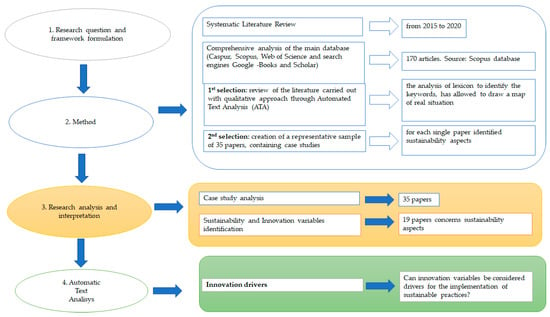
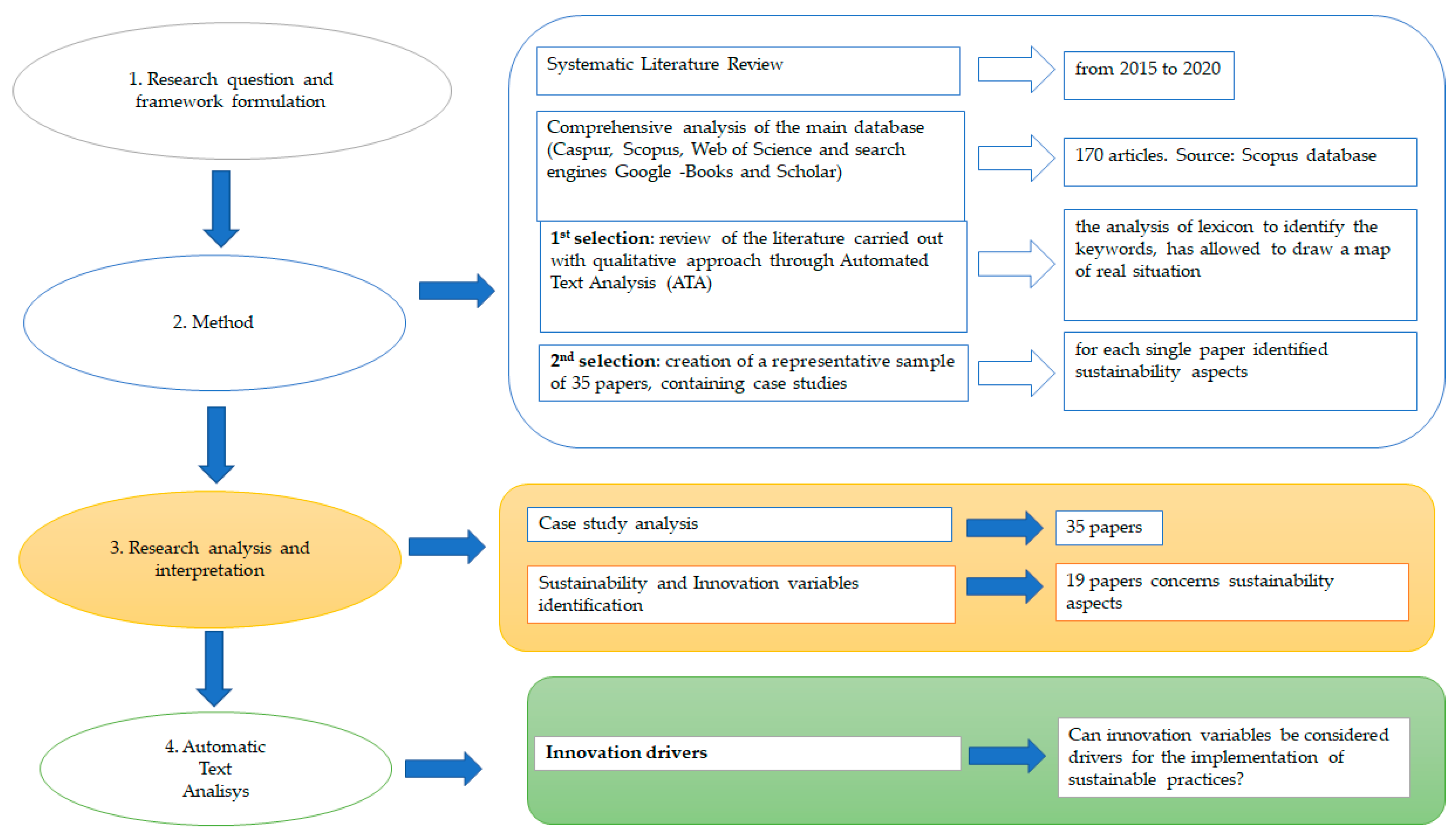
The desk-based research design consists in four main stages. These stages include several steps that are part of the method which was designed specifically to address the research question: “Can innovation variables be considered drivers for the implementation of sustainable practices?”, as show in Figure 1.
Figure 1.
Research framework. Source: authors’ elaboration.
The first step for this analysis consisted of a holistic approach to the identification of the research question and its correct formulation. After that, the second step consists in the method’s exploitation. For this second phase, a systematic literature review was conducted. The systematic literature review overcomes the limitation of a more generally narrative review. After a comprehensive analysis of the main databases (Caspur, Scopus, Web of Science, and search engines Google-Books and Scholar), the authors choose to focus the analysis on the Scopus database. The analysis carried out for the systematic literature review conducted by the authors consisted in a preliminary investigation into case studies about the presence of sustainability drivers within family businesses in the tourism industry between 2015 and 2020, with the aim of identifying how strategy innovations could contribute to the adoption of sustainability practices (131 papers was isolated by the Scopus database).
Systematic literature review was defined by Kitcharoen (2004) as a form of secondary study with the aim of “identifying, evaluating and interpreting all available research relevant to a particular research question, or topic area, or phenomenon of interest” [60].
The desk-based research was conducted using bibliometric indicators. The selection of the items was made based on the presence of the words “family business” and “sustainability” and “family business” and “innovation”. In this step, 35 papers that included case studies and application were analyzed.
From this study, we selected a total of 19 works in which sustainability and innovation variables were performed. The main result of this operation and the key variables extraction is shown in Table 1. Subsequently, some documents which were not focused on the analysis of a case study, and those that focused on strictly particular aspects, were exempted. A careful look at the 19 contributions clearly shows the preference and orientation for qualitative studies. This would be explained by the fact that the present search flow is quite recent. Only in seven contributions was the innovation variable highlighted as a guarantee of the presence of sustainability within the companies. Other variables have been identified.
Table 1.
Articles and variable sustainability. Source: authors’ elaboration.
The study proceeded with the analysis of the identified lexicon and strategic keywords through the use of Automatic Text Analysis (ATA).
ATA uses qualitative approaches and empirical analysis based on phenomena in organized data. For this analysis, there is no need for numerical quantification. The most common approach used to conduct ATA is based on Grounded Theory; it does not precede the empirical research, and the study passes stepwise through the analysis of empirical data.
The use of ATA tools and vocabulary analysis were useful for identifying keywords. It allowed us to draw the main topics discussed and articles published in various periods to select those of interest; that is, those that contain innovation and sustainability aspects, in order to answer our research question concerning the identification of innovation variables to be considered drivers for sustainable development. In this context, a review of the case study-focused literature was an adequate and workable research methodology. The narrative approach—also known as storytelling—was using to develop the case study analysis.
4. Findings
Starting from the evidence highlighted in the literature, the results of our analysis showed a predominance of articles related to the sector of accommodation of the value chain. Therefore, in this part of the work, the objective is to show, based on the exploration of the articles resulting from our analysis, how the sustainability variable is applied within the accompanying sector, and at the same time, in relation to the latter, whether there are innovative elements.
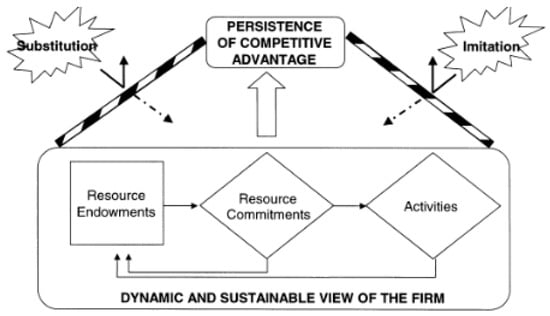
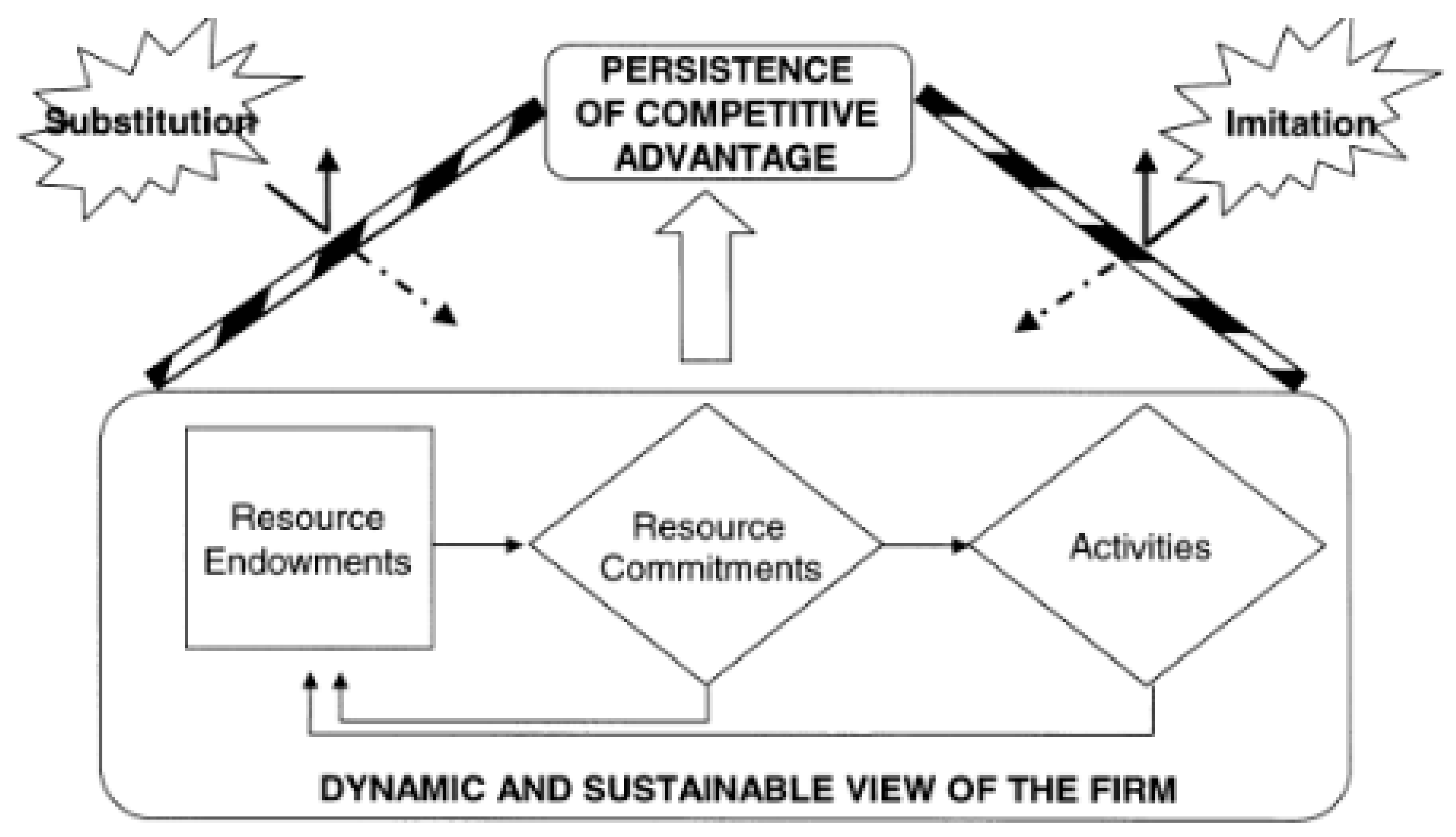
The conceptual basis of the research purpose was inspired—as shown in Figure 2, based on [72]—by the concept that resources, capabilities and activities enable the creation of persistent competitive advantages that are difficult to imitate and substitute by current or potential competitors [73].
Figure 2.
The dynamic firm’s point of view [61].
In the tourism industry, sustainable development is the main concern. Three dimensions of sustainable development were identified: economic, environmental and social [41]. These three dimensions allow companies to achieve greater productivity, and at the same time, allow the reduction of the use of resources and of environmental impact, and they attach an important value to innovation for the realization of sustainable development [22].
The concept of sustainable development in tourism is therefore considered an innovation to support both economic growth, and at the same time, to guarantee environmental protection [22,74].
Concerning the creation of a sustainable business, family entrepreneurs are guided by several elements that make innovative changes, consisting of two points: resources and opportunities [24]. The resources of family businesses are acquired and exploited in different ways than resources that are not proper to the family [12,39]. These unique resources derive from the direct management of the family in the company; therefore, familiarity is an intangible factor that distinguishes family businesses from non-family businesses, and can represent a competitive advantage, but at the same time, these unique family resources can inhibit growth and therefore represent a disadvantage [12,75]. The main objective for tourism companies is represented by financial performance [6], and a fundamental element which contributes to financial performance is the innovation factor [2,8]. At the same time, innovative factors, such as the strong will to maintain the reputation of the family, the high level of communication between the members of the family, and the constant commitment to the company of the family members, are the enabling factors for innovation related to the family [25,76]. Therefore, family dynamics are a relevant factor and must be kept under control in the management of innovation in family businesses [27]. Moreover, this shows how the different behavior and innovative approach of the different family businesses depends on socio-emotional factors, and therefore non-economic factors [25,77]. We can conclude that business development and family history are two related concepts that influence each other [28].
Another interesting aspect concerns the relationship between innovation and succession. It can be said that the involvement of the successor can act as a “catalyst for change” or innovation opportunities [25,78]. In fact, defending one’s family-based traditions and guaranteeing a legacy between generations represents an important non-economic objective of family businesses [36,79]. The innovation process is likely to occur after succession periods and changes of ownership within the family. In this context, in fact, the successors for the company represent new opportunities [80], resources, knowledge and information capable of implementing innovative forms [25,81,82].
The successor will aim for different objectives and will also be characterized by different conflicts [83]. The conflict represents a positive aspect, capable of overturning the rigid traditions characterized by beliefs and attitudes that hinder innovation [25,84]. The successor will also aim to create his own entrepreneurial reputation by changing the status quo [25,84]. In conclusion, it is possible to affirm that the collaboration between generations represents an essential resource to orient the company towards an innovative approach, and it should be considered a real engine of innovation [25,85].
Empirical Evidence
In the case study analysis, it emerged that, within family businesses in the tourism industry, innovation is limited and is not the only driver to ensure sustainable development. Table 2 shows the main key variables and drivers identified by our analysis to ensure sustainable tourism development.
Table 2.
Key variables and drivers. Source: authors’ elaboration.
5. Discussion
The present study used a retrospective perspective to analyze the relationship between innovation and sustainability. The case study analysis and the research design contributed to our critical examination.
From the general results obtained from the systematic literature review, the direction of business strategies in this type of company towards sustainability is evident. The impact of innovative strategies was less evident. For this, the contribution of the case study analysis and the ATA helped the author to define the innovation variables and the extent to which they are present to guarantee sustainable development. In the same way, other variables than the innovative one which promote sustainable development have been identified (see Table 2). In fact, from the results, it seems evident that, in family businesses in the rural tourism sector, the decision-making process, in terms of sustainability, once economic performance was ensured, is guided by ecological and social aspects and observations [86]. The unique family resources and dynamics, and the intergenerational nature of family businesses, entails the greater sensitivity of these companies to the social and ecological dynamics that manifest themselves in the decision-making process [34,87]. Therefore, an analysis of tourism micro-enterprises emerges, and their current and future impact in terms of social, economic and environmental factors particularly favors sustainable development [2].
Moreover, the results show that resilient factors are a determining factor in sustainable development. An enterprise’s resilience is essential to sustainable tourism management, for environmental, economic and sociocultural reasons, and for the survival of the business [12,70].
The long-term orientation is characterized by the intention to continue and maintain the family control of a company. It leads owners to direct their efforts towards long-term investments, such as sustainability practices, highlighting how sustainability is also fundamental for prosperity in this time horizon [36,71].
Furthermore, the importance of innovative practices combined with differentiation strategies for sustainability in tourism, and in particular in the B&B sector, has been underlined, especially when the market is saturated or the product is at the declining stage in its life cycle [24]. The results of our research show that innovation within family businesses is not very present, and is limited to branding strategies. The brand is intended as a means of improving the reputation of the destination [40]. Similarly, at the corporate level, the branding strategies implemented by the employer of a family business aim to solve an increasing risk related to the lack of manpower [40]. Moreover, in the tourism industry and in the hospitality sector, the marketing and branding function is associated with the logic of Corporate Responsibility, rather than sustainability, which seems to be more layered and integrated within organizations [87].
The results also show that we have barely explored and systematized in application models the links between the variables of sustainability and innovation.
Another important result can be seen from the small number of scientific contributions in which these elements are present, and how, even in the case studies, there are no relevant elements except in seven contributions (see Table 1).
Although the tourism industry has been considered a traditional and mature industry, the application of innovative strategies has shown that it could be an incremental resource for sustainable tourism development. Therefore, more research can be suggested to gain a better understanding of ‘how’ innovation could become an engine for implementing sustainable practices, and could eventually have a positive influence on tourism chains’ income.
6. Conclusions, Limits and Future Research
With this contribution, we offer an overview of the implementation of sustainability practices in family touristic businesses, and the factors which determine their sustainable development. This study has limitations. The analysis was carried out over a 5year period from 2015 to 2020; therefore, in the future, replicating it would be advisable, in order to extend the research period. Furthermore, the choice and selection of the case study’s object of analysis have been identified, taking into account the sustainability variable in relation to the innovation strategies; in the future, it would be advisable to extend the research by also taking into account other variables that push family businesses to adopt sustainable practices. The lack of theoretical basis is also highlighted by the limited number of case studies and empirical analyses in the field. Furthermore, the limited number of case studies makes it difficult for companies to understand how to innovate their business models, to design and implement alternatives, and therefore to evaluate and adopt the most appropriate.
In the future, it would also be desirable for authors to analyze a case study which is relevant to the work done.
Author Contributions
The authors contributed equally to this work and to its development. G.A. developed the research design, and G.C.E. analyzed the source and literature and conducted the case studies analyses. M.V. coordinated the study. S.P. and F.P. supervised the research project and carried out a detailed revision. All authors have read and agreed to the published version of the manuscript.
Funding
This research received no external funding.
Conflicts of Interest
The authors declare no conflict of interest.
References
- Del Carmen Canizares Ruiz, M. Sustainability and tourism: From international documentation to planning in Spain «horizon 2020» [Sostenibilidad y turismo: De la documentación internacional a la planificación en España «horizonte 2020»]. Boletín Asociación Geógrafos Españoles 2013, 61, 67–92. [Google Scholar]
- Arteaga, Y.; Espinoza, R.; Zuñiga, X.; Espinoza, E.; Villegas, F.; Campos, H. Alternativa Para el Desarrollo Sostenible del Turismo en el Cantón Milagro (Ecuador): Viveros, los Nuevos Emprendimientos. Espacios 2018, 39, 18. [Google Scholar]
- Butler, R.W. Sustainable tourism: A state-of-the-art review|Le tourisme durable: Un état de la question. Tour. Geogr. 1999, 1, 7–25. [Google Scholar] [CrossRef] [Scilit]
- Saarinen, J. Traditions of sustainability in tourism studies. Ann. Tour. Res. 2006, 33, 1121–1140. [Google Scholar] [CrossRef] [Scilit]
- Broccardo, L.; Culasso, F.; Truant, E. Unlocking value creation using an agritourism business model. Sustainability 2017, 9, 1618. [Google Scholar] [CrossRef] [Scilit]
- Getz, D.; Carlsen, J. Family business in tourism. State of the art. Ann. Tour. Res. 2005, 32, 237–258. [Google Scholar] [CrossRef] [Scilit]
- Getz, D.; Carlsen, J. Characteristics and goals of family and owner-operated businesses in the rural tourism and hospitality sectors. Tour. Manag. 2000, 21, 547–560. [Google Scholar] [CrossRef] [Scilit]
- Kallmuenzer, A.; Peters, M. Innovativeness and control mechanisms in tourism and hospitality family firms: A comparative study. Int. J. Hosp. Manag. 2018, 70, 66–74. [Google Scholar] [CrossRef] [Scilit]
- Legohérel, P.; Callot, P.; Gallopel, K.; Peters, M. Personality Characteristics, Attitude Toward Risk, and Decisional Orientation of the Small Business Entrepreneur: A Study of Hospitality Managers. J. Hosp. Tour. Res. 2004, 28, 109–120. [Google Scholar] [CrossRef] [Scilit]
- Peters, M.; Frehse, J.; Buhalis, D. The importance of lifestyle entrepreneurship: A conceptual study of the tourism industry. (Special issue: Innovation and entrepreneurship in the tourism industry). PASOS Rev. Tur. Patrim. Cult. 2009, 7, 393–405. [Google Scholar] [CrossRef] [Scilit]
- Chua, J.H.; Chrisman, J.J.; Sharma, P. Defining the Family Business by Behavior. Entrep. Theory Pract. 1999, 23, 19–39. [Google Scholar]
- Ismail, H.N.; Mohd Puzi, M.A.; Banki, M.B.; Yusoff, N. Inherent factors of family business and transgenerational influencing tourism business in Malaysian islands. J. Tour. Cult. Chang. 2019, 17, 624–641. [Google Scholar]
- Massa, L.; Tucci, L.C. Chapter 21: Business Model Innovation. In The Oxford Handbook of Innovation Management; OUP Oxford: Oxford, UK, 2013. [Google Scholar]
- Valeri, M.; Baggio, R. Italian tourism intermediaries: A social network analysis exploration. Curr. Issues Tour. 2020, 1–14. [Google Scholar] [CrossRef] [Scilit]
- Leach, M.; Rockström, J.; Raskin, P.; Scoones, I.; Stirling, A.C.; Smith, A.; Thompson, J.; Millstone, E.; Ely, A.; Arond, E.; et al. Transforming innovation for sustainability. Ecol. Soc. 2012, 17, 11–18. [Google Scholar] [CrossRef] [Scilit]
- Faber, N.; Jorna, R.; Van Engelen, J.O. The sustainability of “sustainability”—A study into the conceptual foundations of the notion of “sustainability”. In Tools, Techniques and Approaches for Sustainability: Collected Writings in Environmental Assessment Policy and Management; World Scientific Publishing Company: Sinapore, 2010; pp. 337–369. [Google Scholar]
- Adams, R.; Jeanrenaud, S.; Dessant, J.; Overy, P.; Denyer, D. Innovating for Sustainability. 2012. Available online: https://ore.exeter.ac.uk/repository/bitstream/handle/10036/4105/Adams%202012-%20NBS%20Systematic%20Review%20Innovation.pdf?sequence=8 (accessed on 29 July 2020).
- Schaltegger, S.; Lüdeke-Freund, F.; Hansen, E.G. Business cases for sustainability: The role of business model innovation for corporate sustainability. Int. J. Innov. Sustain. Dev. 2012, 6, 95–119. [Google Scholar] [CrossRef] [Scilit]
- Jolink, A.; Niesten, E. Sustainable Development and Business Models of Entrepreneurs in the Organic Food Industry. Bus. Strategy Environ. 2015, 24, 386–401. [Google Scholar] [CrossRef] [Scilit]
- Evans, S.; Vladimirova, D.; Holgado, M.; Van Fossen, K.; Yang, M.; Silva, E.A.; Barlow, C.Y. Business Model Innovation for Sustainability: Towards a Unified Perspective for Creation of Sustainable Business Models. Bus. Strategy Environ. 2017, 26, 597–608. [Google Scholar] [CrossRef] [Scilit]
- Kuščer, K.; Mihalič, T.; Pechlaner, H. Innovation, sustainable tourism and environments in mountain destination development: A comparative analysis of Austria, Slovenia and Switzerland. J. Sustain. Tour. 2017, 25, 489–504. [Google Scholar] [CrossRef] [Scilit]
- Liu, C.W.; Cheng, J.S. Exploring driving forces of innovation in the MSEs: The case of the sustainable B & B tourism industry. Sustainability 2018, 10, 3983. [Google Scholar] [CrossRef] [Scilit]
- Swarbrooke, J. Sustainable Tourism Management; CABI: Oxford, UK, 1999. [Google Scholar]
- Kuo, C.M.M.; Tseng, C.Y.; Chen, L.C. Choosing between exiting or innovative solutions for bed and breakfasts. Int. J. Hosp. Manag. 2018, 73, 12–19. [Google Scholar] [CrossRef] [Scilit]
- Hauck, J.; Prügl, R. Innovation activities during intra-family leadership succession in family firms: An empirical study from a socioemotional wealth perspective. J. Fam. Bus. Strategy 2015, 6, 104–118. [Google Scholar] [CrossRef] [Scilit]
- Chen, S.C.; Elston, J.A. Entrepreneurial motives and characteristics: An analysis of small restaurant owners. Int. J. Hosp. Manag. 2013, 23, 294–305. [Google Scholar] [CrossRef] [Scilit]
- De Massis, A.; Frattini, F.; Pizzurno, E.; Cassia, L. Product innovation in family versus nonfamily firms: An exploratory analysis. J. Small Bus. Manag. 2015, 53, 1–36. [Google Scholar] [CrossRef] [Scilit]
- Peters, M.; Kallmuenzer, A. Entrepreneurial orientation in family firms: The case of the hospitality industry. Curr. Issues Tour. 2018, 21, 21–40. [Google Scholar] [CrossRef] [Scilit]
- Kellermanns, F.W.; Eddleston, K.A.; Sarathy, R.; Murphy, F. Innovativeness in family firms: A family influence perspective. Small Bus. Econ. 2012, 38, 85–101. [Google Scholar] [CrossRef] [Scilit]
- Habbershon, T.G.; Pistrui, J. Enterprising Families Domain: Family-Influenced Ownership Groups in Pursuit of Transgenerational Wealth. Fam. Bus. Rev. 2002, 15, 223–237. [Google Scholar] [CrossRef] [Scilit]
- Cruz, C.; Nordqvist, M. Entrepreneurial orientation in family firms: A generational perspective. Small Bus. Econ. 2012, 38, 33–49. [Google Scholar] [CrossRef] [Scilit]
- Berrone, P.; Cruz, C.; Gomez-Mejia, L.R. Socioemotional Wealth in Family Firms: Theoretical Dimensions, Assessment Approaches, and Agenda for Future Research. Fam. Bus. Rev. 2012, 25, 258–279. [Google Scholar] [CrossRef] [Scilit]
- Le Breton-Miller, I.; Miller, D. Family firms and practices of sustainability: A contingency view. J. Fam. Bus. Strategy 2016, 7, 26–33. [Google Scholar] [CrossRef] [Scilit]
- Kallmuenzer, A.; Nikolakis, W.; Peters, M.; Zanon, J. Trade-offs between dimensions of sustainability: Exploratory evidence from family firms in rural tourism regions. J. Sustain. Tour. 2018, 26, 1204–1221. [Google Scholar] [CrossRef] [Scilit]
- Sharma, S.; Henriques, I. Stakeholder influences on sustainability practices in the Canadian forest products industry. Strategy Manag. J. 2005, 26, 159–180. [Google Scholar] [CrossRef] [Scilit]
- Memili, E.; Fang, H.C.; Koç, B.; Yildirim-Öktem, Ö.; Sonmez, S. Sustainability practices of family firms: The interplay between family ownership and long-term orientation. J. Sustain. Tour. 2018, 26, 9–28. [Google Scholar] [CrossRef] [Scilit]
- Banki, M.B.; Ismail, H.N.; Muhammad, I.B. Coping with seasonality: A case study of family owned micro tourism businesses in Obudu Mountain Resort in Nigeria. Tour. Manag. Perspect. 2016, 18, 141–152. [Google Scholar] [CrossRef] [Scilit]
- Ireland, R.D.; Hitt, M.A.; Sirmon, D.G. A model of strategic enterpreneurship: The construct and its dimensions. J. Manag. 2003, 29, 963–989. [Google Scholar]
- Sirmon, D.G.; Hitt, M.A. Managing Resources: Linking Unique Resources, Management, and Wealth Creation in Family Firms. Entrep. Theory Pract. 2003, 27, 339–358. [Google Scholar] [CrossRef] [Scilit]
- Glowka, G.; Zehrer, A. Tourism family-business owners’ risk perception: Its impact on destination development. Sustainability 2019, 11, 6992. [Google Scholar] [CrossRef] [Scilit]
- Fukuda, K.; Watanabe, C. Innovation Ecosystem for Sustainable Development. In Sustainable Development—Policy and Urban Development—Tourism, Life Science, Management and Environment; IntechOpen: Rijeka, Croatia, 2012. [Google Scholar]
- Lumpkin, G.T.; Dess, G.G. The Entrepreneurial Clarifying It Construct and Linking Orientation. Acad. Manag. Rev. 1996, 16, 429–451. [Google Scholar] [CrossRef] [Scilit]
- Lumpkin, G.T.; Dess, G.G. Linking two dimensions of entrepreneurial orientation to firm performance: The moderating role of environment and industry life cycle. J. Bus. Ventur. 2001, 16, 429–451. [Google Scholar] [CrossRef] [Scilit]
- Sundbo, J.; Orfila-Sintes, F.; Sørensen, F. The innovative behaviour of tourism firms-Comparative studies of Denmark and Spain. Res. Policy 2007, 36, 88–106. [Google Scholar] [CrossRef] [Scilit]
- Cassia, L.; De Massis, A.; Pizzurno, E. An exploratory investigation on NPD in Small Family Businesses from Northern Italy. Int. J. Bus. Manag. Soc. Sci. 2011, 2, 1–14. [Google Scholar]
- Classen, N.; Van Gils, A.; Bammens, Y.; Carree, M. Accessing Resources from Innovation Partners: The Search Breadth of Family SMEs. J. Small Bus. Manag. 2012, 50, 191–215. [Google Scholar] [CrossRef] [Scilit]
- Hall, C.M.; Williams, A.M. Tourism and Innovation; Routledge: London, UK, 2008; ISBN 0203938437. [Google Scholar]
- Hjalager, A.M. A review of innovation research in tourism. Tour. Manag. 2010, 31, 1–12. [Google Scholar] [CrossRef] [Scilit]
- Jacob, M.; Tintoré, J.; Aguiló, E.; Bravo, A.; Mulet, J. Innovation in the tourism sector: Results from a pilot study in the Balearic Islands. Tour. Econ. 2003, 9, 279–295. [Google Scholar] [CrossRef] [Scilit]
- Pikkemaat, B. Innovation in Small and Medium-Sized Tourism Enterprises in Tyrol, Austria. Int. J. Entrep. Innov. 2008, 9, 187–197. [Google Scholar] [CrossRef] [Scilit]
- Ottenbacher, M.; Gnoth, J. How to develop successful hospitality innovation. Cornell Hotel Restaur. Adm. Q. 2005, 46, 205–222. [Google Scholar] [CrossRef] [Scilit]
- Shaw, G.; Williams, A. Knowledge transfer and management in tourism organisations: An emerging research agenda. Tour. Manag. 2009, 30, 325–335. [Google Scholar] [CrossRef] [Scilit]
- Nieves, J.; Diaz-Meneses, G. Antecedents and outcomes of marketing innovation: An empirical analysis in the hotel industry. Int. J. Contemp. Hosp. Manag. 2016, 28, 1554–1576. [Google Scholar] [CrossRef] [Scilit]
- Lee, Y.S.; Shin, W.J. Marketing tradition-bound products through storytelling: A case study of a Japanese sake brewery. Serv. Bus. 2015, 9, 281–295. [Google Scholar] [CrossRef] [Scilit]
- Valeri, M.; Baggio, R. A critical reflection on the adoption of blockchain in tourism. Inf. Technol. Tour. 2020. [Google Scholar] [CrossRef] [Scilit]
- Andereck, K.L. Tourists’ perceptions of environmentally responsible innovations at tourism businesses. J. Sustain. Tour. 2009, 17, 489–499. [Google Scholar] [CrossRef] [Scilit]
- Valeri, M.; Baggio, R. Social network analysis: Organizational implications in tourism management. Int. J. Organ. Anal. 2020. [Google Scholar] [CrossRef] [Scilit]
- Lee, S.; Lee, K.S.; Chua, B.L.; Han, H. Independent café entrepreneurships in Klang Valley, Malaysia—Challenges and critical factors for success: Does family matter? J. Destin. Mark. Manag. 2017, 6, 363–374. [Google Scholar] [CrossRef] [Scilit]
- Bergfeld, M.M.H.; Weber, F.M. Dynasties of innovation: Highly performing German family firms and the owners’ role for innovation. Int. J. Entrep. Innov. Manag. 2011, 13, 80–94. [Google Scholar] [CrossRef] [Scilit]
- Kitcharoen, K. The Importance-Performance Analysis of service quality in administrative departments of private universities in Thailand. ABAC J. 2004, 24, 20–46. [Google Scholar]
- Hamed, S. Habiba Community: Brand management for a family business. Emerald. Emerg. Mark. Case Stud. 2019, 9, 1–20. [Google Scholar] [CrossRef] [Scilit]
- Mhlanga, O. Factors impacting airline efficiency in southern Africa: A data envelopment analysis. GeoJournal 2019, 84, 759–770. [Google Scholar] [CrossRef] [Scilit]
- Ertuna, B.; Karatas-Ozkan, M.; Yamak, S. Diffusion of sustainability and CSR discourse in hospitality industry: Dynamics of local context. Int. J. Contemp. Hosp. Manag. 2019, 31, 2564–2581. [Google Scholar] [CrossRef] [Scilit]
- Candelo, E.; Casalegno, C.; Civera, C.; Büchi, G. A Ticket to Coffee: Stakeholder View and Theoretical Framework of Coffee Tourism Benefits. Tour. Anal. 2019, 24, 329–340. [Google Scholar] [CrossRef] [Scilit]
- Saganeiti, L.; Pilogallo, A.; Izzo, C.; Piro, R.; Scorza, F.; Murgante, B. Development Strategies of Agro-Food Sector in Basilicata Region (Italy): Evidence from INNOVAGRO Project; Springer: Cham, Switzerland, 2019. [Google Scholar] [CrossRef] [Scilit]
- Tortora, M. Humanism and business: The case of a sustainable business experience in the Florentine tourist sector based on the civil economy tradition. In Sustainability and the Humanities; Springer International Publishing: Cham, Switzerland, 2019; ISBN 978-3-319-95336-6. [Google Scholar]
- Mustapha, M.; Awang, K.W. Sustainability of a beach resort: A case study. Int. J. Eng. Technol. 2018, 7. [Google Scholar] [CrossRef] [Scilit]
- Arteaga Estrella, Y.M.; Espinoza Toalombo, R.A.; Zuñiga Santillán, X.L.; Espinoza Solís, E.J.; Villegas Yagual, F.E.; Campos Rocafuerte, H.F. Tourism start-ups; an alternative for the development of sustainable tourism in Milagro city: Plant nurseries, an entrepreneurial opportunity. Revista Espacios 2018, 39, 18. [Google Scholar]
- Rodríguez-Antón, J.M.; Alonso-Almeida, M.M.; Rubio-Andrada, L.; Pedroche, M.S.C. Collaborative economy. An approach to sharing tourism in Spain. Rev. Econ. Publica, Soc. y Coop. 2016, 88, 259–283. [Google Scholar]
- Banki, M.B.; Ismail, H.N. Understanding the characteristics of family owned tourism micro businesses in mountain destinations in developing countries: Evidence from Nigeria. Tour. Manag. Perspect. 2015, 13, 18–32. [Google Scholar] [CrossRef] [Scilit]
- Lloyd, K.; Suchet-Pearson, S.; Wright, S.; Tofa, M.; Rowland, C.; Burarrwanga, L.; Ganambarr, R.; Ganambarr, M.; Ganambarr, B.; Maymuru, D. Transforming tourists and “culturalising commerce”: Indigenous tourism at Bawaka in Northern Australia. Int. Indig. Policy J. 2015, 6. [Google Scholar] [CrossRef] [Scilit]
- Rodriguez, M.A.; Ricart, J.E.; Sanchez, P. Sustainable development and the sustainability of competitive advantage: A dynamic and sustainable view of the firm. Creat. Innov. Manag. 2002, 11, 135–146. [Google Scholar] [CrossRef] [Scilit]
- Arcese, G.; Flammini, S.; Lucchetti, M.C.; Martucci, O. Evidence and experience of open sustainability innovation practices in the food sector. Sustainability 2015, 7, 8067–8090. [Google Scholar] [CrossRef] [Scilit]
- Dabphet, S.; Scott, N.; Ruhanen, L. Applying diffusion theory to destination stakeholder understanding of sustainable tourism development: A case from Thailand. J. Sustain. Tour. 2012, 20, 1107–1124. [Google Scholar] [CrossRef] [Scilit]
- Craig, J.B.L.; Moores, K. A 10-year longitudinal investigation of strategy, systems, and environment on innovation in family firms. Fam. Bus. Rev. 2006, 19, 1–10. [Google Scholar] [CrossRef] [Scilit]
- Lumpkin, G.T.; Brigham, K.H.; Moss, T.W. Long-term orientation: Implications for the entrepreneurial orientation and performance of family businesses. Entrep. Reg. Dev. 2010, 22, 241–264. [Google Scholar] [CrossRef] [Scilit]
- Kotlar, J.; De Massis, A. Goal setting in family firms: Goal diversity, social interactions, and collective commitment to family-centered goals. Entrep. Theory Pract. 2013, 37, 1263–1288. [Google Scholar] [CrossRef] [Scilit]
- Jaskiewicz, P.; Combs, J.G.; Rau, S.B. Entrepreneurial legacy: Toward a theory of how some family firms nurture transgenerational entrepreneurship. J. Bus. Ventur. 2015, 30, 29–49. [Google Scholar] [CrossRef] [Scilit]
- Salvato, C. Predictors of Entrepreneurship in Family Firms. J. Priv. Equity 2004, 7, 68–76. [Google Scholar] [CrossRef] [Scilit]
- Aldrich, H.E.; Cliff, J.E. The pervasive effects of family on entrepreneurship: Toward a family embeddedness perspective. J. Bus. Ventur. 2003, 18, 573–596. [Google Scholar] [CrossRef] [Scilit]
- Handler, W.C. The Succession Experience of the Next Generation. Fam. Bus. Rev. 1992, 5, 283–307. [Google Scholar] [CrossRef] [Scilit]
- Kellermanns, F.W.; Eddleston, K.A.; Barnett, T.; Pearson, A. An exploratory study of family member characteristics and involvement: Effects on entrepreneurial behavior in the family firm. Fam. Bus. Rev. 2008, 21, 1–14. [Google Scholar] [CrossRef] [Scilit]
- Kepner, E. The Family and the Firm: A Coevolutionary Perspective. Fam. Bus. Rev. 1991, 4, 445–461. [Google Scholar] [CrossRef] [Scilit]
- Cabrera-Suárez, K.; De Saá-Pérez, P.; García-Almeida, D. The Succession Process from a Resource- and Knowledge-Based View of the Family Firm. Fam. Bus. Rev. 2001, 14, 37–48. [Google Scholar] [CrossRef] [Scilit]
- Martin, J.M. Impacts of the Tourist Activity and Citizens’ Evaluation About the Necessity for Resting Periods. In Strategic Perspectives in Destination Marketing; IGI Global: Hershey, PA, USA, 2018; pp. 81–112. ISBN 9781522558354. [Google Scholar]
- Fitzgerald, M.A.; Haynes, G.W.; Schrank, H.L.; Danes, S.M. Socially Responsible Processes of Small Family Business Owners. J. Small Bus. Manag. 2010, 48, 524–551. [Google Scholar] [CrossRef] [Scilit]
- Biggs, D.; Hall, C.M.; Stoeckl, N. The resilience of formal and informal tourism enterprises to disasters: Reef tourism in Phuket, Thailand. J. Sustain. Tour. 2012, 20, 645–665. [Google Scholar] [CrossRef] [Scilit]

© 2020 by the authors. Licensee MDPI, Basel, Switzerland. This article is an open access article distributed under the terms and conditions of the Creative Commons Attribution (CC BY) license (http://creativecommons.org/licenses/by/4.0/).