


Abstract
Background: Peripheral nerve stimulation (PNS) is increasingly used in selected patients with neuropathic pain, and many individuals seek supplemental online information to clarify procedural expectations and postoperative care. Large language models such as ChatGPT may provide scalable patient education; however, their performance for PNS-related questions has not been evaluated. This study assessed the reliability, accuracy, and comprehensibility of ChatGPT-5.0 responses to common PNS patient questions. Methods: We conducted a cross-sectional evaluation of ChatGPT-5.0 responses to 21 standardized questions derived through expert consensus, spanning pre-implantation, implantation, and post-implantation domains. Sixteen board-certified interventional pain specialists and a nurse educator independently rated each response using validated scales for reliability (1–6), accuracy (1–3), and comprehensibility (1–3). Descriptive statistics were calculated, and domain-level patterns were examined. Results: Clinician ratings demonstrated generally strong performance across all domains. Mean reliability was 4.7 ± 1.4, mean accuracy 2.6 ± 0.6, and mean comprehensibility 2.8 ± 0.5. Foundational questions addressing mechanisms, expectations, and postoperative care received the highest ratings. Lower ratings were observed for implantation-focused items requiring procedural nuance. No response fell below predefined acceptability thresholds, and sensitivity analyses confirmed that including one partial evaluator did not alter the observed trends. Conclusions: ChatGPT-5.0 generated responses to PNS-related patient questions that clinicians rated as generally reliable, accurate, and understandable, particularly for foundational and postoperative topics. Performance was more variable for procedural questions, underscoring the need for clinician oversight and verification. These findings provide a benchmark of current LLM capabilities and highlight the importance of ongoing evaluation as models evolve and as patients access versions with differing functionalities.
1. Introduction
Chronic neuropathic pain is a complex and heterogeneous condition that often requires multimodal, individualized treatment strategies [1]. Peripheral nerve stimulation (PNS) is one of several neuromodulation approaches used in select patients with focal neuropathic pain [2]. Its application spans conditions such as peripheral nerve injury, complex regional pain syndrome, phantom limb pain, and other refractory neuropathic syndromes. Regardless of modality, effective neuromodulation depends not only on appropriate patient selection and procedural execution, but also on clear patient understanding of mechanisms, expectations, risks, and postoperative care [3,4].
Traditional patient education in neuromodulation primarily relies on verbal counseling, supported by printed materials or online resources [5]. These approaches can vary substantially across clinical settings, may not adequately address patient-specific concerns, and are often constrained by limited time during clinical encounters. As a result, patients may seek supplemental information online, including clarification about procedural steps, postoperative expectations, or troubleshooting—areas where accuracy and clarity are essential for informed decision-making [6,7].
Large language models (LLMs), including the chat-based generative pre-trained transformer (ChatGPT), have emerged as accessible tools capable of generating conversational responses to patient questions. Early studies suggest potential utility for supporting patient education in chronic pain and interventional procedures [8]. However, LLM outputs reflect patterns learned from broad, publicly available data, and their accuracy can vary depending on the topic, terminology, and the quality of the underlying content. Because neuromodulation procedures involve device-specific workflows, safety considerations, and postoperative management steps, it cannot be assumed that LLM-generated explanations are uniformly accurate or complete [9,10,11,12,13,14].
Additionally, because LLMs evolve and different users may access different model versions or capability tiers, information quality may not be consistent across clinical, research, and patient-facing contexts. Evaluating performance at a defined point in time, therefore, provides an essential snapshot of current capabilities and limitations and may help guide the responsible incorporation of LLMs into patient education workflows. Evolving trends indicate that LLMs are increasingly integrated into everyday information-seeking behaviors. Patients frequently consult conversational AI systems to supplement clinical discussions, often asking follow-up questions related to recovery expectations, device management, or potential complications. While such tools may improve accessibility to medical information, they also introduce the possibility of incomplete or oversimplified explanations when applied to complex procedural therapies such as neuromodulation [15,16,17,18,19,20,21]. PNS involves device-specific programming parameters, peri-procedural precautions, and individualized postoperative guidance. As a result, evaluating the quality of AI-generated explanations in this domain is particularly relevant for understanding both the opportunities and the limitations of LLM-assisted patient education.
Given these considerations, no published studies have examined how ChatGPT performs when responding to common patient questions about PNS, a modality with distinct procedural logistics and device considerations compared with other neuromodulation techniques. This study evaluates the reliability, accuracy, and comprehensibility of ChatGPT-generated responses to frequently asked questions across pre-implantation, implantation, and post-implantation domains. By identifying both strengths and content gaps, these findings aim to inform best-practice strategies for incorporating AI-generated educational material into neuromodulation care.
2. Materials and Methods
2.1. Study Design
This cross-sectional study systematically analyzed clinician evaluations of ChatGPT-5.0 (OpenAI, San Francisco, CA, USA) responses to common patient questions about peripheral nerve stimulation (PNS). The methodological structure aligns with prior studies evaluating LLM performance in neuromodulation and interventional pain procedures [10,11,12,13].
2.2. Question Development and Content Scope
Twenty-one standardized questions were created to represent the spectrum of patient inquiry related to PNS (Table 1). Each item was derived through expert consensus among fellowship-trained interventional pain clinicians, reflecting recurring topics encountered in PNS clinical evaluation and follow-up. Question domains included mechanisms of therapy, candidate selection, procedural preparation, surgical technique, expected sensations, complication management, device programming, functional activity, troubleshooting, and long-term outcomes.
Table 1.
Common questions regarding peripheral nerve stimulation asked to ChatGPT.
This approach parallels the methodology used in SCS, ESI, and LBP AI-education research, in which patient-facing questions were generated from clinical practice patterns, published educational materials, and documented patient priorities [10,11,12,13,14].
To enhance content validity, the study questions were designed to approximate the type of inquiries commonly encountered during clinical consultations, peri-procedural counseling, and postoperative follow-up visits. Questions were intentionally phrased using language consistent with typical patient communication rather than technical medical terminology. This approach was intended to simulate real-world patient interactions with conversational AI systems. This design strategy is consistent with prior evaluations of large language models in medical education and patient information contexts, where realistic patient-style prompts have been used to assess response quality [13,15,18]. By incorporating questions spanning the entire care pathway—from initial treatment consideration through long-term device management—the evaluation framework allowed assessment of how effectively ChatGPT communicates information across the continuum of PNS care.
2.3. ChatGPT Response Generation
The 21 questions were independently entered into ChatGPT-5.0. These questions addressed fundamental concepts, including PNS mechanisms, indications, procedural logistics, peri-procedural preparation, expected sensations, potential complications, device management, and long-term considerations. Using ChatGPT-5.0, each question was input to generate a detailed, patient-appropriate written response.
To reduce prompt bias, each question was submitted in uniform phrasing that emphasized clarity and patient-centered language. No additional context or follow-up prompts were provided. The model output for each question consisted of a single, complete written response, generated in a single interaction. Responses were exported directly from the interface to ensure content fidelity.
All responses were generated using ChatGPT-5.0 (OpenAI, San Francisco, CA, USA), with the same version and interface used throughout the evaluation period. Responses were recorded verbatim without modification to preserve accuracy and reproducibility.
2.4. Participants and Survey Structure
Sixteen evaluators participated in the study, including fifteen board-certified interventional pain physicians and one certified nurse educator with expertise in patient communication and health literacy. Fifteen participants completed ratings for all items; one participant completed only the first item. The partial dataset was included for item-level analysis of that question and excluded from aggregated analyses elsewhere. Surveys were administered via the secure Qualtrics XM survey platform (Qualtrics, Provo, UT, USA). Evaluators rated each ChatGPT-5.0 response using validated scales reflecting three primary performance constructs:
Surveys were administered via the secure Qualtrics XM platform (Qualtrics, Provo, UT, USA). Evaluators independently rated each ChatGPT-generated response using established scoring systems reflecting three constructs: reliability (1–6 scale; 1 = very poor, 6 = excellent), accuracy (1–3 scale; 1 = inaccurate, 3 = accurate), and comprehensibility (1–3 scale; 1 = difficult to understand, 3 = very clear). These scales have been used in prior neuromodulation-related LLM performance studies.
2.5. Data Management and Statistical Analysis
Responses and ratings were compiled and categorized by procedural phase:
- Pre-implantation (Q1–6): Mechanisms, risks, expectations;
- Implantation (Q7–13): Perioperative experience;
- Post-implantation (Q14–21): Long-term management, safety, troubleshooting.
Descriptive statistics were used because the objective was to assess overall rating patterns rather than to compare subgroups or test predefined hypotheses. All analyses were conducted using Microsoft Excel with manual verification of data entry and summary outputs.
3. Results
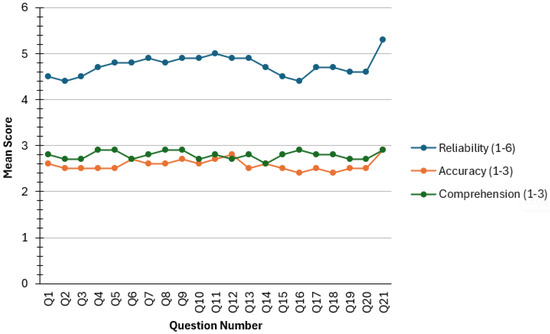
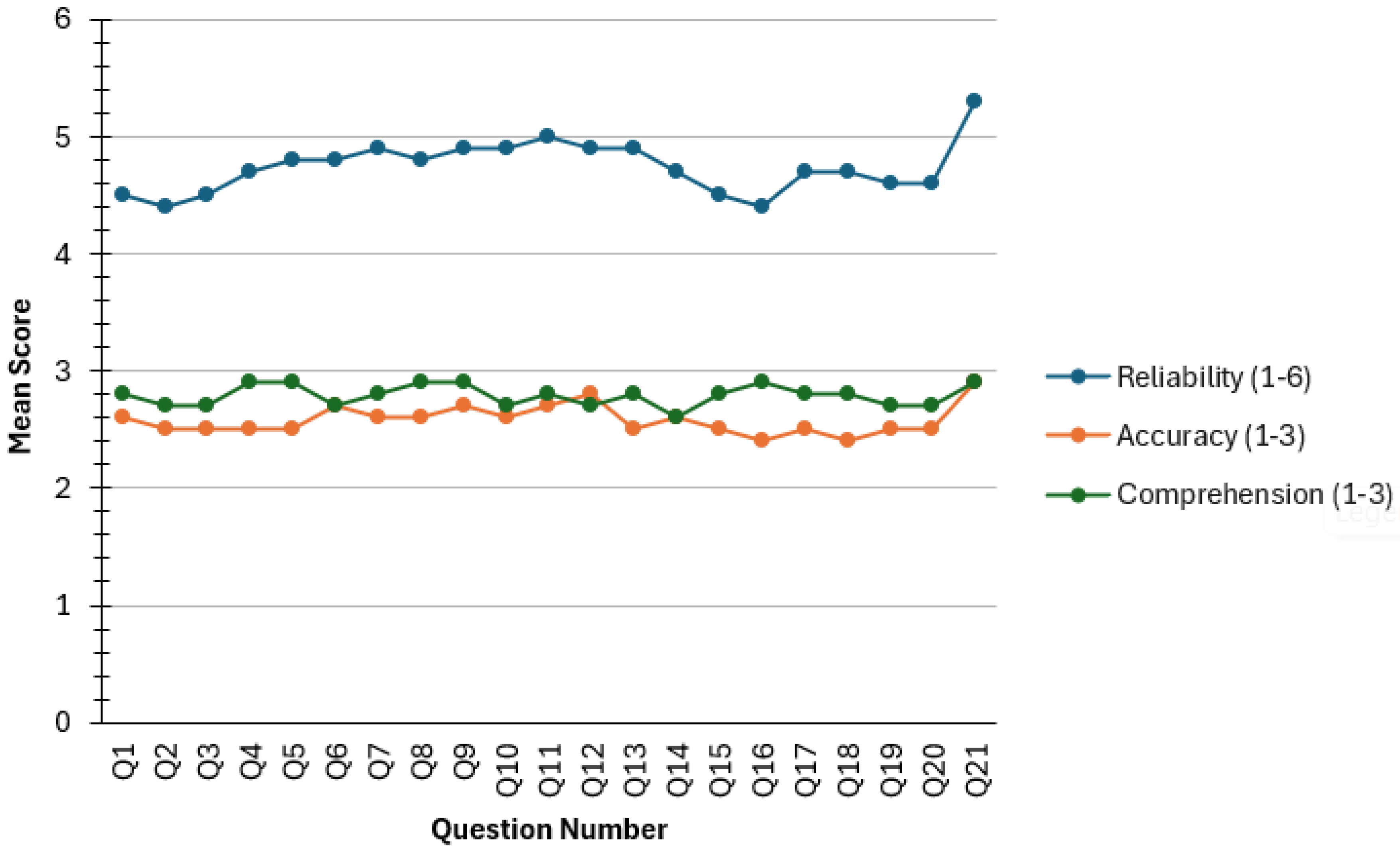
Clinician evaluations of the 21 ChatGPT-generated responses showed generally favorable ratings across all three assessment domains (Table 2). On the 6-point reliability scale, responses received a mean rating of 4.7 ± 1.4, indicating that evaluators perceived the content as adequately coherent and clinically consistent for most questions. Reliability scores ranged from 4.4 to 5.3. Question-level reliability was lowest for Q2 and Q16 (4.4 ± 1.5 and 4.4 ± 1.6, respectively) and highest for Q11 and Q21 (5.0 ± 1.4 and 5.3 ± 0.6, respectively).
Table 2.
Descriptive statistics of clinician evaluations of ChatGPT-generated responses.
Accuracy ratings on the 3-point scale yielded a mean score of 2.6 ± 0.6, reflecting clinician agreement that most responses aligned reasonably well with general PNS practices. Scores ranged from 2.4 to 2.9. Lower accuracy values were observed for Q16 and Q18 (2.4 ± 0.8 and 2.4 ± 0.9, respectively), both of which were related to postoperative considerations. Higher values were assigned to Q12 and Q21 (2.8 ± 0.6 and 2.9 ± 0.4), which addressed sensory expectations and general troubleshooting guidance.
Comprehensibility ratings were consistently high, with a mean of 2.8 ± 0.5 on the 3-point scale. Scores ranged from 2.6 to 2.9. Question 21 had the highest comprehensibility rating (2.9 ± 0.3), and several items (Q4, Q5, Q8, Q9, Q16) shared similarly high values (2.9 ± 0.5). The lowest comprehensibility score was noted for Q14 (2.6 ± 0.6), though still within an acceptable range for patient-facing material (Figure 1).
Figure 1.
Mean reliability, accuracy, and comprehensibility scores for pre-implantation (Q1–6), implantation (Q7–13), and post-implantation (Q14–21).
Domain-level patterns showed that pre-implantation and post-implantation questions tended to receive slightly higher ratings than implantation-focused items, which involve more procedural nuance. This pattern is consistent with the greater technical specificity required for perioperative questions. Including a partial dataset from one evaluator for Q1 did not materially affect the mean values or overall trends. These findings reflect clinician assessments of ChatGPT-5.0’s explanatory content and highlight areas where responses were perceived as more precise or more complete, as well as those that required greater specificity.
Inter-rater agreement was strong across all metrics, and the sensitivity analysis confirmed that including the single partial response (Q1 only) did not materially affect aggregated outcomes. Taken together, these results reflect clinician perceptions of ChatGPT-5.0’s performance, suggesting more precise and more complete responses for foundational and postoperative topics and comparatively lower clarity for items requiring procedural nuance.
4. Discussion
This study evaluated the quality of ChatGPT-5.0 responses to common patient questions about peripheral nerve stimulation (PNS) using clinician ratings of reliability, accuracy, and comprehensibility. Overall, raters found the responses generally coherent, clinically consistent, and understandable for foundational educational topics. These findings parallel prior work demonstrating that large language models can generate readable explanations for pain-related and interventional procedures, while also revealing performance variability in areas requiring procedural or device-specific nuance [15,16,17].
Across domains, higher ratings were observed for questions addressing mechanisms, expectations, risks, and postoperative care. These topics align more closely with the types of general medical information commonly represented in publicly available sources from which LLMs derive patterns. Conversely, lower, more variable ratings were observed for implantation-related questions [18,19]. These items require more precise detail regarding procedural steps, perioperative workflows, implant selection factors, and troubleshooting—information that is less consistently represented in general online content and therefore more challenging for models to reproduce accurately. This pattern is consistent with previous LLM evaluations in neuromodulation, minimally invasive spine procedures, and orthopedic and neurosurgical education, where accuracy tends to decline as clinical specificity increases [18,19]. Additionally, because LLMs continue to evolve and patients may rely on versions with different capabilities from those available to clinicians, real-world accuracy may vary.
The high comprehensibility ratings highlight a potential value: ChatGPT’s ability to translate complex terminology into accessible language. From a clinical perspective, this characteristic may help address a common challenge in neuromodulation practice: ensuring that patients understand complex therapeutic concepts discussed during time-limited clinical visits. Patients considering PNS must often process detailed information regarding device mechanics, expected sensory effects, activity restrictions, and long-term device management. Supplementary explanations that reinforce these concepts in clear language may therefore support patient comprehension and engagement. Prior studies examining AI-generated patient education in orthopedic surgery, spine care, and chronic pain management have similarly demonstrated that large language models can enhance readability and accessibility of medical information while maintaining generally acceptable accuracy [14,16,19].
Nevertheless, the results of this study also suggest that AI-generated explanations should not be considered a replacement for clinician counseling. Rather, LLM outputs may function best as complementary educational material that reinforces information delivered during the clinical encounter while still requiring clinician verification for accuracy and procedural specificity. Effective communication is central to informed decision-making, expectation setting, and postoperative adherence. For patients who seek supplemental explanations outside clinic visits, readable summaries may help reinforce core concepts. However, strong readability should not be interpreted as a proxy for correctness or completeness—particularly in procedural contexts where clinicians must verify nuanced or individualized decisions [15,16,17,20,21,22].
Importantly, these results represent clinician evaluations of ChatGPT-5.0 outputs at a defined point in time. Large language models evolve rapidly, and performance can differ across versions, access tiers, and user interfaces. Patients relying on freely available models may encounter a different response quality than clinicians or researchers accessing more advanced versions, a discrepancy that underscores the need for cautious interpretation. Additionally, LLM performance may change as training corpora expand, even when the application version number remains the same, or as model updates refine their ability to represent medical or device-specific information [16,19]. For these reasons, the present findings should be viewed as a snapshot of current capabilities rather than a definitive characterization of future model behavior.
This study has several strengths, including expert-designed questions, independent clinician evaluation, and analysis across multiple procedural stages. However, several limitations warrant consideration. The sample size of raters was modest and limited primarily to clinicians, which does not capture how patients interpret the material or how much they trust AI-generated guidance. In addition, the evaluation focused on static responses generated in a single interaction. In real-world use, conversational AI systems often produce iterative responses in which patients ask follow-up questions or request clarification. Such dynamic exchanges may alter the accuracy, completeness, or framing of the information provided. Future studies examining multi-turn interactions between patients and large language models may provide further insight into how these systems function in realistic educational contexts. Ratings focused solely on textual content; we did not evaluate tone, cultural tailoring, health literacy alignment, or multimodal formats (e.g., images, video, voice). Additionally, the study did not compare ChatGPT’s performance with other LLMs or with manufacturer-provided educational materials, which may offer different content scope or specificity. Future research should incorporate patient-centered evaluations, test model behavior across different versions and platforms, explore safeguards for misinformation, and examine whether AI-generated education improves patient comprehension, satisfaction, or shared decision-making in neuromodulation care.
Overall, these findings suggest that ChatGPT may serve as an adjunctive educational tool for general PNS-related questions while emphasizing the continued importance of clinician oversight. The model performed better for foundational and postoperative topics than for procedural or device-specific inquiries, highlighting areas where human verification remains essential. As LLMs continue to evolve, ongoing evaluation will be critical to ensuring that AI-generated educational content is accurate, accessible, and safely integrated into clinical practice.
5. Conclusions
This study evaluated ChatGPT-5.0 responses to commonly asked peripheral nerve stimulation (PNS) questions and found that clinicians rated most outputs as generally reliable, accurate, and understandable for foundational and postoperative topics. Performance was more variable for procedural and implantation-related questions, suggesting that model outputs may lack sufficient detail for patient education without clinician oversight.
These findings represent clinician assessments at a single point in time and should not be interpreted as validation of the model for clinical decision-making. Because large language models evolve rapidly—and because patients may use versions with capabilities different from those available to clinicians—ongoing evaluation is essential to ensure content accuracy, consistency, and safety. It would be instructive to evaluate how AI-generated responses influence patient comprehension, expectation alignment, and shared decision-making during neuromodulation consultations.
Within these limitations, ChatGPT may serve as an adjunctive tool to supplement general PNS education, particularly when used to reinforce broad concepts discussed in clinical encounters. Future studies incorporating patient perspectives, multiple LLM platforms, and longitudinal assessment across model updates will be necessary for determining the real-world utility and safety of AI-generated educational materials in neuromodulation care.
Author Contributions
All authors made substantial and meaningful contributions to the study’s conception, design, implementation, data collection, or data analysis, as well as writing and editing the manuscript. Specifically, C.A.O. contributed to the study’s conception, design, implementation, data collection, and data analysis, as well as writing and editing the manuscript. M.U.S., S.P. (Sarvesh Palaniappan), J.L., S.P. (Sreekrishna Pokuri), P.A., A.W.H., A.A., J.P., H.P., Y.C.M., C.S., F.K.C. and U.O. contributed to implementation, data collection, or data analysis, as well as writing and editing the manuscript. A.A.E.S. contributed to the study’s conception, design, data analysis, and writing and editing of the manuscript. All authors have read and agreed to the published version of the manuscript.
Funding
This research received no external funding.
Institutional Review Board Statement
Ethical review and approval were waived by the Yale University Human Research Protection Program Institutional Review Board (IRB Protocol ID: 2000027238) on 13 January 2020.
Informed Consent Statement
Oral informed consent was obtained from all participants prior to participation in the survey, and no written consent form was used. All participants were informed of the purpose of the study and voluntarily agreed to participate prior to completing the survey. We thank all participants of this study.
Data Availability Statement
The raw data supporting the conclusions of this article will be made available by the authors on request.
Conflicts of Interest
Charles Odonkor received consulting fees and a research grant from Boston Scientific and SPR Pain Relief, which were unrelated to the submitted work. Alaa Abd-Elsayed is a consultant for SPR Pain Relief, outside the submitted work. Uzair Siddique, Sarvesh Palaniappan, Jacob Locklear, Sreekrishna Pokuri, Peju Adekoya, Annie W. Hsu, Alexandra Radler, Jonathan Paek, Hari Prabhakar, Yuri Chaves Martins, Christina Smith, and Uzondu Osuagwu declare no conflicts of interest, sources of funding, or financial ties pertinent to the submitted work. Alaa Abd-Elsayed is an Editorial Board member of Advances in Therapy. Alaa Abd-Elsayed was not involved in the selection of peer reviewers for the manuscript, nor in any of the subsequent editorial decisions.
Abbreviations
The following abbreviations are used in this manuscript:
| AI | Artificial Intelligence |
| PNS | Peripheral Nerve Stimulation |
| LLM | Large Language Model |
| SCS | Spinal Cord Stimulation |
References
- Raffaeli, W.; Tenti, M.; Corraro, A.; Malafoglia, V.; Ilari, S.; Balzani, E.; Bonci, A. Chronic pain: What does it mean? A review on the use of the term chronic pain in clinical practice. J. Pain Res. 2021, 14, 827–835. [Google Scholar] [CrossRef] [Scilit]
- Lin, T.; Gargya, A.; Singh, H.; Sivanesan, E.; Gulati, A. Mechanism of Peripheral Nerve Stimulation in Chronic Pain. Pain Med. 2020, 21, S6–S12. [Google Scholar] [CrossRef] [Scilit] [PubMed]
- Odonkor, C.A.; Hirani, S.; Bohacek, S.; Pokuri, S.; Chow, R.M.; Abd-Elsayed, A. A prospective multidimensional assessment of the impact of payer type, insurance delays, psychological and clinical domains on response to 60-day peripheral nerve stimulation: 6-month outcomes. Pain Med. 2025, pnaf151. [Google Scholar] [CrossRef] [Scilit] [PubMed]
- Odonkor, C.A.; Oghenesume, O.; Hirani, S.; Bohacek, S.; Gutierrez, D.E.; Sekhar, R.; McCormick, Z.L.; Poree, L.; Abd-Elsayed, A. Clinical predictors of pain relief with 60-day peripheral nerve stimulation: A multicenter observational study. J. Pain Res. 2025, 18, 3963–3976. [Google Scholar] [CrossRef] [Scilit] [PubMed]
- Giguère, A.; Légaré, F.; Grimshaw, J.; Turcotte, S.; Fiander, M.; Grudniewicz, A.; Makosso-Kallyth, S.; Wolf, F.M.; Farmer, A.P.; Gagnon, M.P. Printed educational materials: Effects on professional practice and healthcare outcomes. Cochrane Database Syst. Rev. 2012, 2012, CD004398. [Google Scholar] [CrossRef] [Scilit]
- Grudniewicz, A.; Kealy, R.; Rodseth, R.N.; Hamid, J.; Rudoler, D.; Straus, S.E. What is the effectiveness of printed educational materials on primary care physician knowledge, behaviour, and patient outcomes: A systematic review and meta-analyses. Implement. Sci. 2015, 10, 164. [Google Scholar] [CrossRef] [Scilit]
- Williams, J.R.; Caceda-Castro, L.E.; Dusablon, T.; Stipa, M. Design, development, and evaluation of printed educational materials for evidence-based practice dissemination. JBI Evid. Implement. 2016, 14, 84–94. [Google Scholar] [CrossRef] [Scilit]
- Qazi, S.; Kadri, M.B.; Naveed, M.; Khawaja, B.A.; Khan, S.Z.; Alam, M.M.; Su’ud, M.M. AI-Driven Learning Management Systems: Modern Developments, Challenges and Future Trends during the Age of ChatGPT. Comput. Mater. Contin. 2024, 80, 3289–3314. [Google Scholar] [CrossRef] [Scilit]
- Saroha, S. Artificial Intelligence in Medical Education: Promise, Pitfalls, and Practical Pathways. Adv. Med. Educ. Pract. 2025, 16, 1039–1046. [Google Scholar] [CrossRef] [Scilit]
- Bianco, G.L.; Cascella, M.; Li, S.; Day, M.; Kapural, L.; Robinson, C.L.; Sinagra, E. Reliability, Accuracy, and Comprehensibility of AI-Based Responses to Common Patient Questions Regarding Spinal Cord Stimulation. J. Clin. Med. 2025, 14, 1453. [Google Scholar] [CrossRef] [Scilit] [PubMed] [PubMed Central]
- Glicksman, M.; Wang, S.; Yellapragada, S.; Robinson, C.; Orhurhu, V.; Emerick, T. Artificial intelligence and pain medicine education: Benefits and pitfalls for the medical trainee. Pain Pract. 2025, 25, e13428. [Google Scholar] [CrossRef] [Scilit]
- Cascella, M.; Leoni, M.L.; Shariff, M.N.; Varrassi, G. Artificial intelligence-driven diagnostic processes and comprehensive multimodal models in pain medicine. J. Pers. Med. 2024, 14, 983. [Google Scholar] [CrossRef] [Scilit]
- Olivier, T.; Ma, Z.; Patel, A.; Shi, W.; Murtuza, M.; Hatchard, N.E.; Pan, X.N.; Annaswamy, T.M. Assessing ChatGPT responses to patient questions on epidural steroid injections: A comparative study of general vs. specific queries. Interv. Pain Med. 2025, 4, 100592. [Google Scholar] [CrossRef] [Scilit]
- AlSamhori, J.F.; Alkafaween, A.M.; Al-Badawi, A.W.; Alhabashneh, Z.T.; Alelaumi, A.F.; Haddad, B.I.; Nashwan, A.J. The role of ChatGPT in improving orthopedic Patient education in low-resource settings across various orthopedic specialties. J. Precis. Med. Health Dis. 2025, 3, 100017. [Google Scholar] [CrossRef] [Scilit]
- Basharat, A.; Shah, R.; Wilcox, N.; Tur, G.; Tripati, S.; Kansal, P.; Gandhi, N.; Pokuri, S.; Chong, G.; Odonkor, C.A.; et al. ChatGPT and low back pain-Evaluating AI-driven patient education in the context of interventional pain medicine. Interv. Pain Med. 2025, 4, 100636. [Google Scholar] [CrossRef] [Scilit] [PubMed]
- Tabanli, A.; Demirkiran, N.D. Comparing ChatGPT 3.5 and 4.0 in Low Back Pain Patient Education: Addressing Strengths, Limitations, and Psychosocial Challenges. World Neurosurg. 2025, 196, 123755. [Google Scholar] [CrossRef] [Scilit] [PubMed]
- Liu, X.; Li, P.; Fan, X.; Wang, C. Evaluation of online large language models for patient education regarding chronic low back pain. Pain Physician 2024, 27, E645. [Google Scholar] [CrossRef] [Scilit] [PubMed]
- Gupta, A.; Basha, A.; Sontam, T.R.; Hlavinka, W.J.; Croen, B.J.; Abdou, C.; Abdullah, M.; Hamilton, R. Evolution of patient education materials from large-language artificial intelligence models on complex regional pain syndrome: Are patients learning? Bayl. Univ. Med. Cent. Proc. 2025, 38, 221–226. [Google Scholar] [CrossRef] [Scilit]
- Sarikonda, A.; Abishek, R.; Isch, E.L.; Momin, A.A.; Self, M.; Sambangi, A.; Carreras, A.; Jallo, J.; Harrop, J.; Sivaganesan, A.; et al. Assessing the clinical appropriateness and practical utility of ChatGPT as an educational resource for patients considering minimally invasive spine surgery. Cureus 2024, 16, e71105. [Google Scholar] [CrossRef] [Scilit]
- Lisacek-Kiosoglous, A.B.; Powling, A.S.; Fontalis, A.; Gabr, A.; Mazomenos, E.; Haddad, F.S. Artificial intelligence in orthopaedic surgery: Exploring its applications, limitations, and future direction. Bone Jt. Res. 2023, 12, 447–454. [Google Scholar] [CrossRef] [Scilit]
- Kuang, Y.R.; Zou, M.X.; Niu, H.Q.; Zheng, B.Y.; Zhang, T.L.; Zheng, B.W. ChatGPT encounters multiple opportunities and challenges in neurosurgery. Int. J. Surg. 2023, 109, 2886–2891. [Google Scholar] [CrossRef] [Scilit]
- Shrestha, N.; Shen, Z.; Zaidat, B.; Duey, A.H.; Tang, J.E.; Ahmed, W.; Hoang, T.; Mejia, M.R.; Rajjoub, R.; Markowitz, J.S.; et al. Performance of ChatGPT on NASS clinical guidelines for the diagnosis and treatment of low back pain: A comparison study. Spine 2024, 49, 640–651. [Google Scholar] [CrossRef] [Scilit]

Disclaimer/Publisher’s Note: The statements, opinions and data contained in all publications are solely those of the individual author(s) and contributor(s) and not of MDPI and/or the editor(s). MDPI and/or the editor(s) disclaim responsibility for any injury to people or property resulting from any ideas, methods, instructions or products referred to in the content. |
© 2026 by the authors. Licensee MDPI, Basel, Switzerland. This article is an open access article distributed under the terms and conditions of the Creative Commons Attribution (CC BY) license.