
Combination Hyaluronidase and Triamcinolone Acetonide Enzymatic Injections for Treatment of Ledderhose Disease: A Novel Technique and Case Series


Abstract
1. Introduction
2. Injection Technique
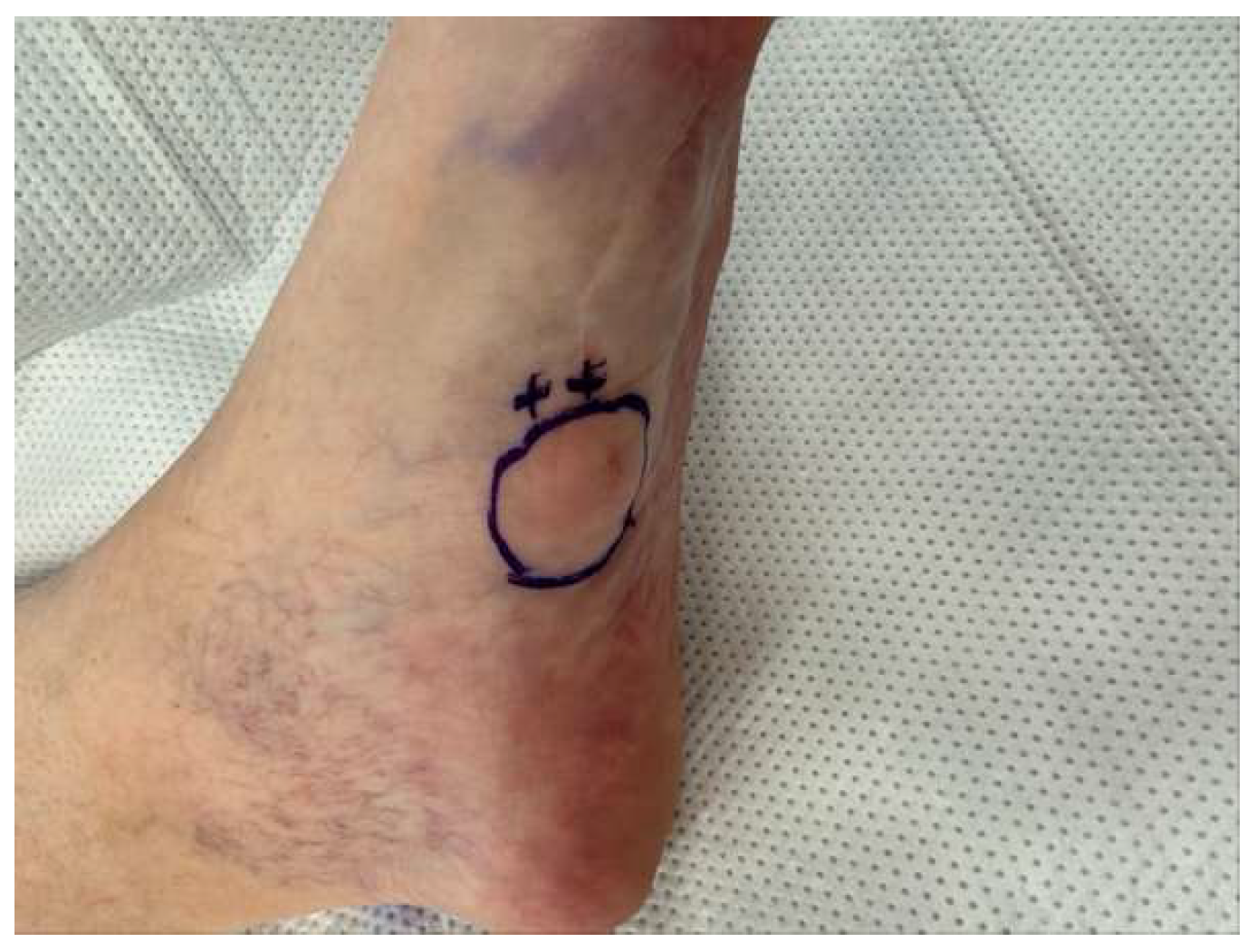
- The patient sits supine in the exam chair, with feet placed on the footrest. The fibrotic nodules within the plantar fascia are identified through palpation or guided by imaging techniques such as ultrasound. The injection sites are marked with a marking pen based on the location and distribution of nodules (Figure 1).
- The injection site is prepared by disinfecting the plantar surface, typically using an antiseptic solution.
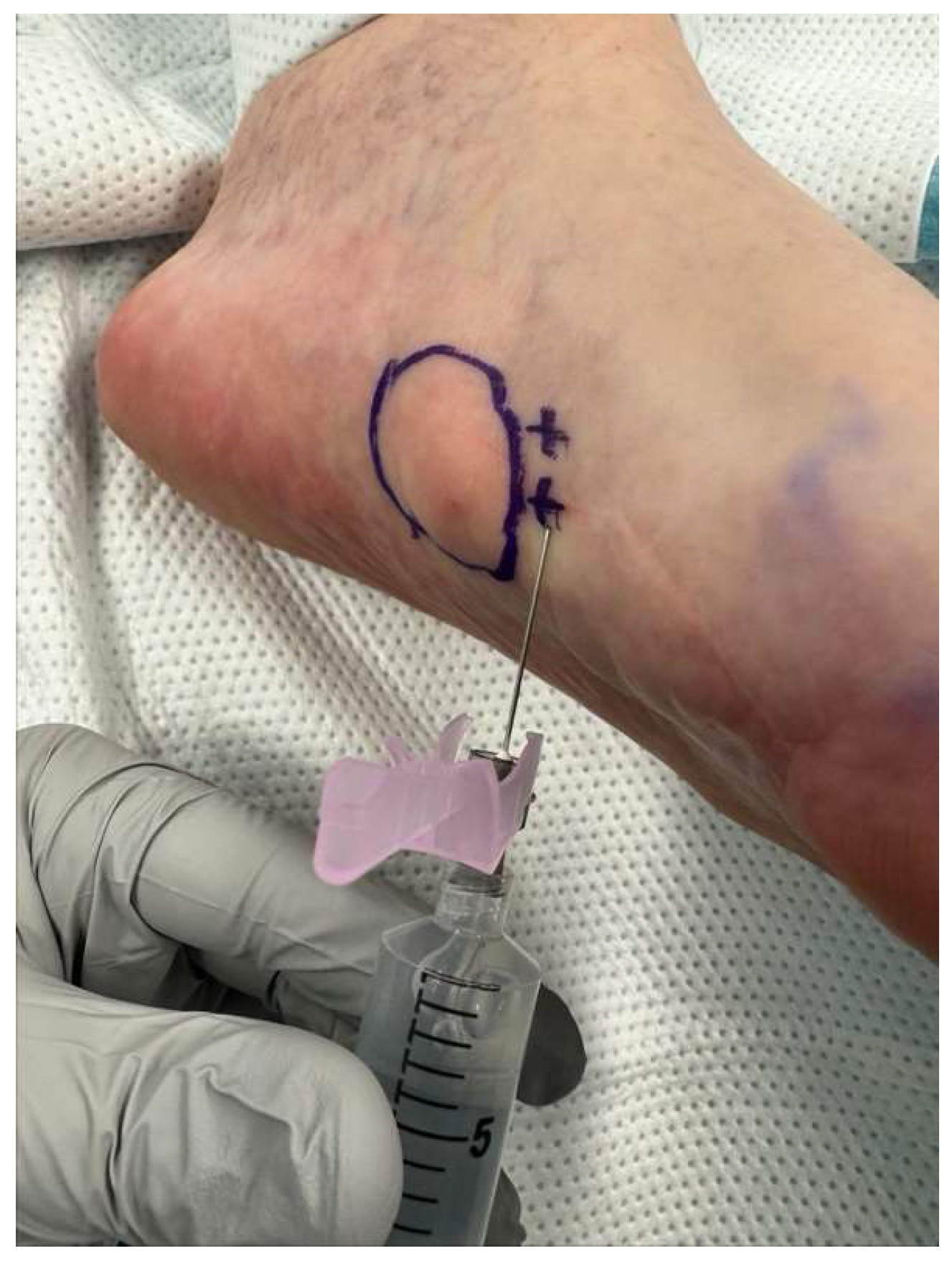
- Ethyl chloride spray is recommended to anesthetize the skin prior to injection. Approximately 3–5 milliliters (mL) of lidocaine 1% or 2% with epinephrine 1:100,000 is infiltrated around the lesion with a 25-gauge, 1-1/2” needle. The needle is inserted at the marked sites, aiming to reach the fibrotic nodules within the plantar fascia (Figure 2).
- For each fibroma, using the sterile technique, a recommended combination of 1 mL of hyaluronidase (150 international units [IU]), 1 mL of lidocaine 1% plain or local anesthetic of choice, and 0.25 mL of triamcinolone acetonide (Kenalog-40) is prepared in a 3 mL syringe with a 22-gauge, 1-1/2” needle.
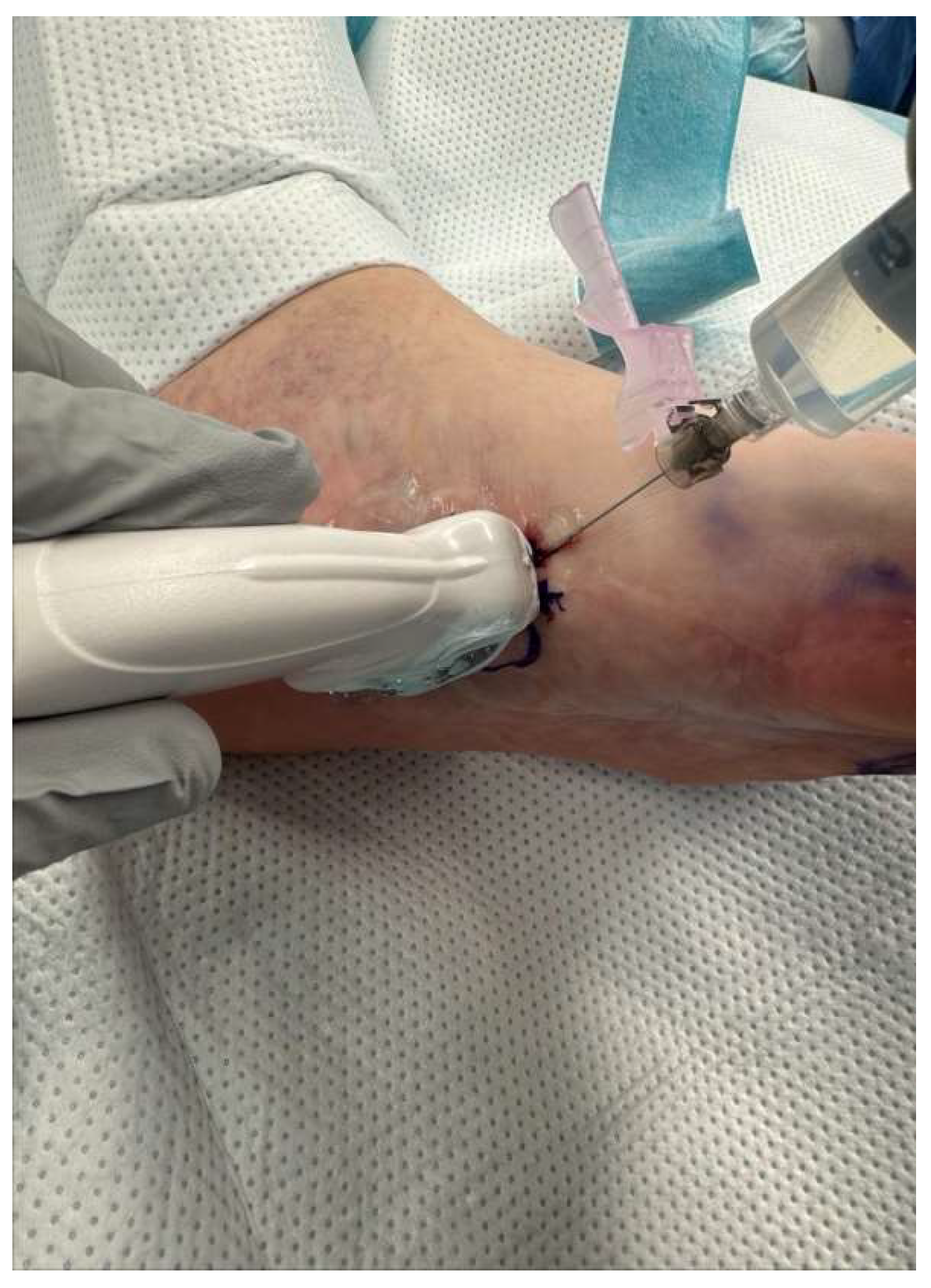
- The fibroma is visualized under ultrasound (performing the injection with ultrasound is recommended to increase accuracy). The prepared hyaluronidase solution is injected into the targeted nodules at the marked sites. The fibroma is infiltrated with approximately half of the solution into the center of the lesion, with the remaining solution infiltrated around the fibroma. Care is taken to ensure a slow and controlled injection, allowing for optimal diffusion of the enzymatic solution within the fibrous tissue. These steps are repeated for each fibroma (Figure 3).
- Post-Injection Care: The patient is allowed to immediately bear weight in their desired footwear. The patient is informed that they may experience increased pain over the next few days.
- Protocol: A series of three injections at three-week intervals should be considered. After the third set of injections, depending on the size and pain level of the fibroma, additional injections at three-week intervals may be continued. Once the fibroma is no longer symptomatic, it is recommended that patients start application of verapamil 15% transdermal gel, one to two times a day, indefinitely over each mass. For multiple lesions on one foot, a posterior tibial nerve block may be performed for better pain relief during injections.
3. Case Studies
4. Discussion
5. Conclusions
Author Contributions
Funding
Institutional Review Board Statement
Informed Consent Statement
Data Availability Statement
Conflicts of Interest
References
- Schurer, A.; Manley, G.; Wach, W. International Patient Survey (Part 2: Ledderhose Disease). In Dupuytren Disease and Related Diseases—The Cutting Edge; Werker, P., Dias, J., Eaton, C., Reichert, B., Wach, W., Eds.; Springer: Cham, Switzerland, 2017. [Google Scholar]
- Sammarco, G.J.; Mangone, P.G. Classification and treatment of plantar fibromatosis. Foot Ankle Int. 2000, 21, 563–569. [Google Scholar] [CrossRef] [Scilit]
- Walraven, M.; Hinz, B. Therapeutic approaches to control tissue repair and fibrosis: Extracellular matrix as a game changer. Matrix Biol. 2018, 71–72, 205–224. [Google Scholar] [CrossRef] [Scilit] [PubMed]
- Tomac, A.; Ion, A.P.; Opriș, D.R.; Arbănași, E.M.; Ciucanu, C.C.; Bandici, B.C.; Coșarcă, C.M.; Covalcic, D.C.; Mureșan, A.V. Ledderhose’s Disease: An Up-to-Date Review of a Rare Non-Malignant Disorder. Clin. Pract. 2023, 13, 1182–1195. [Google Scholar] [CrossRef] [Scilit] [PubMed]
- Flanagan, G.; Burt, N.; Reilly, I. Intralesional fenestration and corticosteroid injection for symptomatic Ledderhose disease of the foot: Two case reports. Sage Open Med. Case Rep. 2021, 9, 1–6. [Google Scholar] [CrossRef] [Scilit]
- Jung, H. Hyaluronidase: An overview of its properties, applications, and side effects. Arch. Plast. Surg. 2020, 47, 297–300. [Google Scholar] [CrossRef] [Scilit]
- Herrera, J.; Henke, C.A.; Bitterman, P.B. Extracellular matrix as a driver of progressive fibrosis. J. Clin. Investig. 2018, 128, 45–53. [Google Scholar] [CrossRef] [Scilit]
- Carroll, P.; Henshaw, R.M.; Garwood, C.; Raspovic, K.; Kumar, D. Plantar Fibromatosis: Pathophysiology, Surgical and Nonsurgical Therapies: An Evidence-Based Review. Foot Ankle Spec. 2018, 11, 168–176. [Google Scholar] [CrossRef] [Scilit]
- Webber, J.; Jenkins, R.H.; Meran, S.; Phillips, A.; Steadman, R. Modulation of TGFbeta1-dependent myofibroblast differentiation by hyaluronan. Am. J. Pathol. 2009, 175, 148–160. [Google Scholar] [CrossRef] [Scilit]
- Midgley, A.C.; Rogers, M.; Hallett, M.B.; Clayton, A.; Bowen, T.; Phillips, A.O.; Steadman, R. Transforming growth factor-β1 (TGF-β1)-stimulated fibroblast to myofibroblast differentiation is mediated by hyaluronan (HA)-facilitated epidermal growth factor receptor (EGFR) and CD44 co-localization in lipid rafts. J. Biol. Chem. 2013, 288, 14824–14838. [Google Scholar] [CrossRef] [Scilit] [PubMed]
- Albeiroti, S.; Soroosh, A.; de la Motte, C.A. Hyaluronan’s Role in Fibrosis: A Pathogenic Factor or a Passive Player? Biomed Res. Int. 2015, 2015, 790203. [Google Scholar] [CrossRef] [Scilit]
- Buhren, B.A.; Schrumpf, H.; Hoff, N.-P.; Bölke, E.; Hilton, S.; Gerber, P.A. Hyaluronidase: From clinical applications to molecular and cellular mechanisms. Eur. J. Med. Res. 2016, 21, 5. [Google Scholar] [CrossRef] [Scilit]
- Lamprakopoulos, A.; Zorzos, I.; Lykourinas, M. The Use of Betamethasone and Hyaluronidase and Lidocaine in the Treatment of Peyronie’s Disease. Scand. J. Urol. Nephrol. 2000, 34, 355–360. [Google Scholar] [CrossRef] [Scilit]
- Bassot, M.J. Traitement de la maladie de Dupuytren par exérèse pharmaco-dynamique isolée ou complétée par un temps plastique uniquement cutané. Lille Chir. 1965, 20, 38. [Google Scholar] [PubMed]
- Hueston, J.T. Enzymic fasciotomy. Hand 1971, 3, 38–40. [Google Scholar] [CrossRef] [Scilit] [PubMed]
- Raghavan, P.; Lu, Y.; Mirchandani, M.; Stecco, A. Human Recombinant Hyaluronidase Injections for Upper Limb Muscle Stiffness in Individuals with Cerebral Injury: A Case Series. EBioMedicine 2016, 9, 306–313. [Google Scholar] [CrossRef] [Scilit]
- Kaul, A.; Short, W.D.; Wang, X.; Keswani, S.G. Hyaluronidases in Human Diseases. Int. J. Mol. Sci. 2021, 22, 3204. [Google Scholar] [CrossRef] [Scilit]
- Meek, R.M.D.; McLellan, S.; Reilly, J.; Crossan, J.F. The effect of steroids on Dupuytren’s disease: Role of programmed cell death. J. Hand Surg. 2002, 27, 270–273. [Google Scholar] [CrossRef] [Scilit] [PubMed]
- Petland, A.P.; Anderson, T.F. Plantar fibromatosis responds to intralesional steroids. J. Am. Acad. Dermatol. 1985, 12, 212–214. [Google Scholar] [CrossRef] [Scilit]
- Ketchum, L.D.; Donahue, T.K. The injection of nodules of Dupuytren’s disease with triamcinolone acetonide. J. Hand Surg. 2000, 25, 1157–1162. [Google Scholar] [CrossRef] [Scilit]
- Lehrman, J.D.; Miceli, A.L.L.; Tabchi, S.G.; Kaplan, M.A. The effects of collagenase clostridium histolyticum on plantar fibromatosis: A case study. J. Foot Ankle 2019, 58, 1281–1284. [Google Scholar] [CrossRef] [Scilit]
- Greenfield, A.; Baez, A.; Humbyrd, C. Ultrasound-Guided Collagenase Injection Therapy of Recurrent Plantar Fibromatosis: A Case Report. Foot Ankle Orthop. 2023, 8, 1–5. [Google Scholar] [CrossRef] [Scilit] [PubMed]
- Durr, H.R.; Krodel, A.; Trouillier, H.; Lienemann, A.; Refior, H.J. Fibromatosis of the plantar fasci: Diagnosis and indications for surgical treatment. Foot Ankle Int. 1999, 20, 13–17. [Google Scholar] [CrossRef] [Scilit] [PubMed]



| Case | Lesion Location | Sex | Age (yrs) | Pre-Treatment Size (cm2) | Post-Treatment Size (cm2) | Absolute Reduction (cm2) | Size Reduction (%) | Hyaluronidase Dose (IU/Injection) | Total Injections |
|---|---|---|---|---|---|---|---|---|---|
| 1 | Left midfoot | F | 49 | 0.64 | 0.04 | 0.6 | 93.8 | 150 | 4 |
| 2 | Left foot #1 | M | 59 | 0.23 | 0.11 | 0.12 | 52.2 | 150 | 3 |
| 2 | Left foot #2 | M | 59 | 0.29 | 0.13 | 0.16 | 55.2 | 150 | 3 |
| 2 | Right foot | M | 59 | 1.51 | 0.89 | 0.62 | 41.1 | 150 | 3 |
| 3 | Right foot | F | 65 | 2.09 | 0.89 | 1.2 | 57.4 | 150 | 4 |
| 3 | Left foot #1 | F | 65 | 0.45 | 0.21 | 0.24 | 53.3 | 150 | 4 |
| 3 | Left foot #2 | F | 65 | 0.56 | 0.23 | 0.33 | 58.9 | 150 | 4 |
| 3 | Left foot #3 | F | 65 | 0.28 | 0.12 | 0.16 | 57.1 | 150 | 4 |
Disclaimer/Publisher’s Note: The statements, opinions and data contained in all publications are solely those of the individual author(s) and contributor(s) and not of MDPI and/or the editor(s). MDPI and/or the editor(s) disclaim responsibility for any injury to people or property resulting from any ideas, methods, instructions or products referred to in the content. |
© 2026 by the authors. Licensee MDPI, Basel, Switzerland. This article is an open access article distributed under the terms and conditions of the Creative Commons Attribution (CC BY) license.
Share and Cite
Carroll, P.; Boudreau, A.; Hu, H.; Lin, R.P.; Louzati, B.; Davis, E. Combination Hyaluronidase and Triamcinolone Acetonide Enzymatic Injections for Treatment of Ledderhose Disease: A Novel Technique and Case Series. Clin. Pract. 2026, 16, 35. https://doi.org/10.3390/clinpract16020035
Carroll P, Boudreau A, Hu H, Lin RP, Louzati B, Davis E. Combination Hyaluronidase and Triamcinolone Acetonide Enzymatic Injections for Treatment of Ledderhose Disease: A Novel Technique and Case Series. Clinics and Practice. 2026; 16(2):35. https://doi.org/10.3390/clinpract16020035
Chicago/Turabian StyleCarroll, Paul, Alyson Boudreau, Haoning Hu, Ryan P. Lin, Bilal Louzati, and Eddie Davis. 2026. "Combination Hyaluronidase and Triamcinolone Acetonide Enzymatic Injections for Treatment of Ledderhose Disease: A Novel Technique and Case Series" Clinics and Practice 16, no. 2: 35. https://doi.org/10.3390/clinpract16020035
APA StyleCarroll, P., Boudreau, A., Hu, H., Lin, R. P., Louzati, B., & Davis, E. (2026). Combination Hyaluronidase and Triamcinolone Acetonide Enzymatic Injections for Treatment of Ledderhose Disease: A Novel Technique and Case Series. Clinics and Practice, 16(2), 35. https://doi.org/10.3390/clinpract16020035