


Abstract
Background/Objectives: The clinical history preceding diabetic ketoacidosis (DKA) and the acute hospital course may reflect different vulnerabilities. We examined factors associated with previous DKA and total hospital length of stay in adults admitted to intensive care. Methods: This retrospective single-center study included 91 unique adults admitted during 2021–2025. Firth logistic regression examined previous DKA among 68 patients with established diabetes. Negative binomial regression with HC3 robust inference examined total hospital stay. A separate post hoc Firth model examined severe acid–base presentation. Results: Previous DKA was documented in 28/68 patients (41.2%) and was associated with established type 1 diabetes (adjusted odds ratio [aOR] 6.09, 95% confidence interval [CI] 1.18–39.83) and recorded psychiatric disorder (aOR 7.35, 95% CI 1.92–36.47). Infection-related presentation was associated with longer stay (adjusted incidence rate ratio 1.40, 95% CI 1.07–1.82; p = 0.013), with standardized means of 11.4 versus 8.1 days. Newly diagnosed diabetes was associated with lower odds of severe acid–base presentation in the exploratory model (aOR 0.24, 95% CI 0.08–0.67). No in-hospital deaths occurred. Conclusions: Previous DKA and hospital stay showed different patterns of association. The estimates were imprecise and apply to a small ICU-selected population. The post hoc severity finding requires replication. These observational associations do not establish causation or support individual prediction.
1. Introduction
Diabetic ketoacidosis (DKA) is an acute metabolic emergency characterized by ketosis and metabolic acidosis in the setting of diabetes or hyperglycemia. The degree of insulin deficiency, counter-regulatory stress and accompanying illness produces a wide clinical spectrum, from metabolic decompensation that responds promptly to treatment to circulatory compromise, neurological disturbance and organ dysfunction. Contemporary guidance has refined diagnosis and treatment, including recognition of presentations without marked hyperglycaemia, but adult DKA populations remain heterogeneous across diabetes types, age groups and healthcare settings [1,2,3].
The burden on health services remains substantial. Population-based studies from the United States and England have reported increasing DKA-related emergency visits or hospital admissions, while trends in length of stay, re-admission and mortality have not been uniform [4,5,6]. More recent US data show an increasing absolute number of ICU admissions for DKA, while the proportion of DKA presentations admitted to intensive care remained broadly stable [7]. Longitudinal data in type 1 diabetes associate previous DKA with subsequent mortality and vascular and acute complications [8]. Earlier DKA also identifies patients at risk of re-admission [9]. Administrative data show that re-admission is socially patterned, indicating that the circumstances surrounding DKA extend beyond the biochemical disturbance measured during an individual admission [10].
Previous DKA often reflects accumulated vulnerability involving insulin interruption, psychiatric illness, substance use, socioeconomic adversity and difficulties maintaining contact with diabetes services [11,12,13,14,15,16,17]. These influences may act through several pathways and should not be reduced to a single label of non-adherence. Their association with earlier DKA need not translate into a corresponding association with the severity of the current episode. Admission physiology also depends on the duration of insulin deficiency, the stress of a concurrent illness and the point at which treatment begins, whereas total hospital stay incorporates treatment of the precipitant and the organization of subsequent care [1,3,18,19]. Distinguishing a patient’s documented DKA history from the acute hospital course may therefore clarify which question each routinely recorded characteristic can reasonably address.
Selection into intensive care is central to that distinction. Contemporary international survey data show variation in the ICU admission criteria and management practices reported by clinicians [20]. Selected patients can be managed through protocolized non-ICU pathways when appropriate monitoring is available [21,22]. International cohorts consequently differ not only in their patients’ characteristics but also in the pathway through which those patients enter the study. At our center, ICU admission is based on severe DKA, haemodynamic or neurological compromise, or comorbidity that complicates treatment. Local data from this selected service can complement international evidence without assuming that an ICU cohort represents all adults with DKA in the surrounding population. This is particularly relevant when interpreting the limited ICU-focused evidence available from South-Eastern Europe.
Newly diagnosed diabetes adds a further source of heterogeneity. Delayed recognition of diabetes can allow substantial insulin deficiency to develop, but new-onset DKA does not necessarily have the same clinical background as DKA in established disease. In established diabetes, interrupted insulin treatment and recurrent difficulties with self-management may contribute, whereas the newly diagnosed group can include both type 1 and type 2 diabetes [1,3,23]. Differences in diabetes-type composition and presentation pathways could therefore influence an observed association between newly diagnosed diabetes and acid–base severity. Such a comparison is exploratory and cannot by itself establish an effect of disease duration.
We characterized adults admitted with DKA to the intensive care service of University Hospital of Split during 2021–2025. The main analyses examined factors associated with a documented history of DKA among patients with established diabetes and with total hospital length of stay. A separate post hoc analysis explored whether newly diagnosed diabetes was associated with a different acid–base presentation from established diabetes.
2. Materials and Methods
2.1. Study Design and Population
This retrospective, single-center observational study included adults aged 18 years or older admitted with DKA to the Department of Internal Medicine, Division of Intensive Care and Clinical Pharmacology with Toxicology, University Hospital of Split, during 2021–2025. Cases were identified by searching the hospital information system and ICU registry, followed by manual review of the clinical documentation. The recorded diagnosis of DKA was reviewed alongside admission glucose, pH, bicarbonate and semiquantitative urine ketone findings. Patient identifiers were checked to identify repeat admissions. The cohort comprised 91 unique patients, each of whom contributed one hospitalization; no patient was hospitalized more than once during the study period. The study is reported in accordance with the STROBE recommendations [24].
ICU admission was considered for severe DKA, haemodynamic instability, altered consciousness or comorbidity that complicated treatment, with decisions made in consultation with the attending physician. Admission was therefore not restricted to patients with a severe acid–base classification. Patients with a mild acid–base presentation could receive ICU care when their accompanying illness or clinical condition required intensive monitoring or treatment.
Patients were transferred from the ICU to the Endocrinology ward after metabolic and clinical stabilization, once intensive monitoring was no longer required.
The study was conducted in accordance with the Declaration of Helsinki and approved by the Ethics Committee of University Hospital of Split (Class 520-03/26-01/145; Registry No. 2181-147/01/06/LJ.Z.-26-02; decision dated 25 June 2026).
2.2. Clinical Data, Definitions, and Outcomes
For each patient, we recorded demographic and anthropometric characteristics, diabetes type and duration, comorbidities, admission vital signs and laboratory findings, the clinical context of DKA, disposition, follow-up status and total hospital length of stay. Diabetes was considered newly diagnosed when it was first recognized during the index hospitalization and established when the diagnosis was already known before admission. Presentation status and diabetes type were recorded separately. Descriptive analyses used three mutually exclusive groups: newly diagnosed diabetes, established type 1 diabetes and established type 2 diabetes.
Among patients with established diabetes, duration was categorized as ≤5 years, including a duration of less than 1 year; >5 to 10 years; or >10 years. These categories were coded 1, 2 and 3, respectively. Newly diagnosed diabetes was coded separately as 0 and was not included in the previous-DKA model. A history of previous DKA required at least one hospitalization before the index admission, confirmed by an available discharge summary from University Hospital of Split or another hospital.
Psychiatric disease was recorded when a psychiatric diagnosis was already documented before the index hospitalization. All 19 diagnoses predated that admission; none was first established during the index hospitalization. The variable encompassed depressive, anxiety, trauma-related, eating, bipolar and psychotic disorders, together with documented opiate addiction. Other comorbidities were recorded from the clinical documentation. Body mass index was recalculated from height and weight, and the anion gap as sodium minus chloride minus bicarbonate.
Newly diagnosed diabetes was treated as presentation status rather than as a mutually exclusive precipitant. Infection-related presentation required an infection present at admission, documented by the treating physician and supported by a compatible clinical presentation and appropriate microbiological, imaging or other site-specific findings. Infections that developed only during hospitalization were not classified as presenting precipitants. Among patients with established diabetes, the presentation context was described as poor diabetes control without recorded infection or infection-related presentation, with or without poor diabetes control. Infection was also coded independently in the full cohort because it could coexist with newly diagnosed diabetes.
DKA severity was summarized using a modified acid–base classification derived from the classic American Diabetes Association thresholds [25]. Mild presentation was defined by pH 7.25–7.30 or bicarbonate 15–18 mmol/L, moderate presentation by pH 7.00 to <7.25 or bicarbonate 10 to <15 mmol/L, and severe presentation by pH < 7.00 or bicarbonate <10 mmol/L. When pH and bicarbonate indicated different categories, the more severe category was used. This classification did not incorporate mental status or quantitative blood ketone concentrations and was not intended to reproduce the full clinical severity assessment. Urine ketones were assessed semiquantitatively using dipsticks; quantitative blood β-hydroxybutyrate was not measured.
Patients were treated using an ADA-based protocol for fluid and insulin management [25]. Clinical resolution of DKA was defined by glucose <11.1 mmol/L together with at least two of the following: bicarbonate ≥15 mmol/L, venous pH >7.3 or anion gap ≤12 mmol/L [25].
The main outcomes were a documented history of previous DKA among patients with established diabetes and total hospital length of stay, measured in days. Severe acid–base presentation was examined as a separate exploratory outcome. SAPS II-derived predicted in-hospital mortality was used as a summary of acute physiological risk in a sensitivity analysis of length of stay [26]. Separate ICU length of stay and prior exposure to SGLT2 inhibitors, continuous glucose monitoring or insulin-pump therapy were not collected.
2.3. Statistical Analysis
Continuous variables are reported as median and interquartile range (IQR), and categorical variables as number and percentage. The variables used in the main analyses, including HbA1c, SAPS II-derived predicted mortality and lactate, were available for all 91 patients. Exploratory two-group comparisons used the Mann–Whitney U test for continuous variables and Fisher’s exact test for categorical variables. The Benjamini–Hochberg procedure controlled the false discovery rate within each family of comparisons [27].
Previous DKA was modeled among the 68 patients with established diabetes, 28 of whom had a documented earlier episode. Firth penalized logistic regression was used because the outcome count was modest and several covariate patterns were sparse [28,29]. The model included age per 10 years, type 1 diabetes, recorded psychiatric disorder and diabetes-duration category as an ordinal term. Sensitivity analyses added HbA1c and represented diabetes duration with separate nominal categories. Adjusted odds ratios (aORs), profile penalized-likelihood 95% confidence intervals (CIs) and penalized likelihood-ratio p values are reported.
Total hospital length of stay was analyzed using negative binomial regression with a log link and HC3 heteroscedasticity-consistent standard errors. The predictors were infection-related presentation, severe acid–base DKA and age per 10 years. Sensitivity analyses added SAPS II-derived predicted mortality and, separately, included previous DKA among the 68 patients with established diabetes. The latter model excluded newly diagnosed patients, for whom previous DKA was not applicable. Standardized fitted mean stays under infection-related and other presentations were averaged over the observed covariate distribution, with delta-method CIs based on the HC3 covariance matrix.
A separate post hoc exploratory Firth model examined severe versus mild or moderate acid–base presentation in all 91 patients. The covariates were newly diagnosed versus established diabetes, age per 10 years, sex and infection-related presentation. Component analyses defined severe presentation separately as pH < 7.00 and bicarbonate <10 mmol/L. An additional sensitivity model adjusted for actual diabetes type. Adjusted probabilities for newly diagnosed and established diabetes were marginally standardized to the observed age, sex and infection distribution, using delta-method CIs.
Sample size was determined by all eligible ICU admissions during the study period; no a priori sample-size calculation was performed. Statistical analyses were performed in RStudio version 2026.05.0 (Posit Software, PBC) using R version 4.6.0 (24 April 2026). Firth models maximized the Jeffreys-penalized likelihood; negative binomial parameters were estimated by maximum likelihood, with HC3 inference based on the GLM information and leverage. Tests were two-sided, and p values and 95% CIs are reported.
Generative-AI assistance was used in preparing analytical code and revising the manuscript. Numerical estimates were obtained by executing the analytical scripts on the study data, and code and outputs were checked against the source records.
3. Results
3.1. Clinical Profile of the Study Cohort
The cohort comprised 91 unique adults; median age was 43 years (IQR 26.5–63.5), and 51 (56.0%) were men. Diabetes was newly diagnosed in 23 patients (25.3%), including 8 with type 1 and 15 with type 2 diabetes. Among 68 patients with established diabetes, 43 had type 1 and 25 had type 2 diabetes (Table 1).
Table 1.
Clinical characteristics by diabetes presentation group.
A previously documented psychiatric disorder was present in 19 patients (20.9%); depression was the most frequent diagnosis (n = 7), followed by post-traumatic stress disorder (n = 3). The remaining diagnoses included anxiety, eating, bipolar and psychotic disorders and opiate addiction. Infection-related presentation occurred in 18 patients (19.8%): respiratory infection in 9, urinary tract infection in 6, gastrointestinal infection in 2 and prostatitis in 1 (Supplementary Table S4).
Two newly diagnosed patients also had an infection. Among patients with established diabetes, 52/68 (76.5%) presented without recorded infection and 16/68 (23.5%) with infection. The modified acid–base classification identified 5 mild, 35 moderate and 51 severe presentations. Median total hospital stay was 8 days (IQR 5.5–10.5); 69 patients were transferred to Endocrinology and 22 were discharged directly after intensive-care treatment. There were no in-hospital deaths.
3.2. Documented History of Previous DKA
Previous DKA was documented in 28/68 patients with established diabetes (41.2%). It was present in 25/43 patients with established type 1 diabetes (58.1%) and 3/25 with type 2 diabetes (12.0%), and in 13/17 patients with a recorded psychiatric disorder (76.5%) versus 15/51 without one (29.4%). Unadjusted comparisons are presented in Supplementary Table S1.
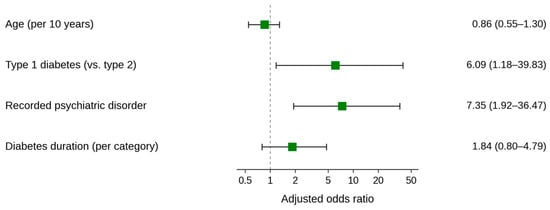
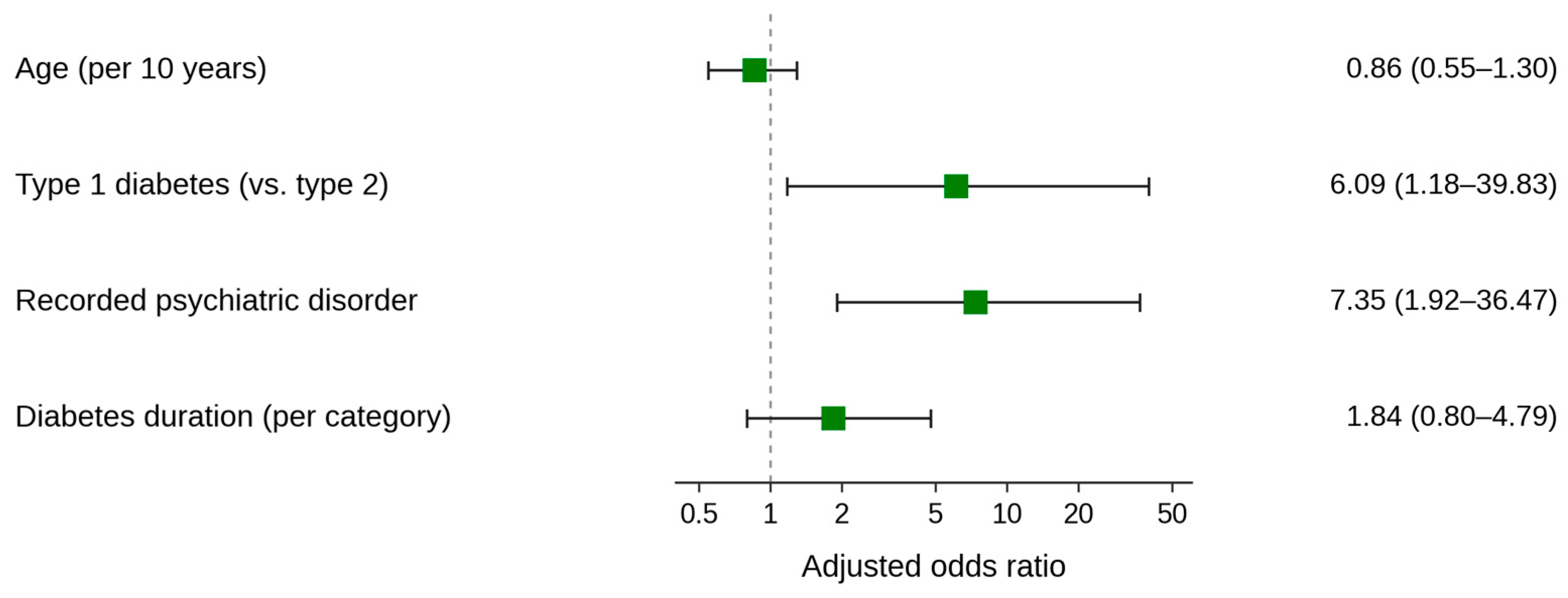
In the primary Firth model, established type 1 diabetes (aOR 6.09, 95% CI 1.18–39.83; p = 0.031) and recorded psychiatric disorder (aOR 7.35, 95% CI 1.92–36.47; p = 0.003) were associated with previous DKA. Both estimates had wide confidence intervals (Table 2 and Figure 1). The associations persisted in models adding HbA1c or representing diabetes duration as nominal categories (Supplementary Table S2).
Table 2.
Firth penalized logistic model for documented previous DKA.
Figure 1.
Adjusted odds ratios for documented previous DKA. Squares indicate adjusted estimates and horizontal lines profile penalized-likelihood 95% CIs. The vertical reference line indicates an OR of 1; the horizontal scale is logarithmic.
3.3. Hospital Length of Stay
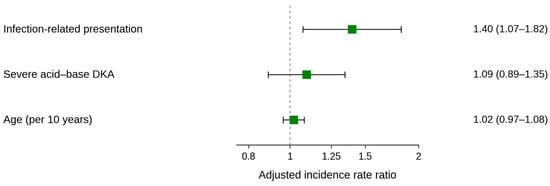
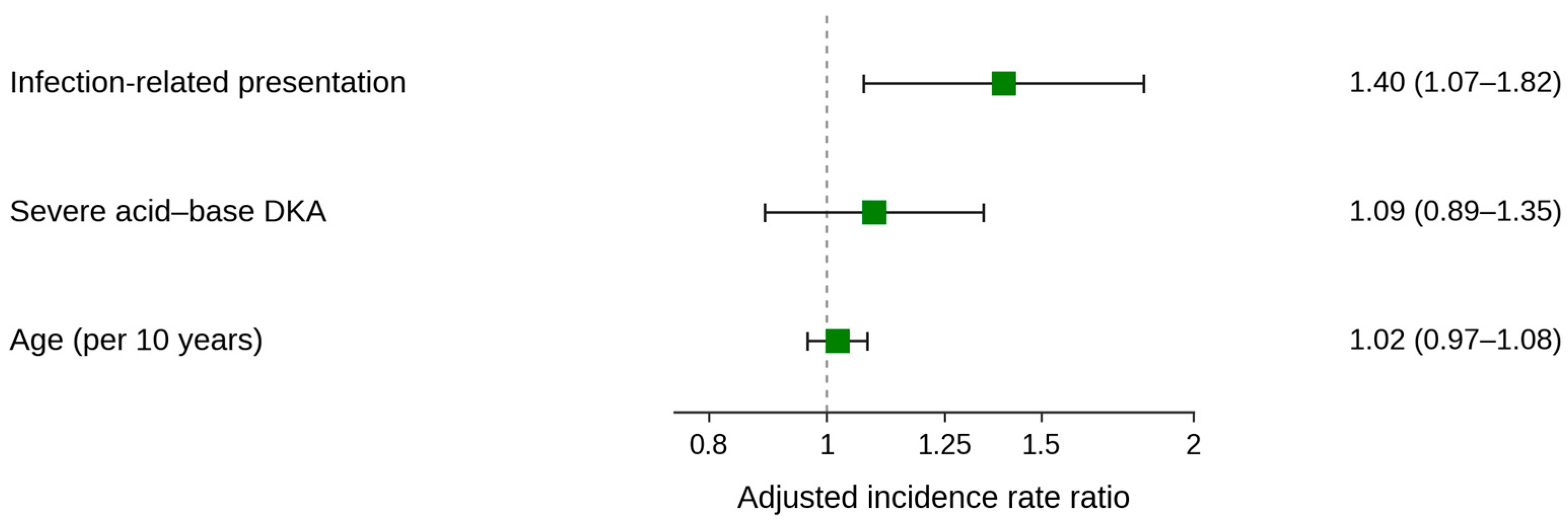
Median total hospital stay was 10 days (IQR 6–16) for infection-related presentations and 8 days (IQR 5–10) for other presentations. After adjustment for age and severe acid–base presentation, infection was associated with a longer expected stay (adjusted incidence rate ratio [aIRR] 1.40, 95% CI 1.07–1.82; p = 0.013; Table 3 and Figure 2).
Table 3.
Negative binomial model for total hospital length of stay.
Figure 2.
Adjusted incidence rate ratios for total hospital length of stay. Squares indicate adjusted estimates and horizontal lines HC3 robust 95% CIs. The reference line indicates an IRR of 1; the horizontal scale is logarithmic.
Standardized adjusted mean stays were 11.4 days (95% CI 8.6–14.1) with infection and 8.1 days (7.2–9.0) without infection, an adjusted difference of 3.2 days (95% CI 0.4–6.1). The infection estimate was similar after adding SAPS II-derived predicted mortality and, in the established-diabetes model, additionally including previous DKA (Supplementary Table S3).
3.4. Exploratory Analysis of Severe Acid–Base Presentation
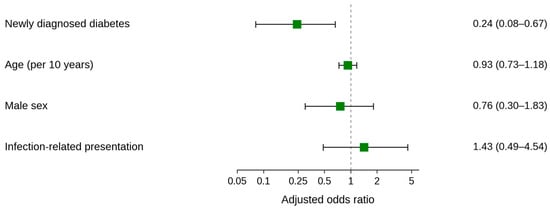
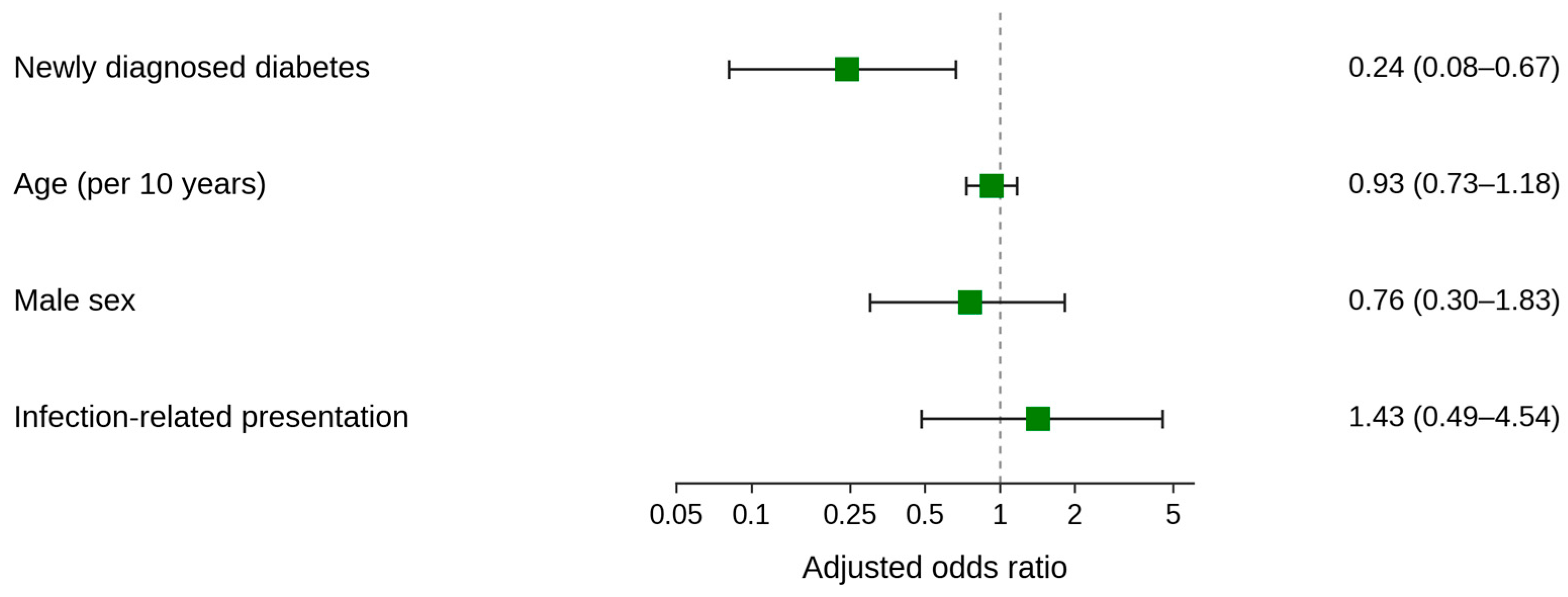
Severe acid–base presentation occurred in 7/23 patients with newly diagnosed diabetes (30.4%) and 44/68 with established diabetes (64.7%). In the post hoc Firth model, newly diagnosed diabetes was associated with lower odds of severe presentation (aOR 0.24, 95% CI 0.08–0.67; p = 0.006; Table 4 and Figure 3). The association remained after additional adjustment for diabetes type (aOR 0.24, 95% CI 0.07–0.76; p = 0.015).
Table 4.
Post hoc Firth model for severe acid–base presentation.
Figure 3.
Adjusted odds ratios for severe acid–base presentation in the post hoc model. Squares indicate adjusted estimates and horizontal lines indicate profile-penalized likelihood 95% CIs. The reference line indicates an OR of 1; the horizontal scale is logarithmic.
Standardized probabilities of severe presentation were 30.8% (95% CI 15.2–52.4%) for newly diagnosed and 64.3% (52.2–74.8%) for established diabetes. Component analyses using pH <7.00 or bicarbonate <10 mmol/L yielded estimates in the same direction (Supplementary Table S5). These analyses were exploratory.
4. Discussion
The principal findings concern a documented history of DKA and the current hospital course, which are related but distinct outcomes. Among patients with established diabetes, type 1 diabetes and recorded psychiatric disorder were associated with previous DKA. Infection-related presentation was associated with a longer total hospital stay. The estimates identify patterns within a small, clinically selected ICU cohort, rather than independent causes or reliable predictors for individual patients. A separate post hoc analysis suggested less frequent severe acid–base presentation in newly diagnosed diabetes, but that comparison requires particular caution because the groups differed in diabetes-type composition.
The psychiatric association is consistent with observational studies and systematic review evidence linking repeated DKA to psychological and social vulnerability [10,11,12,13,14,15]. The recorded diagnoses in this cohort were heterogeneous: depression was most frequent, but trauma-related and anxiety disorders, bulimia, bipolar disorder, schizophrenia and opiate addiction were also represented. All were known before the index admission, which excludes psychiatric diagnoses first made during that hospitalization as the basis of the observed variable. It does not establish that a diagnosis preceded the earlier DKA episode, nor that the different conditions share the same relationship with DKA. The pooled coefficient cannot be attributed to depression or any other individual diagnosis.
Several clinically plausible pathways may connect these conditions with difficulties managing diabetes. Symptoms, treatment burden, disrupted routines and reduced access to support can affect insulin administration or recognition of deteriorating glycaemic control. Intentional and unintentional insulin interruption may coexist with practical barriers. Recent qualitative research has identified limited access to ketone-testing supplies, mental-health challenges and fear of stigma as barriers to DKA prevention [16]. None of these mechanisms was measured directly here. We therefore cannot determine whether psychiatric morbidity itself, its consequences for daily care, associated social conditions or other unmeasured factors explain the association. Recording a psychiatric diagnosis should not be interpreted as evidence of non-adherence.
Documentation also affects what can be observed. Patients with repeated healthcare contact have more opportunities for an existing psychiatric condition to be recognized and entered into the record. Under-recognition among patients with fewer contacts could exaggerate the apparent separation between history groups. Although diagnoses were already known at the index admission, the direction of the relationship with earlier DKA remains unresolved. Metabolic crises may themselves intensify distress, and longitudinal evidence links DKA admission with subsequent serious psychological outcomes [30].
The association with established type 1 diabetes is biologically plausible because sustained exogenous insulin is necessary to prevent ketogenesis [1,3]. However, diabetes type is also linked to age at diagnosis, treatment modality and the length of time during which an earlier episode could have occurred. Adjustment for broad duration categories cannot fully account for these differences. Prospective evidence demonstrates substantial variation in DKA risk within type 1 diabetes itself [31]. The wide confidence interval in our model therefore matters: the direction of the association was more informative than its precise magnitude. The analysis concerns documented previous events and does not estimate the probability of a future recurrence after discharge.
For infection, total hospital stay is an organizational as well as a clinical endpoint. The observed association may reflect treatment of the concurrent infection, diagnostic investigations, comorbidity and the timing of transfer or discharge. It should not be interpreted as a causal effect of infection on the speed of DKA resolution. Other DKA cohorts show that inpatient outcomes depend on comorbidity and accompanying illness, and that total stay need not correspond closely to biochemical recovery [18,19,32,33]. Separate ICU stay and time to metabolic resolution were not collected, so these components cannot be disentangled in the present analysis. The shorter unadjusted stay among patients with previous DKA could reflect differences in recognition or care pathways; the established-diabetes sensitivity analysis did not establish a clear independent association with stay.
The lack of a clear association between the severe acid–base category and total stay does not establish that physiological severity is unimportant. A single admission classification captures only part of an evolving illness, while subsequent management and discharge processes can weaken its relationship with total hospital days. Studies examining biochemical normalization and hospital utilization have used different outcomes and care settings [33,34]. Our estimate is consequently best read as an imprecise secondary coefficient within the specified model, not as evidence that severity has no bearing on clinical management.
Selection into intensive care places an additional limit on both analyses. At this center, ICU admission depends on haemodynamic or neurological compromise and treatment-complicating comorbidity as well as acid–base severity. A patient with mild biochemical DKA may therefore enter the cohort for reasons different from those of a patient with profound acidosis. Conditioning on ICU admission can alter the observed relationships between these characteristics. Internationally reported differences in ICU admission criteria and observational evidence on protocolized non-ICU pathways illustrate why results from an ICU cohort should not be transferred directly to an unselected emergency-department population [20,21,22]. The single-center setting cannot establish a distinct regional DKA phenotype.
The exploratory comparison of newly diagnosed and established diabetes remains sensitive to case mix. Of the 23 newly diagnosed patients, eight had type 1 and 15 type 2 diabetes, whereas type 1 diabetes predominated among those with established disease. Adjustment for diabetes type did not remove the association with acid–base severity, but it cannot eliminate differences within these broad categories or in the pathway to diagnosis. Residual insulin secretion, preceding treatment and diagnostic delay may contribute to the observed pattern [1,3,23,33]. The small newly diagnosed subgroups do not support firm type-specific conclusions. No inference should be made that newly diagnosed diabetes is intrinsically less dangerous; the finding remains a question for replication rather than an established difference between disease stages.
The severity measure also requires careful naming. Our modified classification used the more severe of pH and bicarbonate and did not include mental status or quantitative ketonemia. It therefore describes acid–base presentation, not the full severity assessment proposed by classic or contemporary consensus guidance [3,25]. pH and bicarbonate can reflect disturbances other than ketoacidosis, including mixed acid–base disorders, and cannot quantify the ketone burden. Component analyses help show whether a result depends entirely on one threshold, but agreement between such analyses does not validate the classification as a comprehensive measure of clinical severity. Hyperosmolality and combined DKA–hyperosmolar presentations may also affect outcomes in ways not captured by this acid–base measure [35].
Several limitations remain despite more detailed clinical definitions. The sample comprised 91 patients, and the previous-DKA model included only 68 patients and 28 events. Firth regression can reduce small-sample bias and address sparse covariate patterns, but it cannot recover information that the study does not contain. Wide intervals remain compatible with substantially different association sizes. Robust covariance estimates likewise do not remove residual confounding. Insulin omission, health literacy, financial or practical barriers, continuity of care and psychiatric treatment were not measured systematically. Prior SGLT2-inhibitor exposure, glucose-monitoring technology and insulin-pump use were not collected. The post hoc severity analysis is additionally vulnerable to chance findings and should remain subordinate to the main analyses.
The clinical implication is a focused, non-stigmatizing assessment after DKA, not a diagnosis-based prediction rule. A known psychiatric disorder may provide a reason to review current mental-health needs, the feasibility of the insulin regimen and access to practical support. It does not identify the cause of an individual episode. Contemporary guidance supports routine psychosocial assessment and referral when indicated [36]. Repeated DKA may warrant specialist mental-health involvement [37]. Completion of structured education and insulin-pump use were associated with lower DKA rates in nationwide observational studies [38,39]. These findings provide a rationale for integrated follow-up, but our study did not test either intervention or establish which patients would benefit most.
Prospective multicenter work should recruit across ICU and non-ICU pathways, document the timing of psychiatric diagnoses and DKA episodes, and collect treatment, technology and social-context variables in a consistent manner. Recording metabolic resolution separately from ICU transfer and hospital discharge would allow the acute physiological response to be distinguished from the broader care process. Larger samples would also permit assessment of individual psychiatric conditions and diabetes-type-specific presentation patterns without relying on unstable small subgroups. Until then, the present findings should be used to frame these questions and describe local clinical experience, rather than to support causal claims or individual risk prediction.
5. Conclusions
In this small ICU cohort, established type 1 diabetes and recorded psychiatric disorder were associated with documented previous DKA, and infection-related presentation was associated with longer total hospital stay. A post hoc association between newly diagnosed diabetes and less severe acid–base presentation warrants replication. Selection into intensive care, residual confounding and imprecise estimates limit interpretation. These findings do not establish causation or support individual risk prediction.
Supplementary Materials
The following supporting information can be downloaded at: https://www.mdpi.com/article/10.3390/clinpract16110204/s1, Table S1: Unadjusted characteristics by previous DKA; Table S2: Sensitivity analyses of previous DKA; Table S3: Sensitivity analyses of total hospital stay; Table S4: Psychiatric diagnoses and infection sites; Table S5: Sensitivity analyses of severe acid–base presentation.
Author Contributions
Conceptualization, M.M., R.Š., M.K. (Marko Kumrić) and J.B.; methodology, M.M., R.Š., M.K. (Marko Kumrić) and J.B.; software, R.Š.; validation, R.Š., M.K. (Marko Kumrić) and J.B.; formal analysis, R.Š. and M.K. (Marko Kumrić); investigation, M.M., V.K., M.K. (Mladen Krnić) and T.T.K.; resources, V.K., M.K. (Mladen Krnić), T.T.K. and J.B.; data curation, M.M., R.Š. and V.K.; writing—original draft preparation, M.M., R.Š. and M.K. (Marko Kumrić); writing—review and editing, M.M., R.Š., M.K. (Marko Kumrić), V.K., M.K. (Mladen Krnić), T.T.K. and J.B.; visualization, R.Š.; supervision, T.T.K. and J.B.; project administration, M.M. and J.B. All authors have read and agreed to the published version of the manuscript.
Funding
This research received no external funding.
Institutional Review Board Statement
The study was conducted in accordance with the Declaration of Helsinki and approved by the Ethics Committee of University Hospital of Split (protocol code 2181-147/01/06/LJ.Z.-26-02) on 25 June 2026.
Informed Consent Statement
Informed consent was waived by the Ethics Committee of University Hospital of Split due to the retrospective nature of the study and the use of routinely collected clinical data.
Data Availability Statement
The data presented in this study are available on request from the corresponding author. The data are not publicly available to protect the privacy and confidentiality of the study participants.
Conflicts of Interest
The authors declare no conflicts of interest.
Abbreviations
The following abbreviations are used in this manuscript:
| DKA | diabetic ketoacidosis |
| HC3 | heteroscedasticity-consistent covariance estimator type 3 |
| SAPS II | Simplified Acute Physiology Score II |
| T1DM | type 1 diabetes mellitus |
| T2DM | type 2 diabetes mellitus |
References
- Dhatariya, K.K.; Glaser, N.S.; Codner, E.; Umpierrez, G.E. Diabetic Ketoacidosis. Nat. Rev. Dis. Primers 2020, 6, 40. [Google Scholar] [CrossRef] [Scilit] [PubMed]
- Farsani, S.F.; Brodovicz, K.; Soleymanlou, N.; Marquard, J.; Wissinger, E.; Maiese, B.A. Incidence and Prevalence of Diabetic Ketoacidosis (DKA) among Adults with Type 1 Diabetes Mellitus (T1D): A Systematic Literature Review. BMJ Open 2017, 7, e016587. [Google Scholar] [CrossRef] [Scilit] [PubMed]
- Umpierrez, G.E.; Davis, G.M.; ElSayed, N.A.; Fadini, G.P.; Galindo, R.J.; Hirsch, I.B.; Klonoff, D.C.; McCoy, R.G.; Misra, S.; Gabbay, R.A.; et al. Hyperglycaemic Crises in Adults with Diabetes: A Consensus Report. Diabetologia 2024, 67, 1455–1479. [Google Scholar] [CrossRef] [Scilit] [PubMed]
- Desai, D.; Mehta, D.; Mathias, P.; Menon, G.; Schubart, U.K. Health Care Utilization and Burden of Diabetic Ketoacidosis in the U.S. Over the Past Decade: A Nationwide Analysis. Diabetes Care 2018, 41, 1631–1638. [Google Scholar] [CrossRef] [Scilit] [PubMed]
- Benoit, S.R.; Hora, I.; Pasquel, F.J.; Gregg, E.W.; Albright, A.L.; Imperatore, G. Trends in Emergency Department Visits and Inpatient Admissions for Hyperglycemic Crises in Adults with Diabetes in the U.S., 2006–2015. Diabetes Care 2020, 43, 1057–1064. [Google Scholar] [CrossRef] [Scilit] [PubMed]
- Zhong, V.W.; Juhaeri, J.; Mayer-Davis, E.J. Trends in Hospital Admission for Diabetic Ketoacidosis in Adults with Type 1 and Type 2 Diabetes in England, 1998–2013: A Retrospective Cohort Study. Diabetes Care 2018, 41, 1870–1877. [Google Scholar] [CrossRef] [Scilit] [PubMed]
- Haas, N.L.; Viderman, D.; Ahdoot, R.; Seiler, K.; Griffey, R.T.; Schneider, R.; Cranford, J.A.; Janke, A.T. National Intensive Care Unit Utilization for Diabetic Ketoacidosis Increased From 2012 to 2022. Acad. Emerg. Med. 2025, 32, 1248–1250. [Google Scholar] [CrossRef] [Scilit] [PubMed]
- Budhram, D.R.; Bapat, P.; Bakhsh, A.; Abuabat, M.I.; Verhoeff, N.J.; Mumford, D.; Orszag, A.; Jain, A.; Cherney, D.Z.I.; Fralick, M.; et al. Prognostic Implications of Diabetic Ketoacidosis in Adults on Long-Term Mortality and Diabetes-Related Complications. Can. J. Diabetes 2024, 48, 462–470.e3. [Google Scholar] [CrossRef] [Scilit] [PubMed]
- Hurtado, C.R.; Lemor, A.; Vallejo, F.; Lopez, K.; Garcia, R.; Mathew, J.; Galindo, R.J. Causes and Predictors for 30-DAY Re-Admissions in Adult Patients with Diabetic Ketoacidosis in the United States: A Nationwide Analysis, 2010–2014. Endocr. Pract. 2019, 25, 242–253. [Google Scholar] [CrossRef] [Scilit] [PubMed]
- Everett, E.; Mathioudakis, N.N. Association of Socioeconomic Status and DKA Readmission in Adults with Type 1 Diabetes: Analysis of the US National Readmission Database. BMJ Open Diabetes Res. Care 2019, 7, e000621. [Google Scholar] [CrossRef] [Scilit] [PubMed]
- Allcock, B.; Stewart, R.; Jackson, M. Psychosocial Factors Associated with Repeat Diabetic Ketoacidosis in People Living with Type 1 Diabetes: A Systematic Review. Diabet. Med. 2022, 39, e14663. [Google Scholar] [CrossRef] [Scilit] [PubMed]
- Garrett, C.J.; Moulton, C.D.; Choudhary, P.; Amiel, S.A.; Fonagy, P.; Ismail, K. The Psychopathology of Recurrent Diabetic Ketoacidosis: A Case–Control Study. Diabet. Med. 2021, 38, e14505. [Google Scholar] [CrossRef] [Scilit] [PubMed]
- Hamblin, P.S.; Abdul-Wahab, A.L.; Xu, S.F.B.; Steele, C.E.; Vogrin, S. Diabetic Ketoacidosis: A Canary in the Mine for Mental Health Disorders? Intern. Med. J. 2022, 52, 1002–1008. [Google Scholar] [CrossRef] [Scilit] [PubMed]
- Del Degan, S.; Dubé, F.; Gagnon, C.; Boulet, G. Risk Factors for Recurrent Diabetic Ketoacidosis in Adults with Type 1 Diabetes. Can. J. Diabetes 2019, 43, 472–476.e1. [Google Scholar] [CrossRef] [Scilit] [PubMed]
- Hare, M.J.L.; Deitch, J.M.; Kang, M.J.Y.; Bach, L.A. Clinical, Psychological and Demographic Factors in a Contemporary Adult Cohort with Diabetic Ketoacidosis and Type 1 Diabetes. Intern. Med. J. 2021, 51, 1292–1297. [Google Scholar] [CrossRef] [Scilit] [PubMed]
- Verhoeff, N.J.; Cheema, W.; Mojdehi, S.; Gad, H.; Mumford, D.; Waniss, M.R.; Orszag, A.; Jain, A.; Bapat, P.; Budhram, D.; et al. Barriers to Diabetic Ketoacidosis Prevention in Adults with Type 1 Diabetes: Implications for Education and Implementation of New Monitoring Technologies. Can. J. Diabetes 2026, 50, 72–81.e2. [Google Scholar] [CrossRef] [Scilit] [PubMed]
- Lyerla, R.; Johnson-Rabbett, B.; Shakally, A.; Magar, R.; Alameddine, H.; Fish, L. Recurrent DKA Results in High Societal Costs—A Retrospective Study Identifying Social Predictors of Recurrence for Potential Future Intervention. Clin. Diabetes Endocrinol. 2021, 7, 13. [Google Scholar] [CrossRef] [Scilit] [PubMed]
- Ata, F.; Khan, A.A.; Khamees, I.; Iqbal, P.; Yousaf, Z.; Mohammed, B.Z.M.; Aboshdid, R.; Marzouk, S.K.K.; Barjas, H.; Khalid, M.; et al. Clinical and Biochemical Determinants of Length of Stay, Readmission and Recurrence in Patients Admitted with Diabetic Ketoacidosis. Ann. Med. 2023, 55, 533–542. [Google Scholar] [CrossRef] [Scilit] [PubMed]
- Takahashi, K.; Uenishi, N.; Sanui, M.; Uchino, S.; Yonezawa, N.; Takei, T.; Nishioka, N.; Kobayashi, H.; Otaka, S.; Yamamoto, K.; et al. Clinical Profile of Patients with Diabetic Ketoacidosis and Hyperglycemic Hyperosmolar Syndrome in Japan: A Multicenter Retrospective Cohort Study. Acta Diabetol. 2023, 61, 117–126. [Google Scholar] [CrossRef] [Scilit] [PubMed]
- Jozwiak, M.; Hayes, M.M.; Canet, E.; Lautrette, A.; Duroyon, M.-M.; Molinari, N.; Jung, B. Management of Diabetic Keto-Acidosis in Adult Patients Admitted to Intensive Care Unit: An ESICM-Endorsed International Survey. Crit. Care 2024, 28, 408. [Google Scholar] [CrossRef] [Scilit] [PubMed]
- Fernando, S.M.; Bagshaw, S.M.; Rochwerg, B.; McIsaac, D.I.; Thavorn, K.; Forster, A.J.; Tran, A.; Reardon, P.M.; Rosenberg, E.; Tanuseputro, P.; et al. Comparison of Outcomes and Costs between Adult Diabetic Ketoacidosis Patients Admitted to the ICU and Step-down Unit. J. Crit. Care 2019, 50, 257–261. [Google Scholar] [CrossRef] [Scilit] [PubMed]
- Rao, P.; Jiang, S.; Kipnis, P.; Patel, D.M.; Katsnelson, S.; Madani, S.; Liu, V.X. Evaluation of Outcomes Following Hospital-Wide Implementation of a Subcutaneous Insulin Protocol for Diabetic Ketoacidosis. JAMA Netw. Open 2022, 5, e226417. [Google Scholar] [CrossRef] [Scilit] [PubMed]
- Raubenheimer, P.J.; Skelton, J.; Peya, B.; Dave, J.A.; Levitt, N.S. Phenotype and Predictors of Insulin Independence in Adults Presenting with Diabetic Ketoacidosis: A Prospective Cohort Study. Diabetologia 2024, 67, 494–505. [Google Scholar] [CrossRef] [Scilit] [PubMed]
- Von Elm, E.; Altman, D.G.; Egger, M.; Pocock, S.J.; Gøtzsche, P.C.; Vandenbroucke, J.P. The Strengthening the Reporting of Observational Studies in Epidemiology (STROBE) Statement: Guidelines for Reporting Observational Studies. Lancet 2007, 370, 1453–1457. [Google Scholar] [CrossRef] [Scilit] [PubMed]
- Kitabchi, A.E.; Umpierrez, G.E.; Miles, J.M.; Fisher, J.N. Hyperglycemic Crises in Adult Patients with Diabetes. Diabetes Care 2009, 32, 1335–1343. [Google Scholar] [CrossRef] [Scilit] [PubMed]
- Le Gall, J.-R.; Lemeshow, S.; Saulnier, F. A New Simplified Acute Physiology Score (SAPS II) Based on a European/North American Multicenter Study. JAMA 1993, 270, 2957. [Google Scholar] [CrossRef] [Scilit]
- Benjamini, Y.; Hochberg, Y. Controlling the False Discovery Rate: A Practical and Powerful Approach to Multiple Testing. J. R. Stat. Soc. Ser. B Stat. Methodol. 1995, 57, 289–300. [Google Scholar] [CrossRef] [Scilit]
- Firth, D. Bias Reduction of Maximum Likelihood Estimates. Biometrika 1993, 80, 27–38. [Google Scholar] [CrossRef]
- Heinze, G.; Schemper, M. A Solution to the Problem of Separation in Logistic Regression. Stat. Med. 2002, 21, 2409–2419. [Google Scholar] [CrossRef] [Scilit] [PubMed]
- Petit, J.-M.; Goueslard, K.; Chauvet-Gelinier, J.-C.; Bouillet, B.; Vergès, B.; Jollant, F.; Quantin, C. Association between Hospital Admission for Ketoacidosis and Subsequent Suicide Attempt in Young Adults with Type 1 Diabetes. Diabetologia 2020, 63, 1745–1752. [Google Scholar] [CrossRef] [Scilit] [PubMed]
- Thomas, M.; Harjutsalo, V.; Feodoroff, M.; Forsblom, C.; Gordin, D.; Groop, P.-H. The Long-Term Incidence of Hospitalization for Ketoacidosis in Adults with Established T1D—A Prospective Cohort Study. J. Clin. Endocrinol. Metab. 2020, 105, 231–241. [Google Scholar] [CrossRef] [Scilit] [PubMed]
- Sato, Y.; Morita, K.; Okada, A.; Matsui, H.; Fushimi, K.; Yasunaga, H. Factors Affecting In-Hospital Mortality of Diabetic Ketoacidosis Patients: A Retrospective Cohort Study. Diabetes Res. Clin. Pract. 2021, 171, 108588. [Google Scholar] [CrossRef] [Scilit] [PubMed]
- Ooi, E.; Nash, K.; Rengarajan, L.; Melson, E.; Thomas, L.; Johnson, A.; Zhou, D.; Wallett, L.; Ghosh, S.; Narendran, P.; et al. Clinical and Biochemical Profile of 786 Sequential Episodes of Diabetic Ketoacidosis in Adults with Type 1 and Type 2 Diabetes Mellitus. BMJ Open Diabetes Res. Care 2021, 9, e002451. [Google Scholar] [CrossRef] [Scilit] [PubMed]
- Lee, M.H.; Calder, G.L.; Santamaria, J.D.; MacIsaac, R.J. Diabetic Ketoacidosis in Adult Patients: An Audit of Factors Influencing Time to Normalisation of Metabolic Parameters. Intern. Med. J. 2018, 48, 529–534. [Google Scholar] [CrossRef] [Scilit] [PubMed]
- Pasquel, F.J.; Tsegka, K.; Wang, H.; Cardona, S.; Galindo, R.J.; Fayfman, M.; Davis, G.; Vellanki, P.; Migdal, A.; Gujral, U.; et al. Clinical Outcomes in Patients with Isolated or Combined Diabetic Ketoacidosis and Hyperosmolar Hyperglycemic State: A Retrospective, Hospital-Based Cohort Study. Diabetes Care 2020, 43, 349–357. [Google Scholar] [CrossRef] [Scilit] [PubMed]
- American Diabetes Association Professional Practice Committee for Diabetes. 5. Facilitating Positive Health Behaviors and Well-Being to Improve Health Outcomes: Standards of Care in Diabetes—2026. Diabetes Care 2026, 49, S89–S131. [Google Scholar] [CrossRef] [Scilit] [PubMed]
- Dhatariya, K.K. The Joint British Diabetes Societies for Inpatient Care The Management of Diabetic Ketoacidosis in Adults—An Updated Guideline from the Joint British Diabetes Society for Inpatient Care. Diabet. Med. 2022, 39, e14788. [Google Scholar] [CrossRef] [Scilit] [PubMed]
- Jeyam, A.; Gibb, F.W.; McKnight, J.A.; Kennon, B.; O’Reilly, J.E.; Caparrotta, T.M.; Höhn, A.; McGurnaghan, S.J.; Blackbourn, L.A.K.; Hatam, S.; et al. Marked Improvements in Glycaemic Outcomes Following Insulin Pump Therapy Initiation in People with Type 1 Diabetes: A Nationwide Observational Study in Scotland. Diabetologia 2021, 64, 1320–1331. [Google Scholar] [CrossRef] [Scilit] [PubMed]
- O’Reilly, J.E.; Jeyam, A.; Caparrotta, T.M.; Mellor, J.; Hohn, A.; McKeigue, P.M.; McGurnaghan, S.J.; Blackbourn, L.A.K.; McCrimmon, R.; Wild, S.H.; et al. Rising Rates and Widening Socioeconomic Disparities in Diabetic Ketoacidosis in Type 1 Diabetes in Scotland: A Nationwide Retrospective Cohort Observational Study. Diabetes Care 2021, 44, 2010–2017. [Google Scholar] [CrossRef] [Scilit] [PubMed]

Disclaimer/Publisher’s Note: The statements, opinions and data contained in all publications are solely those of the individual author(s) and contributor(s) and not of MDPI and/or the editor(s). MDPI and/or the editor(s) disclaim responsibility for any injury to people or property resulting from any ideas, methods, instructions or products referred to in the content. |
© 2026 by the authors. Licensee MDPI, Basel, Switzerland. This article is an open access article distributed under the terms and conditions of the Creative Commons Attribution (CC BY) license.